

Submitted:
03 July 2026
Posted:
13 July 2026
You are already at the latest version
Abstract
This review presents a current understanding of the relationship between the structure of multicomponent metallic melts and the processes of amorphization and nanocrystallization. Particular attention is paid to the thermal-temporal treatment (TTT) of melts as a precision method for monitoring the nonequilibrium state of the liquid phase, the relaxation kinetics of cluster associations, and liquid-liquid transitions (LLT). The mechanisms by which precrystallization melt treatment affects the homogeneity of the amorphous precursor, the size of nanograins (7–15 nm), the phase composition (Fe₃Si, Fe₂B), and the resulting magnetic characteristics of toroidal cores (μmax > 600,000, Hc < 0.5 A/m) are investigated. Based on an analysis of structural models of metallic melts (cybotactic, quasicrystalline, and quasichemical), it is shown that critical temperatures, viscosity hysteresis, and oscillatory relaxation serve as indicators of melt equilibrium. It is noted that the optimized TTT protocols combined with controlled annealing at 542–572°C enable the formation of Fe₃Si nanograins with exceptional magnetic softness. The obtained results open the possibility of discussing the prospects for integrating TTT with in situ diagnostics, CALPHAD modeling, and the potential of machine learning for the design of next-generation soft magnetic nanomaterials with tailored frequency characteristics for high-frequency power electronics and their use in electromagnetic shielding.
Keywords:
nanocrystalline soft magnets
; liquid–liquid transition
; melt pre-conditioning
; thermal-temporal treatment
1. Introduction
Soft magnetic nanocrystalline alloys based on the Fe–Si–B–Cu–Nb system (Finemet type) and their analogs remain critically important materials for high-frequency power electronics, next-generation transformers, and electromagnetic shielding applications [1,2,3,4,5,6]. A number of studies have presented a critical analysis of existing theoretical models (in particular, the random anisotropy model), identifying their fundamental shortcomings in fully describing the magnetic behavior of nanocrystalline alloys [7]. Strategic paths for creating next-generation materials that overcome the traditional tradeoff between ultra-low power loss and high saturation induction for use in high-frequency power electronics have been outlined.
Data on the formation mechanisms and methods for producing iron-based nanocrystalline alloys exist, demonstrating how precise adjustment of the chemical composition optimizes their nanoscale microstructure. The ability to achieve high saturation induction (Bs) with low reversal losses positions these alloys as key functional materials for future miniature electronics [8].
Replacing traditional pure electrical iron with amorphous and nanocrystalline soft magnetic materials is being explored to overcome performance limitations in high-frequency magnetic circuits and electromagnetic relays. Dynamic tests and wavelet analysis indicate that the use of nanocrystalline alloys (in particular, 1K107B) significantly improves dynamic response, reduces losses, and increases device accuracy [9]. Laminated nanocrystalline magnetic cores are also used to effectively suppress eddy current losses in high-frequency power electronics. The laminated structure has been shown to not only improve magnetic performance at high frequencies but also significantly enhance the thermal stability of the magnetic cores under harsh operating conditions [10]. Most technological protocols for nanostructure control focus exclusively on annealing after amorphization, while melt preparation before crystallization remains a poorly understood area. Current data confirm that the liquid-metal state is not a passive intermediate phase: its microheterogeneity, cluster dynamics, and relaxation kinetics are directly inherited by the amorphous matrix and determine the uniformity of nanograin nucleation [11,12,13,14].
This review systematizes the results of long-term research in condensed matter physics, the methodology of thermal-temporal treatment (TTT) of melts, and its influence on the properties of nanocrystalline magnetic cores. Particular attention is given to critical temperatures, viscosity hysteresis, liquid-liquid structural transitions (LLTs), and their role in the formation of an equilibrium melt before quenching. The goal of this review is to fill a gap in the literature by linking the fundamental aspects of metallic liquid structure with applied problems in the design of nanomaterials with unique magnetic characteristics.
The behavior of real multicomponent melts based on 3d transition metals cannot be described by the "simple liquid" theory due to directional d-bonds, impurity interactions, and thermal history [15,16,17]. We consider three complementary structural models—cybotactic, quasicrystalline, and quasichemical—and discuss how modern experimental methods (small-angle neutron scattering, in situ X-ray diffraction) confirm the coexistence of several types of clusters in Al-Si, Fe-B, and Fe-Si-B melts near liquidus temperatures [18,19,20]. The dynamics of their dissolution and recombination underlie strategies for controlling the homogeneity of the amorphous precursor [21,22,23].
This paper presents a critical analysis of modern theoretical models (in particular, the random anisotropy model) and identifies their fundamental shortcomings in fully describing the magnetic behavior of nanocrystalline alloys. Strategic pathways are outlined for the development of next-generation materials that overcome the traditional trade-off between ultra-low power loss and high saturation induction for applications in high-frequency power electronics.
2. Structural Models of Multicomponent Metallic Melts
The fundamental question is the structure of the melts. Metallic melts, like any thermodynamic systems, should be divided into two groups: nonequilibrium melts, which temporarily retain structural elements of the original phases, and equilibrium melts, whose structure and properties are determined not by their prehistory but by their composition and state parameters. Both are genetically linked to the original crystalline state. The former by nonequilibrium elements of their structure, the latter by the nature of the interatomic bonds and the short-range order formed [11].
The free energy of such a nonequilibrium system, F = U - TS, exceeds its equilibrium value, Fmin, because the entropy of the ordered regions inherited from the original materials is lower than the equilibrium value, Smax. The motivating factor for studying these, from a thermodynamic point of view, obvious states are well-known experimental facts, such as the dependence [6,11] of the property values of molten samples of practically identical chemical composition on their history (initial materials, heating rates and temperatures), the instability over time of the property values of these melts (Figure 1), the discrepancy between the property values obtained during heating and subsequent cooling of the sample.
The relaxation process of nonequilibrium states, if it occurs at all, often continues for hours. More often, metastable states are established, from which the system cannot spontaneously emerge without thermal or mechanical stimulation. In this case, the simplest means of bringing the melt to equilibrium is additional heating to a fixed temperature.
This threshold nature of the system's transition to equilibrium indicates a kinetic rather than diffusional regime for this process; i.e., it is most often not the migration of particles that limits the process, but their detachment from the nonequilibrium formation, which requires a relatively high activation energy.
The behavior of real multicomponent melts based on 3d transition metals cannot be described by the "simple liquid" theory due to the presence of directional d-bonds, impurity interactions, and thermal history [6,11,17].
Three complementary models are used to describe them:
• The sybotactic model: the melt consists of clusters with short-range order, the boundaries of which are blurred by thermal fluctuations. The cluster lifetime depends on the composition and temperature [11,24].
• The quasi-crystalline model emphasizes the ordering tendency, similar to bcc/fcc packings, without the presence of real microcrystals. It allows for the classification of short-range order types by parameters r₁ and z₁ [24,25].
• The quasi-chemical model takes into account the unequal nature of interatomic bonds. The most stable clusters are formed by components with the highest interaction energy (e.g., Fe–O, Fe–B, Fe–Si) [17,26]. This model is a development of the views of Stewart, Frenkel, and Eyring [11,24]. This is particularly true for transition metals, since the purest melt of such an element, due to its dual nature, can be considered a special case of this model. Its essence is as follows.
1. The melt consists of microregions—clusters—in which the arrangement of atoms is characterized by a certain order—short-range order.
2. Due to the intense thermal motion of the particles, the clusters do not have clear boundaries. For the same reason, the lifetime of an equilibrium cluster is limited and depends on the composition (the types of chemical bonds) and temperature. The simultaneous existence of clusters with two or more types of ordering is possible.
3. The energetic disparity between interatomic interactions of different types causes the formation of clusters of different structures and compositions, with have different stability over time. The most stable and long-lived clusters are formed by the most strongly interacting components (for example, iron and oxygen).
It is precisely this emphasis on the disparity of interatomic bonds as the cause of microheterogeneity that fundamentally distinguishes this model of microheterogeneous melt structure from other variants, and therefore it is called quasi-chemical.
Modern experiments (small-angle neutron scattering, in-situ X-ray diffraction) confirm the coexistence of several types of clusters in Al-Si, Fe-B, and Fe-Si-B melts at temperatures close to the liquidus [6,11,20]. The dynamics of their destruction and recombination underlies the control of the homogeneity amorphous precursor [12,18,23,27].
3. Liquid–Liquid Transitions and Relaxation Kinetics
Understanding the nature of liquid structures and properties has always been a hot field in condensed matter physics and metallic materials science. The liquid is not homogeneous and the local structures inside change discontinuously with temperature, pressure, etc. The liquid will experience liquid−liquid structure transition under a certain condition. Liquid−liquid structure transition widely exists in many metals and alloys and plays an important role in the final microstructure and the properties of the solid alloys. This work provides a comprehensive review on this unique structure transition in the metallic liquid together with the recent progress of its impact on the following microstructure and properties after solidification. These effects are discussed by integrating them into different experimental results and theoretical considerations. The application of liquid−liquid structure transition as a strategy to tailor the properties of metals and alloys is proven to be practical and efficient [28].
Significance Contrary to our intuition, even a single-component substance may have more than 2 liquid states. The transition between them is called “liquid–liquid transition (LLT).” Recently, we have accumulated evidence for the presence of LLT. This transition may have a strong influence on crystallization, if it exists below the melting point of the crystal. Here we show that crystal nucleation rate can indeed be enhanced by many orders of magnitude near the spinodal point of LLT. This may be used not only for the control of crystalline morphology but also for searching LLT in a metastable state, which is hidden behind crystallization. Our finding also sheds light on how crystallization and other liquid-state transitions can be coupled [29].
The liquid–liquid transition (LLT) in multicomponent melts is an irreversible destruction of microheterogeneous structures inherited from the solid charge [11,12,17]. Its indicators are:
• Viscosity, density, and electrical resistivity hysteresis during heating–cooling;
• Critical temperature (tc), at which the energy of thermal motion becomes equal to the rupture energy of the strongest interatomic associations;
• Oscillatory relaxation of properties during isothermal holding, indicating the cooperative destruction of dissipative structures [30,31,32,33].
The microheterogeneous state of a chemically heterogeneous melt is understood as the presence of dispersed particles enriched in one of the components, suspended in an environment of a different composition and separated from it by an interphase surface [17]. The microheterogeneous state is destroyed as a result of an energetic impact on the melt, for example, heating to a temperature specific to each composition. After the irreversible destruction of the microheterogeneous state, the melt passes into the state of a true solution, the conditions of its crystallization change, which is reflected in the microstructure, crystalline structure and mechanical properties of the crystallized metal. The concept of the microheterogeneous state of liquid multicomponent alloys was experimentally substantiated by P. S. Popel, U. Dahlborg, M. Calvo-Dahlborg. Using the method of small-angle neutron scattering in melts of Pb-Sn, Al-Si eutectics, regions enriched in one of the elements, separated from the rest of the liquid alloy by a transition layer, were discovered. Two families of particles have been identified: small particles of 10–40 Å in size and large particles of up to 90 Å in size; as the temperature increases, the particles dissolve and recombine into smaller ones [34].
The relaxation kinetics proceed in a kinetic, rather than a diffusion, regime: the activation energy (34–40 kJ/mol) is comparable to the breaking of metal–oxygen or metal–boron bonds [6,32]. Macroscopic stirring does not accelerate the process, whereas holding at tc for 5–10 min ensures the transition of the melt to an equilibrium state [13,19,21]. Modern studies confirm that LLT can be used as a strategic tool to control the nucleation rate and crystallite morphology, which determine the mechanical and thermal properties of the material [5,6,32,33].
4. Thermal-Temporal Treatment (TTT) Pre-Conditioning as a Protocol
There are various methods for bringing a melt to equilibrium. The most readily available method for producing an equilibrium melt is high-temperature treatment. Since the process of bringing a system to equilibrium as a result of heating is non-monotonic and greatly accelerates upon reaching critical temperatures, heating the metal to these temperatures is a key feature of new, advanced technologies. When cooling the liquid metal prepared in this way, its original (non-equilibrium) structure is not restored; i.e., before crystallization, the melt structure is at or near equilibrium and differs significantly from the original.
The results of numerous experiments and the resulting concepts formed the basis for a promising technological method for managing the quality of metal products through targeted thermal treatment of the structure of liquid metal. As already noted, this method is called thermal-temporal treatment (TTT) of the melt [11]. In general, the TTT cycle is represented graphically in temperature-time coordinates (Figure 2).
Thermal-temporal treatment (TTT) of the melt is a strictly regulated cycle that ensures the transition of the liquid phase to an equilibrium state before crystallization or amorphization [11,13]. The basic protocol includes:
1. Heating to tc (or tan if a temperature anomaly is detected);
2. Holding for τobr (determined by the damping of viscosity/magnetic susceptibility oscillations);
3. Accelerated cooling to the tapping/quenching temperature (ttap);
4. Holding for τtap (stabilization before casting).
5. Effective metal stirring allows for a shorter holding time at critical temperatures.
The effectiveness of TTT has been confirmed for over 100 grades of steels and alloys: it reduces chemical inhomogeneity, refines the dendritic structure, and increases plasticity and heat resistance [11,36,37]. In the context of nanomaterials, TTT should be performed immediately before amorphization, since intermediate crystallization and subsequent phase transformations restore the nonequilibrium state of the melt [35,38,39]. Comparison with conventional superheating shows that TTT reduces flow turbulence, improves castability, and increases the thickness stability of the amorphous ribbon [13,19,21].
5. TTT as a Precursor for Amorphization and Nanocrystallization
Studies of the physical properties of liquid iron-, nickel-, and cobalt-based alloys intended for the production of amorphous materials deserve special attention. This is due, on the one hand, to high crystallization rates and the preservation of the structural features of the liquid metal in the solid state, and, on the other hand, to the significant influence of kinematic viscosity and surface properties on the technology for producing amorphous ribbons [35].
Alloys with a high content of amorphizers (Fe-Si-B-Cu-Nb-Mo) are characterized by high absolute viscosity values in the pre-solidus region ((14–20)·10⁻⁷ m²/s), which creates technological difficulties during planar flow casting [35].
A typical temperature dependence of melts with a large number of amorphizing elements is shown in Figure 3.
The critical temperatures tc, heating to which leads to branching of the polytherms of physical properties, the onset temperatures of hysteresis tg, and the magnitude of supercooling Δt are determined.
The presence of hysteresis indicates a nonequilibrium initial state of the melt and the need to achieve tc during the melting process.
It turns out that in some cases, it is advisable to heat the melt only to the anomaly temperature tan. The required melt holding time at tc or tan is determined using the same polytherms and, additionally, by removing the dependence of property values on the isothermal holding time.
The polytherms of viscosity, electrical resistivity, and surface tension demonstrate clear branching at tc, which correlates with the subsequent homogeneity of nanocrystallization (Figure 3).
The kinematic viscosity (Figure 4) of a Finemet-type nanocrystalline magnetic alloy was studied. The first heating regime was to a temperature below tс, followed by quenching. The second heating regime was to a temperature above tс, followed by quenching, as in the first regime. The third heating regime was to a temperature above tс, followed by supercooling and further quenching.
The best performance properties of the belts were obtained in the third mode.
The optimal mode includes heating above tc, holding for 5–10 min, cooling to the liquidus (or below, taking into account Δt), holding for 5 min, and instant quenching [35,39].
The application of TTT allows:
• Destruction of inherited carbide, silicide, and oxide clusters;
• Ensuring a uniform distribution of Cu nuclei in the amorphous matrix;
• Reducing the scatter of properties from ribbon to ribbon.
An analysis of the physical property polytherms of liquid iron-, nickel-, and cobalt-based alloys prone to amorphization reveals the following key patterns. Critical temperatures were established for virtually all the alloys studied. Heating to these temperatures leads to branching of the polytherms of kinematic viscosity, surface tension, electrical resistivity, magnetic susceptibility, and other physical properties. This indicates a nonequilibrium state of the initial melts and the need to achieve a critical temperature during their smelting. Moreover, thermal-temporare treatment of the melt should be performed immediately before producing the amorphous ribbon, rather than at the stage of smelting the blank. Intermediate crystallization of the melt and subsequent solid-phase transformations will again lead to a nonequilibrium state of the melt before its amorphization.
6. Structcure–Property Relationships in Nanocrystalline Magnetic Cores
In its initial state, the alloy is X-ray amorphous (Figure 6). The X-ray diffraction pattern shows a diffuse halo without additional reflections from crystalline phases. Crystallization of the alloy upon heating occurs in a single main stage. A single asymmetric exothermic peak is observed on the HTDT curve in the temperature range of 525-600 °C.
After heat treatment at 522 °C, peaks from the crystalline component appear against the background of the amorphous halo. The main crystalline phase is an ordered Fe3Si solid solution with a lattice parameter of a = 0.56721 nm. With increasing temperature, the intensity of the halo from the amorphous phase decreases, the intensity of the Fe3Si reflections increases, and superstructural reflections become more pronounced. After heat treatment at 542 °C, the alloy is almost completely crystalline—no heat-generating reactions are observed on the HTDT curves.
In the X-ray diffraction patterns of the alloy heat-treated at higher temperatures (552- 602 °C), the halo from the amorphous phase is absent, the lattice parameter of Fe3Si does not change within the limits of determination error.
X-ray diffraction patterns (Cu-Kα radiation) of Fe₇₂.₅Cu₁Nb₂Mo₁.₅Si₁₄B₉ ribbons after annealing at selected temperatures. As-quenched state shows broad amorphous halo. Crystallization onset at 522 °C: emergence of ordered Fe₃Si (DO₃) phase (a = 0.5672 ± 0.0003 nm). Complete nanocrystallization at 542 °C; no amorphous residue detected above 552 °C. Peak indexing: ● Fe₃Si (111), ■ Fe₃Si (200), ▲ Fe₂B (minor phase at Ta ≥ 572 °C). Adapted from [6].
Control of the pre-crystallization melt treatment directly determines the annealing parameters and the final magnetic characteristics. Data for the Fe₇₂.Cu₁Nb₂Mo₁.₅Si₁₄B₉ alloy show:
- Optimal annealing: 542–572 °C;
- μmax: up to 713,000 at 542 °C;
- Hc: minimum 0.41 A/m;
- Grain size: 7–9 nm, with the distribution shifting towards 11–20 nm at Ta > 552 °C.
Magnetic properties of Fe₇₂.₅Cu₁Nb₂Mo₁.₅Si₁₄B₉ nanocrystalline ribbons as a function of annealing temperature (Tan). Samples prepared by planar flow casting (PFC) with TTT-pretreated melt: tc = 1580 °C, τobr = 8 min, cooling rate ≈ 1.2×10⁵ K/s, ribbon thickness 22 ± 2 µm. Measurements at f = 1 kHz, H = 0.4 A/m.
Table 1 shows magnetic properties as annealing temperature.
Grain size distribution in Fe₇₂.₅Cu₁Nb₂Mo₁.₅Si₁₄B₉ nanocrystalline alloys after annealing at selected temperatures. Data from TEM analysis (n = 215 ± 15 grains/sample). Quenching conditions: melt TTT at tc = 1580 °C, τ = 8 min; planar flow casting, wheel speed 35 m/s, ribbon thickness 22 ± 2 µm.
The low initial permeability at 522 °C is due to a significant fraction of the amorphous matrix and incomplete nanocrystallization. The increase in Hc at Ta > 572 °C is associated with the precipitation of the magnetically hard Fe₂B phase [1,38,42].
Figure 7 shows histograms of grain sizes at different heating temperatures of 522, 552 and 602 °C.
Grain boundaries identified via FFT filtering of HRTEM images. Grain size distributions in Fe₇₂.₅Cu₁Nb₂Mo₁.₅Si₁₄B₉ nanocrystalline alloys after annealing at (a) 522 °C, (b) 552 °C, and (c) 602 °C, determined by TEM image analysis (n > 200 grains per sample). Mean grain size: 7 ± 2 nm (522 °C), 9 ± 3 nm (552 °C), 8 ± 3 nm (602 °C). Note the increased fraction of grains >10 nm at higher Ta (Table 2). Scale bars: 20 nm. Adapted from [6].
The average grain size remained virtually unchanged at these temperatures, equaling 7, 9, and 8 nm, respectively. However, the grain size distribution changed with increasing temperature. At a low temperature of 522 °C, a significant maximum of 2-nm grains was observed. These grains, which lack distinct boundaries, are likely nuclei (clusters) of the crystalline phase in the amorphous matrix. At temperatures of 552 °C and 602 °C, the grain size distribution was virtually identical. Moreover, at the higher temperature compared to 522 °C, the proportion of grains larger than 10 nm increased from 20.5 % to 33.5 % (Table 2).
In the nanocrystalline magnetic alloys Fe72.5Cu1Nb2Mo1.5Si14B9, the low initial permeability corresponds to a structure whose proportion in the residual uncrystallized amorphous matrix is significant. The coercivity of the alloy at an annealing temperature of 522 °C is very low. In this region, the low coercivity does not lead to high initial permeability. The highest initial permeability occurs when the structure is characterized by the largest volume of the ordered Fe3Si phase. The increase in the coercivity and the decrease in the initial permeability at high temperatures are explained by the formation of the magnetically hard Fe2B phase [38].
7. Challenges, Scalability, and Future Perspectives
Despite its proven effectiveness, the implementation of TTT in the industrial production of nanocrystalline ribbons faces several barriers:
• The lack of in-situ viscosity and density monitoring systems in real-time on melting installations;
• The energy consumption of long isothermal holds;
• The difficulty of scaling protocols for high-entropy and Co/Ni-based alloys.
Future perspectives include:
• Use of machine learning to optimize temperature-time windows for specific chemical compositions [47,48];
• Development of in-situ diagnostics (synchrotron X-ray, neutron scattering) for direct visualization of LLT and cluster dynamics [12,15,28].
This review represents the result of the authors' many years of research in the field of condensed matter physics. It analyzes current trends in the study of metallic liquids at high temperatures, the structure of multicomponent metallic melts, and specific methods for their analysis. The principles of thermal-temperature treatment of melts are presented. Particular attention is paid to the relationship between the liquid and solid states of metals. The essence of advanced technologies for producing amorphous and nanocrystalline materials is revealed [49,50].
8. Conclusions
1. Thermal-Temporal Treatment (TTT) of metallic melts represents a physically grounded methodology for controlling the nonequilibrium state of the liquid phase, thereby ensuring homogeneity of the amorphous precursor and reproducibility of nanocrystallization. The protocol involves heating to critical temperatures (tc), isothermal holding (τobr = 5–10 min), controlled cooling to tapping temperature, and stabilization prior to casting.
2. Critical temperatures, viscosity hysteresis, and relaxation kinetics serve as key indicators of achieving melt equilibration prior to amorphization. The irreversible nature of structural transformations during heating—evidenced by branching polytherms of viscosity, electrical resistivity, and magnetic susceptibility—confirms the elimination of inherited nonequilibrium clusters.
3. An optimized TTT protocol combined with annealing at 542–572 °C enables the formation of Fe₃Si nanograins with a mean size of 7–9 nm, achieving maximum relative permeability μmax > 600,000 and coercive force Hc < 0.5 A/m. The narrow grain size distribution (σd = 3–4 nm) and minimal fraction of magnetically hard Fe₂B phase are critical for superior magnetic softness.
4. Integration of TTT with modern computational materials science methods (CALPHAD, molecular dynamics), in-situ diagnostics (synchrotron X-ray, neutron scattering), and AI-driven optimization opens pathways for designing next-generation nanocrystalline magnetic cores with tailored frequency response and core loss characteristics for high-frequency power electronics operating in the 1.5–380 GHz range.
Author Contributions
Conceptualization, V.S.T. and K.W.; methodology, V.S.T.; software, N.P.T.; validation, V.S.T., K.W. and N.P.T.; formal analysis, V.S.T.; investigation, K.W.; resources, V.S.T.; data curation, V.S.T.; writing—original draft preparation, V.S.T.; writing—review and editing, V.S.T., R.W. and N.P.T.; visualization, K.W.; supervision, V.S.T.; project administration, N.P.T.; funding acquisition, V.S.T. All authors have read and agreed to the published version of the manuscript.
Funding
This work was carried out with the financial support of the Ministry of Science and Higher Education of the Russian Federation (theme № FEUZ-0226-0013). The APC was funded by MDPI.
Data Availability Statement
The data presented in this article is available upon request from the corresponding author.
Conflicts of Interest
The authors declare no conflict of interest.
Abbreviations
The following abbreviations are used in this manuscript:
| TTT | Thermal-Temporal Treatment |
| LLT | Liquid–Liquid Transition |
| tc | critical temperature for melt equilibration |
| τobr | isothermal holding time at tc |
| μ | relative magnetic permeability |
| Hc | coercive force |
| Finemet-type | Fe-Si-B-Cu-Nb based nanocrystalline soft magnetic alloy |
References
- Kozak, D.S.; Tsepelev, V.S.; Konashkov, V.V.; Vyukhin, V.V.; Zadorozhnyy, V.Y.; Bazlov, A.I.; Kvaratskheliya, A.R.; Tsarkov, A.A.; Van Impe, J.F.M. Thermophysical Properties of the Fe48Cr15Mo14C15B6Y2 Alloy in Liquid State. Metals 2021, 11, 823. [Google Scholar] [CrossRef]
- Chrobak, A.; Ziółkowski, G.; Zivotsky, O.; Pawlik, P.; Klimontko, J. Magnetic Properties of Fe-Nb-B-RE (RE = Tb, Tb/Y, Tb/Nd) Amorphous and Annealed Melt-Spun Ribbons. Crystals 2025, 15, 93. [Google Scholar] [CrossRef]
- Vertman, A.A.; Samarin, A.M. Methods for Studying Properties of Metallic Melts; Metallurgiya: Moscow, Russia, 1969; p. 198. [Google Scholar]
- Yavoiskii, V.I. Theory of Steel Production Processes; Metallurgiya: Moscow, Russia, 1967; p. 792. [Google Scholar]
- Arsentyev, P.P.; Koledov, L.A. Metallic Melts and Their Properties; Metallurgiya: Moscow, Russia, 1976; p. 376. [Google Scholar]
- Tsepelev, V.S. Physics of Amorphous and Nanocrystalline Metallic Melts: Methodology of Analysis; Ural Federal University Press: Ekaterinburg, Russia, 2023; p. 208. ISBN 978-5-7996-3769-9. [Google Scholar]
- Kumar, G.; Ohkudo, T.; Hono, K. Effect of melt temperature on the mechanical properties of bulk metallic glasses. J. Mater. Res. 2009, 24, 2353–2360. [Google Scholar] [CrossRef]
- Lei, X.; Zhou, Y.; Hu, J.; Yu, H.; Xu, S.; Wang, C.; Zheng, L.; Liu, Z. Soft Magnetic Nanocrystalline FeSiBCuCa Alloys with High Electric Resistivity. Metals 2026, 16, 11. [Google Scholar] [CrossRef]
- Ding, D.; You, J.; Cui, X.; Xue, Y.; Tan, X.; Zhai, G. Application of Amorphous and Nanocrystalline Soft Magnetic Materials in Balanced-Force-Type Electromagnetic Relay. Micromachines 2024, 15(3), 368. [Google Scholar] [CrossRef] [PubMed]
- Wan, K. H.; Hsiang, H. I. Next-generation laminated nanocrystalline magnetic cores for high-frequency power electronics: enhancing magnetic properties and thermal stability. JMMM 2025, 629, 173299. [Google Scholar] [CrossRef]
- Baum, B.A.; Khasin, G.A.; Tyagunov, G.V.; Klimenkov, E.A.; Bazin, Y.A.; Kovalenko, L.V.; Mikhailov, V.B.; Raspopova, G.A. Liquid Steel; Metallurgiya: Moscow, Russia, 1984; p. 208. [Google Scholar]
- Zuev, M.V.; Burmasov, S.P.; Stepanov, A.I.; Gudov, A.G.; Murzin, A.V.; Zhitlukhin, E.G. Improvement of modern steelmaking technology based on studying the patterns of metallic melt formation. Electrometallurgy 2013, 4, 10–15. [Google Scholar] [CrossRef]
- Popel, P.S.; Sidorov, V.E.; Brodova, I.G.; Calvo-Dahlborg, M.; Dahlborg, U. Effect of thermal treatment of the initial melt on the structure and properties of crystalline ingots or castings. Melts 2020, 1, 3–36. [Google Scholar] [CrossRef]
- Starodubtsev, Y.; Tsepelev, V. Isobaric Thermal Expansivity and Isothermal Compressibility of Liquid Metals. Materials 2023, 16, 3801. [Google Scholar] [CrossRef] [PubMed]
- Smirnov, L.A.; Gudov, A.G.; Burmasov, S.P.; Oryshchenko, A.S.; Kalinin, G.Y. The Physicochemical Characteristic Study of Melts of Corrosion Resistant Nitrogen-Alloyed Steels. Steel Transl. 2020, 63(9), 679–85. [Google Scholar] [CrossRef]
- Starodubtsev, Y.N.; Tsepelev, V.S.; Tsepeleva, N.P. Kinematic Viscosity of Multicomponent FeCuNbSiB-Based Melts. Nanomaterials 2021, 11, 1042. [Google Scholar] [CrossRef] [PubMed]
- Popel, P.; Carlo-Dahlborg, M.; Dahlborg, U. Metastable microheterogeneity of melts in eutectic and monotectic systems and its influence on the properties of the solidified alloy. J. Non-Cryst. Solids 2007, 353, 3243–3253. [Google Scholar] [CrossRef]
- Ding, Sidan; Hu, Pengqiang; Zhang, Ruisheng; Chen, Hongwen; Wang, Yixin; Ma, Yizhe; Tang, Yichuan; Wang, Kun; Liu, Shaopeng; Zhang, Yin; Zhou, Chao; Yang, Sen. Superior Bs and bending ductility in Fe-Si-B-C-P-Cu nanocrystalline alloys with high Fe content. Rev. Mater. Res. 2026, 2(4), 100200. [Google Scholar] [CrossRef]
- Li, L.; Hu, L.N.; Zhang, L.Y.; et al. Ultra-stable metallic glass generated by modulation of melt state. Rare Met. 2025, 44, 1917–1931. [Google Scholar] [CrossRef]
- Beltyukov, A.L.; Olyanina, N.V. Features of viscosimetric experiment by the oscillating-cup method. Izv. Ferr. Metall. 2026, 69(1), 59–66. [Google Scholar] [CrossRef]
- Tsepelev, V.S.; Starodubtsev, Y.N. Nanocrystalline Soft Magnetic Iron-Based Materials from Liquid State to Ready Product. Nanomaterials 2021, 11, 108. [Google Scholar] [CrossRef] [PubMed]
- Cheng, Q.; Sun, Y.H.; Orava, J.; Wang, W.H. Homogenization of a metallic melt: Enhancing the thermal stability of glassy metal. Mater. Today Phys. 2023, 31, 101004. [Google Scholar] [CrossRef]
- Beltyukov, A.L.; Sterkhova, I.V.; Ladyanov, V.I. Effect of small nickel additions on viscosity of liquid aluminum. J. Mol. Liq. 2019, 296, 111764. [Google Scholar] [CrossRef]
- Baum, B.A. On the relationship between liquid and solid metallic states. Rasplavy 1988, 2, 19. [Google Scholar]
- Arkharov, V.I.; Novokhatskii, I.A. On internal adsorption in melts. Dokl. Akad. Nauk SSSR 1969, 185, 1069–1071. [Google Scholar]
- Tsepelev, V.S.; Starodubtsev, Y.N.; Wu, K.M. Influence of Ni on crystallization and magnetic properties of Fe72.5−xNixCu1Nb2Mo1.5Si14B9 alloys. J. Cryst. Growth 2019, 528, 125256. [Google Scholar] [CrossRef]
- Suzuki, K. Resent advances in nanocrystalline soft magnetic materials: A critical revive for way forward. JMMM 2024, 592, 171677. [Google Scholar] [CrossRef]
- He, Y.; Li, J.-S.; Wang, J.; Beaugnon, E. Liquid–liquid structure transition in metallic melt and its impact on solidification: A review. Trans. Nonferrous Met. Soc. China 2020, 30, 2293–2310. [Google Scholar] [CrossRef]
- Kurita, R.; Tanaka, H. Drastic enhancement of crystal nucleation in a molecular liquid by its liquid–liquid transition. Proc. Natl. Acad. Sci. USA 2019, 116, 24949–24955. [Google Scholar] [CrossRef] [PubMed]
- Tyagunov, A.G.; Baryshev, E.E.; Tyagunov, G.V.; Zaitseva, N.A.; Mushnikov, V.S. Cluster structure of nickel and its alloys with chromium in the liquid state. Melts 2024, 6, 624–632. [Google Scholar] [CrossRef]
- Sidorov, V.E.; Rusanov, B.A.; Petrova, S.A.; Son, L.D.; Ladyanov, V.I. Features of the Electrical Resistance of Co–Fe–Si–B–Nb–REM Alloys in the Amorphous and Crystal States. JTF 2023, 93(1), 117–121. [Google Scholar] [CrossRef]
- Khusnutdinoff, R.M.; Khairullina, R.R.; Beltyukov, A.L.; Sterkhova, I.V.; Suslov, A.A.; Ladyanov, V.I.; Mokshin, A.V. Local Structural Features and Microscopic Dynamics of a Nickel Melt: Experimental Study and Molecular Dynamics Simulation. High Temp. 2023, 61(2), 220–225. [Google Scholar] [CrossRef]
- Prigogine, I. From Being to Becoming; Nauka: Moscow, Russia, 1985; p. 130. [Google Scholar]
- Popel’, P.S.; Sidorov, V.E.; Calvo-Dahlborg, M.; Dahlborg, U.; Molokanov, V.V. Effect of Heat Treatment of a Liquid Alloy on Its Properties in the Molten State and after Amorphization. Metall. 2021, 2021, 88–101. [Google Scholar] [CrossRef]
- Tsepelev, V.S.; Starodubtsev, Yu.N.; Tsepeleva, N.P.; Wu, K.M.; Wang, R.W. Nanotechnology for Obtaining Soft Magnetic Materials. Int. J. Mater. Sci. Eng. 2018, 6(3), 86–92. [Google Scholar] [CrossRef]
- Zhai; Xueting; Li, Xuan; Wang; Zheng; Lina, Hu; Kai, Kai; Song. The connection between the fragile-to-strong transition and the liquid-liquid transition in a binary alloy system. Acta Mater. 2022, 239, 118246. [Google Scholar] [CrossRef]
- Tsepelev, V.; Chikova, O.; Shmakova, K. Model of Temperature-Induced Liquid-Liquid Transition in Metal Alloys. Metall. Mater. Trans. B 2022, 53, 3825–3832. [Google Scholar] [CrossRef]
- Tsepelev, V. Nanocrystalline Soft Magnetic Toroidal Cores of the Highest Relative Magnetic Permeability and Low Coercive Force. Adv. Mater. Res. 2013, 716, 276–280. [Google Scholar] [CrossRef]
- Zivotsky, O.; Titov, A.; Jiraskova, Y.; Bursik, J.; Hendrych, A.; Hrabovska, K.; Tsepelev, V.S. Surface and bulk magnetic anisotropy in bilayered CoSiB/FeNbCuSiB and FeNbSiB/FeSiB ribbons. J. Alloys Compd. 2016, 681, 402–411. [Google Scholar] [CrossRef]
- Dong, Weixia; Liu, Sinan; Wu, Zhenduo; Ma, Jiale; Ren, Yang; Wang; Li, Xun; Lan, Si. Evidence of liquid–liquid phase transition in Zr–Cu–Al melts and its link to glass-forming ability. JournalApplied Phys. Lett. 2025, 127(19), 191903. [Google Scholar] [CrossRef]
- Starodubtsev, Y.N.; Tsepelev, V.S.; Belozerov, V.Y.; Zelenin, V.A. Permeability of Magnetic Cores with Air Gaps. Materials 2022, 15, 1217. [Google Scholar] [CrossRef] [PubMed]
- Chikova, O.A.; Tsepelev, V.S.; Shmakova, K.Y. On Spontaneous Dispersion as a Cause of Microstratification of Metal Melts. Materials 2024, 17, 2215. [Google Scholar] [CrossRef] [PubMed]
- Pastukhov, E.A.; Vatolin, N.A.; Lisin, V.L.; et al. Diffraction Studies of High-Temperature Melts Structure; Ural Branch RAS: Ekaterinburg, Russia, 2003; p. 334. ISBN 5-7691-1308-1. [Google Scholar]
- Vatolin, N.A.; Polukhin, V.A.; Sidorov, N.I. Structural and Dynamic Characteristics of Metallic Melts, Glasses, and Nanocrystals as Functions of Temperature and Hydrogenation. Russ. Metall. 2021, 8, 905–907. [Google Scholar] [CrossRef]
- Gelchinskii, B.R.; Yuryev, A.A.; Zhilina, E.M.; Beltyukova, K.V. Voronoi Polyhedron Investigation of the Short-Range Order in Liquid Bismuth Using Molecular Dynamics Simulation Data. Russ. Metall. 2021, 2021, 987–991. [Google Scholar] [CrossRef]
- Kidari, O.; Chartrand, P. Thermodynamic Evaluation and Optimization of the As–Cd, As–Zn and As–Cd–Zn Systems. Metall. Mater. Trans. B 2023, 54, 2793–2814. [Google Scholar] [CrossRef]
- Liang, Z.; Zhang, X.; Wang, Y.; Lv, S.; Alexandrov, D.V.; Liang, H.; Yang, Y. A Comparative Computational Study of the Solidification Kinetic Coefficients for the Soft-Sphere BCC-Melt and the FCC-Melt Interfaces. Crystals 2024, 14, 292. [Google Scholar] [CrossRef]
- Sun, R.; Liu, L.; He, Y.; Sun, R.; Xu, Z.; Fan, Z.; Zhou, Y.; Hua, C.; Zhou, J.; Ke, H.; Tang, C. Extremely wide annealing processing window in Fe-based amorphous/nanocrystalline alloy guided by machine learning. J. Alloys Compd. 2025, 1025, 180238. [Google Scholar] [CrossRef]
- Jiang, Hao Ran; Gao, Yi Fan; Cao, Lu; Zhong, Qiu; Mu, Yong Kun; Jia, Yan Dong; Wang, Qing; Ren, Jingli; Zhang, Bo; Wang, Gang. Viscosity of a metallic glass-forming liquid by high-rate calorimetry and containerless electrostatic levitation in microgravity. J. Mater. Sci. Technol. 2026, 273(11), 212–222. [Google Scholar] [CrossRef]
- Xiong; Jiankun; Wang; Dayong; Cai; Yangchuan; Zhao; Pengfei; Zhen, Luo. Effect of high-temperature heat treatment on microstructure and properties of FeMnCrNiCo + 20 wt.%TiC high-entropy alloy coating. Appl. Phys. 2022, A 128, 267. [Google Scholar] [CrossRef]
Figure 1.
Temporal instability of the magnetic susceptibility χ dependences of the Fe-Cu-O alloy. Adapted from [6].
Figure 1.
Temporal instability of the magnetic susceptibility χ dependences of the Fe-Cu-O alloy. Adapted from [6].
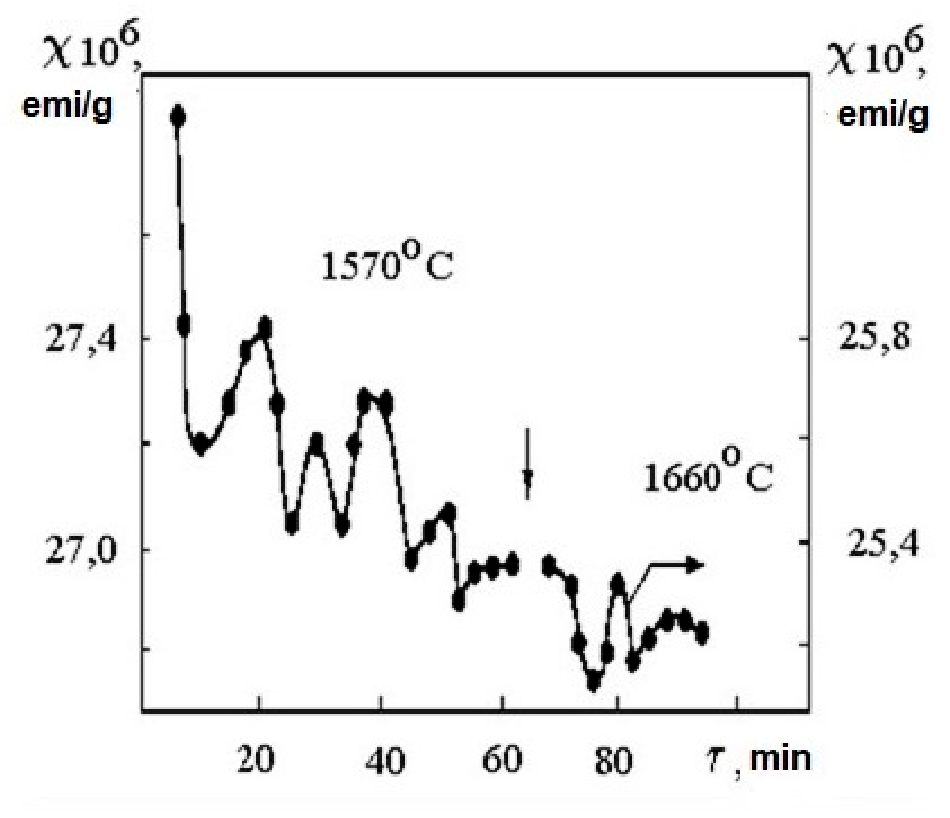
Figure 2.
Schematic representation of the thermal-temporal treatment (TTT) protocol for metallic melts prior to amorphization. Key parameters: tobr — maximum heating temperature (critical temperature tc or anomaly temperature tan); τobr — holding time at tobr (determined by relaxation of viscosity/magnetic susceptibility); ttap — tapping temperature (typically Tliquidus − ΔT, where ΔT = 30–80 °C); τtap — stabilization hold before casting. Adapted from [6].
Figure 2.
Schematic representation of the thermal-temporal treatment (TTT) protocol for metallic melts prior to amorphization. Key parameters: tobr — maximum heating temperature (critical temperature tc or anomaly temperature tan); τobr — holding time at tobr (determined by relaxation of viscosity/magnetic susceptibility); ttap — tapping temperature (typically Tliquidus − ΔT, where ΔT = 30–80 °C); τtap — stabilization hold before casting. Adapted from [6].
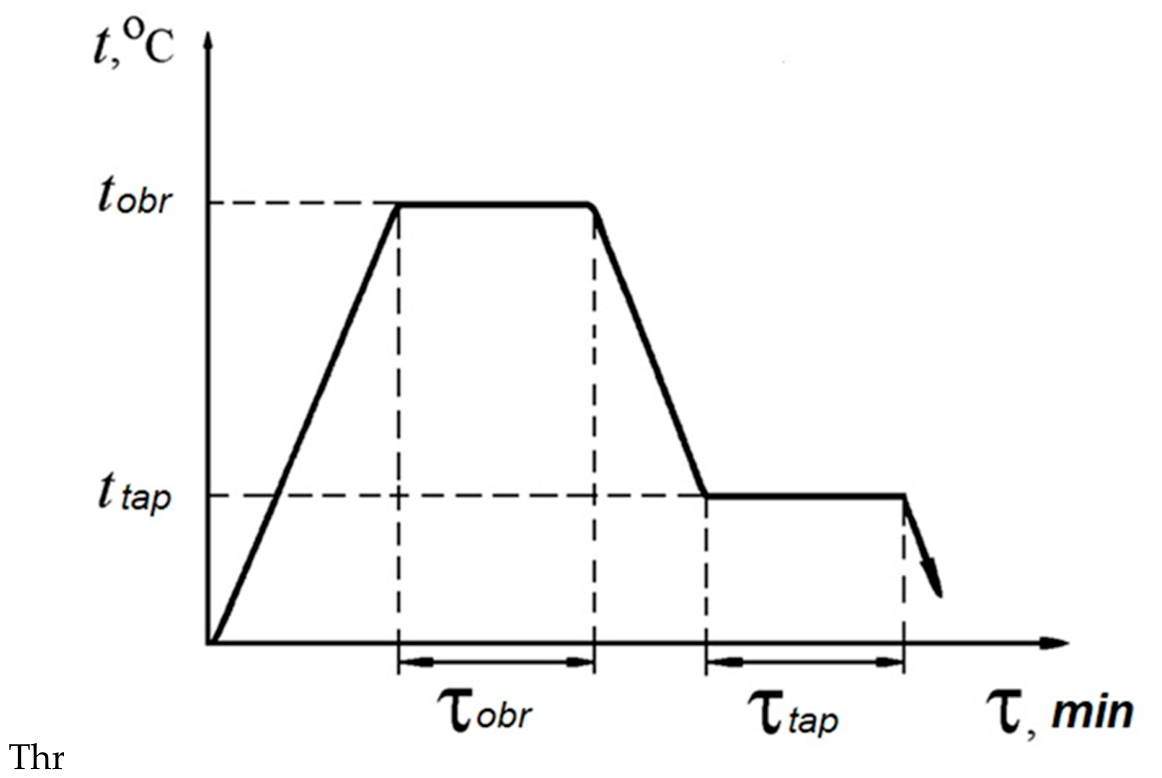
Figure 3.
Temperature dependences of physical properties for amorphizing melts temperature dependences of kinematic viscosity (ν₁, ν₂ — negative and positive hysteresis branches, respectively), electrical resistivity (ρ), magnetic susceptibility (χ), surface tension (σ), and density (d) for Fe-based amorphizing melts (Fe₇₂.₅Cu₁Nb₂Mo₁.₅Si₁₄B₉). Critical temperatures: tan — anomaly onset, tg — hysteresis initiation, tc — critical temperature for melt equilibration; Δt — undercooling degree. Adapted from [6].
Figure 3.
Temperature dependences of physical properties for amorphizing melts temperature dependences of kinematic viscosity (ν₁, ν₂ — negative and positive hysteresis branches, respectively), electrical resistivity (ρ), magnetic susceptibility (χ), surface tension (σ), and density (d) for Fe-based amorphizing melts (Fe₇₂.₅Cu₁Nb₂Mo₁.₅Si₁₄B₉). Critical temperatures: tan — anomaly onset, tg — hysteresis initiation, tc — critical temperature for melt equilibration; Δt — undercooling degree. Adapted from [6].
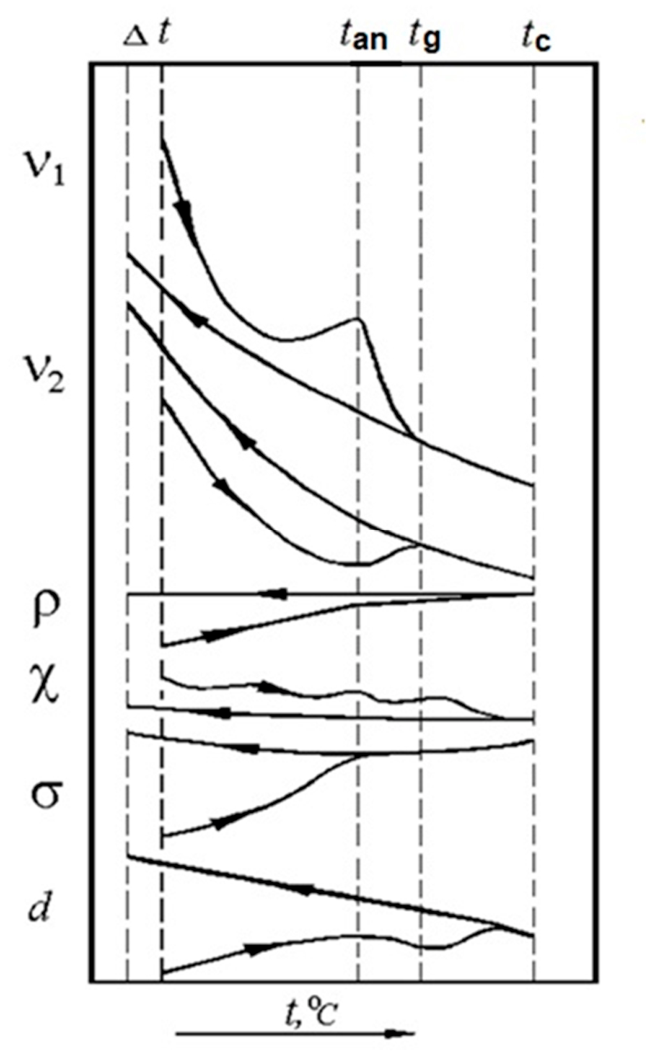
Figure 4.
Viscosity polytherms for Finemet-type alloy under different TTT modes quenching. Critical temperature tc ≈ 1580 °C. Arrows indicate heating (●) and cooling. Kinematic viscosity polytherms of Fe₇₂.₅Cu₁Nb₂Mo₁.₅Si₁₄B₉ melt (Finemet-type) under three thermal histories: (I) heating below tc + quenching; (II) heating above tc + quenching; (III) heating above tc → undercooling → (○) branches. Optimal magnetic properties correspond to Mode III. Adapted from [6].
Figure 4.
Viscosity polytherms for Finemet-type alloy under different TTT modes quenching. Critical temperature tc ≈ 1580 °C. Arrows indicate heating (●) and cooling. Kinematic viscosity polytherms of Fe₇₂.₅Cu₁Nb₂Mo₁.₅Si₁₄B₉ melt (Finemet-type) under three thermal histories: (I) heating below tc + quenching; (II) heating above tc + quenching; (III) heating above tc → undercooling → (○) branches. Optimal magnetic properties correspond to Mode III. Adapted from [6].
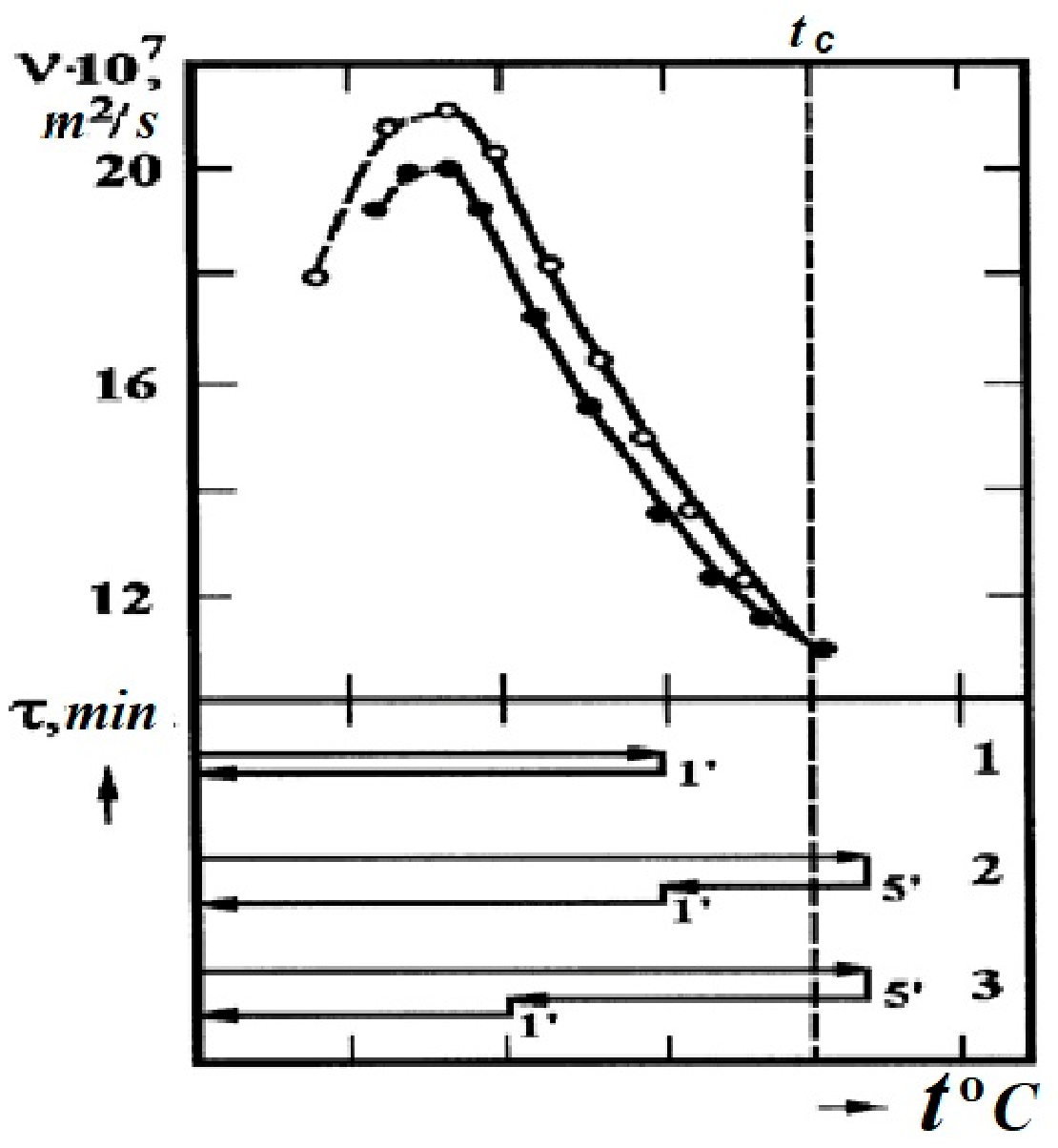
Figure 5.
Hysteresis of kinematic viscosity in Ni-based amorphous brazing alloy (VPr-type) demonstrating the irreversibility of melt equilibration. After intermediate crystallization (●→○→□), viscosity values revert to the initial heating branch, confirming that TTT must be applied immediately before amorphization, not at the ingot melting stage. Adapted from [6].
Figure 5.
Hysteresis of kinematic viscosity in Ni-based amorphous brazing alloy (VPr-type) demonstrating the irreversibility of melt equilibration. After intermediate crystallization (●→○→□), viscosity values revert to the initial heating branch, confirming that TTT must be applied immediately before amorphization, not at the ingot melting stage. Adapted from [6].
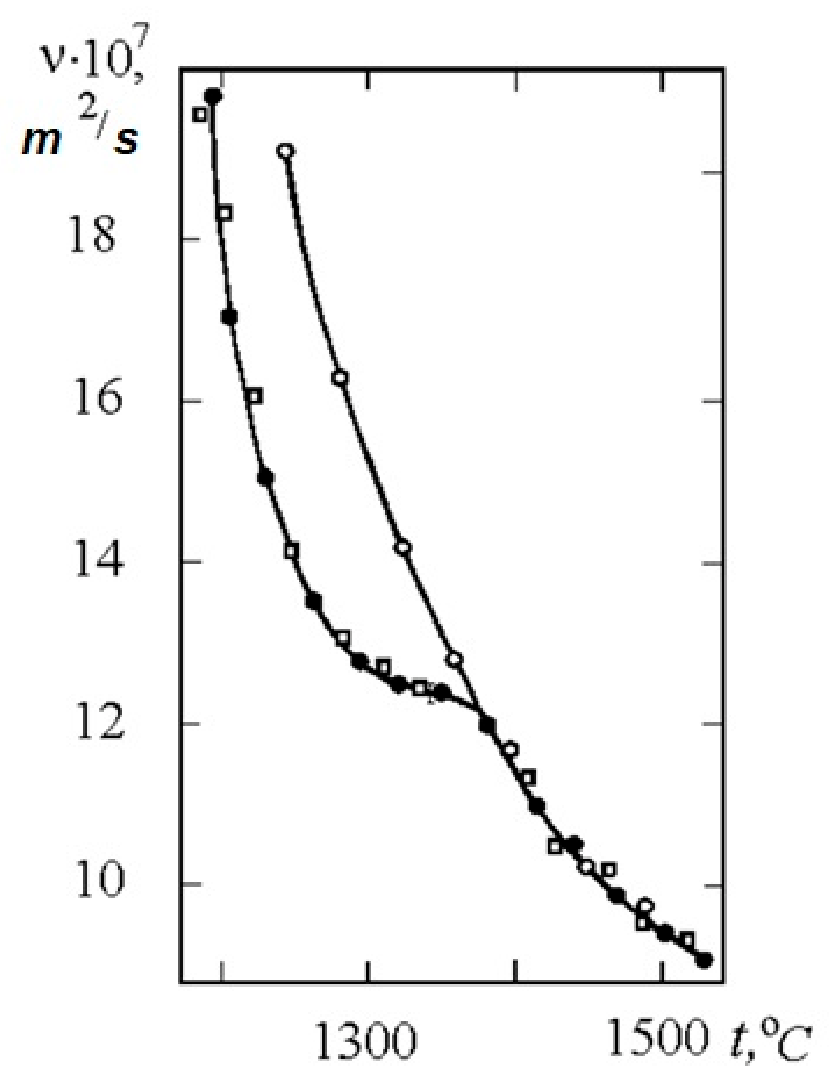
Figure 6.
XRD Patterns of nanocrystalline alloy after annealing.
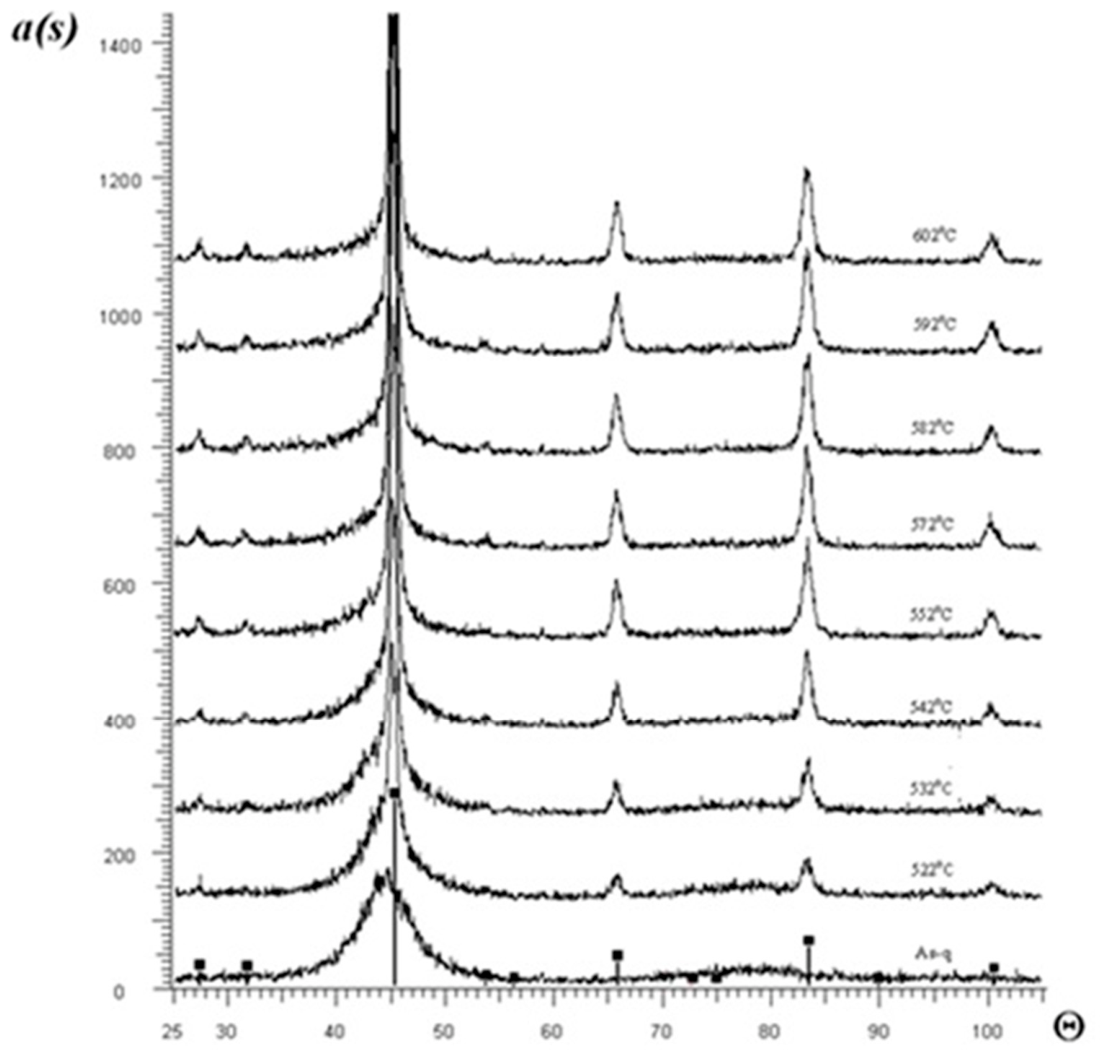
Figure 7.
Grain size distribution histograms.
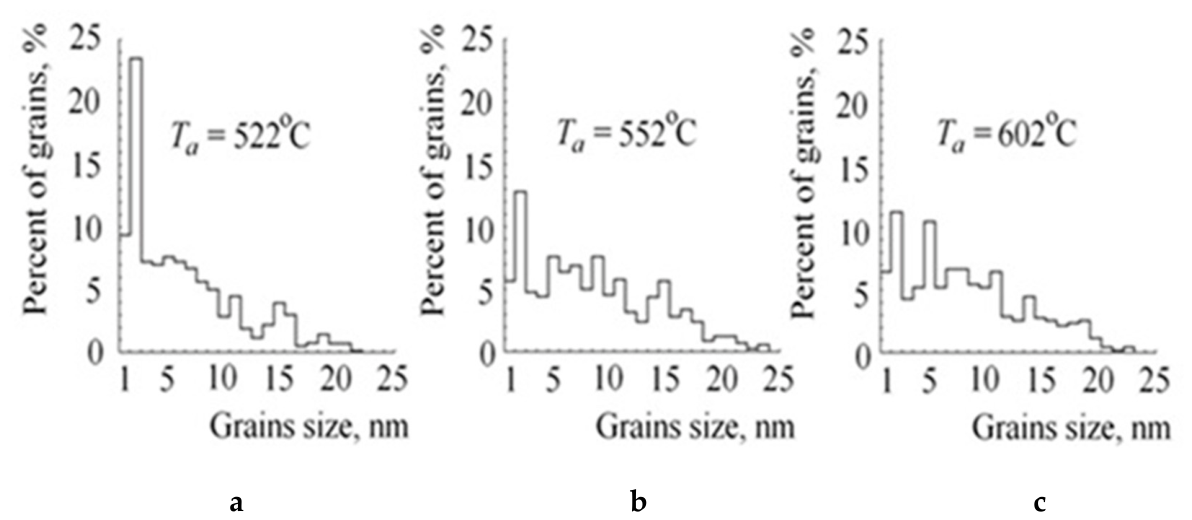

Table 1.
Magnetic properties as annealing temperature.
|
Ta(°C)μ₀.₀₈(±5%)μmax(±8%)KR(±0.03)Hc(A/m)(±0.05)DominantPhase(s) Comp.:Finemet[22]μmaxComp.:Nanoperm [7]Hc 482 7,300 147,000 0.69 2.15 Amorphous + Fe₃Si nuclei 120,000 (Ta=550 °C) 0.8 A/m (Ta=500 °C) 502 14,400 330,000 0.77 1.25 Fe₃Si (minor) — — 522 25,000 394,000 0.65 0.90 Fe₃Si + amorphous — — 532 35,000 540,000 0.63 0.66 Fe₃Si (major) — — 542 52,000 713,000 0.63 0.41 Fe₃Si (fully nano) 650,000 (optimal) 0.5 A/m (optimal) 552 91,000 663,000 0.59 0.45 Fe₃Si + Fe₂B trace — — 562 98,000 664,000 0.63 0.46 Fe₃Si + Fe₂B trace — — 572 120,000 688,000 0.61 0.51 Fe₃Si + Fe₂B — — 582 105,000 588,000 0.58 0.56 Fe₃Si + Fe₂B — — 592 69,000 430,000 0.56 0.56 Fe₃Si + Fe₂B — — 602 61,000 237,000 0.59 1.58 Fe₃Si + Fe₂B (coarsened) — — |
Notes: μ₀.₀₈ — initial permeability at H = 0.08 A/m; μmax — maximum permeability; KR — squareness ratio (Br/Bs); Hc — coercive force. Optimal properties highlighted in bold. Literature data: [21] Tsepelev & Starodubtsev, Nanomaterials 2021; [7] G. Kumar T. Ohkudo & K. Hono. Journal of Materials Research 2009. Adapted from [6].
Table 2.
Grain size distribution after annealing.
| Ta (°C) Mean Size d (nm)σd (nm)0–5 nm(%)6–10 nm(%)11–15 nm(%)16–20 nm(%)21–25 nm(%)>25 nm(%)Fe₂B Fraction* |
| 522 7 ± 2 3.1 54.6 27.4 13.5 6.1 0.9 <0.5 — 552 9 ± 3 4.2 35.4 30.4 21.2 9.7 2.6 0.7 ~2 vol% 602 8 ± 3 4.5 37.8 29.5 19.4 11.0 2.4 0.9 ~5 vol% |
Disclaimer/Publisher’s Note: The statements, opinions and data contained in all publications are solely those of the individual author(s) and contributor(s) and not of MDPI and/or the editor(s). MDPI and/or the editor(s) disclaim responsibility for any injury to people or property resulting from any ideas, methods, instructions or products referred to in the content. |
© 2026 by the authors. Licensee MDPI, Basel, Switzerland. This article is an open access article distributed under the terms and conditions of the Creative Commons Attribution (CC BY) license.
Copyright: This open access article is published under a Creative Commons CC BY 4.0 license, which permit the free download, distribution, and reuse, provided that the author and preprint are cited in any reuse.


