

Submitted:
08 July 2026
Posted:
10 July 2026
You are already at the latest version
Abstract
Triple-negative Breast cancer is a highly heterogeneous tumor subtype lacking universal therapeutic targets, a factor that frequently renders standard pharmacological approaches ineffective. To address the urgent clinical need for precision strategies, we developed a computational framework centered on personalization. Utilizing specific gene expression data, we initially constructed and calibrated 41 individualized regulatory networks, thereby capturing the precise molecular signature of each patient. Then, we applied a hybrid approach to these models—integrating Boolean logical determinism with the exploratory optimization of the combinatorial search space via a Genetic Algorithm—and identified the minimal sets of driver nodes capable of irreversibly driving the tumor cell toward apoptosis. Subsequently, a rigorous optimization process translated these targets into actionable clinical options by mapping them to optimal combinations of oncological drugs under stringent therapeutic constraints. The apoptotic transition was successfully achieved in 92.7% of the samples. Results indicate that effective tumor reprogramming relies on manipulating critical nodes that orchestrate the network's logical dynamics. By minimizing unnecessary perturbations to the overall signaling architecture, this methodology demonstrates the computational feasibility of identifying robust, non-obvious therapeutic targets through Boolean modeling. Ultimately, it offers an adaptive and scalable platform for the rational design of minimally disruptive, patient-specific combinatorial therapies.
Keywords:
oncology
; personalized medicine
; apoptosis
; attractors
; genetic algorithm
; declarative optimization
; CDKN1A
; TRIP13
; drug–target associations
1. Introduction
Cancer, particularly breast cancer, remains an escalating global health emergency due to rising incidence rates [1] and pronounced inter- and intra-tumoral heterogeneity [2]. This profound molecular complexity frequently drives therapeutic resistance to standard cytotoxic regimens, highlighting an urgent clinical need to transition toward precision oncology [3]. While high-throughput transcriptomics such as RNA sequencing [4] offer comprehensive profiling of aberrant gene expression, these static “snapshots” are insufficient to unravel the non-linear, dynamic behaviors of Gene Regulatory Networks (GRNs). Translating massive omics datasets into actionable clinical insights requires a paradigm shift toward Systems Biology.
Mathematical modeling of GRNs is essential for predicting pharmacological responses in silico. Continuous-time quantitative frameworks, such as Ordinary Differential Equations (ODEs), provide precise kinetic insights but are severely bottlenecked by the lack of experimental parameters for large-scale networks [5,6]. To circumvent this, qualitative Boolean network modeling [7] offers a highly effective, parameter-free logical framework. By abstracting molecular states into binary variables, Boolean modeling thoroughly explores the system’s state space to identify “attractors”—stable phenotypes like proliferation or apoptosis [8]. Consequently, this scalable framework enables investigators to simulate how perturbing specific logical nodes can force a global phenotypic shift, even without detailed kinetic data [9].
In this study, we applied this methodology to Triple-Negative Breast Cancer (TNBC), a highly aggressive subtype lacking actionable targets (ER, PR, HER2) and characterized by rapid chemoresistance and early metastasis [10]. Building upon the generic breast cancer Boolean GRN modeled by Sgariglia et al. [11], we substantially expanded the network to capture TNBC-specific pathology. Concretely, the baseline topology was integrated with a curated subset of critical regulatory nodes that have historically been implicated in TNBC oncogenesis, maintenance of an aggressive phenotype, and therapeutic evasion. This targeted expansion involved the incorporation of IRF2BP2 [12,13], which acts as a key transcriptional cofactor modulating immune evasion and survival pathways; MAPK4 [14], an atypical mitogen-activated protein kinase known to promote oncogenic signaling independently of the canonical RAF/MEK/ERK cascade; BCL11A [15], a potent transcriptional repressor driving cancer stemness and tumor progression; USP7 [16,17,18], a deubiquitinase crucial for stabilizing key oncogenic substrates and hindering apoptotic signaling; and TRIP13 [19,20,21], a mitotic checkpoint chaperone frequently overexpressed and associated with chromosomal instability and drug resistance in refractory breast malignancies.
Our core methodological innovation lies in the patient-specific contextualization of the network topology and drug therapy inference. By integrating individual TNBC RNA-seq data, we dynamically “pruned” biologically silent interactions. This yielded distinct, highly specific sub-network architectures that capture unique inter-tumoral heterogeneity while maintaining a standardized analytical scaffold across the cohort.
To overcome the computationally unfeasible combinatorial explosion of possible system states within these personalized networks, we introduced a Genetic Algorithm (GA). Utilizing a “state-constraining” approach, the GA efficiently converged upon precise, minimal combinations of genes that, when forcibly fixed to specific logical states, irreversibly disrupt the pathological TNBC equilibrium and guide the network toward the apoptotic attractor.
Finally, to bridge computational abstraction and clinical applicability, we mapped these mathematical targets to existing FDA-approved antineoplastic agents, facilitating a cross-indication drug-repositioning strategy. The resulting combinatorial regimens were prioritized based on simulated apoptotic efficacy, maximized druggability, and minimized structural network fragmentation (as a proxy for reducing systemic functional impact). This integrated pipeline provides a robust, scalable blueprint for the automated discovery of tailored, minimally disruptive targeted therapies in TNBC.
Ultimately, the core hypothesis of this study is that integrating patient-specific transcriptomic profiles with Boolean network dynamics and heuristic optimization can uncover minimal therapeutic interventions to overcome TNBC resistance. Our findings robustly validate this approach: the developed computational pipeline successfully personalized regulatory networks across the clinical cohort, identifying highly specific, multilayered combinations of driver nodes that irreversibly induce an apoptotic transition in 92.7% of the analyzed profiles. This report highlights the potential of Boolean modeling to translate malignant regulatory networks into actionable therapeutic targets, thereby facilitating cancer control through clinically rationalized treatment strategies. In other words, this integrated systems biology framework establishes a scalable paradigm for precision oncology, demonstrating that complex tumor networks can be safely and rationally reprogrammed through targeted, computationally guided polypharmacology.
2. Results
This section may be divided by subheadings. It should provide a concise and precise description of the experimental results, their interpretation, as well as the experimental conclusions that can be drawn.
2.1. Patient-Specific Network Personalization via Topological Pruning
The primary outcome of our structural customization pipeline was the successful generation of highly individualized Boolean regulatory networks for each TNBC patient. A fundamental achievement of this phase was the strategic decision to elaborate the patient-specific topology by acting selectively on the regulatory interactions (edges) rather than deleting nodes (genes).
Unlike standard reductionist approaches that remove nodes based on low expression levels, which often disrupt the structural integrity of the model by fragmenting the scale-free biological topology [22], our approach preserved the overarching Prior Knowledge Network (PKN) scaffold [23]. By systematically identifying and severing only the specific edges that mathematically contradicted the patient’s empirical transcriptomic profile (e.g., paradoxical activations or defunct repressions), we effectively rewired the flow of regulatory information. This resulted in refined sub-networks that perfectly mirror the unique, pathologically altered signaling cascades of each tumor, without compromising the basal biological architecture.
The formalization of this data-driven filtering mechanism culminated in the development of the Topological Network Pruning algorithm (Algorithm 1). Engineered as a deterministic and scalable computational tool, this algorithm represents a foundational result of our framework. It robustly automates the translation of static, continuous RNA-seq data into coherent, individualized Boolean topologies by systematically evaluating both outgoing and incoming regulatory edges against strict logical coherence thresholds. The complete programmatic logic governing this personalization phase is detailed below.
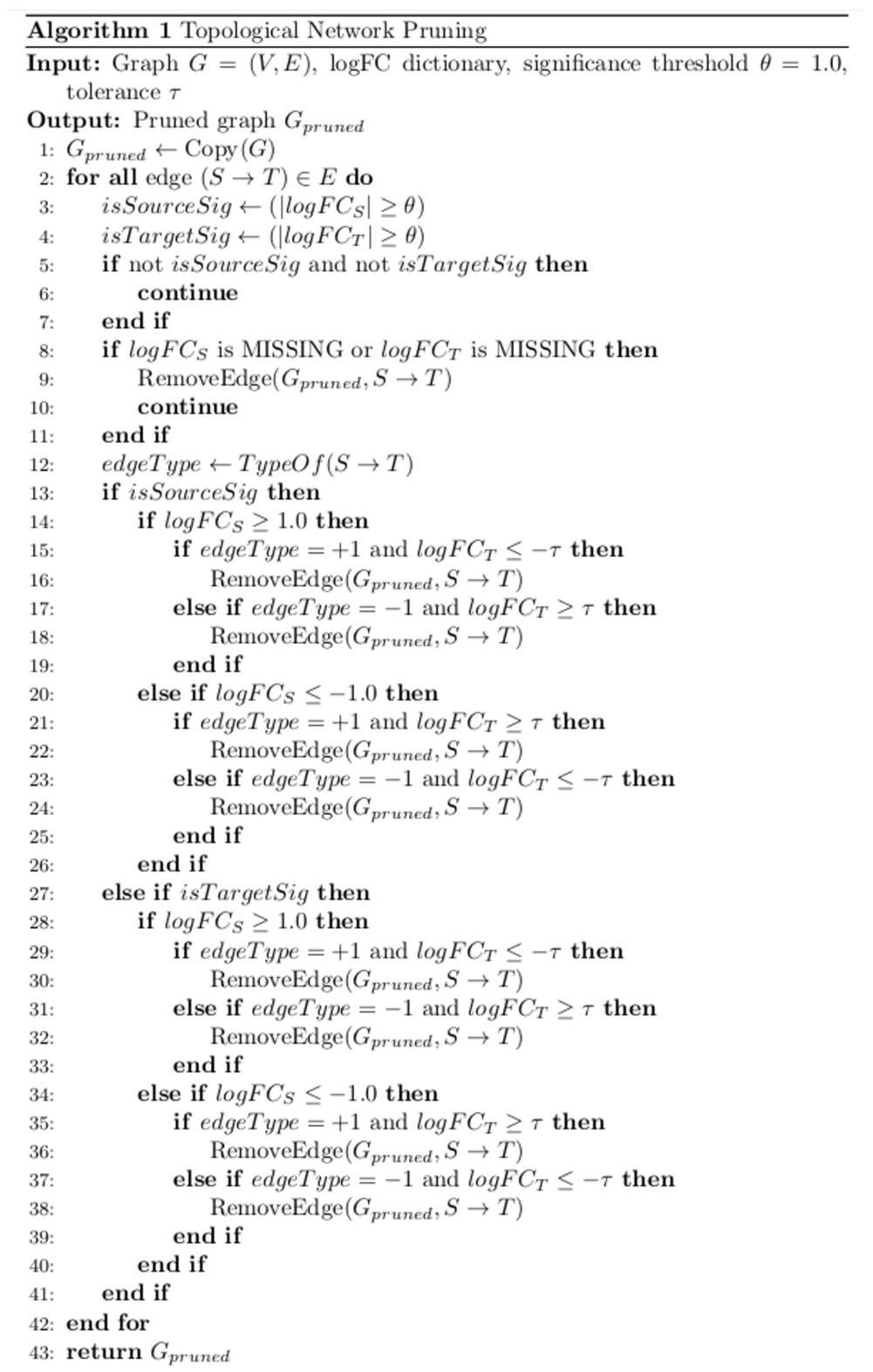
Algorithm 1. Pseudocode for Patient-Specific Topological Network Pruning. The algorithm systematically customizes the generic Boolean regulatory graph () by integrating individual transcriptomic data (logFC array) against a defined tolerance threshold (). Rather than indiscriminately deleting entire nodes, the procedure evaluates the logical coherence of each regulatory interaction. For every significantly dysregulated node (classified as UP or DOWN), the algorithm iteratively verifies both outgoing (Step 3A) and incoming (Step 3B) edges. Regulatory interactions are selectively removed if their theoretical function (+1 for activation, -1 for inhibition) flagrantly contradicts the empirical expression states of the connected node pair. Conversely, edges involving nodes with missing data or non-significant expression changes are conservatively retained to preserve the basal structural integrity of the resulting personalized network ().
The execution of this algorithm successfully yielded a customized therapeutic network for all evaluated patient samples. Comprehensive results for all individualized model personalizations are available in the Zenodo repository cited in the Data Availability Statement below.
2.2. Identification of Therapeutic Driver Nodes via Hybrid Genetic Optimization
Following topological personalization, our objective was to identify specific Driver Nodes capable of actively reprogramming cellular fate. By “Driver Node”, we intend a node that may influence the behavior of the entire network or a substantial part of it [24]. Unperturbed TNBC Boolean models naturally converge into stable attractors that sustain tumor proliferation. Our framework solves this control problem by discovering the precise combinatorial perturbations necessary to force the network’s trajectory out of this pathological trap and irreversibly into a predefined “Apoptosis Attractor” [25].
To navigate the immense combinatorial search space inherent in large-scale network control, we engineered the Unfiltered Strict Hybrid Optimizer (Algorithm 2). This algorithm integrates deterministic Boolean simulations with a heuristic evolutionary search [26]. By permanently locking candidate nodes into fixed logical states—mimicking continuous pharmacological interventions—the optimizer rigorously evaluates the global phenotypic impact of localized structural constraints. Driven by a biological fitness evaluation, the algorithm efficiently converged on minimal, patient-specific sets of Driver Nodes (evaluating up to 8 simultaneous interventions). These combinations maximized alignment with a strict 26-node apoptotic signature while explicitly rewarding the stabilization of terminal executioner pathways, such as the Caspase cascade. Across the entire cohort, this strategy consistently identified the minimal interventions required to secure the apoptotic phenotype. The complete operational architecture of this targeted genetic search is delineated in the pseudocode of Algorithm 2.
The sequential application of the topological pruning and hybrid optimization algorithms to our clinical cohort of 41 TNBC samples yielded highly robust quantitative outcomes. Overall, the computational pipeline successfully identified minimal combinations of driver nodes capable of irreversibly forcing an apoptotic state transition in 38 out of 41 patient-specific networks, achieving a system control rate of 92.7%.
By analyzing the terminal configuration of specific apoptosis nodes within these dynamically controlled networks, we evaluated the underlying biological mechanisms driving these successful transitions. To structurally contextualize these functional outcomes, Figure 1 delineates the foundational architecture of the two primary apoptotic cascades: the receptor-mediated extrinsic pathway and the mitochondria-mediated intrinsic pathway.
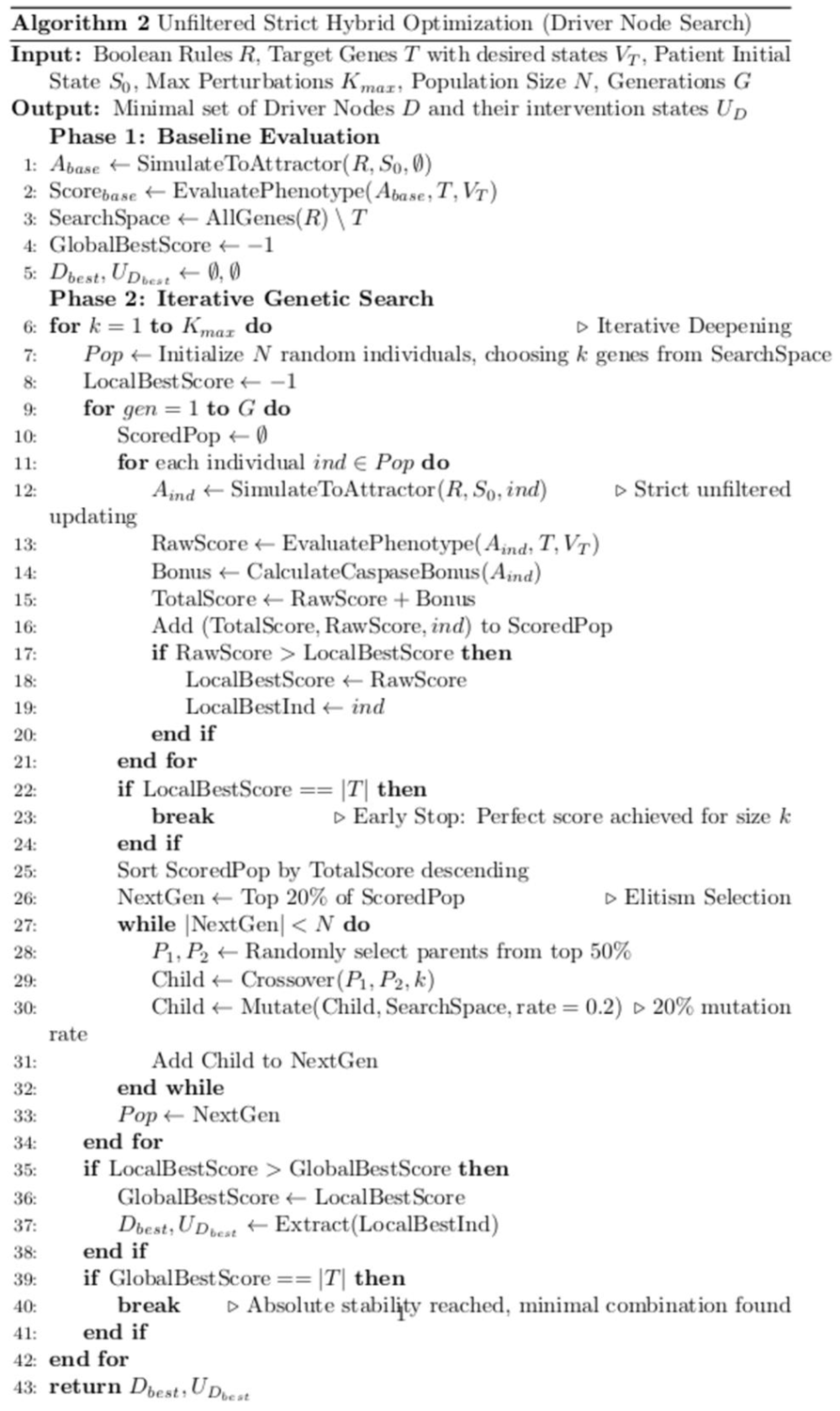
Algorithm 2. Pseudocode for the Unfiltered Strict Hybrid Optimization. This algorithm identifies the minimal set of therapeutic driver nodes required to reprogram the patient-specific network toward an apoptotic phenotype. Following a baseline evaluation of the unperturbed pathological state (Phase 1), it employs an iterative genetic search (Phase 2) to systematically navigate the combinatorial perturbation space. Candidate interventions are evaluated via deterministic Boolean simulations and scored using a dual fitness function that rewards exact target alignment and Caspase cascade stabilization. The evolutionary process utilizes elitism, crossover, and mutation, terminating immediately upon achieving a target match to guarantee therapeutic minimality.
As illustrated, while these signaling trajectories process independent upstream stimuli through distinct initiator nodes—such as the Fas-Associated Death Domain (FADD) for the extrinsic route and the Mitochondrion/Caspase-9 axis for the intrinsic route—they ultimately converge upon a common terminal axis: the activation of executioner caspases required to orchestrate programmed cell death. The genetic optimizer dynamically leveraged these distinct structural routes to overcome patient-specific topological resistance.
By mapping the in silico target configurations onto this canonical biological scaffold, we categorized the individualized therapeutic responses into distinct mechanistic profiles. The overall quantitative distribution of these outcomes across the analyzed cohort is comprehensively summarized in Figure 2, revealing a stratification into three distinct response behaviors based on the underlying network dynamics. Specifically, in the majority of successfully controlled networks (n = 24), an extrinsic pathway dominance was observed; the intrinsic mitochondrial pathway remained fundamentally compromised due to the inability to properly configure the initiator Caspase-9, but the optimizer successfully salvaged the apoptotic cascade by routing programmed cell death exclusively through FADD activation. Conversely, a substantial subset of the cohort (n = 14) exhibited a combined intrinsic and extrinsic activation, where the identified driver nodes achieved a highly robust biological response by simultaneously securing the correct logical configuration of both mitochondria-associated initiators and death-receptor adaptors. Finally, a marginal fraction of the cohort (n = 3) yielded a non-significant response, as severe topological distortion and structural fragmentation of these specific patient-specific models prevented the algorithm from discovering a viable combination of driver nodes capable of forcing the apoptotic attractor.
Following the quantitative assessment of the cohort’s therapeutic apoptotic profiles, we evaluated the qualitative nature of the identified interventions to resolve the specific molecular mechanisms driving network control. To this end, we constructed an integrated target matrix mapping each patient-specific model against its required compositional driver nodes and their specific directional perturbation requirements (Figure 3). This qualitative framework distinguishes between the therapeutic necessity of targeted gene activation (+) versus targeted inhibition (-) within the context of network topology. The structural arrangement of the matrix, organized by response groups, immediately contextualizes molecular interventions against phenotypic outcomes. Specifically, the cohort stratification into three distinct subgroups—Combined Activation, Extrinsic Dominance, and Non-Significant Response—reflects the predominant signaling cascade leveraged by the optimization algorithm to trigger apoptosis, distinguishing between cases requiring dual-pathway engagement versus those driven exclusively by the extrinsic apoptotic module. The upper marginal barplot mirrors the number of genes to be activated or repressed for driving the network toward the apoptosis attractor per patient, which illustrates the precise number of regulatory checkpoints required for simultaneous network control. Concurrently, the right marginal barplot defines the Total Frequency of each driver node across the cohort.
The identified patient-specific driver node configurations are dynamically validated to steer each individualized gene regulatory network toward a stable apoptotic attractor. Consequently, the combination of therapeutic targets identified for each patient dictates a precise configuration of the 26 target nodes utilized to define the cellular phenotype [11], successfully establishing the specific steady-state profile that drives the cell toward programmed cell death.
2.3. Aggregate Topological and Structural Analysis of the Interventions
Following the identification of patient-specific apoptotic trajectories, we evaluated the collective topological properties of the computational interventions across the entire cohort of 41 TNBC samples. This aggregate analysis characterized the structural profile of the specific driver nodes selected by the genetic optimizer, revealing how the algorithm navigated the network topology to enforce the target state transitions.
First, we assessed the relationship between a node’s structural prominence and its actual regulatory efficacy across the cohort (Figure 4a). As illustrated in the distribution, the selected driver nodes are predominantly characterized by low-to-moderate connectivity scores, while highly connected structural hubs were consistently bypassed by the selection pipeline. This outcome aligns with established literature, which demonstrates that network control can be effectively achieved through non-hub nodes with low centrality [24,27].
Furthermore, analyzing the structural proximity of the selected driver nodes to the 26-node apoptotic target module revealed a multi-layered cascading control organization (Figure 4b). The spatial distribution of the interventions demonstrates that the algorithm primarily identified and favored optimal control nodes in the immediate structural vicinity of the target group (Distance 1). However, in network topologies where direct local intervention was dynamically insufficient or logically constrained, the algorithm expanded its search space into progressively deeper upstream layers. Consequently, targets were identified at distances up to a maximum of 4 jumps away. This spatial distribution reflects a functional cascading mechanism, wherein initial distal perturbations are transmitted indirectly through intermediate regulatory layers to ultimately force the downstream apoptotic module into its required configuration.
2.4. Pharmacological Therapeutic Optimization and Drug Repositioning
Following the computational identification and structural validation of patient-specific driver nodes, the final outcome of our analytical pipeline was the successful translation of these abstract mathematical perturbations into clinically actionable pharmacological regimens.
To navigate the complex polypharmacological landscape—where single drugs may hit multiple targets and multiple drugs may target the same gene—we engineered the Multi-Objective Pharmacological Optimization framework (Algorithm 3). This declarative, solver-based algorithm represents a critical translational achievement. By imposing an absolute clinical safety constraint (Hard Constraint), the algorithm automatically invalidates any pharmacological combination whose biological mechanism of action contradicts the requisite Boolean regulatory signals needed to force the apoptotic transition.
The execution of this optimization module yielded highly specific, synergistic drug regimens tailored to each patient’s unique network topology. The system systematically extracted these optimal combinations by satisfying a strict, clinically rationalized hierarchy: it primarily maximized phenotypic efficacy (comprehensive driver node coverage), subsequently minimized the overall drug cardinality to reduce polypharmaceutical toxicity, and finally minimized off-target interference to ensure highly localized intervention and systemic safety. The exact logical architecture and programmatic constraints governing this automated pharmacological selection are delineated in Algorithm 3.
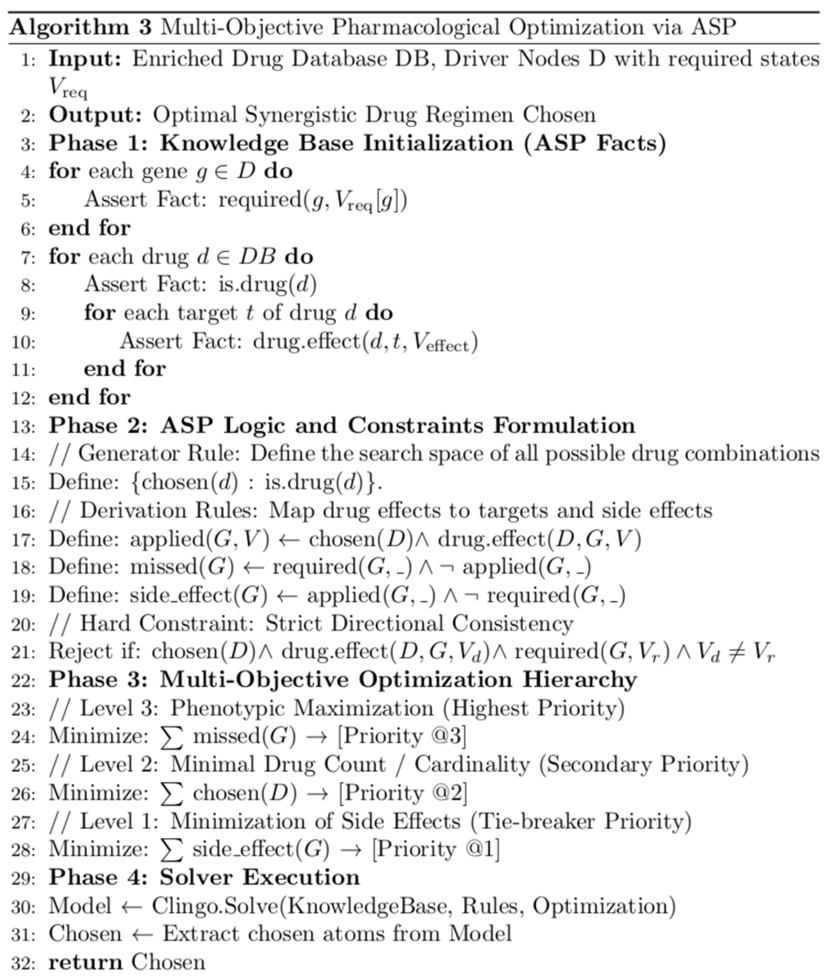
Algorithm 3. The pseudocode details the logical constraint satisfaction framework used to pair mathematical Driver Nodes with clinical drugs. The solver guarantees biological coherence by strictly filtering out contradictory compounds (Hard Constraint). An optimal synergistic regimen is then deterministically derived through a multi-objective hierarchy: primarily maximizing the coverage of required therapeutic targets (Priority 3), secondarily minimizing the total number of administered drugs to reduce complexity (Priority 2), and finally resolving redundancies by minimizing off-target side effects (Priority 1).
The optimization procedure (Algorithm 3) identified seven distinct pharmacological agents capable of executing the required directional perturbations on the prioritized regulatory targets within the individualized networks (Figure 5). Specifically, Cladribine, Diethylstilbestrol, Vincristine Liposomal, Dactinomycin, Dexamethasone, Bexarotene, and Tretinoim were selected as the optimal compounds to engage their respective molecular targets across the patient cohort.
To evaluate the broader pharmacological footprint of these interventions, we quantified the sample-specific Side Effect Score displayed in the upper marginal profile of the matrix (Figure 5). For each analyzed patient, this metric explicitly indicates the total number of molecular targets modulated by the selected drug combination that are distinct from the specific control targets identified by the algorithm. By isolating therapeutic driver engagements from external network perturbations, this score provides an objective measurement of the patient-specific off-target burden associated with each combinatorial intervention.
3. Discussion
The present report introduces and validates an innovative computational framework for the dynamic control of gene regulatory networks in TNBC. The cornerstone of this approach lies in the therapeutic personalization, achieved through a systematic topological pruning procedure [28] applied individually to each analyzed clinical case. This pruning strategy, relying on specific transcriptomic profiles of individual samples, enabled the identification of highly specific therapeutic targets tailored to each patient. By integrating the topological mapping of these personalized networks with a multi-objective genetic search framework, we identified minimal sets of Driver Nodes capable of orchestrating the cascading activation of the apoptotic module. Following this algorithmic identification, the implemented procedure successfully translated these computational targets into actionable therapeutic protocols; wherever feasible, the framework mapped specific pharmacological agents to the selected driver genes, strictly adhering to the precise multi-objective optimization criteria embedded within the algorithm. These findings raise critical methodological and clinical implications that we discuss below.
3.1. Interpretative Synthesis of Results
Beginning with the quantitative efficacy of the framework, the programmed phenotypic transition was successfully completed in 38 out of the 41 analyzed personalized regulatory network models (approximately 92.7%). From a computational perspective, this high success rate validates the intrinsic synergy of the implemented hybrid method, which couples the rigorous deterministic nature of Boolean logic rules with the stochastic exploratory efficiency of the genetic algorithm. While Boolean equations guarantee biological fidelity and adherence to the biochemical constraints of molecular interactions, the stochastic engine effectively navigates the immense combinatorial state space, identifying optimal control configurations that would otherwise remain inaccessible through a purely exhaustive or deterministic search. The identification of the optimal Driver Nodes offers an important partial confirmation of fundamental theories on the control of complex systems, with specific reference to the seminal contributions [24] regarding the structural controllability properties of graphs. Following the results of our model, the nodes endowed with the absolute highest topological connectivity do not necessarily coincide with the most effective control node for inducing the transition toward the desired attractor.
This functional selection can be contextualized by the algorithm’s hierarchical preference for topological proximity, paired with the capacity to penetrate deep into the network architecture when neighboring nodes are logically constrained. Rather than distributing perturbations indiscriminately, the optimization framework operates via a systematic search priority relative to the 26-node apoptotic target module. The simulation data indicate that the algorithm prioritizes a direct control strategy, selecting driver nodes in immediate contact with at least one of the target genes to enforce the required binary configuration. Importantly, when such direct local paths are dynamically insufficient or locked by inhibitory Boolean rules, the framework does not fail; instead, it successfully explores deeper regulatory strata. It navigates upstream to identify nodes with indirect connectivity—operating through a single intermediate layer—and, if further constrained, progressively extends its reach through two or more intermediate regulatory steps. Instead of merely exploiting superficial or peripheral network layers, the algorithm demonstrates an advanced structural penetration capability, resolving complex logical bottlenecks by mobilizing distal upstream regulators.
Within this framework, the evaluation of the implemented interventions highlights a highly selective therapeutic approach tailored to each individualized patient network [22,29]. As a validation step, we conducted a literature review focusing on the most frequently activated node identified in this report.
Analyzing the frequency of the algorithm’s choices highlights which specific genes represent the most reliable target nodes across the entire patient cohort.
A quantitative examination of the optimization outputs reveals that the most frequently selected therapeutic targets across the investigated cohort are TRIP13 and CDKN1A, which were identified as optimal driver nodes in 12 and 9 patient cases, respectively. The recurrence of CDKN1A (encoding the p21 protein) underscores its complex context-dependent role in TNBC pathology [30]. Although p21 traditionally acts as a cell cycle regulator within the nuclear compartment, its elevated expression in tumors deprived of hormone receptors serves as a predictor of decreased overall survival and heightened metastatic recurrence [30]. This clinical aggressiveness is primarily driven by the cytoplasmic translocation of p21, which actively suppresses apoptotic cascades through direct interactions with pro-caspase-3 and ASK1 [30], thereby promoting chemoresistance in refractory TNBC cells. Consequently, the computational selection of CDKN1A as a target aligns with therapeutic strategies aimed at disrupting this cytoplasmic survival mechanism.
Given its central position at the intersection of cell cycle progression, DNA repair, and programmed cell death, the systematic targeted inhibition of CDKN1A highlights a promising, network-guided approach to ablate a pivotal oncogenic evasion mechanism in TNBC.
TRIP13 emerged as the most frequently selected driver node across the analyzed cohort, being identified in 12 independent patient cases. This computational recurrence is consistent with established oncological literature characterizing TRIP13 as a potent oncogenic driver highly overexpressed in breast malignancies and consistently associated with poor clinical prognosis, accelerated tumor progression, and metastatic dissemination [31]. Functionally, the systematic silencing or targeted inhibition of TRIP13 has been demonstrated to impair the viability, proliferation, and migratory capacity of TNBC cells [32]. At the molecular level, suppressing TRIP13 signaling triggers programmed cell death, as evidenced by the biochemical cleavage of poly(ADP-ribose) polymerase (PARP) proteins [32], while simultaneously downregulating the PI3K/AKT signaling cascade to suppress downstream cellular survival mechanisms [31]. Furthermore, TRIP13 plays a critical role in driving the epithelial-to-mesenchymal transition (EMT), a key mechanism underlying the invasive nature of refractory subtypes [33]. The targeted ablation of this node effectively reverses the EMT phenotype by upregulating epithelial markers such as E-cadherin and reducing mesodermal factors, including vimentin and Snail, thereby hindering metastatic potential [33]. Given that high baseline expression of this gene is heavily implicated in conventional drug resistance, including insensitivity to standard PARP inhibitors, the network-guided selection of TRIP13 provides a rational therapeutic strategy to resensitize refractory TNBC phenotypes to standard cytotoxic treatments [32].
Beyond identifying the main target genes, the framework actively matches these driver nodes with specific pharmacological treatments.
Building upon the patient-specific target configurations illustrated in Figure 5, we next examine the mechanistic rationale of the selected therapies against TNBC based on existing medical literature below.
Cladribine was identified from a screening of over 1,800 compounds for its unique ability to target the most aggressive TNBC subtypes, specifically those deficient in the CREB3L1 protein, which represents approximately 75% of these tumor cases [34]. It demonstrates high selective cytotoxicity toward metastatic cancer cells, effectively inducing their death while remaining practically harmless to healthy mammary cells, thereby ensuring low systemic toxicity [34]. As a nucleoside analog, it is metabolically activated by the DCK enzyme; since this enzyme is overexpressed precisely in tumors with the poorest prognoses, TNBC cells selectively accumulate the drug and are consequently eliminated, while normal tissues remain spared [34].
Diethylstilbestrol is not considered an effective treatment for TNBC because this tumor subtype is characterized by the absence of estrogen (ER), progesterone (PR), and HER2 receptors [35]. Unfortunately, it has been identified as a significant risk factor for the development of breast cancer, including cases that lack hormone receptor expression, a condition typical of the TNBC phenotype [36].
Vincristine is a chemotherapy drug derived from an alkaloid that binds to tubulin and prevents its polymerization into microtubules, halting cell division in metaphase and driving TNBC cells toward apoptosis [37]. Its encapsulation in liposomes (such as sphingomyelin and cholesterol) is essential for TNBC treatment as it reduces the severe dose-dependent neurotoxicity of the conventional drug. This system allows the administration of higher doses with higher specificity toward tumor tissue, leveraging the enhanced permeability and retention effect [38]. A pegylated liposomal formulation combining vincristine and doxorubicin drastically increases therapeutic efficacy against TNBC cells in both in vitro and in vivo models, representing a more potent combinatorial strategy compared to the single free drugs [39,40]. TNBC cells frequently develop resistance to vincristine via overexpression of P-glycoprotein (P-gp), which actively effluxes the drug from the cell [39]. The use of liposomes for the co-delivery of vincristine alongside sensitizing agents (such as quinine or quercetin) inhibits P-gp and reduces ATP depletion, restoring tumor sensitivity and overcoming multidrug resistance [40].
Dactinomycin emerged among the most effective (“most sensitive”) compounds against TNBC cell lines, in large-scale screenings of FDA-approved drugs, leading to complete cell death [41]. This antineoplastic antibiotic halts cell proliferation by binding to DNA and inhibiting RNA synthesis (transcription). It acts by stabilizing the tumor suppressor protein P53 through direct binding to MDM2 and MDMX, thereby preventing P53 degradation and triggering programmed cell death (apoptosis) [42]. This drug exhibits a potent synergy with doxorubicin, a standard-of-care treatment for TNBC. This combination drastically increases apoptotic rates and significantly reduces tumor mass compared to single-agent treatments by operating through the P53/PUMA/BAX signaling pathway [43].
Dexamethasone is a synthetic glucocorticoid with strong anti-inflammatory and immunosuppressive effects. In cancer therapy, it is used alongside chemotherapy because it may contribute to reducing inflammation around tumors, preventing nausea and vomiting, as well as improving appetite and well-being [29]. It acts through the activation of the Glucocorticoid Receptor (GR), which serves as a survival mediator within TNBC epithelial tumor cells [43]. GR activation induces the expression of pro-survival genes—such as SGK1, MKP1, and KLF5—which can inhibit chemotherapy-induced apoptosis, raising concerns regarding the potential induction of chemoresistance [43,44]. Despite preclinical data suggesting pro-tumorigenic effects, clinical analyses of TNBC patients indicate that dexamethasone use does not have a statistically significant impact on pathologic complete response rates, recurrence-free survival (RFS), or overall survival [44]. However, high GR expression remains a potent predictive biomarker for poor prognosis and an increased risk of metastasis in the triple-negative subtype [45].
Bexarotene selectively activates retinoid X receptors (RXRs) [46]. Bexarotene derivatives have been developed that exhibit significantly greater antitumor potency than the parent compound, even at very low doses. The most critical feature of these new derivatives is their high selectivity; they specifically recognize and attack tumor cells while leaving healthy mammary tissue virtually unaffected [47].
Tretinoin is a retinoid, a natural derivative of vitamin A [48]. Although TNBC is generally resistant to retinoids, Tretinoin acts as a targeted therapy for a specific molecular niche (approximately 3% of cases) characterized by genetic aberrations in the NOTCH1 gene [49]. In these cells, the constitutive production of N1ICD (the active form of NOTCH1) occurs, rendering the tumor dependent on this pathway for growth [49]. Tretinoin intervenes by reducing NOTCH1 mRNA levels, leading to a decrease in N1ICD protein and subsequent proliferation arrest [49].
Interferon alfa-2b (IFN-α2b) is a recombinant form of interferon alpha, a naturally occurring cytokine produced by immune cells in response to viral infections and other immune stimuli [49]. This biopharmaceutical reduces TNBC cell viability by inducing the expression of several members of the Schlafen (SLFN) gene family, including SLFN5, SLFN11, SLFN12, SLFN12-Like, SLFN13, and SLFN14 [50]. SLFN protein induction is directly linked to decreased tumor survival [51]. IFN-α2b’s action is not mediated exclusively by a single gene but operates through a complex and redundant network of cytotoxic signals; notably, the silencing of SLFN14 completely blocks the effects of IFN- on cell viability [50]. In addition, IFN-b promotes the differentiation of monocytes into dendritic cells and drives macrophages toward an antineoplastic M1 phenotype. Furthermore, it enhances tumor immunogenicity by upregulating antigen presentation on the surface of neoplastic cells, rendering TNBC more visible to the immune system [52].
Based on this evidence, we can state that the multi-objective optimization framework successfully identified a diverse cohort of pharmacological agents with distinct, validated roles in the management of TNBC. Among these, Cladribine, Vincristine Liposome, Dactinomycin, and IFN-2b act as highly effective, direct antineoplastic agents capable of selectively inducing apoptosis, overcoming multidrug resistance, and remodeling the tumor microenvironment to halt metastatic progression. Conversely, the inclusion of Tretinoin and Bexarotene demonstrates the model’s capacity to exploit patient-specific molecular niches—such as NOTCH1 aberrations—and leverage enhanced derivatives to achieve precision targeting with minimal systemic toxicity. Finally, the identification of Diethylstilbestrol and Dexamethasone highlights critical nuances within the network selection: rather than offering direct therapeutic efficacy, these two agents reveal conflicting evidence and contradictions in the existing literature regarding their roles in TNBC.
Moreover, the patient-dependent variation in the drugs assigned to target TGFB1 and RXRA (as depicted in Figure 5) underscores the practical efficacy of the methodology. This variation confirms that the implemented algorithm does not merely apply uniform protocols but actively operationalizes its optimization specificities.
3.2. Practical and Translational Implications
The findings emerging from this study extend beyond theoretical advancements in systems biology, offering concrete and immediately relevant perspectives for translational medicine and drug development in TNBC treatment.
The primary and most significant practical implication lies in the framework’s capability to guide the rational design of personalized combinatorial therapies. Triple-negative breast cancer is notoriously refractory to therapeutic interventions [53,54]. Our model drastically reduces the biochemical search space, transforming a potentially infinite combinatorial problem into a circumscribed therapeutic target. From an applied perspective, this enables the mapping of the identified driver nodes onto existing drug databases via drug combination approaches. Instead of administering massive and non-specific combinations of chemotherapeutic agents, this approach allows the prescription of cocktails of low-dose compounds, thereby mitigating the risks associated with polypharmacology while maximizing therapeutic synergy [55,56,57].
Secondly, the discovery of the Multi-Layered Cascading Control mechanism provides a solution for targets traditionally considered “undruggable” [58,59]. Many genes directly responsible for apoptosis are structurally difficult to target with currently available molecules. Demonstrating, through our algorithm, that state transitions can be induced by acting on nodes located at topological distances of 2, 3, or 4 from the target module implies that precision medicine can bypass the need for direct interaction with the gene of interest. Clinically, this enables the use of FDA-approved drugs acting as upstream regulators, leveraging the natural signal propagation within the network to achieve the desired cascading effect on downstream apoptotic targets.
Finally, the translational utility of this approach is realized through its capacity to resolve patient-specific interventions into actionable, optimized pharmacological profiles. For each analyzed TNBC sample, the methodology systematically evaluates the individualized driver configuration and, whenever available, identifies the precise therapeutic agents required to modulate those specific control points. This selection pipeline operates under strict multi-objective optimization criteria designed to maximize the directional efficacy of the intervention and minimize the impact on the patient while accounting for the inherent constraints of the network. By aligning personalized drug availability with topological requirements, the computational framework ensures that the selected multi-drug combinations effectively satisfy the logic rules necessary to transition the personalized network out of pathological stability and firmly into a validated apoptotic attractor state.
3.3. Limitations and Future Prospects
While demonstrating substantial computational efficacy, the proposed methodology exhibits intrinsic limitations related to the input data, specifically regarding the structure of the analyzed gene regulatory network and the limited coverage of the pharmacological database utilized for therapeutic mapping. In the former case, the obtained results are strictly constrained by the specific characteristics of the adopted model, namely the number and type of included genes, the network topology, and the logical rules (Boolean functions) governing its dynamics. This underscores a clear necessity to validate the proposed framework across divergent biological contexts and on networks of larger scale and complexity to rigorously test its scalability and generalizability.
Secondly, a critical bottleneck emerged during the matching phase between the identified targets and existing therapeutics, as a significant number of Driver Nodes selected by the algorithm were not associated with any drug in the employed reference database. Consequently, the utilization of continuously updated pharmacological datasets and the inclusion of newly emerging drug-target interactions constitute crucial factors to fully evaluate the actual clinical and translational efficacy of the implemented framework.
Nevertheless, while these points raise legitimate methodological limitations, they concurrently provide direct and constructive inspiration for the future developmental trajectories of the framework. From the perspective of achieving deeper therapeutic personalization, a highly promising evolution would entail integrating new and more granular relational specifications among the constituent elements of the gene regulatory network. This contextual enrichment could be achieved by leveraging advanced technologies, such as Knowledge Graphs coupled with Large Language Models (LLMs), which would enable the extraction and structuring of a significantly broader and more diversified informational payload drawn directly from the entire biomedical literature [60,61]. This would be achieved simply by modulating and recalibrating the parameters within the fitness function of the implemented genetic algorithm, thereby rendering the system an intrinsically adaptive tool.
4. Materials and Methods
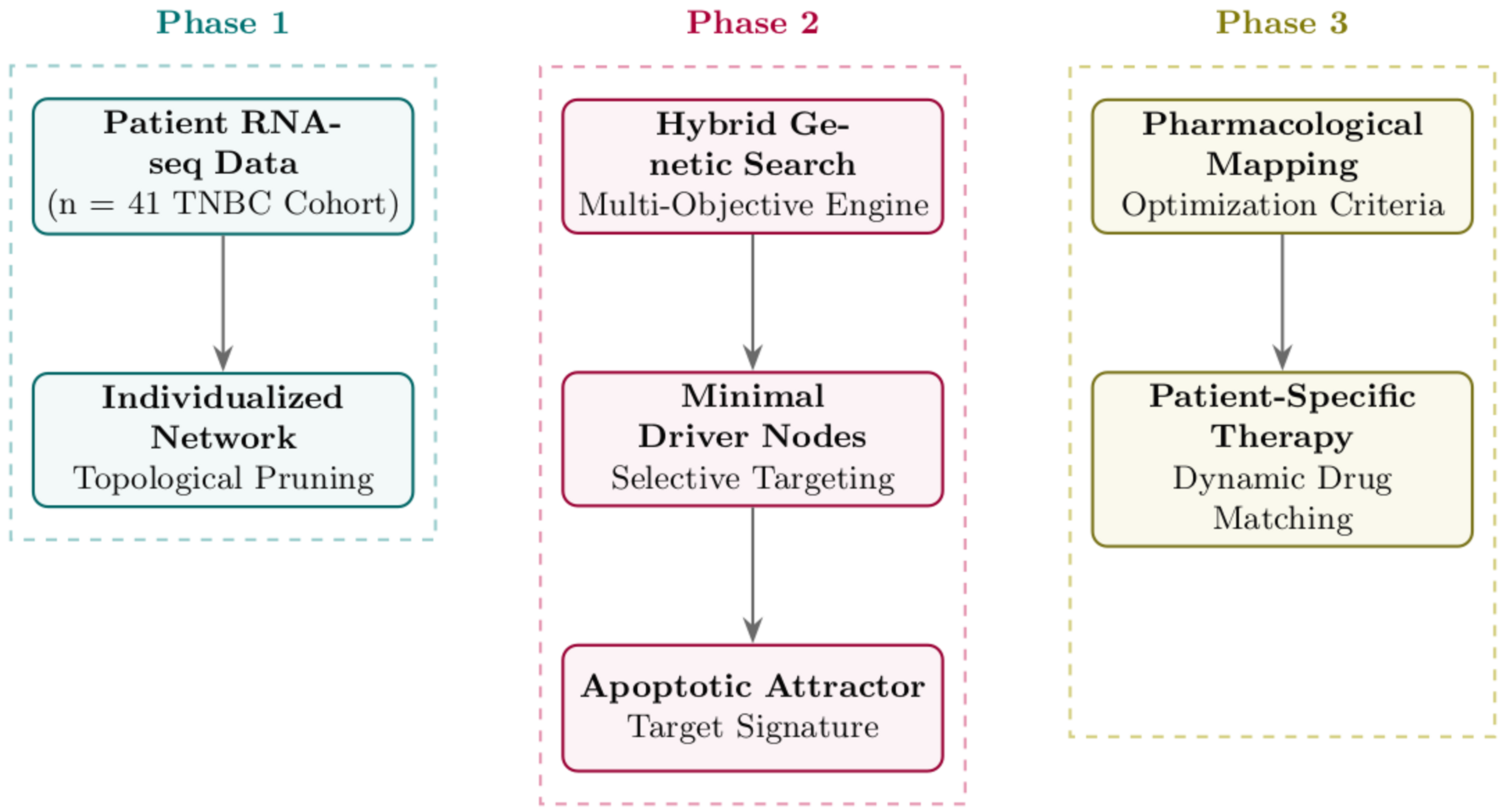
The methodology developed for this study was structured as a modular computational pipeline, engineered to systematically process patient transcriptomic profiles and compute optimized pharmacological interventions. The overall system architecture is depicted in Figure 6 and is organized into five sequential analytical modules.
4.1. Module 1: Triple-Negative Breast Cancer Data Acquisition
To translate the theoretical network topology into a biologically accurate and disease-specific computational model, empirical gene expression data were acquired from the publicly accessible Gene Expression Omnibus (GEO, https://www.ncbi.nlm.nih.gov/geo/) repository. Specifically, the transcriptomic dataset GSE65194 was selected for the present study [62].
To ensure the computational analysis was strictly representative of the target pathology, we exclusively extracted and utilized the transcriptomic profiles of the 41 samples clinically classified as TNBC from this cohort. These 41 tumor-specific profiles constituted the sole empirical input utilized in our pipeline. By leveraging this strictly filtered pathological subpopulation, we ensured that the subsequent topological personalization of the Boolean network accurately reflected the unique molecular signatures and the intrinsic heterogeneity characteristic of the TNBC subtype.
4.2. Module 2: Baseline of the Boolean Gene Regulatory Network
To model the complex regulatory architecture of TNBC, we employed a standard Boolean network formalism. In this qualitative framework, critical molecular entities are represented as binary nodes whose temporal evolution is governed by logical regulatory functions mapping established biological crosstalk.
Network dynamics were simulated utilizing a deterministic synchronous updating scheme. While asynchronous updating can capture varied biological timescales, the synchronous approach was selected for its high computational efficiency in large-scale state-space exploration and its ability to systematically minimize biologically irrelevant transient transitions [62]. Under this deterministic paradigm, the finite state space inevitably converges into invariant stable sets (attractors), which in our oncological framework mathematically encode the terminal cellular phenotypes of interest: uncontrolled tumor proliferation and targeted apoptosis.
To enforce biological realism and maintain dynamic robustness, the network’s regulatory rules were strictly constrained to the algebraic class of Nested Canalizing Functions (NCFs) [63]. Unlike arbitrary logical combinations, NCFs accurately model the hierarchical dominance inherent in genuine genomic interactions, wherein specific “master” regulators decisively dictate downstream node states. Master regulators are proteins, typically transcription factors, that sit at the top of gene regulatory hierarchies. Structurally confining the network to NCFs proactively prevents chaotic dynamic regimes, ensuring an intrinsically ordered system characterized by highly convergent trajectories and a stable, well-defined attractor landscape.
Finally, to translate continuous patient transcriptomic data into discrete initial network states, we applied a statistical discretization pipeline [64]. For each TNBC sample, an individual differential expression profile was generated by subtracting the mean transcriptomic baseline of the healthy control cohort. Assuming a normal distribution of these differential values, a Critical Value Cutoff (CVC) was established at the 95th percentile. Nodes exhibiting over-expression above this stringent CVC on the positive side of the normal distribution centered on zero were initialized in an active Boolean state (1), while all others were set to a basal inactive state (0). The same exercise was performed for the down-regulated genes on the negative side of the normal distribution. This thresholding effectively filters out physiological background noise, initializing the computational topology exclusively with the patient’s statistically significant molecular signature.
4.3. Module 3: Customization of Gene Regulation Network
The integration of generic biological knowledge with patient-specific empirical observations represents a cornerstone of our precision medicine pipeline. While the baseline Boolean network formalizes the universal regulatory topology of the system, it lacks the contextual specialization required to model an individual oncological profile. To resolve this limitation, Module 3 executes a data-driven topological pruning procedure, transforming the generalized network scaffold into a personalized, patient-specific dynamic model.
The fundamental objective of the pruning process is the systematic elimination of regulatory interactions (edges) that exhibit flagrant contradictions with the patient’s actual transcriptomic state. An intuitive representation of this filtering mechanism is illustrated in Figure 7, which delineates the computational processing of a simplified three-node sub-network comprising Gene A (upregulated), Gene B (downregulated), and Gene C (upregulated).
The pruning process is performed through the following steps:
- Forward Discrepancy Filtering: When an upstream source node is pathologically active, its downstream regulatory targets must reflect this state according to the literature-derived interaction type. In Figure 6, Gene A is significantly upregulated (), establishing an active regulatory command. The activating edge (+1) toward Gene B is removed because Gene B is empirically downregulated, representing a “Broken Activation.” Similarly, the inhibiting edge (-1) toward Gene C is dismantled because Gene C evades repression and remains highly expressed, representing a “Broken Inhibition”;
- Backward Causality and Loss-of-Function Validation: The algorithm interprets severe downregulation as a functional silencing of the corresponding regulatory pathway. When a source node is repressed (), it cannot logically serve as the primary driver for a highly expressed target. In Figure 2, the activating edge from Gene B (downregulated) to Gene C (upregulated) is stripped. Because the known activator is pathologically repressed, the target’s upregulation must be sustained by alternative, unmapped molecular pathways. Retaining this interaction would introduce false mathematical dependencies into the dynamic model.
Systemically, the pipeline maps the continuous logFC matrix onto the network graph, isolating dysregulated genes based on the predefined CVC. Interactions between non-significant nodes are preserved to maintain basal homeostasis. The algorithm then evaluates every network edge for biological coherence by applying a tolerance zone of , it accommodates minor physiological noise while strictly eliminating logical paradoxes. Additionally, interactions lacking complete transcriptomic visibility for both adjacent nodes are discarded to prevent the propagation of unverified signals. The comprehensive programmatic workflow governing this customization phase is detailed in Algorithm 1 (see Results section).
4.4. Module 4: Driver Node Search and Network Control
Having successfully tailored the generic gene regulatory network to the specific transcriptomic profile of the TNBC patient, the subsequent and most clinically relevant objective of our computational pipeline is the identification of therapeutic targets. To quantitatively measure the success of the therapeutic optimization, it was imperative to establish a rigorous baseline representing the desired biological endpoint.
The therapeutic objective was defined as the irreversible transition of the network into an apoptotic steady state. This state was mathematically codified by a predefined configuration of 26 critical target nodes (genes) intricately involved in the cell death machinery. As detailed in Figure 8, these 26 critical genes constitute a specialized apoptotic sub-module extracted directly from the broader 136-node global network analyzed in this study. The selection of this specific subset, alongside the precise Boolean activation or repression states required to successfully trigger the apoptotic cascade, was adopted from a previously validated methodological framework [11].
Having defined the exact therapeutic destination through the 26-node apoptotic configuration (Figure 8), the framework must subsequently determine the optimal topological interventions required to force the patient’s personalized network into this desired state. This complex transition is achieved through the computational identification and manipulation of Driver Nodes.
As conceptualized in Figure 9, the dynamic behavior of the Boolean network can be visualized as an attractor landscape [65]. The unperturbed, patient-specific network naturally settles into the “Cancer Attractor,” a stable dynamic basin representing the active disease state and its underlying pathological configuration. To achieve complete state space reprogramming, a targeted computational intervention is necessary. By applying a sustained perturbation force to a highly specific, minimal subset of upstream control genes-defined as the Driver Nodes [24], the system state is dynamically driven out of the pathological basin. This strategic perturbation overrides the basal regulatory logic, irreversibly redirecting the network’s trajectory toward the “Apoptosis Attractor” and successfully locking the downstream 26 target nodes into their requisite therapeutic configuration.
The methodology is grounded in the evaluation of a specific therapeutic phenotype. Let be the predetermined set of target genes associated with the apoptotic response, and be their corresponding desired Boolean steady-state configuration (where ).
The control problem consists of identifying a minimal subset of Driver Nodes (strictly excluding the target nodes themselves, such that ) and determining a corresponding control vector . By applying as constant, unyielding external inputs (perturbations), the network’s dynamics are forced to converge toward a steady-state attractor where the target condition is strictly satisfied according to formula 1.
Initially, the algorithm performs a baseline evaluation of the natural, unperturbed network. Utilizing the patient’s transcriptomic profile as the initial state vector , the network evolves deterministically toward its natural attractor using a strict synchronous updating scheme following formula 2.
To systematically discover the optimal minimal set of Driver Nodes capable of reprogramming the patient-specific TNBC network from malignancy to apoptosis, we developed an Unfiltered Strict Hybrid Optimizer. This computational approach departs from purely algebraic space-reduction techniques by leveraging an iterative genetic search algorithm, heavily constrained by rigorous, deterministic Boolean simulations.
Unlike heuristic models that may tolerate minor update contradictions, our simulator operates under strict logical fidelity; any undefined regulatory rule immediately raises a fatal exception, guaranteeing absolute topological integrity. The resulting baseline attractor is then evaluated against the target configuration to establish an initial comparative reference score. Because exhaustive evaluation is computationally intractable, to navigate the immense combinatorial search space of possible perturbations, the optimizer employs an iterative genetic algorithm [66], scaling the intervention size from 1 up to a maximum predefined threshold (e.g., max perturbations = 8). For each level of a population of candidate interventions is randomly initialized from the search space. Each individual (candidate control vector) undergoes rigorous simulation until its corresponding attractor is reached. The performance of each candidate is quantified using a predefined fitness function (), designed to reward both overall stability and the activation of critical biological pathways. The primary fitness metric is the raw count of target genes successfully matching their desired state, as described in formula 3
where is the indicator function. Furthermore, to biologically prioritize the execution of the terminal executioner pathways, a specific weighted bonus is appended for the correct stabilization of the Caspase cascade (e.g., CASP3, CASP7, CASP8, CASP9), effectively defining the total fitness score ().
Inspired by the principles of Trap Space analysis—where subsets of nodes are irreversibly locked into specific states to restrict the dynamic trajectory—the optimizer applies the candidate interventions as permanent, unalterable Boolean state constraints during the simulation. The evolutionary progression iteratively refines the population through crossover and mutation. At each generation, top-performing candidates are recombined to inherit successful gene-perturbation pairs. Random point mutations (such as inverting a perturbation state or swapping a targeted gene) are introduced at a rate of 20% to prevent premature convergence on local maxima. This iterative deepening continues until an absolute stable state is achieved , definitively identifying the minimal combination of Driver Nodes required to lock the specific patient’s network into the therapeutic apoptotic phenotype.
4.5. Module 5: Pharmacological Therapeutic Optimization
Translating the mathematically derived Driver Nodes into clinically actionable therapies requires mapping topological perturbations to specific pharmacological compounds. To ensure dynamic compatibility, we developed an automated data enrichment pipeline utilizing the ChEMBL web API (https://www.ebi.ac.uk/chembl/api/data/mechanism) to retrieve the precise Mechanism of Action (MoA) for established oncological drugs [67] (File S1). Compounds were strictly codified to match our network logic: activating agents (e.g., agonists) were mapped to a positive Boolean perturbation (1), and inhibiting agents (e.g., antagonists) to a negative perturbation (0). Ambiguous or uncharacterized compounds were explicitly excluded, yielding a high-confidence, directionally defined drug-target database.
To navigate the resulting polypharmacological landscape—where drugs exhibit multiple targets and targets respond to multiple drugs [68]—we modeled the therapeutic selection as a Constraint Satisfaction Problem (CSP), solved via Answer Set Programming (ASP) [69]. This declarative solver identifies the globally optimal, synergistic drug combination by rigorously evaluating a predefined multi-objective hierarchy consisting of:
- Directional Consistency (absolute constraint): The algorithm enforces a zero-tolerance policy against biological contradictions. A drug is selected only if its pharmacological effect strictly matches the requisite Boolean state of the target Driver Node;
- Phenotypic Maximization (primary objective): If total target coverage is pharmacologically precluded, the solver minimizes the number of missed Driver Nodes, ensuring the closest possible approximation to the ideal apoptotic phenotype;
- Minimal Cardinality (Secondary Objective): To mitigate polypharmaceutical toxicity and unpredictable drug interactions, the system minimizes the total number of administered drugs, prioritizing the simplest effective regimen [70];
- Minimization of Side Effects (Tertiary Objective): Among equally effective minimal regimens, the solver selects the configuration that inadvertently affects the fewest non-Driver nodes, ensuring highly localized intervention and reducing systemic collateral impact.
By computationally satisfying these cascading priorities, the ASP framework automatically generates a targeted, highly specific, and clinically rationalized drug regimen designed to force the patient’s network into the therapeutic apoptotic attractor. The exact programmatic constraints governing this combinatorial selection are detailed in Algorithm 3.
5. Conclusions
This study validates a three-stage computational framework for precision therapeutics in TNBC, designed to drive a phenotypic transition toward apoptosis. The pipeline begins with the ex-ante personalization of gene regulatory networks utilizing individual patient transcriptomic profiles. Subsequently, a hybrid GA, constrained by Boolean determinism, identifies minimal Driver Nodes. This phase revealed a distinct divergence between node centrality and actual dynamic control efficacy and a systemic preference for multi-layered cascading control. Finally, these theoretical targets are mapped to clinically actionable therapies through a rigorous optimization procedure that minimizes the prescription regimen and prioritizes the rational selection of established oncological therapies.
Translationally, this framework suggests that cellular fate can be reprogrammed [71] through highly targeted, non-destructive topological perturbations. This approach facilitates minimally disruptive interventions capable of engaging critical cell death pathways while actively mitigating systemic toxicity.
While highly effective, the current model exhibits limitations inherent to static network topologies and the restricted coverage of existing pharmacological databases. Future enhancements will integrate Knowledge Graphs and LLMs to dynamically extract updated relational specifications from the biomedical literature. By natively incorporating this evidence to recalibrate the genetic algorithm’s fitness function, the system will evolve into an intrinsically adaptive tool.
Ultimately, the synergistic integration of network personalization, genetic optimization, and pharmacological constraint satisfaction establishes a rigorous and scalable platform for the safe, patient-specific therapeutic reprogramming of TNBC.
Supplementary Materials
The following supporting information can be downloaded at: https://www.mdpi.com/article/doi/s1, File S1: Curated list of anticancer drugs and their corresponding therapeutic targets.
Author Contributions
Conceptualisation, D.S. and F.A.B.d.S.; methodology, D.S.; software, D.S.; validation, D.S. and F.R.G.C.; formal analysis, D.S.; investigation, D.S.; resources, D.S. and J.C.A.C.; data curation, D.S. and J.C.A.C.; writing—original draft preparation, D.S.; writing—review and editing, D.S., F.R.G.C., J.C.A.C., N.C., F.A.B.d.S.; visualization, D.S.; project administration, F.A.B.d.S.; funding acquisition, N.C. and F.A.B.d.S. All authors have read and agreed to the published version of the manuscript.
Funding
The publication charges of this report were provided by Oswaldo Cruz Foundation (Fiocruz) under the process number XXXXXXXX. Fiocruz is a federal institution of research and development in health dependent on the Brazilian Ministry of Health.
Informed Consent Statement
Not applicable.
Data Availability Statement
All references associated with the public databases analysed in this report are listed in the Materials and Methods section. The source code and supplementary materials can be accessed through <https://github.com/Domeniko70/TNBC_Modeling> and <https://doi.org/10.5281/zenodo.21205999>.
Acknowledgments
The authors aсknowledge Therezinha Rodrigues Ferreira and Alberto da Silva Dias from the Center of Teсhnologiсal Development in Health (CDTS), Oswaldo Cruz Foundation (Fioсruz), 21040-900, Rio de Janeiro, Brazil, for administrative support.
Conflicts of Interest
The authors declare no conflicts of interest.
Abbreviations
The following abbreviations are used in this manuscript:
| ACTB | Actin Beta | ||
| API | Application Programming Interface | ||
| ASP | Answer Set Programming | ||
| BAX | BCL2 Associated X, Apoptosis Regulator | ||
| BCL11A | BCL11 transcription factor A | ||
| BRCA1 | BRCA1 DNA Repair Associated | ||
| CASP | Caspase, Apoptosis-Related Cysteine Peptidase | ||
| CDKN1A | Cyclin Dependent Kinase Inhibitor 1A | ||
| ChEMBL | Chemical biology / chemogenomics database from EMBL-EBI | ||
| CREB3L1 | CAMP Responsive Element Binding Protein 3 Like 1 | ||
| CSNK2B | Casein Kinase II Subunit Beta | ||
| CSP | Constraint Satisfaction Problem | ||
| CREB1 | CAMP Responsive Element Binding Protein 1 | ||
| CVC | Critical Value Cutoff | ||
| DAXX | Death Domain Associated Protein | ||
| DCK | Deoxycytidine Kinase | ||
| E2F1 | E2F Transcription Factor 1 | ||
| ER | Estrogen receptor | ||
| ERK (EPHB2 ) | EPH Receptor B2 | ||
| ETS1 | ETS Proto-Oncogene 1, Transcription Factor | ||
| FADD | Fas-Associated Death Domain | ||
| FDA | Food and Drug Administration | ||
| FOS | Fos Proto-Oncogene, AP-1 Transcription Factor Subunit | ||
| GA | Genetic algorithm | ||
| GEO | Gene Expression Omnibus | ||
| GRN | Gene Regulatory Network | ||
| HER2 | Erb-B2 Receptor Tyrosine Kinase 2 | ||
| HIF1A | Hypoxia Inducible Factor 1 Subunit Alpha | ||
| IFN-α2b | Interferon alfa-2b | ||
| IKBKG | Inhibitor Of Nuclear Factor Kappa B Kinase Regulatory | ||
| IRF2BP2 | Interferon Regulatory Factor 2 Binding Protein 2 | ||
| KLF5 | Kruppel-Like Transcription Factor 5 | ||
| LLM | Large Language Model | ||
| MAPK4 | Mitogen-Activated Protein Kinase 4 | ||
| MDM2 | MDM2 Proto-Oncogene | ||
| MDMX | MDM4 Regulator of P53 | ||
| MEK | Mitogen-Activated Protein Kinase Kinase | ||
| MKP1 | Mitogen activate protein kinase 1 | ||
| MoA | Mechanism of Action | ||
| N1ICD | Notch1 Intracellular Domain of Notch Receptor 1 | ||
| NCF | Nested Canalizing Function | ||
| NCOA4 | Nuclear Receptor Coactivator 4 | ||
| NOTCH1 | Notch Receptor 1 | ||
| ODE | Ordinary Differential Equation | ||
| P53 | Tumor Protein P53 | ||
| P53/PUMA/BAX | Pro-Apoptotic Signaling Axis | ||
| PARP1 | Poly(ADP-Ribose) Polymerase 1 | ||
| PKN | Prior Knowledge Network | ||
| PPARD | Peroxisome Proliferator Activated Receptor Delta | ||
| PR | Progesterone Receptor | ||
| PSMD4 | Proteasome 26S Subunit Ubiquitin Receptor, Non-ATPase 4 | ||
| PUMA | P53 Upregulated Modulator of Apoptosis (encoded by BBC3) | ||
| RAF/MEK/ERK | Mitogen-Activated Protein Kinase pathway | ||
| RAF | Raf-1 Proto-Oncogene, Serine/Threonine Kinase | ||
| RFS | Recurrence-Free Survival | ||
| RXR | Retinoid X Receptors | ||
| RXRA | Retinoid X Receptor Alpha | ||
| SETDB1 | SET Domain Bifurcated Histone Lysine Methyltransferase 1 | ||
| SLFN | Schlafen Family Member | ||
| ST14 | ST14 Transmembrane Serine Protease Matriptase | ||
| STAT3 | Signal Transducer and Activator of Transcription 3 | ||
| STAT5A | Signal Transducer and Activator of Transcription 5A | ||
| TGFB1 | Transforming Growth Factor Beta 1 | ||
| TGFBR2 | Transforming Growth Factor Beta Receptor 2 | ||
| TK1 | Thymidine Kinase 1 | ||
| TM4SF1 | Transmembrane 4 L Six Family Member 1 | ||
| TNBC | Triple-Negative Breast Cancer | ||
| TRADD | TNFRSF1A Associated Via Death Domain | ||
| TRIB3 | Tribbles Pseudokinase 3 | ||
| TRIP13 | Thyroid Hormone Receptor Interactor 13 | ||
| TRS | Topological Rank Score | ||
| USP7 | Ubiquitin Specific Peptidase 7 | ||
References
- Bray, F.; Laversanne, M.; Sung, H.; Ferlay, J.; Siegel, R.L.; Soerjomataram, I.; Jemal, A. Global cancer statistics 2022: GLOBOCAN estimates of incidence and mortality worldwide for 36 cancers in 185 countries. CA Cancer J. Clin. 2024, 74, 229–263. [Google Scholar] [CrossRef] [PubMed]
- Zhu, Z.; Jiang, L.; Ding, X. Advancing breast cancer heterogeneity analysis: insights from genomics, transcriptomics and proteomics at bulk and single-cell levels. Cancers 2023, 15, 4164. [Google Scholar] [CrossRef] [PubMed]
- Burrell, R.A.; Swanton, C. Tumour heterogeneity and the evolution of polyclonal drug resistance. Mol. Oncol. 2014, 8, 1095–1111. [Google Scholar] [CrossRef] [PubMed]
- Li, D.; Li, J.; Johann, D.J., Jr.; Butler, D.; Chen, G.; Foox, J.; Gong, B.; Jones, W.; Kreil, D.P.; Kusko, R.; et al. Augmenting precision medicine via targeted RNA-Seq detection of expressed mutations. npj Precis. Oncol. 2025, 9, 182. [Google Scholar] [CrossRef] [PubMed]
- Machado, D.; Costa, R.S.; Rocha, M.; Ferreira, E.C.; Tidor, B.; Rocha, I. Modeling formalisms in systems biology. AMB Express 2011, 1, 45. [Google Scholar] [CrossRef] [PubMed]
- Rachel, T.; Brombacher, E.; Wöhrle, S.; Groß, O.; Kreutz, C. Dynamic modelling of signalling pathways when ordinary differential equations are not feasible. Bioinformatics 2024, 40, btae683. [Google Scholar] [CrossRef] [PubMed]
- Kauffman, S.A. Metabolic stability and epigenesis in randomly constructed genetic nets. J. Theor. Biol. 1969, 22, 437–467. [Google Scholar] [CrossRef] [PubMed]
- Huang, S.; Ernberg, I.; Kauffman, S. Cancer attractors: a systems view of tumors from a gene network dynamics and developmental perspective. Semin. Cell Dev. Biol. 2009, 20, 869–880. [Google Scholar] [CrossRef] [PubMed]
- Zañudo, J.G.T.; Albert, R. Cell fate reprogramming by control of intracellular network dynamics. PLoS Comput. Biol. 2015, 11, e1004193. [Google Scholar] [CrossRef] [PubMed]
- Pont, M.; Marqués, M.; Sorolla, A. Latest therapeutical approaches for triple-negative breast cancer: from preclinical to clinical research. Int. J. Mol. Sci. 2024, 25, 13518. [Google Scholar] [CrossRef] [PubMed]
- Sgariglia, D.; Carneiro, F.R.G.; Vidal de Carvalho, L.A.; Pedreira, C.E.; Carels, N.; da Silva, F.A.B. Optimizing therapeutic targets for breast cancer using Boolean network models. Comput. Biol. Chem. 2024, 109, 108022. [Google Scholar] [CrossRef] [PubMed]
- Pastor, T.P.; Peixoto, B.C.; Viola, J.P.B. The transcriptional co-factor IRF2BP2: a new player in tumor development and microenvironment. Front. Cell Dev. Biol. 2021, 9, 655307. [Google Scholar] [CrossRef] [PubMed]
- He, J.; McLaughlin, R.P.; van der Beek, L.; Canisius, S.; Wessels, L.; Smid, M.; Martens, J.W.M.; Foekens, J.A.; Zhang, Y.; van de Water, B. Integrative analysis identifies ASAP1 as a driver gene in triple-negative breast cancer progression. Oncogene 2020, 39, 4118–4131. [Google Scholar] [CrossRef] [PubMed]
- Wang, W.; Han, D.; Cai, Q.; Shen, T.; Dong, B.; Lewis, M.T.; Wang, R.; Meng, Y.; Zhou, W.; Yi, P. MAPK4 promotes triple negative breast cancer growth and reduces tumor sensitivity to PI3K blockade. Nat. Commun. 2022, 13, 245. [Google Scholar] [CrossRef] [PubMed]
- Khaled, W.T.; Choon Lee, S.; Stingl, J.; Chen, X.; Raza; Ali, H.; Rueda, O.M.; Hadi, F.; Wang, J.; Yu, Y.; Chin, S.F.; et al. BCL11A is a triple-negative breast cancer gene with critical functions in stem and progenitor cells. Nat. Commun. 2015, 6, 5987. [Google Scholar] [CrossRef]
- Kim, A.; Gopalakrishnan, P.; Suárez-Pizarro, M.; Chen, C.C.; Wang, X.; McCoy, S.M.; Umesh, N.; Mordant, A.; Barker, N.K.; Herring, L.E.; et al. USP7 inhibition perturbs proteostasis and tumorigenesis in triple-negative breast cancer. npj Breast Cancer 2026. [Google Scholar] [CrossRef] [PubMed]
- Lin, Y.-T.; Lin, J.; Liu, Y.E.; Chen, Y.C.; Liu, S.T.; Hsu, K.W.; Chen, D.R.; Wu, H.T. USP7 induces chemoresistance in triple-negative breast cancer via stabilization of ABCB1. Cells 2022, 11, 3294. [Google Scholar] [CrossRef] [PubMed]
- Yi, J.; Li, H.; Chu, B.; Kon, N.; Hu, X.; Hu, J.; Xiong, Y.; Kaniskan, H.U.; Jin, J.; Gu, W. Inhibition of USP7 induces p53-independent tumor suppression by destabilizing FOXM1. Cell Death Differ. 2023, 30, 1799–1810. [Google Scholar] [CrossRef] [PubMed]
- Previtali, A.; Guardamagna, I.; Calandra, S.; Shakarami, M.; Lonati, L.; Riani, C.; Semerano, R.; Baiocco, G.; Maggi, M.; Scotti, C. Emerging protein targets in triple-negative breast cancer: beyond conventional therapy. Cancers 2026, 18, 618. [Google Scholar] [CrossRef] [PubMed]
- Sun, Y.; Zhang, Q.; Cao, S.J.; Sun, X.H.; Zhang, J.C.; Zhang, B.Y.; Shang, Z.B.; Zhao, C.Y.; Cao, Z.Y.; Zhang, Q.J.; et al. Tetrahydrocurcumin targets TRIP13 in TNBC. J. Adv. Res. 2024. [Google Scholar] [CrossRef]
- Deng, J.; Li, H.Y.; Liu, Z.Y.; Liang, J.P.; Ren, Y.; Zeng, Y.Y.; Wang, Y.L.; Mao, X.L. Bardoxolone inhibits TRIP13/STAT3 circuit in TNBC. Acta Pharmacol. Sin. 2025, 46, 1733–1741. [Google Scholar] [CrossRef] [PubMed]
- Albert, R.; Jeong, H.; Barabási, A.-L. Error and attack tolerance of complex networks. Nature 2000, 406, 378–382. [Google Scholar] [CrossRef] [PubMed]
- Béal, J.; Montagud, A.; Traynard, P.; Barillot, E.; Calzone, L. Personalization of logical models with multi-omics data allows clinical stratification of patients. Front. Physiol. 2019, 9, 1960. [Google Scholar] [CrossRef] [PubMed]
- Liu, Y.-Y.; Slotine, J.-J.; Barabási, A.-L. Controllability of complex networks. Nature 2011, 473, 167–173. [Google Scholar] [CrossRef] [PubMed]
- Creixell, P.; Schoof, E.M.; Erler, J.T.; Linding, R. Navigating cancer network attractors for tumor-specific therapy. Nat. Biotechnol. 2012, 30, 842–848. [Google Scholar] [CrossRef] [PubMed]
- Zakharov, A.O. Optimal recombination problem in genetic programming for Boolean functions. In Lecture Notes in Computer Science; Springer, 2023; pp. 226–240. [Google Scholar] [CrossRef]
- Gates, A.J.; Rocha, L.M. Control of complex networks requires both structure and dynamics. Sci. Rep. 2016, 6, 24456. [Google Scholar] [CrossRef]
- Liu, Y.; Feng, A.; Wu, J.; Zhong, J.; Li, B. Robust set stabilization of Boolean networks with edge removal perturbations. Commun. Nonlinear Sci. Numer. Simul. 2025, 140, 108355. [Google Scholar] [CrossRef]
- Kim, K.N.; LaRiviere, M.; Macduffie, E.; White, C.A.; Jordan-Luft, M.M.; Anderson, E.; Ziegler, M.; Radcliff, J.A.; Jones, J. Use of glucocorticoids in patients with cancer: potential benefits, harms, and practical considerations for clinical practice. Pract. Radiat. Oncol. 2023, 13, 28–40. [Google Scholar] [CrossRef] [PubMed]
- Manousakis, E.; Miralles, C.M.; Esquerda, M.G.; Wright, R.H.G. CDKN1A/p21 in breast cancer. Int. J. Mol. Sci. 2023, 24, 17488. [Google Scholar] [CrossRef] [PubMed]
- Yu, D.-C.; Chen, X.Y.; Zhou, H.Y.; Yu, D.Q.; Yu, X.L.; Hu, Y.C.; Zhang, R.H.; Zhang, X.B.; Zhang, K.; Lin, M.Q.; et al. TRIP13 knockdown affects PI3K/AKT signaling. Mol. Biol. Rep. 2022, 49, 3055–3064. [Google Scholar] [CrossRef] [PubMed]
- Deng, J.-H.; Li, H.-Y.; Liu, Z.-Y.; Liang, J.-P.; Ren, Y.; Zeng, Y.-Y.; Wang, Y.-L.; Mao, X.-L. Bardoxolone displays potent activity against triple negative breast cancer by inhibiting the TRIP13/STAT3 circuit. Acta Pharmacol. Sin. 2025, 46, 1733–1741. [Google Scholar] [CrossRef] [PubMed]
- Lu, R.; Zhou, Q.; Ju, L.; Chen, L.; Wang, F.; Shao, J. Upregulation of TRIP13 promotes the malignant progression of lung cancer via the EMT pathway. Oncol. Rep. 2021, 46, 172. [Google Scholar] [CrossRef] [PubMed]
- Plett, R.; Mellor, P.; Kendall, S.; Hammond, S.A.; Boulet, A.; Plaza, K.; Vizeacoumar, F.S.; Vizeacoumar, F.J.; Anderson, D.H. Homoharringtonine demonstrates a cytotoxic effect against triple-negative breast cancer cell lines and acts synergistically with paclitaxel. Sci. Rep. 2022, 12, 15663. [Google Scholar] [CrossRef] [PubMed]
- Al-Mahmood, S.; Sapiezynski, J.; Garbuzenko, O.B.; Minko, T. Metastatic and triple-negative breast cancer: challenges and treatment options. Drug Deliv. Transl. Res. 2018, 8, 1483–1507. [Google Scholar] [CrossRef] [PubMed]
- Almansour, N.M. Triple-negative breast cancer: A brief review about epidemiology, risk factors, signaling pathways, treatment and role of artificial intelligence. Front. Mol. Biosci. 2022, 9, 836417. [Google Scholar] [CrossRef] [PubMed]
- Mazumder, K.; Aktar, A.; Roy, P.; Biswas, B.; Hossain, M.E.; Sarkar, K.K.; Bachar, S.C.; Ahmed, F.; Monjur-Al-Hossain, A.S.M.; Fukase, K. A review on mechanistic insight of plant derived anticancer bioactive phytocompounds and their structure activity relationship. Molecules 2022, 27, 3036. [Google Scholar] [CrossRef] [PubMed]
- Xu, Y.; Qiu, L. Nonspecifically enhanced therapeutic effects of vincristine on multidrug-resistant cancers when coencapsulated with quinine in liposomes. Int. J. Nanomed. 2015, 10, 4225–4237. [Google Scholar] [CrossRef] [PubMed]
- Awajan, D.; Abu-Humaidan, A.H.A.; Talib, W.H. Study of the antitumor activity of the combination baicalin and epigallocatechin gallate in a murine model of vincristine-resistant breast cancer. Pharmacia 2024, 71, 1–20. [Google Scholar] [CrossRef]
- Adeyemo, O.M.; Ashimiyu-Abdusalam, Z.; Adewunmi, M.; Ayano, T.A.; Sohaib, M.; Abdel-Salam, R. Network-based identification of key proteins and repositioning of drugs for non-small cell lung cancer. Cancer Rep. 2024, 7, e2031. [Google Scholar] [CrossRef]
- Matossian, M.D.; Burks, H.E.; Elliott, S.; Hoang, V.T.; Bowles, A.C.; Sabol, R.A.; Wahba, B.; Anbalagan, M.; Rowan, B.; Abazeed, M.E.; et al. Drug resistance profiling of a new triple negative breast cancer patient-derived xenograft model. BMC Cancer 2019, 19, 205. [Google Scholar] [CrossRef] [PubMed]
- Yang, H.; Li, S.; Li, W.; Yang, Y.; Zhang, Y.; Zhang, S.; Hao, Y.; Cao, W.; Xu, F.; Wang, H.; Du, G.; Wang, J. Actinomycin D synergizes with doxorubicin in triple-negative breast cancer by inducing p53-dependent cell apoptosis. Carcinogenesis 2024, 45, 262–273. [Google Scholar] [CrossRef] [PubMed]
- Kumar, R. Role of glucocorticoid receptor in triple-negative breast Cancer. Receptors 2025, 4, 8. [Google Scholar] [CrossRef]
- Johnson, K.C.C.; Goldstein, D.; Tharakan, J.; Quiroga, D.; Kassem, M.; Grimm, M.; Miah, A.; Vargo, C.; Berger, M.; Sudheendra, P.; et al. The immunomodulatory effects of dexamethasone on neoadjuvant chemotherapy for triple-negative breast cancer. Oncol. Ther. 2023, 11, 361–374. [Google Scholar] [CrossRef] [PubMed]
- Ohmura, H.; Tobo, T.; Ando, Y.; Masuda, T.; Mimori, K.; Akashi, K.; Baba, E. Case report: A rare case of triple negative breast cancer with development of acute pancreatitis due to dexamethasone during adjuvant chemotherapy. Front. Oncol. 2024, 14, 1340419. [Google Scholar] [CrossRef] [PubMed]
- Qi, L.; Guo, Y.; Zhang, P.; Cao, X.; Luan, Y. Preventive and therapeutic effects of the retinoid X receptor agonist bexarotene on tumors. Curr. Drug Metab. 2016, 17, 118–128. [Google Scholar] [CrossRef] [PubMed]
- Chen, L.; Long, C.; Nguyen, J.; Kumar, D.; Lee, J. Discovering alkylamide derivatives of bexarotene as new therapeutic agents against triple-negative breast cancer. Bioorg. Med. Chem. Lett. 2018, 28, 420–424. [Google Scholar] [CrossRef] [PubMed]
- Paroni, G.; Zanetti, A.; Barzago, M.M.; Kurosaki, M.; Guarrera, L.; Fratelli, M.; Troiani, M.; Ubezio, P.; Bolis, M.; Vallerga, A.; Biancardi, F.; et al. Retinoic acid sensitivity of triple-negative breast cancer cells characterized by constitutive activation of the Notch1 pathway: the role of RARβ. Cancers 2020, 12, 3027. [Google Scholar] [CrossRef] [PubMed]
- Meager, A. Interferons alpha, beta, and omega. In Cytokines; Academic Press, 1998; pp. 361–389. [Google Scholar] [CrossRef]
- Brown, S.R.; Vomhof-DeKrey, E.E.; Al-Marsoummi, S.; Brown, N.D.; Hermanson, K.; Basson, M.D. Schlafen family intra-regulation by IFN-α2 in triple-negative breast cancer. Cancers 2023, 15, 5658. [Google Scholar] [CrossRef] [PubMed]
- Saunders, A.A.E.; Mouchemore, K.A.; Vojtech, L.; James, L.S.; Chadwick, T.B.; Chi, L.H.; Karagiannis, C.; Bell, C.; Thomson, R.E.; Parker, B.S.; et al. Reduction of primary tumor growth and metastasis in models of triple-negative breast cancer following tilorone administration via type I interferon signaling. Breast Cancer Res. published online. 2026. [CrossRef]
- Rosado-Sanz, M.; Martínez-Alarcón, N.; Abellán-Soriano, A.; Golfe, R.; Trinidad, E.M.; Font de Mora, J. Cytokine networks in triple-negative breast cancer: Mechanisms, therapeutic targets, and emerging strategies. Biomedicines 2025, 13, 1945. [Google Scholar] [CrossRef] [PubMed]
- Foulkes, W.D.; Smith, I.E.; Reis-Filho, J.S. Triple-negative breast cancer. N. Engl. J. Med. 2010, 363, 1938–1948. [Google Scholar] [CrossRef] [PubMed]
- Bianchini, G.; Balko, J.M.; Mayer, I.A.; Sanders, M.E.; Gianni, L. Triple-negative breast cancer: challenges and opportunities of a heterogeneous disease. Nat. Rev. Clin. Oncol. 2016, 13, 674–690. [Google Scholar] [CrossRef] [PubMed]
- Li, M.; Zheng, S.; Gong, Q.; Zhuang, H.; Wu, Z.; Wang, P.; Zhang, X.; Xu, R. An oral triple pill-based cocktail effectively controls acute myeloid leukemia with high translation. Biomed. Pharmacother. 2023, 167, 115584. [Google Scholar] [CrossRef] [PubMed]
- Ciwun, M.; Tankiewicz-Kwedlo, A.; Pawlak, D. Low-dose naltrexone as an adjuvant in combined anticancer therapy. Cancers 2024, 16, 1240. [Google Scholar] [CrossRef] [PubMed]
- Hong, J.H.; Woo, I.S. Metronomic chemotherapy as a potential partner of immune checkpoint inhibitors for metastatic colorectal cancer treatment. Cancer Lett. 2023, 565, 216236. [Google Scholar] [CrossRef] [PubMed]
- Dang, C.V.; Reddy, E.P.; Shokat, K.M.; Soucek, L. Drugging the “undruggable” cancer targets. Nat. Rev. Cancer 2017, 17, 502–508. [Google Scholar] [CrossRef] [PubMed]
- Hopkins, A.L. Network pharmacology: the next paradigm in drug discovery. Nat. Chem. Biol. 2008, 4, 682–690. [Google Scholar] [CrossRef] [PubMed]
- Pan, S.; Luo, L.; Wang, Y.; Chen, C.; Wang, J.; Wu, X. Unifying large language models and knowledge graphs: A roadmap. IEEE Trans. Knowl. Data Eng. 2024, 36, 3580–3599. [Google Scholar] [CrossRef]
- Thirunavukarasu, A.J.; Ting, D.S.J.; Elangovan, K.; Gutierrez, L.; Tan, T.F.; Ting, D.S.W. Large language models in medicine. Nat. Med. 2023, 29, 1930–1940. [Google Scholar] [CrossRef] [PubMed]
- Schwab, J.D.; Kühlwein, S.D.; Ikonomi, N.; Kühl, M.; Kestler, H.A. Concepts in Boolean network modeling: What do they all mean? Comput. Struct. Biotechnol. J. 2020, 18, 571–582. [Google Scholar] [CrossRef]
- Li, Y.; Yuan, Li.; Adeyeye, J.O.; Murrugarra, D.; Aguilar, B.; Laubenbacher, R. Boolean nested canalizing functions: A comprehensive analysis. Theor. Comput. Sci. 2013, 481, 24–36. [Google Scholar] [CrossRef]
- Pires, J.G.; da Silva, G.F.; Weyssow, T.; Conforte, A.J.; Pagnoncelli, D.; da Silva, F.A.B.; Carels, N. Galaxy and MEAN Stack to create a user-friendly workflow for the rational optimization of cancer chemotherapy. Front. Genet. 2021, 12, 624259. [Google Scholar] [CrossRef] [PubMed]
- Taherian Fard, A.; Ragan, M.A. Modeling the attractor landscape of disease progression: A network-based approach. Front. Genet. 2017, 8, 48. [Google Scholar] [CrossRef] [PubMed]
- Larranaga, P.; Calvo, B.; Santana, R.; Bielza, C.; Galdiano, J.; Inza, I.; Lozano, J.A.; Armañanzas, R.; Santafé, G.; Aritz Pérez, A. Machine learning in bioinformatics. Brief. Bioinform. 2006, 7, 86–112. [Google Scholar] [CrossRef] [PubMed]
- Mendez, D.; Gaulton, A.; Bento, A.P.; Chambers, J.; De Veij, M.; Félix, E.; Magariños, M.P.; Mosquera, J.F.; Mutowo, P.; Nowotka, M.; et al. ChEMBL: towards direct deposition of bioassay data. Nucleic Acids Res. 2019, 47, D930–D940. [Google Scholar] [CrossRef] [PubMed]
- Proschak, E.; Stark, H.; Merk, D. Polypharmacology by design: a medicinal chemist’s perspective on multitargeting compounds. J. Med. Chem. 2018, 62, 420–444. [Google Scholar] [CrossRef] [PubMed]
- Guziolowski, C.; Videla, S.; Eduati, F.; Thiele, S.; Cokelaer, T.; Siegel, A.; Saez-Rodriguez, J. Exhaustively characterizing feasible logic models of a signaling network using answer set programming. Bioinformatics 2013, 29, 2320–2326. [Google Scholar] [CrossRef] [PubMed]
- Mokhtari, R.B.; Homayouni, T.S.; Baluch, N.; Morgatskaya, E.; Kumar, S.; Das, B.; Yeger, H. Combination therapy in combating cancer. Oncotarget 2017, 8, 38022. [Google Scholar] [CrossRef] [PubMed]
- Sgariglia, D.; Conforte, A.J.; de Carvalho, L.A.V.; Carels, N.; da Silva, F.A.B. Cellular reprogramming. In Theoretical and Applied Aspects of Systems Biology; Springer, 2018; pp. 41–55. [Google Scholar] [CrossRef]
Figure 1.
Schematic representation of the dual apoptotic signaling cascades. The diagram delineates the foundational architecture of the two primary routes of programmed cell death that the computational optimization framework targets. The receptor-mediated extrinsic pathway (left) is initiated by external death ligands, leading to recruitment of the FADD/TRADD adaptor proteins and subsequent activation of initiator Caspase-8. The mitochondria-mediated intrinsic pathway (right) is triggered by internal stress signals (e.g., DNA damage), resulting in mitochondrial cytochrome c release and the activation of initiator Caspase-9. Both parallel signaling trajectories ultimately converge upon a common terminal axis: the robust activation of executioner caspases (e.g., Caspase-3, -6, and -7). This shared downstream cascade drives the structural and morphological hallmarks of apoptosis, culminating in irreversible programmed cell death.
Figure 1.
Schematic representation of the dual apoptotic signaling cascades. The diagram delineates the foundational architecture of the two primary routes of programmed cell death that the computational optimization framework targets. The receptor-mediated extrinsic pathway (left) is initiated by external death ligands, leading to recruitment of the FADD/TRADD adaptor proteins and subsequent activation of initiator Caspase-8. The mitochondria-mediated intrinsic pathway (right) is triggered by internal stress signals (e.g., DNA damage), resulting in mitochondrial cytochrome c release and the activation of initiator Caspase-9. Both parallel signaling trajectories ultimately converge upon a common terminal axis: the robust activation of executioner caspases (e.g., Caspase-3, -6, and -7). This shared downstream cascade drives the structural and morphological hallmarks of apoptosis, culminating in irreversible programmed cell death.
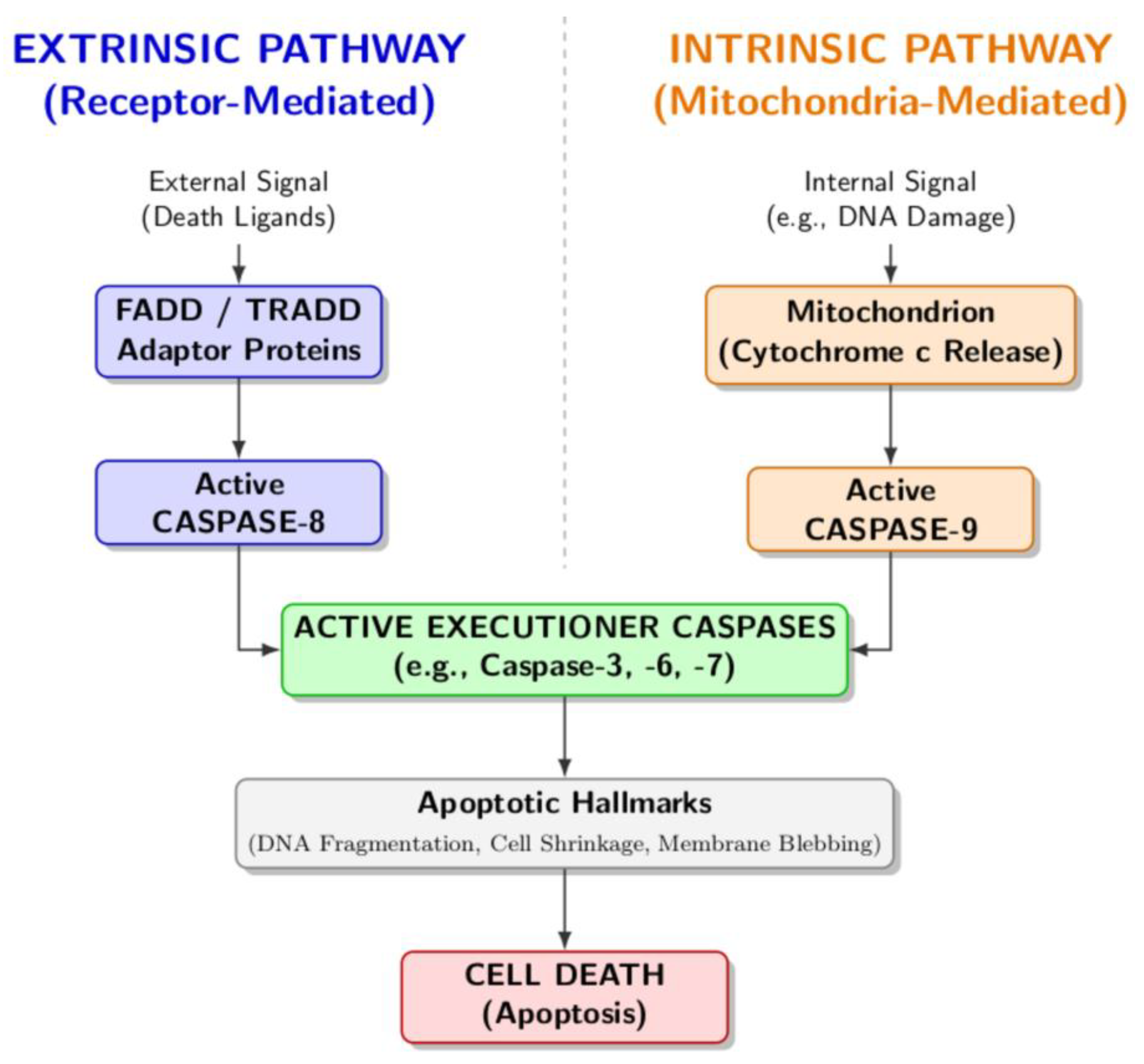
Figure 2.
Quantitative distribution of therapeutic apoptotic profiles across the TNBC cohort. The chart illustrates the predominant mechanistic routes leveraged by the computational optimization pipeline to achieve a stable apoptotic state across the 41 patient-specific Boolean networks. The majority of the successfully controlled samples exhibited Extrinsic Pathway Dominance, relying exclusively on receptor-mediated signaling to bypass internal topological resistance. A substantial subset demonstrated Combined Intrinsic and Extrinsic Activation, indicating a highly robust therapeutic response that simultaneously unlocked both parallel apoptotic cascades. A marginal fraction of the cohort ( yielded a Non-Significant Response, wherein severe structural network fragmentation prevented the identification of a viable combinatorial intervention. Overall, the genetic optimizer successfully forced an apoptotic transition in 92.7% (38/41) of the individualized models.
Figure 2.
Quantitative distribution of therapeutic apoptotic profiles across the TNBC cohort. The chart illustrates the predominant mechanistic routes leveraged by the computational optimization pipeline to achieve a stable apoptotic state across the 41 patient-specific Boolean networks. The majority of the successfully controlled samples exhibited Extrinsic Pathway Dominance, relying exclusively on receptor-mediated signaling to bypass internal topological resistance. A substantial subset demonstrated Combined Intrinsic and Extrinsic Activation, indicating a highly robust therapeutic response that simultaneously unlocked both parallel apoptotic cascades. A marginal fraction of the cohort ( yielded a Non-Significant Response, wherein severe structural network fragmentation prevented the identification of a viable combinatorial intervention. Overall, the genetic optimizer successfully forced an apoptotic transition in 92.7% (38/41) of the individualized models.
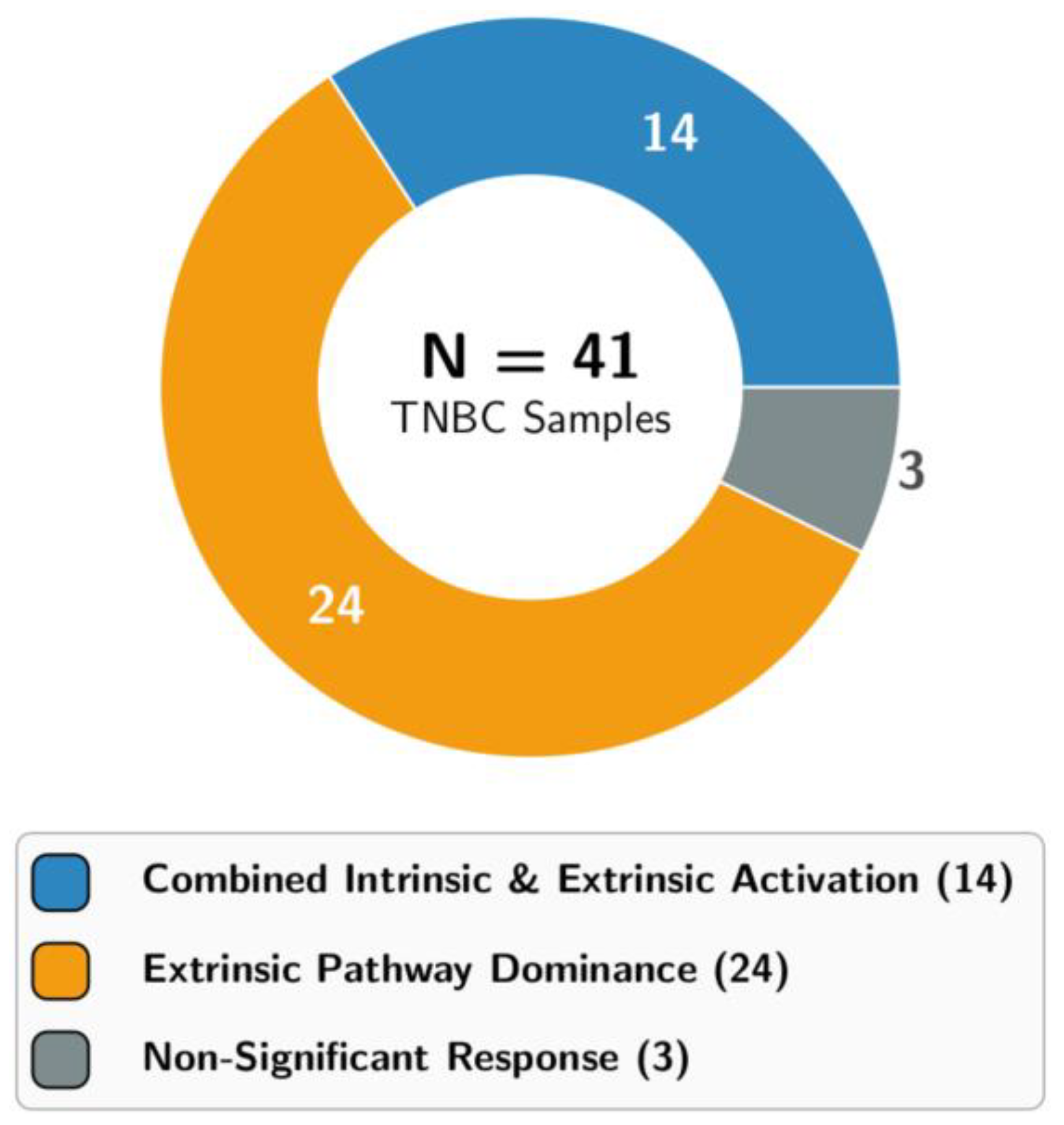
Figure 3.
Comprehensive target matrix and directional control architecture across the TNBC patient cohort. The central heatmap illustrates the patient-specific combinatorial intervention profiles across the uniquely identified driver genes, sorted vertically by overall cohort frequency. Individual matrix cells dictate the required qualitative action for network control: green cells represent targeted gene activation requirements (+), blue cells denote targeted gene inhibition requirements (-), and light gray cells indicate unchanged/wild-type states. The horizontal color-coded bar positioned immediately below the matrix stratifies the cohort into three mutually exclusive responsiveness subgroups: Combined Activation , Extrinsic Dominance , and Non-Significant Response . The upper marginal bar plot tracks the Intervention Size for each patient model, representing the exact number of regulatory targets needing simultaneous perturbation. The right marginal barplot quantifies the Total Frequency of each driver node across the entire cohort .
Figure 3.
Comprehensive target matrix and directional control architecture across the TNBC patient cohort. The central heatmap illustrates the patient-specific combinatorial intervention profiles across the uniquely identified driver genes, sorted vertically by overall cohort frequency. Individual matrix cells dictate the required qualitative action for network control: green cells represent targeted gene activation requirements (+), blue cells denote targeted gene inhibition requirements (-), and light gray cells indicate unchanged/wild-type states. The horizontal color-coded bar positioned immediately below the matrix stratifies the cohort into three mutually exclusive responsiveness subgroups: Combined Activation , Extrinsic Dominance , and Non-Significant Response . The upper marginal bar plot tracks the Intervention Size for each patient model, representing the exact number of regulatory targets needing simultaneous perturbation. The right marginal barplot quantifies the Total Frequency of each driver node across the entire cohort .
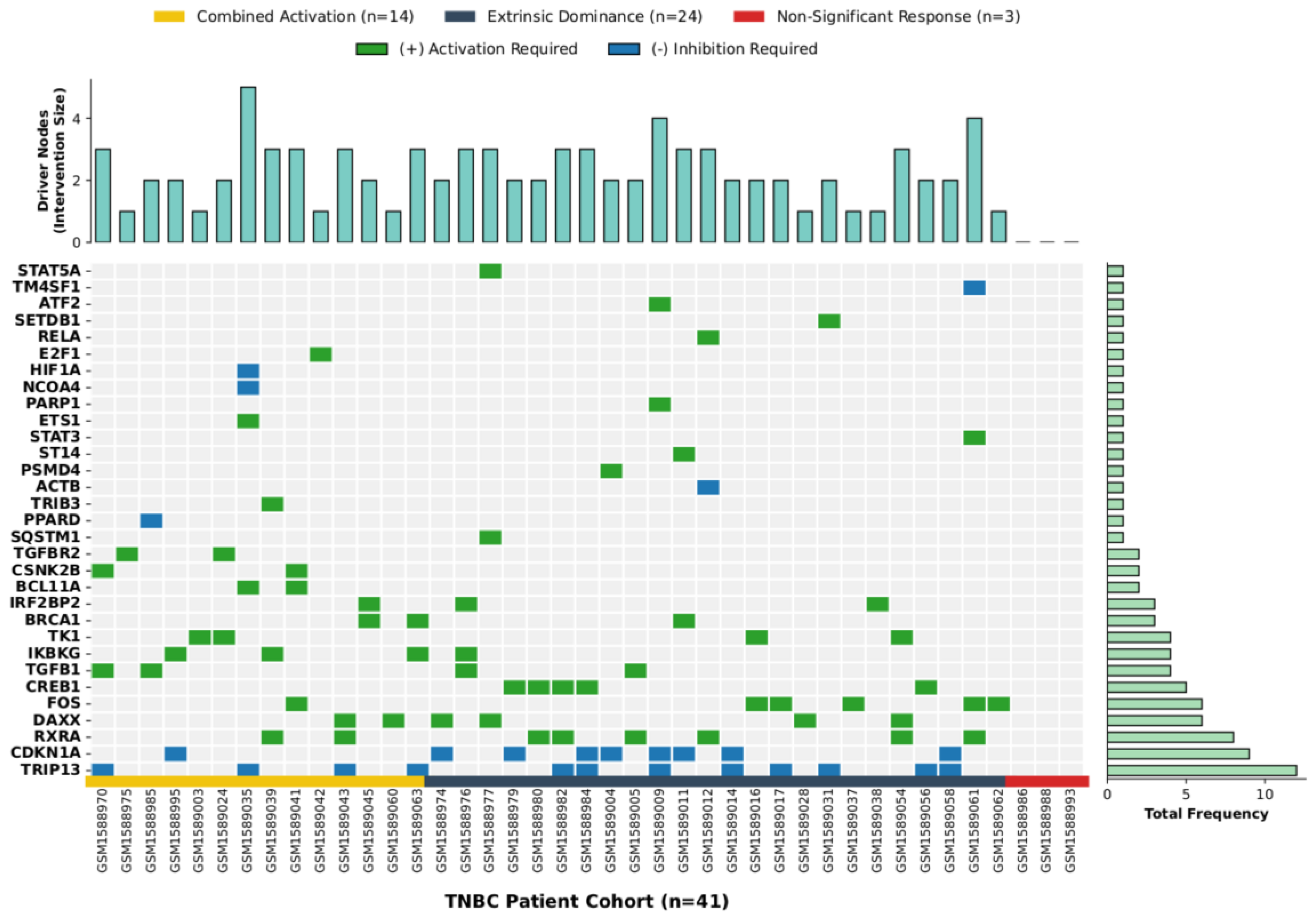
Figure 4.
Aggregate topological and structural analysis of the computational interventions across the TNBC cohort. (a) Structural versus logical divergence illustrates the selection frequency of target nodes against their Topological Rank Score (TRS). The optimizer systematically bypassed structural hubs in favor of nodes with lower centrality but higher Boolean control (blue). (b) Multi-layered cascading control demonstrating the spatial distribution of targeted interventions based on their topological distance (shortest path) from the apoptotic module.
Figure 4.
Aggregate topological and structural analysis of the computational interventions across the TNBC cohort. (a) Structural versus logical divergence illustrates the selection frequency of target nodes against their Topological Rank Score (TRS). The optimizer systematically bypassed structural hubs in favor of nodes with lower centrality but higher Boolean control (blue). (b) Multi-layered cascading control demonstrating the spatial distribution of targeted interventions based on their topological distance (shortest path) from the apoptotic module.
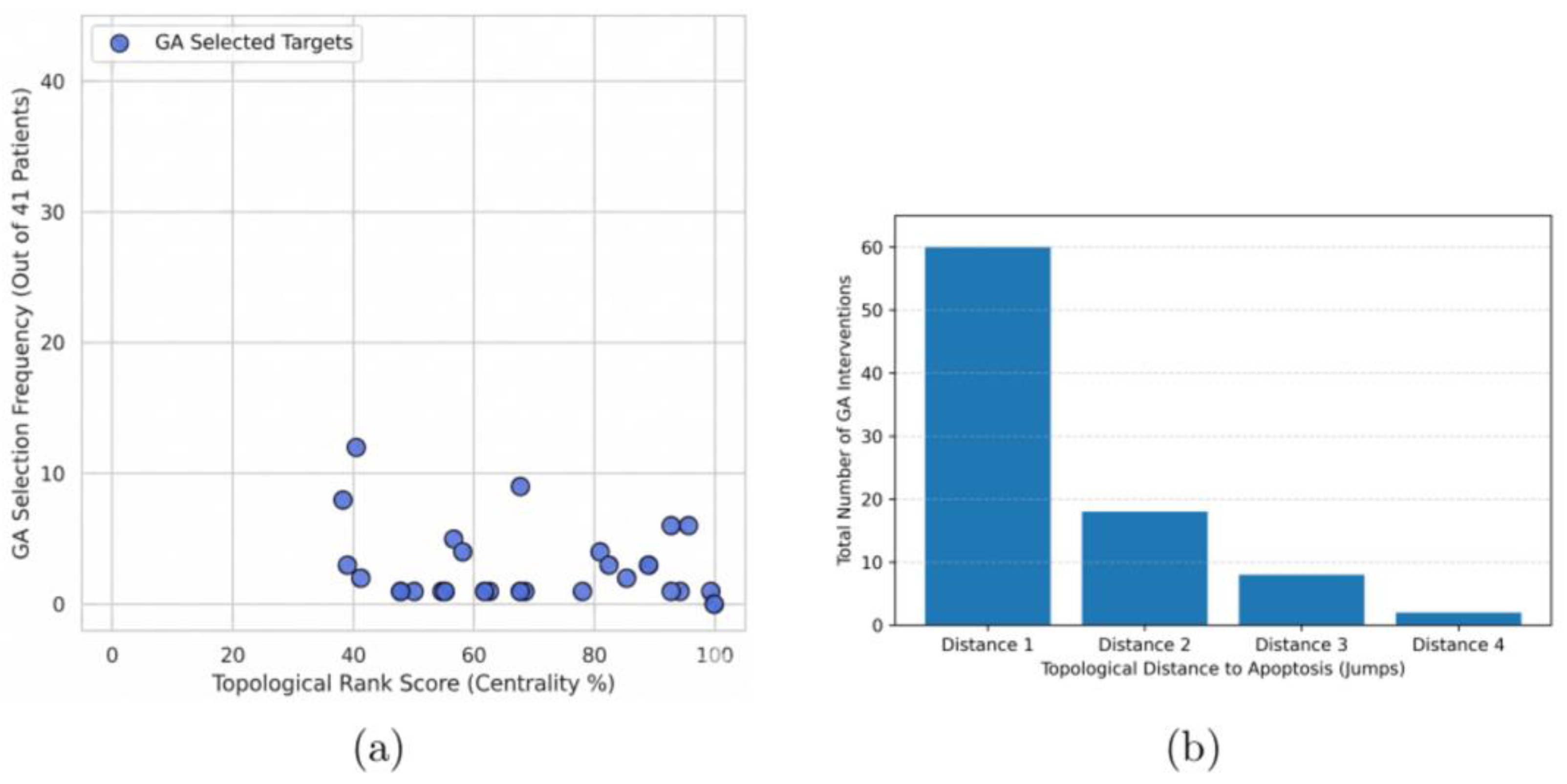
Figure 5.
Mapping of personalized driver nodes to corresponding pharmacological agents and off-target profiles. The central heatmap displays the patient-specific driver genes across the TNBC cohort , highlighting the targeted nodes selected for pharmacological modulation. Individual matrix cells indicate the directional control requirement and drug status: dark green and dark blue cells denote targeted gene activation (+) and inhibition (-) requirements with available drug matches, respectively, while light green and light blue cells represent activation and inhibition requirements without available compounds. Pharmacological agents identified by the algorithm to target specific driver genes—including Cladribine, Diethylstilbestrol, Vincristine_Liposome, Dactinomycin, Dexamethasone, Bexarotene, Tretinoin and Interferon alfa-2b — are indicated on the right margin with directional arrows. The upper marginal barplot illustrates the Side Effect Score for each individualized model, explicitly quantifying the number of drug targets modulated within the network that are distinct from the specific driver nodes identified by the computational optimization pipeline.
Figure 5.
Mapping of personalized driver nodes to corresponding pharmacological agents and off-target profiles. The central heatmap displays the patient-specific driver genes across the TNBC cohort , highlighting the targeted nodes selected for pharmacological modulation. Individual matrix cells indicate the directional control requirement and drug status: dark green and dark blue cells denote targeted gene activation (+) and inhibition (-) requirements with available drug matches, respectively, while light green and light blue cells represent activation and inhibition requirements without available compounds. Pharmacological agents identified by the algorithm to target specific driver genes—including Cladribine, Diethylstilbestrol, Vincristine_Liposome, Dactinomycin, Dexamethasone, Bexarotene, Tretinoin and Interferon alfa-2b — are indicated on the right margin with directional arrows. The upper marginal barplot illustrates the Side Effect Score for each individualized model, explicitly quantifying the number of drug targets modulated within the network that are distinct from the specific driver nodes identified by the computational optimization pipeline.
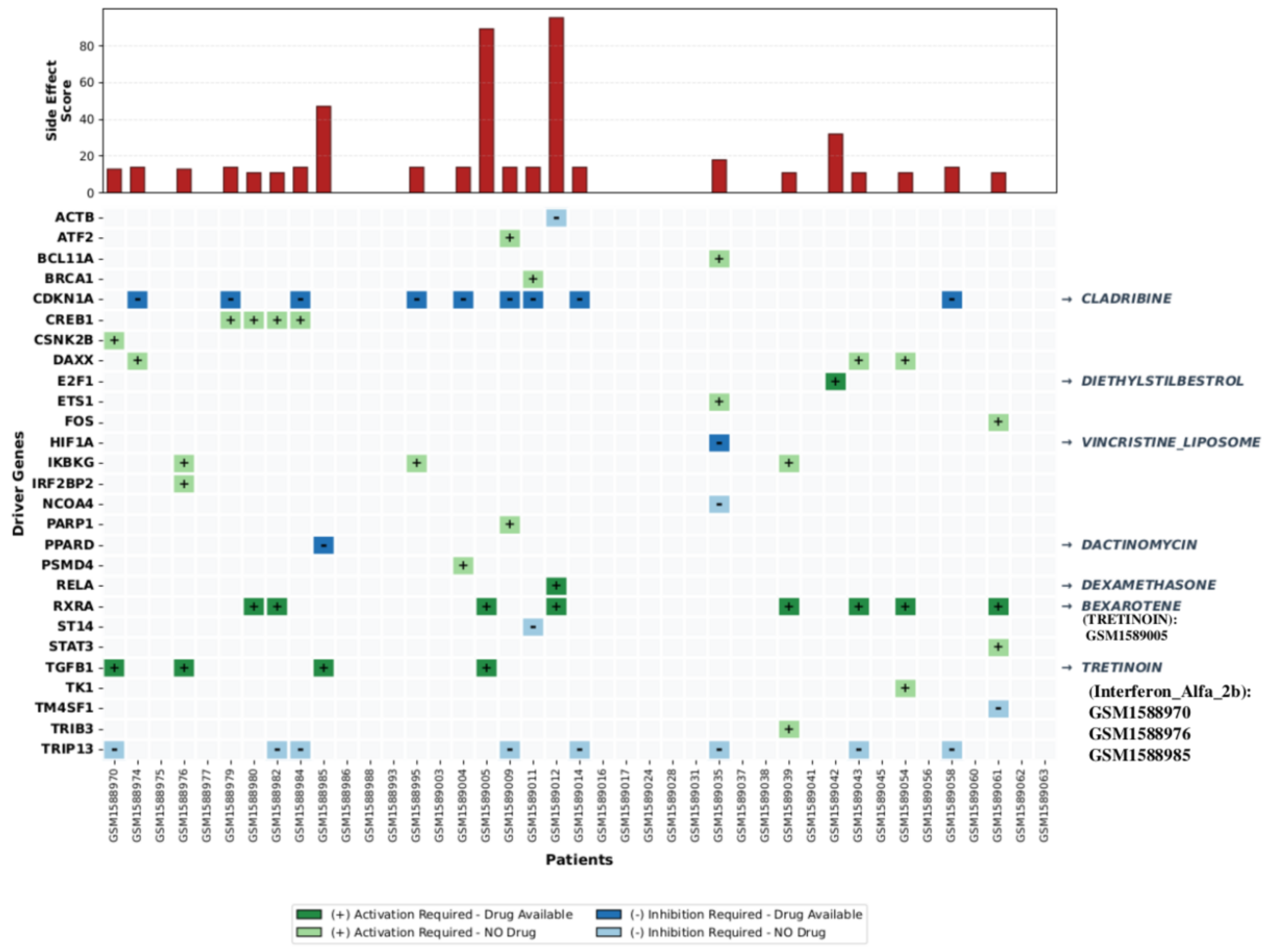
Figure 6.
Schematic representation of the five-stage computational workflow.
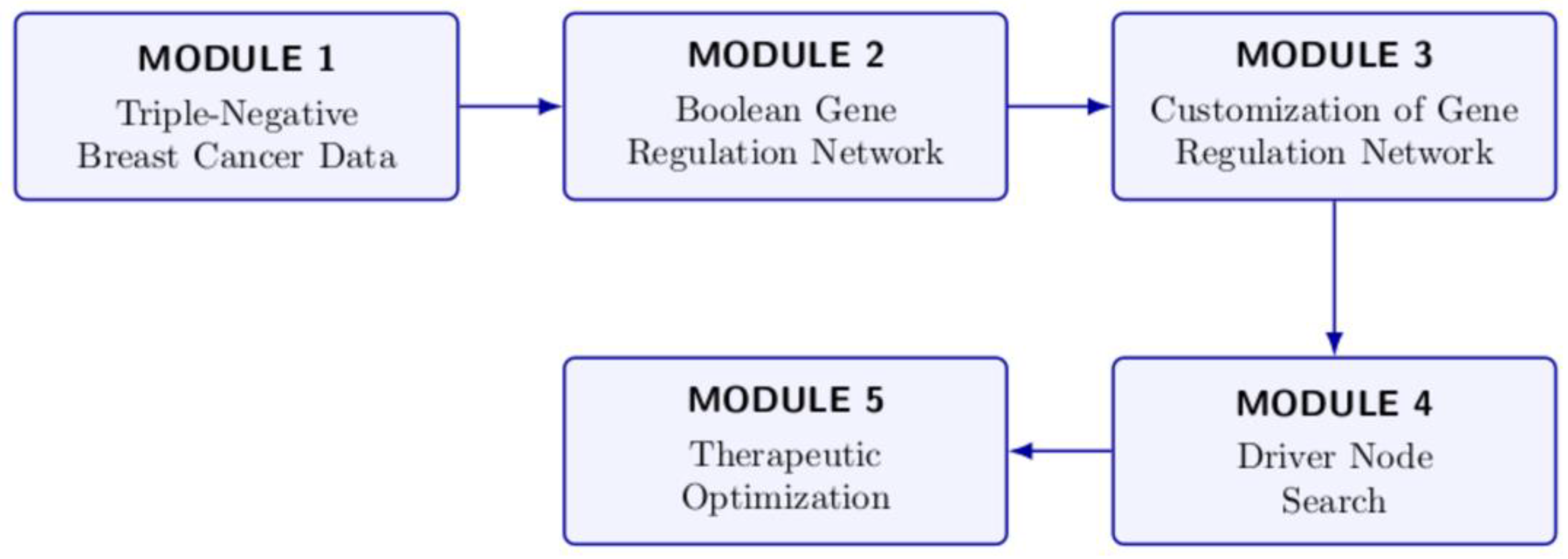
Figure 7.
Patient-Specific Pruning Application (A-B-C Network). Panel A shows the generic reference network. Panel B demonstrates the strict data-driven pruning based on the Python script. All three edges are removed due to flagrant contradictions: Gene A (UP) fails to activate Gene B (DOWN) and fails to inhibit Gene C (UP). The edge from Gene B to Gene C is removed because the source gene is downregulated (Loss of Function) and, therefore, cannot drive the upregulation of Gene C’.
Figure 7.
Patient-Specific Pruning Application (A-B-C Network). Panel A shows the generic reference network. Panel B demonstrates the strict data-driven pruning based on the Python script. All three edges are removed due to flagrant contradictions: Gene A (UP) fails to activate Gene B (DOWN) and fails to inhibit Gene C (UP). The edge from Gene B to Gene C is removed because the source gene is downregulated (Loss of Function) and, therefore, cannot drive the upregulation of Gene C’.
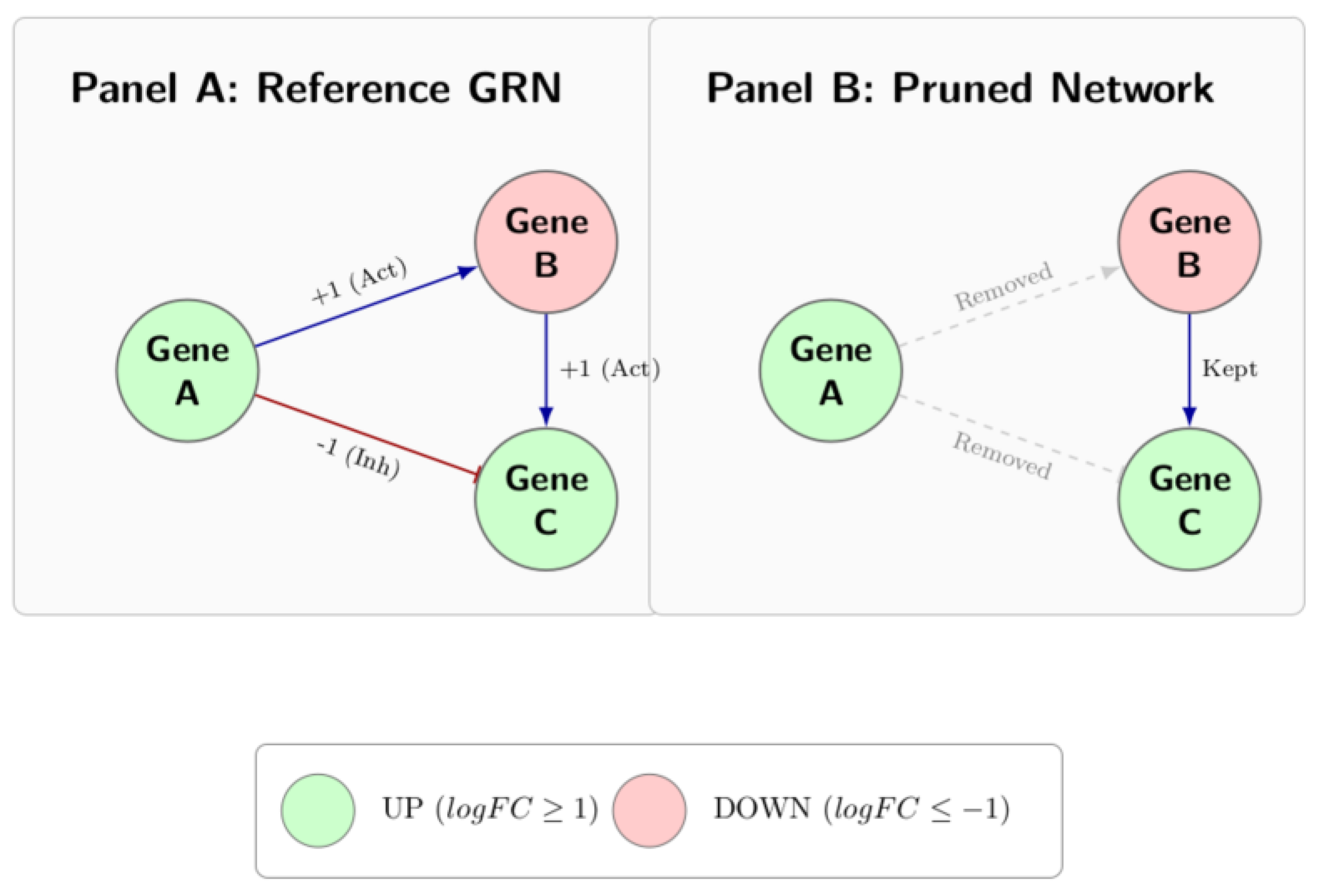
Figure 8.
The 26-node apoptotic target module. This predefined configuration, extracted from the comprehensive 136-node global network, mathematically codifies the therapeutic endpoint. It illustrates the specific Boolean states required to trigger programmed cell death: 19 pro-apoptotic initiators and executioners that must be driven to an active state (State = 1, top panel), and 7 anti-apoptotic factors that must be strictly repressed (State = 0, bottom panel).
Figure 8.
The 26-node apoptotic target module. This predefined configuration, extracted from the comprehensive 136-node global network, mathematically codifies the therapeutic endpoint. It illustrates the specific Boolean states required to trigger programmed cell death: 19 pro-apoptotic initiators and executioners that must be driven to an active state (State = 1, top panel), and 7 anti-apoptotic factors that must be strictly repressed (State = 0, bottom panel).
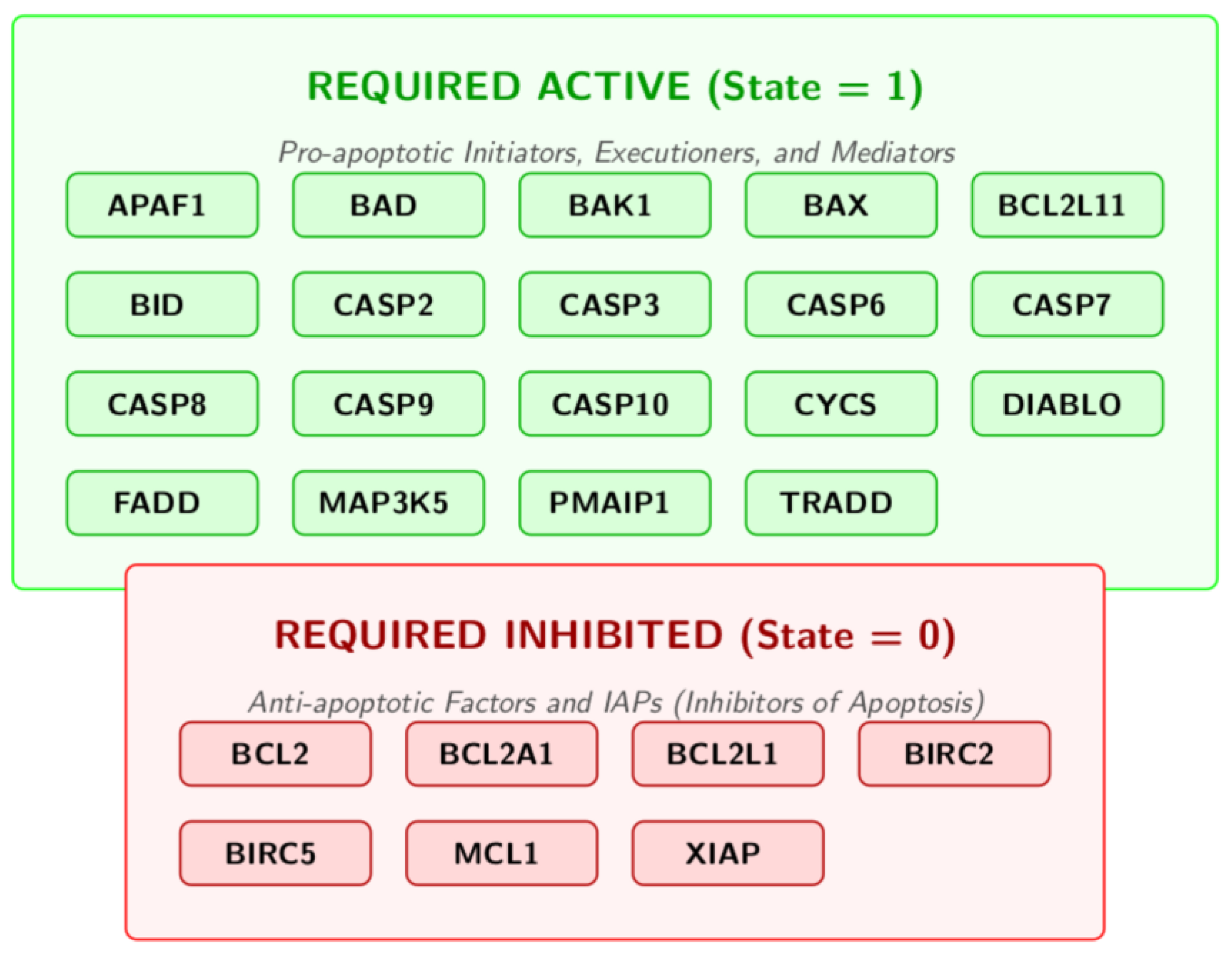
Figure 9.
Conceptual representation of State Space Reprogramming. The epigenetic landscape illustrates the dynamic transition of the Boolean network. The unperturbed system resides in the stable Cancer Attractor (left). A targeted intervention applied to a specific set of Driver Nodes generates a perturbation force that overrides the basal network dynamics, pushing the system state out of the pathological basin and irreversibly into the Apoptosis Attractor, defined by the 26-gene target configuration (right).
Figure 9.
Conceptual representation of State Space Reprogramming. The epigenetic landscape illustrates the dynamic transition of the Boolean network. The unperturbed system resides in the stable Cancer Attractor (left). A targeted intervention applied to a specific set of Driver Nodes generates a perturbation force that overrides the basal network dynamics, pushing the system state out of the pathological basin and irreversibly into the Apoptosis Attractor, defined by the 26-gene target configuration (right).
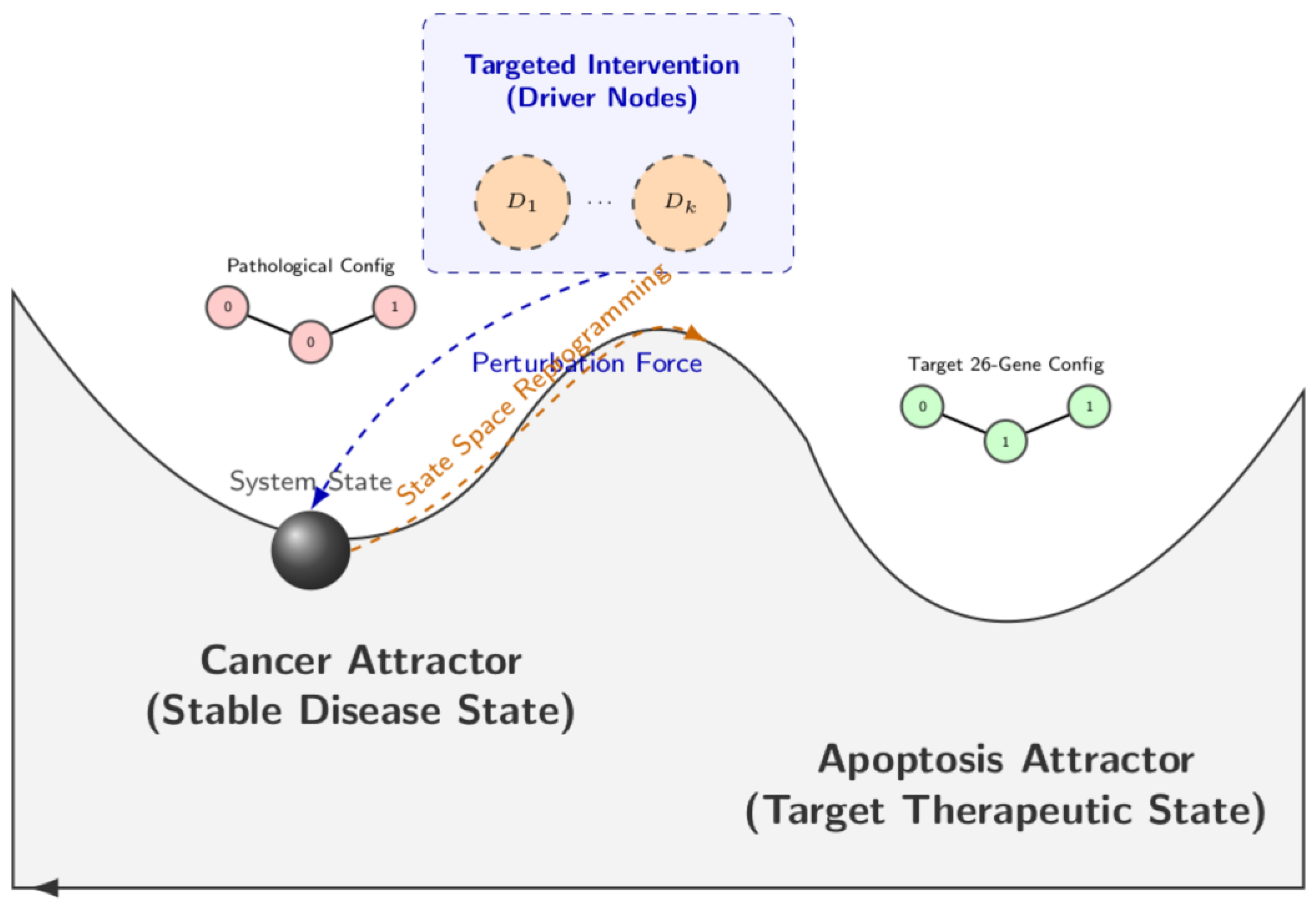
Disclaimer/Publisher’s Note: The statements, opinions and data contained in all publications are solely those of the individual author(s) and contributor(s) and not of MDPI and/or the editor(s). MDPI and/or the editor(s) disclaim responsibility for any injury to people or property resulting from any ideas, methods, instructions or products referred to in the content. |
© 2026 by the authors. Licensee MDPI, Basel, Switzerland. This article is an open access article distributed under the terms and conditions of the Creative Commons Attribution (CC BY) license.
Copyright: This open access article is published under a Creative Commons CC BY 4.0 license, which permit the free download, distribution, and reuse, provided that the author and preprint are cited in any reuse.


