
Submitted:
09 July 2026
Posted:
10 July 2026
You are already at the latest version
Abstract
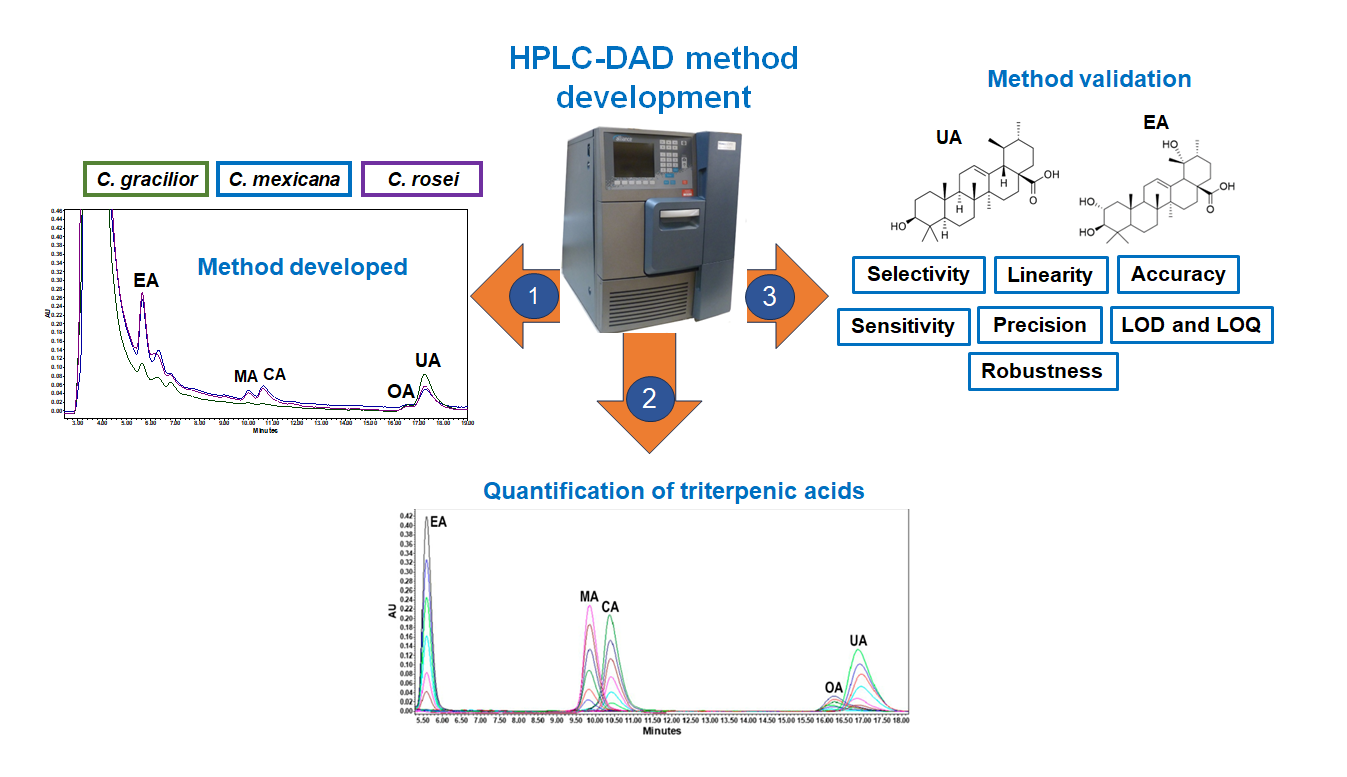
Plants of the genus Crataegus have been used in traditional medicine to treat different health conditions, mainly cardiovascular diseases. Standardized extracts from this genus are marketed in Europe and Asia for the treatment of heart failure. In recent years, our research group has demonstrated that Crataegus gracilior, C. rosei, and C. mexicana exert significant vasorelaxing effects and that their most abundant and vasorelaxant constituents are the triterpenic acids they contain. Therefore, an HPLC-DAD analytical method was developed to simultaneously identify and quantify euscaphic, maslinic, corosolic, oleanolic, and ursolic acids, the main chemical constituents of the leaves of these three Mexican Crataegus species. Euscaphic acid was found to be the main compound in both C. rosei and C. mexicana while ursolic acid in C. gracilior. Therefore, these two acids were selected as their most suitable chemical and pharmacological markers. Accordingly, the developed method was validated for the two acids following the ICH Q2(R1) and USP guidelines. This method can be used for quality control of any crude commercial drugs produced from these species in the future.
Keywords:
Mexican Crataegus
; HPLC-DAD
; method development
; validation
; triterpene acids
; markers
Copyright: This open access article is published under a Creative Commons CC BY 4.0 license, which permit the free download, distribution, and reuse, provided that the author and preprint are cited in any reuse.


