
Submitted:
08 July 2026
Posted:
09 July 2026
You are already at the latest version
Abstract
This integrative literature review examines how generative artificial intelligence is shaping human thinking, cognitive processes and writing practices, with a sustained focus on education across schools, universities, adult learning and professional settings. It considers how AI-supported composing alters the ways writers plan, generate, organise, revise and evaluate text, and how these changes reshape cognition, agency, authorship and learning. Rather than treating generative AI simply as a tool for productivity, the review approaches it as a relational and quasi-agentic technology that participates in meaning-making, decision-making and textual production. Research is synthesised across education, cognitive psychology, writing studies, digital literacy and human-computer interaction. Albert Bandura's social cognitive theory provides the analytical lens, particularly the concepts of triadic reciprocal causation, self-efficacy, observational learning, self-regulation and human agency. The review asks how generative AI mediates the relationship between person, behaviour and environment, and how it reshapes both confidence and dependence in writing. The discussion develops a critical account that recognises clear benefits while warning against cognitive offloading, uncritical trust, homogenised expression and weakened metacognitive control. The article concludes by proposing guidelines for educators across sectors to support critical AI awareness, reflective writing practice and agentic human-AI engagement.
Keywords:
generative AI
; writing
; cognition
; social cognitive theory
; critical AI literacy
1. Introduction and Context
The arrival of widely accessible generative artificial intelligence has unsettled long-held assumptions about who, or what, participates in the act of writing. Within a very short period, platforms such as ChatGPT, Claude, Gemini and Copilot moved from technical novelty to everyday infrastructure in classrooms, workplaces and homes. Educators now confront a situation in which a learner can produce a fluent paragraph, an essay plan or a polished argument in seconds, often without the sustained mental effort such tasks once demanded. This review begins from the premise that generative AI does far more than assist with grammar or surface editing: it increasingly enters the cognitive space of invention, planning, drafting, argument formation and stylistic choice, participating in the very processes through which people think their way into writing. The central question is therefore deceptively simple: how is generative AI shaping cognitive processes and writing practices, and what does this mean for education?
Writing has never been a purely mechanical transcription of finished thought. The cognitive process tradition established that composing is a recursive set of mental operations in which planning, translating and reviewing interact continuously, and in which the act of putting words on a page reshapes the ideas being expressed (Flower & Hayes, 1981; Hayes, 2012). On this account, writing is a way of thinking rather than merely a record of it. If that is so, then a technology that intervenes in drafting and revision is not a neutral accessory; it is an intervention in cognition itself. The significance of generative AI for education lies precisely here. When a system can generate plausible content on demand, the boundary between thinking and writing, and between the writer's mind and the external resource, becomes porous in ways that earlier writing technologies only approached.
Debate about these developments has tended to cluster around three positions. The first frames generative AI as an extension of human capability, a cognitive partner that scaffolds composition, lowers barriers for novice and multilingual writers, and frees attention for higher-order concerns (Kasneci et al., 2023; Salomon et al., 1991; Song & Song, 2023). The second is more anxious, warning that habitual reliance on machine-generated text diminishes independent thinking, weakens memory and judgement, and encourages a quiet deskilling of the very capacities education exists to cultivate (Gerlich, 2025; Kosmyna et al., 2025; Lee et al., 2025). The third resists this binary, proposing that generative AI is producing new hybrid forms of authorship and cognition in which human and machine contributions are entangled and difficult to separate (Draxler et al., 2024; Markauskaite et al., 2022). This review takes the third position seriously while drawing critically on the insights of the other two.
The educational stakes are considerable and they differ across sectors. In schools, teachers must decide how to nurture foundational writing and reasoning when learners can bypass the productive struggle that builds them. In higher education, academics face questions about authorship, assessment, evaluative judgement and the integrity of qualifications (Cotton et al., 2024; Tai et al., 2018). In adult, vocational and community education, where many learners come from migrant and refugee backgrounds or return to study after long absences, generative AI offers genuine support for confidence and access while risking dependence that undercuts the slow development of voice and autonomy (Han & Reinhardt, 2022). In professional and workplace learning, the redistribution of cognitive effort between person and machine has consequences for how knowledge is produced and trusted (Lee et al., 2025). Across these contexts, generative AI is reshaping the relationship between thinking and writing, and education is the site where that reshaping is most consequential.
A further reason to attend closely to generative AI is that it shapes thought before a single word is committed to the page. When a learner consults a model at the outset of a task, the ideas, framings and examples it offers establish an anchor around which subsequent thinking organises itself, influencing the order in which the writer plans, the questions they consider worth asking, and the range of possibilities they entertain. This is why the phrase thinking with the machine is apt: the machine is not only a stenographer at the end of the process but a participant near the beginning, in the formative moment when a vague intention starts to take the shape of an argument. Making this anticipatory shaping visible and accountable to learners is one of the central tasks of education in the present moment.
There are good reasons to undertake this synthesis now and in an integrative rather than a narrowly empirical mode. The literature on generative AI and writing has grown explosively and unevenly, scattered across disciplines that rarely speak to one another and ranging from controlled experiments to speculative commentary. Educators making daily decisions about classroom practice cannot wait for the slow accumulation of definitive longitudinal evidence, yet they are poorly served by either uncritical enthusiasm or reflexive prohibition. By reading empirical findings through a coherent account of human functioning, this review aims to offer a way of understanding generative AI that is neither captured by the marketing of the technology nor paralysed by alarm, and that keeps the developmental purposes of education at the centre of the analysis.
To analyse these dynamics, the review adopts Bandura's social cognitive theory, which conceives of human functioning as a continuous interplay among personal factors, behaviour and the environment (Bandura, 1986, 2001). This framework suits the study of human-AI writing because it refuses both technological determinism and naive humanism, allowing the reviewer to ask how learners' beliefs about their capability, their writing behaviours, and the AI-saturated environments they inhabit are mutually reshaping one another. It foregrounds agency, the human capacity to influence one's own functioning intentionally, as the pivotal construct through which the educational value of generative AI must be judged. The remainder of the article sets out this lens, describes the integrative method, presents six thematic findings, discusses their implications through a social-cognitive reading, and proposes guidelines for agentic and reflective AI use.
Theory: Bandura's Social Cognitive Theory
Social cognitive theory offers a parsimonious yet powerful account of how people learn, act and develop within social and material environments. Its central proposition is triadic reciprocal causation, the claim that personal factors such as beliefs and emotions, behaviour, and environmental influences operate as interacting determinants that shape one another bidirectionally (Bandura, 1986, 2001). None of the three is sovereign. A learner's confidence influences the writing they attempt, the writing they produce alters their environment and the feedback it returns, and that altered environment in turn revises their confidence. Applied to generative AI, this model invites a relational analysis in which the technology is treated as a salient and active feature of the environment in reciprocal relationship with the writer rather than as an external instrument standing outside cognition.
The construct of self-efficacy, the belief in one's capability to organise and execute the actions required to attain a goal, is central to the theory and to this review (Bandura, 1977, 1997). Self-efficacy shapes the tasks people choose, the effort they invest, their persistence in the face of difficulty, and their resilience after setbacks. In writing, efficacy beliefs predict engagement, strategy use and achievement (Sun & Wang, 2020). Generative AI bears directly on these beliefs. A hesitant writer who receives an immediate, fluent draft may experience a surge of confidence, yet the question of whether that confidence reflects a durable capability or a borrowed competence is precisely what educators must learn to discern. Bandura distinguished genuine efficacy, built through mastery experiences, vicarious learning, social persuasion and the interpretation of one's own states, from inflated or misattributed confidence. Generative AI can supply the appearance of mastery without the substance, which makes the careful calibration of self-efficacy a pressing educational concern.
Observational learning and modelling provide a second relevant mechanism. People acquire knowledge, skills and standards by observing others and the products of their activity (Bandura, 1986). A generative model functions as an inexhaustible producer of textual exemplars, and learners observe and internalise its patterns of phrasing, structure and reasoning. This can be pedagogically valuable when models illustrate strong argumentation or genre conventions, yet it can also transmit the homogeneous stylistic tendencies of the system itself, narrowing the range of forms learners regard as normal. Outcome expectations, the anticipated consequences of acting in specific ways, further influence whether and how learners turn to AI, since a student who expects that AI use will raise marks with little risk will engage differently from one who values the learning that effortful composing affords.
Self-regulation and human agency complete the framework and carry the greatest weight in the analysis that follows. Self-regulation refers to the capacity to set goals, monitor performance against internal standards, and adjust effort and strategy accordingly (Bandura, 2001; Zimmerman, 2002). Agency, in Bandura's mature formulation, is the human power to act intentionally, to exercise forethought, to self-regulate through self-reactive influence, and to reflect on the adequacy of one's own functioning (Bandura, 2018). Agency is not the absence of external influence but the capacity to engage influences deliberately rather than be governed by them. This is the crux of the educational argument. Generative AI may strengthen agency when it offers feedback, models and confidence that learners interrogate and incorporate on their own terms; it may erode agency when learners surrender planning, judgement and responsibility to machine output. Whether AI augments or diminishes agentic functioning is therefore not a property of the technology alone but of the reciprocal system in which person, behaviour and environment meet, and education is the practice through which that system can be tilted towards agency.
Methodology
This review adopts an integrative methodology because the phenomenon under study is interdisciplinary, fast-moving and theoretically diverse (Snyder, 2019; Torraco, 2005; Whittemore & Knafl, 2005). An integrative review is designed to bring together conceptual, empirical and theoretical literature on a topic in order to generate new understanding rather than merely to aggregate effect sizes, and it is the review form best suited to combining diverse kinds of evidence about an emerging question (Torraco, 2005; Whittemore & Knafl, 2005). It differs from a systematic review, which typically answers a narrowly bounded empirical question through standardised appraisal of comparable studies, and from a scoping review, which charts the extent of a literature without committing to interpretive synthesis (Snyder, 2019). Because the question of how generative AI shapes thinking and writing spans cognitive psychology, writing studies, education and human-computer interaction, and because the relevant evidence ranges from neurophysiological experiments to conceptual essays, an integrative approach was the most appropriate choice. The review nonetheless borrowed procedural discipline from systematic methods, applying a transparent process of identification, screening, eligibility assessment and inclusion whose reporting was guided by the PRISMA 2020 statement (Page et al., 2021).
Searches were conducted across seven sources selected for complementary coverage of education, psychology, linguistics and computing: Scopus, Web of Science, ERIC, Education Research Complete, PsycINFO, the Linguistics and Language Behavior Abstracts database, and Google Scholar. Table 1 records each source and the rationale for its inclusion. Search strings combined terms for the technology, the cognitive and compositional processes of interest, the constructs drawn from social cognitive theory, and the educational context. Table 2 sets out the concept clusters and representative Boolean strings. The searches were designed to be inclusive at the identification stage so that conceptual and theoretical contributions would not be excluded by an overly empirical filter, and to be progressively more selective as screening proceeded.
Inclusion and exclusion criteria, summarised in Table 3, prioritised peer-reviewed publications appearing between 2022 and 2026, the period bracketing the public release of large language model chat interfaces, while admitting earlier foundational sources for social cognitive theory, writing process research and theories of distributed and extended cognition. Publications were eligible if they addressed, conceptually or empirically, the relationship between generative AI and human cognition, writing or learning, and if they were available in English. Sources were excluded if they treated AI only as a back-end engineering concern with no bearing on human thinking or writing, if they were purely promotional, or if they could not be retrieved in full. Reference lists of included works were hand-searched to capture influential items missed by database queries, and a small number of seminal pre-2022 works were retained because they remain load bearing for the theoretical argument.
The screening process is reported in Table 4, which records counts at each stage following the PRISMA 2020 flow (Page et al., 2021). Database queries and hand-searching returned an initial corpus of approximately 612 records. After the removal of duplicates, 418 records remained, and all 418 were screened at the level of title and abstract. Full texts were retrieved and assessed for 84 records, and 36 publications met all eligibility criteria and were carried into the synthesis. The attrition between abstract screening and full-text assessment reflected the large volume of commentary and opinion pieces that addressed generative AI in education without engaging the cognitive or compositional questions at the heart of this review.
The 36 sources that remained span empirical studies using behavioural, survey and neurophysiological methods, conceptual and theoretical analyses, and reviews, alongside the foundational works on social cognitive theory, writing process and distributed cognition that the integrative method admits, providing the heterogeneity that such a synthesis is designed to interpret. These 36 works constitute the synthesised corpus; the methodological references cited to justify the review's design, screening and analysis appear in the reference list but are additional to it.
Analysis proceeded thematically, following an established approach to coding and theme development (Braun & Clarke, 2006). Each included source was read closely and coded for its claims about cognition, writing process, agency and educational implication. Codes were grouped iteratively into candidate themes, which were tested against the corpus and refined until they offered both coverage and analytic coherence. Six themes were generated, presented in the findings: cognitive offloading, metacognition, writing processes, authorship, self-efficacy and homogenisation. These were then interpreted through the lens of social cognitive theory, with attention to how each affects the reciprocal relationship among person, behaviour and environment and on the preservation or erosion of human agency. The thematic structure is a heuristic for synthesis rather than a set of mutually exclusive categories, since the phenomena overlap: offloading bears on metacognition, authorship is entangled with self-efficacy, and homogenisation is a property of both process and product.
Because the corpus combined evidence of very different kinds, no single appraisal instrument could be applied uniformly. Each source was weighed according to standards appropriate to its type: experimental studies considering sample size, control and ecological validity; survey studies concerned with the measurement and the limits of self-report; and conceptual works in regard to the coherence and reach of their argument. This pluralistic appraisal is characteristic of integrative reviews (Whittemore & Knafl, 2005) and is a strength where the most important questions cannot yet be settled by any single method. The reviewer's location in education and commitment to teaching and learning shaped the questions asked of the literature, stated here for transparency.
Several limitations qualify the findings. The pace of AI development means empirical claims risk obsolescence, since the models studied in 2023 and 2024 differ from those in use at the time of writing. The evidence base is uneven, combining rigorous experiments with small samples, self-report surveys vulnerable to social desirability, and conceptual pieces whose claims outrun their data. A pronounced English-language bias limits the cultural reach of the conclusions, which matters for a field that includes many multilingual learners. Most importantly, it is difficult to separate short-term performance gains from long-term cognitive and developmental effects, which are far harder to measure, and which education most needs to understand. These limitations counsel interpretive caution and underline the value of a theoretically grounded synthesis.
Findings
Table 5 summarises how the six themes that follow map onto the primary social-cognitive constructs that organise this review, offering an overview of the analytic structure before each theme is examined in turn.
The six themes that follow are presented in sequence, but they describe a single interconnected reality in which generative AI alters how people think their way into writing. The presentation moves from the redistribution of cognitive effort, through the monitoring of one's own thinking, to the transformation of the writing process, the renegotiation of authorship, the recalibration of confidence, and finally the homogenisation of expression, attending throughout to how each theme shapes the passage from thought to text and to its educational implications.
Cognitive Offloading
Cognitive offloading refers to the use of external resources and physical action to reduce the internal information-processing demands of a task (Risko & Gilbert, 2016). Humans have always offloaded cognition onto notebooks, calculators, calendars and other people, and the practice is in principle adaptive, freeing limited working memory for the demands that most require it. The extended and distributed cognition traditions describe this coupling of mind and world as a normal feature of human thinking rather than a deficit, arguing that cognitive processes routinely loop through external artefacts (Clark & Chalmers, 1998; Hutchins, 1995; Salomon, 1993). From this vantage, generative AI is the latest and most capable in a long lineage of cognitive partners, and the relevant question is not whether learners offload but what they offload, when, and with what consequences for learning.
The concern with generative AI is that it permits the offloading not merely of storage, as a search engine does, but of generation, the productive act of forming ideas and composing sentences. Early evidence on internet search showed that when people expect information to remain externally available, they remember it less well while remembering where to find it, sometimes called the Google effect (Sparrow et al., 2011). Generative AI extends this dynamic from retrieval to composition: a learner who delegates the framing of an argument or the drafting of a paragraph offloads not a fact but a cognitive operation, and it is precisely such operations that writing instruction seeks to develop. The worry is that what is never effortfully performed may never be learned.
Recent empirical work lends weight to this concern while complicating it. A large survey study found a significant negative association between frequent reliance on AI tools and critical thinking, with cognitive offloading as the mediating mechanism, and with younger participants both offloading more and scoring lower on critical thinking measures (Gerlich, 2025). A neurophysiological study of essay writing reported that participants who composed with a large language model exhibited the weakest, least distributed patterns of brain connectivity, reported the lowest sense of ownership over their essays, and struggled to quote from work they had ostensibly just produced, an accumulation the authors termed cognitive debt (Kosmyna et al., 2025). These findings should be read with care, given modest samples and the difficulty of generalising from controlled tasks, yet they converge with the offloading literature in suggesting that the convenience of delegation carries a cognitive cost that is easy to incur and hard to perceive.
The offloading lens also clarifies why the effects of generative AI differ across sectors. In adult, vocational and workplace learning, where writing is often instrumental and time is scarce, delegating composition to AI can be entirely rational, since the goal is a serviceable document rather than the development of compositional skill. A survey of knowledge workers found that generative AI shifted effort from generating content towards verifying and integrating it, a redistribution that may be appropriate in a workplace yet troubling in a classroom whose purpose is to build the very capacities being offloaded (Lee et al., 2025). The educational judgement turns on whether the offloaded operation is one the learner already commands or one they still need to acquire, a distinction that generic policies about AI use routinely obscure.
For education, the central implication is that offloading must be designed rather than left to chance. The distributed cognition tradition reminds educators that the goal is not to eliminate external support but to arrange the human-tool system so that learners retain and exercise the operations that matter for their development (Salomon et al., 1991). A learner who uses AI to check a finished argument is offloading differently from one who uses it to produce the argument in the first place. The pedagogical task is to make the locus of offloading visible and deliberate, so that the productive struggle which builds capability is protected even as genuine support is welcomed.
Metacognition
Metacognition, the awareness and regulation of one's own thinking, has long been recognised as a determinant of effective learning and writing (Flavell, 1979). Skilled writers monitor their developing text against goals, detect mismatches, and adjust strategy, a hallmark of expertise in composition (Hayes, 2012; Zimmerman, 2002). Generative AI intersects with metacognition in a double-edged way: it can serve as an external prompt to reflection, offering feedback, alternative phrasings and counterarguments that invite the writer to reconsider their choices, or it can short-circuit metacognition entirely by supplying a finished product the learner accepts without the monitoring that effective writing demands.
The evidence suggests that AI supports metacognition only when learners actively interrogate its output. A survey of knowledge workers found that those with higher confidence in their own expertise engaged in more critical thinking when using generative AI, whereas those with higher confidence in the AI engaged in less, shifting their effort from generating content to verifying it and from producing solutions to integrating and overseeing machine output (Lee et al., 2025). This redistribution is not inherently negative, since verification and oversight are genuine cognitive activities, yet it depends entirely on the user choosing to exercise them. The same study reported that participants who trusted the tool too readily reduced their critical engagement, which indicates that the metacognitive benefit of AI is conditional on a stance of informed scepticism that must itself be taught.
In language and writing education, the most promising uses position AI as a feedback partner that scaffolds evaluation rather than as an oracle that forecloses it. Reviews of automated written feedback report that such systems can support revision and engagement, particularly for second-language writers, when learners are guided to weigh, question and selectively act on the feedback rather than comply with it (Shi & Aryadoust, 2024; Su et al., 2023). Used this way, generative AI can externalise the monitoring function long enough for learners to internalise it; used otherwise, it removes the occasion for monitoring altogether. The design challenge is to convert AI from a source of answers into a provocation for reflection, since only the latter cultivates self-regulatory capacities that transfer beyond the task.
These observations connect to established models of self-regulated learning, in which learners cycle through forethought, performance and self-reflection (Zimmerman, 2002). Generative AI can be inserted at any point, and where it is inserted determines whether it supports or supplants regulation. Used in forethought to clarify goals and anticipate difficulties, it can prime self-regulation; used in performance to produce the work itself, it can remove the occasion for monitoring; used in reflection to evaluate a finished draft, it can model the self-assessment learners must eventually perform alone. Classroom routines that ask learners to articulate goals before consulting AI, to record their monitoring decisions during composition, and to reflect afterwards on what they accepted and rejected can convert an otherwise opaque interaction into a structured occasion for metacognitive development.
A further metacognitive risk concerns calibration, the accuracy of learners' judgements about what they know and can do. Offloading research shows that decisions to rely on external resources rest on metacognitive evaluations of one's own abilities, which are often erroneous (Risko & Gilbert, 2016). When fluent AI output stands in for the learner's own performance, the feedback that ordinarily calibrates self-assessment is disrupted, and learners may form inflated estimates of competence that authentic tasks later disconfirm. Designing tasks that periodically require learners to perform without AI, and to compare unaided with assisted work, is one practical means of preserving the calibration on which sound metacognition depends.
Writing Processes
Generative AI is reshaping the writing process at every phase the cognitive process tradition identified (Flower & Hayes, 1981; Hayes, 2012). In invention and planning, learners increasingly begin not with a blank page but with a prompt, soliciting ideas, outlines and framings from a model before committing to their own direction, so that the ideas the system surfaces shape the space of possibilities the writer subsequently explores. Experimental work on idea generation found that writers given access to AI suggestions produced work judged more novel and useful, especially less experienced writers, confirming that the technology genuinely participates in invention rather than merely in transcription (Doshi & Hauser, 2024).
In drafting, the process is becoming more iterative and prompt based. Rather than producing prose linearly, writers increasingly generate candidate text, evaluate it, re-prompt, and assemble a document from negotiated fragments (Lee et al., 2022). This shifts the writer's labour from producing sentences towards specifying intent and selecting among options. The gain is that attention can be directed to rhetorical purpose and structure; the loss is that the sentence-level wrestling through which writers often discover what they mean may be bypassed. Because composing has long been understood as a means of discovery, in which meaning emerges through the act of writing, a process that outsources sentence formation may also outsource part of the thinking that sentences perform.
Revision and editing are similarly transformed. AI can identify weaknesses, propose reorganisations and supply alternatives at a speed no human reviewer can match, and studies report that users value this assistance for efficiency and confidence (Wang, 2024). Yet revision is not only correction; it is the re-seeing of a text against one's intentions, and it depends on the writer holding a vision of what the piece is trying to do. When revision is delegated to a system that optimises for fluency and convention, texts may become smoother while losing the idiosyncrasies that carry a writer's purpose. The educational value of revision lies in the judgement it exercises, which atrophies if the work of re-seeing is handed over wholesale.
These changes are felt differently across the stages of schooling. In the early development of writing, where learners are acquiring the basic machinery of sentence and paragraph construction, the wholesale generation of text by AI can pre-empt the practice through which fluency and control are built, so that learners may produce sophisticated documents while remaining unable to compose comparable text unaided. In more advanced and disciplinary writing, where the challenge is the construction of argument rather than the mechanics of expression, AI assistance can free attention for higher-order rhetorical work while risking the substitution of plausible structure for genuine reasoning. Effective writing pedagogy therefore requires teachers to diagnose, for each learner and task, which processes are already secure and which are still forming, and to direct AI assistance away from the latter (Flower & Hayes, 1981; Hayes, 2012).
Across these phases, the most consequential change is the compression of the distance between thought and text. Traditionally, the friction of composing forced a slow elaboration of ideas, and that friction was generative, since the difficulty of expression often clarified the thought being expressed. Generative AI reduces this friction dramatically, which is liberating for some purposes and impoverishing for others. The implication for education is not that friction should be artificially preserved for its own sake, but that teachers must distinguish productive difficulty, the struggle that builds cognitive and rhetorical capacity, from the friction that is merely tedious, and design tasks that retain the former even as AI removes the latter.
Authorship
Generative AI destabilises authorship, the attribution of a text to a responsible originating mind, in ways education is only beginning to address. When a learner submits work a model substantially produced, conventional notions of originality, ownership and voice come under strain. Empirical work has documented the AI ghostwriter effect, in which users who direct and curate AI-generated text do not feel strong ownership of it yet are willing to declare themselves its authors, revealing a gap between felt and claimed authorship that complicates both ethics and assessment (Draxler et al., 2024). This gap matters because so much of what schooling and the academy value, from the cultivation of voice to the certification of competence, presupposes a stable link between a text and the person who made it.
The question of voice is especially acute. Voice, the distinctive signature of a writer's stance and sensibility, is cultivated slowly through accumulated choices about diction, rhythm and emphasis. Generative systems, trained to produce conventionally acceptable prose, tend to smooth idiosyncrasy towards a competent mean, and learners who lean heavily on them may adopt a borrowed register before developing one of their own. For multilingual writers this is double-edged, since AI can help them express ideas in fluent academic English that would otherwise be inaccessible while also substituting a generic register for the emerging bilingual voice that is itself a resource (Han & Reinhardt, 2022). Educators must hold both possibilities together, welcoming the access AI affords while protecting the space in which a personal voice can form.
Academic integrity is the most visible institutional expression of these authorship anxieties. The capacity of generative AI to produce assessable work has prompted widespread concern about cheating and the reliability of qualifications, alongside recognition that detection is unreliable and prohibition alone inadequate (Cotton et al., 2024; van Dis et al., 2023). The more constructive responses reframe the issue from policing towards pedagogy, asking how assessment can value the processes AI cannot authentically replace, such as in-class reasoning, oral defence, and the documentation of developing thinking. Integrity, on this view, is less a matter of catching misuse than of designing tasks in which authentic authorship is required and rewarded.
In higher education in particular, the destabilisation of authorship is forcing a reconsideration of assessment. Where assessment has relied on the unsupervised production of text as a proxy for learning, the capacity of generative AI to produce such text cheaply has exposed the fragility of that proxy. The more durable responses shift the locus of assessment from the product to the process and the judgement behind it, valuing the reasoning a learner can articulate, the evaluative commentary they can offer on a draft, and the position they can defend in dialogue. This relocates rigour to the human capacities that AI cannot authentically supply: the evaluative judgement that becomes more important, not less, when fluent text is abundant (Tai et al., 2018).
Underlying these specific concerns is a deeper conceptual shift. If writing is increasingly a negotiation between a human and a generative system, then authorship may need to be understood as distributed and entangled rather than singular, a recognition that aligns with longstanding accounts of distributed cognition and with emerging analyses of human-AI capability (Hutchins, 1995; Markauskaite et al., 2022). This does not dissolve human responsibility; it makes the human's agentic role of directing, judging and standing behind the text more rather than less important. Education's task is to help learners occupy that role consciously, to author with AI rather than be authored by it, which requires an explicit pedagogy of disclosure, reflection and accountability.
Self-Efficacy
Generative AI exerts a powerful and ambivalent influence on writing self-efficacy, the belief in one's capability to write effectively (Bandura, 1997; Sun & Wang, 2020). For hesitant writers, multilingual learners and novices, producing fluent text with AI assistance can be genuinely empowering. Studies in second-language writing report that AI feedback and collaboration can enhance motivation and writing self-efficacy, providing continuous, non-judgemental support and a sense of progress that builds willingness to engage (Huang & Mizumoto, 2024; Song & Song, 2023). Chatbot-supported writing has been found to scaffold argumentation for learners who would otherwise struggle to begin (Guo et al., 2022). For learners whose confidence has been eroded by past difficulty, this support can re-open a relationship with writing that had seemed closed.
Bandura's theory clarifies why this matters and where the danger lies. Self-efficacy is built most durably through mastery experiences, the direct experience of succeeding at a challenging task through one's own effort (Bandura, 1997). The difficulty with AI-assisted success is that it may not constitute a mastery experience in the relevant sense, because the success belongs in part to the machine. A learner may feel more efficacious while becoming less capable, a divergence between confidence and competence that is among the most pedagogically hazardous effects of generative AI. The optimistic findings on motivation and confidence must therefore be read alongside the offloading and metacognition literatures, which suggest that the same assistance that raises confidence can hollow out the capability that confidence is meant to track.
The vicarious and persuasive sources of efficacy are also engaged. By modelling competent writing, generative AI offers a form of vicarious experience, and by responding supportively it offers a form of social persuasion, both of which Bandura identified as legitimate but weaker sources of efficacy than mastery (Bandura, 1986). The pedagogical implication is that AI can helpfully contribute to efficacy provided that it does not displace the mastery experiences on which durable confidence rests. A learner who watches the AI model a strong paragraph, attempts one themselves, receives encouragement, and then succeeds without assistance has converted vicarious and persuasive support into mastery; a learner who simply accepts the model's output has not. The design of writing instruction should therefore sequence assistance so that it leads towards, rather than away from, unaided accomplishment.
These dynamics are especially salient for adult learners and for learners from migrant and refugee backgrounds, for whom writing in academic English can present formidable affective as well as linguistic barriers. For such learners, generative AI can function as a patient, non-judgemental interlocutor that lowers the threshold to participation, helps them express ideas that exceed their current command of the language, and supplies the early successes that rebuild a willingness to write (Han & Reinhardt, 2022; Song & Song, 2023). This is a genuine contribution to access and equity. The accompanying risk is that the support becomes a permanent prosthesis rather than a temporary scaffold, so that confidence grows while the underlying capability stalls and the learner's emerging voice is overwritten by the system's conventional register. The educational response is not to withhold the support but to design its gradual withdrawal, ensuring that learners accumulate the unaided successes through which durable efficacy and genuine autonomy are jointly built.
Self-efficacy and self-regulation are tightly coupled, since efficacious learners are more likely to set goals, monitor progress and persist (Sun & Wang, 2020; Zimmerman, 2002). This coupling offers a constructive path. When learners are taught to use AI as a self-regulatory aid, prompting it to surface questions they should ask, to identify gaps in their reasoning, or to model the monitoring a skilled writer performs, the technology can strengthen both confidence and the regulatory capacities that make confidence well-founded. The decisive variable is again agency. Generative AI supports authentic efficacy when learners direct it in the service of their own development, and it undermines efficacy when it substitutes for the effortful accomplishment through which genuine capability and well-calibrated confidence are jointly built.
Homogenisation
A growing body of evidence suggests that widespread reliance on generative AI may homogenise writing, producing prose that is polished and conventionally competent but less varied, less distinctive and less willing to take expressive risks. In a controlled experiment on creative writing, access to AI ideas raised the assessed creativity of individual stories yet rendered those stories more similar to one another than stories written without AI, an outcome the authors characterised as a social dilemma in which individual gains in creativity coincide with a collective loss of novelty (Doshi & Hauser, 2024). The dynamic is intelligible in terms of the technology itself, since models trained to predict probable continuations gravitate towards the typical, and writers who anchor on their suggestions are drawn towards a shared centre of gravity.
For education, homogenisation poses a subtle but significant threat, because so much of what writing instruction seeks to develop lies in the particular: the unexpected example, the personal angle, the argument that resists the obvious. Bandura's account of observational learning explains the mechanism, since learners who repeatedly observe and emulate the system's conventional output internalise its norms as the standard of good writing (Bandura, 1986). The patterns a model favours come to seem natural, and the range of forms learners regard as legitimate narrows accordingly, flattening the diversity of voice that a healthy culture of writing depends upon, with consequences that are collective and cumulative rather than visible in any single text.
The risk is uneven across learners and contexts. For those with little prior writing experience, the conventionalising influence of AI may be especially strong, since they have not yet developed the personal repertoire from which to depart from the norm, and they may mistake the system's competent mean for the ceiling of good writing rather than its floor. For multilingual learners, the picture is again complex, since the homogenising pull towards standard academic English can support access and intelligibility while eroding the distinctive resources that bilingual writers bring (Han & Reinhardt, 2022). Educators must therefore be alert to who is most exposed to homogenisation and design experiences that deliberately cultivate divergence, variety and the productive disruption of convention.
Homogenisation also carries an equity dimension. Generative systems are trained predominantly on text reflecting particular linguistic, cultural and rhetorical norms, and their conventionalising influence pulls writing towards those norms. For learners whose ways of arguing, narrating and knowing diverge from the dominant academic register, this pull can be doubly costly, since it may simultaneously smooth their prose towards acceptability and erase the distinctive resources their backgrounds afford. What presents itself as neutral assistance towards good writing may in practice be assimilation towards a particular standard. Educators therefore have a responsibility to treat the system's output as one convention among many rather than as the measure of quality, and to create space in which learners can recognise and develop the distinctive textual resources they bring.
Countering homogenisation requires positive pedagogical effort rather than mere caution. Practices that compare AI-generated drafts with human alternatives, that ask learners to identify and amplify what is distinctive in their own writing, and that explicitly value risk and surprise can preserve the diversity that the technology tends to erode. The aim is not to reject the fluency AI offers but to ensure that learners experience it as one option among many rather than as the single template for acceptable prose. Read alongside the other findings, homogenisation completes a picture in which generative AI consistently shapes thinking before writing, here by narrowing the space of forms that learners imagine as available.
Discussion
Taken as a whole, the six themes describe a single underlying process: generative AI is altering writing by altering the cognition that produces it, and it is doing so within a reciprocal system that social cognitive theory is well equipped to illuminate. Bandura's triadic model invites us to locate the effects of AI not in the technology alone but in the continuous interplay among the learner as a person, the act of writing as behaviour, and the AI-saturated environment (Bandura, 1986, 2001). The findings can be reread as a set of reciprocal relations. The environment, now populated by capable generative systems, changes what writing behaviours are easy, fast and rewarded. Those altered behaviours, in turn, change the person, reshaping beliefs about capability, habits of monitoring, and the very repertoire of forms a writer commands. And the changed person re-enters the environment with new expectations that further shape how the technology is used. The crucial point is that the influence runs in every direction, which means that neither technological determinism nor a naive faith in unaffected human autonomy can describe the situation accurately.
The central argument of this review can now be stated precisely. Generative AI changes writing by changing what writers believe they can do, what they choose to do, and what the environment makes easy or difficult. It changes belief by offering experiences of fluent production that raise confidence, sometimes beyond the level that capability warrants, with consequences for self-efficacy that may be empowering or hollow depending on whether the underlying competence is genuinely developed (Bandura, 1997; Huang & Mizumoto, 2024). It changes choice by making delegation the path of least resistance, so that the cognitive operations of planning, drafting and revising are offloaded unless learners deliberately retain them (Gerlich, 2025; Risko & Gilbert, 2016). And it changes the environment by establishing fluent, conventional, AI-shaped prose as a default against which all writing is implicitly measured, with homogenising effects on the range of forms learners imagine and attempt (Doshi & Hauser, 2024). In each case the effect is mediated by agency, and in each case education is the practice through which agency can be defended or forfeited.
Generative AI is therefore best understood as neither a neutral tool nor an autonomous replacement for the writer, but as a mediating agent within a social-cognitive system. The language of mediation captures the way the technology stands between intention and text, shaping the passage from thought to expression without simply executing a predetermined plan. This framing resists two common errors. The first is to treat AI as an inert instrument, like a pen, that leaves cognition unchanged; the evidence on offloading, metacognition and homogenisation refutes this, showing that the technology participates in thinking itself. The second is to treat AI as a quasi-author that supersedes the human; the evidence on ownership and the irreducible need for human judgement refutes this too, showing that responsibility, purpose and evaluation remain human functions even when much of the textual labour is shared (Draxler et al., 2024; Lee et al., 2025). The mediating-agent framing holds these truths together, locating AI within the reciprocal system rather than above or beneath it.
The decisive educational variable that emerges from this analysis is critical awareness exercised through self-regulation and reflective judgement. The studies most consistently associated with positive outcomes are those in which learners interrogate, verify and selectively incorporate AI output rather than accept it, and the studies most associated with diminished thinking are those in which trust in the tool displaces critical engagement (Gerlich, 2025; Lee et al., 2025). This pattern maps directly onto Bandura's account of agency, which turns on the capacity to engage environmental influences deliberately rather than be governed by them (Bandura, 2018). Agentic AI use is not the refusal of assistance but its deliberate, monitored and accountable employment, and the cultivation of this stance is precisely the kind of capability that education exists to develop (Markauskaite et al., 2022). The implication is that the question facing educators is not whether learners will use AI but whether they will use it agentically, and that this is a teachable disposition rather than an innate trait.
Two further considerations deepen the analysis. The first concerns evaluative judgement, the capacity to discern the quality of work, which becomes more rather than less important when production is easy and abundant (Tai et al., 2018). Where fluent text is cheap, the scarce and valuable capacity is the ability to judge whether a text is true, apt, well-reasoned and fit for purpose, which AI cannot supply and which learners must possess to use AI well. Education that cultivates this judgement equips learners to direct generative systems rather than be directed by them. The second consideration concerns the long view: because the divergence between confidence and competence may not become apparent in the short term, and the developmental costs of pervasive offloading are slow to manifest, educators must attend to time horizons that learners focused on immediate task success are unlikely to consider on their own.
A distinction long drawn in research on cognition and technology sharpens the educational stakes. Salomon and colleagues differentiated the effects with a technology, the enhanced performance achieved while using it, from the effects of a technology, the lasting cognitive residue that remains after it is set aside (Salomon et al., 1991). Much of the evidence on generative AI documents impressive effects with the tool, since assisted writing is faster, more fluent and often judged higher in quality. The educationally decisive question, however, concerns the effects of the tool, the capacities learners carry away when assistance is withdrawn, and here the evidence is more troubling, with studies of offloading and of essay writing suggesting that pervasive reliance may leave little durable residue and may even erode capacities present before (Gerlich, 2025; Kosmyna et al., 2025). The aim of education is therefore not to maximise performance with AI but to ensure that the lasting effects of its use are developmental rather than degrading.
The reciprocal system, finally, operates differently across the sectors in which education takes place, and a single policy cannot fit them all. In schools, where foundational capacities are still forming, offloading the operations of basic composition is especially hazardous; in higher education, AI can be integrated more freely provided that assessment values reasoning and evaluation (Tai et al., 2018); in adult and vocational education, AI can enable participation while risking dependence; and in professional learning, the redistribution of cognitive labour carries consequences for the reliability and accountability of the knowledge produced (Lee et al., 2025). Across all sectors the governing principle is constant, that AI use should be tilted towards agency, but the means of honouring it must be adapted to the developmental situation of the learners, as the next section sets out.
Finally, the analysis carries an ethical dimension that social cognitive theory frames in terms of self-reactive influence and moral agency (Bandura, 2018). To write is to take responsibility for what one asserts, and the diffusion of authorship across human and machine threatens to diffuse that responsibility unless it is deliberately reclaimed. The agentic writer stands behind the text, having judged its claims and accepted accountability for them, and this standing-behind is an ethical as well as a cognitive act. Education that treats AI use as a matter of efficiency alone misses this dimension, whereas education that treats it as a matter of agency, judgement and responsibility addresses it squarely. The reciprocal system can be tilted towards agency or away from it, and the direction it takes is not given by the technology but chosen, in large part, through the design of learning. That design is the subject of the section that follows.
Application to Education
The analysis yields a set of guidelines for educators across schools, universities, adult education and professional learning, oriented throughout towards the preservation of human agency in the passage from thinking to writing. The first principle is to teach AI as part of the writing process rather than as a shortcut around it. Learners should encounter generative systems as participants in planning, drafting and revising whose contributions are to be directed and judged, not as vending machines for finished text. This means making the phases of composition explicit and showing where, and where not, AI assistance serves learning. Figure 1 presents a model of agentic human-AI writing pedagogy that situates the recursive writing cycle within Bandura's triadic system and places human self-regulation and judgement at its centre.
The second principle is to require disclosure and reflection. When learners document how they used AI, which suggestions they accepted or rejected, and why, they make their own agency visible and convert AI use into an occasion for metacognition rather than an evasion of it. The third principle is to design tasks that preserve planning, judgement and revision as human responsibilities, for instance by assessing the reasoning behind choices, the quality of evaluative commentary on a draft, or the defence of a position in dialogue, so that the capacities AI cannot authentically replace are the ones that count. The fourth principle is to build confidence without encouraging dependence, sequencing assistance so that it leads towards unaided accomplishment and ensuring that learners accumulate the mastery experiences on which durable self-efficacy depends (Bandura, 1997).
The fifth principle is to compare human and AI drafts explicitly, inviting learners to notice differences in voice, risk and distinctiveness, and thereby to resist the homogenising pull of conventional machine prose (Doshi & Hauser, 2024). The sixth principle is to discuss bias, voice and authorship openly, helping learners understand that generative output reflects patterns in its training and that responsibility for a text remains human. The seventh and overarching principle is to cultivate critical AI literacy across all sectors, an integrated capability that combines understanding of how these systems work, skill in directing them, and the disposition to interrogate their output (Long & Magerko, 2020; Ng et al., 2021). Cultivated together, these practices position generative AI as a support for agentic, reflective and distinctive writing rather than a substitute for the thinking that writing requires.
These principles require adaptation rather than uniform application. In schools, assistance is introduced sparingly so that the core developmental work is left to the learner; in universities, the emphasis shifts to integrating AI into disciplinary writing while redesigning assessment to reward reasoning and defensible judgement (Tai et al., 2018); in adult and vocational education, the priority is to honour the enabling, confidence-building potential of AI for learners returning to study or writing in an additional language while sequencing its withdrawal so that autonomy develops; and in professional learning, the task is to combine efficiency with explicit attention to verification and accountability. What unifies these adaptations is critical AI literacy, the integrated capability to understand, direct and interrogate generative systems, which equips learners to think with the machine across every setting they will inhabit (Long & Magerko, 2020; Markauskaite et al., 2022; Ng et al., 2021).
2. Conclusion
Generative artificial intelligence is reshaping cognition and writing through new patterns of collaboration, delegation and dependence, and it is doing so most consequentially in education, where the relationship between thinking and writing is deliberately cultivated. This review has argued that the technology is best understood not as a neutral tool or an autonomous replacement but as a mediating agent within a social-cognitive system, one that shapes how people think their way into writing by altering belief, choice and environment in continuous reciprocal interaction. Read through Bandura's social cognitive theory, the six themes of cognitive offloading, metacognition, writing processes, authorship, self-efficacy and homogenisation describe a single phenomenon: the redistribution of cognitive and compositional labour between person and machine, with effects on learning that depend decisively on whether that redistribution is agentic or passive.
The evidence assembled here counsels neither uncritical enthusiasm nor reflexive prohibition. Generative AI demonstrably supports confidence, access and efficiency, particularly for novice and multilingual writers, and it can scaffold reflection and feedback when learners interrogate its output. Yet the same affordances that assist can also erode, offloading the operations that build capability, hollowing the confidence that should track competence, narrowing the range of forms that learners imagine, and diffusing the authorship and responsibility on which education depends. The difference between augmentation and erosion is not a property of the technology but of the human relationship to it, a relationship that education exists to shape.
The argument's practical upshot is that the educational value of generative AI depends less on access to tools than on the development of critical, agentic and reflective users. The decisive capabilities are self-regulation, evaluative judgement and the disposition to engage AI deliberately rather than be governed by it, and these are teachable. Educators across schools, universities, adult education and the professions can design learning that preserves productive struggle, makes agency visible through disclosure and reflection, protects the mastery experiences that build genuine efficacy, and cultivates the distinctiveness that homogenisation threatens, and in doing so they tilt the reciprocal system towards agency.
The wider significance is that the question generative AI poses to education is not primarily technological but human. It asks what kinds of thinkers and writers we wish to cultivate, and whether the convenience of delegation will be allowed to displace the difficult, formative work through which thinking and writing develop together. To think with the machine, rather than to let the machine think in one's stead, is an achievement of agency that does not occur automatically. It must be taught, modelled and practised, and that is the enduring task of education in the age of generative artificial intelligence.
Declaration
The author report there are no competing financial or other interests to declare.
Statement about the Use of Generative Artificial Intelligence
Anthropic (Claude Opus 4.7) was used in the preparation of this article for the following purposes: assisting in editorial tasks, reducing word length, and checking compliance of the references.
References
- Bandura, A. Self-efficacy: Toward a unifying theory of behavioral change. Psychol. Rev. 1977, 84, 191–215. [Google Scholar] [CrossRef] [PubMed]
- Bandura, A. Social foundations of thought and action: A social cognitive theory; Prentice-Hall, 1986. [Google Scholar]
- Bandura, A. Self-efficacy: The exercise of control; W. H. Freeman, 1997. [Google Scholar]
- Bandura, A. Social cognitive theory: An agentic perspective. Annu. Rev. Psychol. 2001, 52, 1–26. [Google Scholar] [CrossRef] [PubMed]
- Bandura, A. Toward a psychology of human agency: Pathways and reflections. Perspect. Psychol. Sci. 2018, 13, 130–136. [Google Scholar] [CrossRef] [PubMed]
- Braun, V.; Clarke, V. Using thematic analysis in psychology. Qual. Res. Psychol. 2006, 3, 77–101. [Google Scholar] [CrossRef]
- Clark, A.; Chalmers, D. The extended mind. Analysis 1998, 58, 7–19. [Google Scholar] [CrossRef]
- Cotton, D. R. E.; Cotton, P. A.; Shipway, J. R. Chatting and cheating: Ensuring academic integrity in the era of ChatGPT. Innov. Educ. Teach. Int. 2024, 61, 228–239. [Google Scholar] [CrossRef]
- Doshi, A. R.; Hauser, O. P. Generative AI enhances individual creativity but reduces the collective diversity of novel content. Sci. Adv. 2024, 10, eadn5290. [Google Scholar] [CrossRef] [PubMed]
- Draxler, F.; Werner, A.; Lehmann, F.; Hoppe, M.; Schmidt, A.; Buschek, D.; Welsch, R. The AI ghostwriter effect: When users do not perceive ownership of AI-generated text but self-declare as authors. ACM Trans. Comput.-Hum. Interact. 2024, 31, 25. [Google Scholar] [CrossRef]
- Flavell, J. H. Metacognition and cognitive monitoring: A new area of cognitive-developmental inquiry. Am. Psychol. 1979, 34, 906–911. [Google Scholar] [CrossRef]
- Flower, L.; Hayes, J. R. A cognitive process theory of writing. Coll. Compos. Commun. 1981, 32, 365–387. [Google Scholar] [CrossRef]
- Gerlich, M. AI tools in society: Impacts on cognitive offloading and the future of critical thinking. Societies 2025, 15, Article 6. [Google Scholar] [CrossRef]
- Guo, K.; Wang, D.; Chu, S. K. W. Using chatbots to scaffold EFL students' argumentative writing. Assess. Writ. 2022, 54, 100666. [Google Scholar] [CrossRef]
- Han, J.; Reinhardt, J. Autonomy in the digital wilds: Agency, competence, and self-efficacy in the development of L2 digital identities. TESOL Q. 2022, 56, 985–1015. [Google Scholar] [CrossRef]
- Hayes, J. R. Modeling and remodeling writing. Writ. Commun. 2012, 29, 369–388. [Google Scholar] [CrossRef]
- Huang, J.; Mizumoto, A. Examining the effect of generative AI on students' motivation and writing self-efficacy. Digit. Appl. Linguist. 2024, 1, 102324. [Google Scholar] [CrossRef]
- Hutchins, E. Cognition in the wild; MIT Press, 1995. [Google Scholar]
- Kasneci, E.; Sessler, K.; Küchemann, S.; Bannert, M.; Dementieva, D.; Fischer, F.; Gasser, U.; Groh, G.; Günnemann, S.; Hüllermeier, E.; Krusche, S.; Kutyniok, G.; Michaeli, T.; Nerdel, C.; Pfeffer, J.; Poquet, O.; Sailer, M.; Schmidt, A.; Seidel, T.; Kasneci, G. ChatGPT for good? On opportunities and challenges of large language models for education. Learn. Individ. Differ. 2023, 103, 102274. [Google Scholar] [CrossRef]
- Kosmyna, N.; Hauptmann, E.; Yuan, Y. T.; Situ, J.; Liao, X.-H.; Beresnitzky, A. V.; Braunstein, I.; Maes, P. Your brain on ChatGPT: Accumulation of cognitive debt when using an AI assistant for essay writing task. arXiv 2025. [Google Scholar] [CrossRef]
- Lee, H.-P.; Sarkar, A.; Tankelevitch, L.; Drosos, I.; Rintel, S.; Banks, R.; Wilson, N. The impact of generative AI on critical thinking: Self-reported reductions in cognitive effort and confidence effects from a survey of knowledge workers. In Proceedings of the 2025 CHI Conference on Human Factors in Computing Systems (Article 1121); Association for Computing Machinery, 2025. [Google Scholar] [CrossRef]
- Lee, M.; Liang, P.; Yang, Q. CoAuthor: Designing a human-AI collaborative writing dataset for exploring language model capabilities. In Proceedings of the 2022 CHI Conference on Human Factors in Computing Systems (Article 388), 2022; Association for Computing Machinery. [Google Scholar] [CrossRef]
- Long, D.; Magerko, B. What is AI literacy? Competencies and design considerations. In Proceedings of the 2020 CHI Conference on Human Factors in Computing Systems; Association for Computing Machinery, 2020; pp. 1–16. [Google Scholar] [CrossRef]
- Markauskaite, L.; Marrone, R.; Poquet, O.; Knight, S.; Martinez-Maldonado, R.; Howard, S.; Tondeur, J.; De Laat, M.; Buckingham Shum, S.; Gašević, D.; Siemens, G. Rethinking the entwinement between artificial intelligence and human learning: What capabilities do learners need for a world with AI? Comput. Educ. Artif. Intell. 2022, 3, Article 100056. [Google Scholar] [CrossRef]
- Ng, D. T. K.; Leung, J. K. L.; Chu, S. K. W.; Qiao, M. S. Conceptualizing AI literacy: An exploratory review. Comput. Educ. Artif. Intell. 2021, 2, 100041. [Google Scholar] [CrossRef]
- Page, M. J.; McKenzie, J. E.; Bossuyt, P. M.; Boutron, I.; Hoffmann, T. C.; Mulrow, C. D.; Shamseer, L.; Tetzlaff, J. M.; Akl, E. A.; Brennan, S. E.; Chou, R.; Glanville, J.; Grimshaw, J. M.; Hróbjartsson, A.; Lalu, M. M.; Li, T.; Loder, E. W.; Mayo-Wilson, E.; McDonald, S.; Moher, D. The PRISMA 2020 statement: An updated guideline for reporting systematic reviews. BMJ 2021, 372, Article n71. [Google Scholar] [CrossRef] [PubMed]
- Risko, E. F.; Gilbert, S. J. Cognitive offloading. Trends Cogn. Sci. 2016, 20, 676–688. [Google Scholar] [CrossRef] [PubMed]
- Salomon, G. (Ed.) Distributed cognitions: Psychological and educational considerations; Cambridge University Press, 1993. [Google Scholar]
- Salomon, G.; Perkins, D. N.; Globerson, T. Partners in cognition: Extending human intelligence with intelligent technologies. Educ. Res. 1991, 20, 2–9. [Google Scholar] [CrossRef]
- Shi, H.; Aryadoust, V. A systematic review of AI-based automated written feedback research. ReCALL 2024, 36, 187–209. [Google Scholar] [CrossRef]
- Snyder, H. Literature review as a research methodology: An overview and guidelines. J. Bus. Res. 2019, 104, 333–339. [Google Scholar] [CrossRef]
- Song, C.; Song, Y. Enhancing academic writing skills and motivation: Assessing the efficacy of ChatGPT in AI-assisted language learning for EFL students. Front. Psychol. 2023, 14, 1260843. [Google Scholar] [CrossRef] [PubMed]
- Sparrow, B.; Liu, J.; Wegner, D. M. Google effects on memory: Cognitive consequences of having information at our fingertips. Science 2011, 333, 776–778. [Google Scholar] [CrossRef] [PubMed]
- Su, Y.; Lin, Y.; Lai, C. Collaborating with ChatGPT in argumentative writing classrooms. Assess. Writ. 2023, 57, 100752. [Google Scholar] [CrossRef]
- Sun, T.; Wang, C. College students' writing self-efficacy and writing self-regulated learning strategies in learning English as a foreign language. System 2020, 90, 102221. [Google Scholar] [CrossRef]
- Tai, J.; Ajjawi, R.; Boud, D.; Dawson, P.; Panadero, E. Developing evaluative judgement: Enabling students to make decisions about the quality of work. High. Educ. 2018, 76, 467–481. [Google Scholar] [CrossRef]
- Torraco, R. J. Writing integrative literature reviews: Guidelines and examples. Hum. Resour. Dev. Rev. 2005, 4, 356–367. [Google Scholar] [CrossRef]
- van Dis, E. A. M.; Bollen, J.; Zuidema, W.; van Rooij, R.; Bockting, C. L. ChatGPT: Five priorities for research. Nature 2023, 614, 224–226. [Google Scholar] [CrossRef] [PubMed]
- Wang, C. Exploring students' generative AI-assisted writing processes: Perceptions and experiences from native and nonnative English speakers. Technol. Knowl. Learn. 2024, 30, 1825–1846. [Google Scholar] [CrossRef]
- Whittemore, R.; Knafl, K. The integrative review: Updated methodology. J. Adv. Nurs. 2005, 52, 546–553. [Google Scholar] [CrossRef] [PubMed]
- Zimmerman, B. J. Becoming a self-regulated learner: An overview. Theory Into Pract. 2002, 41, 64–70. [Google Scholar] [CrossRef] [PubMed]
Figure 1.
A social-cognitive model of agentic human-AI writing in education.
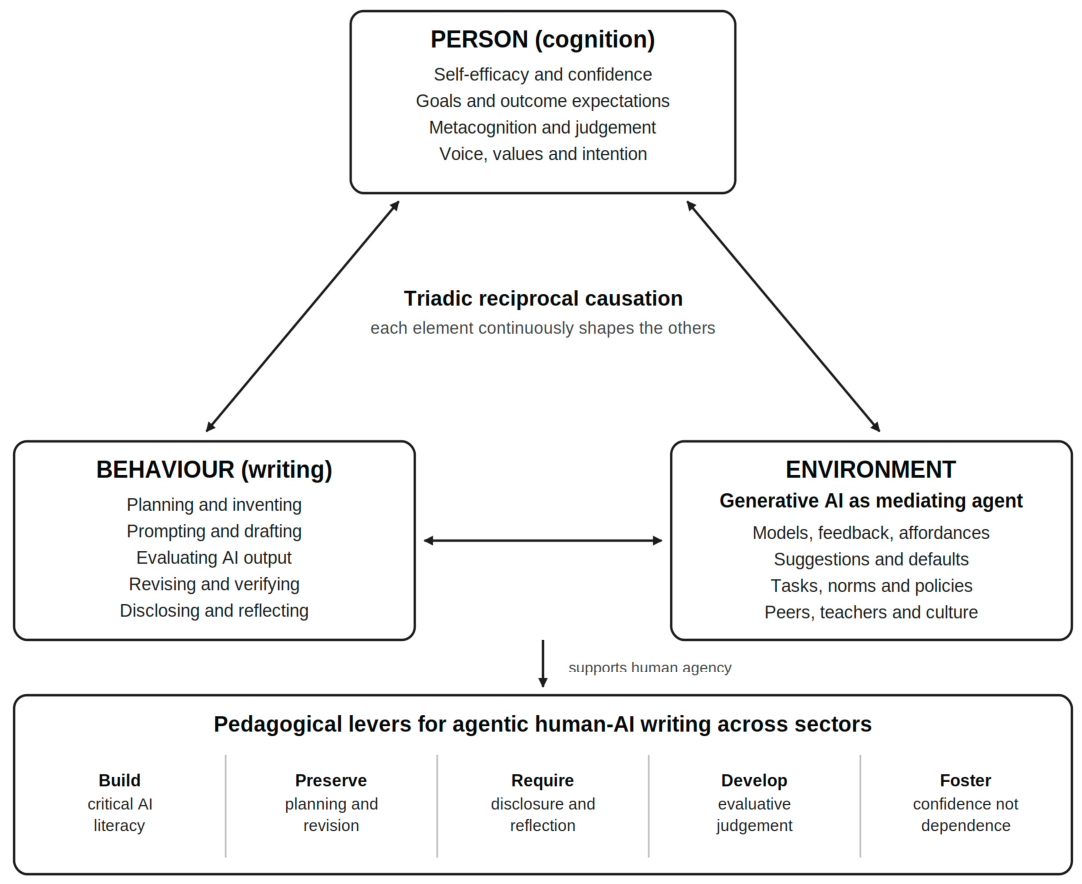

Table 1.
Databases Searched and Disciplinary Rationale.
| Database | Disciplinary coverage and rationale |
|---|---|
| Scopus | Broad multidisciplinary index used to capture education, psychology, computing and linguistics literature and to support citation tracking. |
| Web of Science | Multidisciplinary citation database used alongside Scopus to widen coverage and identify high impact and frequently cited work. |
| ERIC | Core education database providing comprehensive coverage of schooling, higher education and adult education research. |
| Education Research Complete | Education focused index used to capture journal literature on pedagogy, literacy and classroom practice. |
| PsycINFO | Psychology database essential for self-efficacy, metacognition, cognitive offloading and social cognitive theory. |
| LLBA (Linguistics and Language Behavior Abstracts) | Linguistics database used to capture writing, composition and second language literature. |
| Google Scholar | Used as a supplementary source to identify recent preprints, conference proceedings and grey literature in a fast moving field. |
Table 2.
Search Term Clusters.
| Concept cluster | Representative search terms |
|---|---|
| Technology | "generative AI", "generative artificial intelligence", "large language model", "ChatGPT", "AI writing tool" |
| Cognition | cognition, "cognitive offloading", metacognition, "critical thinking", agency, "self-efficacy", "self-regulation" |
| Writing | writing, composition, "academic writing", "second language writing", authorship, revision |
| Education | education, school, "higher education", "adult education", "AI literacy", learning, pedagogy |
Table 3.
Inclusion and Exclusion Criteria.
| Dimension | Inclusion | Exclusion |
|---|---|---|
| Focus | Addresses generative AI in relation to writing, cognition or learning | Generative AI incidental; no human or educational dimension |
| Publication type | Peer reviewed articles, conference papers and scholarly books; foundational theory where needed | Opinion pieces, marketing material and non-scholarly commentary |
| Timeframe | Empirical work from 2022 to 2026; earlier foundational theory admitted | Superseded technical reports without conceptual or educational relevance |
| Language and access | English language and retrievable in full text | Not available in full text; language not readable by the reviewer |
| Relevance | Speaks to thinking, writing, agency or education | Purely technical or computational with no learning relevance |
Table 4.
Screening and Selection Process.
| Stage | Action | Records (n) |
|---|---|---|
| Identification | Records identified across databases and supplementary searching | 612 |
| Duplicate removal | Records remaining after duplicates removed | 418 |
| Abstract screening | Titles and abstracts screened against criteria | 418 |
| Full-text eligibility | Full texts retrieved and assessed for eligibility | 84 |
| Included in synthesis | Studies carried forward into thematic synthesis | 36 |
Table 5.
Themes Mapped to Social Cognitive Constructs.
| Theme | Analytic focus | Primary social-cognitive construct |
|---|---|---|
| Cognitive offloading | Delegation of planning, retrieval, drafting and revision to the system | Reciprocal determinism; environment |
| Metacognition | Monitoring, evaluation and control of one's own thinking when using AI | Self-regulation |
| Writing processes | Reorganisation of planning, translating and reviewing in AI assisted composing | Behaviour; self-regulation |
| Authorship | Ownership, responsibility and voice in hybrid human-AI text | Human agency; proxy agency |
| Self-efficacy | Confidence in one's writing capability, located in the self or the tool | Self-efficacy; outcome expectations |
| Homogenisation | Convergence of expression and stance through repeated modelling | Observational learning |
Disclaimer/Publisher’s Note: The statements, opinions and data contained in all publications are solely those of the individual author(s) and contributor(s) and not of MDPI and/or the editor(s). MDPI and/or the editor(s) disclaim responsibility for any injury to people or property resulting from any ideas, methods, instructions or products referred to in the content. |
© 2026 by the authors. Licensee MDPI, Basel, Switzerland. This article is an open access article distributed under the terms and conditions of the Creative Commons Attribution (CC BY) license (http://creativecommons.org/licenses/by/4.0/).
Copyright: This open access article is published under a Creative Commons CC BY 4.0 license, which permit the free download, distribution, and reuse, provided that the author and preprint are cited in any reuse.


