
Preprint
Article

This version is not peer-reviewed.

Florida Scrub Millipedes, Floridobolus penneri and Narceus gordanus: Shared Mite-Millipede Associations

Submitted:

08 July 2026

Posted:

09 July 2026

You are already at the latest version

Abstract

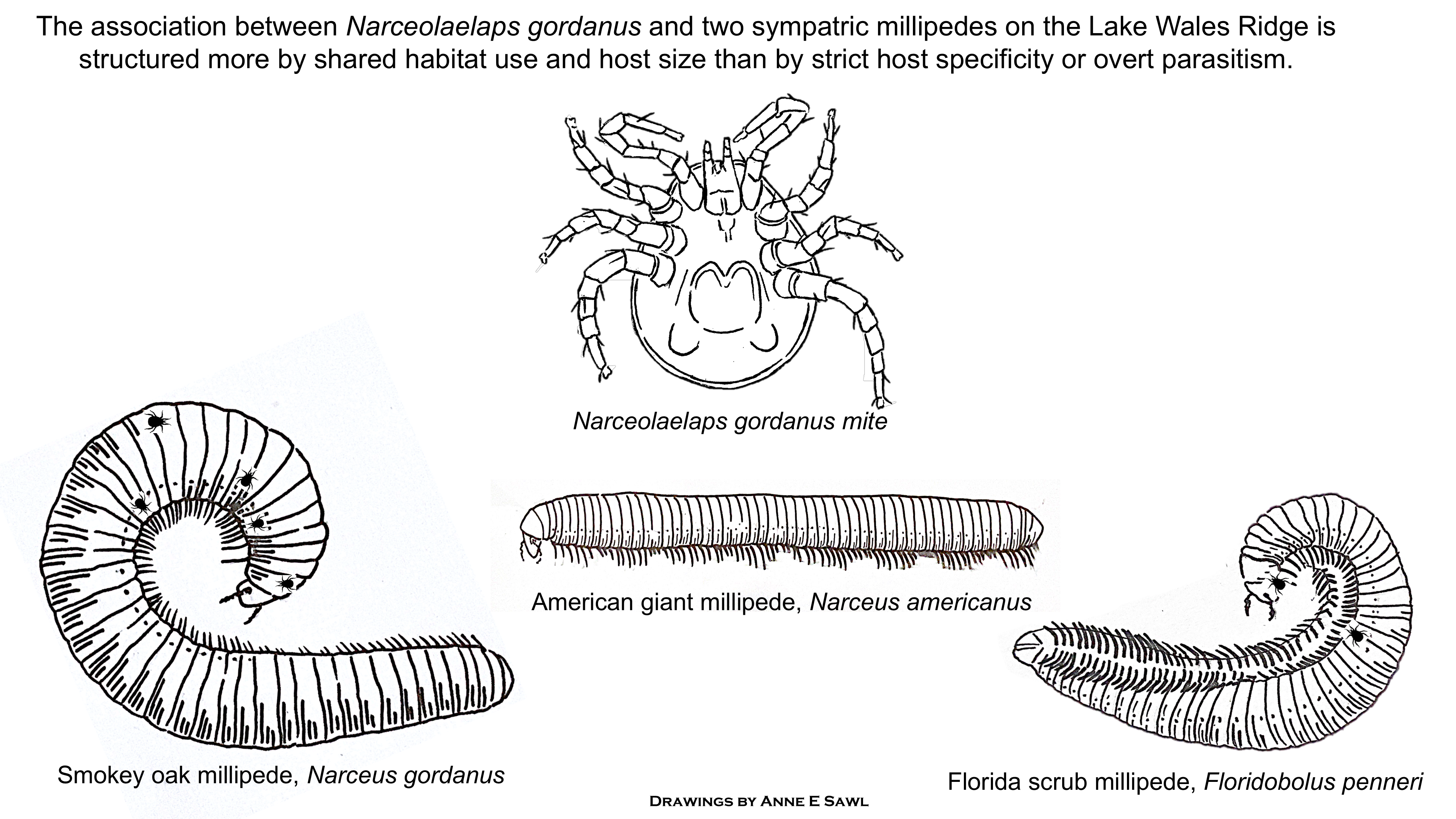
The Lake Wales Ridge in central Florida, USA, is a biodiversity hotspot characterized by species-rich xeric scrub and sandhill communities with high levels of endemism. The endemic Florida scrub millipede, Floridobolus penneri, and the more cosmopolitan Smokey Oak millipede, Narceus gordanus, are sympatric detritivores inhabiting these sandy upland systems. Previous research identified the mite, Narceolaelaps gordanus, as a host-specific parasite of N. gordanus. In this study, we evaluated mite associations on sympatric millipedes across 20 sites on the Lake Wales Ridge and examined whether these associations were consistent with parasitism, commensalism, or phoresy. We found that Narceolaelaps gordanus occurred on both F. penneri and N. gordanus, thereby contradicting previous observations of host specificity. Mite abundance differed between millipede species, with N. gordanus supporting more mites per individual than F. penneri. Independent of host species, larger millipedes supported greater numbers of mites. Over a three-month observation period, we found no visible evidence of exoskeleton or tissue damage associated with mite presence. In laboratory assays, defensive secretions from F. penneri and N. gordanus neither attracted nor repelled mites, suggesting that short-range host chemical cues may not strongly influence mite location behavior. Collectively, our findings indicate that the association between Narceolaelaps gordanus and sympatric millipedes on the Lake Wales Ridge is structured more by shared habitat use and host size than by strict host specificity or overt parasitism. The observed associations are more consistent with opportunistic commensalism or phoretic dispersal in which millipedes function as transport hosts between patchily distributed detrital habitats. Further research integrating behavioral observations, experimental studies, and molecular approaches will be necessary to resolve the ecological and evolutionary nature of these mite–millipede associations.
Keywords: 
;  ;  ;  ;  ;  

1. Introduction

The Lake Wales Ridge in central Florida, USA, is a biodiversity hotspot characterized by xeric, quartz-sand habitats that support numerous endemic species [1,2,3,4]. In these nutrient-poor sandy systems, millipedes function as major detrital processors and recyclers of leaf litter. The heavily sclerotized, segmented exoskeleton of millipedes confers resistance to abiotic stresses and allows them to dominate detrital processing that incorporates organic matter into otherwise nutrient-poor sandy substrates.
Millipedes often have commensal symbiotic relationships with mites, a relationship that developed over 100 to 300 million years ago [5]. However, mite–millipede relationships appear to be ecologically opportunistic, based on mutual locality, rather than evolutionarily specialized, as there is little evidence of cospeciation [6,7]. Previous studies are mixed on the reported sex-biased and spatially localized mite associations on millipedes, suggesting that mite–millipede associations may be influenced by host behavior or defensive secretions rather than strict host specificity alone [8]. Associations between mesostigmatid mites and arthropods span a continuum from parasitism to phoresy and commensalism, with many species using larger arthropods primarily for transport between patchily distributed resources [9].
Narceolaelaps gordanus is a species of mite belonging to Laelapidae family A recent study [10] categorized this mite along with four other parasitizing mite species of millipedes in the genus Narceus. Evidence suggested that Narceolaelaps gordanus burrowed underneath the tergites of its host millipede, Narceolus gordanus, resulting in the declining health of the host. When removed, this mite left a small impression between the tergites. In this study, our aim was to determine if the mite–millipede associations that we observed were host-specific and parasitic, or opportunistic and phoretic/commensal.

2. Materials and Methods

During the millipede breeding season, May through August, we sampled 20 sites along the Lake Wales Ridge (Figure 1). Sites expanded into Lake, Highlands, Polk, Osceola, and Orange counties. All sites were selected based on their open, sandy, scrub habitats. Permits were issued by the Florida Department of Environmental Protection (10042401) and by Polk County Parks and Natural Resources. Within each of the 20 field sites, three 9 m2 plots were surveyed for scrub millipedes (N = 90 plots). Plots were selected based on the presence of trace elements of millipedes, such as leaf litter and millipede fecal pellets. Once each 9 m2 plot was established with stakes and yellow tape, the entire plot was sampled at a depth of 7.5 cm of soil and leaf litter by gently combing the soil with a three-pronged rake.
In total, 215 millipedes were evaluated for the presence of mites. For each individual, we recorded its species, length (cm), segment number, mass (g), sex, and the number of mites. Millipedes from non-preserve sites were placed in boxes of soil and decaying matter, labeled by site and plot, and transported for laboratory studies to the Animal Research Lab’s insectary located on the St. Petersburg Campus of the University of South Florida. The insectary was put on a reverse 12 hr night/day cycle. The temperature was maintained at 26-27o C. Containers were misted twice a week; food consisted of dry fungi, cucumbers, and decaying leaves collected on site and refrigerated in the lab at 1.1o C.
To assess the attraction of mites to the secretions of two sympatric millipede species, we used a fully crossed 2 × 2 factorial design in which mites originating from each millipede species were exposed to defensive secretions from both conspecific and heterospecific millipedes (Table 1). A total of 36 mites were collected from millipede individuals that were housed in USF’s insectary: 18 mites from F. penneri and 18 mites from N. gordanus. Three mites were placed on a 5 mm2 cotton pad soaked with defense secretions from one millipede at the center of a 35 mm petri dish and covered. Each cotton pad was cut from a 40 mm circular pad purchased locally. Defense secretions were obtained from a millipede by gently moving the cotton pad across the individual’s ozopores. The mites in each petri dish were filmed for 7 hours. The footage was reviewed, and the frequency of each mite touching or walking over the pads was recorded.
Data analysis: We used descriptive statistics to determine the percentage of mites per millipede species. We used a generalized linear mixed model (negative binomial, log-linked) to determine predictors of mite number per millipede based on species, body size, and sex. Only adults of the Florida scrub and Smokey oak millipede, N. gordanus, and the Florida scrub millipede, F. penneri, were used in the mite study (n = 188). We excluded the Giant American millipede, N. americanus, and juvenile millipedes from the GLMM analysis (n = 12, 15 respectively). We used the Spearman’s correlation test to determine multicollinearity among body size variables: segment number and body mass were highly correlated, as were body length and body mass. We included only body mass as the primary indicator of body size within and across two species to avoid multicollinearity.
To analyze the frequency of mite attraction/repulsion to the defense secretions of millipedes, we used a generalized linear mixed model (negative binomial, log-linked). All analyses and graphics were generated in JMP 19 Statistical Analysis. Data are available by request to the corresponding author and in the Digital Commons: Dataset DOI, Sawl and Cassill 2026.

3. Results

3.1. Mite Number per Millipede

Mites were found on two millipede species, the Florida scrub millipede, F. penneri, and the Smokey Oak millipede, N. gordanus. Importantly, 100% of the mites located on both millipede species were Narceolaelaps gordanus. Mites were not found on the Giant American millipede, N. americanus millipeds. Millipede species and body mass were significant predictors of mite number per millipede (Table 2, Lines 2, 3). larger millipedes within and between species supported a larger number of mites. Additionally, N. gordanus supported more mites than F. penneri. Proportionately, 48% of N. gordanus and 29% of F. penneri millipedes were hosts to one or more mites. Millipede sex was not a significant predictor of the number of mites per millipede (Table 2, Line 4).

3.2. Mite Associations with Millipede Defense Secretions

Defensive secretions derived from F. penneri and N. gordanus were not significant predictors of the frequency of mite movement across secretion-treated pads (Table 3, Line 2). Likewise, mite origin did not significantly predict the frequency of mite movement (Table 3, Line 3). Although mite activity was high overall, these results indicate that millipede defensive secretions did not measurably attract or deter mites under these conditions, regardless of mite origin or defense secretion by millipede species.

4. Discussion

In this study of the scrub and sandhill habitats of the Lake Wales Ridge in central Florida, USA, we show that the mite, Narceolaelaps gordanus, occurred on two sympatric millipede species, the Smokey Oak millipede, Narceus gordanus, and the Florida scrub millipede, Floridobolus penneri, thereby expanding previous observations in which this mite was considered host specific to only one millipede species, N. gordanus [10]. Not only did a larger proportion of N. gordanus individuals host at least one mite, but N. gordanus also supported a greater number of mites per individual than F. penneri. Within each species, larger millipedes hosted more mites. The observed association may be partially phoretic, favoring larger and potentially more active millipede hosts that provide greater surface area and attachment opportunities [7]. Similar size-dependent associations have been documented in other phoretic mites associated with large arthropod hosts [11,12].
Over a three-month period of observations, we found no visible evidence of parasitism by Narceolaelaps gordanus on either millipede species, which contrasts with an earlier study that interpreted this mite’s association with N. gordanus as parasitic [10]. Although the absence of visible tissue damage does not exclude subtle parasitic effects, our observations are more consistent with alternative ecological associations. These include commensal scavenging, in which mites consume residual organic material encountered during host foraging, or phoretic dispersal, in which mites use millipedes as transport to suitable detrital habitats occupied by other arthropod decomposers.
In our experimental assays, millipede defensive secretions neither attracted nor repelled mites and did not influence the frequency of mite movement across secretion-treated pads. These findings suggest that Narceolaelaps gordanus does not rely primarily on short-range chemical cues from F. penneri or N. gordanus to locate hosts for transport or dispersal. However, because the secretion assay involved a relatively small sample size and laboratory conditions may not fully replicate natural host-location cues, these results should be interpreted cautiously. Collectively, our findings suggest that the association between Narceolaelaps gordanus and sympatric millipedes on the Lake Wales Ridge is structured more by shared habitat use and host body size than by strict host specificity or overt parasitism.
Similar uncertainty regarding the ecological role of the mite-millipede association has been reported in other studies. Mites associated with Doratogonus uncinatus occurred primarily on male hosts and were concentrated on the anterior third of the millipede body [8]. These observations led to speculation that mites may feed on millipede defensive secretions. The position of mites between the ozopores and legs in that study is particularly notable because it suggests that some mite–millipede associations may involve chemical or commensal associations rather than direct tissue parasitism. In another study, mites frequently occupy protected regions beneath tergites and near the ventral surface of the millilpede host, positions consistent with phoretic transport and protection during host movement rather than active tissue parasitism [13].
Numerous phoretic mite associates on the specious Julid millipedes across North America and Europe, demonstrating that mite–millipede associations are taxonomically widespread and often structured by dispersal opportunities rather than strict host specificity [7]. Their study emphasized that many mesostigmatid mites use millipedes as temporary transport hosts while exploiting detrital habitats occupied by multiple arthropod species. A new paramegistid mite associated with Mexican millipedes, further illustrates the widespread evolutionary occurrence of mite–millipede associations across geographically and taxonomically distinct systems [14].
A coevolutionary analysis of Appalachian xystodesmid millipedes and their mesostigmatid mites found limited evidence for strict cospeciation between mites and millipede hosts [6], suggesting that many associations are evolutionarily flexible and influenced more by ecological overlap and host availability than by tightly specialized host–parasite relationships.
Early studies proposed that phoresy represents an adaptive dispersal strategy rather than simple passive transport, allowing small arthropods such as mites to exploit patchily distributed and ephemeral resources [15,16]. This framework is highly consistent with the xeric scrub habitats of the Lake Wales Ridge, where decaying organic matter occurs in scattered microhabitats and mobile millipedes may provide efficient transport between detrital resource patches, further supporting our findings that association between Narceolaelaps gordanus and two sympatric millipede species is a dispersal mechanism rather than a parasitic interaction.
Together with our findings, these studies support the view that mite–millipede associations are ecologically diverse and may range from opportunistic commensalism to phoretic dispersal depending on host behavior, body size, and microhabitat conditions.

5. Conclusions

In summary, this study of mite–millipede associations along Florida’s Lake Wales Ridge provides the first evidence that the mite, Narceolaelaps gordanus, is neither host specific nor overtly parasitic. Instead, the mite occurred on at least two sympatric millipede species, with associations structured more by host size and shared habitat use than by host-specific chemical cues. Our findings are more consistent with opportunistic commensalism or phoretic dispersal than with specialized parasitism. Because mite–millipede associations in Florida’s xeric upland systems remain poorly understood, additional studies across other scrub and sandhill habitats will be important for resolving the ecological and evolutionary nature of these associations.

Author Contributions

Conceptualization, A.E.S.; methodology, A.E.S.; formal analysis, A.E.S., D.L.C.; investigation, A.E.S.; resources, A.E.S., D.L.C.; data curation, A.E.S., D.L.C.; writing—original draft preparation, AES; writing—review and editing, DLC.; visualization, A.E.S.; supervision, D.L.C.; project administration, D.L.C.; funding acquisition, NA. All authors have read and agreed to the published version of the manuscript.

Funding

Not applicable.

Institutional Review Board Statement

This study was reviewed by the lead veterinarian of the Institutional Animal Care and Use Committee (IACUC) at the University of South Florida. This study was determined to be exempt from the guidelines for a formal review.

Data Availability Statement

Data from this study can be downloaded at: https://digitalcommonsdata.usf.edu/datasets/384h7zvpbk/1.

Acknowledgments

GenAI was not used to organize or generate text, data, graphics, study design, data collection, analysis, or interpretation of data. The corresponding author used GenAI as a tutor to explain the GLMM for our dataset and to interpret the “intercept” in Table 2. Partial funding for supplies was provided by the Duke Energy Conservation Biology Graduate Student Research Fund. The authors have reviewed and edited the output and take full responsibility for the content of this publication.

Conflicts of Interest

The authors declare no conflicts of interest.

Abbreviations

The following abbreviations are used in this manuscript:
MDPI Multidisciplinary Digital Publishing Institute
GLMM Generalized linear mixed model
USF University of South Florida
JMP Statistical software

References

  1. Abrahamson, Warren G., Ann F. Johnson, James N. Layne, and Patricia A. Peroni. "Vegetation of the Archbold Biological Station, Florida: an example of the southern Lake Wales ridge." Florida Scientist 1984, 209-250.
  2. Sattman, Danielle Antoinette. "The Biology of the Florida Scrub Endemic Millipede: Floridobolus penneri." PhD diss., University of Missouri-Columbia, 2006.
  3. Corogin PT, Judd WS. Floristic inventory of Tiger Creek Preserve and Saddle Blanket Scrub Preserve, Polk County, Florida. Rhodora. 2009, Oct;111(948):448-502. [CrossRef]
  4. Swain HM, Martin PA. Saving the Florida scrub ecosystem: science and serendipity. Lincoln Institute of Land Policy working paper product code: WP12HS1, Lincoln Institute of Land Policy, Cambridge, Massachusetts, USA. 2012.
  5. Chitty, J. R. Myriapods (centipedes and millipedes). Invertebrate medicine, 2022, 3, 399-412. [CrossRef]
  6. Swafford, L.; Bond, J. E. Failure to cospeciate: an unsorted tale of millipedes and mites. Biological Journal of the Linnean Society, 2010, 101(2), 272-287. [CrossRef]
  7. Farfan, M.; Klompen, H. Phoretic mite associates of millipedes (Diplopoda, Julidae) in the northern Atlantic region (North America, Europe). International Journal of Myriapodology, 2012, 7, 69-91. [CrossRef]
  8. Mwabvu, T., 2014. Surface-active millipedes (Diplopoda) and associated mites (Acari, Mesostigmata) in Pigeon Valley Nature Reserve in Durban, South Africa. Soil Organisms, 86(2), pp.147-157.
  9. Hunter, P. E. & R. M. T. Rosario (1988): Associations of Mesostigmata with other arthropods. – Annual Review of Entomology 33: 393–417. [CrossRef]
  10. Kethley, J. B. Narceolaelaps ng,(Acari: Laelapidae) with four new species parasitizing spiroboloid millipeds. International Journal of Acarology, 1978, 4(3), 195-210. [CrossRef]
  11. Arneberg, P., Skorping, A., Grenfell, B., & Read, A. F. (1998). Host densities as determinants of abundance in parasite communities. Proceedings of the Royal Society B, 265, 1283–1289. [CrossRef]
  12. Combes, C. (2001). Parasitism: The Ecology and Evolution of Intimate Associations. University of Chicago Press.
  13. Gerdeman, B. S., H. Klompen & L. Tanigoshi (2000): Insights into the biology of a mite-millipede association. – Framenta Faunistica 43: 223–227.
  14. Kim, C. M. & H. Klompen (2001): A new genus and species of Paramegistidae (Mesostigmata: Trigynaspida) associated with millipedes from Mexico. – Acarologia 42: 39–51.
  15. Lawrence, R. F. (1939): Notes on the habits of two mites living on South African millipedes. – Transactions of the Royal Society of South Africa 27: 233–239. [CrossRef]
  16. Binns, E. S. Phoresy as migration-some functional aspects of phoresy in mites. Biological Reviews, 1982, 57(4), 571-620. [CrossRef]
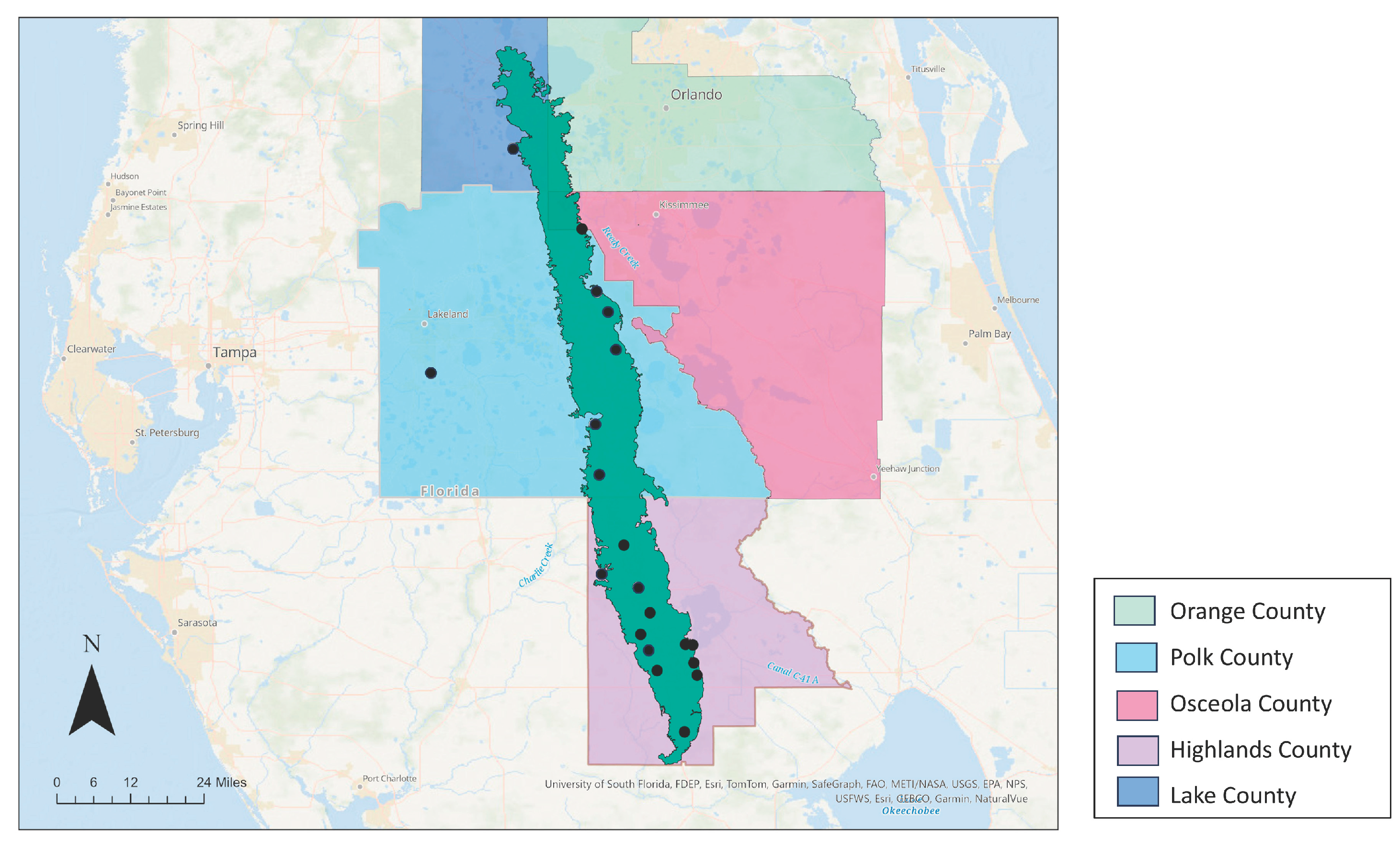
Figure 1. Twenty sampling sites along Lake Wales Ridge and surrounding counties in Florida, USA.
Preprints 222310 g001
Table 1. Experimental design of the assay on mite responses to millipede defense secretions.
Mite host F. penneri secretion N. gordanus secretion
F. penneri 3 mites per petri dish x 3 replicates 3 mites per petri dish x 3 replicates
N. gordanus 3 mites per petri dish x 3 replicates 3 mites per petri dish x 3 replicates
Table 2. Predictors of mite number per millipede (GLMM, Negative binomial distribution, log-linked, N = 188, significant predictors are in bold).
Variables Estimate β t-ratio P Lower CL Upper CL
1 Intercept -1.74 -3.25 0.001 -2.79 -0.69
2 Mass (g) 0.12 2.57 0.011 -0.028 0.21
3 Species [N. gordanusF. penneri] 1.19 2.23 0.027 -0.13 -2.24
4 Sex [M – F] -0.19 -0.83 0.405 -0.65 0.26
Table 3. Frequency of mite attraction over a defense secretion-filled pad from millipedes (N = 12).
Term Estimate β t-ratio P Lower CL Upper CL
1 Intercept 3.99 11.31 < 0.0001 3.19 4.78
2 Defense secretion by millipede species -0.09 -0.23 0.821 -1.02 0.83
3 Origin of mites by millipede species 0.09 0.23 0.821 -0.83 1.06
Disclaimer/Publisher’s Note: The statements, opinions and data contained in all publications are solely those of the individual author(s) and contributor(s) and not of MDPI and/or the editor(s). MDPI and/or the editor(s) disclaim responsibility for any injury to people or property resulting from any ideas, methods, instructions or products referred to in the content.
Copyright: This open access article is published under a Creative Commons CC BY 4.0 license, which permit the free download, distribution, and reuse, provided that the author and preprint are cited in any reuse.
Prerpints.org logo

Preprints.org is a free preprint server supported by MDPI in Basel, Switzerland.

Subscribe

© 2026 MDPI (Basel, Switzerland) unless otherwise stated

Accessibility

Disclaimer

Terms of Use

Privacy Policy

Privacy Settings
