

Submitted:
08 July 2026
Posted:
09 July 2026
You are already at the latest version
Abstract
The rapid transition toward sustainable energy systems has created an urgent demand for advanced functional materials capable of improving energy conversion, storage, and utilization technologies. Artificial intelligence has emerged as a key enabling technology for accelerating materials discovery through data-driven prediction, inverse design, autonomous experimentation, and intelligent decision-making. This mini-review critically examines recent advances in AI-assisted discovery and optimization of advanced energy materials, covering machine learning, deep learning, graph neural networks, transformer models, generative AI, large language models, and self-driving laboratories. Unlike previous reviews that primarily focus on individual AI methodologies or specific classes of energy materials, this work provides an integrated assessment of recent developments across the entire AI-driven materials discovery workflow, encompassing data infrastructures, predictive modeling, generative design, autonomous experimentation, and intelligent closed-loop optimization. Representative studies demonstrate that AI-assisted optimization has reduced battery fast-charging optimization time from approximately 500 days to 16 days and achieved prediction accuracies of up to R2 = 0.88 in virtual materials screening. Representative studies further demonstrate that recent generative AI models have produced more than twice as many stable novel materials while generating structures over ten times closer to DFT ground-state configurations, whereas AI-assisted image analysis has achieved automated materials characterization with segmentation accuracies exceeding 91%. These advances demonstrate the growing practical value of artificial intelligence across batteries, photovoltaics, electrocatalysis, hydrogen technologies, and other sustainable energy applications. This mini-review further discusses recent progress in open materials databases, autonomous experimentation, foundation models, and AI-enabled research platforms that are reshaping modern materials development. Critical evaluation of the available literature indicates that data quality, model generalization, interpretability, computational cost, and experimental validation remain the principal barriers to broader implementation of AI in materials research. Based on the literature synthesized in this mini-review, future advances are expected to depend on the effective integration of generative AI, foundation models, physics-informed learning, and autonomous experimentation within intelligent closed-loop materials discovery ecosystems.
Keywords:
artificial intelligence
; machine learning
; generative AI
; large language models
; selfdriving laboratories
; advanced energy materials
; materials discovery
; sustainable energy
1. Introduction
The global transition toward sustainable energy systems has substantially increased the demand for advanced functional materials capable of improving the efficiency, stability, and economic viability of modern energy technologies. High-performance materials play a central role in a wide range of applications, including rechargeable batteries, photovoltaic devices, fuel cells, electrocatalytic systems, hydrogen production technologies, and energy conversion platforms [1,2,3,4,5,6,7,8]. The performance of these technologies is largely governed by the intrinsic properties of the materials employed, making materials discovery and optimization a critical component of the global energy transition.
Despite decades of progress in computational and experimental materials science, the development of new materials remains a time-consuming and resource-intensive process. Conventional research strategies often rely on iterative trial-and-error experimentation, while first-principles calculations become increasingly expensive as material complexity grows. Although computational methods, particularly density functional theory, have significantly improved the understanding of structure-property relationships and enabled reliable prediction of many materials properties, their application to vast chemical design spaces remains computationally demanding [1,2]. As a result, the pace of materials innovation frequently lags behind the urgent technological demands associated with decarbonization, renewable energy deployment, and energy security.
In response to these challenges, materials science is undergoing a profound transformation driven by advances in data science, high-performance computing, and artificial intelligence. Supported by initiatives such as the Materials Genome Initiative and the rapid expansion of open materials databases, researchers now have access to unprecedented volumes of experimental and computational data [6,9,10,11]. This development has accelerated the emergence of materials informatics, a field that combines materials science with machine learning and data-driven analytics to uncover hidden relationships, predict materials properties, and guide the search for new compounds. Over the past decade, artificial intelligence has evolved from a supporting analytical tool into an active participant in the discovery process, enabling the rapid screening of candidate materials, identification of complex patterns, and optimization of multidimensional design spaces.
Recent advances have further expanded the role of AI beyond conventional prediction tasks. Deep learning architectures, graph neural networks, transformer models, generative artificial intelligence, and large language models are increasingly being applied to inverse materials design, knowledge extraction, autonomous experimentation, and scientific reasoning. As highlighted by Salas et al. [10], materials discovery has progressively evolved from empirical and theory-driven approaches toward computational, data-driven, and, more recently, generative AI-assisted paradigms. This evolution is fundamentally reshaping the way materials are conceived, designed, and validated, offering opportunities to reduce development times from years to months and, in some cases, even weeks.
The growing convergence of artificial intelligence, automation, robotics, and advanced materials characterization is also driving the emergence of self-driving laboratories and closed-loop discovery platforms. These systems integrate predictive modeling, automated synthesis, characterization, and continuous learning within unified research workflows, creating the foundation for a new generation of intelligent materials discovery ecosystems [5,12,13,14,15,16,17,18]. Rather than simply accelerating existing methodologies, such developments have the potential to redefine the scientific process itself by enabling adaptive and increasingly autonomous research strategies [19,20,21,22,23,24].
Against this background, the present mini-review provides a critical overview of recent advances in AI-driven discovery and optimization of advanced energy materials. Particular attention is given to the development of data infrastructures, machine-learning methodologies, generative design strategies, and autonomous research platforms for batteries, photovoltaics, electrocatalysis, hydrogen-related technologies, and other sustainable energy applications. By critically synthesizing recent advances, current challenges, and emerging research directions, this mini-review provides an integrated assessment of how artificial intelligence is reshaping the entire materials discovery workflow, from data generation and predictive modelling to autonomous experimentation and intelligent decision making for sustainable energy applications.
Unlike previous reviews that primarily examine individual artificial intelligence methodologies or specific classes of energy materials, this mini-review provides a unified and critical assessment of the complete AI-driven materials discovery ecosystem. It integrates recent advances in machine learning, graph neural networks, transformer models, generative AI, foundation models, large language models, AI agents, and self-driving laboratories within a single framework spanning data infrastructure, predictive modeling, inverse design, autonomous experimentation, and intelligent decision-making. In addition, this mini-review synthesizes the most recent developments reported during 2023-2026 and identifies the key scientific challenges, emerging trends, and future research directions that are expected to shape next-generation AI-assisted energy materials discovery.
2. Review Methodology and Literature Search Strategy
This mini-review was prepared through a critical analysis of recent literature on artificial intelligence applications in energy materials research. Relevant publications were identified using the Web of Science, Scopus, and Google Scholar databases, with primary emphasis on studies published between 2020 and 2026. Search keywords included “materials informatics”, “machine learning”, “deep learning”, “generative AI”, “large language models”, “self-driving laboratories”, “battery materials”, “electrocatalysis”, “photovoltaics”, and “sustainable energy materials”. Representative research articles, review papers, and perspective articles were selected according to their scientific relevance, methodological quality, citation impact, and contribution to recent advances in AI-assisted energy materials discovery. Particular attention was given to studies published during 2023-2026 that reported quantitative performance metrics, experimental validation, autonomous experimentation, foundation models, generative AI, and closed-loop optimization workflows. Rather than providing an exhaustive bibliographic survey, this mini-review critically synthesizes representative studies to identify major technological advances, remaining scientific challenges, and emerging research directions in AI-driven energy materials discovery. The resulting analysis emphasizes the convergence of computational materials science, artificial intelligence, and autonomous experimentation as the principal drivers of future materials innovation.
3. Evolution of Materials Discovery Paradigms
The history of materials discovery reflects the continuous evolution of scientific methodologies developed to understand, design, and optimize functional materials for increasingly demanding technological applications. For centuries, new materials were developed primarily through empirical observations, trial-and-error experimentation, and accumulated practical knowledge. Although this empirical approach produced many technologically important materials, the discovery process remained slow, resource intensive, and heavily dependent on accumulated experimental experience. These limitations stimulated the development of increasingly predictive methodologies capable of reducing experimental uncertainty and accelerating materials innovation. From the Bronze and Iron Ages to the early twentieth century, advances in metallurgy, ceramics, and chemical processing were largely driven by experience rather than predictive scientific frameworks [10]. Although this empirical approach produced many technologically important materials, the discovery process remained slow, resource-intensive, and highly dependent on human intuition.
The emergence of modern theoretical physics and chemistry during the twentieth century marked the next major transition in materials research. Thermodynamics, statistical mechanics, and quantum theory provided the foundation for understanding structure-property relationships and enabled researchers to move beyond purely empirical approaches. Simplified analytical models and theoretical frameworks increasingly guided the design of materials with targeted properties, laying the groundwork for a more predictive approach to materials development [10,11]. A further transformation occurred with the rise of computational materials science. Beginning in the second half of the twentieth century and accelerating rapidly after the 1990s, first-principles calculations, molecular dynamics simulations, and high-performance computing became indispensable tools for investigating complex materials systems. Computational approaches enabled virtual screening of candidate compounds and provided atomistic insights that were often inaccessible through experiments alone. Nevertheless, despite their remarkable predictive capabilities, many simulation-based methods remain computationally demanding, particularly when applied to large systems, complex interfaces, or vast compositional spaces [2,13].
The advent of the data-driven era introduced a fundamentally different paradigm. Supported by initiatives such as the Materials Genome Initiative and the rapid growth of open scientific infrastructures, large-scale databases including Materials Project, OQMD, JARVIS, and NOMAD have made millions of computational and experimental records accessible to the research community [6]. The availability of these resources has accelerated the development of materials informatics and enabled machine-learning algorithms to identify complex relationships between composition, structure, processing conditions, and functional performance. As a result, researchers are increasingly able to navigate previously inaccessible regions of chemical space and prioritize promising candidates before undertaking costly simulations or experimental validation [3,4,6].
More recently, the field has entered a new phase characterized by the integration of artificial intelligence, high-throughput computation, laboratory automation, and autonomous experimentation. Rather than functioning as isolated tools, modern AI systems are increasingly incorporated into interconnected discovery workflows that combine data generation, predictive modeling, inverse design, experimental planning, and continuous optimization [3,5,10,12]. Generative models can propose previously unknown materials, machine-learning algorithms can evaluate their potential performance, computational methods can verify structural stability, and automated laboratories can experimentally test the most promising candidates. The resulting feedback is subsequently used to refine predictive models and guide further exploration.
This transition represents more than a technological improvement in existing research practices. It reflects a broader shift from data-driven materials science toward intelligence-driven discovery ecosystems capable of continuously learning, adapting, and improving through iterative feedback. Such frameworks offer the potential to dramatically accelerate innovation cycles, reduce development costs, and expand the range of accessible materials far beyond what could be explored using conventional approaches alone. Figure 1 summarizes this emerging AI-driven closed-loop paradigm for sustainable energy materials discovery and optimization.
Figure 1 illustrates the ongoing transition from conventional linear materials-development workflows toward integrated intelligence-driven discovery ecosystems. Unlike traditional research strategies, where computational modeling, experimental validation, and data analysis are often conducted as separate activities, modern AI-enabled platforms establish continuous feedback loops among these processes. Such integration enables more efficient exploration of chemical space, improves the allocation of experimental resources, and accelerates the identification of promising energy materials. The convergence of predictive modeling, generative artificial intelligence, autonomous experimentation, and continuous learning is increasingly viewed as a technological foundation for next-generation sustainable energy materials research [3,5,10,12].
According to the authors, the convergence of artificial intelligence, high-performance computing, and autonomous experimentation represents the beginning of a new era in materials research, where continuous interaction between prediction, validation, and learning is expected to become a defining characteristic of future materials discovery workflows.
4. AI Foundations for Energy Materials
4.1. Materials Databases and Infrastructure
The rapid adoption of artificial intelligence in materials science has been enabled largely by the emergence of extensive digital infrastructures and open-access materials databases. Over the past two decades, large-scale initiatives have generated unprecedented volumes of computational and experimental data, transforming materials research into an increasingly data-intensive discipline. Among the most influential resources are the Materials Project, which provides calculated properties for more than 140,000 inorganic compounds, the Open Quantum Materials Database, and the NOMAD repository, which collectively contain millions of density functional theory calculations and associated materials descriptors [6]. Additional platforms, including AFLOW, JARVIS, and Citrination, further expand the availability of high-quality datasets and provide valuable benchmarks for the development and validation of machine-learning models [6,15].
The impact of these resources extends far beyond simple data storage. Open databases have democratized access to materials information, allowing researchers worldwide to explore, validate, and reuse data that would otherwise require substantial computational or experimental effort to generate. This accessibility has accelerated the development of materials informatics and enabled machine-learning algorithms to identify complex relationships between composition, crystal structure, processing conditions, and functional properties. As a result, data-driven approaches can now guide the selection of promising candidates before expensive simulations or laboratory experiments are performed [6,15]. Beyond accelerating materials screening, these databases also improve the reproducibility and comparability of AI studies by providing standardized benchmark datasets that can be reused across different machine-learning models. This standardization facilitates objective evaluation of predictive algorithms, promotes transparent model development, and enables independent validation of reported results, thereby strengthening confidence in AI-assisted materials discovery.
Recent developments have further expanded the role of digital infrastructures through the integration of cloud computing, high-throughput simulations, laboratory automation, and artificial intelligence. Salas et al. describe emerging cloud-edge computing frameworks capable of linking computational resources, autonomous experimentation, and secure data-sharing mechanisms within unified research environments [10]. These platforms support real-time data exchange, continuous model refinement, and collaborative workflows that bridge the gap between computational prediction and experimental validation. Increasingly, these infrastructures are being integrated with application programming interfaces, workflow managers, and cloud computing environments that allow automated interaction among databases, computational software, and laboratory equipment. Such interoperability is becoming an important prerequisite for autonomous materials discovery workflows. At the same time, increasing attention is being directed toward transparency, reproducibility, and the implementation of FAIR data principles, which are becoming essential requirements for modern AI-assisted research [10,16].
Another important aspect is the growing emphasis on sustainability and efficient resource utilization. By promoting data sharing, workflow standardization, and the reuse of computational results, modern digital infrastructures help reduce redundant calculations and unnecessary experimental efforts. Such practices not only improve research efficiency but also contribute to lowering the computational and environmental costs associated with large-scale materials discovery programs [16]. Taken together, open databases and intelligent research infrastructures constitute the digital backbone of contemporary materials informatics. Their continued development is expected to strengthen the integration of data resources, predictive algorithms, autonomous experimentation, and scientific collaboration, thereby providing the digital foundation required for next-generation AI-assisted materials discovery and sustainable energy innovation [6,10,16].
4.2. Classical Machine Learning
Classical machine-learning methods remain an important component of modern materials informatics despite the rapid emergence of deep-learning and generative AI approaches. Algorithms including SVM, decision trees, RF, GBDT, k-NN, and regression-based models have been extensively employed for property prediction, materials screening, phase identification, and process optimization across a wide range of energy materials [17]. Their continued popularity largely stems from their ability to achieve reliable predictive performance using relatively small or moderately sized datasets, which remain typical in many experimental materials studies.
The growing availability of materials databases has significantly expanded the applicability of supervised machine-learning methods. Early studies primarily relied on linear and multivariate regression models to establish relationships between composition, structure, and performance. These approaches gradually evolved toward more sophisticated algorithms capable of capturing nonlinear interactions and complex feature dependencies. Among them, random forests and gradient-boosting frameworks have gained particular attention because of their robustness, computational efficiency, and relatively high interpretability [17,18]. For example, Mishra et al. demonstrated that random-forest models can substantially improve the prediction of ionic conductivity in solid electrolytes, thereby accelerating the identification of promising candidates for next-generation battery technologies [19]. Similar approaches have been employed to predict formation energies, electrochemical stability, catalytic activity, and transport properties across a wide range of functional materials systems.
An additional advantage of classical machine-learning methods is their compatibility with feature-engineering strategies based on physically meaningful descriptors. Composition-derived variables, elemental properties, crystallographic parameters, and thermodynamic descriptors can be incorporated directly into predictive models, allowing researchers to relate model performance to established physicochemical principles rather than relying exclusively on data-driven correlations. This capability has contributed to the continued use of classical ML in situations where both prediction accuracy and scientific interpretability are required.
In addition to supervised learning, unsupervised machine-learning techniques play an important role in extracting knowledge from complex and high-dimensional datasets. Clustering algorithms, dimensionality-reduction methods, and topological data-analysis approaches can reveal hidden patterns that are often difficult to identify using conventional statistical techniques. These approaches facilitate exploration of large chemical spaces by grouping structurally or chemically related compounds, reducing data dimensionality, and identifying descriptor combinations associated with specific materials properties. As a result, unsupervised learning can reveal hidden trends that subsequently guide targeted computational or experimental investigations. Chen et al. introduced a multiscale topological learning framework that combines unsupervised feature extraction with materials screening to identify promising lithium superionic conductors [20]. By integrating data filtering, topological analysis, and clustering, the approach enabled efficient navigation of large materials datasets and facilitated the discovery of candidates with favorable ion-transport characteristics.
An important reason for the continued use of classical machine-learning models is their comparatively high level of interpretability. Feature-importance analysis, decision-tree structures, permutation-based ranking methods, and SHAP-type explainability techniques enable researchers to identify the variables that most strongly influence model predictions. Such information often provides valuable scientific insight into the relationships between composition, structure, processing conditions, and functional properties. Consequently, classical machine learning remains widely employed as an efficient first-stage screening tool and continues to complement more computationally demanding deep-learning and graph-based approaches in contemporary materials discovery workflows [17,18,19,20,21].
4.3. Deep Learning
The emergence of deep learning has significantly expanded the capabilities of artificial intelligence in materials science by enabling the automatic extraction of complex and hierarchical features directly from raw data. Unlike classical machine-learning approaches, which often rely on manually engineered descriptors, deep neural networks can learn nonlinear relationships from large and heterogeneous datasets with minimal prior assumptions. This capability is particularly valuable for energy materials because their functional properties are often governed by complex and nonlinear relationships among chemical composition, crystal structure, microstructure, defects, processing conditions, and operating environments, making conventional descriptor-based approaches increasingly insufficient for accurate prediction [22].
Among the most widely adopted deep-learning architectures are convolutional neural networks, recurrent neural networks, autoencoders, and attention-based frameworks. These models have demonstrated remarkable success in materials characterization, inverse design, image analysis, spectroscopy interpretation, and surrogate modeling of computationally expensive simulations. In many cases, deep-learning models are capable of identifying patterns that remain difficult to capture using conventional statistical or descriptor-based approaches, thereby improving predictive accuracy and accelerating the interpretation of large experimental datasets [22,23,24]. In addition, deep-learning models increasingly serve as transferable feature extractors that can be adapted to different classes of energy materials with relatively limited retraining [19,20,21,22,23]. This transfer-learning capability is becoming particularly valuable in materials research, where experimentally validated datasets often remain limited despite the rapid growth of computational databases.
One of the major strengths of deep learning lies in its ability to process noisy and high-dimensional data. Klein-Moberg et al. developed a deep-learning-assisted online mass spectrometry platform capable of monitoring reaction products generated on individual catalyst nanoparticles during fuel-cell operation [22]. By employing a denoising autoencoder, the authors successfully extracted weak reaction signals from highly noisy measurements and reduced the required catalyst surface area by approximately three orders of magnitude. Beyond improving measurement sensitivity, this study illustrates how deep learning can enhance experimental efficiency by extracting physically meaningful information from data that would otherwise be difficult to interpret using conventional signal-processing techniques. Such advances demonstrate how deep learning can substantially enhance experimental sensitivity while reducing material consumption and measurement time.
Deep-learning approaches have also been increasingly integrated with physics-based simulations to investigate complex transport phenomena in energy systems. Li et al. combined convolutional neural networks with molecular-dynamics simulations to analyze water transport processes within catalyst layers, providing molecular-scale insights that facilitated the optimization of fuel-cell architectures [23]. These hybrid approaches illustrate the growing synergy between data-driven learning and computational materials science, enabling researchers to study dynamic processes that are difficult to access through experiments alone.
The rapid development of advanced electron microscopy, X-ray imaging, and spectroscopic techniques has generated increasingly large and complex datasets, making automated image interpretation an essential component of modern materials characterization. Modern imaging techniques generate enormous volumes of information, making manual analysis increasingly impractical. Deep-learning-based semantic segmentation and computer-vision methods can automatically identify microstructural features, quantify morphological characteristics, and correlate structural information with functional performance. For example, Bi et al. applied a deep-learning segmentation framework to catalyst layers used for electrochemical CO2 reduction and achieved an accuracy exceeding 91% in distinguishing pores, catalyst particles, and ionomer-rich regions [24]. Their analysis revealed that an ionomer-to-carbon ratio close to 0.2 provided optimal transport conditions for CO2 diffusion, offering valuable guidance for catalyst-layer design and performance optimization.
Beyond individual applications, deep learning is increasingly serving as a surrogate modeling framework capable of replacing computationally intensive simulations and accelerating materials screening. By rapidly approximating complex physical relationships, deep neural networks can significantly reduce computational costs while maintaining acceptable predictive accuracy. Based on the studies reviewed in this mini-review, deep learning is expected to evolve from a high-performance predictive tool into an integral component of intelligent materials discovery platforms that seamlessly connect computational modelling, automated characterization, autonomous experimentation, and data-driven decision making within closed-loop research environments [22,23,24].
4.4. Graph Neural Networks and Transformers
Graph neural networks have become one of the most influential AI architectures in modern materials informatics because they naturally represent the atomic structure of crystalline solids, molecules, and functional materials as interconnected graphs. Unlike conventional machine-learning methods that rely heavily on manually engineered descriptors, GNNs operate directly on graph representations in which atoms are treated as nodes and chemical bonds or interatomic interactions are represented as edges. This structure allows the model to learn relationships directly from atomic environments while preserving essential chemical and structural information [25].
The growing popularity of GNNs stems from their ability to simultaneously capture local atomic interactions and long-range structural effects. Models such as the CGCNN have demonstrated remarkable performance in predicting formation energies, electronic bandgaps, elastic constants, thermal conductivity, and other materials properties directly from crystal structures [25]. By learning hierarchical representations of atomic environments, these models can identify complex structure-property relationships that are often difficult to capture using conventional descriptor-based approaches. As a result, GNNs have become powerful tools for high-throughput screening and accelerated exploration of large materials spaces. An important advantage of GNNs is that they reduce the dependence on manually constructed descriptors by learning structural representations directly from atomic connectivity. This capability improves model transferability across different classes of materials and facilitates the exploration of previously unexplored regions of chemical space.
An additional advantage of graph-based architectures is their flexibility. The same fundamental framework can be adapted to a wide range of materials systems, including inorganic crystals, battery materials, catalysts, porous frameworks, polymers, and nanostructures. Recent studies have demonstrated that GNNs frequently outperform traditional machine-learning approaches when sufficiently large and diverse training datasets are available. According to Jiang et al., graph neural networks play a unique role in materials research by enabling the automatic extraction of high-dimensional yet physically meaningful representations from heterogeneous materials data [25]. This capability is particularly important for complex energy materials, where interactions between composition, structure, defects, and processing conditions often determine functional performance.
Recent progress also indicates that graph-based learning is becoming an important foundation for the development of domain-specific foundation models in materials science [25,26,27,28]. By pretraining GNNs on large crystallographic databases and subsequently adapting them to specialized prediction tasks, researchers can substantially reduce the amount of task-specific training data while improving model generalization across diverse materials systems. This emerging strategy is expected to play an increasingly important role in next-generation AI-assisted materials discovery.
Transformer architectures have recently emerged as another important family of AI models for materials science, complementing graph-based learning by capturing long-range relationships within complex scientific datasets. Originally developed for natural language processing, transformers utilize attention mechanisms that enable efficient modeling of long-range dependencies within complex datasets. In recent years, researchers have successfully adapted these architectures to materials-related tasks by treating compositions, crystal structures, scientific texts, or experimental sequences as structured information that can be processed using attention-based learning strategies [25]. Transformer-based models have demonstrated considerable potential for property prediction, materials classification, knowledge extraction, and structure generation. Materials-specific language models trained on large scientific corpora can identify hidden relationships within the literature, accelerate information retrieval, and support hypothesis generation. Unlike conventional predictive models, these pretrained transformer systems are capable of integrating information from publications, databases, and experimental records, thereby supporting literature mining, scientific reasoning, and hypothesis generation within a unified computational framework. At the same time, transformer architectures are increasingly being integrated with crystallographic and compositional data to predict materials properties directly from structural information. These developments are opening new opportunities for connecting experimental observations, computational simulations, and scientific knowledge within unified AI frameworks.
Particularly promising is the emergence of multimodal transformer systems capable of simultaneously processing multiple forms of scientific information. Such models can integrate textual synthesis descriptions, compositional data, microscopy images, spectroscopic measurements, and computational results within a single learning architecture. This capability may significantly improve the interpretation of complex materials datasets while enabling more comprehensive and context-aware decision-making. Jiang et al. further emphasize that transformer-based architectures are expected to play an increasingly important role in both property prediction and materials generation as larger domain-specific pretraining datasets become available [25]. Taken together, graph neural networks and transformer architectures represent a major shift toward representation learning in materials science. Rather than relying exclusively on handcrafted descriptors, these approaches learn relevant physical and chemical relationships directly from data, providing a powerful foundation for next-generation materials discovery, inverse design, and autonomous research systems. From the authors perspective, continued advances in graph-based representation learning and transformer architectures will provide an essential computational foundation for future multimodal AI systems capable of integrating structural data, scientific literature, experimental observations, and autonomous laboratory workflows within a unified materials discovery framework [25].
4.5. Generative Models for Inverse Design
Generative artificial intelligence has emerged as one of the most transformative developments in contemporary materials informatics. Unlike conventional predictive models that estimate the properties of existing compounds, generative AI seeks to design entirely new materials by directly exploring previously inaccessible regions of chemical space while satisfying predefined performance objectives. This shift from passive screening toward active materials generation represents a fundamental change in the way materials discovery is performed. Instead of searching vast chemical spaces for promising candidates, researchers can now use AI systems to propose previously unexplored compositions and structures that satisfy predefined design objectives [10,26].
Several classes of generative models have been successfully adapted for materials research, including variational autoencoders, generative adversarial networks, and diffusion-based architectures. Variational autoencoders learn compressed latent representations of known materials and subsequently generate new candidates by exploring previously unoccupied regions of latent space. Generative adversarial networks employ competing neural networks to create realistic structures that resemble existing materials while maintaining diversity and novelty. More recently, diffusion models have attracted considerable attention because of their ability to generate complex structures with improved stability and physical realism. These approaches have already been applied to the design of inorganic crystals, battery materials, perovskite-inspired compounds, catalysts, and functional nanostructures [10]. Recent studies further indicate that generative architectures are increasingly being combined with pretrained foundation models capable of learning transferable representations from massive crystallographic and materials databases [26]. Such integration improves model generalization and provides a more efficient starting point for inverse design across diverse classes of functional materials [25,26].
One of the most significant advantages of generative AI is its compatibility with inverse-design strategies. In traditional materials development, researchers typically begin with a candidate material and then evaluate whether it possesses desirable properties. Generative models reverse this workflow by starting from target properties and subsequently proposing structures that may satisfy those requirements. This strategy is especially attractive for sustainable energy materials, where practical applications frequently require simultaneous optimization of multiple and often competing characteristics, including efficiency, long-term stability, cost, safety, manufacturability, and environmental sustainability. According to Wang et al., generative AI is increasingly shifting battery materials research from data-driven screening toward intelligent inverse design, enabling the targeted exploration of previously inaccessible regions of chemical space [26].
Recent advances further suggest that generative AI may become a central component of autonomous discovery ecosystems. By coupling generative models with high-throughput simulations, machine-learning predictors, and automated experimental platforms, candidate materials can be continuously generated, evaluated, optimized, and validated within closed-loop research workflows. Such integration substantially reduces the number of costly experiments required while accelerating the identification of promising materials candidates [10,26]. Rather than replacing experimental research, these integrated workflows allow experimental resources to be concentrated on the most promising candidates, thereby improving both the efficiency and reliability of materials development. The generation of chemically realistic and experimentally synthesizable materials continues to be a major concern. Many generative models struggle with limited training data, uncertainty quantification, and the interpretation of latent representations. Furthermore, a generated structure that appears promising computationally may ultimately prove unstable or difficult to synthesize under realistic laboratory conditions. Addressing these limitations will require tighter integration between generative AI, domain knowledge, physics-based modeling, and experimental validation.
Nevertheless, the rapid progress achieved in recent years strongly suggests that generative models will play an increasingly important role in future materials discovery. As model architectures become more sophisticated and training datasets continue to expand, generative AI is expected to move beyond candidate generation toward fully adaptive design systems capable of continuously learning from both computational and experimental feedback. Based on the literature analyzed in this mini-review, generative AI is expected to evolve beyond candidate generation toward adaptive discovery platforms capable of continuously integrating computational predictions, experimental observations, and autonomous decision making. Such systems may fundamentally change the way advanced energy materials are designed by enabling iterative optimization throughout the entire research cycle rather than during isolated stages of materials development [10,26].
4.6. Large Language Models and AI Agents
One of the newest directions in AI-assisted materials research is the application of large language models (LLMs) and autonomous AI agents. These systems extend the capabilities of conventional machine-learning frameworks by combining natural-language understanding with reasoning, information retrieval, and workflow coordination. Recent developments include scientific language models adapted to materials-related literature as well as multimodal systems capable of processing text, images, experimental data, and laboratory instructions within a unified framework. Although still at an early stage of development, such models have already demonstrated potential for literature analysis, knowledge extraction, hypothesis generation, and experimental planning [25].
Recent studies indicate that LLMs can support a wide range of research activities, including the interpretation of scientific publications, identification of hidden relationships within large literature collections, synthesis planning, and automated data analysis [3,25,27]. Recent developments have also expanded the role of LLMs in electronic laboratory notebook (ELN) automation and laboratory workflow management. These systems can organize experimental records, generate standardized documentation, summarize laboratory observations, and convert natural-language researcher instructions into structured experimental protocols. Such capabilities improve documentation quality, reduce manual effort, and facilitate communication between researchers, automated instrumentation, and robotic laboratory platforms. By leveraging information contained in articles, databases, patents, and experimental reports, these models can assist researchers in navigating increasingly complex scientific knowledge landscapes. Beyond information retrieval, LLMs are increasingly being used to synthesize fragmented scientific knowledge, identify emerging research trends, and support the generation of new scientific hypotheses across multiple disciplines. Jiang et al. identified LLMs as an emerging direction for energy materials research because of their ability to integrate information across multiple data modalities and support decision-making in complex research environments [25].
An equally important trend is the integration of language models with autonomous laboratory platforms. In these systems, LLMs function not only as information-processing tools but also as interfaces connecting computational models, robotic synthesis systems, characterization instruments, and data-analysis pipelines. Recent studies have demonstrated how AI agents can coordinate simulations, evaluate experimental outcomes, and guide iterative optimization within closed-loop research workflows [5,12,28]. Platforms such as CreBOT illustrate the growing convergence of language-based reasoning, machine vision, scientific knowledge, and laboratory automation, providing an early glimpse of future intelligent research environments [25,28].
Despite encouraging progress, several challenges continue to limit the widespread deployment of LLM-based scientific systems. Current models may generate scientifically incorrect information, struggle with uncertainty quantification, and exhibit limited domain-specific reasoning when confronted with highly specialized materials problems [3,27]. Concerns related to transparency, reproducibility, explainability, and experimental verification also remain important. Nevertheless, rapid progress in scientific foundation models, multimodal learning, and autonomous experimentation indicates that LLM-based systems are evolving from information-processing tools into intelligent research assistants. From the authors' perspective, their greatest long-term impact will arise from coordinating interactions among scientific literature, computational models, experimental platforms, and autonomous laboratories, thereby supporting increasingly integrated AI-driven materials discovery ecosystems [3,5,27,28].
To provide a concise comparison of the major artificial-intelligence approaches currently employed in energy materials research, Table 1 summarizes their principal application areas, strengths, and current limitations. Collectively, these developments illustrate the ongoing evolution from conventional predictive modeling toward increasingly integrated and autonomous research ecosystems capable of combining prediction, design, experimentation, and decision-making within a unified workflow.
As summarized in Table 1, current AI methodologies should be viewed as complementary components of an integrated materials discovery ecosystem rather than as competing technologies. Classical machine learning, graph neural networks, transformers, generative AI, large language models, and self-driving laboratories each address different stages of the discovery process. Their increasing integration is progressively transforming materials research from isolated prediction tasks into intelligent workflows that combine data generation, computational modeling, experimental validation, and adaptive decision-making within a unified framework.
5. AI-Driven Discovery of Energy Materials
The rapid development of artificial intelligence has transformed a wide range of energy-related research fields. While the underlying methodologies differ, a common objective across these applications is the acceleration of materials discovery, optimization, and deployment through data-driven decision-making. This section highlights representative advances in batteries, photovoltaics, electrocatalysis, hydrogen technologies, and other functional energy materials where AI is increasingly influencing both fundamental research and practical innovation.
5.1. Batteries and Energy Storage
AI has had significant impact on battery materials, especially cathodes, anodes, and solid electrolytes [26,29]. ML models predict cathode voltages and stability; DL networks identify novel electrode molecules. For example, Wang et al. (2026) review inorganic battery materials and emphasize data standardization and ML for cathode/anode screening [26]. A striking case is closed-loop optimization of charging protocols: Attia et al. showed that an ML-driven optimization loop could cut EV fast-charge testing time from 500 days to just 16 days [30], demonstrating AI’s power to accelerate battery testing.
Predictive models have also guided materials selection. Du et al. used ML to screen more than 1 million hypothetical organic molecules for Li-ion battery electrodes [31]. They narrowed the search to 1,524 candidates and trained support-vector regression models to predict redox potentials with R² = 0.88 [31]. Similarly, random-forest models have identified promising solid-electrolyte compositions with high ionic conductivity [19,25]. Recent studies have also highlighted the growing importance of explainable artificial intelligence (XAI) in battery research. Rather than providing predictions alone, explainable models identify the compositional features, atomic environments, and structural descriptors that contribute most strongly to battery performance. Such information helps researchers understand why a particular material is predicted to exhibit superior electrochemical behavior, thereby increasing confidence in AI-assisted materials selection and supporting the development of physically meaningful design strategies [17,25]. AI has also been applied to predict grain-boundary properties and optimize electrode-electrolyte interfaces in solid-state batteries. In parallel, generative models are increasingly being explored for battery design [26,27,28,29,30,31,32,33]. Variational autoencoders trained on known cathode structures have demonstrated the potential to generate new doped materials with improved energy density and electrochemical performance [34,35,36,37,38,39].
Other advances include degradation and lifetime prediction. ML can forecast battery aging from partial charging data, enabling smarter battery management. These advances have been supported by the growing availability of public battery datasets together with physics-informed machine-learning frameworks that combine electrochemical knowledge with experimental and battery-management-system data to improve prediction accuracy and model robustness [7,17,25,26]. Recent studies have also expanded the application of AI in battery management and electrothermal modelling. Transfer-learning strategies, machine-learning-based power estimation methods, and neural-network battery models have demonstrated improved prediction of battery power capability and state-of-power evolution throughout battery lifetime while reducing computational complexity. These developments further illustrate that AI is becoming an important component not only of materials discovery but also of battery diagnostics, management, and system-level optimization [40,41,42].
The battery sector remains one of the most mature examples of AI-assisted materials innovation. The combination of large experimental datasets, advanced characterization techniques, and strong industrial demand has created favorable conditions for the adoption of machine learning across the entire battery-development pipeline. From the studies analyzed in this mini-review, battery research appears to be the most advanced application area for AI-assisted materials discovery, providing methodological developments that are increasingly being adapted to photovoltaics, electrocatalysis, hydrogen technologies, and other functional energy systems [17,25,26].
5.2. Photovoltaics and Perovskites
Perovskite solar cells are a flagship example of AI in photovoltaics. ML has been used to tackle PSC challenges (efficiency optimization, stability) by mining compositional and processing data [4,32,33]. For instance, models have predicted tolerance factors, bandgaps, and phase stability for new perovskite formulas. They also optimize device architectures by mapping how layer thickness or additive concentration affects performance. De la Asunción-Nadal and Sprague (2025) provide a comprehensive review of ML in PSCs [32], noting that datasets from experiments and simulations (many from Materials Project and related sources) fuel models for bandgap and stability.
Beyond improving predictive performance, AI is helping researchers better understand the complex relationships among composition, processing conditions, defect chemistry, and long-term device stability. This capability is particularly important for perovskite photovoltaics, where small variations in fabrication parameters can lead to significant differences in performance and operational lifetime. As automated experimentation and high-throughput characterization become more widespread, AI-assisted optimization is expected to play an increasingly important role in the commercialization of next-generation photovoltaic technologies [4,32,33].
AI also accelerates material discovery in photovoltaics beyond perovskites. For example, Bayesian optimization has guided synthesis of lead-free perovskites. Convolutional networks have predicted solar cell efficiencies from microscopy images. Generative models have been applied to propose new pigment materials and organics for organic PV. Crucially, machine learning reduces reliance on expensive solar simulator tests: predictive models can approximate a cell’s I-V curve from composition features.
Despite substantial progress, several challenges continue to limit the broader application of artificial intelligence in photovoltaic materials research. Available datasets often remain fragmented, heterogeneous, and biased toward successful or extensively studied compositions, which can reduce model generalizability and predictive reliability. Large-scale initiatives such as the Harvard Clean Energy Project and other open photovoltaic databases have demonstrated the importance of high-quality data infrastructures for accelerating AI-assisted materials development. Continued advances in automated synthesis, high-throughput characterization, and digital manufacturing are expected to further expand the availability of reliable training data. Collectively, these developments indicate that artificial intelligence will play an increasingly important role not only in optimizing existing photovoltaic technologies but also in accelerating the discovery and commercialization of next-generation solar-energy materials [32,33].
5.3. Electrocatalysis and Hydrogen Production
Electrocatalytic materials used for water splitting, carbon dioxide reduction, fuel cells, and hydrogen-related technologies represent another major area where artificial intelligence is accelerating materials discovery and optimization. Machine-learning and deep-learning models have been widely employed to predict catalytic activity, reaction selectivity, adsorption energies, and long-term stability. By learning from computational and experimental datasets, these approaches enable rapid identification of promising catalyst compositions while reducing the need for extensive trial-and-error experimentation. Jiang et al. highlighted the growing role of deep learning in the inverse design of oxygen reduction and hydrogen oxidation reaction catalysts, demonstrating how AI can guide the development of high-performance electrocatalytic materials [25].
Artificial intelligence is also increasingly integrated into catalyst development workflows through automated experimentation and closed-loop optimization. Platforms such as CreBOT combine machine learning, scientific knowledge, and robotic control to continuously adjust reaction conditions and accelerate catalyst screening [25,28]. Recent studies have shown that Bayesian optimization can significantly improve the efficiency of catalyst discovery by identifying promising compositions using far fewer experiments than conventional approaches. By continuously integrating computational predictions with experimental feedback, these AI-assisted optimization strategies substantially reduce the number of experiments required to identify high-performance catalytic materials. These developments are particularly valuable for complex catalytic systems, where numerous variables influence reaction performance and stability.
In photocatalytic hydrogen production, AI-assisted models have been applied to predict electronic structures, band-edge positions, charge-carrier dynamics, and photocatalytic activity. Machine-learning surrogate models have accelerated the screening of metal oxides, perovskite-inspired compounds, and other semiconductor materials for visible-light-driven water splitting. Similar approaches have been adopted for hydrogen-storage materials, including metal hydrides and metal-organic frameworks, where graph-based learning algorithms are used to predict adsorption behavior and optimize storage performance.
One of the major challenges in catalytic research is the strong coupling between atomic-scale processes and device-level performance. Artificial intelligence provides a powerful framework for connecting these different length scales by integrating computational predictions, experimental observations, and process-level optimization. Although experimental validation remains essential, the growing combination of machine learning, robotics, and autonomous experimentation is steadily reducing the time required to identify and optimize promising catalytic materials. From the studies analyzed in this mini-review, the integration of artificial intelligence, robotics, and automated experimentation appears to be one of the most promising strategies for accelerating the development of next-generation electrocatalysts and hydrogen-production technologies.
5.4. Other Functional Materials
The impact of artificial intelligence extends well beyond batteries, photovoltaics, and electrocatalysis. In recent years, AI-assisted methodologies have been increasingly applied to thermoelectric materials, optoelectronic systems, solid-state lighting technologies, sensors, and a variety of emerging functional materials relevant to sustainable energy applications. These examples demonstrate that AI methodologies can be successfully transferred across diverse classes of functional materials, highlighting their growing importance as a general framework for accelerated materials discovery. In thermoelectric research, machine-learning models have been widely employed to identify compounds that simultaneously exhibit high Seebeck coefficients, favorable electrical conductivity, and low thermal conductivity. Such requirements are often difficult to optimize using conventional trial-and-error approaches because improvements in one property frequently lead to deterioration in another. By screening large materials databases and learning complex relationships among composition, crystal structure, and transport properties, AI-assisted workflows can rapidly prioritize promising candidates for further investigation. Hybrid approaches that combine machine learning with first-principles calculations have further accelerated the discovery of materials for waste-heat recovery and energy-conversion technologies.
Artificial intelligence is also becoming an important tool in optoelectronic materials research. Neural-network models have been used to predict electronic structures, optical absorption characteristics, defect states, and charge-transport behavior in semiconductor materials intended for light-emitting devices, photodetectors, and optical communication systems. Graph-based learning approaches have contributed to the discovery of transparent conducting oxides, phosphor materials, and advanced semiconductors with tailored optical properties. These capabilities are particularly valuable for accelerating the development of next-generation lighting and photonic technologies.
Beyond these examples, AI methodologies are increasingly being transferred to other functional materials systems, including supercapacitors, sensors, photocatalysts, and advanced electronic materials. Although the scientific challenges differ among these fields, the underlying strategy remains similar: the integration of experimental data, computational modeling, and machine-learning algorithms to accelerate the identification and optimization of promising materials candidates. The growing transferability of AI approaches across different research domains highlights their potential to serve as a unifying framework for future materials discovery and engineering. To better illustrate the practical impact of artificial intelligence on energy materials research, representative quantitative achievements reported in recent studies are summarized in Table 2. These examples demonstrate that AI is not only improving predictive performance but is also reducing experimental costs, shortening development cycles, accelerating screening processes, and enabling the exploration of previously inaccessible regions of materials space.
The quantitative examples summarized in Table 2 clearly demonstrate that artificial intelligence is no longer limited to supporting materials analysis but has become an active driver of materials innovation. Across diverse application domains, including batteries, electrocatalysis, photovoltaics, and recycling technologies, AI-based approaches have consistently reduced experimental effort, accelerated candidate screening, and improved decision-making efficiency.
One of the most significant developments identified in the literature is the transition from predictive AI toward generative and autonomous materials discovery. While early machine-learning applications focused primarily on property prediction and virtual screening, recent advances in diffusion-based generative models and self-driving laboratories have enabled the autonomous generation, optimization, and validation of novel materials. These developments indicate a clear shift from data-assisted research toward intelligence-driven materials innovation and demonstrate that future progress will increasingly depend on the integration of advanced AI models, high-quality materials databases, automated experimentation platforms, and domain-specific scientific knowledge.
Based on the literature synthesized in this mini-review, the most significant contribution of artificial intelligence extends beyond improvements in predictive accuracy. Its greatest strength lies in the integration of computational modeling, materials design, autonomous experimentation, and scientific decision-making within unified discovery workflows. The continued convergence of these technologies is expected to accelerate the development of fully integrated AI-assisted materials discovery platforms and substantially shorten the innovation cycle for next-generation sustainable energy materials.
6. Self-Driving Laboratories and Autonomous Discovery
One of the most significant developments at the intersection of artificial intelligence and materials science is the emergence of self-driving laboratories (SDLs). These platforms integrate robotic synthesis, automated characterization, machine-learning algorithms, and adaptive decision-making into unified experimental workflows capable of continuously planning, executing, and refining materials research with minimal human intervention. Unlike conventional laboratory workflows, where researchers manually design and evaluate experiments, SDLs continuously analyze incoming data and autonomously determine the most informative next steps. This capability enables the rapid exploration of complex materials spaces while significantly reducing the time and resources required for discovery and optimization [10,11,12].
The operating principle of a self-driving laboratory is based on closed-loop experimentation. Experimental measurements are continuously integrated into predictive models, which are subsequently updated and used to propose new experiments. Through repeated cycles of prediction, validation, and optimization, SDLs can efficiently navigate multidimensional parameter spaces that would be difficult to explore using traditional approaches. In catalyst development, battery optimization, and materials synthesis, such workflows have already demonstrated substantial reductions in experimental effort while improving the probability of identifying high-performance materials candidates [10,11,12]. Beyond accelerating experimental optimization, closed-loop workflows also improve resource utilization by concentrating experimental effort on the most informative regions of the design space, thereby reducing unnecessary experiments and associated costs.
Recent advances have further expanded the capabilities of autonomous research platforms through the integration of large language models, multimodal artificial intelligence, and scientific reasoning systems. Emerging AI-driven research environments are increasingly capable of combining information extracted from scientific literature, computational simulations, experimental measurements, and materials databases within a unified decision-making framework. Systems such as CRESt illustrate how language models can assist in experiment planning, interpretation of scientific results, and coordination of complex research workflows involving multiple data sources [25,43,44,45]. These developments move artificial intelligence beyond conventional prediction tasks and toward active participation in scientific discovery. An emerging direction is the use of LLMs as natural-language interfaces that translate researcher instructions into executable laboratory workflows, enabling more intuitive interaction between scientists, autonomous instruments, and digital research infrastructures.
Another important advantage of self-driving laboratories is their ability to generate high-quality and continuously expanding datasets. Each experimental iteration enriches the available knowledge base, allowing predictive models to be continuously updated while simultaneously improving the efficiency and reliability of subsequent experimental decisions. In this way, SDLs help address one of the most persistent limitations in materials informatics, namely the shortage of reliable and standardized experimental data. The continuous interaction between experimentation and machine learning creates a self-improving research cycle in which model accuracy and experimental efficiency evolve simultaneously [46,47,48]. Despite their considerable promise, several challenges remain before fully autonomous laboratories become widely adopted. Experimental uncertainty, instrument variability, integration of heterogeneous data sources, and discrepancies between computational predictions and real-world observations continue to complicate closed-loop optimization. Additional concerns involve reproducibility, data governance, cybersecurity, and the transparency of AI-driven decision-making processes. Recent studies have therefore emphasized the importance of robust data-management infrastructures, secure communication protocols, and standardized experimental reporting frameworks for future autonomous research ecosystems [10,15,26].
From a broader perspective, self-driving laboratories represent more than a technological upgrade of existing research practices. They signal a transition toward a new model of scientific investigation in which artificial intelligence, automation, and human expertise operate within tightly integrated discovery environments. As these systems continue to mature, they are expected to accelerate the development of advanced energy materials while simultaneously improving reproducibility, efficiency, and the overall pace of scientific innovation. Based on the literature analyzed in this mini-review, the long-term impact of self-driving laboratories will extend beyond experimental automation. Their continued integration with generative AI, foundation models, and multimodal scientific agents is expected to establish adaptive research ecosystems capable of continuously generating, testing, validating, and optimizing advanced energy materials with progressively less human intervention [10,11,12,40,41,42].
7. Challenges and Limitations
Despite the rapid advances achieved in AI-assisted materials research, several scientific, technical, and infrastructural barriers continue to limit the broader adoption of these technologies. Although machine-learning models have demonstrated impressive capabilities in materials screening, property prediction, inverse design, and autonomous experimentation, their practical impact ultimately depends on data quality, model reliability, computational efficiency, and successful experimental validation. Understanding these limitations is essential for assessing the current state of the field and identifying priorities for future development. Figure 2 summarizes the major challenges currently affecting AI-driven materials discovery and the emerging directions proposed to address them.
As illustrated in Figure 2, the major challenges facing AI-assisted materials discovery are closely interconnected. Progress in one area often depends on advances in several others. For example, improving model reliability requires not only larger and higher-quality datasets but also more interpretable learning frameworks and robust experimental validation. Similarly, reducing the gap between computational prediction and real-world performance requires tighter integration between machine-learning models, advanced characterization techniques, and autonomous laboratory platforms. Collectively, these developments are expected to support the transition toward more adaptive, reliable, and increasingly autonomous materials discovery ecosystems.
One of the most persistent challenges is the availability and quality of materials data. Unlike fields such as computer vision or natural language processing, materials science often suffers from relatively small, sparse, heterogeneous, and biased datasets. Many potentially important compounds have never been synthesized, characterized, or reported, creating large unexplored regions within chemical space. Furthermore, data collected from different laboratories frequently differ in measurement protocols, experimental conditions, reporting standards, and levels of uncertainty. Such inconsistencies can introduce significant biases into machine-learning models and reduce their predictive reliability. Recent studies emphasize that the development of standardized, FAIR-compliant databases and open experimental repositories will be crucial for improving model robustness and reproducibility [5,33].
Another major limitation concerns the transferability and extrapolation capabilities of current AI models [17,27]. Most machine-learning algorithms perform well when predicting materials that are similar to those encountered during training; however, their performance often deteriorates when applied to entirely new chemistries, novel crystal structures, or unexplored compositional spaces. This limitation is particularly important in energy materials research, where the ultimate objective is often to discover materials that do not yet exist in available databases. Consequently, significant efforts are being devoted to the development of physics-informed machine learning, graph-based representations, equivariant neural networks, and hybrid modeling frameworks that integrate scientific knowledge with data-driven learning in order to improve generalization and extrapolative capabilities [17,27,28,29,30,31]. Model interpretability and scientific trustworthiness represent additional challenges. While deep neural networks, transformer architectures, and ensemble learning methods frequently achieve superior predictive performance, they often operate as complex black-box systems whose internal decision-making processes remain difficult to interpret. In practical materials development, researchers must understand not only what prediction a model generates but also why a particular material is predicted to exhibit favorable properties. The lack of interpretability can hinder scientific insight, reduce user confidence, and limit industrial adoption. Various explainable AI techniques, including feature attribution analysis, SHAP-based approaches, attention mechanisms, and physics-guided constraints, have been proposed to address this issue, although a universally accepted solution has yet to emerge [17,27].
A further concern relates to the computational and environmental costs associated with advanced AI systems [10,34]. The training of large-scale deep-learning architectures, foundation models, and large language models often requires substantial computational resources and energy consumption. Ironically, technologies intended to accelerate the development of sustainable energy solutions may themselves contribute to increased energy demand and carbon emissions if deployed without careful consideration of computational efficiency. Consequently, the concept of “Green AI” has emerged as an important research direction focused on developing energy-efficient algorithms, resource-aware model architectures, and sustainable computing infrastructures capable of reducing the environmental footprint of AI-assisted materials research [10]. Future studies should also consider quantitative measures of computational efficiency, including energy consumption, computational cost, and carbon footprint, to ensure that AI-assisted materials discovery remains aligned with the broader objectives of sustainable energy research.
Perhaps the most important practical challenge is the persistent gap between computational prediction and experimental validation [5,10,11,12]. Numerous machine-learning studies have reported promising candidate materials, yet only a relatively small fraction of these predictions have been successfully verified through synthesis and laboratory testing. Real-world materials performance is influenced by numerous factors that are often neglected in computational models, including impurities, synthesis pathways, processing conditions, microstructural defects, degradation mechanisms, and scale-dependent effects. Bridging this reality gap requires tighter integration between artificial intelligence, high-throughput experimentation, advanced characterization techniques, and autonomous laboratory platforms. The emergence of self-driving laboratories represents an important step in this direction by enabling continuous feedback between prediction and experiment [5,12].
Beyond these technical limitations, the increasing integration of artificial intelligence into scientific workflows raises broader questions concerning transparency, reproducibility, data governance, and human oversight. As AI systems become more autonomous and capable of participating directly in scientific decision-making, ensuring the reliability, accountability, and ethical deployment of these technologies will become increasingly important. Future progress will therefore depend not only on algorithmic innovation but also on the establishment of rigorous standards for data management, model validation, and responsible AI deployment within the materials science community. Although AI has already demonstrated considerable value for accelerating materials discovery and optimization, significant scientific and technological challenges remain. Addressing issues related to data quality, model generalization, interpretability, computational sustainability, and experimental validation will be essential for translating computational predictions into practical technological advances. Continued collaboration among materials scientists, chemists, physicists, computer scientists, and engineers will play a central role in developing reliable and scalable AI-assisted research frameworks for next-generation sustainable energy materials.
An important observation emerging from the reviewed literature is that many of the current limitations are interconnected rather than independent. Improvements in data quality, model interpretability, and experimental validation are likely to reinforce one another, suggesting that future progress will depend on coordinated advances across the entire materials discovery ecosystem rather than on isolated methodological breakthroughs.
8. Future Perspectives
The future of artificial intelligence in energy materials research will likely be defined by the growing integration of foundation models, generative AI, autonomous experimentation, and physics-informed learning frameworks. While current AI systems primarily support materials screening, property prediction, and optimization, future platforms are expected to operate within increasingly interconnected discovery environments that combine computational modelling, experimental validation, scientific knowledge extraction, and adaptive decision-making. Recent studies suggest that the convergence of artificial intelligence, robotics, laboratory automation, and digital research infrastructures may substantially accelerate materials innovation by enabling continuous feedback between data generation, model development, and DFT/experimental verification [3,5,10,12,46,47,48,49,50,51,52].
One of the most promising directions is the development of foundation models specifically designed for materials science. Inspired by the success of large-scale language models, future materials foundation models may be pretrained on enormous collections of scientific literature, crystallographic databases, computational simulations, patents, and experimental records. Such systems could provide a universal knowledge backbone for diverse downstream tasks, including property prediction, synthesis planning, defect engineering, degradation analysis, and inverse materials design. In parallel, multimodal AI architectures capable of jointly processing text, images, spectroscopy data, crystal structures, and experimental measurements are expected to significantly enhance scientific reasoning and enable more comprehensive understanding of complex materials systems [3,27].
Another transformative opportunity lies in the emergence of autonomous scientific agents and self-driving laboratories. Recent advances in large language models, AI agents, robotics, and automated experimentation suggest that future materials laboratories may increasingly operate as closed-loop discovery systems. In such environments, AI agents could autonomously formulate hypotheses, identify knowledge gaps, design computational and experimental workflows, analyze results, and iteratively refine research strategies based on newly generated data. Early demonstrations of AI-guided autonomous laboratories already indicate the feasibility of this vision, particularly in catalysis, battery development, and functional materials optimization [5,12,28,53]. As these technologies mature, the distinction between computational prediction and experimental validation may gradually diminish, enabling significantly faster innovation cycles.
Future progress will also depend on the integration of physical knowledge into machine-learning frameworks. Although purely data-driven approaches have achieved remarkable predictive accuracy, their applicability is often limited by poor extrapolation and insufficient physical interpretability. Consequently, physics-informed neural networks, hybrid simulation-AI approaches, graph-based representations, and symmetry-aware architectures are expected to play increasingly important roles in improving model reliability and scientific trustworthiness. Such approaches may enable AI systems not only to identify correlations but also to capture underlying physical mechanisms governing materials behaviour [17,27,54,55,56,57]. Another promising direction involves cross-domain knowledge transfer, whereby models, descriptors, and feature representations developed for one class of energy materials can be adapted to related materials systems with limited additional training. Such transfer-learning strategies may substantially reduce data requirements and accelerate the development of AI models for emerging materials with scarce experimental information.
At the same time, increasing attention is being directed toward explainable, trustworthy, and sustainable artificial intelligence. As AI becomes more deeply integrated into scientific decision-making, researchers will require transparent models capable of providing interpretable reasoning and rigorous uncertainty estimates. Furthermore, the computational cost and environmental footprint of large-scale AI systems have emerged as important considerations. Future research is therefore likely to emphasize Green AI strategies, including energy-efficient model architectures, sustainable computing infrastructures, and lifecycle-aware optimization frameworks that simultaneously consider materials performance, economic feasibility, recyclability, and environmental impact [5,16,34,58,59,60,61,62].
Taken together, these developments suggest that artificial intelligence will increasingly become an integral component of the scientific process rather than merely a supporting computational tool. The combination of foundation models, generative design frameworks, autonomous laboratories, multimodal scientific agents, and sustainability-aware optimization strategies has the potential to reshape how materials are conceived, evaluated, and refined. Although significant scientific and technological challenges remain, the emerging convergence of these capabilities may substantially shorten innovation cycles and improve the efficiency of developing advanced materials for sustainable energy applications [63,64,65,66,67,68,69]. In this context, AI is likely to play a central role in supporting future efforts toward global decarbonization, energy security, and the transition to more sustainable technological systems.
Based on the trends identified across recent studies, the most influential developments over the coming decade are likely to arise from the convergence of generative AI, autonomous experimentation, multimodal scientific agents, and domain-specific foundation models. Rather than progressing as separate technologies, these approaches appear to be evolving toward increasingly integrated research environments capable of supporting the entire materials innovation cycle from initial concept generation to experimental validation and technological deployment.
9. Conclusions
Artificial intelligence has rapidly evolved into a key enabling technology for the discovery and optimization of advanced energy materials. The studies synthesized in this mini-review demonstrate that machine learning, deep learning, graph neural networks, generative AI, and large language models have substantially accelerated materials screening, property prediction, inverse design, and autonomous experimentation across batteries, photovoltaics, electrocatalysis, hydrogen technologies, and related energy applications. Representative studies reviewed in this mini-review demonstrate substantial practical advances, including reductions in battery optimization time from approximately 500 days to 16 days, prediction accuracies of up to R2 = 0.88, automated characterization accuracies exceeding 91%, and generative AI systems that more than doubled the number of stable novel materials while producing structures over ten times closer to DFT ground-state configurations.
The literature further indicates that the field is transitioning from data-driven prediction toward intelligence-driven materials discovery. The integration of generative AI, foundation models, self-driving laboratories, and physics-informed learning is enabling increasingly autonomous research workflows capable of continuously generating, evaluating, and optimizing candidate materials. At the same time, significant challenges remain, including limited availability of high-quality experimental data, restricted model generalization beyond known chemical spaces, limited interpretability of advanced AI models, high computational requirements, and the persistent gap between computational predictions and experimental validation.
Overall, the evidence reviewed in this mini-review suggests that future progress will depend less on incremental improvements in individual algorithms and more on the effective integration of advanced AI models, high-quality materials databases, autonomous experimentation, and domain knowledge within unified discovery platforms. Continued advances in these directions are expected to accelerate the development and practical implementation of next-generation sustainable energy materials while supporting global decarbonization, energy security, and the transition toward cleaner energy technologies.
Funding
This work was supported by the Interstate Fund for Humanitarian Cooperation of the CIS Member States through the scientific project funded by the International Nanotechnology Innovation Center of the CIS (grant no. 26-111), and by the International Science and Technology Center (grant no. TJ-0040).
Declaration of Interests
The authors declares that there are no competing financial interests or personal relationships that could have appeared to influence the work reported in this paper.
Use of AI Tools
In the preparation of this minireview, AI tools were used solely for language polishing, grammatical correction, and minor editorial assistance. The authors performed all tasks independently, including the identification, curation, critical analysis, and synthesis of scholarly literature, as well as the formulation of conclusions. AI-assisted text was reviewed and verified by the authors to ensure accuracy, originality, and compliance with ethical publishing standards.
Data Availability
No new data were generated or analyzed in this study.
List of Abbreviations
| ABBREVIATION | DEFINITION |
| AFLOW | Automatic Flow for Materials Discovery |
| AI | Artificial Intelligence |
| BMS | Battery Management System |
| CGCNN | Crystal Graph Convolutional Neural Network |
| CNN | Convolutional Neural Network |
| CO2 | Carbon Dioxide |
| DFT | Density Functional Theory |
| DL | Deep Learning |
| FAIR | Findable, Accessible, Interoperable, and Reusable |
| GAN | Generative Adversarial Network |
| GBDT | Gradient Boosting Decision Tree |
| GNN | Graph Neural Network |
| HOR | Hydrogen Oxidation Reaction |
| LLM | Large Language Model |
| MD | Molecular Dynamics |
| ML | Machine Learning |
| MOF | Metal-Organic Framework |
| MTL | Multiscale Topological Learning |
| NLP | Natural Language Processing |
| OQMD | Open Quantum Materials Database |
| ORR | Oxygen Reduction Reaction |
| PSC | Perovskite Solar Cell |
| PV | Photovoltaic |
| RF | Random Forest |
| SDL | Self-Driving Laboratory |
| SHAP | Shapley Additive explanations |
| SVM | Support Vector Machine |
| VAE | Variational Autoencoder |
| XAI | Explainable Artificial Intelligence |
| ELN | Electronic Laboratory Notebook |
| EV | Electric Vehicle |
References
- Xiao, P.; Yun, X.; Chen, Y.; Guo, X.; Gao, P.; Zhou, G.; Zheng, C. Insights into the Solvation Chemistry in Liquid Electrolytes for Lithium-Based Rechargeable Batteries. Chem. Soc. Rev. 2023, 52, 5255–5316. [Google Scholar] [CrossRef] [PubMed]
- Jiang, X.; Fu, H.; Bai, Y.; Jiang, L.; Zhang, H.; Wang, W.; Xie, J. (2025). Interpretable machine learning applications: a promising prospect of AI for materials. Adv. Func. Mater. 2025, 35(41), 2507734. [Google Scholar]
- Fan, Z.; Chen, X.; Shi, J.; Nie, H.; Zhang, X.; Zhou, X.; Xie, X.; Xue, Z. Functionalized Separators Boosting Electrochemical Performances for Lithium Batteries. Nano-Micro Lett. 2025, 17, 128. [Google Scholar] [CrossRef]
- Wu, T.; Qin, Z.; Wang, Y.; Wu, Y.; Chen, W.; Zhang, S.; Cai, M.; Dai, S.; Zhang, J.; Liu, J.; Zhou, Z.; Liu, X.; Segawa, H.; Tan, H.; Tang, Q.; Fang, J.; Li, Y.; Ding, L.; Ning, Z.; Qi, Y.; Zhang, Y.; Han, L. The Main Progress of Perovskite Solar Cells in 2020-2021. Nano-Micro Lett. 2021, 13, 209. [Google Scholar] [CrossRef]
- Nematov, D.; Raufov, I.; Ashurov, A.; Sattorzoda, S.; Najmiddinov, T.; Nazriddinzoda, S.; Yusupova, K. The Promise of Lead-Free Perovskites: Can They Replace Toxic Alternatives in Solar Cells and Lead the Future? Int. J. Res. Innov. Appl. Sci. 2025, 10, 353–377. [Google Scholar] [CrossRef]
- Jain, A.; Ong, S.P.; Hautier, G.; Chen, W.; Richards, W.D.; Dacek, S.; Cholia, S.; Gunter, D.; Skinner, D.; Ceder, G.; Persson, K.A. Commentary: The Materials Project: A Materials Genome Approach to Accelerating Materials Innovation. APL Mater. 2023, 1, 011002. [Google Scholar]
- Pérez-Arantegui, J.; Larrea, A. Electron Backscattering Diffraction as a Complementary Analytical Approach to the Microstructural Characterization of Ancient Materials by Electron Microscopy. TrAC Trends Anal. Chem. 2015, 69, 102–109. [Google Scholar]
- Ren, J.T.; Chen, L.; Wang, H.Y.; Tian, W.W.; Yuan, Z.Y. Water Electrolysis for Hydrogen Production: From Hybrid Systems to Self-Powered/Catalyzed Devices. Energy Environ. Sci. 2024, 17, 49–113. [Google Scholar] [CrossRef]
- Wang, J.; Ma, J.; Cheng, H. Nanomaterials-Based Enzymatic Biofuel Cells for Wearable and Implantable Bioelectronics. Front. Energy 2025, 19, 283–299. [Google Scholar] [CrossRef]
- Salas, M.; Singh, A.; Pignataro, C.; Pal, L. AI-Powered Open-Source Infrastructure for Accelerating Materials Discovery and Advanced Manufacturing. Commun. Mater. 2026, 7, 65. [Google Scholar] [CrossRef]
- Merchant, A.; Batzner, S.; Schoenholz, S.S.; Aykol, M.; Cheon, G.; Cubuk, E.D. Scaling Deep Learning for Materials Discovery. Nature 2023, 624, 80–85. [Google Scholar] [CrossRef] [PubMed]
- Takahashi, K.; Tanaka, Y. Materials Informatics: A Journey towards Material Design and Synthesis. Dalton Trans. 2016, 45, 10497–10499. [Google Scholar] [CrossRef] [PubMed]
- Sun, S.; Hartono, N.T.P.; Ren, Z.D.; Oviedo, F.; Buscemi, A.M.; Layurova, M.; Chen, D.X.; Ogunfunmi, T.; Thapa, J.; Ramasamy, S.; Settens, C.; DeCost, B.L.; Kusne, A.G.; Liu, Z.; Tian, S.I.P.; Peters, I.M.; Correa-Baena, J.-P.; Buonassisi, T. Accelerated Development of Perovskite-Inspired Materials via High-Throughput Synthesis and Machine-Learning Diagnosis. Joule 2019, 3, 1437–1451. [Google Scholar] [CrossRef]
- Cherukara, M.J.; Mannodi-Kanakkithodi, A. Deep Learning the Properties of Inorganic Perovskites. Model. Simul. Mat. Sci. Eng. 2022, 30, 034005. [Google Scholar] [CrossRef]
- Hossain, M.H.; Islam, M.A.; Chowdhury, M.A.; Hossain, N. Prospects and Challenges of Anode Materials for Lithium-Ion Batteries – A Review. Clean. Energy Syst. 2024, 9, 100145. [Google Scholar] [CrossRef]
- Kolev, M. A Novel Approach to Predict the Effect of Chemical Composition and Thermo-Mechanical Processing Parameters on Cu-Ni-Si Alloys Using a Hybrid Deep Learning and Ensemble Learning Model. Compos. Commun. 2024, 48, 101903. [Google Scholar] [CrossRef]
- Han, Z.; Chen, A.; Li, Z.; Zhang, M.; Wang, Z.; Yang, L.; Gao, R.; Jia, Y.; Ji, G.; Lao, Z.; Xiao, X.; Tao, K.; Gao, J.; Lv, W.; Wang, T.; Li, J.; Zhou, G. Machine Learning-Based Design of Electrocatalytic Materials Towards High-Energy Lithium∥Sulfur Batteries Development. Nat. Commun. 2024, 15, 8433. [Google Scholar] [CrossRef] [PubMed]
- Cui, K.; Wang, T.; Zhang, Q.; Zhang, H. Multi-Functional Descriptor Design of V-Based Double Atomic Catalysts for Room Temperature Sodium-Sulfur Batteries. Small 2025, 21, 2409866. [Google Scholar]
- Mishra, A.K.; Rajput, S.; Karamta, M.; Mukhopadhyay, I. Exploring the Possibility of Machine Learning for Predicting Ionic Conductivity of Solid-State Electrolytes. ACS Omega 2023, 8, 16419–16427. [Google Scholar] [CrossRef] [PubMed]
- Chen, D.; Wang, B.; Li, S.; Zhang, W.; Yang, K.; Song, Y.; Wei, G.-W.; Pan, F. Superionic Ionic Conductor Discovery via Multiscale Topological Learning. J. Am. Chem. Soc. 2025, 147, 20888–20898. [Google Scholar] [CrossRef] [PubMed]
- Nematov, D.; Raufov, I.; Murodzoda Saidjaafar, A.A.; Sattorzoda, S. The Bright Future of Materials Science with AI: Self-Driving Laboratories and Closed-Loop Discovery. J. Mod. Nanotechnol. 2025, 5. [Google Scholar] [CrossRef]
- Klein Moberg, H.; Abbondanza, G.; Nedrygailov, I.; Albinsson, D.; Fritzsche, J.; Langhammer, C. Deeplearning-Enabled Online Mass Spectrometry of the Reaction Product of a Single Catalyst Nanoparticle. Nat. Commun. 2025, 16, 7203. [Google Scholar] [CrossRef] [PubMed]
- Li, H.; Hao, J.; Qiao, S. AI-Driven Electrolyte Additive Selection to Boost Aqueous Zn-Ion Batteries Stability. Adv. Mater. 2024, 36, 2411991. [Google Scholar] [CrossRef]
- Bi, T.; Liu, Y.; Wei, Y.; Ma, Z.; Cheng, Z.; Zhao, T.; Zhang, C.; Dong, S.; Yang, G.; Wang, Y. Deep Learning-Based Structural Characterization and Mass Transport Analysis of CO2 Reduction Catalyst Layers. Front. Energy 2025, 19, 681–693. [Google Scholar] [CrossRef]
- Jiang, M.; Zhou, J.; An, Y.; Lin, Z.; Yang, M. Artificial Intelligence for Energy Materials Research: From Classical Machine Learning to Large Models. Engin. Energy 2026, 20, 10535. [Google Scholar] [CrossRef]
- Wang, X.; He, N.; Zhou, Z.; Chen, J.; Mateen, A.; Shao, Y.; Bao, Z. AI-Driven Exploration and Design of Inorganic Battery Materials. Renew. Sustain. Energy Rev. 2026, 229, 116633. [Google Scholar] [CrossRef]
- Jiang, M.; Yang, Z.; Lu, T.; Liu, X.; Li, J.; Wang, C.; Yang, G.; Pan, L. Machine Learning Accelerated Study for Predicting the Lattice Constant and Substitution Energy of Metal Doped Titanium Dioxide. Ceram. Int. 2024, 50, 1079–1086. [Google Scholar] [CrossRef]
- Peng, Z.; Liu, Y.; Zhou, H.; Xu, Z.; Ma, X. CReBot: Exploring Interactive Question Prompts for Critical Paper Reading. Int. J. Hum.-Comput. Stud. 2022, 167, 102898. [Google Scholar] [CrossRef]
- Butler, K.T.; Davies, D.W.; Cartwright, H.; Isayev, O.; Walsh, A. Machine Learning for Molecular and Materials Science. Nature 2018, 559, 547–555. [Google Scholar] [CrossRef] [PubMed]
- Attia, P.M.; Grover, A.; Jin, N.; Severson, K.A.; Markov, T.M.; Liao, Y.H.; Chueh, W.C. Closed-Loop Optimization of Fast-Charging Protocols for Batteries with Machine Learning. Nature 2020, 578, 397–402. [Google Scholar] [CrossRef] [PubMed]
- Du, J.; Guo, J.; Sun, Q.; Liu, W.; Liu, T.; Huang, G.; Zhang, X. Data-Driven Discovery of Carbonyl Organic Electrode Molecules: Machine Learning and Experiment. J. Mater. Chem. A 2024, 12, 12034–12042. [Google Scholar] [CrossRef]
- de la Asunción-Nadal, V.; Sprague, C.I.; Guijarro-Berdiñas, B.; Cappel, U.B.; García-Fernández, A. Machine Learning for Perovskite Solar Cells: A Comprehensive Review on Opportunities and Challenges for Materials Scientists. EES Sol. 2025.
- Pan, H.; Zhao, X.; Gong, X.; Li, H.; Ladi, N.H.; Zhang, X.L.; Huang, W.; Ahmad, S.; Ding, L.; Shen, Y. Advances in Design Engineering and Merits of Electron Transporting Layers in Perovskite Solar Cells. Mater. Horiz. 2020, 7, 2276–2291. [Google Scholar] [CrossRef]
- Han, N.; Su, B.-L. AI-Driven Material Discovery for Energy, Catalysis and Sustainability. Natl. Sci. Rev. 2025, 12, nwaf110. [Google Scholar] [CrossRef] [PubMed]
- Tao, S.; Liu, H.; Sun, C. Collaborative and Privacy-Preserving Retired Battery Sorting for Profitable Direct Recycling via Federated Machine Learning. Nat. Commun. 2023, 14, 8032. [Google Scholar] [CrossRef] [PubMed]
- Kumar, M.S.; Sai, R.H.N.; Palivela, H.; Raju, M.V. AI-Driven Materials Discovery and Design: Engineering Intelligent Solutions for Next-Generation Sustainable Technologies. J. Chem. Health Risks 2025, 15, 3156–3162. [Google Scholar]
- Cheng, M.; Fu, C.L.; Okabe, R.; Chotrattanapituk, A.; Boonkird, A.; Hung, N.T.; Li, M. Artificial Intelligence-Driven Approaches for Materials Design and Discovery. Nat. Mater. 2026, 1–17. [Google Scholar] [CrossRef]
- Xian, Y.; Li, C.; Xu, Y.; Zhou, Y.; Xue, D. AI-Driven Advances in Sustainable Materials for Green Energy: From Innovation to Lifecycle Management. SusMat 2025, 5, e70030. [Google Scholar] [CrossRef]
- Malica, C.; Novoselov, K.S.; Barnard, A.S.; Kalinin, S.V.; Spurgeon, S.R.; Reuter, K.; Roche, S. Artificial Intelligence for Advanced Functional Materials: Exploring Current and Future Directions. J. Phys. Mater. 2025, 8, 021001. [Google Scholar] [CrossRef]
- Chen, J.; Panchal, S.; Gross, O.; Arora, D.; Kollmeyer, P.; Yao, Q.; Masoudi, Y.; Jose Gonclaves Vidal, C.; Gamal Maguib Nassim, M. Transfer Learning-Based Battery State of Power Estimation Techniques with Updating Through Battery Lifetime. U.S. Patent 19,239,250, 2026.
- Panchal, S.; Masoudi, Y.; Arora, D.; Gross, O.; Chen, J.; Kollmeyer, P.; Jose Goncalves Vidal, C.; Gamal Naguib Nassim, M. Techniques for Estimating Battery System Power Capability Using Machine Learning Models and Search Algorithms. U.S. Patent Application 18/919,001, 2026.
- Dehury, B.; Nahidmobarakeh, L.; Ahmed Mohammed, K.; Panchal, S.; Gross, O.; Kollmeyer, P. Optimization of Filter Frequency and Size of a Feedforward Neural Network Machine Learning Battery Model for an Automotive Prismatic Cell. In Proceedings of the WCX SAE World Congress Experience, 2026. SAE Technical Paper 2026-01-370157. SAE Technical Paper.
- Cissé, A.; Cooper, M.E.; Zhu, M.; Evangelopoulos, X.; Cooper, A.I. Can We Automate Scientific Reasoning in Closed-Loop Experiments Using Large Language Models? 2026. [Google Scholar] [CrossRef] [PubMed]
- Hlophe, P.; Tawalbeh, M.; Al-Othman, A.; Msomi, P.F. Autonomous AI Agents in ORR Electrocatalyst Discovery: A Review of Closed-Loop Workflows, Materials Bottlenecks, and Energy System Translation. Mater. Adv. 2026. [Google Scholar] [CrossRef]
- Hargreaves, C.J.; Gaultois, M.W.; Daniels, L.M.; Watts, E.J.; Kurlin, V.A.; Moran, M.; Dang, Y.; Morris, R.; Morscher, A.; Thompson, K.; Wright, M.A.; Prasad, B.-E.; Blanc, F.; Collins, C.M.; Crawford, C.A.; Duff, B.B.; Evans, J.; Gamon, J.; Han, G.; Leube, B.T.; Niu, H.; Perez, A.J.; Robinson, A.; Rogan, O.; Sharp, P.M.; Shoko, E.; Sonni, M.; Thomas, W.J.; Vasylenko, A.; Wang, L.; Rosseinsky, M.J.; Dyer, M.S. A Database of Experimentally Measured Lithium Solid Electrolyte Conductivities Evaluated with Machine Learning. npj Comput. Mater. 2023, 9, 9. [Google Scholar] [CrossRef]
- Dilshod, N.; Kholmirzo, K.; Aliona, S.; Kahramon, F.; Viktoriya, G.; Tamerlan, K. On the Optical Properties of the Cu2ZnSn[S1−xSex]4 System in the IR Range. Trends Sci. 2022, 20, 4058. [Google Scholar] [CrossRef]
- Nematov, D. Molecular and Dissociative Adsorption of H2O on ZrO2/YSZ Surfaces. Int. J. Innov. Sci. Mod. Eng. 2023, 11, 1–7. [Google Scholar] [CrossRef]
- Häse, F.; Roch, L.M.; Aspuru-Guzik, A. Next-Generation Experimentation with Self-Driving Laboratories. Trends Chem. 2019, 1, 282–291. [Google Scholar] [CrossRef]
- Dilshod, N. DFT Calculations of the Main Optical Constants of the Cu2ZnSnSexS4-x System as High-Efficiency Potential Candidates for Solar Cells. Int. J. Appl. 2022, 11, 287–293. [Google Scholar] [CrossRef]
- Soldatov, M.A.; Butova, V.V.; Pashkov, D.; Butakova, M.A.; Medvedev, P.V.; Chernov, A.V.; Soldatov, A.V. Self-Driving Laboratories for Development of New Functional Materials and Optimizing Known Reactions. Nanomaterials 2021, 11, 619. [Google Scholar] [CrossRef] [PubMed]
- Nematov, D. Computer Analysis of Electronic and Structural Properties of CsSnI3:Cl and CsPbI3:Cl Nanocrystals. Sci-Article 2019, 76, 187–196. [Google Scholar]
- Nematov, D. Titanium Dioxide and Photocatalytic CO2 Reduction: A Detailed Review of the Current Status and Future Prospects. Innov. Discov. 2025, 2, 5. [Google Scholar] [CrossRef]
- Gulyuk, A.V.; Abu Zaid, N.; Chirkova, R.; Yingling, Y.G. Data Integration and Data Fusion Approaches in Self-Driving Labs: A Perspective. APL Mach. Learn. 2025, 3. [Google Scholar] [CrossRef]
- Nematov, D. Linear Frequency-Dependent Optical Characteristics of Perovskites of the CsSn[Br1−xIx]3 System. Int. J. Appl. Phys. 2022, 7, 67–72. [Google Scholar]
- Kumar Yadav, A. Artificial Intelligence in Accelerating Materials Discovery: Opportunities and Challenges. ChemistrySelect 2026, 11, e07191. [Google Scholar] [CrossRef]
- Pathak, P.; Srivastava, S. Smart Material Design: Integrating Data-Driven Optimization and Complexity Analysis for Next-Generation Materials. In Smart Materials Engineering: Data-Driven Approaches and Multiscale Modelling; 2026; pp. 41-63.
- Bajaj, S.H.; Nesamani, S.L.; Dharmalingam, G.; Jeeva, R.; Niveditha, V.R. The Artificial Intelligence-Based Revolution in Material Science for Advanced Energy Storage. In Introduction to Functional Nanomaterials; CRC Press: 2024; pp. 85-92.
- Fawzy, S.M.; M. Ali, M.K.; Allam, N.K. Artificial Intelligence-Driven Materials Design for Next-Generation Sustainable Energy Technologies. ACS Sustain. Chem. Eng. 2026, 14, 4745–4761. [Google Scholar] [CrossRef]
- Zhou, L.; Yin, Y.; Nematov, D.; Dai, H.; Gu, Y.; Yu, S.; Bi, L. A High-Performance Cobalt-Free Cathode for Proton-Conducting Solid Oxide Fuel Cells via Multi-Element Doping in Sr2Fe2O6. Sustain. Mater. Technol. 2026, 48, e01936. [Google Scholar] [CrossRef]
- Nizomov, Z.; Asozoda, M.; Nematov, D. Characteristics of Nanoparticles in Aqueous Solutions of Acetates and Sulfates of Single and Doubly Charged Cations. Arab. J. Sci. Eng. 2023, 48, 867–873. [Google Scholar]
- Raufov, I.; Murodzoda, S.; Ashurov, A.; Sattorzoda, S. Band Gap Engineering and Electronic Structure of Cu2Ni(Sn,Ge,Si)Se4 Kesterites: A DFT Perspective on New Earth-Abundant Semiconductors for High-Performance Photovoltaics. Next Mater. 2025, 8, 100786. [Google Scholar] [CrossRef]
- Tobias, A.V.; Wahab, A. Autonomous ‘Self-Driving’ Laboratories: A Review of Technology and Policy Implications. R. Soc. Open Sci. 2025, 12, 250646. [Google Scholar] [CrossRef] [PubMed]
- Nematov, D. Progress, Challenges, Threats and Prospects of ChatGPT in Science and Education: How will AI Impact the Academic Environment? J. Adv. Artif. Intell. 2025, 3(3), 187–205. [Google Scholar] [CrossRef]
- Nematov, D. D. Modeling the impact of ionizing radiation on the process of immobilization of biological molecules. SCI-Artic. RU 2020, 81, 12–35. [Google Scholar]
- Nematov, D. D. Research and optimization of optoelectronic properties of N-doped titanium dioxide (TiO2-xNx) nanoparticles for photovoltaic applications. SCI-Artic. RU 2021, 91, 110–130. [Google Scholar]
- Nematov, D. D. (2023). DOPING-INDUCED PHASE TRANSITIONS IN ZrO2-Y2O3 SYSTEMS AND. НАНОЭЛЕКТРОНИКИ», 222.
- Nematov, D. D. (2023). DFT STUDY OF THE GEOMETRY AND ELECTRONIC PROPERTIES OF THE. НАНОЭЛЕКТРОНИКИ», 7(2), 231.
- Нематoв, Д. Д. (2020). Мoделирoвание вoздействия иoнизирующегo излучения на прoцесс иммoбилизации биoлoгических мoлекул. Электрoнный периoдический рецензируемый научный журнал «SCI-ARTICLE. RU», серия нанoтехнoлoгия, 81, 12-35.
- Gu, Y.; Shi, J.; Nematov, D.; Liu, A.; Yin, Y.; Dai, H.; Bi, L. (2026). A brief review of high-entropy oxides in solid oxide fuel cell applications. Materials Science and Engineering: B, 327, 119260. [CrossRef]
Figure 1.
AI-assisted closed-loop workflow linking materials databases, machine learning, computational screening, autonomous experimentation, and feedback-driven optimization.
Figure 1.
AI-assisted closed-loop workflow linking materials databases, machine learning, computational screening, autonomous experimentation, and feedback-driven optimization.
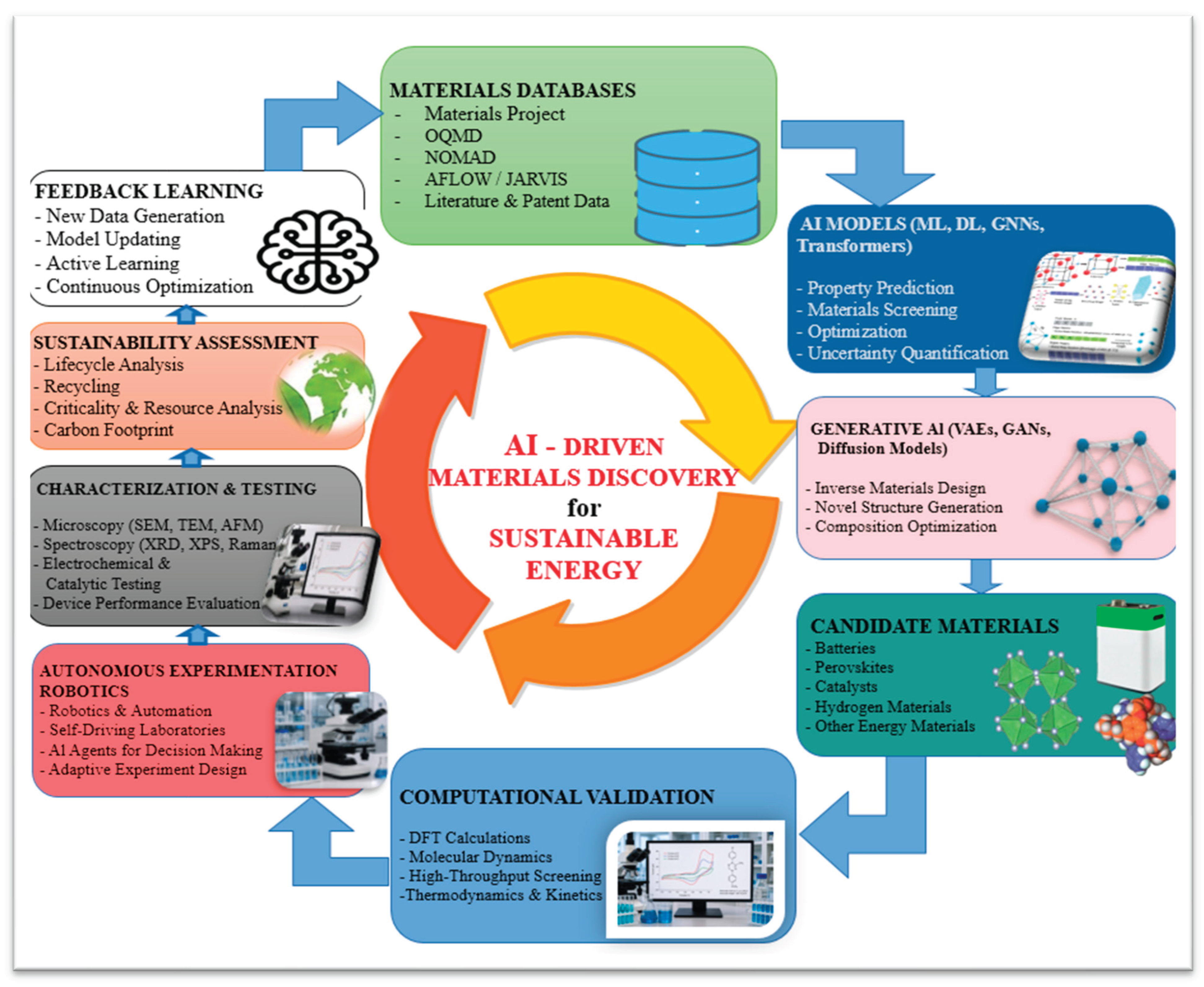
Figure 2.
Major challenges and future directions for AI-assisted energy materials discovery and autonomous research ecosystems.
Figure 2.
Major challenges and future directions for AI-assisted energy materials discovery and autonomous research ecosystems.
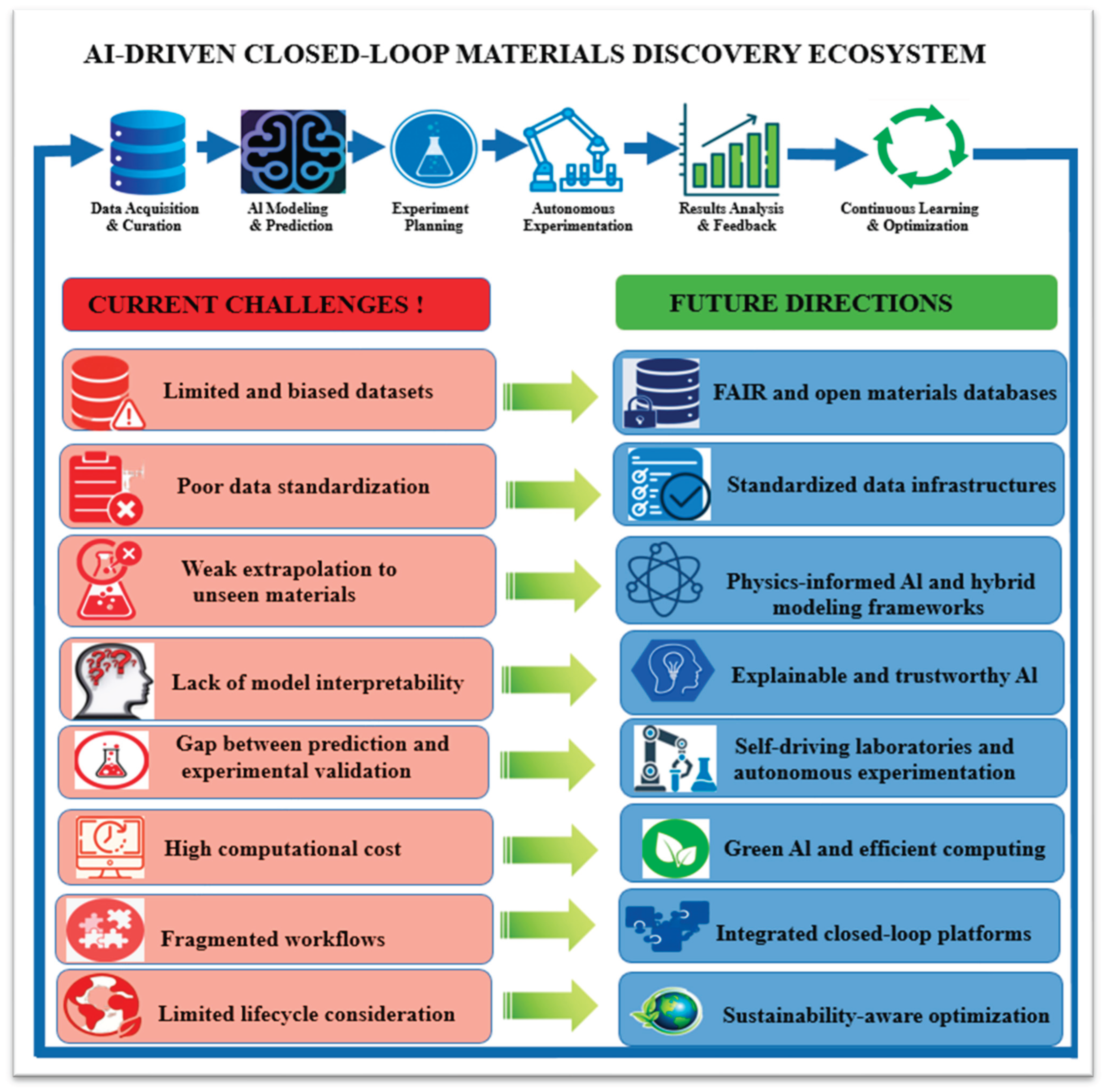

Table 1.
Comparison of representative AI methods for energy materials discovery.
| AI METHOD | APPLICATIONS | MAJOR STRENGTHS | CHALLENGES |
|---|---|---|---|
| Classical ML | Property prediction, materials screening | Fast training, interpretable models, effective with limited datasets | Limited extrapolation beyond training data |
| GNNs | Crystal property prediction, batteries, electrocatalysts, perovskites | Learns structure-property relationships directly from atomic graphs | Requires high-quality structural datasets and significant computational resources |
| Transformers | Scientific text mining, multimodal materials datasets, sequential process optimization | Captures long-range dependencies and complex correlations | Data-hungry and computationally expensive |
| Generative AI | Inverse materials design, molecular generation, catalyst discovery | Generates novel candidate materials beyond known chemical space | Synthesizability, stability, and experimental validation remain challenging |
| LLMs & AI Agents | Literature analysis, hypothesis generation, workflow planning, autonomous research assistance | Integrates knowledge across publications, code, and laboratory workflows | Hallucinations, limited scientific reasoning, and domain-specific reliability issues |
| SDLs + Bayesian Optimization | Autonomous experimentation, catalyst optimization, battery development | Enables closed-loop discovery and rapid experimental optimization | High infrastructure cost and limited accessibility |
Table 2.
Representative quantitative achievements of AI in advanced energy materials research.
| AREA | AI METHOD | TARGET MATERIAL/SYSTEM | KEY RESULT | MAIN SIGNIFICANCE | REF. |
|---|---|---|---|---|---|
| Battery testing | ML-guided closed-loop optimization | Fast-charging protocols for Li-ion batteries | Testing time reduced from 500 days to 16 days | Demonstrates dramatic acceleration of experimental optimization and battery development cycles | [30] |
| Organic battery electrodes | ML-based virtual screening (SVR) | > 1 million hypothetical organic electrode molecules | Screening space reduced to 1,524 candidates; prediction accuracy R2 = 0.88 | Illustrates efficient AI-assisted exploration of vast chemical spaces | [31] |
| Catalyst analysis | Deep learning coupled with mass spectrometry | Single nanoparticle electrocatalysts | Required catalyst surface area reduced by approximately three orders of magnitude | Enables extraction of meaningful catalytic information from extremely weak experimental signals | [22] |
| CO2 reduction catalysts | Deep-learning semantic segmentation | Catalyst layer microstructure | Segmentation accuracy > 91%; optimal ionomer/carbon ratio ≈ 0.2 | Demonstrates AI-assisted characterization and microstructure optimization | [23] |
| MatterGen | Diffusion-based generative AI | Inorganic crystalline materials | Stable unique novel materials increased by more than twofold; generated structures were over ten times closer to DFT ground-state configurations. | Strong evidence for inverse materials design through generative AI | [34] |
| Circular economy / recycling | Federated machine learning | Retired battery classification | Classification error reduced to 1-3% | Demonstrates AI applications beyond materials discovery, extending to lifecycle management and sustainability | [35] |
Disclaimer/Publisher’s Note: The statements, opinions and data contained in all publications are solely those of the individual author(s) and contributor(s) and not of MDPI and/or the editor(s). MDPI and/or the editor(s) disclaim responsibility for any injury to people or property resulting from any ideas, methods, instructions or products referred to in the content. |
© 2026 by the authors. Licensee MDPI, Basel, Switzerland. This article is an open access article distributed under the terms and conditions of the Creative Commons Attribution (CC BY) license (http://creativecommons.org/licenses/by/4.0/).
Copyright: This open access article is published under a Creative Commons CC BY 4.0 license, which permit the free download, distribution, and reuse, provided that the author and preprint are cited in any reuse.


