

Submitted:
07 July 2026
Posted:
09 July 2026
You are already at the latest version
Abstract
The present study demonstrated the fabrication of a sustainable, high-performance composite by upcycling waste denim fabric within a cyanoacrylate matrix reinforced with B₄C micro-particles (4, 7, and 10 wt%). XRD and SEM analyses confirmed the successful integration of the ceramic filler and effective fiber encapsulation, with particle agglom-eration identified at 10 wt% loading. The 7 wt% B₄C composition achieved optimum static mechanical performance, with a tensile strength of ~21.5 MPa and Young's modulus of 1.5 GPa — improvements of ~26% and ~88% over the unreinforced matrix — while at 10 wt%, both properties declined below the unreinforced baseline due to agglomeration-induced stress concentration. Under dynamic impact loading, the peak transmitted force increased monotonically from 0.34 kN to 1.31 kN with B₄C content yet remained well below in-ternational impact protection standard thresholds across all compositions. This divergence between static and dynamic responses reveals that impact resistance is governed by particle hardness and packing density, whereas tensile performance depends critically on dispersion quality and fiber–matrix adhesion. Surface wettability analysis showed a marked increase in hydrophobicity, with the water contact angle rising from 105 ± 4° to 133 ± 4° upon B₄C incorporation, consistent with a Cassie–Baxter wetting regime. These results position B₄C-reinforced waste denim–cyanoacrylate composites as a promising, cost-effective, and eco-friendly material platform for potential next-generation Personal Protective Equipment (PPE) applications.
Keywords:
waste denim
; cyanoacrylate
; super-glue
; textile composite
; boron carbide
; impact resistance
; tensile properties
; hydrophobicity
; upcycling
1. Introduction
Jeans are among the most widely worn garments today, driven by the rise in casual fashion and the availability of affordable, durable denim. The global denim market has seen steady growth in recent years and is projected to exceed $100 billion by 2030, with an estimated production of nearly 3.5 billion pairs of jeans annually [1,2]. This massive production and consumption result in significant denim waste at the end of the garments' lifespan. Each year, approximately 2.16 million tons of used jeans are discarded globally, typically ending up in landfills or incinerators [3]. Landfilled denim contributes to methane emissions from decomposing cotton [4] and can contaminate soil and water due to textile effluents containing indigo dye [5,6]. Meanwhile, incineration releases carbon dioxide and other greenhouse gases from burning organic material [7]. Given the large volume of discarded jeans, recycling is essential to mitigate the environmental impact of denim waste.
The main approaches to recycling encompass mechanical recycling, upcycling, chemical recycling, downcycling, and closed-loop recycling [8,9,10,11,12,13]. Mechanical recycling processes waste denim by shredding or unraveling it into fibers, which are re-spun into yarns for recycled denim fabrics or other textiles, often using uniform manufacturing scraps for weft yarns, while upcycling creatively transforms worn jeans into valuable products like insulation, bags, or home furnishings. Chemical recycling employs advanced technologies to break down cotton into glucose and isolate polyester for reuse, enabling sustainable material recovery. Downcycling repurposes denim into lower-value items like mattress stuffing or construction composites, such as denim-polypropylene blends, while closed-loop recycling collects post-consumer jeans to produce high-quality recycled denim fabrics, fostering a circular system that minimizes waste and promotes sustainability.
Recycled denim fabric also demonstrates considerable promise as a reinforcement material in polymer composites [14,15,16,17,18,19,20,21,22,23]. In these works, denim is blended with various everyday polymers (polyethylene, polypropylene, epoxy, polyurethane) to fabricate reinforced composites; indicatively, one study explored the fabrication of composites using epoxy resin reinforced with recycled cotton textile waste [21]. In this research, denim fabric was shredded and used as a reinforcing agent, comprising roughly 30% of the composite material. The resulting epoxy-based composite exhibited notable enhancements in mechanical performance, including a twofold increase in both tensile strength (from 0.09 to 0.16 MPa) and Young's modulus (from 0.5 to 1.2 MPa) compared to unreinforced epoxy. Tensile testing indicated strong interfacial bonding between the epoxy matrix and the denim fibers, likely due to the presence of fibrils and microfibrils generated during the shredding process. These findings support the potential use of recycled denim–epoxy composites in applications such as fashion items or structural components. In a separate study, textile waste from knitted garments, including denim, was integrated into polyurethane foam to develop composite materials [22]. These composites contained up to 40% textile waste and demonstrated improved mechanical characteristics along with enhanced acoustic properties. Specifically, the inclusion of denim fabric led to a noise reduction coefficient (NRC) that was twice that of pure polyurethane foam, indicating their suitability for structural uses such as automotive parts or acoustic insulation panels.
Although no current research specifically explores the use of superglue (cyanoacrylate) [24,25] in combination with denim fabric for polymer composites, this pairing offers several promising advantages, including fast fabrication, strong initial adhesion, lightweight structural reinforcement, water resistance, and cost-efficiency. Cyanoacrylate's rapid curing — ranging from seconds to minutes — enables much quicker bonding compared to slower-curing resins like epoxy or polyurethane, which may require hours or even days. Its low viscosity allows it to penetrate deeply into the cotton fibers of denim, resulting in a strong and uniform bond throughout the material. This high penetration ability enhances adhesion and contributes to the formation of a tightly bonded composite. Additionally, superglue can rigidify denim without significantly increasing its weight, offering a lightweight yet stiff material. Once cured, it forms a water-resistant barrier that may improve the fabric's water repellency. Lastly, the combination of inexpensive, readily available superglue and recycled denim makes this approach economically viable.
In this study, we present superglue–waste denim composites formulated with 40 wt% cyanoacrylate polymer - the minimum required to effectively wet and bind the denim fabric - reinforced with boron carbide (B₄C) micro-particles at concentrations of 4, 7, and 10 wt%. Boron carbide is a well-established ceramic material recognized for its exceptional hardness, low density, and chemical inertness [26,27,28,29], making it a promising candidate for mechanical reinforcement applications. The investigation aims to evaluate the effect of B₄C filler concentration on the structural, morphological, surface wettability, and mechanical properties of the resulting composites, with particular focus on identifying the threshold of optimal particle dispersion and its influence on both static and dynamic mechanical response. The developed composites are assessed for their potential as candidate materials for personal protective equipment (PPE) applications, offering a promising and eco-friendly route for the upcycling of textile waste into value-added technical materials.
2. Materials and Methods
2.1. Materials
The fabrication of super glue-enhanced composite materials utilized repurposed commercial waste blue denim fabric as the primary substrate (hereafter referred to as “Denim (D)”. A commercial-grade cyanoacrylate adhesive, commonly referred to as “super glue”, served as the matrix phase. To enhance the composite properties, boron carbide (B4C) was incorporated as a particulate filler, sourced from Sigma-Aldrich (powder form, particle size < 10 μm, 98% purity, product #378119-50G).
2.2. Preparation of Denim–Cyanoacrylate (DSG) Composites
For the preparation of the composites, the waste denim fabric was sectioned into uniform dimensions of 5x5 cm and 10x1.5 cm. The polymer matrix was formulated by diluting commercial cyanoacrylate UHU BISON-super glue, with a minimal volume of acetone to optimize viscosity for application. This mixture was applied to the denim layers using a manual brushing technique. To ensure a homogeneous distribution and prevent premature polymerization of the adhesive, the application was executed rapidly and systematically across the substrate surfaces. These composite samples will hereafter be referred to as “DSG” samples. To quantify the degree of cyanoacrylate uptake, all specimens were weighed prior to and following adhesive impregnation using a precision analytical balance. The results revealed an average mass increase of approximately 80 wt% relative to the dry denim substrate, confirming that the adhesive penetrated extensively into the fibrous network and was effectively retained within the composite structure upon curing.
2.3. Preparation of B₄C-Reinforced Denim–Cyanoacrylate (DSGB) Composites
For the preparation of the reinforced composite specimens, B4C was incorporated into the denim layers at three distinct concentrations: 4, 7, and 10 wt%. The measured powder was suspended in a minimal volume of ethanol to create a workable slurry, in which the denim samples were immersed. This allowed the B4C particles to be effectively absorbed into the fabric’s fibrous structure. The samples were then air-dried to ensure the complete evaporation of the ethanol. To form the composite, two fabric sheets were stacked to create a dual-layer structure and impregnated from the top side with the cyanoacrylate adhesive. The adhesive successfully penetrated the first layer and diffused into the second, effectively wetting the interface between them. The assembly was then inverted, and the process was repeated on the reverse side to ensure complete and uniform saturation of the matrix. To ensure statistical reliability and reproducibility, three distinct samples were fabricated for each experimental composition. These composite samples will hereafter be referred to as “DSGB-x%” samples, with the value in parentheses indicating the % wt B₄C content.
2.4. Surface Wettability and Contact Angle Characterization
The wetting properties of the coated surfaces were investigated using the OCA-25 contact angle measuring device from Data Physics Instruments, controlled by the SCA-20 software. The drop method was employed for static contact angle measurements and distilled deionized water droplets of 4 μL were placed onto the surfaces at a rate of 0.5 μL/s under ambient conditions. The final contact angle was calculated as the average of at least five water droplets placed at different positions on the surface. Measurements were repeated on five independently prepared coated surfaces to assess the repeatability. The errors reported correspond to the standard deviation of the measurements.
2.5. X-ray Diffraction Measurements
The crystalline structure and phase composition of the fabricated composites and raw materials were analyzed via X-ray diffraction (XRD) using a Rigaku MiniFlex benchtop diffractometer. The instrument operated with Cu Kα radiation (λ = 1.5418 Å) at an accelerating voltage of 40 kV and a current of 15 mA. The powder samples and composite sections were scanned over a 2θ range from 10ο to 80ο employing a step size of 0.01° (2θ) and a scanning speed of 5o/min per minute. Prior to analysis, the samples were mounted on standard glass holders, ensuring a flat surface for optimal diffraction. Phase identification was performed by comparing the resulting diffractograms with reference patterns from the Crystallography Open Database (COD).
2.6. Drop-Weight Impact Testing
The damage resistance of the DSGB composites was evaluated through drop-weight impact testing in accordance with ASTM D7136/D7136M [30], with specimen dimensions adapted to 5 × 5 cm to accommodate the available sample size. Low-velocity impact testing was performed using an Instron Ceast 9340 drop tower equipped with a 45 kN load cell. Specimens were centered over a high-strength steel support fixture with a rectangular cutout, ensuring consistent boundary conditions across all tests. A hemispherical striker, 16 mm in diameter and 2.5 kg in mass, was released from a predetermined height to deliver a specific impact energy to the center of each specimen. Two impact energy levels, 2 J and 10 J, were selected to evaluate the composite response under both low- and high-severity impact conditions. The drop tower was equipped with an anti-rebound mechanism to prevent secondary impacts that could otherwise compromise the analysis of the primary damage event. Following each impact event, specimens were visually inspected for surface indentation, fiber breakage, and delamination. For each composition, three specimens were tested per impact energy level, and the maximum impact load (kN) and absorbed energy (J) were recorded to characterize the toughening effect of B₄C reinforcement within the denim-polymeric matrix. The absorbed energy was calculated from the area under the load–displacement curve.
2.7. Tensile Properties Characterization
The tensile properties of the DSG and DSGB specimens were evaluated using a Jinan WDW-100 (China) universal testing machine, equipped with a 100 kN load cell and an internal extensometer. Prior to testing, all specimens were conditioned at standard atmospheric conditions (65 ± 2% RH, 21 ± 1C°) according to ASTM D 1776 and measured according to related test standards [31]. The tests were conducted at a constant crosshead speed of 1.5 mm/min until specimen fracture occurred. For each composition, three distinct specimens were tested, with five measurements performed per specimen to ensure statistical reproducibility. The primary parameters recorded included the ultimate tensile strength (in MPa), 0.2% yield strength (in MPa), percentage of elongation after fracture (%), and Young’s modulus (in GPa).
2.8. Scanning Electron Microscopy (SEM)
The morphological characteristics of the DSG and DSGB composites were examined via Scanning Electron Microscopy (SEM) using a JEOL JSM-5600 system, integrated with an Oxford Instruments energy-dispersive X-ray spectrometer (EDS). To enhance conductivity and facilitate high-resolution imaging, the specimens were gold-sputtered prior to analysis.
3. Results and Discussion
3.1. Cyanoacrylate–Cellulose Interaction Mechanism
The mechanical performance of the fabricated composites is fundamentally rooted in the chemical interaction between the cyanoacrylate adhesive and the cellulosic denim substrate. Cyanoacrylate is an acrylic monomer that undergoes rapid anionic polymerization upon exposure to nucleophilic species, most commonly water molecules or mild bases [24,25]. Denim fabric, being predominantly composed of cotton (~90–95%), is inherently rich in cellulose - a biopolymer characterized by an abundance of hydroxyl groups (–OH) along its molecular backbone [32,33]. Upon contact between the cyanoacrylate and the cotton fiber surface, the surface moisture and hydroxyl groups (–OH) of the cellulosic fibers act as nucleophilic species, initiating the rapid anionic polymerization of the cyanoacrylate monomer [41], which propagates along the fiber network (Figure 1). The resulting cross-linked poly(cyanoacrylate) matrix forms a continuous, densely bonded phase firmly interlocked with the cellulosic fiber architecture, effectively transforming the flexible textile into a rigid, fiber-reinforced structural panel[39]. This in-situ polymerization mechanism, driven by the inherent chemical functionality of the denim substrate, eliminates the need for external curing agents or elevated processing temperatures, representing a key advantage of this system over conventional epoxy- or polyurethane-based textile composites.
3.2. Wettability Properties & Contact Angle
Figure 2 depicts the static water contact angle measurements for the fabricated denim–superglue composites, with and without boron carbide (B₄C) reinforcement. The unreinforced denim-superglue composite (DSG) exhibited a contact angle of 105 ± 4°, representing a significant departure from the naturally hydrophilic character of untreated denim, which exhibits contact angles approaching 0° due to immediate capillary wicking action. This intrinsic hydrophobicity of the DSG substrate confirms that the cyanoacrylate adhesive fundamentally alters the surface energy of the textile: by sealing the porous fiber network and forming a dense cross-linked polymer layer over the cellulosic substrate, it effectively suppresses the wicking mechanism and forces water to maintain a compact droplet formation on the surface [34].
The integration of B₄C particles into the denim–superglue matrix resulted in a marked further enhancement of the water contact angle to 133 ± 4°, placing the DSGB composite firmly within the strongly hydrophobic regime and approaching the superhydrophobic threshold (≥150°). This substantial increase of ~28° relative to the unreinforced DSG substrate is attributed to the synergistic interaction between two concurrent mechanisms. First, the B₄C particles introduce a well-defined micro-topography on the composite surface, promoting a Cassie–Baxter wetting regime in which trapped air pockets beneath the droplet reduce the effective solid–liquid contact area, thereby amplifying the apparent contact angle [35]. Second, the progressive coverage of residual polar hydroxyl groups (–OH) on the denim fibers by the ceramic particles further reduces the surface's affinity for water molecules. Recent studies on B₄C composites highlight that their surface performance is highly dependent on preparation processes that govern interfacial bonding and reinforcement distribution [36], consistent with the particle dispersion behavior observed in the SEM analysis of the present study.
Beyond its wetting properties, the incorporation of B₄C significantly enhances the mechanical durability of the composite surface. While conventional water-repellent textile coatings often degrade under physical stress, the exceptional hardness of B₄C particles (~9.5 on the Mohs scale) provides robust, armor-like reinforcement within the cyanoacrylate matrix [37]. The cyanoacrylate acts as a high-strength structural binder, ensuring that the ceramic particles remain firmly anchored to the textile fibers even under abrasion, thereby preserving the micro-topography responsible for the observed hydrophobic behavior over time. Furthermore, the well-known chemical inertness of B₄C ensures that the composite's water-repellent properties are not compromised by environmental exposure or chemical degradation [38]. Consequently, the DSGB composite does not merely offer passive moisture management, but functions simultaneously as a mechanically robust, chemically stable, and moisture-resistant material system — a combination of properties of direct relevance to the engineering of high-performance technical textiles and personal protective equipment.
3.3. X-ray Diffraction Measurements
The crystalline structure and phase composition of the pristine materials and the fabricated composites ((DSG and DSGB) were investigated by X-ray diffraction (XRD), as shown in Figure 3. In particular, the XRD pattern of the pristine denim (D) exhibits the characteristic diffraction peaks of cellulose I, with prominent reflections at 2θ ≈ 14.8°, 16.5°, and a sharp primary peak at 22.7°, corresponding to the (200) crystallographic plane, thereby confirming the semicrystalline nature of the cotton fibers. According to the literature, denim fabric, being a cotton-based textile, is primarily composed of cellulose (~90–95%), with the remaining fraction consisting of hemicellulose, lignin, and natural waxes [32,39]. These components dictate its semi-crystalline behavior, as the crystalline regions of cellulose are embedded within an amorphous matrix of hemicellulose and lignin [40]. Recent studies on the valorization of textile waste emphasize that the structural integrity of these natural fibers is critical for the mechanical performance of reinforced composites[40].
On the other hand, the reference Boron Carbide (Β4C) powder used as the ceramic additive in the composite exhibits a highly crystalline profile with sharp Bragg reflections at 2θ≈23.5ο, 35ο and 38ο, consistent with its rhombohedral structure as reported in ceramic filler research [42]. As observed in Figure 3, the presence of boron carbide becomes clearly detectable in the DSGB samples containing 7 wt% and 10 wt% B₄C, as evidenced by Bragg reflections at 2θ ≈ 23.5° (manifested as an asymmetry of the main peak at higher angles) as well as at 35° and 38°, which appear as clearly resolved new diffraction peaks. In addition, a clear concentration dependence is observed, as the relative intensity of the characteristic Β4C peaks increases proportionally with the filler loading. On the other hand, following the incorporation of the cyanoacrylate matrix into the denim structure, the DSG and DSGB composites maintain the characteristic cellulose diffraction peaks, although slight peak broadening and an increase in the amorphous background are observed. This is attributed to the intrinsically amorphous nature of the superglue polymer, which partially encapsulates the denim fibers and exhibits a broad scattering contribution mainly centered around 2θ ≈ 15° and 32°, as also evidenced by the diffraction pattern (Figure 3) of the neat superglue phase (SG). The simultaneous presence of both cellulose and B₄C diffraction peaks, together with the absence of significant peak shifts, suggests that the incorporation of the cyanoacrylate matrix and ceramic filler into the denim structure primarily results in physical integration and interfacial interactions, without the formation of new crystalline phases or significant structural transformations. This interpretation is further supported by the observed peak broadening and increased amorphous background, which are attributed to partial encapsulation of the cellulose fibers by the amorphous polymer phase, in agreement with recent findings on high-strength textile-reinforced polymer composites [43].
3.4. Scanning Electron Microscopy (SEM) Analysis"
The surface morphology of the raw denim and the fabricated composites was examined via scanning electron microscopy (SEM), as presented in Figure 4. The pristine denim fabric (D) consists of distinct, relatively smooth, and well-defined cotton fibers with a characteristic twisted structure. Upon application of the cyanoacrylate adhesive (DSG), the fiber surfaces become coated with a continuous adhesive layer, resulting in partial fiber encapsulation and the formation of a more integrated fiber–polymer network. The addition of 7 wt% B₄C (DSGB-7 wt%) results in filler particles clearly visible and well dispersed on the coated fiber surfaces. In contrast, the DSGB-10 wt% composite exhibits a higher concentration of B₄C particles, together with increased agglomeration and the formation of larger particle clusters, indicating that the dispersion efficiency decreases at higher filler loadings.
These morphological observations are in good agreement with the structural data obtained from the XRD analysis. The clear, individualized fibers observed in the SEM of the D correspond to the sharp, well-defined peaks of Cellulose I in the XRD pattern. The encapsulation of fibers by the superglue, observed in the SEM, correlates with the increased amorphous background and slight peak broadening in the DSG and DSGB XRD patterns, confirming the presence of the non-crystalline polymer matrix. Furthermore, the progressive increase in B₄C particle density and the appearance of particle clusters in the SEM micrographs is consistent with the proportional increase in the intensity of the B₄C Bragg reflections in the XRD patterns. This correlation between surface morphology and crystalline structure confirms that the boron carbide filler was successfully incorporated into the superglue-denim system, retaining its crystalline identity while physically reinforcing the composite structure.
3.5. Impact Attenuation Performance
The impact attenuation properties of the fabricated composites were evaluated by measuring the peak transmitted force (kN) during drop-weight impact events, as illustrated in Figure 5 and Figure 6. Prior to discussing the mechanical response of the fabricated composites, it is instructive to consider the intrinsic mechanical characteristics of the constituent materials. Denim fabric, as a woven cotton textile, exhibits a characteristically flexible and anisotropic mechanical behavior, with tensile strength values typically ranging from 10 to 50 MPa depending on weave architecture, fiber orientation, and yarn count [44]. Although denim possesses reasonable load-bearing capacity along the warp direction, it offers virtually no resistance to out-of-plane deformation or localized penetration in the absence of a rigid matrix. Conversely, cyanoacrylate adhesive in its neat, fully cured state forms a highly cross-linked, glassy polymer network that is inherently brittle, exhibiting very low strain at break and poor impact resistance due to the absence of energy-dissipating mechanisms [45].
Consequently, neither constituent alone is suitable for protective applications: denim lacks rigidity and penetration resistance, while neat cyanoacrylate lacks the toughness and ductility required to sustain dynamic loading without catastrophic fracture. The denim–superglue composite system is therefore designed to exploit the complementary properties of both constituents: the fibrous denim network provides structural reinforcement and residual toughness, while the cyanoacrylate matrix imparts rigidity and load transfer efficiency — a synergy that is further enhanced by the addition of B₄C ceramic particles, as demonstrated by the mechanical results presented in Figure 6 and Figure 7
The experimental results reveal a distinct transition in the material's energy management mechanism as boron carbide (B₄C) content increases. The unreinforced sample DSG (0 wt% B₄C ) recorded the lowest transmitted force of 0.34 kN, where the denim-superglue matrix, still relatively compliant in the absence of ceramic filler, absorbs impact energy primarily through localized deformation of the fiber network. The transmitted force increased progressively and monotonically with B₄C content, reaching 0.69 kN (4 wt%), 0.92 kN (7 wt%), and 1.31 kN (10 wt%), reflecting a clear dose-dependent stiffening effect. It is important to note that the cyanoacrylate (superglue) does not merely coat the denim fibers but undergoes in-situ anionic polymerization initiated by surface moisture and the hydroxyl groups of the cellulosic fibers, yielding a rigid, densely cross-linked polymeric network firmly interlocked with the denim fiber architecture and transforming the composite from a flexible textile into a semi-rigid to rigid structural panel. Consequently, as B₄C loading increases, the composite does not behave as a flexible cushioning material but rather as an increasingly stiff, armor-like shield, in which the high volumetric density of hard ceramic particles further restricts the residual elasticity of the cross-linked polymer-fiber network and promotes more direct load transfer through the panel thickness.
Given this rigid, ceramic-reinforced character, the composite was benchmarked against impact-protection standards relevant to both flexible PPE inserts and rigid armor systems: EN 1621-1, which sets a maximum mean transmitted force of 35 kN (Level 1) and 20 kN (Level 2) for limb protectors [46]; EN 1621-2, which sets 18 kN (Level 1) and 9 kN (Level 2) for back protectors [47]; and, as a supplementary benchmark given its similar drop-weight/force-transducer methodology, ANSI/ISEA 138 [48], which defines thresholds of 9 kN, 6.5 kN, and 4 kN for Levels 1–3 of dorsal impact protection (originally developed for impact-resistant gloves, but applied here only as a methodological force-threshold reference rather than a direct certification target). It is critical to note that these standards define the maximum allowable transmitted force; lower values indicate better protective performance. Remarkably, even at its stiffest composition (DSGB-10 wt%), the composite transmitted only 1.31 kN, drastically below the most stringent 4 kN threshold, outperforming all referenced standard limits by a wide margin. This high level of protection is attributed to the synergistic effect between the cross-linked denim-cyanoacrylate matrix and the B₄C ceramic reinforcement: the hard ceramic particles act as primary energy-dissipating elements upon impact, while the rigid, fiber-reinforced polymer network distributes the residual stress across the composite surface and resists localized penetration. These findings, supported by the high particle density observed in the SEM analysis and the crystalline stability shown in the XRD patterns, confirm that the B₄C composites provide an effective barrier against mechanical impact, making them promising candidates for rigid or semi-rigid personal protective equipment (PPE) applications.
3.6. Effect of B₄C Loading on Tensile Performance
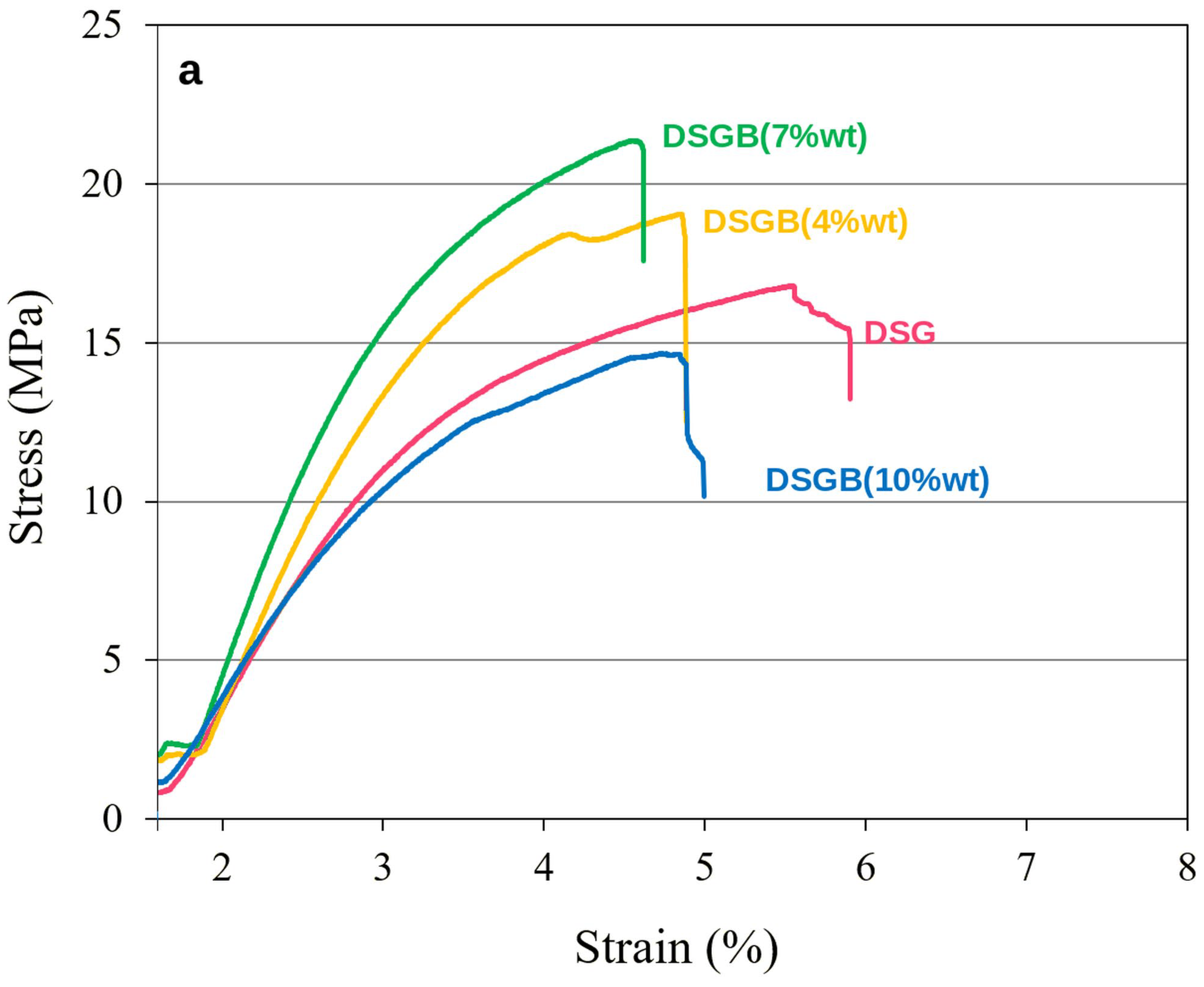
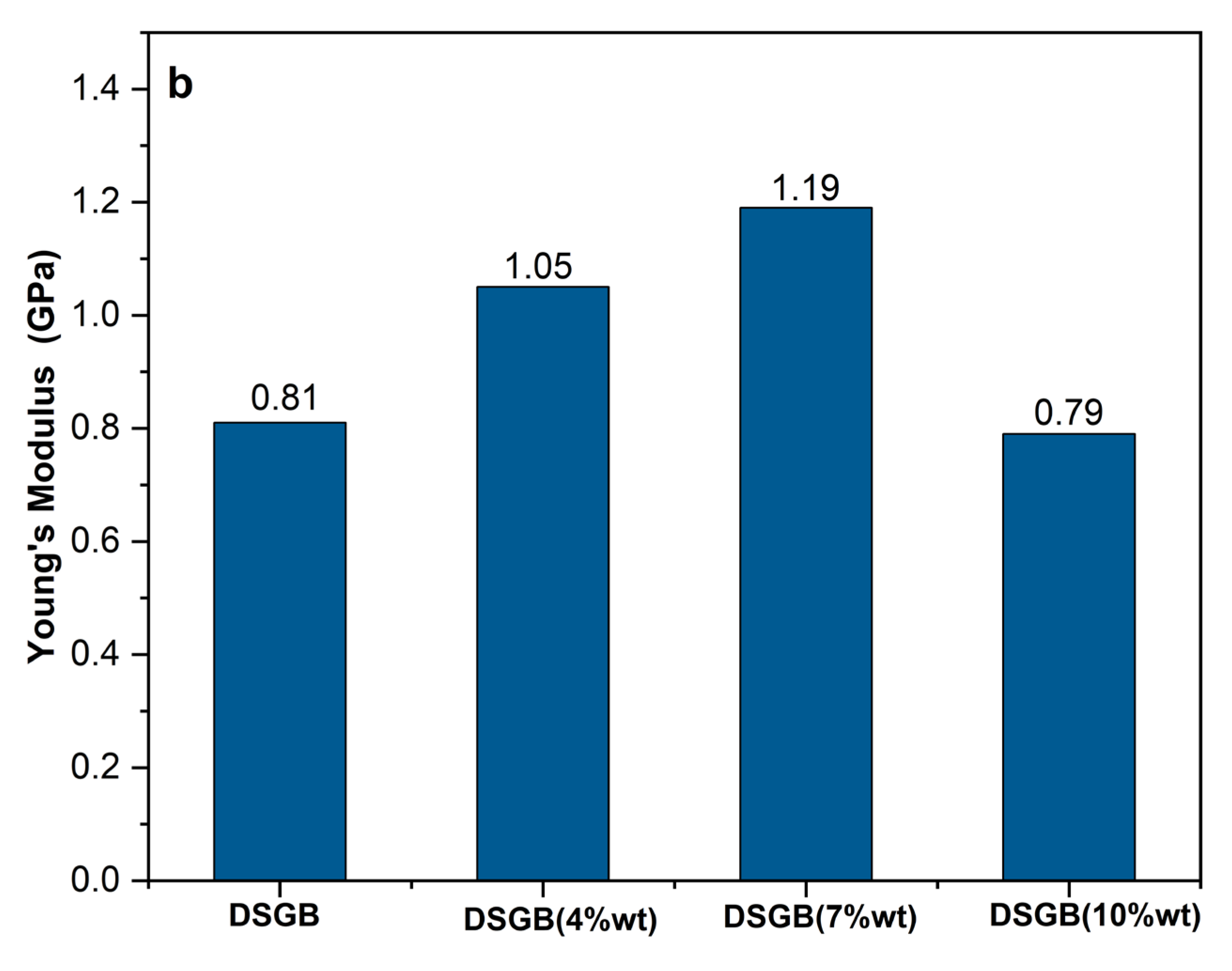
The tensile behavior of the DSG and DSGB composites was systematically investigated to evaluate the reinforcing effect of boron carbide (B4C) loading. The representative stress-strain curves and the corresponding Young’s modulus values are presented in Figure 7.
As illustrated in Figure 7a, the incorporation of B₄C up to 7 wt.% progressively enhances the ultimate tensile strength of the composites. The unreinforced DSG matrix exhibited a peak stress of approximately 17 MPa, increasing to ~17.5 MPa at 4 wt.%, and reaching its maximum value of ~21.5 MPa at 7 wt.% B₄C, representing a notable improvement in the load-bearing capacity of the textile-reinforced system. This strengthening is primarily attributed to the efficient load transfer from the cyanoacrylate-denim matrix to the high-strength ceramic particles [49,50]. The Young's modulus (Figure 7b) followed a similar trend, increasing from 0.8 GPa (0 wt.%) to 1.05 GPa (4 wt.%) and reaching a maximum of 1.19 GPa at 7 wt.%, confirming that the B₄C particles effectively reinforce the polymer-fiber network up to this loading and significantly increase the material's rigidity [36]. The high particle density observed in the SEM micrographs supports this, as the ceramic filler creates a robust mechanical interlocking mechanism with the denim fibers. Interestingly, both the tensile strength and the stiffness exhibited a marked decline at the 10 wt.% B₄C loading. The modulus dropped sharply to 0.79 Gpa, even lower than that of the unreinforced matrix, while the ultimate tensile strength and strain at break were also substantially reduced compared to the 7 wt.% sample. This simultaneous deterioration in both strength and stiffness is a well-documented threshold phenomenon in composite science, known as filler agglomeration [49,50,51]. At high loading concentrations, the ceramic particles tend to form clusters rather than dispersing uniformly within the cyanoacrylate matrix, as evidenced by the SEM images. These agglomerates act as stress concentrators and structural defects, disrupting load transfer efficiency, initiating micro-cracks, and ultimately leading to premature brittle fracture. Furthermore, at this concentration, the matrix may become insufficient to fully wet and encapsulate the high surface area of the particles and fibers, leading to weakened interfacial bonding and a less cohesive, more defect-prone network overall [49].
A critical finding of this study is the contrast between the static (tensile) and dynamic (impact) mechanical responses. Although the 10 wt.% sample underperformed in both tensile strength and stiffness due to agglomeration-induced defects, it demonstrated the highest impact resistance (1.31 kN). This suggests that under high-velocity impact, the sheer volumetric density of the B₄C filler- rather than its uniform dispersion or interfacial bonding quality- governs the energy-dissipation response, overshadowing the structural weaknesses that dominate under slow-rate tensile loading [52]. In other words, impact resistance in this system appears to be primarily a particle-hardness and packing-density effect, whereas tensile performance is critically dependent on dispersion quality and fiber-matrix adhesion-explaining why the two mechanical responses diverge so markedly at high filler content.
4. Conclusions
The present study successfully demonstrated the development of a high-performance, sustainable composite material through the upcycling of waste denim fabric into a cyanoacrylate matrix reinforced with boron carbide (B₄C) microparticles. Structural and morphological analyses using XRD and SEM confirmed the effective encapsulation of the fibrous network and the successful incorporation of the ceramic filler. However, a transition toward localized particle agglomeration was observed at the 10 wt% loading level. Mechanical evaluation revealed a distinct, non-monotonic relationship between filler concentration and mechanical performance. A B₄C loading of 7 wt% was identified as the optimum composition for static mechanical performance, achieving a tensile strength of approximately 21.5 MPa and a Young's modulus of 1.19 GPa. Further increases in filler content resulted in a deterioration of both properties, reducing the Young's modulus below that of the unreinforced composite (0.79 GPa), primarily due to agglomeration-induced stress concentrations.
Conversely, under dynamic impact loading, the material exhibited a progressive transition from a flexible energy-absorbing system to a rigid structural shield, with the peak transmitted force increasing monotonically from 0.34 kN (0 wt%) to 1.31 kN (10 wt%). Importantly, across all compositions, the transmitted force remained well below the allowable limits specified by the international impact protection standards EN 1621-1, EN 1621-2, and ANSI/ISEA 138, confirming the suitability of these composites for high-performance protective applications. Furthermore, surface wettability characterization revealed a significant enhancement in hydrophobicity following B₄C incorporation, with the static water contact angle increasing from 105 ± 4° (DSG) to 133 ± 4° (DSGB), consistent with a Cassie–Baxter wetting regime promoted by the ceramic-induced surface microtopography. Overall, this study presents a rapid and cost-effective strategy for upcycling textile waste into value-added engineering materials, offering a promising and environmentally sustainable pathway toward next-generation Personal Protective Equipment (PPE) that combines sustainability with enhanced mechanical protection.
Supplementary Materials
The following supporting information can be downloaded at the website of this paper posted on Preprints.org.
Author Contributions
Conceptualization, M.A.K.; A.B.B.; C.G.; methodology, M.A.K.; formal analysis, M.A.K., C.G., and S.A.; investigation, M.A.K., C.G., S.A., D.M., and A.A.; resources, M.A.K., C.E.S., A.A; data curation, M.A.K., C.G., S.A., D.M.; writing—original draft preparation, C.G.; writing—review and editing, M.A.K., A.B.B.; supervision, M.A.K.; project administration, M.A.K., C.G.; funding acquisition, M.A.K. All authors have read and agreed to the published version of the manuscript.
Funding
This work was carried out within the framework of the Action ‘Flagship Research Projects in challenging interdisciplinary sectors with practical applications in Greek industry’, implemented through the National Recovery and Resilience Plan Greece 2.0 and funded by the European Union – NextGenerationEU (project code: TAEDR-0535821).
Institutional Review Board Statement
Not applicable.
Data Availability Statement
The original contributions presented in this study are included in the article/Supplementary Material. Further inquiries can be directed to the corresponding author.
Acknowledgments
The authors gratefully acknowledge A. Paipetis for providing access to the laboratory facilities where the Impact Attenuation Performance measurements were carried out. During the preparation of this manuscript/study, the authors used ChatGPT free version for the purposes of English language improvement. The authors have reviewed and edited the output and take full responsibility for the content of this publication.
Conflicts of Interest
The authors declare no conflicts of interest.
Abbreviations
ANSI, American National Standards Institute;
ASTM, American Society for Testing and Materials;
B₄C, Boron Carbide;
CEN, European Committee for Standardization;
COD, Crystallography Open Database;
DSG, Denim–Superglue;
DSGB, Denim–Superglue–Boron Carbide;
EDS, Energy-Dispersive X-ray Spectroscopy;
ISEA, International Safety Equipment Association;
PPE, Personal Protective Equipment;
SEM, Scanning Electron Microscopy;
wt%, Weight Percent;
XRD, X-ray Diffraction.
References
- Grand View Research. Denim Jeans Market Size & Trends. Available online: https://www.grandviewresearch.com/industry-analysis/denim-jeans-market (accessed on 26 May 2025).
- Statista. Market Size of Denim Jeans Worldwide from 2021 to 2026. Available online: https://www.statista.com/statistics/1368005/global-units-of-denim-jeans-market (accessed on 26 May 2025).
- Akı, S.U.; Candan, C.; Nergis, B.; Önder, N.S. Understanding Denim Recycling: A Quantitative Study with Lifecycle Assessment Methodology. In Waste in Textile and Leather Sectors; Körlü, A., Ed.; IntechOpen: London, UK, 2020. [CrossRef]
- Tharmarajah, N.; Shahbaz, K.; Baroutian, S. Textile Waste Pretreatment for Anaerobic Digestion: A Review and Technology Feasibility Study. J. Chem. Technol. Biotechnol. 2024, 99, 2213–2227.
- Periyasamy, A.P.; Periyasami, S. Critical Review on Sustainability in Denim: A Step Toward Sustainable Production and Consumption of Denim. ACS Omega 2023, 8, 4472–4490.
- Li, Z.; Zhang, M.; Li, F.; Shi, S.; Wang, S.; Gao, C.; Li, Y. Recycling of Waste Denim: A Stepwise Utilisation Strategy for Clean Decolourisation, Opening and Degradation. Waste Manag. 2025, 198, 12–20.
- Sanjrani, M.A.; Gang, X.; Mirza, S.N.A. A Review on Textile Solid Waste Management: Disposal and Recycling. Waste Manag. Res. 2025, 43, 522–539.
- Luiken, A.; Bouwhuis, G. Recovery and Recycling of Denim Waste. In Denim Manufacture, Finishing and Applications; Paul, R., Ed.; Woodhead Publishing: Cambridge, UK, 2015; pp. 527–540.
- Radhakrishnan, S. Denim Recycling. In Textiles and Clothing Sustainability; Muthu, S.S., Ed.; Springer: Singapore, 2017; pp. 79–125.
- Yousef, S.; Tatariants, M.; Tichonovas, M.; Kliucininkas, L.; Lukošiūtė, S.-I.; Yan, L. Sustainable Green Technology for Recovery of Cotton Fibers and Polyester from Textile Waste. J. Clean. Prod. 2020, 254, 120078.
- Xie, X.; Hong, Y.; Zeng, X.; Dai, X.; Wagner, M. A Systematic Literature Review for the Recycling and Reuse of Wasted Clothing. Sustainability 2021, 13, 13732.
- Juanga-Labayen, J.P.; Labayen, I.V.; Yuan, Q. A Review on Textile Recycling Practices and Challenges. Textiles 2022, 2, 174–188.
- Kanan, M.; Wannassi, B.; Barham, A.S.; Ben Hassen, M.; Assaf, R. The Quality of Blended Cotton and Denim Waste Fibres: The Effect of Blend Ratio and Waste Category. Fibers 2022, 10, 76.
- Haque, M.S.; Sharif, A. Processing and Characterization of Waste Denim Fiber Reinforced Polymer Composites. Int. J. Innov. Sci. Mod. Eng. 2014, 2, 24–28.
- Echeverria, C.A.; Handoko, W.; Pahlevani, F.; Sahajwalla, V. Cascading Use of Textile Waste for the Advancement of Fibre Reinforced Composites for Building Applications. J. Clean. Prod. 2019, 208, 1524–1536.
- Meng, X.; Fan, W.; Ma, Y.; Wei, T.; Dou, H.; Yang, X.; Tian, H.; Yu, Y.; Zhang, T.; Gao, L. Recycling of Denim Fabric Wastes into High-Performance Composites Using the Needle-Punching Nonwoven Fabrication Route. Text. Res. J. 2020, 90, 695–709.
- Patti, A.; Cicala, G.; Acierno, D. Eco-Sustainability of the Textile Production: Waste Recovery and Current Recycling in the Composites World. Polymers 2021, 13, 134.
- Wang, S.; Zhang, T.; Zhang, X.; Ge, S.; Fan, W. Development of 3D Needled Composite from Denim Waste and Polypropylene Fibers for Structural Applications. Constr. Build. Mater. 2022, 314, 125583.
- Webo, W.; Khoathane, M.C.; Mhike, W.; Mohlamonyane, R.S. Enhancing Sustainability: Composite Materials from Recycled HDPE and Denim Fillers. Polym. Eng. Sci. 2025, 65, 2395–2404.
- Khan, R.M.W.U.; Seyam, A.F.M.; Hussain, M.; Nawab, Y. Valorizing Denim and Polyethylene Sheet Waste to Fiber-Reinforced Composites. Polym. Compos. 2025, 1–21.
- Zonatti, W.F.; Guimarães, B.M.G.; Duleba, W.; Ramos, J.B. Thermoset Composites Reinforced with Recycled Cotton Textile Residues. Text. Cloth. Sustain. 2015, 1, 1–12.
- Tiuc, A.-E.; Vermeşan, H.; Gabor, T.; Vasile, O. Improved Sound Absorption Properties of Polyurethane Foam Mixed with Textile Waste. Energy Procedia 2016, 85, 559–565.
- Raj, M.; Fatima, S.; Tandon, N. Recycled Materials as a Potential Replacement to Synthetic Sound Absorbers: A Study on Denim Shoddy and Waste Jute Fibers. Appl. Acoust. 2020, 159, 107070.
- Raja, P.R. Cyanoacrylate Adhesives: A Critical Review. Rev. Adhes. Adhes. 2016, 4, 398–416.
- Samuel, H.S.; Nweke-Maraizu, U.; Etim, E.E. Cyanoacrylate Chemistry and Polymerization Mechanisms. Prog. Chem. Biochem. Res. 2024, 7, 129–142.
- Boldin, M.S.; Berendeev, N.N.; Melekhin, N.V.; Popov, A.A.; Nokhrin, A.V.; Chuvildeev, V.N. Review of Ballistic Performance of Alumina: Comparison of Alumina with Silicon Carbide and Boron Carbide. Ceram. Int. 2021, 47, 25201–25213.
- Silveira, P.H.P.M.D.; Silva, T.T.D.; Ribeiro, M.P.; Rodrigues de Jesus, P.R.; Credmann, P.C.R.D.S.; Gomes, A.V. A Brief Review of Alumina, Silicon Carbide and Boron Carbide Ceramic Materials for Ballistic Applications. Acad. Lett. 2021, Article 3742.
- Ka, J.; Kim, K.H.; Choi, W.; Jung, S.; Lee, T.H.; Kim, H.S.; Lee, H.; Lee, J.H. Improving the Fracture Toughness of Boron Carbide via Minor Additions of SiC and TiB₂ Through Hot-Press Sintering. Materials 2024, 17, 6233.
- Avcıoğlu, S.; Buldu, M. ; Kaya, F.; Üstündağ, C.B.; Kam, E.; Menceloğlu, Y.Z.; Kaptan, H.Y.; Kaya, C. Processing and Properties Boron Carbide (B₄C) Reinforced LDPE Composites for Radiation Shielding. Ceram. Int. 2020, 46, 343–352.
- ASTM D7136/D7136M-25. Standard Test Method for Measuring the Damage Resistance of a Fiber-Reinforced Polymer Matrix Composite to a Drop-Weight Impact Event; ASTM International: West Conshohocken, PA, USA, 2025.
- ASTM D3039/D3039M-17(2025). Standard Test Method for Tensile Properties of Polymer Matrix Composite Materials; ASTM International: West Conshohocken, PA, USA, 2025.
- Ruiz-Caldas, M.-X.; Carlsson, J.; Sadiktsis, I.; Jaworski, A.; Nilsson, U.; Mathew, A.P. Cellulose Nanocrystals from Postconsumer Cotton and Blended Fabrics: A Study on Their Properties, Chemical Composition, and Process Efficiency. ACS Sustain. Chem. Eng. 2022, 10, 3787–3798.
- Cai, C.; Liu, Z.; Li, F.; Yang, Z. Upgrading Cotton-Based Resources for Regenerated Cellulose Fibers, Functional Fibers, Smart Textiles, and Other High-Value Uses. Carbohydr. Polym. 2025.
- Peng, H.-Y.; Yeh, K.-Y.; Liu, B.-Y.; Chen, L.-J. Defining Hydrophilicity and Hydrophobicity Through Advancing Contact Angles and Wetting Transitions. J. Colloid Interface Sci. 2026, 708, 139801.
- Cassie, A.B.D.; Baxter, S. Wettability of Porous Surfaces. Trans. Faraday Soc. 1944, 40, 546–551.
- Chen, X.; et al. Recent Advances on Aluminum-Based Boron Carbide Composites: Performance, Fabrication, and Applications. Materials 2025, 18, 5469.
- Domnich, V.; Reynaud, S.; Haber, R.A.; Chhowalla, M. Boron Carbide: Structure, Properties, and Stability Under Stress. J. Am. Ceram. Soc. 2011, 94, 3605–3628.
- Mondal, S., Bykova, E., Dey, S.,Ali, S.I., Dubrovinskaia, Ν., Dubrovinsky,L., Parakhonskiy, G., van Smaalen, S.Disorder and Defects Are Not Intrinsic to Boron Carbide. Sci. Rep. 2016, 6, 19330.
- Mwaikambo, L.Y.; Ansell, M.P. Chemical Modification of Hemp, Sisal, Jute, and Kapok Fibers by Alkalization. J. Appl. Polym. Sci. 2002, 84, 2222–2234.
- Nurazzi, N.M.; et al. A Review on Mechanical Performance of Hybrid Natural Fiber Polymer Composites for Structural Applications. Polymers 2021, 13, 2170.
- Sáez, R.; McArdle, C.; Salhi, F.; Marquet, J.; Sebastián, R.M. Controlled Living Anionic Polymerization of Cyanoacrylates by Frustrated Lewis Pair Based Initiators. Chem. Sci. 2019, 10, 3295–3299.
- Thévenot, F. State of the Art Boron Carbide: A Comprehensive Review. J. Eur. Ceram. Soc. 1990, 6, 205–225.
- Norizan, M.N.; et al. Classification of Textile Polymer Composites: Recent Trends and Challenges. Polymers 2021, 13, 2592.
- Berk Ertekin, G.; Marmaralı, A. Mechanical Properties of Cotton and High-Performance Fiber Blended Denim Fabrics for Motorcycle Protective Clothing. J. Test. Eval. 2024, 52, 2206.
- Xu, S.-A. Effects of Methoxy Polyethylene Glycol–Polycaprolactone Block Copolymers and Silica Nanoparticles on the Mechanical, Tissue Affinity and Antibacterial Properties of n-Butyl Cyanoacrylate Adhesive. J. Appl. Polym. Sci. 2023, 140, e54342.
- European Committee for Standardization. Motorcyclists' Protective Clothing Against Mechanical Impact—Part 1: Limb Joint Impact Protectors; EN 1621-1:2012; CEN: Brussels, Belgium, 2012.
- European Committee for Standardization. Motorcyclists' Protective Clothing Against Mechanical Impact—Part 2: Motorcyclists' Back Protectors; EN 1621-2:2014; CEN: Brussels, Belgium, 2014.
- American National Standards Institute; International Safety Equipment Association. American National Standard for Performance and Classification for Impact-Resistant Gloves; ANSI/ISEA 138-2019; ISEA: Arlington, VA, USA, 2019.
- Sharma, S.K.; Sharma, L.K.; Pradhan, R.; Sharma, Y.; Sharma, M.; Gajević, S.; Ivanović, L.; Stojanović, B. Interphase-Centric and Mechanism-Driven Advances in Polymer Composites Reinforced with Nano-, Synthetic, and Inorganic Fillers. Polymers 2026, 18, 323.
- Arora, N.; Dua, S.; Singh, V.K.; Singh, S.K. A Comprehensive Review on Fillers and Mechanical Properties of 3D Printed Polymer Composites. Mater. Today Commun. 2024.
- Kuan, H.T.N.; Tan, M.Y.; Shen, Y.; Yahya, M.Y. Mechanical Properties of Particulate Organic Natural Filler-Reinforced Polymer Composite: A Review. Compos. Adv. Mater. 2021, 30, 1–17.
- Ma, Y.; Wang, J.; Zhao, G.; Liu, Y. New Insights into the Damage Assessment and Energy Dissipation Weight Mechanisms of Ceramic/Fiber Laminated Composites under Ballistic Impact. Ceram. Int. 2023, 49, 21966–21977.
Figure 1.
Super glue (cyanoacrylate) rapidly hardens on denim’s cotton fibers due to a polymerization reaction triggered by cellulose’s hydroxyl groups.
Figure 1.
Super glue (cyanoacrylate) rapidly hardens on denim’s cotton fibers due to a polymerization reaction triggered by cellulose’s hydroxyl groups.
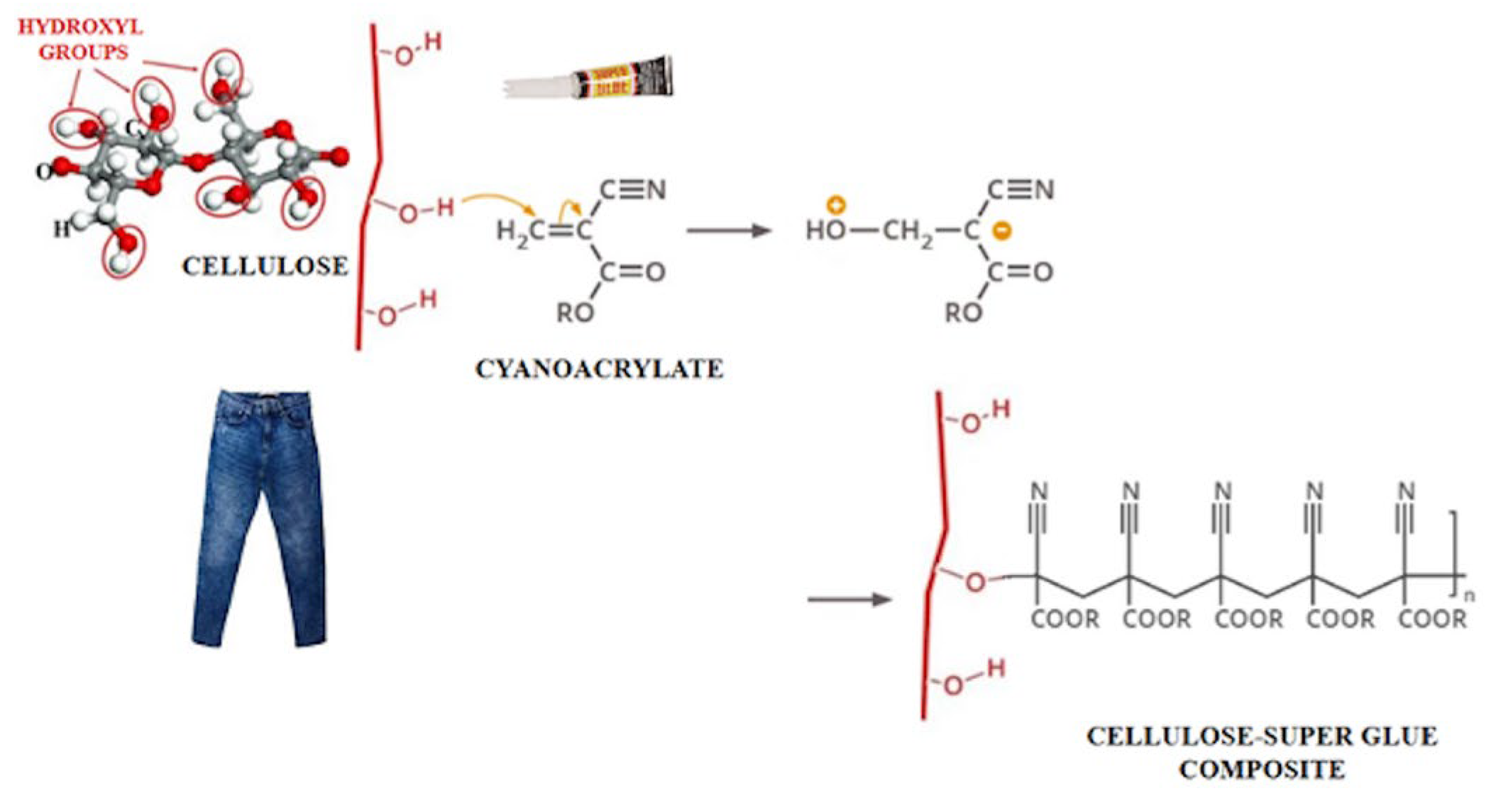
Figure 2.
Static water contact angle measurements of (a) the unreinforced DSG composite (θ = 105 ± 4°) and (b) the B₄C-reinforced -DSGB composite (θ = 133 ± 4°).
Figure 2.
Static water contact angle measurements of (a) the unreinforced DSG composite (θ = 105 ± 4°) and (b) the B₄C-reinforced -DSGB composite (θ = 133 ± 4°).
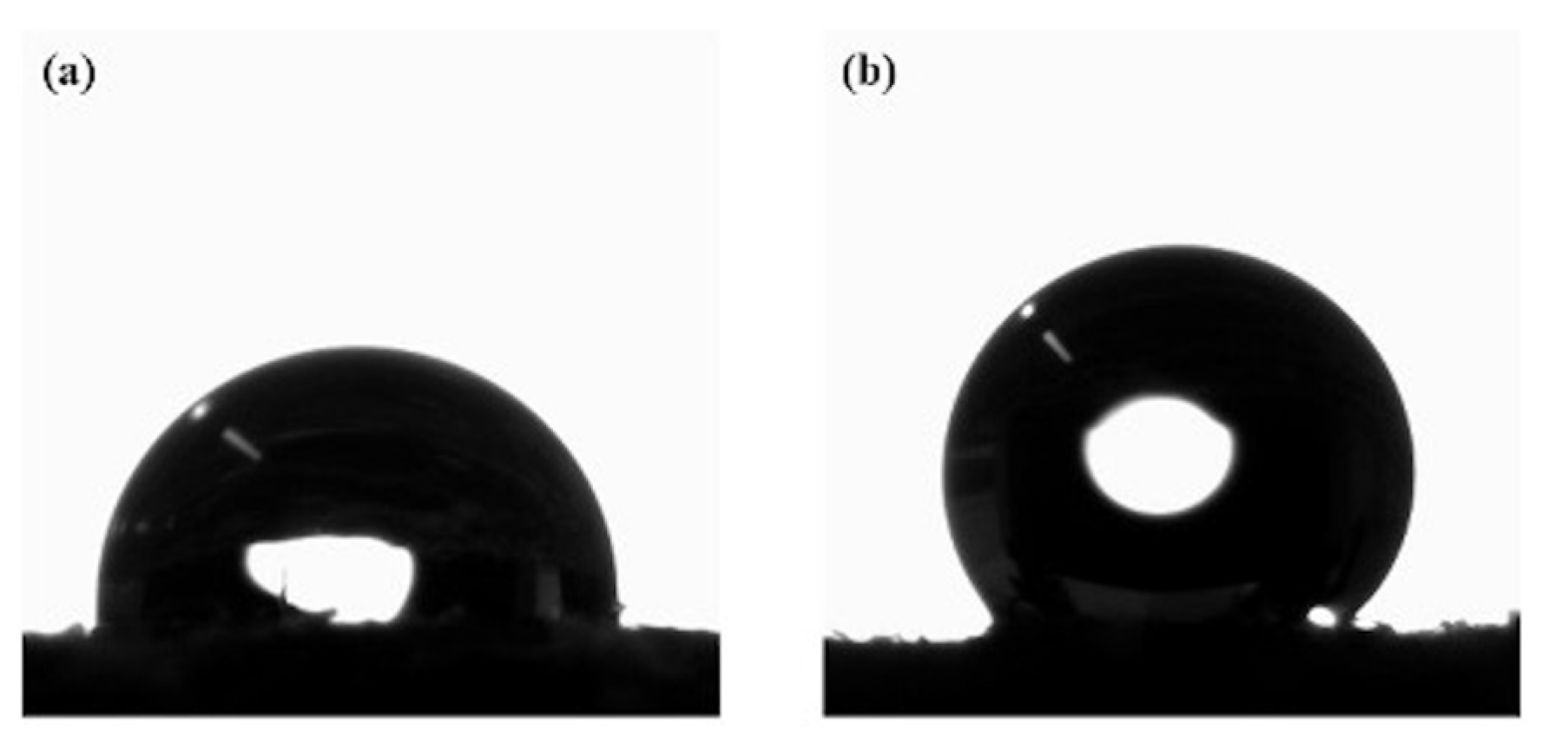
Figure 3.
XRD patterns of pure boron carbide (Β4C), raw denim fabric (D), superglue (SG), superglue-denim composite (DSG) , and superglue-denim composite (DSGB) with varying Β4C concentrations (4wt%, 7wt%, and 10wt%).
Figure 3.
XRD patterns of pure boron carbide (Β4C), raw denim fabric (D), superglue (SG), superglue-denim composite (DSG) , and superglue-denim composite (DSGB) with varying Β4C concentrations (4wt%, 7wt%, and 10wt%).
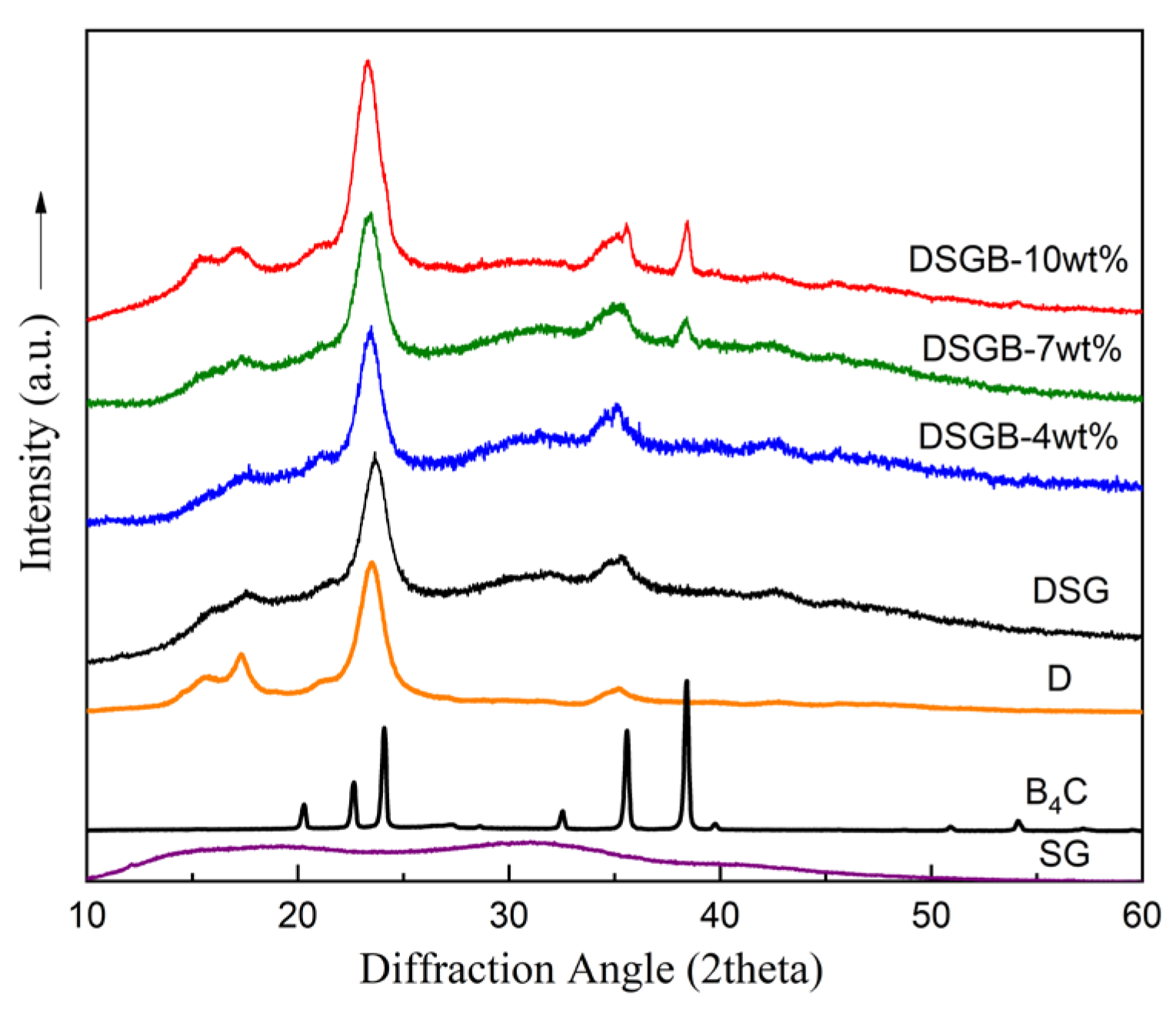
Figure 4.
SEM micrographs of pristine denim fabric (D), denim fabric coated with superglue (DSG), and composites containing 7 wt% B₄C (DSGB-7 wt%) and 10 wt% B₄C (DSGB-10 wt%) filler Β4C particles.
Figure 4.
SEM micrographs of pristine denim fabric (D), denim fabric coated with superglue (DSG), and composites containing 7 wt% B₄C (DSGB-7 wt%) and 10 wt% B₄C (DSGB-10 wt%) filler Β4C particles.
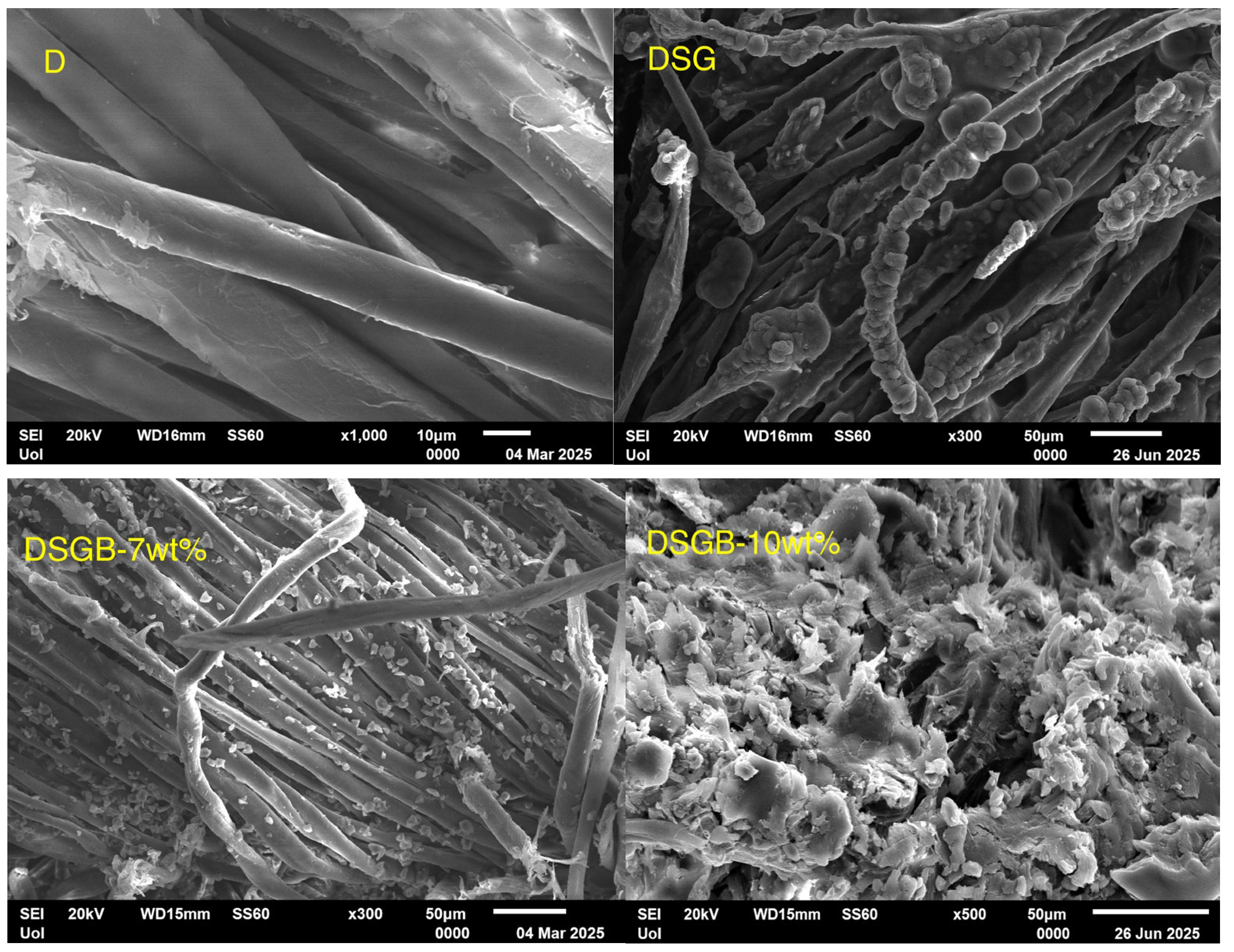
Figure 5.
Experimental setup for the impact testing using the CEAST 9340 Drop Tower system. The inset shows a detailed view of the clamping mechanism and the impactor position relative to the composite specimen.
Figure 5.
Experimental setup for the impact testing using the CEAST 9340 Drop Tower system. The inset shows a detailed view of the clamping mechanism and the impactor position relative to the composite specimen.
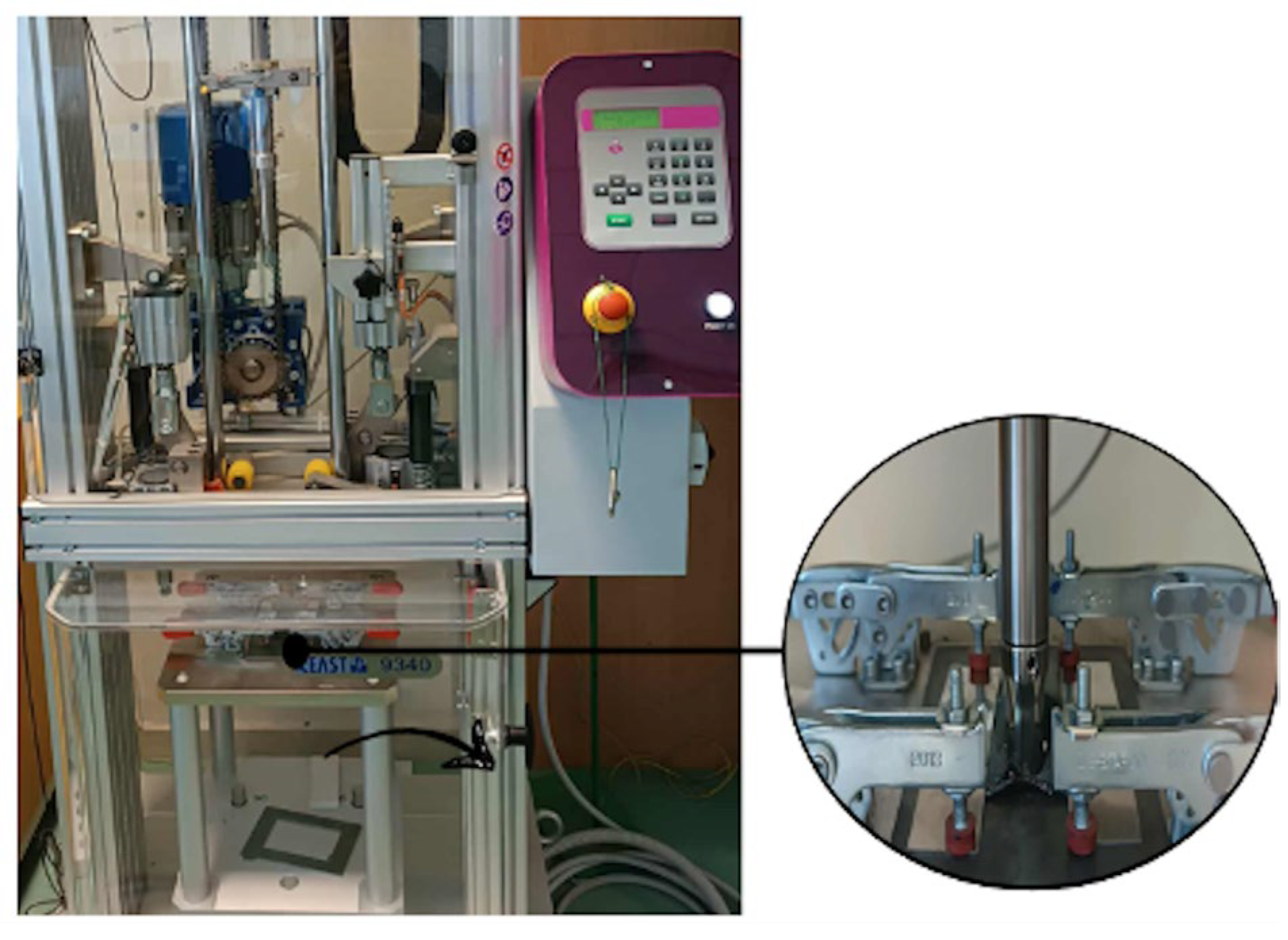
Figure 6.
Peak transmitted force of denim–superglue composites with various boron carbide (B₄C) concentrations (0, 4, 7, and 10 wt%) under drop-weight impact loading. All measured values remain well below the maximum allowable force thresholds defined by EN 1621-1 (35 kN) [46], EN 1621-2 (18 kN) [47], and ANSI/ISEA 138 (9 kN) [48].
Figure 6.
Peak transmitted force of denim–superglue composites with various boron carbide (B₄C) concentrations (0, 4, 7, and 10 wt%) under drop-weight impact loading. All measured values remain well below the maximum allowable force thresholds defined by EN 1621-1 (35 kN) [46], EN 1621-2 (18 kN) [47], and ANSI/ISEA 138 (9 kN) [48].
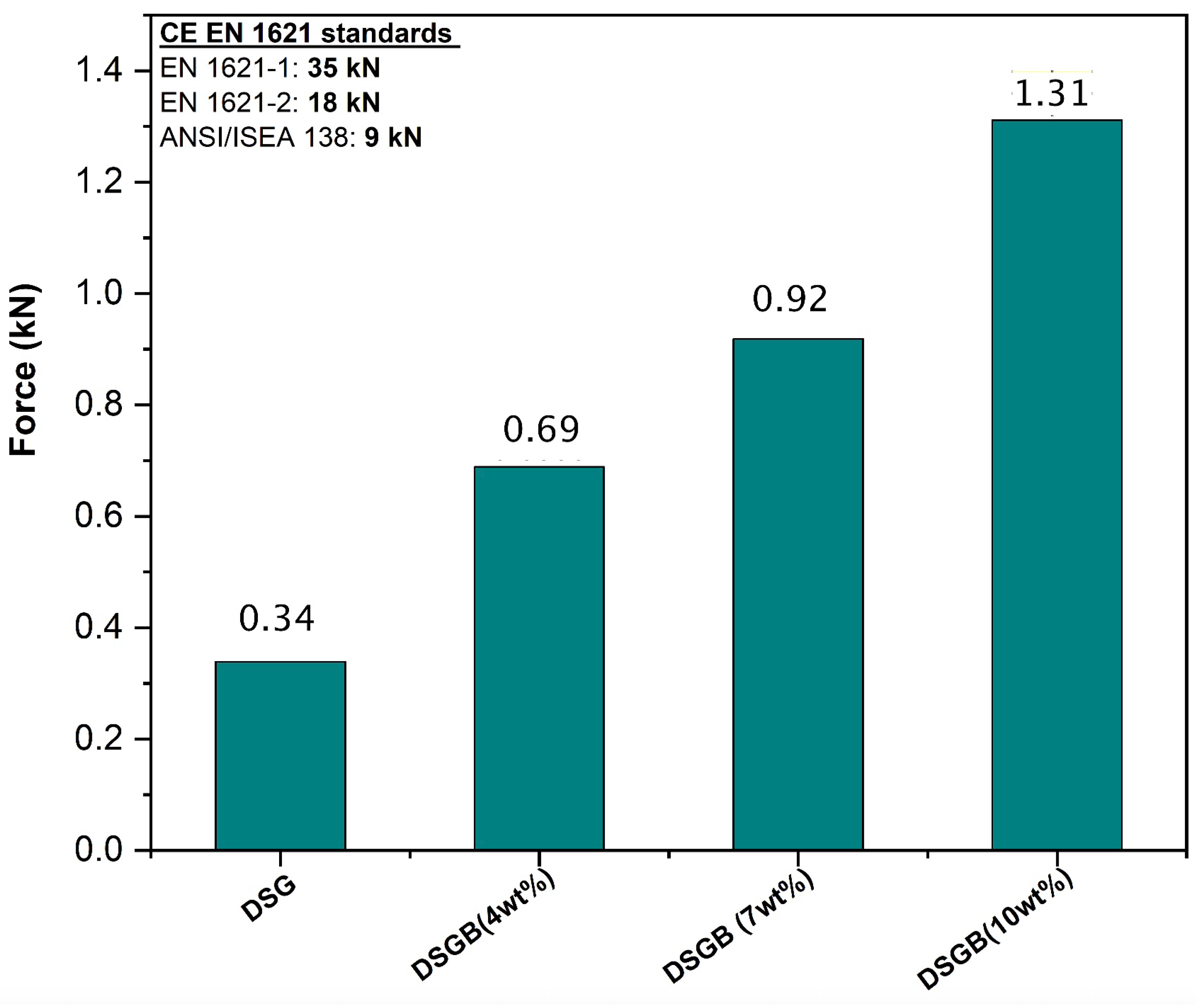
Figure 7.
Tensile properties of the denim-superglue composites: (a) representative stress–strain curves illustrating the effect of B₄C concentration (0, 4, 7, and 10 wt%), and (b) corresponding Young's modulus values, showing the variation in stiffness with increasing filler loading.
Figure 7.
Tensile properties of the denim-superglue composites: (a) representative stress–strain curves illustrating the effect of B₄C concentration (0, 4, 7, and 10 wt%), and (b) corresponding Young's modulus values, showing the variation in stiffness with increasing filler loading.
Disclaimer/Publisher’s Note: The statements, opinions and data contained in all publications are solely those of the individual author(s) and contributor(s) and not of MDPI and/or the editor(s). MDPI and/or the editor(s) disclaim responsibility for any injury to people or property resulting from any ideas, methods, instructions or products referred to in the content. |
© 2026 by the authors. Licensee MDPI, Basel, Switzerland. This article is an open access article distributed under the terms and conditions of the Creative Commons Attribution (CC BY) license (http://creativecommons.org/licenses/by/4.0/).
Copyright: This open access article is published under a Creative Commons CC BY 4.0 license, which permit the free download, distribution, and reuse, provided that the author and preprint are cited in any reuse.


