

Submitted:
03 July 2026
Posted:
08 July 2026
You are already at the latest version
Abstract
This study conceptualises a novel function called Brain Awareness by creating a Comprehensive Model of Self-Regulation through a systematic conceptual review of self-regulation, and functionalising it using the Composite Hierarchical Concept reformation process of De Boecke et al. The resulting Brain Awareness is the result of reconceptualising self-regulation into a composite hierarchical scaffolded function that enables contextual adaptation across six domains of human self-regulation: physiological, affective, behavioural, social, motivational and cognitive. Brain Awareness functions through a looping process of meta-awareness, detecting deviations from the contextually ideal state in each domain and uses cognitive control to enable domain specific mechanisms aimed at restoring equilibrium in the affected domains. This holistic and functional nature of Brain Awareness may facilitate neuroplastic brain development through the creation of therapeutic and educational experiences. Such experiences could rehabilitate neuropsychosocial deficits in self-regulation or improve self-regulation for optimal functioning throughout the lifespan for all populations.
Keywords:
self-regulation
; brain awareness
; contextual adaptation
; physiological reactivity
; emotional regulation
; behaviour
; social competence
; ideal state
; cognition
; motivation
1. Introduction
Self-regulation is an essential intrapsychic human function, enabling the individual to adapt to context, pursue goals, and maintain a holistic state of equilibrium. Most theories emphasise self-regulation as conscious control over automatic responses (Baumeister & Vohs, 2016; Baumeister et al., 2019). It underpins successful living and is a brain-based, biobehavioural system that enables the brain to control reflective, goal-directed action (Baumeister, 2003). lack of self-regulation is directly linked to long-term negative outcome in individuals and society (Robson et al., 2020; Howard et al., 2018; Inzlicht et al., 2021).
The acquisition of self-regulatory skills throughout the lifespan has the potential to reverse stress and trauma induced maladaptive changes in the brain (McEwen, 2016; Rogel et al., 2020; Hanson et al., 2019; Zhang et al., 2013; Kryza-Lacombe et al., 2023). It is thus crucial to design therapeutic experiences that facilitate acquiring self-regulation to facilitate recovery of these maladaptive changes in the brain. Stimulating and activating the neurological anatomy involved in self-regulation facilitates neuroplastic development in the brain anatomy, which is compromised due to various forms of adversities. In therapeutic and educational contexts, this involves creating explicit opportunities to practise self-regulatory skills in operational terms (BAwarenessAwarenessAwarenessraund & Timmons, 2021). Posner and Rothbart (2009) also support the notion that the neuropsychological and biological nature of self-regulation makes it possible to design “experiences” to improve self-regulation through neuroplastic growth. However, the lack of conceptual and operational clarity impedes the translation of self-regulation into experiences that can be incorporated into curricula and therapeutic programmes (Braund & Timmons, 2021).
Literature confirms that models, frameworks, and theories of self-regulation fail to integrate their many related concepts and to operationalise them in ways that allow for fluent, practical use and the design of interventions and learning experiences (Pekrun, 2024; Braund & Timmons, 2021; Philpott-Robinson et al., 2025). Studies highlight many sub-concepts related to self-regulation, examining the interdependence between these sub-concepts and exploring its potential to improve functioning. Every study, however, highlights different sub-concepts and lacks integration and consistency, thus complicating operationalisation and leaving it largely as an academic concept (Howard et al., 2021; Gagne et al., 2021; Cuartas et al., 2022). Complex constructs such as self-regulation and its sub-concepts are nodes in a network and cannot be fully understood by measuring or understanding them in isolation. This would risk losing valuable meaning in practice (De Boeck et al., 2023). Self-regulation functions as an anchor for sub-concepts in this complex construct (Dellantonio & Pastore, 2023). The operationalisation of psychological concepts is intended to help clients develop by practising operational mechanisms that enhance their practical value (De Boeck et al., 2023).
Literature on self-regulatory skills lacks optimisation and a firm foundation on which to build (Inzlicht et al., 2021; Pekrun, 2024; Braund & Timmons, 2021; Philpott-Robinson et al., 2025). Inzlicht et al. (2021) confirm that the fragmentation of self-regulation and its sub-concepts has hindered progress in the field. Research on models and sub-concepts provides valuable insights, but the lack of integration and description of interrelations impacts the operationalizability of self-regulation in robust therapeutic processes (Pekrun, 2024; Braund & Timmons, 2021; Philpott-Robinson et al., 2025)
Malanchini et al. (2019) attempted to address this by examining the structure of associations among multiple self-regulatory constructs. Important core findings of this study indicate that self-regulatory concepts are not isolated but are highly interrelated and can be clustered into domains. These domains reflect broader regulatory dimensions needed for holistic equilibrium. They support the idea of a hierarchical model of self-regulation whereby lower-order traits, such as impulse control, feed into higher-order systems, including academic performance, social behaviour, and mental health. Work by Blair and Ku (2022), presents a more integrated model. However, there is an overemphasis on executive function, a cognitive dimension of self-regulation, and a lack of refinement in areas such as motivation and social competence, which play crucial roles in goal-directed behaviour. Inzlicht et al. (2021) published important work clarifying conceptualisation, interrelations, models, and theories. This work, however, did not integrate these aspects. It does, however, offer a powerful summary of past research and various theories, but in conclusion it calls for a comprehensive conceptualisation of self-regulation. This is the first objective of this study.
Various researchers express the need for the contextualised operationalisation of the concept of self-regulation (Baumeister & Vohs, 2007; Nig, 2017; Hofmann et al., 2012; Zelazo & Carlson, 2012). This is the second objective of this study. It involves the operationalisation or functionalisation of self-regulation to enable future research to create experiences grounded in practical self-regulatory mechanisms that remediate self-regulatory deficits or improve self-regulation to promote optimal functioning in all populations. This operationalised model is called “Brain Awareness”.
2. Literature Review
2.1. The Idea of a Concept
Conceptualising abstract ideas such as self-regulation identifies their attributes and functions, thereby providing conceptual clarity (Podsakoff et al., 2016). Concepts elucidate underlying processes that manifest in observable outcomes (Belcher & Palenberg, 2018). They organise the world into categories based on their unique attributes and functions (Podsakoff et al., 2016). Well-defined concepts are distinguished by key attributes and sub-concepts that set them apart from similar ideas (Podsakoff et al., 2016).
2.2. Entangled Concepts
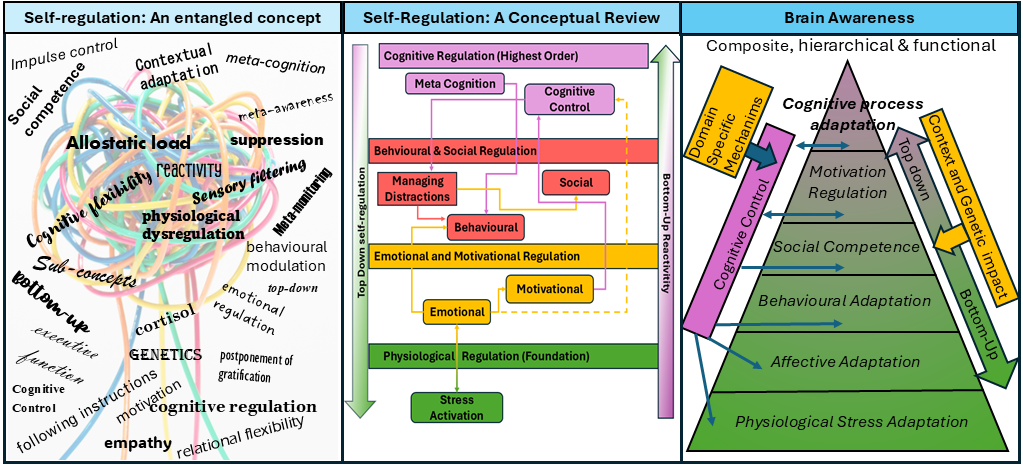
Multidimensional constructs, such as self-regulation, are often entangled in their many sub-constructs, sub-correlates, attributes, and operational implications, which are viewed through various lenses, models, and frameworks in the literature. These kinds of concepts are often fuzzy and hard to operationalise. Systematic Conceptual Reviews are used to dissect, understand and restructure all the above (Clark & Watson, 2019; Tiego et al., 2023; Schreiber & Cramer, 2024; Podsakoff, 2016; Malanchini et al., 2019). This study will start with a systematic conceptual review of self-regulation.
2.3. Self-Regulation as an Entangled Concept
Self-regulation is an essential human function, enabling the pursuit of goals and the maintenance of mental equilibrium Self-regulation theory presents numerous frameworks, models, and components. Each provides insight but often contradicts the other, framing it from different views. This results in findings that collectively lead to a lack of focus and poor operationalisation in therapy (Inzlicht et al., 2021).
Baumeister (2003) tested three theories underlying self-regulation. The first is willpower, driven by strength and energy. This view of self-regulation is an act requiring the choice between dedicating resources to a task or to contextual adaptation. These resources eventually become depleted after repeated attempts to self-regulate. The second theory highlights the cognitive processes of self-knowledge and insight into environmental demands to improve self-regulation in consequential acts rather than to reduce depletion. The third is based on acquiring skills over time to improve self-regulation. Baumeister (2003) concludes that self-regulation operates like a well of energy that empties and takes time to replenish. However, practising self-regulation skills can improve and strengthen it (Baumeister, 2003), in the way a muscle would respond, the most comprehensive recent conceptualisation of self-regulation is that of Blair and Ku (2022), which integrates various models. Their hierarchical model of compounded conceptualisation serves as the foundational for this study. They describe self-regulation as a multilevel, dynamic system encompassing cognitive, emotional, behavioural, physiological, and genetic components. These components are reciprocally related, forming a hierarchical integrative model that evolves developmentally and is highly sensitive to environmental context. Self-regulation requires the coordinated functioning of these five interrelated systems. They identify the systems as executive function, emotional regulation, behavioural traits, physiological stress response, and genetic sensitivity to stress. Executive function or cognitive self-regulation is the function at the highest level in the hierarchy, enabling goal-directed behaviour through working memory, inhibitory control, and cognitive flexibility. Lower-level systems include emotional regulation, behavioural regulation, physiological equilibrium, and predisposing genetics. These lower-level systems develop before cognitive self-regulation or executive function, and their disruption disables executive function. The higher and lower systems operate bi-directionally, first top-down, whereby the individual takes executive control over emotion and physiology, and bottom-up, whereby automatic physiological stress reactivity influences cognition. This model illustrates claims that physiological arousal affects emotional reactivity, which in turn influences attention and executive function. This reaction is anchored in neurobiology and is not a fixed trait but can be neuroplastically developed. The model accordingly advocates interventions that stimulate neuroplasticity and restore regulatory balance.
For researchers to create an effective and trustworthy model of functional self-regulation, it is essential to conduct an in-depth conceptual review of self-regulation from multiple angles and theoretical models. Accordingly, this study has two aims. The first is to create a Comprehensive Conceptualisation of Self-Regulation, and the second seeks to operationalise this comprehensive conceptualisation to create Brain Awareness, a function based on a composite hierarchical structure that divides self-regulation into distinct domains, each regulated by functional mechanisms to enhance self-regulation in all populations,
3. Meterials and Methods
The Comprehensive Model of Self-Regulation was developed in Phase 1, a systematic conceptual review of self-regulation (Carpentras, 2024; De Boeck et al., 2023). Findings from the existing literature on all aspects of self-regulation were synthesised, and the results were reorganised into a comprehensive model to underpin Brain Awareness (Schreiber & Cramer, 2024; De Boeck et al., 2023).
In Phase 2, the researchers conceptualised Brain Awareness in terms of operational practices and contextual relevance. The methodology proposed by De Boeck et al. (2023) was used. It guides the functional reconceptualisation of psychological constructs via a Composite-Hierarchical Construct Reformulation process.
3.1. Phase 1: Systematic Conceptual Review of Self-Regulation
The systematic conceptual review adhered to PRISMA guidelines (Tricco et al., 2018) and maintained the prescribed methodological rigour. The PICOS framework was used to compose the research questions.
The sub-research question was derived from Table 1: “What does an organised, Comprehensive Model of Self-Regulation, with its domains, sub-concepts, theories, models, and frameworks entail?”
To answer this, a rigorous search strategy was developed in accordance with PRISMA guidelines (Tricco et al., 2018). The PRISMA flowchart is shown in Figure 2.
The search strategy was designed in line with the sub-research question. The researchers used the following search terms in Boolean logic: ti: self-regulation AND ti: “conceptualisation” OR “construct” OR “framework” OR “model” OR “theory” OR “paradigm” OR kw: “sub-concepts” OR “domains” OR “components” OR “elements” OR “attributes”. The search was conducted across the following databases: Academic Search Complete, Cambridge, Hindawi, JSTOR, Oxford, ProQuest, PsycARTICLES, PsycINFO, PubMed Central, Sabinet, SAGE, SciELO, and ScienceDirect.
Inclusion and Exclusion criteria were developed in accordance with the conceptual scope of our PICOS framework (Del Mar et al., 2017; Melnyk & Fineout-Overholt, 2019).

Table 2.
Inclusion Criteria.
| Studies about humans across their lifespan |
| Studies interrogating the conceptualisation of self-regulation or its sub-concepts |
| Studies contributing to the conceptual clarity, framework or theoretical advancement of self-regulation |
| Studies that map latent structures, domains or interrelations between sub-concepts |
| Studies that record the taxonomy of self-regulation |
| Studies that classify or operationalise self-regulation |
| Studies that qualify as either review, quantitative, qualitative or mixed-method studies |
| Studies published after 2015 |
Table 3.
Exclusion Criteria.
| Studies in languages other than English |
| Studies that are not peer-reviewed |
| Conference abstracts |
| Studies lacking a conceptual unpacking of self-regulation |
| Studies lacking a theoretical or conceptual contribution. |
| Grey literature |
The initial search rendered 339 studies. Filtering of these results is illustrated in the PRISMA diagram (Figure 2) below (Tricco et al., 2018; Aromataris et al., 2024). After this, 32 studies remained for the final test.
To mitigate the risk of bias, the corpus of 32 was assessed for methodological quality through a critical appraisal, following the guidelines of the Joanna Briggs Institute (JBI) (Aromataris et al., 2024; Page et al., 2021). Each study was assessed by two reviewers using standardised JBI assessment tools. No studies were excluded based on quality. Given the number of sub-concepts involved in self-regulation, the authors were not satisfied with the final number of studies returned by the search. To enhance the depth of findings, the authors engaged in backward citation harvesting as described by Booth et al. (2021), Gough et al. (2017) and Tricco et al. (2018). This is a legitimate strategy to enhance comprehensiveness and conceptual depth. These additional studies were also evaluated using the same criteria for relevance, eligibility, and quality. None of the 23 identified studies was excluded. This process resulted in the addition of 23 studies. This brought our final number of studies to 52.
A data extraction tool was created to extract the following data from findings in articles: author and year of publication, conceptualisation/definition of self-regulation, conceptualisation/definition of sub-concepts of self-regulation, relations between self-regulation and its sub-concepts, relations between sub-concepts themselves, models/frameworks and theories on self-regulation, and significant recent findings.
The extracted data were imported into ATLAS.ti for systematic qualitative thematic analysis as guided by Braun and Clarke (2023). This involved iterative coding, categorisation, and theme development. Through inductive pattern detection, emergent themes were identified and mapped. This process enabled the synthesis of a conceptually coherent and empirically grounded Comprehensive Model of Self-Regulation.
3.2. Phase 2: Composite-Hierarchical Construct Reformation to Conceptualise Brain Awareness
After synthesising the findings of the systematic conceptual review into a Comprehensive Model of Self-Regulation, the steps outlined by De Boeck et al. (2023) were followed to conceptualise Brain Awareness as a Composite Hierarchical Construct (see Figure 3). This enabled the operationalisation of the Comprehensive Model of Self-Regulation and the creation of Brain Awareness. This process is illustrated in Figure 3 below.
3.3. VOSviewer
VOSviewer is software designed to construct and visualise conceptual networks. It enables researchers to explore patterns of co-occurrence within large bodies of literature. It transforms textual data into spatial maps that reveal the relational structure among key terms, concepts, ideas and functions. Applying clustering algorithms and proximity-based layout techniques facilitates the identification of thematic groupings, intellectual domains, conceptual landscapes, and emerging trends within a concept. To triangulate our findings, we created three VOS Maps, the first, of raw extracted data from the conceptual literature review; the second, from the text of our Comprehensive Model of Self-Regulation; and the third, a mapping of the text of the conceptualisation of Brain Awareness (Van Eck & Waltman, 2010; VOS Viewer, nd). The VOS Maps follow in Section 4.
4. Results
4.1. Mapping of Extracted Data
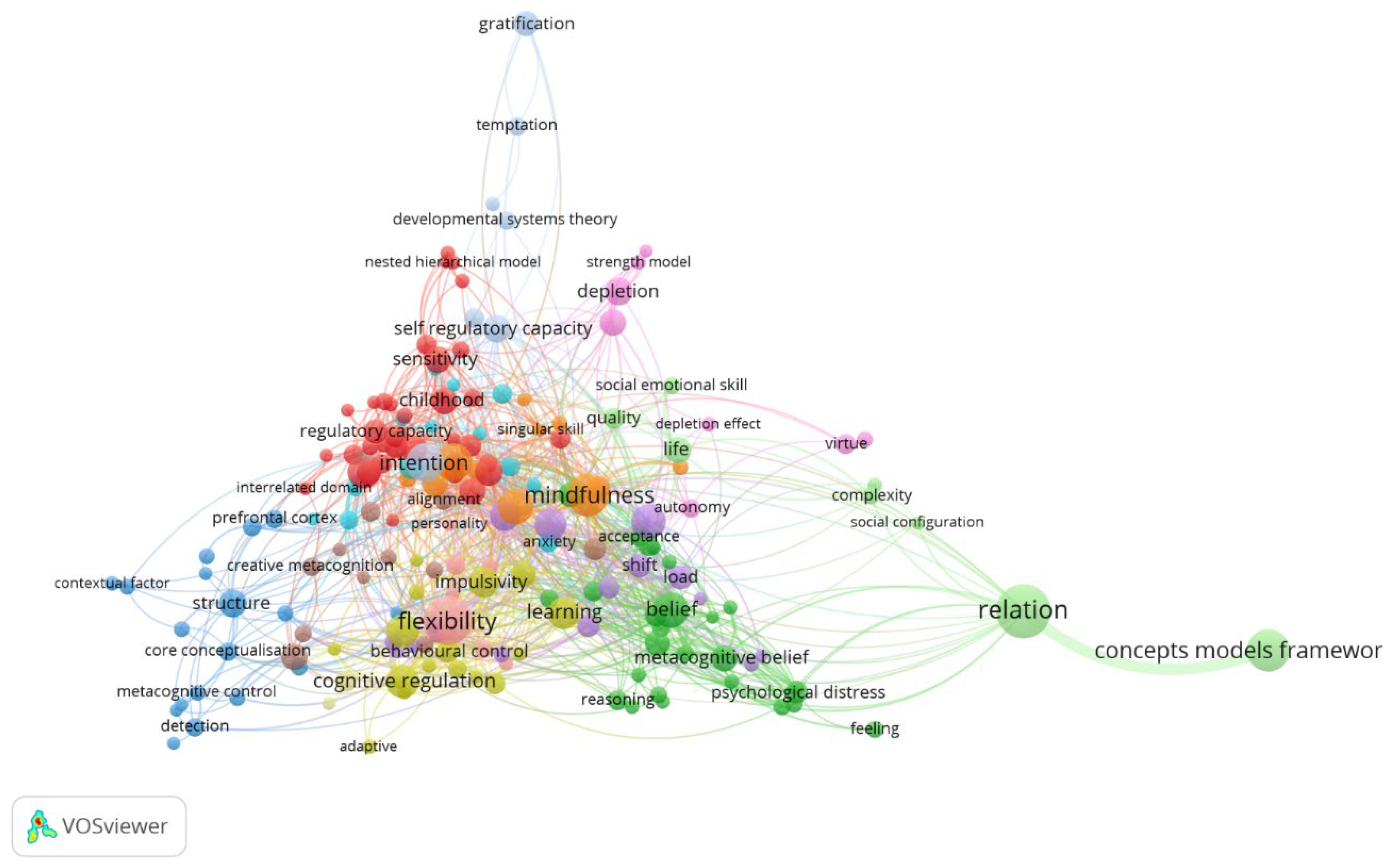
Before exploring the results of the extracted data, the raw extracted text was processed using VOSviewer (Van Eck & Waltman, 2010). It is shown below in VOS Map i.
The dense interconnections in the centre of VOS Map i illustrate high co-occurrence and significant conceptual overlap, indicating over-integration to the extent that no clear patterns or structures emerge. This reflects the extent of the lack of conceptual structure and clarity in the self-regulation literature (Van Eck & Waltman, 2010; VOSviewer, nd).
Findings will be presented below in sequence of the two research aims, starting with the results from the conceptual literature review.
Scheme 1.
4.2. Findings on the Conceptual Literature Review into Self-Regulation
4.2.1. Theories, Frameworks and Models Foundational to Self-Regulation
Theory in psychology provides structural integrity, explanatory power, conceptual rigour, coherence, and operational relevance to constructs. It clarifies core ideas and boundaries, enabling developmental and contextual sensitivity, and supporting operational design (Vohra, 2023; Dziak, 2025).
Thematic analysis of the data extraction clustered the most relevant theories, frameworks, and models of self-regulation:
- A.
- Developmental Theories
Developmental frameworks emphasise the interplay between developmental timing (periods when a child’s brain is susceptible to neuroplastic growth), exposures such as early childhood adversity, and protective factors such as healthy attachment and responsive care, which either hinder or facilitate the development of self-regulation (Frazier et al., 2021; Roos & Witkiewitz, 2017; Nigg, 2017; Schall et al., 2017).
Attachment theory, introduced by Bowlby and Ainsworth (1992), links developmental theory with a neurobiological dimension, framing co-regulation as central to the development of emotional and behavioural self-regulation. Secure attachment relationships foster resilience and regulatory competence (Frazier et al., 2021; Blair & Ku, 2022).
Neurodevelopmental models suggest that the maturation and development of brain structures, such as the prefrontal cortex and the anterior cingulate cortex, are impacted by context, proposing that adversity predisposes individuals to deficits in self-regulatory ability (Woltering & Shi, 2016; Frazier, 2021; Reynolds & McCrea, 2018; Tougas et al., 2015).
The cross-cultural developmental model recognises the role of collectivist and individualist norms in shaping self-regulation practices (Reynolds & McCrea, 2016; Schall et al., 2017).
- B.
- Cognitive Behavioural and Motivational Theories
Bandura’s (1991) Social Cognitive Framework is fundamental to the concept of self-regulation. It posits that self-regulation is a reciprocal interaction between personal and environmental factors. Interactions between factors such as culture, beliefs, values, emotions, behavioural patterns, and external influences shape self-regulation (Evans et al., 2017; Braund & Timmons, 2021). Bandura (1991) maintains that self-regulation is learned when individuals observe others and adjust their behaviour accordingly. This resonates with the idea that social and behavioural regulation are influenced by social expectations, norms, and cues, driven by the need to conform socially (De la Fuente et al., 2022; Masaki, 2023).
Motivational regulation theory highlights that an individual will only conform to observed behaviour if motivated by goals, norms or values. Motivational Regulation is promoted by high levels of self-efficacy and the perceived importance of the task at hand. Bandura’s social cognitive theory illustrates the importance of motivational Regulation.
Self-Regulation Theory (Carver & Scheier, 1982) proposes that self-regulation is a feedback loop involving the current state, its evaluation against goal-related performance, and the resulting holistic adjustment when the current state falls short (Bailey et al., 2018; Blair & Ku, 2022; Niksirat et al., 2019; Belte et al., 2024). Like Self-Regulation Theory, Control Theory (Carver & Scheier, 1982) also emphasises the role of discrepancy reduction between actual and desired states or performance in motivating behaviour change. It explains that this discrepancy is addressed through revisions across different levels of self-regulation and their goal alignment (Lerner et al., 2021; Tougas et al., 2015).
Self-determination theory (Deci & Ryan, 2008) explains that the internalisation of goals is crucial for fostering intrinsic motivation, which drives persistence and sustained effort in goal pursuit (De Bruin et al., 2020; Benight et al., 2024; Shen et al., 2025). Intrinsic motivation theory explains how rewards associated with tasks and goals drive persistence and motivation. This suggests that completing tasks can create internal enjoyment and personal meaning, enhancing engagement, motivating re-engagement and improving performance (Shen et al., 2025; Bailey et al., 2018; Gagne et al., 2021).
- C.
- Executive Function and Cognitive Control Theory
The executive function framework is anchored in cognitive regulation. It defines executive function as a set of cognitive processes supporting goal-directed behaviour. These processes include attentional control, working memory, inhibitory control, cognitive flexibility, and other sub-concepts that serve to cognitively monitor and evaluate goal-oriented performance, register distractions or a lack of performance and solve problems to devise new strategies, and change behaviour accordingly (Gagne et al., 2021; Koslov et al., 2019).
The three-dimensional model of Personality Self-Regulation integrates self-control, self-knowledge, and self-compassion, situating self-regulation within the context of personality development (Valikhani et al., 2020). This draws on concepts of self-knowledge that enable meta-monitoring, conflict detection, evaluation of internal resources, and restrategising after conflicts (Smith & Racine, 2025; Braund & Timmons, 2021; Frazier et al., 2021; Shen et al., 2025). With slight deviations, the model resonates with the idea of executive function, intrinsic motivation, and self-regulation theory discussed above. It is also emphasised in Zimmerman’s model of self-regulated learning, which views self-regulation within personality development as a cyclical process involving forethought, performance, and self-reflection and change (Tee et al., 2021; Valikhani et al., 2020). This recursive process-based idea emerged as a significant theme in the data.
- D.
- Dual-Process and resource models
Dual-process models suggest that self-regulation results from the interaction between reflective (deliberate) and impulsive (automatic) systems. The ability to reflect on performance enables behaviour change, whereas an inability to engage in meta-awareness, meta-monitoring, and meta-reflection, as described by (Gagne et al., 2021; Tougas et al., 2015; Koslov et al., 2019), compromises the ability to detect distractions and evaluate their impact on the pursuit of goals. This captures the primal tension between immediate gratification and the higher-order function of goal pursuit (Jones & Schüz, 2021; Murray & Mulan, 2019; Lebuda & Benedek, 2023; Nigg, 2017).
Resource models of self-control posit that self-control operates like a muscle which can be fatigued through use, leading to temporary impairments in self-regulation (Inzlicht et al., 2021). Beliefs, self-efficacy, and motivation, however, can create a buffer against this impairment (Hagger et al., 2017).
- E.
- Integrative frameworks
Developmental systems theory frames self-regulation as a product of dynamic interactions between biological, psychological and contextual factors, supporting a holistic view of self-regulation as contextually embedded and developmentally fluid (Jones & Schüz, 2021; Lerner et al., 2021).
4.2.2. Conceptualisation of Self-Regulation
Thematic data analysis identified six key sub-concepts of self-regulation: emotional, social, behavioural, cognitive, motivational, and physiological. This is confirmed by Malanchini et al. (2019), who note that the structure of self-regulation comprises multiple sub-concepts that load onto a few core domains (Malanchini et al., 2019).
Thematic data also highlight that self-regulation is the intentional modulation and interplay among thoughts, emotions, and actions. If well developed, it enables individuals to manage internal states to satisfy external demands in pursuit of achieving goals (Inzlicht et al., 2021; Philpott-Robinson et al., 2025; Nigg, 2017; McDonald, 2021). Multiple studies support conceptualisations related to this, but they differ in how they name and describe domains, sub-concepts, interactions among sub-concepts, and the structure of self-regulation. Although all contribute significantly to conceptualising self-regulation, an accurate understanding integrating all these fractured ideas into a single, comprehensive, structured framework is lacking. From our thematic data, we organised self-regulation into three important layers shown in Figure 4 below.
Sub-Concept 1: Emotional self-regulation
Emotional regulation is the ability to modulate emotional responses to internal and external stimuli and is essential for effective behavioural and cognitive regulation (Reynolds & McCrea, 2016; Guo et al., 2025; Koslov et al., 2019). Emotional regulation is a multifaceted construct encompassing processes that influence emotional experiences, expressions, and physiological responses. As a complex, contextually embedded process, it involves a range of components needed for adaptive functioning that influence well-being, relationships, and overall mental health (Guo et al., 2025; Nigg, 2017; Philpott-Robinson, 2025). Understanding these components for emotional self-regulation and their interrelations with other regulatory processes can enhance emotion regulation skills across contexts (Blair & Ku, 2022; Hagger et al., 2017; Murray & Mulan, 2019).
Components of Emotional Self-Regulation
The components mentioned in the data rely primarily on cognitive abilities to regulate emotional responses. The following key components impact this function:
Cognitive Reappraisal
Cognitive reappraisal in the context of emotion regulation involves reinterpreting one’s emotional response to a situation to alter its emotional impact. The cognitive evaluation occurs after an individual has assessed a situation as potentially stressful or challenging (Marple et al., 2025; Smith & Racine, 2025; Koslov et al., 2019). This process also involves determining whether the individual possesses the resources available to cope with the stressor and evaluating the potential consequences of the situation (Marple et al., 2025; Smith & Racine, 2025; Inzlicht et al., 2021). The effectiveness of reappraisal can enhance self-efficacy, leading to more positive appraisals of personal ability and resources in future situations. Self-efficacy is a sub-concept of motivational regulation. This process highlights the importance of self-awareness and meta-knowledge in estimating resources as well as cognitive flexibility in being open to challenges and amending strategies. Reappraisal has been criticised as being too “response-focused” because it relies on prior emotional activation. (Marple et al., 2025; Smith & Racine, 2025; Inzlicht et al., 2021; Horner et al., 2024).
Expressive Suppression
Expressive suppression refers to the inhibition of outward emotional expression and is linked to social competence and impulse control, which are components of other self-regulatory domains. It is generally considered maladaptive because it occurs later in the emotional process and can lead to emotional incongruence (Marple et al., 2025; Smith & Racine, 2025; Finlay-Jones et al., 2015)
Nonacceptance of Emotional Responses
This strategy involves rejecting one’s own emotional experiences. It supports maintaining focus and pursuing tasks in cognitive regulation despite emotional upset. This relies on reasonable impulse control during emotional distress. Impulse control is a cognitively powered process discussed under cognitive control. underpinned by sufficient motivation. It refers to the ability to suppress prepotent or automatic responses (Horner et al., 2024; Marple et al., 2025; Smith & Racine, 2025).
Emotional awareness
Emotional Awareness enables emotional regulation and involves an awareness and understanding of one’s emotional experiences and their impact on thought and behaviour. It is essential for emotional regulation because it enables individuals to recognise, assess, and manage their emotional states. The meta-awareness literature confirms that this complements other forms of awareness and is potentiated by mindfulness (Huang et al., 2020; Geronimi et al., 2019). It also facilitates the initiation of a reappraisal loop involving emotional monitoring, evaluation, reflection, and of change to remain task-focused (Valikhani et al., 2020; Smith & Racine, 2025; Blair & Ku, 2022; Frazier et al., 2021).
Emotional clarity
A lack of emotional clarity hinders reflective processing and the consequential selection of adaptive responses. It involves understanding and accurately identifying emotional experiences, thus facilitating the management of emotional states (Hasking et al., 2017; Valikhani et al., 2022; Smith & Racine, 2025).
Mindfulness
Mindfulness has attracted attention to the concept of self-regulation. It has the potential to enhance various self-regulatory processes, especially meta-awareness, meta-monitoring, and maintaining focus. Mindfulness involves activating a heightened state of self-awareness characterised by a non-judgmental, non-reactive observation of one’s thoughts, emotions, and sensations (McDonald, 2021; Chatterjee et al., 2021; Geronimi et al., 2019). This fosters a deeper understanding of internal states and enables interoception, which is crucial for identifying processes that detract from task execution (McDonald, 2021; Chatterjee et al., 2021). Studies also link mindfulness to improved executive function, enhanced cognitive flexibility, and attentional control, enabling individuals to manage emotional responses and behavioural impulses more mindfully (Huang et al., 2020; Geronimi et al., 2019; McDonald, 2021).
Mindfulness and meta-awareness, combined, enable reactive engagement, creating space for adaptive, evaluated responses to stressors and challenges. This reflective capacity eases high-stress situations, enabling one to pause and assess one’s emotional state, thereby preventing maladaptive responses (Hussain, 2015; Gallant, 2016; Niksirat et al., 2019). The integration of mindfulness into self-regulatory practices has yielded promising results across multiple studies (Woltering & Shi, 2016).
Self-compassion
Self-compassion is a concept that has been found to promote emotional regulation and relieve stress-related symptoms. Greater self-compassion fosters clearer emotional awareness and non-judgmental acceptance of difficult emotions, thereby supporting impulse control (Finlay-Jones et al., 2015).
Critical reflection
The intertwining of emotional regulation and cognitive and behavioural regulation is clear. Emotional regulation is a prerequisite for effective regulation in higher domains. However, it is bidirectional and relies on other domains, such as cognitive and physiological regulation. Socially, emotional regulation is not only an individual process but also depends on relational safety and co-regulation to be effective. This highlights why research on fractured self-regulation is insufficient to understand or change self-regulation (Braund & Timmons, 2021; Kreibich et al., 2022; Lage et al., 2022; Reynolds & McCrea, 2016).
An underreported domain of self-regulation is physiological self-regulation. It is entwined with emotional self-regulation. Both have distinct physiological and biological underpinnings. Emotional regulation depends on physiological mechanisms and has a bidirectional relationship with physiology, as it both requires and contributes to physiological responses to stress (Braund & Timmons, 2021; Nigg, 2017; Philpott-Robinson et al., 2025).
Sub-Concept 2: Physiological self-regulation
All domains of self-regulation are hierarchically scaffolded on physiological regulation (Woltering & Shi, 2016; Frazier et al., 2021; Blair & Ku, 2022). Physiological self-regulation is anchored in a top-down and bottom-up bidirectional process.
Top-down self-regulation of physiological responses refers to deliberate, effortful cognitive control of thoughts, emotions, and behaviours to de-escalate arousal. It is powered by cognitive control, which enables the inhibition of impulsive responses and shifting attention. Bottom-up reactivity involves automatic, reactive physiological processes in response to triggers. This leads to impulsive responses. This is not a form of self-regulation but rather a reactivity characterised by emotional and physiological responses. It is linked to impulsive risk-taking behaviours and can disrupt planned, goal-directed behaviour or lead to disinhibition (Blair & Ku, 2022; McDonald, 2021; Nigg, 2017). Top-down processes manage emotional responses, which initiate physiological arousal to control bottom-up reactivity. It enables individuals to override impulses, creating space for a more considered, rational and goal-directed response (Woltering & Shi, 2016; Blair & Ku, 2022; Evans et al., 2017; Guo et al., 2025; Nigg, 2017).
Bottom-up reactivity interacts with top-down processes. It sends signals to top-down self-regulation, which can either support or hinder deliberate, cognitively controlled efforts to de-escalate physical and emotional arousal. Heightened emotional arousal can impair cognitive control, which is needed for impulse regulation and physiological de-escalation. Top-down processes facilitate goal-directed behaviour through cognitive control, while bottom-up processes reflect the influence of emotional and physiological states on immediate responses to stressors and the consequential behaviour. This interplay provides insight into the reasons for self-regulatory failure and dysregulation (Blair & Ku, 2022; Evans et al., 2017; Guo et al., 2025; Nigg, 2017).
The literature identified the following top-down physiological components that enable physiological self-regulation.
Components of Physiological Self-Regulation
Autonomic Nervous System
The autonomic nervous system is critical through its two branches: The sympathetic system, which prepares the body for action (fight or flight) in response to a trigger, and the parasympathetic system, which promotes calmness and recovery (Blair & Ku, 2022; Woltering & Shi, 2016; Frazier et al., 2021). Cortisol and norepinephrine responses to a stimulus influence the extent of physiological arousal and activate the sympathetic system during stress. This activation impairs emotional regulation and higher-order domains (Blair & Ku, 2022).
Allostasis
Allostasis is the state an individual reaches after activation of the sympathetic system. It refers to the body’s short-term attempts to regulate and adapt to physiological changes in response to stress and to de-escalate arousal (Blair & Ku, 2022; Roos & Witkiewitz, 2017).
Allostatic Load
Allostatic load is the cumulative physiological impact of long-term stress. A high allostatic load can impair self-regulation in other domains. The resource theory posits that self-regulation is a limited resource that is depleted with repeated activation, leading to general dysregulation and damaging psychosocial and physical well-being (Blair & Ku, 2022; Roos & Witkiewitz, 2017).
Cortisol Reactivity
Cortisol is a stress hormone secreted in response to stressful circumstances. Long-term overactive cortisol secretion has a toxic effect on the brain anatomy responsible for self-regulation. It induces dysregulation across various domains, impairing the ability to cope with stress and challenges, appraise effectively, and problem-solve (Blair & Ku, 2022; Frazier et al., 2021; Roos & Witkiewitz, 2017).
Neurochemical Tuning
Neurotransmitters are involved in arousal and attention. Fluctuations in neurotransmitter levels impact reactivity levels, making individuals more prone to chronic hypervigilance and anxiety. These fluctuations affect the ability to maintain attention or inhibit impulses. Neurochemical tuning of neurotransmitters is essential for a healthy response to triggers (Blair & Ku, 2022; Woltering & Shi, 2016; Frazier et al., 2021; Roos & Witkiewitz, 2017).
Genetics and Epigenetics
Epigenetic modulation explains that, transgenerationally and individually, environmental factors and past experience can alter gene expression (Blair & Ku, 2022). Genetic susceptibility influences individual differences in self-regulation, leading to lighter or more intense arousal when faced with a trigger, thereby making self-regulation more or less effortful (Blair & Ku, 2022).
Developmental Influences
Early-life experiences shape neurological development in areas such as the prefrontal cortex, anterior cingulate cortex, and amygdala, impacting self-regulation. Hence, cumulative early childhood adversity structurally damages these brain regions. Caregiver sensitivity and attachment shape the neurological foundations of self-regulation. Secure attachment and responsive caregiving scaffold all domains of self-regulation, thereby buffering stress reactivity (Blair & Ku, 2022; Roos & Witkiewitz, 2017; Nigg, 2017; Schall et al., 2017).
The physiological, biological, and neurological underpinnings of self-regulation are interconnected and complex. They involve a dynamic interplay between the body’s physiological responses and other regulatory domains (Frazier et al., 2021; Ger & Buehler, 2024; Gholami et al., 2022).
Sub-Concept 3: Behavioural self-regulation
Behavioural self-regulation reflects how well individuals manage impulses to act appropriately and navigate complex contexts (Evans et al., 2017; Reynolds & McCrea, 2018). It enables proactive control and modulates observable behaviour to conform to personal and social expectations, goals, tasks, norms, rules, and environmental demands.
Components of behavioural self-regulation
Components of behavioural self-regulation include delaying gratification, following instructions, managing distractions, and suppressing impulsive behaviour. It enables following directions, adhering to instructions, stopping impulsive actions that may not align with long-term goals, and managing distractions by maintaining focus on tasks despite potential interruptions (Shen et al., 2025; Lerner et al., 2021).
Mastering behavioural regulation enhances performance in educational, developmental, and occupational contexts (Tee et al., 2021; Lerner et al., 2021; Blair & Ku, 2022; Evans et al., 2017; Braund & Timmons, 2021). It requires successful self-regulation of physiological, cognitive, emotional, and social processes (Reynolds & McCrea, 2016; Braund & Timmons, 2021; Kreibich et al., 2022).
Developmental factors and context shape competence in behavioural self-regulation; it evolves with age and experience and explains why younger people require more external support to manage behaviours. The effectiveness of behavioural regulation is also influenced by factors such as task complexity, social configuration, relational dynamics, social competence and limiting conditions (Marulis et al., 2020; Nigg, 2017).
Sub-Concept 4: Social self-regulation
Social self-regulation is a higher-order form of self-regulation. It relies on emotional and behavioural regulation to interpret social cues and cognitive control to respond appropriately, despite potential emotional and physiological activation (Braund & Timmons, 2021). Understanding social cues enhances social interactions and fosters cooperative behaviour, helping one to attain social goals and adjust behaviour in response to feedback, which is crucial for maintaining harmonious relationships. Social and behavioural regulation enables adaptation to social context, rules, norms, and demands (Braund & Timmons, 2021; Jones & Schüz, 2021). Meta-awareness enables individuals to monitor social behaviour and detect patterns that are not conducive to attaining a goal or completing a task (Lerner et al., 2021; Braund & Timmons, 2021; Antonopolou, 2024; Kreibich et al., 2022).
Components of social self-regulation:
Co-regulation
Co-regulation facilitates individuals’ learning of social and behavioural regulation through interaction with others, including modelling. Individuals learn what is socially acceptable and appropriate in the context through co-regulation.
Empathy
Empathy enables individuals to read and understand social cues and others’ emotional experiences, guiding social responses and impulse control (Lerner et al., 2021; Braund & Timmons, 2021).
Perspective taking
Perspective taking enables understanding of others’ points of view, enhancing social flexibility.
Social regulation develops over time and is influenced by beliefs, cultural context, and norms of what is acceptable. Early interactions with caregivers play an important role in shaping the capacity for social regulation (Shen et al., 2025; Tougas et al., 2015).
Sub-Concept 5: Motivational self-regulation
Motivational self-regulation is underrecognised yet of great importance due to its bidirectional link with cognitive self-regulation. It drives goal orientation and persistence, enabling individuals to manage their motivation to engage in and maintain goal-directed behaviours (Carden et al., 2022). It is malleable and continuously shaped and refined through experiences, relationships, and context (Braund & Timmons, 2021; Ger & Buehler, 2024; Inzlicht et al., 2021).
Components of motivational self-regulation
Self-efficacy
This is the belief in one’s own competence to succeed, complete a task, or reach a goal. Higher self-efficacy enables motivation and persistence in the face of challenges and is critical to goal-directed behaviour (Braund & Timmons, 2021; Huang et al., 2020; Lebuda & Benedek, 2023).
Task value
Task value refers to the perceived importance of a task. When an individual value a task, they are more likely to exert sustained effort. It is shaped by culture, context and personal values (Braund & Timmons, 2021; Huang et al., 2020; Lebuda & Benedek, 2023).
Goal orientation
Goal orientation describes the extent to which behaviour is oriented toward achieving a goal. This is governed by the perceived task value (Tee et al., 2021).
Motivational regulation relies on repeated feedback loops in which individuals evaluate their progress toward goals and adjust holistically in response to performance. Negative self-appraisals can destabilise motivation while internalised beliefs and norms shape motivational power (Benight et al., 2024; Shen et al., 2025; Huang et al., 2020; De Bruin et al., 2020).
Sub-Concept 6: Cognitive self-regulation
This is the highest level of the self-regulation scaffold. It represents the cognitive mechanisms through which individuals manage cognitive activities to achieve goals and complete tasks (Braund & Timmons, 2021; Frazier et al., 2021; Shen et al., 2025).
There is a broad, inconsistent theoretical discourse on the relationship of cognitive self-regulation to executive function. The discussion ranges from equating executive function to executive function being a function of cognitive self-regulation (Inzlicht et al., 2021; Blair & Ku, 2022; Frazier et al., 2021; Shen et al., 2025). This study will include all components of executive function within cognitive self-regulation but will disregard executive function as a stand-alone process.
Cognitive self-regulation is vital for success and personal development: it supports a goal-focused engagement with challenges. It shapes how individuals navigate tasks, challenges, obstacles, and pursue goals (Lerner et al., 2021; Gagne et al., 2021; Evans et al., 2017; Antonopolou, 2024).
Components of Cognitive Self-Regulation
Working memory
Working Memory is the mind’s capacity to hold and manipulate information for short periods, enabling tasks that require quick reasoning and decision making. It impacts planning, flexible and creative decision making, problem solving, and emotional regulation (Gagne et al., 2021; Antonopolou, 2024; Horner et al., 2024; Huang et al., 2020).
Inhibitory control
Inhibitory control triggers cognitive control to suppress impulsive responses in favour of goal-directed actions, it is thus rooted in the cognitive function of behavioural, emotional, social, and physiological self-regulation. It creates a space between stimulus and response, enabling adaptive strategising in response to contextual demands (Huang et al., 2020; Marulis et al., 2020; Schall et al., 2017).
Cognitive flexibility
Cognitive flexibility is the ability to adapt, create new strategies, and accommodate strategic changes in response to changing demands. This enables reappraisal of problems, problem solving, re-evaluating, and switching between tasks to find the best solution. Cognitively flexible individuals can adapt their thinking to changes in context and task demands. It is greatly enhanced by creativity in developing new approaches to a problem. It underpins adaptability in dynamic environments where demands frequently change and unexpected challenges arise (Boyer, 2023; Blair & Ku, 2022; Roos & Witkiewitz, 2017; Gholami et al., 2022; Jain et al., 2024).
The interplay between cognitive flexibility and emotional regulation is noteworthy. Cognitive flexibility enables individuals to reframe emotional experiences, thereby shifting their focus away from distressing stimuli and toward more constructive interpretations (Tougas et al., 2015; Koslov et al., 2019). This modulates emotional responses, which is essential for maintaining well-being. To promote conceptual clarity, cognitive flexibility should be limited to processes that facilitate problem-solving. This implies that in the emotional, behavioural, or social domains, where flexibility is equally important, there is an argument for concepts such as “emotional flexibility”, “behavioural flexibility”, and “social flexibility” as these are distinctly different from a cognitive process. Thus, in other domains, flexibility should be understood as the ability to feel differently and act flexibly. To enhance conceptual clarity, we argue for recognising the conceptual differences between these domain-related flexibilities (De Boeck et al., 2023; Philpott-Robinson et al., 2025; Woltering & Shi, 2016; Gholami et al., 2022; Boyer, 2023; Blair & Ku, 2022).
Attentional control
Cognitive self-regulation is anchored in maintaining focus on relevant stimuli, promoting task completion and goal achievement by ignoring distractions, staying task-focused, inhibiting impulses and delaying gratification (Lebuda & Benedek, 2023; McDonald, 2021; Jain et al., 2024). This enhances the ability to resist interference from other domains while completing tasks. Data support the idea that emotional regulation is enabled by attentional control, which facilitates sustained focus on relevant stimuli rather than distraction by emotional experiences. This confirms the need to assign cognitive control of other domains to a single cognitive function (Niksirat et al., 2019; Frazier et al., 2021; Hagger et al., 2017).
Cognitive control
Cognitive Control involves regulating cognitive resources such as attention, working memory, and cognitive flexibility by allocating them, guided by motivation, to supporting task engagement (Horner et al., 2024; Inzlicht et al., 2021; Jain et al., 2024; Nigg, 2017). Evans et al. (2019) define cognitive control as the brake and gas pedal of self-regulation across domains. Nigg (2017) confirms that cognitive control is activated when meta-monitoring detects a conflict or arousal and serves as the manager of all top-down regulatory processes, representing all cognitive interventions into other domains (Nigg, 2017). Data from our study, however, present a variety of incoherent conceptualisations of cognitive control.
Cognitive abilities and cognitive control are higher-order abilities that cannot function without lower-order self-regulation. An argument for the role of cognitive control in activating self-regulatory mechanisms in other domains singles itself out as not a higher-order function, but also crucial for lower-order self-regulation.
This explains why lower-order self-regulatory domains and contextual and genetic influences shape predispositions that make cognitive function an learning more effortful for some. Holistic self-regulation of all domains is needed to facilitate optimal cognitive regulation.. These domains depend on cognitive control to appropriately inhibit or execute regulatory functions. Thus, when cognitive control is deficient, the entire self-regulation system is deficient. This warrants a deep investigation into the factors that impact and may improve cognitive control (Glahn et al., 2016; Friedman & Robbins, 2022; Brieant et al., 2023).
Meta-cognition
Meta-cognition is also an entangled term, with multiple conceptual blurring. Analysis positions meta-cognition as awareness of one’s cognitive processes and highlights insight into them. Past literature has overemphasised cognitive processes. We argue that one can be aware of one’s cognitive processes while lacking insight into emotional or social processes. In clarifying conceptual boundaries, identifying meta-cognition as exclusively cognitive, enhances operationalisation by creating parallel awareness and monitoring processes for other domains. This should significantly contribute to the operationalisation of self-regulation. This notion is supported by Hussain (2015), who writes that meta-awareness is a better description of a holistic awareness of oneself and all the processes within the self.
Conceptual blurring is further complicated by some studies that include a regulatory function within metacognition, thereby blurring the conceptual boundaries between metacognition and cognitive control. Meta-cognition should refer exclusively to awareness of one’s own cognitive processes (Ali, 2016; Pattanayak et al., 2022). Keeping concepts simple and within appropriate domains potentiates operationalisation (Hussain, 2015). Frith (2023) posits that meta-cognition is a conscious process at the highest level of cognitive functioning because it receives signals from lower-order processes, which complicates its operationalisation in educational and therapeutic contexts. Like Hussain (2015), the authors suggest clarifying this boundary and operationalising the process by proposing that meta-awareness (awareness of one’s higher- and lower-order processes) would be a better description of this function, because it covers awareness of the entire organism, not just thinking.
Problem solving
Problem solving encompasses cognitive processes that enable individuals to identify obstacles, generate potential solutions, and evaluate them (Koslov et al., 2019; Nigg, 2017). Problem solving is an exclusive cognitive function. In the process, the problem hindering progress toward goal achievement is identified, a repertoire of potential solutions is generated using creativity and cognitive flexibility, and these solutions are then evaluated for their pros and cons (Tee et al., 2021; Lerner et al., 2021). Cognitive flexibility is essential for problem solving, enabling the shift between strategies and solutions and the adaptation of approaches to changing goals or new problems (Braund & Timmons, 2021; Gholami et al., 2022).
Problem solving is directly dependent on physical and emotional regulation, indicating a hierarchical scaffolded structure. Emotional responses can significantly impair the ability to think clearly, generate solutions or make decisions. Feelings may hijack resources because they are lower in the hierarchy. This clouds judgment. Problem solving thus requires cognitive control to mediate between emotional response and problem-solving requirements. In this way, individuals can maintain composure in the face of frustration, disappointment, and fatigue and remain focused on finding solutions. This dependence on problem solving in emotional self-regulation underscores the importance of ubiquitous meta-awareness across domains (Tougas et al., 2015; Hasking et al., 2017; Antonopoulos, 2024).
Some studies maintain that problem solving involves monitoring and evaluation, highlighting another conceptual confusion between it and meta-monitoring. In a more operational approach, the problem-solving process begins only when a problem is detected by meta-monitoring and cognitive control has been alerted (Tougas et al., 2015; Antonopoulos, 2024; Hasking et al., 2017).
Planning
Planning serves as a bridge between intention and action. It involves formulating strategies to achieve goals and occurs after goal setting. When a conflict, obstacle, or new information arises, problem solving is triggered. Based on possible solutions, planning defines ways of continuing to pursue desired outcomes while adapting to change and considering internal and external resources. Planning is part of the recurrent loop responding to change (Inzlicht et al., 2021; Marulis et al., 2020).
At the start of goal pursuit, planning begins with identifying goals which provide direction and motivation, guiding decisions, motivation, and behaviour (Locke & Latham, 2006). Clear goals allow individuals to prioritise efforts and allocate resources accordingly. Knowledge of internal and external resources guides plans; during execution, cognitive control allocates resources to the goal in line with motivation (Braund & Timmons, 2021; Inzlicht et al., 2021; Marulis et al., 2020; Shen et al., 2024).
Effortful control
Effortful control reflects the extent to which an individual is likely to employ top-down cognitive regulation when faced with complex challenges, rather than succumbing to automatic or instinctive responses (Blair & Ku, 2022; Pozuelos et al., 2019; Philpott-Robinson et al., 2025). Some authors view it as an aspect of cognitive control. Thematically, it seems to be one of the factors influencing the effectiveness of self-regulation by shaping the decision to engage cognitive control when self-regulation is difficult and resource-intensive (Nigg, 2017; Blair & Ku, 2022; Philpott-Robinson et al., 2025).
4.2.3. Developmental and Environmental Impacts on Self-Regulation
Thematic analysis identifies the following themes relevant to the developmental and environmental impacts on self-regulation:
Limiting Conditions and Social Configuration
These are external constraints that impact task performance, such as time constraints, a noisy environment, hunger, and other environmental factors (Boyer, 2023).
Cultural Factors
Cultural beliefs and contextual norms significantly impact self-regulatory strategies. Context and culture shape task value, thereby changing motivational levels according to contexts. Adapting behaviour and emotional responses to cultural norms and expectations determines contextual social competence (Shen et al., 2025; Blair & Ku, 2022; Evans et al., 2017). Understanding one’s cultural identity and biases, and how this impact self-regulation in context, affects all self-regulatory domains. It defines the rules of social competence by fostering perspective taking and empathy in scenarios that might be interpreted differently in other contexts (Shen et al., 2025; Blair & Ku, 2022; Evans et al., 2017). The usefulness of strategies, skills and mechanisms varies across cultural contexts and underscores the importance of indigenised context-appropriate interventions into and understanding of self-regulation (Shen et al., 2025).
Contextual Factors
Self-regulation develops and functions through interactions with the environment. Supportive relationships and relational safety are crucial for fostering self-regulatory skills. Environmental stability and predictability enhance the development of cognitive control and other self-regulatory mechanisms, whereas chaotic environments can hinder these and even damage neurological pathways that enable self-regulation (Shen et al., 2025; Blair & Ku, 2022; Evans et al., 2017; Inzlicht et al., 2021).
4.2.4. Conceptual Map of the Comprehensive Model of Self-Regulation
Based on the reorganisation of data through thematic analysis and the above description, we have created a Comprehensive Model of Self-Regulation. Figure 5 offers a conceptual map of this model.
4.3. VOS Map ii
VOS map 2 below presents a visualisation of the construct network of “The Comprehensive Conceptualisation of Self-Regulation”.
Scheme 2.
VOS-map ii.
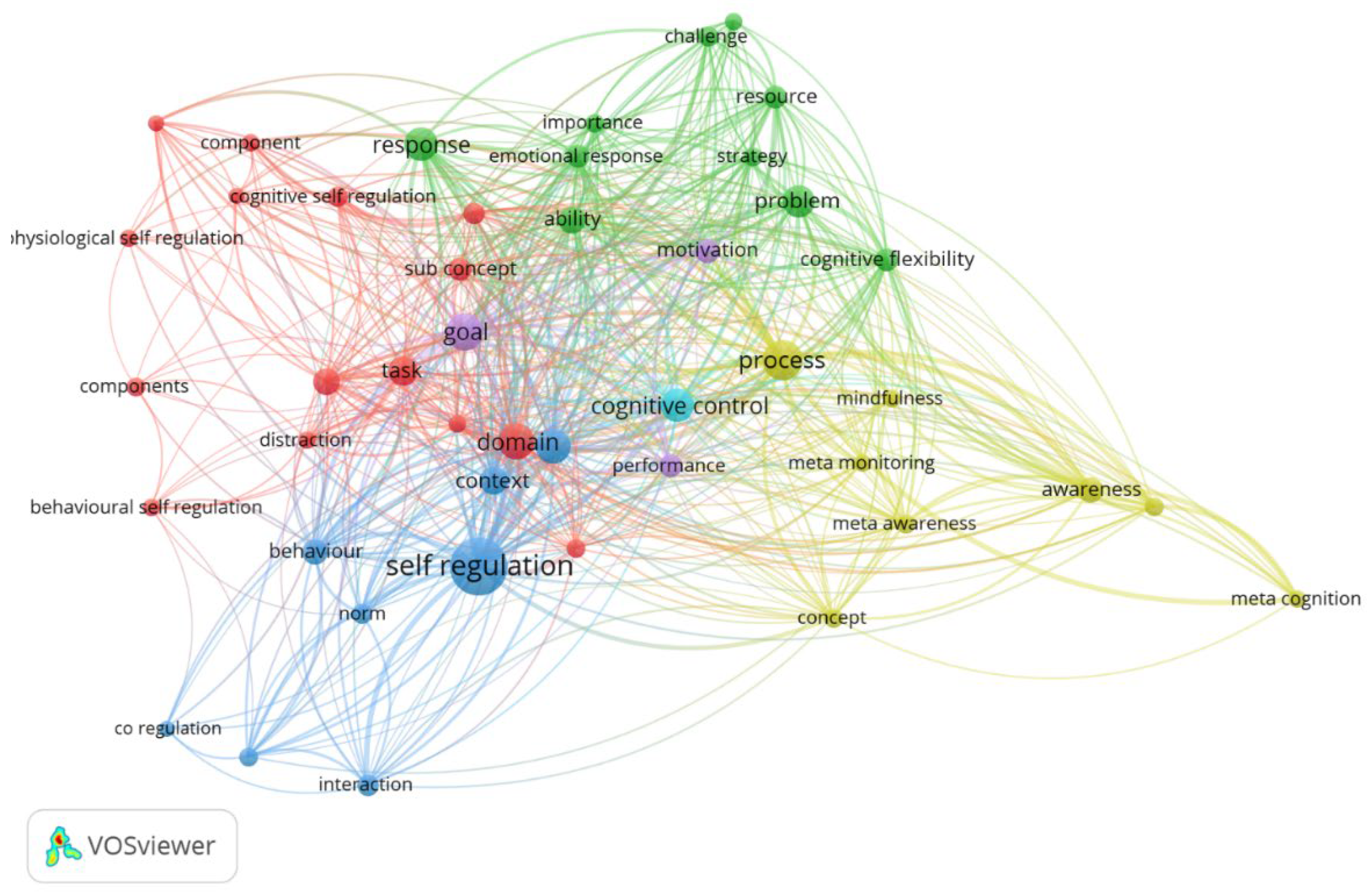
Compared with VOS map 1, analysing self-regulation thematically, organising its subconcepts, and delineating its functions and definitions have resulted in a much more organised construct. This map shows distinct conceptual clusters, and self-regulation is accurately positioned at their intersection, illustrating their compound, integrated nature. Cognitive control is densely populated, confirming our findings that it is the backbone of self-regulation through all domains. Motivation is well connected both to cognitive and behavioural clusters, affirming its important role in supporting cognitive control with the drive to pursue a chosen goal. The difference between maps one and two confirms the viable contribution of the Comprehensive Model of Self-Regulation (Van Eck & Waltman, 2010; Vos Viewer, nd).
5. The Conceptualisation of Brain Awareness
5.1. Meta-Awareness as the Guiding Principle of Self-Regulation in Brain Awareness
Operationalising self-regulation demands meta-awareness. Meta-awareness in Brain Awareness enables individuals to monitor and meta-evaluate their physical, affective, behavioural, social, motivational, and cognitive states to ensure alignment with contextual requirements, a contextually ideal state, goals, tasks, and priorities.
Due to the blurring of conceptual boundaries in self-regulation literature, the distinct applications of metacognition and meta-awareness need clarification. Meta-cognition should be confined to the domain of cognition and represent only the awareness of one’s cognitive functions (Hussain, 2015; Ali, 2016; Pattanayak et al., 2022; Frith, 2023; Van de Kamp et al., 2015). It does not reflect the organism’s overall awareness. Meta-awareness, in turn, comprises the current content of holistic consciousness over a variety of self-regulatory domains. This decenters it from cognitive processes and recognises the individual as a physical, sensory, emotional and social being.
Meta-awareness creates a neuropsychosocial self-representation in the moment and context. It relies on incoming sensory information, interoception, social intelligence, emotional intelligence, proprioception, and memory to estimate emotional and cognitive capacity, relationship to the context, task pefromance, status of goal pursuit, limitations, values, available resources, and physiological, behavioural, social, motivational, and cognitive states (Dunne et al., 2019; Mograbi et al., 2024).
In Brain Awareness, each domain is monitored to evaluate whether its state is conducive to achieving goals or a contextually ideal state. Figure 6 below illustrates the flow of information to create a neuropsychosocial self-representation for this purpose. When a deviation from the ideal state is detected in any domain, meta-evaluation creates a space between the stimulus and the response to develop an appropriate adaptive response that adjusts domains not in an ideal state (Lerner et al., 2021; Evans et al., 2017). This is illustrated in Figure 6 below.
5.2. Cognitive Control as the Executive Power behind Brain Awareness
Literature has been inconsistent about the role of cognitive control. In this model, once a deviation in the ideal state of one of the domains is detected and a meta-evaluation has devised an appropriate adaptive response, cognitive control is powered by motivation to mobilise resources and activate systems that modulate behaviour, and prepare the body and brain for action (Shen et al., 2025; De Bruin et al., 2020; Benight et al., 2024). This is illustrated in Figure 7 below.
5.3. The Domains and Mechanisms of Brain Awareness
5.3.1. The Composite, Hierarchical Operationalised Nature of Brain Awareness
Operationally reconceptualising psychological constructs such as self-regulation, its subconcepts, and components means describing what they do and how their implementation varies across contexts, not what they are. It clarifies concepts as functions (Uher, 2023; De Boeck et al., 2023; FORS, 2023). This contrasts with the traditional treatment of concepts as fixed, internal traits.
An operational conceptualisation of self-regulation promotes and enhances clarity and construct-utility validity, and facilitates integration across disciplines, enabling its use in therapeutic or educational contexts (De Boeck et al., 2023; Du Preez & De Klerk, 2019; Slaney, 2017). De Boeck et al. (2023) suggest that conceptual clarification and operationalisation of psychological concepts should be achieved by capturing the essence of each construct and recording its function. Many psychological constructs, such as self-regulation, are composite rather than unitary; hence, De Boeck et al. (2023) recommend a hierarchical organisation of sub-concepts and components as functions. Their rigorous process, “The Composite-Hierarchical Construct Model”, was used to reconceptualise all sub-concepts and components of the Comprehensive Model of Self-Regulation as more operational, context-sensitive, and epistemologically robust. This reconceptualisation resulted in a function called Brain Awareness, which is composite and hierarchically structured to self-regulation in delineated domains through operational mechanisms. The process is reflected in Figure 3 under methodology
Extracting the Composite Nature of Self-Regulation
Brain Awareness is intended to function as an operational construct (a function) comprising multiple domains that self-regulate via specific mechanisms in each domain. According to the Comprehensive Model of Self-Regulation, these domains are physiological, affective, behavioural, social, motivational and cognitive. Brain Awareness orchestrates self-regulation in these domains to achieve a contextually ideal holistic state and goal achievement. As reflected in the conceptual literature review and the Comprehensive Model of Self-Regulation, the composite nature of self-regulation is an important theme in the data and is supported by most studies (Inzlicht et al., 2021; Nigg, 2017; Woltering & Shi, 2016; Hagger et al., 2017).
Extracting the Hierarchical Nature of Self-Regulation
The composite domains of Brain Awareness interact hierarchically and contextually. Interactions and dependencies between domains are scaffolded rather than rigid and can be influenced by reappraisal loops. Following the literature, the Brain Awareness hierarchy scaffolds domains in the following sequence: Physiological, Emotional, Behavioural, Social, Motivational and Cognitive. This follows the process of lower- to higher-order self-regulation (Blair & Ku, 2022; Jones & Schüz, 2021; Murray & Mulan, 2019; Lebuda & Benedek, 2023; Nigg, 2017). This hierarchical scaffolding remains in place as one adapts to context, change, and challenges, but bidirectional interactions among domains require reappraisal loops. These loops operate through meta-awareness and follow a repetitive cycle of meta-awareness, conflict detection, meta-evaluation, cognitive control that activates domain-specific mechanisms, and recovery toward goal pursuit or the ideal state.
Contextual Sensitivity
Contextual framing of psychological concepts is also a primary requirement for the Composite-Hierarchical Construct Model of De Boeck et al. (2023). Psychological constructs can be understood only in the context of the individual. The thresholds for conflict detection, deviation from an ideal state, or goal pursuit will vary across contexts and environmental demands. Context shapes inherent predispositions in meta-evaluation (Shen et al., 2025; Blair & Ku, 2022; Evans et al., 2017; Inzlicht et al., 2021).
Epistemological Clarification
Brain Awareness is best understood as function that cannot be reduced to any single domain or mechanism; and no single domain is dominant. It is a hierarchical system of domains best understood through their operational mechanisms, which function to achieve a desired state, pursue goals, and facilitate contextually adaptive behaviour resulting in healthy psychosocial functioning.
5.3.2. The Domains and Mechanisms of Brain Awareness
Brain Awareness divides self-regulation into six distinct domains. Every domain relies on a set of functional mechanisms to enhance self-regulation within it.
Domain 1: Physiological Stress Adaptation
Like every domain of Brain Awareness, Physiological Stress Adaptation operates within a loop of meta-awareness and meta-evaluation that compares the current physiological state with the ideal physiological state or current goal-oriented performance against the ideal goal-oriented performance. This requires meta-physiological awareness, which monitors physiological stress response to detect and appraise physiological dysregulation induced by stimuli. Self-regulation in this domain is referred to as “physiological stress adaptation” in a Brain Awareness context (Blair & Ku, 2022; Frazier et al., 2021; Guo et al., 2025; Nigg, 2017).
Physiological Stress Adaptation involves interactions between autonomic, neuroendocrine, neurochemical, and neural control mechanisms to de-escalate stress arousal and refocus the brain on the ideal state or goal-directed behaviour. Some of these mechanisms can be learned to improve cognitive control and enable self-regulation of the physiological stress response (Woltering & Shi, 2016; Frazier et al., 2021).
Physiological Stress Adaptation is the lowest scaffolding domain of Brain Awareness. It scaffolds all other domains; those domains rely on its equilibrium to maintain a contextually ideal state. It enables the modulation of internal biological states in response to environmental stressors and affective stimuli (Blair & Ku, 2022). It is activated when meta-physiological awareness receives alerts indicating deviations, ranging from subtle background discomfort to sensory channels registering external cues, while interoceptive systems signal physiological changes in heartbeat, breath, muscle tension, and visceral sensations. These signals arrive as moment-to-moment data the brain compares against baseline expectations, producing a sense that something in the environment or body has changed and may require attention. These evaluations determine whether the detected change indicates a threat, an opportunity, or a neutral variation (Woltering & Shi, 2016; Blair & Ku, 2022).
This triggers meta-physiological evaluation, which appraises the situation through autonomic and neuroendocrine signalling and translates raw signals into meaningful information. It estimates the resources available to respond and determines urgency and valence, while deciding if the system will escalate, restrain, explore, or resume calm. This evaluation integrates contextual information, internal states of domains, prior learning, desired states and goals to produce a working hypothesis about what is required (Blair & Ku, 2022; Roos & Witkiewitz, 2017; Nigg, 2017).
Next, cognitive control mobilises resources to activate systems that prepare the body and brain for appropriate action or restraint. Autonomic and neurochemical systems shift to meet the assessed demand. Adaptive responses might involve sympathetic arousal that supports vigilance and rapid response, while neurochemical signals allocate attention and motivation. Heart rate, vagal tone, respiration, blood flow, and muscle tone adjust to prepare the individual for orienting, approaching, escaping, or focused engagement as deemed necessary by the appraisal (Blair & Ku, 2022; Frazier et al., 2021; Gholami et al., 2022). This process is referred to as top-down cognitive control.
Bottom-up reactivity involves instinctive responses to distressing external stimuli. The bottom-up responses interact with top-down cognitive control to shape the adaptive response to contextual changes. Physiological adaptation is now actively harnessed to maintain a contextually desired state and task performance (Evans et al., 2017; Woltering & Shi, 2016; Benight et al., 2024).
Recovery and recalibration complete the cycle by de-escalating activation and restoring equilibrium. Parasympathetic engagement, HPA axis modulation, and behavioural routines accelerate the return toward baseline arousal. The nervous system then updates short-term set points through allostatic calibration. Effective recovery shortens time spent in high arousal and reduces interference with functioning in other domains, thereby preventing dysregulation (Roos & Witkiewitz, 2017; Blair & Ku, 2022; Frazier et al., 2021).
Memory and long-term physiological adaptation embed the episode into the individual’s adaptive architecture. This results in epigenetic changes, neuroplasticity, and learned appraisal patterns. This adjusts sensitivity thresholds and regulatory strategies in the event of a recurrence.
A high frequency of appraisal, mobilisation, and recovery accumulates in the short term as either resilience or allostatic load: resilience, when benefit is derived from it, and allostatic load if accumulation leads to depletion (Blair & Ku, 2022; Roos & Witkiewitz, 2017; Ger & Buehler, 2024).
In Brain Awareness, the adaptation and maintenance of equilibrium in each domain is achieved through operational mechanisms. Table 4 below lists the mechanisms responsible for regulative adaptation of physiological processes.
In therapeutic and educational applications of Brain Awareness, these mechanisms should be understood and explained as active, adaptive processes that scaffold physiological adaptation and support recovery, thus preventing higher-order dysregulation in subsequent domains.
Affective Adaptation is the next scaffold of the Brain Awareness domains. It depends on effective physiological stress adaptation, but it can be bi-directional in the sense that effective affective adaptation can also be modulate physiologic stress arousal (Braund & Timmons, 2021; Nigg, 2017; Philpott-Robinson et al., 2025).
Domain 2: Affective Adaptation
Affective Adaptation refers to the modulation of affective responses to preserve relational safety, support emotional coping, maintain a healthy emotional state and enable goal-directed persistence (Reynolds & McCrea, 2016; Guo et al., 2025). Affective Adaptation unfolds through interrelated mechanisms. It starts with meta-affective awareness. When emotional arousal or conflict threatens emotional equilibrium, meta-affective evaluation uses the identified the current affective state, dominant emotion, contextual demands, affective resources and memory. to determine. It then determines the appropriate adaptive response and triggers cognitive control. Cognitive control now activates affective adaptation mechanisms to modulate affect in support of goal attainment and the ideal state. Affective adaptation mechanisms help individuals return to a baseline affective state by restoring emotional equilibrium and enabling recovery from dysregulation (Reynolds & McCrea, 2016; Guo et al., 2025; Philpott-Robinson, 2025; Woltering & Shi, 2016).
High emotional load, however, may reduce the availability of adaptive mechanisms and inhibitory capacity, thereby reducing the resources available to cognitive control for initiating affective and resultant physiological downregulation.
These are the mechanisms Brain Awareness uses to enable affective adaptation.
Table 5.
The Mechanisms of Affective Adaptation.
| Mechanism | Function |
|---|---|
| Meta-affective awareness | This entails the individual being aware of their affective states and dominant emotions, monitoring them for arousal that might compromise goal-directed behaviour or the contextually ideal state (Valikhani et al., 2022; Smith & Racine, 2025). |
| Meta-affective evaluation | Takes into account internal and contextual resources, as well as contextual demands, to determine appropriate mechanisms for downregulating arousal through cognitive control (Reynolds & McCrea, 2016; Smith & Racine, 2025). |
| Reappraisal | Reappraisal alters the affective impact of a trigger by facilitating reinterpretation of its meaning, thus promoting adaptive responses (Marple et al., 2025; Smith & Racine, 2025). |
| Expressive suppression | This involves using cognitive control to inhibit contextually inappropriate or maladaptive affective expression, impacting the behavioural and social domains (Inzlicht et al., 2021). |
| Rejection of affective response | The rejection of affective experiences characterises this maladaptive facet of Affective Adaptation. It disrupts affective reappraisal and adaptive response selection by inhibiting the processing and integration of the experience. It prevents any response to affective stimuli. |
| Impulse control | Cognitive control engages impulse control to suppress automatic or instinctual responses during distress, opting for a more contextual, adaptive, goal-oriented response (Inzlicht et al., 2021; Marple et al., 2025). |
| Affective intelligence | This involves naming and recognising affective experiences and emotions in order to manage them (Valikhani et al., 2022; Smith & Racine, 2025). |
| Meta-compassion | This mechanism enables individuals to respond to emotional distress with self-acceptance, self-kindness, and nonjudgmental awareness. It buffers against affective dysregulation and assists with the return to affective equilibrium (Finlay-Jones et al., 2015). |
| Affective reframing | This enables the reinterpretation of emotionally charged situations or stressors in ways that reduce distress, restore emotional flexibility, and support adaptive functioning. Emotional flexibility shifts the evaluative lens through which an experience is understood and transforms perceived threats into constructive, goal-aligned perspectives (Horner et al., 2024; Inzlicht et al., 2021). |
Domain 3: Behavioural Adaptation
Behavioural Adaptation facilitates real-time recalibration of behaviour, enabling individuals to act intentionally, flexibly, and appropriately, to promote goal-directed behaviours, and to adapt to new contexts. Its mechanisms support adaptive functioning across developmental stages, contexts and relational environments (Braund & Timmons, 2021; Kreibich et al.; Evans et al., 2017; Reynolds & McCrea, 2016).
Well-adjusted behaviour is aligned with contextual demand, relational health, goals, tasks, norms, requirements, priorities and values. Meta-behavioural monitoring continuously tracks behaviour to ensure it is well-adjusted and conducive to goal pursuit and task completion (Tee et al., 2021; Lerner et al., 2021). Once it is detected that behaviour is mal-aligned with contextual demands, relational health and goal pursuit, meta-behavioural awareness registers a conflict. This creates a space between the stimulus and the response, enabling meta-evaluation to gain information and insight into the behavioural change, and strategises to develop an appropriate adaptive response using the mechanisms below (Lerner et al., 2021; Evans et al., 2017).
Table 6.
Mechanisms of Behavioural Adaptation.
| 74 | Function |
|---|---|
| Impulse Inhibition | The inhibition of automatic, affect-driven or contextually inappropriate behavioural responses requires delayed gratification and suppressed reactive action. It blocks premature responses to stressors (Horner et al., 2024; Inzlicht et al., 2021). |
| Task initiation | The initiation of goal-directed behaviour involves converting internal goal-oriented signals to behavioural output, bridging intention and behaviour by overcoming inertia and avoidance (Tee et al., 2021). Initiating a new task is influenced by perceived task value and self-efficacy (motivational mechanisms), which powers cognitive control and is diminished by current emotional load (Horner et al., 2024; Inzlicht et al., 2021). |
| Sustained attention | Maintaining task engagement, relational focus or contextually beneficial behavior over time despite distractions or emotional interference is also supported by motivation, which enables task persistence and contextually beneficial behaviour (Geronimi et al., 2019; Braund & Timmons, 2021). |
| Behavioural flexibility | Flexibly adapting behaviour in response to changing demands, relational fluctuations and behavioural change after feedback, enables strategic behavioural shifts to enable context-sensitive beneficial behaviour (Smith & Racine, 2025). |
| Goal-directed behaviour | The sustained pursuit of internally valued outcomes or goals through cognitive control integrates motivation with behavioural execution, enabling continued alignment with goals despite emotional or contextual disruptions (Tee et al., 2021; Braund & Timmons, 2021). |
| Behavioural inhibition | Suppressing habitual behaviours that conflict with goals or contextual demands requires strategic restraint and supports adaptive decision making (Inzlicht et al., 2021; Woltering & Shi, 2016). |
| Following directions | Complying with others’ instructions can be helpful and is necessary to complete tasks and reach goals (Braund & Timmons, 2021). |
Behavioural Adaptation scaffolds social competence, which is a higher-order function. Social competence cannot be achieved if behaviour is not adapted to context or goal-oriented (Evans et al., 2017; Reynolds & McCrea, 2018).
Domain 4: Social Adaptation
Social Adaptation entails goal-directed, strategic social and relational behaviour that aligns with the individual’s goals or is contextually beneficial. Mechanisms such as social competence enable this (Braund & Timmons, 2021; Jones & Schüz, 2021).
Well-adjusted, contextually beneficial social and relational behaviour is guided by reading and interpreting social cues and feedback, and by tracking goals (Shen et al., 2025; Tougas et al., 2015; Reynolds & McCrea, 2016). Upon detection of a conflict between socially and relationally beneficial and appropriate goal-centred social interaction and current social behaviour, or a lack of relational progression, meta-social awareness triggers an alert. Meta-social awareness collects data to evaluate the situation and strategise for more
socially adaptive behaviour. Cognitive control engages social competence and other mechanisms to enable this prosocial behaviour (Amorim & Marques, 2018; Joss et al., 2021).
This may be delayed by physiological and affective arousal, which needs hierarchically to be de-escalated first. Once emotional reactivity has been neutralised, cognitive control engages with appropriate social competence mechanisms to restore socially adaptive behaviour (Amorim & Marques, 2018; Joss et al., 2021).
Social competence results in goal-congruent social behaviour, repaired relational safety, a regulated affective state, an updated social-cognitive schema for future interactions, and an expanded adaptive repertoire (Lawler et al., 2019; Amorim & Marques, 2018).
Various contextual factors shape social competence. Relational safety provides the emotional security needed for empathy, co-regulation, and behavioural inhibition, while enabling flexible social engagement and recovery from relational damage (Braund & Timmons, 2021). Cultural norms also shape social competence by defining acceptable emotional expression within cultural contexts and relational roles (Reynolds & McCrea, 2016). Environmental predictability enhances the development of social competence, because a stable, low-threat environment supports the maintenance of adaptive equilibrium, while chaotic, unpredictable contexts elevate affective reactivity and reduce adaptive behaviour, negatively impacting the development of social competence (Roos & Witkiewitz, 2017). Early childhood caregiver attachment shapes the baseline experience of trust in relationships and impacts emotional openness and responsiveness to relational feedback. Secure attachment in childhood fosters the internalisation of co-regulation (Braund & Timmons, 2021). These contextual factors actively scaffold the emergence, refinement and adaptive expression in social competence. Social competence is enhanced by access to a broader repertoire of social and contextually adaptive mechanisms (Shen et al., 2025; Tougas et al., 2015).
Table 7.
Mechanisms of Social Adaptation.
| Mechanism | Function |
|---|---|
| Empathy | Detecting others’ emotional states enables understanding and resonating with them, facilitating interpersonal attunement, supporting co-regulation, and informing socially responsive behaviour by integrating external emotional signals into the appraisal cycle. Development of this skill depends on secure attachment and responsive caregiving in early childhood (Braund & Timmons, 2021; Shen et al., 2025; Evans et al., 2017). |
| Perspective taking | Adopting another person’s viewpoint enhances social problem-solving, reducing interpersonal conflict, and enabling context-sensitive behavioural adjustment (Smith & Racine, 2025). |
| Social cue Competence | The capacity to detect, interpret and respond to verbal and non-verbal cues in social situations enables strategic responses, resulting in behavioural synchrony and improved relationships (Geronimi et al., 2019; De la Fuente et al., 2022; Masaki, 2023). |
| Co-regulation | The mutual engagement between roleplayers and the reciprocal regulation of emotions and behaviours assists the development of relational safety and general adaptation in multiple domains through social learning (Braund & Timmons, 2021; Kreibich et al., 2022; Lage et al., 2022; Reynolds & McCrea, 2016). |
| Social inhibition | The capacity to suppress contextually inappropriate or impulsive social behaviours is enabled by cognitive control, which in turn enables strategic restraint, filters social behaviour, and promotes social harmony (Inzlicht et al., 2021; Woltering & Shi, 2016). |
| Relational flexibility | The ability to adjust emotional, behavioural, and social responses to changing relational dynamics, social feedback, or social cues enables relationship re-engagement following relational disruption (Finlay-Jones et al., 2015). |
Domain 5: Motivational Regulation
Motivational Regulation is a value-aligned domain that works through mechanisms to initiate, sustain, and persist with effortful tasks, resulting in sustained task performance and persistence until completion. It maintains motivation to allocate resources to adaptive strategies when facing distractions or conflicts and is the only domain that determines the resource allocation of cognitive control (Shen et al., 2025; De Bruin et al., 2020; Benight et al., 2024).
Once dysregulation in other domains is downregulated, motivation facilitates re-engagement in goal-directed behaviour (Carden et al., 2022; Shen et al., 2025; De Bruin et al., 2020; Benight et al., 2024). Successful re-engagement and goal achievement strengthen self-efficacy (Kruglanski et al., 2018; Fishbach & Woolley, 2022).
For successful goal pursuit or task completion, there must be alignment between goals, values, task demands, personal values, identity, and relational expectations to stimulate motivational engagement and persistence in stressful circumstances (Tee et al., 2021). Task value moderates motivation through perceived task relevance and the expected benefit of completing the task. This motivates the effort invested in underlying goal-oriented behaviour to shape adaptations to task demands despite obstacles and distractions (Tee et al., 2021; Carden et al., 2022; De Bruin et al., 2020; Shen et al., 2025).
The cumulative affective intensity of emotional load can derail motivation, constraining cognitive control, depriving it of the resources to enact effortful or inhibitory control, focused attention, flexibility, and social cue processing (Blair & Ku, 2022; Roos & Witkiewitz, 2017). Motivation can also promoted or derailed by perceived social support and the perception of relational safety. Relational safety buffers against affective reactivity while scaffolding motivation-driven cognitive control to flexibly re-engage after conflicts and failures (Roos & Witkiewitz, 2017; Braund & Timmons, 2021; Blair & Ku, 2022).
Personal history, personality traits, past trauma and relational history contribute to or detract from the resilience needed to stay task-focused and motivated (Blair & Ku, 2022; Braund & Timmons, 2021). Environmental constraints can shift resource allocation, require strategic adjustments, or even lead to motivational failure, stopping goal-oriented behaviour (Carden et al., 2022; De Bruin et al., 2020; Shen et al., 2025).
The allocation of resources during goal pursuit is determined by motivation through self-efficacy and task value appraisal, and precedes and evaluates the importance of the task and the likelihood of achieving the goal. This helps the individual to decide whether the task’s net value and gain align with abilities, needs, values, and priorities. Once the potential goal is appraised and selected, the extent to which the goal is important to the individual is referred to as goal orientation. Resources are allocated accordingly and goal pursuit is activated by task activation (Tee et al., 2021; Shen et al., 2025; Fishbach & Woolley, 2022). Effort is now mobilised, attentional control is activated, planning is initiated, and all other mechanisms are applied to pursue the goal (Carden et al., 2022; De Bruin et al., 2020). Effort maintenance enables persistence mechanisms, which are only possible if motivational mechanisms can counter fatigue and distractions (Benight et al., 2024; Shen et al., 2025).
During task engagement, performance is monitored through meta-awareness of the task’s dominant domain. A lack of progress leads to meta-evaluation and alerts cognitive control. Then the meta-awareness loop kicks in. Meta-evaluation, reappraisal, restrategising, problem-solving, planning, and new resource reallocation are carried out to re-engage with reviewed strategies (Tee et al., 2021; De Bruin et al., 2020).
Table 8.
Mechanisms of Motivational Regulation.
| Mechanism | Function |
|---|---|
| Task value appraisal | The evaluation of a task or goal’s personal importance and potential benefit for the individual modulates motivational engagement, effort allocation and influences persistence under challenging circumstances (Tee et al., 2021). |
| Effort mobilisation | Activates and sustains effort according to resources assigned by cognitive control to achieve goals. toward. It can be compromised by high allostatic load and affective and physical dysregulation (Inzlicht et al., 2021; Horner et al., 2024). |
| Goal orientation | Internal motivation to achieve the goal shapes strategic engagement, emotional investment, and responds to success or failure in tasks (Tee et al., 2021; Huang et al., 2020). |
| Persistence under pressure | Maintaining goal-directed effort despite multi-domain pressure and disruption buffers against withdrawal when faced with challenges. It relies on healthy physiological and affective adaptation, as well as meta-compassion (Finlay-Jones et al., 2015). |
| Re-engagement | Resuming goal-directed effort after interruption, failure or depletion supports re-strategising and persistence in goal-directed behaviour under fluctuating conditions (Blair & Ku, 2022). |
| Autonomy | Internalised motivation to act in accordance with personal values, interests, priorities, or identity despite external demands. It sustains motivated, long-term engagement and buffers against external pressure while enhancing potential for effort investment in goal pursuit (Smith & Racine, 2025). |
Domain 6: Cognitive Process Adaptation
Cognitive Adaptation in Brain Awareness is a self-directed, goal-oriented, multi-mechanism system that enables individuals to monitor, adjust, and optimise cognitive processes in pursuit of goals (Marulis et al., 2020; Nigg, 2017; Shen et al., 2025). It enables clear, flexible strategic thinking, while intentional goal setting guides focus on relevant tasks, activating cognitive resources to pursue goals while managing competing demands (Braund & Tmmons, 2021; Inzlicht et al., 2021; Frazier et al., 2021). Meta-cognitive awareness monitors current cognitive states and processes against the requirements for task completion. The allocation of cognitive resources to task completion is determined by motivation levels. To complete tasks, cognitive resources are used to solve problems, formulate strategies and plan and execute. Working memory holds and manipulates task-relevant information, enabling reasoning and decision making, while attentional control ensures the individual can focus on the task and suppress impulses and distractions, enabling moving from task activation to task completion. Upon detection of conflict or deviation from expected cognitive processes, such as distractions (Blair & Ku, 2022; Braund & Timmons, 2021). Inhibitory control suppresses impulses, reducing the need for immediate gratification. Meta-cognitive evaluation then evaluates strengths, weaknesses, limitations, and available cognitive resources to assist in restrategising and making new plans (Lebuda & Benedek, 2023; Hussain, 2015). This allows a pause to switch to problem-solving and planning (Koslov et al., 2019; Marulis et al., 2020). In this process, physiological and affective adaptation is critical for managing emotions such as frustration, anxiety, and disappointment, which may impact the ability to think clearly, re-strategise, and persist in task engagement. If physiological and affective equilibrium is maintained and restored, persistence and re-engagement are used to restart the processes of effortful control, attentional control and focus. Cognitive flexibility then powers problem-solving by enabling the adjustment of strategies, the reframing of internal experiences and external conflicts, and the recalibration of cognitive efforts through identifying specific obstacles, and generating solutions, while cognitive flexibility enhances the ability to discard ineffective initial strategies, thus enabling strategic agility, restrategising integrating internal and external feedback (Gholami et al., 2022; Braund &Timmons, 2021; Koslov et al., 2019).
The recurrent meta-awareness loops of Brain Awareness operate in concert to maintain overall stability and cross-domain adaptive functioning, while engaging in through cognitive skills (Schall et al., 2017; Huang et al., 2020; Carden et al., 2022; Tee et al., 2021).
The complexity of the task, affective arousal, distractions, developmental maturity, relational safety, and environmental scaffolding influence the effectiveness of cognitive adaptation. As the highest level of functioning, cognitive adaptation requires the effective functioning of all other Brain Awareness domains (Gagne et al., 2021; Evans et al., 2017; Antonopoulou, 2024). Therefore learning is impossible when the other domains are not regulated.
Table 9.
Mechanisms of Cognitive Adaptation.
| Mechanism | Function |
|---|---|
| Attentional control | Cognitively directing and sustaining focus in alignment with task completion, goal attainment or contextual demands. It filters out irrelevant stimuli, prioritising only goal-relevant information and enables strategic engagement with cognitive tasks (Geronimi et al., 2020; Jain et al., 2024; Hussain, 2015). |
| Cognitive flexibility | Shifting cognitive strategies in response to changing demands or feedback, thus enabling the adaptation of thoughts and behaviours as they transition between tasks, rules and mental sets. It transforms rigid thinking into alternative perspectives, enabling adaptive problem solving, conflict resolution, and the integration of new information into a problem through reframing and reappraisal (Jain et al., 2024; Boyer, 2023; Gholami et al., 2022). |
| Working memory | Holding information in short-term memory and manipulating it to support the execution of cognitive tasks enables planning, sequencing and the integration of task-relevant data. Its operability is sensitive to physiological stress, emotional activation and reactivity (Ger & Buehler, 2024; Braund & Timmons, 2021; Horner et al., 2024; Huang et al., 2020). |
| Inhibitory control | It suppresses automatic, habitual or contextually inappropriate cognitive responses, enabling strategic restraint and redirecting attention to goal-aligned processing. It can be compromised by emotional load (Huang et al., 2020; Pozuelos et al., 2019). |
| Strategic processing | The intentional selection and application of cognitive strategies to optimise task performance enable planning, prioritisation, and resource allocation under complex or emotionally charged conditions (Tee et al., 2021). |
| Planning | Planning bridges intention and action by formulating strategies to achieve goals and by facilitating cognitive thought aimed at desired outcomes (Evans et al., 2017; Shen et al., 2025). |
| Problem solving | Requires focus to identify obstacles to goal achievement, generating new solutions through cognitive flexibility, the adaptation of approaches and the reframing of problems. (Koslov et al., 2019; Nigg, 2017). |
| Strategic cognitive adaptation | Integration of and adaptation to new information to select new cognitive strategies or adjust existing strategies according to changing demands, or changes in context (Jain et al., 2024; Lebuda & Benedek, 2023). |
| Meta-cognitive awareness | Tracking performance and assessing task progress, detecting errors or conflicts that might compromise task execution (Carden et al., 2022; Tee et al., 2021). |
| Strategic cognitive recalibration | A post-crisis or dysregulated state in which attentional control has been restored, affective arousal has been downregulated, and interfering input has been filtered out. Effortful control can now enable task completion after adaptive recalibration, and the individual is ready to re-engage with the task (Koslov et al., 2019; Philpott-Robinson et al., 2025; Finlay-Jones et al., 2015). |
Figure 8.
Conceptualisation of Brain Awareness.
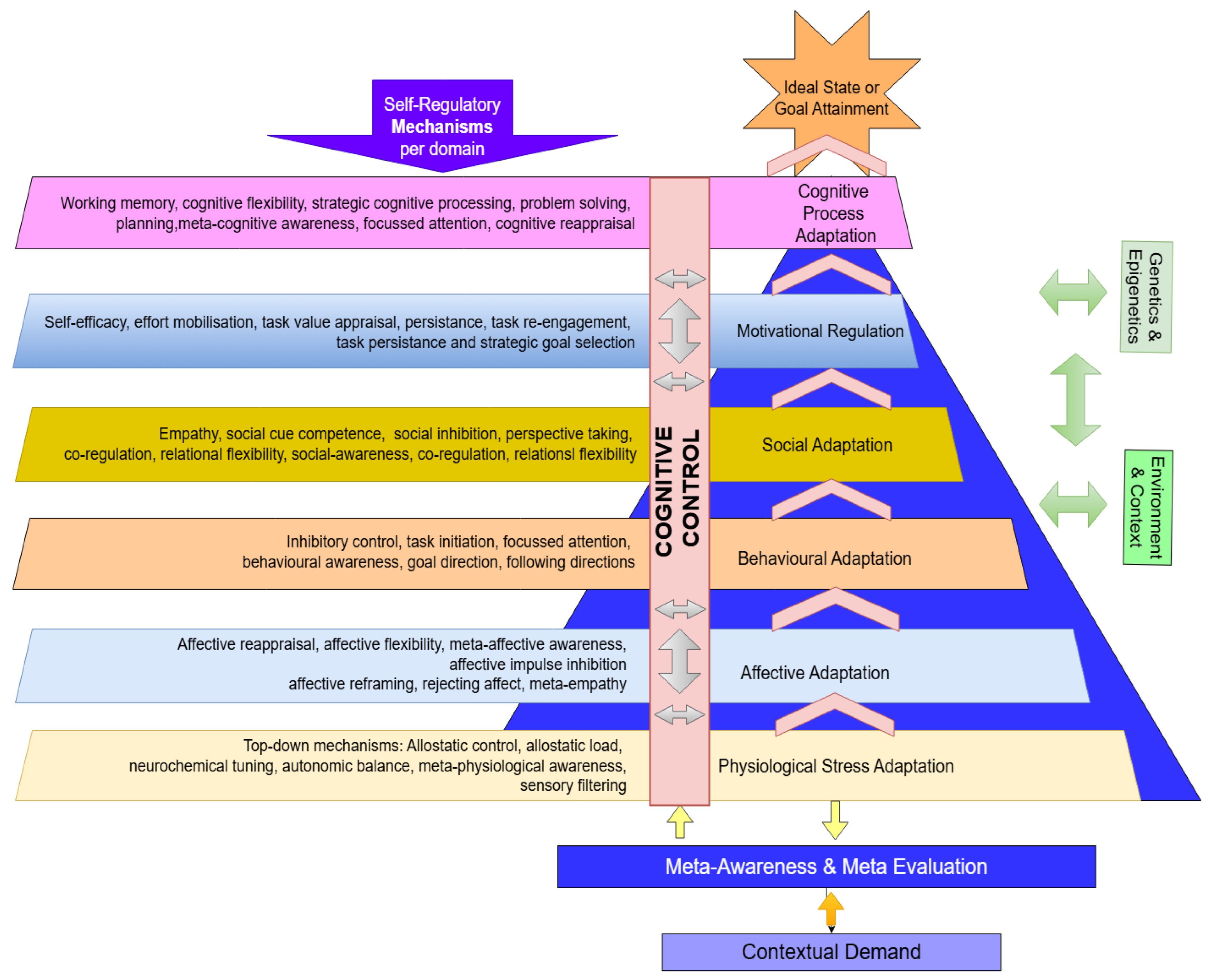
6.
6.1. VOS Map iii
VOSViewer was used to map Brain Awareness in VOS Map 3. The result shows a well-connected network with delineated domains, illustrating the central roles of cognitive control and meta-monitoring, and the absolute centrality of the goal. It also includes the importance of context and strategy. This visualisation presents Brain Awareness as a strategically structured, logical construct centred on achieving goals through operationalising its various domains
Scheme 3.
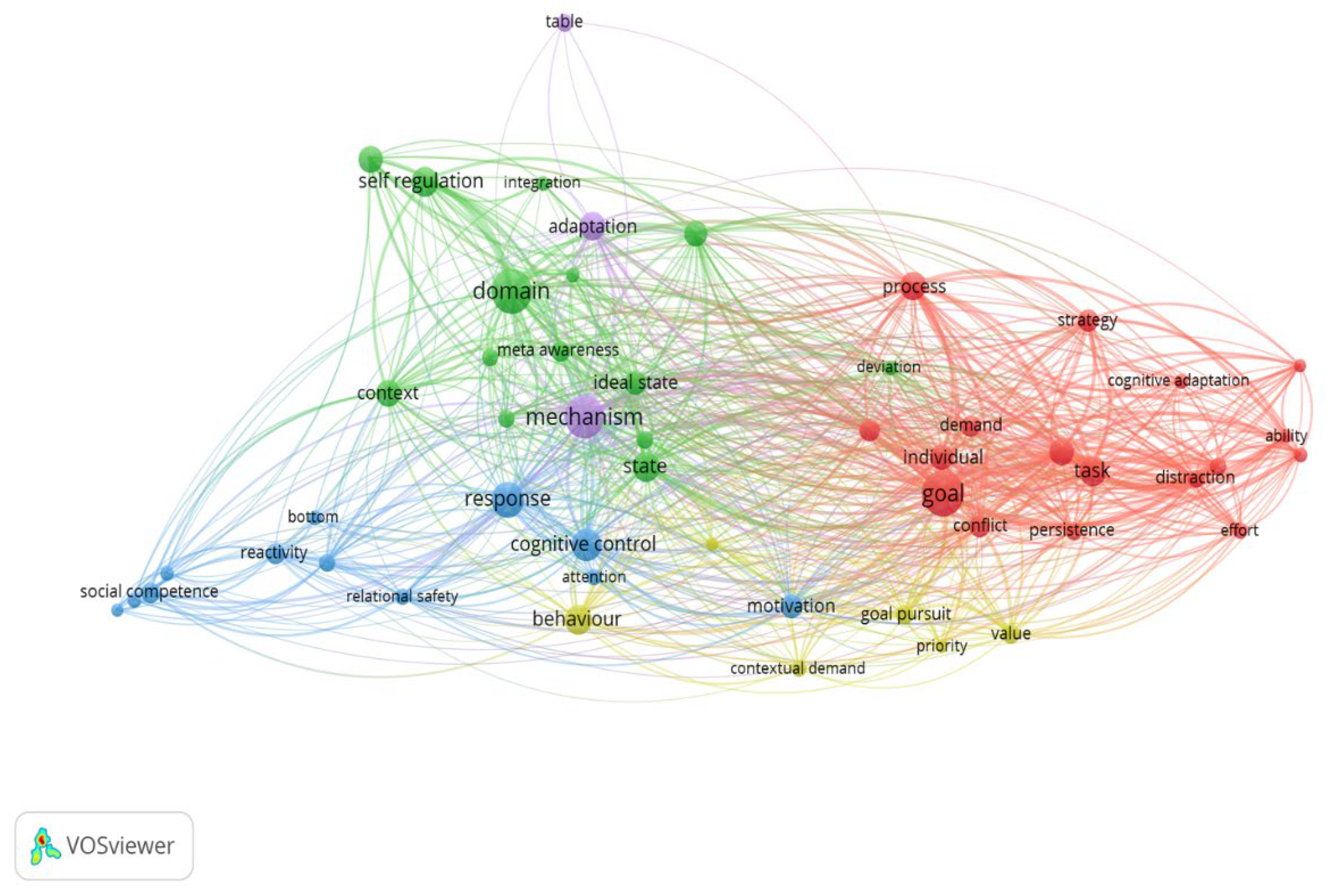
6.2. Summarised Conceptualisation of Brain Awareness
Brain Awareness is a composite, hierarchically organised, developmentally embedded process-based function that operates through a range of domain-specific mechanisms. It enables holistic adaptation to internal and contextual factors. It promotes goal-oriented behaviour and the achievement of a contextually ideal state across physiological, affective, motivational, behavioural, social, and cognitive domains. It operates through a ubiquitous meta-awareness to detect undesirable changes, challenges, and conflicts. Cognitive control functions across domains to allocate resources and activate domain-specific Brain Awareness mechanisms to manage potential dysregulation, to prevent maladaptive outputs, and restore holistic equilibrium.
7. Discussion
As a neuropsychological construct, self-regulation is grounded in a range of theoretical bases. None of these theoretical underpinnings disqualifies or challenges the validity of the others’ when considering self-regulation as a multi-sub-concept construct; they complement rather than oppose other approaches. Merging theories yields a more holistic understanding of self-regulation, by paying due attention to all dimensions of being human and to contextual adaptation, rather than overemphasising executive function.
Thematic analysis of the extracted data has enabled a more organised view of self-regulation, including the main theoretical approaches in literature. This model structures self-regulation into a more coherent, understandable form, hinting at a scaffolded hierarchy. It remains, hoever, unoperationalised and conceptual rather than functional. There are suggestions of a looping process of self-evaluation in literature, but no clear, comprehensive, or consistent direction. It is complicated by the involvement of multiple confusing, overlapping, and contradictory concepts, without specifying how the cognitive domain interacts with other domains.
In the novel Comprehensive Model of Self-Regulation created in this study, a composite idea emerges of demarcated domains from a variety of research, which supports adaptive functioning through reflective loops. This Comprehensive Model of Self-Regulation greatly improves understanding of holistic self-regulation by acknowledging all levels of human beings.
Regulating the holistic self requires explicit iterative assessment of more than the previously over emphasised goal-oriented progress. It involves social behaviour, relationships, physical health, and general holistic states. As self-regulation is acknowledged as a resource that can be either used up, or built up, this resource needs a specific function to make it operate as the brake and fuel pedal of self-regulation. This recognition of the importance of other domains has been lacking in literature, thus impacting greatly on the operationalisability of self-regulation as it is scaffolded in nature. In addition, older literature and theory tend to conceptualise self-regulation as an internal process entirely dependent on internal influences and resources. This denies the great reciprocity between the individual and their context. While self-regulation is viewed as an objective concept, recent literature highlights that it has very little meaning outside of context. It can thus function realistically only as a contextual mechanism of contextual adaptation rather than only as an internal control mechanism. Ommitting the important role of context in self-regulation also denies access to social resources that not only shape development of self-regulation but can also contribute to self-regulation in the moment (Marulis et al., 2020; Jones & Schüz, 2021; Guo et al., 2025; Marple et al., 2025; McDonald, 2021; Frazier et al., 2021; Belte et al., 2024; Nigg, 2017). This impedes its implementation due to a traditional overemphasis on executive function. How can an individual be guided in discerning social or behavioural conflict if context is not included in its understanding?
Literature lacks clear and consistent acknowledgement and utilisation of the hierarchical nature of self-regulation. Simple understanding, such as the inability to solve a problem when tired, emotional or ill is an indication of the natural hierarchy that exists in contextual adaptation. De Boeck et al. (2023) confirm that, for complex concepts such as self-regulation, the absence of hierarchical organisation makes operationalisation challenging because no mental schema exists to guide the idea.
The lack of consistent naming of the engine room behind self-regulation in different domains has left a critical gap, because that which is not named cannot be strengthened or intentionally utilised. Currently, some evidence indicates that cognitive control is the cognitive function that extends across domains.
An overemphasis on executive function has urred its conceptual boundaries with cognitive regulation and obscured the usefulness of cognitive functions in intervening in other domains. If executive function is said to be dependent on emotional regulation, what controls emotional regulation?
Strengthening the idea of a meta-awareness loop across domains, with an awareness of each individual domain, empowers the general thinking process of awareness, fault detection and fault correction. This greatly benefits the functionalisation of self-regulation.
This Comprehensive Model of Self-Regulation offers a more detailed identification and conceptualisation of sub-concepts and self-regulatory domains. It recognises physiological, cognitive, emotional, behavioural, and motivational components, as well as the influence of contextual relational, genetic, and biological factors in a consistent and integrated way. This enhances understanding of self-regulation as a scaffolded, context-sensitive construct shaped by individual traits, relational dynamics, and environmental factors, and highlights its importance for human functioning, surpassing mere cognitive regulation in favour of goal achievement.
Brain Awareness is conceptualised to address the above gaps by operationalising the Comprehensive Model of Self-Regulation as a composite, hierarchical concept that runs on a loop of meta-awareness and is powered by cognitive control. It stays within the clear conceptual boundaries of the different domains, with mechanisms that operationalise regulation across them. Evaluation of the ability to implement these mechanisms can also assess self-regulation and identify specific deficits that can be remediated individually.
Brain Awareness, as a function, guides clients toward a structured, goal-oriented response to feedback from meta-awareness over all domains and mental states and provides a mechanism to address undesirable deviations from baseline through a reappraisal loop using cognitive control.
Brain Awareness describes and categorises multiple domains, organises them into a logical hierarchy, clarifies conceptual boundaries, and operationalises the self-regulation of each domain. The value of Brain Awareness as a holistic enabler of self-regulation through all human domains can enhance individuals’ functioning throughout their lives. Research confirms the explicit benefits of holistic, context-sensitive self-regulation. It is deemed integral to navigating complex contextual, social, emotional, and cognitive demands (Greene et al., 2024; Elhusseini et al., 2022). Overt benefits of enabling self-regulation include academic success, improved health management, quality interpersonal relationships, goal-directed behaviour, increased autonomy, healthy psychosocial well-being, and the ability to manage adaptively all domains of human functioning (Greene et al., 2024; Elhusseini et al., 2022).
This research enables therapists to innovate experiences that support clients’ experiential learning of specific self-regulatory mechanisms and adaptive responses to stressors across domains. Repetition of these mechanisms in individuals who have lived through adversity can assist professionals in rehabilitating maladaptive neuroplastic changes.
8. Conclusions
Brain Awareness lays the foundation for future interventions in self-regulation and contextual maladaptation. It integrates all dimensions of being human and underscores the regulation of lower-order domains before the application of cognitive capabilities. This is an important finding for education, as children living in adversity are often expected to learn while dysregulated, and a lack of insight into their academic failure results in addressing educational rather than physiological, emotional and social competence.
All types of regulation emerge from the dynamic interaction among various domains, rather than from isolated subsystems (Finlayson & Edwards, 2023). The limitations of reductionist science are underscored by Săvoiu et al. (2023), who propose a paradigm shift toward holistic epistemology in health care. They argue that human regulation cannot be fully understood through isolated variables and propose a systems-thinking approach that integrates multiple levels of human functioning. Matser (2024) emphasises the importance of integrating the impact of ecological factors and understanding their interactions with regulatory functioning to achieve a deeper understanding of individuals in their context. Studies express the need for interdisciplinary research frameworks that reflect the interconnectedness of human systems (Săvoiu et al., 2023; Matser, 2024). Brain Awareness as a neuropsychological function answers to all of the above.
This research was conducted in the context of South Africa. The societal impact of early childhood adversity and high levels of developmental delays in self-regulation among young children here is enormous.
Literature suggests that negative consequences for society may result from prevalent developmental delays and self-regulation deficits in members of society. These consequences, of social dysfunction and related conflict, are due to increased aggression, poor social relationships, reduced cohesion in communities, unemployment, poverty, financial instability, and reduced productivity, high rates of mental illness, substance abuse, low academic attainment, high school dropout, limited skills development, increased crime rates, high-risk behaviours, increased teenage pregnancy rate, a strained healthcare system, transgenerational continuation of the problem and a cycle of poverty and disadvantage (Barkley, 2012; Diamond, 2013; Baumaister & Vohs, 2004; Moffit et al., 2001; Peckham, 2023).
These cannot be corrected simply by adopting a social development approach that creates job opportunities, because the process of having and holding a job is highly dependent on self-regulation. Trude et al. (2021) conducted studies in middle-income countries, demonstrating that cumulative early childhood adversity has an inverse impact on adolescent human capital, severely affecting psychosocial adjustment and IQ (Trude et al., 2021). This is confirmed by Zeng et al. (2019), who note that childhood adversity has a detrimental effect on human capital development.
In the Global South, the low ratio of psychologists, social workers and other therapists indicates that there is very little opportunity for a child with a deficit to access psychotherapy. Utilising Brain Awareness to create structured, low-risk cognitive experiences that can be generalised to schools brings solutions closer to those who need them. Studies confirm that the use of structured schemas in psychoeducation promotes the reorganisation of maladaptive cognitive-affective frameworks. It guides attention and provides the means for organising new information for deeper encoding (Neumann & Kopcha, 2018; Arntz et al., 2021; Flanagan et al., 2020).
Brain Awareness has the potential to be the first step in future research that can benefit anyone, but especially developmentally delayed children, high-risk youth, adults with traumatic brain injury or frontal lobe stroke. Multiple studies show that repetitive practice of self-regulatory exercises stimulates neuroplastic brain growth and has the potential to rectify the structural brain damage caused by early childhood adversity, stroke or traumatic brain injury. The operational, mechanism-based nature of Brain Awareness makes it possible to create these experiences for all ages, opening a new dimension for intervention design in self-regulation studies.
9. Future Directions
Future research will require the creation of age-appropriate experiences to enhance Brain Awareness mechanisms by enabling experiential learning of the process and activating neuroplasticity. Empirical testing of these interventions will allow researchers to fine tune generalisable interventions and to design culturally appropriate assessment tools to determine deficits in specific mechanisms.
Author Contributions
Conceptualization, Petro Erasmus and Leandi Erasmus.; Methodology, Leandi Erasmus.; Formal Analysis, Leandi Erasmus.; Investigation, Leandi Erasmus.; Resources, Petro Erasmus.; Data Curation, Leandi Erasmus.; Writing – Original Draft Preparation, Leandi Erasmus.; Writing – Review & Editing, Leandi Erasmus; Visualization, Leandi Erasmus; Supervision, Petro Erasmus.; Funding Acquisition, Petro Erasmus.
Funding
Funding for this study is made available by the Desmond Tutu Medical School of the North West University.
Institutional Review Board Statement
The study was conducted in accordance with the Declaration of Helsinki, and approved by the Institutional Health Research Ethics Committee of North West University, NWU-00236-25A1 as approved on 25 May 2026.
Data Availability Statement
Data and audit trail of the review is available from Dr. Erasmus at Leandi.Erasmus@nwu.ac.za on request.
Conflicts of Interest
The authors declare no conflict of interest.
References
- Agonis, C. Neuroplasticity Knowledge and Perceived Self-Efficacy in Western Adults: A Qualitative Examination. Graduate Student Journal of Psychology 2023, 21. [Google Scholar] [CrossRef]
- Ahn, S. N. A Systematic Review of Interventions Related to Body Awareness in Childhood. International Journal of Environmental Research and Public Health 2022, 19(8900), 8900. [Google Scholar] [CrossRef] [PubMed]
- Ali, M. M. An overview on meta-cognition. Asia Pacific Journal of Research 2016, 1, 38. Available online: https://www.academia.edu/download/105249779/An_Overview_on_Metacognition.pdf.
- Antonopoulou, H. The value of emotional intelligence: Self-awareness, self-regulation, motivation, and empathy as key components. Technium Education and Humanities 2024, 8, 78–92. Available online: https://pdfs.semanticscholar.org/01fd/901d7b6a987dc06497bea64f3b506eb0d4ea.pdf. [CrossRef]
- Alpuğan, Z. The impact of early childhood adversity on neurodevelopment: A comprehensive review. The Journal of Neurobehavioral Sciences 2024, 11(2), 45–59. [Google Scholar] [CrossRef]
- Arntz, A.; Rijkeboer, M.; Chan, E.; Fassbinder, E.; Karaosmanoglu, A.; Lee, C. W.; Panzeri, M. Towards a reformulated theory underlying schema therapy: Position paper of an international workgroup. Cognitive Therapy and Research 2021, 45, 1007–1020. [Google Scholar] [CrossRef]
- Aromataris, E.; Lockwood, C.; Porritt, K.; Pilla., B; Jordan, Z. JBI Manual for Evidence Synthesis; JBI, 2024. [Google Scholar] [CrossRef]
- Bailey, S. F.; Barber, L. K.; Justice, L. M. Is Self-Leadership Just Self-Regulation? Exploring Construct Validity with HEXACO and Self-Regulatory Traits. Current Psychology: A Journal for Diverse Perspectives on Diverse Psychological Issues 2018, 37(1), 149–161. [Google Scholar] [CrossRef]
- Bakibinga, P.; Matanda, D. J. The salutogenic approach to childcare in Sub-Saharan Africa: A focus on children who thrive in the face of adversity. The Handbook of Salutogenesis 2022, 495–501. [Google Scholar] [CrossRef]
- Bandura, A. Social cognitive theory of self-regulation. Organisational Behaviour and Human Decision Processes 1991, 50(2), 248–287. [Google Scholar] [CrossRef]
- Barkley, R. A. The executive functions and self-regulation: an evolutionary neuropsychological perspective. Neuropsychology Review 2001, 11(1), 1–29. Available online: https://link.springer.com/article/10.1023/A:1009085417776. [CrossRef] [PubMed]
- Baumeister, R. F. Ego Depletion and Self-Regulation Failure: A Resource Model of Self-Control. Alcoholism. Clinical and Experimental Research 2003, 27(2), 281–284. [Google Scholar] [CrossRef] [PubMed]
- Baumeister, R. F.; Vohs, K. D. Strength model of self-regulation as a limited resource: Assessment, controversies, update. Advances in Experimental Social Psychology 2016, 54, 67–127. [Google Scholar] [CrossRef]
- Baumeister, R. F.; Wright, B. R. E.; Carreon, D. Self-control “in the wild”: Experience sampling study of trait and state self-regulation. Self and Identity 2019, 18(5), 494–528. [Google Scholar] [CrossRef]
- Belcher, B.; Palenberg, M. Outcomes and impacts of development interventions: toward conceptual clarity. American Journal of Evaluation 2018, 39(4), 478–495. [Google Scholar] [CrossRef]
- Belte, R. G.; De Regt, T.; Kannis-Dymand, L.; Boyes, A.; Parker, M.; Hermens, D. F. The Relationships Between Metacognitive Beliefs, Executive Functioning, and Psychological Distress in Early Adolescence. Cognitive Therapy and Research 2024, 48(6), 1173–1188. [Google Scholar] [CrossRef]
- Benight, C. C.; Hurd, J. A.; Morison, M.; Ricca, B. P. Big ideas series: self-regulation shift theory: trauma, suicide, and violence. Anxiety, Stress, & Coping 2024, 37(1), 1–15. [Google Scholar] [CrossRef] [PubMed]
- Berkman, E. T.; Livingston, J. L.; Kahn, L. E. Finding The “Self” in Self-Regulation: The Identity-Value Model. Psychological Inquiry 2017, 28(2-3), 77–98. [Google Scholar] [CrossRef] [PubMed]
- Boyer, W. Development, Construct Validation, and Normalisation of a New Early Childhood Self-Regulation Assessment Scale. Early Childhood Education Journal 2023, 51(4), 627–640. Available online: https://link.springer.com/article/10.1007/s10643-022-01310-9. [PubMed]
- Blair, C.; Raver, C. C. Individual development and evolution: experiential canalisation of self-regulation. Developmental Psychology 2012, 48(3), 647–657. [Google Scholar] [CrossRef] [PubMed]
- Blair, C.; Ku, S. A Hierarchical Integrated Model of Self-Regulation. Frontiers in Psychology 2022, 13, 725828. [Google Scholar] [CrossRef] [PubMed]
- Bowlby, J.; Ainsworth, M.; Bretherton, I. The origins of attachment theory. Developmental Psychology 1992, 28(5), 759–775. Available online: http://www.drjohnmauldin.com/s/Bowlby-supporting-patterns.pdf. [CrossRef]
- Braund, H.; Timmons, K. Operationalization of self-regulation in the early years: comparing policy with theoretical underpinnings. International Journal of Child Care and Education Policy 2021, 15(1), 8. Available online: https://link.springer.com/article/10.1186/s40723-021-00085-7. [CrossRef]
- Braun, V.; Clarke, V. Toward good practice in thematic analysis: Avoiding common problems and be (com) ing a knowing researcher. International Journal of Transgender Health 2023, 24(1), 1–6. [Google Scholar] [CrossRef] [PubMed]
- Brieant, A.; Clinchard, C.; Deater-Deckard, K.; Lee, J.; King-Casas, B.; Kim-Spoon, J. Differential associations of adversity profiles with adolescent cognitive control and psychopathology. Research on child and adolescent psychopathology 2023, 51(12), 1725–1738. [Google Scholar] [CrossRef] [PubMed]
- Carballo-Marquez, A.; Ampatzoglou, A.; Rojas-Rincón, J.; Garcia-Casanovas, A.; Garolera, M.; Fernández-Capo, M.; Porras-Garcia, B. Improving emotion regulation, internalising symptoms and cognitive functions in adolescents at risk of executive dysfunction—A controlled pilot VR study. Applied Sciences 2025, 15(3), 1223. [Google Scholar] [CrossRef]
- Carden, J.; Jones, R. J.; Passmore, J. Defining Self-Awareness in the Context of Adult Development: A Systematic Literature Review. Journal of Management Education 2022, 46(1), 140–177. [Google Scholar] [CrossRef]
- Carpentras, D. We urgently need a culture of multi-operationalisation in psychological research. Communications Psychology 2024, 2(1), 32. [Google Scholar] [CrossRef] [PubMed]
- Carver, C. S.; Scheier, M. F. Control theory: A useful conceptual framework for personality–social, clinical, and health psychology. Psychological bulletin 1982, 92(1), 111. [Google Scholar] [CrossRef]
- Chatterjee, A.; Damodar, S. K.; Hema, M. A. Influence of positive metacognitions and meta-emotions, and mindfulness on well-being. Indian Journal of Health and Wellbeing 2021, 12(1), 51–56. [Google Scholar] [CrossRef] [PubMed]
- Clark, L. A.; Watson, D. Constructing validity: New developments in creating objective measuring instruments. Psychological Assessment 2019, 31(12), 1412–1427. Available online: https://psycnet.apa.org/record/2019-14248-001. [CrossRef] [PubMed]
- Cooper, H. Research synthesis and meta-analysis: A step-by-step approach, 5th ed.; SAGE Publications, 2017. [Google Scholar]
- Cross, D.; Fani, N.; Powers, A.; Bradley, B. Neurobiological development in the context of childhood trauma. Clinical psychology: science and practice 2017, 24(2), 111. [Google Scholar] [CrossRef] [PubMed]
- Cuartas, J.; Hanno, E.; Lesaux, N. K.; Jones, S. M. Executive function, self-regulation skills, behaviours, and socioeconomic status in early childhood. Plos one 2022, 17(11), e0277013. [Google Scholar] [CrossRef] [PubMed]
- De Boeck, P.; Pek, J.; Walton, K.; Wegener, D. T.; Turner, B. M.; Andersen, B. L.; Petty, R. E. Questioning psychological constructs: Current issues and proposed changes. Psychological Inquiry 2023, 34(4), 239–257. [Google Scholar] [CrossRef]
- De Bruin, A. B. H.; Roelle, J.; Carpenter, S. K.; Baars, M. Synthesizing Cognitive Load and Self-regulation Theory: a Theoretical Framework and Research Agenda. Educational Psychology Review 2020, 32(4), 903–915. [Google Scholar] [CrossRef]
- Deci, E. L.; Ryan, R. M. Self-determination theory: A macrotheory of human motivation, development, and health. Psychologie Canadienne 2008, 49(3), 182. [Google Scholar] [CrossRef]
- De la Fuente, J.; Sander, P.; Putwain, D.; Kauffman, D. F. Advances on self-regulation models: A new research agenda through the SR vs. ER theory in different applied contexts. Frontiers in Psychology 2022, 13, 861493. [Google Scholar] [CrossRef] [PubMed]
- Dellantonio, S.; Pastore, L. Constructs and Operational Conceptualisations in Psychology: When Assessment Misrepresents the Phenomenon:‘Alexithymia’as a Case Study. In International Conference on Model-Based Reasoning; Springer Nature Switzerland: Cham, June 2023; pp. 392–414. [Google Scholar] [CrossRef]
- Del Mar, C.; Hoffmann, T.; Glasziou, P. Information needs, asking questions, and some basics of research studies. Evidence-based practice across the health professions 2017, 16–40. [Google Scholar]
- Dobos, P.; Pongrácz, P. The biological relevance of ‘me’: Body awareness in animals. Trends in Ecology & Evolution 2025, 40(1), 11–13. Available online: https://www.cell.com/trends/ecology-evolution/abstract/S0169-5347(24)00252-0. [CrossRef]
- Dommisse, J. The psychological effects of apartheid psychoanalysis: social, moral and political influences. International Journal of Social Psychiatry 1986, 32(2), 51–63. [Google Scholar] [CrossRef] [PubMed]
- Dunne, J. D.; Thompson, E.; Schooler, J. Mindful meta-awareness: sustained and non-propositional. Current opinion in psychology 2019, 28, 307–311. Available online: https://www.sciencedirect.com/science/article/pii/S2352250. [CrossRef] [PubMed]
- Du Preez, H.; De Klerk, W. A psycho-philosophical view on the’conceptualisation’of psychological measure development. SA Journal of Industrial Psychology 2019, 45(1), 1–10. [Google Scholar] [CrossRef]
- Dziak, M. (2025). Self-regulation theory (SRT). EBSCO Research Starters.
- Elhusseini, S. A.; Tischner, C. M.; Aspiranti, K. B.; Fedewa, A. L. A quantitative review of the effects of self-regulation interventions on primary and secondary student academic achievement. Metacognition and Learning 2022, 17(4), 1117–1139. [Google Scholar] [CrossRef]
- Evans, R.; Norman, P.; Webb, T. L. Using Temporal Self-Regulation Theory to understand healthy and unhealthy eating intentions and behaviour. Appetite 2017, 116, 357–364. [Google Scholar] [CrossRef] [PubMed]
- Evans, D. E.; To, C. N.; Ashare, R. L. The role of cognitive control in the self-regulation and reinforcement of smoking behavior. Nicotine and Tobacco Research 2019, 21(6), 747–754. Available online: https://academic.oup.com/ntr/article-abstract/21/6/747/4845542. [PubMed]
- Finlay-Jones, A. L.; Rees, C. S.; Kane, R. T.; van der Feltz-Cornelis, C. Self-Compassion, Emotion Regulation and Stress among Australian Psychologists: Testing an Emotion Regulation Model of Self-Compassion Using Structural Equation Modelling. Plos One 2015, 10(7). [Google Scholar] [CrossRef] [PubMed]
- Finlayson, K.; Edwards, H. The Evolving Conceptualisation of Holism in Healthcare and Its Implications for Professional Practice, Education and Research. International Journal of Health Sciences 2023, 11(1), 36–47. Available online: https://ijhs.thebrpi.org/journals/ijhs/Vol_11_No_1_June_2023/5.pdf.
- Flanagan, C.; Atkinson, T.; Young, J. An introduction to Schema Therapy: Origins, overview, research status and future directions. Creative methods in schema therapy 2020, 1–16. [Google Scholar] [CrossRef]
- Fraiman, Y. S.; Barrero-Castillero, A.; Litt, J. S. Implications of racial/ethnic perinatal health inequities on long-term neurodevelopmental outcomes and health services utilization. Seminars in Perinatology 2022, 46(8). [Google Scholar] [CrossRef] [PubMed]
- Friedman, N. P.; Robbins, T. W. The role of prefrontal cortex in cognitive control and executive function. Neuropsychopharmacology 2022, 47(1), 72–89. [Google Scholar] [CrossRef]
- Frith, C. D. Consciousness,(meta) cognition, and culture. Quarterly Journal of Experimental Psychology 2023, 76(8), 1711–1723. [Google Scholar] [CrossRef] [PubMed]
- Fishbach, A.; Woolley, K. The structure of intrinsic motivation. Annual Review of Organizational Psychology and Organizational Behavior 2022, 9, 339–363. [Google Scholar] [CrossRef]
- FORS. Measuring psychological constructs: Challenges and recommendations; Swiss Centre of Expertise in the Social Sciences: Lausanne, 2023; Available online: https://forscenter.ch/wp-content/uploads/2023/05/fg_measuringpsychologicalconstructs2023_final.pdf.
- Frazier, L. D.; Schwartz, B. L.; Metcalfe, J. The MAPS Model of Self-Regulation: Integrating Metacognition, Agency, and Possible Selves. Metacognition and Learning 2021, 16(2), 297–318. [Google Scholar] [CrossRef] [PubMed]
- Gagne, J. R.; Liew, J.; Nwadinobi, O. K. How does the broader construct of self-regulation relate to emotion regulation in young children? Developmental Review 2021, 60. [Google Scholar] [CrossRef]
- Gao, W.; Yan, X.; Yuan, J. Neural correlations between cognitive deficits and emotion regulation strategies: understanding emotion dysregulation in depression from the perspective of cognitive control and cognitive biases. Psychoradiology 2022, 2(3), 86–99. [Google Scholar] [CrossRef] [PubMed]
- Gallant, S. N. Mindfulness meditation practice and executive functioning: Breaking down the benefit. Consciousness and Cognition 2016, 40, 116–130. [Google Scholar] [CrossRef] [PubMed]
- Ger, E.; Buehler, F. J. Is monitoring in executive functions related to metacognitive monitoring? Cognitive Development 2024, 72. [Google Scholar] [CrossRef]
- Geronimi, E. M. C.; Arellano, B.; Woodruff-Borden, J. Relating mindfulness and executive function in children. Clinical Child Psychology and Psychiatry 2019, 25(2), 435–445. [Google Scholar] [CrossRef] [PubMed]
- Ginsburg, K. R. The importance of play in promoting healthy child development and maintaining strong parent-child bonds. Pediatrics 2007, 119(1), 182–191. [Google Scholar] [CrossRef] [PubMed]
- Greene, J. A.; Bernacki, M. L.; Hadwin, A. F. Self-regulation. In Handbook of educational psychology, 4th ed.; Schutz, P. A., Muis, K. R., Eds.; Routledge, 2024; pp. 314–334. Available online: https://psycnet.apa.org/record/2024-91807-014<sup>1</sup>.
- Grenell, A.; Butts, J. R.; Levine, S. C.; Fyfe, E. R. Children’s confidence on mathematical equivalence and fraction problems. Journal of Experimental Child Psychology 2024, 246, 106003. [Google Scholar] [CrossRef] [PubMed]
- Gerring, J. Mere Description. British Journal of Political Science 2012, 42(4), 721–746. [Google Scholar] [CrossRef]
- Gholami, R.; Abdoshahi, M.; Naeemikia, M. The role of cognitive flexibility, metacognition and positive emotion, and cognitive emotion regulation in psychological burnout in skilled girl athletes. Journal of Exercise and Health Science 2022, 2(2), 75–90. [Google Scholar] [CrossRef]
- Glahn, D. C.; Knowles, E. E.; Pearlson, G. D. Genetics of cognitive control: Implications for Nimh’s research domain criteria initiative. American Journal of Medical Genetics Part B: Neuropsychiatric Genetics 2016, 171(1), 111–120. [Google Scholar] [CrossRef] [PubMed]
- Guo, Y.; Xiong, Q.; Tan, Y.; Zhao, J.; Liu, S.; Jia, J.; Zhang, Z.; Zhang, Y.; Ren, Z. Neural mechanisms underlying implicit emotion regulation deficit in relational and nonrelational trauma PTSD: Insights from the Nested Hierarchical Model of Self. Psychological Medicine 2025, 55. [Google Scholar] [CrossRef] [PubMed]
- Gough, D.; Oliver, S.; Thomas, J. An introduction to systematic reviews, 2nd ed.; SAGE Publications, 2017. [Google Scholar]
- Gutierrez, A. S.; Zambrana, K.; Poznanski, B.; Valdes, J.; Hart, K. C. Early Life Exposure to Adverse Childhood Experiences and School Readiness Among Preschoolers with Disruptive Behaviors. Journal of Child and Family Studies 2024, 33(9), 3020–3034. [Google Scholar] [CrossRef]
- Hagger, M. S.; Koch, S.; Chatzisarantis, N. L. D.; Orbell, S. The common sense model of self-regulation: Meta-analysis and test of a process model. Psychological Bulletin 2017, 143(11), 1117–1154. [Google Scholar] [CrossRef] [PubMed]
- Hanson, J. L.; Gillmore, A. D.; Yu, T.; Holmes, C. J.; Hallowell, E. S.; Barton, A. W.; Brody, G. H. A family focused intervention influences hippocampal-prefrontal connectivity through gains in self-regulation. Child development 2019, 90(4), 1389–1401. [Google Scholar] [CrossRef] [PubMed]
- Hasking, P.; Whitlock, J.; Voon, D.; Rose, A. A cognitive-emotional model of NSSI: using emotion regulation and cognitive processes to explain why people self-injure. Cognition & Emotion 2017, 31(8), 1543–1556. [Google Scholar] [CrossRef] [PubMed]
- Hickson, J.; Kriegler, S. Childshock: The effects of apartheid on the mental health of South Africa’s children. International journal for the advancement of counselling 1991, 14(2), 141–154. [Google Scholar] [CrossRef]
- Horner, S. B.; Lulla, R.; Wu, H.; Shaktivel, S.; Vaccaro, A.; Herschel, E.; ChristovMoore, L.; McDaniel, C.; Kaplan, J. T.; Greening, S. G. Brain activity associated with emotion regulation predicts individual differences in working memory ability. Cognitive, Affective, & Behavioral Neuroscience 2024, 25(2), 329–343. [Google Scholar] [CrossRef] [PubMed]
- Howard, S. J.; Vasseleu, E.; Neilsen-Hewett, C.; de Rosnay, M.; Chan, A. Y.; Johnstone, S.; Melhuish, E. C. Executive function and self-regulation: Bidirectional longitudinal associations and prediction of early academic skills. Frontiers in Psychology 2021, 12, 733328. [Google Scholar] [CrossRef]
- Huang, C. C.; Lu, S.; Rios, J.; Chen, Y.; Stringham, M.; Cheung, S. Associations between mindfulness, executive function, social-emotional skills, and quality of life among Hispanic children. International journal of environmental research and public health 2020, 17(21), 7796. [Google Scholar] [CrossRef] [PubMed]
- Hussain, D. Meta-Cognition in Mindfulness: A Conceptual Analysis. Psychological Thought 2015, 8(2), 132–141. [Google Scholar] [CrossRef]
- Inzlicht, M.; Werner, K. M.; Briskin, J. L.; Roberts, B. W. Integrating models of self-regulation. Annual review of psychology 2021, 72(1), 319–345. [Google Scholar] [CrossRef] [PubMed]
- Jain, T.; Shukla, R.; Panwar, N. Decoding Cognitive Control and Cognitive Flexibility as Concomitants for Experiential Avoidance in Social Anxiety. Psychological Reports 2024. [Google Scholar] [CrossRef] [PubMed]
- Jones, C. M.; Schüz, B. Stable and momentary psychosocial correlates of everyday smoking: An application of Temporal Self-Regulation Theory. Journal of Behavioural Medicine 2021, 45(1), 50–61. [Google Scholar] [CrossRef] [PubMed]
- Joss, D.; Khan, A.; Lazar, S. W.; Teicher, M. H. A pilot study on amygdala volumetric changes among young adults with childhood maltreatment histories after a mindfulness intervention. Behavioural Brain Research 2021, 399, 113023. [Google Scholar] [CrossRef] [PubMed]
- Ju, S.; McBride, B. A.; Oleschuk, M.; Bost, K. K. Biopsychosocial pathways model of early childhood appetite self-regulation: Temperament as a key to modulation of interactions among systems. Social Science & Medicine 2024, 360, 117338. [Google Scholar] [CrossRef] [PubMed]
- Koo, M.; Dai, H.; Mai, K. M.; Song, C. E. Anticipated temporal landmarks undermine motivation for continued goal pursuit. Organizational Behavior and Human Decision Processes 2020, 161, 142–157. [Google Scholar] [CrossRef]
- Kreibich, A.; Wolf, B. M.; Bettschart, M.; Ghassemi, M.; Herrmann, M.; Brandstätter, V. How self-awareness is connected to less experience of action crises in personal goal pursuit. Motivation and Emotion 2022, 46(6), 825–836. [Google Scholar] [CrossRef]
- Koslov, S. R.; Mukerji, A.; Hedgpeth, K. R.; Lewis-Peacock, J. A. Cognitive Flexibility Improves Memory for Delayed Intentions. eNeuro 2019, 6(6). [Google Scholar] [CrossRef] [PubMed]
- Kruglanski, A. W.; Shah, J. Y.; Fishbach, A.; Friedman, R.; Chun, W. Y.; Sleeth-Keppler, D. A theory of goal systems. In The motivated mind; Kruglanski, A., Ed.; Routledge, 2018; pp. 207–250. [Google Scholar] [CrossRef]
- Kryza-Lacombe, M.; Santiago, R.; Hwang, A.; Raptentsetsang, S.; Maruyama, B. A.; Chen, J.; Mukherjee, P. Resting-State connectivity changes after goal-oriented attentional self-regulation training in veterans with mild traumatic brain injury: Preliminary findings from a randomized controlled trial. Neurotrauma reports 2023, 4(1), neur–2022. [Google Scholar] [CrossRef]
- Lage, C. A.; Wolmarans, D. W.; Mograbi, D. C. An evolutionary view of self-awareness. Behavioural Processes 2022, 194, 104543. [Google Scholar] [CrossRef] [PubMed]
- https. [CrossRef] [PubMed]
- Lawler, J. M.; Esposito, E. A.; Doyle, C. M.; Gunnar, M. R. A preliminary, randomised-controlled trial of mindfulness and game-based executive function training to promote self-regulation in internationally adopted children. Development and Psychopathology 2019, 31(4), 1513–1525. [Google Scholar] [CrossRef] [PubMed]
- Lebuda, I.; Benedek, M. A systematic framework of creative metacognition. Physics of Life Reviews 2023, 46, 161–181. [Google Scholar] [CrossRef] [PubMed]
- Lerner, Wong; Weiner; Johnson. Profiles of adolescent character attributes: Associations with intentional self-regulation and character role model relationships. Journal of Moral Education 2021, 50(3), 293–316. [Google Scholar] [CrossRef]
- Liming, K. W.; Grube, W. A. Wellbeing outcomes for children exposed to multiple adverse experiences in early childhood: A systematic review. Child and Adolescent Social Work Journal 2018, 35(4), 317–335. [Google Scholar] [CrossRef]
- Locke, E. A.; Latham, G. P. New directions in goal-setting theory. Current Directions in Psychological Science 2006, 15(5), 265–268. [Google Scholar] [CrossRef]
- Malanchini, M.; Engelhardt, L. E.; Grotzinger, A. D.; Harden, K. P.; Tucker-Drob, E. M. “Same but different”: Associations between multiple aspects of self-regulation, cognition, and academic abilities. Journal of Personality and Social Psychology 2019, 117(6), 1164. [Google Scholar] [CrossRef] [PubMed]
- Marulis, L. M.; Baker, S. T.; Whitebread, D. Integrating metacognition and executive function to enhance young children’s perception of and agency in their learning. Early Childhood Research Quarterly 2020, 50, 46–54. [Google Scholar] [CrossRef]
- Marple, C. A.; Jeffrey, A.; Schnitker, S. A. Reappraisal as a means to self-transcendence: Aquinas’s model of emotion regulation informs the extended process model. Philosophical Psychology 2025, 38(5), 2363–2390. [Google Scholar] [CrossRef]
- Martinez, A. A Pathway to Resiliency: Fostering Executive Function in Children with Adverse Childhood Experiences. Doctoral dissertation, California State University, Northridge, 2024. [Google Scholar]
- Masaki, M. Self-regulation from the sociocultural perspective: A literature review. Cogent Education 2023, 10(1), 2243763. [Google Scholar] [CrossRef]
- Matser, E. The pillars of human health: A holistic perspective on well-being beyond the biological. International Journal on Neuropsychology and Behavioural Sciences 2024, 5(3). Available online: https://skeenapublishers.com/journal/ijnbs/IJNBS-05-00062.pdf.
- McDonald, H. Z. Associations of Five Facets of Mindfulness With Self-Regulation in College Students. Psychological Reports 2021, 124(3), 1202–1219. [Google Scholar] [CrossRef] [PubMed]
- McEwen, B. S. In pursuit of resilience: stress, epigenetics, and brain plasticity. Annals of the New York Academy of Sciences 2016, 1373(1), 56–64. [Google Scholar] [CrossRef] [PubMed]
- Medina, J.; Coslett, H. B. From maps to form to space: touch and the body schema. Neuropsychologia 2010, 48(3), 645–654. [Google Scholar] [CrossRef] [PubMed]
- https. [CrossRef] [PubMed]
- Melnyk, B. M.; Fineout-Overholt, E. Evidence-based practice in nursing & healthcare: A guide to best practice, 4th ed.; Wolters Kluwer, 2019. [Google Scholar]
- Misje, M.; Ask, T.; Skouen, J. S.; Anderson, B.; Magnussen, L. H. Body awareness and cognitive behavioral therapy for multisite musculoskeletal pain: patients` experiences with group rehabilitation. Physiotherapy Theory and Practice 2024, 40(9), 2014–2024. [Google Scholar] [CrossRef] [PubMed]
- Mograbi, D. C.; Hall, S.; Arantes, B.; Huntley, J. The cognitive neuroscience of self-awareness: Current framework, clinical implications, and future research directions. Wiley Interdisciplinary Reviews: Cognitive Science 2024, 15(2), e1670. [Google Scholar] [CrossRef] [PubMed]
- Murray, K. S.; Mullan, B. Can temporal self-regulation theory and ‘sensitivity to reward’ predict binge drinking amongst university students in Australia? Addictive Behaviors 2019, 99, 106069. [Google Scholar] [CrossRef] [PubMed]
- Nakhostin-Khayyat, M.; Borjali, M.; Zeinali, M.; Fardi, D.; Montazeri, A. The relationship between self-regulation, cognitive flexibility, and resilience among students: A structural equation modelling. BMC Psychology 2024, 12(337). [Google Scholar] [CrossRef] [PubMed]
- Neumann, K. L.; Kopcha, T. J. The use of schema theory in learning, design, and technology. TechTrends 2018, 62(5), 429–431. [Google Scholar] [CrossRef]
- Nigg, J. T. Annual Research Review: On the relations among self-regulation, self-control, executive functioning, effortful control, cognitive control, impulsivity, risk-taking, and inhibition for developmental psychopathology. Journal of Child Psychology and Psychiatry 2017, 58(4), 361–383. [Google Scholar] [CrossRef] [PubMed]
- Niksirat, K. S.; Silpasuwanchai, C.; Cheng, P.; Ren, X. Attention Regulation Framework Designing Self-Regulated Mindfulness Technologies. ACM Transactions on Computer-Human Interaction (TOCHI) 2019, 26(6), 1–44. [Google Scholar] [CrossRef]
- O’Neill, L.; Fraser, T.; Kitchenham, A.; McDonald, V. Hidden burdens: A review of intergenerational, historical and complex trauma, implications for indigenous families. Journal of Child & Adolescent Trauma 2018, 11(2), 173–186. [Google Scholar] [CrossRef]
- Page, M. J.; McKenzie, J. E.; Bossuyt, P. M.; Boutron, I.; Hoffmann, T. C.; Mulrow, C. D.; Moher, D. The PRISMA 2020 statement: An updated guideline for reporting systematic reviews. BMJ 2021, 372, n71. [Google Scholar] [CrossRef] [PubMed]
- Pattanayak, K., Krishnamurthy, V., & Berry, C. (2022, July). Meta-cognition. An inverse-inverse reinforcement learning approach for cognitive radars. In 2022 25th International Conference on Information Fusion (FUSION), 1-8. [CrossRef]
- Payne, E. Creative dance and movement in groupwork; Routledge, 2019. [Google Scholar]
- Page, M. J.; McKenzie, J. E.; Bossuyt, P. M.; Boutron, I.; Hoffmann, T. C.; Mulrow, C. D.; Shamseer, L.; Tetzlaff, J. M.; Akl, E. A.; Brennan, S. E.; Chou, R.; Glanville, J.; Grimshaw, J. M.; Hróbjartsson, A.; Lalu, M. M.; Li, T.; Loder, E. W.; Mayo-Wilson, E.; McDonald, S.; et al. The PRISMA 2020 statement: An updated guideline for reporting systematic reviews. Journal of Clinical Epidemiology 2021, 134, 178–189. [Google Scholar] [CrossRef] [PubMed]
- Peckham, H. Introducing the Neuroplastic Narrative: a non-pathologizing biological foundation for trauma-informed and adverse childhood experience aware approaches. Frontiers in psychiatry 2023, 14, 1103718. [Google Scholar] [CrossRef] [PubMed]
- Pekrun, R. Control-value theory: From achievement emotion to a general theory of human emotions. Educational Psychology Review 2024, 36(3), 83. [Google Scholar] [CrossRef]
- Philpott-Robinson, K.; Blackwell, D.; Regan, C.; Leonard, C.; Haracz, K.; Lane, A. E.; Wales, K. Conflicting Conceptualisations of Self-Regulation in Occupational Therapy: A Scoping Review. Physical & Occupational Therapy in Pediatrics 2025, 45(3), 318–357. [Google Scholar] [CrossRef] [PubMed]
- Posner, M. I.; Rothbart, M. K. Toward a physical basis of attention and self-regulation. Physics of Life Reviews 2009, 6(2), 103–120. [Google Scholar] [CrossRef] [PubMed]
- Pellegrini, A. D.; Gustafsson, K. The Role of Play in Human Development. In Handbook of Socialization: Theory and Research; Grusec, J. E., Hastings, P. D., Eds.; Guilford Press, 2005; pp. 395–417. [Google Scholar]
- Podsakoff, P. M.; MacKenzie, S. B.; Podsakoff, N. P. Recommendations for Creating Better Concept Conceptualisations in the Organizational, Behavioral, and Social Sciences. Organizational Research Methods 2016, 19(2), 159–203. [Google Scholar] [CrossRef]
- https. [CrossRef]
- Pozuelos, J. P.; Combita, L. M.; Abundis, A.; Paz-Alonso, P. M.; Conejero, Á.; Guerra, S.; Rueda, M. R. Metacognitive scaffolding boosts cognitive and neural benefits following executive attention training in children. Developmental Science 2019, 22(2), e12756. [Google Scholar] [CrossRef] [PubMed]
- Reynolds, J. J.; McCrea, S. M. The dual component theory of inhibition regulation: A new model of self-control. New Ideas in Psychology 2016, 41, 8–17. [Google Scholar] [CrossRef]
- Reynolds, J. J.; McCrea, S. M. Criminal behavior and self-control: Using the dual component theory of inhibition regulation to advance self-control and crime research. Current Psychology 2018, 37(4), 832–841. [Google Scholar] [CrossRef]
- Rogel, A.; Loomis, A. M.; Hamlin, E.; Hodgdon, H.; Spinazzola, J.; van der Kolk, B. The impact of neurofeedback training on children with developmental trauma: A randomized controlled study. Psychological Trauma: Theory, Research, Practice, and Policy 2020, 12(8), 918. [Google Scholar] [CrossRef] [PubMed]
- Roos, C. R.; Witkiewitz, K. A contextual model of self-regulation change mechanisms among individuals with addictive disorders. Clinical Psychology Review 2017, 57, 117–128. [Google Scholar] [CrossRef] [PubMed]
- Savage, M. The cost of apartheid. Third World Quarterly 1987, 9(2), 601–621. [Google Scholar] [CrossRef]
- Săvoiu, G.; Čudanov, M.; Tornjanski, V. Does The Holistic Approach Constitute A Realistic and Possible Option for A Future of Profound Human Knowledge and for A Modern Scientific Research. Econophysics, Sociophysics & Other Multidisciplinary Sciences Journal 2023, 12(1), 3–10. [Google Scholar]
- Schall, J. D.; Palmeri, T. J.; Logan, G. D. Models of inhibitory control. Philosophical Transactions of the Royal Society B: Biological Sciences 2017, 372(1718), 20160193. [Google Scholar] [CrossRef] [PubMed]
- Schatz, J. N.; Smith, L. E.; Borkowski, J. G.; Whitman, T. L.; Keogh, D. A. Maltreatment risk, self-regulation, and maladjustment in at-risk children. Child abuse & neglect 2008, 32(10), 972–982. [Google Scholar] [CrossRef]
- Schreiber, F.; Cramer, C. Towards a conceptual systematic review: proposing a methodological framework. Educational Review 2024, 76(6), 1458–1479. [Google Scholar] [CrossRef]
- Shen, Y.; Spencer, D.; Tagsold, J.; Kim, H. Integrating cognition, self-regulation, motivation, and metacognition: a framework of post-pandemic flipped classroom design. In Educational Technology Research and Development: A Bi-Monthly Publication of the Association for Educational Communications & Technology; 2025; pp. 1–37. [Google Scholar] [CrossRef]
- Slaney, K. Validating psychological constructs: Historical, philosophical, and practical dimensions; Springer, 2017. [Google Scholar]
- Smith, R. J.; Racine, T. P. Conceptual limitations in emotion regulation self-report scales. Theory & Psychology 2025, 35(1), 3–16. [Google Scholar] [CrossRef]
- Sultanova, K. The Far-Reaching Effects of Poverty on Children: Impacts on Health, Education, and Future Opportunities. International Journal of Management and Economics Fundamental 2024, 4(04), 34–39. [Google Scholar] [CrossRef]
- Tee, K. N.; Leong, K. E.; Abdul Rahim, S. S. A Self-Regulation Model of Mathematics Achievement for Eleventh-Grade Students. International Journal of Science and Mathematics Education 2021, 19(3), 619–637. [Google Scholar] [CrossRef]
- Tredoux, C.; Dawes, A.; Mattes, F.; Schenk, J. C.; Giese, S.; Leach, G.; Horler, J. Are South African children on track for early learning? Findings from the South African Thrive by Five Index 2021 survey. Child Indicators Research 2024, 17(2), 601–636. [Google Scholar]
- Tricco, A. C.; Lillie, E.; Zarin, W.; O’Brien, K. K.; Colquhoun, H.; Levac, D.; Straus, S. E. PRISMA Extension for Scoping Reviews (PRISMA-ScR): Checklist and Explanation. Annals of Internal Medicine 2018, 169(7), 467–473. [Google Scholar] [CrossRef] [PubMed]
- Tiego, J.; Trender, W.; Hellyer, P. J.; Grant, J. E.; Hampshire, A.; Chamberlain, S. R. Measuring Compulsivity as a Self-Reported Multidimensional Transdiagnostic Construct: Large-Scale (N = 182,000) Validation of the Cambridge-Chicago Compulsivity Trait Scale. Assessment 2023, 30(8), 2433–2448. [Google Scholar] [CrossRef] [PubMed]
- Tougas, M. E.; Hayden, J. A.; McGrath, P. J.; Huguet, A.; Rozario, S. A Systematic Review Exploring the Social Cognitive Theory of Self-Regulation as a Framework for Chronic Health Condition Interventions. PloS One 2015, 10(8), e0134977. [Google Scholar] [CrossRef] [PubMed]
- Tredoux, C.; Dawes, A.; Mattes, F. Thrive by Five Index 2021 Technical Report, Revised* July 2022; Cape Town, 2023; Available online: https://thrivebyfive.co.za/wp-content/uploads/2023/04/Thrive_By_Five_Technical-Report_25-April-2023.pdf.
- Uher, J. What are constructs? Ontological nature, epistemological challenges, and implications for scientific research. Review of General Psychology 2023, 27(2), 138–162. [Google Scholar] [CrossRef]
- Valikhani, A.; Mokaberian, M.; Rahmati Kankat, L.; Moustafa, A. A. Dimensional investigation of individual differences in personality disorder traits based on the three-dimensional model of personality self-regulation. Current Psychology 2020, 41(8), 5163–5175. [Google Scholar] [CrossRef]
- Van de Kamp, M. T.; Admiraal, W.; van Drie, J.; Rijlaarsdam, G. Enhancing divergent thinking in visual arts education: Effects of explicit instruction of meta-cognition. British Journal of Educational Psychology 2015, 85(1), 47–58. [Google Scholar] [CrossRef] [PubMed]
- Van der Kolk, B. A.; McFarlane, A. C. (Eds.) Traumatic stress: The effects of overwhelming experience on mind, body, and society; Guilford Press, 1996. [Google Scholar]
- Van Eck, N. J.; Waltman, L. VOSviewer: A computer program for bibliometric mapping. Scientometrics 2010, 84(2), 523–538. [Google Scholar] [CrossRef] [PubMed]
- Vohra, A. Self-Regulation: Theory, Importance, and Improvement; StudyLib, 2023. [Google Scholar]
- VOSviewer. VOSviewer — Visualizing scientific landscapes. n.d. Available online: https://www.vosviewer.com.
- Wesarg, C.; Van Den Akker, A. L.; Oei, N. Y.; Hoeve, M.; Wiers, R. W. Identifying pathways from early adversity to psychopathology: A review on dysregulated HPA axis functioning and impaired self-regulation in early childhood. European Journal of Developmental Psychology 2020, 17(6), 808–827. [Google Scholar] [CrossRef]
- Woltering, S.; Shi, Q. On the neuroscience of self-regulation in children with disruptive behavior problems: Implications for education. Review of Educational Research 2016, 86(4), 1085–1110. [Google Scholar] [CrossRef]
- Zeine, F.; Jafari, N.; Nami, M.; Blum, K. Awareness Integration Theory: A Psychological and Genetic Path to Self-Directed Neuroplasticity. Health Sciences Review 2024, 100169. [Google Scholar] [CrossRef]
Author Information:
Prof. Petro Erasmus, COMPRES, Desmond Tutu Medical School, North West University, Potchefstroom, 2520. South Africa.
Petro.Erasmus@nwu.ac.za
Petro Erasmus completed a BA Ed degree in School Guidance and Counselling at the University of Pretoria (1985)(Pretoria), which was followed by a Diploma in Special Education (UNISA) in 1994 and the BEd Honors degree in Educational Management in 1990 at UNISA. She then completed her Masters Degree in Guidance and Counselling (2003) at the University of Pretoria (cum laude) as well as a Masters Degree in School Guidance and Counselling (2006)(Unisa). In 2013 she completed her PhD (Educational Psychology) in 2013. She is registered as an Educational Psychologist with the HPCSA (PS0099821). She has had a private practice in Mafikeng (Child, Family Guidance and Development Centre) since 2007 and a Remedial Centre since 1992. She works extensively in the Mafikeng community and was the project leader for the Bullying project, which won the prize for community project of the year 2015. She specializes in Rational Emotive Behavior Therapies, Solution Focused Therapies, and Play Therapy.
She is one of the founding members of the NEURADA Research project, which aims to research neurodevelopmental disorders (Autism, ADHD, Dyslexia, and Developmental Dyscalculia). She is also a member of SEPSA (Society for Educational Psychologists—Division of PSYSSA).
She is the creator of WHARTELS TM, an educational series of products that includes a board game, Puppets, maths apparatus, storybook, and PENPlay app.
Dr. Leandi Erasmus
Prof. Petro Erasmus, COMPRES, Desmond Tutu Medical School, North West University, Potchefstroom, 2520. South Africa (Corresponding Author)
Leandi.Erasmus@nwu.ac.za
+27731629974
Leandi Erasmus completed her degree in social work in 2002. Then, she continued to do an honours degree in psychology (psychometrics). She was involved in multiple child-centred community projects and volunteered in numerous child-serving organisations.
She started her career as a child protection social worker and later moved to extensive involvement in the development of young leaders, and work with high-risk youth affected by adversity. She then served as Youth Commissioner of Social Development in the Office of the Premier in the North West Province. During this time, she also had a clinical child-serving practice in Potchefstroom and Stilfontein, as well as statutory responsibilities.
In 2013, she became the principal (youth development manager) of Boys Town in Magaliesburg. During this time, she earned her Master’s Degree in Social Work and play therapy, and then immediately commenced her PhD. She then moved to Gauteng, where she started a clinical practice with a child psychiatrist.
She received a scholarship from the Konrad Adenauer Stiftung and finished her PhD in 2023. Since then, she has published five international articles and is actively working on large youth- and child-centred research projects, with an emphasis on contextual relevance of interventions. She did an 18 month tenure ate the University of Johannesburg after which she joined the North West University, working mainly in Priority Brain Health Research of the Desmond Tutu Medical School.
Her curernt research focuses on neuropsychosocial interventions and early childhood adversities. She is the co-creator of Brain Awareness.
Figure 2.
The Prisma Flow Diagram.
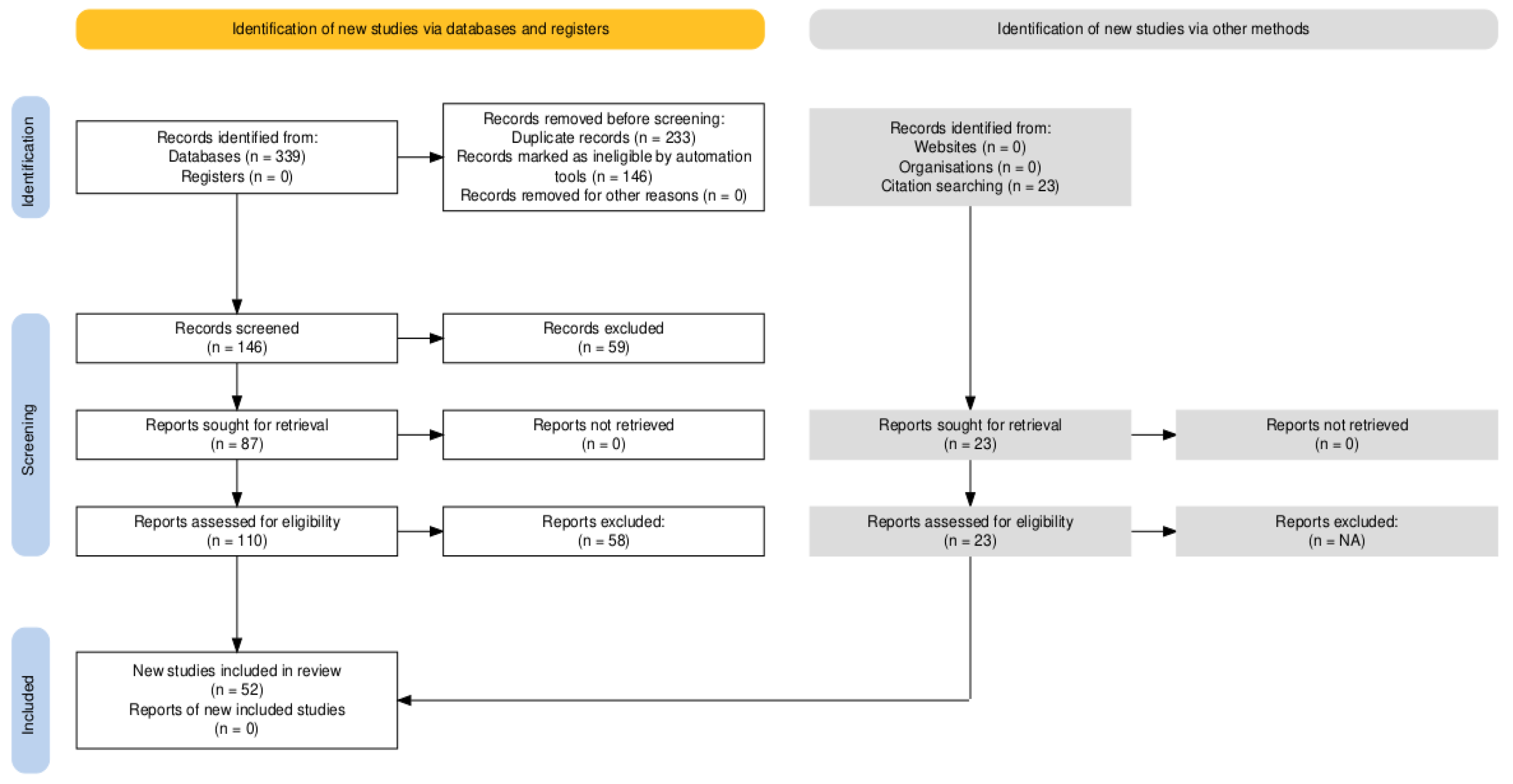
Figure 3.
The Process of Composite Hierarchical Reformulation of the Comprehensive Model of Self-Regulation.
Figure 3.
The Process of Composite Hierarchical Reformulation of the Comprehensive Model of Self-Regulation.
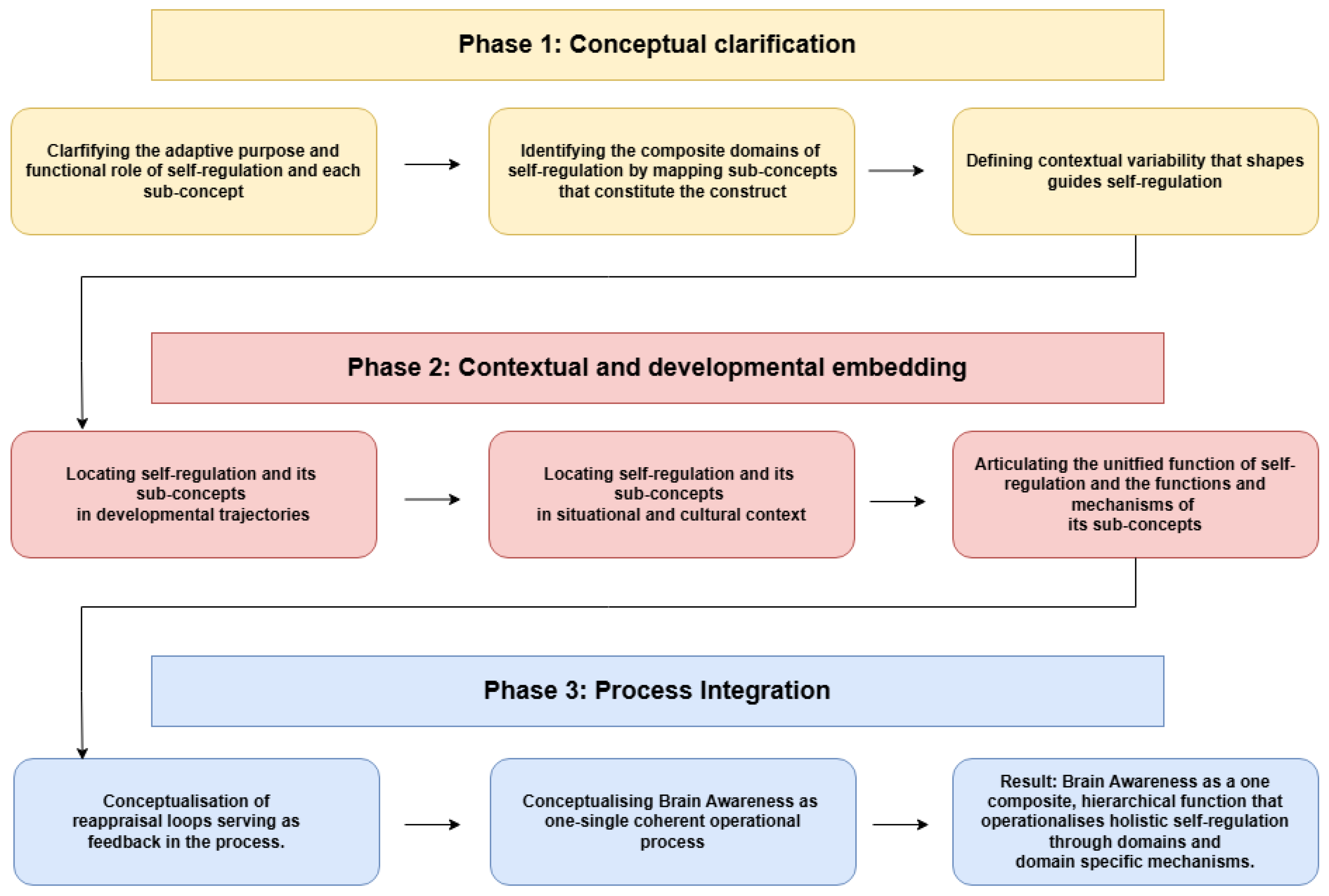
Figure 4.
The Organisation of Self-Regulation into Layers.
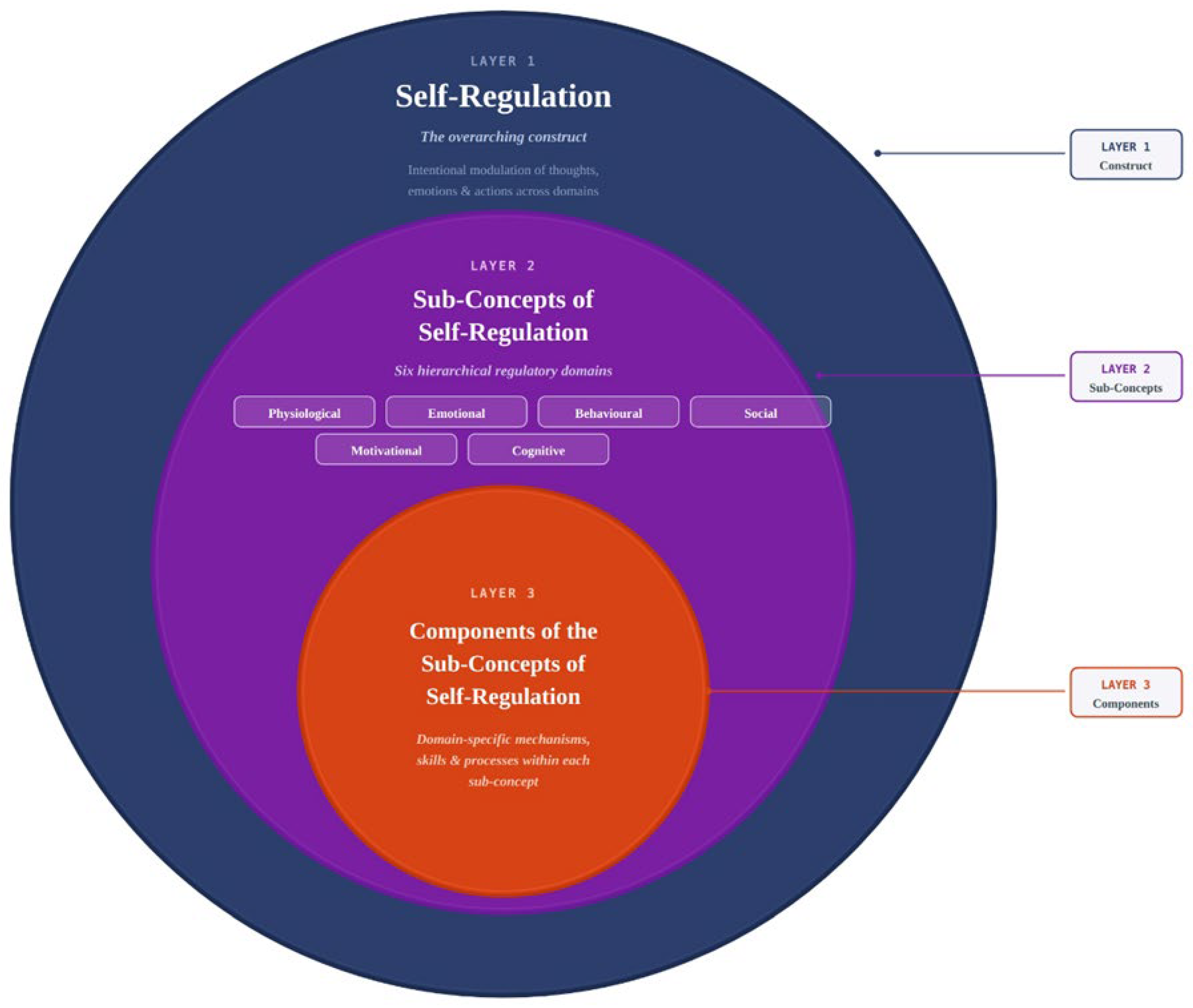
Figure 5.
The Comprehensive Model of Self-Regulation.
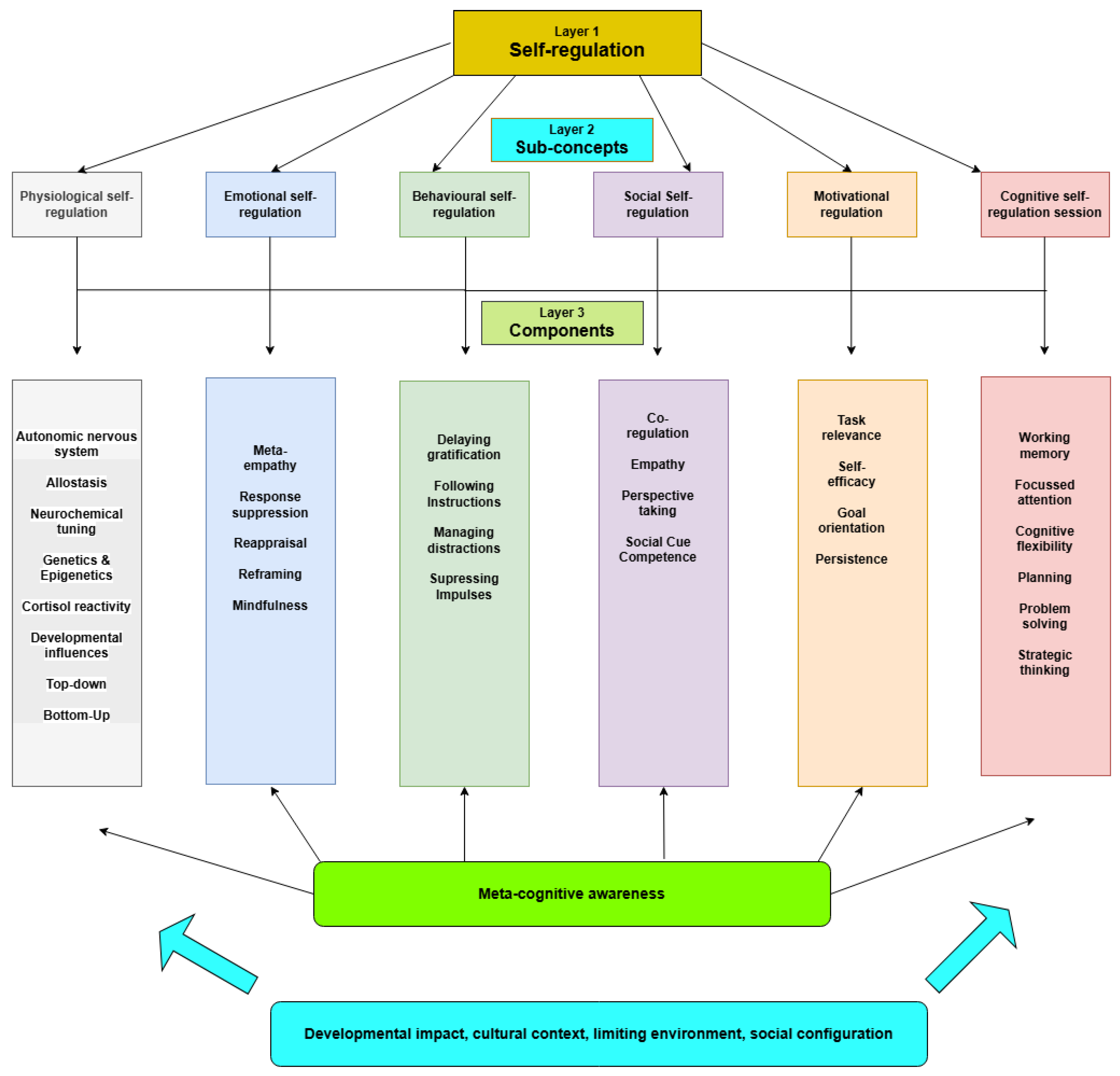
Figure 6.
Meta-awareness and Monitoring Creation of Neuropsychosocial Self-Representation.
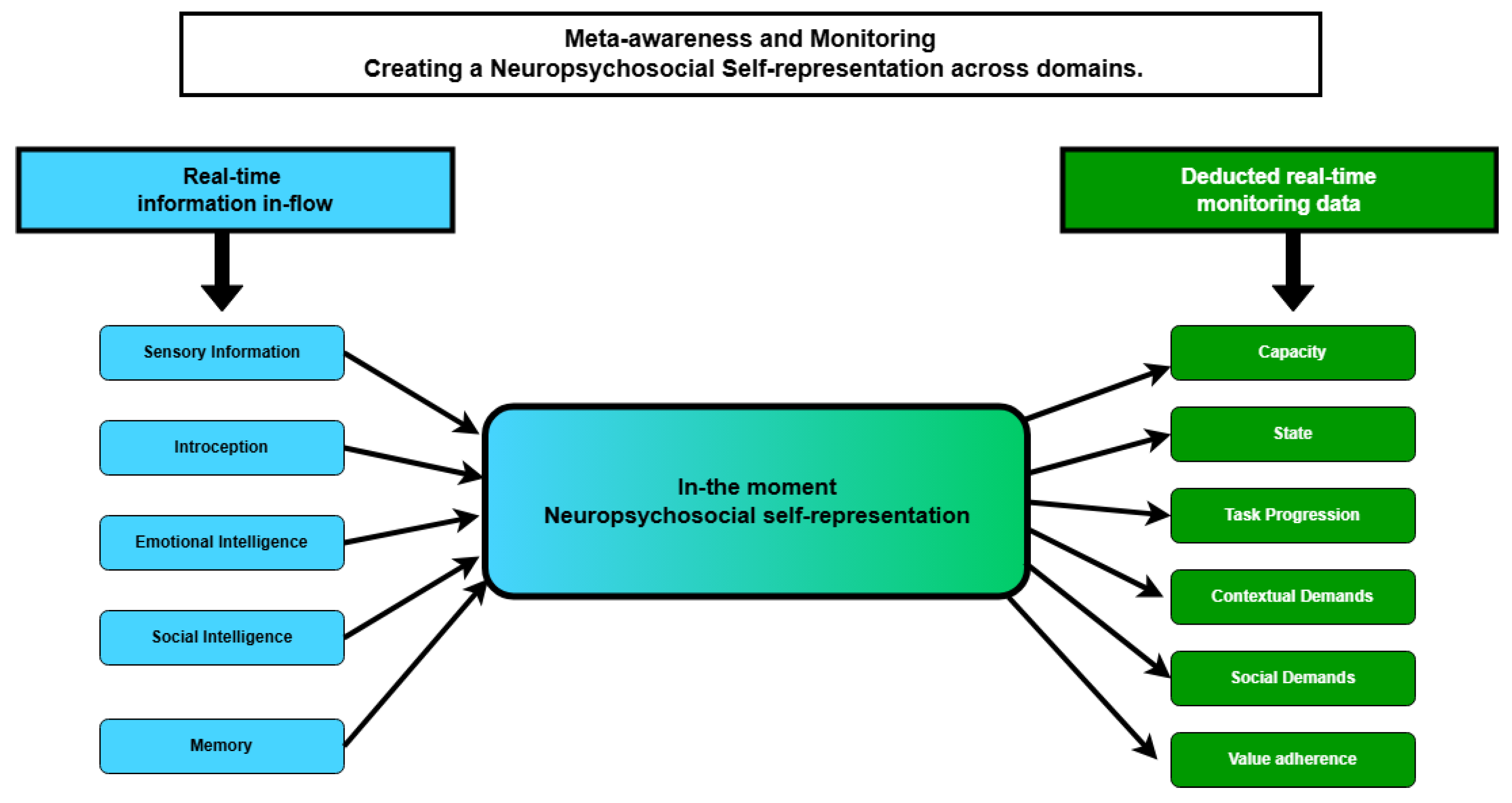
Figure 7.
The role of Cognitive Control in Self-Regulation.
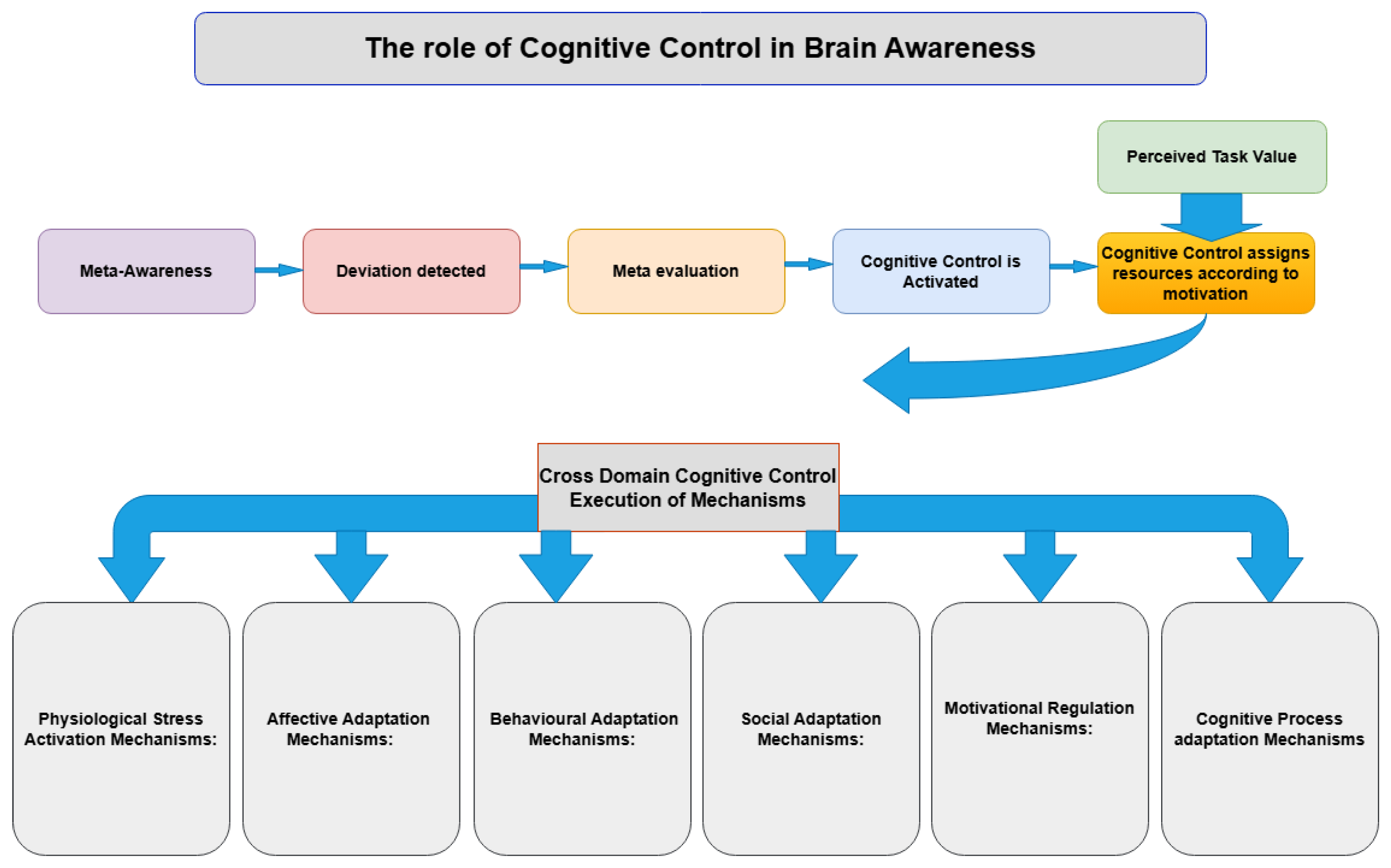
Table 1.
The PICOS Framework.
| Element | Description |
|---|---|
| Population | Adults and children who want to or need to improve self-regulation |
| Intervention | Brain Awareness |
| Comparison | Self-Regulation and all its sub-concepts |
| Outcome | Conceptualising and defining Brain Awareness |
| Study type | Systematic conceptual review |
Table 4.
Mechanisms of the Physiological Stress Adaptation Process.
| Mechanism | Function |
|---|---|
| Meta-physiological awareness | The ubiquitous monitoring of internal triggers activates the appraisal process when physiological arousal occurs. |
| Meta-physiological evaluation | This engages the appraisal process to determine the correct adaptive response. |
| Autonomic balancing | It regulates arousal through an interplay between sympathetic activation and parasympathetic recovery. This enables flexible, affective and behavioural responses to match demand (Woltering & Shi, 2016; Frazier et al., 2021). |
| Neuroendocrine stress buffering | Cortisol and related hormonal responses modulate affective intensity and the duration of stress responses via the hormones secreted by the HPA Axis. This enables cognitive control to exert affective and behavioural inhibition during physiological arousal. If this system reacts optimally, the individual will maintain affective clarity and behavioural composure. In a state of physiological dysregulation, adaptive functioning across all domains of self-regulation is negatively affected (Blair & Ku, 2022). |
| Allostatic calibration | This is a short-term physiological adaptation that enables individuals to maintain temporary stability under intense physiological arousal (Roos & Witkiewitz, 2017; Blair & Ku, 2022). |
| Neurochemical tuning | Neurotransmitters balance, modulate, and adjust arousal through cognitive control to achieve emotional salience during physiological arousal. This balanced signalling supports physiological stress adaptation (Blair & Ku, 2022). |
| Biological sensitivity to context | Genetic and epigenetic factors shape baseline reactivity and recovery thresholds. This impacts long-term adaptive development and stress response in each context (Blair & Ku, 2022). |
| Sensory filtering | Cognitive control regulates the processing of sensory input, preventing feelings of overwhelm and enabling selective attention. |
| Top-down physiological adaptive control | Top-down physiological adaptation uses intentionally activated cognitive control to facilitate a goal-directed or ideal state, ensuring affective adaptation. The effective application of this mechanism is essential for the Brain Awareness process, impacting all domains (Blair & Ku, 2022; McDonald, 2021; Nigg, 2017). |
| Bottom-up reactivity | Bottom-up reactivity is an automatic, reactive process. It is triggered by emotional and physiological activation. It is not enacted through cognitive control, such as top-down processes. Stimuli trigger this immediate response, leading to impulsive responses. It is characterised by emotional reactivity and physiological responses, which influence behaviour without conscious deliberation. It is often linked to risk-taking behaviours (Blair & Ku, 2022; McDonald, 2021; Nigg, 2017; Woltering & Shi, 2016). Bottom-up reactivity can disrupt planned behaviours and lead to disinhibition, whereby individuals act on impulse rather than following adaptive behaviour (Blair & Ku, 2022; McDonald, 2021; Nigg, 2017). |
Disclaimer/Publisher’s Note: The statements, opinions and data contained in all publications are solely those of the individual author(s) and contributor(s) and not of MDPI and/or the editor(s). MDPI and/or the editor(s) disclaim responsibility for any injury to people or property resulting from any ideas, methods, instructions or products referred to in the content. |
© 2026 by the authors. Licensee MDPI, Basel, Switzerland. This article is an open access article distributed under the terms and conditions of the Creative Commons Attribution (CC BY) license (http://creativecommons.org/licenses/by/4.0/).
Copyright: This open access article is published under a Creative Commons CC BY 4.0 license, which permit the free download, distribution, and reuse, provided that the author and preprint are cited in any reuse.


