Preprint
Article

This version is not peer-reviewed.

Response of Native Grassland Plants to Ageratina adenophora Stress: Seedling Growth Inhibition and Antioxidant Defense

  † These authors contributed equally to this work.

Submitted:

07 July 2026

Posted:

08 July 2026

You are already at the latest version

Abstract

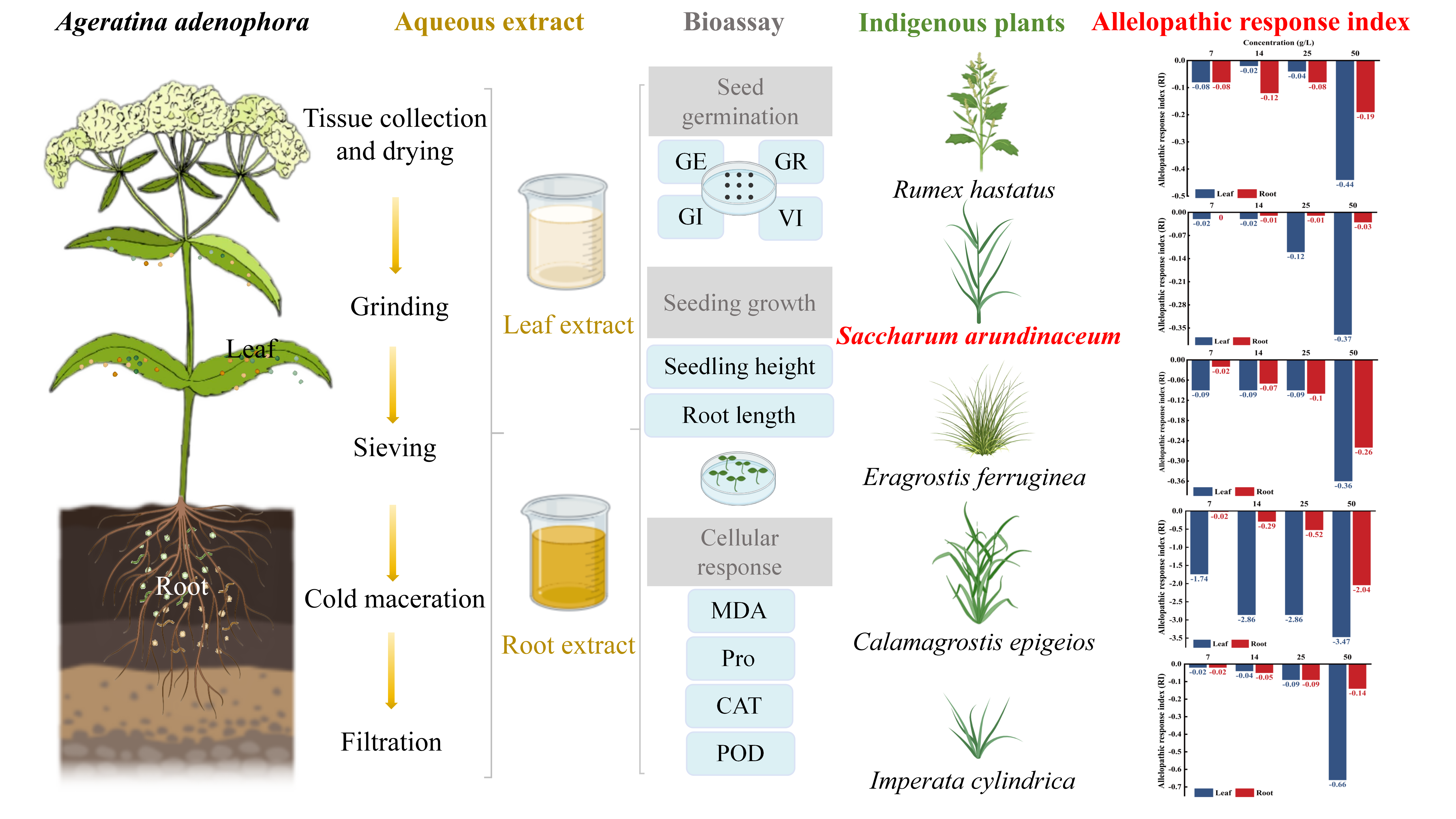
Ageratina adenophora, a highly aggressive weed originating from central Mexico and Costa Rica, has invaded and become naturalized across tropical and subtropical regions, posing substantial challenges to biodiversity conservation and ecological restoration. Although extensive research has elucidated its impacts on various ecosystems and advanced understanding of its phytotoxicity, studies in grassland landscapes remain limited. This study therefore focused on Chengjiang County in southwestern China, a region heavily invaded by A. adenophora. Based on a preliminary survey, five grassland species commonly co-occurring and competing with it were assessed by using seedling growth bioassays and physiological measurements under its aqueous tissue extract. Results showed concentration-dependent dynamic changes in recipient plants. Specifically, malondialdehyde (MDA) and proline (Pro) content were negatively correlated with seedling height and root length (p < 0.05; p < 0.01), indicating the extract caused severe membrane damage and subsequent growth inhibition. Notably, Saccharum arundinaceum exhibited the greatest increase in peroxidase (POD) and catalase (CAT) activity and the highest allelopathic response index (-0.58), followed by Rumex hastatus (-1.05) and Calamagrostis epigeios (-1.08), highlighting it as the least sensitive to A. adenophora stress. Our findings clarify indigenous grassland plant responses to A. adenophora, providing insights into bioherbicide development and replacement strategies.
Keywords: 
;  ;  ;  ;  ;  

1. Introduction

Ageratina adenophora is a highly invasive plant species native to Mexico, belonging to the Asteraceae family and the Ageratina genus. This aggressive weed has invaded approximately 40 countries across tropical and subtropical regions worldwide and posed significant ecological challenges, as it can dominate local flora and disrupt natural ecosystems in the invaded regions [1,2]. As one of the severely impacted countries, China witnessed the first introduction of A. adenophora into Yunnan from Burma in the 1940s. Due to its superior aggressiveness and adaptive resilience to diverse ecological landscape, it subsequently colonized more than 80 percent Provincial area, so far spreading to the north (Hubei Province), east (Guangxi Province), and Northwest (Tibet, Xizang Autonomous Region), causing severe ecological problems [3]. For coordinated nationwide management of invasive species, the Ministry of Agriculture and Rural Affairs issued the List of Key Managed Alien Invasive Species in 2022, in which A. adenophora ranks first among regulated invasive alien plants (IAPs). (http://www.moa.gov.cn/govpublic/KJJYS/202211/t20221109_6415160.htm).
To develop management approaches, understanding the competitive mechanisms between A. adenophora and native plants is essential to elucidate the underlying processes. During the past decades, invasion ecology theory has identified several core mechanisms underlying successful plant invasions. For example, the “Novel Weapons Hypothesis” (NWH) validates that IAPs release allelochemicals novel to native communities, exerting phytotoxic impacts on indigenous flora and disrupting biotic interactions. This theory becomes a central framework for explaining the competitive superiority of many invasive species [4]. To A. adenophora, accumulating research evidence confirmed that it releases allelochemicals into surrounding environment through leaf litters or root exduates to be capable of inducing oxidative stress responses to the vegetation adjacent to it, thereby inhibiting these plants seed germination and seedling growth, ultimately gaining an advantage over the interspecific competition and allowing itself populations to grow and expand rapidly [5,6,7]. To assess A. adenophora allelopathic effect, it typically involved applying A. adenophora plant tissue extracts in bioassay to evaluate phytotoxic effects [8,9,10]. Relevant research on the allelopathic properties of A. adenophora has been conducted widely spanning academia from Australia, India, and China where diverse of ecosystem severely impaired from A. adenophora invasion. For instance, Tripathi et al. and Khatri et al. have confirmed that allelochemicals synthesized in A. adenophora manipulate the population dynamics of plant species such as Trifolium repens, Rumex acetosa, and Oryza sativa [11,12]. These research findings substantially facilitate understanding A. adenophora invasion mechanism and management.
In integrated management of IAPs, selecting and exploiting native plant species as biocontrol substitutes has been implemented and validated as one of the effective ecological approaches in greenhouse and field trials [13,14]. Theoretically, A. adenophora replacement control approach involves leveraging interspecific competition principles by deliberately introducing particular plant species that are insensitive to the allelochemicals released by A. adenophora, thereby suppressing the proliferation of A. adenophora through interspecific competition and ultimately achieving prevention [15,16,17]. Consequently, screening and employing feasible indigenous plants competitor holds promising as a sustainable alternative for A. adenophora biocontrol. However, previous research primarily focused on the ecosystem either agricultural and forest flora communities or soil fauna. Regarding grassland landscape, comparatively few research was conducted to date. Further, due to sophisticated process of A. adenophora-recipient plant interaction, the allelopathic consequence and underlying mechanism is far from thoroughly understood.
Grasslands, taking up approximately 40% of global terrestrial surface, as the most pivotal and fragile ecosystems consistently undergo threats from biological invasion worldwide, and its degradation and restoration relevant to IAPs concomitantly evolved as critical ecological problem [18]. In China, grasslands predominantly occupy a total area of 2.3 folds that of forests and 3.2 folds that of arable land, yet their fragility is prevalently exacerbated by IAPs incursions [19]. Particularly, Yunnan Province, one of the global biodiversity hot spots, located in southwestern China bordering with ASEAN countries, with the rapid growth of China-ASEAN international travel and merchandise importation, the potential risk of alien plant invasion unintentionally introduced into Yunnan and inland increased [20,21]. Chengjiang County, a typical hilly subtropic region located at ecological core zone of central Yunnan, its diverse grasslands ecosystem plays vital ecological roles in regional water conservation, carbon sink and climate regulation [22]. However, this County has been severely suffered from A. adenophora invasion spanning diverse of grassland types for more than 50 years, undermining maintenance of local grasslands ecosystem biodiversity and function service across the whole County [23] (Table S1). Additionally, local natural and semi-natural grasslands exhibit highly fragile and vulnerable to IAPs colonization due to their low plant species richness, frequent anthropogenic disturbance, livestock grazing and limited resource availability, making them an ideal ecosystem for testing invasion ecological theory and developing management strategies [24].
Hence, in the present research, taking Chengjiang County as study area, the native herbaceous species with high frequency and directly competing with A. adenophora in grasslands were selected as target plant species, subsequently assessing the effects of A. adenophora aqueous extracts on their seed germination, seedling growth, and stress-related physiological indicators dynamics. We aim to: 1) Assess the inhibitory extent of A. adenophora tissue aqueous extract on the grassland plant species through seed germination, seedling growth and stress-related physiological index measurement; and 2) Combining seed germination indicators and allelopathic response index of seedling growth analysis, screen the most insensitive native plant species to A. adenophora stress. Our study not only defines the recipient grasslands plant species seedling growth suppression and endogenous enzymatic antioxidant defense response to A. adenophora alleopathic stress but also enlightens bioherbicide development approach through A. adenophora biomass resources utilization.

2. Materials and Methods

2.1. Plant Materials

The recipient indigenous plant species were selected from the local grasslands following 2 criteria: 1) The observation of the plant species with comparative higher frequency, and directly competes with A. adenophora; 2) These native plants generally play crucial roles in water conservation, livestock forage, and ecological restoration [13,15,16]. Thus, five herbaceous plant species within the TOP 15 occurrence frequency, i.e., Imperata cylindrica, Saccharum arundinaceum, Eragrostis ferruginea, Calamagrostis epigeios, and Rumex hastatus were selected as recipient plants for phytotoxic assay (Figures S1 and S2). Mature seeds and whole plants of A. adenophora and the recipient plants seeds were randomly collected between June 2023 and June 2024 from 26 different sampling sites in the Chengjiang grasslands (latitude 24°29′–24°55′N, longitude 102°47′–103°04′E) (Figure 1). All plant seeds was air-dried and stored at -20 ℃, Fresh leaves and roots of A. adenophora were vigorously rinsed with distilled water to eliminate surface contaminants, then air-dried to a constant mass and pulverized into a fine powder.

2.2. Preparation of A. Adenophora Aqueous Extract

To simulate the allelopathic effects of varying invasion intensities on recipient plants, A. adenophora aqueous extract concentrations gradients of 7, 14, 25, and 50 g/L were established to systematically assess allelopathic tolerance of the recipient plants under different stress levels [9,25]. The leaves and roots powder of A. adenophora was passed through a 40-mesh sieve. To prepare aqueous extracts, 5 g of leaf and root powder were each steeped in 100 mL of sterile distilled water. Following static maceration at ambient temperature for 48 h, the mixtures were filtered through dual layers of sterile gauze to yield stock extracts at a concentration of 50 g/L. These stocks were serially diluted with sterile distilled water to achieve final concentrations of 7, 14, and 25 g/L, which were stored at 4 °C.

2.3. Preparation of Agar Germination Medium

A disposable petri dish with a diameter of 9 cm was used as the agar germination container. Different concentration extracts (distilled water as the control) were supplemented with 10 g of agar per liter, heated until the agar was fully dissolved. Subsequently, 20 mL of the prepared extract solution poured in petri dish and shake well. Then a layer of filter paper was deposited on the agar surface after the agar solidified and cooled, and keep the filter paper moist daily with distill water or aqueous extract.

2.4. Seed Germination Experiment Design

The recipient plant seeds collected from 2.2.1 were surface-sterilized by soaking in 0.1% NaClO solution for 10 min, then rinsed 3 times with distilled water and air-dried. Each seed batch set 8 treatments regarding different tissue sources (Leaf or root) and extract concentrations (7g/L, 14g/L, 25g/L, 50g/L), along with one control with distilled water (0g/L), with five replicates per treatment. Each petri dish contained 50 seeds and was incubated at 25℃ with 80% relative humidity under a 12-hr light/12-hr dark period (PGX-310D Light Incubator).

2.5. Data Acquisition and Seed Germination Index Calculation

Germination counts were recorded daily for each treatment, with visible radicle protrusion defined as the germination criterion [26]. On the 20th d, 30 seedlings per treatment were randomly selected to measure root length and seedling height. An additional 20 seedlings per treatment were harvested to determine fresh weight [27].
G e r m i n a t i o n   e n e r g y   G E , % = N 3 N t o t a l × 100 %
G e r m i n a t i o n   r a t e   G R , % = N g e r m N t o t a l × 100 %
G e r m i n a t i o n   i n d e x   G I = G t × D t 1
V i g o r   i n d e x   V I = W × G I
where N3 is the number of seeds germinated on the 3rd day, Ntotal is the total seeds tested; Ngerm is the cumulative number of germinated seeds; Gt is the number of seeds germinated on t day; Dt is the number of days to germination; W is the average fresh weight (g) of 20 seedlings.

2.6. The Allelopathic Response Index Calculation

The allelopathic response index (RI), which represents the intensity of the phytotoxic effect, was used as the formula described by Williamson and Richardson [28]. The value RI reflects the magnitude of the effect intensity and was used to assess the intensity of the allelopathic effect of A. adenophora aqueous extract on tested plants seed germination.
R I = 1 C T
where C represents the germination rate of the control, and T represents the germination rate of the treatment. RI > 0 indicated that seed germination was promoted; RI < 0 indicated an inhibitory effect on the recipient seed germination.

2.7. Physiological Indices Measurement of Seedlings

The dynamic of antioxidant enzymes peroxidase (POD), superoxide dismutase (SOD), and catalase (CAT) activities reflect the ability to scavenge reactive oxygen species (ROS) under biotic or abiotic stress in plants, antioxidant enzymes acting as a protective enzyme system to limit the levels of free radicals and prevent their damage therein maintaining plant cell homeostasis [29]. To assess phytotoxic damage of A. adenophora tissue aqueous extract on the recipient plants, on the 20th d as described in section 2.5., malondialdehyde (MDA) content, proline (Pro) content, POD activity, and CAT activity of the seedlings were quantified, with five replicates per indicator. MDA was determined using the thiobarbituric acid method [30]; Pro via acid ninhydrin method [31]; POD activity was measured using the guaiacol assay [32], and CAT activity was determined through the ultraviolet absorption method [33].

2.8. Data Analysis

ArcGIS 10.8 was employed for mapping the spatial distribution of grasslands and the layout of field survey plots, with all spatial analyses and cartographic production performed using vector data. Raw Data were organized using Microsoft Excel 2019. One-way ANOVA was performed with IBM SPSS Statistics 26. Graphs were plotted using Origin 2021.

3. Results

3.1. Effects of A. Adenophora Aqueous Extracts on Recipient Plants Seed Germination

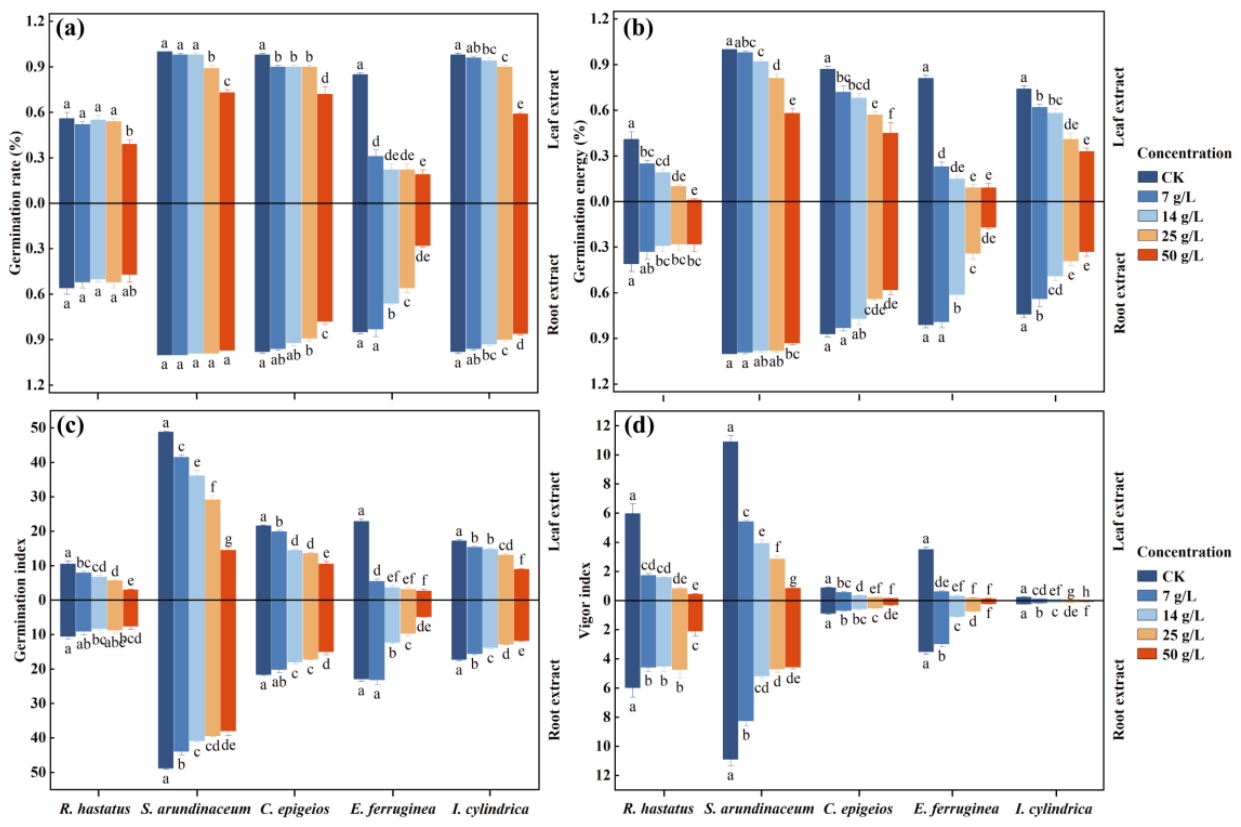
The seed germination assay on recipient plants demonstrated that both leaf and root extracts adversely inhibited the germination of all tested species, with the inhibition being concentration- and plant species-dependent. (Figure 2). Generally, increasing concentrations of A. adenophora extracts led to a gradual decline in germination rate (GR), germination energy (GE), germination index (GI), and vigor index (VI), with leaf extracts exerting a higher inhibitory effect than root extracts. Among the recipient plant species, E. ferruginea was the most sensitive species, e.g., at leaf extract concentration of 7 g/L, there was a significant reduction in GR, GE, GI, and VI by 63.53%, 71.60%, 76.21%, and 82.57% respectively compared to the control. Similarly, at the same concentration, root extract significantly decreased VI by 15.14%. Likewise, E. ferruginea’s GR, GE, and GI were significantly reduced by 22.35%, 24.69%, and 46.35% at 14 g/L of root extract. Comparatively, the impact on S. arundinaceum was comparatively minor. For example, although at leaf extract concentration of 25 g/L, seed GR significantly reduced, while treated with root extract GR approximately showed the same level with CK. At leaf extract concentration 14 g/L and root extract 50 g/L, GE decreased by 8.00% and 7.00% respectively. Overall, germination rate ranked as S. arundinaceum > C. epigeios > I. cylindrica > R. hastatus > E. ferruginea (Figure 2a); germination energy and germination index followed the order S. arundinaceum > C. epigeios > I. cylindrica > E. ferruginea > R. hastatus (Figure 2b and c); and the highest vigor index was S. arundinaceum, followed by R. hastatus, E. ferruginea, C. epigeios, and I. cylindrica (Figure 2d). In conclusion, seed germination measurement indicated that S. arundinaceum showed comparatively tolerant potential to A. adenophora tissue extract stress.

3.2. Effects of A. Adenophora Extracts on Recipient Plants Seedling Growth

The allelopathic effects of A. adenophora leaf and root extracts on seedling growth demonstrated that the extracts significantly inhibited seedling growth of all recipient species, , with the inhibitory effect intensifying as the extract concentration increased (Table 1). Similar to seed germination assay, leaf extracts exhibited a stronger inhibitory effect than root extracts. E. ferruginea seedlings similarly obtained the most sensitive growth inhibitory effect among the plants. For example, at the leaf and root extract concentration of 7 g/L, root length of E. ferruginea was significantly reduced by 62.55% and 61.24% respectively compared to the control. On the contrary, the lowest inhibition of seedling height was observed in S. arundinaceum. The seedling height suppression followed the order E. ferruginea > C. epigeios > S. arundinaceum > I. cylindrica > R. hastatus. For root length, the inhibition rates ranked as C. epigeios > E. ferruginea > I. cylindrica > S. arundinaceum > R. hastatus. The results revealed that the seedlings of S. arundinaceum and R. hastatus represented relatively higher tolerance to A. adenophora leaf and root extracts stress.

3.3. Malondialdehyde (MDA) and Proline (Pro) Content Dynamic of Recipient Plants Under A. Adenophora Tissue Extract Stress

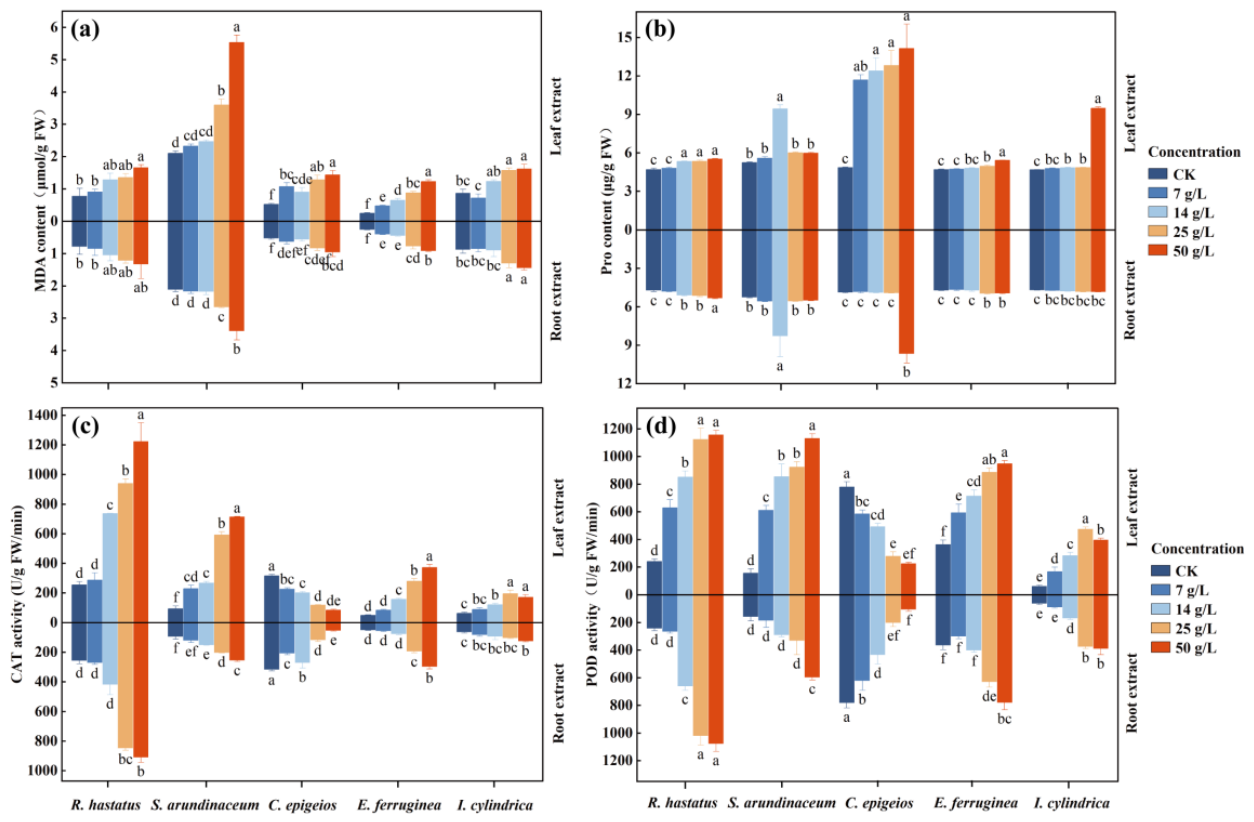
MDA and Pro content are important physiological indicators for measuring oxidative damage via lipid peroxidation under biotic stress [29,34]. To assess the allelopathic effects of A. adenophora tissue aqueous extracts on lipid peroxidation in the recipient plants, MDA and Pro contents were determined in extract-treated seedling tissues, with the extracts found to cause significant differences in MDA and Pro levels. Specifically, MDA content of R. hastatus, S. arundinaceum, and E. ferruginea seedlings increased consistently following extract concentration rising, whereas seedlings of I. cylindrica and C. epigeios exhibited in a fluctuating dynamic (Figure 3a). The rank in MDA dynamic was S. arundinaceum > I. cylindrica > R. hastatus > C. epigeios > E. ferruginea. Meanwhile, Pro content of R. hastatus, C. epigeios, E. ferruginea, and I. cylindrica seedlings demonstrated a steady increasing trend, whereas S. arundinaceum displayed an initial increase followed by a decline (Figure 3b). Notably, S. arundinaceum exhibited distinctive dynamics in both MDA and Pro. For instance, at extract concentration of 25 g/L from leaves and roots, its MDA content significantly different with the control, increasing by 70.79% and 25.60%, respectively. Meanwhile, at the extract concentration 14 g/L, Pro content promptly reached peak, with increases of 79.63% and 57.28% compared to the control.

3.4. Seedling Antioxidant Enzyme Activity Dynamic of Recipient Plants Under A. Adenophora Aqueous Extract Stress

Upon the plant encountered biotic- and abiotic-stress, the plant launches a cascade of enzyme-related physio-biochemical metabolism process to alleviate cellular damage which involve numerous enzymatic components, such as SOD, CAT, POD [35,36]. In the present research, the phytotoxic effect of A. adenophora aqueous extracts on the antioxidant systems of recipient plant seedlings demonstrated significant variations in CAT and POD activities (Figure 3). Specifically, to R. hastatus, S. arundinaceum, and E. ferruginea, both of CAT and POD demonstrated a similar dynamic curve, e.g., a higher CAT and POD activities of the seedlings conjugated with a higher A. adenophora aqueous extract concentration. Conversely, to C. epigeios, both of the enzyme activities of seedlings constantly showed decline as extract concentration increased. Exceptionally, both of these two enzyme of I. cylindrica displayed a pattern of bell shape.
Overall, CAT activity of the tested plants ranked as R. hastatus > S. arundinaceum > E. ferruginea > I. cylindrica > C. epigeios (Figure 3c). Notably, to A. adenophora leaf extract stress, S. arundinaceum obtained the highest absolute increment with 3.9, 5.5, 5.9 and 7.2 folds of the control. Similarly, POD activity followed the trend R. hastatus > E. ferruginea > S. arundinaceum > I. cylindrica > C. epigeios (Figure 3d) and S. arundinaceum also obtained the highest absolute increment. This result indicated that S. arundinaceum intensely activated and boosted antioxidant enzyme metabolic process so as to mitigate cellular damage.

3.5. Intensity of Allelopathic Response of Recipient Plants Under A. Adenophora Stress

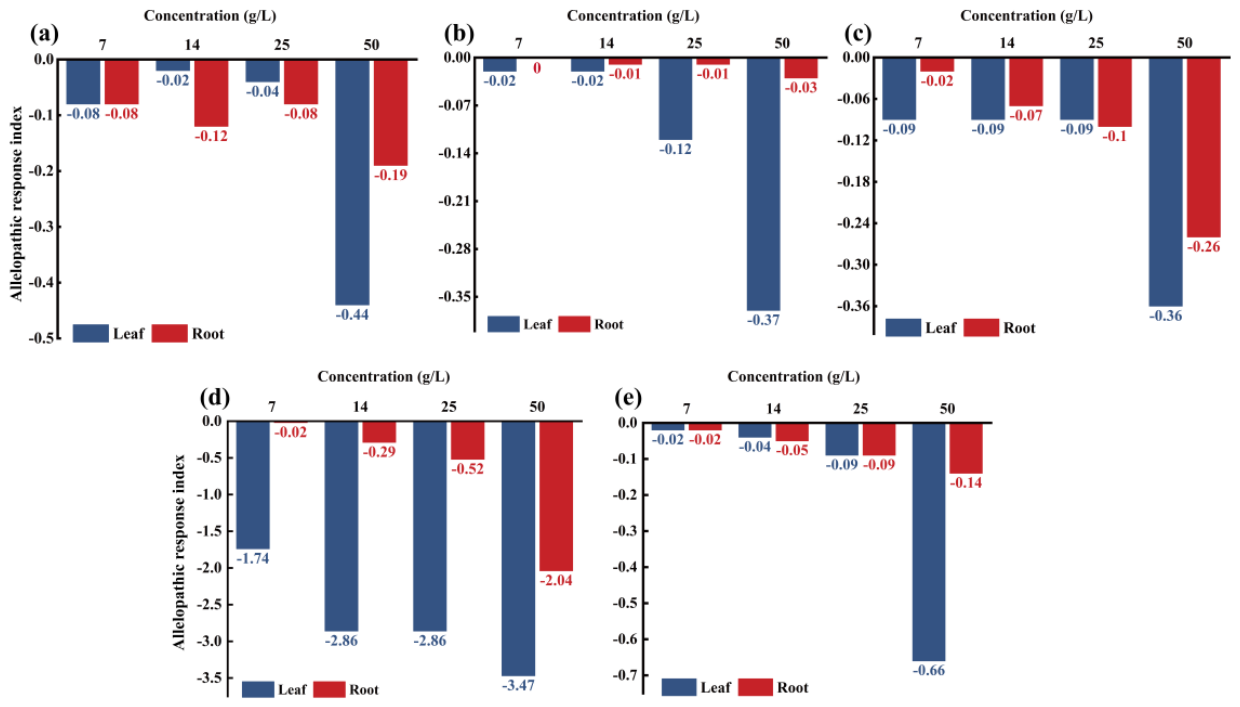
To quantitative assess the phytotoxic effect of the recipient plant species to tissue aqueous extract of A. adenophora, allelopathic response index (RI) as defined in formula 5, reflecting multifaceted attributes and intensity was calculated. The results demonstrated that, with increasing concentrations of A. adenophora leaf extract, the RI of R. hastatus exhibited a trend of initial increase followed by decrease (Figure 4a), with values ranging -0.44~-0.02; at 14 g/L, allelopathic impact is minimal; at 50 g/L, leaf extract exhibits maximum inhibition on R. hastatus. Peaking at -0.08 at root extract 7 g/L and reaching a minimum of -0.19 at 50 g/L. For S. arundinaceum, as leaf and root extract concentrations increased, the allelopathic response index demonstrated a gradually ascending trend (Figure 4b), at leaf extract 50 g/L, the maximum inhibition effect observed is -0.37. For root extract, the maximum of 0.00 at 7 g/L indicates that this concentration shows no allelopathic effect on S. arundinaceum seed germination; With increasing concentrations of A. adenophora leaf and root extracts, the allelopathic response index of C. epigeios, E. ferruginea, and I. cylindrica progressively increased. Specifically, the allelopathic sensitivity indices of C. epigeios to A. adenophora leaf and root extracts exhibited ranges of -0.36~-0.09 and -0.26~-0.02 (Figure 4c); E. ferruginea ranged -3.47~-1.74 and -2.04~-0.02 (Figure 4d); I. cylindrica showed ranges of -0.66~-0.02 and -0.14~-0.02 (Figure 4e). Overall, although leaf and root extract exert inhibitory on all tested plant seed germination, S. arundinaceum demonstrates the minimal sensitivity to A. adenophora extract.
Meanwhile, comprehensive comparison based on the recipient plants across multiple indice-germination rate and vigor index, as well as seedling physiological indicators, indicates that S. arundinaceum obtained the highest value in multiple metrics. The average indices of allelopathic effects further quantified this variation-S. arundinaceum (−0.58) > R. hastatus (−1.05) > C. epigeios (−1.08) > I. cylindrica (−1.11) > E. ferruginea (−13.8) (Figure 4). Summarily, the bioassay implies that S. arundinaceum possesses the highest level tolerance to A. adenophora allelopathic stress, suggesting its potential as a native candidate species for replacement approach of A. adenophora management.

4. Discussion

4.1. The Inhibitory Effects of A. Adenophora Tissue Extract on the Germination and Seedling Growth of Recipient Plants

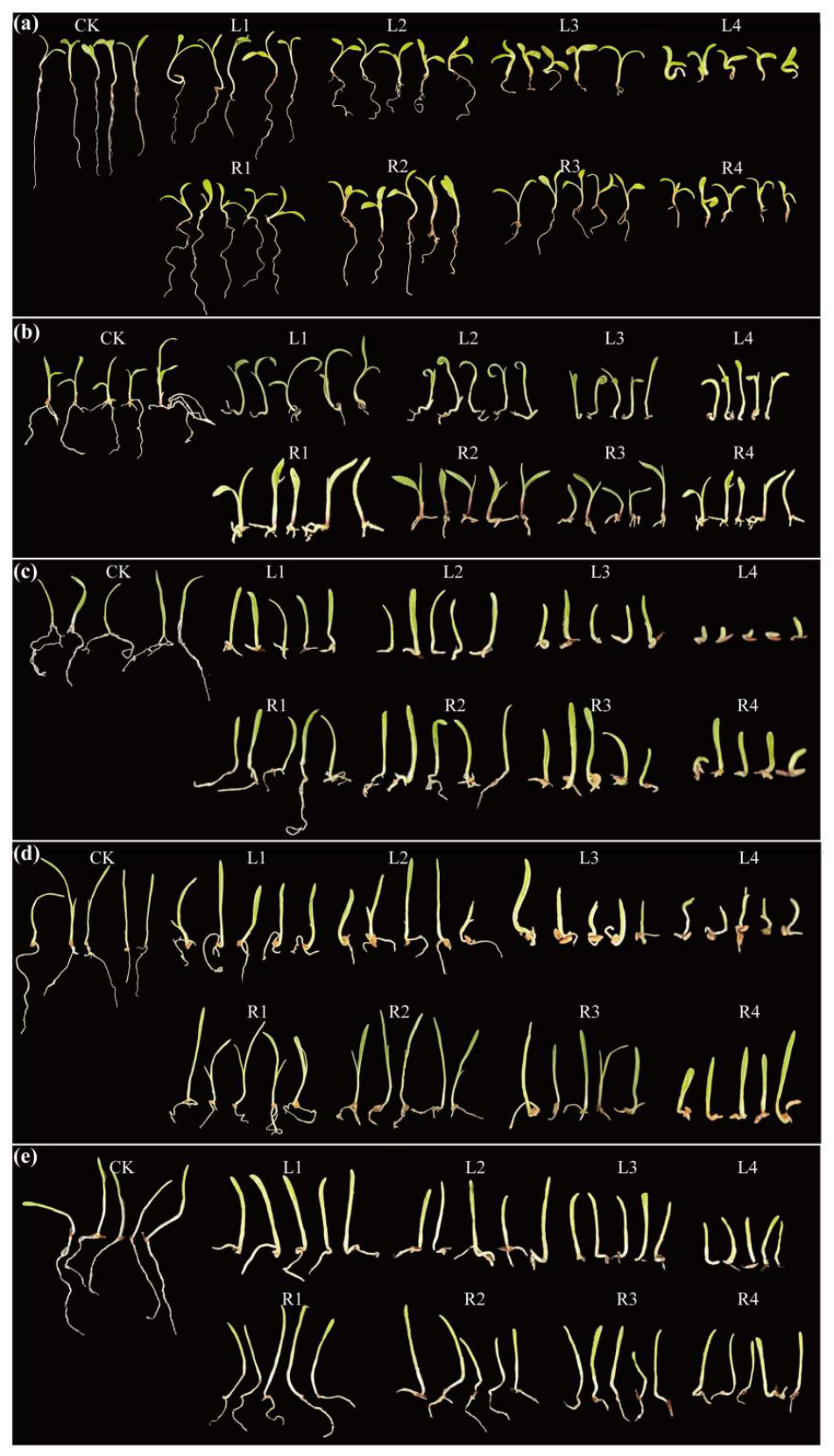
The extreme aggressiveness and proliferation of A. adenophora is attributed to its exquisite allelopathic impact on surrounding flora and soil properties. Numerous literature has confirmed that A. adenophora releases allelopathic compounds such as zeranol, 2-phenylacetic acid glucoside, 9-β-coumarin zeranol, and hydroxyl zeranol into the soil, which significantly alter the soil chemical properties and subsequently inhibit the seeds germination and growth of neighboring plant [37,38]. Generally, the allelopathic/phytotoxic effects not only involves their inhibitory impact on seed germination of recipient species but also relates to the seedling height and root length [39]. The present study demonstrated that aqueous extracts of A. adenophora leaves and roots remarkably suppress germination rate, germination energy, germination index, and vigor index of native plant species, also reducing seedling height and root length (Figure 2; Table 1; Figure 5). The results confirmed the cognition of the broad inhibitory effect of aqueous extracts of IAPs on the seeds germination and early growth of vegetation, providing a alternative illumination for the development of A. adenophora-based natural herbicides, and consistent with previous research on the crops and woody trees, Triticum aestivum, Lens culinaris, Pinus roxburghii, and Quercus leucotrichophora [40].

4.2. Physiological Responses of Recipient Plant to A. Adenophora Allelopathic Stress

Although concurrently suffered from A. adenophora extract stress, our findings revealed that the recipient pants demonstrate distinct biophysiological response with various MDA and Pro levels, reflecting contrasting tolerance of plant species under adverse exogenous stress. It consolidates the consensus that, in the long-term co-evolutionary process, specific plant species developed and possessed an exquisite mechanism to survive under adverse biotic- and abiotic- stress [41,42]. Such plant-plant interaction was particularly assumed to be the main force driving ecosystem co-evolution [43]. In invaded ecosystem, according to ‘Novel Weapon Hypothesis’, A. adenophora normally release allelochemicals to suppress the adjacent vegetation growth, consequently alter the plant species composition [44,45]. Such ecological process substantially involves biomarker metabolite accumulation due to oxidative reaction while the plants suffering from biotic and abiotic stresses. MDA, a primary product of membrane lipid peroxidation, visually represents the extent of oxidative damage to cellular membranes [46]. In present research, the tissue concentrations (e.g., 7 g/L leaf extract for R. hastatus, C. epigeios, I. cylindrica and 25 g/L root extract treatment for S. arundinaceum, C. epigeios, I. cylindrica), a higher MDA content was observed and demonstrated significantly different with the control, consistent with previous findings that allelochemicals from A. adenophora induce ROS bursts in recipient plants, triggering oxidative stress, and directly relate to the inhibition of seed germination and seedling growth [47]. Besides, regarding to the response to osmotic imbalance caused by stress, plants generally activate osmotic regulation mechanisms to maintain cellular homeostasis [48,49]. Our finding revealed that proline, a key osmolyte, was elevated in all treated plants compared to controls, with particularly significant accumulation under higher stress concentrations (Figure 3b). This indicates that under allelochemical stress from A. adenophora, the recipient plants actively synthesized Pro to mitigate osmotic stress and reduce subsequent damage, reflecting a fundamental adaptive strategy in plants [50]. Notably, although a substantial body of evidence indicates a positive correlation between Pro content and plant tolerance to various abiotic stresses, excessive Pro accumulation adversely affects plant growth [51,52]. Our study confirmed that S. arundinaceum likely initiates a more robust and refined biophysiological response to counteract the allelochemicals of A. adenophora and prevent stress-induced oxidative damage (Figure 3b). To further validate whether cellular lipid peroxidation impacts on recipient plant seedlings growth, a correlation analysis between MAD/Pro content and seedling height/root length was conducted. It indicates that there are extremely significant or significant negative correlations between both MDA and Pro with growth measurement of seedlings (Table 2). It may indicate that, under A. adenophora allelochemicals stress, the recipient plant suffered from MAD/Pro accumulation by which adversely affects seedling growth.
Generally, the antioxidant enzyme system constitutes the primary defense line against ROS and oxidative injury in plants [53]. Our observations demonstrated that CAT and POD activities in the recipient plants increased with rising A. adenophora tissue extract concentrations (Figure 3c,d). This result indicated that within the experimental concentration ranges, the recipient plants effectively regulated ROS levels through enhanced antioxidant enzyme activity, protecting membrane integrity from A. adenophora allelochemicals damage, and preventing suppression of ROS scavenging. This result aligned with the research on cucumber (Cucumis sativus) seedlings antioxidant responses under A. adenophora stress and initial increases in antioxidant enzyme activity observed in strawberry (Fragaria ananassa) [54], supporting the dose-response model “low concentration stimulation” in plants subjected to allelopathic stress [55]. However, significant species-specific differences exceptionally observed at higher concentrations level. For example, to C. epigeios, CAT and POD activities continued to decline with increasing extract concentration within the experimental range, and in I. cylindrica, enzyme activities in leaves reached a significant reduction at 25 g/L leaf extract (Figure 4c,d). It strongly suggests that the stress intensity at these levels exceeds the tolerance thresholds of these plant species, causing subsequent cellular damage. Meanwhile, the decline in enzyme activity may be closely related to ROS burst-induced enzyme protein depletion or inactivation, ultimately leading to uncontrolled oxidative damage, which may underpin more severe growth inhibition [56] (Table 1; Figure 3b–d). The distinctly various response patterns of I. cylindrica to leaf versus root extracts-decreasing enzyme activity at high leaf extract concentrations and increasing activity with root extracts-further highlight the complexity of the recipient plant biochemical reaction process triggered by A. adenophora allelochemicals.

4.3. Application of Replacement Control Approach for A. Adenophora Management

Our study results not only reveal distinct variation in the inherent attributes of recipient plants but also shed light on the sophisticated process of plant-plant allelopathy. In addition, recipient plant seeds displayed significant differences sensitivity. In general, at equivalent concentrations, leaf extracts exhibit stronger inhibitory effects than root extracts. Our study results aligned with findings from previous reports [56,57].
Among management approaches, control techniques based on niche competition and allelopathic interactions demonstrated considerable potential due to their environmental compatibility and sustainability [58,59]. Meanwhile, current studies suggested that selecting native or non-invasive alien species with ecological or economic value, and leveraging their competitive advantages in water, light, mineral nutrients, and spatial ecological niches, can effectively displace and suppress the growth and dissemination of A. adenophora [60,61]. For example, selecting fast-growing shrub or tree species capable of establishing a high canopy cover (>70%) within a short period, and planting them during the vulnerable establishment phase of A. adenophora, has implemented in limiting A. adenophora expansion over specific timeframes [62]. Similarly, various grasses species belong to the Poaceae family have been demonstrated efficacy as replacement species due to their remarkable vigorous growth, resource competition, and high coverage. The Poaceae species, e.g., Brachiaria eruciformis, Arundinella hirta, and Pennisetum sinese exhibit distinct inhibitory effects on the proliferation and reproduction of A. adenophora [63,64]. Another Poaceae species Setaria viridis demonstrates remarkable superior competition for underground resources, including water and nutrients, validating it as a promising candidate for replacement controlling and biodiversity restoring in invaded habitats [65]. However, so far, previous research mainly focuses on the landscapes, e.g., agriculture, forestry, and wetland ecosystem, quite few research conducted on A. adenophora invaded grassland, especially on semi-natural grassland landscape. Our research highlights herbaceous plant species native to the grassland that directly compete with A. adenophora, examining their allelopathic tolerance extent to establish a novel theoretical framework for developing alternative control strategies for the grassland ecosystem. As shown by the results, the Poaceae species, except of E. ferruginea, S. arundinaceum, I. cylindrica and C. epigeios demonstrated comparatively tolerance to A. adenophora tissue extract (Figure 4b,c,e; Figure 5b,c,e). Thus, our research combining previous studies implied that Poaceae family could be the resource pool for A. adenophora replacement management. However, the timing of replacement intervention is also critical. For instance, removing A. adenophora prior to flowering and immediately establishing dominant population with fast-growing forage grasses or seedlings, complemented by vegetation restoration measures, facilitating constitutes an effective long-term control strategy [66]. In present study, the recipient grassland Poaceae species, co-occurence with A. adenophora in the same niche and characterizing tolerance to A. adenophora, whether capable of reciprocal suppressing seedling growth and disrupting A. adenophora microbial community remain unclear.
Replacement strategy, even though confronting various constrains, has been manifested successively promising potential in suppressing A. adenophora competition. In present study, we defined the tolerance extent and elucidated response patterns of these candidate plants to A. adenophora allelopathic stress. These findings not only enhance the understanding of the interspecific allelopathic patterns between A. adenophora and geographically widespread plant species of grassland landscape in subtropic region but also provide convincing experimental evidence for novel bioherbicide development. Nevertheless, for a comprehensive assessment S. arundinaceum replacement efficacy, the subsequent research should integrate field monitoring including the rhizosphere microbime dynamic and reciprocal impact between S. arundinaceum and A. adenophora.

5. Conclusions

Five native dominant herbaceous species, i.e., R. hastatus, S. arundinaceum, C. epigeios, E. ferruginea, and I. cylindrica, competing with A. adenophora in invasion grasslands, are selected for phytotoxic bioassays. A. adenophora leaf and root aqueous extracts significantly decreased the germination rate, germination vigor, germination index, and vigor index of the recipient plant seeds. However, the antioxidant substances and antioxidant enzyme activities (MDA, Pro, CAT, and POD) demonstrated remarkably different dynamics under A. adenophora extracts stress. In addition, the allelopathic response index were consistent with seed germination and seedling growth measurement. The indigenous Poaceae plant, S. arundinaceum exhibits superior tolerance to A. adenophora stress, suggesting its candidate potential for the replacement control of A. adenophora in subtropic grassland landscape.

Supplementary Materials

The following supporting information can be downloaded at the website of this paper posted on Preprints.org, Figure S1: Natural co-occurrence of A. adenophora and native plant species in grassland; Figure S2: Flora composition in A. adenophora invasion grasslands; Table S1: The occurrence area statistic of A. adenophora in Chengjiang grasslands.

Author Contributions

Conceptualization, L.Z. and L.G.; methodology, L.Z.; validation, L.G. and X.H.; formal analysis, L.Z. and Z.W.; investigation, L.Z., Y.W. and Y.X.; resources, Y.W., D.W. and Y.X.; data curation, C.S.; writing—original draft preparation, L.Z. and L.G.; writing—review and editing, Y.X.; visualization, L.G. and X.H.; supervision, Y.X.; funding acquisition Y.X. and D.W., All authors have read and agreed to the published version of the manuscript.

Funding

This research was funded by the Yunnan Biodiversity Conservation Foundation (YNBCF202401), Pests Survey of Chengjiang County Grasslands (H20210198).

Data Availability Statement

The original contributions presented in this study are included in the article/supplementary material. Further inquiries can be directed to the corresponding author.

Acknowledgments

We sincerely thank to Forestry and Grassland Ministration of Chengjiang County, providing the field survey collaborative convenience and technique support. We also thank the anonymous reviewers and editor for their careful evaluations and insightful suggestions, which substantially improved the quality of this work.

Conflicts of Interest

The authors declare no conflicts of interest.

Abbreviations

The following abbreviations are used in this manuscript:
MDA Malondialdehyde
Pro Proline
POD Peroxidase
CAT Catalase
GR Germination rate
GE Germination energy
GI Germination index
VI Vigor index
RI Response index

References

  1. Ma, S.J. Flora of invasive plants in China. Shanghai Jiao Tong University Press. 2020, 4, https://www.jiaodapress.com.cn/Data/BookContent/16244.
  2. Cheng, W.; Jia, G.; Zhang, J.; Lin, L.; Cui, M.; Zhang, D.; Jiao, M.; Zhao, X.; Wang, S.; Dong, J.; Xing, Z. Transcriptome and metabolome analysis of the synthesis pathways of allelochemicals in Eupatorium adenophorum. ACS omega 2022, 7, 16803-16816. [CrossRef]
  3. Yuan, C.; Wang, Q.; Chen, Y.; Zhang, L.D.; Tan, L.; Fu, R.H.; Yang, J.T.; Li, Y.; Liu, M.; Stephen, G.C. Impacts of a biocontrol agent on invasive Ageratina adenophora in Southwest China: Friend or foe? Biol. Control. 2021, 152, 104471. [CrossRef]
  4. Callaway, R.M.; Ridenour, W.M. Novel weapons: invasive success and the evolution of increased competitive ability. Front. Ecol. Environ. 2004, 2, 436–443. [CrossRef]
  5. Darji, T.B.; Adhikari, B.; Pathak, S.; Neupane, S.; Thapa, L.B.; Bhatt, T.D.; Pant, R.R.; Pant, G.; Pal, K.B.; Bishwakarma, K. Phytotoxic effects of invasive Ageratina adenophora on two native subtropical shrubs in Nepal. Sci. Rep. 2021, 11, 13663. [CrossRef]
  6. Ren, Z.; Okyere, S.K.; Wen, J.; Xie, L.; Cui, Y.; Wang, S.; Wang, J.; Cao, S.; Shen, L.; Ma, X.; Yu, S.; Deng, J.; Hu, Y. An overview: The toxicity of Ageratina adenophora on animals and its possible interventions. Int. J. Mol. Sci. 2021, 22, 11581. [CrossRef]
  7. Khatri, K.; Bargali, K.; Bargali, S.S. Allelopathic effects of fresh and dried leaf extracts of Ageratina adenophora on rice varieties. Discov. Plants 2025, 2, 96. [CrossRef]
  8. Kalisz, S.; Kivlin, S.N.; Bialic-Murphy, L. Allelopathy is pervasive in invasive plants. Biol. Invasions 2021, 23, 367-371. [CrossRef]
  9. Jiao, Y.; Huang, J. Allelopathic effects of aqueous extracts from uncomposted and composted Mexican devil (Ageratina adenophora) plants on forest fungal growth and soil nitrogen and phosphorus mobilization. Weed Sci. 2024, 72, 76-85. [CrossRef]
  10. Khatri, K.; Bargali, K.; Bargali, S.S.; Negi, B. Effects of leaf residues from Ageratina adenophora on germination, growth and productivity of two rabi crops. Acta. Ecol. Sinica. 2023, 43, 363-374. [CrossRef]
  11. Tripathi, R.S.; Singh, R.S.; Rai, J.P.N. Allelopathic potential of Eupatorium adenophorum a dominant ruderal weed of meghalaya india. Proc. Indian. Natl. Sci. Acad. B. Biol. Sci. 1981, 47, 458-465. https://eurekamag.com/research/004/698/004698020.php.
  12. Khatri, K.; Bargali, K.; Negi, B.; Bargali, S.S. Germination and early seedling growth of two rice varieties as affected by invasive Ageratina adenophora. Curr. Agri. Res. 2020, 8, 2. https://dx.doi.org/10.12944/CARJ.8.2.06.
  13. Mou, D.; Zhang, S.B.; Ou, W.Y.; Tang, J.W.; Cairang, D.Z.; Xie, J.X. Prospects for replacement control for native invader Ligularia virgaurea. Journal of Biosafety 2020, 29, 235-241. [CrossRef]
  14. Shen, S.; Xu, G.; Li, D.; Jin, G.; Liu, S.; Clements, D.R.; Yang, Y.; Rao, J.; Chen, A.; Zhang, F.; Zhu, X.; Weston, L.A. Potential use of sweet potato (Ipomoea batatas (L.) Lam.) to suppress three invasive plant species in agroecosystems (Ageratum conyzoides L., Bidens pilosa L., and Galinsoga parviflora Cav.). Agronomy 2019, 9, 318. [CrossRef]
  15. Cui, Y.C.; Chuang, L.; Wen, L.N.; Fan, Z.W.; Zhang, F.D.; Ma, G.Z.; Shen, S.C.; Xu, G.F.; Yang, S.S.; Xu, Y.; Zhen, F.P. Control effects of alternative species and herbicides on Ageratina adenophora and their interaction. Journal of Biosafety 2022, 31, 336-344. [CrossRef]
  16. Pan, Y.M.; Tang, S.C.; Wei, C.Q.; Li, X.Q.; Lü, S.H. Competition between three native plants and invasive Ageratina adenophora. Acta. Ecologica. Sinica. 2022, 42, 2394-2404. http://dx.doi.org/10.5846/stxb202102240509.
  17. Shi, W.; An, T.; Yang, X.; Li, Y.; Yimingniyazi, A.; Liu, Z.; Feng, Y. Norsesquiterpenes from Lolium perenne and their replacement control of an invasive plant, Ageratina adenophora, through allelopathy. Molecules 2025, 30, 2384. [CrossRef]
  18. Bardgett, R.D.; Bullock, J.M.; Lavorel, S.; Manning, P.; Schaffner, U.; Ostle, N.; et al. Combatting global grassland degradation. Nat. Rev. Earth Environ. 2021, 2, 720–735. [CrossRef]
  19. Hao, L.F.; Han, Y.X.; Wu, Q.M.; Wang, R.; Lin, K.J. Status of invasive alien species in grassland of China and suggestions for prevention and control. Plant Prot. 2022, 48, 10-20. https://link.cnki.net/doi/10.16688/j.zwbh.2022258.
  20. Liu, F.; Zhang, Q.; Wang, J.; Liu, Y.; Wang, W.; Li, S. Ecological security assessment of Yunnan Province, China in the context of Production-Living-Ecological space division. Ecol. Evol. 2024, 14, e70131. [CrossRef]
  21. Xie, B.; Jones, P.; Dwivedi, R.; Bao, L.; Liang, R. Evaluation, comparison, and unique features of ecological security in southwest China: a case study of Yunnan Province. Ecol. Indic. 2023, 153, 110453. [CrossRef]
  22. Xie, G.; Sun, C.; Luo, W.; Gong, Y.; Tang, X. Distinct ecological niches and community dynamics: understanding free-living and particle-attached bacterial communities in an oligotrophic deep lake. Appl. Environ. Microbiol. 2024, 90, e0071424. [CrossRef]
  23. Zhao, L.Y.; Guan, L.R.; Zou, Q.M.; Xu, L.; Wang, Y.; Pan, N.H.; Liu, S.T.; Wu, S.R.; Wu, D.X.; Xie, Y. Landscape heterogeneity drives plant assemblage dynamics and invasibility of semi-natural grasslands uunder the long-term invasion of Ageratina adenophora. Plants 2026, 15, 862. [CrossRef]
  24. Ernst, A.R.; Larkin, D.J.; Kramer, A.T.; Glasenhardt, M.C.; Hipp, A.L. Diverse ecological strategies increase invasion resistance in an experimental grassland restoration. Ecol. Evol. 2025, 15, e71575. [CrossRef]
  25. Judžentienė, A.; Būdienė, J.; Labanauskas, L.; Stancelytė, D.; Nedveckytė, I. Allelopathic activity of Canadian goldenrod (Solidago canadensis L.) extracts on seed germination and growth of lettuce (Lactuca sativa L.) and garden pepper cress (Lepidium sativum L.). Plants 2023, 12, 1421. [CrossRef]
  26. Peng, D.; Chen, Z.; Hu, X.; Li, Z.; Song, B.; Sun, H. Seed dormancy and germination characteristics of two Rheum species in the Himalaya-Hengduan Mountains. Plant Divers. 2017, 39, 180-186. [CrossRef]
  27. Możdżeń, K.; Barabasz-Krasny, B.; Zandi, P.; Kliszcz, A.; Puła, J. Effect of aqueous extracts from Solidago canadensis L. leaves on germination and early growth stages of three cultivars of Raphanus sativus L. Var. radicula pers. Plants 2020, 9, 1549. [CrossRef]
  28. Wang, X.; Zhang, R.; Wang, J.; Di, L.; Wang, H.; Sikdar, A. The effects of leaf extracts of four tree species on Amygdalus pedunculata seedlings growth. Front. Plant Sci. 2021, 11, 587579. [CrossRef]
  29. Borges, C.V.; Orsi, R.O.; Maraschin, M.; Lima, G.P. Oxidative stress in plants and the biochemical response mechanisms. In Plant stress mitigators; Ghorbanpour, M., Shahid, M.A., Eds.; Publisher: Academic Press, 2023, 455-468. [CrossRef]
  30. Yao, Y.; Nan, L.; Wang, K.; Xia, J.; Ma, B.; Cheng, J. Integrative leaf anatomy structure, physiology, and metabolome analyses revealed the response to drought stress in sainfoin at the seedling stage. Phytochem. Anal. 2024, 35, 1174-85. [CrossRef]
  31. Li, H.; Li, Y.; Ke, Q.; Kwak, S.S.; Zhang, S.; Deng, X. Physiological and differential proteomic analyses of imitation drought stress response in sorghum bicolor root at the seedling stage. Int. J. Mol. Sci. 2022, 21, 9174. [CrossRef]
  32. Wang, H.; He, S.; Fan, Y.; Li, T.; Xu, L.; Ma, J.; Wu, J.; Liu, H.; Liu, X.; Mou, C.; Zhao, M.; Chen, L.; Zhu, L.; Zeng, L.; Luo, A. Light intensity is a crucial factor that regulates growth, physiological traits, antioxidant defense, and metabolite acquisition in Dendrobium denneanum. Physiol. Mol. Biol. Plants 2025, 31, 895-911. [CrossRef]
  33. Kadhum, M.A.; Hadwan, M.H. A precise and simple method for measuring catalase activity in biological samples. Chem. Pap. 2021, 75, 1669-78. [CrossRef]
  34. Đorđević, T.; Đurović-Pejčev, R.; Stevanović, M.; Sarić-Krsmanović, M.; Radivojević, L.; Šantrić, L.; Gajić-Umiljendić, J. Phytotoxicity and allelopathic potential of Juglans regia L. leaf extract. Front. Plant Sci. 2022, 13, 986740. [CrossRef]
  35. Hussain, M.I.; Muscolo, A.; Ahmed, M. Plant responses to biotic and abiotic stresses: Crosstalk between biochemistry and ecophysiology. Plants 2022, 11, 3294. [CrossRef]
  36. Jiang, Z.; van Zanten, M.; Sasidharan, R. Mechanisms of plant acclimation to multiple abiotic stresses. Commun. Biol. 2025, 8, 655. [CrossRef]
  37. Zhu, X.; Yi, Y.; Huang, L.; Zhang, C.; Shao, H. Metabolomics reveals the allelopathic potential of the invasive plant Eupatorium adenophorum. Plants 2021, 10, 1473. [CrossRef]
  38. Sun, C.; Li, Q.; Han, L.; Chen, X.; Zhang, F. The effects of allelochemicals from root exudates of Flaveria bidentis on two Bacillus species. Front. Plant. Sci. 2022, 13, 1001208. [CrossRef]
  39. Shen, S.C.; Xu, G.F.; Zhang, F.D.; Jin, G.M.; Liu, S.F.; Yang, Y.X.; Zhang, Y.H. Allelopathic effects of water extracts from sweet potato (Ipomoea batatas) leaves on five major farming weeds. Acta. Ecol. 2017, 37, 1931-1938. [CrossRef]
  40. Khatri, K.; Negi, B.; Bargali, K.; Bargali, S.S. Toxicological assessment of invasive Ageratina adenophora on germination and growth efficiency of native tree and crop species of Kumaun Himalaya. Ecotoxicology 2024, 33, 697-708. [CrossRef]
  41. Devi, E.L.; Kumar, S.; Singh, T.B.; Sharma, S.K.; Beemrote, A.; Devi, C.P.; Chongtham, S.K.; Singh, C.H.; Yumlembam, R.A.; Haribhushan, A.; Prakash, N. Adaptation strategies and defence mechanisms of plants during environmental stress. In Medicinal Plants and Environmental Challenges; Ghorbanpour, M., Varma, A., eds.; Publisher: Springer, Cham, 2017, 31, 359-413. [CrossRef]
  42. Nawaz, M.; Sun, J.; Shabbir, S.; Khattak, W.A.; Ren, G.; Nie, X.; Bo, Y.; Javed, Q.; Du, D.; Sonne, C. A review of plants strategies to resist biotic and abiotic environmental stressors. Sci. Total Environ. 2023, 900, 165832. [CrossRef]
  43. José, L.H.; Ragan, M.C. The ecological importance of allelopathy. Annu. Rev. Ecol. Evol. S. 2021, 52, 25-45. [CrossRef]
  44. Yang, G.Q.; Qiu, W.R.; Jin, Y.N.; Wan, F.H. Potential allelochemicals from root exudates of invasive Ageratina adenophora. Allelopathy J. 2013, 32, 233-242. https://www.researchgate.net/publication/286567404.
  45. Yang, G.; Guo, J.; Zhu, X.; Shao, H.; Gao, T. Soil chemicals from croftonweed (Ageratina adenophora) are phytotoxic. Weed Sci. 2016, 64, 223-230. [CrossRef]
  46. Ma, D.W.; Wang, Y.N.; Wang, Y.; Zhang, H.; Liao, Y.; He, B. Advance in allelochemical stress induced damage to plant cells. Journal of Ecology 2015, 35, 1640-1645. [CrossRef]
  47. Bogatek, R.; Gniazdowska, A. ROS and phytohormones in plant-plant allelopathic interaction. Plant Signal. Behav. 2007, 2, 317-318. [CrossRef]
  48. Yu, B.; Chao, D.Y.; Zhao, Y. How plants sense and respond to osmotic stress. J. Integr. Plant Biol. 2024, 66, 394-423. [CrossRef]
  49. Arif, Y.; Singh, P.; Siddiqui, H.; Bajguz, A.; Hayat, S. Salinity induced physiological and biochemical changes in plants: An omic approach towards salt stress tolerance. Plant Physiol. Biochem. 2020, 156, 64-77. [CrossRef]
  50. Qi, W.; Wang, F.; Ma, L.; Qi, Z.; Liu, S.; Chen, C.; Wu, J.; Wang, P.; Yang, C.; Wu, Y.; Sun, W. Physiological and biochemical mechanisms and cytology of cold tolerance in Brassica napus. Front. Plant Sci. 2020, 11, 1241. [CrossRef]
  51. Ghosh, U.K.; Islam, M.N.; Siddiqui, M.N.; Cao, X.; Khan, M.A.R. Proline, a multifaceted signalling molecule in plant responses to abiotic stress: understanding the physiological mechanisms. Plant Biol. J. 2022, 24, 227-239. [CrossRef]
  52. Mir, R.A., Khah, M.A. Recent progress in enzymatic antioxidant defense system in plants against different environmental stresses. Improving stress resilience in plants 2024, 1, 203-224. [CrossRef]
  53. Tavanti, T.R.; Melo, A.A.R.; Moreira, L.D.K.; Sanchez, D.E.J.; Silva, R.D.S.; Silva, R.M.D.; Reis, A.R.D. Micronutrient fertilization enhances ROS scavenging system for alleviation of abiotic stresses in plants. Plant Physiol. Biochem. 2021, 160, 386-396. [CrossRef]
  54. Guo, Y.; Xiang, C.L.; Ye, Y.L.; Chen, X.J.; Zhen, S.; Kun, X.F.; Liu, H.H. Allelopathy of Eupatorium adenophorum extracts on seed germination and seedling growth of different strawberry varieties. Seed 2021, 40, 96-101. https://link.cnki.net/doi/10.16590/j.cnki.1001-4705.2021.06.096.
  55. Ding, Y.F.; Yang, S.J.; Wang, X.L.; Cao, Z.L. Allelopathic effect of Eupatorium adenophorum water extract on pinus yunnanensis and the key enzyme activity of its seed germination. Seed 2024, 43, 111-115. https://link.cnki.net/doi/10.16590/j.cnki.1001-4705.2024.07.111.
  56. Das, M.B.; Acharya, B.D.; Saquib, M.; Chettri, M.K. Effect of aqueous extract and compost of invasive weed Ageratina adenophora on seed germination and seedling growth of some crops and weeds. Journal of Biodiversity Conservation and Bioresource Management 2018, 4, 11-20. [CrossRef]
  57. Lin, Q.; Wei, T.Z.; Su, S.Q.; Zou, P.H. The effect of aqueous extracts of Ageratina adenophora on seed germination and growth of Neosinocalamus affinis. Journal of Sichuan Forestry Sci. Tech. 2019, 40, 58-61. https://link.cnki.net/doi/10.16779/j.cnki.1003-5508.2019.02.013.
  58. Piemeisel, R.L.; Carsner, E. Replacement control and biological control. Science 1951, 113, 14-15. [CrossRef]
  59. Li, W.; Luo, J.; Tian, X.; Soon Chow, W.; Sun, Z.; Zhang, T.; Peng, S.; Peng, C. A new strategy for controlling invasive weeds: selecting valuable native plants to defeat them. Sci. Rep. 2015, 5, 11004. [CrossRef]
  60. Schuster, M.J.; Wragg, P.D.; Reich, P.B. Using revegetation to suppress invasive plants in grasslands and forests. J. Appl. Ecol. 2018, 55, 2362-2373. [CrossRef]
  61. Gentili, R.; Citterio, S. Using local hay seed for suppressing invasive alien plants in grasslands. Biodiversity 2021, 22, 91-94. [CrossRef]
  62. Yin, J. The current status and outlook of Eupatorium adenophorum control in southwest China. Pratacultural Science 2006, 82-85.
  63. Zhou, S.; Tang, C.J.; Zgang, X.Y. The damage situation and control countermeasures for Eupatorium adenophorum in Sichuan province. Pratacultural Science 2004, 24-26.
  64. Ma, C.J.; Liu, F.G. Research progress on the application of Pennisetum hydridum in ecological environment remediation. Soil and Water Conservation in China 2012, 41-44. [CrossRef]
  65. Jiang, Z.L.; Wang, W.Y.; Lei, G.S.; Gui, F.R.; Liu, W.X.; Li, Z.Y. Root growth characteristics and competitive effects of Ageratina adenophora and four functional type herbaceous plants. The journal of applied ecology 2014, 25, 2833-2839. https://link.cnki.net/doi/10.13287/j.1001-9332.2014.0152.
  66. Wan, F.; Liu, W.; Guo, J.; Qiang, S.; Li, B.; Wang, J.; Yang, G.; Niu, H.; Gui, F.; Huang, W.; Jiang, Z.; Wang, W. Invasive mechanism and control strategy of Ageratina adenophora (Sprengel). Sci. China Life Sci. 2010, 53, 1291-1298. [CrossRef]
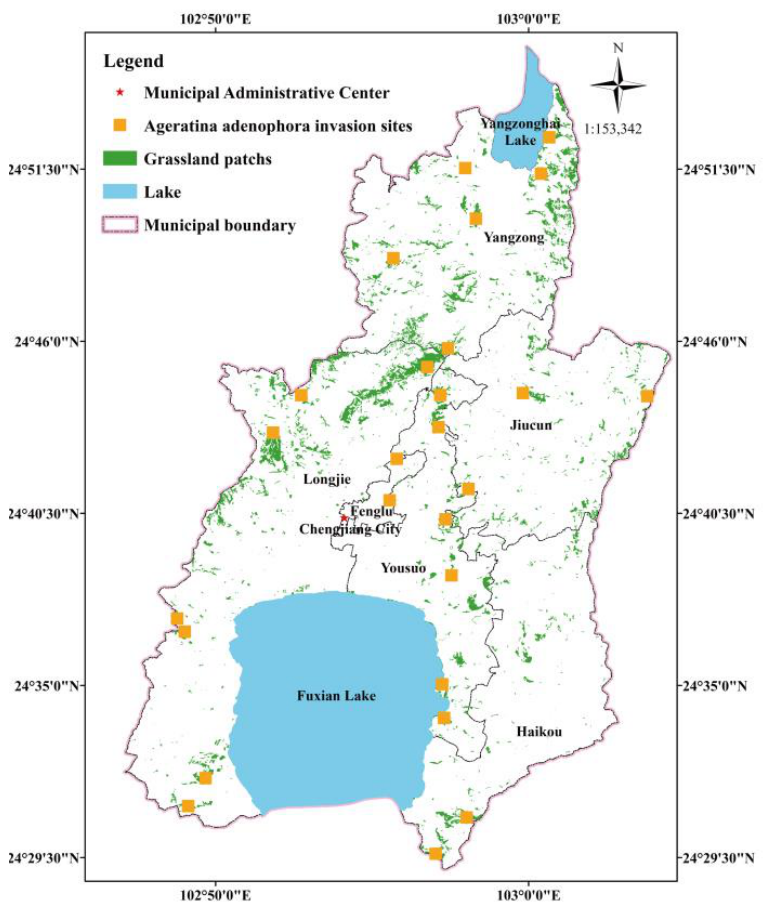
Figure 1. Geographical indication of plants sampling sites in Chengjiang grasslands.
Preprints 222055 g001
Figure 2. Effects of tissue aqueous extracts of A. adenophora on seed germination of the recipient plants. (a), Germination rate; (b), Germination energy; (c), Germination index; (d), Vigor index.
Preprints 222055 g002
Figure 3. Effects of different tissue extracts of A. adenophora on physiological indicator of recipient plants. (a), MDA; (b), Pro; (c), CAT activity; (d), POD activity.
Preprints 222055 g003
Figure 4. Allelopathic response index of recipient plants seed germination to A. adenophora leaf/root extracts. (a), R. hastatus; (b), S. arundinaceum; (c), C. epigeios; (d), E. ferruginea; (e), I. cylindrica.
Preprints 222055 g004
Figure 5. Morphology observation of recipient plants seedlings growth under A. adenophora leaf and root extracts stress. (a), R. hastatus; (b), S. arundinaceum; (c), C. epigeios; (d), E. ferruginea; (e), I. cylindrica. L represents the leaf extract; R represents the root extract; L1-L4 and R1-R4 represent leaf and root extract concentration of 7g/L, 14g/L, 25g/L, 50g/L, CK represent control.
Preprints 222055 g005
Table 1. Inhibitory effect of A. adenophora leaf and root extracts on recipient plants seedling growth.
Measurements Treatments Recipient plant species
R. hastatus S.arundinaceum C. epigeios E. ferruginea I.cylindrica
Seedling height (cm) CK 2.13±0.08a 2.90±0.06a 1.15±0.05a 2.29±0.06a 1.32±0.03a
L1 1.86±0.10a 2.37±0.04b 1.01±0.03b 2.05±0.06b 1.08±0.02c
L2 1.5±0.02b 1.78±0.12c 0.67±0.03d 1.77±0.06c 0.94±0.03d
L3 1.48±0.09b 1.44±0.06d 0.59±0.03e 1.1±0.05e 0.91±0.02d
L4 1.12±0.09c 0.62±0.02e 0.25±0.02f 0.47±0.02f 0.65±0.03e
R1 2.13±0.05a 2.87±0.04a 1.04±0.01b 2.02±0.04b 1.32±0.02a
R2 2.09±0.15a 2.8±0.04a 1.03±0.03b 1.87±0.02c 1.22±0.03b
R3 2.02±0.07a 2.77±0.08a 0.92±0.02c 1.43±0.06d 1.13±0.04c
R4 1.32±0.03bc 2.51±0.08b 0.71±0.02d 1.12±0.03e 0.99±0.03d
Root length (cm) CK 9.27±0.25a 3.36±0.13a 3.68±0.19a 5.34±0.25a 1.53±0.08a
L1 5.85±0.06c 1.20±0.05c 0.29±0.01cd 2.00±0.29b 0.39±0.02cd
L2 3.17±0.10e 0.21±0.02e 0.24±0.03cde 0.7±0.05de 0.14±0.01f
L3 1.05±0.13f 0.16±0.02e 0.07±0.01ef 0.52±0.03de 0.11±0.01f
L4 0.46±0.06f 0.05±0.00e 0.00±0.00f 0.09±0.01f 0.06±0.01f
R1 8.83±0.20a 1.86±0.23b 0.81±0.05b 2.07±0.03b 0.84±0.05b
R2 7.48±0.82b 1.21±0.08c 0.36±0.02c 1.41±0.03c 0.43±0.03c
R3 4.09±0.12d 0.97±0.06c 0.32±0.01c 0.83±0.05d 0.30±0.01de
R4 2.40±0.15e 0.59±0.01d 0.09±0.02def 0.42±0.05ef 0.26±0.01e
Note: L represents the leaf extract; R represents the root extract; L1-L4 and R1-R4 represent leaf and root extract concentration of 7g/L, 14g/L, 25g/L, 50g/L, CK represent control; Values in the table represent mean ± standard error of 5 replications, the lowercase letters within the same column indicate significant differences at the 0.05 level.
Table 2. Correlation analysis between seedlings physiological index and growth measurement of recipient plant species.
Recipient plant Physiological index Seedling height Root length
R. hastatus MDA -0.94158** -0.9878**
Pro -0.91696 -0.97561**
S. arundinaceum MDA -0.88146 -0.96341**
Pro -0.75758* -0.74164*
C. epigeios MDA -0.91132 -0.83181*
Pro -0.91132 -0.83181*
E. ferruginea MDA -0.95122** -0.97561*
Pro -0.80488** -0.80488*
I. cylindrica MDA -0.75696 -0.80488*
Pro -0.9785** -1
Note: * indicates significant difference (p < 0.05); ** exhibits extremely significant difference (p < 0.01).
Disclaimer/Publisher’s Note: The statements, opinions and data contained in all publications are solely those of the individual author(s) and contributor(s) and not of MDPI and/or the editor(s). MDPI and/or the editor(s) disclaim responsibility for any injury to people or property resulting from any ideas, methods, instructions or products referred to in the content.
Copyright: This open access article is published under a Creative Commons CC BY 4.0 license, which permit the free download, distribution, and reuse, provided that the author and preprint are cited in any reuse.
Prerpints.org logo

Preprints.org is a free preprint server supported by MDPI in Basel, Switzerland.

Subscribe

© 2026 MDPI (Basel, Switzerland) unless otherwise stated

Accessibility

Disclaimer

Terms of Use

Privacy Policy

Privacy Settings