
Submitted:
07 July 2026
Posted:
08 July 2026
You are already at the latest version
Abstract
Interactions between plants and microorganisms have long been a central topic in biological research. Bacterial symbiosis on leaf surfaces represents a distinctive and mutually beneficial system within the phyllosphere microbiome. Leaf nodules are the visible manifestation of the symbiosis and confer ecological advantages to host plants by enhancing host resistance against pathogens and herbivores. It has been hypothesized that these advantages promote higher diversification rates in host lineages, but this remains unresolved. Ardisia subg. Crispardisia and its close relatives (Amblyanthopsis and Amblyanthus) within Primulaceae is a typical plant group with leaf-nodule symbiosis, making them an ideal system for testing this hypothesis. In this study, we conducted extensive sampling of “Ardisioids” (Ardisia and its allies), and reconstructed their phylogenetic relationships and evolutionary history using plastid genomes and nuclear datasets (nrDNA and genome-wide SNPs). We clarified the phylogenetic positions of several “Ardisioids” genera (e.g., Sadiria, Tapeinosperma, Amblyanthus, and Amblyanthopsis) and multiple subgenera within Ardisia. We further detected a rapid radiation during the middle Miocene in Ardisia and its allies. Notably, we found that the leaf nodulated clade appears to have originated during this period, approximately 11–8 Ma. BAMM analyses revealed elevated diversification rates in leaf-nodulated lineages, while HiSSE analyses indicated that leaf-nodule symbiosis might have increased speciation rates without significantly affecting extinction rates. These results provide strong evidence that leaf nodule symbiosis represents a key evolutionary innovation that has promoted diversification in Ardisia and its close relatives.
Keywords:
phyllosphere microbiome
; leaf nodule
; Ardisia
; diversification rate
1. Introduction
Plants and microorganisms have developed complex symbiotic relationships throughout long-term evolution, and such associations are widespread in nature [1]. Compared with the well-known mycorrhizal symbiosis in roots [2], phyllosphere microorganisms inhabit a far more variable atmospheric environment. These unique conditions have shaped distinct interaction patterns and ecological functions. As a result, bacterial symbiosis on leaf surfaces, as a specialized ecological niche, has increasingly drawn research attention in recent years [3,4,5,6,7].
Leaf nodulation is a typical example of phyllosphere symbiosis, which represents a morphological feature where symbiotic bacteria establish stable and persistent colonization at specific sites on plant leaves. Unlike the root–microbe interactions and specialized root nodules (i.e., rhizobial nitrogen-fixing symbiosis) [8], leaf nodules housing microbial endophytes in dedicated glandular structures have only recently received attention [9]. Such leaf nodule symbionts have been reported only in a few plant lineages, e.g., Ardisia Sw. and its allies Amblyanthopsis Mez and Amblyanthus A.DC. (Primulaceae), several Rubiaceae genera (i.e., Pavetta L., Psychotria L. and Sericanthe Robbr.), Styrax L. (Styracaceae), and Dioscoreaceae [5,10,11,12].
Significant and fascinating progress has been made in the study of leaf nodule symbiosis. First, studies have shown that leaf nodule symbionts in Ardisia and Psychotria and Pavetta are Burkholderia belonging to the Burkholderiaceae family of β-proteobacteria, while the symbiont of Dioscorea Plum. ex L. (Dioscoreaceae) is Orrella dioscoreae [13]. Second, due to the highly specialized mutualistic relationship between leaf nodule bacteria and their hosts, Candidatus Burkholderia species cannot be cultivated outside their plant hosts. Conversely, host plants (such as Psychotria kirkii Hirkii and Ardisia crenata Sims) exhibit severe growth defects and eventually die when deprived of their endosymbionts [12,14,15,16]. Third, nodulated Burkholderia species display obligate symbiosis and are primarily transmitted vertically through seeds [3]. Additional routes have been proposed, including insect-mediated transmission [4] and pollen-mediated transfer, since Burkholderia spp. have been detected in the stamens of A. crenata [17].
Finally, host plants derive clear benefits from their leaf nodule symbionts. For example, the symbionts of A. crenata produce the cyclic depsipeptide FR900359, a potent and selective inhibitor of Gq proteins [18,19,20,21], which enhances host resistance against pathogens and herbivores. A similar case has been reported in Rubiaceae, where Candidatus Burkholderia endophytes produce the toxic alkaloid pavettamine [5,22]. These observations suggest that leaf nodule symbiosis may confer ecological advantages to host plants by facilitating niche expansion or reducing biotic pressures. A plausible hypothesis is that symbiosis promotes the diversification rate of host plants. However, evidences supporting this hypothesis remains limited, and more direct investigations into leaf nodule symbiosis are needed to rigorously test it. As noted above, Ardisia and its close relatives Amblyanthopsis and Amblyanthus are typical leaf nodule symbiotic plants and represent ideal examples for investigating whether this trait is linked to the formation of species diversity.
Ardisia, the largest pantropical genus of Myrsinoideae (Primulaceae s.l.), comprises approximately 700–1000 species throughout the world [23], with nearly 400 of which occur in Asia. It is a characteristic component of tropical rainforests and Asian evergreen broad-leaved forests [24]. Despite its remarkable species diversity, the genus Ardisia, together with several closely related genera—collectively referred to as the “Ardisioids,” including Amblyanthopsis, Amblyanthus, Tapeinosperma Hook.f., Labisia Lindl., Parathesis Hook.f., Elingamita G.T.S.Baylis, and others [25]—still lacks a well-resolved phylogenetic framework. This is largely due to unresolved taxonomic boundaries both among these genera and within Ardisia itself.
Within Ardisia, only the subg. Crispardisia possesses leaf nodule symbiosis, which represents a key morphological trait [6,12,17,18]. This subgenus is one of the most species-rich Ardisia groups in China and the Indo-Burma region, comprising about 36 species [26]. Two morphologically similar genera, Amblyanthopsis and Amblyanthus, also exhibit crenate leaves with nodules. They differ from Ardisia subg. Crispardisia mainly by their fused anthers and by their relative stamen filament length compared with anthers [27,28,29]. Molecular phylogenetic study have suggested that Amblyanthopsis and Amblyanthus are nested within Ardisia and placed as sister to Ardisia subg. Crispardisia [29]. However, due to the lack of comprehensive sampling and richer molecular data (particularly nuclear genomic information), phylogenetic relationships within Ardisia and its allies are not well understood. Consequently, the origin of leaf nodule symbiosis within Primulaceae, as well as its potential evolutionary importance in driving diversification rates, remains unresolved.
In this study, we sampled extensively across China and adjacent regions, covering Ardisia and its close relatives (e.g., Amblyanthopsis, Amblyanthus), and included representatives of all subgenera of Ardisia in the area (subgenera Crispardisia, Akosmos, Tinus, Bladhia, and Odontophylla). Special emphasis was placed on collecting species of Ardisia subg. Crispardisia. We generated high-throughput sequencing data for each species and reconstructed phylogenetic relationships using state-of-the-art systematic methods. Specifically, we aim to: (1) Reconstruct the phylogeny of Ardisia and related genera (“Ardisioids”); (2) Reconstruct its evolutionary history; and (3) Evaluate the origin of leaf nodule symbiosis of Ardisia and its relatives, and its potential impact on diversification rate.
2. Material and Methods
2.1. Taxon Sampling and DNA Extraction
We sampled 134 accessions, including 130 newly collected individuals. A total of 65 Ardisia species were sampled in this study. Specifically, it covers all five subgenera of Chinese Ardisia (subg. Crispardisia, Akosmos, Bladhia, Tinus, and Odontophylla), representing 60 of the 70 (~86%) species recorded in China [30]; Supplementary Table S1). We also included eight other genera closely related to Ardisia, which are referred to as the “Ardisioids.” Silica-gel dried leaves were used for total genomic DNA extraction with a modified CTAB protocol [31]. DNA integrity was evaluated using agarose gel electrophoresis and Qubit quantification.
2.2. Genome Sequencing and Plastid Assembly
Genomic libraries (2×150 bp) were prepared using the MGIEasy kit and sequenced on the MGISEQ-2000 platform at BGI (Wuhan, China). Raw reads were processed with Trimmomatic v0.36 [32] to remove adapters and low-quality bases. Each sample yielded ~2 Gb clean reads.
Plastid genomes were assembled with GetOrganelle [33] using the “embplant_pt” reference set and Ardisia crenata plastome (MW929178) as seed. Circularized assemblies were validated by read mapping in Geneious v11.0.4. Annotation was performed with GeSeq [34] and verified with Chloë v0.1.0 (https://github.com/ian-small/chloe).
2.3. Concatenated Plastid Phylogeny
Eighty conserved protein-coding sequences were extracted from 134 plastid genomes according to the gene annotations and translated into amino acid sequences. Protein sequences were aligned using the MAFFT L-INS-i algorithm [35], optimized for local iterative refinement. The protein alignments were back-translated into codon alignments, and trimmed using trimAl by removing columns with >50% missing data. These gene alignments were used for both phylogeny and divergence-time estimation.
Concatenated plastid phylogenies were reconstructed using both RAxML v8.2.13 [36] and IQ-TREE v2.4.0 [37]. With both analyses, two additional partitioning strategies were implemented: (1) partitioning by gene (80 partitions) and (2) partitioning by codon position (three partitions). In RAxML, maximum likelihood (ML) analyses were performed with the GTR+Γ substitution model and 500 rapid bootstrap (RBS) replicates. In IQ-TREE, ModelFinder was employed to identify the best-fitting substitution models [38]. Node support was evaluated using 1,000 SH-aLRT tests and ultrafast bootstrap (UFBoot) analyses with 1,000 replicates, incorporating the -bnni correction to reduce potential bootstrap overestimation. Branches with SH-aLRT ≥ 80% and UFBoot ≥ 95% were regarded as strongly supported.
Phylogenetic trees inferred from concatenated plastid dataset under different analytical strategies were compared using Robinson–Foulds (RF) distance. To enable direct comparison across studies with varying taxon sampling and to facilitate assessment of phylogenetic accuracy, RF distances were normalized by dividing the raw RF value by 2(n − 3), where n represents the number of taxa. In addition, weighted RF distances were calculated to account for branch support associated with bipartitions unique to one of the compared trees. This approach incorporates support values into the metric, effectively weighting topological differences according to their evolutionary reliability.
2.4. Nuclear Ribosomal DNA Assembly and its Phylogeny
Nuclear ribosomal DNA (nrDNA) sequences were also assembled in GetOrganelle, with the “embplant_nr” reference dataset. Candidate high-copy contigs were aligned to the nrDNA sequence of Maesa montana A.DC. (KU569493), and the longest, structurally complete repeat unit (ETS-18S-ITS1-5.8S-ITS2-26S) for each sample was selected. This procedure minimizes the impact of incomplete concerted evolution among nrDNA repeats. A total of 126 nrDNA sequences were retained for downstream analyses (Supplementary Table S1). Sequences were aligned using the MAFFT L-INS-i algorithm, and poorly aligned regions were removed at both ends. A maximum likelihood tree was constructed in RAxML with the GTR + Γ model and 500 rapid bootstrap replicates.
2.5. Whole Genome-Wide Variant Calling and Species Tree Reconstruction
Compared with the relatively conserved nrDNA region, genome-wide SNP data provide substantially higher resolution for phylogenetic inference and have become an important approach in evolutionary studies. WASTER is a powerful de novo method for inferring shallow species trees directly from short-read data [39]. It employs a k-mer–based strategy that enables species-tree reconstruction from low-coverage genomic reads without requiring genome assembly or sequence alignment. In this study, clean reads from sequencing were decomposed into 19-bp k-mers, which were subsequently clustered for downstream analyses. A cluster was retained only if all species shared a single variable site located at the central position of the k-mer. Clusters containing within-species polymorphisms were discarded, thereby retaining only homozygous variants and eliminating heterozygous sites. The resulting set of variant sites was concatenated and supplied to CASTER-site for species-tree inference under the T9 substitution model, which is compatible with strand-agnostic sequencing. Branch supports measured as local bootstrap support (>95.0 means highly supported).
2.6. Heterogeneity in Phylogenetic Signals Among Plastid Genes
Although plastid protein-coding genes are typically assumed to share a common evolutionary history, substantial heterogeneity in phylogenetic signal among genes can still occur. To quantify gene-tree concordance and conflict across plastid loci, we employed a gene tree-based approach using PhyParts [40]. Individual plastid gene trees were inferred using RAxML under the same parameter settings as described for the nrDNA analyses. Branches with rapid bootstrap support (RBS) values below 50% were collapsed to reduce the impact of poorly supported relationships.
The resulting gene trees were then compared with the reference topology (the concatenated plastid ML tree) using PhyParts. This approach decomposes each internal node of the reference tree and quantifies the number of gene trees that (1) support the focal bipartition, (2) conflict with current topology, or (3) are uninformative. The distribution of concordant and conflicting signals across nodes was visualized using pie charts.
2.7. Divergence Time Estimation
Divergence times were estimated using MCMCTree in the PAML v4.9 package [41], based on 80 concatenated PCGs dataset. This tree was rooted by designating the two species of Maesa Forssk. (Maesoideae) as the outgroups. Fossils and secondary calibration points were then applied to the rooted topology (Supplementary Table S2).
We estimated divergence times using the approximate likelihood method in MCMCTree. BASEML was first used to obtain preliminary substitution-rate estimates, which were then used in MCMCTree to derive maximum-likelihood branch lengths along with the corresponding gradient and Hessian. A Taylor-approximated likelihood was subsequently constructed, and MCMCTree was run to obtain posterior estimates of node ages and associated parameters. Convergence was assessed in Tracer, ensuring ESS values > 200. The resulting posterior distributions were summarized to generate the final chronogram with 95% credibility intervals.
2.8. Diversification Rate Analysis
Lineage-through-time (LTT) plots were generated using phytools [42] based on the ultrametric time tree of the subfamily Myrsinoides and “Ardisioids.” We then simulated 300 trees under a pure-birth model and compared their LTT curves with that of the empirical time tree. In addition, diversification rates and possible rate shifts across Old World Ardisia (including Amblyanthus and Amblyanthopsis) were further inferred using BAMM v2.5 [43]. Before that, priors were determined using the R package BAMMtools v2.1.6 [43]. The prior for “ExpectedNumberofShifts” was set to 1, and the global sampling probability was set to 0.18. We run BAMM for 2,000,000 generations, sampling every 200 generations. We then evaluated convergence based on ESS ≥ 200 for the loglikelihood and number of shifts using the R package CODA [44]. We discarded the first 25% of BAMM output files as burn-in. Using BAMM posterior probability, we inferred the 95% credible set of macroevolutionary rate shift configurations. We then plotted speciation rates, extinction rates, and net diversification rates using the R package BAMMtools.
2.9. State-Dependent Diversification Rates Analysis
We used the hidden-state speciation and extinction (HiSSE) framework to evaluate whether the presence or absence of leaf nodules is associated with diversification rates in Ardisia. We compared five models differing in the way they account for trait dependence and diversification rate heterogeneity. First, we fitted the standard BiSSE model, which assumes that diversification rates differ directly according to the observed binary trait (presence vs. absence of leaf nodules). Second, we applied two trait-dependent HiSSE models incorporating unobserved rate heterogeneity: HiSSE2 (with two hidden rate classes) and HiSSE4 (with four hidden rate classes). Finally, to test whether diversification rate variation can be explained by unmeasured factors alone, we included character-independent diversification models, which allow two (CID-2) or four (CID-4) hidden states respectively but constrain diversification to be independent of the focal trait. All models were implemented in RevBayes [45], and model fit was compared using marginal likelihoods estimated via stepping-stone sampling.
3. Results
3.1. Phylogenomics of Ardisia and its Allies Based on Plastid and Nuclear Datasets
This study generated a plastid dataset comprising 80 protein-coding genes (PCGs), totaling 68,964 bp in length. The dataset includes 134 plastid genome sequences, representing 65 Ardisia species, 24 samples from 12 closely related genera within Myrsinoideae, and two outgroups belonging to Maesoideae. We also generated an nrDNA dataset and a genome-wide SNP dataset. Detailed information is provided in Table S1.
The plastid dataset was used to reconstruct phylogenetic trees under the maximum likelihood (ML) framework implemented in RAxML and IQ-TREE. The normalized RF (nRF) and weighted nRF distances were both less than 3% and 1%, respectively (Supplementary Table S3), indicating a high degree of topological congruence among ML trees inferred under different partitioning strategies. Direct comparisons of tree topologies further show that the observed discrepancies are confined to nodes with bootstrap support below 50% (Supplementary Figures S1–S5). Consistently, PhyParts analyses demonstrate that these poorly supported nodes lack concordant phylogenetic signals (Supplementary Figure S6). We therefore selected the unpartitioned topology as the representative plastid phylogeny for subsequent analyses (Figure 1A, Supplementary Figure S1). The species tree inferred from genome-wide SNP data using WASTER is shown in Figure 1B. nrDNA sequences are relatively conserved and provide lower resolution, the resulting topology is therefore presented in the Supplementary Materials (Supplementary Figure S7).
All of our phylogenomic analyses indicate that the current circumscription of Ardisia is clearly not monophyletic (Figure 1, Supplementary Figures S1–S5). Two New World Ardisia species (Ardisia amplifolia Standl. and A. guianensis (Aubl.) Mez) were included in this study. However, only A. amplifolia was incorporated into the nrDNA and genome-wide SNP phylogenetic trees, as raw sequencing data for A. guianensis were unavailable. The phylogenetic results nonetheless strongly support a well-resolved clade comprising New World Ardisia taxa together with the New World genus Parathesis and the New Zealand genus Elingamita (Figure 1B, Supplementary Figures S7–S8). This New World clade is in turn recovered as the sister group to the Old World “Ardisioids” lineages. The Old World Ardisia is a moderately well-supported group that contains two small genera, Amblyanthus and Amblyanthopsis based on plastid genes (Figure 1A), while it further contains genera Hymenandra A.DC. ex Spach, Sadiria Mez and Tapeinosperma in the species tree recovered by genome-wide SNP dataset (Figure 1B). The status of Labisia clusters with Hymenandra was strongly recovered in the species tree (Figure 1B).
Within Old World Ardisia, three well-supported monophyletic subgenera were recovered by all three datasets: subg. Akosmos, subg. Bladhia, and subg. Odontophylla, which could be supported by a number of concordant phylogenetic signals on the corresponding nodes inferred by Phyparts (Figure 1A). Both plastid and nrDNA phylogenies indicate that Ardisia subg. Crispardisia is paraphyletic, as Amblyanthus and Amblyanthopsis are nested within it (Figure 1A, Supplementary Figure S7). However, the species tree inferred from genome-wide SNPs supports that Ardisia subg. Crispardisia, with Amblyanthus and Amblyanthopsis form a distinct clade, although the relationship between these three genera remains poorly resolved (Figure 1B, Supplementary Figure S8). Furthermore, all of our datasets consistently show that Ardisia subg. Tinus is polyphyletic, with its species distributed across two distinct clades (Figure 1, Supplementary Figures S1–S5 and S7–S8), and Ardisia subg. Acrardisia consistently nested within it. In addition, Tapeinosperma further resolved as sister to Ardisia subg. Acrardisia in the species tree (Figure 1B, Supplementary Figure S8).
Besides, some taxonomically challenging groups characterized by pronounced morphological variation remain unresolved. Notably, the Ardisia crenata complex (i.e., A. crenata, A. henceana Mez, A. linanensis C.M.Hu, and A. ensifolia E.Walker) and the Ardisia thyrsiflora complex (i.e., A. thyrsiflora D.Don, A. cymose Blume, and A. quinquegona Blume) continue to present difficulties. Within these complexes, A. crenata and A. thyrsiflora exhibit exceptionally broad geographic and elevational ranges and substantial morphological variability [30,46].
3.2. Cytonuclear Conflicts
Many nodes in the nrDNA ML tree showed bootstrap support values below 50 (Supplementary Figure S7), we therefore primarily focused on comparing the plastid phylogeny with the genome-wide SNP species tree. It is evident that substantial cytonuclear conflicts exist between these two phylogenies (Figure 1). Here, we specifically highlight three major conflicts: (1) the phylogenetic placement of Amblyanthus and Amblyanthopsis (Q1); (2) the phylogenetic position of Sadiria (Q2); (3) the phylogenetic position of Tapeinosperma (Q3) (Figure 1).
3.3. Divergence Time Estimate of “Ardisioids”
We reconstructed the evolutionary history of the subfamily Myrsinoideae based on 80 plastid genes, revealing that its early diversification can be traced back to approximately 49 Ma, corresponding to the early Eocene. “Ardisioids” is estimated to have originated around 29 Ma (stem age) and subsequently split into Old World and New World lineages at approximately 22 Ma. Our results further indicate that diversification of the New World “Ardisioids” began around 14 Ma. At roughly the same time, Old World “Ardisioids” also initiated a rapid radiation, giving rise to at least five genera—Labisia, Hymenandra, Tapeinosperma, Sadiria, and Ardisia (Supplementary Figure 2A). The presence of numerous short internodes during the early diversification of the Old and New World “Ardisioids” also indicates a phase of rapid lineage splitting (Supplementary Figures S1–S5, S7). The Phyparts analysis indicated that most genes lacked concordant phylogenetic signals during the period (Supplementary Figure S6). Interspecific divergence within Old World Ardisia occurred since the Quaternary. The Ardisia crenata complex exemplifies this pattern of recent and rapid diversification (Figure 2A). Importantly, lineages exhibiting leaf nodulation show a stem age of approximately 11 Ma and a crown diversification age of around 8 Ma.
3.4. Diversification Rate
The LTT plot for the entire subfamily Myrsinoideae reveals a pronounced increase in lineage accumulation between 14 and 12 Ma (Figure 2B), coinciding with a phase of rapid lineage splitting during the early diversification of both Old and New World “Ardisioids” (Supplementary Figures S1–S6). Phylorate analysis detected a single, well-supported rate shift within the leaf-nodule clade (i.e., Ardisia subg. Crispardisia + Amblyanthus + Amblyanthopsis), dated to approximately 10 Ma (Figure 2C).
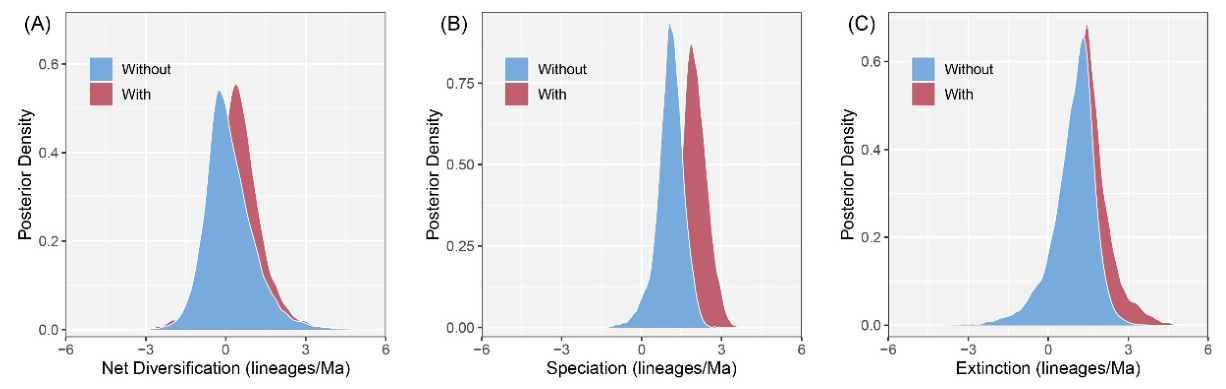
We further investigated whether the leaf-nodulation trait is associated with diversification rates. Model comparison based on marginal likelihoods indicated that the HiSSE4 model best explained the data (Supplementary Table S4), outperforming both the simpler BiSSE and the character-independent CID models. This indicates that diversification rate variation in Ardisia is shaped by a combination of the leaf nodule and additional, unmeasured factors. Under the best-fitting HiSSE4 model, lineages with leaf nodules exhibited consistently higher net diversification rates (r=λ−µ) than its non-nodule relatives (Figure 3). This pattern was primarily driven by elevated speciation rates (λ1) in nodule-bearing lineages, while extinction rates (µ0 and µ1) were comparable between the two groups (Figure 3). These results suggest that the presence of leaf nodules is positively associated with diversification in Ardisia, primarily through enhanced speciation rather than reduced extinction (Figure 3).
4. Discussion
4.1. Traditional Delimitation Among Ardisia and its Relatives Need Re-Evaluated
Traditionally, Ardisia has been recognized as the largest genus within Myrsinaceae s.s, and even after its reclassification under the broadly defined Primulaceae, it remains the largest genus in the family. Due to its extraordinary species richness and pronounced morphological diversity, resolving its phylogenetic relationships with closely related genera and establishing a robust infrageneric classification system have proven to be significant challenges.
Our study, in line with previous phylogenetic analyses, consistently indicates that Ardisia, as currently circumscribed, is not monophyletic. Broadly, it can be divided into two major geographically defined clades: (1) A New World clade, comprising American Ardisia taxa and their allied genera (e.g., Elingamita, Wallenia Sw., Parathesis, Geissanthus Hook.f., and Stylogyne) from Americas; and (2) An Old World clade (e.g., Badula Juss., Oncostemum A.Juss, Amblyanthus, Amblyanthopsis, Discocalyx (A.DC.) Mez, Fittingia Mez, Antistrophe A.DC., Conandrium (K.Schum.) Mez, Labisia, Systellantha B.C.Stone, Sadiria, and Loheria Merr.), which spans a wide distribution across Asia, the Atlantic islands, Australia, and Africa [6,25,47,48].
However, our sampling in this study is largely concentrated in Asia—particularly Ardisia taxa from China and adjacent regions. In contrast, only a few New World Ardisia species were included, and the type species of the genus was not sampled. Therefore, accurately redefining the generic boundaries of Ardisia and fully resolving its taxonomic issues lies beyond the scope of this study. Instead, our primary focus is on clarifying the phylogenetic relationships within Ardisia from China and surrounding areas, as well as examining the systematic placement of several of its closest allies.
4.1.1. The Phylogenetic Position of Tapeinosperma
Based on current evidence, the New Zealand endemic group Elingamita appears to have a closer phylogenetic relationship with the Neotropical clade [25,49]. More intriguingly, the phylogenetic position of Tapeinosperma, distributed across Southeast Asia and Pacific islands, presents a particularly interesting case. Given its geographical distribution, this group would presumably belong to the Old World clade of Ardisia, which was strongly supported by our phylogenetic analyses (Figure 1) and Rose et al. [49]. However, recent studies based on nuclear genes (the Angiosperms353 probe set) present a different perspective: the two included Tapeinosperma species (i.e., T. pseudojambosa (F.Muell.) Mez and T. storezii M.Schmid) were strongly supported as members of the Neotropical clade, forming a sister group to Elingamita [25,50].
Morphologically, Tapeinosperma species are characterized by cylindric styles and conspicuous stigmas, which clearly distinguish them from Ardisia; however, they are not easily separable from its close relative Discocalyx [51]. The discordance in the phylogenetic placement of Tapeinosperma may be attributed to two possible explanations. First, Tapeinosperma may in essence not be monophyletic, with some species more closely related to Elingamita and the New World “Ardisioids,” while others are aligned with the Old World “Ardisioids.” Yet, this explanation seems highly implausible, because studies—including our own—that randomly sampled six distinct species of Tapeinosperma consistently recovered the genus as monophyletic in both nuclear and plastid datasets [25,49,50]. Second, the observed discordance may reflect ancient episodes of extensive hybridization and introgression, which is currently considered the most common cause of cytonuclear conflict [52]. Nevertheless, the striking discrepancies between genome-wide SNPs (Figure 1B) and nrDNA (Supplementary Figure S7) and those derived from the Angiosperms353 probe set underscore the need for further detailed investigation into both the phylogenetic placement and the taxonomic circumscription of Tapeinosperma.
4.1.2. The Phylogenetic Position of Sadiria
Sadiria is a small, well-defined genus established by Mez [28]. It resembles Ardisia but differs in having petals united to or above the middle and flowers borne in very short (equal to or shorter than the petioles), axillary, subfasciculate cymose or subpaniculate inflorescences [28,53]. The genus comprises nine species and two varieties, distributed from the eastern Himalaya and Khasi Hills to northern Myanmar and southern Yunnan, China [28,53,54,55,56,57,58].
Our results reveal pronounced cytonuclear discordance. Plastid phylogenomic analyses strongly support three Sadiria species (including S. longistyla Ze H.Wang & H.Peng) forming a clade that is sister to Old World Ardisia (Figure 1A). In contrast, nuclear data consistently place Sadiria within Old World Ardisia, most closely related to Ardisia subg. Tinus or Ardisia subg. Bladhia (Figure 1B, Supplementary Figure S7), which supported by Julius et al. [48] and Larson et al. [25].
Cytonuclear discordance, increasingly recognized across plant lineages, often reflects complex evolutionary histories such as ghost lineages, hybridization, or introgression [59,60]. Careful re-examination of voucher specimens ruled out misidentification. We therefore infer that the observed phylogenetic conflict most likely resulted from ancient hybridization or introgression between Sadiria and Ardisia. The plastid genome of Sadiria likely represents a ghost lineage inherited from a hybrid ancestor. These findings suggest that Sadiria could potentially be treated as a subgenus within Ardisia. However, because the type species of Ardisia is Neotropical, and molecular evidence clearly separates New World and Old World Ardisia into distinct clades associated with geographically proximate genera, any taxonomic revision would need to be considered at the genus-wide level.
4.1.3. The Phylogenetic Position of Ardisia Subg. Crispardisia, Amblyanthus and Amblyanthopsis
Ardisia subg. Crispardisia can be recognized by its crenulate leaves bearing marginal nodules, which clearly distinguish it from other Ardisia [26,28,58,61]. The subgenus comprises about 36 species [26,30], primarily distributed in subtropical and tropical regions of China and Indo-Burma. Amblyanthus and Amblyanthopsis are morphologically similar to Ardisia, especially because both also possess crenate leaves resembling those of Ardisia subg. Crispardisia, but they are distinguishable by specific traits. For example, anthers in Amblyanthus are laterally connate into a cone, while in Amblyanthopsis they are coherent but not fused [28,58]. Each of these two small genera contains five species: Amblyanthus occurs in Bangladesh, northeastern India, and southwestern China [28,29,57,58], whereas Amblyanthopsis is distributed in Bangladesh, Bhutan, Myanmar, and northeastern India [27,62]. The monophyly of Ardisia subg. Crispardisia has been supported in earlier studies [6,17,48], but its status remains questionable because of limited sampling and omission of its presumed close relatives (Amblyanthus and Amblyanthopsis). In this study, we for the first time included 33 of the 36 species of Ardisia subg. Crispardisia, along with two species representing Amblyanthus and Amblyanthopsis. Nuclear and plastid genomic data allowed us to make several advances.
First, our analyses strongly confirmed that the three groups are closely related and further demonstrated that Amblyanthus and Amblyanthopsis are sister taxa. Their close affinity had also been suggested by Zhou et al. [29] and Larson et al. [25]. From this, we can at least conclude that anther connation is not an ideal character for distinguishing Ardisia from its close relatives. For example, the fused anthers of Amblyanthus are not unique but also occur in other genera such as Conandrium and Hymenandra [48,58], with phylogenetic analyses indicating multiple independent origins [25,48]. This observation reminds us of the unresolved taxonomic issue of Hymenandra. Pipoly and Ricketson [63] transferred several traditional Neotropical Ardisia species into Hymenandra based on the character of fused anthers. As a consequence, Hymenandra was rendered non-monophyletic, with its species divided between Neotropical and Paleotropical lineages [6,25,48].
Second, we confirmed that the presence of leaf nodules is a single evolutionary origin within Primulaceae. All three groups (Ardisia subg. Crispardisia, Amblyanthus, and Amblyanthopsis) have petiolate leaves with glandular-crenate margins, identical to the condition in Ardisia subg. Crispardisia. These marginal glands were shown to be leaf nodules, representing an obligate bacterial leaf symbiosis essential for normal host growth [3,6,11,12]. Our divergence-time estimates suggest that this symbiosis originated around 11 Ma (stem age) to 8 Ma (crown age), approximately three million years earlier than estimated by Lemaire et al. [3]. This discrepancy is most likely attributable to our denser sampling, differences in calibration points, or variation in analytical methods.
Third, their positions of Ardisia subg. Crispardisia, Amblyanthus and Amblyanthopsis show cytonuclear discordance. Our whole genome SNP-based species tree also demonstrated that Ardisia subg. Crispardisia is closely related to Amblyanthus and Amblyanthopsis (Figure 1B). However, plastid evidences strongly support that Amblyanthus and Amblyanthopsis are closely related to Ardisia maculosa, A. hokoensis, and A. shweliensis within Ardisia subg. Crispardisia, suggesting plastid capture from either extinct or undescribed Ardisia subg. Crispardisia taxa. Nevertheless, the exact evolutionary relationships of Amblyanthus and Amblyanthopsis remain uncertain, as each was represented in our study by only a single species. Broader sampling will be required to clarify their phylogenetic placement in the future.
4.2. Rapid Divergence Events Within the Old World Ardisia and its Relatives
Despite the large amount of data used in this study—80 plastid genes and genome-wide SNP datasets—many nodes in the inferred phylogeny still received very low support. Specifically, on the ML phylogenetic trees constructed from plastid genomes and nrDNA, the majority of these nodes lacked significant support (BP < 70, SH-aLRT < 80%, and UFBoot < 95%) (Supplementary Figures S1–S5, S7). We further found that these weakly supported nodes mainly occurred in two regions of the tree: (1) among relationships between subgenera within Ardisia and between Ardisia and its close relatives (i.e., Tapeinosperma and Sardiria), where the branches were also extremely short. The very short branch lengths observed here indicate a lack of phylogenetic signal, consistent with a rapid diversification event [64]. (2) Low support was also observed in many species pairs, particularly within Ardisia subg. Crispardisia, where at least 12 nodes lacked significant support and were likewise characterized by short branches. All topological evidence above is visualized in Figure 1A and Supplementary Figures S1–S5, S7.
Our molecular dating analyses suggest that the first episode of rapid radiation occurred during the middle Miocene, approximately 14–13 Ma. A similar event was also reported by Larson et al. [25]. From the early Miocene, Southeast Asia experienced a climatic shift from seasonally wet to predominantly perhumid conditions [65]. During the Middle Miocene Thermal Maximum, megathermal forests expanded northward to southern China (ca. 24°N), fostering a diverse evergreen rainforest flora dominated by tropical lineages such as Dipterocarpaceae, Leguminosae, and Clusiaceae [65,66,67,68]. Previous historical biogeographic analyses (e.g., Larson et al. [25]) inferred that the ancestral area of the “Ardisioids” (including Ardisia and its allies) was the Indo-Malayan region. This suggests that the warmer climate and sea-level rise during this period [69], may have promoted geographic isolation among Southeast Asian islands, thereby facilitating the rapid diversification of ancestral “Ardisioid” lineages—a pattern documented in several other plant groups [69,70].
Another episode of rapid radiation appears within the lineage comprising Ardisia subg. Crispardisia together with Amblyanthus and Amblyanthopsis. In particular, nearly all species pairs within this clade diverged only within the last 2–3 million years (since the Pleistocene). Compared with the entire genus Ardisia, which contains more than 700 species [23], this plant group comprises only about 45 species (36 in Ardisia subg. Crispardisia, four in Amblyanthopsis, and five in Amblyanthus) [26,27,28,29], reflecting relatively modest species richness. Nevertheless, its main distribution lies in tropical and subtropical China and adjacent regions, near the northern edge of the whole genus’ broader range. For instance, in China alone Ardisia subg. Crispardisia contains 34 species, accounting for nearly half of the country’s ~70 Ardisia species, making it the most species-rich subgenus of Ardisia in this region. The distribution pattern highlights both the strong environmental adaptability and the relatively rapid diversification of the lineage in tropical and subtropical China.
Climatic fluctuations since the Pleistocene likely accelerated divergence and speciation in Southeast Asia. These patterns are linked to complex geological events, such as rapid orogenesis from micro-terrane movements, and major sea-level shifts driven by climate oscillations [69,71], as seen in Impatiens Riv. ex L. [72] and Begonia L. [73]. The case of Ardisia subg. Crispardisia may differ from these island-related scenarios. This lineage is concentrated in tropical and subtropical China and nearby regions, at the northern margin of Ardisia’s Asian distribution, which hosts many endemic and rapidly radiating plant groups (such as Ilex Tourn. ex. L., Actinidia Lindl., Lysimachia Tourn. ex. L. and Magnolia sect. Michelia [74,75,76,77]). Their diversification may have been coupled with and driven by the uplift of the Qinghai–Tibetan Plateau, the East Asian monsoon, and global climate shifts [77]. We therefore hypothesize that Ardisia subg. Crispardisia was also strongly shaped by these external environmental factors.
4.3. Leaf Nodulation as a Key Innovation Driving Diversification
The leaf-nodulated clade (i.e., Ardisia subg. Crispardisia and taxa from Amblyanthopsis and Amblyanthus) exhibits a significantly elevated speciation rate (Figure 2C). Character-dependent diversification models, particularly under the robust HiSSE framework, consistently outperformed alternative models (Figure 3). These results clearly indicate that lineages possessing this intimate mutualism have experienced significantly higher speciation rates than their non-symbiotic relatives. Collectively, the evidence supports leaf-nodule symbiosis as a key innovation that likely triggered adaptive radiation within the species-rich, leaf-nodulated clade of Ardisia.
This finding has additional significance in a broader comparative context. Similar studies in Rubiaceae have revealed a positive association between bacterial leaf endophytes and increased host diversification, including in lineages lacking distinct nodules [78]. Our results provide the first confirmation of a symbiosis-driven diversification pattern within the phyllosphere of Ardisia, suggesting that inherited microbial partnerships may represent an underappreciated driver of plant macroevolution. These associations can fundamentally reshape host evolutionary trajectories by introducing novel functional capacities that promote ecological expansion and lineage diversification.
While identifying a statistical correlation between symbiosis and diversification is essential, understanding the underlying mechanisms is equally critical. In the Ardisia–Burkholderia system, a likely driver is the production of novel chemical defenses by the bacterial symbiont. In A. crenata, the endosymbiont synthesizes FR900359, a potent broad-spectrum defensive compound [4,6,18,19,20,21], directly linking symbiosis to host fitness.
This "borrowed" biochemical arsenal may promote diversification through multiple, non-exclusive mechanisms. First, enhanced defense could facilitate escape from herbivores and pathogens, allowing ancestral Ardisia subg. Crispardisia lineages (including taxa from Amblyanthopsis and Amblyanthus) to colonize previously inaccessible niches. Second, geographic variation in enemy communities may impose divergent selection on symbiotic defense strategies, promoting ecological specialization and ultimately reproductive isolation through allopatric or ecological speciation.
Beyond defense, the symbiosis is also essential for host growth and development. In the absence of symbionts, seedlings can survive for up to three years but remain severely stunted; the shoot tips eventually degenerate into callus tissue, and growth ceases [12,14,16]. The symbiosis may also enhance tolerance to abiotic stressors, including drought, salinity, and nutrient-poor soils [79], functioning analogously to legume–rhizobial associations [80]. By expanding the host’s fundamental niche, the partnership could facilitate broader geographic distributions, increasing opportunities for population isolation and subsequent divergence.
5. Conclusions
Our study focuses primarily on Ardisia and its close relatives (subfamily Myrsinoideae) distributed in China and adjacent regions. Through relatively comprehensive taxon sampling, and for the first time by integrating plastid genome data with nuclear gene datasets, we reconstructed a robust phylogenetic framework and elucidated the evolutionary history of this group. Our results affirm that Ardisia is not monophyletic, but instead represents the core lineage of both Old World and New World “Ardisioids”, highlighting that generic boundaries within “Ardisioids” require more detailed taxonomic and systematic reassessment.
Within our focal groups (Ardisia and allied genera from China and surrounding regions), we detected a rapid radiation event during the middle Miocene, which gave rise to numerous morphologically distinct lineages. A further increase in net diversification rates was observed in lineages characterized by leaf-nodule symbiosis, namely Ardisia subg. Crispardisia, Amblyanthopsis, and Amblyanthus. Our results provide strong evidence that leaf-nodule symbiosis in Ardisia has promoted species diversification by elevating speciation rates, while extinction rates remained comparable to those of non-symbiotic lineages. This dynamic has contributed to both increased species richness and enhanced ecological adaptability within the group. Nevertheless, we cannot exclude the possibility that at least four additional, yet unidentified traits—acting independently or synergistically—have also contributed to the elevated diversity of the leaf–nodulated clade. These findings underscore the need for further research to uncover these hidden traits and to more fully reconstruct the evolutionary history of this remarkable lineage.
Supplementary Materials
The following supporting information can be downloaded at the website of this paper posted on Preprints.org. Figure S1 Maximum Likelihood (ML) tree of “Ardisioids” based on unpartitioned plastid genes. The phylogeny was inferred using RAxML based on the concatenated 80 plastid genes alignment matrix without partitioning scheme (no-partition). Numbers at the nodes represent bootstrap support values derived from 500 replicates; Figure S2 Maximum Likelihood (ML) tree of “Ardisioids” based on plastid data partitioned by codon position. The phylogeny was inferred using RAxML with the dataset partitioned according to the codon positions (1st, 2nd, and 3rd) of the protein-coding genes. Numbers at the nodes represent bootstrap support (BS) values derived from 500 replicates; Figure S3 Maximum Likelihood (ML) tree of “Ardisioids” based on plastid data partitioned by gene. The phylogeny was inferred using RAxML with a gene-based partitioning scheme, where each gene was treated as an independent partition. Numbers at the nodes represent bootstrap support values derived from 500 replicates; Figure S4 Maximum Likelihood (ML) tree of “Ardisioids” based on plastid data partitioned by codon position using IQ-TREE. The phylogeny was inferred using IQ-TREE with a codon-position partitioning scheme. The numbers above and below the nodes represent Ultrafast Bootstrap (UFB) supports and SH-aLRT values derived from 1000 replicates; Figure S5 Maximum Likelihood (ML) tree of “Ardisioids” based on plastid data partitioned by gene using IQ-TREE. The phylogeny was inferred using IQ-TREE with a gene-based partitioning scheme. The numbers above and below the nodes represent Ultrafast Bootstrap (UFB) supports and SH-aLRT values derived from 1000 replicates; Figure S6 PhyParts pie charts showing gene tree conflict and concordance. The pie charts at each node summarize the level of agreement and conflict among individual gene trees compared to the species tree topology. Blue: Proportion of gene trees supporting the species tree topology. Green: Proportion of gene trees supporting the most common alternative topology. Red: Proportion of gene trees supporting all other conflicting topologies. Gray: Proportion of gene trees that are uninformative for that node. The numbers above and below the nodes represent the number of concordant and conflicting gene trees, respectively; Figure S7 Maximum Likelihood (ML) phylogenetic tree of “Ardisioids” based on nuclear ribosomal DNA (nrDNA) data. The tree was constructed using RAxML based on nrDNA sequences. Values at the nodes represent bootstrap support from 500 replicates; Figure S8 Species tree of “Ardisioids” based on genome-wide SNPs using WASTER. This comprehensive tree represents the consolidated phylogenetic framework derived from whole genome variants. Numbers at the branches indicate support values (local bootstrap support), showing the robust relationships (>95.0) between different groups; Table S1 The information of species and molecular data used in this study; Table S2 The calibrations imposed by divergence time estimation in MCMCTREE; Table S3 Analysis of Robinson-Foulds (RF), normalized RF distance and weighted RF distances for the plastid dataset under various modeling strategies; Table S4 Model comparison between HiSSE models. Marginal log-likelihood (marginal lnL) was calculated through the stepping-stone sampling algorithm in RevBayes. References [81,82,83,84,85,86] are included in the supplementary materials.
Author Contributions
Conceptualization, all authors; methodology, D.W., T.-J.L. and H.-F.Y.; formal analysis, D.W., T.-J.L., X.-K.Y. and X.-F.W.; data curation, G.-H.H., Y.X., X.W. and H.-F.Y.; visualization, T.-J.L., H.-F.Y. and X.-K.Y.; writing-original draft, D.W., T.-J.L., X.-K.Y. and H.-F.Y.; writing-review & editing, D.W., T.-J.L., X.-K.Y., X.-F.W., G.-H.H., Y.X., X.W., X.-J.G., G.H. and H.-F.Y.; supervision, X.-J.G. and G.H.; funding acquisition, G.H. and H.-F.Y. All authors have read and agreed to the published version of the manuscript.
Funding
This research was partially supported by the National Natural Science Foundation of China (32470223) and the Guangdong Flagship Project of Basic and Applied Basic Research (2023B0303050001).
Institutional Review Board Statement
Not applicable.
Informed Consent Statement
Not applicable.
Data Availability Statement
The data is available in ScienceDB (DOI: 10.57760/sciencedb.35368).
Acknowledgments
We sincerely thank Prof. Yun-Hong Tan, Prof. Nian-He Xia, and Ms. Hua Liu for generously providing valuable plant materials. We are also grateful to Drs. Tian-Wen Xiao, Lu Jin, and Hang-Hui Kong for their assistance with data analysis.
Conflicts of Interest
Xiao-Kai Yan is employed by Guangdong Nanyue Ecological Technology Co., Ltd. This company had no role in the design, execution, interpretation, or publication of the study. The authors declare no conflicts of interest.
References
- Martin, F.M.; Uroz, S.; Barker, D.G. Ancestral alliances: Plant mutualistic symbioses with fungi and bacteria. Science 2017, 356.
- Martin, F.M.; van der Heijden, M.G.A. The mycorrhizal symbiosis: research frontiers in genomics, ecology, and agricultural application. New Phytol 2024, 242, 1486-1506.
- Lemaire, B.; Vandamme, P.; Merckx, V.; Smets, E.; Dessein, S. Bacterial leaf symbiosis in angiosperms: host specificity without co-speciation. Plos One 2011, 6.
- Pinto-Carbó, M.; Gademann, K.; Eberl, L.; Carlier, A. Leaf nodule symbiosis: function and transmission of obligate bacterial endophytes. Curr Opin Plant Biol 2018, 44, 23-31.
- Yang, C.-J.; Hu, J.-M. Bacterial leaf nodule symbiosis in flowering plants. In Symbiosis; Rigobelo, E., Ed.; IntechOpen: London, 2018, pp., 978-1-78923-225-7.
- Yang, C.-J.; Hu, J.-M. Molecular phylogeny of Asian Ardisia (Myrsinoideae, Primulaceae) and their leaf-nodulated endosymbionts, Burkholderia s. l.(Burkholderiaceae). Plos One 2022, 17, e0261188.
- Danneels, B.; Viruel, J.; Mcgrath, K.; Janssens, S.B.; Wales, N.; Wilkin, P.; Carlier, A. Patterns of transmission and horizontal gene transfer in the Dioscorea sansibarensis leaf symbiosis revealed by whole-genome sequencing. Curr Biol 2021, 31, 2666-+.
- Masson-Boivin, C.; Giraud, E.; Perret, X.; Batut, J. Establishing nitrogen-fixing symbiosis with legumes: how many rhizobium recipes? Trends Microbiol 2009, 17, 458-466.
- Schindler, F.; Fragner, L.; Herpell, J.B.; Berger, A.; Brenner, M.; Tischler, S.; Bellaire, A.; Schönenberger, J.; Li, W.M.; Sun, X.L.; et al. Dissecting metabolism of leaf nodules in Ardisia crenata and Psychotria punctata. Front Mol Biosci 2021, 8.
- Lersten, N.R. Trichome forms in Ardisia (Myrsinaceae) in relation to bacterial leaf nodule symbiosis. Bot J Linn Soc 1977, 75, 229-244.
- Lersten, N.R.; Horner, H.T. Bacterial leaf nodule symbiosis in angiosperms with emphasis on Rubiaceae and Myrsinaceae. Bot Rev 1976, 42, 145-214.
- Miller, I.M. Bacterial leaf nodule symbiosis. Advances in Botanical Research Incorporating Advances in Plant Pathology 1990, 17, 163-234.
- De Meyer, F.; Danneels, B.; Acar, T.; Rasolomampianina, R.; Rajaonah, M.T.; Jeannoda, V.; Carlier, A. Adaptations and evolution of a heritable leaf nodule symbiosis between Dioscorea and Orrella dioscoreae. Isme J 2019, 13, 1831-1844.
- Sinnesael, A.; Leroux, O.; Janssens, S.B.; Smets, E.; Panis, B.; Verstraete, B. Is the bacterial leaf nodule symbiosis obligate for Psychotria umbellata? The development of a Burkholderia-free host plant. Plos One 2019, 14.
- Van Oevelen, S.; De Wachter, R.; Robbrecht, E.; Prinsen, E. Induction of a crippled phenotype in Psychotria (Rubiaceae) upon loss of the bacterial endophyte. Bulgarian Journal of Plant Physiology 2003, 24, 242-247.
- Yamada, T. Studies on the leaf nodules V: The formation of knobs by the effect of antibiotics on the Ardisia crispa and A. punctata. Botanical Magazine (Tokyo) 1955, 68, 267-273.
- Ku, C.; Hu, J.M. Phylogenetic and cophylogenetic analyses of the leaf-nodule symbiosis in subgenus (Myrsinaceae): evidence from nuclear and chloroplast markers and bacterial rrn operons. Int J Plant Sci 2014, 175, 92-109.
- Carlier, A.; Fehr, L.; Pinto-Carbó, M.; Schäberle, T.; Reher, R.; Dessein, S.; König, G.; Eberl, L. The genome analysis of Candidatus Burkholderia crenata reveals that secondary metabolism may be a key function of the Ardisia crenata leaf nodule symbiosis. Environmental microbiology 2016, 18, 2507-2522.
- Crüsemann, M.; Reher, R.; Schamari, I.; Brachmann, A.O.; Ohbayashi, T.; Kuschak, M.; Malfacini, D.; Seidinger, A.; Pinto-Carbó, M.; Richarz, R.; et al. Heterologous expression, biosynthetic studies, and ecological function of the selective Gq-signaling inhibitor FR900359. Angewandte Chemie 2018, 57, 836-840.
- Fujioka, M.; Koda, S.; Morimoto, Y.; Biemann, K. Structure of FR900359, a cyclic depsipeptide from Ardisia crenata Sims. J Org Chem 1988, 53, 2820-2825.
- Schrage, R.; Schmitz, A.L.; Gaffal, E.; Annala, S.; Kehraus, S.; Wenzel, D.; Büllesbach, K.M.; Bald, T.; Inoue, A.; Shinjo, Y.; et al. The experimental power of FR900359 to study Gq-regulated biological processes. Nat Commun 2015, 6.
- Brader, G.; Compant, S.; Mitter, B.; Trognitz, F.; Sessitsch, A. Metabolic potential of endophytic bacteria. Curr Opin Biotech 2014, 27, 30-37.
- Utteridge, T.M.A.; Sabran, S.; Julius, A. Ardisia (Primulaceae-Myrsinoideae) in northern Borneo: An introductory identification primer. Sandakania 2023, 24, 48-62.
- Morley, R. Origin and evolution of tropical rain forests, 2nd ed.; Chichester John Wiley & Sons: 2000; pp., 9780471983262.
- Larson, D.A.; Chanderbali, A.S.; Maurin, O.; Gonçalves, D.J.P.; Dick, C.W.; Soltis, D.E.; Soltis, P.S.; Fritsch, P.W.; Clarkson, J.J.; Grall, A.; et al. The phylogeny and global biogeography of Primulaceae based on high-throughput DNA sequence data. Mol Phylogenet Evol 2023, 182.
- Wu, X.; Ye, Y.S.; Liu, H.; Hu, C.M.; Hao, G. Ardisia medogensis (Primulaceae), a new species from Xizang, China. Phytotaxa 2018, 373, 91-94.
- Ding, H.B.; Yang, B.; Zhou, S.S.; Maw, M.B.; Maung, K.W.; Tan, Y.H. New contributions to the flora of Myanmar I. Plant Diversity 2019, 41, 135-152.
- Mez, C. Myrsinaceae. In Das Pflanzenreich (Heft 9) IV.; Engler, A., Ed.; Verlag von Wilhelm Engelmann: Leipzig, 1902, pp. 1-437,.
- Zhou, Z.; Guo, Y.J.; Yue, J.P.; Chen, H.H.; Tan, Y.H.; Sun, H. Amblyanthus chenii (Primulaceae), a New Species and Generic Record from Xizang, China. Syst Bot 2021, 46, 152-161.
- Huang, G.-H. Taxonomic Revision of Ardisia (Primulaceae) in China and Pan-Himalaya. South China Agricultural University, Guangzhou, 2017.
- Doyle, J.J.; Doyle, J.L. A rapid DNA isolation procedure for small quantities of fresh leaf tissue. Phytochemical Bulletin 1987, 19, 11-15.
- Bolger, A.M.; Lohse, M.; Usadel, B. Trimmomatic: a flexible trimmer for Illumina sequence data. Bioinformatics 2014, 30, 2114-2120.
- Jin, J.J.; Yu, W.B.; Yang, J.B.; Song, Y.; dePamphilis, C.W.; Yi, T.S.; Li, D.Z. GetOrganelle: a fast and versatile toolkit for accurate de novo assembly of organelle genomes. Genome Biol 2020, 21.
- Tillich, M.; Lehwark, P.; Pellizzer, T.; Ulbricht-Jones, E.S.; Fischer, A.; Bock, R.; Greiner, S. GeSeq - versatile and accurate annotation of organelle genomes. Nucleic Acids Res 2017, 45, W6-W11.
- Katoh, K.; Standley, D.M. MAFFT multiple sequence alignment software version 7: improvements in performance and usability. Mol Biol Evol 2013, 30, 772-780.
- Stamatakis, A. RAxML version 8: a tool for phylogenetic analysis and post-analysis of large phylogenies. Bioinformatics 2014, 30, 1312-1313.
- Nguyen, L.T.; Schmidt, H.A.; von Haeseler, A.; Minh, B.Q. IQ-TREE: a fast and effective stochastic algorithm for estimating maximum-likelihood phylogenies. Mol Biol Evol 2015, 32, 268-274.
- Kalyaanamoorthy, S.; Minh, B.Q.; Wong, T.K.F.; von Haeseler, A.; Jermiin, L.S. ModelFinder: fast model selection for accurate phylogenetic estimates. Nature Methods 2017, 14, 587-589.
- Zhang, C.; Nielsen, R. WASTER: practical de novo phylogenomics from low-coverage short reads. Mol Biol Evol 2026, 43, msag073.
- Smith, S.A.; Moore, M.J.; Brown, J.W.; Yang, Y. Analysis of phylogenomic datasets reveals conflict, concordance, and gene duplications with examples from animals and plants. Bmc Evol Biol 2015, 15.
- dos Reis, M.; Yang, Z.H. Approximate likelihood calculation on a phylogeny for bayesian estimation of divergence times. Mol Biol Evol 2011, 28, 2161-2172.
- Revell, L.J. phytools 2.0: an updated R ecosystem for phylogenetic comparative methods (and other things). Peerj 2024, 12.
- Rabosky, D.L.; Grundler, M.; Anderson, C.; Title, P.; Shi, J.J.; Brown, J.W.; Huang, H.; Larson, J.G. BAMMtools: an R package for the analysis of evolutionary dynamics on phylogenetic trees. Methods Ecol Evol 2014, 5, 701-707.
- Plummer, M.; Best, N.; Cowles, K.; Vines, K. CODA: convergence diagnosis and output analysis for MCMC. R news 2006, 6, 7-11.
- Höhna, S.; Landis, M.J.; Heath, T.A.; Boussau, B.; Lartillot, N.; Moore, B.R.; Huelsenbeck, J.P.; Ronquist, F. RevBayes: bayesian phylogenetic inference using graphical models and an interactive model-specification language. Syst Biol 2016, 65, 726-736.
- Chen, J.; Pipoly, J.J. Myrsinaceae In Flora of China; Wu, C. Y., Raven, P. H., Ed.; Science Press: Beijing, 1996; 15, pp. 1-38,.
- Strijk, J.S.; Bone, R.E.; Thébaud, C.; Buerki, S.; Fritsch, P.W.; Hodkinson, T.R.; Strasberg, D. Timing and tempo of evolutionary diversification in a biodiversity hotspot: Primulaceae on Indian Ocean islands. J Biogeogr 2014, 41, 810-822.
- Julius, A.; Gutiérrez-Ortega, J.S.; Sabran, S.; Tagane, S.; Naiki, A.; Darnaedi, D.; Aung, M.; Dang, S.; Nguyen, N.; Binh, H. Phylogenetic relationship of tropical Asian Ardisia and relatives (Primulaceae) shows non-monophyly of recognized genera and subgenera. Journal of Japanese Botany 2021, 93, 149-165.
- Rose, J.P.; Kleist, T.J.; Lofstrand, S.D.; Drew, B.T.; Schönenberger, J.; Sytsma, K.J. Phylogeny, historical biogeography, and diversification of angiosperm order Ericales suggest ancient Neotropical and East Asian connections. Mol Phylogenet Evol 2018, 122, 59-79.
- Zuntini, A.R.; Carruthers, T.; Maurin, O.; Bailey, P.C.; Leempoel, K.; Brewer, G.E.; Epitawalage, N.; Françoso, E.; Gallego-Paramo, B.; McGinnie, C. Phylogenomics and the rise of the angiosperms. Nature 2024, 629, 843-850.
- Smith, A.C. Studies of pacific island plants, xxv. the Myrsinaceae of the Fijian region. Journal of the Arnold Arboretum 1973, 54, 228-292.
- Stull, G.W.; Pham, K.K.; Soltis, P.S.; Soltis, D.E. Deep reticulation: the long legacy of hybridization in vascular plant evolution. Plant J 2023, 114, 743-766.
- Hu, C.M.; Deng, Y.F. Sadiria aberrans, a new combination in Chinese Myrsinaceae. In Annales Botanici Fennici, 2012; BioOne: Vol. 49, pp 395-396.
- Wang, Z.H.; Wang, L.Y.; Li, R.J.; Peng, H. Sadiria yingjiangensis (Myrsinoideae, Primulaceae), a new species reported from West Yunnan, China. Phytotaxa 2019, 392, 93-96.
- Wang, L.Y.; Wang, Z.H.; Chen, L.; Zhao, F.; Li, R.J. Sadiria longistyla (Myrsinoideae, Primulaceae), a new species from Yunnan, China. Phytotaxa 2018, 345, 293-297.
- Nayar, M.; Giri, G. Taxonomic studies on Myrsinaceae of India-I. a new species and review of genus Sadiria Mez. Nelumbo 1974, 144-147.
- Giri, G.S.; Pal, G.D.; Chowdhery, H.J. A new variety of Sadiria erecta (Clarke) Mez (Myrsinaceae) from Arunachal Pradesh, India. Indian Journal of Forestry 1992, 15, 93–94.
- Ståhl, B.; Anderberg, A. Myrsinaceae. In Flowering Plants· Dicotyledons: Celastrales, Oxalidales, Rosales, Cornales, Ericales; Ed.; Springer: 2004, pp. 266-281,.
- Rose, J.P.; Toledo, C.A.P.; Lemmon, E.M.; Lemmon, A.R.; Sytsma, K.J. Out of sight, out of mind: widespread nuclear and plastid-nuclear discordance in the flowering plant genus Polemonium (Polemoniaceae) suggests widespread historical gene flow despite limited nuclear signal. Syst Biol 2021, 70, 162-180.
- Zhang, R.; Stull, G.W.; Jin, J.-J.; Wang, Y.-H.; Guo, Y.; Yang, Z.-Y.; Li, H.-T.; An, K.-L.; Charboneau, J.L.M.; Folk, R.A.; et al. Phylogenetic resolution and conflict in the species-rich flowering plant family Leguminosae. Syst Biol 2025, 75, 236–258.
- Chen, C. Myrsinaceae. In Flora Reipublicae Popularis Sinicae; Chen, C., Ed.; Science Press: Beijing, 1979; 58, pp. 1-147,.
- Odyuo, N.; Roy, D.K. Amblyanthopsis bhotanica (Myrsinaceae) – a lesser known plant from Assam, India. Bulletin of Arunachal Forest Research 2019, 34, 34-36.
- Pipoly, J.J.; Ricketson, J.M. Discovery of the Indo-Malesian genus Hymenandra (Myrsinaceae) in the Neotropics, and its boreotropical implications. SIDA, Contributions to Botany 1999, 18, 701-746.
- Degnan, J.H.; Rosenberg, N.A. Gene tree discordance, phylogenetic inference and the multispecies coalescent. Trends Ecol Evol 2009, 24, 332-340.
- Morley, R.J. Assembly and division of the South and South-East Asian flora in relation to tectonics and climate change. J Trop Ecol 2018, 34, 209-234.
- Shi, G.L.; Jacques, F.M.B.; Li, H.M. Winged fruits of Shorea (Dipterocarpaceae) from the Miocene of Southeast China: evidence for the northward extension of dipterocarps during the mid-Miocene Climatic Optimum. Rev Palaeobot Palyno 2014, 200, 97-107.
- Jacques, F.M.B.; Shi, G.L.; Su, T.; Zhou, Z.K. A tropical forest of the middle Miocene of Fujian (SE China) reveals Sino-Indian biogeographic affinities. Rev Palaeobot Palyno 2015, 216, 76-91.
- Wang, B.; Shi, G.L.; Xu, C.P.; Spicer, R.A.; Perrichot, V.; Schmidt, A.R.; Feldberg, K.; Heinrichs, J.; Chény, C.; Pang, H.; et al. The mid-Miocene Zhangpu biota reveals an outstandingly rich rainforest biome in East Asia. Sci Adv 2021, 7.
- de Bruyn, M.; Stelbrink, B.; Morley, R.J.; Hall, R.; Carvalho, G.R.; Cannon, C.H.; van den Bergh, G.; Meijaard, E.; Metcalfe, I.; Boitani, L.; et al. Borneo and Indochina are Major Evolutionary Hotspots for Southeast Asian Biodiversity. Syst Biol 2014, 63, 879-901.
- Ballarin, F.; Li, S.Q. Diversification in tropics and subtropics following the mid-Miocene climate change: A case study of the spider genus. Global Change Biol 2018, 24, E577-E591.
- Woodruff, D.S. Biogeography and conservation in Southeast Asia: how 2.7 million years of repeated environmental fluctuations affect today’s patterns and the future of the remaining refugial-phase biodiversity. Biodiversity and Conservation 2010, 19, 919-941.
- Janssens, S.B.; Knox, E.B.; Huysmans, S.; Smets, E.F.; Merckx, V.S.F.T. Rapid radiation of Impatiens (Balsaminaceae) during Pliocene and Pleistocene result of a global climate change. Mol Phylogenet Evol 2009, 52, 806-824.
- Thomas, D.C.; Hughes, M.; Phutthai, T.; Ardi, W.H.; Rajbhandary, S.; Rubite, R.; Twyford, A.D.; Richardson, J.E. West to east dispersal and subsequent rapid diversification of the mega-diverse genus Begonia (Begoniaceae) in the Malesian archipelago. J Biogeogr 2012, 39, 98-113.
- Liu, Y.; Li, D.; Zhang, Q.; Song, C.; Zhong, C.; Zhang, X.; Wang, Y.; Yao, X.; Wang, Z.; Zeng, S.; et al. Rapid radiations of both kiwifruit hybrid lineages and their parents shed light on a two-layer mode of species diversification. New Phytol 2017, 215, 877-890.
- Yan, H.F.; Zhang, C.Y.; Anderberg, A.A.; Hao, G.; Ge, X.J.; Wiens, J.J. What explains high plant richness in East Asia? Time and diversification in the tribe Lysimachieae (Primulaceae). New Phytol 2018, 219, 436-448.
- Yao, X.; Song, Y.; Yang, J.B.; Tan, Y.H.; Corlett, R.T. Phylogeny and biogeography of the hollies (Ilex L., Aquifoliaceae). J Syst Evol 2021, 59, 73-82.
- Zhao, N.; Park, S.; Zhang, Y.Q.; Nie, Z.L.; Ge, X.J.; Kim, S.; Yan, H.F. Fingerprints of climatic changes through the late Cenozoic in southern Asian flora: Magnolia section Michelia (Magnoliaceae). Ann Bot-London 2022, 130, 41-52.
- Verstraete, B.; Janssens, S.; Ronsted, N. Non-nodulated bacterial leaf symbiosis promotes the evolutionary success of its host plants in the coffee family (Rubiaceae). Mol Phylogenet Evol 2017, 113, 161-168.
- Nakahashi, C.D.; Frole, K.; Sack, L. Bacterial leaf nodule symbiosis in Ardisia (Myrsinaceae): does it contribute to seedling growth capacity. Plant Biology 2005, 7, 495-500.
- Goyal, R.K.; Habtewold, J.Z. Evaluation of legume-rhizobial symbiotic interactions beyond nitrogen fixation that help the host survival and diversification in hostile environments. Microorganisms 2023, 11, 1454.
- Collinson, M.E. Fossil plants of the London Clay, 2nd ed.; Wiley-Blackwell: New Jersey, 1983; pp., 0901702269.
- Irving, R.S.; Stuessy, T.F. A new paratropical angiosperm florule in the Eocene rockdale formation of Bastrop county, Texas. The Southwestern Naturalist 1971, 111-116.
- de Vos, J.M.; Hughes, C.E.; Schneeweiss, G.M.; Moore, B.R.; Conti, E. Heterostyly accelerates diversification via reduced extinction in primroses. P Roy Soc B-Biol Sci 2014, 281.
- Friis, E.M.; Crane, P.R.; Pedersen, K.R. Early flowers and angiosperm evolution, 2nd ed.; Cambridge University Press: Cambridge, 2011; pp., 1139496387.
- Friis, E.M.; Crane, P.R.; Pedersen, K.R. Early flowers of primuloid Ericales from the Late Cretaceous of Portugal and their ecological and phytogeographic implications. Fossil Imprint 2021, 77, 214–230.
- Friis, E.M.; Pedersen, K.R.; Crane, P.R. Cretaceous diversification of angiosperms in the western part of the Iberian Peninsula. Rev Palaeobot Palyno 2010, 162, 341-361.
Figure 1.
Phylogenetic trees of “Ardisioids”: (A) A cladogram inferred from concatenated plastid protein-coding sequences using RAxML. PhyParts results are shown at selected nodes representing recognized subgenera or genus-level clades (see Supplementary Figure S4 for details); (B) A species tree inferred from genome-wide SNP dataset using WASTER. Bootstrap support values or local bootstrap support for both trees are showed above corresponding branches using colored circles.
Figure 1.
Phylogenetic trees of “Ardisioids”: (A) A cladogram inferred from concatenated plastid protein-coding sequences using RAxML. PhyParts results are shown at selected nodes representing recognized subgenera or genus-level clades (see Supplementary Figure S4 for details); (B) A species tree inferred from genome-wide SNP dataset using WASTER. Bootstrap support values or local bootstrap support for both trees are showed above corresponding branches using colored circles.
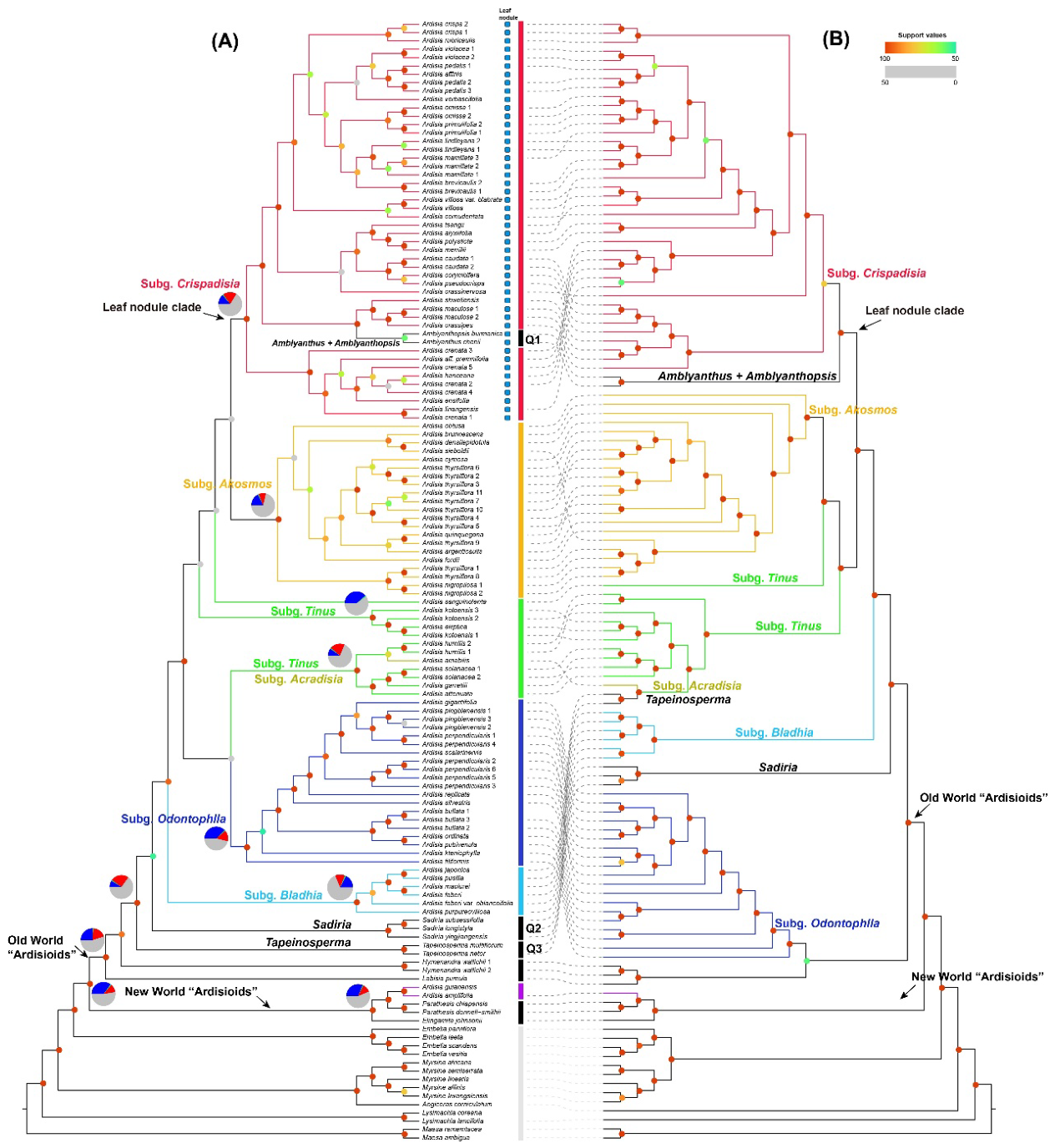
Figure 2.
A chronogram, LTT plot and Phylorate analysis of “Ardisioids”: (A) The chronogram generated using MCMCTREE features yellow shading marking a period of rapid radiation, with Cenozoic temperature changes (red) adapted from Westerhold et al. (2020); (B) Phytools-inferred LTT plot of “Ardisioids,” with yellow shading denoting the period of rapid lineage accumulation; (C) Phylorate plot showing variation in speciation rates across the phylogeny of Old World Ardisia, inferred with BAMM.
Figure 2.
A chronogram, LTT plot and Phylorate analysis of “Ardisioids”: (A) The chronogram generated using MCMCTREE features yellow shading marking a period of rapid radiation, with Cenozoic temperature changes (red) adapted from Westerhold et al. (2020); (B) Phytools-inferred LTT plot of “Ardisioids,” with yellow shading denoting the period of rapid lineage accumulation; (C) Phylorate plot showing variation in speciation rates across the phylogeny of Old World Ardisia, inferred with BAMM.
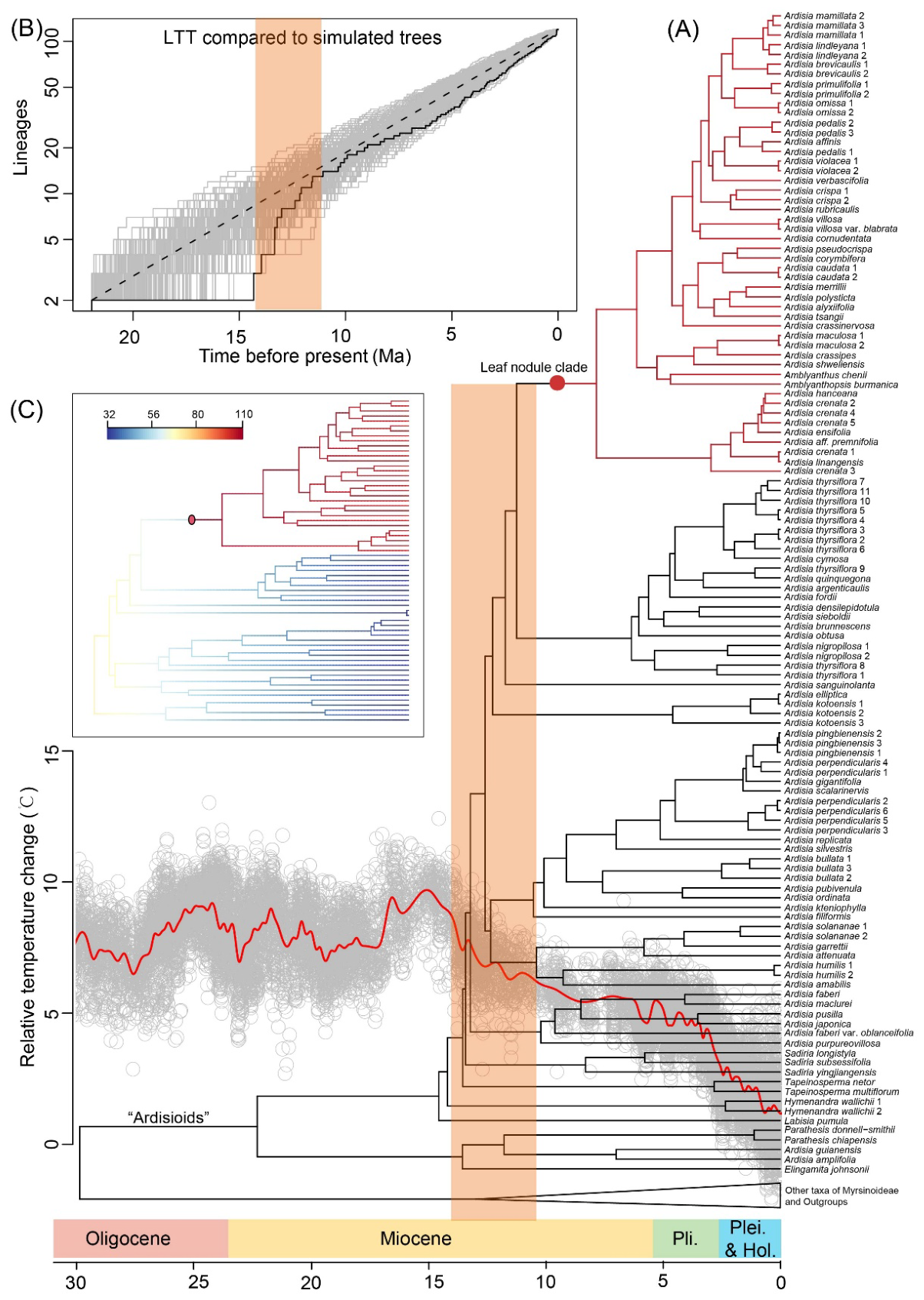
Figure 3.
Posterior distributions of speciation, extinction, and net diversification rates for Ardisia lineages with and without leaf nodules under the best-fitting HiSSE4 model. Lineages with leaf nodules are shown in red and its non-nodule relatives in blue.
Figure 3.
Posterior distributions of speciation, extinction, and net diversification rates for Ardisia lineages with and without leaf nodules under the best-fitting HiSSE4 model. Lineages with leaf nodules are shown in red and its non-nodule relatives in blue.
Disclaimer/Publisher’s Note: The statements, opinions and data contained in all publications are solely those of the individual author(s) and contributor(s) and not of MDPI and/or the editor(s). MDPI and/or the editor(s) disclaim responsibility for any injury to people or property resulting from any ideas, methods, instructions or products referred to in the content. |
© 2026 by the authors. Licensee MDPI, Basel, Switzerland. This article is an open access article distributed under the terms and conditions of the Creative Commons Attribution (CC BY) license (http://creativecommons.org/licenses/by/4.0/).
Copyright: This open access article is published under a Creative Commons CC BY 4.0 license, which permit the free download, distribution, and reuse, provided that the author and preprint are cited in any reuse.


