

Submitted:
06 July 2026
Posted:
08 July 2026
You are already at the latest version
Abstract
We study how learned Kähler-potential fidelity changes across a controlled hard-regime sweep in the Cefalú quartic Calabi--Yau family. Building on the globally invariant architecture introduced in earlier work, we ask whether its hard-point advantage persists uniformly as the quartic regime becomes more difficult, or instead separates across different geometry-sensitive diagnostics. Across the sweep, we find that learned geometric fidelity is not one-dimensional but splits into a structured tradeoff: the globally invariant model is consistently better on projective-invariance drift, while the local-input baseline is stronger on positivity-oriented and lower-tail stability diagnostics, especially \( \texttt{spectral_tail_mean} \). Geometry-aware regularization modifies this tradeoff selectively rather than producing a uniform gain. We further show that a modest degeneration-aware extension is already possible within the same benchmark framework: fragile geometry can be localized by a computable family-side proxy, equation-facing residual concentration can be compared on that support, and the resulting support-conditioned response exhibits low-dimensional collective structure. These findings show that hard-regime learned Calabi--Yau metric fidelity is multi-axis, regime-dependent, and partially support-localized.
Keywords:
Calabi–Yau metrics
; Kähler potentials
; machine learning
; JAX
; projective invariance
; quartic hypersurfaces
; Cefalú family
; geometric fidelity
; hard-regime robustness
MSC: 53C55; 14J32; 68T07; 53C26
1. Introduction
Calabi–Yau manifolds occupy a central place in string compactification, but the sheer breadth of possible geometries makes it difficult to determine which structures are most relevant for physics. Exact analytic control is rare, and even numerical access to metric-dependent quantities across families can quickly become expensive. Computational and learned methods therefore play an increasingly important role in Calabi–Yau geometry: they provide a way to explore hard regimes, compare geometric behavior across families, and build surrogates for quantities that are otherwise difficult to access directly. Once such methods are introduced, however, a new scientific question arises: when a learned geometric model appears successful, which aspects of the underlying geometry is it actually preserving, and how does that answer change as the regime becomes harder?
Scientific Problem
Within this computational setting, a central question in learned Calabi–Yau metric approximation is not only whether a model performs well at isolated benchmark points, but how its geometric fidelity behaves under controlled hardening of the underlying geometry. A learned Kähler-potential surrogate may appear acceptable on selected cases while degrading sharply as one moves into harder or more fragile regimes. In that setting, pointwise success is not enough. What matters is how different notions of geometric fidelity evolve across a family, which diagnostics fail first, and whether those failures are aligned or diagnostically separated.
This issue is especially important in hard quartic families, where local-input and globally invariant learned models can exhibit failure modes that are invisible at the level of training loss alone. As in earlier work, the relevant question is not merely whether a neural surrogate can be trained, but whether its learned correction behaves like a genuine geometric object [1]. The present paper shifts the focus from isolated hard-point comparison to regime dependence: how fidelity changes across a controlled sweep of hard Cefalú geometries, whether geometry-sensitive diagnostics degrade in the same way, and how architectural and objective choices reshape the resulting diagnostic profile.
The paper also asks a modest degeneration-aware question. Namely, can a computable family-side fragility proxy identify support on which learned metric instability, lower-tail degradation, or equation-facing residuals preferentially localize? We do not claim a singularity invariant or a finite-node conifold calculation. Rather, we use this support layer to test whether hard-regime learned metric failure is spatially organized rather than visible only through global averages.
Improving Learned Geometric Fidelity
Earlier work established that globally invariant learned Kähler-potential models outperform local-input baselines on the principal geometry-sensitive diagnostics of a controlled hard-quartic benchmark [1]. In particular, the globally invariant model family was strongest overall on negative-eigenvalue frequency and projective-invariance drift in the hard Cefalú cases and . That result identified a meaningful architectural advantage, but it did not determine whether the same advantage persists uniformly across a broader hard-regime family, or whether different fidelity channels separate as the regime becomes harder.
Our work here takes the next step. Rather than asking which architecture performs best at a small number of hard points, we study how learned geometric fidelity changes across an extended Cefalú hard-regime sweep. The emphasis therefore shifts from architecture-first benchmarking to a more explicitly scientific study of regime-dependent degradation, diagnostic separation, and structured failure. At the same time, we introduce a first support-conditioned extension through fragile-sector localization, class-shadow-style grouped summaries, an equation-facing residual proxy, and a modest collective-mode analysis of the resulting response objects.
Main Scientific Question and Working Claim
The main scientific question of this paper is the following: how does learned geometric fidelity change as one moves through increasingly hard Cefalú regimes, and does that evolution remain one-dimensional across model classes and objectives? A secondary question is whether geometry-aware training objectives can selectively improve particular fidelity channels in the hardest regimes.
Our working claim is that hard-regime learned geometric fidelity is structured rather than one-dimensional. More specifically, different geometry-sensitive diagnostics separate across the Cefalú sweep: globally invariant structure and local-input structure need not dominate the same fidelity channels. We further test whether geometry-aware regularization reshapes this tradeoff selectively rather than producing a universal across-the-board improvement. Finally, we ask whether degeneration-sensitive support, class-shadow-style localization, and equation-facing residuals expose low-dimensional collective organization beyond sweep-level benchmark summaries. Thus the paper is designed to test not only which models perform well, but which notions of learned geometric fidelity remain robust under controlled hardening of the underlying quartic geometry.
Novelty and Benefit
The novelty of the current work lies in five related advances. First, the paper replaces an isolated hard-point comparison with a regime-dependent study over a broader sweep of Cefalú geometries. Second, it expands the diagnostic layer beyond the core metrics developed earlier [1] in order to study degradation, robustness, diagnostic disagreement, and failure structure more directly. Third, it investigates geometry-aware objective ablations for the globally invariant model, thereby asking which fidelity channels can be improved by introducing geometric structure into the training objective. Fourth, it introduces a first degeneration-aware support layer through a geometry-side fragility proxy, fragile-versus-regular sector decomposition, and a lightweight equation-facing residual comparison. Fifth, it provides a reproducible regime-sweep artifact layer so that the scientific analysis is driven by frozen case-wise, sweep-level, support-conditioned, and ablation outputs.
The benefit of this shift is that the paper studies learned metric models as scientific objects rather than merely as benchmark entries. The goal is not only to rank model families at selected parameter values, but to understand how multiple notions of geometric fidelity behave under controlled hardening of the underlying quartic geometry, where those notions align, where they diverge, and how degeneration-sensitive support begins to appear in the learned responses. In this sense, the current work advances the GlobalCY framework from architectural comparison toward a more explicit science of multi-axis learned geometric fidelity with the first elements of a degeneration-aware computational extension.
Reproducibility and Artifact Layer
The scientific scope of the current work requires a corresponding evolution of the software and benchmark substrate. On the geometry side, GeoCYData provides the named hard-regime Cefalú sweep, stable case identifiers, bundle metadata, benchmark manifests, and pointwise fragility exports suitable for support-conditioned analysis. On the learned-model side, GlobalCY provides multi-regime experiment orchestration, geometry-sensitive diagnostics, geometry-aware objective ablations, pointwise learned-metric exports, lightweight equation-facing residual summaries, and frozen artifacts for case-wise, sweep-level, support-level, and hardest-case analysis.
These infrastructure components are not presented as an independent software contribution layered on top of the science. They are the reproducibility layer required to make the scientific questions of this paper testable and reusable. Repository details and artifact schemas are summarized later, while the present introduction emphasizes the scientific role of the infrastructure: it allows the regime sweep, diagnostic separation, support-conditioned analysis, and objective-ablation results to be reproduced from explicit benchmark and run artifacts.
Contributions.
The main contributions of this paper are as follows.
- 1.
- We carry out a regime-dependent study of learned geometric fidelity across a controlled hard-regime sweep in the Cefalú family.
- 2.
- We show that hard-regime learned fidelity is multi-axis: the globally invariant model is consistently stronger on projective-invariance drift, while the local-input baseline is stronger on positivity-oriented and lower-tail stability diagnostics.
- 3.
- We investigate geometry-aware objective ablations for the globally invariant learned Kähler-potential model and show that such interventions modify selected fidelity channels rather than producing a uniform gain.
- 4.
- We introduce a first support-conditioned degeneration-aware layer using a geometry-side fragility proxy, fragile-sector localization, class-shadow-style grouped summaries, and an equation-facing residual comparison.
- 5.
- We provide a first collective-mode analysis of the support-conditioned response, showing low-dimensional collective structure while carefully distinguishing this exploratory signal from a theorem-level singularity or gluing statement.
- 6.
- We provide a reproducible GeoCYData/GlobalCY artifact layer supporting regime-sweep benchmarking, pointwise exports, frozen summaries, support-conditioned diagnostics, and objective-ablation analysis.
Code Availability.
The associated code and benchmark infrastructure are maintained through the geocy-labs GitHub organization, https://github.com/geocy-labs. The GlobalCY framework is available at https://github.com/geocy-labs/globalcy, and the benchmark data substrate is provided through GeoCYData at https://github.com/geocy-labs/geo-cy-data. Further details on the artifact structure and reproducibility workflow are given in the appendices.
2. Related Work
Recent work on learned Calabi–Yau metrics has made clear that approximation quality cannot be judged by optimization behavior alone. In difficult regimes, models that appear acceptable under standard training criteria may still fail on geometry-sensitive quantities. This observation motivates the present paper’s focus on regime-dependent geometric fidelity, diagnostic separation, and structured hard-regime behavior rather than isolated-point benchmark performance.
2.1. Hard-Regime Learned Calabi–Yau Metric Approximation
The most direct precursor to the present study is the work of Berglund et al., who showed that learned Calabi–Yau metric models can behave very differently in singular and near-singular quartic settings, and that topology- and curvature-sensitive quantities may reveal weaknesses that are not visible at the level of training loss alone [2]. Their analysis of hard quartic regimes, including the Cefalú family, is especially important for the present paper because it demonstrates that difficult parameter ranges can act as meaningful stress tests for learned geometric models. The present work takes this insight as its starting point, but shifts the emphasis from isolated hard examples to the question of how different fidelity diagnostics behave across a controlled hard-regime sweep.
More broadly, earlier learned-metric work established that neural surrogates can approximate Ricci-flat Calabi–Yau metrics in nontrivial settings and can serve as serious computational tools rather than merely interpolation devices [3,4,5]. The present paper does not revisit that general proof-of-concept question. Instead, it studies what happens once one fixes a learned Kähler-potential framework and evaluates its geometric behavior under controlled hardening of the underlying quartic regime.
2.2. Geometry-Aware Diagnostics and Objective Design
The move from isolated-point benchmarking to regime-dependent analysis requires diagnostics and objectives that remain sensitive to geometric fidelity rather than to optimization success alone. In classical numerical work, energy-functional and Monge–Ampère-type formulations already made clear that the relevant target is geometric consistency, not simply pointwise approximation [6,7,8]. In the learned setting, the same lesson reappears in a different form: objective design and diagnostic design both matter, because different choices may privilege different aspects of the underlying geometry.
This is directly relevant to the present study. Earlier work treated negative-eigenvalue frequency and projective-invariance drift as the principal diagnostics for a controlled hard-point comparison [1]. The present paper retains those metrics but moves further by studying richer fidelity summaries and by testing geometry-aware objective variants for the globally invariant model family. In this sense, the paper is not only about which model class performs best, but also about how different fidelity channels separate in hard regimes and whether additional geometric structure in the training objective can selectively improve particular aspects of learned metric behavior.
2.3. Degeneration-Sensitive Geometry and Support-Conditioned Computation
A further motivation for the present study comes from the need to connect learned metric benchmarking to degeneration-sensitive geometric structure. While this paper does not attempt a singularity calculation in the strict sense, it asks whether fragile geometry can be resolved computationally, whether instability and residual mass localize on that support, and whether class-shadow-style grouped quantities can be organized relative to the same sectors. The resulting Euler-, determinant-, and residual-facing quantities are computational proxies rather than singular characteristic classes or degeneration invariants. Nevertheless, they move the benchmark toward a setting in which degeneration-aware support, localization, and collective response structure can be studied explicitly rather than inferred only from global averages.
2.4. Regime Dependence and Moduli-Dependent Learning
A central motivation for the present study comes from recent work on moduli-dependent or parameter-dependent learned Calabi–Yau metric models. JAX-native and related learned-geometry frameworks have shown that one can train over families of geometries rather than only at isolated points [9,10,11]. Once parameter variation is introduced, one is naturally led to questions of robustness, degradation, transportability, and stability across regimes.
The present paper is narrower than a full moduli-dependent metric-learning study, but it is motivated by the same transition. The Cefalú hard-regime sweep studied here should be understood as a controlled first step from isolated hard-point comparison toward family-level learned geometry. The goal is not yet to solve the full problem of parameter-dependent metric learning, but to determine how multiple notions of geometric fidelity evolve, align, or diverge across a sequence of increasingly difficult quartic regimes.
2.5. Capability and Software Context
The present work also sits within a growing software ecosystem for computational Calabi–Yau geometry. CYJAX and related JAX-native efforts show the value of differentiable, modular computational pipelines for metric and moduli-dependent geometry [9,10]. A complementary effort is JAXVacua, which focuses on periods, prepotentials, and Type IIB flux vacua in Calabi–Yau orientifold compactifications [12]. Although its scientific scope differs from the present work, it reflects the same broader movement toward differentiable, JAX-native pipelines for computational Calabi–Yau compactifications.
The contribution of the present paper is complementary to these efforts. Its emphasis is not on periods, vacua, or broad topological geometry processing, but on regime-dependent learned metric fidelity, geometry-aware diagnostics, degeneration-aware support analysis, and reproducible benchmark artifacts for learned Kähler-potential models. For that reason, the software context matters here only insofar as it supports the scientific question. The framework extensions used in this paper enable controlled regime sweeps, geometry-aware objective ablations, pointwise support-conditioned diagnostics, richer frozen outputs, and reproducible benchmark artifacts; they serve the analysis of structured hard-regime fidelity tradeoffs rather than constituting a separate engineering track.
3. Scientific Problem and Working Hypotheses
3.1. Scientific Problem
The central scientific problem of this paper is to understand how learned geometric fidelity behaves under controlled hardening of quartic Calabi–Yau regimes. Earlier work established that globally invariant learned Kähler-potential models outperform local-input baselines on the principal geometry-sensitive diagnostics of a fixed hard-point benchmark [1]. That result identified an important architectural advantage, but it did not determine whether the same advantage persists uniformly, weakens, or separates across diagnostics as one moves through a broader family of difficult geometries.
The present paper studies this regime dependence in the Cefalú family. The primary concern is not only whether one model family performs better than another at isolated parameter values, but how different notions of learned geometric fidelity behave as the geometry becomes harder. This includes the onset of negative-eigenvalue behavior, degradation of projective consistency, changes in lower-tail stability, and possible disagreement among geometry-sensitive diagnostics. In this sense, the paper is concerned with structured learned geometric fidelity rather than pointwise architecture ranking alone.
The paper also asks a second, deliberately modest question: whether degeneration-sensitive support structure is already visible in the learned metric data. To that end, we introduce a geometry-side fragility proxy, a fragile-versus-regular support decomposition, a lightweight equation-facing residual proxy, and a first collective-mode analysis of the resulting support-conditioned responses. These additions do not constitute a singularity calculation in the strict sense, but they begin to organize the learned-metric benchmark in a language better suited to later degeneration- and node-aware studies.
3.2. Working Hypotheses
The investigation is guided by the following working hypotheses.
- (H1)
- Learned geometric fidelity changes systematically across the selected Cefalú hard-regime sweep.
- (H2)
- The degradation profile of learned geometric fidelity is not expected to remain one-dimensional across model families: globally invariant structure and local-input structure may dominate different geometry-sensitive diagnostics within the same hard-regime family.
- (H3)
- Different geometry-sensitive diagnostics may degrade at different rates, indicating structured breakdown of learned geometric fidelity rather than a single universal failure threshold.
- (H4)
- Geometry-aware regularization selectively improves particular fidelity channels of the globally invariant model in hard regimes, rather than producing a universal across-the-board improvement.
- (H5)
- Richer diagnostics, including lower-tail, determinant, residual, and related geometry-facing summaries, reveal distinctions between model families and objectives that are only weakly visible under simpler benchmark summaries.
- (H6)
- Degeneration-sensitive support, equation-facing residuals, and class-shadow-style grouped quantities may exhibit structured localization rather than uniform distribution across the sampled geometry.
- (H7)
- Support-conditioned response objects may exhibit measurable low-dimensional collective organization, although such compression need not be uniquely stronger on fragile support than on regular support.
These hypotheses are deliberately testable rather than speculative. They do not assume that the globally invariant model remains uniformly superior under every diagnostic, nor that a first geometry-aware objective design must resolve all hard-regime failure modes. They also do not assume that the support-conditioned extension already yields a canonical singularity invariant or a theorem-level gluing law. Instead, they provide a framework for asking how learned metric behavior changes under regime hardening, which diagnostics are most informative, how different fidelity channels separate across architectures, and whether degeneration-sensitive support and low-dimensional collective structure are already visible in the current computational setting.
3.3. Scope and Boundaries
The scope of the paper is intentionally controlled. The study remains focused on quartic Calabi–Yau geometries in the Cefalú family and does not attempt a broad cross-family survey. It is not a full phenomenology paper, nor does it attempt certified Ricci-flatness, full symbolic distillation, or observable-level physics outputs. The support-conditioned extension introduced here is likewise modest: it studies localization, residual qualification, and collective response structure, but it does not compute finite-node conifold data or singular characteristic classes in the strict sense.
The contribution is therefore narrower but scientifically meaningful: a regime-dependent study of learned geometric fidelity, supported by richer diagnostics, geometry-aware objective ablations, and a reproducible benchmark/artifact layer in GeoCYData and GlobalCY. The resulting study should be understood as a transition from architecture-first benchmarking toward a more explicit analysis of diagnostic separation, degradation structure, degeneration-aware support localization, and learned geometric trustworthiness in hard quartic regimes.
4. Geometric Regime and Benchmark Design
4.1. The Cefalú Hard-Regime Sweep
The geometric core of this work is a controlled hard-regime sweep in the Cefalú family. Rather than restricting attention to one or two isolated hard cases, we study a sequence of quartic regimes chosen to probe increasing geometric difficulty while remaining computationally tractable. In the current benchmark substrate, this sweep is realized through the named GeoCY preset cefalu_hard_regime_sweep_v1, whose canonical cases are , , , , and . These cases are represented in the benchmark registry by the stable identifiers cefalu_lambda_0_50, cefalu_lambda_0_75, cefalu_lambda_0_90, cefalu_lambda_1_0, and cefalu_lambda_1_10.
The purpose of this sweep is not to exhaust the Cefalú family, but to study a scientifically meaningful progression from comparatively easier quartic regimes into harder and more fragile ones. In this sense, the sweep acts as a controlled hardening experiment: each selected -value provides a fixed geometric setting in which learned metric fidelity can be measured, while the full family makes it possible to study how multiple fidelity diagnostics evolve, separate, or fail to align as the regime changes.
The family also carries a first geometry-side degeneration-sensitive coordinate through the fragility proxy exported from GeoCYData. This proxy is not a singularity invariant in the strict sense. Its role is more modest: it allows the sweep to be read not only as a sequence of benchmark labels, but also as a family in which degeneration-sensitive support can be localized and compared across cases.
4.2. Why Regime-Dependent Evaluation Matters
A central limitation of isolated-point benchmarking is that it reveals little about how learned geometric fidelity behaves away from the selected comparison cases. A model that performs well at one hard point may degrade sharply under even modest regime change, while another model may exhibit different strengths across a broader family and across different diagnostics. For that reason, regime-dependent evaluation is scientifically more informative than pointwise comparison alone. It makes it possible to study degradation profiles, hardest-case behavior, diagnostic disagreement, and structured fidelity tradeoffs under controlled hardening of the underlying geometry.
This is especially relevant in the present setting. Earlier work established that globally invariant learned Kähler-potential models outperform local-input baselines on the principal geometry-sensitive diagnostics at selected hard Cefalú points [1]. The present paper asks the next question: how does learned geometric fidelity behave across a broader hard-regime sweep, how do different diagnostics change across the selected -values, and do distinct diagnostics reveal different onset mechanisms of learned metric breakdown? The benchmark is therefore designed not merely to rank models at fixed points, but to study the structure of learned geometric degradation across a family of difficult quartic regimes.
The same regime structure also makes possible a first degeneration-aware support analysis. Once a geometry-side fragility proxy is available, one can ask not only which cases are harder globally, but also whether instability, lower-tail failure, class-shadow-style summaries, and equation-facing residual concentration localize on the same support as the family changes. This extends the benchmark from a purely sweep-level comparison toward a more explicitly support-aware computational geometry setting.
4.3. Benchmark Protocol, Seeds, and Aggregation
The benchmark compares learned model families over the GeoCY preset cefalu_hard_regime_sweep_v1. At minimum, the comparison includes a local-input baseline and the globally invariant model family identified in earlier work as the strongest architectural starting point. The primary seed protocol inherited from the GeoCY preset uses the fixed seed set , with the benchmark and artifact structure designed so that the seed set can be expanded later without altering the basic workflow.
For each case, model, and seed combination, the experiment layer freezes the full diagnostic record and then aggregates results at both the case level and the sweep level. This produces a hierarchy of artifacts suitable for scientific analysis: per-run records, per-case summaries, and sweep-level summaries across the full hard-regime family. The artifact layer also includes pointwise geometry-side fragility exports and pointwise learned-metric diagnostics, making it possible to aggregate not only by case and sweep, but also by fragile-versus-regular support sectors.
The intent is that the benchmark support both the primary scientific question of the paper, namely how learned fidelity changes across the Cefalú sweep, and the secondary analyses involving hardest-case behavior, diagnostic separation, geometry-aware objective ablations, degeneration-sensitive localization, and frozen outputs for later interpretation and reproduction.

Table 1.
Benchmark design across the Cefalú hard-regime sweep.
| Component | Setting |
|---|---|
| Geometry family | cefalu_quartic |
| Benchmark preset | cefalu_hard_regime_sweep_v1 |
| Sweep values | |
| Canonical case IDs | cefalu_lambda_0_50, cefalu_lambda_0_75, cefalu_lambda_0_90, cefalu_lambda_1_0, cefalu_lambda_1_10 |
| Model families | local baseline and globally invariant model |
| Seed set | fixed multi-seed protocol |
| Primary metrics | negative-eigenvalue frequency and projective-invariance drift |
| Extended diagnostics | lower-tail metric-spectrum, determinant, Euler-proxy, residual, and support-conditioned summaries |
| Ablations | geometry-aware objective variants for the global model |
| Frozen outputs | sweep summaries, ablation tables, figures, JSON, markdown artifacts, and pointwise exports |
5. Experimental Infrastructure and Reproducible Artifacts
5.1. GeoCYData Benchmark Substrate
The regime-dependent analysis in this paper requires a broader and more structured benchmark substrate than the isolated hard-point comparison used in earlier work. To support this study, GeoCYData provides a named hard-regime benchmark preset over the Cefalú family, denoted cefalu_hard_regime_sweep_v1. The canonical sweep values are
The corresponding stable case identifiers are
This gives the sweep a stable identity at the level of the geometry and data substrate rather than treating it as an ad hoc collection of manually assembled cases.
Each benchmark case exposes the model-facing views needed for the experiments in this paper, including local-chart representations, invariant representations, sampling metadata, explicit case metadata, and, where available, symmetry-aware artifacts such as canonical representatives, canonical invariants, orbit data, and symmetry reports. The preset also includes a machine-readable manifest recording the benchmark version, geometry family, case identifiers, -values, available model-facing views, and protocol metadata. These data make the hard-regime sweep reproducible and consumable by the downstream experiment layer.
For the support-conditioned analysis, GeoCYData also provides pointwise degeneration-sensitive fragility exports for the sweep cases. These exports are modest by design: they do not claim a singularity invariant or a final degeneration classifier. They provide a geometry-side support coordinate that can be joined directly to pointwise learned-metric outputs, making fragile-versus-regular support decomposition possible within the same benchmark protocol.
5.2. GlobalCY Experiment Layer
On the learned-model side, GlobalCY provides the experiment layer used to train, evaluate, and aggregate the local-input and globally invariant model families across the hard-regime sweep. The regime-sweep runner consumes the GeoCYData preset, reads its benchmark manifest and per-bundle metadata, and executes reproducible multi-case experiments under a fixed multi-seed protocol.
For each case, model, and seed combination, the experiment layer records the full diagnostic output and aggregates it at both the case level and the sweep level. The frozen artifact layer emits casewise summaries, sweep-level summaries, ablation tables, consolidated JSON outputs, figure-ready data, and a markdown summary suitable for manuscript drafting. This gives the paper a stable geometry-to-results workflow in which the scientific analysis is driven by frozen outputs rather than by transient experiment directories.
The same workflow supports the geometry-aware objective-ablation study. The ablation layer allows the globally invariant model to be evaluated under baseline, negativity-regularized, projective-regularized, and combined objectives without changing the underlying benchmark protocol. This makes it possible to ask whether objective-level geometric structure modifies particular fidelity channels in the hardest regimes.
Finally, the experiment layer introduces pointwise learned-metric exports, including pointwise instability quantities, determinant- and log-determinant-facing summaries, and a lightweight equation-facing residual proxy. These exports can be joined directly to the geometry-side fragility data, enabling support-conditioned summaries, class-shadow-style grouped quantities, and the collective-mode analysis of the resulting response objects.
5.3. Artifact Layer and Benchmark Usability
The artifact design separates run-level outputs, casewise summaries, sweep-level summaries, support-conditioned summaries, ablation outputs, and frozen paper-facing artifacts. This separation supports multiple modes of analysis: regime trajectory tables, hardest-case summaries, ablation comparisons, figure-ready exports, and machine-readable result packages. It also records what was run, on which cases, with which seeds, and under which protocol version.
This artifact layer is part of the scientific design of the paper. The central claims of the study involve diagnostic separation across a hard-regime sweep, selective effects of objective-level interventions, and support-conditioned localization of lower-tail instability and residual behavior. Each of these claims requires a stable record of pointwise and aggregated quantities. The reproducibility infrastructure is therefore not a separate engineering track, but the experimental substrate that makes the regime-dependent and support-conditioned analyses inspectable and repeatable.
Table 2.
Experimental infrastructure supporting the hard-regime study.
| Layer | Earlier Work | Present study |
|---|---|---|
| GeoCYData | hard-point benchmark substrate | regime-sweep benchmark substrate with pointwise fragility exports |
| GlobalCY diagnostics | core fidelity diagnostics | extended fidelity, residual, and support-conditioned diagnostics |
| Training objectives | baseline architecture comparison | geometry-aware objective ablations |
| Frozen outputs | case-level frozen artifacts | sweep-, ablation-, support-conditioned, and pointwise frozen artifacts |
| Reproducibility support | initial benchmark workflow | expanded workflow, manifests, documentation, and support-aware artifacts |
6. Models and Objectives
6.1. Reference and Comparison Models
The model comparison in this paper is deliberately narrower and more scientifically focused than in earlier work. The principal aim is no longer to compare all architectural directions at once, but to study how learned geometric fidelity changes across the hard-regime Cefalú sweep and how different fidelity channels separate across model families. For that reason, the main comparison is between two model families: a local-input baseline and the globally invariant model family.
The local-input baseline serves as the reference model. It represents the patch-local strategy in which the learned Kähler-potential correction is inferred directly from local coordinate information, without explicit global invariant structure built into the input representation. The globally invariant model, by contrast, is trained on invariant feature representations derived from the ambient quartic geometry and is designed to test whether encoding more of the global projective structure at the representation level changes the hard-regime fidelity profile of the learned metric surrogate. In earlier work, this globally invariant model emerged as the strongest overall architecture on the principal geometry-sensitive diagnostics, and it therefore becomes the main scientific probe of the present study.
Although symmetry-aware model families remain part of the broader framework, they are not the primary focus of the present benchmark. The objective here is to understand regime-dependent degradation and diagnostic separation of the globally invariant architecture relative to a local baseline. This comparison also feeds into the support-conditioned analyses through pointwise learned-metric exports and fragile-versus-regular summaries. The narrowing of emphasis keeps the scientific question clear: not which possible model class can be introduced next, but how the presently strongest architecture behaves as the regime becomes harder and whether its strengths persist uniformly or only along particular fidelity channels.
6.2. Baseline Objective
The baseline training objective is the same general learned Kähler-potential objective that underlies the framework’s standard metric-construction workflow. In particular, all model families are interpreted through the correction ansatz
where is the reference Fubini–Study metric and is the learned scalar correction. The baseline objective is therefore not introduced here as a new scientific contribution in itself, but as the common training reference against which the geometry-aware objective variants are evaluated.
This paper is not intended as a general loss-engineering study. Rather, the baseline objective serves as the control condition for a more focused scientific question: whether modest but explicitly geometry-aware modifications to the training objective selectively improve particular fidelity channels of the globally invariant model in the hardest regimes. The same baseline models also provide the reference point for support-conditioned and equation-facing comparisons, so that localized instability, residual concentration, and collective response structure can be interpreted relative to a common training condition.
6.3. Geometry-Aware Objective Variants
A second line of investigation concerns geometry-aware objective variants for the globally invariant model. The purpose of these variants is to test whether adding targeted geometric structure to the training objective improves specific fidelity channels in the hardest regimes beyond what architecture alone achieves. The emphasis is deliberately modest: the goal is not to produce a final certified training scheme, but to examine whether a small number of geometry-aware regularizers materially reshape the hard-regime diagnostic profile of the globally invariant model.
The main variants considered are the baseline objective, a negativity-regularized objective, a projective-regularized objective, and a combined objective including both regularization terms. The negativity-regularized variant adds a penalty equal to the mean positive part of the negative minimum eigenvalue across sampled points. Concretely, if denotes the minimum eigenvalue of the learned metric at a sampled point, the penalty is based on the pointwise quantity , averaged over the batch. This provides a simple and interpretable mechanism for discouraging negative-eigenvalue behavior in the learned metric correction.
The projective-regularized variant adds a penalty based on the mean absolute prediction drift under a fixed projective rescaling. Operationally, each homogeneous point is normalized, subjected to a fixed projective rescaling, and then mapped back through the invariant-feature pipeline; the model prediction is evaluated on both the original and rescaled representations, and the absolute difference is averaged over the batch. This penalty is designed to encode, at training time, the same scientific idea that projective-invariance drift measures at evaluation time: namely, whether the learned model respects the global projective structure that motivates the invariant architecture.
The combined objective includes both regularization terms and is intended to probe whether stability-oriented and projective-consistency-oriented constraints act compatibly or expose tradeoffs between different notions of learned geometric fidelity. These variants are investigated scientifically rather than heuristically. If the globally invariant model already provides a strong architectural starting point, then a natural next question is whether additional geometry-aware structure in the objective can selectively improve particular aspects of hard-regime trustworthiness. The objective-ablation study also provides a first test of whether support-conditioned fragile-sector behavior is modified by these interventions. It therefore probes the relationship between representation-level globality and objective-level geometric regularization without presuming a universal across-the-board gain.
Table 3.
Objective variants used in the hard-regime ablation study.
| Variant | Components |
|---|---|
| Baseline | standard learned Kähler-potential training objective |
| Negativity-regularized | baseline objective plus a penalty equal to the mean positive part of the negative minimum eigenvalue across sampled points |
| Projective-regularized | baseline objective plus a penalty equal to the mean absolute prediction drift under a fixed projective rescaling |
| Combined | baseline objective plus both negativity and projective-consistency penalties |
7. Diagnostics
7.1. Stability Diagnostics
The first class of diagnostics concerns the basic stability of the learned metric correction. The most important quantity in this class is the negative-eigenvalue frequency, which measures how often the learned metric correction exhibits undesirable negative-eigenvalue behavior and therefore serves as a direct sanity and stability diagnostic. Closely related to this is the minimum-eigenvalue mean, which averages the per-point minimum eigenvalue over the full sample and provides a broad lower-tail summary of the Hermitian metric spectrum.
These diagnostics are especially important in hard quartic regimes, where learned surrogates may appear acceptable under ordinary optimization criteria while already exhibiting geometric instability at the metric level. For this reason, stability diagnostics are treated not as auxiliary implementation checks, but as part of the scientific evidence concerning how learned fidelity changes as the regime hardens. To refine this picture, the diagnostic layer also includes the lower-tail quantity spectral_tail_mean, defined as the mean of the lowest decile of the per-point minimum-eigenvalue distribution. Unlike min_eigenvalue_mean, which averages over the full sample, spectral_tail_mean is intentionally more sensitive to hardest-case degradation in the lower metric-eigenvalue tail.
These stability quantities also appear in support-conditioned form through fragile-versus-regular summaries and collective response objects. This matters because the paper asks not only how lower-tail failure behaves across the sweep, but also where that failure localizes within degeneration-sensitive geometry.
7.2. Geometric Fidelity Diagnostics
The second class of diagnostics measures geometric fidelity more directly. The central quantity in this class is projective-invariance drift, which probes whether the learned model respects the global projective structure that motivates the invariant representation. In earlier work, this diagnostic was one of the clearest indicators that globally invariant models behave more faithfully than local-input baselines [1]. In the present study, it remains one of the principal metrics for studying how fidelity changes across the hard-regime sweep and whether invariance-sensitive behavior separates from other fidelity channels.
Additional geometric fidelity diagnostics refine and contextualize this picture. Chart consistency is included to assess whether learned corrections remain compatible across local-coordinate descriptions, although in the present benchmark it is not expected to be the primary source of discrimination. Determinant-based summaries and the Euler proxy provide supporting geometry-facing checks that help keep the benchmark from collapsing into a purely optimization-driven exercise. These quantities also provide the raw material for modest class-shadow-style grouped summaries and support-conditioned comparisons. Where feasible, they therefore act both as benchmark diagnostics and as partial bridges toward richer geometry-sensitive targets to be studied in later work.
7.3. Residual and Support-Conditioned Diagnostics
A new diagnostic layer in the present study is the support-conditioned and equation-facing analysis built from pointwise exports. The most important new quantity here is the lightweight residual proxy
which provides a volume-form / Monge–Ampère-type measure of deviation at the sampled-point level. Its role is not to certify Ricci-flatness, but to test whether degeneration-sensitive localization also appears in a quantity closer to the defining geometric equation.
Using the geometry-side fragility proxy exported from GeoCYData, the sampled point cloud is partitioned into fragile and regular support sectors. We then compare instability, class-shadow-style grouped quantities, and residual concentration across that support. This extension makes it possible to ask whether lower-tail instability, residual mass, and class-facing localization are uniformly distributed or instead supported preferentially on degeneration-sensitive geometry. In this sense, the support-conditioned diagnostics provide the first explicit bridge in this paper from sweep-level benchmarking toward a more localized and degeneration-aware computational geometry language.
7.4. Regime-Robustness Diagnostics
Since this paper is concerned with regime dependence rather than isolated-point performance, behavior across the hard-regime sweep is itself part of the diagnostic structure. In this context, sweep-level summaries record how the principal diagnostics change across the selected -values, which cases emerge as hardest for a given diagnostic, and whether different diagnostics remain aligned or diverge across the sweep. These summaries do not replace the underlying run-level metrics; rather, they organize them into a more explicitly scientific picture of learned degradation.
The most important sweep-level quantities are degradation profiles across the sweep, hardest-case behavior, diagnostic separation, and variability across seeds. Together, these make it possible to ask not only which model family performs best at a selected parameter value, but how different model families retain different strengths across different fidelity channels as the regime hardens. Sweep-level analysis is also complemented by support-conditioned and collective-mode diagnostics, so regime dependence is studied not only globally across cases, but also relative to degeneration-sensitive support and the low-dimensional organization of the resulting response objects.
7.5. Primary and Secondary Metrics
Within the full diagnostic suite, two quantities carry the greatest interpretive weight: negative-eigenvalue frequency and projective-invariance drift. These are the primary comparison metrics because they most directly test the architectural and scientific claims at the center of the paper. Negative-eigenvalue frequency measures how often the learned metric correction loses basic stability, while projective-invariance drift measures whether the learned correction remains aligned with the global projective structure of the quartic geometry.
The remaining diagnostics are still scientifically useful, but they play mainly secondary or qualifying roles in the interpretation of the benchmark. The minimum-eigenvalue mean and spectral_tail_mean refine the stability picture; chart consistency, determinant summaries, and the Euler proxy provide additional geometry-facing context; the support-conditioned fragile-versus-regular summaries and the residual proxy begin to resolve where those quantities localize; training loss remains a supporting optimization summary; and runtime records the operational cost of the benchmark workflow. The paper’s central claims therefore begin from the primary architectural signal visible in negativity behavior and projective drift, but the broader diagnostic suite is essential for showing that hard-regime learned geometric fidelity is multi-axis rather than captured by a uniform model ranking, and that the current benchmark can already support a first degeneration-aware extension layer.
Table 4.
Diagnostic suite and interpretive roles.
| Diagnostic | Interpretation | Role |
|---|---|---|
| Negative-eigenvalue frequency | Frequency of undesirable negative-eigenvalue behavior in the learned metric correction | Primary |
| Minimum-eigenvalue mean | Mean of the per-point minimum-eigenvalue distribution over the full sample | Secondary |
| spectral_tail_mean | Mean of the lowest decile of the per-point minimum-eigenvalue distribution; tail-sensitive stability summary | Secondary |
| Projective-invariance drift | Drift relative to global projective structure; principal global-fidelity diagnostic | Primary |
| Chart consistency | Compatibility across local-coordinate descriptions | Secondary / qualifying |
| Determinant summary | Geometry-facing determinant-based summary of learned metric behavior | Auxiliary |
| Euler proxy | Lightweight topology-facing proxy summary | Auxiliary |
| logdet_residual_proxy | Lightweight equation-facing volume-form / determinant mismatch proxy | Secondary / qualifying |
| Training loss | Optimization objective summary | Supporting only |
| Runtime | Computational cost summary | Operational |
8. Experimental Results
8.1. Diagnostic Trajectories Across the Hard-Regime Sweep
The primary empirical result of this paper is the behavior of the learned metric models across the Cefalú hard-regime sweep. Rather than evaluating model families only at isolated hard points, we track how the principal geometry-sensitive diagnostics evolve across the selected benchmark cases. This makes it possible to study not only relative model quality at fixed parameter values, but also the structure of learned geometric degradation under controlled hardening of the underlying quartic geometry. The trajectories are not uniformly monotone in ; in particular, the local-model negative-frequency channel is non-monotone across the sweep. This already indicates that hard-regime fidelity is structured rather than captured by a single scalar hardness coordinate.
Across the sweep, the principal quantities of interest are negative-eigenvalue frequency and projective-invariance drift, together with supporting lower-tail stability summaries such as the minimum-eigenvalue mean and spectral_tail_mean. The resulting trajectories show how different fidelity channels evolve, whether lower-tail instability appears before broader breakdown, and whether invariance-sensitive and positivity-sensitive diagnostics remain aligned across model families or separate as the regime changes.
These trajectories also serve an interpretive role beyond raw comparison. If distinct diagnostics deteriorate at different rates, then learned geometric breakdown is structured rather than uniform. In that case, the sweep becomes a means of identifying which aspects of learned fidelity fail first and whether those failure patterns differ systematically between local-input and globally invariant models. For this reason, the trajectory analysis is not merely a plotting convenience; it is one of the main devices through which this paper studies regime-dependent geometric fidelity.
Figure 9 summarizes these diagnostic trajectories across the Cefalú sweep. The figure is intended to show both the absolute behavior of the primary diagnostics and the structured separation of the competing model families across different fidelity channels.
8.2. Global Versus Local Degradation Profiles
A central question is how the globally invariant and local-input models separate across the Cefalú sweep. The answer depends on which aspect of learned geometric fidelity is being measured. The strongest and cleanest sweep-wide signal is the projective-invariance advantage of the globally invariant model: across the full hard-regime sweep, the global model consistently achieves substantially lower projective-invariance drift than the local baseline. This confirms that the invariant architecture robustly preserves the global projective structure that motivates it, not only at isolated hard points but across the broader Cefalú family.
At the same time, the positivity-oriented and lower-tail stability diagnostics tell a different story. Across the same sweep, the local baseline consistently outperforms the globally invariant model on negative-eigenvalue frequency, minimum-eigenvalue mean, and especially spectral_tail_mean. The regime-dependent comparison therefore does not support a single scalar ordering of the model families. Instead, it reveals a structured diagnostic tradeoff: the globally invariant architecture is stronger on invariance-sensitive fidelity, while the local baseline is stronger on positivity-tail stability.
This makes the degradation-profile analysis more scientifically informative than a simple extension of the earlier work benchmark. The main question is no longer whether the global model “wins” everywhere, but how different notions of learned geometric fidelity separate across the hard regime. In this sense, the Cefalú sweep does more than rank models; it shows that learned geometric breakdown is multi-axis, with different diagnostics selecting different strengths and different hardness patterns across the family.
8.3. Effect of Geometry-Aware Training
A second question is whether geometry-aware regularization improves the behavior of the globally invariant model in the hardest regimes. The architecture result of earlier work established that globally invariant structure provides a strong starting point for invariance-sensitive fidelity. The objective-ablation study asks whether modest but explicit geometric constraints in the training objective can further improve particular hard-regime fidelity channels.
The ablation results show that the effect of regularization is real but selective. Projective-consistency regularization produces the clearest gains on projective-invariance drift in the key overlap hard cases, while negativity-oriented regularization improves lower-tail stability as measured by spectral_tail_mean. The combined objective improves some metrics simultaneously in selected cases, but does not produce a universal monotone improvement across the full ablation set. In particular, the current ablation study does not materially change negative-eigenvalue frequency in the frozen outputs, and the combined objective can expose tradeoffs rather than eliminate them.
Thus, geometry-aware regularization does not simply “improve the model” in one scalar sense. Different objective terms act on different geometric channels. Projective-oriented regularization improves invariance behavior, while negativity-oriented regularization improves lower-tail stability. The ablation study therefore strengthens the central theme: learned geometric fidelity in hard quartic regimes is structured, and targeted objective design can reshape that structure without collapsing it into a single dominant notion of quality.
8.4. Degeneration-Sensitive Class Profiles Across the Cefalú Sweep
Beyond the learned-fidelity diagnostics emphasized in the main sweep analysis, we attach a first degeneration-sensitive geometric profile to the Cefalú hard-regime family. The purpose of this extension is not to claim a full singularity calculation, but to begin organizing the benchmark in a way that is compatible with later degeneration- and node-aware studies. In particular, we seek a computable family-level proxy for geometric fragility together with global class-facing summaries that can be tracked across the sweep.
To this end, we introduce a degeneration-sensitive fragility score derived from the sampled quartic geometry. In the present benchmark, this score is intended only as a computable proxy for near-degenerate behavior rather than as a singularity invariant in the strict algebro-geometric sense. Concretely, for each case in the sweep we evaluate a geometry-side fragility statistic , together with low-quantile and thresholded summaries that record how strongly fragile geometric sectors are represented at that value of .
Alongside this degeneration-sensitive profile, we track global characteristic-class-facing summaries across the same family. At minimum, these include the Euler proxy together with determinant- and log-determinant-facing grouped summaries. The purpose of these global quantities is not to certify topology in the present paper, but to provide a first computational shadow of how class-like geometric information varies across a controlled hardening of the family.
The resulting sweep-level analysis serves two purposes. First, it gives the hard-regime family a geometry-side stress coordinate rather than treating only as a benchmark label. Second, it begins to connect learned metric behavior to global class-sensitive geometry, which is important for later degeneration, singularity, and finite-node conifold studies. In this sense, the present extension should be read as a first degeneration-aware layer rather than as a final characteristic-class computation.
8.5. Localized Class and Instability Decomposition Near Fragile Sectors
To move beyond sweep-level averages, we supplement the hard-regime analysis with a support decomposition based on the geometry-side fragility proxy introduced above. Using the GeoCY fragility export, each sampled point is assigned to either a fragile sector or a complementary regular sector, and the resulting partition is joined directly to the pointwise learned-metric diagnostics through the common key. This yields a pointwise support decomposition over the full hard-regime sweep without requiring additional clustering assumptions.
The first result of this localized analysis is that instability does not distribute uniformly across the geometry. Fragile sectors carry higher negative-eigenvalue frequency in four of the five sweep cases for both the local and globally invariant baselines, and they carry worse lower-tail behavior in all five local cases and in four of the five global cases. Thus, the lower-tail degradation identified earlier in the paper is not only a sweep-level effect: it localizes preferentially in degeneration-sensitive geometry.
Alongside these instability summaries, we compute modest class-shadow-style grouped quantities from the same pointwise exports, including local moments and weighted means of euler_density_ proxy, determinant_g, logdet_g, and logdet_residual_proxy. These are not singular characteristic classes in the strict sense, but they provide a first computational shadow of how class-facing geometric content is distributed across fragile and regular sectors. In the present results, the class-shadow concentration is mixed rather than uniformly fragile-enhanced. This is itself informative: unlike lower-tail instability, class-facing concentration does not yet collapse to a single fragile-sector narrative.
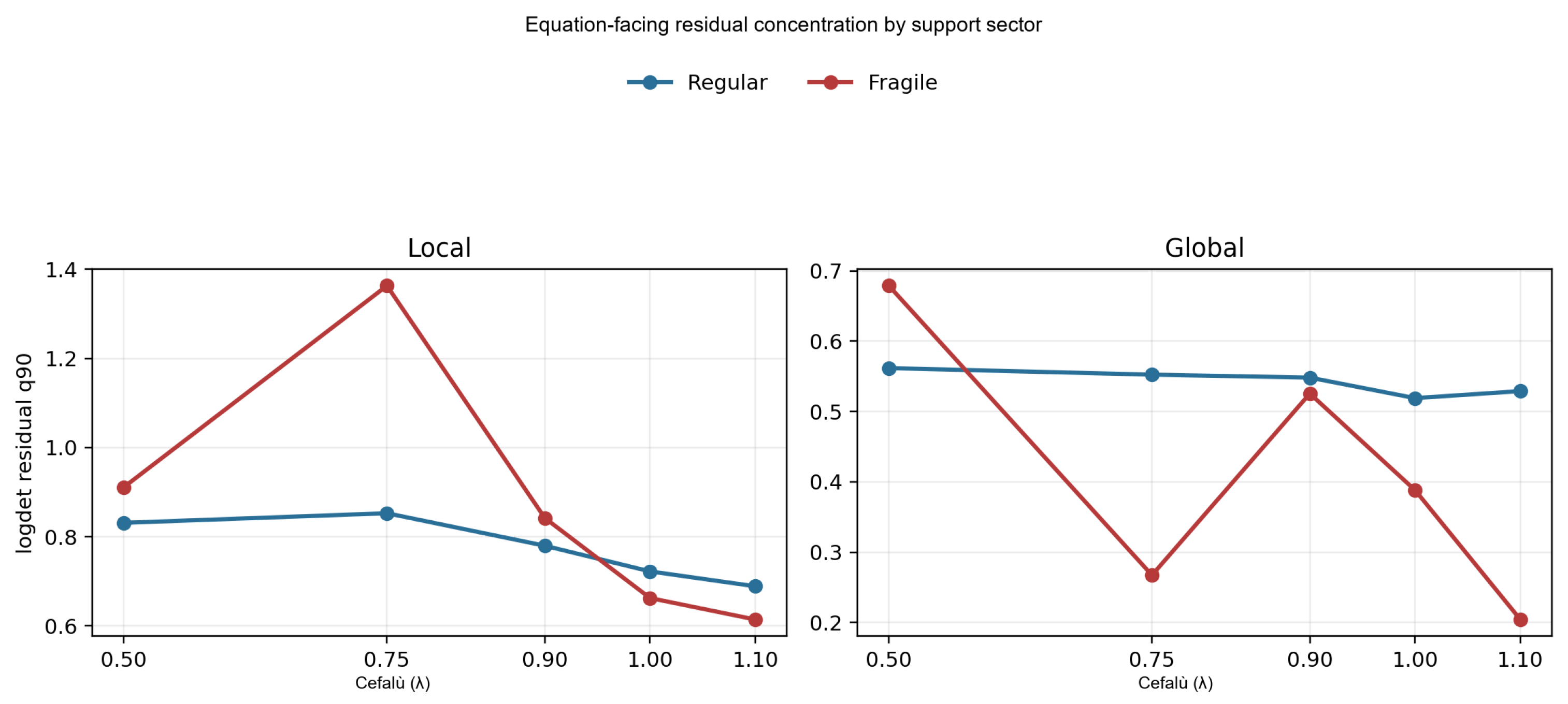
The support-conditioned layer is therefore useful in two ways. First, it shows that degeneration-sensitive localization is already visible in the learned metric data. Second, it distinguishes channels that localize strongly in fragile geometry from channels whose support is more distributed. Figure 1 and Figure 2 summarize the strongest support-conditioned signals for instability and lower-tail behavior, Figure 4 records the corresponding equation-facing residual comparison, and Figure 3 shows the class-shadow-style comparison.
Figure 1.
Fragile-versus-regular comparison for negative-eigenvalue frequency across the Cefalú hard-regime sweep. Fragile sectors carry higher negative-frequency in most sweep cases for both local and globally invariant models, indicating that instability localizes preferentially in degeneration-sensitive geometry.
Figure 1.
Fragile-versus-regular comparison for negative-eigenvalue frequency across the Cefalú hard-regime sweep. Fragile sectors carry higher negative-frequency in most sweep cases for both local and globally invariant models, indicating that instability localizes preferentially in degeneration-sensitive geometry.
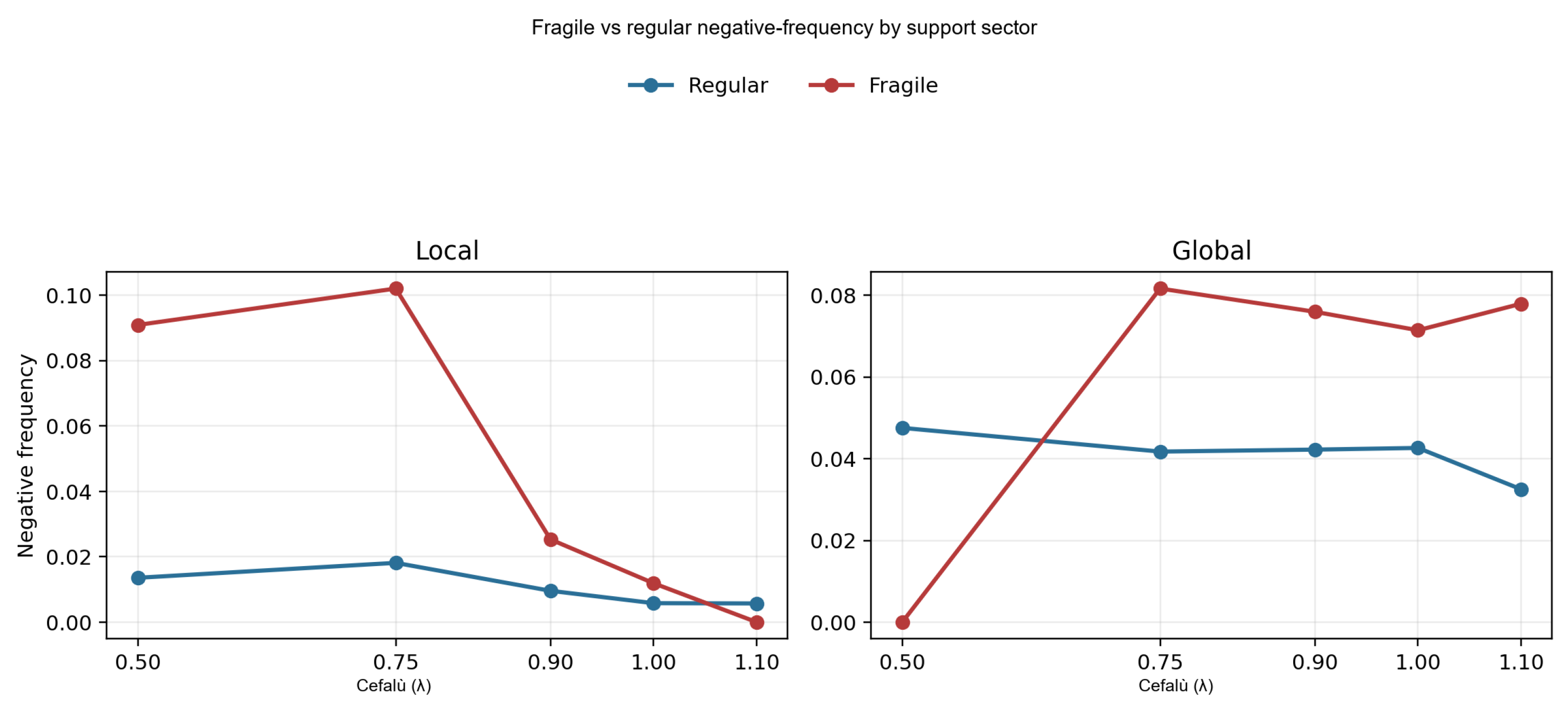
Figure 2.
Fragile-versus-regular comparison for lower-tail stability. The lower metric-eigenvalue tail degrades more strongly in fragile sectors, especially for the local baseline, showing that lower-tail failure is not uniformly distributed across the geometry.
Figure 2.
Fragile-versus-regular comparison for lower-tail stability. The lower metric-eigenvalue tail degrades more strongly in fragile sectors, especially for the local baseline, showing that lower-tail failure is not uniformly distributed across the geometry.
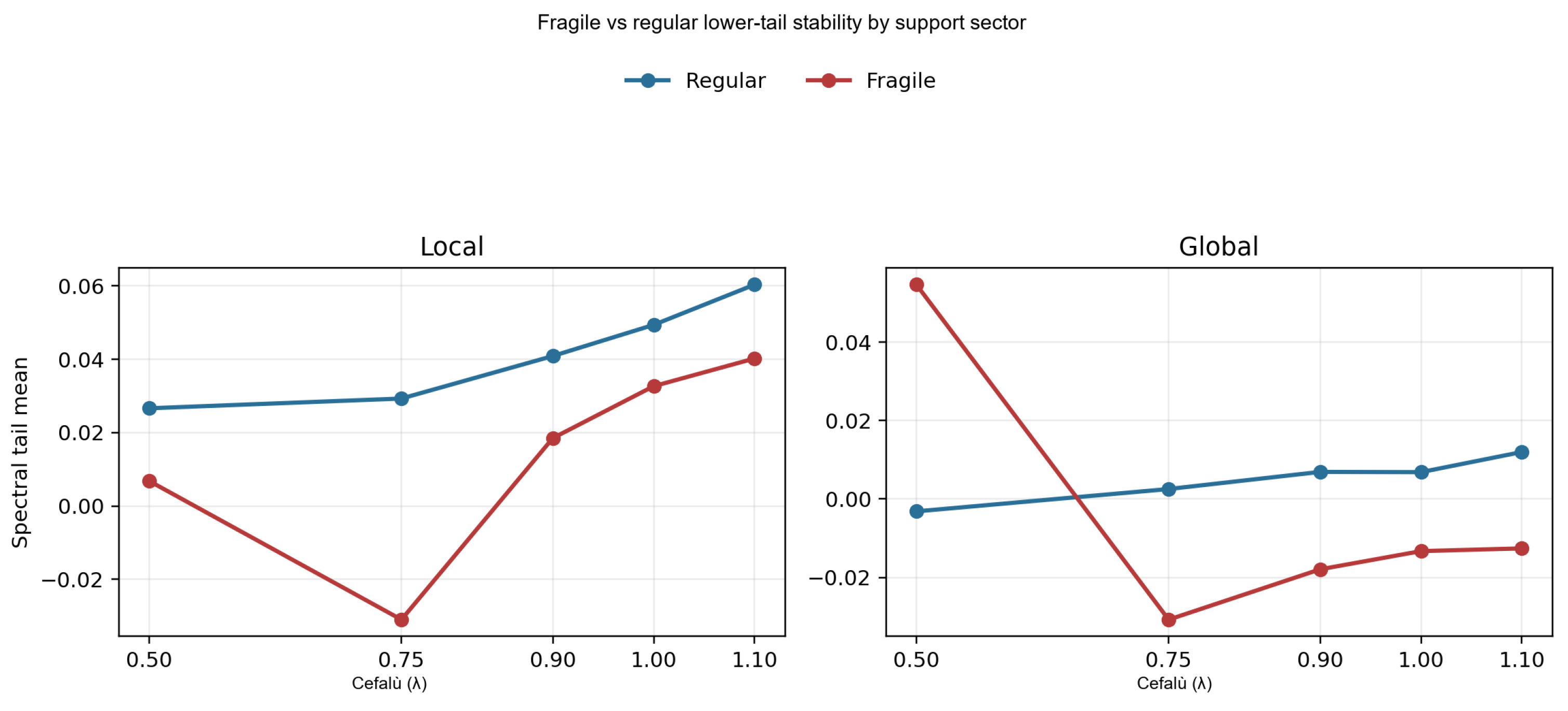
Figure 3.
Fragile-versus-regular comparison for the euler_density_proxy. Unlike lower-tail instability, the class-shadow concentration is mixed rather than uniformly fragile-enhanced, suggesting that class-facing localization is more structured and less one-dimensional than instability localization alone.
Figure 3.
Fragile-versus-regular comparison for the euler_density_proxy. Unlike lower-tail instability, the class-shadow concentration is mixed rather than uniformly fragile-enhanced, suggesting that class-facing localization is more structured and less one-dimensional than instability localization alone.
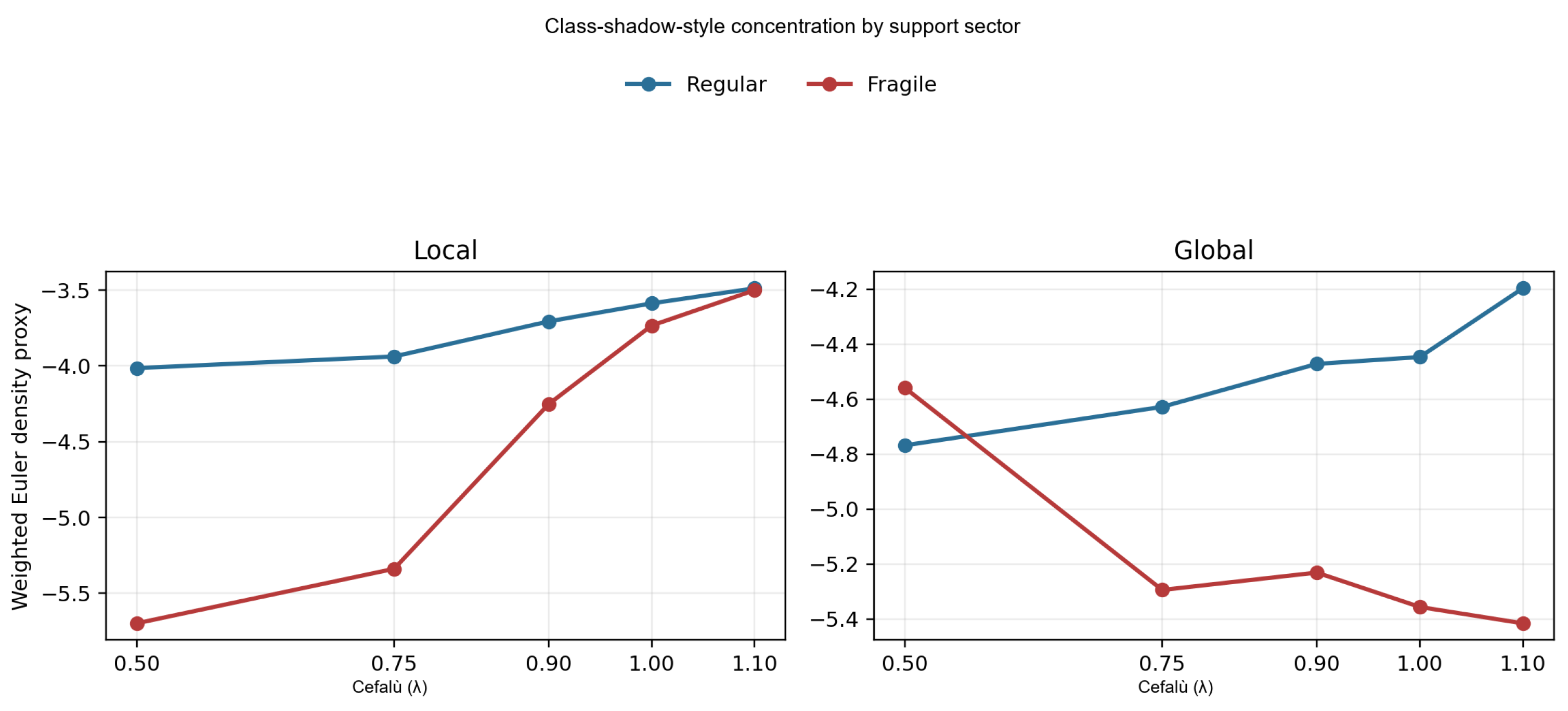
Figure 4.
Fragile-versus-regular comparison for the equation-facing residual proxy logdet_residual_proxy. The fragile-sector separation is stronger and more consistent for the local baseline than for the globally invariant model, indicating channel-dependent localization of equation-facing error.
Figure 4.
Fragile-versus-regular comparison for the equation-facing residual proxy logdet_residual_proxy. The fragile-sector separation is stronger and more consistent for the local baseline than for the globally invariant model, indicating channel-dependent localization of equation-facing error.
8.6. Equation-Facing Qualification of Fragile-Sector Localization
The support decomposition becomes more meaningful if the same fragile sectors are also visible in an equation-facing quantity rather than only in benchmark-side instability summaries. For this reason, we augment the pointwise export layer with the residual proxy
which provides a lightweight volume-form / Monge–Ampère-type measure of deviation at the sampled-point level. The role of this proxy is not to certify Ricci-flatness, but to test whether degeneration-sensitive localization also appears in a quantity closer to the defining geometric equation.
The resulting comparison shows that residual concentration is present, but not uniformly across model classes. In the present sweep, the fragile-versus-regular separation in logdet_residual_proxy is stronger and more consistent for the local baseline than for the globally invariant model. This is scientifically important because it shows that the localization pattern is itself channel-sensitive: lower-tail instability localizes clearly for both model families, whereas equation-facing residual concentration is a sharper fragile-sector separator for the local model than for the global one.
The same structured picture appears in the hardest-case ablation subset at . There, negativity-oriented and combined objective variants slightly soften fragile-sector lower-tail suppression, but they do not clearly remove fragile-sector negative-frequency concentration. This means that the objective interventions are not simply erasing degeneration-sensitive localization. Rather, they modify specific channels while leaving the broader fragile-sector structure visible.
Taken together, these results justify a modest but meaningful conclusion. The present benchmark supports a first support-conditioned shadow in which instability, lower-tail behavior, and equation-facing residuals can all be resolved relative to fragile geometry. The alignment is not uniform across channels, and the class-shadow layer remains mixed, but the extension already shows that degeneration-sensitive sectors are computationally visible and scientifically interpretable within the current framework. Figure 4 summarizes the fragile-versus-regular residual comparison, and Table 5 records the compact support-conditioned summary used in the text.
8.7. Low-Dimensional Collective Response Structure
The degeneration-aware support decomposition makes it possible to ask a stronger question than whether fragile sectors merely exist. Namely: do the resulting support-conditioned response objects behave as if they were freely independent, or do they instead organize into a lower-dimensional collective structure? In the present study, we examine this question using the grouped fragile-versus-regular response objects constructed from instability, class-shadow-style, and residual-facing summaries. The goal is not to claim a theorem-level gluing law, but to test whether the support-conditioned response is already constrained in a numerically collective way.
To do this, we assemble response vectors from the grouped response channels
We then analyze their covariance, correlation, and singular-value structure. Across this 13-channel response space, the resulting data are clearly low-dimensional: both fragile-sector and regular-sector response objects occupy a substantially compressed subspace relative to the ambient channel count. At the same time, the first-pass collective signal is more subtle than a simple “fragile sectors are more collective” slogan. In the present results, the collective compression is stronger for the regular-sector response objects than for the fragile ones. Concretely, the fragile effective-rank ratio is approximately , whereas the regular effective-rank ratio is approximately ; similarly, the first principal component explains about of the fragile-sector variance but about of the regular-sector variance. Thus, the evidence supports a real low-dimensional collective response structure, but it does not support the stronger claim that fragile sectors are uniquely or maximally collective in this first pass.
The dominant collective modes are also scientifically informative. The leading fragile-sector mode is not a pure instability axis, nor a pure residual axis, nor a pure class-shadow axis. Rather, it is a mixed mode whose strongest loadings include euler_density_proxy_mean, logdet_g_mean, euler_density_proxy_weighted_mean, min_eigenvalue_q10, and logdet_residual_mean. This indicates that the support-conditioned response is organized collectively across several channels at once. In that limited but meaningful sense, the grouped response is not well described as a free sum of independent channel contributions.
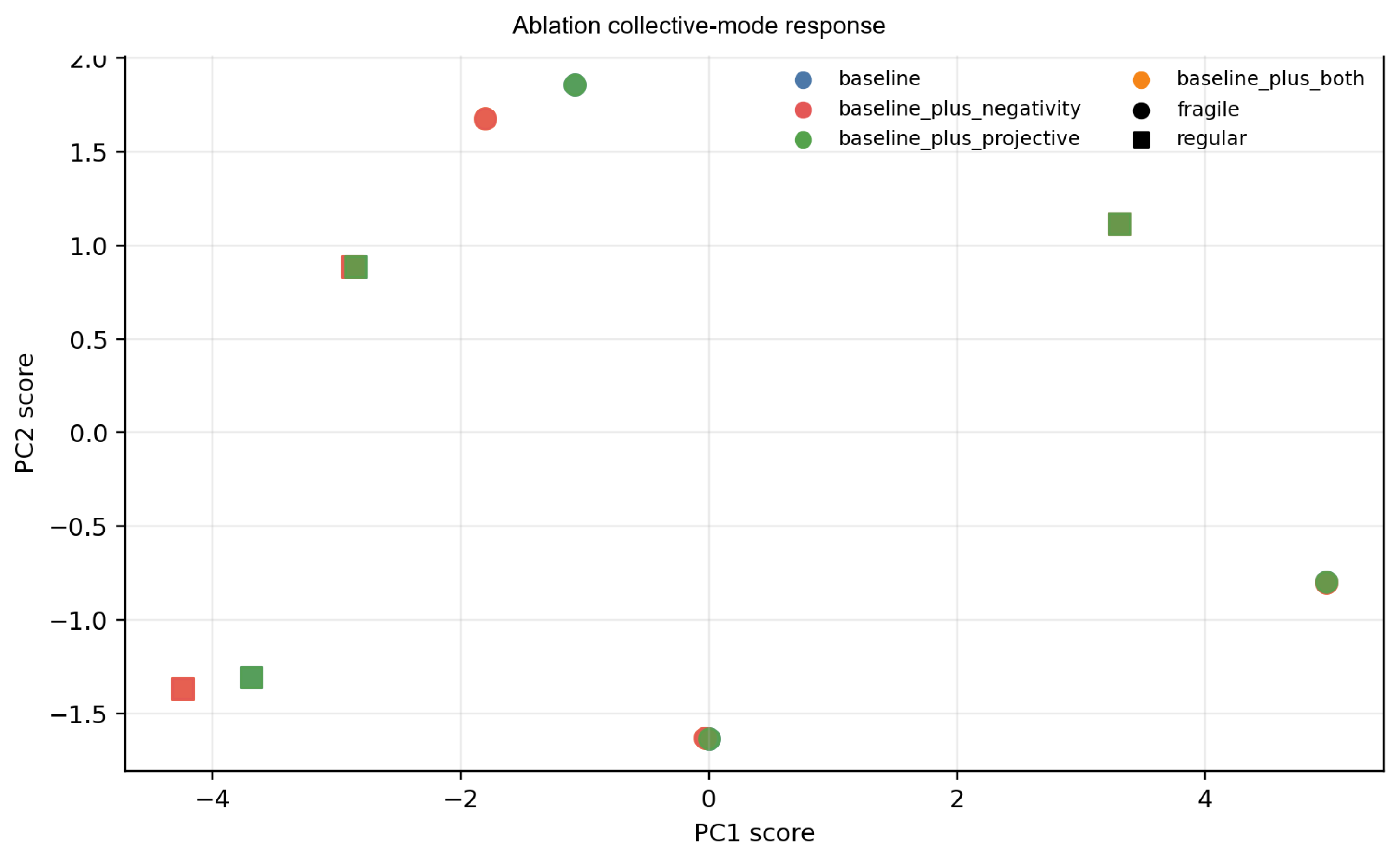
The ablation subset shows a similarly cautious pattern. There too, the response objects are strongly compressed, and the fragile-only ablation structure is even more low-dimensional, with an effective-rank ratio of approximately and the first principal component explaining about of the variance. However, the variant-to-variant shifts are small, so the current objective interventions should not be interpreted as materially reorganizing the collective-mode structure. The right conclusion is therefore modest: the support-conditioned response exhibits clear low-dimensional collective structure, but the strongest collective compression in this first pass is not uniquely fragile-sector-specific. These low-dimensionality summaries are extracted from a relatively small support-conditioned response sample and should therefore be interpreted as exploratory collective diagnostics rather than as stable asymptotic statistics.
Figure 5, Figure 6 and Figure 7 summarize the principal low-dimensionality and coupling signals, while Table 6 records the compact collective-response statistics used in the text.
Table 6.
Compact collective-response summary for the support-conditioned response objects. Lower effective-rank ratios and higher variance capture in the leading principal modes indicate stronger collective compression relative to the full 13-channel response space.
Table 6.
Compact collective-response summary for the support-conditioned response objects. Lower effective-rank ratios and higher variance capture in the leading principal modes indicate stronger collective compression relative to the full 13-channel response space.
| Subset | Effective-rank ratio | PC1 variance explained | Interpretation |
|---|---|---|---|
| Fragile sectors | 0.249 | 0.630 | low-dimensional, but not maximally compressed |
| Regular sectors | 0.171 | 0.793 | stronger first-pass collective compression |
| ablation fragile subset | 0.154 | 0.795 | highly compressed, small variant-to-variant reorganization |
Figure 5.
Singular-value decay for the support-conditioned response objects. The rapid decay relative to the full 13-channel response space indicates that both fragile-sector and regular-sector summaries occupy a substantially lower-dimensional collective structure.
Figure 5.
Singular-value decay for the support-conditioned response objects. The rapid decay relative to the full 13-channel response space indicates that both fragile-sector and regular-sector summaries occupy a substantially lower-dimensional collective structure.
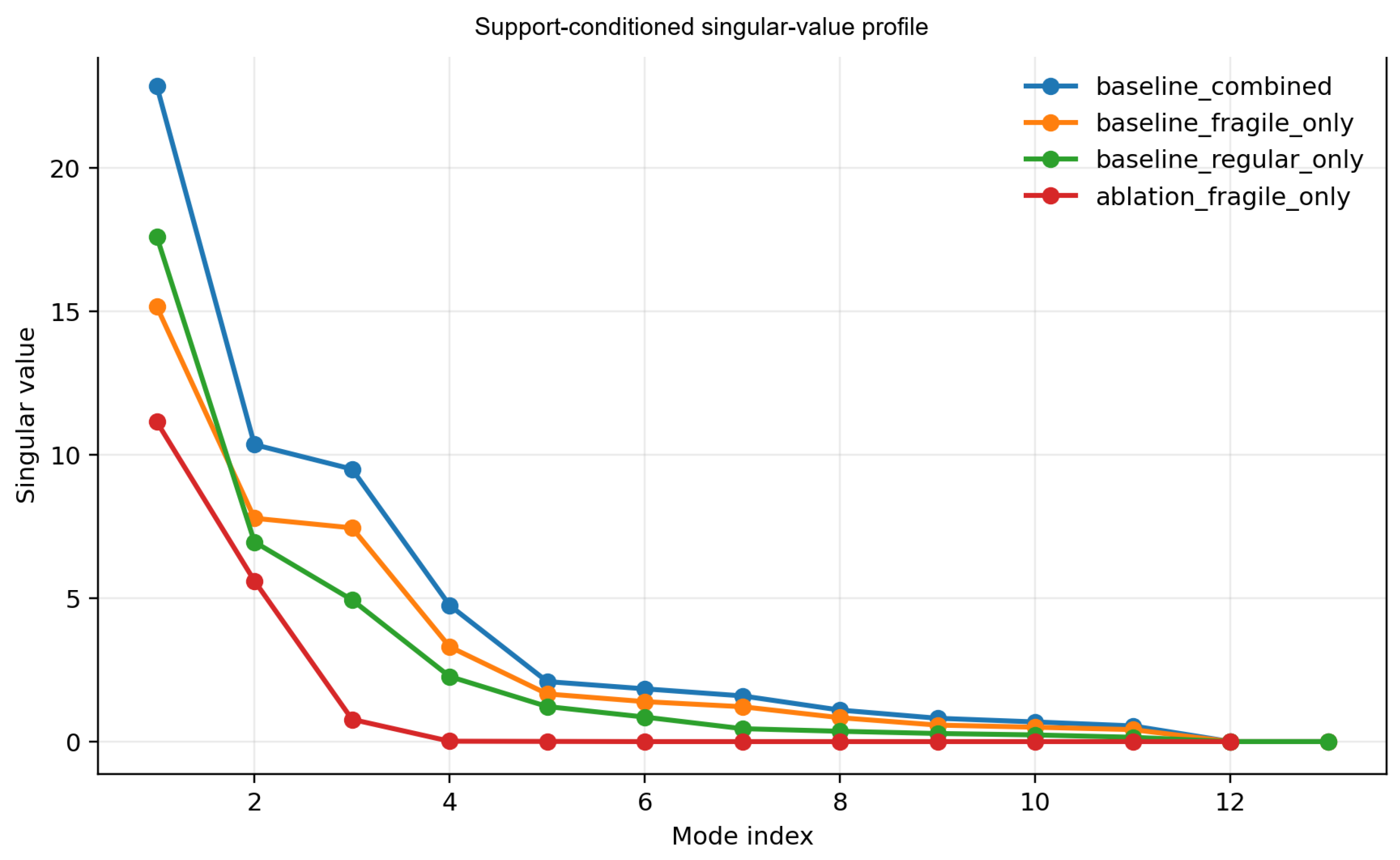
Figure 6.
Explained-variance profile for the leading principal components of the support-conditioned response objects. The first principal mode captures a large fraction of the variance in both fragile and regular sectors, confirming that the grouped response is not freely distributed across all channels.
Figure 6.
Explained-variance profile for the leading principal components of the support-conditioned response objects. The first principal mode captures a large fraction of the variance in both fragile and regular sectors, confirming that the grouped response is not freely distributed across all channels.
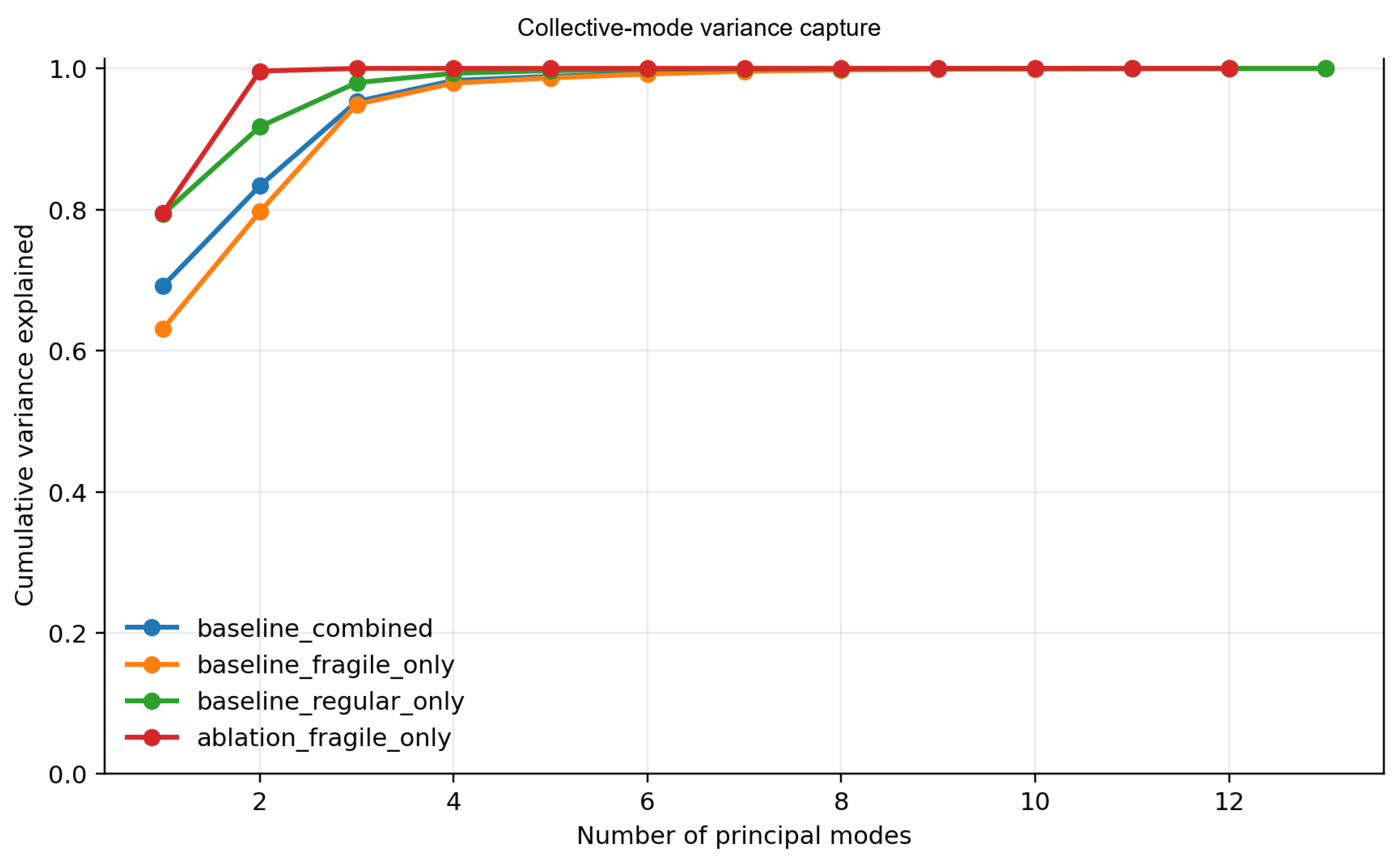
Figure 7.
Correlation structure of the support-conditioned response channels. The mixed loading pattern across instability, class-shadow, and residual-facing quantities shows that the leading collective organization is not confined to a single diagnostic family.
Figure 7.
Correlation structure of the support-conditioned response channels. The mixed loading pattern across instability, class-shadow, and residual-facing quantities shows that the leading collective organization is not confined to a single diagnostic family.
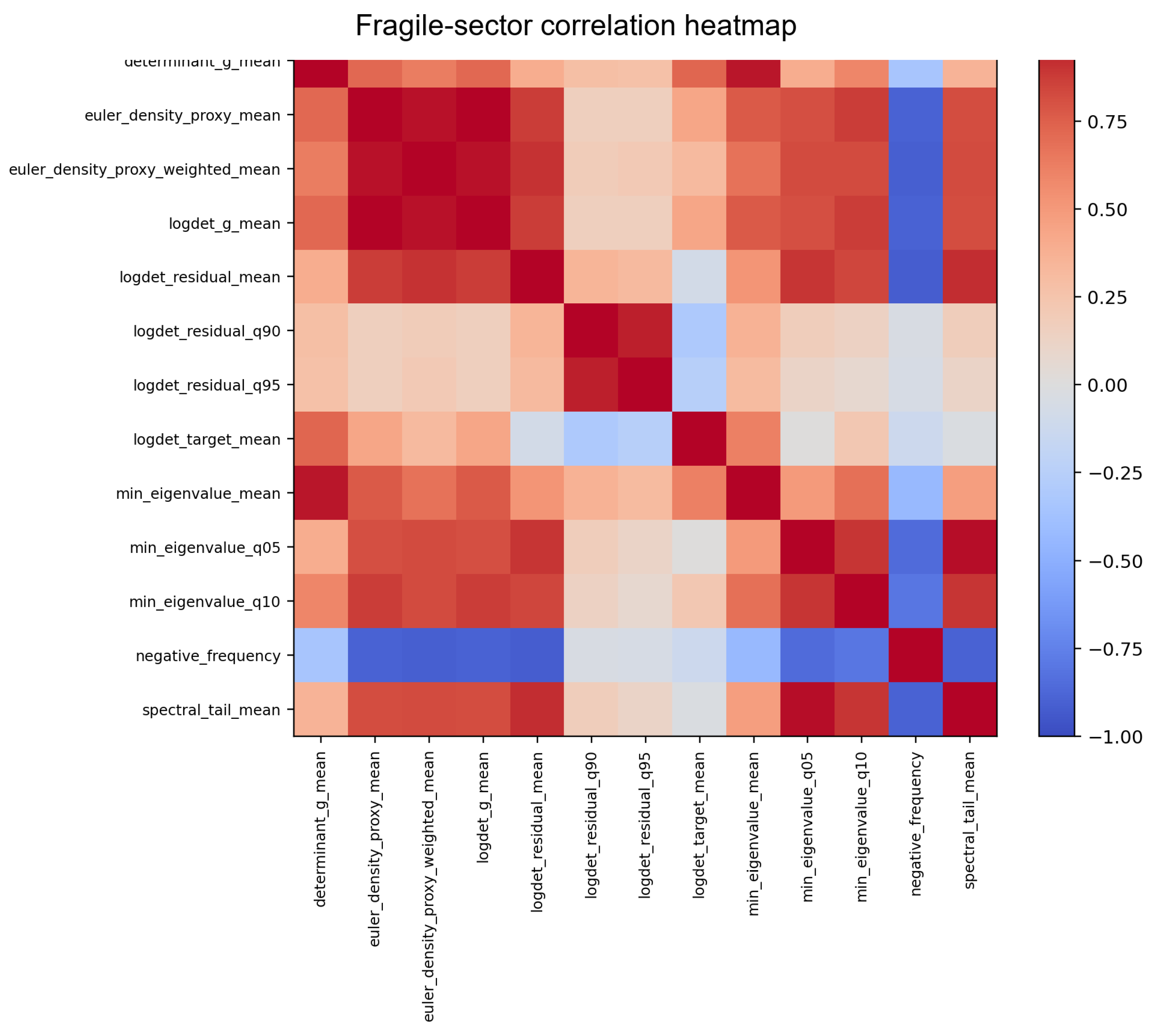
Figure 8.
Collective-mode structure in the ablation subset. The response remains strongly compressed, but the objective variants do not materially reorganize the dominant collective modes in this first pass.
Figure 8.
Collective-mode structure in the ablation subset. The response remains strongly compressed, but the objective variants do not materially reorganize the dominant collective modes in this first pass.
8.8. Hardest-Case Analysis
The hardest-case analysis provides the most concentrated view of learned geometric failure in the benchmark. The regime sweep shows that the notion of hardness is not diagnostic-independent: cases that are hardest for projective-invariance drift are not identical to the cases that are hardest for lower-tail stability or training loss. In the present results, the drift-sensitive notion of hardness points toward the regime, while positivity-tail and loss-sensitive criteria identify different parts of the sweep as hardest for the globally invariant model. This split is itself a significant result, because it shows that the hard regime is not one-dimensional.
The purpose of the hardest-case analysis is therefore not simply to isolate one difficult benchmark row, but to study how different notions of learned failure compete in the most demanding settings. In particular, this analysis asks whether the globally invariant model preserves its invariance advantage in the drift-hardest regime, whether the lower-tail weakness seen in the sweep remains visible under a more detailed comparison, and whether geometry-aware regularization can improve one fidelity channel without destabilizing another. In this setting, one objective variant may improve the lower metric-eigenvalue tail while only weakly changing drift, whereas another may improve drift while leaving the hardest positivity failures largely unresolved.
For that reason, the hardest-case analysis serves as the most detailed lens in the paper. It is where the benchmark moves beyond aggregate comparison and begins to study the structure of failure itself: which metrics deteriorate most severely, which interventions improve them, and which tradeoffs emerge once the regime enters its most demanding range. Figure 12 summarizes the detailed comparison in the hardest overlap case used by the objective-ablation study, while Table 8 records the corresponding objective-level summary for the globally invariant model.
Table 7.
Core results across the full hard-regime sweep.
| Cefalú Case () | Model | Negative-eigenvalue frequency | Projective-invariance drift | spectral_ tail_mean |
|---|---|---|---|---|
| 0.50 | Local | 0.015000 | 3.733362e-08 | 0.026163 |
| 0.50 | Global | 0.046667 | 1.564001e-08 | 0.007294 |
| 0.75 | Local | 0.025000 | 3.886719e-08 | 0.023318 |
| 0.75 | Global | 0.045000 | 1.728535e-08 | 0.007518 |
| 0.90 | Local | 0.011667 | 3.917764e-08 | 0.038782 |
| 0.90 | Global | 0.046667 | 1.593338e-08 | 0.013410 |
| 1.00 | Local | 0.006667 | 3.617257e-08 | 0.048261 |
| 1.00 | Global | 0.046667 | 1.783793e-08 | 0.012506 |
| 1.10 | Local | 0.005000 | 3.794829e-08 | 0.058322 |
| 1.10 | Global | 0.038333 | 1.740176e-08 | 0.017665 |
Table 8.
Objective-ablation summary for the globally invariant model at the hardest overlap ablation case, Cefalú .
Table 8.
Objective-ablation summary for the globally invariant model at the hardest overlap ablation case, Cefalú .
| Variant | Projective-invariance drift | spectral_tail_mean | Interpretation |
|---|---|---|---|
| Baseline | 1.643319e-08 | 0.009408 | reference objective |
| Negativity-regularized | 1.654960e-08 | 0.012471 | strongest lower-tail stability among variants (tied) |
| Projective-regularized | 1.575332e-08 | 0.009408 | strongest drift among variants |
| Combined | 1.625779e-08 | 0.012471 | mixed tradeoff; near-best drift with strongest lower-tail stability (tied) |
8.9. Diagnostic Disagreement and Fidelity Breakdown
A further result is that learned geometric breakdown does not occur uniformly across diagnostics. Instead, different diagnostics fail at different rates and identify different regions of the sweep as hardest. This means that learned metric failure is not adequately described by a single score or threshold. Rather, it has internal structure: some aspects of fidelity remain comparatively stable while others deteriorate, and those deterioration patterns differ across model families and objective variants.
This is especially important because the benchmark combines several distinct notions of geometric quality. Negative-eigenvalue frequency, minimum-eigenvalue mean, and spectral_tail_mean probe different aspects of lower-tail stability, while projective-invariance drift probes consistency with the global projective structure of the quartic geometry. Determinant-based summaries, the Euler proxy, and training loss contribute additional context. The sweep results show that these diagnostics do not fail together and do not produce a single consistent hardness ordering. In particular, the globally invariant model is sweep-wide superior on projective-invariance drift, while the local baseline is sweep-wide superior on positivity-tail stability.
The diagnostic-disagreement analysis is therefore one of the most scientifically informative aspects of the study. It shows that learned geometric fidelity in hard quartic regimes is multi-axis rather than one-dimensional. The benchmark does not merely compare models; it reveals a hierarchy and tradeoff structure among different notions of geometric fidelity. This structured view of failure is stronger and more informative than a simple benchmark ranking, because it identifies which aspects of learned geometry are improved by global invariant structure, which remain weaker, and which can be partially reshaped by geometry-aware objective design.
Figure 9.
Diagnostic trajectories across the Cefalú hard-regime sweep. The figure emphasizes that different diagnostics evolve differently across the sweep: projective-invariance drift consistently favors the globally invariant model, while positivity-oriented and lower-tail diagnostics favor the local baseline.
Figure 9.
Diagnostic trajectories across the Cefalú hard-regime sweep. The figure emphasizes that different diagnostics evolve differently across the sweep: projective-invariance drift consistently favors the globally invariant model, while positivity-oriented and lower-tail diagnostics favor the local baseline.
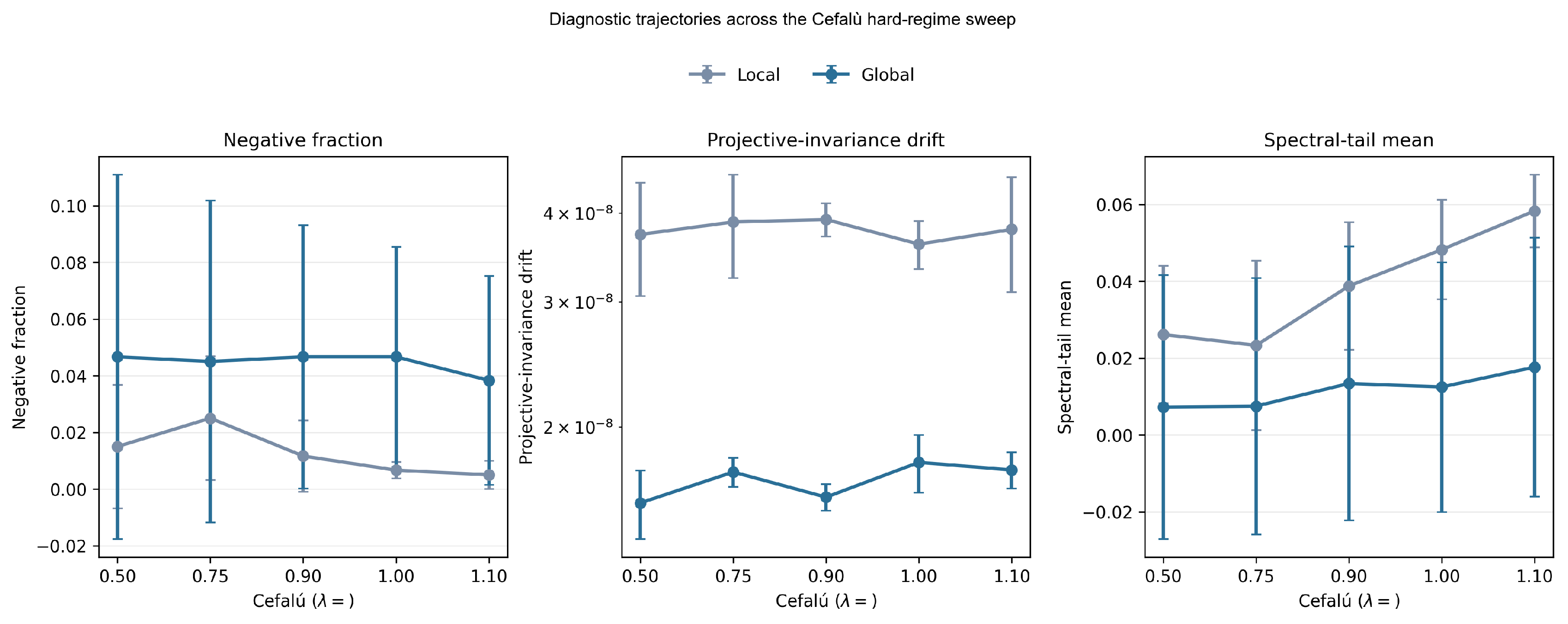
Figure 10.
Comparison of degradation profiles for local and globally invariant models. The main scientific signal is not a uniform winner, but a structured separation between invariance-sensitive and positivity-tail-sensitive notions of learned geometric fidelity.
Figure 10.
Comparison of degradation profiles for local and globally invariant models. The main scientific signal is not a uniform winner, but a structured separation between invariance-sensitive and positivity-tail-sensitive notions of learned geometric fidelity.
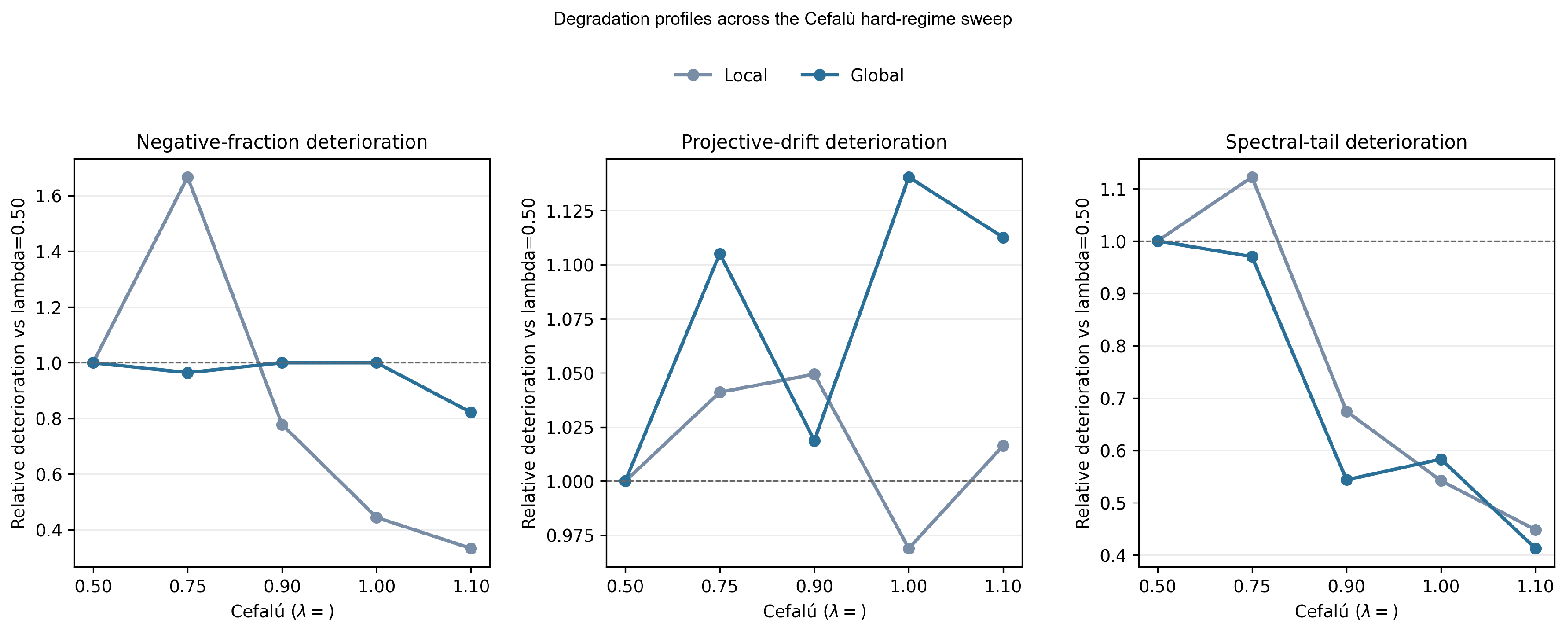
Figure 11.
Effect of geometry-aware objective variants on hardest-case fidelity. Projective-oriented regularization improves invariance drift on the key overlap hard cases, while negativity-oriented regularization improves lower-tail stability, showing that different objective terms act on different fidelity channels.
Figure 11.
Effect of geometry-aware objective variants on hardest-case fidelity. Projective-oriented regularization improves invariance drift on the key overlap hard cases, while negativity-oriented regularization improves lower-tail stability, showing that different objective terms act on different fidelity channels.
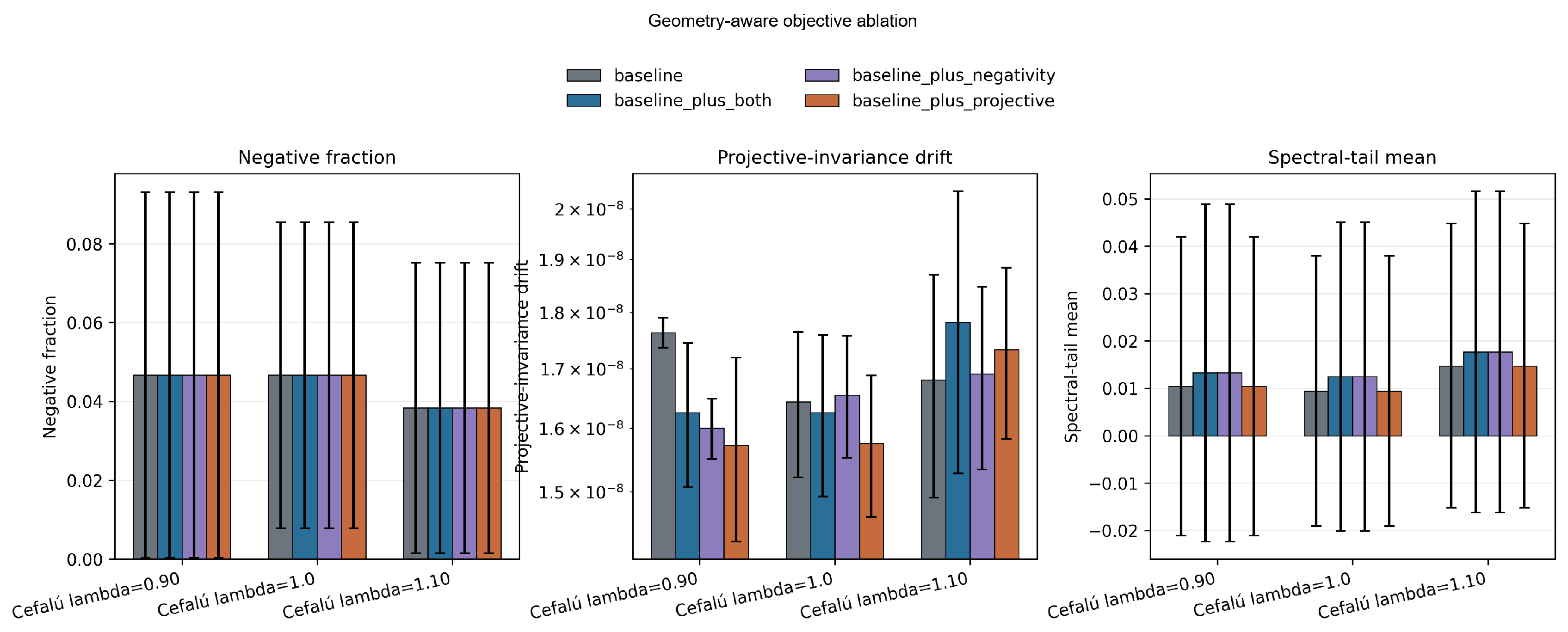
Figure 12.
Detailed comparison at the hardest overlap Cefalú regime used in the objective-ablation study. The figure is intended to highlight how invariance-sensitive and lower-tail-sensitive diagnostics respond differently to model choice and geometry-aware regularization.
Figure 12.
Detailed comparison at the hardest overlap Cefalú regime used in the objective-ablation study. The figure is intended to highlight how invariance-sensitive and lower-tail-sensitive diagnostics respond differently to model choice and geometry-aware regularization.
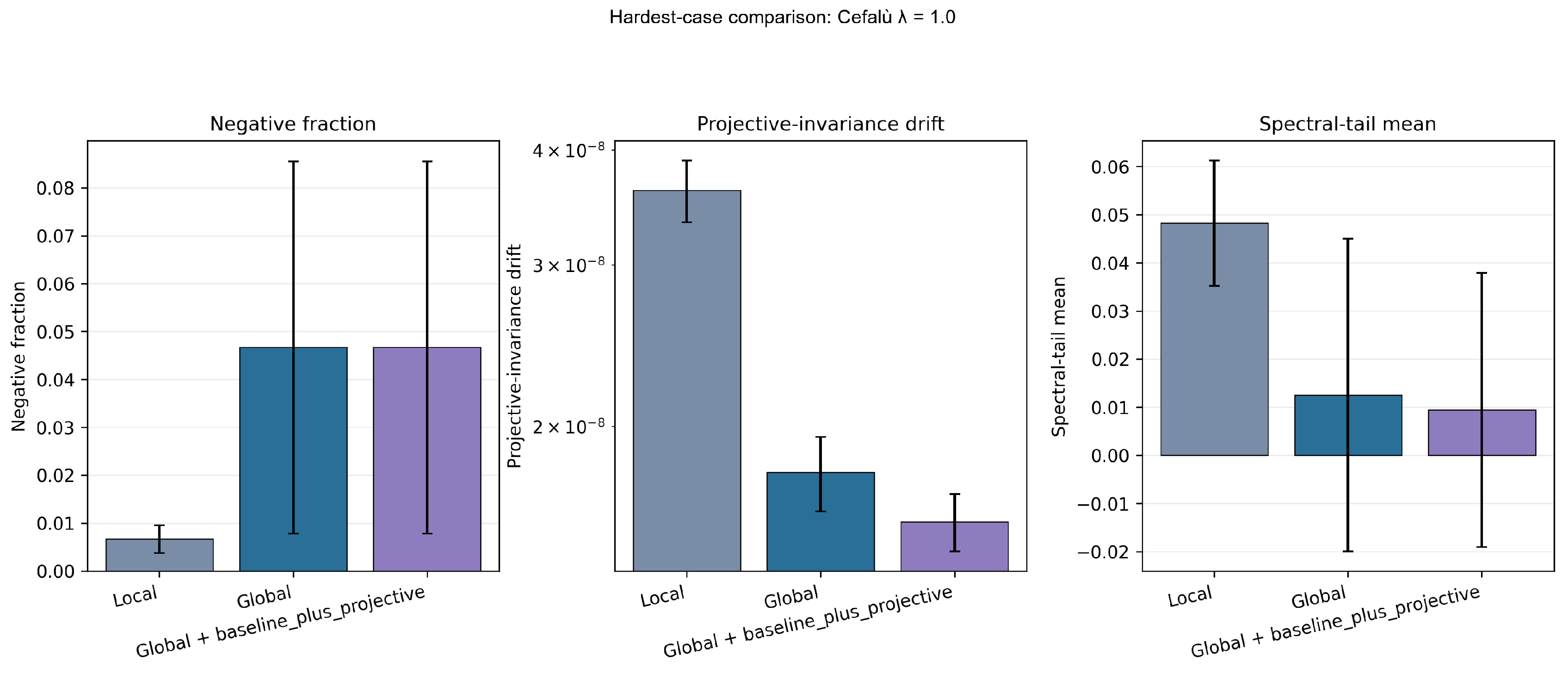
9. Discussion
9.1. What the Regime Sweep Reveals
The regime sweep reveals a more structured scientific picture than a simple benchmark ranking. The strongest and most persistent signal is the projective-invariance advantage of the globally invariant model across the full Cefalú hard-regime sweep. This confirms that encoding global invariant structure at the representation level robustly improves the invariance-sensitive fidelity of the learned metric correction. At the same time, the sweep shows that the local baseline retains a consistent advantage on positivity-oriented and lower-tail stability diagnostics. The result is therefore not a single scalar ordering, but a separation between different channels of learned geometric fidelity.
This is scientifically important because it shows that hard-regime learned metric behavior is multi-axis. The question “which model is better?” cannot be answered independently of the diagnostic lens through which learned geometry is evaluated. The sweep thus does more than compare architectures: it identifies a structured tradeoff between invariance-sensitive fidelity and positivity-tail stability across the hard quartic regime.
9.2. What Geometry-Aware Training Changes
The objective-ablation results show that geometry -aware training matters, but in a selective rather than universal way. Projective-oriented regularization improves the invariance channel it is designed to target, while negativity-oriented regularization improves lower-tail stability. The combined objective does not yet yield a uniform across-the-board improvement, but instead makes the tradeoff structure more explicit. This is useful because it shows that objective-level geometric structure can reshape learned fidelity even when it does not collapse all diagnostics into a single improved ordering.
From this perspective, architecture and objective design play complementary roles. Representation-level globality improves one major channel of geometric fidelity, while objective-level regularization begins to act as a second lever that modifies selected channels. The present results therefore support a more nuanced view of learned Kähler-potential modeling: hard-regime fidelity is not controlled by a single architectural or training choice, but by the interaction between representation, objective, and diagnostic channel.
9.3. Reproducibility and Artifact Structure
Beyond the scientific findings, the present study expands the reproducibility layer needed to study regime-dependent learned geometry. The framework now supports a named regime-sweep benchmark over the Cefalú family, richer frozen diagnostics including lower-tail metric-spectrum summaries, config-driven geometry-aware objective ablations, and a paper-facing artifact path that generates figures and tables from frozen outputs. In parallel, GeoCYData provides the stable benchmark preset, case identifiers, bundle metadata, and manifest structure needed to support this regime-dependent analysis reproducibly.
This matters because the study is not defined only by model classes. It also requires a benchmark substrate, experiment layer, diagnostic layer, ablation layer, and frozen artifact layer that can be inspected, rerun, and extended. The infrastructure is therefore not a separate engineering concern: it is the experimental substrate that makes the regime sweep, diagnostic separation, support-conditioned analysis, and objective-ablation results reproducible.
9.4. Degeneration-Aware Extension Layer
The additional degeneration-sensitive analysis introduced here is deliberately modest, but it changes the role of the benchmark in an important way. The benchmark is no longer only comparing learned metrics through global sweep summaries; it begins to resolve fragile sectors, class-facing localization, and equation-facing residual concentration relative to degeneration-sensitive geometry. This does not amount to a singularity calculation in the strict sense, but it provides a first support-conditioned computational layer for later degeneration- and node-aware studies.
The support-conditioned results show that this layer does not collapse to a single signal. Lower-tail instability localizes clearly in fragile geometry, while the residual channel separates fragile from regular sectors more strongly for the local baseline than for the globally invariant model, and the class-shadow layer remains mixed rather than uniformly fragile-enhanced. That structured outcome is useful because it suggests that degeneration-sensitive support, class-facing concentration, and equation-facing error should be treated as related but distinct computational shadows rather than as a single merged quantity.
9.5. Collective Response Structure
The collective-mode analysis shows that the support -conditioned response objects are not freely distributed across the full channel set. Instead, they occupy a substantially lower-dimensional structure with mixed instability, class-shadow, and residual-facing loadings. This provides a first exploratory indication that support-conditioned learned metric responses can be organized by a small number of collective modes rather than by channelwise independence.
At the same time, the present results do not support the stronger claim that fragile sectors are uniquely more collective than regular sectors. In the first pass, the strongest compression appears on the regular side. That caution is important, but it does not erase the main point. The leading fragile-sector mode is already mixed across instability, class-shadow, and residual-facing quantities, which indicates that the support-conditioned response is structured across multiple diagnostic families. The correct interpretation is therefore modest: the benchmark exhibits a low-dimensional collective response structure, but not yet a fragile-sector-specific dominance principle or a theorem-level gluing statement.
9.6. Limits of the Present Study
Several limits remain. First, the benchmark does not support a uniform claim that the globally invariant model is geometrically superior in every sense. Its strongest advantage is invariance-sensitive fidelity, not positivity-tail fidelity. Second, the current objective-ablation family is intentionally simple and interpretable rather than topology-aware or fully constraint-rich. Third, some diagnostics remain weakly informative in the present benchmark, most notably chart consistency. Fourth, while the present paper includes a lightweight equation-facing residual proxy, it does not yet include curvature-sensitive diagnostics, observable-level physics calculations, symbolic distillation, or certification.
These limits do not weaken the main value of the paper, but they do determine its correct interpretation. The present study establishes a structured analysis of regime-dependent learned geometric fidelity, support-conditioned localization, and low-dimensional collective response. It should not be read as delivering a final or unified notion of learned geometric trustworthiness.
9.7. Implications for Future Studies
The results point naturally to several next steps. One direction is stronger geometry- and topology-aware training, since the present results show that different fidelity channels remain in tension and that simple regularizers improve them only selectively. A second direction is downstream observable work, where the key question is which aspects of learned metric fidelity and support-conditioned structure actually matter for metric-dependent computations. A third direction is symbolic distillation and interpretable surrogate construction, where one must ask not only whether the globally invariant model compresses well, but also which parts of its learned fidelity, support localization, and collective response structure survive compression.
More broadly, the present study provides a bridge between learned metric benchmarking and later degeneration-sensitive geometry. It does not compute finite-node conifold data, but it begins to organize the computational setting in a language of support, localization, residual qualification, and collective structure. In this sense, the paper plays a transitional role: it moves from architecture-first benchmarking toward a more explicit science of tradeoffs, support-conditioned analysis, and targeted intervention.
10. Conclusion
We have studied regime-dependent learned Kähler-potential fidelity across a controlled hard-regime sweep in the Cefalú quartic Calabi–Yau family. The main scientific result is not a simple regime-wide winner, but a structured diagnostic tradeoff. Across the full sweep, the globally invariant model shows a strong and persistent advantage on projective-invariance drift, while the local-input baseline remains stronger on positivity-oriented and lower-tail stability diagnostics, especially spectral_tail_mean. The benchmark therefore shows that learned geometric fidelity in hard quartic regimes is multi-axis rather than one-dimensional.
A second contribution is the systematic comparison of geometry-aware objective variants for the globally invariant model. These ablations show that objective-level geometric regularization can improve targeted fidelity channels, but that the resulting gains are selective and can expose tradeoffs rather than produce a universal monotone improvement. Projective-oriented regularization primarily improves the invariance-sensitive channel, while negativity-oriented regularization improves lower-tail stability. This reinforces the central conclusion that different notions of learned geometric fidelity can be strengthened separately, but are not yet unified by the present objective family.
The paper also introduces a first support-conditioned degeneration-aware extension. Using a geometry-side fragility proxy, we resolve fragile and regular sectors across the hard-regime sweep and find that lower-tail instability localizes preferentially in degeneration-sensitive geometry. The same extension adds a lightweight equation-facing residual proxy and class-shadow-style grouped summaries, allowing instability, residual concentration, and class-facing quantities to be compared on the same support. These quantities are computational proxies rather than singular characteristic classes or degeneration invariants, but they show that degeneration-sensitive support is already visible in the learned metric data.
Finally, we analyze the collective structure of the resulting support-conditioned response objects. The response is low-dimensional relative to the full diagnostic channel set, with mixed instability, class-shadow, and residual-facing loadings. This indicates that the grouped response is not well described by independent channelwise behavior alone. At the same time, the strongest compression in this first pass is not uniquely fragile-sector-specific, so the correct interpretation is intentionally cautious: the present data support an exploratory low-dimensional collective response structure, not a theorem-level gluing law or a fragile-sector dominance principle.
Together, these results establish a reproducible hard-regime benchmark for studying diagnostic separation, objective-level intervention, and support-conditioned learned metric behavior. The accompanying GeoCYData and GlobalCY artifact layers provide named benchmark cases, fixed multi-seed protocols, pointwise exports, frozen summaries, objective-ablation outputs, and figure-ready data. The resulting framework provides a basis for later observable-facing, singularity-facing, and interpretability-focused studies, where the key question will be which learned fidelity channels and support-conditioned structures matter for downstream geometric and physics-facing computations.
Appendix A. Additional Ablations and Benchmark Details
This appendix records supplementary details of the regime-sweep and objective-ablation studies that are useful for interpretation but are not central to the main scientific narrative. The main text establishes the primary result: a structured tradeoff between invariance-sensitive fidelity and positivity-tail stability across the Cefalú hard-regime sweep. The present appendix records additional benchmark, ablation, and reproducibility details supporting that result.
The benchmark used in the main text is the GeoCY preset The benchmark used in the main text is the GeoCY preset . Its canonical cases are:
The fixed seed protocol inherited from the preset is . The experiment and artifact structure is designed so that later expansions of the regime set, seed set, or alternate sweep orderings can be recorded without changing the interpretation of the main results.
The objective-ablation study is deliberately modest and interpretable. It considers only the globally invariant model and compares four variants: the baseline objective, a negativity-regularized objective, a projective-regularized objective, and a combined objective. Possible extensions, such as alternate penalty weights, stronger lower-tail penalties, additional lower-tail quantiles, or hardest-case-targeted schedules, should be treated as supplementary benchmark variants rather than as part of the core claims of the present paper.
A final point concerns interpretation. Some of the most informative findings arise from diagnostic separation rather than from a single aggregate ranking. Hardest-case identification depends on the diagnostic under consideration, and the effects of objective regularization are selective rather than universal. This appendix is therefore also the natural location for seed-level variability summaries, diagnostic ranking comparisons, or alternate hardest-case definitions.
Appendix B. Extended Diagnostics
The main text focuses on the diagnostic layer central to the present benchmark: negative-eigenvalue frequency, minimum-eigenvalue mean, spectral_tail_mean, projective-invariance drift, chart consistency, determinant summaries, the Euler proxy, training loss, and runtime. These are sufficient for the principal conclusions.
The most important extension realized in this paper is the lower-tail quantity
defined as the mean of the lowest decile of the per-point minimum-eigenvalue distribution. This quantity is more sensitive to concentrated lower-tail degradation than the full-sample minimum-eigenvalue mean and, in the present benchmark, reveals a stronger lower-tail separation between model families. It should be understood as a metric-spectrum stability diagnostic, not as a Laplace-spectrum observable.
Additional diagnostics remain possible but are not required for the main claims of the paper. These include residual-sensitive summaries, volume-form or Monge–Ampère-type proxies, curvature-sensitive diagnostics, and stronger chart- or sector-localized stability measures. If future benchmark versions include quantities such as spectral_tail_q10, spectral_tail_q05, lower-tail width summaries, or residual-sensitive observables, they can be recorded as supplementary evidence without altering the core scientific conclusion.
Appendix C. Artifact Schema and Reproducibility Notes
All manuscript-facing figures and tables are generated from frozen outputs rather than from live training runs. This design separates scientific interpretation from the transient state of the experiment directory and improves reproducibility. For that reason, it is useful to record the artifact structure explicitly.
On the geometry side, the GeoCY benchmark preset cefalu_hard_regime_sweep_v1 emits a machine-readable benchmark manifest together with model-ready bundles for each case and seed combination. These bundles expose local-chart and invariant representations, sampling metadata, case metadata, and symmetry-aware artifacts where available. The benchmark manifest records the preset name, benchmark version, geometry family, target name, seed set, sample count, and available model-facing views.
On the experiment side, the GlobalCY workflow emits run-level, case-level, sweep-level, ablation-level, and support-conditioned outputs. The manuscript uses frozen summaries and figure-ready data derived from these outputs. This ensures that the reported diagnostic trajectories, ablation summaries, support-conditioned comparisons, and collective-response statistics are tied to explicit artifact files rather than to live experiment state.
Appendix D. Degeneration-Sensitive Proxies and Class-Shadow Quantities
For completeness, we record the benchmark definitions used in the support-conditioned extension layer. These include the geometry-side fragility score, the rule defining fragile sectors, the localized class-shadow quantities, the support-conditioned response matrix used in the collective-mode analysis, and the equation-facing residual proxy.
The geometry-side fragility score is defined pointwise by
where F is the defining quartic polynomial evaluated on the normalized sampled homogeneous point x. Smaller values of are interpreted as more degeneration-sensitive or more fragile in the present computational sense. This quantity is used only as a geometry-side proxy for near-degenerate behavior; it is not a singularity invariant in the strict algebro-geometric sense.
The fragile subset is defined by
where is chosen to be the global quantile of across the full Cefalú hard-regime sweep. Equivalently, the benchmark uses the corresponding fragile_flag exported by GeoCYData. No additional clustering of the fragile subset is imposed; the support decomposition is strictly fragile versus regular.
The localized class-shadow quantities are obtained by taking grouped moments, quantiles, and weighted means of the benchmark’s pointwise class-facing proxy fields over the fragile and regular sectors. In particular, the present paper uses grouped summaries of
together with the residual-facing quantity defined below. These are not singular characteristic classes in the strict sense, but computational proxies that allow class-facing geometric content to be compared across degeneration-sensitive support sectors.
The support-conditioned response matrix used in the collective-mode analysis is built from grouped fragile-versus-regular response objects. Its channels are
Rows are indexed by , , , and . The corresponding effective-rank summaries are extracted from the singular-value profile of this response matrix and are used only as low-dimensionality diagnostics for the collective response structure.
Finally, the equation-facing residual proxy is defined pointwise by
This is a lightweight volume-form / Monge–Ampère-type mismatch proxy. Its role is not to certify Ricci-flatness, but to test whether degeneration-sensitive localization also appears in a quantity closer to the defining geometric equation.
These objects are not intended as final degeneration invariants, singular characteristic classes, or theorem-level gluing data. Rather, they are computational proxies that permit a first localized and collective analysis of degeneration-sensitive learned metric behavior. While the present quantities are only computational shadows and not singular characteristic classes in the strict sense, they are motivated by the broader role that Euler- and Chern-type class constructions play in organizing singular and degeneration-sensitive geometry [13,14,15].
References
- Rahman, A. GlobalCY I: A JAX Framework for Globally Defined and Symmetry-Aware Neural Kähler Potentials, 2026, [arXiv:hep-th/2604.11404].
- Berglund, P.; Butbaia, G.; Hübsch, T.; Jejjala, V.; Peña, D.M.; Mishra, C.; Tan, J. Machine learned Calabi–Yau metrics and curvature. Advances in Theoretical and Mathematical Physics 2023, 27, 1107–1158, [arXiv:hep-th/2211.09801]. [CrossRef]
- Ashmore, A.; He, Y.H.; Ovrut, B.A. Machine Learning Calabi–Yau Metrics. Fortschritte der Physik 2020, 68, 2000068. [CrossRef]
- Jejjala, V.; Mayorga Peña, D.K.; Mishra, C. Neural network approximations for Calabi–Yau metrics. JHEP 2022, 2022, 105, [arXiv:hep-th/2012.15821]. [CrossRef]
- Douglas, M.R.; Lakshminarasimhan, S.; Qi, Y.; Wrase, T. Numerical Calabi–Yau Metrics from Holomorphic Networks. In Proceedings of the Proceedings of Machine Learning Research, 2022, Vol. 145, pp. 74–100.
- Headrick, M.; Nassar, A. Energy functionals for Calabi–Yau metrics. Advances in Theoretical and Mathematical Physics 2013, 17, 867–902, [arXiv:hep-th/0908.2635]. [CrossRef]
- Donaldson, S.K. Scalar Curvature and Projective Embeddings, II. Q. J. Math. 2005, 56, 345–356, [arXiv:math.DG/math/0407534]. [CrossRef]
- Donaldson, S.K. Some numerical results in complex differential geometry. Pure and Applied Mathematics Quarterly 2009, 5, 571–618. [CrossRef]
- Gerdes, M.; Krippendorf, S. CYJAX: A package for Calabi–Yau metrics with JAX. Machine Learning: Science and Technology 2023, 4, 025031, [arXiv:hep-th/2211.12520]. [CrossRef]
- Anderson, L.B.; Gerdes, M.; Gray, J.; Krippendorf, S.; Raghuram, N.; Rühle, F. Moduli-dependent Calabi–Yau and SU(3)-structure metrics from Machine Learning. JHEP 2021, 2021, 13, [arXiv:hep-th/2012.04656]. [CrossRef]
- Constantin, A.; Lukas, A.; Nutricati, L.A. Calabi–Yau Metrics with Kähler Moduli Dependence, 2026, [arXiv:hep-th/2603.12384]. [CrossRef]
- Dubey, A.; Krippendorf, S.; Schachner, A. JAXVacua: A framework for computing periods, prepotentials, and flux vacua in Calabi–Yau orientifold compactifications, 2023, [arXiv:hep-th/2306.06160].
- MacPherson, R.D. Chern classes for singular algebraic varieties. Annals of Mathematics 1974, 100, 423–432. [CrossRef]
- Fulton, W. Intersection Theory, 2 ed.; Ergebnisse der Mathematik und ihrer Grenzgebiete, Springer: Berlin, 1998.
- Aluffi, P. Chern classes for singular hypersurfaces. Transactions of the American Mathematical Society 1999, 351, 3989–4026. [CrossRef]
Table 5.
Compact fragile-sector support-conditioned summary across the Cefalú hard-regime sweep.
| Case () | Model | Fragile neg. freq. | Fragile spectral_tail_mean |
Fragile residual mean |
|---|---|---|---|---|
| 0.50 | Local | 0.090909 | 0.006813 | -1.246973 |
| 0.50 | Global | 0.000000 | 0.054604 | 0.091608 |
| 0.75 | Local | 0.102041 | -0.031019 | -1.256754 |
| 0.75 | Global | 0.081633 | -0.030762 | -1.634387 |
| 0.90 | Local | 0.025316 | 0.018488 | -0.536606 |
| 0.90 | Global | 0.075949 | -0.017943 | -1.514759 |
| 1.00 | Local | 0.011905 | 0.032667 | -0.314964 |
| 1.00 | Global | 0.071429 | -0.013301 | -1.624563 |
| 1.10 | Local | 0.000000 | 0.040229 | -0.230679 |
| 1.10 | Global | 0.077922 | -0.012605 | -1.750856 |
Disclaimer/Publisher’s Note: The statements, opinions and data contained in all publications are solely those of the individual author(s) and contributor(s) and not of MDPI and/or the editor(s). MDPI and/or the editor(s) disclaim responsibility for any injury to people or property resulting from any ideas, methods, instructions or products referred to in the content. |
© 2026 by the authors. Licensee MDPI, Basel, Switzerland. This article is an open access article distributed under the terms and conditions of the Creative Commons Attribution (CC BY) license (http://creativecommons.org/licenses/by/4.0/).
Copyright: This open access article is published under a Creative Commons CC BY 4.0 license, which permit the free download, distribution, and reuse, provided that the author and preprint are cited in any reuse.


