

Submitted:
07 July 2026
Posted:
08 July 2026
You are already at the latest version
Abstract
Sustainability leadership is increasingly recognised as essential for addressing complex socio-ecological challenges, yet empirically grounded and validated competency frameworks remain scarce, particularly those derived from interdisciplinary and intergenerational samples. Building on an extensive literature synthesis, this study developed an a priori framework comprising four dimensions: (1) Knowledge & Understanding, (2) Values, Motivation & Purpose, (3) Leadership Practices & Impact, and (4) Inner Development & Learning, operationalised into 20 core competency elements. A convergent parallel mixed-methods design was conducted at Kiel University, combining quantitative importance ratings from 301 participants with qualitative content analysis of open-ended responses from 312 participants across all faculties and status groups. Quantitative findings confirmed all 20 elements, with systemic, value-oriented, and collaborative competencies rated particularly highly. Qualitative findings supported all deductive categories while adding 11 inductive categories, foregrounding relational, visionary, critical-systemic, and inner-directed capacities. Trust and empathy emerged as implicit foundations across several dimensions. The resulting framework is organised across four competency dimensions and three relational levels: I (the leader within), Us (in relation to others), and World (in relation to society and systems). It offers a theoretically grounded and empirically validated foundation for sustainability leadership development in higher education, organisations, and professional training.
Keywords:
sustainability leadership
; leadership competency framework
; mixed-methods research
; relational leadership
; responsible leadership
; higher education
; interdisciplinarity
; intergenerational
; inner development goals
; convergent parallel design
1. Introduction
The accelerating convergence of global sustainability crises, ranging from climate change and biodiversity loss to deepening social inequality, has underscored the importance of leadership as a critical enabler of sustainability transformation [1,2]. The adoption of the United Nations Sustainable Development Goals [3] and the Paris Agreement [4] gave renewed institutional impetus to this recognition, prompting a marked growth in scholarly attention to sustainability leadership as a distinct field of inquiry at the intersection of leadership theory and sustainability science [5,6,7]. Beyond effective management, this field is concerned with the normative, relational, and systemic capacities that transformative sustainability action demands.
Significant theoretical and empirical progress has been made in mapping the contours of sustainability leadership across three interrelated domains. At the definitional and conceptual level, foundational work has established that sustainability leadership is concerned not simply with effective management but with mobilising others towards systemic sustainability transformation, with long-term thinking, ethical grounding, and an integrative understanding of environmental, social, and economic dimensions at its core [2,5,8]. A recent integrative systematic review identifies stewardship as the conceptually distinctive attribute that sets sustainability leadership apart from adjacent paradigms such as transformational or responsible leadership [5]. Stewardship is understood as a forward-looking accountability that integrates care for both human and ecological systems across generations. At the competency level, a growing body of empirical work has sought to identify the knowledge, values, and inner capacities that sustainability leaders require. Systems thinking, values-orientation, ethical commitment, reflective practice, resilience, and the capacity to work with uncertainty and complexity emerge as recurring competency clusters across diverse organisational and sectoral contexts [7,9,10]. Qualitative and mixed-methods studies document that practitioners regard personal value commitment, intrinsic motivation, and the capacity for self-reflection as foundational rather than supplementary to effective sustainability leadership [6,11]. At the organisational and systemic level, multilevel frameworks have demonstrated that sustainability leadership operates through dynamic interactions across individual, group, organisational, and societal levels, with collaborative practice, role modelling, and the embedding of sustainability into organisational culture and decision-making identified as key behavioural mechanisms [7,12,13]. Yet, despite this progress, three structural gaps persist. First, no consensus has emerged on a unified conceptualisation, and validated measurement instruments remain largely absent, which means that the relative importance of leadership dimensions has not been assessed in ways that allow for cross-contextual comparability [5]. Second, existing frameworks are predominantly context-specific and have rarely been validated through empirical data that integrates both qualitative practitioner perspectives and quantitative salience ratings. Third, and most fundamentally, no framework has been derived from a sample that is itself interdisciplinary and intergenerational, both of which are constitutive properties of the sustainability paradigm [1,14,15,16].
Higher education institutions occupy a distinctive position in this landscape: they simultaneously serve as sites of sustainability leadership development and as communities spanning the full range of disciplines, career stages, and generational perspectives [11,17,18].
The present study draws on this property through a convergent parallel mixed-methods design conducted at Kiel University in Germany, drawing on respondents from all faculties and status groups, and integrating qualitative content analysis of open-ended responses with quantitative importance ratings. Both strands are structured around four theoretically derived dimensions of sustainability leadership competence, namely Knowledge & Understanding, Values, Motivation & Purpose, Leadership Practices & Impact, and Inner Development & Learning, all of which were developed through an extensive literature synthesis prior to data collection (Section 2).
The study makes three interrelated contributions: it produces the first mixed-methods sustainability leadership competency framework derived from an interdisciplinary and intergenerational sample; it demonstrates how a convergent parallel design can yield both depth and breadth for a complex, multi-dimensional construct; and it provides a practically oriented framework for sustainability leadership development in higher education and beyond. The paper proceeds as follows: Section 2 reviews the theoretical background and derives the four core dimensions; Section 3 describes the research design and analysis procedures; Section 4 reports and integrates the findings; Section 5 and Section 6 discuss implications and conclusions.
2. Theoretical and empirical Background
2.1. Sustainability Leadership: Conceptual Foundations and Definitional Landscape
The concept of sustainability leadership has emerged as a distinct and rapidly growing field of inquiry at the intersection of leadership theory and sustainability science. Publications in the field increased markedly from 2015 onwards, correlating with the adoption of the United Nations Sustainable Development Goals and the Paris Agreement. These global frameworks fundamentally repositioned leadership as a strategic lever for systemic sustainability transformation [5,6]. Related constructs—including responsible leadership, environmental leadership, and green leadership—have each contributed important theoretical and empirical perspectives, and the literature increasingly treats these as overlapping terminological variants rather than strictly distinct concepts [5]. As Boeske [6] demonstrates in a systematic review, the literature has progressively converged around the broader umbrella term sustainability leadership, integrating insights from these adjacent traditions into a coherent (though still developing) body of knowledge.
Foundational definitions centre on the leader’s role in mobilising others towards sustainable ends. Visser and Courtice [8] (p. 8) define a sustainability leader as someone who “inspires and supports action towards a better world.” Eustachio et al. [2] (p. 7) offer a more action-oriented formulation, characterising the sustainability leader as the person who “motivates and influences followers in order to overcome sustainability barriers and address sustainability challenges, guaranteeing that society meets the needs of the present without compromising the ability of future generations to meet their own needs.” A recent integrative systematic review of 145 peer-reviewed articles identifies two recurring conceptual lenses through which such definitions are constructed [5]: a micro-level perspective that emphasises leaders’ personal values, ethical grounding, long-term thinking, and behavioural accountability towards stakeholders and sustainability outcomes; and a macro-level perspective that views sustainability leadership as embedded within organisational structures shaping culture, resilience, and value creation across environmental, social, and economic domains. Across both levels, three themes recur consistently: an orientation towards long-term systemic impact, a commitment to ethical and values-based action, and an integrative understanding of the social, environmental, and economic dimensions of sustainability.
Importantly, sustainability leadership is not reducible to a single leadership style. Transformational, responsible, servant, ethical, and paradoxical leadership each illuminate different facets of how leaders drive sustainability [6,19]. Rather than privileging one approach, the sustainability leadership literature increasingly recognises that effective leaders draw flexibly on multiple orientations, adapting their practices to the systemic tensions and contextual demands of sustainability challenges [7,20]. Systematic content analysis confirms this cross-paradigmatic complexity: while sustainability leadership shares attributes such as ethical orientation, long-term vision, and people-centricity with transformational, servant, and authentic leadership, one attribute emerges as conceptually distinctive: stewardship [5]. Defined as a forward-looking accountability that integrates care for both human and ecological systems across generations, stewardship connects ecological, social, and economic obligations into a single integrative leadership commitment. Unlike the follower-centricity of servant leadership or the ethical stakeholder framing of responsible leadership, stewardship in the sustainability leadership paradigm explicitly extends responsibility to encompass intergenerational equity and ecological integrity, and cannot be reduced to any adjacent paradigm [5].
2.2. Theoretical Frameworks in Sustainability Leadership Research
Several integrative frameworks have sought to map the structural dimensions of sustainability leadership. Visser and Courtice [8] proposed a foundational model comprising three interacting components: the individual leader’s traits, styles, skills, and knowledge; the internal and external context for leadership; and the actions leaders take. This model was among the first to acknowledge that sustainability leadership is inherently relational, non-hierarchical, and contextual, a property that distinguishes it from earlier, more individualistic conceptions of leadership. Visser and Courtice [8] further identified seven key characteristics of sustainability leadership: systemic understanding, emotional intelligence, values orientation, compelling vision, inclusive style, innovative approach, and long-term perspective.
Building on this, Sajjad et al. [7] developed an integrative multilevel framework linking individual-level mechanisms (micro), organisational-level mechanisms (meso), and broader societal context (macro). This multilevel perspective reflects a growing recognition in the literature that sustainability leadership cannot be understood in isolation from the systems within which it operates. Eustachio et al. [2] theorise this as a principle of systems leadership, while Jayashree et al. [13] demonstrate it empirically, showing that sustainability leadership unfolds through dynamic, reciprocal interactions across individual, group, organisational, and societal levels, grounded in Freeman’s [21] stakeholder theory.
Suriyankietkaew et al. [12] contribute the Honeybee Leadership model—originally developed by Avery and Bergsteiner [22] and empirically extended to community-based social enterprises. The model comprises 23 sustainable leadership practices organised around employee development, knowledge-sharing, innovation, participation, and long-term organisational resilience, providing one of the most comprehensive empirically tested catalogues of sustainability leadership behaviours currently available. Similarly, Ruwanika and Massyn [9] developed the Leadership Competence Framework for Sustainable Development (LCFSD)—structured as a ‘bicycle metaphor’—that integrates core values (e.g., ethical behaviour, care for all, respect), core competencies (e.g., ecosystem thinking, self-leadership, knowledge of SDGs), collaborative competencies, strategic competencies, and personal leadership qualities. Grounded in systems theory and competency-based approaches to leadership development, the LCFSD represents one of the most theoretically grounded multi-component sustainability leadership frameworks to date.
At the individual and developmental level, the Inner Development Goals (IDG) framework has gained traction as a theoretically grounded model of the inner capacities required for sustainability transformation [23,24]. The IDG framework identifies five dimensions and 23 associated skills and qualities. These dimensions are: Being (relationship to self), Thinking (cognitive skills), Relating (caring for others and the world), Collaborating (social skills), and Acting (enabling change). This framework resonates strongly with calls to move beyond technical expertise towards the cultivation of intrinsic, relational, and transformative capacities in sustainability leaders [11].
Despite this progress, the extant literature is characterised by notable fragmentation: conceptual discussions predominate, validated measurement instruments are largely absent, and a notable concentration of studies has emerged in Southeast Asia while Western and Northern research contexts remain comparatively underrepresented [5]. Existing frameworks have been developed predominantly in specific organisational or sectoral contexts—manufacturing [9], small and medium enterprises [12,25], higher education [11,23]—and few have been derived from empirical data capturing what leaders and stakeholders across contexts regard as the core dimensions of sustainability leadership.
2.3. Research Gap and Aim of the Present Study
While significant theoretical and empirical progress has been made in mapping the contours of sustainability leadership, several gaps remain. First, existing frameworks are predominantly context-specific and have rarely been validated through empirical data that integrates both the qualitative perspectives of practitioners and the quantitative salience ratings of leadership dimensions. Second, despite a growing body of definitions, no consensus has emerged on a unified conceptualisation of sustainability leadership. A recent integrative review confirms that this fragmentation persists across disciplines, levels of analysis, and measurement approaches [5]. Third, the near-absence of construct-specific, psychometrically validated measurement instruments means that the relative importance of leadership dimensions has not previously been assessed in ways that allow for cross-contextual comparability [5]. Fourth, and perhaps most fundamentally, existing frameworks have not been developed from samples that are themselves interdisciplinary and intergenerational—two properties that are constitutive of the sustainability paradigm itself [14,15,16]. Sustainability challenges cannot be addressed by any single discipline alone, and intergenerational equity lies at the heart of sustainability as a normative concept [1]. A framework for sustainability leadership that does not draw on perspectives across disciplines and generations risks reproducing exactly the fragmentation it seeks to overcome. Although the higher education context has been identified as a particularly significant setting for sustainability leadership development [11,18,23], existing frameworks have not been derived from empirical data that systematically captures this interdisciplinary and intergenerational breadth.
The present study addresses these gaps through a convergent parallel mixed-methods design conducted at Kiel University, integrating qualitative content analysis of open-ended survey responses with quantitative analysis of importance ratings. The sample includes all status groups and faculties of the university, providing the interdisciplinary and intergenerational breadth that the sustainability paradigm demands. The resulting framework is theoretically grounded, empirically validated, and intended to provide a shared orientation for sustainability leadership across organisational and societal contexts. As a first step, the following section synthesises the theoretical and empirical literature into four core dimensions of sustainability leadership that formed the a priori basis for both the quantitative instrument and the qualitative coding scheme
2.4. Identifying Core Dimensions of Sustainability Leadership
The first step of the framework development was an extensive literature review in the form of a structured collaborative literature synthesis, following the familiarisation and thematic framework development stages of the Framework Method [26].
Synthesising the theoretical and empirical literature reviewed above, four overarching dimensions of sustainability leadership were identified, each representing a qualitatively distinct domain of competence, orientation, and practice: (1) Knowledge & Understanding, (2) Values, Motivation & Purpose, (3) Leadership Practices & Impact, and (4) Inner Development & Learning. These dimensions form the a priori framework that guided both the instrument development and the qualitative coding scheme of the present study (see Section 3).
2.4.1. Knowledge & Understanding
Sustainability leadership requires a particular form of knowledge that goes beyond domain expertise to encompass systemic and relational understanding. Leaders need to develop knowledge of sustainability issues across environmental, social, and governance (ESG) dimensions, including climate change, biodiversity, social inequality, and the Sustainable Development Goals (SDGs), as well as the capacity to think systemically about the interdependencies among them [9,12]. Systems thinking—the ability to perceive, analyse, and navigate complex feedback loops, non-linear dynamics, and cross-scale interactions within socio-ecological systems—is widely regarded as a foundational competence for sustainability leaders [7,10]. As Balda et al. [27] (p. 123) argue, leadership for sustainability must take into account the complexities of socio-ecological systems and the interconnected nature of the SDG agenda, recognising that “the SDGs are meant to be understood as an interconnected agenda where one goal is only possible in concert with all the Goals.” Venn et al. [10] (p. 7) similarly report that sustainability professionals explicitly describe the necessity of systems analysis: “you have to be a systemic analyst—analyse in the field—brakes, levers, actors.”
This dimension also encompasses understanding of cause-and-effect relationships across time, long-term path dependencies, and the role of diversity and inclusive decision-making as epistemic resources for navigating complexity [9]. Crucially, systems thinking is not merely a cognitive competence but connects directly to the capacity for transformative action: as Venn et al. [10] (p. 8) note, “a sustainability professional who is not capable of applying systems- or futures-thinking to a sufficient degree would simply not be able to do the job.”
2.4.2. Values, Motivation & Purpose
Values and ethical orientation constitute the motivational foundation of sustainability leadership, rather than merely supplementing it. Boeske and Murray [25] synthesise the ideological and moral dimension of sustainability leadership, identifying that this tradition is rooted in a moral purpose: leaders who are more aware of eco-centric values develop an ecological vision and are personally committed to reducing or preventing harm. Boeske [6] corroborates this in a comprehensive cross-tradition review, finding that the importance of moral and ethical values, attitudes and beliefs is the single most consistent key leadership finding shared across sustainable, sustainability, and environmental leadership approaches. Sajjad et al. [7] argue that addressing societal grand challenges requires leadership that is fundamentally ethically charged and sustainability-driven, with ethical and moral principles (including environmental justice, intergenerational equity, and stewardship) constituting the normative foundation of the sustainable development paradigm.
At the organisational level, Matos et al. [19] identify ethics, trust, value creation, and social change as the core dimensions of responsible leadership; Suriyankietkaew et al. [12] (p. 25) operationalise this through core principles of ethical behaviour, fairness, accountability, transparency, and long-term orientation, finding that ethical values and norms are “strongly entrenched” in the culture of high-performing sustainable enterprises. Beyond individual ethics, this dimension captures the motivational and relational dynamics of purpose-driven leadership. Intrinsic motivation, commitment to sustainability as a personal value, and the capacity to inspire others are recurrent themes across the literature [8,10]. Venn et al. [10] (p. 9) report sustainability practitioners expressing: “Our own values of trying to save the environment are very strong!”—illustrating how personal value commitment functions as a primary motivational driver for sustainability-oriented work.
Equally important is an orientation towards openness, inclusion, and the valuing of diverse perspectives. Wamsler et al. [11] connect this to a broader shift towards a relational paradigm in sustainability leadership, documenting how practitioners increasingly describe their motivations in terms of hope, courage, and collective purpose rather than anxiety-driven engagement. Venn et al. [10] (p. 7) define values-thinking as “the ability to perceive, analyse, reconcile, and negotiate values, norms, principles, and objectives”, highlighting its foundational role in navigating the notoriously complex and multistakeholder-dependent nature of sustainability issues.
2.4.3. Leadership Practices & Impact
The third dimension concerns the behavioural repertoire through which sustainability leaders translate values and knowledge into organisational and societal change. The literature identifies several clusters of practice as particularly salient. Role modelling and ethical behaviour are consistently highlighted: by demonstrating sustainability standards in their own conduct, leaders shape the normative environment for those around them and signal the organisation’s environmental and social value orientation [6,28]. Asante [28] demonstrates empirically that subordinates’ internalisation of their manager’s environmental values deepens when leader and follower share the same values, confirming that green leadership operates most effectively through value alignment rather than through directive authority alone.
Co-creation, participation, and collaborative practice are presented as essential for mobilising diverse stakeholders towards shared sustainability goals [13]. Strategic sustainability planning, including the embedding of sustainability into organisational vision, structures, policies, and decision-making processes, constitutes a further cluster [12]. Network-building and knowledge-sharing beyond organisational boundaries extend the sustainability leader’s impact into wider ecosystems of change [17]. Driving innovation and managing change—including the navigation of systemic tensions and paradoxes inherent in sustainability governance [29]—complete this dimension.
Crucially, this dimension encompasses not only individual behavioural competencies but also the meso-level organisational conditions that sustainability leaders create: inclusive team climates, cultures of experimentation and continuous learning, and recognition systems that reinforce sustainable behaviour at all levels [12]. Jayashree et al. [13] (p. 20) argue that the enactment of sustainability leadership “should be driven by a multi-level and horizontal model built on the fundamentals of reciprocity and inclusivity, not as a tick-box exercise, but as a fundamental requirement.”
2.4.4. Inner Development & Learning
The fourth dimension addresses the interior capacities that sustainability leaders develop through ongoing self-work and transformative learning. Wamsler et al. [11] argue that contemporary societal crises are fundamentally relationship crises—rooted in disconnection from self, others, and the natural world—and that addressing them requires leadership development that integrates cognitive, social-emotional, ethical, and embodied dimensions of human experience. Self-reflection and self-awareness are foundational: Sajjad et al. [7] identify reflective practice as a key individual-level mechanism enabling sustainability leaders to make sense of their personal values, motives, and goals—and to strengthen their connections with others in the pursuit of collaborative sustainability action. Matos et al. [19] observe that the path to responsible leadership is unique for everyone, shaped by personal characteristics and life experiences, with self-awareness identified as the most critical element.
Resilience and the capacity to work productively with uncertainty, ambiguity, and paradox are equally central [7]. Sajjad et al. [7] argue that resilience-focused sustainability leadership is best positioned to navigate critical paradoxical tensions, maintaining a productive balance between contradictory demands (present and future, anticipation and adaptation, profit and purpose) simultaneously. Wamsler et al. [11] document how empathy, compassion, and emotional intelligence emerge from a shift towards more intrinsic and relational capacities, presenting these qualities as essential for the trust-based, collaborative leadership practices that sustainability transformation demands. Wamsler et al. [11] (p.5) report that participants in sustainability leadership programs describe a shift from anxiety-driven motivations towards experiencing “hope, love, and courage” and perceiving their work as meaningful, collaborative, and embodied.
Finally, mindfulness and the capacity for presence enable leaders to avoid mechanical, reactive responses to complexity and to bring the quality of attention required for transformative decision-making [7]. Wamsler et al. [11] (p. 11) emphasise the value of mindfulness-informed methods, integrating compassion, gratitude, and nature contemplation, as key practices for fostering “awareness, connection, and care” in sustainability leaders. Collectively, these inner capacities are best understood not as fixed traits but as ongoing developmental achievements—cultivated through reflective practice, transformative learning experiences, and engagement with co-learning communities and communities of practice [11,23,24]. The Inner Development Goals framework (IDGs) [24] provides a structured, empirically grounded roadmap for this developmental pathway, linking specific inner skills to collective sustainability outcomes.
Synthesised from the theoretical and empirical literature reviewed in this section, these four dimensions and their constituent core elements formed the a priori framework for the present study. Each core element was operationalised in two parallel ways: as a closed importance item in the quantitative survey strand, and as a deductive coding category in the qualitative content analysis of open-ended responses. This dual operationalisation ensured full theoretical alignment across both strands of the convergent parallel mixed-methods design and is described in detail in Section 3.
3. Materials and Methods
This study employed a convergent parallel mixed-methods design [30], in which a qualitative and a quantitative strand were conducted concurrently, analysed independently, and integrated at the results stage. The qualitative strand aimed to identify competencies that leaders in science, practice, and education—including team leaders, professors, educators, and students—associate with sustainability leadership through open-ended responses; the quantitative strand assessed the perceived importance of pre-defined competency items via Likert-type rating scales. Both strands drew on the same survey instrument and participant pool but were designed and analysed independently to preserve the integrity of each approach. Integration was achieved through a joint display enabling triangulation of findings across both data types (see Section 4.3). This design was chosen because it allows each strand to compensate for the inherent limitations of the other while together producing a more comprehensive and empirically grounded competency framework.
3.1. Quantitative Strand
The shared survey instrument comprised four thematic dimensions of sustainability leadership competence: (1) Knowledge & Understanding (K), (2) Values, Motivation & Purpose (V), (3) Leadership Practices & Impact (P), and (4) Inner Development & Learning (L). Within each dimension, participants first responded to one open-ended question and then rated five closed items on Likert-type scales. The present section describes the development and quantitative analysis of the closed items; the qualitative analysis of the open-ended responses is described in Section 3.3.
3.1.1. A Priori Framework Development
Building on the literature synthesis reported in Section 2.4, the survey items and the underlying competency framework were developed prior to data collection through a structured collaborative process, following the familiarisation and thematic framework development stages of the Framework Method [26] and drawing on elements of concept mapping [31] to visually organise and iteratively refine the hierarchical relationships among dimensions, subcategories, and items on a shared digital workspace. Conceptual units from the literature were collectively sorted into thematic dimensions through iterative discussion, resulting in the four final dimensions used in the present study. Core elements within each dimension were subsequently operationalised into survey items through a charting process, in which we mapped conceptual units onto candidate item formulations, reviewed each other’s items for clarity and theoretical grounding, and reached consensus through discussion.
To establish content validity, the item pool was reviewed by a panel of five experts in sustainability research and practice, who assessed whether each item adequately represented its corresponding core element and the broader dimension. Items were revised based on expert feedback to improve conceptual clarity and boundary precision. Additionally, cognitive pretesting was conducted with representatives of the target population to evaluate item comprehensibility and face validity. Minor wording adjustments were made where participants indicated ambiguity or misinterpretation. These iterative review steps were completed prior to survey deployment.
This process yielded five core elements per dimension, 20 in total, each rated by participants regarding its importance for sustainability leadership on a 7-point Likert scale from 1 (not important at all) to 7 (extremely important). The same core elements also served as deductive coding categories in the qualitative strand (see Section 3.3), ensuring full theoretical alignment across both strands of the mixed-methods design.
The complete item list with corresponding core elements and key literature sources is presented in Table 1.
3.1.2. Sample
Of the initial N = 1,175 respondents who initiated the survey, 874 discontinued before completing any substantive items (attrition rate: 74.38%), yielding a final dataset suitable for analysis. Participants were recruited at Kiel University (Kiel, northern Germany) through a multi-channel strategy targeting all faculties and status groups: direct outreach to student councils and study deaneries across all faculties, visits to courses and seminars, distribution of posters and flyers, and contact with actors involved in sustainability-related activities at the university via the Green Office network. This broad recruitment approach was designed to achieve the interdisciplinary and intergenerational breadth of the sample (see Section 2.3).
The survey was administered online in English. Participants were explicitly permitted to respond to the open-ended questions in German or English, reflecting the multilingual composition of the university community.
Of the N = 301, 57.48% identified as female, 37.87% as male, 2.99% as non-binary or gender-diverse, and 1.66% preferred not to indicate their gender. Age ranged from 18 to 68 years (M = 29.48, SD = 11.42). In terms of status group, the sample comprised students (64.45%), doctoral researchers (8.64%), postdoctoral researchers (6.98%), lecturers and teaching staff (2.99%), professors (4.32%), administrative staff and coordinators (9.97%), and other (2.66%). Participants were distributed across all faculties of Kiel University, with the largest proportions from Faculty of Arts and Humanities (30.56%) and Faculty of Mathematics and Natural Sciences (23.26%).
For the quantitative analyses, a dimension-wise inclusion criterion was applied: participants were retained within a given dimension if they had provided at least one valid response on the importance scale for that dimension. This yielded dimension-specific sample sizes ranging from N = 237 (Learning and Inner Development) to N = 301 (Knowledge). A sensitivity analysis confirmed that mean differences for each dimension score between dimensionwise inclusion and complete-case inclusion were negligible (|ΔM| ≤ 0.051), indicating robustness of the results across inclusion criteria.
3.1.3. Analysis
The 20 importance items were rated on a 7-point scale (1 = not at all important to 7 = extremely important).
Internal consistency of each importance subscale was assessed using Cronbach’s α prior to computing descriptive statistics. All four subscales demonstrated acceptable reliability (K: α = .85; V: α = .84; P: α = .79; L: α = .84), and inter-item correlations were uniformly positive (r min = .306–.453), supporting the aggregation of items into dimension-level means.
Descriptive statistics (means and standard deviations) were computed for all 20 items and aggregated into dimension-level scores using R version 4.6.0 (2026-04-24). Pronounced ceiling effects were observed (skewness: −1.46 to −1.91), likely reflecting the normative orientation of the sample toward sustainability leadership competencies. Differences between items are therefore interpreted as relative priorities rather than absolute distinctions [42].
3.2. Qualitative Strand
The Materials and Methods should be described with sufficient detail to allow others to replicate and build
3.2.1. Sample
For the qualitative analyses, all participants who provided at least one open-ended response were included, yielding a qualitative sample of N = 312 individuals. Of these, 43.8% responded exclusively in German, 42.9% exclusively in English, and 13.3% used both languages across their responses.
3.2.2. Data Preparation and Segmentation
Following Mayring [43], open-ended responses were segmented into meaning units, defined as thematically self-contained segments that each express a single coherent idea. Segmentation was conducted by one researcher and served as the basis for subsequent coding.
Prior to formal coding, an informed first-pass sorting was conducted to assign meaning units to their theoretically appropriate dimensions, independent of the survey section in which participants had originally provided their response. This step was necessary because participants frequently responded with content that crossed dimension boundaries, for instance by addressing knowledge-oriented prompts with behavioral descriptions. In total, n = 108 adjustments were made, comprising dimension reassignments and removals of non-informative responses (e.g., meta-comments, single-word entries without context, or expressions of unfamiliarity with the concept). The final dataset comprised K = 685, V = 827, P = 859, and L = 532 meaning units, yielding 2,903 meaning units in total.
3.2.3. Coding Procedure
A deductive-inductive content analysis was conducted by combining the Framework Method [26,44] with qualitative content analysis principles [43]. The Framework Method provided the overarching analytical structure: familiarisation with the material, development of a theoretically grounded thematic framework, systematic indexing of meaning units to categories, charting of coded material by dimension, and mapping of patterns and connections towards an integrated framework. Mayring’s [43] feedback loop principle guided the iterative operationalisation of this structure. This included the deductive derivation of coding categories from the a priori framework, the inductive development of new categories where the material exceeded existing codes, and the repeated consensus and re-coding rounds that ensured category stability. The 20 core elements of the a priori framework (Section 3.2.1) served as the deductive coding categories, operationalised in a codebook with definitions, inclusion and exclusion criteria, and bilingual anchor examples (see Supplementary Table S1). Coding was performed in MAXQDA 24.
Responses were retained in their original language (German or English) and coded based on semantic meaning rather than verbatim wording, in line with recommendations for bilingual qualitative research [45,46,47]. Coding teams were required to demonstrate reading proficiency in both languages prior to assignment. Anchor examples in the codebook were documented bilingually to support consistent coding across language groups. Quotations reproduced in this paper are presented in their original language followed by an English translation provided by the authors; translation decisions for ambiguous cases were documented in coding memos and discussed during consensus rounds.
The coding unit was defined as one meaning unit; the context unit was the complete response from the same participant (identified via a shared person-ID). Multiple coding was permitted up to a maximum of two codes per meaning unit, to account for thematically overlapping content.
Coding proceeded in multiple iterative rounds following Mayring’s [43] feedback loop principle. In a first step, all members of the research team independently coded a stratified random 25% subsample of each dimension (K = 171, V = 207, P = 215, L = 133 meaning units; random seed = 42) to estimate intercoder reliability and identify areas of ambiguity. A consensus discussion followed, in which discrepant coding decisions were reviewed, conceptual boundaries were clarified, and the codebook was refined. Where meaning units could not be adequately captured by the deductive categories, inductive categories were created and operationalised with definitions, inclusion and exclusion criteria, and bilingual anchor examples. Each time new inductive categories were introduced, the relevant sections of the material were re-coded to ensure consistent application of the revised category system. This iterative process of coding, consensus discussion, and targeted re-coding continued until the category system was stable and no new categories emerged. All discrepancies were resolved through consensus.
3.2.4. Intercoder Reliability
Intercoder reliability was assessed on the stratified 25% subsample using Cohen’s kappa (κ), as implemented in MAXQDA 24, with the paragraph as the unit of analysis. Kappa values were interpreted following Landis and Koch [48].
Dimension-level kappa coefficients were: Knowledge & Understanding κ = .40, indicating fair agreement; Values, Motivation & Purpose κ = .58, indicating moderate agreement; Leadership Practices & Impact κ = .64, and Inner Development & Learning κ = .65, both indicating substantial agreement. The lower agreement for the Knowledge dimension is attributable to conceptual proximity between the categories systemic thinking and systemic impact awareness, both of which address leaders’ capacity to understand complex interdependencies, making consistent differentiation challenging. These ambiguities were subsequently clarified through consensus discussion and codebook refinement prior to the main coding phase.
4. Results
4.1. Quantitative Results
Importance ratings were consistently high across all four dimensions (see Table 2).
Table 2 illustrates some notable patterns regarding the perceived importance of competencies in the field of sustainability. The dimension that received the highest overall rating was Values, Motivation & Purpose suggesting that participants did not view sustainability leadership solely as a matter of technical knowledge and professional expertise. It is understood as a strongly value-oriented topic in which interpersonal aspects are considered essential. When considering all individual items, the core element “Systems Thinking and Understanding” received the highest overall rating. This result suggests that participants view sustainability as a complex, interconnected challenge. In contrast, “conceptual sustainability knowledge” received comparatively lower ratings; this suggests that participants considered an application-oriented and systemic understanding to be more important than mere theoretical sustainability knowledge. This interpretation is supported by the differences within the “Knowledge & Understanding” dimension: here, systemic thinking was rated significantly higher than conceptual knowledge. This suggests that not all forms of knowledge were perceived as equally relevant. Overall, the results suggest that participants viewed sustainability leadership not merely as a knowledge-based skill, but rather associated it with systemic thinking, value-oriented aspects, and the ability to navigate complex interrelationships.
4.2. Qualitative Results
4.2.1. Sustainability Knowledge & Understanding
The dimension Sustainability Knowledge & Understanding comprised N = 685 meaning units, resulting in N = 824 code assignments across seven empirical categories (four deductive and three inductive). The most frequently coded category was Systems Thinking & Impact Understanding (K2), followed by Conceptual Sustainability Knowledge (K1), indicating that participants regarded both systemic and foundational knowledge as central to sustainability leadership.

Table 3.
Empirical Categories and Frequencies in the Dimension Sustainability Knowledge & Understanding.
Table 3.
Empirical Categories and Frequencies in the Dimension Sustainability Knowledge & Understanding.
| Category | Name | Definition | n | % |
|---|---|---|---|---|
| K2/K5 |
Systems Thinking & Impact Awareness |
Understanding of interdependencies and impacts across socio-ecological systems, including awareness of one’s own role and the social, economic, and ecological consequences of one’s actions within these systems. | 185 | 22.78 |
| K1 | Conceptual Sustainability Knowledge | Knowledge of foundational sustainability concepts, frameworks, and global challenges (e.g., SDGs, planetary boundaries, climate change). | 158 | 19.46 |
| K4 |
Knowledge of Diversity & Inclusive Decision-Making |
Understanding of how diversity and inclusive participation improve decision quality in sustainability contexts. | 112 | 13.79 |
| K3 |
Cause-Effect Relationships over Time |
Understanding of how short-term actions shape long-term sustainability pathways and intergenerational outcomes. | 75 | 9.24 |
| K5 | merged into K2/K5 | — | — | — |
| Inductive categories | ||||
| K6 |
Knowledge of Team Cohesion and Team Dynamics |
Understanding of social mechanisms within (work) groups, including how interpersonal bonds, team cohesion, and group dynamics influence the effectiveness and stability of sustainability initiatives. | 122 | 15.02 |
| K7 |
Knowledge of Visionary Orientation & Creation of Meaningfulness |
Understanding of how visions, purpose, and meaning-making serve as cognitive anchors and motivational drivers for sustainability transformations, including the role of coherent communication and authentic leadership in aligning collective action toward long-term goals. | 106 | 13.05 |
| K8 | Critical System Awareness | Understanding of the need to critically question existing paradigms, power structures, and systemic logics that perpetuate unsustainable practices, including awareness of structural barriers, path dependencies, and the necessity of transformative rather than incremental change. | 54 | 6.65 |
The a priori category Systemic Impact Awareness (K5) was empirically merged into Systems Thinking & Impact Awareness (K2/K5). The original framework distinguished between understanding systemic interdependencies (K2) and awareness of one’s own impact within those systems (K5). In practice, however, participants did not separate these two aspects. Leaders who described systemic thinking consistently included themselves as agents within the system. The merged category thus captures both the understanding of interdependencies across socio-ecological systems and the awareness that one’s own decisions produce social, economic, and ecological consequences, as illustrated in the anchor example: „understand interconnections across ecological, social, and economic systems” (P-1098)
Conceptual Sustainability Knowledge (K1) was confirmed as defined in the a priori framework. Participants referred to foundational sustainability concepts including climate change, global resource constraints, and the economic dimensions of sustainability, as well as established frameworks such as the SDGs, as illustrated in the anchor example: „In my opinion, leaders should know basic knowledge about recycling, climate change, co2-emission and yet established ways to reduce it and have a positive impact on this thing.” (P-1155).
Knowledge of Diversity & Inclusive Decision-Making (K4) likewise remained unchanged in its original definition. Across the data, participants described diversity and inclusive participation as important conditions for reaching well-grounded decisions in sustainability-related contexts.
Cause-Effect Relationships over Time (K3) was confirmed as defined in the a priori framework. Participants emphasized intergenerational responsibility and the necessity of connecting day-to-day decisions to broader, long-term sustainability outcomes. The temporal dimension of sustainable leadership, meaning the awareness that present actions shape future conditions, appeared as a recurring theme throughout this category. „Effective sustainability leaders understand the long-term consequences of decisions and avoid solutions that simply shift costs or problems into the future.” (P-540)
Knowledge of Team Cohesion and Team Dynamics (K6) emerged as an inductive category. Participants repeatedly described sustainability leadership as dependent on the ability to understand interpersonal dynamics within teams, including trust-building, emotional awareness, conflict management, and the maintenance of social cohesion during transformation processes. Rather than referring only to formal coordination, statements in this category emphasized the relational and communicative dimensions of leadership as central conditions for sustaining collective engagement in sustainability initiatives, as illustrated in the anchor example: „They should understand the group’s dynamics and the relationships within the group to lead in a good manner and be effective long-term.” (P-1011)
Knowledge of Visionary Orientation & Creation of Meaningfulness (K7) emerged as an inductive category emphasizing the importance of meaning-making and future-oriented orientation in sustainability leadership. Across the data, participants described the necessity of understanding visionary communication that creates shared purpose, emotional connection, and long-term commitment among employees and stakeholders or members of a society in general. The findings therefore suggest that sustainability leadership involves not only strategic direction-setting, but also the capacity to create motivational alignment and shared understanding around sustainability-related transformation processes. „I think leaders have to understand how to motivate people for a movement however small it may be.” (P-1112)
Critical System Awareness (K8) emerged as an inductive category. Participants described sustainable leadership as requiring the ability to critically question dominant organizational logics, economic assumptions, and established modes of operation that reproduce unsustainable practices. In this context, sustainability leadership was not framed as the optimization of existing systems alone, but as the capacity to recognize structural limitations and reflect on the broader systemic conditions shaping organizational as well as societal decisions, as illustrated in the anchor example: „Understand the depth of societal changes that might go along with the pursuit of sustainability.” (P-433)
A small number of meaning units (n = 12) could not be assigned to any category and were excluded from the analysis.
Overall, the findings show the strong relevance of systems thinking, conceptual sustainability knowledge, and team-related knowledge within Dimension Sustainability Knowledge & Understanding. The inductively developed categories further indicate that sustainability leaders additionally require an understanding of team dynamics and cohesion, an awareness of systemic structures and dominant logics, and knowledge of how visionary communication and meaning-making foster collective sustainability action.
4.2.2. Values, Motivation & Purpose
The dimension encompasses the Values, Motivation, Principles & Purpose of sustainability leaders. A total of N = 827 meaning units were assigned to eight categories (five deductive, three inductive) resulting in N = 906 code assignments through multiple coding, with Self-Reflection & Empathy (V6) as the dominant category, indicating that participants regarded this capacity as central to sustainability leadership despite its absence from the a priori framework.
Table 4.
Empirical Categories and Frequencies in the Dimension Values, Motivation & Purpose.
| Category | Name | Definition | n | % |
|---|---|---|---|---|
| V4 |
Commitment & Sense of Responsibility |
Personal commitment to sustainable development, a shared sense of responsibility, and a moral obligation toward society and the environment, including the belief in the necessity of collective effort, social obligation, trust in scientific work and its results, reliability, and standing up for sustainability despite resistance. | 136 | 15.20 |
| V1 |
Intrinsic Motivation & Inspiration |
Intrinsic motivation, personal passion for sustainability, and the strong inner drive to act meaningfully, including the ability to inspire others through genuine conviction and purpose-driven engagement. | 129 | 14.41 |
| V5 |
Openness & Appreciation of Diversity |
A fundamental attitude of openness toward new ideas, diverse perspectives, and continuous learning, including curiosity, intellectual openness, willingness to embrace change and innovation, and the courage to explore new paths beyond one’s comfort zone. | 125 | 13.97 |
| V2 |
Fairness & Inclusivity as Core Values |
Value-based commitment to fairness, equality, and social justice, including the pursuit of equal treatment and equal opportunities in society, ethical responsibility, and the principle of leaving no one behind. | 125 | 13.97 |
| V3 |
Trust, Honesty & Transparency |
Belief that trust, integrity, and transparency are fundamental requirements for effective sustainability leadership, reflecting transparency as an ethical principle, integrity as a personal value, and trust as the foundation of leadership relationships. | 40 | 4.80 |
| Inductive categories | ||||
| V6 |
Self-Reflection & Empathy |
Self-reflection, empathy, and emotional awareness as key foundations of sustainable leadership, including inner resilience, humility, pragmatic action over perfectionism, personal development shaped by life experiences, and the fostering of open communication and a constructive learning culture that embraces mistakes. | 163 | 18.21 |
| V7 |
Long-Term Perspective & Philosophy of Life |
Long-term thinking and action that extend beyond one’s own lifetime, with a focus on responsibility toward future generations, sustainable development over short-term profit, environmental and ecological awareness, and leadership decisions guided by personal values, democratic principles, and a comprehensive understanding of what constitutes a good and meaningful life. | 134 | 15.20 |
| V8 |
Cause-driven common good orientation |
Commitment to the common good and sustainable social impact over profit maximization, emphasizing non-profit goals and the prioritization of purpose, meaningfulness, and collective benefit over financial gain, status, or personal advantage. | 43 | 4.80 |
The most frequent deductive category Commitment & Sense of Responsibility (V4) described the personal commitment to sustainability, moral responsibility, and collective effort. The category was expanded to include values supporting sustainable change, such as reliability and trust in scientific evidence, as illustrated in the anchor example: “They take responsibility for their impact on the environment and society, demonstrating stewardship and a commitment to positive change.” (P-1101)
Intrinsic Motivation & Inspiration (V1) described personal motivation for sustainability, purpose orientation, and meaningfulness, including the ability to inspire others through genuine conviction. The indispensable role of intrinsic motivation is captured in the anchor example: “This cannot be done without an intrinsic motivation.” (P-1050)
Openness & Appreciation of Diversity (V5) was confirmed as defined in the priori framework and empirically extended to include the courage to step outside one’s comfort zone to promote sustainable change.
Fairness & Inclusivity as Core Values (V2) was likewise confirmed and empirically extended to include ethics as a core value and a stronger emphasis on justice and equal treatment.
Trust, Honesty & Transparency (V3) was confirmed, describing integrity as a personal value, transparency as an ethical principle, and trust as the foundation of leadership relationships. The comparatively low frequency of this category suggests that while participants recognized trust and transparency as relevant, these values were articulated less prominently than commitment, motivation, or reflective capacities.
The inductive category Self-Reflection & Empathy (V6) was the most frequently coded category across this dimension. Participants described self-reflection, empathy, and emotional awareness as key foundations of sustainability leadership, encompassing inner resilience, humility, pragmatic action over perfectionism, and a constructive approach to mistakes, as illustrated in the anchor example: “High emotional intelligence (empathy).” (P-698)
Similar patterns were evident for the newly created category Long-Term Perspective & Philosophy of Life (V7), reflecting cross-generational thinking as well as broader life philosophies such as environmental awareness and democratic understanding. A participant’s statement exemplifies this orientation: “Fully stand behind the concept of sustainability for a better future.” (P-153)
Cause-driven common good orientation (V8) was introduced due to numerous mentions of anti-capitalist perspectives, emphasizing the need for a non-profit mindset in sustainable leadership.
A small number of meaning units (n = 11) could not be assigned to any category and were excluded from the analysis.
Overall, the findings confirm the relevance of the priori framework for the dimension, with all five deductive categories empirically supported. At the same time, three inductively developed categories emerged, of which Self-Reflection & Empathy (V6) was the most frequently coded category across the entire dimension, followed by Long-Term Perspective & Philosophy of Life (V7). Trust, Honesty & Transparency (V3) received comparatively few code assignments, suggesting that while integrity and transparency are recognized as relevant, they are articulated less prominently than motivational and reflective capacities within sustainability leadership.
4.2.3. Leadership Practices & Impact
The Leadership Practices dimension comprised N = 859 meaning units, resulting in N = 870 code assignments across seven empirical categories (four deductive, three inductive). The most frequently coded category was Role Modelling (P1), followed by Team Climate & Collaborative Leadership (P5), reflecting that participants regarded exemplary and relationship-oriented leadership behavior as central to sustainability leadership.
Table 5.
Empirical Categories and Frequencies in the Dimension Leadership Practices & Impact.
| Category | Name | Definition | n | % |
|---|---|---|---|---|
| P1 | Role Modelling | Embodiment and visibly enactment of sustainability through attentive, empathetic, and reflexive behavior, thereby strengthening their credibility by leading by example. | 170 | 20.09 |
| P5 |
Team Climate & Collaborative Leadership |
Active fostering of a supportive team environment on equal footing through collaborative leadership, shared decision making, psychological safety, and practical inclusion. | 162 | 19.15 |
| P4 | Strategic Sustainability Planning & Implementation | Provision of strategic direction for sustainability by defining clear and measurable sustainability goals, integrating them into organizational decision-making, and ensuring their systematic implementation and institutional embedding through structured planning processes. | 156 | 18.44 |
| P3 |
Networking & Knowledge Sharing |
Facilitation of sustainability by connecting people across organizational and stakeholder networks, enabling communication and knowledge exchange, and integrating diverse perspectives to foster collective action and collaboration. | 136 | 16.08 |
| P2 |
Driving Change & Fostering Innovation |
Fostering of innovation and change by modelling adaptability, maintaining openness to experimentation and new approaches, challenging established routines, and promoting innovative solutions. | 103 | 12.18 |
| Inductive categories | ||||
| P6 | Empowerment | Empowerment of employees to actively contribute to sustainability by nurturing individual potential, enhancing motivation, and promoting a constructive culture of learning from mistakes. | 64 | 7.57 |
| P7 | Taking Initiative & Responsibility | Taking of initiative and assume decisive responsibility in difficult situations, adressing challenges with clarity, resilience, and solution-oriented communication. | 56 | 6.62 |
The most frequent category was Role Modelling (P1), which was empirically adjusted from the a priori label. While ethical action was recognized as an overarching prerequisite for all categories, participants focused specifically on the behavioral dimension of leading by example rather than on ethical standards per se. The empirical category therefore captures how sustainability leaders embody and visibly enact sustainable behavior in their everyday conduct, as illustrated in the anchor example: “Leading by example—such as adopting sustainable behaviors personally—strengthens credibility.” (P-667)
The category Team Climate & Collaborative Leadership (P5) was empirically extended to include psychological safety, practical inclusion, and coordination within teams. Sustainability leadership was therefore often described through everyday interpersonal practices and shared responsibility within the work environment, as illustrated in the anchor example: “Förderung von Mitsprache und Zusammenarbeit” [English translation: Promoting Participation and Collaboration.] (P-325).
The category Strategic Sustainability Planning & Implementation (P4) was confirmed as defined in the a priori framework and empirically extended to include the prioritization of sustainability goals alongside long-term planning and institutional embedding. Overall, the findings suggest that sustainability leadership requires providing strategic direction through clear goals, prioritization, and structured implementation processes, as illustrated in the anchor example: “It might be practical to set a clear direction (purpose + measurable targets).” (P-1039)
Networking & Knowledge Sharing (P3) was confirmed and empirically extended to include the integration of diverse perspectives, which was closely linked to collaboration and communication. The findings suggest that sustainability leadership involves connecting people, fostering communication, and enabling knowledge exchange across networks, as illustrated in the anchor example: “Only through cooperation can you hear different perspectives and can evolve something bigger or better.” (P-1155)
Driving Change & Fostering Innovation (P2) was confirmed as defined in the a priori framework, though it was the least frequently coded deductive category. The findings confirm that openness to change is an important aspect of sustainability leadership, consistent with the priori framework, while concrete actions were less central in the data. It is more about attitude and openness for experiments and change. The results suggest that sustainability leaders need to model adaptability and try new approaches.
The inductive category Empowerment (P6) was added capturing statements about encouraging and enabling employees to actively contribute to sustainability through appreciation, motivation, and the strengthening of individual initiative, as illustrated in the anchor example: “Führung sollte Mitarbeitende langfristig motivieren, binden, fördern und fordern.” [English translation: Leadership should motivate, retain, develop and over the long term.] (P-415).
Taking Initiative & Responsibility (P7) emerged as an inductive category, distinct from Role Modelling (P1) and Driving Change & Fostering Innovation (P2) in its emphasis on decisive, resilient and responsible action, even when dealing with uncomfortable topics. Partcipants described sustainability leaders act decisively, clearly, and transparently, while remaining open to compromise, as illustrated in the anchor example: “[Then, leaders should also be decisive. They should consider criticism but still stay confident in deciding.]” (P-584).
A small number of meaning units (n = 23) could not be assigned to any category and were excluded from the analysis.
Overall, the findings confirm the a priori framework for the dimension, with all five deductive categories empirically supported with only minor adjustments in some cases.
The inductively developed categories Empowerment (P6) and Taking Initiative & Responsibility (P7) further indicate that sustainability leadership additionally requires enabling others to act and taking decisive responsibility in challenging situations.
4.2.4. Inner Development & Learning
The dimension comprised N = 532 meaning units, resulting in N = 621 code assignments across nine empirical categories (five deductive, four inductive). The most frequently coded category was Self-Reflection & Self-Awareness (L1), indicating that participants regarded conscious self-reflection as the most central inner capacity for sustainability leadership.
Table 6.
Empirical Categories and Frequencies in the Dimension Inner Development & Learning.
| Category | Name | Definition | n | % |
|---|---|---|---|---|
| L1 | Self-Reflection & Self-Awareness | Reflection on one’s own strengths, weaknesses, values, privileges, and influence on others to better understand the impact of one’s actions as a prerequisite for effective leadership. | 167 | 26.89 |
| L5 | Co-Learning & Collective Learning Environments | Active creation and cultivation of collaborative learning environments characterized by mutual inspiration, collective growth, and the exchange of perspectives. | 66 | 10.63 |
| L4 | Resilience & Coping with Uncertainty | Development of resilience, the ability to tolerate ambiguity, and the constructive handling of setbacks, pressure, stress, and unforeseen developments during sustainability-related change and decision-making processes. | 43 | 6.92 |
| L3 | Self-management/care and mindfulness | Learning to manage one’s own behavior. In doing so, they should also prioritize their mental health. This includes their own well-being and emotional balance as well as mindfulness practices and avoiding reactive behavior in demanding situations. | 31 | 4.99 |
| L2 | Empathy, Compassion & Emotional Awareness | Deliberate cultivation of empathy, kindness, and emotional intelligence as part of personal leadership development. | 22 | 3.54 |
| Inductive categories | ||||
| L6 | Individual active learning orientation | An individual disposition toward continuous personal development, characterized by actively seeking learning opportunities and training formats for one’s own growth, and maintaining a consistently open mind to new knowledge, experiences and perspectives. | 133 | 21.42 |
| L7 | Reflected openness and consideration for others | Reflecting on the extent to which one is receptive to diverse perspectives and mindful of one’s influence on others (employees, society, different generations). | 87 | 14.01 |
| L8 | Accepting Feedback from others | Listening to feedback and criticism from others with an open mind, even when they disagree, and being willing to learn from external perspectives. | 43 | 6.92 |
| L9 |
Systemic and Organizational Reflection |
Reflecting on the current situation and the structures, routines, and broader societal developments within one’s company at various levels and trying to understand the underlying system. This may also apply to global events in general. | 29 | 4.67 |
Self-Reflection & Self-Awareness (L1) was confirmed as defined in the a priori framework and included statements about reflecting on one’s own values, influence, strengths, weaknesses, and privileges, as illustrated in the anchor example: “Maybe reflect on own actions in comparison to what they invision/expect from others as well and adjust if needed.” (P-128)
Co-Learning & Collective Learning Environments (L5) confirmed the deductive framework. The category included statements about mutual learning, collective exchange, and creating environments in which people learn together and inspire one another, as illustrated in the anchor example: “Connect with other leaders to share best practices, challenges, and lessons” (P-502) The category Resilience & Coping with Uncertainty (L4) was confirmed and refers to handling ambiguity, setbacks, and complex situations constructively.
The a priori category Mindfulness & Presence was adapted to Self-management/care and mindfulness (L3) and empirically extended to include broader forms of self-regulation, emotional self-management, and mental health. Participants described the conscious management of one’s own behavior and the maintenance of psychological well-being in demanding leadership contexts.
Empathy, Compassion & Emotional Awareness (L2) was confirmed as defined in the a priori framework, capturing statements about empathy, emotional sensitivity, and compassionate interaction with others. However, the category appeared comparatively weak, suggesting that emotional awareness was discussed less frequently than reflective and learning-oriented capacities within sustainability leadership.
Several inductive categories emerged. Individual Active Learning Orientation (L6) emerged as an inductive category and was the most frequently coded inductive category across this dimension. Participants described actively seeking different learning formats and a generally curious attitude toward acquiring knowledge. The category differed from existing deductive categories because the focus was not on the content of learning itself, but on the application of methods and structures through which personal development takes place. This category differs from Co-Learning & Collective Learning Environments (L5) in its individual rather than collective focus, as illustrated in the anchor example: “Take trainings, inform themselves, educate themselves” (P-402)
Reflected openness and consideration for others (L7) emerged as an inductive category, capturing leaders’ critical reflections on being open toward differing perspectives and considering the effects of their actions on employees, communities, and society. This category extends beyond Empathy, Compassion & Emotional Awareness (L2) in its emphasis on perspective-taking and critical reflection on one’s own influence within broader social systems, as illustrated in the anchor example: “Thinking about how their actions affect everyone in a different way.” (P-173)
Accepting Feedback from others (L8) emerged as an inductive category, capturing statements about the willingness to receive and integrate feedback, even when it challenged one’s own views. This category differs from Co-Learning & Collective Learning Environments (L5) in its specific emphasis on openness toward criticism and external input, as illustrated in the anchor example: “Sustainable leaders should reflect on how they acted unsustainable in the past and be open for criticism.” (P-176)
Systemic and Organizational Reflection (L9) emerged as an inductive category, capturing statements about reflecting on organizational structures, systemic conditions, and broader societal developments. Unlike Self-Reflection & Self-Awareness (L1), this category focuses outward on understanding organizational and systemic dynamics relevant to sustainable transformation processes, as illustrated in the anchor example:„They need to stay informed about sustainability and society.” (P-557)
Overall, the findings confirm the relevance of the a priori framework for this dimension, with all five deductive categories empirically supported. At the same time, four inductively developed categories emerged, of which Individual Active Learning Orientation (L6) and Reflected Openness and Consideration for Others (L7) were particularly prominent, indicating that ongoing self-reflection and learning are viewed as the most important factors for Sustainability Leadership
4.3. Integration: Triangulation of Qualitative and Quantitative Findings
4.3.1. Dimension-Level Integration
Following the independent analysis of the qualitative and quantitative strands, the third and final step of the convergent parallel mixed-methods design involves the integration of findings through joint display and triangulation [30]. Table 7 presents this integration for each of the four dimensions, juxtaposing the most informative qualitative categories with their quantitative counterparts and synthesising the relationship between the two strands in terms of convergence, complementarity, or divergence. Inductively developed categories that have no quantitative counterpart are included to make the empirical extensions of the a priori framework visible within the integrated display.
For the dimension Knowledge & Understanding, both strands converge strongly on Systems Thinking & Impact Understanding as the central competency, with the highest qualitative frequency (n = 185) corresponding to the highest quantitative importance rating across all 20 items (M = 6.33). This convergence is reinforced by the qualitative findings that participants did not empirically separate systems thinking from systemic impact awareness, supporting the merger of K2 and K5 into a single integrated category.
A complementarity pattern emerges for Conceptual Sustainability Knowledge (K1), which was the second most frequently coded qualitative category (n = 158) yet the lowest-rated item within the dimension (M = 5.71). This suggests that while participants readily associate foundational sustainability concepts with sustainability leadership, they regard applied systemic understanding as more important than theoretical knowledge per se.
Three inductively developed categories—Knowledge of Team Cohesion & Team Dynamics (K6), Knowledge of Visionary Orientation & Creation of Meaningfulness (K7), and Critical System Awareness (K8)—have no quantitative counterpart, as they were not anticipated in the a priori framework. Their emergence indicates a meaningful extension of the a priori framework: sustainability leaders’ knowledge encompasses team-related dynamics, visionary communication, and a critical awareness of dominant systemic logics and structural barriers to sustainability transformation.
For the dimension Values, Motivation & Purpose, a notable divergence emerges for Trust, Honesty & Transparency (V3), which was the third highest-rated item quantitatively (M = 6.07) yet the weakest deductive category qualitatively (n = 40). This pattern suggests that trust and transparency function as implicit prerequisites for sustainability leadership. They represent values that participants recognise as important when explicitly asked but do not foreground spontaneously as defining characteristics.
A complementarity pattern is evident for Openness & Appreciation of Diversity (V5), the highest-rated item within the dimension (M = 6.29). The qualitative strand enriches this quantitative finding by revealing a behavioural courage component—the willingness to step outside one’s comfort zone to promote sustainable change—that was not captured in the a priori item formulation, deepening the understanding of what openness entails in sustainability leadership practice.
The most striking finding in this dimension is the dominance of the inductively developed category Self-Reflection & Empathy (V6), which was the most frequently coded category across the entire dimension (n = 163), surpassing all five deductive categories. Its absence from the a priori framework represents a meaningful extension: inner reflective and empathic capacities—alongside Long-Term Perspective & Philosophy of Life (V7) and Cause-Driven Common Good Orientation (V8)—constitute value dimensions of sustainability leadership that existing frameworks have not yet fully captured.
For the dimension Leadership Practices & Impact, a convergence and complementarity pattern emerges for Team Climate & Collaborative Leadership (P5), which was both the highest-rated quantitative item (M = 6.13) and the second most frequently coded qualitative category (n = 162). The qualitative strand enriches the quantitative finding by specifying the relational mechanisms involved: participants described sustainability leadership as enacted through psychological safety, practical inclusion, and everyday interpersonal coordination rather than through formal structures alone.
A complementarity pattern emerges for Role Modelling (P1), which was the most frequently coded qualitative category (n = 170) yet ranked fourth quantitatively within the dimension (M = 5.90). This asymmetry suggests that role modelling functions as a taken-for-granted expectation of sustainability leaders; participants readily describe it spontaneously as a defining feature, yet do not single it out as distinctively more important than other practices when explicitly prompted to rate importance.
Two inductively developed categories—Empowerment (P6) and Taking Initiative & Responsibility (P7)—extend the a priori framework by capturing behavioural dimensions that participants described as distinct from both role modelling and change management. Together, these findings indicate that sustainability leadership practice encompasses not only exemplary behaviour and strategic planning, but also the active enabling of others and the capacity for decisive, resilient action in the face of resistance and complexity.
For the dimension Inner Development & Learning, a complementarity pattern emerges between the two most prominent categories. Self-Reflection & Self-Awareness (L1) was the most frequently coded deductive category qualitatively (n = 167) and ranked third quantitatively (M = 5.94), showing close alignment between strands and confirming its centrality as the most consciously foregrounded inner capacity. Resilience & Coping with Uncertainty (L4), by contrast, was the highest-rated item quantitatively (M = 6.11) yet appeared with moderate frequency qualitatively (n = 43), suggesting that resilience is widely recognised as important when explicitly prompted but less readily articulated as a distinct developmental dimension in spontaneous responses.
A divergence pattern paralleling that of Trust, Honesty & Transparency (V3) emerges for Empathy, Compassion & Emotional Awareness (L2), which was the second highest-rated item quantitatively (M = 6.02) yet the weakest deductive category qualitatively (n = 22). This suggests that empathic capacities may function as implicit background conditions rather than foregrounded developmental goals in sustainability leadership, or that they are qualitatively subsumed within the broader self-reflection and learning categories.
This dimension shows the most substantial extension of the a priori framework across all four dimensions: four inductively developed categories—Individual Active Learning Orientation (L6), Reflected Openness & Consideration for Others (L7), Accepting Feedback from Others (L8), and Systemic & Organizational Reflection (L9)—together account for more than 50% of all code assignments. This finding indicates that the inner development dimension of sustainability leadership is considerably broader than theoretically anticipated, encompassing not only self-reflection and resilience but also an active orientation toward continuous learning, critical openness to diverse perspectives, receptiveness to external feedback, and the capacity to reflect on organizational and systemic conditions.
4.3.2. Cross-Dimensional Patterns
Taken together, the triangulation across all four dimensions reveals four overarching patterns that inform the derivation of the empirically grounded sustainability leadership framework presented in Section 4.4.
First, the a priori framework is broadly validated by the empirical data: all 20 deductive categories were confirmed across both strands, with no dimension-level category failing to appear in either the qualitative material or the quantitative importance ratings. This convergence across strands and dimensions provides robust empirical support for the four-dimensional structure of sustainability leadership competence derived from the theoretical literature.
Second, a consistent relational turn emerges as the most prominent cross-dimensional pattern in the qualitative data. Across all four dimensions, the inductively developed categories point toward relational, emotional, and inner-directed capacities that were absent from or underrepresented in the a priori framework: Knowledge of Team Cohesion & Team Dynamics (K6), Self-Reflection & Empathy (V6)—the single most frequently coded category in the entire qualitative dataset—Empowerment (P6), and Reflected Openness & Consideration for Others (L7). This convergent inductive signal across dimensions suggests that sustainability leadership is empirically understood as more deeply relational and inner-directed than the theoretical literature had fully anticipated.
Third, a recurring divergence pattern identifies a class of competencies that function as implicit prerequisites rather than salient leadership attributes. Trust, Honesty & Transparency (V3) and Empathy, Compassion & Emotional Awareness (L2) were both rated among the highest-importance items quantitatively yet appeared as the weakest deductive categories qualitatively. This asymmetry suggests that participants regard these capacities as foundational conditions for sustainability leadership—values and dispositions so taken for granted that they are not foregrounded spontaneously but consistently recognised as highly important when explicitly asked.
Fourth, the dimension Inner Development & Learning shows the most substantial empirical extension of the a priori framework across all four dimensions, with more than 50% of qualitative code assignments falling in inductively developed categories. This finding indicates that the inner development dimension of sustainability leadership remains the least theoretically consolidated and yields the greatest empirical enrichment through the mixed-methods approach.
Fifth, two complementary inductive patterns across dimensions suggest a three-level orientation structure underlying sustainability leadership competence. The first pattern—the relational turn described above—points toward an Us-perspective: inductively developed categories across all four dimensions consistently emphasise interpersonal, emotional, and collaborative capacities enacted in relation to others. The second inductive pattern points toward a World-perspective: Critical System Awareness (K8), Long-Term Perspective & Philosophy of Life (V7), Cause-Driven Common Good Orientation (V8), and Systemic & Organizational Reflection (L9) together form a cross-dimensional cluster of competencies directed toward broader societal, ecological, and systemic transformation. Together, these findings suggest a three-level orientation structure: I (the leader within), Us (in relation to others), and World (in relation to society & system). These three perspectives informed the structural organisation of the empirically derived Sustainability Leadership Framework presented in Section 4.4.
4.4. An Empirically Derived Sustainability Leadership Framework
The triangulation of qualitative and quantitative findings yielded an empirically derived Sustainability Leadership Framework comprising 31 competency elements organised across four dimensions, Knowledge & Understanding (K), Values, Motivation & Purpose (V), Leadership Practices & Impact (P), and Inner Development & Learning (L), and three perspectives: the I-perspective (the leader within), the Us-perspective (in relation to others), and the World-perspective (in relation to society & system). The framework is presented in Figure 1.
The relationship between the three perspectives is visualised as a single drop of water meeting a lake. The I-perspective is the drop itself: the leader’s inner cognitive, emotional, and developmental capacities. On its own, a single drop changes little, but as it meets the Us-perspective, the lake already set in motion by the ideas and actions of teams, colleagues, and stakeholders, it can act as a tipping point that orients this motion toward sustainability. The resulting ripples continue to travel outward into the World-perspective, reaching the shore where these collective efforts take effect on broader societal, ecological, and systemic contexts. Each of the four dimensions contributes elements to all three perspectives, reflecting the understanding that sustainability leadership operates simultaneously at the level of the self, the collective, and the world (Figure 2).
The four dimensions reflect distinct but interrelated domains of sustainability leadership competence. The Dimension Knowledge & Understanding captures what sustainability leaders know and understand from foundational sustainability concepts and cause-effect relationships over time to systemic thinking and critical awareness of dominant structures. The dimension Values, Motivation & Purpose encompasses the values, motivations, and purposes that drive sustainability leaders including intrinsic motivation, long-term orientation, and a commitment to the common good. The Dimension Leadership Practices & Impact describes the practices through which sustainability leadership is enacted, from role modelling and team climate to strategic planning, networking, and the empowerment of others. The Dimension Inner Development & Learning addresses the inner development and learning capacities that sustain leaders over time, including self-reflection, resilience, mindfulness, and an active orientation toward continuous growth.
Beyond confirming the a priori framework, the mixed-methods approach yielded 11 inductively developed competency elements that extend existing theoretical frameworks. These cluster predominantly along the Us- and World-perspectives, reflecting two cross-dimensional patterns: a relational turn, most prominently represented by Self-Reflection & Empathy (V6), the most frequently coded category in the entire qualitative dataset, and a systemic-societal orientation, represented by Critical System Awareness (K8), Long-Term Perspective & Philosophy of Life (V7), Cause-Driven Common Good Orientation (V8), and Systemic & Organizational Reflection (L9). Together, these inductive extensions indicate that sustainability leadership as empirically understood extends beyond technical and strategic competencies toward deeply relational and systemically oriented capacities that existing frameworks have not yet fully captured.
5. Discussion
As sustainability challenges intensify and the implementation of the UN Sustainable Development Goals [3] and the Paris Agreement [4] increasingly depends on transformative action across organisations and sectors [49], questions of leadership remain central to sustainability research and practice. Although sustainability leadership has become an established field of inquiry, empirical evidence on the competencies that are considered most important across disciplinary and generational boundaries remained limited [5].
The present study addresses this gap through an interdisciplinary and intergenerational mixed-methods approach. The resulting competency framework not only provides empirical support for key dimensions identified in the literature but also reveals their relative salience as perceived by participants across disciplines and career stages. In addition, new inductive categories have emerged through qualitative analysis, highlighting aspects of sustainability leadership that expand upon existing theoretical conceptualisations and demonstrate the value of combining deductive and inductive approaches in sustainability leadership research. In the following, these findings are discussed in relation to existing sustainability leadership research and their implications for leadership development are derived.
5.1. Interpretation of Key Findings
The triangulation of qualitative and quantitative strands yielded four overarching patterns that warrant interpretive discussion. Together, these patterns advance the understanding of what sustainability leadership entails empirically and how it relates to existing theoretical accounts. The broad empirical confirmation of all 20 deductive categories across both strands provides robust support for the four-dimensional structure of sustainability leadership competence developed in the present study. This convergence suggests that the literature synthesis underlying the a priori framework successfully captured the core domains of sustainability leadership as practitioners and stakeholders understand them. The consistently high importance ratings across all items further suggest that participants regard sustainability leadership as an inherently comprehensive and multidimensional competency. This finding is consistent with the argument that sustainability challenges require leaders who are simultaneously knowledgeable, value-driven, action-oriented, and reflective [7,8,11].
The second and most theoretically significant pattern is the relational turn—the consistent emergence of relational, emotional, and inner-directed capacities across all four dimensions as the dominant inductive signal in the qualitative data. Self-Reflection & Empathy (V6) was the single most frequently coded category in the entire qualitative dataset despite being absent from the a priori framework, suggesting that participants spontaneously foreground empathic and reflective capacities as foundational to sustainability leadership in ways that existing theoretical frameworks have not fully captured. This finding resonates with Wamsler et al.’s [11] documentation of a broader shift towards a relational paradigm in sustainability leadership and aligns with Uhl-Bien’s [50] relational leadership theory, which argues that leadership is fundamentally constituted through relational processes rather than individual traits or behaviours. Visser and Courtice [8] identify emotional intelligence as one of seven key characteristics of sustainability leaders, yet the present study suggests that existing frameworks may systematically underweight relational and empathic capacities—Self-Reflection & Empathy (V6), Knowledge of Team Cohesion & Team Dynamics (K6), Empowerment (P6), and Reflected Openness & Consideration for Others (L7)— relative to their empirical salience in practitioner and stakeholder accounts.
The third pattern—the divergence between quantitative importance ratings and qualitative salience for Trust, Honesty & Transparency (V3) and Empathy, Compassion & Emotional Awareness (L2)—offers a theoretically productive insight into the structure of sustainability leadership competence. Both categories received among the highest quantitative importance ratings within their respective dimensions yet appeared as the weakest deductive categories qualitatively, rarely surfacing spontaneously in open-ended responses. This asymmetry suggests that these capacities function as implicit prerequisites rather than foregrounded leadership attributes: recognised as indispensable when explicitly prompted, yet taken for granted as baseline conditions in everyday accounts of sustainability leadership. This finding resonates with Boyatzis’ [51] influential distinction between threshold competencies (those necessary for minimally adequate performance and therefore taken as given) and differentiating competencies (that distinguish outstanding from average performers and are therefore more likely to be spontaneously articulated). Trust, transparency, and empathy appear to occupy the threshold position in sustainability leadership: they are so fundamentally assumed as conditions for effective leadership that participants do not foreground them as distinguishing characteristics. A parallel pattern has been documented in transformational leadership research, where Bass and Bass [52] note that trust between leader and follower functions as an implicit relational foundation that enables transformational processes rather than constituting a distinct competency in its own right.
The fourth pattern concerns the particular theoretical significance of the dimension Inner Development & Learning, which yielded the most substantial empirical extension of the a priori framework across all four dimensions, with more than 50% of qualitative code assignments falling in inductively developed categories. This finding indicates that the inner development dimension of sustainability leadership remains the least theoretically consolidated and the most empirically open. This conclusion is consistent with the relatively recent emergence of inner development as an explicit focus of sustainability leadership scholarship. The four inductive categories—Individual Active Learning Orientation (L6), Reflected Openness & Consideration for Others (L7), Accepting Feedback from Others (L8), and Systemic & Organizational Reflection (L9)—collectively suggest that inner development in sustainability leadership encompasses considerably more than self-reflection and resilience alone. These findings align with the Inner Development Goals (IDG) framework [24], which similarly identifies five interconnected developmental dimensions—Being, Thinking, Relating, Collaborating, and Acting—as prerequisites for effective sustainability action, and which explicitly foregrounds relational and systemic capacities alongside individual inner development. The present study provides empirical support for the IDG’s theoretical direction and adds specificity to what inner development entails in the context of sustainability leadership: the qualitative data suggest that leaders are expected not only to develop themselves inwardly but to actively orient themselves toward others and toward systemic reflection as part of their developmental practice. These findings resonate with Wamsler et al.’s [11] argument that sustainability crises are fundamentally relationship crises requiring leadership development that integrates cognitive, social-emotional, and ethical dimensions, and with Scharmer and Kaufer’s [53] call for a shift from ego-system to eco-system awareness in sustainability leadership.
Fifth, the three-level orientation structure—I (the leader within), Us (in relation to others), and World (in relation to society & system)—emerged from the data itself as a cross-dimensional organising principle, derived from two complementary inductive patterns: the relational turn pointing toward an Us-perspective, and the systemic-societal cluster—comprising Critical System Awareness (K8), Long-Term Perspective & Philosophy of Life (V7), Cause-Driven Common Good Orientation (V8), and Systemic & Organizational Reflection (L9)—pointing toward a World-perspective. Together with the deductively confirmed inner capacities constituting the I-perspective, these three perspectives provide a structurally coherent account of the domains within which sustainability leadership competence operates. The three-perspective structure resonates with multilevel frameworks in sustainability leadership research. Sajjad et al. [7] develop an integrative multilevel model linking individual-level mechanisms (micro), organisational-level mechanisms (meso), and broader societal context (macro), while Jayashree et al. [13] demonstrate empirically that sustainability leadership unfolds through dynamic, reciprocal interactions across individual, group, organisational, and societal levels. The I/Us/World structure extends this multilevel thinking into the domain of competence: rather than describing levels of organisational context, it describes levels of relational orientation, where the leader’s attention, care, and action are directed. This distinction between contextual levels and orientational levels is a conceptual contribution of the present framework: it suggests that sustainability leadership competence is not simply a matter of operating across organisational scales, but of cultivating a progressively expanding circle of concern and responsibility—from self, to others, to the world.
5.2. Contribution to the Sustainability Leadership Research
The present study makes three interrelated contributions to sustainability leadership research. First, it produces the first mixed-methods sustainability leadership competency framework derived from an interdisciplinary and intergenerational sample, addressing a structural gap identified in recent integrative reviews [5]. By drawing on participants across all faculties and status groups, the framework reflects a cross-sectoral understanding of sustainability leadership that enhances its transferability beyond specific organisational or disciplinary contexts [1,14].
Second, the I/Us/World orientation structure adds a conceptually novel organising principle to domain-based competency classifications. Rather than describing what leaders are competent in, it describes where their attention and responsibility are directed—from self, to others, to the world. This orientational framing resonates with multilevel perspectives in sustainability leadership research [7,13].
Third, the study demonstrates the particular value of a convergent parallel mixed-methods design for sustainability leadership competency research. The triangulation of qualitative and quantitative strands revealed patterns—most notably the implicit prerequisite status of trust and empathy—that would not have been visible through either strand alone, and the deductive-inductive content analysis after Mayring [43] provided a methodologically transparent pathway for empirically grounding and extending a theoretically derived framework.
5.3. Practical Implications
The findings have several implications for the development of sustainability leadership in practice. Most importantly, they suggest that sustainability leadership should not be trained as a purely knowledge-based or strategic competence. For coaching and leadership development programs, the framework highlights the value of integrating reflective practices, collaborative processes, systems thinking and the ability to understand one’s own role within broader organisational and societal systems. These competencies should not be treated as additional “soft skills”, but as core requirements for leaders who are expected to guide sustainability-related transformation processes. This framework can also serve as a guideline for the conceptualisation of training programs. In practical terms, this means that coaching and training formats should create spaces in which leaders can critically examine their own assumptions, values, decision-making habits, and impact on others.
This framework is also relevant for higher education and organisational leadership development. Higher education institutions should embed sustainability leadership competencies across disciplines rather than limiting them to specialised sustainability courses. The I/Us/World orientation structure of the framework provides a useful organising principle for curriculum design: sustainability leadership development programmes could be structured around the progression from personal development (I) to collaborative and relational capacities (Us), to systemic and societal engagement (World). Students need opportunities to practise systems thinking, collaboration, ethical reflection, and critical questioning of unsustainable structures. Organisations, in turn, should reconsider how leadership potential is identified and promoted. Finally, the implicit prerequisite status of trust and empathy identified in this study suggests that these capacities deserve explicit attention in leadership development programmes, precisely because their taken-for-granted status renders them vulnerable to neglect.
5.4. Limitations and Future Research
Several limitations should be considered when interpreting the findings. The university-based sample limits the transferability of the framework. Although the setting enabled interdisciplinary and intergenerational participation, respondents were embedded in an academic environment and may therefore have had comparatively high familiarity with sustainability concepts. The framework should consequently be tested in organisational contexts where sustainability is less established or more strongly shaped by practical constraints.
The sample composition also requires caution. Age, status groups, and leadership experience were not evenly distributed, and the average age of approximately 30 years indicates a relatively young sample. As students constituted the largest status group (64.45% of respondents), the findings may reflect academically socialised perspectives more strongly than those of experienced leaders. Future studies should therefore examine whether sustainability leadership competencies differ across career stages, generations, and leadership roles.
A methodological limitation concerns the consistently high quantitative importance ratings, which suggest a possible ceiling effect. While the scale showed that nearly all competencies were considered important, it offered limited differentiation between desirable and essential competencies. Future research should therefore use ranking procedures, forced-choice formats, or refined scales to assess relative priorities more precisely. Intercoder reliability varied across dimensions, ranging from fair for the dimension Knowledge and Understanding (κ = .40) to substantial for the dimensions Practices and Impact and Inner Development and Learning (κ = .64 and κ = .65), partly reflecting the conceptual proximity between categories such as K2 and K5, which were subsequently merged.
Moreover, the framework primarily describes individual competencies, although sustainability leadership also depends on organisational conditions. Time pressure, hierarchies, financial targets, and institutional routines may restrict whether these competencies can be enacted in practice. Future research should therefore investigate such enabling and constraining conditions.
Finally, the study measured perceived importance rather than feasibility or observable behaviour. Future studies should validate the inductive categories quantitatively and examine implementation barriers in organisational practice. The high attrition rate —potentially related to survey length, respondent burden, and the English-language format—also warrants investigation in future data collection designs.
5. Conclusions
This study presents an empirically derived Sustainability Leadership Framework that integrates qualitative and quantitative evidence from an interdisciplinary and intergenerational sample. By revealing the centrality of relational and inner-directed competencies, the three-level orientation structure of I, Us, and World, and the substantial extension of existing frameworks through inductive categories, it contributes both theoretically and practically to the growing field of sustainability leadership research. As the urgency of sustainability transformation increases, frameworks that reflect the full complexity of what effective sustainability leadership entails—across cognitive, relational, and systemic dimensions—become ever more essential.
Taken together, the Sustainability Leadership Framework presented here offers an empirically grounded and structurally coherent account of the competencies required for effective sustainability leadership. By integrating deductively confirmed and inductively extended elements across four dimensions and three perspectives, it advances existing frameworks in both scope and methodological rigor, and provides a foundation for future research, competency assessment, and leadership development in sustainability contexts.
Author Contributions
Conceptualization, M.B..; methodology, M.B..; software, M.B., C.B., E.C., B.P.J., J.F., S.E.D., L.N., S.M.P., L.S., J.V. and J.W.; validation, M.B., C.B., E.C., B.P.J., J.F., S.E.D., L.N., S.M.P., L.S., J.V. and J.W..; formal analysis, M.B., C.B., E.C., B.P.J., J.F., S.E.D., L.N., S.M.P., L.S., J.V. and J.W.; investigation, M.B., C.B., E.C., B.P.J., J.F., S.E.D., L.N., S.M.P., L.S., J.V. and J.W.; resources, M.B.; data curation, M.B., C.B., E.C., B.P.J., J.F., S.E.D., L.N., S.M.P., L.S., J.V. and J.W.; writing—original draft preparation, M.B., C.B., E.C., B.P.J., J.F., S.E.D., L.N., S.M.P., L.S., J.V. and J.W; writing—review and editing, M.B.; visualization, M.B., E.C., B.P.J., J.F.. and L.S.; supervision, M.B.; project administration, M.B.; funding acquisition, M.B. All authors have read and agreed to the published version of the manuscript.
Funding
This research received no external funding. The teaching project on which this study is based was supported by the German federal–state programme “Zukunftsvertrag Studium und Lehre stärken” (Future Contract for Strengthening Higher Education Teaching and Learning), measure ZSL 5020-26-008.
Institutional Review Board Statement
The study was conducted in accordance with the Declaration of Helsinki, and ethical review and approval were waived by the Department of Work and Organizational Psychology at Kiel University.
Informed Consent Statement
Informed consent was obtained from all subjects involved in the study.
Data Availability Statement
The original data and analysis script presented in the study are openly available in OSF at https://doi.org/10.17605/OSF.IO/3QBWJ, accessed on 21 June 2026. The open-ended qualitative survey responses are available from the corresponding author upon request.
Acknowledgments
The authors would like to thank the Green Office of Kiel University for their institutional support and cooperation throughout this project. We are particularly grateful to Helena Feachner (Office for Sustainable University Development), Kerstin Stiewe (Department for Teaching Development), and Mark Müller-Geers (Working Group on Education for Sustainable Development) for their valuable collaboration and commitment to sustainability in higher education. We also thank Carleen Görrissen for her continuous support throughout the project, and Maria Isabell Otto for her outstanding work in visualising the sustainability leadership framework.
Conflicts of Interest
The authors declare no conflicts of interest. The funders had no role in the design of the study; in the collection, analyses, or interpretation of data; in the writing of the manuscript; or in the decision to publish the results.
References
- World Commission on Environment and Development (Ed.) Our Common Future; Oxford University Press: Oxford, UK, 1987. [Google Scholar]
- Eustachio, J.H.P.P.; Caldana, A.C.F.; Leal Filho, W. Sustainability Leadership: Conceptual Foundations and Research Landscape. J. Clean. Prod. 2023, 415, 137761. [Google Scholar] [CrossRef]
- Transforming Our World: The 2030 Agenda for Sustainable Development; United Nations: New York, NY, USA, 2015.
- Paris Agreement; UNFCCC: Paris, France, 2015.
- Algharabli, M.H.; Jerónimo, H.M.; Henriques, P.L. Understanding Sustainable Leadership through an Integrative Systematic Review of Definitions Boundaries and Metrics. Discov. Sustain. 2026, 7, 598. [Google Scholar] [CrossRef]
- Boeske, J. Leadership towards Sustainability: A Review of Sustainable, Sustainability, and Environmental Leadership. Sustainability 2023, 15, 12626. [Google Scholar] [CrossRef]
- Sajjad, A.; Eweje, G.; Raziq, M.M. Sustainability Leadership: An Integrative Review and Conceptual Synthesis. Bus. Strategy Environ. 2024, 33, 2849–2867. [Google Scholar] [CrossRef]
- Visser, W.; Courtice, P. Sustainability Leadership: Linking Theory and Practice. SSRN J. 2011. [Google Scholar] [CrossRef]
- Ruwanika, E.Q.F.; Massyn, L. A Leadership Competence Framework for Sustainable Development in the Manufacturing Industry in a Developing Country Context: The Bicycle Metaphor. Cogent Bus. Manag. 2024, 11, 2364849. [Google Scholar] [CrossRef]
- Venn, R.; Vandenbussche, V.; Perez, P. Competencies of Experienced Sustainability Professionals. Front. Sustain. 2024, 5, 1411041. [Google Scholar] [CrossRef]
- Wamsler, C.; Osberg, G.; Janss, J.; Stephan, L. Revolutionising Sustainability Leadership and Education: Addressing the Human Dimension to Support Flourishing, Culture and System Transformation. Clim. Change 2024, 177, 4. [Google Scholar] [CrossRef]
- Suriyankietkaew, S.; Krittayaruangroj, K.; Iamsawan, N. Sustainable Leadership Practices and Competencies of SMEs for Sustainability and Resilience: A Community-Based Social Enterprise Study. Sustainability 2022, 14, 5762. [Google Scholar] [CrossRef]
- Jayashree, P.; El Barachi, M.; Hamza, F. Practice of Sustainability Leadership: A Multi-Stakeholder Inclusive Framework. Sustainability 2022, 14, 6346. [Google Scholar] [CrossRef]
- Klein, J.T. Sustainability and Collaboration: Crossdisciplinary and Cross-Sector Horizons. Sustainability 2020, 12, 1515. [Google Scholar] [CrossRef]
- Halali, E.; Perez, O. Binding the Future Boosts Intergenerational Sustainability. npj Clim. Action 2025, 4, 15. [Google Scholar] [CrossRef]
- Lõhmus, A.; Kiisel, M.; Lõhkivi, E. Interdisciplinary Collaboration for Sustainability Science: The Training Challenge. Humanit. Soc. Sci. Commun. 2025, 12, 1936. [Google Scholar] [CrossRef]
- Iqbal, Q.; Piwowar-Sulej, K. Sustainable Leadership in Higher Education Institutions: Social Innovation as a Mechanism. Int. J. Sustain. High. Educ. 2022, 23, 1–20. [Google Scholar] [CrossRef]
- Leal Filho, W.; Sigahi, T.F.A.C.; Anholon, R.; Rebelatto, B.G.; Schmidt-Ross, I.; Hensel-Börner, S.; Franco, D.; Treacy, T.; Brandli, L.L. Promoting Sustainable Development via Stakeholder Engagement in Higher Education. Environ. Sci. Eur. 2025, 37, 64. [Google Scholar] [CrossRef]
- Matos, H.; Santos, N.R.D.; Pais, L.; Sousa, B.D.; Vasconcelos, F. Empirical Research on Responsible Leadership: A Literature Review. Sch. Leadersh. Manag. 2025, 45, 7–29. [Google Scholar] [CrossRef]
- Rosário, A.T.; Boechat, A.C. How Sustainable Leadership Can Leverage Sustainable Development. Sustainability 2025, 17, 3499. [Google Scholar] [CrossRef]
- Freeman, R.E. Strategic Management: A Stakeholder Approach; Pitman: Boston, MA, USA, 1984. [Google Scholar]
- Avery, G.C.; Bergsteiner, H. Sustainable Leadership Practices for Enhancing Business Resilience and Performance. Strategy Leadersh. 2011, 39, 5–15. [Google Scholar] [CrossRef]
- Brooks, R.E.; Brooks, A.K. An Emerging Transformative Learning Journey to Foster Sustainability Leadership in Professional Development Programs. J. Transform. Educ. 2024, 22, 415–432. [Google Scholar] [CrossRef]
- Satterwhite, R.; Sheridan, K.; McIntyre Miller, W. Systems Thinking and the Inner Development Goals. New Dir. Stud. Leadersh. 2025, 2025, 19–28. [Google Scholar] [CrossRef] [PubMed]
- Boeske, J.; Murray, P.A. The Intellectual Domains of Sustainability Leadership in SMEs. Sustainability 2022, 14, 1978. [Google Scholar] [CrossRef]
- Ritchie, J.; Spencer, L. Qualitative Data Analysis for Applied Policy Research. In Analyzing Qualitative Data; Bryman, A., Burgess, R.G., Eds.; Routledge: London, UK, 1994; pp. 173–194. [Google Scholar]
- Balda, J.B.; Stanberry, J.; Altman, B. Leadership and the Regenerative Economy—Concepts, Cases, and Connections: Leveraging the Sustainable Development Goals to Move toward Sustainability Leadership. New Dir. Stud. Leadersh. 2023, 2023, 121–141. [Google Scholar] [CrossRef] [PubMed]
- Asante, K. Hotels’ Green Leadership and Employee pro-Environmental Behaviour, the Role of Value Congruence and Moral Consciousness: Evidence from Symmetrical and Asymmetrical Approaches. J. Sustain. Tour. 2024, 32, 1370–1391. [Google Scholar] [CrossRef]
- Bechtoldt, M.N.; Keller, C. Leading for Strong Sustainability? An Integrative Review on Paradoxical Leadership. Acad. Manag. Proc. 2024, 2024, 20885. [Google Scholar] [CrossRef]
- Creswell, J.W.; Plano Clark, V.L. Designing and Conducting Mixed Methods Research, 3rd ed.; Sage: Thousand Oaks, CA, USA, 2018. [Google Scholar]
- Novak, J.D.; Gowin, D.B. Learning How to Learn; Cambridge University Press: Cambridge, UK, 1984. [Google Scholar]
- Watson, C.; Case, P.; Pryce, J. The Stoic Practice of Sustainability Leadership in Complex Social-Ecological Systems. Leadership 2025, 21, 33–50. [Google Scholar] [CrossRef]
- Maithili, P.; Sarigha Sriram, G.; Sivaranjani, K.; Sribalaji, S. Role of Women in Sustainable Leadership. In Proceedings of the 2023 2nd International Conference on Advancements in Electrical, Electronics, Communication, Computing and Automation (ICAECA); IEEE: Coimbatore, India, 2023; pp. 1–4. [Google Scholar]
- Keil, M.; Michaux, V.; Ziefle, M.; Arning, K. Agents of Sustainable Change: The Importance of Leadership and Responsibility in Corporate Sustainability. Front. Sustain. 2025, 5, 1490669. [Google Scholar] [CrossRef]
- Pabian, A. Sustainable Top Managers and Their Activities in the Enterprise of the Future. CzOTO 2019, 1, 465–471. [Google Scholar] [CrossRef]
- Bedi, A.; Alpaslan, C.M.; Green, S. A Meta-Analytic Review of Ethical Leadership Outcomes and Moderators. J. Bus. Ethics 2016, 139, 517–536. [Google Scholar] [CrossRef]
- Abdou, A.H.; Al Abdulathim, M.A.; Hussni Hasan, N.R.; Salah, M.H.A.; Ali, H.S.A.M.; Kamel, N.J. From Green Inclusive Leadership to Green Organizational Citizenship: Exploring the Mediating Role of Green Work Engagement and Green Organizational Identification in the Hotel Industry Context. Sustainability 2023, 15, 14979. [Google Scholar] [CrossRef]
- Liu, X.; Yu, X. Green Transformational Leadership and Employee Organizational Citizenship Behavior for the Environment in the Manufacturing Industry: A Social Information Processing Perspective. Front. Psychol. 2023, 13, 1097655. [Google Scholar] [CrossRef] [PubMed]
- Tideman, S.G.; Arts, M.C.; Zandee, D.P. Sustainable Leadership: Towards a Workable Definition. J. Corp. Citizsh. 2013, 2013, 17–33. [Google Scholar] [CrossRef]
- Segovia-Pérez, M.; Laguna-Sánchez, P.; De La Fuente-Cabrero, C. Education for Sustainable Leadership: Fostering Women’s Empowerment at the University Level. Sustainability 2019, 11, 5555. [Google Scholar] [CrossRef]
- Rimanoczy, I. The Sustainability Mindset Principles: A Guide to Developing a Mindset for a Better World; Routledge: New York, NY, USA, 2021. [Google Scholar]
- Chyung, S.Y.; Hutchinson, D.; Shamsy, J.A. Evidence-based Survey Design: Ceiling Effects Associated with Response Scales. Perf. Improv. 2020, 59, 6–13. [Google Scholar] [CrossRef]
- Mayring, P. Qualitative Content Analysis: A Step-by-Step Guide; SAGE Publications Ltd.: Thousand Oaks, CA, USA, 2022. [Google Scholar]
- Gale, N.K.; Heath, G.; Cameron, E.; Rashid, S.; Redwood, S. Using the Framework Method for the Analysis of Qualitative Data in Multi-Disciplinary Health Research. BMC Med. Res. Methodol. 2013, 13, 117. [Google Scholar] [CrossRef] [PubMed]
- Temple, B.; Young, A. Qualitative Research and Translation Dilemmas. Qual. Res. 2004, 4, 161–178. [Google Scholar] [CrossRef]
- Squires, A. Methodological Challenges in Cross-Language Qualitative Research: A Research Review. Int. J. Nurs. Stud. 2009, 46, 277–287. [Google Scholar] [CrossRef] [PubMed]
- van Nes, F.; Abma, T.; Jonsson, H.; Deeg, D. Language Differences in Qualitative Research: Is Meaning Lost in Translation? Eur. J. Ageing 2010, 7, 313–316. [Google Scholar] [CrossRef] [PubMed]
- Landis, J.R.; Koch, G.G. The Measurement of Observer Agreement for Categorical Data. Biometrics 1977, 33, 159–174. [Google Scholar] [CrossRef]
- Intergovernmental Panel on Climate Change (IPCC) Climate Change 2022—Impacts, Adaptation and Vulnerability: Working Group II Contribution to the Sixth Assessment Report of the Intergovernmental Panel on Climate Change; Cambridge University Press: Cambridge, UK, 2023.
- Uhl-Bien, M. Relational Leadership Theory: Exploring the Social Processes of Leadership and Organizing. Leadersh. Q. 2006, 17, 654–676. [Google Scholar] [CrossRef]
- Boyatzis, R.E. The Competent Manager: A Model for Effective Performance; Wiley: New York, NY, USA, 1982. [Google Scholar]
- Bass, B.M.; Bass, R. The Bass Handbook of Leadership: Theory, Research, and Managerial Applications, 4th ed.; Free Press: New York, NY, USA, 2008. [Google Scholar]
- Scharmer, C.O.; Kaufer, K. Leading from the Emerging Future: From Ego-System to Eco-System Economies; Berrett-Koehler Publishers: Oakland, CA, USA, 2013. [Google Scholar]
Figure 1.
Sustainability Leadership Framework: the I, Us, and World perspectives.
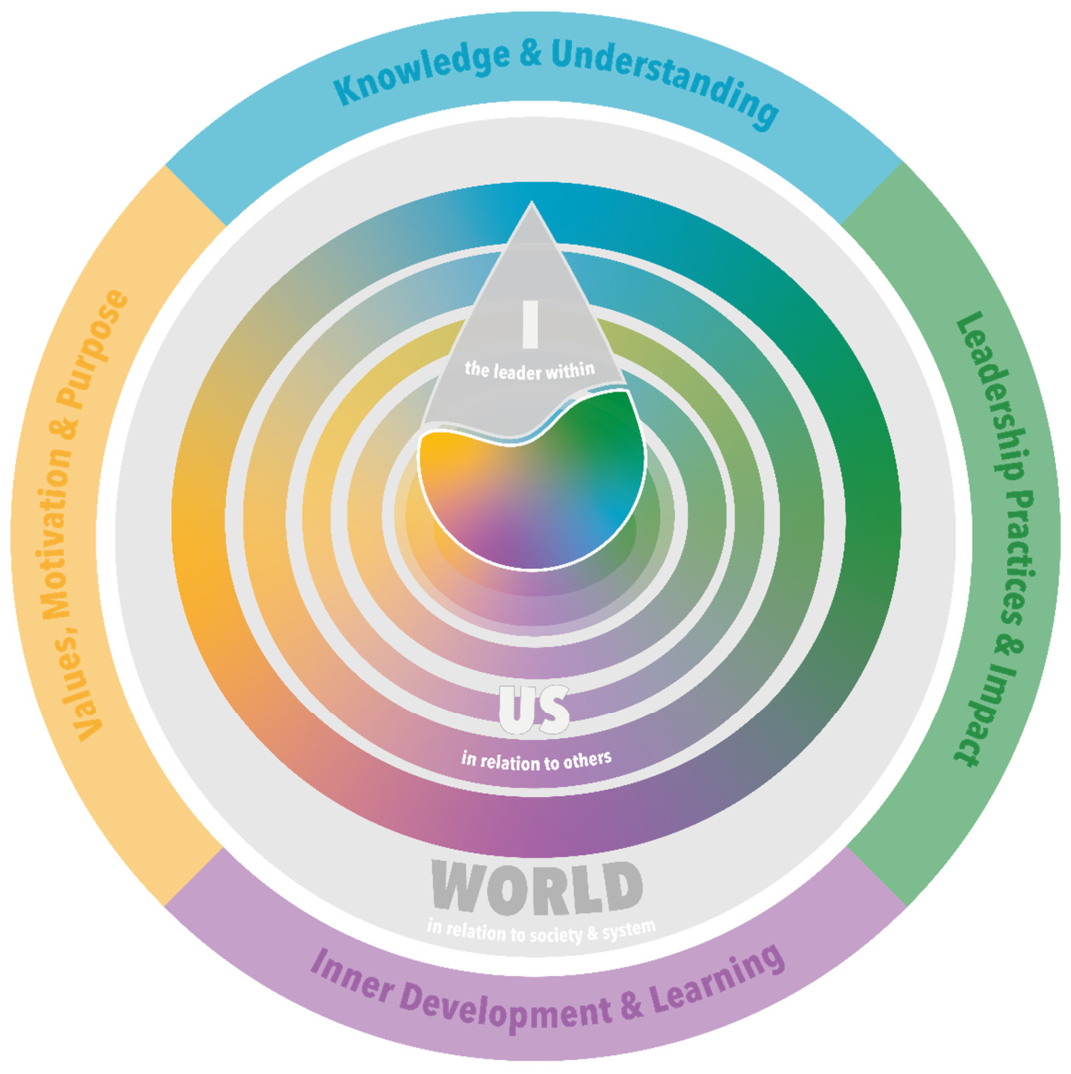
Figure 2.
Sustainability Leadership Framework: dimensions across the I, Us, and World perspectives. Note. ★ indicates inductively developed elements.
Figure 2.
Sustainability Leadership Framework: dimensions across the I, Us, and World perspectives. Note. ★ indicates inductively developed elements.
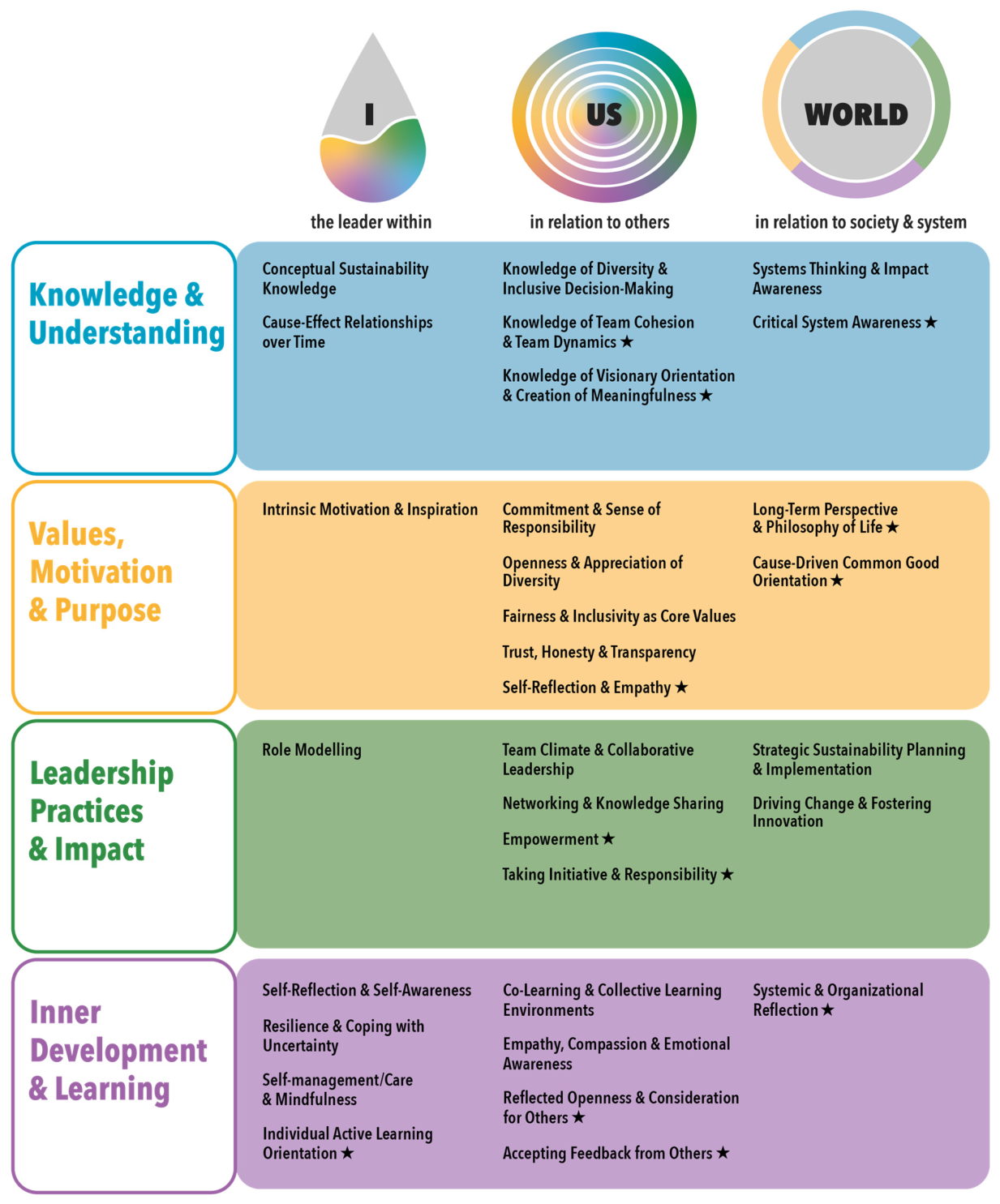
Table 1.
Overview of dimensions and core elements of sustainability leadership.
| Code | Core Element | Survey Item | Key Literature |
|---|---|---|---|
| Knowledge & Understanding | |||
| K1 | Conceptual Sustainability Knowledge | Leaders understand key sustainability concepts, such as the Sustainable Development Goals (SDGs), the three dimensions of sustainability, and major global challenges. | [2,6,7,8,9,27] |
| K2 | Systems Thinking & Impact Understanding | Leaders understand how actions at different levels (individual, team, organizational) interact to shape sustainability outcomes. | [2,6,7,8,27,32] |
| K3 | Cause-Effect Relationships over Time | Leaders understand how short-term actions can influence long-term sustainability pathways. | [7,8,13,27] |
| K4 | Knowledge of Diversity & Inclusive Decision-Making | Leaders understand how diversity and inclusive participation improve decision-making in sustainability contexts. | [9,10,13,33] |
| K5 | Systemic Impact Awareness | Leaders understand that their actions affect the social, economic, and ecological environment. | [6,7,20,34] |
| Values, Motivation, Principles & Purpose | |||
| V1 | Intrinsic Motivation & Inspiration | Leaders are driven by intrinsic motivation and inspire others. | [6,8,12,19] |
| V2 | Fairness & Inclusivity as Core Value | Leaders value fairness which means they respect everyone and leave no one behind. | [7,9,13,17,27] |
| V3 | Trust, Honesty & Transparency | Leaders value building trust and believe that honesty and transparency are fundamental. | [7,12,19,35] |
| V4 | Commitment & Sense of Responsibility | Leaders are committed to sustainable development and feel responsible for joint efforts. | [6,8,19,20] |
| V5 | Openness & Appreciation of Diversity | Leaders value openness to new ideas and diverse perspectives. | [9,10,12,36] |
| Leadership Practices & Impact | |||
| P1 | Role Modelling & Ethical Action | Leaders act as role models by upholding high ethical, social, and environmental standards. | [6,8,33,34,37,38] |
| P2 | Driving Change & Fostering Innovation | Leaders promote change by challenging established routines and encouraging innovative approaches. | [2,6,7,12,13] |
| P3 | Networking & Knowledge Sharing | Leaders build networks and share knowledge to foster collaboration inside and outside the organization. | [7,10,12,17,18,25] |
| P4 | Strategic Sustainability Planning & Implementation | Leaders develop and implement long-term sustainability strategies to achieve organizational goals. | [6,7,12,13,39] |
| P5 | Team Climate & Collaborative Leadership | Leaders foster team unity by creating a supportive and collaborative work environment. | [10,12,13,23,27,40] |
| Inner Development & Learning | |||
| L1 | Self-Reflection & Self-Awareness | Leaders engage in ongoing self-reflection to understand their strengths, weaknesses, and personal development needs. | [7,11,12,19,32,41] |
| L2 | Empathy, Compassion & Emotional Awareness | Leaders intentionally develop kindness, empathy, and emotional awareness in their interactions with others. | [8,10,11,27] |
| L3 | Mindfulness & Presence | Leaders work on staying present and attentive when making decisions and interacting with others as part of their personal development. | [7,11,12,32] |
| L4 | Resilience & Coping with Uncertainty | Leaders build resilience by learning to navigate ambiguity, stress, and unexpected setbacks. | [7,11,12,27] |
| L5 | Co-Learning & Collective Learning Environments | Leaders cultivate co-learning environments where people inspire and empower each other. | [10,11,18,23,27] |
Table 2.
Importance rating of core elements of sustainability leadership.
| Item name | M | SD | N | |
|---|---|---|---|---|
| Sustainability Knowledge & Understanding | ||||
| K2 | Systems Thinking & Impact Understanding | 6.33 | 1.08 | 301 |
| K5 | Systemic Impact Awareness | 6.01 | 1.18 | 301 |
| K3 | Cause-Effect Relationships over Time | 5.83 | 1.18 | 301 |
| K4 | Knowledge of Diversity & Inclusive Decision-Making | 5.79 | 1.36 | 301 |
| K1 | Conceptual Sustainability Knowledge | 5.71 | 1.31 | 301 |
| K total | 5.94 | 0.97 | ||
| Values, Motivation & Purpose | ||||
| V5 | Openness & Appreciation of Diversity | 6.29 | 1.14 | 269 |
| V2 | Fairness & Inclusivity as Core Value | 6.12 | 1.28 | 269 |
| V3 | Trust, Honesty & Transparency | 6.07 | 1.24 | 269 |
| V4 | Commitment & Sense of Responsibility | 5.94 | 1.18 | 269 |
| V1 | Intrinsic Motivation & Inspiration | 5.73 | 1.22 | 269 |
| V total | 6,03 | 0.94 | ||
| Leadership Practices & Impact | ||||
| P5 | Team Climate & Collaborative Leadership | 6.13 | 1.05 | 249 |
| P4 | Strategic Sustainability Planning & Implementation | 6.01 | 1.09 | 249 |
| P2 | Driving Change & Fostering Innovation | 5.96 | 1.06 | 249 |
| P1 | Role Modelling & Ethical Action | 5.90 | 1.25 | 249 |
| P3 | Networking & Knowledge Sharing | 5.78 | 1.19 | 249 |
| P total | 5.95 | 0.83 | ||
| Inner Development & Learning | ||||
| L4 | Resilience & Coping with Uncertainty | 6.11 | 1.06 | 237 |
| L2 | Empathy, Compassion & Emotional Awareness | 6.02 | 1.20 | 237 |
| L1 | Self-Reflection & Self-Awareness | 5.94 | 1.24 | 237 |
| L3 | Mindfulness & Presence | 5.86 | 1.17 | 237 |
| L5 | Co-Learning & Collective Learning Environments | 5.79 | 1.21 | 237 |
| L total | 5.94 | 0.92 | ||
Table 7.
Joint Display: Integration of Qualitative and Quantitative Findings.
| Category / Finding | Qualitative Evidence | Quantitative Evidence | Triangulation |
|---|---|---|---|
| Sustainability Knowledge & Understanding | |||
| Systems Thinking & Impact Awareness (K2/K5) | Most frequently coded category (n = 185); participants empirically merged systemic thinking with impact awareness, not separating the two aspects. | Highest-rated item across all 20 items (M = 6.33, SD = 1.08) | Strong convergence: both strands independently identify systems thinking as the central knowledge competency for sustainability leadership. |
| Conceptual Sustainability Knowledge (K1) | Second most frequently coded category (n = 158); extensively described in relation to foundational sustainability concepts. | Lowest-rated item within the dimension (M = 5.71, SD = 1.31) | Complementarity: frequently mentioned qualitatively yet rated comparatively lower quantitatively, suggesting applied systemic understanding is prioritised over theoretical knowledge. |
| Inductive extensions: K6 Knowledge of Team Cohesion & Team Dynamics (K6) (n = 122), Knowledge of Visionary Orientation & Creation of Meaningfulness (K7) (n = 106), Critical System Awareness (K8) (n = 54) |
Three categories emerged inductively; not anticipated in the a priori framework. | No quantitative counterpart. | Meaningful extension of the a priori framework: sustainability leaders’ knowledge encompasses team dynamics, visionary communication, and critical awareness of dominant systemic logics. |
| Values, Motivation & Purpose | |||
| Trust, Honesty & Transparency (V3) | Weakest deductive category qualitatively (n = 40); seldom mentioned spontaneously despite being a defined a priori category. | Third highest-rated item within the dimension (M = 6.07, SD = 1.24) | Divergence: participants rate trust and transparency highly when explicitly prompted, yet rarely foreground them spontaneously. This suggests these values function as implicit prerequisites rather than salient leadership attributes in everyday practice. |
| Openness & Appreciation of Diversity (V5) | Moderately frequent category (n = 125); empirically extended to include the courage to step outside one’s comfort zone for sustainable change. | Highest-rated item within the dimension (M = 6.29, SD = 1.14) | Complementarity: quantitatively the most important value dimension; qualitatively enriched by the behavioural courage component not captured in the a priori item, deepening the understanding of what openness entails in sustainability leadership practice. |
| Inductive extensions: Self-Reflection & Empathy (V6) (n = 163), Long-Term Perspective & Philosophy of Life (V7) (n = 134), Cause-Driven Common Good Orientation (V8) (n = 43) |
Three categories emerged inductively; V6 was the most frequently coded category across the entire dimension, surpassing all deductive categories. | No quantitative counterpart. | Meaningful extension of the a priori framework: the dominance of V6 Self-Reflection & Empathy as the most frequent category indicates that inner reflective and empathic capacities constitute a core value dimension of sustainability leadership. |
| Leadership Practices & Impact | |||
| Team Climate & Collaborative Leadership (P5) | Second most frequently coded category (n = 162); empirically extended to include psychological safety, practical inclusion, and everyday interpersonal coordination. | Highest-rated item within the dimension (M= 6.13, SD = 1.05) | Convergence and complementarity: both strands identify team climate as the most central leadership practice. The qualitative strand deepens the quantitative finding by specifying the relational and interpersonal mechanisms through which collaborative leadership operates in sustainability contexts. |
| Role Modelling (P1) | Most frequently coded qualitative category (n = 170); participants spontaneously and consistently described leading by example as a defining feature of sustainability leadership. | Fourth highest-rated item within the dimension (M = 5.90, SD = 1.25) | Complementarity: role modelling is the most salient qualitative category yet does not rank as the most important item quantitatively. This suggests it functions as a taken-for-granted expectation of sustainability leaders; widely described spontaneously but not singled out as distinctively more important than other practices when explicitly rated. |
| Inductive extensions: Empowerment (P6) (n = 64), Taking Initiative & Responsibility (P7) (n = 56) |
Two categories emerged inductively, capturing enabling and decisive action dimensions not fully represented in the a priori framework. | No quantitative counterpart. | Meaningful extension of the a priori framework: sustainability leadership practice extends beyond the a priori categories to include the active empowerment of others and the capacity for decisive, resilient action in challenging situations. These are two behavioural dimensions that participants described as distinct from role modelling and change management. |
| Inner Development & Learning | |||
| Self-Reflection & Self-Awareness (L1) and Resilience & Coping with Uncertainty (L4) | L1 most frequently coded deductive category (n = 167). L4 moderately frequent (n = 43); participants described resilience as a developmental capacity for navigating ambiguity and setbacks. |
L4 highest-rated item within the dimension (M = 6.11, SD = 1.06). L1 third highest (M = 5.94, SD = 1.24). | Complementarity: L4 Resilience is rated highest quantitatively yet is less prominent qualitatively, suggesting it is recognised as important when prompted but less readily articulated spontaneously. L1 Self-Reflection shows closer alignment between strands, confirming its centrality as the most consciously foregrounded inner capacity. |
| Empathy, Compassion & Emotional Awareness (L2) | Weakest deductive category qualitatively (n = 22); emotional awareness mentioned rarely as a distinct inner development dimension. | Second highest-rated item within the dimension (M = 6.02, SD = 1.20) | Divergence: empathy is rated highly when explicitly prompted yet barely surfaces spontaneously. This parallels the V3 pattern and suggests that empathic capacities may function as implicit background conditions rather than foregrounded developmental goals or that they are subsumed under the broader self-reflection and learning categories. |
| Inductive extensions: Individual Active Learning Orientation (L6) (n = 133), Reflected Openness & Consideration for Others (L7) (n = 87), Accepting Feedback (L8) (n = 43), Systemic & Organizational Reflection (L9) (n = 29) |
Four inductive categories emerged, accounting for more than 50% of all code assignments in the dimension, representing the largest proportional inductive extension across all four dimensions. | No quantitative counterpart. | Most substantial extension of the a priori framework across all dimensions: the majority of qualitative material could not be captured by existing deductive categories, indicating that the inner development dimension of sustainability leadership is substantially broader than theoretically anticipated. Active learning orientation, reflected openness, feedback receptiveness, and systemic reflection represent distinct developmental capacities. |
Disclaimer/Publisher’s Note: The statements, opinions and data contained in all publications are solely those of the individual author(s) and contributor(s) and not of MDPI and/or the editor(s). MDPI and/or the editor(s) disclaim responsibility for any injury to people or property resulting from any ideas, methods, instructions or products referred to in the content. |
© 2026 by the authors. Licensee MDPI, Basel, Switzerland. This article is an open access article distributed under the terms and conditions of the Creative Commons Attribution (CC BY) license (http://creativecommons.org/licenses/by/4.0/).
Copyright: This open access article is published under a Creative Commons CC BY 4.0 license, which permit the free download, distribution, and reuse, provided that the author and preprint are cited in any reuse.


