

Submitted:
19 September 2026
Posted:
20 September 2026
You are already at the latest version
Abstract
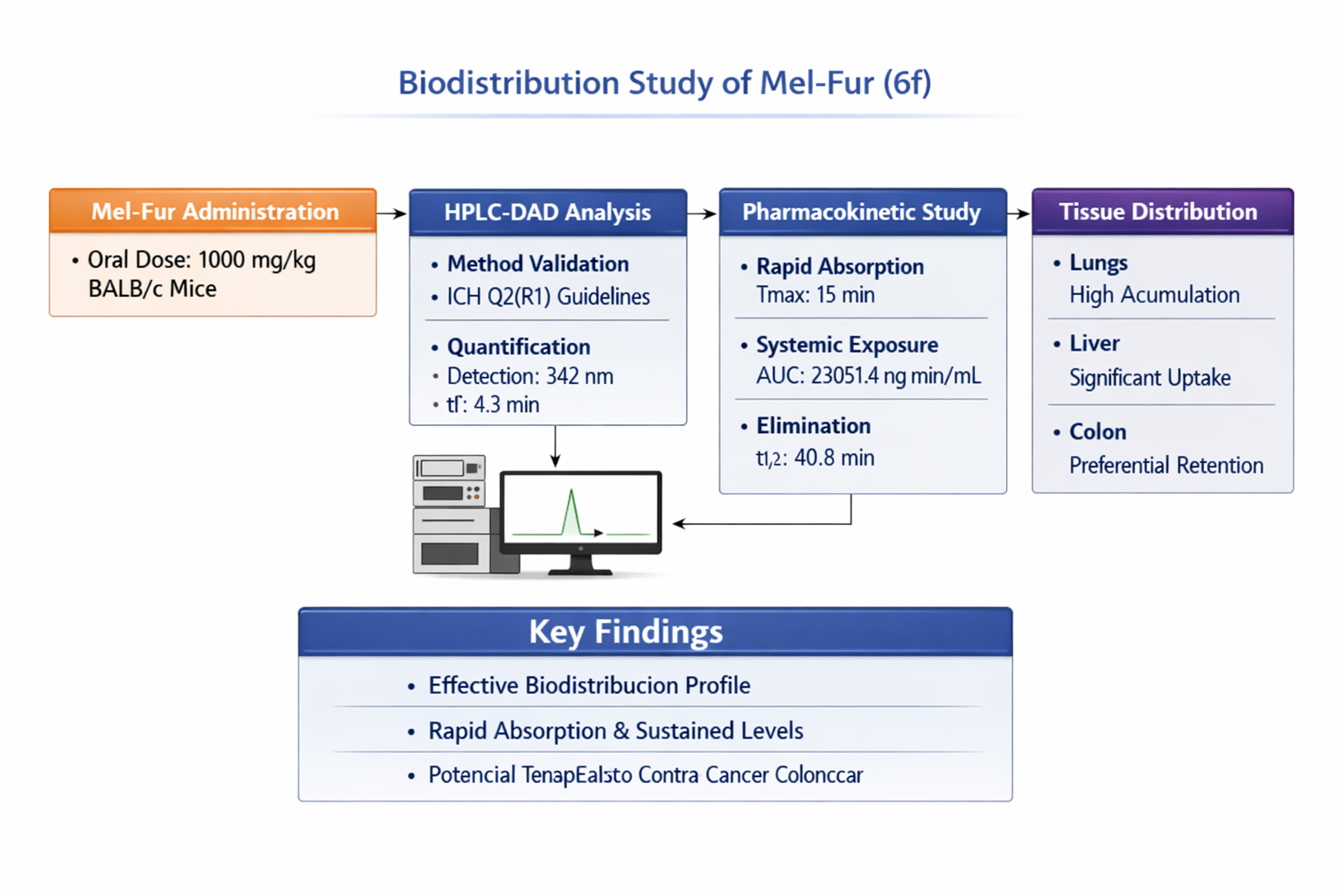
Colorectal cancer (CRC) is associated with high mortality rates and therapeutic limitations due to drug toxicity and resistance. Molecular hybridization has emerged as an innovative strategy, highlighting Mel-Fur (6f), a novel hybrid of melatonin and furanochalcone with antitumor potential. However, characterizing its pharmacokinetic profile is essential to support its preclinical applicability. This study aimed to develop and partially validate a high-performance liquid chromatography method with diode array detection (HPLC-DAD) for the quantification of Mel-Fur in serum and murine organs, and to apply it to an in vivo distribution analysis. Chromatographic separation was performed on an Agilent 1200 using a C30 column and acetonitrile:water (85:15) mobile phase at 0.8 mL/min and detection at 342 nm. The method met ICH M10 and FDA validation guidelines, demonstrating high selectivity, linearity (R2>0.999), precision, accuracy, recovery (>89.9%), and autosampler stability for up to 8 days. Following single oral administration of Mel-Fur (1000" mg/kg" ) in BALB/c mice (n=3 per sampling time point), the hybrid displayed rapid absorption and elimination, with measurable systemic exposure, preferential accumulation in the lungs and liver, and sustained presence in the colon. The partially validated HPLC-DAD method provides a robust analytical tool for preliminary pharmacokinetic and tissue distribution studies of Mel-Fur.
Keywords:
colorectal cancer
; melatonin–furanochalcone hybrid
; HPLC-DAD
; pharmacokinetics
; murine model
Copyright: This open access article is published under a Creative Commons CC BY 4.0 license, which permit the free download, distribution, and reuse, provided that the author and preprint are cited in any reuse.