

Submitted:
05 July 2026
Posted:
07 July 2026
You are already at the latest version
Abstract
We investigate a minimal deterministic hypothesis: that the internal symmetries and Lorentzian kinematics of low-energy physics arise as emergent geometric-phase (Berry / Wilczek–Zee) holonomy of a single elastic substrate—a static four-dimensional cubic brane lattice in a 4D Euclidean ambient, whose only nonlinearity is the Pythagorean link length. With explicit, reproducible computations we show that (i) the Lorentzian signature (3,1) of the effective metric is the sign pattern of the directional prestress, not an imposed structure; (ii) the fluctuation operator about a finite-amplitude periodic carrier has an isolated rank-3 complex eigenbundle whose gauge-invariant Wilczek–Zee curvature generates the full Lie algebra su(3) (Lie-closure rank 8, not merely so(3)), with the abelian trace as a candidate electromagnetic U(1); (iii) emergent gauge invariance, locality, and power counting force the leading dynamics of both sectors to Maxwell and Yang–Mills form, with substrate-induced positive couplings and no mass term; and (iv) the rank selection U(3)-not-U(4) and the U(1)/SU(3) split are set by the prestress parameters. We are deliberate about scope: the color-carrying background is a stable but higher-energy texture, not the ground state, and the emergent Lorentz invariance is only approximate—the residual anisotropy being itself the escape from the Weinberg–Witten no-go; matter and confinement are not treated. The result is a constructive proof of concept that one deterministic elastic substrate can carry a U(1)×SU(3) gauge structure and a Lorentzian light cone as emergent symmetries.
Keywords:
emergent symmetry
; Wilczek–Zee connection
; Berry curvature
; brane lattice
; SU(3)
; emergent gauge fields
; emergent Lorentz invariance
; quantum geometric tensor
; deterministic substrate
1. Introduction
The symmetries that organize low-energy physics—the Lorentz invariance of spacetime and the internal gauge group of the Standard Model—are normally taken as primitive postulates. An alternative, long-running research program asks whether some of them could instead be emergent: low-energy, approximate symmetries of a simpler underlying medium that carries no such symmetry fundamentally. This viewpoint has a substantial pedigree. Emergent gauge fields and even emergent relativistic fermions arise in superfluid [1] and in lattice bosonic models through string-net condensation [2,3]; emergent Lorentzian “acoustic” metrics arise for phonons in moving media [4,5]; and gauge invariance itself can appear as a low-energy attractor of a generic non-gauge-invariant lattice theory [6]. The mathematical engine common to many of these constructions is the geometric phase: the abelian Berry phase [7,8] and its non-abelian Wilczek–Zee generalization [9,10], whose curvature over a parameter manifold behaves as a gauge field strength [11].
This paper studies whether a single, deterministic, purely elastic substrate can carry both an emergent Lorentzian light cone and an emergent gauge structure through this geometric-phase mechanism. The substrate is minimal: a static four-dimensional cubic lattice embedded with codimension zero in a 4D Euclidean ambient, governed by a central-force spring action whose only nonlinearity is the Pythagorean (Euclidean) link length. No gauge field, no metric, and no internal symmetry group is postulated; each is sought as a derived, effective object. The four ambient directions are geometrically equivalent, and the distinction of one as “time” is a property of the action’s sign structure, not of the ambient.
What this paper establishes. We report a set of explicit, reproducible results, each emitted by a named numerical script (Appendix A):
- 1.
- Lorentzian signature from prestress. Linearizing the action yields an effective metric whose signature is exactly the sign pattern of the directional prestress; flipping the temporal sign gives a Euclidean, non-propagating theory. The branch speeds are given in closed form (Section 4).
- 2.
- Full from a rank-3 carrier. About a finite-amplitude periodic vacuum carrier, the Bloch fluctuation operator has an isolated rank-3 complex eigenbundle whose gauge-invariant Wilczek–Zee curvature generates all eight generators of —not merely the of a real frame. The result is generic across backgrounds, leading order in the carrier amplitude, and satisfies the non-abelian Bianchi identity (Section 5).
- 3.
- Maxwell and Yang–Mills dynamics. Emergent local gauge invariance, locality, and power counting force the leading effective action of the trace and traceless sectors to be and , with the mass term forbidden (massless photon and gluon) and substrate-induced, positive, finite couplings (Section 6). We further demonstrate that the same curvature appears over spacetime, not only over the Brillouin zone, closing the interpretive gap between a k-space bundle and a physical gauge field.
- 4.
- Quantitative sector split. The rank selection -not- and the split are controlled by the prestress parameters (Section 7).
What this paper does not claim. We are deliberate about scope, and state the principal limitations up front (they are quantified in Section 8). First, the specific color-carrying background is a stable but higher-energy texture, not the elastic ground state; so this is a demonstration that an sector can live on a substrate texture, not that the ground-state vacuum is a Yang–Mills field. Second, the emergent Lorentz invariance is only approximate: the lattice is genuinely anisotropic, and—as we show—this residual anisotropy is not a defect to be hidden but the very property that lets the emergent massless gauge bosons evade the Weinberg–Witten theorem [12]. Third, the matter sector (self-confined solitons, mass, color sources, confinement) is deliberately deferred to future work; consequently we make no contact with measured couplings or mass ratios. This is a constructive proof of concept about emergent symmetry structure, presented with its boundaries explicit.
Novelty. That holonomy can mimic gauge structure is well established; what is new is that an abelian (Maxwell) and a non-abelian () sector, together with a Lorentzian cone, descend from the same carrier geometry of one deterministic prestressed lattice, with the (versus ) content exhibited explicitly and every claim reproducible (Appendix A).
Determinism and quantum foundations. The substrate is fully deterministic and ontic; probabilistic quantum behavior is not part of the present work. We note only, and defer to future work, that a deterministic locally-mediated substrate is compatible with Bell’s theorem [13] provided measurement independence is relaxed, which for a time-symmetric variational (all-at-once) formulation is the ordinary consequence of boundary data rather than a conspiracy—placing the model in the locally-mediated time-symmetric class of Wharton and Argaman [14]. The Born rule is not derived here and is treated as an open problem.
2. The Deterministic Brane-Lattice Substrate
2.1. Ontology and Action
The fundamental object is a four-dimensional cubic brane lattice embedded with codimension zero in a 4D Euclidean ambient . Lattice sites are labeled by ; each site carries an embedded position (), and the reference (undeformed) configuration is with lattice spacing a. The ambient is fully symmetric—no preferred direction—and serves only to measure Euclidean distances. All asymmetries (the timelike direction; the gauge/gravity split) are properties of the brane action, not of the ambient.
The action is a single central-force spring sum over the 8-link stencil (six spacelike axial neighbours , two temporal ):
with the Lorentzian sign pattern
The link stiffnesses and stress-free (rest) lengths are grouped by direction,
so the minimal dimensionless control set is with , at fixed held spacing a. The single nonlinearity is the Euclidean square root in ; even a Hooke-linear scalar spring law is nonlinear in the node coordinates because the extension is the full ambient distance. This is the microscopic origin of the amplitude–lateral coupling that drives every emergent structure below.
Signature as prestress sign, not postulate. The timelike direction is selected by opposing : temporal link contributions enter the action with the opposite sign from spacelike ones. The signed prestress is ; a nonzero mismatch under periodic boundary conditions holds the links in tension. As shown in Section 4, this sign pattern is exactly the signature of the emergent metric—Lorentzian signature is derived from prestress, not imposed alongside an ambient metric. Prestress magnitude and sign are logically separate: is the zero-mismatch (no-prestress) limit, at which the transverse stiffness vanishes; the working regime keeps and (typically ; see Section 3).
Block and initial-value views. Stationarity is, depending on boundary conditions, either a forward Störmer–Verlet march (initial-value problem) or a 4D boundary-value “block” root-find. Because S is indefinite (Lorentzian, ), one root-finds ; one never minimizes. The two views share the same local Euler–Lagrange stencil, which is precisely the variational (Verlet) integrator [15]. The parameterization (3) refines the earlier single-, formulation, in which the timelike sign could be mistaken for a kinetic-sign artifact rather than a genuine prestress; the resolution is Section 3.
2.2. The Anisotropic Stiffness Tensor
Let be a stationary background () and write fluctuations . The background link vectors and directions are
The exact second variation of a single link energy with respect to its link vector is the anisotropic stiffness tensor
It is an isotropic part plus a rank-one part along the link: a spring is stiffer along its own axis than transverse to it. Its eigenvalues are (transverse, threefold) and (longitudinal); the transverse bracket is positive whenever (stretched links), a fact we use for stability in Section 8.
In the trivial background , so and is diagonal in the fixed axis frame; all commute and share a k-independent eigenbasis, giving a trivial eigenbundle. In a finite-amplitude nonlinear background the differ link to link, so generically . This link-to-link noncommutativity is the mechanical seed of the non-abelian sector (Section 5); it is a property that lives in the Pythagorean nonlinearity, and vanishes if one linearizes it away. Consequently, the absence of a non-abelian sector in the bare straight vacuum is not a no-go theorem—it merely says the trivial background is the wrong place to look.
2.3. The Quadratic Fluctuation Action and the Bloch Operator
The quadratic fluctuation action is
For a background periodic with a supercell (sites s, integer supercell offsets), the Bloch ansatz turns each link into a matrix-valued hopping and yields a Hermitian Bloch fluctuation operator with
The complex phase is the character of the 4D lattice translation group, used to diagonalize translations; physical configurations remain real through conjugate pairs . Because while , is Hermitian but indefinite (the Lorentzian signature is inherited by the spectrum); its eigenvalues are real and its spectral projectors well-defined. The operator is the central object for both the emergent metric (Section 4, trivial background) and the gauge sector (Section 5, nonlinear carrier).
3. Temporal Prestress and the Kinetic Limit
Before analyzing the wave and gauge sectors we settle the status of the timelike link, because it fixes the meaning of . In the earlier single-, formulation the temporal term is an isotropic kinetic energy, so looks like a mere kinetic sign rather than a genuine prestress. The refined form with resolves this.
The temporal link is the kinetic term. Expanding a temporal link about the vacuum, with , the quadratic part of is
In the long-wavelength (continuum) limit , this is a genuine kinetic energy
with emergent inertia derived from the temporal link stiffness—no separately postulated mass. The discrete-to-continuum limit is the long-wavelength limit at fixed lattice spacing, , verified numerically to converge as [16].
Theanisotropy is the fingerprint of genuine prestress. The longitudinal () temporal inertia is , independent of ; the transverse () temporal inertia is , i.e. it is the prestress. At () the temporal term is isotropic ()—indistinguishable from a plain inertia, the kinetic-sign artifact. For it is anisotropic, which only a spring under tension can produce; a pure inertia cannot. The ratio transverse/longitudinal is verified exactly against the link Hessian [16]. The limits (artifact) and (vanishing transverse temporal stiffness, over-decoupling) are both excluded; the working regime is .
makes and hence wave dynamics. With and , the action is : the temporal prestress term supplies the kinetic energy T and the spacelike prestress terms the potential V. The 4D-block stationarity is then Hamilton’s principle, and the Euler–Lagrange stencil is the symplectic Störmer–Verlet integrator [15]. A linearized time march reproduces waves propagating at the transverse speed of Section 4 (measured vs. predicted in dimensionless units), whereas flipping to the all-minus (Euclidean) sign turns the update elliptic and unstable (amplitudes diverge), confirming that —opposite to the spacelike sign—is what converts the static block into causal time evolution [16]. The same factor set here controls the amplitude-mode speed and the sector split in Section 4, Section 5, Section 6 and Section 7.
4. Linearized Waves and the Emergent Lorentzian Metric
We now linearize about the trivial (straight) background, where the tangent stiffness is and . Treating direction 4 as time, the small- dispersion for a polarization follows from the vanishing of the spacetime quadratic form with
Lorentzian signature is the sign pattern. Since , the signature of H is exactly the sign pattern of :
whereas the all-minus (Euclidean) choice gives signature —a definite form with no propagating cone. Both are confirmed numerically [16]. The Minkowski signature is thus derived from the prestress sign, not imposed: the opposite sign of the temporal link makes the stationary equation hyperbolic rather than elliptic.
Effective metric and calibration. The long-wavelength branch speeds follow in closed form (units , ):
for the longitudinal, spatial-transverse (), and amplitude (-polarized) branches respectively; these match the exact lattice generalized eigenproblem to [16]. For the transverse (gauge-carrying) branch the effective mostly-minus line element is . The dispersion is linear and gapless, : a massless relativistic cone with lattice corrections at . A notable exact fact is that the amplitude mode is perfectly isotropic (it is orthogonal to all spacelike links and so sees only the isotropic part of the stiffness). Any single isotropic quadratic cone carries the full Lorentz group as its isometry: boosts map its null vectors to null vectors (verified to ), and slower branches () are timelike inside the cone, hence causal [16].
Genuine anisotropy and the dual-observer question. For the lab-frame dispersion is genuinely anisotropic (and birefringent): the fastest spatial branch varies in speed with propagation direction, with fractional spread at , shrinking to zero only as (the isotropic point, which however disables the gauge sector; the Zener condition also identifies as a partial isotropization) [16]. Isotropy therefore cannot be obtained by tuning without switching off the gauge sector. The load-bearing conjecture (analogue-gravity in spirit [5]) is that an inside observer, whose rods and clocks are built from the same modes, measures a single isotropic c: operationally, a single signal mode used for radar synchronization is measured isotropic by construction, so the per-sector kinematics is Lorentzian; full cross-sector universality remains open. We test one candidate resolution and quantify the residual anisotropy in Section 8; residual birefringence is a falsifiable signature of the framework.
5. The Nonlinear Vacuum Carrier and the Rank-3 Wilczek–Zee Bundle
The central result is that the fluctuation operator about a finite-amplitude periodic background carries an isolated rank-3 complex eigenbundle whose Wilczek–Zee curvature generates the full algebra .
5.1. The Carrier and the Criterion
Following the chain of Section 2, a stationary periodic background gives stiffness tensors and a Bloch operator . The color sector requires an isolated rank-3 spectral subspace —a near-degenerate triplet with a large outside gap (a composite subspace, not exact degeneracy)—transported nontrivially over the base. On the non-abelian Wilczek–Zee connection and its gauge-invariant curvature are
with the algebraic split , , so (). The connection is -valued because the transported carrier is rank 3 over a 4D base: four-dimensional indices do not enlarge the internal group. The natural rank-3 carrier is the complexified transverse-fluctuation bundle: at each link the direction leaves a three-dimensional orthogonal complement, which Bloch-complexifies to ; this moving triplet, not the fixed spatial axes, is the color-carrier candidate. The sharp test is
distinguishing genuine (rank 8) from the real-frame (rank 3) or a pure-gauge artifact (rank 0). Gauge invariance is essential and is enforced by computing with the Wilson-loop (Fukui–Hatsugai) construction [17], which is manifestly invariant under k-local basis changes.
5.2. An Exact Stationary Carrier
We use a closed-form circularly-polarized helix,
with propagation in the plane and polarization in the plane. Because and K has no component along , every link length is independent of n (transverse increments are chords of a fixed angle), while the link directions twist with n. All link tensions are then constant, and the nodal force reduces to a single transverse condition; the spatial () and temporal () contributions have opposite sign precisely because of the Lorentzian pattern (2), so a positive solves the balance. The result is an exact critical point: the numerical residual is [16]. This is a genuine finite-amplitude nonlinear periodic state of the lattice, in compliance with periodic boundary conditions.
5.3. Result: Full
Running the chain on the carrier (15) at, e.g., , (which fixes ), an isolated rank-3 cluster is found with gap/spread (Figure 1). The gauge-invariant curvature yields
while the trace curvature is numerically zero (): this symmetric carrier gives pure color, with the traceless part unambiguously -valued [16]. The eight generators are populated before any commutator is taken (raw span already 8).
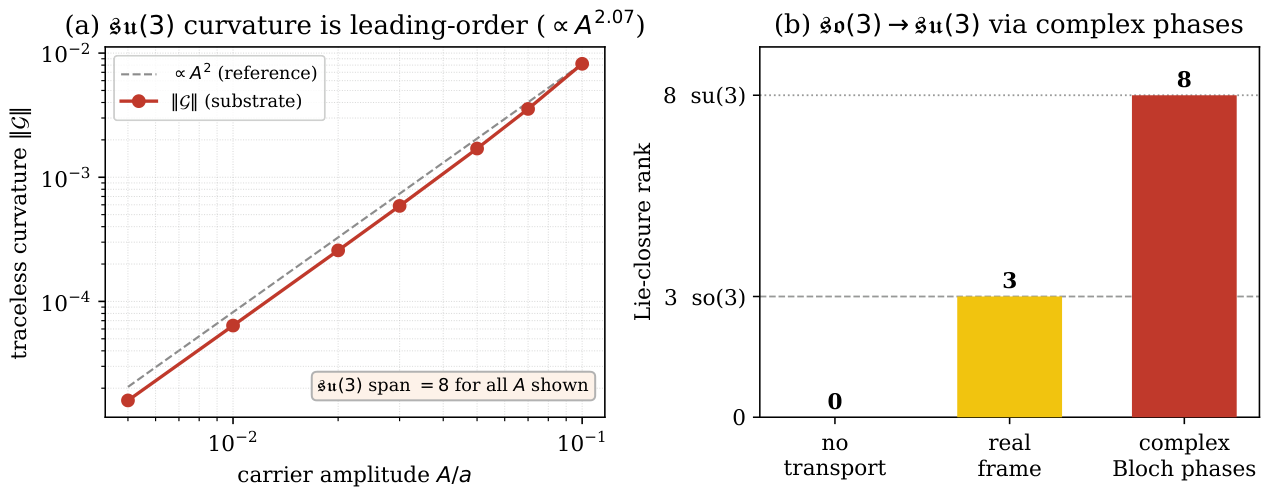
Mechanism (). A control isolates the mechanism (Figure 2b). A real transverse frame (a single-site real-symmetric operator) gives raw span 3, Lie rank 3: only . Removing all k-transport gives rank 0 (trivial bundle); restoring the complex Bloch phases gives rank 8: the three antisymmetric generators come from orientation transport of the real frame, and the five symmetric-traceless + Cartan generators that complete come from the complex Bloch phases acting on the noncommuting real stiffness frames [16]. This resolves the long-standing -vs- question: complex phases on a genuine (multi-site) supercell background are the necessary ingredient. Because the base and substrate remain 4D while only the transported carrier is rank 3, the group is , never (Section 7).
5.4. Genericity, Scaling, and Consistency
Three checks upgrade the single witness to a robust, generic result [16]:
- Genericity. Over 24 distinct exact-stationary helices (varying propagation axis, supercell size, winding, , amplitude; all ), the robust Lie rank is 8 in cases; the lone exception is a measure-zero, -specific accident, exactly as a genericity argument predicts (a set of traceless Hermitian matrices fails to generate only if it lies in a proper subalgebra, a positive-codimension condition). The result is also stable across supercell size and plaquette step.
- Leading-order scaling (Figure 2a). The span persists down to carrier amplitude ; tracking a fixed band/plaquette gives (leading order ), while the mechanical seed—stiffness-matrix noncommutativity—scales as (order A). This matches , with the complex phases (order 1) supplying all eight directions already at that order. The is thus a leading-order effect, not a large-amplitude artifact, and vanishes continuously as .
- Bianchi. In a parallel-transport gauge the relative residual falls as (from to ): the non-abelian Bianchi identity holds, confirming is a consistent curvature.
Together these establish that the substrate’s own curvature generates the full as a generic, discretization-robust, leading-order, identity-satisfying property—not a tuned or numerical artifact.
6. Emergent Gauge Dynamics: Maxwell and Yang–Mills
Section 5 produced the algebraic curvatures (trace) and (traceless). We now show their dynamics are Maxwell and Yang–Mills.
6.1. From the Brillouin Zone to Spacetime
The Wilczek–Zee connection of Section 5 lives over the Brillouin zone. The physical gauge field lives over spacetime. The two are components of one connection on the combined base the carrier depends on. Because the carrier is present throughout the emergent spacetime, nothing forces its frame to be the same everywhere; promoting the frame to a slowly varying spacetime field makes a genuine connection, transforming as . By the Wilczek–Zee adiabatic theorem, the projected dynamics of the carrier amplitude is governed by the covariant derivative , so couples exactly as a gauge potential, and the local acting on is an exact redundancy.
This is demonstrated, not merely argued [16]. Modelling slow spacetime dependence by a non-rigid modulation of the carrier, the spacetime field strength is nonzero and -valued (), a genuine pure-gauge control (constant carrier subspace, basis rotation) gives confirming the field is physical, and the mixed curvature is nonzero in every k-direction. The Brillouin-zone object of Section 5 and the spacetime gauge field are therefore restrictions of a single connection, and the full structure group certified over k is the structure group of the spacetime field.
6.2. Uniqueness of the Effective Actions
The gauge field is a collective coordinate (the carrier frame); its entire dynamics is induced by integrating out the gapped fluctuations. The leading effective action is fixed by symmetry.
Uniqueness statement. Let be the coarse-grained effective action for the soft carrier-frame field, assuming (i) exact local (resp. ) invariance, (ii) locality (the integrated-out modes are gapped, so the kernel is short-ranged and admits a derivative expansion), and (iii) Lorentz invariance in the emergent metric. Then its leading term is uniquely
and analogously for the abelian trace. By gauge invariance, depends only on (resp. ) and covariant derivatives. Counting mass dimension (, ): the dimension-2 mass term is not gauge invariant and is forbidden (a massless gluon/photon); the dimension-4 is the unique invariant (the topological is a total derivative); higher terms are irrelevant, suppressed by the gap scale . Masslessness and the form are the same consequence of gauge invariance: a pure-gauge configuration has (verified to ) and hence zero action, which a mass term would penalize [16]. The non-abelian structure constants are inherited from Section 5.
6.3. Substrate-Induced Couplings
The induced coupling is the substrate’s own quantum-geometric response of the isolated carrier, the integrated non-abelian quantum metric [11,18]
the symmetric partner of the Berry curvature. It is manifestly non-negative; numerically is positive and finite (, minimum sample ), giving a stable propagating gauge field, and similarly for the abelian sector [16]. The coefficient depends on strain/scale (it varies with the carrier amplitude), so the coupling runs—weak and long-range in weak regions, strong and short-range where the link frames twist hard, in the spirit of asymptotic freedom. The absolute normalization involves the coarse-graining scheme; positivity, finiteness, and scale dependence are the theorem-level facts.
6.4. Faraday and Charge
The abelian sector is the trace holonomy, , or the Berry connection of any non-degenerate band. The Bianchi identity is automatic (; verified to ), giving the homogeneous Maxwell equations; the uniqueness theorem gives the inhomogeneous with . Electric charge is topological, : a carrier phase field with winding n has (verified for ), so by Gauss’s law the enclosed charge is integer-quantized and conserved. The photon itself is a continuous, non-quantized classical mode; any granularity would enter only through coupling to quantized matter (deferred).
A clean feature emerges: for the symmetric carrier the vacuum is EM-flat—all abelian Berry curvatures vanish pointwise ( by the Wilson-loop measure), so empty space carries no background electromagnetic field, as it should, while the abelian quantum metric (hence ) is nonzero so the photon still propagates. Breaking the reality symmetry (a generic deformation, i.e. matter) switches the abelian curvature on (), so EM is matter-sourced, consistent with charge-as-winding. This is fully compatible with the nonzero , which lives in the off-diagonal non-abelian sector [16].
7. Quantitative Sector Split
The rank selection and the relative strength of the two sectors are controlled by the prestress parameters. Analytically, the vacuum branch stiffnesses (12) give two candidate near-degenerate triplets with isolation ratios
in both of which cancels: sets only the overall energy/light-cone scale, while the sector split is governed by alone.
Computed on the nonlinear carrier [16]:
- Rank selection , not . The best rank-n near-degenerate cluster isolation (gap/spread, k-averaged) is for . The rank-3 triplet is well isolated while any rank-4 cluster is marginal: the transported carrier is , and is spectrally excluded—quantitatively, not by fiat.
- separation opened by . The rank-3 isolation grows toward , matching the analytic amplitude-split scaling; (with ) opens the gap that splits the fourth mode off the triplet.
- generic, measure-zero. The robust Lie rank is 8 across the entire plane sampled; isolated 3’s are -specific accidents, consistent with the genericity of Section 5.4.
- Coupling split. The abelian and non-abelian kinetic stiffnesses satisfy and , i.e. the sector carries the total stiffness (eight generators to the ’s one) but is roughly equipartitioned per generator (), and the ratio is stable (–) across the parameters.
The overall picture: controls spatial branch mixing and the longitudinal–transverse gap (and is required nonzero for the gauge sector and the lab anisotropy of Section 4); opens the gap that enforces -not-; and only rescales. A natural, more predictive special case is (single prestress dial), which ties the sectors and the gravity channel to one number; the present computations use independent because cancels from the split, and we flag the single-dial option as a falsifiable structural choice for future work.
8. Scope, Limitations, and Falsifiable Predictions
We state the boundaries of the present results explicitly; two of them are the outcome of tests that could have gone either way, and both are reported honestly.
The carrier is a texture, not the ground state. The helical carrier of Section 5.2 is linearly (elastically) stable—every link Hessian bracket is positive-definite (minimum ), so the spatial fluctuation Hessian is positive semidefinite and all fluctuation frequencies obey [16]. However it stores more elastic energy per node than the straight vacuum: it is a stable finite-energy texture, not the elastic ground state. Since the straight ground state has no color (trivial bundle, Section 2.2), the defensible claim is that an sector can live on a stable substrate texture, not that the ground-state vacuum is a Yang–Mills field. Genuine (Floquet) selection of the vacuum carrier—and whether a color-carrying background at or below the straight-vacuum energy exists—is open. (The indefinite action is a saddle, so energy minimization does not by itself decide the vacuum.)
Emergent Lorentz invariance is approximate. As shown in Section 4, the lab dispersion is genuinely anisotropic for . We tested whether the physically relevant gauge (Berry) modes are more isotropic than the bare phonons: the orientation-averaged gauge kinetic tensor has anisotropy , larger than the bare acoustic [16]. This candidate resolution is therefore falsified; the obstruction persists in the gauge sector, and full cross-sector Lorentz universality remains the load-bearing dual-observer conjecture, with only the matter-scale and observer-renormalization routes left open. Residual birefringence (, and direction-dependent transverse speeds) is a concrete falsifiable signature.
This approximate Lorentz invariance is a feature: the Weinberg–Witten escape. The Weinberg–Witten theorem [12] forbids emergent massless charged spin-1 (and spin-2) particles in a theory with an exactly Lorentz-covariant current—precisely the case of an emergent photon and gluon. The standard escape, shared with the emergent-gravity and emergent-gauge literature [1,2], is that Lorentz invariance is only approximate, so the exact-covariance premise fails. The residual anisotropy established above is therefore not merely a limitation but the property that permits the emergent sector to coexist with the no-go theorem: the gauge bosons are collective substrate modes, and exact Lorentz covariance holds only in the long-wavelength limit, with corrections at and .
Matter, confinement, and dynamics are deferred. No self-confined solitons are constructed here; hence no masses, no color sources , no confinement, and no contact with measured couplings or mass ratios. Confinement and the mass gap are nonperturbative and are not addressed. The absolute normalizations of and , and the exact -function, involve the coarse-graining scheme and are left open; only positivity, finiteness, and scale dependence are established. The Minkowski index contractions used in the effective actions inherit the emergent metric, whose universality is the conjecture above.
Foundational open problems. The well-posedness of the nonlinear two-time (block) boundary-value problem is open (it is resolved only in the linear regime, via a chiral two-slice condition). The identification of the trace with the physical electromagnetic field is a candidate pending the matter sector. Quantum-mechanical probability (the Born rule) is not derived.
9. Conclusions
We have shown, constructively and reproducibly, that a single deterministic elastic substrate—a 4D cubic brane lattice whose only nonlinearity is the Pythagorean link length—can carry emergent low-energy symmetries of two distinct kinds. First, the Lorentzian signature of the effective metric is the sign pattern of the directional prestress, and the timelike link’s continuum limit is a genuine kinetic term with emergent inertia; the result is a massless, per-sector Lorentz-invariant light cone with a closed-form calibration. Second, the fluctuation operator about a finite-amplitude periodic carrier possesses an isolated rank-3 complex eigenbundle whose gauge-invariant Wilczek–Zee curvature generates the full Lie algebra —generically, at leading order in the carrier amplitude, and satisfying the non-abelian Bianchi identity—with the abelian trace as a candidate electromagnetic . Emergent local gauge invariance then forces the leading dynamics of both sectors to Maxwell and Yang–Mills form, with substrate-induced positive couplings and a quantitatively controlled (not ) rank selection.
The central methodological commitment is honesty about scope: the color-carrying background is a stable but higher-energy texture rather than the ground state; the emergent Lorentz invariance is approximate, and that very approximateness is what lets the emergent gauge bosons evade the Weinberg–Witten theorem; and the matter sector is deferred. Within those boundaries, the work is a concrete demonstration that emergent gauge structure and Lorentzian geometry can descend from the same carrier geometry of one deterministic lattice.
The natural next steps follow from the stated limitations: constructing self-confined solitons (mass, color charge, and the coupling to the gauge field derived here); settling the selection and energetics of the vacuum carrier; and testing the dual-observer route to full Lorentz universality at the matter scale. Each is a well-posed problem built directly on the interfaces established here.
Author Contributions
L.M. is the sole author and is responsible for all aspects of this work: conceptualization, formal analysis, software, writing—original draft, and writing—review and editing.
Funding
This research received no external funding.
Institutional Review Board Statement
Not applicable.
Informed Consent Statement
Not applicable.
Data Availability Statement
All derivations and every numerical result reported here are reproducible from the openly available scripts in the project repository (derivations/); each figure and quoted number is emitted by a named, self-contained Python/NumPy script cited in the text.
Acknowledgments
The author gratefully acknowledges the educational content creators whose work provided inspiration during the development of these ideas: Richard Behiel, for his explorations of quantum mechanics and field theory; Grant Sanderson (3Blue1Brown), for his geometric intuition and visual mathematical reasoning; and Dr. Jeroen Vleggaar (Huygens Optics), for his illuminating treatments of wave optics. During the preparation of this manuscript, the author used Claude (Anthropic; Claude Opus 4.8) to implement and run the numerical derivations, to draft and edit the text, and to generate the figures. The author conceived the theory, directed and verified all results, and has reviewed and edited all output and takes full responsibility for the content of this publication.
Conflicts of Interest
The author declares no conflicts of interest.
Appendix A. Reproducibility
Every quantitative statement in this paper is emitted by a self-contained Python/NumPy script (SciPy where noted); each is cited above as [16]. The scripts and their principal outputs are:
- t1_su3_witness.py — exact stationary helix (), isolated rank-3 carrier, gauge-invariant Wilson-loop curvature, trace/traceless split, and the Lie-closure rank (), with the real-frame control (Section 5.3).
- t1_genericity_robustness.py — Lie rank 8 in distinct exact-stationary backgrounds; stability across supercell size and plaquette step (Section 5.4).
- t1_smallamp_bianchi.py — span-8 persistence to , scaling and , and the non-abelian Bianchi residual (Section 5.4).
- bridge_spacetime_gauge.py — physical spacetime field strength, pure-gauge control, and nonzero mixed (Section 6.1).
- t2_emergent_metric.py — signature-from-, calibrated branch speeds, massless cone, boost invariance, causality (Section 4).
- t3_maxwell.py — Bianchi, positive , massless photon, EM-flat vacuum, charge = winding (Section 6.4).
- t4_yang_mills.py — positive finite , strain running, structure constants and Casimir, pure-gauge masslessness (Section 6).
- t7_sector_split.py — rank selection, separation vs. , algebra map, coupling split (Section 7).
- t12_temporal_prestress.py — link inertia coefficients and the anisotropy, continuum kinetic limit, Verlet wave propagation (Section 3).
- d7_vacuum_selection.py, t2_gauge_mode_isotropy.py — the texture-energetics and gauge-mode-anisotropy tests of Section 8.
All numbers quoted in the text are the direct console output of these scripts at the parameter values stated in situ (default , , , , from which follows by the force balance of Section 5.2). These scripts were implemented with the assistance of a generative-AI tool and verified by the author (see the GenAI disclosure in the Acknowledgments).
References
- Volovik, G.E. The Universe in a Helium Droplet; Oxford University Press: Oxford, 2003. [Google Scholar]
- Wen, X.G. Quantum Field Theory of Many-Body Systems; Oxford University Press: Oxford, 2004. [Google Scholar]
- Levin, M.A.; Wen, X.G. String-net condensation: A physical mechanism for topological phases. Phys. Rev. B 2005, 71, 045110. [Google Scholar] [CrossRef]
- Unruh, W.G. Experimental Black-Hole Evaporation? Phys. Rev. Lett. 1981, 46, 1351–1353. [Google Scholar] [CrossRef]
- Barceló, C.; Liberati, S.; Visser, M. Analogue Gravity. Living Rev. Relativ. 2005, 8, 12. [Google Scholar] [CrossRef] [PubMed]
- Förster, D.; Nielsen, H.B.; Ninomiya, M. Dynamical stability of local gauge symmetry: Creation of light from chaos. Phys. Lett. B 1980, 94, 135–140. [Google Scholar] [CrossRef]
- Berry, M.V. Quantal phase factors accompanying adiabatic changes. Proc. R. Soc. Lond. A 1984, 392, 45–57. [Google Scholar] [CrossRef]
- Simon, B. Holonomy, the Quantum Adiabatic Theorem, and Berry’s Phase. Phys. Rev. Lett. 1983, 51, 2167–2170. [Google Scholar] [CrossRef]
- Wilczek, F.; Zee, A. Appearance of Gauge Structure in Simple Dynamical Systems. Phys. Rev. Lett. 1984, 52, 2111–2114. [Google Scholar] [CrossRef]
- Shapere, A.; Wilczek, F. (Eds.) Geometric Phases in Physics; World Scientific: Singapore, 1989. [Google Scholar]
- Xiao, D.; Chang, M.C.; Niu, Q. Berry phase effects on electronic properties. Rev. Mod. Phys. 2010, 82, 1959–2007. [Google Scholar] [CrossRef]
- Weinberg, S.; Witten, E. Limits on massless particles. Phys. Lett. B 1980, 96, 59–62. [Google Scholar] [CrossRef]
- Bell, J.S. On the Einstein Podolsky Rosen paradox. Phys. Phys. Fiz. 1964, 1, 195–200. [Google Scholar] [CrossRef]
- Wharton, K.B.; Argaman, N. Colloquium: Bell’s theorem and locally mediated reformulations of quantum mechanics. Rev. Mod. Phys. 2020, 92, 021002. [Google Scholar] [CrossRef]
- Marsden, J.E.; West, M. Discrete mechanics and variational integrators. Acta Numer. 2001, 10, 357–514. [Google Scholar] [CrossRef]
- Molzberger, L. Reproducibility scripts for the deterministic brane-lattice substrate (derivations/), 2026. Self-contained Python/NumPy scripts; see Appendix A. [CrossRef] [PubMed]
- Fukui, T.; Hatsugai, Y.; Suzuki, H. Chern Numbers in Discretized Brillouin Zone: Efficient Method of Computing (Spin) Hall Conductances. J. Phys. Soc. Jpn. 2005, 74, 1674–1677. [Google Scholar] [CrossRef]
- Provost, J.P.; Vallée, G. Riemannian structure on manifolds of quantum states. Comm. Math. Phys. 1980, 76, 289–301. [Google Scholar] [CrossRef]
Figure 1.
Fluctuation spectrum of the Bloch operator along a -cut through the reference point (dotted line; other components fixed at ), over the window where the carrier stays isolated. The rank-3 carrier triplet (bold red) is a near-degenerate composite—small internal spread (red arrow) with a large outside gap (blue arrow) to the remaining bands (gap/spread )—so the projector is well defined. Isolation is local (a near-degenerate composite; see Section 5.4), as reflected by the finite window.
Figure 1.
Fluctuation spectrum of the Bloch operator along a -cut through the reference point (dotted line; other components fixed at ), over the window where the carrier stays isolated. The rank-3 carrier triplet (bold red) is a near-degenerate composite—small internal spread (red arrow) with a large outside gap (blue arrow) to the remaining bands (gap/spread )—so the projector is well defined. Isolation is local (a near-degenerate composite; see Section 5.4), as reflected by the finite window.
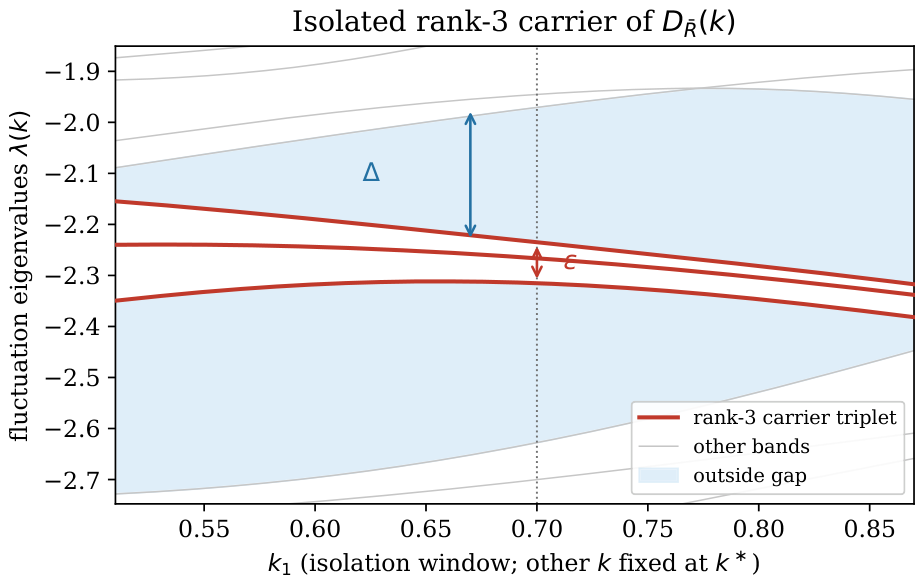
Figure 2.
(a) Small-amplitude scaling: the traceless curvature magnitude (fixed band and ) follows the reference line over more than a decade in carrier amplitude, and the span stays 8 down to —so the is a leading-order effect that vanishes continuously in the flat-vacuum limit, not a large-amplitude artifact. (b) The mechanism: with no k-transport the bundle is trivial (rank 0); a real moving frame gives only (rank 3); the complex Bloch phases of a genuine supercell background complete the algebra to (rank 8).
Figure 2.
(a) Small-amplitude scaling: the traceless curvature magnitude (fixed band and ) follows the reference line over more than a decade in carrier amplitude, and the span stays 8 down to —so the is a leading-order effect that vanishes continuously in the flat-vacuum limit, not a large-amplitude artifact. (b) The mechanism: with no k-transport the bundle is trivial (rank 0); a real moving frame gives only (rank 3); the complex Bloch phases of a genuine supercell background complete the algebra to (rank 8).
Disclaimer/Publisher’s Note: The statements, opinions and data contained in all publications are solely those of the individual author(s) and contributor(s) and not of MDPI and/or the editor(s). MDPI and/or the editor(s) disclaim responsibility for any injury to people or property resulting from any ideas, methods, instructions or products referred to in the content. |
© 2026 by the authors. Licensee MDPI, Basel, Switzerland. This article is an open access article distributed under the terms and conditions of the Creative Commons Attribution (CC BY) license (http://creativecommons.org/licenses/by/4.0/).
Copyright: This open access article is published under a Creative Commons CC BY 4.0 license, which permit the free download, distribution, and reuse, provided that the author and preprint are cited in any reuse.


