

Submitted:
03 July 2026
Posted:
07 July 2026
You are already at the latest version
Abstract
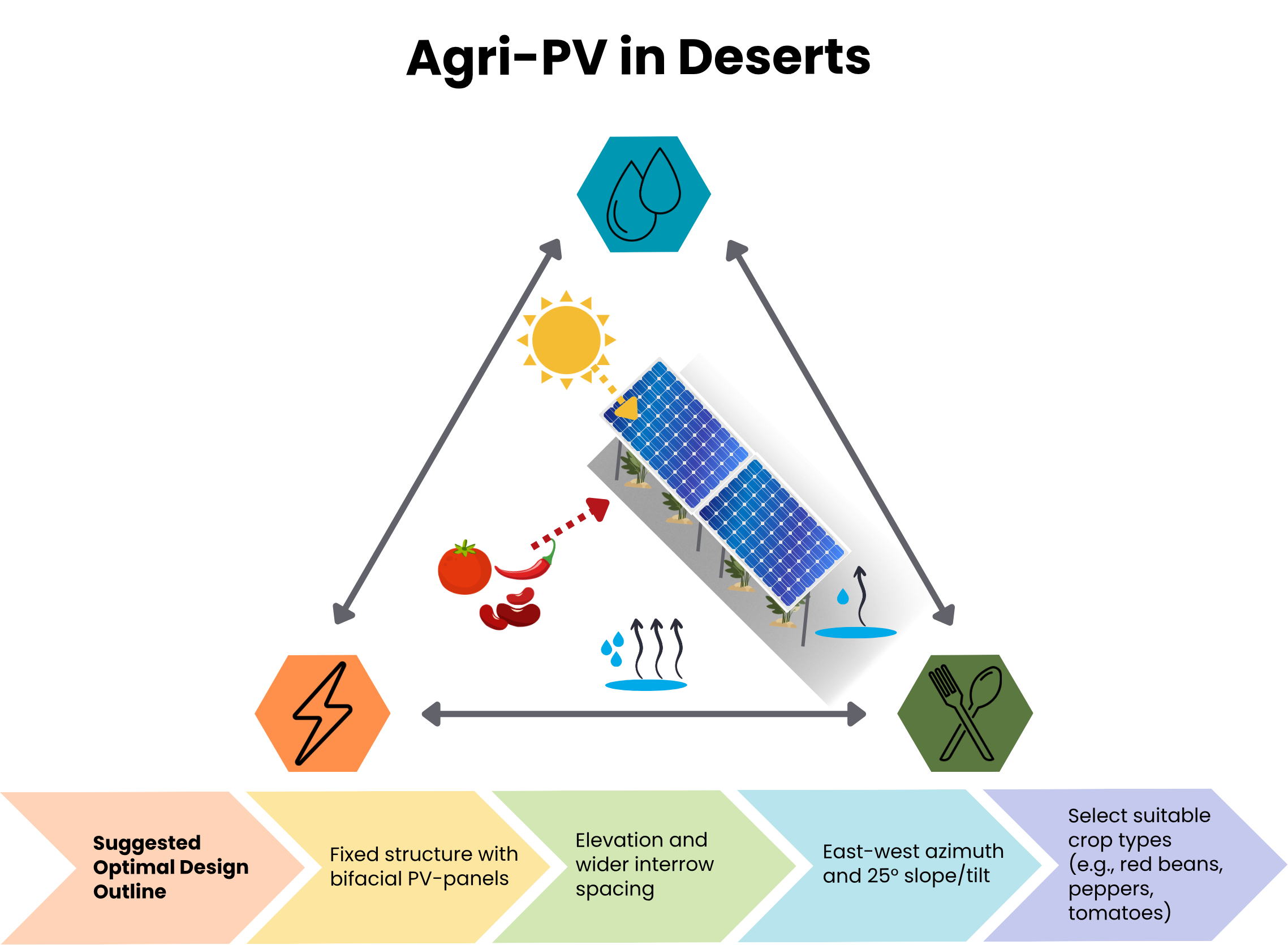
Desertification is increasing pressure on food production and water availability in arid and semi-arid regions, while these regions also offer high solar energy potential. Agrivoltaic (agri-PV) systems, which combine photovoltaic electricity generation with agriculture on the same land, may help address these linked challenges. This focused review examines how agri-PV can support the water-energy-food (W-E-F) nexus in desert environments by synthesizing literature on microclimatic effects, crop responses, photovoltaic design, and implementation barriers. The reviewed studies show that PV shading can lower soil and air temperatures, reduce evaporation, improve soil moisture retention, and, in some cases, enhance crop water productivity under arid conditions. Based on this literature, the paper proposes a design suggestion for an agri-PV system optimized for desert regions, highlighting elevated bifacial modules, fixed structures, wider row spacing, east-west row orientation, moderate tilt angles, and drought-adapted or shade-tolerant crops as promising directions. Key limitations include high capital costs, dust and soiling, water requirements for panel maintenance, ecological trade-offs, and policy barriers. Overall, agri-PV shows strong potential to improve resource-use efficiency in desert regions, but further site-specific field studies and techno-economic assessments are needed before broad design recommendations can be made.
Keywords:
agrivoltaics
; desert agriculture
; arid regions
; water-energy-food nexus
; photovoltaic systems
; bifacial photovoltaics
; microclimate
; crop water productivity
; sustainable land use
Copyright: This open access article is published under a Creative Commons CC BY 4.0 license, which permit the free download, distribution, and reuse, provided that the author and preprint are cited in any reuse.


