

Submitted:
03 July 2026
Posted:
06 July 2026
You are already at the latest version
Abstract
Urea remains the dominant source of bulk nitrogen in agriculture, but its excessive application drives environmental degradation through runoff and groundwater contamination, underscoring the need to improve nitrogen use efficiency (NUE). Gibberellic acid (GA₃), a key plant growth regulator, holds potential to enhance fertilizer effectiveness and impart stress tolerance. This study compared conventional urea (bulk-N) and nano-urea (nano-N), alone and combined with GA₃, in alleviating cadmium (Cd) toxicity in mustard (Brassica juncea L.) Plants were grown under 200 mg Cd kg⁻¹ soil with two nitrogen sources — soil-applied conventional urea (bulk-N; 100 mg kg⁻¹ soil) and foliar nano-urea (nano-N; 100 µL L-1) with or without 10 µM GA₃ foliar application. Compared with conventional urea (bulk-N), nano-urea (nano-N) more efficiently reduced Cd toxicity, promoted plant growth, and lowered environmental impacts through improved nutrient utilization. GA₃ combined with nano-N maximally enhanced photosynthetic-nitrogen and sulfur use efficiency (PNUE and PSUE), elevated nitrogen and sulfur assimilation, and promoted proline and antioxidant enzymes system, GSH accumulation, collectively driving improved photosynthesis and growth under Cd stress. Overall, GA₃ in combination with nano-N showed the greatest efficacy in reducing Cd uptake, improving physiological performance, and strengthening antioxidant defense relative to bulk-N or untreated controls. These findings highlight that the GA₃–nano-urea co-application is an effective strategy for enhancing NUE and alleviating Cd-induced phytotoxicity in mustard.
Keywords:
antioxidant defense
; cadmium toxicity
; nano-N
; nutrient use efficiency
; oxidative stress
1. Introduction
Plants in natural environments are continuously exposed to a range of biotic and abiotic stresses that adversely affect their growth and productivity [1]. Among abiotic stresses, heavy metal (HM) toxicity is particularly detrimental, as HMs are characterized by extended biological half-lives and resistance to environmental degradation [2,3]. Anthropogenic activities such as mining, smelting, and the indiscriminate application of industrial effluents have led to the accumulation of toxic HMs, including cadmium (Cd), copper (Cu), chromium (Cr), aluminium (Al), and mercury (Hg) in agricultural soils [4]. The persistence of these metals in agricultural soils is further exacerbated by additional anthropogenic inputs, including electroplating, tannery effluents, sewage sludge application, and phosphate fertilizer use, collectively intensifying the risk of HM contamination across diverse agroecosystems [5]. The long-term accumulation of HMs in the food chain poses a serious threat to human health and food security, necessitating urgent strategies to mitigate metal toxicity in crop plants [6]. These metals accumulate in plant tissues and generate reactive oxygen species (ROS), including hydrogen peroxide (H₂O₂), superoxide anion (O₂- ⁻), and hydroxyl radical (-OH), from cellular compartments such as peroxisomes, chloroplasts, and mitochondria [7,8,9]. To counteract oxidative damage, plants deploy enzymatic antioxidants, including catalase (CAT), superoxide dismutase (SOD), ascorbate peroxidase (APX), glutathione reductase (GR), and peroxidase (POD), as well as non-enzymatic components such as glutathione, carotenoids, and ascorbate [10]. However, the efficacy of these defense mechanisms depends on the plant’s physiological condition and the intensity of stress.
Cd is a non-essential and highly toxic heavy metal that imposes severe physiological and biochemical challenges on plants. It enters agricultural soil primarily through phosphate fertilizer application, atmospheric deposition, smelting operations, and industrial discharge, making it one of the most widespread contaminants in cultivated lands worldwide [11]. Plant responses to Cd stress are closely associated with oxidative stress and the modulation of hormonal signaling pathways. Cd disrupts the plant antioxidant defense system and reduces its capacity to counteract oxidative damage because of its high affinity for oxygen-, nitrogen-, and sulfur-containing compounds [12]. Once inside the plant system, Cd induces severe toxicity effects at physiological, biochemical, and molecular levels. It disrupts nutrient homeostasis, inhibits photosynthesis, and interferes with nitrogen metabolism [13]. Cd exposure induces oxidative stress through excessive ROS generation, leading to membrane lipid peroxidation, protein denaturation, and disruption of enzymatic function [14]. In Brassica juncea, Cd stress has been documented to impair photosynthetic efficiency, inhibit vegetative growth, and disrupt sulfur and nitrogen metabolism, thereby compromising crop yield and oil quality [15]. To sustain productivity under such conditions, heavy application of chemical fertilizers, particularly conventional urea as the principal nitrogen source, remains common agricultural practice. However, conventional urea is characterized by low NUE, with substantial nitrogen losses occurring via volatilization, leaching, and denitrification [16]. Mustard (B. juncea) is an economically important oilseed crop widely cultivated across South Asia. It is recognized for its relatively high capacity to accumulate Cd in shoot tissues, making it both a model species for HM stress research and a crop of agronomic concern in contaminated environments [17,18]. To sustain productivity under such conditions, the heavy application of chemical fertilizers, particularly conventional urea as the principal nitrogen source, remains a common agricultural practice. However, conventional urea is characterized by low Nitrogen Use efficiency (NUE), with substantial nitrogen losses occurring via volatilization, leaching, and denitrification [19]. Furthermore, under Cd-contaminated conditions, urea application may inadvertently intensify metal uptake and toxicity by altering rhizospheric pH and root physiology, thereby exacerbating plant stress responses [20,21].
Science, engineering, and nanoscale technology, collectively referred to as nanotechnology, constitute a rapidly advancing, multidisciplinary field with significant potential to influence many aspects of society [22]. Nano-fertilizers significantly contribute to the physiological and biochemical functions of crops by enhancing nutrient availability. The application of nano-NPK promotes wheat leaf growth due to improved nutrient uptake, as the nano-sized particles can readily enter through the leaf stomata, facilitating efficient absorption during gas exchange [23]. In this context, nano-urea has emerged as a promising alternative to conventional nitrogen fertilizers. Engineered through nanotechnology, nano-urea particles possess superior surface area, controlled-release characteristics, and enhanced nutrient delivery capabilities [24]. Nano-urea contains nitrogen at the nanoscale with a surface area approximately 10,000 times greater than that of a conventional 1 mm urea prill, and each prill-equivalent volume contains approximately 55,000 nano-nitrogen particles. This unique architecture facilitates foliar absorption through stomata and transport via plasmodesmata, enabling controlled nitrogen release that is reportedly 80% more bioavailable than traditional urea [25]. The nanoparticle surface charge further promotes electrostatic interactions with leaf surface receptors, enhancing stomatal uptake efficiency and substantially reducing nitrogen volatilization and leaching losses compared to soil-applied conventional urea [19,26]. Recent studies have demonstrated that nano-urea not only improves nitrogen assimilation but also fortifies plants against abiotic stresses by modulating antioxidant defense systems and improving physiological resilience [27,28]. Nano-urea has also been shown to release nitrogen approximately 12 times more slowly than conventional urea, facilitating sustained metabolic activity and improving crop yield [29]. Furthermore, nano-fertilizers have been reported to reduce total agrochemical input requirements by up to 50% while maintaining or exceeding conventional yields, representing a major advancement toward precision and sustainable agriculture [30,31]. In Brassica juncea under Cd stress, the application of nano-urea thus holds considerable potential to mitigate toxicity, sustain growth, and optimize physiological functions.
Gibberellic acid (GA₃) is a naturally occurring diterpenoid plant hormone that plays a pivotal role in regulating seed germination, stem elongation, leaf expansion, and flowering [32]. GA₃ mediates these effects primarily through the targeted degradation of DELLA proteins — key repressors of the gibberellin signaling cascade — thereby releasing transcriptional activation of growth-promoting genes in meristematic and elongating tissues [33]. Under Cd stress, endogenous GA₃ levels are often suppressed, leading to impaired cell division and elongation, thereby aggravating growth inhibition [34,35]. GA₃ application has been shown to enhance seed germination rates, seedling vigour, and biomass accumulation in mustard plants exposed to Cd-contaminated soils [36]. Cd typically impairs chlorophyll biosynthesis, damages the photosynthetic apparatus, and reduces stomatal conductance; however, GA₃ application helps maintain chlorophyll content, improves photosystem II (PSII) efficiency, and enhances carbon assimilation, thereby supporting energy metabolism in stressed plants [37]. Recent evidence further indicates that the inhibition of chlorophyll biosynthesis by Cd occurs through suppression of δ-aminolevulinic acid (ALA) synthesis and displacement of Mg²⁺ from the porphyrin ring, both of which are attenuated by GA₃ application [38,39]. Moreover, GA₃ has been reported to upregulate antioxidant enzyme activities, promoting ROS scavenging and reducing oxidative damage under heavy metal stress. Recent studies suggest that GA₃ enhances Cd tolerance by strengthening antioxidant defense, maintaining cellular redox homeostasis, and improving photosynthetic performance. These coordinated responses improve the plant’s overall detoxification capacity and may contribute to reduced Cd accumulation and translocation to aerial tissues [40,41].
The combined use of nano-urea and GA₃, therefore, represents a potentially synergistic strategy to counteract Cd toxicity in B. juncea by improving nitrogen availability, hormonal balance, and antioxidant capacity simultaneously. Despite the individual merits of both treatments, their combined effect under Cd stress in mustard has not been systematically evaluated. The present study was designed to: (i) assess the individual and combined effects of GA₃, bulk-N, and nano-N on growth, photosynthesis, nitrogen metabolism, and antioxidant defense in mustard under Cd stress and (iii) compare the efficacy of nano-N versus bulk-N in alleviating Cd-induced oxidative stress when applied in combination with GA₃. Moreover, since nano-urea provides a sustained nitrogen supply supporting protein synthesis and chlorophyll production, while GA₃ simultaneously restores hormonal homeostasis and activates stress-responsive signaling networks, their combined application may also exert complementary effects on root architecture and rhizospheric chemistry, potentially limiting Cd absorption at the root-soil interface [42,43]. Findings from this study are expected to provide mechanistic insights into the interplay between nitrogen nutrition, phytohormonal regulation, and heavy metal tolerance, with practical implications for sustainable oilseed production in metal-contaminated agroecosystems.
2. Results
2.1. Effect of Bulk-N or Nano-N with GA on Growth Parameters, Use Efficiency of N and S
Cadmium stress significantly suppressed the plant growth. Application of 200 mg Cd kg⁻¹ soil decreased root length by 22.6%, shoot length by 30.8%, plant dry weight by 65.2%, and leaf area by 41.0% relative to the control plants (Table 1).
Under unstressed conditions, individual GA₃ application significantly promoted root length (+64.5%), shoot length (+29.91%), dry weight (+59.0%), and leaf area (+30.4%) compared to controls. Under Cd stress, GA₃ application improved root length by 31.25%, shoot length by 95.06%, dry weight by 131.4%, and leaf area by 72.68% relative to Cd-stressed plants.
Bulk-N applications under normal conditions increased root length, shoot length, dry weight, and leaf area by 32.3%, 59%, 30.36%, and 11.68%, respectively, while nano-N produced greater enhancements of 46.8%, 67.5%, 56.7%, and 23.6%, respectively, compared to the control. Under Cd stress, both bulk-N and nano-N improved growth parameters, with nano-N consistently outperforming bulk-N.
The combined application of GA₃ plus nano-N under Cd stress yielded the most pronounced improvements in growth parameters, increasing root length by 75%, shoot length by 116.04%, plant dry weight by 4.21-fold, and leaf area by 125.58% relative to Cd-stressed plants alone (Table 1). These results demonstrate that nano-N combined with GA₃ is the most effective strategy for restoring growth under Cd stress.
S content increased with GA, bulk-N, and nano-N, and maximally with GA and nano-N. The combined application of GA and nano-N increased S content by 69.2%, while PNUE and PSUE decreased by 38.9% and 29.4%, respectively, under Cd stress compared to the control. The PNUE and PSUE increased by 43% and 10% with nano-N application under no stress, compared to the control, and by 38.5% and 15.1% under Cd stress, compared to Cd-stressed plants. The maximum PNUE and PSUE were observed with the nano-N and GA combination under Cd stress, with PNUE increasing by 70.7% and PSUE by 59.2% compared to Cd-treated plants (Table 1).
2.2. Effect of the GA and Nano-N Chlorophyll Content and Gas Exchange Parameters Under Cd Stress
Cadmium stress significantly impaired photosynthetic performance, reducing chlorophyll content by 44.16%, net photosynthesis by 17.11%, stomatal conductance by 37.98%, and intercellular CO₂ concentration by 39.3% relative to controls (Figure 1, Table 1).
Under unstressed conditions, individual GA₃ application increased net photosynthesis (+62.16%), stomatal conductance (+106.5%), intercellular CO₂ (+96.5%), and chlorophyll content (+45.25%). Under Cd stress, GA₃ supplementation restored net photosynthesis by 69.56%, stomatal conductance by 140.6%, intercellular CO₂ by 113.6% and chlorophyll content by 106.5% relative to Cd-stressed plants.
Individual application of bulk-N under normal or stress conditions improved net photosynthesis, stomatal conductance, intercellular CO₂, and chlorophyll content; however, the increases were smaller than those caused by nano-N under both stress and no-stress conditions, suggesting the effectiveness of nano-N over bulk-N.
Further, when GA₃ was combined with nano-N under Cd stress, we observed the greatest stress alleviation, and this treatment outperformed bulk-N with GA under Cd stress. Nano-N with GA enhanced net photosynthesis (+84.8%), stomatal conductance (+190%), intercellular CO₂ (+188%) and chlorophyll content (+135.9%) relative to Cd-stressed plants, confirming the synergistic benefit of this combination.
2.3. Stomatal Responses
Cd stress caused severe stomatal distortion and restricted stomatal aperture, as confirmed by scanning electron microscopy (Figure 2). The nano-N application under unstressed conditions resulted in maximum stomatal opening. GA₃ and bulk-N applications, both individually and in combination, promoted stomatal opening under unstressed conditions. Importantly, the GA₃ + nano-N combination under Cd stress markedly restored stomatal aperture, supporting improved gas exchange and photosynthetic performance.
2.4. GA with Nano-N Enhanced Nitrate Reductase Activity, Nitrogen Content, Proline, and Glycine Betaine More Than Bulk-N to Reduce Cd-Induced Oxidative Stress
Cd stress reduced NR activity by 33.39% compared to the control plants (Figure 3A). Under normal conditions, GA₃, bulk-N, and nano-N individually increased NR activity by 32.1%, 43.57%, and 57.05%, respectively. The nano-N application under Cd stress significantly increased NR activity by 69.6% compared with stressed plants alone. The GA₃ + nano-N combination under stressed conditions yielded the largest increase in NR activity, 128.7% relative to Cd-stressed plants, demonstrating its superior nitrogen assimilation capacity.
Cd stress reduced leaf nitrogen content by 38.22% (Figure 3B). Under normal conditions, individual applications of GA₃, urea, and nano-urea increased nitrogen content by 42.1%, 71.5%, and 87.1%, respectively. Under Cd stress, the GA₃ with nano-N combination produced the highest N content recovery (+185.6) relative to Cd-stressed plants, followed by GA₃ + bulk-N (+154%).
Proline and glycine-betaine are osmolytes that increase stress tolerance by scavenging ROS. We observed increased proline (+56.9%) and glycine-betaine (+60.1%) contents under Cd stress. However, this increase was insufficient to alleviate Cd stress. The supplementation of GA with nano-N showed a maximal increase in proline by 118.7% and glycine betaine by 144.2% with respect to Cd-stressed plants. Among GA, bulk-N, and nano-N, nano-N was better than both bulk-N and GA in enhancing these osmolytes (Figure 3C, D).
2.5. GA in Combination with Nano-N Maximally Reduced Cd Translocation and Its Content Under Cd Stress
In the presence of Cd in soil, the accumulation of Cd was observed in the root, shoot, and leaves. There was a 23.3-fold increase in root Cd, 21.2-fold in shoot Cd, and a 27.7-fold increase in leaf Cd, causing a 19.0% increase in the translocation index compared to no-stress control plants. The severity of Cd stress was evident with higher translocation and leaf Cd accumulation. This severity was reduced by the application of GA, bulk-N, or nano-N, but most effectively with a combined treatment of GA and nano-N under Cd stress. GA with nano-N reduced Cd in root by 51.4%, in shoot by 51.4%, and in leaf by 74.4%, and translocation index by 47.3% compared to Cd stressed plants (Figure 4 A-D).
2.6. Reduced Cd Accumulation and Translocation Index with GA and Nano-N was Associated with Higher Content of GSH, Cysteine, and Non-Protein Thiol (NPT) that Bound the Cd
In the presence of Cd, plants exhibited increased cysteine, reduced glutathione (GSH), and NPT content. Cysteine content under stress increased by 51.7%, GSH by 34.1%, and NPT by 31%, while sulfur decreased by 30% compared with the control (Figure 5). Among the different treatments without Cd stress, cysteine, GSH, and NPT increased compared to the control, but were lower than in Cd-stressed plants.
Under Cd stress, the application of GA enhanced cysteine, GSH, NPT, and S by 11.7%, 188.6%, 16.1%, and 35.7% compared to stressed plants (Figure 5). Among bulk and nano-N, nano-N showed higher S-amination into cysteine, GSH, and NPT, but in combination with GA, nano-N maximally alleviated Cd stress by enhancing cysteine by 36.0%, GSH by 33.7%, and NPT by 42.6% compared to Cd-stressed plants.
2.7. Antioxidative Enzyme Activity was Enhanced While that of H2O2 and TBARS Decreased when GA, Bulk or Nano-N was Supplemented to Cd-Stressed Plants
Cd exposure increased H₂O₂ content by 120.2% relative to control, indicating severe oxidative stress (Table 2). Individual GA₃ application reduced H₂O₂ by 14.5% under normal conditions compared to the control and by 49.1% under Cd stress compared to stressed plants. Urea and nano-urea also independently reduced H₂O₂ levels. The GA₃ with bulk-N and GA₃ + nano-N combinations under Cd stress reduced H₂O₂ content by 56.4% and 66.7%, respectively, relative to Cd-stressed plants alone, demonstrating effective attenuation of oxidative stress. Similar reduction of TBARS content was observed when nano-N was supplemented with GA under Cd stress, which brought the increased TBARS levels of 29 nmol g-1FW under Cd stress to 8.1 nmol g-1FW with nano-N and GA under Cd stress.
Cd stress increased the antioxidative enzyme activity of APX, GR, SOD, and CAT above controls, a compensatory antioxidant response (Figure). Under normal conditions, GA₃, bulk-N, and nano-N also increased activity, but it was less than the increase caused by Cd stress. Under Cd stress, individual applications of GA, bulk-N, and nano-N further increased APX by 61.1%, 19.4%, and 50.5%, and GR by 64.5%, 34.5%, and 52.5%, SOD by 21.3%, 6.8%, and 15.2%, and CAT by 30.2%, 21.7%, and 36.3%, respectively, compared to stressed plants. The combined GA + Nano-N treatments under Cd stress increased APX by 112.5%, GR by 129.0%, SOD by 46.5%, and CAT activity by 60.8%, respectively, relative to Cd-stressed plants, confirming enhanced antioxidant capacity (Table 2).
2.8. Yield Traits Measurement
All yield-related parameters increased with GA, bulk N, and nano-N, with the largest increases with GA. Under Cd stress, the yield in terms of seed was reduced, but supplementation of GA with nano-N maximally enhanced the number of seeds per plant over control, suggesting a synergistic impact on the yield of Varuna by the GA and nano-N combination (Table 3).
2.9. The Correlation Study Between Different Traits Revealed an Association of Photosynthesis with Growth and Antioxidants
The correlation network analysis identified a highly interconnected trait module centered on nitrogen status and growth-related parameters. N appeared as the most influential node, showing strong associations with RL, SL, PDM, LA, PN, Gs, PSII, Chl, and NRA, indicating a coordinated relationship among nitrogen metabolism, photosynthetic performance, and vegetative growth (Figure 5). GSH, RL, Chl, SL, PDM, LA, and PN also emerged as important secondary nodes, suggesting that these traits contributed strongly to the overall structure of the network. In contrast, oxidative stress and antioxidant-related variables, including CAT, SOD, APX, GR, and H2O2, formed a separate but connected module, reflecting coordinated stress-response regulation. Overall, the network suggests that the treatments promoted an integrated growth–photosynthesis–nitrogen response, while stress-related parameters were organized into a distinct defensive cluster.
2.10. PCA Biplot Showed a Strong Association of Photosynthesis and Growth with GA, Bulk, and Nano-N, While Negatively Associated with Cd Stress
PCA was used to assess the overall variation among treatments in Brassica juncea leaves under Cd, GA, bulk-N, and nano-N applications. The analysis showed that the first two principal components explained most of the total variation and effectively separated the treatments according to their physiological and biochemical responses (Figure 6). The treatment combinations involving GA and nitrogen sources clustered away from the Cd-only treatment, suggesting that these amendments shifted the plant response toward improved growth and metabolic performance. In contrast, the Cd treatment was positioned separately, reflecting its negative effect on the measured traits. Overall, the PCA indicated that GA and nano-N supplementation, particularly in combination, were associated with a coordinated improvement in the trait profile relative to Cd stress.
3. Discussion
The present investigation demonstrated that Cd stress induced wide-ranging physiological and metabolic alterations, including significant reductions in growth, gas exchange performance, chlorophyll content, and nitrogen metabolism, as well as elevated oxidative stress markers. These findings are consistent with previously documented detrimental effects of Cd on mustard and other Brassica species [44,45]. Cd at 200 mg kg⁻¹ in soil reduced fresh and dry biomass substantially, findings in line with those of Guo et al. [46] and Kapoor et al. [47], who reported approximately 35–50% reductions in root and shoot biomass under elevated Cd concentrations. The decline in biomass can be attributed to the disruptive effects of Cd on nutrient acquisition, membrane stability, and cellular proliferation, collectively restricting plant growth and development. In addition, Cd adversely affects the photosynthetic machinery by interfering with chlorophyll biosynthesis through the displacement of essential cofactors such as Mg and Fe and by damaging thylakoid membranes, thereby limiting photosynthetic electron transport and carbon assimilation [39]. These impairments are further aggravated by disturbances in nitrogen metabolism, as Cd-induced inhibition of nitrate reductase and glutamine synthetase activities constrains amino acid biosynthesis and protein turnover, ultimately contributing to the reduced nitrogen metabolism observed under Cd stress [48].
GA₃ application effectively alleviated Cd-induced growth inhibition by promoting cell elongation, enhancing seed germination, and improving physiological adaptability. These beneficial effects are consistent with the well-established role of GA₃ in regulating cell division and elongation, processes that are often impaired under heavy metal stress due to reduced endogenous gibberellin levels [42,49]. In the present study, GA₃ also contributed to the preservation of chlorophyll content and photosynthetic integrity, possibly by protecting the photosynthetic apparatus against Cd-induced oxidative damage and by improving stomatal regulation. Apart from its growth promoting effects, GA₃ has been reported to strengthen cellular antioxidant defense systems and maintain chloroplast ultrastructure under heavy metal stress conditions. Moreover, GA₃-mediated regulation of DELLA proteins, together with its crosstalk with auxins and cytokinins, enhances stress tolerance and supports the maintenance of photosynthetic efficiency [49].
Conventional urea improved nitrogen availability and modestly enhanced metabolic and photosynthetic performance. However, its benefits were constrained by evidence that excessive nitrogen application under Cd stress may enhance metal uptake and toxicity through alterations in root physiology and rhizosphere [50,51]. This finding underscores the importance of precision nitrogen management under heavy metal stress conditions. Although conventional urea enhances N availability, a considerable proportion is lost through volatilization and leaching, resulting in low nitrogen-use efficiency. Moreover, excessive nitrogen fertilization can alter rhizosphere chemistry and root architecture, which may facilitate Cd uptake and translocation [52]. Therefore, balanced nitrogen nutrition is essential for minimizing heavy-metal toxicity (Figure 7).
Nano-N emerged as the most effective nitrogen source in mitigating Cd toxicity across all measured parameters. The superior performance of nano-N is attributable to its nanoscale formulation, which provides a surface area approximately 10,000 times greater than conventional urea, facilitating rapid foliar absorption and targeted nutrient delivery, athereby substantially increasing NUE [53,54]. Enhanced nitrogen assimilation through nano-N application contributed to improved chlorophyll-protein complex synthesis, greater photosynthetic efficiency, and superior biomass accumulation compared to conventional urea [54,55] in Indian mustard and other crops. Notably, nano-N application was associated with a marked reduction in Cd accumulation in plant tissues, possibly through modulation of membrane permeability or formation of stable complexes that reduce Cd bioavailability in planta. Higher GSH, protein, cysteine, and non-protein thiol levels are evidence of lower Cd accumulation and translocation index, which were lowest in the nano-N and GA combination. The elevated antioxidative enzymes observed under high Cd stress in B. juncea are consistent with Al-Mahmud et al. [56] and were further potentiated by nano-N, highlighting its role in bolstering enzymatic antioxidant defense. Among various strategies to reduce heavy metal stress, chelation and sequestration of heavy metals in the vacuole prevent their interaction with cellular components [57]. Zhang et al. [58] also showed the role of NPT in Cd detoxification and sequestration and reduced translocation. We observed a reduced Cd accumulation in shoot and leaves upon the treatment of nano-N or maximally when GA was supplied with nano-N which showed increased NPT, cysteine, and GSH. In fact, the NPT are majorly composed of cysteine, GSH, and phytochelatin. The results also point towards enhanced phytochelation with the combined treatment, which might result in Cd-binding and non-availability. Though direct phytochelatin measurement would confirm this.
The Cd-exposed plants showed lower N and S content and lower photosynthetic- NUE and SUE, which was enhanced with GA, nano-N, and Bulk-N, and maximally with Nano-N in combination with GA. The nano-N with GA influenced not only N content but also S content, and both the PNUE and PSUE substantiated the influence of N on S.
The combined application of GA+nano-N produced the most pronounced improvements under Cd stress across all parameters evaluated, including growth, photosynthesis, nitrogen assimilation, PSUE, PNUE, S content, and the N and S-rich metabolites, including cysteine, GSH, proline, NPT and antioxidant enzyme activities, causing a reduction in ROS and Cd accumulation. This synergistic response can be explained by the dual complementary mechanisms of action: GA₃ activates hormonal signaling pathways that stimulate growth, upregulate antioxidant enzymes, and improve stress adaptability, while nano-N ensures optimal and sustained nitrogen supply through efficient foliar delivery, directly supporting amino acid synthesis, enzyme activation, and protein biosynthesis. Together, these effects reinforce the plant’s capacity to withstand Cd-induced oxidative stress while maintaining productive growth. The significant reduction in H₂O₂ and TBARS content in the GA₃+nano-N treatment confirms a comprehensive attenuation of ROS-mediated oxidative damage, validating this combination as the most effective intervention tested. The superior performance of the combined treatment suggests complementary interactions between hormonal signaling and nutrient metabolism. GA₃-mediated activation of growth pathways together with sustained nitrogen availability from nano-N likely promoted carbon assimilation, amino acid biosynthesis, and antioxidant defense. Such synergistic interactions between phytohormones and nano-fertilizers have recently been proposed as promising strategies for improving stress resilience and crop productivity under adverse environments.
The collective findings suggest that the ameliorative effects of GA₃ and nano-N are mediated through multiple interconnected mechanisms, including improved nitrogen and sulfur assimilation, enhanced synthesis of thiol-containing metabolites, stimulation of antioxidant defense systems, maintenance of photosynthetic efficiency, and reduced Cd uptake and translocation. These responses collectively preserve cellular redox homeostasis and facilitate sequestration of Cd into less toxic forms, thereby improving growth and stress tolerance in B. juncea L. [59].
Future research should investigate the long-term effects of nano-N on soil health and microbial community structure and explore its potential synergistic effects when combined with bio-stimulants or chelating agents. Molecular studies are warranted to elucidate the signaling pathways and gene expression networks modulated by nano-N under heavy metal stress, which could pave the way for targeted approaches to engineer heavy metal tolerance in crop plants.
4. Materials and Methods
4.1. Plant Material and Experimental Conditions
Experiments were conducted on mustard (Brassica juncea L.) cv. Varuna was grown under net-house conditions at the Department of Botany, Aligarh Muslim University. Seeds were surface sterilized with 0.01% HgCl₂, rinsed thoroughly with distilled water, and sown in 20 cm diameter earthen pots filled with a 3:1 mixture of field soil, peat, and compost. Pots were maintained under natural photoperiod conditions with a mean day/night temperature of 25/17 ± 2 °C, photosynthetically active radiation (PAR) of 650 µmol m⁻² s⁻¹, and relative humidity of 62 ± 3%.
The experiment comprised 10 treatments arranged in a completely randomized block design (CRBD) with three replicates per treatment (n = 3), yielding a total of 30 pots. After seedling establishment, six plants per pot were maintained. Treatments were as follows: T1—Control; T2—GA₃ (10 µM, foliar); T3—Cd (200 mg kg⁻¹ soil, as CdCl₂); T4—Bulk-N as 100 mg kg⁻¹ soil urea; T5—Nano-N as Nano-Urea (100µL L-1 , foliar); T6—Cd + Bulk-N; T7—Cd + Nano-N; T8—GA₃ + Cd; T9—GA₃ + Cd + Bulk-N; T10—GA₃ + Cd + Nano-N. Cadmium chloride (200 mg kg⁻¹ soil equivalent) was applied at 10 days after sowing (10 DAS). After 20 DAS, bulk-N (100 mg kg⁻¹ soil), and foliar applications of nano-N (100µL L-1), GA₃ (20 mL of 10 µM), were made using 0.5% teepol as a surfactant. Treatment concentrations were selected based on previously published reports [60,61]. All physiological and biochemical analyses were performed at 30 DAS.
4.2. Growth Parameter Measurements
Plants were carefully uprooted, cleaned to remove adhering soil, and blotted dry. Root length and shoot length were measured manually with a graduated scale. Dry weight was determined after oven-drying at 80 °C until a constant mass was achieved. Leaf area was measured using a leaf area meter.
4.3. Photosynthetic Gas Exchange and Chlorophyll Content
Net photosynthetic rate (Pn), stomatal conductance (gs), and intercellular CO₂ concentration (Ci) were measured in fully expanded upper leaves using an infrared gas analyzer (CID-340, Photosynthesis System, BioScience, Camas, WA, USA) at a PAR of 780 µmol m⁻² s⁻¹ and ambient CO₂ of 390 ± 5 µmol mol⁻¹. Chlorophyll content was determined non-destructively in early morning hours using a SPAD chlorophyll meter (SPAD 502 DL PLUS, Konica Minolta, Japan) and expressed as SPAD units.
4.4. Nitrate Reductase Activity
Nitrate reductase (NR) activity in fresh leaf tissue was estimated by the method of Kuo et al. [62]. The detailed procedure is provided in Supplementary File S1
4.5. Leaf Nitrogen Content
Total leaf nitrogen was estimated by the Kjeldahl digestion method [63]. Details are provided in Supplementary File S1
4.6. Hydrogen Peroxide and TBARS Content
4.7. Determination of Cd Content in Root, Stem, and Leaves and Translocation Factor (TF)
Leaf and root samples were dried in an oven at 80 °C for 48 h, then finely ground into a powder. The powdered samples were digested with a mixture of concentrated HNO3 and HClO4 in a 3:1 (v/v) ratio [12]. The cadmium content was subsequently measured using an atomic absorption spectrophotometer (GBC 932 Plus; GBC Scientific Instruments, Braeside, Australia).
The TF was calculated as the ratio of metal concentration in the leaves to that in the roots, using the following formula [66]:
TF = Cd leaves/Cd root
4.8. Antioxidative Enzymes
In the assay of superoxide dismutase (SOD) activity, it was investigated using the methods of Giannopolitis and Ries [67] and Beyer and Fridovich [68]. The activity of glutathione reductase (GR) was assessed by using the Foyer and Halliwell [69]. method for the GSH-dependent oxidation of NADPH at 340 nm. Catalase (CAT) activity was assayed by the method of Aebi [70]. Ascorbate peroxidase (APX) activity was estimated by Nakano and Asada [71]. Glutathione Reductase (GR) activity was measured by the method of Jablonski and Anderson [72]. Detailed methodology is provided in Supplementary File S1.
4.9. Determination of Reduced Glutathione (GSH), Cysteine Content, NPT, and S Content
4.10. Yield Parameters
Mustard pods were harvested to measure pod/plant, pod length, pod fresh weight, number of seeds per pod, FW of seeds per pod, number of seeds per plant, and the weight of 1000 seeds.
4.11. Statistical Analysis
Data was statistically analyzed using analysis of variance (ANOVA) through SPSS 17.0 for Windows. Principal Component Analysis (PCA) was performed using OriginPro software. The first two components (PC1 and PC2) that explain the greatest variance in the datasets were considered when creating the biplots. Correlation network analysis was performed in R by calculating Pearson correlation coefficients among the measured traits, and the resulting network was visualized using node strength to scale node size and/or color.
4.12. Scanning Electron Microscopy (SEM)
Upper leaves of 30 DAS plants from each treatment were excised and fixed in 2.5% glutaraldehyde. Stomatal morphology was examined using a scanning electron microscope (JSM-6510 LV, JEOL, Japan) at the University Sophisticated Instruments Facility (USIF), Aligarh Muslim University.
5. Conclusions
Cadmium stress severely impaired growth, photosynthesis, nitrogen metabolism, and antioxidant defense in Brassica juncea. Exogenous applications of GA₃, bulk-N, and nano-N individually alleviated these effects, with nano-N consistently outperforming Bulk-N due to its superior bioavailability and nitrogen use efficiency. The combined GA₃+Nano-N treatment under Cd stress produced the most significant recovery across all measured parameters, demonstrating a synergistic protective effect. This integrated strategy, combining the growth-promoting hormonal activity of GA₃ with the efficient nitrogen delivery of nano-N, represents a viable and environmentally sustainable approach to mitigating heavy metal stress in mustard cultivation.
Supplementary Materials
The following supporting information can be downloaded at https://www.mdpi.com/article/doi/s1.
Author Contributions
“Conceptualization, N. A. K..; methodology, N., Y.H.; software, N.I. N..; formal analysis, N.; investigation, N., Y.H..; data curation, N.I. N., N.K.; writing—original draft preparation, N. N.I.; writing—review and editing, N.A.K.; supervision, N.A.K. All authors have read and agreed to the published version of the manuscript.
Funding
No funding information available.
Data Availability Statement
Data are included in this manuscript.
Conflicts of Interest
No conflict of interest
References
- Ghori, N.-H.; Ghori, T.; Hayat, M.Q.; Imadi, S.R.; Gul, A.; Altay, V.; Ozturk, M. Heavy metal stress and responses in plants. Int. J. Environ. Sci. Technol. 2019, 16, 1807–1828. [Google Scholar] [CrossRef]
- Salim, S.A.; Ov, N.S.; Dana, Z.; Hashami, Z.; Afrah, A.; Sadeghi, E.; Bashiry, M. A comprehensive image of environmental toxic heavy metals in red meat: A global systematic review and meta-analysis and risk assessment study. Sci. Total. Environ. 2023, 889, 164100. [Google Scholar] [CrossRef] [PubMed]
- Rather, B.A.; Mir, I.R.; Sehar, Z.; Anjum, N.A.; Masood, A.; Khan, N.A. The outcomes of the functional interplay of nitric oxide and hydrogen sulfide in metal stress tolerance in plants. Plant Physiol. Biochem. 2020, 155, 523–534. [Google Scholar] [CrossRef] [PubMed]
- Thao, N.P.; Khan, M.I.R.; Thu, N.B.A.; Hoang, X.L.T.; Asgher, M.; Khan, N.A.; Tran, L.-S.P. Role of Ethylene and Its Cross Talk with Other Signaling Molecules in Plant Responses to Heavy Metal Stress. Plant Physiol. 2015, 169, 73–84. [Google Scholar] [CrossRef] [PubMed]
- Mustapha, L.S.; Obayomi, O.V.; Obayomi, K.S. A comprehensive review on potential heavy metals in the environment: Persistence, bioaccumulation, ecotoxicology, and agricultural impacts. Ecol. Front. 2025, 46, 434–449. [Google Scholar] [CrossRef]
- Clemens, S. Safer food through plant science: reducing toxic element accumulation in crops. J. Exp. Bot. 2019, 70, 5537–5557. [Google Scholar] [CrossRef] [PubMed]
- Kohli, S.K.; Handa, N.; Gautam, V.; Bali, S.; Sharma, A.; Khanna, K.; Arora, S.; Thukral, A.K.; Ohri, P.; Karpets, Y.V.; et al. ROS Signaling in Plants Under Heavy Metal Stress. In Reactive Oxygen Species and Antioxidant Systems in Plants: Role and Regulation under Abiotic Stress; Khan, M.I.R., Khan, N.A., et al., Eds.; Springer: Singapore, 2017; pp. 185–214. [Google Scholar]
- Berni, R.; Luyckx, M.; Xu, X.; Legay, S.; Sergeant, K.; Hausman, J.-F.; Lutts, S.; Cai, G.; Guerriero, G. Reactive oxygen species and heavy metal stress in plants: Impact on the cell wall and secondary metabolism. Environ. Exp. Bot. 2019, 161, 98–106. [Google Scholar] [CrossRef]
- Alvi, A.F.; Iqbal, N.; Albaqami, M.; Khan, N.A. The emerging key role of reactive sulfur species in abiotic stress tolerance in plants. Physiol. Plant. 2023, 175, e13945. [Google Scholar] [CrossRef] [PubMed]
- Bhaduri, A.M.; Fulekar, M.H. Antioxidant enzyme responses of plants to heavy metal stress. Rev. Environ. Sci. Bio/Technol. 2012, 11, 55–69. [Google Scholar] [CrossRef]
- Mushtaq, G.; Agrawal, S.; Kushwah, A.; Kumar, A.; Lone, R. Cadmium toxicity in plants and its remediation management: A review. Plant Stress 2025, 16. [Google Scholar] [CrossRef]
- Rani, I.; Nidhi; Fatma, M.; Kotay, N.A.; Khan, N.A. Enhancement of gibberellic acid efficiency in regulation of photosynthesis and growth with nutrient-based nano-elicitor in cadmium-treated mustard. Plant Res. 2026, 1. [Google Scholar] [CrossRef]
- Kanwal, P.; Nadeem, M.; Shahbaz, M.; Iqbal, U.Z.; Ikram, F.; Akhtar, R.; Shakeel, M.; Hassan, A.; Sattar, A. Exogenous salicylic acid enhances physiological responses, nutrient uptake by metabolic adjustments to alleviate cadmium stress in rapeseed (Brassica napus L.) cultivars. J. Ecol. Eng. 2025, 26, 451–462. [Google Scholar] [CrossRef] [PubMed]
- Shah, T.; Khan, Z.; Asad, M.; Imran, A.; Niazi, M.B.K.; Alsahli, A.A. Alleviation of cadmium toxicity in wheat by strigolactone: Regulating cadmium uptake, nitric oxide signaling, and genes encoding antioxidant defense system. Plant Physiol. Biochem. 2023, 202, 107916. [Google Scholar] [CrossRef] [PubMed]
- Ali, A.A.; Ahmad, J.; Baig, M.A.; Ahmad, A.; Al-Huqail, A.A.; Qureshi, M.I. Impact of Ferrous Sulfate on Thylakoidal Multiprotein Complexes, Metabolism and Defence of Brassica juncea L. under Arsenic Stress. Plants 2022, 11, 1559. [Google Scholar] [CrossRef] [PubMed]
- Govindasamy, P.; Muthusamy, S.K.; Bagavathiannan, M.; Mowrer, J.; Jagannadham, P.T.K.; Maity, A.; Halli, H.M.; K., S.G.; Vadivel, R.; K., D.T.; et al. Nitrogen use efficiency—a key to enhance crop productivity under a changing climate. Front. Plant Sci. 2023, 14. [Google Scholar] [CrossRef] [PubMed]
- Gill, S.S.; Khan, N.A.; Tuteja, N. Cadmium at high dose perturbs growth, photosynthesis and nitrogen metabolism while at low dose it up regulates sulfur assimilation and antioxidant machinery in garden cress (Lepidium sativum L.). Plant Sci. 2012, 182, 112–120. [Google Scholar] [CrossRef] [PubMed]
- Iqbal, N.; Umar, S.; Khan, N.A.; Khan, M.I.R. A new perspective of phytohormones in salinity and drought stress. Environ. Exp. Bot. 2015, 130, 174–185. [Google Scholar]
- Motasim, A.M.; Samsuri, A.W.; Nabayi, A.; Akter, A.; Haque, M.A.; Sukor, A.S.A.; Adibah, A.M. Urea application in soil: processes, losses, and alternatives—a review. Discov. Agric. 2024, 2, 1–25. [Google Scholar] [CrossRef]
- Fatima, G.; Raza, A.M.; Dhole, P. Heavy Metal Exposure and its Health Implications: A Comprehensive Review. Indian J. Clin. Biochem. 2025, 41, 152–180. [Google Scholar] [CrossRef] [PubMed]
- Sarwar, N.; Saifullah; Malhi, S.S.; Zia, M.H.; Naeem, A.; Bibi, S.; Farid, G. Role of mineral nutrition in minimizing cadmium accumulation by plants. J. Sci. Food Agric. 2010, 90, 925–937. [Google Scholar] [CrossRef] [PubMed]
- Shukla, K.; Mishra, V.; Singh, J.; Varshney, V.; Verma, R.; Srivastava, S. Nanotechnology in sustainable agriculture: A double-edged sword. J. Sci. Food Agric. 2024, 104, 5675–5688. [Google Scholar] [CrossRef] [PubMed]
- Ghazaryan, K.; Pandey, D.; Singh, S.; Varagyan, V.; Alexiou, A.; Petropoulos, D.; Kriemadis, A.; Rajput, V.D.; Minkina, T.; Singh, R.K.; et al. Enhancing Crop Production: Unveiling the Role of Nanofertilizers in Sustainable Agriculture and Precision Nutrient Management. Egypt. J. Soil Sci. 2024, 64, 981–1007. [Google Scholar] [CrossRef]
- Choudhary, R.C.; Singh, P.K.; Parmar, Y.C.J.; Lakshmanan, A. Novel Developments in Nano Fertilizer for Sustainable Crop Production to Promote Global Food Security. Sustainability 2026, 18, 3198. [Google Scholar] [CrossRef]
- Kumar, Y.; Singh, T.; Raliya, R.; Tiwari, K.N. Nano fertilizers for sustainable crop production, higher nutrient use efficiency and enhanced profitability. Indian J. Fertil. 2021, 17, 1206–1214. [Google Scholar]
- Dimkpa, C.O.; Bindraban, P.S. Nanofertilizers: New Products for the Industry? J. Agric. Food Chem. 2018, 66, 6462–6473. [Google Scholar] [CrossRef] [PubMed]
- Patel, D.; Viradiya, M.; Kotadiya, R.; Chaudhary, K.; Dohat, M.; Birla, D.; Kachchiyapatel, K.; Patel, J. Liquid nano urea fertilizer: Its impact on nutrient quality and uptake in summer pearl millet. Int. J. Adv. Biochem. Res. 2024, 8, 661–666. [Google Scholar] [CrossRef]
- Babu, S.; Singh, R.; Yadav, D.; Rathore, S.S.; Raj, R.; Avasthe, R.; Yadav, S.; Das, A.; Yadav, V.; Yadav, B.; et al. Nanofertilizers for agricultural and environmental sustainability. Chemosphere 2022, 292, 133451. [Google Scholar] [CrossRef] [PubMed]
- Saurabh, K.; Math, M.K.; Datta, S.C.; Thekkumpurath, A.S.; Kumar, R. Nanoclay polymer composites loaded with urea and nitrification inhibitors for controlling nitrification in soil. Arch. Agron. Soil Sci. 2018, 65, 478–491. [Google Scholar] [CrossRef]
- Kah, M.; Tufenkji, N.; White, J.C. Nano-enabled strategies to enhance crop nutrition and protection. Nat. Nanotechnol. 2019, 14, 532–540. [Google Scholar] [CrossRef] [PubMed]
- Santos, P.A.; Biraku, X.; Nielsen, E.; Ozketen, A.C.; Ozketen, A.A.; Hakki, E.E. Agricultural nanotechnology for a safe and sustainable future: current status, challenges, and beyond. J. Sci. Food Agric. 2024, 105, 3159–3169. [Google Scholar] [CrossRef] [PubMed]
- Shah, S.H.; Islam, S.; Mohammad, F.; Siddiqui, M.H. Gibberellic Acid: A Versatile Regulator of Plant Growth, Development and Stress Responses. J. Plant Growth Regul. 2023, 42, 7352–7373. [Google Scholar] [CrossRef]
- Islam, S.; Park, K.; Xia, J.; Kwon, E.; Kim, D.Y. Structural insights into gibberellin-mediated DELLA protein degradation. Mol. Plant 2025, 18, 1210–1221. [Google Scholar] [CrossRef] [PubMed]
- Bertels, J.; Huybrechts, M.; Hendrix, S.; Bervoets, L.; Cuypers, A.; Beemster, G.T.S. Cadmium inhibits cell cycle progression and specifically accumulates in the maize leaf meristem. J. Exp. Bot. 2020, 71, 6418–6428. [Google Scholar] [CrossRef] [PubMed]
- Gao, S.; Chu, C. Gibberellin Metabolism and Signaling: Targets for Improving Agronomic Performance of Crops. Plant Cell Physiol. 2020, 61, 1902–1911. [Google Scholar] [CrossRef] [PubMed]
- Iqbal, M.S.; Bashir, F.; Akbar, M.; Ahmad, K.S.; Ali, M.A.; Hussain, S.A.; Arshad, N.; Masood, H.; Munir, S.; Ahmad, T.; et al. Cadmium Toxicity Alleviation through Exogenous Application of Gibberellic Acid (GA3) in Mustard (Brassica juncea (L.) Czern.) and Rapeseed (Brassica rapa L.). Sains Malays. 2021, 51, 3607–3619. [Google Scholar] [CrossRef]
- Chen, X.; Tao, H.; Wu, Y.; Xu, X. Effects of Cadmium on metabolism of photosynthetic pigment and photosynthetic system in Lactuca sativa L. revealed by physiological and proteomics analysis. Sci. Hortic. 2022, 305. [Google Scholar] [CrossRef]
- Li, Y.; Rahman, S.U.; Qiu, Z.; Shahzad, S.M.; Nawaz, M.F.; Huang, J.; Naveed, S.; Li, L.; Wang, X.; Cheng, H. Toxic effects of cadmium on the physiological and biochemical attributes of plants, and phytoremediation strategies: A review. Environ. Pollut. 2023, 325, 121433. [Google Scholar] [CrossRef] [PubMed]
- Zulfiqar, U.; Jiang, W.; Xiukang, W.; Hussain, S.; Ahmad, M.; Maqsood, M.F.; Ali, N.; Ishfaq, M.; Kaleem, M.; Haider, F.U.; et al. Cadmium Phytotoxicity, Tolerance, and Advanced Remediation Approaches in Agricultural Soils; A Comprehensive Review. Front. Plant Sci. 2022, 13, 773815. [Google Scholar] [CrossRef] [PubMed]
- Zhang, X.; Yang, M.; Yang, H.; Pian, R.; Wang, J.; Wu, A.-M. The Uptake, Transfer, and Detoxification of Cadmium in Plants and Its Exogenous Effects. Cells 2024, 13, 907. [Google Scholar] [CrossRef] [PubMed]
- Marques, D.N.; Thiengo, C.C.; Azevedo, R.A. Phytochelatins and Cadmium Mitigation: Harnessing Genetic Avenues for Plant Functional Manipulation. Int. J. Mol. Sci. 2025, 26, 4767. [Google Scholar] [CrossRef] [PubMed]
- Zhang, C.Y.; Wang, H.J.; Wang, H.B. Mechanisms of plant tolerance to heavy metals mediated by gibberellic acid. J. Ecol. Rural Environ. 2020, 36, 137–144. [Google Scholar]
- Yang, Y.; Xiong, J.; Tao, L.; Cao, Z.; Tang, W.; Zhang, J.; Yu, X.; Fu, G.; Zhang, X.; Lu, Y. Regulatory mechanisms of nitrogen (N) on cadmium (Cd) uptake and accumulation in plants: A review. Sci. Total. Environ. 2020, 708, 135186. [Google Scholar] [CrossRef] [PubMed]
- Ali, I.; Khan, M.J.; Khan, M.D. Screening of various Brassica species for phytoremediation of heavy metals-contaminated soil of Lakki Marwat, Pakistan. Environ. Sci. Pollut. Res. 2022, 29, 37765–37776. [Google Scholar] [CrossRef]
- Yao, S.; Zhou, B.; Yu, P.; Bi, Y.; Ren, P.; Duan, M.; Chen, X. Synergistic regulation of Cd stress tolerance in Brassica juncea: Metabolic reprogramming and nutrient-Cd co-transport under Trichoderma harzianum and polyaspartic acid. Environ. Chem. Ecotoxicol. 2025, 7, 1386–1400. [Google Scholar] [CrossRef]
- Guo, D.; Ren, C.; Ali, A.; Du, J.; Zhang, Z.; Li, R.; Zhang, Z. Streptomyces pactum and sulfur mediated the antioxidant enzymes in plant and phytoextraction of potentially toxic elements from a smelter-contaminated soils. Environ. Pollut. 2019, 251, 37–44. [Google Scholar] [CrossRef] [PubMed]
- Kapoor, D.; Singh, M.P.; Kaur, S.; Bhardwaj, R.; Zheng, B.; Sharma, A. Modulation of the Functional Components of Growth, Photosynthesis, and Anti-Oxidant Stress Markers in Cadmium Exposed Brassica juncea L. Plants 2019, 8, 260. [Google Scholar] [CrossRef] [PubMed]
- An, T.; Wu, Y.; Xu, B.; Zhang, S.; Deng, X.; Zhang, Y.; Siddique, K.H.; Chen, Y. Nitrogen supply improved plant growth and Cd translocation in maize at the silking and physiological maturity under moderate Cd stress. Ecotoxicol. Environ. Saf. 2021, 230, 113137. [Google Scholar] [CrossRef]
- Iqbal, M.S.; Bashir, F.; Akbar, M.; Ahmad, K.S.; Ali, M.A.; Hussain, S.A.; Arshad, N.; Masood, H.; Munir, S.; Ahmad, T.; et al. Cadmium Toxicity Alleviation through Exogenous Application of Gibberellic Acid (GA3) in Mustard (Brassica juncea (L.) Czern.) and Rapeseed (Brassica rapa L.). Sains Malays. 2021, 51, 3607–3619. [Google Scholar] [CrossRef]
- Sarwar, N.; Saifullah; Malhi, S.S.; Zia, M.H.; Naeem, A.; Bibi, S.; Farid, G. Role of mineral nutrition in minimizing cadmium accumulation by plants. J. Sci. Food Agric. 2010, 90, 925–937. [Google Scholar] [CrossRef] [PubMed]
- Chen, K.; Xue, W.; Di, X.; Sun, T.; Gao, W.; Sun, Y. Effects of nitrogen forms on Cd uptake and tolerance in wheat seedlings. Sci. Total. Environ. 2024, 936, 173451. [Google Scholar] [CrossRef] [PubMed]
- Swify, S.; Mažeika, R.; Baltrusaitis, J.; Drapanauskaitė, D.; Barčauskaitė, K. Review: Modified Urea Fertilizers and Their Effects on Improving Nitrogen Use Efficiency (NUE). Sustainability 2023, 16, 188. [Google Scholar] [CrossRef]
- Raliya, R.; Franke, C.; Chavalmane, S.; Nair, R.; Reed, N.; Biswas, P. Quantitative Understanding of Nanoparticle Uptake in Watermelon Plants. Front. Plant Sci. 2016, 7, 1288–1288. [Google Scholar] [CrossRef] [PubMed]
- Kumar, Y.; Tiwari, K.N.; Nayak, R.K.; Rai, A.; Singh, S.P.; Singh, A.N.; Kumar, Y.; Tomar, H.; Singh, T.; Raliya, R. Nanofertilizers for increasing nutrient use efficiency, yield and economic returns in important winter season crops of Uttar Pradesh. Indian J. Fertil. 2020, 16, 772–786. [Google Scholar]
- Rathore, S.S.; A Shekhawat, K.; Singh, R.K.; Updhyay, P.K.; Shekhawat, R.; Premi, O.P. Effect of nano-particles on growth, productivity, profitability of Indian mustard (Brassica juncea) under semi-arid conditions. Indian J. Agric. Sci. 2019, 89, 1145–1150. [Google Scholar] [CrossRef]
- Al Mahmud, J.; Hasanuzzaman, M.; Nahar, K.; Rahman, A.; Fujita, M. EDTA reduces cadmium toxicity in mustard (Brassica juncea L.) by enhancing metal chelation, antioxidant defense and glyoxalase systems. Acta Agrobot. 2019, 72. [Google Scholar] [CrossRef]
- Salbitani, G.; Maresca, V.; Cianciullo, P.; Bossa, R.; Carfagna, S.; Basile, A. Non-Protein Thiol Compounds and Antioxidant Responses Involved in Bryophyte Heavy-Metal Tolerance. Int. J. Mol. Sci. 2023, 24, 5302. [Google Scholar] [CrossRef] [PubMed]
- Zhang, Y.; Liu, J.; Zhou, Y.; Gong, T.; Wang, J.; Ge, Y. Enhanced phytoremediation of mixed heavy metal (mercury)–organic pollutants (trichloroethylene) with transgenic alfalfa co-expressing glutathione S-transferase and human P450 2E1. J. Hazard. Mater. 2013, 260, 1100–1107. [Google Scholar] [CrossRef] [PubMed]
- Li, Y.; Xu, R.; Ma, C.; Yu, J.; Lei, S.; Han, Q.; Wang, H. Potential functions of engineered nanomaterials in cadmium remediation in soil-plant system: A review. Environ. Pollut. 2023, 336, 122340. [Google Scholar] [CrossRef] [PubMed]
- Fatma, M.; Sehar, Z.; Iqbal, N.; Alvi, A.F.; Abdi, G.; Proestos, C.; Khan, N.A. Sulfur supplementation enhances nitric oxide efficacy in reversal of chromium-inhibited Calvin cycle enzymes, photosynthetic activity, and carbohydrate metabolism in wheat. Sci. Rep. 2023, 13, 1–15. [Google Scholar] [CrossRef] [PubMed]
- Masood, A.; Khan, M.I.R.; Fatma, M.; Asgher, M.; Per, T.S.; Khan, N.A. Involvement of ethylene in gibberellic acid-induced sulfur assimilation, photosynthetic responses, and alleviation of cadmium stress in mustard. Plant Physiol. Biochem. 2016, 104, 1–10. [Google Scholar] [CrossRef] [PubMed]
- Kuo, T.-M.; Warner, R.L.; Kleinhofs, A. In vitro stability of nitrate reductase from barley leaves. Phytochemistry 1982, 21, 531–533. [Google Scholar] [CrossRef]
- Lindner, R.C. RAPID ANALYTICAL METHODS FOR SOME OF THE MORE COMMON INORGANIC CONSTITUENTS OF PLANT TISSUES. Plant Physiol. 1944, 19, 76–89. [Google Scholar] [CrossRef] [PubMed]
- Okuda, K.; Urabe, I.; Yamada, Y.; Okada, H. Reaction of glutaraldehyde with amino and thiol compounds. J. Ferment. Bioeng. 1991, 71, 100–105. [Google Scholar] [CrossRef]
- Kumar, D.; Yusuf, M.; Singh, P.; Sardar, M.; Sarin, N. Histochemical Detection of Superoxide and H2O2 Accumulation in Brassica juncea Seedlings. Bio-Protocol 2014, 4, e1108. [Google Scholar] [CrossRef]
- Radovanovic, V.; Djekic, I.; Zarkovic, B. Characteristics of Cadmium and Lead Accumulation and Transfer by Chenopodium Quinoa Will. Sustainability 2020, 12, 3789. [Google Scholar] [CrossRef]
- Giannopolitis, C.N.; Ries, S.K. Superoxide dismutases: I. Occurrence in higher plants. Plant Physiol. 1977, 59, 309–314. [Google Scholar] [PubMed]
- Beyer, W.F., Jr.; Fridovich, I. Assaying for superoxide dismutase activity: some large consequences of minor changes in conditions. Anal. Biochem. 1987, 161, 559–566. [Google Scholar] [CrossRef] [PubMed]
- Foyer, C.H.; Halliwell, B. The presence of glutathione and glutathione reductase in chloroplasts: A proposed role in ascorbic acid metabolism. Planta 1976, 133, 21–25. [Google Scholar] [CrossRef] [PubMed]
- Aebi, H. Catalase in vitro. Methods Enzymol. 1984, 105, 121–126. [Google Scholar] [CrossRef] [PubMed]
- Nakano, Y.; Asada, K. Purification of Ascorbate Peroxidase in Spinach Chloroplasts; Its Inactivation in Ascorbate-Depleted Medium and Reactivation by Monodehydroascorbate Radical. Plant Cell Physiol. 1987, 28, 131–140. [Google Scholar] [CrossRef]
- Jablonski, P.P.; Anderson, J.W. Role of a flavonoid in the peroxide-dependent oxidation of glutathione catalysed by pea extracts. Phytochemistry 1984, 23, 1865–1869. [Google Scholar] [CrossRef]
- Gaitonde, M. A spectrophotometric method for the direct determination of cysteine in the presence of other naturally occurring amino acids. Biochem. J. 1967, 104, 627–633. [Google Scholar] [CrossRef] [PubMed]
- Anderson, M.E. [70] Determination of glutathione and glutathione disulfide in biological samples. Methods Enzymol. 1985, 113, 548–555. [Google Scholar] [CrossRef] [PubMed]
- Ellman, G.L. Tissue sulfhydryl groups. Arch. Biochem. Biophys. 1959, 82, 70–77. [Google Scholar] [CrossRef] [PubMed]
- Jacques-Silva, M.C.; Nogueira, C.W.; Broch, L.C.; Flores, É.M.M.; Rocha, J.B.T. Diphenyl Diselenide and Ascorbic Acid Changes Deposition of Selenium and Ascorbic Acid in Liver and Brain of Mice. Basic Clin. Pharmacol. Toxicol. 2001, 88, 119–125. [Google Scholar] [CrossRef] [PubMed]
Figure 1.
Net photosynthesis (A), stomatal conductance (B), intercellular CO2 concentration (C), and total chlorophyll content (D) in mustard (Brassica juncea L. cv. Varuna) treated with/without 200 mg Cd kg-1 soil and GA (Gibberellic acid; 10 µM), bulk-N (100 mg kg-1 soil), and nano-N (100 µL L-1) either singly or in combination at 30 DAS. Data are presented as treatment mean ± SD (n=4). Data followed by the same letter are not significantly different by the LSD test at P<0.05.
Figure 1.
Net photosynthesis (A), stomatal conductance (B), intercellular CO2 concentration (C), and total chlorophyll content (D) in mustard (Brassica juncea L. cv. Varuna) treated with/without 200 mg Cd kg-1 soil and GA (Gibberellic acid; 10 µM), bulk-N (100 mg kg-1 soil), and nano-N (100 µL L-1) either singly or in combination at 30 DAS. Data are presented as treatment mean ± SD (n=4). Data followed by the same letter are not significantly different by the LSD test at P<0.05.
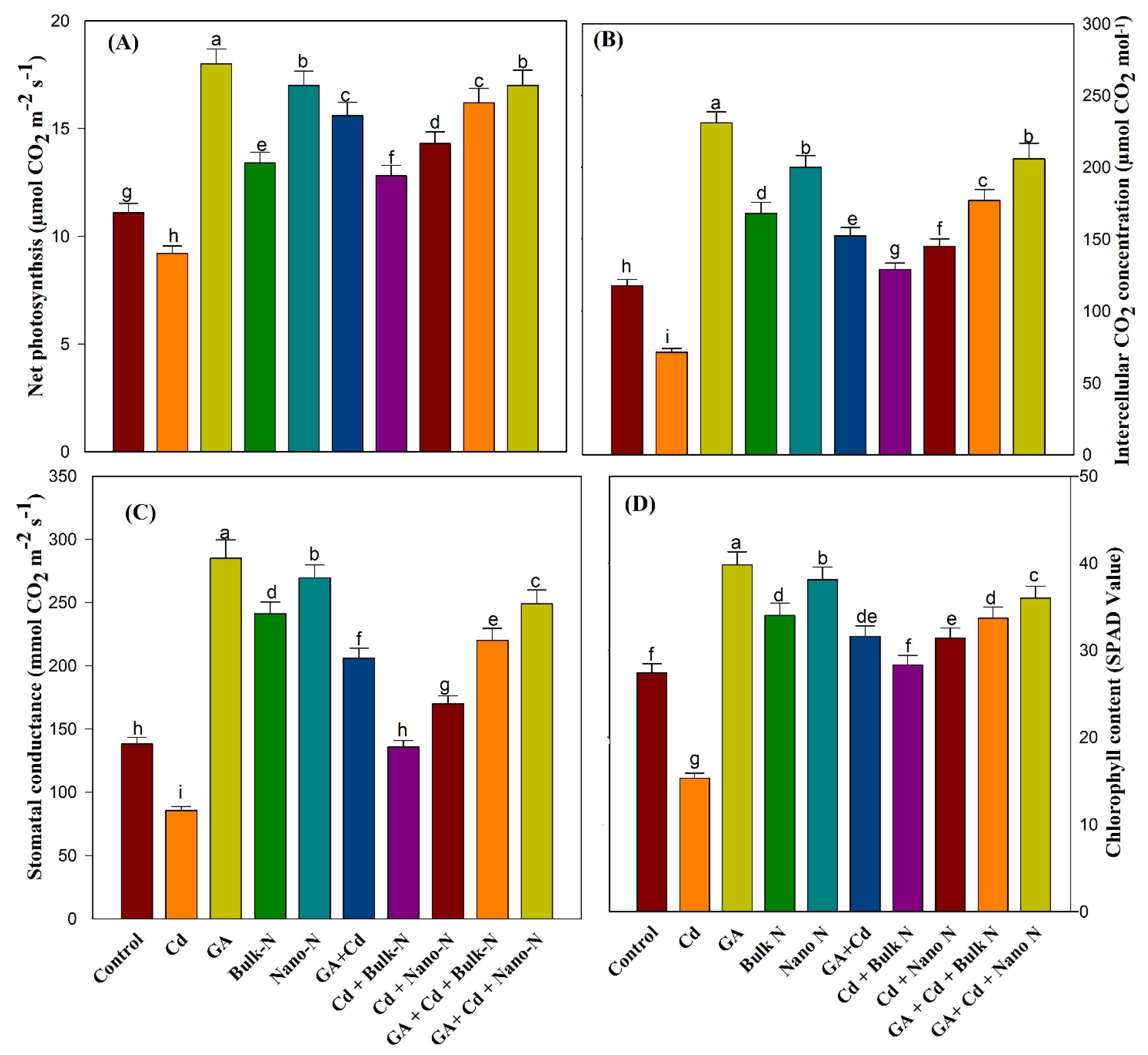
Figure 2.
Stomatal behaviour of mustard (Brassica juncea L. cv. Varuna) under Control (A); GA₃ (B); Cd (C); bulk-N (D); nano-N (E); Cd + bulk-N (F); Cd + nano-N (G); GA₃ + Cd (H); GA₃ + Cd + bulk-N (I); GA₃ + Cd + nano-N (J) at 30 d after sowing. The stomatal aperture was observed under a scanning electron microscope at 3000x magnification. Cd—cadmium; GA—gibberellic acid.
Figure 2.
Stomatal behaviour of mustard (Brassica juncea L. cv. Varuna) under Control (A); GA₃ (B); Cd (C); bulk-N (D); nano-N (E); Cd + bulk-N (F); Cd + nano-N (G); GA₃ + Cd (H); GA₃ + Cd + bulk-N (I); GA₃ + Cd + nano-N (J) at 30 d after sowing. The stomatal aperture was observed under a scanning electron microscope at 3000x magnification. Cd—cadmium; GA—gibberellic acid.
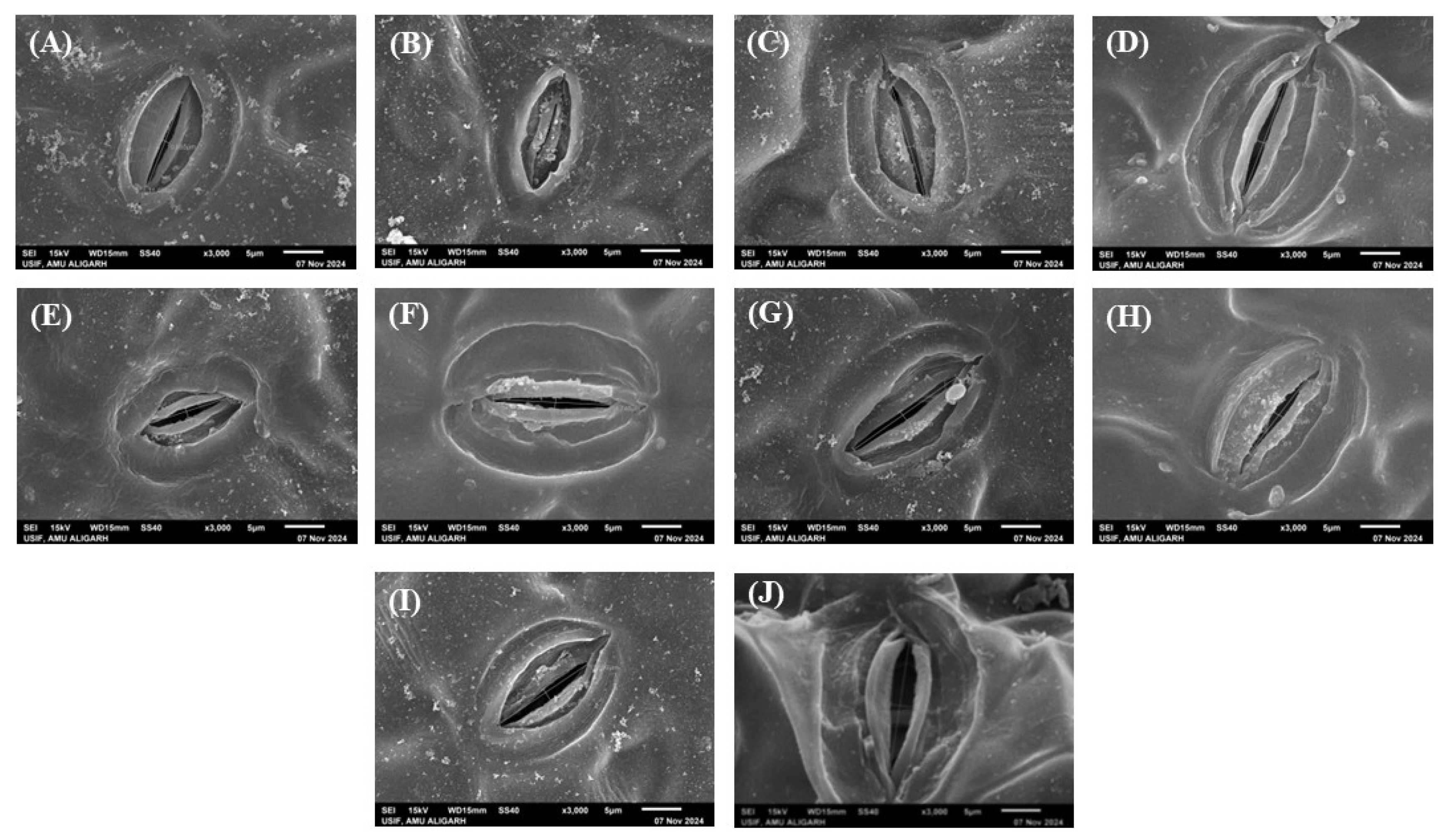
Figure 3.
Nitrate Reductase activity (A), nitrogen content (B), proline content (C), and glycine betaine content (D) in mustard (Brassica juncea L. cv. Varuna) treated with/without 200 mg Cd kg-1 soil and GA (Gibberellic acid; 10 µM), bulk-N (100 mg kg-1 soil), and nano-N (100 µL L-1) either singly or in combination at 30 d after sowing. Data are presented as treatment mean ± SD (n=4). Data followed by the same letter are not significantly different by the LSD test at P<0.05.
Figure 3.
Nitrate Reductase activity (A), nitrogen content (B), proline content (C), and glycine betaine content (D) in mustard (Brassica juncea L. cv. Varuna) treated with/without 200 mg Cd kg-1 soil and GA (Gibberellic acid; 10 µM), bulk-N (100 mg kg-1 soil), and nano-N (100 µL L-1) either singly or in combination at 30 d after sowing. Data are presented as treatment mean ± SD (n=4). Data followed by the same letter are not significantly different by the LSD test at P<0.05.
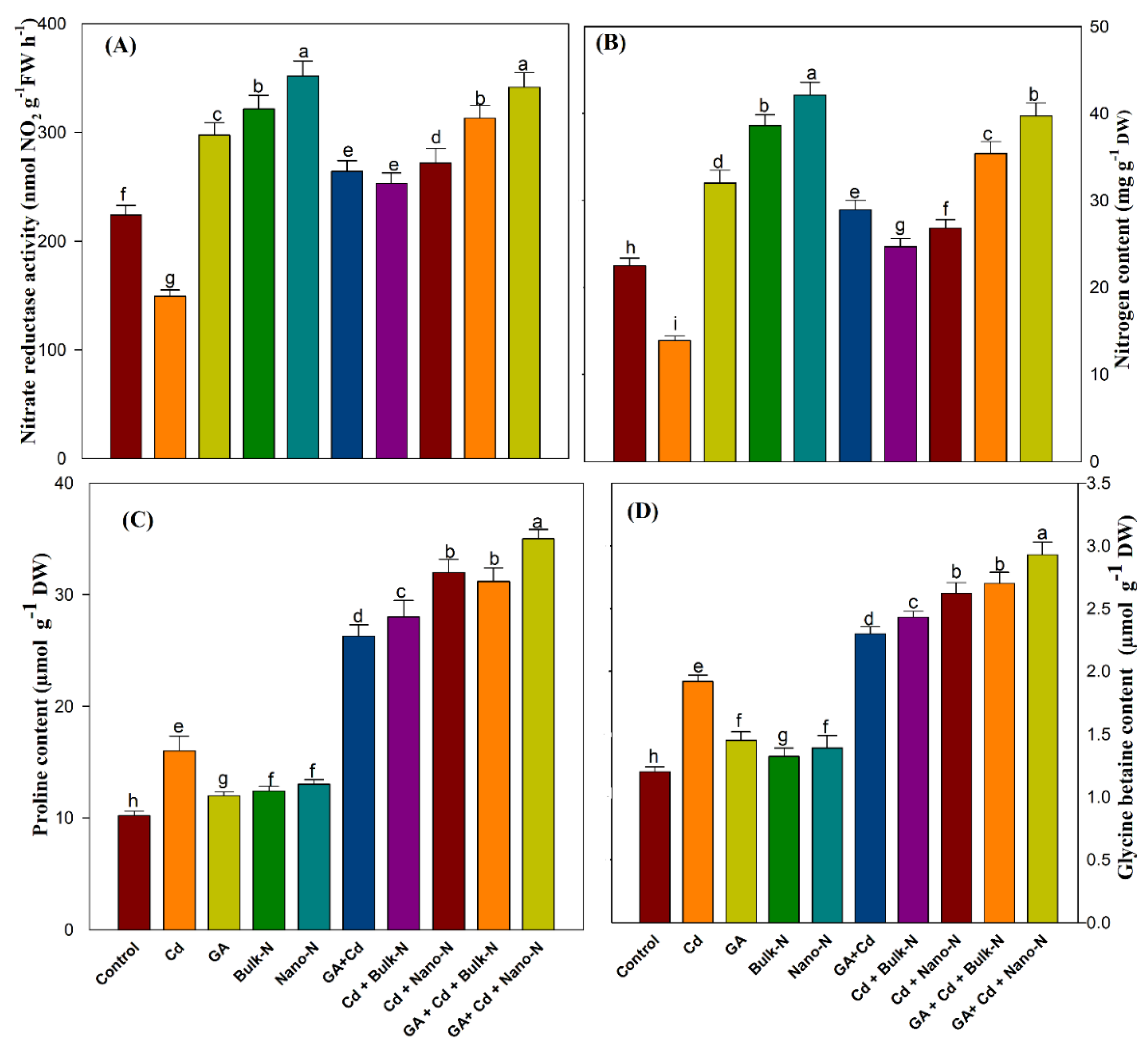
Figure 4.
Cadmium content in root (A), shoot (B), and leaves (C), and translocation index (D) in mustard (Brassica juncea L. cv. Varuna) treated with/without 200 mg Cd kg-1 soil and GA (Gibberellic acid; 10 µM), bulk-N (100 mg kg-1 soil), and nano-N (100 µL L-1) either singly or in combination at 30 d after sowing. Data are presented as treatment mean ± SD (n=4). Data followed by the same letter are not significantly different by the LSD test at P<0.05.
Figure 4.
Cadmium content in root (A), shoot (B), and leaves (C), and translocation index (D) in mustard (Brassica juncea L. cv. Varuna) treated with/without 200 mg Cd kg-1 soil and GA (Gibberellic acid; 10 µM), bulk-N (100 mg kg-1 soil), and nano-N (100 µL L-1) either singly or in combination at 30 d after sowing. Data are presented as treatment mean ± SD (n=4). Data followed by the same letter are not significantly different by the LSD test at P<0.05.
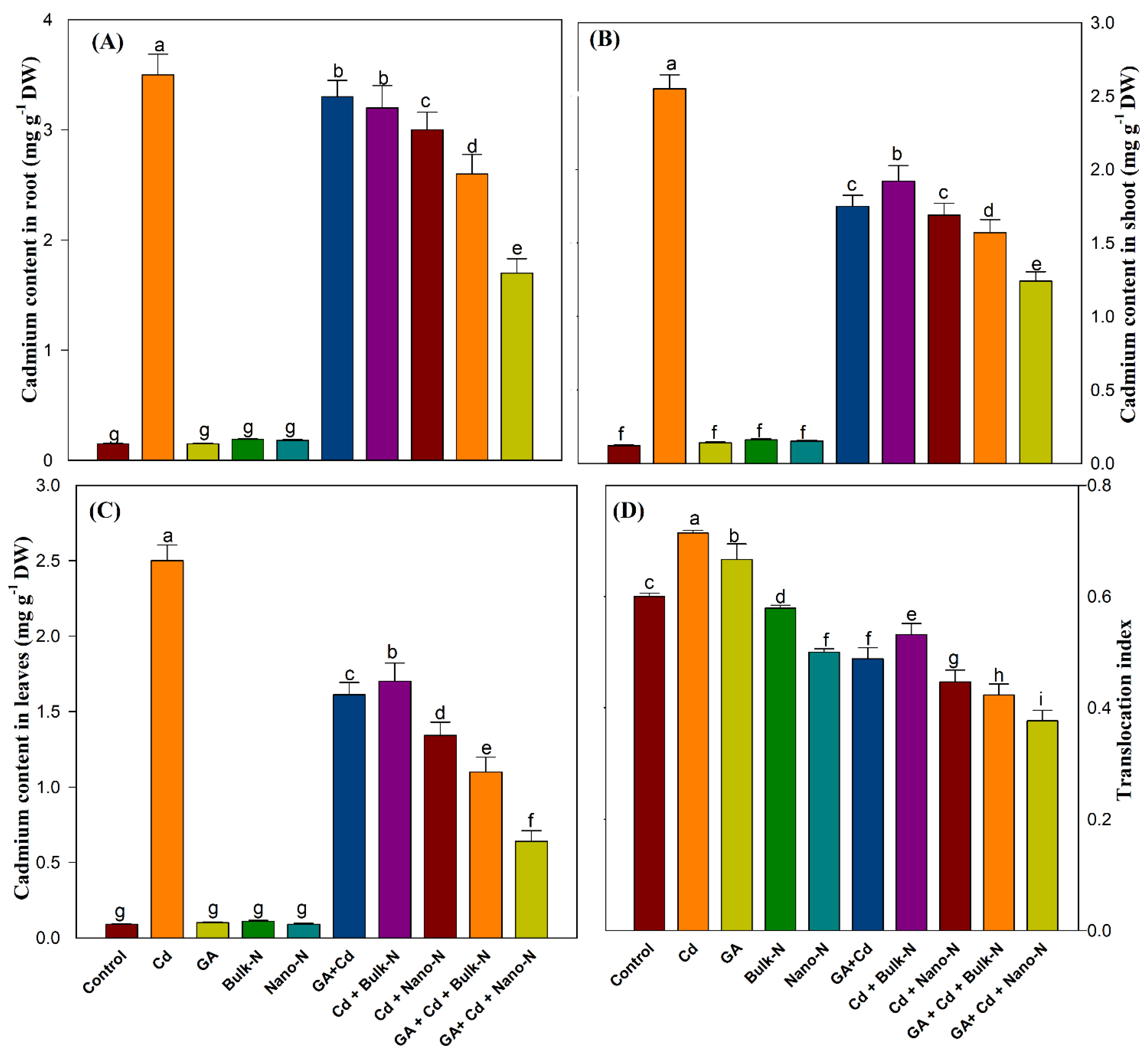
Figure 5.
The correlation between different parameters is shown in this correlation matrix with the node strength in mustard (Brassica juncea L. cv. Varuna) treated with/without 200 mg Cd kg-1 soil and GA (Gibberellic acid; 10 µM), Bulk-N (100 mg kg-1 soil), and Nano-N (100 µL L-1) either singly or in combination at 30 d after sowing. RL, root length; PN, net photosynthesis; NRA, nitrate reductase activity; SL, shoot length; LA, leaf area; GSH, reduced glutathione; SOD, superoxide dismutase;; APX, ascorbate peroxidase; Chl, chlorophyll; GR, glutathione reductase; PDM, plant dry mass; S, sulfur; Gs, stomatal conductance.
Figure 5.
The correlation between different parameters is shown in this correlation matrix with the node strength in mustard (Brassica juncea L. cv. Varuna) treated with/without 200 mg Cd kg-1 soil and GA (Gibberellic acid; 10 µM), Bulk-N (100 mg kg-1 soil), and Nano-N (100 µL L-1) either singly or in combination at 30 d after sowing. RL, root length; PN, net photosynthesis; NRA, nitrate reductase activity; SL, shoot length; LA, leaf area; GSH, reduced glutathione; SOD, superoxide dismutase;; APX, ascorbate peroxidase; Chl, chlorophyll; GR, glutathione reductase; PDM, plant dry mass; S, sulfur; Gs, stomatal conductance.
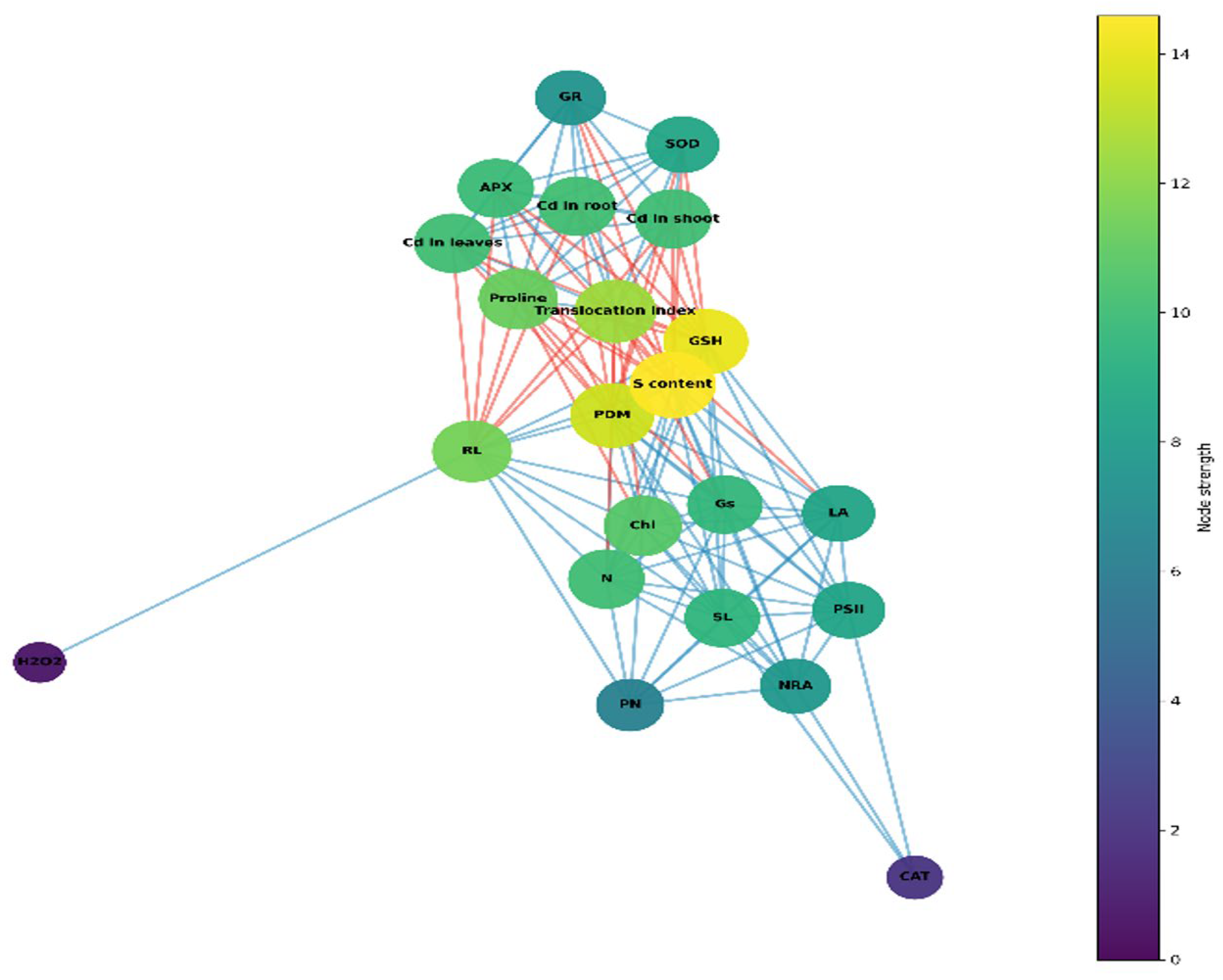
Figure 6.
Principal Component Analysis (PCA) in mustard (Brassica juncea L. cv. Varuna) treated with/without 200 mg Cd kg-1 soil Cd and GA (Gibberellic acid; 10 µM), Bulk-N (100 mg kg-1 soil), and Nano-N (100 µL L-1) either singly or in combination at 30 d after sowing.
Figure 6.
Principal Component Analysis (PCA) in mustard (Brassica juncea L. cv. Varuna) treated with/without 200 mg Cd kg-1 soil Cd and GA (Gibberellic acid; 10 µM), Bulk-N (100 mg kg-1 soil), and Nano-N (100 µL L-1) either singly or in combination at 30 d after sowing.
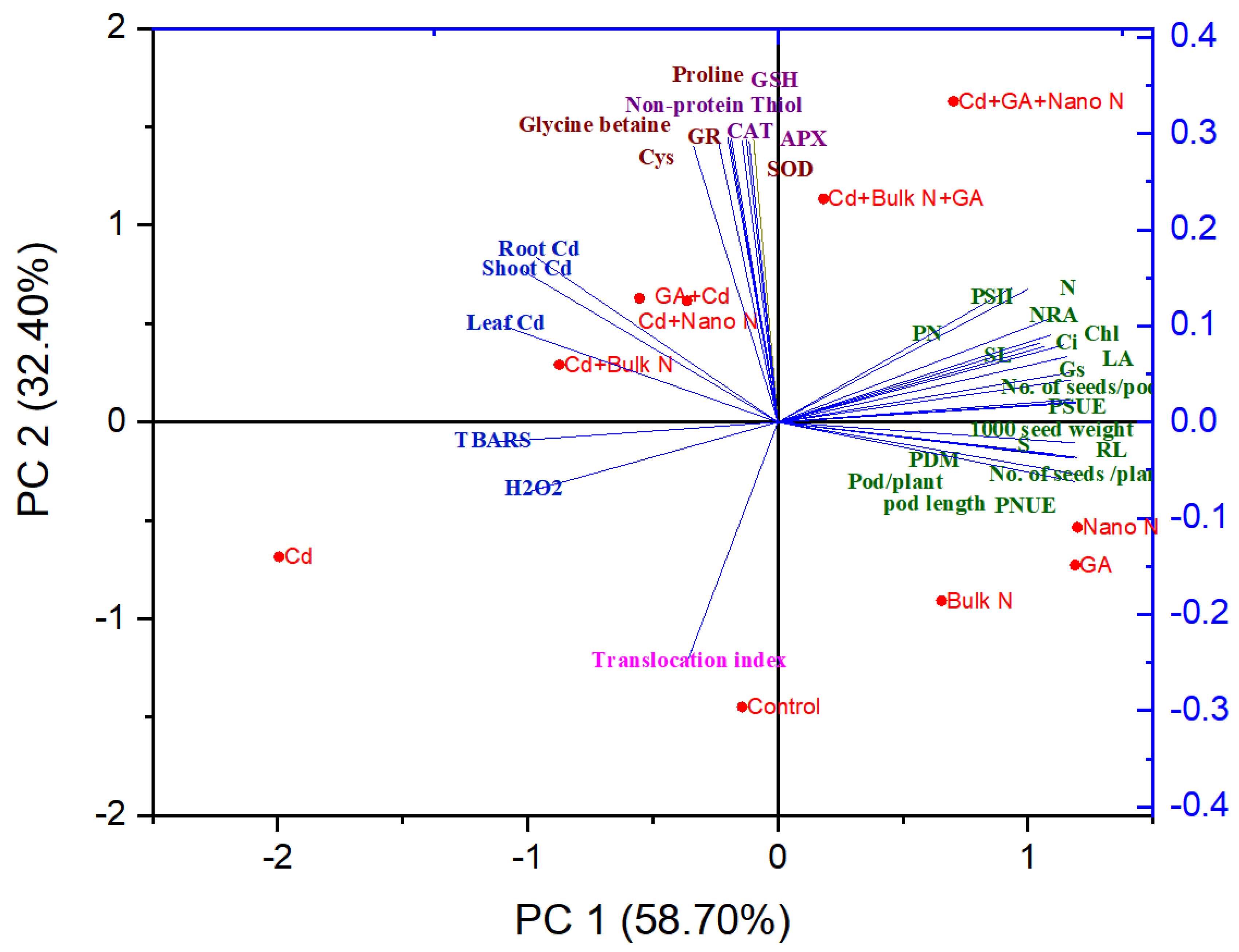
Figure 7.
Proposed mechanism illustrating the synergistic effects of gibberellic acid (GA₃) and nano-urea (Nano-N) in mitigating cadmium (Cd) toxicity. GA₃ enhances antioxidant defense and stress-responsive pathways, while Nano-N improves nitrogen uptake and assimilation. Their combined application promotes sulfur metabolism, proline accumulation, glutathione-mediated Cd detoxification through suppressing reactive oxygen species (ROS) and oxidative stress, and vacuolar sequestration, and ultimately improves plant tolerance to Cd stress.
Figure 7.
Proposed mechanism illustrating the synergistic effects of gibberellic acid (GA₃) and nano-urea (Nano-N) in mitigating cadmium (Cd) toxicity. GA₃ enhances antioxidant defense and stress-responsive pathways, while Nano-N improves nitrogen uptake and assimilation. Their combined application promotes sulfur metabolism, proline accumulation, glutathione-mediated Cd detoxification through suppressing reactive oxygen species (ROS) and oxidative stress, and vacuolar sequestration, and ultimately improves plant tolerance to Cd stress.
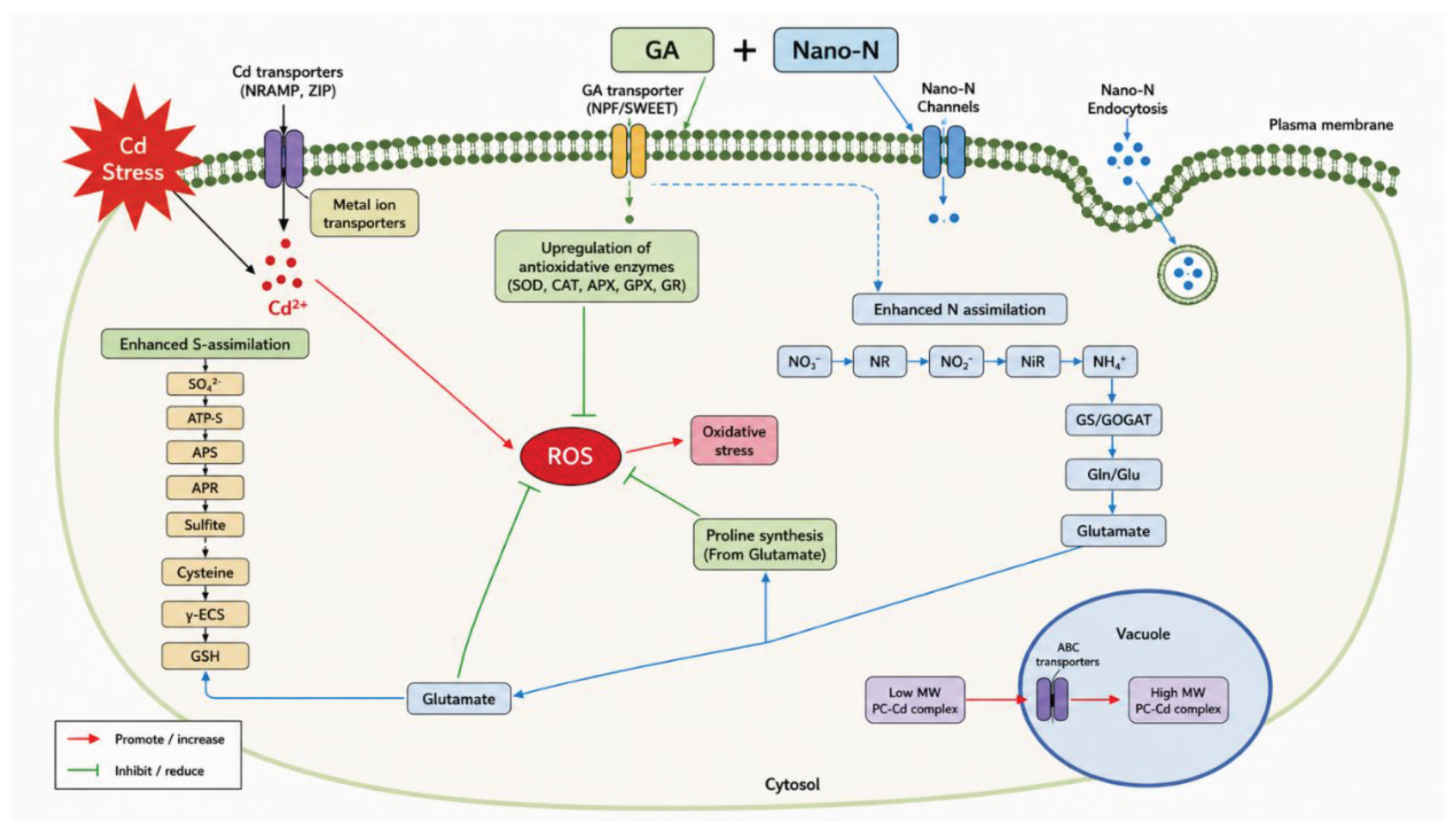

Table 1.
Root length, shoot length, leaf area, plant dry weight, photosynthetic sulfur use efficiency (PSUE), photosynthetic nitrogen use efficiency (PNUE) and sulfur (S) content in mustard (Brassica juncea cv. Varuna treated with/without 200 mg Cd kg-1 soil cadmium and GA (Gibberellic acid; 10 µM), bulk-N (100 mg kg-1) and nano-N (100 µL L-1) either singly or in combination at 30 DAS. Data are presented as treatment means ± SD (n=4). Data followed by the same letter are not significantly different by LSD test at P< 0.05.
Table 1.
Root length, shoot length, leaf area, plant dry weight, photosynthetic sulfur use efficiency (PSUE), photosynthetic nitrogen use efficiency (PNUE) and sulfur (S) content in mustard (Brassica juncea cv. Varuna treated with/without 200 mg Cd kg-1 soil cadmium and GA (Gibberellic acid; 10 µM), bulk-N (100 mg kg-1) and nano-N (100 µL L-1) either singly or in combination at 30 DAS. Data are presented as treatment means ± SD (n=4). Data followed by the same letter are not significantly different by LSD test at P< 0.05.
| Table | 2. | Shoot length (cm) |
Leaf area (cm2) |
Plant dry weight (g plant-1) |
PSUE (g m-2) |
PNUE (g m-2) |
S content (mg g-1 DW) |
|---|---|---|---|---|---|---|---|
| Control | 6.2 ± 0.23g | 11.7±0.44f | 117.3±4.47e | 2.47±0.09d | 17±0.82d | 23.4±1.06d | 6.0±0.19c |
| Cd | 3.8 ± 0.15i | 8.1±0.31g | 69.2±5.01g | 0.86±0.032h | 12±0.39h | 14.3±0.99h | 4.2±0.11f |
| GA | 15.4 ± 0.58a | 19.2±0.57a | 161.5±2.63a | 3.71±0.122b | 20±0.94a | 26.7±1.67c | 8.5±0.21a |
| Bulk-N | 11.5 ± 0.43c | 15.6±0.70c | 135.6±5.55c | 3.22±0.14c | 17.9±0.66d | 27.4±1.81b | 7.1±0.30b |
| Nano-N | 13.0 ± 0.49b | 18.4±0.74b | 145.8±6.16b | 3.87±0.18a | 18.7±0.97c | 28.9±1.89a | 8.2±0.42a |
| Cd + GA | 8.3 ± 0.31f | 15.8±0.60c | 97.5±4.55f | 1.99±0.75e | 16.4±0.71e | 21.2±1.05e | 5.7±0.17c |
| Cd + Bulk-N | 4.9 ± 0.18h | 12.9±0.49e | 102.5±5.01f | 1.31±0.04g | 13.7±0.42g | 18.1±1.09g | 4.8±0.13e |
| Cd + Nano-N | 5.2 ± 0.19h | 14.2±0.54d | 119.5±3.71e | 1.52±0.05f | 15.2±0.65f | 19.8±1.27f | 5.4±0.18d |
| Cd + GA + Bulk-N | 9.5 ± 0.36e | 16.2±0.61c | 129.7±5.71d | 2.34±0.89d | 17.8±0.88d | 21.6±1.77e | 6.3±0.20c |
| Cd + GA + Nano-N | 10.2 ± 0.38d | 17.5±0.66bc | 142.1±5.95c | 3.67±0.13b | 19.1±1.01b | 24.4±1.91d | 7.1±0.27b |
Table 2.
Activity of catalase, superoxide dismutase, ascorbate peroxidase, glutathione reductase, content of hydrogen peroxide (H2O2) and thiobarbituric acid reactive substances (TBARS) in mustard (Brassica juncea L. cv. Varuna) treated with/without 200 mg Cd kg-1 soil and GA (Gibberellic acid; 10 µM), bulk-N (100 mg kg-1 soil), and nano-N (100 µL L-1) either singly or in combination at 30 d after sowing. Data are presented as treatment mean ± SD (n=4). Data followed by same letter are not significantly different by the LSD test at P<0.05. by same letter are not significantly different by LSD test at P< 0.05.
Table 2.
Activity of catalase, superoxide dismutase, ascorbate peroxidase, glutathione reductase, content of hydrogen peroxide (H2O2) and thiobarbituric acid reactive substances (TBARS) in mustard (Brassica juncea L. cv. Varuna) treated with/without 200 mg Cd kg-1 soil and GA (Gibberellic acid; 10 µM), bulk-N (100 mg kg-1 soil), and nano-N (100 µL L-1) either singly or in combination at 30 d after sowing. Data are presented as treatment mean ± SD (n=4). Data followed by same letter are not significantly different by the LSD test at P<0.05. by same letter are not significantly different by LSD test at P< 0.05.
| Treatments | Catalase |
Superoxide dismutase |
Ascorbate peroxidase | Glutathione reductase | H2O2 content | TBARS content |
|---|---|---|---|---|---|---|
| (U mg-1 Protein min-1) | (nmol g-1FW) | |||||
| Control | 151±09.22h | 08.53±0.23h | 2.45±0.17j | 2.19±0.152h | 12.4±1.32c | 10.7±1.65e |
| Cd | 212±10.99g | 14.61±0.58g | 3.60±0.12k | 3.24±0.177f | 27.3±4.21a | 29.0±3.93a |
| GA | 245±14.44e | 12.53±0.78e | 2.81±0.22g | 2.31±0.312g | 10.6±1.5f | 08.6±2.21g |
| Bulk-N | 218±15.89f | 12.01±0.51g | 2.55±0.21i | 2.22±0.342gh | 11.5±1.13de | 09.5±2.72f |
| Nano-N | 232±15.41e | 13.08±0.89f | 2.65±0.17h | 2.45±0.187f | 10.4±1.09f | 08.4±1.54g |
| Cd + GA | 276±16.31c | 17.72±0.72c | 5.80±0.62c | 5.33±0.761c | 13.9±1.78c | 18.2±3.42c |
| Cd + Bulk-N | 258±15.60d | 15.60±0.99e | 4.30±0.41e | 4.36±0.821e | 16.7±1.99b | 23.2±3.85b |
| Cd + Nano-N | 289±16.82c | 16.83±0.47d | 5.42±0.73d | 4.94±0.884d | 12.8±2.11c | 17.0±2.91d |
| Cd + GA + Bulk-N | 314±18.00b | 19.22±0.85b | 6.74±0.87b | 6.38±0.967b | 11.9±1.38d | 11.1±1.82e |
| Cd+ GA+ Nano-N | 341±18.74a | 21.40±0.88a | 7.65±0.90a | 7.42±0.998a | 09.1±0.79g | 08.1±0.97g |
Table 3.
Number of pods, pod length, number of seeds per pod , number seeds per plant and 1000-seed weight in mustard (Brassica juncea L. cv. Varuna) treated with/without 200 mg Cd kg-1 soil and GA (Gibberellic acid; 10 µM), bulk-N (100 mg kg-1 soil), and nano-N (100 µL L-1) either singly or in combination at 30 d after sowing. Data are presented as treatment mean ± SD (n=4). Data followed by same letter are not significantly different by the LSD test at P<0.05.
Table 3.
Number of pods, pod length, number of seeds per pod , number seeds per plant and 1000-seed weight in mustard (Brassica juncea L. cv. Varuna) treated with/without 200 mg Cd kg-1 soil and GA (Gibberellic acid; 10 µM), bulk-N (100 mg kg-1 soil), and nano-N (100 µL L-1) either singly or in combination at 30 d after sowing. Data are presented as treatment mean ± SD (n=4). Data followed by same letter are not significantly different by the LSD test at P<0.05.
| Treatment | Pods per plant | Pod length (cm) | Seeds per pod | Seeds per plant | 1000-seed weight (g) | |
|---|---|---|---|---|---|---|
| Control | 60.1±5.09d | 3.9±0.497f | 20.7±3.91d | 1236±31.5d | 8.97±1.28d | |
| Cd | 41.2±6.876h | 2.53±0.392h | 16.7±2.63f | 849±27.5h | 6.86±0.69g | |
| GA | 78.8±8.602a | 4.67±0.673a | 28.0±2.76a | 1404±24.9a | 12.3±0.96a | |
| Bulk-N | 70.2±7.134 b | 4.20±0.4510c | 23.13±1.68c | 1309±23.7c | 9.69±1.00c | |
| Nano-N | 80.5±5.312a | 4.51±0.604b | 26.7±2.91b | 1399±14.6b | 10.93±1.12b | |
| Cd + GA | 55.1±5.876e | 3.40±0.404g | 20.3±2.31d | 1098±12.4e | 8.82±0.99d | |
| Cd + Bulk-N | 48.0±2.341g | 3.23±0.314h | 18.9±1.82e | 904±11.2g | 7.67±0.48f | |
| Cd + Nano-N | 53.2±4.104ef | 3.80±0.423f | 21.6±3.23d | 996±11.7f | 8.46±0.69de | |
| Cd + GA + Bulk-N | 59.1±5.089d | 4.23±0.304e | 24.2±4.12c | 1221±30.4d | 9.94±0.96c | |
| Cd + GA + Nano-N | 67.7±6.634c | 4.41±0.604d | 26.2±4.18b | 1318±31.7c | 11.13±1.28b |
Disclaimer/Publisher’s Note: The statements, opinions and data contained in all publications are solely those of the individual author(s) and contributor(s) and not of MDPI and/or the editor(s). MDPI and/or the editor(s) disclaim responsibility for any injury to people or property resulting from any ideas, methods, instructions or products referred to in the content. |
© 2026 by the authors. Licensee MDPI, Basel, Switzerland. This article is an open access article distributed under the terms and conditions of the Creative Commons Attribution (CC BY) license (http://creativecommons.org/licenses/by/4.0/).
Copyright: This open access article is published under a Creative Commons CC BY 4.0 license, which permit the free download, distribution, and reuse, provided that the author and preprint are cited in any reuse.


