
Submitted:
04 July 2026
Posted:
06 July 2026
You are already at the latest version
Abstract
(1)Rapid urbanization in China has led millions of rural children to be left behind by parents migrating for work, and previous research suggests that parent–child separation may increase the risk of mobile phone dependence (MPD) among left‑behind children; however, the mediating role of social anxiety (SA) and the buffering role of school connectedness (SC) in the links between father–child estrangement (FCE), mother–child estrangement (MCE), and MPD remain underexplored. (2)To address this, two waves of questionnaire data were collected one year apart from 283 left‑behind junior high school students in a rural area of a central Chinese province (mean age = 13.18, SD = 0.81; 127 boys, 156 girls), and longitudinal data were used to examine whether T1 FCE and T1 MCE predict T2 MPD, whether SA mediates these relationships, and whether SC moderates the direct or indirect pathways. (3)The results showed that both T1 FCE (β = 0.16, p = .007) and T1 MCE (β = 0.11, p = .049) positively predicted T2 MPD, and social anxiety fully mediated both pathways (indirect effects = 0.10 and 0.11, 95% CIs [0.02, 0.10] and [0.04, 0.19]); school connectedness significantly moderated only the MCE pathway (β = −0.09, p = .043): the SA–MPD link was weaker for students with higher SC, though it remained significant. (4)In conclusion, for left‑behind children experiencing mother–child estrangement, strengthening school connectedness may help buffer the risk of mobile phone dependence via social anxiety; however, for those with father–child estrangement, school support alone appears insufficient, and family‑level interventions may be necessary to reduce MPD risk.
Keywords:
parent–child estrangement
; mobile phone dependence
; social anxiety
; school connectedness
; left-behind children
1. Introduction
Rapid urbanization in China has triggered massive internal migration. An estimated 41.77 million rural children—about 38% of the rural child population—now live apart from one or both parents who work in cities (National Bureau of Statistics of China et al., 2023). This family separation, driven largely by economic necessity and household registration policy, puts rural left-behind adolescents at greater risk for both internalizing and externalizing problems (Hu et al., 2018). For school-based mental health services, this is an equity issue: these students often have the greatest need but the least access to support.
Mobile phone dependence (MPD), also termed mobile phone addiction or problematic mobile phone use, is characterized by intense and persistent cravings for and reliance on mobile phones, which can lead to physiological, psychological, and social dysfunction (Peng et al., 2024). According to the 55th Statistical Report on Internet Development in China, as of December 2024, the proportion of Chinese netizens accessing the Internet via mobile phones reached 99.7%. Among them, adolescent netizens accounted for 49%, showing a year-by-year increasing trend (Zhou et al., 2022; Liu & Liu, 2021). Previous research has found that rural left-behind junior high school students exhibit higher levels of interpersonal distress and social anxiety, alongside relatively prominent issues of mobile phone dependence (Chu et al., 2023), which seriously affect their academic performance and physical and mental health. Because school is often the most stable environment in their lives, school psychologists can play a key role in early identification and prevention. Yet we still know little about how paternal versus maternal estrangement translates into MPD, which limits what interventions we can design. The present study uses attachment and social development theory to test social anxiety as a mediator and school connectedness as a moderator, hoping to inform school-based prevention that fits this population's specific needs.
1.1. Parent-Child Estrangement and Mobile phone dependence
Family is the most important environment for individual early development, and its emotional support function plays a key role in individual development. Studies have found that low-quality parent–child attachment plays an important precipitating role in mobile phone dependence (Liese et al., 2020). Parent–child estrangement—a concentrated manifestation of low-quality parent–child attachment—refers to the emotional alienation between parents and children (Harrison, 2009), and it may significantly predict mobile phone dependence in left-behind children (Chen et al., 2019). Based on attachment theory, when parents meet children's attachment needs and establish intimate parent–child relationships and good communication, children develop positive internal working models that protect against mobile phone dependence (Xiang et al., 2022). Conversely, when the establishment of the individual's internal "secure base" is hindered, adolescents may use smartphones as emotional compensation tools to fill the psychological needs unmet by parents.
Previous research has confirmed that alienation can effectively predict instant messaging addiction (Huang & Leung, 2009); that is, the higher the degree of alienation, the more likely it is to trigger mobile phone dependence (Chen et al., 2021). Previous studies have typically treated parent–child attachment as a unitary variable (Chen et al., 2015); however, father–child and mother–child attachments exert differential effects on adolescent adjustment (Ribeiro et al., 2021). Studies have shown that, compared with mother–child attachment, father–child attachment is a stronger predictor of children's anxiety levels (Li et al., 2015). Therefore, the present study will explore the influence paths of father–child estrangement and mother–child estrangement on mobile phone dependence among left-behind junior high school students. Based on this, we propose H1: Both father–child estrangement and mother–child estrangement will positively predict mobile phone dependence among rural left-behind junior high school students.
1.2. The Mediating Role of Social Anxiety
Social anxiety refers to individuals' feelings of tension and worry resulting from fear of negative evaluation by others, accompanied by avoidance behaviors (Lee-Won et al., 2015). Existing research has shown that emotional estrangement between parents and children increases the likelihood of social anxiety in left-behind children (Karasewich & Kuhlmeier, 2020). This is because when primary caregivers fail to meet children's emotional needs, children will doubt their own existential value and experience reduced self-confidence (Erikson, 1993), thereby refusing to initiate social interactions with others. Meanwhile, numerous empirical studies have shown that social anxiety predicts Internet addiction (Kim & Koh, 2018; Ding et al., 2016). According to compensatory Internet use theory, individuals seek to escape real-life problems and therefore choose the Internet as a means of self-compensation; excessive Internet use may alleviate social anxiety, but it may also increase the risk of mobile phone dependence. Studies have shown that when adolescents have higher levels of social anxiety, they are more likely to develop mobile phone dependence (Darcin et al., 2015; Yang et al., 2022). Therefore, this study proposes Hypothesis 2: Social anxiety will mediate the relationship between parent–child estrangement and mobile phone dependence among rural left-behind junior high school students.
1.3. The Moderating Role of School Connectedness
School connectedness reflects individuals' sense of belonging and identity at school, as well as the degree of emotional connection with teachers and peers. The social development model (Kim, 2016) posits that perceived connections with parents, school, peers, and community, along with positive socialization experiences, can effectively prevent adolescent problem behaviors. Research has shown that both peer support and teacher support in school can effectively reduce the occurrence of adolescent problem behaviors (Zhang et al., 2021). School connectedness can not only reduce adolescents' social anxiety levels (Pikulski et al., 2020), but also predict lower risk of mobile phone dependence (You et al., 2019). Specifically, compared with adolescents with low school connectedness, adolescents with high school connectedness are more confident in interpersonal interactions and have lower social anxiety, thus the effect of weakening mobile phone dependence may be stronger. Research has shown that school connectedness moderates the relationship between social anxiety and problematic social network use (Xiang, 2022). Based on this, this study proposes H3: School connectedness may moderate the relationship between social anxiety and mobile phone dependence among rural left-behind junior high school students.
In summary, this study separately examined the effects of FCE and MCE on MPD among rural left-behind junior high school students, constructing a moderated mediation model to test the mediating role of SA and the moderating role of SC.
2. Materials and Methods
2.1. Participants
We collected data from a public junior high school (Grades 7–8) located in a rural area of a certain province in central China. Research assistants administered paper questionnaires in classrooms at two points one year apart: December 2024 (T1) and December 2025 (T2). At T1, 896 students completed surveys, including 398 left-behind children. At T2, 630 students returned surveys; of these, 283 left-behind children could be matched using student IDs. After dropping incomplete responses, the final sample was 283 left-behind adolescents (mean age = 13.18, SD = 0.81; 127 boys [44.8%], 156girls [55.2%]). Most (177, 62.5%) had fathers working outside, a small number (4,1.4%) had mothers working outside, and 23 (8.1%) had both parents away.
Additionally, following the methodology of previous studies (Hu et al., 2023), an independent-samples t-test was conducted to compare social anxiety at T1 between participants who dropped out and those who were successfully tracked. The results indicated no significant difference (t = –1.834, p > .05), suggesting that attrition in this study was not systematic.The ethics review board approved the study, legal guardians gave informed consent, and students gave verbal assent at both waves.
2.2. Measures
2.2.1. Parent-Child Attachment Scale
The parent attachment subscale from the short form of the Inventory of Parent and Peer Attachment (IPPA; Armsden & Greenberg, 1987), revised by Wang (2007), was used. The subscale contains 20 items covering three dimensions—trust, communication, and alienation—rated on a 5-point Likert scale (1 = completely disagree, 5 = completely agree). This study used only the 6-item alienation dimension from both the father and mother subscales to assess FCE and MCE. Higher scores indicate greater estrangement. A sample item is, “I do not get much attention from my mother.” In this study, Cronbach’s α for the alienation dimension was .89 at T1 and .86 at T2.
2.2.2. Mobile Phone Dependence Scale
The Mobile Phone Addiction Index (MPAI; Leung, 2008), adapted from Bianchi and Phillips’s (2005) Mobile Phone Problem Use Scale, was used. The 17-item scale measures four dimensions: loss of control, withdrawal, escapism, and inefficiency, rated on a 5-point Likert scale (1 = never, 5 = always). Higher total scores indicate greater MPD. A sample item is, “You have been told that you spend too much time on your mobile phone.” Cronbach’s α was .91 at T1 and .91 at T2.
2.2.3. Social Anxiety Scale
The Social Anxiety Scale for Adolescents (SAS-A; La Greca & Lopez, 1998), revised by Zhu (2008), was used. This 13-item scale assesses fear of negative evaluation, social avoidance and distress in new situations, and social avoidance and distress in general situations, rated on a 5-point Likert scale (1 = completely disagree, 5 = completely agree). A sample item is, “I feel shy when I am with strangers.” Cronbach’s α was .93 at T1 and .91 at T2.
2.2.4. School Connectedness Scale
The School Connectedness Scale (Yu et al., 2017) was used. This 10-item scale measures teacher support, peer support, and school belonging on a 5-point Likert scale (1 = completely disagree, 5 = completely agree). Higher scores indicate greater SC. A sample item is, “When I have difficulties, I can rely on my classmates.” Cronbach’s α was .85 at T1 and .83 at T2.
2.3. Data Analysis
We used SPSS 27.0 for all analyses. Harman's single-factor test checked for common method bias. Because predictors, mediators, and outcomes were measured at different time points, procedural separation already reduced CMB risk (Podsakoff et al., 2003). We then computed descriptive statistics and Pearson correlations. To test mediation and moderated mediation, we used Hayes's (2018) PROCESS macro (Model 4 and Model 14, respectively). Indirect effects were evaluated with bias-corrected bootstrap 95% CIs based on 5,000 resamples. Significant interactions were probed using the Johnson–Neyman technique.
3. Results
This section may be divided by subheadings. It should provide a concise and precise description of the experimental results, their interpretation, as well as the experimental conclusions that can be drawn.
3.1. Common Method Bias Test
As this study primarily collected data using questionnaires, Harman's single-factor test was employed to examine common method bias for both waves of data. The results showed that there were 9 factors with eigenvalues greater than 1 at T1, and the first factor explained 25.93% of the variance; at T2, there were 10 factors with eigenvalues greater than 1, and the first major factor explained 26.72% of the variance. The explained variance of the first factor for both waves of data was below the critical standard of 40%. Therefore, this study did not have a serious common method bias problem in either T1 or T2 data.
3.2. Correlation Analysis
In this study, the absolute values of skewness and kurtosis for all variables were below 2.0 (see Table 1), suggesting acceptable normality (Hancock & Mueller, 2010). Correlation analysis (see Table 2) showed that father–child estrangement, mother–child estrangement, social anxiety, and mobile phone dependence were all significantly positively correlated with each other at both T1 and T2. Meanwhile, school connectedness at T1 and T2 was significantly negatively correlated with all of the above variables.
3.3. Moderated Mediation Model Test
3.3.1. The Relationship Between Father-Child Estrangement and Mobile Phone Dependence: Moderated Mediation Model Test
A moderated mediation model was tested with T1 FCE as the predictor, T2 SA as the mediator, T1 SC as the moderator, and T2 MPD as the outcome, controlling for gender and grade. As shown in Table 3 (Equations 1–3), T1 FCE positively predicted T2 MPD (β = 0.16, SE = 0.06, t = 2.70, p = .007) and T2 SA (β = 0.19, SE = 0.06, t = 3.35, p < .001). When T2 SA was entered, the direct effect of T1 FCE on T2 MPD became nonsignificant (β = 0.06, SE = 0.05, t = 1.13, p = .26), whereas T2 SA significantly predicted T2 MPD (β = 0.51, SE = 0.05, t = 9.86, p < .001). The bias-corrected bootstrap test (5,000 resamples) indicated a significant indirect effect of T1 FCE on T2 MPD via T2 SA (effect = 0.10, SE = 0.03, 95% CI [0.02, 0.10]), supporting full mediation.
To test moderation, the T2 SA × T1 SC interaction was added (Equation 4). The interaction did not significantly predict T2 MPD (β = -0.09, SE = 0.05, t = -1.90, p = .11). The index of moderated mediation was -0.02 (95% CI [-0.04, 0.00]), containing zero; thus, moderated mediation was not supported in the FCE pathway.
3.3.2. The Relationship Between Mother-Child Estrangement and Mobile Phone Dependence: Moderated Mediation Model Test
In this study, a moderated mediation model was constructed with T1 mother–child estrangement (MCE) as the independent variable, T2 social anxiety (SA) as the mediator, T1 school connectedness (SC) as the moderator, and T2 mobile phone dependence (MPD) as the dependent variable. Mediation effects were tested using Model 4 of Hayes's (2018) PROCESS macro for SPSS. As shown in Equations 1–3 in Table 4, T1 MCE positively predicted both T2 MPD and T2 SA. After entering the mediator T2 SA, the direct effect of T1 MCE on T2 MPD became nonsignificant, whereas T2 SA significantly and positively predicted T2 MPD. Results from the bias-corrected bootstrap method indicated that the mediating effect of T2 SA was significant, with an indirect effect of 0.11 (SE = 0.04) and a 95% confidence interval of [0.04, 0.19] that did not contain zero. This suggests that T1 MCE exerts a significant indirect effect on T2 MPD through the full mediation of T2 SA.
To test the moderating effect of T1 school connectedness on the latter stage of the indirect effect of T1 mother-child estrangement on T2 mobile phone dependence via T2 social anxiety, Model 14 of PROCESS was used. The results are shown in Equation 4 in Table 4: The interaction term of T2 social anxiety and T1 school connectedness significantly predicted T2 mobile phone dependence, indicating that T1 school connectedness significantly moderated the relationship between T2 social anxiety and T2 mobile phone dependence. The index of moderated mediation was −0.02, with a confidence interval of [−0.18, −0.03], which did not contain 0, indicating that the moderated mediation effect was significant.
To illustrate the moderating effect of SC, simple slope analyses were conducted at high (+1 SD) and low (−1 SD) levels of T1 SC. As shown in Figure 1, when SC was low, T2 SA significantly positively predicted T2 MPD (bsimple = 0.57, p < .001); when SC was high, the positive predictive effect of T2 SA on T2 MPD was attenuated but remained significant (bsimple = 0.39, p < .001). Thus, higher SC weakened the SA→MPD link in the MCE pathway.
Because dichotomizing continuous moderators can lose information, the Johnson–Neyman technique was applied. Across the observed range of T1 SC (approximately −3.35 to +1.69 SDs), the conditional effect of T2 SA on T2 MPD was significant (p < .05) at all values. As SC increased, the conditional effect gradually decreased (see Figure 2).
4. Discussion
4.1. Parent-Child Estrangement and Mobile Phone Dependence
This study found that both T1 FCE and T1 MCE predicted T2 MPD, supporting H1. This fits with prior work showing that parent–child emotional alienation is a risk factor for MPD in left-behind children (Zhou et al., 2021). Compensatory satisfaction theory offers a straightforward explanation: smartphones provide immediate emotional gratification—virtual contact, entertainment, attention—that can substitute for an absent parental bond (Yu et al., 2012; Gao & Chen, 2006). What stands out is that FCE and MCE had similarly sized effects. Both parents matter. For school psychologists, this means MPD screening in rural schools should ask about relationship quality with both mother and father, not just screen time.
4.2. The Mediating Role of Social Anxiety
SA fully mediated both the FCE→MPD and MCE→MPD links, supporting H2. One way to read this is through attachment theory: estrangement damages children's internal working models, making them doubt their own worth and fear negative evaluation from peers (Wang et al., 2017). That fear manifests as SA. To get away from it, left-behind adolescents turn to smartphones, where anonymous interaction feels safer (Kim & Koh, 2018; Liu et al., 2017). The problem is that this escape route quickly becomes a dependency.
Because the estrangement→anxiety→dependence chain looks similar for both FCE and MCE, school-based programs might usefully target SA directly—through social skills groups, anxiety management, or structured peer activities—rather than waiting for family reunion to solve the problem.
4.3. The Moderating Role of School Connectedness
SC moderated the SA→MPD link for maternal estrangement but not for paternal estrangement. When mother–child bonds are strained, a connected school environment—supportive teachers, accepting peers—can serve as an alternative secure base, reducing the need to seek emotional refuge in smartphones (Catalano et al., 2004; Zhang et al., 2021). School belonging seems to compensate for what is missing at home.
But this compensation did not work for father–child estrangement. We suspect this reflects the different roles fathers and mothers typically play. Fathers often act as playmates and exploration coaches, building children's self-efficacy (Paquette, 2004). When that bond is broken by long-term labor migration, the damage to self-esteem and social confidence may run too deep for school peer support to fix. In traditional Chinese families, fathers also tend to be more emotionally reserved; their physical absence plus limited expression may create a more unstable family climate than maternal absence alone. SC is a valuable resource, but it cannot rebuild the basic trust and self-efficacy that paternal estrangement undermines.
4.4. Implications for School Psychology Practice
The findings carry direct implications for school-based prevention and intervention with a marginalized population. First, MPD assessments should include questions about parent–child estrangement and SA, not just hours online. Dependence behaviors often reflect attachment problems rather than poor self-control. Second, the different moderation patterns call for different interventions. For students with MCE, boosting SC is a practical strategy: peer support groups, teacher mentorship, and school-wide belonging initiatives can weaken the anxiety–dependence link. For students with FCE, SC alone is not enough. Schools may need to partner with community organizations to bring in male mentors or set up structured father-involvement programs—scheduled video calls, online parenting workshops—to rebuild the paternal bond alongside school support. Third, at the policy level, MPD prevention should sit within mental health services, not disciplinary codes. Because left-behind status is produced by large-scale migration policy, school mental health services need an equity lens to reach the students who need them most.
4.5. Limitations and Future Directions
This study has several limitations that should be addressed in future research. First, this study collected data at only two time points, which may result in the loss of some information when constructing the moderated mediation model. Future research could explore causal relationships among variables using three-wave longitudinal data or experimental methods. Second, this study separately examined the effects of Father-child estrangement and Mother-child estrangement on Mobile phone dependence and their mechanisms, and the results indicated that different attachment relationships may have different mechanisms affecting Social anxiety. Future research could explore the internal mechanisms through which Father-child estrangement and Mother-child estrangement influence Social anxiety, as well as other moderating variables beyond school connectedness. Finally, this study used self-report methods to collect data, and because Mobile phone dependence is a negative event, the measured levels of Mobile phone dependence may be lower than actual levels. Future research could collect data from multiple perspectives to obtain more objective results.
5. Conclusions
In this two-wave study of rural left-behind junior high school students, both father–child and mother–child estrangement predicted later mobile phone dependence, with SA fully explaining both links. SC only buffered the maternal pathway. For school psychologists, the message is practical but nuanced: strengthening school connectedness helps when mother–child bonds are weak, but father–child estrangement demands family-level intervention that school support cannot replace.
Author Contributions
Conceptualization, Lihong Liu and Yuzhou Han.; methodology, Lihong Liu and Yuzhou Han., software, Lihong Liu and Yuzhou Han.; validation, Lihong Liu and Yuzhou Han.; investigation, Lihong Liu and Yuzhou Han., resources, Lihong Liu.,Yuzhou Han and Liuhong Yang.,data curation, Lihong Liu.,Yuzhou Han.; writing—original draft preparation, Yuzhou Han.; writing—review and editing, Lihong Liu.and Liuhong Yang; visualization, Lihong Liu.; supervision, Lihong Liu and Liuhong Yang.; project administration, Lihong Liu and Liuhong Yang., All authors have read and agreed to the published version of the manuscript.”
Funding
This research received no specific grant from any funding agency in the public, commercial, or not-for-profit sectors.
Institutional Review Board Statement
The study was conducted in accordance with the Declaration of Helsinki, and approved by the Ethics Committee of Shanxi University (protocol code SXULL2022065, June 18, 2022).
Informed Consent Statement
Informed consent was obtained from all subjects involved in the study.
Conflicts of Interest
The funders had no role in the design of the study; in the collection, analyses, or interpretation of data; in the writing of the manuscript; or in the decision to publish the results.
References
- Armsden; Greenberg; Armsden, G. C.; Greenberg, M. T. The inventory of parent and peer attachment: Individual differences and their relationship to psychological well-being in adolescence. J. Youth Adolesc. 1987, 16(5), 427–454. [Google Scholar] [CrossRef] [PubMed]
- Bianchi; Phillips; Bianchi, A.; Phillips, J. G. Psychological predictors of problem mobile phone use. CyberPsychology Behav. 2005, 8(1), 39–51. [Google Scholar] [CrossRef] [PubMed]
- Catalano; Catalano, R. F.; Oesterle, S.; Fleming, C. B.; Hawkins, J. D.; et al. The importance of bonding to school for healthy development: Findings from the Social Development Research Group. J. Sch. Health 2004, 74(7), 252–261. [Google Scholar] [CrossRef] [PubMed]
- Chen; Chen, W.; Li, D. P.; Bao, Z. Z.; Yan, Y. W.; Zhou, Z. K.; et al. Parent-child attachment and adolescents' problematic Internet use: A moderated mediation model [In Chinese]. Acta Psychol. Sin. 2015, 47(5), 611–623. [Google Scholar]
- Chen; Chen, W. F.; Zhang, D. J.; Liu, J. S.; Pan, Y. G.; Sang, B.; et al. Parental attachment and depressive symptoms in Chinese adolescents: The mediation effect of emotion regulation. Aust. J. Psychol. 2019, 71(3), 241–248. [Google Scholar] [CrossRef]
- Chen; Chen, Y. M.; Gao, Y. J.; Deng, Q. Y.; Peng, M.; Gao, F. Q.; et al. The relationship between shyness and mobile phone dependence among junior high school students: A moderated mediation model [In Chinese]. Psychol. Dev. Educ. 2021, 37(1), 46–53. [Google Scholar]
- Chu; Chu, X. Y.; Chu, Z. Q.; Wang, Q.; Ji, S. T.; Lei, L.; et al. Parent-child attachment avoidance and smartphone dependence among rural junior high school students: The mediating role of social anxiety and the moderating role of family economic hardship [In Chinese]. Psychol. Dev. Educ. 2023, 39(2), 192–199. [Google Scholar]
- Darcin; Darcin, A. E.; Noyan, C.; Nurmedov, S.; Yilmaz, O.; Dilbaz, N.; et al. Smartphone addiction in relation with social anxiety and loneliness among university students in Turkey. Eur. Psychiatry 2015, 30 (Suppl. 1), 505. [Google Scholar] [CrossRef]
- Ding; Ding, Q.; Wei, H.; Zhang, Y. X.; Zhou, Z. K.; et al. The effect of self-concealment on Internet addiction among college students: The multiple mediating roles of social anxiety and loneliness [In Chinese]. Chin. J. Clin. Psychol. 2016, 24(2), 293–297. [Google Scholar]
- Erikson; Erikson, E. H. Childhood and society, Rev. ed.; W. W. Norton & Company, 1993. [Google Scholar]
- Gao; Chen; Gao, W. B.; Chen, Z. Y. Pathological psychological mechanisms of Internet addiction and comprehensive psychological intervention research [In Chinese]. Adv. Psychol. Sci. 2006, 14(4), 596–603. [Google Scholar]
- Hancock; Mueller; Hancock, G. R.; Mueller, R. O. The reviewer's guide to quantitative methods in the social sciences; Routledge, 2010. [Google Scholar]
- Harrison; Harrison, K. D. Self-injury among a college population: The role of attachment, self-esteem, and emotional expression as risk factors . Doctoral dissertation, Roosevelt University, ProQuest Dissertations Publishing, 2009. [Google Scholar]
- Hayes; Hayes, A. F. Introduction to mediation, moderation, and conditional process analysis: A regression-based approach, 2nd ed.; Guilford Press, 2018. [Google Scholar]
- Hu; Hu, H. W.; Gao, J. M.; Jiang, H. C.; Jiang, H. X.; Guo, S. Y.; Chen, K.; Jin, K. L.; Qi, Y. Y.; et al. A comparative study of behavior problems among left-behind children, migrant children and local children. Int. J. Environ. Res. Public Health 2018, 15(4), Article 655. [Google Scholar] [CrossRef] [PubMed]
- Hu; Hu, Y.; Li, X.; Zhang, J.; et al. Attrition analysis in longitudinal studies of left-behind children: A methodological note. J. Child Fam. Stud. 2023, 32(4), 1123–1130. [Google Scholar]
- Huang; Leung; Huang, H.; Leung, L. Instant messaging addiction among teenagers in China: Shyness, alienation, and academic performance decrement. CyberPsychology Behav. 2009, 12(6), 675–679. [Google Scholar] [CrossRef] [PubMed]
- Karasewich; Kuhlmeier; Karasewich, T. A.; Kuhlmeier, V. A. Trait social anxiety as a conditional adaptation: A developmental and evolutionary framework. Dev. Rev. 2020, 55, 100886. [Google Scholar] [CrossRef]
- Kim; Kim, D. H. The moderating effects of the way of coping in between perceived stress and smartphone use in adolescent [In Korean]. Korean J. Stress Res. 2016, 24(2), 57–64. [Google Scholar]
- Kim; Koh; Kim, E.; Koh, E. Avoidant attachment and smartphone addiction in college students: The mediating effects of anxiety and self-esteem. Comput. Hum. Behav. 2018, 84, 264–271. [Google Scholar] [CrossRef]
- La Greca; Lopez; La Greca, A. M.; Lopez, N. Social anxiety among adolescents: Linkages with peer relations and friendships. J. Abnorm. Child Psychol. 1998, 26(2), 83–94. [Google Scholar] [CrossRef] [PubMed]
- Lee-Won; Lee-Won, R. J.; Herzog, L.; Park, S. G.; et al. Hooked on Facebook: The role of social anxiety and need for belonging in problematic use of Facebook. Cyberpsychology Behav. Soc. Netw. 2015, 18(10), 567–574. [Google Scholar]
- Leung; Leung, L. Linking psychological attributes to addiction and improper use of the mobile phone among adolescents in Hong Kong. J. Child. Media 2008, 2(2), 93–113. [Google Scholar] [CrossRef]
- Li; Li, X. M.; Xin, T. G.; Yuan, J.; Lü, L. X.; Tao, J. Y.; Liu, Y.; et al. Validity and reliability of the Chinese version of the Interpersonal Needs Questionnaire in college students [In Chinese]. Chin. J. Clin. Psychol. 2015, 23(4), 590–593. [Google Scholar]
- Liese; Liese, B. S.; Kim, H. S.; Hodgins, D. C.; et al. Insecure attachment and addiction: Testing the mediating role of emotion dysregulation in four potentially addictive behaviors. Addctv. Behav. 2020, 107, 106432. [Google Scholar] [CrossRef] [PubMed]
- Liu; Liu; Liu, J.; Liu, H. Y. China education equity first regional health examination report [In Chinese; Beijing Normal University, 2021. [Google Scholar]
- Liu; Liu, Q. X.; Yang, Y.; Lin, Y.; Yu, S.; Zhou, Z. K.; et al. Smartphone addiction: Concept, measurement, and influencing factors [In Chinese]. Chin. J. Clin. Psychol. 2017, 25(1), 82–87. [Google Scholar]
- National Bureau of Statistics of China; National Bureau of Statistics of China; United Nations Children's Fund; United Nations Population Fund; et al. Children in China: Facts and figures 2020 . (Report No. CN-2023-001). 2023. Available online: https://www.unicef.cn/reports/children-china-facts-figures-2020.
- Paquette; Paquette, D. Theorizing the father–child relationship: Mechanisms and developmental outcomes. Hum. Dev. 2004, 47(4), 193–219. [Google Scholar] [CrossRef]
- Peng; Pan; Peng, Y.; Pan, H. Y. The impact of parent-child attachment and friendship quality on self-consciousness of left-behind children [In Chinese]. Chin. J. Clin. Psychol. 2023, 31(1), 218–221. [Google Scholar]
- Peng; Peng, Y. M.; Yang, Q.; Ling, R.; Yang, X. B.; et al. The effect of mental health literacy on mobile phone dependence among vocational college students: A moderated mediation model [In Chinese]. Chin. J. Clin. Psychol. 2024, 32(4), 794–798. [Google Scholar]
- Pikulski; Pikulski, P. J.; Pella, J. E.; Casline, E. P.; Hale, A. E.; Drake, K.; Ginsburg, G. S.; et al. School connectedness and child anxiety. J. Psychol. Couns. Sch. 2020, 30(1), 13–24. [Google Scholar] [CrossRef]
- Podsakoff; Podsakoff, P. M.; MacKenzie, S. B.; Lee, J. Y.; Podsakoff, N. P.; et al. Common method biases in behavioral research: A critical review of the literature and recommended remedies. J. Appl. Psychol. 2003, 88(5), 879–903. [Google Scholar] [CrossRef] [PubMed]
- Ribeiro; Ribeiro, J. D.; Linthicum, K. P.; Harris, L. M.; Bryen, C. P.; Broshek, C. E.; et al. Raising doubt about the anticipated consequences of suicidal behavior: Evidence for a new approach from laboratory and real-world experiments. Behav. Res. Ther. 2021, 147, 103971. [Google Scholar] [CrossRef] [PubMed]
- Wang; Wang, Q. C.; Chong, X.; Wang, Y. L.; Chen, Q.; Wu, N.; et al. The relationship between parent-child attachment and social anxiety among primary school students [In Chinese]. Psychol. Prog. 2017, 7(5), 724–729. [Google Scholar]
- Wang; Wang, S. Q. Individual and family factors in the formation of ego identity among college students . Doctoral dissertation, Beijing Normal University, In Chinese, 2007. [Google Scholar]
- Xiang; Xiang, L. L. The relationship between loneliness and problematic mobile social network use among left-behind junior high school students: A moderated mediation model . Master's thesis, Hunan Agricultural University, In Chinese, 2022. [Google Scholar]
- Xiang; Xiang, Y.; He, Q.; Yuan, R.; et al. Childhood maltreatment affects mobile phone addiction from the perspective of attachment theory. Int. J. Ment. Health Addctn. 2022, 21(6), 3536–3548. [Google Scholar] [CrossRef]
- Yang; Yang, X. Y.; Bai, Y. J.; Yu, Y. Y.; Wang, X. Q.; Lü, J.; Cao, J. Q.; et al. A cross-lagged analysis of loneliness, social anxiety, and mobile phone dependence among college students [In Chinese]. Chin. J. Clin. Psychol. 2022, 30(1), 64–67. [Google Scholar]
- You; You, Z.; Zhang, Y.; Zhang, L.; Xu, Y.; Chen, X.; et al. How does self-esteem affect mobile phone addiction? The mediating role of social anxiety and interpersonal sensitivity. Psychiatry Res. 2019, 271, 526–531. [Google Scholar] [CrossRef] [PubMed]
- Yu; Yu, C. F.; Zhang, W.; Zeng, Y. Y.; Ye, T.; Hu, J. P.; Li, D. L.; et al. The relationship among adolescent gratitude, basic psychological needs, and pathological Internet use [In Chinese]. Psychol. Dev. Educ. 2012, 28(1), 83–90. [Google Scholar]
- Yu; Yu, C. F.; Liu, S.; Wu, T.; Zhang, W.; et al. Parental corporal punishment and adolescent Internet gaming addiction: A moderated mediation model [In Chinese]. Journal South China Norm. Univ.> (Social Science Edition) 2017, 17(4), 92–98. [Google Scholar]
- Zhang; Zhang, R. P.; Qiu, Z. G.; Li, Y. J.; Liu, L. H.; Zhi, S. H.; et al. Teacher support, peer support, and externalizing problems among left-behind children in rural China: Sequential mediation by self-esteem and self-control. Child. Youth Serv. Rev. 2021, 121, 105824. [Google Scholar] [CrossRef]
- Zhou; Zhou, C.; Wang, Y.; Lin, X.; et al. The relationship between parent-child alienation and adolescent smartphone addiction: The mediating role of emotion regulation difficulties [In Chinese]. Chin. J. Clin. Psychol. 2021, 29(5), 1006–1010. [Google Scholar]
- Zhou; Zhou, W. W.; Zhang, T. C.; Xu, T.; Zhang, F. L.; et al. A meta-analysis of the current status of mobile phone dependence among middle school students in mainland China [In Chinese]. Psychol. Mon. 2022, 3, 1–5. [Google Scholar]
- Zhu; Zhu, H. D. A study on the relationship between adolescent attachment and social anxiety . Master's thesis, Southwest University, In Chinese, 2008. [Google Scholar]
Figure 1.
The Moderating Effect of School Connectedness (Low vs. High) on the Relationship between Social anxiety and Mobile phone dependence.
Figure 1.
The Moderating Effect of School Connectedness (Low vs. High) on the Relationship between Social anxiety and Mobile phone dependence.
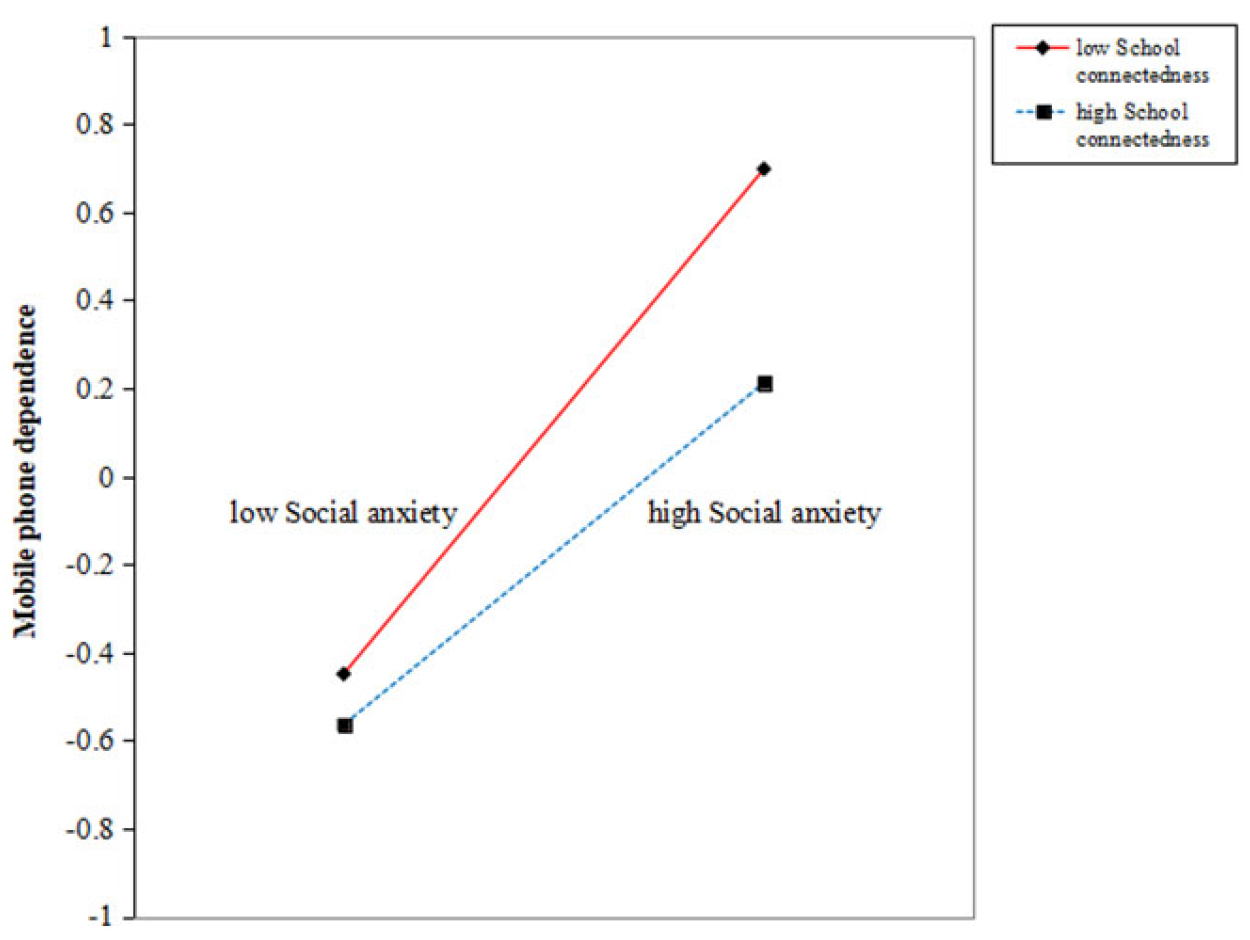
Figure 2.
Conditional effect of Social anxiety on Mobile phone dependence as a function of School connectedness among left-behind Junior high school students. (Note: Predictions of T2 Mobile phone dependence by T2 Social anxiety among left-behind junior high school students under different levels of T1 school connectedness; all variables were standardized. The middle straight line represents the point estimate, and the upper and lower curves represent the 95% confidence interval.).
Figure 2.
Conditional effect of Social anxiety on Mobile phone dependence as a function of School connectedness among left-behind Junior high school students. (Note: Predictions of T2 Mobile phone dependence by T2 Social anxiety among left-behind junior high school students under different levels of T1 school connectedness; all variables were standardized. The middle straight line represents the point estimate, and the upper and lower curves represent the 95% confidence interval.).
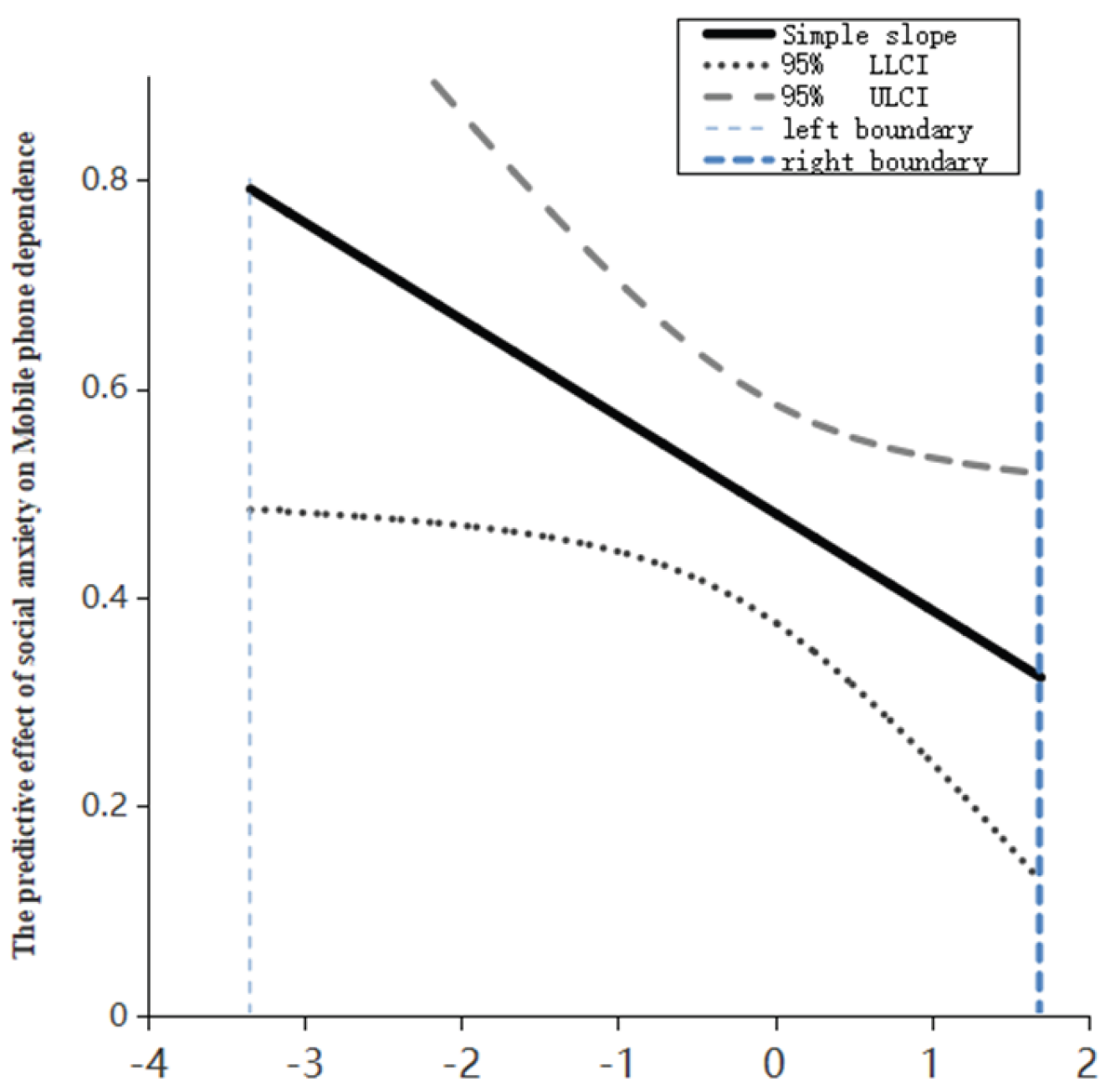

Table 1.
Descriptive Statistics for All Variables(N=283).
| Variable | M | SD | Skewness | Kurtosis |
| 1 T1 Father-child estrangement | 2.09 | 1.03 | 0.90 | 0.19 |
| 2 T2 Father-child estrangement | 2.20 | 0.91 | 0.36 | -0.77 |
| 3 T1 Mother-child estrangement | 2.00 | 0.98 | 0.94 | 0.35 |
| 4 T2 Mother-child estrangement | 2.09 | 0.87 | 0.37 | -0.90 |
| 5 T1 Social anxiety | 2.17 | 0.85 | 0.65 | -0.20 |
| 6 T2 Social anxiety | 2.22 | 0.79 | 0.50 | -0.70 |
| 7 T1 Mobile phone dependence | 1.85 | 0.71 | 1.16 | 1.24 |
| 8 T2 Mobile phone dependence | 2.03 | 0.66 | 0.57 | -0.08 |
| 9 T1 School connectedness | 3.79 | 0.71 | -0.56 | 0.10 |
| 10 T2 School connectedness | 3.70 | 0.62 | -0.28 | 0.20 |
| 11 Gender | 1.55 | 0.50 | -0.21 | -1.97 |
| 12 Grade | 1.53 | 0.50 | -0.12 | -2.00 |
Note. Gender was coded as 1 = male, 2 = female; grade was coded as 1 = Grade 7, 2 = Grade 8.
Table 2.
Correlation Matrix for All Variables.
| 1 | 2 | 3 | 4 | 5 | 6 | 7 | 8 | 9 | 10 | 11 | 12 | |
| 1 T1 FCE | - | |||||||||||
| 2 T2 FCE | .29 | - | ||||||||||
| 3 T1 MCE | .75 | .23 | - | |||||||||
| 4 T2 MCE | .29 | .78 | .26 | - | ||||||||
| 5 T1 SA | .26 | .25 | .30 | .24 | - | |||||||
| 6 T2 SA | .19 | .43 | .21 | .44 | .56 | - | ||||||
| 7 T1 MPD | .31 | .36 | .26 | .31 | .48 | .35 | - | |||||
| 8 T2 MPD | .18 | .44 | .13 | .43 | .31 | .50 | .45 | - | ||||
| 9 T1 SC | -.25 | -.31 | -.29 | -.30 | -.26 | -.28 | -.31 | -.26 | - | |||
| 10 T2 SC | -.12 | -.39 | -.16 | -.31 | -.26 | -.39 | -.26 | -.29 | .50 | - | ||
| 11 Gender | -.06 | .03 | -.02 | 0 | .12 | .18 | .03 | -.08 | -.11 | -.06 | - | |
| 12 Age | .11 | .13 | .05 | 0.10 | .04 | .07 | .21 | .19 | -.07 | 0 | -.02 | - |
|
Note: p< . 05, p< . 01, p< . 001. FCE = father–child estrangement; MCE = mother–child estrangement; SA = social anxiety; MPD = mobile phone dependence; SC = school connectedness. | ||||||||||||
Table 3.
Moderated Mediation Model Test for Father-child estrangement (FCE).
| Predictor variable | Equation 1 T2MPD | Equation 2 T2SA | Equation 3 T2MPD | Equation 4 T2MPD | ||||||||
| β | SE | t | β | SE | t | β | SE | t | β | SE | t | |
| T1FCE | 0.16 | 0.06 | 2.70 | 0.19 | 0.06 | 3.35 | 0.06 | 0.05 | 1.13 | 0.03 | 0.05 | 0.50 |
| T2SA | 0.51 | 0.05 | 9.86 | 0.47 | 0.05 | 8.89 | ||||||
| T1SC | -0.13 | 0.05 | -2.52 | |||||||||
| T2SA T1SC | -0.09 | 0.05 | -1.90 | |||||||||
| Gender | 0.20 | 0.06 | 3.41 | -0.16 | 0.05 | -3.22 | -0.18 | 0.05 | -3.53 | |||
| Grade | 0.05 | 0.06 | 0.95 | 0.14 | 0.05 | 2.78 | 0.14 | 0.05 | 2.76 | |||
| R2 | 0.06 | 0.08 | 0.31 | 0.33 | ||||||||
| F | 6.43 | 7.72 | 30.44 | 22.6 | ||||||||
Table 4.
Moderated Mediation Model Test for Mother-child estrangement (MCE).
| Predictor variable | Equation 1 T2MPD | Equation 2 T2SA | Equation 3 T2MPD | Equation 4 T2MPD | ||||||||
| β | SE | t | β | SE | t | β | SE | t | β | SE | t | |
| T1MCE | 0.11 | 0.06 | 1.98 | 0.21 | 0.06 | 3.65 | 0 | 0.05 | 0.11 | -0.04 | 0.05 | -0.81 |
| T2SA | 0.52 | 0.05 | 9.99 | 0.48 | 0.06 | 9.07 | ||||||
| T1SC | -0.15 | 0.05 | -2.81 | |||||||||
| T2SA T1SC | -0.09 | 0.05 | -2.03 | |||||||||
| Gender | 0.19 | 0.06 | 3.32 | -0.17 | 0.05 | -3.32 | -0.19 | 0.05 | -3.67 | |||
| Grade | 0.06 | 0.06 | 1.15 | 0.14 | 0.05 | 2.89 | 0.14 | 0.05 | 2.83 | |||
| R2 | 0.05 | 0.08 | 0.30 | 0.33 | ||||||||
| F | 5.26 | 8.46 | 30.32 | 22.7 | ||||||||
Disclaimer/Publisher’s Note: The statements, opinions and data contained in all publications are solely those of the individual author(s) and contributor(s) and not of MDPI and/or the editor(s). MDPI and/or the editor(s) disclaim responsibility for any injury to people or property resulting from any ideas, methods, instructions or products referred to in the content. |
© 2026 by the authors. Licensee MDPI, Basel, Switzerland. This article is an open access article distributed under the terms and conditions of the Creative Commons Attribution (CC BY) license (http://creativecommons.org/licenses/by/4.0/).
Copyright: This open access article is published under a Creative Commons CC BY 4.0 license, which permit the free download, distribution, and reuse, provided that the author and preprint are cited in any reuse.


