
Submitted:
03 July 2026
Posted:
06 July 2026
You are already at the latest version
Abstract
Galaxy rotation curves alone no longer provide a decisive test between dark matter and its main alternatives. Standard halo models, relativistic MOND theories, and the recently proposed κ-Model can all reproduce the observed kinematics of spiral galaxies with comparable accuracy. The central problem is therefore to identify observables capable of breaking this degeneracy. In this work, we compare MOND and the κ-Model for four isolated galaxies by combining rotation-curve constraints with gravitational lensing predictions. In both dark matter and relativistic MOND frameworks, the velocity field and the lensing signal are expected to arise from the same effective gravitational mass distribution. The κ-Model instead offers a different interpretation: galactic dynamics and lensing distortions need not be governed by a single large-scale mechanism, since they reflect distinct aspects of the anamorphic mapping between physical and observational space. We argue that the outer regions of isolated galaxies provide the most favorable regime for testing this distinction. In the κ-framework, the asymptotic lensing behavior predicts a specific relation between the gravitational shear and the projected mass density around the galaxy. The measured shear is therefore not merely a consequence of the dynamical mass reconstruction, but also encodes the geometric structure of the observational bundle. Consequently, a systematic mismatch between the lensing signal inferred from dynamics and that obtained directly from gravitational shear measurements would challenge the common assumption, shared by dark matter and relativistic MOND theories, that a single effective mass distribution simultaneously accounts for galactic kinematics and lensing. Although speculative, this hypothesis is directly testable and hence falsifiable. If such a discrepancy were observationally established, it would provide a clear empirical signature in favor of the κ-framework and would rule out, in its standard form, the paradigm according to which the same underlying mass component is responsible for both galaxy rotation curves and gravitational lensing.
Keywords:
dark matter
; MOND
; spiral galaxies
; weak gravitational lensing
; velocity profiles
; κ-model
1. Introduction
1.1. The Dark Matter Paradigm
The dark matter paradigm constitutes the standard interpretation of the observed discrepancies between the visible baryonic content of astrophysical systems and their inferred gravitational dynamics. Within the framework of the CDM cosmological model, dark matter is assumed to consist of a non-baryonic, weakly interacting component dominating the matter content of the Universe.
The first indications of missing mass date back to the pioneering work of Zwicky in the 1930s on the dynamics of the Coma galaxy cluster [1]. By applying the virial theorem to the observed velocity dispersion of cluster galaxies, Zwicky concluded that the visible matter was insufficient to gravitationally bind the system. Similar discrepancies were later identified at galactic scales through the study of spiral galaxy rotation curves, particularly in the influential work of Rubin and collaborators [2]. Instead of decreasing according to Newtonian expectations at large radii, galactic rotation curves remain approximately flat far beyond the visible stellar disk. Within the dark matter framework, these observations are interpreted as evidence for extended dark halos surrounding galaxies and clusters. Cosmological simulations based on cold dark matter (CDM) further reproduce large-scale structure formation remarkably well, including the filamentary distribution of galaxies and the anisotropy spectrum of the Cosmic Microwave Background (CMB) [3,4]. The dark matter paradigm also provides a natural explanation for several gravitational lensing observations, including strong and weak lensing effects observed in galaxy clusters. In particular, systems such as the Bullet Cluster are often considered among the strongest empirical arguments in favor of dark matter, since the inferred gravitational mass distribution appears spatially displaced from the dominant baryonic gas component [5].
Despite its major observational successes, the nature of dark matter remains unknown. Numerous candidates have been proposed, including Weakly Interacting Massive Particles (WIMPs), axions, sterile neutrinos, and other exotic particles beyond the Standard Model. However, no direct experimental detection has yet been universally confirmed.
1.2. Short Historical Development of Modified Gravity Theories
However, the dark matter paradigm faces several challenges at galactic and subgalactic scales, including the cusp–core problem, the missing satellites problem, and the baryonic fine-tuning relations emphasized by MOND phenomenology. These difficulties have motivated the development of numerous modified gravity and alternative cosmological proposals. In this context, several authors have explored the possibility that the observed dynamical discrepancies may not necessarily indicate the existence of additional unseen matter, but rather signal a breakdown or an incomplete understanding of gravitation itself at very large scales or in the weak-acceleration regime.
A first difficulty concerns the scale at which gravity should be modified. Within the Solar System, gravitational physics has been verified with extremely high precision. Experimental tests show that the inverse-square law of gravitation remains valid over a very broad range of scales, extending from millimeters to planetary distances. Likewise, the numerical value of the gravitational constant appears identical whether gravity is probed at laboratory scales or in celestial mechanics [6]. Moreover, the fundamental constants of physics appear to be remarkably universal, namely independent of spacetime position and cosmic epoch to a very high degree of accuracy. Observational studies of distant quasars indicate that even the fine-structure constant exhibits at most extremely small cosmological variations over billions of years [7]. Similar constraints are generally assumed to apply to other fundamental constants, including the speed of light and Newton’s gravitational constant.
Consequently, the possible ways of modifying gravitation are strongly constrained. Any viable modified gravity theory must simultaneously reproduce the extraordinary local success of Newtonian gravity and General Relativity while accounting for the large-scale discrepancies traditionally attributed to dark matter.
A second conceptual difficulty arises from the field-theoretic structure of modified gravity itself. Once gravitational modifications are formulated within a relativistic framework and quantized, additional gauge or mediator fields generally appear. These extra degrees of freedom do not belong to the Standard Model particle content and often behave effectively as dark-sector fields. In this sense, many modified gravity theories tend to reintroduce, in another form, entities phenomenologically similar to dark matter itself. For example, Scalar–tensor–vector gravity (MOG) explicitly introduces additional vector degrees of freedom [8]. At this stage, one may therefore gain the impression that one is facing a double conceptual difficulty: not only must gravity itself be modified, but one also ends up introducing additional fields that effectively behave as hidden matter components.
Nevertheless, despite these conceptual tensions, some modified gravity theories have progressively evolved through several major stages, beginning with Milgrom’s Modified Newtonian Dynamics (MOND).
-MOND and the Modification of Gravity/Inertia
In 1983, Milgrom proposed MOND as a modification of Newtonian dynamics in the regime of extremely low accelerations [9,10]. MOND introduces a characteristic acceleration scale
and replaces Newton’s second law by
where is the Newtonian gravitational potential generated solely by baryonic matter, and is an interpolation function satisfying
MOND successfully reproduces several empirical galactic regularities, including the baryonic Tully–Fisher relation and the baryon–dynamics correlations commonly referred to as "Renzo’s rule". In this respect, MOND naturally explains features that remain difficult to explain directly from standard cold dark matter scenarios without invoking complex baryonic feedback mechanisms.
However, the original MOND formulation suffered from a major theoretical drawback: the MOND equation violates the conservation laws of momentum, energy, and angular momentum. Bekenstein and Milgrom rapidly showed that a Lagrangian reformulation of MOND could remedy this highly problematic situation [11].
– AQUAL: The Lagrangian Reformulation of MOND
To restore the conservation laws absent from the original MOND formulation, Bekenstein and Milgrom introduced in 1984 the Aquadratic Lagrangian theory (AQUAL) [11].
The AQUAL action is based on the Lagrangian
Variation of the action yields the nonlinear Poisson equation
with
A first integral gives
where h is a calculable vector field. In highly symmetric situations, the curl term vanishes and the original MOND equation is exactly recovered.
Because AQUAL derives from a variational principle, the conservation laws absent from the original MOND formulation are restored. The next major step was then to construct a relativistic formulation of MOND capable of treating gravitational lensing and cosmological phenomena.
-Toward Relativistic MOND
A natural first idea was to consider scalar–tensor theories in which the physical metric is conformally related to the Einstein metric:
However, purely conformal scalar–tensor theories fail to generate sufficient gravitational lensing in galaxy clusters. Although massive particles are affected by the scalar field, photon trajectories remain almost unchanged because null geodesics are conformally invariant.
The next step therefore consisted of introducing not only the scalar field itself but also its gradient. Bekenstein and Sanders proposed in 1994 a disformal transformation involving both the scalar field and its gradient [12]. The physical metric then depends not only on but also on , thereby modifying the causal structure experienced by matter and radiation. This represented a significant conceptual advance, but it also generated new theoretical difficulties. In particular, gravitational waves and electromagnetic waves could propagate along different effective null cones, leading to possible violations of causality and Lorentz invariance. A further development was proposed by Sanders [13], who introduced an explicit vector field into the metric structure:
The vector field was assumed to be time-like, thereby introducing a preferred temporal direction in spacetime.
The conceptual basis of this approach can be traced back to Einstein’s later interpretation of the "relativistic ether". In his famous 1920 Leiden lecture, Einstein argued that General Relativity attributes physical properties to spacetime itself and therefore admits a form of ether. However, this ether differs radically from the nineteenth-century mechanical ether conceived as a material medium defining an absolute reference frame. Einstein’s ether is instead a dynamical structure associated with spacetime geometry itself.
The introduction of a time-like vector field effectively endows the vacuum with an internal dynamical structure. However, Sanders’ theory suffered from an important conceptual difficulty. While the metric and the scalar field remained dynamical, the vector field was introduced as a fixed background field. Such a non-dynamical field generally implies the existence of preferred frames, a partial breaking of local Lorentz invariance, and the introduction of an effectively absolute spacetime structure.
– TeVeS and Dynamical Vector Fields
To overcome these difficulties, Bekenstein later developed Tensor–Vector–Scalar gravity (TeVeS), in which the vector field becomes fully dynamical and possesses its own action and equations of motion [14].
The theory introduces a normalized time-like vector field satisfying
The vector field therefore defines a preferred temporal direction at every point of spacetime while remaining generally covariant. However, strict Lorentz invariance is no longer fully preserved. Thus, introducing a preferred temporal direction amounts to abandoning part of the philosophical core of relativity.
Later developments increasingly emphasized the dynamical vector field itself as the fundamental object. Zlosnik, Ferreira, and Starkman reformulated modified gravity in terms of a dynamical ether field closely related to Einstein–ether theories [15]. In these approaches, the time-like vector field becomes the fundamental dynamical entity defining the vacuum structure itself. More recent developments eventually by Skordis and Zlosnik introduced an emergent dark sector effectively mimicking cosmological dark matter [16]. At this stage, an important question naturally emerges: if modified gravity theories ultimately introduce additional dynamical degrees of freedom behaving phenomenologically like dark matter, should one not simply accept dark matter itself?
Ultimately, Modern Einstein–ether theories raise a deep tension: in attempting to preserve gravitation without dark matter, they may inadvertently reintroduce preferred structures or hidden violations of Lorentz invariance, thereby partially undermining the relativistic principles from which they originally emerged. Conceptually, the additional vector field, as it is commonly interpreted, essentially amounts to attributing to the vacuum an internal dynamics analogous to that of a moving medium. Do modified gravity theories truly remain faithful to the deeper spirit of relativity, or do they instead reintroduce, in a more sophisticated form, a privileged structure of spacetime?
1.3. Alternative Models to Dark Matter and Modified Gravity
– Entropic Gravity
Within the framework of entropic gravity, gravitation is not regarded as a fundamental interaction but rather as an emergent macroscopic phenomenon arising from underlying microscopic degrees of freedom. This idea was initially proposed by Verlinde [17] and is deeply connected to holographic principles, black-hole thermodynamics, and the informational interpretation of spacetime geometry. In this interpretation, gravity emerges as an entropic force associated with changes in the information content of spacetime. The motion of matter is interpreted thermodynamically: when a particle changes position, the entropy associated with the microscopic degrees of freedom of spacetime also changes, giving rise to an effective force that macroscopically reproduces gravitational attraction. A central idea of Verlinde’s later developments [18] is that the phenomena usually attributed to dark matter may emerge naturally from modifications of the entanglement entropy structure of the vacuum at cosmological scales. In this picture, the apparent excess gravitational attraction observed in galaxies and clusters does not necessarily require additional unseen particles, but may instead arise from emergent thermodynamic or informational corrections to gravity itself. In particular, Verlinde argued that the observed MOND-like phenomenology could result from an elastic response of the microscopic spacetime degrees of freedom to the presence of baryonic matter. The additional acceleration scale appearing in galactic dynamics would then reflect emergent properties of the cosmological vacuum rather than a fundamental modification of Newtonian gravity. One of the conceptual strengths of entropic gravity is that it attempts to connect gravitation, thermodynamics, quantum information, and holography within a unified framework. The theory therefore belongs to a broader class of proposals in which spacetime geometry and gravitation are viewed as emergent collective phenomena rather than fundamental entities.
However, several important difficulties remain open. The microscopic nature of the underlying degrees of freedom is still not fully understood, and the relativistic and cosmological consistency of the theory remains under active debate. In particular, reproducing simultaneously gravitational lensing, galaxy cluster dynamics, and cosmological observations remains challenging.
– Fractional-Dimensional Interpretations of MOND
A possible alternative interpretation of MOND-like phenomenology has been explored by Varieschi [19,20] within the framework of fractional-dimensional gravity. The basic conclusion suggested by MOND phenomenology is that there may exist in nature an effective interaction whose radial dependence decreases more slowly than the standard inverse-square law, namely approximately as
instead of the usual
At laboratory or Solar-System scales, none of the known fundamental interactions — in particular electromagnetism and gravity, both mediated by effectively massless particles (the photon and the classical graviton) — exhibit such a slow radial decay. Nevertheless, this does not exclude the possibility that an effective interaction behaving approximately as could emerge at very large astrophysical or cosmological scales.
The inverse-square dependence is not accidental. It is deeply connected to the geometry of three-dimensional space through flux conservation on a spherical surface. in three spatial dimensions, the area of a sphere scales as
which naturally leads to inverse-square field laws. From this perspective, a force varying approximately as recalls what would occur in an effectively two-dimensional geometry, where the flux would instead spread over a cylindrical surface proportional to r. Closely related ideas were explored by Varieschi in the framework of fractional-dimensional gravity [19,20].
In these schemes, the effective dimensionality of space is allowed to deviate from the standard integer value . Gravitational dynamics are reformulated in a fractional-dimensional setting in which the gravitational potential and force laws acquire modified radial dependences. In particular, Varieschi showed that MOND-like phenomenology may naturally emerge from an effective dimensional reduction at large scales.
In his relativistic extension [19], the gravitational field equations are generalized to non-integer spatial dimensions while preserving covariance properties. The corresponding Newtonian limit leads to modified gravitational potentials capable of reproducing flattened galactic rotation curves without explicitly introducing dark matter.
In a subsequent work [20], Varieschi further investigated the so-called External Field Effect (EFE), a characteristic feature of MOND phenomenology whereby the internal dynamics of a system depend on the external gravitational environment. Within the fractional-dimensional framework, the EFE emerges naturally from the scale dependence of the effective dimensionality.
However, an important conceptual distinction remains. In MOND itself, physical space remains fundamentally three-dimensional; it is primarily the dynamical law that is modified, generally through the introduction of additional scalar or vector fields, possibly emergent or effective in nature. By contrast, fractional-dimensional formalism reinterpret the anomalous force law geometrically through an effective modification of spatial dimensionality itself.
– Refracted Gravity
Another interesting alternative to both dark matter and modified gravity frameworks has been proposed by Cesare, Diaferio, Matsakos, and collaborators under the name Refracted Gravity (RG) [21,22,23]. The central idea of this concept is inspired by an analogy with electrodynamics in dielectric media. In refracted gravity, the gravitational field is assumed to propagate through a medium whose effective gravitational permittivity depends on the local mass density.
More precisely, the Poisson equation is modified according to
where is a gravitational permittivity depending on the local density . In regions of low density, the effective propagation of the gravitational field is altered, producing an enhancement of gravitational attraction without explicitly introducing dark matter.
The analogy with optical refraction is central to the model. Just as light rays are refracted when propagating through media with varying refractive indices, gravitational field lines in RG are effectively redirected by density gradients. This mechanism modifies the geometry of the gravitational field at galactic scales and naturally generates stronger effective gravitational effects in low-density environments.
In their 2020 study [21], Cesare et al. applied refracted gravity to DiskMass Survey galaxies and showed that the modified field equations can reproduce the observed rotation curves and vertical velocity dispersions of disk galaxies without requiring massive dark matter halos. The model successfully accounts for several galactic dynamical properties while preserving Newtonian behavior in high-density regimes.
In a subsequent work [22], the same framework was extended to three nearby elliptical E0 galaxies. The authors demonstrated that refracted gravity can also reproduce the observed stellar dynamics of pressure-supported systems, suggesting that the mechanism is not restricted to rotating disk galaxies alone.
The authors further explored the relation between refracted gravity and MOND phenomenology in a later comparative study [23]. Several dynamical similarities between RG and MOND were emphasized, particularly regarding low-acceleration galactic dynamics and the emergence of effective gravitational amplification at large scales. However, important conceptual differences remain. MOND modifies the dynamical law itself through an acceleration scale, whereas refracted gravity modifies the propagation of the gravitational field through an effective medium characterized by a density-dependent gravitational permittivity.
One notable feature of refracted gravity is that the theory attempts to preserve much of the standard Newtonian and relativistic gravitational structure while introducing environmental effects through the modified propagation of field lines. In this sense, RG occupies an intermediate conceptual position between modified gravity theories and emergent effective-medium descriptions.
Nevertheless, several open questions remain concerning the fundamental physical origin of the gravitational permittivity function, the relativistic completion of the theory, and its compatibility with cosmological observations and gravitational lensing constraints.
– Amplified Lense–Thirring Effects at Galactic Scales
Using the high-precision astrometric data provided by Gaia DR3, Beordo, Crosta, and Lattanzi [24] performed a detailed analysis of the Milky Way rotation curve within several competing theoretical frameworks, including the standard CDM paradigm, MOND, and general relativistic conception. This analysis performed by these authors also suggests that gravitomagnetic effects associated with General Relativity, in particular effects related to the Lense–Thirring mechanism, could become significantly more relevant at galactic scales than is usually assumed in standard astrophysical modeling [24]. In conventional weak-field treatments, frame-dragging effects generated by rotating mass distributions are generally considered negligible at the scale of galaxies. However, the authors argue that large-scale relativistic contributions associated with the global rotation and mass distribution of the Milky Way may produce nontrivial corrections to the Galactic rotation curve. In this interpretation, part of the dynamical effects commonly attributed to dark matter could instead emerge from amplified gravitomagnetic contributions inherent to General Relativity itself. Although these relativistic corrections do not completely eliminate the dark matter problem, the study suggests that General Relativity may contribute more substantially to galactic dynamics at very large scales than is usually assumed in purely Newtonian treatments. This possibility is particularly interesting because it does not require modifying the fundamental laws of gravitation, but rather reexamining the large-scale dynamical consequences of Einsteinian gravity in rotating astrophysical systems.
– CCC+TL Cosmology
An alternative cosmological framework has recently been proposed by Gupta [25] under the name CCC+TL cosmology, combining elements of Conformal Cyclic Cosmology (CCC) with the hypothesis of "Tired Light" (TL). The model attempts to reinterpret several major cosmological observations without invoking the standard CDM framework, dark energy, or inflation in their conventional forms. In this proposal, the observed cosmological redshift is not attributed exclusively to metric expansion of spacetime but is instead partially interpreted as resulting from cumulative photon energy-loss mechanisms during propagation over cosmological distances. The framework therefore revisits, in a modernized form, the old tired-light idea, while embedding it within a broader cyclic cosmological scenario inspired by Penrose’s conformal cyclic cosmology. In his 2024 study [25], Gupta tested the CCC+TL model against observed Baryon Acoustic Oscillation (BAO) features, which constitute one of the major observational probes of large-scale cosmology. The analysis showed that the proposed framework can reproduce several observed BAO correlations while using fewer free parameters than the standard CDM model. One of the motivations behind the CCC+TL framework is to address current tensions in observational cosmology, particularly discrepancies related to the Hubble constant and the interpretation of high-redshift observations. The model also attempts to provide an alternative explanation for the apparent accelerated expansion of the Universe without explicitly introducing dark energy. However, the interpretation remains highly non-standard and raises several important theoretical questions. In particular, the physical mechanism responsible for the proposed photon energy loss remains uncertain, and the compatibility of the model with the full range of cosmological observations — including the Cosmic Microwave Background, structure formation, and gravitational lensing — remains under active debate.
– Scale-Invariant Vacuum Cosmology
Another proposal to the dark matter and dark energy problems has been developed by Maeder within the framework of scale-invariant vacuum cosmology (SIV) [26,27]. This interpretation is based on the hypothesis that empty space may possess a fundamental scale invariance at large cosmological scales. The theory is formulated within a Weyl–integrable geometric framework, in which the standard Einstein equations are modified by the introduction of a scale gauge field .
In this framework, gravitation is no longer entirely determined by the metric tensor alone. Instead, spacetime geometry acquires an additional scale degree of freedom associated with local scale transformations. The cosmological evolution equations are correspondingly modified by terms involving the gauge function and its derivatives. A central result of the model is that the dynamical effects usually attributed to dark matter may emerge effectively from scale-invariant contributions to the gravitational dynamics. In particular, the theory predicts modified acceleration laws at galactic scales, leading to flattened rotation curves without explicitly introducing non-baryonic dark matter halos. In this sense, the model reproduces several MOND-like phenomenological features. Maeder further argued that scale invariance may also account for a number of cosmological observations usually interpreted in terms of dark energy. The modified cosmological equations naturally lead to accelerated cosmic expansion without introducing a cosmological constant or vacuum energy density in the conventional sense. More recent developments by Gueorguiev and Maeder [27] have emphasized that the scale-invariant vacuum paradigm appears capable of simultaneously addressing several major astrophysical problems, including: galactic rotation curves, galaxy cluster dynamics structure formation and late-time cosmic acceleration.
However, several conceptual and theoretical issues remain open. One important difficulty concerns the role of the scale gauge function . Since observable quantities may depend on the choice of scale gauge, questions naturally arise regarding the uniqueness and physical interpretation of the theory. More generally, the introduction of an additional scale degree of freedom may be viewed as replacing the dark sector by an enlarged geometric structure whose physical origin remains to be fully clarified. Nevertheless, the scale-invariant vacuum perspective constitutes one of the most original attempts to reinterpret dark matter and dark energy phenomena as manifestations of modified spacetime geometry rather than as evidence for additional unseen matter components.
Thus, although there is broad agreement among all these models that some nontrivial phenomenon emerges at very large scales – while remaining absent at Solar-System scales – the proposed explanations are numerous, and every plausible theoretical avenue deserves careful consideration.
1.4. Reinterpretation of MOND Within the -Model
As discussed above, the relativistic extensions of MOND proposed so far generally introduce a level of theoretical complexity that appears rather artificial when compared with the conceptual naturalness and geometrical minimalism of General Relativity, as one might expect from a successful fundamental physical theory.
Nevertheless, the original MOND framework proposed by Milgrom in 1983 remains remarkably predictive regarding the dynamics and velocity profiles of spiral galaxies. In this sense, MOND likely constitutes an important phenomenological starting point. However, the observed MOND-like regularities may require a fundamentally different interpretation rather than being understood strictly in terms of modified gravity. This constitutes the central motivation of the -Model [28,29,30,33,34,35].
A fundamental distinction between MOND and the -Model concerns the physical interpretation of the acceleration scale . In MOND, is introduced as a universal constant with the empirical value . Its possible cosmological origin is usually motivated by the approximate coincidence , which reproduces the MOND scale only at the order-of-magnitude level and remains essentially heuristic. By contrast, the -Model of [33,34] derives the characteristic acceleration from the local baryonic surface density of the Solar neighbourhood through the relation
Using the observed value
one obtains
This numerical agreement is substantially more precise than the broad cosmological coincidence invoked in MOND. Interestingly, this result acquires additional significance because it is well known that the transition between the Newtonian and MONDian regimes coincidentally occurs near the Solar neighbourhood in the Milky Way. Hence, the relation relies exclusively on directly measurable local baryonic quantities, suggesting that the characteristic acceleration scale may emerge as a functional of the local mean density and large-scale environmental properties rather than from the global expansion of the Universe. Such an interpretation potentially provides a greater degree of flexibility than standard MOND phenomenology. One may therefore expect that this framework could account not only for the asymptotically flat rotation curves observed in spiral galaxies, but also for the very large velocity dispersions observed in galaxy clusters, and even for systems such as the Bullet Cluster [31]. It is also plausible that a similar reinterpretation procedure could eventually be extended to the Cosmic Microwave Background (CMB) anisotropy spectrum.
A second important aspect of the -Model concerns gravitational lensing. In standard MOND interpretation, lensing effects are often reformulated in terms of equivalent dynamical masses or effective radial velocities. Within the -framework, however, such a procedure has no obvious physical meaning. Velocity profiles and gravitational lensing are instead treated as physically distinct phenomena, potentially governed by different large-scale mechanisms.
– The –model: An Anamorphic Interpretation of the Missing Mass Problem
The -Model [35] provides a novel proposal for addressing the missing mass problem. Its purpose is not to modify the law of gravitation, as in MOND, MOG, or scalar–tensor–vector theories. Rather, it suggests that the discrepancy usually attributed to dark matter may arise from the way astronomical systems of very large spatial extension are mapped onto the observational space of terrestrial observers.
The central idea is that the Universe may possess an anamorphic structure. In this framework, what is distorted is not gravity itself, but the observational representation of large-scale systems1. A galaxy, a galaxy cluster, or even a a spot of the CMB may be described in a "basis" space, where ordinary Newtonian gravity or General Relativity remains valid, and then transported towards the space of observers through a scale-dependent transformation. The apparent missing mass is therefore interpreted as a geometrical and observational effect associated with the mapping between these two levels of description.
A key originality of the model is the introduction of a bundle structure. The base space contains the mechanical description of the system: either a Newtonian-basis or an Einstein-basis. In this base, no exotic dark matter is added and the gravitational law is not modified. The fibre, on the other hand, represents the space of observers. The observed galaxy or cluster is not directly identical to the object described in the base, but corresponds to its image in the observer fiber after application of a -dependent rescaling. In this sense, the model separates the physical dynamics from the observational representation of this dynamics.
This construction differs sharply from modified gravity theories. In MOND, the Newtonian law of inertia or gravity is altered below a characteristic acceleration scale. In MOG or relativistic MOND-like theories, additional scalar, vector, or tensor degrees of freedom are introduced into the gravitational sector. By contrast, the -Model keeps the underlying mechanics unchanged. The additional structure is not a new force field, but a map between the mechanical base and the observational fibres. Its novelty lies therefore in shifting the missing mass problem from the dynamics of gravity to the geometry of observation.
The -effect is assumed to become relevant only beyond a characteristic scale. At Solar-System scales, or in binary stellar systems, ordinary Newtonian or relativistic mechanics is recovered without distortion. At galactic and cluster scales, however, lengths are no longer assumed to be directly commensurable with the small-scale standards used by terrestrial observers. The larger and more diffuse the system, the stronger the effective rescaling may become. In this way, low-density astronomical structures are expected to display stronger apparent deviations from the Newtonian expectation. This point gives the model a distinctive explanatory strategy. In the standard dark matter paradigm, flat rotation curves are explained by adding an extended halo of non-luminous matter. In MOND, they are explained by modifying the dynamical law in the low-acceleration regime. In the -Model, they are instead explained by an observational rescaling: the object seen by the observer is an anamorphic image of a more compact object evolving according to ordinary gravity in the base. The apparent dynamical mass is therefore not a real additional mass, but the result of interpreting the fibre image as if it were directly the base object.
Photometric observations provide luminosity-based distance estimates and inferred mass distributions reconstructed within the observer’s geometrical framework. Spectroscopic measurements yield line-of-sight velocities that are largely independent of any global reconstruction of spatial geometry. By strong contrast, trigonometric measurements are currently accessible only within relatively local regions of the Milky Way, typically on sub-kiloparsec scales. This limitation becomes particularly significant because the strongest -effects are expected precisely at galactic and cluster scales, where direct parallax determinations are no longer feasible. In this sense, the -Model implicitly suggests that the geometric structure inferred from large-scale observations may not possess the same ontological status as locally measured geometry. The situation is conceptually reminiscent, although in an inverse manner, of quantum mechanics: at microscopic scales classical trajectories cease to exist, whereas in the framework global geodesic structure itself may progressively lose operational meaning at cosmological scales. Consequently, the propagation of light may remain locally geodesic while becoming effectively non-integrable or anamorphic over very large distances, although such a picture remains difficult to visualize intuitively.
The –Model also introduces a potentially important distinction between external and internal observations. A galaxy observed from outside may exhibit a -distorted velocity profile, whereas the same system observed from within may not necessarily lead to the same reconstructed rotation curve. This is especially relevant for the Milky Way, where Gaia provides trigonometric and proper-motion data. The Milky Way may therefore offer a discriminating test between MOND-like models and the -Model, since both may give similar predictions for external galaxies while differing in the interpretation of internal galactic measurements. Interestingly, the Keplerian decline reported for the Milky Way rotation curve by [32], which appears to be in tension with standard MOND predictions, might be interpreted within the framework as a consequence of the distinction between internal and external observations. Eventually, the distinction between photometric and spectroscopic observables on the one hand, and purely trigonometric quantities on the other hand, is not merely technical but reflects a fundamental difference in physical and epistemological status.
The –Model is therefore best understood as a phenomenological and geometrical framework rather than as a complete fundamental theory. Its originality is threefold. First, it attempts to preserve ordinary gravity in the base space. Second, it avoids the introduction of exotic non-baryonic dark matter. Third, it attributes the observed discrepancies to an anamorphic mapping between the mechanical world and the observer’s reconstructed world. The missing mass problem is thus reformulated as a problem of scale, commensurability, and observational projection. In this perspective, the Universe is not necessarily dynamically different from the Newtonian or Einsteinian Universe; rather, it may be observationally anamorphic. The apparent need for dark matter would then arise because one mistakenly identifies the distorted image in the observer fiber with the undistorted object in the mechanical base. This is the central conceptual contribution of the -Model: it proposes that the dark matter problem may reflect not a failure of gravity, nor the presence of unseen particles, but a non-trivial relation between physical dynamics and astronomical observation at very large scales.
– –Model versus relativistic ether-like theories
An interpretive comparison may also be established between the -Model and relativistic -like theories. In Einstein– or tensor–vector–scalar strategy, the vacuum acquires an additional dynamical structure through the introduction of a time-like vector field, thereby defining locally preferred temporal directions and an effective observer-dependent spatial decomposition. In such theories, the vacuum itself may be viewed as possessing an internal dynamical flow analogous to a moving medium. The -Model differs fundamentally from this perspective since it does not introduce any additional physical field into the gravitational sector. Nevertheless, both conceptions share the deeper structural idea that the observed spacetime may not be strictly identical to the underlying mechanical spacetime. In Einstein–ether theories, this distinction arises from a dynamical structure of the vacuum itself, whereas in the -framework it emerges from an anamorphic geometrical mapping between the mechanical base and the observer fiber. One may therefore interpret the -effect as a form of large-scale geometrical magnification of observational space rather than as a genuine modification of gravitation or as a physical flow of the vacuum. From a conceptual perspective, -type models may appear more conservative than Einstein–ether-like theories, since they preserve local Lorentz invariance and avoid introducing any preferred direction or background structure in the vacuum. In this sense, the framework remains closer to the original relativistic intuition underlying general relativity.
––Model versus fractional-dimension gravity
The fractional-dimension gravity model of [19,20] and the kappa anamorphic framework [35] converge on the idea that the dark matter problem may originate from an incomplete description of spacetime geometry rather than from missing matter. In both formulations, the apparent excess gravitational effects emerge through scale-dependent geometric corrections that become dominant in weak-field galactic regimes. Varieschi introduces an effective fractional spatial dimensionality , which modifies the Poisson equation and produces long-range deviations from Newtonian gravity consistent with flat rotation curves. Similarly, the kappa framework introduces a deformation parameter describing an anamorphic large-scale structure of the Universe, generating apparent dynamical discrepancies through observational geometry. Both theories therefore replace dark matter halos by emergent geometric effects linked to nontrivial spacetime structure. Consequently, both interpretations belong to a broader class of geometric alternatives to CDM in which cosmological anomalies arise from the structure of spacetime itself rather than from invisible matter.
––Model versus refracted gravity
Refracted gravity introduces a gravitational permittivity depending on local matter density, causing gravitational field lines to refract analogously to electromagnetic waves in dielectric media. Similarly, the kappa framework attributes anomalous galactic observations to large-scale anamorphic geometric distortions encoded by the parameter . Both theories therefore replace dark matter halos with emergent geometric or medium-like effects that alter the apparent distribution of gravity at large scales. A central common feature is the existence of scale-dependent deviations that become significant only in low-density or weak-field environments, naturally reproducing flat galactic rotation curves. Additionally, both models recover standard Newtonian and relativistic behavior in high-density local regimes, preserving consistency with Solar System observations. The two frameworks also exhibit phenomenological similarities with MOND-like transitions without requiring additional unseen matter components. Conceptually, refracted gravity modifies the effective transmission of the gravitational field through a density-dependent medium, whereas the -Model modifies the observational geometry of the Universe itself.
2. Computational Details
The method has already been presented elsewhere [28,29,30,35]. It is summarized in the present section.
In the base, the volume density of a spiral galaxy is assumed to be of the form (MacLaurin-type function):
and in the bundle:
where and . Since the -Model does not invoke missing mass, the invariance of the total mass must be preserved when passing from the base to the bundle; therefore, let 2, with:
and:
Assuming that in the base and in the bundle3.
In the base the spectroscopic velocity is given by:
where the gravitational potential can be written:
where the angle is defined between the directions and . The spectroscopic velocity is then transported in the bundle by the -transform (stretching of the distances).
3. Results
The and values are strongly correlated, with a linear regression coefficient of , indicating an almost perfect alignment of the data points. Naturally, the sample is limited to only four isolated galaxies and therefore cannot provide a definitive statistical demonstration. Nevertheless, the significance of the result does not rely solely on the number of objects but also on the remarkably small scatter around the fitted relation. No galaxy behaves as an outlier, and all four systems follow the same density–magnification trend.
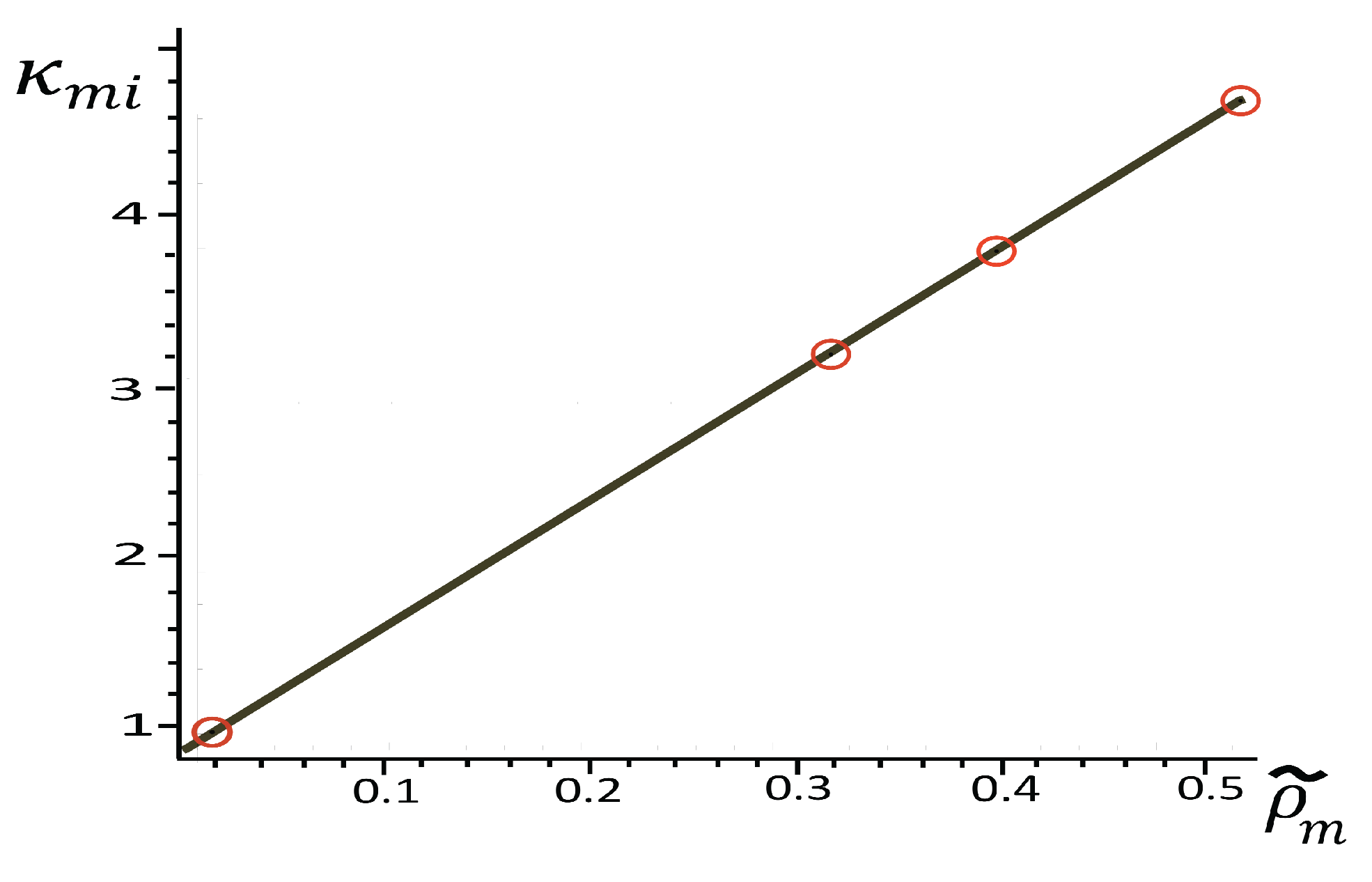
Figure 1.
Linear regression fit for the couple & .
Moreover, the correlation is not obtained over a narrow range of parameters. The central density parameter spans the interval , while the magnification coefficient varies from to , corresponding to a dynamic range close to a factor of five. The observed alignment therefore extends over a substantial region of parameter space, reducing the likelihood that it results from a trivial restricted-range effect.
It is also worth emphasizing that the galaxies considered here are not arbitrarily selected. They correspond to the isolated systems analyzed by Mistele et al. in their weak-lensing study of indefinitely flat circular velocities and the baryonic Tully–Fisher relation [36]. At present, very few galaxies simultaneously possess extended rotation-curve measurements, weak-lensing constraints at large galactocentric radii, and sufficient isolation to avoid significant environmental effects. Consequently, the small sample size primarily reflects the scarcity of suitable observational data rather than an arbitrary selection. Although a larger sample will ultimately be required to establish the statistical significance and universality of the relation, the present result already suggests the existence of an empirical scaling law linking the central density parameter to the -magnification factor.
In addition the MOND profiles have been obtained with the formula
where and are the Newtonian velocity and acceleration, respectively. The coefficient is taken equal to .
The corresponding results are shown in Figure 2.
The accuracy can be estimated by computing the root mean square error between the theoretical and observed profiles, let for the -Model
and for the MOND theory:
where n is the number of control points ().
These quantities are listed in columns 8 and 9 of Table 1. The precision is similar for both MOND and the -Model, around . However, we can also guess that another limit is existing. The main contributors to this uncertainty are the imprecise knowledge of distances, poorly constrained galaxy inclinations, and the likely variation of this inclination along a galactocentric radius.
4. The Gravitational Lensing Distortion in the Outer Region (Halo)
Gravitational lensing depends on the mass projected onto the plane of the sky. Let denote the corresponding projected density in the base.
With we have
and
In the elementary case of an attracting mass point M taken located at the origin of the coordinates in the base (), acting on an unit length placed at u, the radial gravitational lensing distortion is given by
The distortion is then mapped into the observed space through the local magnification factor . Weak-lensing observations indicate that the shear remains approximately constant in the outer halo. Within the -Model, this observational constraint translates into
Working backward from this observational constraint yields and . Real galaxies are, however, extended objects. The deflection angle is given by
where denotes the three-dimensional mass density in the base. For simplicity, the galaxy is assumed to be viewed face-on and to possess circular symmetry. In the plane (), the image distortion is related to the derivative . A quantitative prediction therefore requires an estimate of the halo density distribution in the base. This issue is addressed in the next section.
– Evaluating the mean volume density of the baryonic halo as seen both in the base and in the bundle
The density outside an isolated galaxy, although very low as assumed in the previous section, is nevertheless not zero. Within the -Model, a strictly zero density would even lead to the unphysical limit of infinite stretching. It must at least exceed the baryonic component of the cosmological density, . We therefore impose the condition in this region. In what follows, the notation in the base is as follows: denotes the halo radius (with its counterpart in the bundle given by ), while and denote, respectively, the volume density and the surface density projected onto the sky plane at the galaxy center, . It is also reasonable to assume that the radius of the low-density region surrounding the galaxy is a few times, and at most of order ten times, the size of the galaxy itself, here normalized to .
Let us place in the base. In order to obtain the volume density (variable ) we have to deproject the surface density (variable u). For a surface density assumed varying as , we take for the volume density a function easy to manipulate such as varying approximately as , and then we determine the , and for the better fit. We write
and
Let denote the total mass of the halo. The halo surrounding an isolated galaxy is expected to contain a small amount of baryonic matter. Although its total mass is unknown, it is reasonable to assume that it does not exceed the baryonic mass of the galaxy itself. This assumption therefore leads to the constraint , taking the approximate baryonic mass of the Milky Way as a reference. In normalized units, we have taken: radius of the galaxy equal to 1, half-thickness equal to and volume density ( in normalized unit). Physical quantities are recovered by expressing lengths in kiloparsecs and masses in units of 5. The projected density profile was then fitted iteratively while simultaneously satisfying the total-mass constraint. This procedure yields the coefficients , , and . The remaining parameters were subsequently adjusted accordingly. Setting gives , indicating a strong stretching of the halo ().
We also obtain , , (normalized units). This leads to the observational mean density (bundle) (normalized) or (taking the reference density equal to or )6.
Once these quantities have been determined, we may proceed to evaluate both the integral (eq. 13) and its derivative. Applying the -transform then yields the distortion (in normalized units) in the observer bundle, providing an estimate of the weak gravitational lensing signal for the four galaxies considered in this work (Figure 3). The predicted shear exhibits the observed asymptotically flat behaviour. This is where the -Model differs from MOND: one cannot implicitly infer a velocity profile associated with the motion of hypothetical masses that might be located in the very low-density halo. Nevertheless, the plateaus obtained are proportional to the acceleration of a hypothetical particle placed in the halo at a given radius.
5. The Velocity Profile in the Outer Region (Halo)
Inspection of the SPARC catalogue shows that [33], one can observe that, at large radii, approximately one third of the rotation curves are slightly increasing, another third are slightly decreasing, and the remaining third are nearly flat. Within the dark matter framework, this diversity can be readily interpreted by adjusting, in an ad hoc manner, the radius of the dark matter halo. The situation is more restrictive for MOND and for the -Model [33].
However, for the four galaxies considered in the present paper, it is found that the rotation curves are slightly decreasing at large radii. This naturally raises the question of how MOND can reconcile a decreasing profile with the flat profile inferred from gravitational lensing data? One possible explanation is that that the profile is not always strictly decreasing but, in reality, oscillates around a mean value and eventually reaches a flat plateau at very large distances. By contrast, the -Model predicts that, beyond the maximal radius () of the observable matter (gas) in a spiral galaxy, the profile continues to decrease.
Knowing the density distribution within the halo, we can compute the corresponding velocity profiles directly for the four isolated galaxies. In the following, we assume that the dominant gravitational mass is contained within the galaxy and that the outer mass (halo mass) is negligible (i.e., absence of dark matter). In this case, the velocities decrease as a function of the radius u, as they would be perceived in the base. However, although this decrease is, as expected, purely Keplerian in the base, the stretching (from the base toward the bundle) causes this decrease to appear as an intermediate profile between a purely Keplerian profile and a flat profile.
This constitutes an essential difference from the prediction of MOND, which implies that the flat profile extends indefinitely toward infinity (at least for an isolated galaxy; this is no longer strictly valid for a galaxy in a cluster when the external field effect, EFE, is taken into account). The results are displayed in Figure 4 for the four galaxies considered.
We have also plotted the MOND profiles. One can immediately observe that these profiles are flat and differ significantly from the corresponding -Model profiles, which exhibit a semi-Keplerian behaviour.
6. Conclusions
In this work, we compared the predictions of MOND and of the -Model for four isolated galaxies through gravitational lensing observations. Our results indicate that the -Model provides a satisfactory description of the observed lensing effects without requiring dark matter halos, while remaining compatible with General Relativity in the underlying base space. In this framework, the apparent magnification does not arise from a modification of the physical gravitational field itself, but from a scale-dependent observational effect associated with the observer bundle structure.
This interpretation differs fundamentally from standard modified-gravity paradigm. In the - Model, the physical reality described in the base manifold remains governed by the usual Einsteinian or Newtonian dynamics, whereas the observed amplification emerges from the projection between the base space and the observer bundle. The effect may therefore be interpreted as a kind of cosmological anamorphosis or observational illusion rather than as evidence for additional invisible matter.
An interesting comparison may nevertheless be drawn with fractal and multifractional cosmological models, such as those recently discussed by Calcagni and collaborators [37]. In both perspectives, scale dependence plays a central role in the interpretation of astrophysical observations. However, the ontological status of this scale dependence is profoundly different. In multifractional or fractal cosmologies, the modification is assumed to affect the physical structure of spacetime itself through multiscale geometry, varying spectral dimensions, or fractional operators. By contrast, in the -Model, the scale dependence is associated with the observational representation and not with a fundamental modification of spacetime geometry. Thus, although the -Model and fractal cosmologies share certain phenomenological similarities, particularly in their attempt to explain apparent gravitational anomalies without invoking standard dark matter, they correspond to two conceptually distinct frameworks. The former relocates the effect to the observer representation, whereas the latter attributes it to a genuine multiscale structure of spacetime itself.
Future work could investigate whether deeper mathematical correspondences exist between these concepts, particularly concerning scale transformations, observer-dependent geometry, and effective cosmological magnification effects.
The CDM paradigm generally requires at least two galaxy-by-galaxy free parameters, for example in Navarro–Frenk–White halo profiles, and may therefore appear more phenomenologically adjustable than MOND, which relies on a universal acceleration scale. The counterpart is that MOND encounters difficulties in larger systems, especially galaxy clusters. By contrast, the flexibility of the -Model allows it to be adapted to a broader range of astrophysical situations.
The main distinction between MOND and the -Model concerns weak gravitational lensing in isolated galaxies, which has been addressed in the present work. Whereas MOND treats velocity profiles and gravitational lensing within a unified dynamical framework, the -Model treats them as two physically distinct phenomena. This difference should, in principle, make it possible to falsify one framework and support the other through suitable observations.
A possible observational strategy would be to identify a sample of stars or free-floating neutral gas clouds randomly distributed at sufficiently large radii in the low-density region surrounding an isolated galaxy, and then to measure their orbital velocities. Such measurements would provide a direct way to discriminate between MOND and the -Model. Whether these observations can be achieved in practice remains an important question.
Although the -Model is not yet established on fully developed theoretical foundations, particularly because of the still imperfect knowledge of the mean density in the base and of its relation to the coefficient , it nevertheless provides a useful working hypothesis. It strongly suggests that the mean-density field underlies, or at least translates, an optical-like effect, not in the usual optical sense, that may play an important role in interpreting observed galactic velocity profiles and gravitational lensing in galaxies and galaxy clusters. This possibility has not yet been systematically incorporated into current models.
Let us note that the -Model also presents some similarities with Finsler geometry. In both cases, the effective geometry perceived by the observer may depend on additional structural variables beyond the standard spacetime coordinates, leading to scale-dependent or observer-dependent effects. However, a very important distinction must be emphasized. In Finsler geometry, the modification affects the intrinsic metric structure of spacetime itself through a directional dependence of the metric. By contrast, in the -Model, the underlying base manifold remains governed by the usual Riemannian or Einsteinian geometry, while the apparent modification emerges from the observational projection associated with the bundle structure. The effect therefore acts more as an anamorphic or representational transformation than as a fundamental modification of spacetime geometry.
The -Model naturally separates the fundamental dynamics defined on the base manifold from the physical perception associated with the observer fiber. In this framework, the base space contains the underlying dynamical and geometric structure, while the observed physics emerges only after lifting to the observer fiber, where anamorphic magnification takes place. Consequently, if the base geometry is already Riemannian or pseudo-Riemannian, relativistic properties such as geodesic structure, causality, covariance, and Lorentzian consistency are intrinsically present from the outset. Unlike relativistic MOND constructions such as TeVeS, the -Model therefore does not require the introduction of auxiliary scalar or vector fields, nor the reconstruction of an effective relativistic metric. Relativity is already encoded in the geometry of the base manifold itself. The anamorphic effects arise only at the observational level through the base-to-fiber morphism, suggesting that the apparent dynamical amplification is not a modification of the fundamental gravitational equations, but rather a geometrical effect associated with observation. In this sense, the -Model appears closer to a fiber-geometric or observer-dependent effective description than to a conventional modified-gravity theory. Such a framework may naturally preserve relativistic consistency while offering a new interpretation of apparent dark-matter phenomena as emergent consequences of anamorphic observation geometry.
An important interpretative consequence of the -framework concerns the status of geodesic structure at extremely large cosmological scales. In the same way that the notion of a classical trajectory loses its physical meaning at quantum scales, the concept of a globally well-defined geodesic may also become non-fundamental when considering the Universe as a whole. Standard cosmological models implicitly rely on the existence of a smooth pseudo-Riemannian manifold endowed with globally coherent geodesics and large-scale metric homogeneity. However, the observed homogeneity of the Universe may only correspond to an effective or statistical property emerging after coarse-graining, rather than to an exact global geometric structure. Within the anamorphic interpretation proposed here, the FLRW metric could therefore represent only an intermediate-scale approximation of a deeper relational organization of spacetime. In this perspective, cosmological observables do not necessarily require the existence of exact global geodesics, but only stable large-scale statistical correlations compatible with observational isotropy and homogeneity. The Universe would thus remain locally compatible with general relativity while globally escaping the classical notion of a smooth geometrical manifold, suggesting that geometry itself may be an emergent and scale-dependent structure rather than a fundamental property of reality.
Funding
This research received no external funding.
Conflicts of Interest
The author declares no conflicts of interest.
References
- Zwicky, F. Die Rotverschiebung von extragalaktischen Nebeln. Helv. Phys. Acta 1933, 6, 110–127. Available online: https://www.e-periodica.ch/digbib/view?pid=hpa-001:1933:6::112.
- Rubin, V. C.; Ford, W. K.; Thonnard, N. Rotational Properties of 21 SC Galaxies with a Large Range of Luminosities and Radii, from NGC 4605/R = 4 kpc to UGC 2885/R = 122 kpc. Astrophys. J. 1980, 238, 471–487. [Google Scholar] [CrossRef]
- Springel, V.; et al. Simulations of the Formation, Evolution and Clustering of Galaxies and Quasars. Nature 2005, 435, 629–636. [Google Scholar] [CrossRef] [PubMed]
- Planck Collaboration. Planck 2018 Results. VI. Cosmological Parameters. Astron. Astrophys. 2020, 641, A6. [Google Scholar] [CrossRef]
- Clowe, D.; Bradac, M.; Gonzalez, A. H.; Markevitch, M.; Randall, S. W.; Jones, C.; Zaritsky, D. A Direct Empirical Proof of the Existence of Dark Matter. Astrophys. J. Lett. 2006, 648, L109–L113. [Google Scholar] [CrossRef]
- Yang, S.-Q.; Zhan, B.-G.; Wang, Q.-L.; Shao, C.-G.; Tu, L.-C.; Tan, W.-H.; Luo, J. Test of the Gravitational Inverse Square Law at Millimeter Ranges. Phys. Rev. Lett. 2012, 108, 081101. [Google Scholar] [CrossRef] [PubMed]
- Wilczynska, M. R.; Webb, J. K.; Bainbridge, M.; Barrow, J. D.; Bosman, S. E. I.; Carswell, R. F.; Dąbrowski, M. P.; Dumont, V.; Lee, C.-C.; Pasquini, L. Four direct measurements of the fine-structure constant 13 billion years ago. Sci. Adv. 2020, 6, eaay9672. [Google Scholar] [CrossRef] [PubMed]
- Moffat, J. W. Scalar–Tensor–Vector Gravity Theory. JCAP 2006, 03, 004. [Google Scholar] [CrossRef]
- Milgrom, M. A Modification of the Newtonian Dynamics: Implications for Galaxy Systems. Astrophys. J. 1983, 270, 384–389. [Google Scholar] [CrossRef] [PubMed]
- Milgrom, M. MOND theory. Can. J. Phys. 2015, 93, 107–118. [Google Scholar] [CrossRef]
- Bekenstein, J. D.; Milgrom, M. Does the Missing Mass Problem Signal the Breakdown of Newtonian Gravity? Astrophys. J. 1984, 286, 7–14. [Google Scholar] [CrossRef]
- Bekenstein, J. D.; Sanders, R. H. Gravitational Lenses and Unconventional Gravity Theories. Astrophys. J. 1994, 429, 480–490. [Google Scholar] [CrossRef]
- Sanders, R. H. A Stratified Framework for Scalar–Tensor Theories of Modified Dynamics. Astrophys. J. 1997, 480, 492–502. [Google Scholar] [CrossRef] [PubMed]
- Bekenstein, J. D. Relativistic Gravitation Theory for the MOND Paradigm. Phys. Rev. D. 2004, 70, 083509. [Google Scholar] [CrossRef]
- Zlosnik, T. G.; Ferreira, P. G.; Starkman, G. D. Modifying Gravity with the Aether: An Alternative to Dark Matter. Phys. Rev. D. 2007, 75, 044017. [Google Scholar] [CrossRef]
- Skordis, C.; Zlosnik, T. New Relativistic Theory for Modified Newtonian Dynamics. Phys. Rev. Lett. 2021, 127, 161302. [Google Scholar] [CrossRef] [PubMed]
- Verlinde, E. On the Origin of Gravity and the Laws of Newton. J. High Energy Phys. 2011, 29, 2011. [Google Scholar] [CrossRef]
- Verlinde, E. Emergent Gravity and the Dark Universe. SciPost Phys. 2017, 2, 016. [Google Scholar] [CrossRef]
- Varieschi, G. U. Relativistic Fractional-Dimension Gravity. Universe 2021, 7, 387. [Google Scholar] [CrossRef]
- Varieschi, G. U. Newtonian Fractional-Dimension Gravity and the External Field Effect. Eur. Phys. J. Plus 2022, 137, 1217. [Google Scholar] [CrossRef]
- Cesare, V.; Diaferio, A.; Matsakos, T.; Angus, G. Dynamics of DiskMass Survey galaxies in refracted gravity. Astron. Astrophys. 2020, 637, A70. [Google Scholar] [CrossRef]
- Cesare, V.; Diaferio, A.; Matsakos, T. The dynamics of three nearby E0 galaxies in refracted gravity. Astron. Astrophys. 2022, 657, A133. [Google Scholar] [CrossRef]
- Cesare, V. Dark Coincidences: Small-Scale Solutions with Refracted Gravity and MOND. Universe 2023, 9, 56. [Google Scholar] [CrossRef]
- Beordo, W.; Crosta, M.; Lattanzi, M. G. Exploring Milky Way Rotation Curves with Gaia DR3: A Comparison Between ΛCDM, MOND, and General Relativistic Aapproaches. J. Cosmol. Astropart. Phys. 2024, 12, 024. [Google Scholar] [CrossRef]
- Gupta, R. Testing CCC+TL Cosmology with Observed Baryon Acoustic Oscillation Features. Astrophys. J. 2024, 964, 55. [Google Scholar] [CrossRef]
- Maeder, A. Dynamical Effects of the Scale Invariance of the Empty Space: The Fall of Dark Matter? Astrophys. J. 2017, 849, 158. [Google Scholar] [CrossRef]
- Gueorguiev, V. G.; Maeder, A. The Scale-Invariant Vacuum Paradigm: Main Results and Current Progress Review. Symmetry 2024, 16, 657. [Google Scholar] [CrossRef]
- Pascoli, G.; Pernas, L. Some Considerations about a Potential Application of the Abstract Concept of Asymmetric Distance in the Field of Astrophysics. HAL Open Science. 2020. Available online: https://hal.science/hal-02530737.
- Pascoli, G. The κ-Model, a minimal model alternative to dark matter: Application to the galactic rotation problem. Astrophys. Space Sci. 2022, 367, 62. [Google Scholar] [CrossRef]
- Pascoli, G. An empirical analysis of the dynamics of both individual galaxies and gravitational lensing in galaxy clusters without dark matter. arXiv 2022, arXiv:2210.12380. [Google Scholar] [CrossRef]
- Pascoli, G. A comparative study of MOND and MOG theories versus the κ-Model: An application to galaxy clusters. Can. J. Phys. 2023, 101, 11. [Google Scholar] [CrossRef]
- Jiao, O.; Hammer, F.; Wang, H.; Wang, J.; Amram, P.; Chemin, L.; Yang, Y. Detection of the Keplerian Decline in the Milky Way Rotation Curve. Astron. Astrophys. 2023, 678, A208. [Google Scholar] [CrossRef]
- Pascoli, G. The κ-Model under the Test of the SPARC Database. Universe 2024, 10, 151. [Google Scholar] [CrossRef]
- Pascoli, G.; Pernas, L. Is Dark Matter a Misinterpretation of a Perspective Effect? Symmetry 2024, 16, 937. [Google Scholar] [CrossRef]
- Pascoli, G.; Pernas, L. Understanding the Universe Without Dark Matter and Without the Need to Modify Gravity: Is the Universe an Anamorphic Structure? Symmetry 2026, 18, 234, Available online: DOI. [Google Scholar] [CrossRef]
- Mistele, T.; McGaugh, S.S.; Lelli, F.; Schombert, J.M.; Li, P. Indefinitely Flat Circular Velocities and the Baryonic Tully-Fisher Relation from Weak Lensing. ApJL 2024, 969, L3. [Google Scholar] [CrossRef]
- Briscese, F.; Calcagni, G. Fractal universe and quantum gravity made simple. arXiv 10.48550/arXiv.2210.12380. 2026. [Google Scholar]
| 1 | In the -Model, the underlying spacetime structure of the base manifold is assumed to remain physically unchanged. However, this underlying reality is not directly accessible to any observer. Since no observer can possess a global view of the Universe, the observed cosmological structure necessarily corresponds to a partial and projected representation of the underlying geometry. The effect therefore does not arise from a physical modification of spacetime itself, but from the geometrical and observational limitations associated with the observer bundle. In this sense, the -Model differs fundamentally from fractal or multifractional cosmologies [37]. In the latter, the multiscale structure is assumed to belong intrinsically to spacetime itself. By contrast, in the -Model, the multiscale appearance emerges from the observational projection of a hidden underlying reality that cannot be globally accessed by local observers. |
| 2 |
As the density has been expressed (Eq. 1), the mass in the base is independent of the value of . The coefficient ensures the equality of the masses computed simultaneously in the base and in the bundle. The value of is therefore uniquely determined by this equality.
Although this coefficient for matching the corresponding masses (base versus bundle) may appear ad hoc, it is not an independent parameter; rather, its value is automatically imposed by mass invariance.
|
| 3 |
The parameter must be specified. In the median plane of the galaxy (), one has , from which it follows that (and one also recovers ).
However, the McLaurin distribution is finite in extent in the base, whereas in the bundle the exponential distribution extends to infinity. One must therefore impose which is indirectly equivalent to introducing a cut-off in the exponential distribution, expressed in the variable[29], the -transform links the base to the bundle by the two independent relationships and ).
|
| 4 | More specifically to avoid a singularity at the origin. |
| 5 | The volume of the halo is properly gigantic and a spiral galaxy is a very flat confined object. Thus, even a very low density in the halo can produce a very large total mass. We have assumed that seen in the bundle for the galactic radius of the objects under examination in the current paper) and (halo radius) in the bundle. |
| 6 |
In the case of a galaxy cluster, the mean density in the bundle (quantities without a tilde) can be related to that in the base (quantities with a tilde) by writing the conservation relation for the energy emitted at X ( electronic density and temperature, the latter one being invariant by the kappa-transformn (l size of a volume element)
For [31], we obtain .
|
Figure 2.
Velocity profiles for four isolated galaxies of the SPARC catalogue. Associating the mass of tab1 and terminal velocities of Figure 1 shows that the baryonic Tully-Fisher relation is checked both for MOND and -Model. The orange curve displays the -Model; the solid green curve shows the MOND prediction; the solid blue curve corresponds to the Keplerian model; the dashed blue curve shows the total Keplerian fit; the dashed red curve indicates the stellar contribution; and the dashed green curve indicates the gas contribution.
Figure 2.
Velocity profiles for four isolated galaxies of the SPARC catalogue. Associating the mass of tab1 and terminal velocities of Figure 1 shows that the baryonic Tully-Fisher relation is checked both for MOND and -Model. The orange curve displays the -Model; the solid green curve shows the MOND prediction; the solid blue curve corresponds to the Keplerian model; the dashed blue curve shows the total Keplerian fit; the dashed red curve indicates the stellar contribution; and the dashed green curve indicates the gas contribution.
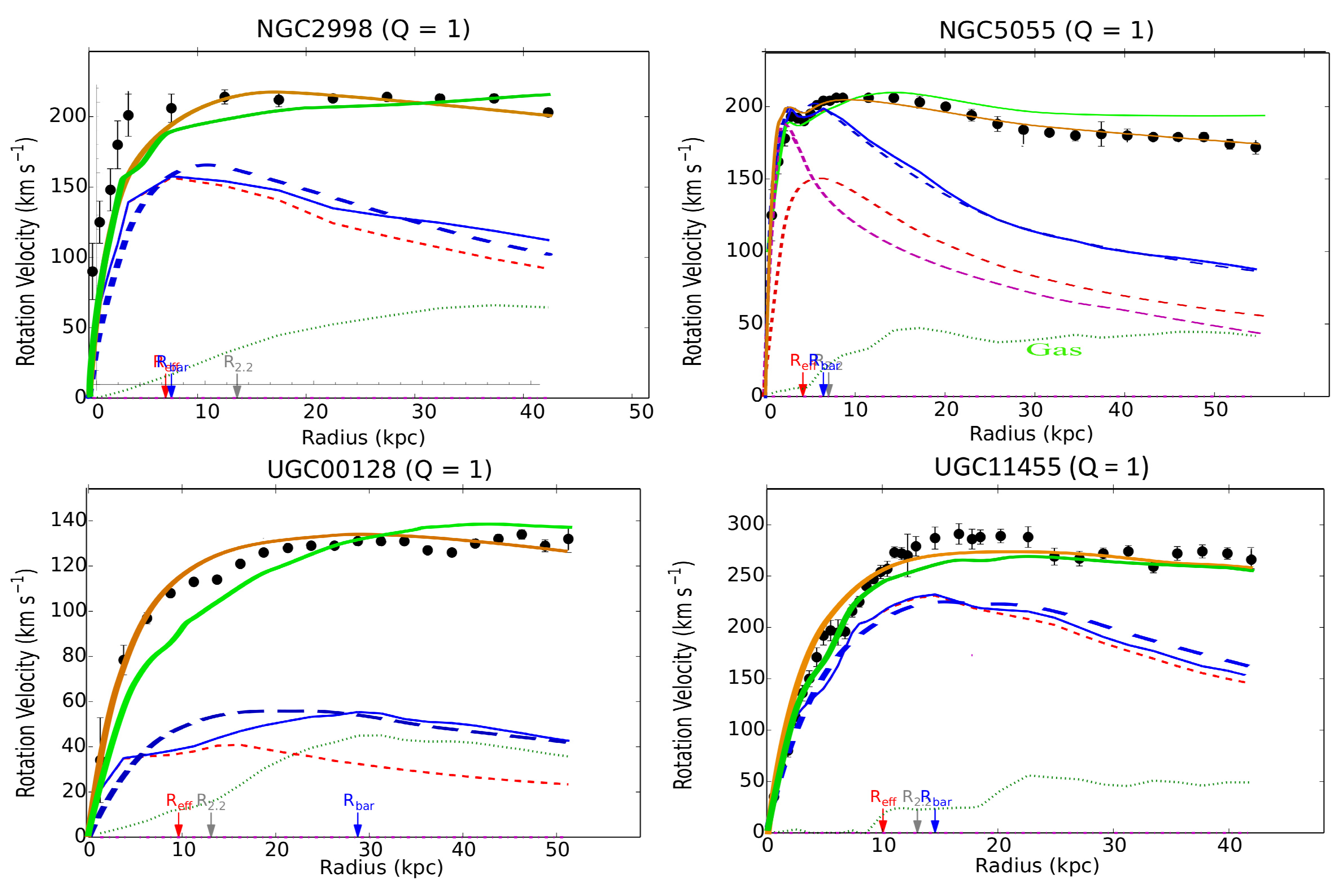
Figure 3.
Gravitational lensing in the -Model framework for four isolated galaxies of the SPARC catalogue.
Figure 3.
Gravitational lensing in the -Model framework for four isolated galaxies of the SPARC catalogue.
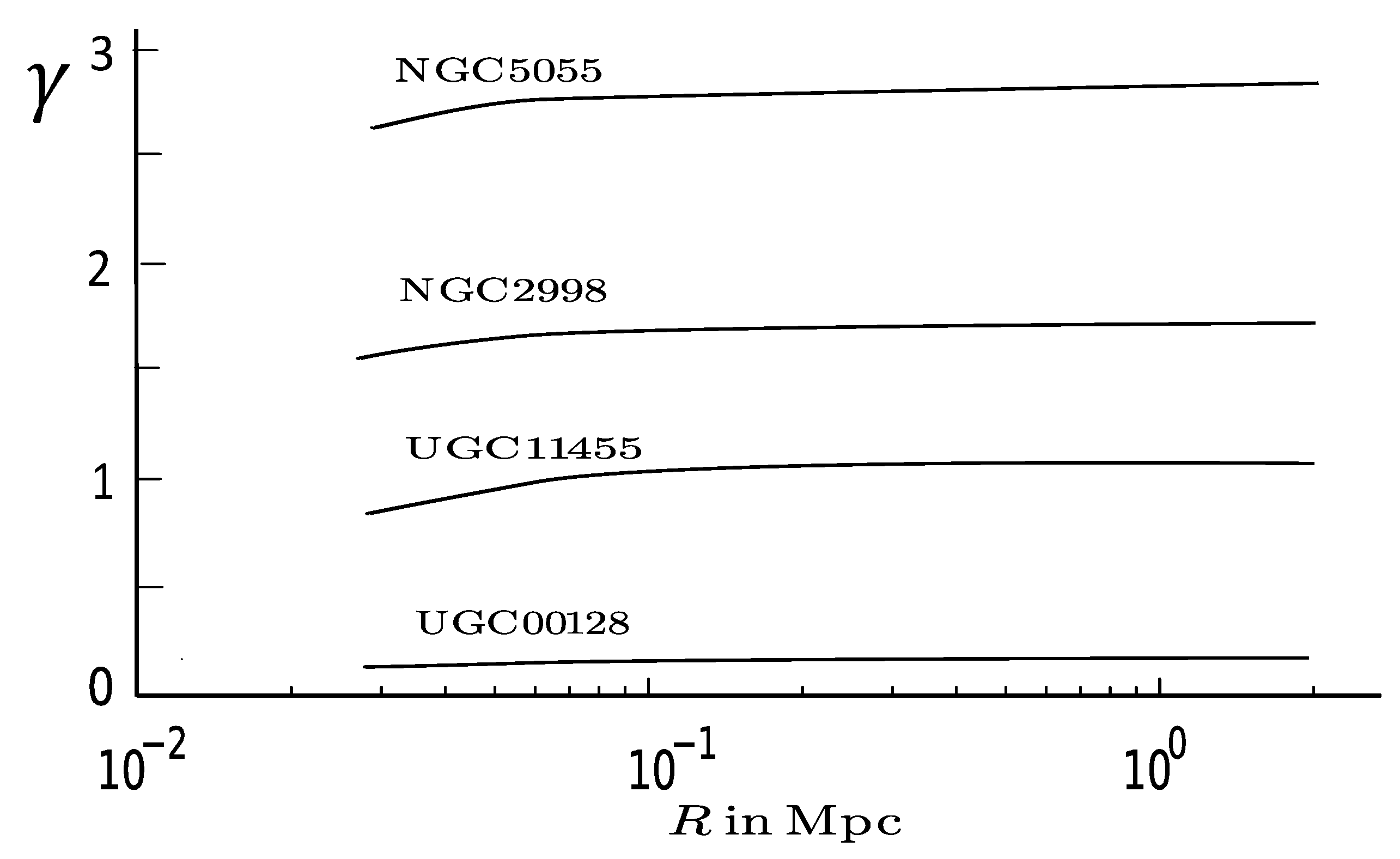
Figure 4.
Velocity profiles in the surrounding halo for four isolated galaxies of the SPARC catalogue. The orange curve displays the -Model; the green curve shows the MOND prediction; the solid blue curve corresponds to the Keplerian model.
Figure 4.
Velocity profiles in the surrounding halo for four isolated galaxies of the SPARC catalogue. The orange curve displays the -Model; the green curve shows the MOND prediction; the solid blue curve corresponds to the Keplerian model.
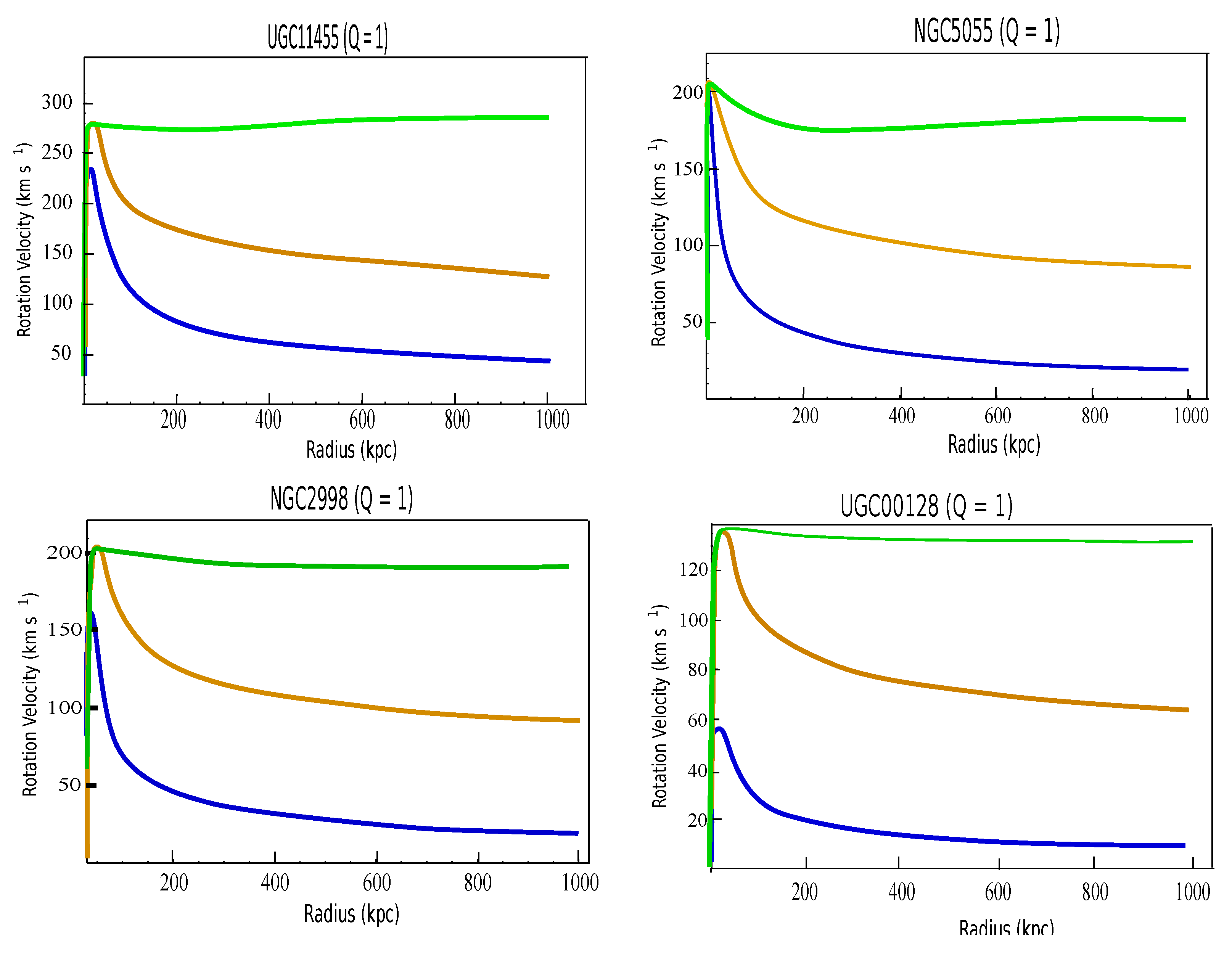

Table 1.
Properties of the four isolated galaxies analyzed in the bundle. The first column gives the total mass, the second gives the radius of the galaxy, the third gives the exponent of the exponential distribution of density as a function of x, represents the central maximum volume density (). The coefficients and respectively correspond to the inner (local) and outer (global) values of estimated at the center, .
Table 1.
Properties of the four isolated galaxies analyzed in the bundle. The first column gives the total mass, the second gives the radius of the galaxy, the third gives the exponent of the exponential distribution of density as a function of x, represents the central maximum volume density (). The coefficients and respectively correspond to the inner (local) and outer (global) values of estimated at the center, .
| Galaxy | Mass ( | Radius () | () | () | () | |||
|---|---|---|---|---|---|---|---|---|
| 42 | 5 | |||||||
| 55 | 3 | |||||||
| 50 | 9 | |||||||
| 42 |
For NGC5055, the mass expresses the total mass (bulge+disk). The mass (resp. radius) of the spherical bulge is taken equal to (resp. ).
Disclaimer/Publisher’s Note: The statements, opinions and data contained in all publications are solely those of the individual author(s) and contributor(s) and not of MDPI and/or the editor(s). MDPI and/or the editor(s) disclaim responsibility for any injury to people or property resulting from any ideas, methods, instructions or products referred to in the content. |
© 2026 by the authors. Licensee MDPI, Basel, Switzerland. This article is an open access article distributed under the terms and conditions of the Creative Commons Attribution (CC BY) license (http://creativecommons.org/licenses/by/4.0/).
Copyright: This open access article is published under a Creative Commons CC BY 4.0 license, which permit the free download, distribution, and reuse, provided that the author and preprint are cited in any reuse.


