

Submitted:
03 July 2026
Posted:
06 July 2026
You are already at the latest version
Preprints on COVID-19 and SARS-CoV-2
Abstract
The COVID-19 pandemic elevated messenger RNA (mRNA) technology from an obscure concept to a proven vaccine platform, largely due to the nucleoside-modification discovery by Karikó and Weissman, which earned them the 2023 Nobel Prize. Five years post-initial authorizations, this review examines the platform's evolution across three key areas. Firstly, platform design has expanded significantly beyond the initial lipid nanoparticle (LNP)-mRNA formulations. Innovations now include engineered ionizable lipids, optimized untranslated regions, self-amplifying RNA, circular RNA, and thermostabilization strategies, all aimed at reducing reliance on cold-chain storage. Secondly, real-world effectiveness data revealed robust initial protection against severe disease. However, this protection diminished as Omicron sublineages emerged, leading to immune escape and antibody waning. This necessitated variant-matched boosters, which offered progressively shorter periods of benefit. A genuine, though comparatively small, myocarditis safety signal was also observed. Thirdly, global equity outcomes were notably poor. Concentrated manufacturing, stringent cold-chain requirements, and intellectual property barriers hindered access for low-income countries, despite initiatives like COVAX and WHO technology transfer programs. Beyond COVID-19, the mRNA platform has expanded to include vaccines for RSV and influenza, HIV vaccine candidates, and personalized cancer neoantigen vaccines, which have shown promising early efficacy. Remaining challenges include progressive IgG4 class-switching after repeated immunizations, incomplete thermostability, and regulatory frameworks that are not yet equipped for self-amplifying or personalized products. We contend that equity, thermostability, and regulatory preparedness must be integrated into platform and manufacturing strategies from the outset, rather than being reactive measures implemented only after a new pandemic emerges.
Keywords:
COVID-19
; mRNA vaccines
; lipid nanoparticles
; circular RNA
; COVAX
; cancer vaccines
1. Introduction
The SARS-CoV-2 virus, whose initial cases were recorded in Wuhan during December 2019, exhibited exponential transmissibility, rapidly breaching borders and achieving pandemic status as it engulfed populations worldwide[1]. The COVID-19 pandemic became the key test for a vaccine technology that had been mostly ignored by scientists for many years. Early tests showed that mRNA made in a lab can cause unwanted inflammation and not make enough protein in cells and tissues, which was a big problem that slowed down the use of this method in real medical treatments for a long time[2]. The key discovery happened when Karikó and Weissman showed that mRNA made with changed nucleoside bases doesn't get noticed by the body's natural defense system[2], a discovery that was first published in 2005 after being turned down by Nature and Science, with reviewers saying the work was “not new” and “not interesting to a wide audience[3]. It took over ten years for this discovery to go from a specialized immunology finding to becoming the basis of a major global public health effort. This path was acknowledged when Karikó and Weissman won the Nobel Prize in Physiology or Medicine for their key findings on the role of base modifications in mRNA, which played a vital part in creating vaccines during one of the largest health challenges in modern history[2,3]. The coming together of this immune system knowledge with recent progress in delivering lipids and designing antigens led to a very fast response time that had never been seen before. These results, along with advances in delivering mRNA inside the body, keeping the SARS-CoV-2 spike protein stable, and big investments from companies and governments, helped approve two very effective mRNA vaccines for COVID-19 by the end of 2020[4]. The amount of vaccine distribution that happened later was huge: over 13 billion doses of the COVID-19 vaccine were given around the world, saving millions of lives and stopping serious illness in even more people[5]. Yet when the platform expanded worldwide, it showed major unfairness in how things were set up, which limited its success in improving public health. Even with efforts like COVAX, by the end of 2021 just 8.5% of people in low-income countries had gotten at least one vaccine dose, while between 76 and 78% in high-income and upper-middle-income countries had been vaccinated[6]. According to COVAX data, by August 2021, just 33 million COVID-19 vaccine doses had been sent to low-income countries, while high-income countries received 1.6 billion doses[7]. a gap reflecting disparities in manufacturing capacity, cold-chain infrastructure, and procurement power rather than epidemiological need. Although COVAX ultimately delivered 2 billion COVID-19 vaccinations to lower-income countries before being wound down[8] at that time, six countries still had less than 10% coverage for the first dose of the vaccine, showing that fair sharing of the vaccine was still a big problem, not something that had already been fixed.
Five years later, the mRNA technology has kept improving and has grown much more than the initial Comirnaty and Spikevax versions. Second-generation self-amplifying mRNA vaccines use a part of the virus that helps make more of the virus's proteins, allowing the vaccine to work well even with a smaller amount, and these vaccines are now being used in real patients[9]. ARCT-154 (KOSTAIVE) showed stronger, longer-lasting, and more varied immune responses compared to regular mRNA vaccines.It was the first self-amplifying mRNA vaccine to get approval from regulators in Japan in November 2023.Later, in February 2025, it also received marketing authorization from the European Commission[9,10].
Because of this path, it's important to take a close look in the middle of the decade. This review brings together five years of evidence from three connected areas: the molecular and delivery advances that have shaped each new generation of mRNA vaccine technology; the growing body of real-world data on how well and safely these vaccines work, collected from their worldwide use and as new virus versions emerged; and the ongoing differences in access and benefits that affected who got vaccinated and how quickly. By bringing these threads together, we want to create useful insights for being ready for future pandemics and for using mRNA technology in new ways to fight other infectious diseases and cancer.
2. Platform Design
2.1. Lipid Nanoparticle Delivery: The Engine of Clinical Translation
The clinical success of first-generation mRNA vaccines rests on the lipid nanoparticle (LNP), a non-mRNA component as critical as the genetic payload itself. LNPs are multi-component delivery vehicles consisting of an ionizable lipid, cholesterol, a helper phospholipid, and a PEGylated lipid. The ionizable lipid is widely considered the most consequential ingredient because it condenses the negatively charged mRNA during formulation and subsequently mediates endosomal escape into the cytoplasm of target cells[11]. Comirnaty (BNT162b2) and Spikevax (mRNA-1273) both utilize ionizable lipids that share an amino-alcohol head group, despite having distinct structures. Their reported pKa values, 6.09 and 6.75 respectively, fall within the narrow range associated with effective adaptive immune stimulation after intramuscular administration[11,12]. PEGylated lipids, despite typically comprising less than 2.5% of the total formulation, govern nanoparticle size and circulation behavior. The linker region connecting the ionizable head group to its hydrocarbon tails is now understood to influence both head-group pKa and the efficiency of endosomal escape[11,13]. Subsequent engineering has advanced beyond the SM-102 and ALC-0315 lipids originally used in Moderna and Pfizer-BioNTech products. Combinatorial and AI-assisted lipid libraries have identified next-generation ionizable lipids, such as the stereodefined H9T6 formulation. These new lipids achieve substantially higher transfection efficiency than SM-102 and localize expression predominantly to the injection site, thereby reducing the systemic exposure associated with reactogenicity[14]. Parallel work has pursued organ-selective targeting: a redesigned ionizable lipid bearing an aromatic ring modification (“aroLNP”) delivered at least tenfold less mRNA to the liver than the Moderna LNP formulation while preserving lymph-node delivery efficiency in animal models, illustrating how rational lipid engineering can reduce off-target effects without compromising immunogenicity[15].
2.2. mRNA Construct Engineering: UTRs, Codon Usage, and Nucleoside Modification
Beyond the delivery vehicle, the mRNA molecule itself has undergone intensive sequence-level optimization. The foundational advance, for which Karikó and Weissman were awarded the 2023 Nobel Prize, was the discovery that substituting modified nucleosides for unmodified uridine suppresses recognition by pattern-recognition receptors like Toll-like receptors. This crucial modification avoids the inflammatory response and translational shutdown that had stalled mRNA therapeutics for over a decade[2]. Building on this foundation, contemporary platform design treats the 5' untranslated region (UTR), 3' UTR, and open reading frame as tunable elements rather than fixed scaffolds. Large-scale pooled screens have ranked hundreds of thousands of 3' UTR variants by their effect on mRNA half-life and tens of thousands of 5' UTR sequences by ribosome loading efficiency. This enables the rational selection of UTR combinations that improve potency at lower doses[16]. Such integrated engineering, which combines optimized ionizable lipids, UTR selection, and nucleoside chemistry, has been shown to improve dendritic-cell transfection more than 3.5-fold relative to SM-102-based formulations. This suggests a path toward lower-dose vaccines with reduced reactogenicity[14].
2.3. Second-Generation Platforms: Self-Amplifying mRNA
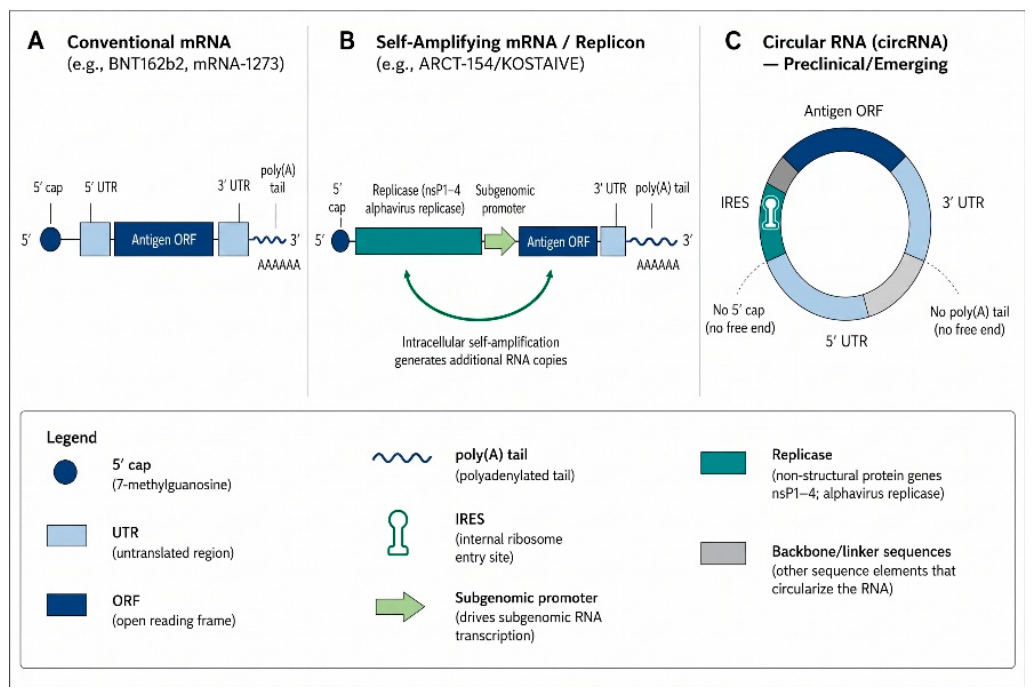
The most clinically advanced next-generation platform is self-amplifying mRNA (saRNA), also known as replicon RNA. Unlike conventional mRNA, replicon RNA encodes the antigen of interest and the non-structural proteins of an alphavirus (typically an attenuated Venezuelan equine encephalitis virus backbone). These proteins assemble into an RNA-dependent RNA polymerase complex that amplifies the antigen-encoding sequence directly within transfected cells[17]. Because the replicon manufactures additional copies after delivery, self-amplifying platforms can achieve immunogenicity comparable to or exceeding conventional mRNA vaccines at doses six- to twentyfold lower. This may reduce both manufacturing costs and dose-dependent adverse events[18]. This advantage was demonstrated clinically: in Phase III trials, an LNP/repRNA SARS-CoV-2 vaccine achieved efficacy with a 5 μg dose, which was six-fold lower than Comirnaty and twenty-fold lower than Spikevax[18]. ARCT-154 (KOSTAIVE), a self-amplifying mRNA vaccine, was the first product of its class to receive regulatory approval worldwide when it was approved in Japan in November 2023. It demonstrated superior immune responses in magnitude, persistence, and breadth compared to first-generation mRNA vaccines. Subsequently, it received European Commission marketing authorization in February 2025[9]. The principal remaining hurdle for replicon platforms is regulatory and manufacturing standardization. This is because each change to the encoded gene of interest currently triggers extensive re-evaluation, even though the replication machinery itself remains constant.
2.4. Circular RNA: An Emerging Third-Generation Platform
Under active investigation is circular RNA (circRNA), a structurally distinct alternative. This covalently closed-loop molecule lacks the 5' cap and 3' poly(A) tail that mark linear mRNA for degradation. Its closed topology confers intrinsic resistance to exonuclease-mediated decay, extending intracellular stability and sustaining antigen expression beyond what linear mRNA achieves[19]. Because circRNA lacks the terminal structures that activate Toll-like receptor and RIG-I-like receptor sensing pathways, it has also been associated with attenuated innate inflammatory signaling compared to linear mRNA[20,21]. Translation occurs through cap-independent mechanisms mediated by internal ribosome entry sites (IRES). The systematic screening and secondary-structure optimization of IRES elements, such as the Enterovirus A IRES, has substantially improved circRNA translation efficiency in immune cells[22]. Critically for global deployment, unmodified circRNA constructs have demonstrated superior thermal stability compared to both linear RNA controls and modified linear mRNA. This raises the prospect of vaccines that tolerate room-temperature or refrigerated storage, rather than the ultra-cold chain required by first-generation products[20]. CircRNA vaccine development remains in preclinical and early phases compared to saRNA. Head-to-head comparisons against clinically validated mRNA platforms are needed before translational claims can be fully substantiated[21].
2.5. Thermostability and the Cold-Chain Constraint
Unopened vials of mRNA-1273 and BNT162b2 were initially licensed for storage at −25 to −15°C and −90 to −60°C, respectively. Their stability was limited to approximately one month when refrigerated (2–8°C) and only a few hours at room temperature[23]. Subsequent regulatory updates extended the permissible refrigerated storage of the Pfizer-BioNTech vaccine to ten weeks at 2–8°C. While this eased distribution constraints, it did not eliminate them in resource-limited settings[23]. Engineering has tried several different approaches at the same time. These include drying the mRNA-LNP mixtures using freeze-drying to make them into stable dry powder form, using special oil-in-water droplets called LION to keep the self-amplifying RNA safe without needing a fridge, and using nanostructured lipid carriers that can stay stable for at least a year if stored in the fridge[24]. A 2025 multinational study found that 96% of vaccine supplies in a Cameroonian distribution network exceeded recommended temperature thresholds for over ten hours during transit. This highlights that improvements in vaccine thermostability have not yet been matched by infrastructure capacity throughout much of the Global South[25].
Taken together, these platform-level advances-in lipid nanoparticle chemistry, mRNA sequence engineering, self-amplifying and circular RNA architectures, and thermostabilization—define the technical trajectory of mRNA vaccines since 2020. The following section examines how these design choices have translated into measurable, real-world effectiveness across variants, populations, and time.
Figure 1.
Structural comparison of RNA vaccine platforms. (A) Conventional mRNA vaccines contain a 5′ cap, 5′ and 3′ untranslated regions (UTRs), an antigen open reading frame (ORF), and a poly(A) tail for efficient translation and stability. (B) Self-amplifying mRNA (saRNA) vaccines incorporate alphavirus-derived replicase genes (nsP1–4) and a subgenomic promoter, enabling intracellular RNA amplification and enhanced antigen expression at lower doses. (C) Circular RNA (circRNA) vaccines utilize a covalently closed RNA structure with an internal ribosome entry site (IRES)-mediated translation mechanism and lack free 5′ and 3′ ends, providing increased stability and resistance to exonuclease degradation.
Figure 1.
Structural comparison of RNA vaccine platforms. (A) Conventional mRNA vaccines contain a 5′ cap, 5′ and 3′ untranslated regions (UTRs), an antigen open reading frame (ORF), and a poly(A) tail for efficient translation and stability. (B) Self-amplifying mRNA (saRNA) vaccines incorporate alphavirus-derived replicase genes (nsP1–4) and a subgenomic promoter, enabling intracellular RNA amplification and enhanced antigen expression at lower doses. (C) Circular RNA (circRNA) vaccines utilize a covalently closed RNA structure with an internal ribosome entry site (IRES)-mediated translation mechanism and lack free 5′ and 3′ ends, providing increased stability and resistance to exonuclease degradation.
3. Real-World Effectiveness of mRNA COVID-19 Vaccines
3.1. Effectiveness Against Original Strains and Early Variants
Phase III trials showed that BNT162b2 and mRNA-1273 were very effective against the original SARS-CoV-2 virus, and this result was quickly supported by big studies done in real-world settings, not just in controlled experiments[26,27]. Real-world surveillance in Slovenia during the Omicron-predominant period revealed that three-dose mRNA vaccines were 95% effective (95% CI: 95–96%) against COVID-19 hospitalization due to severe acute respiratory infection (SARI) in individuals aged 65 and older. This compared to 82% effectiveness (95% CI: 79–84%) after two doses, with both levels of protection sustained for at least six months[28]. These figures established a durability benchmark against which the erosion of protection caused by subsequent variants would be measured.
3.2. Variant-Driven Erosion of Effectiveness
The emergence of the Omicron variant in late 2021 marked a decisive inflection point in the real-world performance of mRNA vaccines. Modeling surveillance data from Japan's entire population (126 million) estimated that in Tokyo during January 2022, the effectiveness of two doses of mRNA vaccine against the Omicron variant was 62.1% (95% CI: 48–66%). This figure is relative to the Delta variant period, for which waning immunity estimates were 93.8% among individuals under 65 years[29]. A community-wide serosurvey of 5,310 infection-naive residents in Hong Kong during the BA.2 wave found that the effectiveness of three and four doses of BNT162b2 against Omicron infection was 48% (95% credible interval: 34–64%) and 69% (46–98%), respectively. However, this effectiveness waned to 26% and 35% at 100 days post-immunisation[30], demonstrating that rapid antibody decline compounded the effect of immune escape. United States surveillance across 10 states, encompassing 87,904 hospitalizations, confirmed this pattern for severe outcomes: Among adults who had received their third mRNA vaccine dose 14–179 days earlier, vaccine effectiveness (VE) against hospitalization was 90% during the Delta-predominant period and 81% during the Omicron-predominant period. This effectiveness further declined to 57% among those vaccinated 180 or more days earlier during the Omicron period. This demonstrates that both immune escape by the variant and waning immunity independently contributed to the declining protection[31].
3.3. Updated Variant-Matched Formulations
Regulators authorized successive antigen updates due to declining effectiveness against immune-evasive lineages. For instance, the bivalent BA.4/5-containing booster, authorized in the United States in August 2022 without prior efficacy trial data, initially offered approximately 29% effectiveness against infection during the BA.4/5 predominance. This effectiveness declined to 19% during BQ lineage predominance and provided no measurable protection once XBB lineages became dominant32. The next-generation XBB.1.5-targeted formulation, authorized in September 2023, performed somewhat better but followed the same waning trajectory. A prospective cohort of Cleveland Clinic employees found that the 2023–2024 formula vaccine was 42% effective (95% CI: 32–51%) against infection before JN.1 became dominant, declining to 19% (95% CI: −1 to 35%) after JN.1 emerged[32]. This study also identified a signal warranting ongoing investigation: the cumulative risk of COVID-19 increased with each additional prior vaccine dose received. The authors attribute this primarily to immune imprinting and a class switch toward spike-specific IgG4 antibodies after repeated antigen exposure, rather than to a direct adverse vaccine effect[32]. Separately, a retrospective US cohort study evaluated mRNA-1273.815, Moderna's XBB.1.5 formulation. Using inverse probability of treatment weighting, the study found that it reduced COVID-19-related hospitalizations and medically attended illness[33], reflecting the manufacturer-specific real-world evidence increasingly required by regulatory bodies for each seasonal reformulation.
3.4. Comparative Platform Effectiveness
A comparative effectiveness study evaluated four COVID-19 vaccines (BNT162b2, mRNA-1273, ChAdOx1 nCov-19, and NVX-CoV2373) against SARS-CoV-2 Omicron infection. The study found that mRNA vaccine platforms broadly outperformed non-mRNA comparators in absolute vaccine effectiveness (VE). Furthermore, BNT162b2 and mRNA-1273 demonstrated broadly comparable effectiveness to each other when used in either primary or booster dosing schedules[34]. Within the mRNA class, several large database comparisons have reported a modest advantage for mRNA-1273 over BNT162b2. This is most plausibly attributable to the higher mRNA content per dose (100 μg versus 30 μg). However, comparative effectiveness between the two products against Omicron hospitalization was reported as closely parallel rather than substantially divergent in Qatar-based long-term follow-up[12]. Non-mRNA platforms retain important practical advantages in global deployment contexts, including lower unit cost, greater thermostability, and established inactivated-vaccine cold-chain compatibility.
3.5. Safety Surveillance at Population Scale
The primary safety concern identified through real-world surveillance of mRNA vaccines has been myocarditis and pericarditis, observed mainly in young males after the second dose. However, a systematic review and meta-analysis comparing myocarditis following SARS-CoV-2 infection with that after COVID-19 vaccination revealed that while vaccine-associated myocarditis is a genuine and statistically significant signal, its absolute incidence is substantially lower than myocarditis resulting from SARS-CoV-2 infection itself. This finding emphasizes the overall favorable benefit-risk profile of the vaccines[35]. A large US cohort study, which analyzed claims databases from over 15.2 million vaccine recipients, identified an elevated risk of myocarditis and pericarditis within seven days following mRNA vaccination. This risk was predominantly observed in males aged 12–39 after their second dose. However, the absolute risk remained low. The authors concluded that COVID-19-related cardiac complications in unvaccinated individuals substantially outweighed the vaccine-attributable risk across nearly all demographic groups[36]. A separate active surveillance analysis using the PCORnet distributed research network across multiple U.S. health systems confirmed myocarditis and pericarditis as significant adverse events following both BNT162b2 and mRNA-1273 vaccines. The highest signal was observed in males aged 12–20 years within seven days of the second dose[37]. A large Nordic cohort study of 23 million residents quantified brand-level differences in myocarditis risk: mRNA-1273 was associated with a higher risk than BNT162b2, particularly in young males. Consequently, several Nordic countries preferentially used BNT162b2 in younger age groups[38]. Across all analyses, myocarditis cases were predominantly mild, with most individuals recovering fully with conservative management. Furthermore, modeling-based benefit-risk assessments consistently concluded that the reduction in COVID-19-associated severe disease and death conferred by vaccination exceeded the cardiac risk across virtually all age and sex subgroups studied.
4. Global Equity: Who Benefited and at What Pace?
4.1. The Structural Architecture of Vaccine Inequity
The inequitable distribution of COVID-19 vaccines was not accidental; rather, it mirrored enduring structural flaws within the global pharmaceutical system. By August 2021, low-income countries had received only 33 million COVID-19 vaccine doses, a stark contrast to the 1.6 billion delivered to high-income countries. Evidence suggests this disparity stemmed primarily from supply-side failures, specifically the concentration of mRNA manufacturing capacity in a few wealthy nations and the use of bilateral advance purchase agreements that relegated lower-income countries to the back of the global allocation queue[7]. A cross-sectional ecological analysis of 138 countries in May 2021 revealed that low-income nations had an estimated 4.05 percentage points lower vaccination coverage compared to high-income countries (95% CI: −4.59 to −3.51, p < 0.001), even after controlling for vaccination policy. This underscores that income level, independent of policy efforts, was the dominant predictor of access[39]. By early 2022, COVAX-the multilateral mechanism created to counter this exact dynamic-had allocated 1.68 billion doses. However, it had only distributed 1.03 billion (61%) to 148 countries and territories. Benefit analysis showed that despite a formal commitment to equity, countries with lower per-capita GDP continued to receive fewer doses per capita than wealthier, self-financing participants[40].
4.2. COVAX: Architecture, Achievements, and Shortfalls
By the end of 2022, COVAX had delivered approximately 1.9 billion COVID-19 vaccine doses to 146 economies. Roughly 90% of these doses went to lower-income economies, making it the fastest and most complex global vaccine deployment in history[41]. Despite this scale, the mechanism also had significant limitations. By early 2022, 34 countries covered by the COVAX Advance Market Commitment, 28 of which were in sub-Saharan Africa, still had less than 10% COVID-19 vaccination coverage[41]. As of March 2023, the WHO reported that 69.7% of the global population had received at least one vaccine dose. However, nearly two and a half years after the first vaccine authorization, this proportion remained below 30% in low-income countries[42]. Structural explanations for COVAX's shortfalls converge on several factors: the mechanism was chronically underfunded relative to its procurement commitments; early global supply constraints, exacerbated by wealthy countries' bilateral deals, consistently reduced the doses available for COVAX allocation; and demand-side barriers, including cold-chain deficits, healthcare worker shortages, and vaccine hesitancy, impeded uptake even when supply was available[6]. A critical design flaw of COVAX was its focus on procuring vaccine doses rather than strengthening the end-to-end delivery systems. This became evident when donated doses neared their expiration dates before they could be widely administered.
4.3. mRNA-Specific Barriers: Cold Chain and Manufacturing Concentration
First-generation mRNA vaccines required cold-chain storage that was incompatible with the health infrastructure in many lower-income settings. BNT162b2, for example, was initially authorized for storage at −90 to −60°C and could only be refrigerated for about four weeks. Even after regulatory updates extended its refrigerated shelf life to ten weeks at 2–8°C, these requirements remained challenging for the logistics networks in much of sub-Saharan Africa and South Asia[43]. A 2026 narrative review of cold-chain distribution in developing countries documented near-universal temperature excursions during last-mile distribution in the assessed networks. Vaccine supplies routinely exceeded recommended thresholds for multiple hours during transit in Cameroonian and similar settings[25]. Manufacturing concentration compounded the problem: Africa CDC estimates that less than 1% of vaccines administered on the African continent are produced locally[44], meaning that every dose used in Africa during the COVID-19 pandemic required international shipment and the associated cold-chain logistics[45].
4.4. Technology Transfer and Capacity Building Initiatives
The patents, trade secrets, and regulatory data exclusivities protecting mRNA platform technologies created additional barriers to voluntary licensing and knowledge transfer. Moderna's broad mRNA vaccine patent portfolio, in particular, was cited as a potential obstacle to the success of the WHO hub initiative[46]. The program adopted a hub-and-spoke model. Argentina and Brazil were the first announced spoke recipients in September 2021, with manufacturers in Vietnam, Bangladesh, Pakistan, Ukraine, and other countries joining subsequently[47,48]. A case study conducted from November 2022 to May 2023 assessed the program against a mission-oriented policy framework. It concluded that while technical knowledge transfer had progressed, the program faced significant challenges from regulatory bottlenecks, inadequate surge financing, and the absence of guaranteed demand-side commitments from high-income country donors. These issues risked the hub becoming merely a demonstration project rather than achieving transformative system change[46]. By April 2023, the program entered its second phase, shifting focus beyond COVID-19 to broader pathogen targets. African manufacturers began exploring applications for mRNA technology in malaria, dengue, Lassa fever, and oncology, repositioning it as a generalizable platform rather than a tool specific to pandemics[44].
4.5. Equity Lessons: A Synthesis
Five years after the first mRNA vaccine was authorized, the equity record reveals a profound structural failure, despite extraordinary logistical efforts. The mRNA platform's inherent characteristics-its reliance on a cold chain, concentrated manufacturing, and proprietary know-how-exacerbated existing global health inequities instead of overcoming them. This leads to concrete, actionable lessons: thermostable next-generation formulations (such as saRNA with LION carriers or lyophilized LNP-mRNA) must be prioritized for deployment in resource-limited settings; regional manufacturing capacity needs to be established during inter-epidemic periods, rather than in reaction to outbreaks; and intellectual property frameworks must be reformed proactively to facilitate technology transfer, thereby avoiding the need for crisis-triggered waiver negotiations[7,45,46].
5. Beyond COVID-19: Platform Diversification and Future Directions
5.1. Respiratory Viruses: Influenza and RSV
Beyond COVID-19, the most clinically advanced application of mRNA technology has been in the respiratory virus space. In May 2024, Moderna's mRNA-1345 (mRESVIA)-an mRNA-LNP vaccine encoding the RSV prefusion F protein-received FDA approval for adults aged 60 and older. This marks the first regulatory authorization of an mRNA vaccine for a pathogen other than SARS-CoV-2, demonstrating the platform's potential for rapid expansion to related vaccine targets[49]. Moderna subsequently filed for regulatory approval of mRNA-1345 for high-risk adults aged 18–59, following positive Phase 3 immunogenicity data[50]. In June 2024, the influenza/COVID-19 combination vaccine mRNA-1083 met its primary endpoints in a Phase 3 trial. The vaccine demonstrated superior immune responses against both influenza and COVID-19 compared to existing single-antigen vaccines in adults aged 50 and older. Regulatory submission is anticipated under priority review[51]. The clinical success of these two programs demonstrates that the LNP-mRNA platform is not pathogen-specific; it can be adapted to antigens beyond the spike protein while retaining immunogenicity and an acceptable safety profile[52].
5.2. HIV: The Hardest Target
HIV represents the most technically demanding infectious disease application of mRNA vaccine technology, owing to the virus’s extraordinary genetic diversity, rapid mutation rate, and the proteoglycan shielding that conceals broadly neutralising epitopes on the envelope glycoprotein[52]. Nevertheless, the mRNA platform's capacity to encode structurally complex antigens and its rapid updateability make it well-suited for the iterative antigen design approaches needed to elicit broadly neutralizing antibodies. While several mRNA-based HIV vaccine candidates are in early clinical development, none had advanced beyond Phase 1/2 as of June 2026. The field awaits proof of concept that mRNA immunization can reliably induce the rare B-cell lineage responses required for broad HIV neutralization[53,54]. The technical pathway is clear in principle: encoding germline-targeting priming immunogens followed by sequential boosting with heterologous constructs. However, the clinical timeline to efficacy data remains years away.
5.3. Personalised Cancer Vaccines: The Neoantigen Paradigm
The most transformative application of post-COVID mRNA technology may be in oncology, particularly in personalized cancer vaccines that encode tumor-specific neoantigens. The Phase 2b KEYNOTE-942 trial (mRNA-4157-P201) provided the first randomized evidence of efficacy for an mRNA cancer treatment. In patients with resected high-risk Stage III/IV melanoma, mRNA-4157 (V940) combined with pembrolizumab reduced the risk of disease recurrence or death compared to pembrolizumab monotherapy. This combination showed a hazard ratio of 0.561 (95% CI: 0.309–1.017) and an 18-month recurrence-free survival rate of 79% versus 62%[55]. Three-year follow-up data presented at ASCO confirmed a sustained benefit, with 2.5-year recurrence-free survival rates of 74.8% for the combination versus 55.6% for pembrolizumab alone[56]. Following these results, Merck and Moderna initiated the pivotal Phase 3 INTerpath program in 2025. This program comprises two parallel randomized trials: INTerpath-001 for resected high-risk Stage IIB–IV melanoma and INTerpath-002 for resected Stage II–IIIB non-small cell lung cancer (NSCLC). Enrollment is currently ongoing across multiple countries for both trials[55,57]. Additional Phase 3 trials are underway in renal cell carcinoma and muscle-invasive urothelial carcinoma[57]. Globally, over 60 mRNA cancer vaccine candidates are currently in clinical development, and regulatory experts anticipate the first commercial approval by 2029[58]. The mRNA-4157 platform encodes up to 34 patient-specific neoantigens. These neoantigens are identified through whole-exome and RNA sequencing of the tumor, and proprietary algorithms select mutations predicted to generate immunogenic peptides presented by the patient's HLA alleles. This entire manufacturing and computational process relies on the rapid mRNA synthesis capabilities established and validated during COVID-19 vaccine production[55,56].
5.4. Platform Challenges: What COVID-19 Did Not Solve
Despite the breadth of post-COVID mRNA development activity, several platform-level challenges identified during the pandemic remain unresolved. Among these are innate immune activation following repeated mRNA immunization and the IgG4 class-switch signal observed by[32], and the question of whether immune imprinting limits the effectiveness of sequentially updated formulations requires systematic mechanistic investigation before mRNA platforms can be deployed confidently as annual respiratory vaccines.
While improved, the thermostability of mRNA products has not yet reached the room-temperature stability of lyophilized live-attenuated vaccines. This limits their reach in settings where cold-chain infrastructure remains inadequate[25]. Regulatory frameworks for single-antigen mRNA vaccines are not yet fully adapted to personalized cancer vaccines, which have per-patient antigen sequences, or to self-amplifying platforms, where each antigen update can constitute a new product. This regulatory science challenge is actively being addressed by multiple jurisdictions. Finally, while declining, the manufacturing cost per dose of mRNA vaccines remains substantially higher than that of traditional inactivated vaccines. This limits the economic viability of deploying mRNA vaccines in primary immunization programs in low-income countries without sustained concessional pricing or public manufacturing capacity[7,46].
6. Challenges and Future Directions
6.1. Immune Imprinting and IgG4 Class Switching
A critical unresolved concern is the progressive IgG4 class switch observed after repeated mRNA immunization[59]. Following three doses of BNT162b2, spike-specific IgG4-switched B cells constituted a median of 14.4% of the spike-binding memory B-cell pool, compared to 1.3% in the overall repertoire. This switch was associated with reduced antibody-dependent cellular phagocytosis and complement deposition, both critical Fc-mediated effector functions for antiviral immunity[60]. A 2025 longitudinal cohort study confirmed that elevated IgG4 levels after booster vaccination were associated with an increased risk of subsequent SARS-CoV-2 infection. The study also found that repeated mRNA vaccination drives IgG4 induction, beginning after the first booster dose[61]. Systematic investigation is required to determine whether this immune tolerance phenotype limits long-term vaccine effectiveness or poses risks beyond SARS-CoV-2 before mRNA vaccines are deployed as annual immunizations across multiple pathogens[62].
6.2. Thermostability and Supply Chain Resilience
Despite incremental advances in formulation, dependence on the ultra-cold chain remains the primary logistical barrier to equitable mRNA vaccine deployment. A 2026 systematic review of the mRNA supply chain identified regulatory harmonization, diversification of lipid and nucleotide input suppliers, and investment in regional fill-finish capacity as the most impactful near-term interventions for resilience, alongside lyophilization and LION-based thermostabilization strategies[18]. Addressing these structural vulnerabilities in the mRNA vaccine supply chain during the inter-pandemic period is a prerequisite for equitable deployment during future health emergencies.
6.3. Regulatory Adaptation for Next-Generation Platforms
Current regulatory frameworks, developed for single-antigen, fixed-sequence mRNA vaccines, require adaptation for three emerging product classes: personalized cancer vaccines with per-patient neoantigen sequences; self-amplifying platforms where antigen updates may trigger full re-evaluation despite unchanged replication machinery; and circular RNA constructs, which lack approved precedent[63]. A comprehensive review of platform regulation for 2025-2026 concluded that the mRNA platform would be poised to transform both pandemic preparedness and routine immunotherapy once regulatory agencies gained sufficient experience with nucleic acid vaccines and manufacturing became decentralized. However, the review identified investment in regulatory science as the critical rate-limiting step[64]. International regulatory harmonization initiatives, modeled on the WHO's collaborative registration procedures, must be accelerated to prevent regulatory fragmentation from slowing access to next-generation mRNA products[65].
6.4. Equity-by-Design: A Structural Imperative
The principal systemic lesson from 2020-2025 is that equity cannot be retrofitted onto a platform designed around commercial incentives for high-income countries. A WHO/PAHO/MPP stakeholder meeting in April 2024 concluded that financing mRNA manufacturing in low- and middle-income countries requires engagement from multilateral development banks, advance market commitments for locally manufactured products, and demand guarantees from high-income country donors to ensure the economic viability of regional manufacturing[66]. Without these structural commitments formalized before the next outbreak, the technology transfer and hub-and-spoke manufacturing model will remain a demonstration exercise rather than a functioning global public good.
7. Conclusion
Five years of accumulated evidence demonstrate that mRNA vaccine technology has fulfilled its central promise. Once considered too unstable and inflammatory for clinical use, it rapidly became the fastest vaccine response in history and has since evolved into a versatile tool with applications far beyond COVID-19. The molecular and delivery engineering discussed here—including next-generation ionizable lipids, optimized untranslated regions, self-amplifying RNA, and emerging circular RNA architectures—has consistently improved potency, durability, and manufacturability. While these advancements have reduced the cold-chain burden that hindered early deployment, they have not eliminated it. Real-world surveillance across diverse populations confirms that mRNA vaccines significantly reduced severe disease and death. This benefit persisted even as Omicron-era immune escape and waning immunity diminished protection against infection and necessitated repeated, less effective antigen updates. Population-scale safety monitoring has clarified, rather than dismissed, the myocarditis signal, placing it within a favorable overall benefit-risk profile across nearly all age and sex subgroups studied.
In contrast, the platform's equity record represents its most significant unfinished business. Manufacturing concentration, reliance on an ultra-cold chain, and restrictive intellectual property agreements consistently resulted in populations with the greatest unmet needs being served last and least. While COVAX and the WHO mRNA technology transfer hub have shown that alternative models are possible, neither currently offers a durable substitute for regionally distributed manufacturing, pre-negotiated financing commitments, and reformed intellectual property frameworks. Looking forward, the platform's diversification into respiratory diseases, HIV, and personalized oncology confirms that COVID-19 was a proof of concept, not an endpoint. Realizing this potential responsibly will require resolving questions surrounding immune imprinting and IgG4 in response to repeated dosing, closing the remaining thermostability gap, and adapting regulatory science for self-amplifying and patient-specific products. Above all, if the next five years of mRNA vaccine development are to benefit all populations rather than a privileged few, equity-by-design, manufacturing capacity, financing, and intellectual property frameworks must be established during inter-pandemic periods, not improvised during crises. These elements should be considered a core technical requirement of pandemic preparedness, not an afterthought.
Author Contributions
A.C. (Anup Chaudhary) conceived the review, conducted the literature search and synthesis, and wrote, reviewed, and approved the final manuscript.
Funding
This research received no external funding.
Acknowledgments
The authors acknowledge the use of SciDraw AI for generating scientific illustrations during the preparation of this work. Author assume full responsibility for the scientific content, interpretations, and conclusions presented herein.
Conflicts of Interest
The author declares no conflict of interest.
References
- Krishnan, A.; Hamilton, J.P.; Alqahtani, S.A.; Woreta, T.A. COVID-19: An overview and a clinical update. World J. Clin. Cases 2021, 9, 8–23. [Google Scholar] [CrossRef] [PubMed]
- Nobel Prize Outreach Discoveries concerning nucleoside base modifications that enabled the development of effective mRNA vaccines against COVID-19; Karolinska Institutet, 2023; p. 12.
- Bansal, A. From rejection to the Nobel Prize: Karikó and Weissman’s pioneering work on mRNA vaccines, and the need for diversity and inclusion in translational immunology. Front. Immunol. 2023, 14, 1306025. [Google Scholar] [CrossRef] [PubMed]
- Swetha, K.; Kotla, N.G.; Tunki, L.; Jayaraj, A.; Bhargava, S.K.; Hu, H.; Bonam, S.R.; Kurapati, R. Recent Advances in the Lipid Nanoparticle-Mediated Delivery of mRNA Vaccines. Vaccines 2023, 11, 658. [Google Scholar] [CrossRef] [PubMed]
- WHO COVID-19 Vaccines.
- De Bengy Puyvallée, A.; Storeng, K.T. COVAX, vaccine donations and the politics of global vaccine inequity. Glob. Health 2022, 18, 26. [Google Scholar] [CrossRef] [PubMed]
- Ferranna, M. Causes and costs of global COVID-19 vaccine inequity. Semin. Immunopathol. 2024, 45, 469–480. [Google Scholar] [CrossRef] [PubMed]
- World Economic Forum. winding down COVAX lessons learnt from delivering 2 billion COVID-19 vaccinations to lower-income countries. 2024. [Google Scholar]
- Naito, T. A second-generation, self-amplifying COVID-19 Vaccine: World’s first approval and distribution in the Japanese market with vaccine hesitancy. Hum. Vaccines Immunother. 2025, 21, 2530291. [Google Scholar] [CrossRef] [PubMed]
- CSL Limited European Commission. Approves CSL and Arcturus Therapeutics’ KOSTAIVE®, the First Self-amplifying mRNA COVID-19 Vaccine 2025.
- Schoenmaker, L.; Witzigmann, D.; Kulkarni, J.A.; Verbeke, R.; Kersten, G.; Jiskoot, W.; Crommelin, D.J.A. mRNA-lipid nanoparticle COVID-19 vaccines: Structure and stability. Int. J. Pharm. 2021, 601, 120586. [Google Scholar] [CrossRef] [PubMed]
- Chemaitelly, H.; Ayoub, H.H.; Coyle, P.; Tang, P.; Hasan, M.R.; Yassine, H.M.; Al Thani, A.A.; Al-Kanaani, Z.; Al-Kuwari, E.; Jeremijenko, A.; et al. BNT162b2 Versus mRNA-1273 Vaccines: Comparative Analysis of Long-Term Protection Against SARS-CoV-2 Infection and Severe COVID-19 in Qatar. Influenza Other Respir. Viruses 2024, 18, e13357. [Google Scholar] [CrossRef] [PubMed]
- Gao, P. PEGylated lipids in lipid nanoparticle delivery dynamics and therapeutic innovation. Beilstein J. Nanotechnol. 2025, 16, 1914–1930. [Google Scholar] [CrossRef] [PubMed]
- Kim, J.G.; Xu, J.; Lee, D.; Song, J.; Lee, S.; Hong, M.H.; Zhu, J.; Zhu, A.; Patwari, K.; Shim, E.; et al. Comprehensive Engineering of Ionizable Lipid Nanoparticles and mRNA Elements for Next-Generation Vaccines. ACS Nano 2026, 20, 7022–7045. [Google Scholar] [CrossRef] [PubMed]
- Scheffler, I. New Lipid Nanoparticle Design Improves Precision of mRNA Vaccine Delivery 2026. [PubMed]
- Ma, Q.; Zhang, X.; Yang, J.; Li, H.; Hao, Y.; Feng, X. Optimization of the 5’ untranslated region of mRNA vaccines. Sci. Rep. 2024, 14, 19845. [Google Scholar] [CrossRef] [PubMed]
- Comes, J.D.G.; Pijlman, G.P.; Hick, T.A.H. Rise of the RNA machines - self-amplification in mRNA vaccine design. Trends Biotechnol. 2023, 41, 1417–1429. [Google Scholar] [CrossRef] [PubMed]
- Gulati, G.K.; Simpson, A.C.; MacMillen, Z.; Krieger, K.; Sharma, S.; Erasmus, J.H.; Reed, S.G.; Davie, J.W.; Avril, M.; Khandhar, A.P. Preclinical development of lyophilized self-replicating RNA vaccines for COVID-19 and malaria with improved long-term thermostability. J. Control. Release Off. J. Control. Release Soc. 2025, 377, 81–92. [Google Scholar] [CrossRef] [PubMed]
- Gao, Y.; Takenaka, K.; Xu, S.-M.; Cheng, Y.; Janitz, M. Recent advances in investigation of circRNA/lncRNA-miRNA-mRNA networks through RNA sequencing data analysis. Brief. Funct. Genom. 2025, 24, elaf005. [Google Scholar] [CrossRef] [PubMed]
- Zhang, Y.; Jin, S.; Zuo, Z.; Liu, S.; Xu, J.; Yang, C.; Wan, P.; Xun, L.; Luo, M.; Yang, F.; et al. Rational Design and Immunological Mechanisms of Circular RNA-Based Vaccines: Emerging Frontiers in Combating Pathogen Infection. Vaccines 2025, 13, 563. [Google Scholar] [CrossRef] [PubMed]
- Lee, K.H.; Lee, J.; Lee, S.-W. Circular RNA as a New Vaccine Platform: Considerations, Challenges, and Perspectives. Vaccines 2026, 14, 221. [Google Scholar] [CrossRef] [PubMed]
- Yu, H.; Wen, Y.; Yu, W.; Lu, L.; Yang, Y.; Liu, C.; Hu, Z.; Fang, Z.; Huang, S. Optimized circular RNA vaccines for superior cancer immunotherapy. Theranostics 2025, 15, 1420–1438. [Google Scholar] [CrossRef] [PubMed]
- Voigt, E.A.; Gerhardt, A.; Hanson, D.; Jennewein, M.F.; Battisti, P.; Reed, S.; Singh, J.; Mohamath, R.; Bakken, J.; Beaver, S.; et al. A self-amplifying RNA vaccine against COVID-19 with long-term room-temperature stability. npj Vaccines 2022, 7, 136. [Google Scholar] [CrossRef] [PubMed]
- Khan, M.D.F.H.; Baudin, F.; Sudalaiyadum Perumal, A.; Kamen, A.A. Freeze-Drying of mRNA-LNPs Vaccines: A Review. Vaccines 2025, 13, 853. [Google Scholar] [CrossRef] [PubMed]
- Maureen, I.A.; Ugwu, D.C.; Egwuenu, A.; Muhammad, F.S.; David, I. Challenges and Innovations of Vaccine Cold Chain Distribution in Developing Countries: A Narrative Review. Int. J. Res. Sci. Innov. 2026, 12, 1404–1417. [Google Scholar] [CrossRef]
- Thomas, S.J.; Perez, J.L.; Lockhart, S.P.; Hariharan, S.; Kitchin, N.; Bailey, R.; Liau, K.; Lagkadinou, E.; Türeci, Ö.; Şahin, U.; et al. Efficacy and safety of the BNT162b2 mRNA COVID-19 vaccine in participants with a history of cancer: subgroup analysis of a global phase 3 randomized clinical trial. Vaccine 2022, 40, 1483–1492. [Google Scholar] [CrossRef] [PubMed]
- Baden, L.R.; El Sahly, H.M.; Essink, B.; Kotloff, K.; Frey, S.; Novak, R.; Diemert, D.; Spector, S.A.; Rouphael, N.; Creech, C.B.; et al. Efficacy and Safety of the mRNA-1273 SARS-CoV-2 Vaccine. N. Engl. J. Med. 2021, 384, 403–416. [Google Scholar] [CrossRef] [PubMed]
- Grgič Vitek, M.; Klavs, I.; Učakar, V.; Vrh, M.; Mrzel, M.; Serdt, M.; Fafangel, M. mRNA vaccine effectiveness against hospitalisation due to severe acute respiratory infection (SARI) COVID-19 during Omicron variant predominance estimated from real-world surveillance data, Slovenia, February to March 2022. Euro Surveill. Bull. Eur. Sur Mal. Transm. Eur. Commun. Dis. Bull. 2022, 27, 2200350. [Google Scholar] [CrossRef] [PubMed]
- Kodera, S.; Rashed, E.A.; Hirata, A. Estimation of Real-World Vaccination Effectiveness of mRNA COVID-19 Vaccines against Delta and Omicron Variants in Japan. Vaccines 2022, 10, 430. [Google Scholar] [CrossRef] [PubMed]
- Lau, J.J.; Cheng, S.M.S.; Leung, K.; Lee, C.K.; Hachim, A.; Tsang, L.C.H.; Yam, K.W.H.; Chaothai, S.; Kwan, K.K.H.; Chai, Z.Y.H.; et al. Real-world COVID-19 vaccine effectiveness against the Omicron BA.2 variant in a SARS-CoV-2 infection-naive population. Nat. Med. 2023, 29, 348–357. [Google Scholar] [CrossRef] [PubMed]
- Thompson, M.G.; Natarajan, K.; Irving, S.A.; Rowley, E.A.; Griggs, E.P.; Gaglani, M.; Klein, N.P.; Grannis, S.J.; DeSilva, M.B.; Stenehjem, E.; et al. Effectiveness of a Third Dose of mRNA Vaccines Against COVID-19-Associated Emergency Department and Urgent Care Encounters and Hospitalizations Among Adults During Periods of Delta and Omicron Variant Predominance - VISION Network, 10 States, August 2021-January 2022. MMWR Morb. Mortal. Wkly. Rep. 2022, 71, 139–145. [Google Scholar] [CrossRef] [PubMed]
- Shrestha, N.K.; Burke, P.C.; Nowacki, A.S.; Gordon, S.M. Effectiveness of the 2023-2024 Formulation of the COVID-19 Messenger RNA Vaccine. Clin. Infect. Dis. Off. Publ. Infect. Dis. Soc. Am. 2024, 79, 405–411. [Google Scholar] [CrossRef] [PubMed]
- Kopel, H.; Araujo, A.B.; Bogdanov, A.; Zeng, N.; Winer, I.; Winer-Jones, J.P.; Lu, T.; Marks, M.A.; Bonafede, M.; Nguyen, V.H.; et al. Effectiveness of the 2023-2024 Omicron XBB.1.5-containing mRNA COVID-19 Vaccine (mRNA-1273.815) in Preventing COVID-19-related Hospitalizations and Medical Encounters Among Adults in the United States. Open Forum Infect. Dis. 2024, 11, ofae695. [Google Scholar] [CrossRef] [PubMed]
- Liu, B.; Stepien, S.; Qian, J.; Gidding, H.; Nicolopoulos, K.; Amin, J.; Cheng, A.; Macartney, K. Comparative effectiveness of four COVID-19 vaccines, BNT162b2 mRNA, mRNA-1273, ChAdOx1 nCov-19 and NVX-CoV2373 against SARS-CoV-2 B.1.1.529 (Omicron) infection. Vaccine 2023, 41, 5587–5591. [Google Scholar] [CrossRef] [PubMed]
- Voleti, N.; Reddy, S.P.; Ssentongo, P. Myocarditis in SARS-CoV-2 infection vs. COVID-19 vaccination: A systematic review and meta-analysis. Front. Cardiovasc. Med. 2022, 9, 951314. [Google Scholar] [CrossRef] [PubMed]
- Wong, H.-L.; Hu, M.; Zhou, C.K.; Lloyd, P.C.; Amend, K.L.; Beachler, D.C.; Secora, A.; McMahill-Walraven, C.N.; Lu, Y.; Wu, Y.; et al. Risk of myocarditis and pericarditis after the COVID-19 mRNA vaccination in the USA: a cohort study in claims databases. The Lancet 2022, 399, 2191–2199. [Google Scholar] [CrossRef] [PubMed]
- Block, J.P.; Boehmer, T.K.; Forrest, C.B.; Carton, T.W.; Lee, G.M.; Ajani, U.A.; Christakis, D.A.; Cowell, L.G.; Draper, C.; Ghildayal, N.; et al. Cardiac Complications After SARS-CoV-2 Infection and mRNA COVID-19 Vaccination - PCORnet, United States, January 2021-January 2022. MMWR Morb. Mortal. Wkly. Rep. 2022, 71, 517–523. [Google Scholar] [CrossRef] [PubMed]
- Karlstad, Ø.; Hovi, P.; Husby, A.; Härkänen, T.; Selmer, R.M.; Pihlström, N.; Hansen, J.V.; Nohynek, H.; Gunnes, N.; Sundström, A.; et al. SARS-CoV-2 Vaccination and Myocarditis in a Nordic Cohort Study of 23 Million Residents. JAMA Cardiol. 2022, 7, 600–612. [Google Scholar] [CrossRef] [PubMed]
- Duan, Y.; Shi, J.; Wang, Z.; Zhou, S.; Jin, Y.; Zheng, Z.-J. Disparities in COVID-19 Vaccination among Low-, Middle-, and High-Income Countries: The Mediating Role of Vaccination Policy. Vaccines 2021, 9, 905. [Google Scholar] [CrossRef] [PubMed]
- Yoo, K.J.; Mehta, A.; Mak, J.; Bishai, D.; Chansa, C.; Patenaude, B. COVAX and equitable access to COVID-19 vaccines. Bull. World Health Organ. 2022, 100, 315–328. [Google Scholar] [CrossRef] [PubMed]
- Gavi; the V.A. A preliminary assessment of COVAX’s impact in lower-income countries 2023.
- WHO mRNA Technology Transfer Programme moves to the next phase of its development 2023.
- Uddin, M.N.; Roni, M.A. Challenges of Storage and Stability of mRNA-Based COVID-19 Vaccines. Vaccines 2021, 9, 1033. [Google Scholar] [CrossRef] [PubMed]
- WIPO mRNA Vaccine Production on the African Continent: Progress and Promise 2025
- Kolawole, O.; Ncube, C.; De Beer, J. Challenges implementing technology transfer as a viable pathway for equitable vaccine production and access: A case study of the mRNA vaccine hub in South Africa. Glob. Public Health 2025, 20, 2504698. [Google Scholar] [CrossRef] [PubMed]
- Dutt, D.; Mazzucato, M.; Torreele, E. An mRNA technology transfer programme and economic sustainability in health care. Bull. World Health Organ. 2024, 102, 344–351. [Google Scholar] [CrossRef] [PubMed]
- PAHO PAHO selects centers in Argentina, Brazil to develop COVID-19 mRNA vaccines 2021
- WHO Towards Africa’s first mRNA vaccine technology transfer hub 2021.
- Moderna Inc Moderna Provides Business and Pipeline Updates at 43rd Annual J.P. Morgan Healthcare Conference 2025.
- Moderna Inc Introducing the World’s First mRNA Vaccine Against RSV 2024
- Zheng, L.; Feng, H. Respiratory virus mRNA vaccines: mRNA Design, clinical studies, and future challenges. Anim. Model. Exp. Med. 2025, 8, 1731–1740. [Google Scholar] [CrossRef] [PubMed]
- Haghmorad, D.; Eslami, M.; Orooji, N.; Halabitska, I.; Kamyshna, I.; Kamyshnyi, O.; Oksenych, V. mRNA vaccine platforms: linking infectious disease prevention and cancer immunotherapy. Front. Bioeng. Biotechnol. 2025, 13, 1547025. [Google Scholar] [CrossRef] [PubMed]
- CAS The future of mRNA vaccines beyond COVID-19 2025
- Saxena, S.; Mandrah, V.; Tariq, W.; Das, P.; Sambhav, K.; Devi, S.H. The Future of mRNA Vaccines: Potential Beyond COVID-19. Cureus 2025, 17, e84529. [Google Scholar] [CrossRef] [PubMed]
- Moderna, Inc. Merck Moderna and Merck Announce mRNA-4157/V940, an Investigational Personalized mRNA Cancer Vaccine, in Combination With KEYTRUDA® (pembrolizumab), Met Primary Efficacy Endpoint in Phase 2b KEYNOTE-942 Trial 2022.
- Zoroddu, S.; Bagella, L. Next-Generation mRNA Vaccines in Melanoma: Advances in Delivery and Combination Strategies. Cells 2025, 14, 1476. [Google Scholar] [CrossRef] [PubMed]
- Ibragimova, A.A.; Fedorov, A.A.; Kirilenko, K.M.; Choynzonov, E.L.; Denisov, E.V.; Patysheva, M.R. mRNA-Based Personalized Cancer Vaccines: Opportunities, Challenges and Outcomes. Acta Naturae 2025, 17, 17–37. [Google Scholar] [CrossRef] [PubMed]
- Magoola, M.; Niazi, S.K. Current Progress and Future Perspectives of RNA-Based Cancer Vaccines: A 2025 Update. Cancers 2025, 17, 1882. [Google Scholar] [CrossRef] [PubMed]
- Uversky, V.; Redwan, E.; Makis, W.; Rubio-Casillas, A. IgG4 Antibodies Induced by Repeated Vaccination May Generate Immune Tolerance to the SARS-CoV-2 Spike Protein. Vaccines 2023, 11, 991. [Google Scholar] [CrossRef] [PubMed]
- Irrgang, P.; Gerling, J.; Kocher, K.; Lapuente, D.; Steininger, P.; Habenicht, K.; Wytopil, M.; Beileke, S.; Schäfer, S.; Zhong, J.; et al. Class switch toward noninflammatory, spike-specific IgG4 antibodies after repeated SARS-CoV-2 mRNA vaccination. Sci. Immunol. 2023, 8, eade2798. [Google Scholar] [CrossRef] [PubMed]
- Martín Pérez, C.; Ruiz-Rius, S.; Ramírez-Morros, A.; Vidal, M.; Opi, D.H.; Santamaria, P.; Blanco, J.; Vidal-Alaball, J.; Beeson, J.G.; Molinos-Albert, L.M.; et al. Post-vaccination IgG4 and IgG2 class switch associates with increased risk of SARS-CoV-2 infections. J. Infect. 2025, 90, 106473. [Google Scholar] [CrossRef] [PubMed]
- Iqbal, S.M.; Rosen, A.M.; Edwards, D.; Bolio, A.; Larson, H.J.; Servin, M.; Rudowitz, M.; Carfi, A.; Ceddia, F. Opportunities and challenges to implementing mRNA-based vaccines and medicines: lessons from COVID-19. Front. Public Health 2024, 12, 1429265. [Google Scholar] [CrossRef] [PubMed]
- Skerritt, J.H. Considerations for mRNA Product Development, Regulation and Deployment Across the Lifecycle. Vaccines 2025, 13, 473. [Google Scholar] [CrossRef] [PubMed]
- Pawar, B.; Loganathan, S.; Mukkatira Belliappa, K.; Ranganathan, L.B.; Thekdi, K.P.; Hiware, S.D. A Comprehensive Review of Vaccine Development: From Traditional Platforms to Messenger RNA (mRNA) Technologies. Cureus 2026, 18, e100608. [Google Scholar] [CrossRef] [PubMed]
- Jeon, J.; Kim, E. Exploring Future Pandemic Preparedness Through the Development of Preventive Vaccine Platforms and the Key Roles of International Organizations in a Global Health Crisis. Vaccines 2025, 13, 56. [Google Scholar] [CrossRef] [PubMed]
- Abreu, R.D.S.; Ferreira, D.D.P.; De Araujo, N.S.; Horita, S.; Tilli, T.M.; Degrave, W.; Moreira, A.D.S.; Waghabi, M.C. Liquid biopsy in cancer diagnosis and prognosis: a paradigm shift in precision oncology. Front. Mol. Biosci. 2026, 12, 1708518. [Google Scholar] [CrossRef] [PubMed]
Disclaimer/Publisher’s Note: The statements, opinions and data contained in all publications are solely those of the individual author(s) and contributor(s) and not of MDPI and/or the editor(s). MDPI and/or the editor(s) disclaim responsibility for any injury to people or property resulting from any ideas, methods, instructions or products referred to in the content. |
© 2026 by the authors. Licensee MDPI, Basel, Switzerland. This article is an open access article distributed under the terms and conditions of the Creative Commons Attribution (CC BY) license (http://creativecommons.org/licenses/by/4.0/).
Copyright: This open access article is published under a Creative Commons CC BY 4.0 license, which permit the free download, distribution, and reuse, provided that the author and preprint are cited in any reuse.


