

Submitted:
03 July 2026
Posted:
03 July 2026
You are already at the latest version
Abstract
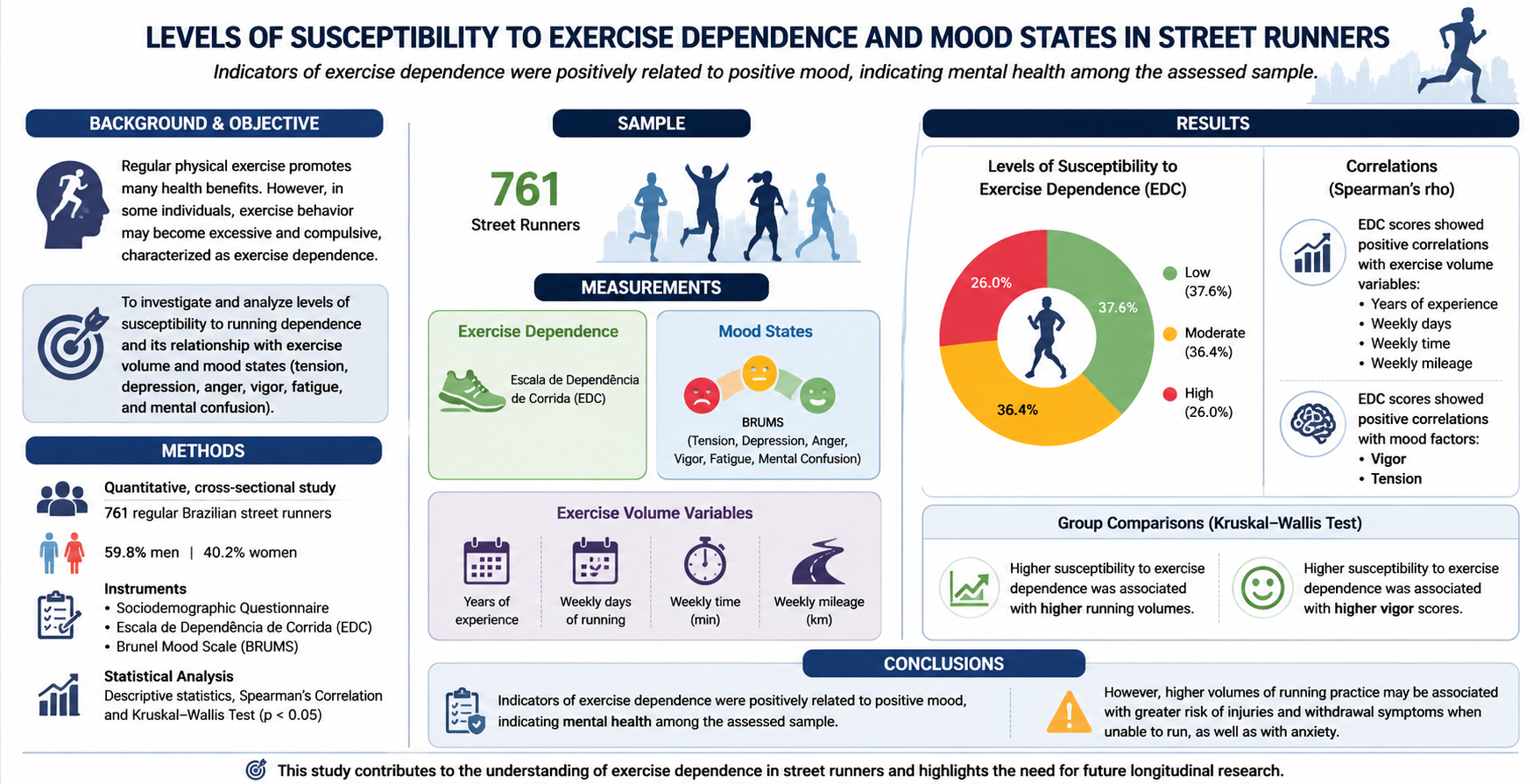
The regular practice of physical exercise is often associated with promoting benefits for practitioners. In recent decades, street running has become popular worldwide, with most participants being amateur runners who engage in the activity as a means of promoting quality of life. Among the psychological aspects related to exercise, studies have shown that some individuals may become susceptible to “exercise dependence,” a condition in which exercise takes a central role in a person’s life. As a result, individuals may exhibit characteristics such as: excessive training; injuries; weight control issues; withdrawal symptoms when unable to exercise; and even problems in social relationships, when exercise is exclusively prioritized. Background/Objectives: The aim of this study was to investigate and analyze levels of susceptibility to running dependence and its relationship with exercise volume and mood states (tension, depression, anger, vigor, fatigue, and mental confusion). Methods: This was a quantitative cross-sectional study involving 761 regular Brazilian runners (59.8% male and 40.2% female) who consented to participate and answered the Sociodemographic Questionnaire, the Escala de Dependência de Corrida (EDC), a Brazilian Portuguese adaptation of the Negative Addiction Scale (NAS), and the Brunel Mood Scale (BRUMS). The analysis plan was conducted through descriptive statistics (mean; standard deviation; median; 1st and 3rd quartiles; interquartile range and 95% confidence intervals) and inferential statistics (Spearman’s Correlation and Kruskal-Wallis Test). In all tests, the significance level adopted was p<0.05. Results: The sample was divided into three groups of susceptibility to exercise dependence: low (37.6%), moderate (36.4%), and high (26%). Scores indicative of exercise dependence showed positive correlations with practice volume variables (years of experience and weekly days, time, and mileage) and the mood factors of vigor and tension. Comparisons made using the Kruskal-Wallis Test revealed significant differences between the groups, as higher levels of susceptibility to dependence were positively associated with higher running volumes and vigor scores. Conclusions: Indicators of exercise dependence were positively related to positive mood, indicating mental health among the assessed sample.
Keywords:
street running
; exercise dependence
; mood states
1. Introduction
It is well established in the academic literature that regular physical exercise promotes various health benefits for practitioners [1,2]. Among many practices, street running has recently gained prominence as one of the most practiced modalities in several countries. In recent decades, the international popularization of street running is reflected by the significant increase in the number of participants and the organization of events. In general, runners can be amateurs or professionals, and the motivations for this practice are diverse, involving various factors such as the pursuit of well-being, quality of life, sociability, body aesthetics, competitiveness, professional goals, and more [3,4]. Along with the increase in running practice, there has also been a growing number of scientific studies investigating the physical and psychological effects resulting from this physical exercise [5,6,7,8].
Despite the numerous benefits of physical exercise, studies have shown that for some individuals, the behavior of exercising can become compulsive and even harmful to their health. This phenomenon is referred to, among other terms, as “exercise dependence.” Although exercise dependence is not a widely discussed topic, its consequences can be highly destructive to individuals experiencing this condition, making it a subject of significant relevance for scientific studies [9,10,11].
Among the various practices, aerobic exercises and sports that involve high intensity (e.g., running, CrossFit, and cycling) have been identified as activities in which practitioners may significantly increase the volume and intensity of their sessions and training routines. This is because the series of vigorous efforts involved in these activities promote short- and/or medium-term improvements in physiological and psychological aspects. As a result, these factors can serve as motivational drivers for some individuals to continuously increase their practices, to the point of developing compulsive behaviors towards them [12,13]. While the benefits of exercise are widely recognized, extreme levels of practice can lead to addictive behaviors with potentially harmful consequences for a minority of individuals [14].
The associations made between negative psychological aspects and exercise are found in investigations related to exercise dependence, which indicate that individuals with behavioral characteristics of excessive and compulsive exercise may exhibit certain negative symptoms, such as decreased physical vigor, symptoms of anxiety, depression, and increased fatigue and irritability [15]. Specifically, mood changes are primarily associated with periods when, for some reason, these individuals are unable to exercise [9,10,11,16].
Although the inclusion of exercise dependence as a mental disorder classification in the Diagnostic and Statistical Manual of Mental Disorders has been suggested, this inclusion has not yet occurred [10,15,17,18]. Furthermore, despite the existence of various instruments for assessing exercise dependence, their criteria are not yet conclusive, requiring further experimental research, as well as consistent control groups, better control of participant biases, and improved operational procedures to better define the diagnosis of exercise dependence [14,15]. There is also a need for greater consistency in the development of terminology and assessments, as problems in these areas lead to screening instruments that may evaluate susceptibility, presence, and intensity of symptoms and/or risks, but not provide a precise diagnosis of exercise dependence [18].
Based on this information, it is evident that although the literature addresses negative consequences for the psychological health of individuals who exhibit risk characteristics for exercise dependence, when it comes specifically to mood states, these harmful changes are mainly observed when the practice is discontinued, and not necessarily when regular practice is maintained [11]. However, to date, few studies have explored the relationship between exercise dependence and mood states in runners. Thus, investigations on this topic are relevant, as they contribute to expanding knowledge in these areas. Therefore, based on the aspects discussed in this introduction, the aim of this study was to investigate the relationship between exercise dependence and the mood states of regular street runners who had not been deprived of their practices. The hypotheses considered are that practitioners with indicators of exercise dependence will exhibit higher running volumes as well as positive mental health, given that they were not deprived of their regular practices.
2. Materials and Methods
2.1. Participants
This study involved 761 regular street runners with a mean age of 39.00±12.57 years, of both sexes, with 40.2% (306) being female and 59.8% (455) male.
2.2. Procedures
Initially, the research project was submitted for review by the Research Ethics Committee of São Paulo State University “Júlio de Mesquita Filho” (UNESP Bauru/São Paulo/Brazil) and approved according to the Process CAAE: 99303818.0.0000.5398. in compliance with the Guidelines and Regulatory Standards for Research Involving Human Beings of the National Health Council, Resolution 466/2012 [19].
Before participating in the research, all volunteers were informed about the study’s objectives, as well as the procedures to be carried out and the preservation of their identities in relation to the dissemination of the research. Those who agreed to participate, before answering the questionnaires, read and signed an Informed Consent Form (ICF). The criteria adopted for the inclusion and exclusion of individuals are presented in the diagram below (Figure 1), organized in accordance with the STROBE guidelines [21].
2.3. Instruments
Sociodemographic Questionnaire: This instrument was used to collect sociodemographic data from the participants, including age, gender, weight, height, education level, profession, as well as characteristics related to running practice, such as duration of practice (years/months), participation in races, and training routines (days per week, time per session, weekly mileage, professional guidance, and the practice of other exercises/sports).
Escala de Dependência de Corrida (EDC; Running Dependence Scale): Originally developed by Hailey and Bailey [21], the Negative Addiction Scale (NAS) was translated and adapted for Brazilian runners by Rosa, Mello, and Souza-Formigoni [22]. The scale quantifies scores indicative of running dependence based on negative psychological aspects related to this physical exercise/sport. Through its application, a score of up to 14 points can be obtained, with higher scores indicating greater behavioral characteristics related to exercise dependence. In the present study, EDC scores were classified into levels of exercise dependence susceptibility (low (37.6%), moderate (36.4%), and high (26%)) and not as a psychological diagnostic criterion for exercise dependence.
Brunel Mood Scale (BRUMS): Adapted from the Profile of Mood States instrument [23], BRUMS was developed to allow for a quick measurement of mood states in adult and/or adolescent populations by Terry, Lane, and Fogarty [24]. It was later translated and validated into Portuguese by Rohlfs et al. [25]. In this study, participants were asked to rate the scale using the following criterion: “How have you been feeling over the past week of training, including today” [25]. BRUMS contains 24 simple mood indicators, related to six subjective and transient states: Tension-anxiety (T); Depression-dejection (D); Anger-hostility (A); Vigor-activity (V); Fatigue-inertia (F); and Confusion-bewilderment (C). Factors T, D, A, F, and C are considered negative factors, while V is positive. When negative factors present low scores and the positive factor presents high scores, this is considered the Iceberg Profile, which indicates positive psychological health. Conversely, the Inverted Iceberg Profile indicates negative psychological health.
2.4. Statistical Analysis
To verify the normality of the data, the Kolmogorov-Smirnov Test was performed, with statistical significance set at p>0.05. The data did not meet the normality assumptions (p<0.05), and thus are considered non-parametric. A K-means Cluster Analysis was conducted to group the subjects based on similarities in their scores on the EDC responses. Three groups were defined according to levels of susceptibility to running dependence: low (scores between 0 and 3), moderate (scores between 4 and 6), and high (scores between 7 and 12).
Variables related to running practice volume and mood states were presented in Descriptive Statistics tables. For data analysis, Descriptive Statistics calculations were performed, including mean (x), standard deviation (sd), median (Md), interquartile range (IQR), and 95% confidence interval (CI95%). For Inferential Statistics, Spearman’s Rank Correlation Coefficient (rs) was used to analyze correlations between running dependence scores and aspects of running practice volume and the six mood states. The strength of the correlation coefficient was qualitatively assessed according to [26] as follows: null (0); weak (0.01 to 0.30); moderate (0.31 to 0.60); strong (0.61 to 0.90); very strong (0.91 to 0.99); and perfect (1). The Non-Parametric Kruskal-Wallis Test was used to compare the quantitative variables of participants’ characteristics and mood states among the three groups of susceptibility to running dependence. Statistical analysis was performed using IBM® SPSS® Statistics Version 25 software, and a significance level of p<0.05 was adopted for all statistical tests.
3. Results
According to the participants’ self-reports, Table 1 shows the quantitative variables related to the characteristics of running practice volume among the participants.
Table 2 presents the descriptive data of the EDC and BRUMS instruments. For the scores related to mood states, the data showed high values for the vigor factor (Md:12.00; CI95%:11.10-11.51) compared to the factors of tension, depression, anger, fatigue, and mental confusion. These data indicate characteristics related to the Iceberg Profile, which suggests positive psychological health.
All Spearman’s Rank Correlation Test was applied to analyze the correlations between running dependence scores and the quantitative variables of running practice volume and the six subscales of mood states (Table 3).
Table 3 shows that there was a “weak” positive correlation that was statistically significant between the EDC scores and years of practice (rs=0.137; p<0.001), as well as “moderate” positive correlations that were statistically significant between dependence scores and the number of days of running practice per week (rs=0.400; p<0.001), weekly practice time (rs=0.395; p<0.001), and weekly mileage (rs=0.346; p<0.001). Regarding mood states, a “weak” positive correlation, although statistically significant, was noted between dependence scores and vigor (rs=0.296; p<0.001) and tension (rs=0.080; p<0.05). Higher volumes of running practice were positively associated with higher levels of susceptibility to exercise dependence.
A Cluster Analysis (K-means Cluster) was conducted to group subjects with similar responses regarding the EDC. Based on this analysis, three groups of susceptibility to running dependence were defined: low (scores between 0 and 3), moderate (scores between 4 and 6), and high (scores between 7 and 12). The comparisons of the analyses of running practice volumes are presented in Table 4.
In relation to the time spent running (in years), the comparisons indicated significant differences between the groups, with the high susceptibility group showing greater practice time (Md: 4.00; IC95%: 5.73-7.94) compared to the low (Md: 3.04; CI 95%: 4.00-5.24) and moderate (Md: 3.50; CI 95%: 4.50-5.91) groups.
The number of days per week of running practice also showed statistically significant differences in comparisons between each pair of groups (p = 0.000), with higher values observed in groups with greater levels of susceptibility to dependence. The same trend was seen for time spent practicing and weekly mileage, as significant differences were found between the groups, with greater amounts of time and weekly mileage correlating with higher levels of susceptibility to running dependence.
Table 5 presents the comparative analyses of the scores for the subscales of mood states among the three groups of susceptibility to running dependence. It is noted that the differences were not statistically significant among the groups (p > 0.05) for the negative factors of tension (p = 0.074), depression (p = 0.405), anger (p = 0.173), fatigue (p = 0.113), and confusion (p = 0.480). Statistically significant differences (p < 0.05) were identified only for the vigor factor (p=0.000).
4. Discussion
The objective of this study was to investigate the relationship between susceptibility to exercise dependence and mood states in regular runners. Although regular running practice is often associated with promoting well-being and quality of life due to its health benefits, some practitioners may develop harmful behaviors related to running [27].
Despite this phenomenon being addressed in the literature regarding behaviors characterized as “dependence,” which may share criteria similar to other addictions, there are still complexities concerning its diagnosis and, consequently, the definition of prevalence rates. This is due to the diversity of research types, terminology, procedures, instruments, exercise modalities, and sports investigated, as well as the varied profiles of samples assessed and the differing results found on the topic [13,18,28]. Therefore, this study did not consider the prevalence and/or diagnosis of exercise dependence, as this issue is complex and there are no well-defined criteria for diagnosing behaviors related to this type of dependence [14,18].
When evaluating mood state scores, high scores were identified for the vigor factor. Although tension and fatigue factors showed higher scores compared to other negative factors, vigor still surpassed the others, indicating positive psychological health [23]. These findings align with other studies that have identified that regular exercisers experience positive mood states and psychological well-being [29,30].
The tests used for inferential statistics identified positive and statistically significant correlations between the total scores of the EDC and the practice volume variables (years of practice, days per week, weekly duration, and weekly mileage), as well as with the mood state factors related to vigor and tension. When comparing groups, statistically significant differences were found in exercise practice volumes and vigor scores. The relationship between greater practice experience and higher risk levels for dependence has also been observed in other studies with gym-goers [31], bodybuilders [32], marathon runners [22], and runners [33].
The literature often discusses that individuals showing signs of exercise dependence tend to engage in more intensive volumes in their practice routines [9,10,11,12,13,18]. In this context, the identification of positive and statistically significant relationships between indicators of running dependence and the frequency of practice (days per week), weekly duration, and weekly mileage confirms that practitioners with these indicators exercise more. It is important to highlight that, while greater amounts of physical exercise are associated with health benefits, the optimal frequencies, intensities, and durations of high-volume practices are still unclear [34]. In road running, research has noted that higher practice volumes are linked to increased occurrences of injuries [35].
Positive mood was identified in all groups, corresponding to the Iceberg Profile [23]. This result can be explained by the higher scores in vigor compared to the negative mood factors. Similar findings were observed by Oliveira et al. [36] and Anderson et al. [37], who, while evaluating runners, did not find negative changes in the participants’ mood, despite identifying indicators of dependence. Additionally, the authors noted that these individuals had significant percentages of quality of life. However, it is important to highlight that these previously cited studies also evaluated individuals who were not deprived of their usual exercise practices, indicating that in these cases, despite the presence of dependence-related characteristics, significant and detrimental influences on the participants’ mood were not observed.
The fact that the runners assessed in this study were not deprived of their usual practices and still exhibited positive mood scores, even with indicators of running dependence, highlights the importance of considering the psychological effects of regular exercise. The literature on this topic indicates that increased positive feelings and reduced negative feelings, along with other benefits, are key factors for motivation, adherence, and maintenance of regular practices [38].
Overall, the mood states of the participants were positive. Despite the tension and fatigue states being the only negative factors that showed higher scores in relation to greater indicators of exercise dependence, no statistically significant differences were found between the groups. It is worth considering that the literature discusses the relationship between exercise compulsion and anxiety traits [39]. Thus, one hypothesis to consider is that the evaluations of mood states may have detected anxiety traits in subjects more susceptible to running dependence, given that tension is related to anxiety. Regarding fatigue, a hypothesis for the increased scores in this factor among groups with higher indicators of dependence could be that these groups engaged in greater weekly exercise volumes, potentially leading to a higher perception of fatigue [6].
The findings of this study relate to those of Glasser [40], who identified that habitual runners, even with high weekly volumes of running, exhibit a set of positive psychological aspects that positively influence overall well-being, which he attributes to a condition of “positive addiction”.
This study has limitations regarding the instrument used to assess running dependency, the EDC. Hausenblas and Downs [15] argue that this instrument has deficiencies, as responses to some questions may be confused with participants’ levels of negative emotion rather than their level of dependency. Furthermore, the authors note that the validity and reliability of this instrument are unknown. In addition to the limitations of the instrument used, it is important to consider how the “addiction” to running is perceived within the community of practitioners and how this perception may influence responses to the questionnaire. Many practitioners may not view their “addiction” to running as detrimental, which can lead some subjects to equate a strong sense of “commitment” and “involvement” with the activity as synonymous with “addiction,” which would not be linguistically correct due to the different meanings of these expressions [11,41].
Another limitation of this study is its cross-sectional design, which does not allow causal relationships to be established between exercise dependence indicators, running practice volume, and mood states. Therefore, the findings should be interpreted as associations rather than cause-and-effect relationships.
5. Conclusions
Higher scores related to characteristics of exercise dependence in runners were positively correlated with running practice volume variables (years of experience, weekly training frequency, weekly training duration, and weekly mileage), as well as with the mood state factors of vigor and tension. Comparisons between groups revealed significant differences, as higher levels of susceptibility to exercise dependence were positively associated with greater running volumes and higher vigor scores. Indicators of running dependence were positively related to positive mood, suggesting psychological health among the assessed sample.
In this sense, no negative psychological consequences were identified in the evaluated sample. However, it is essential that this population engages in running practice consciously and without excess, as runners may be at risk of developing injuries due to high training volumes, stereotyped exercise-related behaviors, and withdrawal symptoms when training routines are interrupted for any reason.
Furthermore, the positive association identified between exercise dependence indicators and tension scores suggests that anxiety-related characteristics may be present among runners with greater susceptibility to exercise dependence. Monitoring stress- and anxiety-related responses in this population may contribute to maintaining athletic performance, psychological well-being, and injury prevention.
The research field to which this study belongs, namely exercise dependence, is still under development. Therefore, future studies should seek to improve the terminology and assessment instruments related to indicators of exercise dependence.
Author Contributions
Conceptualization, Anderson Ricardo Malmonge Barbosa Luciano and Carlos Eduardo Lopes Verardi; methodology, Anderson Ricardo Malmonge Barbosa Luciano and Carlos Eduardo Lopes Verardi; investigation, Anderson Ricardo Malmonge Barbosa Luciano, Flávia Marchesi Ciniciato, Danilo Malmonge Barbosa Luciano and Carlos Eduardo Lopes Verardi; formal analysis, Anderson Ricardo Malmonge Barbosa Luciano, Flávia Marchesi Ciniciato, Ercizio Lucas Biazus and Carlos Eduardo Lopes Verardi, Vinicius Barroso Hirota, Elias De França and Marcelo Rodrigues da Cunha; validation, Anderson Ricardo Malmonge Barbosa Luciano and Carlos Eduardo Lopes Verardi; data curation, Anderson Ricardo Malmonge Barbosa Luciano, Flávia Marchesi Ciniciato, Danilo Malmonge Barbosa Luciano and Carlos Eduardo Lopes Verardi; writing—original draft preparation, Anderson Ricardo Malmonge Barbosa Luciano; writing—review and editing, Anderson Ricardo Malmonge Barbosa Luciano, Flávia Marchesi Ciniciato, Danilo Malmonge Barbosa Luciano, Ercizio Lucas Biazus, Vinicius Barroso Hirota, Elias De França, Marcelo Rodrigues da Cunha and Carlos Eduardo Lopes Verardi; supervision, Anderson Ricardo Malmonge Barbosa Luciano and Carlos Eduardo Lopes Verardi; project administration, Anderson Ricardo Malmonge Barbosa Luciano and Carlos Eduardo Lopes Verardi. All authors have read and agreed to the published version of the manuscript.
Funding
This research received no external funding.
Institutional Review Board Statement
The study was conducted in accordance with the Declaration of Helsinki and approved by the Research Ethics Committee of Universidade Estadual Paulista “Júlio de Mesquita Filho” (São Paulo State University—UNESP), Brazil, under CAAE protocol number 99303818.0.0000.5398 (Certificado de Apresentação para Apreciação Ética; Certificate of Presentation for Ethical Consideration), in accordance with the Brazilian National Health Council Resolution No. 466/2012 governing research involving human participants.
Informed Consent Statement
Informed consent was obtained from all subjects involved in the study.
Data Availability Statement
The data presented in this study are available from the corresponding author upon reasonable request. The data are not publicly available due to privacy and ethical restrictions related to the participants involved in the study.
Acknowledgments
The authors would like to thank all runners who voluntarily participated in this study. The authors also express their gratitude to the staff of Universidade Estadual Paulista “Júlio de Mesquita Filho” (UNESP) for their support of academic and scientific activities. We are grateful to our family members and friends for their encouragement and support throughout the development of this research. The authors also thank the editorial team and reviewers of the Journal of Functional Morphology and Kinesiology for their time and consideration in evaluating this manuscript. Finally, we acknowledge all readers, researchers, and professionals interested in this field of study, whose dedication to scientific inquiry contributes to the advancement and dissemination of scientific knowledge.
Conflicts of Interest
The authors declare no conflicts of interest.
Abbreviations
The following abbreviations are used in this manuscript:
| BRUMS | Brunel Mood Scale |
| CAAE | Certificado de Apresentação para Apreciação Ética (Certificate of Presentation for Ethical Consideration) |
| CI95% | 95% Confidence Interval |
| EDC | Escala de Dependência de Corrida, Brazilian Portuguese adaptation of the Negative Addiction Scale (NAS) |
| H | Kruskal–Wallis H Statistic |
| ICF | Informed Consent Form |
| IQR | Interquartile Range |
| Md | Median |
| NAS | Negative Addiction Scale |
| Q1 | First Quartile |
| Q3 | Third Quartile |
| rs | Spearman’s Rank Correlation Coefficient |
| SD | Standard Deviation |
| SPSS | Statistical Package for the Social Sciences |
| STROBE | Strengthening the Reporting of Observational Studies in Epidemiology |
| df | Degrees of Freedom |
| UNESP | Universidade Estadual Paulista “Júlio de Mesquita Filho” (São Paulo State University “Júlio de Mesquita Filho”) |
References
- Mandolesi, L.; Polverino, A.; Montuori, S.; Foti, F.; Ferraioli, G.; Sorrentino, P.; Sorrentino, G. Effects of Physical Exercise on Cognitive Functioning and Wellbeing: Biological and Psychological Benefits. Front. Psychol. 2018, 9, 509. [CrossRef]
- Liu, Y.; Yan, T.; Chu, J.M.-T.; Chen, Y.; Dunnett, S.; Ho, Y.-S.; Wong, G.T.-C.; Chang, R.C.-C. The Beneficial Effects of Physical Exercise in the Brain and Related Pathophysiological Mechanisms in Neurodegenerative Diseases. Lab. Investig. 2019, 99, 943–957. [CrossRef]
- Sanfelice, R.; Santos, A.; Silva, M.; Nakamura, F.; Costa, I. Análise Qualitativa dos Fatores que Levam à Prática da Corrida de Rua. RBPFEX Rev. Bras. Prescr. Fisiol. Exerc. 2017, 11, 83–88.
- Parolini, P.L.L.; Rocco Júnior, A.J.; Carlassara, E.O.C. Evento Esportivo ou Experiência para o Consumidor? Um Estudo sobre a Motivação do Consumidor em Comparecer a Eventos de Corrida de Rua. Rev. Bras. Mark. 2018, 17, 356–369. [CrossRef]
- Floría, P.; Sánchez-Sixto, A.; Harrison, A.J.; Ferber, R. Effects of Running Experience on Coordination and Its Variability in Runners. J. Sports Sci. 2018, 36, 272–278. [CrossRef]
- Melo, C.C.; Pereira, J.K.C.; Pachêco, T.N.P.; Boletini, T.L.; Belo, F.R.R.; Noce, F. Os Efeitos de uma Prova de Corrida no Estado de Humor de Praticantes Amadores. Psicol. Rev. 2018, 27, 591–614. [CrossRef]
- Takayama, F.; Aoyagi, A.; Shimazu, W.; Nabekura, Y. Effects of Marathon Running on Aerobic Fitness and Performance in Recreational Runners One Week after a Race. J. Sports Med. 2017, 2017, 9402386. [CrossRef]
- Rodrigues, J.P.; Triani, F.S.; Malina, A.; Telles, S.C.C. Das Esteiras para as Ruas: Fatores que Levam os Alunos de Academias às Corridas de Rua. Motrivivência 2019, 31, 1–18. [CrossRef]
- Morgan, W.P. Negative Addiction in Runners. Physician Sportsmed. 1979, 7, 55–77. [CrossRef]
- Veale, D. Does Primary Exercise Dependence Really Exist? In Exercise Addiction: Motivation for Participation in Sport and Exercise; Annett, J.; Cripps, B.; Steinberg, H., Eds.; British Psychological Society: Leicester, UK, 1995; pp. 71–75.
- Berczik, K.; Szabo, A.; Griffiths, M.D.; Kurimay, T.; Kun, B.; Urban, R.; Demetrovics, Z. Exercise Addiction: Symptoms, Diagnosis, Epidemiology, and Etiology. Subst. Use Misuse 2012, 47, 403–417. [CrossRef]
- Nogueira, A.; Tovar-Gálvez, M.; González-Hernández, J. Do It, Don’t Feel It, and Be Invincible: A Prolog of Exercise Addiction in Endurance Sports. Front. Psychol. 2019, 10, 2692. [CrossRef]
- Lukács, A.; Sasvári, P.; Gömöri, E.; et al. Exercise Addiction and Its Related Factors in Amateur Runners. J. Behav. Addict. 2019, 8, 343–349. [CrossRef]
- Gori, A.; Topino, E.; Griffiths, M.D. Protective and Risk Factors in Exercise Addiction: A Series of Moderated Mediation Analyses. Int. J. Environ. Res. Public Health 2021, 18, 9706. [CrossRef]
- Hausenblas, H.A.; Downs, D.S. Exercise Dependence: A Systematic Review. Psychol. Sport Exerc. 2002, 3, 89–123. [CrossRef]
- Antunes, H.K.M.; Leite, G.S.F.; Lee, K.S.; Barreto, A.T.; Santos, R.V.T.; Mello, M.T. Exercise Deprivation Increases Negative Mood in Exercise-Addicted Subjects and Modifies Their Biochemical Markers. Physiol. Behav. 2016, 156, 182–190. [CrossRef]
- Pinna, F.; Dell’Osso, B.; Di Nicola, M.; Janiri, L.; Altamura, A.C.; Carpiniello, B.; Hollander, E. Behavioural Addictions and the Transition from DSM-IV-TR to DSM-5. J. Psychopathol. 2015, 21, 380–389.
- Egorov, A.Y.; Szabo, A. The Exercise Paradox: An Interactional Model for a Clearer Conceptualization of Exercise Addiction. J. Behav. Addict. 2013, 2, 199–208. [CrossRef]
- Brasil. Conselho Nacional de Saúde. Resolução No. 466, de 12 de Dezembro de 2012. Diário Oficial da União 2013, 112, 59–62.
- Malta, M.; Cardoso, L.O.; Bastos, F.I.; Magnanini, M.M.F.; Silva, C.M.F.P. STROBE Initiative: Guidelines on Reporting Observational Studies. Rev. Saúde Pública 2010, 44, 559–565. [CrossRef]
- Hailey, B.J.; Bailey, L.A. Negative Addiction in Runners: A Quantitative Approach. J. Sport Behav. 1982, 5, 150–154.
- Rosa, D.A.; Mello, M.T.; Souza-Formigoni, M.L.O. Dependência da Prática de Exercícios Físicos: Estudo com Maratonistas Brasileiros. Rev. Bras. Med. Esporte 2003, 9, 9–14. [CrossRef]
- Morgan, W.P.; Brown, D.R.; Raglin, J.S.; O’Connor, P.J.; Ellickson, K.A. Psychological Monitoring of Overtraining and Staleness. Br. J. Sports Med. 1987, 21, 107–114. [CrossRef]
- Terry, P.C.; Lane, A.M.; Fogarty, G.J. Construct Validity of the Profile of Mood States—Adolescents for Use with Adults. Psychol. Sport Exerc. 2003, 4, 125–139. [CrossRef]
- Rohlfs, I.C.P.M.; Carvalho, T.; Rotta, T.M.; Krebs, R.J. A Escala de Humor de Brunel (BRUMS): Instrumento para Detecção Precoce da Síndrome do Excesso de Treinamento. Rev. Bras. Med. Esporte 2008, 14, 176–181. [CrossRef]
- Callegari-Jacques, S.M. Bioestatística: Princípios e Aplicações; Artmed: Porto Alegre, Brazil, 2009.
- López, A.N.; Del Valle, A.S.; Rosa, S.M. Adicción a Correr: Una Revisión Desde Sus Inicios Hasta la Actualidad. Rev. Psicol. Apl. Deporte Ejerc. Fís. 2017, 1, e6. [CrossRef]
- Kardefelt-Winther, D.; Heeren, A.; Schimmenti, A.; van Rooij, A.; Maurage, P.; Carras, M.; Edman, J.; Blaszczynski, A.; Khazaal, Y.; Billieux, J. How Can We Conceptualize Behavioural Addiction Without Pathologizing Common Behaviours? Addiction 2017, 112, 1709–1715. [CrossRef]
- Laux, R.C.; Mattiello, G.F.; Corazza, S.T. Efeitos dos Treinamentos Metabólico e de Força no Estado de Humor. ConScientiae Saúde 2018, 17, 286–292. [CrossRef]
- Laredo-Aguilera, J.A.; Carmona-Torres, J.M.; García-Pinillos, F.; et al. Effects of a 10-Week Functional Training Programme on Pain, Mood State, Depression, and Sleep in Healthy Older Adults. Psychogeriatrics 2018, 18, 292–298. [CrossRef]
- Baptista, J.G.; Palma, A. Dependência de Exercício e Motivos para Exercitar: Estudo com Frequentadores de uma Academia do Rio de Janeiro. Rev. Bras. Ciênc. Esporte 2016, 38, 24–31.
- Hurst, R.; Hale, B.; Smith, D.; Collins, D. Exercise Dependence, Social Physique Anxiety, and Social Support in Experienced and Inexperienced Bodybuilders and Weightlifters. Br. J. Sports Med. 2000, 34, 431–435. [CrossRef]
- Furst, D.M.; Germone, K. Negative Addiction in Male and Female Runners and Exercisers. Percept. Mot. Skills 1993, 77, 192–194. [CrossRef]
- O’Donovan, G.; Blazevich, A.J.; Boreham, C.; Cooper, A.R.; Crank, H.; Ekelund, U.; Fox, K.R.; Gately, P.; Giles-Corti, B.; Gill, J.M.R.; et al. The ABC of Physical Activity for Health: A Consensus Statement from the British Association of Sport and Exercise Sciences. J. Sports Sci. 2010, 28, 573–591. [CrossRef]
- Borel, W.P.; Monteiro, A.; Netto Júnior, J.; et al. Prevalência de Lesões em Corredores de Rua Amadores Brasileiros: Metanálise. Rev. Bras. Med. Esporte 2019, 25, 161–167. [CrossRef]
- Oliveira, A.L.G.; Caputo, F.; Greco, C.C.; Denadai, B.S. Dependência de Exercício Físico em Atletas de Endurance Prolongada: Corrida de Aventura e Triatletas. Rev. Psicologia e Saúde 2015.
- Anderson, S.J.; Basson, C.J.; Geils, C. Personality Style and Mood States Associated with a Negative Addiction to Running. South Afr. J. Sports Med. 1997, 4, 6–11.
- Junior, A.W.S.; Caputo, E.L.; Reichert, F.F. A Motivação Autodeterminada em Corredores Recreacionais: Uma Abordagem Quanti-Qualitativa. Cad. Educ. Fís. Esporte 2019, 17, 1–8. [CrossRef]
- Hall, H.K.; Kerr, A.W.; Kozub, S.A. The Mediating Influence of Unconditional Self-Acceptance and Labile Self-Esteem on the Relationship Between Multidimensional Perfectionism and Exercise Dependence. Psychol. Sport Exerc. 2009, 10, 35–44. [CrossRef]
- Glasser, W. Positive Addiction. J. Ext. 1977, 15, 4–8.
- Amblard, I. “Sobre Ser Livre, Louco e Viciado”: Processos Identitários e Representações Sociais de Corredores de Rua. Doctoral Thesis, Universidade Federal de Pernambuco, Recife, Brazil, 2017.
Figure 1.
Flow diagram of inclusion and exclusion of individuals according to STROBE guidelines *. Abbreviations: ICF (Informed Consent Form), EDC (Escala de Dependência de Corrida, Brazilian Portuguese adaptation of the Negative Addiction Scale—NAS), and BRUMS (Brunel Mood Scale). Note: * Strengthening the Reporting of Observational Studies in Epidemiology [21].
Figure 1.
Flow diagram of inclusion and exclusion of individuals according to STROBE guidelines *. Abbreviations: ICF (Informed Consent Form), EDC (Escala de Dependência de Corrida, Brazilian Portuguese adaptation of the Negative Addiction Scale—NAS), and BRUMS (Brunel Mood Scale). Note: * Strengthening the Reporting of Observational Studies in Epidemiology [21].
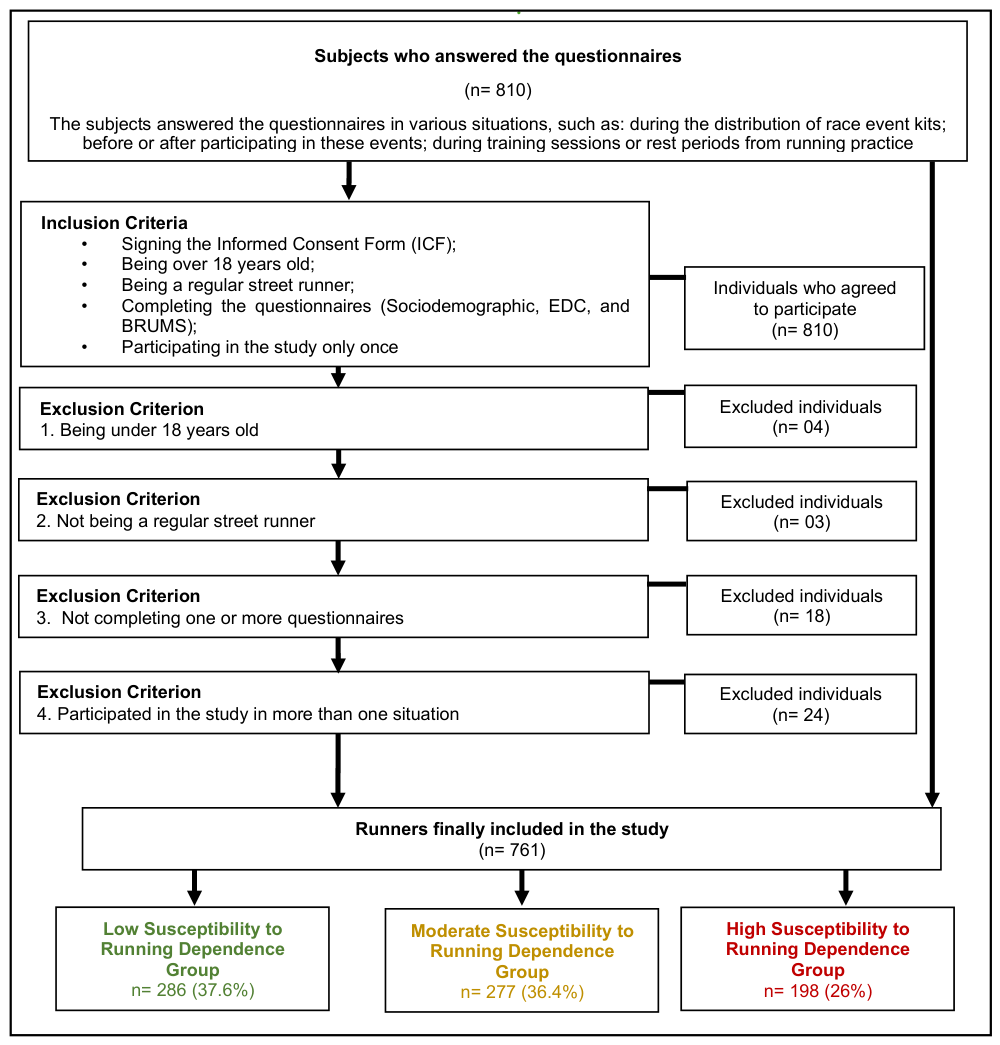

Table 1.
Descriptive statistics related to running practice volume.
| Variables | x±sd | Md | Quartiles | IQR | CI 95% | |
| Q1 | Q3 | |||||
| Running practice duration (years) | 5.41±6.36 | 3.50 | 1.25 | 6.25 | 5.00 | (4.96-5.86) |
| Days per week | 3.20±1.21 | 3.00 | 2.00 | 4.00 | 2.00 | (3.12-3.29) |
| Time per week (minutes) | 199.22±148.19 | 180.00 | 120.00 | 240.00 | 120.00 | (188.67-209.76) |
| Weekly mileage (km) | 23.7±17.81 | 20.00 | 12.00 | 30.00 | 18.00 | (22.41-24.94) |
Abbreviations: mean (x); standard deviation (sd); median (Md); 1st quartile (Q1); 3rd quartile (Q3); interquartile range (IQR); 95% confidence interval (CI95%).
Table 2.
Descriptive statistics of running dependence scores and mood states.
| Variables | x±sd | Md | Quartiles | IQR | CI 95% | |
| Q1 | Q3 | |||||
| EDC | 4.63±2.69 | 4.00 | 2.00 | 7.00 | 5.00 | (4.43-4.82) |
| BRUMS | ||||||
| Tension | 2.57±2.74 | 2.00 | 0.00 | 4.00 | 4.00 | (2.37-2.76) |
| Depression | 0.54±1.26 | 0.00 | 0.00 | 0.00 | 0.00 | (0.45-0.63) |
| Anger | 0.67±1.54 | 0.00 | 0.00 | 0.00 | 0.00 | (0.56-0.78) |
| Vigor | 11.30±2.88 | 12.00 | 9.00 | 13.00 | 4.00 | (11.10-11.51) |
| Fatigue | 2.85±2.84 | 2.00 | 0.00 | 4.00 | 4.00 | (2.64-3.05) |
| Mental confusion | 0.84±1.65 | 0.00 | 0.00 | 1.00 | 1.00 | (0.73-0.96) |
Abbreviations: mean (x); standard deviation (sd); median (Md); 1st quartile (Q1); 3rd quartile (Q3); interquartile range (IQR); 95% confidence interval (CI95%); Escala de Dependência de Corrida (EDC); Brunel Mood Scale (BRUMS).
Table 3.
Spearman’s Rank Correlation between dependence scores, running practice volume variables, and mood states.
Table 3.
Spearman’s Rank Correlation between dependence scores, running practice volume variables, and mood states.
| Variables | Running Practice Volume | Mood States | |||||||||
| Years of practice | Days per week | Weekly time | Weekly mileage | T | D | A | V | F | C | ||
| Running Dependence | rs | 0.137** | 0.400** | 0.395** | 0.346** | 0.080* | -0.014 | 0.012 | 0.296** | 0.031 | -0.005 |
| p | 0.000 | 0.000 | 0.000 | 0.000 | 0.028 | 0.703 | 0.751 | 0.000 | 0.401 | 0.895 | |
Abbreviations: Tension (T); Depression (D); Anger (A); Vigor (V); Fatigue (F); Mental Confusion (C); Spearman’s rho coefficient (rs); statistical significance (p). Note: *. Correlation is significant at the 0.05 level (2-tailed). **. Correlation is significant at the 0.01 level (2-tailed).
Table 4.
Comparison of quantitative variables of running practice volume among the risk groups (low, moderate, and high) for dependence, according to the Kruskal-Wallis Test.
Table 4.
Comparison of quantitative variables of running practice volume among the risk groups (low, moderate, and high) for dependence, according to the Kruskal-Wallis Test.
| x±sd | Md | Quartiles | IQR | CI 95% | H | df | p | ||
| Q1 | Q3 | ||||||||
| Running practice time (years) | |||||||||
| Low | 4.62±5.29 | 3.04 | 1 | 5.95 | 4.95 | (4.00-5.24) | 12.094 | 2 | 0.002* |
| Moderate | 5.21±6 | 3.5 | 1.17 | 6 | 4.83 | (4.50-5.91) | |||
| High | 6.83±7.9 | 4 | 2 | 8 | 6 | (5.73-7.94) | |||
| Days per week | |||||||||
| Low | 2.71±1.02 | 3 | 2 | 3 | 1 | (2.59-2.83) | 99.591 | 2 | 0.000* |
| Moderate | 3.29±1.17 | 3 | 3 | 4 | 1 | (3.15-3.43) | |||
| High | 3.8±1.24 | 3 | 3 | 4 | 1 | (3.62-3.97) | |||
| Time per week (minutes) | |||||||||
| Low | 148.99±103.71 | 120 | 80 | 180 | 100 | (136.92-161.06) | 101.22 | 2 | 0.000* |
| Moderate | 213.5±154.34 | 180 | 120 | 240 | 120 | (195.25-231.76) | |||
| High | 251.78±170.47 | 205 | 160 | 300 | 140 | (227.89-275.67) | |||
| Weekly mileage (km) | |||||||||
| Low | 18.14±13.4 | 15 | 10 | 20.75 | 10.75 | (16.57-19.69) | 78.054 | 2 | 0.000* |
| Moderate | 25±19.03 | 20 | 14 | 30 | 16 | (22.72-27.23) | |||
| High | 29.9±19.24 | 25 | 15 | 38 | 23 | (27.18-32.57) | |||
Abbreviations: mean (x); standard deviation (sd); median (Md); 1st quartile (Q1); 3rd quartile (Q3); interquartile range (IQR); 95% confidence interval (CI95%); Kruskal-Wallis H (H); degrees of freedom (df); statistical probability (p); Note: * Statistically significant difference (p<0.05).
Table 5.
Comparison of mood scores among the three groups of risk levels for running dependency, based on the Kruskal-Wallis Test.
Table 5.
Comparison of mood scores among the three groups of risk levels for running dependency, based on the Kruskal-Wallis Test.
| Variables | Running Dependence | ||||||||||||||||||||
| Low Risk n=286 (37.6%) | Moderate Risk n=277 (36.4%) | High Risk n=198 (26%) | |||||||||||||||||||
| x±sd | Md | Quartiles | IQR | CI95% | x±sd | Md | Quartiles | IQR | CI95% | x±sd | Md | Quartiles | IQR | CI95% | H | df | p | ||||
| Q1 | Q3 | Q1 | Q3 | Q1 | Q3 | ||||||||||||||||
| BRUMS | |||||||||||||||||||||
| Tension | 2.23±2.44 | 1.5 | 0 | 4 | 4 | (1.95-2.52) | 2.65±2.76 | 2 | 0 | 4 | 4 | (2.33-2.98) | 2.92±3.06 | 2 | 0 | 4 | 4 | (2.49-3.35) | 5.216 | 2 | 0.074 |
| Depression | 0.5±1.22 | 0 | 0 | 0 | 0 | (0.36-0.64) | 0.61±1.34 | 0 | 0 | 1 | 1 | (0.45-0.77) | 0.51±1.18 | 0 | 0 | 0 | 0 | (0.34-0.67) | 1.808 | 2 | 0.405 |
| Anger | 0.59±1.51 | 0 | 0 | 0 | 0 | (0.41-0.76) | 0.78±1.61 | 0 | 0 | 1 | 1 | (0.59-0.97) | 0.65±1.49 | 0 | 0 | 0 | 0 | (0.44-0.86) | 3.507 | 2 | 0.173 |
| Vigor | 10.45±2.74 | 11 | 9 | 12 | 3 | (10.14-10.77) | 11.48±2.95 | 12 | 10 | 14 | 4 | (11.13-11.83) | 12.28±2.63 | 12 | 11 | 14 | 3 | (11.91-12.65) | 53.993 | 2 | 0.000* |
| Fatigue | 2.48±2.46 | 2 | 0 | 4 | 4 | (2.20-2.77) | 3.1±2.96 | 3 | 0 | 5 | 5 | (2.75-3.45) | 3.02±3.14 | 2 | 0 | 4.75 | 4.75 | (2.58-3.46) | 4.369 | 2 | 0.113 |
| Mental Confusion | 0.8±1.54 | 0 | 0 | 1 | 1 | (0.62-0.98) | 0.94±1.74 | 0 | 0 | 1 | 1 | (0.73-1.14) | 0.78±1.69 | 0 | 0 | 1 | 1 | (0.54-1.01) | 1.469 | 2 | 0.480 |
Abbreviations: mean (x); standard deviation (sd); median (Md); 1st quartile (Q1); 3rd quartile (Q3); interquartile range (IQR); 95% confidence intervals (CI95%); Kruskal-Wallis H (H); degrees of freedom (df); statistical probability (p); BRUMS (Brunel Mood Scale). Note: *statistically significant difference (p<0.05).
Disclaimer/Publisher’s Note: The statements, opinions and data contained in all publications are solely those of the individual author(s) and contributor(s) and not of MDPI and/or the editor(s). MDPI and/or the editor(s) disclaim responsibility for any injury to people or property resulting from any ideas, methods, instructions or products referred to in the content. |
© 2026 by the authors. Licensee MDPI, Basel, Switzerland. This article is an open access article distributed under the terms and conditions of the Creative Commons Attribution (CC BY) license (http://creativecommons.org/licenses/by/4.0/).
Copyright: This open access article is published under a Creative Commons CC BY 4.0 license, which permit the free download, distribution, and reuse, provided that the author and preprint are cited in any reuse.


