

Submitted:
02 July 2026
Posted:
03 July 2026
You are already at the latest version
Abstract
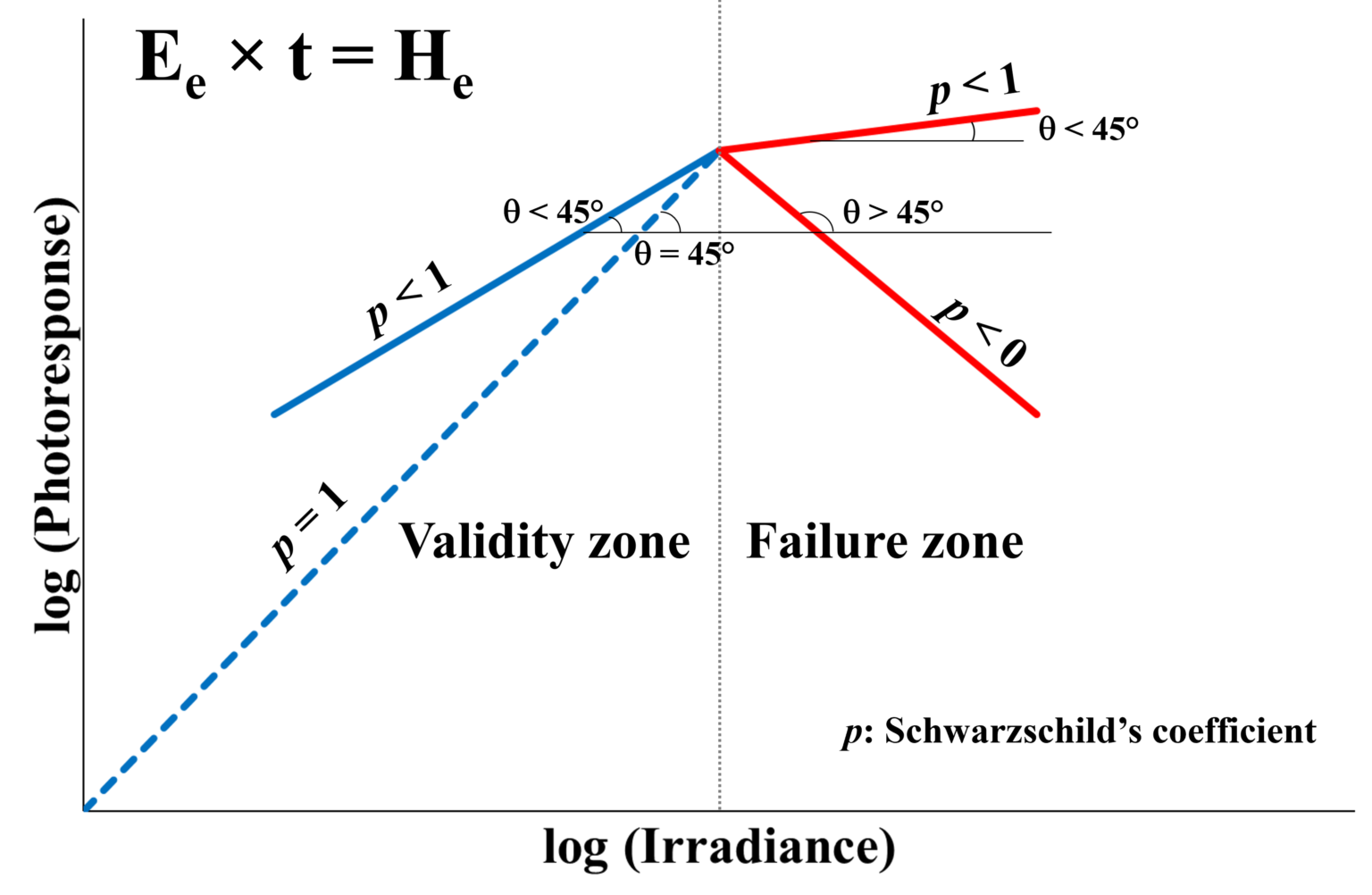
This study was aimed at developing an irradiation strategy that would be able to maintain the validity of Bunsen-Roscoe reciprocity law when exposing aorta to ultraviolet A (UVA) radiation as a procedure to reinforce mechanically the blood vessels. Furthermore, it was aimed at establishing a research-based criterion for recommending optimal irradiance levels in a potential clinical setting. Aorta specimens were harvested postmortem from goat eyelids and exposed to UVA radiation (365 nm) in the specified conditions. Thermographic infrared analysis was carried out in order to determine the photothermal response. By performing irradiation in the presence of a photosensitizer (a riboflavin compound), which resulted in the crosslinking of vascular collagen, a photochemomechanical response was also determined based on the changes in mechanical properties as evaluated in a mechanical tester. Based on these radiation-induced photoresponses, a graphical method was employed to define the failure zones when applying the reciprocity law. Loss of law’s validity was confirmed by the descending values of Schwarzschild’s p-coefficients. Both photoresponses showed that law’s failure zone begins at an irradiance in the region 70–75 mW/cm2, for radiant exposures between 6 and 18 J/cm2. Consequently, a higher irradiance is inexpedient when exposing vascular tissue to UVA radiation.
Keywords:
aorta
; collagen
; UVA radiation
; riboflavin
; photochemical crosslinking
; Bunsen-Roscoe law
; Schwarzschild’s p-coefficients
Copyright: This open access article is published under a Creative Commons CC BY 4.0 license, which permit the free download, distribution, and reuse, provided that the author and preprint are cited in any reuse.


