
Submitted:
02 July 2026
Posted:
02 July 2026
You are already at the latest version
Abstract
Laser powder bed fusion (LPBF) enables fabrication of complex bimetallic structures, such as combustion chambers, that require a thermally conductive internal channel supported with a high-strength structural jacket. Inconel625 (IN625) served as the substrate, with GRCop-42 deposited with varying laser power and laser scanning speeds to create the IN625-GRCop-42 interface. Hot isostatic pressing (HIP) was performed to evaluate defect mitigation and Vickers microhardness testing assessed the mechanical properties across the bimetallic interface. Microstructure characterization revealed porosity across the full processing window and HIP was unsuccessful in eliminating the defects, indicating that densification is primarily achieved by LPBF process optimization. Microhardness testing proved that the as-printed samples showed higher microhardness values than the as-HIPped samples due to the fine microstructure, high dislocation density and residual stresses caused by the LPBF process. As-HIPped samples showed recrystallization and grain coarsening due to the decrease in microhardness compared to the as-printed samples. These results highlight the importance of LPBF process optimization in achieving strong, thermally stable IN625-GRCop-42 bimetallic interfaces. This study aims to investigate the microstructural and mechanical behavior of the IN625 and GRCop-42 dissimilar metal interface fabricated using the LPBF process and the effects of HIP on the bimetallic microstructure.
Keywords:
laser powder bed fusion (LPBF)
; GRCop-42
; Inconel 625 (IN625)
; bimetallic interface
; hot isostatic pressing (HIP)
; microstructure
; additive manufacturing
1. Introduction
Additive manufacturing (AM) is widely used in aerospace applications due to its ability to fabricate components with complex geometries compared to conventional manufacturing methods. Laser powder bed fusion (LPBF) exhibits layer-by-layer fabrication with the aid of a high-powered laser and metal powder feedstock. LPBF selectively melts the metal powder, enabling production of lightweight, intricate structures with minimal material was [1]. Specifically, when it comes to aerospace applications, LPBF technology has been deemed appropriate for manufacturing combustion chambers with internal coolant channels. Combustion chambers need to be lined with a material that has excellent thermal conductivity and enables effective heat transfer, to serve as the internal coolant channels, while being supported by a high strength material that acts as a good structural jacket [1].
NASA has developed GRCop-42, a copper alloy, that works well in high-temperature applications such as liquid rocket engines. GRCop-42 demonstrates good thermal conductivity and strength retention in high-temperature applications [1]. GRCop-42 would serve well as the inner lining of the combustion chamber but would still require heat-resistant alloy to support the structure and act as a structural jacket. Inconel 625 (IN625), a nickel-based superalloy, is suitable as the outer lining of the combustion chamber as it is widely used for its excellent strength and toughness in extreme temperatures [1]. The bimetallic combination of the IN625, structural jacket, and GRCop-42, thermally conductive liner, offers an excellent solution for the combustion chamber design [2].
Fabricating defect-free bimetallic structures through conventional manufacturing methods has proven to be a significant processing limitation [3]. The LPBF process depends heavily on curating the processing such as laser power, laser scanning speed, hatch spacing and layer thickness, that work together to fabricate builds that are defect-free and produce consistent microstructure and properties. The high reflectivity and conductivity of copper alloys complicate the LPBF process.
Previously, there has been work done on fabricating bimetallic combustion chambers with IN625 and GRCop-84 [2]. However, the understanding of the processing relationship between interfacial mixing microstructure of IN625 and GRCop-42 during the LPBF process has not been previously studied and established. To establish a reliable dissimilar metal joint, this study aims to understand the microstructure of the IN625-GRCop-42 interface fabricated via LPBF.
2. Materials and Methods
The powder feedstock used in this study was gas-automized IN625 LPBF powder supplied by Carpenter Technology Corporation, as the base-built substrate of the structure, and GRCop-42 powder sourced from Powder Allow Corporation (PAC). The particle size distribution (PSD) for the IN625 powder was reported by Carpenter Technology Corporation as D10= 22.2, D50 = 34.7 and D90= 52.9. The PSD for the GRCop-42 powder was reported by PAC as D10= 21.2, D50 = 35.8 and D90= 57.8. The chemical compositions of both materials are summarized in Table 1.
The bimetallic structure was fabricated using the 2onelab LPBF machine, equipped with a maximum laser power of 220 W and laser scanning speed of 1100 mm/s. The LPBF chamber was filled with nitrogen gas that served as an inert atmosphere throughout the fabrication process [4]. IN625 printing was optimized and then used to fabricate the substrate of the bimetallic structure. To optimize IN625, 7 mm x 7 mm x 3 mm cubes were fabricated on a stainless-steel build plate across a set processing parameter values. Table 2 presents the specific conditions used to fabricate the IN625 substrates, along with additional printing parameters that were kept constant throughout the LPBF process.
The objective was to refine the GRCop-42 process conditions on top of the IN625 substrate by studying the mixing between the two alloys at the interface. Similarly, to how the IN625 substrates were optimized, 7mm x 7mm x 3 mm cubes of GRCop-42 were fabricated on top of the optimized parameter built IN625 substrate. Preliminary trials indicated that GRCop-42 required laser power greater than 160W to allow sufficient fusion. Laser power below 160 W failed to provide enough energy to bond the powder particles, therefore, only laser power 160 W and above were considered viable for GRCop-42 fabrication. Table 3 presents the process parameters used for fabricating the GRCop-42 structure.
As part of post-processing, the LPBF fabricated cubes were sectioned along the build direction, via wire electrical discharge machining (W-EDM), to expose the interface. One half of all LPBF fabricated bimetallic samples were subjected to hot isostatic pressing (HIP) at Oregon Manufacturing Innovation Center (OMIC) to understand and compare how the process influences the grain structure and mechanical properties of as-HIPped samples versus the as-printed samples. The HIP treatment was performed with the Quintus system set at a temperature of 950 °C and at a pressure of 150 MPa. HIP was conducted at a controlled heating rate of 5 °C per minute, and a 4 hour hold at peak temperature.
To investigate the microstructure at the interface of the bimetallic IN625-GRCop-24 structure, the W-EDM sectioned cubes were mounted in conductive graphite resin to minimize changing and improve analysis stability during characterization. The mounted samples were polished using SiC abrasive papers, starting with the 180-grit paper for 1 minute. The samples were progressively polished using abrasive papers up to 1200-grit, with the polishing time increasing by 2 minutes with each grit level. After the grinding, the samples were polished using the 0.05 μm alumina slurry and deionized water for 10 minutes. Through this grinding and polishing process, we obtained a surface finish that was smooth, scratch-free and suitable for microstructure evaluation.
Vickers microhardness testing was conducted, for all mounted bimetallic structures, to evaluate its mechanical performance. Microhardness measurements were obtained using the LECO AMH55 microhardness tester that was equipped with a diamond indenter. This microhardness tester applied a load of 0.5 kgf with a 15 second dwell time when obtaining the microhardness readings for the bimetallic samples. Hardness impressions were made at 10 different points at each different region (IN625, bimetallic interface and GRCop-42 regions) to identify the variations in hardness results across the structure.
3. Results
3.1. Sample Fabrication
Figure 1 illustrates the structure of the fabricated bimetallic structure. The IN626 substrate was first fabricated using the optimized LPBF parameters and directly on top of the substrate, the GRCop-42 layer was deposited. This formed the dissimilar metal interface of interest.
3.2. Microstructure Characterization
Figure 2 and Figure 3 show the optical micrographs of the unetched as-print and as-HIPped bimetallic samples, while Figure 4 and Figure 5 show the scanning electron microscope (SEM) micrographs of the unetched as-printed and as-HIPped IN625-GRCop-42 bimetallic samples, respectively, fabricated across the full processing array. The laser power ranged between 160 W to 220 W while the laser scan speeds ranged between 200 mm/s to 1100 mm/s. The red, yellow and blue bars on the SEM micrographs highlight the GRCop-42, bimetallic interface and IN625 regions respectively.
3.3. Mechanical Test
Figure 6 presents the Vickers microhardness results measured across the bimetallic interface in the as-printed and as-HIPped conditions, respectively. Ten microhardness indentation readings, with a 15 second dwell time and a load force of 0.5 kgf ,were taken at the bimetallic interface for each sample fabricated using different combinations of laser scanning speed and power. In the graphs, horizontal reference lines are included to indicate the microhardness values of arc-melted IN625 and GRCop-42 for reference.
4. Discussion
The required LPBF parameters varied significantly across both alloys. GRCop-42 is a highly reflective copper alloy that requires much higher laser power during the LPBF. The increased laser power was necessary to ensure sufficient energy was absorbed into each layer of the structure. At lower laser powers, 160 W and below, the powder bed was not supplied with sufficient energy, which resulted in not melted powder sandwiched between the printed layers. This resulted in lack of fusion (LOF) defects and the structure delaminating as the LPBF process progressed [5]. In contrast, the IN625 alloy is comparatively much less reflective than the copper alloy. Therefore, the IN625 substrate required a significantly lower laser power to fabricate cubes with good consolidation. Based on the combined density, microstructural and hardness analysis to optimize IN625 to serve as the substrate for the bimetallic structure, the optimal processing condition for IN625 was determined to be 190 W laser power paired with 200 mm/s laser scanning speed.
Figure 2, Figure 3, Figure 4 and Figure 5 show that across all samples fabricated, the GRCop-42 region remained incompletely molten and porous. HIP processing is typically expected to collapse internal porosity under the elevated temperature and isostatic pressure. Figure 3 and Figure 5 shows that the optical micrograph and the SEM micrographs of the as-HIPped samples continued to display porosity in the GRCop-42 region. This demonstrates that the selected HIP procedure did not fully eliminate the existing pores in the bimetallic structures. This could be an indication that the as-printed samples were sufficiently porous to allow argon infiltration into the samples during HIP, preventing effective compression of the bulk volume and suggesting the defects were likely too large to be fully eliminated by this post-processing treatment.
Vickers microhardness analysis was conducted on twelve samples manufactured across the full processing window, with indentations taken in three distinct regions (IN625 substrate, bimetallic interface and the GRCop-42 region). Within the IN625 region, a direct comparison was made between the as-printed and the as-HIPped samples. The as-printed samples exhibited an average hardness of 326 ± 17 HV, whereas the as-HIPped samples showed a reduced average hardness of 292 ± 21 HV. The as-printed samples consistently displayed higher hardness values compared to their as-HIPped processed counterparts. LPBF processing results in high cooling rates during the fabricating process, which results in fine microstructure, higher dislocation density and significant residual stress [5].
Similarly, within the GRCop-42 region, the HIP-treated samples produced lower hardness readings compared to their as-printed counterparts. The as-printed GRCop-42 microhardness values measured between 86 HV to 158 HV across the full processing window. The highest microhardness value measured in the GRCop-42 region was 158 HV, which corresponded to the sample fabricated using a combination of high laser power and scan speed (200 W, 1100 mm/s). The increased laser power, with its ability to provide more energy into the powder bed during the fabrication, enhances the melt pool temperature and allows for more mixing between each layer of the LPBF build [8]. This results in better consolidation and as a result, higher microhardness readings in the GRCop-42 region at the interface.
The as-printed IN625-GRCop-42 interface exhibited a microhardness range of 190 HV to 262 HV. In comparison, the as-HIPped interface region showed a range between 109 HV to 275 HV. The highest reading for the interface region was gathered from the sample fabricated using a combination of 160 W laser power and 1100 mm/s scanning speed. As expected, the interface shows significantly higher microhardness values compared to the GRCop-42 region, as it reflects the mixing of the nickel-based superalloy, highlighting the mechanical strength of the IN625 substrate [9]. At lower laser powers, 160 W and 190 W, the as-HIPped samples yielded higher hardness values compared to the as-printed samples. This behavior can be explained as 160 W and 190 W offer lower energy input during the LPBF process compared to the 220 W. This results in less stable melt pool formation at the interface, which can lead to incomplete fusion of power particles during fabrication During HIP, the exposure to 950 °C and 150 MPa improves metallurgical bonding and promotes diffusion at the dissimilar interface [10].
However, at the higher laser power of 220 W, the hardness at the interface was observed to be higher in the as-printed samples compared to the as-HIPed samples. This is because 220 W results in better consolidation during the LPBF process due to the higher energy input. The LPBF process causes rapid solidification rates and residual stress, which in return would elevate the hardness of the samples. During HIP, the samples undergo recrystallization which reduces the initial residual stress imposed from the LPBF process and produces samples with lower hardness [11].
5. Conclusions
The IN625 substrate processing conditions employed in this work were pre-optimised, where dense, defect-free samples were fabricated with a laser power of 190 W paired with the laser scanning speed of 200 mm/s. In contrast, GRCop-42, due to the materials’ high reflectivity and ability to dissipate heat quickly during the LPBF process, required a substantially higher energy input. GRCop-42 required laser power greater than 160 W as lower laser powers were unable to generate adequate melt pool penetration. Weak melt pool penetration results in poor interlayer bonding and mixing during the LPBF process [8].
Microstructural characterization revealed that the as-printed bimetallic samples displayed varying levels of porosity, in the GRCop-42 region, across the full array of processing condiitons. HIPing was conducted at 950 °C and 150 MPa and this process was unsuccessful in eliminating the existing porosities.
Mechanical evaluation further supported the observation from microstructural characterization. The microhardness measurements revealed that the bimetallic structure was strongly influenced by both the LPBF processing parameters and the HIP treatment. The regions that displayed improved consolidation during the LPBD process showed increased hardness values. In contrast, the as-HIPped samples displayed lower hardness values due to recrystallization. These findings show that while HIP can relieve residual stress, it cannot compensate for inadequate densification introduced during the LPBF process. Therefore, achieving a dense and mechanically reliable IN625-GRCop-42 bimetallic structure relies primarily on optimizing the LPBF processing parameters during fabrication.
Author Contributions
Conceptualization, V.S, N.W and S.P; data curation, V.S and N.G; formal analysis, V.S and N.G; funding acquisition, S.P; investigation, V.S ; methodology, V.S and N.W; project administration, S.P; resources, S.P; supervision, N.W and S.P; validation, V.S; writing-original draft, V.S; writing-review & editing, S.P, N.W and N.G;.
Funding
This research was funded by the US National Science Foundation (NSF), grant number 2338253 (NSF CAREER).
Acknowledgments
The authors would like to acknowledge the support provided by Dr. Peter Eschbach at the OSU Electron Microcopy Facility.
Abbreviations
The following abbreviations are used in this manuscript:
| LPBF | Laser Powder Bed Fusion |
| IN625 | Inconel 625 |
| HIP | Hot isostatic pressing |
| SEM | Scanning Electron Microscope |
References
- Gradl, P.R.; Protz, C.S.; Ellis, D.L.; Greene, S.E. Progress in Additively Manufactured Copper-Alloy GRCop-84, GRCop-42, and Bimetallic Combustion Chambers for Liquid Rocket Engines. [PubMed]
- Chen, Y.; Zeng, C.; Ding, H.; Emanet, S.; Gradl, P.R.; Ellis, D.L.; Guo, S. Thermophysical properties of additively manufactured (AM) GRCop-42 and GRCop-84. Mater. Today Commun. 2023, 36, 106665. [Google Scholar] [CrossRef]
- Gradl, P.R.; Protz, C.; Cooper, K.; Garcia, C.; Ellis, D.; Evans, L. GRCop-42 development and hot-fire testing using additive manufacturing powder bed fusion for channel-cooled combustion chambers. In Proceedings of the AIAA Propulsion and Energy Forum and Exposition, Indianapolis, IN, USA, 19–22 August 2019. [Google Scholar]
- Parida, A.K.; Maity, K. Comparison the machinability of Inconel 718, Inconel 625 and Monel 400 in hot turning operation. Eng. Sci. Technol. Int. J. 2018, 21, 364–370. [Google Scholar] [CrossRef]
- Demeneghi, G.; Gradl, P.; Mayeur, J.R.; Hazeli, K. GRCop-42: Comparison between laser powder bed fusion and laser powder direct energy deposition. Addit. Manuf. Lett. 2024, 10, 100224. [Google Scholar] [CrossRef]
- Preis, J.; Lawson, S.B.; Lee, I.; Kawasaki, M.; Bay, B.K.; Manoharan, S.; Paul, B.K.; Pasebani, S. Influence of travel speed on microstructure and mechanical behavior of Inconel 625 fabricated using wire-fed laser directed energy deposition. J. Mater. Process. Technol. 2024, 330, 118464. [Google Scholar]
- Preis, J.; Lawson, S.B.; Wannenmacher, N.; Pasebani, S. Joining Inconel 718 and GRCop42: A framework for developing transition compositions to avoid cracking and brittle phase formation. Mater. Des. 2025, 252, 113733. [Google Scholar] [CrossRef]
- Wang, J.; Zhu, R.; Liu, Y.; Zhang, L. Understanding melt pool characteristics in laser powder bed fusion: An overview of single- and multi-track melt pools for process optimization. 2023. [Google Scholar] [CrossRef] [PubMed]
- Eiselstein, H.L.; Tillack, D.J. The invention and definition of alloy 625. [CrossRef]
- Aghayar, Y.; Moazzen, P.; Kestens, L.A.I.; Mohammadi, M. Tailoring the microstructure, physical, and mechanical properties of pure copper using various additive manufacturing techniques. J. Alloys Compd. 2025, 1010, 178332. [Google Scholar] [CrossRef]
- Gruber, K.; Dziedzic, R.; Kuźnicka, B.; Madejski, B.; Malicki, M. Impact of high temperature stress relieving on final properties of Inconel 718 processed by laser powder bed fusion. Mater. Sci. Eng. A 2021, 813, 141111. [Google Scholar] [CrossRef]
Figure 1.
Regions selection on bimetallic samples for microhardness measurements.
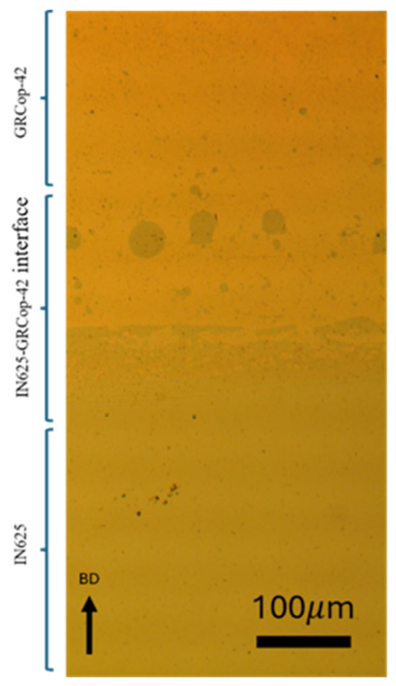
Figure 2.
Optical micrographs of the as-printed IN625-GRCop-42 bimetallic sample interfaces..
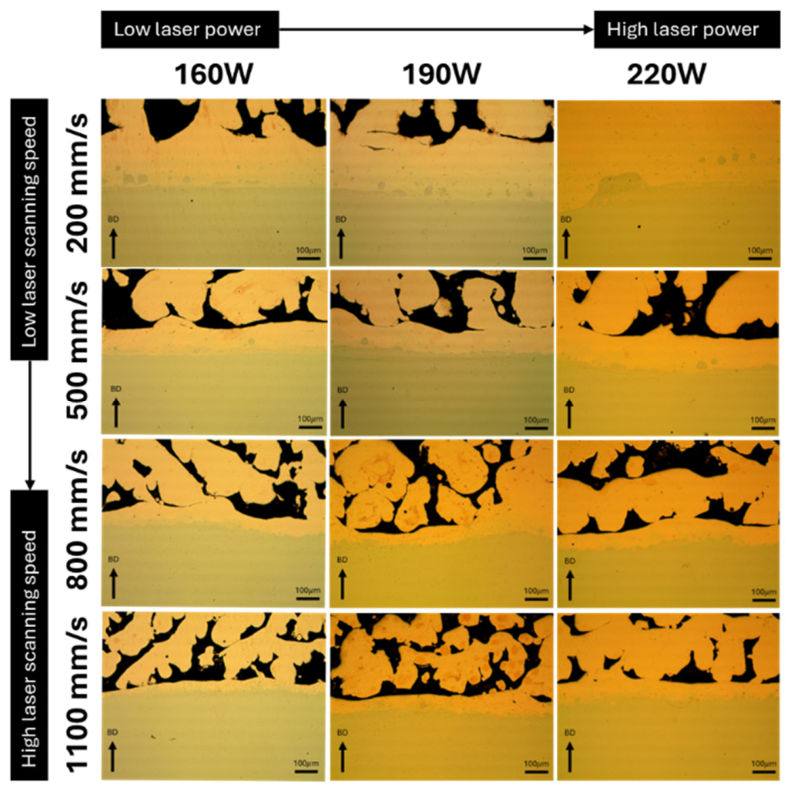
Figure 3.
Optical micrographs of the as-HIPped IN625-GRCop-42 bimetallic sample interfaces.
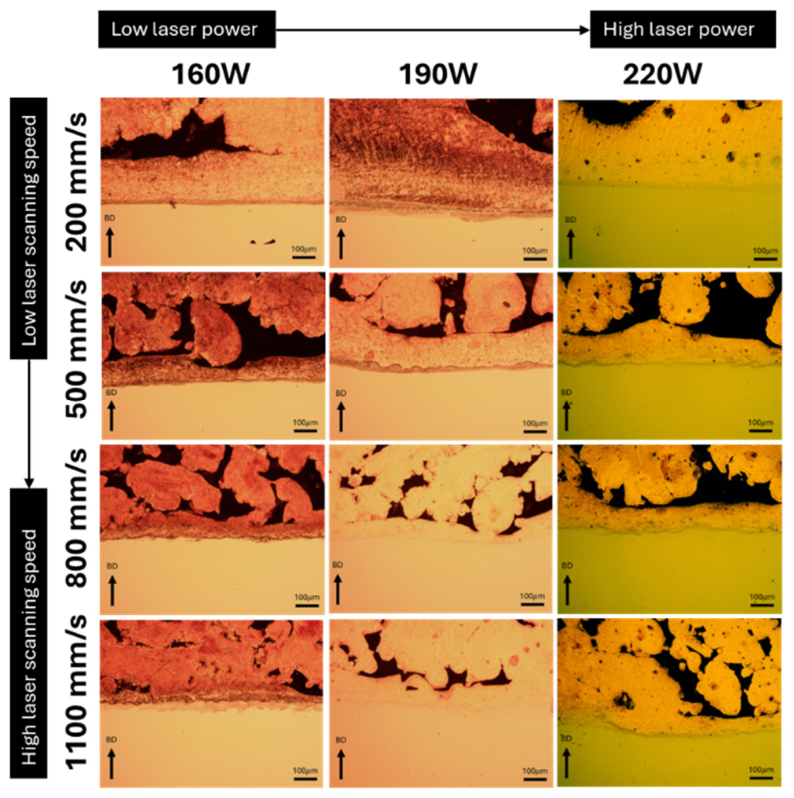
Figure 4.
SEM micrographs of the unetched as-printed IN625-GRCop-42 bimetallic sample interfaces.
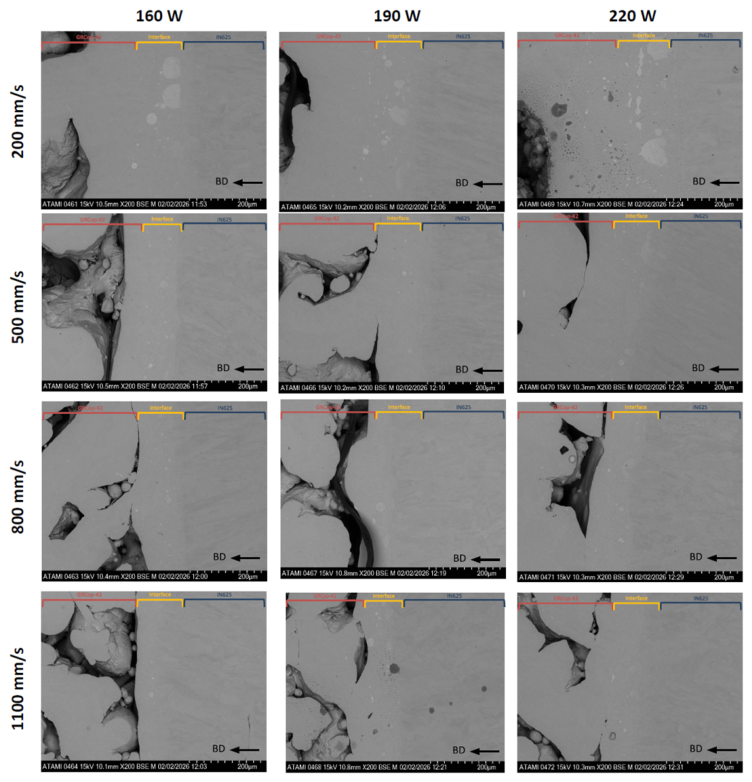
Figure 5.
SEM micrographs of the unetched as-HIPped IN625-GRCop-42 bimetallic sample interfaces.
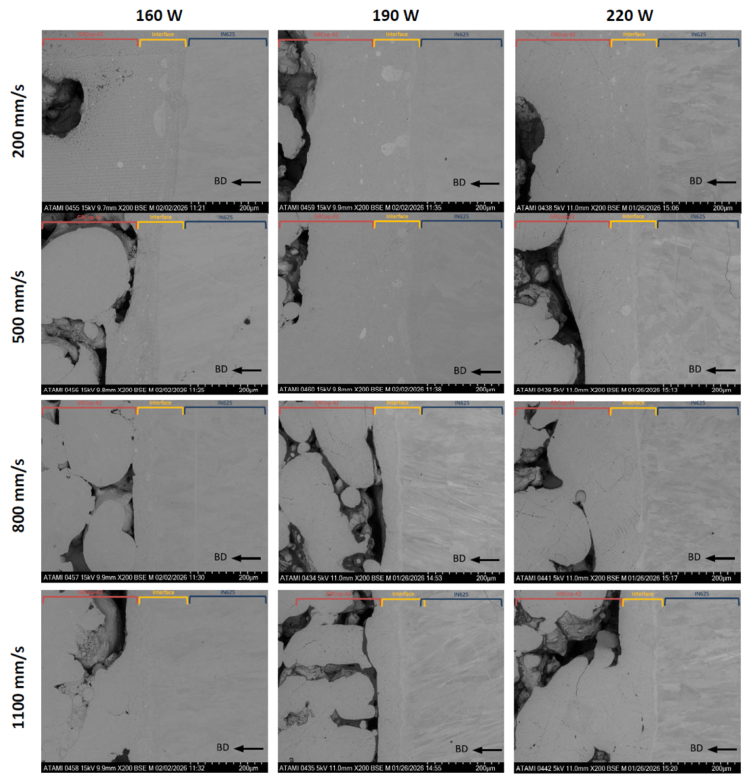
Figure 6.
Vickers microhardness measurements of bimetallic IN625-GRCop-42: (a) as-print samples; (b) as-HIPped samples.
Figure 6.
Vickers microhardness measurements of bimetallic IN625-GRCop-42: (a) as-print samples; (b) as-HIPped samples.
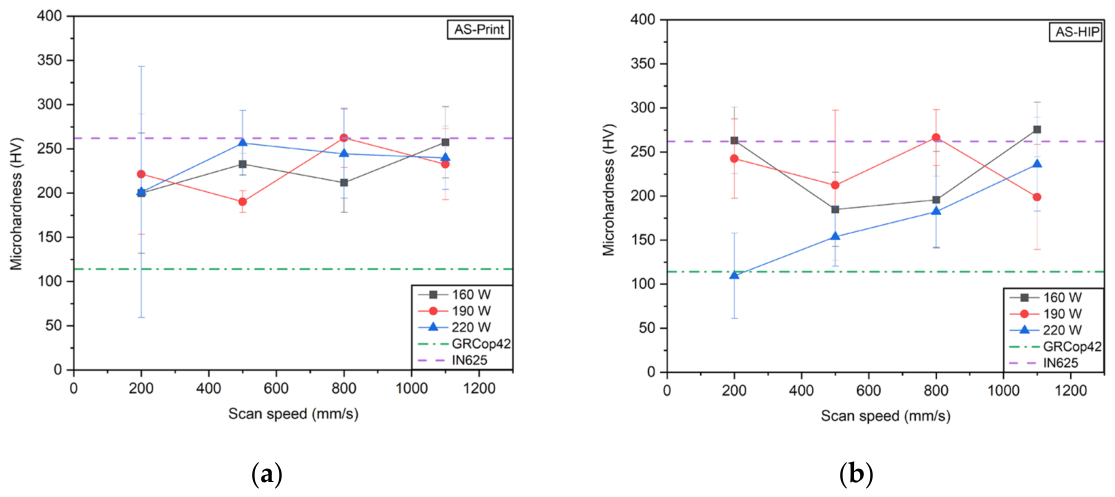

Table 1.
Composition of powders used.
| Element | IN625 [wt.%] | GRCOp-42 [wt.%] |
| Al | 0.16 | 0.015 |
| Cr | 21.14 | 3.36 |
| Fe | 3.40 | 0.03 |
| Mo | 8.83 | - |
| Ni | Bal | - |
| N | 0.019 | <0.001 |
| O | 0.017 | 0.037 |
| Ti | 0.20 | - |
| Nb | 3.99 | 2.9 |
| Cr:Nb ratio | - | 1.17 |
Table 2.
LPBF process parameters used for fabricating IN625 substrates.
| Process Parameters | Parameter Values |
| Laser Power | 130, 160, 190, 220 (W) |
| Laser scanning speed | 200, 500, 800, 1100 (mm/s) |
| Layer thickness | 25 µm |
| Laser spot size | 40 µm |
| Hatch spacing | 40 µm |
Table 3.
LPBF process parameters used for fabricating GRCop-42 fabrication.
| Process Parameters | Parameter Values |
| Laser Power | 160, 190, 220 (W) |
| Laser scanning speed | 200, 500, 800, 1100 (mm/s) |
| Layer thickness | 25 µm |
| Laser spot size | 40 µm |
| Hatch spacing | 40 µm |
Disclaimer/Publisher’s Note: The statements, opinions and data contained in all publications are solely those of the individual author(s) and contributor(s) and not of MDPI and/or the editor(s). MDPI and/or the editor(s) disclaim responsibility for any injury to people or property resulting from any ideas, methods, instructions or products referred to in the content. |
© 2026 by the authors. Licensee MDPI, Basel, Switzerland. This article is an open access article distributed under the terms and conditions of the Creative Commons Attribution (CC BY) license (http://creativecommons.org/licenses/by/4.0/).
Copyright: This open access article is published under a Creative Commons CC BY 4.0 license, which permit the free download, distribution, and reuse, provided that the author and preprint are cited in any reuse.


