
Submitted:
02 July 2026
Posted:
02 July 2026
You are already at the latest version
Abstract
Two people can view the same information but can take different actions. Most importantly, while thinking about moral, political issues, such as abortion, depending on the variation in the psychological systems, a perception of threat can arise. To exploit this aspect of the psychological systems, state and non-state actors make use of propaganda techniques to influence any target audience. Although the spread of disinformation is extensively studied in the information eco-system, an understanding of the effects of propaganda that result from interactions between the schemata of the individuals and schemata of the perceptual stimuli is not accounted for in systemic analysis of the disinformation threat vector. Moreover, while aiming to undermine the norms, values, and institutions in free societies, propaganda does not target the material objects or networks; it targets the psychological systems. Therefore, to improve the systemic understanding of disinformation propaganda, this research scrutinized the possibility of using the moral foundation theory (MFT) to include the psychological systems in a target audience analysis. The moral sentiments of an information operation were analyzed and the MFT dictionary was used to determine the moral scheme of the information streams. The words and hashtags were clustered by using the MFT dictionary; then, the moral cluster and word frequency analyses in the context of disinformation propaganda were conducted. The moral cluster frequency approach can augment the target audience analysis; it can ameliorate the counter information operation endeavors and threat vector analyses. To further study this, a quantum open system model of interaction between an information stream and the target audience cognitive system was built. The effects of non-selective measurement were studied via modeling and simulating a quantum open system based cognitive model.
Keywords:
disinformation
; morality
; propaganda
; quantum open system
; quantum cognition
1. Introduction
People categorize social phenomena, actions, and other-than-themselves with their psychological systems. These psychological systems support diverse interpretative frameworks such that the same phenomenon can be perceived as praiseworthy by person A and blameworthy by person B. The story of a former member of the Westboro Baptist Church (WBC), Megan Phelps-Roper [1], can demonstrate the effects of the changes in these psychological systems. Her grandfather is the founding pastor, and her mother was the spokesperson of the church. She grew up in an environment in which the doctrine of the WBC permeated every aspect of her life [1]. She had been very articulate about the church and its exclusivist doctrine. When the church members decided to promulgate their doctrine via social media, Megan became the face of the church on Twitter. She argues that Twitter and other social media platforms enable the evolution of individuals and societies in unprecedented ways [1]. She shares her discussions (with then-husband to be) concerning the notions such as commandments and truth. During those discussions, he was choosing his words in such a way that Megan would see the commandment and truth notions through the lenses of humility, gentleness, and compassion. Switching perspectives allowed her to interpret the very same notions with different lenses; in return, exclusivist interpretations have transformed into an inclusivist understanding. Although leaving WBC means estrangement from her family, Megan left.
Unfortunately, the changes in psychological systems via social media can lead to radicalism [2] or other social problems [3]. State and non-state actors actively shape the information sphere [4] and make use of propaganda techniques to encircle the information consumers in the information ecosystem [2,5,6,7,8,9,10]. These increased interactions involve the schemata of the individuals and schemata of the perceptual stimuli [11,12]. The state of the art disinformation/fake-news/network studies, e.g., [13,14,15,16], do not address the interaction between perceptual stimuli and the cognitive dimension. While propaganda attempts to undermine the norms, values, and institutions in free societies, it does not target the material objects or networks; it targets the psychological systems that are utilized to perceive norms, values, and institutions.
In this paper, first, the moral sentiments of an information operation [17] were examined by capitalizing on the moral foundation theory (MFT) [18]. Besides the text mining and language processing methods, the MFT dictionary was used to determine the moral scheme of the information stream of information operation. The words and hashtags were clustered based on the MFT dictionary to obtain moral cluster frequency; then, the moral cluster and word/hashtag frequency analyses were compared in the context of disinformation propaganda. By using the identified stream schemata and determined MFT pillar distribution, a quantum open system based interaction model was built. By using this model, a control and treatment comparison was completed to test if non-selective measurement affects the resulting MFT pillar distribution.
2. Moral Foundation Theory
Two people can view the same information but can take different actions. Specifically, when it comes to moral political issues such as abortion or same-sex marriage, with the varying political preferences, the perception of threat can arise, conflict can ensue. The problem here is not about being right or wrong; the problem is not recognizing the differences in the interpretative framework that are enabled while perceiving the same phenomena. A book, movie, blog, speech, and tweet all have associated narratives. Narratives and frames are embedded in the story schemata, which describes the contextual regularities [12] of stimuli. When people interact with the regularities in the stimuli, their schemata are modified. A modified schema will affect the information-seeking behavior of the individuals, who then can be inadvertently directed to confirmation bias and trapped in a filter-bubble. For example, to counter a conservative filter-bubble concerning abortion, the left should understand the interpretative framework of the conservative right. Thinking about moral issues, e.g., same-sex marriage, is different than thinking about what to do during a long weekend.
As a robust theoretical framework, MFT indicates that the human mind interprets the social phenomena with five innate foundations: care/harm, fairness/cheating, loyalty/betrayal, authority/subversion, and purity/degradation, details are shown in Table 1 [19]. By using these five innate foundations, the degree of an individual’s political leanings can be expressed [20]. Haidt [20] argues that morality is innate and learned; morality results from adaptation processes that include psychological mechanisms.
The five pillars of morality for two major political preferences exhibit different moral matrices [19] Figure 1. The moral matrix of the left is dominated by two of the five moral foundations; the right, social conservatives, have an equally weighted moral matrix [20]. Subsequent MFT studies introduced four categories concerning the patterns in moral pillars [21] Fig. 2. The two new categories (liberation and religious left in Figure 2) elucidate the state of the moral mind of the individuals, who are typically categorized as moderates or bi-conceptuals [22].
Although morality is innate, it is highly dependent on environmental influences [19,24]. MFT elucidates a framework in which one can study how the human mind is prepared to learn/adapt values, norms that are related to a diverse set of social problems [24]. MFT has commonalities with the construction of social reality [25]. MFT becomes a method to discover the origins of moral prejudices. For example, the left perceives the legalization of same-sex-marriage as a way to reduce harm for the innocent victims and to increase fairness for everyone [21]; the right perceives the same-sex marriage as a different cultural practice, an action against the authority of the church and an impure action [21]. Therefore, the two sides cannot fathom each other unless they comprehend the differences in their interpretative framework. The MFT can provide a unified framework to study the interaction between the human mind and perceptual stimuli in the information sphere.
An important product of the MFT is its dictionary [23,26,27]; the first MFT dictionary [28] had a limited number of words. Although the first dictionary had been used as the theoretical foundation for several voting prediction studies [21,29,30,31,32] and provided robust results, a recent MFT study [27] suggested a newer version of the dictionary [23] ,Table 2, which is more comprehensive. MFT delineates characteristics of moral development, such as the construction of social reality, contextual learning/adaptation, being highly intuitive, and dependent on the environmental influences.
Propaganda and Moral Foundation Theory
MFT can ameliorate the models of counter-information operations that include disinformation propaganda. In this work, four aspects of propaganda that connote the characteristics of the moral foundation theory are discussed.
The first aspect: Morality is a product of the construction of social reality. Information connotes the reality [33] and includes disinformation [34]; as a result, taking the totality of information [35] into account is critical to capture the full threat vector of disinformation propaganda. For example, while focusing on dissemination of disinformation and fake-news or critical nodes in social networks e.g., [13,14,15,16], the interactions that occur between perceptual stimuli and the cognitive dimension can be unheeded. These interactions are part of the construction of social reality, which delineates the perceptual adaptation processes, such as X becomes Y in context C [25]. Since disinformation propaganda aims to undermine the norms, values, and institutions in free societies, it targets the process of construction of reality; in return, cognitive representations of norms, values, and institutions change, and the magnitude of change should be accounted for the threat vector of disinformation propaganda.
The second aspect: Contextual learning and adaption. Propaganda exploits cognitive peripheral routes, such as watching TV while doing other work, or skimming through updates in social media feeds [8,9,10] so that it can increase its interaction with the target audience [7]. These interactions involve the schemata of the individuals and regularities of the perceptual stimuli [11,12]. As a result, the changing schemata of the individual constrains the action and perception of the individual, such as defining the other-than-self [36,37]. In the new information ecosystem, the reciprocal relationship between the user and the environment is augmented with more contextual effects [38]. This provides a perfect ontology for disinforming [38]; as a result, the freedom of choice is controlled, culture is directed, and the danger of being systemically disinformed becomes very real [11].
The third aspect: Morality is highly intuitive and influenced by the environment. Propaganda attempts to smear a specific interpretative framework for the concepts that are pertinent to social norms, values, and institutions [16,38,39]; in doing so, it can induce conflict concerning the social issues. Propaganda standardizes ideas, reinforces prevailing stereotypes, and provides patterns of thought concerning all the aspects of social life. In doing so, propaganda attempts to codify social, political, and moral standards [6]. The distracting elements of the information ecosystem enact fast thinking; hence, the intuitive system controls the decisions [3,40], framing effects increase [41], and analytical reasoning can be hindered [22,40,42].
The fourth aspect: Propaganda cannot create something out of nothing; it must attach itself to a sentiment, an idea that exists in the society [6]; it must be associated with a foundation that already exists in the minds of the constituents of the target audience. Propaganda must consist of fundamental psycho-sociological bases, such as pillars of MFT because propaganda that conflicts with the accepted structure of a target audience would have no possibility of success [6].
3. Analysis of Twitter Data
On January 31st, 2018, Twitter (now X) released a comprehensive archive of tweets and media associated with state-sponsored information operations. The importance of this data set is that it includes entities that knowingly attempted to manipulate and distort public conversation regarding the 2016 U.S. presidential elections as part of an information operation. This data set is categorized as information operation by Twitter; therefore, analysis of this data set can be conducted without a study to determine whether this data set is part of an information operation or not.
3.1. Analysis of Information Operation Data
First, the algorithm that was developed as part of this work was tested with the MFT dictionary by analyzing the morality of random tweets related to UNICEF and Sky-Sport-Boxing. The results indicate that 74.41% of the @UNICEF related tweets are virtue-oriented, and 88.95% of the @skysportboxing associated tweets are vice-oriented; thus, both the dictionary and algorithm are sensitive enough to capture the morality of tweets.
The largest data set in the January 2018 release was selected. This data set includes IRA associated accounts, tweets, and media. The total number of tweets in this data set is 920,761. The analysis is conducted with the English version of the MFT dictionary, and after removing the tweets that contain only hashtags, the total number of English tweets becomes 592,360.
After extracting the repeated words and hashtags Table 3 and Fig. 3, the repeated words are compared with the words [13] that were commonly used in the 2016 presidential election campaigns. Although this data set was extracted from an information operation that intended to manipulate the 2016 U.S. presidential elections, the repeated words in Table 3 and Figure 3 have sparse relation to both of the campaigns. For example, from the word count, only “hillary” and “obama” could be related to one of the campaigns and from the hashtag list “maga,” and “americafirst” hashtags can be related to a campaign. The word cloud in Figure 3 indicates that a target audience analysis that is based on word frequency analysis can be inadequate to capture a full threat vector. Consider the design of a counter disinformation operation, which includes a refutation text that contains the words in Figure 3. The countering arguments might be logical in design; however, the audience may not capture the logical arguments; moreover, they will be trapped in an echo-chamber that keeps repeating the same words. From the propaganda perspective, this is the perfect situation to reinforce the adversarial intent. A subtle context in the information stream that does not surface with a word count or semantic analysis should be accounted for the design of a counter disinformation propaganda.
A hashtags frequency analysis was conducted because contrary to Twitter’s recommendation of using two hashtags in a tweet to maximize visibility; there are thousands of tweets with 3,4, 5, and 6 hashtags. The word frequency analysis, shown in Figure 3, suggests that there are anti-Islamic, anti-Muslim, and anti-immigrant sentiments in the corpus. Though this might be true and supported by the hashtag frequency analysis, shown in Figure 3, it does not reveal the characteristics of the target audience; hence, it cannot provide a foundation to design counter-information operation.
A co-occurrence analysis could provide a network relation among the repeated words, but it wouldn’t allow one to express the schema of the target audience and story structure of the information stream. Therefore, tracking the most repeated words cannot elucidate the details of the target audience of an information operation; however, the most repeated words render target concept analysis (The term target concept analysis came up in a discussion with Maj. C. Amsley, the U.S. Army) possible.
3.2. MFT Dictionary Analysis
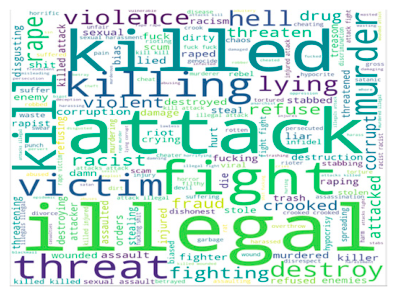
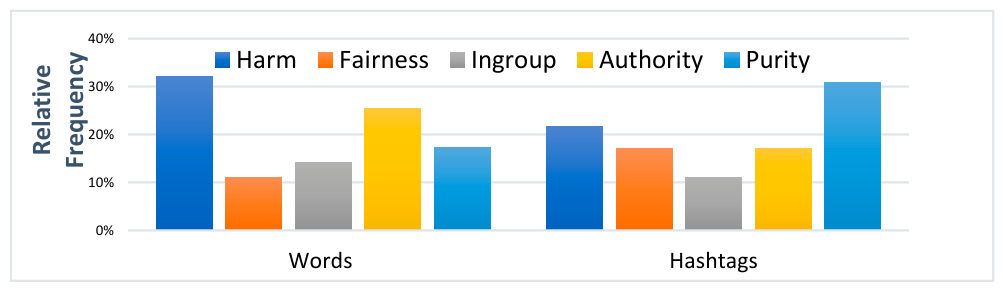
IRA associated tweets are further analyzed by using the MFT English dictionary [23]. After cleaning up the corpus from the stop words, the remaining words are checked with the MFT dictionary clusters [23], and the associated seed words are listed in Table 2. The total number of tweets that include at least one moral dictionary word is 215,691, and the relative frequency distribution of the tweets with respect to moral pillars is shown in Figure 5. The co-occurrence analysis allowed one to check the number of tweets, which include at least one of the most repeated (>10,000) words and the moral dictionary words; 97,990 tweets satisfy this condition. This means that the words in Figure 3 are seen with the context in Figure 4. The context in Figure 4 can be gleaned by the individuals who have a similar moral matrix Figure 2. The co-occurrence analysis does not consider the effects of order of tweets, threads, any twitter account relations, hashtags, and emojis.
Figure 4.
Moral foundation dictionary word cloud for the harm foundation.
The morality of the hashtags in this information operation can provide additional insight into the target audience analysis. Since hashtags are used to increase the visibility of a tweet [43], the frequency analysis of the moral dictionary can delineate the moral matrix of the target audience. In reference to the clusters in Figure 2, the morality of hashtags in Figure 5 indicates a target audience towards the center of the moral spectrum.
By using the moral foundation analysis of the words and hashtags, one can argue that this specific information operation was targeting the moderate voters. However, the contribution of this approach, from the modeling perspective, is that both the schema of the information stream and the schema of the target audience can be expressed with the same framework; hence can be accounted for in systemic threat vector analysis that captures the interaction between target audience and the information stream.
Figure 5.
Moral foundation dictionary analysis of the Russian propaganda.
4. Human Mind and Stimuli Interaction
The overlapping concept for propaganda, influence, social networks, disinformation, misinformation and information warfare research is the human element. The models in this field mostly capitalized on the theoretical construct of classical probability theory (CPT). For example, a Bayesian model in this context is a monotonic accumulation model [44] with the constraints of the Bayesian model that has the property of the conjugate update [45]. Belief update in the Bayesian model in the context of propaganda/disinformation/influence operations context, is sequential and order independent [45,46,47,48]. Modeling influence with Bayesian approach not only ignores the order of the information received, but also demonstrates no sensitivity between having information one-by-one vs receiving all at once [47]. Markov models of information sharing/opinion update/influence [49] can also be considered adaptive, however, there is no time sensitivity in the Markov models. A Markov model of influence follows an ergodic behavior and monotonically converges to a stationary distribution [45,50]. A pure quantum probability model (QPT) based model [51,52] that is based on the coherence assumptions supports two types of adaptations. First adaptation is through intended interaction which is the decision making entity elicit a judgement or a decision [52,53,54,55]; second, through gradually adapting to the environment with dynamics that is explained by Markov dynamics [56,57]. Both the Markov and Bayesian modeling approaches aligned with the older propaganda/disinformation/influence [58] efforts in which the volume of information was not inflated and, hence, target audience monotonically would absorb the evidence with the cues in information stream. For the contemporary propaganda/influence operation modeling, these modeling approaches fail to capture ambiguity/indeterminacy [59,60]. More importantly, Bayesian or Markov based models represents uncertainty in a way that it decreases as the evidence accumulates; if this is the case, which may not be all the time, the increase in ambiguity/confusion with more information cannot be captured by these CPT based models [46,55,61,62,63].
The modern age propaganda is like a firehose [58]. Modern information/influence/propaganda operations are high-volume, repetitive, engagement-driven, and aim at inducing confusion along with persuasion [64,65]. Consequently, the new information ecosystem, in which humans are drawn in information, becomes the perfect habitat for these operations. People in this ecosystem may not know what to pay attention to. Information in the new ecosystems is too timely, which may entail spontaneous action [66]. Its repetitive, continuous stream with high volume of information generates an environment in which humans have very little time to think between perceptual stimuli [58,67,68,69]. This environment gives rise to fast thinking situations in which framing effects can increase [70]. In this environment humans are exposed to an excessive amount of information, and hence the analytical reasoning processes can be hindered [40]. For example, a conflict can easily arise if the interlocutors use incompatible frames to understand a social phenomenon [71]. Therefore, a framework that can represent destabilization and engagement-timing that can account for judgement/choice/decision elicitation can capture features of modern age information warfare.
Hitherto research indicates that although QPT based models capture the shortcomings of CPT based models, using a pure quantum model also introduces modeling shortcomings. However, the quantum open system (QOS) modeling combines Markov and pure quantum models in one equation with single continuous probability distribution [45,50,53,54,55].
4.1. Quantum Open System Modeling
Quantum probability theory (QPT) is recognized as a comprehensive method in cognitive modeling [46,72,73]. Mathematical axioms of QPT ameliorate the puzzling experimental findings in cognitive science as they did for physics [76]. One of the peculiar contributions of the QPT is that it can capture different types of uncertainty [77], which may be characterized as either epistemic or ontic [50,55,62,78]. Epistemic uncertainty has to do with a lack of information and can be minimized through gathering additional information from the environment. Ontic uncertainty describes the uncertainty or indeterminacy experienced due to the superposition of the cognitive states that are based on possible outcomes [46]. Ontic uncertainty, indeterminacy can only be resolved through interaction with the environment, for example, eliciting (non-selective measurement [79]) a category/judgment/decision. The distinctions between epistemic and ontic uncertainty are important for modeling propaganda; especially the ontic type of uncertainty that can allow one to address ambiguity/confusion that is internal to the target audience [57,60,80,81].
Depending on the situational constraints, quantum-like and classical dynamics dominate human information processing. To represent the change in dynamics continuously with one single probability distribution, quantum open system (QOS) [82] has been adapted to use in decision modeling [50,55,78]. QOS can capture both the non-commutative relations between incongruent perspectives and interaction effects while also including classical Markovian dynamics. Furthermore, QOS can relate the dissipation and adaptation dynamics of the decision making with a single probability distribution as a function of time [54].
4.1.1. QOS Equation
The quantum open system is an extension of the Gorini-Kossakowski-Sudarshan-Lindblad (GKSL) equation, also known as the Lindblad equation [78,83,84] shown in equation (1).
The equation in (1) is the QOS equation and is used to describe cognition and human decision making [55,78,85,86]. The first part of the equation (2) ), represents the quantum component. The second part of the equation (1), ), represents the classical Markov component. The weighting parameter, , in equation (1) provides a means to weight which element (e.g., Markov or quantum) will dominate the system. For example, when , it signifies that the system is a fully quantum regime which indicates a higher ontic uncertainty; when , quantum dynamics no longer take place and the system model becomes Markovian. The quantum open system models begins with oscillatory behavior and due to the interaction with the environment the oscillation dissipates to a stationary distribution as in the case of Markov models [83].
The challenge with using this equation (1) as it was used in earlier applications in evidence accumulation [53,85], and trust [55] is that it does not work for the target audience analysis as is. The reason is that evidence accumulation and trust models in [53,55,85] are both one dimensional quantum/Markov walk. The modeling assumption in these approaches is like a spatial quantum walk in which states are linearly ordered. If the same assumption is used for MFT pillars, the resulting order will be . This is just an arbitrary order that can be found in the seminal MFT work [24,40]. This assumption would introduce nearest-neighbor structure which means that with this arbitrary order, some of the moral foundation pillars, cognitively, are assumed to be adjacent, resulting in a chain sequence behavior.
4.1.2. Building Hamiltonian
The general Hamiltonian equation is:
In equation (5) represents coupling constant, is the coupling matrix to determine the off diagonal terms of the Hamiltonian and s represents the information stream that determines the diagonal potential based on the MFT pillars of the information stream. represents the potential depth, and determines the dynamics between adjacent pillars transition vs. information stream strength. In the case of chain approach coupling matrix will be:
The chain sequence approach was the first Hamiltonian matrix built in this work. However, the in equation (6) introduces an arbitrary adjacent coupling to the MFT pillars. In equation (6) each column represents one MFT pillar (from left to right: ), and the off-diagonal 1 entries represent the transition possibility.
A theoretically correct approach is to restructure the coupling matrix, in the Hamiltonian by using block foundations of the MFT pillars [19,87]. There are two blocks for MFT pillars, which are individualizing foundation, and binding foundation. The individualizing foundation includes two pillars, which are Care and Fairness; the binding foundation includes three pillars, which are Loyalty, Authority, and Purity. With this approach the coupling matrix becomes:
In equation (7) represents the strength of coupling between the pillars in a block. For example, Care and Fairness in the individual foundation block coupled with a strength of . This coupling strength is between 0 and 1. When , the coupling constant in equation (7) becomes ; if the , the coupling between the pillars become fully coupled. This means that every pillar couples directly with the other pillars. However, there is no evidence in the MFT literature to support this super coupling approach. Having a value between 0 and 1 provides a coupling within the blocks of MFT.
4.1.3. Building Markov Intensity Matrix
Building the Markov component of the QOS equation is similar to building Hamiltonian. Choosing the Markov intensity matrix without considering the individual/binding block constraint would mean that the classical component of the QOS results in alignment with the information stream schema quickly and under all conditions. In the model the rate of arrival is expressed by ; as a result, without the clustering constraint, the rate of change is:
Where in equation (8) is the information stream. In this work, there are two stream profiles for IRA; one is based on the words in the corpus and the other is based on the hashtags, which are shown in equation 9 and 10 respectively.
By using the same block constraint used in equations (6) and (7), the new intensity matrix will be:
Since in equation (6) is symmetric, , , is ensured and the stationary distribution will be still .
4.1.4. Operationalizing K and H matrix in QOS
The QOS equation shown in equation (1) requires adjustment to operationalize the K and H matrices. The density matrix, , is a 5 × 5 matrix that represents the general cognitive system of the target audience. The diagonal entries represent the probability of a foundation pillar based on the target audience MFT category that is shown in Figure 1. In this work, a new super operator that acts on is introduced to account for the defense mechanics of the target audience in the same equation. This new operator is:
The super operator is written as:
In equation (13) there are two forces in action, which are attack and defense. The attack force dynamics can be quantum and classical Markov dynamics. Each of these dynamics represents the operators that can act on the cognitive system with respect to the information stimuli. Quantum dynamics in attack component in equation (13) is similar to fast thinking aspect, system 1[88], which derives the confusion when exposed to cues in an information stream. On the other hand the Markov dynamics in attack component in equation (13) is similar to more analytical slow thinking system 2 [88]. Defense component in the super-operator only includes classical Markov because of the assumption that defense mechanics requires more analytical reasoning and it will be slower as assumed in system 2 [89]. The attack weight is between 0 and 1; the quantum vs classical weight is between 0 and 1.
The hitherto Hamiltonian discussion in this work provides a sufficient construct to build the model however, the requires more discussion to distinguish the and .
Intensity Matrix
In equation (13) by following the discussion in [55,78,85,86] of the attack component can be written as:
The intensity matrix in equation (14) is calculated as follows:
Based on equation (15), the off-diagonal elements are scaled by , hence, the transition within a moral cluster (individual/binding) can occur at full rate because . On the other hand, cross cluster block transition rates will be weighted by , where .
The intensity matrix of the attack component is a 5 × 5 Markov intensity matrix with a stationary distribution , information stream. The attack dissipator in equation (14) represents either analytical reasoning that derives accepting the information stream schema; or it represents the adaptation to the information environment. The diagonal elements of reproduces classical master equation which is where p is a probability column vector. Including in equation (14) delivers the consistency of dissipator factor to operate on all of the elements of density matrix, not just the diagonal elements.
Intensity Matrix
The defense intensity matrix is the same as in terms of the cluster block matrix. The only difference between and is that the stationary distribution in defense intensity matrix is represented as which is the initial distribution of the target audience based on their MFT pillars.
By using in equation (16), the dissipater, , is built as in equation (14).
5. Analysis and Results
The goal of the analysis is to use the QOS model to simulate the evolution of the cognitive system represented by under different conditions that are characterized by and values to understand the behavior of the target audience under different conditions. The parameter values that are used in this analysis are shown in Table 4.
The choice of these parameters is to analyze the behavior of a target audience under boundary conditions, e.g., fully quantum, minimal attack, and decision elicitation. There are two groups in each analysis, control and treatment. When the treatment group is prompted to elicit, the target audience is forced to make a categorical judgment; for example, which one of the five moral foundations (Care, Fairness, Loyalty, Authority, Purity) is the cue about? The elicitation is a forced categorization among the five foundations, but a specific outcome is not revealed. The comparison between the control and treatment group is to explicate how categorization affects the evolution of the cognitive state. This is an important feature of the quantum models because a confused target audience can be prompted to substantiate to a chosen outcome [68,90]. When a target audience is exposed to an information stream for a long time, the dissipater dynamic dominates and off-diagonal terms of the density matrix become zero [55]. The logic of this elicitation is to replicate this adaptation process with forced categorization. The coherence is destroyed () but the population is untouched. The elicitation acts on coherence (not on a single foundation) such that an induced ambiguity can be used as an advantage to substantiate a firm group at the cognitive level. This process is also known as non-selective measurement [79].
Thus, the elicitation is the act of categorization itself, averaged over all possible answers weighted by their probabilities. No single foundation is picked out; the whole superposition is collapsed into a classical mixture across all five pillars, with the population weights preserved.
From the propaganda perspective, elicitation is the moment a propaganda feed prompts a reaction; for instance, these prompts can be
- share this,
- which side are you on,
- react now,
- who would you vote for in November.
The target audience is pushed to substantiate a moral framing of the cue; for example, is this cue a:
- Loyalty matter?
- Care matter?
- Authority matter?
This act of measurement is implemented in the treatment group. In the quantum model, the act of being forced to categorize a cue operates the ambiguity that is represented by the oscillation [68].
In addition to the parameters listed in Table 4, the initial distribution of each group, conservative and progressive are as follows:
5.1. Pure Quantum Case #1
In this condition the behavior of the target audience was analyzed when the information stream was set to IRA hashtags. Since , in the attack component there is no Markov contribution; there is no defense mechanics involved because . Under these two conditions, the behavior of the target audience over time is controlled with full quantum dynamics. For the control groups in Figure 6 and Figure 7, both the conservative and progressive audience demonstrate oscillating behavior when they are exposed to the IRA hashtag stream which has a conservative distribution, shown in equation (19). This oscillation represents the ontic type uncertainty [55,62,68,78,85] that is an individual in the target audience experiences due to the superposition/coherence. This oscillation alludes to ontic uncertainty which describes the internal ambiguity that an individual experiences while processing the new information [55,61,62,67,68].
In this condition there is no dissipating dynamics, as a result, until an elicitation is prompted for a categorization/decision, the coherence is not interrupted, as shown in Figure 8. The treatment group, which was prompted to elicit a categorization through a non-selective measurement process, demonstrates different behavior than the control group. The graphs in Figure 7 demonstrate that the introduced block coupling to avoid chain progress captures the progressive audience resistant to the binding stream, shown in equation (10) (system stays in Care-Fairness domain). However, repeated elicitation, non-selective measurement, manages to force some probability across the moral-family boundary into the binding foundations (Authority, Loyalty and Purity). This supports the idea that the individualizing/binding boundary introduces distinct vulnerabilities, and prompting is the mechanic that makes the breach possible.
For a conservative target audience the prior distribution, shown in equation (17) is uniform, as a result this population experiences more oscillation compared with the progressive audience. As can be seen in Figure 6, the breach between the two blocks is higher in Fairness with non-selective measurement after prompting to elicit. This is something that needs to be investigated further because of the nature of the quantum random walk that considers spatial priority (closer to binding block) to Fairness
Figure 9 shows the final moral foundation probability distribution per pillar. The progressive audience in Figure 9 has become more aligned with elicitation process. This indicates that although information stream induces confusion, the elicitation determines the final non-kinetic effect. As discussed in [91] confusion is the goal for the modern age propaganda, however, substantiating it is required to have an effect. For the conservative target audience, eliciting also helps to align with the information stream MFT distribution.
Figure 10 demonstrates how eliciting improves the non-kinetic effects of a propaganda. The total variation distance is calculated as:
Both the conservative and progressive target audiences were affected by the information stream and got closer to stream distribution when elicitation, non-selective measurement, occurs.
5.2. Pure Quantum Case #2
In this set of conditions, although there is no Markov component for the attack, there is a heavy defense component which is Markovian. As can be seen in Figure 11, Figure 12, and Figure 13, the defense mechanics prevents oscillation and pulls the final distribution towards the prior distributions for both groups.
As shown in Figure 14, eliciting when prompted, improved the defense efforts, and final MFT probability distribution per pillar remained at the prior distribution levels.
5.3. Pure Classical Case #1
In this set of conditions, the developed model is tested for Markov dynamics of the attack component without having any defense resistance. The conservative group increased the probability distribution for the binding block MFT pillars shown in Figure 15; since the information stream has conservative perspective, it consolidates the conservative perspective. For the progressive target audience, however, the MFT probability distribution adapts, as shown in Figure 16, to the stream’s distribution which is closer to the conservative. Since there is no quantum contribution in the attack component, the treatment and control results are identical as shown in Figure 17. This shows the unique aspect of modeling human behavior with quantum dynamics.
5.4. Pure Classical Case #2
In this set of conditions, what is tested is that the defense mechanics dominates the process and the only attack component is Markovian. As can be seen in Figure 18 Figure 19Figure 20, the system protects the prior distribution in all cases and each target audience maintains its initial distribution. This is a check point for the model’s defense mechanic if that is consistent in terms of defending against a weak information exposure.
5.5. Full Quantum
Balanced attack and defenseIn this set of conditions, the attack component is dominated by the quantum dynamics, and the defense and attack components are equally weighted. Similar to the previous full quantum dynamic case, the non-selective elicitation serves the purpose of the propaganda. For example, as shown in Figure 21, elicitation helps to align the conservative prior to the stream, which is also conservative. However, as can be seen in Figure 22, the non-selective measurement changes the probability distribution in favor of information stream. This indicates that the confusion element discussed in [91] is accentuated with the quantum model; when a target audience is confused, the subsequent prompted elicitation of a category in the form of non-selective measurement, changes the outcome in favor of propaganda, which can also be seen in Figure 23 and Figure 24.
5.6. TVD comparison for ,
So far in the analysis section, different sets of conditions were used to test the model. The model captures the critical characteristic of the human behavior that is consistent with the earlier research in quantum open system modeling. In this section, 10 different conditions, shown in Table 5, were used to test the total variation distance outcome.
Figure 25 shows a condition in which Markov attack dynamics are 20% more dominant than the quantum dynamics. As expected, relative smaller oscillation for both groups has been observed, however, due to the presence of quantum dynamics, elicitation via non-selective measurement pushes the progressive target audience towards the information stream distribution.
Figure 26 shows a balanced attack condition and the sensitivity of the progressive group to non-selective elicitation is still higher compared with the conservative group. This is expected because the information stream is already conservative. The key observation for the conservative group is that non-selective elicitation allows the target audience to preserve the probability distribution within the binding block.
Figure 27 shows a case in which quantum condition is more dominant over the Markov attack component. Figure 27 demonstrates that in the case of having higher oscillation, the elicitation gives rise to higher displacement to the stream.
The non-selective measurement gives a boost to the intended effect of the information stream in the case of the progressive target audience more than the conservative target audience. For the conservative audience, the partial quantum attack, , is more comprehensive than the fully quantum one , because the classical channel keeps pushing while the pure quantum (dominated by Hamiltonian dynamics only) attack freezes at the maximum mixed point. Maximum quantumness is not maximum propaganda effectiveness for a uniform-prior audience.
A propaganda operation using a highly coherent attack, which aims to generate/exploit ambiguity, can improve the intended outcome by prompting engagement more frequently and focusing earlier and alter prompting; each prompt collapses the ambiguity (off-diagonal elements become zero) before it can resolve back, pulling the audience toward the stream. High-frequency engagement/prompting can be a way to convert oscillatory destabilization into directional capture.
6. Conclusions
This paper demonstrated that word frequency analysis is inadequate to analyze the adversarial activities in the information environment. It is known that disinformation operations repeat specific words at high frequency; however, having the word frequency exploration at the center of the target audience analysis can be deceiving and limit the threat vector analysis. Although co-occurrence analysis can provide different perspectives, the drawback is that there is no unified framework to represent the schema of the target audience and the schema of the information stream with the same bases; besides, lacking the representation of a priori mind state of the individuals of the target audience renders the interaction models incomplete.
Using five-pillar psychological system of the moral foundation theory introduces a framework to analyze the cluster frequency approach to study adaptation, intuition, and environmental influences in a systemic way in the context of disinformation propaganda.
This paper introduced a new modeling approach to model information processing of a target audience. The unique aspects of the model are as follows. First, the model accounts for both the quantum and classical dynamics. Second, the information stimuli, attack mechanics, defense mechanics, and the cognitive system are represented in the same equation with the same system states. This makes this model a repeatable approach to understand and analyze a target audience.
Without recognizing the psychological systems as a foundation to represent mental states of the individuals, the efforts to counter disinformation propaganda would not only fail but also inadvertently augment the intent of the disinformation propaganda. Since propaganda exploits the cognitive peripheral routes, an approach that is supported by MFT will ameliorate the design of the counter disinformation operation with a comprehensive framework. Removing a node in a network or the content from the world-wide-web will not undo the impacts of the disinformation propaganda from the cognitive dimension. Moreover, ignoring this aspect means that individuals in free societies can become more vulnerable to threats in the information ecosystem.
Funding
This research received no external funding.
Data Availability Statement
The data presented in this study are openly available at https://blog.x.com/en_us/topics/company/2018/enabling-further-research-of-information-operations-on-twitter and https://www.kaggle.com/datasets/paultimothymooney/twitter-election-data-archives.
Conflicts of Interest
The author declare no conflict of interest.
References
- M. Phelps-Roper, Unfollow; Farrar, Straus and Giroux: New York, 2019.
- M. Erbschloe, Exteremist Propaganda in Social Media; Taylor and Francis Group: Boac Raton, FL, 2019.
- M. Aiken, The Cyber Effect: An Expert in Cyberpsychology Explains How Technology Is Shaping Our Children, Our Behavior, and Our Values--and What We Can Do About It; Spiegel & Grau: New York, 2017.
- Dearth, D. H. “Shaping the ‘Information Space’: Perception Management in Peace, Crisis and War,” in Cyberwar 3.0; Campen, A., Dearth, D. H., Eds.; AFCEA International Press: Fairfax, 2000; Volume ch. 3.1, pp. 153–164. [Google Scholar]
- Canan, M.; Warren, R. Cognitive Schemas and Disinfromation Effects on Decision Making in Lay Populations. 13th International Conference on Cyber Warfare and Security, Washington DC, 2018; pp. 101–119. [Google Scholar]
- J. Ellul, Propaganda: The Formation of Men’s Attitude; Vintage Books: New York, 1965.
- Joint Chiefs of Staff. Joint Publicaiton 3-13: Information Operations; Joint Publication: Washington DC, 2013. [Google Scholar]
- Pratkanis, R.; Aronson, E. Age of Propaganda: The Everyday Use and Abuse of Persuasion, Revised Ed; Owl Books: New York, 2001. [Google Scholar]
- Haciyakupoglu, G.; Ang, B. “CIVILIANS IN THE INFORMATION OPERATIOS BATTLEFRONT: CHINA’S INFORMATION OPERATIONS IN THE TAIWAN STRAITS,” in Distortions, Rumors, Untruths, Misinformation and Smears, Kindle Edi; Vasu, N., Ang, B., Jayakumar, S., Eds.; World Scientific: Hackensack, 2019; Volume ch. 6, pp. 1341–1865. [Google Scholar]
- Ray; George, J. F. Online Disinformation and the Psychological Bases of Prejudice and Political Conservatism; 2019; vol. 6, pp. 2742–2752. [Google Scholar]
- U. Neisser, Cognition and Reality: Principles and Implications of Cognitive Psychology; W. H. Freeman and Company: San Fransico, 1976.
- J. Mandler, Stories, Scripts, and Scenes: Aspects of Schema Theory; Psychology Press Taylor and Francis Group: Hillsdale New Jersey, 1984.
- Budak, C. What happened ? The Spread of Fake News Publisher Content During the 2016 U. S. Presidential Election. in World Wide Web Conference 2019, 2019; pp. 139–150. [Google Scholar]
- Aral, S.; Dhillon, P. S. Social influence maximization under empirical influence models. Nat. Hum. Behav. 2018. [Google Scholar] [CrossRef] [PubMed]
- K. Starbird, Disinformation ’ s spread: bots, trolls and all of us; Springer Narure Ltd., 2019; vol. 571, p. 449.
- Stewart, Leo G.; Arif, A.; Nied, A. C.; Spiro, E. S.; Starbird, K. Drawing the Lines of Contention: Networked Frame Contests Within # BlackLivesMatter Discourse. PACM Hum.-Comput. Interact. 2017, vol. 1. [Google Scholar]
- Roth, Y. Information operations on Twitter: principles, process, and disclosure. Available online: https://blog.twitter.com/en_us/topics/company/2019/information-ops-on-twitter.html.
- Graham, J.; Nosek, B. A.; Haidt, J.; Iyer, R.; Ditto, P. H. Mapping the Moral Domain. 2012, vol. 101(no. 2), 366–385. [Google Scholar] [CrossRef]
- Graham, J.; Haidt, J.; Nosek, B. A. Liberals and Conservatives Rely on Different Sets of Moral Foundations. 2009, vol. 96(no. 5), 1029–1046. [Google Scholar] [CrossRef] [PubMed]
- J. Haidt, The Righteous Mind: Why Good People are Divided by Politics and Religion, no. March; Vintage Books: New York, 2012.
- Haidt, J.; Graham, J.; Joseph, C. Above and Below Left-Right: Ideological Narratives and Moral Foundations. Pyschoogy PPress 2009, vol. 20, 110–119. [Google Scholar] [CrossRef]
- G. Lakoff, Don’t Think of an Elephant: Know Your Values and Frame the Debate; Chelsea Green Publishing: White River Junction, 2004.
- Frimer, J. A.; Boghrati, R.; Haidt, J.; Graham, J.; Dehgani, M. Moral Foundations Dictionary for Linguistic Analyses 2.0; Unpubl. Work, 2019. [Google Scholar]
- Graham, J.; et al. Moral Foundations Theory: The Pragmatic Validity of Moral Pluralism. Adv. Exp. Soc. Psychol. 2013, vol. 47, 55–130. [Google Scholar] [CrossRef]
- J. Searl, The Construction of Social Reality, The Free P; New York, 1995.
- Garten, J.; Hoover, J.; Johnson, K. M.; Boghrati, R.; Iskiwitch, C.; Dehghani, M. Dict. Distrib. Comb. Expert Distrib. Dict. Represent. 2018, 344–361. [CrossRef] [PubMed]
- Hoover, J.; et al. Moral Foundations Twitter Corpus: A collection of 35k tweets annotated for moral sentiment. In PsyArXiv Prepr.; 2019. [Google Scholar]
- Graham, J.; Haidt, J. Moral Foundation Dictionary. Available online: https://moralfoundations.org/wp-content/uploads/files/downloads/moral.
- Conover, M. D.; Gonc, B.; Ratkiewicz, J.; Flammini, A.; Menczer, F. “Predicting the Political Alignment of Twitter Users”. [CrossRef] [PubMed]
- Iyer, R.; Ditto, P. Beyond Identity Politics: Moral Psychology and the 2008 Democratic Primary. 2010, vol. 10(no. 1), 293–306. [Google Scholar] [CrossRef]
- Dawson, S. L.; Tyson, G. A. Will Morality or Political Ideology Determine Attitudes to Climate Change ? 2012, vol. 24(no. 2), 8–25. [Google Scholar]
- Franks, S.; Scherr, K. C. Using Moral Foundations to Predict Voting Behavior: Regression Models from the 2012 U. S. Presidential Election. 2015, vol. 15(no. 1). [Google Scholar] [CrossRef]
- K. West, The Social and Psychological Distoration of Information; Nelson-Hall: Chicago, 1981.
- J. Fox, Information and Misinformation: An Investigation of the Notions of Information, Misinformation, Informing and Misinforming; Greenwood Press: Wesport, Connecticut, 1983.
- L. Floridi, The Philosophy of Information; Oxford: Oxford, 2011.
- S. Pinker, Words and rules: The ingredients of language; Basic Books: New York, New York, USA, 2015.
- E. Goffman, The Presentation of Self in Everyday Life; Anchor Books: New York, 1959.
- Canan, M.; Akil, A. A warfare domain approach to the disinformation problem. in 15th International Conference on Cyber Warfare and Security, Norfolk, 2020. [Google Scholar]
- Wilson, T.; Starbird, K. Cross-Platform Disinformation Campaigns: Lessons Learned and Next Steps. Harv. Kennedy Sch. Misinformation Rev. 2020, vol. 1(no. 1), 1–13. [Google Scholar]
- J. Haidt, The Righteou Mind: Why Good People are Divided by Politics and Religion; Vintage Books: New York, 2012.
- Guo, L.; Trueblood, J. S.; Diederich, A. Thinking Fast Increases Framing Effects in Risky Decision Making. Assoc. Pyschological Sci. 2017, vol. 28(no. 4), 530–543. [Google Scholar] [CrossRef] [PubMed]
- Joint Chiefs of Staff. Cyber Operations: Joint Publication 3-12. 2018. [Google Scholar] [PubMed]
- Twitter, “Hot to use hashtags.”. Available online: https://help.twitter.com/en/using-twitter/how-to-use-hashtags.
- Nayak, S. Hosseinalipour; Dai, H. Smart Information Spreading for Opinion Maximization in Social Networks. arXiv 2019, arXiv:1901.00209arXiv. [Google Scholar] [CrossRef]
- Busemeyer, J. R.; Bruza, P. D. Quantum models of cognition and decision, Reissue edition; Cambridge University Press: Cambridge, 2014. [Google Scholar]
- Pothos, E. M.; Busemeyer, J. R. Quantum cognition. Annu. Rev. Psychol. 2022, vol. 73, 749–778. [Google Scholar] [CrossRef]
- Azrieli, Y.; Das, R. Sequential Non-Bayesian Persuasion. arXiv:2508.09464. 2025. [Google Scholar] [CrossRef]
- Kamenica, E.; Gentzkow, M. Bayesian Persuasion. Am. Econ. Rev. 2011, vol. 101(no. 6), 2590–2615. [Google Scholar] [CrossRef]
- Bolzern, P.; Colaneri, P.; Nicolao, G. D. Opinion influence and evolution in social networks: a Markovian agents model. arXiv 2018, arXiv:1711.09802arXiv. [Google Scholar] [CrossRef]
- Busemeyer, J.; Zhang, Q.; Balakrishnan, S. N.; Wang, Z. Application of Quantum—Markov Open System Models to Human Cognition and Decision. Entropy 2020, vol. 22(no. 9), 990. [Google Scholar] [CrossRef] [PubMed]
- Aerts, D. Quantum structure in cognition. J. Math. Psychol. 2009, vol. 53(no. 5), 314–348. [Google Scholar] [CrossRef]
- Busemeyer, J. R.; Bruza, P. D. Quantum models of cognition and decision; Cambridge university press: Cambridge, 2012. [Google Scholar]
- Kvam, P. D.; Busemeyer, J. R.; Pleskac, T. J. Temporal oscillations in preference strength provide evidence for an open system model of constructed preference. Sci. Rep. 2021, vol. 11(no. 1), 8169. [Google Scholar] [CrossRef] [PubMed]
- Epping, G.; Kvam, P.; Pleskac, T.; Busemeyer, J. Open System Model of Choice and Response Time. Proc. Annu. Meet. Cogn. Sci. Soc. 2022, vol. 44. Available online: https://escholarship.org/uc/item/7qh514cv (accessed on Jun. 19 2023).
- Humr, S.; Canan, M. Intermediate Judgments and Trust in Artificial Intelligence-Supported Decision-Making. Entropy 2024, vol. 26(no. 6), 500. [Google Scholar] [CrossRef] [PubMed]
- Busemeyer, J.; Zhang, Q.; Balakrishnan, S. N.; Wang, Z. Application of Quantum—Markov Open System Models to Human Cognition and Decision. Entropy 2020, vol. 22(no. 9), 990. [Google Scholar] [CrossRef] [PubMed]
- Humr, S.; Canan, M. Intermediate Judgments and Trust in Artificial Intelligence-Supported Decision-Making. Entropy 2024, vol. 26(no. 6), 500. [Google Scholar] [CrossRef] [PubMed]
- Paul, C.; Matthews, M. The Russian ‘Firehose of Falsehood’ Propaganda Model Why It Might Work and Options to Counter It. Available online: https://www.rand.org/pubs/perspectives/PE198.html.
- Yearsley, J. M. Advanced tools and concepts for quantum cognition: A tutorial. J. Math. Psychol. 2017, vol. 78, 24–39. [Google Scholar] [CrossRef]
- Kvam, P. D.; Pleskac, T. J. A quantum information architecture for cue-based heuristics. Decision 2017, vol. 4(no. 4), 197–233. [Google Scholar] [CrossRef]
- Yearsley, J. M. Advanced tools and concepts for quantum cognition: A tutorial. J. Math. Psychol. 2017, vol. 78, 24–39. [Google Scholar] [CrossRef]
- Kvam, P. D.; Pleskac, T. J. A quantum information architecture for cue-based heuristics. Decision 2017, vol. 4(no. 4), 197–233. [Google Scholar] [CrossRef]
- Busemeyer, J. R.; Wang, Z. Quantum Cognition: Key Issues and Discussion. Top. Cogn. Sci. 2014, vol. 6(no. 1), 43–46. [Google Scholar] [CrossRef] [PubMed]
- Tversky; Slovic, P.; Kahneman, D. The Causes of Preference Reversal. Am. Econ. Rev. 1990, vol. 80(no. 1), 204–217. [Google Scholar]
- Woolley, S. C.; Howard, P. N. (Eds.) Computational Propaganda; Oxford University Press, 2018; vol. 1. [Google Scholar] [CrossRef]
- Canan, M.; Akil, A. A warfare domain approach to the disinformation problem. ICCWS 2020 15th International Conference on Cyber Warfare and Security, Mar. 2020; Academic Conferences and Publishing Limited. [Google Scholar]
- Canan, Mustafa; Demir, Mustafa; Kovacic, Samuel. A Probabilistic Perspective of Human-Machine Interaction. In presented at the Proceedings of the 55th Hawaii International Conference on System Sciences, 2022. [Google Scholar]
- Humr, S.; Canan, M.; Demir, M. A Quantum Probability Approach to Improving Human–AI Decision Making. Entropy 2025, vol. 27(no. 2), 152. [Google Scholar] [CrossRef] [PubMed]
- Canan, M.; Canan, D. Countering disinformation propaganda: Reverse engineering the experimental implicit learning paradigm. in ICCWS 2020 15th International Conference on Cyber Warfare and Security, Mar. 2020; Academic Conferences and Publishing Limited. [Google Scholar]
- Guo, L.; Trueblood, J. S.; Diederich, A. Thinking Fast Increases Framing Effects in Risky Decision Making. Psychol. Sci. 2017, vol. 28(no. 4), 530–543. [Google Scholar] [CrossRef] [PubMed]
- Lakoff, G.; Dean, H.; Hazen, D. Don’t think of an elephant! know your values and frame the debate; the essential guide for progressives; Chelsea Green Publisihing: White River Junction, Vt, 2004. [Google Scholar]
- Busemeyer, J. R.; Wang, Z. Quantum Cognition: Key Issues and Discussion. Top. Cogn. Sci. 2014, vol. 6(no. 1), 43–46. [Google Scholar] [CrossRef] [PubMed]
- Aerts, D. Quantum structure in cognition. J. Math. Psychol. 2009, vol. 53(no. 5), 314–348. [Google Scholar] [CrossRef]
- Agrawal, P. M.; Sharda, R. Quantum mechanics and human decision making; Rochester, NY, 05 Aug 2010; p. 1653911. [Google Scholar] [CrossRef]
- Stenholm, S.; Suominen, K.-A. Quantum approach to informatics, 1st edition; Wiley-Interscience: Hoboken, N.J, 2005. [Google Scholar]
- L. Floridi, The philosophy of information; OUP Oxford, 2013.
- Hertwig, R.; Pleskac, T. J.; Pachur, T. Taming uncertainty; MIT Press: Cambridge, MA, 2019. [Google Scholar]
- Kvam, P. D.; Busemeyer, J. R.; Pleskac, T. J. Temporal oscillations in preference strength provide evidence for an open system model of constructed preference. Sci. Rep. 2021, vol. 11(no. 1, Art. no. 1). [Google Scholar] [CrossRef] [PubMed]
- Pechen; Il’in, N.; Shuang, F.; Rabitz, H. Quantum control by von Neumann measurements. Phys. Rev. A 2006, vol. 74(no. 5), 052102. [Google Scholar] [CrossRef]
- Kvam, P. D.; Busemeyer, J. R.; Pleskac, T. J. Temporal oscillations in preference strength provide evidence for an open system model of constructed preference. Sci. Rep. 2021, vol. 11(no. 1), 8169. [Google Scholar] [CrossRef] [PubMed]
- Humr, S.; Canan, M.; Demir, M. A Quantum Probability Approach to Improving Human–AI Decision Making. Entropy 2025, vol. 27(no. 2), 152. [Google Scholar] [CrossRef] [PubMed]
- Roeder, L.; et al. A Quantum Model of Trust Calibration in Human–AI Interactions. Entropy 2023, vol. 25(no. 9, Art. no. 9). [Google Scholar] [CrossRef] [PubMed]
- Basieva; Khrennikov, A. ‘What is life?’: open quantum systems approach. Open Syst. Inf. Dyn. 2022, vol. 29(no. 04), 2250016. [Google Scholar] [CrossRef]
- Ingarden, R. S.; Kossakowski, A.; Ohya, M. Information Dynamics and Open Systems: Classical and Quantum Approach, 1997th edition; Springer: Dordrecht; Boston, 1997. [Google Scholar]
- Busemeyer; Zhang, Q.; Balakrishnan, S. N.; Wang, Z. Application of quantum—Markov open system models to human cognition and decision. Entropy 2020, vol. 22(no. 9, Art. no. 9). [Google Scholar] [CrossRef] [PubMed]
- Martínez-Martínez; Sánchez-Burillo, E. Quantum stochastic walks on networks for decision-making. Sci. Rep. 2016, vol. 6(no. 1, Art. no. 1). [Google Scholar] [CrossRef] [PubMed]
- Graham; Nosek, B. A.; Haidt, J.; Iyer, R.; Koleva, S.; Ditto, P. H. Mapping the moral domain. J. Pers. Soc. Psychol. 2011, vol. 101(no. 2), 366–385. [Google Scholar] [CrossRef] [PubMed]
- D. Kahneman, Thinking, fast and slow, First paperback edition; Farrar, Straus and Giroux: New York, 2013.
- D. Kahneman, Thinking, fast and slow, First paperback edition; Farrar, Straus and Giroux: New York, 2013.
- Snow, S. Jain; Krishnamurthy, V. “Lyapunov based Stochastic Stability of Human-Machine Interaction: A Quantum Decision System Approach,” ArXiv220400059 Cs Econ Eess Q-Fin. Mar 2022. Available online: http://arxiv.org/abs/2204.00059 (accessed on Apr. 12 2022).
- Paul, C.; Matthews, M. The Russian ‘Firehose of Falsehood’ Propaganda Model Why It Might Work and Options to Counter It. Available online: https://www.rand.org/pubs/perspectives/PE198.html.
Figure 1.
The five pillars of morality for two major political preferences [19].
Figure 1.
The five pillars of morality for two major political preferences [19].
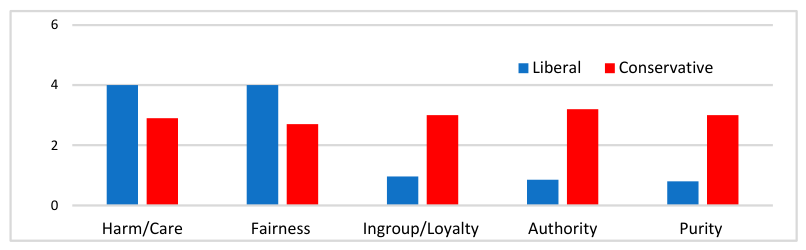
Figure 2.
Moral foundation patterns for four clusters, reproduced based on [21].
Figure 2.
Moral foundation patterns for four clusters, reproduced based on [21].
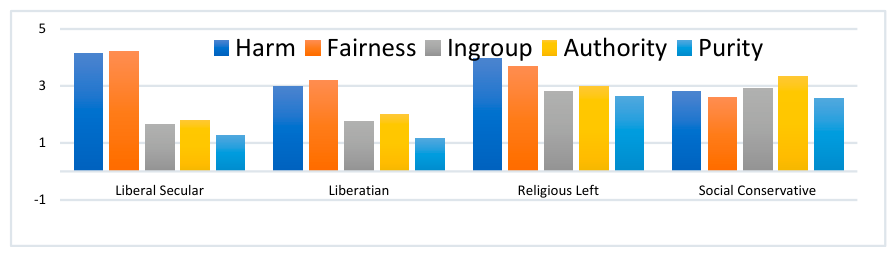
Figure 3.
Word clouds for the words (left), and hashtag (right) in IRA data set [17] .
Figure 3.
Word clouds for the words (left), and hashtag (right) in IRA data set [17] .
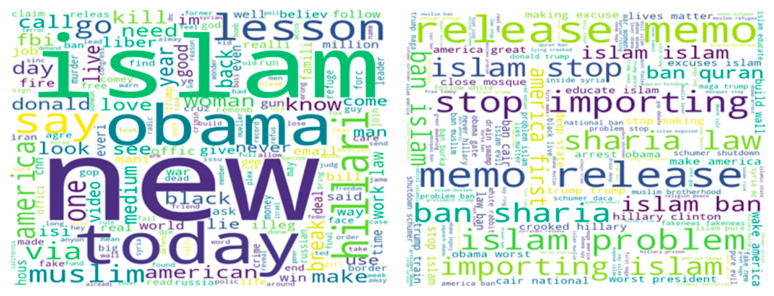
Figure 6.
Conservative Probability distribution per Moral foundation.
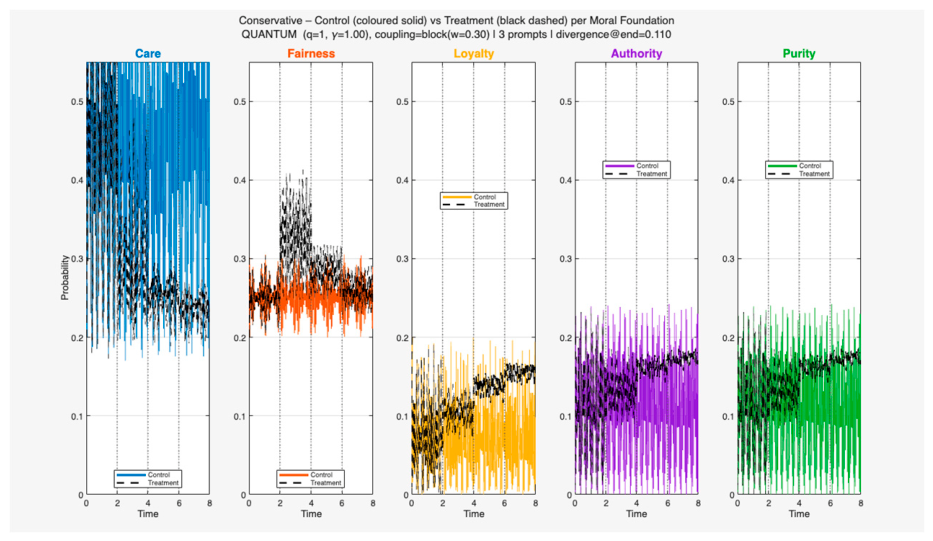
Figure 7.
Progressive Probability distribution per Moral foundation.
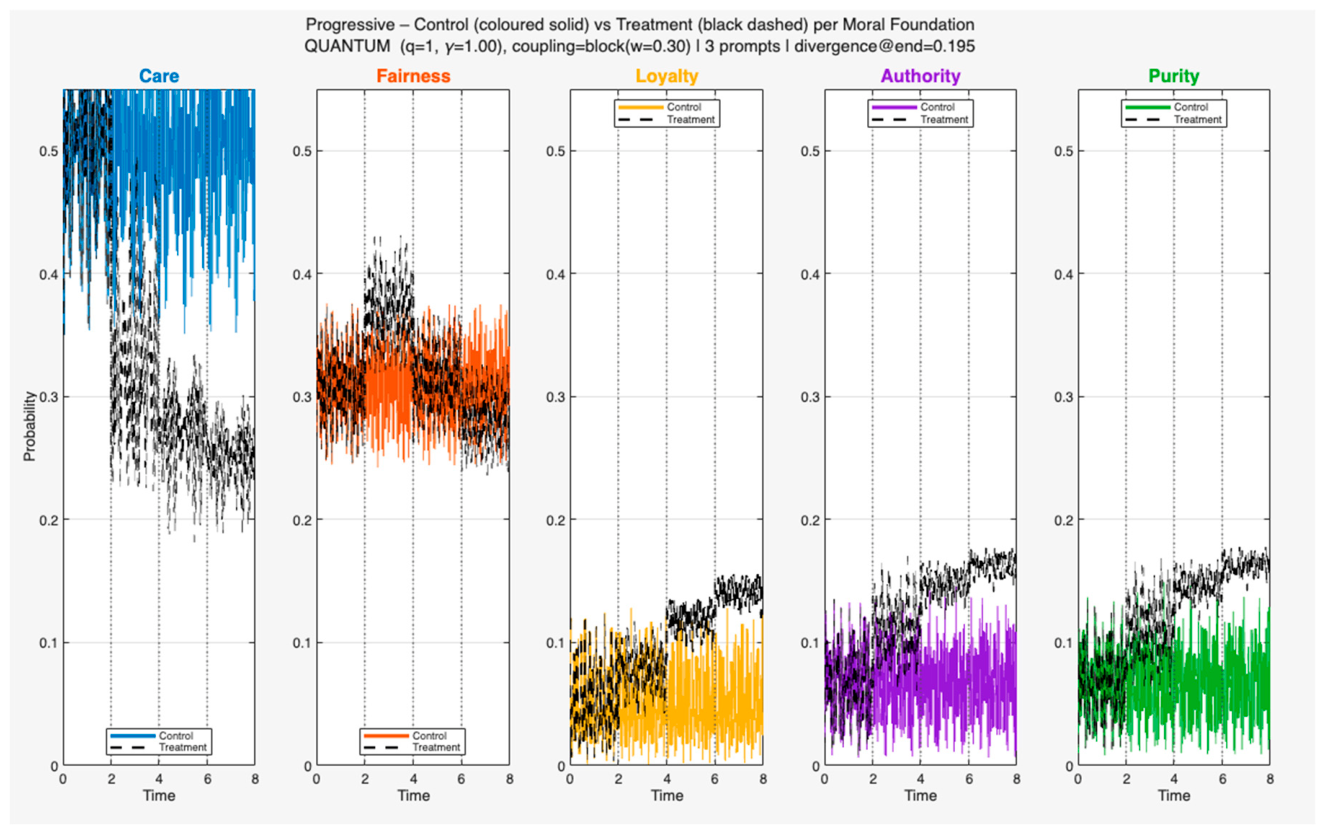
Figure 8.
Coherence over time for (no treatment).
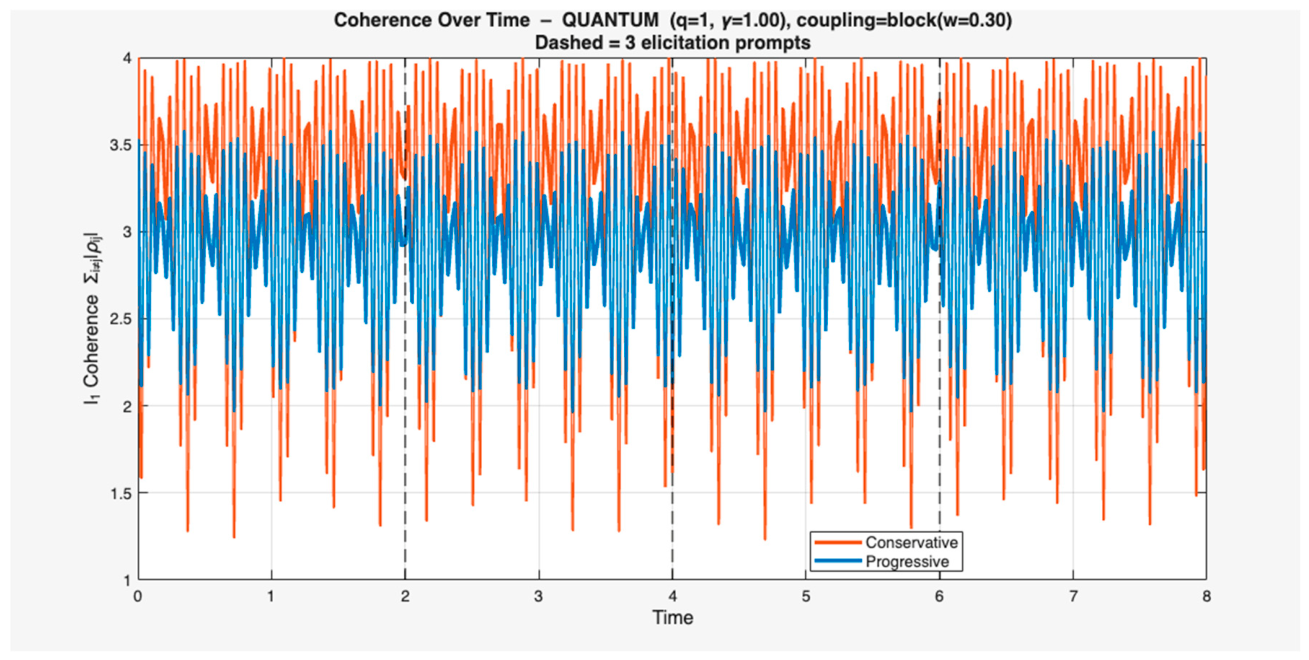
Figure 9.
Final Moral Foundation Pillar Distribution for full quantum case full attack no defense.
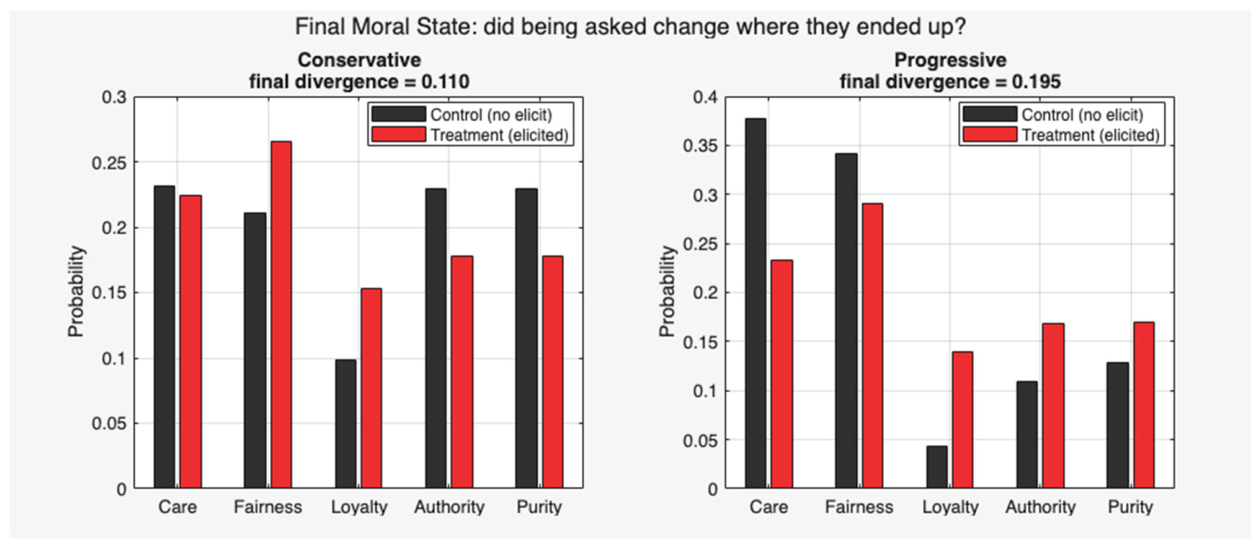
Figure 10.
The total variation distance (TVD) between the target audience initial moral state () and propaganda stream ().
Figure 10.
The total variation distance (TVD) between the target audience initial moral state () and propaganda stream ().
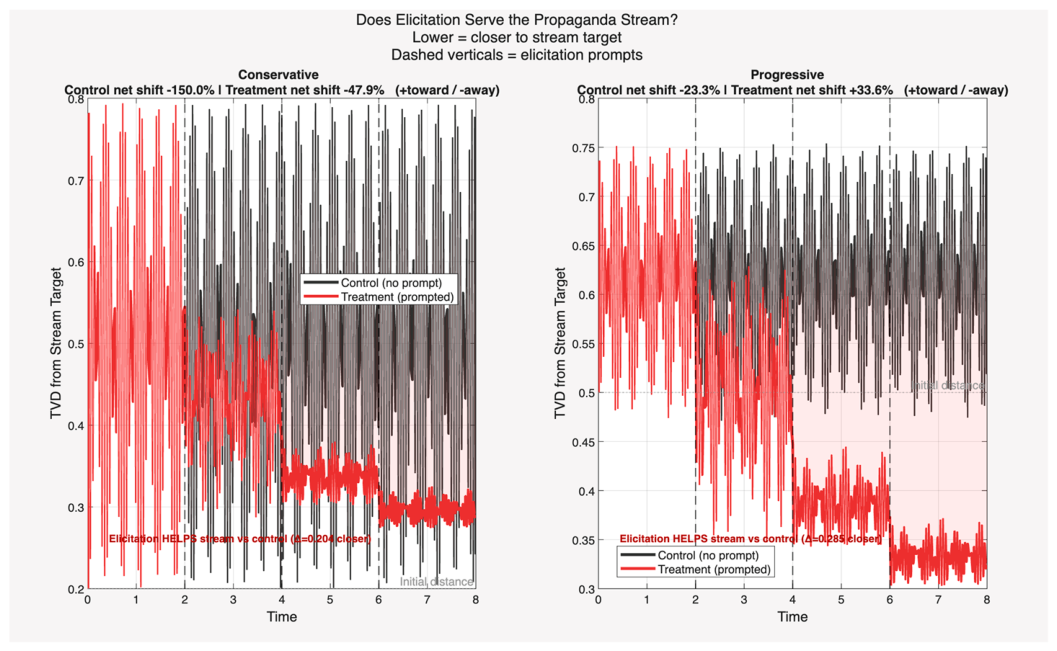
Figure 11.
Conservative Probability Distribution per Moral foundation pillar full quantum heavy defense ()
Figure 11.
Conservative Probability Distribution per Moral foundation pillar full quantum heavy defense ()
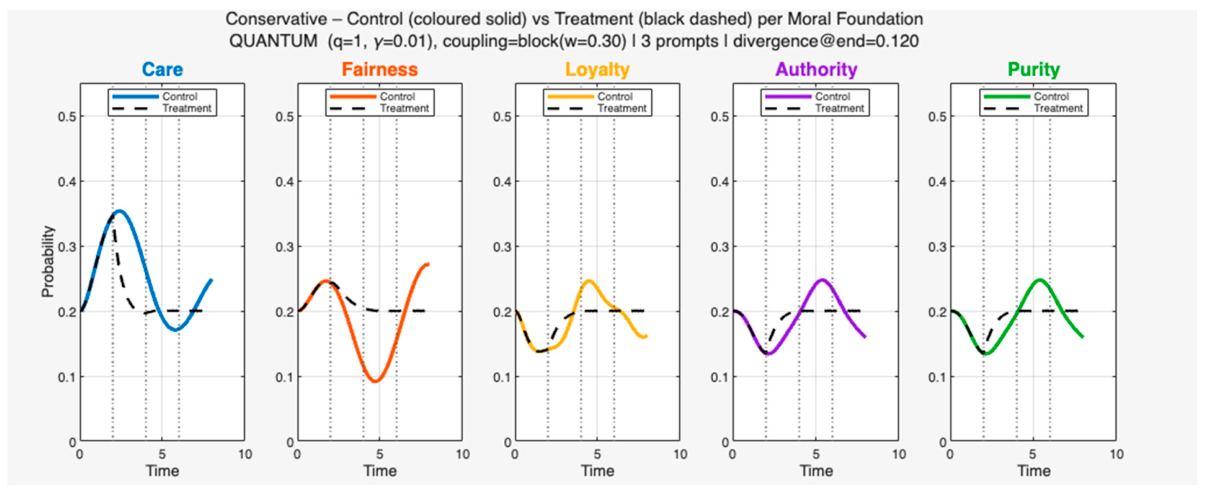
Figure 12.
Progressive Probability Distribution per Moral foundation pillar full quantum heavy defense ())
Figure 12.
Progressive Probability Distribution per Moral foundation pillar full quantum heavy defense ())
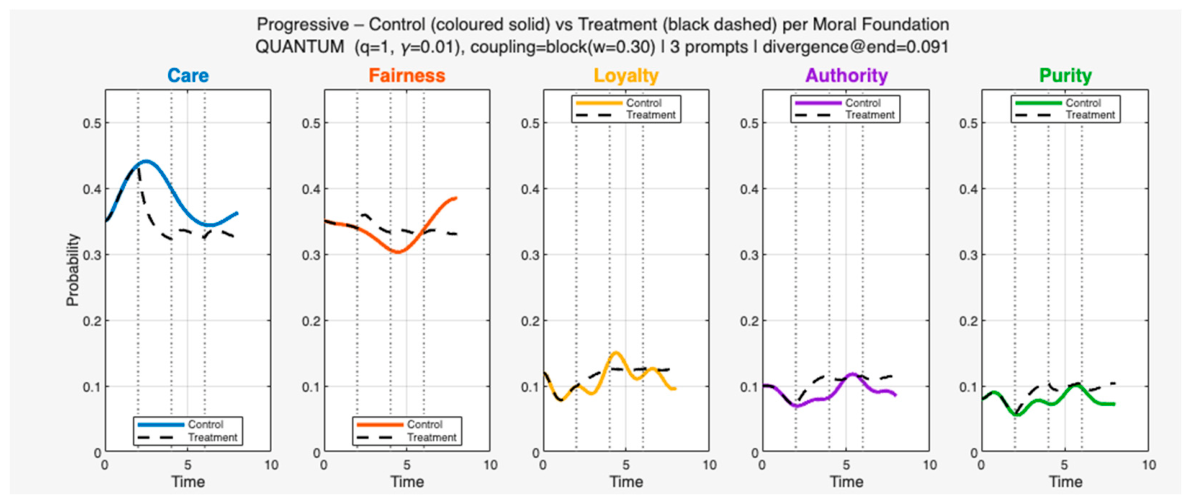
Figure 13.
Coherence over time full quantum heavy defense ()
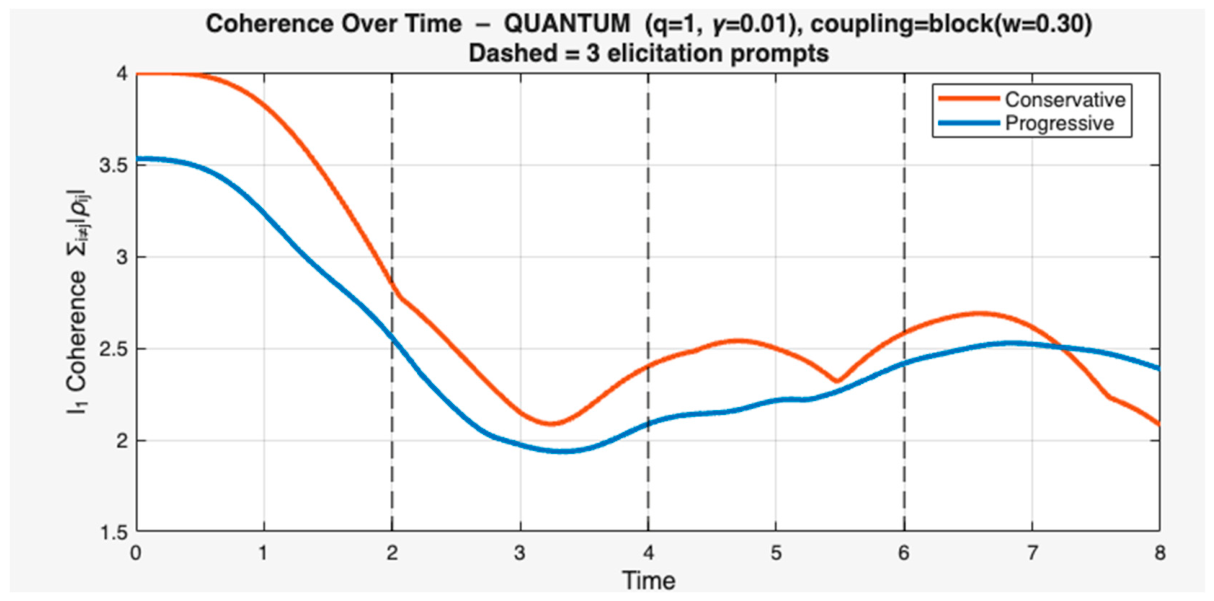
Figure 14.
Final Probability Distribution for MFT pillars full quantum heavy defense ()
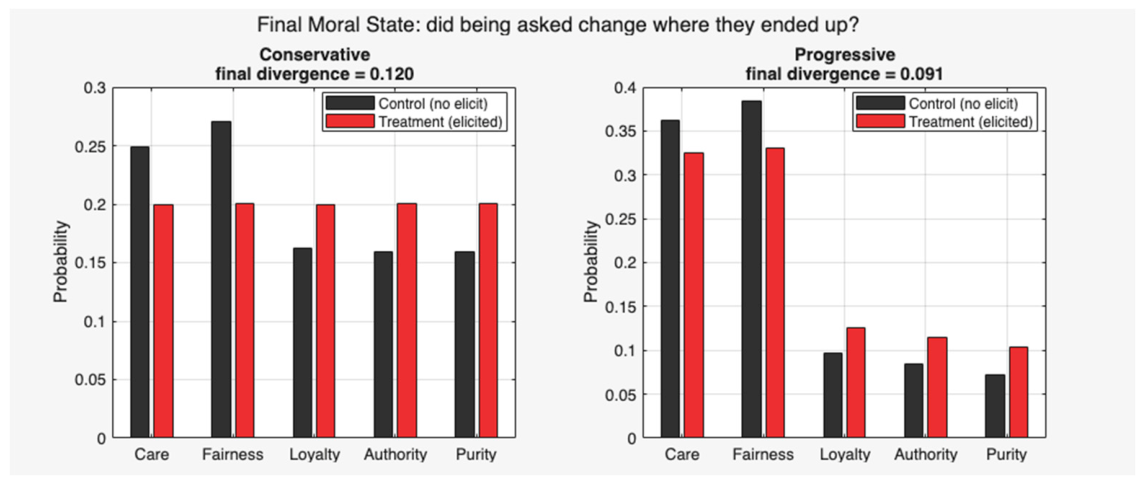
Figure 15.
Conservative Probability distribution for Control vs Treatment per MFT pillar.
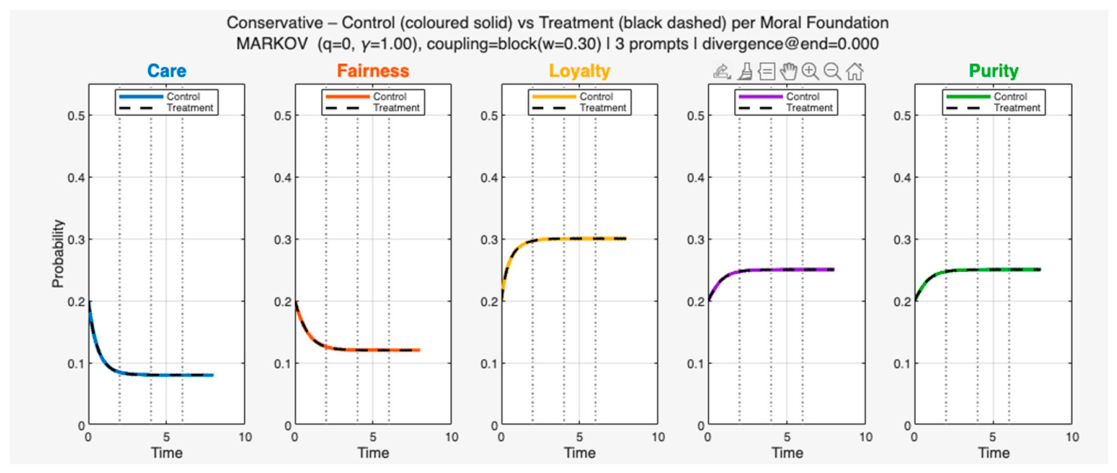
Figure 16.
Progressive probability distribution for Control vs Treatment per MFT pillar.
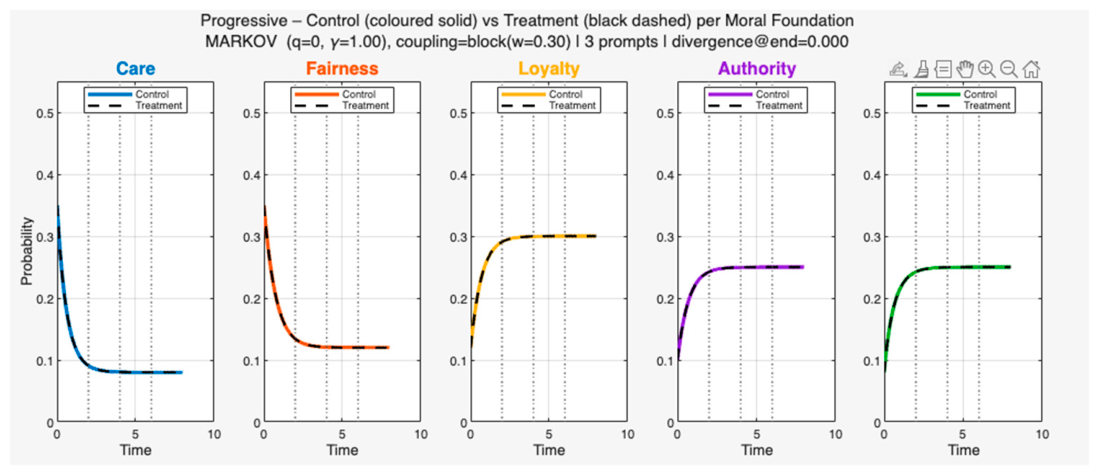
Figure 17.
Final MFT state.
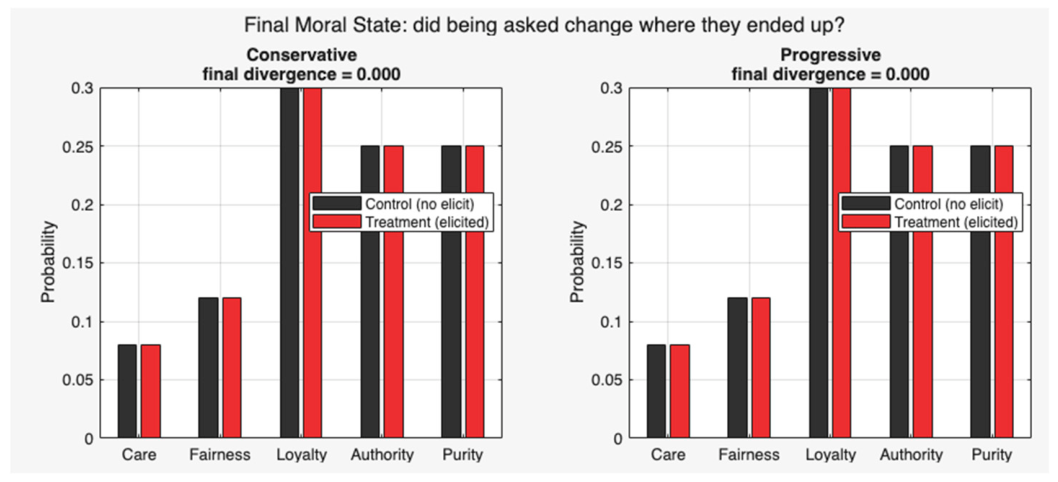
Figure 18.
Progressive Probability distribution per Moral foundation full Markov q=0 and high defense
Figure 18.
Progressive Probability distribution per Moral foundation full Markov q=0 and high defense
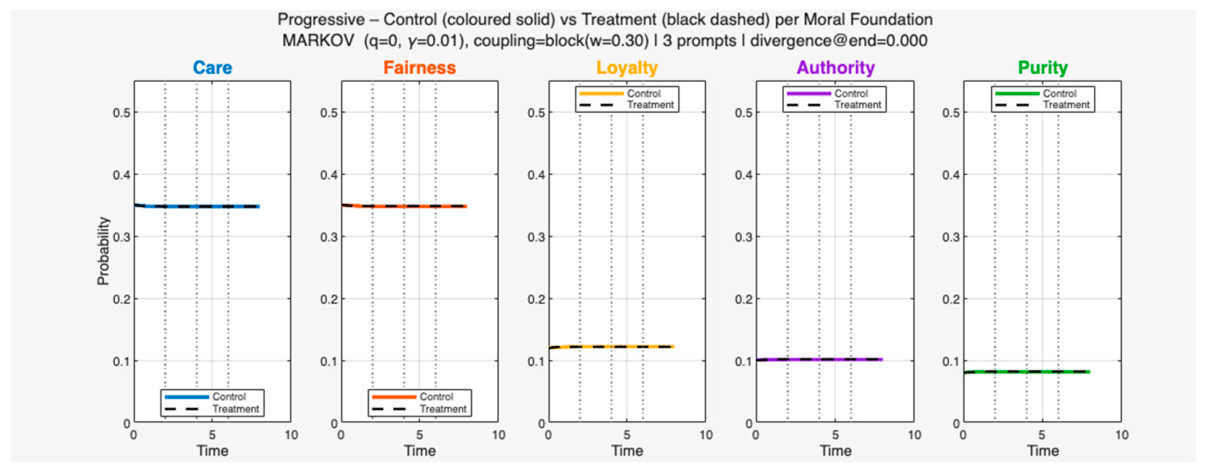
Figure 19.
Conservative Probability distribution per Moral foundation full Markov q=0 and high defense
Figure 19.
Conservative Probability distribution per Moral foundation full Markov q=0 and high defense
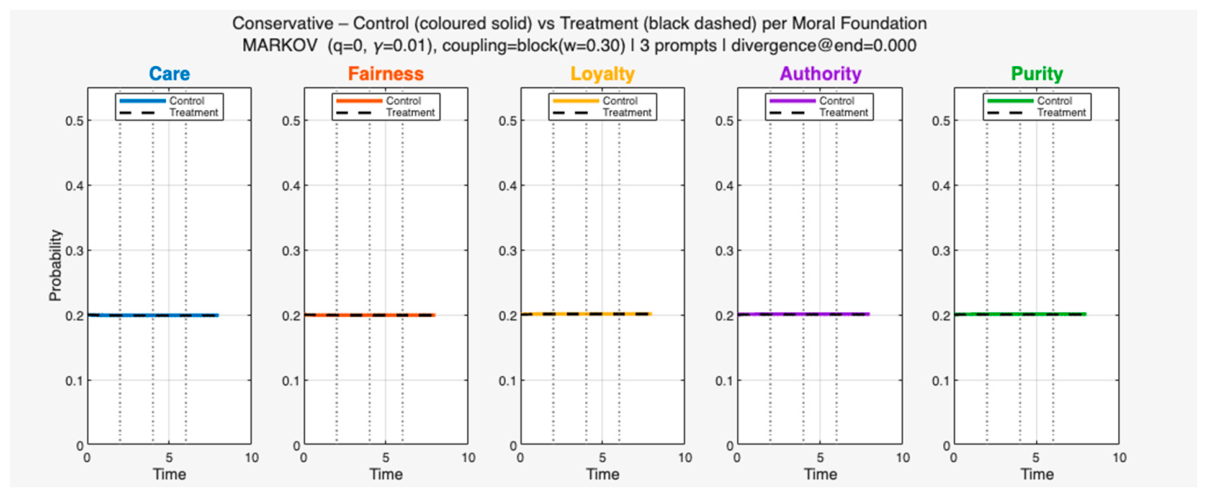
Figure 20.
Final Moral State for full Markov q=0 and
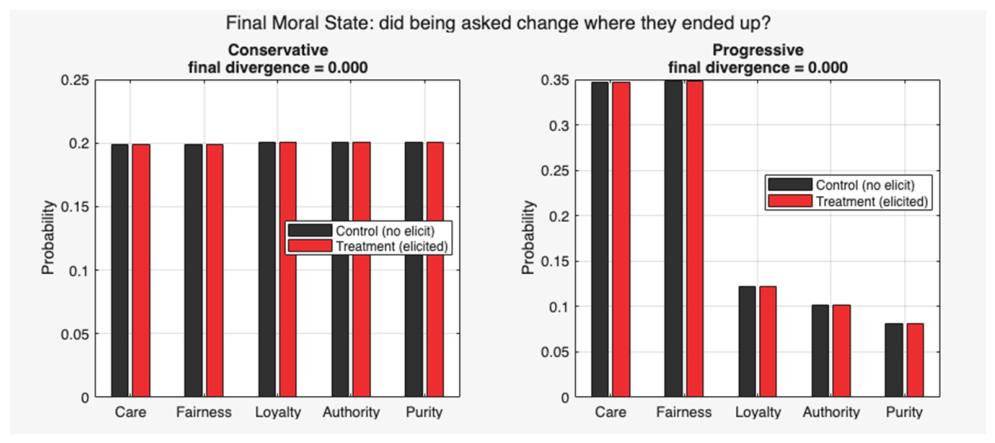
Figure 21.
Conservative Probability distribution per Moral foundation full quantum q=1 and high defense
Figure 21.
Conservative Probability distribution per Moral foundation full quantum q=1 and high defense
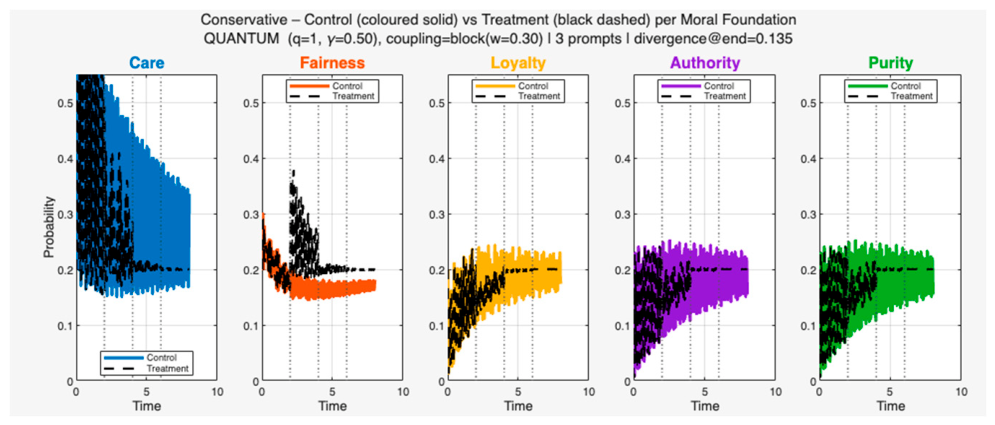
Figure 22.
Progressive Probability distribution per Moral foundation full quantum q=1 and high defense
Figure 22.
Progressive Probability distribution per Moral foundation full quantum q=1 and high defense
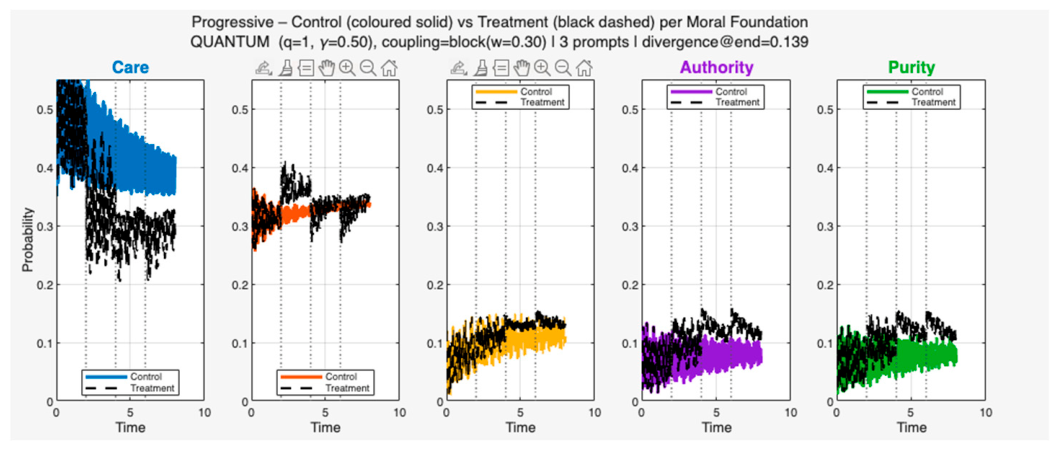
Figure 23.
Total Variation Distance (TVD) between target audience initial distribution and propaganda stream q= 1
Figure 23.
Total Variation Distance (TVD) between target audience initial distribution and propaganda stream q= 1
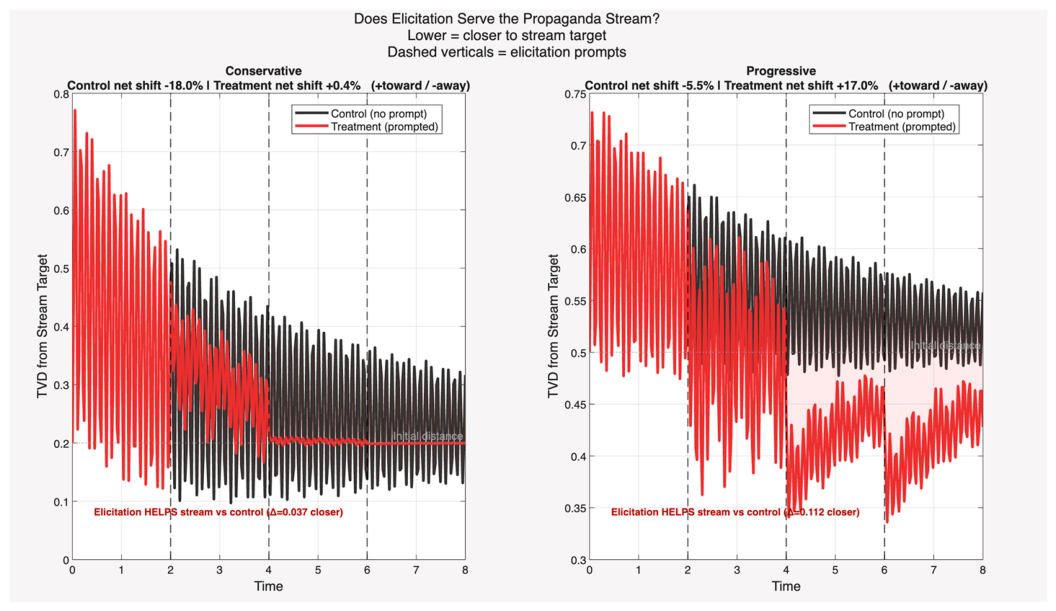
Figure 24.
Final MFT pillar distribution for q =1 and
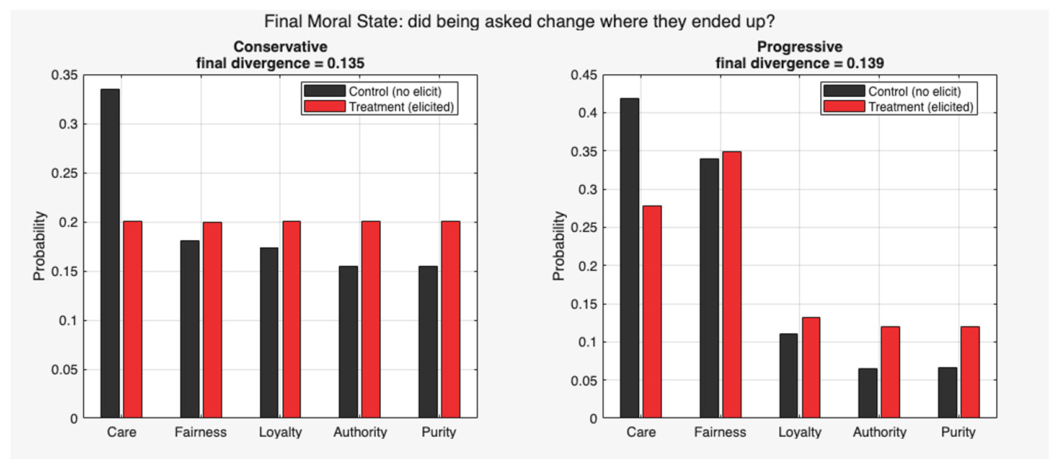
Figure 25.
TVD and q = 0.4.
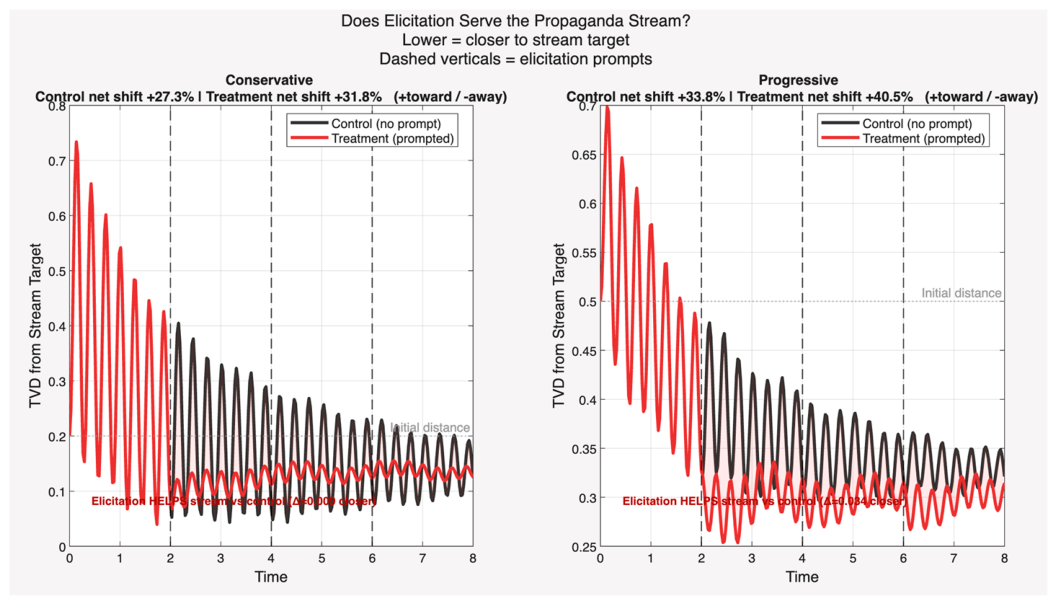
Figure 26.
TVD and q = 0.5.
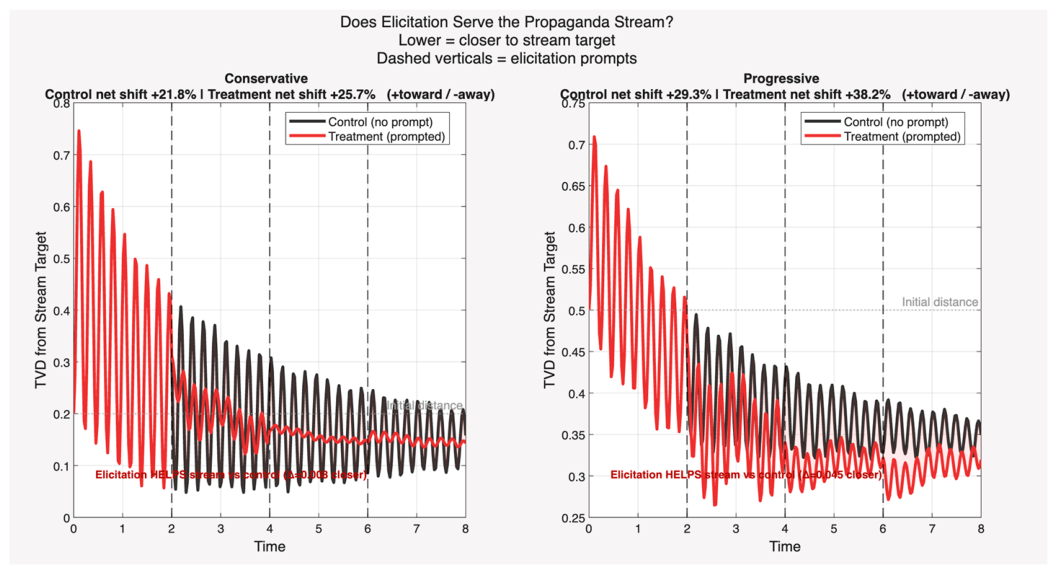
Figure 27.
TVD and q = 0.6.
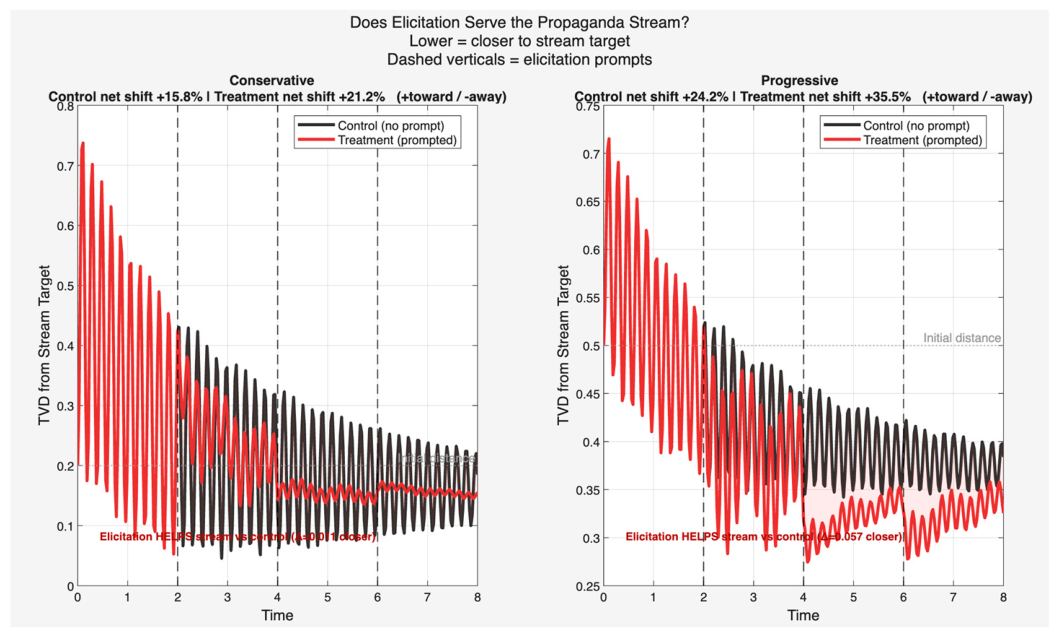

Table 1.
Moral foundation pillars.
| Pillar | Description |
|---|---|
| Harm/Care | Basic concerns for the suffering of others, including virtues of caring and compassion. |
| Fairness/Cheating | Concerns about unfair treatment, inequality, and more abstract notion of justice. |
| Ingroup/Loyalty | Concerns related to obligations of group membership, such as loyalty, self-sacrifice and vigilance against betrayal. |
| Authority/Subversion | Concerns related to social order and the obligations of hierarchical relationships, such as obedience, respect, and proper role fulfillment. |
| Purity/Degradation | Concerns about physical and spiritual contagion, include virtues of chastity, wholesomeness and control of desires. |
Table 2.
Seed words were used to generate prototypicality estimates in [23].
Table 2.
Seed words were used to generate prototypicality estimates in [23].
| Valence | Foundation | ||||
|---|---|---|---|---|---|
| Care | Fairness | Loyalty | Authority | Sanctity | |
| Virtue | kindness compassion nurture empathy |
fairness equality justice rights |
loyal team player patriot fidelity |
authority obey respect tradition |
purity sanctity sacred wholesome |
| Vice | suffer cruel hurt harm |
cheat fraud unfair injustice |
betray treason disloyal traitor |
subversion disobey disrespect chaos |
impurity depravity degradation unnatural |
Table 3.
Number of repeated words and hashtags in English Tweets.
| Words (Number of Repetition > 20,000) | Hashtags (Number of Repetition >10,000) | ||
|---|---|---|---|
| islam | 46,818 | maga | 40,068 |
| today | 31,669 | releasethememo | 37,699 |
| obama | 31,327 | islamistheproblem | 21,666 |
| lesson | 29,531 | bansharialaw | 17,332 |
| hillary | 25,822 | Stopimportingislam | 15,285 |
| say | 25,342 | banislam | 12,468 |
| muslim | 23,333 | americafirst | 11,713 |
| via | 23,029 | islam | 10,005 |
Table 4.
Model parameter for the simulation analysis.
| Coupling | ||||||
|---|---|---|---|---|---|---|
| 1 | 1 | 5 | 5 | 35 | 500 | 0.3 |
| 0.01 | 1 | 5 | 5 | 35 | 500 | 0.3 |
| 1 | 0 | 5 | 5 | 35 | 500 | 0.3 |
| 0.01 | 0 | 5 | 5 | 35 | 500 | 0.3 |
| 1 | 0.5 | 5 | 5 | 35 | 500 | 0.3 |
Table 5.
q vs. Shift for control and treatment conditions.
| Net Shift | ||||
| Control | Treatment | |||
| q | Conservative | Progressive | Conservative | Progressive |
| 0.1 | 40.1% | 46.1% | 39.9% | 48.9% |
| 0.2 | 33.9% | 41.0% | 34.7% | 47.2% |
| 0.3 | 32.5% | 34.3% | 38.0% | 43.5% |
| 0.4 | 27.3% | 33.8% | 31.8% | 40.5% |
| 0.5 | 21.8% | 29.3% | 25.7% | 38.2% |
| 0.6 | 15.8% | 24.2% | 21.2% | 35.5% |
| 0.7 | 10.3% | 18.6% | 18.2% | 29.9% |
| 0.8 | 2.9% | 11.9% | 14.9% | 22.4% |
| 0.9 | -6.6% | 3.9% | 7.3% | 22.7% |
| 1 | -18.0% | -5.5% | 4.0% | 17.0% |
Disclaimer/Publisher’s Note: The statements, opinions and data contained in all publications are solely those of the individual author(s) and contributor(s) and not of MDPI and/or the editor(s). MDPI and/or the editor(s) disclaim responsibility for any injury to people or property resulting from any ideas, methods, instructions or products referred to in the content. |
© 2026 by the authors. Licensee MDPI, Basel, Switzerland. This article is an open access article distributed under the terms and conditions of the Creative Commons Attribution (CC BY) license (http://creativecommons.org/licenses/by/4.0/).
Copyright: This open access article is published under a Creative Commons CC BY 4.0 license, which permit the free download, distribution, and reuse, provided that the author and preprint are cited in any reuse.


