

Submitted:
30 June 2026
Posted:
01 July 2026
You are already at the latest version
Abstract
This study analyzes the structural and magnetic properties of a new composite material with a lithium borate glass matrix loaded with electric arc furnace slag, with a composition of 50Li2O- 50B2O3- 80 wt.% Slag. The amorphous nature of the obtained glass is confirmed by X-ray diffraction analysis (XRD). Differential scanning calorimetry (DSC) indicates that the material has an extremely high thermal stability as evidenced by its high glass transition temperature which is due to the reinforcing role of the slag metallic oxides. Additionally, magnetic studies reveal a highly frustrated magnetic state in the disordered system. The significant addition of mixed-valence iron ions (Fe2+/Fe3+) in the slag forms antiferromagnetic interactions in the system. These factors result in the stabilization of the spin-glass state. The incorporation of slag within the lithium borate matrix is a promising route to valorize this industrial by-product and to develop new functional materials.
Keywords:
electric arc furnace slag
; borate glass
; X-ray diffraction
; DSC
; antiferromagnetic interactions
1. Introduction
Industrial slag is considered one of the most significant types of solid wastes globally. The majority of them are generated during the production of metals and electricity. Extraction of such waste is vital not only due to environmental considerations but also from an economic perspective. Currently, the main approach to their recycling is to reuse slags as substitutes of natural aggregates in various structures in order to reduce CO2 emissions and increase resource utilization efficiency [1,2,3]. Electric arc furnace slag (EAFS) results from the smelting process of liquid steel. It mainly contains oxides of calcium, iron, and silicon that hardly react with each other. Therefore, EAFS is suitable as a replacement material for natural aggregates in Portland cement-based materials [4,5,6]. Research indicates that EAFS can be used as a replacement of natural fine aggregates in ultra-high-performance concrete (UHPC) without decreasing its properties [7,8]. Considering that EAFS is an oxide-rich chemistry, especially its high iron content, suggests another possibility that has barely been explored: using it as a raw material for advanced functional glasses.
Borate glasses have attracted attention due to their optical transparency, low melting points, thermal stability, and ability to dissolve rare-earth and transition-metal ions [9,10,11]. The structural of pure B2O3 glass is made up of trigonal boroxol rings (BO3) and tetrahedral 4-fold coordinated boron (BO4). Unlike silicate glasses, that have rigid tetrahedral networks, the borate framework is topologically flexible. This flexibility allows the network to be modified by adding network modifiers or intermediates [12,13]. With its ability to dynamically reorganize its building blocks, B2O3 is an ideal base matrix for the design of customized amorphous materials for applications such as solid-state electrolytes, non-linear optical devices and radiation shielding [14,15,16,17].
Lithium borate glasses exemplify this flexibility and are governed by the well-known "borate anomaly" [18]. Pure B2O3 glass contains only trigonal [BO3] units in boroxol rings. When alkali oxides, such as Li2O are added, the trigonal units [BO3] convert to tetrahedral [BO4] groups, creating bridging oxygens (BOs) that improve thermal stability, humidity resistance, and glass-forming ability [19]. However, past a certain modifier threshold, the coordination reverses: [BO4] converts back to [BO3], producing non-bridging oxygens (NBOs) [20,21,22,23]. The 50Li2O- 50B2O3 composition is a useful reference point in this respect. Its amorphous framework is well-defined and responsive enough to serve as a baseline for structure-property studies in glass science [24].
This binary borate network can also be modified with transition-metal (TM) oxides. This has led to research on solid-state battery cathodes, solar energy conversion, electronic switching circuits, and electrochemical gas sensors [25,26]. In the glassy matrix, TM ions typically exist in mixed-valence states, altering their local coordination environment and enhancing the non-linear optical, electronic, and magnetic properties of the host [15,27,28,29]. Most published work has involved adding pure synthetic oxides individually to lithium borate glasses to adjust their properties. This approach relies on expensive, refined chemical precursors. Our approach is different in that we replace those refined oxides with a single complex industrial by-product: EAFS. Adding 80 parts of slag to the glass dramatically changes the simple binary baseline, introducing several network formers and modifiers at once. Instead of merely encapsulating waste or using it as a low-value aggregate, this work treats the slag as a functional material precursor.
In order to examine the properties of this glass, it is necessary to understand the structural interactions of major oxides present in the slag. In the case of Fe2O3, magnetic moments are formed, which contribute to making the structure magnetic. These are multivalent cations that occupy network forming and modifying sites, and due to their proximity in the tightly packed borate network, there are strong antiparallel super-exchange Fe-O-Fe interactions [30,31,32]. Iron may be present as Fe2+ and Fe3+ and the relative proportion of these ions depends on such factors as melting temperature, glass composition and iron content. Fe2+ ions (3d6 configuration) normally occupy octahedral coordination sites and show a spin-allowed electronic transition. In contrast, Fe3+ ions (3d5) normally do not show spin-allowed transitions, thus influencing the spectroscopic behavior of the glass [33,34,35,36]. Calcium oxide (CaO) further modifies the network, in which Ca2+ cations occupy interstitial sites. This compensates for the negative tetrahedral units’ charge and generates non-bridging oxygens (NBOs) which affect packing density and mechanical stability [37,38]. Silica (SiO2) transforms the matrix into a lithium borosilicate network by polymerizing the framework through B-O-Si linkages which improves chemical and thermal durability [39,40]. With 80 parts slag, these oxides are not isolated dopants. Their combined effect determines the distribution, spacing, and coordination environments of iron ions. Therefore, the magnetic properties, such as susceptibility and low-temperature exchange interactions, are a direct consequence of this locally engineered borate network.
However, it is also fascinating to observe that the properties of condensed matter systems are defined by the notion of symmetry. The crystal structures, where the arrangement of atoms takes on a long-range periodicity, impose certain symmetry operations. In contrast, amorphous materials lack translational symmetry over long distances but preserve a certain degree of local structural order through short-range coordination units [41,42]. The local symmetry around network-forming and network-modifying species strongly influences bond lengths, bond angles, and electronic environments, thereby controlling the emergence of collective physical phenomena [43,44]. Consequently, understanding how local symmetry evolves in complex glassy networks is essential for establishing structure-property relationships.
From a magnetic perspective, symmetry breaking has profound consequences on exchange interactions between magnetic ions. The type and extent of super-exchange routes depend highly on the presence of local coordination polyhedron distortion, affecting both bond geometry and interatomic distances. In disordered systems containing transition-metal ions, the coexistence of multiple local environments generates a broad distribution of exchange interactions, often leading to competing ferromagnetic and antiferromagnetic couplings [45,46]. This competition creates magnetic frustration, suppresses long-range magnetic ordering, and may stabilize unconventional magnetic states such as spin-glass phases [47,48]. Thus, it could be said that the decrease of local structural symmetry is one of the main causes behind the complex magnetic properties found in many amorphous compounds.
Glassy systems, characterized by the combination of variable chemical structural disorder, provide a perfect ground for investigating the interaction between symmetry and magnetism. Glasses provide a continuous variety of local environments that can be designed by adding network modifiers and transition-metal species, in contrast to crystalline materials where symmetry is limited by periodicity. Such research into the effects of symmetry breaking in local regions on the magnetic interaction at the atomic level is now possible thanks to this flexibility. The distribution of Fe2+/Fe3+ ions in an inherently disordered structure in iron-based borate glasses offers an ideal medium to explore the relationship between spin glassiness and magnetic frustration.
In this context, the present study proposes a novel, high-value approach to valorization by designing a multi-oxide glass that is heavily loaded with industrial waste. Specifically, a new glass system with the composition 50Li2O- 50B2O3- 80 wt.% Slag (LiBS) was synthesized. This study primarily aims to elucidate the direct correlation between the structural compactness induced by this extreme waste loading and the macroscopic magnetic properties of the resulting material. The amorphous network topology and local environment were thoroughly characterized using structural, physical measurements and vibrational spectroscopy (FTIR and Raman). Concurrently, we conducted a detailed investigation of the magnetic properties using vibrating sample magnetometry (VSM) as a function of magnetic field and temperature. These findings reveal that confinement of iron ions in the lithium borate glass matrix leads to a strong antiferromagnetic behavior. This opens new perspectives for developing functional magnetic materials from the circular economy.
2. Materials and Methods
This research used Electric arc furnace slag (EAFS) as a natural raw material for the production process. The EAFS material was collected at a mining location situated in the Oujda region of Morocco. Before the glass manufacturing process, the slag material was crushed and powdered in a laboratory-grade agate mortar to facilitate homogeneous mixture and reduce potential analytical interferences. The EAFS was characterized in terms of its chemical composition by Panalytical XRF (PW2400).
The glass samples with the composition of 50Li2O- 50B2O3- 80 wt.% Slag (LiBS) were prepared using a traditional melt-quenching method, utilizing high-purity analytical grade raw materials such as lithium carbonate (Li2CO3) and boric acid (H3BO3) and electric arc furnace Slag. The appropriate amounts of the various starting materials were blended in an agate mortar and thoroughly homogenized prior to transfer to a platinum crucible and heated in an electrical muffle furnace at 200°C during 12 h. Then heated at 600°C for 24 hours to ensure the elimination of the volatile H2O, NH3, and CO2 compounds. The temperature of the muffle was then raised to 1000°C and maintained at this level for 2 hours to allow the complete smelting and refining of the resulting liquid. The melt was then rapidly quenched by placing the crucible on a stainless-steel plate. The resulting glass samples were then placed in a desiccator to prevent any possibility of moisture absorption prior to structural and magnetic property.
The Surface morphology and macroscopic homogeneity of the synthesized glass sample were initially examined using an Olympus BX51M (MM03-01) optical microscope in reflected light mode. Concurrently, a Quanta 200 FEG scanning electron microscope (SEM; FEI/Thermo Fisher Scientific, Waltham, MA, USA) was utilized to investigate the microstructural features and cross-sectional fracture topologies at the sub-micron scale, further verifying the structural uniformity of the amorphous framework.
The amorphous nature was checked using a Siemens D5000 diffractometer with CuKα radiation over a 2θ range of 5° to 90°. Thermal properties were analyzed by Differential Scanning Calorimetry (DSC) with a Setaram121 calorimeter at a heating rate of 10°C/min under Argon flux. Densities were determined using a RADWAG analytical balance and the Archimedes technique with water as the immersion liquid. Structural features of the glass samples were characterized by Fourier Transform Infrared Spectroscopy (FTIR) and Raman spectroscopy. FTIR analysis was conducted with a Bruker Platinum-ATR apparatus in the 400-1800 cm-1 range. Raman spectra were collected using a Perkin-Elmer Spectrum GX spectrometer with a 532 nm excitation laser, recorded in backscattering geometry from 200 to 1800 cm-1.
The magnetic properties were characterized using a Physical Property Measurement System (PPMS DynaCool, Quantum Design) under various applied external fields. Magnetization M(T) was measured as a function of temperature from 15 to 300 K, with applied magnetic fields ranging from 0.1 kOe to 10 kOe, in both zero-field cooled (ZFC) and field-cooled (FC) regimes.
3. Results and Discussion
3.1. X-Ray Fluorescence
The elemental composition of electric arc furnace slag (EAFS), which was used as the raw material to make the glass materials, can be found in Table 1. The results show that the main chemical elements in EAFS are Fe2O3 (31.69 wt%), CaO (30.59 wt%) and SiO2 (14.21 wt%). These three components are more than 76% of the total mass of the slag. Additionally, minor constituents such as Al2O3 (8.30 wt%), MgO (6.16 wt%) and MnO (3.61 wt%) complement the network modification by altering local field asymmetries, while the negligible amounts of impurities (SO3, K2O, TiO2 and P2O5) confirm that the selected EAFS possesses an ideal chemical readiness for high-value upcycling into functional glass materials.
3.2. Morphology and Microstructure
Figure 1 shows the morphology and optical microstructure of the studied sample. In Figure 1a, the sample appears as a transparent to translucent amber-yellow glass. The successful formation of a continuous glassy phase is deducted from the good visual homogeneity and by the absence of visible cracks or significant opacity, despite the high slag content.
The optical microscopy image (Figure 1b) shows a mostly homogeneous glass matrix with slight local contrast variations and a few brighter regions. These heterogeneities may be associated with slag enriched microdomains, but could be associated also to the minor glassy compositional fluctuations. It is worth to mention that of neither large crystallized regions nor well-defined crystalline grains or large crystallized regions are clearly observed, highlighting the amorphous nature of the studied sample. Furthermore, the multi-color contrast observed in the micrograph could be linked to the interference phenomenon and/or to diffraction of the light. These preliminary observations tend to confirm that the slag was well incorporated into the lithium borate matrix, thus leading to a homogeneous glass, albeit a small tendency toward phase separation or crystallization could be spotted.
Figure 2 exhibits SEM images of the glassy system LiBS. As depicted in the figure, compact and homogeneous morphology seems predominant, signature of an amorphous material. Besides, the fracture surface shows a limited number of pores with an irregular glassy region containing dispersed bright particles.
Noting that despite the high slag content, no extensive grain boundaries are observed, confirming the formation of a vitreous matrix. However, at higher magnifications, some small particles embedded within the glass network are detected and may originate from slag-derived phases. The obtained homogeneous distribution and the non-observation of any significant interfacial separation reveal the well incorporation of the slag constituents within the glassy matrix.
3.3. Structural and Thermal Properties
The non-crystalline and amorphous characteristics of the prepared LiBS glass can be seen in Figure 3a. The analysis of XRD shows broad, diffuse halos throughout the pattern, which reflects the amorphous and long-range disorder, associated with the glassy network. This phenomenon is also important because it reflects the existence of a certain amount of disorder within glass materials as opposed to a much more regularly ordered array of atoms in crystalline solids.
The thermal stability and structural evolution of the synthesized glass matrix was evaluated by differential scanning calorimetry (DSC), as shown in Figure 3b. The thermogram displays a well-defined endothermic step corresponding to a glass transition temperature (Tg) of 465°C. The high Tg value is an indication of an improved structural rigidity as compared to typical baseline borate networks and is strongly correlated to the profound structural modifications induced by the addition of the EAFS. Since calcium and iron oxides are the main components of the used slag, their simultaneous introduction into the matrix leads to significant changes in the cross-linking density of the network [49,50]. The incorporation of these stable metal oxides provides a strong structural reinforcement to the amorphous framework, increasing the overall connectivity and rigidity of the vitreous skeleton and thus conferring the glass with superior macroscopic thermal stability [51]. Besides the identification of the glass transition, the DSC profile yields important information on the long-range structural stability of the matrix against devitrification. In particular, the heat flow curve is remarkably flat in the broad temperature range 500°C to 700°C, and it exhibits a full absence of exothermic crystallization peaks (Tc). The absence of devitrification features means that, despite the very high loading of multi-oxide slag, the network has an excellent structural integrity in a large temperature window [52]. This thermal behavior is an important scientific guarantee for the further study of the magnetic properties of the material. It excludes rigorously the formation of any localized crystalline clusters or parasitic magnetic phases, which could otherwise generate extrinsic magnetic responses.
This structural arrangement and the resulting network compaction are further substantiated by the physical property measurements, namely density and molar volume (VM). The density of the glass was determined to be 2.33 g.cm-3, while the corresponding molar volume was calculated at 59.78 cm3.mol-1. These physical values reflect a characteristic packing density that is primarily driven by the large-scale accumulation of heavy alkaline-earth metal ions (Ca2+) and transition metal ions (Fe2+/Fe3+) supplied abundantly by the 80 parts of slag [53,54]. In this type of glass, calcium and iron ions act as modifiers of the network. These ions fill interstitial located in the amorphous structure of the glass. They serve as charge neutralizers on the tetrahedral units [BO4]- [55]. Since there is such a high concentration of calcium and iron in the structure of the glass, they are both tightly packed making the overall structure of the glass dense and well defined.
To further elucidate the local structural network and structural units of the synthesized LiBS glass, FTIR and Raman vibrational characterizations were investigated, as illustrated in Figure 4a and b. Both complementary vibrational techniques provide key insights into the short-range order of this multi-component system, mapping the complex co-polymerization between the lithium-borate host and the high concentration of slag-derived oxides. The broadness of the vibrational bands observed in both spectra confirms the structurally disordered, fully amorphous nature of the sample, which perfectly aligns with the previous XRD and DSC observations. The FTIR transmittance spectrum is given in Figure 4a. The obtained absorption bands were compared to the equivalent materials reported in the literature. Table 2 gathers the position of bands and their related assignments. The band around 1370 cm-1 is linked to the asymmetric stretching vibration B-O bond in BO3 units. Noting that this band is prior identified in the orthoborates , metaborate (B∅2) and pyroborate (B∅2) groups [56,57,58,59]. While the band at 1240 cm-1 is attributed to the stretching vibrations of terminal B-O bonds in [BO3] units, suggesting the presence of non-bridging oxygen (NBO) atoms which are heavily generated by the modifier effect of Ca2+ and iron ions [60,61,62,63]. The band at around 1045 cm-1 is due to the stretching vibrations of B-O bond in BO4 units from tetraborate, pentaborate and triborate units [64,65]. The co-existence of these bands clearly confirms that the slag components are not simply encapsulated but actively network-integrated. Those near 920 cm-1 range are associated with stretching vibrations of B-O bonds in tetrahedral [BO4] units originating from di-borate structural groups [57,66,67]. Moreover, the bands observed around 703 cm-1 are attributed to the Si-O bending [68,69], and to the bending vibrations of B-O-B linkage in borate network [69,70,71].
The Raman data was collected in the range 200- 1800 cm-1, which is presented in Figure 4b. The summary of the vibrational band assignment is given in Table 2. The bands found at 1498 cm-1 are assigned to the asymmetric stretching vibrations of B-O bonds in BO3 triangles [72,73]. The bands located at 1004 cm-1 can be attributed to the stretching modes of B-O bonds in BO4 tetrahedra [74,75]. While the bands found at 762 cm-1 can be assigned to represents the ring breathing mode of six-membered rings containing [B∅3] and units providing direct spectroscopic proof of the borate anomaly stability even under an 80 wt.% of slag [76,77]. The band observed at 527 cm-1 correspond to the bending vibrational mode of units [59,78]. The band at 456 cm-1 is attributed to the bending vibrations of B-O-B linkages in the borate network [79,80].
The vibrational modes identified through the FTIR and Raman spectroscopy provide insights in understanding the short-range order and spatial symmetry development in the glass matrix. In an ideal glass structure, the local environment is composed of symmetrical trigonal and tetrahedral structures. Due to their geometry, they present themselves in degenerated vibrational modes where there should be sharp spectral peaks. However, the introduction of the multi-oxide EAFS destabilizes the structural equilibrium of the glass structure. The influx of heavy oxide network modifiers and formers causes extensive spatial and chemical instability. As a result, the clear manifestation of the broadening, asymmetry, and overlap of the stretching bands of FTIR and Raman spectra indicate that the structures are far from being symmetric and ideal. The presence of such a huge amount of EAFS necessitates distortion in the structures, leading to varied distributions of bond lengths and broken bond angles in the vicinity of the central atom. In the context of vibrational spectroscopy, this localized symmetry breaking manifests directly as the lifting of vibrational degeneracy, overlapping sub-bands, creating the broad spectral envelopes characteristic of the amorphous state. Ultimately, this reduction of the symmetry at the microstructure level is the core characteristic of the synthesized glass. This clearly shows that the atoms are arranged in an asymmetric manner within the atomic field, and this directly forms the basis of its thermal and mechanical stability.
3.4. Magnetic Investigation
To evaluate the magnetic characteristics of the LiBS glass, M-H magnetic hysteresis loops were recorded at different temperatures ranging from 15K to 300K, as shown in Figure 5. It is evident that all samples displayed non-linear M-H loops at each of the selected temperatures, which do not reach saturation even under the application of the highest magnetic field (10 KOe). All samples demonstrate distinct antiferromagnetic (AFM) behavior based on the morphology of both hysteresis loops [81]. The antiferromagnetic coupling is further result of the Fe-O-Fe exchange interaction. Between temperatures 15 K and 50 K, the linear dependence of magnetization in high fields is accompanied by an increase in maximum magnetization. A maximum magnetization that approaches 0.6 emu/g at about 15 K, suggesting a strong paramagnetic background from intermixed Fe2+ and Fe3+ ions within the amorphous borate matrix as well as possible short-range antiferromagnetic interactions. In contrast, these curves evolve into a well-defined S-shaped hysteretic form at temperatures 300 K; indeed, the maximum magnetization is decreased by up to an order of magnitude (≈ 0.08 emu/g). The room temperature antiferromagnetism is due to the antiferromagnetic super-exchange interactions between neighboring Fe ions distributed within the disordered glass network. The macro-spins of these clusters are free to flip under thermal energy but can easily be aligned in the field of an external magnetic [82,83,84].
To investigate the magnetic characteristics of the synthesized material, the zero-field-cooled (ZFC) and field-cooled (FC) magnetic susceptibility were measured under different magnetic fields, as shown in Figure 6 and Figure 7. It is important to note that in the ZFC and FC graphs, a bifurcation occurs starting at T= 275 K when a magnetic field of 0.1 KOe is applied. This phenomenon is commonly associated with spin-glass behavior [85,86,87]. The observed bifurcation decreases as the magnetic field strength increases, ultimately converging above 10 kOe (see Figure 6). This dependence on the magnetic field is intrinsically linked to the significant spin frustration that exists within the amorphous material; the application of a high external magnetic field effectively overcomes these local energy barriers, forcibly aligning the frustrated spins along the field direction even at low temperatures [88,89]. For a magnetic phase transition of a system, a strong splitting between ZFC and FC protocols below the transition temperature is generally found with the two branches merging at the transition point. In the case of spin-glass models, this low temperature divergence is strongly enhanced in the presence of strong structural and magnetic frustration, which usually results from lattice distortions, structural disorder and the competition of the coexisting ferromagnetic and antiferromagnetic exchange interactions.
The linear fit of the inverse magnetic susceptibility χ-1(T) is illustrated in Figure 7. To analyze the 1/χ vs T curve the Curie-Weiss equation was used [90]:
with C signifying the Curie constant and θ representing the Weiss temperature. Concerning the effective magnetic moment per Fe ion (μ in μB/Fe), its estimation is determined from the Curie constant using the relation [90]:
The linear fit of χ-1 vs. T curve follows the Curie-Weiss law, giving a Weiss temperature θ = -9.64 K and a Curie constant C = 1.28 x10⁻³ (emu.K/g.Oe). The negative sign of θ provides definitive evidence for the predominance of short-range antiferromagnetic (AFM) exchange interactions between the coexisting transition metal ions (Fe2+/Fe3+) embedded within the amorphous network [91]. This behavior is structurally rooted in the exceptionally high loading of industrial slag. By forcing an immense concentration of network modifiers and intermediates into the matrix baseline, the interstitial free volume of the glass framework is severely compromised. This profound structural compaction forces adjacent iron canyons into close spatial proximity, continuously activating anti-parallel super-exchange pathways via Fe-O-Fe linkages.
The obtained effective magnetic moment per iron ion was determined to be µeff = 1.80 µB. This experimental value is exceptionally low compared to the theoretical spin-only moments expected for isolated high-spin iron species, which stand 4.90 µB for Fe2+ (3d6) and 5.92 µB for Fe3+ (3d5) [92,93]. In the context of heavily waste-loaded transition metal glasses, this unusually suppressed magnetic moment reveals a pronounced spin-masking effect. Due to the dense crowding of metallurgical slag within the amorphous network, the iron ions do not behave as magnetically isolated centers. However, as the system is cooled to approach the freezing point, strong AFM super-exchange couplings among neighboring spins cause the great majority of the Fe2+/Fe3+ spins to be aligned in an anti-parallel manner. The cancellation of the magnetic contribution of such coupled spins means that a considerable fraction of the overall magnetization is not detected macroscopically.
3.5. Structure-Property Correlation: From Disordered Network to Frustrated Magnetic Behavior
The magnetic behavior of the LiBS glass can be directly correlated with the progressive reduction of local structural symmetry induced by the heavy incorporation of EAFS. In an ideal borate network, the [BO3] triangles and [BO4] tetrahedra possess relatively well-defined local geometry. Nonetheless, the concurrent addition of high amounts of Fe2+/Fe3+, Ca2+, Si4+, Mg2+, and Mn2+ ions results in considerable deviations in terms of bond lengths and angles, causing a wide range of local environments to develop. Such structural disorder is a characteristic feature of multicomponent oxide glasses and has frequently been associated with symmetry breaking at the short- and medium-range scales [41,44].
The lack of local symmetry has been observed in the form of marked broadening and overlapping of the FTIR and Raman bands due to different nonequivalent sites in the structure [94,95].
From a magnetic standpoint, these local distortions modify the Fe-O-Fe super-exchange pathways responsible for magnetic coupling. According to the Goodenough–Kanamori rules, the exchange interaction strength is highly sensitive to both the Fe-O bond distance and the Fe-O-Fe bond angle [96,97,98]. Therefore, the structural asymmetry generated within the amorphous network produces a statistical distribution of exchange constants rather than a single well-defined interaction. Similar behavior has been reported in iron-containing disordered oxides, where random variations in local geometry generate competing magnetic interactions and magnetic frustration [45,48]. Consequently, neighboring iron ions experience competing magnetic couplings, leading to the coexistence of locally favored antiferromagnetic and weakly uncompensated magnetic regions.
This interpretation is supported by the magnetic measurements. The negative Weiss temperature (θ = -9.64 K) shows that there are more antiferromagnetic interactions, and the very low effective magnetic moment (µeff = 1.80 µB) indicates that the magnetic moments cancel out each other effectively by having antiparallel spins. Furthermore, the pronounced ZFC-FC bifurcation observed at low magnetic fields indicates the presence of magnetic frustration and spin freezing in disordered magnetic systems [47,48]. These observations collectively suggest that the degree of local symmetry breaking governs the distribution of magnetic exchange interactions and ultimately stabilizes the spin-glass state. Therefore, in the present glass system, the reduction of local structural symmetry acts as the microscopic origin of the observed frustrated magnetic behavior, consistent with the widely accepted picture of spin-glass formation in structurally disordered materials [45,47].
The relationship between the local structure framework and physical properties of the LiBS glass is an important landmark in the utilization of industrial waste to produce functional material. On an atomic scale, the large amount of 80 parts of metallurgical slag has led to the modification of the fundamental lithium borate baseline lattice towards a tightly bound lithium borate structure. This topological change results from a strong structural association between the slag elements. Here the introduction of divalent Ca2+ and mixed valence iron (Fe2+/Fe3+) cations in the system has helped fill the free volumes. The heavy metallic cations have not only aided in compensating the charges for the [BO4] structural units but have also helped introduce NBOs. These factors have significantly contributed towards making the lattice much more densely packed. At the macro level, such a reinforcing effect clearly determines the outstanding stability of the glass, which can be seen in high glass transition temperature (Tg = 465°C). What is unique is that such restrictions and densification lead to immediate proximity between the incorporated iron ions. Thus, the reduction in the distance between the ions leads to the constant activation of strong anti-parallel Fe-O-Fe super-exchange interactions. Such a combination eventually results in a suppression of the effective magnetic moment at an exceptionally low level µeff = 1.80 µB due to a significant masking effect, while the magnetic frustration ensures disordered spin-glass behavior of the sample.
4. Conclusions
In summary, the 50Li2O- 50B2O3- 80 wt.% Slag system was prepared by melt-quenching method. The characterization techniques such XRD, DSC, density measurement, FTIR, and Raman spectroscopy, have been used to give a full explanation of the structural arrangement at different length scales. The synthesized glass showed remarkable thermal stability with a relatively high glass transition temperature (Tg = 465°C). The increased rigidity is a direct result of the structural strengthening effect of the major slag constituents on the multicomponent vitreous framework. Magnetic investigations revealed an intriguing highly frustrated magnetic structure embedded in a structurally amorphous environment. The temperature dependence of magnetic susceptibility exhibits a clear Curie-Weiss behavior at low temperatures, indicating a negative paramagnetic Curie-Weiss temperature. This proves the absolute predominance of antiferromagnetic super-exchange interactions through Fe-O-Fe pathways.
Additionally, the extremely high density of mixed-valent iron ions (Fe2+/Fe3+) leads to a strong spin-masking effect, resulting in an extremely low experimental effective magnetic moment of µeff = 1.80 µB. The negative Weiss temperature together with the ZFC-FC bifurcation indicate a highly frustrated magnetic state that may evolve toward a spin-glass-like behavior at low temperature.
These results are a double success providing not only environmentally friendly approach to metallurgical solid waste but also an efficient way to synthesize magnetically active amorphous materials.
Author Contributions
Conceptualization, K.K., A.L.; methodology, K.K., A.E.B., L.B. and M.T.; validation, A.L.; investigation, K.K., A.E.B., L.B., J.Z., N.A., A.J., M.E.M., M.S. and M.T.; writing—original draft preparation, K.K.; writing—review and editing, A.L.; visualization, J.Z., N.A., A.J., M.E.M. and A.L.; supervision, A.E.B., L.B. and A.L. All authors have read and agreed to the published version of the manuscript.
Funding
This research received no external funding.
Institutional Review Board Statement
Not applicable.
Informed Consent Statement
Not applicable.
Data Availability Statement
The original contributions presented in this study are included in the article. Further inquiries can be directed to the corresponding author(s).
Acknowledgments
This study was supported by the National Center for Scientific and Technical Research (CNRST) under the "PhD-Associate Scholarship - PASS" program in Morocco.
Conflicts of Interest
The authors declare no conflicts of interest.
Abbreviations
The following abbreviations are used in this manuscript:
| AFM | Antiferromagnetic |
| DSC | Differential Scanning Calorimetry |
| EAFS | Electric Arc Furnace Slag |
| FC | Field Cooled |
| FTIR | Fourier-Transform Infrared Spectroscopy |
| NBO | Non-Bridging Oxygen |
| SEM | Scanning Electron Microscopy |
| Tc | Crystallization Temperature |
| Tg | Glass Transition Temperature |
| TM | Transition Metal |
| VSM | Vibrating Sample Magnetometer |
| XRD | X-Ray Diffraction |
| ZFC | Zero-Field Cooled |
References
- Yelubay, M.; Tolegenov, D.; Maussumbayev, S.; Kanasheva, N.; Aitkaliyeva, G.; Mokichev, V.; Denisov, S.; Tsvetkov, S.; Kasprzhitskii, A.; Lazorenko, G. Preparation, Characterization and Performance Analysis of Sustainable Kaolinitic Clay-Based Ceramics Incorporating Ternary Blends of Steel Slag, Coal Fly Ash and Waste Glass Bottle-Derived Powder. RSC Adv. 2026, 16, 15051–15061. [CrossRef]
- Pedersen, M.T.; Lothenbach, B.; Hallet, V.; Leemann, A.; Eykens, L.; Winnefeld, F. Non-Ferrous Metallurgical Slags as SCMs - a Study of Reactivity and Hydration Mechanism of a Pyro-Metallurgical Slag before and after Heat Treatment. Cem. Concr. Compos. 2026, 171, 106618. [CrossRef]
- Zhu, Y.; Yang, X.; Wu, S.; Xu, H. Carbonation-Induced Pore Structure Modification of Steel Slag Aggregates and Its Effects on Expansion, Adhesion, and CO2 Emissions of Asphalt Concrete. Constr. Build. Mater. Transp. 2026, 1–2, 100005. [CrossRef]
- Awoyera, P.O.; Babalola, O.E.; Aluko, O.G. The Use of Slags in Recycled Aggregate Concrete. In The Structural Integrity of Recycled Aggregate Concrete Produced with Fillers and Pozzolans; Elsevier, 2022; pp. 145–170 ISBN 978-0-12-824105-9.
- Teo, P.T.; Zakaria, S.K.; Salleh, S.Z.; Taib, M.A.A.; Mohd Sharif, N.; Abu Seman, A.; Mohamed, J.J.; Yusoff, M.; Yusoff, A.H.; Mohamad, M.; et al. Assessment of Electric Arc Furnace (EAF) Steel Slag Waste’s Recycling Options into Value Added Green Products: A Review. Metals 2020, 10, 1347. [CrossRef]
- Khan, M.R.N. Chemical Composition of Electric Arc Furnace Slag – A Review. Int. J. Res. Eng. Sci. Manag. 2023, 6, 112–120.
- Salas, I.; Tamayo, P.; Cifrián, E.; Thomas, C.; Andrés, A. Application of Electric Arc Furnace Slag in Building Concrete: Environmental and Structural Characterization. J. Build. Eng. 2025, 110, 112993. [CrossRef]
- Abellan-Garcia, J.; Daza-Marquez, N.; Molinares, M. Cost-Effective and Sustainable Ultra-High-Performance Concrete with Electric Arc Furnace Slag and Calcium Carbonate: A Multi-Objective Optimization and Experimental Validation Approach. Sci. Rep. 2026, 16, 16335. [CrossRef]
- Kebaili, I.; Boukhris, I.; Sayyed, M.I. Gamma-Ray Shielding Properties of Lead Borovanadate Glasses. Ceram. Int. 2020, 46, 19624–19628. [CrossRef]
- Abouhaswa, A.S.; El-Agawany, F.I.; Ahmed, E.M.; Rammah, Y.S. Optical, Magnetic Characteristics, and Nuclear Radiation Shielding Capacity of Newly Synthesized Barium Boro-Vanadate Glasses: B2O3–BaF2–Na2O–V2O5. Radiat. Phys. Chem. 2022, 192, 109922. [CrossRef]
- Sayyed, M.I.; Kaky, K.M.; Gaikwad, D.K.; Agar, O.; Gawai, U.P.; Baki, S.O. Physical, Structural, Optical and Gamma Radiation Shielding Properties of Borate Glasses Containing Heavy Metals (Bi2O3/MoO3). J. Non-Cryst. Solids 2019, 507, 30–37. [CrossRef]
- Abdelghany, A.M.; Hammad, A.H. Impact of Vanadium Ions in Barium Borate Glass. Spectrochim. Acta. A. Mol. Biomol. Spectrosc. 2015, 137, 39–44. [CrossRef]
- Barde, R.V.; Waghuley, S.A. Transport and Physical Properties of V2O5-P2O5-B2O3 Glasses Doped with Dy2O3. J. Adv. Ceram. 2013, 2, 246–251. [CrossRef]
- Scherer, C.; Schmid, F.; Letz, M.; Horbach, J. Structure and Dynamics of B2O3 Melts and Glasses: From Ab Initio to Classical Molecular Dynamics Simulations. Comput. Mater. Sci. 2019, 159, 73–85. [CrossRef]
- D, V.; C, D.; Deka, U. A Comprehensive Review of Structural, and Optical Properties of Boronated Glasses Doped with 3-d Transition Metal Oxides (TMOs). J. Alloys Compd. 2025, 1024, 180145. [CrossRef]
- Sallam, O.I.; Rammah, Y.S.; Nabil, I.M.; El-Seidy, A.M.A. Enhanced Optical and Structural Traits of Irradiated Lead Borate Glasses via Ce3+ and Dy3+ Ions with Studying Radiation Shielding Performance. Sci. Rep. 2024, 14, 24478. [CrossRef]
- Yuan, J.; Jiang, B.; Li, Y.; Guo, X.; Kwame, Y.E.; He, M. Effect of Flux B2O3 on Structure and Properties of LATP Solid Electrolyte. J. Mater. Sci. 2024, 59, 16629–16643. [CrossRef]
- Kodama, M.; Kojima, S.; Feller, S.; Affatigato, M. Borate Anomaly, Anharmonicity and Fragility in Lithium Borate Glasses. Phys. Chem. Glas. 2005, 46, 190–193.
- Bhogi, A.; Kistaiah, P. Alkaline Earth Lithium Borate Glasses Doped with Fe (III) Ions –an EPR and Optical Absorption Study. Mater. Today Proc. 2018, 5, 26199–26206. [CrossRef]
- Hashim, S.; Mhareb, M.H.A.; Ghoshal, S.K.; Alajerami, Y.S.M.; Bradley, D.A.; Saripan, M.I.; Tamchek, N.; Alzimami, K. Luminescence Characteristics of Li2O–MgO–B2O3 Doped with Dy3+ as a Solid TL Detector. Radiat. Phys. Chem. 2015, 116, 138–141. [CrossRef]
- Anjaiah, J.; Laxmikanth, C.; Mwanga, S.F.; Raju, P.; Mohammad Ali, S.K.; Shankar, J.; Neeraja Rani, G.; Mwankemwa, B. Influence of Rare-Earth Ion Doping on Dielectric Properties of Lithium Zinc Borate Glasses. Opt. Mater. 2022, 131, 112718. [CrossRef]
- Elkholy, M.M. Thermoluminescence of B2O3–Li2O Glass System Doped with MgO. J. Lumin. 2010, 130, 1880–1892. [CrossRef]
- Fernandes, H.R.; Kapoor, S.; Patel, Y.; Ngai, K.; Levin, K.; Germanov, Y.; Krishtopa, L.; Kroeker, S.; Goel, A. Composition-Structure-Property Relationships in Li2O–Al2O3–B2O3 Glasses. J. Non-Cryst. Solids 2018, 502, 142–151. [CrossRef]
- Song, L.; Wang, Y.; Hannon, A.C.; Feller, S.; Li, W.; Zhou, Y.; Zhu, F. Structural Investigation of Lithium Borate Glasses by Raman Spectroscopy: Quantitative Evaluation of Structural Units and Its Correlation with Density. J. Non-Cryst. Solids 2023, 616, 122478. [CrossRef]
- Luo, J.; Guo, B.; Li, N.; Huang, Q.; Wang, J.; Fu, Y.; Jia, L.; Zhang, X.; Hou, J.; Zhu, J.; et al. Conductive Binary Li Borate Glass Coating for Improved Ni-Rich Positive Electrode in Sulfide-Based All-Solid-State Li Batteries. Nat. Commun. 2025, 16, 9462. [CrossRef]
- Charlesworth, T.; Yiamsawat, K.; Gao, H.; Rees, G.J.; Williams, C.K.; Bruce, P.G.; Pasta, M.; Gregory, G.L. Lithium Borate Polycarbonates for High-Capacity Solid-State Composite Cathodes. Angew. Chem. Int. Ed. 2024, 63, e202408246. [CrossRef]
- Dua, V.; Arya, S.K.; Singh, K. Review on Transition Metals Containing Lithium Borate Glasses Properties, Applications and Perspectives. J. Mater. Sci. 2023, 58, 8678–8699. [CrossRef]
- Kindrat, I.I.; Padlyak, B.V.; Lisiecki, R.; Adamiv, V.T. Spectroscopic and Luminescent Properties of the Lithium Tetraborate Glass Co-Doped with Tm and Ag. J. Lumin. 2020, 225, 117357. [CrossRef]
- Morsy, M.A.; Garrison, T.F.; Kessler, M.R.; Mhareb, M.H.A.; El-Deen, H.Z. Structural Elucidation of Lithium Borate Glasses Using XRD, FTIR, and EPR Spectroscopy. ACS Phys. Chem. Au 2025, 5, 227–238. [CrossRef]
- Rezlescu, N.; Rezlescu, E.; Pasnicu, C.; Craus, M.L. Annealing Effect on Magnetic Properties of the Li2O-B2O3-Fe2O3 System. J. Magn. Magn. Mater. 1994, 131, 273–277. [CrossRef]
- Elkelany, E.A.; Hassan, M.A.; Samir, A.; Abdel-Ghany, A.M.; El-Bahnasawy, H.H.; Farouk, M. Optical and Mössbauer Spectroscopy of Lithium Tetraborate Glass Doped with Iron Oxide. Opt. Mater. 2021, 112, 110744. [CrossRef]
- Sanchez, J.P.; Friedt, J.M. Magnetic Properties of the Ternary Oxide Glasses, Li2O-B2 O3-Fe2O3 from 57Fe Mössbauer Spectroscopy. J. Phys. 1982, 43, 1707–1716. [CrossRef]
- Bawazeer, O.; Sadeq, M.S. Compositional Dependency of Transparency, Optical and Radiation Shielding Parameters inside Gd2O3–Fe2O3–Na2O–SiO2–B2O3 Glass. Ceram. Int. 2024, 50, 159–173. [CrossRef]
- Babeer, A.M.; Sayyed, M.I.; Morshidy, H.Y.; Mahmoud, A.E.; Abdo, M.A.; Sadeq, M.S. High Transparency of PbO–BaO–Fe2O3–SrO–B2O3 Glasses with Improved Radiation Shielding Properties. Opt. Mater. 2023, 145, 114387. [CrossRef]
- Liu, T.; Huang, Q.; Liang, H.; Liu, P.; Luo, Z.; Zhu, L.; Lu, A. Effect of Fe2O3 Doping on Structure, Physical-Mechanical Properties and Luminescence Performance of Magnesium-Aluminum-Silicon Based Glass-Ceramics. Ceram. Int. 2020, 46, 28851–28859. [CrossRef]
- Bhogi, A.; Kistaiah, P. Thermal and Structural Characterization of Lithium Borate Glasses Doped with Fe(III) Ions: The Role of Alkaline Earths. Opt. Mater. 2020, 109, 110345. [CrossRef]
- Pimentel, N.B.; Mastelaro, V.R.; M’Peko, J.-C.; Martin, S.W.; Rojas, S.S.; De Souza, J.E. Structural and Electrical Characterization of Glasses in the Li2O–CaO–B2O3 System. J. Non-Cryst. Solids 2018, 499, 272–277. [CrossRef]
- Koseva, I.; Nikolov, V.; Gancheva, M.; Aleksandrov, L.; Ivanov, P.; Petrova, P.; Iordanova, R.; Tomova, R. Optical Properties of the Glasses from the System CaO-GeO2-Li2O-B2O3 Doped by Terbium. Mater. Today Proc. 2022, 61, 1190–1197. [CrossRef]
- Błaszczak, K.; Jelonek, W.; Adamczyk, A. Infrared Studies of Glasses in the Li2O–B2O3–GeO2(SiO2) Systems. J. Mol. Struct. 1999, 511–512, 163–166. [CrossRef]
- Shaaban, Kh.S.; Al-Baradi, A.M.; Ali, A.M. Physical, Mechanical, and Thermal Characteristics of B2O3 - SiO2- Li2O -Fe2O3 Glasses. Silicon 2022, 14, 9609–9616. [CrossRef]
- Jerzy Zarzycki Glasses and the Vitreous State; Cambridge University Press, 1991;
- Stephen R. Elliott Physics of Amorphous Materials; Longman.; 1990;
- Phillips, J.C. Topology of Covalent Non-Crystalline Solids I: Short-Range Order in Chalcogenide Alloys. J. Non-Cryst. Solids 1979, 34, 153–181. [CrossRef]
- James E. Shelby Introduction to Glass Science and Technology, (2nd Ed.); Royal Society of Chemistry, 2005;
- J. M. D. Coey Magnetism and Magnetic Materials; Cambridge University Press, 2010; ISBN 978-0-521-81614-4.
- Greedan, J.E. Geometrically Frustrated Magnetic Materials. J. Mater. Chem. 2001, 11, 37–53. [CrossRef]
- Binder, K.; Young, A.P. Spin Glasses: Experimental Facts, Theoretical Concepts, and Open Questions. Rev. Mod. Phys. 1986, 58, 801–976. [CrossRef]
- Mydosh, J.A. Spin Glasses: An Experimental Introduction; Taylor & Francis, 1993; ISBN 978-0-7484-0038-6.
- Saddeek, Y.B.; Shaaban, E.R.; Moustafa, E.S.; Moustafa, H.M. Spectroscopic Properties, Electronic Polarizability, and Optical Basicity of Bi2O3–Li2O–B2O3 Glasses. Phys. B Condens. Matter 2008, 403, 2399–2407. [CrossRef]
- Pelino, M.; Karamanov, A.; Pisciella, P.; Crisucci, S.; Zonetti, D. Vitrification of Electric Arc Furnace Dusts. Waste Manag. 2002, 22, 945–949. [CrossRef]
- Shelby, J.E. Introduction to Glass Science and Technology (3rd Ed.); The Royal Society of Chemistry, 2020; ISBN 978-1-83916-141-4.
- Donald, I.W. Preparation, Properties and Chemistry of Glass- and Glass-Ceramic-to-Metal Seals and Coatings. J. Mater. Sci. 1993, 28, 2841–2886. [CrossRef]
- Zhang, K.; Li, B.; Wu, W. Structural and Magnetic Properties of Steel Slag Based Glass–Ceramics. Adv. Appl. Ceram. 2015, 114, 121–125. [CrossRef]
- Gaafar, M.S.; Marzouk, S.Y.; Zayed, H.A.; Soliman, L.I.; Serag El-Deen, A.H. Structural Studies and Mechanical Properties of Some Borate Glasses Doped with Different Alkali and Cobalt Oxides. Curr. Appl. Phys. 2013, 13, 152–158. [CrossRef]
- Kamitsos, E.I.; Karakassides, M.A.; Chryssikos, G.D. Vibrational Spectra of Magnesium-Sodium-Borate Glasses. 2. Raman and Mid-Infrared Investigation of the Network Structure. J. Phys. Chem. 1987, 91, 1073–1079. [CrossRef]
- Ahmed, M.R.; Ashok, B.; Ahmmad, S.K.; Hameed, A.; Chary, M.N.; Shareefuddin, Md. Infrared and Raman Spectroscopic Studies of Mn2+ Ions Doped in Strontium Alumino Borate Glasses: Describes the Role of Al2O3. Spectrochim. Acta. A. Mol. Biomol. Spectrosc. 2019, 210, 308–314. [CrossRef]
- Ahlawat, J.; Pawaria, S.; Deopa, N.; Dahiya, S.; Punia, R.; Maan, A.S. Structural and Optical Characterization of IR Transparent Sodium-Modified Zinc Borate Oxide Glasses. Appl. Phys. A 2022, 128, 923. [CrossRef]
- Ahmed, M.R.; Sekhar, K.C.; Ahammed, S.; Sathe, V.; Alrowaili, Z.A.; Amami, M.; Olarinoye, I.O.; Al-Buriahi, M.S.; Tonguc, B.T.; Shareefuddin, Md. Synthesis, Physical, Optical, Structural and Radiation Shielding Characterization of Borate Glasses: A Focus on the Role of SrO/Al2O3 Substitution. Ceram. Int. 2022, 48, 2124–2137. [CrossRef]
- Pavan Kumar C S; Sumukha, C.S.; Madhu, A.; Prathap N V, S.; V, M.M.; V, M.C. Impact of Alkali and Iron Oxide Content on the AC Conductivity: An Impedance Spectroscopic Study of Borate Glasses. Ceram. Int. 2026, 52, 6983–6997. [CrossRef]
- Mariyappan, M.; Arunkumar, S.; Marimuthu, K. Effect of Bi2O3 on the Structural and Spectroscopic Properties of Sm3+ Ions Doped Sodiumfluoroborate Glasses. J. Mol. Struct. 2016, 1105, 214–224. [CrossRef]
- Sayyed, M.I.; Almuqrin, A.H.; Biradar, S. Tailoring Mechanical, Structural, and Radiation Shielding Performance in Borate-Based Glasses through ZnO+PbO2 Substitution. Radiat. Phys. Chem. 2026, 238, 113240. [CrossRef]
- Farouk, M.; Samir, A.; Ibrahim, A.; Farag, M.A.; Solieman, A. Raman, FTIR Studies and Optical Absorption of Zinc Borate Glasses Containing WO3. Appl. Phys. A 2020, 126, 696. [CrossRef]
- Dalal, S.; Khasa, S.; Dahiya, M.S.; Agarwal, A.; Yadav, A.; Seth, V.P.; Dahiya, S. Effect of Substituting Iron on Structural, Thermal and Dielectric Properties of Lithium Borate Glasses. Mater. Res. Bull. 2015, 70, 559–566. [CrossRef]
- Vanshika; Tunish; Dahiya, R.; Makhija, A.; Ravita; Dahiya, S.; Punia, R. Physical, Thermal, Structural and Optical Properties of Dy3+-Doped Lithium Calcium Alumino Borate (LCAB) Glasses for Photonic Device Applications. J. Mol. Struct. 2025, 1345, 143127. [CrossRef]
- Pascuta, P.; Lungu, R.; Ardelean, I. FTIR and Raman Spectroscopic Investigation of Some Strontium–Borate Glasses Doped with Iron Ions. J. Mater. Sci. Mater. Electron. 2010, 21, 548–553. [CrossRef]
- Bala, M.; Agrohiya, S.; Dahiya, S.; Ohlan, A.; Punia, R.; Maan, A.S. Effect of Replacement of Bi2O3 by Li2O on Structural, Thermal, Optical and Other Physical Properties of Zinc Borate Glasses. J. Mol. Struct. 2020, 1219, 128589. [CrossRef]
- Alqarni, A.S.; Kesavulu, C.R.; Vidya, C.; Srinatha, N.; Madhu, A. Structural and Spectroscopic Investigations of Dy3+-Doped Lithium-Calcium-Bismuth-Borate Glasses. Inorg. Chem. Commun. 2026, 188, 116549. [CrossRef]
- Tainio, J.M.; Salazar, D.A.A.; Nommeots-Nomm, A.; Roiland, C.; Bureau, B.; Neuville, D.R.; Brauer, D.S.; Massera, J. Structure and in Vitro Dissolution of Mg and Sr Containing Borosilicate Bioactive Glasses for Bone Tissue Engineering. J. Non-Cryst. Solids 2020, 533, 119893. [CrossRef]
- Chhina, M.K.; Mittal, R.; Kaur, S.; Singh, K. SrO Effect on the Structure, Phase Separation and Crystallization Kinetics of C a O − S i O 2 − B 2 O 3 − N a 2 O − Z r O 2 Glasses. J. Non-Cryst. Solids 2022, 576, 121301. [CrossRef]
- Othman, H.A.; Elkholy, H.S.; Hager, I.Z. FTIR of Binary Lead Borate Glass: Structural Investigation. J. Mol. Struct. 2016, 1106, 286–290. [CrossRef]
- Vijayalakshmi, L.; Kumar, K.N.; Babu, P.R.; Kwon, S.J.; Baek, J.D.; Al-Asbahi, B.A. Exploring Luminescence Dynamics in Ce3+/Er3+ Co-Doped Lithium Zinc Barium Borate Optical Glasses: A Study for Advancing Photonic Technologies. J. Non-Cryst. Solids 2024, 635, 122998. [CrossRef]
- Pawar, P.P.; Gedam, R.S. Gd3+ Incorporated Lithium Alumino-Borate Glasses for Narrow-Band Ultraviolet B Light Emitting Diode Applications. Mater. Chem. Phys. 2026, 350, 131927. [CrossRef]
- Umamaheswara Singh, R.; Echeweozo, E.O.; Chandra Sekhar, K.; Shareefuddin, M.; Purushotham, Y.; Alzahrani, J.S.; Al-Buriahi, M.S. FTIR, Raman Spectroscopic, Microstructure and Neutron-Particle Interaction Properties of Mo3+ Doped Cadmium Zinc Lithium-Borate Glasses. Ceram. Int. 2024, 50, 38981–38988. [CrossRef]
- Li, Y.; Li, P.; Liu, X.; Jiang, Z.; Shan, Z.; Zhang, J.; Luo, S.; Yue, Y.; Zhang, Y. Unveiling the Key Factor for Enhancing Capacity in Iron-Borate Glass Anodes for Li-Ion Batteries. J. Non-Cryst. Solids 2024, 637, 123040. [CrossRef]
- Pavan Kumar, C.S.; Pratap, S.; Sumuka, C.S.; Sivasankara Reddy, N. Review on the Structure of Borate Glasses by Raman Spectroscopic Technique. Ceram. Int. 2026, 52, 1359–1382. [CrossRef]
- Parthasaradhi Reddy, C.; Naresh, V.; Ramakrishna Reddy, K.T. Li2OLiFZnF2B2O3P2O5: MnO Glasses – Thermal, Structural, Optical and Luminescence Characteristics. Opt. Mater. 2016, 51, 154–161. [CrossRef]
- Chatzipanagis, K.I.; Tagiara, N.S.; Kamitsos, E.I.; Barrow, N.; Slagle, I.; Wilson, R.; Greiner, T.; Jesuit, M.; Leonard, N.; Phillips, A.; et al. Structure of Lead Borate Glasses by Raman, 11B MAS, and 207Pb NMR Spectroscopies. J. Non-Cryst. Solids 2022, 589, 121660. [CrossRef]
- Eales, J.D.; Bell, A.M.T.; Cutforth, D.A.; Kruger, A.A.; Bingham, P.A. Structural Changes in Borosilicate Glasses as a Function of Fe2O3 Content: A Multi-Technique Approach. J. Non-Cryst. Solids 2023, 622, 122664. [CrossRef]
- Madhu, A.; Alqarni, A.S.; Kagola, U.K.; Angadi, B.; Srinatha, N. Performance Evaluation of NIR and Cooperative Luminescence in Yb2O3-Doped Lithium-Calcium-Bismuth-Borate Glasses. Ceram. Int. 2026, 52, 14238–14249. [CrossRef]
- Pena, R.B.; Bradtmüller, H.; Ensuncho, L.; De Oliveira, M.; Eckert, H. Incorporation Mechanisms of Niobium into Lithium Borate Glasses: Insights from Solid State Nuclear Magnetic Resonance and Raman Spectroscopy. J. Non-Cryst. Solids 2026, 674, 123912. [CrossRef]
- El Arni, S.; Rguig, O.; Hadouchi, M.; Assani, A.; Saadi, M.; Lahmar, A.; Bouyanfif, H.; El Marssi, M.; El Ammari, L. Synthesis, Structural Characterization and Magnetic Properties of CoInOPO4 with the α-Fe2OPO4 Structure. J. Solid State Chem. 2023, 324, 124111. [CrossRef]
- Lu, Z.; Chen, X.; Liu, X.; Lin, D.; Wu, Y.; Zhang, Y.; Wang, H.; Jiang, S.; Li, H.; Wang, X.; et al. Interpretable Machine-Learning Strategy for Soft-Magnetic Property and Thermal Stability in Fe-Based Metallic Glasses. Npj Comput. Mater. 2020, 6, 187. [CrossRef]
- Baino, F.; Fiume, E.; Miola, M.; Leone, F.; Onida, B.; Laviano, F.; Gerbaldo, R.; Verné, E. Fe-Doped Sol-Gel Glasses and Glass-Ceramics for Magnetic Hyperthermia. Materials 2018, 11, 173. [CrossRef]
- Saddeek, Y.B.; Abd Elfadeel, G.; Alhabradi, M.; Salah, M. Structural, Magnetic, Mechanical, and Radiation-Shielding Properties of Fe2O3- Doped Sodium Titanoborate Glasses. Phys. B Condens. Matter 2026, 735, 418690. [CrossRef]
- El Arni, S.; Chayal, L.; Alloun, F.; Hadouchi, M.; Assani, A.; Saadi, M.; El Marssi, M.; Lahmar, A.; El Ammari, L. Structural and Magnetic Insights of the Novel Phosphate Ca2NiFe2(PO4)4. Solid State Sci. 2024, 155, 107652. [CrossRef]
- Shaw, J.L.; Wright, A.C.; Sinclair, R.N.; Marasinghe, G.K.; Holland, D.; Lees, M.R.; Scales, C.R. Spin Glass-like Antiferromagnetic Interactions in Iron Phosphate Glasses. J. Non-Cryst. Solids 2004, 345–346, 245–250. [CrossRef]
- Hadouchi, M.; Marrec, F.L.; Mahhouti, Z.; Belhadi, J.; Marssi, M.E.; Lahmar, A. Enhanced Magnetization in Multiferroic Nanocomposite Bi0.9Gd0.1Fe0.9Mn0.05X0.05O3 (X= Cr, Co) Thin Films. Thin Solid Films 2020, 709, 138025. [CrossRef]
- Zhao, X.; Bao, K.; Ma, S.; Zhou, C.; Zhu, P.; Tao, Q.; Cui, T. Revelation of the High Hardness and Spin Glass Behavior in the Novel Magnetic Material CrFeB. J. Alloys Compd. 2024, 982, 173800. [CrossRef]
- Padmanaban, A.; Sidletskiy, O. Anomalous Magnetic Properties and Spin-Glass Transition in Hexagonal Dy0.5lu0.5mno3 Crystals 2025.
- Cullity, B.D.; Graham, C.D. Introduction to Magnetic Materials; John Wiley & Sons, 2011; ISBN 978-1-118-21149-6.
- Jucá, R.F.; Cardoso, I.F.; Oliveira, F.G.S.; Da Silva Neto, O.C.; Sousa Junior, M.A.R.; Ribeiro, F.D.C.; De Oliveira Neto, J.G.; Magalhães, K.F.; Dos Santos, A.P.B.; Saraiva, G.D.; et al. Tuning Structural, Thermal, Optical and Magnetic Properties of Fe-Based Aluminosilicate Glasses-Ceramics via WO3 Doping. J. Alloys Compd. 2026, 1057, 186892. [CrossRef]
- Alloun, F.; Hadouchi, M.; Assani, A.; Saadi, M.; Lahmar, A.; El Marssi, M.; Mezzane, D.; El Ammari, L. Synthesis, Crystal Structure, Electrical and Magnetic Properties of a Novel Phosphate: Ag4CoFe2(PO4)4. J. Solid State Chem. 2023, 322, 124006. [CrossRef]
- Alloun, F.; Hadouchi, M.; Assani, A.; Saadi, M.; Lahmar, A.; El Marssi, M.; El Ammari, L. Synthesis, Structural Characterization and Magnetic Behavior of a Novel Phosphate: K4(Co0.25Fe0.75)4(PO4)5. Solid State Sci. 2023, 139, 107170. [CrossRef]
- Kamitsos, E.I.; Patsis, A.P.; Karakassides, M.A.; Chryssikos, G.D. Infrared Reflectance Spectra of Lithium Borate Glasses. J. Non-Cryst. Solids 1990, 126, 52–67. [CrossRef]
- Marzouk, M.A.; Ali, I.S.; ElBatal, H.A. Optical, FT Infrared and Photoluminescence Spectra of CeO2 – Doped Na2O – ZnO – B2O3 Host Glass and Effects of Gamma Irradiation. J. Non-Cryst. Solids 2018, 485, 14–23. [CrossRef]
- Goodenough, J.B. Theory of the Role of Covalence in the Perovskite-Type Manganites. Phys. Rev. 1955, 100, 564–573. [CrossRef]
- Kanamori, J. Superexchange Interaction and Symmetry Properties of Electron Orbitals. J. Phys. Chem. Solids 1959, 10, 87–98. [CrossRef]
- Anderson, P.W. Theory of Magnetic Exchange Interactions:Exchange in Insulators and Semiconductors. In Solid State Physics; Elsevier, 1963; Vol. 14, pp. 99–214 ISBN 978-0-12-607714-8.
Figure 1.
(a) Photograph of the as-prepared LiBS sample, exhibiting a transparent amber-yellow appearance. (b) Optical microscopy image of the sample.
Figure 1.
(a) Photograph of the as-prepared LiBS sample, exhibiting a transparent amber-yellow appearance. (b) Optical microscopy image of the sample.
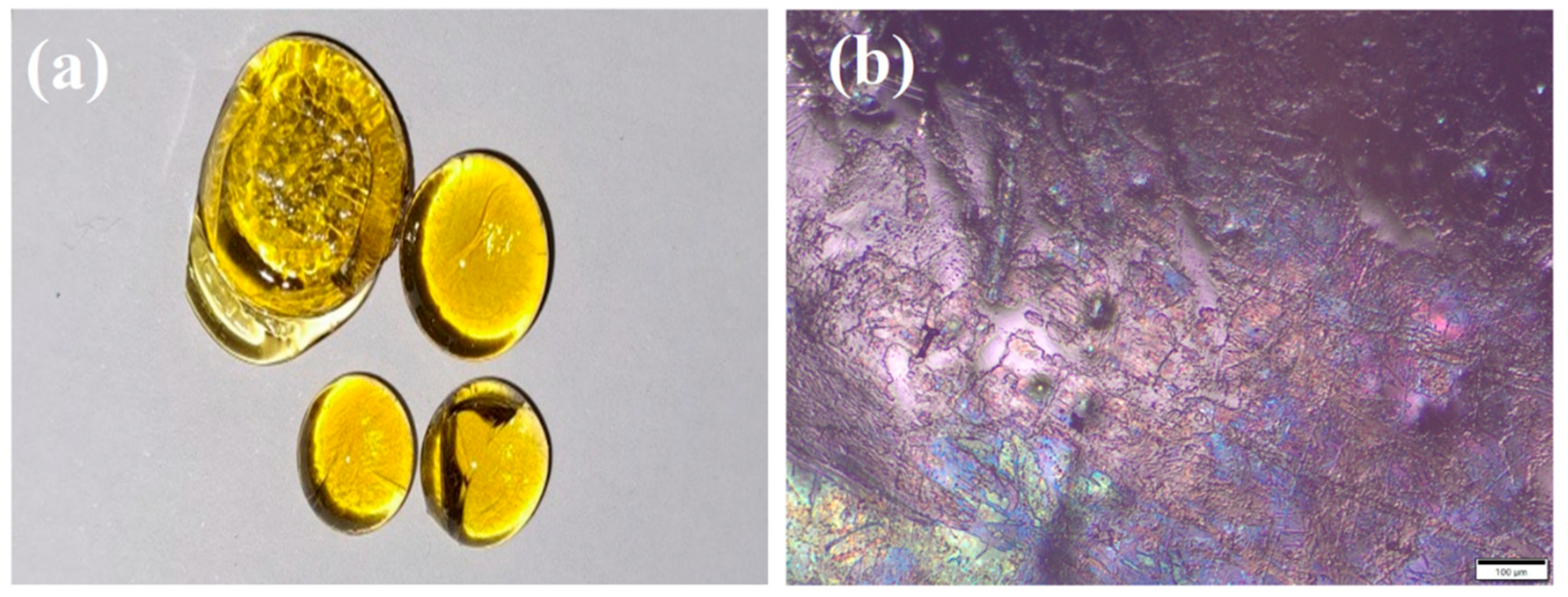
Figure 2.
SEM micrographs of the 50Li2O- 50B2O3- 80 wt.% slag (LiBS) glass recorded at different magnifications.
Figure 2.
SEM micrographs of the 50Li2O- 50B2O3- 80 wt.% slag (LiBS) glass recorded at different magnifications.
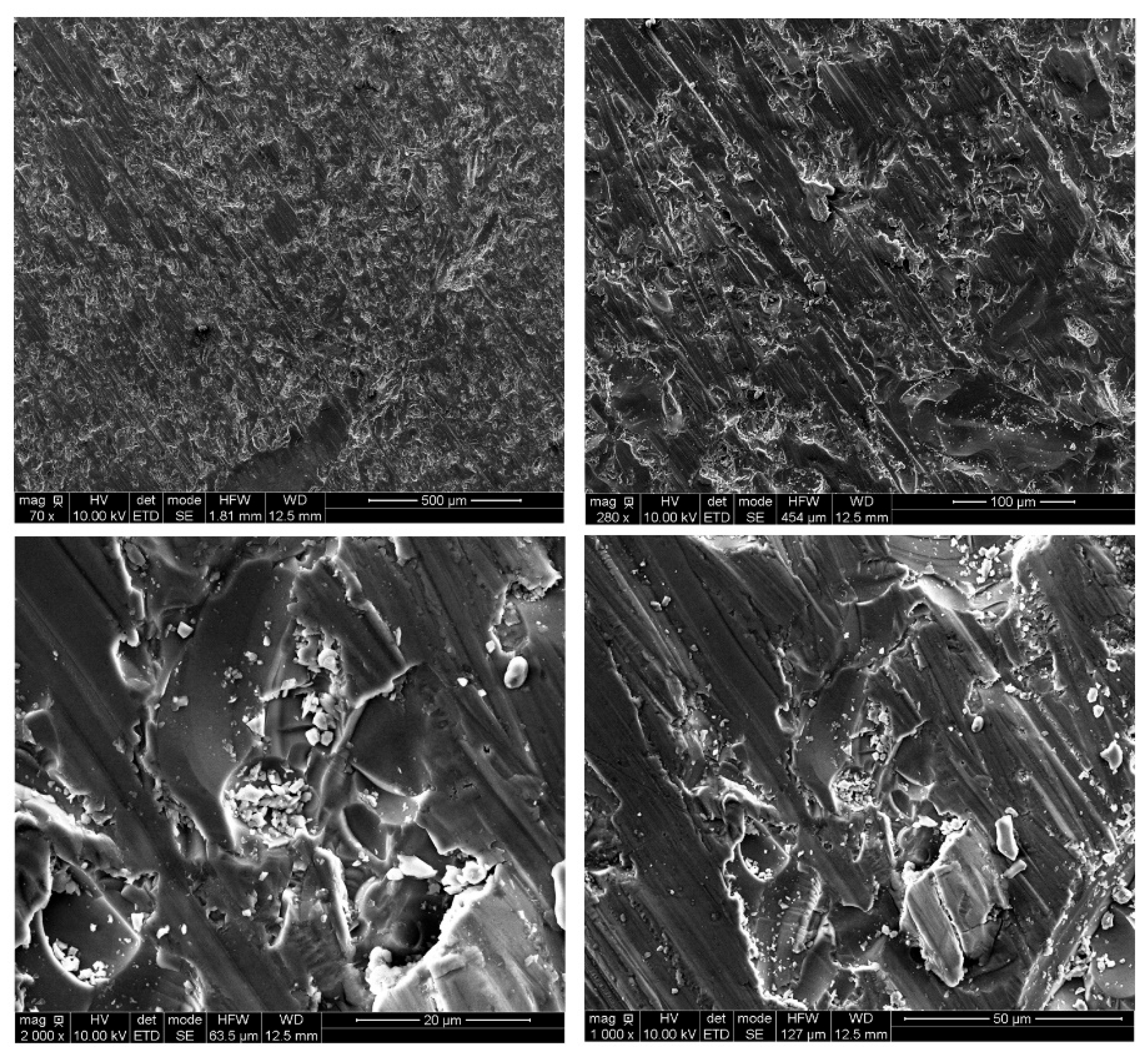
Figure 3.
Figure 3. (a) XRD patterns, (b) DSC curve of the LiBS glass and (c) Enlarged view of the glass transition region together with the tangent construction used to determine Tg.
Figure 3.
Figure 3. (a) XRD patterns, (b) DSC curve of the LiBS glass and (c) Enlarged view of the glass transition region together with the tangent construction used to determine Tg.
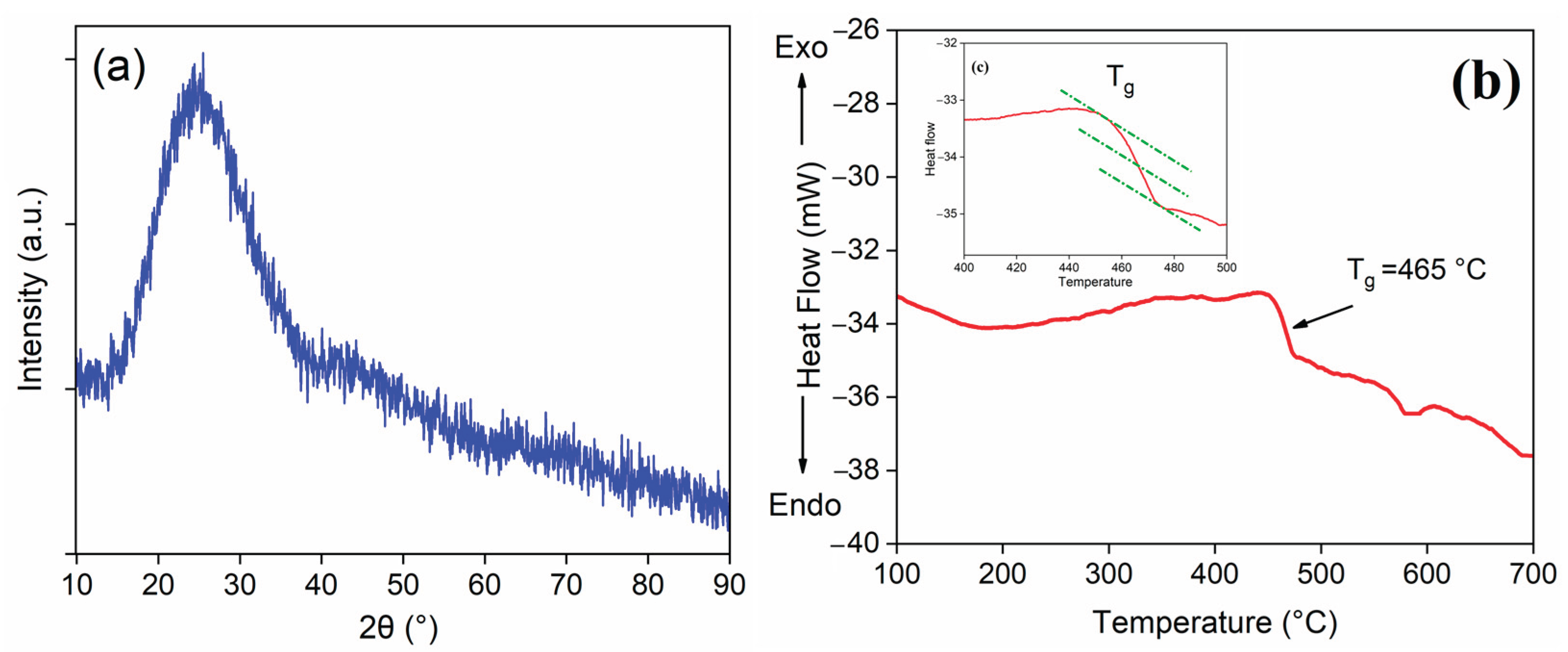
Figure 4.
(a) FTIR and (b) Raman spectra of LiBS glass.
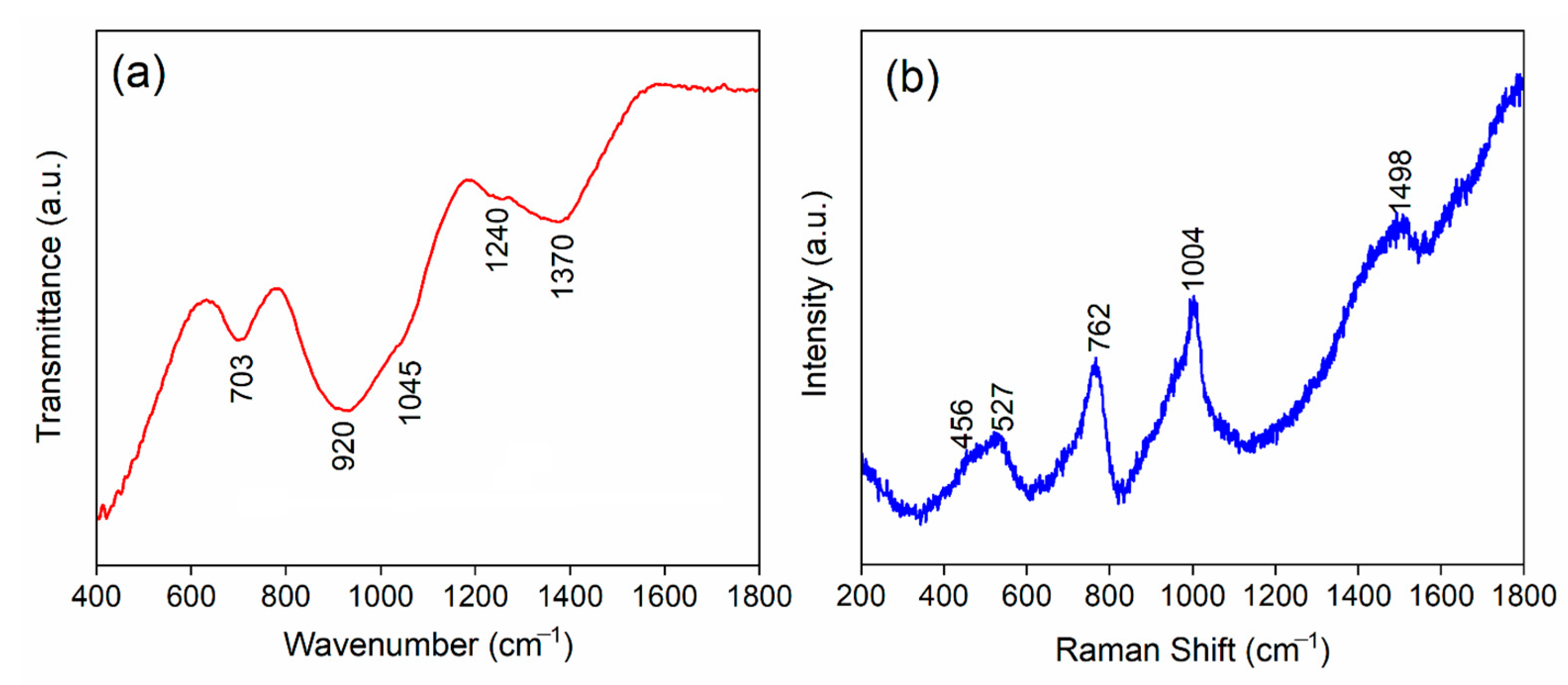
Figure 5.
Magnetic hysteresis loops (M-H) of the LiBS glass recorded at various temperatures from 15 to 300 K.
Figure 5.
Magnetic hysteresis loops (M-H) of the LiBS glass recorded at various temperatures from 15 to 300 K.
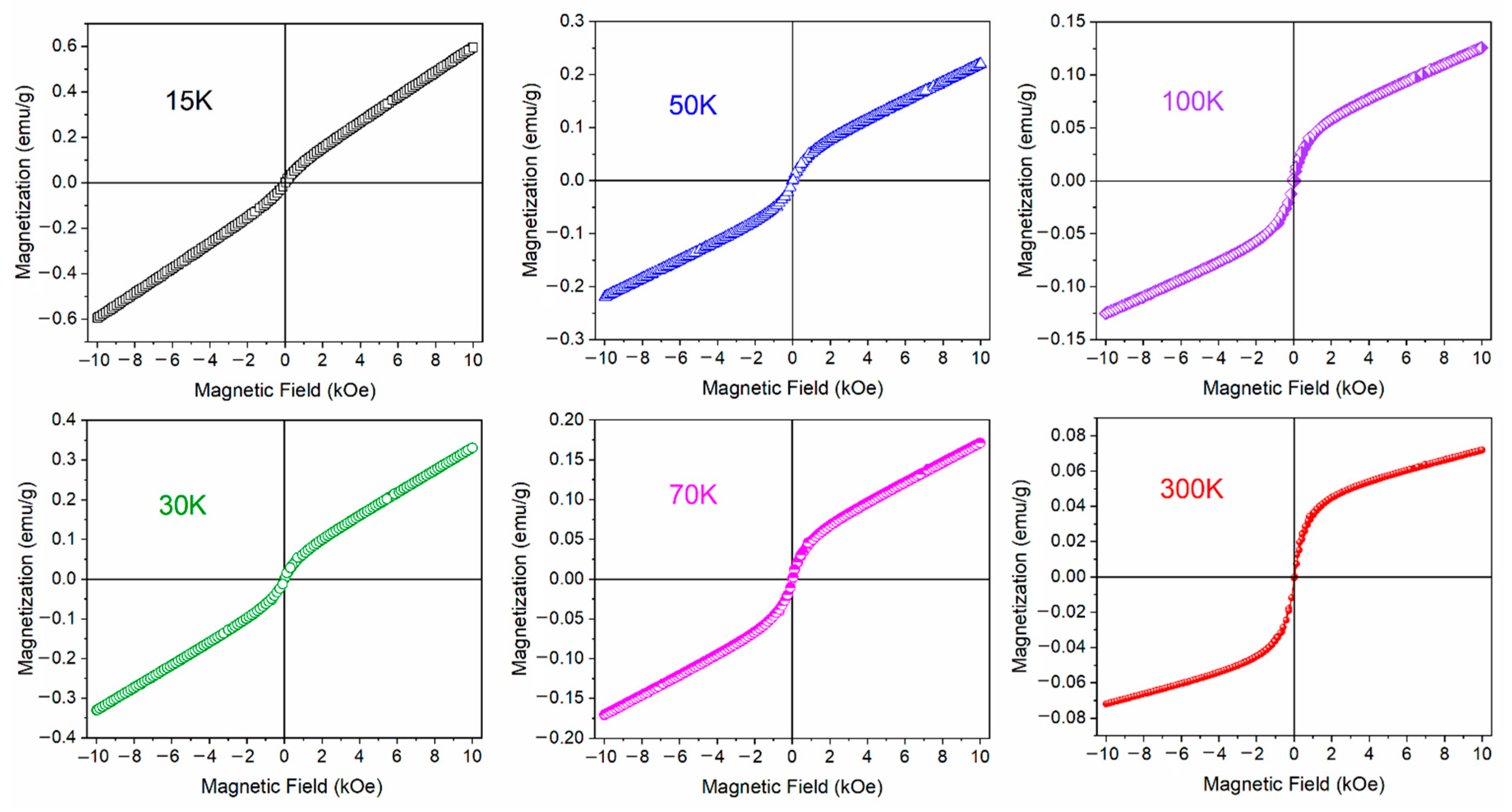
Figure 6.
The magnetization versus temperature obtained in the ZFC and FC modes for applied fields of 0.1 KOe, 0.5 KOe, 1 KOe, and 5 KOe.
Figure 6.
The magnetization versus temperature obtained in the ZFC and FC modes for applied fields of 0.1 KOe, 0.5 KOe, 1 KOe, and 5 KOe.
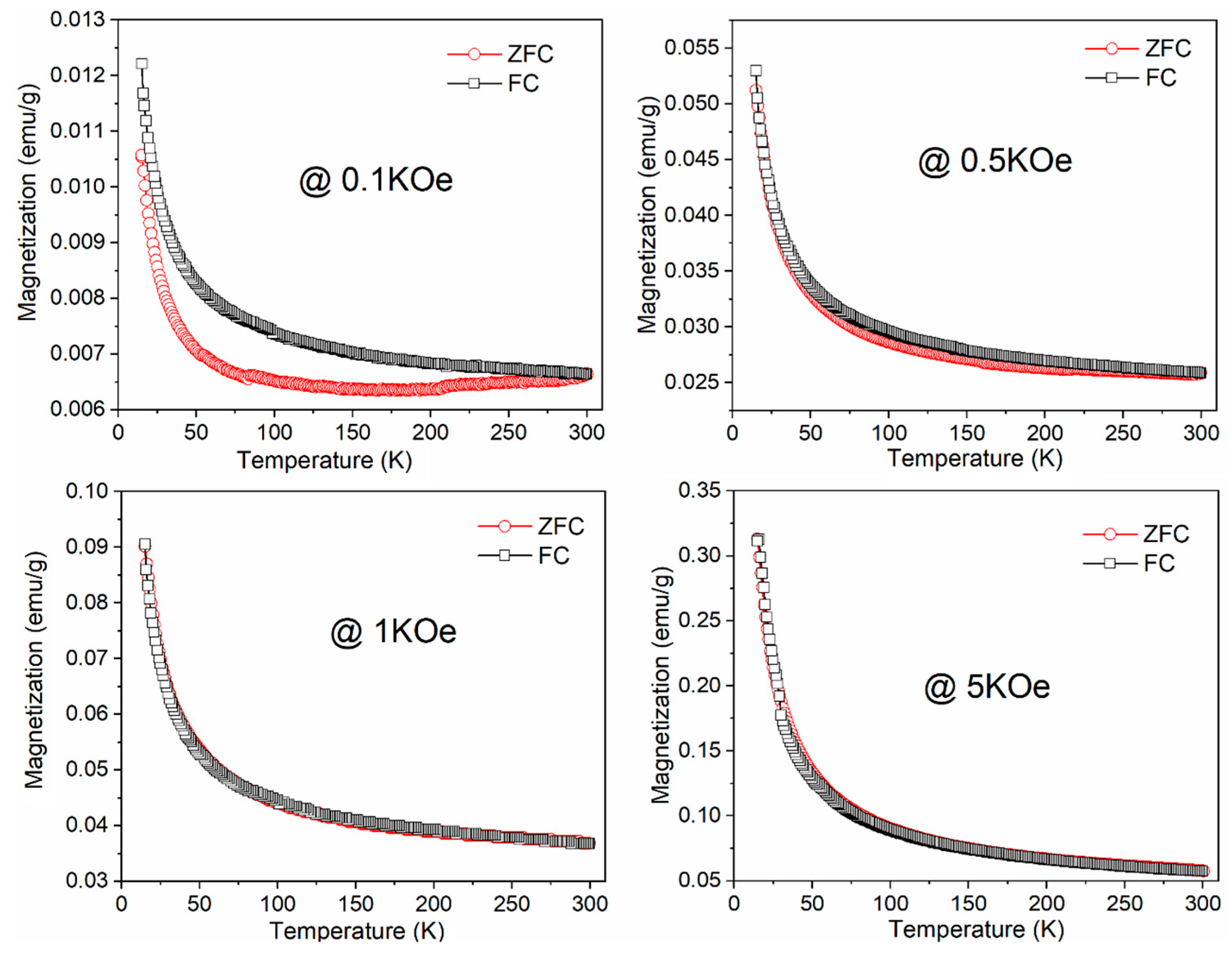
Figure 7.
Temperature-dependent magnetization in both the ZFC and FC modes of the LiBS sample at H = 10 KOe, as well as the inverse of susceptibility 1/χ.
Figure 7.
Temperature-dependent magnetization in both the ZFC and FC modes of the LiBS sample at H = 10 KOe, as well as the inverse of susceptibility 1/χ.
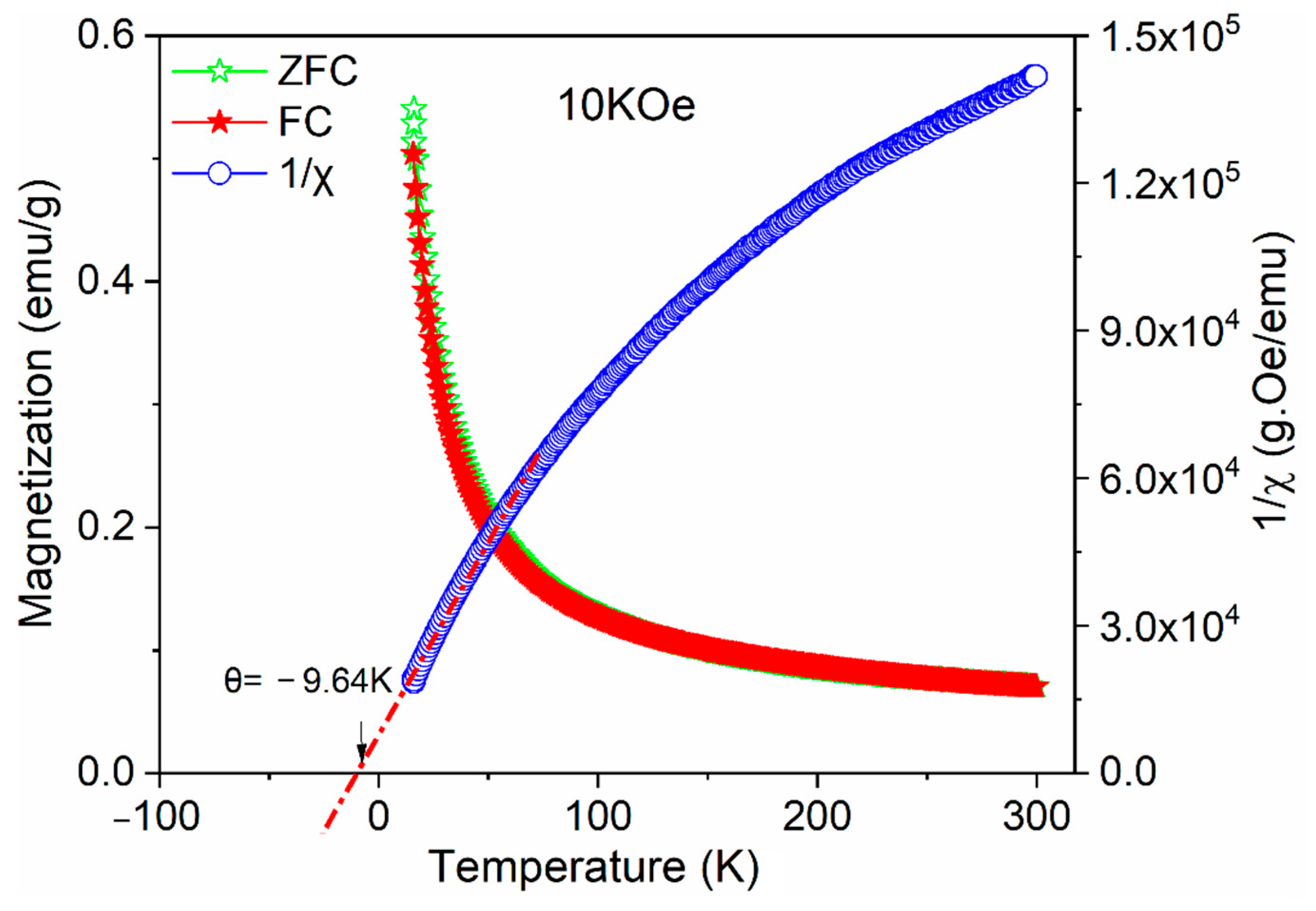

Table 1.
Chemical composition of electric arc furnace slag.
| Constituent | SiO2 | Al2O3 | Fe2O3 | CaO | SO3 | K2O | TiO2 | MnO | MgO | P2O5 |
| Content % | 14.21 | 8.30 | 31.69 | 30.59 | 0.46 | 0.02 | 0.59 | 3.61 | 6.16 | 0.57 |
Table 2.
Infrared and Raman wavenumbers and their corresponding assignments for the LiBS sample.
| FTIR | Raman | Assignments | References |
| 1370 | 1498 | Asymmetric stretching vibration B-O bond in [BO3] units present in metaborate, pyroborate, and orthoborates groups | [56,57,58,59,72,73] |
| 1240 | - | Stretching vibrations of terminal B-O bonds in [BO3] | [60,61,62,63] |
| 1045 | 1004 | Stretching vibrations of B-O bond in BO4 units from tetraborate, pentaborate and triborate units | [64,65,74,75] |
| 920 | - | Stretching vibrations of B-O bonds in tetrahedral [BO4] units originating from di-borate structural groups | [57,66,67] |
| - | 762 | Six-membered rings containing one trigonal [B∅3] and two tetrahedral [B∅4]- borate ring breathing vibrations | [76,77] |
| 703 | - | Si-O bending Bending vibrations of B-O-B linkage in borate network |
[68,69] [69,70,71] |
| - | 527 | units | [59,78] |
| - | 456 | Bending vibrations of B-O-B linkages in the borate network | [79,80] |
Disclaimer/Publisher’s Note: The statements, opinions and data contained in all publications are solely those of the individual author(s) and contributor(s) and not of MDPI and/or the editor(s). MDPI and/or the editor(s) disclaim responsibility for any injury to people or property resulting from any ideas, methods, instructions or products referred to in the content. |
© 2026 by the authors. Licensee MDPI, Basel, Switzerland. This article is an open access article distributed under the terms and conditions of the Creative Commons Attribution (CC BY) license (http://creativecommons.org/licenses/by/4.0/).
Copyright: This open access article is published under a Creative Commons CC BY 4.0 license, which permit the free download, distribution, and reuse, provided that the author and preprint are cited in any reuse.