
Submitted:
30 June 2026
Posted:
01 July 2026
You are already at the latest version
Abstract
We examined the endolichenic fungal communities from three lichen species occupying the rocks in geographically and climatically different Israeli zones—the continental northern region, the Mediterranean area, and the central Negev Desert. Overall, 103 fungal species belonging to 61 genera were isolated from the lichens collected during three seasons. The majority of fungi were melanin-containing: 69 species, comprising 76.8% of all isolates. The relative abundances of melanized species with thick-walled and multicellular spores in each season were substantially higher in the most climatically severe desert regions. Seasonal effect was significantly expressed on species richness and isolate densities of the endolichenic communities, which were the lowest in the summer. Both these characteristics were also significantly dependent on lichen species hosted the communities, and were the lowest in the very thin thalli of Circinaria calcarea. Fungal communities from the nearby rock surface formed more coherent groups, and their complexes of dominant species were subjected to clearer regional and seasonal variations in comparison with the endolichenic communities. This fact is explained by the specific conditions of lichen hosts possessing the differences in growth form, moisture regime, and metabolic activity, which can substantially affect the formation of endolichenic communities.
Keywords:
endolichenic fungi
; Israeli regions
; lichen thalli
; melanin-containing fungi
; rock surface
; saxicolous lichens
1. Introduction
During last decades, lichen thalli as a habitat for specific group of fungi—endolichenic communities, attract attention of mycologists all over the world. The communities of endolichenic fungi have been studied across different geographical regions and ecosystems involving various lichen species and forms on a variety of substrates, and employing both culture-based and culture-independent molecular techniques e.g., [1,2,3,4,5,6,7,8,9,10]. So far, the investigating of endolichenic fungal communities offers a unique opportunity to explore the intricate influence of both external environmental factors and the specific conditions of lichen interior on the development of these communities. Besides, endolichenic fungi are known as the sources of bioactive secondary metabolites, which makes them promising for the use in pharmacology and biotechnology e.g., [9,11,12,13,14,15,16].
In Israel, endolichenic fungi in the thalli of saxicolous lichens have been studied in three different regions: in the northern part of the country at Upper Galilee [17], at the Central Negev Desert [18] and in the Mediterranean region at Mount Carmel [19]. The endolichenic communities were characterized by a complex of protective features, which were important for inhabiting the interior of lichen thalli and for withstanding the severe external conditions.
Our previous studies focused on the influence of local environmental variability on the composition and diversity of endolichenic fungal communities (different rock types—[17]; different slope orientation—[18,19]). However, the impact of macroenvironmental variability associated with distinct climatic conditions in Israel have not been yet investigated.
Following the aforementioned reason, we chose to sample lichen specimens simultaneously in the geographically and climatically different Israeli regions where our previous studies were conducted—the continental northern region (Upper Galilee), the Mediterranean area (Mt. Carmel), and the Negev Desert (its central part). Three species of lichens were chosen to collect—Circinaria calcarean (L.) A. Nordin, Savić & Tibell (former Aspicilia calcarea), Variospora aurantia (Pers.) Arup, Frödén & Søchting (former Caloplaca aurantia), and Lathagrium cristatum (L.) Otálora, P.M. Jørg. & Wedin (former Collema cristatum); accordingly, the areas where all three lichen species could be found, were selected as sampling localities within the above regions.
Therefore, the current research focuses on the composition and diversity of endolichenic fungi associated with three species of saxicolous lichens occupying the rocks at geographically and climatically different regions in Israel. The main goal of the study addresses the effect of several environmental aspects—climatic differences, seasonal fluctuations, and species of a lichen, on the composition and richness of endolichenic fungal communities. In parallel, we studied the composition of fungal communities inhabiting the surface of rocks from which lichen specimens were collected, in order to compare the endolichenic and rock-surface communities and to trace possible sources of the formation of fungal assemblages occupying the lichen thalli.
2. Materials and Methods
2.1. Site Description
Five research sites were chosen within the three geographic and climatic areas in Israel: northern continental (Upper Galilee), Mediterranean (Mount Carmel), and desert (Central Negev) (Figure 1). Main characteristics of these sites—location, altitude, annual precipitation, and dominant vegetation, are given in Table 1. In the northern and desert areas, two sites were designated considering their distinct differences in altitude.
2.2. Sampling Design
Three lichen species—Circinaria calcarea, Variospora aurantia, and Lathagrium cristatum (Figure 2) were collected in each research site (with the exception of Wadi Amud, Upper Galilee, in the spring, where V. aurantia was not collected; and Borot Lots, Negev Desert, in the summer, where sampling was not conducted). The species have different growth forms: cracked-areolated (C. calcarea), crustose-placodioid (V. aurantia), and foliose (L. cristatum); the first two species contain green algae as a photobiont, the last one contains cyanobacterial photobiont [21].
2.3. Microclimatic Measurements
Microclimatic measurements (Table 2) were performed in parallel with the collection of lichen specimens. Air humidity and temperature were measured using the humidity and temperature meter (Testo 610). The surface temperature of 20 randomly selected rocks was recorded with the Micron Infrared Thermometer (Model M102HTL). The measurements were taken at the center of rocks on a lichen-free surface.
2.4. Preparation of Lichen thalli
The preparation procedure followed the protocol described in our previous study [17]. Lichen samples were purified in tap water to remove soil, dust, and debris from their surfaces, and then thoroughly cleaned with running tap water. The lichen thalli were surface sterilized by successive immersion for 1 minute in 75% ethanol, 3 minutes in 2% sodium hypochlorite, and 30 seconds in 75% ethanol. The lichen thalli were then dried by placing them over sterile filter paper, and after that were exposed to ultraviolet (UV-C) light for 30 minutes for additional surface sterilization. The sterilized lichen samples were cut into eight to ten fragments of an approximately 1-mm² size using a sterile razor blade. From each rock containing lichen thalli, powder samples were obtained by scraping the surface with a small sterile knife.
2.5. Isolation of Fungal Strains
The fragments of lichen thali and rock powder were spread evenly over the surface of Malt Extract Agar (MEA) (Pronadisa, Laboratorios Conda S.A. Madrid, Spain) in Petri dishes of 90-mm diameter. Streptomycin (Spectrum Chemical Mfg. Corp, Gardens, USA) was added to the medium (100 µg/ml) to prevent bacterial growth. The plates were incubated at 25 °C in darkness for 10-30 d. Altogether, six Petri dishes with fragments of a lichen species from six rocks per site were incubated, in parallel with six Petri dishes containing the powder of six different rocks from a site, which were the sources of lichen thalli.
After incubation, the emerging fungal colonies were transferred to MEA for purification and further taxonomic identification. In an attempt to induce sporulation, all non-sporulating isolates were additionally grown on oatmeal agar (Sigma-Aldrich Inc, St. Louis, USA) as recommended by Bills et al. [22], and on Water Agar (agar—20 g, water—1000 ml).
Taxonomic identification was mainly based on morphological characteristics of fungal isolates (structure, size, and color of fruit bodies, asci, sporophores, sporogeneous cells, and spores). Some morphological traits (kind of sporulation—teleomorphic or anamorphic; pigmentation of mycelium and spores—light-colored or melanized; and spore structure—size and number of cells) were used for the characterization of fungal life style. Melanization of fungal structures was characterized visually (brown to black color). Ten most frequently occurring non-sporulating strains of endolichenic fungi were sent for molecular identification at Hy Laboratories Ltd., Rehovot, Israel. The procedure is described in detail in our previous publications e.g., [23]. All names of the identified species are cited according to the Species Fungorum database (www.speciesfungorum.org).
2.6. Data Analysis
For each fungal species from the interior of lichens and rock surface, relative abundance was calculated as number of isolates of a particular species in the sample/total number of all isolates in the sample. For fungal communities from each lichen species, species richness and isolate density expressed as number of colony forming units (CFU) were calculated per lichen specimen.
To estimate similarity between endolichenic and rock-inhabiting fungal communities from different regions and seasons, the clustering of communities (AHC) based on species’ relative abundance was made using XLSTAT (http://www.xlstat.com ). The clustering was based on the unweighted pair-group average method with Chi-squared distance as the distance coefficient and with automatic truncation designated the number of homogeneous groups (clusters). A nonmetric multidimensional scaling (NMDS) plots based on the Bray– Curtis dissimilarity matrix were constructed for the ordination of endolichenic and nearby rock-inhabiting fungal communities, separately for each lichen species. The analysis was performed using R version 3.5.1 (http://www.R-project.org/ ) with the vegan package. The three-way unbalanced ANOVA test (XLSTAT) was employed to assess the influence of geographic region, season, and lichen species, separately and in interactions, on the following characteristics of endolichenic communities: species richness, isolate density, and the contributions of melanin-containing species (as a group of fungi resistant to different kinds of stresses)—both overall and the species with large multicellular spores, to the community composition. The ANOVA test was performed on data from the sites where all lichen species in all seasons were sampled.
3. Results
3.1. Composition of Endolichenic and Rock-Surface Communities
From lichen thalli, 103 identified species were isolated. The endolichenic fungi represented Zygomycota (7 species), and Ascomycota (96). The species belonged to 61 genera; the most numerous were Chaetomium, (10 species), Alternaria (9), Penicillium (8), Fusarium (7), and Aspergillus (5). Six types of strains, remaining non-sporulating in culture, have not been identified.
A lower number of species (93) was isolated from the rock surfaces, with 59 species (40.2%) being common for rocks and lichen interior. The rock-inhabiting fungi belonged to Zygomycota (7 species) and Ascomycota (86). The species comprised 63 genera; the most numerous were Alternaria, Aspergillus (8 species each), Penicillium, Fusarium (7 species each), and Chaetomium (6). Five types of strains, which remained non-sporulating in culture, have not been identified.
The majority of fungi isolated from lichen thali were melanin-containing: 69 species, comprising 76.8% of all isolates. On the rock surface, this group was represented by only 46 species, while accounting for 84% of all isolates. The overall relative abundance of melanized species was not subjected to any clear spatial and seasonal variations either in the lichen thali or on the rock surface (Figure 3). At the same time, the distribution of melanin-containing fungi with large multicellular spores showed some regularities. In each season, their abundance was remarkably higher in the desert area, either at Sede Boker (ND1) in the lichen interior (1.4-3.3-fold), or at Borot Lots (ND2) on the rock surface (1.8-4.4-fold), with differences more expressed in the summer. The variations in relative abundance of melanized species in the thalli of different lichen species, both overall and with large many-celled spores, did not show any clear pattern (Figure S1). In the spring, this parameter was slightly lower in the interior of Lathagrium cristatum, while both in the summer and winter at the majority of sites, the communities in Circinaria calcarea contained the lowest proportion of melanics with large multicellular spores.
Different species dominated the endolichenic fungal communities across sites and seasons (Table 3): in the spring—Sporormiella australis and Cladosporium cladosporioides (UG1); Anthostomella limitata, C. cladosporioides and Alternaria alternata (UG2); Sordaria fimicola and C. cladosporioides (MC); S. australis, A. alternata, and A. atra (ND1,2); in the summer—S. australis and Coniochaeta sp. (UG1); C. cladosporioides and Scedosporium desertorum (UG2); S. australis (MC); C. cladosporioides, Penicillium sacculum, and Roselinia convexa (ND1); in the winter—C. cladosporioides prevailed in all sites except for ND2, where A. alternata and A. atra dominated; these Alternaria species were abundant also at ND1. Variations in the dominant species of rock-inhabiting fungal communities were less expressed (Table 4) and subjected to some regularities. C. cladosporioides overwhelmingly prevailed in all sites and seasons except for the desert localities, where A. alternata and A. atra were more abundant, especially in the spring and summer; the relative abundance of C. cladosporioides notably decreased southward, with the simultaneous increase in abundance of Alternaria spp. (Table 4).
Clustering fungal communities based on species relative abundance did not reveal any close relationships either between the lichen- and rock-inhabiting communities in the same site or season, or among the endolichenic communities across different sites and seasons (Figure 4). In contrast, the great majority of rock-surface communities clustered together, although without any pronounced spatial or seasonal associations. The nonmetric multidimensional scaling for the ordination of endolichenic and nearby rock-inhabiting fungal communities, performed separately for each lichen species, revealed some regularities (Figure 5). In each lichen habitat, the rock-surface communities grouped closely, while only the communities from Circinaria calcarea formed the incoherent group. In C. calcarea and Variospora aurantia, the winter communities formed more close associations apparently due to the dominance or high abundance of C. cladosporioides.
3.2. Species Richness and Density of Fungal Isolates in Lichen thalli
The overall numbers of fungal species in lichen thalli were subjected to seasonal and spatial fluctuations, being higher in the winter and in each season—in the Upper Galilee localities, either Mount Meron or Wadi Amud (Table 3). Across different lichen species, number of endolichenic fungal species varied remarkably during the study period, both overall and per specimen—from 3 to 20 and from 0.7 to 7.5, respectively (Table 5). Density of fungal isolates per lichen specimen was also subjected to substantial variation—from 1.3 to 31.5 (Table 5). The thalli of Circinaria calcarea hosted the lowest number of fungal species and isolates in all sites and seasons (except for species richness in the summer). The distribution of either species richness or numbers of CFUs across geographic regions did not show any clear pattern. In seasonal dynamics, the summer endolichenic communities contained the least number of species and CFUs, except for the communities in C. calcarea, following this pattern only at Mt. Carmel (Table 5). Notably, the winter endolichenic communities in the desert sites were characterized by the highest values of both species richness and density of fungal isolates.
3.3. Effect of Geographic Region, Season, and Lichen Species on the Characteristics of Endolichenic Communities
The three-way unbalanced ANOVA test revealed significant impact of season and lichen species both on species richness and isolate density of endolichenic fungi (Table 6). The significant influence of geographic region was revealed only on the contribution of melanin-containing spp. with large and multicellular spores to the composition of endolichenic communities. The interactions of season with lichen species or region had a significant impact on species richness and CFU numbers, respectively, while the cumulative effect of all three factors on the characteristics of endolichenic communities was non-significant (Table 6).
4. Discussion
In the course of the study, comparatively rich endolichenic mycobiota consisting of 103 identified species from 61 genera was isolated from 246 lichen specimens. This mycobiota was subjected to certain regularities in its distribution over regions, seasons, and lichen species.
The influence of regional climatic conditions was reflected in the composition of endolichenic communities, namely in the contribution of melanin-containing species with large many-celled and thick-walled spores (Table 6). Expectedly, their relative abundances in each season were substantially higher in the most climatically severe desert regions (Figure 3). Such species with the protective melanin pigmentation and spore morphology are well known stress-tolerant microorganisms resistant to solar and UV radiation, high temperatures, desiccation, oligotrophic conditions, and various kinds of pollutions [24,25]. In our previous studies, melanized fungi with large multicellular spores comprised the main core of endolichenic communities in Wadi Boker (Central Negev), as well as in Upper Galilee and at the south-facing slope of a canyon in Mount Carmel [17,18,19]. The prevailing species from the genus Alternaria are known as endophytes e.g., [26] and phylloplane-inhabiting species [27]; the latter are able to resist the substantial fluctuations in temperature and water content of the external environment. The coprophilous meiospore-producing (morphologically sexual) Sporormiella spp. and Sordaria fimicola, which were frequently and abundantly isolated from the lichen interior, are known to be thermotolerant and were also reported as endophytes [28,29]. Additionally, these species may produce thick-walled, dark brown or black perithecia, thus strengthening the morphological adaptations to severe environmental conditions.
In comparison with regional dynamics, seasonal variations in the composition of endolichenic fungal communities were less pronounced. Notably, the melanized species with comparatively small and mainly one-celled conidia, Cladosporium cladosporioides, prevailed in all winter communities, except for the desert high-altitude locality at Borot Lot. In contrast, seasonal effect was significantly expressed on species richness and isolate densities of the endolichenic communities (Table 6). Expectedly, in the majority of localities, both these characteristics were the lowest in the most climatically severe summer season. Interestingly, both species richness and density of fungal isolates reached the highest values in the winter desert endolichenic communities. It is likely that the desert climatic conditions in winter—warm daily temperatures accompanied by restricted amount of precipitation, are suitable for the development of endolichenic fungal communities to the greatest extent.
Species richness and density of fungal isolates in endolichenic communities were also significantly dependent on lichen species, which hosted the communities (Table 6). Obviously, the growth form of lichen thallus influenced the above characteristics of endolichenic fungal communities. The thalli of Circinaria calcarea, which held the lowest number of fungal species and isolates in almost all sites and seasons (Table 5), were the thinnest and consisted of greyish-white, finely cracked-areolated crusts. Similarly, in our study conducted in Nahal Boker (the central Negev desert), the lowest values of species richness and density of fungal isolates were found in the endolithic Caloplaca alociza, which possessed very thin, smooth, and immersed thalli [18].
Great majority of the isolated endolichenic fungi are soil residents by their origin e.g., [30] and were found in various Israeli soils e.g., [31]. At the same time, a set of species abundantly or frequently occupied the studied lichen thalli, are known to have different origin. Among them—epiphytic meiospore-producing species, inhabiting the surface of dead plant stands (Anthostomella limitata, Coniochaeta sp., Daldinia concentrica, Roselinia convexa—e.g., [27,32]), as well as plant pathogens (Biscogniauxia mediterranea and Pestalotiopsis guepinii—[33,34]) and the insect pathogen (Corniculantispora arenarium—[35]). It is also worth noting the abundant presence of Penicillium sacculum in the thalli of L. cristarum (the Negev Desert, summer). Generally, penicillii were considered as possible contaminants, which can be isolated from lichen thalli after insufficient surface sterilization e.g., [36]. However, P. sacculum is a rare species inhabiting the terrestrial and marine ecosystems e.g., [30]. It is also was reported as a root endophyte [37] and a producer of secondary metabolites including mycotoxins with the antibacterial and antifungal activities e.g., [38].
In two our previous studies [17,18,19], rocks were considered as a possible source for the formation of endolichenic communities. Likewise, in the present study, more than 40% species were common for the rock surface and lichen interior. However, both beta-diversity estimations based on species relative abundances—AHC and NMDS, demonstrated distinct differences in the composition of rock- and lichen-inhabiting fungal communities. Notably, the rock-surface communities formed more coherent groups, and their complexex of dominant species were subjected to clearer regional and seasonal variations in comparison with the endolichenic communities. This phenomenon is obviously associated with the specific conditions in lichen thalli as a shelter for fungal communities. Such peculiarities of lichen hosts as their different growth forms and the ability to produce various secondary metabolites e.g., [39] can substantially influence the formation of endolichenic communities. Additionally, chlorolichens (Circinaria calcarea and Variospora aurantia) are able to absorb moisture from the air, while cyanolichens (Lathagrium cristatum) need liquid water (mainly from rain) for their metabolic activity [40], and such differences in water regime can also affect the development of endolichenic fungi.
5. Conclusions
Our study revealed comparatively rich mycobiota inhabiting the interior of three saxicolous lichen species, which cover the rocks in geographically and climatically different Israeli regions. This mycobiota was subjected to certain regularities in its distribution over regions, seasons, and lichen species. The relative abundances of melanized species with thick-walled and multicellular spores in each season were substantially higher in the most climatically severe desert regions. Seasonal effect was significantly expressed on species richness and isolate densities of the endolichenic communities—in the majority of localities, both these characteristics were the lowest in the most stressful summer season. Species richness and density of fungal isolates were also significantly dependent on lichen species hosted the communities, and were the lowest in the finely cracked thalli of Circinaria calcarea consisting of small, smooth, angular areoles. Fungal communities from the nearby rock surface formed more homogeneous groups, and their complexes of dominant species were subjected to clearer regional and seasonal variations in comparison with the endolichenic communities. This fact is explained by the specific conditions of lichen hosts possessing the differences in growth form, moisture regime, and metabolic activity, which can substantially influence the formation of endolichenic communities and diversify their composition.
Supplementary Materials
The following supporting information can be downloaded at the website of this paper posted on Preprints.org, Figure S1: Relative abundance of melanin-containing spp. in thalli of three lichen species (C.c.—Circinaria calcarea; V.a.- Variospora aurantia, L.c.—Lathagrium cristatum) from different Israeli regions and in different seasons (a—spring, b—summer, c—winter). The area below the line on bars indicates contributions of species with large multicellular spores. Locality abbreviations—as in Table 1.
Author Contributions
Conceptualization, T.M.; methodology, T.M. and G.I.; formal analysis, G.I.; writing—original draft preparation, G.I.; writing—review and editing, G.I. and T.M; visualization, G.I. and T.M. funding acquisition, G.I. and T.M. All authors have read and agreed to the published version of the manuscript.
Funding
This research was funded by one of the National Key Research and Development Program of China, under Grant 2016YFE0203400; The APC was funded by one of the National Key Research and Development Program of China, under Grant 2016YFE0203400.
Acknowledgments
The authors thank the Israeli Ministry of Absorption for financial support of this study.
Conflicts of Interest
The authors declare no conflict of interest. The funders had no role in the design of the study; in the collection, analyses, or interpretation of data; in the writing of the manuscript; or in the decision to publish the results.
References
- Li, W-C.; Zhou, J.; Guo, S-Y.; Guo, L-D. Endophytic fungi associated with lichens in Baihua mountain of Beijing, China. Fungal Divers. 2007, 25, 69-80.
- Peršoh, D.; Rambold, G. Lichen-associated fungi of the Letharietum vulpinae. Mycol. Progr. 2012, 11, 753-760. [CrossRef]
- Zhang, T/; Wei, X-L.; Zhang, Y-Q.; Liu, H-Y.; Yu, L-Y. Diversity and distribution of lichen-associated fungi in the Ny-Ålesund Region (Svalbard, High Arctic) as revealed by 454 pyrosequencing. Sci Rep. 2015. Available from: www.nature.com/scientificreports. [CrossRef]
- Suryanarayanan, T.S.; Thirunavukkarasu, N. Endolichenic fungi: the lesser known fungal associates of lichens. Mycology 2017, 8, 189-196. [CrossRef]
- Suryanarayanan, T.S.; Govindarajulu, M.B.; Rajamani, T.; Tripathi, M.; Joshi, Y. Endolichenic fungi in lichens of Champawat district, Uttarakhand, northern India. Mycol. Progr. 2017, 16, 205-211. [CrossRef]
- Chakarwarti, J.; Nayaka, S.; Srivastava, S. Diversity of endolichenic fungi – A review. Asian J. Mycol. 2020, 3(1), 488–509. [CrossRef]
- Oh, S-Y.; Yang, J.H.; Woo, J-J.; Oh, S-O.; Hur, J-S. Diversity and distribution patterns of endolichenic fungi in Jeju Island, South Korea. Sustainability 2020, 12, 3769. [CrossRef]
- Muggia, L.; Quan, Yu.; Gueidan, C.; Al-Hatmi, A.M.S.; Grube, M.; de Hoog, S. Sequence data from isolated lichen-associated melanized fungi enhance delimitation of two new lineages within Chaetothyriomycetidae. Mycol. Progr. 2021, 20, 911–927. [CrossRef]
- Santiago, K.A.A.; Dela Cruz, T.E.E.; Ting, A.S.Y. Diversity and bioactivity of endolichenic fungi in Usnea lichens of the Philippines. Czech Mycol. 2021, 73. 1–19. [CrossRef]
- Oh, S-Y.; Yang, J.H. New Trichoderma species and six unrecorded species of endolichenic fungi isolated from lichens. Mycobiology 2025, 53, 435–449. [CrossRef]
- Gao, H.; Zou, J.; Li, J.; Zhao, H. Endolichenic fungi: a potential treasure trove for discovery of special structures and bioactive compounds. Stud. Nat. Prod. Chem. 2016, 48, 347-397. [CrossRef]
- Kellog, J.; Raja, HA. Endolichenic fungi: a new source of rich bioactive secondary metabolites on the horizon. Phytochem. Rev. 2017, 16, 271–293. [CrossRef]
- Singh, B.N.; Upreti, DK.; Gupta, VK.; Dai, X-F.; Jiang, Y. Endolichenic fungi: a hidden reservoir of next generation biopharmaceuticals. Trends Biotechnol. 2017, 35, 808-813. [CrossRef]
- Tripathi, M.; Joshi, Y. Endolichenic Fungi: Present and Future Trends. Springer Nature Pte Ltd.: Singapore, 2019. [CrossRef]
- Wethalawe, A.N.; Alwi, Y.V.; Udukala, D.N.; Paranagama, P.A. 2021. Antimicrobial compounds isolated from endolichenic fungi: a review. Molecules 2021, 26, 3901. [CrossRef]
- Chang, R.; Yan, Z.; Jiang, J.; Wang, Y.; Si, H.; Bose, T.; Miao, C. Four novel endolichenic fungi from Usnea spp. (Lecanorales, Parmeliaceae) in Yunnan and Guizho, China: Taxonomic description and preliminary assessment of bioactive potentials. MycoKeys 2025, 118, 55-80. [CrossRef]
- Grishkan, I.; Temina. M. Interior of saxicolous lichens on different types of rocks as a habitat for microfungal communities in Upper Galilee, Israel. Acta Mycol. 2019, 54, 1123. [CrossRef]
- Grishkan, I.; Temina. M. Composition and diversity of endolichenic microfungal communities from saxicolous lichens at Nahal Boker, the central Negev Desert, Israel. Fungal Ecol. 2023, 61. [CrossRef]
- Grishkan, I.; Temina. M. Diversity of microfungal communities inside saxicolous lichens from Nahal Oren, Mount Carmel, Israel. Czech Mycol. 2023, 75, 15–34. [CrossRef]
- Atlas of Israel. 3rd ed.; Surveys of Israel: Tel Aviv, Israel, 1985.
- Temina, M.; Kondratyuk, S.Y.; Zelenko, S.D.; Wasser, S.P.; Nevo, E. Lichen-forming, lichenicolous and allied fungi of Israel. Wasser, S.P.; Nevo, E., Eds. A.R.G. Ganter Verlag: Ruggell, Liechtenstein, 2005.
- Bills, G.F.; Christensen, M.; Powell, M.; Thorn, G. Saprobic soil microfungi. In Biodiversity of Microfungi. Inventory and Monitoring Methods. Mueller, G.M; Bills, G.F; Foster, M.S, Eds., Elsevier Academic Press: California, USA, 2004, pp. 271-302.
- Grishkan, I.; Kidron, G.J. Vertical divergence of cultured microfungal communities at the Hallamish dune field, Western Negev Desert, Israel. Geomicrobiol. J 2017, 34, 706–721. [CrossRef]
- Grishkan. I. Ecological stress: Melanization as a response in fungi to radiation. In Extremophiles Handbook. Horikoshi, K.; Antranikian, G.; Bull, A.; Robb, F.; Stetter, K, Eds., Springer DE, 2011, pp. 1136-1148. [CrossRef]
- Treseder, K.K.; Lennon, J.T. Fungal traits that drive ecosystem dynamics on land. Microbiol. Mol. Biol. Rev. 2015, 79, 243-262. [CrossRef]
- Lawrence, D.P.; Rotondo, F.; Gannibal, P.B. Biodiversity and taxonomy of the pleomorphic genus Alternaria. Mycol. Progr. 2016, 15, 3. [CrossRef]
- Ellis, M.B.; Ellis, J.P. 1997. Microfungi on Land Plants. An Identification Handbook. Richmond Publishing Co. Ltd., The England.
- Mapperson, R.R.; Kotiw, M.; Davis, T.A.; Dearnaley, J.D.W. The diversity and antimicrobial activity of Preussia sp. endophytes isolated from Australian dry rainforests. Curr. Microbiol. 2014, 68: 30–37. [CrossRef]
- Schulz, B.; Wanke, U.; Draeger, S.; Aust, H-J, Endophytes from herbaceous plants and shrubs: effectiveness of surface sterilization methods. Mycol. Res. 1993, 97, 1447–1450.
- Domsch, K.H.; Gams, W.; Anderson, T.H. Compendium of Soil Fungi, 2nd revised ed.; Academic Press: NY, USA, 2007.
- Volz, P.A.; Ellanskaya, I.A.; Grishkan, I.; Wasser, S.P.; Nevo E. Soil Microfungi of Israel. Subramanian, C.V.; Wasser, S.P., Eds., A.R.A. Ganter Verlag K.-G.: Ruggell, Liechtenstein, 2001.
- Su, H.; Li, Q-R.; Kang, J-Ch.; Wen, T-Ch.; Hyde, K. Rosellinia convexa sp. nov. (Xylariales, Pezizomycotina) from China. Mycoscience 2016, 57, 164-170.
- Ju, Y-M.; Rogers, J.D. New and interesting Biscogniauxia taxa, with a key to the world species. Mycol. Res. 2001, 105, 1123–1133. [CrossRef]
- Sutton, B.C. The Coelomycetes. Commonwealth Mycological Institute: Kew, Surrey, England. 1980.
- Gams, W. Cephalosporium-Artige. Schimmelpilze (Hyphomycetes). G. Fischer: Stuttgart, Germany, 1971.
- Muggia, L.; Grube, M. Fungal diversity in lichens: from extremotolerance to interactions with algae. Life 2018, 8, 15–28. [CrossRef]
- Kim, H.; You, Y-H.; Yoon, H.; Seo, Y.; Kim, Y-E.; Choo, Y-S.; Lee, I-J.; Shin, J-H.; Kim, J-G. Culturable fungal endophytes isolated from the roots of coastal plants inhabiting Korean east coast. Mycobiology 2014, 42, 100-108. [CrossRef]
- Chen, L.; Guo, W.; Zheng, Y.; Zhou, J.; Liu, T.; Chen, W.; Liang, D.; Zhao, M.; Zhu, Y.; Wu, Q.; Zhang, J. Occurrence and characterization of fungi and mycotoxins in contaminated medicinal herbs. Toxins 2020, 12, 30. [CrossRef]
- Poulsen-Silva, E.; Carolina, Otero, M.; Diaz-Cornejo, S.; Atala, C.; Fuentes, J.A.; Gordillo-Fuenzalida, F. 2025. Secondary metabolites of lichens: the untapped biomedical and pharmaceutical potential of antimicrobial molecules. Fungal Biol. Rev. 2025, 51. [CrossRef]
- Lange, O.L.; Kilian, E.; Zingler, H. Water vapor uptake and photosynthesis of lichens: performance differences in species with green and blue-green algae as phycobionts. Oecologia 1986, 71, 104–110. [CrossRef]
Figure 1.
Map of Israel showing sampling localities in different geographic regions.
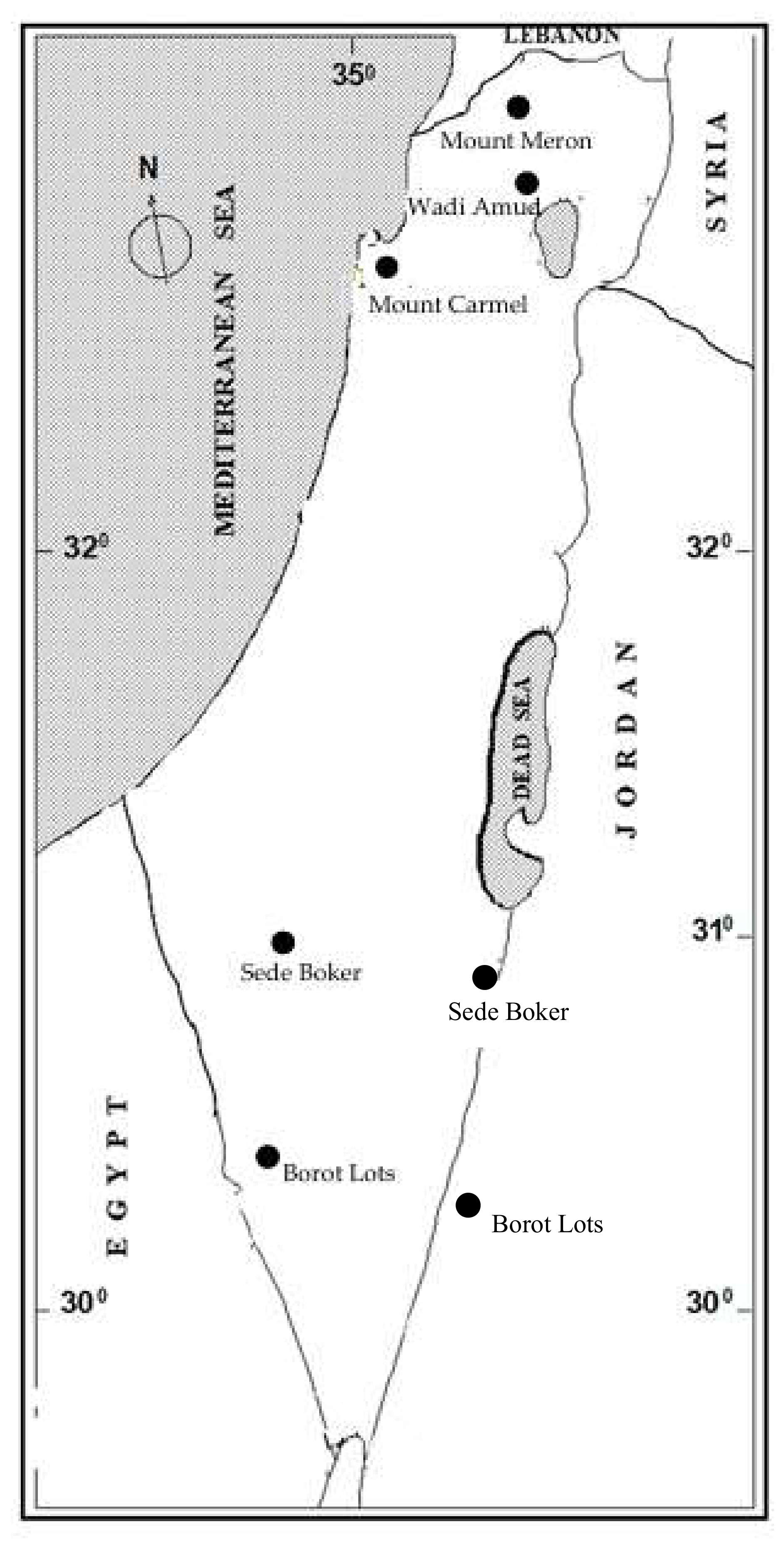
Figure 2.
Saxicolous lichen species collected in different geographic regions of Israel. a. Variospora aurantia; b. Circinaria calcarea; c. Lathagrium cristatum.
Figure 2.
Saxicolous lichen species collected in different geographic regions of Israel. a. Variospora aurantia; b. Circinaria calcarea; c. Lathagrium cristatum.
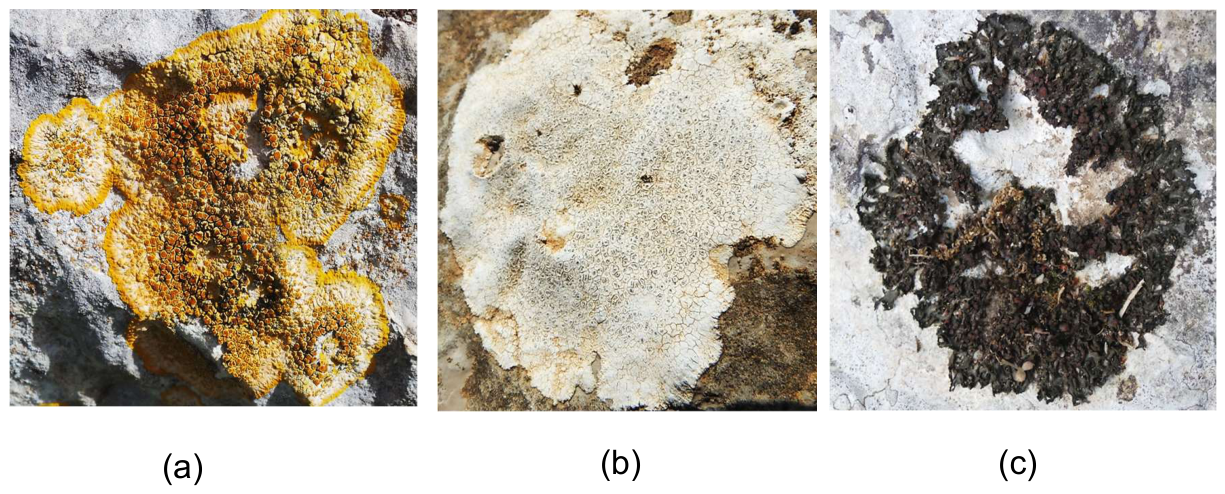
Figure 3.
Relative abundance of melanin-containing spp. in lichen thalli and on rock surfaces in different Israeli regions and in different seasons. The area left (lichen thalli) and right (rock surface) from the line on bars indicates contributions of species with large multicellular spores. Locality abbreviations – as in Table 1.
Figure 3.
Relative abundance of melanin-containing spp. in lichen thalli and on rock surfaces in different Israeli regions and in different seasons. The area left (lichen thalli) and right (rock surface) from the line on bars indicates contributions of species with large multicellular spores. Locality abbreviations – as in Table 1.
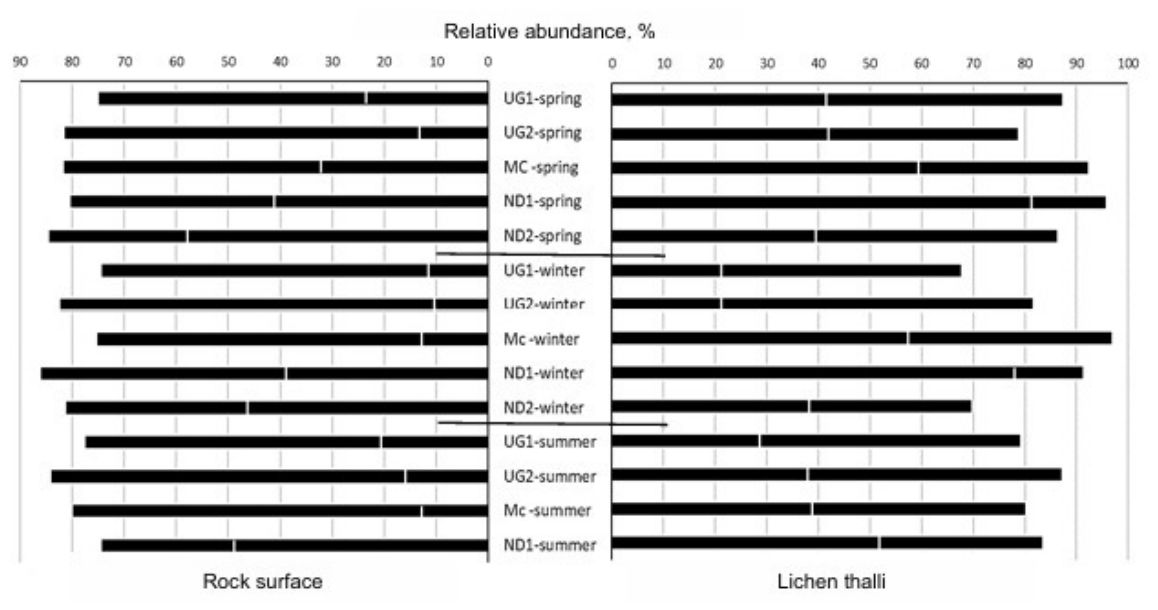
Figure 4.
Clustering the endolichenic (L) and rock-inhabiting (R) fungal communities based on relative abundance of species isolated in spring (sp), summer (su), and winter (w) from sites in different Israeli regions. Locality abbreviations – as in Table 1.
Figure 4.
Clustering the endolichenic (L) and rock-inhabiting (R) fungal communities based on relative abundance of species isolated in spring (sp), summer (su), and winter (w) from sites in different Israeli regions. Locality abbreviations – as in Table 1.
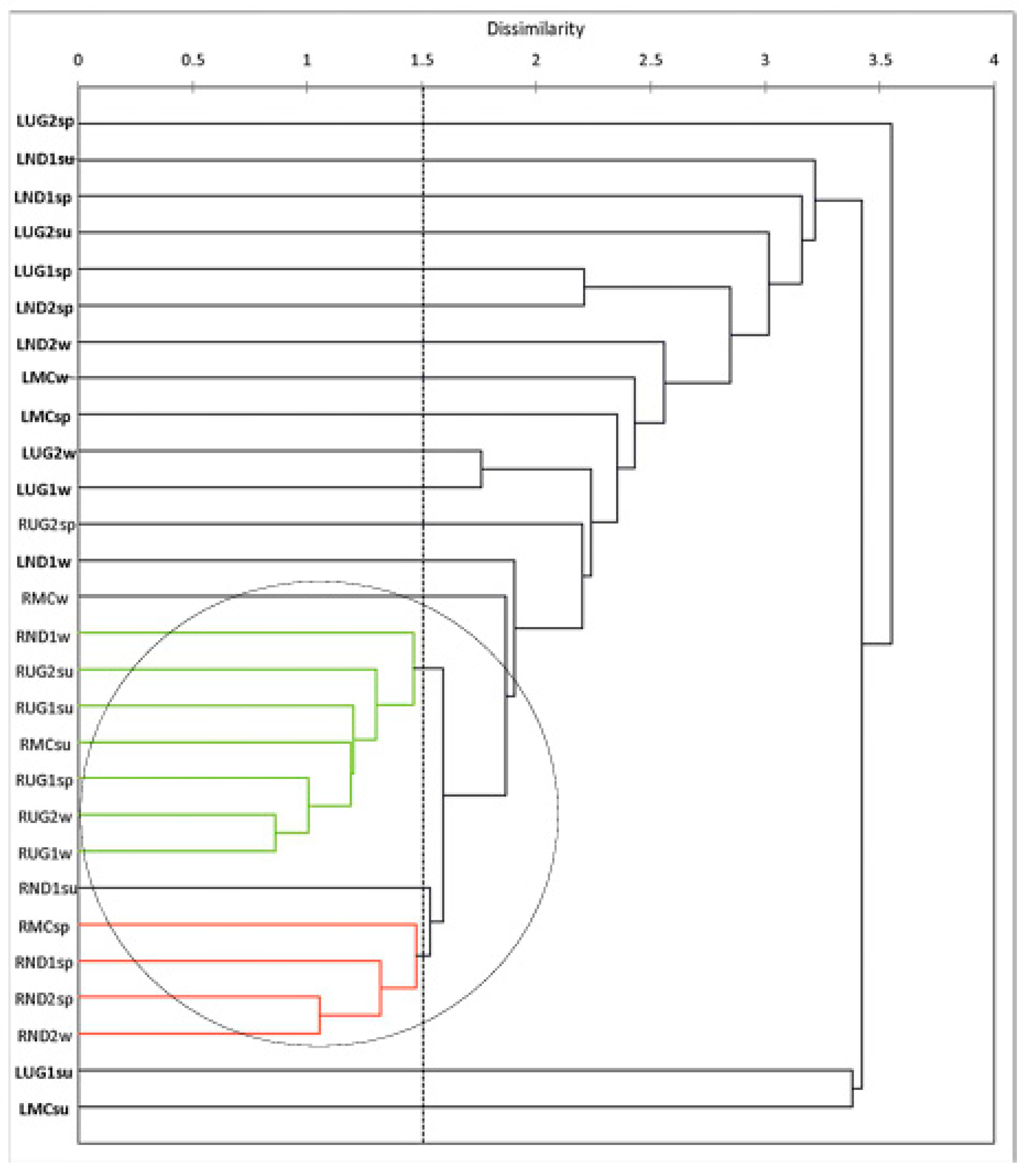
Figure 5.
NMDS ordination of endolichenic (L) and nearby rock-inhabiting (R) fungal communities isolated in spring (sp), winter (w), and summer (su) from different Israeli regions (abbreviations as in Table 1). (a) - Circinaria calcarea, (b) - Variospora aurantia, and (c) - Lathagrium cristatum.
Figure 5.
NMDS ordination of endolichenic (L) and nearby rock-inhabiting (R) fungal communities isolated in spring (sp), winter (w), and summer (su) from different Israeli regions (abbreviations as in Table 1). (a) - Circinaria calcarea, (b) - Variospora aurantia, and (c) - Lathagrium cristatum.
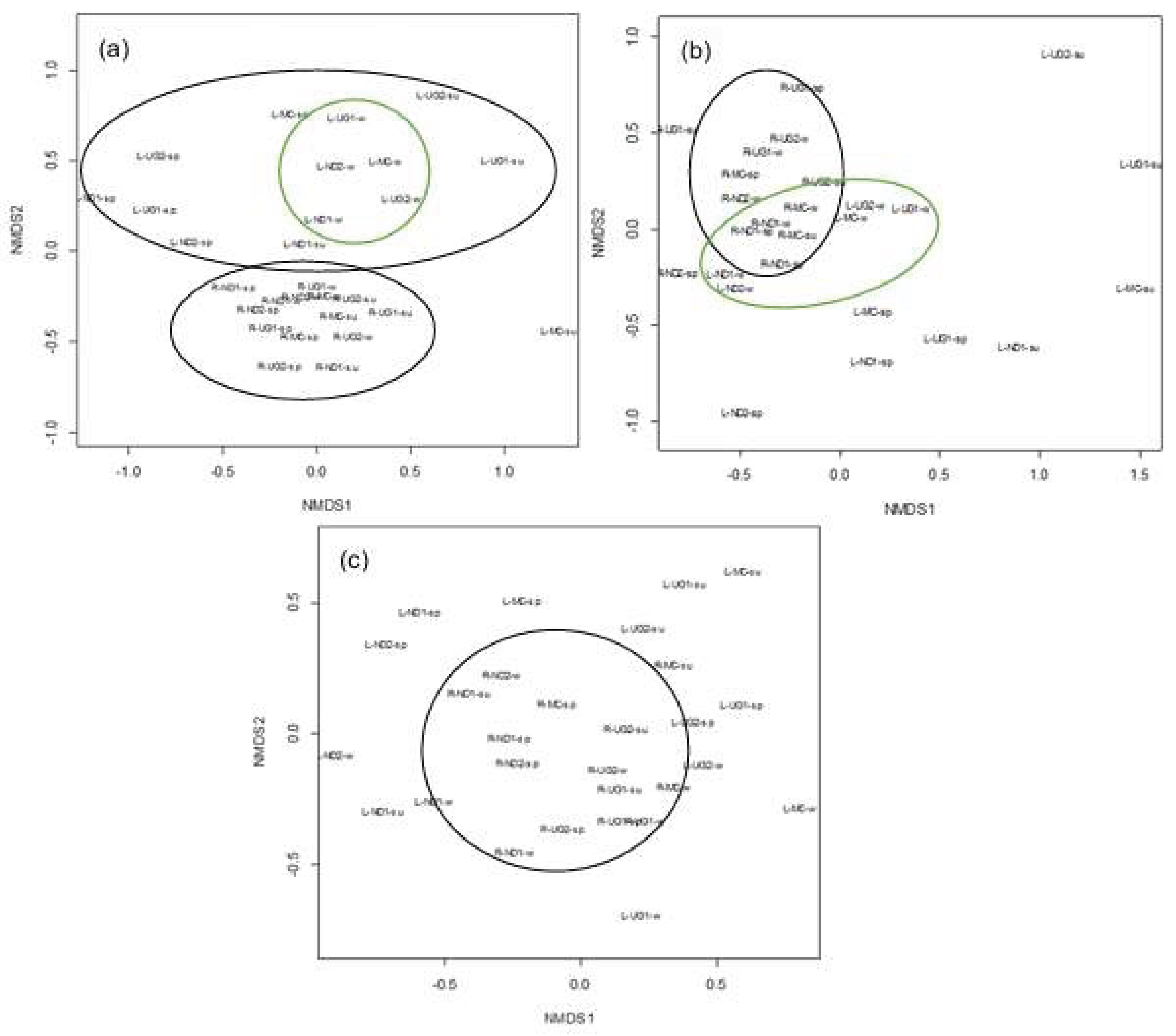

Table 1.
Description of sampling localities in different Israeli regions [20].
Table 1.
Description of sampling localities in different Israeli regions [20].
| Location | Coordinates | Altitude, m Above Sea Level | Annual Precipitation | Dominant Vegetation |
|---|---|---|---|---|
| Upper Galilee, Mount Meron (UG1) |
N 33°00.902’ E 35°23.606’ |
890 | 900 mm | Trees: Quercus calliprinos, Q. boissieri, Arbutus andrachne, Eriolobus trilobatus; shrubs: Pistacia terebinthus; grasses: Juniperus oxycedrus |
| Upper Galilee, Wadi Amud (UG2) |
N 32°58.805’ E 35°26.668’ | 635 | 800 mm | Trees: Q. calliprinos. Calicotome villosa, bushes: Rhamnus alaternus, Sarcopoterium spinosum; grasses: Cyclamen persicum, Anemone coronaria |
| Mount Carmel (MC) |
N 32°44.026’ E 35°02.311’ |
500 | 600 mm | Trees: Q. calliprinos; shrubs: Pistacia palaestina, Cistus salviifolius; Calicotome villosa |
| Negev Desert, Sede Boker (ND1) |
N 30°52.478’ E 34°47.013’ |
470 | 95 mm | Semishrubs: Artemisia herba-alba, Zygophyllum dumosum, Hammada scoparia. |
| Negev Desert, Borot Lots (ND2) |
N 30°30.263’ E 34°36.511’ |
1000 | 95 mm | Semishrubs: Artemisia sieberi; grasses: Helianthemum vesicarium |
Table 2.
Temperature of rock surface and air humidity at sampling localities in different Israeli regions and in different seasons (average ± SD, n=20) 1.
Table 2.
Temperature of rock surface and air humidity at sampling localities in different Israeli regions and in different seasons (average ± SD, n=20) 1.
| Locality | Rock Temperature, oC | Air Humidity, % | ||||
|---|---|---|---|---|---|---|
| Spring | Winter | Summer | Spring | Winter | Summer | |
| Upper Galilee, Mount Meron |
15.4±0.3 | 10.4±0.4 | 36.9±0.1 | 69.2±0.1 | 62.3±0.5 | 57.8±0.2 |
| Upper Galilee, Wadi Amud |
21.6±0.1 | 19.5±0.3 | 39.8±0.2 | 67.2±0.6 | 79.4±1.4 | 40.7±0.7 |
| Mount Carmel | 21.6±0.2 | 17.1±0.3 | 44.3±0.2 | 56.0±0.1 | 65.9±0.9 | 54.2±0.1 |
| Negev Desert, Sede Boker |
34.2±0.3 | 18.2±0.3 | 50.5±0.4 | 57.3±0.1 | 56.4±0.2 | 56.1±0.2 |
| Negev Desert, Borot Lots |
42.6±0.2 | 24.2±0.3 | - | 57.3±0.1 | 47.3±1.6 | - |
1 measured during the following hours: Mount Meron, spring: 11:30-12 a.m., winter and summer: 1-1:30 p.m.; Wadi Amud, spring: 10-10:30 a.m., winter: 10:30-11 a.m., summer: 11-11:30 a.m.; Mount Carmel, spring: 10-10:30 a.m., winter: 9:30-10 a.m., summer: 10-10:30 a.m.; Sede Boker: spring, winter, summer: 10-10:30 a.m.; Borot Lod, spring, winter: 12-12:30.
Table 3.
Most common fungi from interior of saxicolous lichens in different Israeli regions and in different seasons, with their relative abundance (%). Melanin-containing species are underlined; melanin-containing species with large and multicellular spores are in bold.
Table 3.
Most common fungi from interior of saxicolous lichens in different Israeli regions and in different seasons, with their relative abundance (%). Melanin-containing species are underlined; melanin-containing species with large and multicellular spores are in bold.
| Species | Spring | Winter | Summer | |||||||||||
|---|---|---|---|---|---|---|---|---|---|---|---|---|---|---|
| UG1 | UG2 | MC | ND1 | ND2 | UG1 | UG2 | MC | ND1 | ND2 | UG1 | UG2 | MC | ND1 | |
| Zygomycota | ||||||||||||||
|
Actinomucor elegans |
- | - | - | - | - | 0.4 | - | - | 0.15 | - | - | - | - | - |
| Mortierella humilis | - | - | - | - | - | - | 0.9 | - | - | - | 1.7 | - | - | - |
| Mucor hiemalis | - | - | - | 1.1 | - | - | 0.3 | - | - | - | - | - | - | - |
| M. plumbeus | 0.6 | - | - | - | - | - | 0.8 | - | - | - | - | - | - | - |
| M. racemosus | - | - | - | - | - | 1.7 | 0.8 | 1.7 | - | - | 1.7 | - | - | - |
| Rhizopus arrhizus | - | 1.1 | - | - | - | - | 1.7 | - | - | - | - | 0.8 | - | - |
| Ascomycota | ||||||||||||||
|
Acaulium acremonium |
- | 1.1 | - | - | - | - | - | - | - | - | - | - | - | - |
|
Alternaria alternata |
0.7 | 13.9 | 4.2 | 9.3 | 12.3 | - | 4.2 | 3.3 | 17.2 | 18 | - | 3.5 | 1.3 | 5.7 |
| A. atra | 1 | - | 7.2 | 11.5 | 10.3 | 2.2 | 5 | 3.1 | 21.2 | 26 | - | - | - | 13.3 |
| A. botrytis | - | - | - | - | - | - | 1.2 | - | - | - | - | - | - | - |
| A. chartarum | - | - | - | - | - | - | - | - | - | 0.8 | - | - | - | - |
| A. chlamydospora | - | 0.6 | - | - | 0.7 | - | - | - | - | 1.2 | - | - | - | - |
| A. chlamydo-sporigena | - | - | - | - | 0.4 | - | - | - | - | 0.8 | - | - | - | - |
| A. destruens1 | - | - | - | - | - | - | - | - | - | - | - | 3.5 | 9.6 | 1.1 |
| A. phragmospora | 0.6 | 1.2 | 1.7 | 6.8 | 4 | 4.5 | 3 | - | 9.6 | 0.25 | - | - | - | - |
| A. raphani | - | 0.5 | - | - | - | 0.5 | - | 0.5 | 0.35 | 0.35 | - | - | - | - |
|
Anthostomella limitata |
- | 25 | - | - | - | - | - | - | - | - | - | - | - | - |
|
Aphanocladium album |
- | - | - | 4.2 | - | 4.9 | - | - | - | - | - | - | - | - |
|
Apiospora phaeosperma |
- | - | - | - | - | - | 2 | - | - | - | - | - | - | - |
|
Ascochyta medicaginis |
- | - | - | 0.5 | - | 2.3 | - | - | - | - | - | - | - | - |
| Aspergillus flavus | - | - | - | 0.5 | - | - | 0.4 | - | - | - | - | - | - | - |
| A. fisheri1 | 1.2 | - | - | 0.6 | 0.7 | - | - | - | - | - | - | 0.8 | - | - |
| A. niger | 0.3 | 2.2 | - | - | - | 1.3 | 0.8 | - | 0.15 | - | 2 | - | 2.6 | - |
| A. ustus | - | 0.6 | - | - | - | - | 0.4 | - | 0.35 | - | - | - | - | - |
|
Biscognialixia meditterranea1 |
3.2 | 0.4 | - | - | 0.9 | - | - | - | - | - | - | - | - | - |
| Bisifusarium dimerum | - | - | 0.6 | - | - | - | - | - | - | - | - | - | 5 | - |
| Boeremia exigua | - | 0.6 | - | - | - | - | 0.6 | - | 3.6 | 1.6 | - | - | - | - |
| Camarosporium aequivocum | - | 2.8 | - | - | 0.8 | - | - | - | - | - | - | - | - | - |
|
Canariomyces notabilis |
- | - | - | - | - | - | - | - | - | - | 7 | - | - | - |
| Cephalotrichum stemonitis | - | - | - | - | - | 2.9 | - | - | - | - | - | - | - | - |
|
Chaetomium bostrichoides |
- | - | - | - | - | - | - | - | - | - | - | 2.2 | - | - |
| Ch. cochliodes | - | 1.7 | - | - | - | - | 0.35 | - | 1.3 | - | - | - | - | - |
| Ch. elatum | - | - | - | - | - | 7.8 | 3.4 | - | - | - | - | - | 1.9 | - |
| Ch. fusisporum | - | 3.3 | - | - | - | 0.35 | 0.7 | - | - | - | - | - | - | - |
| Ch. globosum | 0.8 | - | 3.1 | 3.3 | - | - | 0.7 | - | - | - | - | - | - | 1.1 |
| Ch. madrasense | - | - | 0.8 | - | - | - | - | - | - | - | - | - | - | - |
| Ch. strumarium | - | - | - | - | - | 1.5 | - | 3.3 | - | - | - | - | - | - |
| Ch. succinum | - | - | - | - | 0.5 | 0.4 | - | - | - | - | - | - | - | 0.8 |
| Chaetomium subaffine | 0.6 | - | - | - | - | - | - | - | 2 | - | - | - | - | - |
| Chaetomium sp. | - | - | - | - | - | - | - | - | - | - | - | - | 1.3 | 1.3 |
|
Chrysosporium pannorum |
- | - | - | - | - | - | - | - | - | 3.5 | - | - | - | - |
|
Cladorrhinum hyalocarpum |
1.1 | - | - | 1.6 | 6 | - | - | - | - | - | - | - | - | - |
| Cladosporium cladosporioides | 32.3 | 18.1 | 23.2 | 13.2 | 6.3 | 28.7 | 33.5 | 22.3 | 21.8 | 9.5 | 9.6 | 25.9 | 2.6 | 14.7 |
| C. sphaerospermum | - | - | - | - | - | - | - | 1.8 | - | - | - | - | - | - |
| Clonostachys rosea | 0.9 | 0.5 | - | - | - | - | - | - | - | - | - | - | - | - |
| Coniochaeta sp.2 | 2.1 | 6.6 | 1.8 | - | - | 4.5 | - | 0.5 | - | - | 12.7 | 0.8 | 9 | - |
| Corniculantispora aranearum1 | - | 7.8 | - | - | - | - | - | 1.4 | - | 3.3 | - | - | - | - |
|
Daldinia concentrica1 |
- | - | - | - | - | 6.8 | 1.2 | 2.6 | - | - | - | 13.1 | 1.3 | - |
| Diplodia seriata1 | - | 3.1 | - | 1.1 | - | - | - | - | - | - | - | - | - | - |
| Epicoccum nigrum | - | - | - | - | - | 0.35 | - | - | 0.35 | - | - | - | - | - |
| Exserohilum rostratum | - | - | 0.9 | - | - | - | - | - | - | 0.2 | - | - | - | - |
| Fusarium equiseti1 | - | - | 4.8 | - | - | 3.3 | 10.5 | 1.5 | 1.1 | 0.55 | 2.0 | 2.4 | - | - |
| F. longifundum1 | - | - | - | - | - | 2.1 | - | - | - | - | 2.1 | 3.6 | 10.3 | 5.7 |
| F. iranicum1 | - | - | 1.4 | - | - | - | - | - | - | - | 1.7 | - | - | - |
| F. oxysporum | 2.1 | 0.6 | - | - | 1 | - | 1.2 | - | - | - | - | - | - | - |
| F. redolens | - | - | - | - | - | 3.5 | 2.5 | - | 0.7 | - | - | - | - | - |
| F. sporotrichoides | - | - | - | - | - | 0.35 | 0.4 | 1.4 | - | - | - | - | - | - |
| F. tricinctum1 | - | 5.6 | 1.4 | - | - | - | 2.4 | 4.2 | 1.3 | 0.2 | - | - | - | 8.5 |
| Hansfordia ovalispora | - | 0.3 | - | 1 | - | - | - | - | - | - | - | - | - | - |
|
Monochaetia kansensis |
- | - | - | 0.9 | - | - | - | - | - | - | 1.9 | - | - | - |
|
Monodictys castaneae |
- | - | - | - | - | 2.2 | - | - | - | - | 1.9 | - | - | - |
| M. fluctuata | 3.3 | - | - | - | - | - | - | - | - | - | - | - | - | - |
| Neocucurbitaria cava | - | - | 2.1 | - | 3.4 | - | - | - | - | 1.2 | - | 5.6 | - | - |
|
Neoscytalidium dimidiatum |
- | 3.9 | - | - | - | - | - | - | - | - | - | - | - | - |
| Nigrospora oryzae | - | 1.7 | - | - | 5.7 | 5.7 | 2.1 | - | 1.4 | 3.2 | 6.3 | - | 1.9 | - |
|
Papulaspora pannosa |
- | - | 0.9 | - | - | - | 0.15 | - | - | - | - | - | - | - |
| Paraboeremia putaminum | - | - | - | 1.1 | - | - | - | - | - | - | - | - | - | - |
|
Parathielavia hyrcaniae |
- | - | - | - | - | - | - | 2.4 | - | 2.3 | 3.2 | 1.1 | 1.3 | - |
|
Penicillium brevicompactum |
- | 0.9 | 0.8 | - | - | - | - | - | - | 2.2 | - | - | - | - |
| P. glabrum | 1.2 | 0.5 | - | - | - | 1.7 | 0.6 | 1.7 | - | - | 6.5 | 1.7 | - | - |
| P. paxillii | - | - | - | - | - | - | - | 4.4 | - | - | - | - | - | - |
| P. restrictum | - | - | - | - | - | - | - | - | - | - | - | - | - | 4.1 |
| P. sacculum | - | - | - | - | - | 2.2 | - | - | - | - | - | - | - | 8.7 |
| P. simplicissimum | - | - | 2.5 | - | - | 0.35 | - | - | 0.2 | 2.2 | - | - | - | - |
| P. waksmanii | - | - | - | - | - | - | - | - | - | - | 5.3 | 4.1 | - | - |
| P. viridicatum | 1.8 | 1.6 | - | - | - | - | - | - | - | - | - | - | - | - |
| Pestalotiopsis guepinii | - | - | 2.4 | - | 0.7 | - | - | 6.7 | - | - | - | - | - | - |
|
Pseudothielavia terricola |
- | - | 0.5 | 7.7 | 1 | 8.3 | 5 | - | - | 1.2 | 1.7 | - | - | 1.1 |
| Rosellinia convexa1 | - | - | - | - | - | - | - | 3.3 | 1.4 | 0.8 | - | 1.6 | 1.9 | 10.5 |
| Scedosporium desertorum | - | - | - | - | - | - | - | - | - | 7.1 | - | 19.6 | - | - |
| Sordaria fimicola | 4.4 | 1.1 | 14 | 3.2 | - | 12.8 | 6.3 | 14.9 | 0.15 | 0.4 | 28.3 | 7.5 | 40.1 | 1.6 |
|
Sporormiella australis |
32.5 | 12.5 | 3.1 | 28.5 | 49.9 | - | - | - | - | 1 | - | - | 1.9 | 5.4 |
| S. minima | - | - | - | - | - | 2.6 | 4.2 | 8.9 | 6.8 | 9.1 | 7.1 | 6.9 | - | 4 |
|
Stachybotrys c hartarum |
- | - | - | - | - | - | - | 0.3 | 1.2 | 1 | 1.8 | - | - | 0.8 |
| Stenocarpella maydis | - | 1.1 | - | - | - | - | - | - | - | - | - | - | - | - |
| Subramaniula thielavioides | - | - | - | - | - | - | - | 1 | - | - | - | - | - | - |
|
Stemphylium vesicarium |
- | 0.6 | 7.2 | 1.1 | - | 0.5 | 2 | 3.1 | 3.8 | 1.3 | - | - | 1.9 | 1.6 |
| Talaromyces ruber | - | - | 1.2 | - | - | - | - | - | - | - | - | - | - | - |
| T. variabiles | - | - | - | - | - | - | - | - | - | 2.8 | - | - | - | - |
|
Triangularia setosa |
- | - | - | - | - | - | - | - | - | - | - | - | 1.9 | - |
| Trichocladium griseum | - | - | 0.8 | - | - | - | 0.4 | - | - | - | - | - | - | - |
|
Trichoderma koningii |
1.2 | 3.3 | 1 | - | - | - | 1 | 4.2 | - | - | - | 0.8 | 1.4 | - |
| Zasmidium cellare | - | 1.2 | - | - | - | - | - | - | - | - | - | - | - | - |
| Xylaria sp.2 | - | - | - | - | - | - | - | - | 0.15 | 0.8 | - | - | 2.6 | - |
| Overall number of species | 22 | 243 | 23 | 20 | 22 | 34 | 27 | 30 | 30 | 26 | 24 | 17 | 22 | 21 |
Abbreviations as in Table 1; 1identified by molecular analysis, 99% of maximal identity; 2identified by molecular analysis, 96% of maximal identity; 3sampling contained specimens of two lichen species.
Table 4.
Most common fungi from rock surface in different Israeli regions and in different seasons, with their relative abundance (%). Melanin-containing species are underlined; melanin-containing species with large and multicellular spores are in bold.
Table 4.
Most common fungi from rock surface in different Israeli regions and in different seasons, with their relative abundance (%). Melanin-containing species are underlined; melanin-containing species with large and multicellular spores are in bold.
| Species | Spring | Winter | Summer | |||||||||||
|---|---|---|---|---|---|---|---|---|---|---|---|---|---|---|
| UG1 | UG2 | MC | ND1 | ND2 | UG1 | UG2 | MC | ND1 | ND2 | UG1 | UG2 | MC | ND1 | |
| Zygomycota | ||||||||||||||
| Cunninghamella echinulata | - | - | - | - | - | - | - | 0.7 | 0.4 | - | - | - | - | - |
| Mortierella humilis | 4.7 | 4.4 | 0.5 | 0.5 | 1.7 | 4.9 | 4.8 | 0.7 | 5.5 | 1.4 | - | - | - | - |
| Mucor hiemalis | - | - | - | 0.3 | - | 0.4 | - | - | - | 0.45 | - | - | - | - |
| M. plumbeus | 0.1 | 0.55 | - | - | - | - | - | 0.7 | - | - | - | - | - | - |
| M. racemosus | - | - | - | - | - | 0.4 | 2.9 | - | - | - | 0.4 | 0.55 | - | 2 |
| Rhizopus arrhizus | 0.4 | 0.25 | 0.6 | 0.4 | 0.6 | 0.2 | 0.2 | 2.2 | 0.4 | - | 0.7 | 0.2 | - | - |
| Ascomycota | ||||||||||||||
|
Alternaria alternata |
7.8 | 9.3 | 19.6 | 28.5 | 31.6 | 2 | 1.7 | 7.6 | 9.7 | 26.5 | 6.4 | 11.2 | 10.5 | 22.3 |
| A. atra | 5 | 3.2 | 11.1 | 9.6 | 19.1 | 7.6 | 7 | 4.4 | 23.6 | 18.2 | 8.3 | 7.6 | 1.9 | 23.7 |
| A. chlamydospora | - | - | - | - | 0.2 | - | 0.4 | - | - | - | - | - | - | 0.15 |
| A. destruens1 | - | - | - | - | - | - | - | - | - | - | 0.4 | - | - | 1 |
| A. phragmospora | 0.5 | 0.13 | 1.5 | 0.3 | - | 3.8 | - | - | - | - | - | - | - | - |
| A. raphani | - | - | 2 | - | - | 0.2 | - | 0.9 | - | - | - | - | - | - |
|
Ascochyta medicaginis |
- | - | - | 0.4 | - | - | - | - | - | - | - | 0.3 | - | - |
| Aspergillus flavus | 0.13 | - | - | - | - | - | - | - | 0.13 | - | 0.3 | 0.3 | - | 0.8 |
| A. fisheri1 | 0.23 | - | - | - | - | - | - | - | - | - | 0.2 | 0.6 | - | 0.15 |
| A. nidulans | - | - | - | - | - | - | - | 1.9 | - | - | - | - | - | 0.8 |
| A. niger | 0.25 | 0.9 | 1.3 | 0.25 | 0.9 | 0.1 | 1.2 | 0.7 | 0.45 | 0.5 | 0.4 | 0.8 | 4.8 | 2.5 |
| A. ustus | 0.13 | - | - | - | - | 0.7 | 0.9 | - | - | - | 0.25 | 0.45 | 0.15 | - |
| Beauveria bassiana | - | 0.6 | - | - | - | - | - | - | - | - | - | 0.7 | - | - |
| Bisifusarium dimerum | - | - | - | - | - | - | - | 2.5 | - | - | - | - | - | - |
| Boeremia exigua | 0.3 | 1.9 | - | - | - | 0.23 | 0.85 | 0.7 | 5.2 | 0.13 | 0.13 | 0.7 | 0.65 | - |
| Camarosporium aequivocum | - | 0.35 | - | - | 1.3 | - | - | - | - | - | - | - | - | - |
|
Chaetomium fusisporum |
- | 0.55 | - | - | - | - | 0.15 | - | - | - | - | - | - | - |
| Ch. globosum | - | - | 0.2 | 0.13 | 0.3 | - | - | - | - | - | - | - | - | - |
| Ch. piluliferum | 0.8 | - | - | - | - | - | 0.55 | - | - | - | - | - | - | - |
| Chaetomium sp. | - | - | 0.7 | - | - | - | - | - | 0.35 | - | - | - | - | 1.9 |
| Cladosporium cladosporioides | 64.8 | 49.4 | 41.9 | 38.3 | 24.5 | 71 | 57.9 | 48 | 40.2 | 34.2 | 62.3 | 53.6 | 60.2 | 15.5 |
| Clonostachys rosea | 0.13 | - | 0.3 | - | - | 0.7 | 0.3 | 0.25 | - | - | 1.3 | - | - | - |
| Coleophoma empetri | 0.13 | - | - | - | 0.3 | - | - | - | - | - | - | - | - | - |
| Coniochaeta sp.2 | 1.6 | 1.5 | - | - | - | - | - | - | 0.15 | 1 | 0.7 | - | - | - |
|
Culvularia spicifera |
- | - | 0.3 | 0.13 | - | - | - | - | - | 0.13 | - | - | - | - |
|
Daldinia concentrica1 |
- | - | - | - | - | - | - | - | - | - | - | 0.1 | 0.15 | - |
| Diplodia seriata1 | - | 1.3 | 0.6 | - | - | - | - | - | - | - | - | - | - | 0.15 |
| Exserohilum rostratum | - | - | 0.2 | 0.25 | - | - | - | - | - | - | - | - | - | - |
| Epicoccum nigrum | - | - | - | 0.12 | - | - | 0.12 | - | 0.55 | - | - | - | - | - |
| Epicoccum sp. | - | 0.25 | - | - | - | - | - | - | - | - | - | - | - | 0.15 |
| Fusarium equiseti1 | - | 5 | 6.0 | 4.2 | 2.5 | 2.7 | 6.8 | 4.2 | 2.7 | 5.0 | - | 0.6 | - | 5.5 |
| F. longifundum1 | - | - | 0.3 | 0.7 | - | - | 1.4 | 0.7 | 2.7 | 2.7 | 3.4 | 4.2 | 10.7 | 13.2 |
| F. iranicum1 | - | - | - | - | - | - | - | - | - | - | 1.1 | - | 0.8 | - |
| F. oxysporum | 3.9 | 0.25 | 0.4 | 7.5 | - | 1.1 | 1 | 0.95 | - | 0.4 | 1.2 | 0.15 | 1.6 | - |
| F. tricinctum1 | 2.2 | 3.8 | 3.8 | 1.9 | 4.3 | 0.23 | 3.5 | 5.4 | 1.1 | 2.9 | 2.1 | 2.7 | 3.1 | 2.7 |
|
Lecanicillium psaliotae |
0.4 | 0.6 | 0.25 | 0.25 | - | 0.4 | - | - | - | - | 0.25 | - | - | - |
|
Monodictys fluctuata |
0.4 | - | - | 1.5 | - | - | - | - | - | - | - | - | - | - |
| Neocamarosporium betae | - | - | - | 0.13 | - | - | - | - | - | - | 0.3 | - | - | - |
| Nigrospora oryzae | 0.1 | - | - | - | 0.2 | - | - | - | 0.23 | 1.8 | 5.1 | - | - | - |
|
Penicillium aurantiogriseum |
1.2 | 0.6 | - | 2.2 | 3.4 | - | - | - | - | 3.2 | - | - | - | - |
| P. brevicompactum | - | - | 1.9 | - | - | - | 2.9 | - | - | 1.4 | - | - | - | - |
| P. scabrosum | - | - | - | 1.4 | - | - | - | - | - | - | - | - | - | - |
| P. sclerotiorum | - | - | - | - | - | 0.15 | 0.1 | - | - | - | - | - | - | - |
| P. simplicissimum | - | 2.6 | 0.5 | - | 2.4 | 2 | - | 1.5 | 1.6 | 7.7 | 0.5 | 1.1 | 0.65 | |
| Pestalotiopsis guepinii | - | 1.4 | - | 0.2 | 1.9 | - | - | 2.2 | - | - | - | - | 0.15 | - |
| Rosellinia sp.2 | - | - | - | - | - | - | - | - | - | - | 0.15 | 0.25 | - | - |
| Sordaria fimicola | - | - | 0.4 | - | - | - | - | 0.4 | - | 0.15 | 0.6 | 0.6 | 0.6 | - |
|
Sporormiella australis |
- | - | 0.6 | 1.7 | - | - | 0.15 | - | 0.35 | - | - | - | - | - |
|
Stachybotrys chartarum |
- | 4 | 0.35 | 0.25 | 0.6 | - | 0.25 | - | 0.5 | - | 0.13 | - | 0.5 | 0.15 |
|
Stemphylium vesicarium |
0.4 | 10.9 | - | 1 | 0.1 | - | 0.55 | - | 1.8 | 0.12 | 0.7 | 1.5 | 0.75 | 2.3 |
|
Talaromyces variabiles |
- | - | - | - | 2.8 | 0.5 | - | 0.2 | - | - | - | - | - | - |
| Trichocladium griseum | 0.5 | - | - | - | - | - | 0.9 | 6.9 | - | - | 0.8 | - | - | - |
|
Trichoderma koningii |
- | - | 1.4 | - | - | - | 0.8 | 2 | - | 1.1 | - | 0.15 | - | - |
| T. viride | 0.3 | 3 | 0.5 | - | - | - | - | - | 0.4 | - | - | - | 0.8 | - |
| Venturia carpophila | - | 5 | - | - | - | - | - | - | - | - | - | - | - | - |
| Immature fruit bodies | 0.1 | 0.35 | - | - | - | - | - | - | - | - | - | - | - | - |
Abbreviations as in Table 1. 1 identified by molecular analysis, 99% of maximal identity; 2identified by molecular analysis, 96% of maximal identity.
Table 5.
Species richness (SR) and isolate density (colony forming units, CFUs) of endolichenic fungal communities in three saxicolous lichen species from different Israeli regions and in different seasons.
Table 5.
Species richness (SR) and isolate density (colony forming units, CFUs) of endolichenic fungal communities in three saxicolous lichen species from different Israeli regions and in different seasons.
| Site | Lichen Species | Spring | Winter | Summer | |||
|---|---|---|---|---|---|---|---|
| SR1 | CFU/spe-cimen | SR | CFU/spe-cimen | SR | CFU/spe-cimen | ||
| Upper Galilee, Mount Meron |
Circinaria calcarea | 2.2(6) | 6.0 | 2.7(8) | 3.5 | 2.8(11) | 4.8 |
| Lathagrium cristatum | 6.0(17) | 15.8 | 4.7(18) | 13.2 | 2.5(7) | 5.6 | |
| Variospora aurantia | 4.8(12) | 13.2 | 5.8(13) | 11.7 | 2.3(6) | 7.3 | |
| Upper Galilee, Wadi Amud |
Circinaria calcarea | 0.7(3) | 1.3 | 4.2(12) | 7.2 | 2.3(11) | 2.3 |
| Lathagrium cristatum | 6.3(20) | 15.6 | 5.5(19) | 14.2 | 4.3(14) | 6.8 | |
| Variospora aurantia | - | - | 6.8(17) | 19.3 | 2.5(8) | 6.3 | |
| Mount Carmel | Circinaria calcarea | 2.0(8) | 2.7 | 2.0(9) | 2.3 | 0.8(6) | 1.5 |
| Lathagrium cristatum | 4.7(13) | 10.8 | 4.2(11) | 6.5 | 2.7(10) | 4.3 | |
| Variospora aurantia | 3.8(15) | 6.1 | 7.2(16) | 21.8 | 2.7(9) | 3.7 | |
| Negev Desert, Sede Boker |
Circinaria calcarea | 1.0(6) | 1.8 | 4.2(11) | 8.3 | 2.0(6) | 2.3 |
| Lathagrium cristatum | 5.7(15) | 10.0 | 7.5(16) | 15.0 | 2.5(11) | 4.3 | |
| Variospora aurantia | 4.0(13) | 5.7 | 6.8(19) | 31.5 | 4.2(13) | 5.8 | |
| Negev Desert, Borot Lots |
Circinaria calcarea | 2.5(9) | 5.2 | 3.3(12) | 5.7 | - | - |
| Lathagrium cristatum | 4.3(11) | 8.2 | 6.3(15) | 13.8 | - | - | |
| Variospora aurantia | 3.0(10) | 10.0 | 6.3(18) | 27.7 | - | - | |
1 outside and inside the brackets—values per specimen and overall, respectively; “-”—specimens were not collected.
Table 6.
Results of three-way unbalanced ANOVA for the effect of geographic region, season, lichen species, and interactions among them on selected characteristics of endolichenic fungal communities in Israel.
Table 6.
Results of three-way unbalanced ANOVA for the effect of geographic region, season, lichen species, and interactions among them on selected characteristics of endolichenic fungal communities in Israel.
| Source | Species Richness per Specimen | CFU per Specimen | Contribution of Melanin-Containing spp. | Contribution of m-c spp. with Large Multicellular Spores | ||||
|---|---|---|---|---|---|---|---|---|
| DF | F Pr>F | DF | F Pr>F | DF | F Pr>F | DF | F Pr>F | |
| region | 2 | 0.90ns | 2 | 1.96ns | 2 | 1.76 ns | 2 | 6.27@ |
| season | 2 | 7.70@ | 2 | 13.85* | 2 | 0.18 ns | 2 | 0.77 ns |
| lichen species | 2 | 12.11* | 2 | 14.55* | 2 | 0.51 ns | 2 | 1.14 ns |
| region*season | 4 | 0.52 ns | 4 | 4.26@ | 4 | 1.83 ns | 4 | 1.64 ns |
| region*species | 4 | 1.43 ns | 4 | 0.74ns | 4 | 2.76 ns | 4 | 0.09 ns |
| season*species | 4 | 1.65 ns | 4 | 5.83@ | 4 | 2.52 ns | 4 | 1.92 ns |
| region*season* species |
8 |
1.20ns |
8 |
0.86ns |
8 |
0.76 ns |
8 |
0.63 ns |
DF—degree of freedom; @ ≤ 0.05; * ≤ 0.01; ns—non-significant.
Disclaimer/Publisher’s Note: The statements, opinions and data contained in all publications are solely those of the individual author(s) and contributor(s) and not of MDPI and/or the editor(s). MDPI and/or the editor(s) disclaim responsibility for any injury to people or property resulting from any ideas, methods, instructions or products referred to in the content. |
© 2026 by the authors. Licensee MDPI, Basel, Switzerland. This article is an open access article distributed under the terms and conditions of the Creative Commons Attribution (CC BY) license (http://creativecommons.org/licenses/by/4.0/).
Copyright: This open access article is published under a Creative Commons CC BY 4.0 license, which permit the free download, distribution, and reuse, provided that the author and preprint are cited in any reuse.


