

Submitted:
29 June 2026
Posted:
02 July 2026
You are already at the latest version
Abstract
White mustard (Sinapis alba L.) productivity is strongly influenced by crop spatial configuration and environmental variability, particularly in dry steppe agroecosystems. This study evaluated the effects of seeding rate and sowing method on crop growth, biomass accumulation, and yield formation on southern carbonate chernozem soils. Field experiments were conducted during 2023 - 2025 using a two-factor design with three seeding rates (1.5, 2.5, and 3.5 million viable seeds ha⁻¹) and two sowing methods (25 cm row spacing and 50 cm wide-row spacing). Seed yield was significantly affected by seeding rate, with 2.5 million viable seeds ha⁻¹ producing the highest and most stable yields across years. Both lower and higher seeding rates were associated with reduced productivity, particularly under drought conditions. Sowing method effects depended on hydrothermal conditions, with row sowing (25 cm) improving yield stability under moisture deficit. Pearson’s correlation analysis indicated that seed yield was more closely associated with plant height at flowering and pod formation than with early-stage biomass accumulation. Although biomass variables were strongly interrelated across growth stages, their direct association with seed yield was limited, indicating that reproductive-stage plant development was a more reliable predictor of yield variation under moisture-limited conditions. Significant seeding rate × sowing method interactions were observed under dry conditions, highlighting the importance of crop spatial configuration for stabilizing productivity under climatic variability. This study provides region-specific evidence of the combined effects of seeding rate and sowing method under contrasting hydrothermal conditions and identifies an effective crop spatial configuration for improving white mustard productivity in the dry steppe of Northern Kazakhstan.
Keywords:
white mustard
; seeding rate
; sowing method
; biomass accumulation
; yield formation
; dryland agriculture
; crop density
1. Introduction
White mustard (Sinapis alba L.) is an oilseed and green manure crop characterized by a short growing season, high adaptability to environmental conditions, and diverse applications. In recent years, interest in this crop has increased due to its potential to diversify cropping systems, improve the phytosanitary condition of soils, and ensure relatively stable yields under conditions of unstable moisture availability [1]. Mustard seeds are widely used as a spice in the food industry, while the oil is primarily valued for industrial purposes. Studies conducted in Croatia have shown that the oil content in white mustard seeds ranges from 23.97 to 24.37%, with erucic acid (C22:1) predominating, alongside oleic, linoleic, and linolenic acids as the main fatty acid components [2,3]. The crop is characterized by good adaptability to diverse environmental conditions, which makes it suitable for sustainable and dryland farming systems. Plant growth and yield formation in white mustard are strongly influenced by climatic factors and agronomic practices. Under variable environmental conditions, the crop exhibits significant phenotypic plasticity, allowing it to maintain productivity under stress, particularly drought [4]. Among agronomic factors, nitrogen fertilization plays a key role in regulating yield and seed quality; however, its efficiency depends on optimized application rates [5]. In addition, recent studies have shown that nitrogen availability and soil enzymatic activity significantly affect both seed yield and oil quality of white mustard, highlighting the importance of integrated nutrient management strategies [5]. Furthermore, white mustard has gained attention as a promising feedstock for biodiesel production due to its favorable oil composition and adaptability to marginal environments. The growth dynamics of the crop are also strongly influenced by ecological conditions, which determine biomass partitioning and yield formation [3,4].
Under southern carbonate chernozem conditions, moisture deficit, wind erosion, and pronounced climatic variability necessitate the adoption of resource-efficient farming practices. Under such conditions, the inclusion of white mustard in crop rotations may contribute to stabilizing oilseed production. However, its seed yield and overall productivity largely depend on the scientifically justified optimization of seeding rate and sowing method
Experimental studies conducted in various agro-climatic regions indicate that the seed yield of white mustard responds markedly to changes in plant density. For example, in Croatia, the highest seed yield was obtained at a density of 110 viable seeds m⁻². Moreover, increasing plant density resulted in yield improvements from 933 to 1168 kg ha⁻¹ and oil yield from 197 to 238 kg ha⁻¹ [2]. These findings suggest that increasing density during early growth stages can positively influence productivity. However, excessively high seeding rates may intensify intra-specific competition, potentially reducing yield stability, which highlights the importance of determining optimal, region-specific seeding rates.
Data obtained under North American conditions further emphasize the limiting role of moisture in yield formation. In Southern Alberta (Canada), the potential yield of white mustard was found to depend on available soil moisture, with each additional millimeter of precipitation above 90 mm contributing 7 - 8 kg ha⁻¹ to yield. Additionally, delaying sowing by 3 - 4 weeks reduced seed yield by an average of 37%, underscoring the importance of timely and uniform crop establishment under dry steppe conditions [6].
Regional studies indicate that the optimal seeding rate for white mustard generally falls within the range of 2.0 - 2.5 million viable seeds ha⁻¹. For instance, although field germination reached its highest level at 4.0 million seeds ha⁻¹ (86.9%), the highest plant survival rates were observed at 2.0 - 2.5 million seeds ha⁻¹ (91.5 - 90.7%) [7]. This suggests that increasing seeding rate beyond an optimal level does not necessarily improve productivity and may negatively affect crop stand stability.
The sowing method also play a significant role in shaping crop structure and productivity [8,9]. Variations in row spacing influence canopy development, light interception, soil moisture utilization, and weed competition. Studies conducted in the Penza region demonstrated that increasing seeding rate under narrow row spacing (15 cm) reduced weed density, with annual weeds decreasing from 71 to 56 plants m⁻² and perennial weeds from 8 to 1 plants m⁻² [10]. This indicates that row sowing can indirectly enhance yield stability by improving the competitive ability of the crop.
Overall, both international and regional studies confirm that optimizing plant density and sowing method is essential for improving seed yield and oil production in white mustard [2,4,5,7,10]. Previous studies have demonstrated that seed yield of white mustard is highly dependent on plant density and environmental conditions, with optimal seeding rates generally ensuring higher productivity and stability [11]. Climatic factors, particularly precipitation variability, play a critical role in regulating crop performance in dryland systems [12]. However, the extent to which these relationships hold under the dry steppe conditions of Northern Kazakhstan, particularly in years with unstable hydrothermal regimes, remains insufficiently studied. Although previous research has demonstrated that growth and yield of white mustard depend on plant density, sowing date, and hydrothermal conditions, their combined effects under local conditions have not been fully elucidated [13,14]. Therefore, a comprehensive evaluation of the influence of seeding rate and sowing method on the growth and productivity of white mustard, taking into account regional climatic characteristics, represents an important scientific task.
This study aimed to determine the effects of seeding rate (1.5, 2.5, and 3.5 million viable seeds ha⁻¹) and sowing method (row spacing of 25 and 50 cm) on the growth and yield of white mustard (Sinapis alba L.) under dry steppe conditions during 2023 - 2025, and to scientifically substantiate their optimal combinations under varying hydrothermal conditions.
2. Materials and Methods
2.1. Study Area and Climatic Conditions
Field experiments were conducted during 2023 - 2025 under southern carbonate chernozem conditions in Northern Kazakhstan. The region is characterized by a sharply continental climate, with hot, dry summers and highly variable interannual precipitation. Such environmental conditions create a high-risk farming system, where crop productivity is largely dependent on climatic variability.
The 2023 growing season was characterized as extremely dry. Precipitation during the vegetation period was significantly below the long-term average: in June, only 18.3 mm of rainfall was recorded, which was more than two times lower than normal, while in July precipitation amounted to 31.9 mm, 25.1 mm below the long-term average. The average daily air temperature in June and July was 18.4 and 20.4 °C, respectively, close to the long-term values, whereas in August it exceeded the average by 2.2 °C.
In 2024, increased thermal resources were observed at the beginning of the growing season. The average daily temperatures in May and June exceeded long-term averages by 3.1 and 1.8°C, respectively. However, precipitation remained generally insufficient throughout the season, with deficits of 5.2, 5.8, 1.4, and 4.9 mm recorded in May, June, July, and August, respectively. Despite this, a significant increase in rainfall occurred during the third decade of July, exceeding the long-term average by 24.3 mm, which temporarily improved conditions for plant growth and development.
The 2025 season was characterized by extremely hot and dry conditions characterized the 2025 season. Average air temperatures in June and July exceeded long-term values by 1.7 and 4.5°C, respectively. The accumulated effective temperatures (T > 0°C, 5°C, and 10 °C) increased by 14.8%, 22.3%, and 36.2% compared with long-term averages. In addition, the frequency of extreme heat events (above +35 °C) increased, intensifying thermal stress on plants.
Thus, drought in 2023 was mainly associated with moisture deficit, whereas in 2025, heat stress played a dominant role, limiting plant compensatory capacity and negatively affecting yield formation.
The experimental site was located on southern chernozem soil characterized by low humus content and limited moisture reserves. Clean fallow was used as the preceding crop. All experimental treatments were managed using uniform agronomic practices recommended for the region.
2.2. Experimental Design and Treatments
The study was conducted as a two-factor field experiment with three replications, arranged using a systematic design. This approach minimized the influence of spatial heterogeneity and ensured an objective assessment of the studied factors.
Factor A – seeding rate:
A₁ – 1.5 million viable seeds ha⁻¹
A₂ – 2.5 million viable seeds ha⁻¹
A₃ – 3.5 million viable seeds ha⁻¹
Factor B – sowing method (row spacing):
B₁ – row sowing (25 cm spacing)
B₂ – wide-row sowing (50 cm spacing)
All treatment combinations were systematically arranged within blocks. Plot size was sufficient to evaluate morphological traits and to ensure reliable yield assessment using mechanized harvesting.
2.3. Crop Management
Sowing was carried out at the optimal time recommended for the region. The establishment and management of the experiment followed the methodology described by Dospekhov [15]. A uniform background of mineral nutrition was applied across all treatments. Weed, pest, and disease control measures were implemented uniformly according to standard agronomic practices.
2.4. Measurements and Data Collection
Plant emergence and stand density were determined during early growth stages using 1 m² sampling areas. Plant height was measured at the rosette, flowering, and pod formation stages using 20 randomly selected plants per treatment.
Green biomass was determined by harvesting plants at the specified phenological stages and weighing them immediately. Dry biomass was measured after drying plant samples to a constant weight under controlled conditions.
Weed infestation was assessed using 1 m² sampling plots. Weed species were counted (plants m⁻²), then cut at ground level, and their fresh biomass was determined (g m⁻²).
Seed yield was measured at full maturity by harvesting the central area of each plot, and the data were adjusted to standard moisture content.
Meteorological data, including average daily temperature and precipitation, were obtained from a nearby weather station. The hydrothermal coefficient (HTC) was calculated according to the method of Selyaninov [16].
2.5. Statistical Analysis
Data were analyzed using linear mixed-effects models to account for variability between years. Seeding rate (SR), sowing method (SM), and their interaction (SR x SM) were treated as fixed effects, while year and replication nested within year were considered random effects (1/year/rep).
Separate models were developed for plant height, green biomass, and dry biomass at each phenological stage, as independent plant samples were collected at each stage. Estimated marginal means (EMMs) were compared using Tukey’s test at a significance level of α = 0.05.
Model assumptions were evaluated through residual analysis and Q–Q plots to assess normality and homogeneity of variances.
Relationships between morphological traits, biomass accumulation, and yield were analyzed using Pearson’s correlation coefficient (r) heatmap. All statistical analyses and graphs were done using R-Studio.
3. Results
3.1. Effect of Sowing Method and Seeding Rate on Plant Height at Different Growth Stages
Variations in plant height response to sowing method and seed rates are shown in Figure 1. Plant height was not significantly affected by seeding rate, sowing method, or their interaction at the rosette, flowering, or pod formation stages (p > 0.05; Figure 1). All treatment combinations were assigned to the same statistical group at each growth stage.
Plant height increased throughout crop development across all treatments. Under row sowing, mean plant height ranged from 17.3 - 18.3 cm at the rosette stage, 53.2 - 57.3 cm at flowering, and 90.8 - 96.7 cm at pod formation. Under wide row sowing, corresponding values ranged from 17.8 - 18.7 cm, 55.9 - 58.4 cm, and 92.1 - 99.6 cm, respectively. The greatest plant height at pod formation was observed under wide row sowing at 2.5 million seeds ha⁻¹ (99.6 cm), whereas the lowest value was recorded under row sowing at 1.5 million seeds ha⁻¹ (90.8 cm).
3.2. Effect of Sowing Method and Seeding Rate on Fresh and Dry Biomass Accumulation
The results obtained during the 2023 - 2025 growing season demonstrated that the interaction between sowing method and seeding rate (SM × SR) significantly influenced fresh biomass accumulation across phenological stages (p < 0.001), whereas no significant interaction was detected for dry weight (p > 0.05) (Table 1). At the rosette stage, fresh biomass remained relatively low across all SM × SR combinations (37.4 - 49.4 g), although significant differences among treatments were observed. At flowering, divergence among treatment combinations became evident. Under row sowing, fresh biomass declined from 306.9 g at 1.5 million seeds ha⁻¹ to 187.5 and 181.9 g at 2.5 and 3.5 million seeds ha⁻¹, respectively. Under wide row sowing, fresh biomass at flowering was greatest at 2.5 million seeds ha⁻¹ (355.3 g) and lowest at 3.5 million seeds ha⁻¹ (247.9 g). During pod formation, fresh biomass reached its highest values across treatments. The highest fresh biomass was observed under row sowing at 1.5 million seeds ha⁻¹ (544.8 g), significantly exceeding wide row treatments at equivalent and higher seeding rates (466.3 - 484.5 g). Fresh biomass under row sowing was lower at 2.5 and 3.5 million seeds ha⁻¹ (345.3 and 322.5 g, respectively) than at 1.5 million seeds ha⁻¹.
The non-significant SM × SR interaction for dry biomass indicated that both factors acted independently. Dry biomass at the rosette stage was consistently minimal across all treatments (4.7 - 6.8 g), with no significant differentiation among combinations. At flowering, dry biomass under row sowing was lower at higher seeding rates (29.9 and 30.6 g at 2.5 and 3.5 million seeds ha⁻¹, respectively) compared with the lowest seeding rate (46.9 g), while wide row sowing maintained comparatively similar dry biomass across seeding rates (40.5 - 52.4 g). At pod formation, the greatest dry weight was observed under wide row sowing at 1.5 million seeds ha⁻¹ (126.0 g), significantly exceeding all row sowing treatments (102.8 - 111.1 g) and the remaining wide row combinations (103.1 - 104.0 g).
Main effects of seeding rate and sowing method were significant for fresh biomass (p < 0.001). The greatest mean fresh biomass was observed at 1.5 million seeds ha⁻¹ (281 g), followed by 2.5 million seeds ha⁻¹ (243.2 g), while the lowest value was recorded at 3.5 million seeds ha⁻¹ (195 g). Mean dry biomass across seeding rates did not differ significantly (55.3, 49.9, and 49.6 g at 1.5, 2.5, and 3.5 million seeds ha⁻¹, respectively). Sowing method also significantly influenced fresh biomass (p < 0.001), with a higher overall mean under wide row sowing (254.2 g) than under row sowing (225.2 g). No significant effect of sowing method was detected for dry weight, with row and wide row arrangements exhibiting comparable means (53.8 and 49.4 g, respectively; p > 0.05).
3.3. Effect of Sowing Method and Seeding Rate on Weed Infestation and Yield
Prior to harvest, weed infestation varied substantially among sowing methods and seeding rates. Under row sowing, the highest weed density and biomass were observed at the seeding rate of 1.5 million seeds ha⁻¹, reaching 46 plants m⁻² and 473.81 g m⁻², respectively (Table 2). Increasing the seeding rate to 2.5 million seeds ha⁻¹ reduced weed density to 28 plants m⁻² and weed biomass to 303.48 g m⁻². At 3.5 million seeds ha⁻¹, weed density remained similar (27 plants m⁻²), whereas weed biomass decreased further to 164.77 g m⁻².
Under wide-row sowing, weed infestation was generally lower. Weed density and biomass at 1.5 million seeds ha⁻¹ were 21 plants m⁻² and 138.41 g m⁻², respectively. At 2.5 million seeds ha⁻¹, weed density was 18 plants m⁻² and biomass was 190.01 g m⁻², while at 3.5 million seeds ha⁻¹, corresponding values were 16 plants m⁻² and 145.56 g m⁻².
Across sowing methods, increasing the seeding rate was associated with lower weed density and biomass. The greatest weed infestation was observed under row sowing at 1.5 million seeds ha⁻¹, whereas the lowest weed density and biomass were recorded under wide-row sowing at 3.5 million seeds ha⁻¹. Treatments characterized by lower weed infestation were generally associated with higher seed yield.
3.4. Effect of Sowing Method and Seeding Rate on Seed Yield of White Mustard
The yield of white mustard varied considerably across the study years. The interaction between sowing method and seeding rate (SM × SR) significantly affected seed yield across all three growing seasons (p < 0.001) (Table 3). In 2023, yield differences among SM × SR combinations were relatively moderate, ranging from 5.38 to 6.27 c ha⁻¹ under row sowing and 5.38 to 6.12 c ha⁻¹ under wide row sowing, with both sowing methods exhibiting their highest yields at 2.5 million seeds ha⁻¹ (6.27 and 6.12 c ha⁻¹, respectively). In 2024, treatment differentiation became more pronounced. Under row sowing, the highest yield was observed at 2.5 million seeds ha⁻¹ (5.38 c ha⁻¹) and the lowest at 1.5 million seeds ha⁻¹ (3.34 c ha⁻¹), whereas under wide row sowing, the highest yield was recorded at 2.5 million seeds ha⁻¹ (6.42 c ha⁻¹), significantly exceeding all other combinations in that year. In 2025, under severe drought conditions, yield ranged from 2.00 to 5.10 c ha⁻¹. Differences among treatment combinations were more pronounced, with the highest value observed under row sowing at 2.5 million seeds ha⁻¹ (5.10 c ha⁻¹), while the least yield was observed under wide row sowing at 1.5 million seeds ha⁻¹ (2.00 c ha⁻¹). Across years, the highest yields were generally observed at 2.5 million seeds ha⁻¹, whereas lower values were frequently recorded at 1.5 and 3.5 million seeds ha⁻¹.
Main effects showed that both seeding rate and sowing method exerted a significant influence on seed yield (p < 0.001). Mean yield across years was lowest at 1.5 million seeds ha⁻¹ (3.75 c ha⁻¹), significantly lower than at 2.5 million seeds ha⁻¹ (5.22 c ha⁻¹), while the yield at 3.5 million seeds ha⁻¹ (4.82 c ha⁻¹) was statistically comparable to both. Mean yields under row and wide row sowing were statistically different, with higher yields observed under row sowing (4.70 and 4.50 c ha⁻¹, respectively; p < 0.05).
3.5. Relationships Among Biomass Accumulation, Plant Height, and Seed Yield
Pearson’s correlation analysis revealed distinct relationships among fresh biomass (FBM), dry biomass (DBM), plant height (PH), and seed yield across phenological stages (Figure 2). Seed yield showed limited associations with biomass accumulation during early crop development. No significant correlations were observed between yield and fresh or dry biomass at the rosette or flowering stages, nor with plant height at the rosette stage. However, yield was negatively correlated with FBM at pod formation (r = −0.41, p < 0.01), whereas positive correlations were observed with plant height at flowering (r = 0.32, p < 0.05) and at pod formation (r = 0.29, p < 0.05). These results indicate that plant height at later developmental stages was more closely associated with yield variation than biomass accumulation during early growth.
Strong positive relationships were observed among biomass variables across growth stages. The strongest correlation occurred between rosette FBM and flowering FBM (r = 0.92, p < 0.001), indicating substantial continuity in fresh biomass accumulation from early vegetative growth to flowering. Flowering FBM was also strongly correlated with pod formation DBM (r = 0.94, p < 0.001), while pod formation FBM was positively associated with pod formation DBM (r = 0.71, p < 0.001) and flowering DBM (r = 0.43, p < 0.01). Similarly, rosette DBM exhibited a strong positive correlation with pod formation DBM (r = 0.71, p < 0.001). Collectively, these relationships demonstrate a consistent progression of biomass accumulation throughout crop development, whereby plants exhibiting greater biomass at earlier stages generally maintained higher biomass levels at later stages.
Plant height was positively associated with both biomass accumulation and subsequent plant development. Rosette DBM was positively correlated with PH at pod formation (r = 0.46, p < 0.001), whereas flowering DBM was positively associated with PH at flowering (r = 0.27, p < 0.05) and pod formation (r = 0.29, p < 0.05). Significant positive relationships were also observed among plant height measurements across developmental stages, with PH at rosette positively correlated with PH at flowering (r = 0.51, p < 0.001), and PH at flowering positively correlated with PH at pod formation (r = 0.30, p < 0.05). These findings indicate that differences in plant stature established during early growth tended to persist throughout later developmental stages.
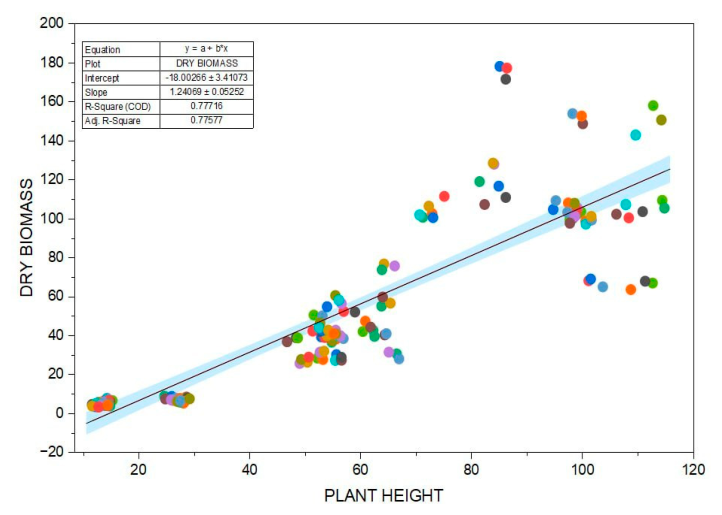
Linear regression analysis further demonstrated a strong positive relationship between fresh and dry biomass across all treatments and growth stages (Figure 2). The fitted model, with an R² value of 0.78, indicates that 78% of the variation in fresh biomass was explained by dry biomass. Plant height was also strongly associated with dry biomass accumulation (Figure 3). The strong coefficients of determination obtained for both models highlight the close relationships among plant height, fresh biomass, and dry biomass under the conditions of the present study.
Figure 4.
Relationship between plant height and dry biomass.
4. Discussion
The results of this study demonstrate that the seed yield performance of white mustard (Sinapis alba L.) grown on southern carbonate chernozem soils was strongly influenced by the interaction among seeding rate, sowing method, and hydrothermal conditions during the growing season. These findings highlight the importance of crop spatial arrangement in regulating yield formation under dry steppe conditions, where agronomic management becomes increasingly important under environmental stress.
The medium seeding rate (2.5 million viable seeds ha⁻¹) was associated with the highest mean seed yield across years. Similar responses have been reported in other agro-climatic regions, where the highest and most consistent yields of white mustard were obtained at moderate plant densities [2,6,17]. Optimal plant density has been widely recognized as a key factor affecting resource utilization, crop competitiveness, and yield formation in mustard production systems [11]. In contrast, excessive seeding rates may intensify intra-specific competition, particularly under drought conditions, leading to reductions in yield performance, a phenomenon often described as density compensation [6,7].
Sowing method is an integral factor influencing overall plant growth and yield [18,19]. In the present study, sowing method generally influenced mustard yield. Row sowing (25 cm) generally exhibited superior yield performance under dry steppe conditions, particularly during the drought-affected growing season. Differences in weed infestation were also observed among sowing methods and seeding rates. Treatments characterized by lower weed density and biomass generally corresponded to those exhibiting greater seed yield, particularly at the intermediate and higher seeding rates. Similar relationships have been reported in previous studies, where enhanced crop competitiveness resulting from increased plant density and narrower row spacing reduced weed growth and was associated with improved crop productivity [20,21]. Similar responses have also been reported in other regions, where crop spatial arrangement influences agrocenosis structure and crop competitiveness [10].
Correlation analysis demonstrated that mustard yield was more closely associated with plant height at flowering and pod formation than with biomass accumulation during earlier growth stages. Although strong positive relationships were observed among biomass variables across phenological stages, most biomass traits showed no significant association with seed yield. These findings suggest that plant structural development during the reproductive period may be a more informative indicator of yield variation than early-stage biomass accumulation under moisture-limited conditions.
This pattern partially contrasts with the report of Hajzler et al [22] who emphasized biomass production as a critical determinant of productivity in white mustard and related oilseed crops, particularly under water-limited environments. Their findings indicated that rapid shoot biomass development enhances nitrogen uptake and supports overall crop performance during drought, with early vigor and high biomass accumulation being linked to improved yield outcomes. In the present study, however, early biomass accumulation did not exhibit a significant relationship with seed yield, suggesting that its contribution to final productivity may be context-dependent and potentially moderated by stress timing, genotype, or resource allocation patterns. In contrast, yield variation in the current dataset appeared to be more closely aligned with reproductive-stage morphological development rather than early biomass expression alone.
The results also highlight the important role of climatic conditions in determining the effectiveness of agronomic practices. Under relatively favorable moisture conditions, differences among treatment combinations were comparatively small. In contrast, under moisture deficit, the interaction between sowing method and seeding rate became a more important determinant of yield formation. Similar observations have been reported in arid and semi-arid production environments, where crop spatial arrangement and plant density are major factors influencing productivity under climatic stress [2,6]
Overall, the present study demonstrates that optimization of both seeding rate and sowing method can improve the yield performance of white mustard under dry steppe conditions. The combination of row sowing and a seeding rate of 2.5 million viable seeds ha⁻¹ was associated with the highest yield across years and may therefore represent an effective agronomic strategy for production systems exposed to climatic variability. These findings emphasize the importance of optimizing crop spatial arrangement and plant density to improve productivity under moisture-limited conditions.
5. Conclusions
The research investigated the influence of sowing rate and sowing method on growth, biomass accumulation, and seed yield of white mustard under southern carbonate Chernozem soil conditions. The results of this study indicate that, under dry steppe conditions, a seeding rate of 2.5 million viable seeds ha⁻¹ is optimal for white mustard (Sinapis alba L.), ensuring balanced crop density and efficient yield formation. Row sowing (25 cm) enhanced yield stability under drought conditions, likely through improved canopy development and resource use efficiency.
Yield formation was more closely associated with reproductive-stage plant traits, particularly plant height at flowering and pod formation, whereas early biomass accumulation showed limited direct association with final seed yield. This suggests that structural development during the reproductive phase is a more reliable indicator of yield variation under moisture-limited conditions.
The findings emphasize that optimizing plant density and sowing method is a key agronomic strategy for improving yield stability in dryland systems. The study demonstrates a clear interaction between seeding rate, sowing method, and hydrothermal conditions, providing region-specific recommendations for white mustard cultivation in Northern Kazakhstan.
Author Contributions
“Conceptualization, K.A. and B.A.; methodology, K.A.; software, K.H.D; validation, G.S., N.M., and B.A.; formal analysis, K.H.D, E.U.; data curation, K.A.; writing—original draft preparation, B.K.; writing—review and editing, K.H.D, K.K., E.U; visualization, K.H.D.; project administration, C.K.
Funding
Field experiments conducted during 2023-2025 were carried out without external funding. Data processing, analysis, and manuscript preparation were supported by the targeted funding program BR22885719 (2024-2026) of the Ministry of Agriculture of the Republic of Kazakhstan, “Development and implementation of sustainable farming systems for profitable agricultural production under climate variability in different soil and climatic zones of Kazakhstan”.
Acknowledgments
The authors express their gratitude to the staffs of the A. I, Barayev Grain Research Institute and Saken Seifullin Agrotechnical Research University, for their assistance with field experimentation and laboratory analyses. The authors have also reviewed and edited the output and take full responsibility for the content of this publication.
Conflicts of Interest
The authors declare no conflicts of interest.
References
- Sawicka, B.; Kotiuk, E. Gorczyce jako rośliny wielofunkcyjne. Acta Sci. Pol. Agric. 2007, 6, 17–27. Available online: https://www.researchgate.net/publication/264003269_Gorczyce_jako_rosliny_wielofunkcyjne.
- Brčić, M.; Pospišil, M.; Pospišil, A.; Kraljić, K.; Obradnović, M.; Škevin, D. Influence of Seeding Density on Seed and Oil Yield, and Fatty Acid Composition of White Mustard (Sinapis alba L.). Acta Agric. Slov. 2024, 120, 1–9. [Google Scholar] [CrossRef]
- Mitrović, P.M.; Stamenković, O.S.; Banković-Ilić, I.B.; Djalović, I.G.; Nježić, Z.B.; Farooq, M.; Siddique, K.H.M.; Veljković, V.B. White Mustard (Sinapis alba L.) Oil in Biodiesel Production: A Review. Front. Plant Sci. 2020, 11, 299. [Google Scholar] [CrossRef] [PubMed]
- Muhammad, G.; Manaf, A.; Hassan, F.; Khalid, A.; Sher, A.; Lovatt, C.J.; Syed, A.; Bahkali, A.H.; Elgorban, A.M.; Qayyum, A. Allometric Dynamics of Sinapis alba under Different Ecological Conditions. J. King Saud. Univ. – Sci. 2023, 35, 102403. [Google Scholar]
- Kozera, W.; Siwik-Ziomek, A.; Figas, A.; Knapowski, T. The Quantity and Quality of White Mustard (Sinapis alba L.) Seed Depending on Nitrogen Fertilization and Soil Enzyme Activity. Agronomy 2025, 15, 2582. [Google Scholar] [CrossRef]
- McKenzie, R.H.; Middleton, A.B.; Bremer, E. Response of Mustard to Fertilization, Seeding Date, and Seeding Rate in Southern Alberta. Can. J. Plant Sci. 2006, 86, 353–362. [Google Scholar] [CrossRef]
- Taishev, N.R.; Prakhova, T.Ya. Produktivnost’ gorchitsy beloy v zavisimosti ot normy vyseva v usloviyakh lesostepi Srednego Povolzh’ya. Int. Agric. J. 2023, 64, 65–68. [Google Scholar]
- Hossain, M.B.; Alam, M.S.; Ripon, M.A. Effect of irrigation and sowing method on yield and yield attributes of mustard. Rajshahi Univ. J. Life Earth Agric. Sci. 2013, 41, 65–70. [Google Scholar] [CrossRef]
- Singh, P.K.; Singh, S.K.; Kumar, M. Effect of different sowing dates and establishment methods on growth, yield and economics of mustard (Brassica juncea L.). J. Exp. Agric. Int. 2024, 46, 490–497. [Google Scholar] [CrossRef]
- Gushchina, V.A.; Lykova, A.S.; Korolev, A.S. Weed infestation of the white mustard agrocenosis depending on agronomic practices under the forest-steppe conditions of the Middle Volga region. Agrar. Nauchnyy Zhurnal 2023, 6, 12–17. [Google Scholar] [CrossRef]
- Mykolaiko, I.; Polishchuk, V.; Brovdi, A.; Karpuk, L.; Titarenko, O.; Mostypan, O.; Zaika, N.; Konovalov, D.; Yatsenko, A.; Kryzhanjvskiy, V. Yield and quality of mustard seeds depending on the use of technology elements. Grassroots J. Nat. Resour. 2025, 8, 606–619. [Google Scholar] [CrossRef]
- Stroe, C.T.; Panaitescu, L. Studies on the Cultivation of White Mustard (Sinapis alba) under Agroecological Conditions. Sci. Pap. Ser. A. Agron. 2025, 68, 616–624. [Google Scholar]
- Serekpayev, N.; Mukhanov, N.; Kurbanbayev, A.; Akhylbekova, B. Formation dynamics of biomass of lentil crops depending on the plant density in the steppe zone of Kazakhstan. Casp. J. Environ. Sci. 2023, 21(5), 1247–1254. [Google Scholar] [CrossRef]
- Mukhanov, N.; Serekpayev, N.; Balgabayev, N.; Stybayev, G.; Baitelenova, A.; Nogaev, A.; Kurbanbayev, A.; Akhylbekova, B. Efficiency of Japanese millet (Echinochloa frumentacea) fodder crop cultivation in the arid steppe. Online J. Biol. Sci. 2023, 23(4), 424–431. [Google Scholar] [CrossRef]
- Dospekhov, B. A. Methods of field experiment; Agropromizdat: Moscow, Russia, 1985. [Google Scholar]
- Selyaninov, G.T. Agricultural climatic evaluation of territory moisture conditions. Proc. Main. Geophys. Obs. 1928, 20, 177–185. [Google Scholar]
- Alam, M. J.; Ahmed, K. S.; Mollah, M. R. A.; Tareq, M. Z.; Mottalib, M. A. Effect of seed rate and sowing method on the yield of mustard. Bangladesh J. Environ. Sci. 2015, 29, 37–40. [Google Scholar]
- Kazemeini, S.A.; Edalat, M.; Shekoofa, A.; Hamidi, R. Effects of nitrogen and plant density on rapeseed (Brassica napus L.) yield and yield components in southern Iran. J. Appl. Sci. 2010, 10, 1461–1465. [Google Scholar] [CrossRef]
- French, R.J.; Seymour, M.; Malik, R.S. Plant density response and optimum crop densities for canola (Brassica napus L.) in Western Australia. Crop Pasture Sci. 2016, 67, 397–408. [Google Scholar]
- Tanveer, S.K.; Husssain, I.; Sohail, M.; Kissana Agency, N.S.; Abbas, S.G. Effect of different planting methods on yield and yield components of wheat; Addis Ababa, Ethiopia, 2003. [Google Scholar]
- Reda, A.; Dechassa, N.; Assefa, K. Evaluation of seed rates and sowing methods on growth, yield and yield attributes of tef (Eragrostis tef (Zucc.) Trotter) in Ada District, East Shewa, Ethiopia. Am.-Eurasian J. Agric. Environ. Sci. 2018, 18(1), 34–49. [Google Scholar]
- Hajzler, M.; Klimešová, J.; Procházková, P.; Středa, T. Genotypic Differences in Root System Size in White Mustard in Relation to Biomass Yield and Soil Nitrogen Content. Acta Univ. Agric. Et. Silvic. Mendel. Brun. 2018, 66, 871–881. [Google Scholar] [CrossRef]
Figure 1.
Plant Height of white mustard plants at different phenological stages in 2023–2025 growing season (a) Rosette stage (b) Flowering stage (c) Pod formation.
Figure 1.
Plant Height of white mustard plants at different phenological stages in 2023–2025 growing season (a) Rosette stage (b) Flowering stage (c) Pod formation.
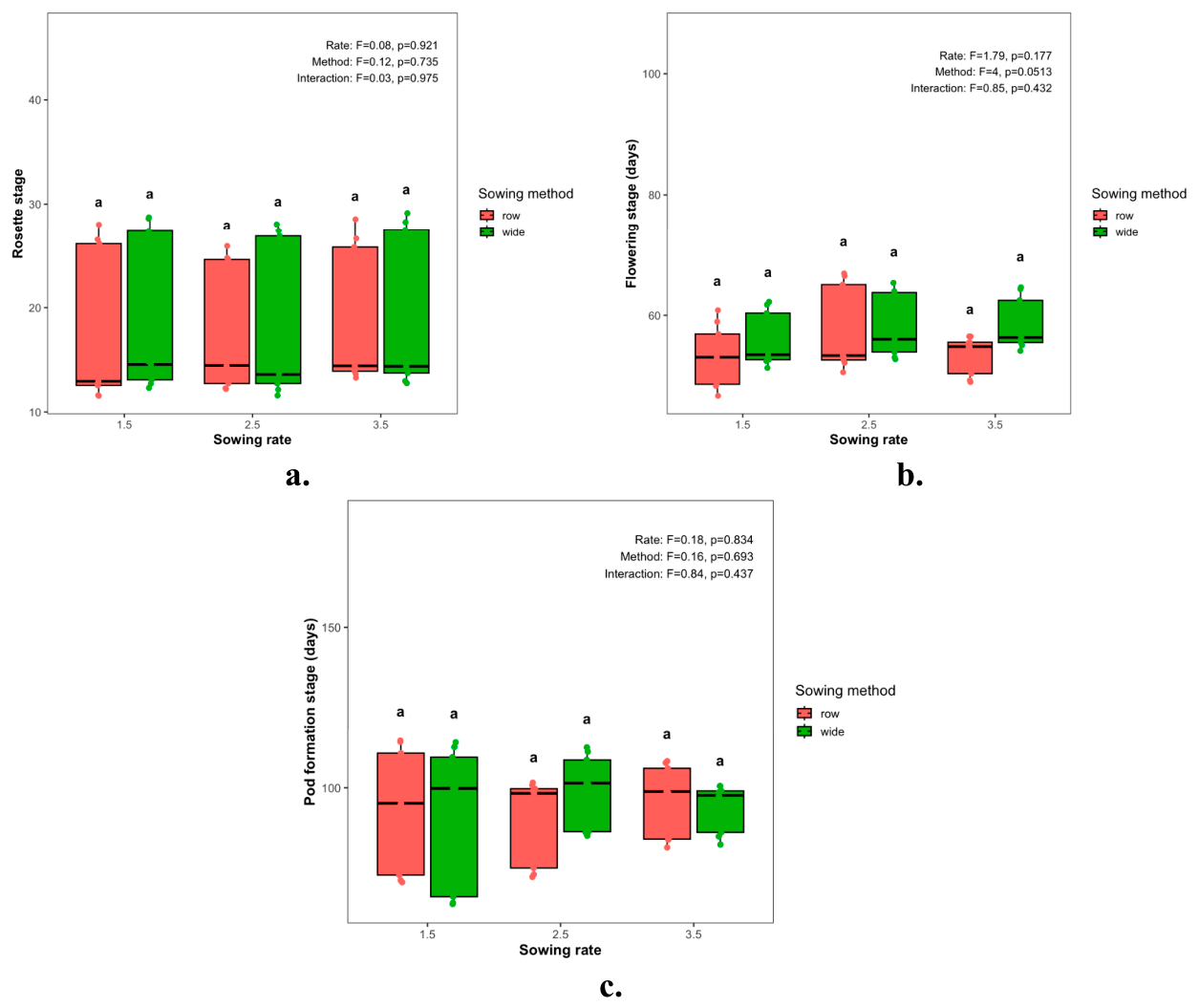
Figure 2.
Correlation between phase-specific growth parameters and yield.
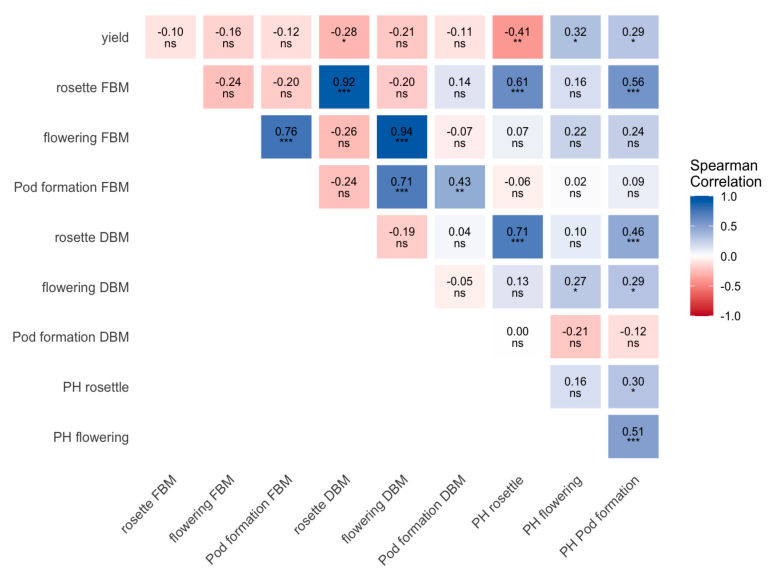
Figure 3.
Relationship between green and dry biomass.
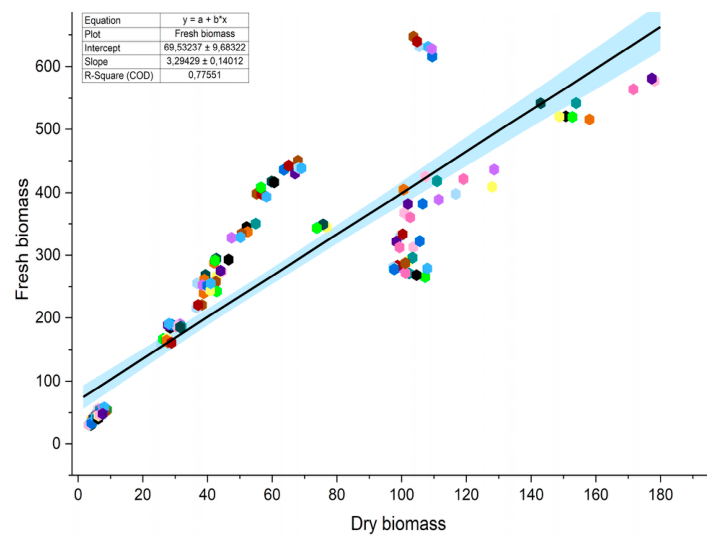

Table 1.
Effect of sowing method and seeding rate on fresh and dry biomass accumulation of plants at different growth stages.
Table 1.
Effect of sowing method and seeding rate on fresh and dry biomass accumulation of plants at different growth stages.
| Sowing method | Seeding rate, million seeds ha⁻¹ | Phenological stages | |||||
|---|---|---|---|---|---|---|---|
| Fresh biomass | Dry Biomass | ||||||
| Rosette | Flowering | Pod formation | Rosette | Flowering | Pod formation | ||
| Row | 1.5 | 41.3g | 306.9cd | 544.8a | 5.5e | 46.9c | 105.1b |
| 2.5 | 49.4g | 187.5f | 345.3c | 6.8e | 29.9d | 102.8b | |
| 3.5 | 47.9g | 181.9f | 322.5cd | 6.5e | 30.6d | 111.1ab | |
| Wide row | 1.5 | 47.6g | 279.3de | 466.3b | 6.2e | 42.6cd | 126.0a |
| 2.5 | 37.4g | 355.3c | 484.5b | 4.7e | 52.4c | 103.1b | |
| 3.5 | 41.4g | 247.9e | 329.0c | 5.5e | 40.5cd | 104.0b | |
| SM x SR | *** | ns | |||||
| Seeding Rate (SR) | 1.5 | 281a | 55.3a | ||||
| 2.5 | 243.2b | 49.9a | |||||
| 3.5 | 195c | 49.6a | |||||
| Sowing Method (SM) | Row | 225.2b | 53.8a | ||||
| Wide | 254.2a | 49.4a | |||||
| SR | *** | ns | |||||
| SM | *** | ns | |||||
Means with different letters are significantly different; *p<0.05, **p<0.01, ***p<0.001.
Table 2.
Weed infestation indicators depending on sowing method and seeding rate (2023–2025).
| Sowing method | Seeding rate, million seeds ha⁻¹ | Field bindweed – Convolvulus arvensis L. | Wild buckwheat – Fallopia convolvulus (L.) Á. Löve | Creeping thistle – Cirsium arvense (L.) Scop. | Cleavers – Galium aparine L. | Other weed species – (various species) | Common lamb’s quarters – Chenopodium album L. | Redroot pigweed – Amaranthus retroflexus L. | total | |
|---|---|---|---|---|---|---|---|---|---|---|
| Weed species | ||||||||||
| Row | 1.5 | 12 | 4 | - | - | 12 | 7 | 11 | 46 | |
| 2.5 | 7 | 4 | 3 | 1 | 2 | 6 | 5 | 28 | ||
| 3.5 | 4 | 3 | - | 3 | 8 | 3 | 6 | 27 | ||
| Wide row | 1.5 | 6 | 2 | - | - | 6 | 4 | 3 | 21 | |
| 2.5 | 5 | 2 | - | - | 2 | 7 | 3 | 18 | ||
| 3.5 | 5 | 3 | 1 | - | 2 | 4 | 1 | 16 | ||
| Fresh weight, g m⁻² | ||||||||||
| Row | 1.5 | 200.84 | 63.74 | - | - | 34.16 | 101.30 | 73.77 | 473.81 | |
| 2.5 | 57.56 | 58.78 | 95.59 | 4.37 | 4.24 | 72.70 | 10.25 | 303.48 | ||
| 3.5 | 61.66 | 17.35 | - | 17.50 | 11.42 | 37.44 | 19.40 | 164.77 | ||
| Wide row | 1.5 | 64.26 | 7.47 | - | - | 19.73 | 38.68 | 8.27 | 138.41 | |
| 2.5 | 44.57 | 62.47 | - | - | 1.75 | 59.57 | 21.64 | 190.01 | ||
| 3.5 | 44.61 | 44.36 | 13.65 | - | 5.88 | 31.80 | 5.26 | 145.56 | ||
Table 3.
Effect of sowing method and seeding rate on seed yield of white mustard (Sinapis alba L.) in 2023-2025 (с ha⁻¹).
Table 3.
Effect of sowing method and seeding rate on seed yield of white mustard (Sinapis alba L.) in 2023-2025 (с ha⁻¹).
| Sowing method | Seeding rate, million seeds ha⁻¹ | Yield, с ha⁻¹ | ||
|---|---|---|---|---|
| 2023 | 2024 | 2025 | ||
| Row | 1.5 | 5.47b | 3.34c | 2.90bc |
| 2.5 | 6.27a | 5.38ab | 5.10a | |
| 3.5 | 5.88ab | 4.90b | 3.20b | |
| Wide row | 1.5 | 5.38b | 3.52c | 2.00d |
| 2.5 | 6.12a | 6.42a | 3.40a | |
| 3.5 | 5.75ab | 5.09b | 2.80b | |
| SM x SR | *** | |||
| Seeding Rate | 1.5 | 3.75b | ||
| 2.5 | 5.22a | |||
| 3.5 | 4.82a | |||
| Sowing Method | Row | 4.70a | ||
| Wide | 4.50b | |||
| SR | *** | |||
| SM | *** | |||
Means with different letters are significantly different; *p<0.05, **p<0.01, ***p<0.001.
Disclaimer/Publisher’s Note: The statements, opinions and data contained in all publications are solely those of the individual author(s) and contributor(s) and not of MDPI and/or the editor(s). MDPI and/or the editor(s) disclaim responsibility for any injury to people or property resulting from any ideas, methods, instructions or products referred to in the content. |
© 2026 by the authors. Licensee MDPI, Basel, Switzerland. This article is an open access article distributed under the terms and conditions of the Creative Commons Attribution (CC BY) license (http://creativecommons.org/licenses/by/4.0/).
Copyright: This open access article is published under a Creative Commons CC BY 4.0 license, which permit the free download, distribution, and reuse, provided that the author and preprint are cited in any reuse.


