

Submitted:
01 July 2026
Posted:
02 July 2026
You are already at the latest version
Abstract
High-dimensional quantum entanglement realized with orbital-angular-momentum (OAM) modes of photons provides a powerful platform for exploring the topology and geometry of quantum state spaces. Recent experiments using spontaneous parametric down-conversion have demonstrated entangled photon pairs occupying a seven-dimensional OAM Hilbert space whose topology is governed by the Lie group , giving rise to a 48-dimensional manifold of quantum states. In this work, we propose a geometric interpretation of this structure based on octonion algebra. The seven OAM basis modes are mapped onto the seven imaginary units of the octonions, whose multiplication rules are encoded by the Fano plane. Within this framework, nonlinear three-wave interactions that underlie photon-pair generation naturally correspond to cyclic triples in the Fano-plane geometry. This correspondence suggests that the observed topological structure of high-dimensional entangled photon states may admit an octonionic geometric description, providing a potential bridge between structured-light quantum optics and exceptional algebraic structures.
Keywords:
quantum entanglement
; orbital angular momentum photons
; high-dimensional Hilbert space
; structured light
; octonion algebra
; fano plane geometry
; SU(7) symmetry
; exceptional algebra structures
1. Introduction
Quantum entanglement [1,2] constitutes one of the most fundamental resources of quantum information science and forms the physical basis of emerging technologies, including quantum computing [3,4], quantum communication [5,6], and quantum cryptography [7]. High-dimensional quantum entanglement realized with orbital-angular-momentum (OAM) modes of photons provides a powerful platform for exploring the geometry and topology of quantum state spaces. Recent experiments have demonstrated entangled photon pairs occupying a seven-dimensional OAM Hilbert space whose topology is governed by the Lie group , giving rise to a 48-dimensional manifold of quantum states.
Recent developments in structured-light quantum optics [8] have enabled the generation of entangled photon pairs [9] occupying high-dimensional Hilbert spaces of orbital angular momentum (OAM) [10]. Experiments by Andrew Forbes and collaborators [11] demonstrate that entangled OAM states can exhibit nontrivial topological spectra when analyzed using Yang–Mills-inspired methods [12].
For a qudit space of dimension , the topology is characterized by the Lie algebra , whose dimension determines the dimensionality of the associated manifold [13]. In the case , the resulting parameter space therefore contains 48 degrees of freedom.
In this work, we explore a possible geometric interpretation of this structure based on octonion algebra [14].
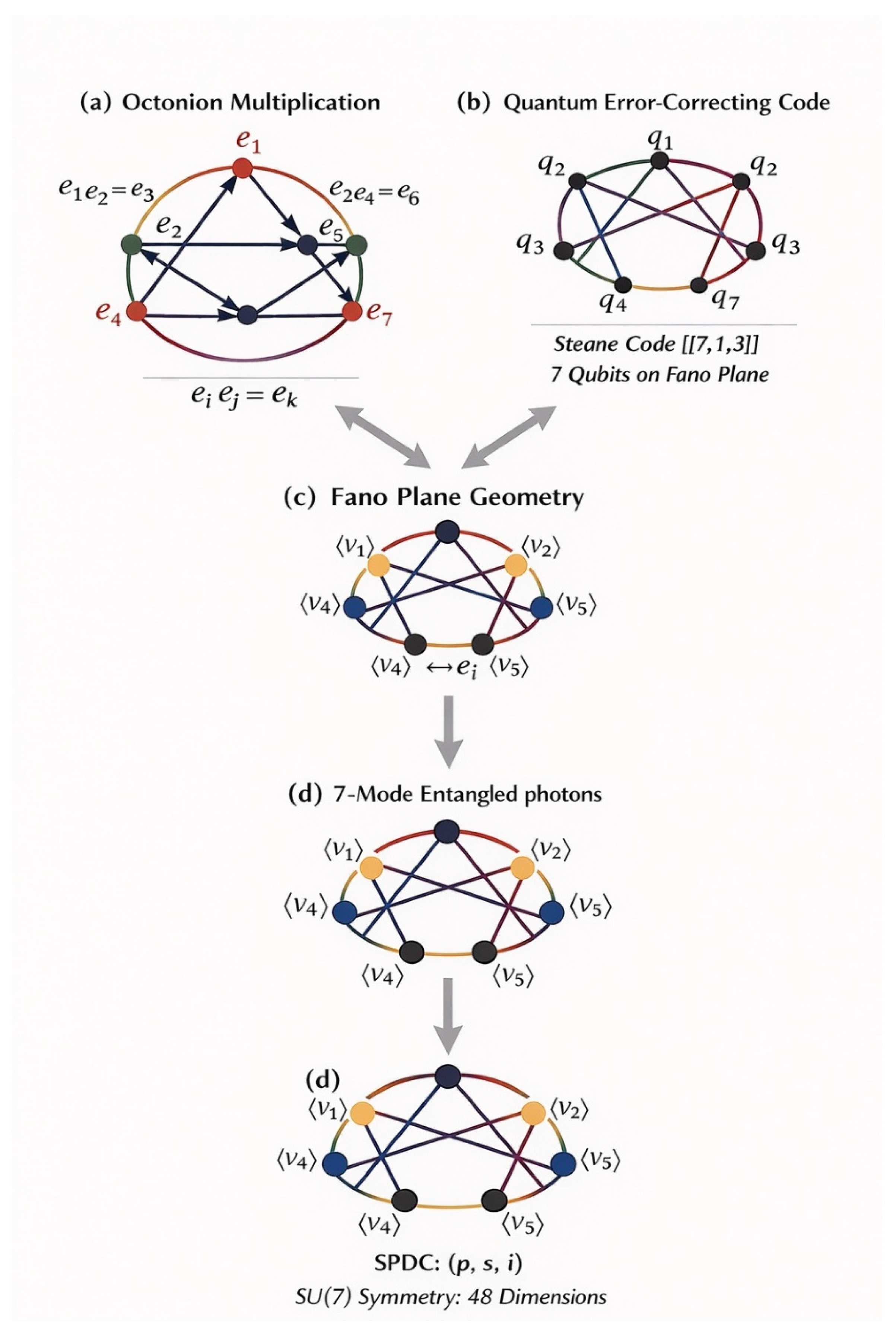
High-dimensional entangled photon states generated by spontaneous parametric down-conversion (SPDC) [15] provide a powerful platform for exploring the topology of quantum state spaces. Recent experiments [11] using orbital-angular-momentum (OAM) modes have demonstrated that a photon pair restricted to a seven-dimensional OAM basis forms a qudit system whose symmetry is naturally described by the Lie group . The corresponding Lie algebra contains generators, which define the dimensionality of the observed topological manifold of the quantum state space. The appearance of a seven-mode structure suggests a deeper geometric organization. In particular, the seven OAM basis states can be mapped onto the seven points of the Fano plane, which also encodes the multiplication rules of the octonion algebra and appears in quantum error-correcting codes [16] such as the Steane [1,3,7] code [17]. This correspondence provides a geometric framework linking nonlinear optical interactions, high-dimensional entanglement, and octonionic algebraic structures.
Figure 1.
Geometric relations among octonion algebra, quantum error-correcting codes, and high-dimensional photon entanglement. (a) Multiplication rules of the imaginary octonion units represented by the Fano plane [18], where each line defines a cyclic triple satisfying . (b) The Steane quantum error-correcting code, in which seven qubits are arranged according to the same Fano-plane geometry. (c) Abstract Fano-plane structure illustrating the seven basis elements and their triple relations. (d) Seven-mode entangled photon states generated by spontaneous parametric down-conversion (SPDC), where the OAM basis states correspond to the seven points of the Fano plane. The resulting Hilbert space has symmetry with generators, defining the dimensionality of the associated topological manifold.
Figure 1.
Geometric relations among octonion algebra, quantum error-correcting codes, and high-dimensional photon entanglement. (a) Multiplication rules of the imaginary octonion units represented by the Fano plane [18], where each line defines a cyclic triple satisfying . (b) The Steane quantum error-correcting code, in which seven qubits are arranged according to the same Fano-plane geometry. (c) Abstract Fano-plane structure illustrating the seven basis elements and their triple relations. (d) Seven-mode entangled photon states generated by spontaneous parametric down-conversion (SPDC), where the OAM basis states correspond to the seven points of the Fano plane. The resulting Hilbert space has symmetry with generators, defining the dimensionality of the associated topological manifold.
2. Seven-Dimensional OAM Qudit Space
In the experiment, the photon pair occupies a finite OAM basis
The global symmetry group acting on this Hilbert space is
with Lie algebra dimension
This provides a natural explanation for the 48-dimensional topological manifold observed experimentally.
3. Octonion Algebra and the Fano Plane
Octonions form an eight-dimensional normed division algebra consisting of one real unit and seven imaginary units
Their multiplication rules are represented by the Fano plane, whose seven points correspond to the imaginary octonion directions.
We therefore map the seven OAM basis states to the octonion units
This establishes a one-to-one correspondence between the OAM mode space and the imaginary octonion space.
4. Nonlinear Optical Couplings and Fano-Plane Triples
Spontaneous parametric down-conversion is governed by a three-wave interaction Hamiltonian [19]
Because the fundamental interaction involves three optical fields, it naturally suggests a correspondence with the cyclic triples of the Fano plane.
Under the proposed mapping, allowed vortex-mode couplings can therefore be associated with octonion multiplication triples.
5. SU(7) Symmetry and Octonionic Geometry
The seven-mode OAM basis spans the complex vector space
Unitary transformations mixing these modes form the group , whose 48 generators define the tangent directions of the observed topological manifold.
In the proposed interpretation, these transformations act on an octonion-inspired seven-dimensional internal space associated with vortex modes [20].
6. Possible Relation to Exceptional Lie Groups
Octonions are closely related to the exceptional Lie group [21], which preserves the octonion multiplication rules. Furthermore, the Albert algebra [22] of Hermitian octonionic matrices possess the exceptional symmetry [23].
Although the present experiment does not directly demonstrate such exceptional symmetries, the octonion-based organization of the seven OAM modes may provide a geometric framework connecting structured-light entanglement with exceptional algebraic structures.
7. Discussion
The appearance of a seven-dimensional OAM basis and a 48-dimensional topological manifold suggests a deeper geometric structure underlying high-dimensional entangled photon systems.
The octonionic interpretation proposed here provides a natural mathematical framework linking
- vortex-mode entanglement
- nonlinear optical interactions
- exceptional algebra and geometry.
8. Conclusions
In this work, we have proposed a geometric interpretation of high-dimensional quantum entanglement in vortex photons based on octonion algebra. Recent experiments on entangled orbital-angular-momentum photon pairs reveal a seven-dimensional Hilbert space whose topology is governed by the Lie group , giving rise to a 48-dimensional manifold of quantum states. While this structure has previously been analyzed using gauge-theoretic methods, its geometric organization has remained largely unexplored.
The main novelty of the present work is the identification of a natural correspondence between the seven OAM basis modes and the seven imaginary units of the octonion algebra. Through this mapping, the structure of the entangled photon Hilbert space can be associated with the Fano plane, which encodes the multiplication rules of the octonions. Within this framework, the nonlinear three-wave interaction underlying spontaneous parametric down-conversion corresponds naturally to cyclic triples of the Fano-plane geometry.
This interpretation provides a unified geometric perspective linking three areas that are usually studied separately: high-dimensional photonic entanglement, nonlinear optical interactions, and exceptional algebraic structures. The proposed framework suggests that structured-light quantum optics may offer an experimentally accessible platform for exploring geometric structures related to octonion algebra and exceptional symmetries.
Future work may investigate whether similar geometric correspondences arise in larger OAM Hilbert spaces and whether octonion-inspired structures can lead to new insights into the topology and classification of high-dimensional quantum entangled states.
Funding Acknowledgment
The author is a retired professor without funding.
Conflicts of Interest Statement
The author declares no conflict of interest with anyone.
Data Availability Statement
This work contains theoretical derivations with no experiments. The data is available upon reasonable request.
References
- Einstein, A.; Podolsky, B.; Rosen, N. Can Quantum-Mechanical Description of Physical Reality Be Considered Complete? Phys. Rev. 1935, 47, 777–780. [Google Scholar] [CrossRef]
- Schrödinger, E. Discussion of Probability Relations Between Separated Systems. Proc. Camb. Philos. Soc. 1935, 31, 555–563. [Google Scholar] [CrossRef]
- Clauser, J. F.; Freedman, S. J. Experimental Test of Local Hidden-Variable Theories. Phys. Rev. Lett. 1972, 28, 938–941. [Google Scholar] [CrossRef]
- Aspect, A.; Dalibard, J.; Roger, G. Experimental Test of Bell’s Inequalities Using Time-Varying Analyzers. Phys. Rev. Lett. 1982, 49, 1804–1807. [Google Scholar]
- Zeilinger, A.; Horne, M. A.; Greenberger, D. M. Bell’s Theorem Without Inequalities. Am. J. Phys. 1990, 58, 1131–1143. [Google Scholar] [CrossRef]
- Nielsen, M. A.; Chuang, I. L. Quantum Computation and Quantum Information; Cambridge University Press: Cambridge, 2010. [Google Scholar]
- Preskill, J. Quantum Computing in the NISQ Era and Beyond. Quantum 2018, 2, 79. [Google Scholar] [CrossRef]
- Bennett, C. H.; Brassard, G. Quantum Cryptography: Public Key Distribution and Coin Tossing. Proceedings of IEEE International Conference on Computers, Systems and Signal Processing, Bangalore, 1984; pp. 175–179. [Google Scholar]
- Gisin, N.; Ribordy, G.; Tittel, W.; Zbinden, H. Quantum Cryptography. Rev. Mod. Phys. 2002, 74, 145–195. [Google Scholar] [CrossRef]
- Ekert, A. K. Quantum Cryptography Based on Bell’s Theorem. Phys. Rev. Lett. 1991, 67, 661–663. [Google Scholar] [CrossRef] [PubMed]
- Forbes, A.; Dudley, A.; McLaren, M. Creation and Detection of Optical Modes with Spatial Light Modulators. Adv. Opt. Photonics 2016, 8, 200–227. [Google Scholar] [CrossRef]
- Kwiat, P. G.; Mattle, K.; Weinfurter, H.; Zeilinger, A.; Sergienko, A.; Shih, Y. New High-Intensity Source of Polarization-Entangled Photon Pairs. Phys. Rev. Lett. 1995, 75, 4337–4341. [Google Scholar] [PubMed]
- Allen, L.; Beijersbergen, M. W.; Spreeuw, R. J. C.; Woerdman, J. P. Orbital Angular Momentum of Light and the Transformation of Laguerre–Gaussian Laser Modes. Phys. Rev. A 1992, 45, 8185–8189. [Google Scholar] [PubMed]
- de Mello Koch, R.; Ornelas, P.; Gounden, N.; Lu, B.-Q.; Nape, I.; Forbes, A. Revealing the Topological Nature of Entangled Orbital Angular Momentum States of Light. Nat. Commun. 2025, 16, 11095. [Google Scholar] [CrossRef] [PubMed]
- Yang, C. N.; Mills, R. L. Conservation of Isotopic Spin and Isotopic Gauge Invariance. Phys. Rev. 1954, 96, 191–195. [Google Scholar] [CrossRef]
- Georgi, H. Lie Algebras in Particle Physics; Westview Press: Boulder, 1999. [Google Scholar]
- Baez, J. C. The Octonions. Bull. Am. Math. Soc. 2002, 39, 145–205. [Google Scholar]
- Boyd, R. W. Nonlinear Optics; Academic Press: San Diego, 2020. [Google Scholar]
- Calderbank, A. R.; Shor, P. W. Good Quantum Error-Correcting Codes Exist. Phys. Rev. A 1996, 54, 1098–1105. [Google Scholar] [CrossRef] [PubMed]
- Steane, A. M. Error Correcting Codes in Quantum Theory. Phys. Rev. Lett. 1996, 77, 793–797. [Google Scholar] [CrossRef] [PubMed]
- Conway, J. H.; Smith, D. A. On Quaternions and Octonions: Their Geometry, Arithmetic and Symmetry; Peters, A. K., Natick, Eds.; 2003. [Google Scholar]
- Springer, T. A.; Veldkamp, F. D. Octonions, Jordan Algebras and Exceptional Groups; Springer: Berlin, 2000. [Google Scholar]
- Adams, J. F. Lectures on Exceptional Lie Groups; University of Chicago Press, 1996. [Google Scholar]
Disclaimer/Publisher’s Note: The statements, opinions and data contained in all publications are solely those of the individual author(s) and contributor(s) and not of MDPI and/or the editor(s). MDPI and/or the editor(s) disclaim responsibility for any injury to people or property resulting from any ideas, methods, instructions or products referred to in the content. |
© 2026 by the authors. Licensee MDPI, Basel, Switzerland. This article is an open access article distributed under the terms and conditions of the Creative Commons Attribution (CC BY) license (http://creativecommons.org/licenses/by/4.0/).
Copyright: This open access article is published under a Creative Commons CC BY 4.0 license, which permit the free download, distribution, and reuse, provided that the author and preprint are cited in any reuse.


