

Submitted:
30 June 2026
Posted:
01 July 2026
You are already at the latest version
Abstract
Macadamia (Macadamia spp.) is an economically important nut crop whose severe recalcitrance to genetic transformation substantially hinders progress in functional genomics and molecular breeding. To overcome this critical technical bottleneck, this study established a highly efficient and broadly applicable in planta hairy root genetic transformation system with integrated visual screening. This system utilizes an Agrobacterium rhizogenes-mediated transformation method, employing multiple visual reporter gene systems (DsRed2, eGFP, RUBY, and AtPAP2) to achieve antibiotic-independent and non-destructive screening of transgenic roots. Notably, the system innovatively incorporates air layering (marcotting) technique to extend in planta genetic transformation to branches of mature trees in the field. By circumventing the stringent sterile conditions required for conventional in vitro tissue culture, this approach achieves genotype-independent transformation across open-pollinated seedlings with diverse genetic backgrounds (A4, GR1, HAES900, and O.C.), yielding transgenic hairy root induction frequencies of 39.25% to 47.38%. Furthermore, transgenic hairy roots were successfully induced on mature tree branches, with a maximum induction rate of 28.2%. Gene expression analyses confirmed stable, high-level expression of target transgenes in all transgenic hairy root lines. This in planta transformation system provides a reliable in vivo experimental platform for the rapid functional validation of candidate genes and the investigation of root biology in Macadamia. Moreover, it establishes a novel strategy for plant regeneration via root-to-shoot organogenesis, offering a promising avenue for the genetic improvement of recalcitrant woody plants.
Keywords:
Macadamia
; hairy roots
; visual reporters
; In planta
; air layering
1. Introduction
Macadamia (Macadamia spp.), a woody nut tree species of high global economic value [1], is currently experiencing rapid advancements in molecular biology research and genomics-assisted breeding [2,3,4]. However, constrained by the inherent biological characteristics of perennial woody plants, coupled with the prolonged, inefficient, and highly contamination-prone in vitro tissue culture processes, Macadamia has long lacked a highly efficient genetic transformation system. This deficiency severely impedes the functional validation of key genes and molecular improvement in this species [5]. Consequently, developing a rapid and efficient alternative transformation system that circumvents cumbersome aseptic tissue culture procedures remains an urgent priority.
In recent years, Agrobacterium rhizogenes-mediated hairy root composite plant systems have emerged as a highly efficient strategy for gene function studies in woody plants [5,6]. Unlike conventional tissue culture, the in planta A. rhizogenes inoculation method under non-sterile conditions enables researchers to perform transformations directly on intact plants grown in greenhouses or natural habitats. This strategy not only effectively circumvents the stringent sterility requirements and the risk of somaclonal variation inherent in tissue culture processes, but also facilitates the generation of transgenic roots harboring target genes within a matter of weeks. Consequently, it significantly shortens the timeframe required for functional validation compared with traditional stable genetic transformation, providing a robust experimental platform for investigating root development, nutrient acquisition, and plant-microbe interactions [6,7].
Despite the substantial advantages of the in planta hairy root system, its widespread application remains constrained by several technical factors. First, the rapid, accurate, and non-destructive identification of positive transgenic hairy roots—without reliance on antibiotic or herbicide selectable markers—poses a formidable technical challenge. Traditional reporter systems, such as GUS staining, typically necessitate tissue fixation and chromogenic substrate incubation, thereby precluding continuous in vivo monitoring of the identical transformed roots [8]. The introduction of visual reporter genes—including fluorescent proteins [9,10] and systems capable of producing macroscopically visible pigments (e.g., the betalain reporter RUBY and the anthocyanin biosynthetic regulator AtPAP2) [11,12,13]—enables the non-destructive identification and dynamic tracking of transformation events. Second, the susceptibility of tissues to Agrobacterium infection is highly genotype-dependent, and varies significantly across different species and developmental stages [14]. This host-dependency frequently results in substantial fluctuations in transformation efficiency, and even constitutes a critical limiting factor for the establishment of highly efficient hairy root systems in certain woody plants.
In light of these considerations, the present study established and systematically evaluated an Agrobacterium rhizogenes-mediated in planta hairy root induction system for Macadamia. To assess the impact of host genotype on transformation efficiency, we systematically compared the differential responses to hairy root induction across distinct Macadamia genotypes and validated the applicability of the system in both seedlings and 5-year-old branches. Furthermore, the scope of transformation recipients was extended to mature trees, successfully inducing the generation of transgenic hairy roots on the branches of adult trees via the air layering (marcotting) technique [15,16,17]. To facilitate the rapid identification of positive transgenic roots, we evaluated the efficacy of several visual reporters—namely DsRed2, eGFP, RUBY, and AtPAP2—in the induced hairy roots, and subsequently analyzed the expression profiles of the transgenes within these positive events. Ultimately, the establishment of this system provides a robust tool for accelerating functional studies of root-related genes in Macadamia, while simultaneously serving as a valuable reference for developing hairy root transformation protocols in other recalcitrant woody plant species.
2. Results
2.1. Establishment of an Agrobacterium rhizogenes-Mediated Hairy Root Genetic Transformation System in Macadamia Hypocotyls
Owing to their robust potential for cell division and differentiation, hypocotyls are frequently utilized as ideal recipient tissues for hairy root induction. However, the developmental stage of the recipient tissue directly determines both its genetic transformation efficiency and its tolerance to Agrobacterium infection. To this end, we evaluated Macadamia hypocotyls at three distinct developmental stages: P1 (early germination, characterized by the emergence of the radicle and hypocotyl through the seed coat), P2 (elongation of the hypocotyl and radicle, accompanied by lateral root emergence), and P3 (significant elongation of the hypocotyl and radicle, with pronounced lignification observed in the hypocotyl) (Figure 1A). These three stages collectively represent the developmental progression of the hypocotyl from a tender, juvenile state to maturation and aging.
Following radicle excision and subsequent inoculation with Agrobacterium rhizogenes, hypocotyls at distinct developmental stages exhibited significantly different sensitivities to mechanical wounding and Agrobacterium infection. The infection-induced mortality rates of hypocotyls across the four cultivars (A4, GR1, HAES900, and O.C.) demonstrated a pronounced developmental stage-dependency (Figure 1B). At the highly juvenile P1 stage, Agrobacterium infection provoked severe tissue necrosis and shoot wilting, resulting in mortality rates as high as 42% to 56% among the cultivars. Upon progressing to the P2 stage, the tolerance of the recipient tissues to infection-induced stress markedly increased, leading to a drastic reduction in mortality rates to 4%–10%, which represented a statistically significant difference compared with that in the P1 stage (P < 0.05). By the P3 stage, survival rates were maintained at remarkably high levels, with no significant difference from those observed at the P2 stage. These results indicate that juvenile recipients at the P1 stage are highly vulnerable to infection-induced stress, whereas seedlings at the P2 and P3 stages exhibit robust stress tolerance, rendering them highly suitable recipient materials for efficient hairy root induction.
To further validate the feasibility of the transformation system utilizing P2 and P3 stage recipients, seedling hypocotyls were independently inoculated with Agrobacterium rhizogenes strain K599 harboring the visual fluorescent reporter constructs pKSE402-eGFP and p501-SUC2::JcFT-DsRed2 (Figure 1C). Under specific excitation wavelengths, distinct eGFP green or DsRed2 red fluorescence signals were successfully detected in the transgenic hairy roots induced across various cultivars. In contrast, no fluorescence emission was observed in the negative control group inoculated with the empty K599 strain (lacking fluorescent reporter constructs) (Figure 1D). These imaging results provide visual confirmation of the efficient expression of transgenes within the induced roots, thereby demonstrating the reliability of the established hairy root induction system for Macadamia.
2.2. Optimization of the Hairy Root Genetic Transformation System in Macadamia Hypocotyls
To further evaluate the impact of developmental stage on genetic transformation efficiency, we quantified the positive hairy root induction rates across four cultivars (A4, GR1, HAES900, and O.C.) during the P1–P3 stages (Figure 2A). The results revealed that the transformation efficiencies of three cultivars—A4, HAES900, and O.C.—remained relatively stable from the P1 to P3 stages, ranging between 20% and 40%, with no statistically significant differences observed among the developmental stages (P > 0.05). In contrast, cultivar GR1 exhibited a pronounced developmental stage-dependency. Its positive induction rate at the P1 stage was significantly higher than that at the P3 stage (P < 0.05), indicating that the juvenile tissues of this genotype exhibit greater transformation potential, with transformation efficiency declining as seedling age increases.
In addition, this study compared the effects of two Agrobacterium inoculation methods—the dip-inoculation method (DIP) and the injection-inoculation method (INJ)—on hairy root induction efficiency. The results revealed (Figure 2B) that the positive transgenic root induction rates achieved via DIP ranged from 27.93% to 30.84%, whereas the rates obtained via INJ increased to 39.25%–47.38%. Notably, in the GR1 and O.C. cultivars, the induction efficiency of the INJ method was significantly superior to that of the DIP method. This discrepancy may be attributed to the deeper mechanical woundingcaused by needle injection, which penetrates the hypocotyl epidermis and forces the A. rhizogenes suspension directly into the internal vascular cambium and deeper parenchymal cells. Consequently, this physical delivery enhances both the number of accessible target cells and the probability of effective T-DNA integration. Taken together, the INJ method demonstrates superior broad applicability and high efficiency for the induction of positive transgenic hairy roots in Macadamia.
2.3. Application of Pigment-Synthesizing Reporter Genes in the Hairy Root Genetic Transformation of Macadamia
To investigate the application efficacy of two visual pigment-synthesizing reporter systems—specifically those mediating betalain and anthocyanin biosynthesis—in regenerated roots derived from Agrobacterium rhizogenes-mediated in planta transformation, this study utilized the injection-inoculation method. Recipient tissues were independently inoculated with the empty K599 strain, K599 strains containings p35S-RUBY/pRUBY-WIP/pGNP-AtPAP2 (Figure 3A) to characterize the phenotypes of the resulting hairy roots and assess the expression profiles of the transgenes.
The results revealed that inoculation with the empty K599 strain induced a certain number of adventitious roots; however, these roots lacked any visual marker signals, representing typical adventitious roots elicited solely by the endogenous Ri plasmid (Figure 3B). Following inoculation with K599-RUBY, a subset of the induced roots exhibited a macroscopically visible dark red coloration. This phenotype is attributed to the production and accumulation of betalain pigments within the tissues driven by the expression of the RUBY reporter system, thereby demonstrating the successful expression of the exogenous betalain biosynthetic genes in the hairy root tissues (Figure 3B). In the case of the K599-RUBY-WIP treatment, both the induced roots and their associated calli similarly displayed distinct RUBY-mediated red signals (Figure 3B and Figure 3C). Upon inoculation with K599-AtPAP2, a proportion of the induced roots exhibited a pale purple or light red phenotype (Figure 3B). This phenomenon occurs because the transcription factor AtPAP2 is capable of activating the endogenous anthocyanin biosynthetic pathway, leading to the accumulation of anthocyanin-class pigments in the tissues. This result concurrently verifies the successful expression of the transgene in the induced roots. Subsequent gene expression analysis confirmed that these visually pigmented roots were positive transgenic roots (Figure 3D). Collectively, these findings demonstrate that macroscopic, direct visual screening systems based on the pigment-synthesizing reporters RUBY and AtPAP2 enable the early, non-destructive, and intuitive identification of transgenic roots in the absence of antibiotic selection pressure.
2.4. Establishment of an A. rhizogenes-Mediated Hairy Root Genetic Transformation System in Mature Macadamia Branches via the Air Layering Technique
The air layering technique provides a highly efficient method for vegetative propagation by promoting root formation on mature branches. It not only facilitates the rapid clonal multiplication of elite cultivars [15,16,17], but also holds significant potential for applications in genetic transformation and molecular breeding. To investigate the stimulatory effects of Agrobacterium rhizogenes on root induction in mature Macadamia branches, robust and disease-free 5-year-old grafted plants (cultivars: GR1, JW, and O.C.) were selected as experimental materials. The target branches were subjected to girdling, with the phloem completely removed to create an artificial wounding interface. The wound sites were subsequently wrapped in absorbent cotton saturated with a bacterial suspension of A. rhizogenes strain K599/p501-SUC2::JcFT-DsRed2 (Figure 1C), which was then firmly secured using an air layering rooting box (Figure 4A–C). At 17 days post-treatment, the tissue immediately above the girdling site began to swell, accompanied by macroscopically visible initial callus formation (Figure 4D). Over time, the calli underwent further proliferation and subsequent differentiation into root primordia. By 30 days post-treatment, a substantial mass of compact callus had developed at the wounding site, which was concurrent with the distinct emergence of adventitious roots (Figure 4E). At 40 days post-treatment, the initially emerged roots entered a rapid elongation phase, during which time the length of the roots significantly increased (Figure 4F). By 65 days post-treatment, the number of roots had further increased, culminating in the formation of a relatively well-developed root system architecture (Figure 4G). Subsequent sampling and observation under a fluorescence stereomicroscope revealed distinct red fluorescence signals within the induced roots (Figure 4H).
To validate the transcriptional activity of the transgenes within the mature-stage transformation system, the induced transgenic roots from the three cultivars were analyzed utilizing RT-qPCR (Figure 4I). The results demonstrated that following inoculation with Agrobacterium rhizogenes (Ag), the relative expression levels in the GR1+Ag, JW+Ag, and O.C.+Ag treatments were markedly higher than those in their respective control groups. Specifically, compared with those of the corresponding uninoculated controls, the transcript abundances of the transgenes JcFT and DsRed2 were significantly elevated (P < 0.01). Notably, although the transcription of the floral-promoting gene JcFT was highin the transgenic roots, the morphological apical end of the rooted branches failed to exhibit any floral bud differentiation phenotype during the observation period (within 2 months post-inoculation).
2.5. Optimization of Conditions for the Air Layering-Based Hairy Root Genetic Transformation System in Macadamia
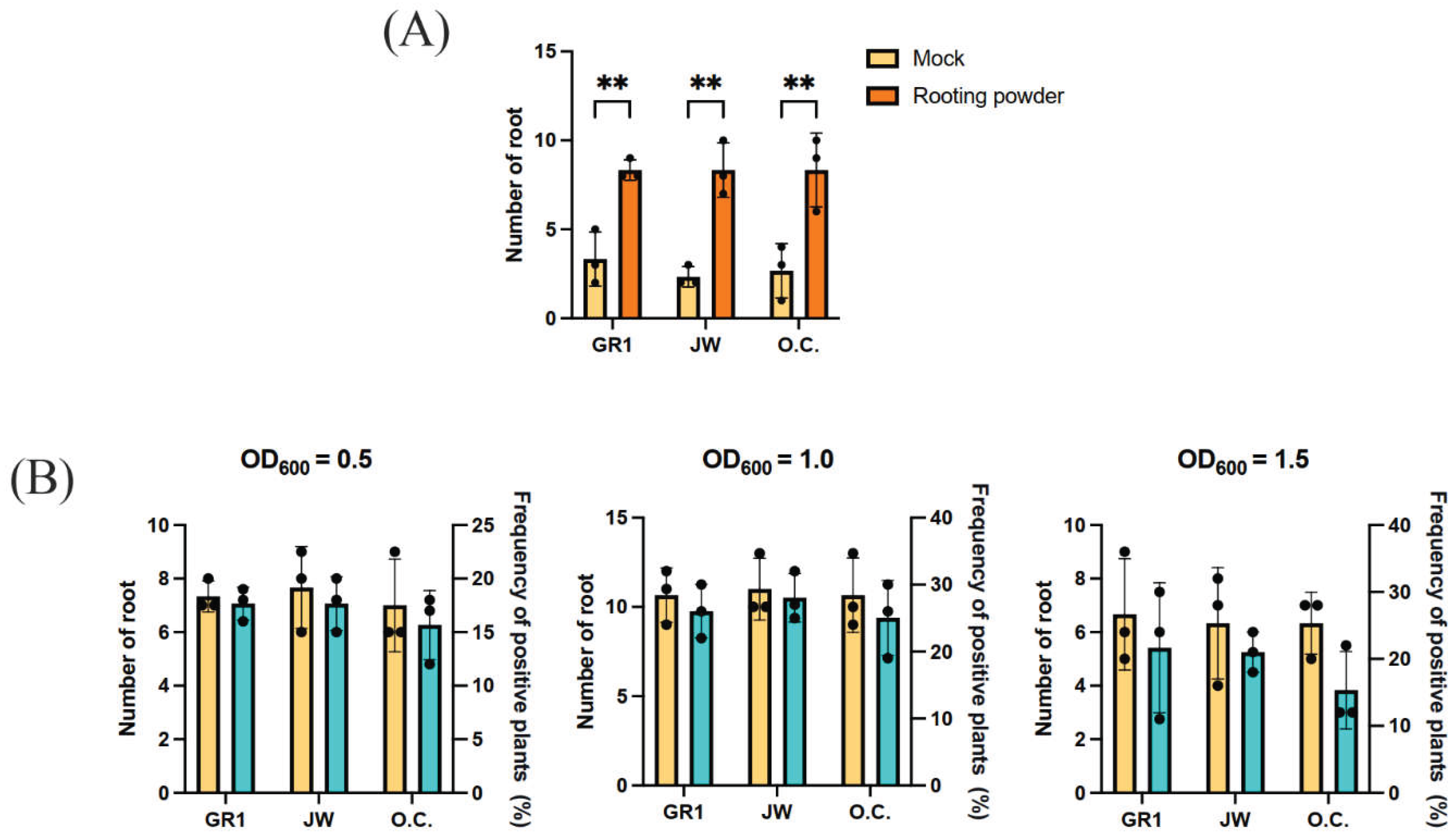
To systematically optimize the transformation efficiency of the air layering-based system, this study evaluated the effects of various treatment conditions on the number of roots generated per individual branch and the transformation frequencies across three cultivars (GR1, JW, and O.C.). Under mock-inoculated control conditions (without Agrobacterium), all three cultivars (GR1, JW, and O.C.) were capable of producing adventitious roots, yielding averages of 3.3, 2.3, and 2.7 roots per branch, respectively (Figure 5A). However, the frequency of positive transgenic plants was essentially zero, indicating that while the air layering technique inherently facilitates root induction under natural conditions, no genetic transformation events occurred (Figure 5A). Following treatment with exogenous rooting powder, the number of adventitious roots uniformly increased to an average of 8 per branch across all three cultivars (Figure 5A). These findings demonstrate that although plant growth regulators can effectively stimulate adventitious root formation, they similarly do not yield any positive transgenic roots.
In the Agrobacterium inoculation treatments, varying the bacterial suspension concentration resulted in pronounced differences in both the number of induced roots and the frequency of positive transgenic plants. At a bacterial cell density of OD600 = 0.5, all three cultivars (GR1, JW, and O.C.) generated a certain proportion of positive transgenic roots (17.7%, 17.7%, and 15.7%, respectively) (Figure 5B). This finding indicates that although a relatively low concentration of Agrobacterium can achieve effective infection, the overall transformation efficiency remains relatively low. As the bacterial concentration increased to OD600 = 1.0, the positive transgenic frequencies across the three cultivars significantly elevated (to 26.0%, 28.2%, and 24.8%, respectively) (Figure 5B), while the number of induced roots concurrently remained robust. This suggests that at this specific cell density, an optimal balance between Agrobacterium infection efficiency and plant tissue viability is achieved, thereby yielding a superior transformation efficiency. Upon further elevating the bacterial density to OD600 = 1.5, the positive transgenic frequencies did not exhibit any further substantial enhancement compared with those at OD600 = 1.0; instead, a slight decrease was observed in certain cultivars (dropping to 21.6%, 21.0%, and 15.3%, respectively) (Figure 5B). It is postulated that excessive bacterial concentrations may inflict severe biological stress on plant tissues, consequently impairing overall root induction and transformation outcomes. Furthermore, no significant genotype-dependent differences were observed among the distinct recipient cultivars across these treatments.
Taken together, these findings indicate that the cell density of the Agrobacterium suspension profoundly affects the transformation efficiency of the air layering-based hairy root induction system. Under the present experimental conditions, an OD600 of 1.0 represented the relatively optimal inoculation concentration. It is capable of securing a robust number of induced roots while concurrently yielding a high proportion of positive transgenic plants, thereby establishing an optimized parameter framework for downstream genetic transformation experiments.
3. Discussion
3.1. Overcoming the Age Limitation of Transformation in Woody Plants by Integrating Air Layering with Agrobacterium rhizogenes
In the genetic transformation of woody fruit trees, the strict dependence on juvenile explants has long constituted an insurmountable bottleneck [14,18] . Due to a pronounced decline in cellular totipotency, mature tree tissues are exceedingly recalcitrant to de novo organogenesis via conventional induction protocols [14,18]. The most fundamental breakthrough of this study lies in the integration of Agrobacterium rhizogenes inoculation with the air layering technique, which resulted in the successful generation of transgenic hairy roots on reproductively mature branches (Figure 4). The endogenous hormonal homeostasis inherent in mature woody tissues typically precludes cellular dedifferentiation [5]. Conversely, the physical intervention of air layering (girdling) artificially generates a localized microenvironment enriched with auxins and carbohydrates [19,20]. Building upon this foundation, in planta inoculation with A. rhizogenes introduces rol genes that amplify hormonal signaling, ultimately resulting in cell fate reprogramming within these exceptionally recalcitrant mature tissues [6,21]. This molecular-level cell fate reprogramming successfully breaches the transformation recalcitrance barrier in mature Macadamia tissues, rendering direct in vivo gene functional validation on adult trees feasible.
Germplasm innovation in woody plants predominantly relies on conventional seedling breeding, which is severely constrained by a prolonged juvenile phase prior to initial flowering, thus significantly impeding genetic improvement [22,23]. Classical floral induction models indicate that the FLOWERING LOCUS T (FT) protein undergoes long-distance transport from the leaves to the shoot apical meristem (SAM) via the phloem. It subsequently interacts with the bZIP transcription factor FD, which is specifically expressed within the SAM, to orchestrate the floral transition program [24,25]. In the woody plant Jatropha curcas, the JcFT protein can be robustly translocated from a transgenic rootstock to a non-transgenic scion, thereby promoting early flowering in the scion [26,27]. Furthermore, FT synthesized in transgenic hairy roots has also been shown to be translocated from the subterranean root system to aerial shoots [28]. In the present study, despite RT-qPCR confirming the high-level transcription of JcFT within the air layering-induced positive hairy roots (Figure 4I), the SAM of the corresponding layered branches failed to exhibit the anticipated floral bud differentiation. This observation aligns with similar findings in the gymnosperm woody plant Pinus tabuliformis [28]. The responsiveness of the SAM to florigenic signals in woody plants is generally subject to stringent seasonal and epigenetic regulation [29,30]. Consequently, we propose several factors for this lack of early flowering: an insufficient concentration of effective FT protein reaching the target site, coupled with a potential mismatch in developmental competence. Additionally, the mechanisms of long-distance FT transport may vary between homologous and heterologous systems, and the substantial biomass of mature Macadamia branches could dilute the translated JcFT protein prior to its arrival at the SAM. Furthermore, mature tissues may require more profound epigenetic remodeling—such as the repression of FLOWERING LOCUS C (FLC) homologs—to respond to florigenic signals. Together, these limiting factors likely account for the failure of these composite branches to undergo precocious flowering.
3.2. Integration of the In Planta Non-Sterile System with Visual Transgenic Screening Systems
Traditional tissue culture processes are frequently accompanied by severe tissue browning, exceptionally high contamination rates, and the potential risk of somaclonal variation [5]. The in planta transformation system established in this study completely circumvents these cumbersome aseptic procedures, substantially shortening the experimental duration to an average of only 30 days from inoculation to the emergence of positive roots. To comprehensively evaluate the broad applicability and stability of this transformation protocol, we simultaneously incorporated four distinct types of reporter genes (DsRed2, eGFP, RUBY, and AtPAP2) into the Macadamia hairy root induction system (Figure 1C and Figure 3A). The results demonstrate that this hairy root induction method functions independently of specific vector backbones, and therefore has broad application potential.
In contrast to the conventional GUS staining assay, which relies on destructive biochemical reactions [8] , the visual systems employed in this study facilitate continuous screening within intact living plants. The fluorescent systems (eGFP and DsRed2) satisfy the precise requirements for subcellular localization and high-resolution histological observation of hairy roots [9,10] . They are capable of effectively bypassing interference from endogenous tissue pigments under specific excitation wavelengths, thus conferring high-resolution advantages in tissue anatomy and fine-scale localization studies. However, their reliance on fluorescence microscopy equipment limits their convenience for field environments and high-throughput macroscopic screening; furthermore, fluorescent signals are prone to attenuation in aging root systems.
By comparison, pigment-synthesizing reporter genes enable non-destructive, macroscopic visual screening. Notably, within the root system investigated in this study, the coloration efficiency of RUBY was significantly greater than that of AtPAP2. The underlying mechanism is that the RUBY system, by introducing a complete suite of betalain biosynthetic enzymes, directly utilizes endogenous tyrosine to synthesize the pigment, rendering it independent of the secondary metabolic background of the recipient plant. Conversely, as a transcription factor, AtPAP2-mediated anthocyanin accumulation is highly dependent on the coordinated expression of endogenous anthocyanin biosynthetic pathway-related genes within the recipient. The root-specific gene expression patterns in Macadamia likely restrict its coloration efficacy [12,13]. Although RUBY exhibits excellent macroscopic visibility, a certain degree of pigment degradation was observed during the later stages of cultivation.
3.3. Overcoming Genotype Dependency to Construct a Broad-Spectrum Genetic Transformation Platform
Genotype dependency constitutes another major limitation restricting the widespread application of Agrobacterium-mediated transformation technologies [5] . Distinct Macadamia genotypes exhibit substantial variations in endogenous hormone levels, phenolic compound accumulation, recalcitrance to in vitro regeneration, and susceptibility to Agrobacterium infection, resulting in an exceedingly narrow applicability for conventional transformation methods [5,31]. The in planta transformation strategy employed in this study effectively exploits the robust endogenous homeostasis of intact plants as a buffer, thereby completely circumventing the extremely stringent conditions required for in vitro tissue culture [6,32]. Moreover, by proceeding via direct organogenesis, this system successfully bypasses the highly genotype-restricted regeneration bottleneck [5,14].
The seedlings utilized in this study were derived from the germination of open-pollinated seeds, and thus possessed highly diverse genetic backgrounds. The results demonstrated that although distinct genotypes exhibited slight variations in the timing of root initiation because of differences in their initial endogenous hormone levels (Figure 1A), the rol gene cluster harbored by A. rhizogenes profoundly amplified the sensitivity of the recipient cells to hormones, thereby minimizing the differential responses among genotypes [6] . Consequently, upon the integration of expression cassettes—with or without developmental regulatory factors—all the tested genotypes ultimately and successfully yielded positive transgenic hairy roots (Figure 1D; Figure 3B, C; Figure 4A–H; Figure 5C). These findings demonstrate that our A. rhizogenes-mediated in planta hairy root induction strategy is robust and broadly applicable across genotypes. This system is no longer confined to a single model cultivar, and may provide a broadly applicable platform for germplasm evaluation and gene function characterization across Macadamia and other recalcitrant woody plant species.
3.4. Limitations and Future Prospects of the Established Genetic Transformation System
It should be objectively recognized that the in planta transgenic hairy root induction system inherently produces composite (chimeric) plants, in which the root system is transgenic while the shoot system remains wild-type. Due to the untransformed nature of the reproductive primordia, this system t is incapable of directly generating heritable transgenic progeny. Nevertheless, this intrinsic limitation does not preclude the system’s ability to generate stable transgenic materials. In fact, Agrobacterium rhizogenes-induced hairy roots exhibit vigorous proliferation and high cellular totipotency. These positive roots, rigorously identified via visual screening systems, serve as excellent explants for in vitro regeneration [33]. Moving forward, optimizing the in vitro hairy root regeneration system to induce de novo adventitious shoot differentiation from these positive roots will provide a highly promising alternative pathway. This approach could completely circumvent the recalcitrance associated with the regeneration of conventional Macadamia stem and leaf tissues, thereby facilitating the recovery of intact, stably transformed plants [33,34].
This composite plant system also provides a powerful platform for elucidating the molecular mechanisms underlying the unique biological traits and important agronomic characteristics of Macadamia. For example, by integrating multi-omics approaches such as spatial transcriptomics and metabolomics, this system can be used to dissect key biological processes, including the development of proteoid roots (cluster roots), the regulatory networks of efficient phosphorus acquisition, and root-microbe symbiotic interactions [35,36,37]. Furthermore, this system can serve as an efficient tool for functional validation of genes in macadamia roots, while also enabling rapid assessment of gene editing efficiency within the species [17]. It may function as a homologous system for evaluating the activity and off-target effects of gene editing tools such as CRISPR–Cas9. In this way, prior to committing months or even years to stable transformation, researchers can utilize transgenic hairy root systems to quickly validate sgRNA editing efficiency and potential off-target effects, thereby substantially reducing trial-and-error costs. Collectively, these applications will provide robust empirical support for future molecular breeding endeavors in macadamia.
4. Materials and Methods
4.1. Plant Materials
The seedlings utilized in the experiments were derived from fully developed, mature seeds harvested from Macadamia germplasms A4, GR1, HAES900, and O.C. All seeds were obtained via natural open pollination. The seeds were submerged in clean water for approximately 3 to 4 days to ensure complete imbibition. Subsequently, the fully imbibed seeds were sown in trays filled with vermiculite and covered with a layer of the same substrate. The trays were then transferred to a plant growth chamber maintained at 26 °C. The vermiculite was kept adequately moist by daily spraying with water. Seed germination was continuously monitored, and subsequent experiments were initiated upon the evident elongation of the hypocotyls.
The air layering experiments were conducted under natural field conditions. Specifically, the trials were carried out from September to November 2024 in Nanning, Guangxi, China. During the experimental period, the ambient natural environment had an average temperature of approximately 24–25 °C and a relative humidity of 72%–78% (https://zh.weatherspark.com), providing an optimal microclimate for adventitious rooting and hairy root induction. Healthy branches with stem diameters of approximately 1.0 to 1.5 cm were selected from 5-year-old grafted plants of three Macadamia cultivars (GR1, JW, and O.C.) cultivated in an orchard. A girdling knife was used to completely remove a circumferential strip of approximately 1 cm wide bark from each selected branch to facilitate the treatment.
4.2. Plasmid Vectors
The pKSE402-eGFP vector employed in this study harbors an enhanced green fluorescent protein (eGFP) reporter gene driven by the CaMV 35S promoter, along with the kanamycin resistance selectable marker gene nptII and the Cas9 coding sequence [9]. The p501-SUC2::JcFT-DsRed2 vector contains a JcFT expression cassette driven by the phloem-specific SUC2 promoter, and an enhanced red fluorescent protein (DsRed2) reporter gene driven by the CaMV 35S promoter, while also carrying the nptII selectable marker [26,38,39]. The p35S-RUBY vector integrates the RUBY visual reporter system driven by the CaMV 35S promoter and carries the hygromycin resistance selectable marker gene hpt driven by the nos promoter [40]. The pRUBY-WIP vector comprises a 35S promoter-driven RUBY reporter module and a ZmUbi promoter-driven Cas9 expression cassette, concurrently harboring a WIP developmental regulatory module driven by the 35S promoter. This WIP module consists of three tandemly arrayed genes: ZmWUS2, ipt, and AtPLT5 [41]. The pGNP-AtPAP2 vector carries the anthocyanin accumulation regulatory factor AtPAP2 driven by the CaMV 35S promoter and incorporates a GUS::NPTII fusion gene, thereby conferring dual functionalities for both histochemical assays and kanamycin resistance selection [12].
4.3. Genetic Transformation
A 2 mL aliquot of the Agrobacterium rhizogenes strain K599 liquid culture was centrifuged at 8000 × g for 2 min to harvest the bacterial cells. After discarding the supernatant, the cell pellet was resuspended and evenly spread onto the surface of solid YEB medium supplemented with appropriate antibiotics. The plates were incubated at 28 °C for 36–48 h to form a dense bacterial lawn. Subsequently, the bacterial cells were scraped off and resuspended in an inoculation buffer (10 mM MES, 10 mM MgSO4, and 100 μM acetosyringone, pH 5.5–5.6). The bacterial cell density was adjusted to an OD600 of 0.5, and the suspension was statically incubated in the dark at 28 °C for 1 h for pre-induction prior to the inoculation treatments.
(1) Dip-inoculation method (DIP): Seedlings derived from germinated seeds were utilized as transformation recipients. The hypocotyl was excised approximately 1 cm below the cotyledonary node. The cut surface was directly dipped into the aforementioned pre-induced bacterial suspension. The seedlings were then replanted into vermiculite with the wounded surface facing upwards and co-cultivated in the dark at 28 °C for 3 days. Following co-cultivation, the inoculated Macadamia seedlings were transferred to a growth chamber maintained at 26 °C under a 16-h light/8-h dark photoperiod. The plants were watered daily to maintain substrate moisture, and hairy root development was evaluated at 25 days post-inoculation.
(2) Injection-inoculation method (INJ): Similarly, seedlings were employed as recipients by excising the hypocotyl 1 cm below the cotyledonary node. A 1 mL syringe was used to draw the pre-induced bacterial suspension and inject it into the cut surface of the remaining hypocotyl from multiple angles. Following the injection, the subsequent co-cultivation and maintenance procedures were identical to those described for the DIP method.
(3) Air layering-assisted in planta transformation method for mature trees: Intact living branches from 5-year-old grafted mature Macadamia trees were utilized as transformation recipients. Healthy, vigorous branches free of diseases, pests, and mechanical injuries were selected. A girdling treatment was performed by removing an approximately 1 cm-wide strip of phloem tissue down to the vascular cambium surface. Sterile absorbent cotton was then tightly wrapped around the girdled wound sites to facilitate liquid treatments. The experiment comprised three treatment groups: (i) Agrobacterium transformation group (Experimental group): the cotton was fully saturated with the aforementioned pre-induced bacterial suspension; (ii) Blank control group (Mock): the cotton was saturated with an equal volume of sterile inoculation buffer; and (iii) Hormone control group (Positive control): the cotton was saturated with an optimal concentration of commercial rooting powder solution (#100179410436, STANLEY, China). After the wound treatments, specialized air-layering rooting boxes were used to enclose the girdled sites and filled with pre-sterilized cultivation substrate. Once the boxes were secured, sterile water was periodically supplemented to maintain a high-humidity microenvironment within the substrate. At 30 days post-transformation, the rooting boxes were dismantled, and the induction and development of hairy roots or adventitious roots at the wound sites were evaluated and recorded across all groups.
4.4. Phenotypic Characterization of Transgenic Hairy Roots
Upon the induction of hairy roots from the recipient tissues, transformation events were screened utilizing either fluorescence or white-light imaging techniques, contingent upon the specific reporter system introduced. Non-transgenic roots consistently served as negative controls across all assays.
Detection of the fluorescent reporter systems (eGFP and DsRed2): Initial fluorescence screening of the induced hairy roots was performed utilizing a handheld dual-wavelength fluorescence excitation light source (LUYOR-3415RG, LUYOR Instrument Co., Ltd., USA). Under specific excitation illumination coupled with corresponding emission filters, eGFP-positive hairy roots exhibited distinct green fluorescent signals, whereas DsRed2-positive hairy roots displayed red fluorescent signals [9,10]. The spectral characteristics of the eGFP and DsRed2 proteins correspond to excitation/emission peaks at approximately 488/507 nm and 558/583 nm, respectively. For samples presenting ambiguous signals during the preliminary screening, a fluorescence stereomicroscope (P-DSL32, Nikon, Japan) was deployed for high-resolution microscopic observation and image acquisition under the appropriate fluorescence channels, thereby rigorously confirming the specificity of the fluorescent signals.
Detection of the macroscopically visible reporter systems: For transformation groups harboring the RUBY reporter gene, specialized excitation light sources were unnecessary, as this system visualizes transformation events via the catalyzed massive accumulation of betalain pigments. Morphological observations were conducted directly under ambient white light or a bright-field stereomicroscope; positive transgenic hairy root tissues exhibited a macroscopically visible red or dark purplish-red coloration [11,40]。Similarly, for groups transformed with the AtPAP2 reporter gene, which functions by inducing substantial anthocyanin accumulation, transgenic hairy root tissues could be directly identified macroscopically, displaying a distinct purple or purplish-red phenotype [12]。By contrast, the non-transgenic control roots of Macadamia maintained their characteristic milky-white or light-brown appearance.
4.5. Real-Time Quantitative PCR (RT-qPCR)
To analyze the transcriptional levels of the expression cassettes within the hairy roots and calli, real-time quantitative PCR (RT-qPCR) assays were performed utilizing the SYBR Green I fluorescence intercalating dye method. Total RNA was extracted from the samples using the E.Z.N.A. Plant RNA Kit (R6827, OMEGA, USA). Subsequently, the integrity of the extracted RNA was evaluated via agarose gel electrophoresis, and its concentration and purity were quantified using a NanoDrop spectrophotometer. Upon verification of adequate RNA quality, first-strand cDNA synthesis was executed using the HiScript III All-in-one RT SuperMix for qPCR kit (R323, Vazyme, China) strictly adhering to the manufacturer’s protocol for downstream quantitative analysis. The Macadamia Actin1 gene (NCBI GenBank accession no. NC_056569) was utilized as the internal reference gene [42]. The PCR reaction mixtures and thermocycling conditions were established according to the manual of the ChamQ Universal SYBR qPCR Master Mix kit (Q711, Vazyme, China). Relative gene expression levels were calculated using the method, with the expression level of the internal reference gene Actin1 normalized to 1 to calibrate the expression profiles of the target genes. All reactions were performed in triplicate. The specific primers utilized in this study are listed in Supplementary Table 1.
4.6. Statistical Analysis
Data acquisition across all experimental units was conducted upon the completion of the co-cultivation and induction phases. Infection-induced mortality rate = (number of dead plants post-inoculation / total number of inoculated plants) × 100%. Frequencies of positive transgenic plants (%) = (number of positive plants / total number of infected plants) × 100%. All data presented in this study are derived from a minimum of three independent biological replicates and are expressed as the mean ± standard deviation (SD). To assess the statistical significance among different treatment groups, one-way analysis of variance (ANOVA) and two-way ANOVA were performed utilizing GraphPad Prism 9 software. Differences were defined as statistically significant at a threshold of P < 0.05.
5. Conclusions
This study successfully established an efficient, genotype-independent, and visualized in planta hairy root transformation system specifically tailored for the recalcitrant woody plant Macadamia. By integrating Agrobacterium rhizogenes with multiplexed visual reporter systems, this protocol enables rapid, antibiotic-independent screening and non-destructive identification of positive transgenic tissues under non-sterile conditions. Our findings robustly demonstrate that this in planta strategy effectively circumvents the severe genotype dependency inherent in traditional in vitro tissue culture methods, resulting in exceptional broad-spectrum transformation applicability across various open-pollinated seedlings. More crucially, coupled with the air layering technique, this study achieved in planta transformation on the branches of mature maternal Macadamia trees for the first time, significantly breaching the tissue maturity barrier that has long constrained the advancement of woody plant biotechnology.
Although this system currently primarily generates composite transgenic plants, its potential as a highly efficient in vivo testing platform is substantial. This system provides a rapid and reliable pipeline for functional validation of key candidate genes identified from large-scale transcriptomic datasets. In the future, this platform can be utilized not only to precisely assess the targeted editing efficiency of CRISPR-Cas9 and other genome-editing tools in target species, but also—when integrated with multi-omics approaches such as spatial transcriptomics and metabolomics—to elucidate the complex regulatory mechanisms underlying Macadamia proteoid (cluster) root development and rhizosphere microbial interactions. Furthermore, the use of rigorously validated positive hairy roots as explants, combined with continued optimization of de novo root-to-shoot organogenesis and plant regeneration pathways [33], holds promise for establishing a novel and effective strategy for the stable genetic transformation and improvement of recalcitrant woody plants.
Supplementary Materials
The following supporting information can be downloaded at the website of this paper posted on Preprints.org, Table S1. Primers used in this study.
Author Contributions
ZF.X. designed and supervised the study, and revised the paper. Y.M. performed experiments, analyzed data, and wrote the paper. YC. F., X. T., YJ. L., K. L., YQ. P., M. L., JJ. X., YW. W., KP. L., LM. Z., SJ. H. collected germplasm and revised the paper. All authors have read and agreed to the published version of the manuscript.
Funding
This work was supported by the Guangxi Specific Project for Science and Technology Bases and Talents (AD23026337) and the Key Program for Forestry Science and Technology Promotion and Demonstration in Guangxi (2023GXLK12).
Acknowledgments
We thank Prof. Wei Yao (Guangxi University) for generously providing the pGNP-AtPAP2 vector, Prof. Xiaolan Zhang (China Agricultural University) for generously providing the pKSE402-eGFP vector, and Prof. Changwei Zhang (Nanjing Agricultural University) for generously providing the pRUBY-WIP vector, and Prof. Yunde Zhao (University of California, San Diego) for generously providing the p35S-RUBY vector.
References
- Trueman, S.J. The reproductive biology of macadamia. Sci. Hortic. 2013, 150, 354–359. [Google Scholar] [CrossRef]
- Wang, P.; Mo, Y.; Wang, Y.; Fei, Y.; Huang, J.; Ni, J.; Xu, Z.-F. Macadamia germplasm and genomic database (MacadamiaGGD): A comprehensive platform for germplasm innovation and functional genomics in Macadamia. Front. Plant Sci. 2022, 13, 1007266. [Google Scholar] [CrossRef] [PubMed]
- Fei, Y.-C.; Mo, Y.; Lin, K.; Tao, L.; He, X.; Ye, F.; Xu, J.; Li, M.; Xu, Z.-F. Comparative transcriptome analysis reveals a possible mechanism of starvation stress-induced fruit abscission in macadamia. BMC Plant Biol. 2025, 25, 739. [Google Scholar] [CrossRef] [PubMed]
- Poudel, P.D.; Faveri, J.-D.; Topp, B.; Alam, M. Genome-wide association studies revealed partial genetic links between early vigour and precocity in macadamia. Hortic. Res. 2025, 12. [Google Scholar] [CrossRef] [PubMed]
- Maharjan, B.K.; Islam, M.T.; Muzaffar, A.; Tschaplinski, T.J.; Tuskan, G.A.; Chen, J.-G.; Yang, X. Woody plant transformation: current status, challenges, and future perspectives. Plants 2025, 14, 3420. [Google Scholar] [CrossRef] [PubMed]
- Ying, W.; Wen, G.; Xu, W.; Liu, H.; Ding, W.; Zheng, L.; He, Y.; Yuan, H.; Yan, D.; Cui, F.; et al. Agrobacterium rhizogenes: paving the road to research and breeding for woody plants. Front. Plant Sci. 2023, 14, 1196561. [Google Scholar] [CrossRef] [PubMed]
- Wang, P.; Si, H.; Li, C.; Xu, Z.; Guo, H.; Jin, S.; Cheng, H. Plant genetic transformation: achievements, current status and future prospects. Plant Biotechnol. J. 2025, 23, 2034–2058. [Google Scholar] [CrossRef] [PubMed]
- Jefferson, R. The GUS reporter gene system. Nature 1989, 342, 837–838. [Google Scholar] [CrossRef] [PubMed]
- Cheng, Z.; Liu, X.; Yan, S.; Liu, B.; Zhong, Y.; Song, W.; Chen, J.; Wang, Z.; Che, G.; Liu, L.; et al. Pollen tube emergence is mediated by ovary-expressed ALCATRAZ in cucumber. Nat. Commun. 2023, 14, 258. [Google Scholar] [CrossRef] [PubMed]
- Sun, L.; Alariqi, M.; Zhu, Y.; Li, J.; Li, Z.; Wang, Q.; Li, Y.; Rui, H.; Zhang, X.; Jin, S. Red fluorescent protein (DsRed2), an ideal reporter for cotton genetic transformation and molecular breeding. Crop J. 2018, 6, 366–376. [Google Scholar] [CrossRef]
- Chen, L.; Cai, Y.; Liu, X.; Yao, W.; Wu, S.; Hou, W. The RUBY reporter for visual selection in soybean genome editing. aBIOTECH 2024, 5, 209–213. [Google Scholar] [CrossRef] [PubMed]
- Duan, Z.-z.; Huang, Z.; Zhou, Y.-m.; Li, H.; Tu, W.; Zhang, M.; Yao, W. Plant expression vector construction and genetic transformation of anthocyanin synthesis transcription factor PAP2. J. Anhui Agric. Sci. 2020, 48, 106–110. [Google Scholar]
- Sharifova, S.; Prasad, K.V.; Cheema, A.; Reddy, A.S. Genetically encoded betalain-based RUBY visual reporters: noninvasive monitoring of biological processes. Trends Plant Sci. 2025, 30, 1332–1345. [Google Scholar] [CrossRef] [PubMed]
- Altpeter, F.; Springer, N.M.; Bartley, L.E.; Blechl, A.E.; Brutnell, T.P.; Citovsky, V.; Conrad, L.J.; Gelvin, S.B.; Jackson, D.P.; Kausch, A.P. Advancing crop transformation in the era of genome editing. Plant Cell 2016, 28, 1510–1520. [Google Scholar] [CrossRef] [PubMed]
- Mwang’ingo, P.; Teklehaimanot, Z.; Lulandala, L.; Maliondo, S. Propagating Osyris lanceolata (African sandalwood) through air layering: Its potential and limitation in Tanzania. South. Afr. For. J. 2006, 207, 7–13. [Google Scholar] [CrossRef]
- Leakey, R.R.B. Plant Cloning: Macropropagation. In Encyclopedia of Agriculture and Food Systems; Van Alfen, N., Ed.; Elsevier: San Diego, CA, USA, 2014; Volume 4, In; 2014; 4 4; pp. 349–359. [Google Scholar]
- Zhang, S.Y.; Luo, R.F.; Wu, Y.X.; Zhang, T.T.; Yusuf, A.; Wang, N.; Li, M.; Duan, S. Establishment and application of high-pressure propagation breeding (HPPB)-mediated genetic transformation system in citrus rootstocks. Plant Biotechnol. J. 2025, 23, 2790–2792. [Google Scholar] [CrossRef] [PubMed]
- Gambino, G.; Gribaudo, I. Genetic transformation of fruit trees: current status and remaining challenges. Transgenic Res. 2012, 21, 1163–1181. [Google Scholar] [CrossRef] [PubMed]
- De Schepper, V.; Steppe, K.; Van Labeke, M.-C.; Lemeur, R. Detailed analysis of double girdling effects on stem diameter variations and sap flow in young oak trees. Environ. Exp. Bot. 2010, 68, 149–156. [Google Scholar] [CrossRef]
- Li, N.; Chang, Y. Effective methods for adventitious root regeneration on weeping fig stems. Forests 2022, 13, 1165. [Google Scholar] [CrossRef]
- Spena, A.; Schmülling, T.; Koncz, C.; Schell, J.S. Independent and synergistic activity of rol A, B and C loci in stimulating abnormal growth in plants. EMBO J. 1987, 6, 3891–3899. [Google Scholar] [CrossRef] [PubMed]
- Tang, M.; Tao, Y.-B.; Fu, Q.; Song, Y.; Niu, L.; Xu, Z.-F. An ortholog of LEAFY in Jatropha curcas regulates flowering time and floral organ development. Sci. Rep. 2016, 6, 37306. [Google Scholar] [CrossRef] [PubMed]
- Manuela, D.; Xu, M. Juvenile leaves or adult leaves: determinants for vegetative phase change in flowering plants. Int. J. Mol. Sci. 2020, 21, 9753. [Google Scholar] [CrossRef] [PubMed]
- Corbesier, L.; Vincent, C.; Jang, S.; Fornara, F.; Fan, Q.; Searle, I.; Giakountis, A.; Farrona, S.; Gissot, L.; Turnbull, C. FT protein movement contributes to long-distance signaling in floral induction of Arabidopsis. Science 2007, 316, 1030–1033. [Google Scholar] [CrossRef] [PubMed]
- Abe, M.; Kobayashi, Y.; Yamamoto, S.; Daimon, Y.; Yamaguchi, A.; Ikeda, Y.; Ichinoki, H.; Notaguchi, M.; Goto, K.; Araki, T. FD, a bZIP protein mediating signals from the floral pathway integrator FT at the shoot apex. Science 2005, 309, 1052–1056. [Google Scholar] [CrossRef] [PubMed]
- Tang, M.; Bai, X.; Xia, Y.; Huang, P.; Xu, Z.-F. SBP-Box transcription factor JcSPL9 regulates both seed yield and oil content in the biofuel plant Jatropha curcas. Plant Biotechnol. J. 2026, 24, 3125–3140. [Google Scholar] [PubMed]
- Tang, M.; Bai, X.; Wang, J.; Chen, T.; Meng, X.; Deng, H.; Li, C.; Xu, Z.-F. Efficiency of graft-transmitted JcFT for floral induction in woody perennial species of the Jatropha genus depends on transport distance. Tree Physiol. 2022, 42, 189–201. [Google Scholar] [PubMed]
- Li, J.J.; Zhao, Y.M.; Liu, J.F.; Li, C.H.; Zhang, H.; Song, Y.T.; Zuo, Q.; Wang, P.Y.; Gao, K.; Meng, D. Rooting conifer genetic research: an accessible and efficient transformation system. Plant Biotechnol. J. 2026, 24, 4027–4040. [Google Scholar] [CrossRef] [PubMed]
- Brunner, A.M.; Nilsson, O. Revisiting tree maturation and floral initiation in the poplar functional genomics era. New Phytol. 2004, 164, 43–51. [Google Scholar] [CrossRef] [PubMed]
- Wilkie, J.D.; Sedgley, M.; Olesen, T. Regulation of floral initiation in horticultural trees. J. Exp. Bot. 2008, 59, 3215–3228. [Google Scholar] [CrossRef] [PubMed]
- Gitonga, L.; Gichuki, S.; Ngamau, K.; Muigai, A.; Kahangi, E.; Wasilwa, L.; Wepukhulu, S.; Njogu, N. Effect of explant type, source and genotype on in vitro shoot regeneration in Macadamia (Macadamia spp.). J. Agric. Biotechnol. Sustain. Dev. 2010, 2, 119–125. [Google Scholar]
- Bélanger, J.G.; Copley, T.R.; Hoyos-Villegas, V.; Charron, J.-B.; O’Donoughue, L. A comprehensive review of in planta stable transformation strategies. Plant Methods 2024, 20, 79. [Google Scholar] [CrossRef] [PubMed]
- Liu, L.; Qu, J.; Wang, C.; Liu, M.; Zhang, C.; Zhang, X.; Guo, C.; Wu, C.; Yang, G.; Huang, J. An efficient genetic transformation system mediated by Rhizobium rhizogenes in fruit trees based on the transgenic hairy root to shoot conversion. Plant Biotechnol. J. 2024, 22, 2093–2103. [Google Scholar] [CrossRef] [PubMed]
- Yamashita, H.; Daimon, H.; Akasaka-Kennedy, Y.; Masuda, T. Plant regeneration from hairy roots of apple rootstock, Malus prunifolia Borkh. var. ringo Asami, strain Nagano No. 1, transformed by Agrobacterium rhizogenes. J. Jpn. Soc. Hortic. Sci. 2004, 73, 505–510. [Google Scholar]
- Lambers, H. Phosphorus acquisition and utilization in plants. Annu. Rev. Plant Biol. 2022, 73, 17–42. [Google Scholar] [CrossRef] [PubMed]
- Giacomello, S. A new era for plant science: spatial single-cell transcriptomics. Curr. Opin. Plant Biol. 2021, 60, 102041. [Google Scholar] [CrossRef] [PubMed]
- Boisson-Dernier, A.; Chabaud, M.; Garcia, F.; Bécard, G.; Rosenberg, C.; Barker, D.G. Agrobacterium rhizogenes-transformed roots of Medicago truncatula for the study of nitrogen-fixing and endomycorrhizal symbiotic associations. Mol. Plant-Microbe Interact. 2001, 14, 695–700. [Google Scholar] [PubMed]
- Li, C.; Luo, L.; Fu, Q.; Niu, L.; Xu, Z.-F. Isolation and functional characterization of JcFT, a FLOWERING LOCUS T (FT) homologous gene from the biofuel plant Jatropha curcas. BMC Plant Biol. 2014, 14, 125. [Google Scholar] [CrossRef] [PubMed]
- Pan, W.; Cheng, Z.; Han, Z.; Yang, H.; Zhang, W.; Zhang, H. Efficient genetic transformation and CRISPR/Cas9-mediated genome editing of watermelon assisted by genes encoding developmental regulators. J. Zhejiang Univ.-Sci. B 2022, 23, 339–344. [Google Scholar] [PubMed]
- Lin, K.; Lu, L.-X.; Pan, B.-Z.; Chai, X.; Fu, Q.-T.; Geng, X.-C.; Mo, Y.; Fei, Y.-C.; Xu, J.-J.; Li, M.; et al. Agrobacterium rhizogenes-mediated hairy root genetic transformation using Agrobacterium gel inoculation and RUBY reporter enables efficient gene function analysis in sacha inchi (Plukenetia volubilis). Int. J. Mol. Sci. 2025, 26, 2496. [Google Scholar] [CrossRef] [PubMed]
- Wang, Y.; Yang, X.; Wang, W.; Wang, Y.; Chen, X.; Wu, H.; Gao, Z.; Xu, H.; Liu, T.; Li, Y. Efficient genetic transformation and gene editing of Chinese cabbage using Agrobacterium rhizogenes. Plant Physiol. 2025, 197, kiae543. [Google Scholar] [PubMed]
- Nock, C.J.; Baten, A.; Mauleon, R.; Langdon, K.S.; Topp, B.; Hardner, C.; Furtado, A.; Henry, R.J.; King, G.J. Chromosome-scale assembly and annotation of the Macadamia genome (Macadamia integrifolia HAES 741). G3 2020, 10, 3497–3504. [Google Scholar] [CrossRef] [PubMed]
Figure 1.
High-efficiency induction and identification of positive transgenic hairy roots in Macadamia seedlings. (A) Three distinct developmental stages (P1, P2, and P3) of Macadamia seedlings utilized for transgenic hairy root induction. The red dashed line indicates the excision site on the hypocotyl, which concurrently serves as the site for Agrobacterium inoculation. Scale bar = 2 cm. (B) Infection-induced mortality rates of four Macadamia genotypes (A4, GR1, HAES900, and O.C.) following treatments at different developmental stages (P1–P3). Infection-induced mortality rate = (number of dead plants post-inoculation / total number of inoculated plants) × 100%. The error bars represent the standard deviation (SD). Different lowercase letters above the bars indicate statistically significant differences among treatments (P < 0.05). (C) Schematic representations of the T-DNA regions of the expression vectors utilized in this study: pKSE402-eGFP (harboring a 35S promoter-driven eGFP reporter gene) and p501-SUC2::JcFT-DsRed2 (harboring a 35S promoter-driven DsRed2 reporter gene). (D) Phenotypic observations of the induced positive transgenic hairy roots across different seedling genotypes inoculated with A. rhizogenes strain K599 harboring distinct expression vectors. Imaging was performed under bright field (upper panels) and fluorescence (lower panels). The K599 strain lacking the fluorescent reporter constructs served as the wild-type negative control. The fluorescence signals of the eGFP and DsRed2 proteins were detected under blue excitation light (approximately 440–460 nm) for O.C. and green excitation light (approximately 520–560 nm) for GR1, respectively. Scale bar = 2 cm.
Figure 1.
High-efficiency induction and identification of positive transgenic hairy roots in Macadamia seedlings. (A) Three distinct developmental stages (P1, P2, and P3) of Macadamia seedlings utilized for transgenic hairy root induction. The red dashed line indicates the excision site on the hypocotyl, which concurrently serves as the site for Agrobacterium inoculation. Scale bar = 2 cm. (B) Infection-induced mortality rates of four Macadamia genotypes (A4, GR1, HAES900, and O.C.) following treatments at different developmental stages (P1–P3). Infection-induced mortality rate = (number of dead plants post-inoculation / total number of inoculated plants) × 100%. The error bars represent the standard deviation (SD). Different lowercase letters above the bars indicate statistically significant differences among treatments (P < 0.05). (C) Schematic representations of the T-DNA regions of the expression vectors utilized in this study: pKSE402-eGFP (harboring a 35S promoter-driven eGFP reporter gene) and p501-SUC2::JcFT-DsRed2 (harboring a 35S promoter-driven DsRed2 reporter gene). (D) Phenotypic observations of the induced positive transgenic hairy roots across different seedling genotypes inoculated with A. rhizogenes strain K599 harboring distinct expression vectors. Imaging was performed under bright field (upper panels) and fluorescence (lower panels). The K599 strain lacking the fluorescent reporter constructs served as the wild-type negative control. The fluorescence signals of the eGFP and DsRed2 proteins were detected under blue excitation light (approximately 440–460 nm) for O.C. and green excitation light (approximately 520–560 nm) for GR1, respectively. Scale bar = 2 cm.
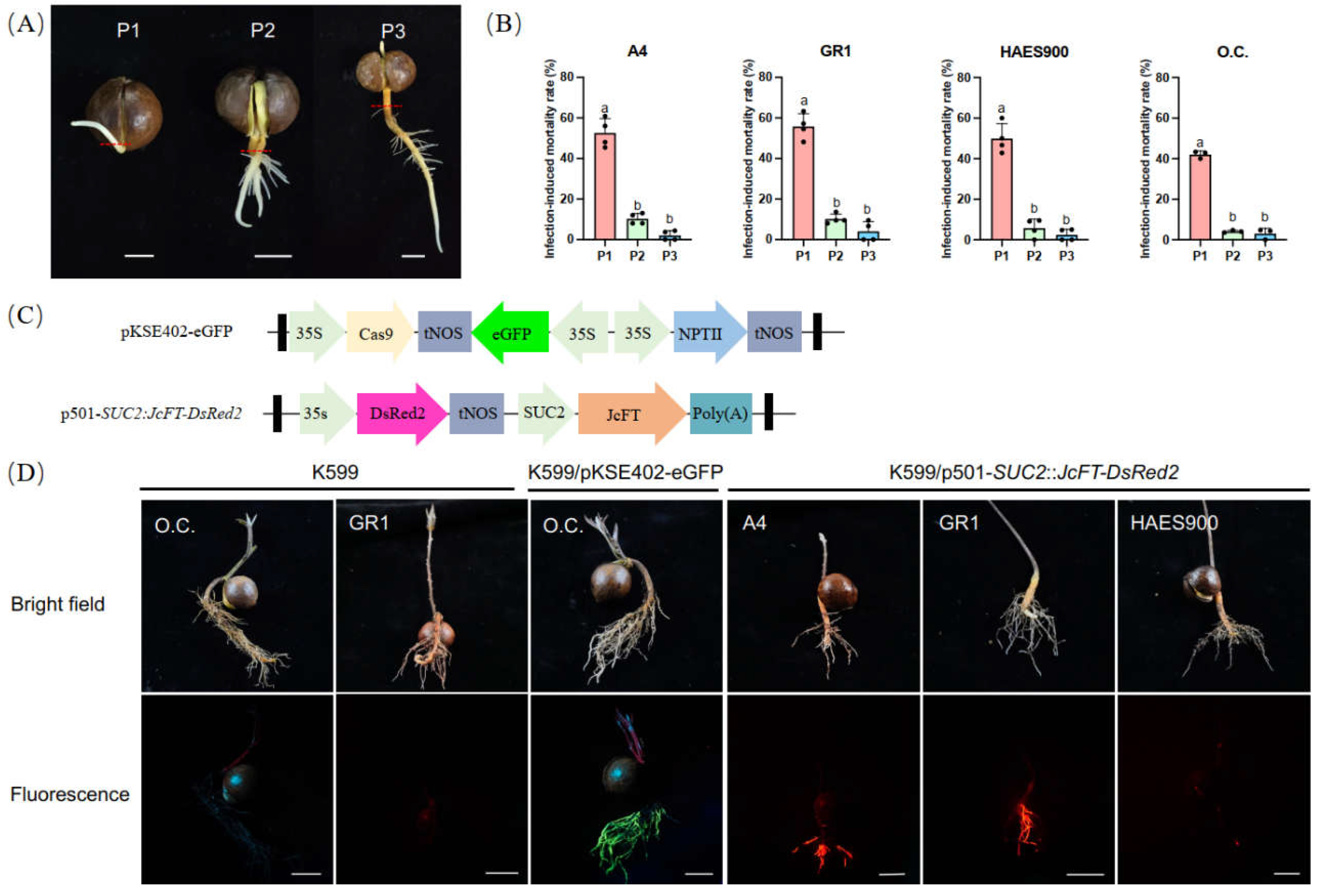
Figure 2.
Effects of different developmental stages and inoculation treatments on the induction rates of positive transgenic Macadamia seedlings. (A) Frequencies (%) of positive transgenic plants induced across four Macadamia genotypes (A4, GR1, HAES900, and O.C.) at three distinct developmental stages (P1, P2, and P3). The error bars represent the standard deviation (SD), and the scatter points indicate independent biological replicates. Different lowercase letters above the bars indicate statistically significant differences among groups (P < 0.05), whereas ‘ns’ denotes no significant difference (P > 0.05). (B) Comparative effects of two distinct inoculation treatments (yellow bars represent the dip-inoculation method, DIP; blue bars represent the injection-inoculation method, INJ) on the frequencies (%) of positive transgenic plants across the four Macadamia genotypes. Asterisks indicate highly significant differences between the two treatments (P < 0.01), whereas ‘ns’ denotes no significant difference (P > 0.05).
Figure 2.
Effects of different developmental stages and inoculation treatments on the induction rates of positive transgenic Macadamia seedlings. (A) Frequencies (%) of positive transgenic plants induced across four Macadamia genotypes (A4, GR1, HAES900, and O.C.) at three distinct developmental stages (P1, P2, and P3). The error bars represent the standard deviation (SD), and the scatter points indicate independent biological replicates. Different lowercase letters above the bars indicate statistically significant differences among groups (P < 0.05), whereas ‘ns’ denotes no significant difference (P > 0.05). (B) Comparative effects of two distinct inoculation treatments (yellow bars represent the dip-inoculation method, DIP; blue bars represent the injection-inoculation method, INJ) on the frequencies (%) of positive transgenic plants across the four Macadamia genotypes. Asterisks indicate highly significant differences between the two treatments (P < 0.01), whereas ‘ns’ denotes no significant difference (P > 0.05).
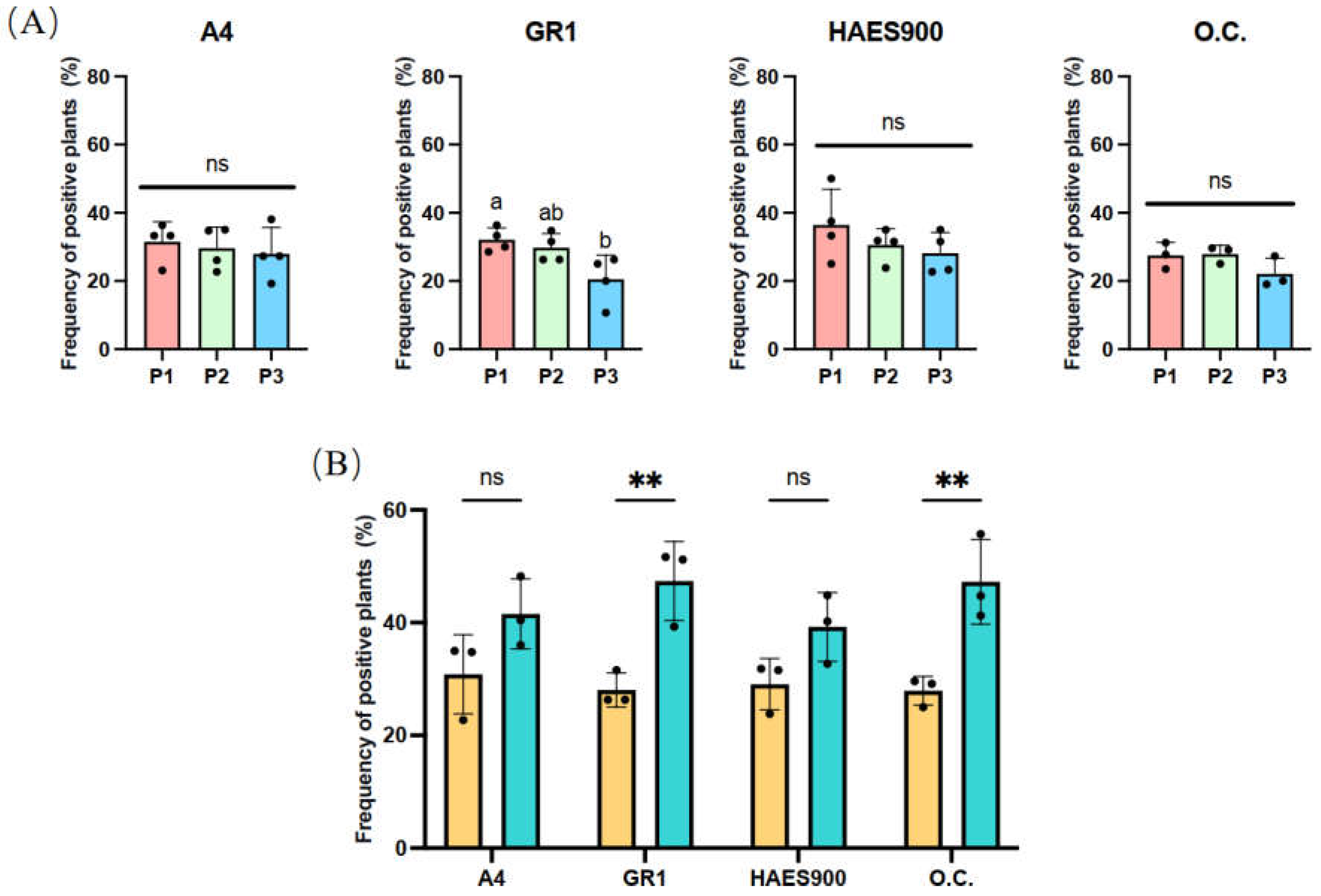
Figure 3.
Identification and molecular validation of in planta hairy roots in Macadamia mediated by multiplex visual reporter systems. (A) Schematic representations of the T-DNA regions of the three expression vectors utilized in this study. (B) Early phenotypic observations of hairy roots induced at the wounding sites on Macadamia branches following inoculation with the wild-type Agrobacterium rhizogenes strain K599 and engineered strains harboring distinct expression vectors. Red arrows indicate distinct color changes. Scale bar = 2.5 mm. (C) Phenotypes of positive transgenic hairy roots developing on potted Macadamia seedlings. The red dashed box corresponds to the magnified view on the right, where red arrows explicitly indicate the positive transgenic roots exhibiting distinct red coloration within the soil matrix. (D) Quantitative analysis of target gene expression levels in hairy roots under different treatments via RT-qPCR. The relative expression levels of RUBY, the WIP developmental regulatory cassette, and the AtPAP2 gene were assayed in hairy roots induced by the wild-type strain (K599) and strains harboring the p35S-RUBY, pRUBY-WIP, and pGNP-AtPAP2 vectors, respectively. Actin1 was utilized as the internal reference gene. Error bars represent the standard deviation (SD) of independent biological replicates.
Figure 3.
Identification and molecular validation of in planta hairy roots in Macadamia mediated by multiplex visual reporter systems. (A) Schematic representations of the T-DNA regions of the three expression vectors utilized in this study. (B) Early phenotypic observations of hairy roots induced at the wounding sites on Macadamia branches following inoculation with the wild-type Agrobacterium rhizogenes strain K599 and engineered strains harboring distinct expression vectors. Red arrows indicate distinct color changes. Scale bar = 2.5 mm. (C) Phenotypes of positive transgenic hairy roots developing on potted Macadamia seedlings. The red dashed box corresponds to the magnified view on the right, where red arrows explicitly indicate the positive transgenic roots exhibiting distinct red coloration within the soil matrix. (D) Quantitative analysis of target gene expression levels in hairy roots under different treatments via RT-qPCR. The relative expression levels of RUBY, the WIP developmental regulatory cassette, and the AtPAP2 gene were assayed in hairy roots induced by the wild-type strain (K599) and strains harboring the p35S-RUBY, pRUBY-WIP, and pGNP-AtPAP2 vectors, respectively. Actin1 was utilized as the internal reference gene. Error bars represent the standard deviation (SD) of independent biological replicates.
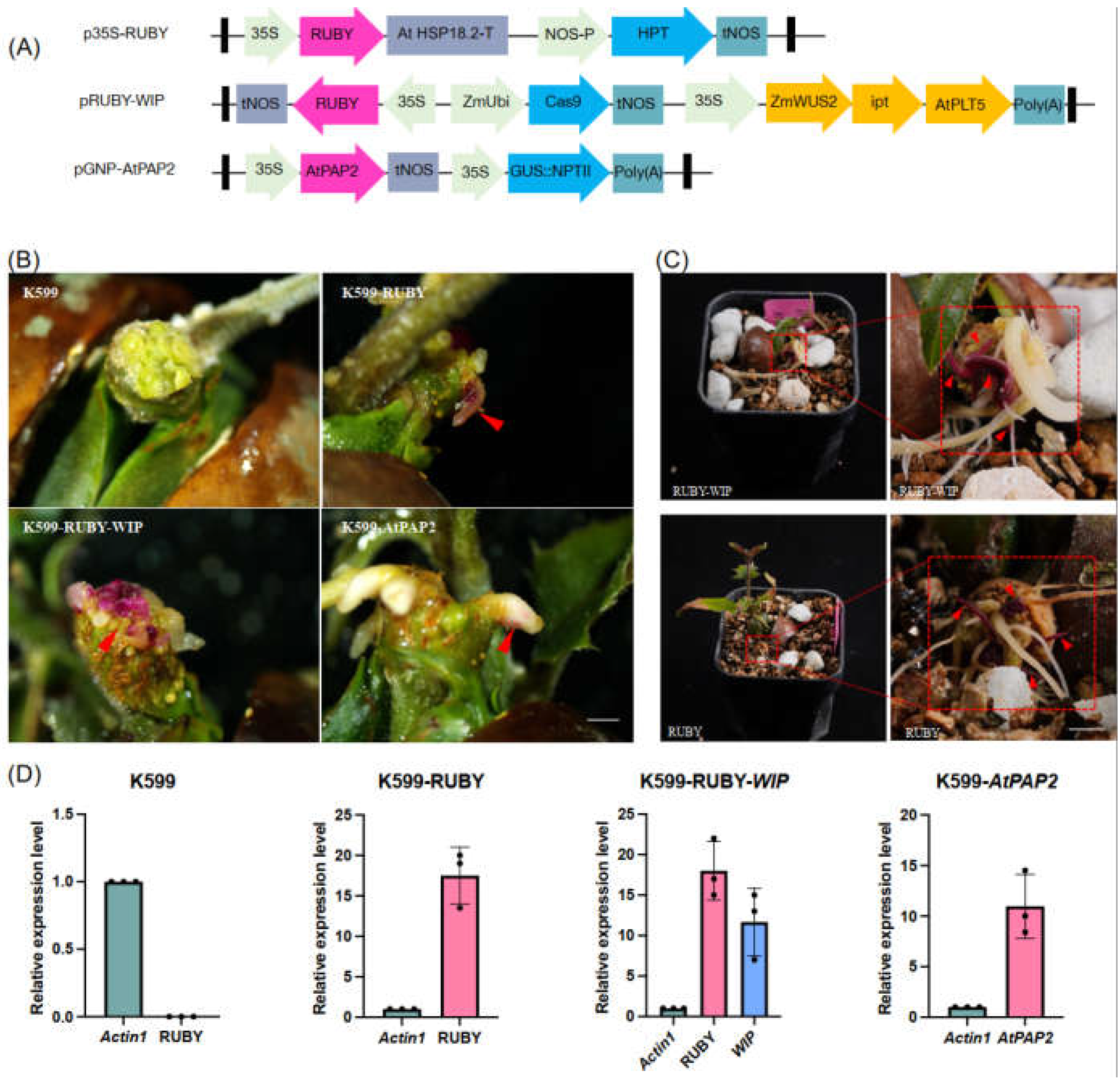
Figure 4.
In planta induction and molecular validation of hairy roots on mature Macadamia branches via air layering. (A–C) Operational workflow of in planta hairy root transformation integrated with the air layering technique. (A) Physical girdling of a mature branch; (B) Application of Agrobacterium rhizogenes bacterial paste harboring an expression vector (e.g., p501-SUC2::JcFT-DsRed2) to the girdled wounding site; (C) Wrapping and light-exclusion treatment utilizing a rooting ball filled with a moisture-retaining substrate. (D–G) Dynamic morphological evolution of tissues at the wounding site during the induction process. (D) Early formation of cortical callus; (E) Massive proliferation of the callus accompanied by the emergence of hairy root primordia; (F) Elongation growth of the induced positive hairy roots; (G) Observation of the extensive hairy root system developed within the substrate upon removal of the rooting ball. Scale bars in A–G = 1 cm. (H) Phenotypic observations of the induced hairy roots under bright field (left) and fluorescence (right) conditions. Red fluorescence indicates the successful expression of the DsRed2 reporter gene within the root vascular tissues. Scale bar = 1 cm. (I) Quantitative analysis of the relative expression levels of the target gene JcFT and the reporter gene DsRed2 across three mature Macadamia genotypes (GR1, JW, and O.C.) via RT-qPCR. Wild-type branches without Agrobacterium inoculation served as the control group, whereas ‘+Ag’ denotes the experimental group inoculated with A. rhizogenes. Error bars represent the standard deviation (SD) of independent biological replicates. Asterisks indicate highly significant differences between the control and transformed groups (P < 0.01).
Figure 4.
In planta induction and molecular validation of hairy roots on mature Macadamia branches via air layering. (A–C) Operational workflow of in planta hairy root transformation integrated with the air layering technique. (A) Physical girdling of a mature branch; (B) Application of Agrobacterium rhizogenes bacterial paste harboring an expression vector (e.g., p501-SUC2::JcFT-DsRed2) to the girdled wounding site; (C) Wrapping and light-exclusion treatment utilizing a rooting ball filled with a moisture-retaining substrate. (D–G) Dynamic morphological evolution of tissues at the wounding site during the induction process. (D) Early formation of cortical callus; (E) Massive proliferation of the callus accompanied by the emergence of hairy root primordia; (F) Elongation growth of the induced positive hairy roots; (G) Observation of the extensive hairy root system developed within the substrate upon removal of the rooting ball. Scale bars in A–G = 1 cm. (H) Phenotypic observations of the induced hairy roots under bright field (left) and fluorescence (right) conditions. Red fluorescence indicates the successful expression of the DsRed2 reporter gene within the root vascular tissues. Scale bar = 1 cm. (I) Quantitative analysis of the relative expression levels of the target gene JcFT and the reporter gene DsRed2 across three mature Macadamia genotypes (GR1, JW, and O.C.) via RT-qPCR. Wild-type branches without Agrobacterium inoculation served as the control group, whereas ‘+Ag’ denotes the experimental group inoculated with A. rhizogenes. Error bars represent the standard deviation (SD) of independent biological replicates. Asterisks indicate highly significant differences between the control and transformed groups (P < 0.01).
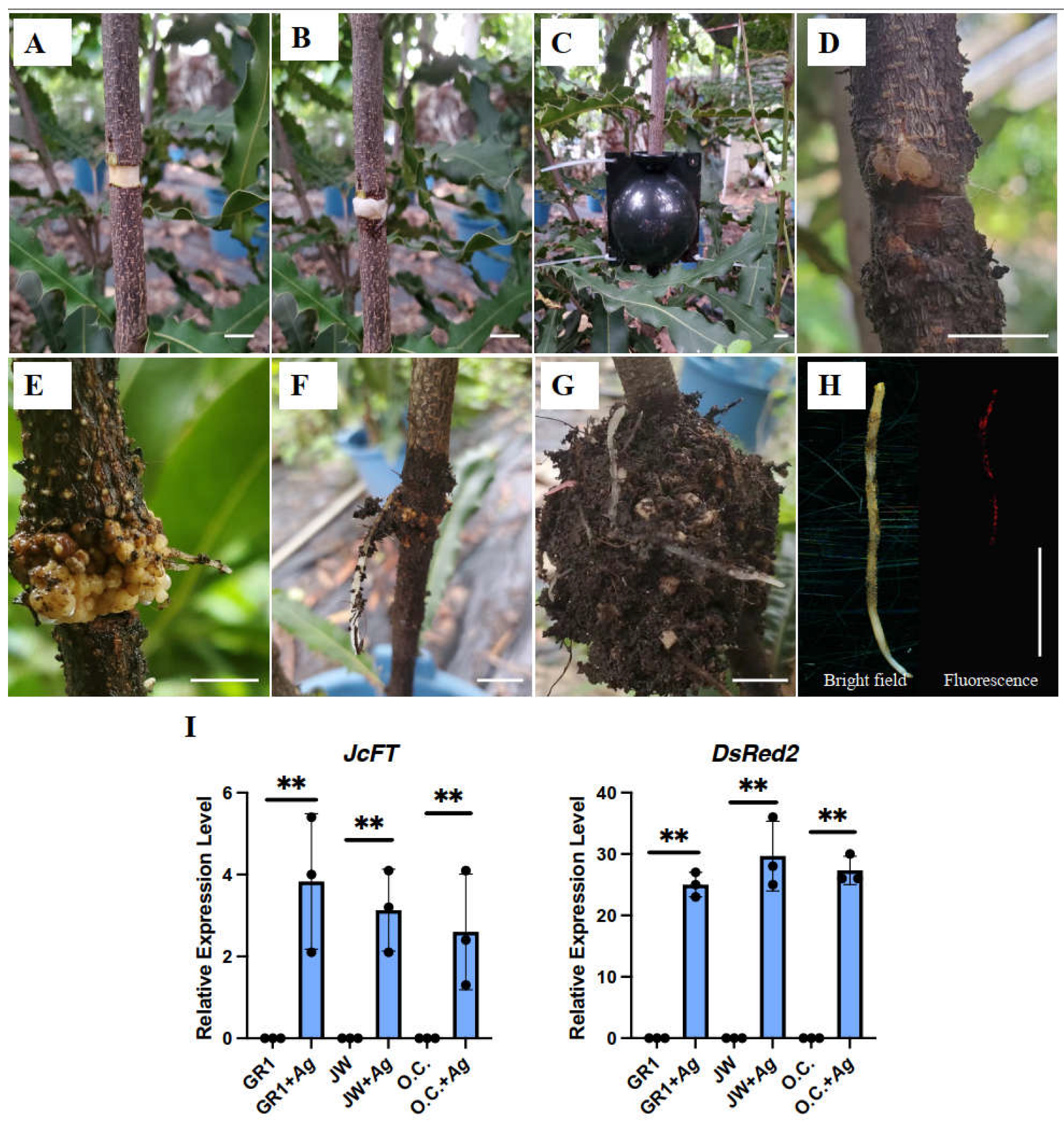
Figure 5.
Optimization of Agrobacterium rhizogenes inoculation density for air layering-based rooting and transformation efficiency in mature Macadamia. (A) Effects of control treatments on adventitious root induction across three mature Macadamia cultivars (GR1, JW, and O.C.), where ‘Mock’ served as the blank control and ‘Rooting powder’ denotes the exogenous rooting hormone treatment. (B) Effects of varying A. rhizogenes suspension concentrations (OD600 = 0.5, 1.0, and 1.5) on adventitious root induction and positive transformation efficiency. Each treatment panel utilizes a dual Y-axis configuration: the left Y-axis and the corresponding yellow bars represent the average number of roots generated at the air layering sites, whereas the right Y-axis and the corresponding blue-green bars indicate the frequency of positive transgenic plants (%). Black scatter points signify independent biological replicates, and error bars represent the standard deviation (SD).
Figure 5.
Optimization of Agrobacterium rhizogenes inoculation density for air layering-based rooting and transformation efficiency in mature Macadamia. (A) Effects of control treatments on adventitious root induction across three mature Macadamia cultivars (GR1, JW, and O.C.), where ‘Mock’ served as the blank control and ‘Rooting powder’ denotes the exogenous rooting hormone treatment. (B) Effects of varying A. rhizogenes suspension concentrations (OD600 = 0.5, 1.0, and 1.5) on adventitious root induction and positive transformation efficiency. Each treatment panel utilizes a dual Y-axis configuration: the left Y-axis and the corresponding yellow bars represent the average number of roots generated at the air layering sites, whereas the right Y-axis and the corresponding blue-green bars indicate the frequency of positive transgenic plants (%). Black scatter points signify independent biological replicates, and error bars represent the standard deviation (SD).
Disclaimer/Publisher’s Note: The statements, opinions and data contained in all publications are solely those of the individual author(s) and contributor(s) and not of MDPI and/or the editor(s). MDPI and/or the editor(s) disclaim responsibility for any injury to people or property resulting from any ideas, methods, instructions or products referred to in the content. |
© 2026 by the authors. Licensee MDPI, Basel, Switzerland. This article is an open access article distributed under the terms and conditions of the Creative Commons Attribution (CC BY) license (http://creativecommons.org/licenses/by/4.0/).
Copyright: This open access article is published under a Creative Commons CC BY 4.0 license, which permit the free download, distribution, and reuse, provided that the author and preprint are cited in any reuse.


