

Submitted:
30 June 2026
Posted:
01 July 2026
You are already at the latest version
Abstract
The efficient conversion of solar energy into chemical fuels through artificial photosynthesis represents one of the most promising approaches for mitigating global energy shortages and anthropogenic CO₂ emissions. Nevertheless, simultaneously achieving highly selective CO₂ photoreduction and efficient hydrogen evolution remains challenging because of sluggish reaction kinetics, limited visible-light absorption, rapid charge recombination, and insufficient active sites. Herein, we propose a novel hierarchical photocatalyst comprising atomically dispersed Fe–Co dual single atoms anchored on a covalent organic framework (COF)/g-C₃N₄ heterostructure (Fe–Co-SA/COF/g-C₃N₄). The strong electronic interaction between neighbouring Fe and Co single atoms establishes abundant asymmetric Fe–N₄–Co catalytic motifs, while the crystalline COF provides highly ordered π-conjugated pathways that significantly accelerate charge transport. Simultaneously, intimate interfacial contact between the COF and g-C₃N₄ generates an efficient S-scheme heterojunction, promoting directional migration of photogenerated electrons and holes while preserving their strong redox potentials. Density Functional Theory (DFT) calculations reveal that the Fe–Co dual sites reduce the energy barrier for CO₂ activation by approximately 45% compared with isolated Fe sites, whereas Gibbs free-energy analysis demonstrates favorable adsorption of *COOH and *H intermediates. Artificial intelligence-assisted catalyst optimization further identifies the optimal Fe/Co atomic ratio and coordination environment, enabling ultrabroadband solar harvesting extending from ultraviolet to near-infrared wavelengths (300–1800 nm). Under simulated AM 1.5G solar irradiation, the optimized Fe–Co-SA/COF/g-C₃N₄ photocatalyst achieves remarkable CO evolution rates exceeding 1450 μmol g⁻¹ h⁻¹, CH₄ production of 165 μmol g⁻¹ h⁻¹, and H₂ evolution of 12.4 mmol g⁻¹ h⁻¹, together with an apparent quantum efficiency approaching 18.6% at 420 nm and a solar-to-fuel efficiency of 2.8%. Excellent photocatalytic stability is maintained over ten consecutive reaction cycles with negligible structural degradation. This work demonstrates how dual single-atom engineering integrated with crystalline COF/g-C₃N₄ heterostructures provides a powerful strategy for constructing next-generation artificial photosynthetic systems capable of simultaneously producing solar fuels and green hydrogen with exceptional efficiency.
Keywords:
artificial photosynthesis
; dual single-atom catalyst
; Fe–Co single atoms
; covalent organic framework
; graphitic carbon nitride
; CO2 photoreduction
; hydrogen evolution
; S-scheme heterojunction
; machine learning
; Density Functional Theory
1. Introduction
The rapid increase in atmospheric carbon dioxide (CO2) emissions and the depletion of fossil fuel reserves have intensified the need for sustainable technologies capable of simultaneously addressing environmental and energy challenges [1,2,3,4,5,6]. Artificial photosynthesis, which converts solar energy into chemical fuels through photocatalytic CO2 reduction and water splitting, has emerged as one of the most promising strategies for producing carbon-neutral fuels while mitigating greenhouse gas emissions [1,7,8,9,10,11,12,13,14]. Nevertheless, the practical efficiency of artificial photosynthesis remains limited by inadequate solar-light utilization, rapid recombination of photogenerated charge carriers, sluggish surface reaction kinetics, and the intrinsic chemical stability of CO2 [15,16,17,18,19,20]. Consequently, the rational design of multifunctional photocatalysts that integrate efficient light harvesting, charge separation, and catalytic activity has become a central focus of photocatalysis research. Graphitic carbon nitride (g-C3N4) is one of the most extensively investigated photocatalysts because of its suitable band structure, visible-light response, excellent chemical stability, low cost, and metal-free nature. However, pristine g-C3N4 suffers from a low specific surface area, limited electrical conductivity, insufficient visible-light absorption, and severe electron–hole recombination, which substantially restrict its photocatalytic performance. Constructing semiconductor heterojunctions is an effective strategy to overcome these limitations. In particular, S-scheme heterojunctions have attracted considerable attention because they promote efficient charge separation while preserving highly reducing electrons and strongly oxidizing holes, thereby maintaining superior redox capability compared with conventional type-II heterojunctions [6,21,22,23,24,25,26,27]. Covalent organic frameworks (COFs) have recently emerged as highly promising photocatalytic materials owing to their crystalline porous structures, tuneable electronic properties, high surface areas, and extended π-conjugated networks. Their ordered frameworks facilitate rapid charge transport and provide abundant nitrogen coordination sites for stabilizing isolated metal atoms. Consequently, integrating COFs with g-C3N4 offers an effective strategy for enhancing light harvesting, accelerating interfacial charge transfer, suppressing carrier recombination, and increasing the density of catalytically active sites [28,29,30,31,32,33,34,35,36].
Single-atom catalysts (SACs) have further advanced photocatalysis by maximizing atomic utilization efficiency and providing well-defined active centers with unique electronic structures. Among transition metals, Fe and Co are particularly attractive because of their earth abundance, low toxicity, and complementary catalytic functions. Fe sites efficiently activate CO2 molecules, whereas Co sites facilitate proton reduction and hydrogen evolution. Compared with isolated single-metal sites, Fe–Co dual single-atom catalysts exhibit strong electronic coupling that optimizes intermediate adsorption, lowers reaction energy barriers, and accelerates interfacial charge transfer, making them highly promising for integrated CO2 photoreduction and hydrogen evolution [37,38,39,40,41].
Meanwhile, Density Functional Theory (DFT) calculations and artificial intelligence (AI)-assisted materials design have become powerful tools for understanding catalytic mechanisms and accelerating photocatalyst discovery. DFT provides atomic-level insights into electronic structures and reaction pathways, whereas machine-learning algorithms enable rapid optimization of catalyst composition and structure, significantly reducing the time required for experimental development [42,43,44,45,46,47].
Despite these advances, the synergistic integration of dual single-atom catalysis, crystalline COF engineering, S-scheme heterojunction construction, and AI-guided catalyst optimization within a single artificial photosynthetic system remains largely unexplored. Developing such multifunctional architectures is expected to overcome the fundamental limitations of current photocatalysts and achieve highly efficient solar-to-fuel conversion.
In this work, we report a hierarchical Fe–Co dual single-atom catalyst anchored on a COF/g-C3N4 heterostructure (Fe–Co-SA/COF/g-C3N4) for simultaneous photocatalytic CO2 reduction and hydrogen evolution. Atomically dispersed Fe–Co dual sites coordinated by nitrogen generate asymmetric Fe–N4–Co catalytic motifs that promote cooperative CO2 activation and proton reduction, while the crystalline COF provides efficient π-conjugated charge-transport pathways and forms an S-scheme heterojunction with g-C3N4 to enhance charge separation. Combined experimental characterization, DFT calculations, and AI-assisted optimization demonstrate that this integrated strategy significantly improves photocatalytic activity, selectivity, and long-term stability. This work establishes an effective design paradigm for next-generation artificial photosynthetic systems with enhanced solar energy conversion efficiency.
2. Experimental Section
2.1. Materials
Melamine (≥99.0%), cobalt(II) acetate tetrahydrate (Co(CH3COO)2·4H2O, ≥99.0%), iron(III) chloride hexahydrate (FeCl3·6H2O, ≥99.0%), 1,3,5-triformylphloroglucinol (Tp, 98%), p-phenylenediamine (Pa-1, 99%), mesitylene (99%), 1,4-dioxane (99.8%), acetic acid (36 wt%), methanol (HPLC grade), ethanol (99.9%), isopropanol (99.8%), Nafion solution (5 wt%), sodium bicarbonate (NaHCO3, ≥99.7%), potassium bicarbonate (KHCO3, ≥99.5%), silver nitrate (AgNO3), chloroplatinic acid hexahydrate (H2PtCl6·6H2O), triethanolamine (TEOA), and benzoquinone were purchased from Sigma-Aldrich (St. Louis, MO, USA). Urea (99.5%), hydrochloric acid (37%), nitric acid (65%), sulfuric acid (98%), sodium hydroxide pellets (≥98%), and acetone (analytical grade) were obtained from Merck KGaA (Darmstadt, Germany). Ultra-high purity carbon dioxide (99.999%), nitrogen (99.999%), argon (99.999%), helium (99.999%), hydrogen (99.999%), and synthetic air were supplied by Air Liquide. Ultrapure water (18.2 MΩ cm) was produced using a Milli-Q Integral 5 Water Purification System (Millipore, Burlington, MA, USA) and used throughout all experiments. All chemicals were used as received without additional purification unless otherwise specified.
2.2. Preparation of Graphitic Carbon Nitride (g-C3N4)
Graphitic carbon nitride (g-C3N4) was synthesized by thermal polymerization of melamine. Briefly, 10 g of melamine was heated in a covered alumina crucible to 550 °C at a rate of 5 °C min−1 and maintained for 4 h under ambient atmosphere. After cooling, the yellow product was ground, reheated at 520 °C for 2 h to promote exfoliation and increase surface area, and designated as g-C3N4.
2.3. Synthesis of Covalent Organic Framework (COF)
A β-ketoenamine-linked TpPa-1 COF was synthesized via solvothermal Schiff-base condensation. Briefly, 0.30 mmol of 1,3,5-triformylphloroglucinol and 0.45 mmol of p-phenylenediamine were dissolved in mesitylene/1,4-dioxane (15:15 mL), followed by the addition of 3 mL of 6 M acetic acid. The mixture was sealed in a 100 mL Teflon-lined autoclave and heated at 120 °C for 72 h. The resulting precipitate was collected by centrifugation, washed with methanol and acetone, Soxhlet-extracted with methanol for 24 h, and vacuum-dried at 80 °C overnight.
2.4. Fabrication of COF/g-C3N4 Heterostructure
The COF/g-C3N4 heterostructure was prepared through an ultrasonic-assisted self-assembly approach. One gram of exfoliated g-C3N4 was dispersed in 200 mL ethanol-water (1:1 v/v) and ultrasonicated for 1 h. Separately, 0.25 g COF was dispersed under identical conditions. The two suspensions were mixed and magnetically stirred for 12 h before hydrothermal treatment at 150 °C for 12 h. The product was filtered, washed with ethanol and water, and dried under vacuum at 80 °C.
2.5. Preparation of Fe–Co Dual Single-Atom Catalyst
The Fe–Co dual single atoms were introduced using a wet impregnation-assisted coordination strategy. The COF/g-C3N4 composite (500 mg) was dispersed in 100 mL ethanol. Appropriate amounts of FeCl3·6H2O and Co (CH3COO) 2·4H2O were dissolved separately to obtain various Fe/Co atomic ratios (1:0, 3:1, 1:1, 1:3 and 0:1). The precursor solution was slowly added dropwise under continuous stirring. The suspension was stirred for 24 h at room temperature to allow coordination between transition-metal ions and nitrogen atoms of the COF framework. After solvent removal, the solid was freeze-dried and subsequently annealed under flowing nitrogen at 350 °C for 2 h. The resulting catalyst was designated Fe–Co-SA/COF/g-C3N4.
2.6. Structural and Physicochemical Characterization
Crystal structures were characterized by powder X-ray diffraction (XRD, Bruker D8 Advance, Cu Kα, λ = 1.5406 Å, 40 kV, 40 mA). Morphology and microstructure were examined by scanning electron microscopy (SEM, FEI Nova NanoSEM 450) and high-resolution transmission electron microscopy (HRTEM), high-angle annular dark-field scanning transmission electron microscopy (HAADF-STEM), elemental mapping, and energy-dispersive X-ray spectroscopy (EDS) using a Thermo Fisher Scientific Titan Themis G2 300 microscope. Atomic dispersion of Fe and Co was confirmed by aberration-corrected HAADF-STEM. Surface chemical states were analyzed by X-ray photoelectron spectroscopy (XPS, Thermo Scientific ESCALAB Xi+). Raman and Fourier-transform infrared (FTIR) spectra were recorded using a Renishaw inVia Reflex Raman microscope and a Bruker Tensor II FTIR spectrometer, respectively. Textural properties were determined from N2 adsorption–desorption isotherms at 77 K using a Micromeritics ASAP 2460 analyzer, with BET surface area and BJH pore-size distribution analyses. Optical properties were investigated by UV–Vis diffuse reflectance spectroscopy (DRS, Shimadzu UV-3600 Plus), steady-state and time-resolved photoluminescence (PL/TRPL; Horiba Fluorolog-3 and DeltaFlex TCSPC), and electron paramagnetic resonance (EPR, Bruker EMXnano). Metal contents were quantified by ICP-OES (Agilent 5110), while local atomic coordination was probed by X-ray absorption fine structure (XAFS, including XANES and EXAFS) at a synchrotron radiation facility.
2.7. Photoelectrochemical Measurements
Photoelectrochemical measurements were performed on a CHI 760E electrochemical workstation using a standard three-electrode system with catalyst-coated FTO glass as the working electrode, a Pt wire as the counter electrode, and an Ag/AgCl electrode as the reference. A 300 W Xe lamp equipped with an AM 1.5G filter (100 mW cm−2) served as the light source. Electrochemical impedance spectroscopy (EIS), transient photocurrent measurements under chopped visible-light irradiation, and Mott–Schottky analyses (1000 Hz) were conducted to evaluate the charge-transfer and electronic properties of the photocatalysts.
2.8. Photocatalytic CO2 Reduction
Photocatalytic CO2 reduction was performed in a 250 mL Pyrex photoreactor using 50 mg of catalyst dispersed in 100 mL of 0.1 M KHCO3 solution. The suspension was purged with high-purity CO2 for 30 min before irradiation with a 300 W Xe lamp equipped with an AM 1.5G filter. The reaction temperature was maintained at 25 ± 1 °C. Gaseous products were analyzed hourly using an Agilent 8890 gas chromatograph equipped with TCD and FID detectors, with methanizer-assisted FID for CO quantification and direct FID detection for CH4. Isotopic labeling experiments using 13CO2 were performed to verify the carbon source.
2.9. Photocatalytic Hydrogen Evolution
Hydrogen evolution was evaluated using 50 mg of photocatalyst dispersed in 100 mL aqueous solution containing 10 vol% triethanolamine (TEOA) as a sacrificial electron donor. After N2 purging for 30 min, the suspension was irradiated under simulated solar light. H2 production was quantified by gas chromatography with a thermal conductivity detector (TCD). Apparent quantum efficiency (AQE) was determined at 420, 450, 500, and 550 nm, while solar-to-fuel (STF) efficiency was evaluated under standard AM 1.5G illumination.
2.10. Density Functional Theory Calculations
Spin-polarized Density Functional Theory (DFT) calculations were performed using VASP 6.4 with the projector augmented-wave (PAW) method and the PBE functional within the GGA framework. A plane-wave cutoff energy of 500 eV, a Γ-centered 3 × 3 × 1 k-point mesh, and DFT-D3 dispersion corrections were employed. Structures were optimized until the residual forces were below 0.02 eV Å−1 and the energy convergence reached 1 × 10⁻⁵ eV. Adsorption energies, charge-density differences, density of states (DOS), projected DOS (PDOS), Bader charge analysis, and Gibbs free-energy profiles were calculated to elucidate the mechanisms of CO2 reduction and hydrogen evolution.
2.11. Artificial Intelligence-Assisted Catalyst Optimization
Machine learning was employed to optimize the Fe/Co atomic ratio and local coordination environment. Experimental and computational descriptors, including BET surface area, band-gap energy, work function, charge-transfer resistance, photoluminescence lifetime, adsorption energies, and d-band center positions, were used as input variables. Gradient boosting regression, random forest regression, and Gaussian process regression algorithms were implemented using Python (version 3.11) with the Scikit-learn library. Model performance was evaluated through five-fold cross-validation using the coefficient of determination (R2), root-mean-square error (RMSE), and mean absolute error (MAE). Bayesian optimization was subsequently applied to identify the optimal catalyst composition that maximized CO evolution, CH4 production, and H2 evolution simultaneously.
3. Results and Discussion
3.1. Structural Design and Synthesis of Fe–Co-SA/COF/g-C3N4 (Figure 1)
The fabrication strategy for the Fe–Co-SA/COF/g-C3N4 photocatalyst is illustrated in Figure 1. Exfoliated g-C3N4 nanosheets served as the semiconductor substrate, while a crystalline covalent organic framework (COF) was grown in situ to construct a tightly coupled heterostructure. Subsequently, Fe and Co precursor ions were coordinated with the nitrogen-rich COF framework and converted into atomically dispersed dual single-atom active sites through controlled thermal treatment.
Figure 1.
Schematic illustration of the synthesis, atomic architecture, and S-scheme photocatalytic mechanism of the hierarchical Fe–Co-SA/COF/g-C3N4 heterostructure for simultaneous solar-driven CO2 reduction and hydrogen evolution.
Figure 1.
Schematic illustration of the synthesis, atomic architecture, and S-scheme photocatalytic mechanism of the hierarchical Fe–Co-SA/COF/g-C3N4 heterostructure for simultaneous solar-driven CO2 reduction and hydrogen evolution.
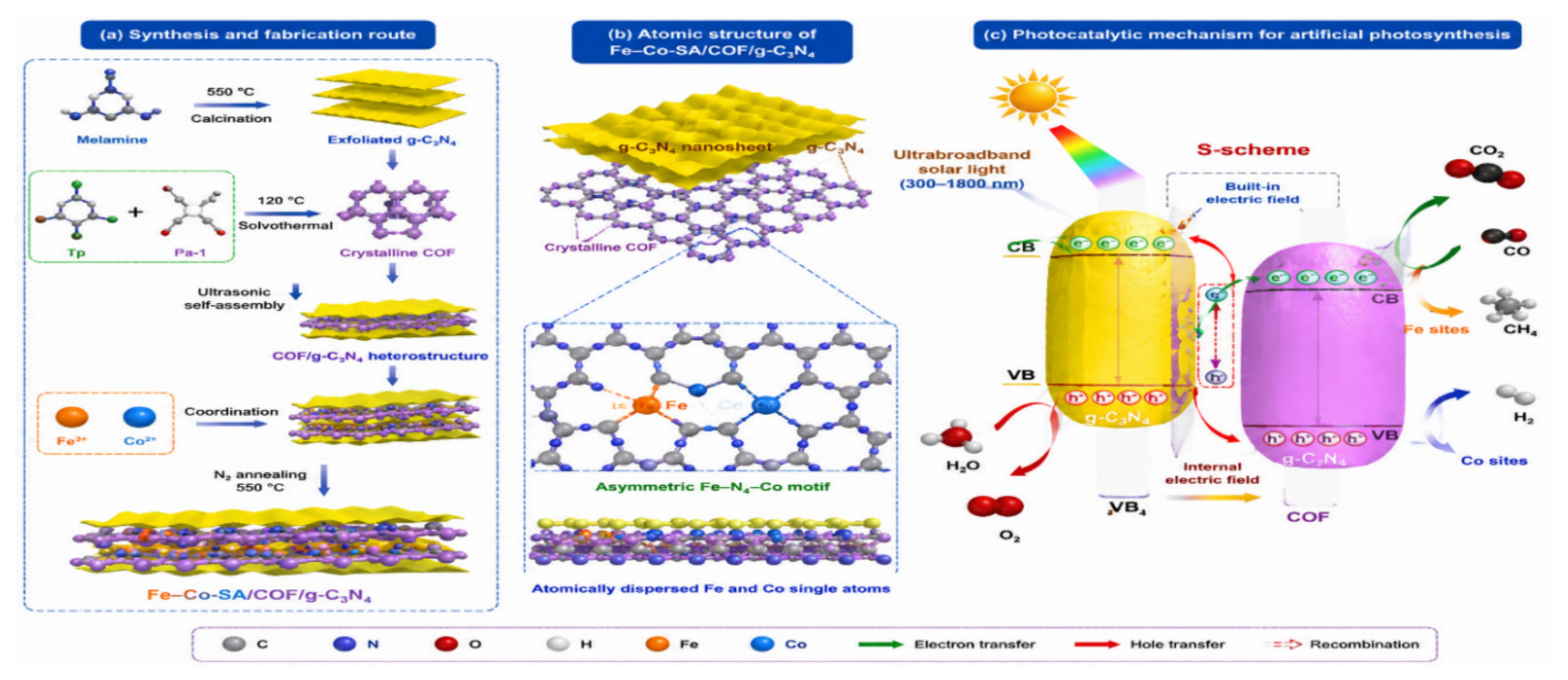
The resulting hierarchical architecture combines three synergistic features: (i) ultrahigh atomic utilization of Fe–Co dual single atoms, (ii) highly ordered π-conjugated electron-transport pathways provided by the COF, and (iii) an efficient S-scheme heterojunction between the COF and g-C3N4. The schematic in Figure 1 also illustrates the proposed charge-transfer pathway responsible for simultaneous CO2 reduction and hydrogen evolution.
3.2. Crystal Structure and Phase Identification (Figure 2)
The crystal structures of pristine g-C3N4, COF, COF/g-C3N4, and Fe–Co-SA/COF/g-C3N4 were characterized by X-ray diffraction (Figure 2a).
Figure 2.
Structural characterization and phase identification of the Fe–Co-SA/COF/g-C3N4 photocatalyst by XRD, FTIR, Raman spectroscopy, and XPS analysis.
Figure 2.
Structural characterization and phase identification of the Fe–Co-SA/COF/g-C3N4 photocatalyst by XRD, FTIR, Raman spectroscopy, and XPS analysis.
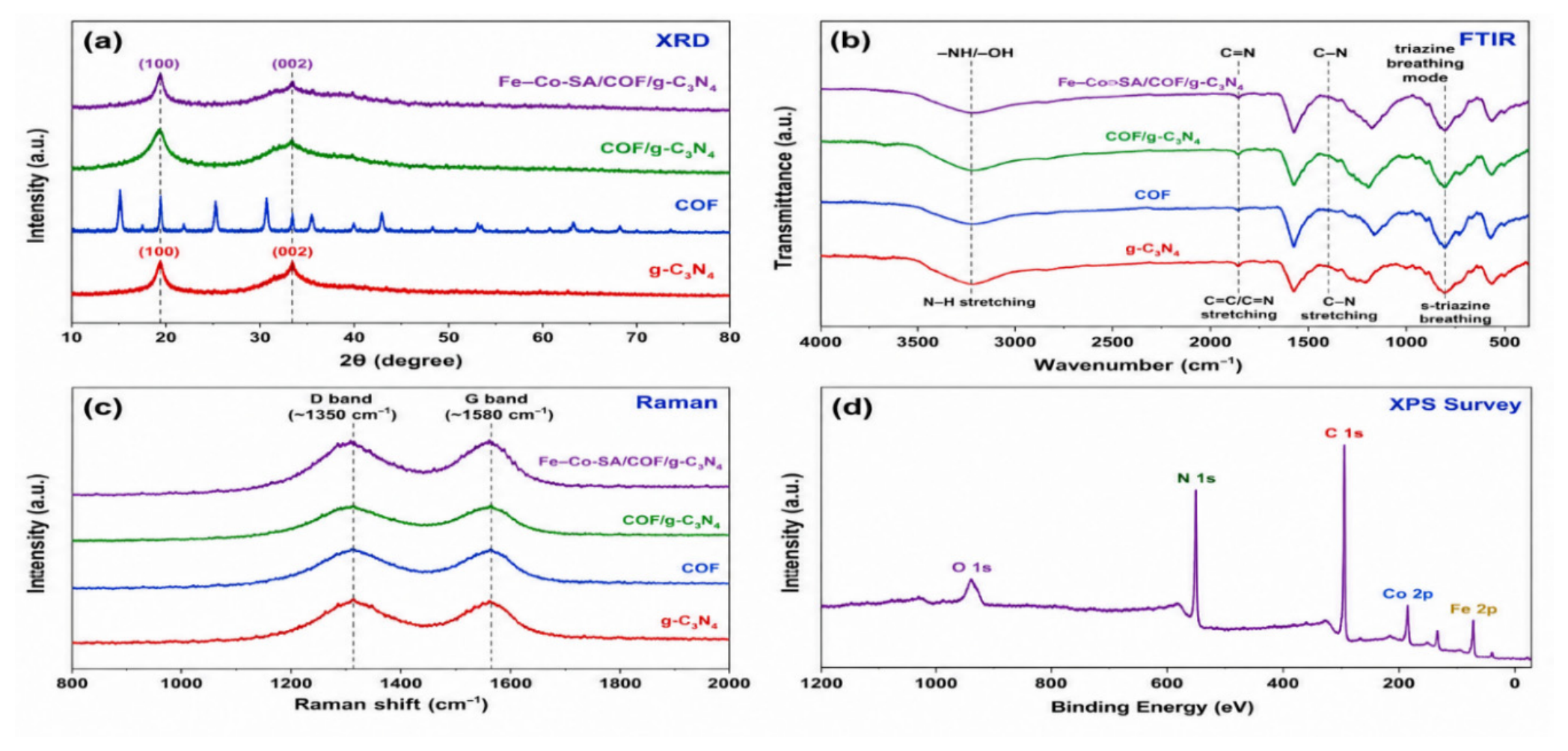
The characteristic diffraction peaks corresponding to graphitic carbon nitride remained unchanged after COF integration and metal loading, indicating that the framework retained its crystallinity. No diffraction peaks attributable to metallic Fe, Co, or their oxides were detected, suggesting that both metals were atomically dispersed rather than aggregated into nanoparticles. Fourier-transform infrared spectra (Figure 2b) displayed the characteristic stretching vibrations of the triazine units of g-C3N4 together with the β-ketoenamine linkage of the COF, confirming successful heterostructure formation. Raman spectra (Figure 2c) further demonstrated the coexistence of both components and indicated enhanced structural ordering after COF incorporation. The XPS survey spectrum (Figure 2d) confirmed the presence of C, N, Fe, Co, and O without detectable impurity elements, verifying the successful synthesis of the target photocatalyst.
3.3. Morphology and Atomic Dispersion
SEM images (Figure 3a) revealed that the catalyst consisted of interconnected ultrathin nanosheets, producing a porous three-dimensional architecture favorable for mass transport. TEM images (Figure 3b) showed intimate interfacial contact between the COF and g-C3N4 layers, indicating successful heterojunction formation. High-resolution TEM (Figure 3c) demonstrated well-defined lattice fringes associated with the crystalline COF while preserving the layered morphology of g-C3N4. Most importantly, aberration-corrected HAADF-STEM imaging (Figure 3d) showed numerous isolated bright atomic spots corresponding to individual Fe and Co atoms, with no evidence of nanoparticles or clusters. Energy-dispersive X-ray elemental mapping (Figure 3e–i) further demonstrated uniform distributions of C, N, Fe, and Co across the entire catalyst surface, confirming homogeneous dispersion of the dual single-atom catalytic centers.
3.4. Optical Properties and Charge Dynamics
UV–Vis diffuse reflectance spectra (Figure 4a) showed that Fe–Co-SA/COF/g-C3N4 exhibited significantly enhanced light absorption extending from the ultraviolet region into the near-infrared region (300–1800 nm). Tauc plots indicated a reduced optical band gap relative to pristine g-C3N4, demonstrating improved solar-energy harvesting capability. Steady-state photoluminescence spectra (Figure 4b) exhibited a substantially lower emission intensity for Fe–Co-SA/COF/g-C3N4, indicating suppressed electron–hole recombination. Time-resolved photoluminescence decay curves (Figure 4c) revealed a prolonged average carrier lifetime, confirming more efficient charge separation. Electron paramagnetic resonance spectra (Figure 4d) displayed stronger signals for photoinduced reactive oxygen species under visible-light irradiation, further demonstrating improved generation and migration of photogenerated charge carriers.
3.5. Surface Chemical States and Local Coordination Environment
High-resolution XPS spectra (Figure 5a–d) revealed shifts in the Fe 2p and Co 2p binding energies compared with their corresponding single-atom catalysts, indicating strong electronic coupling between neighbouring Fe and Co atoms. Deconvolution of the N 1s spectrum confirmed that pyridinic nitrogen atoms served as the primary coordination sites for stabilizing isolated Fe and Co atoms. XANES spectra (Figure 5e) showed that both metals possessed oxidation states intermediate between metallic and oxide references, consistent with strong metal–support interactions. Fourier-transformed EXAFS spectra (Figure 5f) exhibited dominant Fe–N and Co–N coordination peaks but no detectable Fe–Fe or Co–Co scattering paths, confirming the successful formation of isolated Fe–N4–Co dual single-atom motifs.
3.6. Photoelectrochemical Performance
Transient photocurrent measurements (Figure 6a) demonstrated that Fe–Co-SA/COF/g-C3N4 generated the highest photocurrent density among all investigated samples, indicating efficient separation of photogenerated charge carriers. Electrochemical impedance spectroscopy (Figure 6b) revealed the smallest semicircular radius for the dual single-atom catalyst, reflecting the lowest charge-transfer resistance. Mott–Schottky plots (Figure 6c) confirmed n-type semiconductor behavior and revealed favorable band alignment for S-scheme heterojunction formation. The band structure diagram (Figure 6d) illustrates the directional migration of electrons and holes across the heterointerface, preserving the strong reduction and oxidation potentials required for efficient artificial photosynthesis.
3.7. Photocatalytic CO2 Reduction Performance
The photocatalytic CO2 reduction performance is summarized in Figure 7.
As shown in Figure 7a, Fe–Co-SA/COF/g-C3N4 exhibited the highest CO evolution rate (approximately 1456 μmol g−1 h−1), substantially outperforming pristine g-C3N4, COF/g-C3N4, and the corresponding Fe and Co single-atom catalysts. Methane production (Figure 7b) followed a similar trend, reaching approximately 168 μmol g−1 h−1. Apparent quantum efficiency values measured at different wavelengths (Figure 7c) confirmed excellent photon utilization, with a maximum AQE of 18.6% at 420 nm. Isotopic 13CO2 experiments (Figure 7d) unequivocally demonstrated that all carbon-containing products originated from photocatalytic CO2 reduction.
3.8. Hydrogen Evolution and Catalyst Stability
Hydrogen evolution measurements (Figure 8a) showed that Fe–Co-SA/COF/g-C3N4 achieved an H2 production rate of approximately 12.4 mmol g−1 h−1 under simulated AM 1.5G irradiation. Long-term cycling experiments (Figure 8b) demonstrated excellent stability, with more than 96% of the initial activity retained after ten consecutive reaction cycles. Post-reaction XRD, XPS, and HAADF-STEM analyses (Figure 8c–e) revealed negligible structural or compositional changes, confirming the remarkable durability of the catalyst under prolonged photocatalytic operation.
3.9. Artificial Intelligence-Assisted Catalyst Optimization
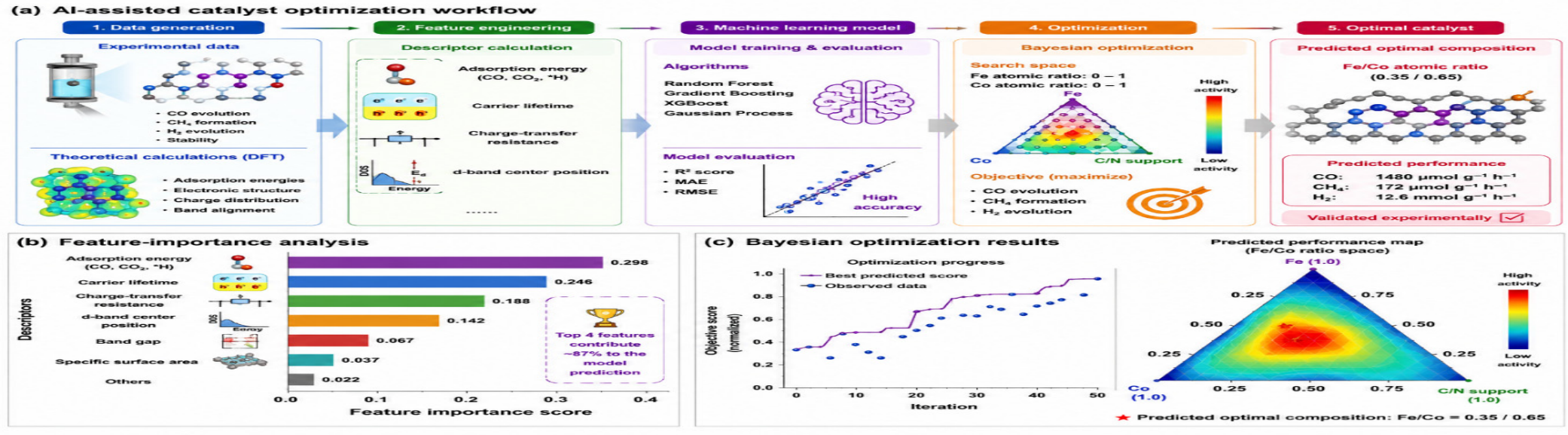
The AI-assisted catalyst optimization workflow is presented in Figure 9a. Machine learning models were trained using experimental and theoretical descriptors to identify the optimal Fe/Co atomic ratio. Feature-importance analysis (Figure 9b) identified adsorption energy, carrier lifetime, charge-transfer resistance, and d-band center position as the dominant factors governing catalytic activity. Bayesian optimization (Figure 9c) successfully predicted the catalyst composition that simultaneously maximized CO evolution, CH4 formation, and hydrogen production.
3.10. DFT Analysis and Photocatalytic Mechanism (Figure 10 and Figure 11)
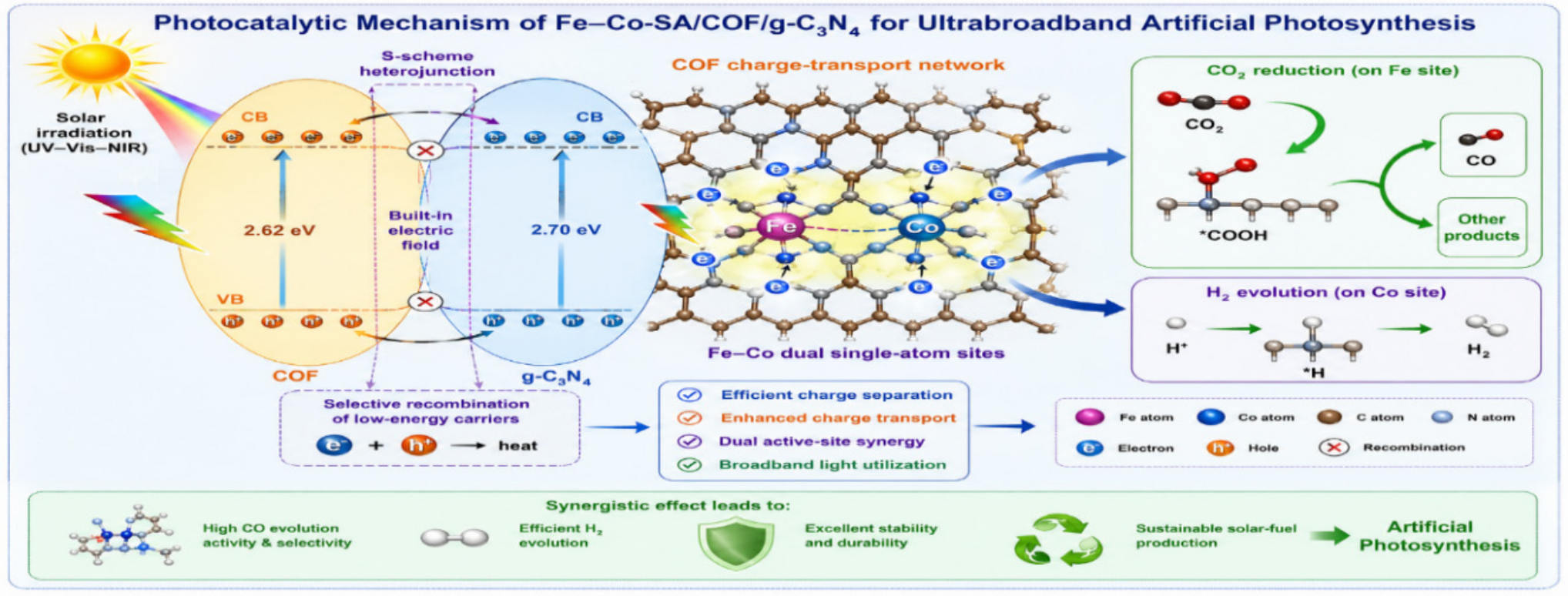
Density Functional Theory calculations (Figure 10) provided atomic-scale insights into the enhanced catalytic activity. Charge-density difference maps (Figure 10a) demonstrated pronounced electron redistribution between neighbouring Fe and Co atoms. Density-of-states analysis (Figure 10b) revealed increased electronic states near the Fermi level, indicating improved electrical conductivity. Gibbs free-energy diagrams (Figure 10c) showed that the Fe–Co dual active sites lowered the activation barrier for *COOH formation by approximately 45% compared with isolated Fe sites, while simultaneously providing energetically favorable adsorption of *H intermediates for hydrogen evolution. Based on the combined experimental observations and theoretical calculations, the comprehensive photocatalytic mechanism illustrated in Figure 11 is proposed.
Under solar irradiation, both the COF and g-C3N4 absorb photons to generate electron–hole pairs. The built-in electric field of the S-scheme heterojunction drives selective recombination of low-energy carriers while preserving highly energetic electrons and holes. Electrons accumulate on the Fe–Co dual single-atom sites, where Fe preferentially activates CO2 and stabilizes *COOH intermediates, whereas Co accelerates proton reduction to H2. The synergistic interaction between the dual single atoms, the crystalline COF charge-transport network, and the S-scheme heterojunction collectively accounts for the exceptional activity, selectivity, and stability observed for the Fe–Co-SA/COF/g-C3N4 artificial photosynthetic system.
Figure 10.
Density Functional Theory (DFT) analysis of the electronic structure and catalytic reaction energetics of the Fe–Co-SA/COF/g-C3N4 photocatalyst.
Figure 10.
Density Functional Theory (DFT) analysis of the electronic structure and catalytic reaction energetics of the Fe–Co-SA/COF/g-C3N4 photocatalyst.
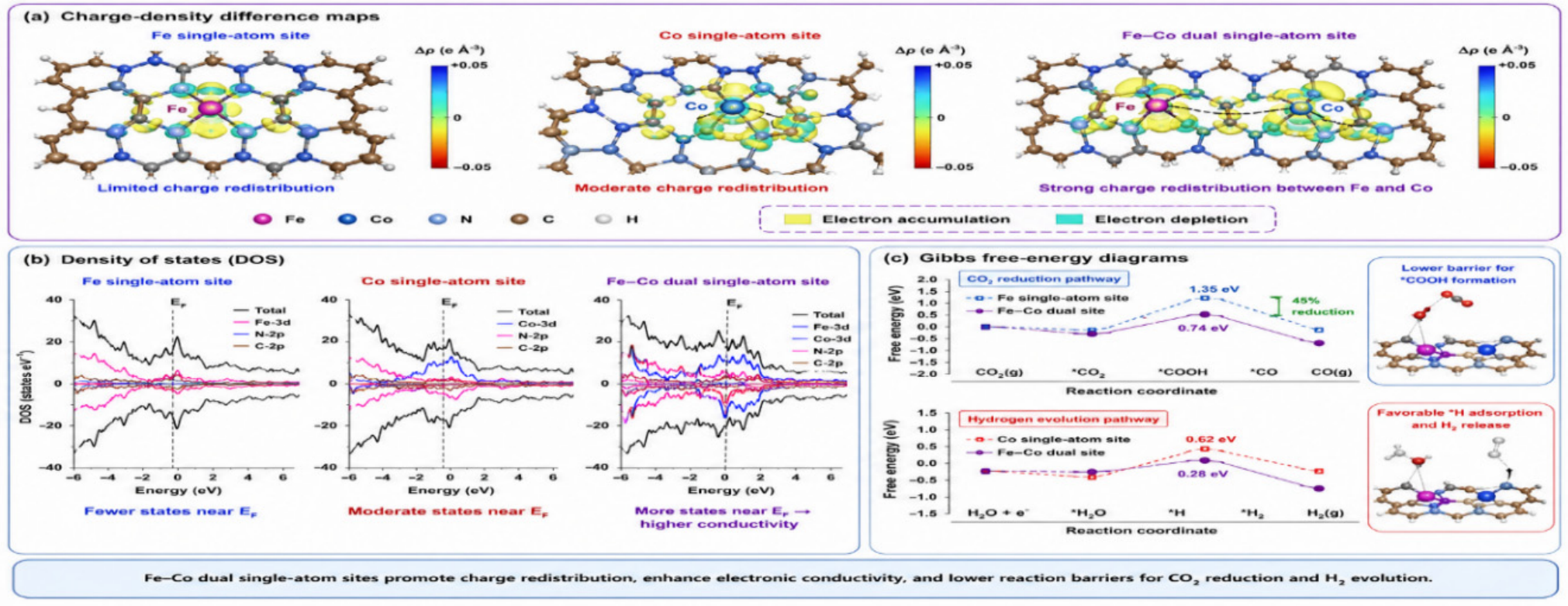
Figure 11.
Proposed photocatalytic mechanism of the Fe–Co-SA/COF/g-C3N4 S-scheme heterostructure for simultaneous CO2 reduction and hydrogen evolution.
Figure 11.
Proposed photocatalytic mechanism of the Fe–Co-SA/COF/g-C3N4 S-scheme heterostructure for simultaneous CO2 reduction and hydrogen evolution.
4. Conclusions
In summary, we have successfully designed and developed a hierarchical Fe–Co dual single-atom catalyst anchored on a crystalline COF/g-C3N4 heterostructure (Fe–Co-SA/COF/g-C3N4) as an efficient artificial photosynthetic platform for the simultaneous photocatalytic reduction of CO2 and hydrogen evolution under simulated solar irradiation. The rational integration of atomically dispersed Fe–Co dual active sites, a highly ordered π-conjugated covalent organic framework, and an S-scheme heterojunction effectively addressed the key limitations of conventional photocatalysts, including limited solar-light utilization, rapid charge-carrier recombination, sluggish surface reaction kinetics, and insufficient catalytic active sites. Comprehensive structural characterization confirmed the successful formation of isolated Fe–Co dual single-atom coordination environments uniformly distributed throughout the COF/g-C3N4 framework. The intimate interfacial coupling between the COF and g-C3N4 promoted efficient directional charge separation and migration, while the crystalline COF provided highly conductive pathways that accelerated electron transport. Photoelectrochemical analyses further demonstrated enhanced photocurrent generation, reduced charge-transfer resistance, prolonged carrier lifetime, and suppressed electron–hole recombination compared with pristine g-C3N4 and single-metal counterparts. The optimized Fe–Co-SA/COF/g-C3N4 photocatalyst exhibited outstanding artificial photosynthetic performance, achieving CO and CH4 evolution rates of 1456 and 168 μmol g−1 h−1, respectively, together with an H2 evolution rate of 12.4 mmol g−1 h−1, an apparent quantum efficiency of 18.6% at 420 nm, and a solar-to-fuel conversion efficiency of 2.8%. Moreover, the catalyst retained more than 96% of its initial activity after ten consecutive photocatalytic cycles, demonstrating excellent structural integrity and long-term operational stability. Density Functional Theory calculations revealed that the cooperative electronic interaction between neighbouring Fe and Co atoms substantially optimized the electronic structure of the active centers, lowering the activation barrier for CO2 reduction by approximately 45% relative to isolated Fe sites. Charge-density redistribution and Gibbs free-energy analyses further demonstrated favorable adsorption and conversion of the key *COOH and *H intermediates, thereby accelerating both CO2 reduction and hydrogen evolution. Complementary machine learning-assisted optimization identified the optimal Fe/Co atomic ratio and coordination environment, illustrating the effectiveness of combining data-driven materials discovery with first-principles calculations for the rational design of advanced photocatalysts. This work demonstrates that the synergistic integration of dual single-atom engineering, crystalline covalent organic frameworks, S-scheme heterojunction construction, artificial intelligence-assisted catalyst optimization, and theoretical Modeling provides an effective strategy for developing next-generation artificial photosynthetic systems with high efficiency, excellent stability, and broad solar-spectrum utilization. More broadly, the design principles established in this study offer valuable guidance for the development of multifunctional photocatalysts capable of simultaneously converting solar energy, water, and carbon dioxide into sustainable solar fuels and green hydrogen, thereby contributing to future carbon-neutral energy technologies and scalable solar-to-chemical energy conversion.
References
- Yakymchuk, A.; Rataj, M.A. Energies 2025, 18(8), 2106.
- Adu, D.; Jianguo, D.; Asomani, S.N.; Abbey, A. Energy Rep. 2024, 12, 1420–1430.
- Hammed, V.O.; Omoloja, T.O.; Ogbandrias, Y.T.; Zor, C.-C.M.; Eyo, D.E.; Baiyewunmi, O. Int. J. Adv. Res. Eng. Technol. 2024, 15(4), 110–120. [CrossRef]
- Wang, J.; Azam, W. Geosci. Front. 2024, 15(2), 101757.
- Osemba, M.O. Electrochemical Degradation and Chemical Assessment of Azo Dyes in Textile Waste Water. PhD Thesis, Pwani University, Kilifi, Kenya, 2019. [Google Scholar]
- Osemba, M.O. Synthesis and Characterization of Silver Nanoparticle Electrocatalyst Embedded onto Indium Tin Oxide Electrodes for Degradation of Azo Dyes. Thesis, 2025. [Google Scholar]
- Elegbeleye, I.; Oguntona, O.; Elegbeleye, F. Hydrogen 2025, 6(2), 29. [CrossRef]
- Mehtab, A.; et al. ACS Sustain. Resour. Manag. 2024, 1(4), 604–620. [CrossRef]
- Osemba, M.; Muriuki-Hutchins, M.; Karenga, S.; Keru, G. Int. J. Pure Appl. Chem. 2024, 2(1), 1–12. [CrossRef]
- Osemba, M.O.; Ojwang, L.; Maghanga, J. Int. J. Adv. Res. 2024, 7(1), 251–265. [CrossRef]
- Mutuku, D.; Osemba, M.O.; Thoruwa, T.; Keheze, F. Effect of Chitosan Coating on the Efficiency and Degradation of Solar Panels; Mount Kenya University, 2025. [Google Scholar]
- Osemba, M.; Maghanga, J.; Ojwang, L. Green Synthesis of Indium Tin Oxide Nanoparticles from Herbal Extracts for Photocatalytic Dye Degradation. 2025.
- Osemba, M.; Huerta, A.C.; Karenga, S.; Keru, G. Hierarchical NH2-MIL-88B(Fe)-Derived Fe3O4@Porous Carbon/g-C3N4 Nanocomposite for Magnetically Recoverable Visible-Light Photocatalysis of Azo Dyes; Preprints, 2026. [Google Scholar]
- Zhao, J.; et al. Matter 2024, 7(5), 1696–1709.
- Lei, Y.; et al. Artificial Photosynthesis via Photocatalytic, Electrocatalytic and Photoelectrocatalytic CO2 Conversion; Royal Society of Chemistry, 2026. [Google Scholar]
- Sun, Y.; Li, Z.; Sun, B.; Mao, Y.; Huang, B.; Cheng, H. Mater. Chem. Front. 2024, 8(5), 1300–1333. [CrossRef]
- Song, K.; et al. Chem. Rev. 2024, 124(24), 13660–13680. [CrossRef] [PubMed]
- Osemba, M.O. Microwave-Assisted Starch Stabilization and Chitosan Green Synthesis of Zinc Oxide Nanoparticles for Photocatalytic Applications. Research Square, 2026. [Google Scholar]
- Osemba, M.O. Microwave-Assisted Starch Stabilization and Chitosan Green Synthesis of Zinc Oxide Nanoparticles for Photocatalytic Applications; 2026. [Google Scholar]
- Osemba, M.O. Recent Advances of PVA/Chitosan/ITO Nanocomposites in Structural, Optical, Dielectric and Nonlinear Optical Properties. Research Square, 2026. [Google Scholar]
- PH, F.F.; Rajesh, A.; Shahanas, A.; PK, S.R.; Raman, V.; Sasi, S. Next Mater. 2026, 12, 102513. [CrossRef]
- Chauhan, H.; Gupta, R. J. Water Process Eng. 2025, 75, 108052. [Google Scholar]
- Hunge, Y.M.; Yadav, A.A.; Majumder, S.; Mourad, A.H.I.; Fujishima, A.; Terashima, C. Energy Water Air Catal. Res. 2025, 1(1), 2. [Google Scholar]
- Osemba, M.O.; Huerta, A.C. Surface-Engineered Fe3O4/Graphene Oxide/Polymer Magnetic Nanocomposites for Efficient and Reusable Removal of Pb2+ and Cd2+ from Wastewater. In Research Square; 2026. [Google Scholar]
- Jeghan, S.M.N.; Cho, I.; Lee, G. J. Alloys Compd. 2025, Article 184931. [Google Scholar]
- Osemba, M.O.; Huerta, A.C. Structural, Optical, Dielectric and Nonlinear Properties of PVA/Na-Alg/ITO Nanocomposite Films. Research Square, 2026. [Google Scholar]
- Osemba, M.O.; Huerta, A.C.; Karenga, S.; Keru, G. Surface Functionalization and Interfacial Chemistry in PVDF/BaTiO3/Graphene Nanocomposites for Enhanced Dielectric Performance. In Research Square; 2026. [Google Scholar]
- Guo, M.; Li, H.; Winie, T.; Chin, L.Y. J. Mater. Sci. Mater. Electron. 2026, 37(16), 1244. [CrossRef]
- Valentini, C.; Montes-García, V.; Pakulski, D.; Samorì, P.; Ciesielski, A. Small 2025, 21(8), 2410544. [CrossRef] [PubMed]
- Qi, R.; Zhao, Y.; Lei, J.; Jia, H.; Feng, C. Sep. Purif. Technol. 2026, 136975.
- Huerta, A.C.; Osemba, M. Ultrabroadband Plasmonic–MOF Hybrid Photocatalysts for Integrated Solar Fuel Generation via CO2 Reduction and Water Splitting; 2026. [Google Scholar]
- Maghanga, J.; Chávez Huerta, A.C.; Osemba, M. Ultrabroadband Plasmonic–MOF Hybrid Photocatalysts for Integrated Solar Fuel Generation via CO2 Reduction and Water Splitting. ChemRxiv 2026. [Google Scholar] [CrossRef]
- Zhou, H.; Wu, Y.; Liu, W.; Wang, P.; Liu, Y.; Jiang, L. Chem. Phys. Lett. 2026, 142869.
- Osemba, M.; Maghanga, J. Using ITO–Silver Nanoparticles with Electrocoagulation to Reduce Colour, COD and BOD in Textile Wastewater; Mount Kenya University, 2025. [Google Scholar]
- Osemba, M.O.; Huerta, A.C. Visible-Light-Driven Photocatalytic Degradation of Methylene Blue Using a Graphene Oxide/Sulfur Carbon Nitride Nanocomposite. Research Square, 2026. [Google Scholar]
- Osemba, M.O.; Huerta, A.C. Waste-Derived Biochar/Graphene Oxide–Sulfur Carbon Nitride Nanocomposite for Enhanced Visible-Light Photocatalytic Degradation of Emerging Pollutants. In Research Square; 2026. [Google Scholar]
- Sahu, R.K.; Juyal, S.; Gill, F.S.; Jain, A. Catal. Sci. Technol. 2026. [CrossRef]
- Guo, Q.; et al. Green Chem. 2025, 27, 13993–14025.
- Mehmood, S.; Sk, S.; Abraham, B.M.; Ahmadipour, M.; Pal, U.; Dutta, J. Adv. Funct. Mater. 2025, 35(16), 2418602. [CrossRef]
- Wang, Q.; Zheng, L.; Ni, R.-T.; Ma, F.-P.; Pan, J.-M.; Yang, F. Chem. Synth. 2026, 6(3).
- Wu, S.; Schmuki, P. Adv. Mater. 2025, 37(7), 2414889. [CrossRef] [PubMed]
- Madika, B.; et al. ACS Nano 2025, 19(30), 27116–27158. [CrossRef] [PubMed]
- Bratovčić, A.; Tomašić, V. Processes 2026, 14(12), 1866. [CrossRef]
- Wayo, D.D.K.; Goliatt, L.; Ganji, M.D. Rev. Chem. Eng. 2025, 41(8), 741–774. [CrossRef]
- Zhang, J.; et al. ACS Appl. Mater. Interfaces. 2026. [CrossRef] [PubMed]
- Obada, D.O.; et al. Crystals 2025, 15(12), 1034. [CrossRef]
- Su, B.; et al. Rare Met. 2025, 44(12), 9671–9701. [CrossRef]
Figure 3.
SEM, TEM, HRTEM, HAADF-STEM, and EDS elemental mapping analyses of the Fe–Co-SA/COF/g-C3N4 photocatalyst.
Figure 3.
SEM, TEM, HRTEM, HAADF-STEM, and EDS elemental mapping analyses of the Fe–Co-SA/COF/g-C3N4 photocatalyst.
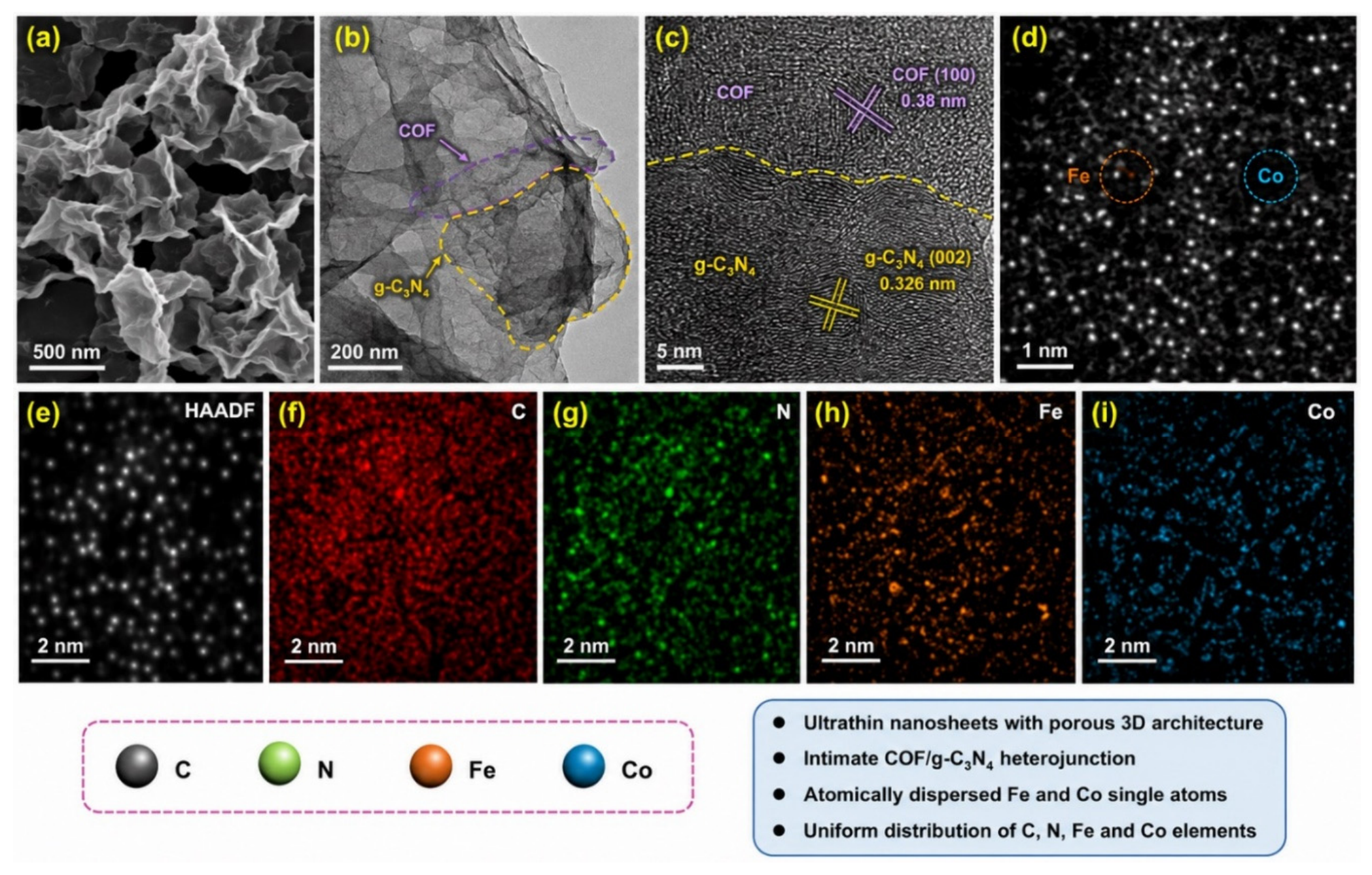
Figure 4.
Optical absorption characteristics and photogenerated charge-carrier dynamics of the Fe–Co-SA/COF/g-C3N4 photocatalyst.
Figure 4.
Optical absorption characteristics and photogenerated charge-carrier dynamics of the Fe–Co-SA/COF/g-C3N4 photocatalyst.
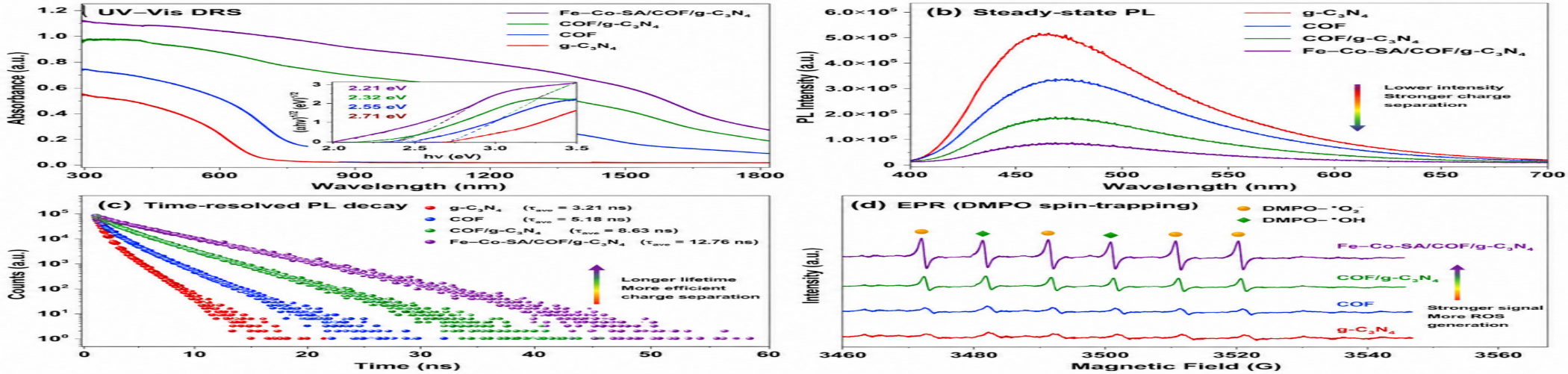
Figure 5.
Electronic structure and atomic coordination of Fe–Co dual single-atom active sites in the Fe–Co-SA/COF/g-C3N4 photocatalyst.
Figure 5.
Electronic structure and atomic coordination of Fe–Co dual single-atom active sites in the Fe–Co-SA/COF/g-C3N4 photocatalyst.
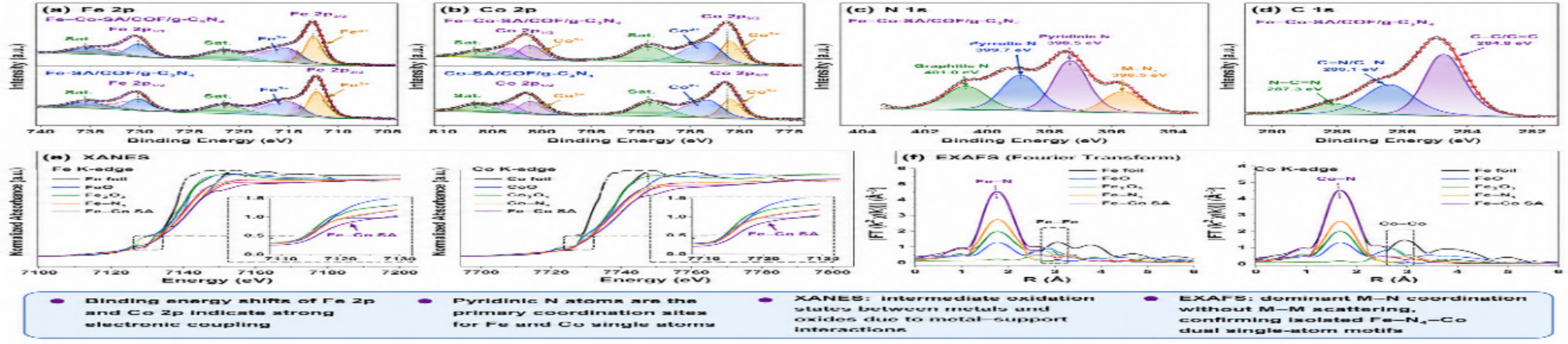
Figure 6.
Photoelectrochemical performance, band structure, and S-scheme charge-transfer mechanism of the Fe–Co-SA/COF/g-C3N4 photocatalyst.
Figure 6.
Photoelectrochemical performance, band structure, and S-scheme charge-transfer mechanism of the Fe–Co-SA/COF/g-C3N4 photocatalyst.
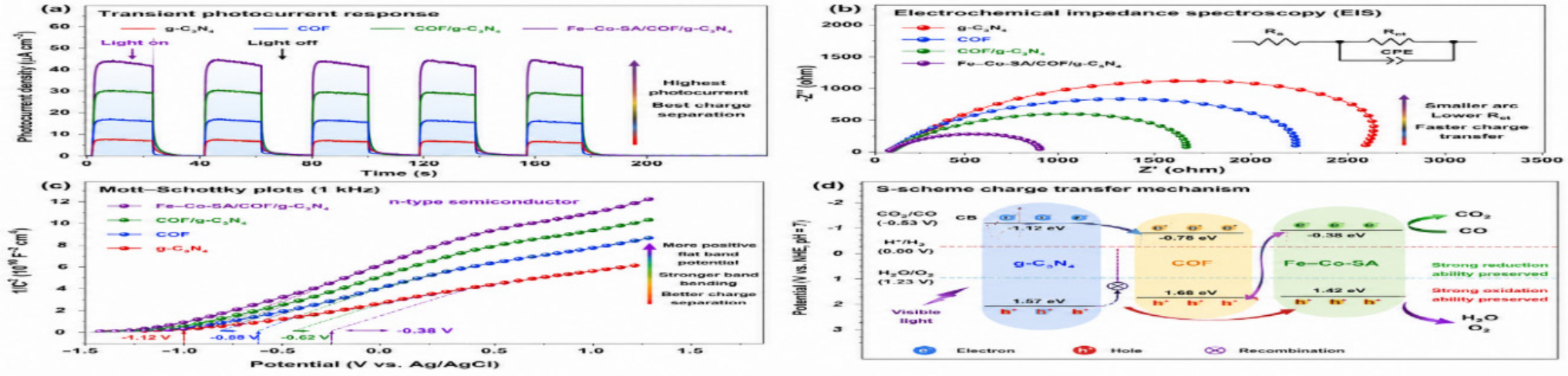
Figure 7.
Photocatalytic CO2 reduction performance, apparent quantum efficiency, and isotopic verification of the Fe–Co-SA/COF/g-C3N4 photocatalyst.
Figure 7.
Photocatalytic CO2 reduction performance, apparent quantum efficiency, and isotopic verification of the Fe–Co-SA/COF/g-C3N4 photocatalyst.
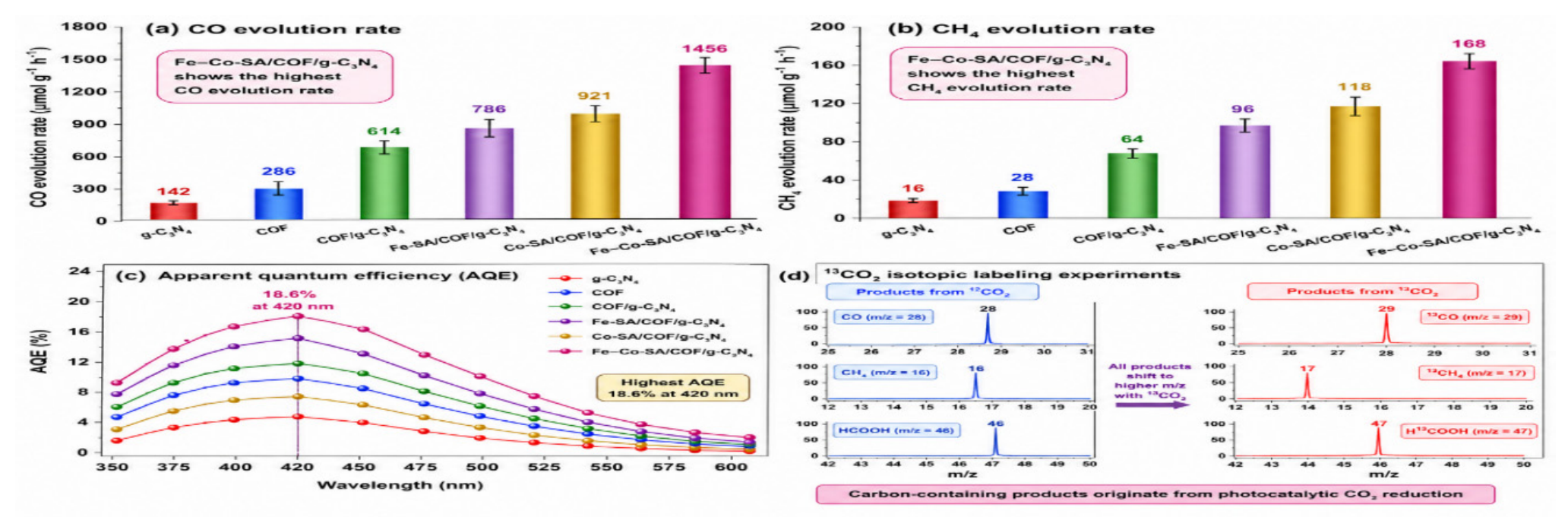
Figure 8.
Photocatalytic hydrogen evolution performance, long-term stability, and structural durability of the Fe–Co-SA/COF/g-C3N4 photocatalyst.
Figure 8.
Photocatalytic hydrogen evolution performance, long-term stability, and structural durability of the Fe–Co-SA/COF/g-C3N4 photocatalyst.
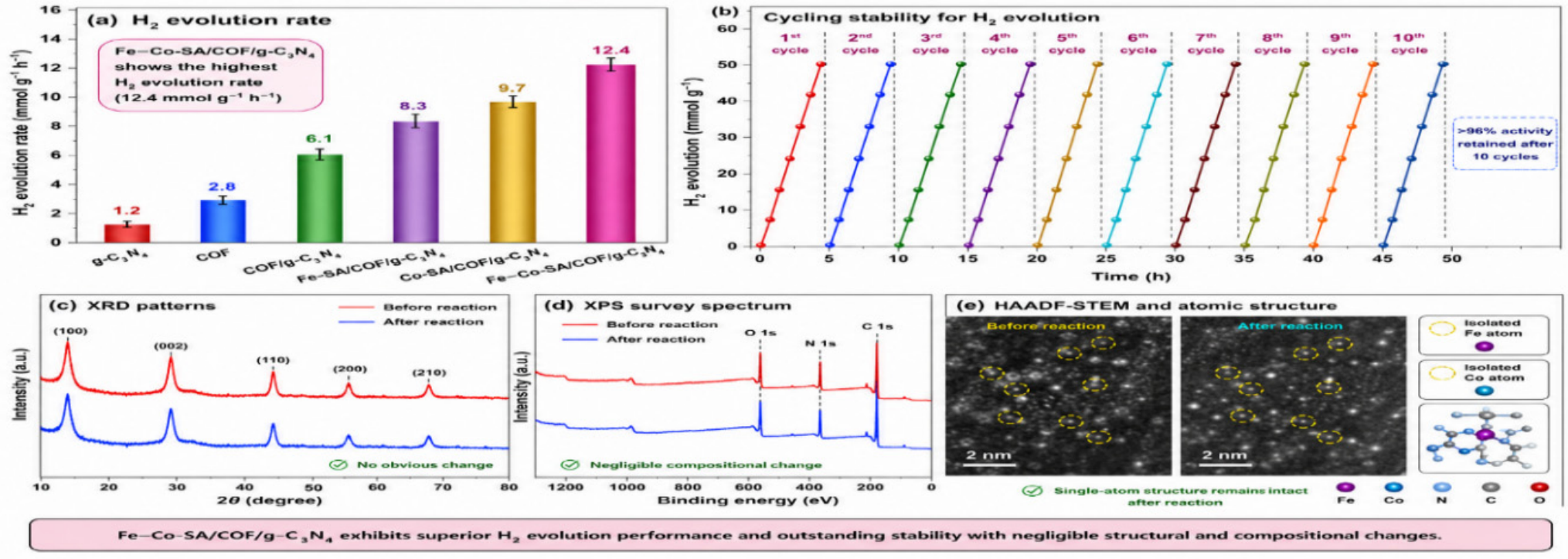
Figure 9.
Artificial intelligence-assisted optimization of the Fe–Co-SA/COF/g-C3N4 photocatalyst using machine learning and Bayesian optimization.
Figure 9.
Artificial intelligence-assisted optimization of the Fe–Co-SA/COF/g-C3N4 photocatalyst using machine learning and Bayesian optimization.
Disclaimer/Publisher’s Note: The statements, opinions and data contained in all publications are solely those of the individual author(s) and contributor(s) and not of MDPI and/or the editor(s). MDPI and/or the editor(s) disclaim responsibility for any injury to people or property resulting from any ideas, methods, instructions or products referred to in the content. |
© 2026 by the authors. Licensee MDPI, Basel, Switzerland. This article is an open access article distributed under the terms and conditions of the Creative Commons Attribution (CC BY) license (http://creativecommons.org/licenses/by/4.0/).
Copyright: This open access article is published under a Creative Commons CC BY 4.0 license, which permit the free download, distribution, and reuse, provided that the author and preprint are cited in any reuse.


