

Submitted:
29 June 2026
Posted:
01 July 2026
You are already at the latest version
Abstract
Since its inception in the 19th century, the concept of ecology has continuously expanded in scope—from individual organisms to the biosphere—and deepened in focus, shifting from organism-environment interactions to the structures and functions of ecosystems. As an interdisciplinary concept prone to controversy and revision, ecology plays a pivotal role in advancing ecological civilization. However, the absence of a mechanism-based and time-appropriate definition has hindered the integration of cross-hierarchical research and the response to practical demands amid global environmental changes. This paper briefly reviews the origin and evolutionary context of the ecology concept and identifies the limitations of previous definitions. It then elaborates on the essence of ecology, and proposes an updated redefinition: Ecology explores the structures and functions (material cycling and energy flow) of the bio-hierarchy (total ecosystems), which is co-shaped by information-mediated feedback regulation between organisms and their biotic and abiotic environments, self-organization and structuralization, as well as human-nature coupling, and provides theoretical foundation and practical solutions for the harmonious coexistence between humanity and nature. Finally, the paper outlines future research directions centered on establishing a unified, cross-hierarchical ecological theoretical framework to support ecological civilization construction and global eco-environmental governance.
Keywords:
redefinition
; ecology
; interdisciplinary concept
; cross-hierarchical
; structures and functions
; information-mediated feedback
; self-organization
; structuralization
; human-nature coupling
; theoretical framework
1. Why Is a Better Definition of Ecology Needed?
A concept is a cognitive unit developed by humans through the abstract generalization of the essential features, shared attributes of objective entities, as well as the abstract underlying relationships and laws revealed in the process of understanding the world (Dove 2022, Laycock 2023). It can be stabilized and standardized through language or other symbolic systems (Langacker 1991). However, concepts are not immutable; instead, they evolve in tandem with the expansion of cognitive boundaries, shifts in application scenarios, and transformations in cognitive perspectives, and thus possess an inherent impetus for iterative refinement (Williams et al. 2018). Some concepts, especially interdisciplinary ones like ecology, are prone to controversy and revision due to their ambiguous boundaries, cross-domain applications, entanglement with value judgments, or rapid evolution alongside the advancement of human cognition (Palti 2024). Given that a precise and well-articulated definition of such a concept not only orients related research with clear directionality but also provides robust theoretical framework for practical applications, exploring the essence of ecology and formulating a scientific, time-appropriate definition has become essential in contemporary ecological research.
Ecology encompasses scales ranging from the microcosm of a single drop of water to the macrocosm of the entire biosphere (Xie 2013). Adopted and applied across a broad spectrum of disciplines, ecology is shaped by evolving human values toward nature, while technological advancements catalyze rapid shifts in how humans perceive and understand ecological processes. As an example, ecology currently occupies a pivotal and irreplaceable position in China. Since the turn of the 21st century, ecological research in China has experienced unprecedented development. In 2011, the Academic Degrees Committee of the State Council separated ecology from the field of biology, officially designating it as a first-class discipline (Fang 2021, Yu et al. 2021). At the 19th National Congress of the Communist Party of China, the construction of ecological civilization was elevated to an unprecedented strategic height, and the concept that "humanity and nature form a community of life, and humanity must respect, adapt to, and protect nature" was proposed (Fu et al. 2020, Wei et al. 2021). The Congress further highlighted the significance of strengthening biodiversity conservation and enhancing ecosystem stability in China—practical goals that require a scientific and time-appropriate definition of ecology to provide theoretical guidance.
The preservation of biodiversity and the maintenance of ecosystem stability constitute the core of ecological research at small and medium spatiotemporal scales, whereas species evolution and ecosystem development represent the focal points of research at large spatiotemporal scales. The former tends to prioritize ecological processes—centering on the dynamic interactions within ecosystems—while the latter emphasizes ecological patterns, focusing on the emergent, structured characteristics of ecosystems across broader scales. These two lines of inquiry are mutually causal and interdependent, yet their integration and unified interpretation have long been constrained by the absence of a macroscopically inclusive and mechanism-based ecology concept that covers cross-hierarchical processes, human-nature interaction dimensions, and contemporary global environmental change contexts.
Against this backdrop, we elaborate on the following questions: How has the definition of ecology changed over time? What mechanisms drive bio-hierarchical processes? How should ecology be redefined to meet current research and practical demands? After addressing these questions, we propose a redefinition framework of ecology that integrates cross-hierarchical processes, information-mediated feedback regulation, and human-nature coupling. We then outline the corresponding research priorities and future prospects to provide a theoretical foundation for the development of ecological civilization and for global ecological environmental governance (Figure 1).
2. How Did the Definition of Ecology Change?
The term ‘ecology’ (from the Greek 'oikos' meaning home or habitat) was coined by Ernst Haeckel in 1866 to denote the science of Darwin’s "Struggle for Existence". As organisms compete for scarce environmental resources, studies on the evolutionary outcomes of such interactions formed evolutionary biology, while investigations into the interactions themselves established ecology (Cooper 2003). Nearly 160 years have passed since Haeckel’s initial definition, and since then a diverse array of alternative definitions has been proposed (Figure 2, Table 1). All these definitions capture distinct facets of ecology and possess their own inherent validity. Early definitions in the first century focused largely on organismal interactions with biotic and abiotic surroundings. Conceptualisation has since been progressively expanded: Odum integrated ecosystem structure and function into the definition in 1971; Likens supplemented energy and matter transformation and flux in 1992; Mackenzie et al. included global biological organisation in 1998; Odum and Barrett added biospheric organisation, operation and sustainable management in 2008; and Comín incorporated mutual feedback mechanisms into ecological definitions in 2010.
It is evident from Table 1 that the definition of ecology is inherently abstract and broad. Yet, the conceptual shifts over time reflect important advances in ecological research and focus over the past century, including: (1) A deepened understanding of the biological hierarchy, expanding from individuals to populations, communities, ecosystems, and ultimately the biosphere; (2) A shift from examining individual factors to investigating the structures and functions of ecological systems; (3) a transition from scattered observations to systematic, structured research; (4) a broadening of the spatiotemporal scales at which ecological phenomena are studied; (5) an extension from purely observational studies of natural systems to research supporting sustainable development of human society and addressing global environmental challenges.
Developing a universally accepted definition of ecology, however, is challenging (Chapman and Reiss 1998, Gunton and Francis 2017, Yu et al. 2021), given the extreme diversity, stochasticity, and complexity exhibited by millions of species (including humans) and their habitats across ecosystem types, processes, patterns, and scales.
The traditional definitions of ecology possess several disadvantages and limitations that render them insufficient for guiding contemporary ecological research and practice. They do not systematically capture the cross-hierarchical coupling mechanisms of ecological processes in the context of global environmental changes, and they do not fully incorporate the role of anthropogenic drivers of ecological dynamics. Moreover, they have paid insufficient attention to ecological driving mechanisms. Although terms such as "organization" and "feedback" occasionally appeared within earlier definitions, they were not included in a systematic, cohesive conceptual framework. No definitions explicitly referenced to the concepts of "information" and “structuralization”, nor did they account for cross-hierarchical information transmission, the nesting of feedback processes across the bio-hierarchy, or the coupling dynamics between human activities and natural ecosystems.
We first elaborate on several core concepts that underpin ecological processes and then examine their fundamental significance to the field of ecology.
3. Notes on Several Concepts on Driving Forces in Ecology
A driving force is a fundamental factor, process, or mechanism that can initiate, sustain, or propel a specific change, evolution, or system behavior.
(1) Information Transmission
The modern concept of "information" was primarily established by Shannon (1948), who defined "information" from an engineering perspective as "something that eliminates uncertainty" and established a quantitative framework for measuring it (including the information entropy formula). Prior to this development, "information" had been used in everyday language and in some academic contexts, but no systematic scientific definition existed. The Chinese term "信息" (xìnxī) had already appeared as early as the Tang and Song Dynasties, where its core meaning was "message or news".
Schrödinger (1944) first proposed the concept that genes contain a "code-script", arguing that this script determines the future developmental patterns and mature functional states of organisms. Watson and Crick (1953) suggested that "the precise sequence of bases might be the code that carries genetical information", formally linking "information" to the molecular structure of genetic material and marking the establishment of this term within the field of biology.
Odum (1953) incorporated information into the theoretical framework of ecosystem energy systems and ecosystems dynamics against the backdrop of the emerging information theory and cybernetics. He emphasized the regulatory role of information in natural and social systems. Through analyses such as the transmission of genetic information in DNA and the perception of environmental signals by organisms, he indirectly elucidated the regulatory value of information for self-organization, stable functioning, and evolutionary development of ecosystems.
(2) Material Circulation and Energy Flow
Descartes (1664) was the first to compare the human body to a sophisticated "automaton". Mayer (1845) recognized life as an energy conversion system. van Helmont (1648) discovered carbon dioxide, while Lavoisier (1789) established the law of conservation of mass through experiments and revealed the transformation of carbon in processes such as respiration and combustion, thereby advancing the understanding of the laws of material transformation. Lindeman (1942) identified the unidirectional flow and gradual attenuation of energy along the food chain (i.e., "Lindeman's Law"), which marked the shift in ecosystem energy flow research from qualitative to quantitative analysis.
Odum (1953) defined material circulation (biogeochemical cycling) and energy flow as the two core functions of ecosystems, emphasizing their interdependence and central role in maintaining ecosystem stability. However, "information" was not a core term but mentioned largely as a derivative concept arising from systems theory.
(3) Feedback
Bernard (1865), although he did not explicitly use the term "feedback", described the core logic of feedback regulation: when external disturbances cause key physiological parameters such as body temperature and blood glucose to deviate from normal levels, the organism initiates targeted reflex mechanisms to counteract the deviation and restore balance. This principle corresponds directly the modern concept of negative feedback, laying the foundation for understanding feedback phenomena in living systems.
Cannon (1932) proposed the concept of "homeostasis" based on Bernard's theory, systematically organizing the negative feedback mechanisms through which organisms maintain internal environmental stability and refining the scientific framework of feedback regulation. Later, Wiener (1948), the founder of cybernetics, pointed out that the maintenance of homeostasis in living systems is essentially consistent with the negative feedback mechanisms in mechanical systems, thereby formally extending the concept of feedback into the general theoretical framework for studying living systems.
Odum (1953) first introduced a cybernetic perspective into ecological research, explicitly proposing that ecosystems regulate material circulation and energy flow through negative feedback mechanisms to maintain their own dynamic balance (initially termed "homeostasis", later revised to "homeorhesis"), although he did not use the term "feedback" directly. Patten (1959) systematically linked entropy, information, and the role of feedback regulation.
From the 1970s onward, feedback mechanisms became the mainstream theoretical framework for explaining ecosystem stability, and scholars empirically confirmed its universality through research on species symbiotic relationships (Molles 2021).
(4) Self-Organization
The concept of "self-organization" in contemporary scientific sense was formally introduced by von Foerster (1974) in the context of cybernetics. In the late 1990s, scientists formally began applying the core logic of self-organization (the "activator-inhibitor" theory, also known as the Turing principle) to explain the formation of ordered patterns in ecosystems (Turing 1952, Klausmeier 1999). In 2004, this theory was applied to explain the "fairy circles" in Namibia (as a spatially self-organized ecosystem phenomenon ), proposing that vegetation can generated ordered structures through self-organization that maximize resource utilization (Caylor and Shugart 2006). The subsequent discovery of fairy circles in termite-free areas of Australia in 2016 further supported the applicability of self-organization theory in ecology (Getzin et al. 2016). Additionally, relevant studies of vegetation pattern formation based on reaction-diffusion dynamics have provided further theoretical support for the application of self-organization theory in ecological research (e.g., Zhao et al. 2021).
(5) Structuration
The Swiss cognitive psychologist Jean Piaget (Piaget 1923, 1926, 1968) refined the concept of "structure" as a systemic attribute with three core characteristics: "wholeness, transformability, and self-regulation", and proposed that concepts do not exist in isolation but are implicitly defined through their interrelationships within a structured whole. This theory laid a scientific foundation for the notion of "structuration".
After the rise of systems theory in ecology during the 1950s and 1960s, scholars such as Odum (1953) focused on the interactions among components and the properties of overall structures in, reinforcing the "structural analysis" approach, even though the term "structuration" was not explicitly used. Pickett and White (1985) proposed the Patch Dynamics Theory, which focuses on the structural characteristics, dynamic changes, and interactions among patches in the landscape. Essentially, this theory investigates the processes of spatial and dynamic structuration in ecosystems.
4. Why Are These Functional Processes Important for Ecology?
Elucidating the function of an ecological element is of greater importance than describing its form. In this section, we outline the dynamic essence of bio-hierarchy to illustrate the core tenets of ecology.
(1) Information as Survival Instructions
Without life, who would behold and marvel at mountains, rivers, oceans, winds, clouds, thunderstorms, celestial bodies, and quantum entanglement? Devoid of perceivers, information bears no intrinsic meaning whatsoever, and life stands as the sole qualified perceiver. Accordingly, prior to the emergence of life, no perceiving subjects or subjective worlds existed, leaving merely the existence, motion and alteration of all substances in the objective world. Since the advent of life, the Earth has inherently been an information-driven world, which has merely grown increasingly prosperous over time.
No information, no life. Ecological information serves as the "source of instructions" for the survival of organisms. Countless examples demonstrate how the transmission of information regulates the behavior of animals and physiological responses of plants, such as the long-distance migrations of birds and the spawning migration of fish populations.
There is long-standing unresolved debate regarding the inherent nature and formal definition of information. For instance, Norbert Wiener declared, "Information is information, not matter or energy" (Wiener 1948). Physicists have suggested alternative interpretations, including "Information as negative entropy" (Brillouin 1956), the "It from bit" hypothesis (Giulini and Kiefer 1994), and the view that "the material world is constituted by information itself" (Myung 2003). These differing definitions are mostly derived from the perspective of non-living systems, ignoring the inherent connection between information and life.
Here, we define information as follows. Information is a biological product that governs feedback, organization, and structuralization across the bio-hierarchy. It promotes the survival of individuals, populations, and species by regulating organisms’ physiology, behaviors, and even mental activities. Information falls into two major types: genetic information and perceptual-cognitive information. The latter encompasses everything perceivable and recognizable to living systems—internal or external, material or spiritual, past or present, direct or indirect, concrete or abstract—including their forms, interrelations, attributes, as well as the processes and intrinsic laws governing their motion and transformation. Information also comprises abiotic information generated via human technologies, such as communication information and artificial intelligent information. In brief, we conceptualize information as a life-derived substance originating alongside the emergence of life and functioning to sustain the survival of all living organisms, humans included. It covers three core categories:
(1) Bio-information: Information that operates autonomously within living systems (e.g., genetic information and molecular information). This category underlines the basic metabolic, developmental, and reproductive activities of organisms, guiding the automatic functioning of a cell or an organism.
(2) Eco-information: Eco-information refers to all perceptible and cognitively processable entities accessible to humans and other organisms. These cover internal and external, tangible and intangible, past and present, direct and indirect, concrete and abstract entities, along with their configurations, interconnections, inherent attributes, as well as the dynamic mechanisms and fundamental laws governing their movement and variation. Such information drives organisms’ physiological, behavioural and psychological adaptations to habitat shifts, directly sustaining individual survival.
Eco-signals fall into three primary categories: physical, chemical and behavioural cues. They propagate across the full biological hierarchy: cells, individuals, populations, communities, ecosystems and the biosphere. As the supreme regulator of ecological dynamics, this system coordinates core ecological processes: organismal metabolism, population reproduction, interspecific competition, predation and anti-predator avoidance, community succession, ecological stability and speciation.
Information forms the quintessential soul of ecology. Innumerable flora, fauna and microorganisms construct an interdependent ecological web through intraspecific and interspecific interactions, within which information, energy and matter circulate sustainably.
(3) Man-made information: Information recorded, stored, disseminated or generated by humans via science and technology (e.g., communication information, intelligent information). This category of information improves human survival and adaptability by broadening the scope of perceptible information and refining response strategies. Fundamentally an extension of human vital activities, it therefore belongs to life-derived information.
Among all forms of life, humanity stands unparalleled: its temporal and spatial perceptual scope for both material and spiritual natural information, its sensory acuity, and the sophistication of the technologies it has forged for transmitting, storing and processing information far surpass those of any other living being. The artificial informational domain and its supporting industries have made nature, forged over billions of years of evolution, pale into insignificance. Yet one truth we must never forget: all information, man-made notwithstanding, originates from life itself. No life, no information; this is an eternal, inviolable law.
(2) Feedback Is the Responsive Execution of Survival Instructions
Feedback functions as the "core hub" for implementing regulations, stimulating competition, and maintaining stability. Feedback occurs at all levels, yet individual-level feedback regulation forms the foundation for cross-hierarchical feedback processes, which manifest as increasingly complex interactive feedback patterns.
Wiener (1948) defined feedback as a cyclic regulatory process in which a portion of a system’s output information is returned as input to modulate subsequent system activities. This cybernetic concept of feedback provides a core framework for understanding regulatory mechanisms across biological systems. As emphasized by Wiener, the central function of biological communication and control is to enable adaptive regulation, with the ultimate goal of maintaining systemic balance or stability under variable environmental conditions.
Feedback is commonly categorized into two types. Negative feedback reduces deviations from a predefined system state: the system’s output counteracts the initiating input, narrowing the gap between the current and target states to enhance systemic stability. In contrast, positive feedback amplifies systemic deviations: the output reinforces the initiating input, broadening the gap between current and target states, inducing systemic oscillations, and intensifying regulatory signals. Industrial cybernetic frameworks primarily focus on negative feedback, whereas biological systems rely on the interplay of both types for normal functioning (Cinquin and Demongeot 2002).
In biological systems, these two feedback types serve specialized fitness-related functions. Positive feedback typically accelerates biochemical or physiological cascades that boost competitive fitness, often driving irreversible, process-completing responses. Negative feedback, by contrast, dampens excessive physiological activity to maintain homeostatic balance—the core internal stability essential for organismal survival. Collectively, these feedback mechanisms constitute a basis for organismal competition, survival, adaptation, learning, and evolution.
At the organismal level, numerous empirical examples illustrate both types of feedback regulation. A classic example of positive feedback is the extrinsic coagulation cascade in sea turtles, where plasma factors VIII and IX, plus thrombin-induced activation of subsequent clotting factors, amplify coagulation, enabling them to adapt to their hypoxic diving habits (Soslau et al. 2005). Negative feedback is exemplified by thermoregulation: deviations from core body temperature trigger central thermoregulatory responses that adjust heat production or dissipation, restoring temperature to its homeostatic set point (Hensley et al. 2013).
The regulatory effects of feedback are not limited to individual organisms but extend across higher biological levels. At the population level, individual reproduction generates a positive feedback loop: increased reproductive success of individuals elevates overall population size, potentially leading to exponential growth. A well-documented example is the exponential growth trend of the modern human population (Cohen 1995, Lutz et al. 2001). At the community level, interspecific interactions form negative feedback loops that maintain community stability, predator-prey and parasite-host interactions being typical examples, where changes in the abundance of one species modulate the abundance of the other (and vice versa), thereby preventing extreme population fluctuations. This regulatory principle was first formalized in the Lotka-Volterra model (Lotka 1925, Volterra 1931) and has been empirically validated in numerous natural systems, including arthropod and vertebrate communities (Hassell 1978).
Beyond classical theoretical frameworks, numerous ecological studies have verified positive and negative feedback mechanisms across hierarchical biological levels.
In forest ecosystems, host-specific pathogenic fungi trigger conspecific negative density-dependent plant-soil feedback to restrain the dominance of single tree species, while ectomycorrhizal mutualistic fungi generate positive regulatory feedback to weaken such inhibitory effects and sustain subtropical forest biodiversity (Chen et al. 2019). Mixed-species plantations maintain persistently high and stable productivity through niche complementarity as a compensatory negative feedback, which avoids the reinforcing yield-decline positive feedback commonly found in monoculture forests (Feng et al. 2022).
Turning to grassland ecosystems, severe drought produces reinforcing positive feedback driven by the continuous decline of subordinate species in Eurasian grasslands, while the compensatory responses of subordinate species function as negative feedback to preserve ecosystem productivity in North American grasslands (Yu et al. 2025).
Across global terrestrial and aquatic ecosystems, the loss of top predators forms herbivory-driven reinforcing feedback that limits vegetation restoration, while trophic cascade management reconstructs stabilizing negative feedback to reverse ecosystem degradation (Xu et al. 2023).
(3) Self-Organization as Construction Engine
Self-organization serves as a core link connecting information with the physical structure of ecosystems and the hierarchical structure of biological systems.
Self-organization is a spontaneous, decentralized process in which a system transforms from an initially disordered or homogeneous state into an ordered, structured, or functionally integrated state (Bertalanffy 1968). This transformation is driven entirely by local interactions among the system’s intrinsic components—without external direction, centralized control, or predefined design. The defining characteristic of self-organization is the emergence of global order from simple local rules: individual components only respond to signals or stimuli from their immediate neighbors, yet their collective behavior generates coherent, system-level patterns that enhance the system’s adaptability to environmental changes.
Self-organization is pervasive across all biological scales serves as a fundamental mechanism underlying the formation and maintenance of biological order. Its scope ranges from subcellular compartments (e.g., protein complexes, nucleolar structures) to whole organisms, and further to higher ecological entities including populations, communities, ecosystems, and even biogeographic units. Self-organizing biological systems rely on intrinsic interaction mechanisms—such as chemical concentration gradients, cell-cell adhesion, physical force transmission, molecular recognition, and cross-species signaling—to drive pattern formation, structural differentiation, and functional integration. These intrinsic interactions are crucial for the survival, development, and evolution of organisms, as they enable systems to self-adjust and optimize performance in dynamic habitats without relying on external regulatory controls.
Key examples of biological self-organization include vertebrate embryonic development, where embryonic cells self-organize via local signaling (e.g., morphogen gradients) and adhesion to form specialized tissues and organs (e.g., neural tube), without external guidance. These emergent structures establish the foundation for mature organism function (Wolpert 1996). In bacterial biofilms, microbial cells secrete EPS and communicate locally to assemble structured biofilms. Stochastic - gene expression pulsing in cells generates spatially organized functional subpopulations that enhance stress and antibiotic resistance (Costerton et al. 1999, Nadezhdin et al. 2020). Self-organization also governs collective animal behavior, where birds, fish, and insects form coordinated groups through simple local rules (distance maintenance, direction alignment) without leadership. This group formation reduces predation risk and improves foraging efficiency (Reynolds 1987). At the community/ecosystem level, self-organization can be seen in phenomena such as grassland plants forming patchy distributions via plant-soil feedbacks (Huston 1994) and forest ecosystems developing layered canopies through light competition to optimize resource utilization (Odum 1983). Finally, at biogeographic scales, species adapted to specific environments (e.g., arid zones) self-organize into distinct biogeographic assemblages through collective dispersal and adaptation, forming unique flora/fauna units (Morrone 2008).
(4) Structuralization as Evolutionary Self-Organization
Structuration is the ultimate outcome of self-organization, manifesting as hierarchical structures of life and serving as a carrier for material circulation and energy flow, much like a 'skeleton' that supports the form and function of the bio-hierarchy.
Key examples of structuralization include:
(1) Over billions of years, the structuralization of life's basic components – diverse biomolecules) encapsulated in lipid vesicles – drove the emergence of the genetic code and the first prokaryotic cells (Xie 2021). Subsequently, oxidation-driven complexification and structuralization processes within prokaryotic cells, together with a sharp, threshold-dependent expansion of genome size, facilitated the origin of the first eukaryotic cells (Wang et al. 2023). This evolutionary progression then led to the emergence of multicellular organisms characterized by differentiated tissues and specialized organs (Niklas and Newman 2013, Miao et al. 2024).
(2) Differentiation of multicellular organismal structure: Long-term evolutionary self-organization and cell differentiation from single-celled eukaryotes gave rise to multicellular organisms with specialized tissues (e.g., muscle, nerve, and epithelial tissues) and organ systems (e.g., circulatory, respiratory, and reproductive systems). Fossil-calibrated molecular clock studies on Volvocine algae have further clarified the stepwise evolutionary transitions leading to cellular differentiation and multicellular structualization, including the emergence of anisogamy (Lindsey et al. 2024).
(3) Formation of biological communities: Populations of different species self-organize into structured communities with distinct species compositions, abundance hierarchies, and spatial distribution patterns (e.g., forest communities with layered canopies and grassland communities dominated by characteristic species). These structures arise through long-term interspecific interactions such as mutualism, competition, and predation (Huston 1994).
(4) Construction of ecosystem structure: Biological communities and the abiotic environment (e.g., soil, water, and atmosphere) interact to form ecosystems with hierarchical structures, including producer, consumer, and decomposer trophic levels, which facilitate the circulation of materials and flow of energy within the system (Odum 1983).
(5) Formation of biogeographic units: The global biosphere has been automatically structuralized into distinct biogeographic units by geological movements, geographic isolation, climate change, and evolutionary differentiation. Recent integration of in situ botanical observations with remote sensing data, for example, has enabled precise mapping of bioregions at fine spatial resolutions (e.g., 5 km grid for France), identifying five distinct bioregions that accurately capture the biogeographical structure of plant biodiversity (Lenormand et al. 2025).
(6) Assembly of the biosphere: All biogeographic units, ecosystems, communities, and organisms together automatically form the biosphere, a highly structuralized global system. Within this system, each component interacts synergistically, maintaining the stability of Earth’s global material cycles and energy flows (Lovelock 1979).
Therefore, structuralization is a fundamental evolutionary outcome throughout the history of life, serving as the foundational basis for the innovation, complexity, stability, diversity, and functional specialization of the bio-hierarchy.
In short, information (the soul) guides orientation, feedback (the core hub) coordinates regulation, self-organization (the engine of implementation) provides driving force, and structuralization constructs the material skeleton of the bio-hierarchy. The positive and negative feedback relationships formed via information exchange between organisms and their biotic and abiotic environments, together with self-organizing and structuralizing processes driven by these feedbacks, represent a unique attribute of the material world. They underpin the formation of bio-hierarchy and form the fundamental mechanism allowing Earth’s diverse species and ecosystems to maintain relative stability during evolutionary development. This embodies the core essence of ecology and should occupy the central position within the discipline and its formal definition (Figure 3).
5. How Is the Bio-Hierarchy Regulated?
Feedback processes acting at different levels of organization are not necessarily independent (Pausas and Bond 2022); instead, they constitute an integrated regulatory network spanning individuals, populations, communities, ecosystems, biogeographic units and the entire biosphere (Figure 4).
(1) From Individuals to Populations: Information-Driven Amplification of Intraspecific Feedback
The individual is the fundamental unit of information perception and feedback response. By detecting chemical signals (e.g., pheromones, allelochemicals) and physical signals (e.g., temperature, light), individuals initiate physiological or behavioral positive/negative feedback responses. These individual-level responses are amplified through intraspecific information transmission, thereby exerting regulatory effects on population dynamics and structure. In the context of human interference, anthropogenic signals (e.g., chemical pollutants, habitat modification) may alter individual information perception processes and feedback thresholds of individuals, subsequently affecting population dynamics. For example, pesticide residues can disrupt pheromone communication of insects, interfering with their reproductive feedback loops and leading to population decline or outbreaks (Schöfer et al. 2023).
Negative feedback regulation case: When population density becomes excessively high, aggregation pheromones released by individual insects are detected by conspecifics, triggering behavioral responses such as "scattering for foraging and reducing reproductive rate" to prevent overpopulation growth (Yang et al. 2023). Similarly, individual plants experiencing resource scarcity secrete allelopathic inhibitory substances that signal "survival pressure" to surrounding conspecific seedlings, forming negative feedback mechanisms that restricts population density (Muhl et al. 2018).
Positive feedback regulation case: After discovering a nectar source, honeybees communicate its location through dance signals and pheromones, guiding colony members to aggregate at the site for foraging. This creates a "food discovery-colony aggregation" positive feedback loop that enhances population foraging efficiency (Dong et al. 2023). However, human-induced habitat fragmentation can block this information transmission, disrupt this positive feedback and reduce foraging efficiency (Alves et al. 2023, Pioltelli et al. 2024).
(2) From Population to Community: Information-Mediated Synergy of Interspecific Feedback
Information transmission between populations of different species mediates the synergy of interspecific positive and negative feedback, which is a key driver in shaping species community composition, structural patterns, and stability. Modern human activities, such as the introduction of invasive species and the overexploitation of keystone species, can disrupt interspecific information transmission and feedback synergy, leading to community degradation and biodiversity loss.
Negative feedback regulation case: In tropical forests, chemical signals released by the roots of adult trees attract specific pathogenic microorganisms. These pathogens generate species-specific "growth inhibition" signals that suppress the recruitment of conspecific seedlings. while leaving heterospecific seedlings unaffected. This species-specific negative feedback prevents single tree species from monopolizing resources, maintaining community species diversity (Clark and Clark 1984). However, deforestation can destroy these signaling pathways, thereby disrupting this negative feedback mechanism and reducing community diversity.
Positive feedback regulation case: Rhizosphere signals from nitrogen-fixing plant populations convey "nitrogen supply" information to neighboring gramineous plants. In return, gramineous plants provide "high-temperature avoidance" signals to nitrogen-fixing plants through shading, forming a mutualistic positive feedback that promotes both populations to become dominant species within the community (Liu et al. 2024). Agricultural intensification, such as excessive use of chemical fertilizers, can weaken this mutualistic information feedback by altering soil nutrient conditions.
(3) From Community to Ecosystem: Information-Coupled Stability of Functional Feedback
Information interactions among species within a community can integrate into ecosystem-level functional signals – such as those related to material cycling and energy flow. These functional signals regulate ecosystem processes through feedback mechanisms, thereby maintaining or altering the system's stable state. In the contemporary era, human activities (e.g., industrial emissions, land-use change) have become important sources of ecosystem-level information signals, which can either enhance or disrupt the functional feedback of ecosystems.
Negative feedback regulation case: In intact grassland ecosystems, asynchronous population dynamics of coexisting plants produce divergent stress signals under drought or overgrazing. Growth-suppression signals received by some species trigger rapid expansion of complementary plants to offset biomass loss, curbing drastic fluctuations in ecosystem primary productivity. Habitat fragmentation weakens this stabilizing loop and generates delayed stability debt alongside the extinction debt of grassland species (Liang et al. 2025).
Positive feedback regulation case: Submerged vegetation in shallow lakes releases allelochemical inhibitory signals to suppress algal growth, alleviating algae’s competitive uptake of light and nutrients. Reduced algal biomass elevates water clarity and delivers "sufficient light" environmental signals to submerged plants, further boosting macrophyte proliferation and forming a self-reinforcing positive feedback loop that sustains the clear-water stable state of lake ecosystems (Nakai et al. 2012, Wang et al. 2014, Su et al. 2019, 2021, Cheng et al. 2023). In contrast, cyanobacterial blooms accelerate internal phosphorus release from lake sediments, transmitting "nutrient surplus" signals to cyanobacteria and boosting their proliferation. Elevated phosphorus concentrations further fuel cyanobacterial overgrowth and maintain turbid water conditions, forming a self-reinforcing positive feedback loop that stabilizes the turbid-water state of lake ecosystems (Xie et al. 2003a, b). During grassland community degradation, reduced vegetation coverage transmits "environmental deterioration" signals to soil microorganisms, leading to decreased microbial activity, slower organic matter decomposition, and reduced soil fertility. The resulting in "nutrient insufficiency" signals transmitted back to vegetation further exacerbate degradation, forming a positive feedback loop of ecosystem functional decline (Gao et al. 2025). Overgrazing, a major human disturbance, can initiate and accelerate this positive feedback loop.
(4) From Ecosystem to Biogeographic Unit: Information-Linked Regional Feedback Regulation
A biogeographic unit refers to a regional assemblage with broadly similar climate, soil, watershed, and biological community characteristics (e.g., tropical rainforest biogeographic units, temperate grassland biogeographic units, Yangtze biogeographic unit). Ecosystems within the same biogeographic unit exchange information through carriers such as hydrological networks, atmospheric circulation, and species migration, driving regional-scale positive and negative feedback regulation to maintain the structural and functional stability of the biogeographic unit. This regional feedback regulation is a crucial link connecting local ecological processes to global ecological dynamics. Within the context of contemporary global change, human-induced information signals (e.g., transboundary air pollutants, spread of invasive species) can cross ecosystem boundaries and affect regional feedback regulation of biogeographic units (Chen et al. 2024).
Negative feedback regulation case: In temperate forest biogeographic units, when a local forest ecosystem suffers insect pest damage, volatile chemical signals from the damaged vegetation can be transported to surrounding undamaged forests via atmospheric circulation. This triggers defensive feedback, prompting nearby trees to pre-synthesize insect-resistant secondary metabolites to inhibit regional spread of pests. At the same time, tree death caused by pests increases surface litter, transmitting "nutrient supplement" signals to soil ecosystems. This promotes microbial decomposition, improves soil fertility, and supports subsequent vegetation restoration—forming a regional ecological restoration negative feedback cycle (Pawlowski et al. 2020). However, large-scale deforestation can reduce the extent of undamaged forests, weakening this regional negative feedback regulation.
Positive feedback regulation case: In arid and semi-arid grassland biogeographic units, overgrazing-induced grassland desertification exposes soil surfaces, intensifying local wind erosion. This "wind-sand erosion" signal spreads to surrounding grasslands, causing vegetation root exposure and growth inhibition. Subsequent declines in vegetation coverage exacerbate regional desertification, forming a positive feedback loop that drives the expansion of desertified areas within the grassland biogeographic unit (Schlesinger et al. 1990). This positive feedback loop is further amplified by the contemporary climate change (e.g., increased aridity), posing a severe threat to regional ecological security.
(5) From Biogeographic Unit to Biosphere: Information-Linked Global Feedback Regulation
Biogeographic units transmit status information via cross-regional carriers such as atmospheric circulation, ocean currents, and global species migration. These information flows drive biosphere-scale positive and negative feedback regulation, forming a global dynamic ecological network. This global feedback regulation is critical for maintaining biosphere stability and addressing global ecological and environmental problems. Human activities have become a dominant driver of global ecological change, and the information signals that they generate (e.g., greenhouse gas emissions, global trade-related species invasion) have profoundly affected the global feedback regulation of the biosphere.
Negative feedback regulation is critical for maintaining biosphere stability. Elevated atmospheric CO₂ concentrations transmit "sufficient carbon source" signals to vegetation in terrestrial systems (e.g., forests, grasslands), triggering "enhanced photosynthesis and increased carbon sequestration" feedback responses that help reduce atmospheric CO₂ levels. In marine systems, phytoplankton releases dimethyl sulfide in response to rising ocean temperatures; this substance acts as cloud condensation nuclei, increasing cloud albedo and transmitting "cooling" signals to the atmosphere, thereby mitigating global warming (Deng et al. 2021). Together, these two processes form a negative feedback network for climate regulation at the biosphere level. However, excessive greenhouse gas emissions from human activities can exceed the regulatory capacity of these negative feedback mechanisms, leading to continued global warming.
Positive feedback regulation, by contrast, may exacerbate global ecological imbalances. Rising temperatures induce permafrost thaw in the Arctic tundra, releasing methane. This methane strengthens the greenhouse release to the atmosphere, further increasing global temperatures and accelerating permafrost thaw. Concurrently, deforestation in the Amazon rainforest reduces vegetation cover and weakens regional transpiration, transmitting "decreased water vapor" signals to the atmosphere. This leads to reduced local precipitation, worsening drought conditions, forming a rainforest degradation positive feedback loop that threatens global biosphere stability (Hodgkins et al. 2014). Both of these positive feedback loops are closely linked to human activities and have become major challenges for contemporary global ecological governance.
Positive and negative feedbacks can interact and offset each other to maintain ecosystem dynamic equilibrium.
Typical seasonal bidirectional feedbacks can be observed in northern high-latitude terrestrial ecosystems, where climate warming prolongs the growing season and boosts vegetation productivity, which strengthens carbon sequestration as stabilizing negative feedbacks to slow atmospheric CO₂accumulation. By contrast, elevated ecosystem respiration in the non-growing season, coupled with permafrost thaw and wildfire carbon emissions, generates reinforcing positive feedbacks that accelerate global climate warming (Liu et al. 2024).
From a global experimental synthesis perspective, terrestrial ecosystems generate bidirectional carbon–climate feedbacks: elevated net primary productivity enhances carbon sequestration as stabilizing negative feedbacks to constrain atmospheric warming, while intensified soil respiration and drought-triggered vegetation carbon losses drive reinforcing positive feedbacks that accelerate climate change (Song et al. 2019).
Another typical case lies in the widespread global vegetation greening: enhanced terrestrial carbon sequestration and transpiration-driven evaporative cooling function as stabilizing negative feedbacks to mitigate global warming, while reduced surface albedo across high-latitude regions may trigger reinforcing positive feedbacks that amplify local climate warming (Piao et al. 2020).
Feedback cascading is not necessarily confined to adjacent bio-hierarchical levels. For instance, certain plant species benefit from fire disturbances due to enhanced post-fire seedling recruitment. Fires thin vegetation cover, favouring light-loving, fire-adapted flora over shade-tolerant, fire-vulnerable forest species and sustaining open biomes alongside their characteristic plant and animal assemblages. This population-level advantage of high flammability reshapes community structure, expands the coverage of fire- and grazing-prone open landscapes, and further modulates surface albedo and large-scale biogeochemical cycling (Pausas and Keeley 2014, Pausas et al. 2017, Pausas and Bond 2020, 2022, Potter et al. 2020).
Feedback operates even over geological timescales. Atmospheric CO2 is consumed via rhizosphere chemical weathering, amplified by fresh weatherable minerals exposed during orogeny. In the Miocene, negative feedbacks slowed CO2 drawdown: low CO2 induced carbon starvation and suppressed tree growth, shifting forests toward less weathering-intensive grasslands. Seasonal climates promoted the expansion of flammable, high-efficiency C4 grasses; more frequent fires further constrained trees and replenished atmospheric CO2. Collectively, these processes stabilized global atmospheric CO2 and temperature (Bond et al. 2003, Keeley et al. 2005, Beerling and Osborne 2006, Quirk et al. 2012, Pagani et al. 2019, Pausas and Bond 2022).
6. Human-Nature Coupling as a Co-Driver
Throughout geological history, information-mediated feedback regulation and self-organization have served as the primary drivers of the evolution and structural formation of the bio-hierarchy. In the Anthropocene, however, human-nature coupling has emerged as a distinct and important additional driver that reshapes the bio-hierarchy (Figure 5).
Human activities substantially reshape feedback regulation across different biological hierarchical scales, from population to regional and global levels, as illustrated in the following representative cases.
At the population level, habitat fragmentation triggers reinforcing positive feedback through the isolation of giant panda local populations and progressive erosion of genetic diversity, while integrated national park management paired with ecological corridors acts as stabilizing negative feedback to sustain metapopulation viability and reduce local population extinction risks (Yang et al. 2023).
At the regional scale, socioeconomic expansion caused rising nitrogen emissions and deposition as a reinforcing positive trend, while national pollution control policies served as negative regulatory feedback to stabilize China’s atmospheric nitrogen deposition (Yu et al. 2019).
At the global scale, deforestation initiates positive feedback that accelerates greenhouse gas accumulation and regional warming, whereas vegetation restoration mitigates global warming via carbon sequestration as a climate negative feedback (Piao et al. 2009).
Signals, which have evolved to support species survival, act as a critical carrier of information-mediated feedback within bio-hierarchy. However, human-induced habitat modifications— a typical manifestation of unbalanced human-nature coupling—have triggered profound ecological disruptions. A salient example is Acipenser sinensis (Chinese sturgeon), a species endemic to the Yangtze River Basin. Guided by inherent physiological and ecological signals, the Chinese sturgeon historically migrated more than 3,200 kilometers to the Jinsha River to spawn, a behavior critical for its persistence. The construction of the Gezhouba Dam, an anthropogenic infrastructure project that compromised the integrity of the Yangtze River biogeographic unit, has completely blocked this species' reproductive migration pathway. Bound by the directionality of its intrinsic biological signals, the Chinese sturgeon has been unable to adapt to this abrupt environmental shift and is now listed as a critically endangered species on the brink of extinction (Xie et al. 2003, Zhang et al. 2023, Cao et al. 2025).
Self-organization, a core natural driver, is primarily manifested in two forms: the autonomous physiological activities of individual organisms and the formation of structured biological communities. This process integrates individual-level feedback responses to sustain the stability of the bio-hierarchy. In the contemporary era, human-nature coupling acts as a dual-force modifier of self-organization: ecological restoration initiatives, a positive form of human-nature coupling, may facilitate the self-organization of degraded ecosystems; by contrast, excessive anthropogenic disturbance (a disruptive form of human-nature coupling) can impair the inherent self-organization processes of natural systems. Thus, the self-organization process underpinning nature is reshaped under the action of human-nature coupling.
Self-organization processes operating across all levels of biosystems generate the complex hierarchical structures on Earth, representing the core process of bio-hierarchical structuralization. These hierarchical structures possess two characteristics: the capacity to maintain relative stability (i.e., homeostasis) in the short term and the ability to undergo long-term evolutionary development. Under the framework of human-nature coupling, the stability and evolutionary trajectories of these hierarchical structures are no longer shaped solely by natural drivers but are increasingly impacted by anthropogenic activities.
Information transmission, an intrinsic component of biological hierarchy function, is inherently coupled with material cycling and energy flow, permeating all levels of the bio-hierarchy in the form of signal flows. This coupling mechanism enhances the integrity of the hierarchical system: information signals from lower hierarchical levels (e.g., individuals or populations) are transmitted upward through the integration of material cycling and energy flow, where they are amplified into key feedback drivers that regulate higher-level systems (e.g., communities or ecosystems). In turn, information changes at higher levels—such as global climate signals or biogeographic-scale environmental signals—diffuse downward through material exchange and energy transfer, adjusting the feedback response thresholds of lower-level units (e.g., individuals and populations). Human-nature coupling has altered this inherent coupling relationship. For instance, urbanization, a typical form of human-nature interaction, has disrupted local material and energy flows, thereby modifying the pathways and the efficiency of information transmission in urban ecosystems.
Ultimately, under the co-driving influence of natural processes (information-mediated feedback regulation, self-organization, structuralization) and human-nature coupling, the Earth's bio-hierarchy is integrated into an indivisible organic whole: the biosphere. This integration mechanism provides a theoretical basis for addressing the cross-hierarchical integration gaps and the human-nature decoupling challenges embedded in traditional ecology definitions- It thereby lays the foundation for the development of a unified, cross-hierarchical ecological theoretical framework.
7. Redefining Ecology and Future Prospects
Based on the above argumentation and discussion, we propose a new definition of Ecology that integrates cross-hierarchical processes, human-nature coupling, and contemporary practical demands: Ecology explores the structures and functions (material cycling and energy flow) of the bio-hierarchy (total ecosystems), which is co-shaped by information-mediated feedback regulation between organisms and their biotic and abiotic environments, self-organization and structuralization, as well as human-nature coupling, and provides theoretical foundation and practical solutions for the harmonious coexistence between humanity and nature. This definition further rests on the following four key elements: (1) cross-hierarchical operation of multiple driving forces; (2) scale-dependent pattern and process formation; (3) stability maintenance (ecological resilience) and evolutionary potential of ecosystems; (4) the coupled dynamics and coordinated regulation of human-ecological systems.
With this new definition in mind, future ecological research should focus on: (1) how multi-source information signals (including human-induced signals) are transmitted across spatiotemporal scales; (2) how cross-hierarchical feedback regulation is nested and operates under the influence of human activities; (3) how self-organization in coupled human-ecological systems drives the formation of multiple equilibrium states and their resilience; (4) how to establish coupled models including both natural and human driving forces, alongside the development of a cross-hierarchical ecological regulation system, in order to establish a unified cross-hierarchical ecological theoretical framework and provide practical guidance for ecological restoration and biodiversity conservation (Figure 6).
It is expected that these efforts will facilitate the development of an ecological theory for the coordinated regulation of "humans, organisms, and the environment", thereby offering scientific support for solving global ecological and environmental issues (e.g., climate change, biodiversity loss, and ecosystem degradation) and for achieving long-term harmonious coexistence between humanity and nature.
Acknowledgments
This work was supported by the National Natural Science Foundation of China (92251304). EJ was supported by Yunnan Provincial Council of Academicians and Experts Workstations (202405AF140006).
Declaration Of Interests: The authors declare no competing interests.
Declaration Of Interests
The authors declare no competing interests.
References
- Cooper, G. J. (2003) The Science of the Struggle for Existence: On the Foundations of Ecology. Cambridge: Cambridge University Press.
- Laycock, H. (2023) The concept of a substance and its linguistic embodiment. Philosophies, 8(6), 114. [CrossRef]
- Dove, G. (2022) Abstract Concepts and the Embodied Mind: Rethinking Grounded Cognition. Oxford: Oxford University Press.
- Langacker, R. (1991) Foundations of Cognitive Grammar. California: Stanford University Press.
- Williams, C. (2018) Override: My Quest to Go Beyond Brain Training and Take Control of My Mind. London: Little, Brown Book Group.
- Palti, E.J. (2024) Intellectual History and the Problem of Conceptual Change. Cambridge : Cambridge University Press.
- Xie, P. (2013) Scaling Ecology to Understand Natural Design of Life Systems and Their Operations and Evolutions. Beijing: Science Press.
- Fang, J.Y. (2021) Re-constructing the disciplinary system of ecology in a new age. Univ. Discipl. 2: 61-73.
- Yu, G.R., Wang, Q.F., Yang, M. et al. (2021) Discussion on the scientific concept of ecology, and its evolution and the contemporary ecological sispline system. J. Appl. Ecol. 32:1-15.
- Fu, B.J., Chen, L.D., Ma, K. M. et al. (2020) Ecosystem services and ecological security in China: A review. Curr. Opin. Environ. Sustain. 47: 113 - 121.
- Wei, F.W., Liu, J.G., Wang. X. et al. (2021) Biodiversity conservation in China: From policy to practice. Natl. Sci. Rev. 8(4): nwaa299.
- Haeckel, E. (1866) Generelle Morphologie der Organismen. Allgemeine Grundzüge der organischen Formen-Wissenschaft, mechanisch begründet durch die von Charles Darwin reformirte Descendenz-Theorie. Berlin: Reimer.
- Haeckel, E. (1868) Natürliche Schöpfungsgeschichte: gemeinverständliche wissenschaftliche Vorträge über die Entwickelungslehre im Allgemeinen und diejenige von Darwin, Goethe und Lamarck im Besonderen, über die Anwendung derselben auf den Ursprung des Menschen und andere damit zusammenhängende Grundfragen der Naturwissenschaft. Berlin: Reimer.
- Haeckel, E. (1870) Über Entwicklungsgang und Aufgabe der Zoologie. Jenaische Z Med Naturwiss 5:353-370.
- Elton, C. (1924) Periodic fluctuations in the numbers of animals, their causes and effects. Br. J. Exp. Biol. 2: 119-163. [CrossRef]
- Taylor, W.P. (1936) What is ecology and what good is it? Ecology 17: 333-346.
- Allee, W.C., Emerson, A.E., Park, O. et al. (1949) Principles of Animal Ecology. Philadelphia: Saunders.
- Clarke, L. (1954) Elements of Ecology. New York: John Wiley and Sons.
- Woodbury, A.M. (1954) Principles of General Ecology. New York: Blakiston.
- MacFadyen, A. (1957) Animal Ecology, Aims and Methods. London: Pitman & Sons. [CrossRef]
- Andrewartha, H.G. (1961) Introduction to the Study of Animal Populations. Chicago: Chicago Univ. Press.
- Kendeigh, S.C. (1961) Animal Ecology. Englewood Cliffs: Prentice- Hall.
- Kendeigh, S.C. (1974) Ecology with special reference to animals and man. Englewood Cliffs: Prentice Hall.
- Misra, R. (1967) Form, function and factors in ecology. J. Indian Bot. Soc. 46: 144-153.
- Lewis, T., Taylor, L.R. (1967) Introduction to Experimental Ecology. London: Academic Press.
- Petrides, G.A. (1968) Problems in species introductions. IUCN Hull. 2: 70-71.
- Margalef, R. (1968) Perspectives on Ecology. Chicago: University of Chicago Press.
- Odum, E.P. (1971) Fundamentals of Ecology (3rd). Philadelphia, London: Saunders.
- Pianka, E.R. (1974) Evolutionary Ecology. New York: Harper and Row.
- Southwick, C.H. (1976) Ecology and the Quality of our Environment. New York: Van Nostrand Company.
- Smith, R.L. (1977) Elements of Ecology and Field Biology. New York: Harper & Row. [CrossRef]
- Krebs, C.J. (1978) Ecology, The Experimental Analysis of Distribution and Abundance. (1st ed). New York: Harper & Row.
- Ma, S.J. (1980) Developmental trends of modern ecology and our tasks. In: Research on Forest Ecosystems (Volume 1). Beijing: Science Press, 221-232.
- Ma, S.J., Wang, R.S. (1984) The social-economic-natural complex ecosystem. Acta Eco. Sinica 4(1): 1-8.
- Likens, G.E. (1992) The Ecosystem Approach: Its Use and Abuse. Excellence in Ecology Vol. 3. Oldendorf-Luhe, Germany: Ecology Institute. [CrossRef]
- Chapman, J.L., Reiss, M.J. (1998) Ecology: Principles and Applications. Cambridge: Cambridge University Press.
- Mackenzie, A., Ball, A.S., Virdee, S. (1998) Instant Notes in Ecology. New York: Springer. [CrossRef]
- Ricklefs, R.E. (2001) The Economy of Nature. New York: W. H. Freeman and Company. B lackwell Publishing Ltd.
- Bush, M.B. (2002) Ecology of a Changing Planet (3rd Edition. California: Benjamin Cummings.
- Begon, M., Townsend, C.R., Harper, J.L. (2006) Ecology: From Individuals to Ecosystems. Oxford: Blackwell Publishing.
- May, R.M., McLean, A. (2007) Theoretical Ecology: Principles and Applications. Oxford: Oxford University Press.
- Odum, E.P., Barrett, G.W. (2008) Fundamentals of Ecology. Boston: Cengage Learning.
- Comín, F.A. (2010) Ecological Restoration: A Global Challenge. Cambridge: Cambridge University Press.
- Rozzi, R., Chapin III, F.S., Callicott, J.B. et al. (Eds.) (2015) Earth Stewardship: Linking Ecology and Ethics in Theory and Practice. Springer International Publishing.
- Inouye, D.W. (2015) The next century of ecology. Nature, 349: 565. [CrossRef]
- Urban, P., Sabo, P., Plesník, J. (2021) How to define ecology on the basis of its current understanding? Folia Oecol. 48(1): 1-8. [CrossRef]
- Fang, J.Y., Shi, Y., Zhu, J.L. et al. (2026) Rethinking about ecology: development, theories, and applications. Chin. J. Plant Ecol. 50:1-23.
- Stanford Encyclopedia of Philosophy (2024) Ecology (Fall 2024 ed.).
- Gunton, R., Francis, G. (2017) Laws in ecology: diverse modes of explanation for a holistic science? Zygon 52(2): 538–560.
- Shannon, C.E. (1948) A mathematical theory of communication. Bell. Syst. Tech. J. 27: 379-423, 623-656.
- Schrödinger, E. (1944) What Is Life? The Physical Aspect of the Living Cell. Cambridge: Cambridge University Press.
- Watson, J.D., Crick, F.H.C. (1953) Genetical implications of the structure of deoxyribonucleic acid. Nature 171: 964-967. [CrossRef]
- Odum, H. T. (1953) Fundamentals of Ecology. Philadelphia: Saunders.
- Descartes, R. (1664) Traité de l'homme. Paris: Chez Charles Angot.
- Mayer, J.R. (1845) Die Bewegungsmechanik in der Organismen und ihre Beziehung zum Stoffwechsel. Liebigs Ann. Chem. 53: 233-240.
- van Helmont, J.B. (1648) Ortus Medicinae: id est initia physicae inaudita, progressus medicinae novus. Amsterdam: Elzevir.
- Lavoisier, A.L. (1789) Traité Élémentaire de Chimie. Paris: Cuchet.
- Lindeman, R.L. (1942) The trophic-dynamic aspect of ecology. Ecology 23: 399-418.
- Bernard, C. (1865) Introduction à l'étude de la médecine expérimentale. Paris: Garnier-Flammarion.
- Cannon, W.B. (1932) The Wisdom of the Body. New York: W.W. Norton.
- Wiener, N. (1948) Cybernetics: Or Control and Communication in the Animal and the Machine. Cambridge: MIT Press.
- Patten, B. (1959) An introduction to the cybernetics of the ecosystem: the trophic dynamic aspect. Ecology 40: 221-231. [CrossRef]
- Molles, M.C. (2021) Ecology: Concepts and applications (9th ed.). New York: McGraw-Hill.
- von Foerster, H. (Ed.). (1974) Cybernetics of cybernetics: Or, the control of control and the communication of communication. Minneapolis: Future Systems Inc.
- Turing, A.M. (1952) The chemical basis of morphogenesis. Philos. Trans. R. Soc. B 237: 37-72. [CrossRef]
- Klausmeier, C.A. (1999) Regular and irregular patterns in semi-arid vegetation. Science 284: 1826-1828. [CrossRef]
- Caylor, K.K., Shugart, H.H. (2006) Spatial patterns and processes in arid savannas. In: D'Odorico, P., Porporato, A. (eds) Dryland Ecohydrology. Springer, Dordrecht.
- Getzin S., Yizhaq H., Bell B., et al. (2016) Discovery of fairy circles in Australia supports self-organization theory. Proc. Natl. Acad. Sci. 113: 3551 - 3556. [CrossRef]
- Zhao, L.X., Zhang, K., Siteur, K. et al. (2021) Fairy circles reveal the resilience of self-organized salt marshes. Sci. Adv. 7 (6): eabe1100. [CrossRef]
- Piaget, J. (1923) Le langage et la pensée chez l'enfant. Neuchâtel: Delachaux et Niestlé.
- Piaget, J. (1926) La représentation du monde chez l'enfant. Neuchâtel: Delachaux et Niestlé.
- Piaget, J. (1968) Le structuralisme. Paris: Presses Universitaires de France.
- Pickett, S.T.A., White, P.S. (1985) The Ecology of Natural Disturbance and Patch Dynamics. Orlando: Academic Press. [CrossRef]
- Brillouin, L. (1956) Science and Information Theory. New York: Academic Press.
- Giulini, D., Kiefer, C. (1994) Wheeler-deWitt metric and the attractivity of gravity. Phys. Lett. A 193: 21–24. [CrossRef]
- Myung, Y.S. (2003) Logarithmic corrections to the Bekenstein–Hawking entropy for five-dimensional black holes and de Sitter spaces. Physics Letters B 574: 289–295. [CrossRef]
- Cinquin, O., Demongeot, J. (2002) Roles of positive and negative feedback in biological systems. C. R. Biol. 325: 1085-1095. [CrossRef]
- Soslau, G.; Prest, P.J., Class, R. et al. (2005) Comparison of sea turtle thrombocyte aggregation to human platelet aggregation in whole blood. Comp. Biochem. Physiol. B 142: 353–360. [CrossRef]
- Hensley, D.W., Mark, A.E., Abella, J.V. et al. (2013) 50 years of computer simulation of the human thermoregulatory system. J. Biomech. Eng. 135(2): 021006. [CrossRef]
- Cohen, J.E. (1995) How Many People Can the Earth Support? New York: W. W. Norton & Company.
- Lutz, W., Sanderson, W., Scherbov, S. (2001) The end of world population growth. Nature, 412, 543-545. [CrossRef]
- Lotka, A. J. (1925) Elements of Physical Biology. Philadelphia: Williams & Wilkins Company.
- Volterra, V. (1931) Variations and Fluctuations of the Number of Individuals in Animal Species Living Together. New York: McGrawHill. [CrossRef]
- Hassell, M.P. (1978) The dynamics of arthropod predator-prey systems. Princeton: Princeton University Press.
- Chen, L., Swenson, N.G., Ji, N. et al. (2019) Differential soil fungus accumulation and density dependence of trees in a subtropical forest. Science 366(6461): 124–128. [CrossRef]
- Feng, Y.H., Schmid, B., Loreau, M. et al. (2022) Multispecies forest plantations outyield monocultures across a broad range of conditions. Science 376(6593): 865-868. [CrossRef]
- Yu, Q., Xu, C., Wu, H.H. et al. (2025) Contrasting drought sensitivity of Eurasian and North American grasslands. Nature 635(7962), 564–570. [CrossRef]
- Xu, C.L., Silliman, B.R., Chen, J.S., et al. (2023) Herbivory limits success of vegetation restoration globally. Science 382(6670): 589-594. [CrossRef]
- von Bertalanffy, L. (1968) General System Theory: Foundations, Development, Applications. New York: George Braziller.
- Wolpert, L. (1996) One hundred years of positional information. Trends Genet. 12: 359-364. [CrossRef]
- Costerton, J.W., Stewart, P.S., Greenberg, E.P. (1999) Bacterial biofilms: a common cause of persistent infections. Science 284: 1318-1322. [CrossRef]
- Nadezhdin, E., Murphy, N., Dalchau, N. et al. (2020). Stochastic pulsing of gene expression enables the generation of spatial patterns in Bacillus subtilis biofilms. Nat. Commun. 11(1): 950. [CrossRef]
- Reynolds, C.W. (1987) Flocks, herds and schools: a distributed behavioral model. Comput. Graph. 21: 25-34. [CrossRef]
- Huston, M. (1994) Biological diversity: the coexistence of species. Cambridge: Cambridge University Press. [CrossRef]
- Odum, E.P. (1983) Basic Ecology. Philadelphia: Saunders College Publishing.
- Morrone, J. J. (2009) Evolutionary biogeography: An integrative approach with case studies. Columbia University Press.
- Xie, P. (2021) Who is the missing “matchmaker” between proteins and nucleic acids? The Innovation 2(3): 100120. [CrossRef]
- Wang, H., Zhao, X., Xu, C. et al. (2023) The DNA Packing Hypothesis for the mysterious eukaryogenesis. Innov. Life 1(3): 100031. [CrossRef]
- Niklas, K. J., Newman, S. A. (2013) The origins of multicellular organisms. Evol. Dev. 15(2): 112–122.
- Miao, L., Pang, K., Yuan, X. et al. (2024) 1.63-billion-year-old multicellular eukaryotes from the Chuanlinggou Formation in North China. Sci. Adv. 10(23): eadk3208.
- Lindsey, C.R., Knoll, A.H., Herron, M.D. et al. (2024) Fossil-calibrated molecular clock data enable reconstruction of steps leading to differentiated multicellularity and anisogamy in the Volvocine algae. BMC Biol. 22(1): 79. [CrossRef]
- Lovelock, J.E. (1979) Gaia: A New Look at Life on Earth. Oxford: Oxford University Press.
- Pausas, J.G., Bond, W.J. (2022) Feedbacks in ecology and evolution. Trends Ecol. Evol. 37: 637-644. [CrossRef]
- Chen J., Wang H., Zhang L. et al. (2024) A new window for conservation biogeography. Innov. Geosci. 2(1): 100052.
- Lenormand, M., Férét, J.-B., Papuga, G. et al. (2025) Coupling in situ and remote sensing data to assess α- and β-diversity over biogeographic gradients. Ecography, e07479. [CrossRef]
- Schöfer, N., Ackermann, J., Hoheneder, J. et al. (2023) Sublethal Effects of Four Insecticides Targeting Cholinergic Neurons on Partner and Host Finding in the Parasitic Wasp Nasonia vitripennis. Environ. Toxicol. Chem. 42: 2400-2411. [CrossRef]
- Yang, J., Yu, Q.Q., Yu, J. et al. (2023) 4- Vinylanisole promotes conspecific interaction and acquisition of gregarious behavior in the migratory locust. Proc. Natl. Acad. Sci. 120: e2306659120. [CrossRef]
- Muhl, C., Roelke, D., Gaedke, U. (2018) Resisting annihilation: relationships between functional trait dissimilarity, assemblage competitive power and allelopathy. Ecol. Lett. 21:760-769. [CrossRef]
- Dong, S.H., Lin, T., Nieh, J.C. et al. (2023) Social signal learning of the waggle dance in honey bees. Science 379: 1015-1018. [CrossRef]
- Alves, D.A., George, E.A., Kaur, R. et al. (2023) Diverse communication strategies in bees as a window into adaptations to an unpredictable world. Proc. Natl. Acad. Sci. 120(24): e2219031120. [CrossRef]
- Pioltelli, S., Biella, M., Ghisbain, G. et al. (2024) Landscape fragmentation constrains bumblebee nutritional ecology and foraging dynamics. Landsc. Urban Plan. 247: 105075.
- Clark, D.A., Clark, D.B. (1984) Spacing dynamics of a tropical rain forest tree: evaluation of the Janzen-Connell Model. Am. Nat. 124: 769-788.
- Liu, R., Li, R.R., Li, Y.J. et al. (2024) Benzoic acid facilitates ANF in monocot crops by recruiting nitrogen-fixing Paraburkholderia. ISME J. 18: wrae210. [CrossRef]
- Liang, M., Yang, Q., Chase, J.M. et al. (2025) Unifying spatial scaling laws of biodiversity and ecosystem stability. Science 387(6740), eadl2373. [CrossRef]
- Nakai, S., Zou, G., Okusa, T. et al. (2012) Polyphenols and fatty acids responsible for anti-cyanobacterial allelopathic effects of submerged macrophyte Myriophyllum spicatum. Water Sci. Technol. 66: 993-999. [CrossRef]
- Wang, H., Wang, H., Liang, X. et al. (2014) Total phosphorus thresholds for regimeshifts are nearly equal in subtropical and temperate shallow lakes with moderate depths and areas. Freshw. Biol. 59 (8): 1659e1671. [CrossRef]
- Su, H.J., Wu, Y., Xia, W.L. et al. (2019) Stoichiometric mechanisms of regime shifts in freshwater ecosystem. Wat. Res. 149: 302-310. [CrossRef]
- Su H., Wang R., Feng Y. et al. (2021) Long- term empirical evidence, early warning signals and multiple drivers of regime shifts in a lake ecosystem. J. Ecol., 109: 3182–3194. [CrossRef]
- Cheng, C.Y., Chen J., Su H.J. et al. (2023) Eutrophication decreases ecological resilience by reducing species diversity and altering functional traits of submerged macrophytes. Glob. Change Biol. 2023, 29: 5000–5013. [CrossRef]
- Xie, L.Q., Xie, P., Tang, H.J. (2003a) Enhancement of dissolved phosphorus release from sediment to lakewater by Microcystis blooms—an enclosure experiment in ahyper-eutrophic, subtropical Chinese lake. Environ. Pollut. 122: 391-399. [CrossRef]
- Xie, L.Q., Xie, P., Li, S.X. et al. (2003b) The low TN:TP ratio, a cause or a result of Microcystis blooms? Wat. Res. 37: 2073-2080. [CrossRef]
- Gao, X.X., Zhang, D.Y., Peng, Y.F. et al. (2025) Grassland degradation alters plant and soil biodiversity–multifunctionality relationships. Nat. Plants 11: 2487-2497. [CrossRef]
- Pawlowski, S.P., Sweeney, J.D., Hillier, N.K. (2020) Electrophysiological Responses of the Beech Leaf-Mining Weevil,Orchestes fagi, to seasonally-variant volatile organic compounds emitted by American Beech,Fagus grandifolia. J. Chem. Eco. 46: 935-946. [CrossRef]
- Schlesinger, W.H., Reynolds, J.F., Cunningham, G.L. et al. (1990) Biological feedbacks in global desertification. Science 247: 1043-1048. [CrossRef]
- Deng, X.W., Chen, J., Hansson, L-A. et al. (2021) Eco-chemical mechanisms govern phytoplankton emissions of dimethylsulfide in global surface waters. Nat. Sci. Rev. 8: nwaa 140. [CrossRef]
- Hodgkins, S., Tfaily, M.M., McCalley, C.K. et al. (2014) Changes in peat chemistry associated with permafrost thaw increase greenhouse gas production. Proc. Natl. Acad. Sci. 111: 5819-5824. [CrossRef]
- Liu Z., Rogers B.M., Keppel-Aleks G. et al. (2014) Seasonal CO₂amplitude in northern high latitudes. Nat. Rev. Earth Environ. 5(11): 802-817. [CrossRef]
- Song J, Wan SQ, Piao S.L. et al. (2019) A meta-analysis of 1,119 manipulative experiments on terrestrial carbon-cycling responses to global change. Nat. Ecol. Evol. 2019, 3(9): 1309-1320. [CrossRef]
- Piao, S., Wang, X., Park, T. et al. (2020) Characteristics, drivers and feedbacks of global greening. Nat. Rev. Earth Environ. 1: 14–27. [CrossRef]
- Pausas, J.G., Keeley, J.E. (2014) Evolutionary ecology ofresprouting and seeding in fire-prone ecosystems. New Phytol. 204: 55–6573. [CrossRef]
- Pausas, J.G., Keeley, J.E., Schwilk, D.W. (2017) Flammability as an ecological and evolutionary driver. J. Ecol. 105: 289–297. [CrossRef]
- Pausas, J.G., Bond, W. (2020) On the three major recyclingpathways in terrestrial ecosystems. Trends Ecol. Evol. 35: 767–775. [CrossRef]
- Potter, S. Solvik, K., Erb, A. et al. (2020) Climate change decreases the coolingeffect from post-fire albedo in boreal North America. Glob.Chang. Biol. 26: 1592–1607.
- Bond, W.J., Midgley, G.F., Woodward, F.I. (2003) The importance of low atmospheric CO2and fire in promoting the spread of grasslands and savannas.Glob. Chang. Biol. 9, 973–982. [CrossRef]
- Keeley, J.E., Rundel, P.W. (2005) Fire and the Miocene expansion of C4 grasslands. Ecol. Lett. 8: 683–69060. [CrossRef]
- Beerling, D.J., Osborne, C.P. (2006) The origin of thesavanna biome. Glob. Chang. Biol. 12: 2023–203161. [CrossRef]
- Pagani, M., Caldeira, K., Berner, R. et al. (2009) The role of terrestrial plants in limiting atmospheric CO2 decline over the past 24 million years. Nature 460: 85–8859. [CrossRef]
- Quirk, J., Beerling, D.J., Banwart, S.A. et al. (2012) Evolution of trees and mycorrhizal fungi intensifies silicate mineral weathering. Biol. Lett. 8: 1006–101158. [CrossRef]
- Yang, B., Dai, Q.L., Xu, Y. et al. (2023) Need of a paradigm shift to conserve endangered species in China’s National Park System. The Innovation 4(4): 100462. [CrossRef]
- Yu, G.R., Jia, Y.L., He, N.P. et al. (2019) Stabilization of atmospheric nitrogen deposition in China over the past decade. Nature Geo. 12(6): 424-430. [CrossRef]
- Piao, S.L., Fang, J.Y., Ciais, P. et al. (2009) The carbon balance of terrestrial ecosystems in China. Nature 458(7241): 1009-1013. [CrossRef]
- Xie, P. (2003) Three-gorges dam: risk to ancient fish. Science 302: 1149. [CrossRef]
- Zhang, L., Wang, H., Gessner, J. et al. (2023) To save sturgeons, we need river channels around hydropower dams. Proc. Natl. Acad. Sci. 120: e2217386120. [CrossRef]
- Cao, H., Zhang, L., Gessner, J. et al. (2025) Learn from Chinese examples to save endangered sturgeons from hydropower dams. Nat. Ecol. Evol. 9: 880-882. [CrossRef]
Figure 1.
Schematic of the review.
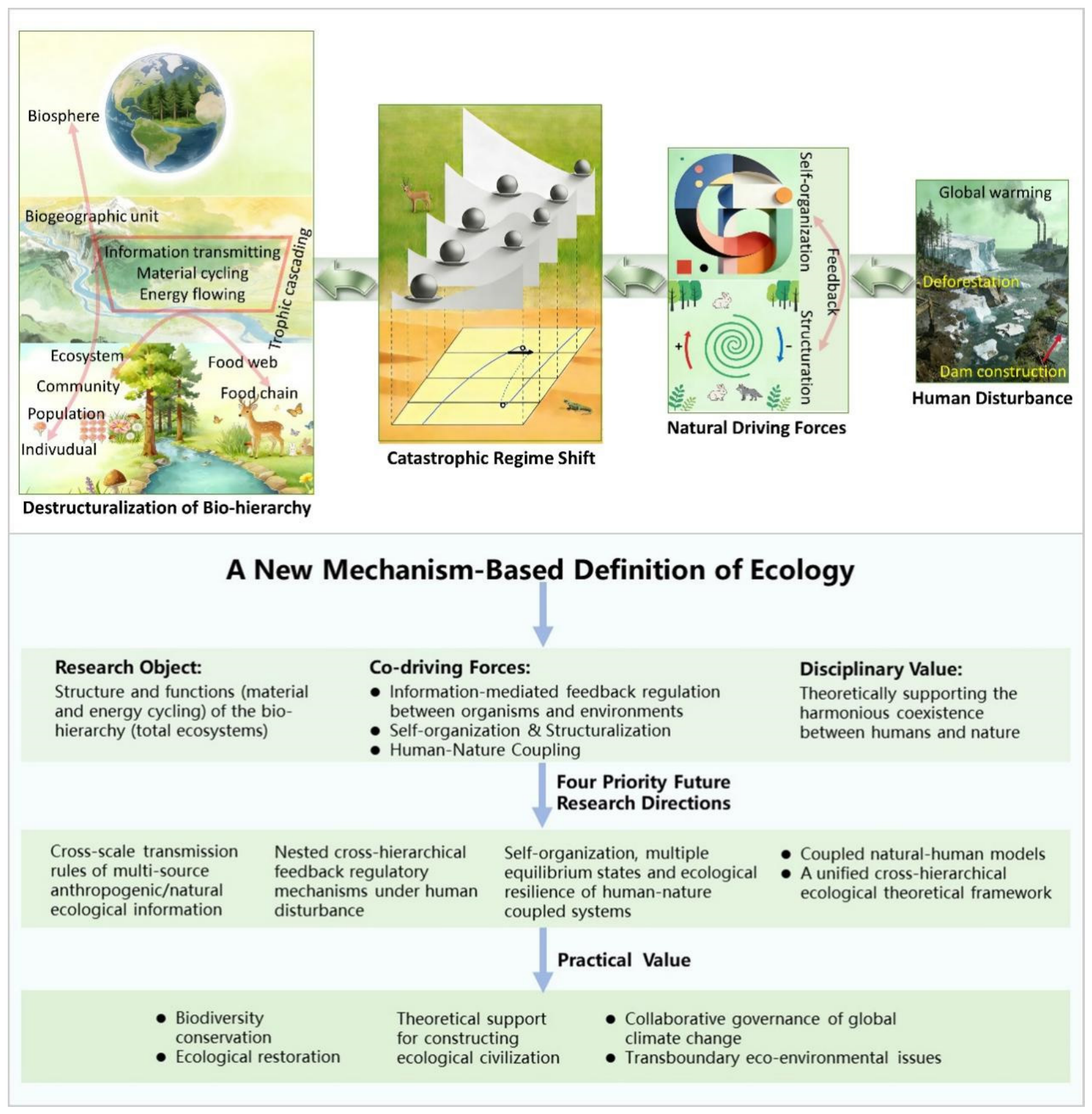
Figure 2.
Evolution in the definition of ecology.
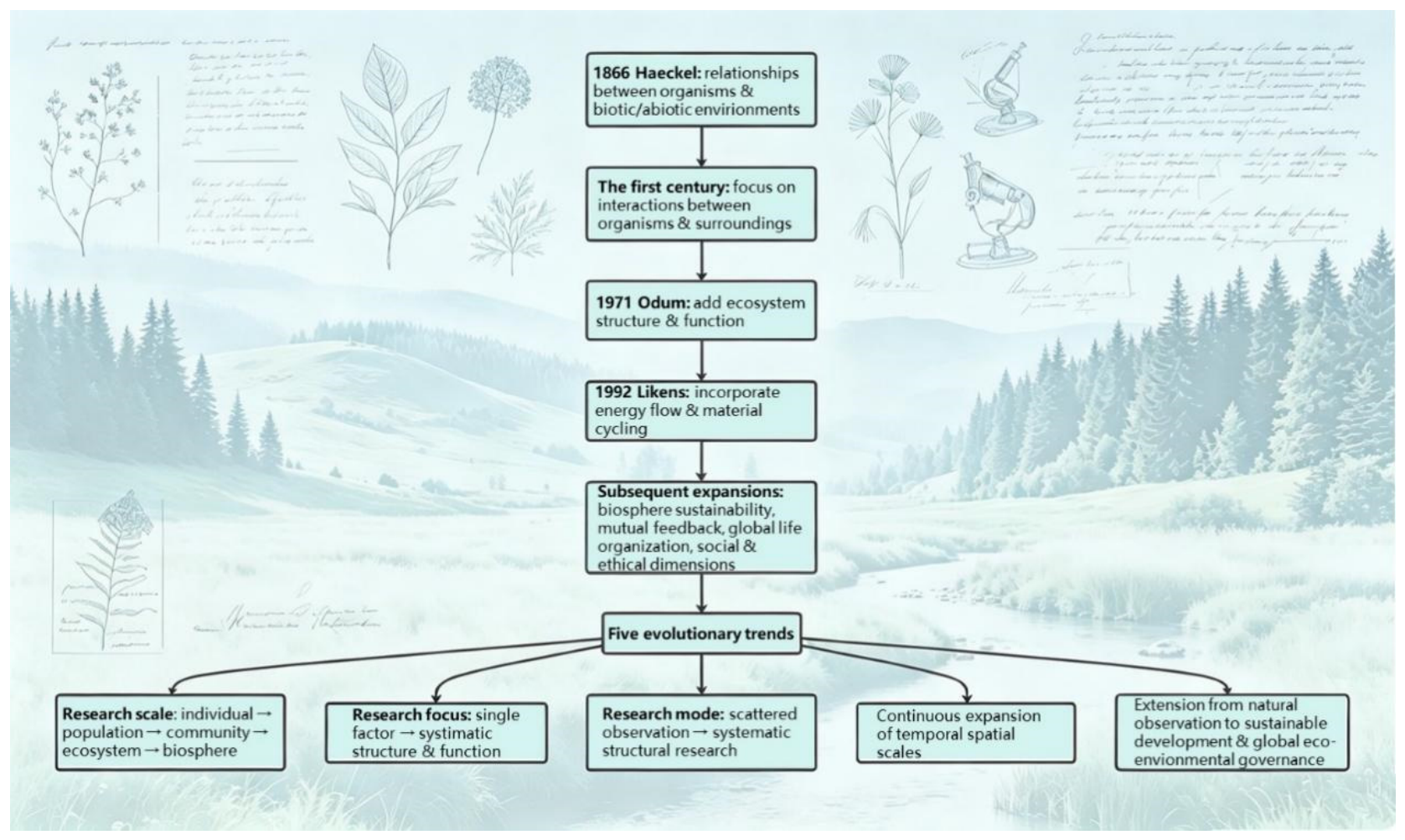
Figure 3.
The core tenets of ecology.
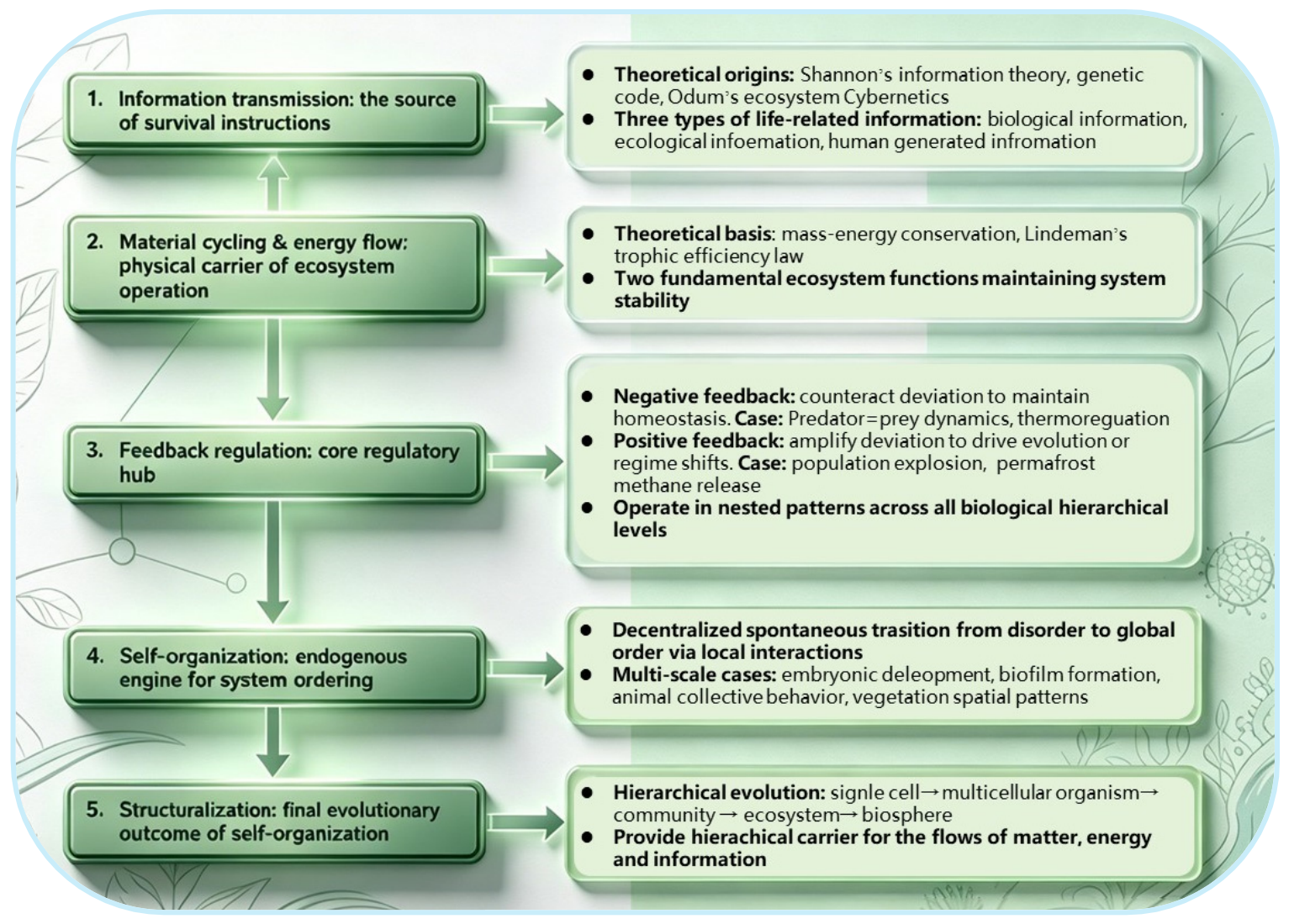
Figure 4.
An integrated regulatory network across bio-hierarchy.
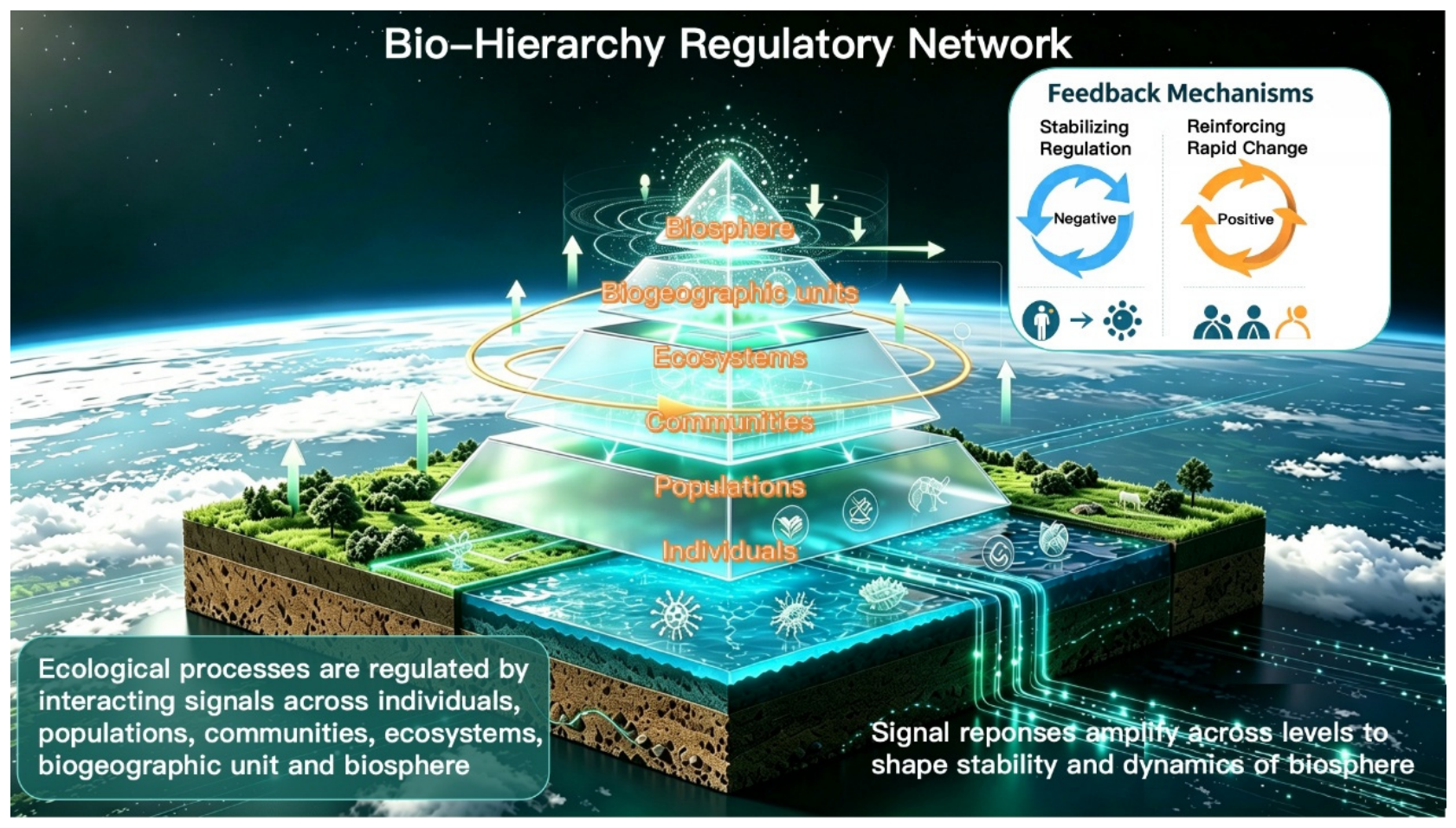
Figure 5.
Schematic diagram illustrating how human-nature coupling reshapes bio-hierarchy.
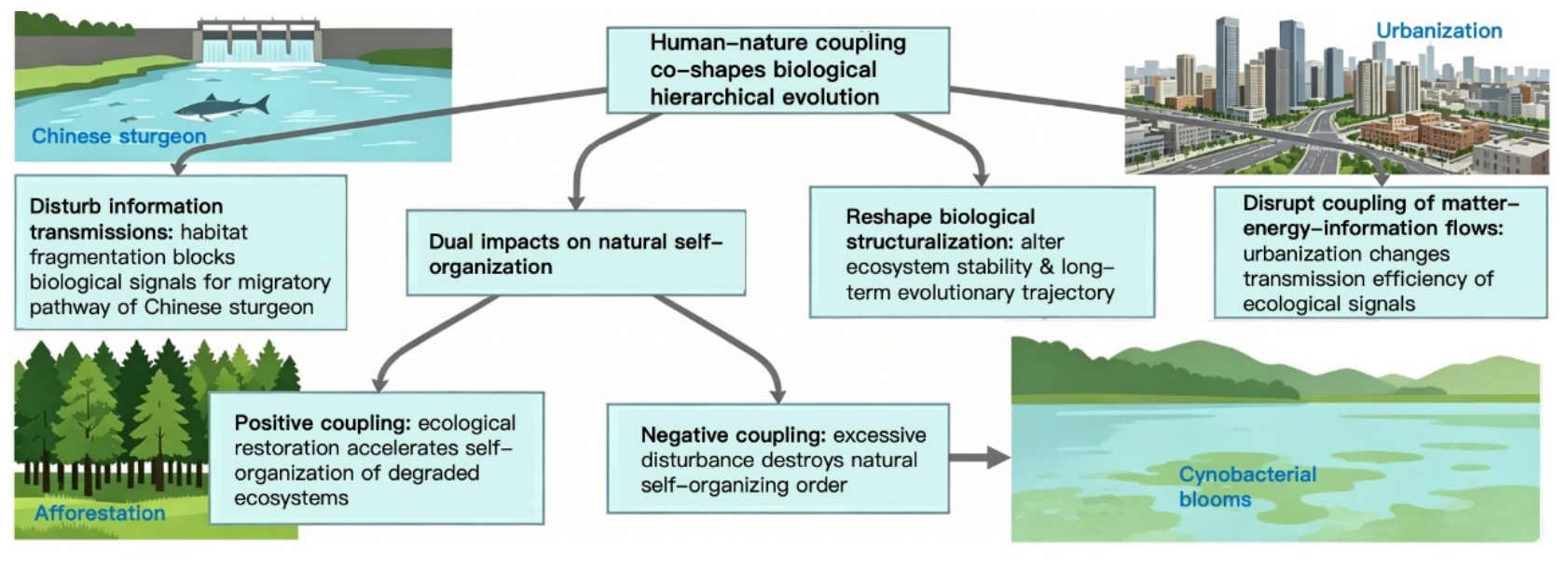
Figure 6.
Schematic diagram illustrating ecology in the anthropocene towards a unified ecological theory for humans, organism and the environment.
Figure 6.
Schematic diagram illustrating ecology in the anthropocene towards a unified ecological theory for humans, organism and the environment.
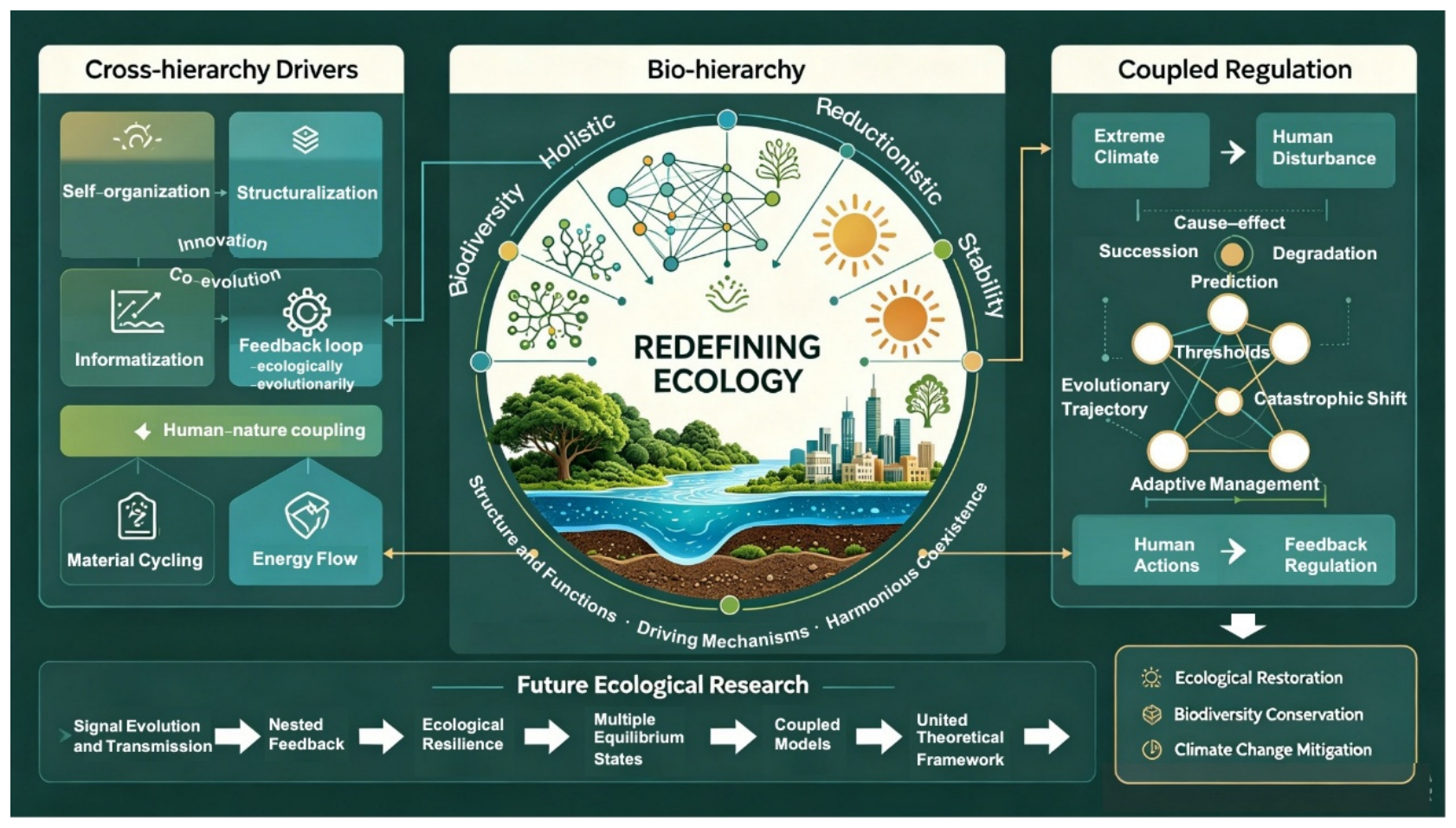

Table 1.
Representative definitions of ecology.
| Definition of ecology | Author |
|---|---|
| By ecology we refer to the whole science concerned with the relationships between organisms and their surrounding external world, which, in a broader sense , encompasses all ‘conditions of existence’. These conditions are partly of an organic nature and partly inorganic. | Haeckel 1866 |
| Ecology concerns the study of organisms in relations to their surrounding world, encompassing both the organic and inorganic conditions of existence. It examines the so-called ‘economy of nature’, i.e. the interrelations of all organisms living in the same place, their adaptations to environmental conditions, and the transformations they undergo through the struggle for existence | Haeckel 1868 |
| By ecology, we refer to the science of the ‘economy’ or household of animal organisms. This includes the full range of an organism’s relations to both its inorganic and its organic environment, in particular the beneficial and hostile interactions with those plants and animals with which it comes into direct contact. In short, it includes all the intricate interrelations that Darwin collectively described as the struggle for existence. | Haeckel 1870 |
| The branch of scientific natural history concerned with the sociology and economics of animals. | Elton 1927 |
| The science of all the relations of all organisms to all aspects of their environments. | Taylor 1936 |
| The science of the interrelationships between living organisms and their environments, both physical and biotic, emphasizing interactions within and between species. | Allee et al. 1949 |
| In its broadest sense, ecology is the study of the relations between plants and animals and their environment, a scope that would include much of biology, biochemistry, and biophysics. In its narrower sense, ecology refers specifically to the study of plant and animal communities | Clarke 1954 |
| The science that investigates organisms in relation to their environment: a philosophical approach that interprets the living world through natural processes. | Woodburry 1954 |
| A science concerned with the interrelationships of living organisms, both plants and animals, and their environment. | Macfadyen 1957 |
| The scientific study of the distribution and abundance of organisms. | Andrewartha 1961 |
| The study of animals and plants in relation to each other and to their environment. | Kendeigh 1961, 1974 |
| The study of interactions among biological form, functions, and factors. | Misra 1967 |
| The study of how individual organisms, populations and communities respond to environmental changes. | Lewis and Taylor 1967 |
| The study of environmental interactions that control the welfare of living organisms, including their distribution, abundance, production, and evolution. | Petrides 1968 |
| The biology of ecosystems. | Margalef 1968 |
| The study of the structure and function of ecosystems, or more broadly, of nature. | Odum 1971 |
| The study of the relations between organisms and the totality of the biological and physical factors that affect or are affected by them. | Pinaka 1974 |
| The scientific study of the relationships of living organisms with each other and with their environments. | Southwick 1976 |
| A multidisciplinary science that investigates organisms and their habitats, with a primary focus on the ecosystem. | Smith 1977 |
| The scientific study of the interactions that determine the distribution and abundance of organisms. | Krebs 1978 |
| The scientific study of the interactions and the underlying mechanisms between living and environmental systems | Ma 1980, Ma and Wang 1984 |
| The scientific study of the processes influencing the distribution and abundance of organisms, the interactions among them, and the transformation and flux of energy and matter. | Likens 1992 |
| The study of ecosystems, or the totality of reciprocal interactions between living organisms and their physical surroundings. | Chapman and Reiss 1998 |
| Ecology is the science that explores the patterns and processes governing interactions between organisms and their physical and biological environments, and the consequences of these interactions for the organization of life on Earth. | Mackenzie et al. 1998 |
| Ecology is the scientific investigation of how organisms interact with the living and nonliving components of their environment, and how these interactions shape the distribution, abundance, and evolution of populations and communities. | Ricklefs 2001 |
| Ecology is the study of the relationships between organisms and their environments, with a focus on how environmental changes drive shifts in biological communities and ecosystem functions over time. | Bush 2002 |
| Ecology is the study of the relationships between organisms and their environment, encompassing the flows of energy and materials through their ecological systems, the dynamics of populations, and the structure and function of communities in response to environmental change. | Begon et al. 2006 |
| Ecology explores the interactive mechanisms between organisms and their biotic and abiotic environments and reveals how these interactions shape the structure, function and dynamics of ecosystems at different spatial and temporal scales. | May and McLean 2007 |
| Ecology is the study of the structure and function of nature, focusing on the interrelationships between organisms and their environment, the organization and operation of ecological systems at different scales, and providing a theoretical basis for the sustainable management of the biosphere. | Odum and Barrett 2008 |
| Ecology, as a science guiding ecological restoration and sustainable development, studies the integrity and functionality of ecosystems, the mutual feedback between organisms and their habitats, and provides strategies for reconciling socioeconomic development with ecological protection. | Comín 2010 |
| Earth stewardship calls ecologists to engage not only to generate knowledge about the interactions between organisms and their environment, but also to engage in public discourse that links ecological science with ethical and social dimensions. | Rozzi et al. 2015 |
| The science of ecology is about relationships—among organisms and habitats, on all scales—and how they provide information that helps us better understand our world. | Inouye 2015 |
| Ecology is the science that investigates the structure, dynamics, and functions of nature, including evolution. Structure encompasses the distribution and abundance of individual organisms, habitats and ecosystems; dynamics include all the aspects of the trajectories and cycles of life histories, including growth, development, reproduction or renewal, interactions and their changes, cycling of matter, and flows and transformations of energy and information; functions comprise the properties, traits, and niches of organisms and species in an ecosystem, as well as the properties and niches of ecosystems in the landscape, ecoregion, and the entire earth system. | Urban et al. 2021 |
| Ecology is the study of the structure, function, and dynamics of macroscopic living systems, providing both theoretical foundations and practical solutions that help humanity to understand, protect, and sustainably utilize nature, while supporting the long-term sustainability of the biosphere. | Fang 2021, Fang et al. 2026 |
| Ecology explores the structural and functional states of ecosystems, their formative mechanisms, as well as their interactions with environmental systems and relevant regulatory techniques. | Yu et al. 2021 |
| Ecology is the scientific discipline that studies interactions between individual organisms and their environments, including interactions with both conspecifics and members of other species. | Stanford Encyclopedia of Philosophy 2024 |
Disclaimer/Publisher’s Note: The statements, opinions and data contained in all publications are solely those of the individual author(s) and contributor(s) and not of MDPI and/or the editor(s). MDPI and/or the editor(s) disclaim responsibility for any injury to people or property resulting from any ideas, methods, instructions or products referred to in the content. |
© 2026 by the authors. Licensee MDPI, Basel, Switzerland. This article is an open access article distributed under the terms and conditions of the Creative Commons Attribution (CC BY) license (http://creativecommons.org/licenses/by/4.0/).
Copyright: This open access article is published under a Creative Commons CC BY 4.0 license, which permit the free download, distribution, and reuse, provided that the author and preprint are cited in any reuse.


