

Submitted:
29 June 2026
Posted:
30 June 2026
You are already at the latest version
Abstract
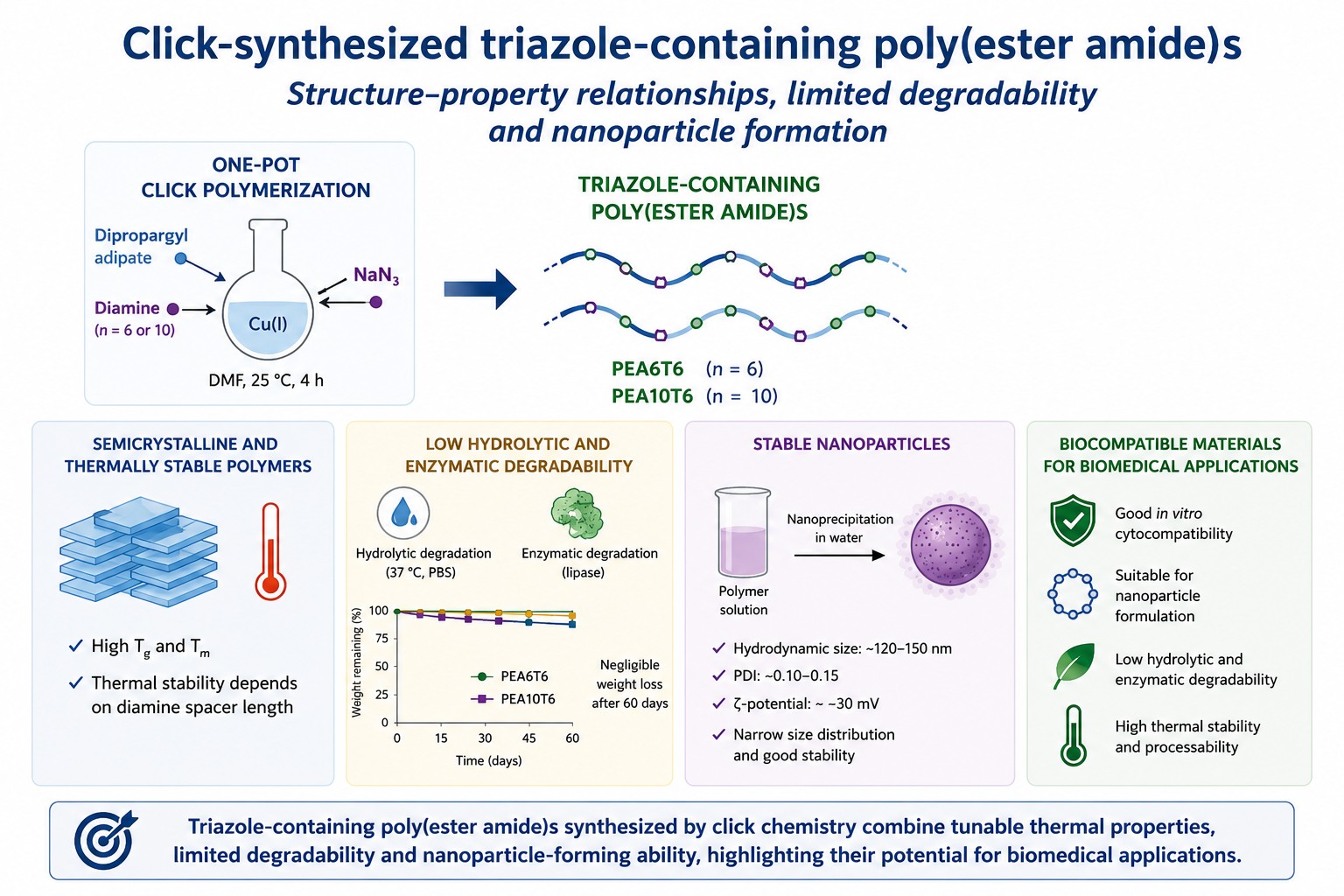
Triazole-containing poly(ester amide)s were synthesized by a one-pot Cu(I)-catalyzed click step-growth polymerization using adipate-based dipropargyl esters and in situ generated diazide monomers derived from aliphatic diamines. Two polymers differing in the length of the polymethylene segment of the diamine unit (six and ten methylene groups) were ob-tained with yields close to 50% and molecular weights typical of step-growth polymeriza-tions. FTIR and NMR analyses confirmed the formation of the expected polymer structures incorporating 1,2,3-triazole rings.
Despite the complexity of the repeat unit, both polymers were semicrystalline and exhibit-ed high glass transition and melting temperatures, reflecting strong intermolecular inter-actions associated with amide and triazole groups. Thermal stability and processability were strongly dependent on the diamine spacer length, with the longer polymethylene segment allowing melt processing without significant degradation.
The polymers displayed good in vitro cytocompatibility and were suitable for the prepara-tion of stable nanoparticles with narrow size distributions and negative zeta potentials around −30 mV. Degradation studies revealed low hydrolytic and enzymatic degradability under physiological conditions, in contrast to previously reported polyester analogues. These results highlight the potential of triazole-based poly(ester amide)s as biocompatible materials with potential interest for biomedical applications.
Keywords:
poly(ester amide)s
; 1
; 2
; 3-triazole polymers
; click polymerization
; biocompatible polymers
; thermal properties
; degradation behavior
; polymeric nanoparticles
1. Introduction
Triazoles are five-membered heteroaromatic rings containing three nitrogen atoms arranged in either the 1,2,3- or 1,2,4-positions. Owing to their aromatic character and high nitrogen content, triazole rings can accommodate substituents with both electrophilic and nucleophilic character, which contributes to their chemical versatility and biological relevance. Indeed, triazole derivatives have been widely reported to exhibit a broad spectrum of biological activities, including antimicrobial, antiviral, antitubercular, anticancer, anticonvulsant, analgesic, antioxidant, anti-inflammatory, and antidepressant effects [1]. More recently, substituted 1,2,3-triazoles have also demonstrated promising activity in the treatment of acute respiratory syndrome caused by coronavirus 2 (SARS-CoV-2) [2]. These therapeutic applications have stimulated considerable interest in the development of triazole-based materials, particularly those aimed at minimizing adverse effects traditionally associated with azole derivatives, such as hepatotoxicity and endocrine disruption [3,4].
Among triazole derivatives, the 1,4-disubstituted 1,2,3-triazole ring is of particular interest because it can be regarded as a biomimetic analogue of a trans-amide linkage. This structural motif can be efficiently generated via the copper(I)-catalyzed Huisgen 1,3-dipolar cycloaddition between terminal azide and alkyne groups, a robust and versatile reaction widely known as “click chemistry” [5]. Importantly, the 1,2,3-triazole ring exhibits low toxicity [4,6], which makes it especially attractive for incorporation into polymeric systems intended for biomedical applications. Consequently, increasing efforts have been devoted to the synthesis of triazole-containing polyamides and polyesters, revealing marked differences in degradability, physicochemical behavior, and potential use as drug delivery systems.
Poly(amide-triazole)s derived from renewable resources have been reported, for example, using glucose functionalized with azide and alkyne groups. These polymers were amorphous, exhibited relatively high molecular weights (45,000–129,000 g·mol−1), and showed degradability under strongly basic aqueous conditions (40 wt% sodium deuteroxide at 44 °C) [7]. Related linear copolymers based on gluconamide units bearing methyl or benzyl side groups were also synthesized, although significant degradation was only observed under accelerated conditions, such as aqueous solutions at pH 10 and 80 °C [8]. Further examples include poly(amide-triazole)s derived from D-gluconolactone [9] and D-galactose [10]. In particular, cationic poly(amide-triazole)s based on methoxylated D-gluconolactone have attracted attention as potential nanocarriers for gene therapy, owing to their ability to condense DNA and form spherical polyplexes with positive ζ-potentials and diameters in the 100–200 nm range [11].
In parallel, poly(ester-triazole)s have been synthesized through Cu(I)-catalyzed click cycloaddition reactions involving diynes capable of generating ester linkages and bis-azido carbohydrate-derived monomers. Such polymers were generally amorphous and displayed moderate molecular weights (13,000–37,000 g·mol−1). Poly(ethylene glycol)-based systems were water-soluble and exhibited hydrolytic degradability under mild conditions, such as distilled water or buffered saline solutions at physiological pH [12]. Other carbohydrate-derived bis-azido monomers, including glucose, arabinose, and erythrose derivatives, led to poly(ester-triazole)s capable of forming hydrogels upon crosslinking with hexamethylene diisocyanate [13]. Additional studies reported polyesters incorporating triazole rings and D-galactonolactone [14], as well as one-pot, multicomponent synthetic strategies yielding poly(ester-triazole)s with tunable methylene segment lengths and elastic, film-forming properties [15]. In these systems, the formation of nanoparticles for drug delivery applications was also proposed, with negative ζ-potentials attributed to partial ester hydrolysis.
Poly(ester amide)s constitute a distinct class of polymers that combine structural features of both polyamides and polyesters, thereby offering a balance between mechanical robustness and hydrolytic degradability [16,17]. The presence of amide groups enables the establishment of strong intermolecular hydrogen bonds, which can enhance mechanical performance, while ester groups provide potential degradation pathways under physiological or mildly hydrolytic conditions. Despite the extensive literature on triazole-containing polyesters, to the best of our knowledge, triazole-containing poly(ester amide)s have received little attention in the literature.
The main objective of the present work is therefore the synthesis and characterization of novel triazole-containing poly(ester amide)s and the evaluation of their physicochemical and biological properties. Two polymers differing in the length of the polymethylene segment of the diamine unit—namely 1,6-hexanediamine and 1,10-decanediamine—were prepared using adipate-based dicarboxylic units. The resulting polymers, poly [1-(bis(N,N′-hexamethylenediamine)acetamide)-4-(bis(methyl)adipate)triazole] and poly [1-(bis(N,N′-decamethylenediamine)acetamide)-4-(bis(methyl)adipate)triazole], are abbreviated as PEA6T6 and PEA10T6, respectively. Their thermal properties, degradation behavior, biocompatibility, and ability to form nanoparticles were systematically investigated, with the aim of assessing their potential as functional polymeric platforms for biomedical applications.
In this context, it is worth noting that related polyester-triazole systems have been reported to exhibit significantly higher hydrolytic degradability under comparable conditions. This contrast highlights the critical role of the amide-to-ester ratio in governing the degradation behavior of triazole-containing polymers. This observation suggests that modulation of ester and amide content within the polymer backbone may provide a useful strategy to influence degradation behaviour.
2. Experimental Part
2.1. Materials
All reagents, including adipoyl chloride, triethylamine (TEA), propargyl alcohol, 1,6-hexanediamine, 1,10-decanediamine, α-bromoacetyl bromide, sodium azide, copper(I) iodide, and ethylenediaminetetraacetic acid (EDTA), as well as solvents (dimethylacetamide, DMA; dichloromethane; and N-methyl-2-pyrrolidone, NMP), were purchased from Merck (Barcelona, Spain) and used as received. 1,1,1,3,3,3-Hexafluoroisopropanol (HFIP) was obtained from Apollo Scientific (Cheshire, UK).
Buffer solutions at pH 3, 7, and 10 (citric acid/citrate, phosphate/hydrogen phosphate saline, and carbonate–bicarbonate buffers, respectively) were supplied by Supelco (Barcelona, Spain). Sebacoyl dichloride (SDC), 1,7-diaminoheptane (DAH), sodium carbonate, and formic acid were purchased from Sigma Aldrich (Barcelona, Spain) and used as received.
2.2. Synthesis
The novel poly(ester amide)s were synthesized using a strategy inspired by Katsarava et al. [15], which allows the incorporation of 1,2,3-triazole moieties into aliphatic polyester backbones through click chemistry. The synthetic pathway includes the preparation of a diyne monomer (compound I) and a bis(bromoacetyl)-functionalized diamine derivative (compound II), the latter serving as a precursor to the second monomer. The corresponding diazide intermediate (compound III) was generated in situ and subsequently employed in a one-pot step-growth polymerization process.
2.2.1. Synthesis of Dipropargyl Adipate (Compound I)
Adipoyl dichloride (30 mmol) was dissolved in 100 mL of DMA in a round-bottom flask. Triethylamine (61.5 mmol) was added as a proton scavenger, and the solution was cooled to −5 °C using an ice-salt bath. Propargyl alcohol (61.5 mmol) was then added dropwise over 30 min under magnetic stirring. The reaction mixture was allowed to warm to room temperature and stirred for 20 h.
The reaction was quenched by pouring the mixture into 300 mL of water and kept overnight at 4 °C. The resulting white solid was collected by filtration, dried under vacuum, and recrystallized from an ethanol/hexane mixture.
Yield: 76.5%.
m.p.: 25–26 °C.
FTIR (cm−1): 3227 (≡CH), 2116 (C≡C), 1736 (C=O), 1229 (C–O).
1H NMR (DMSO-d6, ppm): 1.51–1.71 (4H, m, CH2), 2.29–2.42 (4H, m, CH2CO), 2.96 (2H, t, CH), 4.63 (4H, d, OCH2).
13C NMR (DMSO-d6, ppm): 23.4 (CH2), 32.6 (CH2CO), 51.0 (OCH2), 75.9 (CH), 77.4 (C≡C), 170.9 (C=O).
Scheme 1.
Synthesis of the dipropargyl ester of adipic acid (compound I).

2.2.2. Synthesis of Bis(bromoacetyl) Diamines (Compound II)
The appropriate diamine (17 mmol; either 1,6-hexanediamine or 1,10-decanediamine) was dissolved in 100 mL of dichloromethane containing TEA (35 mmol). α-Bromoacetyl bromide (35 mmol) was added dropwise over 15 min under stirring (Scheme 2). The reaction mixture was refluxed for 20 h.
After solvent removal under reduced pressure, the resulting orange crystalline solid was recrystallized from an acetone/water mixture.
1,6-Hexanediamine derivative:
Yield 88.6%.
FTIR (cm−1): 3293 (amide A), 3064 (amide B), 2939 (CH2 asym), 2861 (CH2 sym), 675 (Br–CH2).
1H NMR (DMSO-d6, ppm): 1.26–1.40 (8H, m, CH2), 3.06 (4H, td, CH2NH), 3.81 (4H, s, Br–CH2), 8.20 (2H, t, NH).
13C NMR (DMSO-d6, ppm): 26.6, 28.8, 31.36, 40.07, 169.58.
1,10-Decanediamine derivative:
Yield 86.3%.
FTIR (cm−1): 3275 (amide A), 3082 (amide B), 2917 (CH2 asym), 2847 (CH2 sym), 724 (Br–CH2).
1H NMR (DMSO-d6, ppm): 1.22–1.53 (16H, m, CH2), 3.16 (4H, td, CH2NH), 3.86 (4H, s, Br–CH2), 6.93 (2H, t, NH).
13C NMR (DMSO-d6, ppm): 24.5, 28.8–29.3, 31.35, 40.1, 169.6.
2.2.3. One-Pot Click Step-Growth Polymerization
The conversion of the bromo-precursor (compound II) into the azide monomer has been carried out following this procedure. Bis(bromoacetyl) diamine (1.70 mmol) and sodium azide (3.5 mmol) were dissolved in 3 mL of NMP and stirred under nitrogen at 25 °C for 3 h to generate the diazide intermediate in situ (compound III). This monomer was not isolated because of the inherent hazards associated with azide-containing organic compounds.
Scheme 3.
One-pot synthesis of poly(ester amide)s PEA6T6 and PEA10T6.
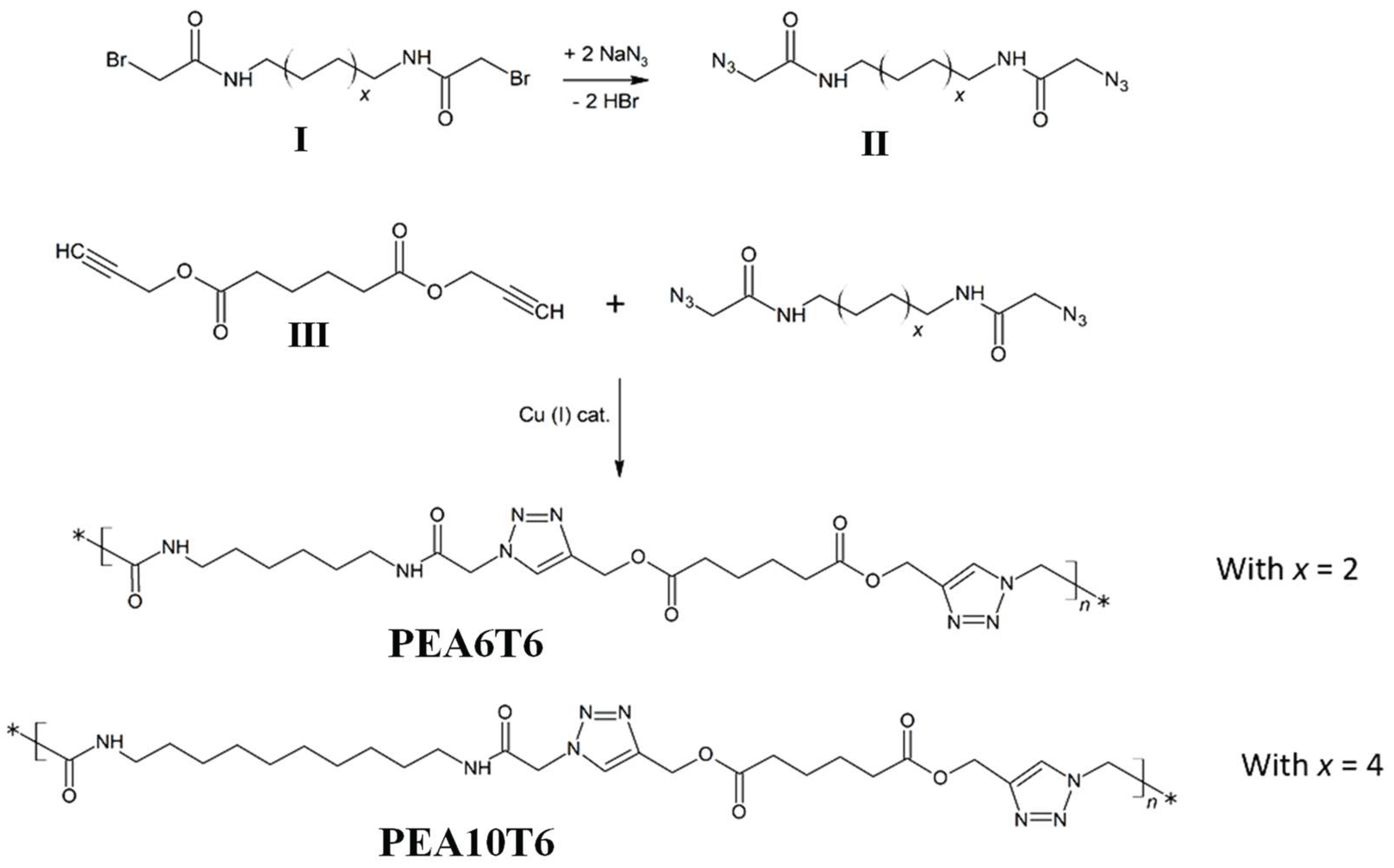
The reaction mixture was cooled to 0 °C, and dipropargyl adipate (1.70 mmol), CuI (0.33 mmol, 20 mol%), TEA (1.70 mmol), and HFIP (1 mL) were added. The CuI/TEA molar ratio was 1:5. The solution became progressively viscous, and after 4 h the temperature was raised to 25 °C to facilitate stirring. After 9 h, polymerization was completed and the polymer was precipitated in water, filtered, and washed twice with 0.5 M EDTA solution to remove residual copper.
PEA6T6:
Yield 52%.
FTIR (ATR, νmax, cm−1): 3306 (amide A, N–H stretching), 3123 (triazole CH stretching), 3079 (amide B), 1725 (ester C=O stretching), 1660 (amide I), 1553 (amide II) and 1228 (C–O–C).
1H NMR (TFA-d, δ, ppm): 8.66 (br, 3H, overlapping amide NH and triazole CH), 5.95 and 5.49 (2s, 8H, two CH2 groups adjacent to the triazole rings), 3.30 (t, 4H, NHCH2), 2.55 (t, 4H, COCH2), 1.65–1.50 (m, 8H methylene groups adjacent to NHCH2 and COCH2), 1.35–1.20 (br, 4 H, internal aliphatic methylene groups).
13C NMR (TFA-d, δ, ppm): 173.0 and 171.0 (C=O, ester and amide), 140.0 and 122.5 (triazole carbons), 54.0–50.0 (CH2 adjacent to triazole and OCO), 39.0 (NHCH2), 33.5–28.0 (aliphatic CH2 adjacent to carbonyl and internal CH2), 24.5 (internal aliphatic CH2).
PEA10T6:
Yield 49%.
FTIR (ATR, νmax, cm−1): 3310 (amide A, N–H stretching), 3124 (triazole CH stretching), 3081 (amide B), 1726 (ester C=O stretching), 1661 (amide I), 1551 (amide II) and 1249 (C–O–C).
1H NMR (TFA-d, δ, ppm): 8.66 (br, 2.5, overlapping amide NH and triazole CH), 5.49 (br s, 8H, overlapping CH2 groups adjacent to triazole and ester oxygen), 3.30 (br, 4H, NHCH2), 2.55 (br, 4H, COCH2), 1.65–1.50 (m, 8H, methylene groups adjacent to NHCH2 and COCH2), 1.35–1.20 (br, 12 H, internal aliphatic methylene groups).
2.3. Characterization Techniques
Molecular weights were determined by gel permeation chromatography (GPC) using a Shimadzu LC-8A system equipped with a refractive index detector (RID-20A). HFIP containing 0.05 M CF3COONa was used as the eluent at a flow rate of 1 mL·min−1. Polymethyl methacrylate standards were employed for calibration.
FTIR spectra were recorded with a Jasco FTIR-4700 spectrometer equipped with a diamond ATR accessory (resolution 4 cm−1).
1H and 13C NMR spectra were obtained on a Bruker Ascend 400 spectrometer using CDCl3 or CF3COOD as solvents.
Differential scanning calorimetry (DSC) measurements were performed on a TA Instruments Q100 calorimeter under nitrogen atmosphere using a three-run protocol (first heating, cooling, second heating at 10 °C min−1).
Thermogravimetric analysis (TGA) was carried out using a TA Instruments Q50 analyzer under nitrogen at a heating rate of 10 °C·min−1.
2.4. Degradation Studies
Degradation experiments were conducted at 37 °C in hydrolytic (pH 3, 7, and 10), enzymatic (lipase), and oxidative (30 wt% H2O2) media. Polymer tablets were prepared by compression and accurately weighed.
Samples were incubated in 2 mL of degradation medium, which was refreshed at each time point. Weight loss (WL) was determined according to Equation (1):
where w0 is the initial weight and wd is the weight after degradation.
WL (%) = (w0 - wd) / w0 × 100
2.5. Antibacterial Activity
Antibacterial activity was evaluated by inhibition halo assays using Staphylococcus aureus on LB agar plates, with gentamicin as positive control.
Additionally, bacterial growth inhibition was assessed in liquid culture against Streptococcus mutans, Streptococcus sanguinis, Lactobacillus salivarius, and Escherichia coli by monitoring optical density at 595 nm.
2.6. In Vitro Biocompatibility
Cytotoxicity was evaluated according to ISO 10993-5 using extract tests on COS-1 and SAOS-2 cells. Cell viability was quantified by MTT assay after 24 h exposure to polymer extracts. Fluorescence microscopy using DAPI and phalloidin staining was employed for qualitative cell adhesion assessment.
2.7. Preparation and Characterization of Nanoparticles
Nanoparticles were prepared by solvent displacement by dropwise addition of polymer solutions into water containing Tween-20. After dialysis, particle morphology was analyzed by SEM, size distribution by ImageJ, and zeta potential by DLS.
3. Results
3.1. Polymer Synthesis and Structural Characterization
The selection of an appropriate solvent system was a critical factor for the successful implementation of the one-pot synthesis strategy. The solvent had to be compatible with three consecutive processes: (i) nucleophilic substitution of the bis(bromoacetyl)diamines to generate the diazide monomer, (ii) dissolution of the dipropargyl adipate, and (iii) solubilization of the growing polymer chains during step-growth polymerization.
A major limitation arose from the poor solubility of the forming poly(ester amide) chains in solvents that are otherwise suitable for azide formation. This issue is particularly relevant for polymers containing amide groups, where strong intermolecular interactions often promote premature precipitation and limit molecular weight development. Such constraints are less severe in related polyesters, as previously reported [15].
To overcome these limitations, the one-pot reaction was carried out in N-methylpyrrolidone (NMP), which ensured good solubility of all low-molecular-weight intermediates. Hexafluoroisopropanol (HFIP) was subsequently added to improve the solubility of the growing polymer chains and facilitate further chain extension. Using this strategy, two polymers differing in the length of the diamine segment were successfully obtained with yields close to 50%. The resulting materials exhibited moderate molecular weights typical of step-growth polymerizations, with weight-average molecular weights of 11,900 g·mol−1 for PEA6T6 and 18,900 g·mol−1 for PEA10T6, and corresponding polydispersity indices of 2.4 and 2.6.
These moderate molecular weights can be attributed to limited solubility of the growing chains, likely leading to partial precipitation during polymerization and thereby limiting further chain growth, as well as to strong intermolecular interactions associated with amide and triazole groups. Both polymers were readily soluble in formic acid, whereas dissolution in stronger solvents such as trifluoroacetic acid and HFIP required heating, further supporting the restricted solubility of these systems.
NMR spectroscopic analyses were consistent with the proposed chemical structures, with no evidence of residual monomers. As shown in Figure 1, the lower-molecular-weight PEA6T6 sample exhibited improved spectral resolution, allowing the NHCH2 triplet and the two methylene signals adjacent to the triazole ring to be clearly distinguished. In addition, very weak signals tentatively attributable to chain-end groups were detected only in PEA6T6, possibly arising from propargyl adipate-derived terminal units.
The FTIR spectra of PEA6T6 and PEA10T6 (Figure 2) showed the characteristic absorptions expected for poly(ester amide) structures containing 1,2,3-triazole units. Both polymers exhibited the characteristic bands of amide and ester functionalities, together with intense methylene absorptions, which were more pronounced for PEA10T6 due to its longer aliphatic segment. The amide A and amide B bands were observed at approximately 3306–3310 and 3079–3081 cm−1, respectively. In addition, a weak absorption band at 3123–3124 cm−1, located adjacent to the amide B band, was attributed to the C–H stretching vibration of the 1,2,3-triazole ring, providing further evidence for its incorporation into the polymer backbone. The ester carbonyl stretching band was observed at 1725–1726 cm−1, while the amide I and amide II bands appeared at 1660–1661 and 1551–1553 cm−1, respectively. These band positions are consistent with poly(ester amide) chains exhibiting a largely non-ordered or random-chain conformation in the solid state. Additional absorptions in the 2930–2850 cm−1 region were assigned to the asymmetric and symmetric stretching vibrations of aliphatic methylene groups, whereas bands in the 1465–1410 cm−1 region corresponded mainly to CH2 bending modes. Strong absorptions assigned to ester C–O–C stretching vibrations were observed at 1228 cm−1 for PEA6T6 and 1249 cm−1 for PEA10T6. The close similarity between both spectra confirms the presence of the same functional groups in the two polymers, while the higher relative intensity of the methylene absorptions in PEA10T6 reflects its longer aliphatic spacer.
3.2. Thermal Properties
The triazole-containing poly(ester amide)s exhibited moderate thermal stability in view of their relatively high melting temperatures. Among the two samples, PEA10T6 showed the highest stability, with the onset of thermal degradation occurring at approximately 220 °C. The degradation process involved multiple overlapping degradation steps (Figure 3), which may tentatively be associated with the decomposition of different structural fragments containing ester, triazole and amide moieties.
PEA6T6 displayed a similar multistep degradation profile, although decomposition started at a slightly lower temperature, around 200 °C. The main difference between both polymers concerned the relative contribution of the first degradation step, which was less intense in PEA10T6, as expected considering the longer polymethylene segment in its diamide unit. Additionally, differences in the complexity of the second and third degradation steps were observed. In particular, two distinct DTGA peaks were detected for the second step of PEA10T6 and for the third step of PEA6T6. Notably, the third degradation step occurred at higher temperatures for PEA6T6, suggesting a higher intrinsic thermal stability of the diamide segment when the polymethylene spacer is shorter. No solid residue was detected for either polymer at temperatures above 630 °C.
Differential scanning calorimetry revealed that both synthesized poly(ester amide)s were semicrystalline, as evidenced by well-defined melting endotherms above 200 °C (Figure 4). This finding indicates the presence of a significant crystalline phase in both polymers despite the structural complexity of the backbone. Such behavior is likely promoted by the presence of rigid triazole rings and amide groups capable of establishing strong intermolecular hydrogen-bonding interactions. The relatively high glass transition temperatures—52 °C for PEA10T6 and 55 °C for PEA6T6—further support the presence of a stiff polymer backbone.
A relevant difference between both polymers concerns their processability from the melt. PEA10T6 could be melt-processed without significant loss of crystallinity, as demonstrated by the full recovery of melting and crystallization enthalpies (≈ 50 J g−1) for melt-crystallized and quenched samples. Only minor variations in the melting temperature were observed for solution-crystallized (210 °C), melt-crystallized (208 °C), and quenched samples (205 °C), possibly indicating a limited formation of shorter chains due to mild thermal scission during heating.
In contrast, PEA6T6 exhibited a more critical behavior, as its melting temperature approached or exceeded the onset temperature of degradation (≈ 225 °C vs 220 °C). During the first heating scan, an exothermic event associated with degradation was observed immediately after the melting endotherm, leading to partial overlap of both processes and an underestimation of the melting enthalpy (≈ 27 J g−1). The subsequent cooling scan showed a marked reduction in crystallization ability, attributed to the presence of degradation fragments. This alteration was further evidenced in the second heating run, where multiple exothermic events appeared prior to fusion, followed by two melting peaks at 149 °C and 192 °C, which are attributed to crystalline domains formed from degraded species. After melting, a flat baseline was recovered up to 250 °C, indicating the absence of further degradation processes within this temperature range. A similar, albeit less pronounced, behavior was observed for quenched samples, which experienced shorter exposure times at high temperatures (Figure 4).
3.3. Degradability of PEA6T6 and PEA10T6 Poly(ester amide)s
The degradation behavior of PEA6T6 and PEA10T6 was evaluated under hydrolytic, enzymatic, and accelerated conditions, and the corresponding weight-loss data are summarized in Figure 5.
Both poly(ester amide)s exhibited a high resistance to degradation after 21 days of exposure to hydrolytic media at acidic, neutral, and basic pH, as well as to enzymatic media, when experiments were conducted at 37 °C. Only marginal weight loss was detected under strongly basic conditions (pH 10) when the temperature was increased to 70 °C to accelerate degradation.
This behavior is in clear contrast with previously reported polyester-triazole systems, which exhibit significantly higher susceptibility to hydrolytic degradation under similar conditions. The reduced degradability observed in the present systems is likely related to the strong intermolecular interactions associated with amide and triazole groups, the semicrystalline nature of the polymers, and the presence of hydrolytically stable amide bonds within the polymer backbone.
Differences between both polymers were minor, although a slightly higher weight loss was consistently observed for PEA6T6. This behavior may be related to its lower hydrophobicity and lower molecular weight compared with PEA10T6. Gel permeation chromatography analyses confirmed that no significant changes in molecular weight occurred after exposure to the degradation media at 37 °C. Under accelerated alkaline conditions, a moderate molecular weight decrease of approximately 20% was detected, in agreement with the limited mass loss observed gravimetrically.
Taken together, the results obtained for PEA6T6 and PEA10T6 highlight the important influence of backbone composition on the degradation behaviour of triazole-containing polymers. Preliminary attempts to prepare the fully amide-based analogue yielded only low-molecular-weight materials, which exhibited negligible weight loss under the degradation conditions evaluated (Supporting Information). Although their limited molecular weight precludes a direct comparison with the present poly(ester amide)s, these observations are consistent with the reduced hydrolytic susceptibility generally associated with amide-rich polymer backbones.
3.4. Antibacterial Activity of PEA6T6 and PEA10T6
No bacterial growth inhibition halos were observed around either of the poly(ester amide) samples placed on agar plates. Under these conditions, normal bacterial growth led to the formation of numerous small, white colonies uniformly distributed over the agar surface. In contrast, the positive control for antibacterial activity produced a clear inhibition halo surrounding the disc, corresponding to a zone devoid of bacterial colonies. These observations do not provide evidence for the release of antibacterial species from the polymer samples by radial diffusion. Consistently, bacterial growth in liquid media containing suspensions of the PEA polymers showed no inhibition; instead, a slight increase in bacterial proliferation was detected (Figure 6).
These results allow two relevant conclusions to be drawn. First, the absence of antibacterial activity suggests that residual copper species, if present, are below concentrations capable of producing detectable antibacterial effects under the experimental conditions employed. Second, the lack of antibacterial response does not provide evidence for the release of triazole-containing species under the tested conditions. This observation is consistent with the limited degradability of the polymers at low temperature and with the fact that the release of triazole-containing species would require the cleavage of both ester and amide bonds flanking the heterocycle.
This behavior contrasts with that reported for related polyesters, which generally exhibit higher susceptibility to hydrolytic degradation [15]. The present results therefore suggest a possible strategy to achieve controlled or tunable degradation and release of triazole-containing species by partially substituting the bis(bromoacetyl)diamines with the corresponding bis(bromoacetyl)diols, thereby increasing the fraction of hydrolytically labile ester bonds within the polymer backbone.
3.5. Biocompatibility of PEA6T6 and PEA10T6
Cell adhesion and proliferation assays performed on PEA6T6 and PEA10T6 samples demonstrated that both polymers exhibit biocompatibility comparable to that of the control surfaces (Figure 7). Quantitative analyses showed high levels of cell adhesion and proliferation for both polymers, regardless of the cell line employed.
These results are consistent with the biocompatibility previously reported for aliphatic poly(ester amide)s and indicate that the incorporation of triazole rings into the polymer backbone does not induce detectable cytotoxic effects. Consequently, the synthesized materials appear suitable for biomedical applications in which high biocompatibility is required but rapid biodegradability is not essential.
3.6. Preparation and Characterization of Nanoparticles from PEA6T6 and PEA10T6
Both poly(ester amide)s were suitable for the preparation of nanoscale particles by the solvent displacement method. Only minor differences were observed in terms of polydispersity index, which ranged from 0.19 ± 0.01 to 0.21 ± 0.01, and zeta potential values, which were consistently negative and close to −30 mV for both polymers (−30.3 and −30.2 mV for PEA6T6, and −31.2 and −31.4 mV for PEA10T6). The observed negative zeta potentials were consistent with the good colloidal stability experimentally observed during storage.
In contrast, the mean particle diameter showed a marked dependence on the solvent employed during nanoparticle preparation, particularly for PEA6T6. Average diameters of 239.1 ± 2.5 nm and 348.3 ± 1.8 nm were obtained when trifluoroacetic acid and hexafluoroisopropanol were used as solvents, respectively. More homogeneous particle sizes were obtained for PEA10T6, with intermediate mean diameters of 287.5 ± 2.6 nm (TFA) and 298.7 ± 2.6 nm (HFIP).
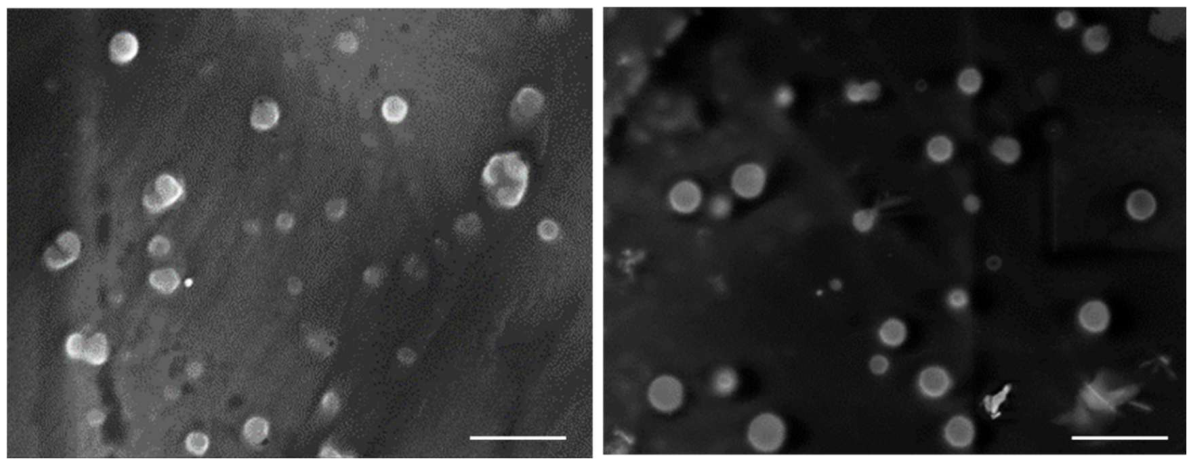
Scanning electron microscopy images (Figure 8) revealed that the nanoparticles exhibited a rounded morphology and moderate size dispersity. A slightly higher tendency toward agglomeration was observed for PEA6T6 particles, despite the minimal differences in zeta potential between both systems. The negative surface charge of the nanoparticles, combined with the limited chemical degradability of the polymers, was sufficient to ensure colloidal stability upon storage, as confirmed after maintaining the samples for two months at 5 °C without detectable aggregation or sedimentation.
4. Conclusions
Poly(ester amide)s incorporating 1,2,3-triazole rings were successfully synthesized through a one-pot Cu(I)-catalyzed click step-growth polymerization, achieving yields close to 50%. The synthetic strategy involved the in situ generation of a diazide monomer from bisbromoacetyldiamine precursors, followed by polymerization with a dipropargyl adipate derivative, without the need for intermediate purification steps. Despite the structural complexity of the repeat unit, the obtained polymers exhibited moderate molecular weights and reproducible chemical structures, as confirmed by NMR and FTIR spectroscopy. Solubility was restricted to strongly hydrogen-bond-disrupting solvents such as trifluoroacetic acid and hexafluoroisopropanol, reflecting the strong intermolecular interactions promoted by amide and triazole functionalities.
Thermal analyses revealed that the synthesized poly(ester amide)s are semicrystalline materials displaying relatively high glass transition and melting temperatures, indicative of stiff polymer chains and efficient packing. The length of the polymethylene segment in the diamine unit played a decisive role in thermal behavior and processability. In particular, increasing the diamine spacer from six to ten methylene groups resulted in enhanced thermal stability during melting, enabling melt processing without significant degradation. In contrast, the shorter spacer led to partial overlap between melting and degradation processes, limiting thermal processability.
Both polymers exhibited very low hydrolytic and enzymatic degradability under physiological conditions (37 °C). This behaviour was consistent with their semicrystalline nature and with the presence of hydrolytically resistant amide bonds in the polymer backbone. As a consequence, the results obtained did not suggest the release of triazole-containing species under the conditions investigated, and no intrinsic antibacterial activity was observed. Nevertheless, the polymers displayed good in vitro cytocompatibility, with high levels of cell adhesion and proliferation for all tested cell lines. These results indicate that the incorporation of triazole rings into poly(ester amide) backbones does not lead to detectable cytotoxic effects under the experimental conditions employed. Furthermore, preliminary observations on the corresponding polyamide analogue, although limited to low-molecular-weight materials, were consistent with the strong influence of backbone composition on the degradation behaviour of triazole-containing polymers.
Importantly, both polymers proved suitable for the preparation of stable nanoparticles with relatively narrow size distributions and zeta potentials close to −30 mV. Nanoparticle dimensions could be modulated by polymer structure and solvent selection, while colloidal stability was maintained during storage, highlighting their potential as carrier materials.
Overall, this work introduces a new class of triazole-containing poly(ester amide)s that combine structural rigidity, thermal stability, biocompatibility, and nanoparticle-forming capability. Although their low degradability limits immediate antibacterial action, the modular nature of the synthetic approach offers clear opportunities for future materials design. In particular, controlled substitution of diamine-based diazide monomers by diol-based analogues would allow tuning the ester-to-amide ratio, thereby enabling adjustment of degradation behavior and functional release. These findings position triazole-based poly(ester amide)s as versatile platforms for the development of advanced biomedical materials where long-term stability and controlled functionality are required.
Furthermore, the present results, together with literature reports on related polyester systems, point toward a general strategy for tuning degradation behavior in triazole-containing polymers through backbone composition. This approach provides a versatile platform for the rational design of functional polymeric systems with tunable stability and performance.his section is not mandatory but can be added to the manuscript if the discussion is unusually long or complex.
Supplementary Materials
The following supporting information can be downloaded at the website of this paper posted on Preprints.org, preliminary characterization of the corresponding polyamide analogue and Scheme S1: Synthetic route for the preparation of triazole-containing polyamides.
Author Contributions
Conceptualization, M.A., L.F., L.V., and J.P.; methodology, M.A., L.F., and L.V.; formal analysis, M.A., L.F., L.V., and J.P.; investigation, M.A., L.F., L.V., and J.P.; writing—original draft preparation, M.A., L.V., and J.P.; writing—review and editing, J.P.; supervision, L.V., and J.P. All authors have read and agreed to the published version of the manuscript.
Funding
This research was funded by the Spanish Ministry of Science, Innovation and Universities through PID2022-140302OB-I00 and by the Generalitat de Catalunya under the project 2021-SGR-01042. This work is part of the Maria de Maeztu Units of Excellence Programme CEX2023-001300-M funded by MCIN/AEI/10.13039/501100011033. The funders had no role in the writing of the manuscript or the decision to publish the study.
Data Availability Statement
The data presented in this study are available from the corresponding author upon reasonable request.
Acknowledgments
During the preparation of this manuscript, the author used ChatGPT (OpenAI, GPT-5.2, version: ChatGPT April 2025) to refine scientific language, improve clarity, and ensure grammatical consistency. The authors reviewed and edited the output and takes full responsibility for the content of this manuscript. M.A. acknowledges the predoctoral fellowship “Ayudas para contratos predoctorales para la formación de doctores 2019” from the Spanish Ministry of Science, Innovation and Universities.
Conflicts of Interest
The authors declare no conflicts of interest.
References
- Matin, M.M.; Matin, P.; Rahman, M.R.; Ben Hadda, T.; Almalki, F.A.; Mahmud, S.; Ghoneim, M.M.; Alruwaily, M.; Alshehri, S. Triazoles and their derivatives: Chemistry, synthesis, and therapeutic applications. Front. Mol. Biosci. 2022, 9, 864286. [Google Scholar] [CrossRef] [PubMed]
- Cortés-García, C.J.; Chacón-García, L.; Mejía-Benavides, J.E.; Díaz-Cervantes, E. Tackling the SARS-CoV-2 main protease using hybrid derivatives of 1,5-disubstituted tetrazole–1,2,3-triazoles: An in silico assay. PeerJ Phys. Chem. 2020, 2, e10. [Google Scholar]
- Benitez, L.L.; Carver, P.L. Adverse effects associated with long-term administration of azole antifungal agents. Drugs 2019, 79, 833–853. [Google Scholar] [CrossRef] [PubMed]
- Lima-Neto, R.G.; Cavalcante, N.N.M.; Srivastava, R.M.; Mendonça Junior, F.J.B.; Wanderley, A.G.; Neves, R.P.; Dos Anjos, J.V. Synthesis of 1,2,3-triazole derivatives and in vitro antifungal evaluation on Candida strains. Molecules 2012, 17, 5882–5892. [Google Scholar] [CrossRef] [PubMed]
- Kolb, H.C.; Finn, M.G.; Sharpless, K.B. Click chemistry: Diverse chemical function from a few good reactions. Angew. Chem. Int. Ed. 2001, 40, 2004–2021. [Google Scholar]
- Sheehan, D.J.; Hitchcock, C.A.; Sibley, C.M. Current and emerging azole antifungal agents. Clin. Microbiol. Rev. 1999, 12, 40–79. [Google Scholar] [CrossRef] [PubMed]
- Molina-Pinilla, I.; Bueno-Martínez, M.; Hakkou, K.; Galbis, J.A. Linear poly(amide triazole)s derived from D-glucose. J. Polym. Sci. Part A Polym. Chem. 2014, 52, 629–638. [Google Scholar]
- Bueno-Martínez, M.; Molina-Pinilla, I.; Hakkou, K.; Galbis, J.A. Synthesis and characterization of copoly(amide triazole)s derived from D-glucose. J. Polym. Sci. Part A Polym. Chem. 2015, 53, 413–421. [Google Scholar]
- Fidalgo, D.M.; Kolender, A.A.; Varela, O. Poly(amide-triazole)s obtained by regioselective, microwave-assisted click polymerization of bio-based monomers. Mater. Today Commun. 2015, 2, e70–e83. [Google Scholar]
- Rivas, M.V.; Petroselli, G.; Erra-Balsells, R.; Varela, O.; Kolender, A.A. Synthesis, characterization and chemical degradation of poly(ester-triazole)s derived from D-galactose. RSC Adv. 2019, 9, 9860–9869. [Google Scholar] [PubMed]
- Molina-Pinilla, I.; Hakkou, K.; Romero-Azogil, L.; Benito, E.; García-Martín, M.G.; Bueno-Martínez, M. Synthesis of degradable linear cationic poly(amide triazole)s with DNA-condensation capability. Eur. Polym. J. 2019, 113, 36–46. [Google Scholar]
- Bueno, M.; Molina, I.; Galbis, J.A. Degradable “click” polyesters from erythritol having free hydroxyl groups. Polym. Degrad. Stab. 2012, 97, 1662–1670. [Google Scholar] [CrossRef]
- Hakkou, K.; Bueno-Martínez, M.; Molina-Pinilla, I.; Galbis, J.A. Degradable poly(ester triazole)s based on renewable resources. J. Polym. Sci. Part A Polym. Chem. 2015, 53, 2481–2493. [Google Scholar]
- Rivas, M.V.; Varela, O.; Kolender, A.A. Galactose-derived poly(amide-triazole)s: Degradation, deprotection and derivatization studies. Eur. Polym. J. 2020, 130, 109653. [Google Scholar]
- Kantaria, T.; Titvinidze, G.; Otinashvili, G.; Kupatadze, N.; Zavradashvili, N.; Tugushi, D.; Katsarava, R. New 1,2,3-triazole-containing polyesters via click step-growth polymerization and nanoparticles made of them. Int. J. Polym. Sci. 2018, 2018, 1–14. [Google Scholar]
- Rodriguez-Galán, A.; Franco, L.; Puiggalí, J. Degradable poly(ester amide)s for biomedical applications. Polymers 2011, 3, 65–99. [Google Scholar]
- Díaz, A.; Katsarava, R.; Puiggalí, J. Synthesis, properties and applications of biodegradable polymers derived from diols and dicarboxylic acids: From polyesters to poly(ester amide)s. Int. J. Mol. Sci. 2014, 15, 7064–7123. [Google Scholar] [CrossRef] [PubMed]
- International Organization for Standardization. ISO 10993-5:2009; Biological Evaluation of Medical Devices—Part 5: Tests for In Vitro Cytotoxicity. International Organization for Standardization: Geneva, Switzerland, 2009.
- Llorens, E.; Calderón, S.; del Valle, L.J.; Puiggalí, J. Polybiguanide (PHMB) loaded in PLA scaffolds displaying high hydrophobicity, biocompatibility and antibacterial properties. Mater. Sci. Eng. C 2015, 50, 74–84. [Google Scholar] [CrossRef]
- Schneider, C.A.; Rasband, W.S.; Eliceiri, K.W. NIH Image to ImageJ: 25 years of image analysis. Nat. Methods 2012, 9, 671–675. [Google Scholar] [CrossRef] [PubMed]
- Mark, H.F.; Bikales, N.M.; Overberger, C.G.; Menges, G. Polyamides. In Encyclopedia of Polymer Science and Engineering; Wiley: New York, NY, USA, 1987; Volume 11, pp. 585–623. [Google Scholar]
Scheme 2.
Synthesis of bis(bromoacetyl) diamine derivatives (compound II). x corresponds to 2 or 4 for Br_AM_6 or Br_AM_10 compounds, respectively.
Scheme 2.
Synthesis of bis(bromoacetyl) diamine derivatives (compound II). x corresponds to 2 or 4 for Br_AM_6 or Br_AM_10 compounds, respectively.

Figure 1.
1H NMR spectrum of PEA10T6 (a) and 13C NMR spectrum of PEA6T6 (b), with assignment of the main signals. The insets in panel (a) correspond to the analogous spectral regions of the lower-molecular-weight PEA6T6 sample and are included to highlight the improved resolution of these signals. In PEA6T6, the NHCH2 protons appear as a well-defined triplet, while the methylene protons adjacent to the triazole rings are clearly resolved into two distinct singlets. It should also be noted that the integration of the signals in the 8.8–8.3 ppm region is lower than expected owing to proton exchange between the amide NH groups and the solvent.
Figure 1.
1H NMR spectrum of PEA10T6 (a) and 13C NMR spectrum of PEA6T6 (b), with assignment of the main signals. The insets in panel (a) correspond to the analogous spectral regions of the lower-molecular-weight PEA6T6 sample and are included to highlight the improved resolution of these signals. In PEA6T6, the NHCH2 protons appear as a well-defined triplet, while the methylene protons adjacent to the triazole rings are clearly resolved into two distinct singlets. It should also be noted that the integration of the signals in the 8.8–8.3 ppm region is lower than expected owing to proton exchange between the amide NH groups and the solvent.
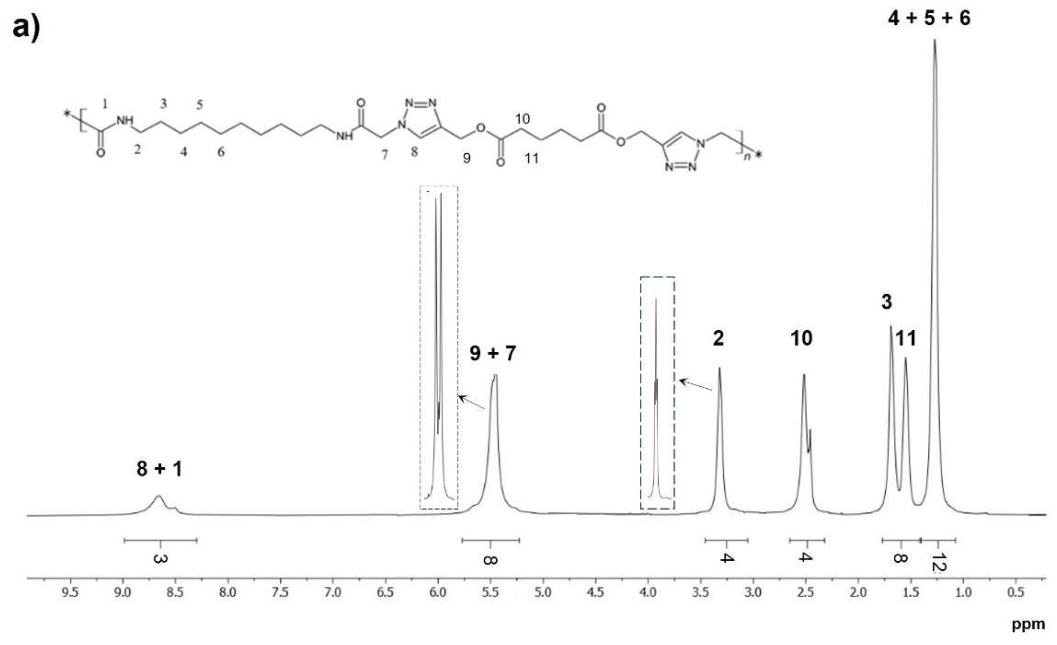
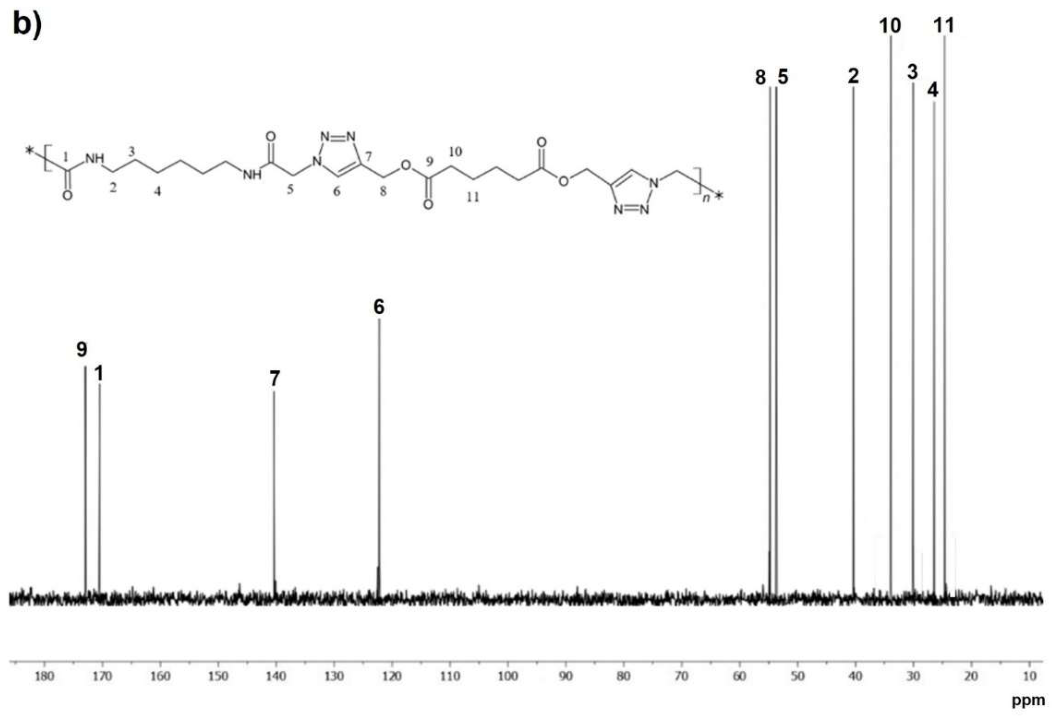
Figure 2.
Comparison between the FTIR spectra of PEA6T6 and PEA10T6.
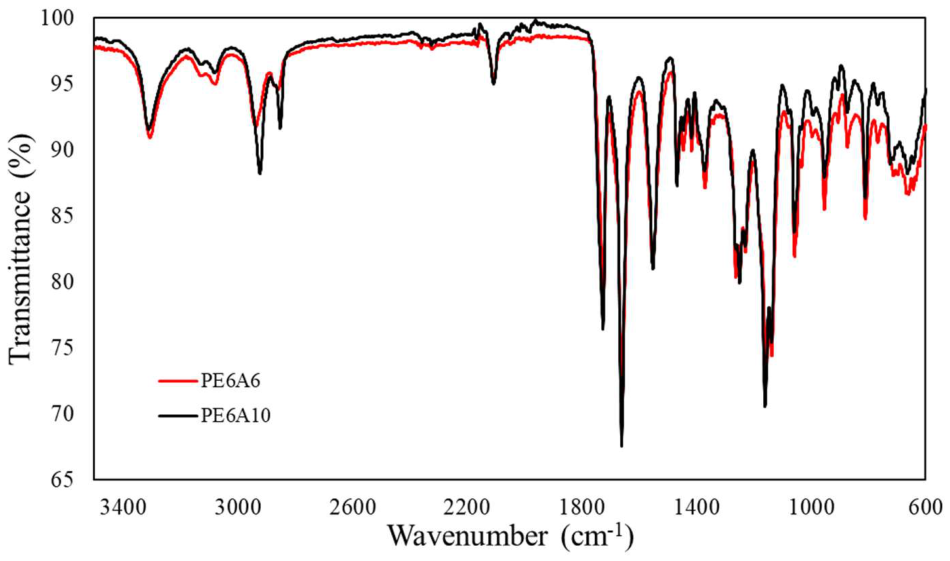
Figure 3.
TGA (solid lines) and DTGA (dashed lines) curves of PEA6T6 (green) and PEA10T6 (blue), highlighting the three main thermal degradation steps.
Figure 3.
TGA (solid lines) and DTGA (dashed lines) curves of PEA6T6 (green) and PEA10T6 (blue), highlighting the three main thermal degradation steps.
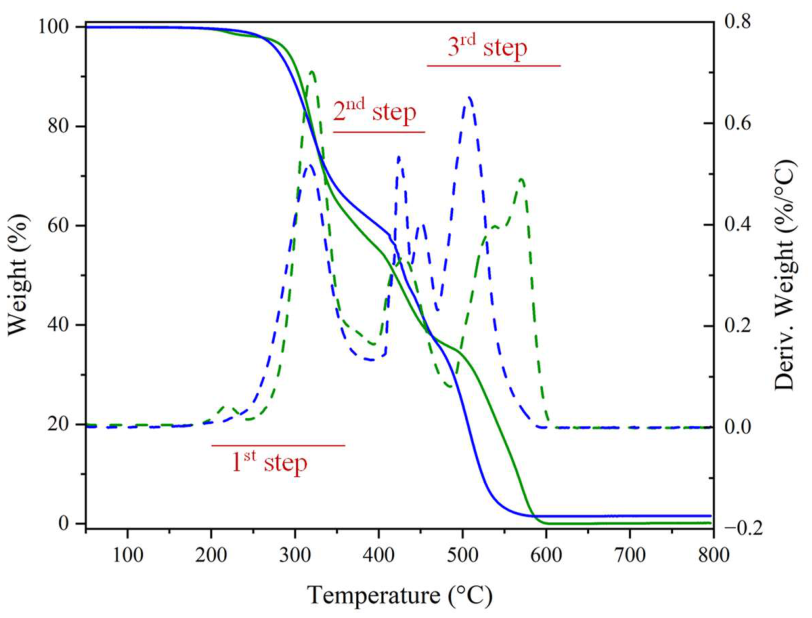
Figure 4.
DSC thermograms of PEA10T6 (left) and PEA6T6 (right) obtained during: (a) first heating run, (b) subsequent cooling run, (c) second heating run, and (d) third heating run performed on melt-quenched samples.
Figure 4.
DSC thermograms of PEA10T6 (left) and PEA6T6 (right) obtained during: (a) first heating run, (b) subsequent cooling run, (c) second heating run, and (d) third heating run performed on melt-quenched samples.
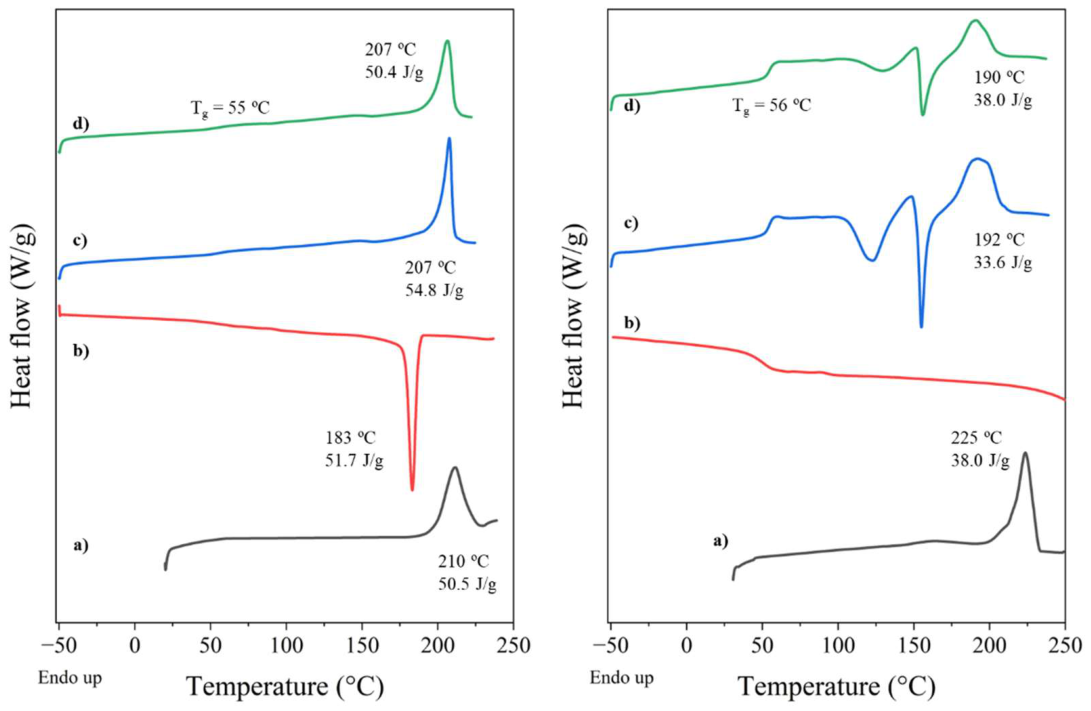
Figure 5.
Weight loss of PEA6T6 (top) and PEA10T6 (bottom) samples as a function of time at different conditions: Hydrolytic degradation at pHs 3, 7 and 10 and 37 ºC (curves 1–3), lipase enzymatic degradation at 37 ºC (curve 4), and oxidative medium at 70 °C (curve 5). Weight losses were close to 0.1%, 0.5%, 1%, 1.2% and 10% for curves 1–5, respectively.
Figure 5.
Weight loss of PEA6T6 (top) and PEA10T6 (bottom) samples as a function of time at different conditions: Hydrolytic degradation at pHs 3, 7 and 10 and 37 ºC (curves 1–3), lipase enzymatic degradation at 37 ºC (curve 4), and oxidative medium at 70 °C (curve 5). Weight losses were close to 0.1%, 0.5%, 1%, 1.2% and 10% for curves 1–5, respectively.
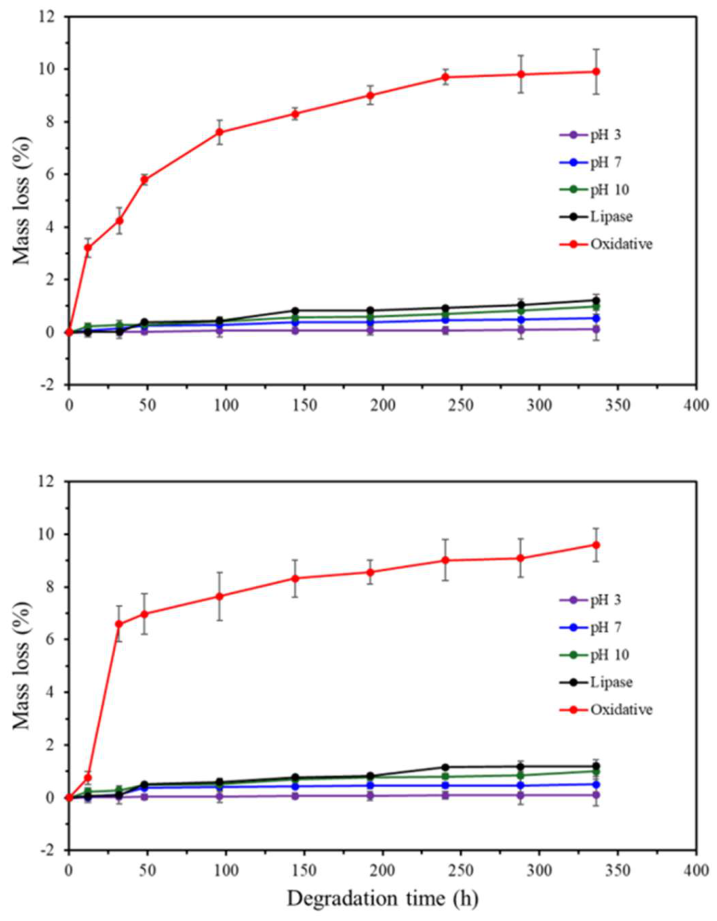
Figure 6.
Relative bacterial growth (normalized to the 100% control) of the indicated microorganisms incubated in the presence of PEA6T6. Red curves correspond to cultures containing the polymer, while grey curves represent the control experiments without polymer.
Figure 6.
Relative bacterial growth (normalized to the 100% control) of the indicated microorganisms incubated in the presence of PEA6T6. Red curves correspond to cultures containing the polymer, while grey curves represent the control experiments without polymer.
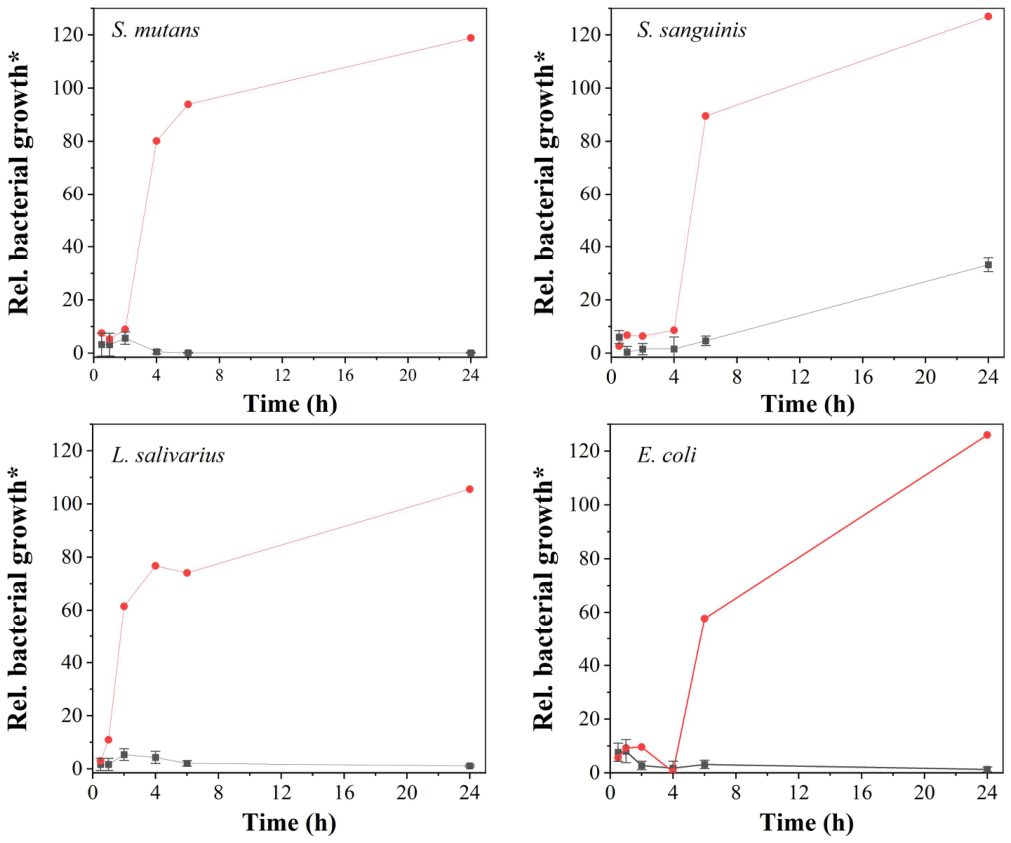
Figure 7.
Cell proliferation of COS-1 and SAOS-2 cells after direct contact with the indicated poly(ester amide)s, normalized to the control values.
Figure 7.
Cell proliferation of COS-1 and SAOS-2 cells after direct contact with the indicated poly(ester amide)s, normalized to the control values.
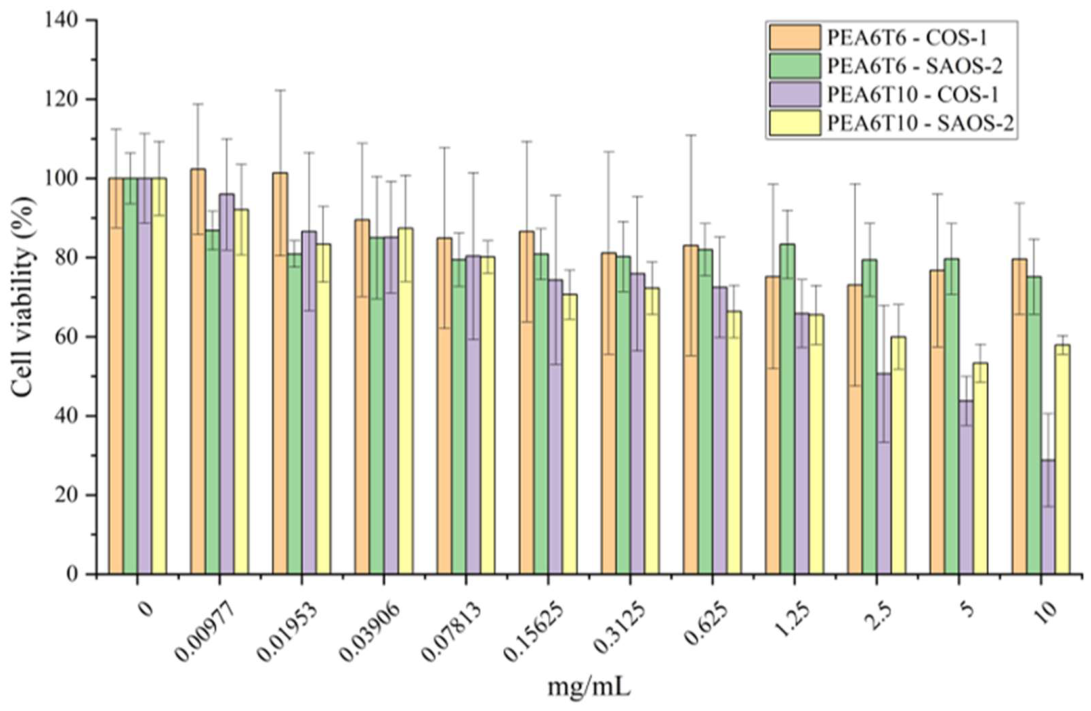
Figure 8.
SEM micrographs showing the morphology of PEA6T6 (left) and PEA10T6 (right) nanoparticles prepared from trifluoroacetic acid (TFA) solutions. Scale bar = 0.5 μm.
Figure 8.
SEM micrographs showing the morphology of PEA6T6 (left) and PEA10T6 (right) nanoparticles prepared from trifluoroacetic acid (TFA) solutions. Scale bar = 0.5 μm.
Disclaimer/Publisher’s Note: The statements, opinions and data contained in all publications are solely those of the individual author(s) and contributor(s) and not of MDPI and/or the editor(s). MDPI and/or the editor(s) disclaim responsibility for any injury to people or property resulting from any ideas, methods, instructions or products referred to in the content. |
© 2026 by the authors. Licensee MDPI, Basel, Switzerland. This article is an open access article distributed under the terms and conditions of the Creative Commons Attribution (CC BY) license (http://creativecommons.org/licenses/by/4.0/).
Copyright: This open access article is published under a Creative Commons CC BY 4.0 license, which permit the free download, distribution, and reuse, provided that the author and preprint are cited in any reuse.


