
Submitted:
27 June 2026
Posted:
30 June 2026
You are already at the latest version
Abstract
CubeSat constellations are increasingly used for persistent Earth observation, global Internet of Things connectivity, distributed sensing, and low-cost communications. As deployment activity grows, constellation design becomes a multi-objective problem involving orbital geometry, spatial coverage, revisit time, communication capability, and implementation complexity. This paper reviews and compares major CubeSat constellation architectures, focusing on Walker Delta, Walker Star, and hybrid multi-layer configurations. Prior studies are examined according to their assumptions, coverage goals, performance metrics, and reported trade-offs, with emphasis on the limitations of idealized visibility models. The review is complemented by a simulation-based parametric optimization study in Systems Tool Kit (STK). A four-round sequential sweep varies inclination, altitude, satellite count, and plane count for each architecture under a common nadir cone half-angle of 45 degrees and common decision thresholds of at least 97 percent instantaneous coverage and at most 10 minutes revisit time. The results show that no architecture is universally optimal. Performance depends on latitude requirements, continuity objectives, satellite count, and mission priorities. Walker Delta remains useful for structured mid-latitude coverage, Walker Star provides the strongest threshold satisfaction in the present comparison, and the Hybrid design offers a competitive satellite-count trade-off. The study therefore provides both a consolidated literature synthesis and a quantitatively grounded reference for future CubeSat constellation design.
Keywords:
CubeSat
; nanosatellite
; satellite constellation
; distributed satellite systems
; inter-satellite link
; constellation architecture
; satellite communication
; coverage
; parametric optimization
; Walker constellation
1. Introduction
CubeSats were introduced in the late 1990s as a practical way to broaden access to space. Before this standard emerged, satellites were typically large, expensive platforms developed mainly by governments or major industrial organizations. In 1999, Bob Twiggs at Stanford University and Jordi Puig-Suari at California Polytechnic State University proposed the CubeSat standard, defining a modular 1U satellite bus of approximately . This standard reduced development cost and complexity, making satellite missions more accessible to universities, research institutions, and countries with limited space infrastructure [1,2,3]. Since then, CubeSats have expanded beyond education into scientific, commercial, and operational missions. Their applications include Earth observation, such as Planet Labs’ PlanetScope mission; space weather studies, such as CSSWE; and interplanetary missions, such as MarCO and Lunar IceCube [4,5,6]. Larger standardized buses, including 2U, 3U, 6U, and 12U configurations, have also become common as missions require more payload volume, power, and antenna aperture [1].
Communication is one of the most active areas of CubeSat development. CubeSats are increasingly used for data relay, Internet of Things connectivity, and radio-frequency technology demonstration [7,8,9,10]. Examples include NASA’s AeroCube Optical Communications and Sensor Demonstration mission, which demonstrated satellite-to-ground laser communication, and ISARA, which used a high-gain antenna to increase achievable data rates [11]. Kepler Communications’ KIPP system also illustrates how small satellites can be used to support connectivity in polar regions. These examples show the promise of CubeSat communications, but they also highlight the technical limits imposed by small antennas, restricted transmit power, limited onboard energy, thermal constraints, and finite orbital lifetime.
Several mitigation strategies have been studied to address these constraints, including advanced antennas, software-defined radios, efficient solar arrays, improved attitude control, autonomous navigation, and optimized orbit design. Distributed satellite systems are especially important because they allow multiple spacecraft to share sensing, communication, and routing functions. In some architectures, inter-satellite links enable satellites to cooperate, reduce latency, improve reliability, and adapt to changing environmental or mission conditions [12,13,14,15,16,17].
Although CubeSats and satellite networks have been widely studied, the evidence remains fragmented across several research streams. Some studies focus on CubeSat mission evolution, subsystem technologies, or communication challenges, while constellation optimization studies often examine specific orbital configurations for narrow applications under different assumptions and metrics. As a result, direct architecture-centered comparisons of Walker Delta, Walker Star, and hybrid or multi-layer CubeSat constellations remain difficult to interpret. This difficulty increases when coverage behavior, revisit performance, latitude dependence, communication considerations, and implementation complexity are not evaluated together.
This paper addresses that synthesis need by reviewing and comparing the main CubeSat constellation architecture families. It brings together findings that are often separated across mission reviews, communication studies, and constellation optimization research. The literature synthesis is complemented by a focused STK-based parametric optimization study that quantifies architecture-level trade-offs in a common simulation environment. Each architecture is evaluated through a four-round sequential sweep, and a uniform cone half-angle is applied so that performance differences are driven by architecture rather than inconsistent sensor assumptions.
LEO constellation design for global or near-global service is commonly assessed using coverage maps and revisit statistics, including maximum, average, and percentile gap times. These metrics are useful because they scale to large parametric sweeps, but they do not always describe global continuity, latitude-dependent access, or maximum-gap behaviour, which are important for narrow-field-of-view CubeSat payloads. Propagation fidelity also varies across studies. Many analyses use Keplerian or J2-only models for tractability, while more engineering-oriented studies include higher-order zonal terms to preserve phasing realism over multi-day windows. Differences in propagation model, minimum-elevation mask, cone angle, altitude, satellite count, and sensor assumptions make direct comparison across published architecture results difficult.
1.1. Contributions
CubeSat constellation research now covers geometry design, coverage analysis, communication-aware modeling, and architecture-specific optimization. However, the literature remains fragmented, and architecture-level comparison is often complicated by differences in assumptions, metrics, visibility models, and system constraints. To address this gap, this paper makes the following contributions:
- 1.
- It provides an architecture-centered comparative review of the main CubeSat constellation families discussed in the literature, especially Walker Delta, Walker Star, and hybrid or multi-layer constellations. The review emphasizes structural features, recurring orbital design choices, and common mission contexts.
- 2.
- It synthesizes prior studies using multiple comparison dimensions rather than a single coverage indicator. These dimensions include spatial coverage, revisit behavior, latitude-dependent performance, communication-related considerations, implementation complexity, and mission suitability.
- 3.
- It identifies recurring gaps in existing comparisons, including idealized visibility assumptions, inconsistent metric definitions, unequal comparison baselines, and limited treatment of practical trade-offs such as redundancy, deployment burden, and regional service balance.
- 4.
- It performs a focused STK-based parametric optimization using four sequential sweep rounds for each architecture. The sweep varies inclination, altitude, satellite count, and orbital plane count while holding the remaining parameters at the best values from the preceding round. A common cone half-angle of is applied to all architectures so that the results reflect architecture-driven differences rather than inconsistent sensor geometry.
- 5.
- It uses the combined review and optimization results to clarify the mission conditions under which each architecture is most suitable. In the present comparison, Walker Star satisfies the primary coverage and revisit thresholds at its optimized configuration, while the Hybrid architecture offers a competitive option when satellite count is a stronger constraint.
1.2. Related Works
Previous studies on CubeSat constellations are connected to the vast body of CubeSat review literature. There are surveys and studies that trace the evolution of CubeSat from educational and technology demonstration platforms, shifting into mission-capable spacecraft for services such as Earth observation, telecommunications, scientific sensing, and deep space applications [18,19]. At the subsystem level, antenna and communication review papers show that CubeSat communication performance is strongly affected by limits such as antenna gain, small hardware size, deployment difficulty, and available onboard power [20,21]. These review papers are useful because they explain how mature CubeSat technology has become, but they do not mainly compare constellation architectures as different system-level design options.
Another group of research focuses on constellation geometry and orbit optimization. It looks at how satellite orbits are arranged and how parameters such as altitude, inclination, number of planes, phasing, and shell design affect constellation performance. The older/classical studies on Walker constellations and polar-orbit designs created the basic design rules that are still used today for Walker Delta and Walker Star constellation structures [22,23,24,25]. Newer studies build on those older Walker design rules by applying optimization methods to different mission goals, including navigation, Earth observation, and continuous coverage [26,27,28,29,30,31]. Surveys on LEO constellation designs show that orbit and architecture choices are closely connected to coverage, delay or latency, system resilience, cost, and difficulties in deployment [32,33]. Some studies have demonstrated that using two orbital shells can improve global availability and the geometric performance at large, compared to using one shell. Other studies added on to this and demonstrated that the best constellation architecture may change depending on the mission at hand [34,35,36,37,38,39,40].
Some research studies dive deeper to look at serviceable footprint instead of just their geometric footprint. They consider whether the constellation can actually support communication needs, not just the satellite visibility.
Handley showed that the way satellites are connected and how data is routed through inter-satellite links can strongly affect latency in large LEO systems [41]. Other studies also show that inter-satellite links, cross-layer modelling, and transmission efficiency can change the final network performance of LEO constellations [42,43,44,45].
Del Portillo and co-authors compared major broadband LEO constellations and showed that both the satellite network design and the ground infrastructure assumptions strongly affect estimated throughput and capacity [46].
For satellite IoT systems, Chan and co-authors developed a more realistic uplink performance model that includes satellite availability, packet collisions, interference, Doppler shift, and channel impairments instead of relying only on geometric visibility [47].
This group of studies is important because it shows that an architecture may look good in coverage plots, but may perform differently when routing, interference, access protocols, and gateway assumptions are included [48,49,50,51].
Another area of research focuses on evaluation metrics and modelling realism. Many studies compare instantaneous coverage, revisit time, and availability, as these metrics are easier to apply in optimization studies.
Some studies reflect that judging constellations only by simple metrics like coverage percentage, revisit time, and/or availability is not enough, but rather consider other parameters such as system resilience, service continuity, coordination between layers, and the general implementation difficulty [29,40].
Some studies on antenna and beam steering also show that field-of-view assumptions have to be realistic, because overly generous footprint models can make small CubeSat payloads appear as if they cover more area than they can actually serve [20,21].
Considering these studies together, one can learn and see that the problem is not that previous research does not exist; rather, the problem is that the evidence is scattered across different types of studies that use assumptions and performance measures.
This paper fills that gap. It does not claim that review papers are missing; instead, it brings together the evidence that is usually separated across CubeSat mission reviews, communication studies, and constellation optimization papers.
This paper incorporates a case study that optimizes Walker Delta, Walker Star, and Hybrid constellations separately, then compares their optimised performance using common metrics.
It is important to realise that a fair comparison does not always mean forcing every architecture to use the same orbital parameters. In many cases, each architecture is best optimised according to its own design behaviour, and the resulting best configuration can then be compared using the same metrics and decision thresholds. This method gives each architecture a fair chance to show its best performance, while still allowing the final results to be compared under common performance measures.
The study does not just discuss the architectures in theory; it also incorporates an organised simulation process to measure how the architectures trade off against each other.
The paper now moves into a literature summary table. The table lists key authors, what constellation topic they studied, what metrics they used, and what each study contributed.
Beyond the metrics already discussed, many studies still give limited attention to global coverage continuity, access duty cycle by latitude, and maximum continuous coverage gaps, even though these measures are important for narrow field of view CubeSat payloads. Some constellation studies make use of simplified orbit models, such as Keplerian motion or J2-only propagation, because these models are much faster and easier to use in optimization. However, the use of simplified models can reduce the realism of multi-day constellation simulations drastically, especially when studying how the satellite positions and coverage pattern change over time [58,59]. It is important to note that geometric coverage alone is not enough in communication-focused missions. A satellite may be visible, but the link may still fail if the signal is weak, the antenna beam does not cover the user, or the data rate requirement cannot be met [20,21,46,47].
This is why link-budget awareness is important when interpreting constellation coverage results. In a simplified downlink check, the received energy-per-bit to noise-density ratio can be expressed as
where is the transmit power in dBW, and are the transmit and receive antenna gains in dBi, is the free-space path loss, represents additional implementation, pointing, polarization, and atmospheric losses, is the system noise temperature, and is the required bit rate. The link margin is then
Therefore, a geometric access interval should be interpreted as a candidate service interval only when the field-of-view condition and the link-margin condition are both satisfied.
2. Materials and Methods
2.1. Review and Comparative Framework
This section explains how the study compares a total of three constellation architectures. The comparison is based on both the reviewed literature as well as the case study, so that the architectures can be assessed using the same general performance themes. This makes it important to compare Walker Delta, Walker Star, and Hybrid constellations using common metrics while still allowing each architecture to be optimised according to its own design behaviour [34,40,60,61,62].
2.2. Case Study System Model
The first stage of the case study defines a common simulation environment for all three architectures. This includes the same 100 Fibonacci-distributed global ground targets, simulation duration, and field-of-view assumption. This setup is important, as it prevents the comparison from being affected by different target sets or different visibility assumptions.
The global target set can be written as , where in the case study. To avoid clustering the targets near the poles, the target locations are generated using a Fibonacci-sphere distribution. For the j-th target, the normalized vertical coordinate and longitude are expressed as
and the corresponding latitude is
The ground position of each target on the Earth surface can therefore be represented as
where is the Earth radius. At each simulation time , the geometric access state of target is treated as a binary variable,
where is the elevation angle from target j to satellite n, is the minimum elevation angle, is the off-nadir angle between the satellite boresight and the target direction, and is the sensor cone half-angle. This means that a target is counted as geometrically covered only when at least one satellite satisfies both the visibility and cone-angle conditions.
2.3. Constellation Architectures
The study demonstrates that the architectures have their own typical structure and use case. Walker Delta is usually treated as a regular single-shell baseline, Walker Star is used for near-polar or full-latitude coverage, and the Hybrid architecture combines two or more shells to improve balance, continuity, and/or resilience.
Figure 1.
Illustration of inter-satellite link communication within CubeSat constellations.
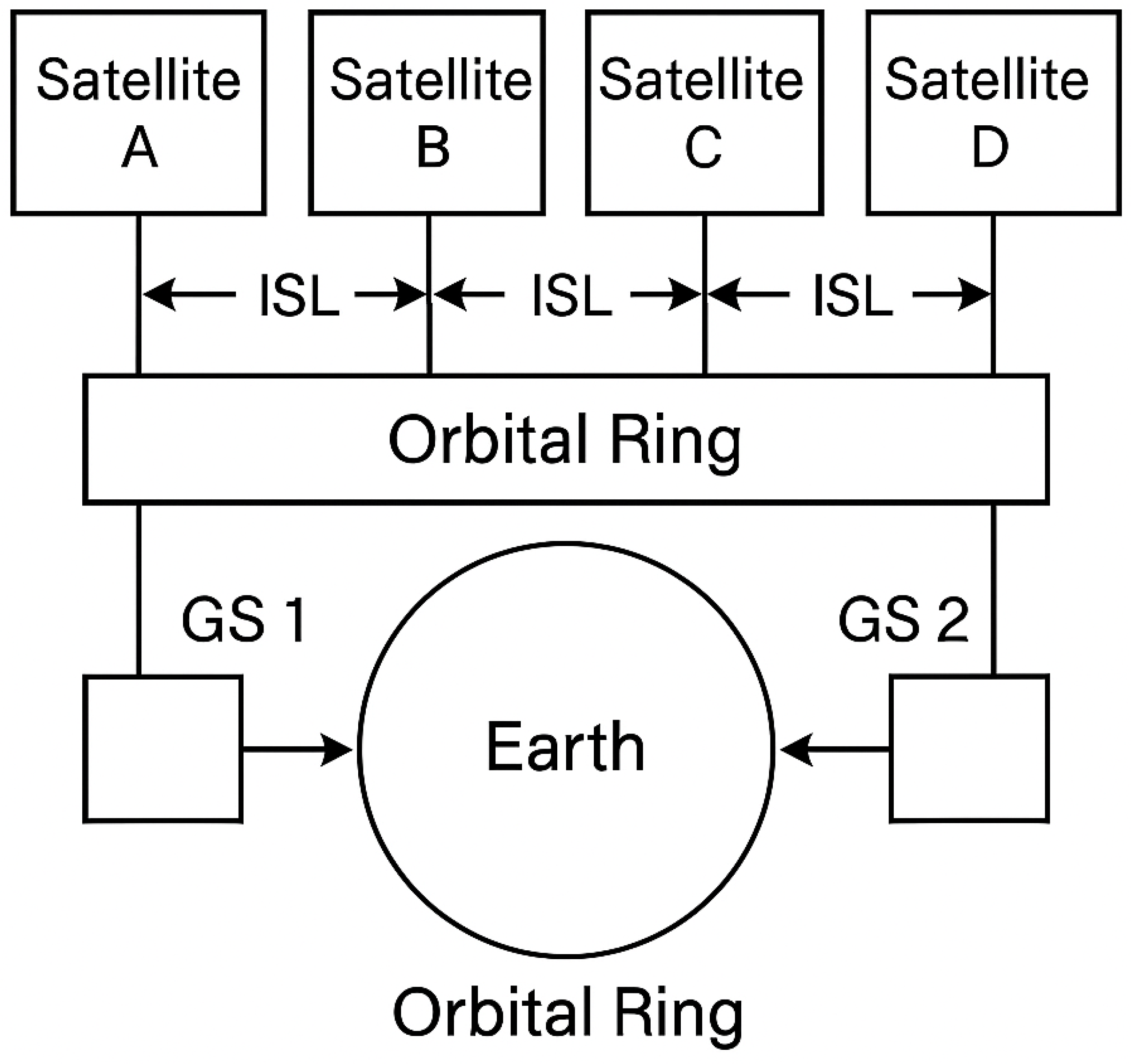
Figure 2.
Conceptual relationship between geometric access and communication-feasible service.

Figure 3.
Review framework used to compare CubeSat constellation architecture families and related performance themes.
Figure 3.
Review framework used to compare CubeSat constellation architecture families and related performance themes.
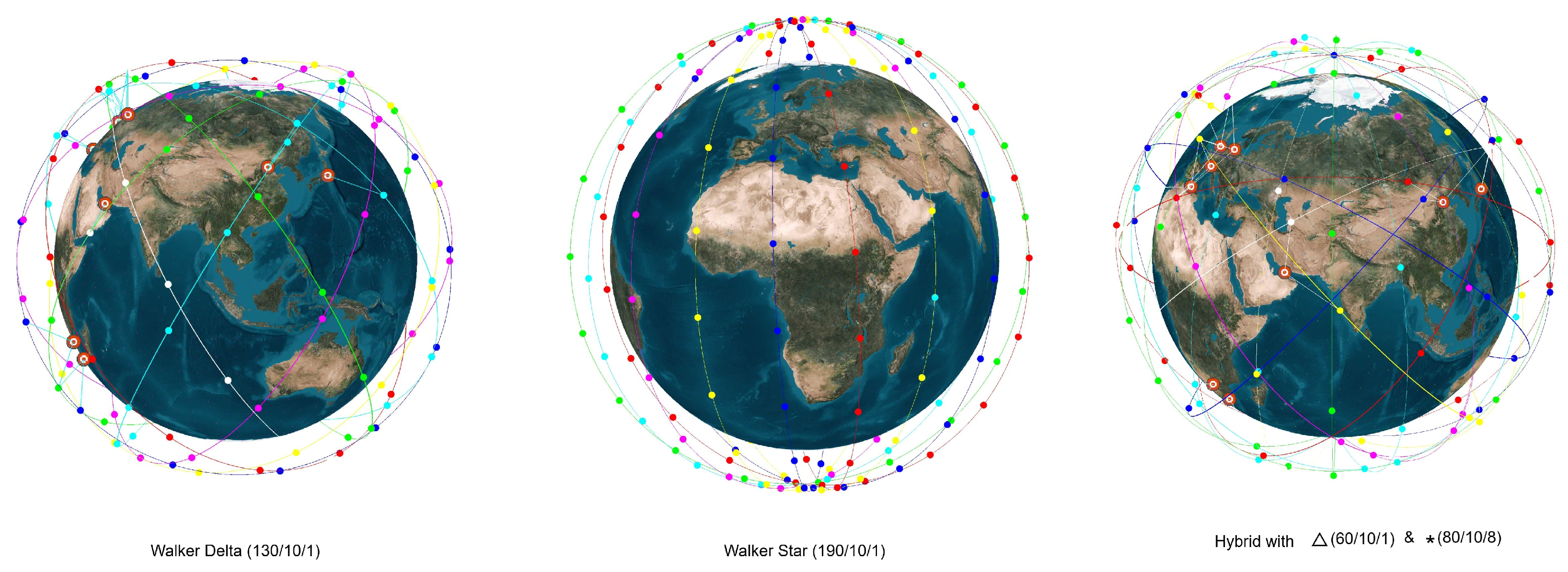
Figure 4.
Schematic geometry of a nadir-pointing CubeSat cone half-angle, footprint boundary, ground footprint radius, and elevation angle.
Figure 4.
Schematic geometry of a nadir-pointing CubeSat cone half-angle, footprint boundary, ground footprint radius, and elevation angle.
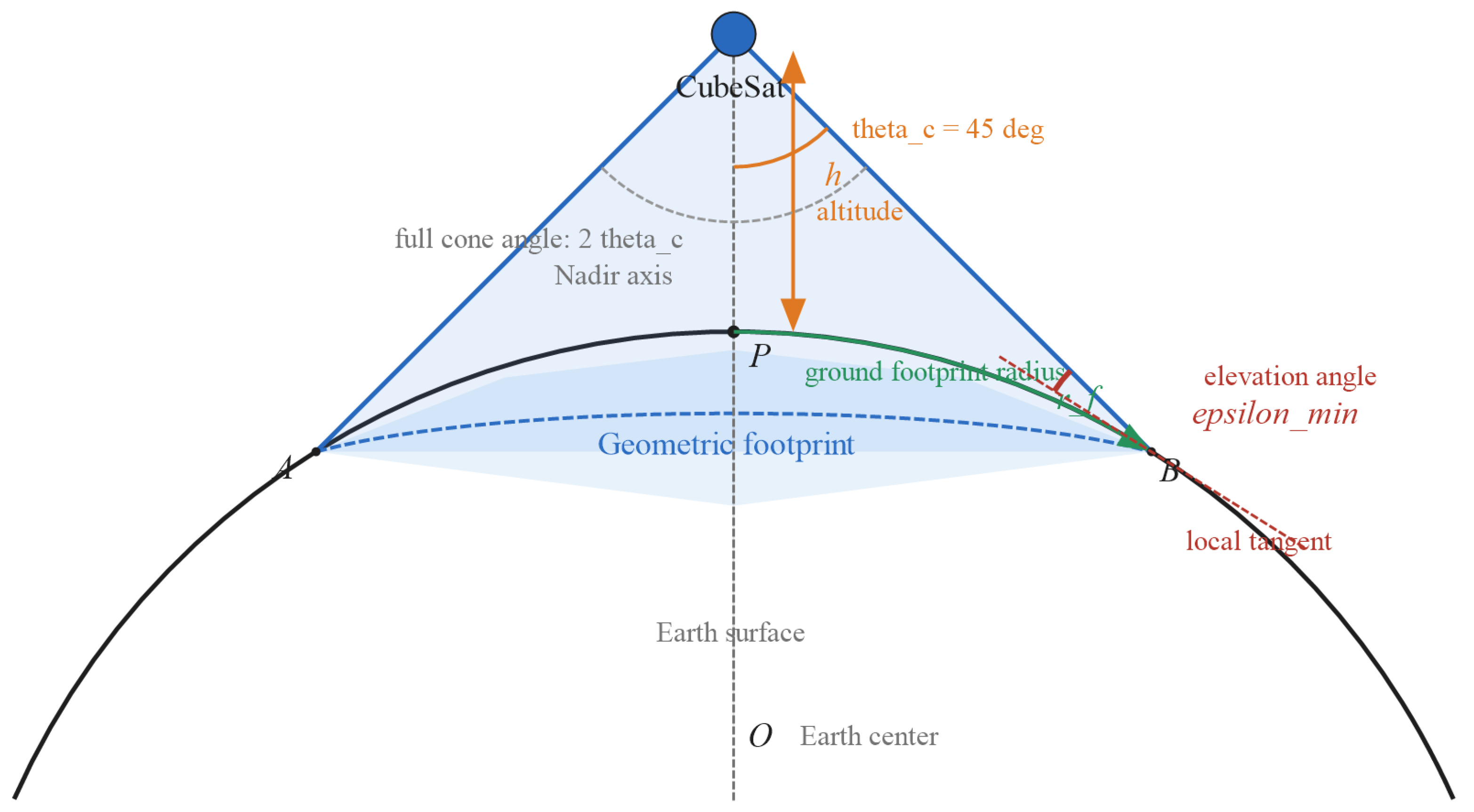
Figure 5.
Visual comparison of the Walker Delta, Walker Star, and Hybrid constellation architecture concepts considered in the case study.
Figure 5.
Visual comparison of the Walker Delta, Walker Star, and Hybrid constellation architecture concepts considered in the case study.
2.3.1. Mathematical Architecture Representation
The three architectures can be represented using the same basic Walker notation, with the main differences appearing in the RAAN range, inclination choice, and number of orbital shells. Let be the total number of satellites, P the number of orbital planes, the number of satellites per plane, i the inclination, F the Walker phasing factor, the plane index, and the satellite index. For a single-shell Walker constellation, the common inclination can be written as
where is the identity matrix. The RAAN of the p-th plane is then
where for a Walker Delta constellation and for a Walker Star constellation [22,23]. The corresponding RAAN matrix can be expressed as
The in-plane angular position of each satellite can be represented using the true anomaly term
This gives the constellation position matrix
Using this notation, the Walker Delta case is mainly distinguished by the full RAAN distribution, while the Walker Star case is distinguished by the RAAN distribution and near-polar inclination. The Hybrid architecture is represented as a combination of two or more shells,
where each shell k may follow a Walker Delta, Walker Star, or other orbital pattern. This representation is useful because it allows each shell to retain its own altitude, inclination, plane count, phasing, and RAAN range while still being evaluated as one combined constellation.
2.3.2. Walker Delta
Walker Delta constellations are usually described as single-shell Walker patterns that have orbital planes spread across the RAAN range. They are often used as the structured baseline and are commonly associated with stronger equatorial and/or mid-latitude coverage, but they are often weaker at the polar regions. Walker Delta is attractive for missions that need structured global distribution, predictable revisit, and communication redundancy in non-polar regions. Its main strengths are geometric regularity and much simpler parameterization, while its limitations include latitude imbalance, weaker polar access, and possible overestimation when studies use idealized visibility assumptions [32,63].
2.3.3. Walker Star
Walker Star constellations have their orbital planes across a RAAN range and often use near-polar inclination. This makes them particularly useful for missions that need stronger polar access or wider latitude coverage, although their final performance still depends on the mission targets, the number of satellites, and the evaluation metric. The Walker Star’s main advantage is that it can provide better access at higher latitudes and near the poles compared with lower-inclination single-shell constellations like Walker Delta. However, it should not be treated as automatically better for every mission, because the final result always depends on the target region, the number of satellites, and the performance metric being prioritized at a given time [32,34,63].
2.3.4. Hybrid Architecture
Hybrid constellations combine two or more orbital shells that incorporate either the same type of constellation or different types. The purpose is usually to balance the weaknesses of one shell with the strengths of another, or the weaknesses of one constellation with the strengths of another, such as improving availability, continuity, coverage balance, or resilience across different regions. Hybrid architectures are often used, as they can improve latitude balance, continuity, availability, and resilience compared to a single-shell design. The advantage in certain missions is that different shells can support different roles, but their limitation is that they are more complex to design, deploy, coordinate, and evaluate. They can also have a lot of signal interference, depending on the type of constellations incorporated in the overall system.
Hybrid constellations provide better latitude balance and continuity in a case where the different shells are arranged to compensate for each other’s weak coverage regions. Research shows that multi-layer constellations achieve similar or better coverage with fewer satellites than a single-shell constellation, depending on the mission requirements. However, hybrid designs also introduce more difficulty because the different shells must be coordinated in terms of altitude, inclination, phasing, communication links, and deployment strategy. For this reason, hybrid constellations are better understood as flexible design options rather than automatically superior architectures. Their value depends on whether the extra complexity is justified by the improvement in coverage, continuity, resilience, or satellite-count efficiency [34,40,60,61,62].
2.4. Parametric Optimisation Procedure
The case study incorporates a sequential parametric optimization approach, where one constellation parameter is varied at a time while the other parameters are held constant. After each sweep, the best-performing value is selected based on the coverage and revisit results, and that value then becomes the updated baseline for the next sweep. This approach allows the constellations to be optimized separately while still comparing their final configurations using the same performance metrics. Once the common environment is fixed, the sequential sweeps are then used to identify the strongest parameter combination for each architecture.
2.5. Performance Metrics
The study makes use of instantaneous coverage to measure how much of the evaluated area or target set is covered at each simulation time. Revisit time and the maximum continuous access gap are used to measure the time-based quality of coverage, because a target can be covered sometimes but still experience long periods without good access. The Fibonacci-distributed target set helps make the comparison fairer, because the three architectures are tested against the same global sampling pattern.
Using the binary access variable in Equation (6), the instantaneous coverage percentage at time is calculated as
The reported mean and minimum coverage values are then obtained from the full simulation time vector ,
For each target, the continuous access gaps are extracted from the time intervals where . If is the set of no-access intervals for target , then the maximum gap for the full constellation is
The revisit-time metric is interpreted as the time between successive access opportunities for the same target. Therefore, the case study uses coverage, revisit time, and maximum gap together so that the results do not depend on coverage percentage alone.
The heat map is used to specifically show where the longest access gaps occur geographically. Coverage by latitude, on one hand, shows each constellation’s performance across low, middle, and high latitudes. These metrics are kept separate from communication link-budget performance, as the present case study mainly evaluates the geometric access and continuity of the constellations, rather than broadband service quality.
2.6. Assumptions and Limitations
The study makes use of a 48-hour simulation window so that short-term access behavior can be compared across the three architectures. The same sensor field-of-view assumption is used for all architectures to avoid making one constellation look better only because it was given a wider footprint. Because the analysis is geometric, the results are interpreted as access and continuity performance rather than confirmed communication service.
The selected cone half-angle of represents an angular coverage region of approximately about the antenna boresight. This value is reasonable as a common geometric assumption only if the spacecraft payload can maintain useful gain across the required off-boresight range. Several CubeSat antenna families can be considered for such a field-of-view assumption, but the final choice depends on frequency band, gain target, polarization, pointing accuracy, spacecraft size, and link-margin requirement [20,21].

Table 1.
CubeSat form factors and indicative specifications.
| Form | Size | Mass | Notes |
|---|---|---|---|
| 1U | cm | 1.33 kg | Baseline unit |
| 2U | cm | 2.6 kg | Stacked unit |
| 3U | cm | 4 kg | Common bus for university and technology missions |
| 6U | cm | 8 to 12 kg | Larger power and antenna volume |
| 12U | cm | 16 to 24 kg | Higher payload volume for more demanding missions |
Table 2.
Literature summary on CubeSat constellations for global connectivity.
| Authors / Year | Constellation Focus and Methodology | Metrics | Key Contributions |
|---|---|---|---|
| Toorian et al., Shiroma et al., Simons et al. [1,2,3] | General CubeSat history; literature review | Mission growth, diversification | Early studies on the 1U standard; demonstrated low-cost access, rapid development, and educational/commercial uptake. |
| Bomani et al., Burkhard et al. [52,53] | CubeSat mission trends; statistical analysis | Launch counts, mission types | Identified steady growth from 2003 to 2021, adoption of larger form factors, and diversification of missions. |
| Alanazi [54] | CubeSat reliability; statistical failure analysis | Subsystem failure rates | Found communication subsystem failures account for 48% of mission losses. |
| Klesh and Krajewski [55] | Relay networks using the MarCO mission; prototyping | Data relay, downlink | Demonstrated UHF/X-band relays, autonomous operations, and deep-space navigation using 6U CubeSats. |
| Handley [56] | LEO mega-constellations; heuristic and analytical modelling | Latency, routing | Proposed dynamic routing and showed that inter-satellite links reduce latency compared with terrestrial networks. |
| Del Portillo et al. [57] | LEO broadband constellations; system modelling and FCC data | Capacity, throughput, inter-satellite-link gain | Compared three networks; inter-satellite links increase capacity by 42%, and optimised gateways enable smaller constellations to compete. |
| Yang et al. [58] | Two-tier clustered LEO; multi-objective PSO and Clohessy–Wiltshire dynamics | Revisit time, latency | Designed a two-layer constellation with 891 satellites that achieves global imaging in 35 min. |
| Guan et al. [59] | Walker constellations; NSGA-III and genetic algorithm | Coverage, GDOP | Optimised GNSS-augmenting Walker constellations; hybrid setups reduce satellite count while improving GDOP. |
Table 3.
Candidate CubeSat antenna families that can support or approximate a cone half-angle assumption.
Table 3.
Candidate CubeSat antenna families that can support or approximate a cone half-angle assumption.
| Antenna family | Relevance to a cone half-angle | Main limitation for constellation interpretation |
|---|---|---|
| Monopole, dipole, turnstile, or crossed-dipole antennas | Provide broad or near-omnidirectional coverage and can satisfy wide geometric visibility assumptions [20,64,65]. | Low gain can reduce data-rate capability and link margin, especially for communication-focused missions. |
| Single microstrip patch antenna | Provides broadside directional coverage and may approximate a wide cone when edge-of-beam gain remains acceptable [66,67]. | Gain normally decreases away from boresight, so the usable beam can be smaller than the geometric cone. |
| Patch array or phased patch array | Can provide higher gain and may support beam steering across the required angular region [21,68,69,70]. | Requires more spacecraft area, power, control complexity, and beam scheduling. |
| Quadrifilar helix or compact helical antenna | Can provide circular polarization and relatively broad coverage for small satellites [71]. | Beamwidth and gain depend strongly on the physical design and operating band. |
| Small horn or deployable high-gain antenna | Can be designed for a defined beamwidth and stronger link margin than very low-gain antennas [5,72,73,74]. | Higher gain often narrows the beam, so pointing accuracy and scanning strategy become more important. |
3. Results
3.1. Optimised Configuration Results
Figure 6 shows that the Walker Delta optimisation is mainly influenced by altitude and satellite count. In the inclination sweep, the lower-inclination option gives the strongest coverage for the selected global target set, while larger inclinations do not remove the polar limitation enough to improve the overall result. The altitude sweep then produces the largest coverage increase, because raising the shell from 500 km to 1300 km increases the geometric footprint of each satellite. After this altitude is selected, increasing the satellite count improves both mean and minimum instantaneous coverage, but the improvement is still not enough to satisfy the 97% threshold. The plane-count sweep shows that distributing the 150 satellites across 15 planes gives the strongest Walker Delta result, while adding more planes starts to reduce the coverage slightly. This demonstrates that the Walker Delta limitation is not only the number of satellites, but also the lower-inclination geometry that leaves weaker high-latitude and polar access.
Figure 7 shows a different optimisation behaviour for the Walker Star architecture. The near-polar inclination improves latitude reach and allows the constellation to serve high-latitude and near-polar targets more consistently than the lower-inclination Walker Delta case. The altitude sweep is the most important step, because increasing the altitude to 1500 km raises both mean and minimum instantaneous coverage above the 97% decision threshold. The satellite-count and plane-count sweeps then improve the result further, but the gains become smaller once the constellation is already close to full geometric coverage. The selected Walker Star configuration therefore reflects a threshold-driven design: it uses enough satellites and planes to keep the minimum instantaneous coverage above the required level, while the revisit-time metric is already well below the 10 min limit.
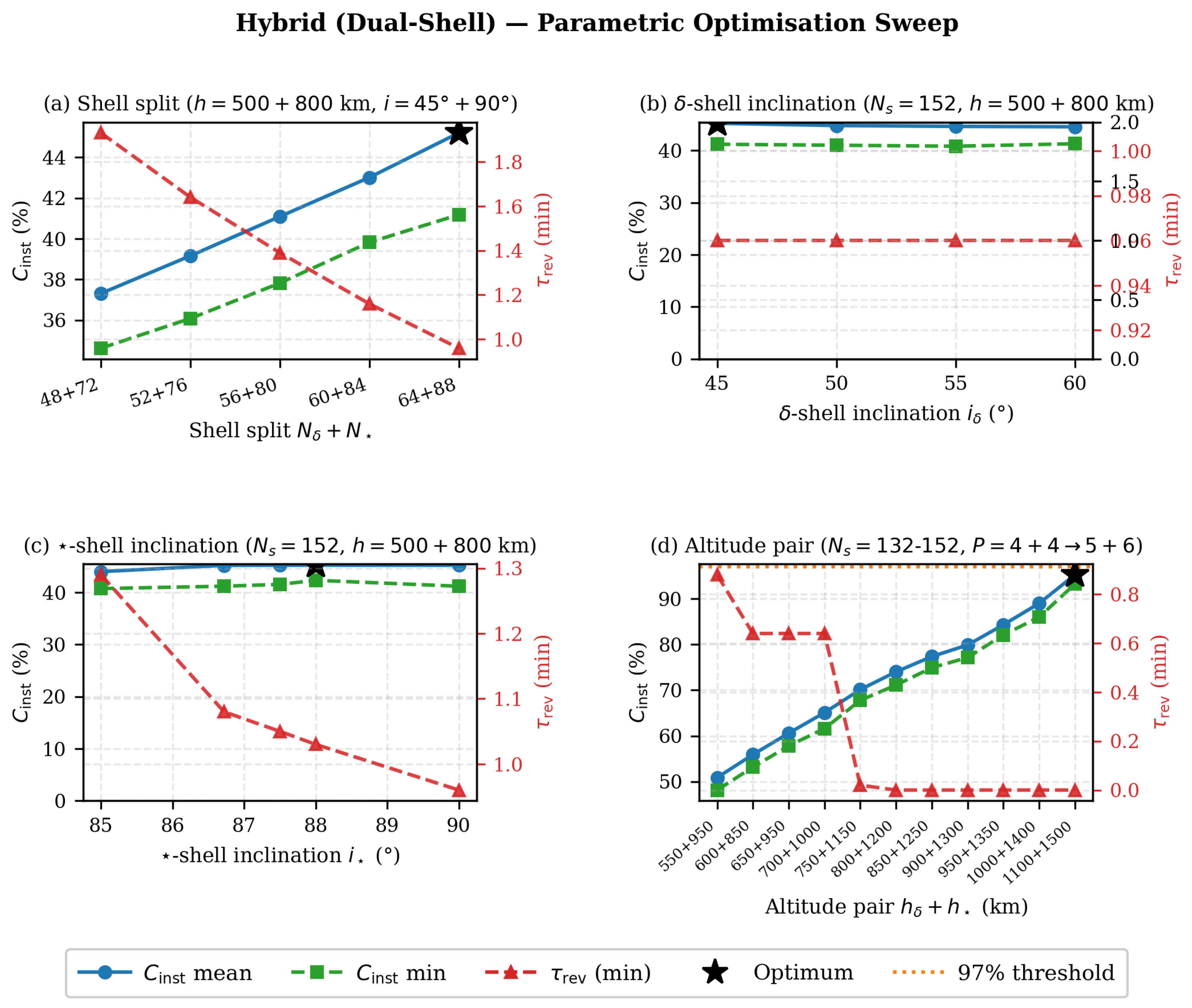
Figure 8 shows how the Hybrid architecture benefits from distributing satellites between two shells. The first sweep indicates that moving more satellites into the near-polar shell improves the global coverage balance, because the polar shell compensates for the weaker high-latitude access of the lower-inclination shell. The inclination sweeps show smaller changes compared with the shell-split and altitude-pair sweeps, meaning that the hybrid result is driven more strongly by how the two shells are combined than by a single inclination value. The altitude-pair sweep gives the strongest improvement, with higher paired altitudes increasing the geometric footprint and reducing revisit time. However, even after optimisation, the Hybrid case remains below the 97% instantaneous coverage threshold. This makes the Hybrid configuration useful as a satellite-count-efficient and more balanced architecture, but not the strongest option under the selected coverage threshold.
3.2. Comparative Access and Continuity Results
Walker Star achieved the strongest instantaneous coverage result, with and , giving a positive margin of percentage points above the 97% threshold. The Hybrid configuration achieved and , which placed it 3.74 percentage points below the threshold, although it used only 132 satellites. Walker Delta achieved and , meaning it missed the threshold by 15.26 percentage points despite using 150 satellites.
All three constellation architectures satisfy the 10-minute revisit-time requirement by a very large margin. The Walker Delta has a reported revisit time of approximately 0.01 minutes, which is approximately 0.6 seconds, while the Walker Star and Hybrid are reported below 0.01 minutes. These values should therefore be interpreted as bounded results, meaning that the Walker Star and Hybrid values are below the displayed limit rather than exactly equal to the Walker Delta value. This demonstrates that revisit time is not the main limiting metric in the final comparison. Rather, the stronger differences come from instantaneous coverage, latitude behavior, satellite count, and architecture complexity.
The STK comparison is based on a 48-hour time window, which helps show the time behavior of each optimized architecture under the same simulation duration and target set. The importance of this comparison is to show how consistently that access is maintained over time. This is important because two constellations can have similar average coverage but still differ in access stability, regional gaps, and continuity behavior.
The geographic maximum-gap heatmap identifies where the longest access interruptions occur across the evaluated global target set. It helps reveal whether the coverage problem is evenly distributed or concentrated in specific latitude bands or geographic regions. For CubeSat constellations, this is particularly important because a design may achieve high overall coverage while still leaving certain regions with poorer continuity.
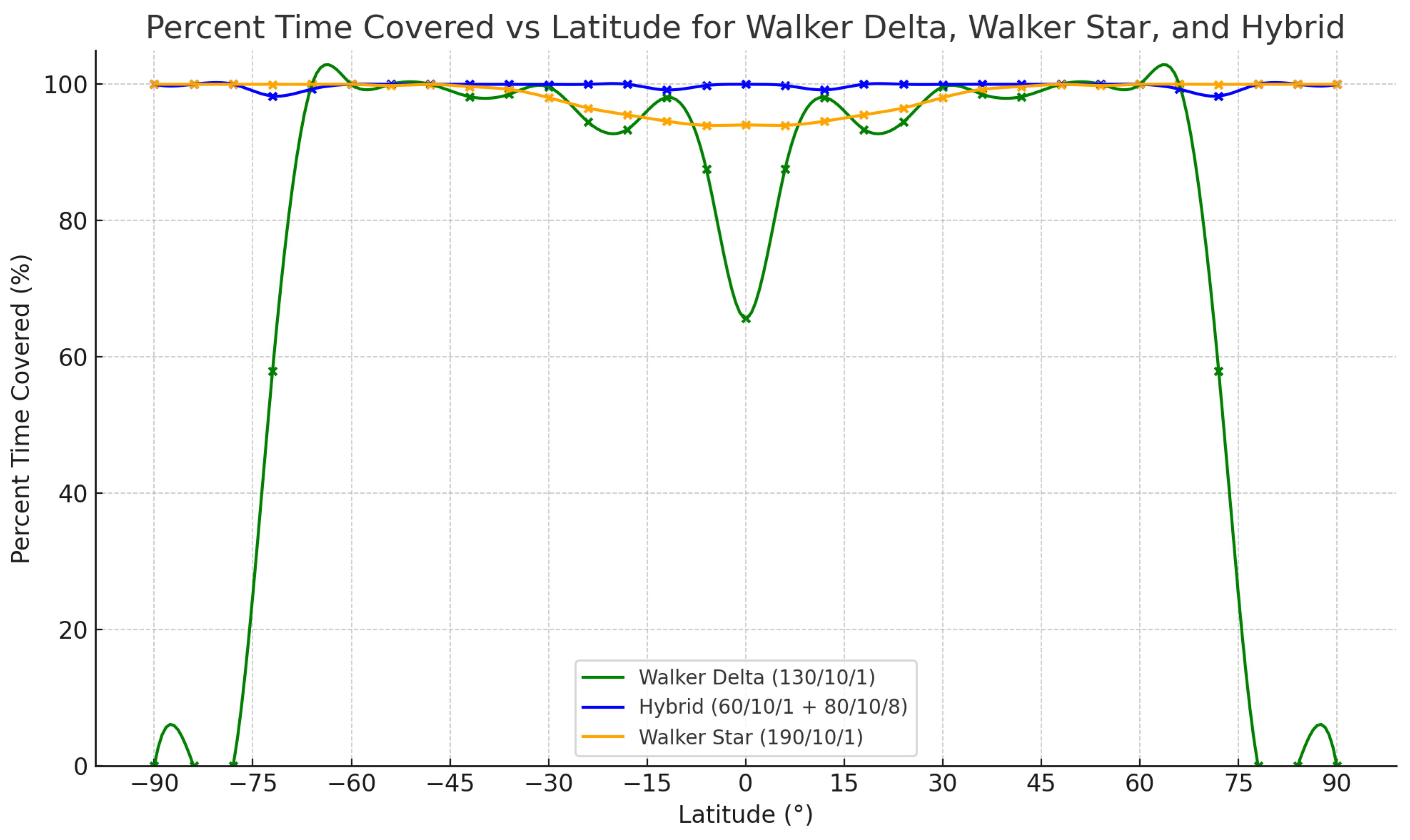
In the case of the Walker Delta, the longest access gaps are concentrated near high-latitude and/or polar regions, which is expected because the optimized Walker Delta uses a lower inclination and therefore does not support polar access as strongly. It is also expected for a Walker Delta to perform in such a manner, as increasing the inclination can sometimes reduce the concentration of coverage over the mid-latitude areas, which are areas where much of the population is located. The Walker Star heatmap is much darker and more uniform across the sampled targets, showing that the near-polar architecture reduces long access gaps across most latitude bands. The Hybrid heatmap demonstrates an intermediate behavior. The near-polar shell improves high-latitude continuity, while the lower-inclination shell supports lower- and mid-latitude regions. Regardless, the result still contains visible regional gap patterns.
3.3. Geometric Coverage and Communication-Aware Interpretation
The Walker Star architecture exceeds the 97% instantaneous coverage threshold by 2.85 percentage points, thus making it the only optimized architecture that satisfies this coverage requirement. Walker Delta, on the other hand, remains about 15.26 percentage points below the threshold, while the Hybrid architecture remains approximately 3.74 percentage points below it. When satellite count is considered, Walker Star still gives the strongest coverage yield, while the Hybrid remains competitive because it uses fewer satellites than both single-shell cases.
4. Discussion
4.1. Architecture Trade-Offs
The Walker Delta results show strong performance in structured mid-latitude access, but weaker performance in polar regions. The Walker Star results show stronger high-latitude and near-polar access, but at the cost of satellite count. The Hybrid results show that combining shells can improve balance between regions, but the architecture becomes more complex to design and may also introduce additional interference challenges.
It is important to note that no single architecture should be treated as the best option for every mission. The preferred constellation architecture depends on whether the mission prioritizes polar access, mid-latitude coverage, fewer satellites, or simpler deployment. This means that constellation architecture selection should be connected to the mission objective rather than only to the highest coverage percentage.
The findings demonstrate that Walker Delta, Walker Star, and Hybrid constellations should be compared using more than one metric. Coverage percentage alone can hide important differences in latitude behavior, access gaps, revisit time, and implementation complexity. Therefore, a multi-metric comparison gives a more useful basis for selecting a CubeSat constellation architecture.
A useful comparison should therefore consider numerical performance and the practical implementation issues as well. Higher coverage may not be enough if the constellation requires too many satellites, difficult deployment, or complex coordination. For CubeSat missions, it is especially important because payload size, power, antenna, field of view, and operational lifetime can be strongly limited.
The radar-style comparison helps to show the differences between the architectures in coverage, revisit behavior, satellite efficiency, and implementation burden. This supports the argument that architecture selection should be treated as a multi-objective decision. In practice, the best option is the one that gives acceptable coverage and continuity while still remaining realistic for CubeSat deployment and operation.
The results also demonstrate that the same constellation can look stronger or weaker depending on which metric is emphasized. For instance, one architecture can provide better latitude balance, while another may provide better satellite efficiency or simpler deployment. This means that constellation design should not be reduced to a single winning architecture without considering the mission context. This also applies to more complex architectures such as hybrid constellations. As demonstrated in the paper, the hybrid constellation is not necessarily better than the Walker Star. In terms of instantaneous coverage, Walker Star outperforms the other constellations. However, in terms of redundancy, the Hybrid constellation may offer advantages, even though its coverage behaviour and field-of-view performance are not as strong as the Walker Star.
Hybrid architectures should be interpreted cautiously, as adding more shells can increase signal overlap and coordination complexity. Although this overlap may improve redundancy and availability, it can also act as a disadvantage by increasing the risk of interference if frequency reuse, beam scheduling, and power control are not properly managed. Therefore, the benefit of a hybrid architecture has to be weighed against the extra engineering effort needed for interference mitigation and operational coordination.
In terms of constellation sizing, Walker Delta has the largest satellite count but still gives the weakest coverage result, which demonstrates that increasing the satellite count alone does not guarantee stronger global coverage. The Hybrid configuration uses the fewest satellites, but its dual-shell structure means that the lower satellite count must be balanced against the higher design and coordination complexity.
Figure 9.
Optimised architecture comparison: (a) instantaneous coverage and (b) revisit time. The 10 min revisit requirement is off-scale because the reported revisit values are below one second, while Walker Star and Hybrid are reported as sub-0.01 min values rather than exact equal values.
Figure 9.
Optimised architecture comparison: (a) instantaneous coverage and (b) revisit time. The 10 min revisit requirement is off-scale because the reported revisit values are below one second, while Walker Star and Hybrid are reported as sub-0.01 min values rather than exact equal values.
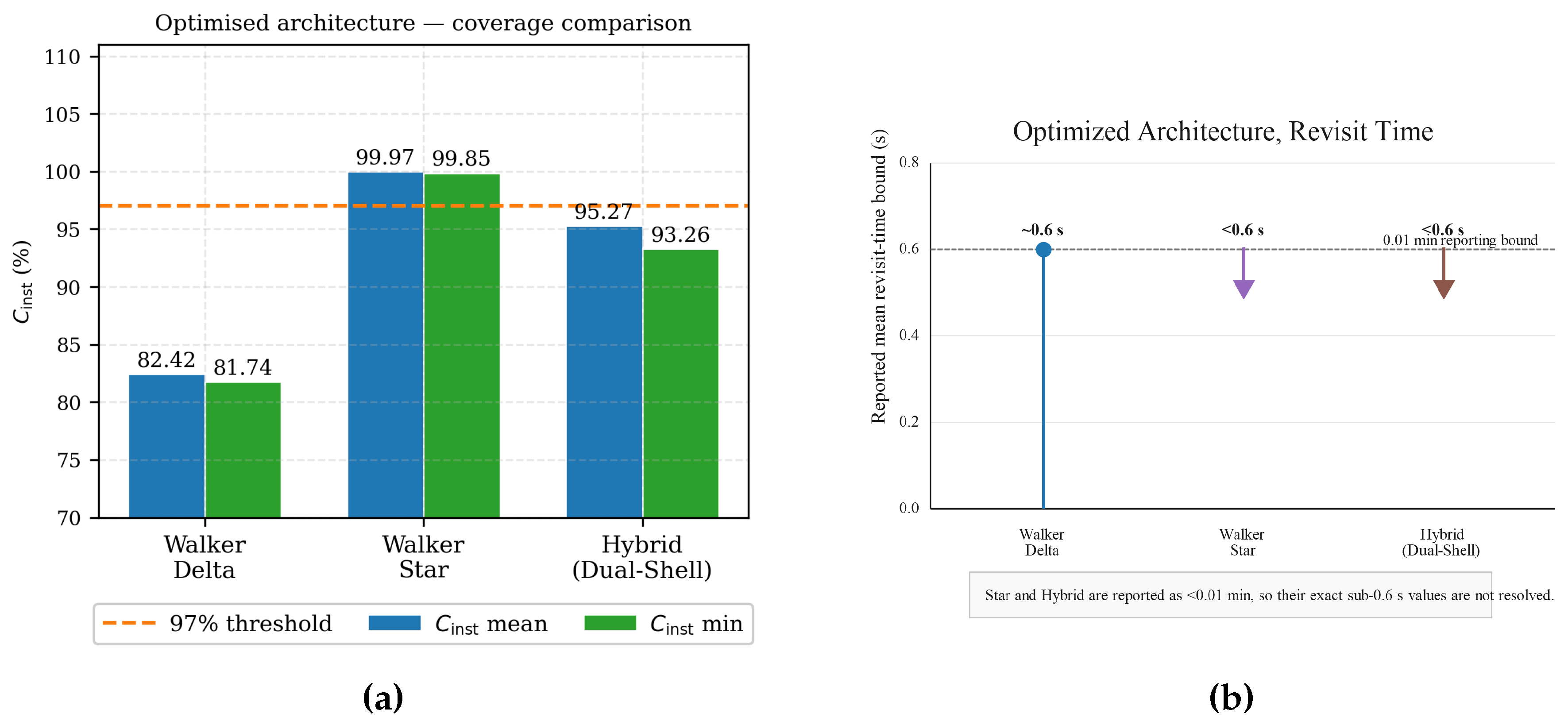
Figure 10.
STK-based 48-hour comparison of access behaviour for the three constellation architectures.
Figure 10.
STK-based 48-hour comparison of access behaviour for the three constellation architectures.
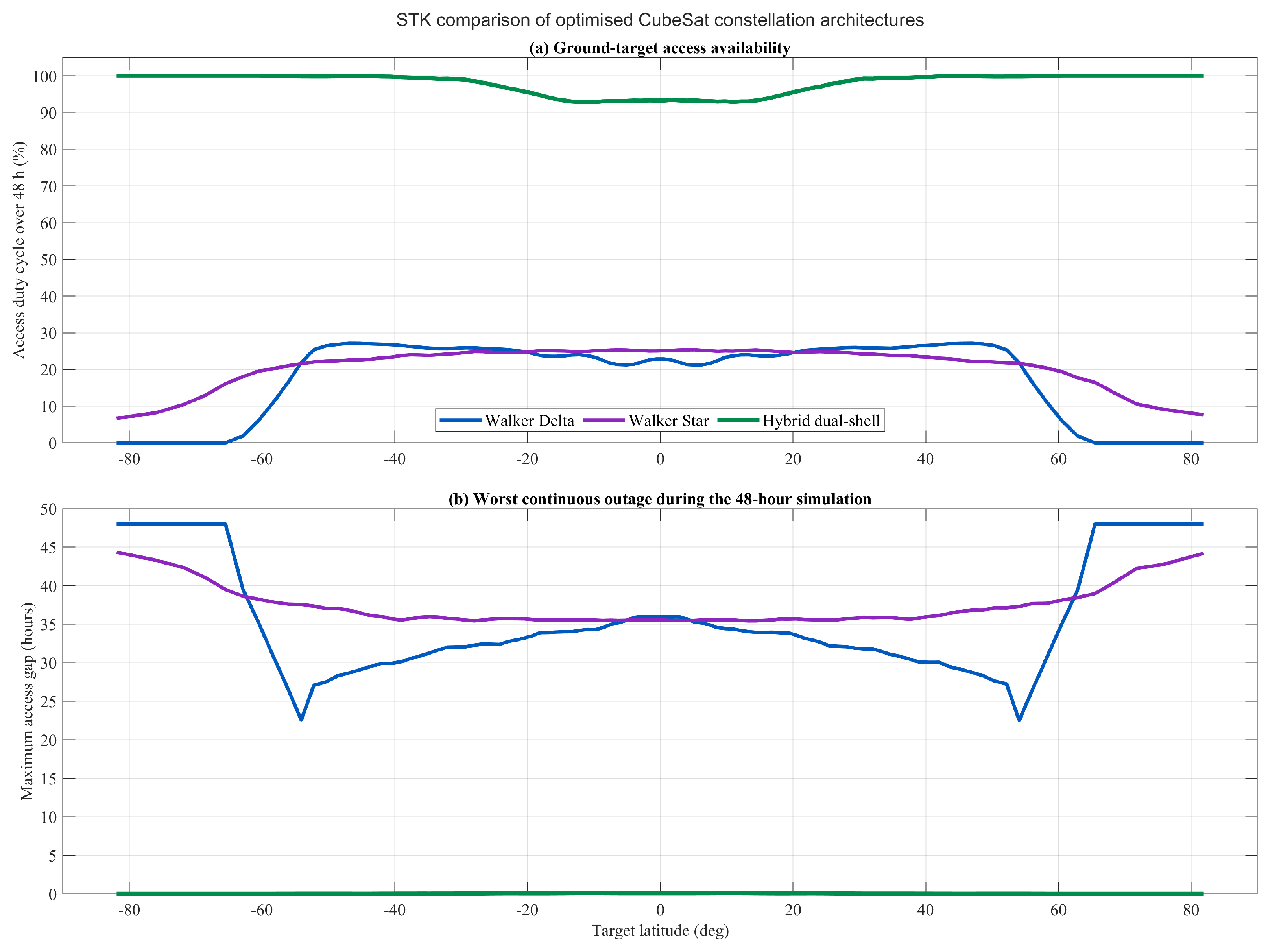
Figure 11.
Geographic maximum-gap distribution over the 48-hour comparison period.
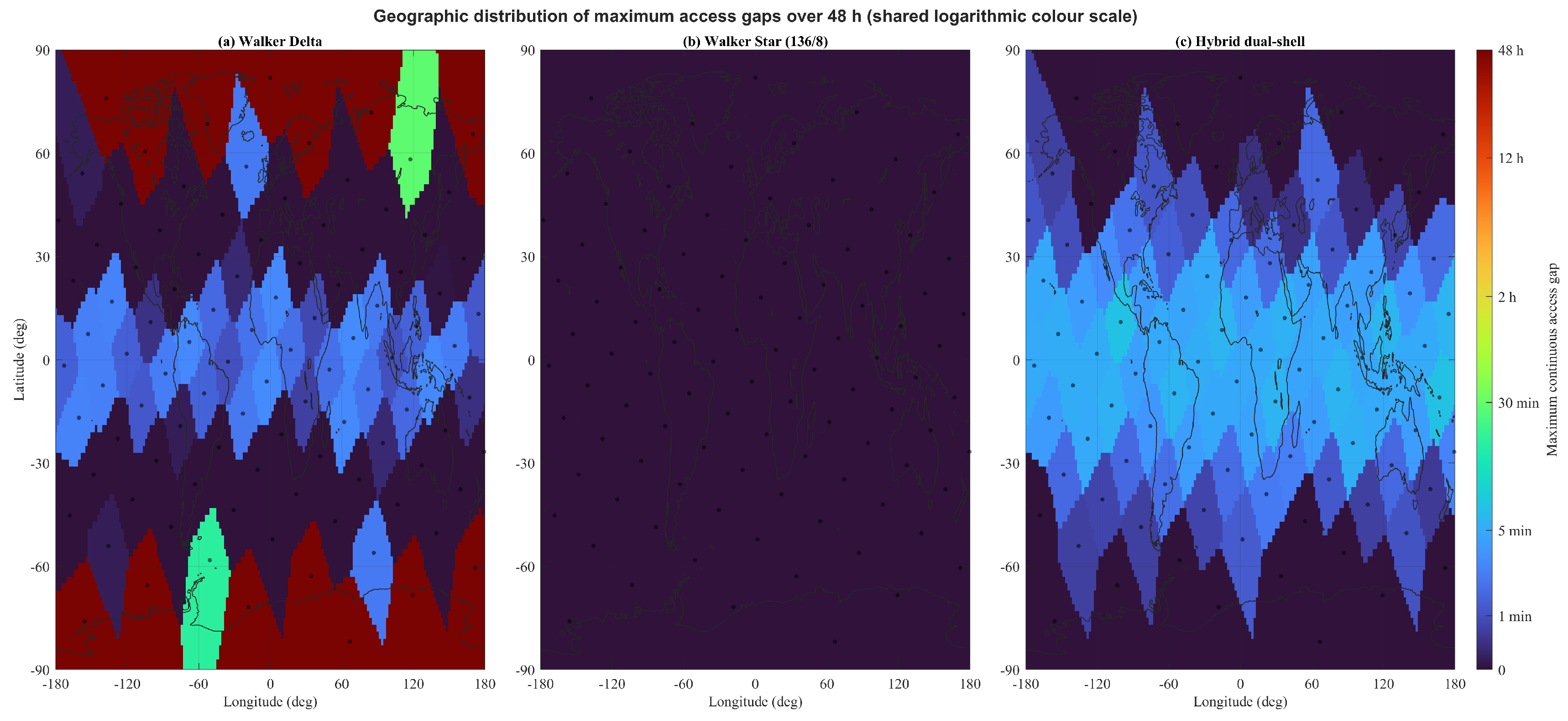
Figure 12.
Communication-aware interpretation support metrics: (a) instantaneous coverage margin relative to the selected decision threshold and (b) coverage yield per satellite.
Figure 12.
Communication-aware interpretation support metrics: (a) instantaneous coverage margin relative to the selected decision threshold and (b) coverage yield per satellite.
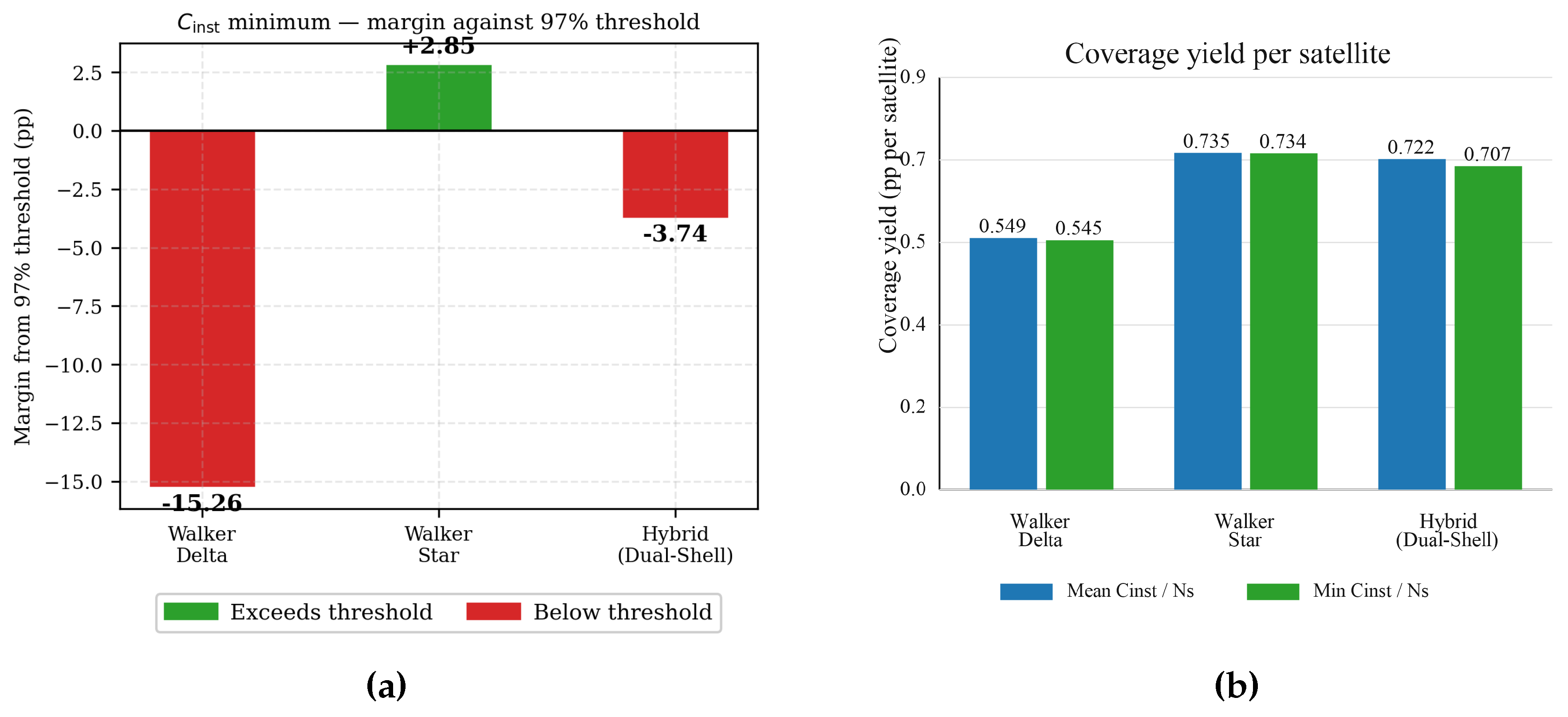
Figure 13.
Constellation sizing comparison for the optimised Walker Delta, Walker Star, and Hybrid cases.
Figure 13.
Constellation sizing comparison for the optimised Walker Delta, Walker Star, and Hybrid cases.
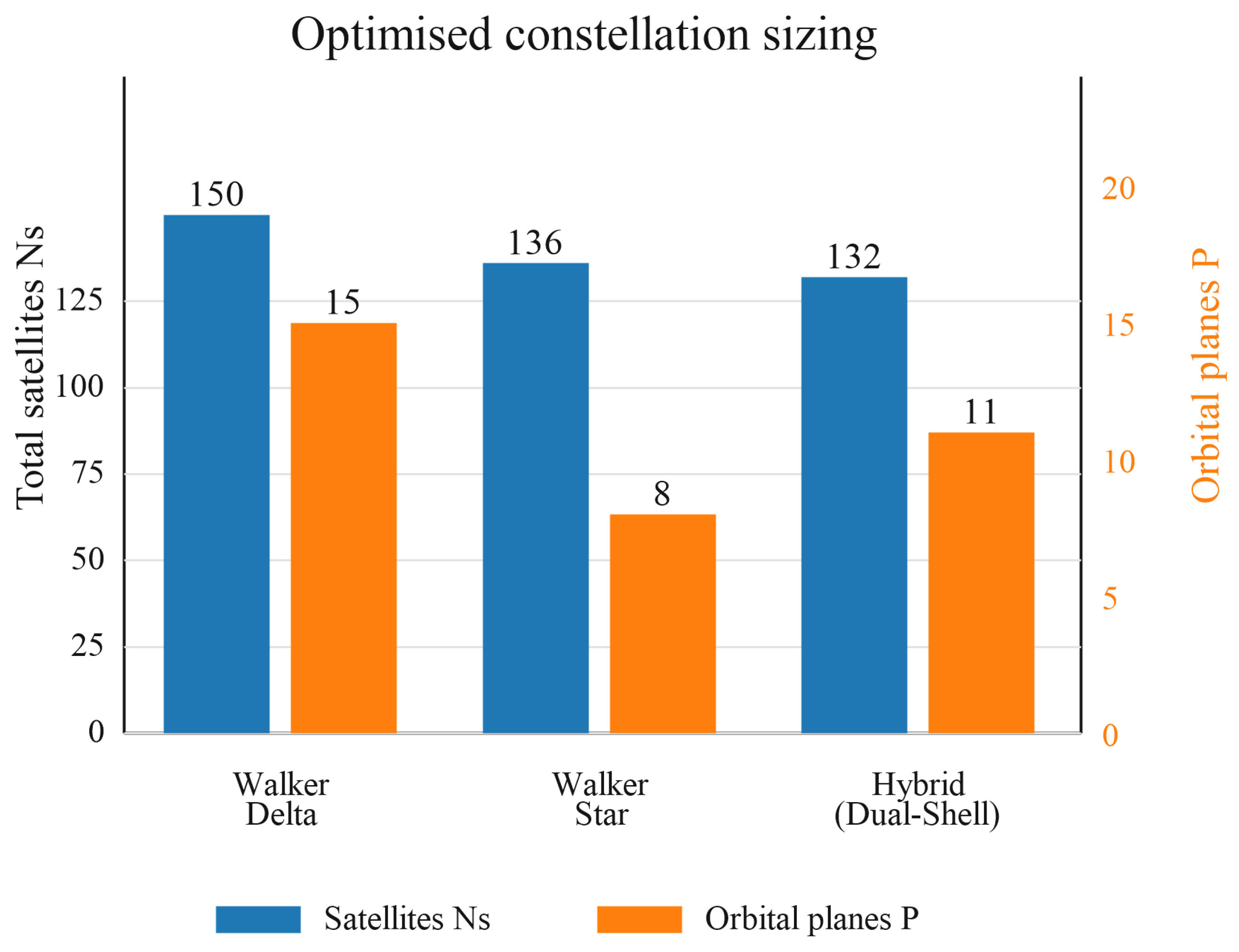
Figure 14.
Radar-style summary of architecture trade-offs across the main comparison metrics.
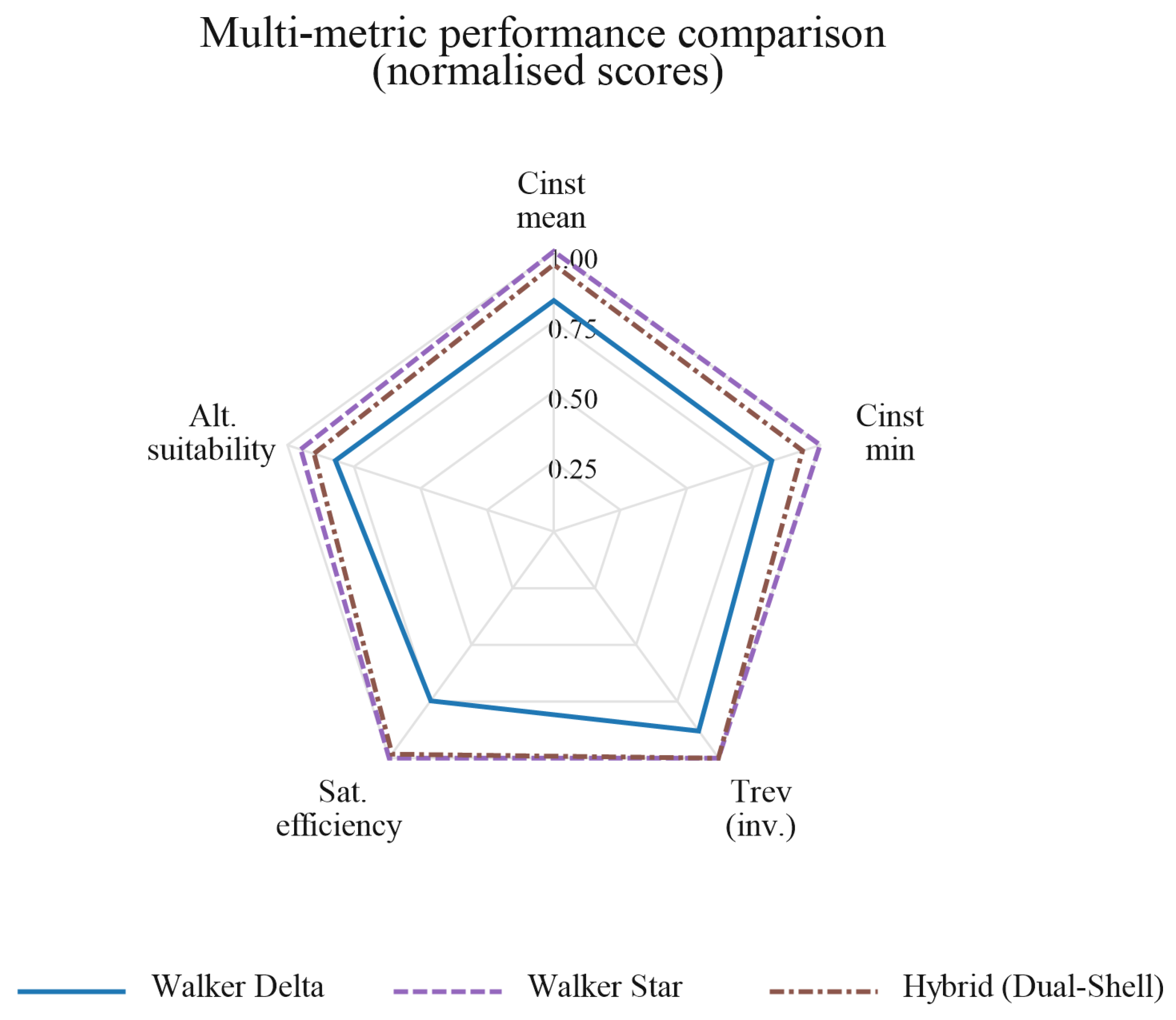
According to the case study, Walker Star has the strongest combined performance across coverage, revisit behavior, and threshold satisfaction. The Hybrid constellation, on the other hand, remains useful because it balances coverage, satellite efficiency, and redundancy, even though it brings more implementation complexity. Walker Delta is easier to parameterize and deploy as a single-shell baseline, but it performs weakly in polar regions and therefore affects global coverage performance at large, limiting its suitability for missions that require near-global continuity.
4.2. Implications for CubeSat Constellation Design
It is important to note that the results are understood as geometric access results, not confirmed broadband service results. A target being visible to a satellite does not prove that the link budget, antenna pointing, interference conditions, or data-rate requirements are satisfied. This is why future work should connect the constellation geometry results with link-budget validation, scheduling, and interference analysis.
4.3. Limitations and Future Work
The current study does not dive into network behavior such as routing, onboard resource allocation, gateway availability, or interference coordination. While the missing elements are important, as constellations can indeed have good geometric coverage while facing service interruptions at the network level, they are not included in this paper. For communication-focused CubeSat missions, future simulations should therefore move from access-only evaluation toward service-aware evaluation.
The framework can be extended by checking the link budget for every access interval, as well as including gateway availability, inter-satellite routing, interference management, and beam scheduling. Adding these important elements would allow the comparison to move from geometric coverage toward serviceable communication coverage.
5. Conclusions
The study reviewed and compared Walker Delta, Walker Star, and Hybrid CubeSat constellations for global coverage-oriented missions. It further validated the literature with a case study, which demonstrated that each architecture has different strengths and limitations in latitude coverage, revisit behavior, satellite count, and implementation complexity. The case study supported the review by optimizing each architecture separately and thereafter comparing the optimized results using common performance metrics.
The results demonstrated that Walker Star had the strongest overall coverage and revisit performance, and the Hybrid remained competitive because it used fewer satellites while still giving balanced access behavior. On the other hand, Walker Delta remained useful as a structured single-shell baseline but performed weaker for high-latitude or near-polar coverage.
In essence, constellation architecture selection is mission-dependent, not universal. A design that works well for high-latitude access does not necessarily work best for mid-latitude or satellite-count-limited missions. Future CubeSat constellation studies should therefore compare architectures using multiple metrics instead of relying only on coverage percentage.
The study also distinguishes geometric access and serviceable communication coverage, and outlines that a satellite can indeed have a wide footprint, but this does not necessarily mean that it is serviceable. Future work should therefore include link-budget validation, interference analysis, gateway access, and scheduling constraints. This would allow future comparisons to move from geometric coverage toward serviceable CubeSat communication coverage.
Author Contributions
Conceptualization, A.N.P.; methodology, A.N.P.; software, A.N.P.; validation, A.N.P., B.B. and C.K.L.; formal analysis, A.N.P.; investigation, A.N.P.; resources, A.N.P.; data curation, A.N.P.; writing–original draft preparation, A.N.P.; writing–review and editing, B.B. and C.K.L.; supervision, B.B. and C.K.L.; project administration, A.N.P. All authors have read and agreed to the published version of the manuscript.
Funding
This research received no external funding.
Institutional Review Board Statement
Not applicable.
Informed Consent Statement
Not applicable.
Data Availability Statement
The simulation data and analysis outputs supporting the findings of this study are available from the corresponding author upon reasonable request.
Acknowledgments
The authors acknowledge the support of the Department of Electrical, Computer and Telecommunication Engineering at Botswana International University of Science and Technology.
Conflicts of Interest
The authors declare no conflicts of interest.
References
- Toorian, A.; Diaz, K.; Lee, S. The CubeSat Approach to Space Access. In Proceedings of the 2008 IEEE Aerospace Conference, 2008; pp. 1–14. [Google Scholar] [CrossRef]
- Shiroma, W.; Martin, L.; Akagi, J.; Akagi, J.; Wolfe, B.; Fewell, B.; Ohta, A. CubeSats: A bright future for nanosatellites. Open Eng. 2011, 1, 9–15. [Google Scholar] [CrossRef]
- Simons, R.N.; Goverdhanam, K. Applications of nano-satellites and cube-satellites in microwave and RF domain. In Proceedings of the 2015 IEEE MTT-S International Microwave Symposium, Phoenix, AZ, USA, May 2015; pp. 1–4. [Google Scholar] [CrossRef]
- Badagavi, P.; Nanadi, S. Cube Sat — A smart device in space technology. In Proceedings of the 2017 International Conference on Electrical, Electronics, Communication, Computer, and Optimization Techniques (ICEECCOT), 2017; pp. 1–6. [Google Scholar] [CrossRef]
- Hodges, R.E.; Chahat, N.E.; Hoppe, D.J.; Vacchione, J.D. The Mars Cube One deployable high gain antenna. In Proceedings of the 2016 IEEE International Symposium on Antennas and Propagation (APSURSI), 2016; pp. 1533–1534. [Google Scholar] [CrossRef]
- Malphrus, B.K.; Brown, K.Z.; Garcia, J.; Conner, C.; Kruth, J.; Combs, M.S.; Fite, N.; McNeil, S.; Wilczweski, S.; Haught, K.; et al. The Lunar IceCube EM-1 Mission: Prospecting the Moon for Water Ice. IEEE Aerosp. Electron. Syst. Mag. 2019, 34, 6–14. [Google Scholar] [CrossRef]
- Saeed, N.; Elzanaty, A.; Almorad, H.; Dahrouj, H.; Al-Naffouri, T.Y.; Alouini, M.S. CubeSat Communications: Recent Advances and Future Challenges. IEEE Commun. Surv. Tutor. 2020, 22, 1839–1862. [Google Scholar] [CrossRef]
- Humad, Y.A.I.; TagElsir, A.; Daffalla, M.M. Design and implementation of communication subsystem for ISRASAT1 Cube Satellite. In Proceedings of the 2017 International Conference on Communication, Control, Computing and Electronics Engineering (ICCCCEE), Khartoum, Sudan, January 2017; pp. 1–4. [Google Scholar] [CrossRef]
- Arifin, J. Study of CubeSat Systems for IoT. In Proceedings of the 2021 12th International Renewable Engineering Conference (IREC), 2021; pp. 1–3. [Google Scholar] [CrossRef]
- Virushabadoss, N.; Mahjabeen, N.; Phull Bakshi, H.S.; Henderson, R. Design of X- and Ka-Band Reflectarray Antennas for Intercelestial Communication Using CubeSat Relay. In Proceedings of the 2021 IEEE Space Hardware and Radio Conference (SHaRC), 2021; pp. 31–34. [Google Scholar] [CrossRef]
- Aguirre, F.; Custodero, B.; Shah, B. Ka-band Tone Generator for the ISARA CubeSat. In Proceedings of the 2015 IEEE Aerospace Conference, 2015; pp. 1–6. [Google Scholar] [CrossRef]
- Marrero, L.M.; Merlano-Duncan, J.C.; Querol, J.; Kumar, S.; Krivochiza, J.; Sharma, S.K.; Chatzinotas, S.; Camps, A.; Ottersten, B. Architectures and Synchronization Techniques for Distributed Satellite Systems (DSS): A Survey. IEEE Access 2022, 10, 45375–45409. [Google Scholar] [CrossRef]
- Barnhart, D.J.; Vladimirova, T.; Sweeting, M.N. Very-Small-Satellite Design for Distributed Space Missions. J. Spacecr. Rocket. 2007, 44, 1294–1306. [Google Scholar] [CrossRef]
- Chen, Q.; Yang, L.; Liu, X.; Cheng, B.; Guo, J.; Li, X. Modeling and Analysis of Inter-Satellite Link in LEO Satellite Networks. In Proceedings of the 2021 13th International Conference on Communication Software and Networks (ICCSN), 2021; pp. 134–138. [Google Scholar] [CrossRef]
- Jung, S.; Bang, E.; Hwang, Y. Modeling of Inter-Satellite Link Protocol for Satellite Constellation. In Proceedings of the 2023 14th International Conference on Information and Communication Technology Convergence (ICTC), 2023; pp. 1612–1613. [Google Scholar] [CrossRef]
- Bridges, C.P.; Vladimirova, T. Agent Computing Applications in Distributed Satellite Systems. In Proceedings of the 2009 International Symposium on Autonomous Decentralized Systems (ISADS), 2009; pp. 1–8. [Google Scholar] [CrossRef]
- Thangavel, K.; Spiller, D.; Sabatini, R.; Amici, S.; Longepe, N.; Servidia, P.; Marzocca, P.; Fayek, H.; Ansalone, L. Trusted Autonomous Operations of Distributed Satellite Systems (DSS) Using Optical Sensors. Sensors 2023, 23, 3344. [Google Scholar] [CrossRef] [PubMed]
- Bomani, B.M.M. CubeSat Technology Past and Present: Current State-of-the-Art Survey. NASA Technical Publication NASA/TP-20210000201, 2021. [Google Scholar]
- Bouzoukis, K.P.; Moraitis, G.; Kostopoulos, V.; Lappas, V. An Overview of CubeSat Missions and Applications. Aerospace 2025, 12, 550. [Google Scholar] [CrossRef]
- Abulgasem, S.; Tubbal, F.M.; Raad, R.; Theoharis, P.I.; Lu, S.; Iranmanesh, S. Antenna Designs for CubeSats: A Review. IEEE Access 2021, 9, 45289–45324. [Google Scholar] [CrossRef]
- Saeidi, T.; Karamzadeh, S. Enhancing CubeSat Communication Through Beam-Steering Antennas: A Review of Technologies and Challenges. Electronics 2025, 14, 754. [Google Scholar] [CrossRef]
- Walker, J.G. Some Circular Orbit Patterns Providing Continuous Whole Earth Coverage. J. Br. Interplanet. Soc. 1970, 24, 369–384. [Google Scholar]
- Walker, J.G. Technical Report TR 77044; Continuous Whole-Earth Coverage by Circular-Orbit Satellite Patterns. Royal Aircraft Establishment: Farnborough, UK, 1977.
- Walker, J.G. Coverage Predictions and Selection Criteria for Satellite Constellations. J. Br. Interplanet. Soc. 1982, 35, 273–279. [Google Scholar]
- Beste, D.C. Design of Satellite Constellations for Optimal Continuous Coverage. IEEE Trans. Aerosp. Electron. Syst. 1978, AES-14, 466–473. [Google Scholar] [CrossRef]
- Barnett, J.C.; Salama, P. Optimization Design for a Communication Nanosatellite Constellation. In Proceedings of the 66th International Astronautical Congress (IAC), Jerusalem, Israel, 2015; p. IAC–15–C1.2.3. [Google Scholar]
- Vemuri, S.S.; Dappuri, B. Walker-Delta Constellation Design for LEO-Based Navigation Using Small Satellites. In Proceedings of the 7th International Conference on Computing in Engineering & Technology (ICCET 2022), 2022; pp. 250–253. [Google Scholar] [CrossRef]
- Gong, Y.; Zhang, S.; Peng, X. Quick Coverage Analysis of Mega Walker Constellation Based on 2D Map. Acta Astronaut. 2021, 188, 99–109. [Google Scholar] [CrossRef]
- Li, Y.; Zhao, S.; Wu, J. A General Evaluation Criterion for the Coverage Performance of LEO Constellations. Aerosp. Sci. Technol. 2016, 48, 94–101. [Google Scholar] [CrossRef]
- Lee, S.S. Explicit Mathematical Formulation and Coverage Consistency of Satellite Constellation Designs for Repeating Ground Track Orbits. IEEE Trans. Aerosp. Electron. Syst. 2024, 60, 1102–1112. [Google Scholar] [CrossRef]
- Melaku, S.D.; Kim, H.D. Optimization of Multi-Mission CubeSat Constellations with a Multi-Objective Genetic Algorithm. Remote Sens. 2023, 15, 1572. [Google Scholar] [CrossRef]
- Çelikbilek, K.; Saleem, Z.; Morales Ferre, R.; Praks, J.; Lohan, E.S. Survey on Optimization Methods for LEO-Satellite-Based Networks with Applications in Future Autonomous Transportation. Sensors 2022, 22, 1421. [Google Scholar] [CrossRef] [PubMed]
- Ahmed, A.A. A Comprehensive Review of Satellite Orbital Placement and Coverage Optimization for Low Earth Orbit Satellite Networks: Challenges and Solutions. Network 2025, 5, 32. [Google Scholar] [CrossRef]
- Guan, M.; Xu, T.; Gao, F.; Nie, W.; Yang, H. Optimal Walker Constellation Design of LEO-Based Global Navigation and Augmentation System. Remote Sens. 2020, 12, 1845. [Google Scholar] [CrossRef]
- Paek, S.W.; Kim, S.; de Weck, O. Optimization of Reconfigurable Satellite Constellations Using Simulated Annealing and Genetic Algorithm. Sensors 2019, 19, 765. [Google Scholar] [CrossRef] [PubMed]
- Kimura, K.; Inagaki, K.; Karasawa, Y. Global satellite communication network using double-layered inclined-orbit constellation with optical intersatellite links. Proc. Free-Space Laser Commun. Technol. VIII 1996, Vol. 2699, 2–13. [Google Scholar] [CrossRef]
- Guo, Q.p. Studies on Layered Satellite Networks and Performance Evaluation of MEO—LEO Satellite Network. Microcomput. Inf. 2009, 25, 233–235. [Google Scholar]
- Wang, P.; Di, B.; Song, L. Multi-Layer LEO Satellite Constellation Design for Seamless Global Coverage. In Proceedings of the 2021 IEEE Global Communications Conference (GLOBECOM), 2021; pp. 1–6. [Google Scholar] [CrossRef]
- Zhang, W.; Wu, T.; Ma, H.; Li, G. A Global Seamless Hybrid Constellation Design Approach with Restricted Ground Supporting for Space Information Network. J. Syst. Sci. Inf. 2019, 7, 257–269. [Google Scholar] [CrossRef]
- Höyhtyä, M.; Anttonen, A.; Majanen, M.; Yastrebova-Castillo, A.; Varga, M.; Lodigiani, L.; Corici, M.; Zope, H. Multi-Layered Satellite Communications Systems for Ultra-High Availability and Resilience. Electronics 2024, 13, 1269. [Google Scholar] [CrossRef]
- Handley, M. Delay is Not an Option: Low Latency Routing in Space. In Proceedings of the Proceedings of the 17th ACM Workshop on Hot Topics in Networks, New York, NY, USA, 2018; HotNets ’18, pp. 85–91. [Google Scholar] [CrossRef]
- Qi, X.; Zhang, B.; Qiu, Z.; Zheng, L. Using Inter-Mesh Links to Reduce End-to-End Delay in Walker Delta Constellations. IEEE Commun. Lett. 2021, 25, 3070–3074. [Google Scholar] [CrossRef]
- Royster, T.; Sun, J.; Narula-Tam, A.; Shake, T. Network Performance of pLEO Topologies in a High-Inclination Walker Delta Satellite Constellation. In Proceedings of the 2023 IEEE Aerospace Conference, 2023; pp. 1–9. [Google Scholar] [CrossRef]
- Jiang, Y.; Wu, S.; Mo, Q. A Novel Cross-Layer Model Based Communication Network for Satellite Constellations. In Proceedings of the 2021 13th International Conference on Communication Software and Networks (ICCSN), 2021; pp. 139–143. [Google Scholar] [CrossRef]
- Lu, Y.; Zhao, Y.; Sun, F.; Yang, F.; Liang, R.; Shen, J.; Zuo, Z. Enhancing Transmission Efficiency of Mega-Constellation LEO Satellite Networks. IEEE Trans. Veh. Technol. 2022, 71, 13210–13225. [Google Scholar] [CrossRef]
- del Portillo, I.; Cameron, B.G.; Crawley, E.F. A Technical Comparison of Three Low Earth Orbit Satellite Constellation Systems to Provide Global Broadband. Acta Astronaut. 2019, 159, 123–135. [Google Scholar] [CrossRef]
- Chan, C.C.; Al Homssi, B.; Al-Hourani, A. Performance Evaluation of Random Access Methods for IoT-over-Satellite. Remote Sens. 2022, 14, 4232. [Google Scholar] [CrossRef]
- Tonkin, S.; Vries, J.P.D. NewSpace Spectrum Sharing: Assessing Interference Risk and Mitigations for New Satellite Constellations. Tech. Rep. SSRN 2018. [Google Scholar] [CrossRef]
- Suilmann, J.; Voicu, A.M.; Simić, L.; Mähönen, P. The Dense Sky: Evaluating System Coexistence of New NGSO Satellite Constellations in the Ka Band. In Proceedings of the 2021 IEEE Globecom Workshops (GC Wkshps), 2021; pp. 1–6. [Google Scholar] [CrossRef]
- Liang, J.; Chaudhry, A.U.; Erdogan, E.; et al. Free-Space Optical (FSO) Satellite Networks Performance Analysis: Transmission Power, Latency, and Outage Probability. IEEE Trans. Aerosp. Electron. Syst. 2024, 60, 1234–1245. [Google Scholar] [CrossRef]
- Ning, Y.; Zhao, Y.; Zhang, J. Optimizing Multi-Source Multi-Sink Maximum Flow with Coverage Constraints in Large-Scale Optical Satellite Networks. In Proceedings of the 2023 Asia Communications and Photonics Conference/2023 International Photonics and Optoelectronics Meetings (ACP/POEM), 2023; pp. 1–3. [Google Scholar] [CrossRef]
- Bomani, B.M.M. CubeSat Technology Past and Present: Current State-of-the-Art Survey. NASA Technical Publication NASA/TP-20210000201, 2021. [Google Scholar]
- Burkhard, C.; Weston, S. The Evolution of CubeSat Spacecraft Platforms. In Proceedings of the NATO Science and Technology Organization Meeting Proceedings (STO-MP-AVT-336), Moffett Field, CA, USA, 2021. [Google Scholar]
- Alanazi, A.; Straub, J. Statistical Analysis of CubeSat Mission Failure. In Proceedings of the 32nd Annual AIAA/USU Conference on Small Satellites, Fargo, ND, USA, 2018. [Google Scholar] [CrossRef]
- Klesh, A.; Krajewski, J. MarCO: CubeSats to Mars in 2016. In Proceedings of the Proceedings of the AIAA/USU Conference on Small Satellites, Logan, UT, USA, 2015; p. SSC15-VI-1. [Google Scholar]
- Handley, M. Delay is Not an Option: Low Latency Routing in Space. In Proceedings of the Proceedings of the 17th ACM Workshop on Hot Topics in Networks (HotNets ’18), 2018; ACM; pp. 85–91. [Google Scholar] [CrossRef]
- Del Portillo, I.; Cameron, B.G.; Crawley, E.F. A Technical Comparison of Three Low Earth Orbit Satellite Constellation Systems to Provide Global Broadband. Acta Astronaut. 2019, 159, 123–135. [Google Scholar] [CrossRef]
- Yang, Y.; Wu, X.; Li, J.; Zang, J.; Lu, J.; Zgeib, R. Configuration Design Method of Mega Constellation for Low Earth Orbit Observation. Space Sci. Technol. 2024, 4, 1–14. [Google Scholar] [CrossRef]
- Guan, M.; Xu, T.; Gao, F.; Nie, W.; Yang, H. Optimal Walker Constellation Design of LEO-Based Global Navigation and Augmentation System. Remote Sens. 2020, 12, 1845. [Google Scholar] [CrossRef]
- Deng, Z.; et al. Optimization Design of Two-Layer Walker Constellation for LEO Navigation Augmentation Using a Dynamic Multi-Objective Differential Evolutionary Algorithm Based on Elite Guidance. GPS Solut. 2023, 27, 26. [Google Scholar] [CrossRef] [PubMed]
- Jia, L.; Zhang, Y.; Yu, J.; Wang, X. Design of Mega-Constellations for Global Uniform Coverage with Inter-Satellite Links. Aerospace 2022, 9, 234. [Google Scholar] [CrossRef]
- Wang, S.; et al. Multi-Layer LEO Constellation Optimization Based on D-NSDE Algorithm. Remote Sens. 2025, 17, 994. [Google Scholar] [CrossRef]
- Ledesma, O.; et al. Architectural Framework and Feasibility of Internet of Things-Driven Mars Exploration via Satellite Constellations. Electronics 2024, 13, 1289. [Google Scholar] [CrossRef]
- Leao, T.F.C.; Mooney-Chopin, V.; Trueman, C.W.; Gleason, S. Design and Implementation of a Diplexer and a Dual-Band VHF/UHF Antenna for Nano-Satellites. IEEE Antennas Wirel. Propag. Lett. 2013, 12, 1098–1101. [Google Scholar]
- Schraml, K.; Narbudowicz, A.; Chalermwisutkul, S.; Heberling, D.; Ammann, M.J. Easy-to-Deploy LC-Loaded Dipole and Monopole Antennas for CubeSat. In Proceedings of the Proceedings of the 11th European Conference on Antennas and Propagation (EuCAP), Paris, France, 2017; pp. 2303–2306. [Google Scholar]
- Nascetti, A.; Pittella, E.; Teo, P.; Pisa, S. High-Gain S-Band Patch Antenna System for Earth-Observation CubeSat Satellites. IEEE Antennas Wirel. Propag. Lett. 2015, 14, 434–437. [Google Scholar]
- Yao, Y.; Liao, S.; Wang, J.; Xue, K.; Balfour, E.A.; Luo, Y. A New Patch Antenna Designed for CubeSat: Dual Feed, LS Dual-Band Stacked, and Circularly Polarized. IEEE Antennas Propag. Mag. 2016, 58, 16–21. [Google Scholar]
- Buttazzoni, G.; Comisso, M.; Cuttin, A.; Fragiacomo, M.; Vescovo, R.; Gatti, R.V. Reconfigurable Phased Antenna Array for Extending CubeSat Operations to Ka-Band: Design and Feasibility. Acta Astronaut. 2017, 137, 114–121. [Google Scholar] [CrossRef]
- Jimenez, D.A.; Reyna, A.; Balderas, L.I.; Panduro, M.A. Design of 4 x 4 Low-Profile Antenna Array for CubeSat Applications. Micromachines 2023, 14, 180. [Google Scholar] [CrossRef] [PubMed]
- Klein, J.; Hawkins, J.; Thorsen, D. Improving CubeSat Downlink Capacity with Active Phased Array Antennas. In Proceedings of the Proceedings of the 2014 IEEE Aerospace Conference, Big Sky, MT, USA, 2014. [Google Scholar]
- Nguyen, M.T.; Ferrero, F.; Trinh, L.H. Compact UHF Circularly Polarized Multi-Band Quadrifilar Antenna for CubeSat. Sensors 2023, 23, 5361. [Google Scholar] [CrossRef]
- Hodges, R.E.; Chahat, N.; Hoppe, D.J.; Vacchione, J.D. A Deployable High-Gain Antenna Bound for Mars. IEEE Antennas Propag. Mag. 2017, 59, 39–49. [Google Scholar] [CrossRef]
- Chahat, N.; Sauder, J.; Mitchell, M.; Beidleman, N.; Freebury, G. One-Meter Deployable Mesh Reflector for Deep-Space Network Telecommunication at X-Band and Ka-Band. IEEE Trans. Antennas Propag. 2020, 68, 727–735. [Google Scholar]
- Mishra, G.; Sharma, S.K.; Chieh, J.C.S. A Circular Polarized Feed Horn with Inbuilt Polarizer for Offset Reflector Antenna for W-Band CubeSat Applications. IEEE Trans. Antennas Propag. 2019, 67, 1904–1909. [Google Scholar]
Figure 6.
Sequential optimisation sweep results for the Walker Delta architecture.
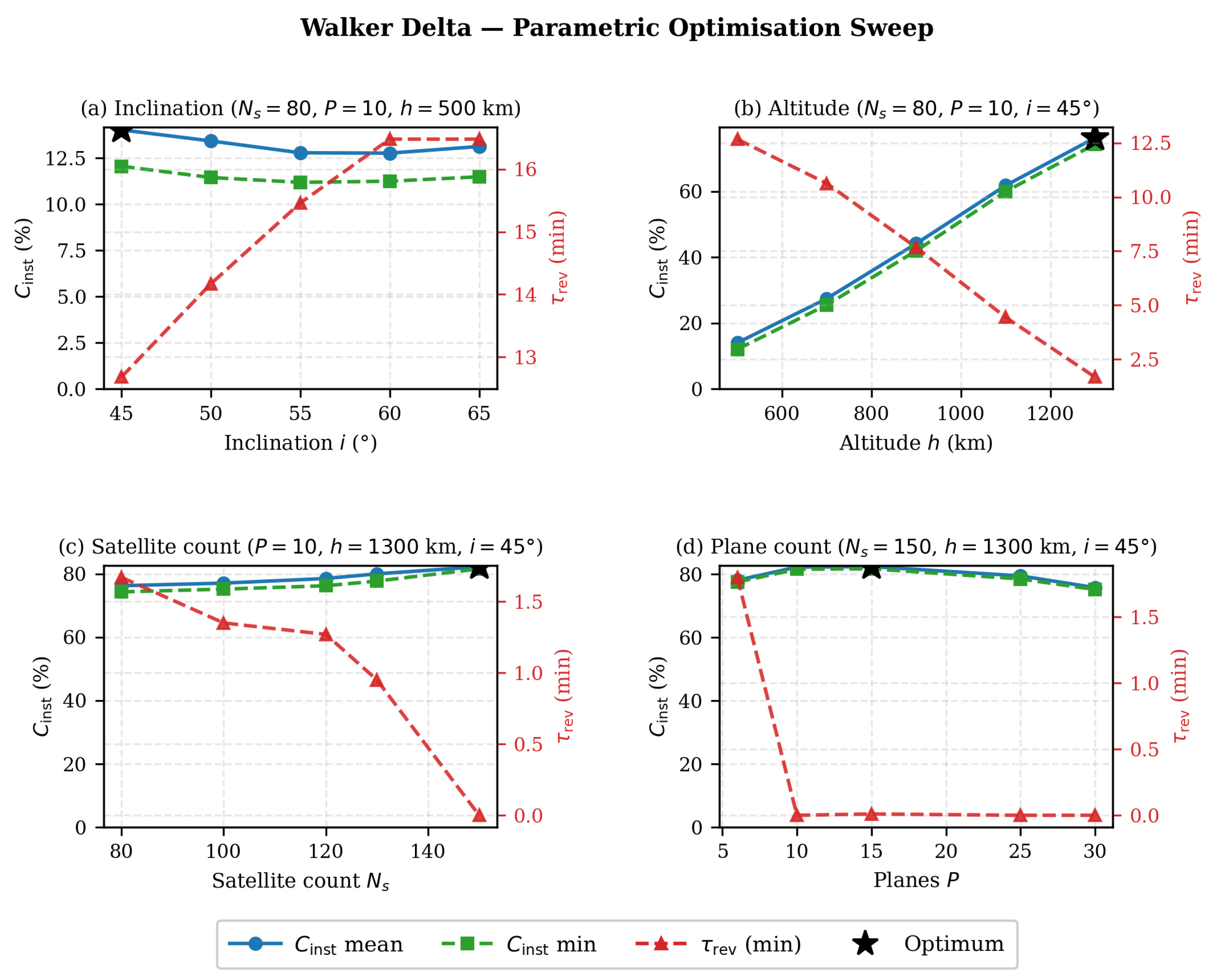
Figure 7.
Sequential optimisation sweep results for the Walker Star architecture.
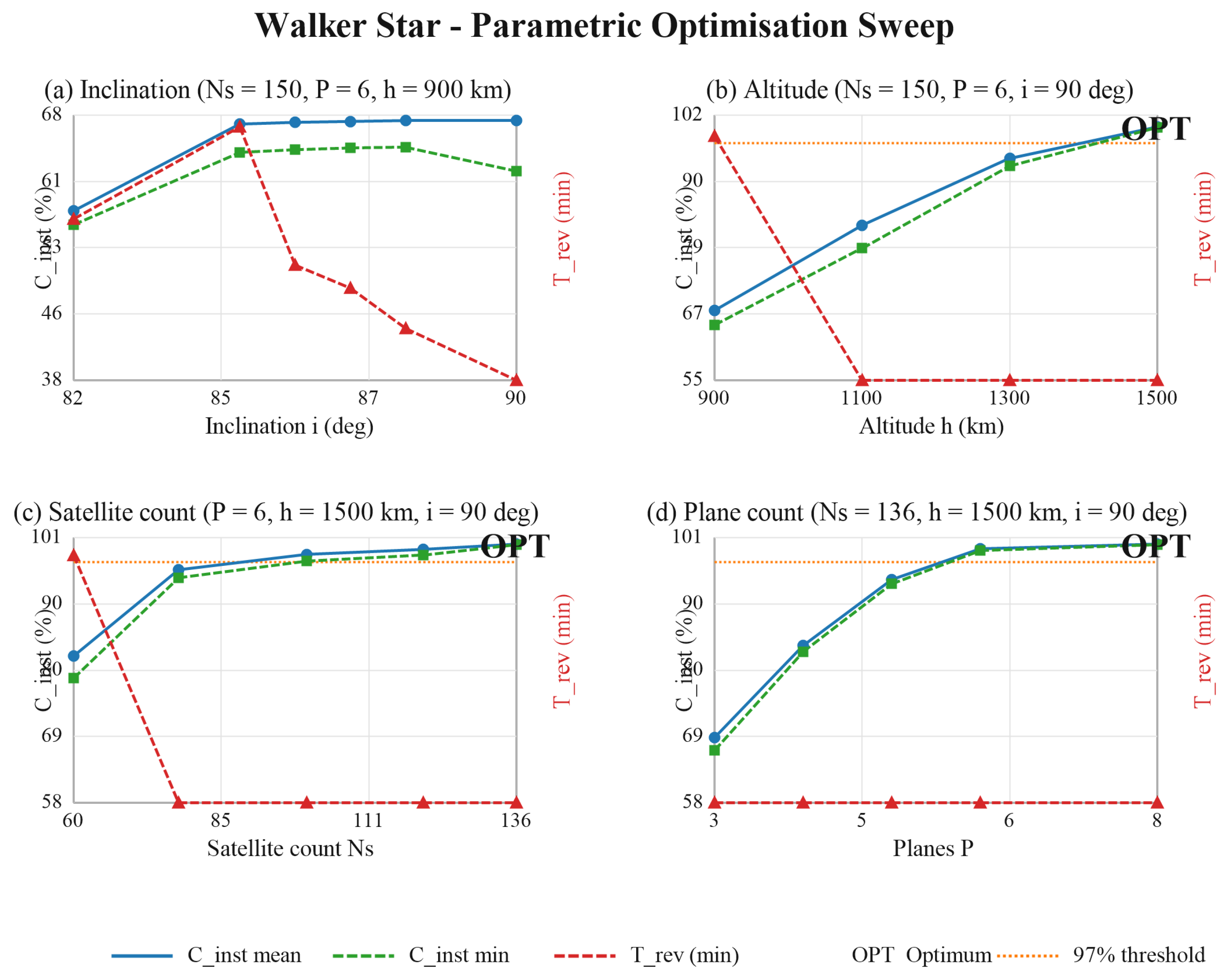
Figure 8.
Sequential optimisation sweep results for the Hybrid architecture.
Disclaimer/Publisher’s Note: The statements, opinions and data contained in all publications are solely those of the individual author(s) and contributor(s) and not of MDPI and/or the editor(s). MDPI and/or the editor(s) disclaim responsibility for any injury to people or property resulting from any ideas, methods, instructions or products referred to in the content. |
© 2026 by the authors. Licensee MDPI, Basel, Switzerland. This article is an open access article distributed under the terms and conditions of the Creative Commons Attribution (CC BY) license.
Copyright: This open access article is published under a Creative Commons CC BY 4.0 license, which permit the free download, distribution, and reuse, provided that the author and preprint are cited in any reuse.


