

Submitted:
28 June 2026
Posted:
29 June 2026
You are already at the latest version
Abstract
Global food output is at risk due to soil salinity, which is intensified by climate change and can cause yield losses of up to 50% in susceptible species. Hydroponic systems offer a controlled environment that can ease salt stress, but building genuinely resilient crops still depends on understanding how plants cope with it. To get at the molecular mechanisms of salt tolerance, we bring together what omics technologies (genomics, transcriptomics, proteomics, and metabolomics) reveal about the physiological adaptations plants depend on, such as ion homeostasis, osmotic regulation, and antioxidant defenses. We also consider how hydroponic culture enables these traits to be tested in real time, and how gene-editing tools such as CRISPR-Cas9 can refine them. Pulling these layers of data together also gives researchers a way to anticipate how crops might cope under the conditions climate change is expected to bring, from rising sea levels to increasingly erratic rainfall. To ensure food security in a warming future, this review summarizes current developments, identifies research gaps, and proposes a practical agenda for developing salinity-tolerant hydroponic crops.
Keywords:
soil salinity
; hydroponic systems
; physiological adaptations
; omics technologies
; gene-editing tools
1. Introduction
Across many agricultural regions, irregular rainfall is leaving soils dry or saline, while rising seas leave coastal farmland flooded with saltwater. 25% of irrigated fields worldwide are already affected by salinity, which can reduce yields of staple crops like lettuce and tomatoes by up to 50% [1]. Increased evaporation, saline water intrusion, and unsustainable irrigation methods are among the ways climate change worsens this problem [2]. The scale of the problem is not static; it grows year on year. Salt and sodification now affect approximately 1125 million hectares of land, with approximately 76 million hectares impacted by human-induced salinization and sodification [3]. Globally, soil salinity has affected 20% and 33% of all farmed and irrigated lands, respectively, resulting in a loss of $27.3 billion [4,5]. The global population is projected to increase by 2.3 billion by 2050, necessitating a 70% rise in food crop production [6,7]. However, salinity stress poses a significant threat to achieving this goal by severely limiting agricultural productivity.
Conventional breeding has delivered incremental gains in salt tolerance. Still, progress has been slow because tolerance is a quantitative trait governed by many genes of small effect and is strongly modulated by the environment [8]. By avoiding saline soils and utilizing resources efficiently, hydroponic systems support plant growth by delivering nutrients directly to plant roots in a controlled solution [9]. High salt levels, however, interfere with plant growth even in hydroponics, necessitating the use of resilient cultivars.
Plants employ various complex physiological processes, including ion exclusion, osmotic adjustment, and scavenging of reactive oxygen species (ROS), to mitigate salinity stress. Recent advancements in omics technologies including genomics, transcriptomics, proteomics, and metabolomics, have shed light on the molecular networks underlying these adaptations, identifying key genes, proteins, and metabolites [8]. When paired with CRISPR-Cas9 and other gene-editing techniques, these discoveries enable precise modifications to enhance tolerance to salinity. Hydroponics provides a unique platform for assessing these interventions under controlled salt levels, thus accelerating the development of crops resilient to environmental changes. However, a plant that thrives in one saline habitat may struggle in another due to differences in ionic composition, the timing of stress, or the simultaneous occurrence of heat and drought [10,11,12]. This genotype-by-environment interaction poses a significant challenge, one that controlled cultivation and high-resolution molecular profiling can effectively address. Hydroponic systems reduce much of the variability that complicates field trials; while integrating genomics, transcriptomics, proteomics, and metabolomics reveals the regulatory architecture that breeding alone can not easily uncover [13].
With an emphasis on their applicability to climate change, this review integrates physiological and omics-based methods to increase salinity tolerance in hydroponic crops. We examine how these approaches provide a route to sustainable agriculture by addressing issues like rising temperatures and saline irrigation.
2. Physiological Mechanisms of Salinity Stress Response
Plants deploy three complementary lines of defense. In Ion Homeostasis, to maintain favorable K⁺/Na⁺ ratios, plants such as tomatoes and lettuce rely on transporters like SOS1 and NHX1 to either sequester Na⁺ into vacuoles or reject it from the cytosol [14]. Ion toxicity can be decreased in hydroponics by adjusting nutrient solutions to promote these mechanisms. In the case of osmotic adjustment, plants store compatible solutes such as proline and glycine betaine to prevent water loss (Figure 1). These osmolytes maintain cell function under stress by stabilizing proteins and membranes [15]. This response is improved by the precise replenishment of osmolyte made possible by hydroponic systems. In antioxidant defense, Salt-induced ROS damages membranes and DNA. To limit this damage, plants increase the levels of non-enzymatic antioxidants such as ascorbate, along with enzymes including superoxide dismutase (SOD) and catalase (CAT) (Figure 1) [16]. Hydroponic systems enable real-time monitoring of oxidative stress markers, facilitating targeted therapies. These mechanisms differ markedly between species. Glycophytes such as spinach require carefully formulated nutrient solutions to cope with salt, whereas halophytes such as Salicornia thrive under high salinity [17]. Comprehending these reactions establishes the foundation for omics-driven enhancements specifically designed for hydroponic systems [18].
It is useful to separate the two phases through which salinity injures a plant, because they require different defenses and unfold on different timescales. The first is an osmotic phase that begins within minutes of the roots encountering a saline solution: the lowered water potential outside the concentration has built up in the leaves [10]. The second is an ionic phase that develops over days to weeks as sodium and chloride accumulate in transpiring leaves, eventually reaching concentrations that impair enzyme activity, disrupt photosynthesis, and accelerate the senescence of older leaves [14]. A tolerant cultivar must therefore manage both the immediate water deficit and the slower poisoning, and the relative weight a plant gives to each strategy varies considerably among species.
Sodium exclusion at the root and the regulated distribution of ions inside the shoot are crucial to the ionic phase of tolerance. The best-understood example is the SOS (Salt Overlay Sensitive) pathway, where a calcium-triggered signal activates the SOS3-SOS2 protein kinase complex, which then activates the plasma-membrane antiporter SOS1 to pump sodium back out of root cells [14,19]. Working alongside this, HKT-family transporters retrieve sodium from the xylem stream, so that less of it reaches the photosynthetic tissues, helping the plant hold a favorable potassium-to-sodium ratio in the leaves [20]. What the plant cannot exclude, it compartmentalizes; vacuolar NHX antiporters sequester sodium away from the cytosol, where it would otherwise interfere with potassium-dependent metabolism [21]. In a hydroponic setting, these fluxes can be tracked directly because the composition of the bathing solution is known and can be sampled over time.
The osmotic phase is met chiefly by the accumulation of compatible solutes and by tight regulation of cell turgor. Proline, synthesized through the action of P5CS, and glycine betaine, produced by BADH, lower the cellular water potential without poisoning metabolism, allowing the plant to keep drawing water from an increasingly saline medium while also stabilizing proteins and membranes against denaturation (Figure 1) [15,22]. Sugars, polyols, and certain amino acids contribute to the same osmotic adjustment. Overlying both phases is the burden of oxidative stress: the metabolic disturbance caused by salt generates reactive oxygen species in chloroplasts, mitochondria, and peroxisomes, and unchecked, these molecules damage lipids, proteins, and nucleic acids [16]. Plants counter this with an enzymatic arm built around superoxide dismutase, catalase, and the ascorbate-glutathione cycle, supplemented SOS1 by non-enzymatic scavengers such as ascorbate, glutathione, and a range of phenolic compounds [23]. Hormonal signals, abscisic acid in particular, coordinate these responses, linking the perception of stress at the root to stomatal behavior and gene expression throughout the plant [24].
3. Multi omics Approaches to Dissect Salinity Tolerance
Omics technologies have reshaped plant science by resolving the molecular basis of stress tolerance. Below, we consider how each omics layer contributes to salinity resistance in hydroponically grown crops (Figure 2). Whole-genome sequencing has identified candidate genes for salinity tolerance and quantitative trait loci (QTLs). In rice, for instance, the Saltol QTL control Na+/K+ homeostasis to enhance tolerance throughout the seedling stage [13]. In hydroponically grown tomatoes, GWAS identified genes linked to ion transport, guiding marker-assisted breeding [25]. Comparative genomics across species reveals conserved pathways, such as those involving HKT1 transporters, which are perfect targets for improvement [10]. RNA-seq profiling resolves which genes are differentially expressed under salt stress. HKT1 and NHX1 gene overexpression is associated with vacuolar sequestration and Na+ exclusion in hydroponically grown lettuce [21]. Non-coding RNAs, including miRNAs, also help regulate these stress responses, offering additional targets for genetic engineering [26]. Hydroponics enables precise stress applications making it easier to record dynamic transcriptome alternations. Proteomic analysis identifies proteins essential for ion transport and stress signaling. For instance, measures to increase resilience were informed by the identification of upregulated antioxidant enzymes under salinity conditions in hydroponic spinach using 2D gel electrophoresis [27]. Additionally, proteins implicated in ROS scavenging in tomatoes have been identified by mass spectrometry-based proteomics, showing species-specific adaptations [28]. Metabolic profiling is used to identify antioxidants and osmolytes linked to tolerance. Higher levels of proline flavonoids in tolerant cultivars of hydroponically grown cucumber were revealed by GC-MS, which guided modifications to nutrient solution [29].
Metabolic flux research provides insights into adaptive pathways by clarifying how plants reorganize their metabolism under stress [30]. A systems-level understanding of stress responses can be obtained by combining omics datasets. ABA signaling, for example, was identified as a crucial organizer of osmotic and ionic responses in hydroponic Arabidopsis through the integration of transcriptome and metabolomic data [31].
Because hydroponic systems enable regulated salt exposure and real-time phenotyping, they are perfect for validating omics results. For instance, the function of SOS1 in ion homeostasis has been verified using hydroponic experiments on Arabidopsis mutants, opening the door for targeted gene editing [32].
Before considering each layer in turn, it is worth stating why a multi-omics view is necessary rather than merely fashionable. A single layer answers a single kind of question: the genome tells us what a plant could do, the transcriptome what it is attempting to do under a given stress, the proteome what machinery is actually present, and the metabolome the chemical outcome of all that activity. Salt tolerance emerges from the interaction of all four, and correlations that appear convincing at one level frequently fail to hold at the next, because transcript abundance is an imperfect predictor of protein abundance and protein abundance an imperfect predictor of metabolic flux [8,33]. Reading the layers together, and ideally from the same experimental material, is therefore the only reliable route to causal candidates. Pan-genome and comparative analyses now show that part of the natural variation in tolerance lies not in coding sequence but in the presence, absence, or copy number of regulatory elements, which helps explain why landraces and wild relatives often carry tolerance alleles missing from elite cultivars [10]. These resources turn the older, laborious search for markers into a problem of prioritization, and they supply the candidate lists that the downstream layers then test.
Transcriptomic, proteomic, and metabolomic profiling each refine those candidate lists in complementary ways. The real power, however, comes from integration. When transcriptome and metabolome data from the same hydroponic experiment are modeled jointly, the abscisic acid signaling hub repeatedly surfaces as the coordinator that ties the osmotic and ionic responses together, and machine-learning models trained on such combined datasets can predict tolerance with an accuracy that no single layer achieves [31,34].
4. Gene Editing and Genetic Engineering for Salinity Tolerance
Crop improvement has been transformed by CRISPR-Cas9, which enables precise editing of stress-responsive genes. In hydroponically grown rice, OsNHX1enhanced Na⁺ sequestration and increased resistance to 150 mM NaCl [35]. Similarly, overexpression of HVP10, a vacuolar H⁺-pyrophosphatase in barley, increased growth under salt stress by increasing Na⁺ sequestration into root vacuoles and reducing Na⁺ accumulation in shoots [36]. Furthermore, overexpression of transcription factors such as DREB and NAC enhances stress-responsive gene networks, making them crucial targets [19].
The benefits of co-overexpression of several genes are synergistic. Co-expressing AVP1, AtCLCc, and PP2A-C5, for instance, allowed Arabidopsis plants to withstand 300 mM NaCl, greatly outperforming single-gene alterations [37]. Overexpressing BADH increased glycine betaine levels in hydroponically grown tomato, improving osmotic tolerance [38]. By providing constant stress conditions and reducing ambient noise, hydroponics accelerates up the screening of edited lines.
Regulatory obstacles and off-target effects remain problems. With their increased precision, base and prime editing may allay public worries about genetically modified organisms [39]. High-throughput testing of modified crops is made possible by hydroponic systems, which can close the gap between the lab and the field.
Editing tools have moved well beyond the first generation of CRISPR-Cas9 knockouts, and the expanding toolkit matters for a trait as quantitative as salt tolerance. Knocking out a negative regulator is straightforward and has produced tolerant lines in several crops. Still many tolerance alleles differ from sensitive ones by a single nucleotide or by a change in expression level rather than by the loss of a gene [19]. Base editing, which converts one base to another without a double-strand break, and prime editing, which can install small insertions, deletions, and precise substitutions, allow researchers to recreate favorable natural alleles directly in an elite background [39,40]. CRISPR activation and interference, together with editing of promoter regions and upstream open reading frames, enable dialing dial gene expression up or down rather than simply switching a gene off, which suits the additive, dose-dependent nature of osmotic adjustment and ion transport. Because tolerance is rarely conferred by one gene, multiplexed and stacked strategies are increasingly the goal. Co-expressing complementary components, for example, a vacuolar pyrophosphatase together with a chloride channel and a regulatory phosphatase subunit, has yielded far greater tolerance than altering any one of them alone, and editing platforms now permit several targets to be modified in a single transformation event [37].
Hydroponic systems address the issues related to off-target activity and throughput of edited crops directly by allowing large numbers of edited lines to be challenged with a uniform, precisely controlled salt dose and phenotype in parallel, so that the most promising events can be advanced to soil and field trials with confidence rather than guesswork [18,41]. The main genes involved in salinity tolerance, their roles, and their applicability to hydroponic crops like tomatoes, lettuce, and spinach are compiled in Table 1.
5. Hydroponics as a Platform for Climate-Resilient Agriculture
Beyond its role as a cultivation method, hydroponics provides a controlled testbed for crops that can withstand the effects of climate change. Researchers can model climate change scenarios, including saline irrigation and combination of drought and salinity stress, by manipulating nutrient solutions [42]. For example, hydroponic experiments using lettuce in 100 mM NaCl revealed fertilizer compositions that sustain growth, guiding field applications [43].
Climate change is intensifying soil and irrigation water salinity through rising sea levels and diminishing freshwater availability. Hydroponic systems help offset this by recycling nutrients and water [9] Real-time salinity and fertilizer adjustments are made via automated hydroponic systems equipped with sensors to maximize plant performance [44]. Hydroponics enables vertical farming, which addresses land scarcity by maximizing production in urban environments [45].
Hydroponically tested omics-guided breeding can create crops adapted to certain climate conditions. For instance, combining transcriptomics with GWAS in hydroponic tomatoes revealed genes for combined salinity and heat tolerance, which is important for future climates [46].
The value of hydroponics for this research program rests on a simple property: it gives the experimenter direct control over the root environment. Salinity can be imposed as a single, known step or ramped gradually to mimic the slow accumulation of salt in a field. The ionic composition of the solution can be tuned to separate the effects of sodium, chloride, and the osmotic component. This distinction that is almost impossible to make in soil [43]. Because the medium can be sampled and replenished continuously, nutrient supply and stress levels are decoupled, allowing a plant to be maintained under a steady salt dose while its nutrient status is kept constant, isolating the variable of interest in a way that field studies cannot match.
These same properties make hydroponics a credible testbed for the conditions expected to accompany that climate change. Combined stresses, such as the salinity-plus-heat or salinity-plus-drought scenarios that increasingly define growing seasons in low-latitude regions, can be reproduced and dissected, and the resulting data feed directly into breeding for future rather than historical climates [42,46]. The recirculating design of modern systems also conserves the two resources that salinization most threatens, namely fresh water and clean nutrient solution, by capturing and reusing drainage that would be lost in open-field irrigation [47]. Sensor-equipped, automated installations monitor electrical conductivity, pH, dissolved oxygen, and ion-selective signals in real time and adjust the solution, accordingly, turning a single experiment into a continuous record of how a genotype copes with stress [48].
6. Challenges and Future Directions
Important obstacles remain despite this progress. Because omics datasets are often species-specific, transferring findings across crops is difficult; standardizing hydroponic protocols for omics studies would help to address this [49]. Additionally, smaller breeding projects are constrained by the high cost of omics and gene-editing technologies [50].
A further difficulty is biological rather than economic. Tolerance measured at the seedling stage in a hydroponic tank does not always predict performance through flowering and grain fill in the field, where the stress is intermittent, the microbiome is present, and the plant must trade tolerance against yield [49]. Bridging this gap requires that controlled-environment results be validated across developmental stages and, ultimately, in soil, and it cautions against treating a hydroponic phenotype as the final word. The absence of standard protocols compounds the problem, because differences in salt dose, application timing, nutrient formulation, and the growth stage at sampling make it hard to compare omics datasets generated in different laboratories, let alone to pool them [18].
The data themselves pose a distinct set of challenges. Multi-omics studies generate large, heterogeneous datasets whose integration demands analytical skill and computing infrastructure that are unevenly distributed, and much of their value is lost when they remain in private repositories or are published without the metadata needed for reuse them [33,51]. Reproducibility suffers accordingly. Realizing the promise of machine-learning prediction depends on training data that are large, well-annotated, and openly shared, conditions that the field has not yet met. Addressing this is as much a matter of culture and policy, in the form of data-sharing norms and common reporting standards, as it is of technology.
Looking further ahead, several lines of work deserve attention beyond the immediate priorities listed below. Epigenetic regulation, including DNA methylation and histone modification, offers a route to heritable changes in tolerance that do not alter the genome sequence and may therefore sidestep some regulatory objections to edited crops. Still its stability across generations needs careful study [52]. The root microbiome and the use of beneficial microbes or biostimulants to prime salt tolerance are complementary and comparatively low-cost strategy that fits naturally with recirculating hydroponic systems [53]. Single-cell and spatial omics promise to resolve how different cell types within the root and leaf divide the labor of tolerance, a resolution that bulk profiling cannot reach [54]. Pursuing these alongside the established omics layers would deepen, rather than merely broaden, the understanding on which durable salt tolerance must be built.
7. Conclusions
Salinity stress and climate change are two problems that are growing worse together, and agriculture cannot deal with them one at a time. Scientists now have powerful tools, a better understanding of how plants cope with salt, advanced molecular technologies, precise gene-editing methods, and controlled hydroponic farming systems. Used together, these tools can finally lead to crops that are truly resistant to salt stress. However, this will only happen if researchers work with all these approaches at the same time, not separately. One of the clearest lessons from this field is that salt tolerance is not something that can be fixed with a single gene or a single solution. Plants respond to salt stress in multiple ways, at different speeds, and across many different cells and molecules. To properly understand and improve this, we need to look at the whole picture and that is exactly what combining omics technologies and hydroponic experiments allows us to do. Once we understand what needs to be changed, gene-editing tools give us the ability to make those changes with far more accuracy than old breeding methods ever could.
Moving forward, the scientific community needs to agree on common experimental standards, share data more openly, and bring together experts from different fields such as biology, engineering, agriculture, and data science. Results from hydroponic lab experiments also need to be carefully tested in real field conditions before they can be applied in farming. The biggest remaining challenge is closing the gap between what works in a controlled laboratory and what actually performs well out in the field.
Global food demand is increasing while salt is steadily degrading more and more farmland. Delays in turning scientific progress into practical solutions will cost lives and livelihoods. The knowledge and tools are already there. What is needed now is commitment to work together and move faster so that farmers have access to crops that can grow and produce food even as the world becomes saltier and warmer.
This review provides a roadmap for sustainable food production and urges researchers to use these tools to protect agriculture from increasing soil salinity caused by climate change.
Author Contributions
M.A.A., K.M.S, M.M.H. and T.N. conceptualized the review framework. M.K., M.A.I, B.S., U.K.A., and R.Z. conducted the literature analysis, interpreted the data, drafted key sections. M.A.M. and M.F.H. supervised the work. M.A.A. and M.F.H.; writing—original draft preparation, M.K., M.A.I, B.S., U.K.A., R.Z. and M.M.H., writing—review and editing, M.A.M. and M.F.H. supervision. All authors have read and agreed to the published version of the manuscript.
Funding
This research received no external funding.
Data Availability Statement
All data supporting the findings of this study are included in the manuscript.
Acknowledgments
The authors thank Professor Joarder DNA and Chromosome Research Laboratory, Department of Genetic Engineering and Biotechnology, University of Rajshahi, Bangladesh for providing the facilities to conduct this research.
Conflicts of Interest
The authors declare no conflicts of interest.
References
- Chele, K.H.; Tinte, M.M.; Piater, L.A.; Dubery, I.A.; Tugizimana, F. Soil Salinity, a Serious Environmental Issue and Plant Responses: A Metabolomics Perspective. Metabolites 2021, 11, 724. [Google Scholar] [CrossRef] [PubMed]
- Singh, N.; Maurya, V.; Gupta, K.; Sharma, I.; Sharma, A.; Kumar, R. Salt Stress and Its Eco-Friendly Management Using Biostimulants in Grain Legumes: A Review. Discov. Agric. 2025, 3, 13. [Google Scholar] [CrossRef]
- Hossain, M.S. Present Scenario of Global Salt Affected Soils, Its Management and Importance of Salinity Research. Int. Res. J. Biol. Sci. 2019, 1, 1–3. [Google Scholar]
- Egamberdieva, D.; Wirth, S.; Bellingrath-Kimura, S.D.; Mishra, J.; Arora, N.K. Salt-Tolerant Plant Growth Promoting Rhizobacteria for Enhancing Crop Productivity of Saline Soils. Front. Microbiol. 2019, Volume 10. [Google Scholar]
- Qadir, M.; Quillérou, E.; Nangia, V.; Murtaza, G.; Singh, M.; Thomas, R.J.; Drechsel, P.; Noble, A.D. Economics of Salt-Induced Land Degradation and Restoration. Nat. Resour. Forum 2014, 38, 282–295. [Google Scholar] [CrossRef]
- Siegel, F.R. Food 2050: More Mouths to Feed—Food Availability and Access BT - The Earth’s Human Carrying Capacity: Limitations Assessed, Solutions Proposed; Siegel, F.R., Ed.; Springer International Publishing: Cham, 2021; pp. 87–107. ISBN 978-3-030-73476-3. [Google Scholar]
- Shrivastava, P.; Kumar, R. Soil Salinity: A Serious Environmental Issue and Plant Growth Promoting Bacteria as One of the Tools for Its Alleviation. Saudi J. Biol. Sci. 2015, 22, 123–131. [Google Scholar] [CrossRef] [PubMed]
- Jha, U.C.; Bohra, A.; Jha, R.; Parida, S.K. Salinity Stress Response and ‘Omics’ Approaches for Improving Salinity Stress Tolerance in Major Grain Legumes. Plant Cell Rep. 2019, 38, 255–277. [Google Scholar] [CrossRef] [PubMed]
- Fathidarehnijeh, E.; Nadeem, M.; Cheema, M.; Thomas, R.; Krishnapillai, M.; Galagedara, L. Current Perspective on Nutrient Solution Management Strategies to Improve the Nutrient and Water Use Efficiency in Hydroponic Systems. Can. J. Plant Sci. 2023, 104, 88–102. [Google Scholar] [CrossRef]
- Rana Munns, M.T. Mechanisms of Salinity Tolerance. Annu. Rev. Plant Biol. 2008, 59, 651–681. [Google Scholar] [CrossRef] [PubMed]
- Mittler, R. Abiotic Stress, the Field Environment and Stress Combination. Trends Plant Sci. 2006, 11, 15–19. [Google Scholar] [CrossRef] [PubMed]
- Suzuki, N.; Rivero, R.M.; Shulaev, V.; Blumwald, E.; Mittler, R. Abiotic and Biotic Stress Combinations. New Phytol. 2014, 203, 32–43. [Google Scholar] [CrossRef] [PubMed]
- Kumar, P.; Choudhary, M.; Halder, T.; Prakash, N.R.; Singh, V.; V., V.T.; Sheoran, S.; T., R.K.; Longmei, N.; Rakshit, S.; et al. Salinity Stress Tolerance and Omics Approaches: Revisiting the Progress and Achievements in Major Cereal Crops. Heredity (Edinb) . 2022, 128, 497–518. [Google Scholar] [CrossRef] [PubMed]
- Zhu, J.-K. Abiotic Stress Signaling and Responses in Plants. Cell 2016, 167, 313–324. [Google Scholar] [CrossRef] [PubMed]
- Ashraf, M.; Foolad, M.R. Roles of Glycine Betaine and Proline in Improving Plant Abiotic Stress Resistance. Environ. Exp. Bot. 2007, 59, 206–216. [Google Scholar] [CrossRef]
- Nahar, K.; Hasanuzzaman, M.; Fujita, M. Roles of Osmolytes in Plant Adaptation to Drought and Salinity BT - Osmolytes and Plants Acclimation to Changing Environment: Emerging Omics Technologies; Iqbal, N., Nazar, R., A. Khan, N., Eds.; Springer India: New Delhi, 2016; pp. 37–68. ISBN 978-81-322-2616-1. [Google Scholar]
- Flowers, T.J.; Colmer, T.D. Plant Salt Tolerance: Adaptations in Halophytes. Ann. Bot. 2015, 115, 327–331. [Google Scholar] [CrossRef] [PubMed]
- Anjum, M.A.; Hosen, M.E.; Hridoy, A.I.; Rahman, M.S.; Joty, F.A.; Khalekuzzaman, M.; Islam, M.A.; Zaman, R. Establishment and Maintenance of Brassica Alba and Solanum Lycopersicum on Hydroponic Culture at Laboratory Condition. J. Bio-Sci. 2023, 31, 87–98. [Google Scholar] [CrossRef]
- Ma, L.; Liu, X.; Lv, W.; Yang, Y. Molecular Mechanisms of Plant Responses to Salt Stress. Front. Plant Sci. 2022, Volume 13. [Google Scholar] [PubMed]
- Hauser, F.; Horie, T. A Conserved Primary Salt Tolerance Mechanism Mediated by HKT Transporters: A Mechanism for Sodium Exclusion and Maintenance of High K+/Na+ Ratio in Leaves during Salinity Stress. Plant. Cell Environ. 2010, 33, 552–565. [Google Scholar] [CrossRef] [PubMed]
- Chen, C.; Norton, G.J.; Price, A.H. Genome-Wide Association Mapping for Salt Tolerance of Rice Seedlings Grown in Hydroponic and Soil Systems Using the Bengal and Assam Aus Panel. Front. Plant Sci. 2020, Volume 11. [Google Scholar]
- Niazian, M.; Sadat-Noori, S.A.; Tohidfar, M.; Mortazavian, S.M.M.; Sabbatini, P. Betaine Aldehyde Dehydrogenase (BADH) vs. Flavodoxin (Fld): Two Important Genes for Enhancing Plants Stress Tolerance and Productivity. Front. Plant Sci. 2021, Volume 12. [Google Scholar]
- Arif, Y.; Singh, P.; Siddiqui, H.; Bajguz, A.; Hayat, S. Salinity Induced Physiological and Biochemical Changes in Plants: An Omic Approach towards Salt Stress Tolerance. Plant Physiol. Biochem. 2020, 156, 64–77. [Google Scholar] [CrossRef] [PubMed]
- Zhao, S.; Zhang, Q.; Liu, M.; Zhou, H.; Ma, C.; Wang, P. Regulation of Plant Responses to Salt Stress. Int. J. Mol. Sci. 2021, 22, 4609. [Google Scholar] [CrossRef] [PubMed]
- Liu, C.; Chen, K.; Zhao, X.; Wang, X.; Shen, C.; Zhu, Y.; Dai, M.; Qiu, X.; Yang, R.; Xing, D.; et al. Identification of Genes for Salt Tolerance and Yield-Related Traits in Rice Plants Grown Hydroponically and under Saline Field Conditions by Genome-Wide Association Study. Rice 2019, 12, 88. [Google Scholar] [CrossRef] [PubMed]
- Chandran, A.K.N.; Kim, J.-W.; Yoo, Y.-H.; Park, H.L.; Kim, Y.-J.; Cho, M.-H.; Jung, K.-H. Transcriptome Analysis of Rice-Seedling Roots under Soil–Salt Stress Using RNA-Seq Method. Plant Biotechnol. Rep. 2019, 13, 567–578. [Google Scholar] [CrossRef]
- Capriotti, A.L.; Borrelli, G.M.; Colapicchioni, V.; Papa, R.; Piovesana, S.; Samperi, R.; Stampachiacchiere, S.; Laganà, A. Proteomic Study of a Tolerant Genotype of Durum Wheat under Salt-Stress Conditions. Anal. Bioanal. Chem. 2014, 406, 1423–1435. [Google Scholar] [CrossRef] [PubMed]
- Singh, M.; Singh, A.; Prasad, S.M.; Singh, R.K. Regulation of Plants Metabolism in Response to Salt Stress: An Omics Approach. Acta Physiol. Plant. 2017, 39, 48. [Google Scholar] [CrossRef]
- Liu, B.; Peng, X.; Han, L.; Hou, L.; Li, B. Effects of Exogenous Spermidine on Root Metabolism of Cucumber Seedlings under Salt Stress by GC-MS. Agronomy 2020, 10, 459. [Google Scholar] [CrossRef]
- Abdelrahman, M.; Burritt, D.J.; Tran, L.-S.P. The Use of Metabolomic Quantitative Trait Locus Mapping and Osmotic Adjustment Traits for the Improvement of Crop Yields under Environmental Stresses. Semin. Cell Dev. Biol. 2018, 83, 86–94. [Google Scholar] [CrossRef] [PubMed]
- Fahmi, Z.; Sewitz, S.A.; Lipkow, K. Systems Biology of Genome Structure and Dynamics BT - Systems Biology; Rajewsky, N., Jurga, S., Barciszewski, J., Eds.; Springer International Publishing: Cham, 2018; pp. 1–15. ISBN 978-3-319-92967-5. [Google Scholar]
- Shi, H.; Quintero, F.J.; Pardo, J.M.; Zhu, J.-K. The Putative Plasma Membrane Na+/H+ Antiporter SOS1 Controls Long-Distance Na+ Transport in Plants. Plant Cell 2002, 14, 465–477. [Google Scholar] [CrossRef] [PubMed]
- Mangal, V.; Lal, M.K.; Tiwari, R.K.; Altaf, M.A.; Sood, S.; Gahlaut, V.; Bhatt, A.; Thakur, A.K.; Kumar, R.; Bhardwaj, V.; et al. A Comprehensive and Conceptual Overview of Omics-Based Approaches for Enhancing the Resilience of Vegetable Crops against Abiotic Stresses. Planta 2023, 257, 80. [Google Scholar] [CrossRef] [PubMed]
- Muthuramalingam, P.; Jeyasri, R.; Rakkammal, K.; Satish, L.; Shamili, S.; Karthikeyan, A.; Valliammai, A.; Priya, A.; Selvaraj, A.; Gowri, P.; et al. Multi-Omics and Integrative Approach towards Understanding Salinity Tolerance in Rice: A Review. Biology . 2022, 11, 1022. [Google Scholar] [CrossRef] [PubMed]
- Fukuda, A.; Nakamura, A.; Tagiri, A.; Tanaka, H.; Miyao, A.; Hirochika, H.; Tanaka, Y. Function, Intracellular Localization and the Importance in Salt Tolerance of a Vacuolar Na+/H+ Antiporter from Rice. Plant Cell Physiol. 2004, 45, 146–159. [Google Scholar] [CrossRef] [PubMed]
- Fu, L.; Wu, D.; Zhang, X.; Xu, Y.; Kuang, L.; Cai, S.; Zhang, G.; Shen, Q. Vacuolar H+-Pyrophosphatase HVP10 Enhances Salt Tolerance via Promoting Na+ Translocation into Root Vacuoles. Plant Physiol. 2022, 188, 1248–1263. [Google Scholar] [CrossRef] [PubMed]
- Balasubramaniam, T.; Wijewardene, I.; Hu, R.; Shen, G.; Zhang, J.; Zhang, H. Co-Overexpression of AVP1, PP2A-C5, and AtCLCc in Arabidopsis Thaliana Greatly Increases Tolerance to Salt and Drought Stresses. Environ. Exp. Bot. 2022, 200, 104934. [Google Scholar] [CrossRef]
- Moghaieb, R.E.A.; Tanaka, N.; Saneoka, H.; Hussein, H.A.; Yousef, S.S.; Ewada, M.A.-F.; Aly, M.A.M.; Fujita, K. Expression of Betaine Aldehyde Dehydrogenase Gene in Transgenic Tomato Hairy Roots Leads to the Accumulation of Glycine Betaine and Contributes to the Maintenance of the Osmotic Potential under Salt Stress. Soil Sci. Plant Nutr. 2000, 46, 873–883. [Google Scholar] [CrossRef]
- Zhou, R.; Jiang, F.; Niu, L.; Song, X.; Yu, L.; Yang, Y.; Wu, Z. Increase Crop Resilience to Heat Stress Using Omic Strategies. Front. Plant Sci. 2022, Volume 13, 2022. [Google Scholar]
- Chavhan, R.L.; Jaybhaye, S.G.G.; Hinge, V.R.S.; Deshmukh, A.S.S.; Shaikh, U.S.; Jadhav, P.K.K.; Kadam, U.S.; Hong, J.C. Emerging Applications of Gene Editing Technologies for the Development of Climate-Resilient Crops. Front. Genome Ed. 2025, Volume 7, 2025. [Google Scholar]
- Anjum, M.A.; Hosen, M.E.; Sraboni, F.S.; Ahmed, N.U.; Goshwami, A.; Islam, M.A.; Acharjee, U.K.; Alqahtani, T.; Sindi, E.R.; Tóth, Z.; et al. Optimizing Nitrogen and Sulfur Supplementation for Enhanced Growth and Biochemical Composition in Solanum Lycopersicum under Hydroponic Conditions. Sci. Rep. 2026, 16, 2417. [Google Scholar] [CrossRef] [PubMed]
- Andjelkovic, V. Introductory Chapter: Climate Changes and Abiotic Stress in Plants; Andjelkovic, V., Ed.; IntechOpen: London, 2018; ISBN 978-1-78923-123-6. [Google Scholar]
- Fgaier, S.; Aarrouf, J.; Lopez-Lauri, F.; Lizzi, Y.; Poiroux, F.; Urban, L. Effect of High Salinity and of Priming of Non-Germinated Seeds by UV-C Light on Photosynthesis of Lettuce Plants Grown in a Controlled Soilless System. Front. Plant Sci. 2023, Volume 14, 2023. [Google Scholar]
- Hasan, M.; Bhat, A.G.; S, V.K.; R, M.; Yadav, A.K.; Saji, A.; G, B.; Prakash, S.A. IoT-Based Smart Fertigation Scheduling and Wireless Microclimate Monitoring for a Greenhouse Dutch Bucket Hydroponic System. Irrig. Drain. 2025, 74, 1889–1903. [Google Scholar] [CrossRef]
- Gurung, L.; Rawal, J.S.; Puspa, R.C.; Joshi, G.R.; Mandal, A. Vertical Farming in Urban Agriculture: Opportunities, Challenges, and Future Directions. Big Data Agric. 2024, 6, 106–112. [Google Scholar] [CrossRef]
- Yadav, B.; Kaur, V.; Narayan, O.P.; Yadav, S.K.; Kumar, A.; Wankhede, D.P. Integrated Omics Approaches for Flax Improvement under Abiotic and Biotic Stress: Current Status and Future Prospects. Front. Plant Sci. 2022, Volume 13, 2022. [Google Scholar]
- Lakhiar, I.A.; Yan, H.; Syed, T.N.; Zhang, C.; Shaikh, S.A.; Rakibuzzaman, M.; Vistro, R.B. Soilless Agricultural Systems: Opportunities, Challenges, and Applications for Enhancing Horticultural Resilience to Climate Change and Urbanization. Horticulturae 2025, 11, 568. [Google Scholar] [CrossRef]
- Shareef, U.; Rehman, A.U.; Ahmad, R. A Systematic Literature Review on Parameters Optimization for Smart Hydroponic Systems. AI 2024, 5, 1517–1533. [Google Scholar] [CrossRef]
- Lee, J.M.; Goh, J.C.; Koh, E.; Mutwil-Anderwald, D.; Mutwil, M. Cross-Species Analysis of Abiotic Stress in Hydroponic Leafy Crops Reveals Conserved Regulatory Networks and Key Divergences. Front. Plant Sci. 2025, Volume 16, 2025. [Google Scholar]
- Venezia, M.; Creasey Krainer, K.M. Current Advancements and Limitations of Gene Editing in Orphan Crops. Front. Plant Sci. 2021, Volume 12, 2021. [Google Scholar]
- Razzaq, A.; Wishart, D.S.; Wani, S.H.; Hameed, M.K.; Mubin, M.; Saleem, F. Advances in Metabolomics-Driven Diagnostic Breeding and Crop Improvement. Metabolites 2022, 12, 511. [Google Scholar] [CrossRef] [PubMed]
- Zhang, D.; Zhang, D.; Zhang, Y.; Li, G.; Sun, D.; Zhou, B.; Li, J. Insights into the Epigenetic Basis of Plant Salt Tolerance. Int. J. Mol. Sci. 2024, 25, 11698. [Google Scholar] [CrossRef] [PubMed]
- Witzel, K.; Motos, J.R.A.; Atay, E.; Çiçek, N.; Mistríková, V.; Oney-Birol, S.; Soto, S.R.; Solymosi, K.; Yücedağ, C.; Papenbrock, J. Leveraging Microorganisms and Biostimulants: Mitigating Salinity Stress in Crops with Agricultural Biologicals. Plant Soil 2025. [Google Scholar] [CrossRef]
- Hu, Y.; Dash, L.; May, G.; Sardesai, N.; Deschamps, S. Harnessing Single-Cell and Spatial Transcriptomics for Crop Improvement. Plants 2024, 13, 3476. [Google Scholar] [CrossRef] [PubMed]
Figure 1.
Physiological and molecular responses to salt stress in hydroponic crops. The image depicts the primary adaptation processes used by hydroponically produced crops during salinity stress. These responses include (A) ion homeostasis to maintain cellular Na⁺/K⁺ balance; (B) osmotic adjustment through the accumulation of compatible solutes such as proline and glycine betaine; and (C) antioxidant defense systems to mitigate oxidative damage by scavenging reactive oxygen species (ROS). These coordinated physiological and molecular processes improve plant tolerance to salty conditions in hydroponic environments.
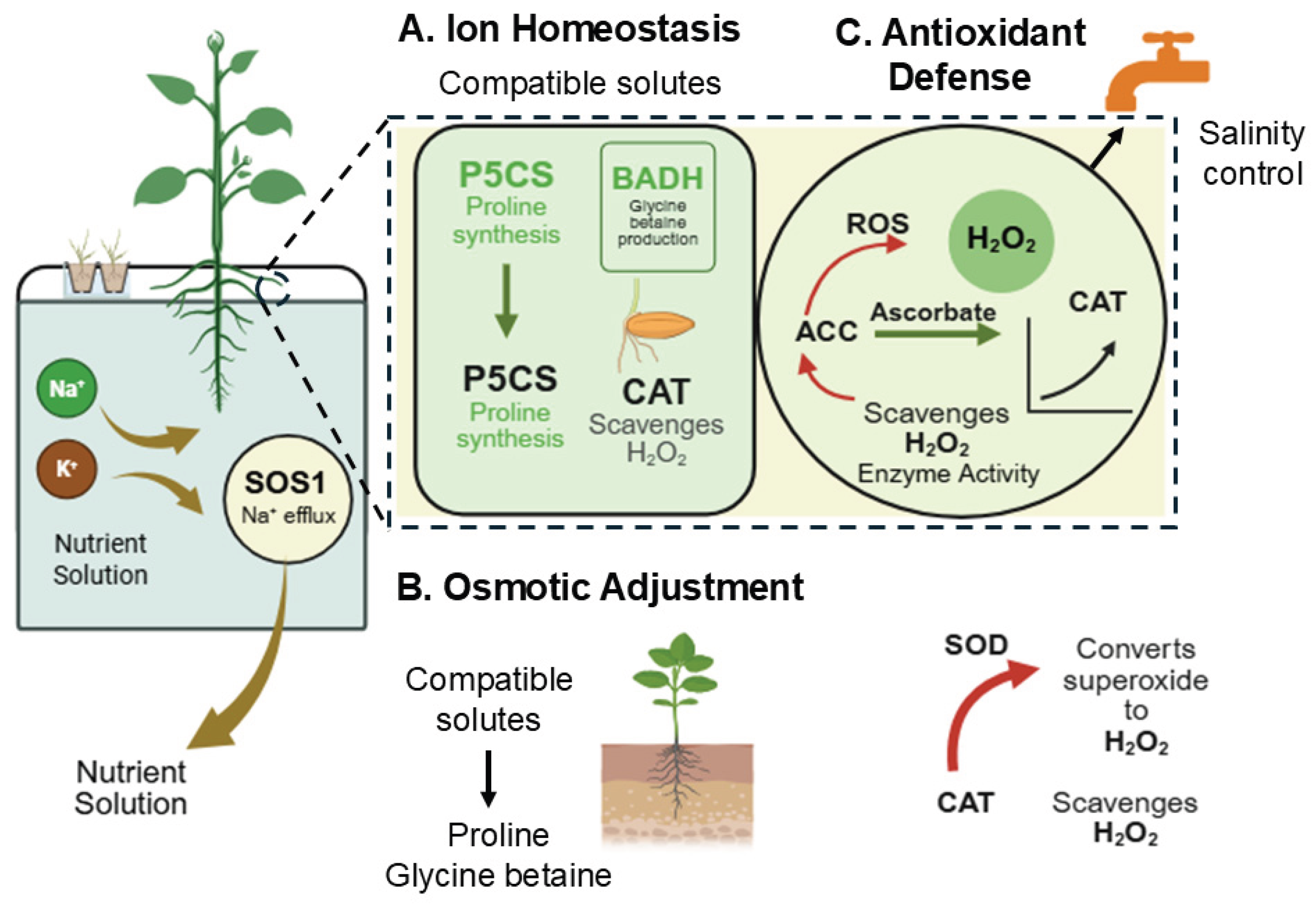
Figure 2.
Integrative genomics and a CRISPR/Cas9-based gene-editing strategy to improve salinity tolerance in hydroponic crops. Salt stress is used in hydroponic settings, followed by omics data collection (GWAS, RNA-Seq, LC-MS, and GC-MS), data integration, candidate gene identification, CRISPR/Cas9-mediated gene editing, and phenotypic confirmation under saline conditions.


Table 1.
Key Genes and Pathways for Salinity Tolerance in Hydroponic Crops.
| Gene | Function | Physiological Role | Crop Example | Reference |
|---|---|---|---|---|
| SOS1 | Na+/H+ antiporter | Excludes Na⁺ from cytosol, maintains K⁺/Na⁺ ratio | Tomato (Solanum lycopersicum) | [14] |
| NHX1 | Vacuolar Na⁺/H⁺ antiporter | Sequesters Na⁺ into vacuoles, reduces toxicity | Lettuce (Lactuca sativa) | [21] |
| HKT1 | High-affinity K⁺ transporter | Regulates Na⁺/K⁺ homeostasis in roots | Spinach (Spinacia oleracea) | [10] |
| BADH | Betaine aldehyde dehydrogenase | Synthesizes glycine betaine for osmotic adjustment | Tomato (Solanum lycopersicum) | [38] |
| P5CS | Pyrroline-5-carboxylate synthetase | Synthesizes proline for osmotic protection | Lettuce (Lactuca sativa) | [15] |
| SOD | Superoxide dismutase | Converts superoxide to H₂O₂, mitigates ROS damage | Spinach (Spinacia oleracea) | [16] |
| CAT | Catalase | Decomposes H₂O₂, reduces oxidative stress | Tomato (Solanum lycopersicum) | [16] |
Disclaimer/Publisher’s Note: The statements, opinions and data contained in all publications are solely those of the individual author(s) and contributor(s) and not of MDPI and/or the editor(s). MDPI and/or the editor(s) disclaim responsibility for any injury to people or property resulting from any ideas, methods, instructions or products referred to in the content. |
© 2026 by the authors. Licensee MDPI, Basel, Switzerland. This article is an open access article distributed under the terms and conditions of the Creative Commons Attribution (CC BY) license (http://creativecommons.org/licenses/by/4.0/).
Copyright: This open access article is published under a Creative Commons CC BY 4.0 license, which permit the free download, distribution, and reuse, provided that the author and preprint are cited in any reuse.