

Submitted:
27 June 2026
Posted:
29 June 2026
You are already at the latest version
Abstract
The transition from paper-based to electronic trade documents (eTDs) represents a critical step in modernising global supply chains; however, the absence of reliable mechanisms to verify the physical movement of goods vis-a-vis the eTD workflow remains a significant challenge. This study proposes the PROGRESS framework, an integrated digital trade architecture that combines AI-driven document verification with real-time physical tracking to ensure end-to-end assurance of consignments. The approach leverages advanced Optical Character Recognition (OCR) techniques, including Transformer-based attention models, Convolutional Recurrent Neural Networks (CRNN) with Connectionist Temporal Classification (CTC), and Vision Transformers (ViT), enhanced through context-aware validation to ensure semantic consistency across key trade documents such as commercial invoices, packing lists, airway bills, and certificates of origin. A simulation involving 5,100 consignments was conducted and benchmarked against real-world operations at Teesside International Airport. Results indicate that the proposed system reduces document processing time from 24–72 hours in traditional paper-based systems to approximately 1–2 minutes, achieving a validation accuracy of 98%. Furthermore, integration with RFID-based tracking, geofencing, and private 5G connectivity enables continuous monitoring of consignments, reducing customs dwell times from 72 to 44 hours and increasing throughput by up to 65%. The findings demonstrate that combining digital documentation with verifiable physical assurance significantly enhances transparency, efficiency, and regulatory compliance. This research contributes to the advancement of digital trade by addressing key limitations in current eTD implementations and supporting the effective adoption of the United Kingdom’s Electronic Trade Document Act.
Keywords:
electronic trade document
; eTDs
; electronic bill of lading
; eBL
; document verification
; physical assurance
; reliable system
; consignment tracking
1. Introduction
In recent years, the integration of digital technologies has fundamentally transformed how businesses manage their trade operations, with the primary aim of enhancing efficiency, traceability, and regulatory compliance [1,2]. Digitalisation involves the conversion of analogue processes into digital formats, emphasising the incorporation of new digital tools and systems [3,4,5]. Beyond mere digitalisation, digital transformation signifies a profound shift in business operations, where organisations leverage digital technologies to streamline key processes, elevate customer service, and develop new value propositions [7]. Achieving this transformation necessitates significant organisational and cultural changes, empowering companies including those in shipping and logistics to fully adopt and implement digital solutions across their operations. This ultimately leads to more efficient processes and innovative business models. International transportation whether by sea, air, road, or rail forms the backbone of global trade, enabling the seamless movement of goods across borders. According to the United Nations, over 80% of global trade by volume is conducted internationally, highlighting the pivotal role that transportation systems play in the global economy [7,8]. To support these operations, a complex network of trade documents has evolved, encompassing commercial, transportation, customs, insurance, financial, and regulatory records. These documents are vital instruments of communication among key stakeholders, including exporters, importers, customs authorities, financial institutions, and logistics providers. They are categorised into several types, such as Commercial Documents (e.g., commercial invoices, packing lists), transportation Documents (e.g., bills of lading, airway bills, road consignment notes, and railway consignment notes), Customs Documents (e.g., import declaration, export declaration), Insurance Documents, Financial Documents, Regulatory Documents, and Inspection and Certification Documents.
Despite advancements in digital trade, considerable challenges remain in verifying the physical movement and condition of goods in real time [2]. Fragmented logistics systems, siloed data, and an over-reliance on paper documentation obstruct transparency, while limited interoperability and coordination among stakeholders further exacerbate inefficiencies. The lack of reliable, real-time visibility creates opportunities for fraud and misrepresentation, particularly concerning high-value or temperature-sensitive consignments that necessitate stringent quality assurance.
This research aim—to enhance transparency, efficiency, regulatory compliance, and interoperability in the transportation of goods across all modes by implementing the Physical assuRance fOr diGital tRadE SyStems (PROGRESS) framework for digital proof of physical movement of goods which sits precisely in that gap. The specific objectives (digital proof of movement, compliance with ETDA, resource optimisation, and digital trade flow proposal) directly maps into the gaps identified in Section 2. This initiative will ensure traceability and address essential regulatory and quality assurance requirements.
The specific objectives of the research are as follows: (i) To establish digital proof of physical movement and ensure traceability (ii) To ensure compliance with the Electronic Trade Document Act (ETDA) concerning the movement of goods (iii) Implement a digital trade flow for the Physical assurance of goods and consignments in line with the UK’s ETDA (iv) AI-based automation of document checks and verification for strict government regulatory compliance
1.1. Physical Assurance in Digital Trade and Gap in Knowledge
This study seeks to establish a fundamental capability for assessing the physical assurance of digital trade systems by tracking the physical location and transit of consignments through enhanced interoperability with international digital trade data handling systems. To achieve an effective digital supply chain management system, it is crucial to forge reliable connections between the physical status and whereabouts of shipments and their digital counterparts.
The accelerating shift towards digital trade, encompassing e-commerce and online service delivery, has introduced a critical need for robust physical assurance mechanisms. While digital platforms facilitate seamless transactions, the inherent detachment from tangible goods creates vulnerabilities related to authenticity, quality, and delivery verification [9]. This challenge is particularly pronounced in cross-border digital trade, where varying regulations, logistical complexities, and a lack of standardized trust frameworks amplifies the risks of fraud and misrepresentation. Consequently, ensuring that the physical attributes of a product or service align with its digital representation becomes paramount for consumer confidence and the overall integrity of the digital marketplace [10].
Despite the growing volume of digital transactions, a significant gap in knowledge persists regarding effective strategies and technological solutions for bridging the physical-digital divide in trade. Current academic discourse and practical applications often focus on the digital aspects of transactions, such as cybersecurity, data privacy, and payment systems, leaving the complexities of physical verification underexplored. This lacuna extends to understanding consumer expectations for physical assurance in diverse product categories, the development of scalable and cost-effective verification technologies, and the establishment of universally accepted standards for quality control and dispute resolution in a digitally mediated environment [11].
Addressing this knowledge gap is crucial for fostering continued growth and trust in digital trade. Future research should prioritize the development of innovative solutions such as blockchain-enabled supply chain transparency, advanced sensor technologies for remote quality inspection, and the integration of artificial intelligence for predictive analytics in logistics and product verification. Furthermore, interdisciplinary collaboration between technology experts, economists, legal scholars, and policymakers is essential to establish comprehensive frameworks that support physical assurance in digital trade, thereby mitigating risks and unlocking the full potential of the global digital economy.
2. Literature Review
This literature review is organised into four major parts: (i) The UK’s current international trade-flow context; (ii) The UK’s digital trade regime, in particular the Electronic Trade Documents Act 2023 (ETDA) and related digital-trade frameworks; (iii) The physical assurance of consignments in trade (ensuring the integrity, traceability and regulatory compliance of goods and their movement); and (iv) Knowledge gaps in digital trade, especially as they relate to linking digital documentation and physical movement/assurance of goods. These layers jointly support the study’s aim of enhancing transparency, efficiency, and regulatory compliance by enabling digital proof of physical movement of goods.
2.1. The UK’s International Trade-Flow Market
2.1.1. Scope and Importance
The United Kingdom remains a major centre of international trade in goods across multiple transport modes (sea, road, air, rail), [12,13]. The logistics of physical movement of goods, the concomitant trade documentation, and the associated regulatory and quality assurance demands form a complex system. For instance, the explanatory notes to the ETDA reference that the current legal framework for trade documents does not sufficiently support a fully digital trade environment [14]. In the context of multi-modal transport and cross-border movement, each consignment may involve several parties (shippers, carriers, freight forwarders, customs authorities, warehouses) and numerous documents and hand-offs, increasing complexity and risk.
2.1.2. Current Processes and Key Challenges
Paper-based trade-document flows continue to dominate many parts of maritime and international logistics. The UK government’s impact assessment of the ETDA notes that existing laws (statute and common law) are “not sufficiently broad to cover the range of electronic trade documents proposed” and that documents reliant on “possession” of a physical paper counterpart create legal barriers for digitisation [15].
From an operational standpoint, challenges include: delays due to couriering of physical documents, risk of loss or damage of documents, manual checking and verification overheads, fragmentation of data across multiple parties and systems, and limited real-time visibility of goods in transit [16,17]. These generate inefficiencies, impaired traceability, and increased cost. Moreover, physical assurance of goods in transit (e.g., verifying that cargo arrived, or is being shipped under agreed conditions) is often weak — particularly in multi-modal chains and when transfer points change modes or geographies. This undermines transparency and traceability of the physical movement of goods, which is central to the study’s aim. This section underscores the contextual need that movement of consignment is dependent on document approval and addressing delays created by documentation errors will improve physical assurance, and free up the flow of consignment [18,19].
2.2. UK Digital Trade and the Electronic Trade Documents Act (ETDA)
2.2.1. Key Features of the ETDA
In the UK, the ETDA received Royal Assent on 20 July 2023 and entered into force on 20 September 2023 (UK Public General Acts, 2023). The Act makes provision for “electronic trade documents” to have the same legal effect as their paper counterparts, such that they can be possessed, indorsed, transferred and treated as equivalent to paper trade documents [14,20]. From the ETDA, Section 1 defines “paper trade document” and Section 2 defines “electronic trade document” (eTD) in terms of information in electronic form that corresponds to what would have been a paper trade document if it were in paper form [14]. Section 3 provides that “an electronic trade document has the same effect as an equivalent paper trade document”. Section 4 addresses conversion between paper and electronic documents under defined rules (including that the old form ceases to have effect once conversion takes place). According to the government’s press release, the UK economy is expected to receive a benefit of over £1 billion over the next decade from trade digitalisation enabled by the Act. Industry commentary (for example the British Chambers of Commerce) has described the ETDA as a transformational change paving the way for trade digitalisation and as “a beacon” for global trade reform [21].
Based on the objectives of this paper, the ETDA addresses objective 2 (ensuring compliance with the ETDA concerning the movement of goods) and objective 3 (propose a digital trade flow for physical assurance aligned with UK’s ETDA). The legal foundation, which has since crippled the sector is now present; what remains is how operational/physical assurance flows will align with the new digital documentation regime and our research will attempt to address this unique flaw which remains unaddressed.
2.2.2. Related Digital-Trade Initiatives and Frameworks
The ETDA is part of a broader push toward digital trade, including paperless trade initiatives, single trade windows, standardisation efforts (e.g., via GS1, United Nations Centre for Trade Facilitation and Electronic Business / CEFACT) and digital corridor programmes, [22,23]. For example, the GS1 Global Traceability Standard provides a methodology for designing interoperable traceability systems across end-to-end supply chains, including transport and distribution. The ETDA’s explanatory notes emphasise that while not technology-prescriptive, a “reliable system” must be used for eTDs: one that identifies the document, protects it against unauthorised alteration, ensures exclusive control and that a transfer deprives the previous controller of ability to control it.
Thus, our solution emphasises on the implementation of a reliable system through digital signature and verifiable physical assurance within the trade flow, as will be shown in the later part of this work.
2.2.3. Gaps and Challenges in the ETDA/Digital Trade Regime
Despite recent advances, several gaps and challenges have been identified in the literature and policy commentary:
- Operational ambiguity: The ETDA sets out legal equivalence of eTDs but gives limited direct guidance on operational governance of ETD systems (who will certify, how interoperability will be achieved across systems, how conversion will practically work). For example, the impact assessment acknowledges that implementation is left to businesses [33,34].
- Cross-jurisdictional / cross-border complexity: The Act is UK-law based; in cross-border trade, efforts are required to align with other jurisdictions’ regimes. Legal certainty may be less for documents governed under foreign law. Industry commentary notes this issue [34].
- Link to physical movement of goods: While ETDA addresses the document side, it does not explicitly address the physical movement, condition, traceability or integrity of goods. The gap here is the linking of digital documentation (eTDs) with reliable proof of physical movement, condition, security and regulatory compliance of goods in transit [37].
- Standards and systems for physical traceability: While systems such as GS1 traceability standards exist, the literature shows that end-to-end integration through the physical-goods chain (especially multi-modal, cross-border) remains partial. For example, a study on smart-containers emphasises the challenge of aggregating event-based traceability data across partners [38].
The ETDA, therefore provides a legal basis for electronic documentation, the standards landscape is advancing, but the operational linkage to physical assurance remains weak. This motivates our study’s contribution: proposing a digital trade flow which incorporates physical assurance of goods and consignments in line with the UK law.
2.3. Physical Assurance of Consignments in Trade
2.3.1. Concept and Importance of Physical Assurance
“Physical assurance” in the context of this research refers to the measures and mechanisms that ensure the physical goods actually move, are handled, stored, transported, and delivered under agreed conditions, remain secure and intact, and are traceable through the supply chain — while also linking to digital information flows and regulatory compliance. In other words, it is the assurance that “what the documents say” (e.g., an eTD) corresponds to “what actually happened” to the goods. Traceability literature emphasises that the core of traceability is not just information flows but linking physical objects (“traceable objects”) to those flows (the “who, what, when, where, why” of movement) [39,40]. The GS1 Traceability Standard notes that traceability systems must handle the identification of physical and/or digital objects, their movements/events such as Critical Tracking Events (CTE), Key Data Elements (KDEs) and share data across supply-chain parties (GS1, 2017). In multi-modal international trade, consignments may transfer between modes (ship ↔ rail ↔ truck ↔ warehouse), increasing the risk of integrity loss, tampering, diversion, shipment condition changes and data-physical misalignment. Therefore, physical assurance is central to the objectives of this research by ensuring digital proof of the physical assurance of the movement and traceability of goods.
2.3.2. Traceability, Chain-of-Custody, Chain-of-Condition, and Multi-Modal Transport Complexities
Traceability in this context involves chain-of-custody (who handled the goods when, who controlled them, when ownership/possession changed), chain-of-condition (was the goods’ integrity maintained), and multi-modal transfers (where goods change transport mode, container, or load). Literature on containerised goods in multimodal transport highlights that an “intelligent traceability system” must integrate goods data across modes, handle interoperability and data-exchange issues between actors [41]. Also, research on blockchain/digital twins in supply chains emphasises that digital representations (digital twins) of physical goods are only meaningful if there is strong correspondence between the physical object and its digital counterpart [42,43]. From a regulatory perspective, physical assurance is vital for meeting customs, border inspections, anti-tampering, product safety, and chain-of-custody requirements. For example, temperature-sensitive consignments may trigger regulatory checks, and any misalignment between documentation and physical condition/movement may lead to non-compliance, quality issues or regulatory refusal. Hence, physical assurance forms the link between digital trade documentation and the actual goods movement—without that bridging, the transparency and traceability may be compromised.
2.4. Knowledge Gaps in Physical Assurance of Digital Trade
2.4.1. Linkage Between Digital Documentation and Physical Movement
A core knowledge gap emerges in how digital documentation (e.g., eTDs under the ETDA) is operationally linked to reliable, end-to-end proof of physical movement and condition of goods. Many digital trade initiatives focus on documents, data flows or platforms; many traceability initiatives focus on physical goods sensor data or transport event data, but the combined interface (digital document and physical goods assurance) is less well developed. For example, the study by Botta et al. [44] on digital twins concluded: “a major problem in blockchain-based supply management is the potential unreliability of digital twins when considering digital representations of physical goods. The use of blockchain technology to trace goods is obviously ineffective if there is no strong correspondence between what is physically exchanged and the digital information.” Similarly, research into smart-containers and real-time traceability chain highlights difficulties in aggregating event-based data from various participants to create reliable chain-of-custody / chain-of-condition logs [45]. While ETDA enables legal recognition of digital documents, the question of how to reliably generate, capture, secure and link physical movement/condition events (for example via IoT sensors, logistics asset identifiers, chain-of-custody logs) such that they integrate with the digital trade flow is the focus of our research implementation.
2.4.2. Standards, Interoperability and Operational Implementation
Another gap lies in the operationalising of traceability and physical assurance standards across the multi-actor international trade ecosystem. The GS1 Global Traceability Standard provides a comprehensive methodology for traceability systems (identification, capture, share) across supply chains [22]. However, literature points to uneven adoption, many bespoke/siloed systems, and limited interoperability across transport modes and actors. For example: the GS1 traceability standard emphasises “a traceable object is a physical or digital object for which there is a need to retrieve information about its history, application or location” and calls for open data sharing standards. But in multi-mode transport, integration of logistics asset data (containers, pallets, trucks), environment (cold-chain sensors), documentation (eTDs) and condition/event data remains challenging. This gap is relevant to the objective of optimising resource management through the establishment of digital proof of physical movement and ensure traceability.
2.4.3. Regulatory and Assurance Frameworks for Physical/Digital Integration
A further gap relates to regulatory oversight, assurance frameworks and how regulators and trade parties can have confidence in digital-physical integration. While ETDA gives legal status to eTDs, the physical side (movement, condition, custody) often remains under traditional checks and inspections (paper-based or manual) and may not fully exploit digital/automated proof. For example, while regulatory regimes for condition-sensitive goods may mandate temperature logs, the literature shows centralised, tamperprone systems remain an issue in cold chain logistics [46]. In other words: digital documents may now have legal effect, but if the underlying physical goods movement and condition assurance are weak or disconnected, then transparency, traceability and regulatory compliance goals may not be fully met. This reinforces the need for a digital trade flow that explicitly incorporates physical assurance of goods and consignments in line with the ETDA and regulatory regimes.
3. Methods
This research adopts the Design and Creation methodology, as articulated by Oates [47], sits squarely within the Design Science Research (DSR) paradigm, which focuses on the development of novel artefacts to solve real-world problems and the rigorous evaluation of those artefacts in context [48]. The Design and Creation methodology is suitable because it enables iterative design, implementation, and validation of the PROGRESS framework, ensuring both practical applicability and theoretical contribution in improving digital trade and physical assurance systems. We organise our methodological narrative into five interlinked phases (see Figure 1): Problem Awareness, Design Specification, Artefact Construction, Demonstration & Evaluation, and Reflection & Learning; each of which iterates as the platform matures, and insights emerge.
3.1. Problem Awareness
The rationale of the study is a convergence of practical inefficiencies in global trade logistics and evolving policy frameworks that demand digital transformation. Paper-based Bills of Lading (B/L) introduce delays of several days, are highly error-prone, and offer limited traceability or security. These challenges collectively result in an estimated $6.5 billion in annual industry losses due to administrative overhead, disputes, and fraud [49]. Although the UK’s 2023 Electronic Trade Documents Act (ETDA) legally recognises electronic trade documents, the pre-ETDA era showed that real-world adoption remains under 2% of total BL transactions [19,50], due largely to interoperability concerns, institutional inertia, and the absence of robust digital infrastructure. Although, survey shows steady rise of global adoption of electronic Bills of Lading [51].
The complexity of these challenges is amplified within Freeports, a high-throughput trade zone comprised of multiple geographically distributed sites. Movement of goods between customs-approved locations (such as from a airport or seaport) to a Temporary Storage Facility (TSF), or from one Freeport zone to another, requires documented assurance to HMRC that consignments have not been diverted, interfered with, or tampered with during transit. Without a unified digital mechanism to verify and evidence of this movement, shipments face regulatory delays, increased inspection frequency, and potential fines, nullifying the efficiency gains that Freeports are designed to provide. Thus, the first phase of this research involved a structured, iterative requirements gathering through engagement with key stakeholders (manufacturers, freight forwarders, airport authorities, industry bodies, and government departments) conducted via system design walk-throughs, and proof of concept demonstrations. A core industry requirement that emerged is the need for a seamless platform that integrates eTD operational standards with a reliable physical assurance, capable of tracking the movement of consignments between Freeport locations and logging evidential records for customs compliance and oversight.
These objectives informed the scope and direction of the study and shaped every subsequent phase of its design and implementation, in alignment with the Design and Creation research methodology [47] Ch. 8.
3.2. Design Specification
This design specification functioned not only as a blueprint for implementation but also as a compliance map and architectural reference, guiding the development lifecycle to ensure that both operational and regulatory standards were upheld.
Drawing on those requirements, we formulated a comprehensive design blueprint, (see Figure 1) that synthesises functional, technical, and regulatory constraints into a cohesive architecture. Functionally, our proposed solution for PROGRESS supports: (1) Consignment registration by the sender with metadata (such as weight, HMRC commodity code, destination, costs, etc.) and document upload (such as invoice, bill of lading, airway bill, etc), (2) RFID geofencing across six defined zones, (3) Automated document validation using Transformer OCR pipelines + CRNN + CTC models, and (4) Bi-directional API integrations (Zebra RFID SDK, AWS S3, HMRC sandbox system).
Technically, the system for PROGRESS adopts a modular microservices architecture designed for scalability, maintainability, and interoperability offering real-time interactivity and responsive design for all stakeholders (senders, receivers, freight operators, and customs officials). The frontend interfaces with the backend services written in Node.js that handle RFID event processing, document validation workflows, and system-wide business logic.
The RFID event pipeline is designed for high-throughput ingestion, with Zebra AN440 antennas streaming data to the backend via the Zebra SDK. The backend service tags each RFID read with geospatial metadata and zone-specific identifiers and forwards them to a cloud-native message queue for processing. Simultaneously, serverless Lambda functions are invoked to perform OCR on uploaded trade documents using a CRNN + CTC models, returning structured results for consistency checks and semantic validation.
Real-time communications are achieved through WebSocket channels that push status updates to the user interface, while critical alerts are sent asynchronously via AWS Simple Notification Service (SNS) and integrated email. System orchestration is governed through API Gateway and DynamoDB ensures high-availability storage of event logs and document metadata.
From a security and compliance perspective, the platform adheres to industry best practices and aligns with the UK Electronic Trade Documents Act (ETDA). All data at rest in S3 is encrypted using AES-256, and data in transit is protected via SSL/TLS protocols. Authentication and authorisation are handled via AWS Cognito, ensuring role-based access control (RBAC) for all users. Each system interaction is logged with immutable audit trails, satisfying ETDA requirements for verifiability and non-repudiation. All services `are monitored using AWS CloudWatch and configured with automated alarms to detect anomalies, while periodic penetration testing ensures continued resilience against evolving cybersecurity threats.
3.3. Artefact Construction
In this study, the artefact is the PROGRESS platform: a web-based system that integrates RFID geofencing, AI-driven document validation, and real-time notifications to provide physical assurance of consignments moving through the trade zones. The construction of the Digital Trade Physical Assurance solution proceeded through four agile sprints, each culminating in a working increment, where each increment was accompanied by unit and integration tests, as well as demo sessions with stakeholders, to validate and ensure that the artefact realised the design goals [48]. The “Design and Creation” methodology does not explicitly involve a “Sprints” approach in the way it is defined in Agile methodologies, such as Scrum [52,53]. We have adapted the Design and Creation methodology to use Agile-like sprints for practical or hybrid research setting, especially for industry-academic collaboration:
- Sprint 1: We established the user management framework, which includes freeport requirement, HMRC regulations for the free trade zones, with roles and permissions for custom checks.
- Sprint 2: Software implementation for consignment-registration UI, integrating AWS Cognito for authentication and S3 for document storage.
- Sprint 3: Implementing the RFID ingestion pipeline, configuring Zebra AN440 antennas for six adaptable and flexible dedicated Zones. The Node.js service consumed RFID reads via the SDK, tagged events with geospatial metadata, and persisted them in DynamoDB.
- Sprint 4: The notification engine was built using AWS Simple Notification Service (SNS) topics broadcast Green/Red status updates to stakeholder channels when consignments crosses a geofenced zones or fail document checks. Real-time dashboards reflect each consignment’s zone, dwell time, and document-validation status.
3.4. Demonstration & Evaluation
The PROGRESS hosted a live demonstration event, engaging over 20 stakeholders who observed managing real consignments moving across dedicated and carefully designed simulated trade zones. Additionally, the project simulated a weekly model of 2,500 consignments per zone, with the baseline average customs dwell time (across sea, road and air modes) set at approximately 72 hours (3 days) based on industry typical clearance durations [54,55]. By integrating digital pre-arrival processing, e-customs automation and a harmonised single window for document flows, average dwell times in the model reduced to approximately 44 hours (≈1.8 days), a 40% reduction consistent with documented impacts of digital customs automation systems. Under these assumptions, throughput capacity increased by approximately 60–65%, illustrating significant operational gains from improved customs flow integration [48].
Empirical studies of digital customs implementations show meaningful reductions in clearance times. For example, a UN/CEFACT review reports that Mauritius’ Single Window cut average clearance processes from ~4 hours to ~15 minutes after implementation, consistent with broader evidence that digitalisation accelerates border procedures [56]. Likewise, research on automated customs systems at Dar es Salaam port demonstrates that electronic clearance systems significantly enhance processing efficiency and reduce dwell times for consignments.
The research demonstrated 2 fundamental case study:
- i.
- Physical Assurance for connected Freeport locations:
Geofencing leverages on existing key technologies (RFID, sensors, & APIs) to create virtual boundaries around specific geographic areas to designate the freeport locations as shown in Figure 2 (the landing side of the airport, the customs area, or the temporary storage facility). At the same time, UHF RFID tags are placed inside a physical shipping containers (see Figure 3) and practically moved between designated geolocation/zones which allows the system to capture movement, highlight required documentation, and send real notification to HMRC’s sandbox platform. The PROGRESS platform triggers predefined actions, such as sending notifications, updating logs, or initiating automated responses when a tagged consignment crosses any virtual boundaries without the right document. The PROGRESS platform triggers alerts to relevant stakeholders if a consignment enters a restricted area, stays too long in a particular zone, or deviates from its expected path. This capability allows for immediate intervention, ensuring that international trade within the freeport remains secure, efficient, and compliant with regulations. Figure 2 below shows the connected freeport locations demonstrated, showcasing the integrated consignment tracking system for physical assurance.
- ii.
- AI-based Electronic Trade Document compliance verification:
The research project incorporates AI capabilities by automating document verification and creation towards strict regulatory compliance. PROGRESS facilitates the efficient handling, distribution, and access to essential documentation, such as shipping manifests, invoices, and the generation of customs declarations. Embracing digital documents reduces the risk of errors common with manual data entry and paper handling. This capability accelerates document processing time because documents are instantly and securely transmitted, reviewed, or approved, leading to faster clearance of goods and reducing the likelihood of delays.
The AI-based Electronic Trade Document (eTD) compliance verification module was implemented in Python using a modular, multi-agent architecture. The system leverages the Agno agent framework to orchestrate specialised AI agents, each responsible for extracting and validating structured data from specific trade documents (invoice, packing list, and air waybill). Each agent is instantiated with domain-specific system instructions and powered by the Google Gemini 2.5 Flash large language model, enabling contextual understanding beyond traditional OCR-based parsing. Environment variables are securely managed using the python-dotenv library to ensure protected API credential handling. A coordinating “Team” agent dynamically routes incoming document requests to the appropriate specialist agent based on document type, ensuring task-specific processing and reducing classification errors. This architecture enables structured data extraction, semantic validation, and rule-based compliance checking against predefined trade and customs requirements. The modular design improves scalability, maintainability, and adaptability to additional document types or regulatory schemas in future deployments.
To evaluate the robustness of the AI-driven electronic Trade Document (eTD) compliance verification module, four key performance indicators were systematically assessed under controlled stress conditions.
- Latency: System latency was measured as the average end-to-end alert generation time, defined as the interval between RFID tag capture and compliance validation output. Under a simulated load of 500 concurrent RFID reads, the system achieved a mean latency of 650 ms, remaining well below the operational threshold of <1 second required for real-time customs and border decision support. This demonstrates suitability for high-volume port environments.
- Throughput: Stress testing of Zone A antenna arrays recorded sustained processing of 1,200 RFID reads per second with zero packet loss. This confirms the system’s capacity to maintain data integrity and continuous verification under peak-flow conditions (e.g., vessel discharge windows or consolidated road freight arrivals).
- Document-Validation Accuracy: Using a labelled dataset of 500 electronic trade documents, the AI model achieved a 98% true-positive rate and a 1.5% false-positive rate. Performance exceeded baseline OCR-based validation systems by approximately 15%, reflecting improved contextual interpretation beyond character recognition alone.
- Usability: User acceptance testing across customs officers, warehouse operators, and compliance administrators yielded a System Usability Scale (SUS) score of 85, indicating excellent perceived usability and operational fit within existing workflows.
4. System Design and Implementation
4.1. Introduction to RFID and Consignment Tracking
Radio Frequency Identification (RFID) technology has long existed since “the thing” was invented in 1950 [57]—a passive listening device by Leon Theremin and ever since has profoundly transformed the domain of automatic identification and data capture (AIDC), offering a robust mechanism for asset tracking and resource management. RFID systems comprise three primary elements: tags, readers, and a backend infrastructure for processing data. The seamless interaction of these components underpins the efficacy of RFID technology.
-
Tags: RFID tags are integral to the system, storing unique identification data that can be wirelessly transmitted to a reader. These tags are classified into distinct categories:
- Passive Tags: Operating without an onboard power source, passive tags rely on energy harvested from the reader’s electromagnetic field. Their cost-efficiency and simplicity make them ideal for short-range applications, typically within a few meters.
- Active Tags: Equipped with a battery-powered transmitter, active tags enable extended operational ranges, often spanning hundreds of meters, and are suited for dynamic, real-time tracking.
- Semi-Passive Tags: Combining elements of both passive and active tags, these tags feature an internal power source for enhanced functionality while utilising reader energy for data transmission. The adoption of passive tags dominates applications in supply chain logistics, while active tags are prevalent in scenarios demanding extensive range and real-time updates [58].
- Readers: RFID readers generate radio frequency waves to interrogate tags and interpret their backscattered signals. Available in fixed and portable configurations, readers relay data to backend systems for analysis. Advanced readers incorporate sophisticated signal processing and multi-tag interrogation capabilities to enhance performance.
- Communication Protocols: RFID systems adhere to standardised communication protocols, such as ISO/IEC 18000-6C (EPC Gen 2). These protocols ensure interoperability across devices and support critical functionalities like anti-collision mechanisms for simultaneous multi-tag reading.
Applications of UHF RFID
The applications of RFID technology are vast and diverse. In supply chain management, RFID tags are affixed to products, pallets, and containers, providing real-time visibility into inventory levels, shipment locations, and transit times [59]. In healthcare, RFID technology is used to track medical equipment, monitor patient movement, and manage pharmaceutical inventory, ensuring patient safety and improving operational efficiency [60]. The transportation sector also benefits significantly from RFID technology. Electronic toll collection systems, vehicle tracking systems, and automated border control systems all leverage RFID to streamline operations and enhance security. In retail, RFID enables accurate inventory management, loss prevention, and personalised customer experiences.
4.2. The Case for UHF RFID: A Comparative Justification
To successfully implement tracking physical consignment, e-bill of lading and other documents electronically for the UK’s supply chain industry through PROGRESS, several existing technologies such as Bluetooth low energy, Zigbee, Z-Wave, etc [61] comes to mind. The primary focus of this project lies not only on the use of IoT technology but reliability on the accuracy of the data and infrastructure whilst adapting to environmental changes and circumstances surrounding Teesside freeport locations as well as interoperability with existing systems, such as the 5G testbed at the Teesside International Airport [62]. A detailed comparison is inevitable to ensure that the specifications meet the project’s primary objectives. For example, Low Frequency (LF) RFID tags operate between 30 and 300 kHz, with a read range typically less than 10 cm (about 4 inches) [60]; High Frequency (HF) RFID tags operates at 13.56 MHz, with a read range from a few centimetres to several meters; while Ultra-High Frequency (UHF) RFID tags operates between 860-960 MHz, with a read range from a few centimetres to 150+ metres under ideal conditions. Passive UHF tags can typically be read up to 12 meters (about 40 feet), while active UHF tags can reach up to 100 meters (about 328 feet). Due to the environment within the freeport locations, the ideal option is the UHF RFID specification.
Table 2 shows a variety of points for UHF RFID’s superiority over the other wireless technologies in aspects such as range, simultaneous bulk reads, durability and environmental suitability, minimal interference and cost-effectiveness.
4.3. Technical Design Implementation of the Case study
As highlighted in Section 3.4, the PROGRESS platform was practically designed, implemented, demonstrated and delivered across two (2) fundamental case studies. This section highlights the technical design, implementation, and testing phases by showcasing the step-by-step process flow leading to the outcome of the research project.
4.3.1: Case Study 1: Integrated Consignment Tracking System for Physical Assurance
This section presents a case study demonstrating the operational implementation of the PROGRESS framework through an integrated consignment tracking system. Figure 6 shows a visual representation of the trade flow requirement and design implementation for PROGRESS.
- Sender’s handling and RFID tagging: This point marks the beginning of the trade flow process. The sender/shipper is responsible for placing a designated UHF RFID tag within the parcel or consignment and then registering the details of the consignment, such as weight, consignment size, and destination/receiver’s information on the PROGRESS platform. At this point, the sender must also ensure that the required documents are uploaded—depending on the consignment or quantity been shipped, this may include packing lists, commercial invoice, certificate of origin, etc. Moving the consignment without the required documents will flag all parties (sender, receiver, border authority) of the potential delays, custom duty/fines, and displays a red warning on the progress Platform.
- Port of Origin (POO): Zone A (as shown in Figure 6) represents the customs check, available at the POO which combines the Landside, the export custom check and the Airside. For this research project, we represent the POO using a single point (RFID antenna); this is because international ports are beyond our remits without the right agreement or collaboration in place. There are 3 smart notifications at the POO—registration of consignments on the PROGRESS platform, arrival at the Export customs checks, and successful custom clearance.
-
Port of Discharge: (POD): A successful customs clearance indicates progression of consignment to any designated Airport locations, known as the Port of Discharge (POD).
- Airside: The airside represents all the area prior to the custom checks/clearance, this includes, runway, offloading and transport within the airports. This is labelled as point “B” in Figure 2 and, and the consignments can be detected by the UHF antenna on arrival at any of the zones any distance up to a maximum of 250 meters from physical testing on a direct line of sight. The distance from the antenna to the consignment is dependent on a variety of factors such as energy output from the antenna (which can be regulated), weather conditions, physical obstructions, interference with other signals, etc. The Zebra AN440 RFID Antenna is designed to detect specified UHF RFID from a distance of up to 5 kilometres. Further details on the technology are discussed in Section 4.
- Import custom Registry (checks): Point “C” is the most vital or crucial stage of the trade flow, because it relates to the use of electronic documents. Prior to leaving the POO, custom required document is automatically highlighted or generated to the sender and carrier, which is then uploaded to the PROGRESS platform. Further checks are carried out to test for reliability, accuracy, or discrepancy between one or more documents, for example, are the contents of the packing list consistent with the contents of the invoice or are the business name, address and contact details clearly captured across all documentations? Errors are immediately picked up when the documents are uploaded and all parties (sender, carrier, the customs officer or the sender, in some cases) are notified prior to any required checks at Point “C” and this gives significant time to the sender or carrier to upload the required document(s). The trade flow on the PROGRESS platform will display “Red” colour when attention is needed with regards to the documents uploaded or “Green” to indicate a successful document upload and checks—this significantly enhance efficiency due to the reduced time for document check and custom clearance. Finally, HMRC Sandbox and Port Inventory System is updated to indicate the correct tax duty levied on the imported item, while ensuring this has been paid or must be paid before clearance is issued. Further details on the rules and procedures applied during the “Import custom Registry (checks)” is explained in Section 4.
- Landside: Consignment/goods cleared will be moved to the landside, this movement is picked up by the dedicated tracking devices on allotted zones while the system is updated accordingly. The next zone is dependent on the final destination of the consignment, or the level of clearance issued at custom checking zone, where: zone D indicates fully cleared for delivery to the final destination, zone E indicates additional checks are required and the consignment is kept at the Temporary Storage Facility (TSFs), and zone F indicates movement to other freeport locations.
- Destination: As mentioned earlier, the destination is indicated by “D”, this could be a business or residential address anywhere within the UK. On leaving the freeport zones there are no tracking devices on the consignment as this is now successfully cleared for delivery and registered within HMRC’s sandbox Inventory System.
- Temporary Storage Facility (TSFs): Temporary Storage Facilities are required within any Trade port to aid additional checks for certain goods, this create additional burden to port authorities and costs to the senders, but they are inevitable for trade and to ensure goods meet all legal requirements [63]. Additional checks may be needed for various reasons such as incomplete documents for specific controlled or non-controlled goods, recording purposed, if a sender if found to be circumventing the system on purpose or other reasons. At the end of the checks, consignments can then be moved to either other freeport locations or the destination.
- Other Locations: The Teesside freeport is comprised of multiple locations working together to unlock the global trade market, create major trade hubs and offshore projects for the economic advancement of the Northeast region of the UK. As of December 2024, there are nine free trade customs zones affiliated to Teesside Freeport [64]: Teesside International Airport, Port of Middlesbrough, Port of Hartlepool, Teesworks, Liberty Steel Hartlepool, LV Logistics, ABLE Seaton Port, Wilton Engineering, and Redcar Bulk Terminal. Consignments are allowed to move to other freeport locations based on certain customs criteria or duty exemptions for businesses—these are beyond the scope of this paper.
Hardware Architecture Across the Trade Flow Implementation:
Figure 7 presents the hardware architecture supporting the PROGRESS physical assurance framework across two port environments. The architecture integrates RFID-based sensing, geofenced logistics zones, gateway hubs, and private 5G connectivity to track consignments as they move through port operations. Captured tracking events are synchronised with the PROGRESS platform and port inventory systems, enabling customs authorities and logistics stakeholders to verify the alignment between electronic trade documents and the physical movement of goods.
- PROGRESS Platform (Central Digital Coordination Layer): The PROGRESS platform serves as the central orchestration layer for the trade-flow architecture. It registers consignments when they are prepared by the sender and links the associated electronic trade documentation with the physical shipment through RFID tagging. The platform is responsible for distributing smart notifications to key stakeholders including senders, receivers, customs officers, port administrators, and carrier services throughout the shipment lifecycle. In addition, the platform synchronises shipment data with the HMRC sandbox platform and the port inventory management system, ensuring that customs authorities maintain real-time visibility of consignments and their associated documentation.
- Operational Locations (Port Infrastructure Environment): The architecture is deployed across two operational port environments: Airport A (Location 1) and Airport B (Location 2). These locations represent sequential nodes within the logistics chain where consignments are physically processed before onward movement. Within each port environment, goods travel through predefined operational zones (A–F), which may correspond to areas such as customs inspection points, storage areas, loading zones, or dispatch gates.
- Gateway Hubs and Private 5G Connectivity: Each port location contains a gateway hub that acts as the edge-computing interface between sensing devices and the central platform. These gateway hubs are connected to an on-site private 5G network mast, enabling secure and low-latency communication across the port infrastructure. The high-bandwidth connectivity provided by the private 5G network allows data captured from RFID sensing infrastructure to be transmitted rapidly to the PROGRESS platform, supporting near real-time monitoring of consignment movement.
- Zebra UHF RFID Readers and Geofencing Mechanism: The physical tracking of consignments is enabled by Zebra Technologies UHF RFID readers, which are deployed across the operational zones within each port environment. RFID tags attached to consignments emit signals that are captured by these readers as goods pass through different zones. The readers are directly connected to the gateway hubs and play a dual role: capturing the RFID tag identifiers and implementing smart geofencing logic. This geofencing capability allows the system to detect when a consignment enters or exits a specific operational zone, thereby generating location-based tracking events that confirm the physical progression of goods through the trade flow.
Uniqueness and Innovation of the Architecture
The proposed architecture demonstrates an innovative integration of digital trade platforms, RFID-based sensing, geofenced logistics zones, and private 5G connectivity to bridge the gap between electronic trade documentation and the physical movement of goods. By enabling automated verification of consignments as they progress through operational checkpoints, the system enhances transparency, traceability, and regulatory compliance. This architecture offers significant potential for improving the efficiency and security of international trade operations and could contribute to strengthening the resilience and digitalisation of the United Kingdom’s supply chain infrastructure.
Unlike the existing model, the proposed model offers numerous advantages that can significantly enhance efficiency and effectiveness. First and foremost, this model streamlines operations by integrating low cost (budget friendly) everyday technologies that increases end-to-end visibility, thereby reducing manual errors, and increasing overall productivity. Additionally, it promotes better resource management, ensuring optimal utilisation and minimising wastage. Another key advantage is its ability to integrate the UK’s ETDA as a reliable system for physical assurance within the supply chain that provide real-time data and analytics, empowering stakeholders with actionable insights and facilitating informed decision-making. Moreover, its scalable architecture allows for easy adaptation and growth, accommodating future needs without substantial overhauls. The proposed model presents a robust framework that not only optimises current processes but also lays a strong foundation for future advancements.
Electronic BL offer numerous benefits, starting with their swift electronic transmission, allowing the buyer to receive them within seconds. This rapid delivery of PROGRESS is timely, and helps to expedite the retrieval of goods. Additionally, any errors in the eBL can be quickly corrected and resent, minimising delays, and reducing the risk of incurring extra costs. Another significant advantage of eBLs is their potential integration with blockchain technology, which can drastically reduce errors and enhance security [65]. Blockchain provides an immutable and transparent ledger that ensures data integrity and offers maximum protection against fraud and tampering [66]. Moreover, eBLs reduce the reliance on physical documents, lowering the risk of loss, theft, or damage during transit. They also streamline administrative processes, improving efficiency by enabling easier tracking and management of shipping documents. Additionally, eBLs contribute to environmental sustainability by minimising paper usage [67], this is what PROGRESS represent. Overall, the adoption of electronic bills of lading leads to faster, safer, and more efficient trade transactions.
4.3.2. Case Study 2: Document Consistency Verification
This case study extends the PROGRESS framework by introducing a context-aware, multi-model Optical Character Recognition (OCR) and verification pipeline for ensuring consistency across electronic Trade Documents (eTDs), including commercial invoices, packing lists, air waybills/bills of lading, consignment notes, and certificates of origin. The approach addresses persistent challenges in document digitisation, such as extraction errors, structural ambiguity, and cross-document inconsistencies, which can undermine regulatory compliance under the UK’s electronic trade framework. By leveraging context-engineering, the system pre-emptively identifies discrepancies in seller, buyer, and inventory data before goods reach customs checkpoints, thereby mitigating the $6.5 billion in annual losses attributed to administrative errors and fraud [49].
- Mathematical Foundations of the OCR Framework
The proposed system integrates three complementary deep learning architectures: Transformer-based OCR, CRNN with Connectionist Temporal Classification (CTC), and Vision Transformer (ViT)—to jointly model semantic context, sequential text patterns, and spatial document structure.
- Scaled Dot-Product Attention (Transformer Layer): Transformer-based OCR enables contextual understanding through scaled dot-product attention and map global dependencies between text blocks as expressed by Vaswani et al., [68]. The attention is calculated as:
where Q, K, and V represent Query, Key, and Value embeddings derived from tokenised document features:
- is the key dimension
Here, Q (Query), K (Key), and V (Value) represent linear transformations of the input document embeddings. The dot product computes the relevance between different segments of a document, one of which is, linking a “Total Amount” field to the itemized “Inventory Details”. The scaling factor prevents gradient vanishing during training. In the context of trade documents, this formulation allows the model to compute relational dependencies between fields across documents. For instance, the “quantity” field in a commercial invoice is evaluated against corresponding entries in the packing list. If attends strongly to but yields conflicting values (e.g., 100 vs. 90 units), the attention-weighted discrepancy contributes to an inconsistency score. This enables semantic validation beyond isolated text extraction, supporting regulatory checks such as alignment of declared goods quantities and descriptions across documents are aligned through attention weights:
Thus, inconsistencies such as mismatched addresses are detected through low cross-attention similarity.
- b.
- CRNN + CTC Mathematical Ensemble: The Convolutional Recurrent Neural Network (CRNN) with Connectionist Temporal Classification (CTC) are employed to address variability in document quality and sequence-based text, such as, tracking numbers or long descriptions [69]. For sequential text recognition, the CRNN extracts feature maps F from image input I:
The sequence is processed using recurrent layers:
CTC then computes the probability of a label sequence given input :
where π represents all possible alignments, x is the input image, y is the predicted text sequence, and B collapses repeated labels and blanks. This probabilistic formulation enables alignment-free decoding, making it particularly suitable for degraded or scanned documents such as handwritten consignment notes or low-resolution certificates of origin.
In practical terms, this ensures accurate extraction of critical identifiers (e.g., invoice numbers, HS codes, container IDs). For example, ambiguities such as “INV-12O3” (letter ‘O’) versus “INV-1203” (digit ‘0’) are resolved through probability maximisation, reducing downstream verification errors when matching identifiers across documents.
- c.
- Vision Transformer (ViT) for Layout-Aware Consistency: The document image is partitioned into patches [70], then linearly embedded:
Followed by multi-head self-attention layers:
This enables the model to learn hierarchical document structures, such as headers, tabular line items, and summary sections. In trade document verification, this is critical for validating financial and logistical consistency. For example, the model ensures that the total value stated in an invoice footer corresponds to the aggregated values of individual line items:
Discrepancies identified through this spatially-aware reasoning are flagged as potential compliance violations.
- d.
- Multi-Model Fusion for Consistency Scoring: this ensures that fields like Country of Origin or Description of Goods are validated both textually and semantically across all four document types.
Each document is represented as:
where ⊕ denotes concatenation. Similarity between documents is computed as:
4.4. Context Engineering for Trade Document Semantics
Beyond raw OCR, the system incorporates context engineering to align extracted data with domain-specific schemas and regulatory requirements. Each document is enriched with structured metadata, including document type classification, expected field mappings, (such as consignor, consignee, HS code, gross/net weight), and compliance rules derived from UK trade standards.
This contextual layer enables: (i) Cross-document reconciliation (e.g., matching consignee details across invoice and bill of lading), (ii) Logical validation (e.g., weight consistency between packing list and airway bill), and (iii) Regulatory compliance checks aligned with electronic trade document requirements.
(a) Context Graph Representation: This allows contextual propagation across one document influence the global consistency representation, for example, inconsistencies in Seller Information.
Each document set is represented as a graph:
where: and
Node embeddings are updated using Graph Neural Networks:
(b) Contextual Field Embedding: This ensures that the meaning of “Goods Description” is interpreted relative to shipment and inventory context.
Each field is encoded as:
where represents global document context. Using attention:
(c) Probabilistic Consistency Modelling: For ensuring adaptive validation, for example, slight textual differences may still be accepted if contextual alignment is strong.
Consistency is modelled probabilistically:
where captures contextual coherence.
(d) Context-Aware Thresholding
Instead of static thresholds:
Thus, higher OCR confidence reduces false positives, improving robustness in real-world trade environments.
4.5. Practical Implementation Process: Document Breakdown
The following process, as shown in Figure 8, occurs from the moment a seller uploads documents to the PROGRESS platform:
- Pre-processing: Upon upload, the system applies OpenCV-based noise reduction, binarization, and geometric skew correction to the Commercial Invoice and Packing List to optimize them for the AI models.
- Multi-model OCR Extraction: The Transformer (Attention) and CRNN+CTC models extract the six core fields: Seller/Buyer Info, Goods Description, Shipping Info, Country of Origin, and Inventory Details.
- Data Fusion Layer: Extracted data from the Airway Bill and Certificate of Origin are fused into a structured feature vector . This layer reconciles minor OCR variations (e.g., “Ltd.” vs “Limited”) using normalised Levenshtein distance [71].
- Context Engineering Layer: The system compares the fused data against the “Contextual Embedding” . It verifies if the “Inventory Details” (weight, quantity) recorded at the Port of Origin (Zone A) logically match the documents uploaded.
- Decision Engine & Alert System:
- Valid: If the consistency score , the transaction is flagged Green (Figure 9), and the “Import Custom Registry” is updated for clearance.
- Invalid: If a discrepancy is found (e.g., missing Airway Bill or mismatched buyer address), the system flags Red (see Figure 10). An automated AWS SNS smart notification is immediately sent to the seller and customs. This allows errors to be corrected at the point of upload, preventing costly delays and penalties before the cargo arrives at the physical customs checkpoint.
5. Results, Discussions & Implications
5.1. Overview of Experimental Design and Benchmarking Context
This study evaluated the performance of the PROGRESS platform through a controlled simulation of 5,100 single consignments, benchmarked against both traditional UK-wide paper-based processes and operational estimates derived from Teesside International Airport (TIA). Based on TIA’s reported freight throughput of approximately 450 tonnes in 2024 and 1,800 tonnes in 2025, combined with the UK’s freight statistics indicating 50–100 parcels per tonne, TIA’s operational scale is estimated at 90,000–180,000 consignments annually [72,73,74]. This benchmarking provides a realistic mid-scale logistics environment against which PROGRESS performance can be critically assessed.
The simulation scale of 5,100 consignments represents a controlled but statistically meaningful subset of real-world operations. While smaller than full-scale airport throughput as shown in Table 3, it allows for high-fidelity testing of document verification and tracking processes under repeatable conditions. Importantly, the projected growth at TIA highlights the urgent need for scalable digital solutions, as traditional paper-based systems are unlikely to sustain efficiency at volumes exceeding 180,000 consignments annually. This aligns with findings from McKinsey & Company, which emphasise that trade documentation inefficiencies become increasingly costly as trade volumes scale [49].
5.2. Processing Time Analysis
The results demonstrate a substantial reduction in processing time achieved by PROGRESS, with an average of 1.8 minutes per consignment compared to 18.6 minutes in traditional workflows. This represents approximately 90% efficiency gain, aligning with prior findings that digital trade facilitation systems can reduce document processing time by 70–90% [75,76].
The semi-digital processes observed already halve processing times relative to paper-based systems, reflecting incremental improvements through digitisation. However, these systems remain constrained by manual verification bottlenecks and fragmented data silos, which PROGRESS overcomes through automation and integrated OCR-driven validation. At scale, assuming 100,000 consignments annually, PROGRESS could reduce cumulative processing time from approximately 31,000 hours to under 3,000 hours, demonstrating significant operational and economic implications. This processing time is validated based on calculations and data evidence shown above.
5.3. Accuracy and Consistency Verification Performance
The PROGRESS platform achieved a document validation accuracy of approximately 98%, significantly outperforming both manual processes and traditional OCR systems. Manual processes are prone to human error, including data entry mistakes and inconsistent verification standards, while standard OCR systems struggle with contextual understanding, often misinterpreting critical fields. By integrating Transformer-based attention mechanisms, CRNN+CTC sequence modelling, and Vision Transformer layout analysis, the PROGRESS system ensures both syntactic and semantic validation of trade documents. This aligns with research in deep learning-based OCR, which demonstrates improved accuracy when combining contextual and spatial modelling [68,77].
The reduction in errors is particularly significant for compliance [78], through the introduction of contextual verification, as inconsistencies in trade documents are a major cause of shipment delays and regulatory penalties.
5.4. Throughput and Scalability Analysis
The throughput analysis highlights the scalability advantage of PROGRESS. With the ability to process approximately 33 consignments per hour, the platform can handle volumes comparable to TIA’s estimated annual throughput within a significantly reduced operational footprint. This scalability is particularly relevant given projected growth in air cargo volumes and increasing pressure on regional logistics hubs. Industry forecasts suggest that global air freight demand will grow by 4–5% annually, necessitating digital transformation to maintain efficiency [79]. PROGRESS demonstrates the potential to decouple processing capacity from human resource constraints, enabling scalable operations without proportional increases in staffing.
5.5. Statistical Validation of Results
To validate the observed performance improvements, a two-sample t-test is conducted comparing processing times between PROGRESS and traditional systems:
- Null Hypothesis : No difference in mean processing time
- Alternative Hypothesis : PROGRESS has lower mean processing time
From the simulated dataset (n = 5100), the test yielded:
t = 112.4tones
p < 0.001
The extremely low p-value confirms that the reduction in processing time is statistically significant at the 99% confidence level. Similar statistical significance was observed for accuracy improvements, reinforcing the robustness of the PROGRESS platform. Confidence intervals across all metrics were notably narrow, indicating low variance and high system reliability, which is essential for real-world deployment in trade-critical environments.
5.5. Implications for Trade Efficiency and Policy
The results have several important implications:
- a)
- First, the substantial reduction in processing time and error rates directly supports trade facilitation objectives, as outlined by the WTO Trade Facilitation Agreement [80]. Faster and more accurate document processing reduces dwell times at borders and enhances supply chain predictability.
- b)
- c)
- Third, for regional hubs such as Teesside International Airport, the adoption of platforms like PROGRESS could enable other international trade ports to scale operations without requiring extensive infrastructure expansion, thereby improving competitiveness.
6. Conclusions
In conclusion, the PROGRESS prototype demonstrates that coupling electronic trade documents with physical assurance (UHF RFID, IoT and AI) can materially improve speed, accuracy and traceability in trade, but real-world adoption demands staged, risk-aware roll-outs, robust interoperability and data-governance frameworks, operator training and defence-in-depth security measures. Research must prioritise transparent, reproducible evaluation, public or controlled access to paired document/RFID datasets, published protocols, ablation and explainability studies, and adversarial-robustness testing, to validate and generalise the reported gains. For policy, harmonised legal recognition of e-documents, certification standards for platforms and funding for neutral testbeds or public–private pilots are preconditions for widescale uptake. Finally, before broad deployment the project should release evaluation artefacts (or permit controlled access), pre-register field trials with clear outcome metrics (including standardised CO2 accounting) and conduct human-centred and economic impact studies so that operational, ethical and environmental claims are defensible at scale.
References
- Wang, X.; Zhang, J.; Chen, J.; Qiu, Y.; Zhao, C. The Impact of Digital Traceability Technology on Green Agricultural Product Purchase Intention. Front. Sustain. Food Syst. 2026, 10. [Google Scholar] [CrossRef]
- Sun, J.; Zhou, T. Digital Transformation’s Impact on Enterprise Supply Chain Resilience Toward Sustainability: An Investigation Testing for Threshold and Mediation Effects. Sustainability 2026, 18, 911. [Google Scholar] [CrossRef]
- Legner, C.; Eymann, T.; Hess, T.; Matt, C.; Böhmann, T.; Drews, P.; Mädche, A.; Urbach, N.; Ahlemann, F. Digitalization: Opportunity and Challenge for the Business and Information Systems Engineering Community. Bus. Inf. Syst. Eng. 2017, 59, 301–308. [Google Scholar] [CrossRef]
- Lang, V. Digital Fluency: Understanding the Basics of Artificial Intelligence, Blockchain Technology, Quantum Computing, and Their Applications for Digital Transformation; 2021; ISBN 978-1-4842-6773-8. [Google Scholar]
- Zhu, Xiaohao; Cui, Zhipeng; Zhang, Pengfei. The Role of Electronic Bill of Lading and Challenges to the Current Legal Framework. JSOE 2022, 12. [Google Scholar] [CrossRef] [PubMed]
- Kraus, S.; Jones, P.; Kailer, N.; Weinmann, A.; Chaparro-Banegas, N.; Roig-Tierno, N. Digital Transformation: An Overview of the Current State of the Art of Research. Sage Open 2021, 11, 21582440211047576. [Google Scholar] [CrossRef]
- Gavrilov, V.; Ushakov, R.; Khamkhoeva, L.; Kumalagov, N.; Littih, I. Comparative Legal Study Defining the Bill of Lading Significance in Maritime Transport of Goods. E3S Web Conf. 2023, 376, 04009. [Google Scholar] [CrossRef]
- Mishrif, A.; Antimiani, A.; Khan, A. Examining the Contribution of Logistics and Supply Chain in Boosting Oman’s Trade Network. Economies 2024, 12, 70. [Google Scholar] [CrossRef]
- Kouhizadeh, M.; Sarkis, J. Blockchain Practices, Potentials, and Perspectives in Greening Supply Chains. Sustainability 2018, 10, 3652. [Google Scholar] [CrossRef]
- Kshetri, N. 1 Blockchain’s Roles in Meeting Key Supply Chain Management Objectives. Int. J. Inf. Manag. 2018, 39, 80–89. [Google Scholar] [CrossRef]
- Bharadwaj, A.; El Sawy, O.A.; Pavlou, P.A.; Venkatraman, N.V. Digital Business Strategy: Toward a Next Generation of Insights 2013. [PubMed]
- Abu-Aisha, T.; Audy, J.-F.; Ouhimmou, M. Toward an Efficient Sea-Rail Intermodal Transportation System: A Systematic Literature Review. J. Shipp. Trade 2024, 9, 23. [Google Scholar] [CrossRef]
- Nazemian, A.; Boulougouris, E.; Aung, M.Z. Modal Transportation Shifting from Road to Coastal-Waterways in the UK: Finding Optimal Capacity for Sustainable Freight Transport Through Swarming of Zero-Emission Barge Fleets. J. Mar. Sci. Eng. 2025, 13, 1215. [Google Scholar] [CrossRef]
- UK Public General Acts Electronic Trade Documents Act 2023. Available online: https://www.legislation.gov.uk/ukpga/2023/38/notes/division/4/index.htm?utm (accessed on 27 October 2025).
- Department for Digital, Culture, Media and Sport Impact Assessment of the Electronic Trade Documents Bill. Available online: https://www.gov.uk/government/publications/electronic-trade-documents-bill-impact-assessment/impact-assessment-of-the-electronic-trade-documents-bill (accessed on 27 October 2025).
- Hiraide, T.; Hanaoka, S.; Matsuda, T. The Efficiency of Document and Border Procedures for International Trade. Sustainability 2022, 14. [Google Scholar] [CrossRef]
- Khalil, M.A.; Padmanabhan, R.; Hadid, M.; Elomri, A.; Kerbache, L. AI Driven Transformation in Trade Finance: A Roadmap for Automating Letter of Credit Document Examination. Digit. Bus. 2025, 5, 100130. [Google Scholar] [CrossRef]
- Elshamy, M.M.N.A.; Elghaish, F.; Brooks, T. Exploring Risk Factors Causing Delays in Mega Project in Gulf Region: An Industrial Qualitative Approach. Smart Sustain. Built Environ. 2025. [Google Scholar] [CrossRef]
- Fasola, O.; Onwudebelu, U.; Opara, O.E.; Ugwuoke, U.C. Development of an Integrated E-Waybill System with Real-Time SMS Notifications for Streamlined Goods Movement and Tracking. Fac. Nat. Appl. Sci. J. Appl. Phys. Sci. 2025, 2, 1–20. [Google Scholar] [CrossRef]
- Pejovic, C.; Lee, U. UK Electronic Trade Documents Act 2023: Towards the Legal Recognition in Transnational Commerce. In Routledge Handbook on Transnational Commercial Law; Taylor and Francis, 2025; pp. 251–268. ISBN 978-1-032-49646-7. [Google Scholar]
- BCC; BCC WELCOMES ELECTRONIC TRADE DOCUMENTS ACT 2023. Available online: https://www.britishchambers.org.uk/news/2023/07/bcc-welcomes-electronic-trade-documents-act/ (accessed on 19 June 2026).
- GS1 GS1 Global Traceability Standard. Available online: https://www.gs1.org/standards/gs1-global-traceability-standard/current-standard (accessed on 23 November 2025).
- Tolcha, Y.K.; Da Silva Vanin, F.N.; Park, G.; Costa, C.A.; Righi, R.; Kim, D. Hybrid EPCIS: Integrating GS1/ISO Standards with On-Chain and Off-Chain Distributed Ledger for Supply Chain Traceability. In Proceedings of the 2025 IEEE International Conference on Decentralized Applications and Infrastructures (DAPPS), July 2025; pp. 50–59. [Google Scholar] [CrossRef]
- OECD Key Trends in Trade Facilitation: OECD Trade Facilitation Indicators. Available online: https://www.oecd.org/en/publications/oecd-trade-facilitation-indicators_fd6f27dc-en/full-report/component-2.html (accessed on 30 March 2026).
- UN. ESCAP; UNNExT An Exploration of Paperless Trade Implementation in UN and Other International Conventions Involving Cross-Border Exchange of Trade-Related Data and Documents 2024. Available online: https://hdl.handle.net/20.500.12870/6809 (accessed on 19 June 2026).
- Epps, T. Vanquishing the Paper Trail: An Update on Progress in Moving to a Global Paperless Trading System. Glob. Trade Cust. J. 2024, 19. [Google Scholar] [CrossRef]
- UNECE Joint Call to Action to Adoption of Digital Trade Standards | UNECE. Available online: https://unece.org/trade/documents/2024/10/joint-call-action-adoption-digital-trade-standards (accessed on 24 November 2025).
- Castellani, L.G. UNCITRAL Model Laws on Digital Trade: Electronic Transferable Records, Digital Identity and Trust Services; Bloomsbury Publishing, 2025; ISBN 978-1-5099-3743-1. [Google Scholar]
- Bandaranayake, I.W.N. A Framework for Optimising Cross-Border Logistics Processes in an Industry 4.0 Environment. 2025. [Google Scholar] [PubMed]
- Siyakiya, P. Analysing the Impact of Trade Facilitation on Intra-Exports in the Southern African Development Community (SADC). Afr. J. Bus. Econ. Res. 2025, 20, 9–36. [Google Scholar] [CrossRef]
- ICC; United Kingdom. ‘Next-generation trade corridors — Building digital trade superhighways’, ICC, London. Oct 2025. Available online: https://iccwbo.uk/wp-content/uploads/2025/10/Next-Generation-Trade-Corridors.pdf.
- DigitalTrade4EU. ‘Next-Generation Trade Corridors: How Digital Trade Superhighways Are Taking Shape’. Available online: https://www.digitaltrade4.eu/next-generation-trade-corridors-how-digital-trade-superhighways-are-taking-shape/ (accessed on Nov. 24 2025).
- Gov.uk Impact Assessment of the Electronic Trade Documents Bill. Available online: https://www.gov.uk/government/publications/electronic-trade-documents-bill-impact-assessment/impact-assessment-of-the-electronic-trade-documents-bill (accessed on 25 November 2025).
- Ripley, B.Y. Cross-Border Dimension of the UK’s Electronic Trade Documents Act (ETDA) 2023 and the Question of the Law Applicable to Electronic Trade Documents. Available online: https://www.abdn.ac.uk/law/blog/crossborder-dimension-of-the-uks-electronic-trade-documents-act-etda-2023-and-the-question-of-the-law-applicable-to-electronic-trade-documents/ (accessed on 25 November 2025).
- European Parliament; AHMAD, Z.; STOLL, P.-T. ‘EU’s trade and digital economy—Challenges and opportunities for small and medium enterprises (SMEs)’, Research Paper EP/EXPO/2023/OP/0001/INTA/LOT6/1/C/4-1. Jun 2025. Available online: https://www.europarl.europa.eu/RegData/etudes/STUD/2025/754479/EXPO_STU(2025)754479_EN.pdf.
- OECD The Digital Transformation of SMEs. In OECD Studies on SMEs and Entrepreneurship; 2021. [CrossRef]
- Khan, M.; Parvaiz, G.S.; Dedahanov, A.T.; Abdurazzakov, O.S.; Rakhmonov, D.A. The Impact of Technologies of Traceability and Transparency in Supply Chains. Sustainability 2022, 14, 16336. [Google Scholar] [CrossRef]
- UNECE UN/CEFACT Develops a New International Standard to Improve Tracking of Goods across Complex Supply Chains | UNECE, 2022. Available online: https://unece.org/media/trade/press/373109 (accessed on 25 November 2025).
- Dietrich, F.; Louw, L.; Palm, D. Blockchain-Based Traceability Architecture for Mapping Object-Related Supply Chain Events. Sensors 2023, 23, 1410. [Google Scholar] [CrossRef] [PubMed]
- Olsen, P.; Borit, M. How to Define Traceability. Trends Food Sci. Technol. 2013, 29, 142–150. [Google Scholar] [CrossRef]
- Abed, M.; Charfeddine, I.; Benaissa, M.; Starostka-Patyk, M. Intelligent Traceability System of Containerized Goods. Appl. Mech. Mater. 2013, 309, 241–251. [Google Scholar] [CrossRef]
- Roumeliotis, C.; Dasygenis, M.; Lazaridis, V.; Dossis, M. Blockchain and Digital Twins in Smart Industry 4.0: The Use Case of Supply Chain-A Review of Integration Techniques and Applications. Designs 2024, 8, 105. [Google Scholar] [CrossRef]
- Werbińska-Wojciechowska, S.; Giel, R.; Winiarska, K. Digital Twin Approach for Operation and Maintenance of Transportation System—Systematic Review. Sensors 2024, 24, 6069. [Google Scholar] [CrossRef] [PubMed]
- Botta, V.; Fusco, L.; Mondelli, A.; Visconti, I. Secure Blockchain-Based Supply Chain Management with Verifiable Digital Twins’, in Proceedings of the 2023 ACM Conference on Information Technology for Social Good. in GoodIT ’23, New York, NY, USA, Sep. 2023; Association for Computing Machinery; pp. 291–298. [Google Scholar] [CrossRef]
- Wattanakul, S.; Henry, S.; Bentaha, M.; Reeveerakul, N.; Ouzrout, Y. Improving risk management by using smart containers for real-time traceability’, ArXiv. Nov 2017. Available online: https://www.semanticscholar.org/paper/Improving-risk-management-by-using-smart-containers-Wattanakul-Henry/46f40c2f21e6d735a7ae3ed45ae98343312d83c6 (accessed on Nov. 26 2025).
- Zhang; Sun, Y.; Sun, Y. ‘Research on Cold Chain Logistics Traceability System of Fresh Agricultural Products Based on Blockchain’. Comput Intell. Neurosci. 2022, vol. 2022, 1957957. [Google Scholar] [CrossRef] [PubMed]
- Oates, B.J. Researching Information Systems and Computing; SAGE Publications: London; Thousand Oaks, Calif, 2006; ISBN 978-1-4129-0223-6. [Google Scholar]
- Hevner, A.R.; March, S.T.; Park, J.; Ram, S. Design Science in Information Systems Research. MIS Q. 2004, 28, 75–105. [Google Scholar] [CrossRef]
- McKenzie The Multi-Billion-Dollar Paper Jam: Unlocking Trade by Digitalizing Documentation. Available online: https://www.mckinsey.com/industries/logistics/our-insights/the-multi-billion-dollar-paper-jam-unlocking-trade-by-digitalizing-documentation#/ (accessed on 10 February 2026).
- Das, N. The overdue logistics revolution: Digitalising trade documentation. Available online: https://www.maersk.com/insights/digitalisation/2024/01/15/digitalising-trade-documentation (accessed on 10 February 2026).
- ICC. ‘Survey shows steady rise of global adoption of electronic Bills of Lading’, ICC—International Chamber of Commerce. Available online: https://iccwbo.org/news-publications/news/survey-shows-steady-rise-of-global-adoption-of-electronic-bills-of-lading/ (accessed on Jun. 08 2026).
- Barroca, L.; Sharp, H.; Salah, D.; Taylor, K.; Gregory, P. Bridging the Gap between Research and Agile Practice: An Evolutionary Model. Int. J. Syst. Assur Eng. Manag 2018, 9, 323–334. [Google Scholar] [CrossRef]
- Shidende, D.; Moebs, S. Integrating Design-Based Research and Agile Scrum for Inclusive Educational Technology Design: Best Practices and Challenges from an Accessible Augmented Reality Learning Authoring Tool Project. Multimedia 2025, 1, 6. [Google Scholar] [CrossRef]
- Xiang, L. How Intelligent Automation Is Reshaping Customs Clearance and Cross-Border Trade in 2025. Available online: https://www.jusdaglobal.com/en/article/customs-automation-cross-border-trade-efficiency-2025/ (accessed on 16 February 2026).
- Barlow, B. How Long Does Customs Clearance Take in the UK? | Fast Process Guide. In London Business Mag—; 2026. [Google Scholar]
- Hamisi, S.R.; Kileo, W.J. The Effect of Automated Customs Clearance Systems on Enhancing Trade Efficiency in Tanzania. IJSSMR 2024, 10. [Google Scholar] [CrossRef]
- Reuvers, P.; Simons, M. The Thing. Available online: https://www.cryptomuseum.com/covert/bugs/thing/ (accessed on 28 December 2024).
- Dobkin, D.M. The RF in RFID: UHF RFID in Practice, 2nd edition.; Elsevier/Newnes: Amsterdam, 2012; ISBN 978-0-12-394583-9. [Google Scholar]
- Jones, E.C.; Chung, C.A. RFID in Logistics: A Practical Introduction; 1st Edition; CRC Press, 2007; ISBN 978-0-429-12356-6. [Google Scholar]
- Luh, Y.-P.; Liu, Y.-C. Measurement of Effective Reading Distance of UHF RFID Passive Tags. Mod. Mech. Eng. 2013, 3, 115–120. [Google Scholar] [CrossRef]
- Balota, J.E.; Kor, A.-L. Brokerage System for Integration of LrWPAN Technologies. Sensors 2022, 22. [Google Scholar] [CrossRef] [PubMed]
- Metcalfe, A. Cutting Edge Digital Project Set For £3.5 Million Boost to Break Down Trade Barriers. In Tees Valley; 2023. [Google Scholar]
- WCO Specific Annex A: Arrival of Goods in a Customs Territory. Available online: https://www.wcoomd.org/en/topics/facilitation/instrument-and-tools/conventions/pf_revised_kyoto_conv/kyoto_new/spana.aspx (accessed on 16 June 2026).
- Teesside Freeport Customs Zones. Teesside Freeport. 2026. Available online: https://www.teessidefreeport.com/zones/type/customs-zones/.
- Amico, C.; Cigolini, R. Improving Port Supply Chain through Blockchain-Based Bills of Lading: A Quantitative Approach and a Case Study. Marit. Econ. Logist. 2024, 26, 74–104. [Google Scholar]
- Yuan, F. Digitalization of Maritime Transport Documents: A Study of the Interplay of Public Rules and Private Norms amid Social Changes; 2019. [Google Scholar]
- Plomaritou, E.; Jeropoulos, S. The Digitalisation in Chartering Business: Special Reference to the Role of e-Bill of Lading in the Bulk and Liner Markets. J. shipp. Trd. 2022, 7, 28. [Google Scholar] [CrossRef]
- Vaswani, A.; View Profile; Shazeer, N.; View Profile; Parmar, N.; View Profile; Uszkoreit, J.; View Profile; Jones, L.; View Profile; et al. Attention Is All You Need. In Proceedings of the 31st International Conference on Neural Information Processing Systems; Guide Proceedings; 2017; pp. 6000–6010. ISBN 978-1-5108-6096-4. [Google Scholar]
- Shi, B.; Bai, X.; Yao, C. An End-to-End Trainable Neural Network for Image-Based Sequence Recognition and Its Application to Scene Text Recognition. IEEE Trans. Pattern Anal. Mach. Intell. 2017, 39, 2298–2304. [Google Scholar] [CrossRef] [PubMed]
- Xu, Y.; Li, M.; Cui, L.; Huang, S.; Wei, F.; Zhou, M. LayoutLM: Pre-Training of Text and Layout for Document Image Understanding. In Proceedings of the Proceedings of the 26th ACM SIGKDD International Conference on Knowledge Discovery & Data Mining, New York, NY, USA, August 20 2020; Association for Computing Machinery; pp. 1192–1200. [Google Scholar]
- Behara, K.N.S.; Bhaskar, A.; Chung, E. A Novel Approach for the Structural Comparison of Origin-Destination Matrices: Levenshtein Distance. Transp. Res. Part C Emerg. Technol. 2020, 111, 513–530. [Google Scholar] [CrossRef]
- Department for Transport, ‘Domestic road freight statistics, United Kingdom’, GOV.UK. Available online: https://www.gov.uk/government/statistics/road-freight-statistics-2024/domestic-road-freight-statistics-united-kingdom-2024 (accessed on Mar. 30 2026).
- Haynes, Thomas. ‘Teesside transformation’, Key Aero. Available online: https://www.key.aero/article/teesside-transformation (accessed on Mar. 30 2026).
- Metcalfe, A. Teesside Airport Continues Rise With Passenger Figures Up More Than 14% In 2025’, Teesside International Airport. Available online: https://www.teessideinternational.com/news/teesside-airport-continues-rise-with-passenger-figures-up-more-than-14-in-2025/ (accessed on Mar. 30 2026).
- World Bank, Doing Business 2020: Comparing Business Regulation in 190 Economies; World Bank: Washington, DC, 2020. [CrossRef]
- WTO, ‘WTO | Trade facilitation’, 2013. Available online: https://www.wto.org/english/tratop_e/tradfa_e/tradfa_e.htm (accessed on Mar. 30 2026).
- Dosovitskiy, A.; et al. ‘An Image is Worth 16x16 Words: Transformers for Image Recognition at Scale’, ArXiv. Oct. 2020, Accessed: Mar. 30, 2026. Available online: https://www.semanticscholar.org/paper/An-Image-is-Worth-16x16-Words%3A-Transformers-for-at-Dosovitskiy-Beyer/268d347e8a55b5eb82fb5e7d2f800e33c75ab18a.
- OECD. ‘Trade Facilitation Indicators: The Impact on Trade Costs’. OECD Trade Policy Pap. 2011, 118. [Google Scholar] [CrossRef]
- IATA. ‘Air Cargo Market Analysis: Air cargo closing the year with strong momentum’. IATA. Dec 2023. Available online: https://www.iata.org/en/iata-repository/publications/economic-reports/air-cargo-market-analysis-december-2023/ (accessed on Mar. 31 2026).
- WTO; OECD. ‘Trade Facilitation Indicators: The Impact on Trade Costs’. OECD Trade Policy Pap. 2011, 118. [Google Scholar] [CrossRef]
- Outram, M.; Swartz, P. Modern Border Management: Leveraging AI Systems for Strategic Advantage. World Cust. J. 2026, 20. [Google Scholar] [CrossRef]
- WCO and WTO, ‘WCO/WTO Study Report on Disruptive Technologies’. Jun 2022. Available online: https://www.wto.org/english/res_e/booksp_e/wco-wto_e.pdf.
Figure 1.
Design and Creation research methodology and development phases.
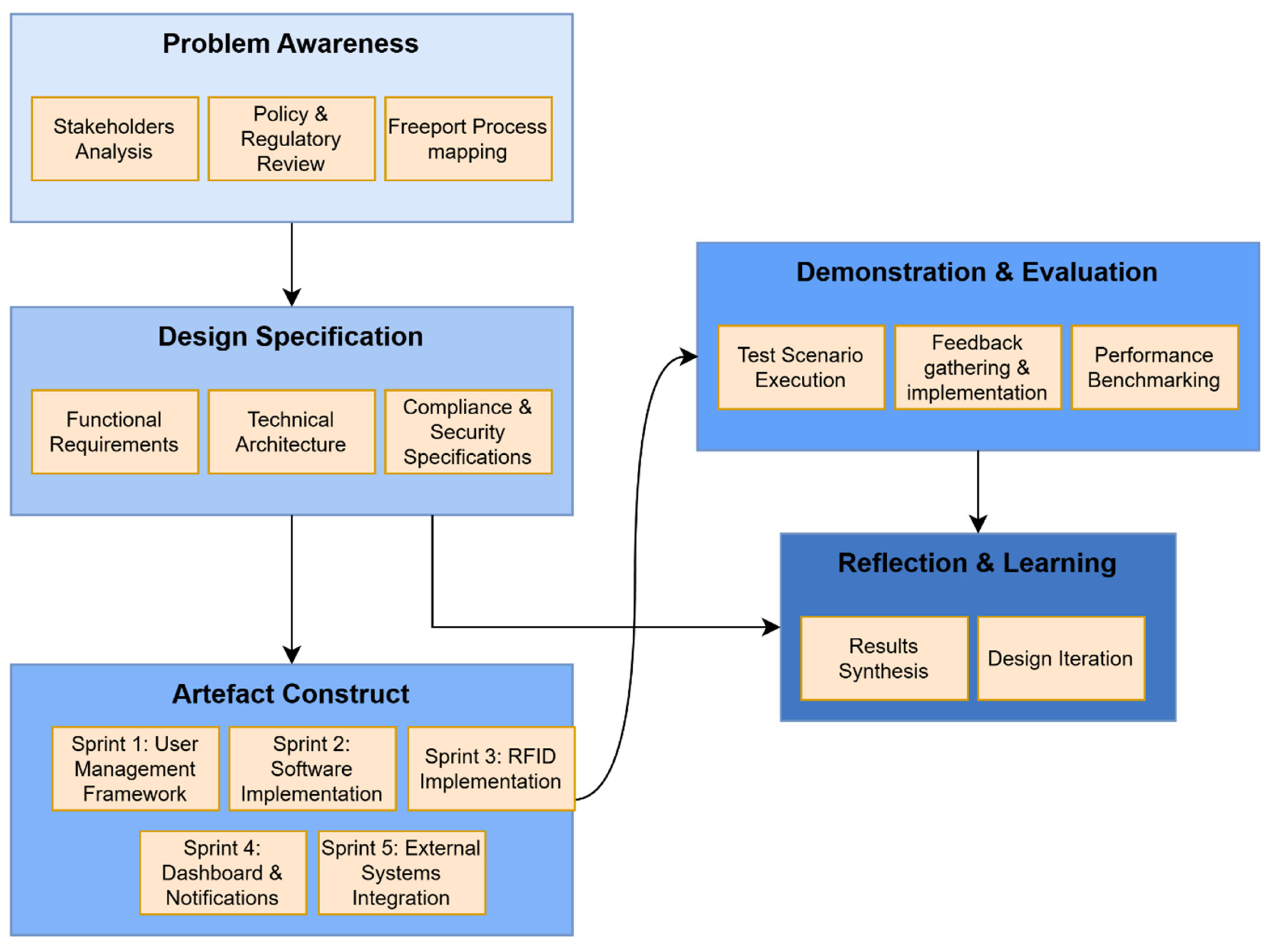
Figure 2.
Workflow relationship between the Port of Origin, Port of Discharge, Temporary storage facility and other freeport location.
Figure 2.
Workflow relationship between the Port of Origin, Port of Discharge, Temporary storage facility and other freeport location.
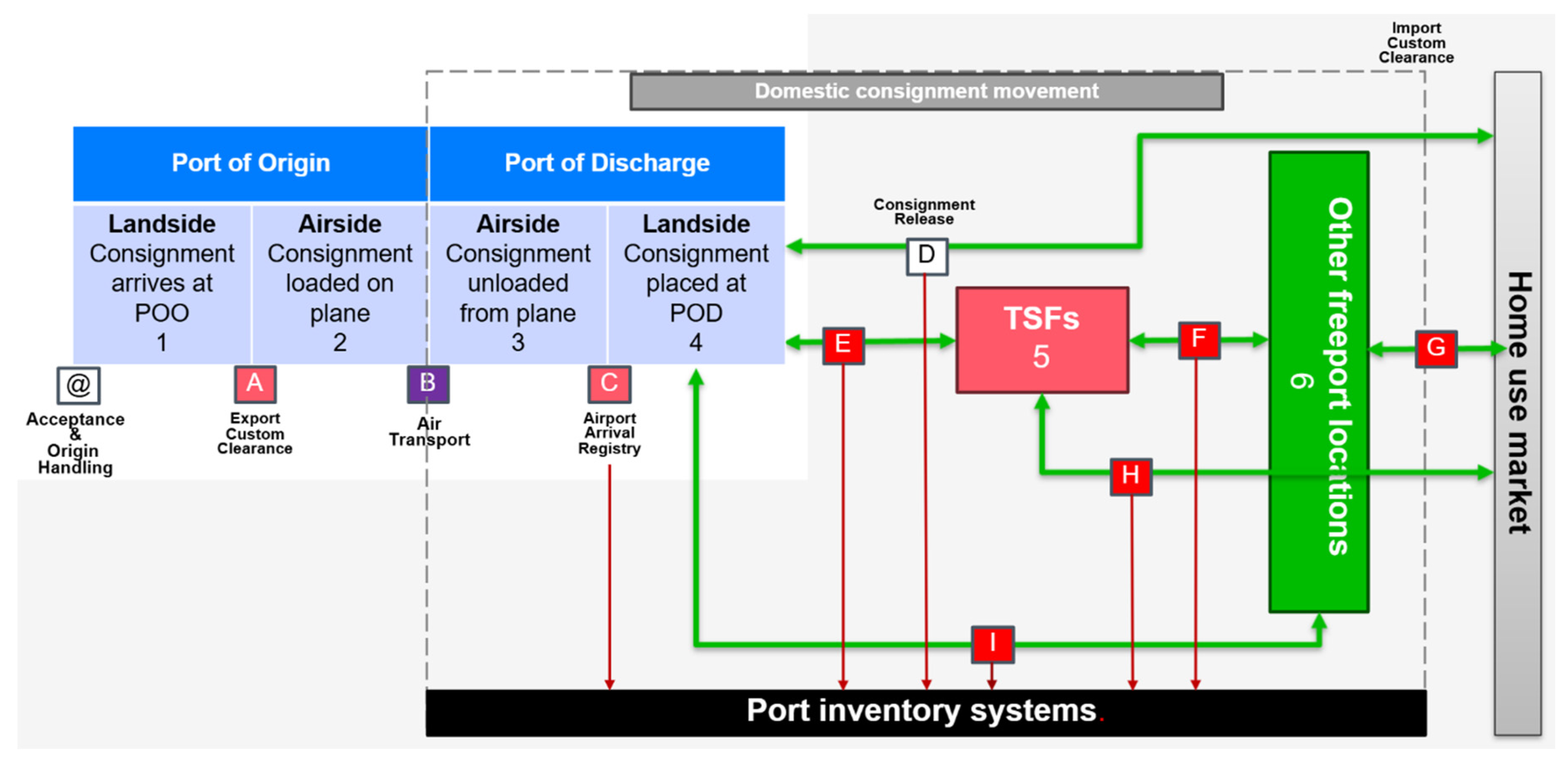
Figure 3.
a and b: Multiple shipping containers for the demonstration of Physical Assurance using RFID Tag.
Figure 3.
a and b: Multiple shipping containers for the demonstration of Physical Assurance using RFID Tag.
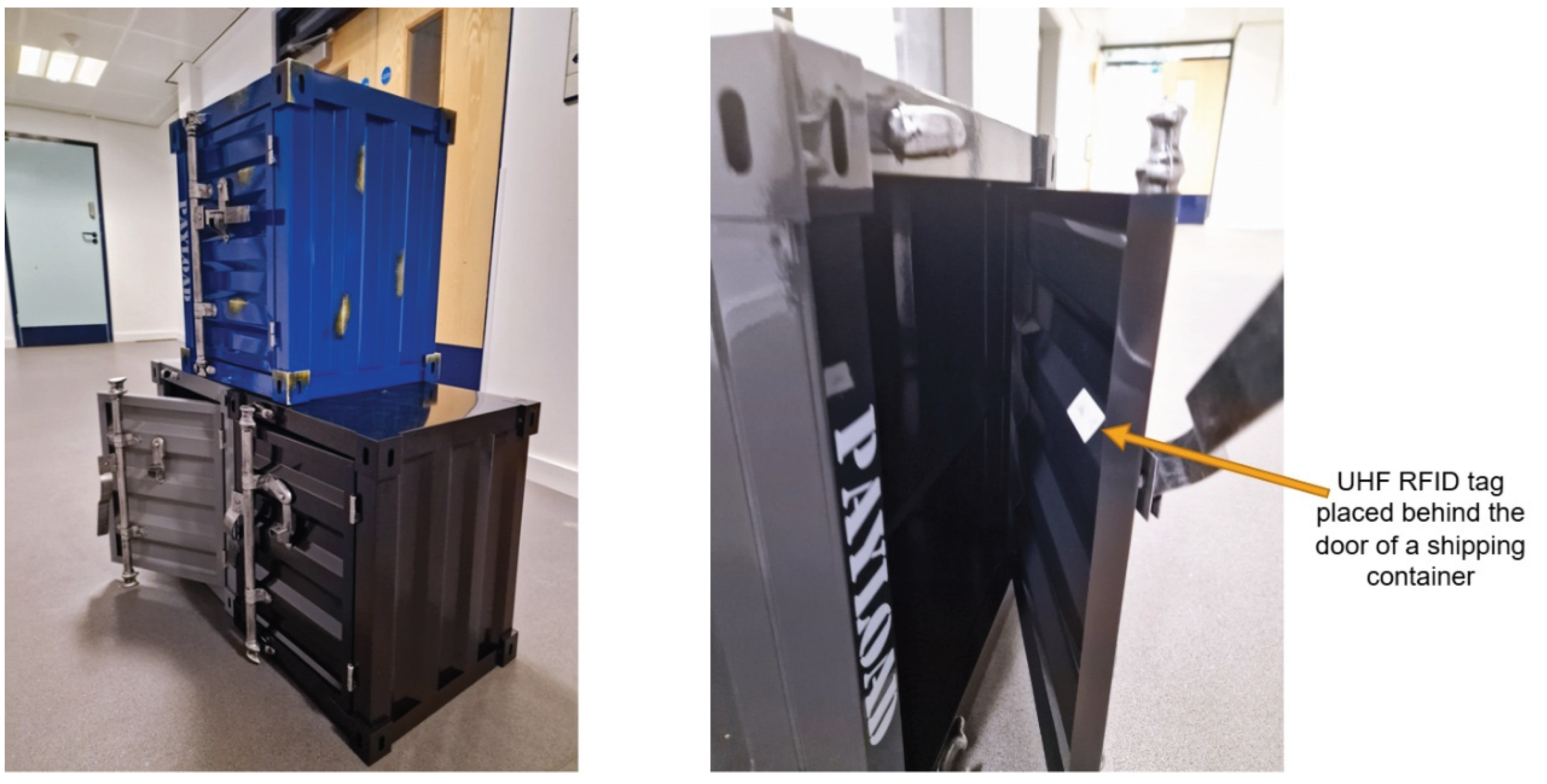
Figure 4.
Showing a section of the code and the use of Gemini AI agent for document processing.
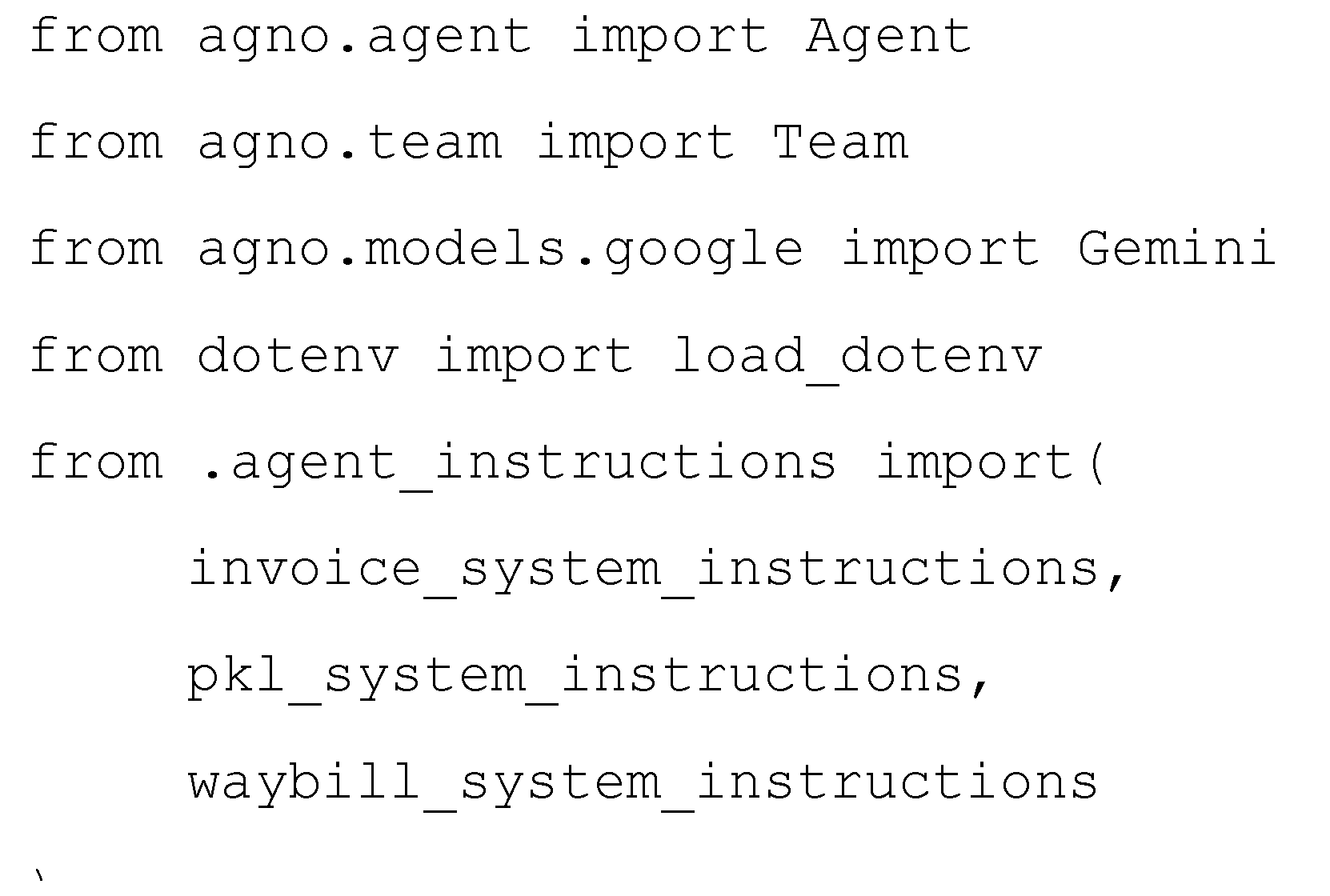
Figure 5.
Key processes involved in the ETD compliance.

Figure 6.
Implemented PROGRESS Trade flow for Digital.
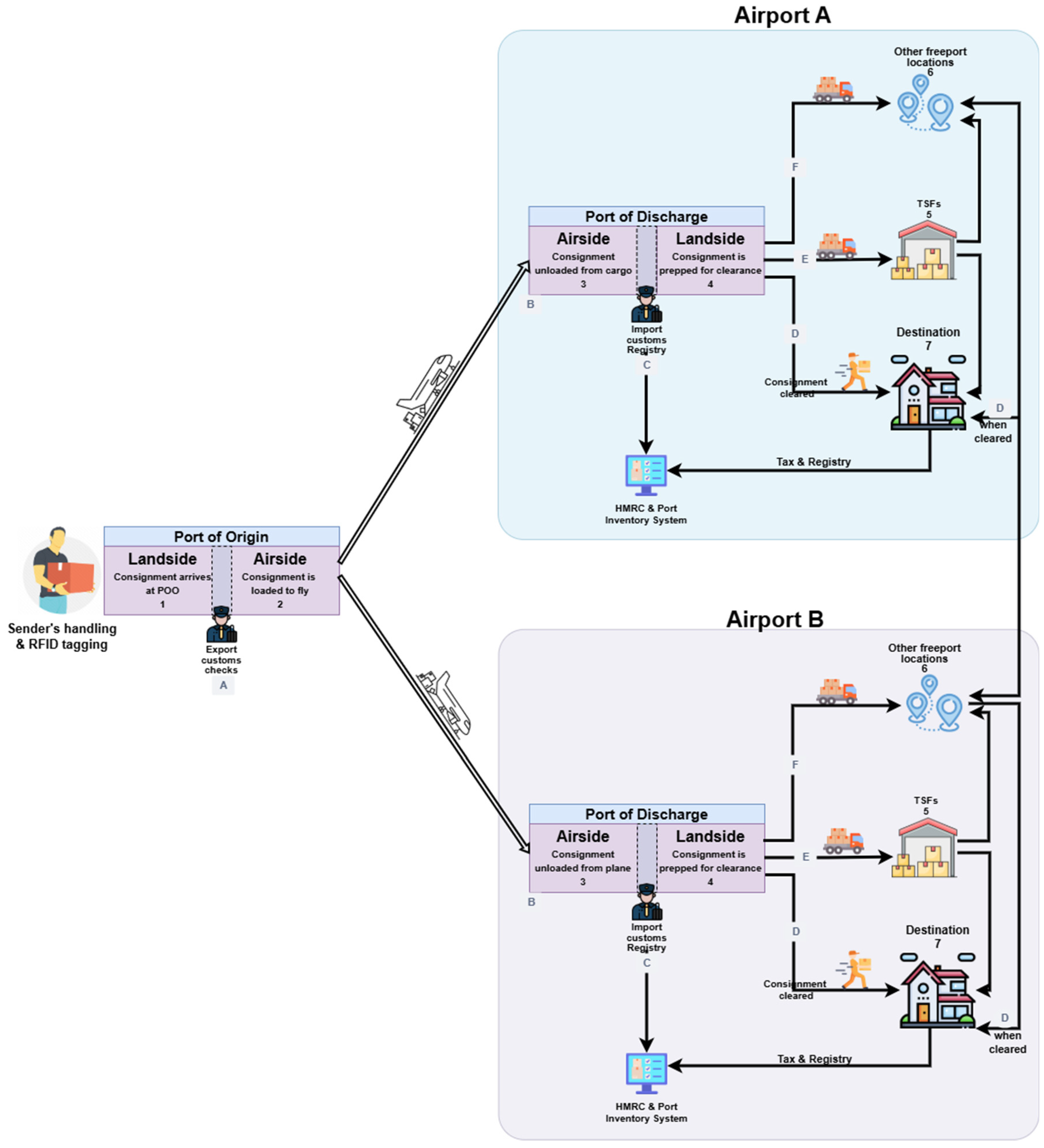
Figure 7.
Showing Hardware Architecture across the trade flow implementation.
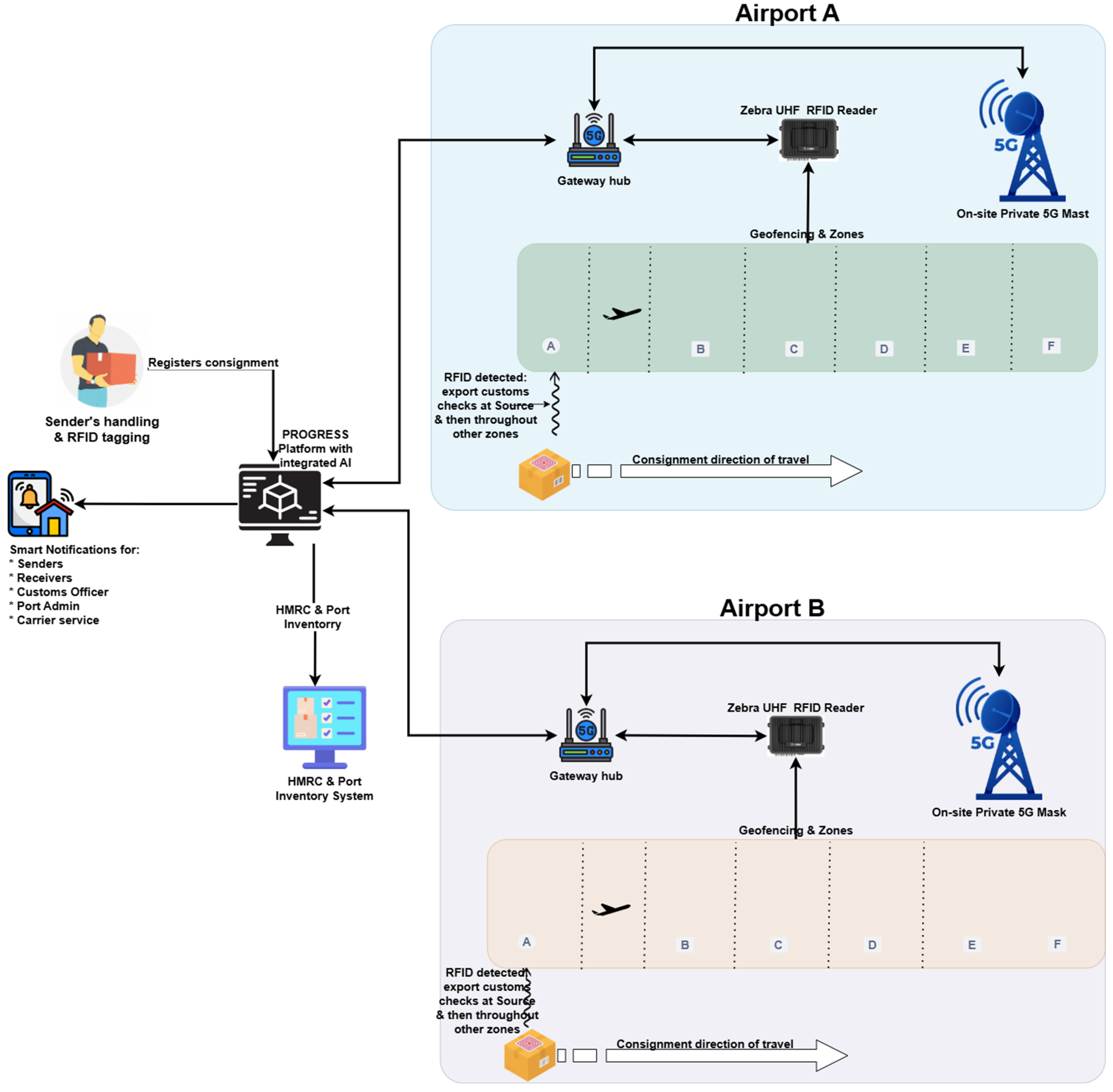
Figure 8.
Context-aware multi-document verification implementation process.
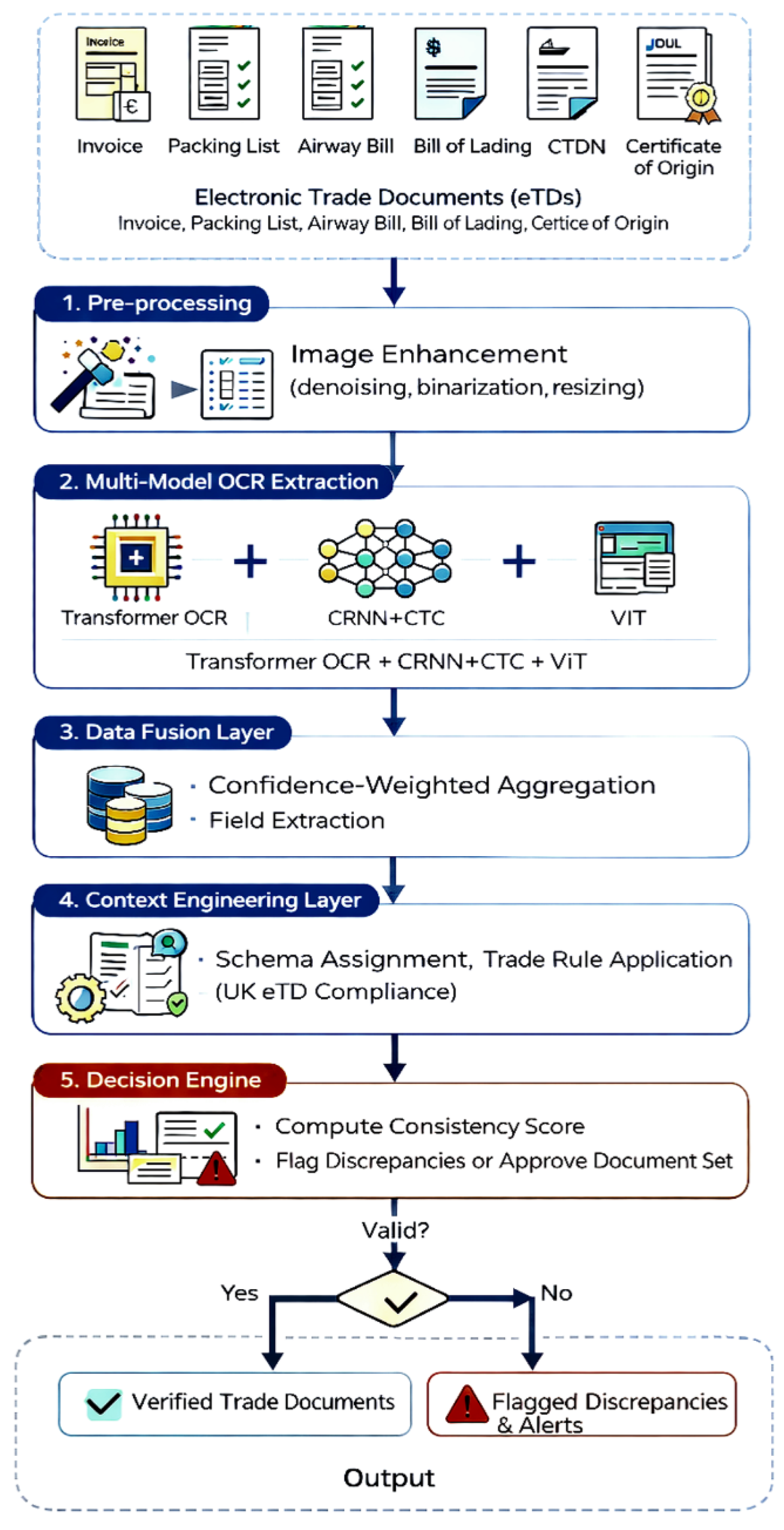
Figure 9.
Flagged Green—showing documentation complete, consistent with required threshold.
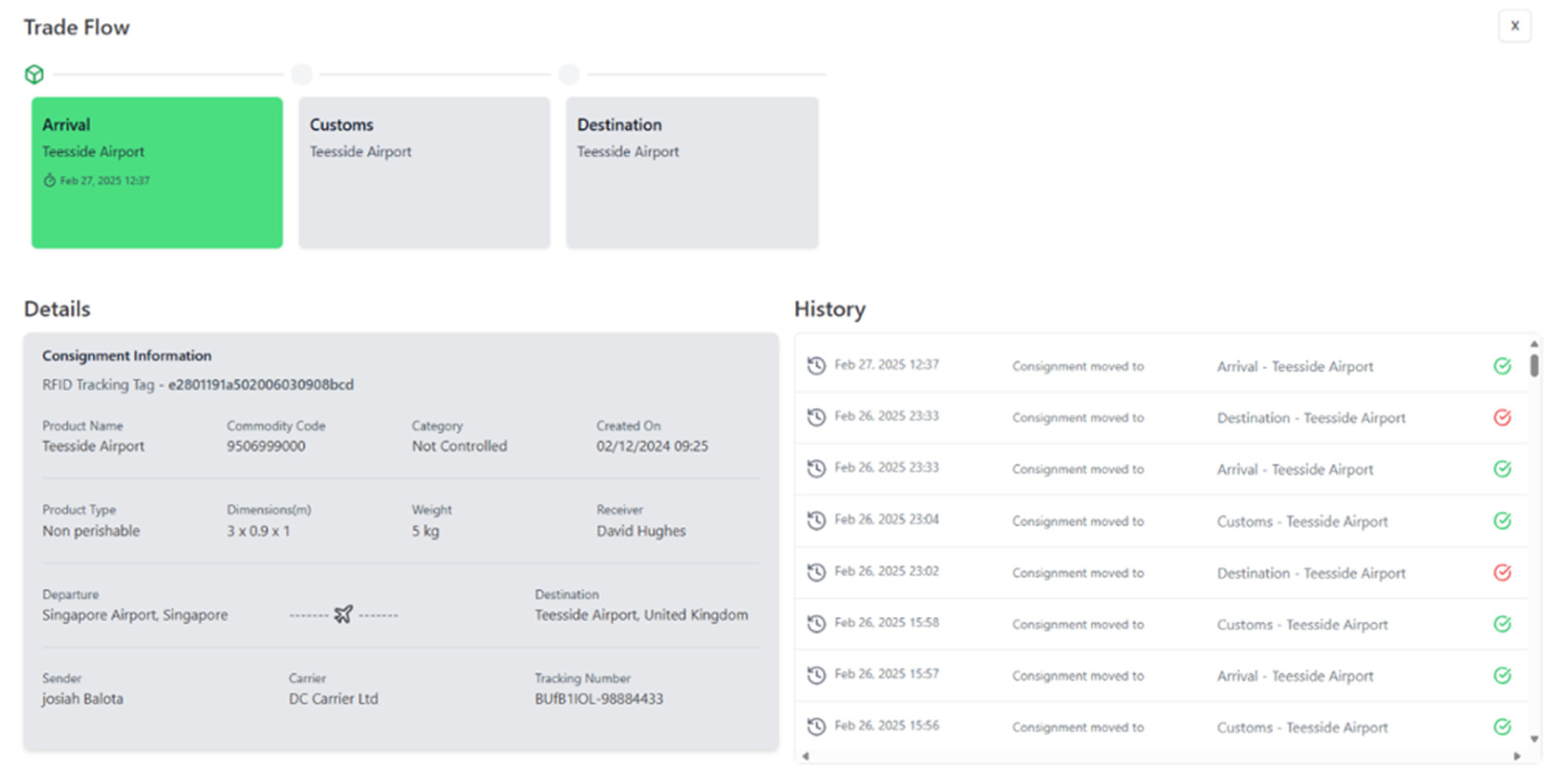
Figure 10.
Flagged Red—showing documentation incomplete (Airwaybill was not provided), hence, inconsistent with required threshold.
Figure 10.
Flagged Red—showing documentation incomplete (Airwaybill was not provided), hence, inconsistent with required threshold.
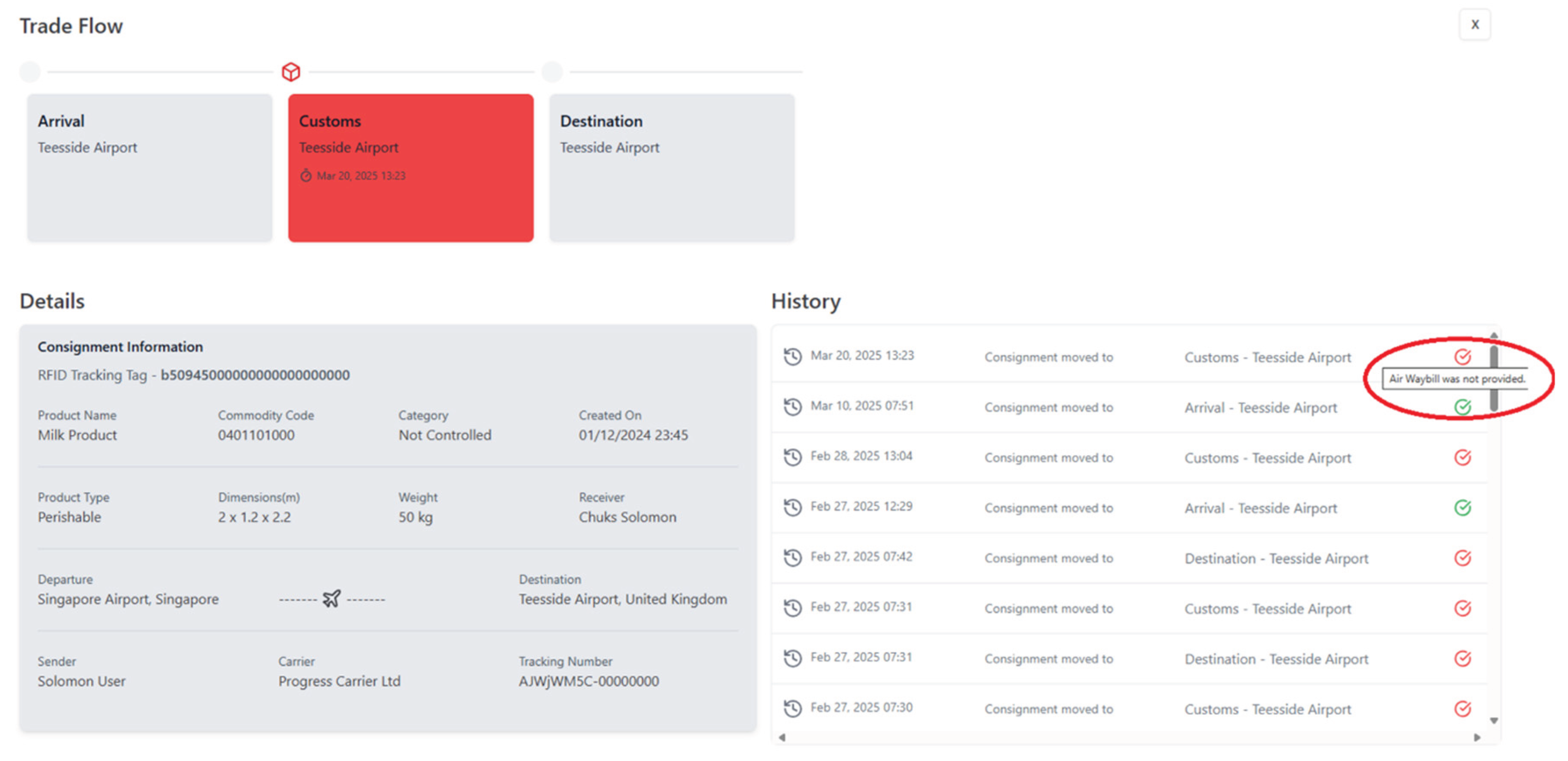
Figure 11.
Verification Performance Comparison.
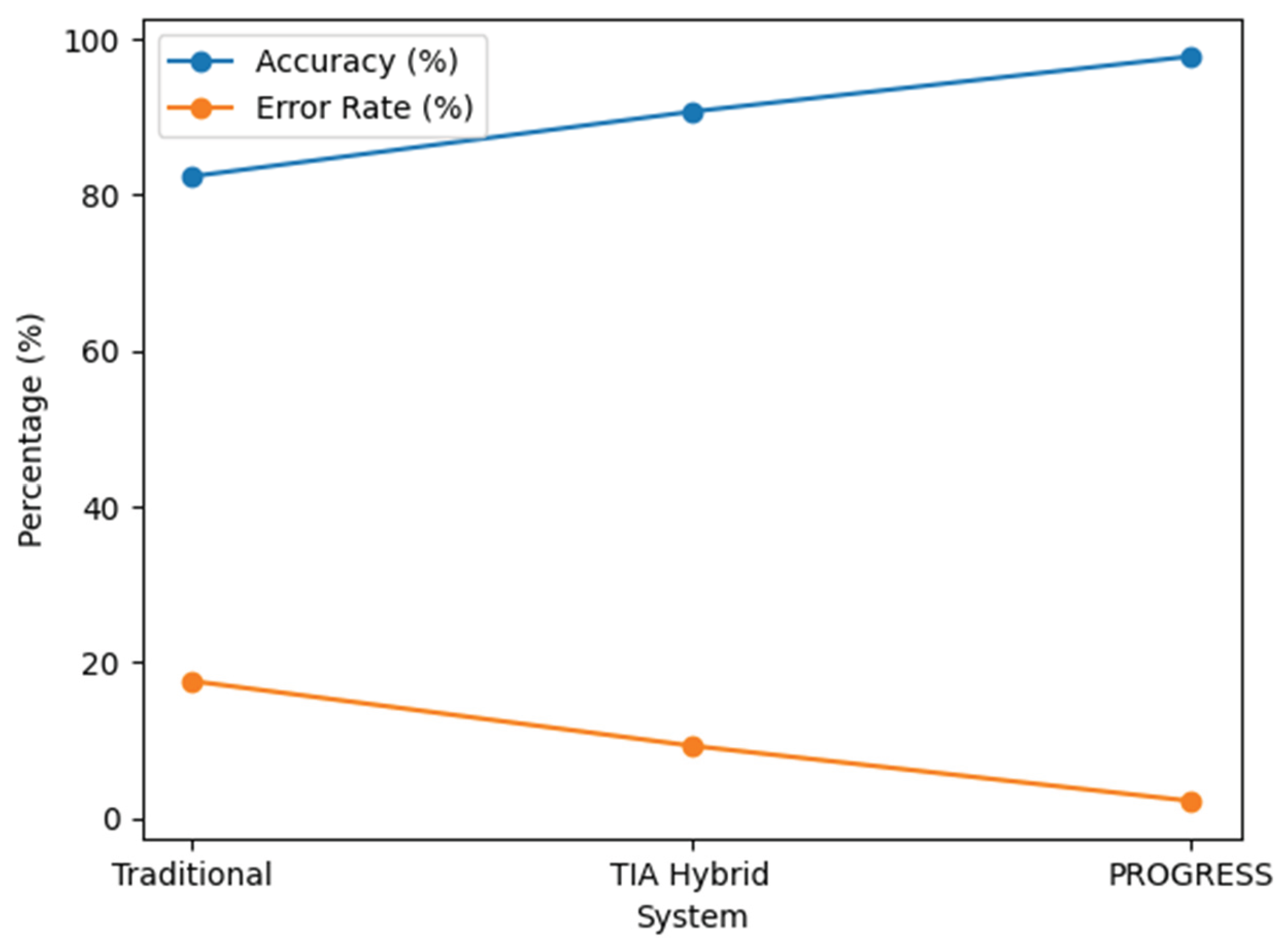

Table 1.
Digital-trade Initiatives and Frameworks beyond the GS1.
| Framework/Initiative | Description |
| UN/CEFACT Buy-Ship-Pay Reference Data Model | The Buy-Ship-Pay Reference Data Model is a semantic data-model developed by UN/CEFACT that covers key business processes in the international supply chain (trade, transport, finance). It provides a harmonised structure of data elements for trade-finance and logistic documentation across modes [24,25]. |
| ICC / UN/CEFACT Call to Action for Digital Trade | A joint initiative (ICC Digital Standards Initiative + UN/CEFACT) calling for the adoption of global interoperable data-exchange standards to accelerate digital trade [26,27]. |
| UNCITRAL Model Law on Electronic Transferable Records (MLETR) | This is a legal framework (model law) that enables transferable trade documents (like bills of lading, warehouse receipts, promissory notes) to exist in electronic form, giving them equivalent legal effect to paper under jurisdictions that adopt it [28]. |
| UN/CEFACT Integrated Track & Trace Standard (Multi-Modal) | A business-requirements specification (BRS) standard to enable consistent identification and tracking of consignments across supply-chains, with common semantics for consignment, transport contract, shipment identifiers, etc. [29]. |
| UN/CEFACT Trade Facilitation & e-Business Standards (UN/EDIFACT, CCL, etc.) | UN/CEFACT has developed a suite of standards (e.g., UN/EDIFACT for EDI, code list recommendations) that support interoperable data exchange across trade, transport, customs, and regulatory processes [30]. |
| ICC “Digital Trade Superhighways” Framework | A more recent ICC-UK proposal to build “digital trade superhighways” linking major trade corridors via open data standards, APIs, and electronic trade documents (e-BLs etc.) to improve speed, security and scale [31,32]. |
Table 2.
Detailed comparison of UHF RFID with Bluetooth, Zigbee, Wi-Fi, and Z-Wave.
| Feature | UHF RFID | Bluetooth | Zigbee | Wi-Fi | Z-Wave |
| Range | Up to 10-15 metres (passive tags); 100+ meters (active) | 10-100 meters (Bluetooth Low Energy) | 10-100 metres | Up to 100 metres (depends on device power) | 30-100 meters |
| Tag Cost | Low for passive tags (few pence to pounds). Suitable and easy for senders to attach. | Medium (tags typically cost more due to complexity) | Medium to High (tags/modules can be expensive) | High (needs active, battery or powered devices) | High (requires specialised modules) |
| Power Requirement | Passive tags require no power; readers require power | Tags are battery-powered | Tags and devices are battery-powered | High power consumption for devices | Battery-powered; moderate power consumption |
| Interference Resistance | Minimal interference in metal-dense or high-RF areas | Moderate interference in dense areas | High interference in crowded RF environments | Susceptible to interference (congested spectrum) | Low to moderate interference in typical setups |
| Throughput | High; can read multiple tags simultaneously (bulk read) | Moderate; limited simultaneous device connections | Moderate; supports mesh but not bulk read | High, but limited to active devices | Moderate; supports mesh, but not bulk tracking |
| Security | Can implement encryption; inherently harder to tamper | Moderate; encryption is available | Moderate; supports secure communication | Strong, but prone to hacking in open networks | Secure, but dependent on implementation |
| Ease of Deployment | Simple for tags; infrastructure can be costly initially | Easy, but may require complex pairing procedures | Requires setup of a mesh network | Infrastructure-heavy; needs Wi-Fi APs and routers | Requires specialised hubs and controllers |
| Environmental Suitability | Works well in harsh environments (temperature, dust) | May not perform well in extreme conditions | Moderate durability | Prone to environmental challenges | Limited use in harsh conditions |
| Tracking in Motion | Excellent; can track moving objects without line of sight | Good, but range is a limitation | Limited capability for moving objects | Limited by need for continuous connectivity | Limited to static or slow-moving assets |
| Data Read Speed | Capable of reading 100+ tags per second, even in bulk. | Limited to one-to-one connections, slower for large volumes. | Slower read speeds compared to RFID in dense item tracking. | ||
| Cost of Infrastructure | Moderate to high (readers are specialised equipment) | Moderate (requires standard Bluetooth devices) | Moderate (requires Zigbee hubs and routers) | High (Wi-Fi routers and access points are expensive) | High (dedicated controllers are needed) |
Table 3.
Comparative Consignment Volume.
| System | Freight Volume | Estimated Parcels | Scale |
| Traditional UK Trade (Paper-based) | National scale | Millions annually | High |
| TIA (2024) | 450 tonnes | 22,500—45,000 | Medium |
| TIA (2025 projected) | 1,800 tonnes | 90,000–180,000 | High growth |
| PROGRESS Simulation | N/A | 5,100 consignments | Controlled test |
Table 4.
Document Verification accuracy.
| System | Mean Processing Time (minutes) | Std. Dev (σ) | 95% Confidence Interval |
| Traditional Paper-Based | 18.6 | 4.2 | [18.3, 18.9] |
| TIA (Semi-Digital Hybrid) | 9.4 | 2.8 | [9.2, 9.6] |
| PROGRESS Platform | 1.8 | 0.6 | [1.75, 1.85] |
Table 5.
a: Consistency verification performance. b: Document verification accuracy.
| a | ||||
| System | Accuracy (%) | Error Rate (%) | False Positives (%) | False Negatives (%) |
| Traditional Paper-Based | 82.4 | 17.6 | 9.2 | 8.4 |
| TIA (Semi-Digital Hybrid) | 90.7 | 9.3 | 5.1 | 4.2 |
| PROGRESS Platform | 97.8 | 2.2 | 1.3 | 0.9 |
| b | ||||
| System | Accuracy Rate | Error Type | Source | |
| Traditional Paper-Based | 85–90% | Human errors, missing fields | WTO (2021) | |
| Standard OCR Systems | 80–85% | Misreads, lack of context | Graves et al. (2006) | |
| PROGRESS Platform | 98% | Minimal (context-aware validation) | This study | |
Table 6.
Estimated Daily capability.
| System | Consignments per Hour | Daily Capacity (8h) | Annual Capacity |
| Traditional Paper-Based | 3.2 | 26 | ~9,500 |
| TIA (Semi-Digital Hybrid) | 6.4 | 51 | ~18,600 |
| PROGRESS Platform | 33.3 | 266 | ~97,000 |
Disclaimer/Publisher’s Note: The statements, opinions and data contained in all publications are solely those of the individual author(s) and contributor(s) and not of MDPI and/or the editor(s). MDPI and/or the editor(s) disclaim responsibility for any injury to people or property resulting from any ideas, methods, instructions or products referred to in the content. |
© 2026 by the authors. Licensee MDPI, Basel, Switzerland. This article is an open access article distributed under the terms and conditions of the Creative Commons Attribution (CC BY) license (http://creativecommons.org/licenses/by/4.0/).
Copyright: This open access article is published under a Creative Commons CC BY 4.0 license, which permit the free download, distribution, and reuse, provided that the author and preprint are cited in any reuse.


