
Submitted:
25 June 2026
Posted:
29 June 2026
You are already at the latest version
Abstract
Founder cells comprise the earliest state of commitment to form one organ or branch, and no other [1]. Comparative lineage analyses concur that cell fate is established later in flowering plants than in animals, and is determined by position rather than lineage, but both systems harbor large numbers of organ progenitors in lieu of a few stem cells [2]. An exciting new serial-editing strategy, applied here for the first time in plants, holds great promise for determining the cell lineage history of every structure in the plant body [3]. Unfortunately, the authors' conclusion that every shoot branch and lateral organ of the Arabidopsis plant derives from exactly three founder cells is unsupported by both the classical plant literature and more recent studies of plant cell lineage, calling for more cautious interpretation of the data and for better integration with complementary experimental strategies.
Keywords:
founder cells
; cell lineage
; plant development
Xia and coauthors [3] employed an ingenious cell-lineage editing system named e-SMALT, previously used in yeast and Drosophila, to generate serially-induced mutations in a synthetic barcode in Arabidopsis thaliana that are inherited following somatic cell divisions. The shared inheritance of these cumulative mutations can be used to infer lineage relationships between all cells in the adult organism, and the reconstructed cell lineages obtained by the authors are impressive and unprecedented in plants. Using this approach, the authors concluded that all branches and aerial organs of the flowering plant Arabidopsis derive from exactly three founder cells, with each cell originating from distinct histological layers: the L1, L2, and L3 [4]. This interpretation stands in strong contrast with both classical estimates and state-of-the-art quantifications of founder cell number in angiosperms.
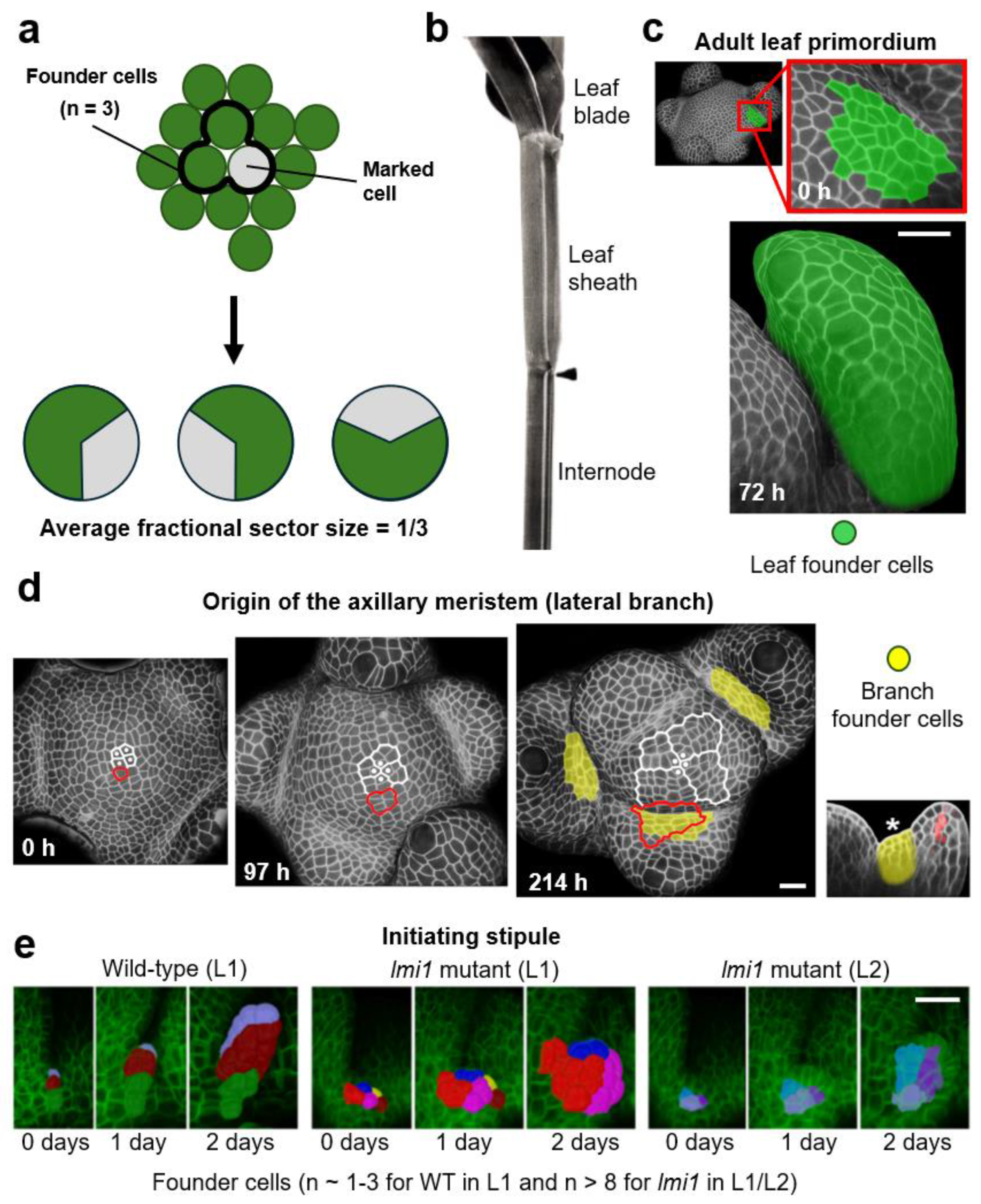
Founder cells of an organ primordium or branch comprise the earliest stage at which cells no longer give clonal descendants lying outside that structure, and are thus “committed”. Classical clonal analyses estimated founder cell numbers by correlating the fraction of the fully developed tissue occupied by a chimeric genetic marker (e.g., X-ray-induced albino sectors, anthocyanin sectors, GUS staining, etc) to the number of cells committed to that structure at the time of chimera induction (Figure 1a-b) [5,6]. Such estimates assume that each founder cell contributes equally to the mature organ and include corrections for the timing of chimera induction relative to DNA replication. Importantly, the timing of sector induction must be known in order to estimate the number of founder cells comprising any organ or branch present at this earliest state of commitment. Using this approach, maize leaves were estimated to derive from approximately 100 to 150 founder cells, while cotton leaves are derived from approximately 100 cells [6,7]. For the Arabidopsis first true juvenile leaf, Irish and Sussex [8] identified approximately 8 to 9 founder cells in the L2 layer alone, yielding approximately 30 total leaf founder cells across all three tissue layers.
Molecular genetic data provide further support for large founder cell populations in angiosperm organs and branches. For example, studies in Arabidopsis and maize used the expression domains of class 1 KNOX genes (which are absent from leaf founder cells) to count the cells in the shoot apical meristem (SAM) peripheral zone that are positionally committed to leaf initiation [9,10]. Approximately 125 founder cells are counted in maize, whereas ~ 30 cells are found in the Arabidopsis SAM. Likewise, expression of DORNRÖSCHEN-LIKE, a marker for floral organ founder cells, revealed dozens of cells per floral organ [11].
Recent live-imaging studies employed quantitative counts of organ and branch founder cells and further refute the three-cell interpretation. Time-lapse confocal imaging of adult leaf, axillary bud, stamen, and carpel development in Arabidopsis enables direct tracking of individual cells in the outermost cell layer (L1), from organ initiation and throughout ontogeny. As shown in Figure 1c-d, such analyses consistently identify dozens of founder cells in the L1 layer alone [12,13,14,15,16]. Even stipules, small appendages at the leaf base that in Arabidopsis derive exclusively from the epidermis, often arise from more than one founder cell (Figure 1e) [17]. Moreover, in the Arabidopsis lmi1 mutant, where stipules are transformed into leaf-like organs, sub-epidermal cells are recruited, which is accompanied by an increase in epidermal founder cell number (Figure 1e) [17]. These data suggest that inner tissue recruitment inherently requires expansion of the epidermal founder cell pool. Taken together, live-imaging studies, classical clonal analyses, and molecular genetic data all converge on the same conclusion: although the precise founder cell number may vary across organ types, species, and growth conditions, lateral organs and branches are consistently founded by a minimum of dozens of cells — never as few as three.
What might explain the apparent discrepancy between the authors’ three-founder-cell interpretation and the established evidence for multiple founder cells theory? The key issue is that the authors equate genealogical ancestry with developmental founder-cell identity. Xia et al. [3] state that founder cells are “a strictly genealogical concept, referring to the earliest and fate-specified subset of ancestor”. Yet these two criteria are not equivalent. Genealogical ancestry can be inferred from shared mutations in a cell lineage history, but fate specification is a developmental property that depends on when and where cells become committed to an organ or branch. A single inferred ancestral cell in a lineage tree therefore does not, by itself, identify a founder cell in the developmental sense.
From a genealogical perspective, the nested clade structure in the e-SMALT phylogeny is entirely consistent with the established hierarchical organization of shoot development. Uncommitted apical stem-cell lineages in the SAM central zone give rise to clonal sectors, from which multicellular founder pools are later recruited in the peripheral zone to initiate organs or lateral branches (Figure 1d). Once a lateral branch establishes a new SAM, the same process repeats, producing nested coalescence points in the cell lineage history: points at which sampled lineages trace back to a single inferred ancestral cell. Under this interpretation, the inferred single-cell ancestors represent apical stem-cell lineages upstream of founder-cell recruitment, not the founder cells themselves. They therefore do not demonstrate a “fate-specified subset of ancestors” corresponding to organ or branch founder cells. Because this process occurs separately within each histological layer, the resulting clade structures are layer-specific and ultimately trace back to the early developmental lineages from which L1, L2, and L3 were established. This apical stem-cell interpretation is supported by live imaging in Arabidopsis [15], as well as by computational inferences from layer-specific somatic sequencing data in apricot [18].
This distinction is central because Xia et al.3 sampled adult structures only and did not determine the timing or duration of barcode editing relative to organ or branch initiation. Their data therefore cannot establish the ontogenetic stage at which the relevant barcode edits occurred, which is required to estimate founder-cell number. What their study confirms is that shoot branches and aerial organs in Arabidopsis are embedded within three early-established developmental lineages corresponding to the classical histogenic L1, L2, and L3 layers, a foundational concept in plant biology since the 1940s [19]. Their inferred cell lineage history also appears to recover deeper ancestry within these layers, including the coalescence of mature organ lineages to apical stem-cell ancestors. This is a genuine and valuable contribution because it shows that e-SMALT can recover known features of plant shoot organization. However, it is not equivalent to showing that each organ or branch derives from exactly three founder cells.
In conclusion, e-SMALT represents a genuinely exciting and powerful advance for plant developmental biology, with tremendous potential to address questions about lineage relationships, tissue layer contributions, and developmental trajectories at single-cell resolution. Apparent single-cell coalescence events in the cell lineage history should not be equated with single-cell organ founding, as the same topology can arise when multiple organ founder cells are sampled from a clonal sector derived from a single apical stem-cell lineage. The data therefore lend themselves to a fundamentally different and more parsimonious interpretation—one consistent with the well-evidenced understanding of multicellular organ founder fields and stem-cell-derived sectors in the SAM. As powerful new technologies expand our ability to generate large-scale data, their interpretation must always be carefully grounded in established quantitative evidence, guided by an understanding of what is known. A combination of e-SMALT, single-cell transcriptomics, and live-imaging will ultimately provide the most complete and reliable framework for uncovering cell lineage relationships during plant organogenesis.
Author Contributions
MJS, AB, FJ, and DK wrote the manuscript with the input from all other authors.
Acknowledgments
We thank Enrico Coen and Miltos Tsiantis for critical reading and discussion of the manuscript.
Conflicts of Interest
Authors declare that they have no competing interests.
References
- Hall, J.C.; Gelbart, W.M.; Kankel, D.R. Mosaic systems. In The Genetics and Biology of Drosophila; Ashburner, M., Novitski, E., Eds.; Academic Press: London, 2004; Volume 1a, pp. 264–314. [Google Scholar]
- Subtelny, S.; Sussex, I. M. (Eds.) The Clonal Basis of Development: 36th Symposium of the Society for Developmental Biology, Raleigh, NC, June 13-15; Academic Press, 1978. [Google Scholar]
- Xia, F.N.; et al. Mapping the zygote-to-adult developmental cell phylogeny in Arabidopsis thaliana reveals a three-cell rule of branching. Nat. Plants 2026, 12, 880–896. [Google Scholar] [CrossRef] [PubMed]
- Mayer, U.; Torres Ruiz, R.A.; Berleth, T.; Misera, S.; Jurgens, G. Mutations affecting body organization in the Arabisopsis embryo. Nature 1991, 353, 402–407. [Google Scholar]
- Howell, S.H. Molecular Genetics of Plant Development. In Cambridge University Press; 1998. [Google Scholar]
- Poethig, R.S.; Szymkowiack, E.J. Clonal analysis of leaf development in maize. Maydica 1995, 40, 67–76. [Google Scholar]
- Dolan, L.; Poethig, R.S. Clonal analysis of leaf development in cotton. Am. J. Bot. 1998, 85, 315–321. [Google Scholar] [CrossRef] [PubMed]
- Irish, V. F.; Sussex, I. M. A fate map of the Arabidopsis embryonic shoot apical meristem. Development 1992, 115, 745–753. [Google Scholar] [CrossRef]
- Long, J.; Barton, M. K. Initiation of Axillary and Floral Meristems in Arabidopsis. Dev. Biol. 2000, 218, 341–353. [Google Scholar] [CrossRef] [PubMed]
- Jackson, D.; Veit, B.; Hake, S. Expression of maize KNOTTED1 related homeobox genes in the shoot apical meristem predicts patterns of morphogenesis in the vegetative shoot. Development 1994, 120, 405–413. [Google Scholar] [CrossRef]
- Chandler, J.W.; Jacobs, B.; Cole, M.; Comelli, P.; Werr, W. DORNRÖSCHEN-LIKE expression marks Arabidopsis floral organ founder cells and precedes auxin response maxima. Plant Mol. Biol. 2011, 76, 171–185. [Google Scholar] [CrossRef] [PubMed]
- Burian, A.; et al. Specification of leaf dorsiventrality via a prepatterned binary readout of a uniform auxin input. Nat. Plan. 2022, 8, 269–280. [Google Scholar] [CrossRef]
- Silveira, S.R.; et al. Live-imaging provides an atlas of cellular growth dynamics in the stamen. Plant Physiol. 2022, 188, 769–781. [Google Scholar] [PubMed]
- Gomez-Felipe, A.; de Folter, S.; Kierzkowski, D. Auxin and cytokinin regulate growth dynamics underlying carpel initiation in Arabidopsis. J. Ex. Bot. 2026, 77, 1743–1755. [Google Scholar]
- Burian, A.; Barbier de Reuille, P.; Kuhlemeier, C. Patterns of Stem Cell Divisions Contribute to Plant Longevity. Curr. Biol. 2016, 26, 1385–1394. [Google Scholar] [CrossRef] [PubMed]
- Shi, B.; et al. Two-Step Regulation of a Meristematic Cell Population Acting in Shoot Branching in Arabidopsis. PLoS Genet. 2016, 1006168. [Google Scholar]
- Vuolo, F.; et al. LMI1 homeodomain protein regulates organ proportions by spatial modulation of endoreduplication. Genes Dev. 2018, 32, 1361–1366. [Google Scholar] [CrossRef] [PubMed]
- Johannes, F. Somatic Evolution of Stem Cell Mutations in Long-Lived Plants. Mol. Biol. Evol. 2025, 42, msaf165. [Google Scholar] [CrossRef] [PubMed]
- Satina, S.; Blakeslee, A. F.; Avery, A. G. Demonstration of the three germ layers in the shoot apex of Datura by means of induced polyploidy in periclinal chimeras. Am. J. Bot. 1940, 27, 73–90. [Google Scholar] [CrossRef]
Figure 1.
Organs and branches originate from many founder cells, not just three. a, Estimations of organ founder cells for lateral organs. If just three founder cells are present during organ initiation, chimeric cells harboring an identifiable genetic and/or phenotypic marker will occupy approximately 1/3 of the tissue in the mature organ (modified from [5]). b, An albino sector induced at the founder cell stage of maize phytomer (comprising the leaf blade, leaf sheath and internode) development occupies far less than 1/3 of the phytomer tissue rendering an estimation of 100-125 founder cells (modified from [6]). c, Cell-lineage tracing of an adult leaf primordium formation at the SAM of Arabidopsis grown in short day conditions, showing that it derives from dozens of founder cells in the L1 (0 h, green) (modified from [12]). d, Cell-lineage tracing at the Arabidopsis SAM during the transition to flowering showing the initiation of axillary meristems at the leaf axils with dozens of founder cells in the L1 (yellow). These founder cells derive from a single cell at the SAM central zone (outlined in red at 0h). Dots indicate the 4 apical stem cells, which self-renew and generate cells that are displaced toward the SAM periphery, giving rise to new organs (cell clones originating from each stem cell are outlined in white). The longitudinal section (left) shows initiating axillary meristem at the axil of leaf primordium (modified from [15]) e, 3D cell-lineage tracing for the initiating stipule in the wild-type and lmi1 mutant. Colors indicate clones developing from single epidermal (L1) or subepidermal (L2) cells at the initiation (modified from [17]). Scale bars, 20 µm.
Figure 1.
Organs and branches originate from many founder cells, not just three. a, Estimations of organ founder cells for lateral organs. If just three founder cells are present during organ initiation, chimeric cells harboring an identifiable genetic and/or phenotypic marker will occupy approximately 1/3 of the tissue in the mature organ (modified from [5]). b, An albino sector induced at the founder cell stage of maize phytomer (comprising the leaf blade, leaf sheath and internode) development occupies far less than 1/3 of the phytomer tissue rendering an estimation of 100-125 founder cells (modified from [6]). c, Cell-lineage tracing of an adult leaf primordium formation at the SAM of Arabidopsis grown in short day conditions, showing that it derives from dozens of founder cells in the L1 (0 h, green) (modified from [12]). d, Cell-lineage tracing at the Arabidopsis SAM during the transition to flowering showing the initiation of axillary meristems at the leaf axils with dozens of founder cells in the L1 (yellow). These founder cells derive from a single cell at the SAM central zone (outlined in red at 0h). Dots indicate the 4 apical stem cells, which self-renew and generate cells that are displaced toward the SAM periphery, giving rise to new organs (cell clones originating from each stem cell are outlined in white). The longitudinal section (left) shows initiating axillary meristem at the axil of leaf primordium (modified from [15]) e, 3D cell-lineage tracing for the initiating stipule in the wild-type and lmi1 mutant. Colors indicate clones developing from single epidermal (L1) or subepidermal (L2) cells at the initiation (modified from [17]). Scale bars, 20 µm.
Disclaimer/Publisher’s Note: The statements, opinions and data contained in all publications are solely those of the individual author(s) and contributor(s) and not of MDPI and/or the editor(s). MDPI and/or the editor(s) disclaim responsibility for any injury to people or property resulting from any ideas, methods, instructions or products referred to in the content. |
© 2026 by the authors. Licensee MDPI, Basel, Switzerland. This article is an open access article distributed under the terms and conditions of the Creative Commons Attribution (CC BY) license (http://creativecommons.org/licenses/by/4.0/).
Copyright: This open access article is published under a Creative Commons CC BY 4.0 license, which permit the free download, distribution, and reuse, provided that the author and preprint are cited in any reuse.


