

Submitted:
25 June 2026
Posted:
26 June 2026
You are already at the latest version
Abstract
Building-integrated photovoltaics (BIPV) offer a promising approach to creating energy-efficient and climate-responsive buildings, yet few studies have explored their bioclimatic performance in tropical mountain regions, where variable solar radiation and ambient conditions influence both energy production and indoor comfort. This study evaluates the “Cubo de Innovación,” a pilot BIPV building in Manizales, Colombia, designed as a living laboratory for second-generation photovoltaic technologies. Simulations using PVSyst estimated photovoltaic generation, while EnergyPlus assessed thermal comfort, daylighting, and energy performance. Results show the building operates as a net-positive energy system, producing nearly six times its annual consumption, with thermal comfort maintained within ASHRAE 55 standards through passive bioclimatic strategies. The system avoids 1.98 tCO₂e in emissions annually, highlighting BIPV’s dual role as an active energy generator and passive comfort regulator in tropical high-altitude climates. These findings provide a replicable framework for evaluating BIPV bioclimatic efficiency in Latin America and comparable regions.
Keywords:
bioclimatic efficiency
; thermal comfort
; BIPV
; carbon footprint
; predicted mean vote
1. Introduction
The global imperative to mitigate climate change has placed significant focus on the building and construction sector, which is responsible for approximately 32% of global final energy consumption and 34% of energy-related carbon dioxide emissions [1]. Achieving the ambitious targets set by international agreements, such as the Paris Agreement, requires a fundamental shift in building design and operation towards decarbonization and energy self-sufficiency [2]. In this context, Building Integrated Photovoltaics (BIPV) have emerged as a pivotal technology, enabling the building envelope to transition from a passive barrier to an active energy-generating system, by replacing conventional construction materials with photovoltaic elements. BIPV systems offer a pathway to net-zero energy buildings, particularly in dense urban environments where space for traditional solar arrays is limited [3].
The second-generation photovoltaic technologies are particularly suited for BIPV applications, due to their material properties and manufacturing processes. Cadmium Telluride (CdTe) thin-film technology is a prominent example, offering advantages such as superior performance in low-light and high-temperature conditions, a lower embodied energy footprint compared to traditional silicon, and the ability to be manufactured as semi-transparent modules, allowing for aesthetic and functional integration into fenestration systems [4]. Moreover, its direct band gap is well-matched to the solar spectrum, contributing to its high quantum efficiency. On the other hand, crystalline Silicon (Si) technology remains the market leader, prized for its high conversion efficiency, long-term stability, and cost-effectiveness. However, its opacity and rigidity present challenges for seamless architectural integration, often limiting its use to opaque applications like roof tiles or spandrel panels [5].
Despite extensive research on BIPV performance, a significant knowledge gap persists regarding their holistic application in tropical mountain climates since, these regions, characterized by high-altitude solar irradiance and moderate ambient temperatures, present a unique set of design challenges and opportunities that differ from the hot-and-humid tropical lowlands, where mitigating solar heat gain to reduce cooling loads is the primary objective [6]. In a tropical mountain climate, the optimal design strategy may instead focus on harnessing abundant solar energy while monitoring the indoor environment to maintain comfort without active cooling, which suggests a climate-specific design methodology where BIPV systems are valued not only for energy generation but also for their ability to passively regulate thermal and visual comfort [3].
To address this research gap, this paper presents a comprehensive case study of the "Cubo de Innovación", a pioneering pilot building located at Central Hidroeléctrica de Caldas (CHEC) premises, in Manizales-Colombia. This facility serves as a living laboratory for evaluating second-generation BIPV technologies in a real-world setting. This research places an emphasis on two critical areas: the building's carbon footprint, encompassing both embodied and operational emissions, and the thermal comfort of its occupants, evaluated against internationally recognized standards.
This paper is structured as follows: Section 2 describes the case study, detailing the architectural features of the Innovation Cube. Section 3 presents the methodology, including a theoretical review of BIPV technologies, and the simulation models of the BIPV system in PVSyst and EnergyPlus. Section 4 discusses the results, focusing on the building’s energy balance, thermal comfort analysis, and the estimation of its carbon footprint. Finally, Section 5 outlines the conclusions and highlights future research opportunities related to the optimization of BIPV systems and bioclimatic performance in tropical mountain climates.
2. BIPV System: The “Cubo de Innovación CHEC” Case Study
The "Cubo de Innovación" is located at the Estación Uribe campus in Manizales, Caldas, Colombia, at a latitude of 5.05° N, a longitude of -75.53° W, and an elevation of 1918 m above sea level, with a local climate classified under the ASHRAE 4A zone (mixed-humid) [7]. This zone is characteristic of a tropical mountain environment whose climate features: moderate ambient temperatures, high relative humidity, and significant solar radiation throughout the year, providing a unique and challenging context for evaluating building performance. Figure 1 shows a panoramic view of the BIPV premises.
The building is a pilot facility designed to function as a sustainable structure for testing, validating, and promoting the use of advanced BIPV technologies in the region. Its design integrates three distinct second-generation photovoltaic systems that replace conventional building envelope materials, combining opaque and semi-transparent technologies to serve both energy and architectural functions. Figure 2a shows a PVSyst design of the Cubo de Innovación CHEC. Figure 2b shows the inside of the building with both BIPV solar tiles and solar windows.
The Cubo de Innovación CHEC integrates a combination of three BIPV subsystems that differ in technology, transparency, and architectural function, each contributing uniquely to the building’s energy performance and bioclimatic behavior.
- Solar Tiles (Silicon): The central portion of the building's roof is covered with 30 opaque solar tiles based on mono-crystalline Silicon (Si) technology. This system is designed for maximum power generation in a limited area, covering a total surface of 17.1 m2.
- Solar Pergola System (Cadmium Telluride): An external pergola structure is integrated with 64 semi-transparent modules utilizing Cadmium Telluride (CdTe) thin-film technology. This large-area system, covering 46.1 m2, provides shading and generates electricity while allowing diffuse daylight to pass through.
- Solar Window (Cadmium Telluride): The building's fenestration consists of semi-transparent yellow CdTe photovoltaic glass, covering two windows with a total surface of 3.5 m2 and 20% of transparency These BIPV windows serve the dual purpose of providing a view and natural light, typical of a conventional window, while also contributing to the building's overall power generation.
Table 1 presents a summary of the integrated systems.
3. Methodology
The methodology combines a theoretical review and simulation-based modeling. The technical data provided by the suppliers of the BIPV technologies were used to perform simulations in EnergyPlus [8], to analyze thermal comfort, daylight performance, and overall bioclimatic efficiency. In parallel, PVSyst simulations were used to estimate photovoltaic generation and self-consumption ratios. Both software uses their own validated mathematical models to get the results [].
3.1. Whole-Building Energy Simulation
The dynamic performance of the "Cubo de Innovación" was modeled using the EnergyPlus simulation engine, a state-of-the-art, open-source program developed by the U.S. Department of Energy, renowned for its robust heat-balance-based physics engine [8]. This engine facilitates an integrated, simultaneous solution of thermal zone conditions and HVAC system responses, making it exceptionally well-suited for detailed bioclimatic and energy analyses.
A detailed three-dimensional model of the Cubo de Innovación CHEC building was developed using the EnergyPlus simulation engine to represent both its architectural configuration and physical behavior under local climatic conditions. Additionally, the model incorporates the precise geographical location of Manizales and a customized Typical Meteorological Year (TMY) file constructed from long-term meteorological records to capture the specific characteristics of the tropical mountain climate (.epw file - EnergyPlus Weather Data). All construction assemblies, such as walls, roofs, windows, and shading structures, were parameterized based on their geometric and material properties, including thermal conductivity, density, and specific heat.
The BIPV systems were represented through the PhotovoltaicPerformance:Simple and Generator:Photovoltaic objects in EnergyPlus, enabling a coupled analysis of their electrical generation and envelope-related thermal effects. Key parameters such as module efficiency, nominal capacity, and temperature coefficients were defined according to manufacturer data for Cadmium Telluride (CdTe) and Silicon (Si) technologies. Besides, optical and thermal properties, including Solar Heat Gain Coefficient (SHGC), Visible Light Transmittance (VLT), and overall heat transfer coefficient (U-value), were implemented to quantify the systems’ dual role as energy generators and dynamic façade elements.
Internal loads and operation schedules were modeled according to the building’s actual use as a workspace and meeting area, with realistic occupancy, lighting, and equipment profiles. Thermal comfort analysis incorporated metabolic rates and clothing insulation values following ASHRAE 55:2021 [9] and ISO 7730:2025 [10], ensuring consistency between simulated indoor conditions and experimental measurements obtained through the monitoring device.
3.2. Carbon Footprint Assessment Methodology
A Life Cycle Assessment (LCA) framework was adopted to evaluate the building's carbon footprint, considering both embodied and operational emissions.
- Embodied Carbon (Manufacturing): A "cradle-to-gate" analysis was performed to quantify the embodied carbon associated with the manufacturing of the BIPV cells. First, the embodied emissions for each technology (Si and CdTe) were calculated by multiplying the installed surface area by a technology-specific emission factor, expressed in kgCO2e/m2, using emission factors selected from the literature to correspond with the energy matrix of the manufacturing country (China), ensuring the analysis reflects the project's specific supply chain [11].
- Operational Carbon (Avoided Emissions): The operational carbon footprint is evaluated in terms of avoided emissions, through multiplying the total annual electricity generated by the BIPV system, as determined by a PVSyst simulation, by the official grid emission factor for Colombia. This study uses the most recently published factor from the Unidad de Planeación Minero Energética (UPME), which is 0.177 kgCO2e/kWh for the year 2023 [12]. The equation is:
3.3. Thermal and Visual Comfort Standards
The assessment of occupant comfort was conducted in accordance with internationally recognized standards to ensure a rigorous and comparable evaluation.
- Thermal Comfort: The analysis adheres to the methodologies prescribed in ASHRAE Standard 55, "Thermal Environmental Conditions for Human Occupancy" [9] and ISO 7730, "Ergonomics of the thermal environment" [10]. The primary metrics for evaluation are the Predicted Mean Vote (PMV), which predicts the average thermal sensation of a group of people on a 7-point scale, and the Predicted Percentage of Dissatisfied (PPD), which estimates the percentage of people likely to feel thermally uncomfortable. According to ASHRAE 55, an environment is considered comfortable when the PMV is within the range of -0.5 to +0.5. The input parameters for the PMV model, distinguishing between measured/simulated, calculated, and assumed values, are detailed in Table 2.
- UNE-EN 12464-1:2022: "Light and lighting. Lighting of work places. Part 1: Indoor work places" [13]. The analysis focuses on illuminance levels (lux) within task areas, where a range of 500–2000 lux is recommended for typical office work.
4. Results and Discussion
This section presents the primary findings from the experimental monitoring and simulation analyses, focusing on the three core performance areas: carbon footprint, thermal comfort, and natural lighting.
4.1. Carbon Footprint: A Life Cycle Perspective
The carbon footprint analysis reveals a highly favorable environmental profile for the "Cubo de Innovación," primarily driven by its status as a net-positive energy building.
The "cradle-to-gate" assessment of the BIPV systems yielded a total embodied carbon of 7,447.32 kgCO2 associated with the manufacturing of the photovoltaic cells. On the one hand, Si-based roof tile system contributed 3,668.76 kgCO2, while the larger CdTe pergola system contributed 3,778.56 kgCO2. A detailed examination of these figures reveals an important nuance in BIPV system designs: despite the emission factor for Si manufacturing is substantially higher per unit area (215 kgCO2e/m2) compared to CdTe (82 kgCO2/m2), the total embodied emissions for both systems are remarkably similar. This outcome is a direct result of the application-specific design choices: the smaller, high-efficiency Si system was selected for the space-constrained roof, whereas the larger, semi-transparent CdTe system was chosen for the pergola and windows to meet both energy and daylighting objectives. This demonstrates that selecting a BIPV technology is a multi-objective optimization problem where the material with the lowest intrinsic carbon intensity may not always result in the lowest total embodied carbon for a project, depending on the required scale and functional requirements.
Annual electricity consumption is obtained through a smart meter, projecting a value for the building of 1,930.59 kWh and a total annual electricity generation, obtained from a PVSyst simulation, from the combined BIPV systems of 11,223 kWh. This significant surplus confirms the building's status as a net-positive energy building, producing approximately 5.8 times the energy it consumes annually. Based on this on-site generation and the Colombian grid emission factor, the building achieves an annual avoidance of 341.71 kg CO₂e in operational emissions. Furthermore, taking into account the total annual production of the BIPV system, the avoided emissions rise to 1,986.47 kgCO₂e, considering that the surplus electricity exported to the grid also displaces carbon-intensive generation sources. Table 3 summarizes all the different emissions.
4.2. Thermal Comfort in a BIPV-Integrated Envelope
The thermal comfort analysis indicates that the BIPV envelope creates a distinct and highly sustainable indoor microclimate, passively maintaining cool conditions that align with comfort standards through minor behavioral adjustments by occupants.
The annual average results from the EnergyPlus simulation predict a stable indoor environment with an air temperature of 20.8°C, a mean radiant temperature of 21.4°C, and a relative humidity of 64.9%. To assess occupant sensation under these conditions, PMV and PPD values were calculated for eight scenarios, varying metabolic rate (1.0 and 1.1 met) and clothing insulation (0.57, 0.61, 0.96, and 1.01 clo). Table 4 presents the clothing descriptions associated with each clo value, and Table 5 summarizes the detailed PMV–PPD results.
The findings consistently show negative PMV values across all scenarios, indicating a prevailing sensation of coolness. For occupants wearing typical light office attire (0.57 – 0.61 clo), the environment is perceived as "slightly cool" to "cool," falling outside the ASHRAE 55 comfort range, with PPD values exceeding 27%. However, thermal comfort is successfully achieved (PMV between -0.5 and +0.5) when occupants wear slightly heavier clothing, such as a sweater or light jacket (0.96 – 1.01 clo), which brings the PPD down to an acceptable level below 10%.
This consistent coolness is a direct result of the BIPV envelope's performance, particularly the semi-transparent CdTe glazing, which effectively limits solar heat gain. In the moderate tropical mountain climate of Manizales, this passive cooling effect is so pronounced that it entirely eliminates the need for mechanical air conditioning. The building achieves thermal comfort not through energy-intensive active systems but by encouraging minor, intuitive behavioral adaptations from its occupants. This represents a highly sustainable and resilient comfort strategy, marking a significant departure from BIPV studies conducted in hotter tropical climates where the primary focus is on rejecting heat to reduce active cooling loads.
4.3. Performance of Natural Lighting and Visual Comfort
The analysis of the building's daylighting performance demonstrates the dual functionality of the semi-transparent CdTe glazing, which acts as both an energy generator and an effective passive daylighting control system.
The EnergyPlus simulation produced an illuminance distribution map for the building's interior. The results indicate that during typical daytime hours, the illuminance level in the central task area is consistently maintained around 400 lux. While this value is slightly below the 500 lux minimum recommended by the UNE-EN 12464-1 standard for demanding office tasks, it is considered sufficient for the building's primary functions, such as meetings and computer-based work, thereby significantly reducing the need for artificial lighting during the day. Although the recommended minimum value is not fully achieved, this shortfall does not represent a functional limitation, as artificial lighting can easily compensate for the deficit when required. Moreover, the electrical demand associated with supplementary lighting is fully supported by the building’s BIPV generation, ensuring that illuminance requirements can be met without compromising the building’s net-positive energy balance or its bioclimatic performance.
A crucial finding emerges from the comparison between the BIPV-glazed windows and the conventional, non-PV glass door. The area immediately adjacent to the glass door exhibits excessive illuminance levels, exceeding 2500 lux, which creates a high potential for visual discomfort and glare. In stark contrast, the areas near the CdTe windows show much more moderate and uniformly distributed light levels. This observation confirms that the lower Visible Light Transmittance (VLT) of the semi-transparent BIPV modules effectively modulates incoming daylight, providing useful illumination while mitigating the risk of visual discomfort. This capability highlights the role of semi-transparent BIPV as an integrated shading and daylighting solution, potentially obviating the need for external shading devices or internal blinds, which can simplify facade design and reduce overall construction costs while enhancing occupant visual comfort. A summary of the illuminance performance is provided in Table 6.
5. Conclusions
This study conducted a comprehensive theoretical and simulation-based evaluation of the "Cubo de Innovación," a building integrated with second-generation CdTe and Si photovoltaic technologies in a tropical mountain climate. The analysis yielded several key conclusions regarding the building's bioclimatic and energy performance:
First, the building operates with a net-positive energy balance, generating nearly six times its annual energy needs. This high level of energy autonomy results in significant operational carbon reductions of 1,986.47kgCO2e per year, this finding strongly validates the effectiveness of BIPV as a cornerstone technology for achieving and exceeding net-zero energy targets.
Second, the BIPV envelope creates a unique, passively cooled indoor thermal environment. In the moderate tropical mountain climate, the solar control properties of the BIPV glazing maintain cool indoor conditions that achieve thermal comfort through minor behavioral adaptations by occupants, such as wearing additional clothing layers. For example, scenarios with light-sweater or long-sleeve clothing (0.96 – 1.01 clo) remained within ASHRAE 55 comfort limits throughout the year, demonstrating that acceptable comfort can be achieved without mechanical cooling. This represents a highly resilient and sustainable comfort strategy that is particularly relevant for high-altitude equatorial regions.
Third, the semi-transparent CdTe BIPV technology serves a dual function, acting as an effective passive daylighting and glare control system in addition to generating electricity. Although natural illuminance falls slightly below recommended levels for demanding tasks, any additional lighting can be supplied through artificial illumination powered by the building’s own BIPV system, ensuring visual comfort without compromising its net-positive energy balance.
Collectively, these findings provide a validated model for sustainable building design that is specifically tailored to the conditions of tropical mountain climates. The results challenge conventional design paradigms and offer a replicable template for architects, engineers, and policymakers seeking to advance sustainable construction in Latin America and other regions with similar climatic characteristics.
Future research should focus on long-term experimental monitoring of the "Cubo de Innovación" to validate the simulation results over multiple years and assess the degradation and durability of the BIPV systems. Moreover, research into the performance of BIPV modules with varying levels of transparency could help optimize the balance between energy generation and daylighting. Finally, a detailed techno-economic analysis based on the validated performance data is warranted to develop a commercially viable business model for the widespread adoption of these technologies.
References
- UNEP. Global Status Report for Buildings and Construction 2024/2025 | UNEP - UN Environment Programme. Available online: https://www.unep.org/resources/report/global-status-report-buildings-and-construction-20242025 (accessed on Oct. 13 2025).
- IEA, “Buildings - Energy System,” IEA. Available online: https://www.iea.org/energy-system/buildings (accessed on Oct. 13 2025).
- IEA. Building-Integrated Photovoltaics Technical Guidebook. Feb 2025. Available online: https://iea-pvps.org/wp-content/uploads/2025/02/Building-Integrated-Photovoltaics-Technical-Guidebook.pdf.
- Kettle, J.; et al. Review of technology specific degradation in crystalline silicon, cadmium telluride, copper indium gallium selenide, dye sensitised, organic and perovskite solar cells in photovoltaic modules: Understanding how reliability improvements in mature technologies can enhance emerging technologies. Prog. Photovolt. Res. Appl. 2022, vol. 30(no. 12), 1365–1392. [Google Scholar] [CrossRef]
- Vodapally, S. N.; Ali, M. H. A Comprehensive Review of Solar Photovoltaic (PV) Technologies, Architecture, and Its Applications to Improved Efficiency. Energies 2023, vol. 16(no. 1), 319. [Google Scholar] [CrossRef]
- Hendinata, L. K.; Prilia, R.; Fikri, A. I. R.; Suprapto, M. A.; Siddiq, N. A. Evaluating the Energy Performance of Transparent Photovoltaics for Building Windows in Tropical Climates. Indones. J. Energy 2024, vol. 7(no. 2), 66–77. [Google Scholar] [CrossRef]
- ASHRAE, “ASHRAE Climate Zones.”. Available online: https://help.iesve.com/ve2021/ashrae_climate_zones.htm (accessed on Oct. 13 2025).
- EnergyPlus. Available online: https://energyplus.net/ (accessed on Oct. 13 2025).
- ASHRAE, “Standard 55 – Thermal Environmental Conditions for Human Occupancy,” ASHRAE. Available online: https://www.ashrae.org/technical-resources/bookstore/standard-55-thermal-environmental-conditions-for-human-occupancy (accessed on Jun. 20 2025).
- ISO. ISO 7730:2025. Available online: https://www.iso.org/standard/85803.html (accessed on Jun. 20 2025).
- Wikoff, H. M.; Reese, S. B.; Reese, M. O. “Embodied energy and carbon from the manufacture of cadmium telluride and silicon photovoltaics”. Joule 2022, vol. 6(no. 7), 1710–1725. [Google Scholar] [CrossRef]
- UPME. “RESOLUCIÓN No. 001198 de 2024.” UPME, Dec. 26, 2024. Available online: https://www1.upme.gov.co/Normatividad/1198_2024.pdf.
- “UNE-EN 12464-1:2022 Luz e iluminación. Iluminación de los lugares de trabajo. Parte 1: Lugares de trabajo en interiores”. Available online: https://www.une.org/encuentra-tu-norma/busca-tu-norma/norma?c=N0068596 (accessed on Jun. 21 2025).
- ASHRAE. “Thermal Environmental Conditions for Human Occupancy - ANSI/ASHRAE Addendum h to ANSI/ASHRAE Standard 55-2010”. ASHRAE. 2010. Available online: https://www.ashrae.org/file%20library/technical%20resources/standards%20and%20guidelines/standards%20addenda/55_2010_h_final.pdf.
Figure 1.
Panoramic view of the Cubo de Innovación CHEC.
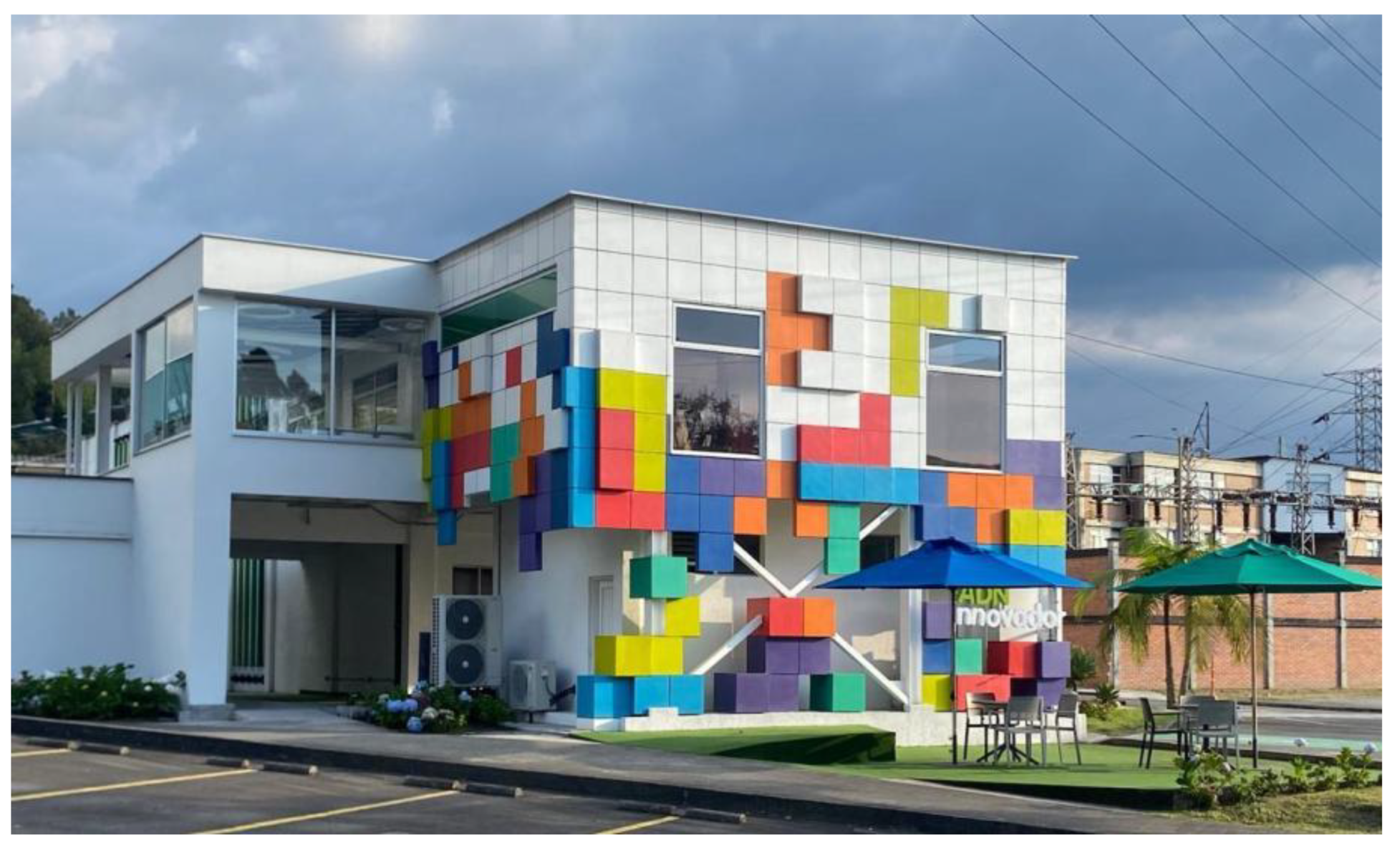
Figure 2.
BIPV Building: a) system layout, b) Inside of the Cubo de Innovación CHEC.
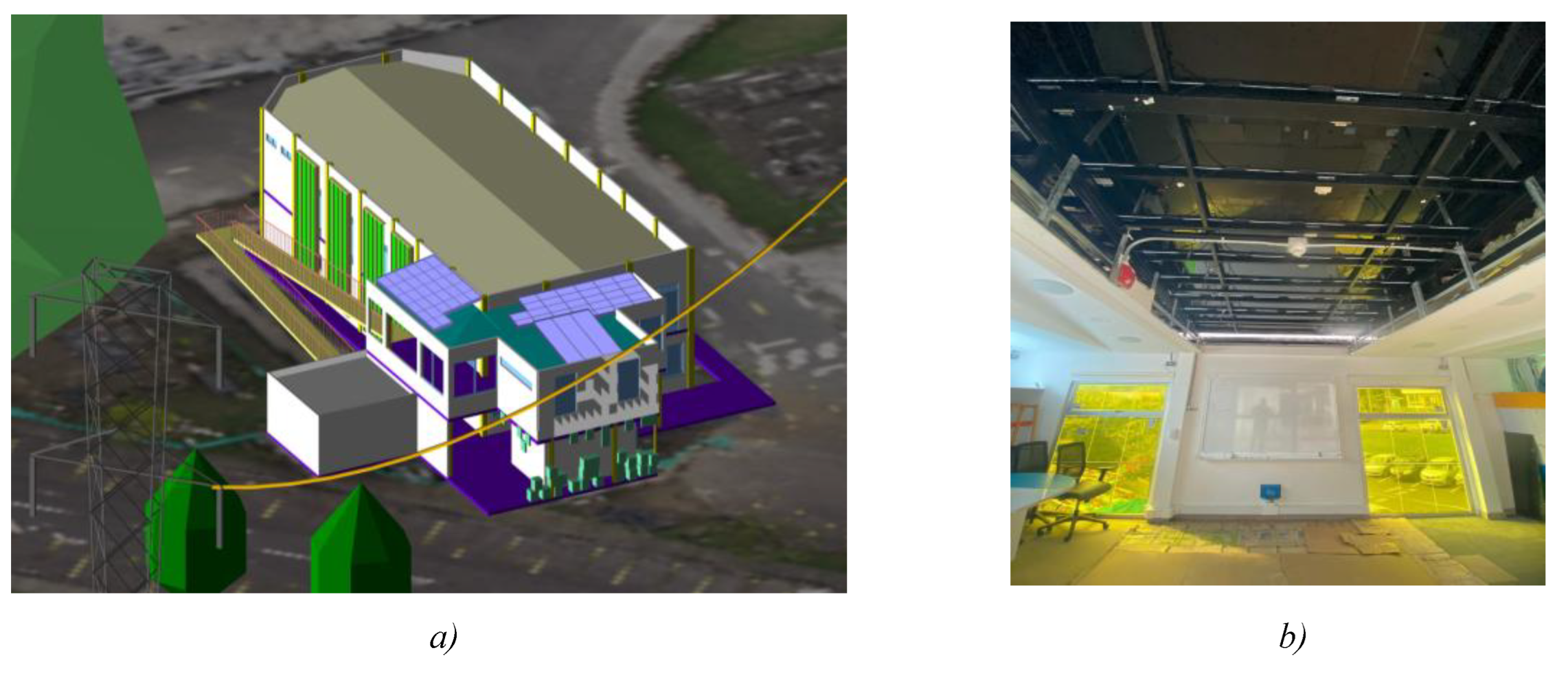

Table 1.
Specifications of Integrated BIPV Systems.
| BIPV Component | Technology | Area (m2) | Power per module (W) | System Power (kWp) |
|---|---|---|---|---|
| Solar Tiles | Silicon (Si) | 17.1 | 88 | 2.64 |
| Solar Pergola | Cadmium Telluride (CdTe) | 46.1 | 92 | 5.88 |
| Solar Windows | Cadmium Telluride (CdTe) | 3.5 | 190 | 0.38 |
Table 2.
Parameters for Thermal Comfort (PMV) Calculation.
| Parameter | Value/Source | Type |
|---|---|---|
| Air Temperature (°C) | EnergyPlus | Simulated |
| Mean Radiant Temp. (°C) | EnergyPlus | Simulated |
| Relative Humidity (%) | EnergyPlus | Simulated |
| Air Velocity (m/s) | 0.1 | Assumed (indoor) |
| Metabolic Rate (met) | 1.0 (seated, reading), 1.1 (typing) | Assumed (Scenario-based) |
| Clothing Level (clo) | 0.57, 0.61, 0.96, 1.01 | Assumed (Scenario-based) |
Table 3.
Carbon Footprint Summary.
| Metric | Source | Value | Unit |
|---|---|---|---|
| Embodied Emissions | Si (Roof) | 3,668.76 | kgCO2e |
| Embodied Emissions | CdTe (Pergola) | 3,778.56 | kgCO2e |
| Total Embodied Emissions | All BIPV | 7,447.32 | kgCO2e |
| Annual Energy Consumption | Grid | 1,930.59 | kWh/year |
| Annual Energy Generation | All BIPV | 11,223 | kWh/year |
| Annual Avoided Emissions (Building) | Grid | 341.71 | kgCO2e/year |
| Annual Avoided Emissions (Total) | All BIPV | 1,986.47 | kgCO2e/year |
Table 4.
Clothing description according to clo value (Adapted from [14]).
Table 4.
Clothing description according to clo value (Adapted from [14]).
| Clo value | Clothing description |
|---|---|
| 0.57 | Trousers and a short-sleeved shirt |
| 0.61 | Trousers and a long-sleeved shirt |
| 0.96 | Trousers, a long-sleeved shirt and a suit jacket |
| 1.01 | Trousers, a long-sleeved shirt, a T-shirt, and a long-sleeved sweater |
Table 5.
Summary of Thermal Comfort Simulation Results (PMV/PPD Scenarios).
| Activity (met) | Clothing (clo) | PMV | PPD (%) | Within Comfort Range? (ASHRAE 55) |
|---|---|---|---|---|
| 1.0 | 0.57 | -1.52 | 52.15 | No |
| 1.0 | 0.61 | -1.39 | 45.22 | No |
| 1.0 | 0.96 | -0.55 | 11.41 | No |
| 1.0 | 1.01 | -0.36 | 9.50 | Yes |
| 1.1 | 0.57 | -1.13 | 32.11 | No |
| 1.1 | 0.61 | -1.02 | 27.04 | No |
| 1.1 | 0.96 | -0.38 | 6.67 | Yes |
| 1.1 | 1.01 | -0.21 | 5.87 | Yes |
Table 6.
Key Illuminance Metrics vs. Standard Requirements.
| Location | Avg. Simulated Illuminance (lux) | Standard Requirement (lux) | Compliance/Observation |
|---|---|---|---|
| Central Task Area | ~400 | 500-1000 | Partial |
| Near BIPV Windows | 300-500 | N/A | Controlled, uniform light |
| Near Glass Door | >2500 | N/A | High potential for glare |
Disclaimer/Publisher’s Note: The statements, opinions and data contained in all publications are solely those of the individual author(s) and contributor(s) and not of MDPI and/or the editor(s). MDPI and/or the editor(s) disclaim responsibility for any injury to people or property resulting from any ideas, methods, instructions or products referred to in the content. |
© 2026 by the authors. Licensee MDPI, Basel, Switzerland. This article is an open access article distributed under the terms and conditions of the Creative Commons Attribution (CC BY) license (http://creativecommons.org/licenses/by/4.0/).
Copyright: This open access article is published under a Creative Commons CC BY 4.0 license, which permit the free download, distribution, and reuse, provided that the author and preprint are cited in any reuse.


