

Submitted:
25 June 2026
Posted:
26 June 2026
You are already at the latest version
Abstract
Introduction: Sexual consent is a multidimensional construct involving both internal willingness and external communication, yet validated French-language instruments assessing these dimensions remain scarce. Objective: This study aimed to validate French versions of the Internal and External Consent Scale (IECS-FV) and examine their associations with sociodemographic and intimate relationship variables. Methods: A sample of 649 French-speaking emerging adults (18–25 years) completed translated versions of the ICS and ECS, alongside measures of relationship characteristics and sociodemographic factors. Confirmatory factor analyses (CFA), gender invariance testing, reliability analyses, ANOVAs, and correlational analyses were conducted. Results: The revised ICS-FV demonstrated excellent psychometric properties with a 19-item four-factor structure: Physical Response/Arousal, Agreement/Wantedness, Safety/Comfort, and Readiness. The ECS-FV showed satisfactory psychometric properties with a refined 15-item five-factor structure: Non-verbal behavior, Passive behavior, Communicative/Initiator behavior, Borderline Pressure, and Non-response Signals. All factors demonstrated good internal consistency (α ≥ .70). Gender invariance was supported for the ECS-FV but not for the ICS-FV. Positive internal and external consent dimensions were significantly associated with higher sexual satisfaction, romantic relationship satisfaction, sexual frequency, and relationship commitment, whereas non-response and passive behaviors were linked to less favorable outcomes. Conclusion: The IECS-FV are reliable and valid tools for assessing multidimensional sexual consent in French-speaking emerging adults. These instruments offer valuable resources for research, prevention, and clinical interventions targeting sexual health, relational functioning, and sexual violence prevention.
Keywords:
sexual consent
; internal consent
; external consent
; scale validation
; French adaptation
; sexual compliance
; intimate relationships
1. Introduction
Sexual consent is a central yet complex construct in the study of intimate relationships, carrying direct implications for the prevention of sexual violence (Gilles-Noguès et al., 2025). Despite its apparent simplicity in everyday discourse, consent resists straightforward definition, and the conceptual ambiguity surrounding it has significant consequences for both legal frameworks and prevention practice (Fenner, 2017). Charlene Muehlenhard and her colleagues (2016) propose three conceptualizations. The first defines consent as an internal state of willingness: a subjective psychological experience of desire, readiness, and agreement. This definition captures what consent fundamentally is, but it remains largely inaccessible to outside observers, including legal systems, which cannot directly access another person’s mental states. The second conceptualizes consent as an explicit act of permission: a verbal or written agreement given in anticipation of a sexual act. While this model offers clarity and legal tractability, it reflects a relatively marginal communicative practice, most associated with specific alt-sex communities such as BDSM, and does not reflect the way consent is negotiated in the vast majority of sexual interactions (Fenner, 2017). The third, and arguably most socially prevalent, conceptualization frames consent as behavior interpreted by another person as an expression of willingness, or its absence: actions, reactions or silences that a partner interprets as indicating agreement. Under this model, the validity of consent depends entirely on the partner’s capacity and willingness to correctly read the signals being emitted.
In contexts of sexual violence prevention and judicial assessment, this third conceptualization is the most operationally relevant. Direct access to another person’s internal state is never possible; what can be investigated is which behavioral signals were emitted, how they were interpreted, and whether contextual factors or prior experiences may have shaped the behavior of the person involved (Muehlenhard et al., 2016). Coercion, within this framework, can be understood as the disregard or circumvention of refusal signals, or the absence of consent signals (Glowacz et al., 2018; Struckman-Johnson et al., 2003). Crucially, accounts of coercive experiences consistently describe situations in which implicit, and often explicit, refusal cues were present but not acted upon (Beres, 2010; DeGue & DiLillo, 2005; Gilles-Noguès et al., 2025; Struckman-Johnson et al., 2003). Sexual coercion in intimate relationships rarely takes the form of physical constraint. Rather, it generally operates through subtler mechanisms of psychological pressure: persistent re-initiation, emotional manipulation, or expressions of anger that erode the conditions for freely expressed refusal (Camilleri et al., 2009; Garrido-Macías et al., 2022). Understanding how individuals communicate consent, and how those signals are interpreted by their partner, is therefore essential to identifying the behavioral mechanisms that underlie sexual coercion (Jozkowski et al., 2014).
This framework raises a theoretically and clinically important question regarding a related phenomenon: consenting to engage in a sexual interaction despite a lack of desire for it, called sexual compliance (Gunst et al., 2024; Impett & Peplau, 2003). This phenomenon appears to be highly prevalent in heterosexual relationships (Kubota & Nakazawa, 2024; Nickull et al., 2025). Part of the literature frames sexual compliance as an autonomous relational act, unrelated to partner pressure or coercion, and associated with positive relational outcomes (Gunst et al., 2024; Nickull et al., 2025). However, empirical evidence tends to show that negative consequences are at least as frequent, if not more, and that the predictors of compliance generally point to individual vulnerabilities such as insecure attachment, low self-esteem, low sexual assertivity or difficulties in sexual communication (Darden et al., 2019; Gunst et al., 2024). Furthermore, associations have been found between sexual compliance and histories or ongoing dynamics of coercion within the relationship (Benoit & Ronis, 2022; Gilles-Noguès et al., 2024; Gunst et al., 2024; Katz & Tirone, 2010; Nickull et al., 2025). Some authors further argue that even in the absence of any coercive climate, sexual compliance may result from the internalization of gender norms; a process sometimes described as “social coercion” (Fenner, 2017; Garcia, 2021; Gunst et al., 2024; Khera et al., 2022). Whether or not sexual compliance is fully distinguishable from coercion, the fact that it appears predominantly associated with negative individual outcomes underscores the importance of deepening research on this topic; not only to inform prevention strategies and sex education, but also to support individuals in identifying alternative strategies for preserving or strengthening intimacy within relationships. Advancing this work carries direct implications for prevention, therapeutic and sexological practice.
More importantly, advancing this research agenda in French-speaking populations requires access to validated measurement tools. An instrument specifically designed to assess sexual compliance exists : the Sexual Compliance Questionnaire (Muehlenhard & Cook, 1988). This questionnaire defines compliance at the outset and focuses primarily on compliance-driven behaviors over the past year. The Internal and External Consent Scales (IECS; Jozkowski et al., 2014), offer a complementary and more fine-grained approach: rather than identifying which specific behaviors were compliant, they assess both internal and external levels of consent for a given sexual encounter, while also estimating the frequency with which individuals rely on various internal and external consent signals during their most recent sexual interaction. This makes the IECS a comprehensive and efficient instrument for research protocols on sexual consent more broadly, thereby optimizing participant response burden.
Developed through a mixed-methods approach, the scales are structured into two complementary subscales. The Internal Consent Scale assesses the subjective psychological experience associated with a sexual encounter, including dimensions of physical response, safety and comfort, arousal, agreement, and readiness; operationalizing the internal state of willingness that legal and preventive frameworks struggle to access. The External Consent Scale captures the observable behavioral signals through which consent is communicated to a partner, including nonverbal cues, verbal initiation, passivity, and, at the boundary of coercion, borderline pressure behaviors (Jozkowski et al., 2014). Together, these two scales make it possible to evaluate the degree to which an individual’s felt internal experience aligns with the signals they outwardly express for a given sexual encounter and to identify which communicative strategies individuals habitually rely upon in sexual interactions (Jozkowski et al., 2014; Marcantonio et al., 2018; Willis et al., 2019). This information is particularly valuable for understanding the conditions under which compliance occurs, and for designing contextually grounded prevention and intervention programs.
Despite the theoretical and clinical relevance of these constructs, research on sexual consent communication remains largely anchored in English-speaking, predominantly North American contexts. Validated French-language instruments are scarce, limiting the capacity of Francophone researchers and clinicians to investigate these questions in their own populations and cultural contexts. The present study aims to address this gap by examining the psychometric properties of French-language adaptations of the IECS in a French-speaking sample.
The Present Study
Thus, this study aimed at developing and evaluate the psychometric properties of French versions of the Internal Sexual Consent Scale and the External Sexual Consent Scale (IECS-FV). Specifically, the study seeks to: (a) examine the factorial structure, internal consistency, and gender invariance of the IECS-FV; and (b) investigate the associations between sexual consent–related behaviors, as assessed by these scales, and participants’ intimate relationship characteristics, as well as their sociodemographic variables.
2. Methods
2.1. Participants
A total of 649 participants took part in this study. All participants were aged between 18 and 25 years. The sample was predominantly female (73.34%), with male (22.80%), non-binary (3.24%), and other gender (0.61%) participants also represented. Regarding sexual orientation, the majority identified as heterosexual (65.02%), followed by bisexual (18.34%), other (12.17%), and homosexual (4.47%).
In terms of intimate relationship status, nearly half of participants reported being in a long-term monogamous relationship (47.44%), while the remainder were distributed across single and emerging relationship statuses. The sample was predominantly educated at high school or undergraduate level (75.03%), with a smaller proportion holding postgraduate qualifications (22.49%). Most participants reported a monthly income below 1000€ (77.81%). Full sociodemographic details are presented in Table 1.
2.2. Ethics and Procedures
The study protocol was approved by the University of Picardie Jules Verne Non-Interventional Clinical Research Ethics Committee (Approval No: 2023-25/2023-01-1) and conducted in accordance with the Declaration of Helsinki and its subsequent amendments (Wolrd health organization, 2024).
Prior to participation, all participants were presented with an information notice detailing the study’s objectives, procedures, and their rights, including the right to withdraw at any time without consequence. Informed consent was obtained from all participants before data collection. Responses were strictly anonymous, and all data were processed in compliance with the General Data Protection Regulation (GDPR).
Data reported in the present study were collected as part of a larger international research project on sexual consent and intimate relationship dynamics. Data were collected through an online questionnaire (Limesurvey team, 2024) distributed via social networks (linkedin, facebook, Instagram) and QR codes displayed across multiple university campuses in northern France, including faculties of medicine, sciences, humanities, and literature.
2.3. Measures
Sociodemographic variables. These include age, gender, intimate relationship status, educational level, and monthly income.
Intimate relationship variables. These include the number of sexual partners had in the previous 30 days; the number of sexual intercourses had in the previous 30 days; the level of satisfaction with the sexual intercourses in the previous 12 months, the level of satisfaction with the intimate partner relationships in the previous 12 months.
Internal sexual consent measure. The French version of the Internal Consent Scale (ICS-FV) was developed through the translation of the original English ICS. The original instrument (Jozkowski et al., 2014) comprises 25 items distributed across five dimensions reflecting distinct internal sexual consent–related communication processes: physical response (6 items), arousal (3 items), agreement/wantedness (5 items), safety/comfort (7 items), and readiness (4 items). All items are rated on a 4-point Likert scale ranging from strongly disagree to strongly agree. In the original validation study, the ICS demonstrated excellent internal consistency (α = .95), and all factor loadings were above .90.
External sexual consent measure. The French version of the External Consent Scale (ECS-FV) was developed through translation of the original English ECS and the addition of a 4-point Likert scale, ranging from strongly disagree to strongly agree, to include preferences measurement. The original instrument (Jozkowski et al., 2014) comprises 18 items organized into five dimensions reflecting distinct external sexual consent–related communication strategies: nonverbal behavior (5 items), passive behavior (4 items), communicative/initiator behavior (3 items), borderline pressure behavior (3 items), and non-response signals (3 items). In the original validation study, the ECS demonstrated good internal consistency (α = .84), and factor loadings ranged from .55 to .80.
Minor modifications were made to the original scale to enhance inclusivity and clarity, and to harmonize administration procedures. First, the term “vaginal-penile intercourse” was replaced by “penetrative sexual activity” (activité sexuelle pénétrative), and the phrase “or sexual activity” was replaced by “or other sexual activity” (ou autre activité sexuelle), in order to ensure the scale’s applicability to participants across diverse sexual orientations and relationship configurations. This need to make the measure more inclusive is also highlighted by Walsh et al. in a confirmatory analysis study (Walsh et al., 2019).
Second, the original instructions for the two subscales differed in their handling of participants with no experience of sexual intercourse: the ICS instructed participants to select “N/A,” while the ECS directed them to select the last response option. To improve consistency and reduce potential confusion, these divergent instructions were replaced by a unified filter question, presented once at the beginning of each subscale: “If you have never engaged in penetrative sexual activity (or other sexual activity), please select the first option only” (Si vous n’avez jamais eu d’activité sexuelle pénétrative [ou autre activité sexuelle], veuillez sélectionner la première option uniquement), this option being “I have never engaged in sexual activity” (Je n’ai jamais eu d’activité sexuelle). This harmonization was intended to standardize the administration of both subscales while minimizing participant burden.
The translation process followed a standard forward-backward translation procedure (Beaton et al., 2000). The scales were first translated from English into French by the first author, who holds a C2 level of English proficiency as attested by a score of 112/120 on the TOEFL iBT. The French version was then independently back-translated into English by a native Franco-British bilingual speaker with no prior knowledge of the original scales. Semantic equivalence between the original and back-translated versions was assessed item by item. Agreement was reached on 37 of the 43 items (86%), indicating a high level of correspondence. For the six remaining items, the translators reached consensus through discussion, and the final wording was agreed upon jointly.
Table 1 presents the original 25 ICS items (in English) and the 18 ECS items (in English), alongside their French translations, as well as the intimate relationship and sociodemographic variables assessed in the present study. Table S9 Presents the French version of the Internal and External Consent Scale (IECS-FV).
2.4. Data Analytics
First, descriptive statistical analyses were conducted for all study variables and measures, including range, mean (M), standard deviation (SD), skewness, kurtosis, and frequency distributions.
Subsequently, the suitability of the data for factor analytic procedures was assessed by examining assumptions of sampling adequacy and sphericity, using the Kaiser–Meyer–Olkin (KMO) measure and Bartlett’s test of sphericity, respectively.
Third, a confirmatory factor analysis (CFA) was conducted on the ICS data including all 25 items (CFA Model 1), using maximum likelihood estimation (MLE), to examine the scale’s dimensional structure and construct validity. MLE has been shown to provide robust and reliable parameter estimates even with categorical indicators, such as Likert-type items, particularly in studies with relatively large sample sizes (Asún et al., 2016; Rhemtulla et al., 2012). Model fit was evaluated using widely recommended fit indices (Goretzko et al., 2024), including the comparative fit index (CFI), Tucker–Lewis index (TLI), standardized root mean square residual (SRMR), and root mean square error of approximation (RMSEA). Following established guidelines (Goretzko et al., 2024; Hu & Bentler, 1999), CFI and TLI values ≥ .95 and ≥ .90 indicate excellent and good fit, respectively, whereas SRMR ≤ .08 and RMSEA ≤ .08 indicate acceptable model fit. In addition, measurement invariance of the factorial structure across gender (female vs. male participants) was assessed.
Fourth, because several standardized factor loadings in CFA Model 1 fell below the recommended threshold of 0.50, these estimates were used as criteria for item removal. Accordingly, six items with loadings below this threshold were excluded: items 8, 12, 22, and 24 from the Physical response factor, item 6 from the Arousal factor, and item 18 from the Readiness factor. In addition, based on a series of iterative CFA procedures, the Physical response and Arousal factors were combined into a single factor, termed Physical response/arousal, comprising items 2, 17, 1, and 3. The revised model resulting from these modifications was specified as CFA Model 2.
Fifth, a confirmatory factor analysis (CFA) was conducted on the ESCS data including all 18 items (CFA Model 3). As the primary fit indices (CFI and TLI) indicated poor model fit, standardized factor loadings were examined to guide item refinement. Based on this criterion, three items with loadings below 0.40 were removed: item 13 from the Communicative/initiator behavior factor, item 14 from the Borderline pressure behavior factor, and item 15 from the Non-response signals factor. Subsequently, a second CFA was performed on the revised ESCS item set, resulting in CFA Model 4.
Sixth, the internal consistency of the factor structures identified in the CFA models was evaluated by computing Cronbach’s alpha (α) for each scale factor, along with Cronbach’s α if item deleted and item–rest correlations. Cronbach’s alpha (coefficient α) is a reliability index assessing the internal consistency of a scale, with values ranging from 0 to 1. Conventionally, values ≥ .70 are considered acceptable for exploratory research, ≥ .80 for established research contexts, and ≥ .90 for high-stakes clinical applications (Bland & Altman, 1997; Nunnally, 1978; Zijlmans et al., 2018). In the present study, reliability was estimated for the total score of each sexual consent–related behavioral dimension. Cronbach’s α if item deleted indicates the reliability coefficient that would be obtained if a given item were removed from the scale, thereby informing item contribution to overall consistency. Item–rest correlation reflects the association between each item and the total score computed from the remaining items, with values ≥ .20 generally considered acceptable (Bland & Altman, 1997; Nunnally, 1978; Zijlmans et al., 2018).
Seventh, to examine the relationships between sexual consent–related behaviors (as derived from CFA Model 2 and CFA Model 4) and participants’ intimate relationship measures and sociodemographic variables, we conducted analyses of variance (ANOVA) for nominal variables (i.e., gender and sexual orientation) and Pearson correlation analyses for the remaining ordinal variables.
All analyses were performed using Jamovi statistical software (version 2.6; The Jamovi Project, 2025) for descriptive and correlational analyses, and the R statistical environment, specifically the lavaan package (version 0.6-19; Rosseel, 2012), for confirmatory factor analyses.
3. Results
3.1. Descriptive Statistics
Table 1 presents a summary of the descriptive statistics for participants’ responses to the initial 25 items of the ICS-FV, the 18 items of the ECS-FV, the four intimate relationship measures, and the six sociodemographic variables.
3.2. Confirmatory Factorial Analysis (CFA) Results
3.2.1. CFA Related to the ICS
The assumptions of sampling adequacy and sphericity were met (KMO = 0.87; Bartlett’s test of sphericity: χ2 [df = 153] = 3200, p < .001) (Cerny & Kaiser, 1977).
The CFA Model 1 (ICS data comprising 25 items and five factors) showed acceptable fit indices: χ2 = 844, df = 220, p < .001; CFI = .93; TLI = .92; SRMR = .045; RMSEA = 0.066 (95% CI [.061–.070]). However, six standardized factor loadings—corresponding to items 8, 12, 22, 24, 6, and 18—were below the 0.50 threshold.
The overall CFA Model 2 (ICS data including 19 items and four factors) demonstrated excellent fit indices, and an improvement over CFA Model 1: χ2 = 536, df = 129, p < .001; CFI = .95; TLI = .94; SRMR = .036; RMSEA = 0.069 (95% CI [.063–0.075]). Figure 1 presents the CFA path diagram for CFA Model 2. Standardized factor loadings of the observed variables on the latent constructs (see Figure 1) ranged from 0.62 to 0.90 and were all statistically significant (p < .001), indicating that each indicator reliably reflects its corresponding latent construct (Goretzko et al., 2024; Hu & Bentler, 1999). The variances of the observed variables (see Table S2 in the Supplementary Material) were also statistically significant (p < .001), suggesting adequate variability across measures (Goretzko et al., 2024; Hu & Bentler, 1999).
Nunnally, J. C. (1978). Cronbach’s Alpha. Journal of Consumer Research, 16, 297-334.
Consequently, the final ICS-FV is based on the factorial structure derived from CFA Model 2, comprising 19 items across four dimensions. Detailed statistics for CFA Model 2, including factor loadings and factor covariances, are presented in Tables S1 and S2 of the Supplementary Material.
3.2.2. CFA Related to the ECS
The assumptions of sampling adequacy and sphericity were met (KMO = 0.96; Bartlett’s test of sphericity: χ2 [df = 300] = 10,093, p < .001) (Cerny & Kaiser, 1977).
The overall CFA Model 3 (ESCS data including 18 items) showed poor fit indices: χ2 = 447, df = 93, p < .001; CFI = .86; TLI = .82; SRMR = .063; RMSEA = 0.076 (95% CI [.069–.083]).
The overall CFA Model 4 (ESCS data including 15 items) demonstrated an acceptable fit to the observed data and an improvement over CFA Model 3: χ2 = 281, df = 80, p < .001; CFI = .92; TLI = .90; SRMR = .049; RMSEA = 0.062 (95% CI [.054–0.070]). Figure 2 presents the CFA path diagram for CFA Model 4. Standardized factor loadings of the observed variables on the latent constructs (see Figure 2) ranged from 0.47 to 0.91 and were all statistically significant (p < .001), indicating that each indicator adequately reflects the underlying latent construct (Goretzko et al., 2024; Hu & Bentler, 1999). Notably, only two items (items 9 and 5) presented loadings below 0.50. The variances of the observed variables (see Table S6 in the Supplementary Material) were also statistically significant (p < .001), suggesting sufficient variability across the measures (Goretzko et al., 2024; Hu & Bentler, 1999).
Consequently, the final ECS-FV is based on the factorial structure derived from CFA Model 4, comprising 15 items across five dimensions. Detailed statistics for CFA Model 4, including factor loadings and factor covariances, are presented in Tables S5 and S6 of the Supplementary Material.
3.3. Gender (Female vs. Male) Invariance Tests
For the ICS-FV, the configural invariance model demonstrated an acceptable fit (CFI = .93; TLI = .92; SRMR = 0.050; RMSEA = 0.079). However, the metric invariance test indicated that the factor loadings were not equivalent across genders, suggesting statistically significant differences in the meaning of the three modeled constructs between female and male participants (Δχ2 = 878.95, df = 292, p < .001).
For the ECS-FV, the configural invariance model also showed an acceptable fit (CFI = .91; TLI = .90; SRMR = 0.060; RMSEA = 0.066). In contrast to the ICS-FV, the metric invariance test indicated that factor loadings were invariant across genders, suggesting that the meaning of the three modeled constructs did not differ statistically between female and male participants (Δχ2 = 387.78, df = 160, p = .070).
3.4. Internal Reliability
As reported in Table 2, the internal reliability indices for the final ICS-FV (CFA Model 2; 19 items and four factors) and the final ECS-FV (15 items and five factors) indicated good reliability. Specifically, Cronbach’s alpha values were ≥ .70 across all factors, Cronbach’s α if item deleted supported the retention of the observed items, and item–rest correlations were ≥ .30, further confirming satisfactory internal consistency.
3.5. Comparisons Between the ICS-FV and the ECS-FV Scores
There was a statistically significant difference in the mean scores across the four internal sexual consent (ICS) behavioral dimensions, χ2 (df = 3) = 281, p < .001. According to participants’ ratings, the most frequently endorsed ISC behavior was Agreement/wantedness (M = 3.71), followed by Safety/comfort (M = 3.53), Physical response/arousal (M = 3.48), and Readiness (M = 3.44), which was the least endorsed. Further details regarding this finding are provided in Table S4 of the Supplementary Material.
There was also a statistically significant difference in the mean scores across the five external sexual consent (ECS) behavioral dimensions, χ2 (df = 3) = 936, p < .001. According to participants’ ratings, the most frequently endorsed ECS behavior was Non-verbal behavior (M = 3.43), followed by Passive behavior (M = 3.37), Communicative/initiator behavior (M = 3.26), Borderline pressure (M = 2.72), and Non-response signals (M = 2.03), which was the least endorsed. Further details regarding this finding are provided in Table S8 of the Supplementary Material.
3.6. Correlations Between the Intra Scales’ Specific Sexual Consent Behaviors
Table 3 presents the correlations between the ICS-FV and ECS-FV sexual consent behaviors, as well as the associations between these behaviors and the other modeled study variables.
All correlations among the four ICS-FV sexual consent behaviors were positive and statistically significant. Similarly, correlations among the ECS-FV sexual consent behaviors were all statistically significant; most were positive, with the exception of Non-response signals, which showed a positive association with Passive behavior but negative associations with all other ECS-FV sexual consent behaviors.
3.7. Correlations Between the Inter Scales’ Specific Sexual Consent Behaviors
As shown in Table 3, all ICS sexual consent behaviors (Physical response/arousal, Agreement/wantedness, Safety/comfort, and Readiness) are significantly correlated with the ECS sexual consent behaviors (Non-verbal behavior, Passive behavior, Communicative/initiator behavior, Borderline pressure behavior, and Non-response signals). Most correlations were positive. The only exception was Non-response signals, which, although statistically significant, was negatively associated with the other sexual consent behaviors.
3.8. Relationships Between the ICS-FV Sexual Consent Behaviors, the ECS-FV Sexual Consent Behaviors, the Participants Gender and Sexual Orientation
ANOVA and follow-up t-test analyses (see Tables S4 and S8 in the Supplementary Material) were conducted to examine whether participants’ gender and sexual orientation were associated with their scores on ICS and ECS sexual consent behaviors. Overall, few differences emerged according to gender and sexual orientation in the endorsement of ICS behaviors. Significant differences were observed only for Physical response/arousal and Agreement/wantedness. Regarding Physical response/arousal, male participants reported significantly higher scores than female participants (M = 3.49 [0.02] vs. M = 3.42 [0.02], t(645) = 4.45, p = .001, d = 0.41), indicating a greater likelihood of endorsing this behavioral strategy in communicating sexual consent. Similarly, for Agreement/wantedness, male participants also scored significantly higher than female participants (M = 3.81 [0.03] vs. M = 3.68 [0.02], t(645) = 3.02, p < .014, d = 0.28), suggesting a higher endorsement of this strategy among male participants.
With regard to ECS behaviors, few gender and sexual orientation differences were also observed. A significant difference emerged only for Communicative/initiator behavior, with male participants reporting higher scores than female participants (M = 3.48 [0.06] vs. M = 3.18 [0.03], t(645) = 4.145, p < .001, d = 0.39). This indicates that male participants were more likely than female participants to report using this behavioral strategy to communicate sexual consent.
3.9. Correlation Between the ICS-FV Sexual Consent Behaviors, the ECS-FV Sexual Consent Behaviors, the Participants’ Relationship, and Remaining Sociodemographic Variables
As shown in Table 3, ICS Physical response/arousal was significantly and positively correlated with sexual intercourse frequency, sexual satisfaction, romantic relationship satisfaction, and the level of intimate relationship commitment. ICS Agreement/wantedness was significantly and positively correlated with sexual intercourse frequency, sexual satisfaction, romantic relationship satisfaction, and the level of intimate relationship commitment. ICS Safety/comfort was significantly and positively correlated with sexual intercourse frequency, sexual satisfaction, romantic relationship satisfaction, the level of intimate relationship commitment, and income. ICS Readiness was significantly and positively correlated with sexual intercourse frequency, sexual satisfaction, romantic relationship satisfaction, and the level of intimate relationship commitment. ECS Non-verbal behavior was significantly and positively correlated to sexual intercourse frequency, sexual satisfaction, romantic relationship satisfaction, and the level of intimate relationship commitment. ECS Passive behavior was significantly and positively correlated with sexual intercourse frequency, sexual satisfaction, romantic relationship satisfaction; it was significantly and negatively correlated to age, educational level, and income. ECS Communicative/initiator behavior was significantly and positively correlated with sexual intercourse frequency, sexual satisfaction, romantic relationship satisfaction, and the level of intimate relationship commitment. ECS Borderline pressure was significantly and positively correlated with sexual satisfaction and romantic relationship satisfaction; was significantly and negatively correlated with age and educational level. ECS Non-response signals was significantly and negatively correlated with sexual satisfaction, romantic relationship satisfaction, and with the level of intimate relationship commitment.
As shown in Table 3, ICS Physical response/arousal was significantly and positively correlated with sexual intercourse frequency, sexual satisfaction, romantic relationship satisfaction, and level of intimate relationship commitment. Similarly, ICS Agreement/wantedness was significantly and positively associated with sexual intercourse frequency, sexual satisfaction, romantic relationship satisfaction, and intimate relationship commitment. ICS Safety/comfort was also significantly and positively correlated with sexual intercourse frequency, sexual satisfaction, romantic relationship satisfaction, intimate relationship commitment, and income. ICS Readiness showed significant and positive associations with sexual intercourse frequency, sexual satisfaction, romantic relationship satisfaction, and intimate relationship commitment.
Regarding ECS behaviors, Non-verbal behavior was significantly and positively correlated with sexual intercourse frequency, sexual satisfaction, romantic relationship satisfaction, and intimate relationship commitment. Passive behavior was significantly and positively associated with sexual intercourse frequency, sexual satisfaction, and romantic relationship satisfaction, while showing significant negative correlations with age, educational level, and income. Communicative/initiator behavior was significantly and positively correlated with sexual intercourse frequency, sexual satisfaction, romantic relationship satisfaction, and intimate relationship commitment. Borderline pressure was significantly and positively associated with sexual satisfaction and romantic relationship satisfaction, and significantly and negatively correlated with age and educational level. Finally, Non-response signals were significantly and negatively correlated with sexual satisfaction, romantic relationship satisfaction, and intimate relationship commitment.
4. Discussion
4.1. Overview of the Study Objectives and Principal Findings
The present study aimed to develop and validate French versions of the Internal Consent Scale and External Consent Scale (IECS-FV) among French-speaking emerging adults, while also examining their factorial validity, reliability, gender invariance, and associations with sociodemographic and intimate relationship variables. Overall, findings provide substantial support for the psychometric adequacy of both French adaptations, while also highlighting important cultural and gender-related nuances in the measurement and expression of sexual consent. These findings contribute significantly to the Francophone literature by offering validated instruments capable of assessing internal and external dimensions of sexual consent communication in young adults.
Consistent with prior conceptualizations of sexual consent as both an internal psychological state and an externally communicated interpersonal process (Jozkowski et al., 2014; Muehlenhard et al., 2016), the present results suggest that sexual consent among French-speaking young adults can be reliably measured through multidimensional constructs. However, modifications to the original factorial structures were required, particularly for the ICS-FV, indicating that some aspects of sexual consent may be culturally or developmentally specific.
4.2. Psychometric Properties of the ICS-FV
The French adaptation of the Internal Consent Scale (ICS-FV) demonstrated strong psychometric performance after refinement. While the original five-factor structure proposed by Jozkowski et al. (2014) initially showed acceptable fit, six items displayed insufficient loadings, necessitating item removal and restructuring. The resulting 19-item, four-factor model demonstrated excellent fit and robust reliability.
Importantly, the merger of Physical Response and Arousal into a single factor suggests that in this French-speaking sample, physiological sexual responses and subjective arousal may be experienced less distinctly than in the original North American validation sample. This may reflect developmental characteristics of emerging adulthood, where bodily and emotional experiences of sexuality are highly intertwined (Quinn-Nilas et al., 2016), or sociocultural differences in how sexual readiness and arousal are conceptualized (Willis et al., 2019).
The retained dimensions (Physical Response/Arousal, Agreement/Wantedness, Safety/Comfort, and Readiness) align closely with theoretical models positioning consent as a dynamic internal process involving desire, autonomy, and emotional security (Marcantonio et al., 2018). Particularly noteworthy is the prominence of Agreement/Wantedness and Safety/Comfort, which emerged as the highest-rated dimensions, reinforcing the centrality of subjective willingness and psychological safety in consensual sexual experiences (Muehlenhard et al., 2016).
The strong internal consistency across all factors further supports the ICS-FV as a reliable measure for assessing nuanced internal sexual consent experiences in French-speaking populations.
4.3. Psychometric Properties of the ECS-FV
The ECS-FV also demonstrated satisfactory psychometric properties, though refinement was necessary. The revised 15-item model showed acceptable to good fit, supporting the multidimensionality of external sexual consent communication.
The preservation of five distinct factors (Non-verbal behavior, Passive behavior, Communicative/Initiator behavior, Borderline pressure, and Non-response signals) largely replicates the original structure (Jozkowski et al., 2014), suggesting stronger cross-cultural stability in external consent communication strategies compared to internal consent experiences.
Non-verbal behavior emerged as the most commonly endorsed external strategy, consistent with prior literature indicating that sexual consent is often communicated behaviorally rather than verbally in heterosexual and emerging adult relationships (Edwards et al., 2022; Willis et al., 2019).
Passive behavior’s relatively high endorsement may also reflect the prevalence of indirect consent strategies, which may overlap with sexual compliance dynamics (Darden et al., 2019; Muehlenhard et al., 2016). Meanwhile, lower endorsement of Non-response signals suggests that overt ambiguity or silence may be less normative but remains clinically relevant given its negative associations with relational satisfaction (Jozkowski et al., 2014).
Overall, the ECS-FV appears well-suited for assessing external sexual consent communication patterns in French-speaking youth.
4.4. Gender Invariance and Gender Differences
Gender invariance analyses yielded contrasting findings for the two scales. The ECS-FV demonstrated metric invariance across male and female participants, indicating that external sexual consent communication behaviors are expressed similarly across genders. This suggests that communication strategies may be relatively stable across gender groups, in accordance with what is reported in the literature (Muehlenhard et al., 2016).
In contrast, the ICS-FV failed to demonstrate metric invariance, indicating that the internal psychological experience of sexual consent may differ meaningfully between men and women. This finding is theoretically coherent with gendered sexual socialization literature: women’s consent experiences are likely shaped by a convergence of factors, including the risk of social stigmatization, the possibility of physical pain, and internalized norms of “sexual debt”, that introduce layers of complexity less salient in men’s experiences (Beres, 2010; Conroy et al., 2015; Geary et al., 2013). Notably, this framing does not imply that men’s consent experiences are uniformly straightforward; research on sexual compliance suggests that a meaningful proportion of men also engage in unwanted sexual activity, often linked to adherence to stereotypical gender roles (Peterson, 2024). Nevertheless, the relational, physical, and normative asymmetries women face in sexual negotiation may generate a qualitatively distinct phenomenology of consent (Fenner, 2017).
Observed gender differences further supported this interpretation. Male participants reported higher levels of Physical Response/Arousal, Agreement/Wantedness, and Communicative/Initiator behavior. These findings align with traditional gender norms that position men as sexual initiators and women as gatekeepers (Garcia, 2021), though effect sizes were modest.
These results emphasize the importance of considering gender-specific dynamics in both sexual consent research and prevention programming.
4.5. Relationships Between Internal and External Consent Dimensions
Significant positive correlations between all internal consent dimensions and most external consent behaviors support the theoretical coherence of the IECS framework. Individuals reporting stronger internal willingness, readiness, and safety were generally more likely to engage in active external consent communication.
This coherence between internal and external consent is particularly important, as discrepancies between felt consent and expressed consent may represent conditions under which sexual compliance or coercion are more likely to occur (Gilles-Noguès et al., 2024; Hust et al., 2017; Katz & Tirone, 2010).
Notably, Non-response signals were negatively associated with all positive consent dimensions, suggesting that silence or ambiguity may function as markers of lower consent congruence and potentially greater vulnerability.
These findings support the utility of simultaneously measuring both internal and external consent processes to better understand sexual agency and relational dynamics.
4.6. Associations with Sociodemographic and Intimate Relationship Variables
A consistent pattern emerged linking more consistent consent profiles with more positive intimate relationship functioning. Internal consent dimensions were positively associated with sexual frequency, sexual satisfaction, romantic satisfaction, and relationship commitment. Similarly, active external consent strategies (e.g., non-verbal and communicative behaviors) were positively related to these variables. These findings align with prior evidence suggesting that consensual, communicative sexual interactions contribute to sexual satisfaction (Marcantonio et al., 2020).
Conversely, passive behaviors and non-response signals were associated with lower socioeconomic indicators, younger age, and lower relationship quality. This may indicate that less empowered consent communication is linked to developmental immaturity, reduced relational resources, or broader social inequalities (Sánchez-Ocaña et al., 2026).
Interestingly, Borderline pressure behaviors were positively associated with sexual and relational satisfaction, a finding that warrants caution. It is possible that some borderline pressure items may capture playful persuasion rather than coercion in certain relational contexts. However, given the literature on normalization od coercive behaviors (Burt, 1980; Camilleri et al., 2009; Wilson, 2023), this dimension requires further conceptual clarification.
4.7. Limitations
Several limitations should be acknowledged. First, the sample was predominantly female, heterosexual, and mainly university-affiliated, which may limit generalizability to broader French-speaking populations. Second, the cross-sectional design precludes causal inference regarding the relationships between sexual consent behaviors and relational outcomes. Third, all data were self-reported, raising potential concerns regarding recall bias and social desirability effects (King, 2024). Fourth, the exclusion of non-binary participants from invariance analyses due to sample size limitations restricts understanding of sexual consent measurement across more diverse gender identities. Finally, while translation procedures were rigorous, some structural modifications suggest possible cultural adaptation effects that warrant replication.
5. Future Research Directions
Future studies should examine the IECS-FV in more diverse populations, including older adults, LGBTQ+ communities, and clinical populations. Longitudinal designs are needed to assess temporal stability and predictive validity. Further investigation into internal-external consent discrepancies may improve understanding of sexual compliance and coercion. Additionally, qualitative research could help clarify culturally specific meanings of passive, borderline, and non-response consent behaviors within Francophone contexts. Cross-cultural comparisons between French-speaking and other populations may also advance global sexual consent theories.
6. Conclusion
The present study provides evidence for the validity and reliability of French versions of the Internal and External Sexual Consent Scales among emerging adults. These instruments represent valuable tools for advancing Francophone research, prevention, and clinical practice related to sexual consent, sexual compliance, and intimate relationship functioning.
By capturing both internal experiences and external communication strategies, the IECS-FV offers a comprehensive framework for understanding sexual consent as a multidimensional psychosocial process. These findings support the broader conceptualization of sexual consent as central not only to sexual violence prevention, but also to relational health, autonomy, and sexual well-being.
Supplementary Materials
The following supporting information can be downloaded at the website of this paper posted on Preprints.org.
Author Contributions
EG-N and GVC conceived the study. EG-N and GVC conceived the survey and prepared the questionnaires. EG-N collected the data. GVC conducted data analyses. GVC and EG-N wrote the first draft. All authors read, reviewed, and approved the manuscript.
Funding
This research received no external funding.
Institutional Review Board Statement
The study protocol was reviewed and approved by the University of Picardie Jules Verne Non-Interventional Clinical Research Ethics Committee (Approval No: 2023-25/2023-01-1, approval date: 29 March 2023). The study was conducted in accordance with the Declaration of Helsinki (World Medical Association [WMA], 1964) and its later amendments, governing ethical principles for medical research involving human subjects.
Informed Consent Statement
Participation in the study was voluntary. Prior to data collection, written informed consent was electronically obtained from the participants. The study included participants aged 18–25 years. All data were collected anonymously and handled confidentially.
Data availability
Data supporting the reported results are available in an Open Science Framework (OSF) repository. During peer review, anonymized access is provided through a view-only link. The repository will be made fully public upon acceptance of the manuscript.
Acknowledgments
The authors wish to acknowledge the study participants for their contribution. During the preparation of this work the author(s) used Claude ia (sonnet 4.6) in order to improve the style and readability of the text. After using this tool, the authors reviewed and edited the content as needed and take full responsibility for the content of the published article.
Conflicts of Interest
The authors declare no competing interests.
Abbreviations
IECS = Internal and External Consent Scale
IECS-FV = French Version of the Internal and External consent Scale
BDSM: Bondage, domination and sado-masochism
CFA = Confirmatory Factorial Analysis.
KMO = Kaiser–Meyer–Olkin test.
CFI = Comparative Fit Index.
TLI = Tucker Lewis Fit Index.
SRMR = Standardized Root Mean Square Residual.
RMSEA = Root Mean Square Error of Approximation.
References
- Asún, R. A.; Rdz-Navarro, K.; Alvarado, J. M. Developing Multidimensional Likert Scales Using Item Factor Analysis: The Case of Four-point Items. Sociological Methods & Research 2016, 45(1), 109–133. [Google Scholar] [CrossRef]
- Beaton, D. E.; Bombardier, C.; Guillemin, F.; Ferraz, M. B. Guidelines for the Process of Cross-Cultural Adaptation of Self-Report Measures. Spine 2000, 25(24), 3186. [Google Scholar] [CrossRef] [PubMed]
- Benoit, A. A.; Ronis, S. T. A Qualitative Examination of Withdrawing Sexual Consent, Sexual Compliance, and Young Women’s Role as Sexual Gatekeepers. International Journal of Sexual Health 2022, 34(4), 577–592. [Google Scholar] [CrossRef] [PubMed]
- Beres, M. Sexual miscommunication? Untangling assumptions about sexual communication between casual sex partners. Culture, Health & Sexuality 2010, 12(1), 1–14. [Google Scholar] [CrossRef] [PubMed]
- Bland, J. M.; Altman, D. G. Statistics notes: Cronbach’s alpha. BMJ 1997, 314(7080), 572. [Google Scholar] [CrossRef] [PubMed]
- Burt, M. R. Cultural myths and supports for rape. Journal of Personality and Social Psychology 1980, 38, 217–230. [Google Scholar] [CrossRef] [PubMed]
- Camilleri, J. A.; Quinsey, V. L.; Tapscott, J. L. Assessing the Propensity for Sexual Coaxing and Coercion in Relationships: Factor Structure, Reliability, and Validity of the Tactics to Obtain Sex Scale. Archives of Sexual Behavior 2009, 38(6), 959–973. [Google Scholar] [CrossRef] [PubMed]
- Cerny, B. A.; Kaiser, H. F. A Study Of A Measure Of Sampling Adequacy For Factor-Analytic Correlation Matrices. Multivariate Behavioral Research 1977, 12(1), 43–47. [Google Scholar] [CrossRef] [PubMed]
- Conroy, N. E.; Krishnakumar, A.; Leone, J. M. Reexamining issues of conceptualization and willing consent: The hidden role of coercion in experiences of sexual acquiescence. Journal of Interpersonal Violence 2015, 30(11), 1828–1846. [Google Scholar] [CrossRef] [PubMed]
- Darden, M. C.; Ehman, A. C.; Lair, E. C.; Gross, A. M. Sexual Compliance: Examining the Relationships Among Sexual Want, Sexual Consent, and Sexual Assertiveness. Sexuality & Culture 2019, 23(1), 220–235. [Google Scholar] [CrossRef]
- DeGue, S.; DiLillo, D. “You would if you loved me”: Toward an improved conceptual and etiological understanding of nonphysical male sexual coercion. Aggression and Violent Behavior 2005, 10(4), 513–532. [Google Scholar] [CrossRef]
- Edwards, J.; Rehman, U.; Byers, E. Perceived barriers and rewards to sexual consent communication: A qualitative analysis. Journal of Social and Personal Relationships 2022, 39, 026540752210807. [Google Scholar] [CrossRef] [PubMed]
- Fenner, L. Sexual Consent as a Scientific Subject: A Literature Review. American Journal of Sexuality Education 2017, 12(4), 451–471. [Google Scholar] [CrossRef]
- Garcia, M. La Conversation des Sexes: Philosophie du Consentement; Paris, France; Flammarion, 2021. [Google Scholar]
- Garrido-Macías, M.; Valor-Segura, I.; Expósito, F. Women’s risk perception and responses to intimate partner sexual coercion: The role of type of tactic, previous experience, and myths acceptance. The Spanish Journal of Psychology 2022, 25, 2022-71714-001. [Google Scholar] [CrossRef] [PubMed]
- Geary, C. W.; Baumgartner, J. N.; Wedderburn, M.; Montoya, T.; Catone, J. Sexual agency and ambivalence in the narratives of first time sexual experiences of adolescent girls in Jamaica: Implications for sex education. Sex Education 2013, 13(4), 437–449. [Google Scholar] [CrossRef]
- Gilles-Noguès, E.; Cruz, G. V.; Megalakaki, O. Learning Sexuality and Consent: A Qualitative Study on the Experiences of Young French Adults; Qeios, 2024. [Google Scholar] [CrossRef]
- Gilles-Noguès, E.; Moore, P. J.; Vera Cruz, G. (2025, mai). Jugments in sexual consent : Using the information integration paradigm to understand how people understand sexual consent. 9th international Information integration theory conference. mai, 2025. Available online: https://hal.science/hal-05222556.
- Glowacz, F.; Goblet, M.; Courtain, A. Sexual coercion in adolescence: From non-consensual sexuality to sexuality under constraint. Sexologies, Sexual Coercion and Sexual Violence Coercition Sexuelle et Violences Sexuelles 2018, 27(2), e33–e37. [Google Scholar] [CrossRef]
- Goretzko, D.; Siemund, K.; Sterner, P. Evaluating Model Fit of Measurement Models in Confirmatory Factor Analysis. Educational and Psychological Measurement 2024, 84(1), 123–144. [Google Scholar] [CrossRef] [PubMed]
- Gunst, A.; Alanko, K.; Nickull, S.; Dewitte, M.; Källström, M.; Antfolk, J.; Jern, P. A Qualitative Content Analysis of Perceived Individual and Relational Consequences of Sexual Compliance and Their Contributors. Archives of Sexual Behavior 2024, 53(8), 3025–3041. [Google Scholar] [CrossRef] [PubMed]
- Hu, L.; Bentler, P. M. Cutoff criteria for fit indexes in covariance structure analysis: Conventional criteria versus new alternatives. Structural Equation Modeling: A Multidisciplinary Journal 1999, 6(1), 1–55. [Google Scholar] [CrossRef]
- Hust, S. J. T.; Rodgers, K. B.; Bayly, B. Scripting Sexual Consent: Internalized Traditional Sexual Scripts and Sexual Consent Expectancies Among College Students. Family Relations 2017, 66(1), 197–210. [Google Scholar] [CrossRef]
- Impett, E. A.; Peplau, L. A. Sexual compliance: Gender, motivational, and relationship perspectives. The Journal of Sex Research 2003, 40(1), 87–100. [Google Scholar] [CrossRef] [PubMed]
- Jozkowski, K. N.; Peterson, Z. D.; Sanders, S. A.; Dennis, B.; Reece, M. Gender Differences in Heterosexual College Students’ Conceptualizations and Indicators of Sexual Consent: Implications for Contemporary Sexual Assault Prevention Education. The Journal of Sex Research 2014, 51(8), 904–916. [Google Scholar] [CrossRef] [PubMed]
- Jozkowski, K. N.; Sanders, S.; Peterson, Z. D.; Dennis, B.; Reece, M. Consenting to Sexual Activity: The Development and Psychometric Assessment of Dual Measures of Consent. Archives of Sexual Behavior 2014, 43(3), 437–450. [Google Scholar] [CrossRef] [PubMed]
- Katz, J.; Tirone, V. Going Along With It: Sexually Coercive Partner Behavior Predicts Dating Women’s Compliance With Unwanted Sex. Violence Against Women 2010, 16(7), 730–742. [Google Scholar] [CrossRef] [PubMed]
- Khera, D.; Champion, A.; Walton, K.; Pedersen, C. Why men don’t say no: Sexual compliance and gender socialization in heterosexual men. Psychology & Sexuality 2022, 13(5), 1336–1349. [Google Scholar] [CrossRef]
- King, B. M. Social desirability biased responding: Are researchers listening? Psychology and behavioral science 2024, 21(5), 556075. [Google Scholar] [CrossRef] [PubMed]
- Kubota, S.; Nakazawa, E. Concept and implications of sexual consent for education: A systematic review of empirical studies. Sexual and Relationship Therapy 2024, 39(3), 1021–1043. [Google Scholar] [CrossRef]
- Limesurvey team. LimeSurvey (Version 3.27.33) [Logiciel]. LimeSurvey Community Edition. 2024. Available online: https://www.limesurvey.org/fr.
- Marcantonio, T.; Jozkowski, K. N.; Wiersma-Mosley, J. The Influence of Partner Status and Sexual Behavior on College Women’s Consent Communication and Feelings. Journal of Sex & Marital Therapy 2018, 44(8), 776–786. [Google Scholar] [CrossRef] [PubMed]
- Marcantonio, T. L.; Willis, M.; Jozkowski, K. N. Women’s Sexual Consent: Potential Implications for Sexual Satisfaction. Current Sexual Health Reports 2020, 12(3), 120–126. [Google Scholar] [CrossRef]
- Muehlenhard, C. L.; Cook, S. W. Men’s self-reports of unwanted sexual activity. The Journal of Sex Research 1988, 24(1), 58–72. [Google Scholar] [CrossRef] [PubMed]
- Muehlenhard, C. L.; Humphreys, T. P.; Jozkowski, K. N.; Peterson, Z. D. The Complexities of Sexual Consent Among College Students: A Conceptual and Empirical Review. The Journal of Sex Research 2016, 53(4-5), 457–487. [Google Scholar] [CrossRef] [PubMed]
- Nickull, S.; Jern, P.; Niu, C.; Källström, M.; Gunst, A. Predictors of Perceived Positive and Negative Consequences of Sexual Compliance. Journal of Sex & Marital Therapy 2025, 51(2), 142–162. [Google Scholar] [CrossRef] [PubMed]
- Nunnally, J. C. An Overview of Psychological Measurement. In Clinical Diagnosis of Mental Disorders: A Handbook; Wolman, B. B., Ed.; Springer US, 1978; pp. 97–146. [Google Scholar] [CrossRef]
- Peterson, Z. D. Beyond sexual victimization and perpetration: Men, masculinities, and unwanted consensual sex. Psychology of Men & Masculinities 2024, 25(4), 402–417. [Google Scholar] [CrossRef]
- Quinn-Nilas, C.; Benson, L.; Milhausen, R. R.; Buchholz, A. C.; Goncalves, M. The Relationship Between Body Image and Domains of Sexual Functioning Among Heterosexual, Emerging Adult Women. Sexual Medicine 2016, 4(3), e182–e189. [Google Scholar] [CrossRef] [PubMed]
- Rhemtulla, M.; Brosseau-Liard, P. É.; Savalei, V. When can categorical variables be treated as continuous? A comparison of robust continuous and categorical SEM estimation methods under suboptimal conditions. Psychological Methods 2012, 17(3), 354–373. [Google Scholar] [CrossRef] [PubMed]
- Sánchez-Ocaña, A.; Catalán Águila, M.; Strizzi, J.; Fernández Agis, I. The role of sexual assertiveness in understanding consent: Insights from BDSM sexualities. Psychology & Sexuality 2026, 0(0), 1–22. [Google Scholar] [CrossRef]
- Struckman-Johnson, C.; Struckman-Johnson, D.; Anderson, P. B. Tactics of sexual coercion: When men and women won’t take no for an answer. Journal of Sex Research. (world) 2003. [Google Scholar] [CrossRef] [PubMed]
- Walsh, K.; Honickman, S.; Valdespino-Hayden, Z.; Lowe, S. R. Dual Measures of Sexual Consent: A Confirmatory Factor Analysis of the Internal Consent Scale and External Consent Scale. The Journal of Sex Research 2019, 56(6), 802–810. [Google Scholar] [CrossRef] [PubMed]
- Willis, M.; Hunt, M.; Wodika, A.; Rhodes, D. L.; Goodman, J.; Jozkowski, K. N. Explicit Verbal Sexual Consent Communication: Effects of Gender, Relationship Status, and Type of Sexual Behavior. International Journal of Sexual Health 2019, 31(1), 60–70. [Google Scholar] [CrossRef]
- Wilson, M. Understanding Refusals, Using Coercion: Young Men’s Understanding and Use of Normalized Sexualized Violence within Heterosex. The Journal of Sex Research 2023, 60(8), 1168–1180. [Google Scholar] [CrossRef] [PubMed]
- Wolrd health organization. WMA Declaration of Helsinki – Ethical Principles for Medical Research Involving Human Participants; (Version 11), 2024; Available online: https://www.wma.net/policies-post/wma-declaration-of-helsinki/#:~:text=Medical%20research%20involving%20human%20subjects%20must%20be%20conducted%20only%20by,or%20other%20health%20care%20professional.
- Zijlmans, E. A. O.; Tijmstra, J.; van der Ark, L. A.; Sijtsma, K. Item-Score Reliability in Empirical-Data Sets and Its Relationship With Other Item Indices. Educational and Psychological Measurement 2018, 78(6), 998–1020. [Google Scholar] [CrossRef] [PubMed]
Figure 1.
The CFA path diagram with the standardized estimates: ICS-FV. Note. Confirmation factor analysis of the questionnaire. The ellipses represent the latent variables (the three factors: Physical response/arousal [PRA]; Safety/comfort [SC]; Agreement/wantedness [AW]); Readness [RD]) and the rectangles represent the different items. The values on the arrow directed on the ellipses are the variance of each latent factor (fixed to 1). The values on the arrow linking each of the three circles are the correlations between the latent variables. The values on the arrow linking each latent variable to the corresponding items are the factors loadings (standardized estimates). The factor loadings indicate how well each item is representative of its unobservable construct (factor). Its values go from 0 to 1. The values on top of each rectangle are the square of the standardized factor loadings; they give the proportion of the explained variance (R2) in each item, which indicates how much of the variance in the item is explained by the unobserved construct. If a standardized factor loading value is greater than 0.70 or explains at least half (0.50 = 50%) of the variance in the item, then the corresponding item is important in explaining the unobserved construct it belongs to. ISCS = Internal Sexual Consent Scale. See Table 2 for all item labels.
Figure 1.
The CFA path diagram with the standardized estimates: ICS-FV. Note. Confirmation factor analysis of the questionnaire. The ellipses represent the latent variables (the three factors: Physical response/arousal [PRA]; Safety/comfort [SC]; Agreement/wantedness [AW]); Readness [RD]) and the rectangles represent the different items. The values on the arrow directed on the ellipses are the variance of each latent factor (fixed to 1). The values on the arrow linking each of the three circles are the correlations between the latent variables. The values on the arrow linking each latent variable to the corresponding items are the factors loadings (standardized estimates). The factor loadings indicate how well each item is representative of its unobservable construct (factor). Its values go from 0 to 1. The values on top of each rectangle are the square of the standardized factor loadings; they give the proportion of the explained variance (R2) in each item, which indicates how much of the variance in the item is explained by the unobserved construct. If a standardized factor loading value is greater than 0.70 or explains at least half (0.50 = 50%) of the variance in the item, then the corresponding item is important in explaining the unobserved construct it belongs to. ISCS = Internal Sexual Consent Scale. See Table 2 for all item labels.
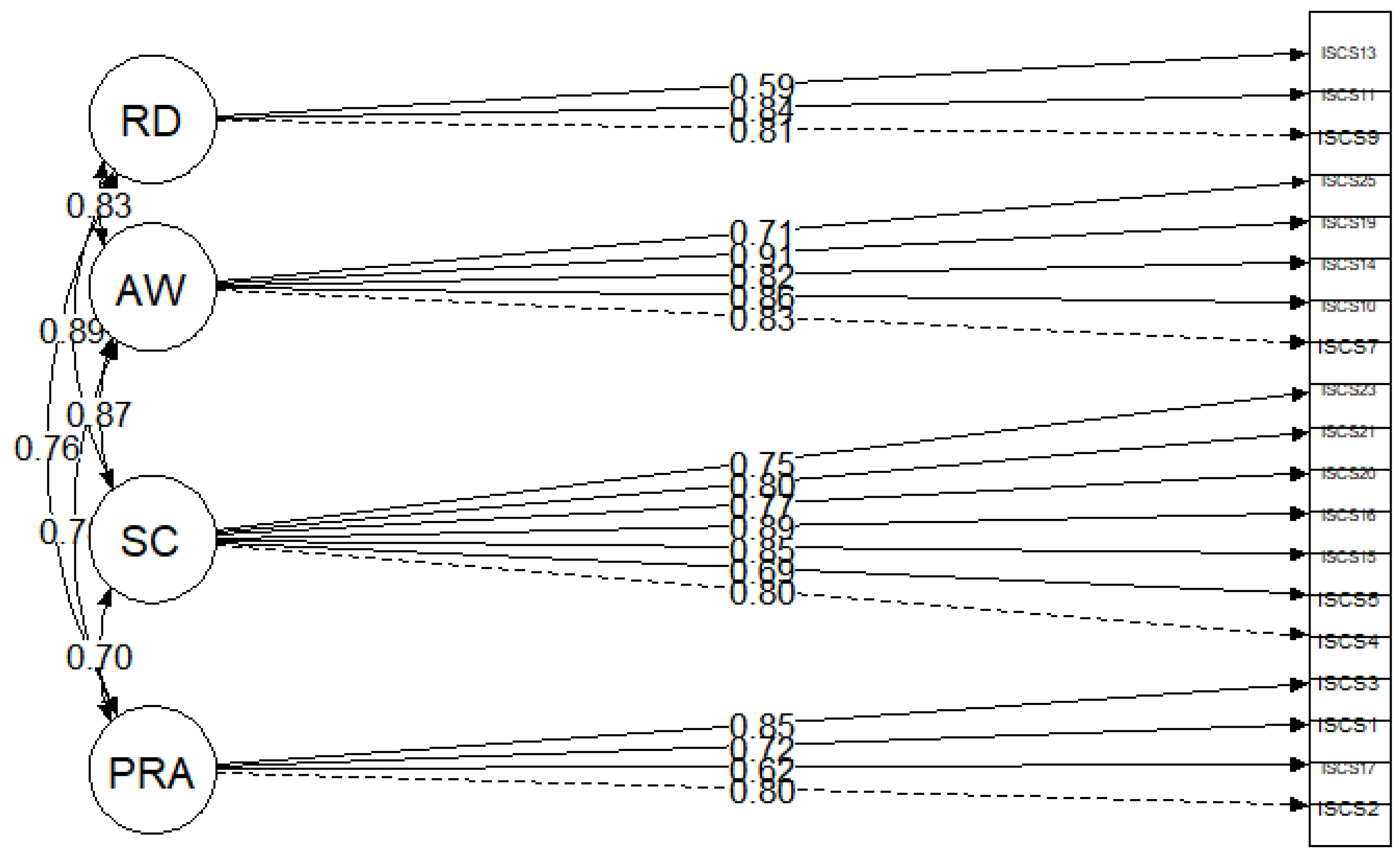
Figure 2.
The CFA path diagram with the standardized estimates: ECS. Note. Confirmation factor analysis of the questionnaire. The ellipses represent the latent variables (the four factors: Non-verbal behavior [NVB]; Passive behavior [PB]; Communicative/initiator behavior [CIB]; Borderline pressure [BP]; Non-response signals [NRS]) and the rectangles represent the different items. The values on the arrow directed on the ellipses are the variance of each latent factor (fixed to 1). The values on the arrow linking each of the three circles are the correlations between the latent variables. The values on the arrow linking each latent variable to the corresponding items are the factors loadings (standardized estimates). The factor loadings indicate how well each item is representative of its unobservable construct (factor). Its values go from 0 to 1. The values on top of each rectangle are the square of the standardized factor loadings; they give the proportion of the explained variance (R2) in each item, which indicates how much of the variance in the item is explained by the unobserved construct. If a standardized factor loading value is greater than 0.70 or explains at least half (0.50 = 50%) of the variance in the item, then the corresponding item is important in explaining the unobserved construct it belongs to. ESCS = External Sexual Consent Scale. See Table 2 for all item labels.
Figure 2.
The CFA path diagram with the standardized estimates: ECS. Note. Confirmation factor analysis of the questionnaire. The ellipses represent the latent variables (the four factors: Non-verbal behavior [NVB]; Passive behavior [PB]; Communicative/initiator behavior [CIB]; Borderline pressure [BP]; Non-response signals [NRS]) and the rectangles represent the different items. The values on the arrow directed on the ellipses are the variance of each latent factor (fixed to 1). The values on the arrow linking each of the three circles are the correlations between the latent variables. The values on the arrow linking each latent variable to the corresponding items are the factors loadings (standardized estimates). The factor loadings indicate how well each item is representative of its unobservable construct (factor). Its values go from 0 to 1. The values on top of each rectangle are the square of the standardized factor loadings; they give the proportion of the explained variance (R2) in each item, which indicates how much of the variance in the item is explained by the unobserved construct. If a standardized factor loading value is greater than 0.70 or explains at least half (0.50 = 50%) of the variance in the item, then the corresponding item is important in explaining the unobserved construct it belongs to. ESCS = External Sexual Consent Scale. See Table 2 for all item labels.
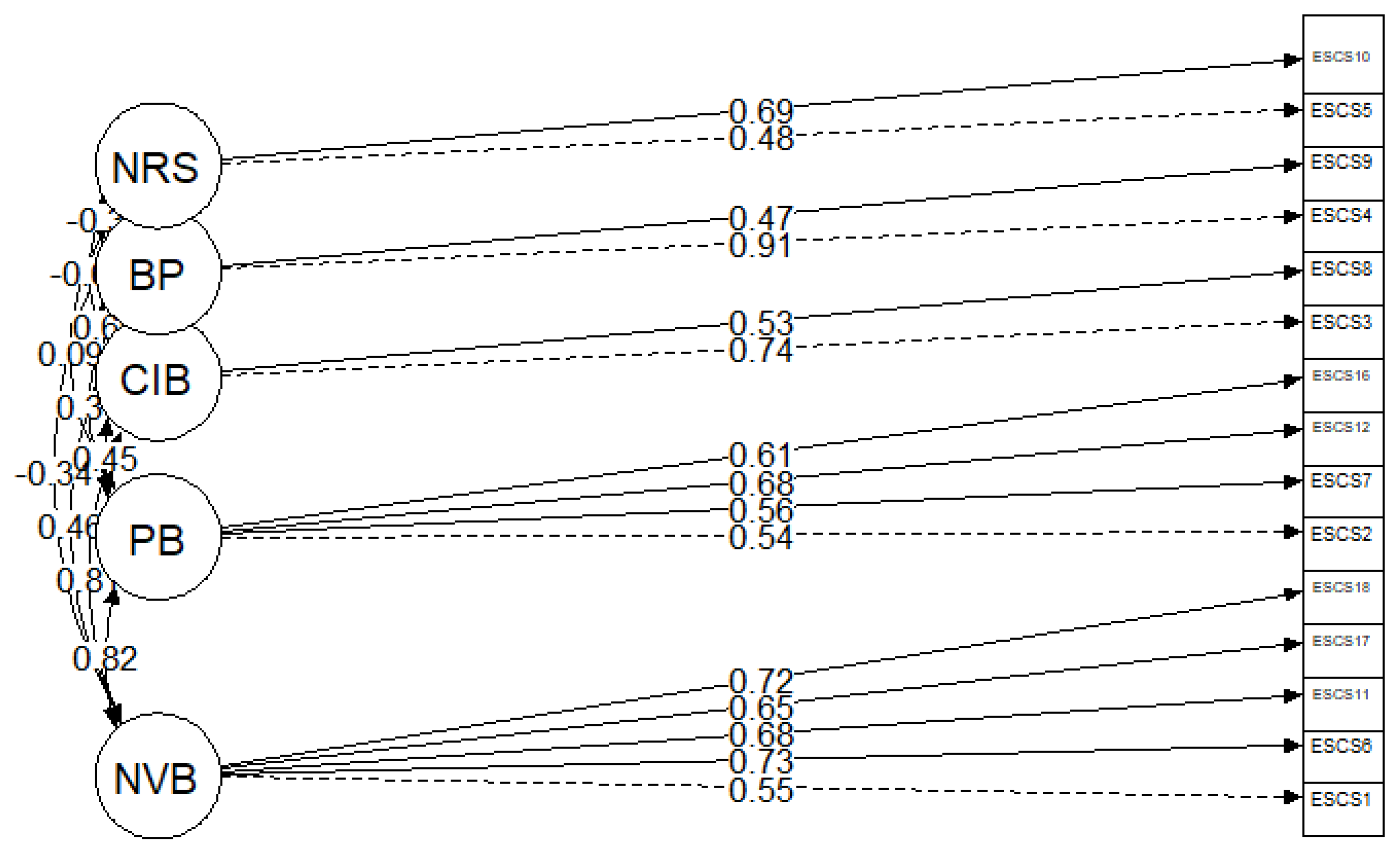

Table 1.
Descriptive statistics of all the study variables.
| Measures | Scale/min-max | Mean | SD | Skewness* | Kurtosis* | Frequency | |
|---|---|---|---|---|---|---|---|
| English | French | ||||||
| Internal Consent Scale | |||||||
| Physical Response (α = 0.63) | |||||||
| I felt heated | 2[Je me suis senti.e chaud.e] | 1-4 | 3.42 | .68 | -.985 | .672 | |
| I felt rapid heart beat | 8[J’ai ressenti des battements de cœur rapides] | 1-4 | 3.22 | .84 | -.799 | -.238 | |
| I felt lustful | 12[Je me suis senti.e lascif / lascive] | 1-4 | 2.59 | 1.03 | -.099 | -1.137 | |
| I felt erect/vaginally lubricated | 17[Je me suis senti.e en érection / lubrifié.e vaginalement] | 1-4 | 3.38 | .78 | -1.065 | .389 | |
| I felt flushed | 22[Je me suis senti.e rougir] | 1-4 | 2.58 | .99 | -.032 | -1.054 | |
| I felt eager | 24[Je me suis senti.e avide] | 1-4 | 2.63 | .99 | -.124 | -1.031 | |
| Physical response mean score | 2.97 | .52 | -.232 | -.109 | |||
|
Arousal (α = 0.64) |
|||||||
| I felt interested | 1[Je me suis senti.e intéressé.e] | 1-4 | 3.56 | .62 | -1.451 | 2.499 | |
| I felt aroused | 3[Je me suis senti.e excité.e] | 1-4 | 3.57 | .63 | -1.434 | 2.005 | |
| I felt turned on | 6[Je me suis senti.e allumé.e] | 1-4 | 2.87 | .93 | -.431 | -.720 | |
|
Physical arousal mean score |
3.33 | .56 | -.824 | .888 | |||
| Agreement / Wantedness (α = 0.91) | |||||||
| The sex felt consented to | 7[J’ai eu la sensation que la relation sexuelle était consentie] | 1-4 | 3.79 | .50 | -2.726 | 8.548 | |
| The sex felt desired | 10[J’avais la sensation que la relation sexuelle était désirée] | 1-4 | 3.69 | .57 | -1.992 | 3.966 | |
| The sex I felt agreed to | 14[J’ai eu la sensation que j’étais d’accord pour la relation sexuelle] | 1-4 | 3.69 | .57 | -2.031 | 4.675 | |
| The sex felt wanted | 19[J’ai eu la sensation que la relation sexuelle était voulue] | 1-4 | 3.74 | .54 | -2.338 | 6.239 | |
| The sex I felt consensual | 25[J’ai eu la sensation que la relation sexuelle était consensuelle] | 1-4 | 3.63 | .63 | -1.949 | 4.083 | |
|
Agreement / Wantedness mean score |
3.709 | .48 | -2.421 | 7.427 | |||
|
Safety / Comfort (α = 0.92) |
|||||||
| I felt secure | 4[Je me suis senti.e en sécurité] | 1-4 | 3.67 | .58 | -1.958 | 4.157 | |
| I felt in control | 5[Je me suis senti.e en contrôle] | 1-4 | 3.30 | .79 | -.925 | .203 | |
| I felt comfortable | 15[Je me suis senti.e en confort] | 1-4 | 3.53 | .68 | -1.378 | 1.432 | |
| I felt safe | 16[Je me suis senti.e en sûreté] | 1-4 | 3.65 | .61 | -1.927 | 4.018 | |
| I felt certain | 20[Je me suis senti.e certain.e de moi] | 1-4 | 3.38 | .81 | -1.127 | .438 | |
| I felt respected | 21[Je me suis senti.e respecté.e] | 1-4 | 3.68 | .58 | -1.911 | 3.635 | |
| I felt protected | 23[Je me suis senti.e protégé.e] | 1-4 | 3.47 | .72 | -1.249 | .985 | |
|
Safety / Comfort mean score |
3.52 | .56 | -1.618 | 2.984 | |||
| Readiness (α = 0.72) | |||||||
| I felt ready | 9[Je me suis senti.e prêt.e] | 1-4 | 3.58 | .65 | -1.498 | 1.937 | |
| I felt sure | 11[Je me suis senti.e sûr.e] | 1-4 | 3.44 | .75 | -1.273 | 1.108 | |
| I felt willing | 13[Je me suis senti.e disposé.e] | 1-4 | 3.30 | .77 | -1.039 | .854 | |
| I felt aware of my surroundings | 18[J’avais conscience de l’environnement qui nous entourait] | 1-4 | 3.65 | .59 | -1.699 | 2.771 | |
| Readiness Mean Score | 3.49 | .51 | -1.129 | 1.435 | |||
| External Consent Scale | |||||||
| Non-verbal Behavior (α = 0.79) | |||||||
| I used non-verbal cues such as body language, signals, flirting. | 1[J’ai utilisé des indices non verbaux tels que le langage corporel, les signaux physiques ou le flirt] | 1-4 | 3.55 | .67 | -1.573 | 2.555 | |
| I increased physical contact between myself and my partner | 6[J’ai intensifié le contact physique entre moi et mon/ma partenaire] | 1-4 | 3.43 | .75 | -1.304 | 1.398 | |
| I touched my partner, showed him/her what I wanted through touch or increasing physical contact between myself and the other person | 11[J’ai touché mon/ma partenaire, je lui ai montré ce que je voulais par le toucher ou en intensifiant le contact physique entre moi et lui/elle] | 1-4 | 3.18 | .87 | -.901 | .104 | |
| I removed mine and/or my partner’s clothing | 17[J’ai enlevé mes vêtements ou ceux de mon/ma partenaire] | 1-4 | 3.34 | .87 | -1.279 | .880 | |
| I engaged in some level of sexual activity such as kissing or “foreplay” | 18[Je me suis engagé.e dans certains niveaux d’activité sexuelle tels que les baisers ou les “préliminaires”] | 1-4 | 3.63 | .63 | -1.957 | 4.159 | |
| Nonverbal behavior mean score | 3.42 | .56 | -1.232 | 1.786 | |||
| Passive Behavior (α = 0.70) | |||||||
| I did not resist their attempts for sexual activity | 2[Je n’ai pas résisté aux initiatives sexuelles de mon/ma partenaire] | 1-4 | 3.19 | .85 | -.882 | .147 | |
| I did not say no or push my partner away | 7[Je n’ai pas dit non ni repoussé mon/ma partenaire] | 1-4 | 3.46 | .84 | -1.664 | 2.066 | |
| I let the sexual activity progress to the point of intercourse | 12[J’ai laissé l’activité sexuelle progresser] | 1-4 | 3.43 | .68 | -1.172 | 1.551 | |
| I reciprocated my partner’s advances | 16[J’ai réciproqué aux avances de mon/ma partenaire] | 1-4 | 3.40 | .72 | -1.199 | 1.342 | |
|
Passive behavior mean score |
3.37 | .56 | -1.117 | 1.811 | |||
| Communicative / Initiator (α = 0.58) | |||||||
| I initiated sexual behavior and checked to see if it was reciprocated | 3[J’ai initié des comportements sexuels et j’ai vérifié si c’était réciproque] | 1-4 | 3.30 | .88 | -1.132 | .407 | |
| I used verbal cues such as communicating my interest in sexual behavior or asking if he/she wanted to have sex with me. | 8[J’ai utilisé des signaux verbaux tels que communiquer mon intérêt pour le comportement sexuel ou j’ai demandé à mon/ma partenaire s’il/elle voulait avoir des relations sexuelles avec moi] |
1-4 | 3.21 | .97 | -.956 | -.281 | |
| I indirectly communicated/implied my interest in sex (e.g., talked about getting a condom) | 13[J’ai indirectement communiqué/sous-entendu mon intérêt pour la relation sexuelle (par exemple, j’ai parlé d’aller chercher un préservatif)] | 1-4 | 2.79 | 1.04 | -.310 | -1.128 | |
|
Communicative / Initiator mean score |
3.10 | .71 | -.717 | .163 | |||
| Borderline Pressure (α = 0.41) | |||||||
| I took my partner somewhere private | 4[J’ai emmené mon/ma partenaire dans un endroit privé] | 1-4 | 3.17 | 1.01 | -.936 | -.363 | |
| I shut or close the door | 9[J’ai fermé ou verrouillé la porte] | 1-4 | 2.27 | 1.16 | .303 | -1.382 | |
| I just kept moving forward in sexual behavior/actions unless my partner stopped me | 14[J’ai juste persévéré dans les comportements/actions sexuels à moins que mon/ma partenaire ne m’arrête] | 1-4 | 2.26 | 1.00 | .272 | -1.014 | |
| Borderline pressure mean score | 2.56 | .71 | -.072 | -.530 | |||
| No Response Signals (α = 0.48) | |||||||
| It just happened | 5[C’est juste arrivé] | 1-4 | 2.33 | .99 | .154 | -1.051 | |
| I did not say anything | 10[Je n’ai rien dit] |
1-4 | 1.72 | .88 | 1.063 | .226 | |
| I did not do anything; it was clear from my actions or from looking at me that I was willing to engage in sexual activity/sexual intercourse | 15[Je n’ai rien fait ; il était clair d’après mes actions ou en me regardant que j’étais prêt.e à avoir des rapports sexuels] | 1-4 | 2.19 | 1.00 | .431 | -.867 | |
| No response signals mean score | 2.08 | .67 | .254 | -.484 | |||
| Relationship measures | |||||||
| Number of sexual partners (previous 30 days) | 0-40 | 1.03 | 1.80 | 16.600 | 341.741 | ||
| Sexual intercourse frequency (previous 30 days) | 0-60 | 6.55 | 8.13 | 2.696 | 10.372 | ||
| Sexual satisfaction (previous 12 months) | 1-10 | 6.97 | 2.30 | -.797 | .062 | ||
| Romantic relationship satisfaction (previous 12 months) | 1-10 | 7.24 | 2.51 | -.912 | -.009 | ||
| Sociodemographic measures | |||||||
| Age | 18-25 | ||||||
| Gender | Male = 148(22.80%); Female = 476(73.34%); Non-binary = 21(3.24%); Other = 4(0.61%). |
||||||
| Sexual orientation | Heterosexual = 422(65.02%); Homosexual = 29(4.47%); Bisexual = 119(18.34%); Other = 79(12.17%) |
||||||
| Intimate relationship status | 1-7 | 3.85 | 1.58 | -.457 | -.020 | 1(Single, no partner) = 92(14.18%); 2(Single, occasional partners) = 64(9.86%); 3(Single, regular partner) = 46(7.09%); 4(Recent couple, monogamous) = 139(21.42%); 5(Long-term couple, monogamous) = 308(47.44%). |
|
| Education level | 1-5 | 2.82 | .87 | .531 | .334 | 1(Middle school) = 16(2.47%); 2(High school) = 246(37.90%); 3(Bachelor’s degree) = 241(37.13%); 4(Master’s degree) = 135(20.80%); 5(PhD) = 11(1.69%). |
|
| Income | 1-11 | 1.88 | 1.31 | 2.561 | 10.986 | 1(0-500€) = 346(53.31%); 2(500-1000€) =159(24.50%) ; 3(1000- 500€) = 74(11.40%); 4(1500-2000€) = 20(3.08%); 5(2000- 2500€) = 4(0.62%); 6(2500-3000€) = 1(0.15%); 7(3000-3500€) = 1(0.15%); 8(3500-4000€) = 3(0.46%). |
Table 2.
Reliability statistics of the EICS-French version: Cronbach alpha and Item-rest correlation.
Table 2.
Reliability statistics of the EICS-French version: Cronbach alpha and Item-rest correlation.
| Measures | *Item-rest correlation | *Cronbach’s α (if item dropped) | *Cronbach’s α | |
|---|---|---|---|---|
| English | French | |||
| Internal Consent Scale | ||||
| Physical response/arousal | 0.77 | |||
| I felt heated | 2[Je me suis senti.e chaud.e] | 0.675 | 0.661 | |
| I felt erect/vaginally lubricated | 17[Je me suis senti.e en érection / lubrifié.e vaginalement] | 0.396 | 0.834 | |
| I felt interested | 1[Je me suis senti.e intéressé.e] | 0.582 | 0.714 | |
| I felt aroused | 3[Je me suis senti.e excité.e] | 0.710 | 0.650 | |
| Agreement / Wantedness | 0.91 | |||
| The sex felt consented to | 7[J’ai eu la sensation que la relation sexuelle était consentie] | 0.794 | 0.888 | |
| The sex felt desired | 10[J’avais la sensation que la relation sexuelle était désirée] | 0.800 | 0.884 | |
| The sex I felt agreed to | 14[J’ai eu la sensation que j’étais d’accord pour la relation sexuelle] | 0.774 | 0.890 | |
| The sex felt wanted | 19[J’ai eu la sensation que la relation sexuelle était voulue] | 0.852 | 0.874 | |
| The sex felt consensual | 25[J’ai eu la sensation que la relation sexuelle était consensuelle] | 0.673 | 0.915 | |
| Safety / Comfort | 0.92 | |||
| I felt secure | 4[Je me suis senti.e en sécurité] | 0.763 | 0.902 | |
| I felt in control | 5[Je me suis senti.e en contrôle] | 0.669 | 0.912 | |
| I felt comfortable | 15[Je me suis senti.e en confort] | 0.811 | 0.895 | |
| I felt safe | 16[Je me suis senti.e en sûreté] | 0.838 | 0.894 | |
| I felt certain | 20[Je me suis senti.e certain.e de moi] | 0.710 | 0.908 | |
| I felt respected | 21[Je me suis senti.e respecté.e] | 0.758 | 0.902 | |
| I felt protected | 23[Je me suis senti.e protégé.e] | 0.718 | 0.905 | |
| Readiness | 0.72 | |||
| I felt ready | 9[Je me suis senti.e prêt.e] | 0.692 | 0.626 | |
| I felt sure | 11[Je me suis senti.e sûr.e] | 0.648 | 0.657 | |
| I felt willing | 13[Je me suis senti.e disposé.e] | 0.517 | 0.809 | |
| External Consent Scale | ||||
| Nonverbal Behavior | 0.79 | |||
| I used non-verbal cues such as body language, signals, flirting. | 1[J’ai utilisé des indices non verbaux tels que le langage corporel, les signaux physiques ou le flirt] | 0.478 | 0.780 | |
| I increased physical contact between myself and my partner | 6[J’ai intensifié le contact physique entre moi et mon/ma partenaire] | 0.638 | 0.731 | |
| I touched my partner, showed him/her what I wanted through touch or increasing physical contact between myself and the other person | 11[J’ai touché mon/ma partenaire, je lui ai montré ce que je voulais par le toucher ou en intensifiant le contact physique entre moi et lui/elle] | 0.616 | 0.739 | |
| I removed mine and/or my partner’s clothing | 17[J’ai enlevé mes vêtements ou ceux de mon/ma partenaire] | 0.539 | 0.768 | |
| I engaged in some level of sexual activity such as kissing or “foreplay” | 18[Je me suis engagé.e dans certains niveaux d’activité sexuelle tels que les baisers ou les “préliminaires”] | 0.622 | 0.743 | |
| Passive Behavior | 0.70 | |||
| I did not resist their attempts for sexual activity | 2[Je n’ai pas résisté aux initiatives sexuelles de mon/ma partenaire] | 0.504 | 0.612 | |
| I did not say no or push my partner away | 7[Je n’ai pas dit non ni repoussé mon/ma partenaire] | 0.476 | 0.631 | |
| I let the sexual activity progress to the point of intercourse | 12[J’ai laissé l’activité sexuelle progresser] | 0.480 | 0.631 | |
| I reciprocated my partner’s advances | 16[J’ai réciproqué aux avances de mon/ma partenaire] | 0.460 | 0.640 | |
| Communicative / Initiator | 0.56 | |||
| I initiated sexual behavior and checked to see if it was reciprocated | 3[J’ai initié des comportements sexuels et j’ai vérifié si c’était réciproque] | 0.393 | 0.355 | |
| I used verbal cues such as communicating my interest in sexual behavior or asking if he/she wanted to have sex with me. | 8[J’ai utilisé des signaux verbaux tels que communiquer mon intérêt pour le comportement sexuel ou j’ai demandé à mon/ma partenaire s’il/elle voulait avoir des relations sexuelles avec moi] | 0.393 | 0.434 | |
| Borderline Pressure | 0.59 | |||
| I took my partner somewhere private | 4[J’ai emmené mon/ma partenaire dans un endroit privé] | 0.425 | 0.370 | |
| I shut or close the door | 9[J’ai fermé ou verrouillé la porte] | 0.425 | 0.488 | |
| No Response Signals | 0.49 | |||
| It just happened | 5[C’est juste arrivé] | 0.329 | 0.371 | |
| I did not say anything | 10[Je n’ai rien dit] | 0.329 | 0.292 |
Number of participants = 649. *Cronbach’s alpha (Cronbach’s α or coefficient α): Is a reliability coefficient and a measure of the internal consistency of tests and measures. It ranges from 0 to 1, where values ≥ .70 are acceptable in early-stage research, ≥ .80 for basic research, and ≥ .90 for high-stakes clinical decisions. (Nunnally, 1978; Zijlmans et al., 2018). In this case, Reliability estimated for a total score of each sexual rejection behavior. Cronbach’s α (if item dropped): Cronbach’s α that would be obtained if an item were to be dropped ((Nunnally, 1978; Zijlmans et al., 2018). Item-rest correlation: Measure the association of the item with the total score on the other items. An item-rest correlation of 0.2 or above is generally considered acceptable ((Nunnally, 1978; Zijlmans et al., 2018).
Table 3.
Correlation between the sexual consent behaviors, the intimate relationship measures, and the sociodemographic variables.
Table 3.
Correlation between the sexual consent behaviors, the intimate relationship measures, and the sociodemographic variables.
| Measures | 1 | 2 | 3 | 4 | 5 | 6 | 7 | 8 | 9 | 10 | 11 | 12 | 13 | 14 | 15 | 16 | 17 |
|---|---|---|---|---|---|---|---|---|---|---|---|---|---|---|---|---|---|
| 1.ICS Physical response/arousal |
|||||||||||||||||
| 2.ICS Agreement/wantedness |
0.700** | ||||||||||||||||
| 3.ICS Safety/comfort |
0.634** | 0.796** | |||||||||||||||
| 4.ICS Readiness |
0.664** | 0.712** | 0.767** | ||||||||||||||
| 5.ECS Non-verbal behavior | 0.498** | 0.568** | 0.527** | 0.482** | |||||||||||||
| 6.ECS Passive behavior |
0.339** | 0.387** | 0.351** | 0.354** | 0.584** | ||||||||||||
| 7.ECS Communicative/initiator |
0.442** | 0.463** | 0.475** | 0.419** | 0.523** | 0.242** | |||||||||||
| 8.ECS Borderline pressure |
0.239** | 0.248** | 0.252** | 0.224** | 0.344** | 0.262** | 0.443** | ||||||||||
| 9.ECS Non-response signals |
-0.228** | -0.280** | -0.318** | -0.236** | -0.188** | 0.084* | -0.369** | -0.166** | |||||||||
| 10.Number of sexual partners (previous 30 days) | -0.039 | -0.009 | 0.046 | 0.053 | -0.012 | -0.006 | 0.016 | -0.054 | -0.024 | ||||||||
| 11.Sexual intercourse frequency (previous 30 days) | 0.190** | 0.137** | 0.201** | 0.167** | 0.144** | 0.122** | 0.133** | 0.042 | -0.057 | 0.078* | |||||||
| 12.Sexual satisfaction (previous 12 months) | 0.321** | 0.311** | 0.391** | 0.318** | 0.219** | 0.106* | 0.242** | 0.090* | -0.220** | 0.143** | 0.378** | ||||||
| 13.Romantic relationship satisfaction (previous 12 months) | 0.282** | 0.297** | 0.417** | 0.306** | 0.229** | 0.163** | 0.190** | 0.116* | -0.154** | 0.112* | 0.335** | 0.682** | |||||
| 14.Age | -0.074 | -0.024 | 0.027 | -0.007 | -0.064 | -0.089* | -0.045 | -0.143** | -0.049 | -0.023 | 0.009 | -0.098* | -0.076 | ||||
| 15.Relationship status (level of intimate relationship commitment) | 0.120* | 0.133** | 0.310** | 0.204** | 0.077* | 0.031 | 0.106* | -0.000 | -0.116* | 0.151** | 0.324** | 0.427** | 0.535** | 0.087 | |||
| 16.Education level | -0.019 | 0.009 | 0.040 | -0.024 | -0.004 | -0.105* | -0.052 | -0.100* | -0.061 | -0.043 | 0.039 | -0.006 | 0.009 | 0.500 | 0.091 | ||
| 17.Income | 0.037 | 0.068 | 0.099 | 0.067 | 0.001 | -0.094* | 0.013 | -0.062 | -0.039 | 0.005 | -0.006 | -0.008 | -0.014 | 0.430 | 0.430** | 0.410 |
Number of participants = 649. **significance at p<.001; *significance at p<.05.
Disclaimer/Publisher’s Note: The statements, opinions and data contained in all publications are solely those of the individual author(s) and contributor(s) and not of MDPI and/or the editor(s). MDPI and/or the editor(s) disclaim responsibility for any injury to people or property resulting from any ideas, methods, instructions or products referred to in the content. |
© 2026 by the authors. Licensee MDPI, Basel, Switzerland. This article is an open access article distributed under the terms and conditions of the Creative Commons Attribution (CC BY) license (http://creativecommons.org/licenses/by/4.0/).
Copyright: This open access article is published under a Creative Commons CC BY 4.0 license, which permit the free download, distribution, and reuse, provided that the author and preprint are cited in any reuse.


