

Submitted:
25 June 2026
Posted:
26 June 2026
You are already at the latest version
Abstract
People seek happiness by engaging in or avoiding activities that affect their well-being, which is also shaped by political, social, and economic contexts. This study explores how macro-social variables (democratic quality and social progress) relate to individual self-reported happiness. Using data from 167 countries, regression and mediation analyses were conducted, drawing on secondary sources such as The Economist's democracy index, Fehder et al. social progress index (2018), and Helliwell et al. happiness index (2023). The hypothesis on the democratic quality of a country predicting its happiness, -mediated by social progress-, has received partial support up to date. However, we fond significant statistical associations for government functioning and, to a lesser extent, for political participation, thereby identifying democratic dimensions that influence happiness and underscoring their importance for advancing research and guiding policy design.
Keywords:
happiness
; democracy
; social progress
; the functioning of government
; political participation
1. Introduction
When are individuals happy, and which social and political contexts are conducive to such happiness? These questions-foundational within the social sciences-have informed an expanding body of research aimed at elucidating how institutional, economic, and social conditions shape subjective well-being. Over the past decade, the study of happiness has evolved from a marginal field of inquiry into a central framework for assessing social progress and informing public policy, reflecting a growing recognition that individual well-being depends not only on psychological factors but also on the structural environments in which individuals reside (Helliwell, 2020; Felice, 2020; Oishi et al., 2020).
A significant strand of this literature demonstrates that residing in a democratic context is associated with higher levels of life satisfaction and well-being. Democracies characterized by more effective institutions, stronger civil liberties, and more inclusive political processes tend to exhibit environments in which populations report elevated levels of happiness (Helliwell et al., 2023; Paleologou, 2022). Nevertheless, the mechanisms through which democratic quality is related to subjective happiness remain insufficiently specified. Existing studies have largely emphasized direct relationships, employing bivariate analyses or simplified models, without undertaking a deeper examination of the pathways linking democracy to well-being or identifying which dimensions of democratic quality are most salient.
At the same time, there is robust evidence that well-being depends on structural factors linked to social progress, such as access to basic resources, the quality of public services, life opportunities, and levels of social inclusion. However, these elements have rarely been incorporated as explanatory mechanisms within models analysing the relationship between democracy and happiness. This misalignment between theoretical frameworks and empirical investigation leaves unresolved a central question: to what extent is the association between democracy and happiness shaped by patterns of social progress? This study directly addresses this gap by proposing and evaluating a model in which democratic quality predicts a country’s average level of happiness, conditional on its Social Progress Index. In addition, the dimensions of the Democracy Index are examined separately to identify which components-such as the functioning of government or political participation-are most closely related to well-being.
Drawing on data from 167 countries and employing regression and mediation models, the analysis provides comparative evidence on the structure of relationships among democracy, social progress, and happiness, thereby contributing to a clearer understanding of the institutional and social mechanisms that underpin population well-being.
2. Theoretical Framework
2.1. Two Sides of a Coin
Since the 19th century, the scientific study of happiness has followed two different traditions. The first, led by psychology, focuses on the individual analysis and it explores the actions that people carry out to improve their happiness. This actions include expressing gratitude, socialising, smiling, spending money, removal of social media and the avoidance unpleasant activities (Folk & Dunn, 2024). Within this tradition, happiness is understood as life satisfaction, accompanied by high levels of positive and low levels of negative emotions (Diener, 1984). Other authors, expand this vision on proposing that happiness is composed of five fundamental aspects: positive emotions, commitment, meaningful relationships, sense of achievement and purpose in life. Furthermore, there is a recognition that factors such as culture, economics and physical environment also play an important role in well-being, although this line of research has not gone into such detail regarding contextual variables (Seligman, 2011).
Furthermore, the second tradition, mainly adopted by economics and sociology, focuses on structural factors of society that promote happiness in a community, region or country. Along this line, happiness has been treated as an economic variable, linked to factors such as income distribution, earning capacity and economic freedom. Some authors, influenced by Keynesian economics, hold that state intervention is necessary to guarantee general happiness (Felice, 2020; Helliwell, 2020). Authors including Wilkinson, Stiglitz and Piketty argue that well-being and happiness depend less on economic freedom and more on equal opportunities and state protection against market failings (Piketty, 2021; Wilkinson & Pickett, 2009). In accordance with this vision, variables such as financial inequality, social stratification and quality of public services are key factors in nurturing happiness (Helliwell, 2020; Helliwell et al., 2023). Moreover, it has been demonstrated that happiness is related to socioeconomic indicators like inflation, GDP and life expectancy, all elements central to social progress, which refers to the capacity of the state to satisfy the needs of the population via social and economic policies. According to various authors, social progress is an essential factor for happiness, with quality of democratic institutions being key to ensuring such advancement (Akgun et al., 2023; Samreen, 2019). Previous studies have shown significant correlations between democracy, human development and happiness, indicating that democratic countries tend to generate greater well-being among their citizens in comparison to non-democratic ones (Paleologou, 2022; Stiglitz et al., 2010). Nevertheless, as in the psychological tradition, this approach also faces limitations, such as the use of simple regression models that fail to explore the relationship between democracy, social progress and happiness in detail. More complex mediation models, such as those used in this work, may shed light on these connections in a more in-depth manner (Akgun et al., 2023). Neither is there an adequate analysis of why, despite enjoying favourable sociopolitical conditions, some people continue to be unsatisfied with their lives.
In the context of this debate, different proposals have been developed for measuring happiness objectively. One of the most accepted examples globally is the World Happiness Index, also known as the General Happiness Index. This indicator is based on individual self-evaluation, permitting data to be obtained on life satisfaction in different countries and regions. The results are published annually in the World Happiness Report, using data from the Cantril scale created by Gallup World Poll (GWP) and (Helliwell et al., 2023). On this scale, respondents are asked to imagine steps numbered 0 to 10, where 10 represents the best possible life and 0 the worst. The better the score reported, the greater satisfaction with life and, therefore, happiness. This methodology starts from the premise that self-informed measures are the most reliable for the subjective evaluation of well-being, an essential component of happiness (Helliwell et al., 2023).
Once the information is collected, to create the report the scores of over 10,000 subjects per country are averaged (Helliwell et al., 2023). Furthermore, the average of the three previous years is taken into account, creating a final happiness score reported as the level of happiness for each country. This index has also been related to socioeconomic variables such as GPD per capita, life expectancy, social support, perception of corruption and political freedom, among other factors (Forgeard et al., 2011; Helliwell et al., 2023).
2.2. Social Progress
One of the social phenomena most widely studied by various disciplines has been social progress. This can be defined as the capacity of a society to satisfy the basic human needs of its citizens, establish the foundations that allow individuals and communities to improve and sustain their quality of life, as well as create the most favourable conditions for everyone to be able to achieve their maximum potential (Global Index, 2021). Social progress is an essential variable in the configuration of the welfare state, as this is born with the purpose of guaranteeing harmony and social progress on the part of the state in the face of market imbalances and insufficiencies. Thus, nations, via their different policies aimed at building a bigger or smaller welfare state (social policies that attempt to meet the socio-economic and environmental needs of a country) favour or hinder social progress (Estes, 2015; Global Index, 2021).
Normally, social progress has been measured in different countries via classic socioeconomic indicators, such as GPD per capita, the human development index and the child mortality index. However, these indicators have been criticised due to the fact they only consider very basic economic factors, which are not sufficiently sensitive when distinguishing between countries that have already reached high levels of economic development. With this limitation arises the Social Progress Index (SPI), which endeavours to measure social development without directly addressing economic indicators; rather, it employs a series of indicators that show the capacity of a state to have a positive influence on the citizens and communities that comprise it (Sen et al., 2010). This indicator emerges as a more comprehensive and effective alternative for analysing social progress at both global and regional scales. (Estes, 2015; Sen et al., 2010).
2.3. Representative Democracy and the Welfare State
Despite the welfare state having its origins in the authoritarian German Empire, it has enjoyed a long relationship with the democratic system. Representative democracy, at least in theory, is a system of government that attempts to represent all adult citizens via political parties. As it has the obligation of representing all citizens, this system must reflect their economic and social needs in order to maintain social order and political legitimacy (Paleologou, 2022; Woodside et al., 2023).
In reference to measuring the democratic quality of a country, there are numerous proposals. A possible example of this is the Corruption Perception Index (CPI), published annually since 1995 by International Transparency based in Berlin (Germany). Another reference is the group of Varieties of Democracy (V-Dem) indices, created by the University of Gothenburg (Sweden) and which shows a multitude of quantitative data on democratic quality around the world. This same institution houses the Quality of Government Institute, which defines and collects data and issues reports on how to create high quality public institutions (Coppedge et al., 2019).
One of the most widely used proposals for measuring the quality of liberal representative democracies is the Democracy Index, developed by the Economist Intelligence Unit (EIU). It is a highly consolidated index used extensively for its capacity for synthesis, along with its interpretative simplicity, summarising the most essential aspects of representative democracy in five categories: electoral process and pluralism, functioning of government, political participation, political culture and civil liberties (Democracy Index 2022, 2022). Each category includes a series of components that are evaluated and assigned a score between 0 and 10, and then weighted to calculate a country’s final democracy index score. The indices and sub-indices used in the democracy index include aspects such as the integrity of elections, citizen participation, the freedom of expression and the press, respect for human rights, rule of law and corruption, among others (Democracy Index 2022, 2022). These indicators are compiled from surveys with binary responses, to which others from specialised data sources are added such as government reports, non-governmental organisations, communications media and democracy experts. The democracy index classifies countries into four main categories: full democracy, flawed democracy, hybrid regime and authoritarian regime. Each category has different subcategories and score ranges that reflect the level of democracy and deficiencies in each country (Democracy Index 2022, 2022; Rahman, 2014).
2.4. Representative Democracy, Social Progress and Happiness
Many studies have found relationships between these three indicators, as well as others. The Social Progress Imperative foundation itself, which develops and administers the indicator, states in its 2022 executive summary that there is a non-linear relationship (probably positive logarithmic) between GDP per capita and the Social Progress Index. At the lowest income levels, marginal differences in GDP per capita are associated with large improvements in social progress. However, as countries reach high income levels, the rate of change decreases. This is the reason why GDP per capita does not entirely explain social progress, given that countries reach differing levels of social progress at similar levels of GDP per capita (Estes, 2015; Sen et al., 2010).
The Social Progress Index (SPI) is chosen as the central variable because it provides a more comprehensive measure of societal well-being compared to traditional economic indicators, such as GDP or HDI. While GDP per capita remains a useful metric, it fails to capture non-economic dimensions of progress, such as access to education, healthcare, and environmental quality (Estes, 2015; Sen et al., 2010). Moreover, the SPI incorporates a broad array of indicators reflecting social and environmental outcomes, offering a multidimensional framework that aligns more closely with the goals of representative democracy and subjective well-being (Mishra, 2018). This makes SPI a more robust and holistic measure for analysing the interplay between democracy, social progress, and happiness. Mishra (2018) developed a structural equations model that permits the identification of interrelationships between the Social Progress Index and a number of variable types, including the democracy index. This model proved quite fruitful, showing empirically that globalisation, representative democracy, human development, and low corruption are mutually reinforcing, and together explain social progress reasonably well. This is closely related to the democracy index, with this factor being an important predictive and explanatory variable of social progress within the model (Mishra, 2018).
Other studies have found a positive relationship between democracy and happiness. In other words, people who live in more democratic countries report higher happiness levels. (Paleologou, 2022; Samreen, 2019). Dorn et al. (2007), using data from 28 countries, found a significant impact and positive association between democratic quality and happiness (even after controlling factors such as religion and income); that is, the greater the levels of democracy, the greater levels of happiness. This coincides with the results of Frey & Stutzer (2000), who found that the more developed direct democracy institutions were (direct participation of the greatest number of citizens in political and economic decision-making beyond electoral processes), the happier the people (Dorn et al., 2007; Frey & Stutzer, 2000; Roberts et al., 2015).
On the other hand, Paleologou (2022) argues via regression models that the democracy index predicts happiness, particularly in regard to high-income countries. Other works have examined the interaction between democracy, social progress, and happiness, finding that democracy and social progress can interact positively to increase happiness (Lee et al., 2021; Ott, 2010). Greater democracy can improve access to education and medical attention, which in turn enhances people’s well-being and satisfaction (Lee et al., 2021; Samreen, 2019).
More recent research shows that there are positive relationships between happiness and several classic indicators of social welfare, such as the share of GDP spent on social spending, the distribution of employment, or the quality and effectiveness of government (O’Connor, 2017). Countries that are able to allocate their economic and social resources to the needs of the population tend to have a higher average level of satisfaction (happiness score) (O’Connor, 2017). On the other hand, including these classic social progress variables shows that the direct relationship between democratic quality and happiness decreases in intensity, although it is still remarkable (Bromo et al., 2024). Other more recent research has also pointed to geographical factors and the relationship of these to institutions and their different strategies for coping with both health and economic crises (Okulicz-Kozaryn & Valente, 2024). The Covid-19 pandemic and the subsequent economic and institutional dislocation are factors that have influenced the happiness and well-being of citizens in different countries and within countries differently (Okulicz-Kozaryn & Valente, 2024; Sze et al., 2024).
The Social Progress Index has been used as an alternative to other classical measures of human development (GDP, HDI, etc.) as they focus on economic issues and do not consider other aspects of social progress itself (Estes, 2015). Moreover, this measure is readily incorporated into statistical analyses given the transparency of its construction and the systematic manner in which it is compiled (Estes, 2015; Harmacek et al., 2022).
The principal theoretical inference emerging from this study is that democracy and happiness are positively related, yet the level of social progress achieved by a country constitutes a crucial conditioning factor that enables this relationship. High levels of social progress are associated with elevated levels of both democratic quality and happiness. The main objective of this paper is to show how the different relationships between democracy (and its sub-indicators), social progress and overall happiness are structured, enabling the theoretical inference reported above. For this purpose, we employed linear regression to examine the predictive relationships among the variables and further explored these potential linkages through a mediation analysis. These statistical procedures allowed for a robust characterization of the associations among all variables, yielding a model that provides precise insight between democracy, social progress, and population well-being. In line with the preceding discussion, the following hypotheses are formulated:
Hypothesis 1:
A country’s average happiness (HP) is predicted by its democracy index (DE).
Hypothesis 2:
The subdimensions of democracy—electoral process, functioning of government, political participation, political culture, and civil rights-positively predict a country’s average level of happiness.
Hypothesis 3:
The association between a country’s democracy index and its average happiness is mediated by the country’s level of social progress.
Hypothesis 4:
The relationship between a country’s democratic sub-indices (electoral process, functioning of government, political participation, political culture, civil rights) and its average level of happiness is mediated by the country’s level of social progress.
3. Methodology
3.1. Sample
A database was constructed compiling the country-level scores for each of the indices described above. It comprises 167 countries from all continents (several countries were excluded, like North Korea or Cuba, among others, due to the absence of updated data on the indices used in the reports published in 2022). Each country is assigned a score for democracy (and its subindices), social progress and happiness. All indices were obtained from the reports published in 2022 on each indicator, except for the happiness index, published in 2023. The variables examined, as well as the relationships among them, pertain to the macro-social characteristics of the countries under study rather than to the individuals comprising those populations. The constructed database does not encompass all countries and regions, as it excludes several entities with limited international recognition (Western Sahara, Kosovo, Taiwan...), overseas territories dependent on a metropolis (Puerto Rico, Virgin Islands, Greenland...) as well as countries that do not meet the minimum standards of statistical data quality (North Korea, Cuba...). However, the dataset constitutes a large and diverse cross-national sample, broadly representative of countries worldwide, thereby enhancing the reliability and robustness of the analyses conducted.
3.2. Measurement
All variables used in this study correspond to the arithmetic mean of the values for 2020, 2021 and 2022 for each of the countries included in the analysis, following a methodological approach consistent with that adopted in prior research (Bromo et al., 2024; O’Connor, 2017), while prioritizing the most recent and methodologically complete data available.
A) Democracy index (DE): This variable represents the arithmetic mean of each country’s the Democracy Index score for the years 2020, 2021 and 2022. The democracy index assigns scores on a 0 to10 scale, where 0 denotes a complete absence of democracy and 10 reflects full democracy. These scores are subsequently used to classify countries into one of four regime categories: full democracies, flawed democracies, hybrid regimes and authoritarian regimes (Democracy Index 2022, 2022). The democracy index is derived from the compilation and analysis of quantifiable indicators, such as existence of free and fair elections, respect and protection for human rights and fundamental freedoms, levels of public participation in political decision-making and the degree of governmental transparency (Democracy Index 2022, 2022). To this end, a wide array of surveys is administered globally, to which distinct weightings procedures are subsequently applied to yield a standardized general score index for each country. The information of these surveys is completed with data from a number of specialised institutions (for example the World Bank and the International Monetary Fund), as well as the evaluations provided by a broad panel of experts in political science (Democracy Index 2022, 2022; Rahman, 2014).
The Democracy Index is a weighted average, based on the responses to a questionnaire consisting of about 60 questions, each of which allows for a choice of one out of two or three possible alternative answers (multiple choice). The index is constructed using both surveys of the population in each of the countries and experts in the field. However, in the case of some countries where independent surveys cannot be conducted to provide conclusive results, only expert information is used, in combination with information from other countries that are similar in both territory and the political system (Democracy Index 2022, 2022; Rahman, 2014).
b) Sub-indices of the democracy index. The democracy index is constituted by the five sub-indices that measure the quality of countries in determined political and social aspects, and are specified in Table 1 (Democracy Index 2022, 2022; Rahman, 2014). These sub-indicators are also the arithmetic means for the years 2020, 2021 and 2022.
c) Social progress index (SPI). This variable represents the arithmetic mean of the social progress index for the years 2020, 2021 and 2022 for each of the countries analysed. This index is a measurement that seeks to evaluate and compare social well-being and progress of societies throughout the world. In contrast to other indices that focus on economic indicators, the Social Progress Index focuses on social and environmental dimensions that are fundamental for population’s quality of life. The index comprises various dimensions, which are in turn divided into specific indicators. These indicators are generated through a principal component analysis (PCA), whereby each extracted component represents a linear combination of multiple raw data inputs. Some of the evaluated dimensions encompass basic human needs such as nutrition, access to drinking water and sanitation-as well as access to education, health and well-being. They also include quality-of-life indicators, covering domains such as housing, personal safety, and access to cultural resources, alongside dimensions related to personal freedom, social inclusion, and environmental sustainability(Fehder et al., 2018; Global Index, 2021).
Each dimension and sub-indicator is rated on a scale from 0 to 100, where a higher score indicates a greater level of social progress. The Social Progress Index (SPI) provides a comprehensive overview of a country’s social performance, allowing for comparisons between nations and identifying areas for potential improvement. This index consists of 60 fundamental indicators, which are grouped into 12 components, and these are further categorized into 3 dimensions. The arithmetic mean of these 3 dimensions represents the Social Progress Index.
To calculate the index, a wide spectrum of indicators was employed, including both subjective (e.g., survey-based measures such as average satisfaction with the healthcare system) and objective indicators addressing multiple aspects (e.g., life expectancy of the aging population, air pollution levels, or the proportion of children enrolled in school) according to Fehder et al., (2018) and Harmacek et al. (2022).

Table 2.
Group of indicators that comprise the social progress index.
| Dimensions | Explanation |
|---|---|
| Basic Needs | Group of all sub-indices that evaluate access to and availability of basic needs such as food, drinking water, medical attention, housing, public sanitation and environmental pollution. |
| Well-Being Fundamentals | Group of sub-indicators that measure factors influencing people’s well-being, such as access to and quality of educational system, social inclusion and access to technology. |
| Opportunities | Group of indicators that evaluate people’s opportunities for improving their quality of life and achieve their personal realisation. Includes access to personal rights, political liberties, access to information and communications, as well as economic opportunities such as employment. |
The social progress index is calculated as follows:
Each dimension is calculated via the expression:
Lastly, each component is obtained via PCA, being:
d) SPI_FIX: In some of its dimensions, the index includes raw data on democratic quality and political participation, which may introduce theoretical and statistical distortions when testing or refuting the proposed hypotheses. For this reason, we decided to exclude the components pertaining to democratic domains from these dimensions. The adjustments made are subsequently reflected in the Social Progress Index. This revised variable represents the arithmetic mean of the recalculated Social Progress Index for the years 2020, 2021, and 2022 for each of the analyzed countries.
- 1)
- The “Personal Safety” component has been removed from the Basic Needs dimension because it contains the “Political killings and torture” indicator.
- 2)
- The “Access to Information and Communications” component has been removed because it contains the “Access to online governance” and “Alternative sources of information index” indicators.
- 3)
- Only the “Access to Advanced Education” component has been included from the Opportunities dimension given that the remaining components have indicators related to democratic quality.
e) Happiness Index (HP) by country 2022. This indicator evaluates countries’ general level of happiness. The report is annually published by the UN Sustainable Development Solutions Network (Helliwell et al., 2023). HP comprises individuals’ self-assessments regarding their lives; specifically, in their answers to the life evaluation question from the Cantril scale created by Gallup World Poll. Countries can be assigned a score spanning 0-10 range. The higher the score on this index, the happier the population is, in general terms. The report provides a classification of countries according to their level of happiness, enabling comparisons and analyses at a global level, as well as providing exhaustive measurements and reports since 2012. The score reported each year corresponds to the arithmetic mean of the values obtained during the three years preceding the publication date-thus, the 2023 score reflects the average for 2020, 2021, and 2022. This measure refers to the average level of happiness within a given country (Helliwell et al., 2023).
3.3. Analytical Approach
Following the construction of the database, a simple linear regression analysis between democracy and happiness was performed as a starting point. Another regression analysis was then carried out, but with the democratic sub-indices as predictive variables of happiness. Once this regression analysis was complete, two mediation analyses were performed, one between the democracy and happiness indices with social progress as a mediating variable, and another between the democracy sub-indices as independent variables, social progress as a mediating variable, and the happiness index as a dependent variable.
Across allvariables employed, missing data were identified-except for the SPI (and, consequently, for the SPI-FIX, which includes 169 countries). Considering this, the analyses begin with a sample of 167 countries. For the regression models, the sample size was further reduced from 167 to 134. However, for the mediation models two combined procedures were used to address missing data: a parametric bootstrap with 1000 resamples implemented to obtain more stable and unbiased estimators, and the use of the Full Information Maximum Likelihood (FIML) algorithm incorporated through the SEM library. This algorithm enables the adjustment of the model, which derives in a sum via the adjustment functions for individual cases and, thus, the adjusted information of the model is based on the 167 original cases. This approach allows us makes to obtain parameter estimates (e.g., standardized coefficients, confidence intervals) using all observed data points, without resorting to ad hoc imputation. The model is fitted directly incorporating incomplete cases under the assumption of missing at random (, into the FIML rather than excluding them. Compared to listwise deletion, this constitutes a substantially more efficient and statistically principled strategy. Moreover, it produces parameter estimates that exhibit markedly lower bias and greater robustness relative to those derived from traditional single-imputation approaches (Enders, 2001; Graham, 2009; Wu et al., 2023).
All regression analyses were performed with the corresponding assumption tests. Normality was checked by Kolmogorov-Smirnov test, because of straightforward implementation, versatility and robustness with large samples. The Goldfeld-Quandt test was used for the assumption of heteroscedasticity of residuals. The self-correlation of residuals was tested with the Durbin-Watson test, whereas multicollinearity was tested via inflation (VIF) and tolerance. The mediation analyses were performed with GML Mediation Model which incorporates parametric bootstrapping and FIML missing data estimation, by using the statistical software program Jamovi 2.6.44.
4. Results
4.1. Preliminary Analysis
Table 3 shows the descriptive statistics from the democracy, social progress and happiness indices.
A correlation analysis was performed to take a closer look at these relationships between variables. The Pearson correlations revealed the existence of strong and significant correlations between each of the democratic variables regarding the happiness index and SPI.Accordingly, both regression and mediation analyses were performed in order to further elucidate the structure underlying these correlations (Table 4)
The Pearson correlation between SPI-FIX and SPI is R=0.978 (p<0.001) indicating an exceptionally strong and statistically significant association. This denotes that, despite not being the same index, the SPI-FIX constitutes a measure that closely approximates it and, moreover, excludes any democratic components from its formulation.
Our analysis shows that both the democracy index and its constituent sub-indices, exhibit significant and positive correlations with the reformulated SPI and the happiness index. These correlations are at the foundation for subsequently constructing a series of linear regression models. This implies that, in principle, the variables of interest are related to one-another, a prerequisite for testing the new hypotheses that may follow.
4.2. Regression Models
4.2.1. Democracy-Happiness Model
To test the first hypothesis was we constructed a simple linear regression model to demonstrate whether the democracy index was able to predict the happiness index in a satisfactory manner. This first model examines the linear regression between the democracy index (independent variable) and the happiness index, the dependent variable (n=134). The model provides an adjusted R2 =0.407. The overall model test is significant (F=93.768, p<0.001). The model includes an intercept (b=3.648, EE=0.209, t=17.468 p<0.001) and a predicting variable (b=0.331, EE=0.034, β=0.642, t=9.683 and p<0.001). The general democracy index can adjust 40% of the happiness index variability, indicating there must be other variables able to contribute more to the model. The assumption of normality of residuals (K-S=0.079 and p=0.357), the assumption of heteroscedasticity of residuals (Goldfeld-Quandt test, statistic=1.338 and p=0.119), and the assumption of autocorrelation (Durbin-Watson test, DW=1.976, p=0.938) were met. It can be assumed that the residuals of the model are approximately random, homogeneous and independent of each other.
4.2.2. Subindices-Happiness Model
In order to accept or reject the second working hypothesis, a multiple linear regression model was created, which seeks to predict the happiness index based on the sub-indices (n=134). The model yielded an adjusted R2=0.458. The overall model test of the revealed an F=23.836, and a p<0.001, indicating good adjustment. The model included the following components: Intercept (b=3.589, EE=0.279, t=12.866 and p<0.001), electoral process (b=-0.097, EE=0.055, β=-0.302 t=-1.756, and p=0.081), functioning of government (b=0.267, EE=0.059, β=0.579, t=4.506 and p<0.001), political participation (b=0.112, EE=0.068, β=0.181, t=1.654 and p=0.100), political culture (b=-0.041, EE=0.058, β=-0.068, t=-0.707 and p=0.481), and civil rights (b=0.134, EE=0.081, β=0.303 t=1.656 and p=0.100). Of these, only the intercept and the functioning of government were statistically significant in the model.
The assumption of normality of residuals (K-S=0.103 and p=0.111), heteroscedasticity of residuals (Goldfeld-Quandt test, statistic=0.981 and p=0.529), and autocorrelation (Durbin-Watson test, DW=2.003, p=0.962) were fully met. It can then be assumed that the residuals of the model are approximately random, homogeneous and independent of each other. The collinearity statistics are: electoral process (VIF=7.364 and tolerance=0.136), functioning of government (VIF=4.112 and tolerance=0.243), political participation (VIF=2.996 and tolerance=0.334), political culture (VIF=2.314 and tolerance=0.432), and civil rights (VIF=8.365 and tolerance=0.120). The model shows some multicollinearity, as the variables for the electoral process and civil rights have multicollinearity statistics very close to the critical values. These critical values would be a tolerance <0.01 and a inflation VIF >10 (Miles, 2014; Richardson & Machan, 2021). Although the multicollinearity detected is not very serious, it cannot be ignored, as the strong correlation between several of the predictor variables may lead to an overestimation of the coefficients and confidence intervals obtained. However, this correlation is to be expected, as these indicators are intended to measure closely related aspects of representative democracy (Rahman, 2014). Furthermore, the critical values are not exceeded, which indicates that the multicollinearity, although considerable, does not seriously undermine the statistical model presented (Richardson & Machan, 2021).
4.3. Mediation Analysis
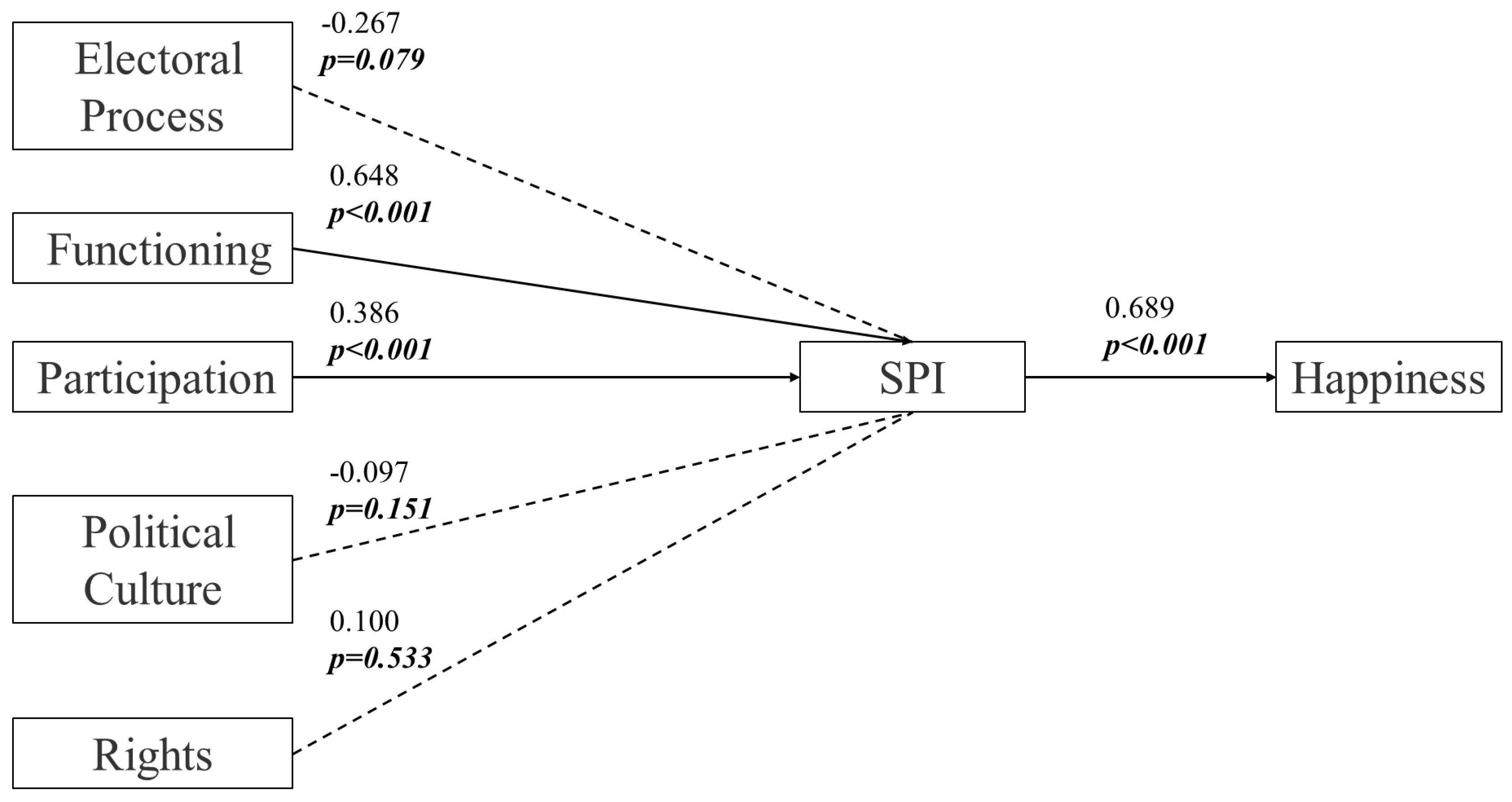
Two mediation analyses were conducted on all these variables, obtaining the results shown in Figure 1.
The indirect effect has a coefficient b=0.261 (SE=0.034), β=0.515, z=7.765 and p<0.001. On the other hand, the direct effect is insignificant, being b=0.063 (SE=0.050), β=0.124, z=1.270 and p=0.204. The total effect is significant, being b=0.331 (SE=0.038), β=0.658, z=8.689 and p<0.001. The total model has an R2=0.654, with an F=123.578 and a p<0.001.
4.3.2. Specific Mediation Analysis
Following the fourth hypothesis, the mediation model was specified to examine the predictive relationship between the democratic quality sub-indices and happiness, mediated by social progress (n=167).
Table 5.
Indirect, direct and total effects of specific mediation model.
| Type | Effect | Estimate | SE | β | z | p |
| Indirect | PR ⇒ SPI_FIX ⇒ HP | -0.057 | 0.033 | -0.184 | -1.707 | 0.088 |
| F ⇒ SPI_FIX⇒ HP | 0.202 | 0.046 | 0.446 | 4.354 | <.001 | |
| P ⇒ SPI_FIX ⇒ HP | 0.160 | 0.042 | 0.266 | 3.761 | <.001 | |
| C ⇒ SPI_FIX ⇒ HP | -0.043 | 0.030 | -0.067 | -1.428 | 0.153 | |
| R ⇒ SPI_FIX ⇒ HP | 0.030 | 0.048 | 0.069 | 0.619 | 0.536 | |
| Direct | PR ⇒ HP | -0.069 | 0.046 | -0.222 | -1.504 | 0.133 |
| F ⇒ HP | 0.078 | 0.064 | 0.172 | 1.223 | 0.221 | |
| P ⇒ HP | -0.009 | 0.064 | -0.015 | -0.138 | 0.891 | |
| C ⇒ HP | -0.004 | 0.039 | -0.007 | -0.112 | 0.911 | |
| R ⇒ HP | 0.097 | 0.069 | 0.226 | 1.402 | 0.161 | |
| Total | PR ⇒ HP | -0.097 | 0.062 | -0.315 | -1.564 | 0.118 |
| F ⇒ HP | 0.267 | 0.068 | 0.590 | 3.953 | <.001 | |
| P ⇒ HP | 0.112 | 0.078 | 0.186 | 1.436 | 0.151 | |
| C ⇒ HP | -0.041 | 0.057 | -0.064 | -0.728 | 0.466 | |
| R ⇒ HP | 0.134 | 0.089 | 0.311 | 1.506 | 0.132 |
The model threw a R2=0.668, with an F=42.678 statistic and a p<0.001 value. Of all the effects, only three are significant: The indirect effects of the functioning of government (p<0.001) and to a lesser degree political participation (p<0.001), and the total effect of the functioning of government on happiness (p<0.001). When comparing the mediation models, both yield highly similar measures of model fit (general mediation: R² = 0.654; mediation with subindices: R² = 0.668).
The general model offers a more parsimonious specification with comparable fit, as it includes only a single predictor-the aggregate democracy index-whereas the specific model incorporates multiple predictors, most of which do not make a statistically meaningful contribution to explaining the dependent variable. Nevertheless, the specific model provides a more comprehensive depiction of the relationships among democratic components, social progress, and happiness. It identifies which of these components exhibit statistically significant associations with the happiness index, both directly and indirectly through the Social Progress Index.
Figure 2.
Standardised coefficients of the Specific Mediation Model.
5. Discussion and Conclusions
The findings of this study demonstrate that democratic quality, social progress, and happiness exhibit statistically significant associations across the sample of 167 countries under examination. To begin with, the initial hypothesis-according to which higher levels of democratic quality would be associated with greater levels of happiness-receives only partial empirical support. The simple regression model reveals a positive association between both indicators; however, the model’s predictive adequacy remains moderate. This pattern aligns with prior scholarship that has documented positive linkages between these constructs (Helliwell et al., 2023; Paleologou, 2022), while simultaneously indicating that additional determinants must be incorporated to more fully account for cross-national variation in subjective well-being.
The analysis of the subdimensions of the Democracy Index yields more differentiated insights. Among the institutional components assessed, only the functioning of government exhibits a direct and statistically significant association with happiness, whereas the remaining dimensions show either weak or non-significant relationships. This configuration suggests that institutional features related to governmental effectiveness, accountability, and political stability bear a closer relationship to a country’s average well-being than other facets of formal democratic structure (Bromo et al., 2024; Ott, 2010). Nonetheless, the presence of multicollinearity, even if it does not exceed critical values, must be considered, as it can distort the model statistics. Nevertheless, the large sample size and the stability of the standard errors used ensure that, despite the presence of such multicollinearity, it does not pose a serious problem for the integrity of the model (Miles, 2014; Richardson & Machan, 2021). Future research should use statistical procedures that allow for the smoothing of such multicollinearity, in combination with other statistical strategies, such as longitudinal analysis, among others (Rahman & Nahar, 2017).
The mediation analysis offers a more integrated perspective on the relationships under examination. The third hypothesis, which proposed that the association between democratic quality and happiness would be mediated by social progress, is empirically substantiated by the aggregate model: the indirect effect through the Social Progress Index is statistically significant, whereas the direct effect loses statistical relevance. This pattern indicates that social progress constitutes a central component of the relational structure linking democracy and well-being. Put differently, cross-national differences in well-being appear to be more closely associated with levels of social progress than with democratic quality per se.
The specific mediation model based on the Democracy Index subdimensions further identifies which democratic attributes are most closely tied to this mechanism. The findings show that the functioning of government-and, to a lesser extent, political participation-exhibits significant indirect associations with happiness through social progress. This suggests that particular institutional features-such as administrative capacity, governmental stability, or levels of citizen participation-may be associated with contexts that foster higher levels of social progress, which, in turn, are linked to elevated levels of subjective well-being (Ott, 2010; Samreen, 2019). However, the models employed do not allow for establishing directionality nor for ruling out bidirectional relationships; therefore, these associations must be interpreted cautiously and in non-causal terms, given the correlational nature of the study.
Taken together, our findings carry substantive relevance for the scholarly understanding of democracy and well-being in two principal respects: Firstly, they provide evidence that the associations between democracy and well-being are not accounted for solely by the presence of formal rights or civil liberties, but also by structural conditions linked to social progress(Ott, 2010; Samreen, 2019). Secondly, they allow for a disaggregation of the relative contribution of the various dimensions of democracy, demonstrating that not all of them are related to well-being in the same manner. These contributions partially address the gap identified in the literature, which has typically examined the democracy–happiness relationship in an aggregate fashion and through simplified models, without incorporating explanatory mechanisms or assessing institutional subcomponents (Bromo et al., 2024; Ott, 2010) These results should be understood as a point of departure for research employing longitudinal designs or micro-level data capable of capturing the underlying social processes with greater precision (Bromo et al., 2024; Collado, 2024). Similarly, the incorporation of additional cultural or contextual measures would help refine our understanding of these associations, given that levels of subjective well-being may be shaped by cultural norms, social expectations, and survey response tendencies that are not fully captured by national-level indicators (Helliwell et al., 2023; Ott, 2010).
6. Statements and Declarations
The authors declare that this study is entirely original and complies with the guidelines of the journal and the publisher. In this work, social big data from completely public and transparent countries have been used. Thus, the authors consider that no specific ethical consent is necessary. The authors did not receive support from any organization for the submitted work. Also, the authors declare they have no financial interests. The authors have no competing interests to declare that are relevant to the content of this article.
Data Availability
All data used are from secondary sources publicly available for use. The data used in this research are available as follows:
- a)
- The data for the Happiness Index are available at: https://worldhappiness.report/ed/2023/
- b)
- The data for the Social Progress Index are available upon request from the authors of said index in Harmacek, J., Krylova, P., Htitich, M.: 2022 Social Progress Index Data. The imperative of social progress. Washington, DC. Available at www.socialprogress.org
- c)
- The data for the Democracy index and its sub-indicators are available in The Economist Reports for the years 2020, 2021 and 2022, all of these reports being completely public.
References
- Akgun, A. İ.; Türkoğlu, S. P.; Erikli, S. Investigating the determinants of happiness index in EU-27 countries: A quantile regression approach. International Journal of Sociology and Social Policy 2023, 43(1/2), 156–177. [Google Scholar] [CrossRef]
- Bromo, F.; Pacek, A. C.; Radcliff, B. Varieties of democracy and life satisfaction: Is there a connection? Social Science Quarterly 2024, 105(4), 1152–1163. [Google Scholar] [CrossRef]
- Collado, Z. C. Does the intensity of conflict-Induced internal displacement influence national happiness scores? The Social Science Journal 2024, 1–9. [Google Scholar] [CrossRef]
- Coppedge, M.; Gerring, J.; Knutsen, C. H.; Lindberg, S. I.; Teorell, J.; Marquardt, K. L.; Medzihorsky, J.; Pemstein, D.; Pernes, J.; Von Römer, J.; Stepanova, N.; Tzelgov, E.; Wang, Y.; Wilson, S. L. V-Dem Methodology V9. SSRN Electronic Journal 2019. [Google Scholar] [CrossRef]
- Democracy Index 2022; Economist Intelligence Unit, 2022; Available online: https://www.eiu.com/n/campaigns/democracy-index-2022/.
- Diener, E. Subjective well-being. Psychological Bulletin 1984, 95(3), 542–575. [Google Scholar] [CrossRef]
- Enders, C. K. A Primer on Maximum Likelihood Algorithms Available for Use With Missing Data. Structural Equation Modeling: A Multidisciplinary Journal 2001, 8(1), 128–141. [Google Scholar] [CrossRef] [PubMed]
- Estes, R. J. The Index of Social Progress: Objective Approaches (3). In Global Handbook of Quality of Life; Glatzer, W., Camfield, L., Møller, V., Rojas, M., Eds.; Springer Netherlands, 2015; pp. 159–205. [Google Scholar] [CrossRef]
- Fehder, D.; Porter, M.; Stern, S. The Empirics of Social Progress: The Interplay between Subjective Well-Being and Societal Performance. AEA Papers and Proceedings 2018, 108, 477–482. [Google Scholar] [CrossRef]
- Felice, E. Historia económica de la felicidad: Una nueva visión de la historia del mundo; Critica, 2020. [Google Scholar]
- Folk, D.; Dunn, E. How Can People Become Happier? A Systematic Review of Preregistered Experiments. Annual Review of Psychology 2024, 75(1), 467–493. [Google Scholar] [CrossRef] [PubMed]
- Forgeard, M. J. C.; Jayawickreme, E.; Kern, M. L.; Seligman, M. E. P. Doing the Right Thing: Measuring Well-Being for Public Policy. International Journal of Wellbeing 2011, 1(1). [Google Scholar] [CrossRef]
- Global Index: Methodology; Social Progress Imperative, 2021; Available online: https://www.socialprogress.org/index/global/methodology/.
- Graham, J. W. Missing Data Analysis: Making It Work in the Real World. Annual Review of Psychology 2009, 60(1), 549–576. [Google Scholar] [CrossRef] [PubMed]
- Helliwell, J. F. Three questions about happiness. Behavioural Public Policy 2020, 4(2), 177–187. [Google Scholar] [CrossRef]
- Helliwell, J. F.; Layard, R.; Sachs, J. D.; Neve, J.-E. D.; Aknin, L. B.; Wang, S. World Happiness Report 2023. 20 March 2023. Available online: https://worldhappiness.report/ed/2023/.
- Miles, J. Tolerance and Variance Inflation Factor. In Wiley StatsRef: Statistics Reference Online, 1st ed.; Kenett, R. S., Longford, N. T., Piegorsch, W. W., Ruggeri, F., Eds.; Wiley, 2014. [Google Scholar] [CrossRef]
- O’Connor, K. J. Happiness and Welfare State Policy Around the World. Review of Behavioral Economics 2017, 4(4), 397–420. [Google Scholar] [CrossRef]
- Okulicz-Kozaryn, A.; Valente, R. R. The Impact of Covid19 on the Urban–Rural Happiness. Applied Research in Quality of Life 2024. [Google Scholar] [CrossRef]
- Ott, J. C. Good Governance and Happiness in Nations: Technical Quality Precedes Democracy and Quality Beats Size. Journal of Happiness Studies 2010, 11(3), 353–368. [Google Scholar] [CrossRef]
- Paleologou, S.-M. Happiness, democracy and socio-economic conditions: Evidence from a difference GMM estimator. Journal of Behavioral and Experimental Economics 2022, 101, 101945. [Google Scholar] [CrossRef]
- Piketty, T. Una breve historia de la igualdad; Deusto, 2021. [Google Scholar]
- Rahman, M. Statistical analysis of democracy index. Humanomics 2014, 30(4), 373–384. [Google Scholar] [CrossRef]
- Rahman, M.; Nahar, S. Variance and Time Series Analysis of Democracy Index. Journal of Education, Society and Behavioural Science 2017, 23(4), 1–12. [Google Scholar] [CrossRef]
- Richardson, P.; Machan, L. Jamovi for psychologists; Red globe press, 2021. [Google Scholar]
- Samreen, I. Does social development increase the happiness level? Evidence from global panel data. Turkish Economic Review 2019, 6(4), 320–334. [Google Scholar] [CrossRef]
- Seligman, M. E. P. Flourish: A visionary new understanding of happiness and well-being (1. Free Press hardcover ed); Free Press, 2011. [Google Scholar]
- Sen, A.; Stiglitz, J.; Paul Fitoussi, J. Mis-measuring our lives: Why GDP doesn’t add up? 2010.
- Stiglitz, J. E.; Sen, A.; Fitoussi, J.-P. (Eds.) Mismeasuring our lives: Why GDP doesn’t add up; New Press, 2010. [Google Scholar]
- Sze, K. Y. P.; Ho, S. Y.; Lai, A. Y. K.; Sit, S. M. M.; Lam, T. H.; Wang, M. P. Socioeconomic Disparities in Family Well-Being, Family Communication Quality, and Personal Happiness among Chinese: Findings from Repeated Cross-Sectional Studies in 2016–2023. Applied Research in Quality of Life 2024, 19(6), 3357–3375. [Google Scholar] [CrossRef]
- Wilkinson, R.; Pickett, K. Desigualdad. Un análisis de la (in)felicidad colectiva; Turner, 2009. [Google Scholar]
- Woodside, A. G.; Mir-Bernal, P.; Sádaba, T. How democracy and authoritarianism impact nations’ QOL and happiness: Applying complexity theory tenets in building and testing case-based models. Journal of Innovation & Knowledge 2023, 8(4), 100428. [Google Scholar] [CrossRef]
- Wu, T.; Kim, S. Y.; Westine, C. Evaluating the Effects of Missing Data Handling Methods on Scale Linking Accuracy. Educational and Psychological Measurement 2023, 83(6), 1202–1228. [Google Scholar] [CrossRef] [PubMed]
Figure 1.
Standardised coefficients of the General mediation model between democratic quality, happiness and modified social progress.
Figure 1.
Standardised coefficients of the General mediation model between democratic quality, happiness and modified social progress.
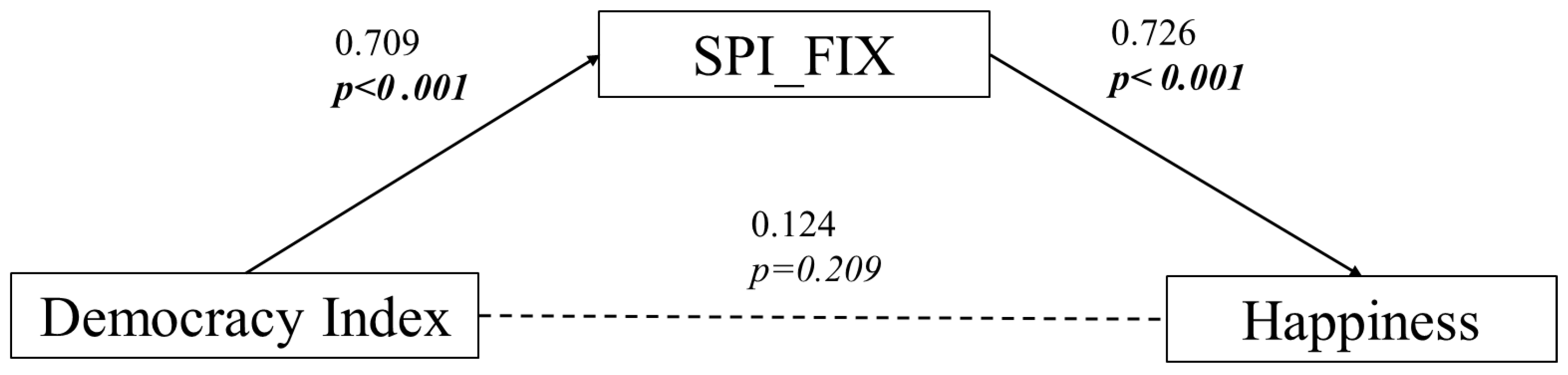
Table 1.
Sub-indices of the democracy index.
| Sub-index | Explanation |
|---|---|
| Electoral process and pluralism (PR) | Evaluates the quality of electoral processes, including political competence, transparency, freedom of expression and electoral participation. |
| Functioning of government (F) | Examines the effectiveness and accountability of government, political stability, quality of public administration and separation of powers. |
| Political participation (P) | Measures citizen participation and commitment regarding the political process, including participation in political parties, civil organisations and capacity to influence political decisions. |
| Political culture (C) | Analyses the degree of respect for political rights, democratic culture, trust in institutions tolerance towards diverse political opinions. |
| Civil rights and liberties (R) | Evaluates respect for human rights and fundamental liberties, including freedom of expression, freedom of the press, gender equality and individual rights. |
Table 3.
Mean, median and standard deviation of democracy, modified social progress and happiness.
| N | Missing | Mean | Median | SD | |
| Happiness | 137 | 37 | 5.540 | 0.097 | 5.684 |
| SPI | 169 | 5 | 65.908 | 1.149 | 67.093 |
| SPI_FIX | 169 | 5 | 64.354 | 1.220 | 66.716 |
| Democracy (DE) | 167 | 7 | 5.315 | 0.178 | 5.627 |
| Process (PR) | 167 | 7 | 5.656 | 0.292 | 7.000 |
| Functioning (F) | 167 | 7 | 4.672 | 0.200 | 5.000 |
| Participation (P) | 167 | 7 | 5.406 | 0.150 | 5.560 |
| Culture (C) | 167 | 7 | 5.417 | 0.139 | 5.210 |
| Rights (R) | 167 | 7 | 5.429 | 0.210 | 5.687 |
Table 4.
Pearson correlation coefficients between democracy, modified social progress and happiness.
Table 4.
Pearson correlation coefficients between democracy, modified social progress and happiness.
| HP | SPI | SPI_FIX | DE | PR | F | P | C | |
| HP | — | |||||||
| SPI | 0.822*** | — | ||||||
| SPI_FIX | 0.804*** | 0.978*** | — | |||||
| DE | 0.642*** | 0.804*** | 0.705*** | — | ||||
| PR | 0.543*** | 0.713*** | 0.613*** | 0.943*** | — | |||
| F | 0.674*** | 0.810*** | 0.730*** | 0.917*** | 0.817*** | — | ||
| P | 0.548*** | 0.725*** | 0.665*** | 0.871*** | 0.806*** | 0.725*** | — | |
| C | 0.481*** | 0.552*** | 0.470*** | 0.723*** | 0.523*** | 0.662*** | 0.564*** | — |
| R | 0.612*** | 0.763*** | 0.656*** | 0.961*** | 0.914*** | 0.852*** | 0.798*** | 0.647*** |
Nota. * p < .05, ** p < .01, *** p < .001.
Disclaimer/Publisher’s Note: The statements, opinions and data contained in all publications are solely those of the individual author(s) and contributor(s) and not of MDPI and/or the editor(s). MDPI and/or the editor(s) disclaim responsibility for any injury to people or property resulting from any ideas, methods, instructions or products referred to in the content. |
© 2026 by the authors. Licensee MDPI, Basel, Switzerland. This article is an open access article distributed under the terms and conditions of the Creative Commons Attribution (CC BY) license.
Copyright: This open access article is published under a Creative Commons CC BY 4.0 license, which permit the free download, distribution, and reuse, provided that the author and preprint are cited in any reuse.


