
Submitted:
24 June 2026
Posted:
25 June 2026
You are already at the latest version
Abstract
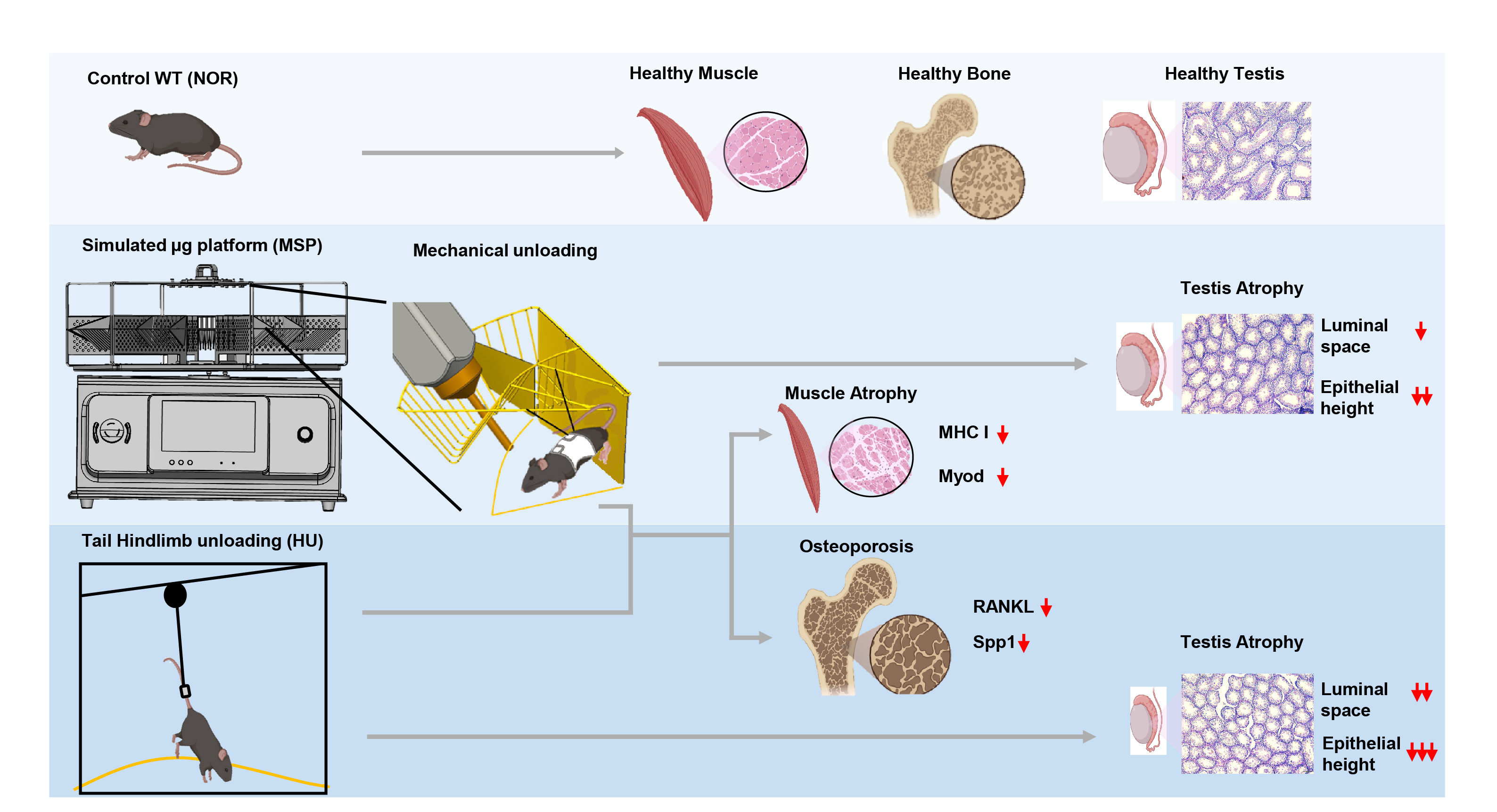
Ground-based analog models, such as the Hindlimb Unloading (HU) technique, have been used for several decades in simulating microgravity effects on musculoskeletal studies. However, in several aspects, this model has seen limited technological advancement. Here is the design and validation of Microgravity Simulated Platform (MSP), a refined evolution of the classic HU model. The multipurpose engineered MSP apparatus is designed to overcome key limitations of existing models by enabling simultaneous study of larger number of mice in compact space, with less lesion and inflammation and with advanced central axis rotation control for hypergravity like studies. It presents a comparative analysis with HU and Normal WT (NOR) group and demonstrated that the MSP recapitulates the classic physiological markers of disuse observed during spaceflight, particularly in the musculoskeletal system. Critically, results indicates that the MSP not only provides a comparable simulation of microgravity-induced effects but also offers enhancements in experimental consistency and animal well-being. In conclusion, MSP represents a significant advancement in ground-based space life sciences research, providing a more refined, efficient, high-throughput, and extensible platform for elucidating the pathophysiological mechanisms of mechanical unloading and for testing prospective countermeasures.
Keywords:
simulated microgravity
; inflammation
; muscle atrophy
; muscle fiber shift
; disuse-osteoporosis
Copyright: This open access article is published under a Creative Commons CC BY 4.0 license, which permit the free download, distribution, and reuse, provided that the author and preprint are cited in any reuse.


