

Submitted:
24 June 2026
Posted:
25 June 2026
You are already at the latest version
Abstract
High-efficiency energy sources for electric vehicles and portable electronic devices require advanced lithium-ion batteries (LIBs) with high energy density, superior power capability, and long-term cycling stability. Among the various components of LIBs, the cathode material plays a pivotal role in determining the electrochemical performance, safety, and commercial viability of the battery. To meet the growing demands of modern applications, cathode materials must combine high capacity with structural stability, thermal safety, cost-effectiveness, and excellent rate capability. This article reviews the most widely used cathode materials with layered and spinel structures. Their key advantages and inherent limitations are discussed in detail, together with strategies aimed at improving their performance through elemental doping and surface coating approaches. In addition, the review summarizes facile, scalable, and cost-effective synthesis methods for these cathode materials and highlights advances characterization techniques employed to achieve a deeper understanding of their nanostructured features and electrochemical behavior.
Keywords:
lithium-ion batteries
; cathode materials
; layered structure
; spinel LiMn2O4
; polyanionic phosphates
; lithium and nickel rich oxides
; synthesis processes
1. Introduction
The persistent dependence on fossil fuels, including oil, coal, and natural gas has led to severe environmental pollution and an escalating global energy crisis. Consequently, considerable research efforts have been devoted to the development of sustainable and renewable energy resources such as solar, wind, and tidal energy. However, the intermittent and fluctuating nature of these renewable sources necessitates the advancement of efficient energy storage materials and devices to ensure stable and continuous grid supply.
Lithium-ion batteries (LIBs) have emerged as the leading rechargeable energy storage technology since their commercialization by Sony in 1991 [1]. Their widespread adoption in consumer electronics portable devices, and electric vehicles stems from a unique combination of desirable properties, including high energy density, long cycle life, high efficiency, lightweight construction, environmental compatibility, and relatively low maintenance requirements [2]. Unlike primary cells, which are designed for single-use applications, LIBs are secondary batteries that rely on reversible electrochemical reactions, enabling repeated charge–discharge cycles and prolonged operational lifespan. The conceptual foundation of rechargeable lithium batteries can be traced back to the early 1970s, when Whittingham introduced TiS2 as a cathode material coupled with lithium metal as the anode [3,4]. This pioneering work demonstrated the feasibility of lithium intercalation chemistry and marked the beginning of modern rechargeable lithium battery research. Shortly thereafter, Besenhard proposed the use of graphite as a host anode material in combination with transition-metal oxide cathodes, thereby contributing to the development of safer and more stable electrochemical systems [5]. A significant breakthrough was achieved in 1979, when Goodenough and Mizushima successfully employed layered LiCoO2 as a cathode material, establishing the technological foundation for modern lithium-ion batteries [6]. These pioneering contributions collectively accelerated the advancement and commercialization of LIB technology. As illustrated in Figure 1 and summarized in Table 1, comparative analyses demonstrate that LIBs outperform conventional secondary batteries in terms of energy density, power capability, energy efficiency, and low self-discharge behavior. Such superior electrochemical characteristics firmly establish LIBs as the dominant rechargeable power source for portable electronic devices and next-generation energy storage systems [7]. Furthermore, their high energy density, compact size, and lightweight configuration make LIBs particularly attractive for advanced applications, including electric vehicles (EVs) and hybrid electric vehicles (HEVs), and large-scale renewable energy storage technologies.
This review examines recent advancements in Li-ion battery cathode materials in depth, including lithiated oxides with rock-salt, spinel, and olivine structure, and their derivatives. Their key advantages and inherent limitations are discussed in detail, together with strategies aimed at improving their performance through elemental doping and surface coating approaches. In addition, facile, scalable, and cost-effective synthesis methods for these cathode materials and highlights advances characterization techniques employed to achieve a deeper understanding of their nanostructured features and electrochemical behavior are discussed.
Figure 1.
Comparison of energy density of lithium-ion batteries with other types of batteries.
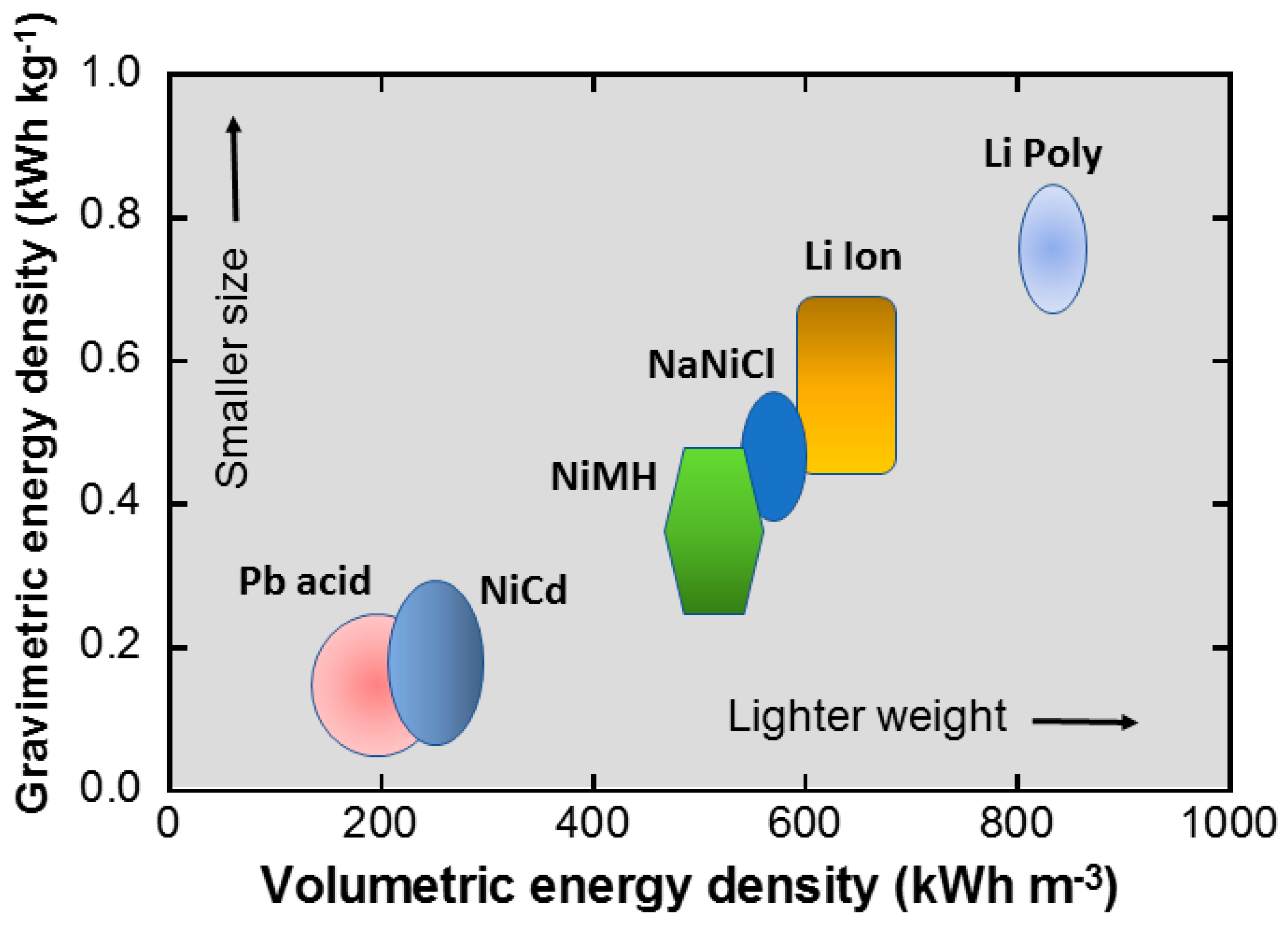

Table 1.
Comparison between LIBs with other types of batteries.
| Battery | Specific energy (Wh kg−1) |
Energy density (Wh L−1) |
Specific power (W kg−1) |
Cycle life (cycles) |
|---|---|---|---|---|
| Pb-acid Ni-Cd Ni-MH Li-ion Li-polymer |
30–45 40–60 60-70 90-130 155 |
60-90 80-110 130-170 140-200 220 |
200-300 150-350 150-300 250-450 315 |
400-600 600-1200 300 800-1200 600 |
2. Components and Function of LIBs
Like other rechargeable battery systems, lithium-ion batteries are secondary electrochemical cells that convert the chemical energy stored in its active materials into electrical energy. A typical LIB cell is composed of a positive electrode (cathode) and a negative electrode (anode), separated by a porous separator soaked with an electrolyte solution [8]. In conventional LIBs, both electrodes act as host materials capable of reversibly intercalating and deintercalating lithium ions during charge and discharge processes (Figure 2). Graphitic carbon is commonly used as the anode material, whereas lithium transition-metal oxides such as LiMO2, (M = Co, Mn, or Ni) are widely employed as cathode materials. The separator plays a crucial role in ensuring battery safety and performance by preventing direct physical contact between the electrodes, thereby avoiding short circuits, while still permitting the transport of lithium ions through the electrolyte. The electrolyte, generally composed of a lithium salt dissolved in an organic solvent serves as an ionic conductor that facilitates ion migration between the electrodes, while remaining electronically insulating [9].
During the charging process of a LIB, Li+ ions migrate from the cathode, which progressively becomes a lithium-deficient LiMO2 compound, toward the anode, where lithium is stored, resulting in a lithium-rich phase. This migration occurs through the electrolyte under the influence of an external power source, and is accompanied by the oxidation (delithiation) of the cathode material. During discharge, the reverse process takes place: lithium ions move back to the cathode through lithiation (reduction), thereby restoring the initial chemical composition of the electrode materials. The specific capacity of a LIB is primarily determined by the amount of lithium that can be reversibly extracted and reinserted into the cathode structure, as well as by the kinetics of these processes. Consequently, both the energy capacity and the operating voltage of the battery are strongly dependent on the structural, electronic, and chemical properties of the cathode material. This highlights the central role of the cathode in governing the overall electrochemical performance of LIBs. In addition to this electrochemical importance, the cathode also represents one of the most expensive components of LIBs, often accounting for more than half of the total manufacturing cost. For this reason, extensive research efforts have been dedicated to the development of new cathode materials with superior electrochemical properties, and to the optimization of existing compounds in order to enhance energy density, cycling stability, safety, and cost-effectiveness [10].
3. Cathode Materials for Rechargeable LIBs
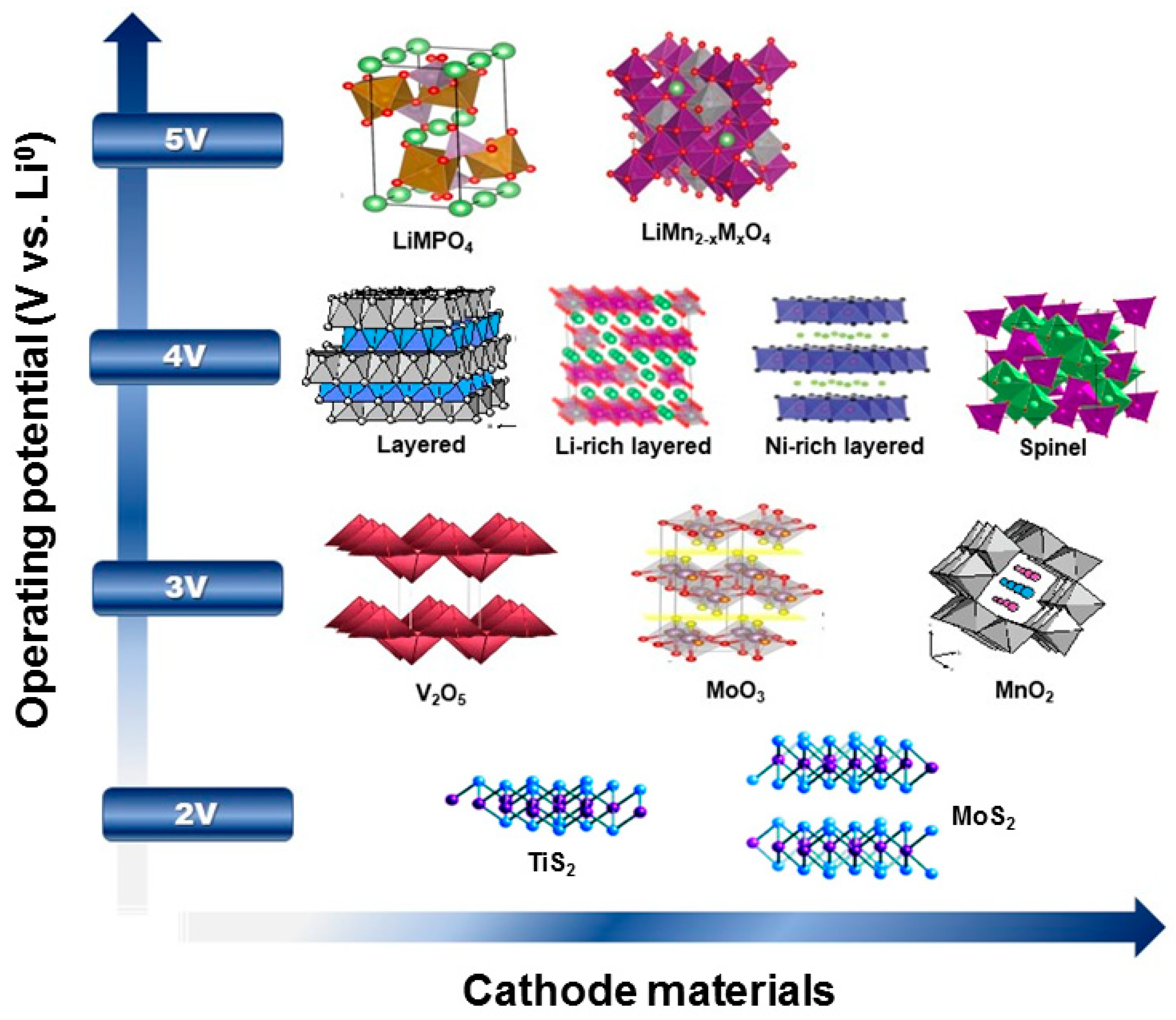
Based on their average operating voltage versus metallic lithium, cathode materials can generally be classified into four main categories, as illustrated in Figure 3.
- (I)
- Low-voltage (∼2 V) cathode materials: This category includes layered transition-metal dichalcogenides with two-dimensional (2D) structures, such as titanium disulfide (TiS2) and molybdenum disulfide (MoS2). These materials are initially unlithiated and therefore require lithium insertion during the first discharge cycle in order to become electrochemically active.
- (II)
- Intermediate-voltage (∼3 V) cathode materials: Representative materials in this group include manganese dioxide (MnO2), molybdenum trioxide (MoO3), lithium iron phosphate (LiFePO4), and vanadium-based oxides such as V2O5 and LiV3O8. Similar to the low-voltage class, several of these compounds are initially unlithiated and undergo lithiation during the first discharge process. Among them, LiFePO4 has attracted significant attention owing to its excellent thermal stability, long cycle life, and environmental compatibility, despite its moderate operating voltage.
- (III)
- High-voltage (∼4 V) cathode materials: This category includes the most commercially successful cathode material, lithium cobalt oxide (LiCoO2), as well as other layered oxides such as lithium nickel oxide (LiNiO2), lithium nickel manganese cobalt oxide (LiNi1/3Mn1/3Co1/3O2), and nickel-rich compositions such as NMC811 (LiNi0.8Co0.1Mn0.1O2). In addition, three-dimensional (3D) spinel-structured materials, notably lithium manganese oxide (LiMn2O4) also belong to this group. These cathode materials are already lithiated and are widely valued for their high operating voltage, elevated energy density, and good cycling stability, making them highly suitable for commercial LIB applications.
- (IV)
- Ultra-high-voltage (∼5 V) cathode materials: This class comprises advanced cathode materials capable of operating at very high potentials, including olivine-type phosphates such as lithium manganese phosphate (LiMnPO4) and lithium cobalt phosphate (LiCoPO4), as well as spinel compounds of the form Li2MxMn4-xO8 (where M = Fe, Co). Owing to their robust three-dimensional frameworks, these materials exhibit enhanced structural stability during lithium insertion and extraction processes. Although still under active development, ultra-high-voltage cathodes are considered promising candidates for next-generation lithium-ion batteries due to their potential to significantly increase energy density and operating voltage.
Collectively, these cathode materials, which encompass one-dimensional (1D), two-dimensional (2D), and three-dimensional (3D) structural frameworks, have been extensively studied and widely implemented in commercial LIB technologies. Their diverse structural structures and electrochemical properties provide a broad range of performance characteristics, enabling the development of batteries tailored for specific applications, from portable electronics to electric vehicles and large-scale energy storage systems. Continued advances in cathode material design and optimization remain central to improving the energy density, safety, cycling stability, and cost-effectiveness of next-generation LIBs.
Figure 3.
Scheme for different cathode materials based on operating potential vs. lithium.
The performance, safety, and service life of LIBs are strongly governed by the intrinsic properties of the cathode material. To achieve high electrochemical performance and practical viability, cathode materials must satisfy several key essential requirements:
- Large lithium chemical potential difference: A substantial potential difference between the cathode and anode is necessary to obtain a high cell voltage and, consequently, a high energy output.
- High lithium-ion storage capability: The cathode should be capable of reversibly accommodating a large quantity of lithium ions per formula unit in order to maximize the specific capacity of the battery.
- Structural stability during cycling: The crystal structure of the cathode material must remain stable throughout repeated lithium intercalation and deintercalation processes to ensure long cycle life and reliable rechargeability.
- Efficient electronic and ionic transport: High electronic conductivity and rapid lithium-ion diffusion are essential for improving charge–discharge kinetics and reducing internal resistance.
- Electrochemical and thermal stability: Cathode materials must remain chemically and structurally stable within the operating voltage and temperature ranges, particularly in contact with the electrolyte, in order to minimize side reactions and material degradation.
- Low Cost and environmental compatibility: For large-scale commercialization and sustainable deployment, cathode materials should be economically feasible, abundant, and environmentally benign.
- Highly reversible Li+ intercalation/deintercalation: The insertion and extraction of lithium should occur reversibly at a sufficiently high redox potential to ensure both high energy efficiency and prolonged cycling performance.
The continued development and widespread adoption of LIBs therefore depend strongly on advances in cathode materials that simultaneously deliver high energy density, enhanced safety, and economic viability [11]. Figure 4 presents the relationship between cell voltage and specific capacity for a range of cathode materials, providing an overview of their respective electrochemical performance domains.
3.1. Layered Transition-Metal Oxides LiMO2 (4V)
Layered transition-metal oxides with the general formula LiMO2 (where M = Co, Mn, Ni) constitute the most extensively utilized class of cathode materials in commercial rechargeable lithium-ion batteries. Their two-dimensional layered crystal structure enables reversible lithium-ion intercalation and deintercalation with high efficiency, thereby supporting high energy density and excellent electrochemical performance. Owing to their relatively high operating voltage (~4 V), favorable cycling behavior, and mature synthesis routes, these materials have become central to the development of high-performance LIB technologies.
3.1.1. Lithium Cobalt Oxide (LiCoO2, LCO)
Lithium cobalt oxide (LCO) was first proposed as a reversible lithium insertion material by the group of John Goodenough in 1980 [6], and was later employed by Akira Yoshino in the prototype rechargeable lithium-ion battery introduced in 1986 [13]. Since then, LCO has remained one of the most extensively investigated and commercially utilized cathode materials in the LIB technology owing to its well-defined layered structure and reliable electrochemical performance. LCO is typically synthesized at temperatures around 750 °C, forming a layered trigonal structure (often referred to as hexagonal) with the space group Rm [14]. In this structure, Li+ and Co3+ ions occupy the octahedral 3a and 3b sites, respectively, and are separated by layers of cubic close-packed oxygen ions. As illustrated in Figure 5, the O3-type LCO unit cell consists of three slabs of edge-sharing CoO6 octahedra alternating with lithium layers, thereby creating a stable layered framework [15]. During discharge (lithiation), LCO preserves its hexagonal structure. Upon charging, lithium ions are extracted from the lattice, to form Li1₋ₓCoO2 compounds, accompanied by the oxidation of Co3+ ions to maintain charge neutrality. However, when more than approximately 50% of the lithium is removed, a structural phase transition from the hexagonal to a monoclinic structure occurs, leading to reduced structural stability and diminished electrochemical reversibility. This intrinsic structural instability, combined with the high cost and limited thermal safety associated with cobalt-based materials, represents one of the principal limitations of LCO cathodes. Consequently, the practical specific capacity of LCO is generally restricted to approximately 140 mAh g-1, which corresponds to nearly half of its theoretical capacity (280 mAh g−1), since deeper delithiation accelerates structural degradation and compromises cycling stability.
Despite its widespread commercial application, lithium cobalt oxide (LiCoO2, LCO) exhibits several critical limitations, including structural instability at high states of charge, high cost associated with cobalt content, and significant safety concerns under abusive operating conditions. These shortcomings have motivated extensive research efforts toward the development of alternative cathode materials as well as modification strategies aimed at improving the electrochemical performance and stability of LCO. Among the various approaches investigated, elemental doping has proven particularly effective. Substitutional doping with main-group elements such as Al, Mg, and B, as well as and transition metals including Ti, Mn, Cr, and Fe, has been reported to enhance structural stability, suppress detrimental phase transitions, and improve capacity retention during cycling. In parallel, surface coating with metal oxides can effectively reduce electrolyte decomposition and minimize interfacial resistance, thereby stabilizing LCO at elevated operating voltages. Through these combined strategies, optimized LCO-based cathodes have demonstrated discharge capacities exceeding 200 mAh g−1 under carefully controlled conditions [16,17,18,19]. This enhancement is primarily attributed to the stabilization of the crystal lattice and the suppression of detrimental phase transitions during cycling. Figure 6 illustrates the electrochemical behavior of a nanostructured LiCoO2 electrode synthesized via the sol-gel method. Within the voltage window 2.5 ‒ 4.3 V, the charge/discharge profiles exhibit the characteristic plateau at approximately 3.92 V, corresponding the first phase transition H1→H2 associated to a semiconductor-to-metal transition (Figure 6a). For cells cycled between 3.6 and 4.2 V, the reversible capacity remains relatively stable over repeated cycles. In contrast, a pronounced capacity fading is observed when the upper cutoff voltage is extended to 3.6 ‒ 4.5 V, mainly due to oxygen loss and structural degradation induced by deep lithium extraction (Figure 6b).
3.1.2. Lithium Nickel Oxide (LNO)
Lithium nickel oxide (LiNiO2, LNO) was first introduced as a cathode material by Dyer et al. [20]. Owing to the replacement of Co3+ with Ni3+ while preserving the same layered crystal framework as LiCoO2, LNO was initially regarded as a lower-cost and potentially safer alternative to lithium cobalt oxide, as illustrated in Figure 5. LNO exhibits an average operating voltage of approximately 4 V, together with a high theoretical specific capacity of nearly 250 mAh g−1 and an electrode density of about 3.3 g cm−3, making it an attracting candidate for high-energy-density lithium-ion batteries [21,22]. Despite these promising characteristics, the practical application of LNO has been significantly limited by several intrinsic challenges. One of the major difficulties lies in synthesizing LNO with the ideal layered Rm structure. During synthesis, nickel ions tend to migrate into lithium sites because the ionic radii of Ni2+ and Li+ are relatively similar. This cation mixing disrupts the layered ordering, hinders lithium-ion diffusion, and deteriorates electrochemical performance [23]. Furthermore, LNO suffers from structural instability at high states of delithiation, leading to phase transitions, surface degradation, and poor cycling stability [24]. Thermal instability and high reactivity with the electrolyte at elevated voltages also raise safety concerns, thereby restricting its widespread commercial implementation. To overcome these limitations, numerous strategies have been investigated, including surface coating and partial substitution with other metal ions such as manganese (Mn), cobalt (Co), and aluminum (Al). These modifications are intended to suppress cation disorder, reinforce structural stability, and enhance electrochemical performance. More recently, Huang et al. examined the effect of introducing a small amount (1 mol%) of niobium (Nb5+) into LNO. Owing to its high valence state, relatively large ionic radius (0.64 Å), and strong Nb–O bonding, Nb doping effectively reduced Ni2+/Li+ cation mixing and improved the structural stability of the layered framework. The modified compound, LiNi0.99Nb0.01O2, demonstrated enhanced electrochemical performance, including a capacity retention of 91.4% after 100 cycles at 0.5C, and an excellent rate capability of 143 mAh g−1 at 5C, In comparison, the pristine LCO exhibited only 69.2% capacity retention and a discharge capacity of 127 mAh g−1under identical conditions. These results highlight the effectiveness of targeted doping strategies in mitigating the inherent drawbacks of LNO and improving its suitability for high-performance LIB applications [25].
In another study, Wei et al. proposed a lanthanum-doping strategy to stabilize the lattice oxygen in LNO cathodes for highly durable LIBs. The incorporation of La into Ni sites strengthened the transition metal–oxygen bonding and mitigated charge compensation effects, thereby improving the structural stability of the layered framework. The optimized 2 wt.% La-doped LNO electrode delivered a reversible specific capacity of approximately 160 mAh g−1 after 100 cycles at 1C, together with an excellent capacity retention of 94.2% (Figure 7). Density functional theory (DFT) calculations further confirmed the beneficial role of La doping on the electronic structure of LNO. In particular, the substitution of Ni by La reduced the space-charge polarization within the La–O bonds and shifted the d-band center of La-doped LNO toward higher energy levels, thereby contributing to enhanced lattice stability and improved electrochemical performance [26].
3.1.3. Lithium Manganese Oxides (LM’O)
Lithiated manganese oxide (LiMnO2, LM’O) has attracted significant interest as a cathode material because of the natural abundance, low cost, and environmental friendliness of manganese-based compounds. In addition to these advantages, LM’O is electrochemically active and exhibits a high theoretical capacity of approximately 285 mAh g−1. Structurally, LiMnO2 can exist in two principal polymorphic forms: a zigzag-type orthorhombic phase with Pmnm symmetry and a monoclinic phase with C2/m symmetry. To improve structural stability during cycling and to alleviate problems associated with poor crystallinity, considerable efforts have been devoted to the synthesis of stoichiometric layered LM’O materials. Nevertheless, similar to LiNiO2 (LNO), obtaining phase-pure LM’O with a stable layered structure remains challenging. Furthermore, compared with LiCoO2, LM’O exhibits lower structural stability during the charging process, mainly due to the tendency of manganese ions to undergo structural rearrangements and phase transformations upon lithium extraction. These instabilities adversely affect cycling performance and have limited the large-scale practical application of layered LMO cathodes [26,27].
Layered LiMnO2 also suffers from severe structural distortion during electrochemical cycling, primarily due to the Jahn–Teller activity of Mn3+ ions. During lithium extraction, the layered framework tends to transform irreversibly into spinel-like phases, resulting in rapid capacity fading and poor cycling stability. As illustrated in Figure 8, these structural transformations are accompanied by significant lattice rearrangements that deteriorate lithium-ion diffusion pathways and reduce electrochemical reversibility [28,29,30]. To address these shortcomings, various approaches have been explored, including cation substitution, nanostructuring, and surface modification. Partial substitution of Mn with transition metals such as Ni, Co, Cr, or Fe has been shown to suppress Jahn–Teller distortion and stabilize the layered structure during cycling. In addition, reducing particle size and engineering surface coatings can enhance lithium diffusion kinetics and minimize undesirable side reactions with the electrolyte. These strategies have contributed to improved cycling performance and enhanced structural stability, thereby increasing the potential of manganese-based layered oxides for next-generation lithium-ion batteries. Despite these efforts, the inherent limitations of LM’O have restricted its widespread commercialization. As a result, significant research has shifted toward the development of binary and ternary transition metal oxide systems that combine the favorable attributes of LCO, LNO, and LM’O, while mitigating their individual drawbacks. These multi-component cathode materials offer a promising pathway toward high-performance, cost-effective, and thermally stable LIB technologies.
3.1.4. Mixed Transition Metal Oxide (LiNi1-xMxO2, M=Co, Mn)
Extensive research has been devoted to the development of mixed transition-metal oxides through the partial substitution of nickel with mono- or multivalent cations, leading to the formation of solid-solution cathode materials. These substitutions are primarily aimed at improving the structural stability, electrochemical performance, thermal stability, and cycling behavior of nickel-based layered oxides. In an attempt to combine the beneficial properties of individual layered oxides while minimizing their inherent limitations, Tsutomu Ohzuku and co-workers [31] synthesized the binary layered compound LiNi0.5Mn0.5O2, which can be considered a solid solution derived from LiNiO2 and NiMnO2 in an equimolar (1:1) ratio. It attracted considerable attention due to its improved thermal stability and enhanced cycling performance compared with pure LiNiO2, while maintaining a relatively high operating voltage and capacity [32]. This cathode material employs Ni2+ as the electrochemically active species, while Mn4+ serves as a structural stabilizer. In particular, Mn4+ is believed to enhance the structural integrity of the material during repeated charge–discharge cycling [33]. Electrochemical investigations have shown that LiNi0.5Mn0.5O2 operates within a voltage range of 3.6–4.3 V, delivering specific capacities of approximately 175 mAh g−1 at 3.6 V and exceeding 250 mAh g−1 at 4.0 V [34]. The layered structure of this solid solution is characterized by the occupation of the transition-metal layers by Ni and Mn ions, while lithium ions are located in the interlayer galleries. Furthermore, doping studies have revealed a reduction in the thickness of the transition-metal layers compared with pristine samples, indicating the successful incorporation of Al3+ ions into the crystal lattice [35]. Despite its promising electrochemical performance, advanced characterizations technics including transmission electron microscopy, nuclear magnetic resonance, X-ray and neutron diffraction, as well as first-principles calculations have revealed the presence of partial cation mixing in the synthesized material, with approximately 8–10% of Ni2+ ions occupying Li+ sites within the lithium layers. Li+ and Ni2+ in the synthesized material [36,37,38]. This cation disorder is known to influence lithium-ion diffusion pathways and can adversely affect the electrochemical performance and cycling stability of the cathode material. Such cation disorder obstructs lithium-ion diffusion pathways, thereby limiting lithium extraction/insertion kinetics and reducing the rate capability of the material. Nevertheless, LiNi0.5Mn0.5O2 exhibits several significant advantages over LiCoO2, including a higher energy density, with capacities reaching approximately 200 mAh g−1 at 4 V [39], as well as enhanced thermal stability. In particular, the material maintains its structural integrity at temperatures up to 300 °C without structural degradation [40]. To further enhance the electrochemical performance of LiNi0.5Mn0.5O2, several strategies aimed at minimizing Li/Ni cation mixing have been investigated. Among them, ion-exchange synthesis methods have successfully reduced the degree of Li/Ni disorder to approximately 4%, leading to improved electrochemical performance and enhanced rate capabilities [41,42]. In addition, Al3+ doping (z = 0.03) has been reported to significantly improve electrochemical behavior of the material, increasing the third-cycle discharge capacity from 154 to 192 mAh g−1. Furthermore, nanospherical layered Li1+xNi0.5Mn0.5O2+δ materials synthesized via a rheological phase reaction method exhibit noticeable structural and morphological changes with increasing lithium content. For compositions with x = 0.1 and 0.2, the excess lithium occupies sites within the transition-metal layers, leading to the formation of a Li2MnO3-like structure. In these materials, Mn ions become electrochemically activated during the charge–discharge process, contributing to the overall capacity of the electrode. Notably, for the composition with x = 0.2, the electrode delivers a high discharge capacity of approximately 200 mAh g−1 and exhibits excellent cycling stability, with virtually no capacity decay after 100 cycles at 20 mA g−1 within a voltage window of 2.5–4.5 V [43].
To overcome the limitations associated with LiCoO2 and LiNiO2 cathode materials, considerable attention has been devoted to the synthesis of nanostructured LiNi1−yCoyO2 mixed-phase materials using wet chemistry approaches, particularly through succinic acid-assisted synthesis technique [44]. Solution-based preparation methods provide improved homogeneity at the molecular level, promoting better mixing of the constituent elements and enhanced reactivity of the precursors, thereby facilitating the formation of purer and more crystalline products (Figure 9). Pelletized LiCo1−yNiyO2 powders (0.0≤y≤0.6) were evaluated in Li//LiCo1−yNiyO2 half-cells using galvanostatic charge-discharge measurements. Among the investigated compositions, the LiCo0.6Ni0.4O2 electrode exhibited a particularly attractive electrochemical behavior, delivering a reversible capacity of approximately 150 mAh g−1 within the voltage range 2.5–4.1 V, along with a stable charge–discharge profile during cycling. Another effective involves Al3+ doping, owing to the smaller ionic radius of Al3+ compared with Ni3+ (0.535 Å versus 0.56 Å). The incorporation of Al3+ into the LiNiO2 structure contributes to improved structural stability and helps suppress overcharging-related degradation phenomena. Furthermore, theoretical calculations have predicted that Al3+ substitution increases the Li insertion potential, as the stable trivalent state of aluminum promotes stronger electronic interactions and enhanced charge compensation through oxygen redox activity [45,46]. Figure 10 illustrates the morphology, crystallographic parameters and electrochemical kinetics of nanostructured layered LixNi0.5-yAlyCo0.5O2 (0.0≤y≤0.3) cathode materials. SEM observations reveal that the incorporation of Al3+ leads to a significant reduction in particle size decreasing from approximately 350 nm for the pristine sample to nearly 80 nm for the composition with y=0.3, as shown in Figures 10a-b. The formation of smaller particles upon Al doping had already been anticipated from the broadening of the diffraction peaks, indicative of reduced crystallite dimensions. The evolution of the lattice parameters, determined by Rietveld refinement, indicates that the predominant phase corresponds to a solid solution progressively enriched with the dopant cation (Figure 10c). These structural modifications confirm the successful incorporation of Al3+ into the host lattice and suggest a strong influence of doping on both the crystal structure and microstructural properties of the cathode materials. The ahex parameter decreases with increasing y due to the substitution of larger Ni3+ ions by smaller Al3+ ions. In contrast, the chex parameter shows a slight increase, which can be attributed to structural distortion induced by the smaller and more polarizing Al3+ ions, leading to an expansion of the interlayer spacing along the c-axis. At a cut-off voltage of 4.2 V, the charge capacity of the Li//LiNi0.35Al0.15Co0.5O2 cell reaches approximately 115 mAh g−1. These results also demonstrate that Al doping enhances lithium diffusion within the LixNi0.5-yAlyCo0.5O2 framework, owing to the increase in the enlarged interlayer spacing and reduced grain size (Figure 10d).
3.1.5. Ternary Transition Metal Oxides (LiNi1₋ₓ₋ᵧMnₓCoᵧO2, NMC)
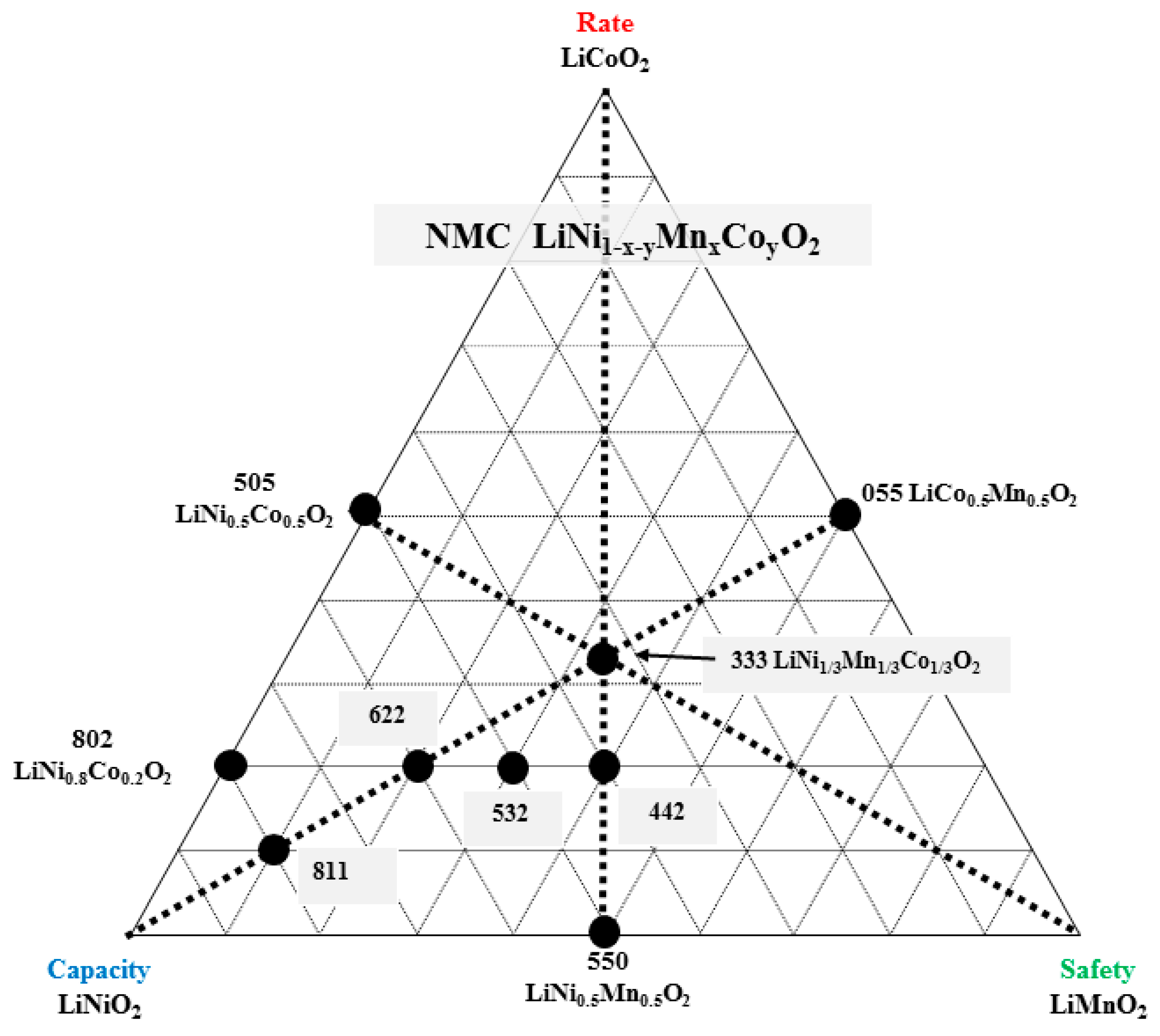
To overcome the limitations associated with single-component layered oxides, Ohzuku et al. [31] reported in 2001 the successful synthesis of a ternary solid solution composed of three transition-metal ions, Co, Mn, and Ni in equal proportions, with the general formula LiNi1₋ₓ₋ᵧMnₓCoᵧO2 (NMC). The design of this solid solution was based on the triangular phase diagram of the LiCoO2–LiNiO2–LiMnO2 system, leading to the formation of a layered two-dimensional (2D) crystal structure, as shown in Figure 11. The development of NMC materials was primarily motivated by the need to synergistically combine the advantages of Ni-, Mn-, and Co-based oxides while simultaneously alleviating their individual limitations. Electrochemical studies revealed that LiNi1/3Mn1/3Co1/3O2 (NMC333) operates at a high average voltage of approximately 4.7 V and exhibits outstanding electrochemical performance. In particular, NMC333 delivered a reversible capacity of 160 mAh g−1 within the voltage window of 2.5–4.4 V, which increased to nearly 200 mAh g−1 when cycled between 2.8–4.6 V [47].
In this system, each transition-metal ion fulfills a specific and complementary role:
- Manganese (Mn), owing to its low-cost and environmentally benignity, primarily enhances the structural stability of the cathode during cycling.
- Nickel (Ni) acts as the main electrochemically active species, increasing the specific capacity through the Ni2+/Ni4+ redox couple.
The synergistic interplay between these three transition metals has made NMC cathodes one of the most versatile and commercially successful classes of materials for LIBs, offering an effective balance between energy density, cycle life, cost, and safety.
Figure 11.
Ternary phase diagram of LiNi1-x-yMnxCoxO2 formed from LiCoO2-LiNiO2-LiMnO2 solid solution.
Figure 11.
Ternary phase diagram of LiNi1-x-yMnxCoxO2 formed from LiCoO2-LiNiO2-LiMnO2 solid solution.
During the charging process, lithium ions are extracted from the layered structure through the oxidation of Ni2+ to Ni4+ via the intermediate Ni3+, as well as the oxidation of Co3+ to Co4+. In contrast, Mn4+ remains electrochemically inactive and primarily contributes to structural stabilization during cycling. This redox behavior enables NMC333 to exhibit high reversible capacity and stable discharge performance over prolonged cycling, even at elevated temperatures such as 55 °C. Nevertheless, extended aging of lithium-deficient NMC333 at 70 °C for 45 days has been reported to trigger a phase transition from the layered structure to a spinel-like phase, thereby deteriorating electrochemical its performance [51]. To mitigate these degradation mechanisms, a variety of material engineering strategies have been extensively explored, including cationic doping, surface coating, and particle size optimization. These modifications are designed to stabilize the layered structure, suppress detrimental phase transitions, minimize cation mixing, and ultimately improve the electrochemical stability of NMC cathodes under prolonged cycling. Such approaches are particularly important for meeting the demanding performance and durability requirements of electric vehicle applications. Among these strategies, RuO2 doping has proven especially effective in enhancing the electrochemical performance. As illustrated in Figure 12, the pristine NMC333 electrode delivered an initial discharge capacity of 194.9 mAh g−1, while electrodes doped with 1, 2, and 3 wt.% RuO2 exhibited significantly higher capacities of 214.9, 242.9, and 251.2 mAh g−1, respectively. In addition to the substantial increase in specific capacity, the sample containing 3 wt.% RuO2 demonstrated markedly improved cycling stability relative to the other compositions. These results highlight the critical role of targeted cationic doping in simultaneously enhancing both the capacity retention and long-term structural durability of NMC cathode materials [52].
3.1.6. High Voltage Layered Cathode Materials (> 4 V)
Lithium-rich (e.g., Li1₊ₓMn0.54Co0.13Ni0.13O2) and nickel-rich layered oxides (e.g., LiNi0.8Mn0.1Co0.1O2, commonly referred to as LMCN and NMC811, respectively) have emerged as promising next-generation cathode materials for LIBs. These materials can operate at high cut-off voltages exceeding 4 V and, when cycled within the 2.4–4.7 V voltage window, exhibit several significant advantages, including reduced cobalt content, improved cost-effectiveness, enhanced safety, high energy density, and remarkable specific capacities approaching 260 mAh g−1. Their reversible capacity is nearly twice that of conventional LiCoO2 [53,54,55,56]. Lithium-rich oxides generally consist of a composite structure formed by two distinct phases: (i) a rhombohedral LiMO2 (M = Co, Mn, Ni) with Rm symmetry, and (ii) a monoclinic Li2MnO3 with C2/m symmetry, as illustrated in Figure 13. The synergistic contribution of these two phases is responsible for the high capacity and enhanced electrochemical performance of lithium-rich cathode materials. Despite their high specific capacity, these materials present several important limitations. When charged to voltages approaching 4.6 V, they undergo irreversible capacity loss and exhibit low Coulombic efficiency during the initial cycles. This behavior is mainly associated with the formation of Li2O resulting from the extraction of both lithium and oxygen from the electrochemically inactive Li2MnO3 phase. The consequent structural instability leads to poor cycling stability and significant voltage decay, driven by the gradual transition from the layered phase to a spinel-like phase, ultimately resulting in capacity fading [57]. In addition, manganese dissolution into the electrolyte during cycling further deteriorates the long-term electrochemical stability and overall performance of these materials. To overcome this limitation, many efforts have been made to optimize different synthesis methods such as coprecipitation, sol-gel, solid-state, hydrothermal, and combustion, reviewed and critically analyzed in [58]. These challenges underscore the need for continued research into structural stabilization strategies — such as doping, surface modification, and interface engineering — to fully unlock the potential of lithium-rich and nickel-rich layered oxides as high-capacity cathodes for advanced LIB applications.
Several strategies have been proposed to address the intrinsic limitations of Li-rich layered cathode materials and enhance their electrochemical performance:
Additional strategies have also been reported to further enhance the electrochemical performance of Li-rich layered cathode materials:
- Alkali metal substitution: Replacing a fraction of Li+ ions with larger monovalent cations such as Na+ [68] or K+ [69] expands the Li+ diffusion channels, enhances segregation between alkali and transition-metal ions, and improves cycling stability as well as rate capability. In particular, partial substitution with Na+ (ionic radius 1.02 Å compared to 0.76 Å for Li+) strengthens Li–O bonding, suppresses oxygen release, and enlarges the interlayer spacing, thereby facilitating Li+ diffusion and improving electrochemical performance [65].
- Advanced coatings: Although Al- and Cr-based coatings have been reported to increase rate capability, they do not fully prevent voltage fade, which is primarily associated with bulk structural changes [70]. More promising results have been achieved with AlF3 coatings, which provide both structural protection and enhanced electrochemical performance. For example, Li1.2Ni0.2Mn0.6O2 coated with AlF3 exhibited stable capacities of approximately 250 mAh g−1 after 50 cycles, together with improved rate capability, using a simple and scalable synthesis approach [58].
Collectively, these modification strategies underscore the critical role of surface/interface engineering, lattice doping, and structural stabilization in promoting the practical implementation of Li-rich cathode materials. Continued efforts in these areas are crucial for mitigating voltage fade, reducing irreversible capacity loss, and improving long-term cycling stability, thereby facilitating the development of next-generation high-energy LIBs. For example, Abdel-Ghany and co-workers examined the effect of carboxylic-acid based chelating agents, namely concentrated citric acid and ethylene diamine tetra-acetic acid (EDTA) solution, on the particle size, the morphology, and electrochemical performance of layered Li-rich Li1.2Ni0.13Mn0.54Co0.13O2 synthesized by sol-gel method. Their results demonstrated that the sample prepared using EDTA as the organic complexing delivered superior electrochemical performance, exhibiting a higher initial capacity and enhanced rate capability (Figure 14) [62].
Nickel-rich layered transition-metal oxides represent one of the most advanced families of cathode materials for high-energy LIBs. Their appeal originates from the high redox potential of Ni3+/Ni4+, which enables significantly greater energy density than cobalt- or manganese-dominated compositions [71,72]. Commonly important compositions such as LiNi0.8Mn0.1Co0.1O2 (NMC811) and LiNi0.8Co0.15Al0.05O2 (NCA) adopt an O3-type layered structure, isostructural with LiCoO2, in which lithium layers alternate with MO2 slabs [71,73]. Figure 15 illustrates the composition–performance relationship of NMC materials, emphasizing that cathode selection requires a careful balance between specific capacity and thermal stability [71]. The data also highlight the critical role of nickel content: high-Ni formulations consistently achieve higher specific capacity and energy density than lower-Ni compositions such as NMC532 or NMC622 [72,74].
Among these materials, NCA has rapidly advanced toward large-scale applications, particularly in the electric vehicle (EV) sector, owing to its favorable combination of high energy density, reduced cost through cobalt minimization, and enhanced chemical stability resulting from Al substitution [71,75]. Aluminum, whose ionic radius is comparable to that of Ni3+ and Co3+, can be readily incorporated into the transition-metal sites of the NCA crystal structure, where it serves as a structural stabilizer. By occupying these sites, Al strengthens the crystal framework, improves structural durability, and helps maintain the high operating voltage associated with nickel redox activity [71]. This beneficial role of Al has led to the widespread adoption of NCA compositions in commercial EV battery systems.
Despite these advantages, Ni-rich oxides still suffer from several intrinsic degradation mechanisms. The relatively weak Ni–O bonding and the highly oxidizing nature of the Ni4+ state enhance chemical reactivity, thereby accelerating oxygen release, surface reconstruction into spinel- or rock-salt-like phases, and parasitic reactions with the electrolyte [76,77]. In addition, cycling at high voltages (>4.2 V) or operating at elevated temperature promotes the H2→H3 phase transition, which causes significant lattice contraction along the c-axis and induces the formation of microcracks within secondary particles [78]. These microcracks facilitate electrolyte infiltration and accelerate the growth of resistive cathode–electrolyte interphase (CEI) layers, ultimately hindering Li+ diffusion and compromising long-term capacity retention [79,80].
Studies by Ryu et al. [81] demonstrated that the H2–H3 phase transition is highly sensitive to nickel content. Specifically, only compositions containing Ni ≥ 80 % exhibited a pronounced H2–H3 transformation, while the associated dQ/dV peaks increased progressively with Ni fraction, reflecting an increasingly severe structural response at high states of charge. In agreement with this trend, LiNi0.95Co0.025Mn0.025O2 displayed the largest variation in the lattice c-parameter, indicative of enhanced lattice instability. Complementary investigations by Nam et al. [82] further showed that both the onset potential and the kinetics of the H2→H3 transition are accelerated as the Ni content increases. For instance, in LiNi0.95Co0.04Al0.01O2 (NCA95), the H3 phase emerged at approximately 4.17 V —earlier than in lower-Ni counterparts—and the transition was completed before 4.23 V. These observations collectively highlight the earlier onset, faster progression, and greater structural severity of the H2–H3 transformation in highly Ni-enriched cathodes.
To overcome these limitations, extensive surface-engineering and bulk-modification strategies have been developed. Surface coatings—including metals and metal fluorides (e.g., Ag, AlF3, MgF2) [83,84,85], metal oxides (e.g., TiO2, Al2O3, ZrO2, Y2O3) [86,87,88], phosphates (Li3PO4, FePO4), and lithium-conducting ceramics (e.g., Li2TiO3, LiAlO2) [84,85,86,87,88,89] —have been shown to suppress electrolyte decomposition, retard oxygen evolution, and stabilize the cathode surface under high-voltage operation [84,88,90]. These coatings significantly enhance cycling performance and thermal stability by mitigating surface-induced phase transformations and reducing transition-metal dissolution [86].
Complementary to surface coatings, bulk doping provides an intrinsic stabilization strategy for layered cathodes. The substitution of cations such as Al, Ti, Zr, K, or Cr can reinforce the layered framework [91,92,93,94], suppress Ni/Li cation mixing, and enhance structural reversibility during high-voltage cycling [93]. For instance, Ti and Zr dopants have been shown to significantly improve capacity retention by preserving structural integrity and mitigating surface degradation, even when cells are cycled up to 4.5–4.7 V [95,96]. Overall, these dopants contribute to enhanced cycling stability and prolonged battery lifetime. However, some of them including Ti, Al, and Zr, complicate the synthesis of the hydroxide/carbonate precursors during co-precipitation. Therefore, they are introduced through a post-wet sol-gel process [97,98,99,100,101,102,103,104]. Not only the incorporation of these dopants during calcination is costly, but also, it may result in inhomogeneities and even phase segregation to the surface in some cases [105,106,107,108,109]. On another hand, Mg is easier to incorporate through a hydroxide co-precipitation synthesis, and is cheaper. That is why it has been widely used as a dopant improving the cycle life and the thermal stability in all the lamellar compounds LiCoO2 [110], LiNiO2 [107,108,109,111,112,113,114], NMC [111,115,116], NCA [113,114,117]. However, Mg is electrochemically inactive, so that it reduces the capacity. This reduction was found negligible if the addition of Mg is reduced to 1–1.5 mol%, but in this case, the capacity decay of all Ni-rich cathode materials remains a challenge not completely overcome [116].
3.1.7. Core–Shell Structures and Concentration-Gradient Designs in NMC and NCA
The degradation mechanisms discussed in the preceding sections—particularly microcracking associated with the H2→H3 phase transition, the high surface reactivity of Ni4+ species, and the growth of the cathode–electrolyte interphase (CEI)—originate primarily at or near the particle surface. These phenomena are further exacerbated by the Ni-rich bulk compositions required to achieve high specific capacities. Although surface coatings and bulk doping have been shown to improve electrochemical performance, they do not fully address the fundamental trade-off between the need for a highly electrochemically active Ni-rich interior and a chemically stable surface. Consequently, intraparticle compositional engineering strategies have been developed to spatially decouple electrochemical activity from chemical stability within individual secondary particles. Among these, core–shell and concentration-gradient architectures have emerged as particularly effective approaches. These designs are based on a common principle: a Ni-rich core provides high capacity through the Ni2+/Ni4+ redox couple, while a Mn- or Co-enriched outer region enhances structural integrity, thermal stability, and resistance to electrolyte-induced surface degradation [93,118,119,120,121,122,123,124].
3.1.7.1. Discrete Core–Shell Structures
The first implementation of intraparticle compositional control was the discrete core–shell structure reported by Sun et al. [121]. In this design, a Ni-rich core, Li[(Ni0.8Co0.1Mn0.1)0.8(Ni0.5Mn0.5)0.2]O2, is encapsulated by a Mn-rich shell based on LiNi0.5Mn0.5O2. The Ni-rich core provides high reversible capacity, whereas the Mn-rich shell enhances thermal stability and mitigates parasitic reactions between the cathode surface and the electrolyte. Relative to compositionally homogeneous Ni-rich cathodes, this architecture demonstrated improved thermal stability and enhanced cycling performance under mild testing conditions [118,119].
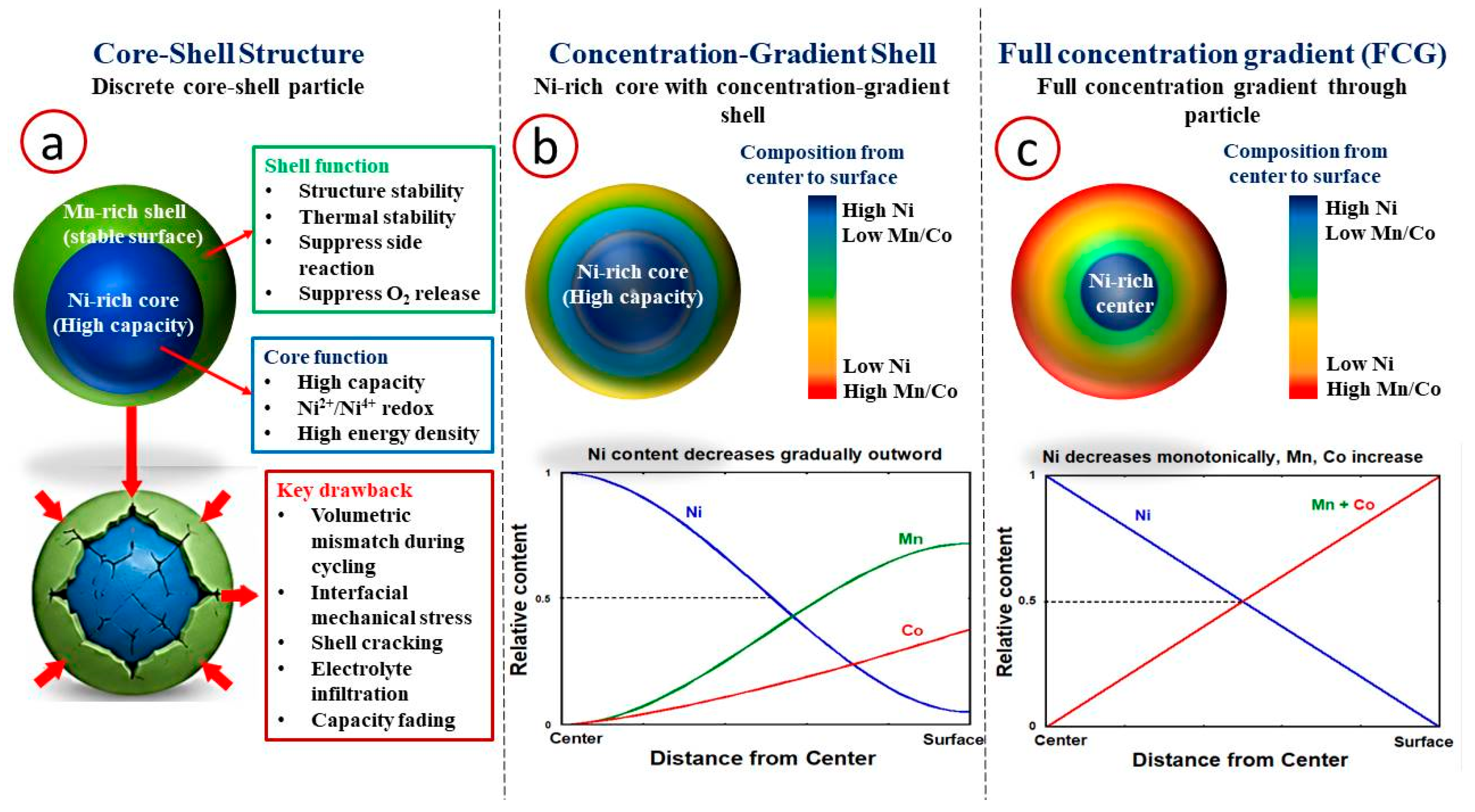
Despite these advantages, discrete core–shell structures suffer from a fundamental limitation: the sharp compositional discontinuity at the core–shell interface generates substantial lattice mismatch and mechanical stress during repeated lithiation and delithiation. Because the Ni-rich core and Mn-rich shell undergo different volume changes during cycling, interfacial stress progressively accumulates, leading to crack formation and long-term performance degradation (Figure. 16a) [93,118,120]. Operando synchrotron X-ray imaging combined with phase-field simulations has confirmed that the abrupt interface acts as the primary crack-initiation site under realistic cycling conditions [93]. Furthermore, a comprehensive review by Hou et al. [120] identified co-precipitation as the most scalable synthesis route for core–shell cathodes while highlighting interfacial delamination as a major obstacle to commercialization. These limitations motivated the development of compositionally graded particle architectures designed to reduce interfacial stress and improve structural durability.
3.1.7.2. Concentration-Gradient (CG) Structures
To address the limitations associated with the abrupt compositional transition in conventional core–shell architectures, concentration-gradient (CG) structures were developed. In these materials, the Ni content gradually decreases from the particle core toward the surface, while the concentrations of Mn and Co increase correspondingly (Figure 16b). This continuous compositional gradient distributes mechanical stress more evenly throughout the particle, reducing stress concentrations and thereby suppressing crack initiation and propagation during electrochemical cycling. Sun et al. [121] reported that CG LiNi0.83Co0.07Mn0.10O2 exhibited enhanced structural stability and improved capacity retention compared with both conventional NMC622 and discrete core–shell cathodes.
The stabilizing role of the Mn-enriched surface in CG cathodes was further clarified by Bak et al. [122], who combined multiscale synchrotron spectroscopy with electrochemical analysis. Their study showed that the Mn-rich outer region promotes the reversibility of the Ni redox reaction during cycling while suppressing oxygen evolution at high states of charge. The Mn–O-rich surface layer acts as a protective chemical barrier, limiting parasitic electrolyte oxidation and inhibiting the formation of resistive rock-salt phases on the particle surface. As a result, both cycling performance and thermal stability are significantly improved. These findings provide strong mechanistic evidence that Mn-rich surface enrichment is an effective strategy for enhancing the long-term stability and safety of gradient-structured cathode materials.
Analogous concentration-gradient strategies have also been successfully applied to NCA-based cathodes. Pan et al. [123] demonstrated that gradient Mg/Al co-doping in LiNi0.95Co0.03Al0.01Mg0.01O2 effectively mitigated the H2→H3 phase transition, resulting in enhanced structural stability during cycling. The modified cathode exhibited a capacity retention of 95.6% after 100 cycles and maintained an excellent rate capability of 172.9 mAh g−1 at 10C rate. The surface enrichment of electrochemically inactive Mg and Al serves to passivate highly reactive surface sites, suppress oxygen evolution, and improve interfacial stability while preserving the high Ni content in the particle interior. Furthermore, a gradient NCA–NMC core–shell architecture, consisting of an NCA core encapsulated by an NMC concentration-gradient shell, has been reported to achieve an outstanding capacity retention of 99.8% after 200 cycles, together with markedly improved thermal and air stability relative to pristine NCA [124].
3.1.7.3. Full Concentration Gradient (FCG) Structures
A more advanced gradient-design strategy is the full concentration gradient (FCG) architecture, in which the transition-metal composition varies continuously from the particle core to the surface without forming distinct compositional interfaces [125]. In FCG cathodes, the Ni concentration gradually decreases from the center toward the surface, while the Mn and Co concentrations increase correspondingly across the entire particle radius (Figure 16c). This continuous compositional transition minimizes local stress concentrations and promotes a more uniform distribution of mechanical strain during the repeated volume changes associated with Li+ insertion and extraction.
A notable microstructural characteristic of many FCG particles is the radial alignment of primary crystallites. This arrangement facilitates anisotropic Li+ transport along the (010) crystallographic planes while reducing intergranular cracking by accommodating strain through grain-boundary sliding rather than fracture [126]. Furthermore, radial grain alignment shortens the effective Li+ diffusion pathways between grain boundaries and the particle surface, thereby enhancing rate capability. Park et al. [126] reported that FCG NMC78 (LiNi0.78Co0.10Mn0.12O2) retained 86.3% of its initial capacity after 4000 cycles at 0.5C, demonstrating that the synergistic integration of compositional-gradient engineering and microstructural control can deliver exceptional long-term cycling stability.
Beyond the compositional gradient, an oxidation-state (valence) gradient in Ni has been shown to independently enhance the stability of high-Ni cathodes. Lin et al. [127] synthesized a compositionally uniform LiNi0.8Mn0.1Co0.1O2 material featuring a hierarchical Ni valence gradient from surface to core. They demonstrated that enrichment of lower-valence Ni2+ at the surface, with more oxidized Ni3+ concentrated in the interior, improves both cycling performance and thermal stability compared to conventional materials. These findings indicate that, in FCG cathodes, stabilization arises from the synergistic effect of both compositional and Ni-valence gradients. They further suggest that future cathode designs could benefit from independently engineering the valence profile in addition to the compositional gradient.
3.1.7.4. Advanced Gradient Designs and Doping Strategies
Building upon the FCG concept, further structural and compositional refinements have been developed to enhance electrochemical performance and structural stability. In particular, two-slope and tapered concentration-gradient architectures enable more precise control over the Ni distribution within secondary particles. This allows independent optimization of core and shell compositions, thereby improving the balance between capacity and long-term cycling stability. Such designs are especially relevant for highly Ni-rich cathodes (≥80% Ni), where the H2→H3 phase transition occurring near the particle surface remains a dominant degradation mechanism, even in gradient-engineered structures [128].
In parallel, elemental doping strategies have been widely integrated with FCG cathodes to further reinforce structural robustness and mitigate degradation pathways. For example, Zhao et al. [129] demonstrated that in-situ Zr doping in FCG LiNi0.8Co0.05Mn0.15O2 significantly improved electrochemical durability, achieving 91.9% capacity retention after 200 cycles at 1C, while maintaining stability under high cut-off voltage (4.5 V) and elevated temperature conditions (55 °C). Mechanistically, Zr4+ substitution at transition-metal sites strengthens the layered structure by expanding Li-slab spacing and suppressing irreversible phase transformations.
Furthermore, synergistic modification approaches combining FCG design with Ti-pillar doping and Li2ZrO3 (LZO) surface coating have demonstrated additional gains in both Li+ transport kinetics and thermal stability. In this configuration, the LZO coating acts as a protective interfacial layer, effectively mitigating electrolyte-induced side reactions and surface degradation [130]. More recently, dual-doping strategies involving Zr in combination with elements such as Al, Mg, or Ti have been proposed, offering complementary enhancements in structural integrity, thermal resilience, and electrochemical kinetics [129,130].
An important but often overlooked challenge in FCG synthesis is thermally driven interdiffusion of transition metals during high-temperature lithiation, which can attenuate the as-synthesized gradient and weaken surface passivation. Cai et al. [131] demonstrated that SiO44− polyanion doping can suppress Ni and Mn interdiffusion during calcination, thereby preserving the concentration-gradient structure and enhancing surface stability at the end of charge. This strategy highlights the importance of coupling gradient design with structural stabilizers capable of resisting thermal homogenization.
The concentration-gradient concept has also been extended to single-crystal Ni-rich cathodes, where surface degradation and intragranular stress accumulation remain key challenges. Engineering a low-Ni surface region within single-crystal particles has been proposed to improve surface passivation and reduce electrolyte reactivity, while the absence of grain boundaries mitigates intergranular crack propagation [132]. In this work, Hu et al. further showed that integrating gradient engineering with single-crystal morphology represents a promising direction for next-generation Ni-rich cathodes, particularly for applications requiring both high energy density and long-term cycling stability.
Figure 16.
Schematic illustration of the three generations of intraparticle compositional engineering in Ni-rich layered cathode particles. (a) First-generation discrete core–shell structure with an abrupt Ni-rich/Mn-rich interface; the red arrow indicates the region of high interfacial stress and the primary crack-initiation site during cycling. (b) Second-generation concentration-gradient structure with a gradual compositional transition confined to the outer shell of a Ni-rich core particle; the Mn-rich surface layer suppresses oxygen release and maintains Ni-redox reversibility. (c) Third-generation full concentration gradient structure showing a continuous, monotonic decrease in Ni content and corresponding increase in Mn + Co content from the particle center to the outer surface; radially aligned primary crystallites (not shown) further reduce intergranular cracking.
Figure 16.
Schematic illustration of the three generations of intraparticle compositional engineering in Ni-rich layered cathode particles. (a) First-generation discrete core–shell structure with an abrupt Ni-rich/Mn-rich interface; the red arrow indicates the region of high interfacial stress and the primary crack-initiation site during cycling. (b) Second-generation concentration-gradient structure with a gradual compositional transition confined to the outer shell of a Ni-rich core particle; the Mn-rich surface layer suppresses oxygen release and maintains Ni-redox reversibility. (c) Third-generation full concentration gradient structure showing a continuous, monotonic decrease in Ni content and corresponding increase in Mn + Co content from the particle center to the outer surface; radially aligned primary crystallites (not shown) further reduce intergranular cracking.
Overall, core–shell and concentration-gradient architectures constitute significant advances in the design of Ni-rich layered cathode materials. By spatially decoupling electrochemical functions within individual secondary particles, these strategies enhance the trade-off between high energy density and long-term structural stability. Compared with early discrete core–shell configurations, CG, and FCG structures enable more homogeneous stress distribution and improved resistance to particle cracking during electrochemical cycling. The ongoing integration of concentration-gradient engineering with surface coatings, elemental doping, and single-crystal designs is expected to play a central role in the development of next-generation lithium-ion batteries for electric vehicle applications.
Collectively, these insights highlight why Ni-rich layered oxides remain among the most promising cathode materials for next-generation lithium-ion batteries. Their high energy density and reduced reliance on cobalt strongly support the technological, economic, and sustainability requirements of large-scale energy storage applications, particularly electric vehicles. At the same time, continuous advances in surface coatings, elemental doping, and microstructural engineering are progressively mitigating key limitations related to thermal instability, interfacial reactivity, and long-term cycling durability.
3.2. Spinel Oxides LiMn2O4 (LMO)
In the early 1980s, Thackeray and co-workers [133] investigated cubic spinel-structured cathode materials with Fd3̅m symmetry, including LiMn2O4 (LMO, ~4 V) and LiMn1.5Ni0.5O2 (~5 V), which offer three-dimensional (3D) lithium-ion diffusion pathways. Compared with layered oxide cathodes, spinel materials are generally safer, more cost-effective, and exhibit several favorable electrochemical characteristics, such as a high operating voltage plateau, excellent rate capability, and good cycling stability [134]. Nevertheless, spinel cathodes still experience significant capacity fading during long-term cycling. This performance mainly originates from two factors:
- (1)
- Manganese dissolution into the electrolyte, caused by the disproportionation reaction of Mn3+ ions (2Mn3+ → Mn4+ + Mn2+). The generated Mn2+ species dissolve into the electrolyte, leading to the gradual loss of electrochemically active material.
- (2)
- Irreversible structural distortion, involving the transformation of the cubic spinel structure into a tetragonal phase. This transition is associated with the presence of Jahn–Teller active Mn3+ ions, which induce lattice distortion and structural instability during repeated charge/discharge cycling [135,136].
A study investigated the electrochemical behavior of Li-rich spinel Li1+yMn2−yO4−δ (LLMO, y ≈ 0.03, δ ≈ 0.01) as a cathode in Li-ion batteries, with particular emphasis on the origin of the extra capacity obtained within an extended operating voltage window of 1.5–4.8 V vs. Li+/Li [137]. The nanostructured LLMO material, synthesized via a sol-gel route and calcined at 900 °C, exhibited a crystallite size of approximatively 380 nm, a specific surface area of 1.68 m2 g−1, and monodisperse mesopores with an average diameter of 5.1 nm. The Li-rich spinel electrode delivered an initial discharge capacity of 172 mAh g−1. At a current density of 100 mA g−1 (~0.7C), the capacity remained at 123 mAh g−1 after 100 cycles, corresponding to a retention of 71.5%. Remarkably, the electrode still delivered 77 mAh g−1 after 500 cycles within the wide potential range of 1.5–4.8 V, demonstrating excellent long-term stability. This enhanced cyclability was attributed to the suppression of the Jahn-Teller distortion induced by Li doping. In contrast, when cycled within the narrower voltage range of 3.0–4.5 V, the electrode exhibited a much lower initial capacity of 85 mAh g−1 and a capacity retention of only 54.3% after 100 cycles. Differential capacity analysis (dQ/dV) versus potential further confirmed the structural and electrochemical stability of the Li-rich spinel. After 500 cycles, the redox peaks remained at nearly identical potentials and the peak separation showed no significant change, indicating that Li doping effectively mitigates the main degradation and fading mechanisms in the electrode (Figure 17) [101].
To suppress Mn dissolution and mitigate capacity fading, a wide range of doping strategies has been investigated. Partial substitution of Mn with transition metals such as Ni, Mg, Al, Cr, Zn, Ti, Fe, and Cu effectively decreases the concentration of Jahn–Teller active Mn3+ ions, thereby enhancing the structural stability and electrochemical performance of spinel cathodes [138]. Among these approaches, Ni substitution has attracted particular attention. In LiMn1.5Ni0.5O2, the incorporation of Ni increases the average oxidation state of Mn, which suppresses Jahn–Teller distortion and stabilizes the spinel framework. As a result, improved electrochemical properties are achieved, including higher operating voltage, enhanced cycling stability, and superior rate capability [139]. Depending on synthesis conditions, Ni-substituted spinels may crystallize either in the disordered Fdm structure or in the ordered P4332 phase [150]. In addition, the reversible Ni2+/Ni4+ redox couple extends the operating voltage to approximately 4.7 V, enabling the development of high-voltage LiMn1.5Ni0.5O4 cathodes with significantly improved energy density [141]. Nevertheless, several challenges remain, particularly the difficulty of obtaining stoichiometric LiNi0.5Mn1.5O4, without the formation of secondary nickel oxide impurities during synthesis [142]. Interestingly, the presence of a small amount of Mn3+ in the ordered structure can be beneficial, as it enhances electronic conductivity and facilitates charge compensation through oxygen deficiency. Experimentally, LiNi0.5Mn1.5O4 delivers a capacity of approximately 140 mAh g−1, which is slightly lower than its theoretical value of 147 mAh g−1. To further improve electrochemical performance, surface modification strategies have also been extensively explored. Protecting coatings based on metal oxides such as ZnO, Al2O3, Co3O4, and MoO3 effectively stabilize the electrode/electrolyte interface, suppress Mn dissolution, and improve cycling stability, as illustrated in Figure 18 [143].
3.3. Polyanionic Cathodes LiMPO4
3.3.1. Historical Development and Commercialization
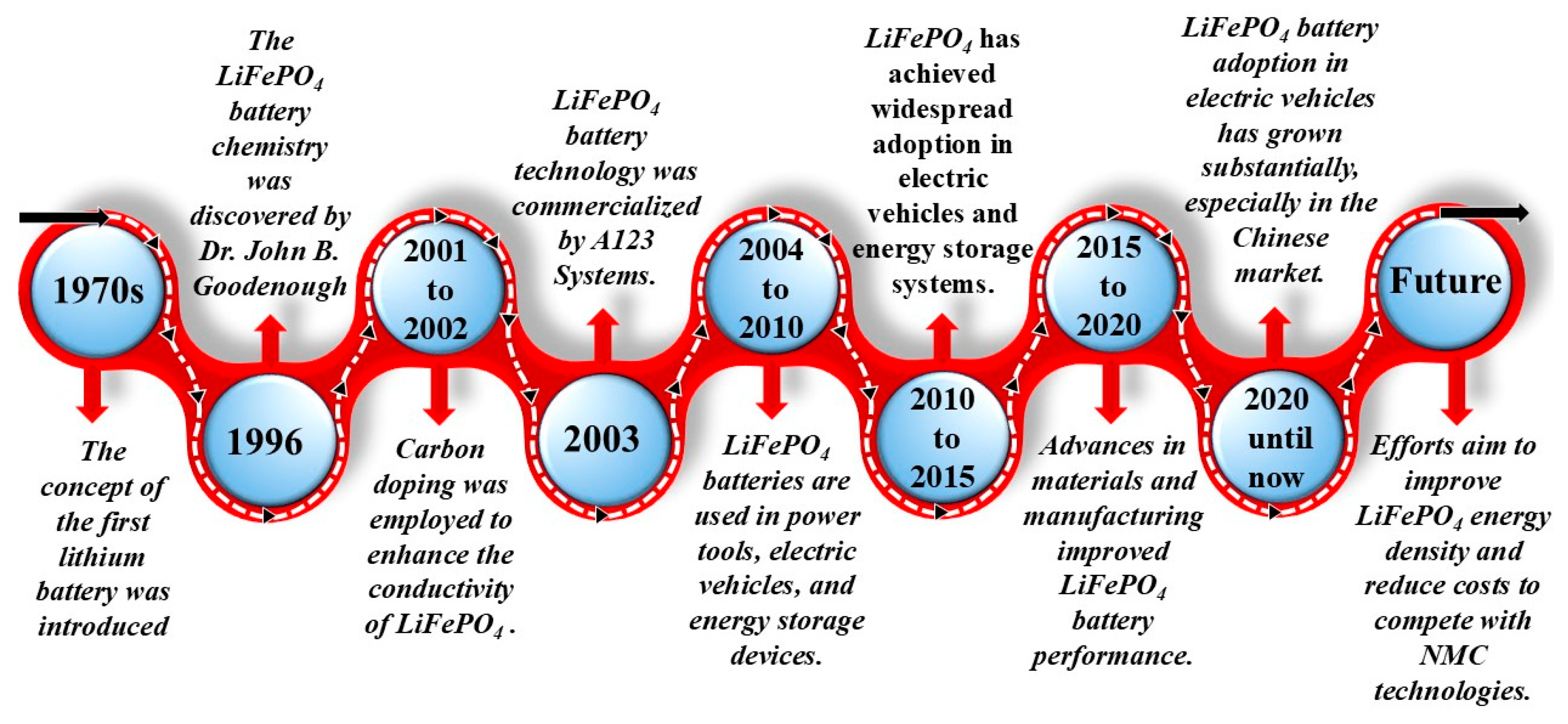
Lithium iron phosphate (LiFePO4, LFP) has become one of the most commercially successful cathode materials for LIBs, particularly in electric vehicles (EVs) and stationary energy-storage systems. As illustrated in Figure 19, the development of LFP spans more than four decades, beginning with the early conceptual advances in rechargeable lithium batteries during the 1970s and culminating in the identification of olivine-structured LiFePO4 as a promising cathode material by Goodenough and co-workers in the mid-1990s [144]. Despite its favorable electrochemical stability and safety, the practical implementation of LFP was initially limited by its intrinsically low electronic conductivity (~10−9 S cm−1), which is approximately six orders of magnitude lower than that of commercial LiCoO2 (10−3 S cm−1) [145]. This limitation was successfully addressed in the early 2000s through the development of carbon-coating and carbon-composite strategies, which significantly improved charge transport and enabled high-rate capability and practical electrode performance [146,147].
The widespread deployment of LFP has been driven by several key advantages, including its lower cost compared with layered oxide cathodes, superior thermal and chemical stability, excellent intrinsic safety, and long cycle life, often exceeding 2000 charge–discharge cycles [147,148]. In addition, the use of abundant and non-toxic iron contributes to the environmental sustainability and economic attractiveness of this chemistry. These characteristics enabled the early commercialization of LFP batteries by A123 Systems in the early 2000s, followed by extensive adoption in power tools, grid-scale energy storage, and, more recently, electric vehicles (Figure 19).
Since 2020, LFP has experienced a strong commercial resurgence in the electric vehicle sector, particularly in the Chinese market, owing to its intrinsic safety, cost competitiveness, and suitability for large-format prismatic cells used in cell-to-pack (CTP) integration strategies. The adoption of LFP chemistry in Tesla Model 3 and Model Y vehicles (2021–present), together with the widespread deployment of LFP-based blade battery technology by BYD has further validated the commercial viability of this cathode chemistry for mass-market electric vehicles [149]. These developments have significantly accelerated global LFP production capacity and reinforced its position as a leading cathode material for cost-sensitive and high-safety energy-storage applications.
Figure 19.
Timeline of LiFePO4 battery development from material to system.
3.3.2. Crystal Structure and Fundamental Limitations of LiFePO4
The intrinsic safety and electrochemical stability of LFP arise from its highly robust olivine crystal structure. LFP crystallizes in an orthorhombic olivine framework belonging to the Pnma space group, characterized by a hexagonal close-packed arrangement of oxygen atoms. Within this structure, Li+ and Fe2+ ions occupy distinct octahedral sites, whereas P atoms are located in tetrahedral sites. The resulting framework consists of corner-sharing FeO6 octahedra interconnected by highly stable PO43- tetrahedra, forming a rigid three-dimensional polyanionic network (Figure 20) [150].
This unique polyanion framework underpins the defining properties of LFP. The strong covalent P–O firmly stabilize the oxygen sublattice, suppressing oxygen release and thereby imparting exceptional thermal stability. This significantly mitigates the risk of thermal runaway, representing a major safety advantage over oxygen-evolving layered oxides such as LiCoO2 [151]. In parallel, the olivine structure exhibits remarkable mechanical and structural robustness during the two-phase transition between LiFePO4 and FePO4, undergoing only a ~6.9% variation in unit-cell volume upon full lithium extraction/insertion [152]. This limited lattice strain is directly responsible for the outstanding cycling stability of LFP. Furthermore, the high structural stability gives rise to the characteristic flat electrochemical voltage plateau observed during lithiation/delithiation at approximately 3.45 V vs. Li+/Li, associated with the Fe2+/Fe3+ redox couple.
Electrochemically, LFP delivers a theoretical specific capacity of approximately 170 mAh g−1 while operating through the Fe2+/Fe3+ redox reaction at a stable voltage plateau near 3.45 V vs. Li+/Li [145,153]. This flat voltage response originates from the two-phase transformation between LiFePO4 and FePO4. The rapid migration of the phase interface facilitates effective ionic and electronic conductivity during cycling. This mechanism contributes to the good rate capability and excellent long-term cyclability of LFP, with capacity retention often exceeding 90% after 1000 cycles. Nevertheless, irreversible lithium loss at the phase interface remains one of the principal degradation mechanisms, particularly under high current-density operation.
3.3.3. Fundamental Limitations
Despite its widespread commercial adoption, the olivine structure of LiFePO4 imposes several intrinsic limitations on its electrochemical performance. Most notably, Li+ diffusion is confined to one-dimensional (1D) channels along the (010) crystallographic direction, leading to relatively slow ion transport kinetics compared with the two-dimensional (2D) or three-dimensional (3D) diffusion pathways characteristic of layered or spinel cathode materials, respectively [154]. In. addition, the strong inductive effect of the highly electronegative PO43− polyanion reduces the orbital overlap between Fe 3d states and O 2p states resulting in extremely low intrinsic electronic conductivity. The combined effect of restricted ionic diffusion and poor electronic transport significantly limits the rate capability and high-power performance of pristine LiFePO4, making it unsuitable for fast charge–discharge applications without extensive material engineering. Another important degradation mechanism is the irreversible loss of lithium at the phase boundary during repeated cycling, particularly under high current densities [155]. Consequently, substantial optimization strategies—such as particle nanosizing, conductive carbon coating, cation doping, and advanced electrode architectures—are generally required to achieve competitive electrochemical performance.
3.3.4. Performance Enhancement Strategies for LiFePO4
The introduction of carbon-coating techniques in the early 2000s marked a major breakthrough in the development of LiFePO4 cathodes, substantially enhancing their intrinsically low electronic conductivity while maintaining structural integrity and cycling stability. Among the most effective approaches, graphene-coated porous LiFePO4 nanospheres demonstrated outstanding electrochemical performance, delivering a discharge capacity of 163.8 mAh g−1 at 0.1C and retaining over 92% of their capacity after 500 cycles at 10C [156]. Similarly, ultrathin (1–2 nm) highly graphitized carbon coatings enabled capacities of 143.6 mAh g−1 at 1C with only 1.47% capacity fading after 50 cycles [157]. In general, the carbon content is maintained below 10 wt.% in order to optimize the trade-off between electronic conductivity and volumetric energy density, since excessive carbon loading decreases tap density and reduces overall energy storage efficiency [1568].
Beyond conventional carbon coating, heteroatom doping strategies have emerged as an effective route to further improve LiFePO4 electrochemical behavior. In particular, nitrogen and boron doping introduce additional defect sites and modifies the electronic structure of the carbon matrix, thereby increasing surface area, enhancing charge-transfer kinetics, and facilitating electron transport. Dual N,B-doped carbon-wrapped LiFePO4 composites have shown synergistic improvements in conductivity and electrochemical activity, attributed to enhanced charge-carrier generation and more efficient lithium-ion diffusion pathways [159].
Recent advances in precursor engineering have leveraged metal-organic frameworks (MOFs) as self-sacrificial templates, enabling carbon modification, morphological control, and cation doping to be achieved simultaneously within a single synthetic step [160]. In. particular, Prussian blue analogue-derived precursors have been used to fabricate nitrogen-doped carbon-encapsulated LFP nanocomposites. This strategy generates an in-situ nitrogen-doped carbon coating with a thickness of 3–5 nm, which enhances electronic conductivity and accelerates interfacial charge-transfer kinetics. As a result, the material delivers outstanding electrochemical performance, including a reversible capacity of 153 mAh g−1 at 0.5C over 500 cycles with 90.1% capacity retention, as well as excellent rate capability of 120 mAh g−1 at 10C [161]. Building upon this approach, oxygen- and fluorine-co-doped carbon-wrapped LFP composited have been synthesized using the iron-based MOFs (MIL-53(Fe)) as a sacrificial template. Through controlled pyrolysis under mixed atmospheres, simultaneous heteroatom doping was achieved, leading to enhanced carbon conductivity (~10−2 S cm−1) and improved electrolyte wettability. Consequently, the composite exhibited a discharge capacity of 160.9 mAh g−1 at 1C after 500 cycles with 94.7% capacity retention, while still maintaining 128 mAh g−1 at 5C [162].
3.3.5. Nanostructuring and Morphological Engineering
Morphological engineering through solvothermal synthesis in different reaction media enables precise control over LFP architectures, spanning from nanorods to complex hierarchical structures. For instance, rectangular prismatic nanorods synthesized in water/glycerol media have delivered a discharge capacity of 163.8 mAh g−1 at 0.2C, attributed to optimized lithium-ion diffusion pathways along the [010] crystallographic direction [163]. These multiscale design strategies effectively reconcile the competing requirements of nanoengineering and microengineering. At the nanoscale, reduced particle dimensions shorten Li+ diffusion lengths and increase the active surface area available for charge transfer, thereby enhancing rate capability. At the microscale, larger secondary structures improve tap density and volumetric energy density while limiting excessive electrode–electrolyte interfacial area, which helps suppress parasitic side reactions. To balance these effects, hierarchical architectures composed of nano-sized primary particles (50–200 nm) assembled into microsized secondary particles (1–5 μm) have been developed. Such structures successfully mitigate the conventional trade-off between high-rate performance and volumetric energy density [164]. Nevertheless, despite their superior electrochemical kinetics, nanostructured materials generally exhibit lower tap densities (0.6–1.0 g cm−3) compared with commercial LFP materials (1.3–1.5 g cm−3), leading to reduced volumetric energy density—an important limitation for automotive battery applications.
3.3.6. Synthesis Routes and Process Optimization
Lithium iron phosphate can be synthesized via several scalable approaches, including solid-state reactions, sol–gel processing, hydrothermal/solvothermal synthesis, co-precipitation, and molten-state methods. Among these, solid-state route remains the most widely adopted at the industrial scale because of its operational simplicity, high crystallinity, and excellent phase purity. However, this method generally requires high processing temperatures, resulting in significant energy consumption and, under inert atmospheres, potential emissions of toxic gases.
In recent years, hydrothermal and solvothermal techniques have gained considerable attention because they allow precise control over particle size, morphology, and crystallinity at relatively low reaction temperatures (approximately 80–200 °C). These processes are usually followed by a post-annealing step at 500–750 °C to further improve crystal structure and electrochemical performance [165]. Similarly, wet pre-lithiation coupled with carbothermal reduction at 500–600 °C has been shown to produce highly homogeneous LFP powders with enhanced mass-transfer properties, delivering discharge capacities of approximately 148 mAh g-1 at 10C [166]. Process optimization is critical because synthesis temperature strongly influences phase composition and electrochemical behavior. Excessive firing temperatures above ~800 °C may induce undesirable secondary phases such as Fe2P. Although Fe2P can improve electronic conductivity, its formation is generally associated with capacity fading and poor cycling stability [12]. Solution-based synthesis methods, including hydrothermal and solvothermal routes provide superior control over particle morphology and size distribution; however, they often exhibit lower manufacturing yields (typically 60–75%) compared with conventional synthesis (> 90%). These lower yields mainly arise from to filtration losses, incomplete precipitation, and the increased complexity of liquid-phase processing.
3.3.7. Cation Doping strategies
Cation doping is another effective approach for tuning the phase transition mechanism and enhancing ionic conductivity while largely preserving tap density. In this strategy, Li+ sites are partially substituted with aliovalent cations such as Mg2+, Al3+, Zr4+, Ti4+, Nb5+, typically at low concentrations (~1 at.%). Such substitutions promote the formation of solid solutions and generate lattice defects, both of which can facilitate charge-carrier transport and improve the electrochemical performance of the material. Early studies reported dramatic increases in conductivity—up to eight orders of magnitude—, with values exceeding 10−3 S cm−1 [145]. However, later investigations suggested that these enhancements may not arise solely from intrinsic bulk conductivity improvements, but could also be strongly influenced by nano-network or interfacial effects.
3.4. High-Voltage Olivine Cathodes: Beyond LiFePO4
Although LiFePO4 (LFP) has achieved widespread commercial adoption owing to its excellent thermal stability, long cycle life, and low cost [146], its relatively low operating potential (3.45 V vs. Li+/Li) intrinsically limits the energy density attainable in LIBs. Because the specific energy of a battery scales approximately with the product of capacity and voltage, increasing the operating voltage constitutes one of the most effective strategies for improving overall cell performance [167]. Within the olivine family LiMPO4 (M = Fe, Mn, Co, Ni), partial or complete substitution of iron by alternative transition metals provides a promising route toward higher-voltage cathode chemistries while preserving the intrinsic structural robustness and thermal safety associated with the olivine framework [168]. In principle, these materials retain the characteristic one-dimensional lithium diffusion channels and strong covalent phosphate framework that contribute to the remarkable stability of LFP. In polyanion cathodes such as LiMPO4, the redox potential of the transition-metal center is strongly governed by the inductive effect of the phosphate (PO43−) group. The highly electronegative phosphate polyanion withdraws electron density from the metal–oxygen bonds, thereby decreasing metal–oxygen covalency and stabilizing the antibonding states involved in the redox process. As a result, the operating voltage generally increases with the electronegativity of the transition-metal species [169]. Nevertheless, the correlation between transition-metal electronegativity and electrochemical potential is not purely linear, as crystal-field effects, electronic configuration, Jahn–Teller distortions, and metal–oxygen hybridization also play critical roles in determining the accessible redox couples and their corresponding voltages.
Although iron exhibits moderate electronegativity (χ = 1.83 on the Pauling scale), the Fe2+/Fe3+ redox couple in LiFePO4 displays a lower-than-expected potential (3.45 V). This behavior originates from the electronic structure of high-spin Fe2+ (3d6), where oxidation to Fe3+ (3d5) requires removal of an electron from a doubly occupied t2g orbital, thereby introducing an additional electron-pairing energy penalty [170]. This behavior originates from the electronic structure of high-spin Fe2+ (3d6), where oxidation to Fe3+ (3d5) requires removal of an electron from a doubly occupied t2g orbital, thereby introducing an additional electron-pairing energy penalty. By contrast, Mn2+ adopts a high-spin half-filled 3d5 configuration in which all five d electrons remain unpaired. Oxidation to Mn3+ (3d4) therefore occurs without any additional pairing-energy cost. In combination with the relatively low crystal-field stabilization energy of the high-spin d5 state, this leads to a thermodynamically more favorable oxidation process and a correspondingly higher Mn2+/Mn3+ redox potential (~4.1 V) in LiMnPO4 [171]. These electronic-structure effects provide the fundamental thermodynamic basis for the development of higher-voltage olivine cathodes through substitution of Fe by alternative transition metals such as Mn.
3.4.1. Lithium Manganese Phosphate (LiMnPO4)
Lithium manganese phosphate is a promising member of the olivine phosphate cathode family. Sharing the same olivine crystal structure as LiFePO4, LiMnPO4 substitutes manganese for iron, leading to significantly different electrochemical characteristics. The material operates at a higher voltage of approximately 4.1 V vs. Li+/Li through the Mn2+/Mn3+ redox couple, corresponding to an increase of nearly 18% compared to LiFePO4 [172]. This higher operating voltage results in a substantially improved theoretical energy density of approximately 701 Wh kg−1, surpassing the ~586 Wh kg−1 typically reported for LiFePO4 [173]. Despite this increase in energy density, LiMnPO4 retains a theoretical specific capacity of approximately 170–171 mAh g−1, comparable to other olivine phosphate cathodes. In addition to its enhanced energy characteristics, LiMnPO4 preserves the intrinsic safety advantages associated with the olivine phosphate framework. The strong P–O covalent bonding contributes to excellent thermal stability and high resistance to oxygen release and thermal runaway, making the material particularly attractive for safe lithium-ion battery applications [143].
Despite these attractive properties, LiMnPO4 still faces major barriers to commercialization. Like other olivine phosphates, it possesses an intrinsically wide band gap (>3 eV), which leads to extremely low electronic and ionic conductivity, both far below the levels required for practical battery operation and notably poorer than those of LiFePO4 [173,174]. Figure 21 shows that these transport limitations severely hinder the achievement of high capacities at elevated discharge rates, even when carbon-coating strategies similar to those successfully applied to LFP are employed [147]. The challenge is further aggravated by the one-dimensional Li+ diffusion pathway along the [010] crystallographic direction, which creates inherent kinetic bottlenecks within the structure. In addition, antisite defects caused by Li/M further obstruct Li+ transport, ultimately limiting rate capability and hindering the widespread practical deployment of LiMnPO4 [144,175].
LiMnPO4 also suffers from a distinctive structural limitation associated with the Jahn–Teller activity of the Mn3+ ions (high-spin d4, t2g3eg1 configuration) arising from the degeneracy of the eg orbitals [176]. During delithiation, this electronic instability induces a cooperative tetragonal distortion of the MnO6 octahedra, leading to pronounced lattice instability, anisotropic strain, and contraction along the c-axis, all of which hinder Li+ transport [177]. These structural distortions promote mechanical degradation, resulting in rapid capacity fading and poor high-rate performance, thereby compromising both rate capability and long-term cycling stability. Consequently, carbon-coating strategies that successfully mitigated the comparatively milder phase-boundary limitations in LiFePO4 have proven insufficient to overcome the much more severe kinetic constraints in LMP [175].
Figure 21.
Electrical conductivity of LiMPO4 (M = Fe, Ni, Co, Mn) olivine materials. Numbers indicate the activation energy in eV. The low conductivity is related to the small free volume and separation of MO6 octahedra by oxygen atoms of the (PO4) −3 anions. Reproduced from [12]. Copyright 20,216 Springer.
Figure 21.
Electrical conductivity of LiMPO4 (M = Fe, Ni, Co, Mn) olivine materials. Numbers indicate the activation energy in eV. The low conductivity is related to the small free volume and separation of MO6 octahedra by oxygen atoms of the (PO4) −3 anions. Reproduced from [12]. Copyright 20,216 Springer.
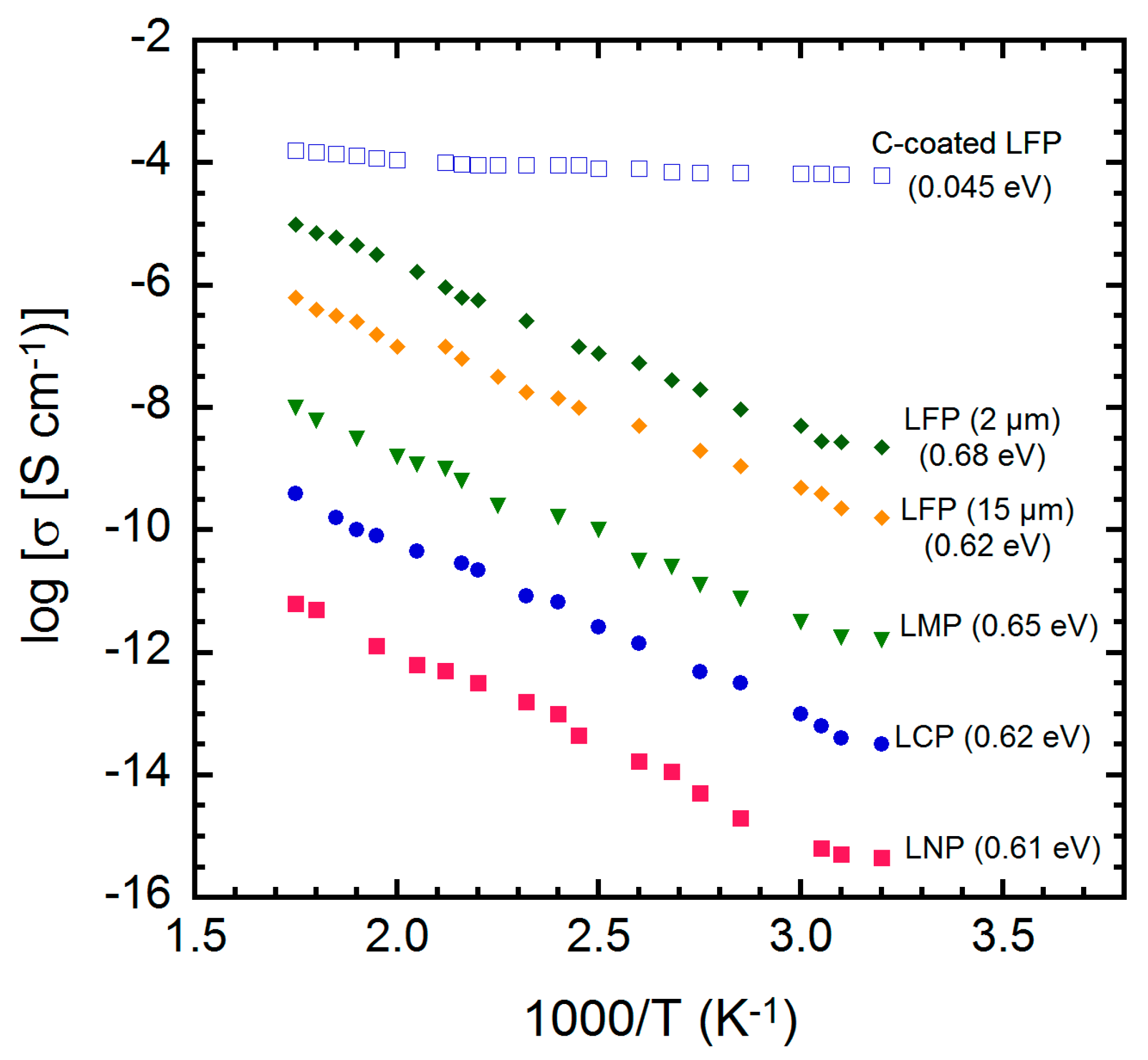
3.4.2. Enhancement Strategies
Extensive have been devoted to mitigating the intrinsic limitations of LiMnPO4 a range of strategies, many of which are inspired by the successful optimization approaches developed for LiFePO4. Among these, carbon coating remains the most widely employed and fundamental method, as conformal carbon layers can significantly enhance surface electronic conductivity. The nature of the carbon precursor plays a decisive role in determining the structure, conductivity, and overall electrochemical performance of the resulting nanocomposite. For instance, Li et al. [178] reported that rod-like LMP/C composites synthesized using beta-cyclodextrin as the carbon source exhibited a high reversible capacity of 153 mAh g−1 at C/10, substantially outperforming analogous materials prepared with more precursors such as glucose, sucrose, or citric acid. In parallel, solid-state routes combined with various carbon sources have also been extensively explored to construct efficient conductive carbon networks [179,180]. In these systems, optimizing the coating, homogeneity, and degree of graphitization degree is essential for maximizing electrochemical performance and ensuring effective charge transport [181]. More advanced synthetic approaches such as microwave-assisted solvothermal synthesis, have yielded particularly promising results. Certain LMP/C nanocomposites prepared via these techniques demonstrated capacities as high as 155 mAh g−1 at 0.5C after 100 cycles and maintaining 118 mAh g−1 at a demanding 10C rate [182].
Particle size reduction through nanostructuring represents another key strategy for improving the electrochemical performance of LiMnPO4, as it shortens Li+ diffusion pathways and increases the electrode-electrolyte interfacial area. Drezen et al. [183] demonstrated that crystallite size can be precisely controlled by adjusting the sintering temperature during precursor-based synthesis, thereby establishing a direct correlation between processing conditions, particle morphology, and electrochemical behavior. Nevertheless, excessive downsizing must be carefully managed, since it may reduce tap density and exacerbate parasitic side reactions with the electrolyte [184]. Among compositional modification approaches, metal doping— particularly with iron— has shown considerable potential. Fe substitution in LiMnPO4 effectively alleviates the Jahn-Teller distortion while simultaneously enhancing both ionic and electronic conductivity. The resulting LiMn1-xFexPO4 solid solutions combine the high operating voltage associated with manganese with the superior transport properties of iron-based olivines, thereby offering a favorable compromise between energy density and kinetics [185]. Co-doping strategies have also attracted significant attention. Kim et al. [186] demonstrated that the simultaneous incorporation of small amounts of Fe and Co into the LMP structure markedly improved electrochemical performance while preserving the characteristic ~4.0 V redox potential. This enhancement was attributed to the formation of a local solid-solution-like environment within the olivine framework, which lowers the nucleation barrier of the delithiated phase and alleviates structural strain associated with the Jahn–Teller effect. In addition to Fe and Co, other dopants such as vanadium [187], lanthanum [188], and zirconium [189] have also been investigated for their ability to stabilize the crystal structure and further improve electrochemical performance.
A wide range of synthesis strategies has been developed to tailor the morphology, crystallinity, and surface characteristics of LiMnPO4 in order to improve its electrochemical performance. Among these, hydrothermal and solvothermal methods are particularly attractive because they provide excellent control over stoichiometry, crystal growth, particle size, and phase purity [190,191,192]. These approaches enable the preparation of highly crystalline and uniformly distributed particles, which are beneficial for enhancing Li+ diffusion and electrode kinetics. Ionothermal synthesis employing ionic liquid media enables has also emerged as an effective route for morphology engineering, allowing the formation of diverse nanostructures such as nanorods, nanoplates, and spindle-shaped particles [193,194]. Similarly, deep eutectic solvent-based approaches have gained attention as environmentally friendly alternatives, offering comparable control over particle morphology while adhering to green-chemistry principles [195]. Precipitation-based synthesis routes employing precursors such as NH4MnPO4·H2O and MnPO4·H2O provide precise control over stoichiometry and precursor homogeneity, both of which are crucial for obtaining phase-pure LiMnPO4 with improved electrochemical performance [38,179,183,196]. In parallel, spray pyrolysis combined with wet ball milling has been successfully utilized to fabricate LiMgxMn1−xPO4/C composite cathodes, offering an effective approach for producing compositionally modified and carbon-coated olivine materials with enhanced structural and electrochemical properties [197,198].
3.5. Other High-Voltage Olivine Cathodes
Figure 22 compares the operating voltages and theoretical energy densities across the LiMPO4 olivine family. The electronic structure effects responsible for elevating the Mn3+/Mn2+ redox potential relative to the Fe3+/Fe2+ couple become even more pronounced for cobalt- and nickel-based olivine materials. Consequently, LiCoPO4 (LCP) operates at approximately 4.8 V vs. Li+/Li through the Co2+/Co3+ redox reaction, while LiNiPO4 (LNP) reaches an even higher operating voltage of about 5.1 V via the Ni3+/Ni2+ couple. These voltages represent increases of roughly 39% and 48%, respectively, compared with LiFePO4, leading to remarkable theoretical energy densities of nearly 802 Wh kg−1 for LCP and ~852 Wh kg−1 for LNP [193,194]. Despite these highly attractive energy characteristics, the substantial increase in operating voltage is accompanied by considerably greater technical and electrochemical challenges, which have thus far limited the practical implementation of these high-voltage olivine cathodes.
For both LiCoPO4 and LiNiPO4, the very high operating voltages (> 4.5 V) create major compatibility issues with conventional carbonate-based electrolytes. At such potentials, electrolyte oxidation becomes thermodynamically favorable, leading to the formation of a resistive solid-electrolyte interphase (CEI/SEI) layers, gas evolution (e.g., CO2 and alkyl carbonate species), and continuous parasitic reactions that progressively accelerate capacity fading [199,200]. Considerable efforts have therefore been directed toward mitigating these interfacial instabilities through surface engineering and electrolyte optimization. In particular, protective coatings such that AlPO4, FePO4 have been employed to suppress direct electrode–electrolyte reactions, while alternative electrolyte systems — including ionic liquids, fluorinated carbonates, or solid-state electrolytes — are actively being explored to improve high-voltage stability [201,202,203,204].
Among these materials, LiNiPO4 remains especially challenging to synthesize in a phase-pure form. Conventional high-temperature solid-state routes frequently generate impurity phases such as Li4P2O7 (lithium pyrophosphate) and Ni3P (nickel phosphide) mainly due to the thermodynamic instability of LiNiPO4 and phosphorus volatilization above 600°C [205]. These secondary phases not only decrease the fraction of electrochemically active material but also increase interfacial impedance and promote undesirable side reactions. Although low-temperature hydrothermal synthesis methods can reduce impurity formation, the resulting products often exhibit limited crystallinity and extremely small particle sizes, which adversely affect tap density and electrode packing efficiency [164].
Figure 22.
Redox potential and theoretical energy density of olivine LiMPO4 cathode materials (M = Fe, Mn, Co, Ni).
Figure 22.
Redox potential and theoretical energy density of olivine LiMPO4 cathode materials (M = Fe, Mn, Co, Ni).
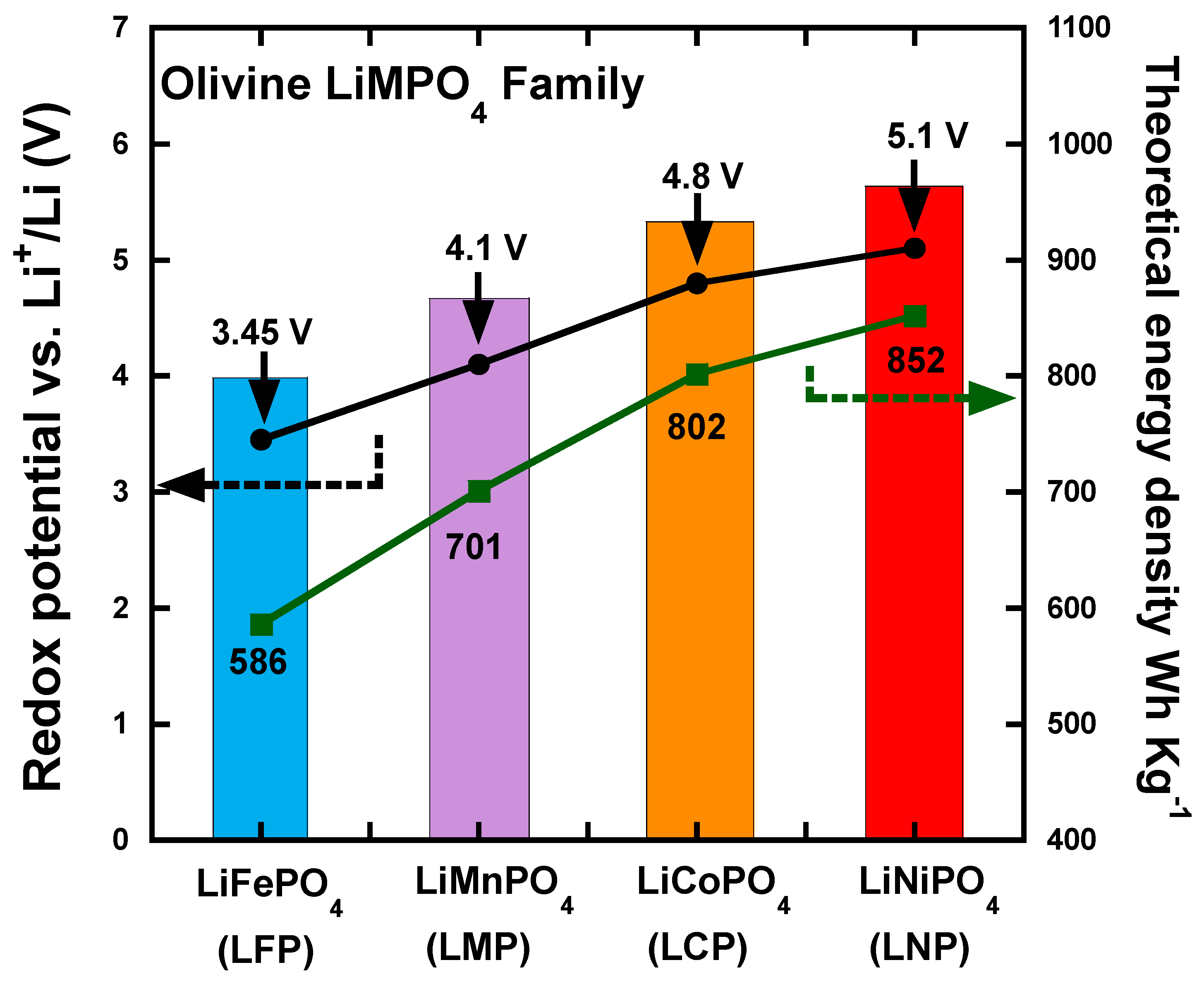
3.6. Lithium Manganese Iron Phosphate (LMFP) Solid Solutions
Given the complementary strengths and limitations of LiMnPO4 and LiFePO4, the LiMnxFe1−xPO4 (LMFP) solid-solution system has emerged as one of the most promising strategies for developing high-voltage olivine cathodes. LMFP combines the higher operating voltage of the Mn2+/Mn3+ redox couple with the superior electrochemical kinetics, electronic conductivity, and structural stability associated with iron-containing olivines. Partial Fe substitution mitigates the Jahn–Teller distortion induced by Mn3+, enhances both ionic and electronic transport, and lowers the kinetic barrier associated with the two-phase transition process [185,186].
Representative compositions such as LiMn0.6Fe0.4PO4 and LiFe0.9Mn0.1PO4 have demonstrated discharge capacities approaching 160 mAhg−1 at moderate current densities, with average operating voltages in the range 3.85–4.0 V and gravimetric energy densities up to approximately 559 Wh kg−1. These values correspond to an energy-density improvement of nearly 20% compared with commercial LFP, while preserving the intrinsic thermal stability and safety advantages of olivine phosphates [206,207]. In-situ synchrotron diffraction investigations of LiFe0.5Mn0.5PO4 during electrochemical cycling have provided important mechanistic insights into the role of iron in modifying structural evolution and phase-transition dynamics [208]. Iron incorporation has been shown to suppress lattice strain accumulation, facilitate phase-boundary migration, and promote more homogeneous lithiation/delithiation behavior, thereby improving rate capability and cycling stability relative to pure LiMnPO4. Although pure LiMnPO4 remains primarily confined to laboratory-scale research because of its intrinsically low conductivity and sluggish Mn3+/Mn2+ reaction kinetics, LMFP solid solutions are increasingly attracting commercial interest. Several battery manufacturers have initiated pilot-scale production, and next generation high-voltage LMFP cathodes are expected to occupy a growing share of the lithium-ion battery market in the coming years. In parallel, emerging recycling and upcycling approaches have demonstrated the direct conversion of mixed spent LiFePO4 and LiMn2O4 cathodes into high-performance LMFP materials, simultaneously addressing sustainability challenges and electrochemical performance [199].
4. Synthesis of Nanostructured Cathode Materials
The morphological characteristics of cathode materials—including structure, particle size, grain size distribution, surface area, and crystallinity—are strongly influenced by the synthesis method employed. These parameters directly affect lithium-ion diffusion pathways during electrochemical processes, thereby exerting a profound influence on overall battery performance. Consequently, the electrochemical behavior of cathode materials can vary significantly depending on the synthesis route adopted. One of the most promising approaches for enhancing the performance of nanostructured electrode materials is nanostructuring itself [209]. Reducing particle dimensions shortens lithium-ion diffusion distances, increases electrode–electrolyte contact area, and improves reaction kinetics, all of which contribute to higher capacity and superior rate capability. However, the fragility of nanoscale lattice structures must also be considered during synthesis, as the structural properties of cathode materials are highly sensitive to processing conditions. Based on synthesis temperature, preparation methods can generally be classified into high-temperature and low-temperature approaches, as illustrated in Figure 23.
- High-temperature synthesis: Solid-state reaction (SSR) remains the most widely employed high-temperature synthesis technique because of its simplicity and suitability for large-scale industrial production. However, it often produces relatively large particles and offers limited control over particle morphology.
- Low-temperature synthesis: Low-temperature methods are generally more sophisticated and provide improved control over particle size and morphology, enabling the preparation of highly pure and homogeneous phases. These approaches typically utilize organic additives or chelating agents—such as citric acid, ethylene glycol, polyvinyl alcohol, and EDTA—to construct the lattice framework at the molecular level, thereby enhancing crystallinity and compositional uniformity.
Thus, the choice of synthesis route plays a decisive role in tailoring the structural, morphological, and electrochemical properties of cathode materials. In particular, nanostructuring and wet-chemistry approaches have emerged as highly attractive strategies for next-generation lithium-ion batteries, owing to their ability to enhance lithium-ion diffusion kinetics, improve electronic conductivity, and provide precise control over particle size and compositional homogeneity. These synthesis methods not only enable superior electrochemical performance but also facilitate the development of high-energy-density cathodes with improved cycling stability and rate capability.
Figure 23.
Methods for the synthesis of nanostructured cathode materials.
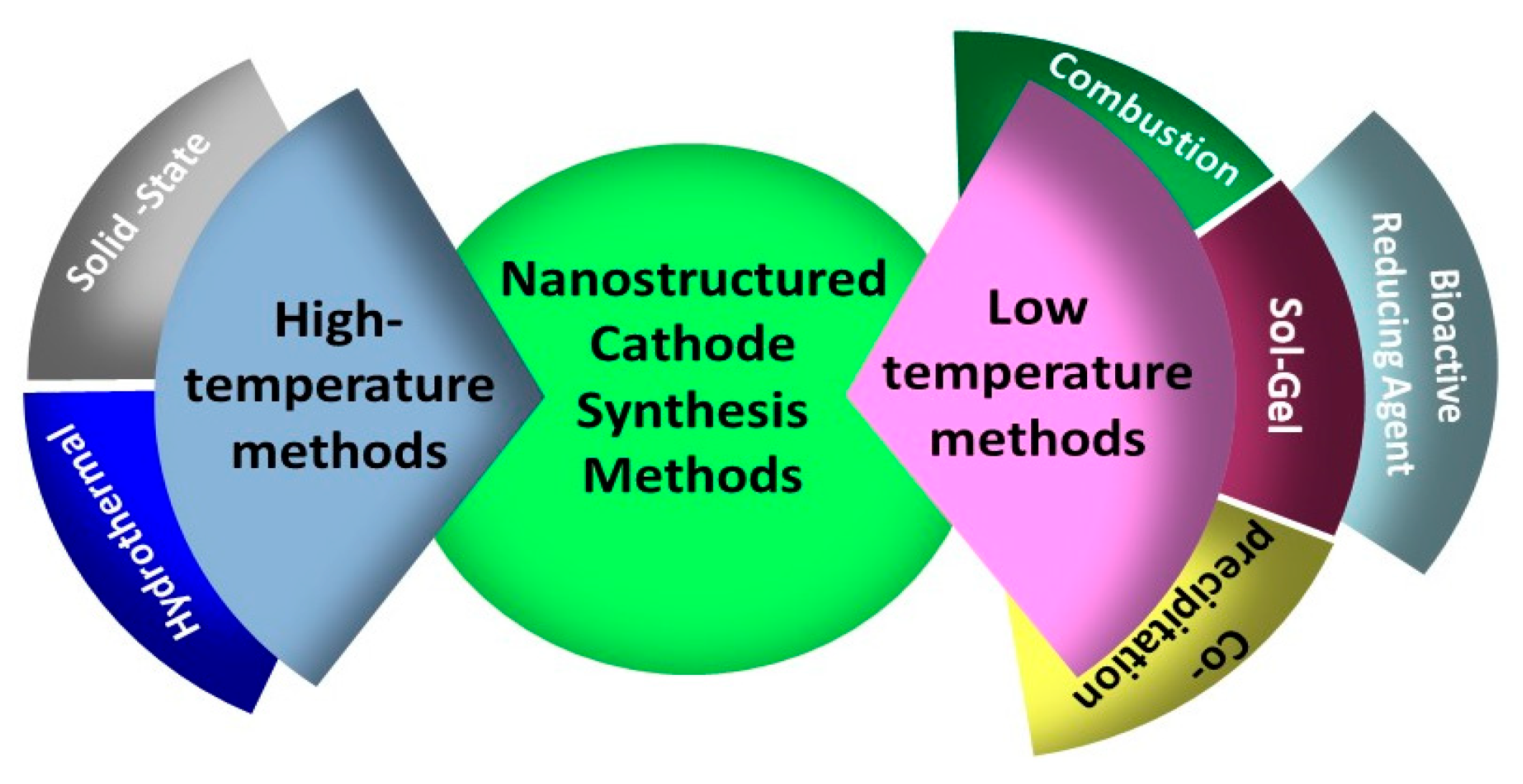
4.1. Solid State Reaction (SSR)
The solid-state reaction (SSR) method is one of the most conventional and widely used techniques for synthesizing powder materials from solid precursors. This method relies on high-temperature and is appreciated for its simplicity, ease of implementation, low cost, and minimal equipment requirements. In SSR synthesis, the physicochemical properties of the starting materials—such as reactivity, surface area, and free energy—as well as external parameters including temperature, pressure, and reaction atmosphere, strongly influence the final product characteristics. Using the SSR approach, Jiang et al. [210] successfully synthesized layered Li(Ni1/3Co1/3Mn1/3)O2 cathode material. The obtained compound exhibited a low degree of cation mixing and delivered a specific discharge capacity of 218.9 mAh g−1 with a Coulombic efficiency of 99.41% in the voltage range of 2.8–4.3 V (vs. Li+/Li). These results demonstrate the capability of the SSR to produce layered cathode materials with promising electrochemical performance. Despite these advantages, SSR also suffers from several limitations compared with solution-based synthesis techniques. Although the method is facile, scalable, and compatible with industrial production, it often produces materials with non-uniform morphology, large particle sizes, relatively large particle sizes, and broad particle-size distributions. In addition, the prolonged high-temperature calcination process, together with repeated grinding, mixing, and annealing steps, may induce particle coarsening and oxygen deficiency. Such drawbacks can promote the formation of impurity phases, and consequently deteriorate the structural integrity and electrochemical performance of the resulting cathode materials.
4.2. Hydrothermal Methods (HTM)
The hydrothermal method (HTM) is one of the most widely employed synthesis techniques for preparing cathode metal oxide nanostructures due to its ability to produce materials with high crystallinity, fine particle size, homogeneous distribution, and limited particle agglomeration [211]. In this process, precursor compounds are dissolved and recrystallized in a sealed autoclave under high-temperature and high-pressure aqueous conditions, where water acts as the reaction medium. The physicochemical properties of the resulting nanostructures are strongly governed by synthesis parameters such as reaction temperature, pressure, precursor concentration, pH, and reaction time. Precise control of these parameters promotes rapid nucleation and regulated crystal growth, enabling the formation of nanostructured cathode materials with tailored morphology, particle size, and lattice structure. Consequently, HTM is particularly effective for synthesizing highly crystalline and compositionally uniform metal oxides with controlled microstructural features. A major advantage of HTM lies in its ability to achieve excellent stoichiometric control, high phase purity, and desirable crystal architectures while using relatively low-cost raw materials. Compared with conventional solid-state or high-temperature synthesis routes, HTM offers enhanced control over particle size distribution, crystallinity, and structural homogeneity, which are critical factors for improving electrochemical performance. Despite these advantages, HTM also exhibits several limitations. The process requires specialized high-pressure equipment and prolonged reaction times at elevated temperatures, leading to increased energy consumption and operational complexity. In addition, large-scale industrial implementation remains challenging because of difficulties associated with reactor design, safety requirements, and process scalability. Therefore, although HTM is highly effective for producing advanced nanostructured cathode materials with superior electrochemical properties, its broader industrial application is still constrained by economic and scale-up considerations.
4.3. Low-Temperature Wet-Chemical Route
Low-temperature wet-chemical synthesis methods, commonly referred to as “chimie douce”, rely on alcoholic or aqueous precursor solutions to produce cathode materials with high phase purity, controlled stoichiometry, and enhanced homogeneity. Unlike conventional solid-state reactions, these approaches promote mixing at the molecular level, leading to improved compositional uniformity, reduced particle size, lower processing temperatures, and better crystallinity.
Owing to these advantages, wet-chemical routes have become widely used for the synthesis of lithium-based cathode materials. The most commonly employed techniques include:
- Combustion Method (CM) [217]: A rapid synthesis approach based on highly exothermic redox reactions between metal nitrates and organic fuels, producing fine powders with high surface area and good chemical homogeneity.
These wet-chemical synthesis methods offer several advantages over conventional high-temperature solid-state reactions, including improved control over particle size distribution, enhanced chemical homogeneity, and lower synthesis temperatures. Consequently, they are regarded as effective strategies for tailoring the morphology and electrochemical performance of advanced cathode materials. Among these approaches, the sol–gel method is one of the most widely employed and efficient techniques for synthesizing cathode materials, because of its ability to produce highly pure phases with controlled stoichiometry and morphology. In this process, stoichiometric amounts of precursor materials are initially dissolved in distilled water to form a homogeneous solution. The precursor solutions are then gradually introduced into a continuously stirred aqueous solution containing a suitable complexing agent in the desired ratio. Prolonged stirring, typically for at least three hours, ensures uniform mixing and facilitates complexation between the metal ions and the chelating agent. Following gelation, the solution undergoes slow evaporation, heating, and drying, leading to the formation of a transparent gel. This gel is subsequently transformed into a xerogel, which serves as the precursor for further thermal treatment. The xerogel is then calcined to decompose the organic constituents and convert metal carboxylates are converted into their corresponding oxides. After cooling to room temperature, the resulting powders are subjected to a second calcination step under controlled conditions, either in air or under vacuum, to obtain the desired crystalline phase and enhance structural stability. This multi-step synthesis route enables the production of cathode materials with uniform particle size, high crystallinity, and excellent phase purity. A schematic illustration of the cathode growth mechanism through the sol–gel synthesis process is presented in Figure 24 [218].
The sol–gel process (SGP) enables precise control over the homogeneous mixing of precursor components, ensuring uniform distribution and facilitating the formation and growth of crystalline phases with a narrow particle size distribution. Due to its relatively low reaction temperature, SGP is generally regarded as a cost-effective synthesis route compared with other methods operating under similar conditions [212]. Moreover, it is widely recognized as one of the most time- and cost-efficient approaches for producing high-purity cathode materials. Despite these advantages, SGP also exhibits several important limitations. The incorporation of organic chelating agents during synthesis results in the evolution of large volumes of gaseous by-products during calcination, which complicates processing and increases environmental and safety concerns. In addition, these factors hinder the scalability of the process for industrial applications. Consequently, although SGP is highly effective for laboratory-scale preparation of high-purity cathode materials, its large-scale industrial implementation remains challenging.
An innovative variation of the sol–gel process involves the use of bioactive reducing agents derived from natural sources such as green tea, aloe vera, or fruit peels (e.g., orange, tangerine). This environmentally friendly strategy employs plant-based extracts as natural chelating agents, providing a sustainable alternative to conventional organic reagents. The process generally comprises two main stages:
- Preparation of the bio-reducing agent: For instance, orange peel extract can be prepared by boiling small pieces of thoroughly washed discarded peels in distilled water at 100 °C for 10 minutes. The resulting mixture is then filtered to obtain a clear extract suitable for further use [214].
- Integration into the sol–gel process: The obtained bio-extract is subsequently introduced into the sol–gel synthesis as a chelating and complexing agent. It promotes metal-ion coordination, enhances precursor homogeneity, and facilitates the formation of uniform gels, thereby improving the sustainability of the synthesis route.
This bio-assisted sol–gel approach not only reduces dependence on synthetic organic chelating agents, but also offers a greener, more cost-effective, and potentially scalable route for cathode material synthesis. Figure 25 schematically illustrates the cathode growth formation process employing orange peel extract in the sol–gel method [214].
4.4. Co-Precipitation Methods (CPM)
The co-precipitation method (CPM) is widely recognized as an effective synthesis route for highly crystalline cathode materials due to its controlled nucleation and growth kinetics in homogeneous solutions. This his method enables the formation of fine, uniformly distributed particles with high specific surface area, which facilitates lithium-ion diffusion and enhance electrochemical performance. Additional advantages of CPM include short synthesis time, low energy consumption, and high product yield [215]. In a typical CPM process, stoichiometric amounts of precursor salts are dissolved in distilled water to obtain a homogeneous, saturated solution. Subsequently, a precipitating agent is added dropwise under continuous stirring, including precipitation of the precursor compounds. The obtained precipitate is then separated and dried through filtration or evaporation techniques [91]. To synthesize the final cathode material, the precursor is mixed with a stoichiometric amount of LiOH and calcined at an appropriate temperature under controlled atmospheric conditions (air or vacuum), with intermittent grinding to ensure compositional and structural uniformity. Figure 26 schematically presents the cathode growth mechanism during the co-precipitation process. An advanced modification of CPM involves the hydrogen peroxide-assisted co-precipitation, in which H2O2 functions both as an oxidizing agent and a dispersant. This approach improves precursor dispersion and promotes more effective oxidation during synthesis, resulting in enhanced electrochemical performance. For instance, NCM materials prepared via H2O2-assisted CPM exhibited superior specific capacity and improved cyclic stability compared with those synthesized using conventional co-precipitation products [216].
While the co-precipitation method offers several advantages over the sol–gel process, including precise control of stoichiometry, operational simplicity, facile adjustment of synthesis parameters, and a relatively short synthesis time, it also presents certain limitations. A major challenge arises from the formation of locally high precipitant concentrations during the reaction, which can promote particle agglomeration and compositional heterogeneity in the resulting product. These effects may adversely affect the structural uniformity of the synthesized cathode material and ultimately compromise its electrochemical performance.
4.5. Combustion method (CM)
The combustion method (CM) is a low-temperature synthesis route for producing cathode materials that eliminates the need for additional calcination steps. In this process, organic fuels such as glycine, urea, or citric acid undergo self-ignition upon heating, generating the thermal energy required for the formation of the target crystal structure. The method is particularly attractive due to its simplicity, low equipment requirements, effectively suppression of particle agglomeration, and ability to facilitate homogeneous dopant incorporation into the final material.
With a single annealing stage, CM can be applied to both liquid and solid precursors, enabling the synthesis of nanoscale cathode materials [217]. Typically, metal salt precursors are mixed with a suitable fuel to form a xerogel at relatively low temperatures. Upon heating, the xerogel undergoes a highly exothermic combustion reaction, generating precursor powders with ultrafine particle sizes. These powders are then calcined at elevated temperatures to produce the final crystalline cathode material. Owing to its simplicity, low cost, and effective control over particle size and morphology, CM has attracted considerable interest for cathode synthesis. However, the technique also presents notable drawbacks. In particular, its strong dependence on combustion behavior makes process control challenging and limits reproducibility during scale-up, thereby restricting its suitability for large-scale industrial production.
5. Structural Optimization
Despite the remarkable advantages of cathode materials in electrochemical cells, several inherent challenges continue to limit their long-term performance. These include low electronic conductivity, irreversible structural degradation, oxygen evolution during charge–discharge cycling, capacity fading at high current densities, thermal and structural instability, and associated safety risks. To overcome these limitations, surface modification has been widely explored as an effective strategy for enhancing cathode performance by minimizing undesirable side reactions between the electrode and the electrolyte. In addition to lattice doping, surface engineering has emerged as one of the most effective approaches for improving cycle structural stability and extending cycle life. Among the various techniques employed, the deposition of thin protective coatings on cathode particles is particularly attractive. These coatings typically consist of metal oxides, metal fluoride, metal polyanionic compounds, or metallic layers [218]. Acting as physical and chemical barriers, they suppress electrolyte decomposition, stabilize the electrode–electrolyte interface, reduce transition-metal dissolution, and mitigate structural degradation during repeated cycling.
Although coating procedures generally follow similar principles, specific synthesis routes and deposition conditions vary depending on the nature of the coating material and the selected fabrication method. Among the most extensively studied surface coatings, aluminum fluoride (AlF3) and lithium fluoride (LiF) have demonstrated significant effectiveness in enhancing interfacial stability and suppressing undesirable parasitic reactions at cathode- electrolyte interface. As schematically illustrated in Figure 27, the AlF3/LiF coating process provides a robust surface-engineering strategy that mitigates degradation mechanisms, improves cycling stability, and prolongs the operational lifetime of lithium-ion batteries [219].
5.1. Characterization techniques
Thermal analysis methods, including thermogravimetric analysis (TG), differential thermal analysis (DTA), and differential scanning calorimetry (DSC) are widely used to assess the thermal behavior and stability of both precursor and synthesized powders. These technics provide valuable information on mass-loss processes, thermal decomposition, phase transformations, and crystallization phenomena. The resulting data enable the determination of suitable heat-treatment conditions, identification of exothermic and endothermic reactions during calcination, and estimation of crystallization temperatures. Such information is crucial for optimizing synthesis parameters and ensuring the structural stability and phase purity of cathode materials.
X-ray diffraction (XRD) remains the most powerful techniques for the structural characterization of cathode materials, enabling precise assessment of phase purity, crystallinity, and structural evolution during synthesis. Analysis of diffraction patterns provides valuable information on phase transitions and lattice distortions. To obtain detailed structural parameters, XRD data are commonly analyzed using the Rietveld, which minimizes the differences between calculated and experimental diffraction profiles. This approach enables the determination of atomic coordinates, displacement parameters, site occupancies, and phase fractions, providing a comprehensive description of the crystal structure. For instance, XRD was used to examine the influence of increasing Ni content on the crystal structure of LiNiyMn2−yO4 spinels with y=1, synthesized by an EDTA-assisted sol–gel route (Figure 28) [220]. The Ni-rich sample was found to crystallize as a as a biphasic material consisting of a non-stoichiometric LiNiMnO4−δ spinel phase (space group Fdm) and a secondary Ni6MnO8 phase (space group Fm3m). Rietveld refinements indicated a composition (1-z) LiNiMnO4·zNi6MnO8 with z = 37.2. Furthermore, the results showed that only 15.5% of the Ni2+ ions were incorporated into the Fdm spinel structure when 0.5Ni was introduced into the LiNi0.5Mn1.5O4 lattice, highlighting the limited solubility of excess nickel in the spinel framework.
XRD has been widely used to investigate the influence of calcination conditions on Ag-coated LiMn2O4, particularly for determining the oxidation state and phase distribution of silver [221]. Rietveld refinement revealed that calcination in air led to the formation of a predominantly insulating AgO layer (3.2%) with only trace amounts of metallic Ag (0.1%). In contrast, vacuum calcination produced mainly metallic Ag nanoparticles (2.6%), present as nanospheres, together with a smaller fraction of AgO (0.8%) coating the LiMn2O4 particles. These results demonstrate the strong impact of processing atmosphere on the surface chemistry of modified cathode materials and highlight the effectiveness of XRD in characterizing associated structural and compositional changes (Figure 29).
Figure 28.
(a) XRD patterns of the as-prepared LiNiyMn2−yO4 (y = 0.0, 0.5 and 1.0) spinel samples. The insert shows the reflections at ca. 2θ =18.8°. Stars (*) indicate reflections of Ni6MnO8 impurity. (b) Rietveld refinement of Ni-rich LiNiMnO4. (c) Rietveld refinement of the 4-volt spinel LiMn2O4. (d) Rietveld refinement of the 5-volt LiNi0.5Mn1.5O4. Reproduced from [220]. Copyright 2021 under the terms and conditions of the Creative Commons Attribution (CC‒BY) license.
Figure 28.
(a) XRD patterns of the as-prepared LiNiyMn2−yO4 (y = 0.0, 0.5 and 1.0) spinel samples. The insert shows the reflections at ca. 2θ =18.8°. Stars (*) indicate reflections of Ni6MnO8 impurity. (b) Rietveld refinement of Ni-rich LiNiMnO4. (c) Rietveld refinement of the 4-volt spinel LiMn2O4. (d) Rietveld refinement of the 5-volt LiNi0.5Mn1.5O4. Reproduced from [220]. Copyright 2021 under the terms and conditions of the Creative Commons Attribution (CC‒BY) license.
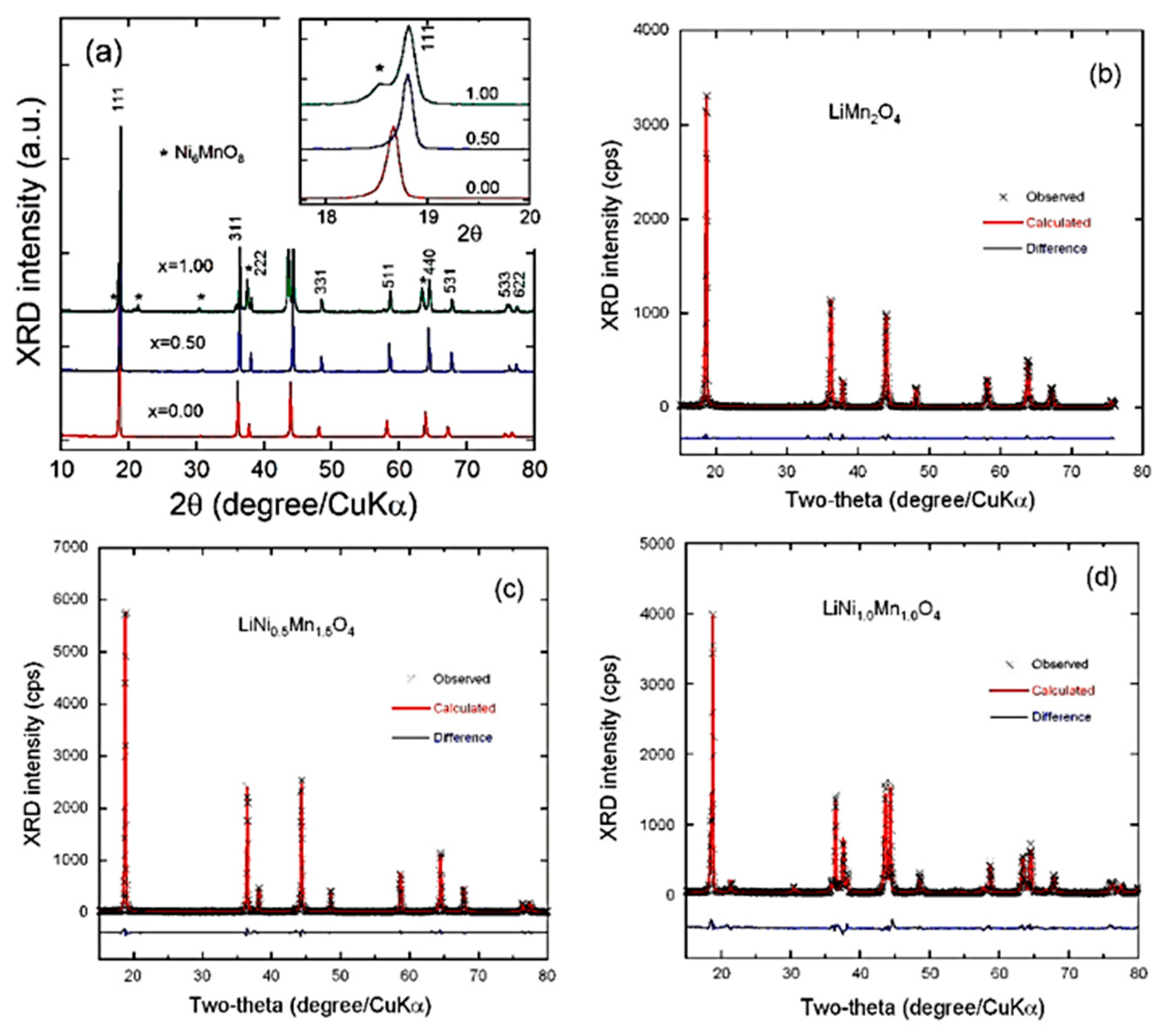
Figure 29.
Rietveld refinements of XRD patterns of (a) as-prepared pristine LMO, (b) Ag/LiMn2O4 treated in air, and (c) Ag/LMO calcined in vacuum. Reproduced from [221]. Copyright 2020 under the Creative Commons Attribution (CC‒BY) license.
Figure 29.
Rietveld refinements of XRD patterns of (a) as-prepared pristine LMO, (b) Ag/LiMn2O4 treated in air, and (c) Ag/LMO calcined in vacuum. Reproduced from [221]. Copyright 2020 under the Creative Commons Attribution (CC‒BY) license.
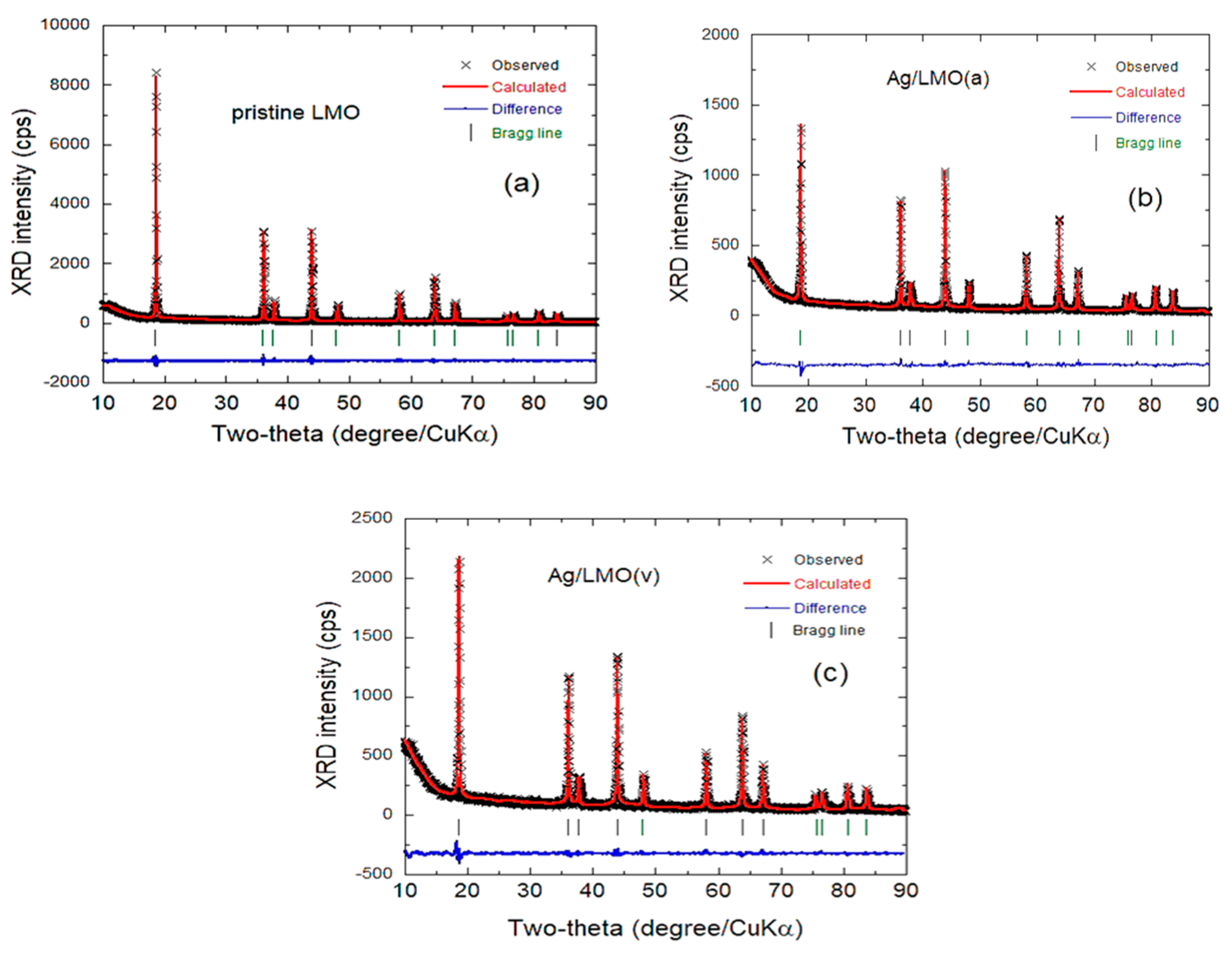
The morphology of cathode particles is primarily governed by the synthesis method, which significantly influences their electrochemical performance. Scanning Electron Microscopy (SEM) is widely used to examine surface morphology and compositional features by scanning the sample with a focused electron beam at the micro- and nanoscale. SEM provides detailed information on particle size, distribution, and surface texture. Transmission Electron Microscopy (TEM) and High-Resolution TEM (HRTEM) offer deeper insights into material structure through electron–matter interactions, enabling the characterization of morphology, crystallinity, strain, and defects. TEM reveals structural features such as dislocations, grain boundaries, and layer growth, whereas HRTEM allows direct visualization of lattice fringes and atomic-scale defects. In addition, the successful incorporation of dopants or surface coatings can be verified by Energy-Dispersive X-ray Spectroscopy (EDX), commonly coupled with TEM/SEM analyses. As an example, Figure 30 presents TEM images of pristine Li1.2Ni0.2Mn0.6O2 and AlF3-coated Li1.2Ni0.2Mn0.6O2 Li-rich cathode materials.
SEM and TEM are widely employed not only to differentiate samples based on morphology and grain size but also to assess surface characteristics of coated materials, including coating thickness, uniformity, and homogeneity. For example, TEM and HRTEM analyses of a hydrothermally synthesized AlF3-coated layered Li1.2Ni0.2Mn0.6O2 cathode demonstrated that the coating process did not affect the particle size or morphology. A uniform AlF3 layer approximately 5–7 nm thick was observed, indicating that the coating was structurally benign and preserved the original particle architecture [222]. In addition, Selected Area Electron Diffraction (SAED) provides valuable structural information by enabling the identification of multiple phases and crystallographic distortions based through characteristic diffraction patterns. For instance, SAED analyses of Li-rich layered Li1.2Ni0.13Mn0.54Co0.13O2 powders synthesized via the sol–gel method using different chelating agents (citric acid, EDTA, and CA/EDTA) revealed disruptions in the rhombohedral symmetry of the samples prepared with citric acid and EDTA (Figure 31). These distortions were attributed to the presence of stacking faults and dislocations within the crystal lattice [63].
Figure 30.
TEM images of (a) pristine Li1.2Ni0.2Mn0.6O2 and (b) AlF3-coated Li1.2Ni0.2Mn0.6O2. HRTEM images of (c) pristine Li1.2Ni0.2Mn0.6O2 and (d) AlF3-coated Li1.2Ni0.2Mn0.6O2. Image (e) shows the morphology of the AlF3 coating [222]. Copyright 2022 under the Creative Commons Attribution (CC‒BY) license.
Figure 30.
TEM images of (a) pristine Li1.2Ni0.2Mn0.6O2 and (b) AlF3-coated Li1.2Ni0.2Mn0.6O2. HRTEM images of (c) pristine Li1.2Ni0.2Mn0.6O2 and (d) AlF3-coated Li1.2Ni0.2Mn0.6O2. Image (e) shows the morphology of the AlF3 coating [222]. Copyright 2022 under the Creative Commons Attribution (CC‒BY) license.
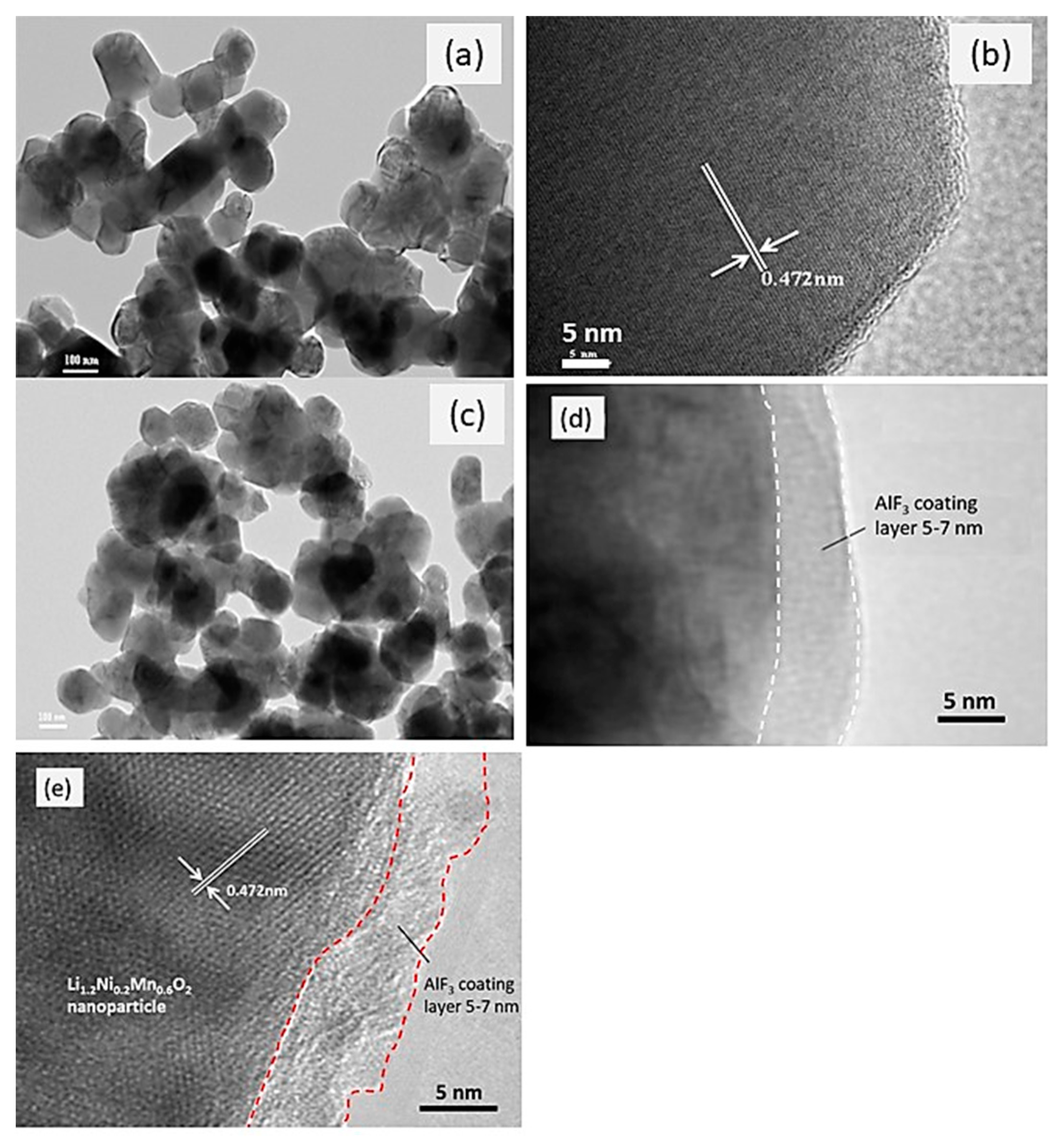
Figure 31.
SAED patterns of Li1.2Ni0.13Mn0.54Co0.13O2 powders synthesized with and without chelating agent–assisted sol-gel method: (a) without chelating, (b) CA/EDTA, (c) CA and (d) EDTA. Reproduced from [63]. Copyright 2020 Springer.
Figure 31.
SAED patterns of Li1.2Ni0.13Mn0.54Co0.13O2 powders synthesized with and without chelating agent–assisted sol-gel method: (a) without chelating, (b) CA/EDTA, (c) CA and (d) EDTA. Reproduced from [63]. Copyright 2020 Springer.
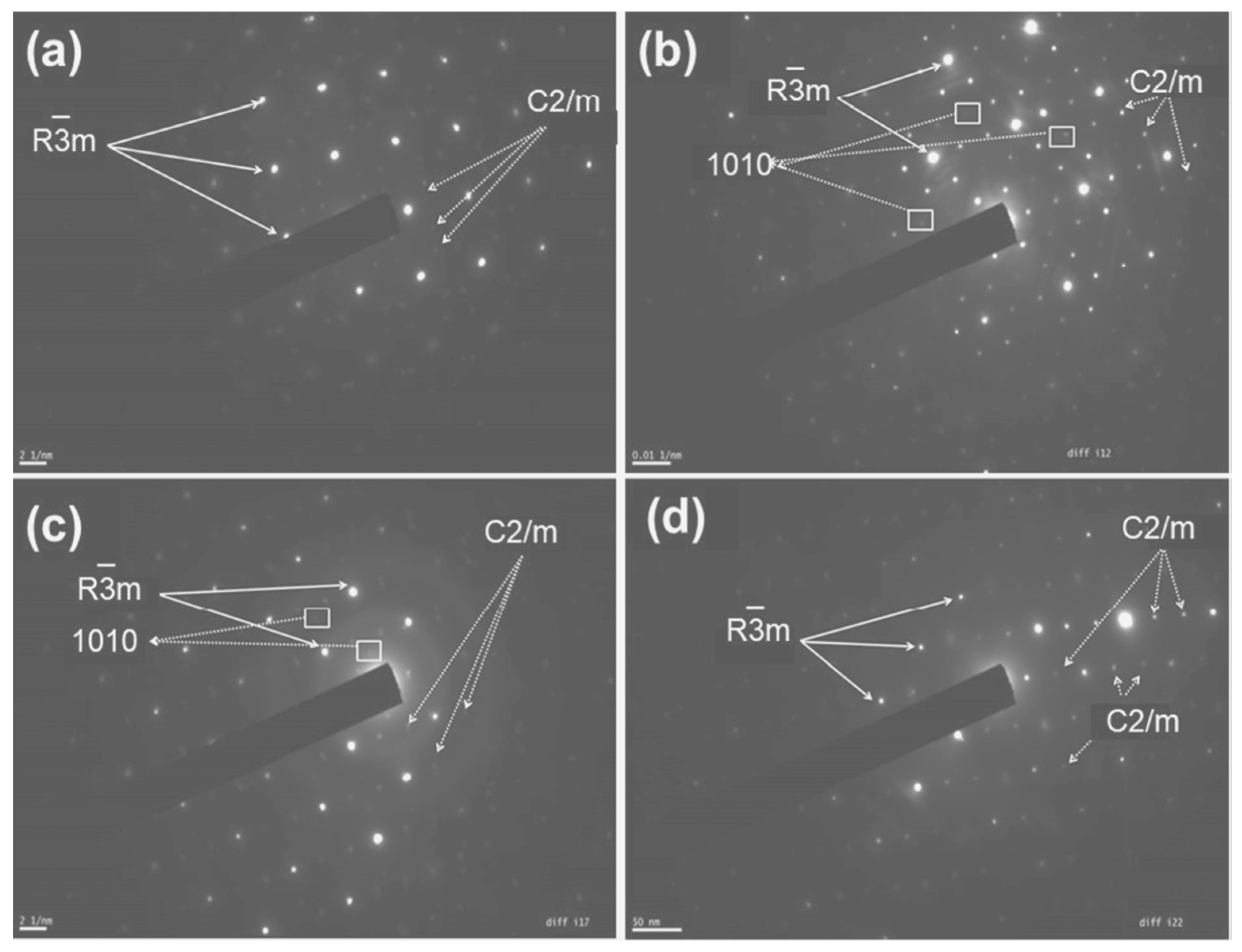
Raman scattering (RS) and Fourier transform infrared (FTIR) spectroscopy are highly sensitive probes of the short-range oxygen coordination environment surrounding cations in oxide lattices. Their sensitivity to local structure makes them particularly valuable for phase identification when multiple local environments coexist. The frequencies and relative intensities of vibrational bands are primarily governed by the cation coordination geometry and oxidation state, whereas grain size and long-range structural order have a comparatively minor influence. Moreover, vibrational spectroscopies are well suited for the characterization of amorphous materials, for which conventional X-ray diffraction (XRD) provides limited structural information [223].
RS probes the local oxygen environment through molecular vibrational modes, providing insights into structural distortions, phase transitions, and local bonding configurations in cathode materials. FTIR spectroscopy offers complementary information on metal–oxygen interactions within the cathode lattice and is frequently combined with other characterization techniques to evaluate lattice anisotropy and the degree of covalency in interlayer regions. Such information is essential for understanding and improving the structural stability of framework materials, particularly those exhibiting deviations from cubic symmetry.
For example, ex situ Raman mapping has been employed to investigate structural changes in LMO during delithiation [224]. Raman maps clearly reveal stable structural states at each electrochemical potential (Figure 32). A full discharge, the dominant phase corresponds to LiMn2O4 purple area), while a minority population of Li-rich Li1+zMn2O4 crystallites is identified by a shift of the high-frequency Raman band from 627 to 635 cm−1. This shift indicates shortening of the Mn−O bond and distortion of the MnO6 octahedra resulting from Li ions occupy of the 16d octahedral sites within the spinel framework. Another study investigated atomic displacements associated with Raman- and IR-active vibrational modes in LiMn2O4 spinels synthesized by sol–gel methods using different chelating agents (citric acid and EDTA) [210].
Although the Raman and FTIR spectra of both samples were largely similar, slight peak shifts observed for the EDTA-assisted sample were attributed to variations in lattice parameters, which contribute to the stabilization of non-cubic structural motifs. The analyses also revealed local lattice distortions associated with Jahn–Teller active Mn3+ ions, manifested by increased cell volume and peak broadening. Furthermore, Mn3+-induced disruption of translational symmetry activated additional vibrational modes that became observable through spectral decomposition. These studies demonstrate the effectiveness of Raman and FTIR spectroscopy in identifying subtle lattice distortions, structural instabilities, and local symmetry changes in LiMn2O4 cathode materials.
X-ray photoelectron spectroscopy (XPS) is a versatile surface analysis technique that enables both qualitative and quantitative characterization of materials. Qualitatively, it provides information on elemental composition, empirical formulas, chemical states, and electronic states of the elements present at the surface. Quantitatively, XPS peak intensities can be deconvoluted to estimate the relative concentrations of different chemical species, allowing determination of average oxidation states. In LIBs, XPS is particularly valuable for elucidating the intercalation mechanisms of cathode materials. By tracking the oxidation states of 3d transition metal cations and oxide species as a function of lithium content in the host structure, XPS offers key insights into structural and electronic destabilization processes occurring during charge–discharge cycling. For instance, XPS analysis of lithium manganese oxide reveals peaks at 642.1 eV and 643.6 eV, assigned to Mn3+ and Mn4+ species, respectively [212]. These values are consistent with those reported for Mn3+ in Mn2O3 and Mn4+ in MnO2 [225]. Deconvolution of Mn 2p spectra enables quantification of the relative proportions of Mn3+ and Mn4+, from which average valence states can be derived. In the case of LiMn2O4 synthesized with EDTA and citric acid, the calculated average Mn valence states were 3.505 and 3.56, respectively, confirming the expected mixed-valence character of manganese in the spinel structures.
XPS is also a powerful technique for probing the influence of calcination conditions on surface chemistry. For example, Figure 33 compares MoO3 (MOA) calcined in air with MoO2 (MOV) calcined under vacuum at 450 °C [214]. The XPS spectra reveal the presence of minor Mo-suboxides (MoO2, Mo4O11, Mo8O23, Mo9O26), indicating mixed valence states at the surface of MOV. These results highlight the sensitivity of XPS to subtle changes in oxidation state and surface composition, which are critical parameters for understanding cathode stability and electrochemical performance.
5.2. Electrochemical Properties
The evaluation of electrochemical properties is one of the most important steps in assessing the suitability of cathode materials for LIBs, as these properties directly determine their performance and practical applicability. The most commonly employed techniques are galvanostatic charge–discharge cycling and cyclic voltammetry (CV). These methods provide information on the evolution of the electrode potential as a function of lithium composition during charge and discharge processes, allowing the investigation of redox reactions, electrochemical reversibility, and structural stability. Electrochemical measurements are typically conducted under various operating conditions, including different current rates, temperatures, and voltage windows, to evaluate the material’s behavior under realistic service conditions. In addition, Electrochemical Impedance Spectroscopy (EIS) is frequently performed on both pristine and cycled electrodes to investigate the kinetic processes governing battery operation. EIS provides valuable insights into charge-transfer resistance, lithium-ion diffusion, and electrode-electrolyte interfacial stability, thereby contributing to a deeper understanding of the factors governing cathode performance. To perform these electrochemical investigations, a complete battery cell must be assembled. The synthesized cathode material is generally coated onto a metallic current collector, while lithium metal is used as the as the counter and reference electrode. Figure 34 illustrates the schematic assembly of a coin-cell in an argon-filled glove box, highlighting the configuration commonly employed for the electrochemical characterization of cathode materials.
The incorporation of a small amount of sodium into lithium-rich cathode materials has been demonstrated to significantly improve their electrochemical performance. As shown in Figure 35a, the introduction of 3 mol.% Na reduces the charge-transfer impedance by more than three orders of magnitude while simultaneously increasing the lithium-ion diffusion coefficient by a similar magnitude [226]. These enhancements in electronic conductivity and ion transport kinetics contribute directly to improved electrochemical reversibility and capacity retention. As illustrated in Figure 35b, the discharge capacity of the Na-doped Li1.2Ni0.13Co0.13Mn0.54O2 electrode gradually increases with cycling. This progressive activation behavior indicates an increase in the amount of electrochemically active lithium at the particle surface during repeated charge–discharge cycles. The results suggest that Na doping not only facilitates lithium-ion transport, but also helps stabilize the electrode–electrolyte interface, thereby promoting sustained electrochemical activity and enhancing the long-term cycling performance of lithium-rich layered cathode materials.
6. Insights and Future Prospective
6.1. Insights
Nanostructuring of cathode materials has emerged as an effective strategy to address several intrinsic limitations encountered in conventional lithium-ion batteries, including sluggish Li+ diffusion, low electronic conductivity, and structural degradation during cycling. Through nanoscale engineering significant improvements have been achieved in charge/discharge capacity, reversible capacity utilization, rate capability, and cyclic stability of across various cathode families, such as layered oxides (e.g., LCO, NMC, and NCA), spinel oxides (LMO), and polyanionic compounds (LFP, LMP). The main insights drawn from recent developments are summarized as follows:
- Shortened lithium-ion diffusion pathways: Reducing particle size to the nanoscale significantly decreases Li+ diffusion lengths while increasing the electrode–electrolyte contact area. As a result, nanostructured cathodes can deliver superior rate performance, even for materials traditionally limited by slow ion transport kinetics, such as LFP.
- Improved interfacial stability through surface engineering: Surface coatings, including carbon, metal oxides, and phosphate layers as well as advanced interface engineering approaches, can effectively mitigate interfacial side reactions, suppress transition-metal dissolution, and stabilize the cathode/electrolyte interface, particularly under high voltage operating conditions.
- Enhanced structural integrity during cycling: Nanosized particles can better accommodate the mechanical strain associated with repeated lithiation and delithiation processes. Their ability to tolerate volume changes reduces microcrack formation and structural degradation, thereby minimizing capacity fading. This effect is particularly important for high-nickel layered oxides and spinel cathodes subjected to aggressive cycling conditions.
- Higher electronic conductivity through carbon integration: The incorporation of conductive carbon materials, such as carbon coatings, carbon nanotubes (CNTs), and graphene networks, creates efficient electron-transport pathways. These conductive frameworks improve overall electronic conductivity while limiting the amount of inactive conductive additives required in the electrode.
- Trade-offs associated with nanostructuring: Despite their numerous advantages, nanostructured cathodes often exhibit increased surface reactivity, accelerated parasitic reactions, lower tap density, and higher manufacturing costs. These drawbacks highlight the importance of optimizing particle size and morphology rather than pursuing indiscriminate size reduction.
Overall, the successful implementation of nanostructured cathodes requires a careful balance between enhanced electrochemical performance and practical considerations related to stability, energy density, scalability, and cost.
The main advantage of the LFP cathode is its outstanding thermal stability and a very good cycle life, which, however, is at the expense of the energy density. Concerning NMC and NCA, the “best” performance depends on which metric we care about most: energy density, power, cycle life, safety, or cost. The practical comparison between NCA and NMC cathodes used in lithium-ion batteries has been reported in recent works [227,228,229], and is synthesized in the following Table 2.
Considering the energy density, NCA wins. Today, it does not exceed 260 Wh kg−1 for NMC811. That is why Tesla historically used NCA for long-range EVs. However, NCA performs better because aluminum stabilizes the structure at high voltage. However, considering the best cycle life, NMC wins. Typical ranges are 5009-1500 cycles for NCA, 1500-2000 cycles for NMC. The reason is that Mn improves the crystal stability, the resistance to cracking, and reduces the oxygen release, reducing degradation during cycling. NMC is also safer to manage thermally and benefits of lower thermal runaway tendency. That is why the market is evolving toward high-Ni NMC, justifying the efforts in research currently made on recycling of Li-ion batteries with NMC cathodes [230].
Table 2.
Practical comparison between NCA and NMC cathodes used in lithium-ion batteries.
| Property | NCA Cathode | NMC Cathode |
|---|---|---|
| Energy density Typical cell energy Power capability Cycle life Thermal stability Safety Cost Main use |
Very high 200–300 Wh kg−1 Excellent Moderate Lower Requires strong BMS/cooling Higher Tesla, aerospace, EVs |
High 150–260 Wh kg−1 Very good Better overall Better More stable Lower Most EVs, ESS, tools |
6.2. Future prospective
The future development of nanostructured cathode materials should focus on bridging the gap between laboratory-scale research and commercially viable battery technologies. Several promising directions can be identified:
- Advanced Nanostructure Design: Future research should move beyond conventional nanoparticles toward hierarchical, mesoporous, and oriented nanostructures that can simultaneously provide rapid lithium-ion transport, high tap density, and enhanced mechanical stability.
- Surface and Interface Engineering: The development of advanced surface passivation strategies, including ultrathin ion-conductive coatings and artificial cathode -/electrolyte interphases, is crucial for minimizing parasitic side reactions while preserving fast Li+ transport kinetics and improving long-term cycling stability.
- Stabilization of Next-Generation Cathodes: Nanostructuring is expected to play a key role in enabling high-energy-density cathode materials, such as high-nickel layered oxides, lithium-rich oxides, and cobalt-free systems. These materials often suffer from structural degradation and interfacial instability, challenges that can be mitigated through rational nanoscale engineering.
- Scalable and Sustainable Manufacturing: The commercialization of nanostructured cathodes requires cost-effective, scalable, and environmentally sustainable synthesis approaches. Techniques such as green synthesis, spray drying, sol–gel processing, hydrothermal synthesis, and solid-state methods with precise nanoscale control offer significant potential for industrial-scale production.
- Integration with Advanced Electrolytes: The co-development of nanostructured cathodes with solid-state electrolytes or high-voltage liquid electrolytes will be essential for achieving safer lithium-ion batteries with wider electrochemical stability windows, higher energy densities, and improved operational reliability.
Overall, the combination of nanostructure engineering, interface optimization, scalable manufacturing, and advanced electrolyte integration is expected to accelerate the commercialization of high-performance lithium-ion batteries for electric vehicles, grid storage, and portable electronics. Table 3 highlights the most familiar cathode materials for lithium-ion batteries.
7. Conclusions
The development of LIBs is essential for addressing current environmental and technological challenges, particularly due to their widespread use in electric vehicles and advanced electronic devices. This review highlights recent progress in cathode materials, which remain the key determinants of LIB performance. Comprehensive characterization techniques—including XRD, TEM, SEM, Raman spectroscopy, FTIR, XPS, EIS, and electrochemical testing—have been extensively employed to evaluate the structural, morphological, surface, and electrochemical properties of cathode materials. The combined use of these methods provides valuable insights for identifying and optimizing high-performance cathode candidates.
Nanotechnology has emerged as a critical driver of battery innovation, enabling the development of nanostructured cathode materials with enhanced conductivity, faster ion diffusion, and improved structural stability. This review has summarized the principal nanostructure designs and synthesis strategies, highlighting their advantages and limitations in improving electrochemical performance and mitigating capacity degradation. Overall, the synergy between advanced synthesis techniques, surface engineering, and nanoscale material design offers significant opportunities for the development of next-generation cathode materials. These advances are expected to play a vital role in meeting the increasing energy storage demands of sustainable transportation, portable electronics, and future clean-energy technologies.
Author Contributions
Conceptualization, A.M.H. and C.M.J.; resources, R.S.E.-T. and A.E.A.-G.; writing—original draft preparation, A.E.A.-G. and R.S.E.-T.; writing—review and editing, A.M. and C.M.J. All authors have read and agreed to the published version of the manuscript.
Funding
This research received no external funding.
Data Availability Statement
New data reported in this review are available from the corresponding author upon request.
Conflicts of Interest
The authors declare no conflicts of interest.
Abbreviations
The following abbreviations are used in this manuscript:
| CA | Citric acid |
| CG | Concentration gradient |
| CM | Combustion method |
| CPM | Co-precipitation method |
| CV | Cyclic voltammetry |
| DFT | Density functional theory |
| DSC | Differential scanning calorimetry |
| DTA | Differential thermal analysis |
| EDTA | Ethylene diamine tetra-acetic acid |
| EDX | Energy-dispersive X-ray spectroscopy |
| EIS | Electrochemical impedance spectroscopy |
| EV | Electric vehicle |
| FCG | Full concentration gradient |
| FTIR | Fourier transform infrared |
| HRTEM | High-resolution transmission electron microscopy |
| HTM | Hydrothermal method |
| LCO | LiCoO2 |
| LFP | LiFePO4 |
| LIB | Lithium-ion battery |
| LLMO | Li1+yMn2−yO4−δ |
| LMCN | Li1.2Ni0.13Mn0.54Co0.13O2 |
| LMO | LiMn2O4 |
| LMP | LiMnPO4 |
| LMFP | LiMn1-yFeyPO4 |
| LNO | LiNiO2 |
| LZO | Li2ZrO3 |
| NCA | LiNi0.8Co0.15Al0.05O2 |
| NMC | LiNi1₋ₓ₋ᵧMnₓCoᵧO2 |
| NMC333 | LiNi1/3Mn1/3Co1/3O2 |
| NMC532 | LiNi0.5Mn0.3Co0.2O2 |
| NMC622 | LiNi0.6Mn0.2Co0.2O2 |
| NMC811 | LiNi0.8Mn0.1Co0.1O2 |
| RS | Raman spectroscopy |
| SAED | Selected area electron diffraction |
| SEM | Scanning electron microscopy |
| SSG | Self-sol-gel |
| SSR | Solid-state reaction |
| TEM | Transmission electron microscopy |
| TG | Thermal gravimetry |
| XPS | X-ay photoelectron spectroscopy |
| XRD | X-ray diffractometry |
References
- Nishi, Y. Lithium ion secondary batteries; past 10 years and the future. J. Power Sources 2001, 100, 101‒106. [CrossRef]
- Makeyaw, A.; Dame, T.; Getu, M.; Goytom, D.; Tadese, M.; Malto, T.M.; Gebremedihin, Y. Targeted advances in lithium-ion batteries: A critical review of synergetic improvements in energy density, life cycle, and safety. Am. J. Quantum Chem. Mol. Spectrosc. 2025, 9, 12–30. [CrossRef]
- Whittingham, M.S. The role of ternary phases in cathode reactions. J. Electrochem. Soc. 1976, 123, 315–320. [CrossRef]
- Whittingham, M.S. Electrical energy storage and intercalation chemistry. Science 1976, 192, 1126–1127. [CrossRef]
- Besenhard, J.O. The electrochemical preparation and properties of ionic alkali metal- and NR4-graphite intercalation compounds in organic electrolytes. Carbon 1976, 14, 111–118. [CrossRef]
- Mizushima, K.; Jones, P.C.; Wiseman, P.J.; Goodenough, J.B. LiₓCoO2 (0 <x ≤ 1): A new cathode material for batteries of high energy density. Mater. Res. Bull. 1980, 15, 783–789.
- Bashir, S.; Sanders, N. K.; Liu, J. L. Technology policy and road map of battery. In: Nanostructured Materials for Next-Generation Energy Storage and Conversion, Zhen, Q.; Bashir, S.; Liu, J. (Eds), Springer: Berlin, 2019, pp. 1–59.
- Zhao, W.; Choi, W.; Yoon, W -S. Nanostructured electrode materials for rechargeable lithium-ion batteries, J. Electrochem. Sci. Technol. 2020, 11, 195–219.
- Ding, Y.; Cano, Z.P.; Yu, A.; Lu, J.; Chen, Z. Automotive Li-ion batteries: Current status and future perspectives. Electrochem. Energy Rev. 2019, 2, 1–28. [CrossRef]
- Kotal, M.; Jakhar, S.; Roy, S.; Sharma, H.K. Cathode materials for rechargeable lithium batteries: Recent progress and future prospects. J. Energy Storage 2022, 47, 103534. [CrossRef]
- Manthiram, A.; Knight, J.C.; Myung, S.T.; Oh, S.M.; Sun, Y.K. Nickel-rich and lithium-rich layered oxide cathodes: Progress and perspectives. Adv. Energy Mater. 2016, 6, 1501010. [CrossRef]
- Julien, C.M.; Mauger, A.; Vijh, A.; Zaghib, K. Lithium Batteries: Science and Technology, Springer, Cham, Switzerland, 2016.
- Yoshino, A.; Sanechika, K.; Nakajima, T. Secondary battery. US Patent 4,668,595, filled May 9, 1986, patented on May 26, 1987.
- Almazrouei, M.; Park, S.; Houck, M.; De Volder, M.; Hochgreb, S.; Boies, A. Synthesis pathway of layered-oxide cathode materials for lithium-ion batteries by spray pyrolysis. ACS Appl. Mater. Interfaces 2024, 16, 33633–33646. [CrossRef]
- Yano, A.; Taguchi, N.; Kanzaki, H.; Shikano, M.; Sakaebe, H. Capability and reversibility of LiCoO2 during charge/discharge with O3/H1‒3 layered structure change. J. Electrochem. Soc. 2021, 168, 050517. [CrossRef]
- Liu, Z.; Han, M.; Zhang, S.; Li, H.; Wu, X.; Fu, Z.; Zhang, H.; Wang, G.; Zhang, Y. Hybrid surface modification and bulk doping enable spent LiCoO2 cathodes for high-voltage operation. Adv. Mater. 2024, 36, 2304938. [CrossRef]
- Zhang, J.-N.; Li, Q.; Ouyang, C.; Yu, X.; Ge, M.; Huang, X.; Hu, E.; Ma, C.; Li, S.; Xiao, R.; Yang, W.; Chu, Y.; Liu, Y.; Yu, H.; Yang, X.-Q.; Huang, X.; Chen, L.; Li, H. Trace doping of multiple elements enables stable battery cycling of LiCoO2 at 4.6 V. Nat. Energy 2019, 4, 594–603. [CrossRef]
- Yang, B.; Wang, J.; Cao, P.; Zhu, T.; Shu, H.; Chen, J.; Zhang, J.; Zhu, J. Classification, summarization and perspectives on state-of-charge estimation of lithium-ion batteries used in electric vehicles. J. Energy Storage 2021, 39, 102572. [CrossRef]
- Duan, J.; Tang, X.; Dai, H.; Yang, Y.; Wu, W.; Wei, X.; Huang, Y. Building safe lithium-ion batteries for electric vehicles: A review. Electrochem. Energy Rev. 2020, 3, 1–42. [CrossRef]
- Dyer, L.D.; Borie, B.S., Jr.; Smith, G.P. Alkali metal–nickel oxides of the type MNiO2. J. Am. Chem. Soc. 1954, 76, 1499–1503. [CrossRef]
- Venkatraman, S.; Shin, Y.; Manthiram, A. Phase relationships and structural and chemical stabilities of charged Li1−xCoO2−δ and Li1−xNi0.85Co0.15O2−δ cathodes. Electrochem. Solid-State Lett. 2003, 6, A9–A12.
- Johnston, B.I.J.; Bolloju, S.; Price, S.W.T.; Squires, A.G.; Ganeshkumar, L.; Ans, M.; Gott, J.A.; Kaur, N.S.; McClelland, I.; Booth, S.G.; Beale, A.M.; Jacques, S.D.M.; Menon, A.S.; Scanlon, D.O.; Piper, L.F.J.; Cussen, S.A. Enhanced cycling stability of LiNiO2 cathodes through a Mg/W dual-cation modification strategy. J. Mater. Chem. A 2025, 13, 39077–39096. [CrossRef]
- Jia, Y.; Hou, X.; Li, K.; Wang, L.; Zhang, M.; Li, Z.; Xu, X.; Zheng, J. Unraveling the oxygen evolution in layered LiNiO2 with the role of Li/Ni disordering. Energy Storage Mater. 2024, 71, 103632. [CrossRef]
- Aurbach, D.; Gamolsky, K.; Markovsky, B.; Salitra, G.; Gofer, Y.; Heider, U.; Oesten, R.; Schmidt, M. The study of surface phenomena related to electrochemical lithium intercalation into LiₓMOᵧ host materials (M = Ni, Mn). J. Electrochem. Soc. 2000, 147, 1322–1331.
- Huang, G.-X.; Wang, R.-H.; Lv, X.-Y.; Su, J.; Long, Y.-F.; Qin, Z.-Z.; Wen, Y.-X. Effect of niobium doping on structural stability and electrochemical properties of LiNiO2 cathode for Li-ion batteries. J. Electrochem. Soc. 2022, 169, 040533. [CrossRef]
- Wei, M.-T.; Wu, L.; Hu, Z.-Y.; Wu, K.-X.; Sun, J.-Y.; Yin, Z.-W.; Yang, X.-Y.; Li, Y.; Van Tendeloo, G.; Su, B.-L. La doping LiNiO2 cathode to immobilize the lattice oxygen for high stable lithium-ion batteries. Nano Lett. 2025, 25, 5265‒5273. [CrossRef]
- Ma, J.; Liu, T.; Ma, J.; Zhang, C.; Yang, J. Progress, challenge, and prospect of LiMnO2: An adventure toward high-energy and low-cost Li-ion batteries. Adv. Sci. 2024, 11, 2304938. [CrossRef]
- Kam, R.L.; Binci, L.; Kaplan, A.D.; Persson, K.A.; Marzari, N.; Ceder, G. The interplay between electron localization, magnetic order, and Jahn–Teller distortion that dictates LiMnO2 phase stability. Phys. Rev. B 2025, 111, 245132. [CrossRef]
- Ammundsen, B.; Paulsen, J. Novel lithium-ion cathode materials based on layered manganese oxides. Adv. Mater. 2001, 13, 943–956.
- Pang, W.K.; Lee, J.Y.; Wei, Y.S.; Wu, S.-H. Preparation and characterization of Cr-doped LiMnO2 cathode materials by Pechini’s method for lithium-ion batteries. Mater. Chem. Phys. 2013, 139, 241–246. [CrossRef]
- Ohzuku, T.; Makimura, Y. Layered lithium insertion material of LiNi1/2Mn1/2O2: A possible alternative to LiCoO2 for advanced lithium-ion batteries. Chem. Lett. 2001, 30, 744–745. [CrossRef]
- Reed, J.; Ceder, G. Charge, potential, and phase stability of layered LiNi0.5Mn0.5O2. Electrochem. Solid-State Lett. 2002, 5, A145–A148.
- Yoon, W.S.; Grey, C.P.; Balasubramanian, M.; Yang, X.Q.; McBreen, J. Investigation of the charge compensation mechanism on electrochemically Li-ion deintercalated Li1−xCo1/3Ni1/3Mn1/3O2 by soft and hard X-ray absorption spectroscopy. Chem. Mater. 2003, 15, 3161–3169.
- Okochi, R.; Arachi, Y. Electrochemical performance of LiNi0.5Mn0.5O2 electrode in all-solid-state battery. ECS Meet. Abstr. 2024, MA2024-02, 4497. [CrossRef]
- Jia, G.; Liu, S.; Yang, G.; Li, F.; Wu, K.; He, Z.; Shangguan, X. The multiple effects of Al-doping on the structure and electrochemical performance of LiNi0.5Mn0.5O2 as cathode material at high voltage. Ionics 2018, 24, 3705–3715. [CrossRef]
- Yoon, W.-S.; Balasubramanian, M.; Yang, X.-Q.; Fu, Z.; Fischer, D.A.; McBreen, J. Soft X-ray absorption spectroscopic study of a LiNi0.5Mn0.5O2 cathode during charge. J. Electrochem. Soc. 2004, 151, A246–A251. [CrossRef]
- Deb, A.; Bergmann, U.; Cramer, S.P.; Cairns, E.J. Local structure of LiNi0.5Mn0.5O2 cathode material probed by in situ X-ray absorption spectroscopy. J. Appl. Phys. 2006, 99, 063701.
- Hinuma, Y.; Meng, Y.S.; Kang, K.; Ceder, G. Phase transitions in the LiNi0.5Mn0.5O2 system with temperature. Chem. Mater. 2007, 19, 1790–1800. [CrossRef]
- Kobayashi, H.; Sakaebe, H.; Kageyama, H.; Tatsumi, K.; Arachi, Y.; Kamiyama, T. Changes in the structure and physical properties of the solid solution LiNi1−xMnₓO2 with variation in composition. J. Mater. Chem. 2003, 13, 590–595. [CrossRef]
- Li, H.H.; Yabuuchi, N.; Meng, Y.S.; Kumar, S.; Breger, J.; Grey, C.P.; Shao-Horn, Y. Changes in the cation ordering of layered O3 LiₓNi0.5Mn0.5O2 during electrochemical cycling to high voltages: An electron diffraction study. Chem. Mater. 2007, 19, 2551–2565. [CrossRef]
- Van der Ven, A.; Ceder, G. Ordering in Liₓ(Ni0.5Mn0.5)O2 and its relation to charge capacity and electrochemical behavior in rechargeable lithium batteries. Electrochem. Commun. 2004, 6, 1045–1050. [CrossRef]
- Breger, J.; Meng, Y.S.; Hinuma, Y.; Kumar, S.; Kang, K.; Shao-Horn, Y.; Ceder, G.; Grey, C.P. Effect of high voltage on the structure and electrochemistry of LiNi0.5Mn0.5O2: A joint experimental and theoretical study. Chem. Mater. 2006, 18, 4768–4781. [CrossRef]
- Shi, X.; Wang, C.; Zhang, Y.; Liu, Q.; Li, H.; Song, D.; Zhang, L. Structure and electrochemical behaviors of spherical Li1+xNi0.5Mn0.5O2+δ synthesized by rheological phase reaction method. Electrochim. Acta 2014, 150, 89–98. [CrossRef]
- Castro-Garcia, S.; Julien C.; Senaris-Rodriguez, M.A. Structural and electrochemical properties of Li-Ni-Co oxides synthesized by wet chemistry via succinic acid-assisted technique. Intl. J. Inorg. Mater. 2001, 3, 323‒329. [CrossRef]
- Ceder, G.; Chiang, Y.M.; Sadoway, D.R.; Aydinol, M.K.; Jang, Y.I.; Huang, B. Identification of cathode materials for lithium batteries guided by first-principles calculations. Nature 1998, 392, 694–696. [CrossRef]
- Castro-Couceiro, A.; Castro-Garcia, S.; Senaris-Rodriguez, M.A.; Soulette F.; Julien, C. Influence of aluminium doping on the properties LiCoO2 and LiNi0.5Co0.5O2 oxides. Solid State Ion. 2003, 156, 15‒26.
- Yang, C.; Huang, J.; Huang, L.; Wang, G. Electrochemical performance of LiCo1/3Mn1/3Ni1/3O2 hollow spheres as cathode material for lithium-ion batteries. J. Power Sources 2013, 226, 219–222. [CrossRef]
- Wang, L.; He, X.; Sun, W.; Wang, J.; Li, Y.; Fan, S. Nano-crystalline LiCoO2 thin film electrodes with enhanced electrochemical performance for lithium-ion batteries. J. Power Sources 2012, 206, 297–302.
- Ohzuku, T.; Ueda, A.; Nagayama, M. Electrochemistry and structural chemistry of LiCoO2 (R(\bar{3})m) for 4 V secondary lithium cells. J. Electrochem. Soc. 1993, 140, 1862–1870.
- Aurbach, D.; Markovsky, B.; Levi, M.D.; Levi, E.; Schechter, A.; Moshkovich, M.; Cohen, Y. New insights into the interactions between electrode materials and electrolyte solutions for advanced nonaqueous batteries. J. Power Sources 1999, 81–82, 95–111. [CrossRef]
- Xu, K. Nonaqueous liquid electrolytes for lithium-based rechargeable batteries. Chem. Rev. 2004, 104, 4303–4418. [CrossRef]
- Kalaiselvi, K.; Premlatha, S.; Raju, M. Paruthimal Kalaignan Guruvaiah, Enhanced electrochemical performance of RuO2 doped LiNi1/3Co1/3Mn1/3O2 cathode material for Lithium-ion battery. Research Square (2021). [CrossRef]
- Tarascon, J.M.; Armand, M. Issues and challenges facing rechargeable lithium batteries. Nature 2001, 414, 359–367. [CrossRef]
- Manthiram, A. An outlook on lithium ion battery technology. ACS Cent. Sci. 2017, 3, 1063–1069. [CrossRef]
- Grey, C.P.; Tarascon, J.M. Sustainability and in situ monitoring in battery development. Nat. Mater. 2017, 16, 45–56. [CrossRef]
- Daniel, C.; Mohanty, D.; Li, J.; Wood, D. L. Cathode materials review. AIP Conf. Proc. 2014, 1597, 26–43.
- Nitta, N.; Wu, F.; Lee, J.T.; Yushin, G. Li-ion battery materials: Present and future. Mater. Today 2015, 18, 252–264. [CrossRef]
- Malik, M.; Chan, K. H.; Azimi, G. Review on the synthesis of LiNixMnyCo1-x-yO2 (NMC) cathodes for lithium-ion batteries. Mater. Today Energy 2022, 28, 101066. [CrossRef]
- Hy, S.; Felix, F.; Rick, J.; Su, W.-N.; Hwang, H. Direct in situ observation of Li2O evolution on Li-rich high-capacity cathode material Li[NixLi(1–2x)/3Mn(2–x)/3]O2 (0 <x <0.5). J. Am. Chem. Soc. 2014, 136, 999–1007. [CrossRef]
- Zhao, Y.; Liu, J.T.; Wang, S.; Ji, R.; Xia, Q.; Ding, Z. Surface structural transition induced by gradient polyanion-doping in Li-rich layered oxides: Implications for enhanced electrochemical performance. Adv. Funct. Mater. 2016, 26, 4760–4770. [CrossRef]
- Abdel-Ghany, A.; El-Tawil, R.S.; Hashem, A.M.; Mauger, A.; Julien, C.M. Improved electrochemical performance of LiNi0.5Mn0.5O2 by Li-enrichment and AlF3 coating. Materialia 2019, 5, 100207. [CrossRef]
- Zhang, L.; Jiang, J.; Zhang, C.; Wu, B.; Wu, F. High-rate layered lithium-rich cathode nanomaterials for lithium-ion batteries synthesized with the assist of carbon spheres templates. J. Power Sources 2016, 331, 247–257. [CrossRef]
- Abdel-Ghany, A.E.; Hashem, A.M.; Mauger, A.; Julien, C.M. Effects of chelators on the structure and electrochemical properties of Li-rich Li1.2Ni0.13Co0.13Mn0.54O2 cathode materials. J. Solid State Electrochem. 2020, 24, 3157–3172. [CrossRef]
- Yu, R.; Wang, X.; Fu, Y.; Wang, L.; Cai, M.; Liu, M.; Lu, B.; Wang, G.; Wang, D.; Ren, Q. Effect of magnesium doping on properties of lithium-rich layered oxide cathodes based on a one-step co-precipitation strategy. J. Mater. Chem. A 2016, 4, 4941–4951. [CrossRef]
- Zhao, J.; Wang, Z.; Guo, H.; Li, X.; He, Z.; Li, T. Synthesis and electrochemical characterization of Zn-doped Li-rich layered Li[Li0.2Mn0.54Ni0.13Co0.13]O2 cathode material. Ceram. Int. 2015, 41, 11396–11401. [CrossRef]
- Park, J.H.; Lim, J.; Yoon, J.; Park, K.S.; Gim, J.; Song, J.; Park, H.; Im, D.; Park, M.; Ahn, D. The effects of Mo doping on 0.3Li[Li0.33Mn0.67]O2·0.7Li[Ni0.5Co0.2Mn0.3]O2 cathode material. Dalton Trans. 2012, 41, 3053–3059. [CrossRef]
- Li, H.; Fan, L.Z. Effects of fluorine substitution on the electrochemical performance of layered Li-excess nickel manganese oxides cathode materials for lithium-ion batteries. Electrochim. Acta 2013, 113, 407–411. [CrossRef]
- Ding, Z.; Xu, M.; Liu, J.; Huang, Q.; Chen, L.; Wang, P. Understanding the enhanced kinetics of gradient-chemical-doped lithium-rich cathode material. ACS Appl. Mater. Interfaces 2017, 9, 20519–20526. [CrossRef]
- Lim, S.N.; Seo, J.Y.; Jung, D.S.; Ahn, W.; Song, H.S.; Yeon, S.H.; Park, S.B. Rate capability for Na-doped Li1.167Ni0.18Mn0.548Co0.105O2 cathode material and characterization of Li-ion diffusion using galvanostatic intermittent titration technique. J. Alloys Compd. 2015, 623, 55–61. [CrossRef]
- Zheng, Z.; Guo, X.; Zhong, Y.; Hua, W.; Shen, C.; Chou, S.; Yang, X. Host structural stabilization of Li1.232Mn0.615Ni0.154O2 through K-doping attempt: Toward superior electrochemical performances. Electrochim. Acta 2016, 188, 336–343. [CrossRef]
- Liu, Y.; Fan, X.; Zhang, Z.; Wu, H.-H.; Liu, D.; Dou, A.; Su, M.; Zhang, Q.; Chu, D. Enhanced electrochemical performance of Li-rich layered cathode materials by combined Cr doping and LiAlO2 coating. ACS Sustain. Chem. Eng. 2018, 7, 2225–2235. [CrossRef]
- Julien, C.M.; Mauger, A. NCA, NCM811, and the route to Ni-richer lithium-ion batteries. Energies 2020, 13, 6363. [CrossRef]
- Fu, B.; Moździerz, M.; Kulka, A.; Świerczek, K. Recent progress in Ni-rich layered oxide cathodes for lithium-ion batteries. Int. J. Miner. Metall. Mater. 2024, 31, 2345–2367.
- Manthiram, A.; Song, B.; Li, W. A perspective on nickel-rich layered oxide cathodes for lithium-ion batteries. Energy Storage Mater. 2017, 6, 125–139. [CrossRef]
- Kim, J.; Lee, H.; Cha, H.; Yoon, M.; Park, M.; Cho, J. Prospect and reality of Ni-rich cathode for commercialization. Adv. Energy Mater. 2018, 8, 1702028. [CrossRef]
- Mauger, A.; Julien, C.M. Design principles and engineering strategies for stabilizing Ni-rich layered oxides in lithium-ion batteries. Batteries 2025, 11, 254. [CrossRef]
- Ryu, H.-H.; Namkoong, B.; Kim, J.-H.; Belharouak, I.; Yoon, C.S.; Sun, Y.-K. Capacity fading mechanisms in Ni-rich single-crystal NCM cathodes. ACS Energy Lett. 2019, 6, 2726–2734. [CrossRef]
- Jung, S.-K.; Gwon, H.; Hong, J.; Park, K.-Y.; Seo, D.-H.; Kim, H.; Hyun, J.; Yang, W.; Kang, K. Understanding the degradation mechanisms of LiNi0.5Co0.2Mn0.3O2 cathode material in lithium-ion batteries. Adv. Energy Mater. 2014, 4, 1300787. [CrossRef]
- Chen, J.; Yang, H.; Li, T.; Liu, C.; Tong, H.; Chen, J.; Liu, Z.; Xia, L.; Chen, Z.; Duan, J.; Li, L. The effects of reversibility of H2–H3 phase transition on Ni-rich layered oxide cathode for high-energy lithium-ion batteries. Front. Chem. 2019, 7, 500. [CrossRef]
- Park, K.-J.; Hwang, J.-Y.; Ryu, H.-H.; Maglia, F.; Kim, S.-J.; Lamp, P.; Yoon, C.S.; Sun, Y.-K. Degradation mechanism of Ni-enriched NCA cathode for lithium batteries: Are microcracks really critical? ACS Energy Lett. 2018, 4, 1394–1400. [CrossRef]
- Liao, Q.-T.; Guo, S.-J.; Qi, M.-Y.; Zhang, S.-D.; Ma, P.-Z.; Li, J.-Y.; Cao, A.-M.; Wan, L.-J. The genesis and control of microcracks in nickel-rich cathode materials for lithium-ion batteries. Sustain. Energy Fuels 2023, 7, 805–4824. [CrossRef]
- Ryu, H.-H.; Park, K.-J.; Yoon, C.S.; Sun, Y.-K. Structural and electrochemical insights into Ni-rich layered cathodes. Chem. Mater. 2018, 30, 1155–1163.
- Nam, G.W.; Park, N.-Y.; Park, K.-J.; Yang, J.; Liu, J.; Yoon, C.S.; Sun, Y.-K. Microstructural control for enhanced cycling performance of Ni-rich cathodes. ACS Energy Lett. 2019, 4, 2995–3001.
- Rad, A.S.; Ghorbanzadeh, M. Structural, microstructural and electrochemical studies of TiO2-Ag double layer coated NCM cathode for lithium-ion batteries. Mater. Res. Express 2019, 6, 086471. [CrossRef]
- Yang, K.; Fan, L.-Z.; Guo, J.; Qu, X. Significant improvement of electrochemical properties of AlF3-coated LiNi0.5Co0.2Mn0.3O2 cathode materials. Electrochim. Acta 2012, 80, 77–82. [CrossRef]
- Sun, Y.K.; Chen, Z.; Noh, H.J.; Lee, D.J.; Jung, H.-G.; Ren, Y.; Wang, S.; Yoon, C.S.; Myung, S.-T.; Amine, K. Nanostructured high-energy cathode materials for advanced lithium batteries. Nat. Mater. 2012, 11, 942–947. [CrossRef]
- Wang, X.; Jiang, Q.; Zhang, Y.; Yuan, N.; Tang, J. High efficient and environment friendly plasma-enhanced synthesis of Al2O3-coated LiNi1/3Co1/3Mn1/3O2 with excellent electrochemical performance. Front. Chem. 2020, 8, 72. [CrossRef]
- Chen, Z.; Wang, J.; Chao, D.; Baikie, T.; Bai, L.; Chen, S.; Zhao, Y.; Sum, T.C.; Lin, J.; Shen, Z. Hierarchical porous LiNi1/3Co1/3Mn1/3O2 nano-/micro spherical cathode material: Minimized cation mixing and improved Li+ mobility for enhanced electrochemical performance. Sci. Rep. 2016, 6, 25771. [CrossRef]
- Kim, Y. Encapsulation of LiNi0.5Co0.2Mn0.3O2 with a thin inorganic electrolyte film to reduce gas evolution. Phys. Chem. Chem. Phys. 2013, 15, 6400–6405. [CrossRef]
- Jiang, G.; Liu, L.; Fei, Z.; Meng, Q.; Zhang, Y.; Dong, P.; Ouyang, Q.; Ke, D.; Wang, J.; Yang, A. Synergistic approach of regeneration and Li3PO4 coating for spent Ni-rich cathode materials. Ionics 2023, 29, 1003–1011. [CrossRef]
- Liu, Y.; Tang, L.-B.; Wei, H.-X.; Zhang, X.-H.; He, Z.-J.; Li, Y.-J.; Zheng, J.-C. Enhancement on structural stability of Ni-rich cathode materials by in-situ fabricating dual-modified layer for lithium-ion batteries. Nano Energy 2019, 65, 104043. [CrossRef]
- Ou, X.; Liu, T.; Zhong, W.; Fan, X.; Guo, X.; Huang, X.; Cao, L.; Hu, J.; Zhang, B.; Chu, Y.S.; Hu, G.; Lin, Z.; Dahbi, M.; Alami, J.; Amine, K.; Yang, C.; Lu, J. Enabling high energy lithium metal batteries via single-crystal Ni-rich cathode material co-doping strategy. Nat. Commun. 2022, 13, 2319. [CrossRef]
- Kim, U.-H.; Ryu, H.-H.; Kim, J.-H.; Mücke, R.; Kaghazchi, P.; Yoon, C.S.; Sun, Y.-K. Microstructure-controlled Ni-rich cathode material by microscale compositional partition for next-generation electric vehicles. Adv. Energy Mater. 2019, 9, 1803902. [CrossRef]
- Wang, J.; Lei, X.; Guo, S.; Gu, L.; Wang, X.; Yu, A.; Su, D. Doping strategy in nickel-rich layered oxide cathode for lithium-ion battery. Renewables 2023, 1, 316–340. [CrossRef]
- Li, H.; Liu, A.; Zhang, N.; Wang, Y.; Yin, S.; Wu, H.; Dahn, J.R. An unavoidable challenge for Ni-rich positive electrode materials for lithium-ion batteries. Chem. Mater. 2019, 31, 7574–7583. [CrossRef]
- Min, K.; Kim, K.; Jung, C.; Seo, S.-W.; Song, Y.Y.; Lee, H.S.; Shin, J.; Cho, E. A comparative study of structural changes in lithium nickel cobalt manganese oxide as a function of Ni content during delithiation process. J. Power Sources 2016, 315, 111–119. [CrossRef]
- Zhang, Z.; Hong, B.; Yi, M.; Fan, X.; Zhang, Z.; Huang, X.; Lai, Y. In situ co-doping strategy for achieving long-term cycle stability of single-crystal Ni-rich cathodes at high voltage. Chem. Eng. J. 2022, 445, 136825. [CrossRef]
- Li, W.; Erickson, E. M.; Manthiram, A. High-nickel layered oxide cathodes for lithium-based automotive batteries. Nat. Energy 2020, 5, 26–34. [CrossRef]
- Myung, S.-T.; Maglia, F.; Park, K.-J.; Yoon, C. S.; Lamp, P.; Kim, S.-J.; Sun, Y.-K. Nickel-Rich Layered Cathode Materials for Automotive Lithium-Ion Batteries: Achievements and Perspectives ACS Energy Lett. 2017, 2, 196–223. [CrossRef]
- Kim, U.-H.; Kuo, L.-Y.; Kaghazchi, P.; Yoon, C. S.; Sun, Y.-K. Quaternary Layered Ni-Rich NCMA Cathode for Lithium-Ion Batteries. ACS Energy Lett. 2019, 4, 576-582. [CrossRef]
- Li, W.; Lee, S.; Manthiram, A. High-Nickel NMA: A Cobalt-Free Alternative to NMC and NCA Cathodes for Lithium-Ion Batteries. Adv. Mater. 2020, 32, 2002718. [CrossRef]
- Schipper, F.; Bouzaglo, H.; Dixit, M.; Erickson E. M.; Weigel, T.; Talianker, M.; Grinblat, J.; Burstein, L.; Schmidt, M.; Lampert, J.; Erk, C.; Markovsky, B.; Major, D. T.; Aurbach, D. From surface ZrO2 coating to bulk Zr doping by high temperature annealing of nickel-rich lithiated oxides and their enhanced electrochemical performance in lithium-ion batteries. Adv. Energy Mater. 2018, 8, 1701682. [CrossRef]
- Kong, D.; Hu, J.; Chen, Z.; Song, K.; Li, C.; Weng, M.; Li, M.; Wang, R.; Liu, T.; Liu, J.; Zhang, M.; Xiao, Y.; Pan, F. Ti-gradient doping to stabilize layered surface structure for high performance high-Ni oxide cathode of Li-ion battery Adv. Energy Mater. 2019, 9, 1901756. [CrossRef]
- Penki, T. R.; Gilady, S.; Nayak, P. K.; Sclar, H.; Elias, Y.; Grinblat, J.; Talianker, M.; Markovsky, B.; Erk, C.; Luski, S.; Aurbach, D. The effect of synthesis and zirconium doping on the performance of nickel-rich NCM622 cathode materials for Li-ion batteries. J. Solid State Electrochem. 2021, 25, 1513-1530. [CrossRef]
- Kim, U. H.; Jun, D. W.; Park, K. J.; Zhang, Q.; Kaghazchi, P.; Aurbach, D.; Major, D. T.; Goobes, G.; Dixit, M.; Leifer, N.; Wang, C. M.; Yan, P.; Ahn, D.; Kim, K. H.; Yoon, C. S.; Sun, Y. K. Pushing the limit of layered transition metal oxide cathodes for high-energy density rechargeable Li ion batteries. Energy Environ. Sci. 2018, 11, 1271-1279. [CrossRef]
- Ryu, H.-H.; Park, G.-T.; Yoon, C. S.; Sun, Y.-K. Suppressing detrimental phase transitions via tungsten doping of LiNiO2 cathode for next-generation lithium-ion batteries. J. Mater. Chem. A 2019, 7, 18580-18588. [CrossRef]
- Zhou, K.; Xie, Q.; Li, B. ; Manthiram, A. An in-depth understanding of the effect of aluminum doping in high-nickel cathodes for lithium-ion batteries. Energy Storage Mater. 2021, 34, 229-240. [CrossRef]
- Mu, L.; Zhang, R.; Kan, W. H.; Zhang, Y; Li, L.; Kuai, C.; Zydlewski, B.; Rahman, M. M.; Sun, C.-J.; Sainio, S; Avdeev, M.; Nordlund, D.; Xin, H. L.; Lin, F. Dopant distribution in Co-free high-energy layered cathode materials. Chem. Mater. 2019, 31, 9769-9776. [CrossRef]
- Yoon, C. S.; Kim, U.-H.; Park, G.-T.; Kim, S. J.; Kim, K.-H.; Kim, J.; Sun, Y.-K. Self-passivation of a LiNiO2 cathode for a lithium-ion battery through Zr doping. ACS Energy Lett. 2018, 3, 1634-1639. [CrossRef]
- Liu, A.; Li, J.; Shunmugasundaram, R.; Dahn, J. R. Synthesis of Mg and Mn doped LiCoO2 and effects on high voltage cycling. J. Electrochem. Soc. 2017, 164, A1655. [CrossRef]
- Seong, W. M.; Manthiram, A. Complementary effects of Mg and Cu incorporation in stabilizing the cobalt-free LiNiO2 cathode for lithium-ion batteries. ACS Appl. Mater. Interfaces 2020, 12, 43653-43664. [CrossRef]
- Li, H.; Cormier, M.; Zhang, N.; Inglis, J.; Li, J.; Dahn, J. R. Is cobalt needed in Ni-rich positive electrode materials for lithium ion batteries? J. Electrochem. Soc. 2019, 166, A429. [CrossRef]
- Liu, A.; Zhang, N.; Li, H.; Inglis, J.; Wang, Y.; Yin, S.; Wu, H.; Dahn, J. R. Investigating the effects of magnesium doping in various Ni-rich positive electrode materials for lithium-ion batteries. J. Electrochem. Soc. 2019, 166, A4025. [CrossRef]
- Kondo, H.; Takeuchi, Y.; Sasaki, T.; Kawauchi, S.; Itou, Y.; Hiruta, O.; Okuda, C.; Yonemura, M.; Kamiyama, T.; Ukyo, Y. Effects of Mg-substitution in Li(Ni,Co,Al)O2 positive electrode materials on the crystal structure and battery performance. J. Power Sources 2007, 174, 1131-1136. [CrossRef]
- Liu, X.; Wang, S.; Wang, L.; Wang, K.; Wu, X.; Zhou, P.; Miao, Z.; Zhou, J.; Zhao, Y.; Zhuo, S. Stabilizing the high-voltage cycle performance of LiNi0.8Co0.1Mn0.1O2 cathode material by Mg doping. J. Power Sources 2019, 438, 227017. [CrossRef]
- Gomez-Martin, A.; Reissign, F.; Frankenstein, L.; Heidbüchel, M.; Winter, M.; Placke, T.; Schmuch, R. Magnesium Substitution in Ni-Rich NMC Layered Cathodes for High-Energy lithium-ion Batteries. Adv. Energy Matter. 2022, 12, 2103045. [CrossRef]
- Huang, B.; Li, X.; Wang, Z.; Guo, H.; Xiong, X. Synthesis of Mg-doped LiNi0.8Co0.15Al0.05O2 oxide and its electrochemical behavior in high-voltage lithium-ion batteries. Ceram. Int. 2014, 40, 13223–13230. [CrossRef]
- Sun, Y.-K.; Myung, S.-T.; Kim, M.-H.; Prakash, J.; Amine, K. Synthesis and characterization of Li[(Ni0.8Co0.1Mn0.1)0.8(Ni0.5Mn0.5)0.2]O2 with the microscale core–shell structure as the positive electrode material for lithium batteries. J. Am. Chem. Soc. 2005, 127, 13411–13418. [CrossRef]
- Noh, H.-J.; Youn, S.; Yoon, C. S.; Sun, Y.-K. Comparison of the structural and electrochemical properties of layered Li[NixCoyMnz]O2 (x = 1/3, 0.5, 0.6, 0.7, 0.8 and 0.85) cathode material for lithium-ion batteries. J. Power Sources 2013, 233, 121–130. [CrossRef]
- Hou, P.; Zhang, H.; Zi, Z.; Zhang, L.; Xu, X. Core–shell and concentration-gradient cathodes prepared via co-precipitation reaction for advanced lithium-ion batteries. J. Mater. Chem. A 2017, 5, 4254–4279. [CrossRef]
- Sun, Y.-K.; Lee, D.-J.; Lee, C. K.; Chen, Z.; Myung, S.-T. A Novel Concentration-gradient Li[Ni0.83Co0.07Mn0.10]O2 cathode material for high-energy lithium-ion batteries. J. Mater. Chem. 2011, 21, 10108–10112.
- Bak, S.-M.; Song, M.; Shadike, Z.; Hunt, A.; Waluyo, I.; Sadowski, J. T.; Yan, H.; Chu, Y. S.; Yang, X.-Q.; Huang, X.; Shin, Y. Understanding improved Cycling and thermal stability of compositionally graded Ni-rich layered LiNi0.6Mn0.2Co0.2O2 cathode materials. Nano Energy 2024, 126, 109644. [CrossRef]
- Pan, T.; Sun, S.; Ma, Y.; Wu, Y.; Deng, Y.; Chen, G. Concentration-gradient Mg and Al co-doped LiNi0.95Co0.03Al0.01Mg0.01O2 as a stable Ni-rich cathode material for lithium-ion batteries. J. Power Sources 2022, 527, 231218.
- Shi, J.-L.; Qi, R.; Zhang, X.-D.; Wang, P.-F.; Fu, W.; Yin, Y.-X.; Xu, J.; Wan, L.-J.; Guo, Y.-G. High-thermal- and air-stability cathode material with concentration-gradient buffer for Li-ion Batteries. ACS Appl. Mater. Interfaces 2018, 10, 15008–15015. [CrossRef]
- Sun, Y.-K.; Myung, S.-T.; Park, B.-C.; Prakash, J.; Belharouak, I.; Amine, K. High-energy cathode Material for long-life and safe lithium batteries. Nat. Mater. 2009, 8, 320–324. [CrossRef]
- Park, G.-T.; Ryu, H.-H.; Noh, T.-C.; Kang, G.-C.; Sun, Y.-K. Microstructure-optimized concentration-gradient NCM cathode for long-life Li-ion batteries. Mater. Today 2022, 52, 9–18. [CrossRef]
- Lin, R.; Bak, S.-M.; Shin, Y.; Zhang, R.; Wang, C.; Kisslinger, K.; Ge, M.; Huang, X.; Shadike, Z.; Pattammattel, A.; Yan, H.; Chu, Y.; Wu, J.; Yang , W.;M. Whittingham, S.; Xin, H. L.; Yang X.-Q. Hierarchical nickel valence gradient stabilizes high-nickel content layered cathode materials. Nat. Commun. 2021, 12, 2350. [CrossRef]
- Lim, B.-B.; Yoon, S.-J.; Park, K.-J.; Yoon, C. S.; Kim, S.-J.; Lee, J. J.; Sun, Y.-K. Advanced concentration gradient cathode material with two-slope for high-energy and safe lithium batteries. Adv. Funct. Mater. 2015, 25, 4673–4680. [CrossRef]
- Zhao, Y.; Gao, H.; Lian, J.; Li, X.; Deng, W.; Wang, G. In-situ Zr doping enhances cycling and thermal stability of full-concentration-gradient Ni-rich cathode LiNi0.8Co0.05Mn0.15O2. Chem. Eng. J. 2024, 496, 154202.
- Chen, Y.; Li, T.; Xue, B.; Wu, X.; Li, L.; Guo, Y.; Zhang L. Synergistic modification of Ni-rich full concentration gradient materials with enhanced thermal stability. Chem. Eng. J. 2022, 446, 137132. [CrossRef]
- Cai, L.; Han, Q.; Yang, M.; Sáha, P.; Cheng, Q.; Jiang, H. In situ doping of polyanions enables concentration-gradient Ni-rich cathodes for long-life lithium-ion batteries. Energy Fuels 2024, 37, 17553–17560. [CrossRef]
- Hu, J.; Wang, H.; Xiao, B.; et al. Challenges and approaches of single-crystal Ni-rich layered cathodes in lithium batteries. Natl. Sci. Rev. 2023, 10, nwad252. [CrossRef]
- Thackeray, M.M.; David, W.I.F.; Bruce, P.G.; Goodenough, J.B. Lithium insertion into manganese spinels. Mater. Res. Bull. 1983, 18, 461–472. [CrossRef]
- Ma, J.; Hu, P.; Cui, G.; Chen, L. Surface and interface issues in spinel LiNi0.5Mn1.5O4: Insights into a potential cathode material for high energy density lithium-ion batteries. Chem. Mater. 2016, 28, 3578–3606. [CrossRef]
- Manthiram, A.; Chemelewski, K.; Lee, E.S. A perspective on the high-voltage LiMn1.5Ni0.5O4 spinel cathode for lithium-ion batteries. Energy Environ. Sci. 2014, 7, 1339–1350. [CrossRef]
- Yi, T.-F.; Han, X.; Chen, B.; Zhu, Y.-R.; Xie, Y. Porous sphere-like LiNi0.5Mn1.5O4–CeO2 composite with high cycling stability as cathode material for lithium-ion battery. J. Alloys Compd. 2017, 703, 103–113. [CrossRef]
- Abbas, S.M.; Fayed, M.G.; El-Tawil, R.S.; Mohamed, S.G.; Abdel-Ghany, A.E.; Hashem, A.M.; Mauger, A.; Julien, C.M. Lithium-rich spinel cathode with higher energy density for sustainable Li-ion batteries operating in extended potential range. Intelligent Sustainable Manufact. 2024, 1, 10014. [CrossRef]
- Luo, Y.; Lu, T.; Zhang, Y.; Yan, L.; Mao, S.S.; Xie, J. Surface-segregated, high-voltage spinel lithium-ion battery cathode material LiNi0.5Mn1.5O4 cathodes by aluminium doping with improved high-rate cyclability. J. Alloys Compd. 2017, 703, 289–297. [CrossRef]
- Li, Y.; Zhang, Q.; Xu, T.; Wang, D.; Pan, D.; Zhao, H.; Bai, Y. LaF3 nanolayer surface modified spinel LiNi0.5Mn1.5O4 cathode material for advanced lithium-ion batteries. Ceram. Int. 2018, 44, 4058–4066. [CrossRef]
- Sun, P.; Ma, Y.; Zhai, T.; Li, H. High performance LiNi0.5Mn1.5O4 cathode by Al-coating and Al3+-doping through a physical vapor deposition method. Electrochim. Acta 2016, 191, 237–246. [CrossRef]
- Feng, S.; Kong, X.; Sun, H.; Wang, B.; Luo, T.; Liu, G. Effect of Zr doping on LiNi0.5Mn1.5O4 with ordered or disordered structures. J. Alloys Compd. 2018, 749, 1009–1018. [CrossRef]
- Kim, H.; Byun, D.; Chang, W.; Jung, H.-G.; Choi, W. A nano-LiNbO3 coating layer and diffusion-induced surface control towards high-performance 5 V spinel cathodes for rechargeable batteries. J. Mater. Chem. A 2017, 5, 25077–25089. [CrossRef]
- Wu, Z.-H.; Shih, J.-Y.; Li, Y.-J.; Tsai, Y.; Hung, T.; Karuppiah, C.; Jose, R.; Yang, C.-C. MoO3 nanoparticle coatings on high-voltage 5 V LiNi0.5Mn1.5O4 cathode materials for improving lithium-ion battery performance. Nanomaterials 2022, 12, 409. [CrossRef]
- Padhi, A.K.; Nanjundaswamy, K.S.; Goodenough, J.B. Phospho-olivines as positive-electrode materials for rechargeable lithium batteries. J. Electrochem. Soc. 1997, 144, 1188‒1194. [CrossRef]
- Mauger, A.; Julien, C.M.; Armand, M.; Goodenough, J.B.; Zaghib, K. Li(Ni,Co)PO4 as cathode materials for lithium batteries: Will the dream come true? Curr. Opin. Electrochem. 2017, 6, 63. [CrossRef]
- Chung, S.Y.; Bloking, J.T.; Chiang, Y.M. Electronically conductive phospho-olivines as lithium storage electrodes. Nat. Mater. 2002, 1, 123‒128. [CrossRef]
- Ravet, N.; Chouinard, Y.; Magnan, J.F.; Besner, S.; Gauthier, M.; Armand, M. Electroactivity of natural and synthetic triphylite. J. Power Sources 2001, 97-98, 503‒507. [CrossRef]
- Schmuch, R.; Wagner, R.; Hörpel, G.; Placke, T.; Winter, M. Performance and cost of materials for lithium-based rechargeable automotive batteries. Nat. Energy 2018, 3, 267‒278. [CrossRef]
- Zeng, X.; Li, M.; Abd El-Hady, D.; Alshitari, W.; Al-Bogami, A.S.; Lu, J.; Amine, K. Commercialization of lithium battery technologies for electric vehicles. Adv. Energy Mater. 2019, 9, 1900161. [CrossRef]
- Milović, M.; Jugović, D.; Cvjetićanin, N.; Uskoković D,D.; Milošević, A.S.; Popović, Z.S.; Vukajlović, F.R. Crystal structure analysis and first principal investigation of F doping in LiFePO4. J. Power Sources 2013, 241, 70–79.
- Zaghib, K.; Guerfi, A.; Hovington, P.; Vijh, A.; Trudeau, M.; Mauger, A.; Goodenough, J.B.; Julien, C.M. Review and analysis of nanostructured olivine-based lithium rechargeable batteries: status and trends. J. Power Sources 2013, 232, 357–369. [CrossRef]
- Andersson, A.S.; Kalska, B.; Häggström, L.; Thomas, J.O. Lithium extraction/insertion in LiFePO4: An X-ray diffraction and Mössbauer spectroscopy study. Solid State Ion. 2000, 130, 41‒52.
- Mauger, A.; Julien, C.M. Olivine Positive Electrodes for Li-Ion batteries: Status and Perspectives. Batteries 2018, 4, 39. [CrossRef]
- Islam, M.S.; Driscoll, D.J.; Fisher, C.A.J.; Slater, P.R. Atomic-scale investigation of defects, dopants, and lithium transport in the LiFePO4 olivine-type battery material. Chem. Mater. 2005, 17, 5085‒5092. [CrossRef]
- Yuan, L.-X.; Wang, Z.-H.; Zhang, W.-X.: Hu, X.-L.; Chen, J.-T.; Huang, Y.-H.; Goodenough, J.B. Development and challenges of LiFePO4 cathode material for lithium-ion batteries. Energy Environ. Sci. 2011, 4, 269‒284. [CrossRef]
- Wang, X.; Feng, Z.; Huang, J.; Deng, W.; Li, X.; Zhang, H.; Wen, Z. Graphene-coated LiFePO4 nanocomposites for high-performance lithium-ion batteries. Carbon 2018, 127, 149‒157.
- Meng, Y.; Xia, J.; Wang, L.; Wang, G.; Zhu, F.; Zhang, Y. Graphitized carbon coating on LiFePO4 cathode material for high-performance lithium-ion batteries. Electrochim. Acta 2018, 261, 96‒103.
- Liang, J.; Xiao, K.; Fang, R.; Rawal, A.; Lennon, A.; Wang, D.-W. Carbon network regulation strategies for advanced LiFePO4 cathodes. Energy Storage Mater. 2021, 43, 202‒211.
- Zhang, J.; Nie, N.; Liu, Y.; Wang, J.; Yu, F.; Gu, J.; Li, W. Heteroatom-doped carbon-coated LiFePO4 cathodes with enhanced electrochemical performance. ACS Appl. Mater. Interfaces 2015, 7, 20134–20143.
- Furukawa, H.; Cordova, K.E.; O'Keeffe, M.; Yaghi, O.M. The chemistry and applications of metal-organic frameworks. Science 2013, 341, 1230444.
- Lin, H.; Huang, Y.; Li, X.; Wang, L.; Chen, S. Prussian blue analogue derived hierarchical carbon-coated LiFePO4 with enhanced electrochemical performance for lithium-ion batteries. J. Mater. Chem. A 2018, 6, 13241‒13249.
- Lin, H.; Zhang, M.; Liu, X.; Wang, F.; Chen, J. Oxygen and fluorine dual-doped carbon framework encapsulated LiFePO4 with superior performance for lithium-ion batteries. Nano Energy 2019, 58, 136‒145.
- Ma, Z.; Shao, G.; Fan, Y.; Wang, G.; Song, J.; Liu, T. Effects of Nb-doped on the structure and electrochemical performance of LiFePO4/C composites. ACS Appl. Mater. Interfaces 2014, 6, 9236‒9244.
- Gaberscek, M.; Dominko, R.; Jamnik, J. Is small particle size more important than carbon coating? An example study on LiFePO4 cathodes. Electrochem. Commun. 2007, 9, 2778‒2783. [CrossRef]
- Yang, S.; Zavalij, P.Y.; Whittingham, M.S. Hydrothermal synthesis of lithium iron phosphate cathodes. Electrochem. Commun. 2001, 3, 505‒508. [CrossRef]
- Ren, X.; Li, Y.; Xi, X.; Yang, J.; Wang, S.; Liu, S.; Zheng, J.; He, Z.; Yang, Y.; Wang, T.; Wu, Q. Wet pre-lithiation method for high-performance LiFePO4 cathodes. Chem. Eng. J. 2023, 453, 139611.
- Goodenough, J.B.; Park, K.S. The Li-ion rechargeable battery: A perspective. J. Am. Chem. Soc. 2013, 135, 1167‒1176. [CrossRef]
- Ellis, B.L., Lee, K.T., Nazar, L.F. (2010). Positive electrode materials for Li-ion and Li-batteries. Chem. Mater. 2010, 22, 691‒714. [CrossRef]
- Manthiram, A.; Goodenough, J.B. Lithium insertion into Fe2(MO4)3 frameworks: Comparison of M = W with M = Mo. J. Solid State Chem. 1987, 71, 349‒360. [CrossRef]
- Zhou, F.; Cococcioni, M.; Marianetti, C.A.; Morgan, D.; Ceder, G. First-principles prediction of redox potentials in transition-metal compounds with LDA+U. Phys. Rev. B 2004, 70, 235121. [CrossRef]
- Li, G.; Azuma, H.; Tohda, M. LiMnPO4 as the cathode for lithium batteries. Electrochem. Solid-State Lett. 2002, 5, A135‒A137.
- Choi, D.; Wang, D.; Bae, I.T.; Xiao, J.; Nie, Z.; Wang, W.; Viswanathan, V.V.; Lee, Y.J.; Zhang, J.G.; Graff, G.L.; Yang, Z.; Liu, J. LiMnPO4 nanoplate grown via solid-state reaction in molten hydrocarbon for Li-ion battery cathode. Nano Lett. 2010, 10, 2799‒2805. [CrossRef]
- Khan, A.A.; Ahmad, M.Z.; Srinivasan, M.; Sankarasubramanian, S. A comprehensive review of LiMnPO4 based cathode materials for lithium-ion batteries: Current strategies to improve its performance. J. Energy Storage 2021, 44, 103308.
- Morgan, D.; Van der Ven, A.; Ceder, G. Li conductivity in LixMPO4 (M = Mn, Fe, Co, Ni) olivine materials. Electrochem. Solid-State Lett. 2004, 4, A30–A32. [CrossRef]
- Rissouli, K.; Benkhouja, K.; Ramos-Barrado, J.R.; Julien, C. Electrical conductivity in lithium orthophosphates. Mater. Sci. Eng. B 2003, 98, 185–189. [CrossRef]
- Goodenough, J.B.; Kim, Y. Challenges for rechargeable Li batteries. Chem. Mater. 2010, 22, 587‒603.
- Delacourt, C.; Laffont, L.; Bouchet, R.; Wurm, C.; Leriche, J.B.; Morcrette, M.; Tarascon, J.M.; Masquelier, C. (2005). Toward understanding of electrical limitations (electronic, ionic) in LiMPO4 (M = Fe, Mn) electrode materials. J. Electrochem. Soc. 2005, 152, A913–A921. [CrossRef]
- Li, L.; Liu, J.; Chen, L.; Xu, H.; Yang, J.; Qian, Y. Effect of different carbon sources on the electrochemical properties of rod-like LMP/C nanocomposites. RSC Adv. 2013, 3, 6847–6852. [CrossRef]
- Wang, L.; Sun, W.; Li, J.; Gao, J.; He, X.; Jiang, C. Synthesis of electrochemically active LiMnPO4 via MnPO4·H2O with different morphology prepared by facile precipitation. Int. J. Electrochem. Sci. 2012, 7, 3591–3600. [CrossRef]
- Zhong, S.; Xu, Y.; Li, Y.; Zeng, H.; Li, W.; Wang, J. Synthesis and electrochemical performance of LiMnPO4/C composites cathode materials. Rare Met. 2012, 31, 474–478. [CrossRef]
- Wang, J.; Sun, X. Understanding and recent development of carbon coating on LiFePO4 cathode materials for lithium-ion batteries. Energy Environ. Sci. 2012, 5, 5163‒5185. [CrossRef]
- Jianfang, W.; Zhengguo, Z.; Ping, Z.; Wenbo, L.; Haining, Z. Synthesis of LiMnPO4/C with superior performance as Li-ion battery cathodes by a two-stage microwave solvothermal process. J. Mater. Chem. A 2015, 3, 13699‒13705.
- Drezen, T.; Kwon, N.H.; Bowen, P.; Teerlinck, I.; Isono, M.; Exnar, I. Effect of particle size on LiMnPO4 cathodes. J. Power Sources 2007, 174, 949–953. [CrossRef]
- Gu, Y.-J.; Li, Y.-F.; Li, F.; He, X.-L.; Liu, Y.; Yang, Y. High-performance LiMnPO4 nanorods synthesized via a facile EG-assisted solvothermal approach. J. Mater. Chem. A 2015, 3, 14891‒14896.
- Yang, J.; Kang, X.-C.; He, L.; Shen, L.; Chen, L.-N.; Yao, L.; Zhou, M.-Z.; Zhang, F. The synthesis of LiMnxFe1-xPO4/C cathode material through solvothermal jointed with solid-state reaction. Materials 2016, 9, 766.
- Kim, J.; Seo, D.H.; Kim, S.W.; Park, Y.U.; Kang, K. Mn based olivine electrode material with high power and energy. Chem. Commun. 2010, 46, 1305–1307. [CrossRef]
- Sierra, S.; García, C.; Serrano, I.; Tirado, J.L.; Rueda-García, D. Stable V-doped LiMnPO4/C cathode material for Li-ion batteries produced by a fast and facile microwave-assisted synthesis. J. Alloys Compd. 2022, 923, 166361.
- Singh, S.; Mitra, S.; Gopal, R. La-doped LiMnPO4/C cathode material for lithium-ion battery. Chem. Papers 2023, 77, 3751–3762.
- Li, X.; Zhang, K.; Mitlin, D.; Yang, Z.; Wang, M.; Tang, Y.; Jiang, F.; Du, Y.; Zheng, J. Fundamental insight into Zr modification of Li- and Mn-rich cathodes: Combined transmission electron microscopy and electrochemical impedance spectroscopy study. Chem. Mater. 2018, 30, 2566‒2573. [CrossRef]
- Devaraju, M.K.; Honma, I. Hydrothermal and solvothermal process towards development of LiMPO4 (M = Fe, Mn) nanomaterials for lithium-ion batteries. Adv. Energy Mater. 2012, 2, 284–297. [CrossRef]
- Zhou, F.; Zhu, P.; Fu, X.; Chen, R.; Sun, R.; Wong, C. Comparative study of LiMnPO4 cathode materials synthesized by solvothermal methods using different manganese salts. CrystEngComm 2014, 16, 766–774. [CrossRef]
- Fujimoto, D.; Lei, Y.; Huang, Z.H.; Kang, F.; Kawamura, J. Synthesis and electrochemical performance of LiMnPO4 by hydrothermal method. Int. J. Electrochem. 2014, 2014, 768912. [CrossRef]
- Barpanda, P.; Djellab, K.; Recham, N.; Armand, M.; Tarascon, J.M. Direct and modified ionothermal synthesis of LiMnPO4 with tunable morphology for rechargeable Li-ion batteries. J. Mater. Chem. 2011, 21, 10143–10152. [CrossRef]
- Yang, G.; Ni, H.; Liu, H.; Gao, P.; Ji, H.; Roy, S.; Pinto, J.; Jiang, X. Direct and modified ionothermal synthesis of LiMnPO4 with tunable morphology for rechargeable Li-ion batteries. J. Mater. Chem. 2011, 21, 11908‒11914.
- Liu, W.; Wang, H.; Tong, Z.; Zhao, N.; Li, Y.; Wang, X.; Lu, Y. Microwave heating synthesis of spindle-like LiMnPO4/C in a deep eutectic solvent. Ceram. Int. 2017, 43, 5715‒5722.
- Xiao, J.; Xu, W.; Choi, D.; Zhang, J. Synthesis and characterization of lithium manganese phosphate by a precipitation method. J. Electrochem. Soc. 2010, 157, A142–A147. [CrossRef]
- Bakenov, Z.; Taniguchi, I. LiMgxMn1−xPO4/C cathodes for lithium batteries prepared by a combination of spray pyrolysis with wet ball milling. J. Electrochem. Soc. 2010, 157, A430–A436. [CrossRef]
- Doan, T.N.L.; Bakenov, Z.; Taniguchi, I. Preparation of carbon coated LiMnPO4 powders by a combination of spray pyrolysis with dry ball-milling followed by heat treatment. Adv. Powder Technol. 2010, 21, 187–196. [CrossRef]
- Bramnik, N.N.; Bramnik, K.G.; Buhrmester, T.; Baehtz, C.; Ehrenberg, H.; Fuess, H. Electrochemical and structural study of LiCoPO4-based electrodes. J. Solid State Electrochem. 2004, 8, 558‒564. [CrossRef]
- Wolfenstine, J.; Allen, J. Ni3+/Ni2+ redox potential in LiNiPO4. J. Power Sources 2005, 142, 389‒390. [CrossRef]
- Xu, K. Nonaqueous liquid electrolytes for lithium-based rechargeable batteries. Chem. Rev. 2004, 104, 4303‒4418. [CrossRef]
- Liu, J.; Banis, M.N.; Sun, Q.; Lushington, A.; Li, R.; Sham, T.K.; Sun, X. Rational design of atomic-layer-deposited LiFePO4 as a high-performance cathode for lithium-ion batteries. Adv. Mater. 2014, 26, 6472‒6477. [CrossRef]
- Kamaya, N.; Homma, K.; Yamakawa, Y.; Hirayama, M.; Kanno, R.; Yonemura, M.; Kamiyama, T.; Kato, Y., Hama, S., Kawamoto, K., Mitsui, A. A lithium superionic conductor. Nat. Mater. 2011, 10, 682‒686. [CrossRef]
- Bramnik, N.N.; Nikolowski, K.; Baehtz, C.; Bramnik, K.G.; Ehrenberg, H. Phase transitions occurring upon lithium insertion-extraction of LiCoPO4. Chem. Mater. 2007, 19, 908‒915. [CrossRef]
- Zaghib, K.; Mauger, A.; Julien, C.M. Olivine-Based Cathode Materials. In: Rechargeable Batteries, Zhang, Z.; Zhang, S.S. (Eds.), 2015, Springer, Cham, Switzerland, pp. 25–60.
- Martha, S.K.; Grinblat, J.; Haik, O.; Zinigrad, E.; Drezen, T.; Miners, J.H.; Exnar, I.; Kay, A.; Markovsky, B.; Aurbach, D. LiMn0.8Fe0.2PO4: An advanced cathode material for rechargeable lithium batteries. Angew. Chem. Int. Ed. 2009, 48, 8559‒8563. [CrossRef]
- Harper, G.; Sommerville, R.; Kendrick, E.; Driscoll, L.; Slater, P.; Stolkin, R.; Walton, A.; Christensen, P.; Heidrich, O.; Lambert, S.; Abbott, A.; Ryder, K.; Gaines, L.; Anderson, P. Recycling lithium-ion batteries from electric vehicles. Nature 2019, 575, 75‒86. [CrossRef]
- Kosova, N.V.; Devyatkina, E.T.; Ancharov, A.I.; Markov, A.V.; Karnaushenko, D.D.; Makukha, V.K. Structural studies of nanosized LiFe0.5Mn0.5PO4 under cycling by in situ synchrotron diffraction. Solid State Ion. 2012, 225, 564–569. [CrossRef]
- Zhang, X.; Cheng, X.; Zhang, Q. Nanostructured energy materials for electrochemical energy conversion and storage: A review. J. Energy Chem. 2016, 25, 967–984. [CrossRef]
- Jiang, Q.; Xu, L.; Huo, J.; Zhang, H.; Wang, S. Plasma-assisted highly efficient synthesis of Li(Ni1/3Co1/3Mn1/3)O2 cathode materials with superior performance for Li-ion batteries. RSC Adv. 2015, 5, 75145–75148. [CrossRef]
- Fu, F.; Huang, Y.; Wu, P.; Bu, Y.; Wang, Y.; Yao, J. Controlled synthesis of lithium-rich layered Li1.2Mn0.56Ni0.12Co0.12O2 oxide with tunable morphology and structure as cathode material for lithium-ion batteries by solvo/hydrothermal methods. J. Alloys Compd. 2015, 618, 673–678. [CrossRef]
- Hashem, A.M.; Abdel-Ghany, A.E.; Abuzeid, H.M.; El-Tawil, R.S.; Indris, S.; Ehrenberg, H.; Mauger, A.; Julien, C.M. EDTA as chelating agent for sol-gel synthesis of spinel LiMn2O4 cathode material for lithium batteries. J. Alloys Compd. 2018, 737, 758–766. [CrossRef]
- Thirunakaran, R.; Lew, G.H.; Yoon, W.-S. Synthesis and electrochemical properties of dual doped spinels LiNiₓAlᵧMn2−ₓ−ᵧO4 via facile novel chelated sol–gel method as possible cathode material for lithium rechargeable batteries. J. Energy Chem. 2017, 26, 101–114. [CrossRef]
- Li, T.; Chang, K.; Hashem, A.M.; Abdel-Ghany, A.E.; El-Tawil, R.S.; Wang, H.; El-Mounayri, H.; Tovar, A.; Zhu, L.; Julien, C.M. Nanostructured molybdenum-oxide anodes for lithium-ion batteries: An outstanding increase in capacity. Nanomaterials 2021, 12, 13. [CrossRef]
- Yang, Z.; Gredin, P.; Mortier, M. Extremely straightforward room temperature co-precipitation method to synthesize cubic KYF4:Yb/Er up-conversion nanoparticles in deionized water-ethanol solution. Opt. Mater. 2019, 98, 109458. [CrossRef]
- Lin, C.; Zhang, Y.; Chen, L.; Lei, Y.; Ou, J.; Guo, Y.; Yuan, H.; Xiao, D. Hydrogen peroxide assisted synthesis of LiNi1/3Co1/3Mn1/3O2 as high-performance cathode for lithium-ion batteries. J. Power Sources 2015, 280, 263–271. [CrossRef]
- Mathew, V.; Sambandam, B.; Kim, S.; Kim, S.; Park, S.; Lee, S.; Lee, J.; Park, S.; Song, J.; Kim, J. High-voltage cathode materials by combustion-based preparative approaches for Li-ion batteries application. J. Power Sources 2020, 472, 228368. [CrossRef]
- Abdel-Ghany, A.E.; El-Tawil, R.S.; Hashem, A.M.; Mauger, A.; Julien, C.M. Integrated lithium-rich yLi2MnO3∙(1-y)LiNi1/3Co1/3Mn1/3O2 layered cathode nanomaterials for lithium-ion batteries. Int. J. Mol. Sci. 2025, 26, 1346. [CrossRef]
- Abdel-Ghany, A. E.; Somia, S. M.; Hashem, A. M.; Mauger, A.; Julien, C. M. Comparative performance analysis of fluoride-decorated Li1.2Ni0.13Co0.13Mn0.54O2 as cathode materials for Li batteries. Nanoenergy Adv. 2025, 5, 23. [CrossRef]
- Li, T.; Chang, K.; Hashem, A.M.; Abdel-Ghany, A.E.; El-Tawil, R.S.; Wang, H.; El-Mounayri, H.; Tovar, A.; Zhu, L.; Julien, C.M. Structural and electrochemical properties of the high Ni content spinel LiNiMnO4. Electrochem. 2021, 2, 95–117. [CrossRef]
- Abbas, S.M.; Hashem, A.M.; Abdel-Ghany, A.E.; Ismail, E.H.; Kotlár, M.; Winter, M.; Li, J.; Julien, C.M. Ag-modified LiMn2O4 cathode for lithium-ion batteries: Coating functionalization. Energies 2020, 13, 5194. [CrossRef]
- Abdel-Ghany, A.; Hashem, A.M.; Mauger, A.; Julien, C.M. Lithium-rich cobalt-free manganese-based layered cathode materials for Li-ion batteries: Suppressing the voltage fading. Energies 2020, 13, 3487. [CrossRef]
- Julien, C.; Massot, M.; Perez-Vicente, C.; Haro-Poniatowski, E.; Nazri, G.A.; Rougier, A. Vibrational spectroscopic studies of the local environment in 4-Volt cathode materials. MRS Symp. Proc. 1997, 496, 415–420. [CrossRef]
- Buchberger, D.A.; Hamankiewicz, B.; Michalska, M.; Głaszczka, A.; Czerwinski A. Ex situ Raman mapping of LiMn2O4 electrodes cycled in lithium-ion batteries. ACS Omega 2024, 9, 30381–3031. [CrossRef]
- Liu, T.; Dai, A.; Lu, J.; Yuan, Y.; Xiao, Y.; Yu, L.; Li, M.; Gim, J.; Ma, L.; Liu, J.; Zhan, C.; Li, L.; Zheng, J.; Ren, Y.; Wu, T.; Shahbazian-Yassar, R.; Wen, J.; Pan, F.; Amine, K. Correlation between manganese dissolution and dynamic phase stability in spinel-based lithium-ion battery. Nat. Commun. 2019, 10, 1–12. [CrossRef]
- Hashem, A.M.; Abdel-Ghany, A.E.; El-Tawil, R.S.; Mauger, A.; Julien, C.M. Effect of Na doping on the electrochemical performance of Li1.2Ni0.13Co0.13Mn0.54O2 cathode for lithium-ion batteries. Sustain. Chem. 2022, 3, 131–148. [CrossRef]
- NMC vs. NCA Battery Cells: What’s the Difference? evlithium.com January 29, 2026.
- Bin Abu Sofian, A.D.A.; Imaduddin, I.S.; Majid, S.R.; Kurniawan, T.A.; Chew, K.W.; Lay, C.-H.; Show, P.L. Nickel-richnickel-cobalt-manganese and nickel-cobalt-aluminum cathodes in lithium-ion batteries: Pathways for performance optimization. J. Cleaner Prod. 2024, 435, 140324. [CrossRef]
- Battery Cathode Materials compared: NMC vs LFP and NCA. tobmachine.com, May 14, 2026.
- Azimi, G.; Chan, K. H.; A review of contemporary and emerging recycling methods for lithium-ion batteries with a focus on NMC cathodes. Resources, Conservation and Recycling 2024, 209, 107825. [CrossRef]
Figure 2.
Schematic diagram of a lithium-ion battery. Reproduced from [8]. Copyright 2020 under the terms of the Creative Commons Attribution Non-Commercial License.
Figure 2.
Schematic diagram of a lithium-ion battery. Reproduced from [8]. Copyright 2020 under the terms of the Creative Commons Attribution Non-Commercial License.
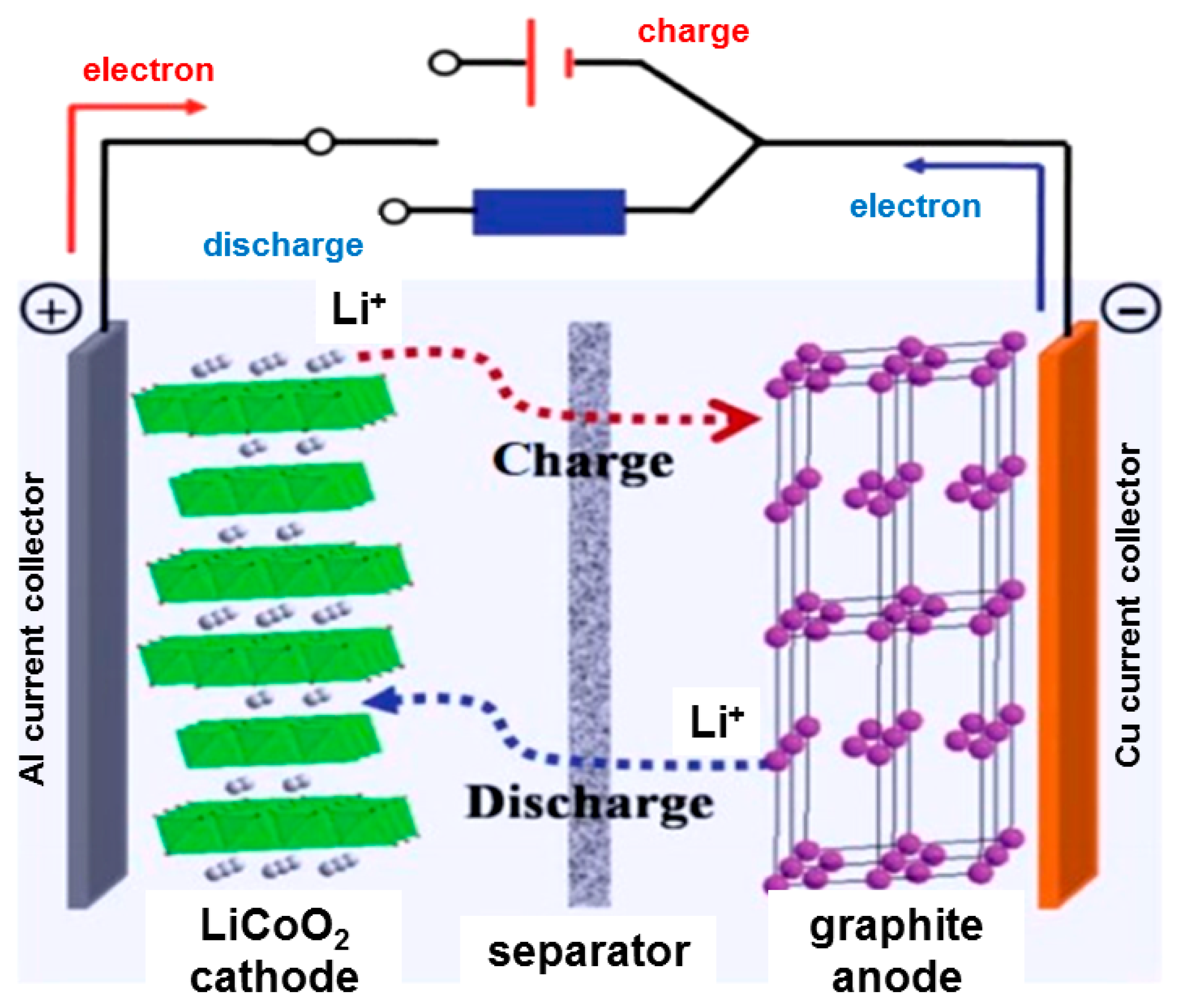
Figure 4.
Potential vs. specific capacity for various cathode materials used in LIBs. Reproduced from [12]. Copyright 2016 Springer.
Figure 4.
Potential vs. specific capacity for various cathode materials used in LIBs. Reproduced from [12]. Copyright 2016 Springer.
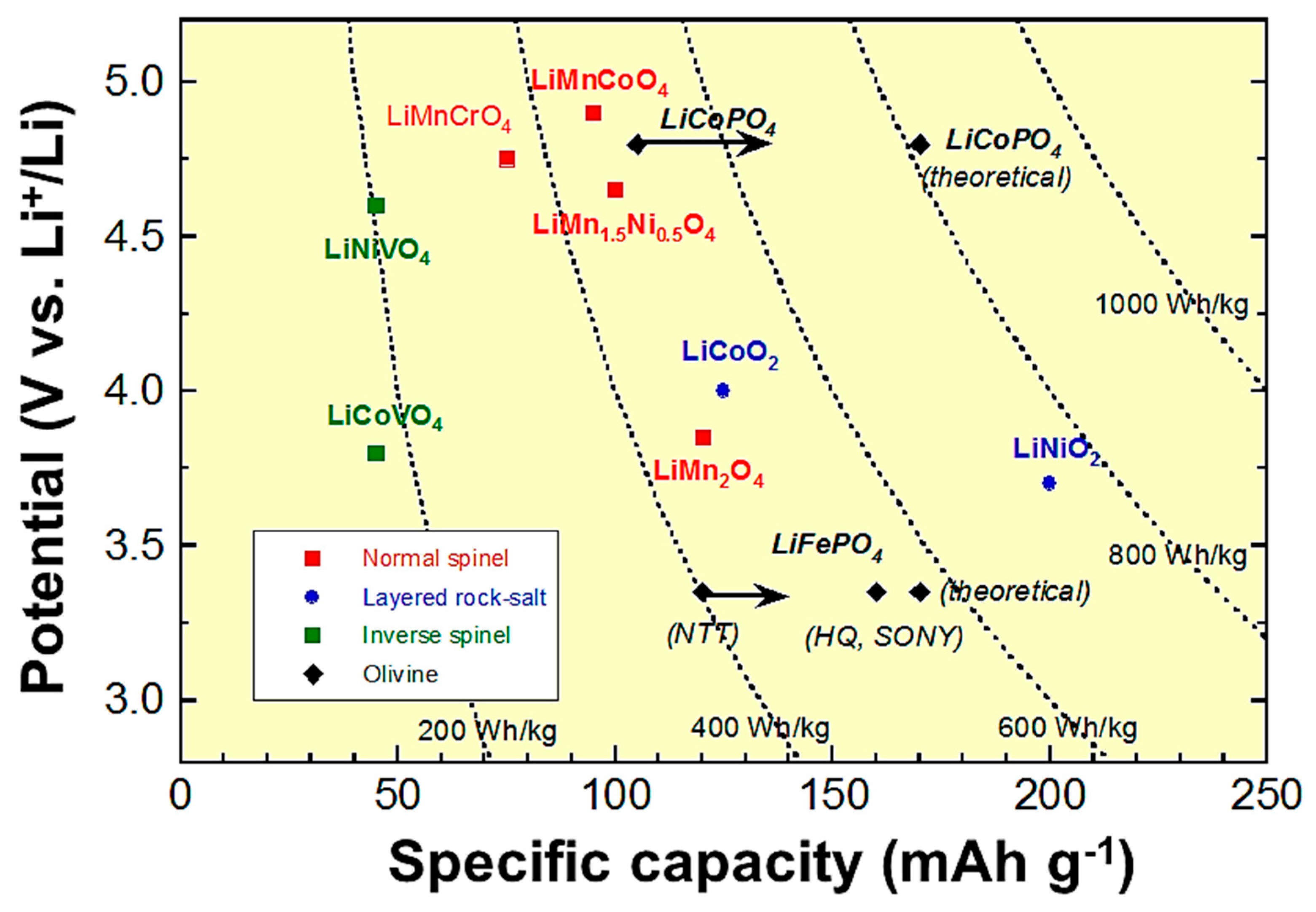
Figure 5.
Representation of the crystal structure of layered rock-salt LiCoO2 associated with Li deinsertion during charging. LixCoO2 transitions from O3 (octahedral triple-phase) to H1‒3 (hybrid-phase of octahedral single-phase O1 and O3) at a potential of ~4.5 V (x~0.3). Reproduced from [15]. Copyright 2021 under the terms of the Creative Commons Attribution 4.0 License (CC‒BY).
Figure 5.
Representation of the crystal structure of layered rock-salt LiCoO2 associated with Li deinsertion during charging. LixCoO2 transitions from O3 (octahedral triple-phase) to H1‒3 (hybrid-phase of octahedral single-phase O1 and O3) at a potential of ~4.5 V (x~0.3). Reproduced from [15]. Copyright 2021 under the terms of the Creative Commons Attribution 4.0 License (CC‒BY).
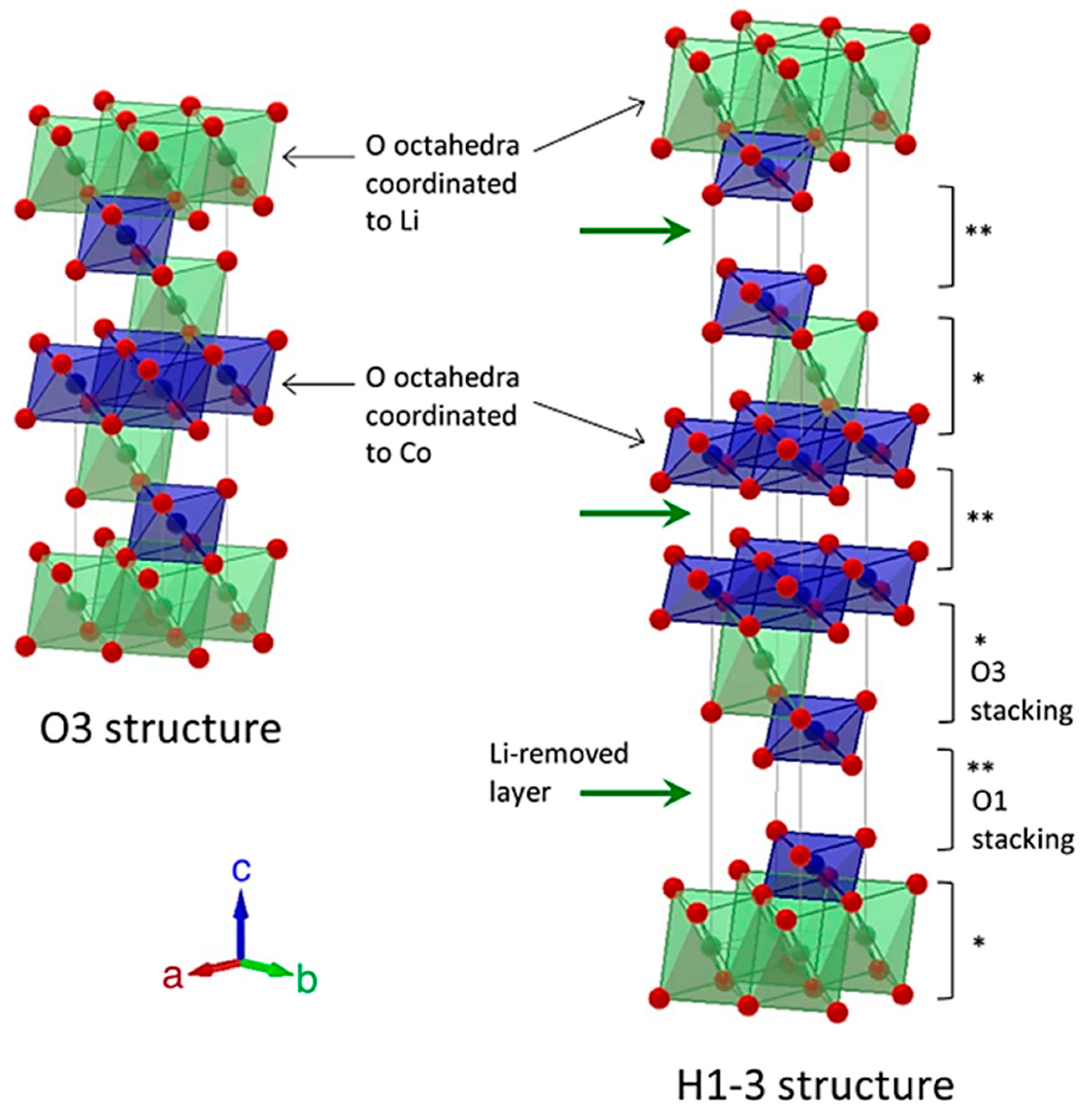
Figure 6.
Electrochemical characteristics of the LiCoO2 cathode material. (a) Charge/discharge profile of a Li//LiCoO2 half-cell cycled in the potential range 3.0 ‒ 4.8 V. Powders ware synthesized by sol-gel method. (b) Capacity retention as a function of the working region. Reproduced from [12]. Copyright 2016 Springer Nature.
Figure 6.
Electrochemical characteristics of the LiCoO2 cathode material. (a) Charge/discharge profile of a Li//LiCoO2 half-cell cycled in the potential range 3.0 ‒ 4.8 V. Powders ware synthesized by sol-gel method. (b) Capacity retention as a function of the working region. Reproduced from [12]. Copyright 2016 Springer Nature.
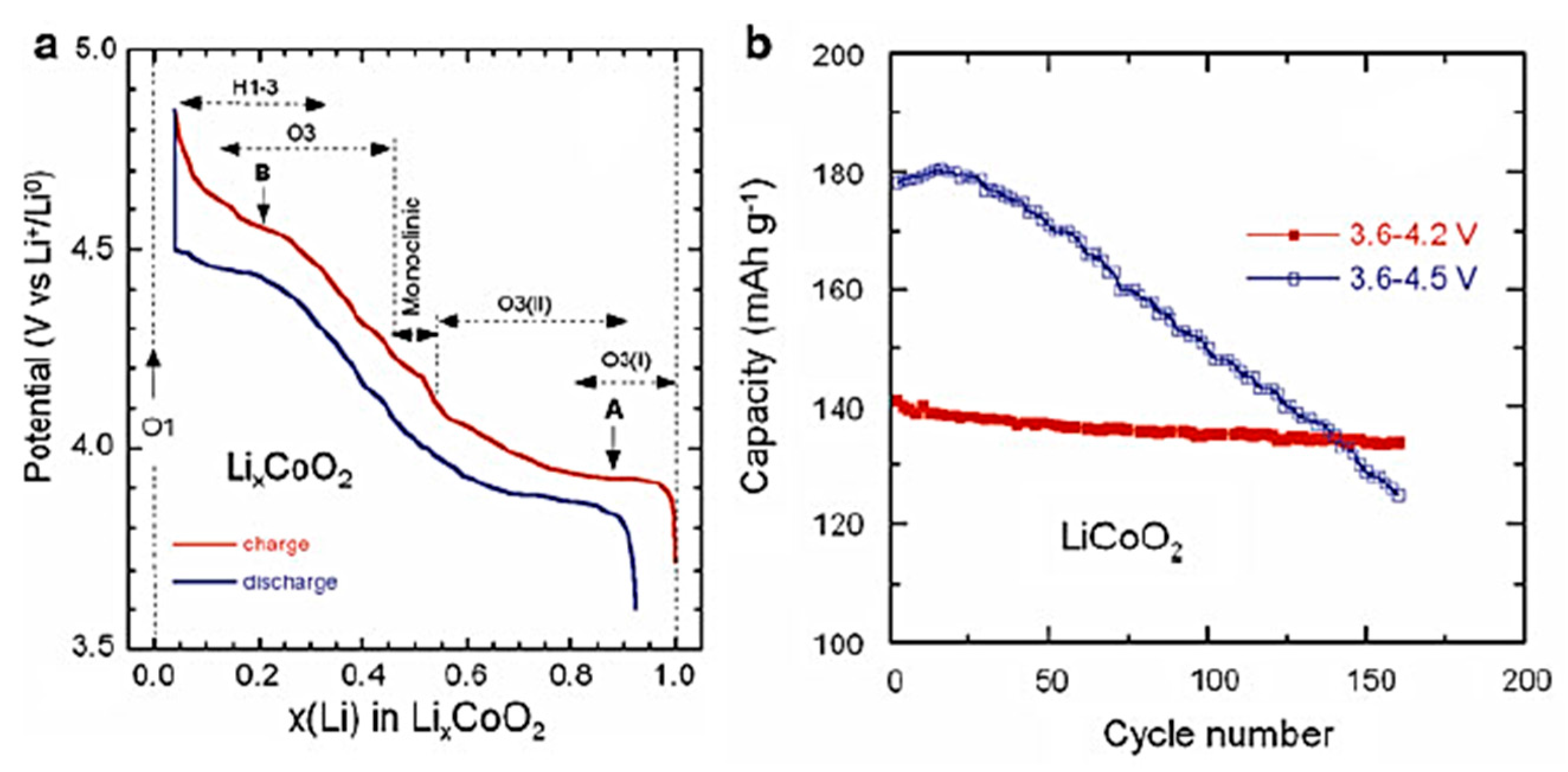
Figure 7.
Electrochemical behavior of 1-3 wt.% La-doped LiNiO2 cathodes. (a) Initial charge and discharge curve of all samples at 0.1C; (b) cycle performance curve under 2.7 − 4.3 V at 0.5C; (c) rate performance; (d) cycle performance curve under 2.7 − 4.3 V at 1C; (e and f) charge and discharge curves of pristine LNO and 2 wt.% La-LNO for different cycles in (d); (g) middle discharge voltage of pristine LNO and 2 wt.% La-LNO in (d); (h and i) CV curves at different sweep speeds of LNO and 2 wt.% La-LNO; (j) linear relationship between anodic/cathodic peak current (Ip) and the square root of the scan rate (ν1/2) in (h) and (i).Reproduced from [26]. Copyright 2025 American Chemical Society.
Figure 7.
Electrochemical behavior of 1-3 wt.% La-doped LiNiO2 cathodes. (a) Initial charge and discharge curve of all samples at 0.1C; (b) cycle performance curve under 2.7 − 4.3 V at 0.5C; (c) rate performance; (d) cycle performance curve under 2.7 − 4.3 V at 1C; (e and f) charge and discharge curves of pristine LNO and 2 wt.% La-LNO for different cycles in (d); (g) middle discharge voltage of pristine LNO and 2 wt.% La-LNO in (d); (h and i) CV curves at different sweep speeds of LNO and 2 wt.% La-LNO; (j) linear relationship between anodic/cathodic peak current (Ip) and the square root of the scan rate (ν1/2) in (h) and (i).Reproduced from [26]. Copyright 2025 American Chemical Society.
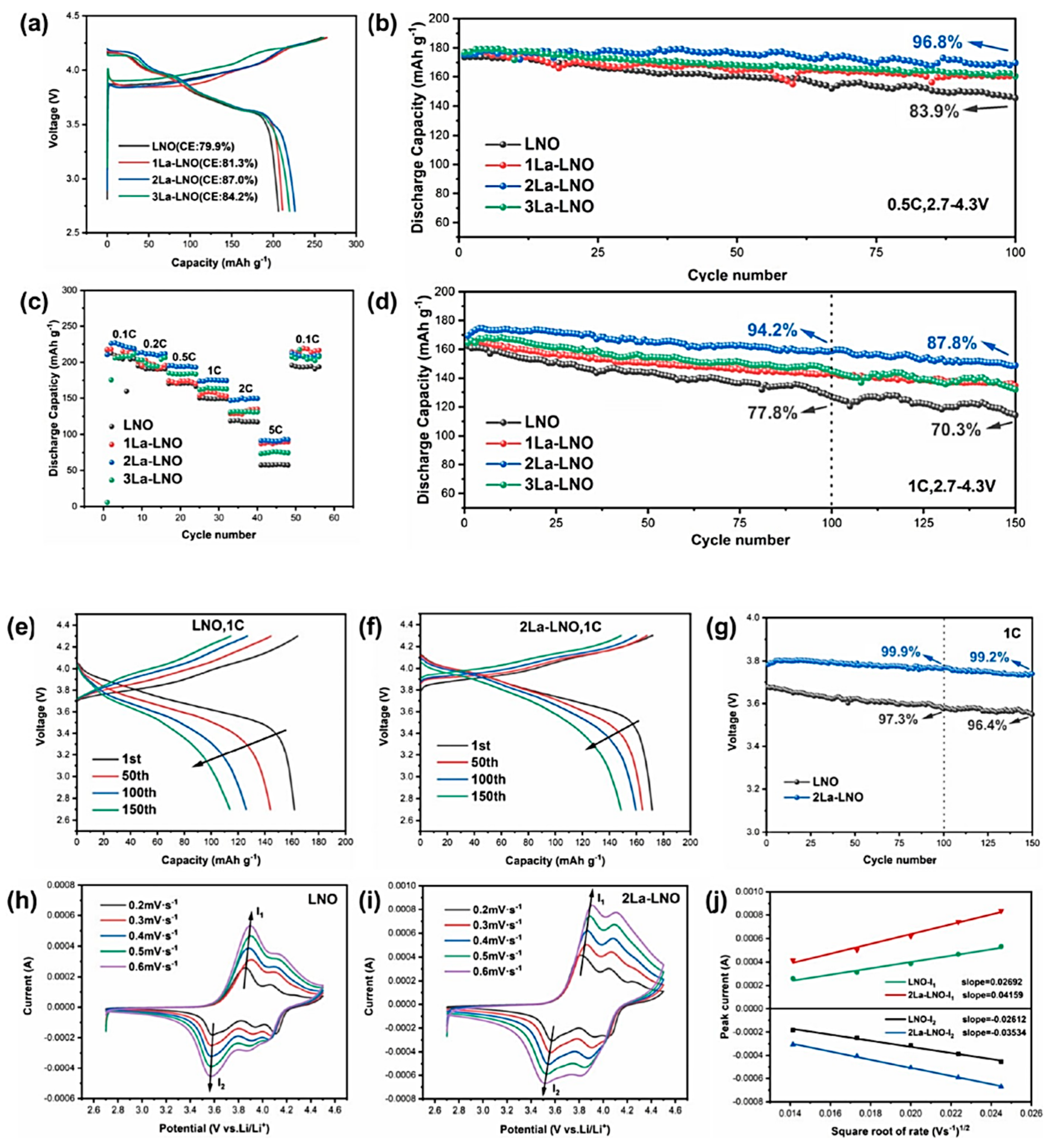
Figure 8.
Electrochemical performance of the layered Cr-doped LiMn1-xCrxO2 cathode materials. Cyclic voltammograms of the three-electrode cells comprised with (a) pristine LiMnO2, (b) 5% Cr-doped, and (c) 10% Cr-doped cathodes performed between 2.5 and 4.5 V at a potential scan rate of 0.1 mV s−1. Charge/discharge profiles of the coin-type cells comprised with (d) pristine LiMnO2, (e) 5% Cr-doped, and (f) 10% Cr-doped LiMnO2 cathodes cycled at C/10 rate with cutoff voltages of 2.5 and 4.5 V. Reproduced from [30]. Copyright 2013 Elsevier.
Figure 8.
Electrochemical performance of the layered Cr-doped LiMn1-xCrxO2 cathode materials. Cyclic voltammograms of the three-electrode cells comprised with (a) pristine LiMnO2, (b) 5% Cr-doped, and (c) 10% Cr-doped cathodes performed between 2.5 and 4.5 V at a potential scan rate of 0.1 mV s−1. Charge/discharge profiles of the coin-type cells comprised with (d) pristine LiMnO2, (e) 5% Cr-doped, and (f) 10% Cr-doped LiMnO2 cathodes cycled at C/10 rate with cutoff voltages of 2.5 and 4.5 V. Reproduced from [30]. Copyright 2013 Elsevier.
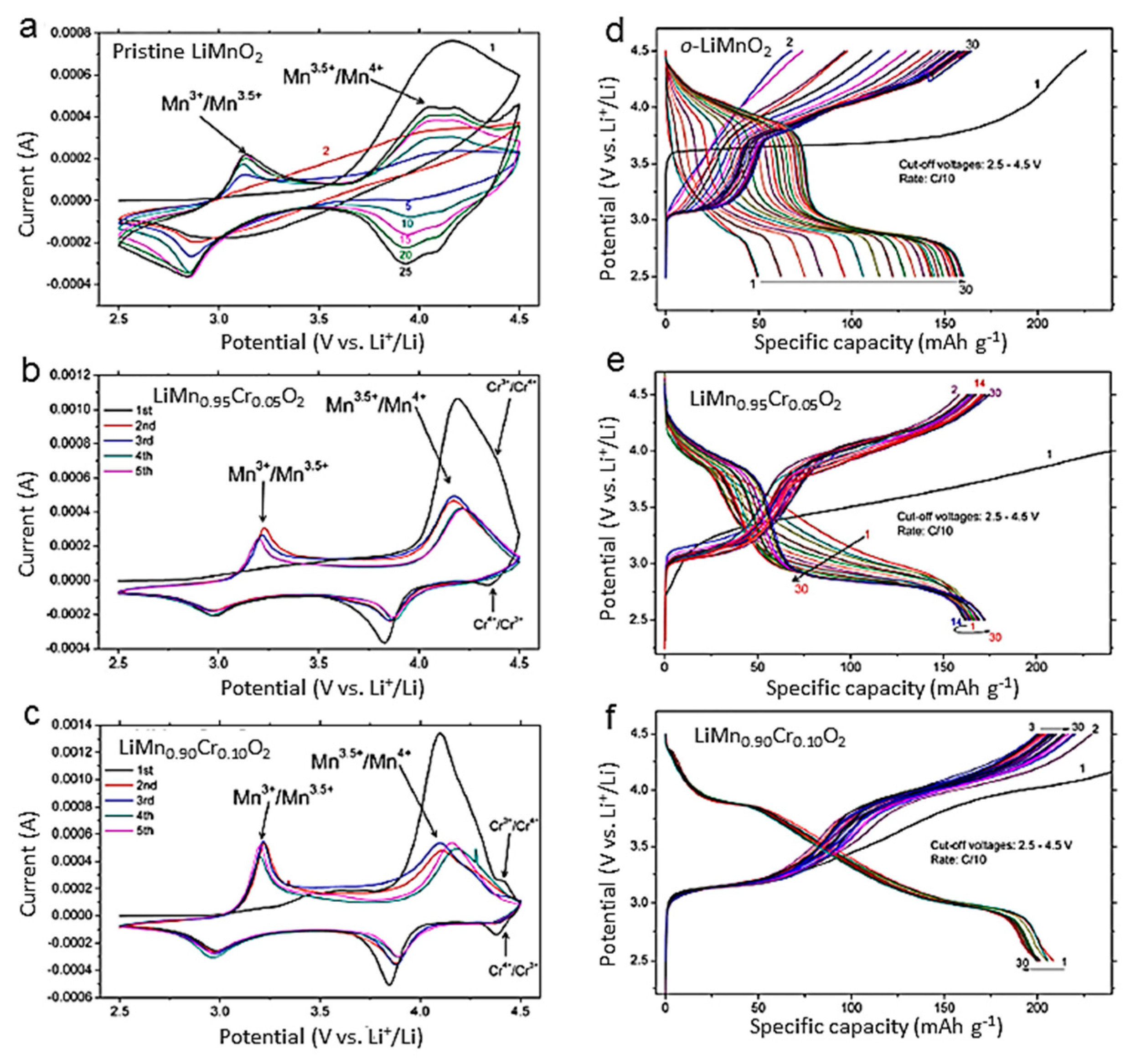
Figure 9.
(a) Typical SEM image of LiCo0.2Ni0.8O2 synthesized by wet chemistry via succinic acid assisted method. (b and c) variation of the lattice parameter a and c with Ni content. (d‒f) Galvanostatic discharge-charge curves recorded at C/10 rate in the potential range 2.5 ‒ 4.1 V for LiCo1-yNiyO2 (d) y = 0.2, (e) y = 0.4, and (f) y = 0.6. Reproduced from [44]. Copyright 2001 Elsevier.
Figure 9.
(a) Typical SEM image of LiCo0.2Ni0.8O2 synthesized by wet chemistry via succinic acid assisted method. (b and c) variation of the lattice parameter a and c with Ni content. (d‒f) Galvanostatic discharge-charge curves recorded at C/10 rate in the potential range 2.5 ‒ 4.1 V for LiCo1-yNiyO2 (d) y = 0.2, (e) y = 0.4, and (f) y = 0.6. Reproduced from [44]. Copyright 2001 Elsevier.
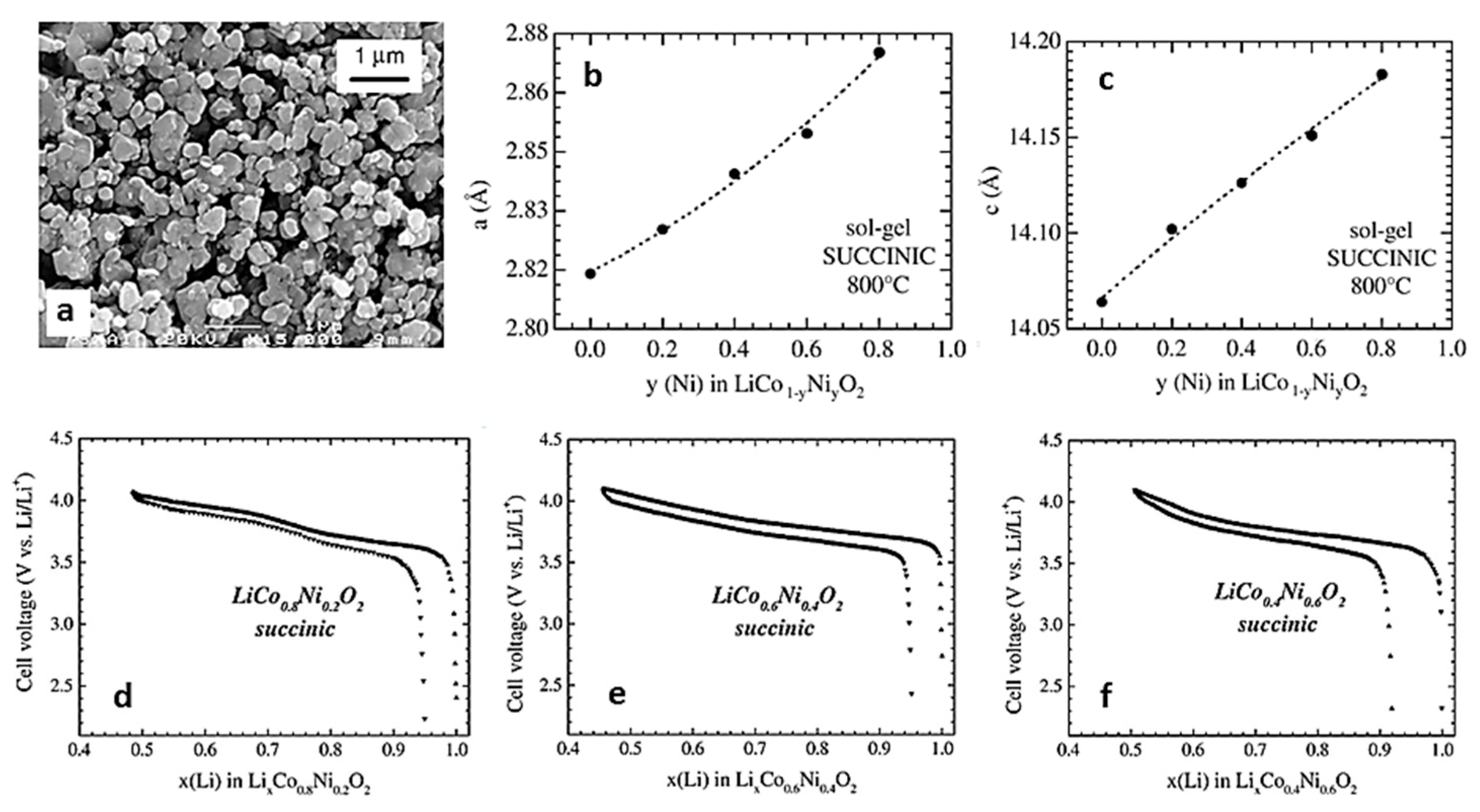
Figure 10.
SEM micrographs of LiNi0.5Co0.5O2 (a) and LiNi0.2Al0.3Co0.5O2 (b) showing the decreasing in the particle size. (c) Variation of the lattice parameters with Al dopant content. (d) Evolution of the Li+ diffusion coefficient of LixNi0.5-yAlyCo0.5O2 with x(Li) and y(Al). Reproduced from [46]. Copyright 2003 Elsevier.
Figure 10.
SEM micrographs of LiNi0.5Co0.5O2 (a) and LiNi0.2Al0.3Co0.5O2 (b) showing the decreasing in the particle size. (c) Variation of the lattice parameters with Al dopant content. (d) Evolution of the Li+ diffusion coefficient of LixNi0.5-yAlyCo0.5O2 with x(Li) and y(Al). Reproduced from [46]. Copyright 2003 Elsevier.
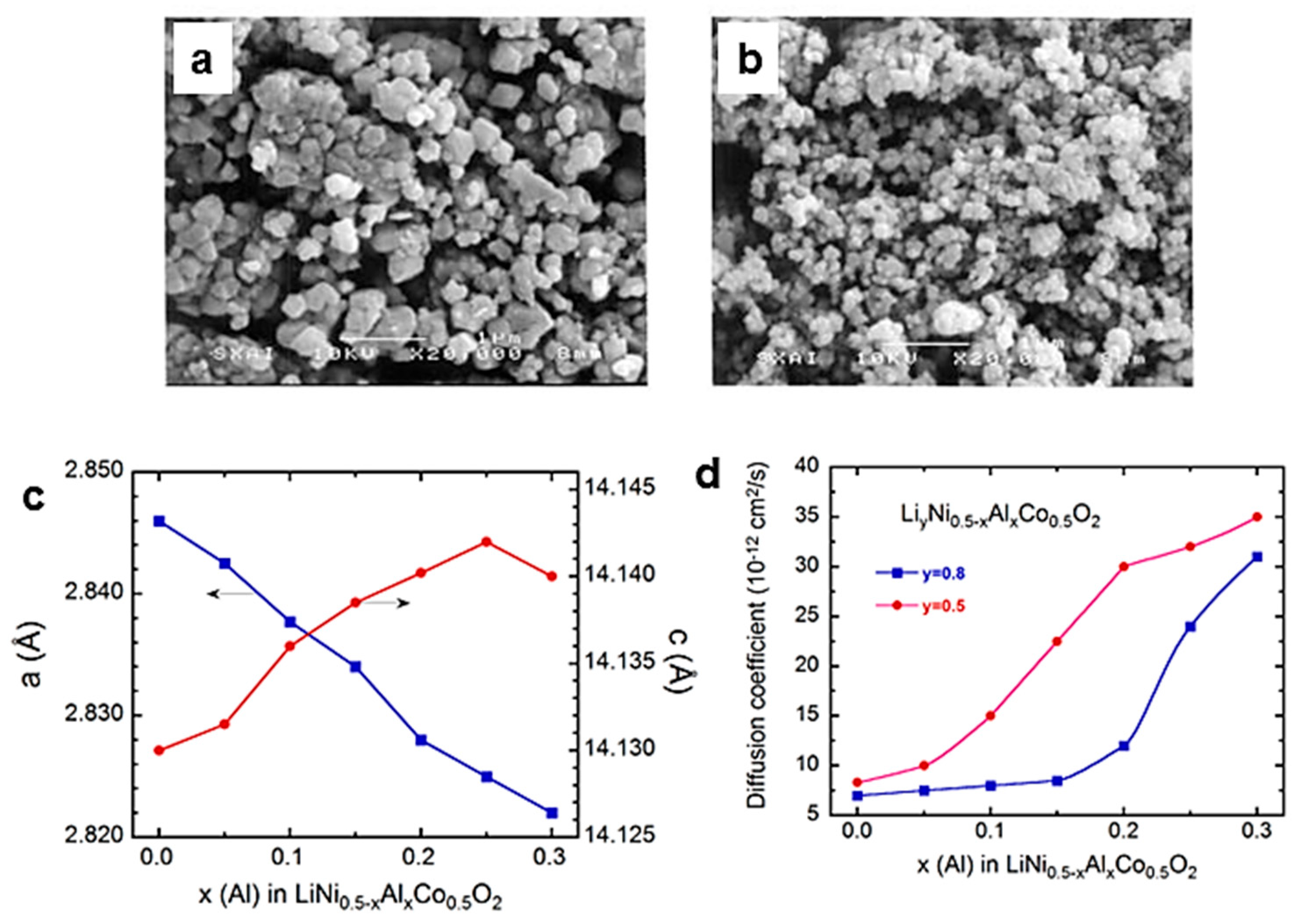
Figure 12.
Galvanostatic charge/discharge test of (a) pristine NMC333, (b) 1% RuO2 doped NMC333, (c) 2% RuO2 doped NMC333, and (d) 3% RuO2 doped NMC333 at 0.1 C rate. Reproduced from [52]. Copyright 2021 under a Creative Commons Attribution 4.0 International License.
Figure 12.
Galvanostatic charge/discharge test of (a) pristine NMC333, (b) 1% RuO2 doped NMC333, (c) 2% RuO2 doped NMC333, and (d) 3% RuO2 doped NMC333 at 0.1 C rate. Reproduced from [52]. Copyright 2021 under a Creative Commons Attribution 4.0 International License.
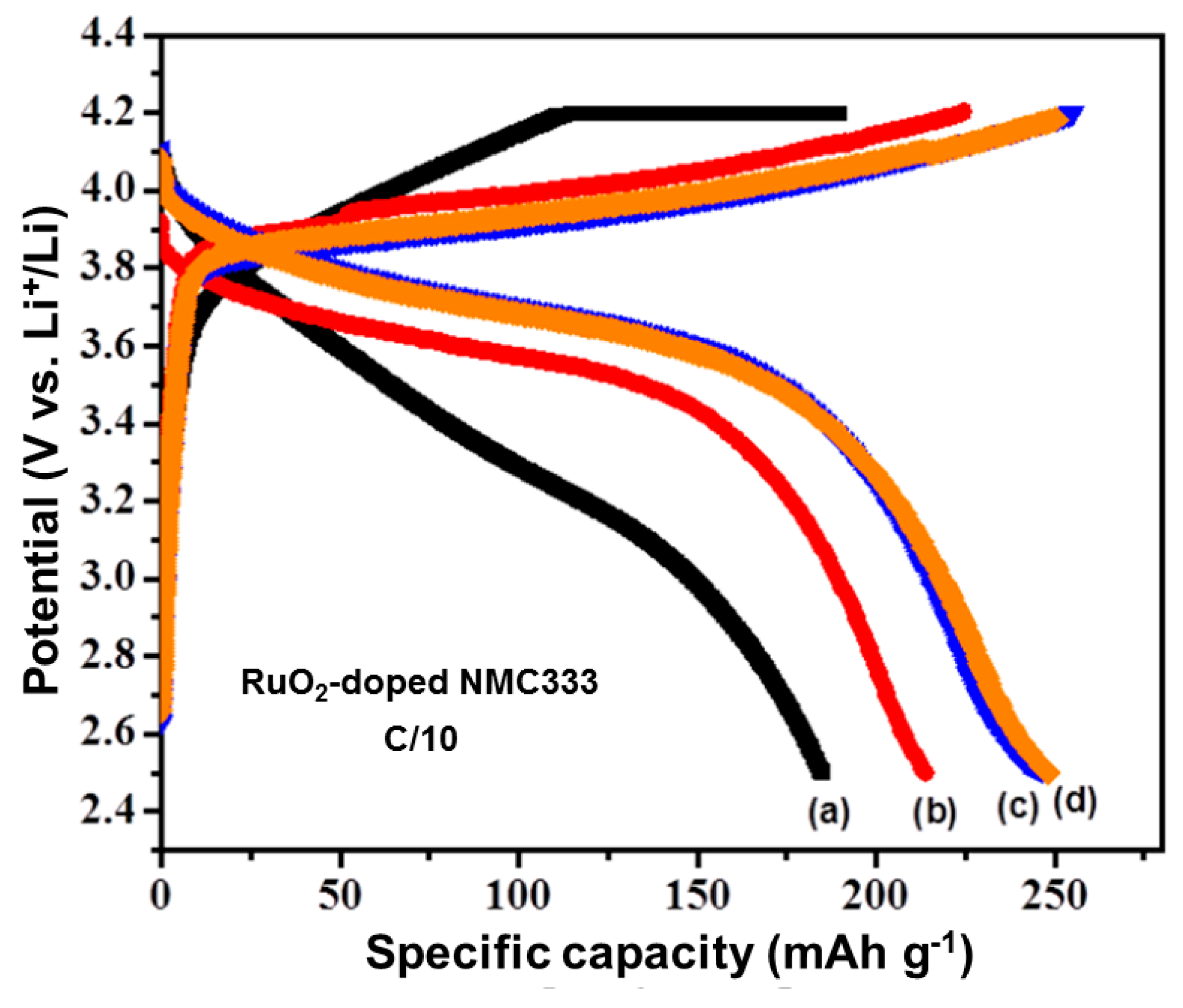
Figure 13.
Structure of the structural components of Li-rich cathode material which is considered as a composite between (a) LiMO2 (M = Co, Mn, Ni) and (b) Li2MnO3 phase.
Figure 13.
Structure of the structural components of Li-rich cathode material which is considered as a composite between (a) LiMO2 (M = Co, Mn, Ni) and (b) Li2MnO3 phase.
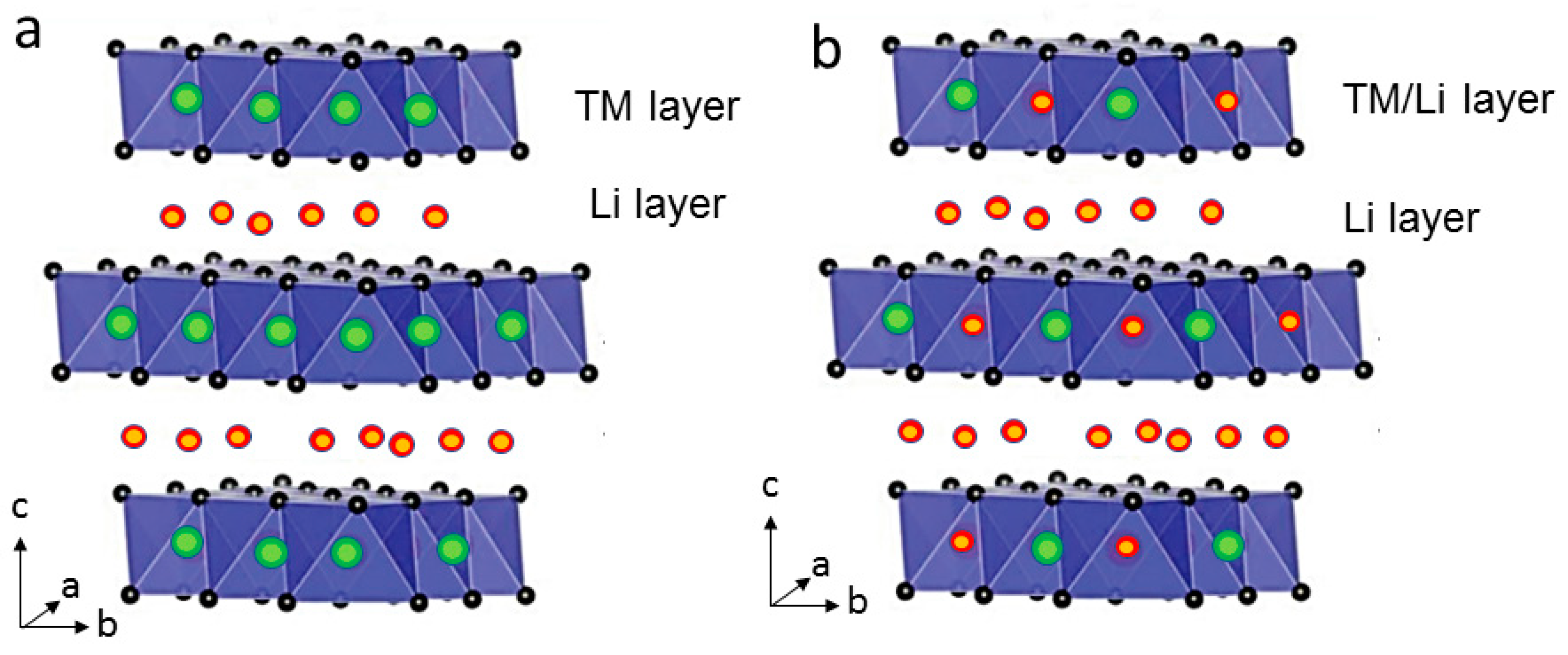
Figure 14.
Galvanostatic charge-discharge profiles of nanostructured Li1.2Ni0.13Mn0.54Co0.13O2 electrodes synthesized by wet chemistry using different chelating agents (a) self-sol-gel (SSG), (b) citric acid (CA), (c) EDTA, and (d) CA-EDTA. Electrochemical tests were carried out at 0.1C rate in the potential between 2.0 and 4.8 V vs. Li+/Li. Reproduced from [62]. Copyright 2020 Springer.
Figure 14.
Galvanostatic charge-discharge profiles of nanostructured Li1.2Ni0.13Mn0.54Co0.13O2 electrodes synthesized by wet chemistry using different chelating agents (a) self-sol-gel (SSG), (b) citric acid (CA), (c) EDTA, and (d) CA-EDTA. Electrochemical tests were carried out at 0.1C rate in the potential between 2.0 and 4.8 V vs. Li+/Li. Reproduced from [62]. Copyright 2020 Springer.
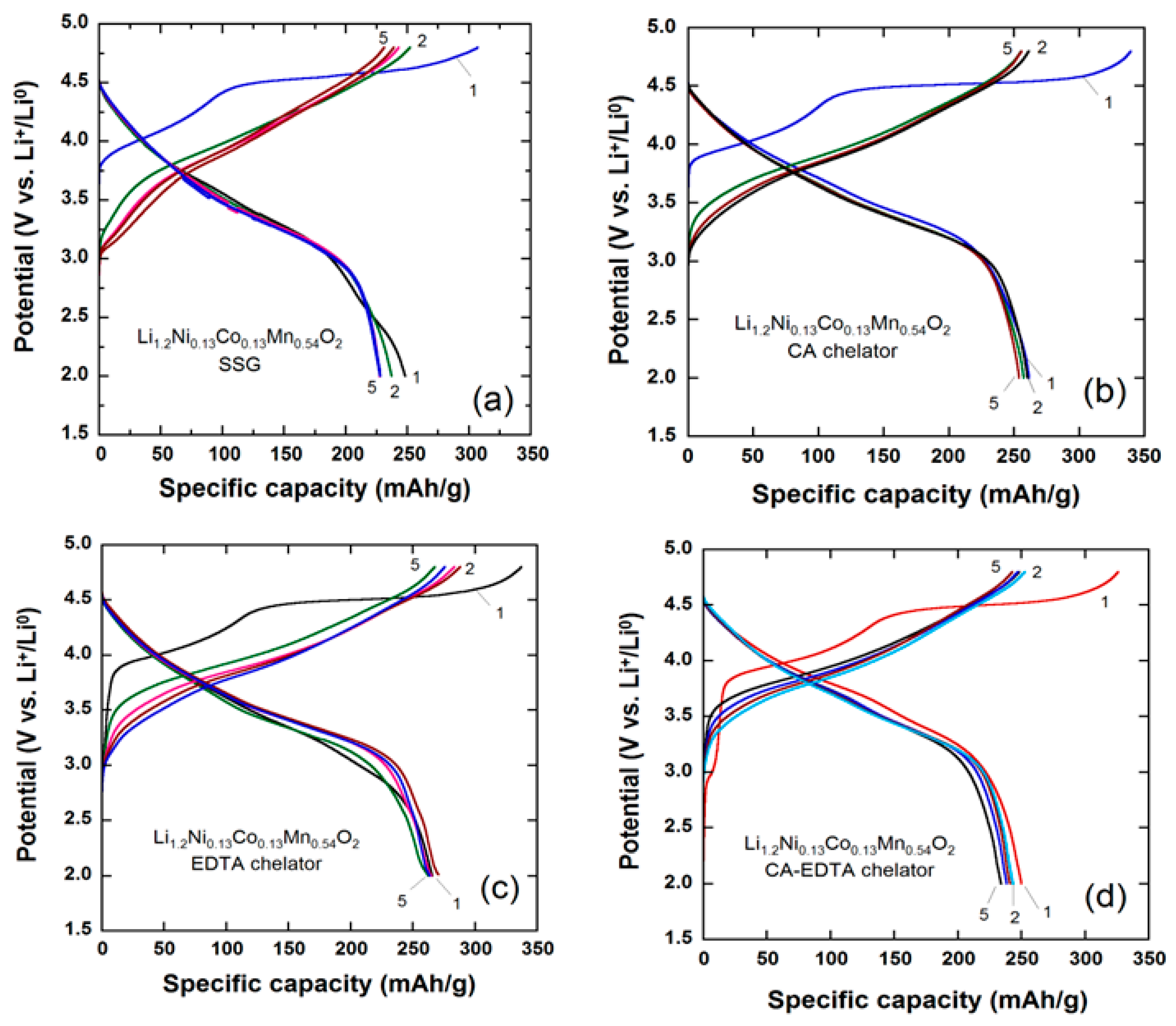
Figure 15.
Illustration of the composition–performance relationship of NMC materials. Evolution of the thermal stability and capacity retention as a function of the discharge. Reproduced from [71]. Copyright 2020 under the terms of the Creative Commons Attribution (CC‒BY) license.
Figure 15.
Illustration of the composition–performance relationship of NMC materials. Evolution of the thermal stability and capacity retention as a function of the discharge. Reproduced from [71]. Copyright 2020 under the terms of the Creative Commons Attribution (CC‒BY) license.
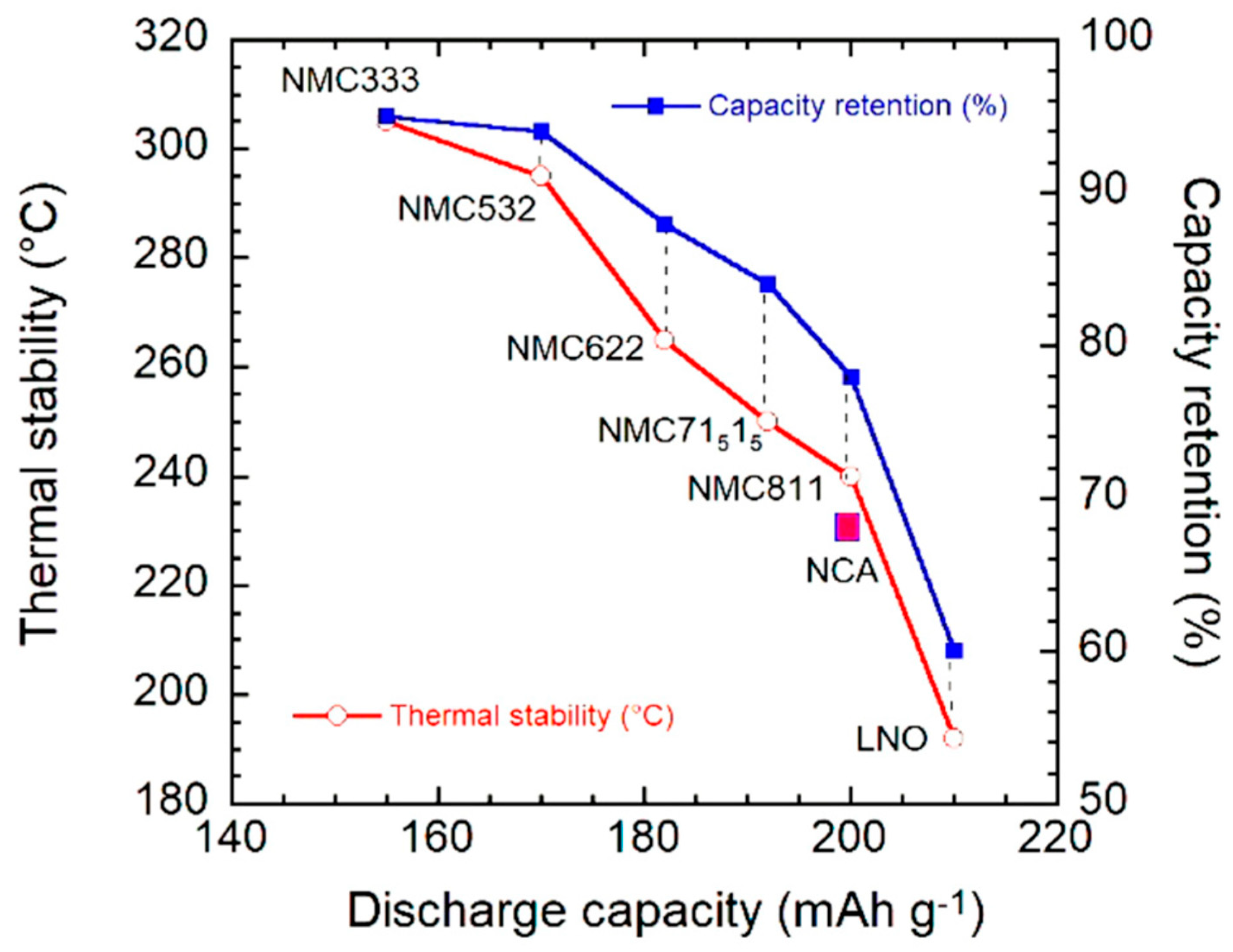
Figure 17.
Differential capacity plots (dQ/dV) vs. V for the LLMO electrode tested at the 1st and 500th cycle in the potential window 1.5–4.8 V. The peaks at ~4 and ~3 V in the dQ/dV plots correspond to Mn3.5+/4+ and Mn3+/3.5+, respectively. Reproduced from [101]. Copyright 2024 under the Creative Commons Attribution 4.0 International License.
Figure 17.
Differential capacity plots (dQ/dV) vs. V for the LLMO electrode tested at the 1st and 500th cycle in the potential window 1.5–4.8 V. The peaks at ~4 and ~3 V in the dQ/dV plots correspond to Mn3.5+/4+ and Mn3+/3.5+, respectively. Reproduced from [101]. Copyright 2024 under the Creative Commons Attribution 4.0 International License.
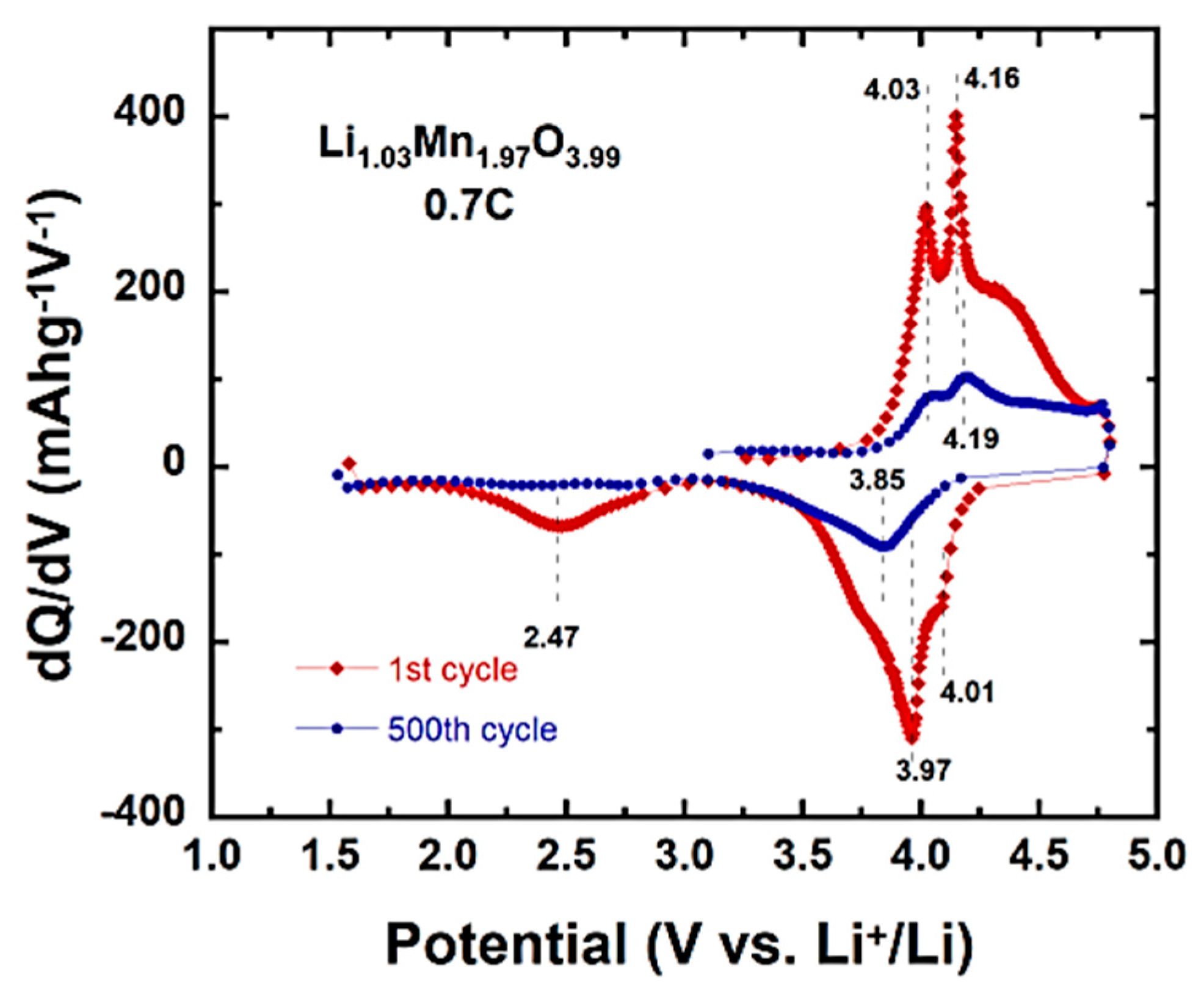
Figure 18.
Charge–discharge curves of pristine LiNi0.5Mn1.5O4 and MoO3-coated LiNi0.5Mn1.5O4 electrodes at 0.1 C rate for (a) initial and (b) fifth cycles. Reproduced from [143]. Copyright 2022 under the terms and conditions of the Creative Commons Attribution (CC‒BY) license.
Figure 18.
Charge–discharge curves of pristine LiNi0.5Mn1.5O4 and MoO3-coated LiNi0.5Mn1.5O4 electrodes at 0.1 C rate for (a) initial and (b) fifth cycles. Reproduced from [143]. Copyright 2022 under the terms and conditions of the Creative Commons Attribution (CC‒BY) license.
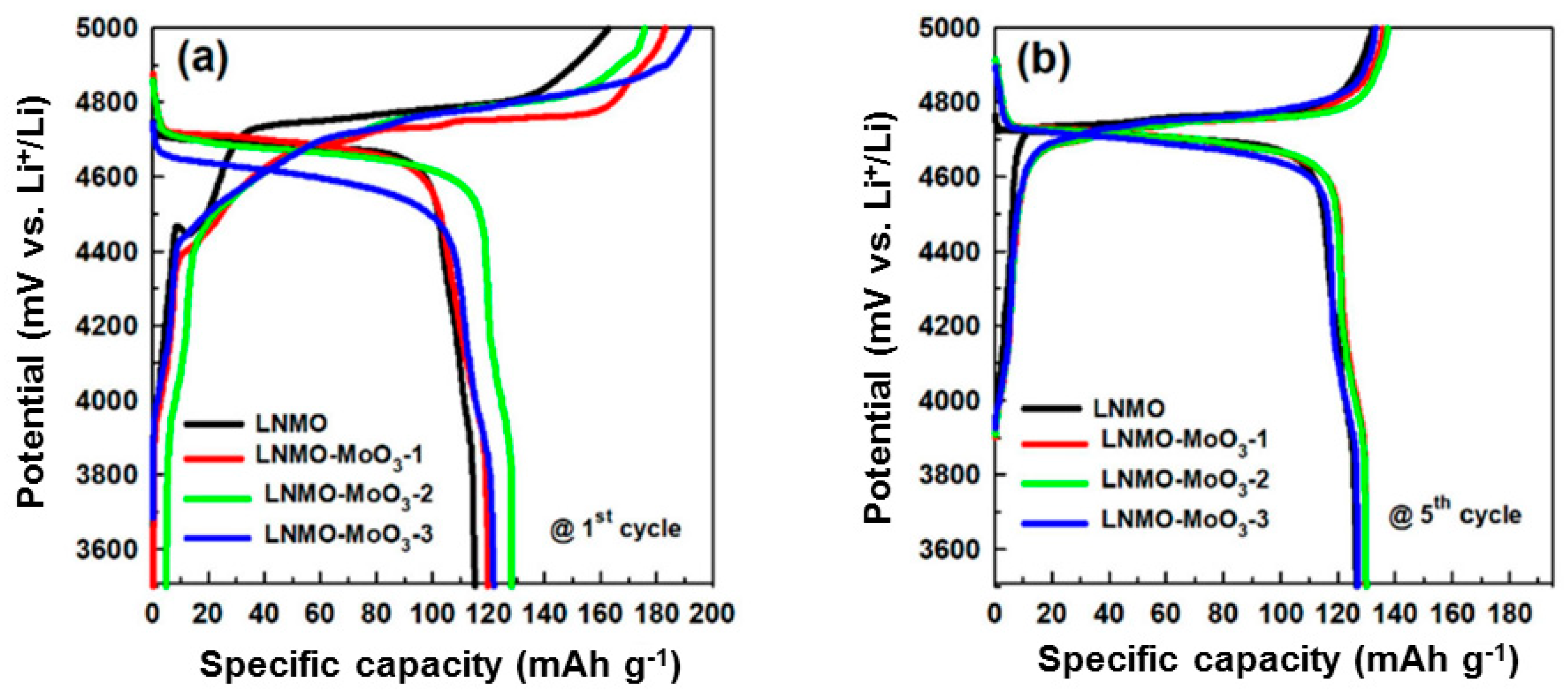
Figure 20.
Crystal structure of (a) LiFePO4 and (b) FePO4 olivine framework. Corner-shared FeO6 octahedra are linked together in the bc-plane; LiO6 octahedra form edge-sharing chains along the b-axis. The tetrahedral PO4 groups bridge neighboring layers of FeO6 octahedra by sharing a common edge with one FeO6 octahedron and two edges with LiO6 octahedra.
Figure 20.
Crystal structure of (a) LiFePO4 and (b) FePO4 olivine framework. Corner-shared FeO6 octahedra are linked together in the bc-plane; LiO6 octahedra form edge-sharing chains along the b-axis. The tetrahedral PO4 groups bridge neighboring layers of FeO6 octahedra by sharing a common edge with one FeO6 octahedron and two edges with LiO6 octahedra.
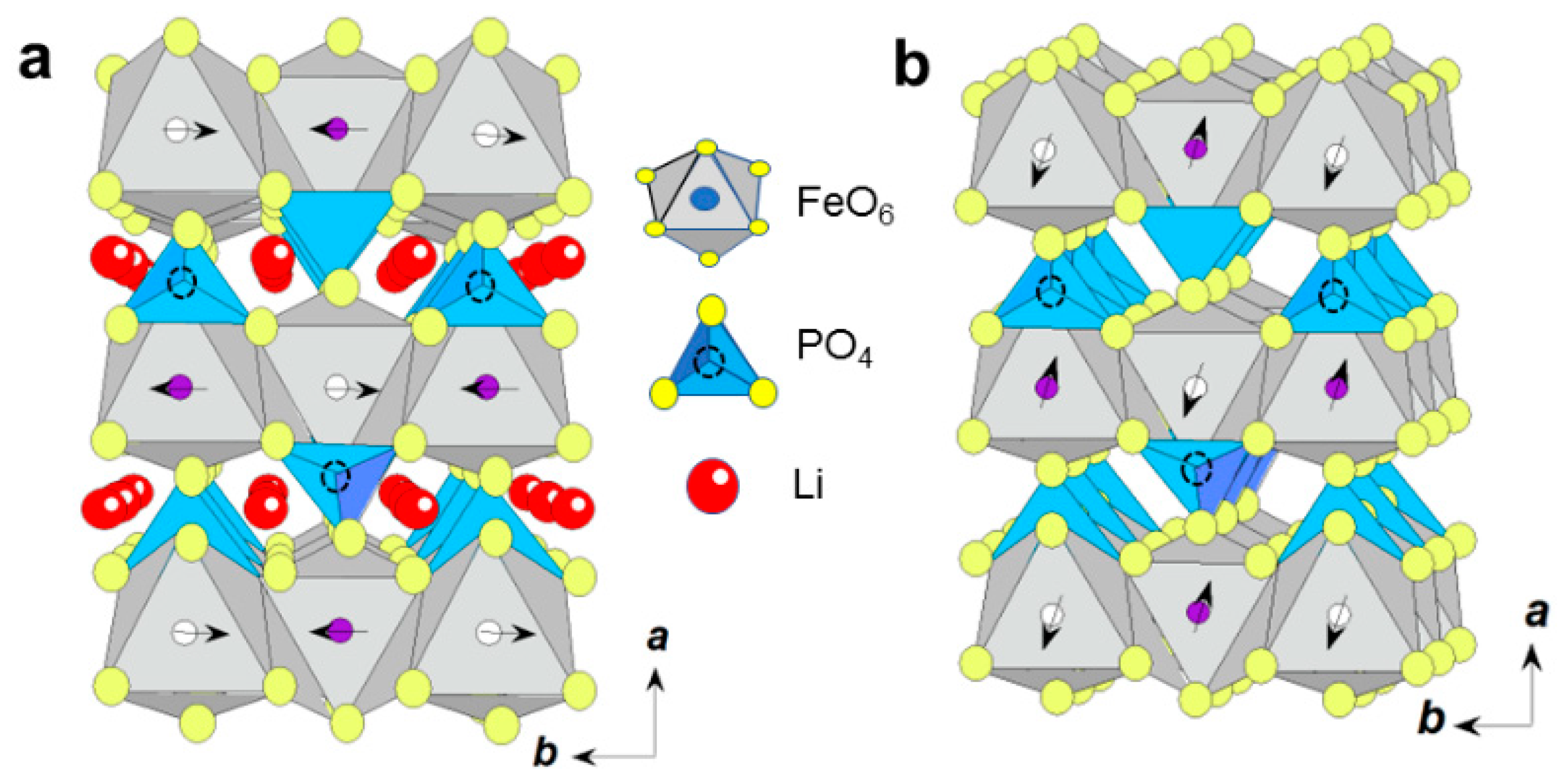
Figure 24.
Schematic diagram for the synthesis of cathode materials by sol-gel method. Reproduced from [218]. Copyright 2025 distributed under the terms and conditions of the Creative Commons Attribution (CC‒BY) license.
Figure 24.
Schematic diagram for the synthesis of cathode materials by sol-gel method. Reproduced from [218]. Copyright 2025 distributed under the terms and conditions of the Creative Commons Attribution (CC‒BY) license.
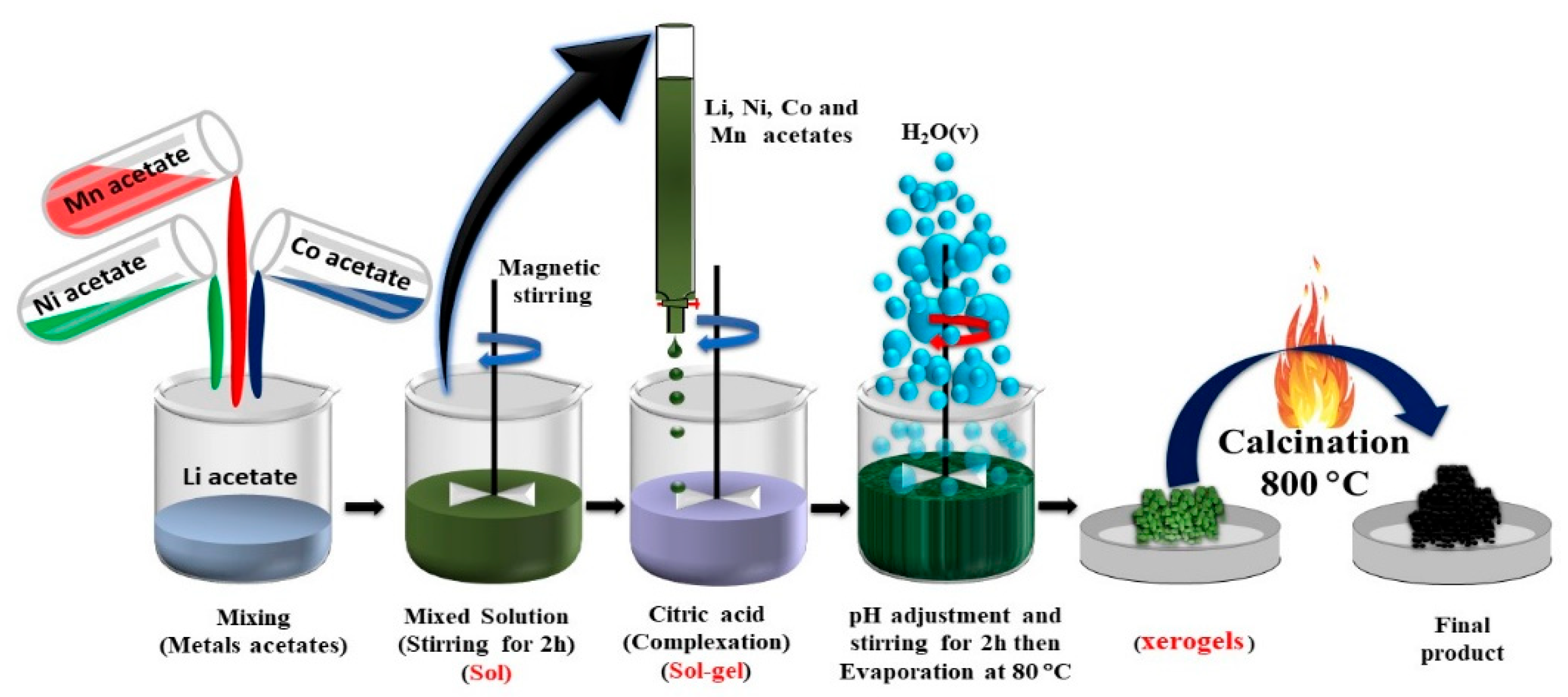
Figure 25.
Schematic diagram for the synthesis of cathode materials by bioactive reducing agent assisted sol-gel method. Reproduced from [214]. Copyright 2021 under the terms and conditions of the Creative Commons Attribution (CC‒BY) license.
Figure 25.
Schematic diagram for the synthesis of cathode materials by bioactive reducing agent assisted sol-gel method. Reproduced from [214]. Copyright 2021 under the terms and conditions of the Creative Commons Attribution (CC‒BY) license.
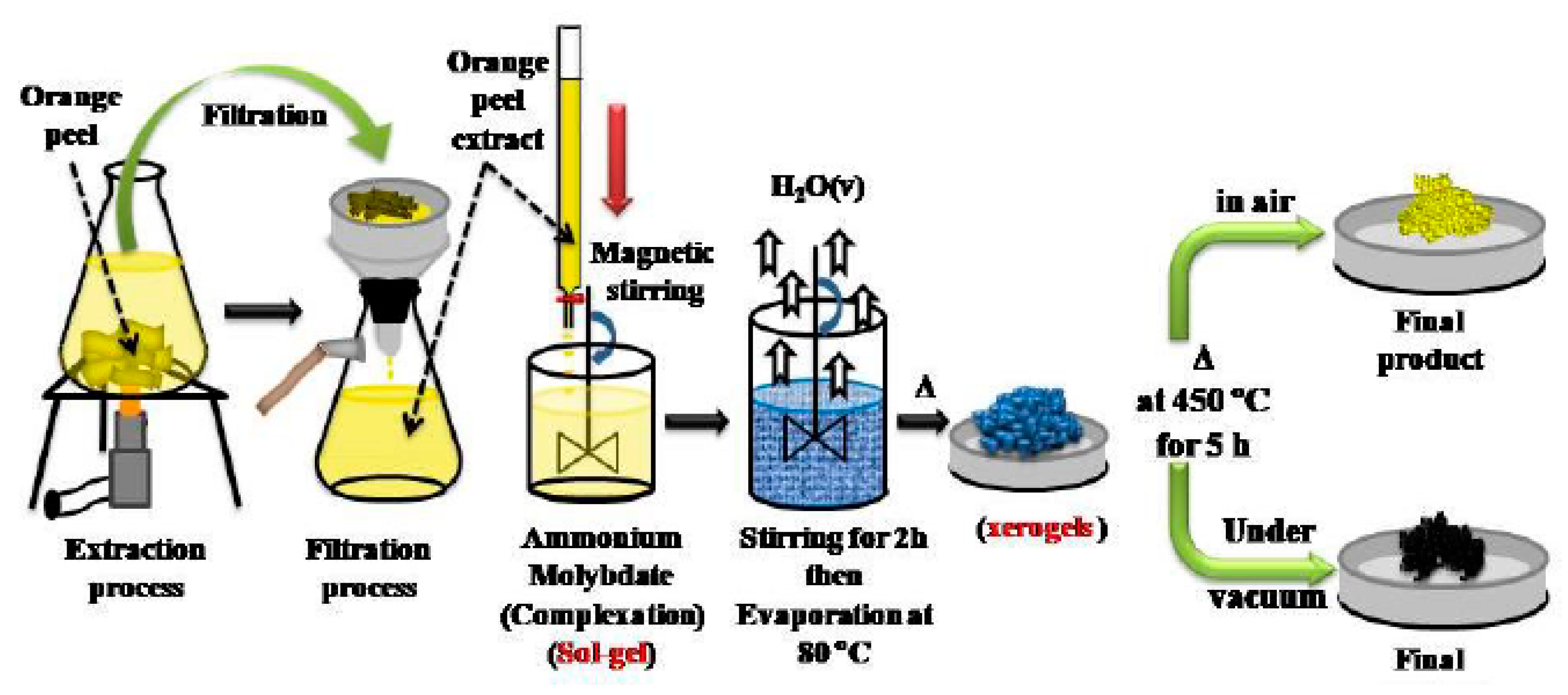
Figure 26.
Schematic diagram for the synthesis of cathode materials by coprecipitation method.
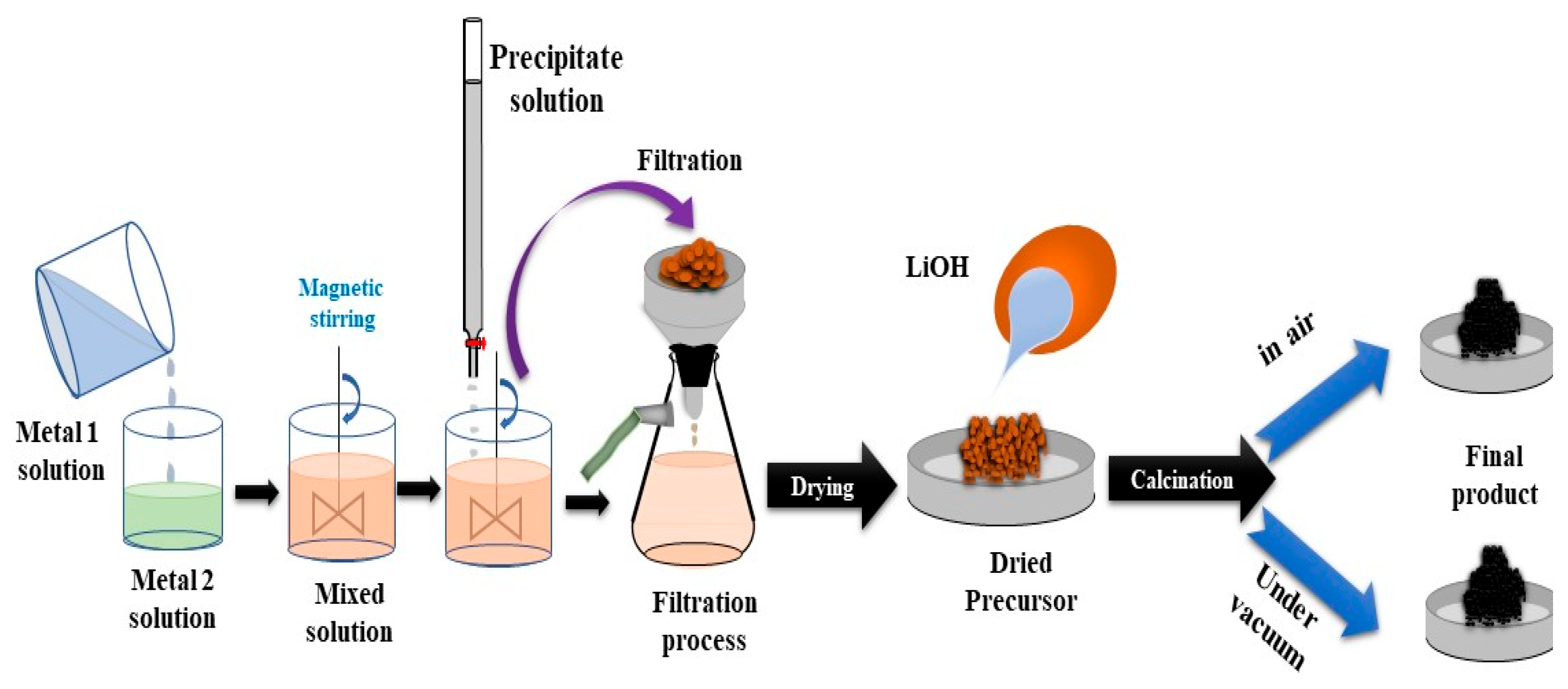
Figure 27.
Schematic representation of the AlF3/LiF coating process of Li-rich layered cathode nanoparticles. Reproduced from [219]. Copyright 2025 under the terms and conditions of the Creative Commons Attribution (CC‒BY) license.
Figure 27.
Schematic representation of the AlF3/LiF coating process of Li-rich layered cathode nanoparticles. Reproduced from [219]. Copyright 2025 under the terms and conditions of the Creative Commons Attribution (CC‒BY) license.
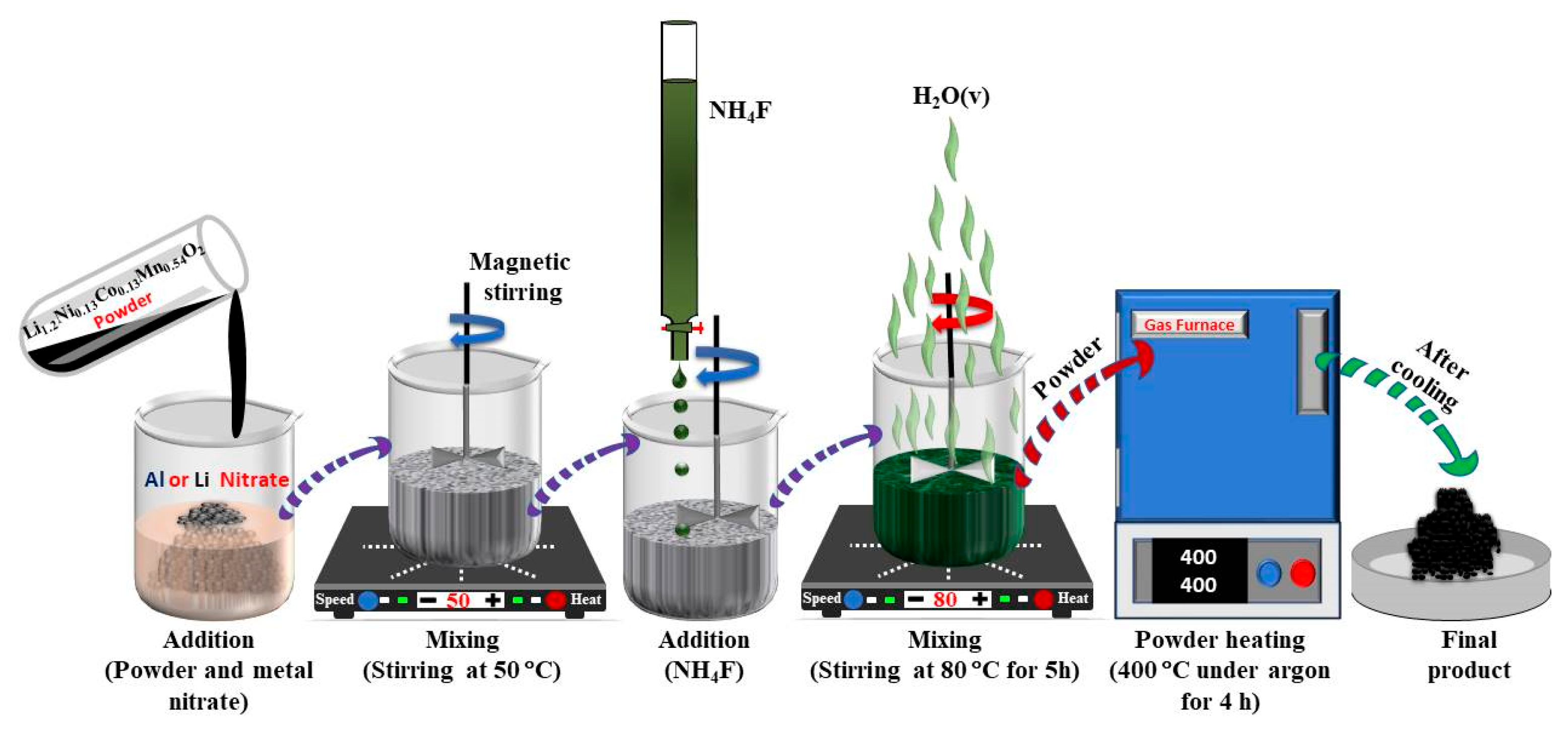
Figure 32.
Ex situ Raman mapping on LMO electrodes at different state-of-charges. Raman maps and corresponding spectra showing clearly that Li deintercalation is a three-phase process in the Li1−xMn2O4 structure (colors on the maps correspond to the colors of spectra below them). The schematic pictures of the delithiation process are also presented at the top. Reproduced from [224]. Copyright 2024 under the terms of the CC-BY 4.0 license.
Figure 32.
Ex situ Raman mapping on LMO electrodes at different state-of-charges. Raman maps and corresponding spectra showing clearly that Li deintercalation is a three-phase process in the Li1−xMn2O4 structure (colors on the maps correspond to the colors of spectra below them). The schematic pictures of the delithiation process are also presented at the top. Reproduced from [224]. Copyright 2024 under the terms of the CC-BY 4.0 license.
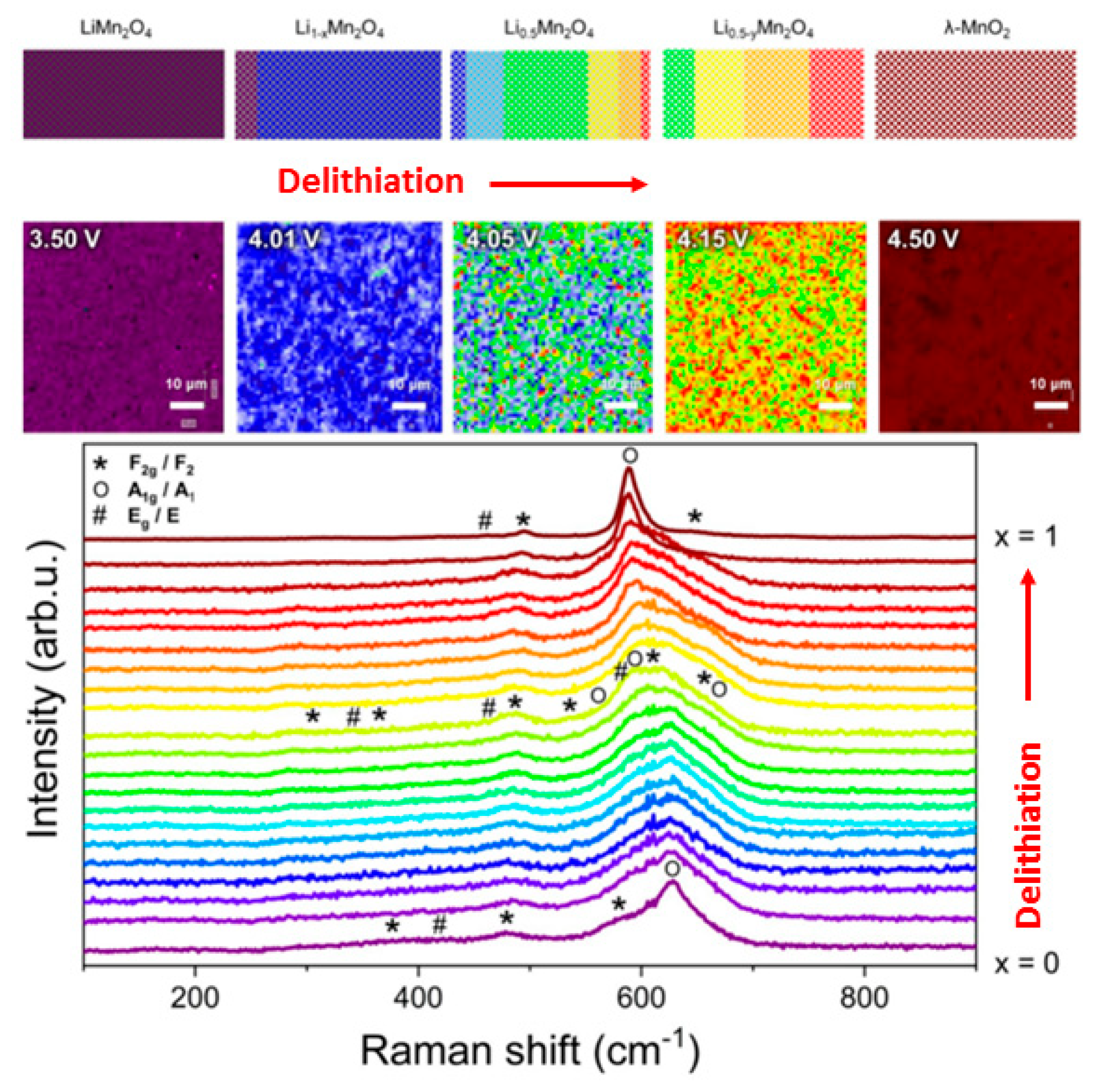
Figure 33.
(a) XPS survey spectra of the MOA and MOV samples. High-resolution XPS spectra of (b) Mo 3d in MOA, (c) Mo 3d in MOV. Reproduced from [214]. Copyright 2021 under the terms and conditions of the Creative Commons Attribution (CC-BY) license.
Figure 33.
(a) XPS survey spectra of the MOA and MOV samples. High-resolution XPS spectra of (b) Mo 3d in MOA, (c) Mo 3d in MOV. Reproduced from [214]. Copyright 2021 under the terms and conditions of the Creative Commons Attribution (CC-BY) license.
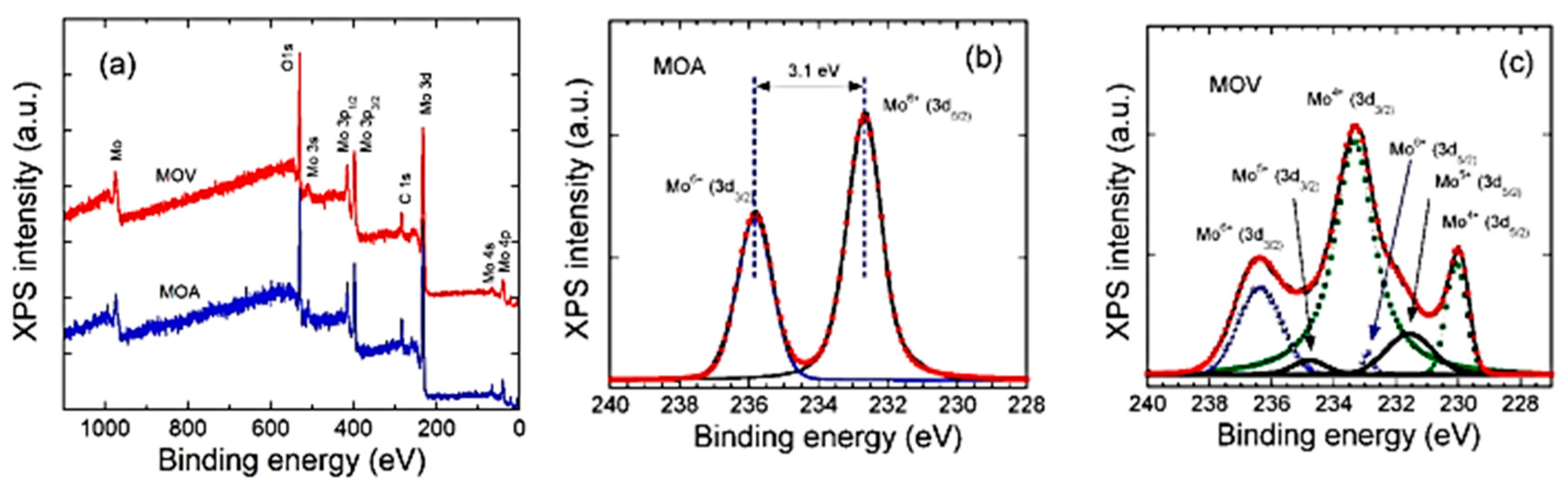
Figure 34.
Schematic representation of the coin-cell assembly.
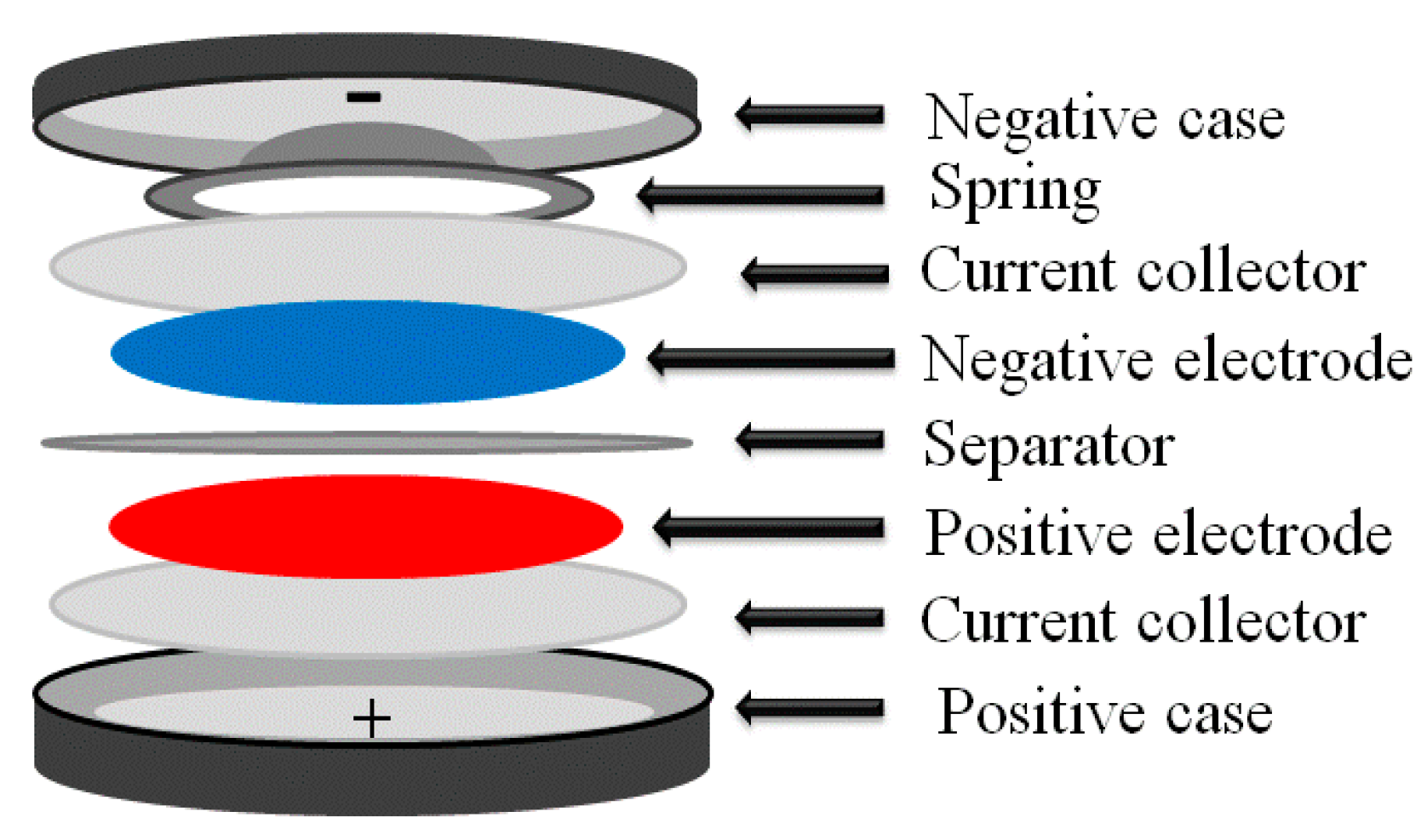
Figure 35.
(a) Nyquist plots and (b) Comparison of cycling behaviors of the pristine Li1.2Ni0.13Co0.13Mn0.54O2 (LNMC) and Na-doped Na-Li1.2Ni0.13Co0.13Mn0.54O2 (Na-LNMC) electrodes. Reproduced from [226]. Copyright 2022 under the terms and conditions of the Creative Commons Attribution (CC‒BY) license.
Figure 35.
(a) Nyquist plots and (b) Comparison of cycling behaviors of the pristine Li1.2Ni0.13Co0.13Mn0.54O2 (LNMC) and Na-doped Na-Li1.2Ni0.13Co0.13Mn0.54O2 (Na-LNMC) electrodes. Reproduced from [226]. Copyright 2022 under the terms and conditions of the Creative Commons Attribution (CC‒BY) license.
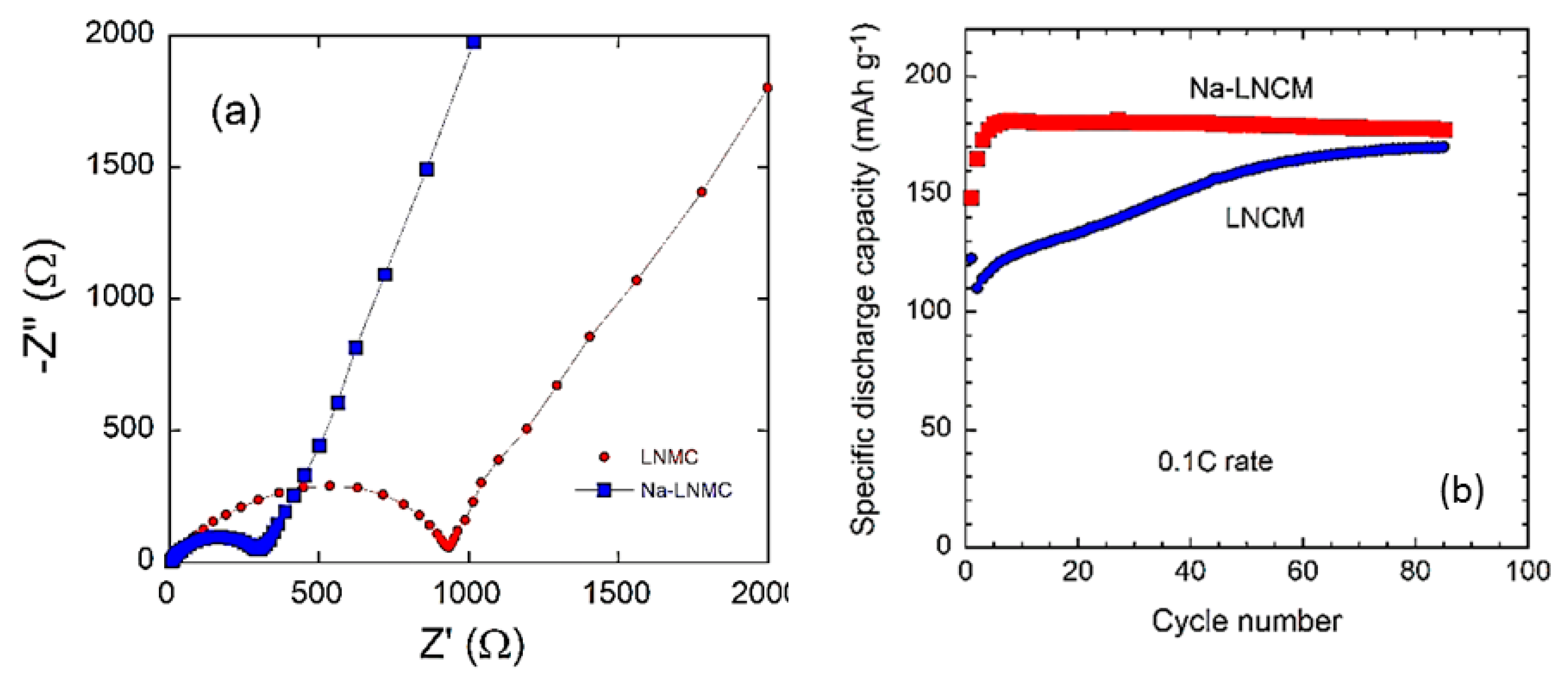
Table 3.
Most familiar cathode materials for lithium-ion batteries.
| Cathode material | Crystal Structure |
Operating Voltage (V vs. Li/Li+) |
Capacity (mAh g−1) |
Key advantages | Main challenges | Relevance of nanostructuring |
|---|---|---|---|---|---|---|
| LiCoO2 | Layered α-NaFeO2 |
3.9–4.2 | ~140 | High energy density | High cost, thermal instability | Improves rate capability and cycling stability; mitigates surface degradation |
| LiNixMnyCozO2 | Layered |
3.6–4.3 | 160–200 | Balanced energy density, cost, and safety | Structural degradation at high Ni content | Enhances Li+ diffusion and suppresses microcracking |
| LiNi0.8Co0.15Al0.05O2 | Layered | 3.6–4.3 | ~200 | High specific energy, long cycle life | Thermal instability, moisture sensitivity | Stabilizes structure and improves high-rate performance |
| LiFePO4 | Olivine |
3.2–3.5 | ~170 | Excellent thermal stability, long cycle life, low cost | Low electronic conductivity, moderate energy density | Essential to overcome poor kinetics via nanosizing and carbon coating |
| LiMn2O4 | Spinel |
~4.0 | ~140 | Low cost; high power capability | Mn dissolution, capacity fading | Reduces strain and improves cycling stability |
| xLi2MnO3·(1−x)LiMO2 | Layered/composite | 4.3–4.8 | >250 | Very high capacity | Voltage fade; structural instability | Controls phase transformation and oxygen loss |
| LiMnPO4 | Olivine | ~4.1 | ~170 | High voltage, good safety | Extremely low conductivity | Nanostructuring enables practical rate performance |
| LiV3O8, V2O5 | Layered | 2.5–4.0 | 250–300 | High capacity, low cost | Poor cycling stability | Enhances structural integrity and kinetics |
| LiNi0.5Mn1.5O4 | Spinel | ~4.7 | ~147 | High voltage, Co-free | Electrolyte decomposition at high voltage | Stabilizes electrode–electrolyte interface |
Disclaimer/Publisher’s Note: The statements, opinions and data contained in all publications are solely those of the individual author(s) and contributor(s) and not of MDPI and/or the editor(s). MDPI and/or the editor(s) disclaim responsibility for any injury to people or property resulting from any ideas, methods, instructions or products referred to in the content. |
© 2026 by the authors. Licensee MDPI, Basel, Switzerland. This article is an open access article distributed under the terms and conditions of the Creative Commons Attribution (CC BY) license (http://creativecommons.org/licenses/by/4.0/).
Copyright: This open access article is published under a Creative Commons CC BY 4.0 license, which permit the free download, distribution, and reuse, provided that the author and preprint are cited in any reuse.


