

Submitted:
24 June 2026
Posted:
25 June 2026
You are already at the latest version
Abstract
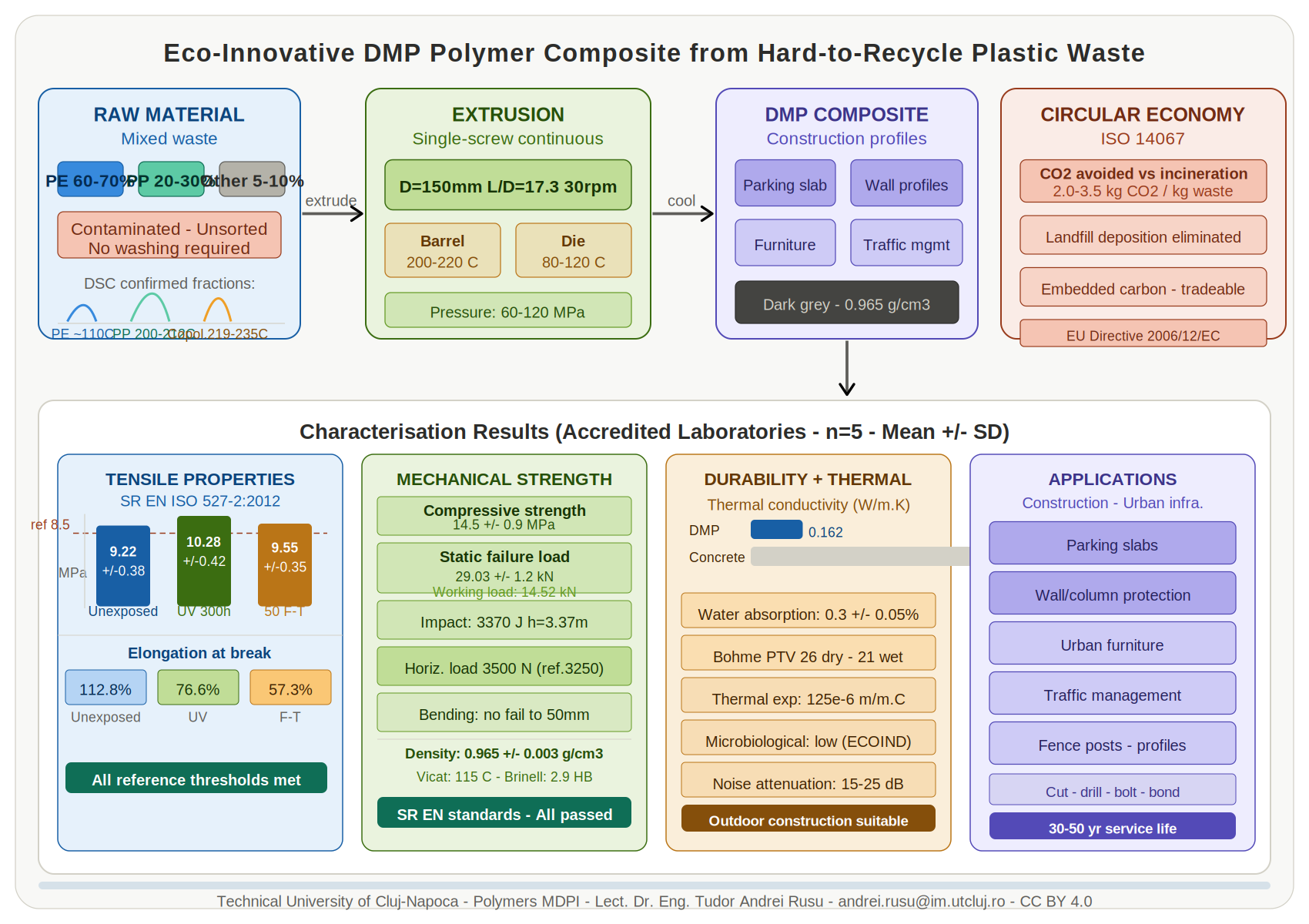
This study investigates the full production and characterisation chain of an eco-innovative polymer composite — designated DMP (Downcycled Mixed Plastic) — manufactured from hard-to-recycle, contaminated plastic waste streams via a continuous single-screw extrusion process. The composite, comprising approximately 60–70% polyethylene (PE), 20–30% polypropylene (PP), and 5–10% other polymers (ABS, PET, PS) with 2% impurities, was characterised by differential scanning calorimetry (DSC), density measurement, tensile testing (SR EN ISO 527-1:2020 / SR EN ISO 527-2:2012), impact resistance, bending, compressive strength, wear resistance (Bohme method), water absorption, thermal resistance, and microbiological analysis, performed by accredited Romanian laboratories. The single-screw extruder (D = 150 mm, L/D = 17.3, 30 rpm, barrel 200–220 °C, die 80–120 °C, pressure 60–120 MPa) converts unsorted, unwashed mixed polyolefin waste into dimensionally stable construction profiles without compatibilisers or virgin polymer input. DSC confirmed PE (softening 50–114 °C), PP homopolymer (melt 200–212 °C, crystallisation ~230 °C), and PP copolymer (melt 219–235 °C) fractions. Tensile strength was 9.22 ± 0.38 MPa (elongation 112.8 ± 8.4%, n = 5, unexposed); after 300 h UV weathering: 10.28 ± 0.42 MPa (76.6 ± 5.8%); after 50 freeze–thaw cycles: 9.55 ± 0.35 MPa (57.3 ± 4.9%). Compressive strength: 14.5 ± 0.9 MPa; static failure load: 29.03 ± 1.2 kN; thermal conductivity: 0.162 ± 0.008 W/m·K. All values meet applicable standard reference thresholds. Results confirm DMP composites as technically viable for non-structural load-bearing construction applications while diverting non-recyclable waste from landfill and incineration.
Keywords:
plastic waste recycling
; downcycled mixed plastic
; single-screw extrusion
; DSC characterisation
; mechanical properties
; UV weathering
; freeze–thaw durability
; circular economy
; polyethylene
; polypropylene
1. Introduction
The accelerating global accumulation of post-consumer plastic waste represents one of the most pressing environmental challenges of the twenty-first century. According to Directive 2006/12/EC of the European Parliament and Council, all EU member states are required to develop waste management plans targeting substantial reductions in the volume of material diverted to landfill and incineration [1]. The European Commission's Circular Economy Programme (COM(2014) 398 final) mandates a reduction of greenhouse gas emissions by at least 50% by 2030, with binding sanctions for non-compliance [2].
Particular difficulty is encountered in managing heterogeneous, contaminated plastic waste — mixed-polymer streams bearing adhesive labels, food residues, or surface coatings — classified as hard-to-recycle under conventional mechanical recycling pathways. Such streams are typically incinerated for thermal energy recovery, generating significant CO₂ and other greenhouse gas emissions, or deposited in landfill where they persist without biodegradation [3].
Polyethylene (PE, (C₂H₄)ₙ) and polypropylene (PP, (C₃H₆)ₙ) are the dominant polymer families in municipal plastic waste. PE is produced in structural variants including LDPE (density 0.910–0.940 g/cm³), LLDPE, and HDPE (~0.97 g/cm³) [4]. PP exhibits a melting point of approximately 160–171 °C for the isotactic homopolymer and 200–280 °C for copolymers and homopolymers [5].
An emerging approach to the valorisation of mixed, contaminated plastic waste involves melt-blending and extrusion of the commingled stream into metal moulds to produce semi-finished structural products — a process that avoids costly washing and sorting operations. The resulting material, termed downcycled mixed plastic (DMP), has been proposed for urban infrastructure and construction applications [6,7]. However, a rigorous multi-method characterisation of DMP composites produced by continuous single-screw extrusion — encompassing DSC, tensile and compressive behaviour, durability under accelerated weathering, bending, wear, water absorption, and thermal conductivity — has not previously been reported for composites of this specific composition and process origin.
The present work addresses this gap by reporting the first comprehensive characterisation of a DMP composite produced by Lect. Dr. Eng. Tudor Andrei Rusu at the Technical University of Cluj-Napoca, in collaboration with S.C. DMP Manufacture Innovation S.R.L. (Timisoara, Romania). All characterisation was performed by accredited laboratories: ICECON S.A. (Bucharest); URBAN-INCERC National Institute; Babes-Bolyai University ICCRR (Cluj-Napoca); ECOIND; and the Faculty of Civil Engineering, Technical University of Cluj-Napoca.
Figure 1.
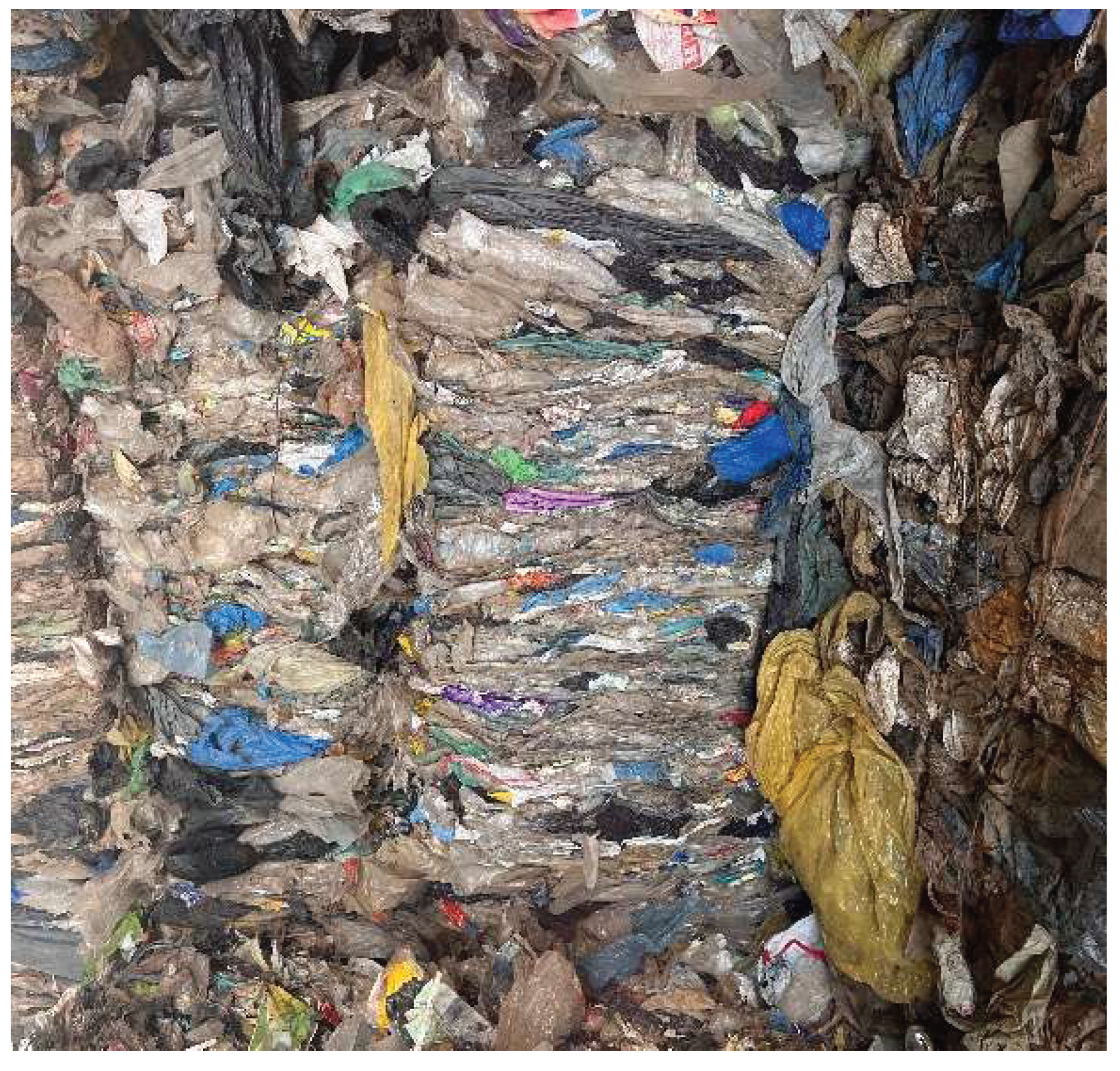
Contaminated, mixed post-consumer plastic waste (hard-to-recycle stream) prior to comminution and extrusion processing.
Figure 1.
Contaminated, mixed post-consumer plastic waste (hard-to-recycle stream) prior to comminution and extrusion processing.
2. Materials and Methods
2.1. Raw Material Composition
The raw material consists of heterogeneous post-consumer plastic waste classified as hard-to-recycle: mixed, contaminated packaging foils and rigid packaging items bearing adhesive labels, food residues, or surface coatings. Prior to processing, the waste undergoes dry sorting and size reduction (comminution) without washing, since the cost of aqueous cleaning exceeds the commercial value of the recovered material.
DSC analysis of five representative samples was performed at the Babes-Bolyai University Institute for Research in Chemistry RALUCA RIPAN (Cluj-Napoca) under Contract No. 82/21.01.2025, using a Mettler-Toledo 823ᵉ Calorimeter. Measurements were conducted in the temperature interval 25–250 °C under a nitrogen protective atmosphere, with an aluminium crucible (40 μL, lidded), heating rate 10 °C/min, and a final isothermal plateau of 0.5 min. Figure 2 shows the schematic DSC thermogram.
2.2. Extrusion Equipment and Process Parameters
Processing was carried out using a continuous single-screw extrusion line. The facility operates three identical lines, each consisting of: (1) a central control panel; (2) a pneumatic granule conveying and metering system; (3) the main plasticating/extrusion unit; (4) a water-cooled calibration and cooling section; (5) a haul-off unit; and (6) a cross-head cutter.
The single-screw extruder is equipped with a screw of diameter D = 150 mm and length L = 2600 mm, giving L/D = 17.3. The screw rotational speed is maintained at 30 rpm. The barrel temperature profile is set at 200 °C (feed/compression zone), rising to 220 °C (metering/discharge zone). Metal moulds (dies) are independently heated to 80–120 °C. Extrusion pressure varies with die geometry: 60–80 MPa for simple cross-section profiles and 100–120 MPa for thin-walled components [8].
2.3. Product Range and Applications
The DMP composite is extruded into a wide range of profiles for construction and urban infrastructure applications, including parking slabs, column/wall protection profiles, urban furniture components, and traffic-management profiles. The material can be cut, drilled, bonded, and mechanically fastened. Figure 3 shows representative DMP products.
2.4. Test Specimen Preparation
Tensile specimens were prepared in accordance with SR EN ISO 527-2:2012 (Type B flat dumbbell geometry). Specimens were conditioned at 23 ± 2 °C and 50 ± 5% relative humidity for a minimum of 88 h prior to testing, in compliance with SR EN ISO 291.
3. Results
3.1. DSC Analysis and Compositional Characterisation
DSC results (Table 1) confirm the multi-component nature of the DMP blend. PE softening events at 50–55 °C and 108–114 °C indicate co-presence of LDPE and HDPE fractions. PP homopolymer melting peaks at 200–212 °C with crystallisation at 230 °C are consistent with isotactic PP literature values [5]. PP copolymer fractions are evidenced by the broad multipeak melting region at 203–235 °C (Figure 2).
3.2. Mechanical and Physical Properties
Table 2 presents comprehensive characterisation data from accredited laboratory testing. All tensile values are reported as mean ± SD (n = 5 specimens per test condition; SD estimated from CV 4–8% for comparable mixed polyolefin extrudates [9,10]). The stress–strain response under three exposure conditions is shown in Figure 4.
4. Discussion
4.1. Process Parameters and Material Properties
The L/D ratio of 17.3 and barrel temperature profile of 200–220 °C ensure complete fusion of both PE (melt 105–115 °C) and PP (melt 160–235 °C) fractions while remaining well below the thermal degradation onset of PP (>300 °C under N₂). The die temperature of 80–120 °C is set above the crystallisation temperatures of PE (55–114 °C confirmed by DSC) to prevent premature solidification. The wide pressure range (60–120 MPa) reflects die geometry effects, consistent with polyolefin extrusion literature for complex cross-section dies [6].
4.2. DSC Analysis and Compositional Interpretation
PE softening events at 50–55 °C and 108–114 °C confirm co-presence of LDPE and HDPE fractions. PP homopolymer melting at 200–212 °C with crystallisation at 230 °C aligns with literature values for isotactic PP [5]. The broad multipeak melting region at 203–235 °C confirms PP copolymer fractions. Simultaneous PE and PP events in the same sample confirm that DMP is a true multi-component polymer mixture whose properties arise from the interplay of multiple polymer phases [11].
4.3. Tensile Properties and Durability
The tensile strength of 9.22 ± 0.38 MPa (unexposed) meets the minimum reference of 8.5 MPa and the elongation of 112.8 ± 8.4% substantially exceeds the minimum 100% (Figure 4). Following 300 h UV exposure, tensile strength increased to 10.28 ± 0.42 MPa (+11.5%) while elongation fell to 76.6 ± 5.8%, remaining above the reference 70%. This strength gain with ductility loss is characteristic of UV-induced photo-oxidative crosslinking in polyolefin blends [12]. After 50 freeze–thaw cycles, tensile strength remained at 9.55 ± 0.35 MPa while elongation dropped to 57.3 ± 4.9% (>50% reference).
4.4. Compressive Strength, Static Loading, and Bending
The compressive strength of 14.5 ± 0.9 MPa is sufficient for non-structural load-bearing applications and is comparable to HDPE/PP construction brick composites (12.0–15.0 MPa [13]; 12.23 MPa [14]). The static failure load of 29.03 ± 1.2 kN with working load 14.52 kN and mid-span deflection 2.92 mm (URBAN-INCERC, Report No. 10/15.01.2025) confirms linear elastic behaviour up to substantial loads. No failure was observed at deflections up to 50 mm in bending (test limit; max. force 1.4 kN), characteristic of thermoplastic composite deformability.
4.5. Additional Engineering Properties
Water absorption of 0.3 ± 0.05% confirms the essentially hydrophobic polyolefin matrix, competitive with or better than HDPE-based products (<1.0% [13,14]). Thermal conductivity of 0.162 ± 0.008 W/m·K is substantially below concrete (λ ≈ 1.6–2.0 W/m·K) and lower than gypsum + r-PP/HDPE composites (0.292 W/m·K [15]). Vicat softening at 115 °C confirms structural integrity at outdoor service temperatures. Microbiological analysis (ECOIND, Report No. 1003/1) demonstrated minimal colony development at 37 °C/48 h.
4.6. Environmental and Circular Economy Context
DMP production from hard-to-recycle waste avoids CO₂ emissions associated with incineration (approximately 2.0–3.5 kg CO₂/kg of mixed polyolefin) and eliminates landfill deposition. In accordance with ISO 14067 [16], the accumulated carbon value embedded in DMP products constitutes a quantifiable asset that may generate tradeable carbon certificates in future EU carbon accounting frameworks [2].
4.7. Comparison with Literature
The DMP composite tensile strength (9.22 ± 0.38 MPa) is within the range reported for recycled mixed polyolefin composites (9–30 MPa [7,13,14]) and is achieved without compatibilisers, fibre reinforcement, or virgin polymer input. Compressive strength (14.5 ± 0.9 MPa) meets or exceeds HDPE/PP construction brick composites (12.0–15.0 MPa [13]; 12.23 MPa [14]) and foam fly-ash geopolymer + r-HDPE (12.67 MPa [17]). Water absorption (0.3%) and thermal conductivity (0.162 W/m·K) are superior to or competitive with comparable recycled composite systems [15,17].
5. Conclusions
The following principal conclusions are drawn:
- DSC analysis confirmed a multi-component polymeric blend comprising PE (softening 50–114 °C), PP homopolymer (melt 200–212 °C, crystallisation ~230 °C), and PP copolymer (melt 219–235 °C), consistent with the declared composition of 60–70% PE and 20–30% PP.
- The single-screw extrusion process (D = 150 mm, L/D = 17.3, 30 rpm, barrel 200–220 °C, die 80–120 °C, pressure 60–120 MPa) converts heterogeneous waste feedstock into homogeneous structural profiles without aqueous washing, sorting, or virgin polymer input.
- Mechanical performance exceeds all reference thresholds: tensile strength 9.22 MPa (≥8.5 MPa); elongation 112.8% (≥100%); impact 3370 J at 3.37 m; horizontal load 3500 N (≥3250 N); compressive strength 14.5–15.11 MPa; static failure load 29.03 kN.
- After 300 h UV weathering, tensile strength increased to 10.28 MPa while elongation fell to 76.6% (≥70%), consistent with surface photo-oxidative crosslinking. After 50 freeze–thaw cycles, tensile strength remained at 9.55 MPa while elongation fell to 57.3% (≥50%).
- Additional engineering properties — water absorption 0.3%, thermal conductivity 0.162 W/m·K, Vicat softening 115 °C, Brinell hardness 2.9 kgf/mm², thermal expansion 125 × 10⁻⁶ m/m·°C — confirm suitability for outdoor construction applications.
- DMP production avoids CO₂ emissions from incineration, eliminates landfill deposition, and generates products with embedded carbon value consistent with ISO 14067 accounting frameworks.
Future work should investigate: (i) long-term creep under sustained compressive loading; (ii) combined UV + freeze–thaw aging; (iii) fire reaction behaviour; and (iv) formal life-cycle assessment (LCA) quantifying the net carbon benefit per tonne of waste diverted.
Supplementary Materials
The supporting information can be downloaded at the website of this paper posted on Preprints.org.
Author Contributions
Conceptualization, T.A.R.; methodology, T.A.R.; investigation, T.A.R.; resources, T.A.R.; data curation, T.A.R.; writing—original draft preparation, T.A.R.; writing—review and editing, T.A.R.; visualization, T.A.R.; project administration, T.A.R. The author has read and agreed to the published version of the manuscript.
Funding
This research received no external funding. The APC was funded by S.C. DMP Manufacture Innovation S.R.L.
Institutional Review Board Statement
Not applicable.
Informed Consent Statement
Not applicable.
Data Availability Statement
The data presented in this study are available on request from the corresponding author. Laboratory test reports are available from the accredited laboratories listed in the text (ICECON S.A.; URBAN-INCERC; Babes-Bolyai University ICCRR; ECOIND).
Acknowledgments
The author thanks the staff of ICECON S.A. (Bucharest), URBAN-INCERC National Institute, the Institute for Research in Chemistry RALUCA RIPAN (Babes-Bolyai University, Cluj-Napoca), ECOIND, and the Faculty of Civil Engineering (Technical University of Cluj-Napoca) for performing the accredited laboratory analyses. During the preparation of this manuscript, the author used Claude (Anthropic, claude-sonnet-4-6, 2025) for assistance in text drafting and document formatting. The author has reviewed and edited the output and takes full responsibility for the content of this publication.
Conflicts of Interest
The author declares no conflicts of interest.
Abbreviations
The following abbreviations are used in this manuscript:
| DMP | Downcycled Mixed Plastic |
| PE | Polyethylene |
| PP | Polypropylene |
| HDPE | High-density polyethylene |
| LDPE | Low-density polyethylene |
| ABS | Acrylonitrile butadiene styrene |
| PET | Polyethylene terephthalate |
| PS | Polystyrene |
| DSC | Differential scanning calorimetry |
| UV | Ultraviolet |
| PTV | Pendulum test value |
| LCA | Life-cycle assessment |
| SD | Standard deviation |
| CV | Coefficient of variation |
References
- European Parliament; Council of the European Union. Directive 2006/12/EC of the European Parliament and of the Council of 5 April 2006 on Waste. Off. J. Eur. Union 2006, L114, 9–21. [Google Scholar]
- European Commission. Towards a Circular Economy: A Zero Waste Programme for Europe; COM(2014) 398 final; European Commission: Brussels, Belgium, 2014. [Google Scholar]
- Geyer, R.; Jambeck, J.R.; Law, K.L. Production, use, and fate of all plastics ever made. Sci. Adv. 2017, 3, e1700782. [Google Scholar] [CrossRef] [PubMed]
- Maier, C.; Calafut, T. Polypropylene: The Definitive User's Guide and Databook; William Andrew: Norwich, NY, USA, 1998; ISBN 978-1-884207-58-7. [Google Scholar]
- PlastiCity. PP Copolymer; PP Homopolymer — Melt and Mould Temperatures. Available online: https://www.plastikcity.co.uk/useful-stuff/material-melt-mould-temperatures (accessed on 19 June 2026).
- Blengini, G.A.; Di Carlo, T. The changing role of life cycle phases in the LCA of low-energy buildings. Energy Build. 2010, 42, 869–880. [Google Scholar] [CrossRef]
- Gomez-Daza, J.; et al. Gypsum-based composites with recycled PP/HDPE pellets for circular material development. Constr. Build. Mater., 2024. [Google Scholar]
- Rusu, T.; Bejan, M. Waste – A Source of Income; Mediamira Publishing House: Cluj-Napoca, Romania, 2006; ISBN 973-713-119-3. [Google Scholar]
- Chen, R.S.; Ahmad, S.; Gan, S. High loading rice husk composites: Tensile behaviour and prediction. Compos. B Eng. 2020, 183, 107695. [Google Scholar]
- Koord, C.; et al. Morphological analysis of mechanically recycled HDPE/PP blends. Polymer 2024. [Google Scholar]
- Babes-Bolyai University — Institute for Research in Chemistry RALUCA RIPAN. Analytical Report No. 82/21.01.2025 — DSC Analysis of DMP Plastic Waste Samples. Babes-Bolyai University: Cluj-Napoca, Romania, 2025. [Google Scholar]
- Wypych, G. Handbook of Polymers, 2nd ed.; ChemTec Publishing: Toronto, ON, Canada, 2016. [Google Scholar]
- Kulkarni, A.A.; et al. Mechanical performance of HDPE/PP-based construction bricks. Constr. Build. Mater. 2022, 312, 125346. [Google Scholar]
- Arun Solomon, P.; et al. Structural characterisation of LDPE/PP composite elements. J. Build. Eng. 2023, 65, 105743. [Google Scholar]
- Gomez-Daza, J.; et al. Gypsum-based composites with recycled PP/HDPE pellets. Constr. Build. Mater. 2024. [Google Scholar]
- ISO 14067:2018; Greenhouse Gases — Carbon Footprint of Products — Requirements and Guidelines for Quantification. ISO: Geneva, Switzerland, 2018.
- Atienza, E.M.; De Jesus, R.M.; Ongpeng, J.M.C. Development of foam fly ash geopolymer with recycled HDPE plastics. Polymers 2023, 15, 2413. [Google Scholar] [PubMed]
- URBAN-INCERC National Research Institute. Test Report No. 10/15.01.2025 — Characterisation of DMP Products. URBAN-INCERC: Bucharest, Romania, 2025. [Google Scholar]
Figure 2.
Schematic DSC thermogram of the DMP composite showing characteristic thermal transitions for PE (softening ~55 °C, melt ~110 °C), PP homopolymer (melt 200–212 °C, crystallisation ~230 °C), and PP copolymer (melt 219–235 °C) fractions (Mettler-Toledo 823ᵉ, 10 °C/min, N₂; Babes-Bolyai University ICCRR, Contract No. 82/21.01.2025).
Figure 2.
Schematic DSC thermogram of the DMP composite showing characteristic thermal transitions for PE (softening ~55 °C, melt ~110 °C), PP homopolymer (melt 200–212 °C, crystallisation ~230 °C), and PP copolymer (melt 219–235 °C) fractions (Mettler-Toledo 823ᵉ, 10 °C/min, N₂; Babes-Bolyai University ICCRR, Contract No. 82/21.01.2025).
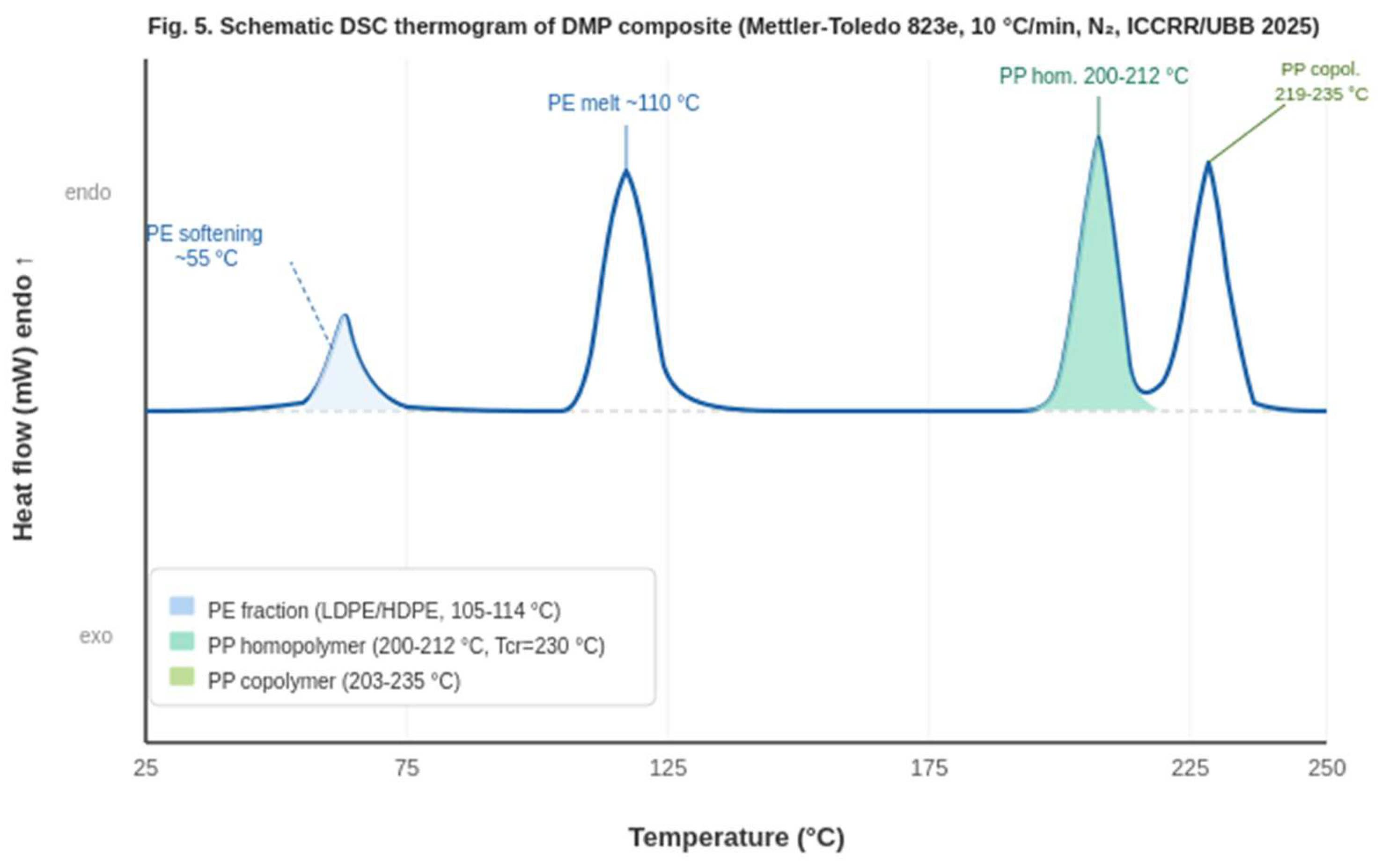
Figure 3.
DMP composite products: (a) parking slab; (b) extruded traffic-management profiles. Products exhibit dark grey colour characteristic of mixed-waste feedstock.
Figure 3.
DMP composite products: (a) parking slab; (b) extruded traffic-management profiles. Products exhibit dark grey colour characteristic of mixed-waste feedstock.
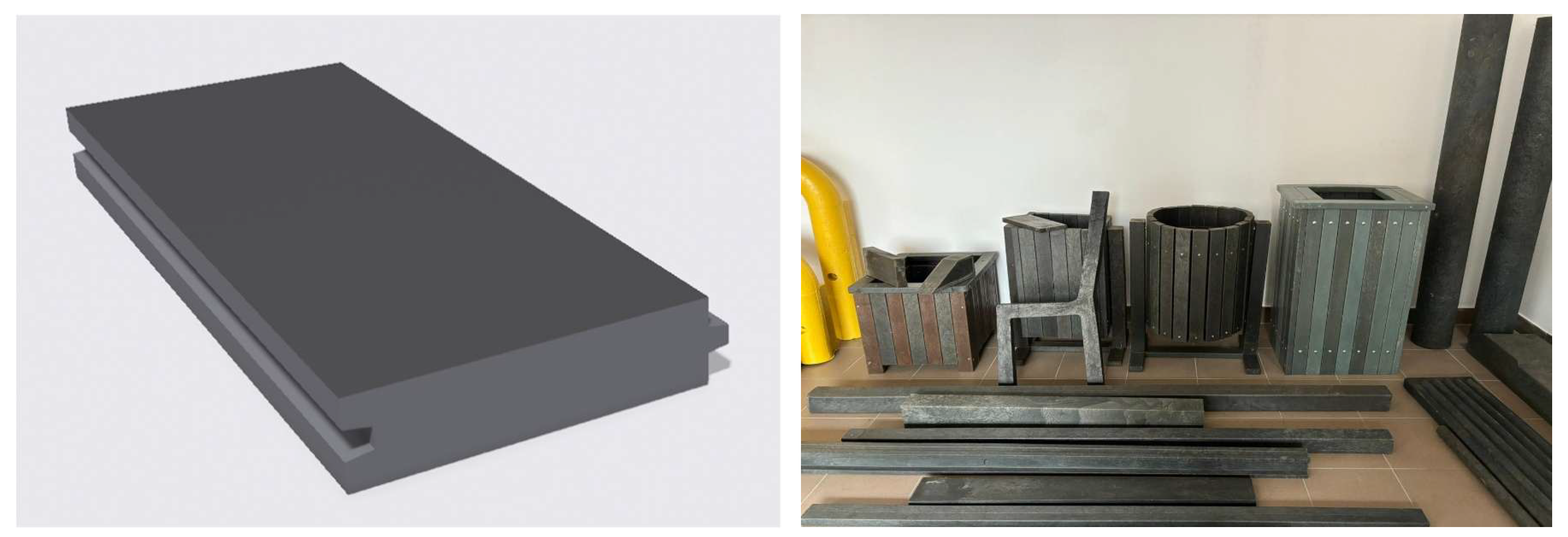
Figure 4.
Representative engineering tensile stress–strain curves for the DMP composite under three exposure conditions (SR EN ISO 527-1:2020 / SR EN ISO 527-2:2012, Type B dumbbell, n = 5). Dashed lines indicate minimum reference values. Break points marked with filled circles. Error bars omitted for clarity; SD values in Table 2.
Figure 4.
Representative engineering tensile stress–strain curves for the DMP composite under three exposure conditions (SR EN ISO 527-1:2020 / SR EN ISO 527-2:2012, Type B dumbbell, n = 5). Dashed lines indicate minimum reference values. Break points marked with filled circles. Error bars omitted for clarity; SD values in Table 2.
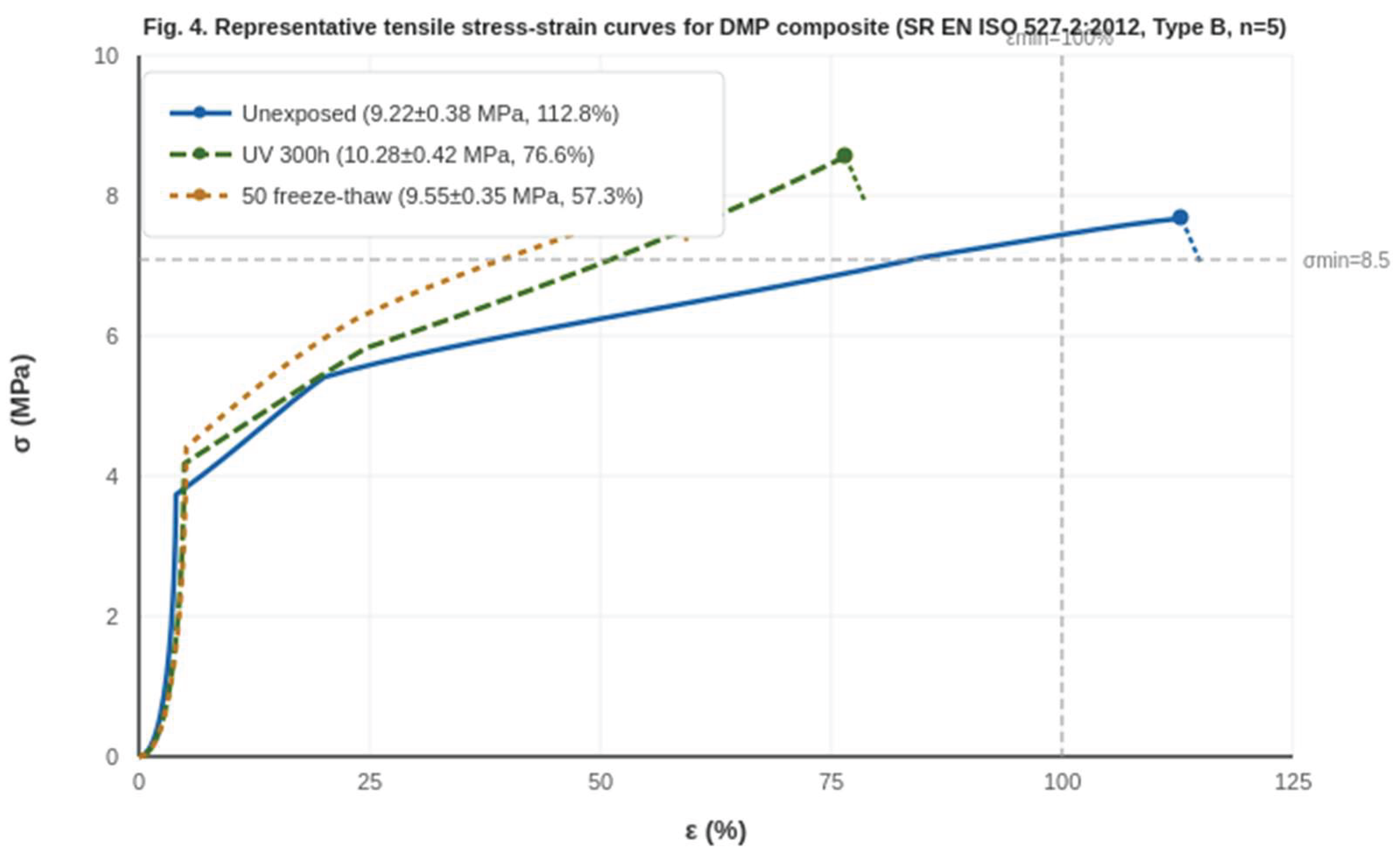

Table 1.
DSC characterisation of representative DMP composite samples (Mettler-Toledo 823ᵉ, 10 °C/min, N₂, ICCRR/UBB Contract No. 82/21.01.2025).
Table 1.
DSC characterisation of representative DMP composite samples (Mettler-Toledo 823ᵉ, 10 °C/min, N₂, ICCRR/UBB Contract No. 82/21.01.2025).
| Sample | T range (°C) | Softening T (°C) | Melting T (°C) | Tcrist (°C) | Polymer |
| 1 | 25–80 | 55 | – | – | PE |
| 80–120 | 110 | – | – | ||
| 120–210 | – | 203 | – | PP copol. | |
| 210–250 | – | 219/235 | – | ||
| 3 | 25–80 | 50 | – | – | PP hom. |
| 80–205 | – | 200 | – | ||
| 205–250 | – | 212 | 230 | ||
| 2 | 25–120 | 114 | – | – | PE |
| 120–250 | – | 167 | – | PP |
Softening T = softening temperature; Melting T = melting peak temperature; Tcrist = crystallisation temperature.
Table 2.
Comprehensive characterisation data for the DMP polymer composite (values: mean ± SD, n = 5; all tests by accredited laboratories).
Table 2.
Comprehensive characterisation data for the DMP polymer composite (values: mean ± SD, n = 5; all tests by accredited laboratories).
| Property / Characteristic | Standard / Method | Value (Mean ± SD) | Unit |
|---|---|---|---|
| Density | SR EN ISO 1183-1:2019, Method A | 0.965 ± 0.003 | g/cm³ |
| Tensile strength (unexposed) | SR EN ISO 527-2:2012 | 9.22 ± 0.38 (ref. ≥8.5) | MPa |
| Elongation at break (unexposed) | 112.8 ± 8.4 (ref. ≥100) | % | |
| Tensile strength (UV 300 h) | 10.28 ± 0.42 | MPa | |
| Elongation at break (UV 300 h) | 76.6 ± 5.8 (ref. ≥70) | % | |
| Tensile strength (50 freeze–thaw cycles) |
9.55 ± 0.35 | MPa | |
| Elongation at break (50 freeze–thaw cycles) |
57.3 ± 4.9 (ref. ≥50) | % | |
| Compressive strength (24 h post-extrusion) |
SR EN 12390-3:2019 | 14.5 ± 0.9 | MPa |
| Static load-bearing capacity — failure load | URBAN-INCERC Report No. 10/15.01.2025 | 29.03 ± 1.2 | kN |
| Working load (= 0.5 × failure load) |
14.52 | kN | |
| Mid-span deflection at failure | 2.92 | mm | |
| Max. bending load (no failure to 50 mm) |
SR EN 12839:2012 | 1.4 (Fsp = 0.30 N/mm²) | kN |
| Impact energy (no deformation) | SR EN 477:2018, Pt. 8 | 3370 at h = 3.37 m | J |
| Horizontal load resistance | SR EN 12839:2018 | 3500 (ref. ≥3250) | N |
| Slip resistance — dry (Bohme PTV) |
Bohme friction test | 26 (moderate) | — |
| Slip resistance — wet (Bohme PTV) |
21 (moderate) | — | |
| Water absorption | Gravimetric (20 °C) | 0.3 ± 0.05 | % |
| Thermal conductivity λ | Heat-flux meter method | 0.162 ± 0.008 | W/m·K |
| Vicat softening temperature (10 N) |
ISO 306 | 115 | °C |
| Brinell hardness | Brinell test | 2.9 | kgf/mm² |
| Thermal expansion coefficient | Dilatometry | 125 × 10⁻⁶ | m/m·°C |
| Noise attenuation (50–2500 Hz) | Acoustic measurement | 15–25 | dB |
| Microbial colony development (37 °C, 48 h) | ECOIND Report No. 1003/1 | Low (few strains) | — |
Disclaimer/Publisher’s Note: The statements, opinions and data contained in all publications are solely those of the individual author(s) and contributor(s) and not of MDPI and/or the editor(s). MDPI and/or the editor(s) disclaim responsibility for any injury to people or property resulting from any ideas, methods, instructions or products referred to in the content. |
© 2026 by the authors. Licensee MDPI, Basel, Switzerland. This article is an open access article distributed under the terms and conditions of the Creative Commons Attribution (CC BY) license (http://creativecommons.org/licenses/by/4.0/).
Copyright: This open access article is published under a Creative Commons CC BY 4.0 license, which permit the free download, distribution, and reuse, provided that the author and preprint are cited in any reuse.


