

Submitted:
23 June 2026
Posted:
25 June 2026
You are already at the latest version
Abstract
Salmonellosis is a significant zoonotic and foodborne disease caused by Salmonella. As a primary host, poultry infections can result in decreased survival rates, diminished production performance and contamination of poultry products, thereby posing a se-rious threat to the sustainable development of poultry farming and human health. In this study, a total of 979 samples were collected from the laying hen production chain and 84 Salmonella strains were isolated with the isolation rate of 8.58% (84/979). Among these, 54 isolates (11.2%) were from commercial house samples, followed by 9 isolates (10.8%) from market samples, 10 isolates (5.88%) from hatchery samples, and 11 iso-lates (4.55%) from breeder house samples. Six different serotypes were identified, with Salmonella enteritidis being the predominant serotype (41.7%), followed by Salmonella typhimurium (22.6%) and Salmonella infantis (21.4%). The Salmonella enteritidis was distributed in various production stages in the laying hen production chain. Among the 16 antibiotics tested, 30 selected strains exhibited 100% resistance to nalidixic acid (NAL) and ciprofloxacin (CIP), attributed to mutations in the quinolone re-sistance-determining region (QRDR) of the gyrA gene. Following this, the resistance rates for ampicillin (AMP), amoxicillin-clavulanate (AMC), and streptomycin (STR) were 56.7%. Notably, isolates from commercial houses and markets displayed higher resistance rates, whereas those from breeder houses and hatcheries exhibited lower rates. Whole genome sequencing (WGS) phylogenetic analysis based on core genome single nucleotide polymorphism (cgSNP) revealed that Salmonella can spread across various stages of the laying hen production chain, posing a potential threat to human health. This study investigates the prevalence of Salmonella within the laying hen production chain, providing a scientific foundation for the effective prevention and control of Salmonella infection.
Keywords:
Salmonella
; laying hen production chain
; resistance
; whole-genome sequence analysis
; core-genome SNP
1. Introduction
Salmonella belongs to the Enterobacteriaceae family and comprised two species: Salmonella bongori and Salmonella enterica. The species Salmonella enterica include 6 subspecies, with a total of approximately 2,600 serotypes [1]. In poultry, infections caused by S. pullorum are referred to as pulorosis, those caused by S. gallinarum are called typhus, and infections by numerous other non-host-adapted serovars are termed paratyphoid [2]. Pulorosis typically leads to the death of chicks aged 1 to 3 weeks. In adult chickens, S. pullorum infection usually display mild or asymptomatic symptoms but can result in decreased production performance and increased mortality [3]. Typhus is generally considered as a disease primarily affecting adult chickens, but it can also lead to significant mortality in chicks [4]. Paratyphoid infections often present as subclinical infections that go unnoticed, thereby posing a significant threat to human health due to the contamination of food, particularly eggs and egg products [5].
Egg, as a high-protein, low-fat, multi-nutrient food, has become an important part of a healthy dietary pattern [6] and the consumption of eggs is increasing year by year in the world [7]. According to statistics, over a billion cases of gastroenteritis caused by Salmonella are reported worldwide annually [8]. Each year in America, there are one million cases of foodborne illness related to non-typhoid Salmonella, specifically the S. Enteritidis, which leads to human salmonellosis mainly through contaminated eggs or egg products [9]. Between 2015 and 2018, a total of 1,209 large-scale infections caused by S. Enteritidis-contaminated eggs were reported in 16 european countries [10]. In the poultry production chain, Salmonella can be present at various stages of production, ultimately contaminating the entire chain through both vertical and horizontal transmission [11]. Lei et al. [12] demonstrated that 148 strains of Salmonella were isolated from 2100 fecal swab samples and the isolation rate of Salmonella was 5.3% at breeder house, 4.2% at hatchery, and 10.4% at commercial chicken farm. Liu et al. [13] conducted continuous monitoring of Salmonella on a large-scale intensive laying hen farm from 2020 to 2023, isolating 105 strains from 1,537 samples, and the commercial areas were identified as the most contaminated with Salmonella. Therefore, comprehensive prevention and control measures should be implemented across the entire farming process to mitigate the risk of contamination.
Recent years have witnessed substantial advancements in the molecular typing analysis of foodborne pathogens with whole-genome sequencing (WGS). WGS has become an effective tool for investigating serotyping, antimicrobial resistance genes, pathogenicity characteristics and the e source of Salmonella. Some researchers [14] employed WGS to study phylogenetic relationships of Salmonella at different stages of chicken slaughter in East China and the slaughter environment was recognized as the source of cross-contamination during processing. Liu et al. [13] conducted a source-trace analysis of S. Kentucky in a laying hen farm using WGS in conjunction with epidemiological investigations, revealing that S. Kentucky entered the farm via an introduction link.
In this study, we conducted a surveillance study to assess the prevalence of Salmonella within a laying hen production chain. Samples were collected from a breeder house and hatchery in Yangzhou, Jiangsu Province, as well as from a commercial house and market in Taizhou, Jiangsu Province. Subsequently, the drug resistance of Salmonella isolates was investigated to provide a scientific basis for optimizing production management models. WGS was used to investigate the genetic relationships among the isolates, thereby offering a theoretical foundation for the prevention and control of Salmonella.
2. Materials and Methods
2.1. Sample Collection
In this study, 979 samples were collected from the laying hen industry chain, which includes one breeder house and one hatchery in Yangzhou, Jiangsu Province, as well as one commercial house (a family farm) and one market in Taizhou, Jiangsu Province, for Salmonella isolation. Parent breeder chickens are raised in the breeder house for egg production, and the eggs are subsequently hatched. Once the chicks reach a certain age, they are transferred to commercial houses for egg laying. Eggs was then transported to the retail market for sale.
A total of 242 samples were collected from breeder house, which included samples from sick or dead chicken, environment, stool, feed and water. A total of 170 samples were collected from hatchery, including dead embryos samples and environment samples. A total of 484 samples were collected from commercial house, which included samples from sick or dead chicken, environment, stool, egg, feed and water. A total of 83 samples were collected from market, including egg samples and environmental samples. All samples were stored on ice and transported to the laboratory within 24 hours. Upon arrival at the laboratory, the samples were processed immediately.
2.2. Isolation and Identification of Salmonella
The buffered peptone water was added to each sample at a volume ratio of 1:9 relative to the sample volume, followed by incubation at 37℃ for 16-20 h for preliminary enrichment. Then, 1 mL of preliminary enrichment culture was added to 10 mL Rappaport-Vassiliadis R10 (RvR10) broth and incubated at 42 °C for 24 h. Upon completion of incubation, selective enrichment culture was streaked onto xylose lysine tergitol 4 (XLT4) agar plates and incubated at 37 °C for 24 h. The polymerase chain reaction (PCR) was employed to determine whether the isolates were Salmonella spp. using specific primers for stn amplification [13]. The serotype of isolates was confirmed by agglutination test using Salmonella antisera (Tianrun, Ningbo, China) according to the Kauffmann–White scheme.
2.3. Antimicrobial Susceptibility Testing
According to the Clinical and Laboratory Standards Institute (CLSI 2021), the antimicrobial susceptibility of 30 Salmonella isolates were tested with disk diffusion method. In brief, a single colony was injected into 4 mL of MH liquid medium and incubated at 37 °C for 16-18 hours. The bacterial suspension was calibrated to 0.5 McFarland units with sterile PBS solution and uniformly distributed onto MH solid agar plates. Antibiotic discs were placed on the infected MH solid agar surface with a disc dispenser. Plates were incubated at 37 °C for 24 hours, after which the diameters of the zones were measured and compared to standard criteria. A total of 16 antimicrobial agents were used: ampicillin (AMP), amoxicillin (AMC), cefazolin (CFZ), cefotaxime(CTX), aztreonam (ATM), meropenem (MEM), gentamicin (GEN), amikacin (AK), streptomycin (STR), enrofloxacin (ENR), nalidixic acid (NAL), ciprofloxacin(CIP), tetracycline (TET), trimethoprim-sulfamethoxazole (SXT), chloramphenicol (CHL), nitrofurantoin (F). Escherichia coli ATCC 25922 served as a control strain.
2.4. WGS
A total of 35 S. Enteritidis isolates from different production stages were selected for WGS. The genomic DNA of the isolated strains was extracted using the TIAN amp Bacteria DNA Kit (Tiangen, Beijing, China) according to the manufacturer’s instructions. All genomes were fragmented to an insertion size of 500 bp for library construction. WGS was conducted using the Illumina NovaSeq 6000 platform, producing 150 bp paired-end reads. Genomes were de novo assembled using SPAdes 3.15.5. Multilocus Sequence Typing (MLST), antimicrobial resistance genes, and core genome SNP analysis were performed according to the methods described by Kang et al. [15]. WGS data of all Salmonella isolates were submitted to the NCBI database with the accession number PRJNA1479310.
2.5. Statistical Analysis
Data of Salmonella isolation prevalence was analyzed using SPSS 22.0 software. The chi-square test was employed to assess the significance of differences, with p< 0.05 indicating significant differences.
3. Results
3.1. Prevalence of Salmonella in the Laying Hen Production Chain
In this study, samples were collected from different stages of a laying hen production chain in Jiangsu Province, including breeder house, hatchery, commercial house, and market, followed by isolation and identification of Salmonella. Among the 979 samples collected, 84 Salmonella isolates were recovered, yielding an overall prevalence rate of 8.58% (Table 1). The highest isolation rate was observed in commercial house (11.2%), followed by market (10.8%). In contrast, the prevalence in breeder house and hatchery was 4.6% and 5.9%, respectively. The isolation rate in commercial house were significantly higher than those in breeder house and hatchery (p < 0.05). Environmental samples from commercial house and markets exhibited relatively high isolation rates. The isolation rate of environmental samples reached 21.4% in markets and 17.3% in commercial house. Among egg samples, the highest prevalence was detected in markets (5.5%). Salmonella was not detected in any feed or water samples.
3.2. Serotyping of Salmonella Isolates
Serotyping of the 84 Salmonella isolates identified six distinct serovars. S. Enteritidis was the predominant serovar, accounting for 41.7% of the isolates, followed by S. Typhimurium (22.6%) and S. Infantis (21.4%) (Figure 1). In addition, seven isolates were identified as S. Kentucky, three as S. Brenderup, and two as S. Agona. S. Enteritidis was the dominant serovar throughout the entire laying hen production chain and was detected in breeder house, hatchery, commercial house, and market.
3.3. Antimicrobial Resistance Phenotypes and Genotypes
Thirty Salmonella isolates were selected for antimicrobial susceptibility testing against 16 antibiotics (Table 2). The highest resistance rates were observed for NAL and CIP (both 100%), followed by AMP, AMC, and STR (56.7%). Resistance to TET was 53.3%, and 33.3% of the isolates were resistant to ENR. Resistance to the remaining antibiotics was primarily detected in S. Kentucky isolates recovered from commercial layer farms. When analyzed by different stages of the production chain, S. Enteritidis isolates from breeder house and hatchery exhibited 100% resistance to NAL and CIP and 30% resistance to ENR, while remaining susceptible to the other 13 tested antibiotics. In contrast, S. Enteritidis isolates from commercial layer farms and retail markets showed 100% resistance to NAL and CIP, and 76.9% resistance to AMP, AMC, and STR. Additionally, these isolates demonstrated resistance to CFZ (7.7%), TET (69.2%), and F (10.5%). S. Kentucky isolates from commercial house exhibited resistance to at least 13 antibiotics, indicating a multidrug-resistant (MDR) phenotype.
WGS was subsequently performed to detect 16 antimicrobial resistance genes among the 30 isolates. All isolates harbored the aminoglycoside resistance gene aac(6’)-Iaa. The detection rates of aph(6)-Id (aminoglycoside resistance) and sul2 (sulfonamide resistance) were both 33.33%, while tet(A) (tetracycline resistance) and blaTEM-1B (β-lactam resistance) were detected in 53.33% and 56.67% of isolates, respectively (Table 3). The resistance genes aadA7,rmtB,sul1,blaCTX-M-55,qnrS1,dfrA14,lnu(F),ARR-2,floR,mph(A) and fosA3 were exclusively identified in the seven S. Kentucky isolates. Resistance to quinolones is commonly associated with mutations in the quinolone resistance-determining regions (QRDRs). WGS analysis revealed that 33.3% (10/30) of the isolates carried a substitution at codon 87 of gyrA, resulting in an Asp87Tyr (D87Y) mutation, while 43.3% (13/30) exhibited an Asp87Asn (D87N) mutation. Furthermore, 23.3% (7/30) of the isolates harbored dual mutations in gyrA, including Asp87Asn (D87N) and Ser83Phe (S83F).
3.4. Traceability Analysis of S. Enteritidis
Whole-genome sequencing was performed on 35 S. Enteritidis isolates. Multilocus sequence typing (MLST) analysis revealed that all isolates belonged to sequence type 11 (ST11) (Figure 2). An evolutionary tree was constructed based on core genome single nucleotide polymorphism (cgSNP), and the isolates were divided into two distinct clades (A1 and A2). Clade A1 included strains recovered from breeder farms, hatcheries, commercial layer farms and retail markets. These isolates shared high genetic relatedness (the pairwise SNP distance values<10 ) and belonged to the same clonal cluster, suggesting that this clone may disseminate along the egg production chain.
4. Discussion
Salmonellosis remains one of the most prevalent foodborne zoonotic diseases worldwide, with poultry and poultry products serving as the primary reservoirs and transmission vehicles for human infections [16,17,18]. This study provides a comprehensive epidemiological analysis of Salmonella contamination across the laying hen production chain in Jiangsu Province, China, revealing an overall isolation rate of 8.58% from samples collected at breeder house, hatchery, commercial house and market. The higher prevalence in commercial house and market compared to breeder house and hatchery aligns with findings from other studies, where commercial and downstream stages often show elevated contamination due to increased environmental exposure, multi-age management, and potential cross-contamination [13,19]. Moreover, environmental samples from commercial house and market in the present study exhibited relatively high isolation rates, suggesting that environmental contamination may contribute substantially to the maintenance and transmission of Salmonella within the production chain.
Serotyping analysis identified six distinct Salmonella serovars among the 84 isolates, with S. Enteritidis being the predominant serovar (41.7%), followed by S. Typhimurium (22.6%) and S. Infantis (21.4%). This serotype distribution is consistent with global and regional trends, where S. Enteritidis has long been recognized as the leading cause of egg-associated salmonellosis worldwide [20,21]. The U.S. Centers for Disease Control and Prevention (CDC) has repeatedly documented S. Enteritidis as a primary serovar in egg-linked outbreaks in the United States [22,23]. It is estimated that approximately 3.25 million eggs in the United States are contaminated with S. enteritidis each year [24]. Similarly, the European Food Safety Authority (EFSA) and European Centre for Disease Prevention and Control (ECDC) have reported numerous multi-country outbreaks of S. Enteritidis linked to eggs and egg products, including prolonged outbreaks affecting up to 18 countries between 2015 and 2020 [10,25,26]. Importantly, our study found that S. Infantis accounted for 21.4% of the isolates, indicating a notable presence that is consistent with its reported emergence in Chinese poultry production. Recent surveillance in China has shown S. Infantis rising in prevalence within poultry and egg-related chains, often ranking among the top serovars alongside S. Enteritidis [19,27]. The rapid spread of S. Infantis is of particular concern because this serovar has been frequently associated with multidrug resistance and enhanced virulence potential in both poultry and humans [28]. Furthermore, S. Enteritidis was detected in all production stages, confirming its ability to disseminate throughout the entire laying hen production chain. In contrast, commercial house harbored the greatest serovar diversity. This pattern supports the hypothesis that open, small-scale production systems are more susceptible to the introduction of Salmonella from external sources such as wildlife, rodents, personnel, or environmental contamination [29,30].
Antimicrobial resistance (AMR) is a major global public health threat, and the emergence of multidrug-resistant Salmonella in poultry production has significantly complicated the treatment of salmonellosis [31]. In this study, all 30 tested Salmonella isolates exhibited 100% resistance to NAL and CIP. NAL and CIP have not been recently applied to control bacterial contamination. Hence, the emergence of drug resistance can be largely explained by the historical use of quinolone antibiotics. The increasing prevalence of NAL resistance raises major concerns, as it may impair the efficacy of fluoroquinolone treatments and ultimately result in delayed or failed therapy [32]. WGS revealed that quinolone resistance was primarily mediated by mutations in the quinolone resistance-determining region (QRDR) of the gyrA gene, with 33.3% of isolates carrying the Asp87Tyr (D87Y) mutation, 43.3% carrying the Asp87Asn (D87N) mutation, and 23.3% harboring dual mutations (Asp87Asn and Ser83Phe). Single mutations at codons 83 or 87 of gyrA typically confer high-level resistance to nalidixic acid, while dual mutations significantly elevate resistance to ciprofloxacin and other fluoroquinolones [33,34]. Notably, Salmonella isolates from commercial house and market displayed broader resistance spectra than those from breeder house and hatchery, which may reflect long-term antimicrobial selection pressure during commercial production and environmental exposure. In particular, S. Kentucky isolated from commercial house exhibited resistance to 15 distinct antibiotics, representing a typical extensively drug-resistant (XDR) phenotype. Meanwhile, several resistance genes such as blaCTX-M-55, qnrS1, fosA3, and rmtB were detected in these isolates. Multidrug-resistant S. Kentucky strains have been regarded as a serious global public health concern in recent years [35,36], with spread in poultry and humans. The detection of multidrug-resistant S. Kentucky in the present study highlights the potential risk of antimicrobial resistance transmission through the egg production chain and underscores the necessity for prudent antimicrobial usage and continuous surveillance in poultry production systems.
WGS-based phylogenetic analysis demonstrated that all S. Enteritidis isolates belonged to ST11, which is recognized as one of the dominant epidemic sequence types associated with poultry and human infections worldwide [37,38]. Core genome SNP analysis further showed that several strains isolated from breeder house, hatchery, commercial house and market clustered into the same clonal lineage with pairwise SNP distances of fewer than 10 SNPs. These results strongly suggest the existence of clonal transmission along the laying hen production chain. Similar findings have been reported in previous studies, which demonstrated that highly related Salmonella isolates can disseminate from upstream breeding systems to downstream retail products through vertical transmission, environmental contamination, personnel movement, and transportation processes. Therefore, this study offered meaningful data regarding the presence and outbreaks of Salmonella in poultry farms and further elucidated the underlying causes for its persistence throughout the subsequent production chain.
5. Conclusions
This study demonstrated that Salmonella, especially S. Enteritidis, is prevalent throughout the laying hen production chain in Jiangsu Province, China and can disseminate among different production stages. The high prevalence of quinolone resistance and the emergence of multidrug-resistant S. Kentucky further underline the potential public health risks associated with antimicrobial-resistant Salmonella in poultry production. These findings provide important epidemiological evidence supporting the implementation of comprehensive surveillance, strict biosecurity measures, and rational antimicrobial use across the entire egg production chain.
Author Contributions
Conceptualization, A.H.X., X.L. and X.B.L.; methodology, A.H.X., X.L., C.J.Z., Y.Y.W., and Z.L.C.; software, X.B.L. and G.X.Z.; validation, A.H.X. and X.L.; formal analysis, A.H.X. and X.L.; data curation, A.H.X., X.L., C.J.Z., Y.Y.W., and Z.L.C.; writing—original draft preparation, A.H.X., X.L. and X.J.G.; writing—review and editing, A.H.X., X.L., X.J.G. and B.W.; supervision, B.W. and Y.J.W.; funding acquisition, A.H.X., Y.J.W. and G.X.Z. All authors have read and agreed to the published version of the manuscript.
Funding
This research was supported by the Taizhou Social Development Plan Project (TS202429), the Science and Technology Innovation Team Project of Jiangsu Agri-Animal Husbandry Vocational College (NSF2024TC01), Taizhou Sixth Phase “311 High-level Talent Training Special Program”, Taizhou “Feng Cheng Ying Cai Program” youth science and technology talent, and the earmarked fund for CARS (CARS-41).
Institutional Review Board Statement
Not applicable.
Informed Consent Statement
Not applicable.
Data Availability Statement
Data will be made available on request.
Conflicts of Interest
The authors declare no conflicts of interest.
References
- Ferrari, R.G.; Rosario, D.K.A.; Cunha-Neto, A.; Mano, S.B.; Figueiredo, E.E.S.; Conte-Junior, C.A. Worldwide Epidemiology of Salmonella Serovars in Animal-Based Foods: A Meta-Analysis. Appl. Env. Microbiol. 2019, 85, e00591-19. [Google Scholar] [CrossRef] [PubMed]
- Li, Y.; Kang, X.; Ed-Dra, A.; Zhou, X.; Jia, C.; Müller, A.; Liu, Y.; Kehrenberg, C.; Yue, M. Genome-Based Assessment of Antimicrobial Resistance and Virulence Potential of Isolates of Non-Pullorum/Gallinarum Salmonella Serovars Recovered from Dead Poultry in China. Microbiol. Spectr. 2022, 10, e0096522. [Google Scholar] [CrossRef] [PubMed]
- Niu, Q.; Wang, X.; Qi, X.; Cao, C.; Yang, K.; Gu, C.; Zhou, Z.; Huang, Q. Identification of the Gut Microbiota Affecting Salmonella Pullorum and Their Relationship with Reproductive Performance in Hens. Front Microbiol. 2023, 14, 1216542. [Google Scholar] [CrossRef] [PubMed]
- Oliveira, E.S.; Arantes, L.C.R.V.; Vieira de Lima, G.B.; Alves, V.V.; Gabardo, M. de P.; Brenig, B.; Azevedo, V.; Aburjaile, F.F.; de Freitas Neto, O.C.; Ecco, R. An Outbreak in Week-Old Broiler Chicks Caused by a Highly Virulent and Multidrug-Resistant Strain of Salmonella Gallinarum. Avian Pathol. 2025, 54, 570–576. [Google Scholar] [CrossRef] [PubMed]
- El-Saadony, M.T.; Salem, H.M.; El-Tahan, A.M.; Abd El-Mageed, T.A.; Soliman, S.M.; Khafaga, A.F.; Swelum, A.A.; Ahmed, A.E.; Alshammari, F.A.; Abd El-Hack, M.E. The Control of Poultry Salmonellosis Using Organic Agents: An Updated Overview. Poult. Sci. 2022, 101, 101716. [Google Scholar] [CrossRef] [PubMed]
- Papanikolaou, Y.; Fulgoni, V.L. Patterns of Egg Consumption Can Help Contribute to Nutrient Recommendations and Are Associated with Diet Quality and Shortfall Nutrient Intakes. Nutrients 2021, 13, 4094. [Google Scholar] [CrossRef] [PubMed]
- Al Hasan, S.M.; Saulam, J.; Kanda, K.; Hirao, T. Temporal Trends in Apparent Food Consumption in Bangladesh: A Joinpoint Regression Analysis of FAO’s Food Balance Sheet Data from 1961 to 2013. Nutrients 2019, 11, 1864. [Google Scholar] [CrossRef] [PubMed]
- Lv, Q.; Chu, X.; Yao, X.; Ma, K.; Zhang, Y.; Deng, X. Inhibition of the Type III Secretion System by Syringaldehyde Protects Mice from Salmonella Enterica Serovar Typhimurium. J. Cell Mol. Med. 2019, 23, 4679–4688. [Google Scholar] [CrossRef] [PubMed]
- Huang, X.; Hu, M.; Zhou, X.; Liu, Y.; Shi, C.; Shi, X. Role of yoaE Gene Regulated by CpxR in the Survival of Salmonella Enterica Serovar Enteritidis in Antibacterial Egg White. mSphere 2020, 5, e00638-19. [Google Scholar] [CrossRef] [PubMed]
- Pijnacker, R.; Dallman, T.J.; Tijsma, A.S.L.; Hawkins, G.; Larkin, L.; Kotila, S.M.; Amore, G.; Amato, E.; Suzuki, P.M.; Denayer, S.; et al. An International Outbreak of Salmonella Enterica Serotype Enteritidis Linked to Eggs from Poland: A Microbiological and Epidemiological Study. Lancet Infect. Dis. 2019, 19, 778–786. [Google Scholar] [CrossRef] [PubMed]
- Bi, X.; Wang, X.; Chen, Y.; Chen, L.; Xing, Y.; Che, Z. Effects of Combination Treatments of Lysozyme and High Power Ultrasound on the Salmonella Typhimurium Inactivation and Quality of Liquid Whole Egg. Ultrason Sonochem. 2020, 60, 104763. [Google Scholar] [CrossRef] [PubMed]
- Lei, C.-W.; Zhang, Y.; Kang, Z.-Z.; Kong, L.-H.; Tang, Y.-Z.; Zhang, A.-Y.; Yang, X.; Wang, H.-N. Vertical Transmission of Salmonella Enteritidis with Heterogeneous Antimicrobial Resistance from Breeding Chickens to Commercial Chickens in China. Vet. Microbiol. 2020, 240, 108538. [Google Scholar] [CrossRef] [PubMed]
- Liu, B.; Meng, C.; Wang, Z.; Li, Q.; Xu, C.; Kang, X.; Chen, L.; Wang, F.; Jiao, X.; Pan, Z. Prevalence and Transmission of Extensively Drug-Resistant Salmonella Enterica Serovar Kentucky ST198 Based on Whole-Genome Sequence in an Intensive Laying Hen Farm in Jiangsu, China. Poult. Sci. 2024, 103, 103608. [Google Scholar] [CrossRef] [PubMed]
- Gu, D.; Wang, Z.; Tian, Y.; Kang, X.; Meng, C.; Chen, X.; Pan, Z.; Jiao, X. Prevalence of Salmonella Isolates and Their Distribution Based on Whole-Genome Sequence in a Chicken Slaughterhouse in Jiangsu, China. Front Vet. Sci. 2020, 7, 29. [Google Scholar] [CrossRef] [PubMed]
- Kang, X.; Wang, M.; Meng, C.; Li, A.; Jiao, X.; Pan, Z. Prevalence and Whole-Genome Sequencing Analysis of Salmonella Reveal Its Spread along the Duck Production Chain. Poult. Sci. 2022, 101, 101993. [Google Scholar] [CrossRef] [PubMed]
- Mkangara, M. Prevention and Control of Human Salmonella Enterica Infections: An Implication in Food Safety. Int. J. Food Sci. 2023, 2023, 8899596. [Google Scholar] [CrossRef] [PubMed]
- Campbell, A.; Harber, A.; Fanning, S.; Marshall, H. New Strains, New Threats: The Rise of Atypical Non-Typhoidal Salmonella Serovars and What It Means for Global Health. Crit. Rev. Microbiol. 2026, 1–18. [Google Scholar] [CrossRef] [PubMed]
- Wang, B.; Wang, H.; Lu, X.; Zheng, X.; Yang, Z. Recent Advances in Electrochemical Biosensors for the Detection of Foodborne Pathogens: Current Perspective and Challenges. Foods 2023, 12, 2795. [Google Scholar] [CrossRef] [PubMed]
- Meng, C.; Wang, F.; Xu, C.; Liu, B.; Kang, X.; Zhang, Y.; Jiao, X.; Pan, Z. Prevalence and Transmission of Salmonella Collected from Farming to Egg Processing of Layer Production Chain in Jiangsu Province, China. Poult. Sci. 2025, 104, 104714. [Google Scholar] [CrossRef] [PubMed]
- Andino, A.; Hanning, I. Salmonella Enterica: Survival, Colonization, and Virulence Differences among Serovars. ScientificWorldJournal 2015, 2015, 520179. [Google Scholar] [CrossRef] [PubMed]
- Abdelhamid, A.G.; Yousef, A.E. Egg-Associated Salmonella Enterica Serovar Enteritidis: Comparative Genomics Unveils Phylogenetic Links, Virulence Potential, and Antimicrobial Resistance Traits. Front Microbiol. 2023, 14, 1278821. [Google Scholar] [CrossRef] [PubMed]
- Xu, Y.; Abdelhamid, A.G.; Sabag-Daigle, A.; Sovic, M.G.; Ahmer, B.M.M.; Yousef, A.E. The Role of Egg Yolk in Modulating the Virulence of Salmonella Enterica Serovar Enteritidis. Front Cell Infect. Microbiol. 2022, 12, 903979. [Google Scholar] [CrossRef] [PubMed]
- Investigation Update: Salmonella Outbreak, August 2025.
- Schroeder, C.M.; Naugle, A.L.; Schlosser, W.D.; Hogue, A.T.; Angulo, F.J.; Rose, J.S.; Ebel, E.D.; Disney, W.T.; Holt, K.G.; Goldman, D.P. Estimate of Illnesses from Salmonella Enteritidis in Eggs, United States, 2000. Emerg. Infect. Dis. 2005, 11, 113–115. [Google Scholar] [CrossRef] [PubMed]
- Multi-country Outbreak of Salmonella Enteritidis Infections Linked to Eggs, Third Update – 6 February 2020. EFS3 2020, 17. [CrossRef]
- Grudlewska-Buda, K.; Wiktorczyk-Kapischke, N.; Wałecka-Zacharska, E.; Kwiecińska-Piróg, J.; Gryń, G.; Skowron, K.J.; Korkus, J.; Gospodarek-Komkowka, E.; Bystroń, J.; Budzyńska, A.; et al. Effect of Radiant Catalytic Ionization and Ozonation on Salmonella Spp. on Eggshells. Foods 2022, 11, 2452. [Google Scholar] [CrossRef] [PubMed]
- Jiang, X.; Siddique, A.; Zhu, L.; Teng, L.; Umar, S.; Li, Y.; Yue, M. Ecological Prevalence and Genomic Characterization of Salmonella Isolated from Selected Poultry Farms in Jiangxi Province, China. Poult. Sci. 2025, 104, 105197. [Google Scholar] [CrossRef] [PubMed]
- Drauch, V.; Kornschober, C.; Palmieri, N.; Hess, M.; Hess, C. Infection Dynamics of Salmonella Infantis Strains Displaying Different Genetic Backgrounds - with or without pESI-like Plasmid - Vary Considerably. Emerg. Microbes Infect. 2021, 10, 1471–1480. [Google Scholar] [CrossRef] [PubMed]
- Salmonella Transmission in Poultry Farms: The Roles of Rodents, Lizards and Formites. Savannah Vet. J. 2019, 1–4. [CrossRef]
- Katsande, P.; Davies, A.R.; Owusu-Nyantakyi, C.; Gufe, C.; Musari, S.; Majuru, C.S.; Machakwa, J. Genetic Diversity and Antimicrobial Resistance Profiles of Salmonella Enterica in the Broiler Supply Chain in Harare, Zimbabwe: Tracking Transmission from Farm to Table. Microb. Genom. 2025, 11, 001550. [Google Scholar] [CrossRef] [PubMed]
- Castro-Vargas, R.E.; Herrera-Sánchez, M.P.; Rodríguez-Hernández, R.; Rondón-Barragán, I.S. Antibiotic Resistance in Salmonella Spp. Isolated from Poultry: A Global Overview. Vet. World 2020, 13, 2070–2084. [Google Scholar] [CrossRef] [PubMed]
- Grigar, M.K.; Cummings, K.J.; Rankin, S.C. Prevalence of Salmonella among Waterfowl along the Texas Gulf Coast. Zoonoses Public Health 2017, 64, 689–692. [Google Scholar] [CrossRef] [PubMed]
- Chen, Y.; Liu, L.; Guo, Y.; Chu, J.; Wang, B.; Sui, Y.; Wei, H.; Hao, H.; Huang, L.; Cheng, G. Distribution and Genetic Characterization of Fluoroquinolone Resistance Gene Qnr among Salmonella Strains from Chicken in China. Microbiol. Spectr. 2024, 12, e0300023. [Google Scholar] [CrossRef] [PubMed]
- Eaves, D.J.; Liebana, E.; Woodward, M.J.; Piddock, L.J.V. Detection of gyrA Mutations in Quinolone-Resistant Salmonella Enterica by Denaturing High-Performance Liquid Chromatography. J. Clin. Microbiol. 2002, 40, 4121–4125. [Google Scholar] [CrossRef] [PubMed]
- Wang, Z.; Jiang, Y.; Xu, H.; Jiao, X.; Wang, J.; Li, Q. Poultry Production as the Main Reservoir of Ciprofloxacin- and Tigecycline-Resistant Extended-Spectrum β-Lactamase (ESBL)-Producing Salmonella Enterica Serovar Kentucky ST198.2-2 Causing Human Infections in China. Appl. Env. Microbiol. 2023, 89, e0094423. [Google Scholar] [CrossRef] [PubMed]
- Jiang, Y.; Wang, Z.-Y.; Li, Q.-C.; Lu, M.-J.; Wu, H.; Mei, C.-Y.; Shen, P.-C.; Jiao, X.; Wang, J. Characterization of Extensively Drug-Resistant Salmonella Enterica Serovar Kentucky Sequence Type 198 Isolates from Chicken Meat Products in Xuancheng, China. Microbiol. Spectr. 2023, 11, e0321922. [Google Scholar] [CrossRef] [PubMed]
- Wang, Q.; Song, M.; Zhao, W.; Hu, X.; Tang, Z.; Guo, L. Investigating the Dynamics of S. Enteritidis Serotype Spread in Breeder Poultry Company Using a Whole Genome Sequencing Approach. Front Vet. Sci. 2026, 13, 1810481. [Google Scholar] [CrossRef] [PubMed]
- Vakili, S.; Haeili, M.; Feizi, A.; Moghaddasi, K.; Omrani, M.; Ghodousi, A.; Cirillo, D.M. Whole-Genome Sequencing-Based Characterization of Salmonella Enterica Serovar Enteritidis and Kentucky Isolated from Laying Hens in Northwest of Iran, 2022-2023. Gut Pathog. 2025, 17, 2. [Google Scholar] [CrossRef] [PubMed]
Figure 1.
Serotype distribution of Salmonella isolates recovered from different stages of the laying hen production chain. Data are presented as the number of isolates for each serotype across different sampling stages.
Figure 1.
Serotype distribution of Salmonella isolates recovered from different stages of the laying hen production chain. Data are presented as the number of isolates for each serotype across different sampling stages.
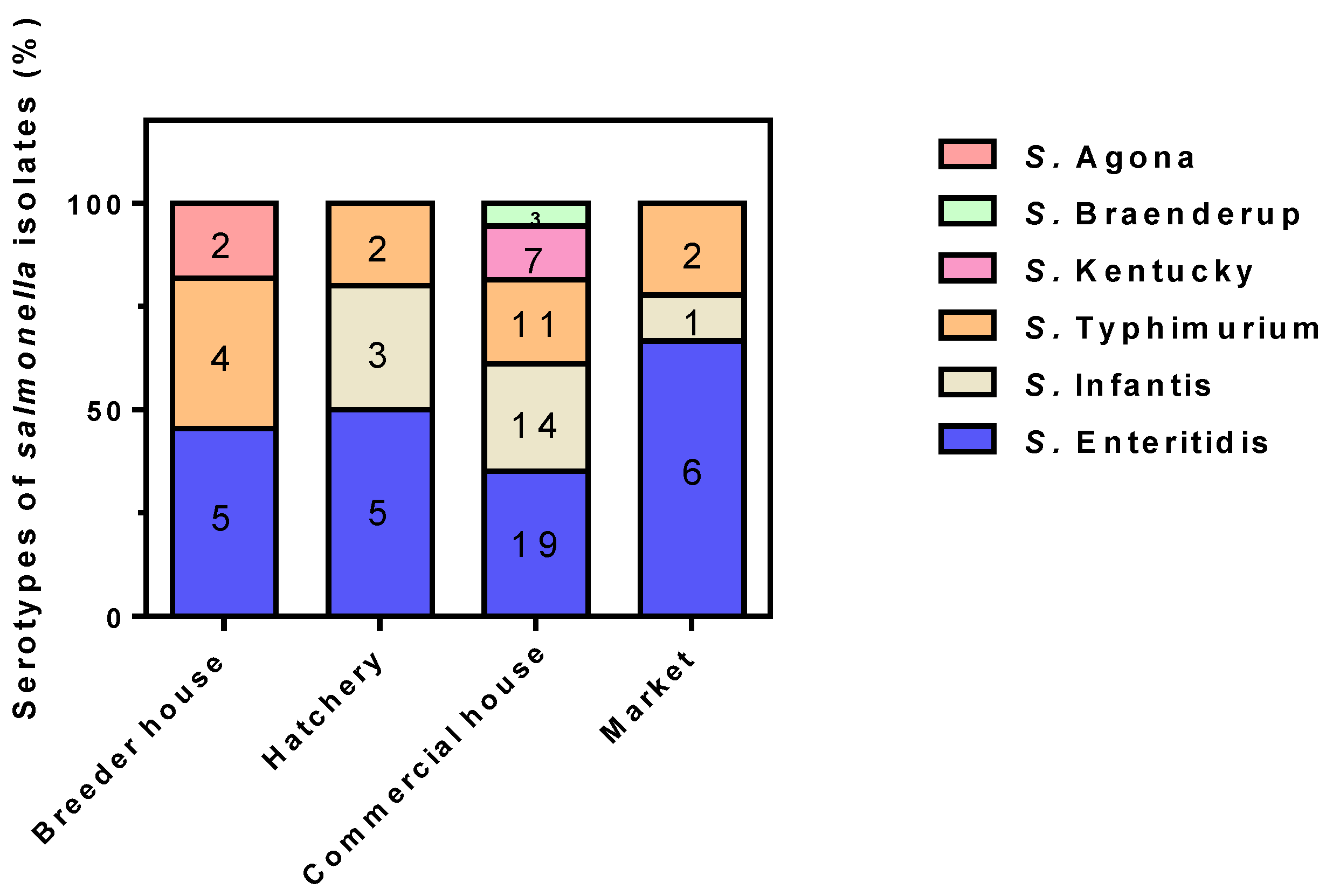
Figure 2.
Phylogenetic tree of S. Enteritidis isolates based on core-genome SNPs. The analysis included 35 S. Enteritidis isolates from different laying hen production stages.
Figure 2.
Phylogenetic tree of S. Enteritidis isolates based on core-genome SNPs. The analysis included 35 S. Enteritidis isolates from different laying hen production stages.
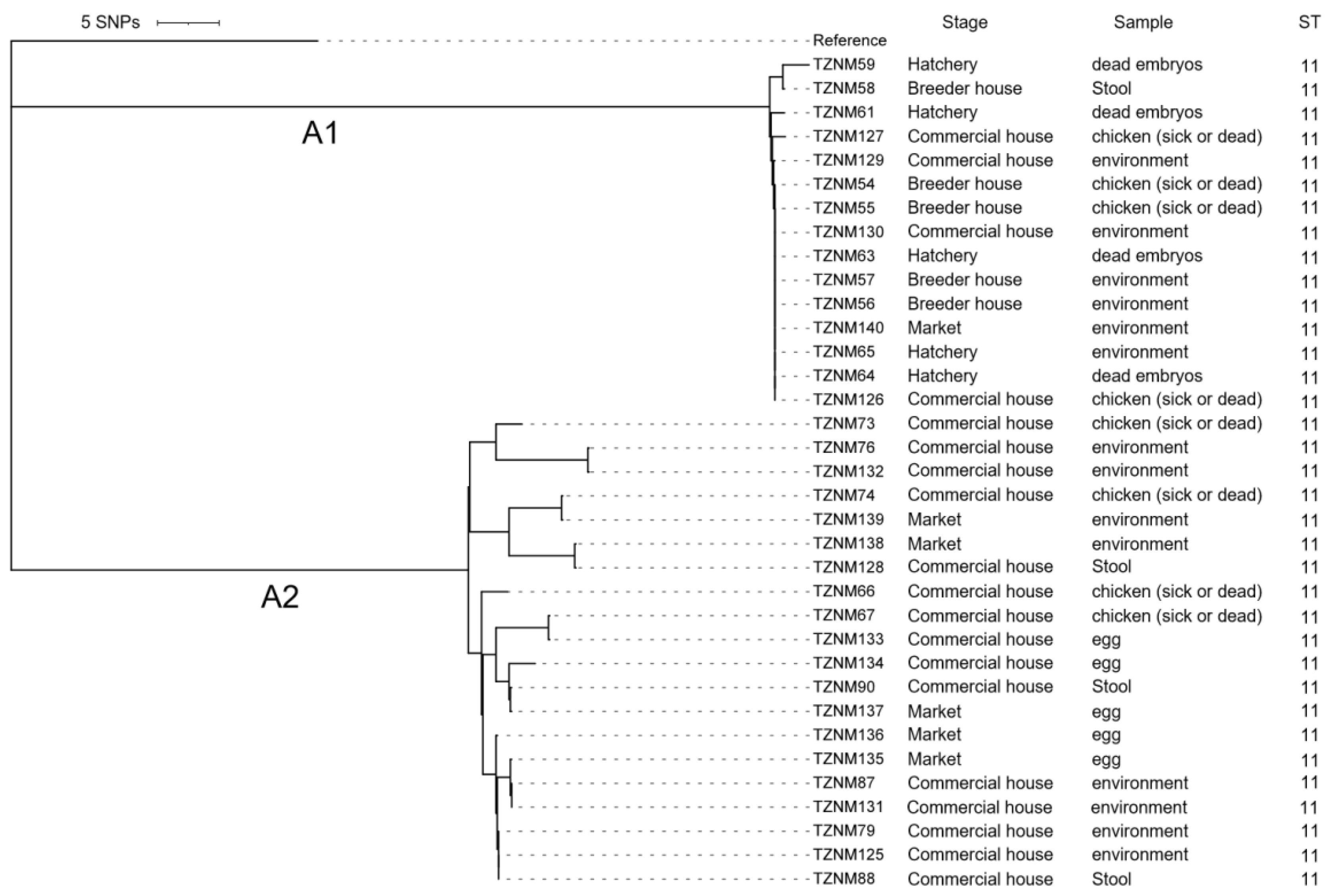

Table 1.
Isolation of Salmonella from different laying hen production stages.
| Location | Stage | Sample | Number of samples | Isolate (%) | Stage separation rate (%) |
|---|---|---|---|---|---|
| Yangzhou | Breeder house | chicken (sick or dead) | 39 | 2 (5.1) | 11/242 (4.6) |
| environment | 143 | 6 (4.2) | |||
| Stool | 45 | 3 (6.7) | |||
| feed | 10 | 0 | |||
| water | 5 | 0 | |||
| Hatchery | dead embryos | 115 | 5 (4.3) | 10/170 (5.9) | |
| environment | 55 | 5 (5.9) | |||
| Taizhou | Commercial house | chicken (sick or dead) | 56 | 9 (16.1) | 54/484(11.2)a |
| environment | 202 | 35 (17.3) | |||
| Stool | 53 | 8 (15.1) | |||
| egg | 158 | 2 (1.3) | |||
| feed | 10 | 0 | |||
| water | 5 | 0 | |||
| Market | egg | 55 | 3 (5.5) | 9/83(10.8) | |
| environment | 28 | 6 (21.4) | |||
| Total | 979 | 84 (8.6) |
aIndicates a significant difference in Commercial house (11.2%) to Breeder house (4.6%) or Hatchery (5.9%) (P < 0.05).
Table 2.
Antimicrobial resistance phenotypes o f 30 Salmonella isolates.
| Resistance number of different sample isolates (%) | |||||
| Antibiotic | Breeder house + Hatchery | Commercial house + Market | Total (n=30) | ||
| S. Enteritidis (n=10) | S. Enteritidis (n=13) | S. Kentucky (n=7) | |||
| β-Lactams | |||||
| Ampicillin (AMP) | 0 | 10(76.9) | 7(100) | 17(56.7) | |
| Amoxicillin (AMC) | 0 | 10(76.9) | 7(100) | 17(56.7) | |
| Cefazolin (CFZ) | 0 | 1(7.7) | 7(100) | 8(26.7) | |
| Cefotaxime(CTX) | 0 | 0 | 7(100) | 7(23.3) | |
| Aztreonam (ATM) | 0 | 0 | 7(100) | 7(23.3) | |
| Meropenem (MEM) | 0 | 0 | 0 | 0 | |
| Aminoglycosides | |||||
| Gentamicin (GEN) | 0 | 0 | 7(100) | 7(23.3) | |
| Amikacin (AK) | 0 | 0 | 6(85.7) | 6(20) | |
| Streptomycin (STR) | 0 | 10(76.9) | 7(100) | 17(56.7) | |
| Quinolone | |||||
| Enrofloxacin (ENR) | 3(30) | 0 | 7(100) | 10(33.3) | |
| Nalidixic acid (NAL) | 10(100) | 13(100) | 7(100) | 30(100) | |
| Ciprofloxacin(CIP) | 10(100) | 13(100) | 7(100) | 30(100) | |
| Sulfonamides | |||||
| Tetracycline (TET) | 0 | 9(69.2) | 7(100) | 16(53.3) | |
| Trimethoprim-sulfamethoxazole (SXT) | 0 | 0 | 7(100) | 7(23.3) | |
| Chloramphenicol (CHL) | 0 | 0 | 7(100) | 7(23.3) | |
| Nitrofurantoin (F) | 0 | 2(10.5) | 1(14.3) | 3(10) | |
Table 3.
Antibiotic resistance of 30 Salmonella isolates.
| Resistance gene | % | |
| Aminoglycoside resistance | aac(6’)-Iaa | 100.00 |
| aadA7 | 23.33 | |
| aph(6)-Id | 33.33 | |
| rmtB | 23.33 | |
| Sulphonamide resistance | sul1 | 23.33 |
| sul2 | 33.33 | |
| Tetracycline resistance | tet(A) | 53.33 |
| Beta-lactam resistance | blaCTX-M-55 | 23.33 |
| blaTEM-1B | 56.67 | |
| Quinolone resistance | qnrS1 | 23.33 |
| Trimethoprim resistance | dfrA14 | 23.33 |
| Lincosamide resistance | lnu(F) | 23.33 |
| Rifampicin resistance | ARR-2 | 23.33 |
| Phenicol resistance | floR | 23.33 |
| Macrolide resistance | mph(A) | 23.33 |
| Fosfomycin resistance | fosA3 | 23.33 |
Disclaimer/Publisher’s Note: The statements, opinions and data contained in all publications are solely those of the individual author(s) and contributor(s) and not of MDPI and/or the editor(s). MDPI and/or the editor(s) disclaim responsibility for any injury to people or property resulting from any ideas, methods, instructions or products referred to in the content. |
© 2026 by the authors. Licensee MDPI, Basel, Switzerland. This article is an open access article distributed under the terms and conditions of the Creative Commons Attribution (CC BY) license (http://creativecommons.org/licenses/by/4.0/).
Copyright: This open access article is published under a Creative Commons CC BY 4.0 license, which permit the free download, distribution, and reuse, provided that the author and preprint are cited in any reuse.