

Submitted:
23 June 2026
Posted:
24 June 2026
You are already at the latest version
Abstract
Assessing genetic diversity of species and populations can help to reduce the risk of biodiversity loss by identifying areas deserving the most attention in terms of conservation priority. Our study was focused on evaluating the genetic variability of two closely related speciesbelonging to the genus Prunus (Rosaceae), Prunus mahaleb L. and Prunus cupaniana Guss. ex E. Huet & A. Huet, both quite rare and unevenly distributed in Sicily (Italy). In this Italian region, P. mahaleb counts scattered populations, mostly concentrated on the mountain ranges close to the northern Tyrrhenian coast, while P. cupaniana is an endemic species known to occur only on Sicani Montains and on the Madonie Massif. A total of 118 georeferenced individuals of P. mahaleb and P. cupaniana were sampled in seven different sites. The samples were genotyped using 9 unlinked nSSr loci. In both species, a high percentage of clonal individuals, low intrapopulation diversity, as well as high divergence among populations were recorded. The analysis conducted using STRUCTURE split P. mahaleb and P. cupaniana two different gene pools (K=2) and pointed out the complete absence of introgression between them. These findings confirm that these taxa should be considered two distinct species. Moreover, in-depth analyses allowed us to distinguish four gene pools for P. mahaleb, while the extant populations of P. cupaniana could be grouped into two clusters suggesting their strong isolation and a very low or even absent geneflow between them. Our results underline the urgent need for interventions aimed at conserving and managing the genetic patrimony of the Sicilian populations of both species.
Keywords:
biodiversity
; plant conservation
; endemic trees
; genetic diversity
; Prunus cupaniana
; Prunus mahaleb
1. Introduction
The amount of genetic diversity represents an important indicator of biodiversity and is widely recognized as the key component for the long-term survival of species [1]. Genetic diversity is a foundation of subsistence providing raw material for adaptation and evolution, especially under rapidly changing environmental and disease conditions [2]. Hence, studies assessing levels of genetic diversity can help to reduce the risk of biodiversity loss by identifying the populations and areas showing the highest values of genetic variability and deserving the most attention in terms of conservation priority [3]. In situ and ex situ conservation plans must consider the intraspecific genetic variation as a fundamental criterion for developing effective conservation strategies [4,5]. Several surveys have highlighted the enormous value of the genetic heritage of Sicilian forests [6]; despite covering slightly 10% of the island, local woodlands host the richest tree flora in Italy. Many woody species have here the southernmost edge of their distribution range, they may have developed adaptations to extreme environmental conditions, which make the Sicilian populations of paramount interest for reforestation activities in an increasingly alarming scenario of global warming.
In this context, our study focused on evaluating the genetic variability of two closely related species belonging to the genus Prunus (Rosaceae), Prunus mahaleb L. and Prunus cupaniana Guss. ex. Huet & A. Huet., is of fundamental importance to implement management and conservation measures for the Sicilian forests.
P. mahaleb, named mahaleb cherry or St. Lucie’s cherry, is a deciduous shrub or small tree, up to 10 (max 15) m tall (Figure 1A). Its bark is dark brown, smooth, glossy [7]. The leaves are alternate, 4-7 cm long, broadly ovate, pointed, base rounded to almost cordate; its margins finely saw-toothed with marginal glands, glossy above and slightly hairy along the midrib beneath. It is a rather long-lived species compared to its closest relatives (i.e. P. avium L., the sweet cherry tree, and P. cerasus L., the sour cherry tree). Due to its extensive root system and its pioneer behavior, P. mahaleb has long been used in horticulture as frost resistant rootstock for both P. avium and P. cerasus [8,9,10]. The natural range of P. mahaleb stretches from Central and Southern Europe towards the Middle East (Lebanon and Syria) [11,12,13]. It occurs in almost all the regions of the Italian Peninsula but is quite rare in the western regions and shows a very fragmented and discontinuous distribution pattern throughout the central-northern Apennines, with very isolated populations in the rest of southern Italy [14].
In Sicily, P. mahaleb counts several scattered populations, mostly concentrated in the mountainous areas close to the northern Tyrrhenian coast, on the Mts. of Trapani and Palermo and Sicani Mts., while it does not occur on the Madonie Massif. It also grows on the southern and eastern slopes of the Nebrodi Mts. (Figure S1) and on the Peloritani Mts. it is only reported to grow along the catchment of the river Mela [15]. Its historical presence on Mt. Etna, documented by herbarium specimens, has not been confirmed recently.
P. cupaniana (Figure 1B) is known to occur only in the territory of Sicani Mts. (Ficuzza-Rocca Busambra) and on the Madonie Massif [16] (Figure 1S). This narrow-ranged endemism was first suspected to be a distinct species by Gussone [17,18], then included within the variability of P. mahaleb and treated as a subspecies by Arcangeli [19], Pénzes [20], Soják [21] up to recent times [16,22], while Nyman [23], Lojacono-Pojero [24] and Fiori [25,26]), considered P. cupaniana just a variety or even as a ‘proles ‘[27] or a mere mountain ecotype. It is distinguished from P. mahaleb by its prostrate or ascending, multi-stemmed bushy habit, leathery leaves with cordate and smaller lamina, and corymbs with fewer flowers bearing smaller petals [16]. Moreover, the presence of distinct vernacular names, i.e. “Ciràsa lampàsa” or “Ciràsa purganti” for P. mahaleb, “Amarèni di muntagna” for P. cupaniana, attests to the fact that they were already considered different taxa in the early 18th century [28].
As a matter of fact, the taxonomic interpretation of P. cupaniana is still controversial and, to the best of our knowledge, until now, it is mostly based only on morphological characters, while no detailed molecular data is available to date.
The principal goals of our work were
- (1)
- to perform genetic analysis based on microsatellite markers to assess the genetic diversity and divergence of the extant Sicilian populations of P. mahaleb and P. cupaniana,
- (2)
- to evaluate the genetic distance between these two taxa and the possible occurrence of hybrids where they co-exist.
Based on our results, we aim to provide guidance on the management and conservation of these precious genetic resources.
2. Materials and Methods
2.1. Plant Material
To define the optimal sampling grid for plant material, the regional distribution range of both species was first delineated [15] (Figure S1). To this end, data was drawn from the scientific literature consulted, from the working group’s own observations, as well as from information provided by local experts. All this distribution data was compiled into a geodatabase. We recorded a larger distribution area for P. mahaleb on Trapani Mts, Sicani Mts, Nebrodi and Peloritani Mts., while P.cupaniana was receorded only on Sicani Mt and Madonie. Sampling was carried out between autumn 2023 and spring 2024 (Figure 2), except for RB and QU stands, where material was collected in autumn 2025. A total of 118 georeferenced individuals of P. mahaleb and P. cupaniana were sampled in seven different Sicilian stands. All the sampling sites fall within the natural distribution range of the target taxa (Figure S1), and some of them are located in protected areas such as regional nature reserves or parks (Table 1 and Figure 2). Three sites only hosted P. mahaleb (ER, AL, CA), two sites in the Madonie Mts. only P. cupaniana (MC, QU). The two taxa coexisted on the Sicani Mts in the Nature Reserve Bosco della Ficuzza, Rocca Busambra, in this area we sampled P.cupaniana in two sites (RB, NE) and P.mahaleb in one stand (PV)
An ecological analysis of the stands was conducted to assess site-specific abiotic and ecological (altitude, aspect, habitat type, threats) as well as biotic (vegetative status, growth habit, consistency of flowering and fruiting, regeneration, and phytosanitary status) parameters (Table 1). Furthermore, each stand was classified following the official inventory of the regional Forest Types [29]. Within each stand, leaf material was collected from a minimum of 6 and a maximum of 20 healthy trees located (when possible) almost 15-20 meters apart. A minimum of 20 young leaves were collected from each tree and stored at -20 °C for DNA extraction and analysis.
Due to the small and uneven number of individuals present on the sites, it was not always possible to collect individuals distant enough to minimize the sampling of close relatives. To overcome this problem, subsequent genetic analysis allowed us to discard clonal individuals.
2.2. DNA Isolation, SSRs Amplification and Genotyping
Leaf tissues (50 mg) from each sample were homogenized in a 2 ml microcentrifuge tube containing 5 mm-long steel beads cooled with liquid nitrogen using Mixer Mill 300 (Qiagen, Hilden, Germany). Genomic DNA was extracted and purified using a DNeasy 96 plant kit (Qiagen) and stored at -20 ° C. The samples were then genotyped using 9 unlinked nSSr loci EMPaS12, EMPaS02, EMPaS06, EMPaS14 [30] UDP96-005, UDP98-412, UDP97-402 [31], PceGA34 PS1202 [32]. The genetic linkage of the loci was investigated in Prunus mapping progenies and all proved to be unlinked [30,31]. Three multiplex PCRs were set up based on the size of products, using fluorescent dye-labelled primers (6-FAM, VIC, NED, PET; Applied Biosystems, Foster City, California, USA). Amplifications were performed with the Type-It Microsatellite PCR Kit (Qiagen, Valencia, CA, USA).
The PCR reactions were performed in 12.5 µl total volume containing 20 ng of genomic DNA, amplification conditions were as follows an initial heat activation step at 95 °C for 5 min, followed by 27 cycles consisting of a denaturation step at 95 °C for 30 s, an annealing step at 57 °C for 1.5 min, and an extension step at 72 °C for 30 s. A final extension step at 60 °C for 30 min was executed. PCR fragments have been run on a SeqStudio TM Genetic Analyzer (ThermoFisher Scientific) for separation and sizing. GeneScan250 LIZ (Life Technologies) was used as an internal size standard. Genotyping was performed using GeneMapper v4.0 software (ThermoFisher Scientific).
2.3. Genetic Diversity and Structure of Prunus Populations
The clonal individuals were identified for each population using the “Multilocus Matches Parameters” analysis of GenAlEX 6.3 software [33] and were removed from the raw data. All subsequent statistical analyses were performed using unique genotypes.
The genetic diversity of each population was also performed with GenAlEX 6.503 software [33]; the mean number of alleles per locus (Ne), observed (Ho) and expected heterozygosity (He), heterozygosity corrected for sample size (UHe), Shannon Index (I) and fixation index (Fis) were calculated. Allelic richness (Ar) was evaluated with HP-Rare 1.0 software [34]. The AMOVA analysis was performed using the software GenAlex.
To assess the genetic differentiation between the analyzed Prunus populations two approaches were adopted, i.e. 1) Principal Coordinate Analysis (PCoA), performed with the GenAlEx software, 2) Bayesian clustering implemented in STRUCTURE 2.3.3 software [35]. For this last analysis, the range of possible number of clusters (K) tested was equal to the number of the populations analysed plus one. Parameters were set for a burn-in period of 100,000 and a MCMC (Markov chain Monte Carlo) with 200,000 iterations. Potential clusters (K) were tested using 10 iterations. To determine the most likely number of K, the ΔK method by Evanno et al [36] was applied using STRUCTURE HARVESTER [37].
The groups indicated by the STRUCTURE analysis were subsequently analysed separately to identify subgroups within each cluster.
3. Results
By performing the”Multilocus Matches”analysis with the GenealEx software, we could identify the presence of several clonal individuals, mostly belonging to the P. cupaniana populations (Table S1).
From the initial 118 individuals we obtained 93 unique genotypes, 52 samples of P. mahaleb and 41 samples of P.cupaniana. All the subsequent analyses were performed using these unique genotypes.
3.1. Genetic Diversity
In Table 2, the mean values of genetic indices related to the two species are reported. A higher number of effective alleles (Ne = 4.17) was observed for the P. mahaleb samples compared with those of P. cupaniana (Ne = 2.71). A similar trend was recorded considering the heterozygosity observed (Ho, P. mahaleb = 0.524, P. cupaniana = 0.244), the expected (He, mahaleb = 0.735, cupaniana = 0.479) and the unbiased (UHe, P. mahaleb = 0.742, P. cupaniana = 0.485). The Shannon Index diversity (I) was 1.63 for P. mahaleb and 0.964 for P. cupaniana. A higher inbreeding coefficient (F) was observed for the P. cupaniana samples (Fis = 0.438), pointing at an excess of homozygotes. The genetic diversity indices were also calculated by single population (Table 3).
Overall, the populations of P. mahaleb showed higher values of genetic diversity compared to populations of P. cupaniana. The highest values of Shannon Diversity Index (I), observed (Ho), expected (He) and unbiased (Uhe) heterozygosity were observed in the CA population of P. mahaleb. Similarly, CA also showed the highest values of allelic richness (A) and private allelic richness (PAr). On the other hand, lower values of these parameters were observed in the populations of P. cupaniana, especially in NE (Ho = 0.22, UHe = 0.11).
All the populations of P. cupaniana showed positive values of inbreeding coefficient (Fis), while the differentiation among populations (Fst) is comparable for both taxa.
3.2. Population Structure
The PcoA analysis was performed considering the matrix of Genetic Distance (GD -GeneAlEx) among single individuals (Figure 3A) and the Fst matrix among populations (Figure 3B). Both the analyses pointed at the presence of a non-random clustering of populations.
Figure 3A shows the PcoA among individuals; the combination of the first two axes explained 38.97% of the variation. In the PcoA, performed using the Fst distance among populations (Figure 3B), the 55.54% of the variance was explained by combining the variation of the first two axes.
In both Figure 3A and 3B, two main groups could be easily distinguished, suggesting a clear separation between the populations of P. cupaniana and P. mahaleb and highlighting the genetic divergence between these two taxa. In addition, the analysis of AMOVA indicated a higher variance in the populations of P. cupaniana. Among the populations of P. cupaniana we observed a variance value of 41%, while 38% of variance was recorded among the populations of P. mahaleb.
The subsequent STRUCTURE analysis corroborated the PCoA results. The most probable division among the populations belonging to the P. cupaniana and P. mahaleb, with stronger support in terms of log-likelihood, was detected at K = 2 (Figure 4A).
The high values of Delta K recorded pointed at the sharp genetic distinctness of the two taxa. It is worth emphasizing the total absence of introgressed individuals even in the Sicani Mts. locations (populations PV, RB and NE) where the two taxa coexist. The STRUCTURE analysis was also performed considering the two species separately (Figure 4B). A different situation can be observed for P. cupaniana and P. mahaleb. It is interesting to note that, while for P. mahaleb there is a division in K = 4 and the geographically distant populations show different gene pools, on the other hand the substructure of P. cupaniana is characterized by two gene pools. The MC is represented by a gene pool while the other three populations are grouped in another unique gene pool.
4. Discussion
In the Mediterranean Basin, islands have been identified as one of the hotspots of plant diversity with 5500 plants and a rate of endemism around 10% [38]. Among the large Mediterranean islands, Sicily hosts one of the richest and most various vascular floras, including 430 strictly endemic taxa [38]. Efforts to preserve biodiversity of this area and to maintain the specie ability to survive in time of climate change must consider the assessment and conservation of intraspecific genetic diversity. In this framework, our study on these two Sicilian Prunus species, showing a scattered and localized distribution, follows the recommendations of IUCN (International Union for the Conservation of Nature) that emphasized the need to better consider genetic diversity during the implementation of projects aimed at the management and conservation of endangered plant species [39]. To the best of our knowledge, this is the first in-depth study on the genetic diversity and structure of the Sicilian populations of P. mahaleb and the endemic P. cupaniana and the first to confirm the strikingly different genetic identity of these two species. Our results provide new information for future management and conservation strategies for the Sicilian populations of both taxa.
While recent studies have investigated the genetic diversity of P. mahaleb populations and accessions in Europe [10,40,41,42] and contributed to clarify the phylogenetic relationships between P. mahaleb and the Cherry species of agronomic interest [43,44], until now there are no reports on the genetic diversity and the genetic relationships of the Sicilian endemic P. cupaniana. Considering both the results of the PcoA and STRUCTURE analysis, the genetic separation between P. mahaleb and P. cupaniana samples is evident.
The analysis conducted using STRUCTURE also highlights the complete absence of introgression between P. mahaleb and P. cupaniana even where they grow in proximity, at Ficuzza and Rocca Busambra sites. Considering all these findings, the genetic analyses suggested that these two taxa should be treated as distinct species, as already reported by Pignatti [14], rather than relegating them to the subspecies or the variety rank, as previously proposed [22]. Their genetic isolation could be likely linked to a reproductive barrier (pollen and/or flower structure, flowering period, presence of specialized pollinators) that deserves to be further investigated. Based on all this evidence, P. cupaniana should therefore be added to the already long list of woody species endemic to the Sicilian vascular flora [45,46].
In both species, a low intrapopulation diversity and a higher divergence among populations was observed. The higher values of Molecular Variance (AMOVA) and the higher Fst among the populations of both P. mahaleb and P. cupaniana indicated that intraspecific gene flow is very low or even absent. Similar results were observed in other species with a scattered and localised distribution [47,48].
Gene flow between genetic clusters is probably low due to the small population size and the geographical and environmental setting of Sicilian sampling sites. In fact, the investigated populations form tiny, isolated patches located at different altitudes and/or separated by strong physical barriers such as rocky cliffs that may represent an insurmountable obstacle for genetic exchanges between them.
This hypothesis is corroborated by some interesting results issued from some studies focused on P. mahaleb. For instance, Jordano and Godoy [8] observed that sharp elevation gradient induces a variation of 5-9 °C in mean weekly minimum temperature and 4 °C in mean maximum temperature during the reproductive period of the Spanish populations of P. mahaleb, causing a remarkable variation in the flowering and fruiting phenophases.
Moreover, when small populations become spatially isolated, the magnitude of genetic variation decreases [49], while the percentage of private or rare alleles increases along with the divergence among populations [47]. The above-mentioned research supports our results: high values of private allelic richness and a low genetic diversity was observed in all the P. mahaleb populations and in the MC and RB populations of P.cupaniana. Therefore, our results point to the separation of P. mahaleb populations in four genepools, while the populations of P. cupaniana were assigned to two clusters.
A remarkably high number of clonal individuals was observed in all populations, especially in those belonging to P. cupaniana. This finding suggests the local prevalence of asexual reproduction through root suckers. Furthermore, these species suffer from the grazing pressure of herbivores on seedlings and young individuals.
5. Conclusions
The results presented here provide an overview of the genetic structure of the Sicilian populations of two woody Rosaceae that are uncommon in Sicily, P. mahaleb and P. cupaniana. Our data confirms the distance between these two taxa, which should be better treated as distinct species. Accordingly, P. cupaniana should be added to the woody endemic flora of the island.
The data issued from our research may be used to address future forest management strategies and inform the actions aimed at maintaining genetic diversity. Our results also help to identify populations whose conservation is crucial for the in-situ and ex situ preservation of both species. Based on our results, we suggest that the CA population of P.mahaleb and the RB population of P. cupaniana deserve priority in conservation. In fact, these two populations showed the highest mean values of allelic richness and private allelic richness among all the considered populations belonging to the two investigated species. To reduce the isolation of the investigated populations and to re-establish the gene flow among them, consideration should be given to the possibility of creating intermediate populations that ensure greater ecological connectivity, which in turn would greatly contribute to increase the values of heterozygosity and allelic richness. Moreover, to enhance and conserve the Sicilian germplasm of P. mahaleb the genetic data concerning its insular populations should be compared with findings from other Italian regions and other European countries. Such investigations would shed light on the natural history of the species and clarify whether its migration path was only mediated by frugivorous animals, or it also mirrors deliberate human introduction events. In fact, as in the case of numerous other woody species of agronomic interest (e.g., vine, olive, chestnut, walnut, hazelnut, pear, pomegranate, stone pine, carob), the role played by introductions made at different times by the peoples who have ruled the island over the last 3000 years, namely the Phoenicians, Greeks and Romans in ancient times, the Byzantines and Arabs during the early Middle Ages, the French and Spanish in the late Middle Ages and in modern times up to the 18th century, cannot be underestimated.
Supplementary Materials
The following supporting information can be downloaded at the website of this paper posted on Preprints.org, Figure S1: Distribution range of P. mahaleb and P. cupaniana; Table S1: clonal individuals ; Table S2: Raw data matrix.
Author Contributions
Conceptualization, C.M., T.L.M., and S.P.; methodology, C.M.,S.P.,and T.L.M.; software, C.M.; validation, C.M., S.P.; laboratory analysis, M.C. and L.L; sampling, G.C., G.T, L.L, M.C; data curation, C.M.; writing—original draft preparation, C.M. and S.P.; writing—review and editing, T.L.M, E.B. and S.P.; funding acquisition, T.L.M. All authors have read and agreed to the published version of the manuscript.
Funding
This study was carried out within the project “Studio per l’implementazione delle specie per le quali è obbligatoria la raccolta di materiale di moltiplicazione”, funded by Dipartimento Regionale dello Sviluppo Rurale e Territoriale- Assessorato Regionale dell’Agricoltura, dello Sviluppo Rurale e della Pesca Mediterranea – Regione Siciliana, in the framework of the Rural Development Programme (PSR) “Sicilia 2014-2020, Sottomisura 15.2”Assessorato Regionale dell’Agricoltura, dello Sviluppo Rurale e della Pesca Mediterranea – Regione Siciliana, nell’ambito del PSR Sicilia 2014-2020, Sottomisura 15.2.
Data Availability Statement
The raw microsatellite data are available in the supplementary material Table S2.
Acknowledgments
The authors thanks for their valuable support, A. Sidoti, chair of the territorial agency of Catania of the Dipartimento Sviluppo Rurale e Territoriale DSRT and A. C. Grasso chair of the unit for territorial valorisation and management of the province agency of Catania of DSRT. The authors are also thanking several friends and colleagues for helping with the sampling activities: Giovanni Giardina (Rocca Busambra-Ficuzza), Alessandro Crisafulli, Francesco Anania, Riccardo Guarino and Noa Terracina (Peloritani Mts.).
Conflicts of Interest
Declare conflicts of interest or state “The authors declare no conflicts of interest.”.
References
- Gapare, W.J. Merging applied gene conservation activities with advanced generation breeding initiatives: a case study of Pinus radiata D. Don. New For. 2014, 45, 311–331.
- Reed, D.H.; Frankham, R. Correlation between fitness and genetic diversity. Conserv. Genet. 2003, 17, 230–237. [CrossRef]
- Suoto, C.P.; Mathiasen, P.; Acosta, M.C.; Quiroga, M.P.; Vidal-Russell, R.; Echeverria, C.; Premoli, A.C. Identifying genetic hotspots by mapping molecular diversity of widespread trees: when commonness matters. J. Hered. 2015, 6, 537-545. [CrossRef]
- Fussi, B.; Seho, M.; Kavaliauskas, D. In situ and ex situ conservation measures In: Lapin K, Oettel J, Braun M, Konrad H (Eds) Ecological Connectivity of Forest Ecosystems 2025, Springer, Cham. [CrossRef]
- Volis, S.; Blecher, M. Quasi in situ: a bridge between ex situ and in situ conservation of plants. Biodiv. Conserv. 2010,19, 2441–2454. [CrossRef]
- Pasta, S.; La Mantia, T.; Clementi, G.; Traina, G.; Cherubini, M.; Leonardi, L.; Mattioni, C. Le indagini genetiche sulle specie forestali siciliane. In: AA. VV. (Eds), I boschi di Sicilia tra strategie di conservazione e di ampliamento. Publisher Danaus Palermo, Italy, 2025; Volume 1, pp 73–101.
- Webb, D.A. Prunus L. In: Tutin TG, Heywood VH, Burges NA, Valentine DH, Walters SM, Webb DA (eds.) Flora Europaea. Volume 2. Rosaceae to Umbelliferae. Cambridge University Press, 1968; pp. 77–80.
- Jordano, P.; Godoy, J.A. RAPD variation and population genetic structure in Prunus mahaleb (Rosaceae), an animal-dispersed tree. Mol. Ecol. 2000, 9, 1293–1305. [CrossRef]
- Ozyurt, I.K.; AKCA, Y., Ercisli, S. Molecular charaxcterization of Prunus mahaleb L. rootstock candidates by ISSR markers. Genetika 2013, 45, 717–726. [CrossRef]
- Abedian M.; aaTalebi M.; Sayed-Tabatabaei, B.E.; Ghobadi, C. Chloroplast microsatellite diversity among and within Prunus mahaleb L. and P. avium L. species. J. Agric. Sci. 2012, 191–202. [CrossRef]
- Barth, D. Prunus mahaleb. In: Roloff A, Weisgerber H, Lang U, Stimm B, Schutt P (eds.), Enzyklopädie der Holzgewächse: Handbuch und Atlas der Dendrologie. Wiley-VCH Verlag, Weinheim 1996, Volume 3.
- Browicz, K. Chorology of Trees and Shrubs in South-West Asia and Adjacent Regions. Bogucki Wydawnictwo Naukowe, 1996; pp 48.
- Charco, J. Guía a los árboles y arbustos del Norte de África. Clave de determinación, descripciones, ilustraciones y mápas de distribución. Agencia Española de Cooperación Internacional, Madrid 2001; pp 671.
- Pignatti, S. Prunus L. In: Pignatti, S.; Guarino, R.; La Rosa, M. (eds) Flora d’Italia. 2ª edizione. Vol. 2. Bologna: Edagricole-New Business Media, Bologna-Milano, Italy, 2017; pp 819–827.
- Pasta, S.; Badalamenti, E.; Clementi, G.; La Mantia, T.; Traina, G. Cap. II – Specie per la quali non esistevano siti di raccolta. In: AA.VV. (eds), I boschi di Sicilia tra strategie di conservazione e di ampliamento. Palermo, Casa Editrice Danaus, Italy, 2025; pp 35–95.
- Raimondo, F.M.; Spadaro, V. Nomenclatural and taxonomic remarks on Prunus cupaniana (Rosaceae) from Sicily. Bocconea, 2012; Volume 24, pp 5–12.
- Gussone, G. Prunus. In: Supplementum ad Florae Siculae Prodromum, quod et specimen florae insularum Siciliae ulteriori adjacentium. Ex Regia Typographia, Neapoli, Italy, 1832; Volume 1, pp 562–564.
- Gussone, G. Prunus. In: Florae Siculae Synopsis exhibens plantas vasculares in Sicilia insulisque adjacentibus hucusque detectas secundum systema Linneanum dispositas. Typ. Tramater, Neapoli, Italy, 1843; Volume 1, pp 552–553.
- Arcangeli, G. Prunus L. In: E. Loescher (Ed) Compendio della Flora Italiana ossia manuale per la determinazione delle piante che trovansi selvatiche od inselvatichite nell’Italia o nelle Isole Adiacenti, Torino, Italy,1882; pp 209-211.
- Pénzes, A. Új Prunus-változatok. I. (Neue Prunus-Varietäten. I.). Bot Közlem 1958, 47, 287–295.
- Soják, J. Problematics in the classification and categorization of Mahaleb cherries). Čas Nár Muz Praze, Rada Přír, 1985,153, 171.
- Bartolucci, F.; Peruzzi, L.; Galasso, G.; Alessandrini, A.; Ardenghi, N.M.G; Bacchetta, G.; Banfi, E.; Barberis, G.; Bernardo, L.; Bouvet, D.; Bovio, M.; Calvia, G.; Castello, M.; Cecchi, L.; Del Guacchio, E.; Domina, G.; Fascetti, S.; Gallo, L.; Gottschlich, G.; Guarino, R.; Gubellini, L.; Hofmann, N.; Iberite, M.; Jiménez-Mejías, P.; Longo, D.; Marchetti, D.; Martini, F.; Masin, R.R.; Medagli, P.; Peccenini, S.; Prosser, F.; Roma-Marzio, F.; Rosati, L.; Santangelo, A.; Scoppola, A.; Selvaggi, A.; Selvi, F.; Soldano, A.; Stinca A, Wagensommer RP, Wilhalm T, Conti F A second update to the checklist of the vascular flora native to Italy. Plant Biosyst. 2024, 158, 219-296. [CrossRef]
- Nyman,C.F. Prunus L. In: Conspectus floræ europæ (Ranunculaceæ-Pomaceæ). Typis Officinæ Bohlinianæ, Örebro 1878, 212–214.
- Lojacono-Pojero, M. Prunus Lin. Flora Sicula o descrizione delle piante spontanee o indigenate in Sicilia, (Polypetalae-Calyciflorae). Tipografia dello Statuto, Palermo, Italy 1891; Volume 1, pp 163–164.
- Fiori, A. Prunus mahaleb. In: Fiori A., Paoletti G. (Eds.), Flora Analitica d’Italia, ossia descrizione delle piante vascolari indigene inselvatichite e largamente coltivate in Italia disposte per quadri analitici. Tip. del Seminario, Padova Italy, 1898; Volume 1, pp 561.
- Fiori, A. Prunus mahaleb. In: Nuova Flora Analitica d’Italia. Contenente la descrizione delle piante vasco/ari indigene inselvatichite e largamente coltivate in Italia. Tip. M. Ricci, Firenze, Italy 1924; Volume 1, 735.
- Ascherson, P.F.A.; Graebner, K Synopsis der Mitteleuropäischen Flora. Band 6(2) Abtheilung [Rosaceae (Pomoideae, Prunoideae); Leguminosae]. Wilhelm Engelmann, Leipzig 1906; pp 136–165.
- Cupani, F. Panphyton Siculum. Ex Typographia regia A. Epiro, Panormi, 1713; Volume 3.
- Camerano, P.; Cullotta. S.; Varese, P. (Eds) Strumenti conoscitivi per la gestione delle risorse forestali della Sicilia. Tipi Forestali. Compagnia delle Foreste, Arezzo, Regione Siciliana. 2011; pp 91.
- Vaughan, S.P.; Russell, K. Characterization of novel microsatellites and development of multiplex PCR for large-scale population studies in wild cherry, Prunus avium. Mol. Ecol. Notes 2004, 4, 429–431. [CrossRef]
- Testolin, R.; Marrazzo, T.; Cipriani, G.; Quarta, R.; Verde, I.; Dettori, M.T.; Pancaldi, M.; Sansavini, S. Microsatellite DNA in peach Prunus persica (L.) Batsch and its use in fingerprinting and testing the genetic origin of cultivars. Genome. 2000, 43, 512–520.
- Downey, S.L.; Iezzoni, A.F. Polymorphic DNA markers in black cherry (Prunus serotina) are identified using sequences from sweet cherry peach, and sour cherry. J. Am. Soc. Hort. Sci. 2000, 125, 76–80.
- Peakall, R.; Smouse, P.E. GenAlEX 6.5: genetic analysis in Excel. Population genetic software for teaching and research: an update. Bioinformatics 2012, 28, 2537–2539. https//doi.org/10.1039/bioinformatics/bts460.
- Kalinowski, S.T. HP-Rare: a computer program for performoring rarefaction on measures of allelic diversity. Mol. Ecol. Notes 2005, 5, 187–189. [CrossRef]
- Pritchard, J.K.; Stephens, M.; Donnelly, P. Inference of population structure using multilocus genotype data. Genetics 2000, 155, 945–959.
- Evanno, G.; Regnaut, S.; Goudet, J. Detecting the number of clusters of individuals using the software STRUCTURE: a simulation study. Mol. Ecol. 2005, 14, 2611–2620. [CrossRef]
- Earl, D.A.; vonHoldt, B.M. STRUCTURE HARVESTER: a website and program for visualizing STRUCTURE output and implementing the Evanno method. Conserv. Genet. Resour. 2012, 4, 359–361.
- Pasta, S.; Médail F, Panitsa M. The vascular flora and the plant communities of the Mediterranean Islands: a biogeographical and historical sketch. In: Corti C., Leviton A., Lo Cascio P., Sindaco R. (Eds.), Herpetofauna of the islands of the Mediterranean Basin. Palermo, Danaus, 2026; pp. 1–61.
- Scotti-Saintagne, C. ; de Sousa Rodrigues, A. ; Roig, A. ; Fady, B. A comprehensive strategy for the conservation of forest tree genetic diversity: an example with the protected Pinus nigra subsp. salzmannii (Dunal) Franco in France. Conserv. Genet. 2024, 25, 469–480.
- Barac, D.; Ognjanov, V.; Obreht, D.; Ljubojevic, M.; Bosnjakovic, D.; Pejic, I.; Gasic, K. Genotypic and phenotypic diversity of cherry species collected in Serbia. Plant Mol. Biol. Rep. 2014, 32, 92–108. [CrossRef]
- Turkoglu, Z.; Bilgener, S.; Ercisli, S.; Yildirim, N. Simple sequence repeat (SSR) analysis for assessment of genetic variability in wild cherry germplasm. J. Appl. Bot. Food Qual. 2012, 85, 229–233.
- Abedian, M.; Talebi, M.; Golmohammdi, H.R.; Sayed-Tabatabaei, B.H. Genetic diversity and population structure of mahaleb cherry (Prunus mahaleb L.) and sweet cherry (Prunus avium L.) using SRAP markers. Biochem. Syst. Ecol. 2012, 40, 112–117. [CrossRef]
- Song, Y.F.; Zhang, C.; Idrees, M.; Yi, X.; Wang, X.R.; Li, M. Molecular phylogenetics and biogeography reveal the origin of cherries (Prunus subg. Cerasus, Rosaceae). Bot. J. Linn. Soc. 2024, 204, 304–315. [CrossRef]
- Shen, X.; Li, Y.; Jiang, D.; Liu, Y. Creating an effective DNA identification system for discriminating cherries (Prunus subgenus Cerasus). BMC Plant Biol 2025, 25, 475. [CrossRef]
- Raimondo, F.M. Biodiversità nella dendroflora italiana. L’Italia Forestale e Montana 2013; Volume 5, pp 233–257. [CrossRef]
- Brullo C, Brullo S. Flora endemica illustrata della Sicilia. Laruffa (Ed) Reggio Calabria, Italy, 2020; pp 441.
- Stevanoski, I.; Lakušić, D.; Kuzmanović, N.; Mitić, D.; Glasnović, P.; Shuka, D.; Radosavljević, I. Ecological and genetic differentiation decoupled in an endemic species, Campanula hawkinsiana (Campanulaceae). J. Linn. Soc. Bot. 2006 boag0091. [CrossRef]
- Vandepitte, K.; Gristina, A.S.; De Raedt, R.; Roldan-Ruiz Marcenò, C.; Sciandrello, S.; Honnay, O. Conservation genetics of endemics from Mediterranean Basin: High genetic differentiation but no genetic diversity loss from the last populations of grape Hyacinth Leopoldia gussonei. Conserv. Genet. 2013, 14, 963–972. [CrossRef]
- Morgan, J.W.; Meyer, M.J.; Young, A.G. Severe habitat fragmentation leads to declines in genetic variation, mate availability and reproductive success in small populations of a once-common Australian grassland Daisy. Int J. Plant Sci. 2013, 174, 1209-1218.
Figure 1.
A: Prunus mahaleb, detail of leaves and fruits; B: Prunus cupaniana, detail of leaves and flowers; C: The stand of P. cupaniana located on the screen slopes of Serra di Quacella (QU) shows clear signs of over browsing by fallow deers; d: The P. mahaleb stand at Alcara Li Fusi (AL) is characterized by a high amount of rock outcrops.
Figure 1.
A: Prunus mahaleb, detail of leaves and fruits; B: Prunus cupaniana, detail of leaves and flowers; C: The stand of P. cupaniana located on the screen slopes of Serra di Quacella (QU) shows clear signs of over browsing by fallow deers; d: The P. mahaleb stand at Alcara Li Fusi (AL) is characterized by a high amount of rock outcrops.
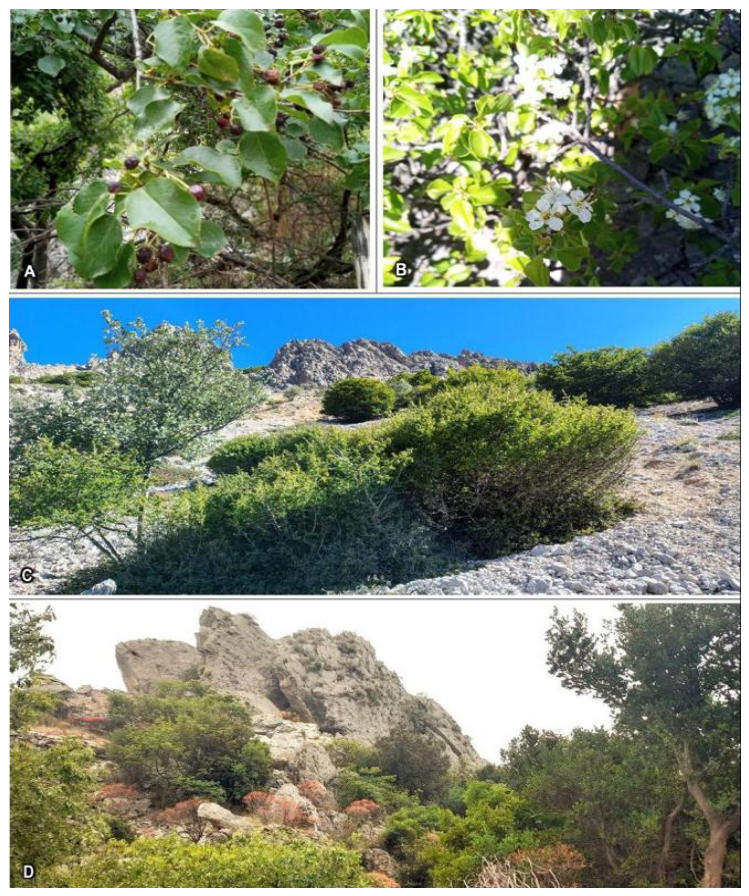
Figure 2.
Sampling sites P. cupaniana (blue dots) and P. mahaleb (red dots).
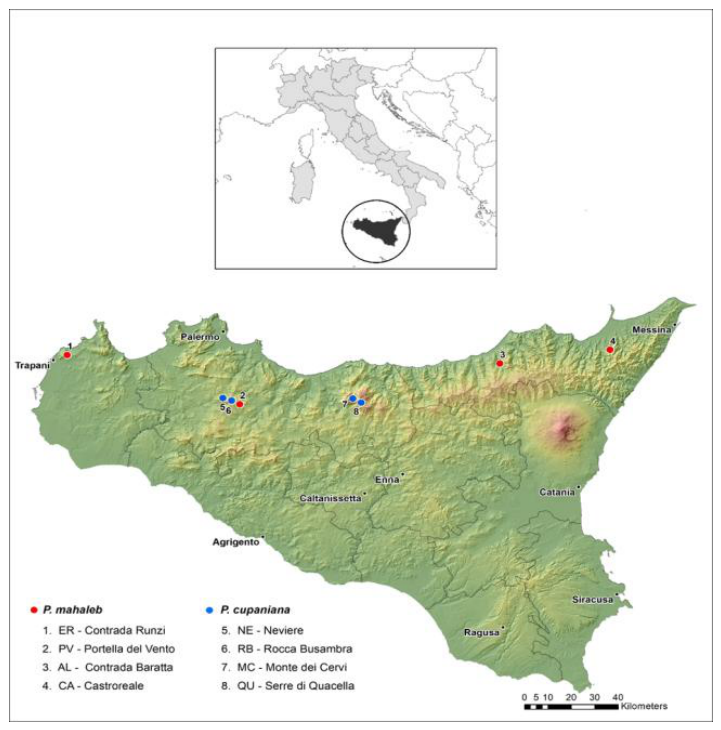
Figure 3.
Principal Coordinate Analysis (PCoA) A: based of pair-wisegenetic distance on the complete set of individuals; B: based on the Fst among populations.
Figure 3.
Principal Coordinate Analysis (PCoA) A: based of pair-wisegenetic distance on the complete set of individuals; B: based on the Fst among populations.
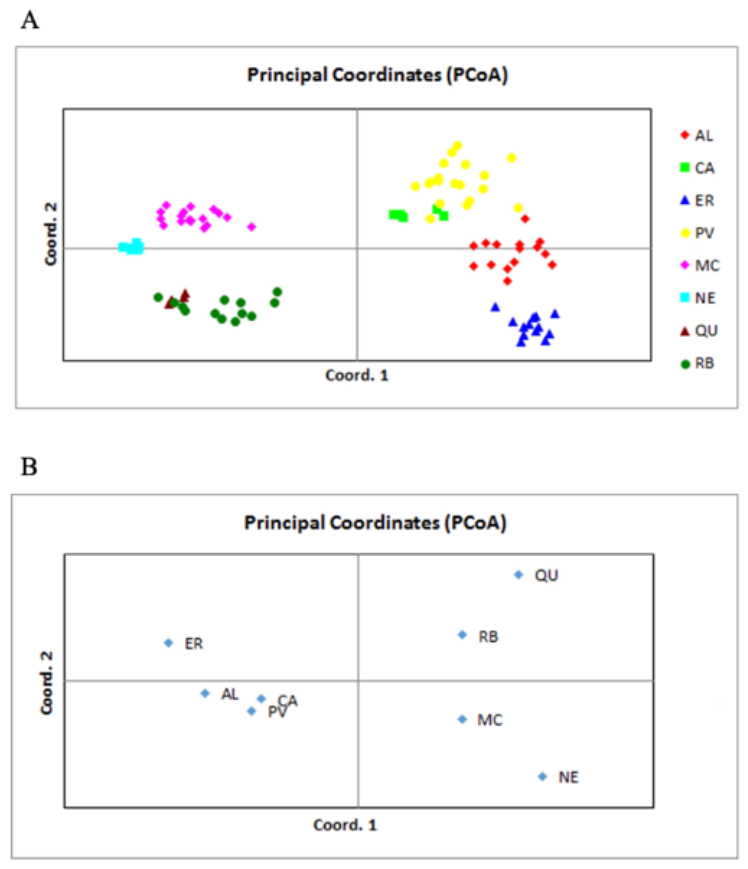
Figure 4.
a: Population structure inferred for the 93 samples of P. mahaleb and P. cupaniana by Bayesian assignment using STRUCTURE software; populations are separated by a vertical black line; b: Population structure considering separately P. mahaleb and P. cupaniana.
Figure 4.
a: Population structure inferred for the 93 samples of P. mahaleb and P. cupaniana by Bayesian assignment using STRUCTURE software; populations are separated by a vertical black line; b: Population structure considering separately P. mahaleb and P. cupaniana.
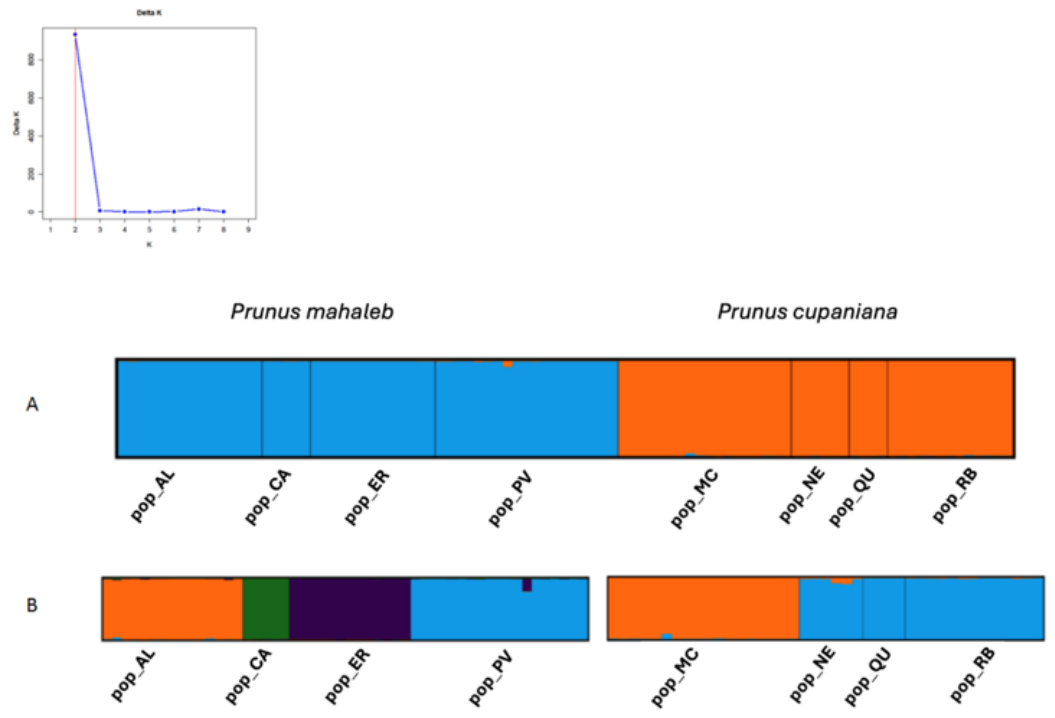

Table 1.
Identity code (ID), sampling location, geographical and ecological characteristics, habit and threats of the 8 populations of P. mahaleb and P. cupaniana.
Table 1.
Identity code (ID), sampling location, geographical and ecological characteristics, habit and threats of the 8 populations of P. mahaleb and P. cupaniana.
| Pop ID | Site | Samples | Lat | Long | Altitude | Habitat | Vegetative status | Growth habit | Threats | |
| (N) | (E) | |||||||||
| QU | Quacella (Madonie Mts.) | 16 | 37,857560 | 14,023969 | 1550-1620 | scree and shrubland nuclei | good | shrub | grazing | |
| P.cupaniana | MC | Mts. Cervi (Madonie Mts.) | 18 | 37,875769 | 13,984092 | 1550-1600 | scree and forest edges | average | prostrate shrub | grazing |
| RB | Rocca Busambra (Sicani) | 15 | 37,855575 | 13,408131 | 1425-1475 | shrubland nuclei | good | shrub | grazing | |
| NE | Neviere (Ficuzza, Sicani Mts.) | 16 | 37,858324 | 13,388601 | 1075-1145 | scree and forest edges | average | prostrate shrub | rock collapse | |
| Total | 65 | |||||||||
| ER | Erice (Trapani Mts.) | 14 | 38,036856 | 12,594021 | 650-750 | forest nuclei on scree | good | tree and shrub | fire | |
| P. mahaleb | PV | Portella (Ficuzza Sicani Mts.) | 20 | 37,845703 | 13,436426 | 1050-1100 | forest nuclei on scree | good | tree | grazing |
| AL | A.LFusi (Nebrodi Mts.) | 15 | 38,004473 | 14,726213 | 650-700 | forest nuclei on scree | good | tree | grazing | |
| CA | Castroreale (Peloritani Mts.) | 6 | 38,083589 | 15,232069 | 750-780 | forest edges | good | tree | n.a. | |
| Total | 55 |
Table 2.
Genetic diversity of the 93 sampled individuals of P. cupaniana and P. mahaleb. N = Number of individuals; Na = number of alleles, Ne = Effective number of alleles per locus; I = Shannon genetic diversity index; Ho = Observed, HE = Expected and uHe = Unbiased heterozygosity; F = Inbreeding coefficient.
Table 2.
Genetic diversity of the 93 sampled individuals of P. cupaniana and P. mahaleb. N = Number of individuals; Na = number of alleles, Ne = Effective number of alleles per locus; I = Shannon genetic diversity index; Ho = Observed, HE = Expected and uHe = Unbiased heterozygosity; F = Inbreeding coefficient.
| N | Ne | I | Ho | He | uHe | Fis | ||
| P. cupaniana | Mean | 40.77 | 2.71 | 0.964 | 0.244 | 0.479 | 0.485 | 0.438 |
| SE | 0.147 | 0.64 | 0.22 | 0.064 | 0.089 | 0.091 | 0.126 | |
| P. mahaleb | Mean | 51.88 | 4.175 | 1.632 | 0.524 | 0.735 | 0.742 | 0.28 |
| SE | 0.111 | 0.51 | 0.104 | 0.04 | 0.029 | 0.03 | 0.054 |
Table 3.
Genetic diversity of the 8 surveyed Prunus populations. N = Number of individuals; Ne = Effective number of alleles per locus; I = Shannon genetic diversity index; Ho = Observed, He = Expected and uHe = Unbiased heterozygosity; Ar = Allelic richness; PAr = Private allelic richness; F = Inbreeding coefficient and Fst = diversity among populations.
Table 3.
Genetic diversity of the 8 surveyed Prunus populations. N = Number of individuals; Ne = Effective number of alleles per locus; I = Shannon genetic diversity index; Ho = Observed, He = Expected and uHe = Unbiased heterozygosity; Ar = Allelic richness; PAr = Private allelic richness; F = Inbreeding coefficient and Fst = diversity among populations.
| Pop ID | N | Ne | I | Ho | He | uHe | Ar | P Ar | Fis | Fst | |
| MC | 18 | 2.151 | 0.694 | 0.33 | 0.375 | 0.385 | 2.44 | 0.55 | 0.07 | ||
| P.cupaniana | NE | 6 | 1.313 | 0.184 | 0.022 | 0.11 | 0.11 | 1.29 | 0 | 0.444 | |
| QU | 4 | 1.252 | 0.178 | 0.167 | 0.111 | 0.127 | 1.31 | 0.13 | 0.047 | ||
| RB | 13 | 2.270 | 0.717 | 0.248 | 0.37 | 0.385 | 2.59 | 0.73 | 0.272 | ||
| All pops | 0.376 | ||||||||||
| AL | 15 | 2.239 | 0.903 | 0.516 | 0.511 | 0.528 | 2.82 | 0.59 | -0.049 | ||
| P. mahaleb | CA | 5 | 3.018 | 1.188 | 0.733 | 0.613 | 0.681 | 4.33 | 2.58 | -0.197 | |
| ER | 13 | 1.481 | 0.435 | 0.359 | 0.275 | 0.286 | 1.77 | 0.15 | -0.229 | ||
| PV | 19 | 3.063 | 1.131 | 0.591 | 0.584 | 0.06 | 3.65 | 1.02 | -0.028 | ||
| All pops | 0.361 |
Disclaimer/Publisher’s Note: The statements, opinions and data contained in all publications are solely those of the individual author(s) and contributor(s) and not of MDPI and/or the editor(s). MDPI and/or the editor(s) disclaim responsibility for any injury to people or property resulting from any ideas, methods, instructions or products referred to in the content. |
© 2026 by the authors. Licensee MDPI, Basel, Switzerland. This article is an open access article distributed under the terms and conditions of the Creative Commons Attribution (CC BY) license (http://creativecommons.org/licenses/by/4.0/).
Copyright: This open access article is published under a Creative Commons CC BY 4.0 license, which permit the free download, distribution, and reuse, provided that the author and preprint are cited in any reuse.


