
Submitted:
22 June 2026
Posted:
24 June 2026
You are already at the latest version
Abstract
Are cognitive technologies making us less intelligent, or more so? This paper develops a dynamic model of human capital formation in which individuals allocate cognitive effort between internal reasoning and external technological support. On this view, rather than exerting uniform effects, technologies alter the incentive structure governing cognitive investment. The model supposes that technological use can take two forms: (1) substitution, in which external systems replace internal cognition, potentially leading to intellectual atrophy through disuse, and (2) complementarity, in which they amplify abilities and knowledge. We propose that which form dominates depends on the curvature of returns to human capital, environmental opportunity structure, and individual differences in exploratory cognition, such as traits related to creativity. Under diminishing returns, optimal behaviour involves increasing reliance on external systems and reduced internal investment. Under convex returns, technological complementarity triggers path-dependent recursive dynamics that reinforce reasoning capacity and accelerate knowledge accumulation. As a result, the same technological systems may generate both cognitive offloading and cognitive amplification across individuals and environments. Thus, we predict that cognitive technologies increase dispersion in developmental outcomes rather than necessarily shifting average cognitive capacity. The long-run effects of intensive use of search engines, artificial intelligence, and the like may therefore depend crucially on individual differences and the institutional conditions that reward or discourage internal cognitive development.
Keywords:
human capital
; fluid intelligence
; crystalized intelligence
; cognitive offloading
; artificial intelligence
; cognitive development
1. Introduction
Concerns that new tools may undermine something important about what it is to be human are perhaps as perennial as innovation itself. In Plato’s Phaedrus, Socrates warns that the invention of writing would “produce forgetfulness … because [individuals] will not practise their memory,” functioning not as an aid to knowledge but as a mere “reminder” (Plato, Phaedrus, 274c–275b). Today, the rise of “smart” devices, large-scale internet search engines, and generative artificial intelligence has raised similar concerns. Namely, many worry that outsourcing memory and reasoning to digital devices may cause our long-run intellectual atrophy through disuse of our faculties or lack of proper stimulation for their healthy development. And as the boundaries blur between what is uniquely “human” in human capital and what can be easily supplanted, there is growing public apprehension about the economic implications of artificial intelligence. Polling shows large proportions of respondents report concern about its impact on employment and job opportunities, with many expecting AI to reduce available jobs in the long run, while others express scepticism about its effects on education and the development of cognitive skills (e.g., Pew Research Center 2025; 2026 Stanford AI Index, 2026; Quinnipiac University, 2026). The purpose of this article is not to argue whether technology is a friend or foe, but to defog the debate by advancing a formal framework to clarify both the challenges and the opportunities of our technological era.
Relevant to this are studies investigating how access to external cognitive systems can alter how individuals allocate attention, memory, and reasoning effort. One line of research emphasizes the role of technology as a cognitive ‘crutch’. For example, the “Google effect” refers to the tendency for people to become less likely to retain information when they believe it remains externally accessible (Sparrow et al., 2011; for a review, see Gong & Yang, 2024). Other work suggests that heavy reliance on digital systems may encourage shallower or fragmented attention and reduced engagement in effortful reasoning (Carr, 2020; Gerlich, 2025; Shanmugasundaram & Tamilarasu, 2023). Research on such “cognitive offloading” further suggests that individuals may reduce internal cognitive effort when technological aids are available, potentially impairing learning transfer, memory consolidation, or critical reasoning under some conditions (Bai et al., 2023; Fan et al., 2025; Grinschgl et al., 2021; Kosmyna et al., 2025) with concerns about automation and artificial intelligence often going beyond immediate task performance to the possibility that technological systems may gradually substitute for the development of internal cognitive capacities themselves (Hooper, 2005). In short, these concerns raise broad questions about the role of cognitive technologies in the formation of human capital over time.
At the same time, historical experience and some contemporary evidence caution against overly deterministic conclusions. The rise of earlier cognitive technologies such as writing, printing, calculators, and search systems did not produce uniform declines in intelligence or widespread cognitive stunting. Humans have always relied on external systems to support cognition, and digital technologies may represent an extension of this broader process of distributed or transactive cognition (Clark & Chalmers, 1998; Wegner, 1987). Indeed, some research suggests that cognitive offloading can improve task efficiency without necessarily reducing underlying cognitive ability (Risko & Gilbert, 2016), while other work indicates that interaction with digital environments may enhance certain forms of attentional processing, information search, or decision-making (e.g., Bansal et al., 2021; Green & Bavelier, 2003; Small et al., 2009). More generally, access to large external information systems may expand opportunities for learning, exploration, and conceptual integration (Firth et al., 2019; Storm et al., 2016). In economic terms, the same technologies may thus function either as substitutes for internal cognitive investment or as complements that amplify reasoning, learning, and human-capital development.
The resulting empirical picture is therefore mixed. Some findings suggest cognitive substitution and skill erosion; others suggest augmentation, reallocation, or enhancement (potentially “catapulting” individuals to higher cognitive capabilities). A limitation of many existing approaches is that they typically treat technology as influencing cognition in a largely direct and uniform manner. On this view, technologies either degrade cognition through offloading or enhance it through access, speed, and efficiency. Yet this may miss the central mechanism. Cognitive technologies also alter the structure of incentives governing effort allocation: they can make internal investment less attractive in some contexts and more valuable in others. The developmental consequences of technology may therefore depend less on the technology itself than on how individuals respond to the altered costs and benefits of internal versus external cognition. This perspective shifts the question from whether technology is good or bad for cognition to when it induces substitution, when it induces complementarity, and why these patterns differ across individuals and environments. These issues matter not merely for momentary task performance, but for the long-run developmental production of human capital.
The present article develops a model of this allocation process, building on Cattell’s classic investment theory of intelligence and economic models of optimization under constraint. We formalize how individuals allocate scarce cognitive effort between internal reasoning and external technological support. The structural progression of our framework is as follows. In Section 2.1, we translate Cattell's verbal theory into a continuous-time differential system to show how the duration and stability of reasoning capacity dictate lifetime human capital. Section 2.2 introduces our technology allocation parameters, demonstrating how cognitive friction and the mathematical curvature of returns modulate individual behaviour. Section 2.3 integrates exploratory traits and environmental dynamism to map long-run developmental trajectories. Ultimately, our model proposes that modern tools act as a wedge: generating sustained cognitive offloading and skill erosion in stagnant contexts, while unleashing cumulative, recursive amplification in dynamic ones. The long-run legacy of the digital age may therefore not be a homogenized human mind, but a more extreme landscape of human capital, with higher peaks and deeper valleys.
2. The Model
2.1. Developmental Coupling of Fluid and Crystallised Intelligence
Before introducing the role of technology, it is useful to formalize the developmental relationship between reasoning capacity and knowledge accumulation. A natural starting point is Cattell’s investment theory of intelligence, which distinguishes between fluid intelligence (reasoning ability) and crystallised intelligence (accumulated knowledge), while positing a developmental interaction between them.
Let denote the stock of crystallised intelligence at time , and let measures fluid intelligence at time (for present purposes, should be interpreted as functionally effective or engaged reasoning capacity, abstracting from the distinction between latent ability and its expression). A simple dynamic representation of knowledge accumulation is given by:
where represents the efficiency with which fluid intelligence is converted into crystallised knowledge through processes such as learning, abstraction, and problem solving, and represents the rate at which existing knowledge depreciates due to forgetting or obsolescence. The first term, , captures the acquisition of new knowledge through reasoning and focused attention, whereas the second term, , captures depreciation through forgetting or obsolescence. Thus, higher fluid intelligence increases the rate of knowledge acquisition, while crystallised knowledge is subject to ongoing decay.
In steady state, net knowledge accumulation ceases (), yielding:
Solving for equilibrium crystallised intelligence gives
This expression has a straightforward interpretation. Equilibrium crystallised intelligence increases with fluid intelligence and learning efficiency and decreases with the rate of knowledge depreciation. Importantly, the model implies that persistent differences in fluid intelligence will generate corresponding long-run differences in crystallised intelligence and therefore persistent differences in human capital accumulation (as intelligence measures important inputs to human capital). In this way, a shared underlying dynamic may contribute to the broad positive manifold observed across cognitive measures.
This static relationship abstracts from the well-documented lifecycle dynamics of fluid intelligence. Empirical work suggests that fluid intelligence typically rises during early life, peaks in early adulthood, and then declines gradually, while crystallised intelligence continues to accumulate over a longer period. To capture this in a minimal way, we allow fluid intelligence itself to evolve dynamically over time. Specifically, we allow fluid reasoning to depend on accumulated knowledge while remaining subject to depreciation:
where captures the extent to which accumulated knowledge scaffolds effective reasoning performance, and captures developmental, biological, or cognitive attenuation in fluid reasoning over time. Combined with (1), equation (2) can generate the familiar developmental pattern in which fluid intelligence rises relatively early and then stabilizes or declines gradually, while crystallised intelligence accumulates more slowly over a longer time horizon. The system can therefore be written as:
This formulation introduces a recursive component into cognitive development. Knowledge is no longer merely a passive store, but functions as cognitive infrastructure that enhances subsequent reasoning capacity.
Formalizing Cattell’s investment theory in this way reveals interesting implications worth remarking on before considering any role for technology. Firstly, persistent differences in fluid intelligence generate diverging trajectories of crystallised intelligence over time. Secondly, periods of elevated fluid intelligence disproportionately shape lifetime accumulation of crystallised intelligence. Finally, when crystallised intelligence feeds back into effective reasoning, cognitive development becomes path dependent and potentially self-reinforcing. Figure 1 shows developmental trajectories implied by this Cattellian system that are broadly consistent with empirical evidence on fluid and crystallised intelligence (e.g., Horn & Cattell, 1967). It also illustrates the predicted long-run implications of changes in fluid intelligence. Because crystallised intelligence feeds back into effective reasoning capacity, small early differences may compound into increasingly divergent developmental pathways.
A conceptual summary of the recursive relationship between fluid intelligence and crystallised intelligence is depicted in Figure 2. Fluid reasoning contributes to knowledge accumulation (), while accumulated knowledge scaffolds effective reasoning (), with both systems being subject to depreciation over time (, ). The dynamics of the system depend on the relative strength of reinforcement () and depreciation ( and ). When reinforcement is sufficiently strong, the system may generate amplification and path dependence, with early differences expanding over time.
2.2. Economic Incentives and Technological Allocation
Having established the coupled dynamics of reasoning and knowledge accumulation, we now ask how external technologies alter those dynamics by changing the incentives for internal cognitive investment. For analytical tractability, we treat crystallised intelligence as the principal accumulated form of cognitive capital and focus on the marginal effects of allocation on the instantaneous dynamics, which characterize the direction of long-run developmental change. Human capital is assumed to be an increasing function of both fluid1 and crystallised intelligence:
with
This formulation captures the idea that productive capability depends both on the stock of knowledge and the capacity to deploy it effectively.
Section 2.1 modelled the accumulation of crystallised intelligence as a function of fluid reasoning capacity. However, modern cognitive environments arguably differ fundamentally from those in which earlier theories of intelligence were developed. Individuals increasingly rely on external cognitive technologies (such as search engines and generative AI systems) which can alter both the process and the incentives for cognitive investment. These technologies may function in two qualitatively distinct ways: (1) as “substitutes” (), in which technology replaces internal cognitive effort (e.g., outsourcing memory, accepting generated solutions without elaboration, reducing active problem solving); and (2) as “complements” (), in which technology amplifies internal cognition (e.g., enabling exploration, iterative reasoning, abstraction, and synthesis).
From this point onward we index all cognitive variables by individual (suppressing time notation where unambiguous). Let denote exogenous technological exposure or intensity and let denote the proportion allocated to complementary cognition, such that and . Here, captures the individual’s chosen allocation of total exposure to technology between complementary and substitutive use. The distinction is behavioural rather than technological: the same tool may serve either role depending on how it is used.
Note that and evolve endogenously through the developmental system described above. Because technological allocation affects the trajectories of both variables, human capital can be written implicitly as a function through its effects on the induced paths of and . Thus, is a reduced-form function of technological allocation through the developmental trajectories and . This preserves an important conceptual distinction. Crystallised intelligence () is a stock of accumulated knowledge, whereas human capital () represents economically productive capability. The two are closely related but not identical. Individuals with similar levels of crystallised knowledge may nevertheless differ in productivity due to variation in reasoning ability, creativity, motivation, health, or other traits. For present purposes, it is sufficient to assume that both fluid and crystallised intelligence contribute positively to human capital.
We now extend the fluid intelligence dynamics to incorporate technological allocation explicitly:
Then substitute:
where captures the augmenting effect of complementary technological use, captures the displacing effect of substitutive use, reflects the scaffolding strength of accumulated knowledge , and represents decay in reasoning capacity. This formalizes a central claim of the model: technology does not exert a uniform effect on cognition. Instead, complementary use strengthens effective reasoning capacity, whereas substitutive use attenuates it. Combining this with the accumulation equation from Section 2.1:
yields a recursive system in which technological behaviour influences fluid reasoning, fluid reasoning shapes knowledge accumulation, and accumulated knowledge feeds back into future cognition. This structure generates path-dependent developmental trajectories, allowing for either cumulative amplification or cumulative cognitive offloading.
We now introduce the economic environment. Let denote the returns to human capital, where:
Crucially, the curvature of varies across institutional and economic contexts. In some environments (such as bureaucratic or highly standardized settings) returns may exhibit diminishing marginal gains:
In these cases, incremental improvements in human capital yield progressively smaller rewards once a threshold level of competence is attained. In other environments, such as entrepreneurial, scientific, or frontier domains, returns may be convex:
Here, unusually high levels of human capital generate disproportionately large rewards through innovation, discovery, and creative problem solving.
We now model technological use as an endogenous allocation decision. Recall that depicts the proportion of technological use devoted to complementary cognition by individual . Then
Substituting into (3) gives:
This representation formalizes technological use as an allocation problem between two competing cognitive channels. Higher values of correspond to greater use of technology for cognitive augmentation, whereas lower values correspond to greater reliance on cognitive offloading.
To see what rational allocation this implies, we assume that individuals choose to maximize a net developmental payoff:
where represents the cognitive and effort costs associated with sustained attention, effortful reasoning, and opportunity costs associated with deeper cognitive engagement, such that
The first-order condition for an interior optimum is:
This condition equates the marginal developmental benefit of complementary technological use () with its marginal cost .
Using the fact that human capital depends on both fluid and crystallised intelligence, we apply the chain rule:
where and .
From the developmental system, technological allocation affects the instantaneous growth rate of fluid intelligence as (3). The marginal effect of allocation on the flow of fluid intelligence is:
Given the accumulation equation:
the marginal effect of allocation on the flow of crystallised intelligence is:
These expressions characterize marginal developmental effects through the system’s instantaneous dynamics; long-run effects follow from integrating these flow effects along the induced trajectory of the system. Substituting into the expression for human capital (5) yields:
Therefore, the first-order condition now becomes:
This condition makes explicit the central mechanism of the model: the marginal benefit of allocating technology toward complementary cognition is increasing in total technological exposure, the combined augmenting and substitutive effects of technology, and the extent to which both fluid and crystallised intelligence contribute to human capital formation. The marginal developmental benefit reflects both gains from augmentation and avoided cognitive offloading2. The key question is therefore not whether technology affects cognition, but how the structure of returns determines the margin at which complementarity or substitution becomes optimal. The curvature of the returns function plays a decisive role in determining optimal behaviour. When returns are concave (), individuals maximize utility by choosing relatively low values of . Cognitive offloading becomes adaptive because additional internal cognitive investment yields diminishing marginal returns. Contrariwise, when returns are convex (), individuals choose higher values of . Complementary technological use becomes adaptive because further increases in cognitive capacity generate disproportionately large rewards.
Figure 3 illustrates how differences in the marginal developmental return to complementary technological use shift the optimal allocation between substitution and complementarity. In higher-return environments, the marginal benefit of complementarity declines more slowly, so the optimal is higher. The implication is straightforward: cognitive technologies do not mechanically determine developmental outcomes; they change the incentive structure governing cognitive effort. The same technology may therefore induce offloading in one setting and amplification in another.
Figure 4 illustrates the implications how small differences in technological allocation may generate qualitatively divergent developmental outcomes over time through recursive interactions between reasoning capacity and knowledge accumulation. Figure 4a shows the hypothetical developmental trajectories in a predominantly substitutive allocation strategy (low ), in which technology increasingly replaces internal cognitive effort. Under this regime, effective fluid reasoning declines more rapidly, slowing subsequent knowledge accumulation and producing a lower long-run crystallised intelligence trajectory (the “crutch” scenario). By contrast, panel (b) shows a predominantly complementary allocation strategy (high ), in which technology amplifies reasoning, learning, and cognitive engagement. Under this regime, fluid intelligence remains elevated for longer and crystallised intelligence continues accumulating toward a substantially higher long-run trajectory.
Another interesting implication follows. Technologies that initially reduce reliance on internally stored knowledge may nevertheless enhance long-run human capital if they sufficiently strengthen fluid reasoning and subsequent knowledge accumulation. This interpretation challenges simplistic readings of phenomena such as the “Google effect,” suggesting instead that their developmental consequences depend on broader incentive structures. That is, Google effects should not imply long-run decline provided that the fluid augmentation parameter is large enough to outpace the initial substitutive drain (). When this condition holds, the enhanced fluid reasoning flow successfully builds a higher-order conceptual scaffolding over the longer term, compensating for the offloaded low-level fact retention.
Thus far, individuals have been treated as homogeneous decision makers operating under different incentive environments. More realistically, individuals differ systematically in traits such as exploratory cognition, novelty seeking, and perceived opportunity space. These differences are likely to affect how technologies are used in practice. We next extend the model to incorporate individual heterogeneity and opportunity structure.
2.3. Individual Differences and Opportunity Structure
Section 2.2 established that the developmental effects of cognitive technologies depend on the incentive structure governing returns to human capital. However, individuals exposed to similar institutional environments and technological affordances often use these tools in markedly different ways. Some individuals increasingly outsource cognition and minimize internal cognitive investment, whereas others use the same technologies to expand their knowledge, explore broader conceptual spaces, and amplify cognitive development. This heterogeneity suggests that incentive structures alone are insufficient. Individuals differ not only in the environments they face, but also in how they perceive and respond to those environments. We therefore introduce a third component of the framework: individual differences in exploratory cognition and perceived opportunity structure.
Let denote the exploratory breadth of individual . This parameter captures stable individual differences associated with exploratory or overinclusive cognition. Relevant examples may include characteristics measured by Eysenck’s P factor (Acar & Runco, 2012; Eysenck, 1995), schizotypy (LeBoutillier et al., 2016) or facets of the Five-Factor Model’s Openness dimension (McCrae, 1987). Higher values of imply that individuals consider a wider range of potential roles, domains, and problems, perceive greater returns to expanding their cognitive repertoire, and are more likely to engage in exploratory learning rather than satisficing strategies.
We also introduce the external opportunity environment, using to denote the dynamism or openness of the environment. Higher values of correspond to environments characterized by rapid technological or institutional change, and the presence of multiple simultaneously accessible niches. Lower values correspond to stable, bureaucratic, or highly standardized environments.
Rather than treating technological strategy as exogenously determined, we allow individual differences and opportunity structure to shape the parameters of the same optimization problem introduced in Section 2.2. Specifically, exploratory breadth and environmental dynamism shift both the perceived returns to human capital and the subjective cost of sustained cognitive investment.
Formally, we write:
with the comparative statics:
And
These conditions summarize how exploratory cognition and environmental dynamism shift both marginal returns to human capital and marginal costs of cognitive investment.
The individual’s problem therefore remains:
Importantly, the structure of the optimization problem is unchanged3: exploratory breadth and environmental dynamism do not alter the form of the individual’s choice, but they shift the parameters governing the marginal benefit and marginal cost schedule, thereby changing the location of the optimal allocation:
where and . The optimal allocation therefore varies systematically across individuals and environments even when facing identical technologies. Intuitively, higher and higher operate as shifters of the marginal benefit of complementarity and/or reductions in the marginal cost of cognitive effort. As a result, they move the interior optimum toward greater complementary technological use (higher ) without requiring any discrete regime switch. Thus, heterogeneity operates through shifts in the same marginal benefit–marginal cost framework developed in Section 2.2.
Combining Section 2.1, Section 2.2 and Section 2.3 yields a unified system in which cognitive trajectories are jointly determined by developmental dynamics, technological allocation, and heterogeneous incentives, implying greater dispersion in outcomes under high dynamism and high exploratory breadth. Figure 5 illustrates how differences in environmental dynamism shift the marginal developmental returns to complementary technological use. In more dynamic environments, higher returns to cognitive complementarity increase the optimal allocation toward complementary technological use (higher ), even holding individual characteristics constant.
The same technological system can therefore generate both cognitive amplification and cognitive offloading across different segments of the population. The framework also provides a developmental interpretation of entrepreneurial and innovative behaviour. High- environments increase the number and diversity of accessible opportunities and disproportionately reward exploratory cognition. In such settings, individuals with high have stronger incentives to choose higher , thereby reinforcing cognitive accumulation and increasing the likelihood of innovation and entrepreneurial discovery.
Taken together, the model links cognitive development, personality, and opportunity structure within a single optimisation framework. Cognitive technologies do not directly determine developmental outcomes. Rather, outcomes emerge from the interaction between technological affordances and heterogeneous incentives governing optimal cognitive allocation. The same technology may function either as a cognitive substitute or as a cognitive amplifier depending on where an individual lies in the space.
2.4. Remarks on Robustness
Although the main results above rest on a Cattellian developmental model, they do not depend critically on that scaffold in its strongest form. The most Cattell-dependent assumption is that fluid intelligence contributes directly to the accumulation of crystallised knowledge:
If this relationship were substantially weaker or absent, the recursive amplification mechanism would be attenuated. In particular, the prediction that technologies may temporarily reduce crystallised knowledge while increasing it in the long run via improvements in fluid reasoning would no longer hold. However, the central logic of the model is more robust. The crucial mechanism concerns how individuals allocate effort between internal cognition and external technological support under varying return structures, not on the specific psychometric architecture of intelligence.
To illustrate, consider an alternative formulation in which crystallised knowledge accumulates independently of fluid reasoning:
In this case, the recursive feedback between and is reduced. Developmental dynamics become more modular, and cumulative amplification is weaker. Nevertheless, the key predictions persist. Namely, that complementary users should strengthen internal reasoning and expand their cognitive range; substitutive users will tend to reduce internal effort and rely increasingly on external systems; and differences in allocation strategies are expected to continue to generate divergence in economically relevant outcomes. This robustness is further reinforced by distinguishing human capital from cognitive stocks (). Even if fluid and crystallised intelligence are partially independent, human capital may depend on both, preserving the incentive structure governing technological use.
The most general and robust proposition of the framework is therefore this: Cognitive technologies alter incentives for investment in internal cognitive capacities, generating divergence between substitutive and complementary developmental trajectories. This requires only three assumptions: (1) Internal cognition retains some positive marginal value; (2) Technologies can either substitute for or complement cognition; and (3) Individuals respond adaptively to incentives. As a result, the framework applies broadly beyond any specific theory of intelligence. Its key sensitivity lies not in the precise relationship between fluid and crystallised intelligence, but in the degree of complementarity between internal cognition and technological augmentation. When complementarity is strong, divergence and amplification emerge; when it is weak, substitution dominates. Thus, technological change increases not only the potential for cognitive enhancement, but also the variance of developmental outcomes.
3. Discussion
Our model does not predict a uniform average effect of cognitive technologies on intelligence or human capital. Because the developmental effects of technologies such as search engines and generative AI are contingent on how individuals use them the clearest prediction is that their effects will be distributional. We suggest that these allocation decisions are shaped by incentive structure and by stable individual differences that influence how people perceive and respond to cognitive opportunities. In this sense, the model provides a basic but formal framework for understanding how a rise in the sophistication and availability of cognitive technologies can generate both the use of technology as cognitive crutches and cognitive catapults within the same population. This is not to say the outcome will be a wash, but that whether the net effect of technology on human intelligence is positive, negative, or neutral will depend on the balance of these tendencies and should vary across populations in predictable ways.
As a guide to how identical technological shifts should produce divergent developmental outcomes, a conceptual summary of our model is provided in Figure 6. When technology is used as a substitute for internal cognitive effort (i.e., individuals rely on technology to offload memory, search, or problem solving, potentially reducing opportunities for sustained internal cognitive investment) we expect it to hinder the development of intelligence. In complementary use, individuals employ the same technologies to extend reasoning, accelerate learning, and explore broader conceptual spaces, thereby strengthening cognitive development over time. Because the model contains recursive feedback processes linking reasoning ability, knowledge accumulation, and technological allocation, even relatively small initial differences in strategy may become amplified across development.
Whether these developmental processes are attenuated or reinforced depends partly on the nature of returns to human capital. When additional cognitive investment yields limited marginal benefits, individuals may rationally favour substitutive technological use. Conversely, in environments where higher levels of reasoning and accumulated knowledge generate substantial rewards — as observed in classic frameworks of specialized and accelerating returns (e.g., Becker, 1964; Rosen, 1981) — individuals have stronger incentives to use technology in ways that enhance long-run cognitive development. Under these conditions, such technologies may function less as external crutches than as developmental multipliers that accelerate the recursive accumulation of human capital.
In addition to differences in perceived returns to human capital and time horizons, some individuals are more exploratory and willing to engage persistently with novel ideas. Such traits may shift the optimal proportion of how technologically is used toward more complementary strategies, particularly in dynamic environments characterized by expanding opportunities and weak institutional “lock-in”. In perhaps simplistic terms, we expect creative and industrious individuals to tend to use technology to become more creative and more industrious, and that they should reach higher levels of intelligence as a result, all other things being equal. This reframes debates about artificial intelligence and cognition away from technological determinism and toward heterogeneous optimal allocation of cognitive effort under varying incentive structures. The central implication is therefore not that technology alters average intelligence, but that it expands the variance.
3.1. Implications
The model predicts that cognitive technologies will generate heterogeneous developmental trajectories across individuals and environments rather than uniform cognitive outcomes (for examples of potential operationalizations of the model’s constructs and corresponding statistical specifications suitable for longitudinal and digital-trace datasets, see Appendix A). Because technological exposure () amplifies the consequences of allocation strategies, even relatively small differences in technological use may produce increasingly divergent cognitive trajectories over time. Under such conditions, aggregate population metrics may obscure underlying divergence, as stable or modest changes in mean performance may coexist with widening dispersion across individuals. For example, this perspective may help contextualize the uneven levelling off or reversal of the Flynn effect observed in some populations (e.g., Dutton et al., 2016). Rather than reflecting a uniform decline in cognitive capability, such patterns may instead be consistent with increasing heterogeneity in developmental trajectories under conditions of high technological saturation.
More generally, reliance on population means alone may mask emerging structural inequalities in cognitive development, especially if those populations are diverse in either or both traits affecting the allocative decision or the types of incentives that they face. The model predicts that technological intensification will manifest empirically through widening variance in cognitive outcomes within birth cohorts over time, increasing divergence between individuals matched on baseline ability but differing in either their technological allocation strategies or factors expected to predict differences in this allocation. Longitudinal designs tracking specific patterns of technological engagement alongside long-term cognitive development are therefore essential to empirically distinguish substitutive from complementary trajectories over time.
3.1.1. Short-Run Performance and Long-Run Development
Another implication concerns the sharp temporal mismatch between instantaneous task efficiency and lifetime cognitive cultivation. Substitutive technological use (→0) generates immediate, easily observable gains in short-run efficiency by reducing the need for internal cognitive computation. However, this immediate performance boost comes at the cost of reduced instances of sustained internal effort, gradually triggering the disuse atrophy mechanism formalized in our model (). This recovers Adam Smith’s classic intuition that extreme specialization can erode cognitive capacity; the worker whose life is spent performing only “a few simple operations” may gradually become “as stupid and ignorant as it is possible for a human creature to become” (Smith, 1776/2008).
Conversely, complementary technological use (→1) imposes high immediate cognitive costs, requiring active attention, working memory deployment, and exploratory reasoning. Its benefits emerge only gradually through recursive human capital accumulation (), which over time increases the baseline efficiency of future cognitive effort. This creates a crucial divergence between performance measured at a cross-sectional point in time and true developmental trajectories over long horizons. From this it follows that traditional standardized assessments and organizational metrics that emphasize static knowledge retrieval or short-run task speed will systematically misclassify individuals. Users leveraging cognitive technology as a developmental scaffold to bootstrap themselves into higher-order conceptual spaces may appear identical to, or even less efficient than, substitutive users on routine tests (despite possessing superior long-run adaptability capacity).
3.1.2. Capital-Labor Complementarity
The present analysis offers a fundamental reinterpretation of technological complementarity relative to conventional macro-labour models. Standard production frameworks typically examine whether technology substitutes for or complements labour as a fixed productive input, altering labour demand or task composition while treating the underlying quality of that labour as exogenous (e.g., Acemoglu & Restrepo, 2018). In contrast, we consider how cognitive technologies can alter the developmental production function through which labour quality itself emerges over the time.
This structural distinction produces three testable macro-economic predictions. The first we may refer to as the “efficiency trap”, where measured productivity gains at the firm or industry level following technological adoption may conceal silent, long-run skill erosion. We predict that organizations using generative artificial intelligence primarily for substitutive automation will harvest immediate cost reductions but risk flattening their long-run adaptive and creative human capital. The second relates to recursive compounding effects: Because complementary allocation increases the future productivity of cognition itself, developmental gains will compound non-linearly over time. Technological exposure will therefore drive an increased widening of differences in innovation rates, adaptability to novelty, and entrepreneurial output even among individuals, firms, or clusters that initially exhibited identical baseline performance metrics. Finally, we predict that technology will function more like education than as a separable input in production. Because the catapulting strategy implies that cognitive technologies modify internal developmental production, effortful and exploratory technological use resembles continuous on-the-job learning or dynamic human-capital cultivation rather than simple task replacement.
3.1.3. Institutional Design and Evaluation Horizons
Because we assume individuals optimize their allocation strategies based on returns, the long-run cognitive consequences of technology will vary systematically across institutional environments as a function of how they reward human capital. For example, literature on "Superstar Economics" (Rosen, 1981) and "Skill-Biased Technological Change" (Goldin & Katz, 2008) provides empirical evidence that frontier or innovative domains exhibit convex (expanding) returns, where marginal gains accelerate at high skill levels, directly driving intensive personal investment and we would expect the catapulting strategy to be most pronounced in such environments. This points to a vulnerability in organizational design: institutions that optimize fiercely for short-run measurable performance, standardized outputs, and strict procedural compliance will inadvertently incentivize systemic cognitive offloading. Educational and corporate systems operating under short evaluation horizons or rigid bureaucratic constraints will systematically bias actors toward substitutive technological strategies, to the extent that the immediate cost-saving and speed advantages of this kind of “automation” match their immediate incentive structures. Conversely, institutions that reward outcomes related to things like abstraction, conceptual integration, non-routine problem solving, and exploratory breadth will naturally foster high rates of complementary technological use. Put in our terms, technologically identical institutions should diverge substantially in their long-run intellectual and productive outputs based entirely on how their internal incentive structures shape choices.
3.1.4. Individual Heterogeneity and Path-Dependence
Finally, our model highlights that individual personality traits interact dynamically with environmental structure to solidify these trajectories over time. Individuals high in exploratory breadth () are uniquely insulated against the cognitive costs of deep technological engagement; their subjective effort barriers are lower, and they are inherently more willing to tolerate the short-run uncertainty required to cultivate a complementary strategy. In highly dynamic, weak lock-in environments (D), these exploratory individuals will aggressively cluster around complementary niches, capturing a potentially large compounding developmental premium.
Because reasoning capacity, knowledge accumulation, and technological allocation interact recursively, these trajectories become increasingly path-dependent over time. Small early variations in allocation choice trigger self-reinforcing feedback loops. Early complementary use builds internal cognitive infrastructure, increasing the future marginal benefits of active thinking and cementing an upward trajectory. Conversely, persistent substitution triggers a compounding reliance on external aids, making a later behavioural reversal progressively more difficult and cognitively expensive. This implies that early educational environments and initial technological habits exert a disproportionately large downstream impact on an individual's lifetime human capital. Cross-sectional studies that evaluate technology's impact over brief windows will tend to underestimate these consequences, as the true legacy of the digital era is a delayed, persistent, and highly polarized bifurcation of human capability.
3.2. Theoretical Context
To our knowledge, no existing framework jointly models endogenous technological allocation, recursive cognitive development, and heterogeneity in incentive structures within a single formal system. In this way, the present model attempts to integrate several previously disconnected lines of work, including Cattell’s classic theory of intelligence, emerging research on cognitive offloading and transactive memory, and economic models of human capital investment. Some recent perspectives as evolved towards similar themes already, such as work on trade-offs associated with technological augmentation. Most notably, models of the “augmentation trap” demonstrate how the use of AI systems can generate a tension between short-run productivity gains and long-run skill erosion, potentially leading to persistent reductions in worker expertise under certain incentive structures (Caosun & Aral 2026). While closely related in spirit, the present analysis differs in some important ways. Firstly, technological use is modelled as an endogenous allocation decision at the level of the individual, rather than as a choice imposed by a planner or organization. Secondly, cognitive capacity is treated as a dynamic, recursive system in which reasoning ability and accumulated knowledge interact over time. Thirdly, the model explicitly incorporates heterogeneity in incentives and opportunity structures, generating systematic divergence in developmental trajectories. As a result, our framework builds on these approaches by shifting from a partial equilibrium account of skill erosion to a general model of cognitive investment under technological change.
A related angle is also taken by the “dynamic capabilities” perspective, which examines how organisations combine human and artificial intelligence to generate value. In this work (Siaw & Ali, 2025), technologies are often characterised as either substituting for or complementing human capabilities within firm-level knowledge processes. While closely related in its recognition of substitution and complementarity, our framework differs in that we have considered decisions at the level of individual cognitive investment rather than organisational resource allocation. We have also treated cognitive capacity as endogenously evolving through a dynamic system in which reasoning ability and accumulated knowledge interact over time, which represents an important extension into the psychological aspects of the issue. Moreover, our model explicitly links technological use to incentive structures governing returns to human capital. Consequently, the present article provides a micro-foundational account of how substitution and complementarity emerge in the development of human capital, rather than treating them as features of organisational capability deployment. In doing so, this shifts the analysis of technological change from its effects on the productivity of cognition to its effects on the developmental processes through which cognition itself evolves.
3.3. Limitations and Future Directions
3.3.1. Analytical Approach
One limitation of the present framework is that the mathematical structure is intentionally simplified and designed primarily to perform conceptual functions rather than as a fully specified structural model calibrated to empirical data. The parameters and functional forms introduced throughout are illustrative, chosen to formalize the core developmental logic linking technological allocation, cognitive investment, and human capital accumulation. Components are thus represented in highly reduced form. The developmental dynamics of fluid and crystallised intelligence are modelled at an abstract level, while institutional incentives, technological environments, and personality differences are compressed into just a few parameters. This abstraction is because the purpose of the model is to isolate the recursive developmental structure linking what we believe to be variables at the heart of the issue rather than to reproduce the full complexity of real-world developmental systems.
That said, future theoretical work could clearly extend the framework in various directions. For example, more elaborate models might endogenize technological exposure itself, distinguish multiple forms of cognitive capital and personality characteristics, incorporate network effects, or explicitly model intergenerational and institutional dynamics. Likewise, future empirical work can identify the functional forms, and parameter ranges most consistent with observed developmental trajectories under different technological environments. Whether this additional complexity improves explanatory power sufficiently to justify the loss of tractability remains an open question. The following sections consider other extensions and boundary conditions that may be especially important for understanding the long-run developmental consequences of cognitive technologies.
3.3.2. Technological Change and Knowledge Depreciation
Another limitation concerns the treatment of knowledge depreciation. In the present framework, depreciation () is represented as a relatively simple parameter capturing forgetting, obsolescence, or erosion of crystallised knowledge over time. However, technological change may itself alter the effective rate of depreciation by accelerating the pace at which skills, knowledge, and occupational competencies become outdated. This possibility may have important implications for cognitive investment decisions and motivation. If accumulated knowledge is expected to depreciate rapidly (), individuals may perceive lower long-run returns to sustained internal cognitive investment and therefore allocate more strongly toward substitutive technological strategies (). Under such conditions, rapid technological change could discourage deep knowledge accumulation even when opportunities for technological augmentation are available.
At the same time, the relationship may not be negative overall. Conceivably, in highly dynamic environments, rapid depreciation may increase the value of fluid reasoning through its effects on adaptability and flexible learning, thereby strengthening incentives for complementary technological use. Technological change may therefore simultaneously reduce the value of stable stocks of existing knowledge while increasing the value of adaptive learning capacity. The developmental consequences of accelerated obsolescence may depend on whether environments mostly reward static expertise or ongoing cognitive flexibility.
More generally, rapid technological change may shorten the effective “epistemic half-life” of accumulated knowledge, altering both the perceived returns to specialization and the time horizons over which cognitive investment remains worthwhile. The present model abstracts from these dynamics but future work may benefit from treating depreciation itself as partially endogenous to technological change or occupational ecology. This issue may be especially important in contexts involving discontinuous labour-force participation. Individuals who temporarily exit rapidly changing occupational environments (for example, during caregiving or parental leave) may experience especially high depreciation rates if technological change accelerates during periods of absence. Under some conditions, this may reduce incentives for long-run cognitive investment by increasing the perceived difficulty of re-entry and skill recovery or motivate increased technological use for bolstering adaptive learning capacities to compensate.
3.3.3. “Misinformation” and Epistemic Quality
An interesting limitation concerns the epistemic quality of accumulated knowledge. The model currently assumes that accumulated knowledge contributes positively to adaptive or productive capability () and therefore implicitly treats accumulated knowledge as broadly aligned with reality. In practice, however, not all accumulated “knowledge” is accurate and adaptive. Just as humans and institutions have evolved increased sophisticated capacities to learn and disseminate adaptive information, many motivated and systemic forces can favour the production of maladaptive and manipulative information as well (Roy, 2017; Roy & Roy, 2018). Complementary cognition may recursively strengthen coherent but inaccurate conceptual systems, particularly when individuals elaborate, integrate, and reinforce distorted underlying assumptions, fallacies, and falsehoods. This raises the possibility that cognitive technologies may not merely increase or decrease cognition but alter the epistemic quality of recursively accumulated cognition itself. If contemporary technological environments do not simply increase access to information; they may also increase exposure to misleading, low-quality, emotionally salient, or strategically manipulative content then they may amplify recursive processes of interpretation, elaboration, and social reinforcement that allow ever more sophisticated “memetic parasites” to evolve over time.
Under such conditions, the developmental effects of complementary cognition become more ambiguous. From this perspective, the long-run risks associated with technological cognition may not consist solely in passive cognitive offloading or reduced reasoning effort but may also involve the amplification of recursively self-reinforcing but epistemically warped cognitive structures. Individuals may therefore become increasingly cognitively sophisticated within locally coherent but inaccurate conceptual systems. Future extensions of the model may therefore benefit from distinguishing between adaptive and maladaptive forms of crystallised knowledge or from incorporating mechanisms governing epistemic filtering, attentional allocation, and informational quality.
3.3.4. Demographic Theories
Demographic models of entrepreneurship (e.g., Lazear, 2004) argue that innovative output depends on the alignment between fluid reasoning capacity and accumulated domain-specific knowledge. The idea here is that demographic factors determine entrepreneurialism in a field: those with younger populations may generate unusually high levels of entrepreneurial activity because expanding opportunities allow substantial crystallised knowledge to be accumulated while fluid reasoning ability remains relatively elevated. The present model complements this perspective by formalizing the developmental interaction between fluid and crystallised intelligence and by introducing technology as an endogenous factor capable of altering the speed and direction of this alignment process. Complementary technological use accelerates the accumulation of crystallised knowledge during periods of high fluid reasoning, increasing the effective overlap between high levels of knowledge and reasoning capacity that supports innovation and entrepreneurial discovery. Conversely, environments that encourage substitutive technological use should weaken this alignment by reducing sustained internal cognitive investment despite increasing access to information. An upshot of this is that technological revolutions may disproportionately advantage specific cohorts who encounter the technology during high-fluid biological periods and operate in environments rewarding complementarity. This may help explain why periods of technological transition often produce highly uneven generational and entrepreneurial outcomes. We would expect this through their amplifying effects on both entrepreneurial opportunity and bureaucratic stagnation depending on how cognitive investment incentives are structured across populations and industries.
3.4. Summary and Conclusion
The present paper models technology as an endogenous input into the developmental production of cognition. Rather than conceptualizing technologies like search engines and generative AI as exogenous forces that uniformly elevate or erode population-level cognitive ability, our model demonstrates that diverse cognitive trajectories can theoretically emerge from an adaptive optimization process where individuals strategically allocate their technological engagement between substitution and complementarity based on the interplay of stable personality traits, environmental dynamism, and the curvature of institutional reward structures. On this account, technological change operates not by directly determining cognitive outcomes, but by reshaping the incentive structures governing cognitive investment. The key implication is that technology amplifies the consequences of how cognition is allocated: in some environments, this leads to sustained cognitive offloading, while in others it produces cumulative cognitive amplification. Understanding this interaction between technological affordances, institutional structure, and recursive cognitive development may therefore provide a more coherent account of the co-evolution of human intelligence and intellectual tools. If correct, then the long-run consequences of technologies like artificial intelligence may depend less on what machines can do than on how environments reward the products of creative minds capable of doing difficult things.
Conflicts of Interest
I have no funding or conflict of interest to declare. No new data was generated in the creation of this manuscript.
Appendix A. Empirical Operationalization and Testable Hypotheses
This appendix translates the conceptual model in the main text into suggested examples of explicit, testable statistical models ready for empirical application against longitudinal or digital-trace datasets. The purpose of this appendix is not to provide definitive empirical specifications, but to illustrate how the core mechanisms of the model can be operationalized in practice. The examples below are intended to guide empirical implementation and highlight distinctive testable implications. Because the data generating process is likely to be nested within individuals, sectors, and institutions, the same hypotheses may also be estimated using multilevel specifications where appropriate.
Appendix A.1. Empirical Mapping of Theoretical Constructs
A particularly important question for future research concerns the empirical identification of allocation strategies (), which may not be directly observable and so must instead be inferred from predicted patterns of technological engagement and downstream developmental outcomes. Because cognitive effort allocation is a latent behavioural choice, researchers must proxy the model's core parameters using observable behavioural, environmental, and psychometric metrics. Table A1 provides an example mapping of these constructs.

| Theoretical Construct | Symbol in the Model | Example of empirical proxies |
| Complementary Allocation | API telemetry of digital tools (iterative prompting; context-window expansion; debugging/coding assistance logs; structured query depth; semantic density of human-AI transcripts) | |
| Substitutive Allocation | Telemetry capturing low-effort retrieval (direct copy-paste rate; single-turn generated answers; acceptance of generated outputs without modification; task completion speed without follow-up revision.) |
|
| Exploratory Breadth | Openness to Experience scores; divergent thinking tasks; Psychoticism or overinclusiveness/originality indicators. | |
| Environmental Dynamism | Industry patenting volatility; occupational task turnover; local technological shocks; sectoral venture-capital intensity, demography. |
|
| Human Capital | Earnings growth; publication or patent accumulation; academic performance; occupational complexity transitions. | |
| Recursive Amplification | | Non-linear longitudinal acceleration in individual productivity, wage growth, or novel task mastery over an extended multi-year observation window. |
Note. Complementary and substitutive allocation are defined jointly, such that observed behaviour can be interpreted as a decomposition of total technological exposure.
Appendix A.2. Statistical/Econometric Specifications
To test the distributional predictions of the recursive model using standard statistical packages, researchers can estimate the following econometric specifications. These specifications approximate the marginal effects of allocation through the model’s instantaneous dynamics, which characterize long-run developmental trajectories.
Hypothesis 1:
Asymmetrical Variance Amplification
The model is consistent with a world where raw technological exposure () should often exhibit weak or inconsistent predictive power once heterogeneity in allocation strategy () is modelled explicitly. The most distinctive macro-prediction of our model is that technological exposure increases dispersion conditional on allocation heterogeneity, rather than shifting unconditional means. Let denote an individual's cognitive stock () or human capital () at time . We expect that:
This can be tested using a multiplicative heteroskedasticity regression model or a conditional variance specification. For example,
where represents the residual variance of human capital outcomes conditional on observed predictors. The framework explicitly predicts that , meaning that rising total technological exposure () drives systematic variance amplification across a population, particularly when that population is heterogeneous in exploratory traits () and environmental returns (). In plainer terms, the prediction is not simply that technology raises or lowers average cognitive performance. Rather, increasing technological exposure should widen developmental dispersion by amplifying the consequences of how individuals allocate cognitive effort. As a result, populations with similar average performance may nevertheless exhibit increasingly divergent developmental trajectories over time.
Hypothesis 2:
Non-Linear Allocative Interaction Effects
Rather than generating simple main effects, the model asserts that technological returns are deeply moderated by individual traits and ecologies. Human capital formation should therefore be estimated using interactive structural equations. For instance,
The core mathematical expectation is that the interaction terms dominate the simple main effect of technological exposure alone. Specifically, is expected to be weak, unstable, or non-positive once allocation is controlled for., so that raw technological exposure, when unaccompanied by active allocation, leads to a flat or negative baseline developmental effect due to automated substitution. We also predict that and , which means the true developmental dividend of technological interaction should be heavily localized within high- cohorts operating in high- environments who maintain a high complementary allocation (). Basically, what this means is that technological exposure alone should often appear deceptively weak or inconsistent when analysed without considering allocation strategy and individual heterogeneity. The same technological system may therefore generate very different developmental outcomes depending on whether individuals use it primarily to reduce internal cognitive effort or to extend and scaffold reasoning.
Hypothesis 3.Short-Run Performance vs. Long-Run Development
To capture the temporal mismatch between instantaneous task efficiency and lifetime cognitive cultivation, researchers should exploit longitudinal panel data to evaluate the sign reversal of substitutive strategies over time. Let measures immediate task speed, and measures long-term novel task adaptability:
and
such that higher complementary allocation reduces immediate efficiency gains while improving long-run adaptive development. This model formalizes why static cross-sectional assessments may misclassify human capital trajectories: substitutive users () will cross-sectionally appear highly efficient in the short run, while underperforming longitudinally on non-routine task abstraction and innovation. This distinction highlights a central feature of the model: strategies that maximize immediate task efficiency need not maximize long-run cognitive development. Technologies that reduce short-run cognitive friction may simultaneously weaken incentives for sustained internal cognitive investment over time.
Hypothesis 4.
Creeping Path Dependence and Lock-In
Because our system features recursive feedback loops between effective fluid capacity () and crystallised stock (), early technological choices dictate long-run strategic flexibility. This can be operationalized by estimating the rising predictive power of early-career digital behaviors on late-career cognitive flexibility:
The model predicts that the autoregressive coefficient is expected to strengthen over time (). Early-stage substitutive strategies induce a “creeping cognitive debt” that hardens into behavioral lock-in, rendering the long-term cognitive cost of switching back to a complementary strategy progressively prohibitive. The broader implication is that early technological habits may exert disproportionately large downstream developmental effects. Because allocation strategies alter future cognitive capacities and incentives simultaneously, behavioural trajectories may become increasingly self-reinforcing over time.
Appendix A.3. Promising Data Sources and Empirical Arenas
Traditional "screen time" or aggregate software adoption metrics are likely to be far too coarse to evaluate this model since they measure the raw volume of exposure () while missing the qualitative allocation boundary (). Researchers should instead target granular digital trace datasets, including software development telemetry (e.g., long-run GitHub commit histories coupled with GitHub Copilot API logs). This could allow researchers to distinguish developers who pass-through verbatim automated blocks (substitution) from those who use the assistant to explore unfamiliar libraries, perform continuous testing, and execute complex code synthesis (complementarity). Interactive educational platforms provide another potentially rich source of data, such as digital traces from AI-driven tutoring environments or large-scale learning management systems (LMS). These platforms log precise student response latencies and prompting revisions, enabling potentially explicit modelling of the transition from passive answer-harvesting to iterative conceptual scaffolding. Finally, large-scale longitudinal cohort studies may be possible through the merging of public datasets like the OECD’s Programme for the International Assessment of Adult Competencies (PIAAC) with localized workplace digitization surveys to evaluate cohort-specific variations in skill premium dispersion across diverse regulatory and institutional environments. More generally, the framework suggests that future research should focus less on the quantity of technological exposure alone and more on the structure of interaction between individuals and cognitive technologies.
Appendix A.4. Identification Challenges and Causal Strategies
Testing these hypotheses requires navigating a number of econometric hurdles. One is the issue of self-selection and latent trait confounding: High-ability individuals (or those possessing high intrinsic motivation) may naturally self-select into complementary tech usage patterns, creating a severe endogeneity bias (). Another is the issue of reverse causality: Does complementary use amplify fluid intelligence, or does high baseline fluid intelligence simply allow individuals to execute complementary strategies? Both may be true. These identification challenges are substantial but not unique to the present approach. Similar issues arise throughout the broader literature on education, skill formation, and human-capital investment, where cognitive development both shapes and is shaped by individual choices and institutional environments.
To identify the causal nature, researchers should seek out exogenous institutional shocks or sharp localized boundaries that shift the costs or benefits of effort allocation without directly altering baseline cognitive capability. A relevant strategy here may be randomized rollouts of AI features: Exploiting instances where software platforms randomly assign users to different generative user interfaces, such as comparing a "one-click output" interface (which biases users toward substitution) against an "iterative dialogue scratchpad" interface (which lowers the cost of complementarity) might be particularly opportune.
Another idea is exploiting geographic or institutional policy mandates. For example, sudden school district bans or state-level workplace mandates regarding specific generative software could be informative as these administrative boundaries act as natural experiments shifting the local incentives and constraints on technology use. This could enable researchers to evaluate how sudden changes and their impacts on technology compress or expand downstream outcome variance across broadly matching cohorts.
Appendix A.5. Historical Microcosms and Retrospective Testing
A common challenge when evaluating frontier cognitive technologies (such as generative artificial intelligence) is the presence of severe developmental time lags. Observing true lifetime human capital accumulation () and late-life recursive feedback stabilization () properly requires decades of continuous longitudinal observation. To bypass this temporal constraint, researchers might examine whether historical technologies work as testable microcosms of the general model. For example, tools like the electronic pocket calculator (introduced broadly in the 1970s) represents a classic shock to the cost of cognitive task execution. We predict two types or extremes of trajectory. One is the substitutive trajectory (): Individuals who utilized the technology purely to offload basic arithmetic operations without engaging with the underlying mathematical principles achieved immediate short-run task efficiency. However, according to our model, this habitual reliance induces a localized disuse atrophy (), weakening or potentially flatlining long-run adaptive mathematical reasoning. This can be contrasted with the other, complementary trajectory (). On this view, students and engineers who leveraged the calculator as an active scaffold to bypass low-level cognitive “friction” were able to explore vastly broader conceptual spaces. For these individuals, the calculator should have functioned as a developmental multiplier, accelerating the recursive accumulation of advanced crystallised STEM capital. The desktop spreadsheet processor (introduced in the 1980s) might be another example of how a technology suddenly and fundamentally altered the incentive structures of cognitive effort in ways that map onto our substitution-complementarity framework.
Because these historical adoptions occurred decades ago, researchers can exploit existing long-run panel data (e.g., the National Longitudinal Survey of Youth [NLSY79] or historical British Cohort Studies) to run retrospective econometric tests of our main hypotheses. The first concerns Cohort Variance Analysis. Researchers can evaluate whether birth cohorts exposed to high calculator saturation during critical developmental windows (high baseline fluid intelligence periods) exhibit a significant, long-run widening of variance in subsequent educational and occupational outcomes relative to unexposed cohorts, rather than a mere shift in average mathematical test scores (Hypothesis 1). The second relates to Baseline Ability Interactions. Using historical administrative records, researchers can test for the predicted non-linear interaction terms (Hypothesis 2). Our model predicts that matching individuals on pre-exposure baseline intelligence will reveal an increasing divergence in mid-career earnings and patent outputs, directly driven by the interaction between individual exploratory breadth () and the availability of the computing tool. Looked at in this way, historical cognitive technologies may provide compressed developmental analogues of contemporary artificial-intelligence systems. Although the technological forms differ and the affected knowledge domains/skills may be narrower, the underlying theoretical issue remains similar.
| 1 | Note that we abstract from distinctions between latent cognitive capacity, deployed reasoning effort, and technologically scaffolded reasoning performance, treating them jointly as effective reasoning capacity relevant to downstream human-capital accumulation. |
| 2 | Formally, implying that reallocating technological use toward complementarity simultaneously increases augmenting effects and reduces substitutive losses. |
| 3 | Formally, the choice problem remains of the same objective function, but the parameters entering MB(·) and MC(·) vary with exploratory breadth and environmental dynamism, implying that shifts continuously across individuals and contexts. |
References
- Acar, S.; Runco, M. A. Psychoticism and creativity: A meta-analytic review. Psychol. Aesthet. Creat. Arts 2012, 6(4), 341. [Google Scholar] [CrossRef]
- Bai, L.; Liu, X.; Su, J. ChatGPT: The cognitive effects on learning and memory. Brain-X 2023, 1(3), e30. [Google Scholar] [CrossRef]
- 3; Becker, G. S. Human Capital; Columbia University Press: Chicago, 1964. [Google Scholar]
- Caosun, M.; Aral, S. The augmentation trap: AI productivity and the cost of cognitive offloading. arXiv 2026, arXiv:2604.03501. [Google Scholar]
- Carr, N. The shallows: What the Internet is doing to our brains; WW Norton & Company, 2020. [Google Scholar]
- Cattell, R. B. Theory of fluid and crystallized intelligence: A critical experiment. J. Educ. Psychol. 1963, 6. 54(1), 1. [Google Scholar] [CrossRef]
- Clark, A.; Chalmers, D. The extended mind. analysis 1998, 7 58(1), 7–19. [Google Scholar] [CrossRef]
- Dutton, E.; van der Linden, D.; Lynn, R. The negative Flynn Effect: A systematic literature review. Intelligence 2016, 59, 163–169. [Google Scholar] [CrossRef]
- Eysenck, H. J. Genius: The natural history of creativity; Cambridge University Press: New York, NY, 1995; p. 9. [Google Scholar]
- 10; Fan, Y.; Tang, L.; Le, H.; Shen, K.; Tan, S.; Zhao, Y.; Gašević, D. Beware of metacognitive laziness: Effects of generative artificial intelligence on learning motivation, processes, and performance. Br. J. Educ. Technol. 2025, 56(2), 489–530. [Google Scholar]
- Firth, J.; Torous, J.; Stubbs, B.; Firth, J. A.; Steiner, G. Z.; Smith, L.; Sarris, J. The “online brain”: how the Internet may be changing our cognition. World Psychiatry 2019, 18(2), 119–129. [Google Scholar] [CrossRef]
- Gerlich, M. AI tools in society: Impacts on cognitive offloading and the future of critical thinking. Societies 2025, 12 15(1), 6. [Google Scholar]
- Gong, C.; Yang, Y. Google effects on memory: a meta-analytical review of the media effects of intensive Internet search behavior. Front. Public Health 2024, 13 12, 1332030. [Google Scholar]
- Hooper, V. J. Cognitive offloading and the reshaping of human thought: The subtle influence of Artificial Intelligence. Colloq. Acad. J. Cult. Thought 2025, 14 Vol. 12, 01–14. [Google Scholar] [CrossRef]
- Horn, J. L.; Cattell, R. B. Age differences in fluid and crystallized intelligence. Acta Psychol. 1967, 15 26, 107–129. [Google Scholar] [CrossRef]
- Goldin, C.; Katz, L. F. The Race between Education and Technology; Harvard University Press, 2008; p. 16. [Google Scholar]
- Lazear, E. P. Balanced skills and entrepreneurship. Am. Econ. Rev. 2004, 17 94(2), 208–211. [Google Scholar] [CrossRef]
- LeBoutillier, N.; Barry, R.; Westley, D. Creativity and the measurement of subclinical psychopathology in the general population: Schizotypy, psychoticism, and hypomania. Psychol. Aesthet. Creat. Arts 2016, 10(2), 240. [Google Scholar] [CrossRef]
- McCrae, R. R. Creativity, divergent thinking, and openness to experience. J. Personal. Soc. Psychol. 1987, 52(6), 1258. [Google Scholar] [CrossRef]
- Pew Research Center. U.S. workers are more worried than hopeful about future AI use in the workplace 2025. [CrossRef]
- Key findings about how Americans view artificial intelligence; Pew Research Center, 12 March 2026; p. 21.
- Plato. Phaedrus; (Original work published ca. 370 B.C.E.); Waterfield, R., Translator; Oxford University Press, 2002; p. 22. [Google Scholar]
- Quinnipiac University. The age of artificial intelligence: Americans’ AI use increases while views sour 2026, 23.
- Risko, E. F.; Gilbert, S. J. Cognitive offloading. Trends Cogn. Sci. 2016, 24 20(9), 676–688. [Google Scholar] [CrossRef]
- Rosen, S. The economics of superstars. Am. Econ. Rev. 1981, 25 71(5), 845–858. [Google Scholar]
- Roy, D. Myths about memes. J. Bioeconomics 2017, 26 19(3), 281–305. [Google Scholar] [CrossRef]
- Roy, D.; Roy, B. A red queen model of personality. Evol. Mind Behav. 2018, 16(1), 1–36. [Google Scholar] [CrossRef]
- Shanmugasundaram, M.; Tamilarasu, A. The impact of digital technology, social media, and artificial intelligence on cognitive functions: a review. Front. Cogn. 2023, 28 2, 1203077. [Google Scholar]
- Siaw, C. A.; Ali, W. Substitution and complementarity between human and artificial intelligence: a dynamic capabilities view. J. Manag. Psychol. 2025, 29 40(5), 539–554. [Google Scholar]
- Sparrow, B.; Liu, J.; Wegner, D. M. Google effects on memory: Cognitive consequences of having information at our fingertips. Science 2011, 30 333(6043), 776–778. [Google Scholar] [CrossRef]
- Small, G. W.; Moody, T. D.; Siddarth, P.; Bookheimer, S. Y. Your brain on Google: patterns of cerebral activation during internet searching. Am. J. Geriatr. Psychiatry 2009, 17(2), 116–126. [Google Scholar] [CrossRef] [PubMed]
- Smith, A. An Inquiry into the Nature and Causes of the Wealth of Nations; Original work published 1776; Oxford University Press, 2008; p. 32. [Google Scholar]
- Stanford Institute for Human-Centered Artificial Intelligence AI index report 2026: Public opinion. 2026.
- Storm, B. C.; Stone, S. M.; Benjamin, A. S. Using the Internet to access information inflates future use of the Internet to access other information. Memory 2017, 25(6), 717–723. [Google Scholar]
- Wegner, D. M. Transactive memory: A contemporary analysis of the group mind. In Theories of Group Behavior; Springer New York: New York, NY, 1987; pp. 185–208. [Google Scholar]
Figure 1.
Comparative developmental trajectories implied by Cattell’s investment theory. Solid lines show developmental paths for an individual’s fluid and crystallised intelligence with dashed lines representing implications of differences in the development of fluid intelligence for comparison. Differences in the (a) persistence, (b) decline, or (c) reactivation of fluid reasoning capacity generate diverging trajectories of crystallised intelligence over time.
Figure 1.
Comparative developmental trajectories implied by Cattell’s investment theory. Solid lines show developmental paths for an individual’s fluid and crystallised intelligence with dashed lines representing implications of differences in the development of fluid intelligence for comparison. Differences in the (a) persistence, (b) decline, or (c) reactivation of fluid reasoning capacity generate diverging trajectories of crystallised intelligence over time.
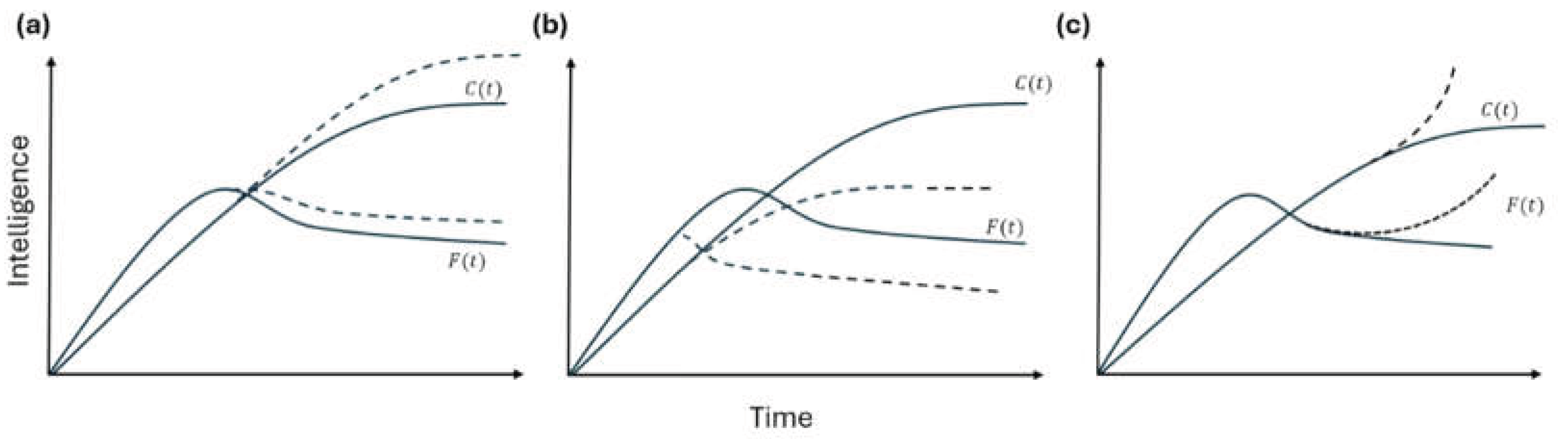
Figure 2.
Recursive developmental system.
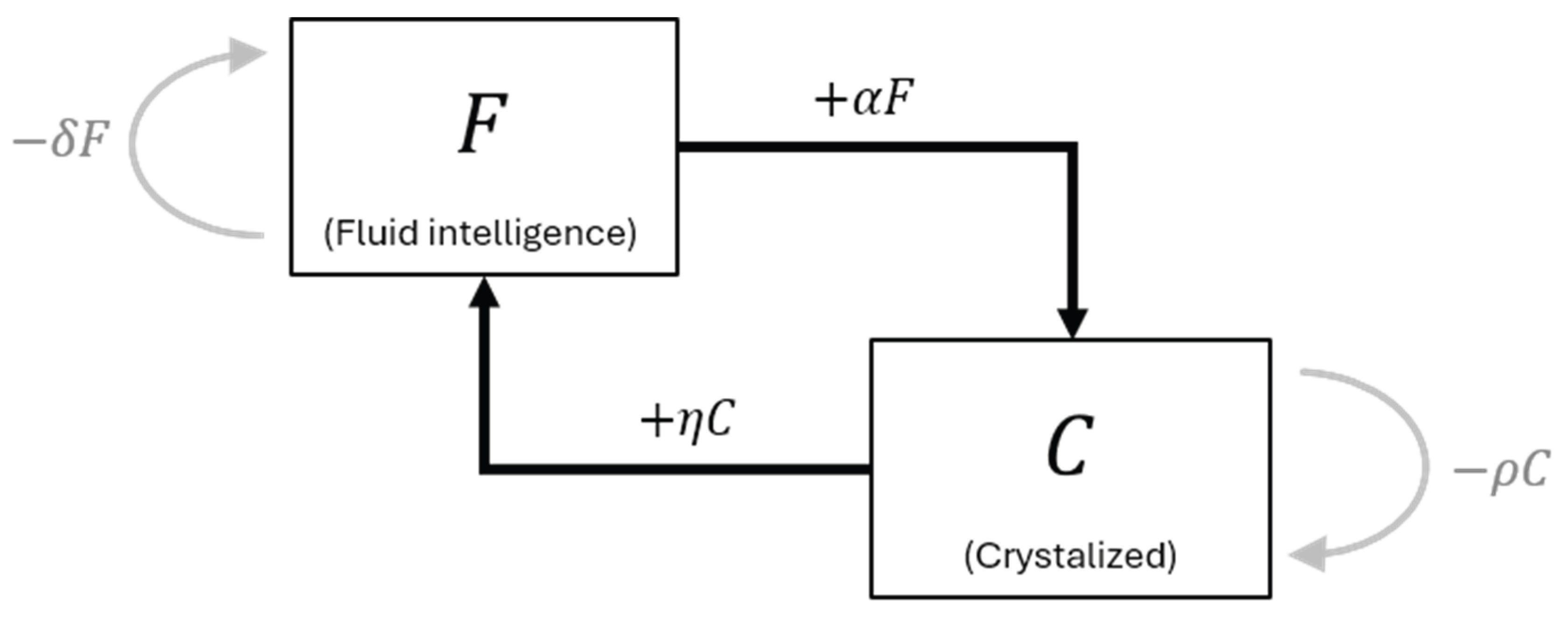
Figure 3.
Incentive structures and heterogeneous technological allocation. Panel (a) compares optimal allocation in lower-return (MB(low)) to higher-return (MB(high)) environments. The shaded region represents the additional range over which complementary allocation remains utility-improving because marginal benefits exceed marginal costs. Panel (b) illustrates how identical shifts in developmental incentives produce heterogeneous behavioural responses across individuals due to differences in subjective cognitive effort costs (MC). Individuals facing lower marginal effort costs exhibit larger shifts in optimal allocation in response to increases in marginal developmental benefits. This captures the role of exploratory cognition and environmental opportunity structures in shaping heterogeneous developmental trajectories under otherwise identical technological conditions.
Figure 3.
Incentive structures and heterogeneous technological allocation. Panel (a) compares optimal allocation in lower-return (MB(low)) to higher-return (MB(high)) environments. The shaded region represents the additional range over which complementary allocation remains utility-improving because marginal benefits exceed marginal costs. Panel (b) illustrates how identical shifts in developmental incentives produce heterogeneous behavioural responses across individuals due to differences in subjective cognitive effort costs (MC). Individuals facing lower marginal effort costs exhibit larger shifts in optimal allocation in response to increases in marginal developmental benefits. This captures the role of exploratory cognition and environmental opportunity structures in shaping heterogeneous developmental trajectories under otherwise identical technological conditions.
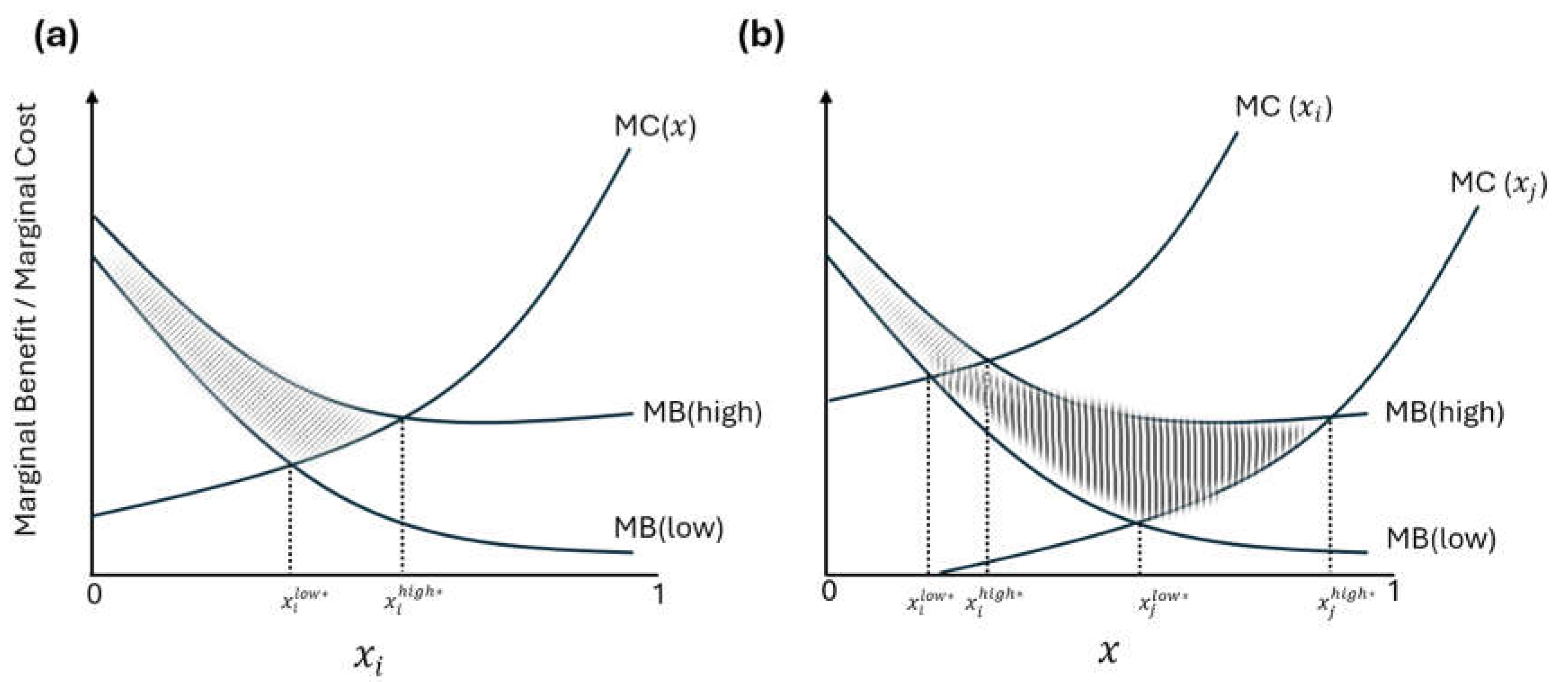
Figure 4.
Divergent developmental trajectories under alternative technological allocation strategies. Solid curves represent a stylized baseline developmental trajectory of fluid intelligence (F) and crystallised intelligence (C) derived from the coupled accumulation framework introduced in Section 2.1. The vertical dashed line represents the period during which technological allocation begins to exert substantial influence on long-run cognitive development for the (a) substitutive allocation strategy (low ) and (b) complementary allocation strategy (high ).
Figure 4.
Divergent developmental trajectories under alternative technological allocation strategies. Solid curves represent a stylized baseline developmental trajectory of fluid intelligence (F) and crystallised intelligence (C) derived from the coupled accumulation framework introduced in Section 2.1. The vertical dashed line represents the period during which technological allocation begins to exert substantial influence on long-run cognitive development for the (a) substitutive allocation strategy (low ) and (b) complementary allocation strategy (high ).
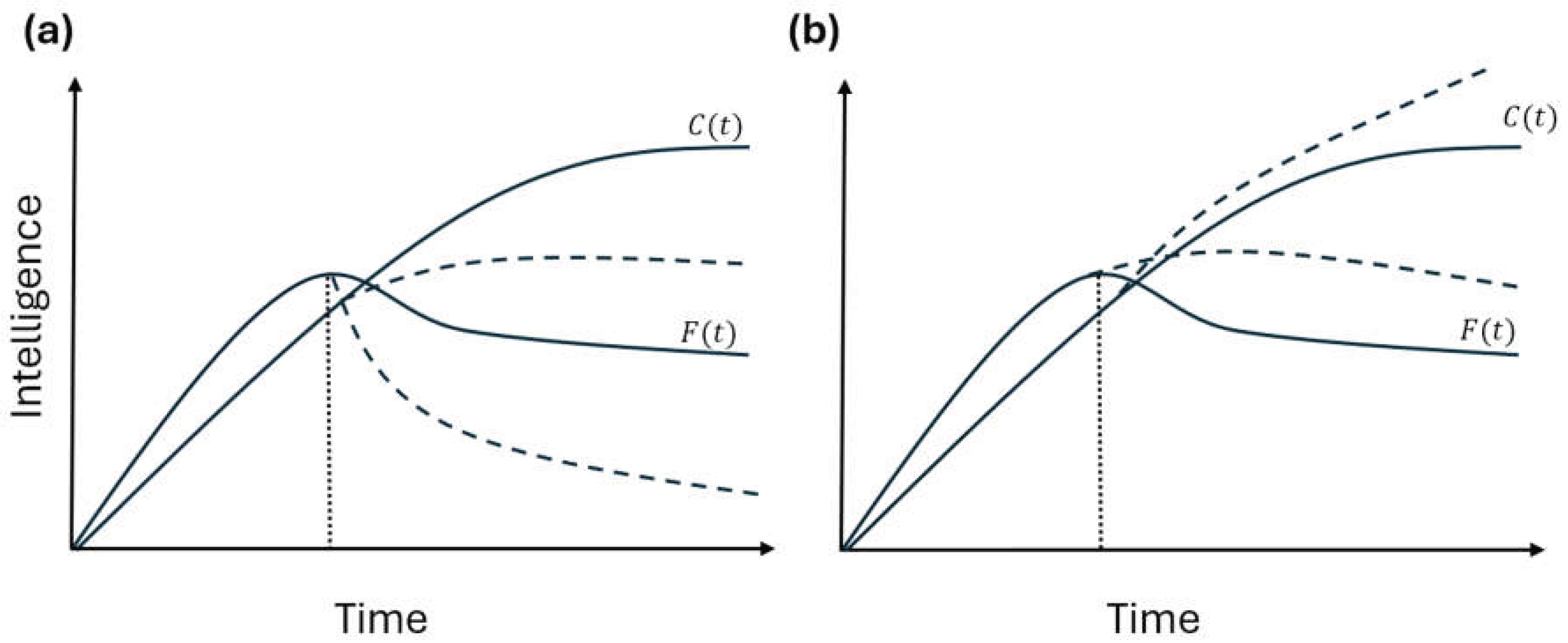
Figure 5.
Opportunity structure and optimal technological allocation. MB(stale) represents environments with low dynamism and limited opportunity expansion, while MB(dynamic) represents environments with high dynamism and stronger returns to cognitive complementarity. Both curves are combined with a representative marginal cost function MC(), reflecting increasing subjective cognitive effort associated with higher levels of complementary technological use. Higher environmental dynamism shifts the marginal benefit curve for complementary use upward (and likely alter its elasticity), increasing the optimal level of complementary allocation. The shaded region highlights the substantial developmental premium captured by exploratory agents when operating within open-niche environments.
Figure 5.
Opportunity structure and optimal technological allocation. MB(stale) represents environments with low dynamism and limited opportunity expansion, while MB(dynamic) represents environments with high dynamism and stronger returns to cognitive complementarity. Both curves are combined with a representative marginal cost function MC(), reflecting increasing subjective cognitive effort associated with higher levels of complementary technological use. Higher environmental dynamism shifts the marginal benefit curve for complementary use upward (and likely alter its elasticity), increasing the optimal level of complementary allocation. The shaded region highlights the substantial developmental premium captured by exploratory agents when operating within open-niche environments.
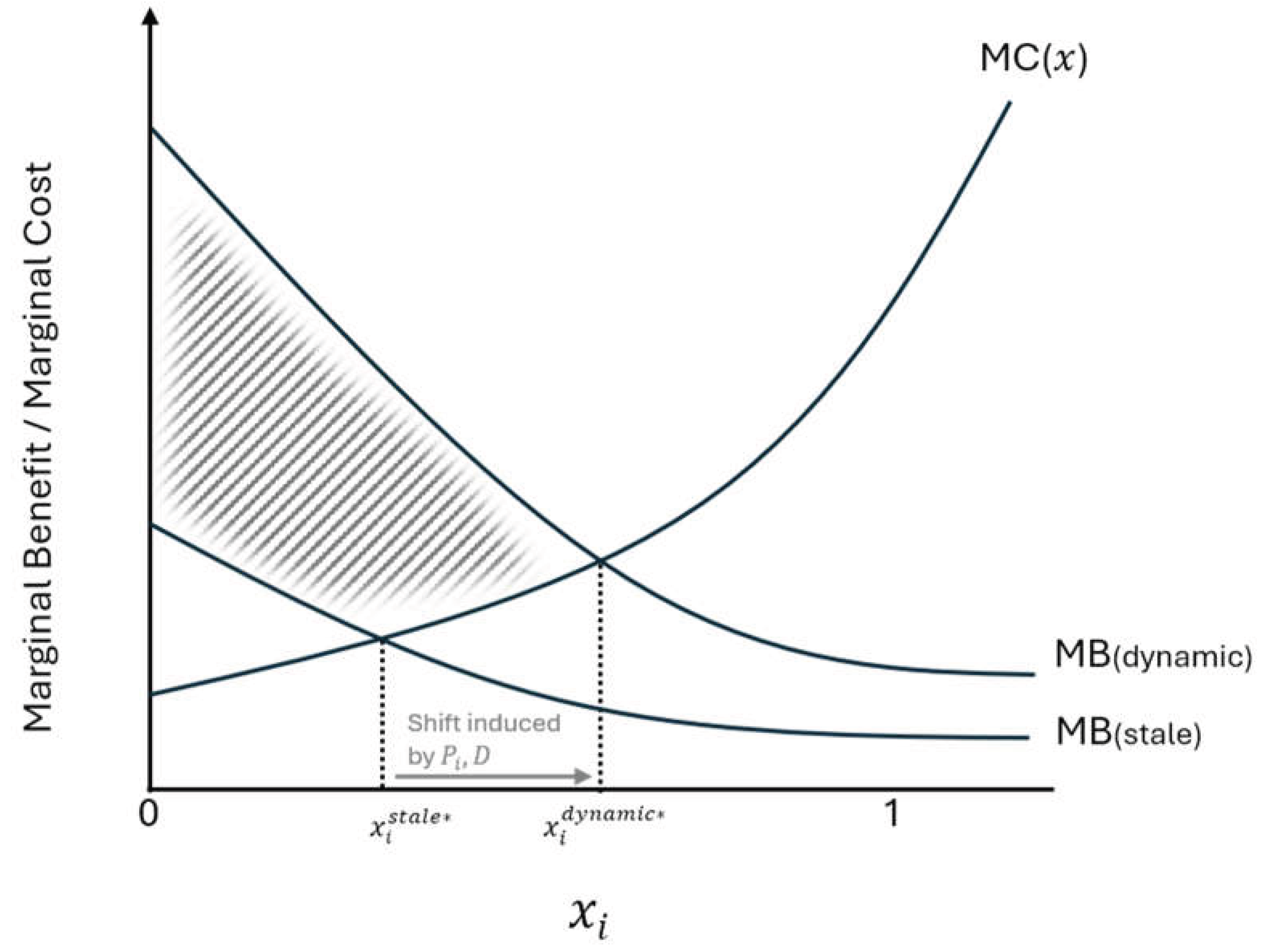
Figure 6.
Schematic representation of the developmental allocation model. Exploratory breadth (), environmental dynamism (), and the institutional returns to human capital jointly shape the individual’s optimal technological allocation strategy. In Cattellian terms, complementary allocation amplifies fluid reasoning and subsequent crystallised knowledge accumulation, whereas substitutive allocation induces cognitive offloading and reduces internal investment. Fluid and crystallised intelligence interact recursively through coupled developmental feedback processes, generating path-dependent trajectories over time.
Figure 6.
Schematic representation of the developmental allocation model. Exploratory breadth (), environmental dynamism (), and the institutional returns to human capital jointly shape the individual’s optimal technological allocation strategy. In Cattellian terms, complementary allocation amplifies fluid reasoning and subsequent crystallised knowledge accumulation, whereas substitutive allocation induces cognitive offloading and reduces internal investment. Fluid and crystallised intelligence interact recursively through coupled developmental feedback processes, generating path-dependent trajectories over time.
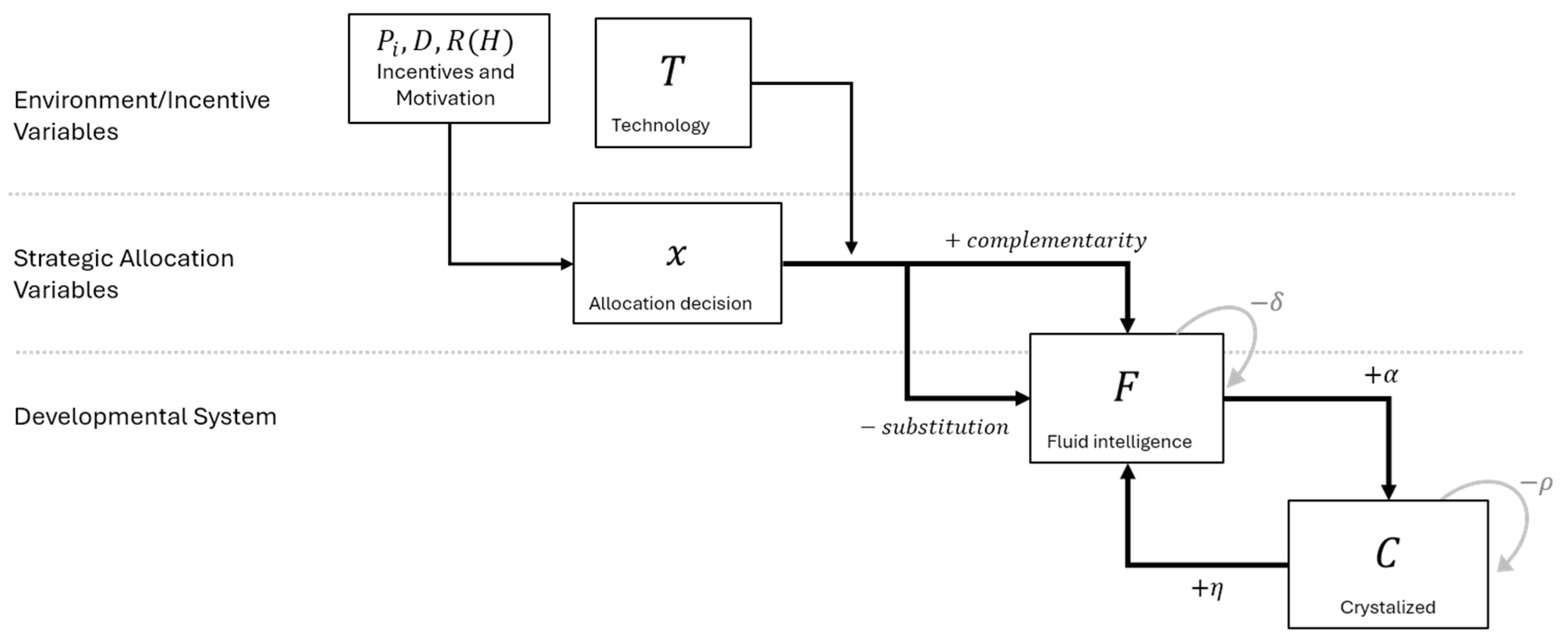
Disclaimer/Publisher’s Note: The statements, opinions and data contained in all publications are solely those of the individual author(s) and contributor(s) and not of MDPI and/or the editor(s). MDPI and/or the editor(s) disclaim responsibility for any injury to people or property resulting from any ideas, methods, instructions or products referred to in the content. |
© 2026 by the authors. Licensee MDPI, Basel, Switzerland. This article is an open access article distributed under the terms and conditions of the Creative Commons Attribution (CC BY) license (http://creativecommons.org/licenses/by/4.0/).
Copyright: This open access article is published under a Creative Commons CC BY 4.0 license, which permit the free download, distribution, and reuse, provided that the author and preprint are cited in any reuse.


