
Submitted:
23 June 2026
Posted:
24 June 2026
You are already at the latest version
Abstract
Catalyst activity loss reduces both the performance and operating flexibility of industrial sulfur dioxide converters, yet its consequences are rarely assessed beyond conversion decline. This work develops an activity-loss vulnerability framework for a four-bed double- contact SO2 converter model evaluated against an industrial fresh-catalyst benchmark and applies it to four prescribed activity scenarios (a = 1.0, 0.8, 0.6, 0.4). At the reference inlet-temperature policy, reducing activity from a = 1.0 to a = 0.4 lowered conversion from 99.758% to 96.812%, increased outlet SO2 slip from 230 to 2960 ppmv, and raised the hotspot from 613.7 to 660.3 °C, exceeding the adopted illustrative limit of 650 °C. Sensitivity, vulnerability, hotspot-risk, and feasible-region maps show that prescribed activity loss progressively shrinks the permissible operating envelope and creates a coupled productivity–emissions–thermal-safety tradeoff. A non-uniform activity profile at the same mean activity as uniform a = 0.6 produced a hotspot 9.3 °C higher, demonstrating that average activity alone is insufficient for thermal-risk assessment. Finally, a scenario-relative Operating Efficiency Reduction Index (OERI) integrates conversion loss, SO2-slip increase, and thermal-margin loss into an illustrative scenario-screening score. The results show that catalyst activity loss should be assessed as a coupled performance, emissions, and operational-vulnerability problem rather than conversion decline alone.
Keywords:
catalyst activity loss
; catalyst deactivation
; sulfur dioxide oxidation
; SO2 converter
; sulfuric acid
; vulnerability mapping
; feasible operating region
; operating efficiency reduction index
; sensitivity analysis
; reactor modeling
1. Introduction
Sulfuric acid is among the most extensively produced commodity chemicals worldwide, with global output consistently exceeding 200 million tonnes per year, and its consumption is widely regarded as a proxy indicator of industrial economic activity [1]. It serves as a critical raw material in fertilizer manufacturing, petroleum refining, metallurgical ore processing, and chemical synthesis. The contact process is the dominant technology for commercial sulfuric acid production. Within this process, the catalytic oxidation of sulfur dioxide to sulfur trioxide:
is the rate-limiting and equilibrium-limited step that governs overall plant conversion, heat recovery, and atmospheric emissions. Because the reaction is reversible and strongly exothermic, achieving high SO2 conversion requires operating along a temperature path that balances reaction kinetics, which favor higher temperatures, against thermodynamic equilibrium, which favors lower temperatures. Modern industrial installations employ the double-contact double-absorption (DCDA) configuration, in which converter gas passes through three catalytic beds, undergoes an intermediate SO3 absorption step, and then enters a final bed where residual SO2 is oxidized. Inter-bed cooling between successive beds manages the exothermic temperature rise and maintains conditions favorable for both kinetics and equilibrium, enabling overall conversions exceeding 99.5% [1,2,3,4].
The active catalyst in industrial SO2 converters is vanadium pentoxide (V2O5) promoted with alkali-metal sulfates and supported on silica or diatomaceous earth. Under process conditions, the active species exists as a liquid vanadium pyrosulfate melt dispersed within the support pores. Although this catalyst exhibits high selectivity and thermal stability, it unavoidably undergoes progressive deactivation during long-term service. Identified deactivation mechanisms include thermal sintering, which reduces the active-phase surface area; poisoning by trace impurities such as arsenic compounds and fluorine species, which irreversibly block active sites; mechanical attrition, which generates fines and increases bed pressure drop; and structural deterioration of the support through pore collapse and surface-area loss [5,6,7,8]. The combined effect is a progressive and largely irreversible reduction in catalyst activity that lowers SO2 conversion, modifies bed temperature profiles, and increases outlet SO2 concentrations. Operators must compensate by raising inlet temperatures or accepting declining conversion and rising emissions until catalyst replacement becomes necessary.
Considerable research has addressed modeling and optimization of SO2 oxidation reactors. Industrial reactor models are generally founded on the Collina/Hougen-Watson kinetic expression, which accounts for the inhibiting adsorption of SO2 and SO3 and incorporates an equilibrium correction [2]. Dynamic and steady-state models have been developed to investigate temperature profiles, conversion characteristics, and energy integration in sulfuric acid plants [2,3,4,9,10,11]. Recent work has extended this direction toward multi-objective optimization, plant-connected digital twins, converter inlet-temperature control, and updated vanadium-catalyst modeling [12,13,14,15].
In the field of catalyst deactivation, Froment established a comprehensive framework for modeling activity loss and its coupling with reactor performance [5]. Bartholomew [6] and Moulijn et al. [7] provided authoritative reviews of deactivation mechanisms and predictive strategies applicable across heterogeneous catalyst systems. Martin et al. [16] further unified the vocabulary and classification of deactivation modes across catalytic systems. The specific deactivation behavior of vanadium pyrosulfate SO2 oxidation catalysts, including active-phase restructuring, alkali-sulfate redistribution, support degradation, and fines generation, has been characterized in mechanistic and industrial spent-catalyst studies [8]. More recently, Pappagallo et al. proposed a pseudo-dynamic methodology in which successive steady-state simulations at progressively reduced activity levels efficiently represent reactor performance loss, demonstrating the value of this approach for fixed-bed and fluidized-bed reactors [17].
Despite these advances, important gaps remain. Previous studies have focused primarily on SO2 converter behavior under fresh or nominally active catalyst conditions, and most deactivation analyses have addressed conversion decline, hot-spot migration, or catalyst activity evolution at the reactor-performance level. The following industrially important aspects remain insufficiently explored:
- the effect of catalyst activity loss on the two-variable feasible operating region and the degree to which reduced activity restricts permissible conditions;
- activity-loss-induced vulnerability to the simultaneous occurrence of conversion loss and SO2 slip increase;
- erosion of hotspot margin and migration of the maximum-temperature location as activity declines;
- a quantitative composite index that integrates multiple activity-loss effects into a single scenario-relative operational deterioration indicator;
- illustrative scenario-screening bands derived from the composite index to support transparent comparison of the investigated states.
Therefore, the objective of this work is to apply an activity-loss vulnerability framework to an industrial double-contact SO2 converter model evaluated at a fresh-catalyst benchmark condition and to develop quantitative indicators for activity-loss-induced operational deterioration. The specific contributions are as follows:
- 1.
- A reactor model evaluated against a fresh-catalyst industrial benchmark is employed to analyze four prescribed catalyst activity-loss scenarios () in a four-bed double-contact industrial SO2 converter.
- 2.
- Bed-wise temperature and SO2 conversion profiles are characterized under each activity state to quantify thermal and conversion deterioration.
- 3.
- Hotspot evolution, hotspot-location migration, and thermal-margin loss are quantified to connect catalyst activity loss with thermal vulnerability.
- 4.
- Local sensitivity maps are constructed to reveal the combined dependence of converter performance on catalyst activity and bed inlet temperature.
- 5.
- Combined vulnerability and hotspot–conversion tradeoff maps are developed to identify regions where productivity, environmental compliance, and thermal safety are simultaneously at risk.
- 6.
- A two-variable feasible-region analysis quantifies the shrinkage of permissible conditions as catalyst activity declines.
- 7.
- An Operating Efficiency Reduction Index (OERI) is introduced as an illustrative, scenario-relative scalar measure of overall performance deterioration and screening priority.
- 8.
- A compact one-at-a-time parameter sensitivity analysis quantifies the effects of kinetic scale, absorber residual, and feed composition near , while a separate decision-threshold test examines dependence on the adopted thermal constraint.
The remainder of this paper is organized as follows. Section 2 describes the activity-loss vulnerability framework, performance indicators, feasible-region analysis, scalar indices, and sensitivity screening. Section 3 presents the case study, mathematical model, and fresh-benchmark evaluation. Section 4 presents and discusses the results. Section 5 discusses industrial implications, limitations, and future perspectives. Section 6 summarizes the conclusions.
2. Methodology
2.1. Framework Overview
The activity-loss vulnerability framework developed in this work translates prescribed catalyst activity reductions into quantitative operational and decision-support metrics through five coupled analysis stages, as illustrated in Figure 1.
- 1.
- Stage I — Reactor simulation: The four-bed DCDA SO2 converter model, evaluated against the fresh industrial benchmark condition, is executed at four prescribed activity levels (), representing the fresh reference and three increasing activity-loss scenarios. Each simulation yields bed-wise axial temperature and SO2 conversion profiles together with final outlet flow conditions.
- 2.
- Stage II — Hotspot and thermal safety analysis: The maximum temperature and its axial location are extracted from each bed profile at every activity level to characterize hotspot temperature evolution, hotspot-location migration between beds, and thermal safety-margin consumption.
- 3.
- Stage III — Local sensitivity analysis: The first-bed inlet temperature is systematically varied around the fresh-benchmark operating point at each activity level to generate two-dimensional sensitivity maps of final SO2 conversion and outlet SO2 slip, revealing the combined dependence of converter performance on catalyst state and inlet temperature.
- 4.
- Stage IV — Vulnerability and feasible-region assessment: A combined vulnerability map is constructed by overlaying conversion loss and SO2 slip on a single operating plane. A hotspot–conversion tradeoff map quantifies the competing effects of feed-temperature adjustment on productivity and thermal margin. The feasible region is identified as the intersection of three simultaneous case-study constraints.
- 5.
- Stage V — Scalar index and scenario screening: The Operating Efficiency Reduction Index (OERI) condenses the multi-dimensional activity-loss effects into a single scenario-relative screening measure. Illustrative priority bands support comparison within the investigated scenario set but are not validated maintenance triggers. One-at-a-time perturbations assess local parameter sensitivity near .
The computational procedure implementing this framework is described in Algorithm 1. The performance indicators, envelope constraints, and index formulations used in each stage are defined in the following subsections.
| Algorithm 1:Activity-Loss Vulnerability Framework for Industrial SO2 Converter Assessment. |
|

Table 1.
Illustrative OERI-based scenario-screening bands.
| OERI range | Screening level | Illustrative interpretation |
|---|---|---|
| Low | Limited deterioration within the scenario set | |
| Moderate | Intermediate deterioration within the scenario set | |
| High | Substantial deterioration; plant-specific assessment warranted | |
| Critical | Greatest deterioration within the scenario set | |
| Bands are illustrative scenario-screening aids, not validated maintenance or replacement thresholds. | ||
2.2. Performance Indicators
The dimensionless fractional SO2 conversion used internally in the reactor balances is defined as
where . For reporting, plotting, constraint evaluation, and all subsequent performance indicators, percentage conversion is used:
Thus, denotes percentage conversion throughout the remainder of this paper, whereas the lowercase symbol is reserved for dimensionless fractional conversion. The outlet SO2 slip is expressed on a dry basis as a molar percentage of the total dry outlet stream:
For comparison with common gas-emission reporting conventions, the same dry molar fraction is also reported in parts per million by volume:
where is expressed in dry-basis mol%. The conversion loss and SO2 slip increase are defined relative to the fresh catalyst reference case ():
Because X is expressed as percentage conversion, is a difference between two percentage values and is therefore reported in percentage points (pp), not as a relative percent change. Similarly, is reported in mol%-points unless another unit is stated.
To account explicitly for thermal safety, the hotspot temperature is defined as the global maximum temperature reached anywhere inside the converter:
where is the axial temperature profile in catalytic bed b as a function of catalyst mass W. An illustrative thermal constraint of is adopted for the present case study. This value is used as an engineering screening boundary rather than a universal catalyst limit; plant-specific applications should replace it with the applicable catalyst-vendor and operating-policy limit. The hotspot safety margin is defined as
with positive values indicating operation within the adopted constraint and negative values indicating exceedance. Loss of margin relative to the fresh catalyst is quantified as
For use in the scalar deterioration indices, each performance degradation indicator is normalized with respect to its maximum value observed across all activity levels:
where the subscript max denotes the value observed at the lowest activity level (). By this normalization, all three indicators are bounded in across the study range, ensuring comparability across dimensions with different physical units.
These normalized indicators serve as the building blocks for the feasible-region analysis and scalar deterioration indices defined below.
2.3. Two-Variable Feasible Operating Region
The two-variable feasible operating region is defined in the space of first-bed inlet temperature and catalyst activity level by three simultaneous case-study constraints:
The conversion threshold of 99.5% represents the case-study performance target. The SO2 slip limit of 0.10 mol% (1000 ppmv) is an illustrative process-outlet screening value rather than a jurisdiction-specific stack-emission standard. At standard conditions (273 K, 101.3 kPa), 1 ppmv SO2≈ 2.86 mg Nm−3; the 1000 ppmv threshold therefore corresponds to approximately 2860 mg Nm−3 for reference against stack-emission regulations. The temperature value of 650 °C is likewise an adopted case-study constraint.
For each activity level, the first-bed inlet temperature is varied over a representative range and all three conditions are evaluated at each grid point. The feasible region is the intersection of the three individually satisfied regions. Its contraction provides a geometric measure of activity-loss-induced reduction in operational flexibility within this two-variable slice.
2.4. Operating Efficiency Reduction Index and Illustrative Scenario Screening
The Operating Efficiency Reduction Index (OERI) is introduced to quantify the combined operational impact of catalyst activity loss by integrating productivity loss, SO2-slip deterioration, and thermal-margin loss into a single dimensionless scalar:
Equal weights are assigned to the three normalized components as an engineering-judgment baseline in the absence of a universally accepted weighting standard. Although and represent different reporting perspectives—productivity and process-outlet SO2 deterioration—they share a common physical root because both are determined by the unreacted SO2 leaving the converter. Across the four activity states examined here, the Pearson correlation between and exceeds 0.999, confirming near-perfect collinearity within this scenario set. Their joint inclusion therefore gives the conversion–slip axis greater effective weight than the thermal component and should be regarded as an explicit screening choice rather than evidence of two independent degradation modes. A plant implementation could instead use a fixed-reference slip ratio, e.g., , or recalibrate all components against economic, environmental, and equipment constraints.
By construction, : the index equals zero for the fresh reference state and unity for the most severely deactivated case in the present scenario set. OERI is therefore a scenario-relative ranking metric; its numerical values are not transferable maintenance thresholds unless the normalization bounds are recalibrated against plant-specific limits, costs, and risk tolerances.
For transparent within-study comparison, illustrative screening bands are assigned from OERI using the following thresholds:
OERI provides a compact deterioration score and ordering of the investigated states. In the present four-scenario set, no investigated case falls within the Moderate band (): the activity states map from Low ( and , OERI and ) to High (, OERI ) and Critical (, OERI ). The value of 1.000 is obtained by construction because defines the maximum normalization values; it does not imply a universal failure state. Linear interpolation suggests that the Moderate band would correspond to approximately – within this particular scenario definition, but a finer activity grid would be required to establish a continuous trajectory.
2.5. Compact Parameter and Decision-Threshold Sensitivity Analysis
A one-at-a-time local sensitivity analysis was performed around the uniform activity-loss scenario because its nominal hotspot temperature lies close to the adopted thermal constraint. The kinetic rate scale, inlet SO2 mole fraction, and inlet O2 mole fraction were independently perturbed by . For each feed-composition perturbation, the N2 fraction was adjusted to preserve a normalized mixture and the total molar flow was recalculated at the fixed feed mass flow of 5000 kg h−1.
The nominal intermediate-absorber removal efficiency is 0.999 and therefore cannot be increased by 10% without exceeding its physical upper bound. Consequently, the residual SO3 fraction, , was perturbed by , corresponding to removal efficiencies of 0.9991 and 0.9989. Separately, the adopted thermal constraint was varied by (585 and 715 °C) as a decision-threshold sensitivity test. This boundary variation changes the reported margin and screening status but does not represent model-input uncertainty and does not alter reactor outputs. The monitored responses were final conversion, outlet SO2 slip in ppmv, hotspot temperature, and thermal margin. The parameter screening is a deterministic local sensitivity analysis rather than a probabilistic uncertainty quantification.
2.6. Framework Algorithm
Algorithm 1 presents the complete computational procedure implementing the five-stage activity-loss vulnerability framework.
3. Case Study and Fresh-Benchmark Model Evaluation
3.1. Industrial SO2 Converter Description
The case study considered in this work is an industrial double-contact double-absorption (DCDA) sulfuric acid converter consisting of four adiabatic fixed-bed catalytic reactors connected in series. Inter-bed heat exchangers are employed to control the exothermic temperature rise and maintain favorable conditions for both reaction kinetics and thermodynamic equilibrium. After the third catalytic bed, sulfur trioxide is removed in an intermediate absorption stage before the gas stream enters the fourth bed for final polishing. This configuration is widely used in modern sulfuric acid plants because it enables overall SO2 conversions exceeding 99.5%.
The oxidation of sulfur dioxide proceeds according to
which is highly exothermic and equilibrium limited. Consequently, the converter must operate along controlled temperature trajectories that balance the opposing influences of reaction kinetics and thermodynamic equilibrium. Inter-bed cooling and intermediate absorption are therefore essential for maintaining favorable operating conditions while maximizing overall SO2 conversion.
The converter configuration adopted in this study consists of three primary catalytic beds followed by intermediate SO3 absorption and a final polishing bed. The benchmark operating conditions and catalyst distributions are taken from the industrial four-bed DCDA converter reported by Gómez-García et al. [18] and are used throughout this work.
3.2. Mathematical Model
A one-dimensional pseudo-homogeneous plug-flow model was employed to describe the thermal and compositional behavior of the converter [19,20]. The mathematical model follows the industrial SO2 converter modeling framework reported by Gosiewski [2] and the sulfuric acid plant model of Kiss et al. [3]. Each catalyst bed was assumed to operate adiabatically, and radial concentration and temperature gradients were neglected. The model consists of coupled species and energy balances combined with a kinetic expression based on the Collina/Hougen–Watson formulation. Intermediate SO3 removal between the third and fourth beds was represented through a constant absorption efficiency.
The model predicts the evolution of species flow rates and temperature along the catalyst weight coordinate and provides bed-wise temperature profiles, cumulative conversion, and outlet SO2 concentrations. The system of ordinary differential equations was solved sequentially for each catalytic bed, with inter-bed cooling and intermediate absorption incorporated between successive stages.
3.2.1. Species Balances
The oxidation of sulfur dioxide is described using one-dimensional plug-flow species balances formulated with respect to catalyst weight. The molar flow rates of sulfur dioxide, oxygen, and sulfur trioxide satisfy
where denotes the molar flow rate of species i, W is the catalyst weight, and is the sulfur dioxide oxidation rate. Nitrogen is treated as an inert diluent; its molar flow rate remains constant throughout each catalytic bed ().
3.2.2. Energy Balance
Because each catalyst bed operates adiabatically, the temperature profile is governed by the heat released by the oxidation reaction and the heat capacity of the gas mixture:
where is the heat of reaction and denotes the heat capacity of species i.
3.2.3. Reaction Kinetics
The oxidation kinetics were represented using the Collina/Hougen–Watson formulation, following previous SO2 converter modeling and optimization studies [2,12]. This formulation accounts for adsorption effects and equilibrium limitations and has been widely validated for industrial vanadium-based SO2 oxidation catalysts.
The full rate expression is
where a is the catalyst activity factor, denotes the partial pressure of species i in atm, and is the net SO2 oxidation rate in kmol h−1. The temperature-dependent kinetic constants and equilibrium constant are given by
where T is the absolute temperature in Kelvin. The constants , , represent the temperature-dependent forward rate constant and adsorption equilibrium constants for SO2 and SO3, respectively; is the thermodynamic equilibrium constant for the SO2 oxidation reaction. These constants are consistent with the published Collina/Hougen–Watson benchmark form widely used in industrial SO2 converter models [2,12]. The computed rate in kmol h−1 is converted to mol s−1 for integration with the energy and species balances.
3.2.4. Intermediate SO3 Absorption
Following the third catalyst bed, sulfur trioxide is removed in an intermediate absorber. The absorption stage is represented by an absorption efficiency, , such that
where and denote the SO3 molar flow rates entering and leaving the absorber, respectively.
3.3. Catalyst Activity-Loss Scenarios
Catalyst activity loss was represented through a dimensionless activity factor, a, defined as
where and denote the aged and fresh-catalyst reaction rates evaluated under identical operating conditions.
Following the consecutive-steady-state methodology of Pappagallo et al. [17], catalyst activity loss was examined through successive steady-state simulations at prescribed reduced-activity levels. The present model does not calculate activity as a function of time or represent a specific deactivation mechanism; the cases are therefore activity-loss scenarios rather than predictions of catalyst age or service life.
Four representative activity states were considered:
corresponding to the fresh reference and mild, moderate, and severe relative activity-loss scenarios, respectively.
The selected activity levels constitute a systematic parametric study rather than snapshots calibrated to a specific plant history or catalyst age. Sintering of the silica support, active-phase restructuring, poisoning, and alkali-sulfate redistribution are recognized deactivation mechanisms in supported vanadium SO2 catalysts, while the resulting activity trajectory depends strongly on feed impurities, temperature history, catalyst formulation, and operating practice [6,7,8,16]. The descriptors fresh, mild, moderate, and severe are therefore used only to distinguish relative activity states within this study and should not be interpreted as specific service-life intervals or replacement criteria.
3.4. Model Parameters and Assumptions
The principal assumptions adopted in this study are summarized below:
- 1.
- One-dimensional plug-flow behavior.
- 2.
- Pseudo-homogeneous reactor model.
- 3.
- Adiabatic operation within each catalyst bed.
- 4.
- Negligible radial concentration and temperature gradients.
- 5.
- Uniform catalyst activity within each bed.
- 6.
- Constant pressure throughout the converter.
- 7.
- Constant intermediate SO3 absorption efficiency.
- 8.
- Steady-state operation for each activity level.
3.5. Fresh-Benchmark Model Evaluation
The mathematical model employed in this work was configured and evaluated against the industrial four-bed SO2 converter data reported by Gómez-García et al. [18]. The configuration consisted of matching the inter-bed temperature policy (bed inlet temperatures at Beds 2, 3, and 4) to the values reported in that reference and using the published catalyst volumes and bulk density directly as the catalyst inventory. No adjustment was made to the published Collina/Hougen–Watson kinetic constants; the rate expression in Equations (19) – (23) was used without modification. The published industrial operating data thus serve as the fresh-condition benchmark against which the model outlet temperatures and overall conversion are compared.
The benchmark evaluation focused on reproducing bed outlet temperatures and overall SO2 conversion under the fresh reference operating condition. Good agreement was obtained, with relative errors below 0.21% across all bed outlet temperatures and overall SO2 conversion, supporting use of the model as a basis for the subsequent parametric activity-loss analysis. This comparison does not constitute direct validation of the reduced-activity cases, for which corresponding industrial measurements were unavailable.
Representative benchmark-comparison results are summarized in Table 4. The evaluated operating condition was subsequently used as the fresh-catalyst reference state (). The vulnerability maps, feasible-region analysis, and scenario ordering are model predictions generated by varying catalyst activity from this reference condition.
Progressive reductions in catalyst activity were then imposed to represent different activity-loss scenarios. The resulting changes in temperature profiles, percentage conversion, process-outlet SO2, and operating flexibility were analyzed using the methodology presented in Section 2.
3.6. Physical Self-Consistency of the Deactivated Simulation Cases
Direct experimental or industrial validation of the deactivated cases (, , ) is not possible in the absence of published operational data from aged SO2 converters. The physical self-consistency of these cases was therefore demonstrated through three complementary arguments.
Energy balance consistency. The activity factor a appears exclusively as a multiplicative pre-factor on the reaction rate term in the kinetic expression (Equation 19). The adiabatic energy balance,
is integrated numerically at each activity level. Because a scales only the rate magnitude, the local slope of the temperature–conversion trajectory with respect to dimensionless fractional conversion within any adiabatic bed,
is independent of a and determined solely by the heat of reaction, initial feed molar flow rate, and gas mixture heat capacity. Equation (28) uses the fractional conversion defined in Equation (2); a slope expressed per percentage point of conversion is smaller by a factor of 100. As catalyst activity decreases, less SO2 is converted per unit bed weight, so the reactor traverses a shorter arc of the same adiabatic line. The shape of the temperature–conversion trajectory is preserved across all four activity levels; only the endpoint changes. This relationship was verified by confirming that the ratio of temperature rise to fractional SO2 conversion increment within each bed remained consistent with the value predicted by Equation (28) at all activity levels, with deviations below the numerical integration tolerance.
Thermodynamic equilibrium constraint. The Collina/Hougen–Watson rate expression (Equation 19) contains the equilibrium correction factor
which approaches zero as the system approaches thermodynamic equilibrium. Because this factor multiplies the net rate, the model cannot predict conversion exceeding the local equilibrium value at any axial position or activity level, regardless of the value of a. Thermodynamic self-consistency is therefore enforced by the rate expression structure itself, not by any post-hoc correction.
Qualitative consistency with published observations. The aging trends predicted by the model — progressive reduction in overall SO2 conversion, increase in outlet SO2 slip, rise in hotspot temperature, and migration of the peak temperature from Bed 1 to Bed 2 as activity declines — are qualitatively consistent with published descriptions of aging behavior in multi-bed industrial SO2 converters [2,3,4]. The redistribution of the exothermic heat release from the first to downstream beds as early-bed activity is lost is a recognized characteristic of catalyst aging in this reactor type [9].
These three arguments collectively demonstrate that the deactivated cases are physically self-consistent. While they cannot substitute for quantitative experimental validation against industrial aged-catalyst data, they confirm that the model generates thermodynamically admissible and qualitatively credible results across the full range of studied activity levels. Quantitative validation of deactivated converter predictions against industrial measurements from aged plants remains an important priority for future work.
4. Results and Discussion
The proposed activity-loss framework was applied to a double-contact SO2 converter model evaluated at the fresh reference condition. Four catalyst activity levels were investigated: the fresh reference () and mild (), moderate (), and severe () relative activity-loss scenarios. The reduced-activity cases are deterministic parametric predictions rather than independently validated deactivation data.
4.1. X–T Trajectory Evolution Under Activity Loss
Figure 2 compares the fresh catalyst case () with the severe deactivation case () using temperature–conversion trajectories, where X denotes percentage conversion. In an SO2 converter, equilibrium conversion decreases with increasing temperature, whereas the kinetic rate generally benefits from higher temperature over the relevant operating range. Within an adiabatic bed, Equation (28) shows that the local temperature rise per fractional-conversion increment is governed by reaction enthalpy and mixture heat capacity and is not directly changed by the activity multiplier. Deactivation therefore does not fundamentally alter the adiabatic temperature–conversion slope; instead, the aged catalyst traverses a shorter portion of the admissible trajectory over the available catalyst inventory and exits each bed at a lower percentage conversion. The cumulative endpoint deficit increases from bed to bed, and inter-bed cooling cannot recover the reaction progress achieved by the fresh catalyst under the same inlet-temperature policy.
Reduced activity decreases the conversion achieved within the available catalyst inventory, and the cumulative shortfall becomes the primary driver of total conversion loss in the severe activity-loss scenario.
4.2. Bed-Wise Temperature Profiles
Figure 3 compares the outlet temperatures of the four catalyst beds across all activity levels. As activity decreases from to , the heat-release load redistributes from Bed 1 to downstream beds. The Bed 1 outlet temperature falls progressively from 614 °C to 431 °C, reflecting reduced SO2 conversion in the first stage. Simultaneously, the Bed 2 outlet temperature rises to 651 °C at and 660 °C at , exceeding the adopted 650 °C constraint. This redistribution concentrates the exothermic load in Bed 2. The effect extends to Bed 4, where outlet temperatures increase as a larger fraction of the remaining conversion shifts to later stages.
Bed-wise temperature profiles therefore serve as a clear and measurable indicator of catalyst deterioration, with the Bed 2 spike providing an early warning of thermal-limit breach under progressive deactivation.
4.3. Hotspot Evolution and Thermal Safety
In addition to bed outlet temperatures, the maximum temperature reached inside the converter provides a direct measure of thermal safety. The hotspot temperature, , was extracted from the axial temperature profile of each catalytic bed for all catalyst activity levels. The hotspot safety margin was defined as
where was used as the illustrative thermal constraint for this case study.
Figure 4 summarizes the three principal hotspot diagnostics. Panel (a) shows that the predicted hotspot rises from 613.7°C for the fresh reference to 660.3°C at . Panel (b) shows migration of the maximum-temperature location from Bed 1 to Bed 2 as activity declines, indicating downstream redistribution of the exothermic load. Panel (c) shows the corresponding reduction in margin relative to the adopted 650 °C constraint, from K to K.
Table 5 summarizes the corresponding hotspot location, hotspot temperature, margin, and position relative to the adopted constraint. The progression from operation within the constraint to operation near or above it shows that decreasing activity progressively consumes thermal margin.
Figure 5 presents a hotspot risk map as a function of catalyst activity and first-bed feed temperature. The color scale represents hotspot temperature, while the contour line corresponds to C. This figure shows that increasing feed temperature can improve reaction performance, but it also increases the risk of exceeding the thermal limit, especially under aged catalyst conditions.
The hotspot analysis strengthens the interpretation of feasible-region shrinkage. Activity loss not only reduces conversion and increases SO2 slip; it also shifts the location of maximum heat release and reduces the available thermal margin.
The reduction in hotspot safety margin has direct implications for the OERI. In this work, the normalized loss of hotspot safety margin is used as the thermal component of OERI alongside the normalized conversion loss and SO2 slip increase. Consequently, OERI provides a compact scenario-relative measure of catalyst deterioration by simultaneously accounting for productivity loss, process-outlet SO2 deterioration, and thermal-robustness degradation.
With the thermal behavior of the reduced-activity converter established, the following subsections examine how prescribed activity loss translates into measurable conversion losses across the individual catalyst beds and across the full operating space.
4.4. Bed-Wise Conversion Profiles
Figure 6 shows the cumulative SO2 conversion profiles across the four catalyst beds. The fresh case reaches a final conversion of 99.758%, whereas the severe deactivation case reaches 96.812%. The bed-wise profiles show that aging effects accumulate along the converter, making downstream conversion particularly sensitive to upstream activity loss. The difference becomes increasingly evident in the later beds because the cumulative penalty of lower reaction rates grows from bed to bed.
Conversion deterioration is monotonic with declining catalyst activity, and bed-wise conversion measurements are highly sensitive indicators of aging state.
4.5. Local Sensitivity Maps: Conversion and SO2 Slip
Figure 7a presents the local sensitivity of final SO2 conversion to catalyst activity and first-bed feed temperature. Higher inlet temperatures improve conversion by increasing reaction rates, whereas lower catalyst activities reduce achievable conversion throughout the explored range. Catalyst activity exerts a stronger influence on conversion than moderate temperature variations; the validated operating condition lies within the high-conversion region for fresh catalysts but migrates toward lower-performance regions as aging progresses. Feed temperature can only partially compensate for activity loss and cannot recover fresh-catalyst performance under severe deactivation.
Figure 7b shows the outlet SO2 slip under the same operating plane. The fresh case produces 0.02296 mol% (230 ppmv) at the validated point, which rises to 0.29597 mol% (2960 ppmv) in the activity-loss scenario. Taken together, the two maps confirm that catalyst activity strongly influences both conversion and process-outlet SO2, and motivate the combined vulnerability representation presented in Section 4.7.
4.6. Conversion–Thermal Safety Tradeoff
The hotspot analysis also reveals a fundamental operating tradeoff. Increasing the first-bed feed temperature can partially recover SO2 conversion under reduced activity, but it simultaneously increases hotspot temperature and reduces the available thermal margin. Figure 8a visualizes this tradeoff; the red contour identifies the adopted 650 °C boundary.
Figure 8b extends the analysis by combining conversion, SO2 slip, and the adopted thermal constraint in one operating map. At high activity and moderate temperature, all three case-study constraints are satisfied. At higher temperature, conversion and slip may remain within their adopted constraints while the predicted hotspot exceeds the adopted boundary. In the lower-activity portion of the map, conversion and slip constraints are increasingly violated, confirming that temperature manipulation alone cannot recover fresh-reference performance. The convergence of constraint boundaries at intermediate activity identifies a region where the predicted operating window is narrow and multiple performance objectives are simultaneously at risk.
4.7. Combined Activity-Loss Vulnerability Map
Figure 9 combines conversion loss and outlet SO2 slip in a single map. The color scale represents conversion loss relative to the fresh reference case, while the contour lines represent SO2 slip levels. This visualization simultaneously identifies performance deterioration, process-outlet SO2 penalties, and regions of heightened operational vulnerability. Regions with high conversion loss also correspond to elevated SO2 slip, demonstrating that prescribed activity loss creates a coupled performance–outlet-slip vulnerability that cannot be adequately captured by monitoring either indicator alone.
The combined map provides a compact representation of the operational consequences of prescribed catalyst activity loss and supports the central argument of this study: reduced activity should be treated as an operational vulnerability problem, not merely as a reduction in reaction rate.
4.8. Two-Variable Feasible Operating Region
Figure 10 shows the two-variable feasible operating region obtained from the simultaneous overlap of three case-study constraints:
The feasible region shrinks progressively as catalyst activity decreases, and the mechanism of shrinkage changes across activity-loss severity. For the fresh catalyst (), a finite inlet-temperature window satisfies all three case-study constraints. At , the thermal constraint removes part of the higher-temperature region. At , the adopted thermal boundary is exceeded at the reference inlet temperature and the predicted conversion of 98.476% is below the 99.5% target. At , the conversion constraint eliminates feasibility throughout the investigated inlet-temperature range; at the reference temperature, conversion is 96.812%. Catalyst activity loss therefore reduces operating flexibility through thermal-boundary tightening and loss of attainable conversion within the investigated domain.
4.9. Operating Efficiency Reduction Index and Illustrative Scenario Screening
To quantify the combined impact of catalyst activity loss, the OERI introduced in Section 2.4 is evaluated at each activity level using normalized conversion loss, SO2 slip increase, and hotspot-margin loss (Equation (11)). Figure 11a decomposes OERI into its three contributors. The thermal component rises most steeply between and , while conversion and slip components grow steadily. The index reaches 1.0 at by construction because that case defines the scenario-relative normalization maximum.
Applying the illustrative screening bands from Table 1, the four activity states are ordered as follows: (OERI = 0.000) is Low; (OERI = 0.209) is Low; (OERI = 0.558) is High; and (OERI = 1.000) is Critical. Figure 11b visualizes this scenario-relative ordering. These labels compare only the investigated states and do not prescribe maintenance action.
Unlike conversion alone, OERI combines conversion loss, process-outlet SO2 deterioration, and hotspot safety-margin loss into a single scenario-relative scalar. In its present form it is suitable only for comparative screening of the investigated scenarios; plant-level monitoring or maintenance decisions require independent normalization bounds, weights, and validation against operational and maintenance data.
Table 6 consolidates the key performance deterioration indicators across all four catalyst activity levels.
Table 6.
Performance deterioration summary across catalyst activity levels.
| Activity | Percentage conversion (%) | (pp) | SO2 Slip (mol%) | SO2 Slip (ppmv) | Hotspot (°C) | Margin (K) | OERI | Priority |
|---|---|---|---|---|---|---|---|---|
| 1.0 | 99.758 | 0.000 | 0.02296 | 230 | 613.7 | +36.3 | 0.000 | Low |
| 0.8 | 99.307 | 0.451 | 0.06534 | 653 | 628.6 | +21.4 | 0.209 | Low |
| 0.6 | 98.476 | 1.281 | 0.14264 | 1426 | 651.0 | −1.0 | 0.558 | High |
| 0.4 | 96.812 | 2.946 | 0.29597 | 2960 | 660.3 | −10.3 | 1.000 | Critical |
| pp: percentage points; ppmv values are dry molar fractions; Margin is relative to C; Priority from Table 1. | ||||||||
Table 7.
OERI-based scenario ordering and illustrative screening guidance.
| Activity | OERI | Screening level | Rank | Interpretation |
|---|---|---|---|---|
| 1.0 | 0.000 | Low | 4 | Normal operation |
| 0.8 | 0.209 | Low | 3 | Review trends and increase monitoring |
| 0.6 | 0.558 | High | 2 | Substantial deterioration in the investigated set |
| 0.4 | 1.000 | Critical | 1 | Maximum normalized deterioration in the investigated set |
| Screening level assigned from Table 1; Rank 1 = greatest modeled deterioration, not a validated maintenance trigger. | ||||
4.10. Activity-Loss Indicator Summary
Figure 11c consolidates four key deterioration indicators: conversion loss, outlet SO2 slip increase, OERI, and hotspot safety-margin loss. Together the panels provide a compact view of the productivity, process-outlet, composite-screening, and thermal dimensions of the investigated activity-loss scenarios.
4.11. Sensitivity to Non-Uniform Catalyst Activity Distribution
The main analysis assumed uniform catalyst activity applied equally to all four beds. In practice, Bed 1 operates at the highest temperature and highest SO2 partial pressure, and typically deactivates faster than downstream beds [6,7]. To assess how this spatial non-uniformity influences converter performance, three non-uniform activity profiles were simulated and compared against the uniform case at a similar average activity. Table 8 summarises the results.
Two findings from Table 8 are particularly significant. First, the non-uniform profile has the same average activity () as the uniform case , yet produces a markedly different thermal outcome: the Bed 2 hotspot temperature rises to 660.3 °C compared with 651.0 °C under uniform activity, and the safety margin deteriorates from K to K. Second, despite the more severe thermal condition, the non-uniform case achieves higher overall conversion (99.078% versus 98.476%), because the more active downstream beds compensate for the conversion shortfall of the deactivated first two beds. This decoupling of conversion and thermal safety under spatially non-uniform deactivation highlights a fundamental limitation of the uniform-activity assumption: models that track only average activity may underestimate thermal risk while simultaneously overestimating it from a conversion perspective. Furthermore, the non-uniform profile with a higher average activity () still exhibits a hotspot 9.4 K above the uniform- case, confirming that spatial distribution of deactivation dominates the thermal response more than average activity alone. These findings underscore the importance of bed-resolved activity monitoring and motivate future extensions of the framework toward spatially distributed deactivation models.
4.12. Compact Parameter and Decision-Threshold Sensitivity Analysis
Figure 12 summarizes the one-at-a-time perturbations around the uniform scenario. The nominal prediction was 98.476% conversion, 1426 ppmv outlet SO2, and a hotspot of 651.0 °C, corresponding to a margin of K relative to the adopted constraint. Feed composition was the dominant source of local output variability. A perturbation in inlet SO2 reduced conversion by 0.705 percentage points, increased outlet slip by 891 ppmv, and raised the hotspot by 9.93 K. A perturbation in O2 reduced conversion by 0.861 percentage points and increased slip by 798 ppmv. Conversely, reducing SO2 or increasing O2 moved the predicted condition toward higher conversion and lower outlet slip.
The kinetic scale had a smaller but still material influence: a perturbation produced conversion changes of to percentage points, slip changes of to ppmv, and hotspot changes of to K. Changing the residual SO3 fraction after the absorber by changed conversion by less than 0.001 percentage points and slip by less than 0.5 ppmv because the nominal removal efficiency is already 99.9%. In the separate decision-threshold test, varying the adopted thermal boundary by did not alter reactor predictions but changed the reported margin by K. This result concerns classification dependence on the selected plant-specific boundary rather than physical model sensitivity.
4.13. Comparison with Previous Studies
Previous SO2 converter studies have primarily focused on kinetic modeling, reactor simulation, X–T diagrams, and optimization under nominal or fresh-catalyst conditions [2,3,10,12]. These works provide important foundations for understanding sulfur dioxide oxidation and optimizing converter operation. However, they generally do not quantify how prescribed activity loss changes the feasible operating region or scenario-level operational vulnerability.
General catalyst-deactivation studies have shown that catalyst activity loss affects reactor conversion and temperature profiles [5,6,7]. The pseudo-dynamic approach of Pappagallo et al. [17] is particularly relevant because it uses successive steady-state simulations at decreasing catalyst activity to represent reactor performance loss. The present work follows the same general philosophy of activity-based scenario analysis but extends it in a different direction: instead of stopping at conversion loss or temperature-profile evolution, the framework translates prescribed activity loss into vulnerability maps, feasible-region shrinkage, OERI, and scenario-screening indicators.
The novelty of this work therefore lies not in SO2 converter modeling alone, nor in the general concept of catalyst activity, but in converting fresh-benchmark-anchored activity-loss simulations into operational vulnerability and scenario-screening metrics for an industrial SO2 converter. Table 9 positions the present work relative to representative prior studies.
4.14. Summary of Principal Findings
Table 10 consolidates the principal findings of the study into a single reference, linking each quantitative result to its industrial implication.
5. Industrial Implications, Limitations, and Future Perspectives
5.1. Industrial Implications
The simulation results suggest that catalyst activity loss should be monitored not only through conversion loss but also through SO2 slip, hotspot migration, margin consumption, and feasible-region shrinkage. The model is evaluated at the fresh reference condition, whereas the reduced-activity results are parametric predictions. Their applicability to a specific plant therefore depends on calibration against measured activity proxies and applicable plant constraints. Within the present scenario set, marks a transition at which the predicted hotspot exceeds the adopted 650 °C boundary by 1.0 K and the scenario-relative OERI exceeds 0.5, placing it in the illustrative High screening band per Table 1. This observation is useful for comparing the investigated states but is not, by itself, a validated maintenance trigger.
5.2. Limitations
Although the proposed activity-loss framework provides a physically interpretable methodology for assessing reduced catalyst performance in industrial SO2 converters, several limitations should be acknowledged.
First, the primary analysis assumed uniform catalyst activity applied equally to all four beds. In practice, activity loss may be spatially non-uniform because bed conditions and contaminant exposure differ. The sensitivity study in Section 4.11 demonstrated that even at the same average activity, a front-loaded profile produced a hotspot temperature 9.3 °C higher than the uniform case while achieving higher conversion. The uniform assumption may therefore underestimate thermal risk when early-bed activity loss dominates.
Second, the present study used prescribed steady-state activity-loss scenarios and did not calculate deactivation rate, catalyst age, or time on stream. The reported conversion decline, hotspot growth, and feasible-region shrinkage should therefore be interpreted as scenario predictions after the process has settled. Transient startup, shutdown, load disturbances, and rapid deactivation events remain outside the model scope.
Third, the feasible operating region is only a two-variable slice in activity–first-bed-temperature space. Other relevant variables, including downstream inlet temperatures, flow, pressure, and absorber performance, were held fixed. The adopted conversion, SO2 slip, and temperature constraints are illustrative and should be replaced with plant-specific requirements.
Fourth, OERI uses scenario-relative normalization and equal illustrative weights. Its numerical values are not transferable plant thresholds, and its normalization should be recalibrated using economic penalties, applicable regulations, catalyst-vendor limits, and maintenance history. Furthermore, as noted in Section 2.4, the conversion-loss and SO2-slip components of OERI are near-perfectly correlated ( across this scenario set) because both derive from the same unreacted SO2 flow. Their joint inclusion implicitly weights the conversion-emission axis more heavily than the thermal component. The correlation should be explicitly acknowledged when OERI is used as a screening tool, and a fixed-reference slip ratio should be substituted when a fully independent emission component is required.
Fifth, the reduced-activity cases (, , ) represent physically screened parametric states but have not been validated against industrial measurements with independently estimated catalyst activity. The present work is therefore a scenario analysis rather than a calibrated prediction of a specific plant’s aging trajectory.
Sixth, the compact parameter study is local and one-at-a-time. It identifies influential inputs near but does not capture parameter interactions or probability distributions. A global uncertainty analysis should follow when parameter covariance and industrial measurement uncertainty become available.
5.3. Future Perspectives
The results of this study motivate several concrete research extensions, ordered from immediate modeling refinements to broader system-level integration.
First, and most directly motivated by the non-uniform activity sensitivity analysis (Section 4.11), future work should extend the discrete profiles considered here to continuous axial activity distributions and experimentally calibrated bed-specific activity estimates. The finding that a front-loaded profile at the same average activity produces a 9.3 °C higher hotspot temperature demonstrates the importance of bed-resolved information for reliable thermal-risk assessment.
Second, the framework could be integrated with online measurements through state-estimation and emission-forecasting techniques to enable real-time catalyst health monitoring [21,22]. Such implementation would require plant-specific calibration of the OERI normalization, weights, and action thresholds. Specific targets include bed outlet temperature sensors, pressure drop, and periodic conversion measurements as activity proxies.
Third, the feasible-region and OERI framework could be embedded within a digital twin or model-predictive optimization platform [13,14,23] to support adaptive inlet-temperature scheduling while preserving plant-specific hotspot margins.
Fourth, the feasible-region shrinkage results show that even moderate deactivation (–) substantially restricts operating flexibility. This motivates plant-wide extensions that include intermediate absorber aging and interactions between converter and absorption stages, since the SO3 slip from an aging absorber compounds the converter’s emission challenge.
Finally, the sustainability dimension of spent catalyst management represents an additional axis of practical relevance. Recent hydrometallurgical studies demonstrate technically viable routes for recovering vanadium, cesium, and aluminum from spent sulfuric-acid catalysts [24,25,26]. These material-recovery pathways could be integrated with the scenario-ranking framework to jointly evaluate replacement timing and catalyst valorization.
6. Conclusions
This study applied an activity-loss vulnerability framework to an industrial double-contact SO2 converter model evaluated against a fresh-catalyst benchmark condition. Four prescribed activity levels were investigated: a fresh reference and three progressively reduced-activity scenarios. The analysis linked activity decline to temperature profiles, hotspot evolution, SO2 conversion, outlet SO2 slip, a two-variable feasible operating region, and scenario-relative deterioration indicators.
The main conclusions are as follows:
- 1.
- Prescribed catalyst activity loss produced clear and measurable changes in converter response. As activity decreased from to , final SO2 conversion decreased from 99.758% to 96.812%, while outlet SO2 slip increased from 230 to 2960 ppmv. Bed-wise profiles showed upstream activity loss cascading into downstream conversion deficits.
- 2.
- Hotspot temperature increased from 613.7 °C at to 660.3 °C at , with the margin changing from K (within the adopted constraint) to K (exceeding the adopted constraint). Concurrently, the hotspot migrated from Bed 1 to Bed 2.
- 3.
- Local sensitivity and tradeoff maps showed that catalyst activity exerts a dominant influence on conversion, SO2 slip, and hotspot temperature. Although feed-temperature adjustment can partially compensate for activity loss, it simultaneously increases hotspot temperature and reduces the available safety margin, creating a fundamental performance–thermal safety tradeoff that cannot be resolved by temperature adjustment alone under severe deactivation.
- 4.
- The combined vulnerability map demonstrated that conversion loss and SO2 slip increase occur simultaneously in reduced-activity operating regions, highlighting coupled productivity and process-outlet consequences that cannot be captured by monitoring either indicator in isolation.
- 5.
- The two-variable feasible-region analysis showed that activity loss reduces operating flexibility within the investigated domain.
- 6.
- The compact parameter sensitivity analysis showed that feed SO2/O2 composition and kinetic scale dominate local output variability at . A SO2 perturbation increased outlet slip by 891 ppmv and hotspot temperature by 9.93 K, whereas a change in absorber residual changed slip by less than 0.5 ppmv. Thermal-status classifications depended strongly on the adopted plant-specific boundary.
- 7.
- The scenario-relative OERI condensed conversion loss, SO2 slip increase, and hotspot-margin loss into a compact within-study screening score. Because its components are equally weighted, conversion loss and SO2 slip are strongly correlated, and the worst scenario defines the normalization maximum, its numerical values are not validated maintenance thresholds and require plant-specific reformulation before operational use.
- 8.
- A sensitivity study with non-uniform bed activity distributions revealed that spatial deactivation patterns significantly alter the thermal response even at the same average activity. A front-loaded profile (, ) produced a hotspot temperature of 660.3 °C and a safety margin of K, compared with 651.0 °C and K for uniform , while simultaneously achieving higher overall conversion (99.08% versus 98.48%). This decoupling of conversion and thermal risk under non-uniform deactivation demonstrates that average activity alone is an insufficient descriptor of converter safety, and that bed-resolved activity monitoring is required for reliable risk assessment.
- 9.
- Overall, the results demonstrate that catalyst activity loss in industrial SO2 converters should be treated as an operational-vulnerability problem, not merely as a reduction in kinetic rate. The proposed framework converts fresh-benchmark-anchored reactor-model outputs into scenario-relative operational indicators.
Future work should extend the analysis to continuous axial and experimentally calibrated bed-specific activity profiles, mechanistic deactivation kinetics, absorber deterioration, plant-wide dynamics, and online activity estimation using industrial measurements.
Author Contributions
Conceptualization, F.A.; methodology, F.A.; software, F.A.; validation, F.A.; formal analysis, F.A.; writing—original draft preparation, F.A.; writing—review and editing, F.A.
Funding
This research received no external funding.
Data Availability Statement
The simulation code, generated figures, result tables, and reproducible workflow that support the findings of this study are openly available on Zenodo at https://doi.org/10.5281/zenodo.20762917.
Conflicts of Interest
The author declares no conflicts of interest.
References
- Müller, H. Sulfuric Acid and Sulfur Trioxide. In Ullmann’s Encyclopedia of Industrial Chemistry; Wiley-VCH: Weinheim, 2012. [Google Scholar] [CrossRef]
- Gosiewski, K. Dynamic Modeling of Industrial SO2 Oxidation Reactors. 1. Model of Hot and Cold Start-Ups of the Plant. Chem. Eng. Process. 1993, 32, 111–129. [Google Scholar]
- Kiss, A.A.; Bildea, C.S.; Grievink, J. Dynamic Modeling and Process Optimization of an Industrial Sulfuric Acid Plant. Chem. Eng. J. 2010, 158, 241–249. [Google Scholar] [CrossRef]
- Sørensen, P.A.; Møllerhøj, M.; Christensen, K.A. New Dynamic Models for Simulation of Industrial SO2 Oxidation Reactors and Wet Gas Sulfuric Acid Plants. Chem. Eng. J. 2015, 278, 421–429. [Google Scholar] [CrossRef]
- Froment, G.F. Modeling of Catalyst Deactivation. Appl. Catal. A General. 2001, 212, 117–128. [Google Scholar] [CrossRef]
- Bartholomew, C.H. Mechanisms of Catalyst Deactivation. Appl. Catal. A General. 2001, 212, 17–60. [Google Scholar] [CrossRef]
- Moulijn, J.A.; van Diepen, A.E.; Kapteijn, F. Catalyst Deactivation: Is It Predictable? What to Do? Appl. Catal. A General. 2001, 212, 3–16. [Google Scholar] [CrossRef]
- Lapina, O.B.; Bal’zhinimaev, B.S.; Boghosian, S.; Eriksen, K.M.; Fehrmann, R. Progress on the Mechanistic Understanding of SO2 Oxidation Catalysts. Catal. Today 1999, 51, 469–479. [Google Scholar] [CrossRef]
- Gosiewski, K. Dynamic Modelling of Industrial SO2 Oxidation Reactors. 2. Model of a Reverse-Flow Reactor. Chem. Eng. Process. Process Intensif. 1993, 32, 233–244. [Google Scholar] [CrossRef]
- Hong, R.Y.; Li, X.; Li, H.Z.; Yuan, W.K. Modeling and Simulation of SO2 Oxidation in a Fixed-Bed Reactor with Periodic Flow Reversal. Catal. Today 1997, 38, 47–58. [Google Scholar] [CrossRef]
- Schöneberger, J.C.; Arellano-Garcia, H.; Wozny, G.; Körkel, S.; Thielert, H. Model-Based Experimental Analysis of a Fixed-Bed Reactor for Catalytic SO2 Oxidation. Ind. Eng. Chem. Res. 2009, 48, 5165–5176. [Google Scholar] [CrossRef]
- Zaker, M.R.; Fauteux-Lefebvre, C.; Thibault, J. Modelling and Multi-Objective Optimization of the Sulphur Dioxide Oxidation Process. Processes 2021, 9, 1072. [Google Scholar] [CrossRef]
- Mounaam, A.; Oulhiq, R.; Souissi, A.; Salouhi, M.; Benjelloun, K.; Bichri, A. A Model-Driven Digital Twin Framework Development for Sulfur Dioxide Conversion Units Simulation. Adv. Sci. Technol. Eng. Syst. J. 2021, 6, 122–131. [Google Scholar] [CrossRef]
- Liu, M.; Li, X.; Wang, K.; Liu, Z.; Li, G. Multi-Model Predictive Control of Converter Inlet Temperature in the Process of Acid Production with Flue Gas. Int. J. Adapt. Control Signal Process. 2024, 38, 1725–1743. [Google Scholar] [CrossRef]
- Baraeva, L.R.; Yusupova, A.A.; Khatsrinov, A.I. Modeling the Oxidation of Sulfur Dioxide on a Vanadium Catalyst. Russ. J. Phys. Chem. A 2025, 99, 2630–2634. [Google Scholar] [CrossRef]
- Martín, A.J.; Mitchell, S.; Mondelli, C.; Jaydev, S.D.; Pérez-Ramírez, J. Unifying Views on Catalyst Deactivation. Nat. Catal. 2022, 5, 854–866. [Google Scholar] [CrossRef]
- Pappagallo, M.A.; Schildhauer, T.J.; Kröcher, O.; Moioli, E. Modeling of the Performance Loss due to Catalyst Deactivation in Fixed- and Fluidized-Bed Reactors. Ind. Eng. Chem. Res. 2025, 64, 17529–17542. [Google Scholar] [CrossRef] [PubMed]
- Gómez-García, M.A.; Dobrosz-Gómez, I.; Fontalvo, J.; Mondragón-Saavedra, E. Simulation of an Industrial Adiabatic Multi-Bed Catalytic Reactor for Sulfur Dioxide Oxidation Using the Maxwell–Stefan Model. Chem. Eng. J. 2015, 269, 356–365. [Google Scholar] [CrossRef]
- Levenspiel, O. Chemical Reaction Engineering, 3rd ed.; John Wiley & Sons: New York, 1999. [Google Scholar]
- Satterfield, C.N. Heterogeneous Catalysis in Industrial Practice, 2nd ed.; McGraw-Hill: New York, 1991. [Google Scholar]
- Venkatasubramanian, V.; Rengaswamy, R.; Yin, K.; Kavuri, S.N. A Review of Process Fault Detection and Diagnosis: Part I: Quantitative Model-Based Methods. Comput. Chem. Eng. 2003, 27, 293–311. [Google Scholar] [CrossRef]
- Isermann, R. Fault-Diagnosis Systems: An Introduction from Fault Detection to Fault Tolerance; Springer: Berlin, 2006. [Google Scholar] [CrossRef]
- Jones, D.; Snider, C.; Nassehi, A.; Yon, J.; Hicks, B. Characterising the Digital Twin: A Systematic Literature Review. CIRP J. Manuf. Sci. Technol. 2020, 29, 36–52. [Google Scholar] [CrossRef]
- Romanovskaia, E.; Romanovski, V.; Kwapinski, W.; Kurilo, I. Selective Recovery of Vanadium Pentoxide from Spent Catalysts of Sulfuric Acid Production: Sustainable Approach. Hydrometallurgy 2021, 200, 105568. [Google Scholar] [CrossRef]
- Lee, D.; Joo, S.H.; Shin, D.J.; Shin, S.M. Recovery of Vanadium and Cesium from Spent Sulfuric Acid Catalysts by a Hydrometallurgical Process. Green Chem. 2022, 24, 790–799. [Google Scholar] [CrossRef]
- Singh, N.; Kang, H.N.; Jyothi, R.K.; Jha, M.K.; Pasupuleti, K.S.; Lee, J.Y. Hydrometallurgical Approach to Recover Vanadium and Aluminum from the Sulfuric Acid Manufacturing Spent Catalyst. Mineral. Process. Extr. Metall. Rev. 2025, 46, 865–876. [Google Scholar] [CrossRef]
Figure 1.
Proposed five-stage framework for activity-loss vulnerability assessment and decision support in industrial SO2 converters. The methodology sequentially combines reactor simulation, thermal analysis, sensitivity mapping, vulnerability assessment, and scenario screening to translate catalyst aging into actionable industrial outcomes.
Figure 1.
Proposed five-stage framework for activity-loss vulnerability assessment and decision support in industrial SO2 converters. The methodology sequentially combines reactor simulation, thermal analysis, sensitivity mapping, vulnerability assessment, and scenario screening to translate catalyst aging into actionable industrial outcomes.
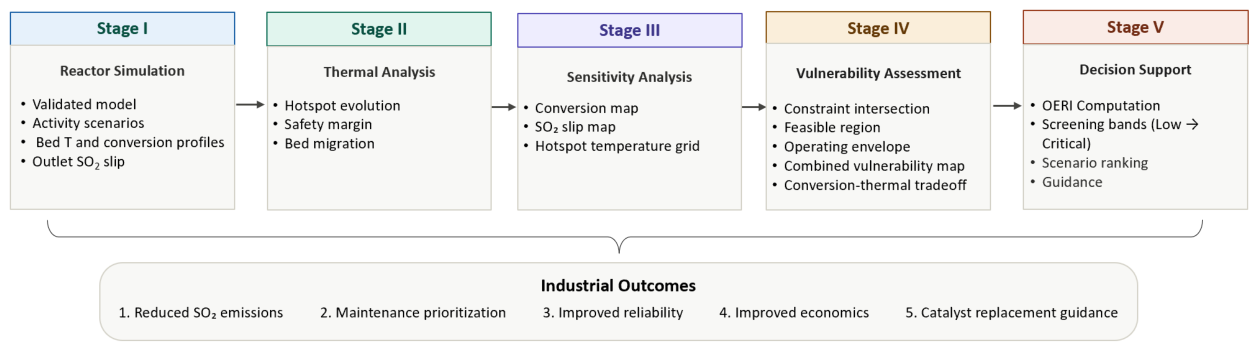
Figure 2.
Temperature–conversion (X–T) trajectories for fresh () and severely deactivated () catalyst cases, with X expressed as percentage conversion. Each rising segment represents one catalytic bed; vertical drops at constant conversion represent inter-bed cooling steps. The grey dashed curve is the thermodynamic equilibrium conversion at the local temperature; the dashed horizontal line marks the adopted illustrative 650 °C constraint. Filled circles mark bed outlet conditions. No uncertainty bounds are shown; reduced-activity results are deterministic predictions from the model evaluated at the fresh reference condition.
Figure 2.
Temperature–conversion (X–T) trajectories for fresh () and severely deactivated () catalyst cases, with X expressed as percentage conversion. Each rising segment represents one catalytic bed; vertical drops at constant conversion represent inter-bed cooling steps. The grey dashed curve is the thermodynamic equilibrium conversion at the local temperature; the dashed horizontal line marks the adopted illustrative 650 °C constraint. Filled circles mark bed outlet conditions. No uncertainty bounds are shown; reduced-activity results are deterministic predictions from the model evaluated at the fresh reference condition.
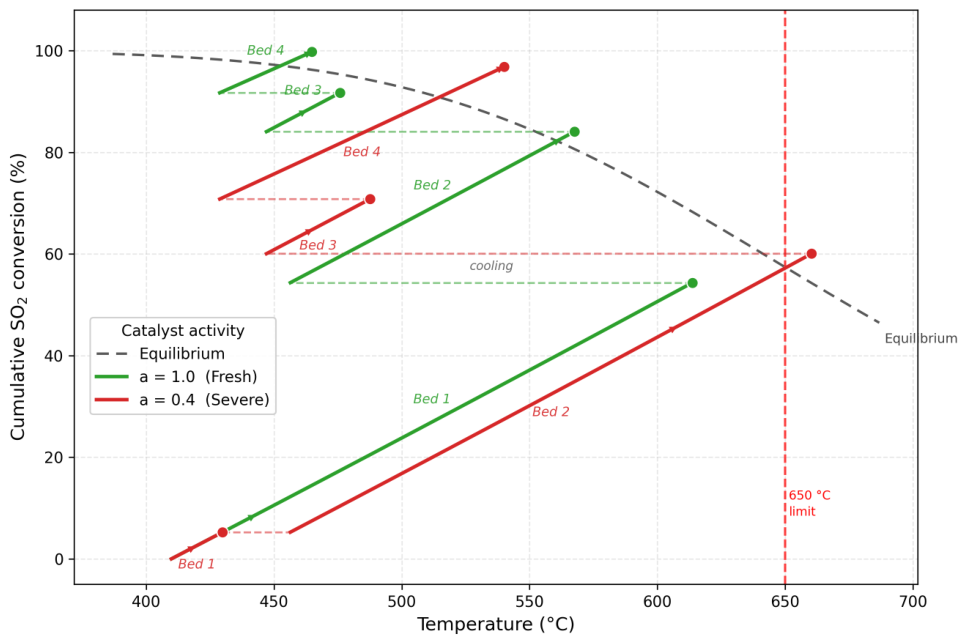
Figure 3.
Predicted bed outlet temperatures for four catalyst activity levels. The dashed horizontal line marks the adopted illustrative 650 °C constraint. The fresh case is benchmarked against the industrial reference; reduced-activity cases are deterministic model predictions.
Figure 3.
Predicted bed outlet temperatures for four catalyst activity levels. The dashed horizontal line marks the adopted illustrative 650 °C constraint. The fresh case is benchmarked against the industrial reference; reduced-activity cases are deterministic model predictions.
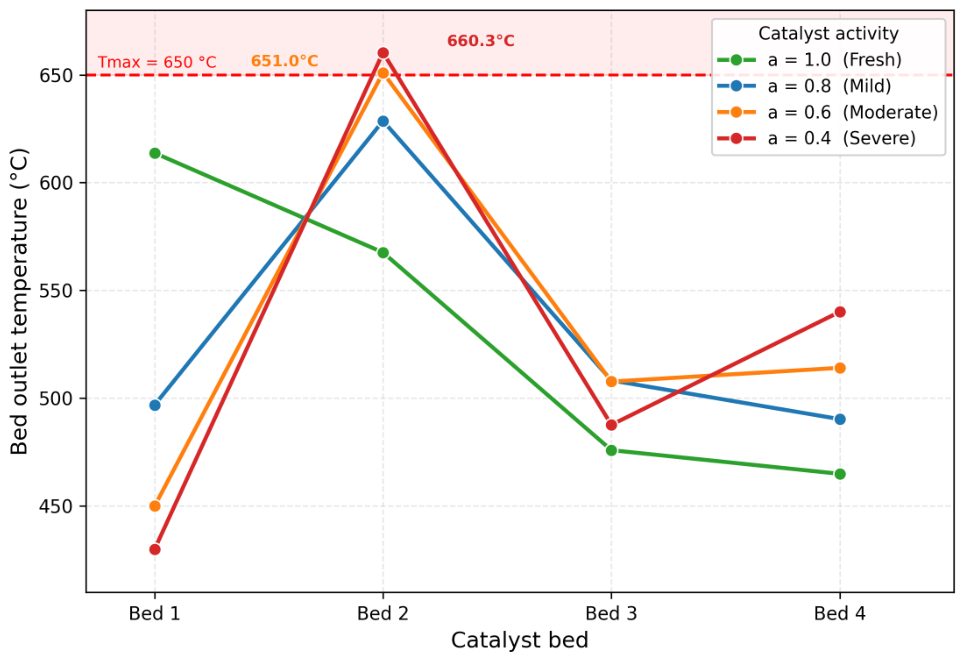
Figure 4.
Hotspot evolution across catalyst activity states. (a) Predicted maximum temperature; the dashed line marks the adopted illustrative 650 °C constraint. (b) Bed containing the maximum temperature. (c) Remaining margin relative to the adopted constraint. The fresh case is benchmarked against the industrial reference; reduced-activity values are deterministic model predictions without uncertainty bounds.
Figure 4.
Hotspot evolution across catalyst activity states. (a) Predicted maximum temperature; the dashed line marks the adopted illustrative 650 °C constraint. (b) Bed containing the maximum temperature. (c) Remaining margin relative to the adopted constraint. The fresh case is benchmarked against the industrial reference; reduced-activity values are deterministic model predictions without uncertainty bounds.
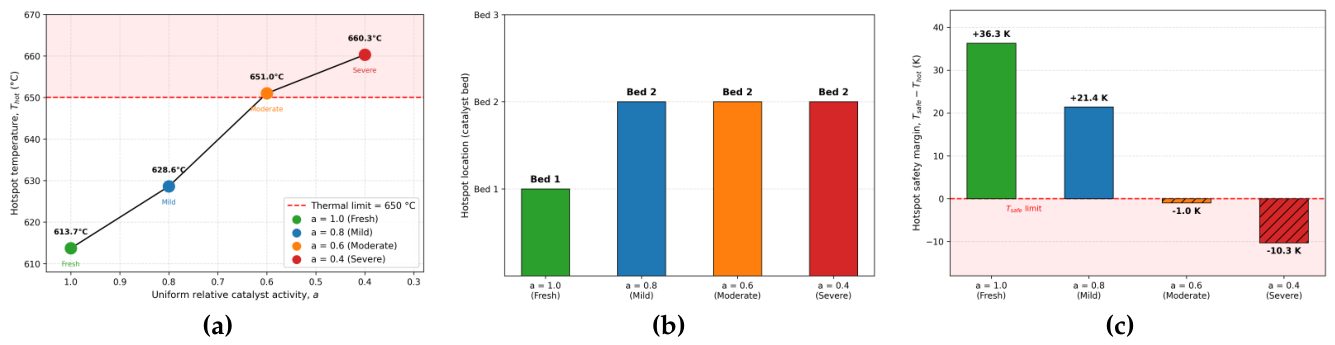
Figure 5.
Hotspot risk map as a function of catalyst activity (a) and first-bed feed temperature (). The color scale represents simulated peak temperature, and the red dashed contour marks the adopted illustrative constraint C. The green filled circle identifies the validated fresh-reference operating point. Values were simulated on a regular grid; standard contour interpolation is used only to visualize boundaries between neighboring grid points.
Figure 5.
Hotspot risk map as a function of catalyst activity (a) and first-bed feed temperature (). The color scale represents simulated peak temperature, and the red dashed contour marks the adopted illustrative constraint C. The green filled circle identifies the validated fresh-reference operating point. Values were simulated on a regular grid; standard contour interpolation is used only to visualize boundaries between neighboring grid points.
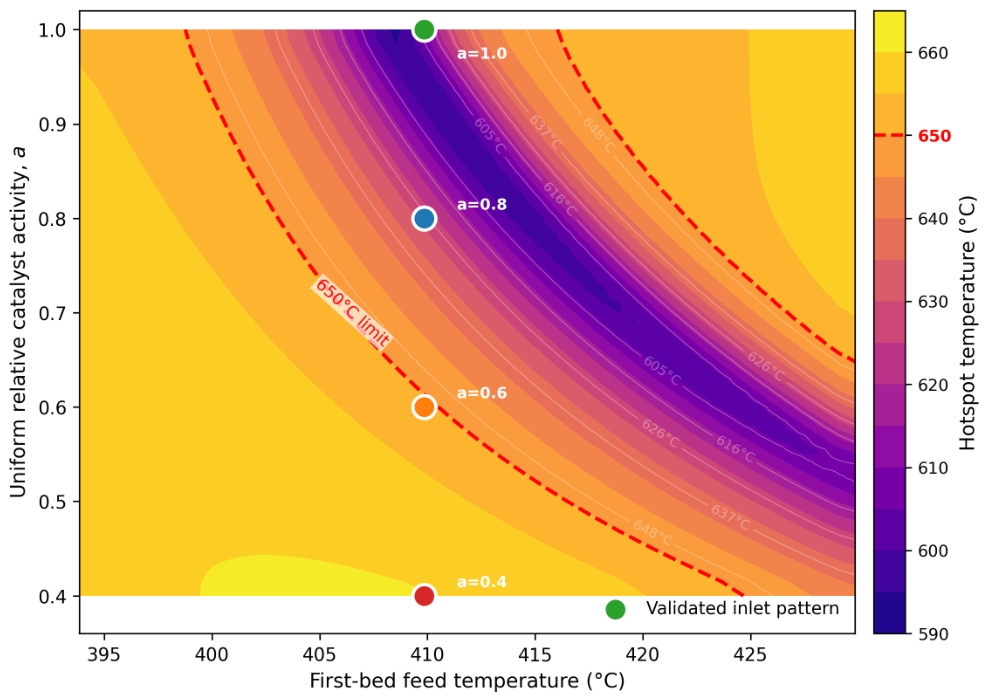
Figure 6.
Predicted cumulative SO2 conversion after each catalytic bed for four activity levels. The dashed horizontal line marks the case-study 99.5% conversion target. The fresh case is benchmarked against the industrial reference; reduced-activity cases are deterministic model predictions.
Figure 6.
Predicted cumulative SO2 conversion after each catalytic bed for four activity levels. The dashed horizontal line marks the case-study 99.5% conversion target. The fresh case is benchmarked against the industrial reference; reduced-activity cases are deterministic model predictions.
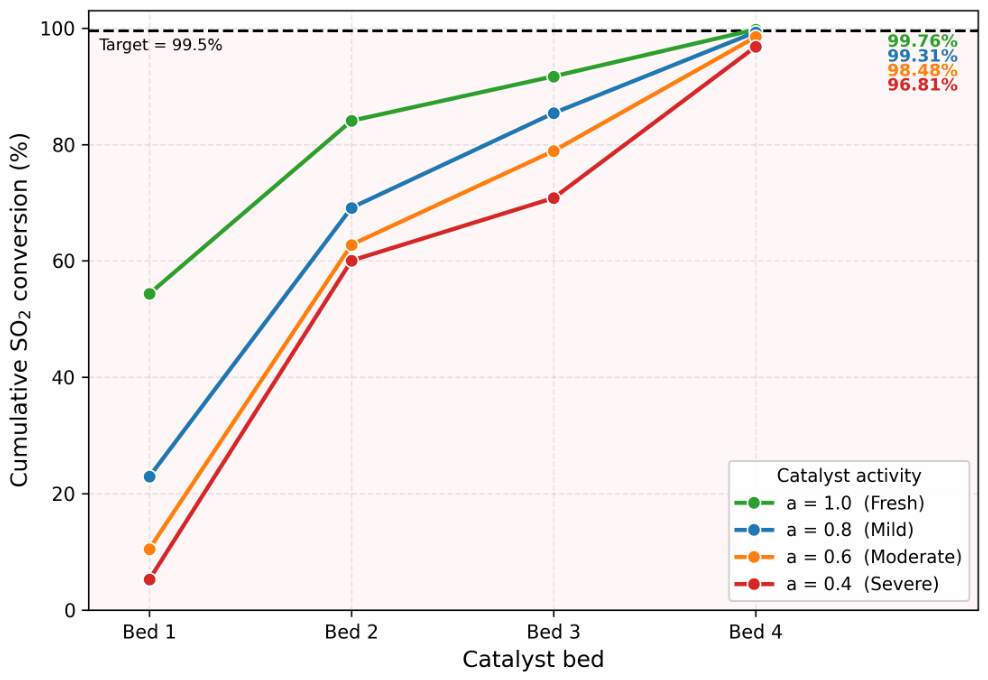
Figure 7.
Local sensitivity maps as functions of catalyst activity (a) and first-bed feed temperature (), generated from a regular grid of deterministic model predictions. (a) Final SO2 conversion (%). The dashed contour marks the 99.5% performance threshold; the green circle marks the validated operating point. (b) Outlet SO2 slip (mol%; multiply by for ppmv). The dashed contour marks the illustrative 0.10 mol% (1000 ppmv) screening value; the green circle marks the validated operating point. Color fields are based on regular-grid simulations; standard plotting interpolation is used only for visualization between neighboring grid points.
Figure 7.
Local sensitivity maps as functions of catalyst activity (a) and first-bed feed temperature (), generated from a regular grid of deterministic model predictions. (a) Final SO2 conversion (%). The dashed contour marks the 99.5% performance threshold; the green circle marks the validated operating point. (b) Outlet SO2 slip (mol%; multiply by for ppmv). The dashed contour marks the illustrative 0.10 mol% (1000 ppmv) screening value; the green circle marks the validated operating point. Color fields are based on regular-grid simulations; standard plotting interpolation is used only for visualization between neighboring grid points.
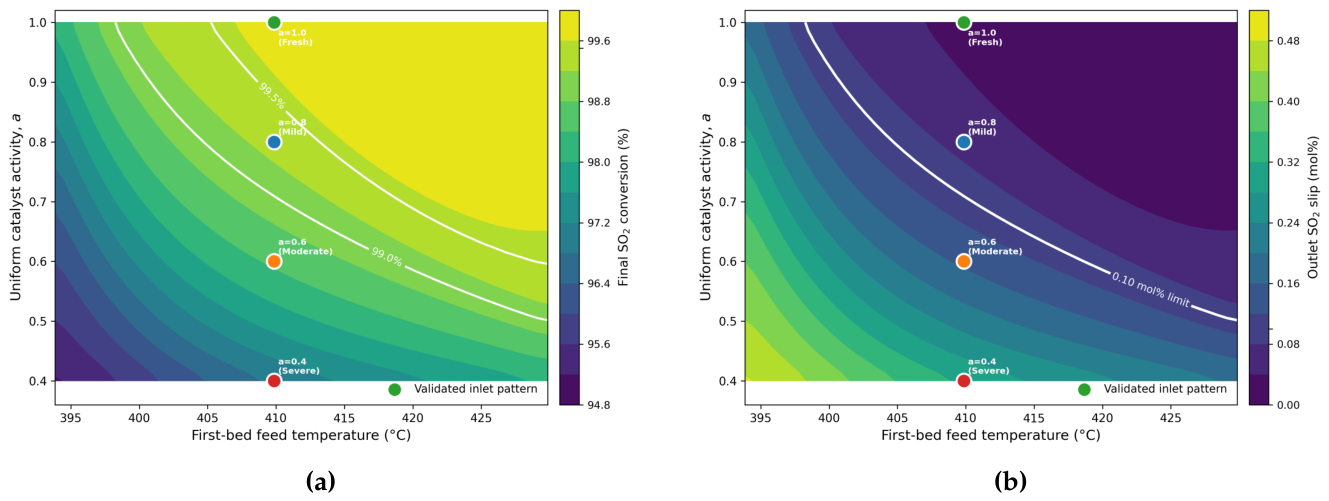
Figure 8.
Operating tradeoff maps as functions of catalyst activity (a) and first-bed feed temperature (), generated from a regular simulation grid. (a) Hotspot–conversion tradeoff: color scale represents final SO2 conversion (%); white iso-contours are hotspot temperature levels; the red contour marks the illustrative 650 °C constraint. The green circle is the validated fresh-reference point. (b) Integrated three-constraint map: the operating space is partitioned into four regions according to which subset of constraints (; mol%; C) are satisfied. The green shaded region is the intersection where all three constraints are simultaneously met; colored boundaries mark the individual constraint limits.
Figure 8.
Operating tradeoff maps as functions of catalyst activity (a) and first-bed feed temperature (), generated from a regular simulation grid. (a) Hotspot–conversion tradeoff: color scale represents final SO2 conversion (%); white iso-contours are hotspot temperature levels; the red contour marks the illustrative 650 °C constraint. The green circle is the validated fresh-reference point. (b) Integrated three-constraint map: the operating space is partitioned into four regions according to which subset of constraints (; mol%; C) are satisfied. The green shaded region is the intersection where all three constraints are simultaneously met; colored boundaries mark the individual constraint limits.
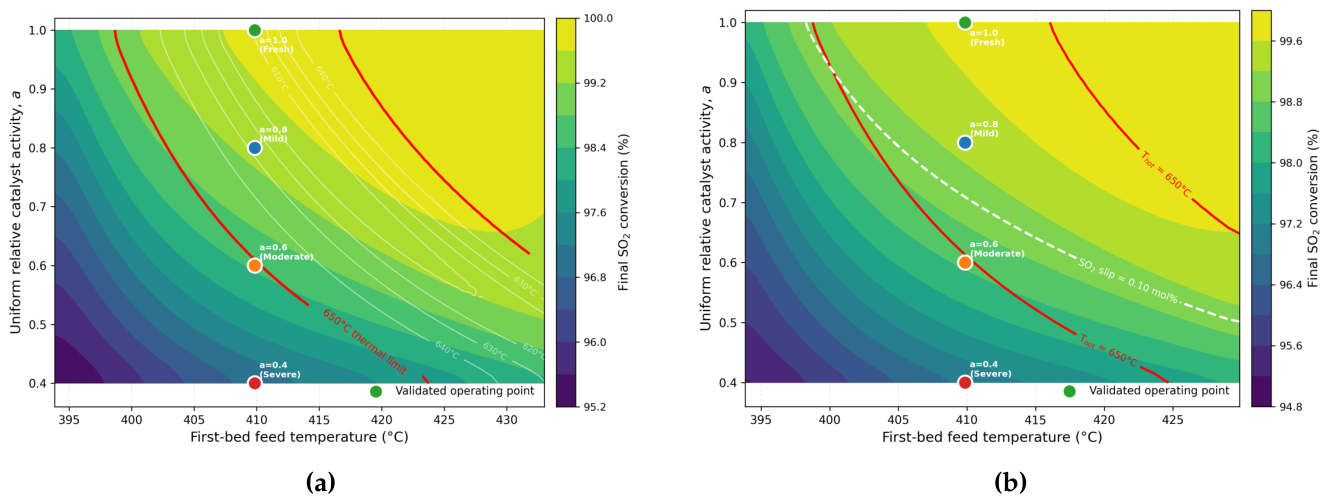
Figure 9.
Combined activity-loss vulnerability map as a function of catalyst activity (a) and first-bed feed temperature (). The color scale represents conversion loss relative to the fresh-catalyst reference () in percentage points; grey iso-contours are outlet SO2 slip levels (mol%); the dashed contour marks the 0.10 mol% screening threshold. Filled circles identify the four activity states at the reference inlet temperature. Values were simulated on a regular grid; standard contour interpolation is used only to visualize boundaries between neighboring grid points.
Figure 9.
Combined activity-loss vulnerability map as a function of catalyst activity (a) and first-bed feed temperature (). The color scale represents conversion loss relative to the fresh-catalyst reference () in percentage points; grey iso-contours are outlet SO2 slip levels (mol%); the dashed contour marks the 0.10 mol% screening threshold. Filled circles identify the four activity states at the reference inlet temperature. Values were simulated on a regular grid; standard contour interpolation is used only to visualize boundaries between neighboring grid points.
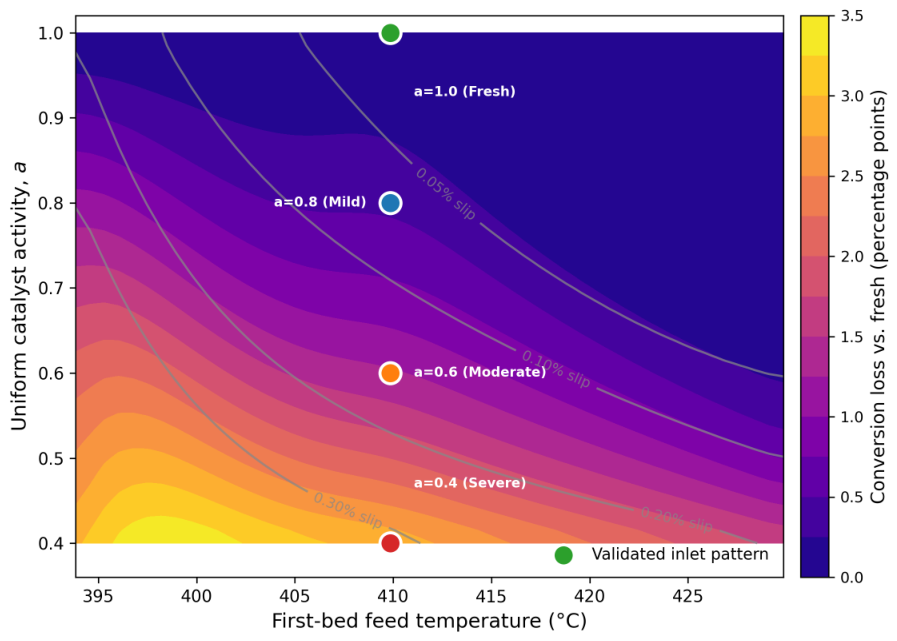
Figure 10.
Two-variable feasible operating region in the (a, ) plane, defined using the case-study constraints , mol% (1000 ppmv), and C. The shaded region is the feasible intersection; solid curves visualize threshold crossings estimated between neighboring points of the regular simulation grid.
Figure 10.
Two-variable feasible operating region in the (a, ) plane, defined using the case-study constraints , mol% (1000 ppmv), and C. The shaded region is the feasible intersection; solid curves visualize threshold crossings estimated between neighboring points of the regular simulation grid.
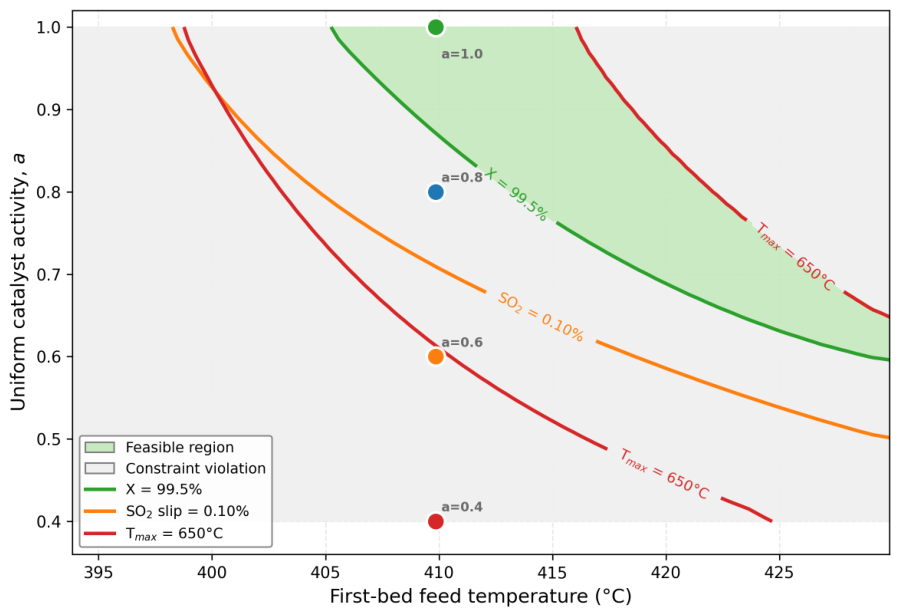
Figure 11.
Integrated activity-loss indicator summary. (a) Decomposition of the scenario-relative OERI into normalized conversion-loss, SO2-slip-increase, and hotspot-margin-loss contributors. (b) OERI-based scenario ordering across the four activity states; the ordering is relative to the investigated scenario set and is not a validated maintenance or replacement rule. (c) Summary of conversion loss (percentage points), outlet SO2 slip increase (mol%), scenario-relative OERI, and hotspot safety-margin loss (K). Reduced-activity values are deterministic predictions extrapolated from a model evaluated at the fresh reference condition.
Figure 11.
Integrated activity-loss indicator summary. (a) Decomposition of the scenario-relative OERI into normalized conversion-loss, SO2-slip-increase, and hotspot-margin-loss contributors. (b) OERI-based scenario ordering across the four activity states; the ordering is relative to the investigated scenario set and is not a validated maintenance or replacement rule. (c) Summary of conversion loss (percentage points), outlet SO2 slip increase (mol%), scenario-relative OERI, and hotspot safety-margin loss (K). Reduced-activity values are deterministic predictions extrapolated from a model evaluated at the fresh reference condition.
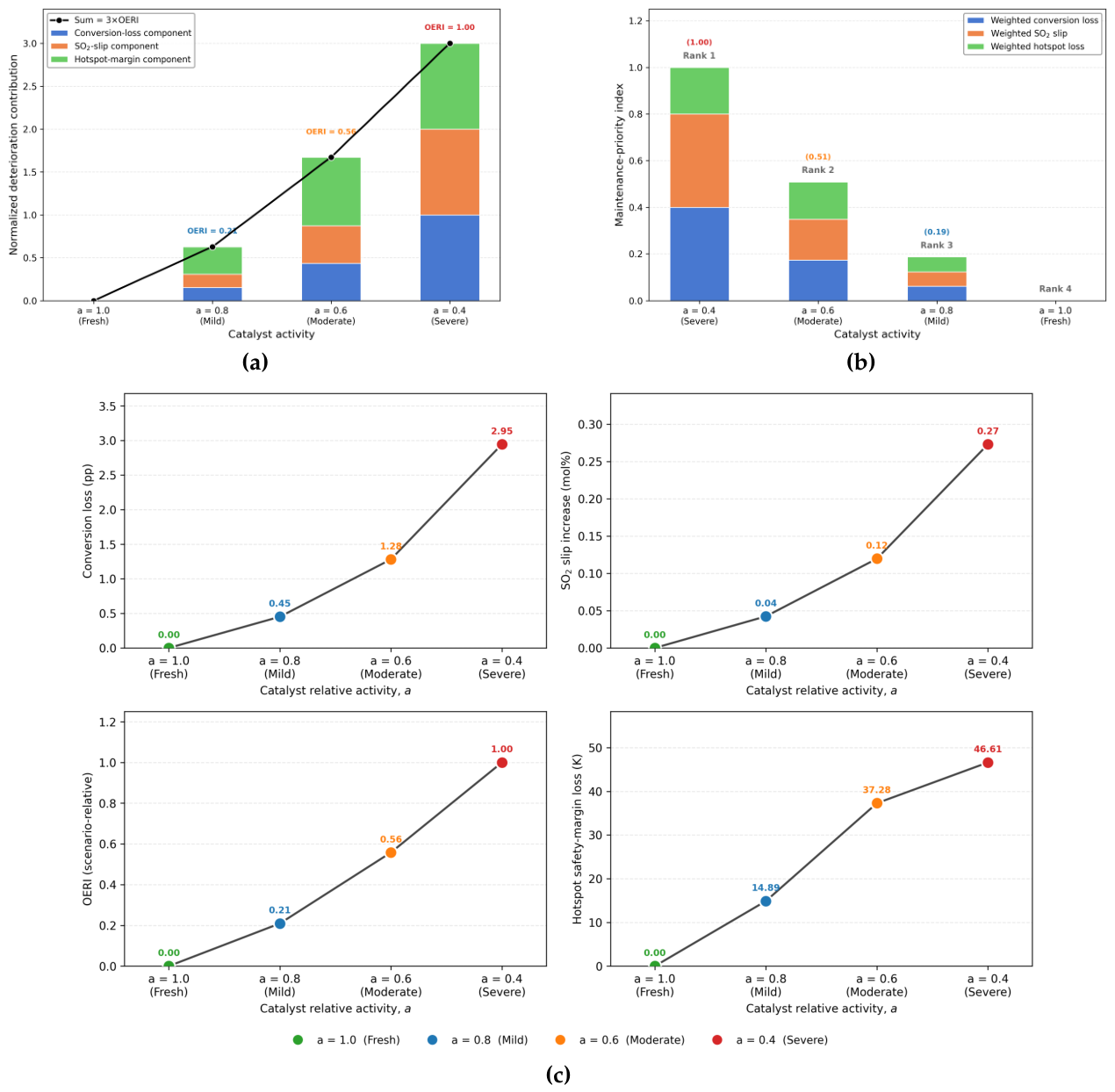
Figure 12.
One-at-a-time local sensitivity analysis and decision-threshold test for the uniform activity-loss scenario. Bars show changes from the nominal prediction in final conversion, outlet SO2 slip, and thermal margin. The kinetic scale and feed SO2/O2 mole fractions were varied by . Because the nominal absorber efficiency is near unity, the residual SO3 fraction was varied by . The adopted thermal constraint was varied separately by to test classification robustness; this boundary test changes the margin but not reactor outputs.
Figure 12.
One-at-a-time local sensitivity analysis and decision-threshold test for the uniform activity-loss scenario. Bars show changes from the nominal prediction in final conversion, outlet SO2 slip, and thermal margin. The kinetic scale and feed SO2/O2 mole fractions were varied by . Because the nominal absorber efficiency is near unity, the residual SO3 fraction was varied by . The adopted thermal constraint was varied separately by to test classification robustness; this boundary test changes the margin but not reactor outputs.
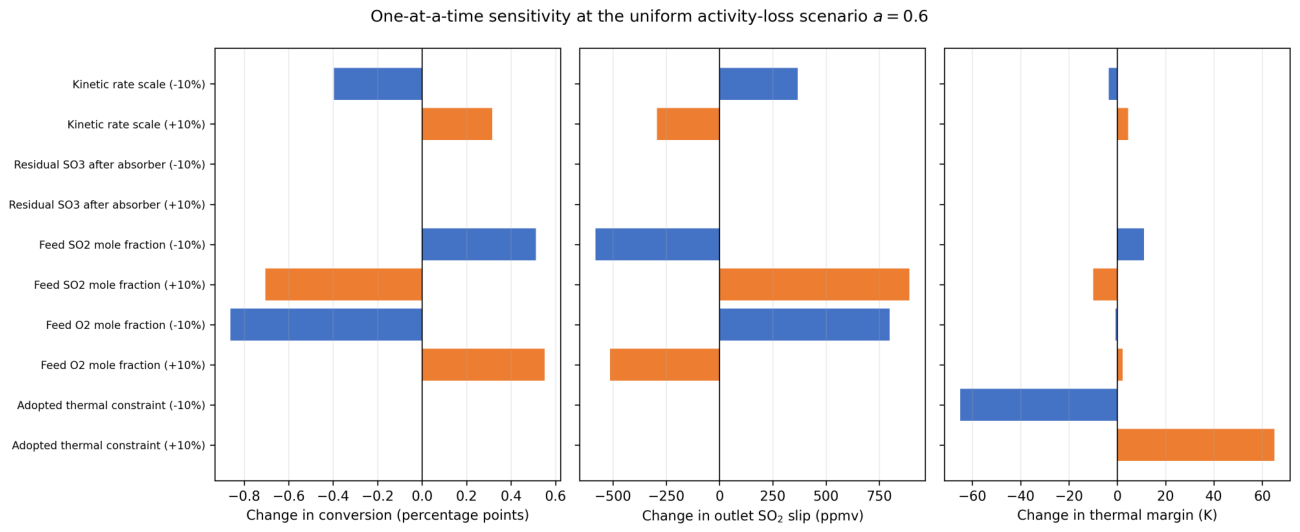
Table 2.
Main model parameters, feed conditions, and operating conditions for the Gómez-García et al. industrial benchmark.
Table 2.
Main model parameters, feed conditions, and operating conditions for the Gómez-García et al. industrial benchmark.
| Parameter | Value | Unit |
|---|---|---|
| Number of catalyst beds | 4 | – |
| Reactor configuration | DCDA converter | – |
| Bed type | Adiabatic fixed bed | – |
| Reaction | SO2 + O2 ⇌ SO3 | – |
| Feed SO2 mole fraction | 0.0836 | mol/mol |
| Feed O2 mole fraction | 0.0890 | mol/mol |
| Feed N2 mole fraction | 0.8274 | mol/mol |
| Total mass flow rate | 5000 | kg h−1 |
| Heat of reaction () | kJ mol−1 | |
| Catalyst activity levels | 1.0, 0.8, 0.6, 0.4 | – |
| Intermediate SO3 absorption | Included after Bed 3 | – |
| Absorption efficiency (after Bed 3) | 0.999 | – |
| Pressure | 2.0265 | bar |
| Bed inlet temperatures (Beds 1–4) | 683.0, 729.6, 720.2, 701.9 | K |
| Catalyst inventory (Beds 1–4) | 8121, 12994, 8663, 14618 | kg |
| Kinetic model | Collina/Hougen–Watson | – |
Table 3.
Collina/Hougen–Watson kinetic constants for SO2 oxidation used in this work (Equations 20–23).
Table 3.
Collina/Hougen–Watson kinetic constants for SO2 oxidation used in this work (Equations 20–23).
| Constant | Expression (T in K) | Physical meaning |
|---|---|---|
| Forward rate constant | ||
| SO2 adsorption equilibrium constant | ||
| SO3 adsorption equilibrium constant | ||
| Reaction thermodynamic equilibrium constant | ||
| Units: in kmol h−1 atm−2; , in atm−1; in atm−1/2. | ||
Table 4.
Representative fresh-benchmark model-evaluation results.
| Variable | Industrial/reference value | Model prediction | Relative error (%) |
|---|---|---|---|
| Bed 1 outlet temperature (K) | 887.0 | 886.9 | 0.01 |
| Bed 2 outlet temperature (K) | 839.0 | 840.7 | 0.20 |
| Bed 3 outlet temperature (K) | 749.0 | 749.0 | 0.00 |
| Bed 4 outlet temperature (K) | 738.0 | 738.0 | 0.00 |
| Overall SO2 conversion (%) | 99.7 | 99.758 | 0.06 |
| Outlet SO2 slip (mol%) | N/R | 0.02296 | – |
| N/R: not reported in the Gómez-García et al. industrial reference. | |||
Table 5.
Thermal indicators predicted for the SO2 converter activity scenarios.
| Catalyst activity | Hotspot bed | Hotspot temp. (°C) | Safety margin (K) | Status |
|---|---|---|---|---|
| 1.0 | 1 | 613.7 | +36.3 | Within adopted constraint |
| 0.8 | 2 | 628.6 | +21.4 | Within adopted constraint |
| 0.6 | 2 | 651.0 | −1.0 | Exceeds constraint by 1.0 K (near boundary) |
| 0.4 | 2 | 660.3 | −10.3 | Exceeds adopted constraint |
Table 8.
Effect of non-uniform bed activity distribution on converter performance. Bed outlet temperatures, overall SO2 conversion, global hotspot temperature, and hotspot safety margin are compared for uniform and non-uniform activity profiles at equivalent or near-equivalent average activities.
Table 8.
Effect of non-uniform bed activity distribution on converter performance. Bed outlet temperatures, overall SO2 conversion, global hotspot temperature, and hotspot safety margin are compared for uniform and non-uniform activity profiles at equivalent or near-equivalent average activities.
| Activity profile | Avg. a | (°C) | (°C) | (°C) | (°C) | Percentage conversion (%) | (°C) | Margin (K) |
|---|---|---|---|---|---|---|---|---|
| Uniform (reference) | 1.00 | 613.7 | 567.6 | 475.8 | 464.9 | 99.758 | 613.7 | +36.3 |
| Uniform | 0.60 | 449.9 | 651.0 | 507.7 | 514.0 | 98.476 | 651.0 | −1.0 |
| Non-uniform | 0.60 | 429.9 | 660.3 | 534.1 | 498.4 | 99.078 | 660.3 | −10.3 |
| Non-uniform | 0.65 | 429.9 | 660.4 | 525.5 | 506.8 | 98.784 | 660.4 | −10.4 |
| Non-uniform | 0.70 | 429.9 | 660.4 | 534.1 | 498.4 | 99.079 | 660.4 | −10.4 |
Table 9.
Positioning of the present work relative to representative previous studies.
| Feature | SO2 converter modelinga | Deactivation studiesb | Pappagallo et al. [17] | Present work |
|---|---|---|---|---|
| SO2 converter modeling | Yes | No | No | Yes |
| Catalyst activity analysis | Limited | Yes | Yes | Yes |
| Bed-wise temperature profiles | Yes | Yes | Yes | Yes |
| Bed-wise conversion profiles | Yes | Yes | Yes | Yes |
| SO2 slip analysis | Limited | No | No | Yes |
| Conversion-loss maps | No | Limited | No | Yes |
| Feasible-region analysis | No | No | No | Yes |
| Feasible-region shrinkage due to activity loss | No | No | No | Yes |
| Composite activity-loss index | No | No | No | Yes |
| Scenario-screening ranking | No | No | No | Yes |
| Decision-support capability | Limited | Limited | Limited | Yes |
| a Representative SO2 converter modeling studies: [2,3,4,10,11,12]. | ||||
| b Representative catalyst-deactivation studies: [5,6,7]. | ||||
| “Limited”: the feature is partially addressed but not systematically quantified or presented as a primary result. | ||||
Table 10.
Principal findings and industrial implications.
| Observation | Quantitative result | Industrial implication |
|---|---|---|
| Conversion drop | 99.758% → 96.812% ( pp) | Reduced acid production efficiency |
| SO2 slip rise | 230 → 2960 ppmv | Increased stack emissions; potential regulatory exceedance |
| Hotspot migration | Bed 1 → Bed 2 at | Downstream thermal risk; Bed 2 monitoring becomes critical |
| Safety-margin loss | K → K | Adopted constraint exceeded at ; temperature flexibility reduced |
| Feasible-region shrinkage | Progressive from to | Operating window narrows; temperature compensation increasingly limited |
| Non-uniform activity effect | C hotspot vs. equal mean a | Average activity underestimates thermal risk; bed-resolved monitoring required |
| OERI ordering | 0.000 (Low) → 1.000 (Critical) | Scenario-relative screening only; plant calibration required |
| pp: percentage points; ppmv: dry molar basis; reduced-activity results are deterministic predictions anchored to the fresh benchmark. | ||
Disclaimer/Publisher’s Note: The statements, opinions and data contained in all publications are solely those of the individual author(s) and contributor(s) and not of MDPI and/or the editor(s). MDPI and/or the editor(s) disclaim responsibility for any injury to people or property resulting from any ideas, methods, instructions or products referred to in the content. |
© 2026 by the authors. Licensee MDPI, Basel, Switzerland. This article is an open access article distributed under the terms and conditions of the Creative Commons Attribution (CC BY) license (http://creativecommons.org/licenses/by/4.0/).
Copyright: This open access article is published under a Creative Commons CC BY 4.0 license, which permit the free download, distribution, and reuse, provided that the author and preprint are cited in any reuse.


