

Submitted:
20 June 2026
Posted:
24 June 2026
You are already at the latest version
Abstract
The scope o this study is to evidence by numerical simulation the influence of various parameters on the efficiency of an enzymatic packed bed reactor. The main characteristic of this reactor is that it contains a packed bed of immobilized enzymes crossed by a liquid substrate stream in order to get the desired product. This is carried out in order to evidence the influence of operating parameters on the substrate conversion rate at the reactor exit. The studied parameters are: bed thickness, feed flow rate, bed density and internal efficiency factor. The obtained results showed how would be these parameters in order to increase the substrate conversion rate at the reactor exit.
Keywords:
bioreactor
; enzyme
; operating parameters
; packed bed
; conversion
1. Introduction
This research studies an enzymatic reactor because it is very used in the food industry in order to produce various products [1]. In the following some industrial uses of enzymes will be cited. The α-amylase enzyme is used to eliminate the starch from the beer liquors and it is also used for the liquefaction of the starch used in the sugar based syrups. The β-galactosidase enzyme is used to eliminate the lactose for producing milk products having low concentration of lactose. The chymosine enzyme is used for proteins coagulating for the cheeses production. The invertase enzyme is used is used for the liquefaction of the saccharose also in the sugar based syrups. The pectinase enzyme is used for the clarification of the fruit juices. The protease enzyme is used for lowering the gluten concentration in the breed and biscuits. The glucose oxydase enzyme is used for the elimination of the oxygen from the fruit juices and, finally, the glucose isomerase is used for the conversion of glucose to fructose in the production of juices having high concentration of fructose [1].
In this study, an enzymatic reaction is assumed to be carried out in an continuous packed bed reactor in order to produce fructose from the conversion of glucose by using the glucose isomerise enzyme which is bonded to the solid particles constituting a packed bed [2,3,4]. This study investigates the effect of operating parameters on the efficiency of the enzymatic packed bed because the parametric sensivity can give important information on the run of a given process [5,6]. For this purpose, the mathematical model of an enzymatic packed bed reactor was set and solved using the data related to a nominal operating point. Afterwards, the influence on the glucose conversion of the main operative variables was evidenced.
2. The Continuous Enzymatic Packed Bed Reactor
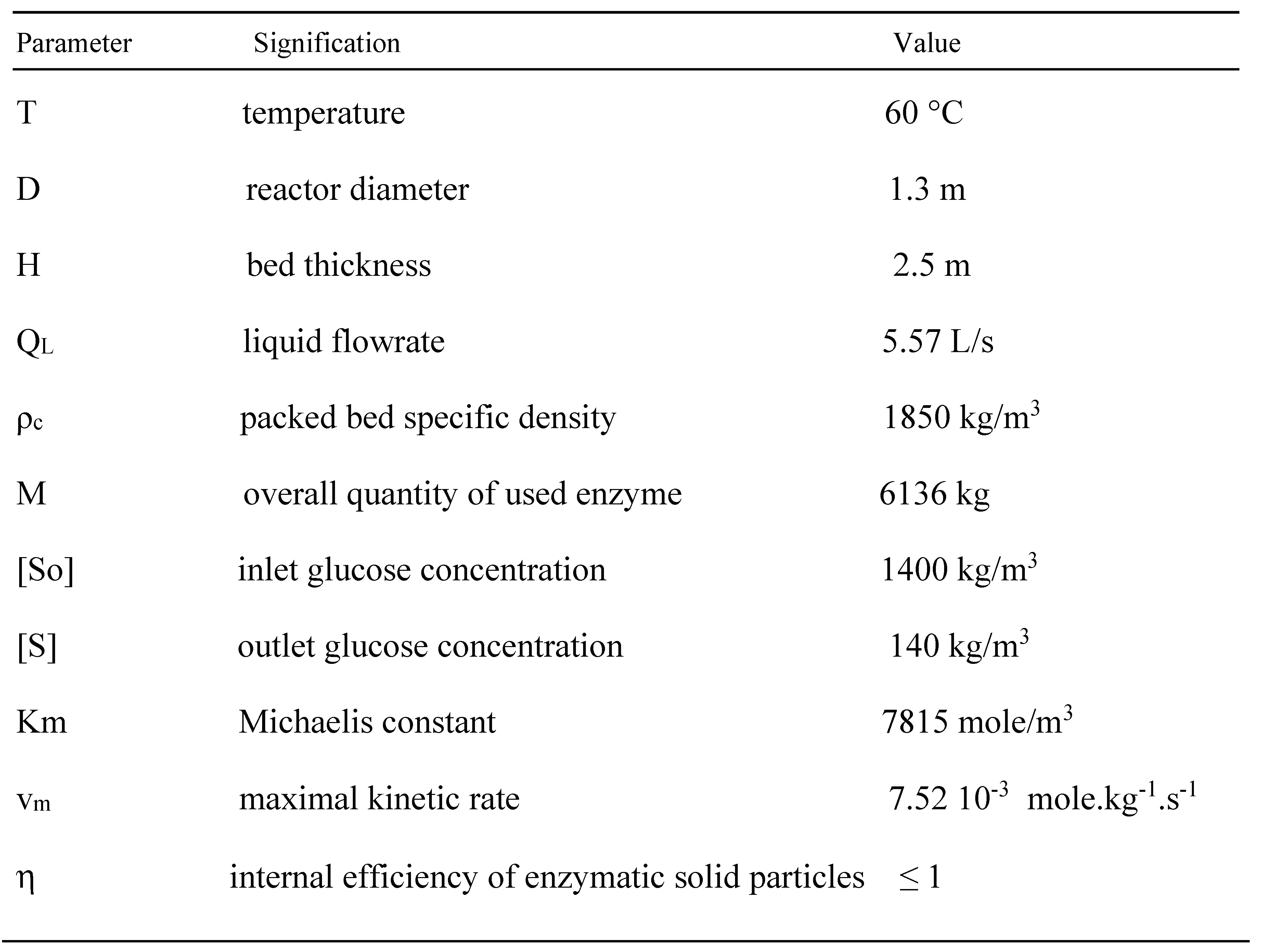
A flowsheet of the continuous enzymatic packed bed reactor is presented in Figure 1 [1]. The reactor consists of a column containing a solid packed bed. The packed bed is formed of solid inert particles onto which the enzymes are bounded in order not to be evacuated out of the reactor by the liquid stream. The feed entering the reactor is entirely liquid and it consist generally of a glucose solution. At the exit of the reactor, the liquid stream will contain a high concentration of fructose. Table 1 gives additional parameter values related to the studied process.
3. Model Assumptions
The main model assumptions are listed below [1]:
-isothermal operation;
- constant volume flow rate throughout the reactor;
- no pressure drop of the liquid phase throughout the reactor;
-negligible influence of external liquid –solid mass transfer.
4. Mathematical Model and Method of Resolution
The mathematical model of the enzymatic packed bed reactor can be resumed essentially to the following dimensionless differential equation [1]:
d[S*]/dz* = -(M.vm.S*.z*)/[QL.[So].(K*+S*.z*)] (1)
with
[S*] = [S]/[So] (dimensionless substrat or glucose concentration)
X = 1-S* (substrat or glucose conversion rate)
z*= z/H (dimensionless axial coordinate)
M = (ρc . π. D2 .H)/4 (overall quantity of used enzyme)
vm = η .0.0175 mole/(s.kg ) (maximal kinetic rate)
K* = Km/[So] (dimensionless Michaelis constant)
The boundary condition of equation (1) is as follows:
z* = 0 [S*] = 1
Equation (1) was solved by using fourth order Runge-Kutta method [4].
5. Results and Discussion
5.1. Glucose Conversion Versus Reactor Diameter for Different Values of Bed Thickness
Figure 2 shows the effect of varying reactor diameter on the glucose conversion for different values of bed thickness. It can be seen that the glucose conversion is very sensitive to the bed thickness; this effect can be explained by the fact that the increase of the bed thickness increases the specific liquid solid area and consequently the enzymatic reaction is enhanced. Moreover, for a fixed value of the reactor diameter, the glucose conversion increases as the bed thickness becomes higher. This last effect is very pronounced at low reactor diameter relatively to high diameter values.
5.2. Glucose Conversion Versus Reactor Diameter for Different Values of Volume Flow Rate
Figure 3 shows the effect of varying reactor diameter on the glucose conversion for different values of volume flowrate. It can be seen that for a fixed value the volume flowrate, the glucose conversion increases as a function of the reactor diameter. Furthermore, for a fixed value of the reactor diameter, the glucose conversion increases if the volume flow rate decreases ; this effect can be explained by the fact that the increase of the volume flow rate has a tendency to induce a flow congestion in the reactor and consequently the enzymatic reaction decelerates. This last effect is very pronounced at low reactor diameter relatively to high diameter values.
5.3. Glucose Conversion Versus Reactor Diameter for Different Values of the Specific Density of the Packed Bed
Figure 4 shows the effect of varying reactor diameter on the glucose conversion for different values of the specific density of the packed bed. It can be seen that for a fixed value of the specific density of the packed bed, the glucose conversion increases as a function of the reactor diameter. Furthermore, for a fixed value of the reactor diameter, the glucose conversion increases if the specific density of the packed bed increases; this effect can be explained by the fact that the increase of the specific density of the packed bed increases the specific liquid solid area and consequently the reaction is improved.
5.4. Glucose Conversion Versus Reactor Diameter for Different Values of Internal Efficiency of Enzymatic Solid Particles
Figure 5 shows the effect of varying reactor diameter on the glucose conversion for different values of the internal efficiency of enzymatic solid particles. It can be seen that for a fixed value of the internal efficiency, the glucose conversion increases as a function of the reactor diameter. Moreover, for a fixed value of the reactor diameter, the glucose conversion increases if the internal efficiency increases; this effect can be explained by the fact that the increase of the internal efficiency increases and improves the liquid- solid mass transfer or glucose transfer towards the solid particles and consequently the reaction is enhanced.
6. Conclusion
This research presented the effects of important operating parameters on the enzymatic conversion of glucose to fructose taking place in a packed bed reactor. Four operating parameters were studied, namely: the bed thickness, the volume flowrate, the specific density of the packed bed and the internal efficiency of enzymatic solid particles. The obtained results showed that for a given value of the reactor diameter, the glucose conversion rate is very sensitive to the packed bed thickness and it increase as the bed thickness increases. The glucose conversion rate is very sensitive to the volume flowrate and it increases if the volume flowrate decreases, and reciprocally, due to flow congestion effects. Furthermore, it was found that the glucose conversion rate increases as the specific density of the packed bed increases due probably to the increase of the number of the reaction sites. Finally, it was found that the glucose conversion rate increases as the internal efficiency of enzymatic solid particles increases due to the improvement of the mass transfer of the substrate (glucose) towards the reaction sites inside the solid particles.
References
- Vafajoo, L.; Beigy, B. A Dynamic Model for Glucose Fermentation in a Three-Phase Bioreactor. APCBEES Procedia 2013, F36000, 2–5. [Google Scholar]
- Riba, J. P. Réacteurs enzymatiques et fermenteurs. Tech. De L’ingénieur 2000, F36000, 1–22. [Google Scholar]
- Shcherbakova-Sandu, M.P.; Meshcheryakov, E.P.; Gulevich, S.A.; Kushwaha, A.K.; Kumar, R.; Sonwane, A.K.; Samal, S.; Kurzina, I.A. Use of Glucose Obtained from Biomass Waste for the Synthesis of Gluconic and Glucaric Acids: Their Production, Application, and Future Prospects. Molecules 2025, 30, 3012. [Google Scholar] [CrossRef] [PubMed]
- Jana, A. K. chemical process modelling and computer simulation; PHI learning private Limited, 2008; ISBN -978-81-203-3196-9. [Google Scholar]
- Bendjaouahdou, C. Parametric study of a ternary batch distillation column. Res. Sq. 2024, 1(1), 14. [Google Scholar] [CrossRef] [PubMed]
- Bendjaouahdou, C. Influence of Operating Parameters on the Efficiency of a Multi-Components Flash Distillation Operation. Preprints.org 2024. [Google Scholar] [CrossRef]
Figure 1.
Flowsheet of continuous enzymatic packed bed reactor [1].
Figure 1.
Flowsheet of continuous enzymatic packed bed reactor [1].
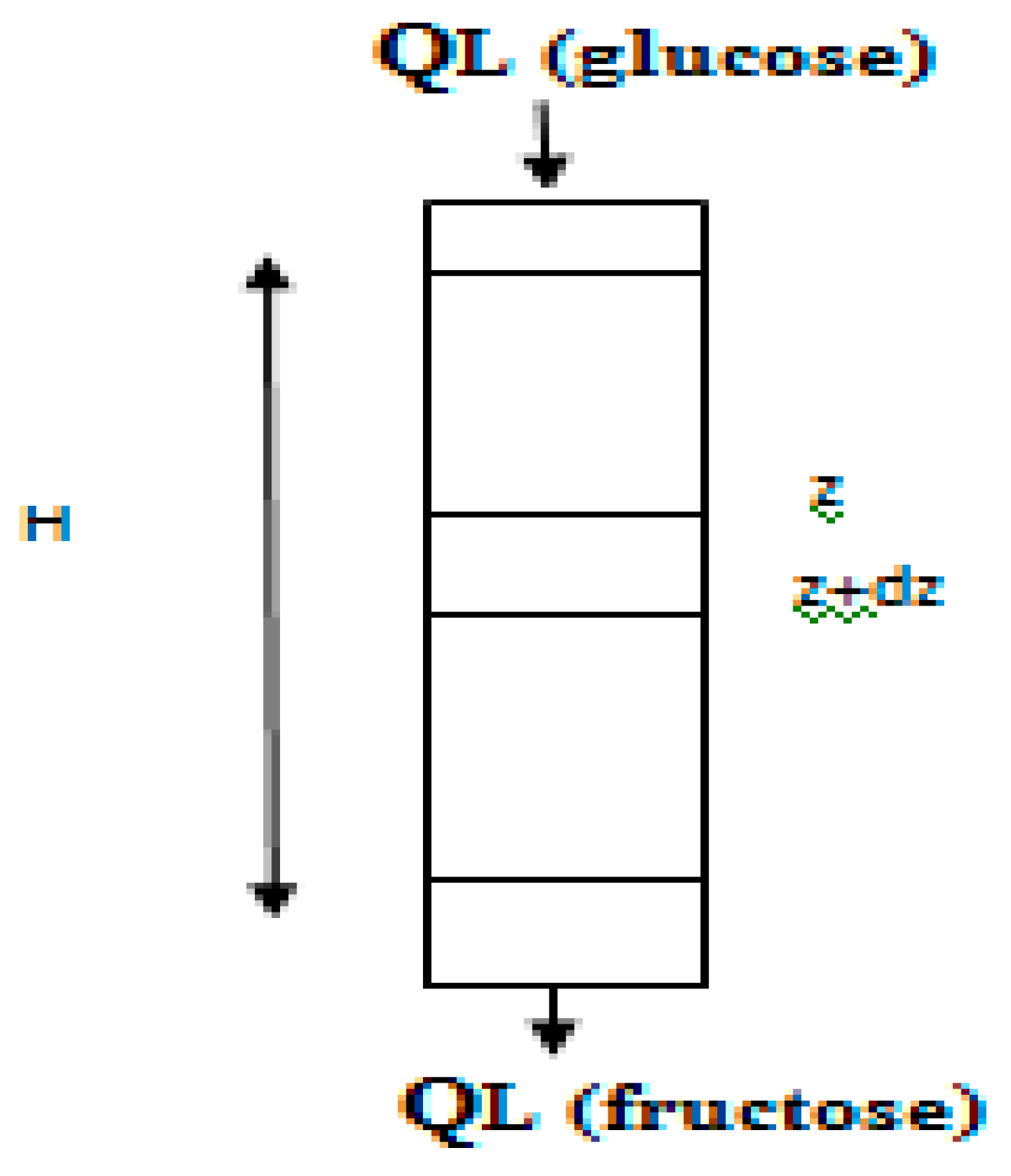
Figure 2.
Glucose conversion (X) versus reactor diameter (D) for different values of bed thickness (H).
Figure 2.
Glucose conversion (X) versus reactor diameter (D) for different values of bed thickness (H).
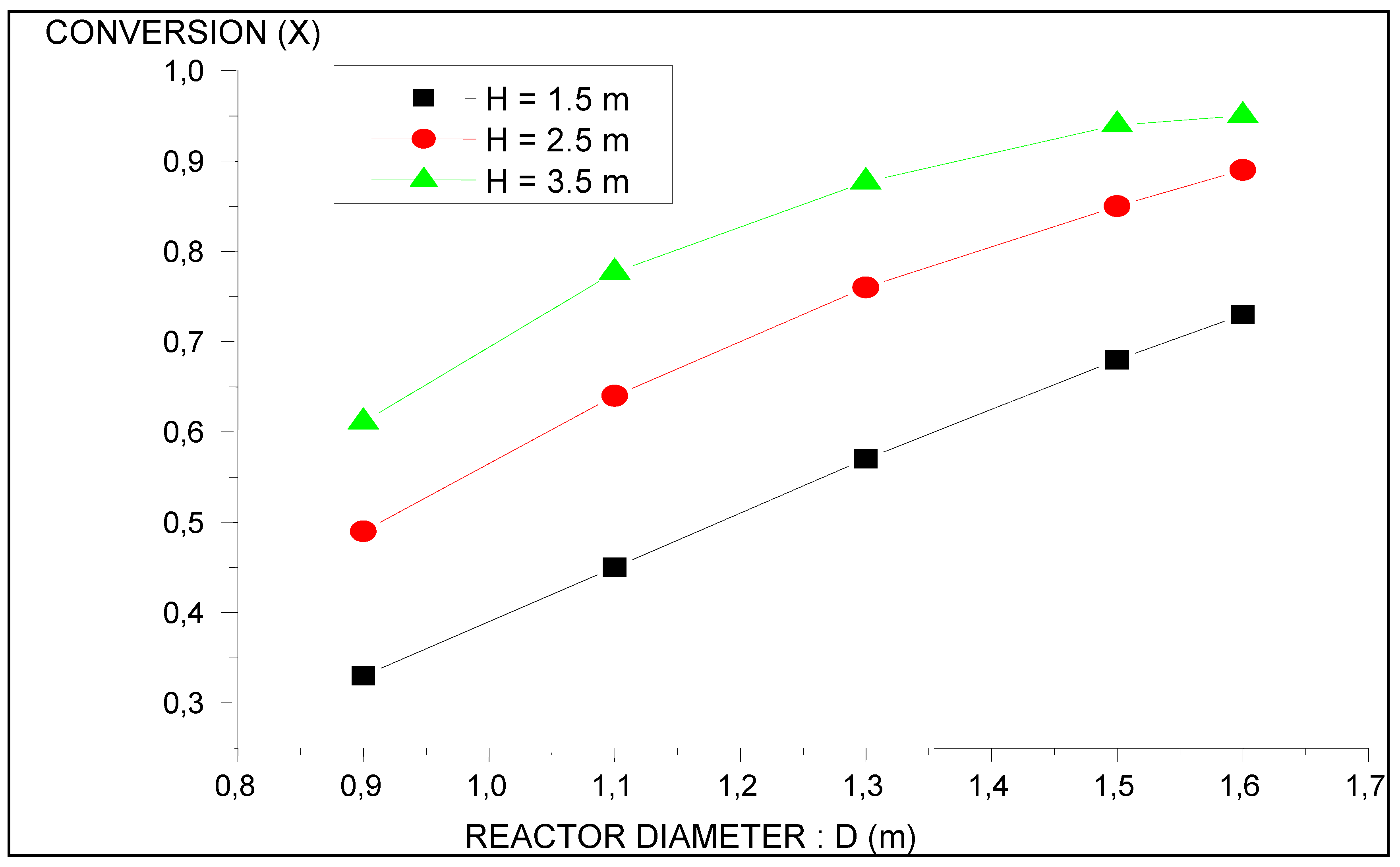
Figure 3.
Glucose conversion (X) versus reactor diameter (D) for different values of volume flowrate (QL).
Figure 3.
Glucose conversion (X) versus reactor diameter (D) for different values of volume flowrate (QL).
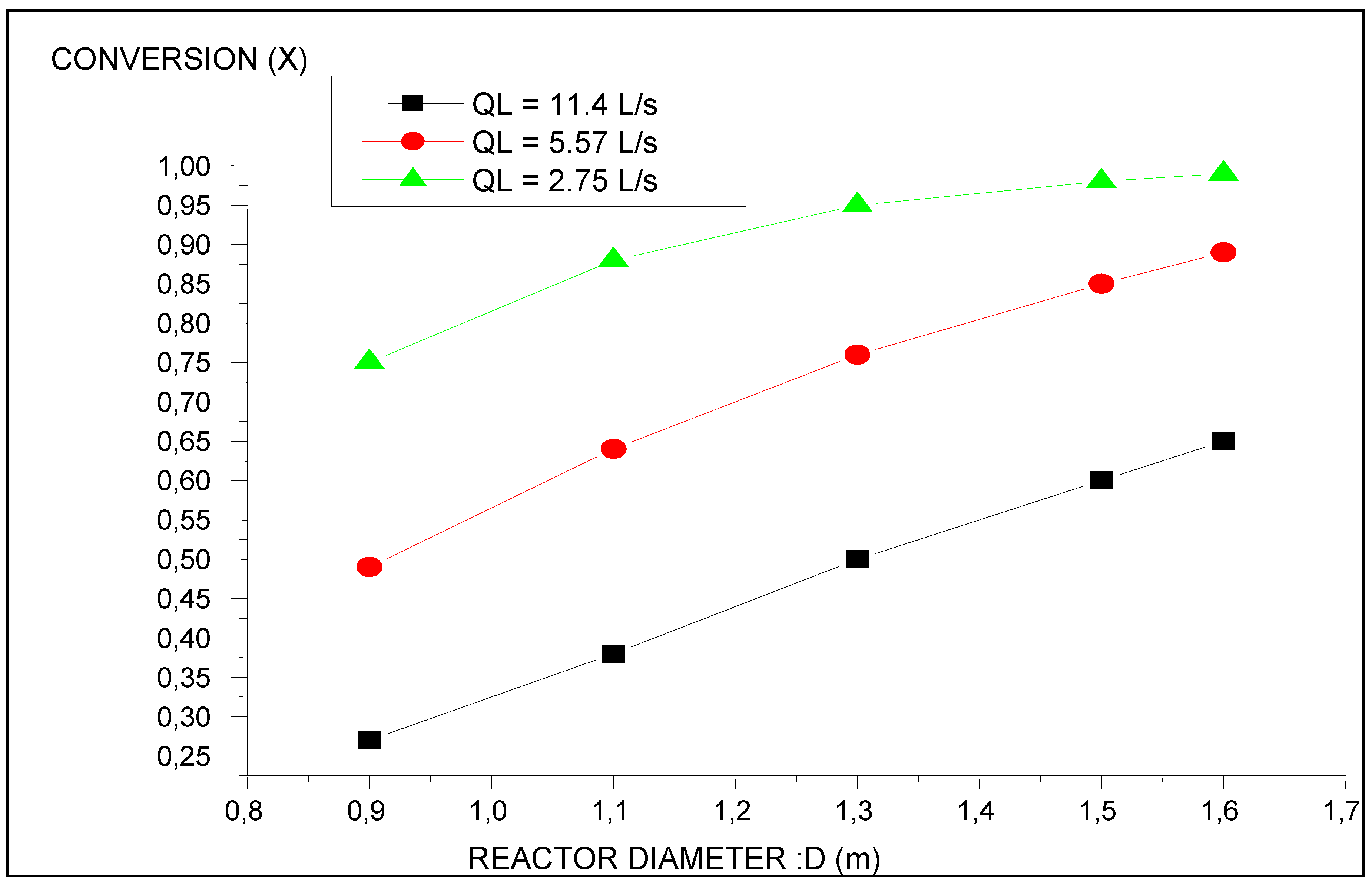
Figure 4.
Glucose conversion (X) versus reactor diameter (D) for different values of the specific density of the packed bed (ρC).
Figure 4.
Glucose conversion (X) versus reactor diameter (D) for different values of the specific density of the packed bed (ρC).
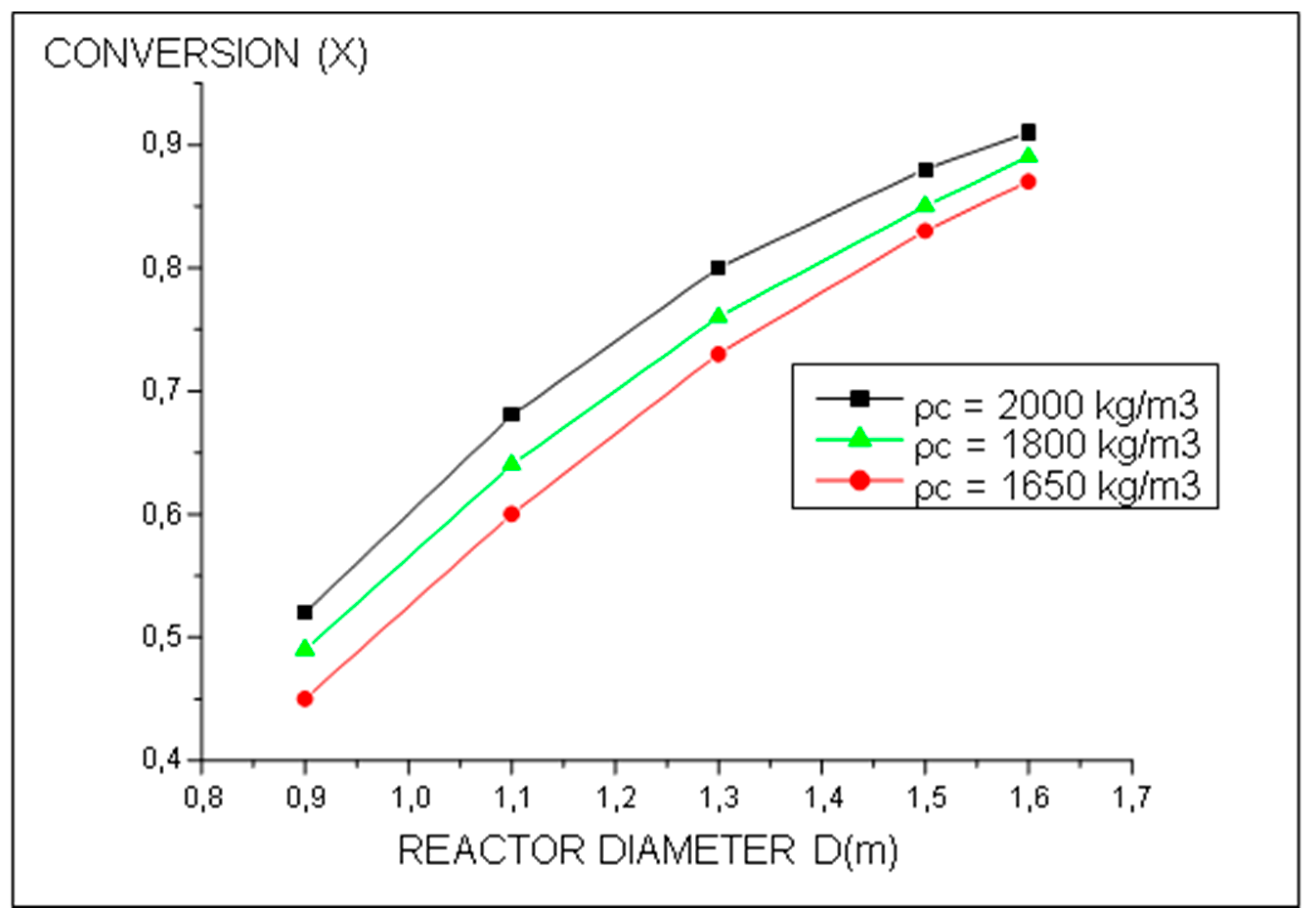
Figure 5.
Glucose conversion (X) versus reactor diameter (D) for different values of the internal efficiency of enzymatic solid particles (η).
Figure 5.
Glucose conversion (X) versus reactor diameter (D) for different values of the internal efficiency of enzymatic solid particles (η).
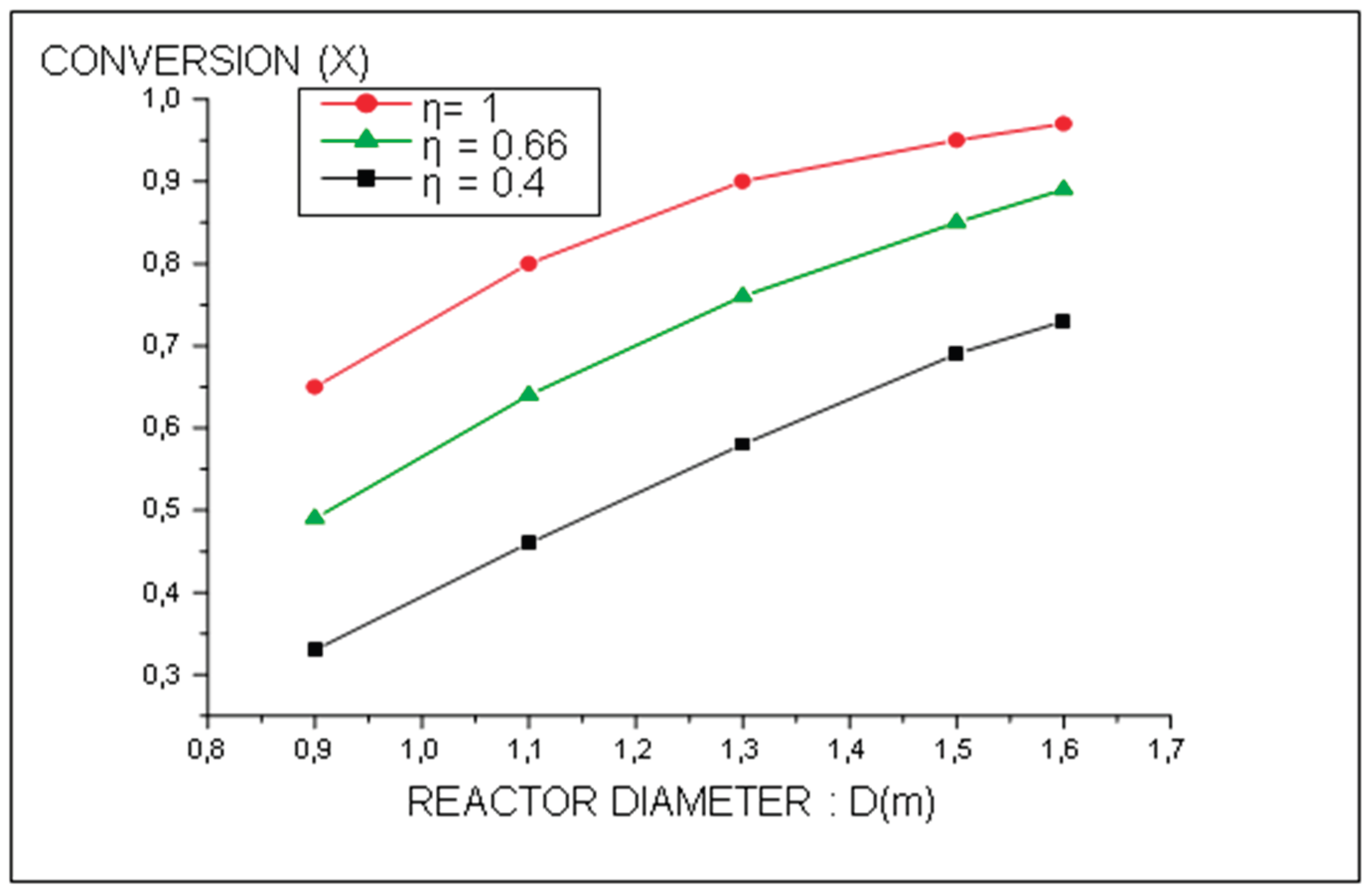

Table 1.
Parameters values for the enzymatic packed bed reactor [1].
Table 1.
Parameters values for the enzymatic packed bed reactor [1].
 |
Disclaimer/Publisher’s Note: The statements, opinions and data contained in all publications are solely those of the individual author(s) and contributor(s) and not of MDPI and/or the editor(s). MDPI and/or the editor(s) disclaim responsibility for any injury to people or property resulting from any ideas, methods, instructions or products referred to in the content. |
© 2026 by the authors. Licensee MDPI, Basel, Switzerland. This article is an open access article distributed under the terms and conditions of the Creative Commons Attribution (CC BY) license (http://creativecommons.org/licenses/by/4.0/).
Copyright: This open access article is published under a Creative Commons CC BY 4.0 license, which permit the free download, distribution, and reuse, provided that the author and preprint are cited in any reuse.


