

Submitted:
20 June 2026
Posted:
24 June 2026
You are already at the latest version
Abstract
Plant-mediated biosynthesis of metal nanoparticles is an environmentally friendly, sustainable, and green strategy for the fabrication of nanomaterials, which can be used as an alternative to conventional methods such as physical and chemical reduction techniques. Rich in polyphenols, flavonoids, terpenoids, proteins, and other bioactive components, plants act as reducing, capping, and stabilizing agents simultaneously to synthesize nanoparticles with mild reaction conditions and environmentally friendly reagents. In this review, recent advances in plant-originated biosynthesis of metal nanoparticles are highlighted, focusing on silver (Ag), gold (Au), and copper (Cu) nanoparticles. The mechanisms for plant-mediated nanoparticle biosynthesis, including the processes of bioreduction, nucleation, growth, and stabilization, are discussed in detail, along with the effects of key parameters during synthesis on the morphology and physicochemical properties of metal nanoparticles. Both extract-mediated and direct biomass-mediated biosynthesis routes for metal nanoparticles are discussed in detail. The advantages of these two biosynthesis approaches on the control of size and shape of metal nanoparticles, including the control of crystallinity and the advanced architectures of anisotropic nanostructures and metal/carbon hybrids, are compared. In addition, the major applications of plant-derived metal nanoparticles in antibacterial and anticancer therapy, environmental catalysis, and emerging electronic devices are summarized. The synergistic effects of phytochemical corona on biological activity, catalytic activity, and functional stability of metal nanoparticles are discussed in detail. Finally, the current challenges in this field and commercialization are analyzed and future research directions toward the rational design and industrial application of plant-derived nanomaterials are proposed.
Keywords:
plant-mediated biosynthesis
; metal nanoparticles
; antibacterial
; anticancer
; catalysis
; electronic devices
1. Introduction
Nanotechnology has matured into a revolutionary technology of great impact in medicine, catalysis, electronics and environmental remediation. All kinds of nanomaterials have been extensively investigated, and metal nanoparticles such as Ag, Au, and Cu nanoparticles have drawn great attention due to their unique optical, electronic and surface properties compared with their corresponding bulk materials [1,2]. Control synthesis of metal nanoparticles with desired size, morphology and surface chemistry is still a great challenge since these basic parameters significantly affect their performance in their ultimate applications [3]. Traditional methods of metal nanoparticle synthesis, such as chemical reduction and physical methods, use toxic reagents, organic solvents, and energy-intensive conditions that are environmentally hazardous and detrimental to human health [4]. Given the need for green manufacturing in contemporary society, there has been a strong drive toward the exploration of green synthesis processes that reduce or eliminate the need for toxic chemicals in the reaction mixture [5,6]. Of all the biological systems that have been reported for such applications (e.g., bacteria, fungi, and algae), plants are especially attractive because they are easily accessible, inexpensive, and contain a large diversity of bioactive compounds [5,7]. Plant materials including leaves, seeds, bark, fruits, stems and roots contain a plethora of natural products like polyphenols, flavonoids, terpenoids, alkaloids, saponins, tannins and proteins [1,7]. These phytochemicals are responsible for two different processes during nanoparticle biosynthesis: (i) reduction of metal ions to their zero-valent metallic state and (ii) capping and stabilizing action that hinders further particle growth and agglomeration [4,8]. This bioreduction property renders easy synthesis of nanoparticles in a one-pot reaction mixture in which nanoparticles self-assemble upon mixing of plant extracts and metal salt precursors under mild conditions [3]. Furthermore, the plant-mediated route has several comparative advantages over the microbial route for synthesis of nanoparticles because the latter requires expensive isolation and maintenance of microorganisms [9].
Silver nanoparticles (AgNPs) are undoubtedly the most studied categories of plant synthesized metal nanoparticles. Various plants have so far been used for the biosynthesis of AgNPs. These include Withania coagulans [10], Astragalus fasciculifolius [11], Pachygone laurifolia [8], Phoenix dactylifera [12], neem, turmeric [13] and other medicinal plants. AgNPs are highly effective antimicrobial agents, which are potent against both susceptible and multidrug resistant bacterial strains, a major global health concern [10]. In addition to antibacterial properties, plant AgNPs have shown potential anticancer, antioxidant and antifungal properties with wide biomedical applications [10]. The phytochemical corona on the biogenic AgNPs is expected to impart greater biological activity to these in comparison to their chemically synthesized counterparts [14]. Like silver nanoparticles (AgNPs), the gold nanoparticles (AuNPs) also have drawn considerable interest in green nanotechnology due to their excellent biocompatibility, chemical stability, and tunable surface plasmon resonance [2]. Gold nanoparticles have been synthesized by plant extracts, and the antioxidant parts in the plant extracts may act as AuNPs reducing agents and stabilizers for the nanoparticles [4,15]. Biogenic AuNPs have wide applications in biomedicine, biosensing, catalysis, agriculture and food industries [3,16]. Copper nanoparticles (CuNPs) are now of increasingly interest due to their relatively low cost as an alternative to noble nanoparticles while maintaining similar catalytic, antimicrobial and electronic properties [5,6]. CuNPs were successfully synthesized using the extracts from Citrus sinensis [5], Jatropha curcas [9] and Lonicera japonica [5] plants. The synthesized nanoparticles were used as antimicrobial agents and for catalytic degradation of organic pollutants [6].
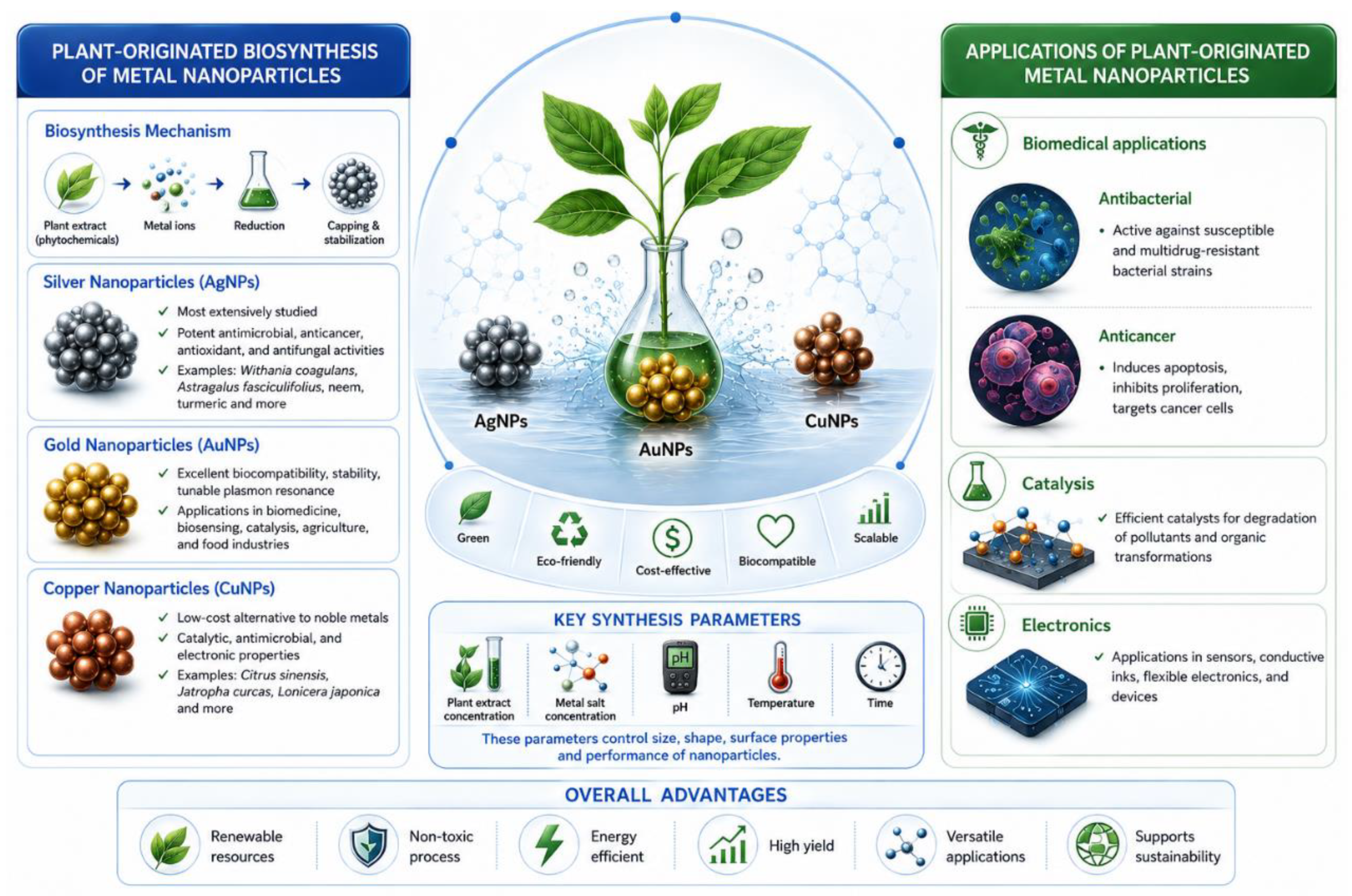
The synthesis parameters - the plant extract concentration, metal salt concentration, reaction temperature, pH and incubation time greatly influence the size, shape and surface properties of the synthesized nanoparticles and ultimately the application performance of the nanoparticles. Knowing these structure-property-function relationships is a crucial next step towards the successful transfer of green nanotechnology from the lab to the market. As shown in Figure. 1. This review provides a comprehensive and systematic overview of plant-originated biosynthesis of metal nanoparticles: an emphasis is placed on silver, gold, and copper nanoparticles. The general biosynthesis mechanism of plant-mediated nanoparticle synthesis is first discussed, followed by a detailed examination of the biosynthesis of individual metal nanoparticles. Subsequently, the major applications of these biogenic nanoparticles in biomedicine, catalysis, and electronics are summarized. Finally, existing challenges and future perspectives for the development and commercialization of plant-derived metal nanoparticles are highlighted.
Figure 1.
Plant-Originated Biosynthesis of Metal Nanoparticles: Mechanisms, Key Synthetic Parameters, Representative Nanoparticle Systems, and Emerging Applications in Biomedicine, Catalysis, and Electronics.
Figure 1.
Plant-Originated Biosynthesis of Metal Nanoparticles: Mechanisms, Key Synthetic Parameters, Representative Nanoparticle Systems, and Emerging Applications in Biomedicine, Catalysis, and Electronics.
2. Plant-Originated Biosynthesis of Metal Nanoparticles
2.1. Biosynthesis Mechanism of Plant-Mediated Metal Nanoparticles
Figure 2.
Summary chart of methods for synthesis of nanoparticles.
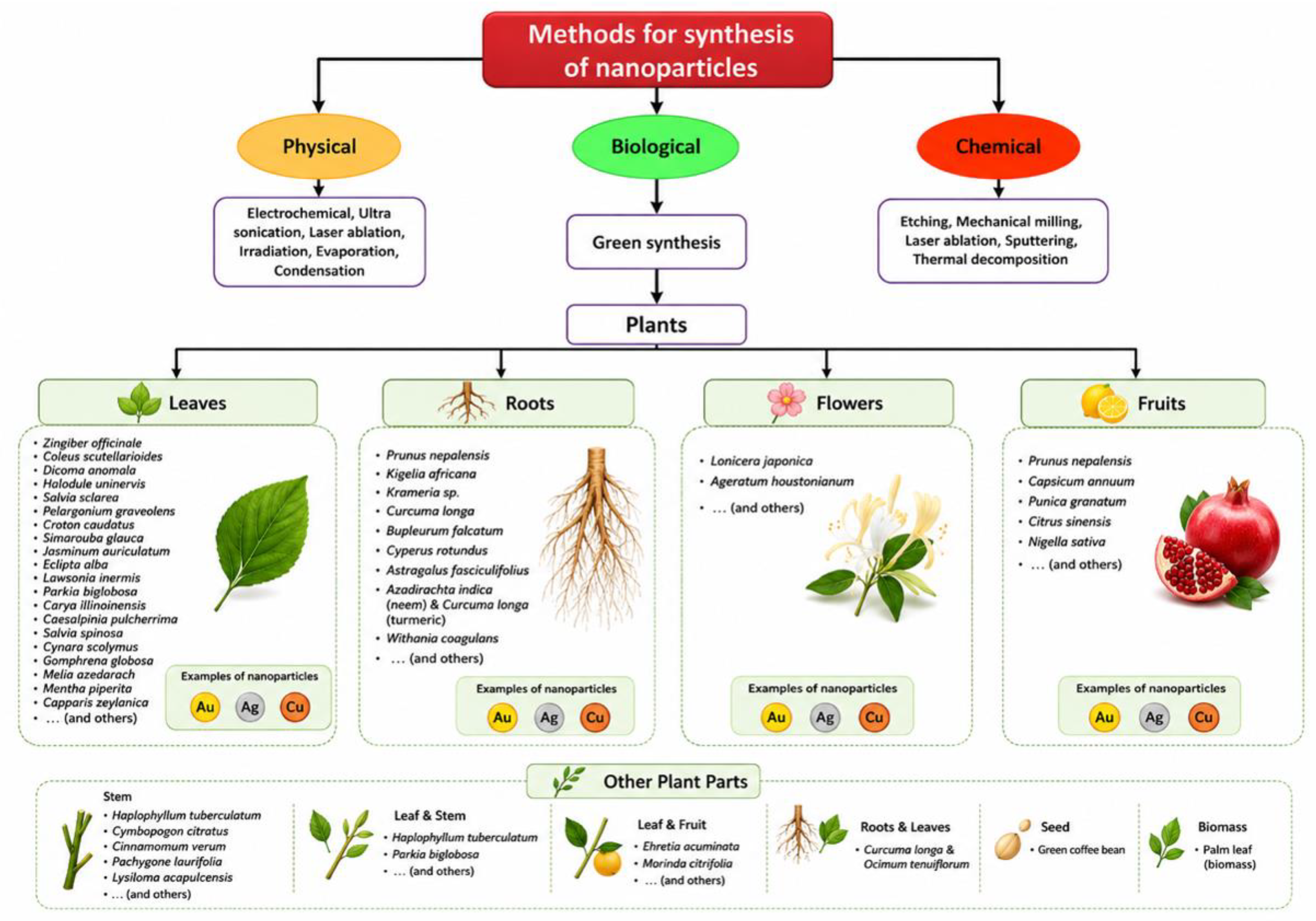
Plant-originated biosynthesis is a green bottom-up route for preparing metal nanoparticles through the interaction between metal precursors and plant-derived biochemical components. As illustrated in Figure. 2. plant tissues, including leaves, stems, roots, flowers, and fruits, can participate in nanoparticle formation either as extracts or as direct biomass. Compared with conventional physical and chemical methods, this strategy avoids harsh reaction conditions and reduces the use of toxic reductants or stabilizers, while plants provide renewable phytochemicals for reduction and surface protection [17,18]. The general mechanism involves reduction, nucleation, growth, and stabilization. Polyphenols, flavonoids, terpenoids, alkaloids, proteins, amino acids, polysaccharides, reducing sugars, and organic acids contain hydroxyl, carbonyl, carboxyl, aldehyde, and amine groups, which can coordinate with Ag⁺, Au³⁺, or Cu²⁺ and donate electrons for bioreduction. The reduced atoms subsequently form nuclei and grow into nanoparticles, while residual biomolecules adsorb onto the particle surface as capping agents to suppress aggregation. Therefore, precursor type, plant part, extract concentration, pH, temperature, and reaction time jointly determine particle size, crystallinity, stability, and morphology [19,20,21].
In this chapter, the synthesis of Ag, Au, and Cu nanoparticles is discussed through two plant-originated routes. Extract-mediated synthesis mainly depends on soluble phytochemicals and is widely used to obtain spherical or quasi-spherical nanoparticles. Direct biomass-mediated synthesis, however, introduces intact or dried plant tissues directly into the precursor solution; under hydrothermal or thermal conditions, biomass may gradually release reducing species and simultaneously provide soft-template, confinement, or carbon-source effects. This mechanistic distinction provides the basis for understanding the morphology evolution summarized in the following Ag, Au, and Cu tables, especially the formation of anisotropic nanostructures, carbon-coated particles, and metal/carbon hybrids.
2.2. Silver Nanoparticles
Silver nanoparticles are the most extensively investigated plant-originated metal nanoparticles in this chapter. As summarized in Table 1, AgNO₃ is almost exclusively used as the silver precursor, mainly because of its high aqueous solubility and facile release of Ag⁺ ions for biological reduction. Most studies adopt extract-mediated wet-chemical synthesis, in which phytochemicals from leaves, roots, fruits, stems, or mixed plant tissues act simultaneously as reducing and capping agents. Typical systems, including Ficus carica/Salvia rosmarinus leaf extract, Trema orientalis leaf extract, Citrus sinensis fruit extract, Astragalus fasciculifolius root extract, Carya illinoinensis leaf extract, Caesalpinia pulcherrima leaf extract, and Nymphae odorata leaf extract, mainly produce spherical AgNPs with sizes from several nanometers to several tens of nanometers [11,22,23,24,25,26,27]. These results suggest that extract-mediated AgNP synthesis generally favors isotropic nucleation and growth when the reduction rate and surface passivation are balanced. Nevertheless, the Ag systems in Table 1 also demonstrate that plant extracts can regulate non-spherical morphology and aggregation behavior. Citrus sinensis and Gomphrena globosa extracts generate triangular Ag structures, Gomphrena globosa further produces hexagonal particles, and Withania coagulans yields irregular Ag particles [10,24,28]. In contrast, Cyperus rotundus root extract produces much larger Ag particles, with reported sizes of 288.5 and 633 nm, indicating that insufficient capping or secondary aggregation may occur during growth [29]. These cases show that AgNP morphology is not determined by AgNO₃ alone, but by the combined effect of reductive phytochemicals, surface-binding molecules, and reaction kinetics.
Beyond extract-mediated synthesis, direct biomass-mediated strategies provide a more advanced route for Ag nanostructure engineering. Palm leaves were directly used as both reductant and carbon source in AgNO₃ solution through a one-pot hydrothermal process, producing carbon-coated Ag nanoparticles with Ag core diameters of 68.33–143.15 nm and carbon shell thicknesses of 1.74–4.70 nm [30]. In another study, dried Alpinia zerumbet leaf chunks were directly introduced into AgNO₃ solution and used as both reducing agent and soft template under PVP-free hydrothermal conditions, yielding Ag nanowires with an average diameter of approximately 77 nm and a length of approximately 10 μm [30]. The former work is particularly important because it integrates Ag⁺ reduction and biomass carbonization to form Ag@C hybrids, while the latter demonstrates that intact biomass can direct one-dimensional Ag growth through a pipe-shaped soft template and oriented attachment mechanism. Together, these studies expand plant-originated Ag synthesis from simple spherical nanoparticle formation to carbon-coated and anisotropic Ag nanostructures.
2.3. Gold Nanoparticles
Gold nanoparticles summarized in Table 2 are mainly synthesized from HAuCl₄, indicating that plant-originated Au synthesis is dominated by a relatively unified precursor system. The strong reducibility of Au³⁺/AuCl₄⁻ allows plant extracts to produce AuNPs under mild wet-chemical conditions, where phytochemicals act as reductants and stabilizing ligands. Most entries report spherical AuNPs, including those prepared using Capsicum annuum fruit, Coleus scutellarioides leaf, Clerodendrum trichotomum leaf, Lilium wallichianum leaf, Halodule uninervis leaf, Pelargonium graveolens leaf, Croton caudatus leaf, Jasminum auriculatum leaf, Eclipta alba whole plant, Lawsonia inermis leaf, Cinnamomum verum stem, Parkia biglobosa leaf/stem, and Zingiber officinale root extracts [3,15,16,40,41,42,43,44,45,46,47,48,49]. Compared with Ag, the Au systems are less focused on precursor variation and more dependent on ligand-mediated control of nucleation and surface stabilization. Although spherical AuNPs are dominant, Table 2 also reveals considerable morphology tunability. Xanthium strumarium leaf extract produces anisotropic AuNPs, Dicoma anomala leaf extract yields spherical, irregular, rod-like, and triangular particles, Salvia sclarea extract forms spherical and polygonal particles, Simarouba glauca leaf extract generates prism-like particles, and Parkia biglobosa leaf/stem extract produces irregular, pentagonal, rod-like, and triangular Au structures [2,49,50,51,52]. These results suggest that plant-derived ligands can selectively adsorb different Au crystal facets, changing relative growth rates and generating non-spherical structures. Therefore, the Au section highlights a different feature from Ag and Cu: morphology evolution occurs mainly within a single precursor system, but under different phytochemical environments.
A notable case is the use of isolated curcumin from Curcuma pseudomontana root to synthesize spherical AuNPs of approximately 20 nm [53]. This work is significant because it uses a chemically defined plant-derived molecule rather than a crude extract, thereby providing clearer evidence for the role of specific phytochemicals in Au³⁺ reduction and particle stabilization. In this sense, it bridges empirical plant-extract screening and molecular-level mechanism analysis. Overall, plant-originated AuNP synthesis is characterized by mild conditions, high colloidal stability, and rich shape tunability; however, compared with Ag and Cu, direct biomass-mediated Au synthesis is less represented in the current table, suggesting that Au systems still rely mainly on soluble phytochemicals rather than biomass-derived templating or carbonization effects.
2.4. Copper Nanoparticles
CuCl₂-based systems demonstrate efficient CuNP formation under plant-extract mediation. Lonicera japonica flower extract produces very small spherical CuNPs of 2–4 nm or 6 ± 1 nm, while Ziziphus mauritiana, Jatropha curcas, and green coffee bean extracts also yield spherical CuNPs with sizes generally below 20 nm [5,9,56,57]. By contrast, Ageratum houstonianum leaf extract produces larger cubic, hexagonal, and rectangular particles of approximately 80 nm, showing that the phytochemical environment can strongly alter Cu growth behavior even with the same precursor [58]. Cu(NO₃)₂ systems further show morphology variability: Carum carvi, Berberis vulgaris, and Cinnamomum zeylanicum extracts mainly generate spherical particles, whereas Hagenia abyssinica leaf extract produces spherical, cylindrical, hexagonal, irregular, and triangular particles [59,60,61,62]. CuSO₄-based synthesis occupies a large proportion of Table 3 and further broadens plant-source diversity. Zingiber officinale, Krameria sp., Celastrus paniculatus, Curcuma longa/Ocimum tenuiflorum, Cymbopogon citratus, and Orobanche aegyptiaca extracts mainly produce spherical CuNPs, whereas Prunus nepalensis and Citrus sinensis systems show cubic, face-centered cubic, or round morphologies [6,63,64,65,66,67,68]. These results confirm the compatibility of CuSO₄ with various plant extracts, but they also imply that Cu products require more rigorous phase analysis. Metallic Cu, Cu₂O, and CuO may coexist or transform during synthesis, washing, drying, storage, or application; therefore, future Cu studies should pay more attention to phase identification, antioxidation strategies, and reproducibility.
Direct biomass-mediated Cu-related synthesis provides a mechanistically distinctive extension beyond conventional extract-mediated CuNP preparation. Fresh Pachira aquatica leaves were used as biomass precursor in CuSO₄ aqueous solution under one-pot hydrothermal conditions, where two-dimensional Cu formed in situ and acted simultaneously as a template and catalyst for multilayered graphitic carbon nanosheets. The Cu phase exhibited a strong Cu (111) preferred orientation, and after Cu removal, well-defined multilayered carbon nanosheets with monolayer thickness as small as 2.86 nm were obtained. This work is particularly important because Cu is not only the reduced metal product, but also an active intermediate that directs biomass carbonization and two-dimensional carbon assembly, thereby linking plant-mediated Cu formation with metal-assisted carbon nanostructure engineering.
3. Applications of Plant-Originated Metal Nanoparticles
3.1. Biomedical Applications
3.1.1. Antibacterial
The global crisis of antimicrobial resistance (AMR) provides the urgent backdrop against which the antibacterial potential of plant-synthesized metal nanoparticles must be evaluated. The World Health Organization has repeatedly identified AMR as among the most serious threats to public health, with multidrug-resistant (MDR) strains of common pathogens rendering first-line and even last-resort antibiotics ineffective at an alarming pace [65,73]. Conventional antibiotics typically act through a single molecular target - inhibiting cell wall synthesis, disrupting protein translation, or blocking nucleic acid replication - and this mechanistic specificity, while therapeutically elegant, provides bacteria with a relatively narrow evolutionary challenge that can be overcome through point mutations, horizontal gene transfer, or efflux pump upregulation [32,36]. Metal nanoparticles, by contrast, exert their antibacterial effects through multiple simultaneous pathways, including the sustained release of bactericidal metal ions, direct physical disruption of cell membrane architecture, generation of reactive oxygen species (ROS) that damage intracellular DNA, proteins, and lipids, and interference with electron transport chains. This multi-target mode of action makes it substantially more difficult for bacterial populations to develop resistance, since simultaneous mutations across several defense systems would be required [74,75]. It is this mechanistic plurality that positions biogenic metal nanoparticles not as simple replacements for antibiotics, but as a fundamentally different class of antimicrobial agent operating under a distinct pharmacological logic [76,77].
The antibacterial performance of any nanoparticle formulation is not, however, a simple function of the core metal identity. Particle size, morphology, surface charge, colloidal stability, and the composition of the phytochemical capping layer all modulate the ultimate biological outcome. The biomolecular corona retained on plant-synthesized nanoparticles is not an inert passivating shell but an active participant in the antibacterial mechanism: polyphenols, flavonoids, terpenoids, and proteins that serve as reducing and stabilizing agents during biosynthesis remain adsorbed on the nanoparticle surface, and many of these compounds possess intrinsic antimicrobial properties of their own [74]. This synergy between the metallic core and the phytochemical shell is a defining advantage that distinguishes biogenic nanoparticles from their chemically synthesized counterparts and frequently translates into superior antibacterial efficacy at lower effective concentrations [78,79].
Silver nanoparticles (AgNPs) remain the most extensively validated antibacterial platform, a status that reflects the particularly favorable electrochemical properties of Ag⁺ ions for disrupting bacterial metabolism. The breadth of this validation is well illustrated by examining a series of plant-mediated AgNP formulations across diverse biological sources. Figure. 3a. shows that AgNPs synthesized from Citrus limetta (sweet lime) peel extract exhibited remarkably low minimum inhibitory concentration (MIC) values of 4.75 μg/mL against a panel of five Gram-positive and Gram-negative topical pathogens, including Staphylococcus aureus, Staphylococcus epidermidis, Streptococcus mutans, Micrococcus luteus, and Escherichia coli, with corresponding IC₅₀ values below 4.28 μg/mL and minimum bactericidal concentration (MBC) values of 13.3 μg/mL [80]. This superior performance is attributable to the rich flavonoid and phenolic content of citrus peel extracts, which not only drives efficient bioreduction but also generates a capping layer with intrinsic antimicrobial synergy [80]. AgNPs synthesized using Reishi mushroom (Ganoderma lucidum) extract displayed MIC values of 64 μg/L against E. coli and S. aureus, 16 μg/L against Enterococcus hirae and Legionella pneumophila subsp. pneumophila, and 128 μg/L against Pseudomonas aeruginosa and Bacillus cereus [1]. Meanwhile, AgNPs biosynthesized from Anabaena variabilis cell extract achieved MIC values of 6.25 μg/mL against P. aeruginosa, 12.5 μg/mL against both E. coli and Klebsiella pneumoniae, 25 μg/mL against B. cereus, and 12.5 μg/mL against C. albicans. Compared to AgNPs prepared from Eucalyptus globulus leaf extract, which showed an MIC of 36 μg/mL against E. coli, the Anabaena-derived particles were approximately three times more potent against the same organism [82]. The disc diffusion data from marine-derived AgNPs further reinforce the breadth of biogenic silver's antibacterial spectrum. AgNPs synthesized from the marine alga Padina sp. produced zones of inhibition of 15.17 ± 0.58 mm against S. aureus, 12.67 ± 0.76 mm against Bacillus subtilis, 13.33 ± 0.76 mm against Pseudomonas sp., and 12.67 ± 0.58 mm against E. coli [83].
Figure 3.
(a) Green synthesis of antibacterial and antifungal silver nanoparticles using Citrus limetta peel extract [80]. (b) Schematic Diagram of the Synthetic Route of Bimetallic Au–Ag NPs, and its Biomedical Applications for Antibacterial Ability [81].
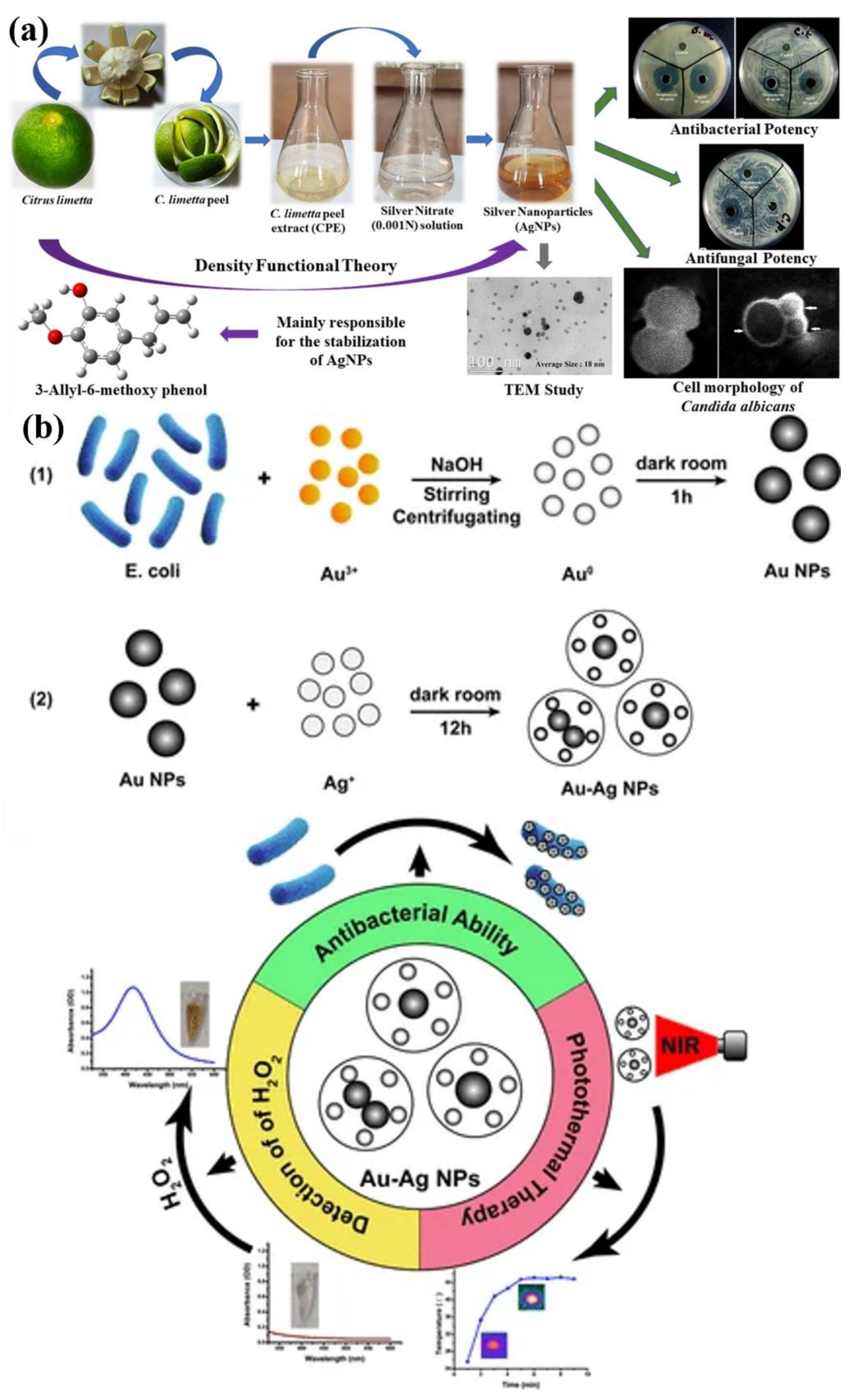
While silver dominates the antibacterial literature, the contribution of gold nanoparticles (AuNPs) should not be underestimated, particularly when considering formulations in which the phytochemical capping layer plays a decisive role. What makes AuNPs mechanistically distinct from AgNPs is the relative chemical inertness of gold: AuNPs do not release bactericidal metal ions to the same extent as silver, and their antibacterial action relies more heavily on direct membrane interaction, disruption of cellular redox homeostasis, and the antimicrobial contribution of the adsorbed phytochemicals. This mechanistic complementarity between Ag and Au platforms suggests that the two metals are not interchangeable but rather occupy distinct niches within the antibacterial design space. AuNPs synthesized from Jasminum auriculatum leaf extract produced dose-dependent zones of inhibition across both bacterial and fungal targets: at a concentration of 30 μL, inhibition zones of 12 mm were recorded against Streptococcus pyogenes and E. coli, 9 mm against S. aureus, and 7 mm against K. pneumoniae, alongside antifungal activity against Aspergillus fumigatus (4 mm), Candida albicans (4 mm), Trichoderma viride (5 mm), and Lecanicillium lecanii (5 mm) [45]. The most inspiring examples of synergy between silver and gold can be found in the hybrid nanostructures devised for the production of bimetallic Au-Ag nanoparticles. As shown in Figure. 3b. biosynthesized Au-Ag bimetallic nanoparticles exhibited MIC values reduced by almost 8-fold with respect to those of Ag⁺ ions or monometallic Au NPs alone: for E. coli, while 0.98 μg/mL Ag and 0.78 μg/mL Au were necessary to obtain total growth inhibition, 7.81 μg/mL Ag⁺ and 7.81 μg/mL of monometallic Au NPs were needed; for S. aureus, the corresponding values were again roughly doubled for the Ag and Au components of the bimetallic, with MICs of about 1.95 μg/mL (Ag) and 1.56 μg/mL (Au) versus 15.63 μg/mL for Ag⁺ and Au NP monometallics [81]. This enormous improvement in antibacterial activity was obtained without compromising the biocompatibility of the bimetallic composition: cell viability experiments performed on HEK 293T human embryonic kidney cells showed that the antibacterial effective concentration did not significantly compromise the biocompatibility of the nanoparticles. The mechanism involve galvanic replacement and electron transfer effects at the Au-Ag interface that enhance the ROS generation and ion release kinetics with respect to what each metal can achieve alone [81].
The antibacterial potential of copper nanoparticles (CuNPs) adds a third dimension to this landscape, one that is particularly attractive from an economic standpoint given copper's substantially lower cost relative to silver and gold. Antibacterial properties of CuNPs fabricated from Citrus sinensis (orange) juice extract via microwave-mediated green process exhibited antibacterial activity against both Gram-positive and Gram-negative bacteria at a low concentration of 1 μg/mL. The respective zones of inhibition were 12.60 ± 0.20 mm (S. aureus) and 10.83 ± 0.81 mm (E. coli). It is interesting to note that Gram-positive S. aureus were more susceptible to CuNP as compared with Gram-negative E. coli, whereas usually for AgNPs, the reverse trend is observed (i.e., Gram-negative species are more susceptible). This differential susceptibility of CuNPs may be attributed to the unique mechanism by which Cu²⁺ ions interact with bacterial cell envelopes [6]. It is well documented that copper ions are transported into bacterial cells via specific metalloproteins and metal transport systems, which are expressed and regulated differently in Gram-positive and Gram-negative organisms. The ability of CuNPs to differentiate between prokaryotic and eukaryotic cells via specific bacterial metal transport proteins and expression levels offers an inherent selectivity advantage. If this selectivity could be rationally optimized over a systematic library of Cu-based antimicrobial nanoparticles, it may improve the therapeutic index of Cu-containing antimicrobial formulations [84].
In synthesizing the evidence presented across these studies, several overarching conclusions emerge. First, plant-mediated synthesis consistently produces metal nanoparticles with clinically relevant antibacterial activity, and the phytochemical capping layer confers synergistic bioactivities that enhance the overall antimicrobial profile beyond what the core metal alone would achieve. Second, the quantitative data reveal a broad spectrum of effective concentrations milligram per milliliter ranges for CuNPs - reflecting the sensitivity of antibacterial performance to synthesis parameters, particle characteristics, and biological source. Third, bimetallic approaches offer a particularly promising strategy for amplifying efficacy while constraining cytotoxicity, achieving up to 8-fold improvements in MIC values relative to monometallic counterparts. Fourth, the Gram-positive/Gram-negative susceptibility differential is not universal but is modulated by metal identity, surface chemistry, and strain-specific factors, cautioning against oversimplified generalizations. The quantitative data extracted from the reviewed studies are consolidated in Table 4, enabling direct cross-study comparison of antibacterial performance across metal types, biological sources, and target organisms.
3.1.2. Anticancer
The multi-target cytotoxic mechanisms that render plant-synthesized metal nanoparticles effective against bacterial pathogens operate with equal, and in many respects greater, therapeutic relevance against malignant cells. Malignant cells operate under chronically elevated baseline oxidative stress due to their accelerated metabolism, dysregulated mitochondrial electron transport, and oncogene-driven proliferative signaling [45,85,86]. This pre-existing redox imbalance means that cancer cells exist closer to the cytotoxic ROS threshold than their non-malignant counterparts, rendering them disproportionately susceptible to the additional oxidative burden imposed by metal nanoparticles [12,87,88]. Conventional chemotherapeutics, much like conventional antibiotics, typically act through a single molecular target and this mechanistic specificity, while initially effective, provides cancer cells with a focused selective pressure that can be overcome through upregulation of drug efflux pumps, activation of DNA repair pathways, or acquisition of anti-apoptotic mutations [89,90]. Plant-synthesized metal nanoparticles, by engaging cancer cells through simultaneous ROS overproduction, mitochondrial membrane depolarization, cell cycle arrest, and physical plasma membrane compromise, present a multi-pronged assault that is inherently more difficult for malignant cells to resist. The phytochemical corona retained from the plant extract further enriches this anticancer pharmacology by contributing flavonoids, polyphenols, and terpenoids with well-documented pro-apoptotic and anti-proliferative properties, creating a dual therapeutic architecture that is absent from chemically synthesized nanoparticles and fundamentally distinguishes biogenic formulations as a unique pharmacological class [91,92,93].
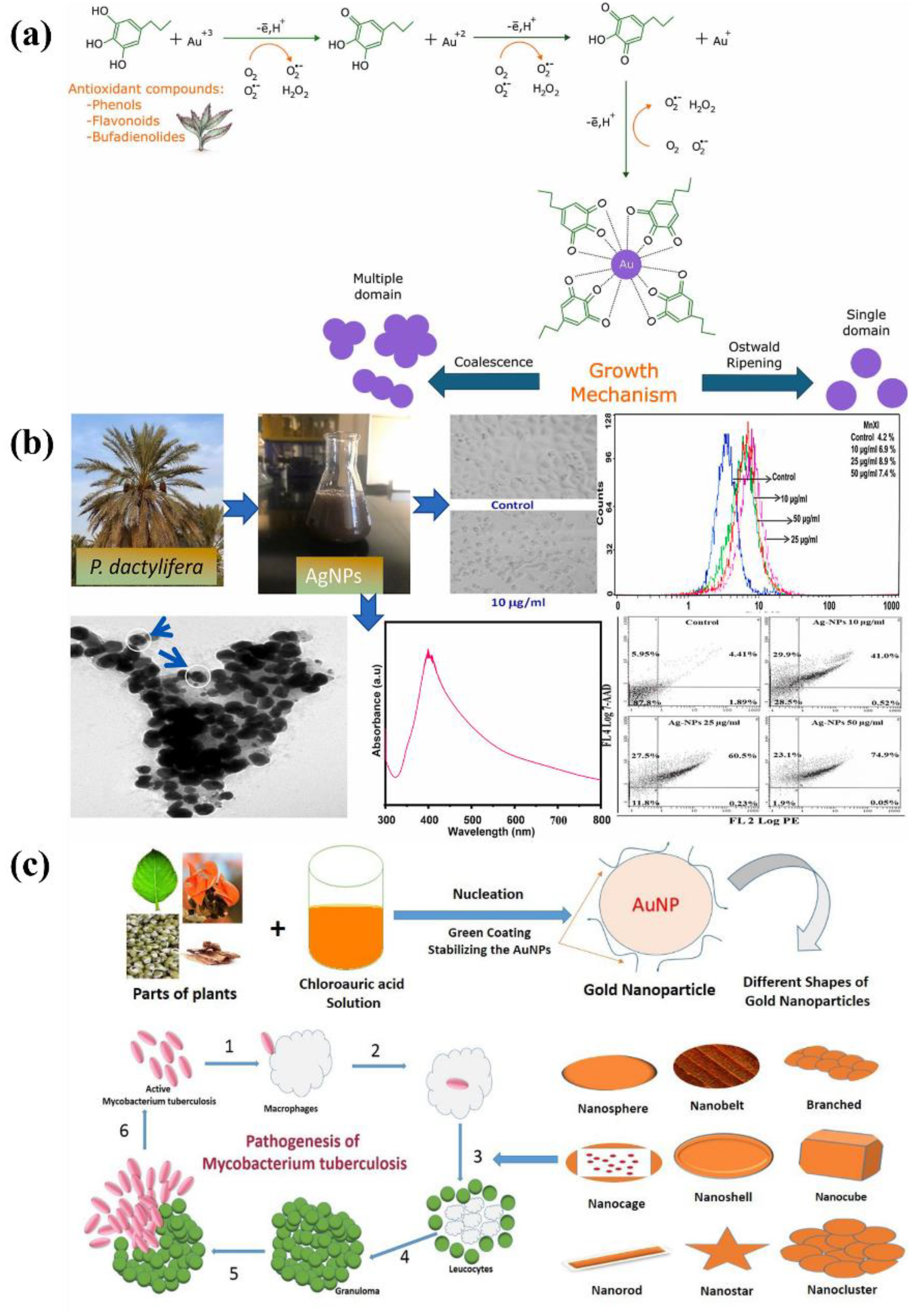
Green Synthesis of Gold Nanoparticles and Their Potential Applications Against tuberculosis [4].
The concept of selectivity is arguably the most critical performance criterion for any candidate anticancer agent, and it is on this parameter that plant-mediated nanoparticles have begun to demonstrate a genuinely meaningful advantage over both free phytochemical extracts and conventional chemotherapeutics. A particularly instructive demonstration of this principle comes from the work on gold nanoparticles (AuNPs) synthesized using Kalanchoe daigremontiana extract (shown in Figure.4a.), in which polyhedral particles with an average diameter of 125.49 nm were evaluated in parallel against Jurkat T-cell leukemia cells (as a cancer model) and 3T3-L1 fibroblasts (as a non-malignant control) over a concentration range of 5-150 μg/mL. The results revealed that the AuNPs exerted selective anticancer effects through a multifactorial mechanism involving enhanced cellular uptake, ROS overproduction, and membrane disruption in the malignant line, while displaying markedly lower toxicity toward normal fibroblasts [91]. This selectivity paradigm is not unique to gold-based systems. Figure. 4b. shows that silver nanoparticles (AgNPs) biosynthesized from Phoenix dactylifera (date palm) seed extract demonstrated potent cytotoxicity against A-549 human lung adenocarcinoma cells through ROS-mediated apoptosis, confirmed by a measurable increase in sub-G1 phase cell populations and a rise in late apoptotic cells. Importantly, comparative evaluation against 3T3-L1 non-malignant fibroblasts revealed that these PD-AgNPs exhibited greater cytotoxicity against the cancer line than against normal cells, recapitulating the selectivity pattern observed with the Kalanchoe-derived AuNPs and establishing that differential cancer cell killing is a generalizable property across both metal types, not an artifact of any single formulation [91]. AuNPs synthesized from Nigella arvensis leaf extract exhibited IC₅₀ values of 10 μg/mL against H1299 non-small cell lung cancer cells and 25 μg/mL against MCF-7 breast cancer cells (shown in Figure. 4c.) [4], while AuNPs derived from Coleus aromaticus leaf extract achieved an IC₅₀ of approximately 31 μg/mL against HepG2 human liver cancer cells, with the authors noting that this cell line was "very sensitive" to the formulation [94]. Moving to Peganum harmala seed-derived AuNPs, an exceptionally low IC₅₀ of 7 μg/mL was recorded against HeLa cervical cancer cells, positioning this formulation among the most potent biogenic anticancer agents reported to date. By contrast, AuNPs synthesized from Artemisia absinthium aerial parts showed considerably more variable sensitivity across cancer types, with IC₅₀ values ranging from 21.16 μg/mL for HeLa cells to 99.72 μg/mL for MCF-7 cells, while Morus nigra fruit-derived AuNPs produced IC₅₀ values of 23.37 μg/mL (HeLa), 66.36 μg/mL (HT-29 colorectal), 58.33 μg/mL (OVCAR3 ovarian), and 191.85 μg/mL (MCF-7) [91]. Two observations of fundamental importance emerge from this cross-formulation comparison. First, the same cancer cell line can exhibit dramatically different susceptibilities to AuNPs from different plant sources - MCF-7 breast cancer cells, for example, show nearly a 27-fold range in IC₅₀ values (7-191.85 μg/mL) across the formulations reviewed. Second, a consistent sensitivity hierarchy emerges across multiple independent studies: HeLa cervical cancer cells rank among the most susceptible targets across virtually all AuNP formulations evaluated, while MCF-7 breast cancer cells tend toward the resistant end of the spectrum.
Figure 4.
(a) Redox mechanism between antioxidant compounds and the Au cations in a Kalanchoe daigremontiana-mediated green synthesis method [91]. (b) Green Synthesis, Physicochemical Characterization, and ROS-Mediated Anticancer Activity of Phoenix dactylifera-Derived AgNPs[12]. (c) Plant-Mediated.
Figure 4.
(a) Redox mechanism between antioxidant compounds and the Au cations in a Kalanchoe daigremontiana-mediated green synthesis method [91]. (b) Green Synthesis, Physicochemical Characterization, and ROS-Mediated Anticancer Activity of Phoenix dactylifera-Derived AgNPs[12]. (c) Plant-Mediated.
The dual functionality of biogenic nanoparticles represents a distinctive advantage over conventional chemotherapeutics. The orange peel-derived AgNPs, beyond their anticancer effects, demonstrated potent antioxidant capacity with a DPPH radical scavenging IC₅₀ of approximately 7 g/100 mL, reflecting the high bioreduction efficiency (approximately 82% conversion of silver cations to metallic silver atoms) achieved by the phenolic-rich citrus peel extract [24]. This antioxidant-anticancer duality is therapeutically significant because cancer treatment frequently induces collateral oxidative damage to healthy tissues; an agent that selectively generates ROS within cancer cells while scavenging free radicals in the surrounding microenvironment could, in principle, reduce the systemic side effects that limit the dose intensity of conventional chemotherapy. Similarly, pomegranate peel-mediated AgNPs have been documented to possess both anticancer and antibacterial properties, raising the prospect of multifunctional therapeutic platforms capable of simultaneously addressing tumor growth and the opportunistic infections that frequently complicate immunosuppressed oncology patients [95]. The copper dimension of anticancer nanoparticle research, while less extensively documented in the plant-synthesis literature than its silver and gold counterparts, introduces a mechanistically distinct and rapidly evolving pathway that deserves particular attention: cuproptosis. Unlike silver- and gold-mediated cytotoxicity, which operate primarily through ROS overproduction and membrane disruption, copper-induced cell death involves the direct binding of copper ions to lipoylated components of the tricarboxylic acid (TCA) cycle, leading to the aggregation of lipoylated proteins and subsequent proteotoxic stress. This form of regulated cell death is biochemically distinct from apoptosis, necroptosis, ferroptosis, and other established cell death modalities, and its recent elucidation has opened an entirely new frontier in metal-based oncology. Ternary copper complexes have been demonstrated to induce both apoptosis and autophagy in breast cancer cells and to cause cell cycle arrest in colorectal cancer cells, establishing that copper can engage multiple cell death pathways depending on the concentration, speciation, and cellular context [96]. However, the quantitative in vitro anticancer data for plant-synthesized CuNPs remain limited compared to the extensive AgNP and AuNP datasets, and systematic comparative studies employing standardized protocols are urgently needed to establish where copper nanoparticles sit within the efficacy hierarchy defined by their noble metal counterparts.
The influence of the plant source on anticancer potency emerges from this review as at least as significant as its influence on antibacterial activity, with IC₅₀ values varying by more than an order of magnitude for the same cancer cell line across different botanical extracts. Rather than viewing this variability as a limitation, it should be recognized as an extraordinary opportunity: systematic high-throughput screening of plant extract-nanoparticle combinations, guided by metabolomic profiling of the phytochemical corona, could identify formulations with dramatically enhanced potency and selectivity for specific cancer types. The field stands at an inflection point where the empirical, one-plant-one-study approach that has characterized much of the literature to date must give way to rational, data-driven optimization strategies that leverage the immense chemical diversity of the plant kingdom as a design parameter rather than a confounding variable. The quantitative anticancer data extracted from the reviewed studies are consolidated in Table 5, enabling direct cross-study comparison across metal types, biological sources, cancer cell lines, and mechanistic pathways.
3.2. Catalysis
The preceding sections have established that the phytochemical corona retained on plant-synthesized metal nanoparticles is not merely a passive stabilizing shell but an active contributor to biological function, enhancing both antibacterial potency and anticancer selectivity through synergistic interactions between the metallic core and the adsorbed biomolecular layer. This same dual architecture proves equally consequential in the domain of heterogeneous catalysis, where biogenic nanoparticles have emerged as compelling alternatives to conventionally prepared catalysts for environmental remediation, organic synthesis, and industrial chemical transformations. The transition from biomedical to catalytic applications represents more than a simple change in target substrate; it reflects a fundamental shift in the operative design criteria, from biocompatibility and selective cytotoxicity toward catalytic turnover frequency, recyclability, substrate scope, and long-term operational stability. Yet the underlying physicochemical principles remain continuous: the same factors that govern nanoparticle-cell interactions in biological systems also determine catalytic activity in chemical systems. It is this mechanistic continuity that makes plant-mediated synthesis uniquely attractive as a unified platform for producing multifunctional nanomaterials whose properties can be tuned, through judicious selection of the botanical source and synthesis conditions, for applications spanning the biomedical-to-catalytic spectrum [9,97].
The environmental imperative driving catalytic applications of biogenic nanoparticles is substantial and urgent. Synthetic organic dyes - including methylene blue (MB), methyl orange (MO), eosin Y (EY), Acid Blue 10B (AB-10B), and Xylenol Orange (XO) - are discharged in enormous quantities from textile, pharmaceutical, leather, and food processing industries, and their persistence in aquatic ecosystems poses severe ecotoxicological risks due to their resistance to biodegradation, their capacity to block sunlight penetration and inhibit photosynthesis, and, in many cases, their direct mutagenic or carcinogenic properties. Conventional treatment methods are often inadequate for complete decolorization and mineralization, particularly for recalcitrant azo and thiazine dyes. Catalytic reduction using sodium borohydride (NaBH₄) as an electron donor in the presence of metal nanoparticles has emerged as one of the most effective and experimentally accessible strategies for rapid dye degradation, and plant-synthesized nanoparticles have proven to be exceptionally capable catalysts in this context [98]. The catalytic mechanism in these systems follows a well-established electron relay model: the nanoparticle surface adsorbs both the electron donor (BH₄⁻) and the electron acceptor (dye molecule), mediating electron transfer from the former to the latter by providing a conductive surface that lowers the kinetic activation barrier of the reaction. The phytochemical capping layer participates in this process by modulating substrate adsorption through electrostatic and hydrophobic interactions, effectively acting as a molecular gatekeeper that influences both the rate and selectivity of the catalytic transformation [14,57].
The catalytic degradation of methylene blue a cationic thiazine dye whose characteristic absorption at 665 nm provides a convenient spectrophotometric handle for kinetic monitoring serves as the most widely employed benchmark reaction for evaluating the performance of biogenic nanocatalysts, and the quantitative data available across silver and copper systems reveal striking differences in catalytic efficiency that illuminate the respective strengths of each metal platform [100]. Copper nanoparticles (CuNPs) synthesized from green coffee beans (Figure. 5a.) extract demonstrated exceptional catalytic performance, achieving complete reduction of MB within 13 minutes with an apparent rate constant (kapp) of 4.458 × 10⁻¹ min⁻¹. The same study reported that glutathione-capped silver nanoparticles (GSH-AgNPs) achieved a kapp of only 2.65 × 10⁻² min⁻¹ for MB reduction under comparable conditions, meaning that the green coffee bean CuNPs were approximately 17-fold faster than the AgNP benchmark. It suggests that the specific combination of copper's electronic structure with the phenolic and caffeoylquinic acid-rich capping layer derived from coffee bean extract creates a synergistic catalytic surface that outperforms silver in this particular transformation [57]. The same CuNP formulation exhibited similarly impressive performance against two additional dye substrates: AB-10B was completely reduced within 10 minutes (kapp = 2.913 × 10⁻¹ min⁻¹), and XO was degraded within 11 minutes (kapp = 2.537 × 10⁻¹ min⁻¹), with all three reactions achieving greater than 92% decolorization efficiency. Crucially, in the absence of CuNPs, the reaction between these dyes and NaBH₄ proceeded at negligibly slow rates, confirming that the nanoparticles serve as indispensable catalytic mediators [57]. CuNPs synthesized from Celastrus paniculatus leaf extract demonstrated photocatalytic degradation of MB under direct sunlight irradiation, achieving a pseudo-first-order rate constant of 0.0172 min⁻¹. While this photocatalytic rate is substantially lower than the NaBH₄-mediated rate constant of 4.458 × 10⁻¹ min⁻¹ achieved by the green coffee bean CuNPs - a difference of approximately 26-fold - the photocatalytic approach eliminates the need for chemical reductants entirely, relying instead on solar energy to generate electron-hole pairs at the CuNP surface that drive the oxidative degradation of the dye [65].
Figure 5.
(a) Green Synthesis of Copper Nanoparticles from Green Coffee Bean Extract and Their Catalytic Application in Organic Dye Degradation [57]. (b) Green Synthesis, Characterization, and Photocatalytic Dye Degradation Performance of Silver Nanoparticles [99].
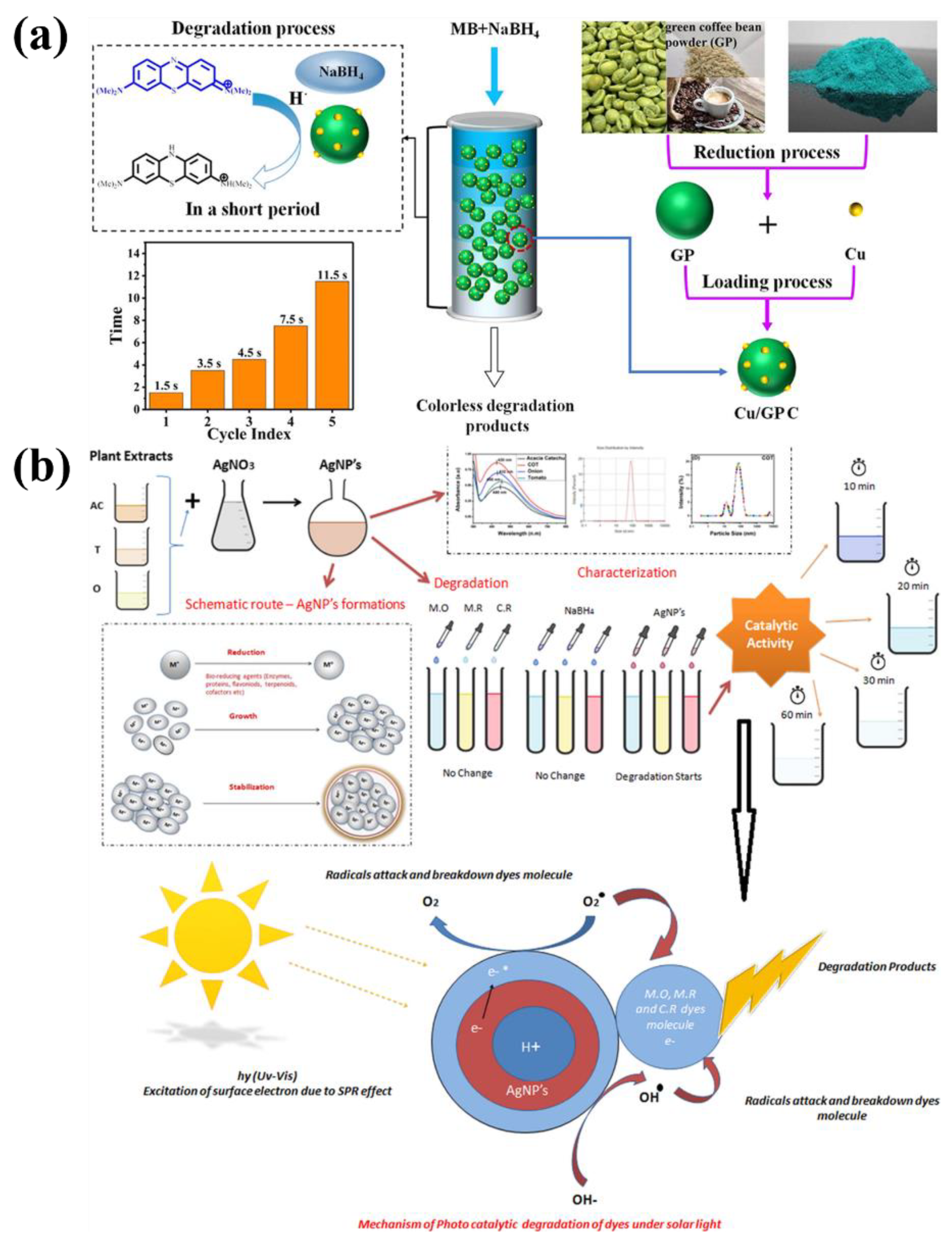
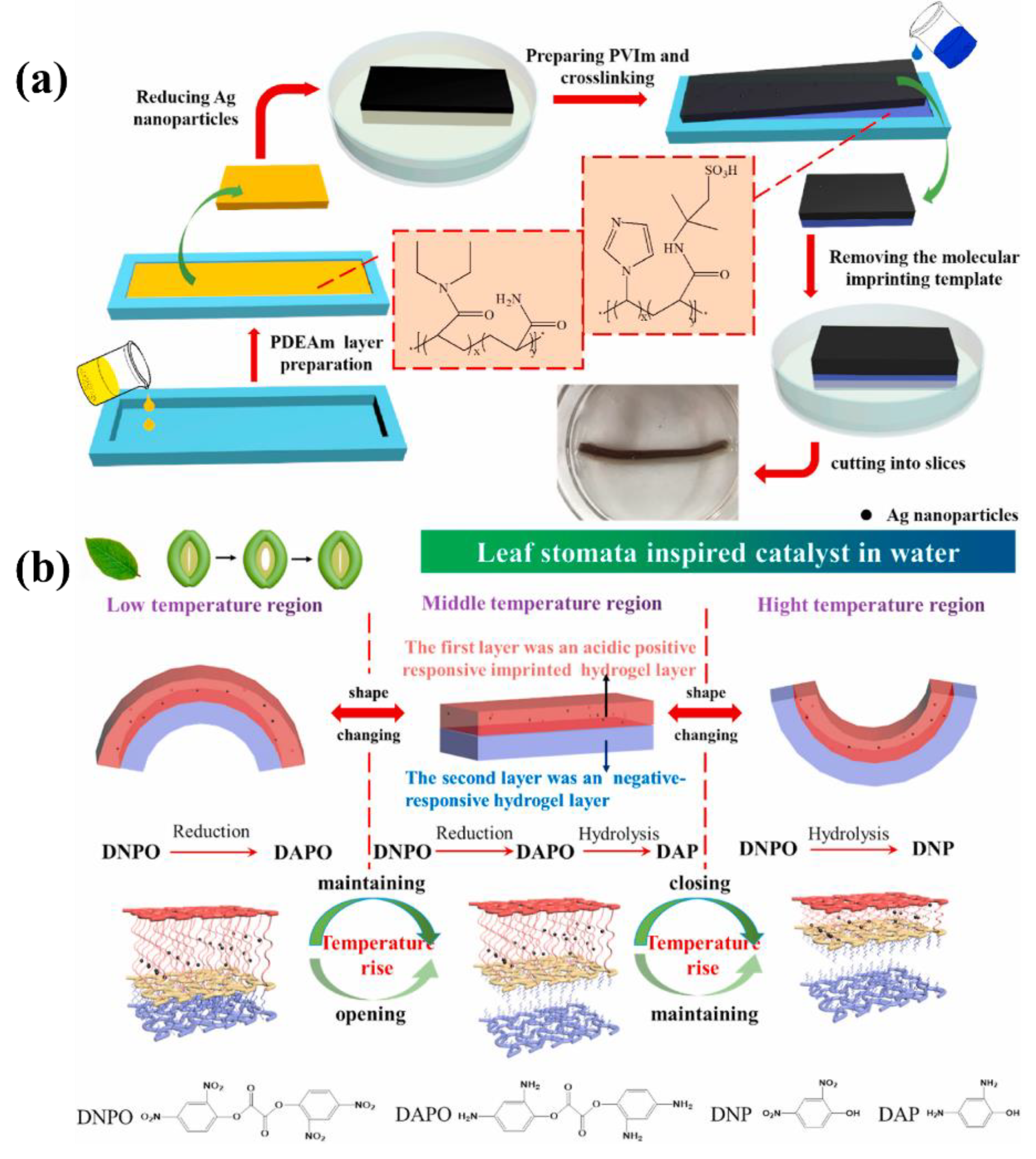
While copper excels in absolute kinetic benchmarks, silver nanoparticles remain the most extensively studied and versatile plant-mediated nanocatalysts, with a documented substrate scope that extends far beyond single-dye degradation to encompass the reduction of nitroaromatic compounds, the degradation of toxic hexavalent chromium, and a broad range of organic transformations including coupling, cycloaddition, cyanation, epoxidation, hydration, and hydrogenation reactions. Figure. 5b. shows that a particularly compelling demonstration of the influence of plant extract identity on silver nanocatalyst performance comes from the systematic comparative study by Chand et al., in which AgNPs were synthesized from four different extract systems tomato (T), onion (O), acacia catechu (C), and a combined extract of all three (COT) and evaluated for the catalytic degradation of three structurally distinct dyes: methyl red (MR), methyl orange (MO), and Congo red (CR), all in the presence of NaBH₄ [99]. Among the four formulations, AgNPs synthesized from the COT mixed extract consistently achieved the best catalytic performance for all three dyes, accomplishing complete degradation of MO within 20 minutes and complete degradation of CR within 15 minutes, whereas AgNPs synthesized from individual onion or acacia catechu extracts required 28 minutes for complete CR degradation under identical conditions [99]. AgNPs derived from Annona squamosa seed extract demonstrated effective photocatalytic degradation of toxic dyes, leveraging the localized surface plasmon resonance (LSPR) of the silver nanoparticles to harvest visible light and generate hot electrons that drive dye decomposition without the need for chemical reductants. The dual catalytic modality mirrors the dual modality observed for CuNPs and establishes that catalytic versatility across mechanistically distinct pathways is a general feature of plant-synthesized metal nanoparticles rather than a metal-specific phenomenon [101]. A particularly innovative extension of supported catalyst concept is the development of smart, stimuli-responsive catalytic architectures that incorporate plant-inspired design principles at the device level, rather than merely at the nanoparticle synthesis level. The stomata-inspired bilayer dual-responsive tandem catalyst reported by Pu et al. (shown in Figure. 6a, b.) exemplifies this emerging paradigm [102]. Drawing direct inspiration from the temperature-regulated opening and closing of stomata in plant leaves, this system consists of two functional polymer layers with opposing thermosensitive behaviors: a first layer fabricated with a negatively-thermosensitive molecularly imprinted polymer encapsulating Ag nanoparticles (PDEA-co-PAM/Ag), responsible for catalytic reduction; and a second layer composed of a positively-thermosensitive polymer (PVI-co-PAMPS) bearing acidic groups capable of catalytic hydrolysis. At low temperatures (below 30 °C), the first layer's channel is open while the second layer's channel remains closed, permitting only catalytic reduction by the encapsulated Ag nanoparticles. At intermediate temperatures (30-50 °C), both layers open simultaneously, enabling a tandem catalytic process in which reduction products from the first layer are directly channeled into the hydrolysis process of the second layer. At elevated temperatures (above 50 °C), the first layer closes while the second layer remains open, restricting catalysis to hydrolysis alone [102]. This temperature-dependent single/tandem/single switchable catalysis represents a conceptual leap beyond the passive catalytic systems discussed thus far, demonstrating that metal nanoparticles can be integrated into responsive polymer architectures that autonomously regulate catalytic function in response to environmental stimuli.
Figure 6.
(a) Preparation processes of the smart catalyst. (b) The switching catalytic mechanism of the bilayer polymer catalyst [102].
Figure 6.
(a) Preparation processes of the smart catalyst. (b) The switching catalytic mechanism of the bilayer polymer catalyst [102].
The comparative analysis across all three metals reveals a catalytic design space in which each metal occupies a distinct performance niche defined by the interplay of intrinsic electronic properties, surface chemistry, and the phytochemical capping layer. Copper offers the highest absolute reaction rates for reductive dye degradation under optimized conditions, as demonstrated by the extraordinary k_app values achieved by the green coffee bean CuNPs (up to 4.458 × 10⁻¹ min⁻¹ for MB), but faces challenges related to oxidative instability and a narrower documented substrate scope [9,57,99]. Silver provides the broadest catalytic versatility, spanning dye degradation across structurally diverse substrates (MB, MO, MR, CR, EY, and beyond), nitroarene reduction, chromium detoxification, and diverse organic transformations, and benefits from the most mature body of literature on supported, bimetallic, and smart responsive formulations [103]. The COT mixed-extract approach to AgNP synthesis and the stomata-inspired smart catalyst architecture represent two complementary strategies for enhancing silver nanocatalyst performance one operating at the molecular level through phytochemical engineering of the capping layer, and the other at the device level through bio-inspired responsive polymer design [102]. Gold offers superior selectivity and long-term stability, particularly in biphasic and oxidizing environments, though at higher material cost [45]. Critically, the phytochemical source exerts a cross-cutting influence across all three metals: the same principles of size control, surface functionalization, and capping layer bioactivity that determine antibacterial and anticancer performance also govern catalytic efficiency, creating a unified design framework in which the botanical extract is not merely a green reagent but a programmable molecular toolkit for tailoring nanoparticle function. The recyclability of plant further strengthens their practical appeal, though systematic studies comparing the cycle-to-cycle activity retention of biogenic versus chemically synthesized catalysts remain an important gap in the current literature. The quantitative catalytic data extracted from the reviewed studies are consolidated in Table 6.
3.3. Electronics
The integration of metal nanoparticles into electronic devices requires confronting a challenge that is largely absent from the biomedical and catalytic domains discussed in preceding sections: the organic capping layer that provides colloidal stability and biological functionality must be either removed, transformed, or strategically retained to enable efficient charge transport between adjacent nanoparticles in the solid state. In conventional chemically synthesized nanoparticle systems, this challenge is typically addressed through high-temperature sintering (often exceeding 300-400 °C) to decompose the synthetic surfactant shell and fuse adjacent metallic cores into a continuous conductive pathway. Plant-synthesized nanoparticles offer a distinctive advantage in this regard, because the biogenic capping agents composed primarily of polyphenols, flavonoids, terpenoids, and proteins derived from the plant extract decompose at substantially lower thermal thresholds than synthetic polymers such as polyvinylpyrrolidone (PVP) or cetyltrimethylammonium bromide (CTAB). This low-temperature decomposition characteristic is critically important for flexible electronics, where thermally sensitive polymer substrates such as polyethylene terephthalate (PET), polyimide (PI), and thermoplastic polyurethane (TPU) cannot withstand the high thermal budgets required by conventional electronic inks and pastes.
Silver nanoparticles are widely recognized as among the most promising candidates for such applications owing to their excellent chemical stability, antimicrobial activity, catalytic properties, and their electrical conductivity. AgNPs synthesized using Withania coagulans extract have exhibited excellent metallic crystallinity and high electrical conductivity, making them ideal candidates for printed electronics and conductive tracks. When formulated into conductive inks, these biogenic AgNPs can be sintered at temperatures as low as 150 °C to yield highly conductive silver pathways with a resistivity of 2.1 × 10⁻⁸ Ω·m, approaching the bulk silver value of 1.59 × 10⁻⁸ Ω·m. The concept of using nanoparticle dispersions to deposit conductive films at low temperatures has been systematically developed in the broader silver nanoparticle electronics literature, and the principles established therein apply directly to biogenic AgNP systems. Balantrapu and Goia described an environmentally friendly route to prepare stable concentrated aqueous dispersions of silver nanoparticles specifically for printable electronics, demonstrating that concentrated dispersions could be used for depositing thin uniform layers that were subsequently sintered into conductive films at low temperatures [104]. The challenge of achieving narrow size distributions in biogenic AgNPs, while more demanding than in carefully controlled chemical syntheses, is offset by the functional benefits of the plant-derived capping layer: its natural decomposition at low temperatures, its capacity to prevent premature aggregation during ink formulation, and its ability to leave behind minimal carbonaceous residue after sintering, all of which contribute to the formation of dense, highly conductive silver networks. Beyond printable conductive tracks, silver nanoparticles have found critical application as conductive fillers in electronically conductive adhesives (ECAs), a technology of growing importance for lead-free electronic packaging and flexible device assembly. Chen et al. demonstrated that incorporating silver nanoparticles into ECAs significantly improved their electrical performance, with the resistivity of ECA samples decreasing from approximately 4.5 × 10⁻⁴ Ω·cm to approximately 1.0 × 10⁻⁴ Ω·cm when silver nanoparticles were included as conductive fillers - a 4.5-fold improvement attributable to the ability of small nanoparticles to fill the interstitial spaces between larger silver flakes and create additional conductive pathways [105]. The absorption peak at 410 nm observed for these AgNPs served as a clear signature of the quantum size effect in their optical properties, confirming the nanoscale dimensions necessary for effective interstitial filling. The electronic applications of plant-synthesized nanoparticles extend well beyond passive conductive elements into active semiconductor devices. AgNPs synthesized from Pachygone laurifolia leaf extract have been evaluated in Schottky barrier diodes, yielding devices with an ideality factor (n) of 1.24 and a barrier height (Φb) of 0.78 eV values that indicate near-ideal diode behavior and confirm that the biogenic nanoparticles can form well-defined metal-semiconductor junctions with reproducible electronic characteristics [8].
Gold nanoparticles, while sharing the high conductivity and chemical stability that make silver attractive for passive conductive applications, offer a fundamentally different set of electronic functionalities rooted in their strong localized surface plasmon resonance (LSPR) and exceptional chemical inertness. AuNPs synthesized from Jasminum auriculatum leaf extract have demonstrated remarkable promise in optoelectronic and sensing devices, exhibiting a strong LSPR peak at 535 nm that is highly sensitive to local refractive index changes. This optical sensitivity has been exploited to design high-performance plasmonic photodetectors with a responsivity of 0.45 A/W [45]. The mechanism underlying this responsivity involves the decay of the surface plasmon into energetic "hot" electrons that are injected across the metal-semiconductor interface, generating a measurable photocurrent proportional to the incident light intensity. By modifying the local dielectric environment surrounding the nanoparticle, the biomolecular shell can shift the LSPR wavelength and modulate the hot electron injection efficiency, offering a bio-derived tuning mechanism for photodetector spectral response that is absent from bare or synthetically capped AuNPs. The charge-trapping capability of gold nanoparticles has been further exploited in non-volatile memory devices, where the ability to store and retain electronic charge within discrete nanoparticle islands forms the basis of floating-gate memory architectures. AuNPs derived from Coleus aromaticus leaf extract, when integrated into nanoparticle floating-gate field-effect transistors (NFETs), achieved a charge storage density of 3.2 × 10¹² cm⁻² with a retention time exceeding 10⁴ seconds [94]. In this device architecture, the plant-derived biomolecular shell surrounding each AuNP core serves as a natural tunneling dielectric barrier: it is thin enough to permit quantum mechanical tunneling of electrons onto the gold core during write operations, yet sufficiently insulating to prevent charge leakage during retention, eliminating the need for complex, multi-step lithographic deposition of artificial dielectric layers.
Figure 7.
(a) Pachira aquatica Aubl [106]. (b) Schematic diagram of synthesis and growth mechanism of 2D dendrite-like Cu/C hybrid [106]. (c) Schematic of the synthesis of the Cu/rGO films and the thermal enhancement mechanism [107].
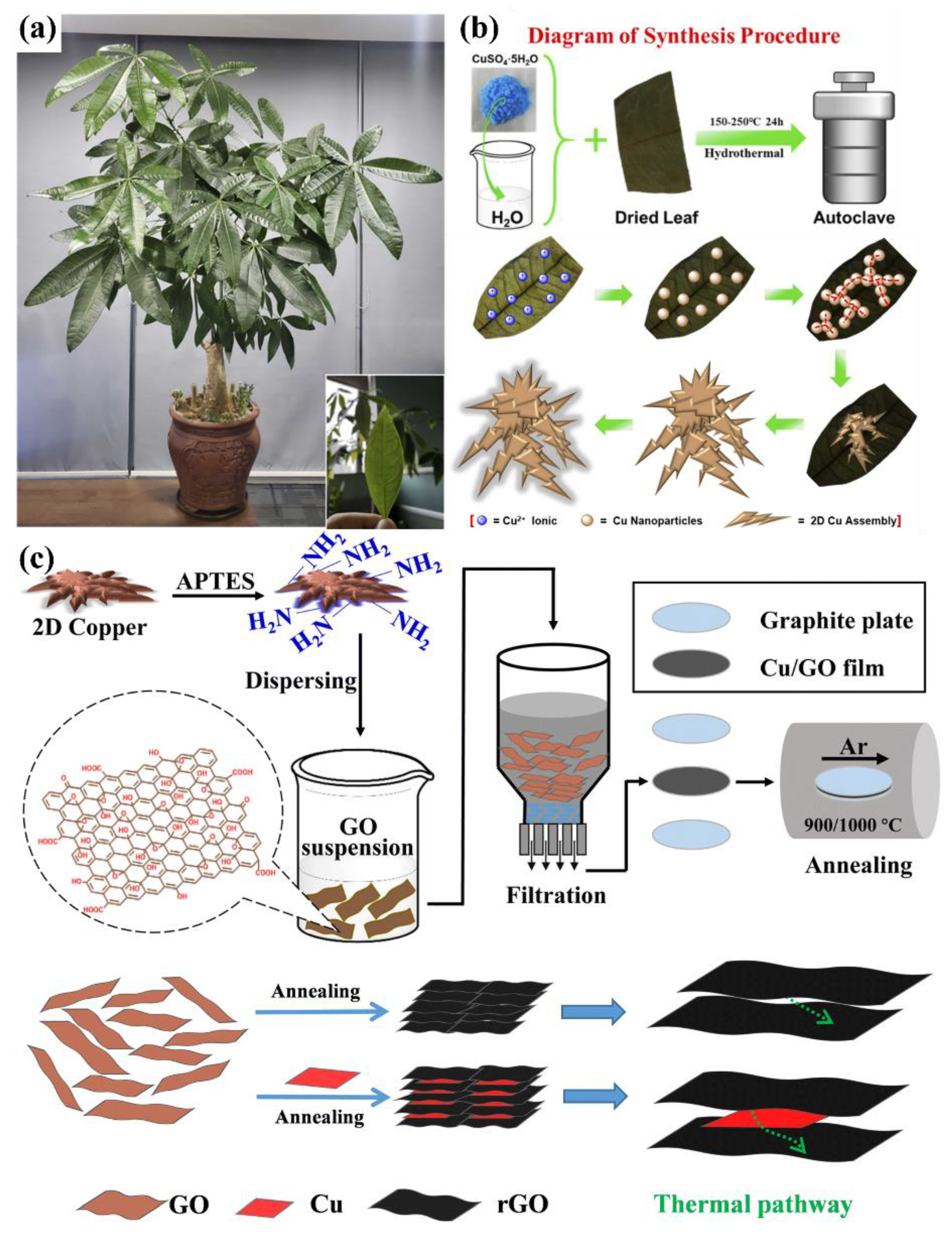
Copper's bulk electrical resistivity (1.67 × 10⁻⁸ Ω·m) is only 5% higher than that of silver (1.59 × 10⁻⁸ Ω·m), yet its material cost is approximately 100-fold lower, making it the obvious choice for applications requiring large-area conductive coatings, electromagnetic interference (EMI) shielding, and commodity electronic interconnects [108]. Copper nanoparticles synthesized from Ziziphus mauritiana leaf extract have been specifically developed as electrochemical sensors for silver ion (Ag⁺) detection, exploiting the galvanic replacement reaction between copper and silver ions to generate a concentration-dependent electrochemical signal. Green synthesis using Ziziphus mauritiana leaves provides the advantage of producing CuNPs with a phytochemical surface layer that can enhance the selectivity of the sensor by acting as a molecular sieve, admitting target analytes while excluding interferents based on size, charge, or chemical affinity [56]. The oxidation resistance challenge has been addressed with particular sophistication in the work of Ye et al., who developed a one-pot biological hydrothermal method to synthesize two-dimensional dendrite-like Cu/C hybrid materials using leaves of Pachira aquatica (commonly known as the money tree) as simultaneously a reducing agent, capping agent, template, and carbon source (shown in Figure. 7a, b.). In this innovative approach, the plant leaves serve a quadruple function that transcends the conventional roles assigned to botanical extracts in nanoparticle synthesis: beyond reducing copper ions and stabilizing the resulting nanostructures, the leaf tissue acts as a physical template that directs the growth of copper into two-dimensional dendritic architectures with a smallest thickness of 2.5 nm and a radius-to-thickness ratio as high as 10³, while the organic matter from the leaf simultaneously carbonizes under hydrothermal conditions to form a protective graphitic carbon coating layer around the copper dendrites [106].
The comparative analysis across the three metals in electronic applications reveals a design landscape that is, in many respects, complementary rather than competitive. Silver offers the highest raw electrical conductivity and the most mature platform for conductive inks, pastes, and electronically conductive adhesives, with demonstrated applications spanning printed circuit tracks (resistivity 2.1 × 10⁻⁸ Ω·m at 150 °C sintering), Schottky barrier diodes (ideality factor 1.24), and ECA fillers (shown in Figure. 7c) [107,109]. However, silver suffers from electromigration under high electric fields and its relatively high cost limits its use in large-area applications. Gold provides unmatched chemical stability and superior optoelectronic functionality plasmonic photodetection at 0.45 A/W responsivity and charge storage at 3.2 × 10¹² cm⁻² density but its cost restricts deployment to specialized, high-value components such as biosensors, memory elements, and plasmonic devices. Copper offers the optimal balance of cost and conductivity for large-area applications, and the plant-mediated synthesis route has proven uniquely capable of addressing copper's oxidation vulnerability through two complementary strategies: phytochemical antioxidant capping and graphitic carbon encapsulation via leaf-templated hydrothermal synthesis. In electrochemical sensors and biosensors, the phytochemical corona enhances analyte selectivity, prevents electrode fouling, and provides biocompatible interfaces for the detection of biological molecules. The field has progressed from initial proof-of-concept demonstrations that biogenic nanoparticles can conduct electricity, through quantitative benchmarking against conventional materials, to the current frontier where plant-mediated synthesis enables electronic performance that surpasses commercial alternatives (as in the Cu/C hybrid conductive composites). The quantitative electronic and optoelectronic performance data consolidated in Table 7 provide a comprehensive cross-metal comparison that enables identification of the optimal biogenic nanoparticle platform for each specific electronic application.
4. Conclusion and Outlook
As one of the most emerging and successful green strategies for metal nanoparticles synthesis, plant-originated biosynthesis has emerged as a highly cost-effective, sustainable, and functionally versatile approach. Phytochemicals from plant extracts and biomass possess multiple activities including metal ion reduction, nanoparticle shaping and growth control, and stabilization of metal nanostructures in one single system. Such multifunctional biomolecules not only simplify the synthesis procedure, but also confer unique surface chemistries on synthesized nanoparticles, which further improve their biological, catalytic, and electronic performance in comparison with conventionally prepared samples. So far, AgNPs and AuNPs have attracted the most attention among all systems reviewed due to their remarkable antimicrobial and biomedical properties, and outstanding biocompatibility, optical characteristics, and shape tunability for biosensing, therapeutics, and optoelectronic applications. CuNPs offer a low-cost alternative to noble-metal nanoparticles and have shown potential in catalysis, antimicrobial technologies, and electronic materials. Direct biomass-mediated approaches beyond conventional extract-mediated synthesis have further expanded the application domain of plant-based nanotechnology towards anisotropic nanostructures, carbon-coated nanoparticles, and metal/carbon hybrid materials.
Despite the above achievements, plant-derived metal nanoparticles still face several major challenges before they can be widely commercialized. First, the phytochemical compositions of plants are complex and highly variable, which limits reproducibility and universal mechanism design. Second, poor understanding of the relationships among phytochemical composition, nanoparticle structure, and functional performance limits rational materials design. Third, the lack of standardized synthesis, purification, and characterization protocols limits comparison among different reports and hinders industrial scale-up. In addition, further assessments of long-term environmental fate, biocompatibility, toxicity, and regulatory compliance are also necessary before commercialization. In the future, beyond empirical nanoparticle synthesis, the mechanism-driven nanoparticle engineering based on the integration of metabolomics, advanced spectroscopy, in situ characterization, machine learning, and computational modeling should be pushed to provide molecular-level understanding of phytochemical-mediated nucleation and growth. The establishment of standardized and scalable production strategies, as well as life-cycle and toxicological assessments, will be crucial for industrial translation. Furthermore, with the emergence of bimetallic and multimetallic nanoparticles, plant-derived hybrid nanocomposites, stimuli-responsive catalytic systems, flexible electronic materials, and precision nanomedicine, we believe that even more exciting opportunities will arise for expanding the functionality of biogenic nanomaterials. Plant-originated biosynthesis represents a potent platform for the sustainable production of multifunctional metal nanoparticles. Continued advances in mechanistic understanding, process standardization, and application-oriented design will accelerate the transfer of plant-derived nanomaterials from proof-of-principle demonstrations at the lab scale to practical technologies for use in healthcare, environmental remediation, catalysis, and next-generation electronics.
Author Contributions
Yijie Yang: data curation, writing-original draft. Xinhao Li: data curation, writing-original draft, writing – review & editing. Huangqing Ye: writing – review & editing, and supervision. Shan Cui: supervision. All authors have read and agreed to the published version of the manuscript.
Funding
This research received no external funding.
Data availability
Data will be made available on request.
Conflicts of interest
The authors declare no conflict of interest.
References
- Aygun, A.; Ozdemir, S.; Gulcan, M.; Cellat, K.; Sen, F. Synthesis and characterization of Reishi mushroom-mediated green synthesis of silver nanoparticles for the biochemical applications. J. Pharm. BioMed Anal. 2020, 178, 112970. [Google Scholar] [CrossRef] [PubMed]
- Kumar, V.; Shariq, M.; Alhashmialameer, D.; Alrashidi, K.A.; Al-Qasmi, N.; AlAmri, M.M.; et al. Green synthesis of gold nanoparticles using Xanthium strumarium extract: photoinduced fabrication, characterization, and biosensing applications. Res. Chem. Intermed. 2025, 51(9), 5079–100. [Google Scholar] [CrossRef]
- Wehbe, N.; Mesmar, J.E.; El Kurdi, R.; Al-Sawalmih, A.; Badran, A.; Patra, D.; et al. Halodule uninervis extract facilitates the green synthesis of gold nanoparticles with anticancer activity. Sci. Rep. 2025, 15(1), 4286. [Google Scholar] [CrossRef] [PubMed]
- Gupta, A.; Pandey, S.; Yadav, J.S. A Review on Recent Trends in Green Synthesis of Gold Nanoparticles for Tuberculosis. Adv. Pharm. Bull. 2021, 11(1), 10–27. [Google Scholar] [PubMed]
- Yu, W.; Tang, J.; Gao, C.; Zheng, X.; Zhu, P. Green Synthesis of Copper Nanoparticles from the Aqueous Extract of Lonicera japonica Thunb and Evaluation of Its Catalytic Property and Cytotoxicity and Antimicrobial Activity. Nanomaterials 2025, 15(2). [Google Scholar] [CrossRef] [PubMed]
- Jahan, I.; Erci, F.; Isildak, I. Facile microwave-mediated green synthesis of non-toxic copper nanoparticles using Citrus sinensis aqueous fruit extract and their antibacterial potentials. J. Drug Deliv. Sci. Technol. 2021, 61. [Google Scholar]
- Noah, N.M. Green synthesis of nanomaterials from sustainable materials for biosensors and drug delivery. In Sensors International; 2022; p. 3. [Google Scholar]
- Joshi, V.; Bachhar, V.; Negi, A.; Mishra, S.S.; Duseja, M. Green synthesis of silver nanoparticles using Pachygone laurifolia extract and pharmacological evaluation for antioxidant, antidiabetic, and antibacterial activity. J. Mol. Struct. 2025, 1342. [Google Scholar]
- Ghosh, M.K.; Sahu, S.; Gupta, I.; Ghorai, T.K. Green synthesis of copper nanoparticles from an extract of Jatropha curcas leaves: characterization, optical properties, CT-DNA binding and photocatalytic activity. RSC Adv. 2020, 10(37), 22027–35. [Google Scholar] [PubMed]
- Khan, A.; Younis, T.; Anas, M.; Ali, M.; Shinwari, Z.K.; Khalil, A.T.; et al. Withania coagulans-mediated green synthesis of silver nanoparticles: characterization and assessment of their phytochemical, antioxidant, toxicity, and antimicrobial activities. BMC Plant Biol. 2025, 25(1). [Google Scholar] [CrossRef] [PubMed]
- Nosrati, F.; Fakheri, B.; Ghaznavi, H.; Mahdinezhad, N.; Sheervalilou, R.; Fazeli-Nasab, B. Green synthesis of silver nanoparticles from plant Astragalus fasciculifolius Bioss and evaluating cytotoxic effects on MCF7 human breast cancer cells. Sci. Rep. 2025, 15(1), 25474. [Google Scholar] [CrossRef] [PubMed]
- Farshori, N.N.; Al-Oqail, M.M.; Al-Sheddi, E.S.; Al-Massarani, S.M.; Saquib, Q.; Siddiqui, M.A.; et al. Green synthesis of silver nanoparticles using Phoenix dactylifera seed extract and its anticancer effect against human lung adenocarcinoma cells. J. Drug Deliv. Sci. Technol. 2022, 70. [Google Scholar] [CrossRef]
- Kumar Singh, R.; Nallaswamy, D.; Rajeshkumar, S.; Varghese, S.S. Green synthesis of silver nanoparticles using neem and turmeric extract and its antimicrobial activity of plant mediated silver nanoparticles. J. Oral Biol. Craniofac Res. 2025, 15(2), 395–401. [Google Scholar] [CrossRef] [PubMed]
- Liu, L.; Yu, C.; Ahmad, S.; Ri, C.; Tang, J. Preferential role of distinct phytochemicals in biosynthesis and antibacterial activity of silver nanoparticles. J. Env. Manag. 2023, 344, 118546. [Google Scholar] [CrossRef]
- Al-Mafarjy, S.S.; Suardi, N.; Ahmed, N.M.; Kernain, D.; Hisham Alkatib, H.; Dheyab, M.A. Green synthesis of gold nanoparticles from Coleus scutellarioides (L.) Benth leaves and assessment of anticancer and antioxidant properties. Inorg. Chem. Commun. 2024, 161. [Google Scholar] [CrossRef]
- Fouda, A.; Eid, A.M.; Guibal, E.; Hamza, M.F.; Hassan, S.E.-D.; Alkhalifah, D.H.M.; et al. Green Synthesis of Gold Nanoparticles by Aqueous Extract of Zingiber officinale: Characterization and Insight into Antimicrobial, Antioxidant, and In Vitro Cytotoxic Activities. Appl. Sci. 2022, 12(24). [Google Scholar] [CrossRef]
- Zhang, D.; Liu, P. Biosynthesis of metal nanoparticles: Bioreduction and biomineralization. Nanotechnol. Rev. 2023, 12(1). [Google Scholar] [CrossRef]
- Cardoso, B.; Nobrega, G.; Afonso, I.S.; Ribeiro, J.E.; Lima, R.A. Sustainable green synthesis of metallic nanoparticle using plants and microorganisms: A review of biosynthesis methods, mechanisms, toxicity, and applications. J. Environ. Chem. Eng. 2025, 13(3). [Google Scholar] [CrossRef]
- Shafey, A.M.E. Green synthesis of metal and metal oxide nanoparticles from plant leaf extracts and their applications: A review. Green Process. Synth. 2020, 9(1), 304–39. [Google Scholar] [CrossRef]
- Nadaf, S.J.; Jadhav, N.R.; Naikwadi, H.S.; Savekar, P.L.; Sapkal, I.D.; Kambli, M.M.; et al. Green synthesis of gold and silver nanoparticles: Updates on research, patents, and future prospects. OpenNano 2022, 8. [Google Scholar] [CrossRef]
- Zulfiqar, Z.; Khan, R.R.M.; Summer, M.; Saeed, Z.; Pervaiz, M.; Rasheed, S.; et al. Plant-mediated green synthesis of silver nanoparticles: Synthesis, characterization, biological applications, and toxicological considerations: A review. Biocatal. Agric. Biotechnol. 2024, 57. [Google Scholar] [CrossRef]
- AlMasoud, N.; Alhaik, H.; Almutairi, M.; Houjak, A.; Hazazi, K.; Alhayek, F.; et al. Green nanotechnology synthesized silver nanoparticles: Characterization and testing its antibacterial activity. Green Process. Synth. 2021, 10(1), 518–28. [Google Scholar] [CrossRef]
- Das, R.; Kumar, P.; Singh, A.K.; Agrawal, S.; Albukhaty, S.; Bhattacharya, I.; et al. Green synthesis of silver nanoparticles using Trema Orientalis. [CrossRef] [PubMed]
- (L.) extract and evaluation of their antibacterial activity. Green Chem. Lett. Rev. 2024, 18(1). [CrossRef]
- Mickky, B.; Elsaka, H.; Abbas, M.; Gebreil, A.; Shams Eldeen, R. Orange peel-mediated synthesis of silver nanoparticles with antioxidant and antitumor activities. BMC Biotechnol. 2024, 24(1). [Google Scholar] [CrossRef] [PubMed]
- Javan Bakht Dalir, S.; Djahaniani, H.; Nabati, F.; Hekmati, M. Characterization and the evaluation of antimicrobial activities of silver nanoparticles biosynthesized from Carya illinoinensis leaf extract. Heliyon 2020, 6(3), e03624. [Google Scholar] [CrossRef] [PubMed]
- Moteriya, P.; Chanda, S. Green Synthesis of Silver Nanoparticles from Caesalpinia pulcherrima Leaf Extract and Evaluation of Their Antimicrobial, Cytotoxic and Genotoxic Potential (3-in-1 System). J. Inorg. Organomet. Polym. Mater. 2020, 30(10), 3920–32. [Google Scholar] [CrossRef]
- Gudimalla, A.; Jose, J.; Varghese, R.J.; Thomas, S. Green Synthesis of Silver Nanoparticles Using Nymphae odorata Extract Incorporated Films and Antimicrobial Activity. J. Polym. Environ. 2020, 29(5), 1412–23. [Google Scholar] [CrossRef]
- Tamilarasi, P.; Meena, P. Green synthesis of silver nanoparticles (Ag NPs) using Gomphrena globosa (Globe amaranth) leaf extract and their characterization. Mater. Today Proc. 2020, 33, 2209–16. [Google Scholar] [CrossRef]
- Sharma, S.; Bose, A.; Biswas, S.; Sen, S.; Roy, I. Cyperus rotundus mediated green synthesis of silver nanoparticles for antibacterial wound dressing applications. Sci. Rep. 2025, 15(1), 18394. [Google Scholar] [CrossRef] [PubMed]
- Jian, X.; Wang, Y.; Zhu, R.; Pan, Y.; Ye, H.; Zeng, X. One-Pot Biosynthesis of Carbon-Coated Silver Nanoparticles Using Palm Leaves as a Reductant and a Carbon Source. ACS Omega 2023, 8(26), 23607–12. [Google Scholar] [CrossRef] [PubMed]
- Morales-Lozoya, V.; Espinoza-Gómez, H.; Z. Flores-López, L.; Sotelo-Barrera, E.L.; Núñez-Rivera, A.; Cadena-Nava, R.D.; et al. Study of the effect of the different parts of Morinda citrifolia L. (noni) on the green synthesis of silver nanoparticles and their antibacterial activity. Appl. Surf. Sci. 2021, 537. [Google Scholar]
- Pirtarighat, S.; Ghannadnia, M.; Baghshahi, S. Green synthesis of silver nanoparticles using the plant extract of Salvia spinosa grown in vitro and their antibacterial activity assessment. J. Nanostructure Chem. 2018, 9(1), 1–9. [Google Scholar] [CrossRef]
- Erdogan, O.; Abbak, M.; Demirbolat, G.M.; Birtekocak, F.; Aksel, M.; Pasa, S.; et al. Green synthesis of silver nanoparticles via Cynara scolymus leaf extracts: The characterization, anticancer potential with photodynamic therapy in MCF7 cells. PLoS ONE 2019, 14(6), e0216496. [Google Scholar] [CrossRef] [PubMed]
- Alkhulaifi, M.M.; Alshehri, J.H.; Alwehaibi, M.A.; Awad, M.A.; Al-Enazi, N.M.; Aldosari, N.S.; et al. Green synthesis of silver nanoparticles using Citrus limon peels and evaluation of their antibacterial and cytotoxic properties. Saudi J. Biol. Sci. 2020, 27(12), 3434–41. [Google Scholar] [CrossRef] [PubMed]
- Garibo, D.; Borbon-Nunez, H.A.; de Leon, J.N.D.; Garcia Mendoza, E.; Estrada, I.; Toledano-Magana, Y.; et al. Green synthesis of silver nanoparticles using Lysiloma acapulcensis exhibit high-antimicrobial activity. Sci. Rep. 2020, 10(1), 12805. [Google Scholar] [CrossRef] [PubMed]
- Jebril, S.; Khanfir Ben Jenana, R.; Dridi, C. Green synthesis of silver nanoparticles using Melia azedarach leaf extract and their antifungal activities: In vitro and in vivo. Mater. Chem. Phys. 2020, 248. [Google Scholar] [CrossRef]
- Khatoon, A.; Khan, F.; Ahmad, N.; Shaikh, S.; Rizvi, S.M.D.; Shakil, S.; et al. Silver nanoparticles from leaf extract of Mentha piperita: Eco-friendly synthesis and effect on acetylcholinesterase activity. Life Sci. 2018, 209, 430–4. [Google Scholar] [CrossRef] [PubMed]
- Nilavukkarasi, M.; Vijayakumar, S.; Prathip Kumar, S. Biological synthesis and characterization of silver nanoparticles with Capparis zeylanica L. leaf extract for potent antimicrobial and anti proliferation efficiency. Mater. Sci. Energy Technol. 2020, 3, 371–6. [Google Scholar] [CrossRef]
- Li, Y.; Wang, Y.; Wu, J.; Pan, Y.; Ye, H.; Zeng, X. Synthesis of Silver Nanowires Using a Polyvinylpyrrolidone-Free Method with an Alpinia zerumbet Leaf Based on the Oriented Attachment Mechanism. ACS Omega 2023, 8(2), 2237–42. [Google Scholar] [CrossRef] [PubMed]
- Patil, T.P.; Vibhute, A.A.; Patil, S.L.; Dongale, T.D.; Tiwari, A.P. Green synthesis of gold nanoparticles via Capsicum annum fruit extract: Characterization, antiangiogenic, antioxidant and anti-inflammatory activities. Appl. Surf. Sci. Adv. 2023, 13. [Google Scholar] [CrossRef]
- Shakoor, A.; Ferdous, U.T.; Khan, S.A.; Gulzar, M.M. Green Synthesis of Gold Nanoparticles Using Clerodendrum trichotomum Thunberg for Antibacterial and Anticancer Applications. Int. J. Nanomed. 2025, 20, 2645–58. [Google Scholar] [CrossRef]
- Stalin, N.; Ramar, D.; Esakkirajan, M.; ArunPrasanna, V.; Arumugam, A.; Gopinath, K. Green synthesis-driven gold nanoparticles using Lilium wallichianum leaf extract for biomedical applications. Inorg. Chem. Commun. 2025, 178. [Google Scholar] [CrossRef]
- Alvand, Z.M.; Aghamir, F.; Rafati, H. Ultrasound-assisted green synthesis of gold nanoparticles using Pelargonium graveolens leaf extract: Antibacterial activity and microfluidic evaluation of mechanistic effects. Nanomedicine 2025, 68, 102841. [Google Scholar] [CrossRef] [PubMed]
- Vijaya Kumar, P.; Mary Jelastin Kala, S.; Prakash, K.S. Green synthesis of gold nanoparticles using Croton Caudatus Geisel leaf extract and their biological studies. Mater. Lett. 2019, 236, 19–22. [Google Scholar] [CrossRef]
- Balasubramanian, S.; Kala, S.M.J.; Pushparaj, T.L. Biogenic synthesis of gold nanoparticles using Jasminum auriculatum leaf extract and their catalytic, antimicrobial and anticancer activities. J. Drug Deliv. Sci. Technol. 2020, 57. [Google Scholar] [CrossRef]
- Vijayakumar, S.; Vinayagam, R.; Anand, M.A.V.; Venkatachalam, K.; Saravanakumar, K.; Wang, M.-H.; et al. Green synthesis of gold nanoparticle using Eclipta alba and its antidiabetic activities through regulation of Bcl-2 expression in pancreatic cell line. J. Drug Deliv. Sci. Technol. 2020, 58. [Google Scholar] [CrossRef]
- Kumari, P.; Meena, A. Green synthesis of gold nanoparticles from Lawsoniainermis and its catalytic activities following the Langmuir-Hinshelwood mechanism. Colloids Surf. A Physicochem. Eng. Asp. 2020, 606. [Google Scholar]
- ElMitwalli, O.S.; Barakat, O.A.; Daoud, R.M.; Akhtar, S.; Henari, F.Z. Green synthesis of gold nanoparticles using cinnamon bark extract, characterization, and fluorescence activity in Au/eosin Y assemblies. J. Nanoparticle Res. 2020, 22(10). [Google Scholar] [CrossRef]
- Davids, J.S.; Ackah, M.; Okoampah, E.; Fometu, S.S.; Guohua, W.; Jianping, Z. Biocontrol Bursaphelenchus xylophilus by using Plant mediated Gold Nanoparticles. Int. J. Agric. Biol. 2020, 26(4). [Google Scholar] [CrossRef]
- Zahra, M.; Abrahamse, H.; George, B.P. Green synthesis of gold nanoparticles from Dicoma anomala extract coated with liposome-encapsulated pheophorbide-a for enhanced photodynamic therapy against MDA-MB-231 triple negative breast cancer cells. BioMed Pharmacother. 2025, 188, 118227. [Google Scholar] [CrossRef] [PubMed]
- Zarei, Z.; Azarnivand, H.; Moazeni, M.; Bahmani, M.; Razmjoue, D.; Oroojalian, F. Salvia sclarea L. mediated green synthesis of gold nanoparticles (AuNPs) and evaluation of their antibacterial, anticandidal, and scolicidal properties. Sci. Rep. 2025, 15(1), 33392. [Google Scholar] [CrossRef] [PubMed]
- Thangamani, N.; Bhuvaneshwari, N. Green synthesis of gold nanoparticles using Simarouba glauca leaf extract and their biological activity of micro-organism. Chem. Phys. Lett. 2019, 732. [Google Scholar] [CrossRef]
- Muniyappan, N.; Pandeeswaran, M.; Amalraj, A. Green synthesis of gold nanoparticles using Curcuma pseudomontana isolated curcumin: Its characterization, antimicrobial, antioxidant and anti- inflammatory activities. Environ. Chem. Ecotoxicol. 2021, 3, 117–24. [Google Scholar] [CrossRef]
- Lee, Y.J. Plant Extract (Bupleurum falcatum) as a Green Factory for Biofabrication of Gold Nanoparticles. In Natural Product Communications; 2015; p. 10. [Google Scholar]
- Acquavia, M.A.; Gubitosa, J.; Rizzi, V.; Cosma, P.; Gaeta, C.; Iannece, P.; et al. Green synthesis of gold nanoparticles from pomegranate juice ascertained by a combined approach based on MALDI FT-ICR MS and LC-ESI-MS/MS. Food Chem. 2025, 476, 143427. [Google Scholar] [CrossRef] [PubMed]
- Memon, R.; Memon, A.A.; Sherazi, S.T.H.; Sirajuddin, S.; Balouch, A.; Shah, M.R.; et al. Application of synthesized copper nanoparticles using aqueous extract ofZiziphus mauritiana L. leaves as a colorimetric sensor for the detection of Ag(). Turk. J. Chem. 2020, 44(5), 1376–85. [Google Scholar] [CrossRef] [PubMed]
- Wang, G.; Zhao, K.; Gao, C.; Wang, J.; Mei, Y.; Zheng, X.; et al. Green synthesis of copper nanoparticles using green coffee bean and their applications for efficient reduction of organic dyes. J. Environ. Chem. Eng. 2021, 9(4). [Google Scholar] [CrossRef]
- Chandraker, S.K.; Lal, M.; Ghosh, M.K.; Tiwari, V.; Ghorai, T.K.; Shukla, R. Green synthesis of copper nanoparticles using leaf extract of Ageratum houstonianum Mill. and study of their photocatalytic and antibacterial activities. Nano Express 2020, 1(1). [Google Scholar] [CrossRef]
- Oraibi, A.G.; Rashad, A.A.; Ahmed, M.H. Carum carvi mediated green synthesis of copper nanoparticles and its effect on Solanum lycopersicum seedlings. J. Arid. Agric. 2023, 9–15. [Google Scholar] [CrossRef]
- Tu, S.; Shen, C.; Bai, X.; Zhang, H.; Amirpour Amraii, S.; Dai, D. Copper nanoparticles green-formulated by a medicinal plant: Preparation, characterization and investigation of its cardioprotective effects. Inorg. Chem. Commun. 2023, 155. [Google Scholar] [CrossRef]
- Liu, H.; Wang, G.; Liu, J.; Nan, K.; Zhang, J.; Guo, L.; et al. Green synthesis of copper nanoparticles usingCinnamomum zelanicumextract and its applications as a highly efficient antioxidant and anti-human lung carcinoma. J. Exp. Nanosci. 2021, 16(1), 410–23. [Google Scholar]
- Murthy, H.C.A.; Desalegn, T.; Kassa, M.; Abebe, B.; Assefa, T. Synthesis of Green Copper Nanoparticles Using Medicinal Plant Hagenia abyssinica (Brace) JF. Gmel. Leaf Extract: Antimicrobial Properties. J. Nanomater. 2020, 2020, 1–12. [Google Scholar] [CrossRef]
- Abbas, A.H.; Fairouz, N.Y. Characterization, biosynthesis of copper nanoparticles using ginger roots extract and investigation of its antibacterial activity. Mater. Today Proc. 2022, 61, 908–13. [Google Scholar] [CrossRef]
- Alshammari, S.O.; Mahmoud, S.Y.; Farrag, E.S. Synthesis of Green Copper Nanoparticles Using Medicinal Plant Krameria sp. Root Extract and Its Applications. Molecules 2023, 28(12). [Google Scholar] [CrossRef] [PubMed]
- Mali, S.C.; Dhaka, A.; Githala, C.K.; Trivedi, R. Green synthesis of copper nanoparticles using Celastrus paniculatus Willd. leaf extract and their photocatalytic and antifungal properties. Biotechnol. Rep. (Amst) 2020, 27, e00518. [Google Scholar] [CrossRef] [PubMed]
- Brumbaugh, A.D.; Cohen, K.A.; St. Angelo, S.K. Ultrasmall Copper Nanoparticles Synthesized with a Plant Tea Reducing Agent. ACS Sustain. Chem. Eng. 2014, 2(8), 1933–9. [Google Scholar] [CrossRef]
- Akhter, G.; Khan, A.; Ali, S.G.; Khan, T.A.; Siddiqi, K.S.; Khan, H.M. Antibacterial and nematicidal properties of biosynthesized Cu nanoparticles using extract of holoparasitic plant. SN Appl. Sci. 2020, 2(7). [Google Scholar] [CrossRef]
- Biresaw, S.S.; Taneja, P. Copper nanoparticles green synthesis and characterization as anticancer potential in breast cancer cells (MCF7) derived from Prunus nepalensis phytochemicals. Mater. Today Proc. 2022, 49, 3501–9. [Google Scholar] [CrossRef]
- Alao, I.I. Green synthesis of Copper Nanoparticles and Investigation of its Antimicrobial Properties. Ad. J. Chem. B 2022, 4, 39–52. [Google Scholar]
- Tahir, M.F.; Khan, M.Z.; Attacha, S.; Asim, N.; Tayyab, M.; Ali, A.; et al. The Comparative Performance of Phytochemicals, Green Synthesised Silver Nanoparticles, and Green Synthesised Copper Nanoparticles-Loaded Textiles to Avoid Nosocomial Infections. Nanomaterials 2022, 12(20). [Google Scholar] [CrossRef] [PubMed]
- M.M. Soliman, A.; A.M. Abdallah, E.; E. Hafez, E.; A. Kadous, E.; A. Kassem, F. Nematicidal Activity of Chemical and Green Biosynthesis of Copper Nanoparticles Against Root-Knot Nematode, Meloidogyne incognita. Alex. Sci. Exch. J. 2022, 43(4), 583–91. [Google Scholar] [CrossRef]
- Kumar, M.; Kaushik, D.; Kumar, A.; Gupta, P.; Proestos, C.; Oz, E.; et al. Green synthesis of copper nanoparticles fromNigella sativaseed extract and evaluation of their antibacterial and antiobesity activity. Int. J. Food Sci. Technol. 2023, 58(6), 2883–92. [Google Scholar] [CrossRef]
- Mao, H.; Yu, H.; Chen, J.; Liao, X. Biphasic catalysis using amphiphilic polyphenols-chelated noble metals as highly active and selective catalysts. Sci. Rep. 2013, 3, 2226. [Google Scholar] [CrossRef] [PubMed]
- Aghajanyan, A.; Gabrielyan, L.; Schubert, R.; Trchounian, A. Silver ion bioreduction in nanoparticles using Artemisia annua L. extract: characterization and application as antibacterial agents. AMB Express 2020, 10(1), 66. [Google Scholar] [CrossRef] [PubMed]
- Zangeneh, M.M.; Ghaneialvar, H.; Akbaribazm, M.; Ghanimatdan, M.; Abbasi, N.; Goorani, S.; et al. Novel synthesis of Falcaria vulgaris leaf extract conjugated copper nanoparticles with potent cytotoxicity, antioxidant, antifungal, antibacterial, and cutaneous wound healing activities under in vitro and in vivo condition. J. Photochem Photobiol. B 2019, 197, 111556. [Google Scholar] [CrossRef] [PubMed]
- Hamed, A.A.; Kabary, H.; Khedr, M.; Emam, A.N. Antibiofilm, antimicrobial and cytotoxic activity of extracellular green-synthesized silver nanoparticles by two marine-derived actinomycete. RSC Adv. 2020, 10(17), 10361–7. [Google Scholar] [CrossRef] [PubMed]
- Li, N.; Saruchi; Thakur, P.; Pandey, J.; Kumar, V. Controlled release of antibiotic cobex by biosynthesize copper nanoparticles using Osmium sanctum and its antibacterial activity. Mater. Lett. 2022, 312. [Google Scholar] [CrossRef]
- Liu, J. Controlled Release of Biologically Active Silver from Nanosilver Surfaces. ACSNANO 2010, 4(11), 6903–13. [Google Scholar] [CrossRef]
- Shende, S.; Ingle, A.P.; Gade, A.; Rai, M. Green synthesis of copper nanoparticles by Citrus medica Linn. (Idilimbu) juice and its antimicrobial activity. World J. Microbiol. Biotechnol. 2015, 31(6), 865–73. [Google Scholar] [CrossRef] [PubMed]
- Dutta, T.; Ghosh, N.N.; Das, M.; Adhikary, R.; Mandal, V.; Chattopadhyay, A.P. Green synthesis of antibacterial and antifungal silver nanoparticles using Citrus limetta peel extract: Experimental and theoretical studies. J. Environ. Chem. Eng. 2020, 8(4). [Google Scholar] [CrossRef]
- Jiang, X.; Fan, X.; Xu, W.; Zhang, R.; Wu, G. Biosynthesis of Bimetallic Au-Ag Nanoparticles Using Escherichia coli and its Biomedical Applications. ACS Biomater. Sci. Eng. 2020, 6(1), 680–9. [Google Scholar] [PubMed]
- Ahamad, I.; Aziz, N.; Zaki, A.; Fatma, T. Synthesis and characterization of silver nanoparticles using Anabaena variabilis as a potential antimicrobial agent. J. Appl. Phycol. 2021, 33(2), 829–41. [Google Scholar] [CrossRef]
- Bhuyar, P.; Rahim, M.H.A.; Sundararaju, S.; Ramaraj, R.; Maniam, G.P.; Govindan, N. Synthesis of silver nanoparticles using marine macroalgae Padina sp. and its antibacterial activity towards pathogenic bacteria. Beni-Suef Univ. J. Basic Appl. Sci. 2020, 9(1). [Google Scholar] [CrossRef]
- Hassan, S.E.; Fouda, A.; Radwan, A.A.; Salem, S.S.; Barghoth, M.G.; Awad, M.A.; et al. Endophytic actinomycetes Streptomyces spp mediated biosynthesis of copper oxide nanoparticles as a promising tool for biotechnological applications. J. Biol. Inorg. Chem. 2019, 24(3), 377–93. [Google Scholar] [CrossRef] [PubMed]
- Wang, P.; Li, A.; Yu, L.; Chen, Y.; Xu, D. Energy Conversion-Based Nanotherapy for Rheumatoid Arthritis Treatment. In Frontiers in Bioengineering and Biotechnology; 2020. [Google Scholar]
- Sindhwani, S.; Syed, A.M.; Ngai, J.; Kingston, B.R.; Maiorino, L.; Rothschild, J.; et al. The entry of nanoparticles into solid tumours. Nat. Mater. 2020, 19(5), 566–75. [Google Scholar] [CrossRef] [PubMed]
- Amrutha, D.S.; Joseph, J.; Vineeth, C.A.; John, A.; Abraham, A. Green synthesis of Cuminum cyminum silver nanoparticles: Characterizations and cytocompatibility with lapine primary tenocytes. J. Biosci. 2021, 46(1). [Google Scholar] [CrossRef] [PubMed]
- Sibuyi, N.R.S.; Thipe, V.C.; Panjtan-Amiri, K.; Meyer, M.; Katti, K.V. Green synthesis of gold nanoparticles using Acai berry and Elderberry extracts and investigation of their effect on prostate and pancreatic cancer cells. Nanobiomedicine 2021, 8. [Google Scholar] [CrossRef] [PubMed]
- Kumari, R.; Sunil, D.; Ningthoujam, R.S. Hypoxia-responsive nanoparticle based drug delivery systems in cancer therapy: An up-to-date review. J. Control. Release 2020, 319, 135–56. [Google Scholar] [PubMed]
- Li, Y.; Jeon, J.; Park, J.H. Hypoxia-responsive nanoparticles for tumor-targeted drug delivery. Cancer Lett. 2020, 490, 31–43. [Google Scholar] [CrossRef] [PubMed]
- Daniela, T.O.; Guadalupe, G.A.; Karla, J.M.; Alicia, D.R.; Marlen, G.R.; Miriam, E. Selective cytotoxicity properties ofKalanchoe daigremontiana-mediated gold nanoparticles against Jurkat leukemia cells. BioMed Mater. 2026, 21(2). [Google Scholar] [CrossRef] [PubMed]
- Wang, S.; Yu, G.; Yang, W.; Wang, Z.; Jacobson, O.; Tian, R.; et al. Photodynamic-Chemodynamic Cascade Reactions for Efficient Drug Delivery and Enhanced Combination Therapy. Adv. Sci. 2021, 8(10). [Google Scholar]
- Sun, M.; Peng, D.; Hao, H.; Hu, J.; Wang, D.; Wang, K.; et al. Thermally Triggered in Situ Assembly of Gold Nanoparticles for Cancer Multimodal Imaging and Photothermal Therapy. ACS Appl. Mater. Interfaces 2017, 9(12), 10453–60. [Google Scholar] [CrossRef] [PubMed]
- Boomi, P.; Ganesan, R.M.; Poorani, G.; Gurumallesh Prabu, H.; Ravikumar, S.; Jeyakanthan, J. Biological synergy of greener gold nanoparticles by using Coleus aromaticus leaf extract. Mater. Sci. Eng. C Mater. Biol. Appl. 2019, 99, 202–10. [Google Scholar] [CrossRef] [PubMed]
- Devanesan, S.; AlSalhi, M.S.; Balaji, R.V.; Ranjitsingh, A.J.A.; Ahamed, A.; Alfuraydi, A.A.; et al. Antimicrobial and Cytotoxicity Effects of Synthesized Silver Nanoparticles from Punica granatum Peel Extract. Nanoscale Res. Lett. 2018, 13(1). [Google Scholar] [CrossRef] [PubMed]
- Gao, L.; Zhang, A. Copper-instigated modulatory cell mortality mechanisms and progress in oncological treatment investigations. In Frontiers in Immunology; 2023. [Google Scholar]
- Fernandes, A.B.; Pavliuk, M.V.; Paun, C.; Carvalho, A.C.; Nomura, C.S.; Lewin, E.; et al. Recoverable and Reusable Polymer Microbead-Supported Metal Nanocatalysts for Redox Chemical Transformations. ACS Appl. Nano Mater. 2020, 3(2), 1722–30. [Google Scholar] [CrossRef]
- Nasrollahzadeh, M.; Mahmoudi-Gom Yek, S.; Motahharifar, N.; Ghafori Gorab, M. Recent Developments in the Plant-Mediated Green Synthesis of Ag-Based Nanoparticles for Environmental and Catalytic Applications. Chem. Rec. 2019, 19(12), 2436–79. [Google Scholar] [PubMed]
- Chand, K.; Cao, D.; Eldin Fouad, D.; Hussain Shah, A.; Qadeer Dayo, A.; Zhu, K.; et al. Green synthesis, characterization and photocatalytic application of silver nanoparticles synthesized by various plant extracts. Arab. J. Chem. 2020, 13(11), 8248–61. [Google Scholar] [CrossRef]
- Vidhu, V.K.; Philip, D. Catalytic degradation of organic dyes using biosynthesized silver nanoparticles. Micron 2014, 56, 54–62. [Google Scholar] [CrossRef] [PubMed]
- Jose, V.; Raphel, L.; Aiswariya, K.S.; Mathew, P. Green synthesis of silver nanoparticles using Annona squamosa L. seed extract: characterization, photocatalytic and biological activity assay. Bioprocess Biosyst. Eng. 2021, 44(9), 1819–29. [Google Scholar] [CrossRef] [PubMed]
- Pu, L.; Zhu, M.; Shen, X.; Wu, S.; Wei, W.; Li, S. Stomata-inspired smart bilayer catalyst with the dual-responsive ability, capable of single/tandem catalysis. Polymer 2021, 234. [Google Scholar] [CrossRef]
- Tenzin Tashi, N.V.G. Silver nanoparticles: Synthesis, mechanism of antimicrobial action, characterization, medical applications, and toxicity effects. Chem. Pharm. Res. 2016, 8(0975-7384), 526–37. [Google Scholar]
- Balantrapu, K.; Goia, D.V. Silver nanoparticles for printable electronics and biological applications. J. Mater. Res. 2011, 24(9), 2828–36. [Google Scholar]
- Chen, D.; Qiao, X.; Qiu, X.; Chen, J. Synthesis and electrical properties of uniform silver nanoparticles for electronic applications. J. Mater. Sci. 2009, 44(4), 1076–81. [Google Scholar] [CrossRef]
- Ye, H. One-pot biosynthesis of two-dimensional dendrite-like Cu/C hybrids with excellent anti-oxidation property for flexible electronics. Alloys Compd. 2023, 957. [Google Scholar] [CrossRef]
- Ye, H.; Chen, J.; Hu, Y.; Li, Y.; Wang, Y.; Fu, X.Z.; et al. Enhanced electrically and thermally conductive free-standing graphene films with two-dimensional copper sheets as the catalyst and bridge. Dalton Trans. 2023, 52(17), 5486–95. [Google Scholar] [CrossRef] [PubMed]
- Bialas, K.; Moschou, D.; Marken, F.; Estrela, P. Electrochemical sensors based on metal nanoparticles with biocatalytic activity. Mikrochim Acta 2022, 189(4), 172. [Google Scholar] [CrossRef] [PubMed]
- Noah, N.M. Green synthesis of nanomaterials from sustainable materials for biosensors and drug delivery. Sens. Int. 2022, 3, 2666–3511. [Google Scholar] [CrossRef]

Table 1.
Plant-Originated Biosynthesis of Silver Nanoparticles.
| Precursor | Plant species | Method | Temp. (°C) | Time | Size (nm) | Ref. |
| AgNO₃ | Ficus carica & Salvia rosmarinus | Wet-chemical | 60 | NR | <22 | [22] |
| AgNO₃ | Trema orientalis | Photo-induced wet-chemical | NR | 3 min | 14.04–34.38 | [23] |
| AgNO₃ | Citrus sinensis (orange) | Wet-chemical | RT | 24 h | 33; 30–40; 398 | [24] |
| AgNO₃ | Cyperus rotundus | Wet-chemical | 60 | 1 h | 288.5; 633 | [29] |
| AgNO₃ | Astragalus fasciculifolius | Wet-chemical | RT | 300 min (5 h) | 12–24 | [11] |
| AgNO₃ | Azadirachta indica (neem) & Curcuma longa (turmeric) | Wet-chemical | RT | 24–48 h | 4–14.81 | [13] |
| AgNO₃ | Pachygone laurifolia | Wet-chemical | RT | ≈20 min | 21 | [8] |
| AgNO₃ | Carya illinoinensis | Wet-chemical | 25 | 24 h | 12–30; 20.34±1.69 | [25] |
| AgNO₃ | Caesalpinia pulcherrima | Wet-chemical | 25 | 24 h | 2–24; 9 | [26] |
| AgNO₃ | Nymphae odorata | Wet-chemical | 95 | 5 min | 15±5; 20; 21 | [27] |
| AgNO₃ | Morinda citrifolia | Wet-chemical | 0 (15 min) then RT | 15 min + 24 h | 11; 7; 3 | [31] |
| AgNO₃ | Salvia spinosa | Wet-chemical | 27 | 6 h | 19–125; 5.13 | [32] |
| AgNO₃ | Cynara scolymus | Wet-chemical & microwave | NR | 30 min + 5 min | 200–223; 98.47±2.04 | [33] |
| AgNO₃ | Gomphrena globosa | Wet-chemical | RT | 24 h | 15.64; 19.44; 22.16 | [28] |
| AgNO₃ | Citrus limon | Wet-chemical | 45 | 15 min | 59.74 | [34] |
| AgNO₃ | Lysiloma acapulcensis | Wet-chemical | RT/light | 15–60 min | 1.2–62; 5 | [35] |
| AgNO₃ | Melia azedarach | Wet-chemical | 40 | 10 min | 18–30; 23; 32 | [36] |
| AgNO₃ | Mentha piperita | Wet-chemical | RT | 1 day | 35 | [37] |
| AgNO₃ | Capparis zeylanica | Wet-chemical | 37 | NR | 28; 23 | [38] |
| AgNO₃ | Gomphrena globosa | Wet-chemical | RT | 24 h | 15.64; 19.44; 22.16 | [28] |
| AgNO₃ | Withania coagulans | Wet-chemical | 60 | 4 h | 26.63; 39.76 | [10] |
| AgNO₃ | Citrus sinensis (orange) | Wet-chemical | RT | 24 h | 33; 30–40; 398 | [24] |
| AgNO₃ | Gomphrena globosa | Wet-chemical | RT | 24 h | 15.64; 19.44; 22.16 | [28] |
| AgNO₃ | Palm leaf (biomass) | Hydrothermal | 150 | 3 h | 68.3–143.2; 1.74–4.70 | [30] |
| AgNO₃ | Alpinia zerumbet | Hydrothermal | 150 | 5 h | 77; 10000 | [39] |
Table 2.
Plant-Originated Biosynthesis of Gold Nanoparticles.
| Precursor | Plant species | Method | Temp. (°C) | Time | Size (nm) | Ref. |
| HAuCl₄ | Capsicum annuum | Wet-chemical | 90 | Several min | 20-30 | [40] |
| HAuCl₄ | Coleus scutellarioides | Wet-chemical | 25 ± 2 | 3 min | 40.10 | [15] |
| HAuCl₄ | Dicoma anomala | Wet-chemical | NR | NR | 61 ± 7.6 | [50] |
| HAuCl₄ | Clerodendrum trichotomum | Wet-chemical | 65 | 80 min | 19.1 ± 2.2 | [41] |
| HAuCl₄ | Lilium wallichianum | Wet-chemical | 37 | 30 min | 11.98 | [42] |
| HAuCl₄ | Halodule uninervis | Ultrasound-assisted | 70-80 | 30 min | 10-50 | [3] |
| HAuCl₄ | Salvia sclarea | Wet-chemical | RT | 15 min | 20-50 | [51] |
| HAuCl₄ | Pelargonium graveolens | Ultrasound-assisted | 55 | NR | 41.51; 45 ± 2.4 | [43] |
| HAuCl₄ | Bupleurum falcatum | Wet-chemical | 80 | 2 h | 10.5 ± 2.3; 13.86 | [54] |
| HAuCl₄ | Croton caudatus | Wet-chemical | RT | NR | 20-50; 10.75 | [44] |
| HAuCl₄ | Simarouba glauca | Wet-chemical | RT | 15 min | NR | [52] |
| HAuCl₄ | Jasminum auriculatum | Wet-chemical | RT | 1 h | 8-37 | [45] |
| HAuCl₄ | Eclipta alba | Wet-chemical | 90 | 20 min | 26 | [46] |
| HAuCl₄ | Lawsonia inermis | Wet-chemical | RT | 45 min | 20 | [47] |
| HAuCl₄ | Cinnamomum verum | Microwave-assisted | NR | 15 s | 35 | [48] |
| HAuCl₄ | Parkia biglobosa | Wet-chemical | RT | 30 min | 2.5-25; 1-35 | [49] |
| HAuCl₄ | Zingiber officinale | Wet-chemical | 60 | 60 min | 5-53; 15.11 ± 8.5 | [16] |
| HAuCl₄ | Xanthium strumarium | Photoinduced | NR | 15 min | 11.1-99.5 | [2] |
| HAuCl₄ | Zingiber officinale | Wet-chemical | 60 | 60 min | 5-53; 15.11 ± 8.5 | [16] |
| HAuCl₄ | Bupleurum falcatum | Wet-chemical | 80 | 2 h | 10.5 ± 2.3; 13.86 | [54] |
| HAuCl₄ | Dicoma anomala | Wet-chemical | NR | NR | 61 ± 7.6 | [50] |
| HAuCl₄ | Parkia biglobosa | Wet-chemical | RT | 30 min | 2.5-25; 1-35 | [49] |
| HAuCl₄ | Parkia biglobosa | Wet-chemical | RT | 30 min | 2.5-25; 1-35 | [49] |
| HAuCl₄ | Salvia sclarea | Wet-chemical | RT | 15 min | 20-50 | [51] |
| HAuCl₄ | Simarouba glauca | Wet-chemical | RT | 15 min | NR | [52] |
| HAuCl₄ | Parkia biglobosa | Wet-chemical | RT | 30 min | 2.5-25; 1-35 | [49] |
| HAuCl₄ | Dicoma anomala | Wet-chemical | NR | NR | 61 ± 7.6 | [50] |
| HAuCl₄ | Pelargonium graveolens | Ultrasound-assisted | 55 | NR | 41.51; 45 ± 2.4 | [43] |
| HAuCl₄ | Dicoma anomala | Wet-chemical | NR | NR | 61 ± 7.6 | [50] |
| HAuCl₄ | Parkia biglobosa | Wet-chemical | RT | 30 min | 2.5-25; 1-35 | [49] |
| HAuCl₄ | Punica granatum | Wet-chemical | RT | 4 h | N/A | [55] |
| HAuCl₄ | Curcuma pseudomontana | Wet-chemical | RT | 30 min | 20 | [53] |
Table 3.
Plant-Originated Biosynthesis of Copper Nanoparticles.
| Precursor | Plant species | Method | Temp. (°C) | Time | Size (nm) | Ref. |
| Cu(CH3COO)2 | Kigelia africana | Wet-chemical | RT | 3 h + 24 h | N/A | [69] |
| CuCl2 | Lonicera japonica | Wet-chemical | 80 | 8 h | 2-4; 6 ± 1 | [5] |
| CuCl2 | Ziziphus mauritiana | Wet-chemical | RT | NR | 7-17; 11.3 | [56] |
| CuCl2 | Jatropha curcas | Wet-chemical | RT | 24 h | 10 ± 1; 12 ± 1 | [9] |
| CuCl2 | Green coffee bean | Wet-chemical | 80 | 10 h | 5-8 | [57] |
| CuCl2 | Ageratum houstonianum | Wet-chemical | RT | 24 h | 80 | [58] |
| CuCl2 | Ageratum houstonianum | Wet-chemical | RT | 24 h | 80 | [58] |
| CuCl2 | Ageratum houstonianum | Wet-chemical | RT | 24 h | 80 | [58] |
| CuCl2 | Ehretia acuminata | Wet-chemical | 100 | 20 h | N/A | [70] |
| Cu(NO3)2 | Carum carvi | Wet-chemical | RT | 12 h | 12.4 | [59] |
| Cu(NO3)2 | Berberis vulgaris | Wet-chemical | 65 | 24 h | 15.11-48.94 | [60] |
| Cu(NO3)2 | Hagenia abyssinica | Wet-chemical | RT | 24 h | 10-50; 34.76 | [62] |
| Cu(NO3)2 | Cinnamomum zeylanicum | Wet-chemical | 65 | 24 h | 19.55-69.70 | [61] |
| Cu(NO3)2 | Hagenia abyssinica | Wet-chemical | RT | 24 h | 10-50; 34.76 | [62] |
| Cu(NO3)2 | Hagenia abyssinica | Wet-chemical | RT | 24 h | 10-50; 34.76 | [62] |
| Cu(NO3)2 | Hagenia abyssinica | Wet-chemical | RT | 24 h | 10-50; 34.76 | [62] |
| Cu(NO3)2 | Hagenia abyssinica | Wet-chemical | RT | 24 h | 10-50; 34.76 | [62] |
| Cu(NO3)2 | Haplophyllum tuberculatum | Wet-chemical | RT | NR | 85 | [71] |
| CuSO4 | Zingiber officinale | Wet-chemical | RT | NR | 60 | [63] |
| CuSO4 | Krameria sp. | Wet-chemical | 70 | 3 h | 5.2-7.7; 6.16 | [64] |
| CuSO4 | Celastrus paniculatus | Wet-chemical | RT | NR | 2-10; 5 | [65] |
| CuSO4 | Curcuma longa & Ocimum tenuiflorum | Wet-chemical | RT | 48 h | 35-55 | [71] |
| CuSO4 | Cymbopogon citratus | Wet-chemical | RT | 3 d | 2.90 ± 0.64 | [66] |
| CuSO4 | Orobanche aegyptiaca | Wet-chemical | RT | 72 h | <50 | [67] |
| CuSO4 | Prunus nepalensis | Wet-chemical | RT | overnight | 35-50; 42.5 | [68] |
| CuSO4 | Prunus nepalensis | Wet-chemical | RT | overnight | 35-50; 42.5 | [68] |
| CuSO4 | Citrus sinensis | Microwave-assisted wet-chemical | NR | 15 min | 6.93-20.70; 10.2 | [6] |
| CuSO4 | Krameria sp. | Wet-chemical | 70 | 3 h | 5.2-7.7; 6.16 | [64] |
| CuSO4 | Curcuma longa & Ocimum tenuiflorum | Wet-chemical | RT | 48 h | 35-55 | [71] |
| CuSO4 | Citrus sinensis | Microwave-assisted wet-chemical | NR | 15 min | 6.93-20.70; 10.2 | [6] |
| CuSO4 | Nigella sativa | Wet-chemical | 80 | NR | 98.23 | [72] |
Table 4.
Quantitative antibacterial activity of biogenic metal nanoparticles from the reviewed literature.
Table 4.
Quantitative antibacterial activity of biogenic metal nanoparticles from the reviewed literature.
| NP Type | Biological Source | Target Organism | MIC (μg/mL) | Zone of Inhibition (mm) | Ref. |
| AgNPs | Citrus limetta peel | S. aureus (G+) | 4.75 | N/A | [80] |
| S. epidermidis (G+) | 4.75 | N/A | |||
| S. mutans (G+) | 4.75 | N/A | |||
| M. luteus (G+) | 4.75 | N/A | |||
| E. coli (G-) | 4.75 | N/A | |||
| C. albicans | 6.69 | N/A | |||
| C. glabrata | 10.7 | N/A | |||
| C. parapsilosis | 10.7 | N/A | |||
| C. tropicalis | 10.7 | N/A | |||
| AgNPs | Reishi mushroom (G. lucidum) | E. coli (G-) | 0.064 | N/A | [1] |
| S. aureus (G+) | 0.064 | N/A | |||
| E. hirae (G+) | 0.016 | N/A | |||
| P. aeruginosa (G-) | 0.128 | N/A | |||
| B. cereus (G+) | 0.128 | N/A | |||
| L. pneumophila (G-) | 0.016 | N/A | |||
| C. albicans | 0.064 | N/A | |||
| AgNPs | Anabaena variabilis | P. aeruginosa | 6.25 | N/A | [82] |
| E. coli (G-) | 12.5 | N/A | |||
| K. pneumoniae (G-) | 12.5 | N/A | |||
| B. cereus (G+) | 25 | N/A | |||
| C. albicans | 12.5 | N/A | |||
| C. glabrata | 25 | N/A | |||
| E. coli (G-) | 36 | N/A | |||
| AgNPs | Padina sp. (marine alga) | S. aureus (G+) | N/A | 15.17 ± 0.58 | [83] |
| B. subtilis (G+) | N/A | 12.67 ± 0.76 | |||
| Pseudomonas sp. (G-) | N/A | 13.33 ± 0.76 | |||
| E. coli (G-) | N/A | 12.67 ± 0.58 | |||
| AuNPs | Jasminum auriculatum leaf | S. pyogenes (G+) | N/A | 12 (at 30 μL) | [45] |
| S. aureus (G+) | N/A | 9 (at 30 μL) | |||
| E. coli (G-) | N/A | 12 (at 30 μL) | |||
| K. pneumoniae (G-) | N/A | 7 (at 30 μL) | |||
| A. fumigatus (fungal) | N/A | 4 (at 30 μL) | |||
| C. albicans (fungal) | N/A | 4 (at 30 μL) | |||
| T. viride (fungal) | N/A | 5 (at 30 μL) |
Table 5.
Quantitative anticancer activity of plant-mediated metal nanoparticles from the reviewed literature.
Table 5.
Quantitative anticancer activity of plant-mediated metal nanoparticles from the reviewed literature.
| NP Type | Biological Source | Cancer Cell Line | IC₅₀ (μg/mL) | Selectivity over Normal Cells | Ref. |
| AuNPs | Peganum harmala seeds | HeLa (cervical) | 7 | Not reported | [91] |
| Nigella arvensis leaf | H1299 (lung, NSCLC) | 10 | Not reported | [4] | |
| Artemisia absinthium aerial parts | HeLa (cervical) | 21.16 | Not reported | [91] | |
| Morus nigra fruit | HeLa (cervical) | 23.37 | Not reported | [91] | |
| Nigella arvensis leaf | MCF-7 (breast) | 25 | Not reported | [94] | |
| Coleus aromaticus leaf | HepG2 (liver) | 31 | Not reported | [94] | |
| Artemisia absinthium aerial parts | OVCAR3 (ovarian) | 45 | Not reported | [91] | |
| Morus nigra fruit | OVCAR3 (ovarian) | 58.33 | Not reported | [91] | |
| Morus nigra fruit | HT-29 (colorectal) | 66.36 | Not reported | [91] | |
| Artemisia absinthium aerial parts | HT-29 (colorectal) | 71.24 | Not reported | [91] | |
| Artemisia absinthium aerial parts | MCF-7 (breast) | 99.72 | Not reported | [91] | |
| Morus nigra fruit | MCF-7 (breast) | 191.85 | Not reported | [91] | |
| Kalanchoe daigremontiana leaf | Jurkat (T-cell leukemia) | 5-150 | Yes (vs. 3T3-L1 fibroblasts) | [91] | |
| Commelina nudiflora | HCT-116 (colon) | N/A | Not reported | [94] | |
| AgNPs | Phoenix dactylifera seed | A-549 (lung) | N/A | Yes (vs. 3T3-L1 fibroblasts) | [12] |
| Phoenix dactylifera root hair | MCF-7 (breast) | N/A | Not reported | [12] | |
| Cleome viscosa | A-549 (lung) | N/A | Not reported | [12] | |
| Ficus krishnae | SKOV3 (ovarian) | N/A | Not reported | [12] | |
| Lampranthus coccineus | HCT-116 (colon) | N/A | Not reported | [12] | |
| Lampranthus coccineus | MCF-7 (breast) | N/A | Not reported | [12] | |
| Lampranthus coccineus | HepG2 (liver) | N/A | Not reported | [12] | |
| Mimusops elengi fruit | HT-29 (colon) | N/A | Not reported | [12] | |
| Mimusops elengi fruit | MCF-7 (breast) | N/A | Not reported | [12] | |
| Trapa natans | A431 (skin) | N/A | Not reported | [12] | |
| Tamarindus indica shell | MCF-7 (breast) | N/A | Not reported | [12] | |
| Citrus sinensis (navel orange) peel | HepG2 (liver) | 1/10th of HCT-116 value | Not reported | [24] | |
| Citrus sinensis (navel orange) peel | HCT-116 (colon) | Higher than HepG2 | Not reported | [24] | |
| Pomegranate peel | Colorectal cancer cells | N/A | Not reported | [95] | |
| Cu(II) complexes | Synthetic ternary | Breast cancer cells | N/A | Not reported | [96] |
| Synthetic ternary | Colorectal cancer cells | N/A | Not reported | [96] |
Table 6.
Quantitative catalytic performance of plant-mediated metal nanoparticles from the reviewed literature.
Table 6.
Quantitative catalytic performance of plant-mediated metal nanoparticles from the reviewed literature.
| NP Type | Biological Source | Substrate | Catalytic Modality | kapp (min⁻¹) | Completion Time | Efficiency (%) | Ref. |
| CuNPs | Green coffee bean extract | MB | NaBH₄ reduction | 4.458 × 10⁻¹ | 13 min | >92 | [57] |
| AB-10B | 2.913 × 10⁻¹ | 10 min | >92 | ||||
| XO | 2.537 × 10⁻¹ | 11 min | >92 | ||||
| Celastrus paniculatus leaf | MB | Sunlight photocatalysis | 1.72 × 10⁻² | N/A | N/A | [65] | |
| AgNPs | Combined tomato + onion + acacia catechu | MR | NaBH₄ reduction | N/A | Best | 100 | [99] |
| MO | N/A | 20 min | 100 | ||||
| CR | N/A | 15 min | 100 | ||||
| Seed extract (Trigonella foenum-graecum) | MB, MO, EY | NaBH₄ reduction | N/A | N/A | N/A | [101] | |
| Annona squamosa seed | Toxic dyes | Photocatalysis | N/A | N/A | N/A | [101] | |
| Saccharum officinarum extract | MB, Methyl Violet 6B, Rose Bengal, 4-NP | Photodegradation / NaBH₄ reduction | N/A | N/A | N/A | [98] | |
| AuNPs | Bayberry tannin (plant polyphenol) | Selective organic transformations | Biphasic catalysis | N/A | N/A | N/A | [73] |
| Various plant extracts | CR, MO | Catalytic degradation | N/A | N/A | N/A | [99] |
Table 7.
Quantitative electronic and optoelectronic performance of plant-synthesized metal nanoparticles.
Table 7.
Quantitative electronic and optoelectronic performance of plant-synthesized metal nanoparticles.
| NP Type | Biological Source | Electronic Application | Key Parameter | Performance Metric | Ref. |
| AgNPs | Withania coagulans extract | Conductive ink / flexible circuits | Electrical resistivity | ~1.0 × 10⁻⁴ → 4.5 × 10⁻⁴ Ω·cm | [10] |
| PVP-stabilized | ECA conductive filler | Resistivity improvement | ~1.0 × 10⁻⁴ → 4.5 × 10⁻⁴ Ω·cm | [105] | |
| Environmentally friendly route | Printable conductive films | Film uniformity / sintering temp | Low-temperature sintering; uniform thin layers | [104] | |
| Pachygone laurifolia leaf | Schottky barrier diode | Ideality factor / barrier height | n = 1.24; Φb = 0.78 eV | [8] | |
| AuNPs | Jasminum auriculatum leaf | Plasmonic photodetector | Responsivity | R = 0.45 A/W | [45] |
| Coleus aromaticus leaf | Non-volatile memory | Charge density / retention time | 3.2 × 10¹² cm⁻²; >10⁴ s | [94] | |
| CuNPs | Citrus sinensis juice | Transparent conductive electrode | Sheet resistance / transmittance | 1.2 Ω/sq at 85% transmittance | [6] |
| Ziziphus mauritiana leaf | Electrochemical Ag⁺ sensor | Analyte detection | Selective Ag⁺ sensing | [56] | |
| Pachira aquatica leaf | Conductive adhesive filler | Resistivity | 9.63 × 10⁻⁵ Ω·cm | [106] | |
| Jatropha curcas extract | EMI shielding | Shielding effectiveness | 32 dB | [9] |
Disclaimer/Publisher’s Note: The statements, opinions and data contained in all publications are solely those of the individual author(s) and contributor(s) and not of MDPI and/or the editor(s). MDPI and/or the editor(s) disclaim responsibility for any injury to people or property resulting from any ideas, methods, instructions or products referred to in the content. |
© 2026 by the authors. Licensee MDPI, Basel, Switzerland. This article is an open access article distributed under the terms and conditions of the Creative Commons Attribution (CC BY) license (http://creativecommons.org/licenses/by/4.0/).
Copyright: This open access article is published under a Creative Commons CC BY 4.0 license, which permit the free download, distribution, and reuse, provided that the author and preprint are cited in any reuse.


