

Submitted:
22 June 2026
Posted:
23 June 2026
You are already at the latest version
Abstract
Galaxy dynamics and the accelerating expansion are the two standing tensions of large-scale gravitation. We develop both from one finite relational substrate on which gravitation is the synchronisation of elementary clocks. Synchronisation reproduces Newton's law at high acceleration and carries an intrinsic resolution floor, fixed by the expansion rate, at \(a_{0}=cH_{0}/2\pi\) - within ten percent of the observed scale, with no free parameter. Below the floor the field is read in a Fourier-conjugate chart where the registered force is an amplitude rather than a gradient, giving the geometric-mean law \(g_{\mathrm{eff}}=\sqrt{g_{\mathrm{bar}}a_{0}}\), hence flat rotation curves and the baryonic Tully-Fisher relation \(v^{4}=GMa_{0}\). The crossover is fixed by a finite first-passage registration and reproduces the empirical radial acceleration relation \(g_{\mathrm{obs}}=g_{\mathrm{bar}}/(1-\exp(-\sqrt{g_{\mathrm{bar}}/a_{0}}))\) with no fitted function; the intrinsic scatter follows as the disk's dynamical temperature and the external-field effect as the total-field dependence of the registration. In merging clusters the coherence-weighted enhancement follows the collisionless galaxies, predicting the lensing offset, and the cluster-core excess is predicted to be the coherent amplitude addition of the core's synchronised components. The cosmological constant is the curvature of the finite chart, \(\Lambda\sim1/\Omega\). The single quantity left to the totality is the \(\Omega\)-hard running of \(a_{0}\) across cosmic scale. Every exact claim is \href{https://github.com/gamayos/frc-numerics/tree/main/32-dark}{verified in finite-field or cyclotomic arithmetic}, the continuum entering only as a labelled degenerate idealisation.
Keywords:
dark matter
; dark energy
; modified Newtonian dynamics
; radial acceleration relation
; baryonic Tully-Fisher relation
; external-field effect
; galaxy clusters
; cosmological constant
; finite mathematics
; relational arithmetic
; finite ring continuum
; finite ring cosmology
1. Introduction
1.1. The Dark Sector
Two observations resist a description of cosmic gravitation in terms of the visible matter alone. The first is dynamical: the rotation speeds of spiral galaxies do not fall with radius beyond the luminous disk, as a Keplerian law applied to the visible mass would require, but remain approximately constant out to the last measured point [1,2,3]. The same excess appears in the velocity dispersions of clusters and in gravitational lensing. The second is cosmological: the expansion of the universe is accelerating [4,5], consistent with a cosmological constant of magnitude in Planck units, a value smaller than any natural vacuum-energy estimate by some 120 orders of magnitude [6,7]. The two phenomena are usually attributed to two new ingredients, a pressureless dark matter and a dark energy, which together dominate the mass–energy budget of the standard cosmological model.
This work derives both from one structure. Our aim is not to add components but to show that the large-scale gravitational phenomenology is the bookkeeping of a finite relational substrate, in which gravitation is the synchronisation of elementary clocks and a single resolution scale, fixed by the expansion rate, governs both the galactic and the cosmological tension.
1.2. The Galactic Phenomenology
Any account of galactic dynamics must meet a set of regularities that have proven remarkably tight. The most economical statement of the data is the radial acceleration relation: the centripetal acceleration inferred from rotation tracks the Newtonian acceleration of the visible baryons through a single curve, with an observed scatter of only dex [8,9]. The relation has three features. At high acceleration , Newtonian gravity. At low acceleration it approaches , the deep regime, which implies both asymptotically flat rotation curves and the baryonic Tully–Fisher relation between the flat rotation speed and the baryonic mass [10,11]. The transition occurs at a universal acceleration , numerically close to , a coincidence noted since the scale was first introduced [12,13].
Three further regularities sharpen the picture. The scatter about the relation is small and appears dominated by observational error, so the underlying relation may be essentially exact [9,14]. The internal dynamics of a system depends on the external gravitational field in which it is embedded, an external-field effect that breaks the strong equivalence principle and has been reported in the outer rotation curves of disk galaxies [15,16]. And on cluster scales the discrepancy persists but is not fully removed by the same acceleration law; clusters retain a residual mass discrepancy in their cores [17,18,19], and in the merging cluster 1E 0657−558 the lensing mass is spatially offset from the dominant X-ray gas and coincides with the collisionless galaxies [20].
1.3. Approaches to the Dark Sector
The standard cosmological model attributes the galactic discrepancy to halos of cold dark matter and the accelerated expansion to a cosmological constant [7]. This account fits the microwave background and large-scale structure but leaves the radial acceleration relation as an emergent product of baryonic feedback rather than a law [8], predicts a particle that has not appeared in direct-detection or axion searches [21,22,23], and does not explain the smallness of the cosmological constant. Modified-dynamics phenomenology takes the opposite view, positing the acceleration scale and a force law that interpolates between the Newtonian and deep regimes [12,24,25]; it captures the galactic regularities economically but introduces the interpolation by hand, does not by itself supply the value of , and under-predicts the mass in cluster cores. A third line treats gravitation as emergent, a thermodynamic or entropic residue of microscopic degrees of freedom [26,27,28,29]; these accounts recover an acceleration scale tied to the cosmological horizon but leave the microscopic substrate unspecified, so they consume macroscopic inputs rather than producing them.
The construction below belongs to the third family but specifies the substrate completely. It is part of a programme that reconstructs physics over a finite relational arithmetic structure, in which the kinematic, dynamical, and gravitational layers are developed in companion papers [30,31,32]. The underlying finitist worldview, as articulated by Lev for physics [33] and Zeilberger for analysis [34], implies that the continuum is a degenerate idealisation of a more fundamental finite mathematics. Gravitation there is the synchronisation dynamics of clocks riding the substrate, with Newton’s constant, the post-Newtonian parameters, and a galactic acceleration scale emerging as computed numbers [30].
1.4. This Work
We show that the galactic phenomenology and the cosmological scale follow from the finite substrate without new components. Section 2 summarises gravitation as synchronisation and derives the acceleration floor . Section 3 shows that the relational field admits two readings, a gradient reading that gives Newton’s law and an amplitude reading, valid below the floor, that gives the geometric-mean law , hence flat rotation curves and the baryonic Tully–Fisher relation. Section 4 computes the interpolation between the two regimes from the conjugating rotation, the observer’s comprehension horizon, and the amplitude statistics, and recovers the empirical radial acceleration relation with no fitted function. Section 5 obtains the intrinsic scatter as the dynamical temperature of the disk and the external-field effect as the total-field dependence of the registration. Section 6 treats clusters: lensing tracks the registered acceleration, the enhancement follows the coherent component and reproduces the merging-cluster offset, and the core residual is quantified. Section 7 identifies the cosmological constant with the curvature of the finite chart and isolates the one quantity left to the totality (-hard), the running of the acceleration scale across cosmic scale. Section 8 and Section 10 discuss predictions and conclude. The numerical conventions and the reproducibility of every quantitative statement are described in Appendix A.
2. Gravitation as Synchronisation, and the Acceleration Floor
2.1. The Substrate and the Drive
The substrate is a large but finite relational arithmetic structure, a prime field of cardinality in Planck units, fixed by the de Sitter entropy of the observable universe [30,31]. Its multiplicative group is a single cyclic phase cycle, and a global scale dilation, multiplication by a fixed generator, advances every cell by one step per fundamental tick. This dilation is the substrate’s time; read at the largest scale it is the Hubble flow. A massive body is an ensemble of elementary clocks phase-locked internally, and its mass is its winding rate, the phase it advances per tick, with read as an identity [30]. Distance between two systems is the decoherence between them, the count of relational steps separating their phases.
2.2. Newton’s Law
Clocks on a common platform synchronise spontaneously, as coupled metronomes do [35,36,37]. The relaxation of mutual phase tension between two locked ensembles lowers a free energy whose gradient along their separation is a force, and because distance is decoherence, the dynamics that increases mutual coherence is identically motion toward smaller separation. On a representative spatial chart the per-tick update of the cell phase is the discrete synchronisation dynamics
with nearest-neighbour coupling, adjacency being the only relational channel. Writing for the offset from the global drive and linearising, the static problem on a spherical shell carries the source as a synchronisation flux through every enclosing surface, , so that the phase gradient and the force on a bound test cluster is [30]. To leading order : Newton’s inverse-square law, with the unit capacity of the coherence channel. The equivalence principle is an identity, the acceleration of a test cluster being independent of its mass and composition.
Proposition 1
(Newtonian limit). The mean synchronisation force reproduces Newton’s law. In a statistically stationary state the time-averaged flux through any closed surface enclosing a source of winding rate m equals m by the discrete divergence theorem, independent of any source-free perturbation of the phase field. The floor noise introduced below is a zero-mean, source-free perturbation, so it leaves the mean force unchanged.
The discrete Gauss law of Proposition 1 is verified in exact rational arithmetic (Appendix A): a unit point source gives unit flux through every enclosing surface, a source-free field gives zero, and their superposition gives unit flux. Newton’s law is thus the high-acceleration reading of the synchronisation field. The remainder of the paper concerns the low-acceleration regime, where a second reading of the same field becomes available.
2.3. The Acceleration Floor
The global drive decorrelates every relational link at the Hubble rate. We fix the phase units once. Phase is counted in cycles, one cycle being the scale-period of the meridian — a full turn of , equal to in angle and to the steps-per-cycle of the drive [32]; is the angular Hubble rate, so the drive’s cyclic frequency is cycles per unit time. A static synchronisation gradient, an acceleration , winds the local phase at the cyclic frequency — by the winding-rate reading of mass, [30]. The gradient is a coherent signal against the decorrelation floor only when its winding frequency reaches the drive’s, ; the threshold acceleration is therefore
the the radian-to-cycle conversion of the angular Hubble rate — the scale-period of the meridian — not a free order-one factor; against the measured transition , agreement to ten percent with no free parameter.1 Equation (2) sets the scale that organises everything below.
3. The Low-Acceleration Regime
3.1. Two Readings of the Relational Field
The synchronisation field carries two distinct readings of one link, which coincide in the Newtonian limit and separate below the floor. The transmitted flux is the phase current the source drives through a link, fixed at the source demand by the Gauss law of Proposition 1 in every chart. The registered force is the gradient of the test cluster’s synchronisation free energy. In the noiseless limit the two coincide, , and gravity is Newtonian. They separate through the chart in which the force is registered.
The substrate carries an exact rotation between a coordinate chart and its Fourier-conjugate spectral chart, a finite fractional Fourier transform indexed along the scale cycle, with cardinal points at the quarter turns [32]. The acceleration floor marks the outward scale horizon of a bounded observer: above it the gravitational signal is resolved in the coordinate chart and read as a phase gradient; below it the signal is sub-horizon in the coordinate chart and is read through the conjugate spectral chart. The conserved flux through a shell is the source demand in both charts, so Newton’s law is undisturbed; what differs is the relation between the conserved flux and the registered force.
3.2. The Amplitude Reading and the Geometric Mean
In the spectral chart the registered force is the amplitude conjugate to the phase, and the conserved flux is read as a coincidence count, the squared amplitude. This is the measurement rule of the quantum layer, where the probability amplitude is the projection between subsystems and the squared amplitude is a count of phase coincidences [31]. The relevant amplitude arithmetic is exact.
Proposition 2
(Amplitude is the square root of the count). In the quarter-turn core , a coherent stack of n aligned unit phasors has squared modulus , so its amplitude is n; for an incoherent ensemble of n unit phasors with independent phases the ensemble (root-mean-square) amplitude is , since
the off-diagonal cross terms cancelling by phase orthogonality. The amplitude is thus the root-mean-square over the ensemble, not the modulus of any single configuration (illustrated in for , Appendix A).
The floor at the test cluster is an incoherent ensemble of phase quanta, and the conserved flux is their count. Writing the per-shell conserved flux as in shell units and for the floor quantum that converts a count to an amplitude, the spectral chart registers the amplitude of the conserved count, so the carried flux is the square of the registered force in units of the floor quantum,
The square root is the amplitude identity of Proposition 2, not a fitted exponent.
3.3. Flat Rotation Curves and the Baryonic Tully–Fisher Relation
For a point mass the deep-regime law (3) gives , so the circular speed is independent of radius: the rotation curve is asymptotically flat, and the flat speed obeys
the baryonic Tully–Fisher relation. Both galactic regularities are consequences of the amplitude reading and the single scale . A numerical evaluation for an exponential disk (Section 4, Figure 1) gives a baryonic Tully–Fisher slope of and, for a disk of , a flat speed of .
4. The Interpolation Function
The Newtonian law of Section 2.2 and the deep law of Section 3.2 are the two ends of a single relation. The crossover is fixed by the conjugating rotation, the observer’s comprehension horizon, and the amplitude statistics, with no further input. We state it as one theorem about a single finite measurement operator; the subsections then derive each clause.
Theorem 1
(Registration). Let a source impose coincidence quanta through a shell against the floor’s , and let be their framed ratio — a framed rational on the scale cycle , below unity in the deep regime, not a cardinal count. Then:
- (i)
- the registered amplitude of the ratio is its norm (Proposition 2, the amplitude of a count, extended from integers to framed ratios by the norm on the quadratic extension );
- (ii)
- the coordinate chart resolves the flux with probability , the first-passage law of the meridian phase against the amplitude barrier A (Proposition 3);
- (iii)
- this f is the resolved flux fraction of the conjugating rotation between the coordinate and spectral charts;
- (iv)
- the measurement is conditional on resolution: the coordinate-registered count is , and the conserved total is that count weighted by the resolution probability, (the law of total expectation); equivalently , that is
The registered force is fixed by the framed ratio x, its amplitude , the first-passage registration, and the conditional count , with no free function.
The three ingredients are the amplitude identity (Proposition 2), the first-passage law (Proposition 3), and flux conservation (Proposition 1). The remainder of this section establishes each in turn and identifies with the chart projection of clause (iii).
4.1. The Rotation Angle and the Comprehension Horizon
The coordinate and spectral charts are two cardinal points of the fractional Fourier rotation, separated by a quarter turn; an intermediate reading is a rotation by an angle , indexed by a finite step along the scale cycle, with the smooth curve below the large-substrate limit of the discrete index [32]. A bounded observer registers a signal in a given chart only when the signal lies within its comprehension horizon in that chart; a signal below the horizon in one chart is brought into view by the conjugating rotation into the other [38]. The floor is the horizon: for the signal is resolved in the coordinate chart and read as a gradient; for it is sub-horizon there and read as an amplitude in the spectral chart. The coordinate chart registers the signal with the first-passage probability of the count’s amplitude against the floor,
the coincidence count and its amplitude (Proposition 2). The unresolved fraction is the spectral weight, . The fractional Fourier rotation supplies the two-chart geometry — the resolved and unresolved weights and — but does not by itself fix : it is the first-passage registration (Proposition 3) that determines the fraction , and the rotation that represents that fraction as a chart weight. The chart angle is therefore , running from the coordinate chart (, ) to the spectral chart (, ) through at the floor.
The coordinate chart carries the fraction of the conserved flux, and by flux conservation the registered force is the source demand divided by that fraction,
4.2. The Exponential as a First-Passage Law
The detection law (5) is the first-passage statistics of the meridian phase under the floor. The phase difference between test cluster and source diffuses on the scale cycle, decorrelating at the floor rate; registration in the coordinate chart is the default, and the only way to fail is to first-pass across a barrier set by the signal’s amplitude before the decorrelation clock fires.
Proposition 3
(First-passage form, finite cycle). The registration of clause (ii) is a first passage. On the meridian cycle the phase difference between test cluster and source performs a symmetric walk killed at the floor (decorrelation) rate s per step; registration fails only if the walk first passes the amplitude barrier , a height of a steps, before the killing fires. The single-step generating factor solves , giving , so the a-step escape transform is exact,
on the cycle up to a wrap correction (the long route round the cycle), negligible for any barrier below the coherence horizon . The decay rate of (7) is per step — theamplitude metricthe killing rate s induces on the meridian, the amplitude one step carries against the floor. A registered signal of amplitude A is thus a barrier of steps, so its first-passage exponent is
This is derived from the chronon (one step), the floor rate (s per step), and the meridian metric ( amplitude per step), not imposed: registrationisthis first passage, so the killed-walk distance to it is the amplitude of the count (Proposition 2), and no quantity is tied to . The escape probability is then and , closing the registration theorem. Substrate amplitudes are integer multiples of , so (8) is exact on the lattice; reading a continuum amplitude costs at most one step, an exponent error from the integrality of a that dominates the series error of . The substrate resolves the walk to the chronon, so both are within-horizon small and (8) is exact in the carrier limit.
The exponent is the amplitude of the count (Proposition 2), realised by the killed walk through the normalisation (8); it is not an artefact of the small-s reduction. The exact carrier form is (7); its resolvable-window reading holds to relative error , and the cyclic wrap correction is exponentially smaller; the killed-walk simulation collapses onto across barrier heights and killing rates (Figure 2, left; Appendix A, firstpassage_finite.py). Equation (6) is therefore a carrier theorem read in the resolvable window, not an observer-chart asymptotic.
4.3. The Radial Acceleration Relation
Equation (6) is the radial acceleration relation. It is identical to the empirical fitting function of McGaugh et al. [8], verified equal to machine precision over six decades in acceleration, with deep-regime slope , Newtonian slope , and the transition at (Figure 1). The exponential form is distinguishable at the knee from the rational interpolation of modified-dynamics phenomenology, by up to in , in the sense favoured by the data. The shape of the relation is thus computed, not assumed: it is the detection probability of a signal crossing the outward scale horizon, read through the conjugating rotation between the two charts (Figure 2, right).
5. Scatter and Environment
5.1. Intrinsic Scatter as Dynamical Temperature
Because the resolved fraction is and the registered force is , a spread in the chart angle of a galaxy produces a spread
The chart angle is the collective orbital phase of the source, and its constituents register at slightly different phases, spread by their peculiar velocities; since the phase-advance rate is the winding rate, a fractional velocity spread is a fractional phase-rate spread. The frame spread is therefore the dynamical temperature of the disk, . For rotationally supported disks –, giving – and a scatter of – dex at the transition, in agreement with the observed dex without adjustment. The relation (9) predicts that the scatter is smallest at high acceleration and rises as into the deep regime, and that it correlates with the dynamical temperature, so the coldest, most rotation-dominated disks lie tightest and pressure-supported systems scatter most (Figure 3, left).
The prediction is a correlation — the scatter tracks the dynamical temperature and rises as — and not a single number. It is therefore not the same quantity as the intrinsic scatter inferred after marginalising galaxy nuisance parameters under an assumed error model, recently put at dex for SPARC [39]: that inference removes the very dynamical-temperature dependence predicted here (peculiar-velocity and inclination terms are absorbed into the per-galaxy parameters), so a small post-marginalisation residual is consistent with a larger physical, temperature-correlated scatter. The falsifiable content is the correlation itself and the trend, tested directly by binning the SPARC scatter in and in x rather than by matching a single dispersion. In particular the scatter is predicted to rise well above the knee value of dex into the deep regime, so agreement at does not establish agreement throughout the relation: the deep-regime rise, at fixed dynamical temperature, is the decisive dataset-level test, with held at rather than fitted.
5.2. The External-Field Effect
The floor is set by the global drive and is universal, but the registration reads the total field at the probe, since the chart angle is fixed by the total gradient against the floor. For an internal field embedded in an external field ,
the argument being the magnitude of the vector total field; the scalar is its collinear approximation, used in the estimates below. A stronger environment moves the registration up the interpolation and uses up the deep enhancement, so where the internal field falls below the external one the rotation curve declines. The outer rotation speed of a fixed disk falls from 182 to 164, 144, and as increases through (Figure 3, right). A Milky-Way-scale environment, , gives the mild downturn reported in disk samples [15]. The acceleration scale remains global; the environmental dependence resides in the registration, not in the threshold.
6. Clusters of Galaxies
6.1. Lensing and the Merging-Cluster Offset
Gravitational lensing measures the same registered acceleration that governs dynamics. In the synchronisation field the spatial metric bias equals the temporal one, so light deflection takes its full value and traces [30]; lensing and dynamics agree by construction. The deep-regime enhancement, being the amplitude reading of Section 3.2, weights the bulk phase coherence of the source. The baseline Newtonian field is sourced by the full baryonic mass, the X-ray gas included, since the internal locking of atoms survives heating; the enhancement, a second-moment quantity, instead follows the components whose bulk phase is coherent. A virialised galaxy is a coherent clump; gas shocked in a merger is bulk-decohered, and decoherence is distance in the relational metric, so the shocked gas drops out of the amplitude reading.
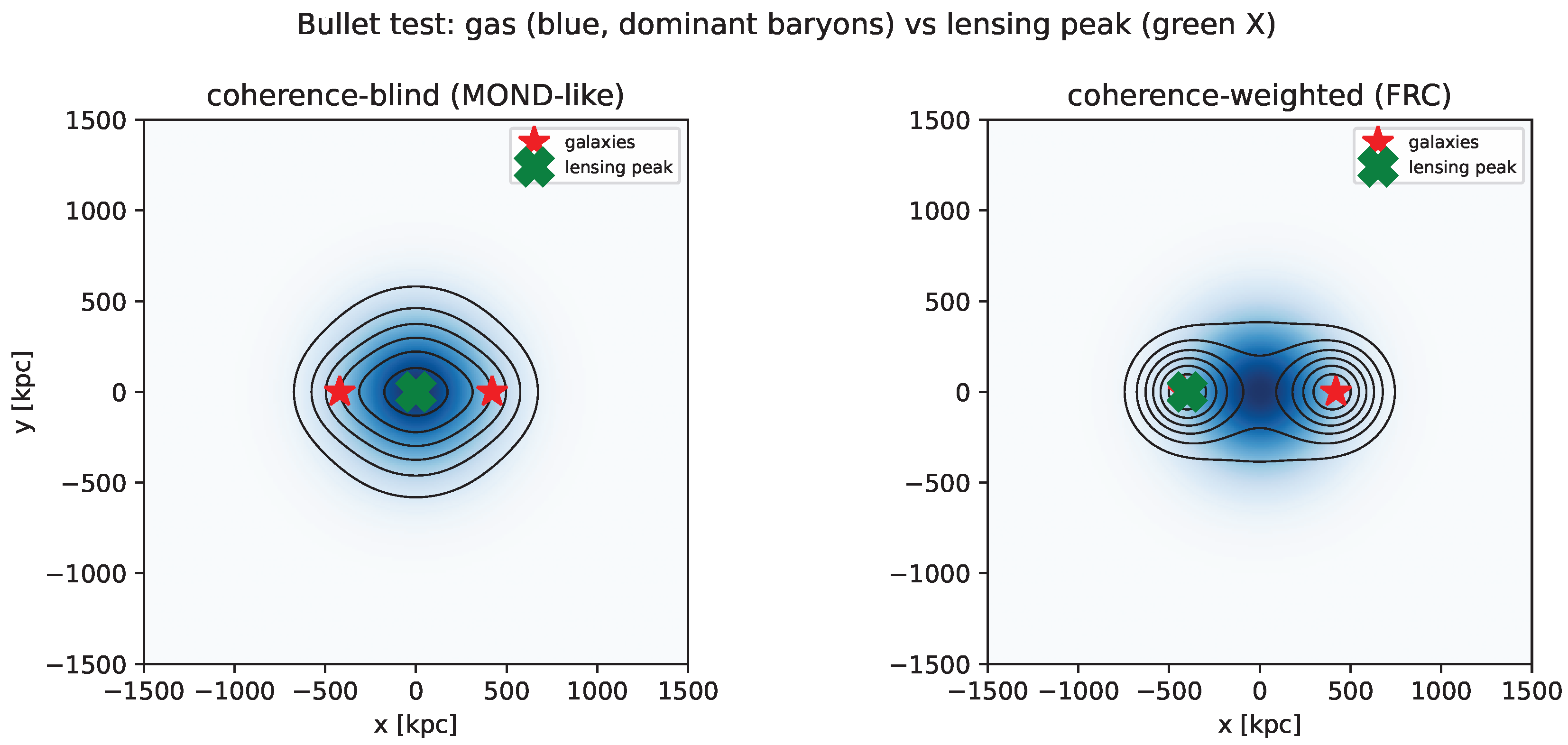
In a Bullet-type merger, with a dominant central gas component and two compact, collisionless galaxy concentrations offset from it, the registered lensing convergence therefore peaks on the galaxies rather than on the gas (Figure 4). A reading that weighted all baryons equally would keep the peak on the dominant gas. The observed displacement of the lensing peak from the baryonic centre of mass, usually read as direct evidence for collisionless particle dark matter, is here the signature that the enhancement is the coherence-weighted amplitude of the substrate, following the collisionless component by construction.
The coherence weight is made precise as the bulk-coherence fraction of a component,
unity for a virialised clump whose constituents share a bulk phase and tending to zero for gas randomised by a merger shock; the enhancement is sourced by while the Newtonian baseline is sourced by . This is a prediction, not a fit to the Bullet: the enhancement follows the coherent component. A modified-gravity account reaches the same offset by a different route — in QUMOND the phantom surface density is centred on the quasi-point-mass galaxies by their greater spatial concentration [40] — so the two are distinguished not by the Bullet alone but by systems in which coherence and concentration diverge: a diffuse but dynamically cold clump should still lens (high w, low concentration), and a concentrated but shock-heated clump should not (low w, high concentration). A quantitative convergence-map reconstruction against the observed gas map, galaxy catalogue, and lensing kernel, with computed from component temperatures and velocity dispersions, is the decisive test; Figure 4 is the qualitative illustration, not that reconstruction.
6.2. The Core Magnitude
Evaluated on the enclosed mass of a cluster (a -model gas with a central galaxy, against an observed total of NFW form), the boost at the core, where –, is –3. This is the boost the relation (6) supplies; it leaves a core-concentrated residual of order two relative to the observed mass, falling to unity by , so the deep outskirts are matched and the residual is confined to the core. This is the cluster residual common to all accounts that organise the discrepancy by the single acceleration [18,19]; read as matter it is the long-standing cluster “missing mass.” In the present framework it is not unaccounted matter but the coherent reading of the same amplitude that governs the deep regime. The registered deep-regime force is an amplitude (Proposition 2), and a core is a superposition of mutually coherent components — the brightest cluster galaxy and the few major virialised concentrations, phase-locked in the common potential by the synchronisation that is gravity itself (Section 2.2). The amplitude adds the components through their coherence matrix , one law for both cluster effects,
In a merger the shocked gas is mutually decohered from the galaxies, , and drops out of the amplitude — the Bullet offset (Section 6.1), a selection effect. In a relaxed core the synchronised components are mutually coherent, , the cross terms add the amplitudes to , and the boost over the smooth is with
For a core of a few comparable coherent concentrations supplies the factor of two, and the boost is core-confined because synchronisation locks the components only where the crossing time is shorter than a Hubble time, the sum reverting to the smooth value beyond the core. The single law (12) thus unifies the Bullet selection and the core addition. But — equivalently — must be computed from the core’s component masses and dynamical state, so the factor-of-two closure is a falsifiable conjecture, not a theorem: the residual is predicted to be , correlating with substructure, relaxed single-galaxy cores lying tight and disturbed cores carrying the excess.
7. Dark Energy and the Cosmological Scale
7.1. The Cosmological Constant
The accelerated expansion enters the same construction through the curvature of the finite chart. The cardinality is the primitive datum; the de Sitter entropy and the chart curvature (in Planck units) are two readings of that one number, not a derivation of one from the other, so no defining datum is reversed [30]. Because is the totality datum and not a vacuum energy summed over modes, there is no large energy to cancel and the 120-order discrepancy does not arise: the construction dissolves the cosmological-constant problem rather than computing from a mode sum. The value of , like the cardinality that sets it, is fixed by the totality and is not derived below the observer horizon — it carries the same -hard status as the cross-scale running of Section 7.2. Its sign is positive: the wrapped finite chart has positive intrinsic curvature — a de Sitter section with equation of state at leading order, the discrete metric and curvature computed in the gravity paper [30] — so finite-chart curvature is accelerated expansion. The same fixes, through , the galactic acceleration scale: the dark-matter threshold and the dark-energy scale are two readings of one floor.
7.2. The Cross-Scale Running
A single quantity in the construction is not fixed below the observer horizon: the dependence of the acceleration scale on cosmic scale, , whose temporal form is the redshift law . The accessible scales are the sub-cycles of the multiplicative structure, of orders the divisors of , and the running across them is the exact ratio . To specify it at every scale requires the full divisor structure of , that is, the factorization of ; a bounded observer reaches only the divisors below the horizon , while a prime factor above the horizon is not accessible to bounded search. The running is therefore decided by the totality but its uniform certificate closes only at carrier scale: it is the rate face of the scale-dilation drive across cosmic scale, and its reduction to the factorisation of places it in the same carrier-scale (-hard) class as the substrate’s other horizon-clause residues. This is the single quantity the present construction leaves to the totality (it is -hard, not merely unspecified); the remaining elements — the registration theorem of Section 4 and the coherence functional (11) — are determined below the horizon.
While its value is -hard, the shape of the running is the resolvable prediction , equivalently . A recent intermediate-redshift survey reports the characteristic acceleration rising from to across [41], in the direction and rough magnitude of the law; a quantitative fit of to such samples is the direct test. The explicit map from the divisor-scale coordinate d to cosmological redshift is not derived here: it is part of the same -hard residue, since the uniform profile requires the full divisor lattice of . Accordingly this subsection is the -hard clause of the ledger (D6), stated as such, not a closed below-horizon consequence.
8. Discussion
The construction reproduces the galactic phenomenology from one scale and two readings of the synchronisation field, with no component added to the visible matter and no function fitted to the galactic data. The radial acceleration relation, the baryonic Tully–Fisher relation, and flat rotation curves follow from the geometric-mean law (3); the shape of the relation follows from the conjugating rotation and the first-passage statistics; the scatter follows from the dynamical temperature of the disk; and the external-field effect follows from the total-field dependence of the registration. Several of these are sharp predictions. The intrinsic scatter is predicted to correlate with the dynamical temperature and to rise into the deep regime, both testable against resolved rotation-curve samples. The acceleration scale tracks the expansion, , so high-redshift rotation curves test the running directly. Cluster cores are predicted to carry a mass –3 times the baryonic mass, and the merging-cluster lensing offset is predicted to follow the collisionless component rather than the gas.
The framework differs from particle dark matter in admitting no new state — the matter content closes at one generation, with no fifth force — so the continuing null results of direct-detection and axion experiments are consistent with it [21,22,23]; the detection of a species that supplies the relevant galactic and cosmological gravitating abundance would falsify it, whereas a weakly-interacting relic that does not account for that abundance would not. It differs from modified-dynamics phenomenology in supplying the acceleration scale, the interpolation function, and the scatter from the substrate rather than positing them, while reproducing the same successful galactic relations. It shares with emergent-gravity programmes the tie between the acceleration scale and the cosmological horizon, but specifies the microscopic substrate, so the scale and the law are outputs. The cluster-core residual is shared with all single-scale accounts; here it is reduced to the coherent amplitude law (12), a falsifiable conjecture whose test is the coherence matrix computed from the core’s components, not a baryon census.
9. Further Falsifiable Predictions
Beyond the radial acceleration relation and its scatter, the construction makes several sharp, parameter-free predictions that separate it from both particle dark matter and constant-scale modified dynamics; each is computed in predictions.py (see App Appendix A).
- P1.
- Cosmic evolution of the scales. Because the floor tracks the expansion, , the radial-acceleration knee shifts to and the baryonic Tully–Fisher zero-point evolves: at fixed baryonic mass the flat speed scales as , so high-redshift disks rotate faster by — at , at , at , with . Constant- dynamics predicts no shift. Falsifier: a high-z knee away from , or a non-evolving Tully–Fisher zero-point.
- P2.
- A two-variable scatter law. The intrinsic scatter is a definite surface over acceleration and dynamical temperature, with . It vanishes for cold () and Newtonian () systems and rises as into the deep regime, reaching dex at for , far above the dex knee value. Falsifier: a deep-regime scatter that does not rise, or does not track .
- P3.
- Wide binaries. Wide stellar binaries enter the deep regime at separations kAU; their relative motion obeys with the same global and the vector Galactic external field , a velocity enhancement of – over Newtonian at the widest separations. The exponential knee is distinct from the Newtonian value 1 and from a rational interpolation. Falsifier: Newtonian wide-binary motion, or a knee of the wrong shape.
- P4.
- Dynamical-state offset. The enhancement weights bulk coherence, so a dynamically hot, pressure-supported system carries a reduced coherence fraction and amplitude : ellipticals, dwarf spheroidals, and ultra-diffuse galaxies should lie at or below the cold-disk relation by – dex for –1, correlating with . Constant-scale dynamics predicts the same relation for every dynamical state. Falsifier: pressure-supported systems on the cold-disk relation.
- P5.
- Coherence-state cluster gas. The X-ray gas gravitates only when bulk-coherent (12): in a relaxed cluster the virialised gas () contributes to the enhancement, while in a merger the shocked gas () drops out, displacing the lensing peak by an amount that grows with the shock Mach number. Particle dark matter has the gas gravitate identically in both, constant-scale dynamics has it source the field identically. Falsifier: a merger lensing peak tracking the shocked gas, or no relaxed-versus-merging difference.
- P6.
- A global, isotropic scale and no dark substructure. The floor is the global drive rate, identical in every direction and environment once the external-field correction is made; and no dark subhaloes exist, so perturbations in stellar streams and the satellite abundance trace baryons alone. Falsifier: a directional or density dependence of beyond the external-field effect, or stream gaps and substructure lensing with no baryonic counterpart.
10. Conclusions
Gravitation on a finite relational substrate is the synchronisation of elementary clocks. The synchronisation field reproduces Newton’s law at high acceleration and carries a resolution floor, fixed by the expansion rate, at . Below the floor the field is read in the Fourier-conjugate chart, where the registered force is an amplitude and the conserved flux a count, so the force is the geometric mean ; this gives flat rotation curves and the baryonic Tully–Fisher relation, and the crossover between the two regimes reproduces the empirical radial acceleration relation with no fitted function. The scatter, the external-field effect, and the lensing of clusters follow from the same registration, and the accelerated expansion is the curvature of the finite chart, . The dark sector of galaxies and the cosmological constant are thus two readings of one finite structure and one scale. The single quantity left to the totality below the observer horizon — -hard, not merely unspecified — is the running of the acceleration scale across cosmic scale, decided by the totality and certified only at carrier scale; the registration law and the coherence functional that the construction rests on are formalised here and determined below the horizon.
Appendix A. Numerical Methods and Reproducibility
Exact statements are identities in finite-field, integer, or cyclotomic arithmetic and are verified exhaustively; the continuum enters only as a controlled large-substrate limit, and comparisons with astrophysical data use standard values. The accompanying suite is deterministic (no random sampling; fixed seeds where an ensemble mean is illustrated) and reproduces every quantitative claim; the repository address and commit are listed with the released version. The discrete Gauss law of Proposition 1 is solved in exact rational arithmetic on a finite lattice. The amplitude identity of Proposition 2 is the cross-term cancellation proved in the text and is illustrated in to . The deep-regime law, the baryonic Tully–Fisher slope, and the exponential-disk rotation curve are evaluated against the radial acceleration relation. The interpolation (6) is checked equal to the empirical fitting function to machine precision. The finite-cycle first-passage of Proposition 3 is verified in firstpassage_finite.py: the exact single-step identity , the controlled reduction with series error and integer-barrier (lattice) error , both within-horizon small, and the exponentially small wrap correction of the killed walk on for a barrier below the coherence horizon. The scatter relation (9), the external-field curves (10), the merging-cluster convergence and coherence weight (11), the enclosed-mass cluster boost, the coherent-addition core residual (, cluster_coherent.py), and the divisor-lattice running of Section 7.2, and the further predictions of Section 9 (predictions.py) are computed in the same suite. Scale-dependent corrections to the continuum readings are bounded and shown negligible at galactic and cluster scales.
Numerical package: https://github.com/gamayos/frc-numerics/tree/main/32-dark
Appendix B. What Is Assumed, Imported, and Derived
The construction’s dependency structure is collected here in one place, so that every result above can be traced to its inputs and the surface a reader must accept is made explicit. Each row carries one status tag.
| tag | meaning |
| I | Import. A standard result or measured datum used here without reproof. |
| B | Bridge. An identification of a mathematical object with a physical one — the interpretive moves. |
| D | Definition. A naming or set-up move, carrying no empirical content. |
| T | Theorem. Derived within this paper from the rows above it. |
| C | Conjecture/prediction. Scoped and falsifiable, not yet confirmed. |
| O | Open. A residue a bounded observer could close (a construction still to be done). |
| -hard. Decided by the totality; not closeable by a bounded observer. |
| # | Move | Status | Source |
| A. Inputs: imported, not derived here | |||
| A1 | The finite substrate , cardinality (Planck units), fixed by the de Sitter entropy. | I | [30,31] |
| A2 | The Hubble datum , the one measured number entering . | I | measured |
| A3 | The synchronisation premise (nearest-neighbour phase coupling) and unit channel capacity . | I | [30] |
| A4 | The amplitude/Born rule: amplitude is the inter-subsystem projection, the squared amplitude a coincidence count. | I | [31] |
| A5 | The exact finite Fourier (FrFT) rotation between the coordinate and conjugate spectral charts. | I | [32] |
| A6 | The comprehension horizon: a bounded observer registers a signal only within its horizon in a chart. | I | [38] |
| A7 | The measured relations used for comparison only: the RAR/McGaugh function, , the dex scatter, the BTFR, the external-field downturn, the merging-cluster offset, the cluster-core residual. | I | [8,9,15,20] |
| B. Bridges: mathematics → physics (the interpretive moves) | |||
| B1 | Gravitation is the synchronisation of elementary clocks; distance is decoherence. | B | §Section 2.1 |
| B2 | Mass is winding rate, ; an acceleration advances phase at the rate . | B | §Section 2.1, Section 2.3 |
| B3 | The acceleration floor is the phase-coherence threshold : the winding frequency reaches the drive’s cyclic frequency (one radian of phase per Hubble time). | B | §Section 2.3 |
| B4 | Below the floor the registered force is read as an amplitude in the conjugate chart, the conserved flux as a count. | B | §Section 3.1, Section 3.2 |
| B5 | The intrinsic scatter is the dynamical temperature of the disk. | B | §Section 5.1 |
| B6 | The lensing enhancement is the coherence-weighted amplitude, following the bulk-coherent components. | B | §Section 6.1 |
| B7 | The cosmological constant is the curvature of the wrapped finite chart. | B | §Section 7.1 |
| C. Derived: theorems and consequences within this paper | |||
| C1 | Newton’s inverse-square law from the discrete Gauss law of the synchronisation flux. | T | Prop. 1 |
| C2 | The acceleration floor , parameter-free to ten percent. | T | Eq. (2) |
| C3 | Amplitude is the square root of the count (exact in , by cross-term cancellation). | T | Prop. 2 |
| C4 | The deep-regime geometric mean . | T | Eq. (3) |
| C5 | Flat rotation curves and the baryonic Tully–Fisher relation . | T | Eq. (4) |
| C6 | The registration theorem: the finite coincidence count, its first-passage law, and flux conservation give the radial acceleration relation with no fitted function, equal to the empirical fit. | T | Thm. 1, Eq. (6) |
| C7 | The finite-cycle first-passage law: is carrier-exact (amplitude identity) and the resolvable reading of the exact transform, to . | T | Prop. 3, Eq. (7) |
| C8 | The intrinsic-scatter relation, smallest at high acceleration and rising as . | T | Eq. (9) |
| C9 | The external-field effect from the total-field dependence of the registration. | T | Eq. (10) |
| C10 | The bulk-coherence weight and the merging-cluster lensing offset onto the coherent component. | D | T | Eq. (11), §Section 6.1 |
| C11 | The cosmological constant , sign positive, de Sitter section; no 120-order cancellation. | T | B | §Section 7.1 |
| D. Predictions and residues | |||
| D1 | The redshift law : the knee shifts and the Tully–Fisher zero-point evolves, ( at ), parameter-free (P1; shape resolvable, value in D6). | C | §Section 9 |
| D2 | The cluster-core residual is in the number of coherent core concentrations, correlating with dynamical state (relaxed tight, disturbed in excess). | C | §Section 6.2 |
| D3 | No new dark-matter state and no dark subhaloes: stream perturbations and the satellite abundance trace baryons; the floor is global and isotropic (P6). | T | B | §Section 9 |
| D4 | The scatter is the two-variable law , vanishing for cold high-x systems and rising as to dex deep (P2). | C | §Section 5.1 |
| D5 | The cluster-core residual is predicted to be the coherent amplitude addition (12) of the synchronised core components, over the smooth boost, the one amplitude law unifying the Bullet selection () and the core addition (); computing (the coherence matrix) from observables is the falsifiable test. | C | §Section 6 |
| D6 | The cross-scale running ; its uniform certificate closes only at carrier scale. | §Section 7.2 | |
| D7 | Wide binaries ( kAU) follow with the global and the vector Galactic field : a 10– enhancement, the exponential knee distinct from Newtonian and rational forms (P3). | C | §Section 9 |
| D8 | Pressure-supported systems (ellipticals, dSphs, UDGs) lie below the cold-disk relation by the coherence factor , , correlating with (P4). | C | §Section 9 |
Collecting the tags separates the three categories directly. Imported are the cardinality and the Hubble datum (A1–A2), the synchronisation, amplitude, Fourier-chart, and horizon results established in the companion papers (A3–A6), and the measured relations used only for comparison (A7); these are the sole inputs. Interpreted are the seven bridges (B1–B7), each a single identification and each the place a reader who rejects the physical reading would object. Derived is the whole of block C — Newton’s law, the floor, the geometric mean, the registration theorem and the radial acceleration relation, the scatter, the external-field effect, and — with no further assumption. The one -hard residue is the cross-scale running (D6), decided by the totality and shared with the number-theoretic instances of the horizon clause. The cluster-core factor, once read as missing mass, is reduced to the within-horizon coherent amplitude law (12), a falsifiable conjecture (D5) pending the coherence matrix from observables — not an import and not an obstruction. The headline predictions D1–D8 are derived or falsifiable.
References
- Rubin, V.C.; Ford, W.K. Rotation of the Andromeda Nebula from a Spectroscopic Survey of Emission Regions. Astrophys. J. 1970, 159, 379. [Google Scholar] [CrossRef]
- Bosma, A. 21-cm line studies of spiral galaxies. Astron. J. 1981, 86, 1825. [Google Scholar] [CrossRef]
- van Albada, T.S.; Sancisi, R. Dark matter in spiral galaxies. Phil. Trans. R. Soc. A 1986, 320, 447. [Google Scholar] [CrossRef]
- Riess, A.G.; et al. Observational Evidence from Supernovae for an Accelerating Universe. Astron. J. 1998, 116, 1009. [Google Scholar] [CrossRef]
- Perlmutter, S.; et al. Measurements of Ω and Λ from 42 High-Redshift Supernovae. Astrophys. J. 1999, 517, 565. [Google Scholar] [CrossRef]
- Weinberg, S. The cosmological constant problem. Rev. Mod. Phys. 1989, 61, 1. [Google Scholar] [CrossRef]
- Planck Collaboration. Planck 2018 results. VI. Cosmological parameters. Astron. Astrophys. 2020, 641, A6. [Google Scholar] [CrossRef]
- McGaugh, S.; Lelli, F.; Schombert, J. Radial Acceleration Relation in Rotationally Supported Galaxies. Phys. Rev. Lett. 2016, 117, 201101. [Google Scholar] [CrossRef] [PubMed]
- Lelli, F.; et al. One Law to Rule Them All: The Radial Acceleration Relation of Galaxies. Astrophys. J. 2017, 836, 152. [Google Scholar] [CrossRef]
- McGaugh, S.; et al. The Baryonic Tully–Fisher Relation. Astrophys. J. Lett. 2000, 533, L99. [Google Scholar] [CrossRef]
- Lelli, F.; McGaugh, S.; Schombert, J. The Small Scatter of the Baryonic Tully–Fisher Relation. Astrophys. J. Lett. 2016, 816, L14. [Google Scholar] [CrossRef]
- Milgrom, M. A modification of the Newtonian dynamics as a possible alternative to the hidden mass hypothesis. Astrophys. J. 1983, 270, 365. [Google Scholar] [CrossRef]
- Milgrom, M. The modified dynamics as a vacuum effect. Phys. Lett. A 1999, 253, 273. [Google Scholar] [CrossRef]
- Desmond, H. A statistical investigation of the mass discrepancy–acceleration relation. Mon. Not. R. Astron. Soc. 2017, 464, 4160. [Google Scholar]
- Chae, K.H.; et al. Testing the Strong Equivalence Principle: Detection of the External Field Effect in Rotationally Supported Galaxies. Astrophys. J. 2020, 904, 51. [Google Scholar] [CrossRef]
- Chae, K.H.; et al. Distinguishing Dark Matter, Modified Gravity, and Modified Inertia with the Inner and Outer Parts of Galactic Rotation Curves. Astrophys. J. 2021, 921, 104. [Google Scholar] [CrossRef]
- The, L.; White, S. The mass of the Coma cluster. Astron. J. 1988, 95, 1642. [Google Scholar]
- Sanders, R.H. Clusters of galaxies with modified Newtonian dynamics. Mon. Not. R. Astron. Soc. 2003, 342, 901. [Google Scholar] [CrossRef]
- Pointecouteau, E.; Silk, J. New constraints on modified Newtonian dynamics from galaxy clusters. Mon. Not. R. Astron. Soc. 2005, 364, 654. [Google Scholar] [CrossRef]
- Clowe, D.; et al. A Direct Empirical Proof of the Existence of Dark Matter. Astrophys. J. Lett. 2006, 648, L109. [Google Scholar] [CrossRef]
- LZ Collaboration. First Dark Matter Search Results from the LUX-ZEPLIN Experiment. Phys. Rev. Lett. 2023, 131, 041002. [Google Scholar] [PubMed]
- XENON Collaboration. First Dark Matter Search with Nuclear Recoils from the XENONnT Experiment. Phys. Rev. Lett. 2023, 131, 041003. [Google Scholar] [CrossRef] [PubMed]
- ADMX Collaboration. Extended Search for the Invisible Axion with the Axion Dark Matter Experiment. Phys. Rev. Lett. 2020, 124, 101303. [Google Scholar] [CrossRef] [PubMed]
- Bekenstein, J.; Milgrom, M. Does the missing mass problem signal the breakdown of Newtonian gravity? Astrophys. J. 1984, 286, 7. [Google Scholar] [CrossRef]
- Famaey, B.; McGaugh, S. Modified Newtonian Dynamics (MOND): Observational Phenomenology and Relativistic Extensions. Living Rev. Relativ. 2012, 15, 10. [Google Scholar] [CrossRef] [PubMed]
- Sakharov, A.D. Vacuum quantum fluctuations in curved space and the theory of gravitation. Sov. Phys. Dokl. 1968, 12, 1040. [Google Scholar]
- Jacobson, T. Thermodynamics of Spacetime: The Einstein Equation of State. Phys. Rev. Lett. 1995, 75, 1260. [Google Scholar] [CrossRef] [PubMed]
- Verlinde, E. On the Origin of Gravity and the Laws of Newton. J. High Energy Phys. 2011, 2011, 29. [Google Scholar] [CrossRef]
- Verlinde, E. Emergent Gravity and the Dark Universe. SciPost Phys. 2017, 2, 016. [Google Scholar] [CrossRef]
- Akhtman, Y.; Voether, E. Gravitation as Phase Synchronisation over Finite Substrate. Preprints 2026. [Google Scholar] [CrossRef]
- Akhtman, Y.; Voether, E. Quantum Observation over Finite Substrate. Preprints 2026. [Google Scholar] [CrossRef]
- Akhtman, Y. Scale-Shift and Fractional Fourier Transform as Rotations in Representation Space over Finite Fields. Preprints 2026. [Google Scholar] [CrossRef]
- Lev, F.M. Finite Mathematics as the Foundation of Classical Mathematics and Quantum Theory: With Applications to Gravity and Particle Theory. In Fundamental Theories of Physics; Springer: Cham, 2020. [Google Scholar] [CrossRef]
- Zeilberger, D. “Real” Analysis Is a Degenerate Case of Discrete Analysis. In New Progress in Difference Equations (Proceedings of ICDEA 2001); Taylor & Francis: London, 2004. [Google Scholar]
- Kuramoto, Y. Self-entrainment of a population of coupled non-linear oscillators. International Symposium on Mathematical Problems in Theoretical Physics, 1975; Springer; Lecture Notes in Physics; Vol. 39, p. 420. [Google Scholar]
- Strogatz, S.H. From Kuramoto to Crawford. Phys. D. 2000, 143, 1. [Google Scholar] [CrossRef]
- Pantaleone, J. Synchronization of metronomes. Am. J. Phys. 2002, 70, 992. [Google Scholar] [CrossRef]
- Akhtman, Y.; Voether, E. P versus NP: Computation as Counting over Finite Substrate, 2026. In FRC programme; draft.
- Stiskalek, R.; Desmond, H. The underlying radial acceleration relation. Mon. Not. R. Astron. Soc. 2023, 526, 3342, [2303.11314. [Google Scholar] [CrossRef]
- (MOND Bullet Cluster analysis). A consistent MOND modelling of the Bullet Cluster. arXiv 2026, arXiv:2604.10811.
- MUSE-DARK Collaboration. MUSE-DARK III. The evolution of the radial acceleration relation at intermediate redshifts. Astron. Astrophys. 2026, 2604.22613. [Google Scholar]
| 1 | The coincidence has long been noted, and read as the acceleration whose Unruh temperature matches the de Sitter temperature of the expansion [13]; that thermodynamic equality fixes up to an order-one factor and does not by itself supply the , which here is the phase-cycle normalisation above. |
Figure 1.
Galactic phenomenology from the two-reading law. Left: the radial acceleration relation (6) (blue) interpolating between the Newtonian (slope 1, dashed) and deep (slope , dash-dotted) regimes, with the transition at (dotted); the rational interpolation of modified-dynamics phenomenology (magenta) shares the limits but parts at the knee, by up to in (the discriminating test, against resolved rotation-curve data). Right: the rotation curve of an exponential disk of , baryonic contribution (dashed) and registered curve (solid). The baryonic Tully–Fisher relation (4) is the deep-regime corollary, not shown.
Figure 1.
Galactic phenomenology from the two-reading law. Left: the radial acceleration relation (6) (blue) interpolating between the Newtonian (slope 1, dashed) and deep (slope , dash-dotted) regimes, with the transition at (dotted); the rational interpolation of modified-dynamics phenomenology (magenta) shares the limits but parts at the knee, by up to in (the discriminating test, against resolved rotation-curve data). Right: the rotation curve of an exponential disk of , baryonic contribution (dashed) and registered curve (solid). The baryonic Tully–Fisher relation (4) is the deep-regime corollary, not shown.
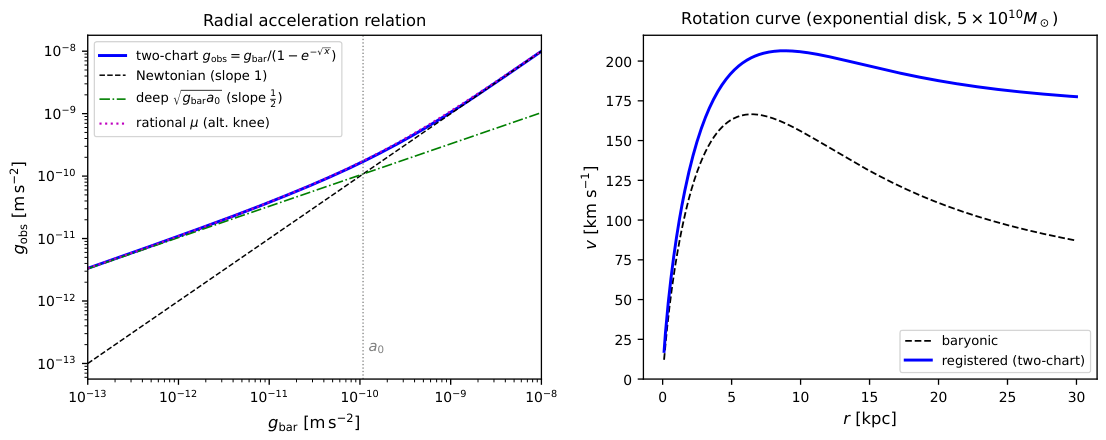
Figure 2.
The interpolation from first principles. Left: the meridian first-passage law (Proposition 3); the killed-walk simulation collapses onto with the amplitude across barrier heights a and killing rates s, the dimensionless normalisation (8). Right: the chart angle with , running from the coordinate chart (, ) to the spectral chart (, ) through at the floor .
Figure 2.
The interpolation from first principles. Left: the meridian first-passage law (Proposition 3); the killed-walk simulation collapses onto with the amplitude across barrier heights a and killing rates s, the dimensionless normalisation (8). Right: the chart angle with , running from the coordinate chart (, ) to the spectral chart (, ) through at the floor .
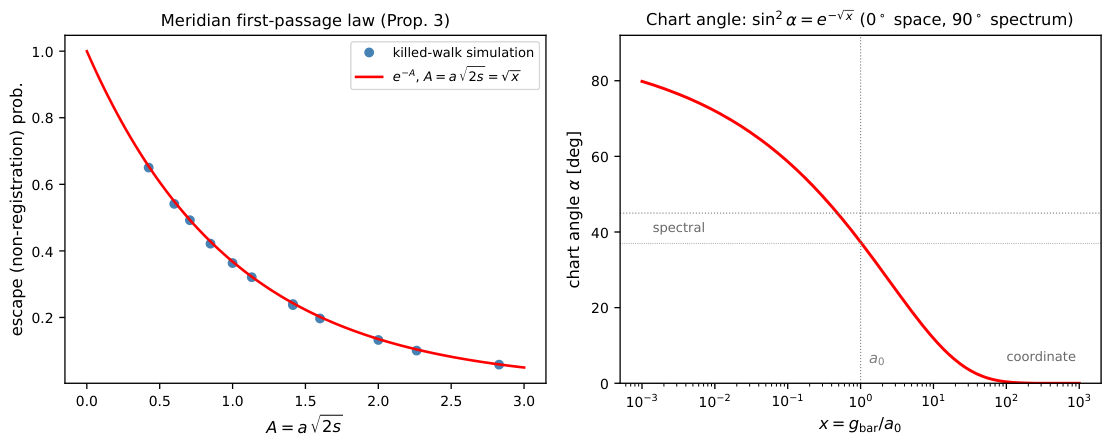
Figure 3.
Scatter and environment. Left: the intrinsic scatter (9), smallest at high acceleration and rising into the deep regime, against the observed dex. Right: rotation curves under (10) for increasing external field, showing the external-field downturn.
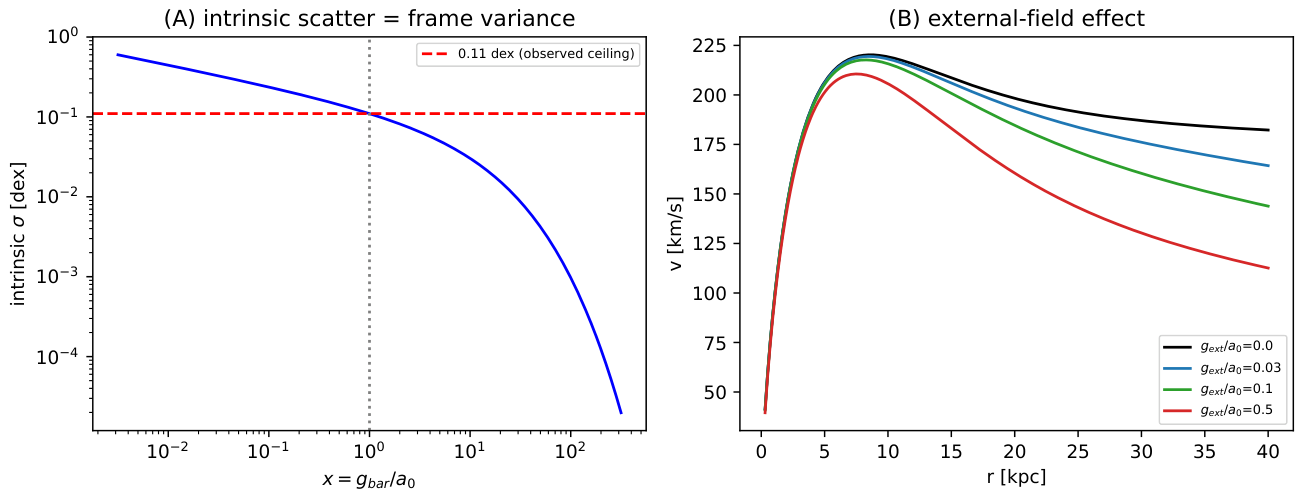
Figure 4.
Merging-cluster test. Gas (blue) dominates the baryons. A coherence-blind enhancement (left) keeps the lensing peak (green) on the gas; the coherence-weighted enhancement (right) places it on the collisionless galaxies (red), illustrating the predicted offset.
Figure 4.
Merging-cluster test. Gas (blue) dominates the baryons. A coherence-blind enhancement (left) keeps the lensing peak (green) on the gas; the coherence-weighted enhancement (right) places it on the collisionless galaxies (red), illustrating the predicted offset.
Disclaimer/Publisher’s Note: The statements, opinions and data contained in all publications are solely those of the individual author(s) and contributor(s) and not of MDPI and/or the editor(s). MDPI and/or the editor(s) disclaim responsibility for any injury to people or property resulting from any ideas, methods, instructions or products referred to in the content. |
© 2026 by the authors. Licensee MDPI, Basel, Switzerland. This article is an open access article distributed under the terms and conditions of the Creative Commons Attribution (CC BY) license (http://creativecommons.org/licenses/by/4.0/).
Copyright: This open access article is published under a Creative Commons CC BY 4.0 license, which permit the free download, distribution, and reuse, provided that the author and preprint are cited in any reuse.


