
Submitted:
22 June 2026
Posted:
23 June 2026
You are already at the latest version
Abstract
Wastewater treatment is purely a water purification step that clarifies wastewater from industrial, agricultural and human generated wastes like dyes, pesticides, antibiotics and plastics and heavy metals to make it consumable for humans. Access to safe and clean drinking water is a fundamental right and therefore should be accounted foremost to fulfil ongoing demands. Contamination of water is often due to the presence of water pollutants above the threshold value as directed by different statuary bodies like Central Pollution Control Board (CPCB) in India, responsible for determining the minimum pollutant that should be present in wastewater and marked as safe for human intake. Some of the most peculiar pollutant present in amicable amount in wastewater are dyes, heavy metals, pesticides, antibiotics, volatile organic compounds (VOCs), inorganic ions, polyaromatic hydrocarbons (PAHs), pharmaceuticals, and personal care products (PPCPs), endocrine disruptors (EDCs), persistent organic pollutants (POPs) and radionuclides among others. These are the products of textile industries, home wastes, and agricultural wastes and leather industries to name a few that are directly discarded into the water bodies without proper pre-chemical treatment. In this paper, we have attempted to search and include the exhaustive list of Metal-Organic frameworks (MOFs) exhibiting exceptional degradation capability towards wastewater to achieve our Sustainable Development Goal 6 (SDG 6) of access of safe and pure drinking water to all. In countries like India, where the availability of safely managed drinking water is a bare minimum, compared to its other continental counterparts, measures should be taken to ensure the minimization of poor sanitation facilities, safely managed domestic and industrial wastewater, the presence of water bodies with good ambient water quality, changes in water efficiency over time, freshwater withdrawal as proportion of available freshwater resources and degree of integrated water resource management. We have actively discussed the synthesis of novel MOFs such as lignocellulosic materials, biochars, MOF-derived carbons, bimetallic MOFs and magnetic materials exhibiting fantastic degradation capacity to fulfil our needs to purify water. The surface characteristics of MOF material is also discussed to include morphology, structure, metal ligand interaction, porosity and stability. The properties, history, background, classification—based on origin, synthesis, factors affecting synthesis, trends of publishing on Metal organic framework (MOF) based wastewater treatment as well as contrast to overall application is also discussed in brevity. The statistics revolving around proportions of available freshwater, discussion of a few water contaminants in greater detail, their removal rates and also a subsequent attempt to automate the process of water cleaning to sustain the global water needs and challenges using Metal organic framework (MOF) research database like the one such as PubChem used for drug research. Key limitations include the stability of MOF, toxicity, costly purchase of chemical for Metal organic framework (MOF) synthesis and not all composites work equally on all the contaminants like selective degradation of organic pollutants and recyclability is a problem that should be addressed equally.
Keywords:
metal organic framework (MOF)
; sustainable development goals (SDGs)
; water remediation
; dyes
; antibiotics
; heavy metals
; pesticides
; volatile organic compounds (VOCs)
1. Introduction
Metal-organic framework (MOF) is a class of porous, versatile, cage-like structures comprising metal centres and organic linkers. The metal ions can typically be transition metals like Ni, Fe, Cu, Zn, Co and organic linkers like 1,4-Benzene dicarboxylic acid (BDC), Benzene-1,3,5-tricarboxylate (BTC), Benzene-1,3,5-tri benzoate (BTB), Naphthalene-1,4 phenyl dicarboxylic acid, 4-Pyrid-4-ylbenzoic acid (HPBA), Porphyrin, Benzene-1,4-diamine, 2-Methyl imidazole (MIM), Polyaniline (PANI) and Terephthalic acid, etc.
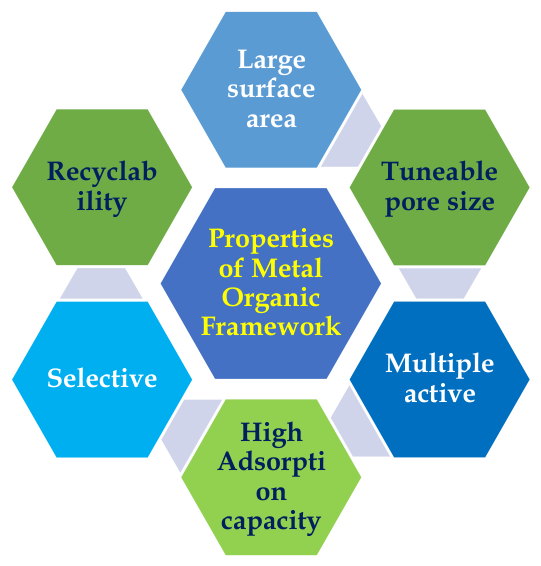
Metal-Organic Framework (MOF) was discovered by Omar Yaghi, a professor at UC Berkley, California at the University of Michigan (1999) while exploring ways to store gases in porous materials [1]. Metal-organic frameworks (MOFs) stand out from other materials in terms of excellent material properties such as large specific surface area, tuneable pore size, fine crystalline structure, multiple active sites, high adsorption capacity, selectivity, stability, sensitivity, versatility, permeability, reliability, scalability, recyclability, and reusability. Other properties of equal significance are kinetic and thermodynamic parameters, simplicity, cost-effectiveness, low energy consumption, high pollutant removal rate, speed, efficiency, biodegradability, and thermal stability.
Figure 1.
Properties of Metal organic framework.
Classification of Metal-organic framework:
Based on origin, Metal-organic framework can be classified as 1) Zeolitic Imidazolate framework (ZIF) 2) Material Institute Lavoisier (MIL) 3) University of Oslo (UiO) 4) Isoreticular (IR) MOF 5) Hong Kong University of Science and Technology (HKUST) 6) Porous coordination network (PCN) 7) Porous coordination polymer (PCP)
Zeolitic Imidazolate Framework (ZIF)
Zeolitic Imidazolate framework (ZIF) is a subclass of the Metal-organic framework (MOF) composed of tetrahedral metal centers such as Zn2+ or Co2+ and imidazolate linkers. It is constructed from materials possessing valence electrons. The geometry resembles zeolites, featuring similar bond angles between metal and nitrogen atoms that impart chemical and thermal stability. Examples are ZIF-8, ZIF-90, ZIF-67 and ZIF-71 [2]. ZIFs possess unique properties such as highly crystalline structure, large pore size, generous surface area, thermal and chemical stability, enhanced selectivity and hydrophilicity, decreased cytotoxicity, acid sensitivity, and a wealth of binding sites. Applications include adsorption, separation, water splitting, corrosion, and sensing.
Materials Institute Lavoiser (MIL)
Material Institute Lavoiser is a type of Metal-organic framework (MOF) named after the institute Lavoiser in France, where they were first developed. These frameworks are typically constructed using trivalent metal ions such as Al3+, Fe3+ , or Cr3+ and dicarboxylate linkers [3]. Properties include durability, high compatibility, versatility, uniform porosity, vast surface area, excellent thermal stability, chemical resistance, and redox properties. Some applications of Material Institute Lavoisier (MIL) are separation, catalysis, environmental cleaning, gas storage, drug delivery, and biomedical applications. Examples of Material Institute Lavoisier (MIL) are MIL-53, MIL-88, MIL-100, MIL-101, MIL-125, MIL-127, and MIL-141 [4,5,6,7,8,9,10].
University of Oslo (UiO)
Zirconium terephthalates are prominent Metal organic frameworks (MOFs) produced at the University of Oslo. They have metal nodes linked 12-fold in Face centred cubic (FCU) topology to form cuboctahedral crystals. The [Zr6O4(OH)4] Secondary building units (SBUs), each linked with twelve 1,4-benzene-dicarboxylate (H2BDC) linkers form the main structure [11]. Properties include porosity, large surface area, resilient materials, adaptability, outstanding mechanical, thermal, and chemical stability, and cost-effectiveness. Some examples of the University of Oslo’s (UiOs) are UiO-66, UiO-67 and its derivatives. Zirconium or Hafnium clusters coordinate with carboxylate linkers such as terephthalic acid to form University of Oslo compounds. Applications include sensing, supercapacitors, catalysis, adsorption, drug delivery, gas storage, energy storage, and environment cleanup.
Isoreticular MOF (IR)
Isoreticular MOFs (IR MOFs) are synthesized using Secondary building unit (SBU) [Zn4O]6+ and a series of aromatic carboxylates. The crystal structure is microporous, crystalline, and octahedral [12]. Application of Isoreticular metal-organic frameworks (IR MOFs) are adsorption, sensing, and catalysis. Properties of equal significance are porosity, selectivity, sensitivity, active pore sites, and large surface area. Examples of Isoreticular MOFs (IR MOFs) are IRMOF-1, IRMOF-3, IRMOF-8, and IRMOF-10, etc. [13,14,15,16].
Hong Kong University of Science and Technology (HKUST)
Hong Kong University of Science and Technology (HKUST) is a well-known MOF invented by researchers at Hong Kong University of Science and Technology in 1991. The structure is composed of dimeric copper linked to four carboxylic acid functional groups from four H3BTC ligand molecules forming a copper carboxylate motif in which each copper atom is octahedrally coordinated with other copper atoms and four oxygen atoms.
Meanwhile, the remaining coordination sites are not bound and thus are available and ready to be occupied by solvent molecules such as water. Properties include a porous, crystalline framework renowned for its large surface area and hardness. Applications are catalysis and sensors. HKUST-1 is a well-known example also known as MOF-199.
Porous Coordination Networks (PCN)
Porous coordination networks are stereo-octahedron materials, that have a 3D structure and a hole–cage–hole topology. Properties include large surface area, significant porosity, high connectivity, often featuring cub octahedral cages as their defining structural motifs. These frameworks are designed to optimize molecular interactions within their cavities, making them highly effective for gas adsorption and separation.
Examples are PCN-57, PCN-222 and PCN-224. Zirconium ions couple with tetrakis (4-carboxyphenyl) porphyrin resulting in wide pores and a strong framework. The flexibility of PCN enables inclusion of numerous functional groups, resulting in tailored features for specific applications. Their stability and versatility make them useful for both academic research and industry uses.
Porous Coordination Polymer (PCP)
Porous coordination polymers (PCPs) are synthesized using transition metal ions as Secondary building units (SBUs) and carboxylic acid, pyridine, and its derivatives as Primary building units (PBUs). Properties include biocompatibility, non-toxicity and biodegradability. Applications are separation, catalysis, and sensor. Examples of Porous coordination polymers (PCPs) are 1a, 1b, 1c, DUT-49, BUT-8 (Cr), NU-1105 and NCU-100.
Figure 2.
Classification of Metal organic framework based on origin.
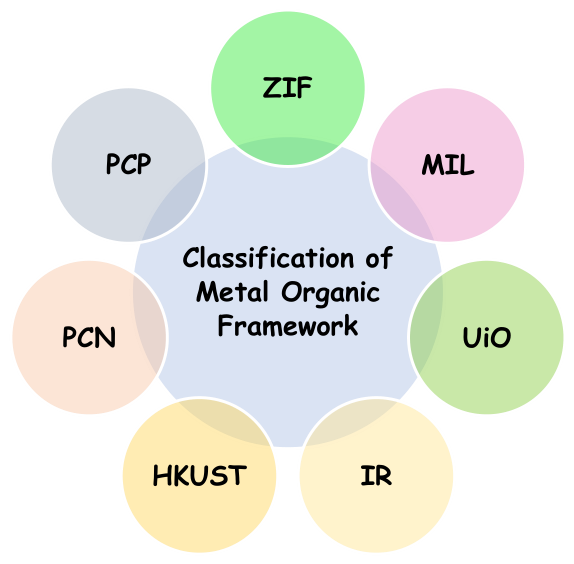
Figure 4.
Factors affecting synthesis of reaction.
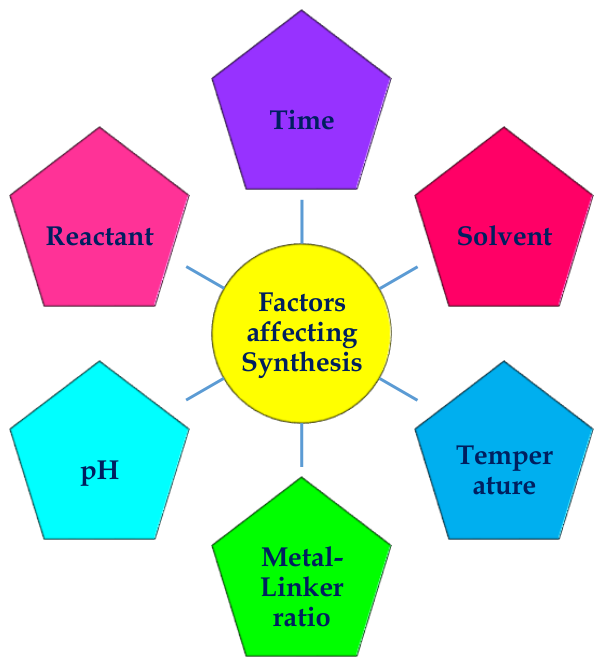
Factors affecting the synthesis of Metal-organic frameworks
Several factors affect synthesis like reaction time, temperature, solvent type, metal and organic linker ratio, etc affecting shape, size, morphology, topography and overall structure of Metal organic frameworks (MOFs).
- Reaction time: The reaction time generally affects forward reaction but little does to the type of product. However, some specific reactions are affected and thus guided by the i.e., the type of Metal organic framework. As the reaction time increases, the density of the tetrahedral nodes in the resulting product also increases leading to increase in the energy of the framework. (Tao et al. 2021).
The change in reaction time will change the particle size of Metal organic framework (MOF) and also agglomeration. (Ma et al., 2021a) A longer reaction time generally allows complete crystallization of Metal organic framework (MOF) structure, increases the activity of molecules and potentially increases the size of crystals.
- 2.
- Temperature: The temperature plays an important role in MOF synthesis affecting the rate of reaction, solubility of reactant, kinetics of crystal growth, coordination ability of coordination group, morphology, shape, and size of Metal organic framework (MOF) crystal.
- 3.
- Solvent type: The choice of solvent is crucial as it affects reactivity, solubility, redox potential, thermodynamic property and activation energy of the Metal organic framework (MOF). The quality of the solvent depends on solubility, polarity, coordination ability and template effect. The common solvents used in the growth of Metal organic framework (MOF) crystals are Dimethyl sulfoxide (DMSO), Alcohol, Acetonitrile, Methanol and Demineralized water (DMW), etc.
- 4.
- Metal to organic linker ratio: The nature of metal ions and organic linkers affects the structure, pore size, composition, and stability of Metal organic framework (MOF) reaction.
- 5.
- pH: pH affects reactant solubility, impurity activity, coordination, and protonation/deprotonation affecting the coordination of metal ions and organic linkers shaping crystal growth. Metal-organic frameworks (MOFs) of high dimensions are formed at high pH.
- 6.
- Reactant: Metal precursors, organic linkers and their concentration ratios tend to significantly alter the structure of Metal organic framework (MOF). Decreasing the reactant concentration decreases the particle size but once the optimum point is reached, it will lead to particle agglomeration and uneven morphology. Surfactants/capping agents often affects nucleation and crystal growth resulting in change in size and morphology of the Metal organic framework (MOF) crystal. The higher the concentration, the higher is the growth rate and also formation of large sized Metal organic frameworks (MOFs).
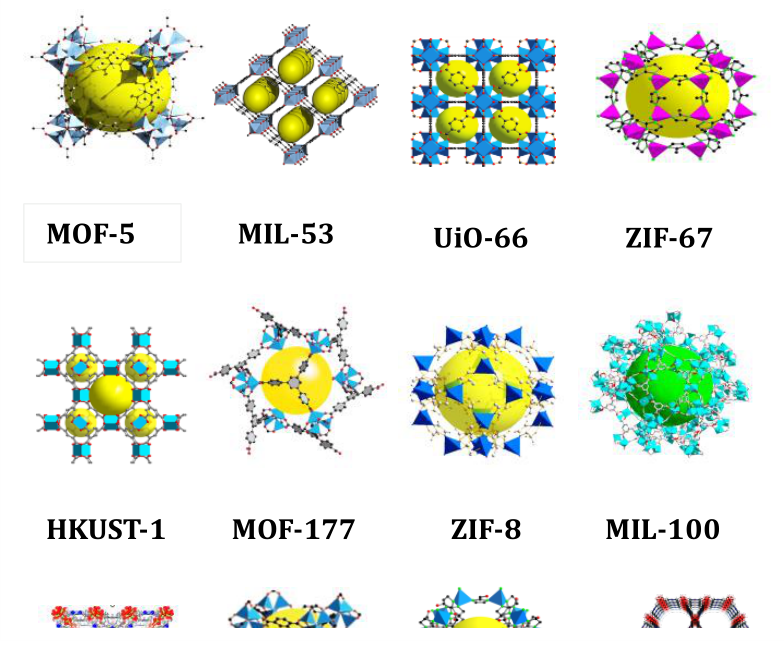
Some of the common Metal organic frameworks (MOFs) taking an active part in adsorption, catalysis, sensing, corrosion, water splitting, drug delivery, waste water treatment, chips, supercapacitors, 3D printing, biomedical applications, gas storage and energy storage, etc applications are discussed below:
Figure 3.
Some common types of Metal organic frameworks (MOFs) utilized in various fields of studies.
Figure 3.
Some common types of Metal organic frameworks (MOFs) utilized in various fields of studies.
Metal organic framework (MOF) is an ever-growing field that is rapidly expanding and it can be tracked down due to the development of novel synthetic approaches to design and develop new Metal organic framework materials (MOFs) and the exponential growth of research publication in almost every application domain. Apart from traditional routes, Machine learning (ML) and Artificial intelligence (AI) tools can also be used to predict patterns and trends in functions and mechanisms of Metal-organic framework materials (MOFs). Thus, possibilities of the use of the Metal-organic framework (MOF) can be explored as a potential source in cancer therapy, synthetic organ transplant, drug delivery, 3D printing high-tech water purification techniques, etc.
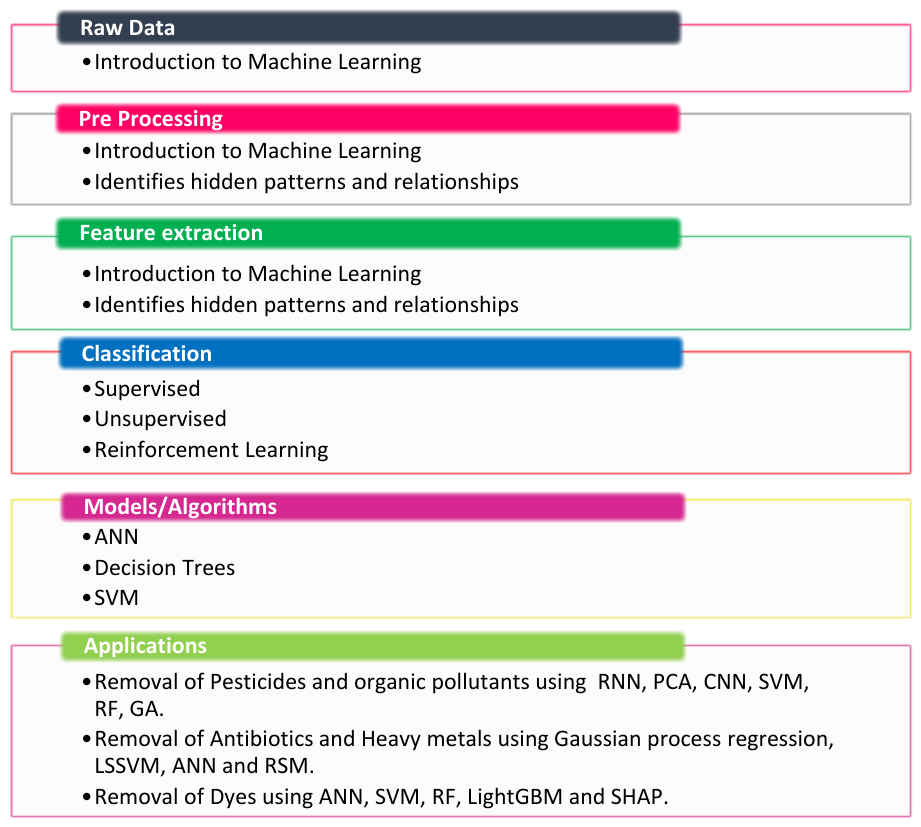
To automate the discovery, design and application process of Metal organic frameworks (MOFs), Machine learning (ML) can be used to predict structure-property relationships, material design and discovery to design novel materials, performance prediction and optimisation, data mining and integration, predictive modelling to predict properties and performance, computational screening to rapidly evaluate Metal organic framework (MOF) structure and optimisation of synthesis parameters to optimise synthesis conditions, etc. The flowchart below clearly defines the machine learning process in a detailed way.
Figure 5.
Steps in Machine learning (ML) that affects synthesis, structure and optimization of Metal organic framework.
Figure 5.
Steps in Machine learning (ML) that affects synthesis, structure and optimization of Metal organic framework.
Synthesis
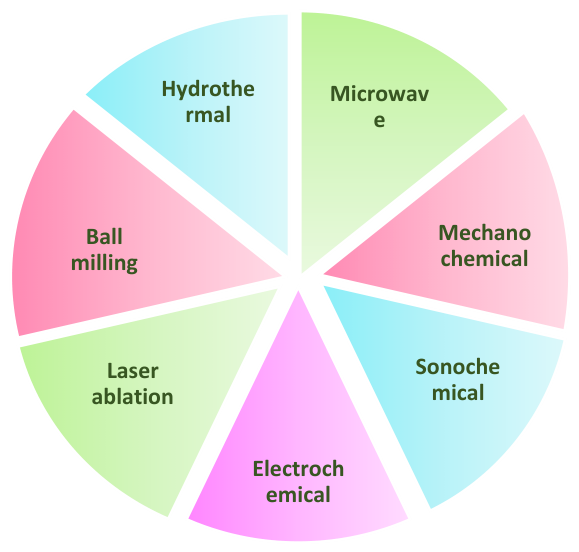
Metal-organic framework (MOF) can be synthesized using a variety of techniques such as the solvothermal method, hydrothermal method, sonochemical method, microwave synthesis, and electrochemical synthesis depending on morphology, structure, and pore size of Metal-organic frameworks (MOFs).
Solvothermal method involves mixing of material precursors placed in an autoclave, for the execution of reaction at a given temperature and pressure. The characteristics and pore size of the material depend on the set temperature. The existing solvothermal methods are based on organic solvents, such as methanol, ethanol, acetone, N, N-dimethylformamide (DMF), and Demineralised water (DMW) however solvent less methods are also utilised in as a part of green synthesis campaign in other methods.
Microwave synthesis is a time-saving method, that utilizes microwave irradiation to heat reactant mixtures in a domestic household microwave oven (DMO) or similar commercially available instrumentation. Using microwave synthesis, various common Metal organic frameworks (MOFs) such as MIL-101, UiO-66, ZIF-8, and PCN-134 have been successfully prepared.
Mechanochemical synthesis is a green and eco-friendly approach that utilises methods such as ball-milling, screw extrusion, liquid-assisted resonant acoustic mixing and other approaches. This method has attracted extensive attention because it uses little or no solvent, enables time-saving one pot synthesis, and generates minimal waste. Liquid-assisted grinding (LAG) and ion- or liquid-assisted grinding (ILAG) are the most commonly used methods in mechanochemical synthesis. Compared with absolutely solvent-free approaches, these methods promote the dissolution of solid reagents and improve the formation of coordination bonds.
Sonochemical synthesis utilizes ultrasound energy ranging from 20 to 1000 kHz, which enables preparation of numerous Metal organic frameworks (MOFs) with diverse crystal sizes and morphologies. In general, the morphology and particle size of Metal organic frameworks (MOFs) are greatly affected by the reaction time, temperature and ultrasonic power.
Electrochemical synthesis is a promising method that applies electrical current to chemical synthesis reactions. This method can be divided into electrode superficial nucleation (ESN), indirect bipolar electrodeposition (IBED), and electrophoretic deposition (EPD) methods. There is no requirement for metal salts as precursors because the metal ions are generated by the electrodes.
Chemical Vapor Deposition (CVD) synthesizes ultrafine particles of less than 1 micrometer (1 μm) (nanomaterials are of 10-100nm size) by chemical reaction taking place in the gaseous phase. This method is mainly used in semiconductor manufacturing and thin films. Homogeneous nucleation generally takes place at the gas phase and heterogeneous nucleation takes place at the substrate level.
Laser ablation often involves nanoparticle generation using a powerful laser beam that hits the target material vaporizing source or precursor. This green technique does not require stabilizing agents or other chemicals and therefore can be declared as a safe synthetic method. The nanoparticle properties, such as average size and distribution, can be tuned by adjusting the fluence, wavelength, and laser salt addition.
Figure 6.
Synthetic measures utilized in the synthesis of various MOF materials.
Characterization of Metal-organic frameworks (MOFs) can be done using techniques such as X-ray Diffraction (XRD), Nuclear Magnetic Resonance (NMR), X-ray Photoelectron Spectroscopy (XPS), Thermo-gravimetric Analysis (TGA/DTA), UV-Visible Spectroscopy (UV-Vis), Fluorescence Spectroscopy and Cyclic voltammetry (CV). Chemical Vapor Deposition (CVD) synthesizes ultrafine particles of less than 1 micro meter (1 μm) (nano materials are of 10-100nm size) by chemical reaction taking place in the gaseous phase. This method is mainly used in semiconductor manufacturing and thin films. Homogeneous nucleation generally takes place at gas phase and heterogeneous nucleation takes place at substrate level.
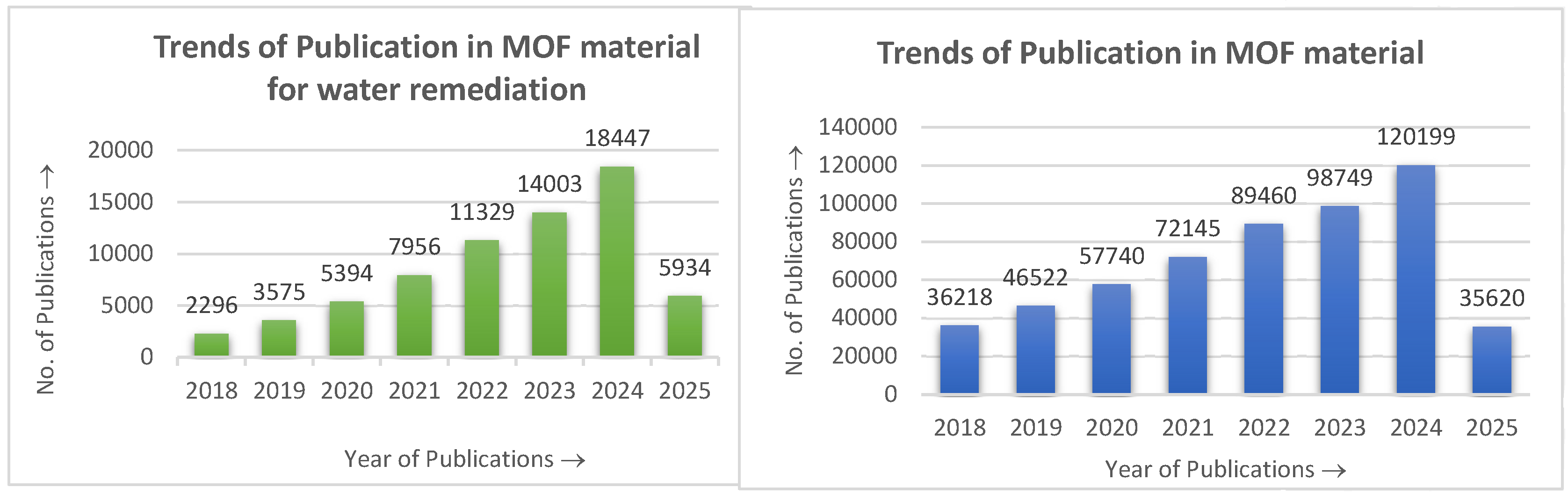
The popularity of Metal organic framework (MOF) material can be estimated from the fact that nearly 60,000 papers were published in wastewater treatment itself in the last decade out of which 18,000 papers were published last year 2024 and the number is increasing (Scopus database). This can be explained by the fact that new and advanced methods are continuously adopted to synthesize Metal organic framework (MOF) materials. Some of them can be recognized as green synthesis, Metal organic framework (MOF) derived carbons, Bimetallic Metal organic framework (MOF), Metal organic framework (MOF) derived from plants, animals and bacterial sources, Magnetic materials, etc. Metal organic framework (MOF) material is designated as a promising material for potential future applications such as chips, sensors and supercapacitors. This can be estimated from the fact that around 1,20,000 papers were published on Metal organic framework (MOF) last year 2024 around all application domains such as sensors, membranes, drug delivery, biomedical application, CO2 adsorption, water splitting, hydrogen storage, supercapacitors and desalination, etc.
Figure 7.
Trends of MOF publication in wastewater treatment and overall application.
Water Pollution
Even though 71% of the whole earth is covered with water, only 3% is present in useable freshwater form. The human population is estimated to be 9 billion by 2050 (Ghumman et al., 2022, 2021) and therefore the demand for freshwater will also increase dramatically with the increase in population. With limited water resources, lower ambient water quality, poor wastewater treatment prior to disposal in water bodies, low safely managed drinking water, and poorly managed withdrawal of water proportional to available water resources, the need to purify water is a must. The situation around clean water can be visualized from the fact that around 1.9 billion people live in water-scarce areas and this will increase to 3 billion by 2050 [17].
According to a UN statistic, around 2/3rd of the population will face water scarcity by 2050 (He et al., 2021). Currently around 780 million people lack access to clean and safe drinking water and by 2050, three out of four people will face drought conditions (UNU-INWEH, 2024). Thus, the responsible stakeholders and policymakers must ensure availability of safe drinking water to avoid incoming crisis and water conflicts.
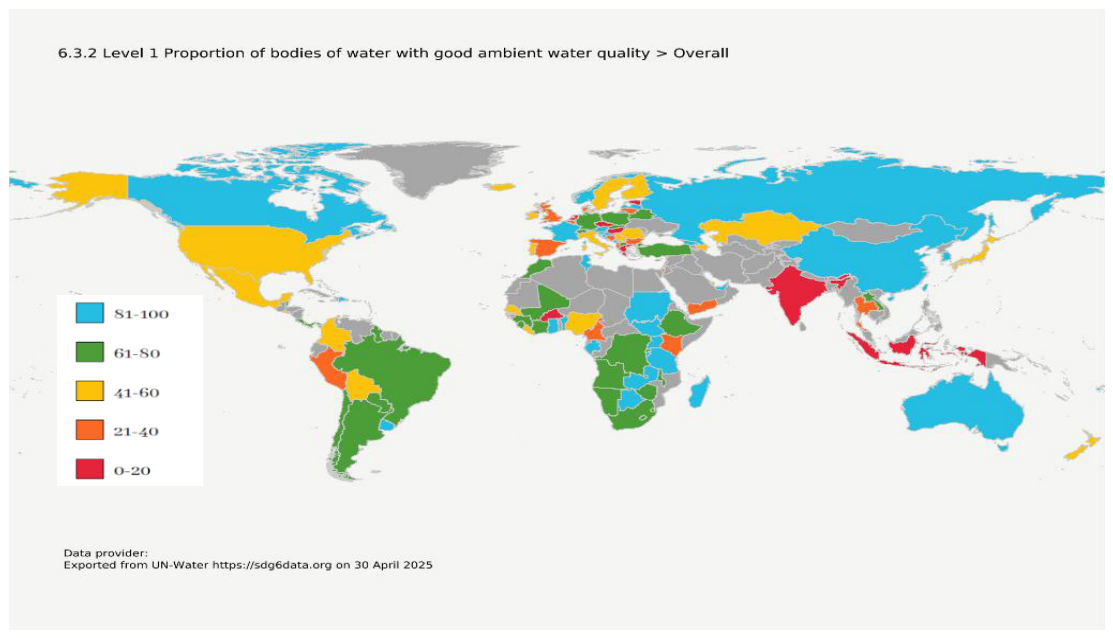
Figure 8.
Sustainable development goal (SDG 6) Proportion of water bodies with good ambient water quality exported from UN water site.
Figure 8.
Sustainable development goal (SDG 6) Proportion of water bodies with good ambient water quality exported from UN water site.
Water can be polluted using natural means like rocks, soil, debris, and organic waste or synthetic routes like laboratories, homes, hospitals, agriculture, mining tanneries, textile, and industries. Major Pollutants that pollute the water resource are heavy metals, dyes, pesticides, antibiotics, organic wastes, inorganic salts and metals, volatile organic compounds, radionuclides, and biological wastes. Desalination can be adopted as a major step to ensure safe and clean drinking water sources.
Figure 9.
Application of Metal organic framework (MOF) material toward water remediation.
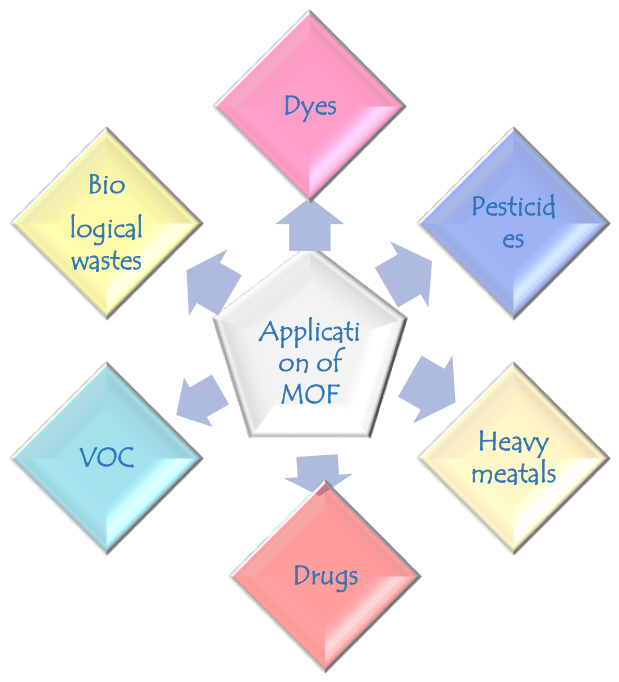
Water can be treated to consumable form using a series of purification steps like Ozonation, Advanced oxidation process (AOP), Fenton process, UV radiation, Activated sludge method, Microfiltration, Ultrafiltration, Nanofiltration, and Reverse Osmosis. Some of the highly efficient MOF materials that can be used to degrade pollutants like Polyaromatic hydrocarbons (PAHs), Polychlorinated biphenyls (PCBs), Per- and Polyfluoroalkyl Substances (PFAS), Perfluoro octane sulfonate (PFOS), Organophosphorus pesticides (OPPs), Perfluorooctanoic acid (PFOA), Poly-aluminium chlorides (PACs), Pharmaceutical and personal care products (PPCPs), Persistent organic pollutants (POPs), Endocrine Disruptors (EDCs) [18] are listed above:
Dyes
Dyes are colored substances typically organic compounds that are used to impart colour to other materials like textiles, paper, food, hair, drugs, cosmetics, leather, plastic, medicine, and printing. A few characteristics of dye material include solubility, chemical bonding, and substrate affinity. It can be classified into natural and synthetic with various subtypes within each category. Some examples of dyes include: 1) Natural dyes derived from plants, animals, or minerals. 2) Synthetic dyes produced chemically 3) Specific dyes like Acid dyes, Basic dyes, Direct dyes, Reactive dyes, Disperse dyes, Vat dyes, Sulphur dyes, Azoic dyes, Pigment dyes, and Optical brightness.
Around 9,000 colorants with more than 50,000 trade names are used in the pharmaceutical, cosmetic, leather, tanning, petrochemical, and textile industries. The mass of synthetic colorants used by the industry is estimated at the level of 1-3 x 10⁵ tons while total annual consumption is 7 x 10⁵ tons respectively [19]. Synthetic dyes are relatively easy to detect but difficult to eliminate from wastewater and surface water ecosystems due to their aromatic structure.
Due to their high stability, dyes pose serious health and ecological issues such as toxicity, mutagenic property, and carcinogenity. Currently, the removal of contaminants is done using flocculation, coagulation, precipitation, photocatalytic degradation, biological oxidation, ion exchange, adsorption, and membrane filtration.
| S. No. | Metal-organic framework (MOF) | Pollutant | Efficiency | Ref |
| 1. | [Cu(bipy)Cl2]n [Cu(bipy)Cl2]n [Cu(bipy)(SO4)]n [Cu(bipy)(SO4)]n |
Methyl Orange Acid Orange 7 Acid Orange 7 Methyl Orange |
1084 mg/g 848 mg/g 3308 mg/g 1521 mg/g |
[20] |
| 2. | Fe/MOF-5@CTS | Congo Red | 219.78 mg/g | [21] |
| 3. | Zr-(TPA)2-UC Zr-(TPA)2-U |
Methylene blue Methylene blue |
151.38 mg/g 147.54 mg/g |
[22] |
| 4. | Fe6-MOF-N |
Methylene blue |
162.46 mg/g |
[23] |
| 5. | Zr-MOF@ATP CS |
Methylene blue |
442.86 mg/g |
[24] |
| 6. | MOF/nanoporous carbon |
Methylene blue |
2724 mg/g |
[25] |
| 7. | Cu-BTC@AG |
Methylene blue |
282.46 mg/g |
[26] |
| 8. | Eu-PET |
Congo Red | 2312 mg/g (pH=7) 2988.11 mg/g (pH= 4) |
[27] |
| 9. | BUT-8 (Cr) |
Rhodamine B | 811.7 mg/g | [28] |
| 10. | ABim-Zn MOF |
Methylene blue Chicago sky blue |
174.64 mg/g 144.26 mg/g |
[29] |
| 11. | PAAc/Lap |
Methylene blue | 3796 mg/g | [30] |
| 12. | MnTB |
Methyl orange | 1500 mg/g |
[31] |
| 13. | MWCNTs/Fe3O4/polyaniline | Methyl orange Congo red |
446.25 mg/g 417.38 mg/g |
[32] |
| 14. | MIL-101 SO3H |
Malachite green Methylene blue |
596 mg/g 351.0 mg/g |
[33] |
| 15. | Ni50/Cu BTC Ni30/Cu–BTC |
Congo red Congo red |
999.20 mg/g 903.40 mg/g |
[34] |
| 16. | MBC | Methylene blue | 100 mg/g |
[35] |
| 17. | MIL-53 (Al) | Rhodamine B | 1547 mg/g (30o C) |
[36] |
| 18. | MIL- 53 (Al) | Methyl orange | 182.5 mg/g | [37] |
| 19. | MIL-68 (Al) | Methylene blue Malachite green |
666.67 mg/g 153.85 mg/g |
[38] |
| 20. | MIL-68 (Al) | Rhodamine B |
1666.67 mg/g 1111.11 mg/g |
[39] |
| 21. | MIL-53@PCA MIL-53@CA |
Congo red Congo red |
476.81 mg/g 370.29 mg/g |
[40] |
| 22. | MIL-68 (In) nanorods MIL-68 (In) micro rods |
Congo red Congo red |
1204.0 mg/g 318 mg/g |
[41] |
| 23. | RGO/NH2 MIL-68 (Al) | Congo red | 473.93 mg/g | [42] |
| 24. | MIL-88A (Fe) MIL-88A (Fe Al) MIL-88A (Al) MIL-88A (Fe-Al)/CS MIL-88A (Fe)/CS MIL-88A (Al)/CS CS |
Congo red Congo red Congo red Congo red Congo red Congo red Congo red |
607.7 mg/g 536.4 mg/g 512.1 mg/g 1312 mg/g 1056 mg/g 996.7 mg/g 769.6 mg/g |
[43] |
| 25. | Cd-ZIF |
Malachite green | 3324.17 mg/g (25o C) |
[44] |
| 26. | CZM | Malachite green |
953.14 mg/g |
[45] |
| 27. | Zn-MOF | Congo red Methyl orange |
355.16 mg/g 148.7 mg/g |
[46] |
| 28. | ZIF-8@ZnAl-LDH ZIF-8 ZIF-8@ZnAl-LDH ZIF-8 |
Methyl orange Methyl orange Malachite green Malachite green |
609.7 mg/g 322.58 mg/g 194.5 mg/g 155.27 mg/g |
[47] |
| 29. | ZIF-67 | Malachite green Malachite green |
3226 mg/g (60o C) 2430 mg/g (20o C) |
[48] |
| 30. | ZIF-67 | Congo red Rhodamine b |
328.77 mg/g 112.35 mg/g |
[49] |
| 31. | ZIF-Co/Ni Co-ZIF Ni-ZIF Ni-ZIF Co-ZIF ZIF-Co/Ni |
Methyl orange Methyl orange Methyl orange Methylene blue Methylene blue Methylene blue |
380.91 mg/g 255.15 mg/g 176.65 mg/g 164.90 mg/g 157.59 mg/g 148.14 mg/g |
[50] |
| 32. | ZIF 8@CS |
Congo red | 922.0 mg/g | [51] |
| 33. | ZIF-8@GO ZIF-8@CNT ZIF-8 |
Malachite green Malachite green Malachite green |
3300 mg/g 2034 mg/g 1667 mg/g |
[52] |
| 34. | PCN-222 | Methylene blue Methyl orange Methylene blue Methyl orange |
906 mg/g 589 mg/g 1239 mg/g (Binary) 1022 mg/g (Binary) |
[53] |
| 35. | NH2-MIL-125 (Ti) |
Bromocresol red 46 Bromocresol blue 41 Methylene blue |
1296 mg/g 1257 mg/g 862 mg/g |
[54] |
| 36. | MIL-101-NH2 @COF |
Acid Blue 9 | 256 mg/g | [55] |
| 37. | MOF-235 |
Methyl orange Methylene blue |
501 mg/g (45o C) 252 mg/g (45o C) |
[56] |
| 38. | CS/MOF 235 |
Methyl orange Methylene blue |
2857 mg/g 2326 mg/g |
[57] |
| 39. | MOF-525@CS |
Congo red | 1947 mg/g | [58] |
| 40. | MIL-100 (Fe) MIL-100 (Cr) MIL-100 (Fe) MIL-100 (Cr) |
Methylene blue Methylene blue Methyl orange Methyl orange |
736.2 mg/g 645.3 mg/g 1045.2 mg/g 211.8 mg/g |
[59] |
| 41. | MIL-100 (Fe) MIL-101 (Fe) MIL-100 (Fe) |
Reactive blue 4 Acid blue 25 Basic blue 3 |
425.05 mg/g 287.18 mg/g 132.74 mg/g |
[60] |
| 42. | MIL-101 (Cr) |
Reactive yellow 15 Reactive red 24 Reactive black 5 Reactive blue 2 |
397 mg/g (30o C) 390 mg/g (30o C) 386 mg/g (30o C) 377 mg/g (30o C) |
[61] |
| 43. | Amino MIL-101(Al) MIL-101(Al) Amino MIL-101(Al) |
Methylene blue Methylene blue Methyl orange |
762 mg/g 195 mg/g 188 mg/g |
[62] |
| 44. | NH2-MIL-101(Cr) |
Congo red | 1206 mg/g | [63] |
| 45. | Fe3O4/PT/GO |
Malachite green | 560.58 mg/g (35o C, pH=6) |
[64] |
| 46. | Fe(OH)3@cellulose |
Congo red | 689.65 mg/g | [65] |
| 47. | Fe3O4@PDA-COOH |
Malachite green | 331.02 mg/g | [66] |
| 48. | Fe3O4/Al2O3/chitosan |
Methyl orange | 416 mg/g (25o C, pH=6) |
[67] |
| 49. | Fe3O4@MIL-100 (Fe) |
Methyl red | 625 mg/g | [68] |
| 50. | Fe3O4/β-CD/GO | Malachite green | 990.10 mg/g (45o C) 740.7 mg/g (25o C) |
[69] |
| 51. | Fe3O4/AMCA/MIL-53 (Al) | Malachite green Methylene blue |
329.61 mg/g (45o C) 325.62 mg/g (45o C) |
[70] |
| 52. | Fe3O4-PSS@ZIF 67 |
Methyl orange | 738 mg/g (pH=8) | [71] |
| 53. | La-MOF-NH2@Fe3O4 |
Congo red | 716.2 mg/g | [72] |
| 54. | CP-1 | Methyl orange Congo red |
779 mg/g 739 mg/g |
[73] |
| 55. | Sr-BTTC |
Basic red 2 Rhodamine B Methylene blue Crystal violet |
675 mg/g 545 mg/g 270 mg/g 184 mg/g |
[74] |
| 56. | TS-COF-1 | Methylene blue Rhodamine B Congo red |
1691 mg/g 625 mg/g 319 mg/g |
[75] |
| 57. | nZVI/BC |
Malachite green | 515.77 mg/g | [76] |
| 58. | SDU-CP 7 |
Safranine T Rhodamine B |
1565 mg/g 919.2 mg/g |
[77] |
| 59. | JLU-MONT1 |
Basic red 9 Basic violet 14 Methyl violet Rhodamine 6G Methylene blue |
1745 mg/g 1653 mg/g 1615 mg/g 1258 mg/g 306 mg/g |
[78] |
| 60. | BTT-TAPT COF |
Indigo Carmine | 547.33 mg/g | [79] |
| 61. | Zr BTB H4TBAPy PCN-134 2D Zr BTB H4TBAPy PCN-134 2D |
Rhodamine B Rhodamine B Methylene blue Methylene blue |
238 mg/g 203 mg/g 124 mg/g 108 mg/g |
[80] |
| 62. |
CNF γ AlOOH |
Crystal violet Methylene blue |
210 mg/g 204 mg/g |
[81] |
| 63. |
β-CD/CA-g-CS |
Methylene blue Malachite green Basic red Acid red Acid yellow Acid blue |
946.66 mg/g 801.66 mg/g 770.50 mg/g 619.60 mg/g 429.22 mg/g 389.64 mg/g |
[82] |
| 64. | PAM-g-QC |
Congo red Eriochrome blue SE |
380.084 mg/g (50o C) 349.284 mg/g (50o C) |
[83] |
| 65. | Bio/MOF-2Me |
Methyl violet | 310.2 mg/g | [84] |
| 66. | UiO-66 | Alizarin red S | 400 mg/g |
[85] |
| 67. | UiO-66 (Zr) |
Safranin T | 366 mg/g | [86] |
| 68. | pH-switchable UiO-66 |
Sunset Yellow | 352.8 mg/g | [87] |
| 69. | UiO-66/GO |
Congo red | 1250 mg/g | [88] |
| 70. | UiO-67 nano/microcrystals |
Congo red Methyl orange Methylene blue |
1144.9 mg/g 576.5 mg/g 215.6 mg/g |
[89] |
| 71. | N-doped UiO-66 |
Rhodamine B |
384.1 mg/g |
[90] |
| 72. | Mn-UiO-66@GO-NH2 | Congo red | 1265.8 mg/g | [91] |
| 73. | UiO-66/MIL-101 (Fe) GO-COOH | Methylene blue | 448.7 mg/g | [92] |
| 74. | NPC | Methyl orange |
872 mg/g |
[93] |
| 75. | Ag/ZIF-67 |
Methyl orange |
994.6 mg/g | [94] |
| 76. | UiO-66/wood membrane |
Rhodamine 6G | 690 mg/g | [95] |
| 77. | H/UiO-66-NH2 xerogel | Reactive red 195 | 884.96 mg/g |
[96] |
| 78. | Pristine UiO-66 |
Methyl orange Methyl red Methylene blue Malachite green |
454 mg/g 384 mg/g 370 mg/g 133 mg/g |
[97] |
| 79. | Ce(III) doped UiO-66 |
Congo red Methyl orange Acid chrome blue k Methylene blue |
826.7 mg/g 639.6 mg/g 245.8 mg/g 145.3 mg/g |
[98] |
| 80. | Ce(III) doped UiO-67 | Congo red Methyl orange Methylene blue |
799.6 mg/g 401.2 mg/g 398.9 mg/g |
[99] |
Antibiotics
Antibiotics are medicines that treat bacterial infections by killing bacteria or stopping them from growing. Common antibiotics manufactured in the pharmaceutical industry are sulfamethoxazole, tetracycline, ciprofloxacin, norfloxacin, ofloxacin, metronidazole, levofloxacin, chloramphenicol, paracetamol, acetaminophen, ibuprofen, atenolol, atrazine, diclofenac, oxytetracycline, chloramphenicol, penicillin, amoxicillin, cefradine, chlortetracycline, doxycycline and azithromycin, etc.
Removal of antibiotics involves techniques such as advanced oxidation process (AOP), nanofiltration, ultrafiltration, microfiltration, chlorination, photocatalysis, fenton process, ozonation, membrane filtration, adsorption, reverse osmosis, ion exchange, UV radiation and activated sludge method, etc. Disposal of drugs as discharge in sewer system, deposition in landfills, production wastewater or unintentional wastewater during production and distribution are some of the common points of pollution sources in case of drug pollution.
Antibiotics and their metabolites are continuously discharged into the natural environment. Sources of antibiotic pollution are veterinary waste, pharmaceutical industry, dairy plants, human habitat, animal waste, hospital waste, animal husbandry, municipal waste and poultry waste. Antibiotics with low molecular weight (<1,000 D) rapidly dissolve in water leading to water contamination and eutrophication.
Pharmaceuticals such as anti-inflammatory, antibiotics, anti-epileptic, oestrogenic, beta blockers, anti-depressants, opioid analgesic, insect repellent, anaesthetic, anti-hypertensive, diuretics, antilipemic, anti-ulcerative and impotence drugs (gizmos et al. 2015; Kimiska et al. 2019; Shi et al. 2020) are considered a vital contaminant in waste water. The annual antibiotic consumption has been estimated to be 1,62,000 ton for China, 13,000 ton for US and 10,000 ton for European countries (Al najrani and Al sager, 2020).
| S. No. | Metal organic framework (MOF) | Pollutant | Efficiency | Ref |
| 1. | kC-g-PAAm@Fe3O4/MOF-199 |
Cefixime Levofloxacin |
1666.67 mg/g 2000 mg/g |
[100] |
| 2. | CYCU-3 |
Tetracycline | 428.13 mg/g | [101] |
| 3. | CoFe2O4/h-BN/MIL-53 (Al) |
Tetracycline Ciprofloxacin |
625.00 mg/g 270.27 mg/g |
[102] |
| 4. | Cu-BDC@GrO Cu-BDC@CNT |
Bisphenol A Bisphenol A |
182.2 mg/g 164.1 mg/g |
[103] |
| 5. | αFe/Fe3C |
Tetracycline hydrochloride |
671.14 mg/g | [104] |
| 6. | Zn2FeOx@CN 500 |
Tetracycline | 769 mg/g (25o C) | [105] |
| 7. | Fc-MOF |
Tetracycline |
736.59 mg/g (40o C, pH=3) |
[106] |
| 8. | NPC 140,94, 105 |
Bisphenol A Sulfamethoxazole |
757 mg/g 625 mg/g |
[93] |
| 9. | Hf-UiO-66 |
Cefoperazone | 346 mg/g | [107] |
| 10. | UiO-66 (Zr/Ce) | Tetracycline | 536 mg/g | [108] |
| 11. | Mn-PBA/GO |
Ciprofloxacin | 1826.64 mg/g |
[109] |
| 12. | NaP5W30/MIL-101-Fe/NFO |
Ciprofloxacin Tetracycline |
796.23 mg/g 263.15 mg/g |
[110] |
| 13. | H3PW12O40/MIL-88A(Fe)/MIL-88B(Fe)/NiFe2O4 |
Tetracycline Ciprofloxacin |
1428.57 mg/g 344.82 mg/g |
[111] |
| 14. | CMC | Ciprofloxacin | 226.8 mg/g (pH=8) | [112] |
| 15. | NH2-MIL-125@TpPa-SO3H |
Ciprofloxacin Norfloxacin Enoxacin Sparfloxacin |
457.5 mg/g 455.7 mg/g 444.7 mg/g 429.1 mg/g |
[113] |
| 16. | Zn-Co ZIF@CS |
Ciprofloxacin | 348.9 mg/g | [114] |
| 17. | Natural Clay@Co/Ni/Cu NH2-BDC | Safinamide | 500.69 mg/g |
[115] |
| 18. | WSB/HDC 550/κ car/CA RHB/HDC 550/κ car/CA |
Tetracycline Tetracycline |
396.09 mg/g 313 mg/g |
[116] |
| 19. | UiO-66-SO3H |
Diclofenac sodium | 263 mg/g | [117] |
| 20. | ZIF-L/FGA200 |
Tetracycline | 387.6 mg/g | [118] |
| 21. | Br-MIL-53 (Fe) NO2-MIL-53 (Fe) NH2-MIL-53(Fe) |
Tetracycline Tetracycline Tetracycline |
309.6 mg/g 272.6 mg/g 271.9 mg/g |
[119] |
| 22. | Tb-MOF | Tetracycline | 266.9 mg/g (25o C) |
[120] |
| 23. | Fe-BTC@Chs/MCC |
sulfamethazine Sulphanilamide |
242.4 mg/g 173.0 mg/g |
[121] |
| 24. | Ni/Co-MOF@CMC Aerogel |
Tetracycline hydrochloride |
624.87 mg/g |
[122] |
| 25. | SH-MOF |
Fluazinam Flurbiprofen |
575 mg/g 435 mg/g |
[122] |
| 26. | Co-NC 1/4-900 |
Amodiaquine |
890.23 mg/g | [124] |
| 27. | MIL-68 (Al)/GO |
Tetracycline | 228 mg/g | [125] |
| 28. | Fe3O4@MIL-100(Fe) |
Ciprofloxacin | 322.58 mg/g | [126] |
| 29. | MOF-525 NU-1000 UiO-66 |
Tetracycline | 807 mg/g 356 mg/g 145 mg/g |
[127] |
| 30. | ZIF-67-Acetate |
Tetracycline | 446.9 mg/g | [128] |
| 31. | PCN-777 | Cephalexin | 442.48 mg/g | [129] |
| 32. | MDC-1000 (1000oC) | Sulfamethoxazole | 435 mg/g | [130] |
| 33. | MIL-53(Fe)@MWCNT | Tetracycline Oxytetracycline Chlortetracycline |
364.37 mg/g (25o C) 325.59 mg/g (25o C) 180.68 mg/g (25o C) |
[131] |
| 34. | ZIF-8/MWCNT |
Benzoic acid | 303 mg/g | [132] |
| 35. | ZIF-8/NH2-MIL 53 (Al) |
Chlortetracycline Doxycycline Tetracycline Oxytetracycline |
578 mg/g 561 mg/g 533 mg/g 526 mg/g |
[133] |
| 36. | UiO-66 (COOH)2/GO |
Tetracycline |
164.91 mg/g | [134] |
| 37. | AG-ZIF AG-Co MOF |
Tetracycline Tetracycline |
456.62 mg/g 105.49 mg/g |
[135] |
| 38. | PCN-222 | Chloramphenicol | 370 mg/g | [136] |
| 39. | HKUST-1 |
Sulfachloropyridazine | 384 mg/g (25oC) | [137] |
| 40. | MIL-101 (Cr) (90o C) | Sulfadimethoxine Sulfamonomethoxine Sulfachloropyridazine |
588.24 mg/g (25o C) 196.08 mg/g 142.86 mg/g |
[138] |
| 41. | Flexible MIL-53 (Al) |
Dimetridazole (DMZ) | 467.3 mg/g | [139] |
| 42. | ZIF-8 (Zn) |
Oxytetracycline Tetracycline |
312.5 mg/g (30o C) 303 mg/g (30o C) |
[140] |
| 43. | Ag/ZIF-67 |
Minocycline (MC) |
938.4 mg/g |
[94] |
| 44. | ZIF-67 derived hollow CO3S4 | Ciprofloxacin | 471.7 mg/g | [141] |
| 45. | NPC-700 (700o C) |
Ciprofloxacin | 416.7 mg/g |
[142] |
| 46. | UiO-66 (Zr) |
Ketorolac tromethamine | 729.92 mg/g | [143] |
| 47. | MIL-101 (Cr)-HSO3 | Ciprofloxacin | 564.9 mg/g | [144] |
| 48. | Fe3O4/ZTB-1 | Congo red | 458.0 mg/g | [145] |
| 49. | ZIF-8/SC |
Ciprofloxacin | 2887 mg/g | [146] |
| 50. | Ni-ZIF-8 | Tetracycline Cefixime |
770.2 mg/g 428.2 mg/g |
[147] |
| 51. | UiO-66/PDA/BC |
Tetracycline Aspirin |
184.3 mg/g 141.1 mg/g |
[148] |
| 52. | CS/PANI/LDH |
Diclofenac sodium | 618.16 mg/g | [149] |
| 53. | UiO-66/ZIF-8/PDA-CA beads | Tetracycline | 290.69 mg/g (25o C) | [150] |
| 54. | Defective UiO-66 | Diclofenac | 321 mg/g | [151] |
| 55. | UiO-66 UiO-66-NH2 |
Curcumin | 393.22 mg/g 382.86 mg/g |
[152] |
| 56. | UiO-66-NH2 UiO-66-NH2 |
Diclofenac | 555.0 mg/g (90o C) 357 mg/g (25o C) |
[153] |
| 57. | UiO-66 NH2-UiO-66 |
Methotrexate |
393.22 mg/g 382.86 mg/g |
[154] |
| 58. | Fe3O4/MIL-100 (Fe) |
Diclofenac sodium | 400 mg/g | [155] |
| 59. | MIL-100 (Fe) |
Diclofenac | 773 mg/g | [156] |
| 60. | UiO-66 (COOFe)2 UiO-66 (COOCu)2 UiO-66 (COOH)2 |
Sodium diclofenac | 769.1 mg/g 624.3 mg/g 480.5 mg/g |
[157] |
| 61. | MC-800 (800oC) | Chlortetracycline | 1158 mg/g | [158] |
| 62. | Ag-NPAC |
Levofloxacin | 1111.11 mg/g |
[159] |
| 63. | HAP/MIL-101 (Fe)/Fe3O4 |
Tetracycline Ciprofloxacin |
120.48 mg/g (25o C) 112.35 mg/g (25o C) |
[160] |
| 64. | ZIF-8/PAN |
Tetracycline | 885.24 mg/g | [161] |
| 65. | H3PW12O40/Fe3O4/MIL-88A (Fe) |
Tetracycline Ciprofloxacin |
370.37 mg/g (25o C) 333.33 mg/g (25o C) |
[162] |
| 66. | Fe3O4/HKUST-1 |
Ciprofloxacin Norfloxacin |
538 mg/g 513 mg/g |
[163] |
| 67. | Ce-doped UiO-66 | Perfloxacin Tetracycline |
476.3 mg/g 368.6 mg/g |
[164] |
| 68. | UiO-66-NH2 | Norfloxacin | 222.5 mg/g | [165] |
| 69. | PAN-C/MIL 101(Fe) |
Tetracycline | 392.64 mg/g | [166] |
| 70. | NH2-PC-700 (700oC) | Ciprofloxacin | 102.5 mg/g | [167] |
| 71. | PCN-224 |
Tetracycline Ciprofloxacin |
354.81 mg/g 207.16 mg/g |
[168] |
| 72. | MIL-53(Fe-Cu) |
Ciprofloxacin | 190.40 mg/g | [169] |
| 73. | PCDM-1000 (1000oC) |
Diclofenac Ibuprofen |
400 mg/g 320 mg/g |
[170] |
| 74. | UiO-66@NH2/TiO2 | Ampicillin | 625.7 mg/g |
[171] |
| 75. | HKUST-1@Cellulose | Meloxicam | 2500 mg/g | [172] |
| 76. | Tb-MOF |
Tetracycline | 266.9 mg/g (25o C) | [173] |
| 77. | Fe3O4-ZIF-8/ZIF-67 |
Tetracycline | 356.25 mg/g | [174] |
| 78. | MOF-808 MOF-808/YSZ |
Diclofenac Diclofenac |
833 mg/g 796 mg/g |
[175] |
| 79. | Copper-based 3D MOF | Diclofenac | 650 mg/g | [176] |
| 80. | MIL-53(Al) |
Diclofenac Naproxen |
422 mg/g 297 mg/g |
[177] |
| 81. | Fe3O4@MOF-525 |
Diclofenac sodium Tetracycline |
745 mg/g 277 mg/g |
[178] |
| 82. | Fe3O4-MOF-100(Fe) |
Diclofenac | 377.36 mg/g (25o C) | [179] |
Pesticides
Pesticides are pollutants found in wastewater due to an increase in agricultural needs. According to World Health Organisation, (WHO), the term pesticide means any chemical that is used to kill pests (weeds, rodents, insects, and fungi). Based on their use and abilities to kill, pesticides can be classified as: 1) Insecticide 2) Herbicide 3) Rodenticide 4) Fungicide 5) Molluscicide 6) Bactericide 7) Avicide 8) Virucide 9) Algicide 10) Acaricide 11) Miticide. They can also be classified as organochlorines, organophosphorus, carbamates, pyrethrin, pyrethroids, etc on the basis of the chemical nature of their active ingredients.
In addition, few miscellaneous groups worth mentioning are phenoxy acetic acid, bipyridyl, inorganic pesticide such as sulphur, copper, mercury, lead, and arsenic compounds. Pesticides play an important role in economic production of a wide range of vegetables, fruits, cereals, forage, fibres and oil crops that now constitute a large part of successful agricultural industry in many countries. It is estimated that approximately 3.5 million ton of pesticides are consumed worldwide (Steingrimdottir et al. 2018; Huang et al. 2019).
Pesticides can be used in a wide array of applications as a potential substituent such as cleaning, agriculture, protection of farm animals, kitchen gardens, enhancing the quality of livestock and agricultural crops, etc. Besides, advantages, pesticides pose a serious threat to human health and the environment such as skin and eye irritation and skin cancer, etc. Removal of pesticides is generally done using advanced techniques such as advanced oxidation, nanofiltration, photocatalysis, adsorption, activated sludge method, membrane technologies, bioreactors, ozonation, Fenton treatment, and UV based treatment, etc. [ Fadali, 2015].
| S. No. | MOF | Pollutant | Efficiency | Ref |
| 1. | 2D-ZHM |
Glyphosate | 285.7 mg/g | [180] |
| 2. | MOF-808 | 2,4 D MCPA |
793 mg/g 775 mg/g |
[181] |
| 3. | Cr-MOF/MIL-101 | PSNPs |
800 mg/g | [182] |
| 4. | Gold Nanospheres |
Dimethoate |
456 mg/g | [183] |
| 5. | Calcium fumarate (CaFu) | Imidacloprid | 467.23 mg/g |
[184] |
| 6. | ZIF-8/Zn2@SA |
Carbendazim | 161.8 mg/g | [185] |
| 7. | Fe3O4-SiO2@UiO 67 |
Glyphosate | 256.54 mg/g |
[186] |
| 8. | UiO-66 | PFOA |
470 mg/g |
[187] |
| 9. | UiO-66/EDTMP |
Polystyrene | 487.225 mg/g | [188] |
| 10. | V-MOF |
Methyl parathion | 383.6 mg/g |
[189] |
| 11. | MIL-53 (Cr) |
2,4-D | 556 mg/g | [190] |
| 12. | AF-CMOF | PFOS |
670 mg/g | [191] |
| 13. | MMCN |
PFOS PFOA |
454.55 mg/g 370.37 mg/g |
[192] |
| 14. | [Cu(INA)2] MOF@Fe3O4 [Cu (INA)2] MOF |
Salbutamol | 2000 mg/g 1450 mg/g |
[193] |
| 15. | CS-MCA/UiO 67 |
Glyphosate 2,4 D |
675.48 mg/g 615.12 mg/g |
[194] |
| 16. | UiO 66@Fe3O4/UiO-66 | Salicylic acid | 343.5 mg/g |
[195] |
| 17. | M-CuO@Ag/PAN/ZIF 67 |
Paraquat Acetaminophen |
1143.7 mg/g 971.6 mg/g |
[196] |
| 18. | PCN-224 | PFOS PFHxS PFBS |
963 mg/g 517 mg/g 395 mg/g |
[197] |
| 19. | MIL-53 (Cr)/rGO/PANI |
2,4-DCP |
98.4 mg/g | [198] |
| 20. | HKUST-1 | Chlorpyrifos | 102 mg/g |
[199] |
| 21. | UIO-67/GO | Glyphosate |
482.69 mg/g |
[200] |
| 22. | MIL-100 (Fe) |
2,4 D |
858.11 mg/g | [201] |
| 23. | H UiO-66 |
Glyphosate |
400 mg/g | [202] |
| 24. | UiO-67 (Zr) |
Glyphosate Glufosinate |
537 mg/g 360 mg/g |
[203] |
| 25. | Granular AC derived from coconut shell |
Malathion |
909.1 mg/g | [204] |
| 26. | 40% Cu-BTC@CA | Dimethoate |
321.9 mg/g | [205] |
| 27. | ZIF-8 (Zn) ZIF-67 ZIF-8 (Zn) ZIF-67 |
Prothiofos Ethion Prothiofos Ethion |
366.7 mg/g 279.3 mg/g 261.1 mg/g 210.8 mg/g |
[206] |
| 28. | UiO-66(Zr) |
MCPA | 370 mg/g | [207] |
| 29. | Fe3O4@SiO2/UiO-66 |
Triclocarban Triclosan |
602.40 mg/g 476.27 mg/g |
[208] |
| 30. | 3DOM CLPS-g-PDMAEMA |
Salicylic acid | 390 mg/g |
[209] |
| 31. | PCN-206 | 2,4-D | 470 mg/g |
[210] |
| 32. | Zr@Ox cotton |
Diazinon Chlorpyrifos |
464.7 mg/g 389.7 mg/g |
[211] |
| 33. | Ca-MOF@M Ca-MOF@M Ca-MOF@S Ca-MOF@S |
Carbaryl Methomyl Carbaryl Methomyl |
732.13 mg/g 500.36 mg/g 366.64 mg/g 179.72 mg/g |
[212] |
| 34. | Th-MOF |
2,4 D |
358.3 mg/g | [213] |
| 35. | UiO-66@PA |
Pirimiphos-methyl Methidathion Triazophos OPPs Quintiofos Fenthion |
274.79 mg/g 256.45 mg/g 248.12 mg/g 246.55 mg/g 243.75 mg/g 209.67 mg/g |
[214] |
| 36. | Bimetallic La/Zn MOF | 2,4 D | 307.5 mg/g |
[215] |
Volatile Organic Compounds
Volatile organic compounds (VOCs) are carbon-based chemicals with high vapor pressure and low water solubility, making them prone to water and environmental contamination. VOCs are a group of organic compounds that readily evaporate at room temperature. Some of the examples of substances and products that actively use and produce potential volatile organic compounds are furnishing, adhesives and glues, air fresheners, permanent markers, carbonless paper, correction fluids, dry cleaning agents, refrigerants, building materials, paints, pharmaceuticals, etc.
VOCs play a major role in water, soil, and air pollution with USEPA classifying 97/189 air pollutants as VOCs. Common exposure pathways of VOC contamination include drinking water, bathing, food, swimming, and laundry. Removal of VOCs is achieved using air stripping, incineration, biological oxidation, activated carbon adsorption, biological treatment, catalysis, and chemical oxidation methods. One of the latest trends in VOC contamination mitigation is the use of nanomaterials in reducing environmental pollution.
| S. No. | Metal organic framework (MOF) |
Pollutants |
Efficiency | Ref | |
| 1. | MIL-101(Cr) | Acetone Benzene Toluene Ethyl benzene m-Xylene p-Xylene 0-Xylene |
1291 mg/g 1291 mg/g 1096 mg/g 1105 mg/g 727 mg/g 1067 mg/g 758 mg/g |
[216] |
|
| 2. | CF-800 CF-800 UF-800 UF-800 |
Benzene Toluene Benzene Toluene |
1268.1 mg/g 1181.6 mg/g 1250.8 mg/g 1069.8 mg/g |
[217] | |
| 3. | C-PDA C-PDA MIL-101 MIL-101 |
Toluene Benzene Benzene Toluene |
1254.95 mg/g 1216.17 mg/g 1173.21 mg/g 458.86 mg/g |
[218] |
|
| 4. | MOF-199 H/MOF-199 MOF-199/W H/MOF-199/W H/MOF-199/W H/MOF-199/W |
Toluene Toluene Toluene Toluene Toluene Toluene |
369.9 mg/g (80o C) 304.7 mg/g (80o C) 323.5 mg/g (80o C) 269.4 mg/g (20o C) 278.9 mg/g (0o C) 226.7 (80o C) |
[219] |
|
| 5. | MOF-177 | Acetone Toluene Benzene o- Xylene m-Xylene Ethyl benzene p-Xylene |
589 mg/g 585 mg/g 800 mg/g 257 mg/g 271 mg/g 271 mg/g 213 mg/g |
[220] | |
| 6. | Co/MOF-74(X) Co/MOF-74 (Cl-) |
Xylene Xylene Xylene |
1317.65 mg/g (Cl-) 607.24 mg/g (NO3-) 474.48 mg/g (OAc-) |
[221] |
|
| 7. | UiO-66@NH2 ZIF-67 UiO-66 MOF-199 |
Toluene Toluene Toluene Toluene |
252 mg/g (20o C) 224 m/g (20o C) 166 mg/g (20o C) 159 mg/g (20o C) |
[222] | |
| 8. | PTF PF |
Toluene Toluene |
383.94 mg/g 372.50 mg/g |
[223] |
|
| 9. | Thermally activated ZIF-67 | Toluene | 414.5 mg/g (250o C) | [224] | |
Heavy metals
Heavy metals are toxic elements having a specific gravity greater than 5 g/cm3. [225] Sources of heavy metals are refineries, power plants, petroleum fuels, nuclear power stations, high transmission lines, plastic industries, textiles, microelectronics, wood preservation, paper processing plants, tanneries, pesticides, fertilizers, etc. Heavy metal toxicity depends on several factors such as dose, route of exposure, chemical species, age, gender, genetics, nutritional status, etc.
World Health Organization (WHO) has set guidelines for acceptable levels of lead (Pb) and Cadmium (Cd) in wastewater, which are 0.065 mg/L and 0.01 mg/L respectively. [226] Heavy metals are extensively used and produced in agriculture, industries, domestic use, mining, tanneries, foundries, smelters, metal-based factories, and medical and technological applications. Natural phenomenon such as weathering, and volcanic eruption also contributes to heavy metal pollution.
| S. No. | MOF | Pollutant | Efficiency |
Ref |
| 1. | Fe3O4@COOH@MIL-125/Oxalic acid | Pb (II) |
465.12 mg/g | [227] |
| 2. | Fe1Co1 MOF-74 |
Au (III) |
3078 mg/g |
[228] |
| 3. | CAU-17 |
SeO32- |
255.3 mg/g | [229] |
| 4. | Nonanuclear UPC-183 |
SeO32- |
308.39 mg/g |
[230] |
| 5. | D-D/UiO-66 | Pb (II) |
667.04 mg/g | [231] |
| 6. | UiO-66@200-FA |
As (V) | 132.5 mg/g | [232] |
| 7. | BNMG-1 |
Nd3+ Eu3+ Dy3+ Tb3+ Y3+ |
355.8 mg/g 333 mg/g 331 mg/g 329 mg/g 323.1 mg/g |
[233] |
| 8. | BD-MOF(Ti)@CS/ Fe3O4 |
Pb(II) | 944.9 mg/g | [234] |
| 9. | UiO-66@NH2/(MAA)2 |
Hg (II) | 890 mg/g | [235] |
| 10. | Zr/Ce UiO-66@NH2 |
U (VI) | 611.33 mg/g (55o C) 376.8 mg/g (25o C) |
[236] |
| 11. | NH2@MIP-SO3H | Cd Cu Hg Pb |
745.83 mg/g 673.67 mg/g 589.85 mg/g 482.66 mg/g |
[237] |
| 12. | CNF γ AlOOH |
U(VI) As(III) Pb(II) |
339 mg/g 105 mg/g 100 mg/g |
[81] |
| 13. | Ca-MOF@LSB |
Cu2+ | 484.2 mg/g | [238] |
| 14. | CPBr-MIL-88A@AmGO |
Cr(VI) |
306.75 mg/g | [239] |
| 15. | Ag/Tipe |
I2 CH3I |
3.31 g/g (75o C) 0.55 g/g (75o C) |
[240] |
| 16. | Metal–organic framework (MOF) decorated with the O– group and N═N unit |
Pb (II) |
463.52 mg/g |
[241] |
| 17. | Functionalised MOF decorated with O-group |
Pb (II) |
616.64 mg/g |
[242] |
| 18. | Manganese dioxide formed in situ |
Pb (II) Cd (II) |
917 mg/g 176 mg/g |
[243] |
| 19. | Fe-BTC/PDA |
Hg (II) Pb (II) |
1634 mg/g 394 mg/g |
[244] |
| 20. | 66E-NFMs | Ce3+ La3+ Hg2+ Cd2+ Cu2+ Pb2+ |
307.7 mg/g 293.3 mg/g 446.4 mg/g 343.6 mg/g 418.4 mg/g 384.6 mg/g |
[245] |
| 21. | GO@αCD-PPy/NC |
Cr (VI) |
666.67 mg/g (45o C) 625 mg/g (35o C) 606.06 mg/g (25o C) |
[246] |
| 22. | UiO-66@EDA | Pb2+ Cd2+ Cu2+ |
243.90 mg/g 217.39 mg/g 208.33 mg/g |
[247] |
| 23. | Cu-MOF/Fe3O4 |
Pb2+ |
219 mg/g |
[248] |
| 24. | NH2-MIL-125(Ti)@TpPa-1 |
Eu3+ UO22+ |
593.97 mg/g 536.73 mg/g |
[249] |
| 25. | Zr-TDA MOF |
Hg(II) Pb (II) |
605.5 mg/g (25o C) 212.7 mg/g (25o C) |
[250] |
| 26. | DMTD |
Hg (II) | 670.5 mg/g | [251] |
| 27. | Fe/Mg MIL-88B | AS (V) | 303.6 mg/g | [252] |
| 28. | Fe-Mn MOF-74 |
As (III) |
161.6 mg/g |
[253] |
| 29. | 1D Fe-gallic-acid MOFs |
Cr (VI) |
1709.2 mg/g |
[254] |
| 30. | γ-CD MOF-NPC |
Cd (II) |
140.85 mg/g |
[255] |
| 31. | ATP@C |
Pb (II) Cr (VI) |
263.83 mg/g 177.74 mg/g |
[256] |
| 32. | STB/MOF-808@SH |
Hg (II) |
228.38 mg/g |
[257] |
| 33. | UTSA-74@FeSO4 |
Cr2O72- |
796 mg/g |
[258] |
| 34. | UiO-66@36-TFA | As (V) | 200 mg/g | [259] |
| 35. | PEI-PD/GO |
Pb2+ Hg2+ Cd2+ Cu2+ |
197 mg/g 110 mg/g 106 mg/g 87 mg/g |
[260] |
| 36. | UiO-66@NH2/silica |
Cr2O72− Cr (VI) |
277.4 mg/g 133.4 mg/g |
[261] |
| 37. | MOF-2 (Cd) |
Pb (II) Cu (II) |
769.23 mg/g 434.78 mg/g |
[262] |
| 38. | UiO-66-NH2@PAM-PET | Pb(II) | 711.99 mg/g | [263] |
| 39. | Ni50Co50 LDH/UiO-66/NH2@NC | Ti(I) |
601.3 mg/g (20o C) |
[264] |
| 40. | Fe2Co1 MOF-74 |
As(V) As(III) |
292.29 mg/g 266.52 mg/g |
[265] |
| 41. | 3D Calcium fumarate MOF (CaFu) | Cd2+ |
781.2 mg/g |
[184] |
| 42. | MIL-100(Fe) | AsO4 3- | 110 mg/g |
[266] |
| 43. | Cd-MOF |
Cr2O72- | 228 mg/g | [267] |
| 44. | Natural Clay@Co/Ni/Cu-NH2-BDC | Cd2+ |
550.69 mg/g |
[114] |
| 45. | SDU/CP-7 |
Iodine (vapour) Iodine (solution) |
1100 mg/g 563.0 mg/g |
[77] |
| 46. | Zn-MOF@MCHS |
Cu (II) |
523.56 mg/g |
[268] |
| 47. | MOF-801/ Sodium-alginate |
Pb (II) |
375.48 mg/g |
[269] |
| 48. | Ni50Co50 Layerd double hydroxide/UiO-66 (Zr)@(COOH)2 | Hg (II) Ni (II) |
509.8 mg/g 441.0 mg/g |
[270] |
| 49. | Cu-MOF@SO42- |
Hg (II) |
989.19 mg/g |
[271] |
| 50. | Zr-MSA Zr-MSA/DCS |
Hg2+ Hg2+ |
2181.5 mg/g 312.4 mg/g |
[272] |
| 51. | ALPF |
Au (III) |
1463 mg/g |
[273] |
| 52. | Zn(Bim)(OAc) |
Cu (II) Pb (II) |
335.57 mg/g 253.8 mg/g |
[274] |
| 53. | Mercapto succinic@MOF |
Hg (II) Pb (II) |
1080 mg/g (pH=4) 510 mg/g (pH=4) |
[275] |
| 54. | Cu-MOF |
Pb (II) |
738.65 mg/g |
[276] |
| 55. | Ti-MOF@SH |
Hg2+ Pb2+ |
943 mg/g (25o C) 341 mg/g (25o C) |
[277] |
| 56. | COOH-GO/CA@IDA |
Pb(II) |
613.30 mg/g |
[278] |
| 57. | CYCS/CNC |
Pb(II) | 334.92 mg/g | [279] |
| 58. | GO@Fe3O4 i.Carr |
Pb (II) |
454.6 mg/g | [280] |
| 59. | HSB-W15-NS |
Fe (III) | 250.81 mg/g | [281] |
| 60. | Co-CNSP |
Hg (II) U (VI) Pb (II) Cu (II) |
716 mg/g 661 mg/g 534 mg/g 325 mg/g |
[282] |
| 61. | 2D-NCS | HgCl2 | 1698 mg/g |
[283] |
Conclusion
Metal Organic Framework (MOF) was discussed in detail-like structure, properties, synthetic procedures, characterisation techniques, publishing trends, uses and applications, wastewater statistics and some common and important pollutants in wastewater. A list of possible highly efficient materials for water remediation is also included with the efficiency. There is a critical need to assess present and potential methods to combat water scarcity, water use efficiency, water stress, water management, safely managed drinking water, ambient water quality and provision of proper sanitation and hygiene challenges.
Moreover, industries, academics, governments, stakeholders, locals and policy makers should come hand in hand to combat sustainable development goal 6 challenges 6.1.1 proportion of population using safely managed drinking water services, 6.2.1 proportion of population using (a) safely managed sanitation services and (b) a hand-washing facility with soap and water, 6.3.1 proportion of domestic and industrial safely treated wastewater flow, 6.3.2 proportion of bodies of water with good ambient water quality, 6.4.1 change in water use efficiency over time 6.4.2 level of water stress: freshwater withdrawal as a proportion of available freshwater resources and 6.5.1 degree of integrated water resources management implementation, etc.
Limitations of using Metal organic framework (MOF) as a potential material for degradation of water pollutants are, there is no proper guidelines and initiatives to discard MOF, certain MOFs have low stability in presence of moisture, thermal method utilizes lots of solvent that is harmful to the environment, production of MOF with high thermal and mechanical strength, selectivity, permeability, agglomeration and green materials having high LD50 values for water. Method of synthesis can be shifted to alternative methods like ball milling, laser ablation, chemical vapour deposition, etc. Potential applications can be summarized as CO2 adsorption at high temperature, drug delivery, sensors, 3D printing and nanochips, etc.
Abbreviations
The following abbreviations are used in this manuscript:
| MOF | Metal Organic Framework |
| SDG | Sustainable development goal |
| ZIF | Zeolitic imidazolate framework |
| POP | Persistent Organic pollutant |
| PAH | Polyaromatic hydrocarbons |
| DMW | Demineralized water |
| WHO | World health organization |
| PFAS | Per- and Polyfluoroalkyl Substances |
| PPCP | Personal care products |
| CV | Cyclic voltammetry |
| AOP | Advanced oxidation process |
| PCB | Polychlorinated biphenyls |
| EDC | Endocrine disruptors |
References
- Li, H.; Eddaoudi, M.; Keeffe, M.; Yaghi, O.M. Design and synthesis of an exceptionally stable and highly porous metal-organic framework. Nature 1999, 402, 276–279. [Google Scholar] [CrossRef]
- Bhattacharjee, S.; Jang, M.; Kwon, H. Zeolitic Imidazolate Frameworks: Synthesis, Functionalization, and Catalytic/Adsorption Applications. Catal. Surv. From Asia 2014, 18, 101–127. [Google Scholar] [CrossRef]
- Golo, D.; Ahlquist, M.; Su, H. Development and Application of Fe3+, Al3+, Cr3+ Dummy Atom Models for Metal–Organic Frameworks. ACS Omega 2025, 10, 3801–3807. [Google Scholar] [CrossRef] [PubMed]
- Ashling, C.; Johnstone, D.; Widmer, R. Synthesis and Properties of a Compositional Series of MIL-53(Al) Metal–Organic Framework Crystal-Glass Composites. J. Americ. Chem. Soc. 2019, 141, 15641–15648. [Google Scholar] [CrossRef] [PubMed]
- Surblé, S.; Serre, C.; Draznieks, C. A new isoreticular class of metal-organic-frameworks with the MIL-88 topology. Chem. Commun. 2006, 284–286. [Google Scholar]
- Mahmoodi, N.; Abdi, J.; Oveisi, M. Metal-organic framework (MIL-100 (Fe)): Synthesis, detailed photocatalytic dye degradation ability in colored textile wastewater and recycling. Mater. Resear. Bulle. 2018, 100, 357–366. [Google Scholar] [CrossRef]
- Niknam, E.; Panahi, F.; Daneshgar, F. Metal–Organic Framework MIL-101(Cr) as an Efficient Heterogeneous Catalyst for Clean Synthesis of Benzoazoles. ACS Omega 2018, 3, 17135–17144. [Google Scholar] [CrossRef] [PubMed]
- Mubarak, N.; Foo, K.; Schneider, R. The chemistry of MIL-125 based materials: Structure, synthesis, modification strategies and photocatalytic applications. J. Environ. Chem. Engg. 2022, 10, 106883. [Google Scholar] [CrossRef]
- Chevreau, H.; Permyakova, A.; Nouar, F. Synthesis of the biocompatible and highly stable MIL-127(Fe): from large scale synthesis to particle size control. Cryst. Engg. Comm. 2016, 18, 4094–4101. [Google Scholar] [CrossRef]
- Planchais, A.; Vinot, S.; Giret, S. Adsorption of Benzene in the Cation-Containing MOFs MIL-141. J. Phys. Chem. C 2013, 117, 19393–19401. [Google Scholar] [CrossRef]
- Yuan, S.; Qin, J.; Lollar, C.; Zhou, H. Stable Metal–Organic Frameworks with Group 4 Metals: Current Status and Trends. ACS Centr. Sci. 2018, 4, 440–450. [Google Scholar] [CrossRef] [PubMed]
- Yusuf, V.; Malek, N.; Kailasa, S. Review on Metal–Organic Framework Classification, Synthetic Approaches, and Influencing Factors: Applications in Energy, Drug Delivery, and Wastewater Treatment. ACS Omega 2022, 7, 44507–44531. [Google Scholar] [CrossRef] [PubMed]
- Mai, Z.; Liu, D. Synthesis and Applications of Isoreticular Metal–Organic Frameworks IRMOFs-n (n = 1, 3, 6, 8). Crys. Grow. Desi. 2019, 19, 7439–7462. [Google Scholar] [CrossRef]
- Ning, H.; Lu, L. Isoreticular Metal-Organic Framework-3 (IRMOF-3): From Experimental Preparation, Functionalized Modification to Practical Applications. Polym. 2024, 16, 2134. [Google Scholar] [CrossRef] [PubMed]
- Feldblyum, J.; Wong-Foy, A.; Matzger, A. Non-interpenetrated IRMOF-8: synthesis, activation, and gas sorption. Chem. Commun. 2012, 48, 9828–9830. [Google Scholar] [CrossRef] [PubMed]
- Carey, C.; Foroughi, L.; Matzger, A. Designed additive suppresses interpenetration in IRMOF-10. Chem. Commun. 2024, 60, 9396–9399. [Google Scholar] [CrossRef] [PubMed]
- Available online: https://www.unep.org/topics/sustainable-development-goals/why-do-sustainable-development-goals-matter/goal-6.
- Li, Y.; Baumert, B.; Costello, E. Per- and polyfluoroalkyl substances, polychlorinated biphenyls, organochlorine pesticides, and polybrominated diphenyl ethers and dysregulation of MicroRNA expression in humans and animals—A systematic review. Env. Resear. 2024, 244, 117832. [Google Scholar] [CrossRef] [PubMed]
- Katheresan, V.; Kansedo, J.; Lau, S. Efficiency of various recent wastewater dye removal methods: A review. J. Envir. Chem. Engg. 2018, 6, 4676–4697. [Google Scholar] [CrossRef]
- Xiao, L.; Xiong, Y.; Wen, Z.; Tian, S. Adsorption behaviour of one-dimensional coordination polymers [Cu(bipy)X]n (X = 2Cl− and SO42−) toward acid orange 7 and methyl orange. RSC Adv. 2015, 5, 61593–61600. [Google Scholar] [CrossRef]
- Monaem, E.; Omer, A.; Eltaweil, A. Durable and Low-Cost Chitosan Decorated Fe/MOF-5 Bimetallic MOF Composite Film for High Performance of the Congo Red Adsorption. J. Polym. Environ. 2024, 32, 2075–2090. [Google Scholar] [CrossRef]
- Demirci, G.; Baig, T.; Kayan, A. UiO-66 MOF/Zr-di-terephthalate/cellulose hybrid composite synthesized via sol-gel approach for the efficient removal of methylene blue dye. Inter. J. Bio. Macromolec. 2024, 283, 137950. [Google Scholar] [CrossRef] [PubMed]
- Guo, W.; Li, S. An iron-based metal-organic framework with strong water stability and effective adsorption of methylene blue from wastewater. J. Solid-State Chem. 2025, 344, 125174. [Google Scholar] [CrossRef]
- Zhang, W.; Sun, P.; Wang, X. Elevating the stability and adsorption performance of metal-organic frameworks by chitosan and attapulgite for capturing methylene blue in the water. Mater. Tod. Comm. 2022, 31, 103601. [Google Scholar] [CrossRef]
- Karimi, H.; Heidari, M.; Emrooz, H. Carbonization temperature effects on adsorption performance of metal-organic framework derived nanoporous carbon for removal of methylene blue from wastewater; experimental and spectrometry study. Diam. relat. mater. 2020, 108, 107999. [Google Scholar] [CrossRef]
- Fu, Q.; Shi, D.; Mo, C. Adsorption behaviour of methylene blue on regenerable composite Cu-BTC@AG. J. Solid-State chem. 2022, 311, 123100. [Google Scholar] [CrossRef]
- Wu, D.; Zhang, J.; Yu, Z. Recycling waste plastic to construct ultra-stable and multifunctional metal-organic framework for fast efficient dye adsorption and acetone vapor detection. Surf. Interf. 2024, 50, 104494. [Google Scholar] [CrossRef]
- Nguyen, K.; Phan, A.; Dang, N. Efficiently improving the adsorption capacity of the Rhodamine B dye in a SO3 H-functionalized chromium-based metal–organic framework. Mater. Advan. 2023, 4, 2636–2647. [Google Scholar] [CrossRef]
- Sherino, B.; Halim, S.; Shahabuddin, S.; Mohammad, S. Simultaneous removal of carcinogenic anionic and cationic dyes from environmental water using a new Zn-based metal–organic framework. Separa. Sci. Tech. 2021, 56, 330–343. [Google Scholar] [CrossRef]
- Gao, B.; Yu, H.; Wen, J. Super-adsorbent poly(acrylic acid)/laponite hydrogel with ultrahigh mechanical property for adsorption of methylene blue. J. Environ. Chem. Engg. 2021, 9, 106346. [Google Scholar] [CrossRef]
- Liu, J.; Wang, Z.; Bi, R.; Mao, F. A polythreaded MnII-MOF and its super-performances for dye adsorption and supercapacitors. Inorg. Chem. Front. 2020, 7, 718–730. [Google Scholar] [CrossRef]
- Zhao, Y.; Chen, H.; Li, J.; Chen, C. Hierarchical MWCNTs/Fe3O4/PANI magnetic composite as adsorbent for methyl orange removal. J. Collo. Interf. Sci. 2015, 450, 189–195. [Google Scholar] [CrossRef] [PubMed]
- Luo, X.; Fu, S.; Du, Y.; Guo, J. Adsorption of methylene blue and malachite green from aqueous solution by sulfonic acid group modified MIL-101. Micro. Meso. Mater. 2017, 237, 268–274. [Google Scholar] [CrossRef]
- Hu, J.; Yu, H.; Dai, W.; Yan, X.; Hu, X. Enhanced adsorptive removal of hazardous anionic dye “congo red” by a Ni/Cu mixed-component metal–organic porous material. RSC Adv. 2014, 4, 235124–35130. [Google Scholar] [CrossRef]
- Nizam, N.; Izman, I.; Baharin, S.; Rusmin, R. Magnetic bentonite composite: Synthesis, characterization and preliminary adsorption-desorption study towards removal of methylene blue. AIP Conf. Proc., Green chemical engineering and technology 2021: 5th GCET 2021 proceedings, Simpang ampat, Malaysia, 15 december 2021; 2024, p. 040009. [Google Scholar] [CrossRef]
- Ma, X.; Tan, J.; Li, Z.; Huang, D. Fabrication of Stable MIL-53 (Al) for Excellent Removal of Rhodamine. Langm. 2022, 38, 1158–1169. [Google Scholar] [CrossRef] [PubMed]
- Sharabati, M.; Sabouni, R. Selective removal of dual dyes from aqueous solutions using a metal organic framework MIL-53(Al). Polyhed 2020, 190, 114762. [Google Scholar] [CrossRef]
- Tehrani, M.; Dorabei, R. Competitive removal of hazardous dyes from aqueous solution by MIL-68(Al): Derivative spectrophotometric method and response surface methodology approach. Spectro. Acta Part A Molec. Biomolec. Spectro. 2016, 160, 8–18. [Google Scholar] [CrossRef] [PubMed]
- Tehrani, M.; Dorabei, R. Highly efficient simultaneous ultrasonic-assisted adsorption of methylene blue and rhodamine B onto metal organic framework MIL-68(Al): central composite design optimization. RSC Adv. 2016, 6, 27416–27425. [Google Scholar] [CrossRef]
- Chen, Y.; Qin, S.; Wu, X.; He, F. In Situ Growth of Mil-53-Fe on Cellulose Aerogel as a Lightweight and Multifunctional Material for Dye Adsorption, Photocatalytic Degradation, And Oil–Water Separation Applications. Available online: https://ssrn.com/abstract=5059280. [CrossRef]
- Jin, L.; Qian, X.; Wang, J.; Aslan, H. MIL-68 (In) nano-rods for the removal of Congo red dye from aqueous solution. J. Collo. Interf. Sci. 2015, 453, 270–275. [Google Scholar] [CrossRef] [PubMed]
- Wu, Z.; Yuan, X.; Zhong, H.; Wang, H. Highly efficient adsorption of Congo red in single and binary water with cationic dyes by reduced graphene oxide decorated NH2-MIL-68(Al). J. Molec. Liq. 2017, 247, 215–229. [Google Scholar] [CrossRef]
- Zhao, S.; Li, Y.; Wang, M. Efficient adsorption of Congo red by micro/nano MIL-88A (Fe, Al, Fe-Al)/chitosan composite sponge: Preparation, characterization, and adsorption mechanism. Inter. J. Bio. Macromolec. 2023, 239, 124157. [Google Scholar] [CrossRef] [PubMed]
- Sadat, S.; Ghaedi, A.; Panahimehr, M. Rapid room-temperature synthesis of cadmium zeolitic imidazolate framework nanoparticles based on 1,1′-carbonyldiimidazole as ultra-high-efficiency adsorbent for ultrasound-assisted removal of malachite green dye. App. Surf. Sci. 2019, 467–468, 1204–1212. [Google Scholar] [CrossRef]
- El-Sewify, I.; Radwan, A.; Shahat, A.; Shahat, M. Superior adsorption and removal of aquaculture and bio-staining dye from industrial wastewater using microporous nanocubic Zn-MOFs. Micro. Meso. Mater. 2022, 329, 111506. [Google Scholar] [CrossRef]
- Gao, L.; Gao, T.; Zhang, Y.; Hu, T. A bifunctional 3D porous Zn-MOF: Fluorescence recognition of Fe3+ and adsorption of congo red/methyl orange dyes in aqueous medium. Dye. Pigm 2022, 197, 109945. [Google Scholar] [CrossRef]
- Nazir, M.; Bashir, M.; Najam, T.; Javed, M. Combining structurally ordered intermetallic nodes: Kinetic and isothermal studies for removal of malachite green and methyl orange with mechanistic aspects. Microchem. J. 2021, 164, 105973. [Google Scholar] [CrossRef]
- Lin, K.; Chang, H. Ultra-high adsorption capacity of zeolitic imidazole framework-67 (ZIF-67) for removal of malachite green from water. Chemo 2015, 139, 624–631. [Google Scholar] [CrossRef] [PubMed]
- Wang, Q.; Wang, X.; Shi, C. LDH Nanoflower Lantern Derived from ZIF-67 and Its Application for Adsorptive Removal of Organics from Water. Indus. Engg. Chem. Resear. 2018, 57, 12478–12484. [Google Scholar] [CrossRef]
- Liu, Y.; Qiu, G.; Yan, A.; Liu, Y. Preparation of metal organic framework materials with defects via a mixed-metallic centers strategy for enhanced removal of organic dye. J. Molec. Liq. 2023, 370, 121016. [Google Scholar] [CrossRef]
- Wang, Y.; Dai, X.; Zhan, Y.; Ding, X. In situ growth of ZIF-8 nanoparticles on chitosan to form the hybrid nanocomposites for high-efficiency removal of Congo Red. Intern. J. Bio Macromolec. 2019, 137, 77–86. [Google Scholar] [CrossRef] [PubMed]
- Abdi, J.; Vossoughi, M.; Mahmoodi, N.; Alemzadeh, I. Synthesis of metal-organic framework hybrid nanocomposites based on GO and CNT with high adsorption capacity for dye removal. Chem. Engg. J. 2017, 326, 1145–1158. [Google Scholar] [CrossRef]
- Li, H.; Cao, X.; Zhang, C.; Yu, Q.; Zhao, Z. Enhanced adsorptive removal of anionic and cationic dyes from single or mixed dye solutions using MOF PCN-222. RSC Adv. 2017, 7, 16273–16281. [Google Scholar] [CrossRef]
- Oveisi, M.; Asli, M.; Mahmoodi, N. MIL-Ti metal-organic frameworks (MOFs) nanomaterials as superior adsorbents: Synthesis and ultrasound-aided dye adsorption from multicomponent wastewater systems. J. Hazard. Mater. 2018, 347, 123–140. [Google Scholar] [CrossRef] [PubMed]
- Dinari, M.; Jamshidian, F. Preparation of MIL-101-NH2 MOF/triazine based covalent organic framework hybrid and its application in acid blue 9 removals. Polym. 2021, 215, 123383. [Google Scholar] [CrossRef]
- Haque, E.; Jun, J.; Jhung, S. Adsorptive removal of methyl orange and methylene blue from aqueous solution with a metal-organic framework material, iron terephthalate (MOF-235). J. Hazard. Mater. 2011, 185, 507–511. [Google Scholar] [CrossRef] [PubMed]
- Saeed, T.; Naeem, A.; Uddin, I.; Farooq, M. Synthesis of chitosan composite of metal-organic framework for the adsorption of dyes; kinetic and thermodynamic approach. J. Hazard. Mater. 2022, 427, 127902. [Google Scholar] [CrossRef] [PubMed]
- Chen, B.; Zhou, X.; Wang, X.; Zhao, S.; Jing, Z. High-efficient removal of anionic dye from aqueous solution using metal-organic frameworks@chitosan aerogel rich in benzene structure. Intern. J. Bio. Macromolec. 2024, 256, 128433. [Google Scholar] [CrossRef] [PubMed]
- Tong, M.; Liu, D.; Yang, Q.; Vinot, S.; Maurin, G. Influence of framework metal ions on the dye capture behavior of MIL-100 (Fe, Cr) MOF type solids. J. Mater. Chem. A 2013, 1, 8534–8537. [Google Scholar] [CrossRef]
- Jasso, A.N.; Villarreal, I.A.; Mayorga, C.K.; Valencia, R. Comparative study of the physicochemical properties of metal organic frameworks in the adsorption of textile dyes. Intern. J. Envir. Sci. Tech. 2025, 22, 9611–9626. [Google Scholar] [CrossRef]
- Karmakar, S.; Roy, D.; Janiak, C.; De, S. Insights into multi-component adsorption of reactive dyes on MIL-101-Cr metal organic framework: Experimental and modeling approach. Separ. Purif. Tech. 2019, 215, 259–275. [Google Scholar] [CrossRef]
- Haque, E.; Lo, V.; Minett, A.; Harris, A.; Church, T. Dichotomous adsorption behaviour of dyes on an amino-functionalised metal–organic framework, amino-MIL-101(Al). J. Mater. Chem. A 2014, 2, 193–203. [Google Scholar] [CrossRef]
- Tan, Y.; Sun, Z.; Meng, H.; Han, Y.; Wu, J. Efficient and selective removal of congo red by mesoporous amino-modified MIL-101(Cr) nanoadsorbents. Powd. Techn. 2019, 356, 162–169. [Google Scholar] [CrossRef]
- Gao, M.; Wang, Z.; Yang, C.; Ning, J.; Zhou, Z. Novel magnetic graphene oxide decorated with persimmon tannins for efficient adsorption of malachite green from aqueous solutions. Collo. Surf. A Physicochem. Engg. Asp. 2019, 566, 48–57. [Google Scholar] [CrossRef]
- Zhao, J.; Lu, Z.; He, X.; Zhang, Z.; Li, Q. Fabrication and Characterization of Highly Porous Fe(OH)3@Cellulose Hybrid Fibers for Effective Removal of Congo Red from Contaminated Water. ACS Sustain. Chem. Engg. 2017, 5, 7723–7732. [Google Scholar] [CrossRef]
- Pan, X.; Zuo, G.; Su, T.; Cheng, S. Polycarboxylic magnetic polydopamine sub-microspheres for effective adsorption of malachite green. Collo. Surf. A Physicochem. Engg. Aspec. 2019, 560, 106–113. [Google Scholar] [CrossRef]
- Tanhaei, B.; Ayati, A.; Lahtinen, M.; Sillanpää, M. Preparation and characterization of a novel chitosan/Al2O3/magnetite nanoparticles composite adsorbent for kinetic, thermodynamic and isotherm studies of Methyl Orange adsorption. Chem. Engg. J. 2015, 259, 1–10. [Google Scholar] [CrossRef]
- Dadfarnia, S.; Shabani, A.M.; Moradi, S.E.; Emami, S. Methyl red removal from water by iron based metal-organic frameworks loaded onto iron oxide nanoparticle adsorbent. Appl. Surf. Sci. 2015, 330, 85–93. [Google Scholar] [CrossRef]
- Wang, D.; Liu, L.; Jiang, X.; Yu, J.; Chen, X. Adsorption and removal of malachite green from aqueous solution using magnetic β-cyclodextrin-graphene oxide nanocomposites as adsorbents. Collo. Surf. A Physicochem. Engg. Aspec. 2015, 466, 166–173. [Google Scholar] [CrossRef]
- Alqadami, A.; Naushad, M.; Alothman, Z.A. Adsorptive performance of MOF nanocomposite for methylene blue and malachite green dyes: Kinetics, isotherm and mechanism. J. Envir. Manag. 2018, 223, 29–36. [Google Scholar] [CrossRef] [PubMed]
- Yang, Q.; Ren, S.; Zhao, Q.; Lu, R. Selective separation of methyl orange from water using magnetic ZIF-67 composites. Chem. Engg. J. 2018, 333, 49–57. [Google Scholar] [CrossRef]
- Valadi, F.; Ekramipooya, A.; Gholami, M. Selective separation of Congo Red from a mixture of anionic and cationic dyes using magnetic-MOF: Experimental and DFT study. J. Molec. Liq. 2020, 72 318, 114051. [Google Scholar] [CrossRef]
- Zhang, J.; Wang, C.; Wang, P.; Cao, Y. Selective uptake of organic dyes in a silver-based coordination polymer. RSC Adv. 2016, 6, 73595–73599. [Google Scholar] [CrossRef]
- Shen, Y.; Fan, C.; Wei, Y.; Du, J.; Zhu, H. An anionic zeolite-like metal–organic framework (AZ-MOF) with a Moravia network for organic dye absorption through cation-exchange. Dalt. Trans. 2016, 45, 10909–10915. [Google Scholar] [CrossRef] [PubMed]
- 75; Zhu, X.; An, S.; Liu, Y.; Hu, J.; Liu, H.; Tian, C. Efficient removal of organic dye pollutants using covalent organic frameworks. Separ. Mater. Devic. Proce. 2017, 63, 3470–3478. [Google Scholar] [CrossRef]
- Eltaweil, A.S.; Mohamed, H.; Monaem, E.; Subruiti, G.M. Mesoporous magnetic biochar composite for enhanced adsorption of malachite green dye: Characterization, adsorption kinetics, thermodynamics and isotherms. Adv. Powd. Tech. 2020, 31, 1253–1263. [Google Scholar] [CrossRef]
- Riaz, M.; Gupta, R.; Sun, D.; Azam, M. Selective adsorption of organic dyes and iodine by a two-dimensional cobalt(II) metal-organic framework. Chin. J. Struc. Chem. 2024, 43, 100427. [Google Scholar] [CrossRef]
- Zhou, Y.; Yao, S.; Ma, Y.; Li, G.; Huo, Q. An anionic single-walled metal–organic nanotube with an armchair (3,3) topology as an extremely smart adsorbent for the effective and selective adsorption of cationic carcinogenic dyes. Chem. Commun. 2018, 54, 3006–3009. [Google Scholar] [CrossRef] [PubMed]
- Pan, X.; Qin, X.; Zhang, Q.; Ge, Y.; Ke, H. N- and S-rich covalent organic framework for highly efficient removal of indigo carmine and reversible iodine capture. Micro. Meso. Mat. 2020, 296, 109990. [Google Scholar] [CrossRef]
- Li, H.; Gao, K.; Mo, B.; Meng, Q.; Li, K. Construction of porous 2D MOF nanosheets for rapid and selective adsorption of cationic dyes. Dalt. Transac. 2021, 50, 3348–3355. [Google Scholar] [CrossRef] [PubMed]
- Sarvalkar, P.; Vhatkar, R.; Sharma, K. Cellulose Nanofiber-Reinforced γ-AlOOH Aerogels for Enhanced Removal of Environmental Pollutants. Langm 2025, 41, 3475–3489. [Google Scholar] [CrossRef] [PubMed]
- Jia, J.; Wu, D.; Yu, J.; Gao, T.; Guo, L. Upgraded β-cyclodextrin-based broad-spectrum adsorbents with enhanced antibacterial property for high-efficient dyeing wastewater remediation. J. Hazar. Mat. 2024, 461, 132610. [Google Scholar] [CrossRef] [PubMed]
- Wang, Y.; Zhao, L.; Peng, H.; Wu, J.; Liu, Z.; Guo, X. Removal of Anionic Dyes from Aqueous Solutions by Cellulose-Based Adsorbents: Equilibrium, Kinetics, and Thermodynamics. J. Chem. Engg. Dat. 2016, olume 61, 3266–3276. [Google Scholar] [CrossRef]
- Xiang, W.; Wang, Q.; Li, Z.; Dong, J.; Liu, J. Water-stable methyl-modified MOF and mixed matrix membrane for efficient adsorption and separation of cationic dyes. Separ. Purif. Tech. 2024, 84 330, Part A, 125268. [Google Scholar] [CrossRef]
- Embaby, M.; Elwany, S.; Setyaningsih, W.; Saber, M. The adsorptive properties of UiO-66 towards organic dyes: A record adsorption capacity for the anionic dye Alizarin Red S. Chin. J. Chem. Engg. 2018, 26, 731–739. [Google Scholar] [CrossRef]
- 86; Wang, K.; Li, C.; Liang, Y.; Han, T.; Huang, H. Rational construction of defects in a metal–organic framework for highly efficient adsorption and separation of dyes. Chem. Engg. J. 2016, 289, 486–493. [Google Scholar] [CrossRef]
- Wang, R.; Liu, L.; Subhan, S.; Muhammad, Y. Engineering pH-switchable UiO-66 via in-situ amino acid doping for highly selective adsorption of anionic dyes. Chem. Engg. J. 2020, 395, 124958. [Google Scholar] [CrossRef]
- Mukherjee, D.; Das, P.; Prasad, G.; Katha, A. Hierarchical graphite oxide decorated UiO-66 for ultrahigh adsorption of dye with synergistic effect of ultrasonication: Experimental and density functional theory study. Separ. Purif. Tech. 2022, 294, 121217. [Google Scholar] [CrossRef]
- Zhang, R.; Huang, Y.; Zhang, W.; Yang, J. Effect of particle size distribution of UiO-67 nano/microcrystals on the adsorption of organic dyes from aqueous solution. Crys. Engg. Comm. 2018, 20, 5672–5676. [Google Scholar] [CrossRef]
- Hu, P.; Zhao, Z.; Sun, X.; Muhammad, Y.; Li, J. Construction of crystal defect sites in N-coordinated UiO-66 via mechanochemical in-situ N-doping strategy for highly selective adsorption of cationic dyes. Chem. Engg. J. 2019, 356, 329–340. [Google Scholar] [CrossRef]
- Eltaweil, A.; Elshishini, H.; Ghatass, Z.; Elsubruiti, G. Ultra-high adsorption capacity and selective removal of Congo red over aminated graphene oxide modified Mn-doped UiO-66 MOF. Powd. Tech. 2021, 379, 407–416. [Google Scholar] [CrossRef]
- Eltaweil, A.; Monaem, E.; Subruiti, G.; Latif, M. Fabrication of UiO-66/MIL-101(Fe) binary MOF/carboxylated-GO composite for adsorptive removal of methylene blue dye from aqueous solutions. RSC Adv. 2020, 10, 19008–19019. [Google Scholar] [CrossRef] [PubMed]
- Li, X.; Yuan, H.; Quan, X.; Chen, S.; You, S. Effective adsorption of sulfamethoxazole, bisphenol A and methyl orange on nanoporous carbon derived from metal-organic frameworks. J. Envir. Sci. 2018, 63, 250–259. [Google Scholar] [CrossRef] [PubMed]
- Saghir, S.; Xiao, Z. Synthesis of novel Ag@ZIF-67 rhombic dodecahedron for enhanced adsorptive removal of antibiotic and organic dye. J. Molec. Liq. 2021, 328, 115323. [Google Scholar] [CrossRef]
- Guo, R.; Cai, X.; Liu, H.; Yang, Z.; Meng, Y. In Situ Growth of Metal–Organic Frameworks in Three-Dimensional Aligned Lumen Arrays of Wood for Rapid and Highly Efficient Organic Pollutant Removal. Environ. Sci. Tech. 2019, 53, 2705–2712. [Google Scholar] [CrossRef] [PubMed]
- Luo, L.; Huang, H.; Heng, Y.; Shi, R.; Wang, W. Hierarchical-pore UiO-66-NH2 xerogel with turned mesopore size for highly efficient organic pollutants removal. J. Collo. Interf. Sci. 2022, 628, 705–716. [Google Scholar] [CrossRef] [PubMed]
- Ahmadijokani, F.; Mohammadkhani, R.; Ahmadipouya, S. Superior chemical stability of UiO-66 metal-organic frameworks (MOFs) for selective dye adsorption. Chem. Engg. J. 2020, 399, 125346. [Google Scholar] [CrossRef]
- Yang, J.; Ying, R.; Han, C.; Hu, Q.; Xu, H. Adsorptive removal of organic dyes from aqueous solution by a Zr-based metal–organic framework: effects of Ce(iii) doping. Dalt. Trans. 2018, 47, 3913–3920. [Google Scholar] [CrossRef] [PubMed]
- Yang, J.; Yang, B.; Zhang, Y.; Yang, R. Rapid adsorptive removal of cationic and anionic dyes from aqueous solution by a Ce(III)-doped Zr-based metal–organic framework. Micro. Meso. Mat. 2020, 292, 109764. [Google Scholar] [CrossRef]
- Salehi, M.; Afruzi, F.; Heidari, G.; Maleki, A. In situ preparation of MOF-199 into the carrageenan-grafted-polyacrylamide@Fe3O4 matrix for enhanced adsorption of levofloxacin and cefixime antibiotics from water. Envir. Resear. 2023, 233, 116466. [Google Scholar] [CrossRef] [PubMed]
- Obeso, J.; Flores, C.; Bounjnah, M.; Viltres, H. Al(III)-based MOF for tetracycline removal from water: Adsorption performance and mechanism. J. Soli. State Chem. 2024, 338, 124908. [Google Scholar] [CrossRef]
- Poormand, F.; Farhadi, S.; Zabardasti, A. Construction of novel CoFe2O4/h-BN/MIL-53 (Al) magnetic nanocomposites for the removal of hazardous antibiotics from water. Inorg. Chem. Comm. 2024, 161, 111978. [Google Scholar] [CrossRef]
- Ahsan, A.; Jabbari, V.; Islam, M.; Turley, R. Sustainable synthesis and remarkable adsorption capacity of MOF/graphene oxide and MOF/CNT based hybrid nanocomposites for the removal of Bisphenol A from water. Sci. Tot. Envir. 2019, 673, 306–317. [Google Scholar] [CrossRef] [PubMed]
- Jung, K.; Kim, J.; Choi, J. Synthesis of magnetic porous carbon composite derived from metal-organic framework using recovered terephthalic acid from polyethylene terephthalate (PET) waste bottles as organic ligand and its potential as adsorbent for antibiotic tetracycline hydrochloride. Compo. Part B Engg. 2020, 187, 107867. [Google Scholar] [CrossRef]
- Wang, Q.; Wu, Z.; Shen, J.; Li, L. Magnetically separable Zn2FeOx@CN microcubes derived from metal-organic frameworks for efficient tetracycline removal. Surf. Interf. 2025, 56, 105698. [Google Scholar] [CrossRef]
- Ma, S.; Di, X.; Wang, Y.; Lu, Y.; Pei, Z. Ferrocene-Based Metal-Organic Framework for Adsorption and Degradation of Antibiotics. Chemis 2024, 20, e202401246. [Google Scholar] [CrossRef] [PubMed]
- Qin, M.; Shi, Y.; Lu, D.; Deng, J.; Shi, G. High-performance Hf/Ti-doped defective Zr-MOFs for cefoperazone adsorption: Behavior and mechanisms. App. Surf. Sci. 2022, 595, 153494. [Google Scholar] [CrossRef]
- Shi, C.; Pu, S.; Wu, L.; Hou, X. A “turn on” colorimetric system based on bimetallic UiO-66(Zr/Ce) for rapid sensing of tetracyclines through visible light triggering. Sens. Actua. B Chem. 2023, 379, 133200. [Google Scholar] [CrossRef]
- Khan, N.; Najam, T.; Shah, S.; Hussain, E. Development of Mn-PBA on GO sheets for adsorptive removal of ciprofloxacin from water: Kinetics, isothermal, thermodynamic and mechanistic studies. Mat. Chem. Phy. 2020, 245, 122737. [Google Scholar] [CrossRef]
- Bazgir, S.; Farhadi, S.; Mansourpanah, Y. Adsorptive removal of tetracycline and ciprofloxacin antibiotics from water using magnetic MIL101-Fe metal–organic framework/NiFe2O4 decorated with Preyssler-Pope-Jeannin [NaP5W30O110]14− polyanion. J. Soli. State Chem. 2022, 315, 123513. [Google Scholar] [CrossRef]
- Fatahi, F.; Farhadi, S.; Zabardasti, A.; Mahmoudi, F. H3PW12O40/MIL-88A(Fe)/MIL-88B(Fe)/NiFe2O4 nanocomposite: A new magnetic sorbent based on MOF/MOF hybrid coupled with PW12O403- polyanions for efficient removal of hazardous antibiotics and dyes from water. Inorg. Chem. Comm. 2024, 162, 112231. [Google Scholar] [CrossRef]
- Tran, T.; Tran, A.; Tran, T.; Le, T. Optimization of ciprofloxacin adsorption onto CoFe-MOF aerogel cylinders based on response surface methodology: Adsorption kinetics, isotherm models. Mater. Sci. Engg B 2023, 297, 116694. [Google Scholar] [CrossRef]
- Lin, S.; Zhao, Z.; Lv, J.; Guan, L.; Du, H. Designing a novel metal-organic framework@covalent organic framework composite for the selective removal of fluoroquinolones: Adsorption behaviors and theoretical investigation. App. Surf. Sci. 2023, 609, 155433. [Google Scholar] [CrossRef]
- Luo, Q.; Liu, P.; Bi, L.; Shi, L. Selective and efficient removal of ciprofloxacin from water by bimetallic MOF beads: Mechanism quantitative analysis and dynamic adsorption. Separ. Purif. Tech. 2024, 332, 125832. [Google Scholar] [CrossRef]
- Abdelazeem, R.; Younes, H.; Eldin, Z. A Selective, Efficient, Facile, and Reusable Natural Clay/Metal Organic Framework as a Promising Adsorbent for the Removal of Drug Residue and Heavy Metal Ions. Colloi. Interf. 2024, 8, 50. [Google Scholar] [CrossRef]
- Yu, F.; Pan, J.; Li, Y.; Yang, Y. Batch and continuous fixed-bed column adsorption of tetracycline by biochar/MOFs derivative covered with κ-carrageenan/calcium alginate hydrogels. J. Envir. Chem. Engg. 2022, 10, 107996. [Google Scholar] [CrossRef]
- Hasan, Z.; Khan, N.; Jhung, S. Adsorptive removal of diclofenac sodium from water with Zr-based metal–organic frameworks. Chem. Engg. J. 2016, 284, 1406–1413. [Google Scholar] [CrossRef]
- Peng, H.; Xiong, W.; Yang, Z.; Cao, J. Facile fabrication of three-dimensional hierarchical porous ZIF-L/gelatin aerogel: Highly efficient adsorbent with excellent recyclability towards antibiotics. Chem. Engg. J. 2021, 426, 130798. [Google Scholar] [CrossRef]
- Yu, J.; Xiong, W.; Li, X.; Yang, Z.; Cao, J. Functionalized MIL-53 (Fe) as efficient adsorbents for removal of tetracycline antibiotics from aqueous solution. Micro. Meso. Mat. 2019, 290, 109642. [Google Scholar] [CrossRef]
- KABAK, B. Synthesis and application of Tb-MOF for efficient fluorescence detection and removal of tetracycline from aqueous environments. J. Molec. Str. 2025, 1322(Part 1), 140348. [Google Scholar] [CrossRef]
- Alanazi, K.; Alshammari, B.; Alkhatib, F. Adsorbent beads based on Fe BTC@Chitosan/microcrystalline cellulose for simultaneous removal of sulfa drugs. Cellu 2024, 31, 11087–11100. [Google Scholar] [CrossRef]
- Yang, W.; Han, Y.; Li, C.; Zhu, L. Shapeable three-dimensional CMC aerogels decorated with Ni/Co-MOF for rapid and highly efficient tetracycline hydrochloride removal. Chem. Engg. J. 2019, 375, 122076. [Google Scholar] [CrossRef]
- Rana, A.; Ghosh, S.; Patel, A.; Das, A. Superhydrophobic Metal–Organic Framework-Based Composite Featuring Removal of Hydrophobic Drugs and Pesticides and Antibacterial Activities. Inorg. Chem. 2024, 63, 15311–15322. [Google Scholar] [CrossRef] [PubMed]
- Pan, Y.; Ding, Q.; Li, B.; Wang, X. Self-adjusted bimetallic zeolitic-imidazolate framework-derived hierarchical magnetic carbon composites as efficient adsorbent for optimizing drug contaminant removal. Chemos 2021, 263, 128101. [Google Scholar] [CrossRef] [PubMed]
- Yu, L.; Cao, W.; Wu, S.; Yang, C. Removal of tetracycline from aqueous solution by MOF/graphite oxide pellets: Preparation, characteristic, adsorption performance and mechanism. Ecotoxi. Env. Saf. 2018, 164, 289–296. [Google Scholar] [CrossRef] [PubMed]
- Moradi, S.; Shabani, A.; Dadfarnia, S.; Emami, S. Effective removal of ciprofloxacin from aqueous solutions using magnetic metal–organic framework sorbents: mechanisms, isotherms and kinetics. J. Iran. Chem. Soci. 2016, 13, 1617–1627. [Google Scholar] [CrossRef]
- Xia, J.; Gao, Y.; Yu, G. Tetracycline removal from aqueous solution using zirconium-based metal-organic frameworks (Zr-MOFs) with different pore size and topology: Adsorption isotherm, kinetic and mechanism studies. J. Collo. Interf. Sci. 2021, 590, 495–505. [Google Scholar] [CrossRef] [PubMed]
- Dehghan, A.; Zarei, A.; Jaafari, J. Tetracycline removal from aqueous solutions using zeolitic imidazolate frameworks with different morphologies: A mathematical modelling. Chemos 2019, 217, 250–260. [Google Scholar] [CrossRef] [PubMed]
- Zhao, Y.; Zhao, H.; Zhao, X.; Qu, Y. Synergistic effect of electrostatic and coordination interactions for adsorption removal of cephalexin from water using a zirconium-based metal-organic framework. J. Collo. Interf. Sci. 2020, 580, 256–263. [Google Scholar] [CrossRef] [PubMed]
- Ahmed, I.; Bhadra, B.; Lee, H.; Jhung, S. Metal-organic framework-derived carbons: Preparation from ZIF-8 and application in the adsorptive removal of sulfamethoxazole from water. Cat. Tod. 2018, 301, 90–97. [Google Scholar] [CrossRef]
- Xiong, W.; Zeng, G.; Yang, Z.; Zhou, Y. Adsorption of tetracycline antibiotics from aqueous solutions on nanocomposite multi-walled carbon nanotube functionalized MIL-53(Fe) as new adsorbent. Sci. Tot. Env. 2018, 627, 235–244. [Google Scholar] [CrossRef] [PubMed]
- Dai, J.; Xiao, X.; Duan, S.; Liu, J.; He, J. Synthesis of novel microporous nanocomposites of ZIF-8 on multiwalled carbon nanotubes for adsorptive removing benzoic acid from water. Chem. Engg. J. 2018, 331, 64–74. [Google Scholar] [CrossRef]
- Li, C.; Zhang, X.; Wen, S.; Xiang, R. Interface engineering of zeolite imidazolate framework−8 on two-dimensional Al−metal−organic framework nanoplates enhancing performance for simultaneous capture and sensing tetracyclines. J. Hazar. Mat. 2020, 395, 122615. [Google Scholar] [CrossRef] [PubMed]
- Wang, K.; Wu, J.; Zhu, M.; Zheng, Y. Highly effective pH-universal removal of tetracycline hydrochloride antibiotics by UiO-66-(COOH)2/GO metal–organic framework composites. J. Soli. Sta. Chem. 2020, 284, 121200. [Google Scholar] [CrossRef]
- Kong, Y.; Zhuang, Y.; Han, K.; Shi, B. Enhanced tetracycline adsorption using alginate-graphene-ZIF67 aerogel. Collo. Surf. A Physicochem. Engg. Aspec. 2020, 588, 124360. [Google Scholar] [CrossRef]
- Zhao, X.; Zhao, H.; Dai, W.; Wei, Y.; Wang, Y. A metal-organic framework with large 1-D channels and rich single bond OH sites for high-efficiency chloramphenicol removal from water. J. Collo. Interf. Sci. 2018, 526, 28–34. [Google Scholar] [CrossRef] [PubMed]
- Azhar, M.; Abid, H.; Sun, H.; Periasamy, V. Excellent performance of copper-based metal organic framework in adsorptive removal of toxic sulfonamide antibiotics from wastewater. J. Collo. Interf. Sci. 2016, 478, 344–352. [Google Scholar] [CrossRef] [PubMed]
- Peng, J.; Wu, E.; Wang, N.; Quan, X. Removal of sulfonamide antibiotics from water by adsorption and persulfate oxidation process. J. Molec. Liq. 2019, 274, 632–638. [Google Scholar] [CrossRef]
- Peng, Y.; Zhang, Y.; Huang, H.; Zhong, C. Flexibility induced high-performance MOF-based adsorbent for nitroimidazole antibiotics capture. Chem. Engg. J. 2018, 333, 678–685. [Google Scholar] [CrossRef]
- Li, N.; Zhou, L.; Jin, X.; Owens, G. Simultaneous removal of tetracycline and oxytetracycline antibiotics from wastewater using a ZIF-8 metal organic-framework. J. Hazar. Mat. 2019, 366, 563–572. [Google Scholar] [CrossRef] [PubMed]
- Liang, C.; Zhang, X.; Feng, P.; Chai, H. ZIF-67 derived hollow cobalt sulfide as superior adsorbent for effective adsorption removal of ciprofloxacin antibiotics. Chem. Engg. J. 2018, 344, 95–104. [Google Scholar] [CrossRef]
- Li, S.; Zhang, X.; Huang, Y. Zeolitic imidazolate framework-8 derived nanoporous carbon as an effective and recyclable adsorbent for removal of ciprofloxacin antibiotics from water. J. Hazar. Mat. 2017, 321, 711–719. [Google Scholar] [CrossRef] [PubMed]
- Singh, S.; Sharma, S.; Umar, A.; Jha, M. Nanocuboidal-shaped zirconium-based metal organic framework for the enhanced adsorptive removal of nonsteroidal anti-inflammatory drug, ketorolac tromethamine, from aqueous phase. New J. Chemi. 2018, 42, 1921–1930. [Google Scholar] [CrossRef]
- Li, Z.; Ma, M.; Zhang, S.; Zhang, Z.; Zhou, L. Efficiently removal of ciprofloxacin from aqueous solution by MIL-101(Cr)-HSO3: the enhanced electrostatic interaction. J. Por. Mater. 2020, 27, 189–204. [Google Scholar] [CrossRef]
- Han, L.; Ge, F.; Sun, G.; Gao, X.; Zheng, H. Effective adsorption of Congo red by a MOF-based magnetic material. Dalt. Trans. 2019, 48, 4650–4656. [Google Scholar] [CrossRef] [PubMed]
- Chai, Y.; Zhang, Y.; Wang, L.; Du, Y.; Wang, B. In situ one-pot construction of MOF/hydrogel composite beads with enhanced wastewater treatment performance. Sep. Purif. Tech. 2022, 295, 121225. [Google Scholar] [CrossRef]
- Zhang, C.; Cheng, X.; Zhao, R.; Fu, M.; Wang, M. Enhanced antibiotic removal via magnetic Ni@ZIF-8 composite nanotubes: Synergistic adsorption, facile recovery and adsorption mechanism. Sep. Purif. Tech. 2025, 363, 131988. [Google Scholar] [CrossRef]
- Cui, J.; Xu, X.; Yang, L.; Chen, C.; Qian, J. Soft foam-like UiO-66/Polydopamine/Bacterial cellulose composite for the removal of aspirin and tetracycline hydrochloride. Chem. Engg. J. 2020, 395, 125174. [Google Scholar] [CrossRef]
- Xu, H.; Zhu, S.; Xia, M.; Wang, F. Rapid and efficient removal of diclofenac sodium from aqueous solution via ternary core-shell CS@PANI@LDH composite: Experimental and adsorption mechanism study. J. Hazar. Mat. 2021, 402, 123815. [Google Scholar] [CrossRef] [PubMed]
- Monaem, E.; Omer, A.; Khalifa, R.; Eltaweil, A. Floatable cellulose acetate beads embedded with flower-like zwitterionic binary MOF/PDA for efficient removal of tetracycline. J. Collo. Interf. Sci. 2022, 620, 333–345. [Google Scholar] [CrossRef] [PubMed]
- Zhuang, S.; Wang, J. Adsorptive removal of pharmaceutical pollutants by defective metal organic framework UiO-66: Insight into the contribution of defects. Chemos 2021, 281, 130997. [Google Scholar] [CrossRef] [PubMed]
- Molavi, H.; Zamani, M.; Aghajanzadeh, M.; Manjili, H. Evaluation of UiO-66 metal organic framework as an effective sorbent for Curcumin’s overdose. App. Organ. Met. chem. 2018, 32, 4221. [Google Scholar] [CrossRef]
- Zhuang, S.; Cheng, R.; Wang, J. Adsorption of diclofenac from aqueous solution using UiO-66-type metal-organic frameworks. Chem. Engg. J. 2019, 359, 354–362. [Google Scholar] [CrossRef]
- Aghajanzadeh, M.; Zamani, M.; Molavi, H.; Manjili, H. Preparation of Metal–Organic Frameworks UiO-66 for Adsorptive Removal of Methotrexate from Aqueous Solution. J. Inorg. Organom. Polym. mater. 2018, 28, 177–186. [Google Scholar] [CrossRef]
- Li, S.; Cui, J.; Wu, X.; Zhang, X.; Hu, Q. Rapid in situ microwave synthesis of Fe3O4@MIL-100(Fe) for aqueous diclofenac sodium removal through integrated adsorption and photodegradation. J. Hazar. Mat. 2019, 373, 408–416. [Google Scholar] [CrossRef] [PubMed]
- Zhuang, S.; Liu, Y.; Wang, J. Mechanistic insight into the adsorption of diclofenac by MIL-100: Experiments and theoretical calculations. Envir. Pollu. 2019, 253, 616–624. [Google Scholar] [CrossRef] [PubMed]
- Younes, H.; Taha, M.; Mahmoud, R.; Mahmoud, H. High adsorption of sodium diclofenac on post-synthetic modified zirconium-based metal-organic frameworks: Experimental and theoretical studies. J. Collo. Interf. Sci. 2022, 607, 334–346. [Google Scholar] [CrossRef] [PubMed]
- Fan, S.; Qu, Y.; Yao, L.; Ren, J.; Luque, R. MOF-derived cluster-shaped magnetic nanocomposite with hierarchical pores as an efficient and regenerative adsorbent for chlortetracycline removal. J. Collo. Interf. Sci. 2021, 586, 433–444. [Google Scholar] [CrossRef] [PubMed]
- Bazgir, S.; Farhadi, S.; Mansourpanah, Y. Adsorptive removal of tetracycline and ciprofloxacin antibiotics from water using magnetic MIL101-Fe metal–organic framework/NiFe2O4 decorated with Preyssler-Pope-Jeannin [NaP5W30O110]14− polyanion. J. Soli. Stat. Chem. 2022, 315, 123513. [Google Scholar] [CrossRef]
- Beiranvand, M.; Farhadi, S.; Gholami, A. Adsorptive removal of tetracycline and ciprofloxacin drugs from water by using a magnetic rod-like hydroxyapatite and MIL-101(Fe) metal–organic framework nanocomposite. RSC Adv. 2022, 12, 34438–34453. [Google Scholar] [CrossRef] [PubMed]
- Zhao, R.; Shi, X.; Ma, T.; Rong, H.; Wang, Z. Constructing Mesoporous Adsorption Channels and MOF–Polymer Interfaces in Electrospun Composite Fibers for Effective Removal of Emerging Organic Contaminants. ACS App. Mat. Interf. 2021, 13, 755–764. [Google Scholar] [CrossRef] [PubMed]
- Ashrafi, M.; Farhadi, S. Polyoxometalate supported on a magnetic Fe3O4/MIL-88A rod-like nanocomposite as an adsorbent for the removal of ciprofloxacin, tetracycline and cationic organic dyes from aqueous solutions. RSC Adv. 2023, 13, 6356–6367. [Google Scholar] [CrossRef] [PubMed]
- Wu, G.; Ma, J.; Li, S.; Guan, J.; Jiang, B. Magnetic copper-based metal organic framework as an effective and recyclable adsorbent for removal of two fluoroquinolone antibiotics from aqueous solutions. J. Collo. Interf. Sci. 2018, 528, 360–371. [Google Scholar] [CrossRef] [PubMed]
- Lv, Q.; Bi, L.; Shi, L.; Yang, L.; Liu, P.; Li, X. Simultaneous removal of antibiotics and metal oxoanions from aqueous solution by Ce-doped UiO-66: Removal mechanisms and solid phase extraction. Separ. Purif. Tech. 2024, 330, Part B, 125451. [Google Scholar] [CrossRef]
- Fang, X.; Wu, S.; Wu, Y.; Yang, W.; Li, Y. High-efficiency adsorption of norfloxacin using octahedral UIO-66-NH2 nanomaterials: Dynamics, thermodynamics, and mechanisms. App. Surf. Sci. 2020, 518, 146226. [Google Scholar] [CrossRef]
- Teng, Y.; Li, W.; Wang, J.; Jia, S.; Zhang, H. A green hydrothermal synthesis of polyacrylonitrile@carbon/MIL-101(Fe) composite nanofiber membrane for efficient selective removal of tetracycline. Separ. Purif. Tech. 2023, 315, 123610. [Google Scholar] [CrossRef]
- Tran, T.; Nguyen, D.; Le, H.; Vo, D.; Doan, V.; Dinh, V. Amino-functionalized MIL-88B(Fe)-based porous carbon for enhanced adsorption toward ciprofloxacin pharmaceutical from aquatic solutions. Comptes Rendus. Chim.>, Energy Secur. Chem. Eng. Conf. (ESChE) 2019, 22, 804–812. [Google Scholar] [CrossRef]
- Zong, Y.; Ma, S.; Gao, J.; Xu, M.; Xue, J. Synthesis of Porphyrin Zr-MOFs for the Adsorption and Photodegradation of Antibiotics under Visible Light. ACS Omega 2021, 6, 17228–17238. [Google Scholar] [CrossRef] [PubMed]
- Chatterjee, A.; Jana, A.; Basu, J. A binary MOF of iron and copper for treating ciprofloxacin-contaminated waste water by an integrated technique of adsorption and photocatalytic degradation. New J. Chem. 2021, 45, 17196–17210. [Google Scholar] [CrossRef]
- Bhadra, B.; Ahmed, I.; Kim, S.; Jhung, S. Adsorptive removal of ibuprofen and diclofenac from water using metal-organic framework-derived porous carbon. Chem. Engg. J. 2017, 314, 50–58. [Google Scholar] [CrossRef]
- Baladastian, A.; Imanipoor, J.; Mohammadi, M. Simultaneous Adsorption of Ampicillin and Lead by a Highly Stable UiO-66-NH2/TiO2 Nanocomposite from Water: Mechanism, Kinetics, Equilibrium, Thermodynamics, and Regeneration Studies. Indust. Engg. Chem. Resear. 2024, 63, 20343–20355. [Google Scholar] [CrossRef]
- Mohammadnejad, M.; Roshan, A. Facile synthesis of HKUST-1-cellulose filter for water purification from meloxicam. Cellu 2024, 31, 535–550. [Google Scholar] [CrossRef]
- KABAK, B. Synthesis and application of Tb-MOF for efficient fluorescence detection and removal of tetracycline from aqueous environments. J. Molec. Str. 2025, 1322(Part 1), 140348. [Google Scholar] [CrossRef]
- Song, X.; Mo, J.; Fang, Y.; Luo, S.; Xu, J. Synthesis of magnetic nanocomposite Fe3O4@ZIF-8@ZIF-67 and removal of tetracycline in water. Envir. Sci. Pollut. Resear. 2022, 29, 35204–35216. [Google Scholar] [CrossRef] [PubMed]
- Prasetya, N.; Li, K. MOF-808 and its hollow fibre adsorbents for efficient diclofenac removal. Chem. Engg. J. 2021, 417, 129216. [Google Scholar] [CrossRef]
- Liu, W.; Shen, X.; Han, Y.; Liu, Z.; Dai, W. Selective adsorption and removal of drug contaminants by using an extremely stable Cu(II)-based 3D metal-organic framework. Chemos 2019, 215, 524–531. [Google Scholar] [CrossRef] [PubMed]
- Karami, A.; Sabouni, R.; Ghommem, M. Experimental investigation of competitive co-adsorption of naproxen and diclofenac from water by an aluminum-based metal-organic framework. J. Molec. Liq. 2020, 305, 112808. [Google Scholar] [CrossRef]
- Zhao, F.; Fang, S.; Gao, Y.; Bi, J. Removal of aqueous pharmaceuticals by magnetically functionalized Zr-MOFs: Adsorption Kinetics, Isotherms, and regeneration. J. Collo. Interf. Sci. 2022, 615, 876–886. [Google Scholar] [CrossRef]
- Zheng, X.; Wang, J.; Xue, X.; Liu, W.; Kong, Y. Facile synthesis of Fe3O4@MOF-100(Fe) magnetic microspheres for the adsorption of diclofenac sodium in aqueous solution. Envir. Sci. Pollut. Resear. 2018, 25, 31705–31717. [Google Scholar] [CrossRef] [PubMed]
- Shen, H.; Tang, Y.; Ma, H. Multifunctional 2D hemin-bridged MOF for the efficient removal and dual-mode detection of organophosphorus pesticides. Microchim. Acta 2024, 191, 319. [Google Scholar] [CrossRef] [PubMed]
- Huang, B.; Wang, R.; Hu, W.; Xu, H. Preparation and performance of MOF-808 (Zr-MOF) for the efficient adsorption of phenoxyacetic acid pesticides. J. Ind. Engg. Chem. 2025, 143, 293–302. [Google Scholar] [CrossRef]
- Modak, S.; Kasula, M.; Esfahani, M. Nanoplastics Removal from Water using Metal–Organic Framework: Investigation of Adsorption Mechanisms, Kinetics, and Effective Environmental Parameters. ACS App. Engg. Mat. 2023, 1, 744–755. [Google Scholar] [CrossRef]
- Momić, T.; Pašti, T.; Bogdanović, U.; Vodnik, V.; Mraković, A. Adsorption of Organophosphate Pesticide Dimethoate on Gold Nanospheres and Nanorods. J. Nanom 2016, 2016, 8910271. [Google Scholar] [CrossRef]
- Singh, S.; Kaushal, S.; Kaur, J.; Kaur, G. CaFu MOF as an efficient adsorbent for simultaneous removal of imidacloprid pesticide and cadmium ions from wastewater. Chemos 2021, 272, 129648. [Google Scholar] [CrossRef] [PubMed]
- Jia, W.; Fan, R.; Zhang, J.; Zhu, K.; Gai, S. Smart MOF-on-MOF Hydrogel as a Simple Rod-shaped Core for Visual Detection and Effective Removal of Pesticides. Small 2022, 18, 2201510. [Google Scholar] [CrossRef] [PubMed]
- Yang, Q.; Wang, J.; Chen, X.; Yang, W.; Pei, H. The simultaneous detection and removal of organophosphorus pesticides by a novel Zr-MOF based smart adsorbent. J. Mat. Chem. A 2018, 6, 2184–2192. [Google Scholar] [CrossRef]
- Nemati, A.; Ramezani, A.; Taghavijeloudar, M. Efficient removal of per-and polyfluoroalkyl substances (PFAS) from water body using UiO-66 as metal-based adsorbent (MOF). 8th Intern. Conference on Applied Researches in Science & Engineering, Aachen, Germany, Dec 2024; 2024, pp. 9004–9030. Available online: https://hal.science/hal-04850242v1/document.
- Xu, K.; Shahab, A.; Li, J.; Wang, D.; Li, Y. A highly efficient and recyclable zirconium-based metal organic framework for the effective removal of nanoplastics from multiple aqueous environments. Proc. Safe. Envir. Protec. 2025, 194, 1101–1115. [Google Scholar] [CrossRef]
- Bukhari, A. Development and assessment of vanadium-based metal–organic frameworks for the effective elimination of hazardous pesticides from aqueous solutions: Mechanism of uptake, adsorption capacities, rate of uptake, and enhancement via the Box-Behnken design. J. Saud. Chem. Soci. 2024, 28, 101949. [Google Scholar] [CrossRef]
- Jung, B.; Hasan, Z.; Jhung, S. Adsorptive removal of 2,4-dichlorophenoxyacetic acid (2,4-D) from water with a metal–organic framework. Chem. Engg. J. 2013, 234, 99–105. [Google Scholar] [CrossRef]
- Amari, A.; Saber, A.; Osman, H.; Spalevic, V. Development of laboratory-cooked, water-resistant, and high-performance Cu-MOF: an economic analysis of Cu-MOF for PFOS pollution management and remediation. Appl. Wate. Sci. 2024, 14, 200. [Google Scholar] [CrossRef]
- Yan, T.; Chen, H.; Jiang, F.; Wang, X. Adsorption of Perfluorooctane Sulfonate and Perfluorooctanoic Acid on Magnetic Mesoporous Carbon Nitride. J. Chem. Engg. Dat. 2014, 59, 508–515. [Google Scholar] [CrossRef]
- Armaya’u, U.; Ariffin, M.; Loh, S.; Khalik, W.; Badar, N. Enhanced Removal of Salbutamol in Water Solution Using Cu-Based Magnetic Designed Metal–Organic Frameworks: Kinetics and Isothermal Models and Statistical Analysis. Arab. J. Sci. Engg. 2024, 49, 439–458. [Google Scholar] [CrossRef]
- Luo, X.; Wang, C.; Huang, G.; Tan, Y.; Tang, W. Bio-inspired chitosan aerogel decorated with MOF-on-COF heterostructure hybrid as recyclable scavenger of herbicides in water. Separ. Purif. Techn. 2022, 298, 121616. [Google Scholar] [CrossRef]
- Yin, Y.; Shi, M.; Ren, Y.; Wang, S.; Hua, M. Wrinkle structure on multifunctional MOFs to facilitate PPCPs adsorption in wastewater. Chem. Engg. J. 2020, 387, 124196. [Google Scholar] [CrossRef]
- Arabkhani, P.; Asfaram, A.; Jazeh, M.; Ateia, M. Plant-mediated green synthesis of nanocomposite-based multifunctional adsorbent with antibacterial activity and high removal efficiency of micropollutants from contaminated waters. J. Wate. Proc. Engg. 2022, 49, 103025. [Google Scholar] [CrossRef]
- Zhang, Y.; Kong, K.; Wu, Q.; Ma, T.; Liang, J. A Porphyrinic Metal-Organic Framework with Cooperative Adsorption Domains for PFAS Removal from Water. Chem. Sus. Chem. 2024, 17, e202400069. [Google Scholar] [CrossRef] [PubMed]
- Oni, B.; Sanni, S. Cationic graphene-based polymer composite modified with chromium-based metal-organic framework [GP/MIL-53(Cr)] for the degradation of 2,4-dichlorophenol in aqueous solution. Mater. Toda. Susta. 2022, 18, 100134. [Google Scholar] [CrossRef]
- Kangra, B.; Jatrana, A.; Maan, S.; Chauhan, S. Effective adsorption of chlorpyrifos pesticides by HKUST-1 metal-organic framework. J. Chem. Sci. 2022, 134, 104. [Google Scholar] [CrossRef]
- Yang, Q.; Wang, J.; Zhang, W.; Liu, F. Interface engineering of metal organic framework on graphene oxide with enhanced adsorption capacity for organophosphorus pesticide. Chem. Engg. J. 2017, 313, 19–26. [Google Scholar] [CrossRef]
- Tan, K.; Foo, K. Preparation of MIL-100 via a novel water-based heatless synthesis technique for the effective remediation of phenoxyacetic acid-based pesticide. J. Envir. Chem. Engg. 2021, 9, 104923. [Google Scholar] [CrossRef]
- Tao, Y.; Fang, F.; Lv, Q.; Qin, W.; He, X. Highly efficient removal of glyphosate from water by hierarchical-pore UiO-66: Selectivity and effects of natural water particles. J. Env. Manag. 2022, 316, 115301. [Google Scholar] [CrossRef] [PubMed]
- Zhu, X.; Li, B.; Yang, J.; Li, Y.; Zhao, W.; Shi, J. Effective Adsorption and Enhanced Removal of Organophosphorus Pesticides from Aqueous Solution by Zr-Based MOFs of UiO-67. ACS App. Mat. Interf. 2015, 7, 223–231. [Google Scholar] [CrossRef] [PubMed]
- Jusoh, A.; Hartini, W.; Ali, N.; Endut, A. Study on the removal of pesticide in agricultural run off by granular activated carbon. Biore. Tech. 2011, 102, 5312–5318. [Google Scholar] [CrossRef] [PubMed]
- Hameed, R.; Gawad, H.; Emam, H. Macroporous Cu-MOF@cellulose acetate membrane serviceable in selective removal of dimethoate pesticide from wastewater. J. Env. Chem. Engg. 2021, 9, 105121. [Google Scholar] [CrossRef]
- Hameed, R.; Taha, M.; Gawad, H.; Mahdy, F. Zeolitic imidazolate frameworks: Experimental and molecular simulation studies for efficient capture of pesticides from wastewater. J. Envir. Chem. Engg. 2019, 7, 103499. [Google Scholar] [CrossRef]
- Seo, Y.; Khan, N.; Jhung, S. Adsorptive removal of methylchlorophenoxypropionic acid from water with a metal-organic framework. Chem. Engg. J. 2015, 270, 22–27. [Google Scholar] [CrossRef]
- Ma, J.; Li, S.; Wu, G.; Arabi, M.; Tan, F. Preparation of magnetic metal-organic frameworks with high binding capacity for removal of two fungicides from aqueous environments. J. Indu. Engg. Chem. 2020, 90, 178–189. [Google Scholar] [CrossRef]
- Zhang, X.; Li, G.; Zhang, H.; Wang, X.; Qu, J. Enhanced adsorption capacity and selectivity towards salicylic acid in water by a cationic polymer functionalized 3-D ordered macroporous adsorbent. Sof. Matt. 2013, 9, 6159–6166. [Google Scholar] [CrossRef]
- Zhang, L.; Guo, B.; He, H.; Zhang, X.; Feng, Y. Fabrication of (4, 10) and (4, 12)-Connected Multifunctional Zirconium Metal–Organic Frameworks for the Targeted Adsorption of a Guest Molecule. Inorg. Chem. 2020, 59, 695–704. [Google Scholar] [CrossRef] [PubMed]
- Hameed, R.; Emam, H. Modulation of metal organic framework hybrid cotton for efficient sweeping of dyes and pesticides from wastewater. Sus. Mat. Techn. 2022, 31, e00366. [Google Scholar] [CrossRef]
- Ahmed, Z. Calcium-organic framework modifiable morphologies for efficient carbamate pesticides adsorption. J. Wat. Proc. Engg. 2025, 70, 107124. [Google Scholar] [CrossRef]
- Alsuhaibani, A.; Alayyafi, A.; Albedair, L. Synthesis and characterization of metal–organic frameworks based on thorium for the effective removal of 2,4-dichlorophenylacetic pesticide from water: Batch adsorption and Box-Behnken Design optimization, and evaluation of reusability. J. Mole. Liq. 2024, 398, 124252. [Google Scholar] [CrossRef]
- Zhao, D.; Yu, G.; Ge, M.; Han, M. Post-modified linker functionalization of metal organic frameworks for high-efficiency adsorption and quantification of trace organophosphorus pesticides in environmental water. Sep. Purif. Tech. 2024, 346, 127470. [Google Scholar] [CrossRef]
- Alaysuy, O.; Aljohani, M.; Alkhamis, K. Synthesis, characterization and adsorption optimization of bimetallic La–Zn metal organic framework for removal of 2,4-dichlorophenylacetic acid. Heli 2024, 10, e28622. [Google Scholar] [CrossRef] [PubMed]
- Yang, K.; Sun, Q.; Xue, F.; Lin, D. Adsorption of volatile organic compounds by metal–organic frameworks MIL-101: Influence of molecular size and shape. J. Hazar. Mat. 2011, 195, 124–131. [Google Scholar] [CrossRef] [PubMed]
- Zhu, W.; Shen, X.; Ou, R.; Murugesan, M. Superhigh selective capture of volatile organic compounds exploiting cigarette butts-derived engineering carbonaceous adsorbent Chin. J. Chem. Engg. 2022, 46, 194–206. [Google Scholar] [CrossRef]
- Wang, X.; Ma, C.; Xiao, J.; Xia, Q. Benzene/toluene/water vapor adsorption and selectivity of novel C-PDA adsorbents with high uptakes of benzene and toluene. Chem. Engg. J. 2018, 335, 970–978. [Google Scholar] [CrossRef]
- Liu, Z.; Yang, S.; Wang, Z.; Ji, N. Construction of hydrophobic HKUST-1 in wood with selective adsorption performance for toluene and moisture blends. Separ. Purif. Tech. 2025, 357, 130134. [Google Scholar] [CrossRef]
- Yang, K.; Xue, F.; Sun, Q.; Yue, R. Adsorption of volatile organic compounds by metal-organic frameworks MOF-177. J. Envir. Chem. Engg. 2013, 1, 713–718. [Google Scholar] [CrossRef]
- Pei, Y.; Ye, C.; Pei, X.; Li, W. Xylene adsorption behaviors of Co-MOF-74(X) synthesized from Co(II) salt with different anions. Inorg. Chim. Act. 2024, 568, 122083. [Google Scholar] [CrossRef]
- Vellingiri, K.; Kumar, P.; Deep, A.; Kim, K. Metal-organic frameworks for the adsorption of gaseous toluene under ambient temperature and pressure. Chem. Engg. J. 2017, 307, 1116–1126. [Google Scholar] [CrossRef]
- Sheraz, M.; Kim, J. Reusable MIL-100(Fe)-polyacrylonitrile-TiO2 nanofiber webs for adsorption and decomposition of toluene. Chem. Engg. J. 2024, 496, 153542. [Google Scholar] [CrossRef]
- Damiri, Z.; Jafari, S.; Yousefinejad, S. Enhanced adsorption of toluene on thermally activated ZIF-67: Characterization, performance, and modelling insights. Heliy. 2024, 10, e30745. [Google Scholar] [CrossRef] [PubMed]
- Briffa, J.; Sinagra, E.; Blundell, R. Heavy metal pollution in the environment and their toxicological effects on humans. Heliy 2020, 6, e04691. [Google Scholar] [CrossRef] [PubMed]
- Chiroma, T.; Ebewele, R.; Hymore, F. Comparative Assessement Of Heavy Metal Levels In Soil, Vegetables and Urban Grey Wastewater Used for Irrigation in Yola and Kano. Inter. Ref. J. Engg. Sci. 2014, 3, 1–9. [Google Scholar]
- Bakr, S.; Eltaweil, A.; Subruiti, G. Oxalic acid-functionalized metal-organic framework MIL-125/carboxylic magnetite composites for adsorptive Pb(II) removal. Mater. Chem. Phy. 2025, 333, 130315. [Google Scholar] [CrossRef]
- Liu, C.; Wang, Z.; Zhang, S. Effective and selective gold recovery based on synergistic bimetallic-hydroxyl metal–organic frameworks. Chem. Engg. J. 2025, 505, 159231. [Google Scholar] [CrossRef]
- Ouyang, H.; Chen, N.; Chang, G.; Zhao, X. Selective Capture of Toxic Selenite Anions by Bismuth-based Metal–Organic Frameworks. Angew. Chem. 2018, 130, 13381–13385. [Google Scholar] [CrossRef]
- Guo, B.; Liu, H.; Pang, J.; Lyu, Q. Tunable rare-earth metal−organic frameworks for ultra-high selenite capture. J. Hazar. Mat. 2022, 436, 129094. [Google Scholar] [CrossRef] [PubMed]
- An, D.; Jin, S.; Zheng, J.; Liao, M.; Chen, L. Regulated dual defects of ligand defects and lattice defects in UIO-66 for ultra-trace simultaneous detection and removal of heavy metal ions. Mat. Chem. Front. 2025, 9, 308–317. [Google Scholar] [CrossRef]
- Jrad, A.; Damacet, P.; Yaghi, Z.; Ahmad, M. Zr-Based Metal–Organic Framework Nanocrystals for Water Remediation. ACS App. Nano Mater. 2022, 5, 10795–10808. [Google Scholar] [CrossRef]
- Bhadane, P.; Menon, D.; Goyal, P.; Kiapi, M. A two-dimensional metal-organic framework for efficient recovery of heavy and light rare earth elements from electronic wastes. Separ. Purif. Techn. 2025, 360, 130946. [Google Scholar] [CrossRef]
- Li, J.; Lin, G.; Zhong, Z.; Wang, Z. A novel magnetic Ti-MOF/chitosan composite for efficient adsorption of Pb(II) from aqueous solutions: Synthesis and investigation. Intern. J. Bio. Macrom. 2024, 258, 129170. [Google Scholar] [CrossRef] [PubMed]
- Azeez, I.; Asmaly, H.; Hamouz, O.; Baig, N. Enhanced mercury removal from wastewater using thiol-functionalized UiO-66-NH2 MOF: experimental and theoretical insights. New J. Chem. 2025, 49, 3096–3108. [Google Scholar] [CrossRef]
- Song, W.; Wang, C.; Xie, C.; Zhang, Z. Efficient extraction of uranium (VI) from aqueous solution by Zr/Ce-UiO-66-NH2 modified by dual strategies of bimetalliization and amination. Nuc. Sci. Tech. 2024, 35, 197. [Google Scholar] [CrossRef]
- Bi, G.; Li, X.; Du, X.; Sun, X.; Yao, W. Remediation of Heavy Metal Pollution from Coal Mine Effluent Using Metal-Organic Frameworks (MOF): Impact of Water Media, Operational Factors and Metal Characteristics. Miner. 2024, 14, 764. [Google Scholar] [CrossRef]
- Mondal, P.; Brahma, B.; Vali, D.; Ray, J. Calcium-Based Metal-Organic Framework: Detection and Idiosyncratic Removal of Copper by Nano-Particle Deposition. Chem. 2024, 30, e202400587. [Google Scholar] [CrossRef] [PubMed]
- Hammad, E.; Eltaweil, A.; Abouelenein, S. Enhanced Cr(VI) removal via CPBr-modified MIL-88A@amine-functionalized GO: synthesis, performance, and mechanism. Envir. Sci. Pollu. Res. 2024, 31, 47851–47865. [Google Scholar] [CrossRef] [PubMed]
- Gao, X.; Hu, Q.; Shi, Y.; Liang, R. Synthesis of an Ag-based metal–organic framework for effective capture of iodine pollutants. Separ. Purif. Techn. 2025, 359, 130353. [Google Scholar] [CrossRef]
- Yu, C.; Wang, K.; Li, X.; Liu, D. Highly Efficient and Facile Removal of Pb2+ from Water by Using a Negatively Charged Azoxy-Functionalized Metal–Organic Framework. Crys. Grow. Desi. 2020, 20, 5251–5260. [Google Scholar] [CrossRef]
- Yu, C.; Shao, Z.; Hou, H. A functionalized metal–organic framework decorated with O− groups showing excellent performance for lead(ii) removal from aqueous solution. Chem. Sci. 2017, 8, 7611–7619. [Google Scholar] [CrossRef] [PubMed]
- Qin, Q.; Wang, Q.; Fu, D.; Ma, J. An efficient approach for Pb(II) and Cd(II) removal using manganese dioxide formed in situ. Chem. Engg. J. 2011, 172, 68–74. [Google Scholar] [CrossRef]
- Sun, D.; Peng, L.; Reeder, W.; Moosavi, S. Rapid, Selective Heavy Metal Removal from Water by a Metal–Organic Framework/Polydopamine Composite. ACS Centr. Sci. 2018, 4, 349–356. [Google Scholar] [CrossRef] [PubMed]
- Huang, P.; Zhang, X.; Zhang, Z.; Wang, X. Insights into EDTA-functionalized metal–organic framework nanofiber membranes for simultaneous removal of multiple metal ions. Separ. Purif. Tech. 2025, 361, 131516. [Google Scholar] [CrossRef]
- Chauke, V.; Maity, A.; Chetty, A. High-performance towards removal of toxic hexavalent chromium from aqueous solution using graphene oxide-alpha cyclodextrin-polypyrrole nanocomposites. J. Molec. Liq. 2015, 211, 71–77. [Google Scholar] [CrossRef]
- Ahmadijokani, F.; Tajahmadi, S.; Bahi, A. Ethylenediamine-functionalized Zr-based MOF for efficient removal of heavy metal ions from water. Chemos. 2021, 264, 128466. [Google Scholar] [CrossRef] [PubMed]
- Shi, Z.; Xu, C.; Guan, H.; Li, L. Magnetic metal organic frameworks (MOFs) composite for removal of lead and malachite green in wastewater. Collo. Surf. A Physicochem. Engg. Aspec. 2018, 539, 382–390. [Google Scholar] [CrossRef]
- Zhong, X.; Liu, Y.; Liang, W.; Zhu, Y. Construction of Core–Shell MOFs@COF Hybrids as a Platform for the Removal of UO22+ and Eu3+ Ions from Solution. ACS App. Mat. Interf. 2021, 13, 13883–13895. [Google Scholar] [CrossRef] [PubMed]
- Zeng, B.; Lin, G.; Li, J.; Wang, W. Thiodiacetic acid-functionalized Zr-MOFs as a robust adsorbent for efficient removal of Hg(II) and Pb(II) from aqueous solution. Micro. Meso. Mat. 2022, 345, 112251. [Google Scholar] [CrossRef]
- Fu, L.; Wang, S.; Lin, G.; Zhang, L.; Liu, Q. Post-functionalization of UiO-66-NH2 by 2,5-Dimercapto-1,3,4-thiadiazole for the high efficient removal of Hg(II) in water. J. Hazar. Mat. 2019, 368, 42–51. [Google Scholar] [CrossRef] [PubMed]
- Gu, Y.; Xie, D.; Wang, Y.; Qin, W. Facile fabrication of composition-tunable Fe/Mg bimetal-organic frameworks for exceptional arsenate removal. Chem. Engg. J. 2019, 357, 579–588. [Google Scholar] [CrossRef]
- Zhang, T.; Wang, J.; Zhang, W.; Yang, C.; Zhang, L. Amorphous Fe/Mn bimetal–organic frameworks: outer and inner structural designs for efficient arsenic(iii) removal. J. Mat. Chem. A 2019, 7, 2845–2854. [Google Scholar] [CrossRef]
- Niu, H.; Zheng, Y.; Wang, S.; He, S.; Cai, Y. Stable hierarchical microspheres of 1D Fe–gallic acid MOFs for fast and efficient Cr(vi) elimination by a combination of reduction, metal substitution and coprecipitation. J. Mater. Chem. A 2017, 5, 16600–16604. [Google Scholar] [CrossRef]
- Liu, C.; Wang, P.; Liu, X.; Yi, X.; Liu, D. Ultrafast Removal of Cadmium(II) by Green Cyclodextrin Metal–Organic-Framework-Based Nanoporous Carbon: Adsorption Mechanism and Application. Chem. 2018, 14, 261–268. [Google Scholar] [CrossRef] [PubMed]
- Chen, L.; Liang, H.; Lu, Y.; Cui, C.; Yu, S. Synthesis of an Attapulgite Clay@Carbon Nanocomposite Adsorbent by a Hydrothermal Carbonization Process and Their Application in the Removal of Toxic Metal Ions from Water. Langm 2011, 27, 8998–9004. [Google Scholar] [CrossRef] [PubMed]
- Zhuang, H.; Yan, G.; Wang, J.; Hu, Z. Efficient Adsorption of Hg(II) Ions Benefits from the Synergistic Effect between Sulfur-Containing MOF-808 and C3N4. J. Envir. Engg. 04024050 2024, 150, 04024050. [Google Scholar] [CrossRef]
- Luo, M.; Xiong, Y.; Wu, H.; Feng, X. The MOF+ Technique: A Significant Synergic Effect Enables High Performance Chromate Removal. Angew. Chem. 2017, 56, 16376–16379. [Google Scholar] [CrossRef] [PubMed]
- Assaad, N.; Sabeh, G.; Hmadeh, M. Defect Control in Zr-Based Metal–Organic Framework Nanoparticles for Arsenic Removal from Water. ACS App. Nano Mater. 2020, 3, 8997–9008. [Google Scholar] [CrossRef]
- Dong, Z.; Zhang, F.; Wang, D.; Liu, X. Polydopamine-mediated surface-functionalization of graphene oxide for heavy metal ions removal. J. Soli. Stat. Chem. 2015, 224, 88–93. [Google Scholar] [CrossRef]
- Mehalmey, W.; Ibrahim, A.; Abugable, A. Metal–organic framework@silica as a stationary phase sorbent for rapid and cost-effective removal of hexavalent chromium. J. Mat. Chem. A 2018, 6, 2742–2751. [Google Scholar] [CrossRef]
- Ghaedi, A.; Panahimehr, M.; Nejad, A. Factorial experimental design for the optimization of highly selective adsorption removal of lead and copper ions using metal organic framework MOF-2 (Cd). J. Molec. Liq. 2018, 272, 15–26. [Google Scholar] [CrossRef]
- Zhao, F.; Su, C.; Yang, W.; Han, Y. In-situ growth of UiO-66-NH2 onto polyacrylamide-grafted nonwoven fabric for highly efficient Pb(II) removal. App. Surf. Sci. 2020, 527, 146862. [Google Scholar] [CrossRef]
- Soltani, R.; Pelalak, R.; Pishnamazi, M. Novel bimodal micro-mesoporous Ni50Co50-LDH/UiO-66-NH2 nanocomposite for Tl(I) adsorption. Arab. J. Chem. 2021, 14, 103058. [Google Scholar] [CrossRef]
- Sun, J.; Zhang, X.; Zhang, A.; Liao, C. Preparation of Fe–Co based MOF-74 and its effective adsorption of arsenic from aqueous solution. J. Env. Sci. 2019, 80, 197–207. [Google Scholar] [CrossRef] [PubMed]
- Cai, J.; Wang, X.; Zhou, Y.; Jiang, L. Selective adsorption of arsenate and the reversible structure transformation of the mesoporous metal–organic framework MIL-100(Fe). Phys. Chem. Chemi. Phys. 2016, 18, 10864–10867. [Google Scholar] [CrossRef] [PubMed]
- Guo, M.; Guo, H.; Liu, S.; Suna, Y. A microporous cationic metal–organic framework for the efficient removal of dichromate and the selective adsorption of dyes from water. RSC Adv. 2017, 7, 51021–51026. [Google Scholar] [CrossRef]
- Sharma, I.; Kumar, A.; Arya, K. Dual-functional luminescent Zn-MOF@MCHS nanocomposite for TNP detection and copper(II) adsorptive removal. Sep. Purif. Techn. 2025, 355, 129538. [Google Scholar] [CrossRef]
- Du, M.; Wang, Y.; Cao, Y.; Tang, W. Defect-Engineered MOF-801/Sodium Alginate Aerogel Beads for Boosting Adsorption of Pb(II). ACS App. Mat. Interf. 2024, 16, 57614–57625. [Google Scholar] [CrossRef] [PubMed]
- Soltani, R.; Pelalak, R.; Pishnamazi, M. A water-stable functionalized NiCo-LDH/MOF nanocomposite: green synthesis, characterization, and its environmental application for heavy metals adsorption. Arab. J. Chem. 2021, 14, 103052. [Google Scholar] [CrossRef]
- Yao, M.; Wu, H.; Yu, C.; Ding, J. Fabrication of 2D MOF nanosheets decorated with SO42− for highly efficient and selective Hg2+ capture from wastewater. Separ. Purif. Tech. 2025, 360, 131048. [Google Scholar] [CrossRef]
- Wang, Z.; Xia, Y.; Wei, Y.; Tang, H. Deep and consecutive removal of Hg2+ from water using a novel dopamine-bridged metal organic framework-carbon sponge composite. Sep. Purif. Tech. 2024, 127512. [Google Scholar] [CrossRef]
- Jung, Y.; Yoon, S.; Jung, K.; Choi, J. Efficient and selective gold recovery using amine-laden polymeric fibers synthesized by a steric hindrance strategy. Chem. Engg. J. 2024, 484, 149602. [Google Scholar] [CrossRef]
- Xu, R.; Jian, M.; Ji, Q.; Hu, C. 2D water-stable zinc-benzimidazole framework nanosheets for ultrafast and selective removal of heavy metals. Chem. Engg. J. 2020, 382, 122658. [Google Scholar] [CrossRef]
- Wang, C.; Lin, G.; Xi, Y.; Li, X. Development of mercaptosuccinic anchored MOF through one-step preparation to enhance adsorption capacity and selectivity for Hg(II) and Pb(II). J. Molec. Liq. 2020, 317, 113896. [Google Scholar] [CrossRef]
- Sun, H.; Wang, K.; Yao, M.; Yu, C. Fabrication of ultrathin two-dimensional MOF nanosheets with cage-like cavities showing excellent adsorption for lead(II). Inorg. Chem. Front. 2023, 10, 6566–6577. [Google Scholar] [CrossRef]
- Zeng, B.; Lin, G.; Li, J.; Wang, W. Ti-based MOF derived by functionalization for selective removal of Pb(II) and Hg(II) from aqueous media. Mat. Sci. Engg. B 2023, 290, 116337. [Google Scholar] [CrossRef]
- Monaem, E.; Gomaa, H.; Omer, A.; Subruiti, G. Sequestration of Pb(II) using channel-like porous spheres of carboxylated graphene oxide-incorporated cellulose acetate@iminodiacetic acid: optimization and mechanism study. Env. Sci. Pollu. Res. 2024, 31, 32664–32679. [Google Scholar] [CrossRef] [PubMed]
- Xu, X.; Ouyang, X.; Yang, L. Adsorption of Pb(II) from aqueous solutions using crosslinked carboxylated chitosan/carboxylated nanocellulose hydrogel beads. J. Molec. Liq. 2021, 322, 114523. [Google Scholar] [CrossRef]
- Omer, A.; Sayed, M.; Monaem, E.; Subruiti, G. Graphene oxide@Fe3O4-decorated iota-carrageenan composite for ultra-fast and highly efficient adsorption of lead (II) from water. Intern. J. Bio. Macromolec. 2023, 253(Part 7), 127437. [Google Scholar] [CrossRef] [PubMed]
- Huang, J.; Zhou, S.; Zhang, S. Two-dimensional layered MOF nanosheets with multiple binding sites for selective detection and removal of Fe(III) ions. Sep. Purif. Tech. 2024, 336, 126294. [Google Scholar] [CrossRef]
- Li, J.; Duan, Q.; Wu, Z.; Li, X. Few-layered metal-organic framework nanosheets as a highly selective and efficient scavenger for heavy metal pollution treatment. Chem. Engg. J. 2020, 383, 123189. [Google Scholar] [CrossRef]
- Wang, C.; He, C.; Luo, Y.; Su, S. Efficient mercury chloride capture by ultrathin 2D metal-organic framework nanosheets. Chem. Engg. J. 2020, 379, 122337. [Google Scholar] [CrossRef]
Disclaimer/Publisher’s Note: The statements, opinions and data contained in all publications are solely those of the individual author(s) and contributor(s) and not of MDPI and/or the editor(s). MDPI and/or the editor(s) disclaim responsibility for any injury to people or property resulting from any ideas, methods, instructions or products referred to in the content. |
© 2026 by the authors. Licensee MDPI, Basel, Switzerland. This article is an open access article distributed under the terms and conditions of the Creative Commons Attribution (CC BY) license (http://creativecommons.org/licenses/by/4.0/).
Copyright: This open access article is published under a Creative Commons CC BY 4.0 license, which permit the free download, distribution, and reuse, provided that the author and preprint are cited in any reuse.


