

Submitted:
20 June 2026
Posted:
23 June 2026
You are already at the latest version
Abstract
Quantum mechanics is characterized by several distinctive features: (1) wave–particle duality, (2) the uncertainty principle, (3) superposition of states, (4) wave function collapse, (5) the tunneling effect, (6) quantum entanglement, and (7) the dominance of probability. Proposed interpretations include the Copenhagen interpretation, the de Broglie–Bohm pilot-wave theory, and the many-worlds interpretation. Despite sustained debate, no unified consensus has emerged. A central obstacle may lie in the unresolved ambiguity over whether a quantum entity is fundamentally a wave or a particle. Although photons and electrons exhibit wave-like and particle-like properties, the concepts of “wave” and “particle” are inherently mutually exclusive. This paper proposes that the true nature of a quantum is a quantized wave interacting at a single spatial point. Based on this premise, the study investigates the vacuum structure and interactions, together with the relationship between wave function collapse and the conservation of physical quantities. The mechanisms underlying the photoelectric effect and quantum tunneling are reexamined, along with the double-slit and delayed-choice quantum eraser experiments. By treating photons and electrons as quantized waves confined to point interactions, this work demonstrates that puzzling quantum behaviors, long considered obstacles to a coherent understanding of quantum mechanics, admit straightforward explanations.
Keywords:
interpretation of quantum mechanics
; wave–particle duality
; wave packet reduction
; quantum entanglement
; Born’s rule
; quantized wave
; single-point interaction
; nonlocal conservation laws
; double-slit experiment
; delayed-choice eraser
Résumé
La mécanique quantique se caractérise par plusieurs traits distinctifs : (1) la dualité onde-corpuscule, (2) le principe d’incertitude, (3) la superposition d’états, (4) l’effondrement de la fonction d’onde, (5) l’effet tunnel quantique, (6) l’intrication quantique et (7) la prédominance des probabilités. Les interprétations proposées comprennent l’interprétation de Copenhague, la théorie de l’onde pilote de de Broglie-Bohm et l’interprétation des mondes multiples. Malgré des débats soutenus, aucun consensus unifié n’a émergé. Un obstacle central pourrait résider dans l’ambiguïté non résolue quant à savoir si une entité quantique est fondamentalement une onde ou une particule. Bien que les photons et les électrons présentent des propriétés ondulatoires et corpusculaires, les concepts d’« onde » et de « particule » sont intrinsèquement mutuellement exclusifs.
Le présent article propose que la véritable nature d’un quantum soit une onde quantifiée interagissant en un seul point spatial. Sur la base de cette prémisse, l’étude examine la structure du vide et ses interactions, ainsi que la relation entre l’effondrement de la fonction d’onde et la conservation des grandeurs physiques. Les mécanismes sous-jacents à l’effet photoélectrique et à l’effet tunnel quantique sont réexaminés, tout comme les expériences de la double fente et de la gomme quantique à choix retardé. En traitant les photons et les électrons comme des ondes quantifiées limitées à des interactions ponctuelles, ce travail démontre que les comportements quantiques déroutants, longtemps considérés comme des obstacles à une compréhension cohérente de la mécanique quantique, admettent des explications simples.
Mots-clés : interprétation de la mécanique quantique ; dualité onde-corpuscule ; réduction des paquets d’ondes ; intrication quantique ; règle de Born ; onde quantifiée ; interaction à un point ; lois de conservation non locales ; expérience des fentes de Young ; gomme à choix différé
1. Introduction
The microscopic world described by quantum mechanics differs profoundly from macroscopic everyday experience. Its defining features include (1) wave–particle duality, (2) the uncertainty principle, (3) superposition of states, (4) wave function collapse, (5) the tunneling effect, (6) quantum entanglement, and (7) the dominance of probability. Several interpretations have been advanced to account for these phenomena, notably the Copenhagen interpretation,[1] the de Broglie–Bohm pilot-wave theory,[2,3] the many-worlds interpretation,[4] and decoherence theory.[5]
The Copenhagen interpretation, formulated by Niels Bohr, Werner Heisenberg, and others, constitutes the standard framework. Under this interpretation, the “objective reality” of a quantum system prior to measurement is relinquished; the system is instead treated as a “potential state” in which all possibilities coexist. Physical quantities such as position and momentum therefore remain undefined, persisting as wave-like probability amplitudes until observation takes place. Upon measurement, “wave function collapse” is said to occur, yielding a single definite state. A longstanding difficulty with this framework, however, is the “measurement problem,” namely, the inability to establish a clear boundary between the microscopic quantum system and the macroscopic measuring apparatus.
In contrast, the de Broglie–Bohm pilot-wave theory posits a “pilot wave” that guides particles assumed to occupy definite positions at all times. Under this view, the probabilistic character of particle positions arises from ignorance of underlying “hidden variables.” Experiments by Aspect and others, however, demonstrated violations of Bell’s inequality, establishing that local hidden variables do not exist and that entanglement resolution is an inherently nonlocal, stochastic process.
The many-worlds interpretation, introduced by Hugh Everett III, holds that the wave function does not collapse upon observation. Instead, the entire universe, including the observer, branches into “worlds” corresponding to every possible outcome. This interpretation continues to provoke debate, largely because of the difficulty in deriving branching probabilities and the fundamental impossibility of confirming the existence of parallel worlds.
Decoherence theory offers one of the most persuasive modern responses to the “micro–macro boundary” problem inherent in the Copenhagen interpretation. Rather than constituting an independent interpretation, however, decoherence is generally regarded as a mechanism that buttresses either the Copenhagen or the many-worlds framework.
More than a century after the advent of quantum mechanics, a unified consensus on its interpretation remains elusive. The persistent disagreement reflects the profound departure of these characteristics and interpretations from ordinary experience.
This paper begins by examining the structure of the vacuum and quantum interactions, along with the relationship between wave function collapse and the conservation of physical quantities, both of which bear directly on wave–particle duality. Photons and electrons are treated as quantized waves propagating through quantum fields and interacting at specific spatial points; on this basis, the mechanisms of the photoelectric effect and quantum tunneling are considered. The double-slit and delayed-choice quantum eraser experiments, conventionally cited as evidence of dual properties, are also analyzed. Because the central aim of this paper is to explore the interpretation that the true nature of a quantum is a wave rather than a particle, the existing interpretations outlined above will not be discussed further.
2. Vacuum Structure and Quantum Interactions
Sound waves propagate through various media: via molecular vibrations in the atmosphere, through the vibration of water molecules in liquid, and by means of lattice vibrations within metals. In an analogous manner, photons propagate through a vacuum as electromagnetic waves governed by Maxwell’s wave equation (1),[6] whereas electrons propagate as waves obeying the Schrödinger equation (2)[7] or, more rigorously, the relativistic Dirac equation (3)[8]:
Here, c denotes the speed of light, E the electric field, ℏ the reduced Planck constant (Dirac constant), H the Hamiltonian, ψ the wave function of the electron, and γμ (μ = 0, 1, 2, 3) the Dirac gamma matrices. The vacuum constitutes the fundamental field through which all elementary particles postulated in quantum field theory,[9] not only photons and electrons, propagate. Equations (1) and (3) are deterministic wave equations satisfying the requirements of special relativity.
By analogy with sound waves, the vacuum must possess some form of structure that serves as a medium for the propagation of elementary particle waves. In the case of photons, this vacuum field transmits electric and magnetic fields; for electrons, it conveys all intrinsic attributes, including mass, electric charge, and spin. The vacuum field is therefore conceptualized not as a mere collection of simple oscillators transmitting vibrations but as a system of oscillators with sufficient degrees of freedom to carry all attributes associated with elementary particles. These quantum-mechanical oscillators undergo perpetual vibration because of their nonextractable zero-point energy (ground-state energy). Consequently, the vacuum in quantum field theory is not an empty void but rather a space in which virtual particles are continuously and randomly created and annihilated in accordance with the energy–time uncertainty principle. Because the quantum field lacks the energy needed to materialize these entities as real particles, virtual particles disappear immediately upon their creation and cannot be observed directly. To satisfy conservation laws governing electric charge, spin, and other quantities, virtual particles are necessarily produced as particle–antiparticle pairs.
In quantum field theory, as illustrated by the Feynman diagram in Figure 1, the electromagnetic force is explained by treating electrons and photons as particle-like entities whose interaction proceeds through the exchange of virtual photons. The force between two electrons, however, is inversely proportional to the square of the distance separating them. For this mechanism to work, each electron would need to “know” the precise direction and distance of the other and then exchange a virtual photon carrying exactly the right momentum to produce a force with the correct inverse-square dependence. How such a process could occur is far from obvious. In classical electromagnetism, by contrast, the force between electrons is accounted for differently: each electron generates an electrostatic field whose strength varies inversely with the square of the distance. Because this field is a vector whose magnitude depends on both direction and distance, the force on each electron in a two-electron system is fully determined by the superposition of the individual electrostatic fields (Figure 2). An interpretation grounded in classical field theory, which naturally encodes both direction and distance, appears more rational than one invoking the exchange of virtual photons whose trajectories, like those of projectiles, are inherently unpredictable.
Scattering experiments conducted at accelerators place an upper bound on the electron’s size of approximately 10−18 m.[10] These experiments, however, do not constitute a direct measurement of the electron’s physical dimensions; they indicate only that the interaction between photons and electrons is confined to an extremely limited range of 10−18 m or less. It is therefore hypothesized that waves of photons and electrons differ from conventional waves in that they exchange energy and momentum at a single spatial point through a single harmonic oscillator. This energy exchange is quantized, occurring in units of E = hν (where h is Planck’s constant and ν is the frequency). The exchange of momentum, in contrast, proceeds continuously, governed by the instantaneous direction and intensity of the electrostatic field. Throughout this process, energy and momentum remain strictly conserved.
Because electrons lack individual identity, it is fundamentally impossible to distinguish one electron from another when multiple electrons are present. Likewise, virtual and real electrons cannot be told apart. Consider a situation in which a single real electron exists in a vacuum, described by a wave function governed by the Dirac equation. Because real and virtual electrons are in principle indistinguishable, the real electron must reside somewhere within the wave packet; however, its identity cannot be established because it is intermixed with virtual electrons that appear and vanish at random. If a photon is directed at this system to measure the electron’s position, it will interact with either the real electron or one of the randomly appearing virtual electrons. Meanwhile, the energy of the real electron’s wave is distributed in proportion to the square of the absolute value of the wave function (|ψ|2). If the materialization of the electron occurs in proportion to the energy density, then the position at which the electron is found, although random, follows a distribution proportional to |ψ|2. The wave function can thus be regarded as a probability wave, because the product of the randomness of the interaction and the energy density gives rise to a probability distribution. This reasoning provides a basis for interpreting the wave function ψ as a probability amplitude, consistent with Born’s probabilistic interpretation.[11] Under the Copenhagen interpretation,[1] the electron’s wave function was reduced to a mere calculational tool for predicting the probability that the electron appears at a given location upon observation. In the present framework, however, the wave function represents the motion of a wave that genuinely exists. The erroneous view that the wave function is nothing more than a probability wave arose precisely because the electron’s interaction is uncertain and localized to a single spatial point.
Observing the position of an electron with photons amounts to inducing an interaction between electromagnetic waves and the electron’s wave. Both possess spatial extent, yet the fact that the electron is found at a single point implies that their interaction is confined to a single point within that extent. It is therefore not contradictory to regard photons and electrons as waves that interact at a single point in space.
The foregoing discussion can be summarized in the following assumptions:
a) The vacuum consists of microscopic, indivisible oscillators, and elementary particles are waves that propagate through these oscillators as a medium.
b) The vacuum field is not composed solely of simple oscillators transmitting vibrations; it possesses degrees of freedom sufficient to convey all properties of elementary particles, including charge and spin.
c) Photons and electrons exchange energy and momentum through a single harmonic oscillator.
d) The Dirac equation describes the motion of physically real waves.
e) The wave function ψ can be regarded as a probability amplitude because the product of the randomness of interactions and the energy density yields a probability distribution.
f) Photons and electrons are waves that interact at a single point in space.
3. Wave Packet Reduction and Conservation of Physical Quantities
An electron exists as a spatially extended wave packet, a condition referred to as a superposition state. When its position is measured, however, this extended wave packet collapses instantaneously to a single spatial point, thereby fixing the electron’s location. This phenomenon is known as wave packet reduction.[12] Given the conclusion of the preceding section, that photons and electrons are waves interacting at a single point in space, we now consider how wave packet collapse proceeds when the position of an electron is measured.
Although an electron is a wave with spatial extent, its interactions are confined to a single spatial point. This constraint demands that certain physical laws be satisfied. For electrons, the relevant laws are the conservation of physical quantities such as electric charge and spin angular momentum. Because all physical quantities associated with an electron must be conserved, localization of the electron at a single point means that it cannot simultaneously exist elsewhere. The moment an interaction occurs at a single spatial point and the electron’s position is fixed, the wave packet throughout the remainder of space must therefore collapse. As noted in Section 2, Equations (1) and (3), which govern electromagnetic and electron fields, respectively, describe deterministic waves consistent with special relativity. Wave packet collapse, by contrast, is random, instantaneous, and superluminal, placing it outside relativistic constraints. What is strictly preserved during this collapse is the rigorous conservation of physical quantities. This observation suggests that the conservation of physical quantities during wave packet collapse constitutes an absolute law that transcends spacetime and is not governed by the principle of the constancy of the speed of light underlying special relativity.[13]
This instantaneous conservation of physical quantities also manifests in quantum entanglement,[14] a phenomenon in which two or more particles are so strongly correlated that determining the state of one instantly determines the state of the other, regardless of the distance separating them. For instance, if two electrons possess entangled spin angular momenta and one is located on Earth while the other is on the Moon, the moment the spin direction of the terrestrial electron is determined through observation, the spin direction of the lunar electron is simultaneously fixed. This occurs because the conservation of angular momentum dictates that once the spin of one electron is known, the spin of the other is uniquely determined.
As demonstrated by the experiments of Aspect et al.[15] and Hensen et al.[16], which confirmed the violation of Bell’s inequality,[17] the conservation of physical quantities during the resolution of quantum entanglement is a nonlocal, stochastic event ungoverned by special relativity. The conservation of all physical quantities, not merely electric charge and spin angular momentum, can be regarded as an absolute law that transcends spacetime and operates independently of relativistic constraints. In other words, although photon and electron waves propagate through space in accordance with relativistic equations, the conservation of physical quantities during wave function collapse or the resolution of entanglement is an absolute principle lying outside the scope of relativity.
Superposition and entanglement may accordingly be interpreted as conditions in which the conservation of physical quantities fluctuates in a manner that transcends spacetime. The vacuum field itself can likewise be viewed as a state in which all physical quantities undergo continual fluctuation while conservation is strictly maintained. When energy is injected into this field from an external source, it materializes as a particle–antiparticle pair with a combined mass corresponding to that energy. The fact that any type of particle can be produced, provided the process is permitted by energy and conservation laws, has been conclusively demonstrated through accelerator experiments.
4. Considerations on Quantum Behavior Based on Wave Nature
Based on the framework developed in the preceding sections, this section examines how the photoelectric and tunneling effects arise. The double-slit experiment and the delayed-choice quantum eraser experiment, both conventionally cited as evidence that photons and electrons possess wave-like and particle-like properties, are also analyzed.
4.1. Photoelectric Effect
The photoelectric effect is a phenomenon in which high-energy light, such as ultraviolet radiation, incident on a metal causes electrons within the metal to absorb the energy and be ejected (Figure 3(a)). Einstein attributed this effect to the particle nature of light, as formulated in his photon hypothesis.[18]
If electrons are treated as waves that interact at a single spatial point, the photoelectric effect can be accounted for as follows. Light propagates through space as a wave and, upon striking a metal surface, transfers energy to free electrons within the metal through electromagnetic interaction. The energy transferred is quantized in units of E = hν, and because the interaction is localized to a single spatial point, a single electron acquires this energy and is ejected. The ejected electron then propagates as a new wave packet (Figure 3(b)). What the photoelectric effect actually confirms is only that photons arrive as wave packets and electrons are emitted as wave packets.
4.2. Tunnel Effect
The tunneling effect is a phenomenon in which an electron traverses a potential barrier that it would classically be unable to surmount, doing so with a certain probability by virtue of its wave-like nature.[19] Existing interpretations often explain this by analogy with a ball passing through a wall.
If the electron is regarded as a wave that interacts at a single spatial point, the tunneling effect can be understood as follows. Prior to interaction, the electron exists entirely as a wave. The electron’s wave packet induces vibrations in the electrons surrounding the atoms that constitute the potential barrier, and these vibrations extend beyond the barrier. Because the wave function outside the barrier remains nonzero, the electron may materialize in the external region with a certain probability. Once the electron materializes beyond the barrier, the original wave packet vanishes in accordance with the conservation of physical quantities, and a new electron wave packet is generated and propagates in the space beyond the barrier (Figure 4). What the tunneling effect confirms is simply that the electron traversed the potential barrier as a wave.
4.3. Double-Slit Experiment
The double-slit experiment is among the most widely cited demonstrations that photons and electrons exhibit both wave-like and particle-like properties.[20] When an electron passes through two slits, it interferes as a wave, producing an interference pattern on the screen behind (Figure 5(a)). Even when electrons are sent through one at a time, an interference pattern gradually builds up on the screen, indicating that a single electron behaves as a wave. When one observes which slit the electron traversed, however, the interference pattern vanishes and the electron appears to have passed through the slits as a particle (Figure 5(b)).
If electrons are treated as waves interacting at a single spatial point, the double-slit experiment admits the following explanation. Because the electron is a wave, even a single electron passes through both slits simultaneously and undergoes interference. The resulting wave remains spatially extended until it reaches the screen and interacts with the atoms composing it. At the screen, the wave interacts electromagnetically with atomic electrons at a single point, with a probability proportional to the squared absolute value of the wave function (|ψ|2). An interference pattern therefore emerges on the screen. Observing which slit the electron traversed, on the other hand, necessarily involves interacting with the electron, for example by directing a photon at it. As illustrated in Figure 5(b), when a photon strikes the wave packet that has passed through the left slit, the electron materializes at that location and the two split wave packets vanish instantaneously. The electron, having materialized through observation, propagates from that position as a new, single wave packet. Because only one wave packet now exists, no interference occurs.
The wave function formalism describes this situation as follows. After passing through both slits, the electron’s wave function is given by equation (4).
where and denote the wave functions corresponding to passage through the right and left slits, respectively. The probability distribution of the electron after passing through both slits is given by equation (5).
The third and fourth terms on the right-hand side are interference terms. If the electron materializes at the left slit as a result of observation, the wave function is given by equation (6).
and the post observation probability distribution is given by equation (7).
No interference terms appear in this expression.
Under the standard interpretation, particle-like behavior is taken to emerge when the electron’s path is observed. What actually occurs, however, is the disappearance of the interference terms from the probability distribution as a consequence of the observation; no genuine “particle-like” nature manifests in this process.
4.4. Delayed Choice Quantum Eraser Experiment
The delayed-choice quantum eraser experiment is a striking experiment that appears to permit a retroactive choice of whether a photon behaves as a wave or as a particle. A detailed description of the experimental setup is provided in Reference.[21]
The experiment can be summarized as follows. Positioned behind the two slits is a nonlinear optical crystal (BBO), which emits a pair of entangled photons from each of the two paths, A and B (Figure 6). One member of each entangled pair, termed the signal photon, is registered by detector D0, while the other, the idler photon, is registered by one of the detectors D1, D2, D3, or D4 (detector D4 is omitted in Figure 6). Detector D0 is arranged to scan along the x-direction so as to record any interference pattern. The idler photon from path A is divided by beam splitter BSA, with 50% directed toward detector D4 and the remaining 50% toward detectors D1 and D2. The idler photon from path B is likewise divided by a beam splitter, with 50% directed toward detector D3 and the remaining 50% toward detectors D1 and D2. Detectors D1 and D2 are arranged so that beam splitter BS causes the two idler photons from paths A and B to interfere; D1 registers only in-phase photons, whereas D2 registers only out-of-phase photons. Because detectors D1 and D2 can receive photons from both paths, a detection event at either D1 or D2 does not reveal whether the photon originated from path A or path B. Detectors D3 and D4, by contrast, receive photons exclusively from paths B and A, respectively, so a detection event at D3 or D4 does identify the photon’s origin. The optical path lengths are further adjusted so that detector D0 registers photons 8 ns before the monitoring detectors D1, D2, D3, and D4. By the time an idler photon is detected, the corresponding signal photon has therefore already been registered. A coincidence circuit connecting the interference and monitoring detectors enables the identification of correlated signal–idler pairs.
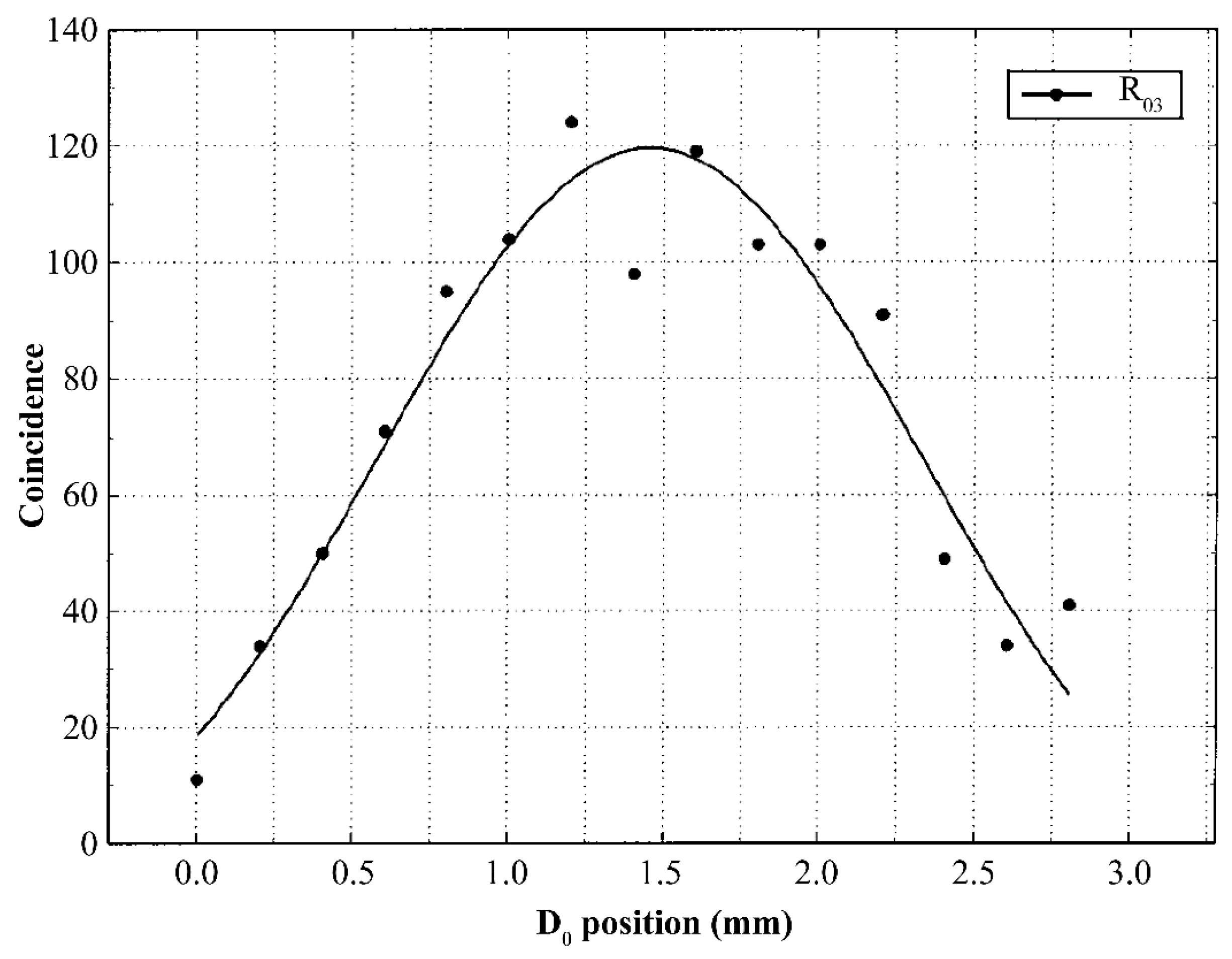
The experimental results can be summarized as follows. Figure 7 shows the joint detection rate R01 and R02 against the x coordinates of detector D0. In both cases, a clear Young’s double-slit interference pattern is observed. There is a phase difference of π between the two interference patterns of R01 and R02. Figure 8 shows the joint detection rate R03 between D0 and D3; here, no interference pattern is discernible. These results are conventionally interpreted as follows. The interference patterns in R01 and R02 arise because detectors D1 and D2 cannot determine whether the idler photons traveled along path A or path B. The absence of an interference pattern in R03, by contrast, is attributed to the fact that detector D3 can identify the path taken by the idler photons. In this view, one can select whether an interference pattern appears, and hence whether the photon behaves as a wave or as a particle, depending on whether the photon’s path is determined. It is further interpreted that one can retroactively choose the quantum’s wave-like or particle-like behavior by selecting the photon’s path even after the detection process is complete.
If photons are regarded as waves that interact at a single spatial point, the results of this experiment admit a different interpretation. Two entangled photons are emitted from paths A and B of the BBO. Although the signal and idler photons are emitted simultaneously, the optical path lengths are adjusted so that the signal photon reaches detector D0 8 ns before the idler photon reaches detectors D1, D2, D3, or D4. At the moment a signal photon is detected by D0, the signal photon’s wave packet collapses; the idler photon, however, has not yet arrived at its detector and remains in its wave packet state. The idler wave packet from path A is divided into two components by beam splitter BSA: one directed toward detector D3 and the other toward mirror MA. The component reflected by mirror MA is further divided by beam splitter BS, with one portion reflected toward detector D1 and the other transmitted toward D2. The component of wave packet A directed toward D1 combines with the component of wave packet B transmitted through beam splitter BS. Meanwhile, the component of wave packet A directed toward D2 combines with the component of wave packet B reflected by beam splitter BS. The system is configured so that wave packets A and B arriving at detector D1 reinforce each other when in phase and cancel when out of phase; for detector D2, the converse holds, with reinforcement occurring for out-of-phase wave packets and cancellation for in-phase ones.
The phase relationships of the photons detected at D0, D1, D2, and D3 are summarized below for two cases:
1) Case where signal photons A and B are in phase:
The wave function of the wave packets entering detector D0 is a superposition of in-phase signal photons:
where and denote the wave packets of signal photons originating from paths A and B, respectively, and θ denotes the photon phase.
Because the idler photons are entangled with the signal photons, they are in phase with the signal photons immediately after emission from the BBO crystal. The idler photon from path A entering detector D1 undergoes two reflections, so its phase is inverted twice and returns to its original value. The idler photon from path B entering D1 undergoes a single reflection, resulting in a phase inversion. The wave function of the wave packets entering detector D1 is therefore
where and are the wave packets of the idler photons originating from paths A and B, respectively.
Similarly, the idler photon from path A entering detector D2 undergoes a single reflection at mirror MA, acquiring a phase inversion. The idler photon from path B undergoes a total of two reflections, at mirror MB and beam splitter BS, and its phase returns to its original value. The wave function of the wave packets entering detector D2 is:
As Equations (9) and (10) indicate, the waves entering detectors D1 and D2 consist of out-of-phase combinations. When signal photons A and B are in phase, they are consequently detected only at detector D2. Although individual signal photons are detected randomly at single spatial points by detector D0, the cumulative detection results exhibit the interference pattern given by Equation (8).
2) Case where signal photons A and B are out of phase:
The wave function of the wave packets entering detector D0 is a superposition of out-of-phase photons:
Following the same reasoning as before, the idler photon from path A entering detector D1 undergoes two phase inversions and thereby returns to its original phase. The idler photon from path B, which begins in an out-of-phase state, undergoes a single inversion and consequently becomes in phase with the original reference. The wave function of the wave packets entering detector D1 is
For detector D2, the idler photon from path A undergoes a single reflection, acquiring a phase inversion. The idler photon from path B undergoes two reflections and returns to its original out-of-phase state. The wave function of the wave packets entering detector D2 is
As indicated in Equations (12) and (13), the waves entering detectors D1 and D2 consist of in-phase combinations. When signal photons A and B are out of phase, they are therefore detected only at detector D1. The cumulative detection results at D0 exhibit the interference pattern given by Equation (11).
From these results, it is clear that the coincidence rate R01 between detectors D0 and D1 displays the interference pattern of Equation (11), while the coincidence rate R02 between D0 and D2 displays the interference pattern of Equation (8), shifted in phase by π. Because detector D3 receives photons exclusively from path B, however, the phase relationship relative to photons from path A remains undetermined. The coincidence rate R03 between detectors D0 and D3 therefore consists of a superposition of both the in-phase and out-of-phase interference patterns, which are mutually indistinguishable. The absence of a visible interference pattern in R03 does not arise because the photon’s path was identified; it arises because two opposing interference patterns are superimposed and cannot be individually resolved. Nor does this result imply that one can retroactively select whether the quantum behaves as a wave or as a particle; rather, interference patterns are inherently present in all detection results of the signal photons.
5. Why Photons and Electrons Appear to Behave Like Particles
As noted above, photons are waves propagating in accordance with Maxwell’s equations, and electrons are waves propagating in accordance with the Dirac equation. Yet both are also commonly regarded as particles. Several reasons account for this apparent particle-like behavior.
The first reason is that photons and electrons can be counted individually, and upon observation they invariably appear as minute, localized points. A photon carries a minimum energy quantum, E = hν, and cannot be subdivided further. When the intensity of light is progressively reduced, individual detection events appear on a screen as discrete points that can be tallied one by one. An electron similarly appears as a point of no discernible size. In everyday experience, entities that can be counted individually and appear as points are naturally identified as particles. A spatially extended wave, however, can equally well be counted one by one and appear point-like, provided its energy is quantized and its interactions are confined to a single spatial point.
The second reason is that charged particles such as electrons leave continuous tracks as they travel through space. The tracks observed in cloud chambers give the impression that particles have traversed the medium.[22] Tracks in spark chambers convey the same impression.[23] In a cloud chamber, however, these tracks are nothing more than a succession of droplets that form when charged particles ionize the gas molecules, with the resulting ions acting as condensation nuclei. In a spark chamber, the tracks consist of a series of luminous gas discharges produced when charged particles excite gases such as helium or neon. This phenomenon is equally well explained by treating the trail as the propagation of a wave rather than the passage of a particle. As the wave packet of a charged particle propagates through a gas, it alters the local electromagnetic field at each point along its path. Where this field is sufficiently strong, it interacts with atomic electrons and ionizes them. A high-voltage pulse applied immediately after ionization then generates a visible spark along the ionized path.
We do not directly observe electrons moving as particles from moment to moment. What we observe is the wake left by the electron’s wave packet, from which we infer that a particle has passed. In everyday experience, the distinction between particles and waves is clear: particles are physical objects, whereas waves are propagating changes of state. The same distinction applies in the domain of elementary particles.
6. Conclusions
More than a century has elapsed since the founding of quantum mechanics, yet no consensus on its interpretation has been achieved. This persistent impasse likely reflects two unresolved difficulties: the inability to explain why quantum entities appear to exhibit both wave-like and particle-like behavior, and the lack of a clear account of the probabilistic and nonlocal character of quantum phenomena. As argued in this paper, particle-like behavior originates from interactions occurring at a single spatial point. Probabilistic behavior originates from the randomness of these interactions. Nonlocality originates from the conservation of physical quantities, a principle that transcends the constraints of space and time. The locality characteristic of relativity arises from the propagation of waves, whereas the nonlocality characteristic of quantum mechanics arises from the conservation of physical quantities. Relativity governs only the propagation of quantum waves; the interactions occurring at the points where waves propagate are governed by probability and by the conservation of physical quantities. Because interactions are probabilistic, the misconception arose that the wave function represents nothing more than a probability distribution, thereby denying the physical reality of the wave. In the framework proposed here, however, electrons move as genuine waves, exactly as described by the wave function.
Einstein famously declared, “God does not play dice,” expressing deep objection to probabilistic uncertainty. He further characterized quantum entanglement as “spooky action at a distance,” rejecting the nonlocality that he considered irreconcilable with relativity. He never accepted quantum mechanics in its entirety. Had the origins of probabilistic uncertainty and nonlocality been properly elucidated during his lifetime, he might have reached a different conclusion.
Although the interpretation proposed in this study contributes to an intuitive understanding of quantum phenomena, it remains at this stage a conceptual model. To place this framework on firmer ground, it will be necessary to formalize mathematically the dynamics of energy exchange at a single point and to verify the quantitative consistency of the resulting theory with established quantum field theory through application to many-body systems.
Author Contributions
Conceptualization, methodology, investigation, formal analysis, writing—original draft preparation, writing—review and editing: [Author Name]. The author has read and approved the published version of the manuscript.
Funding Statement
This research received no external funding.
Data Availability Statement
Not applicable.
Acknowledgments
The author gratefully acknowledges the American Physical Society for permission to reproduce Figures 6, 7 and 8 from [Y. H. Kim et al., Phys. Rev. Lett. 84, 1 (2000)]. The author would like to thank Enago (www.enago.jp) for the English language review.
Declaration of Conflicting Interest
The author declares no conflict of interest.
References
- Bohr, N. Nature 1928, 121, 580. [CrossRef]
- L. de Broglie, J. Phys. Radium 1927, 8, 225. [CrossRef]
- Bohm, D. Phys. Rev. 1952, 85, 166. [CrossRef]
- Everett, H. Rev. Mod. Phys. 1957, 29, 454. [CrossRef]
- Zurek, W. H. Rev. Mod. Phys. 2003, 75, 715. [CrossRef]
- Landau, L. D.; Lifshitz, E. M. Electrodynamics of Continuous Media; Pergamon Press: Oxford, 1963. [Google Scholar]
- Schrödinger, E. Ann. Phys. 1926, 384, 489. [CrossRef]
- Dirac, P. A. M. Proc. R. Soc. Lond. A 1928, 117, 610. [CrossRef]
- S. Weinberg, The Quantum Theory of Fields; Cambridge University Press, 1995/1996. [CrossRef]
- L3 Collaboration. Phys. Lett. B 2000, 489, 81. [CrossRef]
- M. Born, Z. Phys. 1926, 37, 863. [CrossRef]
- J. von Neumann, Mathematical Foundations of Quantum Mechanics; Princeton University Press, 1955. [CrossRef]
- Einstein, A. Ann. Phys. 1905, 17, 891. [CrossRef]
- Einstein; Podolsky, B.; Rosen, N. Phys. Rev. 1935, 47, 777. [CrossRef]
- Aspect; Dalibard, J.; Roger, G. Phys. Rev. Lett. 1982, 49, 1804. [CrossRef]
- Hensen; Bernien, H.; Dréau, A. E.; Reiserer, A.; Kalb, N.; Blok, M. S.; Ruitenberg, J.; Vermeulen, R. F. L.; Schouten, R. N.; Abellán, C.; Amaya, W.; Pruneri, V.; Mitchell, M. W.; Markham, M.; Twitchen, D. J.; Elkouss, D.; Wehner, S.; Taminiau, T. H.; Hanson, R. Nature 2015, 526, 682. [CrossRef] [PubMed]
- Bell, J. S. Physics 1964, 1, 195. [CrossRef]
- Einstein, A. Ann. Phys. 1905, 322, 132. [CrossRef]
- Landau, L. D.; Lifshitz, E. M. Quantum Mechanics: Non-Relativistic Theory; Pergamon Press: Oxford, 1977. [Google Scholar]
- Feynman, R. P.; Leighton, R. B.; Sands, M. The Feynman Lectures on Physics, Vol. III; Addison-Wesley: Reading, MA, 1965. [Google Scholar]
- Kim, Y. H.; Yu, R.; Kulik, S. P.; Shih, Y. H.; Scully, M. O. Phys. Rev. Lett. 2000, 84, 1. [CrossRef] [PubMed]
- Wilson, T. R. Proc. R. Soc. Lond. A 1912, 87, 277. [CrossRef]
- Fukui, S.; Miyamoto, S. J. Phys. Soc. Jpn. 1959, 14, 112. [CrossRef]
Figure 1.
Electron–electron forces mediated by photon exchange.
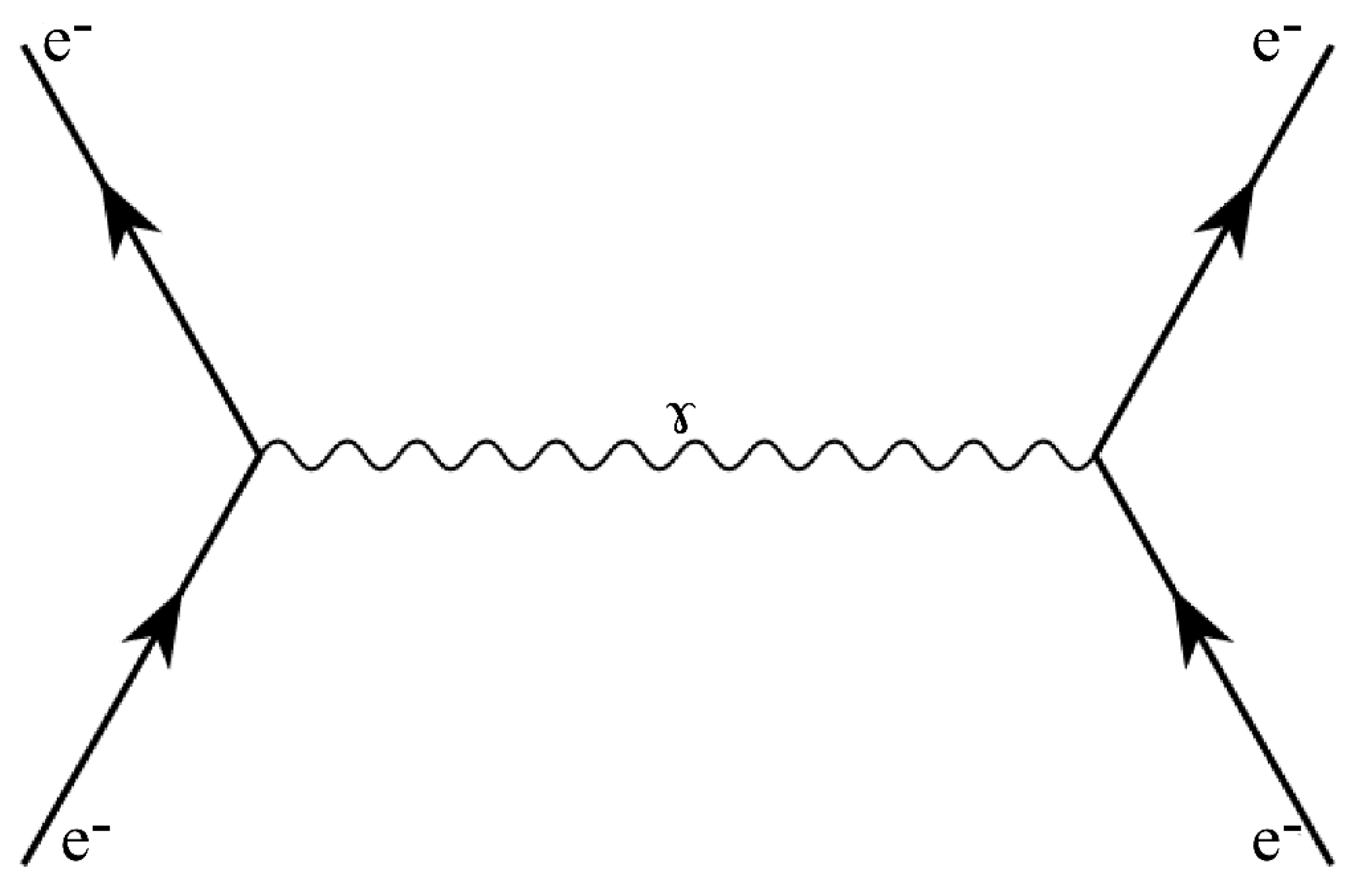
Figure 2.
Force arising from the electromagnetic field generated by electrons.
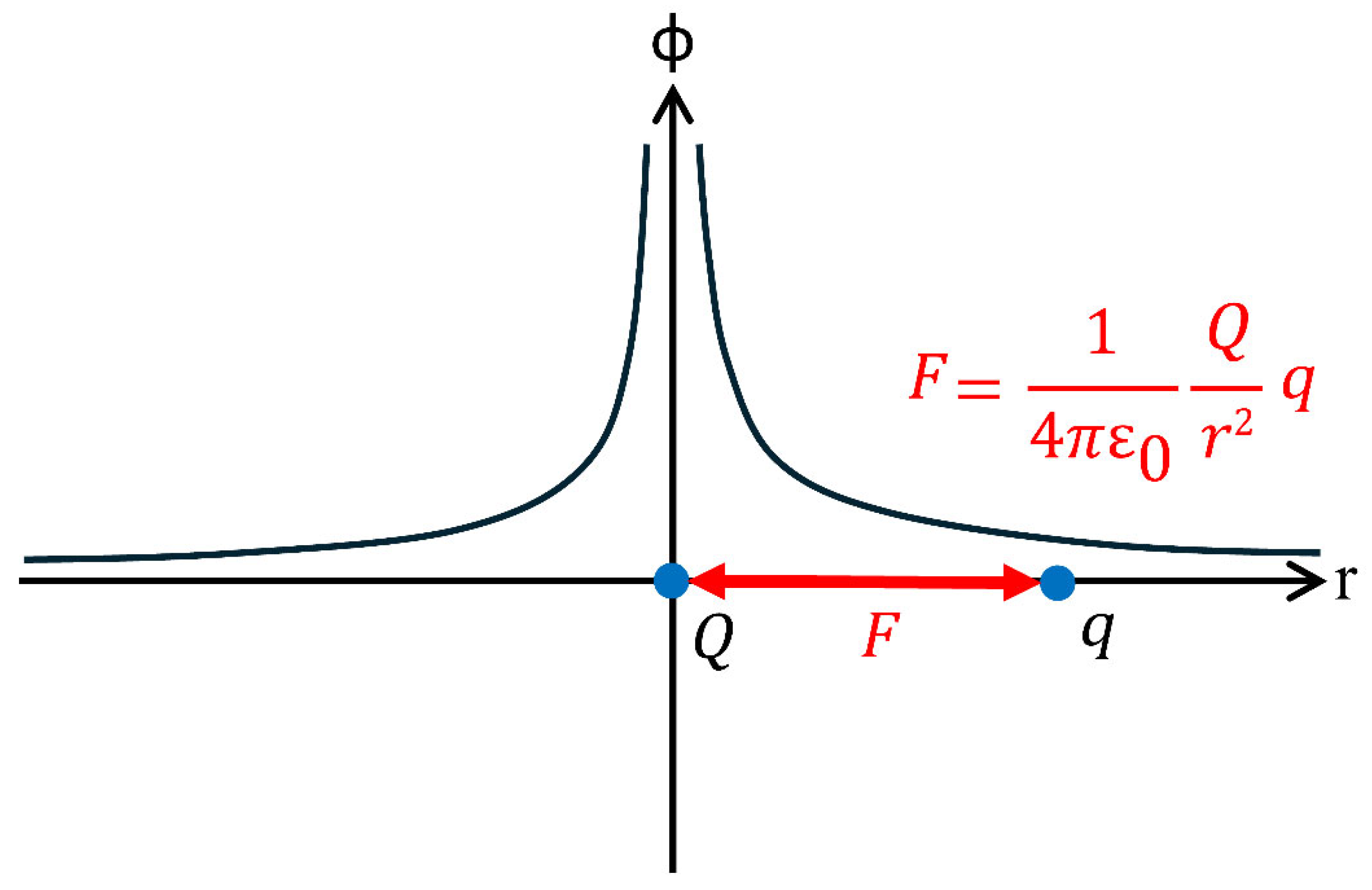
Figure 3.
Photoelectric effect.
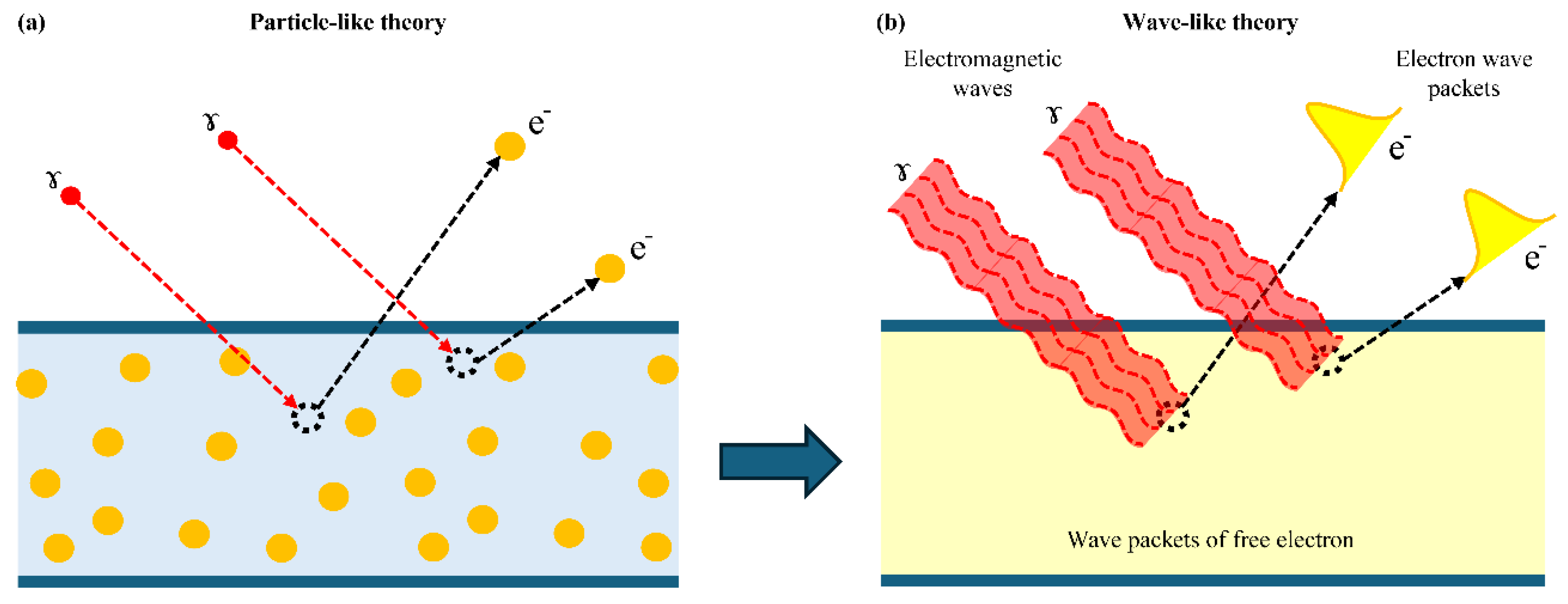
Figure 4.
Tunneling effect.
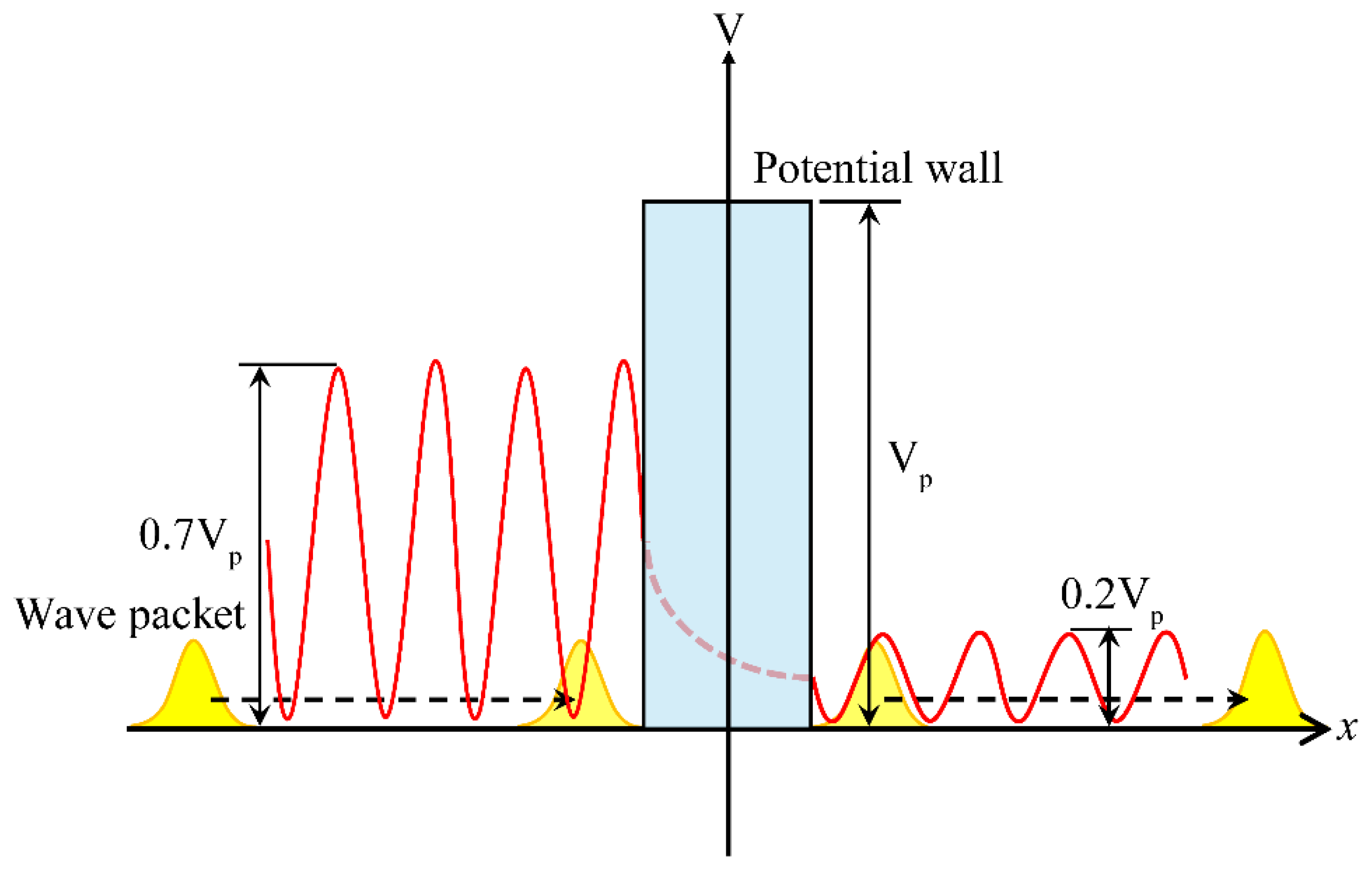
Figure 5.
Double-slit experiment with electrons.
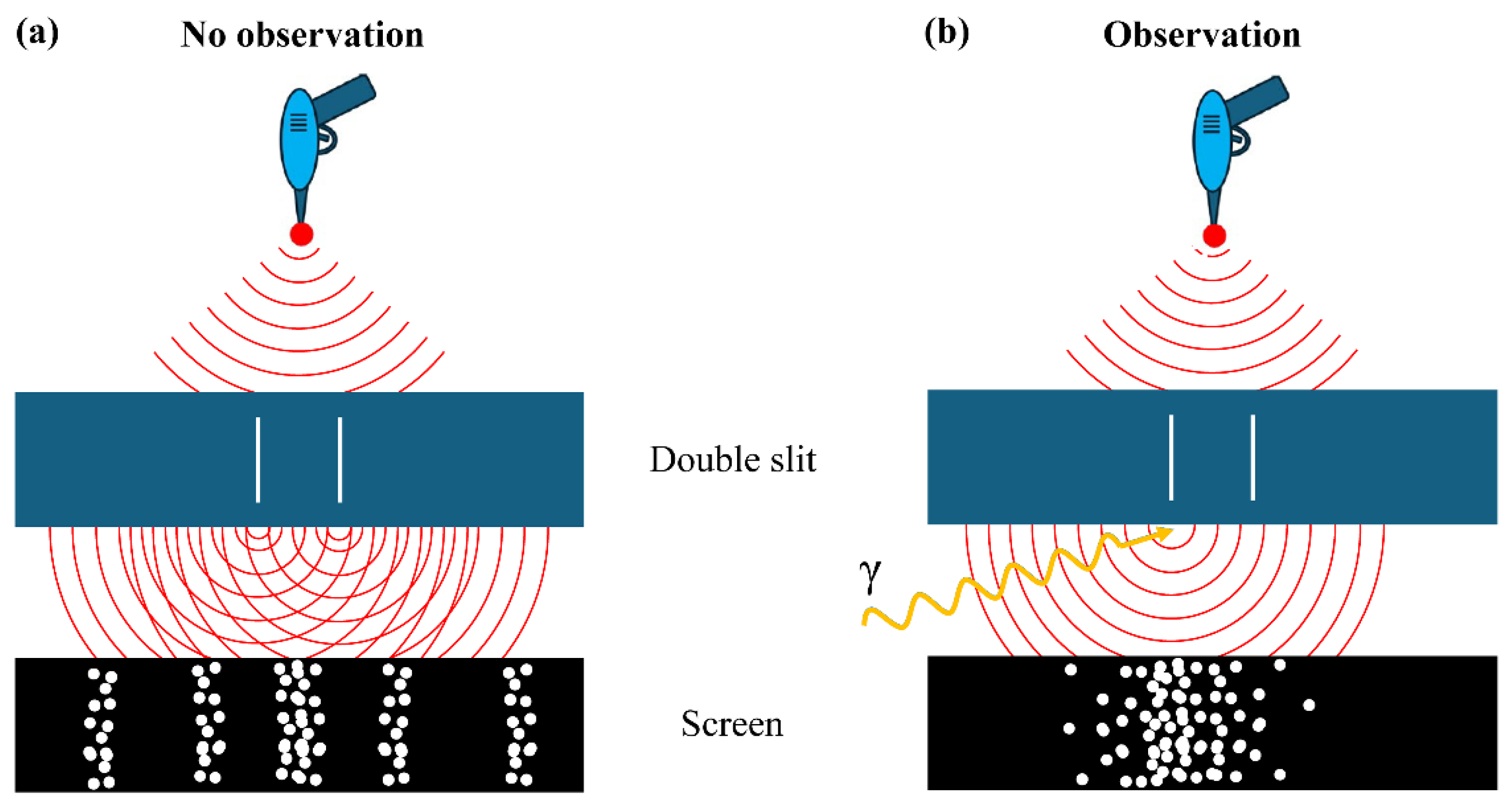
Figure 6.
Schematic of the experimental setup (Reprinted[21]).
Figure 6.
Schematic of the experimental setup (Reprinted[21]).
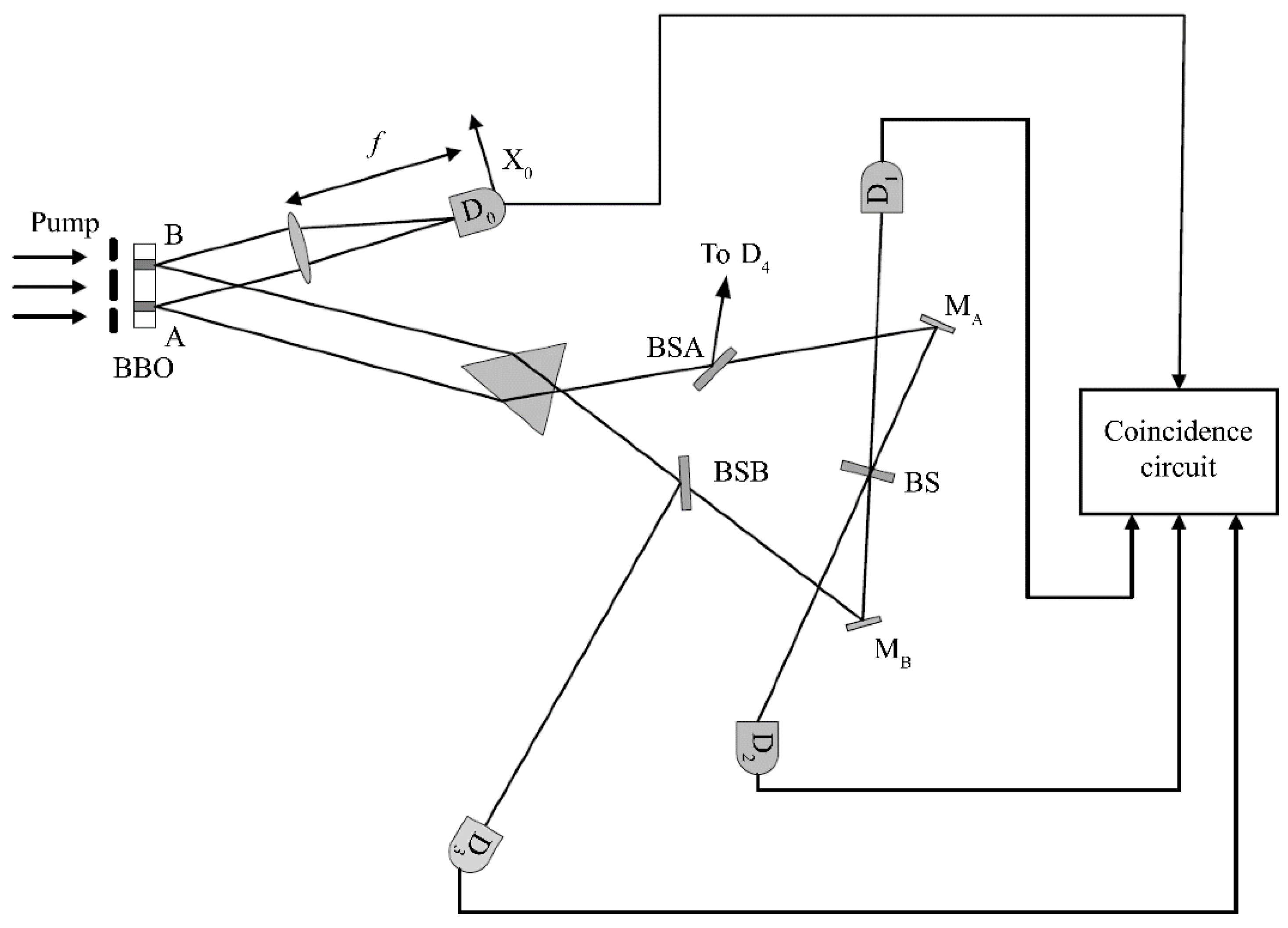
Figure 7.
Joint detection rate R01 and R02 against the x coordinates of detector D0. (Reprinted[21]).
Figure 7.
Joint detection rate R01 and R02 against the x coordinates of detector D0. (Reprinted[21]).
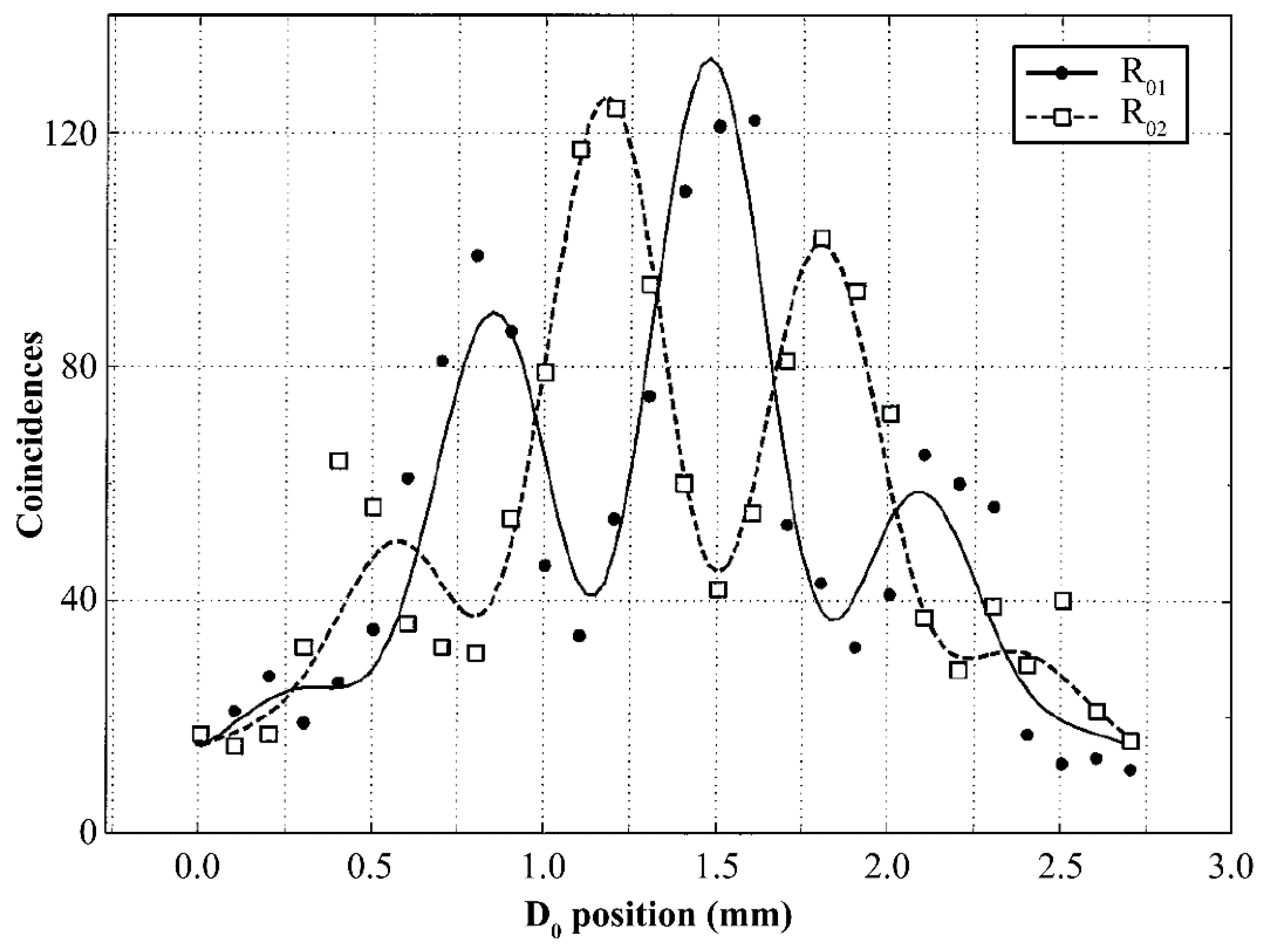
Figure 8.
Joint detection rate R03 between D0 and D3 (Reprinted[21]).
Figure 8.
Joint detection rate R03 between D0 and D3 (Reprinted[21]).
Disclaimer/Publisher’s Note: The statements, opinions and data contained in all publications are solely those of the individual author(s) and contributor(s) and not of MDPI and/or the editor(s). MDPI and/or the editor(s) disclaim responsibility for any injury to people or property resulting from any ideas, methods, instructions or products referred to in the content. |
© 2026 by the authors. Licensee MDPI, Basel, Switzerland. This article is an open access article distributed under the terms and conditions of the Creative Commons Attribution (CC BY) license (http://creativecommons.org/licenses/by/4.0/).
Copyright: This open access article is published under a Creative Commons CC BY 4.0 license, which permit the free download, distribution, and reuse, provided that the author and preprint are cited in any reuse.


